Reviewing Std 6 Basic Science Notes Pdf English Medium and Kerala Syllabus Class 6 Basic Science Chapter 3 Let’s Stand Straight Question Answer SCERT Solutions Notes Pdf can uncover gaps in understanding.
Class 6 Basic Science Chapter 3 Let’s Stand Straight Question Answer Notes
Basic Science Class 6 Chapter 3 Question Answer Notes Let’s Stand Straight
Let’s Stand Straight Class 6 Questions and Answers Notes
Let Us Assess
Question 1.
Which of the following is not a function of the skeleton?
a. Give shape
b. Gives stability
c. Provides protection
d. Gives energy
Answer:
d. Gives energy
Question 2.
Draw and match the correct ones.

Answer:
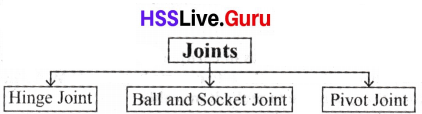
Ball and Socket Joint → The round end of one bone rotates in the cavity of another bone.
Hinge Joint → Can move only to one side.
Pivot Joint → One bone rotates on the other to both sides.

Question 3.
Which food items should be included in a healthy diet for strong bones?
Answer:
Calcium: Found in dairy products like milk, yoghurt.
Protein: Important for bones, and found in meat, poultry, fish, eggs, dairy, and beans.
Magnesium: Found in leafy green vegetables, nuts, seeds, whole grains, and cheese.
Question 4.
Your friend fell down during a football game and fractured his arm. What first aid would you give?
Answer:
- Keep it Still (Use a Splint)
- Put Something Cold on It.
- Get help immediately
Basic Science Class 6 Chapter 3 Question Answer Kerala Syllabus

Question 1.
Are all fishes the same? How are they different from each other?
Answer:
Size
Colour
Question 2.
Shall we make a model of a fish? What materials are required for this?
Answer:
Materials Required:
- Fabric
- Buttons or beads (for eyes)
- Midribs of a coconut palm
- Glue or thread
Steps to Make the Fish Model:
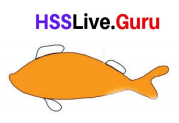
Fish Model :1
- Gut two pieces of fabric in the shape of a fish, each the size of your palm.
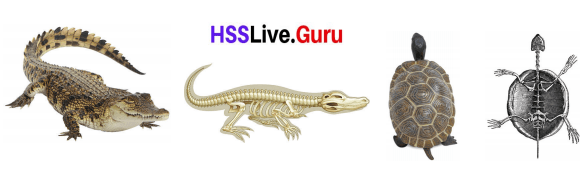
- Decorate the fabric fish by sticking buttons or beads as its eyes.
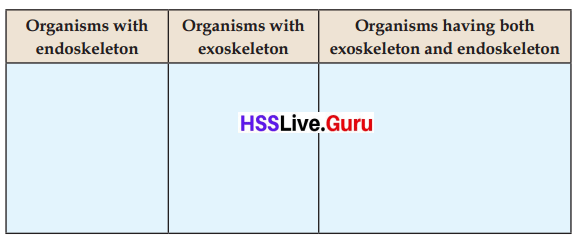
Question 3.
Now, hold the tail portion of the fish and try to make it stand upright. Does the fish stand straight?
Answer:
No
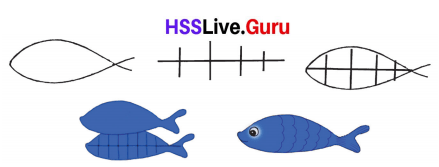
Fish Model: 2
- Cut the midribs of coconut palms and join them together to create the shapes shown in the picture. Use glue or thread to secure them.
- Stick the fish-shaped fabric pieces onto both sides of the palm rib structure.
Question 4.
Hold this fish by its tail portion and make it stand straight. Didn’t you succeed? What could be the reason for this? Discuss.
Answer:
Yes
The coconut palm ribs are like bones for fabric fish. They are stiff and strong. When you put these ribs inside the soft fabric fish, they give it a strong “skeleton”. This “skeleton” helps the fish stay firm and not flop over, so it can stand up straight when you hold its tail.
Question 5.
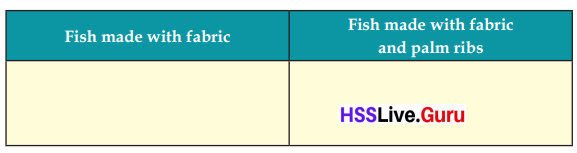
What differences did you observe between the fish made only with fabric and the fish made with fabric and palm ribs?
Answer:
| Fish made with fabrics | Fish made with fabrics and palm ribs |
| • Does not stand straight • Lacks rigidity. |
• Stands straight • The palm ribs provide a rigid internal support structure. |
Question 6.
a) Fabric pieces ere used ¡n both instances. Then why is it that only the second fish you made stood
straight?
Answer:
Palm ribs were used to make the second fish.
b) Palm ribs were used to make the second fish. What could be the reason for that?
Answer:
To give a shape
To give support
To provide stiffness
Question 7.
You must have observed real fish
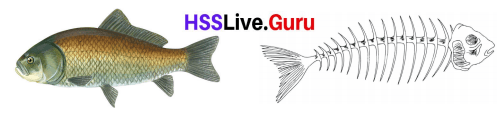
a) When you eat fish, don’t you see the fish bones inside it?
Answer:
Yes
b) Don’t they resemble the part made with palm ribs in the fish you had made? Observe the picture and find out.
Answer:
Yes
c) Do only fish have such parts
Answer:
All living things have such parts
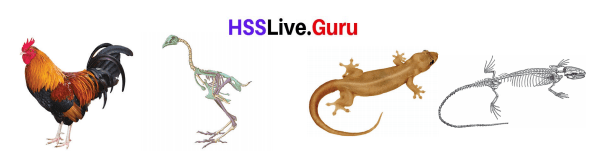
This internal framework, made of bones, is called the skeleton. The skeleton’s primary role is to provide shape and support to the body of an animal, preventing it from collapsing and allowing it to stand and move.
Question 8.
a) Observe the pictures given below. These are the skeletons of various animals. Can you identify the animals to which these skeletons belong? Write down your answers.
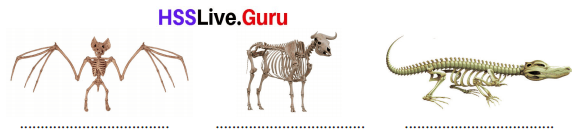
Answer:
Bat
Cow or Ox
Lizard
b) How could you identify the animal by observing the skeleton?
Ans:
Each animal’s skeleton has a distinct form that is characteristic of its species.
Question 9.
Skeletons have weight, then how are birds able to fly?
Answer:
Birds have air cavities (empty spaces filled with air) in their bones.
- This makes their skeleton lighter compared to other organisms.
- This adaptation helps birds to fly.
Question 10.
Penguins cannot fly. Why is it that some birds cannot fly? Write your findings in the Science Diary.
Answer:
- The body is too Heavy
- Very small wings
- The body shape is not suitable for flying.
Question 11.
Find out and list the birds that can’t fly.
Answer:
Emus, Kiwis, Ostriches, Cassowary, Kakapo, Penguins

Question 12.
Which parts have long bones?
Answer:
Arms and legs
Question 13.
Where are the short bones found?
Answer:
Short bones are found in the wrists and ankles.
Question 14.
Examine which bone moves while chewing food.
Answer:
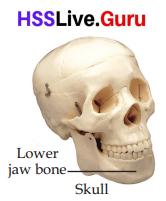
Lower jaw bones
Question 15.
Write down the name of the major organ protected inside the skull.
Answer:
The major organ protected inside the skull is the brain. Skull also provides protection to sensory organs such as the eyes, ears, nose, and tongue.
Question 16.
Observe the picture of the skull to understand the importance given by the human body places on protecting the brain.
Answer:
- The skull is made of strong bone to protect the brain from injury.
- It covers the brain fully from all sides.
- Small openings are provided only for nerves and blood vessels. .
- It acts like a helmet for the brain.
Question 17.
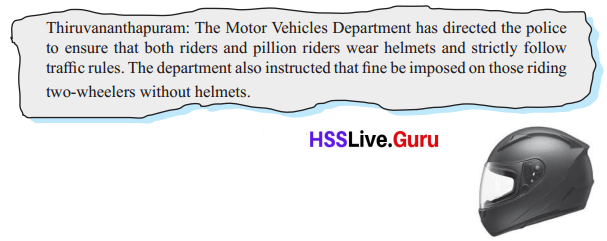
Can you explain the need for wearing helmets while riding two-wheelers? Discuss in the class and write it in your Science Diary.
Answer:
- Protection Against Head and Brain Injuries
- Protection for Face and Jaw.
- Enhanced Visibility and Awareness.
- Reduced Risk of Serious Injury.
Question 18.
Where is our vertebral column found?
Answer:
Our vertebral column, also known as the spine or backbone, is found in the back of our body.
Question 19.
Where are the ribs located?
Answer:
The ribs are located in the chest cavity, forming a cage-like structure called the rib cage.
Question 20.
Answer the following questions and write them in your science diary
a) How many bones are there in the skull?
Answer:
22
b) Among the bones in the skull, which one is capable of movement?
Answer:
Lower Jawbone.
c) How many vertebrae are there in the vertebral column?
Answer:
33
d) Which is the protective covering of the spinal cord?
Answer:
Vertebral column
e) What is the main function of the vertebral column?
Answer:
Supports the body, allows movement, and protects the spinal cord.
f) Which bones protect the heart and lungs?
Answer:
Rib cage
g) Which are the major organs protected by the skull?
Answer:
Brain and Sensory organs
BONES IN ARMS AND LEGS
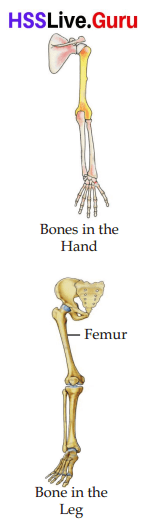
Question 21.
How many bones are there in each human arm?
Answer:
Each human arm has 32 bones.
Question 22.
How many bones are there in each human leg?
Answer:
Each human leg has 31 bones.
Question 23.
Which is the longest bone in the Human body ,
Answer:
Femur
Question 24.
Do the arms have more mobility than the legs ?
Answer:
Yes, arms have more mobility than legs primarily due to the design of the shoulder joint compared to the hip joint, and their different primary functions.
Question 25.
Humans have the ability to stand on two legs. Bones in the legs are stronger than those in the arms. Why is it so?
Answer:
- Humans stand and walk using their legs.
- Legs support the entire weight of the body.
- To carry this weight, leg bones need to be very strong.
- Arms do not carry body weight, so their bones are lighter.
- Strong leg bones help in balance, walking, and running
Question 26.
Why does the number of bones in the human body decrease from about 300 at birth to 206 in adulthood?
Answer:
At birth, our body has about 300 bones. As we reach adulthood, many of these bones fuse together, reducing the total number to 206.
Question 27.
Calculate the total number of bones in the human body.
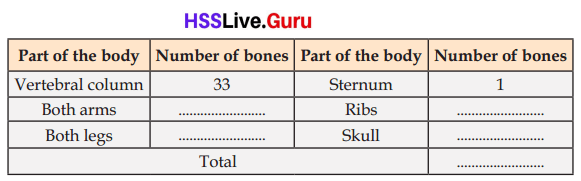
Answer:
| Part of the body | Number of bones | Part of the body | Number of Bones |
| Vertebral column | 33 | Sternum | 1 |
| Both arms | 64 | Ribs | 24 |
| Both legs | 62 | Skull | 22 |
| Total | 206 | ||
Question 28.
Bones are responsible for the production of blood cells and the storage of minerals. Consolidate the functions of bones and write them in your Science Diary.
Answer:
- The skeleton gives shape to the body
- Provide Support
- Protection
- Bones help in movement
Question 29.
Let’s do an activity.
Take thin pipes used for wiring and put it on your fingers as shown in figure. Now, try writing in a book with that hand using a pen. Are you able to write? What is the reason?
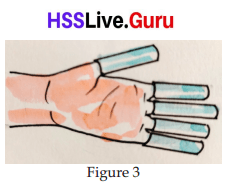
Answer:
No, the main reason is that the thin pipes act like splints or casts on your fingers.
- Prevents Bending at Joints
- Reduce flexibility
- Loss of Grip strength and control
Question 30.
What if all the bones in our body were just a single bone? What difficulties would we face?
Answer:
- No Bending or Moving
- No protection for organs
- No shape
We are able to move our bones because we have joints.
Question 31.
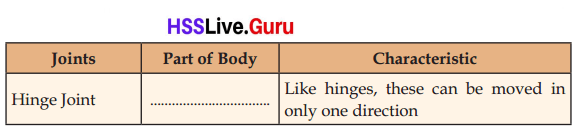
Complete the table and discuss the location and characteristics of hinge joints.
Answer:
| Joints | Part of the Body | Characteristic |
| Hinge Joint | Elbow, Knee, Fingers, Toes | Like hinges, these can be moved in only one direction |
Question 32.
a) Let’s create a model of a hinge joint.
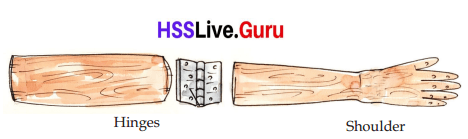
To make a hinge joint, make separate pieces of cardboard or multiwood in the shapes of the parts of a hand, as shown in the picture. How can these two parts be joined? Write in your Science Diary how these parts can be joined using a hinge to make it movable.
Answer:
Align the pieces: Place the two cardboard/multiwood pieces next to each other, with the ends you want to join. Imagine them as the upper arm and forearm meeting at the elbow.
• Position the hinge: Place the hinge over the joint where the two pieces meet.
• Attach the hinge: If using multiwood, you would typically use small screws to attach each side of the hinge to its respective multiwood piece. If using cardboard, you would use strong adhesive, like hot glue or super glue, to firmly attach each leaf of the hinge to the cardboard pieces. You might also reinforce it with tape if needed.
Once the hinge is securely attached to both pieces, they will be able to move around the hinge’s central pin, mimicking the bending motion of a hinge joint in the body, like an elbow or a knee.
b) What are the similarities between the movement of the elbow and that of the model of the hand?
Answer:
The biggest similarity is that both can only move in one direction, like a door.
BALL AND SOCKET JOINT
Question 33.
Is the movement of the shoulder joint similar to that of the elbow and knee?
Answer:
No, the movement of the shoulder joint is not similar to that of the elbow and knee joints.
Question 34.
Try moving your arms sideways. Can’t the shoulder joint be moved in all directions? How is this possible?
Answer:
This is possible because the shoulder joint is a special type of joint called a Ball and Socket Joint.
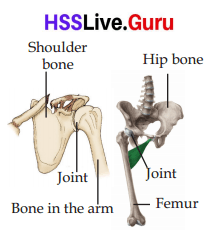
- The ball and socket joint is the joint with maximum freedom of movement.
- It is arranged in such a way that the round end of one bone (ball) is able to rotate in the cavity (socket) of another bone.
- Therefore, it is called the ball-and-socket joint. This type of joint is found in the shoulder and hip.
Question 35.
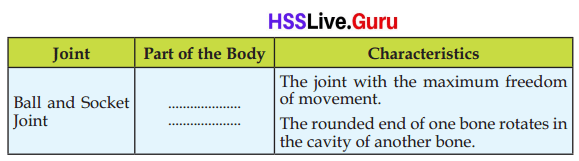
Identify the areas in our body where ball-and-socket joints are found. Complete the table and write it in your science diary
Answer:
| Joint | Part of the Body | Characteristics |
| Ball and Socket Joint | Shoulder, Hip | The joint with the maximum freedom of movement. The rounded end of one bone rotates in the cavity of another bone. |
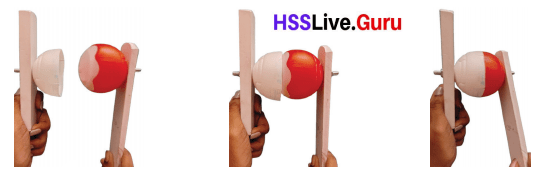
Let’s create a model of the ball-and-socket joint.
Make use of the materials provided for that.
Materials: 2 ice cream balls (big – 1, small – 1), Wooden scale – 2, Nuts and bolts – 2 each
Cut off a small part of the big ice cream ball in such a way that the small ice cream ball remains fitted inside it. Fix the two ice cream balls on the wooden scales using nuts and bolts, as shown’in the picture. Hold the scale with the large ice cream ball in one hand and try rotating the scale with the small ice cream ball. It resembles the movement of the shoulder.
Question 36.
What is the peculiarity of the neck joint? How much can it be rotated?
Answer:
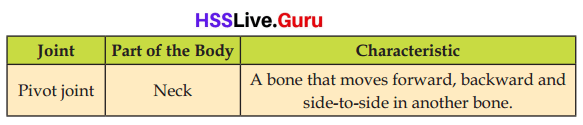
It is possible to move it forward, backwards, towards the left, and right. This type of joint is called a pivot joint.
Observe the table showing the body parts where pivot joints are found and their characteristics.
Let’s make a model of the pivot joint.
To make a model of the pivot joint, take a powder tin. Fix the head of a doll on the lid of the powder tin to make a model of the pivot joint. Just as we turn our neck sideways, the doll’s neck can also be turned.
Question 37.
List out the three types of Joints in our body and their characteristics in the table.
Answer:
| Type of joints | Characteristics |
| Hinge joint | Movement only in one direction (e.g., Elbow, Knee, Fingers) |
| Ball and socket joint | The joint with the maximum freedom of movement. The rounded end of one bone rotates in the cavity of another bone.(e.g., Shoulder, Hip) |
| Pivot Joint | A bone that moves forward, backwards and side-to-side in another bone, (e.g., Neck) |
Question 38.
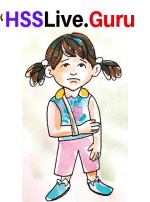
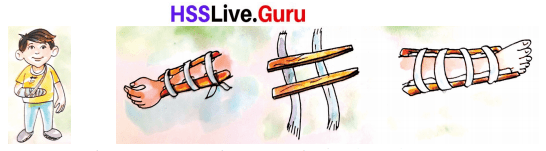
Look at the child’s right arm in the picture. What happened. Why is it necessary to keep it bound in such a way?
Answer:
The Right arm of the child has a fracture.
- To immobilize the arm
- To support the arm
- To Protect the arm from further injury
- To Reduce pain
Question 39.
Prepare a note on different types of fractures and present it before the class.
Answer:
- Simple Fracture: This is when a bone cracks, breaks, or dislocates but doesn’t pierce through the skin.
- Compound Fracture: The bone breaks and pierces through the skin and muscles, often causing open wounds.
- Complicated Fracture: This is a type of compound fracture where the broken bone injures nearby internal organs.
Question 40.
How can we understand if there is a fracture?
Answer:
Pain in the injured area.
Difficulty in moving the injured part.
Differences when compared with similar parts.
If these symptoms are present, administer first aid immediately.
| X-Ray • X-rays were discovered in 1895. • The discoverer was Wilhelm Conrad Rontgen, • X-rays have the property of being able to pass through muscles but not through bones. |
Question 41.
What is the first aid that should be provided to someone with a fracture?
Answer:
- Immobilize the Injured Area
- Bandage the injured part using a splint.
- Apply cold (Ice Pack) .
- A person with a bone fracture should be taken to the hospital immediately after giving first aid.
Question 42.
a) What happens if the fractured part is moved or shaken?
b) How can we keep it immobilised?
Answer:
a) Movement directly irritates the broken bone ends and surrounding injured tissues, resulting in severe pain.
b) Use a Splint: A splint helps to hold the injured part still and prevents movement at the fracture site, as well as at the joints above and below it.
• The splint should be made with a strong plate of wood, metal or plastic. Do not try to move the injured part.
Question 43.
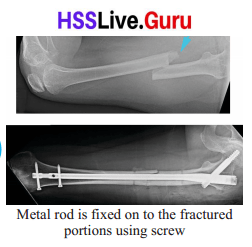
Why do we use a metal rod to fix a fractured bone?
Answer:
Usually, the fractured part is properly joined and fixed by screwing on metal rods. This helps the bones stay stable and heal quickly.
| Knee replacement is a surgical procedure to replace a diseased or worn-out knee bone with an artificial one made of ceramic, metal, and plastic. ■ Wear and tear of the knee caused by weight gain and decreased bone calcium. ■ Knee pain is associated with ageing. |
Question 44.
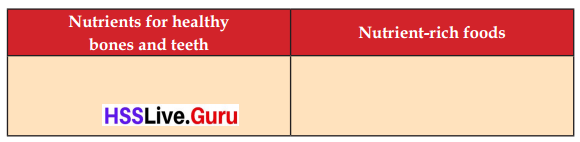
List the nutrients and nutrient-rich foods that are necessary for the health of bones and teeth.
Answer:
| Nutrients for healthy bones and teeth | Nutrient-rich foods |
| Calcium | Dairy products (milk, yoghurt, cheese), leafy green vegetables, sardines, and fortified cereals. |
| Vitamin D | Fatty fish, fortified milk and cereals, egg yolks, and sun exposure |
| Magnesium | Leafy green vegetables, nuts, seeds, legumes, whole grains, dark chocolate |
| Protein | Meat, poultry, fish, eggs, dairy, legumes, nuts, seeds |
| Zinc | Meat, shellfish, legumes, nuts, seeds, whole grains, dairy |
Milk and eggs are served in your school because they are essential for the health of your bones.
| BONES INSIDE THE EAR • Our ear has three parts. The middle ear contains three small bones: ■ Malleus ■ Incus ■ Stapes • These bones are capable of vibration. We hear sounds because of the vibrations they produce. • When these bones vibrate, sound is transmitted from the outer ear to the inner ear. • The stapes is the smallest bone in the human body. • The femur is the largest bone in the human body. |
Question 45.
Which animal is seen in the picture? Have you observed where its skeleton is situated?

Answer:
Yes, for a snail, its skeleton is situated on the outside of its body. This is called an exoskeleton, which is the shell you see.
Question 46.
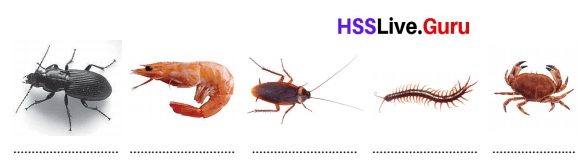
All the animals listed below have a skeleton outside their bodies. Identify and write their names.
Answer:
Beetle, prawns, cockroach, centipede, and crab
Question 47.
How does the outer skeleton benefit these organisms?
Answer:
They help to protect and give shape to their body and offer protection from enemies.
Question 48.
Can both exoskeleton and endoskeleton be found in the same organism?
Answer:
Animals like turtles, crocodiles and alligators have both endoskeleton and exoskeleton.
Question 49.
Classify some familiar organisms into those having an endoskeleton, an exoskeleton, and both.
Answer:
| Organism with endoskeleton | Organism with exoskeleton | Organism having both exoskeleton and endoskeleton |
| Human, Fish, Birds, Dog, Cow, Snake | Cockroach, Crab, Prawn, Snail, Beetle, Centipede | Crocodile/Alligator, Turtle |
| Exoskeleton: ■ Most invertebrates have an exoskeleton. ■ Insects represent the largest number of living beings with exoskeletons. ■ Organisms with an endoskeleton can also have parts similar to an exoskeleton. Examples include the scales of fish and reptiles, feathers of birds, hair, nails, horns, and hooves of animals. |
Class 6 Basic Science Chapter 3 Question Answer Extended Activities
Question 1.
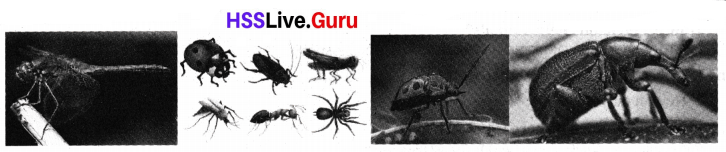
Haven’t you ever seen a variety of insects and beetles with colorful exoskeletons? Collect pictures of such organisms and prepare a digital album.
Answer:
To prepare a digital album, use a search engine like Google Images. You can search for things like:
- Colourful insects with an exoskeleton
- Jewel beetles
- Rainbow insects
- Dragonflies
Add descriptions: For each picture, write down the name of the insect and maybe one interesting fact about its exoskeleton.
Question 2.
Observe animals and see how they can move their body parts.
Answer:
| Animals | Movement of their body part |
| Humans | Use our legs to walk, run, and jump, and our arms to grab things. Our fingers are very flexible, allowing us to write and pick up small objects with ease. Our neck allows us to turn our head to look around. |
| Dogs/Cats | They walk and run on four legs. Their tails can wag side-to-side or up and down. They can bend their backs to stretch or pounce. |
| Birds | They use their wings to fly and their legs to walk, hop, or perch on branches. Their necks are very flexible, allowing them to preen their feathers. |
| Fish | They move through water by swishing their tails from side to side and using their fins for balance and steering. |
| Snakes | They don’t have legs, but they move by wiggling their entire body from side to side or by pushing off surfaces with their scales. |
| Insects | They use their legs to walk, run, or climb. Some have wings to fly. Their antennae can move to sense and detect smells. |
Question 3.
Let’s construct a pivot joint.
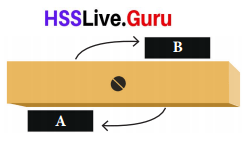
Take a wooden block measuring 15 cm. Secure it to a table using a screw, as shown in the picture, so that it can be turned in any desired direction. Fix the stoppers -A and B on both sides above and below the ends of the piece of wood as shown in the figure. Try turning the wooden block. Don’t you see a movement similar to that of a pivot joint?
Answer:
This activity is a great way to understand a pivot joint.
This movement is very similar to how a pivot joint works in our body (like in your neck). Your head can turn from side to side, but it doesn’t spin all the way around like a propeller. The wooden block model shows how one part (the block) can rotate or pivot around another part (the screw fixed to the table) within certain limits.
Let’s Stand Straight Notes Pdf
Let’s Stand Straight Class 6 Notes Kerala Syllabus
- The skeletal system is the framework that gives living things their shape, support, and protection.
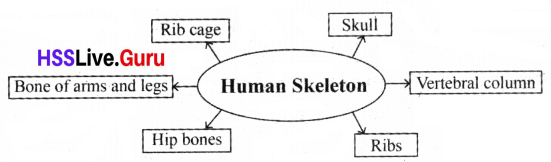
- The human skeleton is made up of key components: the skull, vertebral column (spine), ribs (forming the rib cage), and the bones of the arms and legs, and hipbones.
- Bones provide rigidity and shape to the body
- At birth, humans have about 300 bones, which fuse to 206 bones in adulthood.
- Bones are crucial for blood cell production and mineral storage.
- Skull: Made of 22 bones, it protects the brain and sensory organs (eyes, ears, nose, tongue). Only the lower jawbone is movable. Wearing a helmet is crucial for protecting the skull and brain from injury.
- Vertebral Column (Spine/Backbone): Consists of 33 vertebrae. It provides support for standing and walking and protects the spinal cord.
- Ribs: There are 12 pairs of ribs that form the rib cage. They protect vital organs, such as the heart, lungs, and major blood vessels.
- Arm and Leg Bones: Each arm has 32 bones, and each leg has 31 bones.
- The femur (thigh bone) is the longest bone in the human body.
- Leg bones are stronger than arm bones because they support the entire body weight for standing and movement.
- The stapes in the ear is the smallest bone in the human body.
- Cartilages are flexible tissues, softer than bones, found in areas like the bars, nose, and between vertebrae, providing support and strength.
- Joints are where two or more bones meet, enabling movement. Without joints, our body would be a single, immovable bone
- Hinge Joint: Allows movement in one direction (like a door hinge). Found in the elbow, knee, fingers, and toes.
- Ball and Socket Joint: Offers the maximum freedom of movement (a rounded bone end rotates in a cavity). Found in the shoulder and hip.
- Pivot Joint: Allows for rotational movement around a single axis. Found in the neck, allowing head movement forward, backwards, and side-to-side.
- A fracture is a bone breaking or cracking.
- First aid for a fracture: Immobilise the injured area (e.g., using a splint) to prevent further damage and reduce pain, and then seek immediate medical attention.
- Bone Health: Requires nutrients like Calcium, Vitamin D, Magnesium, Protein, and Zinc. Foods like dairy, leafy greens, fatty fish, nuts, and seeds are beneficial.
- Endoskeleton: Skeleton present inside the body. Exoskeleton: Skeleton present outside the body.
- Some animals, like snails, beetles, prawns, crabs, millipedes, and cockroaches, have skeletons on the outside of their bodies called exoskeletons.
- Exoskeletons provide protection and shape and offer defence against enemies.
- Animals like turtles and crocodiles have both an endoskeleton (internal) and an exoskeleton (external).
- Even animals with endoskeletons can have external features similar to exoskeletons, such as fish scales, bird feathers, and animal hair, nails, and hooves.
INTRODUCTION
This chapter explores the skeletal system, the framework that provides shape, support, and protection to living things. We will learn about the human skeleton, including key components- such as the skull and spine, and understand how joints enable movement. Additionally, we will discover animals with external skeletons, such as snails and crabs.
Haven’t you noticed that there are different kinds of fish in the water bodies near your school or home? It might also have many varieties of colourful fish. A picture of a pond is given below. See how beautiful the fish in it are! Observe each fish carefully.
SKELETON
The skeleton is the framework of bones that provides support and shape to the body and protects certain internal organs.
BONES ARE INSIDE US TOO
We also have bones inside our body. When you touch and examine different parts of your body, like your hands, legs, fingers, and head, you’ll notice that all bones are not the same.
THE HUMAN SKELETON
The skull, vertebral column, ribs, rib cage, bones of the arms and legs, and hipbones together form the human skeleton.
SKULL
The skull is made up of 22 bones.
HELMET: THE SHIELD OF LIFE
Pay attention to the news report:
VERTEBRAL COLUMN
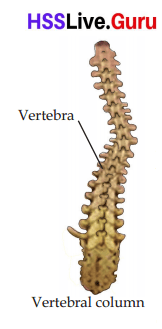
- The vertebral column is a series of bones that help the body stand straight and move.
- The bones in the vertebral column are called vertebrae.
- The vertebral column consists of 33 vertebrae.
- The spinal cord, which is an important part of the nervous system, passes through the vertebral column.
- It acts as a protective shield for the spinal cord.
- If the vertebral column is severely damaged, it will be difficult to stand or walk.
RIBS

- There are 12 pairs of ribs in the human body.
- The ribs enfold and protect the heart, lungs, and some major blood vessels.
- The ribs are connected to the vertebral column at the back and to the sternum in front.
CARTILAGES
- Cartilages are flexible parts that provide support and strength to the body, like bones.
- They are softer than bones and are found in both the human body and the bodies of other animals.
- Primarily, cartilages are found in the ears, nose, elbows, knees, ankles, trachea and the discs between the vertebrae.
JOINTS
A joint is the part where two or more bones meet. There are different types of joints in the human body. Some joints are movable, and some are immovable.
The picture of the bones in the human hand (Figure 1) and a model made of cardboard (Figure 2) are provided below. Carefully observe the figures and identify the differences between the two figures in relation to the movement of the hand.
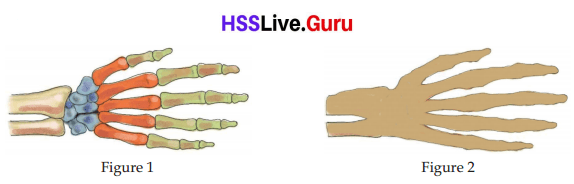
Figure 1: Has Joints, can bend, very flexible
Figure 2: No Joints, cannot bend, very stiff.
HINGE JOINT
The bones in the elbow and knee can be moved only in one direction. This type of joint, found in the elbow and knee, is called a hinge joint.
PIVOT JOINT
A pivot joint is a type of joint in the body that allows for rotational movement around a single axis.
FRACTURE
A fracture is the breaking or cracking of a bone. Fractures can occur in three ways, such as a simple fracture, a compound fracture, or a complicated fracture.
EXOSKELETON AND ENDOSKELETON
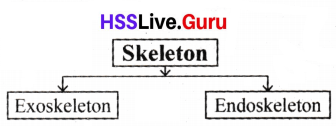
Snails, some types of beetles, mussels and crabs have thick outer covers. Organisms such as millipedes, centipedes, cockroaches, and prawns have relatively thin shells. Such coverings outside the body are called an exoskeleton.
Animals such as cats, frogs, mice, cows and humans have skeletons inside their body. This is the endoskeleton.
WONDERS FROM EXOSKELETON
All of these are made from the exoskeletons of various dead organisms.
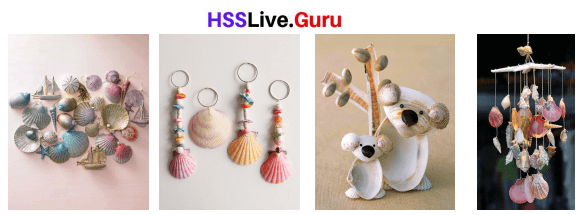
Make crafts using these types of exoskeletons of mussels, clams and conchs available around you and display them at home and in the class.