Reviewing Std 6 Basic Science Notes Pdf English Medium and Kerala Syllabus Class 6 Basic Science Chapter 4 Flowering and Fruiting Question Answer SCERT Solutions Notes Pdf can uncover gaps in understanding.
Class 6 Basic Science Chapter 4 Flowering and Fruiting Question Answer Notes
Basic Science Class 6 Chapter 4 Question Answer Notes Flowering and Fruiting
Flowering and Fruiting Class 6 Questions and Answers Notes
Let Us Assess
Question 1.
Compare the flowers and fruits of mango, banana and jackfruit plants and write the differences.
Answer:
Mango, banana, and jackfruit flowers and fruits differ significantly in appearance and structure.
| Plants | Mango | Banana | Jackfruit |
| Flowers | Small, fragrant, yellowish Bisexual flowers that grow in clusters. | Emerge at the end of a bunch of developing bananas, often with a large, maroon-purple bract (a covering sheath). Unisexual flowers | Small, yellow flowers that are borne on the tree trunk or branches. Unisexual flowers |
| Fruits | Fleshy fruit with a single seed, Simple fruit | A berry, often seedless or with tiny seeds. False fruit | A multiple fruit, meaning it develops from many flowers fused together. |
Question 2.
Which of the following statements regarding coconut is NOT true?
a) It is a monoecious plant.
b) Coconut has separate male and female flowers.
c) Coconuts are produced from female flowers. .
d) Androecium and gynoecium are present in the same flower.
Answer:
b) Coconut has separate male and female flowers.

Question 3.
Draw and match the correct ones.
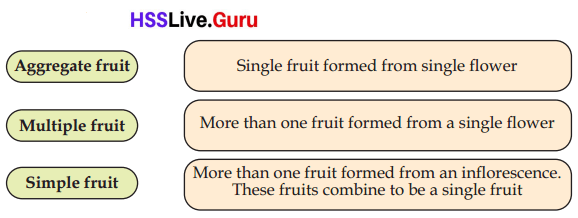
Answer:

Basic Science Class 6 Chapter 4 Question Answer Kerala Syllabus
Question 1.
‘Teacher, do all flowers produce fruits?’ Have you noticed the children’s doubt? What is your opinion?
Answer:
No. Not all flowers produce fruit.
Question 2.
Some of the flowers seen around you are given in the picture below. Which of these flowers can you identify? Identify the flowers in the picture along with your friends and note them.

Answer:
Mukkutti, Thumba, Thottavadi (Mimosa), Kanikkonna
| • All flowers are not similar. • They are different in different ways, such as their colour, fragrance, type of inflorescence, number of petals, etc. |
Question 3.
Observe the flowers around you. Identify their diversity and complete the list given below.
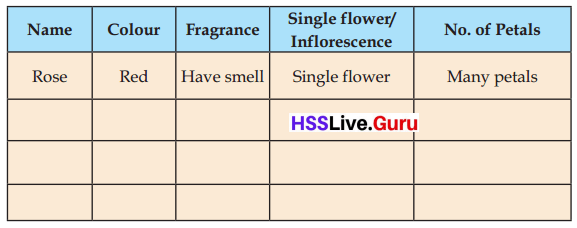
Answer:
| Name | Colour | Fragrance | Single flower/ inflorescence | No. of petals |
| Rose | Red | Have smell | Single flower | Many petals |
| Jasmin | White | Have smell | Single flower | Five (Many in some varieties) |
| Hibiscus | White, pink, red, orange, yellow, purple, and even shades of blue | No specific smell | Single flower | Many |
| Thechi (Ixora) | Red | subtle, sweet fragrance | Single flower | Four |
Question 4.
Do flowers have only petals? Are there no other parts? Observe them. Are the parts the same in all the flowers you have observed?
Answer:
A flower has different parts. According to plant type, parts differ:
Question 5.
Visit your school garden and find out which plants are non-flowering and record it.
Answer:
Ferns, Mosses, Conifers, Cycads, Horsetails, etc. (You can find more from your garden…)
Question 6.
What are the benefits of flowering in plants?
Answer:
- Fruit is formed from a flower.
- Helps in seed production
- Helps in the development of new plants.
Question 7.
Which are the parts of a stamen?
Answer:
A stamen consists of a filament and an anther.
Question 8.
Where are pollen grains found?
Answer:
Pollen grains are found inside the anther chambers
Question 9.
Which are the parts of the carpel?
Answer:
A carpel consists of stigma, style, and ovary. Ovules can be seen inside the ovary.
Question 10.
Where is the female gamete seen?
Answer:
The egg or female gamete is found within the ovule in the ovary.
Question 11.
Given below is a picture showing the longitudinal section of a shoe flower. Label the parts on it.
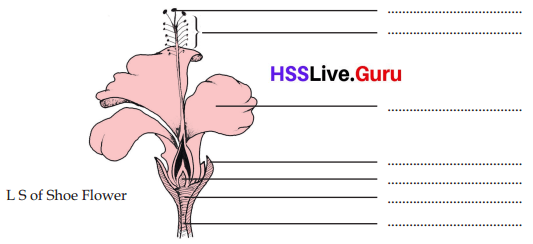
Answer:
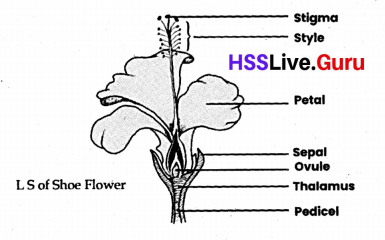
Question 12.
Can a flower have more than one ovary? What is your guess?
Answer:
Yes. Some flowers can have more than one ovary (multiple ovaries).
E.g., Champak, lotus, custard apple and Polyalthia (multiple ovaries in a single flower).
Question 13.
Are the flowers of pumpkin unisexual? Discuss and write in the Science Diary.
Answer:
Yes, the flowers of pumpkin plants are unisexual. This means that a single pumpkin plant will produce two different kinds of flowers: Male flowers (These flowers contain only the male reproductive parts (stamens) and female flowers (These flowers contain only the female reproductive parts (pistil/carpel).
Question 14.
Is the lady’s finger flower unisexual or bisexual? Why? Discuss and record the assumptions in the Science Diary.
Answer:
The lady’s finger flower (also known as okra) is bisexual. This means that each individual lady’s finger flower contains both the male reproductive parts (stamens, which produce pollen) and the female reproductive parts (pistil/carpel, which contains the ovary and develops into the fruit).
Question 15.
Observe the flowers around you and find out the unisexual and bisexual flowers. Write your findings in your Science Diary. Present in the class.
Answer:
| Unisexual Flowers | Bisexual Flowers |
| Bitter gourd | Shoe flower |
| Papaya | Brinjal |
| Cucumber | Tomato |
Question 16.
Discuss which type of flowers is more common among the ones you have observed, unisexual or bisexual?
Answer:
Bisexual flowers are far more common than unisexual flowers among flowering plants. The vast majority of flowering plant species (around 90%) bear bisexual flowers. These flowers are often referred to as “perfect” because they contain both male (stamens) and female (pistil) reproductive organs within the same flower. Having both reproductive parts in one flower can be very efficient for self-pollination, or even for cross-pollination when a single pollinator visit can pick up and deliver pollen.
Question 17.
Shouldn’t the male gamete and the egg fuse for the flower to produce a seed? How is this possible?
Answer:
Yes, the fusion of a male gamete (sperm) with the egg cell is essential for seed formation in flowering plants. This process is possible through Double fertilisation in flowering plants.
Question 18.
Don’t the pollen grains need to reach the stigma of the gynoecium for the male gamete and the egg to fuse? How does this happen?
Answer:
Yes, pollen grains must reach the stigma of the gynoecium for fertilisation to occur. This process is called pollination.
Question 19.
Observe the given pictures.
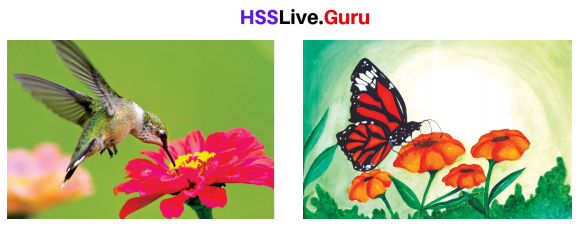
What are the reasons for insects and birds getting attracted to flowers? Write down your guess.
Answer:
Insects and birds are primarily attracted to flowers for food and, in the case of insects, for breeding purposes. Flowers provide them with nectar and pollen, which serve as sources of nutrition. For insects, flowers also offer a place to lay their eggs. Additionally, the bright colours, patterns, and scents of flowers play a crucial role in attracting them.
Question 20.
How do flowers benefit when insects collect honey from the flowers? Do they help to pollinate flowers? Discuss.
Answer:
Flowers benefit from bees collecting nectar because it facilitates pollination, a crucial process for plant reproduction. Bees, in turn, gain a vital food source (nectar and pollen) from the flowers. When bees move from flower to flower collecting pollen, they also deposit pollen grains onto the flowers, thereby pollinating them.
Question 21.
What factors help in pollination?
Answer:
Pollination is facilitated by both abiotic (non-living) and biotic (living) factors. Abiotic factors include wind and water. Biotic factors include insects, birds, and other animals.
Question 22.
Are insects and birds the only pollinators? Besides living beings, which are the other pollinators? Observe the pictures below and identify the pollinators.

No, insects and birds are not the only pollinators. While they are important, other living creatures, such as bats, butterflies, moths, and even some mammals, also play a role. Additionally, non-living factors like wind and water can also be pollinators.
From the pictures given above,
Black pepper – Pollination is facilitated by water
Rice – Pollination is facilitated by wind
Question 23.
Do plants pollinated in this way require factors such as colour, nectar, and fragrance to attract pollinators? Record your assumptions in the Science Diary.
Answer:
No, plants pollinated by water and wind typically do not require any factors like bright colours, nectar, and fragrance to attract pollinators.
Question 24.
Which are the pollinators you have come to know about so far?
Answer:
Insects, bees, wasps, flies, butterflies, moths, wind and water.
Question 25.
In the figures you have observed, in which flowers does self-pollination take place? In which flower does cross-pollination take place? Find and write.
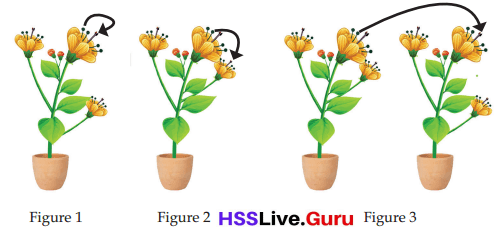
Answer:
Figure 1 – Self-pollination. It occurs in flowers that are bisexual and have both male and female reproductive parts. Here, self-pollination happens between the same flower.
Figure 2 – Self-pollination, happens between two flowers of the same plant.
Figure 3 – Cross-pollination, happens between two different flowers of different plants.
Question 26.
Analyse the given statements regarding pollination. Put (✓) a mark against the correct one.
Answer:
- In dioecious plants, only cross-pollination takes place. (✓)
- In monoecious plants, only cross-pollination takes place
- Both self-pollination and cross-pollination take place in bisexual flowers. (✓)
Question 27.
What happens to the pollen grain after pollination?
Answer:
After pollination, the pollen grain grows down through the style towards the ovary in the form of a tube, (pollen tube).
Question 28.
How does the male gamete reach the ovary?
Answer:
The male gamete reaches the ovary through the pollen tube and fuses with the egg.
Question 29.
What is fertilisation?
Answer:
The process of fusion of the male gamete and the egg in the ovary to form a zygote is called fertilisation.
Question 30.
By what name is the fertilised egg known?
Answer:
The fertilised egg is known as a zygote
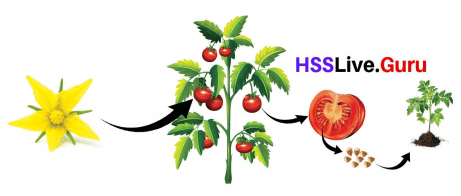
Question 31.
The picture shows the changes in the tomato flower after fertilisation. Analyse the pictures and find out the changes that occur to the parts mentioned below. Discuss and write.
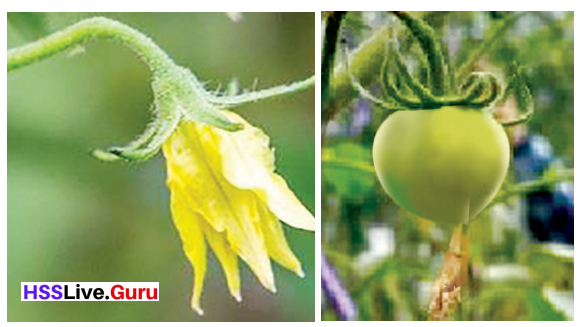
Answer:
Petals – Withers off
Sepals – Persistent (remain attached to the developing fruit)
Pedicel – Remains and becomes part of the fruit stalk.
Ovary – Develops into fruit
Androecium – Dries up and is shed.
| After fertilisation, the zygote develops into an embryo, the ovule becomes a seed, and the ovary develops into a fruit. |
Question 32.
Haven’t you realised that if a flower has more than one ovary, it will produce more than one fruit?
Answer:
Yes. Flowers with multiple ovaries can produce multiple fruits.
Question 33.
Find more examples of aggregate fruits and write them in your Science Diary.
Answer:
Raspberries, blackberries, and strawberries.
Question 34.
Do all the fruits that we see develop from ovaries? How’ about a cashew fruit? Observe the pictures.
Which part of the cashew looks like a fruit? How is cashew different from other fruits? Discuss.

Answer:
No, not all fruits develop solely from the ovary. While most fruits do, some, like the cashew and apple, are considered “false fruits” or “Pseudo fruits” because parts of the flower other than the ovary contribute to their development. In cashews, the fleshy, pear-shaped structure we often see is not the true fruit; the true fruit is the kidney-shaped nut that grows at the end of this structure. In Cashew, the pedicel develops into a fruit.
| • In normal flowers, the ovary develops into fruit. • Sometimes, parts of the flower other than the ovary also become fruit. These are pseudo-fruits. • In cashew the pedicel develops into fruits. • In apple and saberjelly, the thalamus grows and becomes fruit. They are also called pseudo-fruits. |
Question 35.
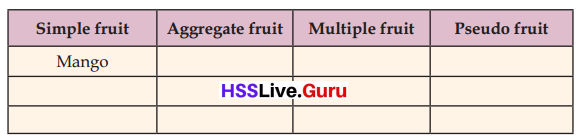
Classify and tabulate the following fruits and present them in the class.
Mango, Pineapple, Papaya, Custard apple, Cashew apple, Strawberry, Guava, Rose apple, Polyalthia fruit, Apple, Breadfruit.
Answer:
| Simple fruit | Aggregate fruit | Multiple fruit | Pseudo fruit |
| Mango | Custard apple. | Jackfruit | Cashew |
| Guava | Strawberry | Pine apple | Apple |
| Papaya | Polyalthia fruit | Breadfruit. | Rose apple |
Question 36.
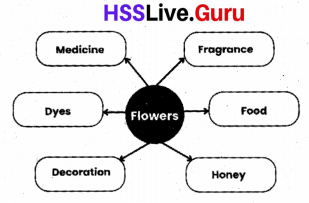
How to a flower benefit us? Are they useful only in pleasing our eyes? Complete the word sun given below. Discuss the uses of flowers, make notes and present it in the class.

Answer:
Question 37.
Isn’t it profitable to grow flowers commercially?
Answer:
Yes, commercial flower farming can be profitable, but it depends on several factors.
| • Flower farming or floriculture is the process of developing, growing and nurturing flowering and ornamental plants commercially. • Flowers are not merely wonderful sights that refresh our eyes, but they also have many other benefits as well. • The main function of flowers is to produce seeds and maintain the generation of plants. Let us conserve plants and flowers. |
Question 38.
What are the benefits of farming flowers? Discuss.
Answer:

Question 39.
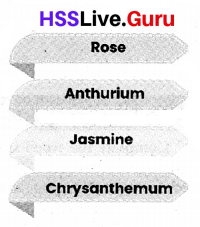
Which are the commercially grown flowering plants?
Answer:
Class 6 Basic Science Chapter 4 Question Answer Extended Activities
Question 1.
Collect different kinds of flowers from your surroundings and prepare a flower carpet or organise a flower show in the class.
Answer:
Here are some hints to make your flower show a success, tailored for your location and the likely types of flowers you’ll find:
Hints for Display & Arrangement of Flowers:
a) Vary Heights and Textures: Encourage participants to use flowers of different sizes and shapes to create visual interest. Tall flowers at the back, shorter ones in front.
b) Colour Harmony & Contrast:
- Monochromatic: All shades of one colour (e.g., different reds of hibiscus).
- Complementary: Colours opposite on the colour wheel (e.g., orange marigolds with blue flowers if you find them).
- Analogous: Colours next to each other on the colour wheel (e.g., red, orange, yellow).
c) Creative “Vases” / Containers:
- Recycled Items: Old glass bottles, plastic containers, coconut shells (polished, if possible!), tin cans (decorated). This promotes eco-friendliness.
- Natural Elements: Bamboo sections, hollowed-out gourds.
- Simple is Best: Sometimes, a single beautiful flower in a simple bottle is more impactful than a crowded arrangement.
d) Storytelling with Flowers: Encourage students to give their arrangements a “title” or tell a short story about where they found the flowers or what inspired their arrangement. This adds a personal touch.
e) Small Details Matter: A few pebbles at the bottom of a clear vase, a ribbon tied around a container, or even a small drawing next to the display can enhance its appeal.
Question 2.
Flowers can be dried and preserved just like leaves in a herbarium. Select suitable flowers. Press them by keeping it inside a paper or book. Keep the flowers for about two weeks inside the paper. Display it in class.
Answer:
Drying and preserving flowers is a fantastic way to appreciate their beauty over time, and it teaches a bit about botany too.
Here are some types of flowers common in our area that press well, and why:
- Hibiscus (Chemparathi): Petals are relatively thin and often separate easily. They come in vibrant colours (red, pink, white, yellow).
- Bougainvillaea: The colourful “bracts” (which look like petals) are very thin and papery, making them ideal for pressing.
- Jasmine: Small, delicate, and often single-layered. They flatten very well.
- Ixora (Thechi): The small individual flowers are good for pressing. You can press whole clusters if they are thin enough, or separate individual blooms.
- Marigold (Genda): While the large, fluffy ones can be challenging, the smaller, single-layered marigolds or individual petals from larger ones press well and retain their yellow/orange colours.
- Ferns and Small Leaves: These are excellent for adding greenery and textural contrast to your pressed flower display, just like in a herbarium.
Flowering and Fruiting Notes Pdf
Flowering and Fruiting Class 6 Notes Kerala Syllabus
- All flowers are not similar. They differ in various ways, such as their colour, fragrance, type of inflorescence, and number of petals, among others.
- A flower has different parts. According to plant type, parts differ.
- Calyx, Corolla, Androecium and Gynoecium are the four main parts seen in a flower. A flower with all these four parts is a complete flower.
- There are flowering plants as well as non-flowering plants in the plant world. Cycas, Pine, Ferns, etc., are some of the non-flowering plants.
- Fruit is formed from the flower, and a new plant arises from the seed within the fruit.
- Fruits and seeds are produced from flowers through reproduction.
- Flowers that possess either an androecium or a gynoecium are unisexual flowers. Bisexual flowers have both androecium and gynoecium in the same flower.
- If the male and female flowers are found in different plants, such plants are called dioecious plants. Monoecious plants have both male and female flowers in the same plant.
- The transfer of pollen grains from the anther to the stigma is considered pollination. Insects and birds play a crucial role in the process of pollination. These are pollinators.
- Transfer of pollen grains to the stigma of the same flower or the stigma of another flower of the same plant is self-pollination. Cross-pollination is the transfer of pollen grains from one flower to the stigma of a flower of another plant of the same species.
- The process of fusion of the male gamete and the egg to form a zygote is called fertilisation.
- After fertilisation, the zygote develops into an embryo, the ovule becomes a seed, and the ovary develops into a fruit.
- A simple fruit is a fruit that is formed from a single flower.
- A fruit that develops from a single flower with multiple ovaries is called an aggregate fruit.
- Fruits formed from an inflorescence are combined together to a single fruit. Such fruits are called multiple fruits.
- The inflorescence is defined as the arrangement of a cluster of flowers on a floral axis. .
- Sometimes, parts of the flower other than the ovary also become fruit. These are pseudo-fruits.
- Flower farming or floriculture is the process of developing, growing and nurturing flowering and ornamental plants commercially.
INTRODUCTION
Have you ever wondered how our favourite fruits like mangoes, apples, or even a tiny tomato come to be? It all starts with something beautiful and amazing: flowers!
In this chapter, we will explore the wonderful world of flowering and fruiting. We’ll learn how a tiny little bud transforms into a colourful flower, what the different parts of that flower are, and how that flower, in turn, helps to create the delicious fruits and seeds we see all around us. It’s a fascinating journey that plants undertake to ensure new plants can grow, and it’s crucial for all the living things on Earth, including us.
PARTS OF FLOWERS
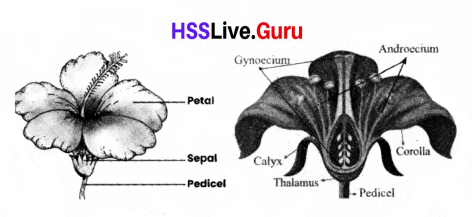
| Parts | Functions |
| Pedicel | Attaches the flower to the stem. |
| Thalamus | Provides a seat for other parts of the flower. |
| Calyx | Formed of sepals. Protects the flower bud by covering it. |
| Corolla | Formed of petals. Gives beauty and charm to the flower |
| Androecium | Formed of stamens. The male reproductive part of the flower. |
| Gynoecium | The female reproductive part of the flower. Gynoecium consists of one or more carpels. |
LET’S OBSERVE AND LEARN
Aim: To observe each part of the flower closely.
Material required: Different types of flowers, a hand lens, forceps and a sheet of white paper.
Procedure:
- Observe each flower with a hand lens.
- Carefully separate the parts of a flower you have observed and display it on a sheet of paper.
- Prepare a longitudinal section of gynoecium with the help of your teacher and observe it using a hand lens.
Observation: You can see the four parts, namely sepals, petals, androecium and gynoecium, in the flower.
|
Complete Flower Calyx, Corolla, Androecium and Gynoecium are the four main parts seen in a flower. A flower with all these four parts is a complete flower. |
PROJECT
Observe the different types of flowers in your home and school. Record the observations in the table below.
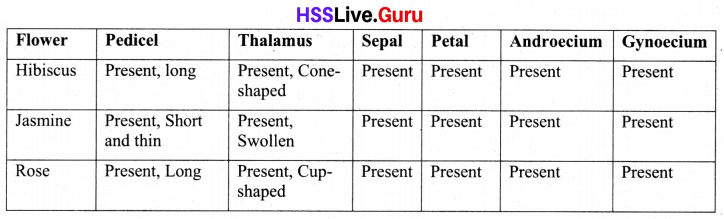
Assumptions:
Most of the flowers we see in our surroundings are complete flowers. But some lack certain parts. The shape and size of the pedicel and thalamus are different in each flower. Sepals, petals, stamens and carpels are present, but their number varies in different ranges.
NON-FLOWERING PLANTS
- All plants do not have flowers.
- There are flowering plants as well as non-flowering plants in the plant world.
- Cycas, Pine, Ferns, etc., are some of the non-flowering plants.
- Apart from these, small plants like algae also do not have flowers.

FRUIT AND SEED
- Fruit is formed from the flower, and a new plant arises from the seed within the fruit.
- Fruits and seeds are produced from flowers through reproduction.
Androecium:
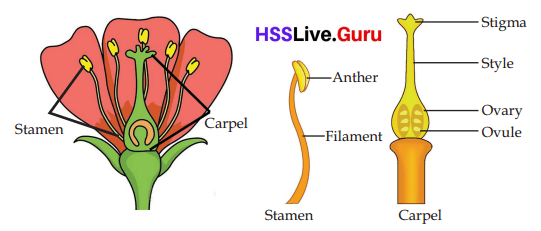
• The male reproductive organ of a flower, which is composed of stamens. Stamens have parts called filaments and anthers. Pollen grains are present in the anther chambers. Pollen grains contain male gametes.
Gynoecium:
• Gynoecium is the female reproductive part of a flower. It is composed of carpels. The carpel consists of stigma, style and ovary. The egg or female gamete is found within the ovule in the ovary.
MALE AND FEMALE FLOWERS
ACTIVITY:
Aim: To find out whether androecium and gynoecium are found within the same flower in all the flowers you have observed.
Materials required: Flowers of lady’s finger and pumpkin, hand lens
Procedure: Observe the flowers of lady’s finger and the pumpkin using a hand lens and find out their androecium and gynoecium.
Observation:
| Flower | Observation |
| Lady’s finger | Androecium and gynoecium are found in the same flower. |
| Pumpkin | Androecium and gynoecium are found in different flowers on the same plant. |
Conclusion: In some flowers, the androecium and gynoecium are found in the same flower. But there are plants in which the androecium and gynoecium are seen in separate flowers.
|
Unisexual and Bisexual Flowers • Flowers that possess either an androecium or a gynoecium are unisexual flowers. |
MALE AND FEMALE PLANTS
• There are plants with only male flowers and plants with only female flowers around us.
• Plants with only male flowers are called male plants, and plants with female flowers only are called female plants.
|
Dioecious and Monoecious Plants • If the male flowers and female flowers are found in different plants, such plants are called dioecious plants. Examples of dioecious plants are date palm, malabar tamarind, nutmeg and papaya. |
FRIENDS OF FLOWERS (POLLINATION)
|
Pollination • The transfer of pollen grains from the anther to the stigma is considered pollination. |
SELF-POLLINATION AND CROSS-POLLINATION
- Transfer of pollen grains to the stigma of the same flower or the stigma of another flower of the same plant is self-pollination.
- Cross-pollination is the transfer of pollen grains from one flower to the stigma of a flower of another plant of the same species.
FERTILISATION
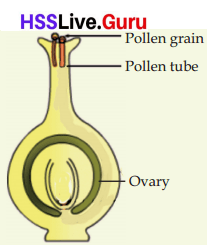
- After pollination, the pollen grain grows down through the style towards the ovary in the form of a tube.
- The male gamete reaches the ovary through this tube and fuses with the egg.
- The process of fusion of the male gamete and the egg to form a zygote is called fertilisation.
FRUITS
- The ovary of a flower develops into fruit after fertilisation.
- There exists a relation between the number of ovaries in flowers and the number of fruits produced.
- If a flower has a single ovary, then it produces a single fruit. E.g., Bitter gourd
- Like bitter gourd’s flower, the flowers of mango, lady’s finger, pea, papaya, etc., also have only one ovary.
- Asimple fruit is a fruit that is formed from a single flower.E.g., Apple, banana, cherry pear, plum, tomato
- A fruit that develops from a single flower with multiple ovaries is called an aggregate fruit. E.g., Custard apple.
INFLORESCENCE
- The inflorescence is defined as the arrangement of a duster of flowers on a floral axis.
- The fruits formed from the inflorescences of the mango tree and the banana plant are seen as separate fruits.
- But fruits formed from the inflorescence of a jackfruit tree combine to form a single fruit.
- Fruits formed from an inflorescence are combined together to a single fruit. Such fruits are called multiple fruits.
- Pineapple, wild jackfruit and breadfruit are examples of multiple fruits.