The comprehensive approach in SCERT Class 6 Basic Science Textbook Solutions Chapter 4 Flowering and Fruiting Important Questions ensure conceptual clarity.
Flowering and Fruiting Extra Questions and Answers Class 6 Basic Science Chapter 4 Kerala Syllabus
Flowering and Fruiting Class 6 Important Questions
Question 1.
‘Calyx, Corolla, Androecium and Gynoecium are the four main parts seen in a flower. A flower with all these four parts is a complete flower.’
a) Draw and label these 4 four parts in a flower.
b) Do all plants flower?
c) Give some examples of non-flowering plants.
Answer:
a) 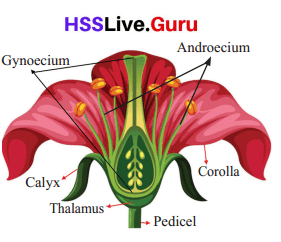
a) No
b) Cycas, Pine, Ferns and algae
Question 2.
Observe the picture given below and answer the following questions.
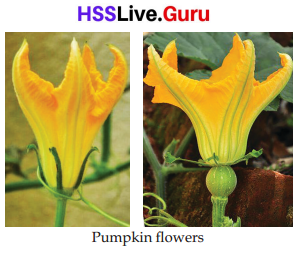
a) Differentiate between the androecium and the gynoecium of a flower.
b) ‘Fruits and seeds are produced from flowers through reproduction.’ What are the benefits of flowering in plants?
Answer:
a) Androecium is the male reproductive organ of a flower, which is composed of stamens. Stamens have parts called fdaments and anthers. Pollen grains are present in the anther chambers. Pollen grains contain male gametes.
Gynoecium is the female reproductive part of a flower. It is composed of carpels. The carpel consists of stigma, style and ovary. The egg or female gamete is found within the ovule in the ovary.
b) Benefits of flowering in plants:
- Fruit is formed from a flower.
- Helps in seed production
- Helps in the development of new plants.

Question 3.
a) Flowers are attractive and appear in different colours and shapes, why?
b) Are gardens the only place where we find flowers?
Answer:
a) Flowers are attractive and appear in different colours and shapes to attract pollinators who help in pollen transfer.
b) No, flowers grow on land, in the ocean, in lakes and rivers, on mountain tops and in the desert.
Question 4.
‘A flower with all four parts, such as Calyx, Corolla, Androecium and Gynoecium, is called a complete flower.’
a) Are all flowers alike? In what respects are they different?
b) Mention the names of flowers you know?
Answer:
a) No, not all flowers are alike. They differ in number of petals, colour, size, shape and fragrance.
b) Hibiscus, Jasmine, Rose, Marigold.
Question 5.
A) You are provided with a Hibiscus flower. The teacher asked you to label the different parts of the hibiscus flower. Draw and Label.

B) Do all the flowers have the same parts?
Answer:
A) 
B) No, some flowers have both male and female parts in a single flower while some have separate male and female parts.
Question 6.
Observe the figure of the carpel of a flower given below.

(a) Name and label the parts indicated as (a), (b), (c), and (d) in the figure.
(b) Where does pollen grains found?
(c) Where is the female gamete seen?
Answer:
a) 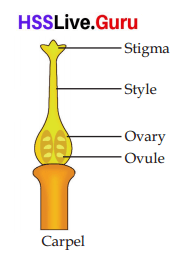
(b) Pollen grains are found inside the anther chambers
(c) The egg or female gamete is found within the ovule in the ovary.
Question 7.
Observe the table given below.
| Flower | Observation |
| Tomato | Androecium and gynoecium are found in the same flower. |
| Papaya | Androecium and gynoecium are found in different flowers on the same plant. |
(a) What are unisexual flowers?
(b) Differentiate between Dioecious and Monoecious Plants.
(c) Is the flower of brinjal unisexual or bisexual? Why?
Answer:
(a) Flowers that possess either an androecium or a gynoecium are called unisexual flowers.
(b) If the male and female flowers are found in different plants, such plants are called dioecious plants. Examples of dioecious plants are date palm, nutmeg and papaya.
Monoecious plants have both male and female flowers in the same plant. Cucumber, pumpkin, ash gourd, snake gourd, coconut, etc. are monoecious plants.
(c) Brinjal flowers are bisexual because they contain both male and female reproductive organs within the same flower. Specifically, they have both stamens (male) and pistils (female).
Question 8.
A list of plants is given in the box below.
| Maize, Coconut, Papaya, Pumpkin, Date palm. Watermelon, Cycas, Lady’s finger, Tomato, Cucumber, Kiwi |
Classify these plants as plants with both the sex organs are found in the same plant and on different plants. Give them suitable headings too.
Answer:
| Monoecious plants | Dioecious plants |
| Maize Coconut Pumpkin Watermelon Lady’s finger Tomato Cucumber |
Papaya Date palm Cycas Kiwi |
Question 9.
What is a male flower? Give examples?
Answer:
Flowers that have only androecium are called male flowers.
Eg: Pumpkin, cucumber, bittergourd.
Question 10.
The names of some flowers are given below. Classify them into unisexual and bisexual flowers. What inferences can be drawn by examining the table?
| Oleander, pumpkin, bittergourd, rose, hibiscus, clitoria, sunflower, mango, hibiscus, snake gourd, watermelon and papaya. |
Answer:
| Unisexual flowers | Bisexual flowers |
| Pumpkin Bittergourd Snakegourd Watermelon Papaya |
Oleander Rose Hibiscus Sunflower Mango |
From this table, we can understand that,
→ Some plants have androecium and gynoecium in the same flower and are called bisexual flowers.
→ While some plants have androecium and gynoecium in separate flowers are called unisexual flowers.
Question 11.

a) Observe the Figure. These are two hibiscus plants. What are the ways in which pollination may occur in these plants?
b) In which plants does the pollination occur through the wind?
c) Draw and label the parts of the Gynoecium.
Answer:
a) In Hibiscus, pollination can occur through two ways, self-pollination and cross-pollination. The figure indicates cross-pollination.
b) Paddy, Wheat, Maize, Sugarcane
c) 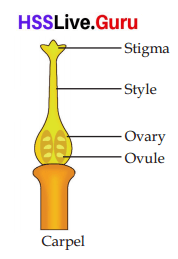
Question 12.
Observe the pictures given below.

a) In which among the given plants does self-pollination not take place?
b) Justify your findings.
c) Self-pollination takes place in two ways. Explain them.
Answer:
a) Nutmeg
b) Nutmeg is a dioecious plant, i.e., the male and female reproductive organs are on separate trees.
c) Self-pollination occurs in two primary ways: autogamy and geitonogamy. Autogamy involves pollen transfer from the anther to the stigma of the same flower, while geitonogamy involves pollen transfer between different flowers on the same plant.
Question 13.
Parts like petals, androecium, etc., wither and fail down after fertilisation. The pedicel. Thalamus and calyx become stronger. Explain the reason.
Answer:
The function of petals to attract pollinating agents, and the function of the androecium is to produce and store pollen grains. So they go off after fertilisation. Pedicel grows stronger to support the fruit. The thalamus becomes stronger, on which the ovary develops into a fruit. The calyx is present in some plants, which grows strong to support the fruit.
Question 14.
A) What do you mean by fertilisation?
B) Where does fertilisation take place?
Answer:
A) Fertilisation is the fusion of a male gamete with the female gamete (egg). Fruit is formed in the plants after fertilisation.
B) Fertilisation takes place in the ovary of the gynoecium.
Question 15.
Write whether the following statements are true or false.
A) In cashew, the fruit develops from the pedicel.
B) In apple and saberjelly, fruits develop from the ovary.
C) Only cross-pollination occurs in unisexual plants.
D) Only cross-pollination occurs in bisexual plants.
Answer:
A) Correct
B) False. In Apple and Saberjelly Fruits developed from thalamus.
C) Correct
D) False. Both self-pollination and cross-pollination occurs in bisexual plants.
Question 16.
Observe the given statements about different types of fruits.
| • Jackfruit and custard apple are multiple fruits • Lady’s finger and grapes are simple fruits • Tomato and custard apple are aggregate fruits • Jackfruit and blackberry are multiple fruits |
a) Find out the right one from the above statements.
b) Write down the peculiarities of simple fruits, aggregate fruits and multiple fruits.
c) Find out the odd one out.
1. Apple
2. Cashew apple
3. Safarjal
4. Jackfruit
Answer:
a) Lady’s finger and grapes are simple fruits, Jackfruit and blackberry are multiple fruits
b)
| Fruits | Peculiarities |
| Simple fruits | Fruit that is formed from a single flower |
| Aggregate fruits | A fruit that develops from a single flower with multiple ovaries |
| Multiple fruits. | Fruits formed from an inflorescence are combined together to a single fruit. |
Question 17.
A. Complete the concept map given below.

B. Write any one difference between aggregate fruit and multiple fruit.
Answer:
A. a) Tomato,
b) Mango,
c) Custard apple,
d) Aggregate fruit,
e) Multiple fruit,
f) Pineapple,
g) Cashew,
h) Apple
B. Aggregate fruits are fruits that develop from a single flower with multiple ovaries. Fruits formed from an inflorescence that are combined together into a single fruit are called multiple fruits.
Question 18.
Observe the pictures
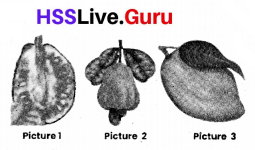
A. What types of fruits are shown in pictures 1 and 3? What are their peculiarities?
B. Name another fruit similar to the picture (2).
| The ovary of a flower develops into fruit and the ovule into seed. |
C. Explain the above statement based on the picture (2).
Answer:
A. Picture 1- Multiple fruits, Picture 3 – Simple fruit
Fruits formed from an inflorescence that are combined together into a single fruit are called multiple fruits, and a fruit that is formed from a single flower is called a simple fruit.
B. Apple (Pseudo fruit)
C. Picture 2 (Cashew) indicates a pseudo fruit. In normal flowers, the ovary develops into fruit. Sometimes, parts of the flower other than the ovary also become fruit. These are pseudo-fruits.
Question 19.
a) Observe the figures given below and complete the table.

| Fruits types | Examples | |
| Simple fruits | Mango | …….(a)……. |
| Aggregate fruit | …….(b)……. | Custard apple |
| Multiple fruit | Pineapple | …….(c)……. |
| Pseudo fruit | …….(d)……. | Apple |
What happens to the following parts when a flower becomes a fruit?
i. Androecium
ii. Ovary
iii. Sepals
iv. Ovule
Answer:
a) (a) Tomato,
(b) Strawberry,
(c) Mulberry,
(d) Chamba
b) Androecium – Dries up and is shed
Ovary – Develops into a fruit.
Sepals – Persistent (remain attached to the developing fruit) or, in some cases, shed off.
Ovule – Develops into a seed
Question 20.
There are so many benefits from flowers.
(a) What is floriculture?
(b) List some benefits of floriculture.
(c) Give some examples of commercially grown flowering plants.
Answer:
(a) Flower farming or floriculture is the process of developing, growing and nurturing flowering and ornamental plants commercially.
(b) Benefits of floriculture:
- Used for spiritual rituals and pujas
- Used for decorations
- Food and medicinal resources
- Manufacturing of perfumes and dyes
- Gardening and landscaping
- Job opportunities and economic growth
(c) Rose, Anthurium, Orchid, Chrysanthemum, Jasmine, Lotus, Vanilla, etc.