Plus One Accountancy Chapter Wise Questions and Answers Chapter 5 Trial Balance and Rectification of Errors

Students can Download Chapter 5 Trial Balance and Rectification of Errors Questions and Answers, Plus One Accountancy Chapter Wise Questions and Answers helps you to revise the complete Kerala State Syllabus and score more marks in your examinations.

Kerala Plus One Accountancy Chapter Wise Questions and Answers Chapter 5 Trial Balance and Rectification of Errors

Plus One Accountancy Trial Balance and Rectification of Errors One Mark Questions and Answers

Question 1.
Which of the following statement is wrong regarding Trial Balance.
(a) Trial balance is a part of the double-entry system.
(b) It is not an account
(c) It is prepared on a specific date
(d) It is prepared to check the arithmetical accuracy of the books of accounts.
Answer:
(a) Trial balance is a part of double entry system.

Question 2.
Sale of machinery is credited to sales a/c is an error of
(a) Commission
(b) Omission
(c) Principle
(d) None of these
Answer:
(c) Principle

Question 3.
Debiting wages account with the amount of wages paid on erection of machinery is an errors of be debited with
(a) Rs. 400
(b) Rs. 800
(c) Rs. 200
(d) None of the above
Answer:
(b) Rs. 800

Plus One Accountancy Chapter Wise Questions and Answers Chapter 5 Trial Balance and Rectification of Errors

Question 4.
Which of the errors does not affect the trial balance?
(a) Wrong balancing
(b) Wrong totaling
(c) Writing an amount in the wrong account but in the correct side.
(d) None of the above.
Answer:
(c) Writing an amount in the wrong account but in the correct side.

Question 5.
Instead of debiting Sanoj’s A/c his account was credited by Rs. 400. To rectify this his account should
(a) Omission
(b) Principle
(c) Commission
Answer:
(b) Principles

Question 6.
Trial balance is
(a) An account
(b) A statement
(c) A subsidiary Book
(d) A Principal book
Answer:
(b) A Statement

Question 7.
Agreement of trial balance is affected by>
(a) One-sided errors only
(b) Two-sided errors only
(c) Both a and b
(d) None of these
Answer:
(c) Both a and b

Question 8.
A trial balance is prepared to check the …………… of ledger accounts.
Answer:
Arithmetical accuracy

Question 9.
If purchase of furniture is recorded in the purchase book, it is an error of …………..
Answer:
Principle

Question 10.
If purchase of goods on credit is not recorded in the books, it is an error of …………
Answer:
Omission

Question 11.
An account in which the difference of trial balance is temporarily put is ………… account.
Answer:
Suspense.

Question 12.
Error of …………. does not affect the trial balance.
Answer:
Principle.

Plus One Accountancy Trial Balance and Rectification of Errors Two Mark Questions and Answers

Question 1.
Match the following.

  1. Installation charges debited to wages account.
  2. Cash paid to ‘X’ is not posted to his account.
  3. Cash paid to ‘A’ is posted, to B’s account.
  4. Sales books and purchase books are undercast by same account.
  5. The sales book is overcast by Rs. 100.

a. Error of commission
b. Compensating error
c. Error of principle
d. One side error
e. Error of omission

Answer:

  • 1-c
  • 2-e
  • 3-a
  • 4-b
  • 5-d

Question 2.
Complete the following on the basis of hint given.

  1. Errors of principle – Rule of accounting is violated
  2. _____ – Wrong amount is written in subsidiary books.

Answer:
Error of commission.

Question 3.

  1. One-sided error – Undercast in Sales returns book
  2. ______ – Purchase of machinery entered in purchase book.

Answer:
Two-sided error.

Question 4.
What do you mean by Trial Balance?
Answer:
Trial balance is a statement that shows either the balance or total amounts of debit items and credit items of all accounts. It is prepared on a particular date to test the arithmetical accuracy of the books of accounts kept under the double-entry system.

Question 5.
Why a trial balance is prepared?
Answer:
A trial balance is prepared:

  1. To check the arithmetical accuracy of the ledger accounts.
  2. To help in locating errors
  3. To provide a basis for preparing the financial statements.

Plus One Accountancy Chapter Wise Questions and Answers Chapter 5 Trial Balance and Rectification of Errors

Question 6.
Agreement of Tial balance is a proof of accuracy of books of accounts. Do you agree? Explain.
Answer:
No, the tallying of the trial balance does not mean that no errors have been committed in the accounting records. There can be errors which do not affect the equality of debits and credits and there can be errors which affect the equality of debits and credits.

Question 7.
Furniture purchased for Rs. 10,000 from Nirmal has been recorded as follows:

  • Nirmal A/c Dr 10,000
  • FurnitureA/c 10,000
  • If it is incorrect, rectify it by passing rectification entry.

Answer:

  • The journal entry is incorrect.
  • Rectification entry is – FurnitureA/c Dr 20,000
  • Nirmal A/c 20,000

Question 8.
On 31st March 2005, when the trial balance of Abi stores was prepared it showed a difference. Inspite of his continuous efforts, the accountant could not locate errors. But the preparation of financial statements cannot be delayed. Is it possible to prepare financial statements with such a trial balance. Can you suggest a solution at the juncture?
Answer:
If the trial balance doesn’t agree even after the repeated efforts, it is better to place the difference under suspense A/c. Otherwise it will cause inordinate delay in tpe preparation of final accounts. However, the suspense a/c has to be later removed by closely scrutinising the books of accounts in due course.

Question 9.
‘Closing stock is normally given out the trial balance’. State the reason.
Answer:
Usually no separate ledger accounts are maintained for stock account. The valuation of stock will be done at the end of a particular period when financial statements are prepared. Therefore it appears out the trial balance.

Question 10.
What are the methods of preparing trial balance?
Answer:
There are three methods of preparing trial balance They are:

  1. Totals method (Total of each side in the ledger)
  2. Balance method (Showing the balances of all ledger accounts.
  3. Totals – cum – balances method

Plus One Accountancy Chapter Wise Questions and Answers Chapter 5 Trial Balance and Rectification of Errors

Question 11.
Explain Error of principles with examples.
Answer:
If any accounting rules or principles are violated in recording a transaction, it is an error of principles. This error does not affect the agreement of trial balance.
Examples :-

  1. Expenses paid for installation of machinery debited to expenses account.
  2. The sale of building is credited to sales account.
  3. Amount spent on repair of machinery debited to machinery account.
  4. Purchase of furniture debited to purchase account.

Plus One Accountancy Trial Balance and Rectification of Errors Three Mark Questions and Answers

Question 1.
When do you open a suspense account? Explain its uses.
Answer:
When all attempts fails to locate errors and the preparation of the final accounts can not be further delayed, the difference in the trial balance is temporarily transferred to an account called “suspense account’’. Uses of suspense Account.

  1. It facilitates the preparation of financial statements even when the trial balance has not tallied.
  2. It helps in giving rectifying entries after the preparation of trial balance.

Question 2.
Mr. Murali’s trial balance showed a difference of Rs. 5,500 on the credit side. The following errors were revealed from the books of account.

  • The purchase of books were overcast by Rs. 3000.
  • The salary paid to Renjith Rs. 7000 has been posted twice.
  • Received from Manu Rs. 5000 has been credited Rs. 500.
  • Prepare a suspense account.

Answer:
Suspense A/c
Plus One Accountancy Chapter Wise Questions and Answers Chapter 5 Trial Balance and Rectification of Errors 1

Question 3.
Explain Error of omission with Examples.
Answer:
Error of omission:
When a transaction is not entered in the books of original entry or not posted from the books original entry to the ledger, an error of omission is caused. The omission may be complete or partial. If a transaction is not entered in the subsidiary books, it is a case of complete omission as the posting in the ledger accounts are also omitted.

In this both the debit and credit aspects go unrecorded, it does not affect the agreement of Trial Balance. If only one aspect of a transaction is recorded, it is a case of Partial omission. It happens while posting from day books to ledger accounts. This will affect the agreement of Trial balance.

Question 4.
Explain Error of Commission with example.
Answer:
Error of commission:
Errors committed when transactions are incorrectly recorded are called error of commission. These are the errors caused by wrong posting, wrong totaling, wrong balancing, wrong carryforwards, etc. For example- if Rs. 290 received from Ram is credited to his account as Rs. 209, it is an error of commission, Error in posting as to the side of account – Rs. 300 received from Kumar is posted his Debit side.

Question 5.
Explain Error of Principles Error with examples.
Answer:
Error of principles:
If any accounting rules or principles are violated in recording a transaction, it is an error of principles. This error does not affect the agreement of trial balance.
Examples:

  1. An item of capital expenditure is wrongly debited to a revenue account.
  2. Sale of building is credited to sales account.

Plus One Accountancy Chapter Wise Questions and Answers Chapter 5 Trial Balance and Rectification of Errors

Question 6.
Explain compensating error with examples.
Answer:
Compensating Error:
These errors arise when a mistake made in one direction is compensated by another mistake made in the opposite direction, to the extent of same amount. These errors do not affect the agreement of trial balance.

For example:
If Purchase of goods from ‘X’ for Rs. 800 is credited to his account as Rs.80 and a purchase from T for Rs. 80 is credited to y’s account as Rs. 800.

Question 7.
Name the errors which do not affect the Trial Balance.
Answer:

  1. Error of complete omission
  2. Error of principle,
  3. Compensating Error
  4. Error of recording in the book of original entry
  5. Error of posting to wrong account on credit side with correct amount.

Question 8.
Name the errors which affect the Trial Balance.
Answer:

  1. Errors due to partial omission
  2. Error of casting
  3. Posting an amount in the wrong side of an account.
  4. Posting of a wrong amount
  5. Wrong totaling or balancing of accounts

Question 9.
Rectify the following errors:
Cash sales Rs. 16,000
a) were not posted to sales a/c
b) were posted as Rs. 6000 in sales account
c) were posted to commission account
Answer:
Plus One Accountancy Chapter Wise Questions and Answers Chapter 5 Trial Balance and Rectification of Errors 2

Question 10.
Locate the types of errors involved in the following transactions.

  1. Purchased goods for 10,000 debited to furniture a/c.
  2. Carriage paid Rs. 1,000 debited to carriage a/c as Rs. 100.
  3. Amount received from Rajesh Rs. 1,800 has not been entered in the books of accounts.

Answer:

  1. Error of principle
  2. Error of commission
  3. Error of omission

Plus One Accountancy Trial Balance and Rectification of Errors Four Mark Questions and Answers

Question 1.
What are the objectives of preparing a trial balance?
Answer:
A Trial balance is prepared with the following objectives:
1. To ascertain the arithmetical accuracy of ledger accounts:
A Trial balance is prepared to check the arithmetical accuracy of ledger accounts. If the sum of the debit and credit columns of Trial balance is equal, it is assumed that the posting to the ledger accounts is accurate. This is because, for every debit we give an equal credit.

2. To help in ascertaining errors:
Some of the errors in the books of account can be detected by the trial balance. An untallied trial balance indicates that some errors have been committed.

3. To provide a basis for preparing final accounts:
The ultimate aim of maintaining books of accounts is to ascertain the financial result and position of the business. For this purpose profit and loss account and blance sheet is prepared on the basis of trial balance.

Plus One Accountancy Chapter Wise Questions and Answers Chapter 5 Trial Balance and Rectification of Errors

Question 2.
Check the arithmetical accuracy of the ledger account balances from the following.

Cash in hand 500
Purchases 44,000
Sales 67,500
Return inwards 400
Return outwards 250
Power 2,100
Stock 25,000
Building 30,000
Machinery 5,000
Creditors 7,250
Capital 32,000

Trial Balance as on …………..
Answer:
Plus One Accountancy Chapter Wise Questions and Answers Chapter 5 Trial Balance and Rectification of Errors 3
Plus One Accountancy Chapter Wise Questions and Answers Chapter 5 Trial Balance and Rectification of Errors 4

Question 3.
Pass journal entries to rectify the following transactions.
a) Purchase of machinery was debited to purchase a/c Rs. 8,000.
b) Goods sold on credit was recorded twice Rs. 1,500.
c) The repair of building was debited to building a/c Rs. 6,000.
d) Rs. 200 received from Jose posted to the debit of his account.
Answer:
Plus One Accountancy Chapter Wise Questions and Answers Chapter 5 Trial Balance and Rectification of Errors 5

Question 4.
Rectify the following errors:

  1. Stationery purchased for ₹500 has been wrongly debited to drawings a/c.
  2. A credit sale of ₹1,500 has been wrongly passed through the purchase book.
  3. ₹4,000 received from Sidhu have been posted on the credit side of his account ₹4,400.
  4. Salary ₹10,000 paid to Mr. Shaju was debited to his personal account.

Answer:
Journal
Plus One Accountancy Chapter Wise Questions and Answers Chapter 5 Trial Balance and Rectification of Errors 6
Plus One Accountancy Chapter Wise Questions and Answers Chapter 5 Trial Balance and Rectification of Errors 7

Plus One Accountancy Trial Balance and Rectification of Errors Five Mark Questions and Answers

Question 1.
Show how you would correct the following errors, write Journal entries.

  1. Rs. 5,000 received on the sale of an asset has been credited to sales account.
  2. A credit purchase of goods amounting to Rs. 500 from Raghavan had not been recorded in the books.
  3. Sales book was undercast by Rs. 500.
  4. Wages Rs. 750 paid for the installation of a new machine are debited to salaries and wages account.
  5. An amount of Rs. 500 written off as depreciation has not been posted to depreciation account.

Answer:
Journal Proper
Plus One Accountancy Chapter Wise Questions and Answers Chapter 5 Trial Balance and Rectification of Errors 8

Plus One Accountancy Chapter Wise Questions and Answers Chapter 5 Trial Balance and Rectification of Errors

Question 2.
Identify the mistakes crept into the trial balance and redraft it in its proper form.
Trial Balance
Plus One Accountancy Chapter Wise Questions and Answers Chapter 5 Trial Balance and Rectification of Errors 9
Answer:
Plus One Accountancy Chapter Wise Questions and Answers Chapter 5 Trial Balance and Rectification of Errors 10

Question 3.
Rectify the following errors
(a) Furniture purchased for ₹10,000 wrongly debited to purchase account.
(b) Machinery purchased on credit from Raman for ₹20,000 was recorded through purchase book.
(c) Repairs on machinery ₹1.400 debited to machinery account.
(d) Repairs on overhauling of secondhand machinery purchased ₹2,000 was debited to repair the account.
(e) Sales of old machinery at book value of ₹3,000 was credited to sales account.
Rectification Entries in Journal
Answer:
Plus One Accountancy Chapter Wise Questions and Answers Chapter 5 Trial Balance and Rectification of Errors 11
Plus One Accountancy Chapter Wise Questions and Answers Chapter 5 Trial Balance and Rectification of Errors 12

Plus One Accountancy Trial Balance and Rectification of Errors Six Mark Questions and Answers

Question 1.
Rectify the following Mistakes.

  1. The purchase day book is undercast (totaled less) by Rs. 180.
  2. Sales day book is overcast (totaled more) by Rs. 100.
  3. The purchase return book is totaled more by Rs. 80.
  4. Sales return book is less by Rs. 110.
  5. Rent paid Rs. 600 is omitted to post to rent account.
  6. The commission received Rs. 40 is omitted and not posted to the commission account.
  7. Salary paid Rs. 350 is posted twice to salary A/c.

Answer:
1. As the purchase account is less by Rs. 180, It should be debited to the purchase account. It should be shown in the debit side as : Undercast in purchase Day Book Rs. 180 Or Mistake in posting.

2. Sales Account is more by Rs. 100. To correct it, Rs. 100 be shown in the debit side of sales A/c as: Overcast in Day Book Rs. 100.

3. Purchase Returns Accounts is credited more by Rs. 80. Now it should be debited with the amount as Overcast in Day Book Rs. 100.

4. The effect is that the sales Return Account is less by Rs. 110. It should how be debited with the amount as Mistake in totaling Rs. 110.

5. Rent account should be debited with Rs. 600 as Omission in posting Rs. 600.

6. The commission account should be credited with Rs. 40 as Omission in posting Rs. 40.

7. The salary account is debited more by Rs. 350. It should now be credited with Rs. 350 as Mistake in polling Rs.350.

Plus One Accountancy Chapter Wise Questions and Answers Chapter 5 Trial Balance and Rectification of Errors

Question 2.
Veeran failed to balance his trial balance the credit side being more by Rs. 420. The difference is placed in a suspense a/c. Later on the following are discovered. Give rectifying entries and also prepare suspense A/c.

  1. Sales Book was undercast by Rs. 100.
  2. Goods for Rs. 300 purchased on credit from Raj was wrongly entered in the sales book. The account of Raj was correctly credited.
  3. The sales return book was undercast by Rs. 30.
  4. A credit item of Rs. 10 was wrongly debited to Renny’s account as Rs. 100.

Answer:
Journal
Plus One Accountancy Chapter Wise Questions and Answers Chapter 5 Trial Balance and Rectification of Errors 13
Suspense A/c
Plus One Accountancy Chapter Wise Questions and Answers Chapter 5 Trial Balance and Rectification of Errors 14

Question 3.
Rectify the following errors:-
a) Discount allowed to Ramesh Rs. 60 on receiving Rs.2000 from him was not recorded in the books.
b) Discount received from Ram Rs. 80 on paying 1900 to him was not posted at all.
c) Bill receivable from Narayan Rs. 1000 was dishonored and wrongly debited allowance account as Rs. 10,000.
d) Cash received from Mohan Rs. 3000 was posted to Naveen as Rs. 1000.
e) Cheques for Rs. 7800 received from Anu in full settlement of his account of Rs. 8000, was dishonored. No. entry was passed in the books on dishonor of the cheque.
f) Old machinery sold to Kannan at its book value of Rs.4000 was recorded through sales book.
g) Depreciation written off as the Machinery Rs.3000, was not posted at all.
Answer:
Plus One Accountancy Chapter Wise Questions and Answers Chapter 5 Trial Balance and Rectification of Errors 15
Plus One Accountancy Chapter Wise Questions and Answers Chapter 5 Trial Balance and Rectification of Errors 16

Plus One Accountancy Trial Balance and Rectification of Errors Eight Mark Questions and Answers

Question 1.
Rectify the following errors by giving correcting entries.

  1. Credit purchase of goods for Rs. 850 from chand and sons has not been recorded in the daybook.
  2. Rent paid to landlord is debited in landlord’s account Rs. 600.
  3. Purchase of Machinery from Precision Machinery Ltd. for Rs. 28,000 is recorded in purchase daybook. j
  4. Carriage paid on purchase of furniture Rs. 300 is debited in carriage account.
  5. Private expenses Rs. 200 is debited in Trade Expenses Account.
  6. Goods sold to Renjith for Rs. 500 has been wrongly recorded in purchase daybook.
  7. Purchase of furniture for the personal use of the proprietor of Rs. 920 has been debited in furniture a/c.
  8. Rs. 180 received from Salini has been credited in the account of Sajini.

Answer:
Plus One Accountancy Chapter Wise Questions and Answers Chapter 5 Trial Balance and Rectification of Errors 17

Plus One Economics Chapter Wise Questions and Answers Chapter 8 Index Numbers

Students can Download Chapter 8 Index Numbers Questions and Answers, Plus One Economics Chapter Wise Questions and Answers helps you to revise the complete Kerala State Syllabus and score more marks in your examinations

Kerala Plus One Economics Chapter Wise Questions and Answers Chapter 8 Index Numbers

Plus One Economics Index Numbers One Mark Questions and Answers

Question 1.
Which of the following is known as cost of living index?
(a) Consumers price index
(b) Wholesale price index
(c) Industrial production index
(d) All the above
Answer:
(a) Consumers price index

Question 2.
Index number can be calculated for ……….
(a) Price
(b) Quantity
(c) Volume
(d) All the above
Answer:
(d) All the above

Question 3.
In 2017 the price of oil increased by 30% compared to 2010. Identify the base year and the current year.
Answer:
Base year 2010, Current year 2017

Plus One Economics Chapter Wise Questions and Answers Chapter 8 Index Numbers

Question 4.
Which of the following indicates the changes in general price level?
(a) Consumers price index
(b) Wholesale price index
(c) Industrial production index
(d) All the above
Answer:
(b) Wholesale price index

Question 5.
An index number which accounts for the relative importance of the items is known as
(a) weighted index
(b) simple aggregative index
(c) simple average of relatives
(d) all the above
Answer:
(a) weighted index

Question 6.
In most of the weighted index numbers the weight pertains to
(a) base year
(b) current year
(c) both base and current year
(d) none of these
Answer:
(b) current year

Question 7.
The impact of change in the price of a commodity with little weight in the index will be
(a) small
(b) large
(c) uncertain
(d) none of these
Answer:
(a) small

Question 8.
A consumer price index measures changes in
(a) retail prices
(b) wholesale prices
(c) producers prices
(d) none of these
Answer:
(a) retail prices

Question 9.
The item having the highest weight in consumer price index for industrial workers is
(a) Food
(b) Housing
(c) Clothing
(d) all the above
Answer:
(a) Food

Plus One Economics Chapter Wise Questions and Answers Chapter 8 Index Numbers

Question 10.
In general, inflation is calculated by using
(a) wholesale price index
(b) consumer price index
(c) producers’ price index
Answer:
(a) wholesale price index

Question 11.
What is the other name of the consumer price index?
Answer:
The other name of the consumer price index is price deflator of income.

Question 12.
What is base period?
Answer:
Base period is the reference period with which the current period is compared.

Plus One Economics Index Numbers Two Mark Questions and Answers

Question 1.
Index numbers are very useful in deflating. Explain.
Answer:
Index numbers are very useful in deflating. They are very useful adjusting original data into real values. For example, money wages can be adjusted for price changes to find out the level of real wages.

Question 2.
Write down the uses of the wholesale price index.
Answer:
The wholesale price index number indicates the change in the general price level. The uses of the wholesale price index are noted down below.

  1. With the help of the wholesale price index, we can estimate the future demand and supply situations
  2. It helps in forecasting future prices
  3. It is used to measure the rate of inflation
  4. It can be used to eliminate the effect of change in price on aggregates such as national income, capital formation, etc.

Question 3.
Define index number.
Answer:
An index number is a statistical device for measuring changes in the magnitude of a group of related variables.

Question 4.
Mention the formula of ‘simple aggregative’ method?
Answer:
\(P_{01}=\frac{\sum P_{1}}{\Sigma P_{0}} \times 100\)
Here,
ΣP = Total of current year’s prices of different commodities.
ΣP0 = Total of base year’s prices of different commodites.

Question 5.
Give utility of index numbers.
Answer:

  1. Index numbers simplify the facts
  2. It is helpful to policymakers
  3. It makes comparative study easy
  4. It helps to study the general trend

Question 6.
Write a short note on Sensex.
Answer:
Sensex is the short form of Bombay Stock Exchange Sensitive Index with 1978 – 79 as base. The value of Sensex is with reference to this period. It consists of 30 stocks represented by 13 sectors of the economy. If Sensex rises, it indicates that the market is doing well and investors expect better earnings on their investment.

Plus One Economics Chapter Wise Questions and Answers Chapter 8 Index Numbers

Question 7.
Consumer price indices are of great useful because of various reasons. What are they?
Answer:

  1. They determine the purchasing power of money.
  2. They are helpful in the determination of real wages.
  3. They are helpful in wage negotiations and wage contracts.
  4. They help in deflating income and value series in national accounts.
  5. They help the government in formulation of wage policy, price policy, rent control and making general economic policies.

Plus One Economics Index Numbers Three Mark Questions and Answers

Question 1.
Name some important index number in use.
Answer:
some important index number in use are mentioned below.

  • Consumer price index
  • Wholesale Price Index
  • Industrial production index
  • Producer Price Index
  • Index number of agricultural production

Question 2.
Construct an index number for 1991 taking 1990 as base year.
Plus One Economics Chapter Wise Questions and Answers Chapter 8 Index Numbers img1
Answer:
Plus One Economics Chapter Wise Questions and Answers Chapter 8 Index Numbers img2
It shows when compared to 1990 the general price level in 1991 increased by 20%.

Plus One Economics Chapter Wise Questions and Answers Chapter 8 Index Numbers

Question 3.
Point out the desirable properties of the base year.
Answer:
The desirable properties of base year are:

  • The base year should be a normal year.
  • Extreme values should not be selected as base period.
  • It should not belong to too far in the past.

Plus One Economics Index Numbers Four Mark Questions and Answers

Question 1.
What are the limitations of index numbers?
Answer:
The limitations of index numbers are mentioned below.

  • Index numbers are not fully true.
  • They do not help in international comparison.
  • They are prepared with certain specific objectives.
  • It is difficult to collect retail prices. So, index numbers based on wholesale prices may be misleading.

Question 2.
“Index number is used in economics for policymaking” substantiate.
Answer:
Wholesale price index number (WPI), consumer price index number (CPI) and industrial production index (IIP) are widely used in policymaking.

1. Consumer index number (CPI) or cost of living index numbers are helpful in wage negotiation, formulation of income policy, price policy, rent control, taxation and general economic policy formulation.

2. The wholesale price index (WPI) is used to eliminate the effect of changes in prices on aggregates such as national income, capital formation, etc.

3. WPI is widely used to measure the rate of inflation. Inflation is a general and continuing increase in prices. If inflation becomes sufficiently large, money may lose its traditional function as a medium of exchange and as a unit of account. Its primary impact lies in lowering the value of money.

4. CPI are used in calculating the purchasing power of money and real wage.

5. Index of industrial production gives us a quantitative figure about the change in production in the industrial sector.

6. Agricultural production index provides us a ready reckoner of the performance of agricultural sector.

7. Sensex is a useful guide for investors in the stock market. If the sensex is rising, investors are optimistic of the future performance of the economy. It is an appropriate time for investment.

Plus One Economics Index Numbers Five Mark Questions and Answers

Question 1.
Certain important issues should be kept in mind while constructing an index number”. Do agree? Substantiate your answer.
Answer:
Yes, certain important issues should be kept in mind, while constructing an index number. Those issues are mentioned below

1. You need to be clear about the purpose of the index. The calculation of a volume index will be inappropriate when one needs a value index.

2. Besides this, the items are not equally important for different groups of consumers when a consumer price index is constructed. The rise in petrol price may not directly impact the living condition of the poor agricultural labourers.

Thus the items to be included in any index have to be selected carefully to be as representative as possible. Only
then you will get a meaningful picture of the change.

3. Every index should have a base. This base should be as normal as possible. Extreme values should not be selected as base period. The period should also not belong to too far in the past. The comparison of between 1993 and 2005 is much more meaningful than a comparison between 1960 and 2005.

Many items in a 1960 typical consumption basket have disappeared at present. Therefore, the base year for any index number is routinely updated.

4. Another issue is the choice of the formula, which depends on the nature of question to be studied. The only difference between the Laspeyres index and Paasche’s index is the weights used in these formulae.

5. Besides, there are many sources of data with different degrees of reliability. Data of poor reliability will give misleading results. Hence, due care should betaken in the collection of data. If primary data are not being used, then the most reliable source of secondary data should be chosen.

Plus One Economics Chapter Wise Questions and Answers Chapter 8 Index Numbers

Question 2.
Explain various types of index numbers.
Answer:
Some Important Index Numbers
1. Consumer price index:
Consumer price index (CPI), also known as the cost of living index, measures the average change in retail prices. The CPI for industrial workers is increasingly considered the appropriate indicator of general inflation, which shows the most accurate impact of price rise on the cost of living of common people.

2. Wholesale price index:
The wholesale price index number indicates the change in the general price level. Unlike the CPI, it does not have any reference consumer category. It does not include items pertaining to services like barber charges, repairing, etc.

3. Industrial production index:
The index number of industrial production measures changes in the level of industrial production comprising many industries. It includes the production of the public and the private sector. It is a weighted average of quantity relatives. In India, it is currently calculated every month with 1993 – 94 as the base.

4. Index number of agricultural production:
The index number of agricultural production is a weighted average of quantity relatives. Its base period is the triennium ending 1981 – 82. In 2003 – 04 the index number of agricultural production was 179.5.

It means that agricultural production has increased by 79.5 percent over the average of the three years 1979 – 80, 1980 – 81 and1981 – 82. Foodgrains have a weight of 62.92 percent in this index.

5. Producer Price Index:
The producer price index number measures price changes from the producers’ perspective. It uses only basic prices including taxes, trade margins, and transport costs.

Plus One Physics Chapter Wise Questions and Answers Chapter 7 Systems of Particles and Rotational Motion

Students can Download Chapter 7 Systems of Particles and Rotational Motion Questions and Answers, Plus One Physics Chapter Wise Questions and Answers helps you to revise the complete Kerala State Syllabus and score more marks in your examinations.

Kerala Plus One Physics Chapter Wise Questions and Answers Chapter 7 Systems of Particles and Rotational Motion

Plus One Physics Systems of Particles and Rotational Motion One Mark Questions and Answers

Question 1.
The dimension of angular momentum is
(a) M°L1T-1
(b) M1L2T2
(c) M1L2T-1
(d) M2L1T-2
Answer:
(c) M1L2T-1
Angular momentum = Moment of inertia x angular velocity
(Angular momentum) = [M1L2][T-1] = [M1L2T-1].

Question 2.
If the density of material of a square plate and a circular plate shown in figure is same, the centre of mass of the composite system will be
Plus One Physics Systems of Particles and Rotational Motion One Mark Questions and Answers 1
(a) inside the square plate
(b) inside the circular plate
(c) at the point of contact
(d) outside the system
Answer:
(a) inside the square plate

Plus One Physics Chapter Wise Questions and Answers Chapter 7 Systems of Particles and Rotational Motion

Question 3.
Why spokes are provided in by cycle wheel?
Answer:
This increases moment of inertia even when the mass is small. This ensures uniform speed.

Question 4.
A ballet dancer, an acrobat and an ice skater make use of an important principle in physics. Which is that principle?
Answer:
Conservation of angular momentum.

Question 5.
A cat is able to land on her feet after a fall. Which principle of physics is being used by her?
Answer:
Principle of conservation of angular momentum.

Question 6.
A body is rotating in steady rate. What is torque acting on the body?
Answer:
Zero. Torque is required only for producing angular acceleration.

Question 7.
A flywheel is revolving with constant angular velocity. A chip of its rim breaks and flies away. What will be the effect on the angular velocity?
Answer:
The reduction in mass will decrease moments of inertia. Hence angular velocity will be increased in order to conserve angular momentum.

Plus One Physics Chapter Wise Questions and Answers Chapter 7 Systems of Particles and Rotational Motion

Question 8.
Is radius of gyration of a body constant quantity?
Answer:
No. It changes with change in position of the axis of rotation.

Question 9.
What is another name for angular momentum?
Answer:
Moment of momentum.

Plus One Physics Systems of Particles and Rotational Motion Two Mark Questions and Answers

Question 1.
Moments of inertia of some bodies with axis are given in the table below. Fill in the blanks
Plus One Physics Systems of Particles and Rotational Motion Two Mark Questions and Answers 2
Answer:
Plus One Physics Systems of Particles and Rotational Motion Two Mark Questions and Answers 3

Plus One Physics Chapter Wise Questions and Answers Chapter 7 Systems of Particles and Rotational Motion

Question 2.
Match the following:

(a) Moment of force Τ ∆ θ
(b) F∆r Linear motion
(c) Couple Torque
(d) 1/2 Iω2 Τ ∆ r
Rotational motion
1/2 MR2
L2/2I

Answer:
(a) Torque
(b) τ ∆ θ
(c) Rotational motion
(d) \(\frac{1}{2} \frac{L^{2}}{1}\).

Question 3.
A cat is able to function its feet after a fall, taking the advantage of principle of conservation of angular momentum.

  1. Give the law of conservation of a angular momentum.
  2. Explain how cat is able to do so

Answer:
1. When there is no external torque, the total angular momentum of a body or a system of bodies are a constant.
τ = \(\frac{d L}{d t}\) (when τ = 0 , we get \(\frac{d L}{d t}\) = 0).
ie L = constant.
But L = Iω
∴ Iω = a constant.

2. When a cat falls, it stretches its body. So that the moment of inertia becomes large. As Iω = constant, the value of angular speed will be decreased due to the increased value of moment of inertia. So cat lands on its feet gently.

Plus One Physics Chapter Wise Questions and Answers Chapter 7 Systems of Particles and Rotational Motion

Question 4.
If the polar ice cap melts what will happen to the length of the day?
Answer:
For earth, angular momentum is a constant (Lω = constant, ie no torque acts on the earth). When the polar ice cap melts, the water thus formed will flow down to the equatorial region.

The accumulation of water in equatorial line will increase the moment of inertia I of earth. In order to keep the angular momentum as a constant, ω will decrease. The decrease in ‘ω’will increase the length of day.

Question 5.
A girl has to lean towards right when carrying a bag in her left hand. Why?
Answer:
When a girl carries her bag in her left hand, the centre of gravity of system will shift towards left. In order to bring it in the middle, the girl has to lean towards right.

Question 6.
If the earth loses the atmosphere what will happen to the length of the day?
Answer:
For earth, the angular momentum (L = Iω) is a constant, because there is no torque acting on it. When earth loses the atmosphere, I decreases and ω increases to keep L as constant. Hence length of the day decreases.

Question 7.
A girl standing on a turn table. What happens to the rotation speed, if she stretches her hand?
Answer:
lf a girl rotating with a uniform speed on turn table, it’s angular momentum (L = Iω) will be a constant. When she suddenly stretches her hand, I Increases and ω decreases to keep L as constant.

Plus One Physics Chapter Wise Questions and Answers Chapter 7 Systems of Particles and Rotational Motion

Question 8.
How does a circus acrobat and a diver take advantage of conservation of angular momentum? Answer:
The diver while leaving the spring board, is throwing himself in a rotating motion. When he brings his hands and legs close, I decrease and ω increases. But before reaching water he will stretch his hands and legs. Hence I increases and ω decreases. So, that he gets a smooth entry into the water.

Plus One Physics Systems of Particles and Rotational Motion Three Mark Questions and Answers

Question 1.
A rigid body consists of ‘n’ particles of mass m1, m2, m3,……The body rotates about an axis with
an angular velocity ω1, ω2, ω3……..

  1. Starting from the kinetic energy of a single particle, arrive at an equation for kinetic energy of rotation.
  2. Moment of inertia is also called rotational inertia. Why?

Answer:
1. Consider a body rotating about an axis passing through some point O with uniform angular velocity ‘ω’. The body can be considered to be made up of a number of particles of masses m1, m2, m3……etc at distances r1, r2, r3……etc. All the particles will have same angular velocity ω But their linear velocities will be different say v1, v2, v3…….etc.
Plus One Physics Systems of Particles and Rotational Motion Three Mark Questions and Answers 4
K.E of 1st particle = \(\frac{1}{2}\)m1v12
\(\frac{1}{2}\)m1(r1ω)2
(∵ v = rω)
K.E of IInd particle = \(\frac{1}{2}\)m2(r2ω)2
∴ K.E of whole body =
Plus One Physics Systems of Particles and Rotational Motion Three Mark Questions and Answers 5
But we know moment of inertia,
Plus One Physics Systems of Particles and Rotational Motion Three Mark Questions and Answers 6
∴ KE = \(\frac{1}{2}\)Iω2
2. Rotation inertia is measured in terms of moment of inertia. Hence moment of inertia is also called rotational inertia.

Plus One Physics Chapter Wise Questions and Answers Chapter 7 Systems of Particles and Rotational Motion

Question 2.
The handle of a door is always found at one edge of the door which is located at a maximum possible distance away from hinges.

  1. Give reason for it.
  2. In which direction will the torque act while the door opens inside the room?
  3. If the door handle is fixed at the middle of the door, what difference do you feel in the applied force to open the door.

Answer:
1. Torque τ = r F sin θ
From the above equation it is clear that, we get maximum torque when the handle of a door is located at a maximum possible distance (r) away from hinge.

2. The direction of torque is always along the axis of rotation of door.

3. If the door handle is fixed at middle, more force must be applied to get maximum torque that is required to open the door.

Question 3.
Moment of inertia depends on the mass, axis of rotation and distribution of mass of the body.

  1. What are moment of inertia and radius of gyration?
  2. How will you distinguish a hard boiled egg from a raw egg by spinning each on the table.

Answer:
1. Moment of inertia I = mr2
Radius of gyration K = \(\sqrt{\frac{I}{m}}\).

2. A raw egg has more monemt of inertia than boiled egg. Hence raw egg spins more time than boiled egg.

Plus One Physics Chapter Wise Questions and Answers Chapter 7 Systems of Particles and Rotational Motion

Question 4.
Table below given analogy between translational and rotational motions. Match the following.
Plus One Physics Systems of Particles and Rotational Motion Three Mark Questions and Answers 7
Answer:
Plus One Physics Systems of Particles and Rotational Motion Three Mark Questions and Answers 8

Plus One Physics Systems of Particles and Rotational Motion Four Mark Questions and Answers

Question 1.
1. Show that the total angular momentum of a rotating system remains constant if no torque acts on the system
Plus One Physics Systems of Particles and Rotational Motion Four Mark Questions and Answers 9
2. A disc of moment of inertia I1 is rotating freely with angular speed ω1 and a second non rotating disc with moment of inertia I2 is dropped on it as shown in the figure. The two then rotate as one unit. Find the angular speed of rotation of the system.
Answer:
1. we know torque τ = \( \frac{d L}{d t}\)
if τ = 0, we get \( \frac{d L}{d t}\) = 0
ie. L = constant.

2. we know if torque acting on the body is zero, its angular momentum will be conserved
ie. I1ω1 = I2ω2
angular momentum of system, ω2 = \(\frac{I_{1} \omega_{1}}{\left(I_{1}+\mathrm{I}_{2}\right)}\).

Plus One Physics Chapter Wise Questions and Answers Chapter 7 Systems of Particles and Rotational Motion

Question 2.
A rigid body can rotate an axis with a constant angular velocity and angular momentum L.

  1. What is its moment of inertia about the axis?
  2. Obtain a mathematical expression for rotational kinetic energy.
  3. If the orientation of the axis of rotation changes, what happens to its moment of inertia

Answer:
1. L = Iω
ie. I = L/ω

2. Consider a rigid body rotating about an axis passing through the point O. Let co be the uniform angular velocity of the body.
Plus One Physics Systems of Particles and Rotational Motion Four Mark Questions and Answers 10
The body is imagined to be made up of large number of particles. Consider one such particle of mass ‘m’ at a distance ‘r’ from the axis of rotation.
Linear Velocity of the particle v = rω
K.E of the particle = 1/2mv2 = 1/2 mr2ω2
K.E of whole body = Σ1/2mr2ω2 = 1/2ω2Σmr2
K.E = 1/2Iω2
Where Σmr2 = I, moment of inertia of the body.

3. Moment of inertia will be changed.

Plus One Physics Chapter Wise Questions and Answers Chapter 7 Systems of Particles and Rotational Motion

Question 3.
A platform diver holds his hands and legs straight and makes loops in air before entering into water.

  1. State the principle behind this.
  2. What happens when he tries to land in the pool by stretching his arms and legs?
  3. In the above situation, rotational kinetic energy is not conserved. Explain.

Answer:
1. Conservation of angular momentum
Statement
Conservation of angular momentum states that, if the total torque acting on a system is zero, its angular momentum will be conserved.

2. Angular velocity decreases.

3. Initial kinetic energy K.E1 = \(\frac{L^{2}}{2 I_{1}}\) ____(1)
where I1 is the moment of inertia of diver when he makes loops in air
final kinetic energy K.E2 = \(\frac{L^{2}}{2 I_{2}}\) _____(2)
where I2 is the moment of inertia of diver when he stretches his hands
But I1 < I2
Hence from eq(1) and eq(2), we get
KE1 > KE2
which means that rotational kinetic is not conserved.

Question 4.
Moment of inertia of a thin ring of radius R about an axis passing through any diameter is 1/2MR2

  1. What is the radius of gyration of the ring about an axis passing through any diameter.
  2. A thin metal ring of radius 0.25m and mass 2kg starts from rest and roll down an inclined plane. If the linear velocity on reaching the foot of the plane is 2m/s, calculate its rotational kinetic energy at that instant.

Answer:
1.
Plus One Physics Systems of Particles and Rotational Motion Four Mark Questions and Answers 11

2.
Plus One Physics Systems of Particles and Rotational Motion Four Mark Questions and Answers 12

Plus One Physics Chapter Wise Questions and Answers Chapter 7 Systems of Particles and Rotational Motion

Question 5.
Plus One Physics Systems of Particles and Rotational Motion Four Mark Questions and Answers 13
Figures show the two different spinning poses of a ballet dancer.

  1. In which spinning pose, the ballet dancer has more angular speed?
  2. State the principle used by the ballet dancer to increase his angular speed.
  3. “In the above situation, rotational kinetic energy is not conserved” – Justify this statement.

Answer:
1. The pose shown in figure (B).

2. Statement of conservation of angular momentum.

3. I1ω1 = I2ω2
1/2 I12ω12 = 1/2 I22ω22
I1(1/2 I1ω12) = (1/2 I2ω22)I2, I1 > I2
(1/2 I2ω22) > 1/2I1ω12

Plus One Physics Systems of Particles and Rotational Motion Five Mark Questions and Answers

Question 1.
The moment of inertia of a thin ring of radius R about an axis passing through any diameter is \(\frac{1}{2}\)MR2

  1. To find the moment of inertia of the same ring about an axis passing through its centre of mass and perpendicular to its plane, which of the following theorem is used and state the theorem.
    • Perpendicular axis theorem.
    • Parallel axis theorem
  2. What is the radius of gyration of the ring about an axis passing through its centre of mass and perpendicular to its plane?
  3. A thin metal ring has a diameter 0.20 cm and mass 1 kg. Calculate its moment of inertia about an axis passing through any tangent.

Answer:
1. perpendicular axis theorem.

2. Moment of inertia of ring,
I = mr2 ____(1)
Moment of inertia of ring in terms of radius of gyration,
I = mk2 ____(2)
From eq(1) and eq(2), we get
mk2 = mr2
radius of gyration, k = r.

3. I = I0 + ma2
Plus One Physics Systems of Particles and Rotational Motion Five Mark Questions and Answers 14

Plus One Physics Chapter Wise Questions and Answers Chapter 7 Systems of Particles and Rotational Motion

Question 2.
The earth is moving around the sun in an elliptical orbit and this brings out the seasons.

  1. Name the physical quantity conserved in this.
  2. As the earth approaches near the sun in its path, it moves faster. State whether this statement is correct or wrong. Why?
  3. Determine the duration of the day on earth if it suddenly shrinks to 1/4th of its present size while the mass of the earth remains unchanged. (Assume earth is a perfect sphere)

Answer:
1. Conservation of angular momentum.

2. This statement is correct.
When earth approaches near the sun, its moment of inertia decreases. To maintain angular momentum as constant, the angular velocity increases.

3. New volume of earth = 1/4 original volume of earth
Plus One Physics Systems of Particles and Rotational Motion Five Mark Questions and Answers 15
Total angular momentum before shrinking = Total momentum after shrinking.
ie. I1ω1 = I1ω2
mr12ω1 = m22ω2 ______(2)
Sub eq(1) in eq(2)
Plus One Physics Systems of Particles and Rotational Motion Five Mark Questions and Answers 16
we know period
Plus One Physics Systems of Particles and Rotational Motion Five Mark Questions and Answers 17
T2 = 3 hr
Duration of day T2 = 3 hr.

Plus One Physics Chapter Wise Questions and Answers Chapter 7 Systems of Particles and Rotational Motion

Question 3.
1. Find the moment of inertia of a sphere about a tangent to the sphere, given the moment of inertia of the sphere about any of its diameters to be 2MR2/5, where M is the mass of the sphere and R is the radius of the sphere.
2. Given the moment of inertia of a disc of mass M and radius R about any of its diameters to be MR2/4, find its moment of inertia about an axis normal to the disc and passing through a point on its edge.
Answer:
1. Applying theorem of parallel axes, moment of inertia of sphere about a tangent
Plus One Physics Systems of Particles and Rotational Motion Five Mark Questions and Answers 18

2. Using theorem of perpendicular axis, the moment of inertia of the disc about an axis passing through the centre of the disc
Plus One Physics Systems of Particles and Rotational Motion Five Mark Questions and Answers 19
Using theorem of parallel axes, moment of inertia of the disc passing through a point on its edge and the normal to the disc
Plus One Physics Systems of Particles and Rotational Motion Five Mark Questions and Answers 20

Question 4.
A solid cylinder of mass 20kg rotates about its axis with angular speed 100rad s-1. The radius of the cylinder is 0.25m. What is the kinetic energy associated with the rotation of the cylinder? What is the magnitude of the angular mementum of the cylinder about its axis?
Answer:
M = 20kg
angularspeed, co – 100 rad s-1; R = 0.25m
Moment of inertia of the cylinder about its axis
= \(\frac{1}{2}\)MR2 = \(\frac{1}{2}\) × 20 × (0.25)2kgm2 = 0.625kgm2
Rotational kinetic energy,
Er = \(\frac{1}{2}\)Iω2 = \(\frac{1}{2}\) × 0.625 × (100)2J = 3125 J
Angular momentum,
L = Iω = 0.625 × 100 Js = 62.5 Js.

Plus One Physics Chapter Wise Questions and Answers Chapter 7 Systems of Particles and Rotational Motion

Question 5.
A rope of negligible mass is wound round a hollow cylinder of mass 3kg and radius 40cm. What is the angular acceleration of the cylinder if the rope is pulled with a force of 30N? What is the linear acceleration of the rope? Assume that there is no slipping.
Answer:
M = 3kg, R = 40cm = 0.4m
F = 30N, α = ?, a = ?
The torque acting on the cylinder,
τ = force × radius of the cylinder = 30N × 0.4m = 12Nm
The moment of inertia of the hollow cylinder about its axis,
I = MR2 = 3kg × (0.4)2m2 = 0.48kgm2
Now, τ = Iα, where α is angular acceleration
∴ The angular acceleration of the cylinder, r 12
α = \(\frac{\tau}{I}=\frac{12}{0.48}\)rad s-2 = 25 rad s-2
The linear acceleration of the rope,
a = Rα = 0.4 × 25m s-2 = 10 m s-2.

Plus One Physics Chapter Wise Questions and Answers Chapter 7 Systems of Particles and Rotational Motion

Question 6.
Explain why friction is necessary to make the disc in roll in the direction indicated.

  1. Give the direction of the frictional force at B, and the sense of frictional torque, before perfect rolling begins.
  2. What is the force of friction after perfect rolling begins?

Answer:
Friction is necessary for rolling.

  1. Frictional force at B opposes velocity of B. So, the frictional force is in the same direction as the arrow. The sense of frictional torque is such as to oppose angular motion, \(\overrightarrow{ω_{0}}\) and \(\overrightarrow{τ_{0}}\) are both normal to the paper, the first into the paper and the second coming out of the paper.
  2. Frictional force decreases the velocity of the point of contact B. Perfect rolling ensures when this velocity is zero. Once this is so, the force of friction is zero.

Plus One Botany Chapter Wise Questions and Answers Chapter 11 Plant Growth and Development

Students can Download Chapter 11 Plant Growth and Development Questions and Answers, Plus One Botany Chapter Wise Questions and Answers helps you to revise the complete Kerala State Syllabus and score more marks in your examinations

Kerala Plus One Botany Chapter Wise Questions and Answers Chapter 11 Plant Growth and Development

Plus One Botany Plant Growth and Development One Mark Questions and Answers

Question 1.
Ethylene is used for
(a) Retarding ripening of tomatoes
(b) Hastening of ripening of fruits
(c) Slowing down ripening of apples
(d) Both b and c
Answer:
(b) Hastening of ripening of fruits.

Question 2.
Coconut milk contains
(a) ABA
(b) Auxin
(c) Cytokinin
(d) Gibberellin
Answer:
(c) Cytokinin

Question 3.
The affect of apical dominance can be overcome by which of the following hormone:
(a) IAA
(b) Ethylene
(c) Gibberellin
(d) Cytokinin
Answer:
(d) Cytokinin.

Plus One Botany Chapter Wise Questions and Answers Chapter 11 Plant Growth and Development

Question 4.
Growth can be measured in various ways. Which of these can be used as parameters to measure growth
(a) Increase in cell number
(b) Increase in cell size
(c) Increase in length and weight
(d) All the above
Answer:
(d) All the above

Question 5.
ABA acts antagonistic to
(a) Ethylene
(b) Cytokinin
(c) Gibberlic acid
(d) IAA
Answer:
(c) Gibberlic acid.

Question 6.
Name the growth regulator which was isolated from the endosperm of maize.
Answer:
Cytokinin(Zeatin).

Question 7.
What can induce bolting cabbage plant?
Answer:
Gibberellins

Question 8.
Certain plants flower only when they are exposed to low temperature for a few weeks . What do you call for this requirement?
Answer:
Vernalisation.

Question 9.
Some volatile substance from the ripened oranges that hastens the ripening of stored unripened bananas. Name the hormone which induces ripening.
Answer:
Ethylene

Question 10.
In a wheat field, some broad-leaved weeds were found by a farmer. Which phytohormone can be used to eradicate them.
Answer:
2, 4 – D (Dichlorophenoxy acetic acid).

Plus One Botany Chapter Wise Questions and Answers Chapter 11 Plant Growth and Development

Question 11.
Name the phytohormone that can cause the development of seedless fruits.
Answer:
Gibberellic acid.

Plus One Botany Plant Growth and Development Two Mark Questions and Answers

Question 1.
Match the following. (Column I with Column II)

Column I Column II
a) Cytokinin i) Promote senescence
b) IAA ii) Delay senescence
c) ABA iii) Initiate rooting
d) Ethylene iv) lateral shoot growth
v) Plant growth inhibitor

Answer:

Column I Column II
a) Cytokinin Delay senescence
b) IAA Initiate rooting
c) ABA Plant growth inhibitor
d) Ethylene Promote senescence

Question 2.
Match the following.

A B
1. Ethylene Zeatin
2. Abscisic acid Overcome apical dominance
3. Cytokinins Fruit ripening
4. Gibberellins Stomatal closure
Herbicide

Answer:

A B
1. Ethylene Fruit ripening
2. Abscisic acid Stomatal closure
3. Cytokinins Zeatin
4. Gibberellins Overcome apical dominance

Question 3.
In plants, the adverse environmental conditions such as severe drought can be overcome by the production of a hormone.

  1. Name the hormone.
  2. Write the role of the hormone.

Answer:

  1. ABA
  2. Stress hormone – Closure of stomata.

Question 4.
Auxin is a growth-promoting phytohormone. Write any two functions of auxin,
Answer:

  1. Production of Seedless fruit
  2. Used as Weedicide

Plus One Botany Chapter Wise Questions and Answers Chapter 11 Plant Growth and Development

Question 5.
Growth pattern of a plant is displayed in graph. Observe the figure.
Plus One Botany Chapter Wise Questions and Answers Chapter 11 Plant Growth and Development img1

  1. What kind of growth form is this?
  2. Why does the graph show a decline to a near-constant level?

Answer:

  1. Sigmoid curve
  2. Stationary phase

Question 6.
Some important functions of a Phytohormone are given below:
Production of Parthenocarpic Fruits Eradication of weeds

  1. Identify the hormone.
  2. Mention any other two important functions of this hormone.

Answer:

  1. Auxin
  2. Root initiation, Apical dominance

Question 7.
In Plants, adverse environmental conditions such as severe drought can be overcome by the use of a hormone.

  1. Name the hormone
  2. Write the role of this hormone.

Answer:

  1. ABA (Abscisic Acid)
  2. It causes the Closure of stomata. This reduces the rate of transpiration.

Question 8.

  1. A farmer is going to plant Tapioca cuttings. Which hormone you will suggest for early rooting of tapioca cuttings?
  2. A defoliated short day plant is kept under short-day conditions for 15 days and another short-day plant with single leaf is kept under short-day conditions for 1 day. Which plant will possibly flower first and give reasons?

Answer:

  1. Auxin
  2. A short day plant with single leaf will flower first Leaf recives the light stimulus and produce Florigen, It is then transported to the vegetative apex. As a result vegetative apex is converted into reproductive apex and bears floral leaves.

Question 9.
Synthetic auxins are of much importance in agriculture. Name any two synthetic auxins.
Answer:

  • 2, 4 – D (2,4 – Dichlorophenoxy acetic acid)
  • 2, 4, 5 – T. ( 2,4,5 – Trichlorophenoxy acetic acid).

Question 10.
Which hormone will add, if you are asked to help a farmer to

  1. Quickly ripens fruit
  2. Bolt a resette plant
  3. Initiate rooting in a twig
  4. Induce stomatal closure in leaves.

Answer:

  1. a) Ethylene
  2. Gibberelline
  3. Auxin
  4. Abscisic acid (ABA)

Question 11.
A gardener finds some broad-leaved dicot weeds growing in his lawns. What can be done to get rid of the weeds efficiently?
Answer:
The dicotyledonous plant grow by their apical shoot meristems while grasses (which make lawns) possess intercalary meristem. Certain auxins, such as synthetic 2, 4-Dichlorophenoxyacetic acid (2,4- D) when applied in excess can damage the shoot apical meristems but they do not cause any damage to the intercalary meristems. Thus, when 2, 4-D is sprayed on lawns, only the dicots get killed and the lawns become free of weeds.

Question 12.
What is the mechanism underlying the phenomenon by which the terminal/apical bud suppresses the growth of lateral buds? Suggest measures to overcome this phenomenon.
Answer:
The phenomenon by which the terminal apical bud suppresses the growth of lateral buds is referred to as apical dominance. This js because of the hormone auxin synthesised in the apical bud that inhibits lateral bud development.

This can be overcome by removing the apical bud (decapitating) and young leaves which will increase branching. It may also be possible to overcome this phenomenon by application of cytokinin and antiauxins like ethylene chlorohydrin, DCA (trichloroanisole), etc.

Plus One Botany Chapter Wise Questions and Answers Chapter 11 Plant Growth and Development

Question 13.
Ethylene is otherwise known as a fruiting hormone. So this is widely used in agricultural fields. Which compound is used as a source of ethylene and what are its merits?
Answer:
Ehephone-Merits:

  1. It promotes female flowers in cucumbers.
  2. It hastens fruit ripening in tomatoes and apples.
  3. It promotes abscission of flowers and fruits.

Question 14.
Plant hormones are organic compounds influencing growth and development. One of the hormones was first isolated from human urine and other is a gaseous hormone.
a) Name the two hormones.
b) Write any two functions of these hormones.
Answer:
Plus One Botany Chapter Wise Questions and Answers Chapter 11 Plant Growth and Development img2

Question 15.
How will you induce lateral branching in a plant which normally does not produce them ? Give reason in support of your answer.
Answer:
When apical bud is removed, it promotes lateral branching. It is due to the removal the auxin from the tip and growth of apical bud is inhibited.

Question 16.
Describe how auxins are related with the bending of shoot towards the source of light.
Answer:
When unilateral light is given, auxin from the illuminated side shifted towards the shaded side and more growth occurs on that side. This causes the bending of the shoot.

Question 17.
How does abscisic acid act antagonistically to auxins and gibberellins?
Answer:
Gibberellin causes the breaking of bud dormancy but auxin check the fruit fall and leaf fall. These two physiological functions are inhibited by ABA.

Question 18.
What is meant by abscission? Name the phytohormone involved in it.
Answer:
It is the shedding of leaves, flowers, fruits, and bark. Abscisic acid(ABA)

Question 19.
What does a stationary phase of sigmoid growth curve indicate?
Answer:
It is otherwise called a declining phase because growth slows down.

Plus One Botany Chapter Wise Questions and Answers Chapter 11 Plant Growth and Development

Question 20.
What is the full form of I BA? Also, mention its one use in agriculture.
Answer:
Indole – 3 -butyric acid
It initiates root formation on stem cuttings by activating root primordia

Question 21
Fill in the places with appropriate word/words.

  1. A phase of growth which is the maximum and fastest is _____.
  2. Apical dominance as expressed in dicotyledonous plants is due to the presence of more _____ in the apical bud than in the lateral ones.
  3. In addition to auxin, _____ must be supplied to culture medium to obtain a good callus in plant tissue culture.
  4. ______ of vegetative plants are the sites of photoperiodic perception.

Answer:

  1. exponential/log phase of an S – curve.
  2. auxin/IAA
  3. cytokinin/Kinetin/6 BAP/Zeatin/etc.
  4. leaves.

Question 22.
Why is abscisic acid called stress hormone?
Answer:
Abscisic acid is also called stress hormone because the synthesis of abscisic acid is stimulated by drought, waterlogging and other adverse environmental conditions. It causes the closure of stomata.

Question 23.
Root and shoot elongation takes place at constant rate in one type of growth but in others zygote develops into embryo. What are the types of growth in both?
Answer:
In the former growth is arithematic type while in the latter initial geometric then arithematic type.

Question 24.
Give the term for the process given below.

  1. formation of vascular cambium and cork cambium
  2. Formation of secondary tissues in dicot stem

Answer:

  1. Dedifferentiation
  2. Redifferentiation

Question 25.

  1. Name the phenomenon of the influence of day length on the flowering of long day and short-day plants
  2. Which is the part of plant shows response to such phenomenon

Answer:

  1. Photoperiodism
  2. Leaf.

Plus One Botany Chapter Wise Questions and Answers Chapter 11 Plant Growth and Development

Question 26.
Identify the true or false statements from the following.

  1. ABA is known as Anti- gibberellin
  2. Auxin promotes flowering in pineapple
  3. Low-temperature treatment not promote flowering in varieties of wheat
  4. Bakane disease associated with ethylene

Answer:

  1. True
  2. True
  3. False
  4. False

Plus One Botany Plant Growth and Development Three Mark Questions and Answers

Question 1.
Identify the hormone have important role from the statement given below

  1. In Tea plantation and hedge making
  2. Increase stem length of sugar cane
  3. ripening of fruits

Answer:

  1. Auxin
  2. Gibberellin
  3. Ethylene

Question 2.
Which one of the plant growth regulators would you use if you are asked to:

  1. Induce rooting in a twig
  2. Quickly ripen a fruit
  3. Delay leaf senescence
  4. ‘bolt’ a rosette plant
  5. Induce immediate stomatal closure in leaves.

Answer:

  1. auxin
  2. ethylene
  3. cytokinin
  4. gibberellins
  5. ABA

Question 3.
The S-shaped growth curve is shown in the diagram. Label ‘a’ to ‘c’ and also write short notes on ‘a’ and ‘b’.
Plus One Botany Chapter Wise Questions and Answers Chapter 11 Plant Growth and Development img3
Answer:

  • a – lag phase (slow phase)
  • b – exponential phase (rapid phase)
  • c – stationary phase (stagnant phase)

Question 4.
Plant growth substances (PGS) have innumerable practical Applications. Name the PGS you should use to

  1. Increase yield of sugar cane
  2. Promote lateral shoot growth
  3. Inhibit seed germination

Answer:

  1. GA3/gibberellinfgibberellic acid
  2. Cytokinin zeatin/kinetin
  3. ABA/Abscissic acid.

Plus One Botany Plant Growth and Development NCERT Mark Questions and Answers

Question 1.
Why is abscisic acid also known as stress hormone?
Answer:
Abscisic acid increases the tolerance of plants to various kinds of stresses. Therefore, it is also called the stress hormone.

Question 2.
‘Both growth and differentiation in higher plants are open’. Comment.
Answer:
Theoretically, growth and differentiation in higher plants are open. This means that there is no limit to the ‘extent a plant part can grow. But it is more correct to say that development and differentiation is open in higher plants. Once a cell loses its capacity to divide then it differentiates Differentiation is the process by which a particular plant starts doing the job it is meant to do.

For example, the job of a leaf is to make food for plant. Sometimes environment or a particular phase of growth can dictate a particular part to behave differently. This is the phase when redifferentiation occurs and the plant part takes on a new role. Thus, it can be said that development and differentiation are open to change under the given environmental conditions and demands of those conditions.

Plus One Botany Chapter Wise Questions and Answers Chapter 11 Plant Growth and Development

Question 3.
Which one of the plant growth regulators would you use if you are asked to:

  1. induce rooting in a twig
  2. quickly ripen a fruit
  3. delay leaf senescence
  4. induce growth in axillary buds
  5. ‘bolt’ a rosette plant
  6. induce immediate stomatal closure in leaves

Answer:

  1. Auxins
  2. Ethylene
  3. Cytokinins
  4. Auxins
  5. Gibberellins
  6. Abscisic Acid

Question 4.
Would a defoliated plant respond to the photoperiodic cycle? Why?
Answer:
The hormone responsible for photoperiodism is found in leaves. So a defoliated plant will be devoid of such hormones and will not respond to the photoperiodic cycle.

Question 5.
What would be expected to happen if:

  1. GA is applied to rice seedlings
  2. dividing cells stop differentiating
  3. a rotten fruit gets mixed with unripe fruits
  4. you forget to add cytokinin to the culture medium

Answer:
1. GAj increases the length of axis. This property will help increase the length of axis so that yield of rice can be increased.

2. When dividing cells stop differentiating then it is the maturity stage of that part of the plant. Further growth of that particular region will be stopped.

3. The ethylene present in rotten fruit will hasten the ripening process of unripe fruit and may lead to premature ripening.

4. There will be lesser cell division and culture will not grow as per the target.

Plus One Botany Chapter Wise Questions and Answers Chapter 11 Plant Growth and Development

Question 6.
Why is not anyone parameter good enough to demonstrate growth throughout the life of a flowering plant?
Answer:
Like most of the organisms plants also go through various phases of growth. When a seed is germinating then the parameters of growth will be different compared to growth of a mature plant. Moreover, plants can be of huge variety, right from perennial plants to plants living hundreds of years. Because of sheer diversity in size and life span any single parameter to define and measure the growth of a plant can never be sufficient.

Plus One Botany Plant Growth and Development Multiple Choice Questions and Answers

Question 1.
The ripening of fruits can be fastened by treatment with
(a) gibberellins
(b) cytokinins
(c) ethylene gas
(d) auxin
Answer:
(c) ethylene gas

Question 2.
Which of the following is the effect of a plant hormone, which is synthesized more in the absence of light?
(a) Inhibits the development of seedless fruits
(b) Responsible for closing of stomata
(c) Induces the dormancy of seeds
(d) Length of intemodes increases
Answer:
(d) Length of intemodes increases

Question 3.
Leaf abscission is caused by
(a) ABA
(b) cytokinin
(c) auxin
(d) gibberellin
Answer:
(a) ABA

Question 4.
A hormone delaying senescence is
(a) auxin
(b) cytokinins
(c) ethylene
(d) gibberellin
Answer:
(b) cytokinins

Question 5.
Which of the following induces bolting in rosette plants?
(a) Gibberellins
(b) Cytokinin
(c) Auxins
(d) Ethylene
Answer:
(a) Gibberellins

Question 6.
Sprouting of potato under storage condition can be prevented by
(a) auxin
(b) gibberellin
(c) ethylene
(d) cytokinin
Answer:
(a) auxin

Question 7.
The plant hormone produced by Rhizobium for nodulation is
(a) IBA
(b) NAA
(c) 2, 4-D
(d) IAA
Answer:
(d) IAA

Plus One Botany Chapter Wise Questions and Answers Chapter 11 Plant Growth and Development

Question 8.
Cell elongation in internodal regions of the green plants takes place due to
(a) indole acetic acid
(b) cytokinins
(c) gibberellins
(d) ethylene
Answer:
(c) gibberellins

Question 9.
How does pruning help in making the hedge dense?
(a) It induces the differentiation of new shoots from the rootstock
(b) It frees axillary buds from apical dominance
(c) it promotes adventitious root growth
(d) it promotes the growth of apical buds
Answer:
(b) It frees axillary buds from apical dominance

Question 10.
Name of a gaseous plant hormone is
(a) IAA
(b) gibberellin
(c) ethylene
(d) abscisic acid
Answer:
(c) ethylene

Question 11.
The maximum growth rate occurs in
(a) stationary phase
(b) senescent phase
(c) lag phase
(d) exponential phase
Answer:
(d) exponential phase

Question 12.
Growth promoting hormone is
(a) gibberellins
(b) ABA
(c) auxins
(d) both a and c
Answer:
(d) both a and c

Question 13.
The discovery of gibberellins is related with one of the following
(a) blast disease of rice
(b) foolish seedling disese
(c) bakane disease of rice
(d) early blight disease of potato
Answer:
(c) bakane disease of rice

Question 14.
Which of the following movements in plants is due the increased concentration of auxin?
(a) Movement of shoot towards the source of light
(b) Nyctinasty
(c) Movement of sunflower towards sun
(d) root differentiation
Answer:
(a) Movement of shoot towards the source of light

Question 15.
The problem of necrosis and gradual senescence, while performing tissue culture can be overcome by
(a) spraying auxins
(b) spraying cytokinins
(c) suspension culture
(d) subculture
Answer:
(b) spraying cytokinins

Question 16.
The following statements are given about plant growth hormones
I. Cytokinins especially help in delaying senescence
II. Auxins are involved in regulating apical dominance
III. Ethylene is especially useful in enhancing seed germination
IV. Gibberellins are responsible for immature falling of leaves
Which of the above statements are correct
(a) I and II only
(b) I and III only
(c) II and III only
(d) II, III, and IV only
Answer:
(a) I and II only

Question 17.
Which plant hormone promotes seed dormancy, bud dormancy and causes stomatal closure?
(a) auxin
(b) Abscisic acid
(c) GA
(d) CH2=CH2
Answer:
(b) Abscisic acid

Question 18.
Abscisic acid is primarily synthesized in
(a) lysosomes
(b) Golgi complex
(c) chloroplast
(d) ribosomes
Answer:
(c) chloroplast

Plus One Botany Chapter Wise Questions and Answers Chapter 11 Plant Growth and Development

Question 19.
Auxin in plant means for
(a) cell elongation
(b) fruit ripening
(c) cell division
(d) cell differentiation
Answer:
(c) cell division

Question 20.
The hormone present in the liquid endosperm of coconut is
(a) cytokinin
(b) gibberellin
(c) ethylene
(d) auxin
Answer:
(a) cytokinin

Plus One Maths Chapter Wise Questions and Answers Chapter 5 Complex Numbers and Quadratic Equations

Students can Download Chapter 5 Complex Numbers and Quadratic Equations Questions and Answers, Plus One Maths Chapter Wise Questions and Answers helps you to revise the complete Kerala State Syllabus and score more marks in your examinations.

Kerala Plus One Maths Chapter Wise Questions and Answers Chapter 5 Complex Numbers and Quadratic Equations

Plus One Maths Complex Numbers and Quadratic Equations Three Mark Questions and Answers

Question 1.
If z1 = 2 – i, z2 = 1 + i

  1. Find | z1 + z2 + 1| and |z1 – z2 + i| (2)
  2. Hence find \(\left|\frac{z_{1}+z_{2}+1}{z_{1}-z_{2}+i}\right|\) (1)

Answer:
1. |z1 + z2 + 1| = |2 – i + 1 + i + 1| = 4
|z1 – z2 + i| = |2 – i – 1 – i + i| = |1 – i|
\(=\sqrt{1+1}=\sqrt{2}\)

2.
Plus One Maths Complex Numbers and Quadratic Equations Three Mark Questions and Answers 1

Plus One Maths Chapter Wise Questions and Answers Chapter 5 Complex Numbers and Quadratic Equations

Question 2.
Find the square root of -15 – 8i.
Answer:
Let x + iy = \(\sqrt{-15-8 i}\)
Then (x + iy)2 = -15 – 8i
⇒ x2 – y2 + 2xyi = – 15 – 8i
Equating real and imaginary parts, we have
x2 – y2 = -15 ______(1)
2xy = – 8
We know the identity
(x2 + y2)2 = (x2 – y2)2 + (2xy)2
= 225 + 64
= 289
Thus, x2 + y2 = 17 _______(2)
From (1) and (2), x2 = 1 and y2 = 16 or x = ±1 and y = ±4
Since the product xy is negative, we have
x = 1, y = -4 or, x = -1, y = 4
Thus, the square roots of -15 – 8i are 1 – 4i and -1 + 4i.

Plus One Maths Complex Numbers and Quadratic Equations Four Mark Questions and Answers

Question 1.
Consider the complex number \(\frac{i-1}{\cos \frac{\pi}{3}+i \sin \frac{\pi}{3}}\)

  1. Express in a + ib form. (2)
  2. Convert into polar form. (2)

Answer:
1.
Plus One Maths Complex Numbers and Quadratic Equations Four Mark Questions and Answers 2

Plus One Maths Chapter Wise Questions and Answers Chapter 5 Complex Numbers and Quadratic Equations

2.
Plus One Maths Complex Numbers and Quadratic Equations Four Mark Questions and Answers 3
The complex number lies in the first quadrant;
⇒ θ = α = \(\frac{5 \pi}{12}\)
Plus One Maths Complex Numbers and Quadratic Equations Four Mark Questions and Answers 4

Plus One Maths Chapter Wise Questions and Answers Chapter 5 Complex Numbers and Quadratic Equations

Question 2.

  1. Express the complex number \(\frac{2-i}{(1-i)(1+2 i)}\) in the form a + ib (2)
  2. Solve the equation 27x2 – 10x + 1 = 0 (2)

Answer:
1.
Plus One Maths Complex Numbers and Quadratic Equations Four Mark Questions and Answers 5

2. 27x2 – 10x + 1 = 0
Plus One Maths Complex Numbers and Quadratic Equations Four Mark Questions and Answers 6

Plus One Maths Chapter Wise Questions and Answers Chapter 5 Complex Numbers and Quadratic Equations

Question 3.

  1. For what value of x and y 4x + i(3x – y) = 3 – 6i (2)
  2. Solve the equation 21x2 – 28x + 10 = 0 (2)

Answer:
1. Given; 4x + i(3x – y) = 3 – 6i
⇒ 4x = 3; 3x – y = -6
Plus One Maths Complex Numbers and Quadratic Equations Four Mark Questions and Answers 7

2. 21x2 – 28x + 10 = 0
Plus One Maths Complex Numbers and Quadratic Equations Four Mark Questions and Answers 8

Plus One Maths Chapter Wise Questions and Answers Chapter 5 Complex Numbers and Quadratic Equations

Question 4.
Consider the complex number z = \(\frac{1+i}{1-i}\)
1. Write z in a + ib form.
2.
Plus One Maths Complex Numbers and Quadratic Equations Four Mark Questions and Answers 9
In the figure radius of the circle is 1. Write the polar form of the complex number represent by the points P and Q. (2)
3. Find the square root of i. (2)
Answer:
1.
Plus One Maths Complex Numbers and Quadratic Equations Four Mark Questions and Answers 10

2. Polar form of the point P is \(1\left(\cos \frac{\pi}{2}+i \sin \frac{\pi}{2}\right)\)
Polar form of the point Q is \(1\left(\cos \frac{\pi}{4}+i \sin \frac{\pi}{4}\right)\)

3. i = 0 + i ⇒ \(\sqrt{i}\) = x + iy ⇒ i = x2 + y2 + 2xyi x2 + y2 = 0; 2xy = 1
(x2 + y2)2 = (x2 – y2)2 + 4x2y2
(x2 + y2)2 = 0 + (1)2 = 1
x2 + y2 = 1; x2 + y2 = 0
Plus One Maths Complex Numbers and Quadratic Equations Four Mark Questions and Answers 11

Plus One Maths Complex Numbers and Quadratic Equations Six Mark Questions and Answers

Question 1.

  1. Express the complex number \(\frac{3-\sqrt{-16}}{1-\sqrt{-9}}\) in the form a + ib (2)
  2. Represent the complex number \(\frac{5+i \sqrt{3}}{-4+2 \sqrt{3 i}}\) in the polar form. (2)
  3. Solve the equation ix2 – x + 12i = 0 (2)

Answer:
1.
Plus One Maths Complex Numbers and Quadratic Equations Four Mark Questions and Answers 12

2.
Plus One Maths Complex Numbers and Quadratic Equations Four Mark Questions and Answers 13

Plus One Maths Chapter Wise Questions and Answers Chapter 5 Complex Numbers and Quadratic Equations
The complex number lies in the third quadrant;
Plus One Maths Complex Numbers and Quadratic Equations Four Mark Questions and Answers 14

3. ix2 – x + 12i = 0
Plus One Maths Complex Numbers and Quadratic Equations Four Mark Questions and Answers 15

Plus One Maths Complex Numbers and Quadratic Equations Practice Problems Questions and Answers

Question 1.
Express each of the following in a + ib form. (1 score each)

  1. (2 – 4i) + (5 + 3i)
  2. (1 – i) – (-1 + 6i)
  3. 3(7 + 7i) + i(7 + 7i)
  4. \(\left(\frac{1}{5}+i \frac{2}{5}\right)-\left(4+\frac{5}{2} i\right)\)

Answer:
1. (2 – 4i) + (5 + 3i) = (2 + 5) + (-4 + 3)i = 7 – i

2. (1 – i) – (-1 + 6i) = 1 – i + 1 – 6i = 2 – 7i

3. 3(7 + 7i) + i(7 + 7i) = 21 + 21i + 7i – 7 = 14 + 28i

4.
Plus One Maths Complex Numbers and Quadratic Equations Four Mark Questions and Answers 16

Plus One Maths Chapter Wise Questions and Answers Chapter 5 Complex Numbers and Quadratic Equations

Question 2.
Express each of the following in a + ib form. (1 score each)

  1. (-5i)(\(\frac{1}{8}\)i)
  2. (-i)(2i)(-\(\frac{1}{8}\)i)3
  3. i99
  4. i111 + i222 + i333
  5. (7 – i)(2 + 7i)
  6. (-1 – i)(4 + 2i)
  7. (5 – 3i)2
  8. (\(\frac{1}{3}\) + 3i)3

Answer:
1.
Plus One Maths Complex Numbers and Quadratic Equations Four Mark Questions and Answers 17

2.
Plus One Maths Complex Numbers and Quadratic Equations Four Mark Questions and Answers 18

3. i99 = i96 + 3 = i96i3 = -i

4. i111 + i222 + i333 + i108 + i220 + 2 + i332 + 1
= i3 + i2 + i1 = -i – 1 + i = -1

5. (7 – i)(2 + 7i) = 7 × 2 – 2i + 7 × 7i – i × 7i
= 14 – 2i + 49i + 7 = 21 + 47i

6. (-1 – i)(4 + 2i) = -4 – 4i – 2i + 2 = – 2 – 6i

7. (5 – 3i)2 = 52 – 2 × 5 × 3i + (3i)2
= 25 – 30i – 9 = 16 – 30i

8.
Plus One Maths Complex Numbers and Quadratic Equations Four Mark Questions and Answers 19

Plus One Maths Chapter Wise Questions and Answers Chapter 5 Complex Numbers and Quadratic Equations

Question 3.
Find the multiplicative inverse of the following; (1 score each)

  1. 3 – 4i
  2. 2 – 3i
  3. \(\sqrt{5}\) + 3i

Answer:
1. Multiplicative inverse = \(\frac{1}{3-4 i}\)
Plus One Maths Complex Numbers and Quadratic Equations Four Mark Questions and Answers 20

2. Multiplicative inverse = \(\frac{1}{2-3 i}\)
Plus One Maths Complex Numbers and Quadratic Equations Four Mark Questions and Answers 21

3. Multiplicative inverse = \(\frac{1}{\sqrt{5}+3 i}\)
Plus One Maths Complex Numbers and Quadratic Equations Four Mark Questions and Answers 22

Plus One Maths Chapter Wise Questions and Answers Chapter 5 Complex Numbers and Quadratic Equations

Question 4.
Express each of the following in a + ib form. (2 score each)
Plus One Maths Complex Numbers and Quadratic Equations Four Mark Questions and Answers 23
Answer:
Plus One Maths Complex Numbers and Quadratic Equations Four Mark Questions and Answers 24
Plus One Maths Complex Numbers and Quadratic Equations Four Mark Questions and Answers 25
Plus One Maths Complex Numbers and Quadratic Equations Four Mark Questions and Answers 26
Plus One Maths Complex Numbers and Quadratic Equations Four Mark Questions and Answers 27

Plus One Maths Chapter Wise Questions and Answers Chapter 5 Complex Numbers and Quadratic Equations
Plus One Maths Complex Numbers and Quadratic Equations Four Mark Questions and Answers 28

Question 5.
Convert the following into polar form. (2 score each)

  1. 1 + i
  2. -1 + i
  3. \(\sqrt{3}\) – i
  4. \(\frac{5-\sqrt{3} i}{4+2 \sqrt{3} i}\)

Answer:
1. Given; 1 + i = r(cosθ + isinθ)
r = \(\sqrt{1+1}=\sqrt{2}\)
tanα = \(\left|\frac{1}{1}\right|\) = 1 ⇒ α = \(\frac{\pi}{4}\)
The complex number lies in the first quadrant;
Plus One Maths Complex Numbers and Quadratic Equations Four Mark Questions and Answers 29

2. -1 + i = r(cosθ + isinθ)
r = \(\sqrt{1+1}=\sqrt{2}\)
tanα = \(\left|\frac{1}{-1}\right|\) = 1 ⇒ α = \(\frac{\pi}{4}\)
The complex number lies in the second quadrant;
Plus One Maths Complex Numbers and Quadratic Equations Four Mark Questions and Answers 30

3.
Plus One Maths Complex Numbers and Quadratic Equations Four Mark Questions and Answers 31
The complex number lies in the fourth quadrant;
Plus One Maths Complex Numbers and Quadratic Equations Four Mark Questions and Answers 32

Plus One Maths Chapter Wise Questions and Answers Chapter 5 Complex Numbers and Quadratic Equations

4.
Plus One Maths Complex Numbers and Quadratic Equations Four Mark Questions and Answers 33
The complex number lies in the fourth quadrant;
Plus One Maths Complex Numbers and Quadratic Equations Four Mark Questions and Answers 34

Plus One Economics Chapter Wise Questions and Answers Chapter 7 Correlation

Students can Download Chapter 7 Correlation Questions and Answers, Plus One Economics Chapter Wise Questions and Answers helps you to revise the complete Kerala State Syllabus and score more marks in your examinations

Kerala Plus One Economics Chapter Wise Questions and Answers Chapter 7 Correlation

Plus One Economics Correlation One Mark Questions and Answers

Question 1.
Who developed rank correlation co-efficient.
(i) Karl Pearson
(ii) Karl Marx
(iii) Spearman
(iv) None of the above
Answer:
(iii) Spearman

Question 2.
If r= +1, if shows:
(i) Positive correlation
(ii) Perfect positive correlation
(iii) No correlation
(iv) Rank correlation
Answer:
(ii) Perfect positive correlation

Question 3.
If ‘r’ is positive the two variables will more in
(i) Opposite direction
(ii) Inverse direction
(iii) Same direction
(iv) None of the above
Answer:
(iii) Same direction

Plus One Economics Chapter Wise Questions and Answers Chapter 7 Correlation

Question 4.
Which of the following correlation can be used to measure numerically only leniar relationship between two variables?
(i) Karl Pearsons coefficient of correlation
(ii) Spearman correlation
(iii) Rank correlation
(iv) None of the above
Answer:
(i) Karl Pearsons coefficient of correlation

Question 5.
The unit of correlation coefficient between height in feet and weight in kgs is
(i) kg/feet
(ii) percentage
(iii) non-existent
Answer:
(iii) non-existent

Question 6.
The range of simple correlation coefficient is
(i) 0 to infinity
(ii) minus one to plus one
(iii) minus infinity to infinity
Answer:
(ii) minus one to plus one

Question 7.
If rxy is positive the relation between X and Y is of the type.
(i) When Y increases X increases
(ii) When Y decreases X increases
(iii) When Y increases X does not change
Answer:
(i) When Y increases X increases

Question 8.
If rxy = 0 the variable X and Y are
(i) linearly related
(ii) not linearly related
(iii) independent
Answer:
(ii) not linearly related

Question 9.
Of the following three measures which can measure any type of relationship
(i) Karl Pearson’s coefficient of correlation
(ii) Spearman’s rank correlation
(iii) Scatter diagram
Answer:
(iii) Scatter diagram

Question 10.
If precisely measured data are available the simple correlation coefficient is
(i) more accurate than rank correlation coefficient
(ii) less accurate than rank correlation coefficient
(iii) as accurate as the rank correlation coefficient
Answer:
(iii) as accurate as the rank correlation coefficient

Question 11.
Define correlation.
Answer:
Correlation studies and measures the direction and intensity of relationship among variables.

Plus One Economics Chapter Wise Questions and Answers Chapter 7 Correlation

Question 12.
Write the formula for calculating correlation.
Answer:
1. Karl Pearson’s coefficient of correlation
\(r=\frac{\sum x y}{\sqrt{\sum x^{2} \times \sum y^{2}}}\)

2. Spearman’s Rank correlation coefficient
\(R=1-\frac{6 \Sigma D^{2}}{N\left(N^{2}-1\right)}\)

Plus One Economics Correlation Two Mark Questions and Answers

Question 1.
Can r lie outside the -1 and 1 range depending on the type of data?
Answer:
No, r cannot lie outside -1 and 1 range depending on the types of data. It lies between minus one and plus one.

Question 2.
Indicate the kind of relationship between X and Y, if the points of the scatter diagram tend to cluster about.

  1. A straight line sloping upward.
  2. A straight line sloping downward.

Answer:

  1. A straight line sloping upward: it is the case of positive correlation.
  2. A straight line sloping downward: it is the case of negative correlation.

Question 3.
Name the correlation mentioned in the graph.
Plus One Economics Chapter Wise Questions and Answers Chapter 7 Correlation img1
Answer:
(a) Positive correlation
(b) Negative correlation
(c) No correlation
(d) Perfect positive correlation
(e) Perfect negative correlation

Question 4.
Give two examples each for positive and negative correlation.
Answer:
1. Positive Correlation

  • Relation between price and supply
  • Relation between height and weight

2. Negative Correlation

  • Relation between price and demand
  • Sale of woolen garment and day temperature

Plus One Economics Chapter Wise Questions and Answers Chapter 7 Correlation

Question 5.
What are perfect correlations? Give examples.
Answer:
Perfect correlation is that where changes in two related variables are exactly proportional. It is of two types:
a) Positive perfect correlation and
b) Negative perfect correlation
There is perfect positive correlation between the two variables of equal proportional changes are in the same direction. It is expressed as +1. If equal proportional changes are in the reverse direction. Then there is negative perfect correlation and it is described as -1.
Plus One Economics Chapter Wise Questions and Answers Chapter 7 Correlation img2

Question 6.
Show in scatter diagram the following.

  1. Positive correlation
  2. Negative correlation

Answer:
Plus One Economics Chapter Wise Questions and Answers Chapter 7 Correlation img3

Plus One Economics Correlation Three Mark Questions and Answers

Question 1.
Interpret the values for as 1, -1 and 0.
r=1 r = -1 r = 0
Answer:
r as 1 means that there is perfect positive relationship between two variables r as -1 means that there is perfect negative relationship between two variables r as 0 means that there lack correlation between two variables

Question 2.
List some variables where accurate measurement is difficult.
Answer:
The following are some variables where accurate measurement is difficult.

  • Secularism
  • Honesty
  • Beauty
  • Impartiality
  • Patriotism

Question 3.
State the nature of relationship.

  1. sale of woolen garments and the day temperature
  2. amount of rainfall and yield of crop
  3. the colour of dress and intelligence of the lady

Answer:

  1. negative correlation
  2. positive correlation
  3. no correlation

Question 4.
Write down the merits of scatter diagram.
Answer:
Merits of scatter diagram are pointed out below:

  1. It is a very simple method of studying correlation.
  2. Just a glance of the diagram will show the relationship.
  3. It indicates whether the relationship is positive or negative.

Question 5.
Construct a flow chart showing the methods of measuring correlation?
Answer:
Plus One Economics Chapter Wise Questions and Answers Chapter 7 Correlation img4

Question 6.
Illustrate positive correlation and negative correlation.
Answer:
Correlation is commonly classified into negative and positive correlation.
The correlation is said to be positive when the variables move together in the same direction. When the income rises, consumption also rises. When income falls, consumption also falls. For instance, sale of ice-cream and temperature move in the same direction.

The correlation is negative when they move in opposite directions. When the price of apples falls its demand increases. When the prices rise its demand decreases. When you spend more time in studying, chances of your failing decline. These are instances of negative correlation. The variables move in opposite direction.

Question 7.
Calculate the coefficient of correlation from the following data.
Plus One Economics Chapter Wise Questions and Answers Chapter 7 Correlation img5
Answer:
Plus One Economics Chapter Wise Questions and Answers Chapter 7 Correlation img6

Plus One Economics Chapter Wise Questions and Answers Chapter 7 Correlation

Question 8.
The following are the ranks obtained by 10 students in two subjects. Calculate Spearman’s rank correlation.

Rank of Statistics Rank of Economics
1 2
2 4
3 1
4 5
5 3
6 9
7 7
8 10
9 6
10 8

Answer:
Plus One Economics Chapter Wise Questions and Answers Chapter 7 Correlation img7

Question 9.
Calculate coefficient of correlation using the following data.
Plus One Economics Chapter Wise Questions and Answers Chapter 7 Correlation img8
Answer:
Plus One Economics Chapter Wise Questions and Answers Chapter 7 Correlation img9

Plus One Economics Correlation Five Mark Questions and Answers

Question 1.
What do you mean by Spearman’s rank correlation coefficient? Point out the situations where it is used. Also, bring about its usefulness.
Answer:
Spearman’s rank correlation was developed by the British psychologist C.E. Spearman. It is used when the variables cannot be measured meaningfully as in the case of price, income, weight, etc. The ranking may be more meaningful when the measurements of the variables are suspect.

There are also situations when you are required to quantify qualities such as fairness, honesty, etc. Ranking may be a better alternative to the quantification of qualities. Moreover, sometimes the correlation coefficient between two variables with extreme values may be quite different from the coefficient without the extreme values. Under these circumstances, rank correlation provides a better alternative to simple correlation.

Rank correlation coefficient and simple correlation coefficient have the same interpretation. Its formula has been derived from simple correlation coefficient where individual values have been replaced by ranks. These ranks are used for the calculation of correlation. This coefficient provides a measure of linear association between ranks assigned to these units, not their values. It is the Product Moment Correlation between the ranks.

Plus One Economics Chapter Wise Questions and Answers Chapter 7 Correlation

Question 2.
“Correlation Coefficient has certain essential properties”-substantiate.
Answer:
Correlation Coefficient has certain essential properties as discussed below.
1. r has no unit. It is a pure number. It means units of measurement are not part of r. r between height in feet and weight in kilograms, for instance, is 0.7.

2. A negative value of /-indicates an inverse relation. A change in one variable is associated with change in the other variable in the opposite direction. When price of a commodity rises, its demand falls. When the rate of interest rises the demand for funds also falls. It is because now funds have become costlier.

3. If r is positive the two variables move in the same direction. If/”= 0 the two variables are uncorrelated. There is no linear relation between them. However other types of relationships may be there.

4. If r = 1 or r = -1 the correlation is perfect. The relation between them is exact.

5. A high value of r indicates strong linear relationship. Its value is said to be high when it is close to+1 or-1.

6. A low value of r indicates a weak linear relation. Its value is said to be low when it is dose to zero.

7. The value of the correlation coefficient lies between minus one and plus one, -1 < r < +1. If, in any exercise, the value of r \s outside this range indicates error in calculation.

8. The value of r is unaffected by the change of origin and change of scale. Given two variables X and Y let us define two new variables.

Question 3.
Illustrate the following ideas in scatter diagrams.
i. Positive correlation
ii. Perfect positive correlation
iii. Negative correlation
iv. Perfect negative correlation No correlation
Answer:
Plus One Economics Chapter Wise Questions and Answers Chapter 7 Correlation img10
Plus One Economics Chapter Wise Questions and Answers Chapter 7 Correlation img11
Plus One Economics Chapter Wise Questions and Answers Chapter 7 Correlation img12

Plus One Computer Science Chapter Wise Questions and Answers Chapter 7 Control Statements

Students can Download Chapter 7 Control Statements Questions and Answers, Plus One Computer Science Chapter Wise Questions and Answers helps you to revise the complete Kerala State Syllabus and score more marks in your examinations.

Kerala Plus One Computer Science Chapter Wise Questions and Answers Chapter 7 Control Statements

Plus One Control Statements One Mark Questions and Answers

Question 1.
An if statement contains another if statement completely. Then it is known as _________.
Answer:
Nested if

Plus One Computer Science Chapter Wise Questions and Answers Chapter 7 Control Statements

Question 2.
From the following which is not optional with switch statement.
(a) break
(b) default
(c) case
(d) none of these
Answer:
(c) case.

Question 3.
To exit from a switch statement _______ is used.
(a) quit
(b) exit
(c) break
(d) none of these
Answer:
(c) break

Question 4.
From the following which statement is true for switch statement.
(a) switch is used to test the equality
(b) switch is used to test relational or logical expression
(c) switch can handle real numbers case data
(d) none of these
Answer:
(a) switch is used to test the equality

Question 5.
Sonet wants to execute a statement more than once. From the following which is exactly suitable.
(a) if
(b) loop
(c) switch
(d) if else if ladder
Answer:
(b) loop

Question 6.
Odd one out
(a) for
(b) if
(c) switch
(d) if-else if ladder
Answer:
(a) for. It is a loop the others are branching statement.

Question 7.
Odd one out
(a) for
(b) if
(c) while
(d) do-while
Answer:
(b) if. It is a branching statement and the others are loops.

Question 8.
From the following which loop does the three things, initialisation, checking and updation.
(a) while
(b) do-while
(c) for
(d) none of these
Answer:
(c) for

Question 9.
Predict the output Output
(a) 10
(b) 1 to 10
(c) 11
(d) none of these
Answer:
(c) 11.

Plus One Computer Science Chapter Wise Questions and Answers Chapter 7 Control Statements

Question 10.
From the following which is exit controlled loop
(a) for
(b) while
(c) do-while
(d) None of these
Answer:
(c) do-while

Question 11.
_____________ statement is used for unconditional jump from one location to another.
Answer:
goto.

Question 12.
Sunitha wants to skip one iteration. From the following which will help her?
(a)continue
(b) break
(c) for
(d) case
Answer:
(a) continue

Question 13.
To terminate a program, from the following which is used.
(a) break
(b) continue
(c) end()
(d) exit()
Answer:
(d) exit()

Question 14.
Which header file is needed to use exit() function in a program?
(a) iostream
(b) cstdlib
(c) math
(d) iomanip
Answer:
(b) cstdlib

Question 15.
In while loop, the loop variable should be updated?
(a) along with while statement
(b) after the while statement
(c) before the while statement
(d) inside the body of while
Answer:
(d) Inside the body of while

Question 16.
How many times the following loop will execute?
int S = 0, i = 0;
do
{
S + = i;
i++;
} while(i < 5);
Answer:
5 times

Plus One Computer Science Chapter Wise Questions and Answers Chapter 7 Control Statements

Question 17.
1. statement takes the program control out of the loop even though the test expression is true.

2. Consider the following code fragment. How many times will the character be printed on the screen?
for (i=0; i< 10; i =i+2);
cout <<“*”;
}
Answer:

  1. break or goto
  2. Only one time because of semicolon(;) in the end of the for(i=0;i<10;i=i+2);

Question 18.
Which selection statement tests the value of a variable or an expression against a list of integers or character constants? (SAY-2015) (1)
(a) For
(b) If
(c) Switch
(d) Conditional expression
Answer:
(c) switch

Question 19.
How many times the following loop will execute? (MARCH-2016) (1)
int m = 2
do
{
cout<<“Welcome”; m++ ;
} while (m>10);
Answer:
Only one time

Question 20.
________ statement takes the program control outside a loop even though the test expression is true. (SCERT SAMPLE – II) (1)
Answer:
break

Question 21.
Read the following C++ statement for (int n = 1; n<10; n+=2); cout<<n
Now, choose the correct output from the following options. (SCERT SAMPLE – II)(1)
(a) 1
(b) 13579
(c) 11
(d) 10
Answer:
(c) 11. This is because of for statement is end with; (semi colon). Here cout<<n; executes only once.

Question 22.
____________ search method is an example for ‘divide and conquer method’.
Answer:
goto.

Plus One Computer Science Chapter Wise Questions and Answers Chapter 7 Control Statements

Question 23.
1. Name the type or loop which can be used to ensure that the body of the loop will surely be executed at least once.

2. Consider the code given below and predict the output. (MARCH-2017) (1)
for (int i=1; i<=9;i=i+2)
{
if (i==5) continue;
cout<<i<< ” “;
}
Answer:

  1. do while loop(Exit controlled loop)
  2. 1 3 7 9. It bypasses one iteration of the loop when i = 5.

Plus One Control Statements Two Mark Questions and Answers

Question 1.
Your friend Arun asked you that is there any loop that will do three things, initialization, testing and updation. What is your answer. Explain?
Answer:
Yes. There is only one loop namely for loop that will do this three things. The other loops will do the checking only, initialisation must be do before the loop and updation must be inside the loop.
The syntax of for loop is given below For(initialisation; testing; updation)
{
Body of the for loop;
}

Question 2.
While writing a program Geo uses while loop but forgets to update the loop variable. What will happen?
Answer:
The loop variable inside the while loop must be updated otherwise the loop will not be terminated. The loop will be work infinitely.

Question 3.
Draw the flow chart of if statement.
Answer:
Plus One Computer Science Chapter Wise Questions and Answers Chapter 7 Control Statements 1

Plus One Computer Science Chapter Wise Questions and Answers Chapter 7 Control Statements

Question 4.
Draw the flow chart of if else statement
Answer:
Plus One Computer Science Chapter Wise Questions and Answers Chapter 7 Control Statements 2

Question 5.
Write a while loop that display numbers from 500 to 550.
Answer:
int i = 500
while (i<=550)
{
cout<<i;
i = i + 1;
}

Question 6.
Distinguish between exit(0) function and return statement
Answer:
Both are used to terminate the program but both are different. Return is a keyword and exit(0) is a function. The difference is, we can use more than one exit(0) function but we can use only one return statement in a scope. To use exit(0), the header file cstdlib should be used.

Question 7.
Draw the flowchart of for loop
Answer:
Plus One Computer Science Chapter Wise Questions and Answers Chapter 7 Control Statements 3

Question 8.
How many time the following for loop will execute? Justify.
for(i = 0; ; i ++)
{
if(i > 5)
cout<<“continue”;
else
cout<<“over”;
}
Answer:
Here the loop becomes infinite because the check condition is missing.

Question 9.
Predict the output.
#include<iostream.h>
int main()
{
int a = 0;
start:
cout<<endl<< ++a;
if(a < 5)
goto start;
}
Answer:
1
2
3
4
3

Plus One Computer Science Chapter Wise Questions and Answers Chapter 7 Control Statements

Question 10.
for(int i=2, sum=0; i <= 20; i=i+2)
sum += i;
Rewrite the above code using while loop.
Answer:
int i = 2; sum=0;
while (i<=20)
{
sum += i;
i = i + 2;
}

Question 11,.
Rewrite the following code using switch case statement.
if(day == 1)
cout<<“Sunday”;
else if(day == 2)
cout<<“Monday”;
else if(day == 7)
cout<<“Saturday”;
else
cout <<“Wednesday”;
Answer:
switch (day)
{
case 1: cout<<“Sunday”;break;
case 2: cout<<“Monday”;break;
case 7: cout<<“Saturday”;break;
default : cout<<“Wednesday”;
}

Question 12.
Pick the odd one out from the following. Give reason.

  1. for, while, do….while
  2. if, switch, for

Answer:

  1. do…..while. It is an exit controlled loop while others are entry controlled loop
  2. for. It is a loop while others are branching statements.

Question 13.
State whether the following statements are True or False. In either case justify your answer.

  1. Break statement is essential in switch
  2. For loop is an entry controlled loop
  3. Do…while loop is an entry controlled loop
  4. Switch is a selection statement

Answer:

  1. False. It is not essential in single case statement
  2. True. Because it will first check the condition. If it is true then only the body will be executed.
  3. False. It is an exit controlled loop.
  4. True.

Plus One Computer Science Chapter Wise Questions and Answers Chapter 7 Control Statements

Question 14.
Write the equivalent code for the following statement. R = (P<Q?P:Q)
Answer:
if(P<Q)
R = P;
else
R = Q;

Question 15.
Examine the following code snippet and find out the output? What will happen if the statement int ch; is replaced by char ch;
int ch;
for(ch=’A’;ch<=’Z’;++ch)
cout<<ch<<”;
Answer:
This code snippet will print 65, 66, 67,……., 90. If the statement int ch; is replaced by char ch; it prints A, B, C, ……., Z.

Question 16.

  1. _______ is an entry control loop.
  2. _______ Explain the memory allocation for the following declaration statement. int A[10] [10];

Answer:

  1. while or for loop
  2. To store an integer 4 bytes is used in Geany Editor. int A[10] [10]; → It needs 10 × 10 × 4 = 400 bytes

Question 17.
Differentiate between break and continue statements in C++. (SAY -2016) (2)
Answer:
break statement:
It is used to skip over a part of the code i.e. we can premature exit from a loop such as while, do-while, for or switch.
Syntax:
while (expression)
{
if (condition)
break;
}

continue statement:
It bypasses one iteration of the loop. That is it skips one iteration and continue the loop with next iteration value.
Syntax :
while (expression)
{
if (condition)
continue;
}

Plus One Control Statements Three Mark Questions and Answers

Question 1.
Compare if else and conditional operator?
Answer:
We can use conditional operator as an alternative of if-else statement. The conditional operator is a ternary operator.
The syntax of if-else
if (expression 1)
expression 2;
else
expression 3;

First expression 1 is evaluated if it is true expression 2 will be executed otherwise expression 3 will be executed. Instead of this, we can be written as follows using conditional operator Expression 1 ? expression 2: expression 3;

Plus One Computer Science Chapter Wise Questions and Answers Chapter 7 Control Statements

Question 2.
Plus One Computer Science Chapter Wise Questions and Answers Chapter 7 Control Statements 4
Answer:
Plus One Computer Science Chapter Wise Questions and Answers Chapter 7 Control Statements 5
Plus One Computer Science Chapter Wise Questions and Answers Chapter 7 Control Statements 6

Question 3.
Rewrite the program following program using if else.
#include<iostream>
using namespace std;
int main()
{
int a,b,big;
cout<<“Enter two integers”;
cin>>a>>b;
big = (a>b)?a:b;
cout<<“Biggest number is “<<big<<endl;
return 0;
}
Answer:
Plus One Computer Science Chapter Wise Questions and Answers Chapter 7 Control Statements 7

Plus One Computer Science Chapter Wise Questions and Answers Chapter 7 Control Statements

Question 4.
Plus One Computer Science Chapter Wise Questions and Answers Chapter 7 Control Statements 43
Plus One Computer Science Chapter Wise Questions and Answers Chapter 7 Control Statements 8
Is it possible to rewrite the above program using switch statement? Distinguish between switch and if else if ladder.
Answer:
No. It is not possible to write the above code using switch statement. Following are the difference between switch and if else if ladder.

  1. Switch can test only for equality but if can evaluate a relational or logical expression
  2. If else is more versatile
  3. If else can handle floating values but switch cannot
  4. If the test expression contains more variable if-else is used
  5. Testing a value against a set of constants switch is more efficient than if-else.

Question 5.
Rewrite the following using nested switch construct.
Plus One Computer Science Chapter Wise Questions and Answers Chapter 7 Control Statements 9
Answer:
Plus One Computer Science Chapter Wise Questions and Answers Chapter 7 Control Statements 10

Plus One Computer Science Chapter Wise Questions and Answers Chapter 7 Control Statements

Question 6.
Consider the following output and write down the code for the same.
*
* *
* * *
* * * *
Answer:
#include<iostream>
using namespace std;
int main()
{
int i,j;
for(i=1;i<5;i++)
{
for(j=1;j<=i;j++)
cout<<n*”;
cout<<endl;
}
}

Question 7.
Consider the following output and write down the code for the same.
1
1 2
1 2 3
1 2 3 4
Answer:
#include<iostream>
using namespace std;
int main()
{
int ij;
for(i=1;i<5;i++)
{
for(j=l;j<=i;j++)
cout<<j<<“”;
cout<<endl;
}
}

Question 8.
Consider the following output and write down the code for the same.
1
2 2
3 3 3
4 4 4 4
Answer:
#include<iostream>
using namespace std;
int main()
{
int ij;
for(i=1;i<5;i++)
{
for(j=1;j<=i;j++)
cout<<i<<””;
cout<<endl;
}
}

Question 9.
Consider the following output and write down the code for the same.
1
2 3
4 5 6
7 8 9 10
Answer:
#include<iostream>
using namespace std;
int main()
{
int ij,k=0;
for(i=1;i<5;i++)
{
for(j=l;j<=i;j++)
cout<<++k<<“”;
cout<<endl;
}
}

Plus One Computer Science Chapter Wise Questions and Answers Chapter 7 Control Statements

Question 10.
Consider the following output and write down the code for the same.
1
1 3
1 3 5
1 3 5 7
Answer:
#include<iostream>
using namespace std;
int main()
{
int i,j;
for(i=1;i<5;i++)
{
for(j=1;j<=i;j++)
cout<<j × 2-1<<”
cout<<endl;
}
}

Question 11.
Consider the following output and write down the code for the same.
2
4 4
6 6 6
8 8 8 8
Answer:
#include<iostream>
using namespace std;
int main()
{
int i,j;
for(i=1;i<5;i++)
{
for(j=1;j<=i;j++)
cout<<i × 2<<“”;
cout<<endl;
}
}

Question 12.
Write a program to print the sum of first n natural numbers.
Answer:
#include<iostream>
using namespace std;
int main()
{
int n,i,sum=0;
cout<<“Enter a value for n”;
cin>>n;
for(i=1;i<=n;i++)
{
sum = sum + i;
}
cout<<“The sum of first ” <<n<<” numbers is “<<sum;
}

Question 13.
Write a program to read a number and check whether it is palindrome or not.
Answer:
Plus One Computer Science Chapter Wise Questions and Answers Chapter 7 Control Statements 11

Plus One Computer Science Chapter Wise Questions and Answers Chapter 7 Control Statements

Question 14.
Write a program to print the factorial of a number.
Answer:
#include<iostream>
using namespace std;
int main()
{
int n,i;
long fact = 1;
cout<<“Enter a number”;
cin>>n;
for(i=1;i<=n;i++)
fact = fact × i;
cout<<“The factorial of “<<n<<” is “<<fact;
}

Question 15.
Write a program to print the Fibonacci series.
Answer:
#include<iostream>
using namespace std;
int main()
Plus One Computer Science Chapter Wise Questions and Answers Chapter 7 Control Statements 12

Question 16.
Write a program to read a number and check whether the given number is Armstrong or not.
Answer:
Plus One Computer Science Chapter Wise Questions and Answers Chapter 7 Control Statements 13

Question 17.
Write down the code for the following output using while loop.
*
* *
* * *
* * * *
Answer:
Plus One Computer Science Chapter Wise Questions and Answers Chapter 7 Control Statements 14

Question 18.
Distinguish between entry controlled loop and exit controlled loop.
Answer:
An entry controlled loop first checks the condition and execute(or enters in to) the body of loop only if it is true. But exit control loop first execute the body of the loop once even if the condition is false then check the condition. The for loop and while loop are entry controlled loops but do-while loop is an exit controlled loop.

Plus One Computer Science Chapter Wise Questions and Answers Chapter 7 Control Statements

Question 19.
Write a program to find the largest of 3 numbers.
Answer:
Plus One Computer Science Chapter Wise Questions and Answers Chapter 7 Control Statements 15

Question 20.
Check whether a given number is prime or not.
Answer:
Plus One Computer Science Chapter Wise Questions and Answers Chapter 7 Control Statements 16

Question 21.
Write a program to print the prime numbers less than 100.
Answer:
Plus One Computer Science Chapter Wise Questions and Answers Chapter 7 Control Statements 17

Question 22.
Write a program to read number and display its factors.
Answer:
#include<iostream>
using namespace std;
int main()
{
int n,i;
cout<<“Enter a number greater than zero”;
cin>>n;
cout<<“The factors are”;
for(i=1;i<=n;i++)
if(n%i==0)
cout<<i<<“,”;
}

Plus One Computer Science Chapter Wise Questions and Answers Chapter 7 Control Statements

Question 23.
Write a program to print the Armstrong numbers less than 1000.
Answer:
Plus One Computer Science Chapter Wise Questions and Answers Chapter 7 Control Statements 18

Question 24.
Char result;
float marks;
cin>>marks;
if (marks >= 50)
result = ’P’;
else
result = ’F’;
cout<<result;
Rewrite the above code without using if statement.
Answer:
result=(marks>=50) ? ’P’: ’F’;

Question 25.
The output of a program is given below.
1
3
5
7
9
The sum is 25
Write a C++ program for obtaining the above output.
Answer:
#include<iostream>
using namespace std;
int main()
{
int sum=0,i;
for (i=1; i<=9; i+=2)
{
cout<<i<<endl;
sum = sum + i;
}
cout<<“The sum is”<<sum;
}

Question 26.
Find out the error in syntax if any and correct it?
Answer:
1. while (test condition);
{
}

2. do (condition)
{
}while

3. switch (condition)
{
Case 1:
Case 2:
Case 3:
Case 4:
}
Answer:
1. No need of semi colon. The corrected toop is given below
while (test condition)
{
}

2. In do … while loop the while must be end with semicolon.
do (condition)
{
}while;

3. switch contains expression instead of condition switch(expression)
{
Case 1:
Case 2:
Case 3:
Case 4:
}

Plus One Computer Science Chapter Wise Questions and Answers Chapter 7 Control Statements

Question 27.
Given the total mark of each student in SSLC examination. Write a C++ code fragment to find the grades.
Answer:
Plus One Computer Science Chapter Wise Questions and Answers Chapter 7 Control Statements 19

Question 28.
You are given the heights of 3 students. Write the relevant code segment to find the maximum height?
Answer:
Plus One Computer Science Chapter Wise Questions and Answers Chapter 7 Control Statements 20

Question 29.
Write the easiest code snippet for printing your name 1000 times. Explain.
Answer:
#include<iostream>
using namespace std;
int main()
{
int i;
char name[20];
cout<<“Enter your name:
cin>>name;
for(i=0;i<1000;i++)
cout<<name<<endl;
}

Question 30.
Given a code segment for(i=1; i<10; i++)
cout<<i;

  1. Rewrite the code using do….while loop
  2. What will be the output when i = 0? Give reason.

Answer:
1. i = 1;
do{
cout<<i; i++;
}while(i<10);

2. When i = 0, it will execute one more time. ie. the for loop execute 9 times but here this loop executes 10 times.

Question 31.
Whenever a string is entered the inverse of that string is displayed( eg: if we enter ‘CAR’ the output is ‘RAC’). Write a suitable programme for the output.
Answer:
Plus One Computer Science Chapter Wise Questions and Answers Chapter 7 Control Statements 21

Plus One Computer Science Chapter Wise Questions and Answers Chapter 7 Control Statements

Question 32.
Write a C++ program to display as follows
A
A B
A B C
A B C D
A B C D E
Answer:
Plus One Computer Science Chapter Wise Questions and Answers Chapter 7 Control Statements 22

Question 33.
Write C++ program forgetting the following output. (SAY-2016) (3)
1
1 2
1 2 3
1 2 3 4

OR

Consider the following C++ program and answer the following questions.
#include<iostream.h>
int main()
{
int a, p = 1;
for(a=1;a<=5;a+=2)
p = p × a;
cout<<p;
}

(a) Predict the output of the above code.
(b) Rewrite the above program using while loop.

Answer:
Plus One Computer Science Chapter Wise Questions and Answers Chapter 7 Control Statements 23

Plus One Control Statements Five Mark Questions and Answers

Question 1.
“We know that the execution of a program is sequential”. Is it possible to change this sequential manner and explain different jump statements in detail.
Answer:
The execution of a program is sequential but we can change this sequential manner by using jump statements. The jump statements are
1. goto statement:
By using goto we can transfer the control anywhere in the program without any condition. The syntax is goto label;
Example:
Plus One Computer Science Chapter Wise Questions and Answers Chapter 7 Control Statements 24
Plus One Computer Science Chapter Wise Questions and Answers Chapter 7 Control Statements 25

2. break statement:
It is used to skip over a part of the code i.e. we can premature exit from a loop such as while, do-while, for or switch.
Plus One Computer Science Chapter Wise Questions and Answers Chapter 7 Control Statements 26

Plus One Computer Science Chapter Wise Questions and Answers Chapter 7 Control Statements

3. continue statement:
It bypasses one iteration of the loop.
Plus One Computer Science Chapter Wise Questions and Answers Chapter 7 Control Statements 27
Plus One Computer Science Chapter Wise Questions and Answers Chapter 7 Control Statements 28

4. exit(0) function:
It is used to terminate the program. For this the header file cstdlib must be included.

Question 2.
Mr. X wants to get an output 9 when inputting 342 and he also wants to get 12 when inputting 651. Write the program and draw a suitable flowchart for X?
Answer:
Plus One Computer Science Chapter Wise Questions and Answers Chapter 7 Control Statements 29
Plus One Computer Science Chapter Wise Questions and Answers Chapter 7 Control Statements 30
Plus One Computer Science Chapter Wise Questions and Answers Chapter 7 Control Statements 31

Question 3.
Explain conditional statements in detail?
Answer:
1. Simple if:
The syntax is given below if(expression)
statement;

or

if(expression)
{
Block of statements
}
First expression evaluates if it is true then only statement will be executed.
eg: if (n>0)
cout<<n<<” is positive”;

2. if else:
The syntax is given below, if (expression)
statement 1;
else
statement 2;

or

if (expression)
{
statement block 1;
}
else
{
statement block 2;
}
First expression evaluates if it is true statement block 1 will be executed otherwise statement block 2 will be executed. Only one block will be executed at a time so it is called branching statement.
eg:
if (n>0)
cout<<n<<” is positive”;
else
cout<<n<<” is negative”;

3. if else if ladder:
The syntax will be given below
if (expression!)
{
statement block 1;
}
else if (expression 2)
{
statement block 2;
}
else if (expression 3)
{
statement block 3;
}
else
{
statement block n;
}
Here first expression 1 will be evaluated if it is true only the statement blockl will be executed otherwise expression 2 will be executed if it is true only the statement block 2 will be executed and so on. If all the expression evaluated is false then only statement block n will be evaluated .
eg:
If (mark>=90)
cout<<“Your grade is A+”;
else if (mark>=80)
cout<<“Your grade is A”;
else if (mark>=70)
cout<<“Your grade is B+”;
else if (mark>=60)
cout<<“Your grade is B”;
else if (mark>=50)
cout<<”Your grade is C+”;
else if (mark>=40)
cout<<“Your grade is C”;
else if (mark>=30)
cout<<“Your grade is D+”;
else
cout<<“Your grade is D”;

Plus One Computer Science Chapter Wise Questions and Answers Chapter 7 Control Statements

4. conditional operator:
It is a ternary operator and it is an alternative for if else construct. The syntax is given below.
expression 1? expression 2: expression 3;

or

expression 1? Value if true : value if false;
Here expression 1 will be evaluated if it true expression 2 will be executed otherwise expression 3 will be executed.
eg:
n>0?cout<<n<<” is positive”:cout<<n<<” is negative”;

5. Switch:
It is a multiple branch statement. Its syntax is given below.
switch(expression)
{
case value: statements;break;
……..
default : statements;
}
First expression evaluated and selects the statements with matched case value.
eg:
switch (n)
{
case 1: cout<< “Sunday”;break;
case 2: cout<< “Monday”;break;
case 3: cout<< “Tuesday”;break;
case 4: cout<< “Wedesday”;break;
case 5: cout<< “Thursday”;break;
case 6: cout<< “Friday”;break;
case 7: cout<< “Saturday”;break;
default : cout<< “lnvalid”
}

Question 4.
Explain different loops in detail?
1. For loop:
The syntax of for loop is for(initialization; checking ; update loop variable)
{
Body of loop;
}
First part, initialization is executed once, then checking is carried out if it is true the body of the for loop is executed. Then loop variable is updated and again checking is carried out this process continues until the checking becomes false. It is an entry controlled loop.
eg: for(i=1,j=1;i<=10;i++,j++)
cout<<i<<” × “<<j<<” = “<<i × j;

2. While loop:
It is also an entry controlled loop The syntax is given below
Loop variable initialised while(expression)
{
Body of the loop;
Update loop variable;
}
Here the loop variable must be initialised outside the while loop. Then the expression is evaluated if it is true then only the body of the loop will be executed and the loop variable must be updated inside the body. The body of the loop will be executed until the expression becomes false.
eg:
i = 1;
j = 1;
while(i<=10)
{
cout<<i<<” × “<<j<<” = “<<i × j; i++;
j++;
}

3. do While loop:
It is an exit controlled loop. The syntax is given below
do
{
Statements
}while(expression);
Here the body executes atleast once even if the condition is false. After executing the body it checks the expression if it false it quits the body otherwise the process will be continue.

Plus One Computer Science Chapter Wise Questions and Answers Chapter 7 Control Statements

Question 5.
Write a program to do the following:

  1. Inputs the values for variables ‘n’ and ‘m’.
  2. Prints the numbers between ‘m’ and ‘n’ which are exactly divisible by ‘m’.
  3. Checks whether the numbers divisible by ‘m’ are odd or even.

OR

Write a program using nested loop that inputs a number ‘n’ which generates an output as follows. Hint: if the value of ‘n’ is 5, the output will be as ‘n’
Answer:
1.
25
25 16
25 16 9
25 16 9 4
25 16 9 4 1

2.
#include<iostream.h>
#include<conio.h>
void main()
{
clrscr();
int i,n,m;
cout<<“Enter values for n and m”;
cin>>n>>m;
for(i=1;i<=n;i++)
if(i%m == 0)
cout<<i<<“,”;
getch();
}

3.
#include<iostream.h>
#include<conio.h>
void main()
{
clrscr();
int i,n,m;
cout<<“Enter values for n and m”;
cin>>n>>m;
for(i=1;i<=n;i++)
if(i%m == 0)
{
cout<<i<<“\t”;
if(i%2 == 0)
cout<<“even”<<endl;
else
cout<<“odd”<<endl;
}
getch();
}

OR

#include<iostream.h>
#include<conio.h>
#include<string.h>//for strlen()
main()
{
clrscr();
int n,i,j;
cout<<“enter a value for n:”;
cin>>n;
for(i=n;i>0;i- -)
{
for(j=n;j>=i;j~)
cout<<j × j<<“\t”;
cout<<endl;
}
getch();
}

Plus One Computer Science Chapter Wise Questions and Answers Chapter 7 Control Statements

Question 6.
Write a C++ program to display Fibonacci series. (SAY-2015)
Answer:
Plus One Computer Science Chapter Wise Questions and Answers Chapter 7 Control Statements 32
Plus One Computer Science Chapter Wise Questions and Answers Chapter 7 Control Statements 33

Question 7.
1. Write a C++ program to accept an integer number and check whether it is an Armstrong number or not. (Hint: Sum of the cubes of the digits of an Armstrong number is equal to that number itself)

OR

2. rite a C++ program to accept an integer number and print its reverse (Hint: If 234 is given, the output must be 432).
Answer:
1.
Plus One Computer Science Chapter Wise Questions and Answers Chapter 7 Control Statements 34
2. #include<iostream>
void main()
Plus One Computer Science Chapter Wise Questions and Answers Chapter 7 Control Statements 35


Question 8.
1. Write a menu driven program which accepts 3 numbers and show options to find and display.

  • the biggest number
  • the smallest number
  • the sun of the numbers
  • the product of the numbers

OR

2. Write a C++ program to check whether a number is palindrome or not.
Answer:
1.
Plus One Computer Science Chapter Wise Questions and Answers Chapter 7 Control Statements 36
Plus One Computer Science Chapter Wise Questions and Answers Chapter 7 Control Statements 37

OR
2.
Plus One Computer Science Chapter Wise Questions and Answers Chapter 7 Control Statements 38

Plus One Computer Science Chapter Wise Questions and Answers Chapter 7 Control Statements

Question 9.
Answer any one question from 22(a) and 22(b).
1. Write a C++ program to display all leap years between 1000 and 2000 excluding all century years.

OR

2. Write a C++ program to find the sum of the first 10 numbers of Fibonacci series. (Fibonacci series is 0, 1, 1,2, 3, 5, 8, 15 where 0 and 1 are the first two terms and reamaining terms are obtained by the sum of the two preceding terms.)
Answer:
1.
Plus One Computer Science Chapter Wise Questions and Answers Chapter 7 Control Statements 39

OR
2.

Plus One Computer Science Chapter Wise Questions and Answers Chapter 7 Control Statements 40

Question 10 (MARCH-2017)
Write a program to check whether the given number is palindrome or not. (MARCH-2017) (5)

OR

Write a program to print the leap years between 2000 and 3000.
(A century year is leap year only if it is divided by 400 and a noncentury year is leap year only if it is divided by 4).
Answer:
Plus One Computer Science Chapter Wise Questions and Answers Chapter 7 Control Statements 41

OR

Plus One Computer Science Chapter Wise Questions and Answers Chapter 7 Control Statements 42

Plus One Botany Chapter Wise Questions and Answers Chapter 3 Morphology of Flowering Plants

Students can Download Chapter 3 Morphology of Flowering Plants Questions and Answers, Plus One Botany Chapter Wise Questions and Answers helps you to revise the complete Kerala State Syllabus and score more marks in your examinations

Kerala Plus One Botany Chapter Wise Questions and Answers Chapter 3 Morphology of Flowering Plants

Plus One Botany Morphology of Flowering Plants One Mark Questions and Answers

Question 1.
Which plant part is modified into a pitcher in pitcher plants?
(a) stem
(b) leaf
(c) flower
(d) root
Answer:
(b) leaf

Question 2.
Marginal placentation is generally found in the family
(a) Solanaceae
(b) Fabaceae
(c) Liliaceae
(d) Cucurbitaceae
Answer:
(b) Fabaceae

Question 3.
Nonendospermic seeds are found in
(a) pea
(b) groundnut
(c) beans
(d) all of these
Answer:
(d) all of these

Plus One Botany Chapter Wise Questions and Answers Chapter 3 Morphology of Flowering Plants

Question 4.
Monocotyledonous seed possess a cotyledon which is represented by
(a) teg men
(b) endosperm
(c) scutellum
(d) aleurone
Answer:
(c) scutellum

Question 5.
Which floral family has (9) + 1 arrangement of anthers in the andoecium
(a) Malvaceae
(b) Fabaceae
(c) Solanaceae
(d) Liliaceae
Answer:
(b) Fabaceae

Question 6.
Based on the relationship, fill in the blanks.

  1. Prop root: Support
    Pneumatophore: ……….
  2. Transpiration: Stomata
    Guttation: ……….

Answer:

  1. breathing /respiration
  2. Hydathode

Question 7.
The arrangement of petals in the flower is known as
Answer:
Aestivation

Plus One Botany Chapter Wise Questions and Answers Chapter 3 Morphology of Flowering Plants

Question 8.
When your teacher asked to write a few examples for root modifications, a student wrote Potato. Is it correct? Why ?
Answer:
No. Stem modification

Question 9.
Write the name of the family which has the given floral formula.
Plus One Botany Chapter Wise Questions and Answers Chapter 3 Morphology of Flowering Plants img1
Answer:
Solanaceae

Question 10.
Observe the relationship between first two words and fill up the suitable word in the next place.

  1. Shoot – plumule: Root …………..
  2. Outer integument – testa: inner integnment ……….

Answer:

  1. Radicle
  2. tegmen

Question 11.
Observe the first pair in a and b and then complete the second pair.

  1. gourd – Tendril
    citrus – …………
  2. Brinjal – Hypogynous flower
    Rose – …………..

Answer:

  1. Thom
  2. Epigynous

Question 12.
Identify the family having the given floral formula.
Plus One Botany Chapter Wise Questions and Answers Chapter 3 Morphology of Flowering Plants img2
Answer:
Papilionaceae

Question 13.
“Stilt roots are adventitious and give mechanical support’’. How does prop root help the plant?
Answer:
Support the horizontal branches.

Question 14.
“Some flowers are called perigynous”. What do you mean by it?
Answer:
Ovary half inferior or half superior.

Question 15.
From the following terms relating a flower, write its floral formula.
Bisexual; sepals 5 and united petal 5 and united; stamens 5 and epipetalous, carpels 2 and Syncarpous, superior..
Answer:
Solanaceae

Plus One Botany Chapter Wise Questions and Answers Chapter 3 Morphology of Flowering Plants

Question 16.
Based on morphology pick up the odd one and state reason for your selection (Carrot, Beetroot, Potato, Sweetpotato, radish).
Answer:
Potato- because it is a stem modifications.

Question 17.
Phyllotaxy is the arrangement of leaves on the branch. Identify the order of plants showing Alternate, opposite and Whorled phyllotaxy in the following.
(a) China rose, Calotropis, Nerium
(b) Nerium, China rose, Caltropis
(c) Nerium, Caltropis, China rose
(d) China rose, Nerium, Caltropis
Answer:
(a) China rose, Calotropis, Nerium

Plus One Botany Morphology of Flowering Plants Two Mark Questions and Answers

Question 1.
Identify the types of aestivation in the following diagrams. Justify your answer.
Plus One Botany Chapter Wise Questions and Answers Chapter 3 Morphology of Flowering Plants img3
Answer:

  • Valvate aestivation – Petals touching each other.
  • Imbricate aestivation – petals arranged as one completely in, one completely out & others in and out.

Question 2.
“Potato is a stem and sweet potato is a root”. Justify the statement on the basis of external features only.
Answer:
Potato has distinct nodes and internodes whereas sweet potato does not have nodes and internodes. Potato tuber has scale leaves while sweet potato does not have scale leaves.

Question 3.
Identify the given family. Write the floral formula, mention the economic importance.

  1. Bisexual, actinomorphic
  2. Perianth six
  3. Valvate aestivation
  4. Ovary superior, Prilocular with many ovules.

Answer:
Plus One Botany Chapter Wise Questions and Answers Chapter 3 Morphology of Flowering Plants img4

Question 4.
Note the difference between the placenta and thalamus.
Answer:

  • Placenta – Region with which ovules are attached to ovary.
  • Thalamus – Region where floral parts are attached

Question 5.
Based on the relationship, fill in the blanks.

  1. Prop root: Support
    Pneumatophore: …………
  2. Transpiration: Stomata
    Guttation: …………….

Answer:

  1. Breathing
  2. Hydathode

Plus One Botany Chapter Wise Questions and Answers Chapter 3 Morphology of Flowering Plants

Question 6.

  1. Identify the type of placentation given below.
  2. Differentiate between apocarpous and syncarpous condition

Plus One Botany Chapter Wise Questions and Answers Chapter 3 Morphology of Flowering Plants img5
Answer:

  1. marginal, axile, parietal, freecentral,basal
  2. apocarpous – free carpels.
    Syncarpous – fused carpels

Question 7.
In early morning, on the margins of leaves water drops are seen. Why does it occur?
Answer:
Guttation – The lose of water in the form of water droplets through water stomata seen on the margin on the leaves.

Question 8.
You are provided with the rhizome of a ginger plant.

  1. Name the part of the plant modified to form this structure.
  2. Write any three differentiating characters.

Answer:

  1. Stem
  2. Presence of Node, internode, terminal bud, axillary buds & scale leaves.

Question 9.
The following diagrams show different types of placentation.
Plus One Botany Chapter Wise Questions and Answers Chapter 3 Morphology of Flowering Plants img6

  1. Name the type of placentations.
  2. write one example for each placentation.

Answer:

  1. Marginal, Basal
  2. Pea & Sunflower

Question 10.
L.S of maize seed is given below.Observe the diagram and label the parts.
Plus One Botany Chapter Wise Questions and Answers Chapter 3 Morphology of Flowering Plants img7
Answer:

  1. Endosperm
  2. Scutellum
  3. Coleoptile
  4. Plumule

Question 11.
The floral formula of a flower is
Plus One Botany Chapter Wise Questions and Answers Chapter 3 Morphology of Flowering Plants img8

  1. Identify the family.
  2. Write the characters of androecium and gynoecium of this family.

Answer:

  1. Solanaceae
  2. Androecium – Five stamens epipetalous
    Gynoecium – bicarpellary, syncarpous, superior ovary.

Question 12.
Expand the floral formula
Plus One Botany Chapter Wise Questions and Answers Chapter 3 Morphology of Flowering Plants img9
Answer:
zygomorphic bisexual pentamerous gamosepalous papilionaceous corolla diadelphous – Androecium. Gynoecium – superior.

Question 13.
Observe the following diagram and answer to the following Questions.
Plus One Botany Chapter Wise Questions and Answers Chapter 3 Morphology of Flowering Plants img10

  1. Name the part of the plant modified in ‘A’ and ‘B’.
  2. Mention their functions.

Answer:

  1. A – Taproot B – Adventitious root
  2. A – Storage B – Respiration

Plus One Botany Chapter Wise Questions and Answers Chapter 3 Morphology of Flowering Plants

Question 14.
The rhizome of ginger is found underground. But it is not root. Give reason.
Answer:
It has nodes, internodes, scale, leaves, axillary bud, terminal bud, adventitious root etc.

Question 15.
How is pinnately compound leaf different from palmately compound leaf?
Answer:
When a number of leaflets are present on either sides of a common axis, rachis it is pinnately compound leaf. Rachis represents the midrib of leaf. Eg. Neem When the leaflets are attached at a common point like fingers on palm it is palmately compound leaf. Eg. Bombax or silk cotton.

Question 16.
Identify the phyllotaxy of A and B
Plus One Botany Chapter Wise Questions and Answers Chapter 3 Morphology of Flowering Plants img11
Answer:
(a) Alternate
(b) Oppositemedicinal.

Question 17.
Roots obtain oxygen from air in the soil for respiration. In the absence or deficiency of 02, root growth is restricted or completely stopped. How do the plants growing in marshlands or swamps obtain their 02 required for root respiration?
Answer:
In marshy area, the plants get 02 through special roots called pneumatophores or respiratory roots.Such roots are negatively geotropic.

Question 18.
During a feild trip to the coastal areas of Kochi, your team saw many trees growing in swampy areas, when thourdughly observed they found many roots growing upwards above the soil level.

  1. In your opinion what kind of roots were seen in that trees?
  2. How do these roots help the trees?

Answer:

  1. Pneumatophore
  2. Gaseous exchange

Question 19.
Rhizome of ginger is like the roots of other plants that grows underground. Despite this fact ginger is a stem and not a root. Justify.
Answer:
Because it possess nodes and internodes, buds, scale leaf, and adventitious roots. Hence these are stem characters.

Question 20.
Tendrils are found in the following plants. Identify whether they are stem tendrils or leaf tendrils,
a. Cucumber
b. Peas
c. Pumpkins
d. Watermelons
Answer:
a,c,d – stem tendril b – leaf tendril

Question 21.
You have heard about several insectivorous plants that feed on insects. Nepenthes or the pitcher plant is one such example, which usually grows in shallow water or in marshlands. What part of the plant is modified into a pitcher1? How does this modification help the plant for food even though it can photosynthesize like any other green plant?
Answer:
Lamina, Plant get additional nutrition (nitrogen) from the digested insect body.

Plus One Botany Chapter Wise Questions and Answers Chapter 3 Morphology of Flowering Plants

Question 22.
Mangrove plants have negatively geotropic roots

  1. Name the root
  2. Identify its function

Answer:

  1. Pneumatophore
  2. Gaseous exchange

Question 23.
1. Write the floral formula of the flower having following description (Bisexual, Zygomorhic, Calyx 5 gamosepalous, Corolla 5 polysepalous, vexillary aestivation, Androecium 10 (stamens 9 united and1 free), Gynoecium 1 carpel, ovary superior)
2. Identify the family of the flower
Answer:

  1. K(5)C 1 + 2 + (2) A(9) + 1G1
  2. Fabaceae

Question 24.
The following diagrams show different types of placentation.

  1. Name the types of placentations?
  2. Write one example for each placentations?

Answer:

  1. Marginal and Basal placentation
  2. Marginal – pea, Basal – sunflower

Question 25.
Dicot and monocot leaves shows differences on their leaves mostly in the arrangement of veins, explain it.
Answer:
In Dicot, the veins are repeatedly branched to form network. This is called Reticulate venation. In Monocot, the veins run parallel to one another. This is called Parallel venation.

Question 26.
What is placentation ?Give two types with example.
Answer:
It is the mode of arrangement of ovules in an Ovary

  1. Axile placentation – Arrangement of ovules in the axis of ovary having septa.
  2. Free central placentation – Arrangement of ovules in the central part of ovary without having septa.

Question 27.
Common functions of roots are absorption, fixation and conduction. Besides these, roots perform other functions. Justify this statement with two example.
Answer:
1. In addition to absorption, fixation, and conduction, roots perform mechanical support, eg -prop root and stilt root.

2. Some are Breathing roots eg:- Pneumatophore.

Question 28.
Differentiate between
Hypogynous and Epigynous
Answer:

  1. In hypogynous flower the position of Gynoecium is superior to all other floral whorls.
  2. In epigynous flower the position of Gynoecium is inferior to all other floral whorls.

Plus One Botany Chapter Wise Questions and Answers Chapter 3 Morphology of Flowering Plants

Question 29.
A list of some plant parts are given below. Note the morphological modification in each item.

  1. Carrot
  2. Tapioca
  3. Potato
  4. Ginger

Answer:

  1. Carrot – Tap root modification
  2. Tapioca – Adventitious root modification
  3. Potato – Underground stem modification
  4. Ginger – Underground stem modification

Question 30.
Some flowers are called perigynous”. What do you mean by it?
Answer:
In such flowers ovary is half inferior that means position of ovary comes to the same level of other floral whorls lies.
Eg:- plum, rose, and peach

Question 31.
How is pinnately compound leaf different from palmately compound leaf?
Answer:
1. In pinnately compound leaf lamina divided into number of leaflets. It is due to the incisions touch the midrib Eg:- Neem.

2. In palmately compound leaf, lamina is divided into number of leaflets, they are arranged like fingers on the palm Eg:- Silk cotton

Question 32.
When your teacher asked to write a few examples for root modifications, a student wrote Potato. Is it correct? Why ?
Answer:
No, Potato is an example of underground stem modification.

Question 33.
How can you differentiate between free central and axile placentation?
Answer:
In free central placentation ovules are arranged at central axis of ovary without septa but in axile placentation ovules are arranged at central axis of ovary with septa/ cross walls.

Question 34.

  1. Name the aestivations given below
  2. Give an example for each

Plus One Botany Chapter Wise Questions and Answers Chapter 3 Morphology of Flowering Plants img12
Answer:
1. Twisted and imbricate
Hibiscus and cassia

Plus One Botany Chapter Wise Questions and Answers Chapter 3 Morphology of Flowering Plants

Question 35.
Potato is a stem and sweet potato is a root”. Justify the statement on the basis of external features only.
Answer:
Potato is an underground stem. It possess adventitious bud, nodes and internodes Sweet potato is adventitious root modification. It possess root hairs and stores food.

Question 36.
The floral formula of a family is given below Give two examples for economically important plants
Plus One Botany Chapter Wise Questions and Answers Chapter 3 Morphology of Flowering Plants img13
Answer:

  • Indigofera – dye obtained
  • Sesbania- Used as Fodder

Plus One Botany Chapter Wise Questions and Answers Chapter 3 Morphology of Flowering Plants img14

Question 37.
The mature seeds of plants such as gram and peas possess no Endosperm. Why?
Answer:
Endosperm gets used up by the developing embryo during seed development.

Question 38.
Match the following.

Group A Group B
A.  Aleurone layer

B.  Parthenocarpic fruit

C.  Ovule

D.  Endosperm

i.    without fertilization

ii.    Nutrition

iii.   Double fertilization

iv.  Seed

Answer:
A – iv
B – i
C – iii
D – ii

Question 39.
Mango and coconut are ‘drupe’ type of fruits. In mango fleshy mesocarp is edible.

  1. What is the edible part of coconut?
  2. What does milk of tender coconut represent?

Answer:

  1. Endosperm
  2. Liquid endosperm (free nuclear endosperm)

Question 40.
The mode of arrangements of sepals or petals in a floral bud is known as aestivation. Draw the various types of aestivation possible for a typical pentamerous flower.
Answer:
Plus One Botany Chapter Wise Questions and Answers Chapter 3 Morphology of Flowering Plants img15

Question 41.
Give the technical term and examples of the flowers given here based on the position of the ovary.
Answer:
Hypogynous- hibiscus and perigynous- plum and rose.

Question 42.
Modified adventitious roots in Banyan tree and Maize plant are known in different names

  1. Which are they?
  2. Give its function

Answer:

  1. Banyan tree – Prop root, Maize plant-Stilt root
  2. Mechanical support

Question 43.
Thorns and spines are different modified structures in citrus and cactus.

  1. Which plant part is modified ?
  2. Give its function.

Answer:

  1. Thorns – stem modification, Spines – Leaf modification
  2. protective function

Question 44.
Some important family characters are given below flowers are zygomorphic, Hypogynous, monocarpellary ovary, anthers diadelphous, and papilionaceous corolla

  1. Identify the family
  2. Give 2 economically important plants

Answer:

  1. Fabaceae
  2. dye – Indigofera, fodder yielding – sesbania and Trifolium

Question 45.
Give the technichal term of the following

  1. Two leaves at each node
  2. flowers cannot be divided into two equal halves
  3. position of ovary is higher than other floral whorls
  4. carpels are fused

Answer:

  1. opposite phyllotaxy
  2. asymmetric
  3. Hypogynous flower
  4. syncarpous

Plus One Botany Chapter Wise Questions and Answers Chapter 3 Morphology of Flowering Plants

Question 46.
Mention the statement given below are true or false

  1. In axile placentation ovules are arranged in axis of single-chambered ovary
  2. In Imbricate aestivation floral appendages are in irregular overlapping
  3. In Alstonia phyllotaxy is whorled
  4. Floral axis has definite growth in racemose type

Answer:

  1. False
  2. True
  3. True
  4. False

Plus One Botany Morphology of Flowering Plants Three Mark Questions and Answers

Question 1.
Justify the following statements on the basis of external features.

  1. Underground parts of plants are not always roots
  2. Flower is a modified shoot

Answer:
1. Underground stem get modified for different purposes like food storage, reproduction and perennation. They can be recognized from root in having nodes, internodes,scale leaves, terminal bud &axillary bud eg. Rhizome – ginger, stem tuber- potato.

2. A flower can be considered as a modified shoot because each whorl of a flower represents each node. The leaves at each node is modified to perform functions like protection, attraction and reproduction. The internodes are compressed to form a flower.

Question 2.

  1. What is meant by modification of root?
  2. What type of root is found in
    • banyan tree
    • turnip
    • mangrove tree root modification is the change in shape and structure of root for performing functions other than absorption and conduction.

Answer:

  1. It is modified for performing different functions.
    • Modification of root in banyan tree-prop roots- for mechanical support
    • Turnip-napiform modification – for food storage
    • Mangrove tree-pneumatophores – respiration

Plus One Botany Chapter Wise Questions and Answers Chapter 3 Morphology of Flowering Plants

Question 3.
Some characters of a flower is given below. Bisexual, sepals 5 and united, Petals 5 and united, stamens 5 and epipetalous, carpels 2, syncarpous and superior ovary.

  1. Write its floral formula.
  2. Identify the family.
  3. List any two economically important plants belonging to this family.

Answer:
1.
Plus One Botany Chapter Wise Questions and Answers Chapter 3 Morphology of Flowering Plants img16
2. Solanaceae
3. Potato – Solanum tuberosum Tomato – Lycopersicum esculentum

Question 4.
A particular flower of a family is characterised by this type of aestivation.
Plus One Botany Chapter Wise Questions and Answers Chapter 3 Morphology of Flowering Plants img17
a) Identify the family.
b) Write the floral formula.
c) Mention two economic importance of the family.
Answer:
Plus One Botany Chapter Wise Questions and Answers Chapter 3 Morphology of Flowering Plants img18

Question 5.
Observe the relationship between first two words and fill up the suitable word in the fourth place.

  1. Shoot – plumule: Root ………..
  2. Nepenthes – pitcher: Utricularia …………
  3. Outer integument – testa: inner integument …………..
  4. Ovule – seed: Ovary – …………..

Answer:

  1. Radicle
  2. Bladder
  3. Tegmen
  4. Fruit

Question 6.
Label the regions of the root tip in the given diagram.
Plus One Botany Chapter Wise Questions and Answers Chapter 3 Morphology of Flowering Plants img19
Answer:

  1. Root cap
  2. Meristematic
  3. Region of elongation
  4. Root hair region

Question 7.
The arrangements of ovules within the ovary is known as placentation.

  1. What does the term placenta refer to?
  2. Name and draw various types of placentations in the flower as seen in T.S. or V.S.

Answer:
1. Placenta It is the cushion-like structure in which ovules are arranged.
2.
Plus One Botany Chapter Wise Questions and Answers Chapter 3 Morphology of Flowering Plants img20

Question 8.
Define the following terms.

  1. Aestivation:
  2. Placentation:
  3. Actinomorphic:
  4. Zygomorphic:
  5. superior ovary:
  6. Perigynous flower:
  7. Epigynous

Answer:

  1. Aestivation: Arrangement of sepals and petals in an unopened flower bud.
  2. Placentation: The mode of arrangement of ovules within the ovary
  3. Actinomorphic: When a flower can be divided into two equal radial halves at any radial plane. Eg: Chinarose.
  4. Zygomorphic: When a flower can be cut into two equal halves only in one vertical plane. Eg: pea.
  5. Superior ovary: When gynoecium occupies superior or highest position while other parts are situated below it. Eg: Mustard.
  6. Perigynous flower: If the gynoecium is at the centre and all other, parts arise on the rim of the thalamus. Eg: Rose

Plus One Botany Chapter Wise Questions and Answers Chapter 3 Morphology of Flowering Plants

Question 9.
Differentiate between

  1. Racemose and cymose inflorescence.
  2. Fibrous and adventitious root
  3. Apocarpous and syncarpous ovary.

Answer:
1. Racemose:The axis or peduncle shows indefinite growth. Flowers are arranged in acropetal succession.
Cymose: the axis or peduncle shows definite growth or ends in a flower. Flowers are arranged in basipetal succession.

2. Fibrous: The primary root stops its growth and lateral roots arise from the base of the stem.
Adventitious: The roots arise from the part of the plant other than the radicle.

3. Apocarpous: When the carpels of ovary are free.
Syncarpous: When the carpels of ovary are fused.

Question 10.
Floral characters of a plant are given below: Pentamerous flowers, Polypetalous, Stamens 5, Polyandrous, Bicarpellary Syncarpous, Swollen placenta, Oblique ovary.
a) Name the Family of this plant belongs.
b) Write the floral formula of this family.
c) Give two examples with its importance.
Answer:
Plus One Botany Chapter Wise Questions and Answers Chapter 3 Morphology of Flowering Plants img21

Plus One Botany Morphology of Flowering Plants NCERT Mark Questions and Answers

Question 1.
How is a pinnately compound leaf different from a plamately compound leaf?
Answer:
1. Pinnately Compound Leaf.
In pinnately compound leaf a number of leaflets are present on a common axis. Example, neem leaves.

2. Palmately Compound Leaf.
In palmately compound leaf number of leaflets are attached at the common point. Example, cotton leaves.
Plus One Botany Chapter Wise Questions and Answers Chapter 3 Morphology of Flowering Plants img22

Question 2.
Explain with suitable examples the different types of phyllotaxy.
Answer:
1. Phyllotaxy. Phyllotaxy is the pattern of arrangement of leaves on the stem or branch. This is usually of three types – alternate, opposite and whorled.

2. In alternate type of phyllotaxy, a single leaf arises at each node in alternate manner, as in china rose, mustard and sunflower plants.

3. In the Opposite type, a pair of leaves arise at each node and lie opposite to each other as in Calotropis and guava plants.

4. If more than two leaves arise at a node and form a whorl, it is called whorled, as in Alstonia.
Plus One Botany Chapter Wise Questions and Answers Chapter 3 Morphology of Flowering Plants img23

Plus One Botany Chapter Wise Questions and Answers Chapter 3 Morphology of Flowering Plants

Question 3.
What is meant by modification of root? What type of modification of root is found to the :

  1. Banyan tree
  2. Turnip
  3. Mangrove trees

Answer:
The Primary function of the root is absorption of water and minerals and giving mechanical support to the plant. Sometimes roots get modified to carry out other functions like storage of food or additional mechanical support.

1. Banyan Tree. In banyan trees long roots develop from branches and they hanging deep down to reach the ground. They are providing additional mechanical support to the huge banyan tree. This modification is called a prop root.

2. Turnip. In turnip the root is modified to store extra food.

3. Mangrove Trees. Mangrove trees are found in marshy area. The roots are modified into pneumatophore providing extra passage to allow additional oxygen to the plant.

Plus One Botany Plant Kingdom Multiple Choice Questions and Answers

Question 1.
The obliquely growing roots that provides mechanical support to the main stem are
(a) prop root
(b) stilt root
(c) pneumatophore
(d) pillar root
Answer:
(b) stilt root

Question 2.
Lateral branches arise from the base of main stem that grows aerially at first and arch downwards in
(a) pistia
(b) mint
(c) jasmine
(d) both b & C
Answer:
(d) both b & C

Question 3.
Pulvinus is found in the leaf base of
(a) Rosaceae
(b) Leguminosae
(c) Malvaceae
(d) Solanaceae
Answer:
(b) Leguminosae

Question 4.
The appearance of more than one leaf at each node is represented by
(a) china rose
(b) sunflower
(c) Alstonia
(d) guava
Answer:
(c) Alstonia

Question 5.
Roots are significant in the exchange of gases
(a) pneumatophore
(b) stilt root
(c) pillar root
(d) assimilatory root
Answer:
(a) pneumatophore

Question 6.
The type of flower cannot be divided into two similar halves in any vertical plane through centre is
(a) actinomorphic
(b) zygomorphic
(c) asymmetric
(d) both b & c
Answer:
(c) asymmetric

Plus One Botany Chapter Wise Questions and Answers Chapter 3 Morphology of Flowering Plants

Question 7.
Ovary half inferior is seen in
(a) plum
(b) china rose
(c) peach
(d) both a & c
Answer:
(d) both a & c

Question 8.
Find out the papilionaceous type of corolla from the given figure.
Plus One Botany Chapter Wise Questions and Answers Chapter 3 Morphology of Flowering Plants img24
(a) A
(b) B
(c) C
(d) D
Answer:
(d) D

Question 9.
9. Flowers with bisexual, zygomorphic, diadelphous and monocarpellary superior ovary are the characteristic feature of
(a) fabaceae
(b) malvaceae
(c) solanaceae
(d) liliaceae
Answer:
(a) fabaceae

Question 10.
The type of placentation given here is
Plus One Botany Chapter Wise Questions and Answers Chapter 3 Morphology of Flowering Plants img25
(a) axile
(b) basal
(c) marginal
(d) parietal
Answer:
(d) parietal

Question 11.
Hilum is found in
(a) embryo
(b) seed coat
(c) radicle
(d) chalaza
Answer:
(b) seed coat

Question 12.
Ashwagandha is represented by the family
(a) Fabaceae
(b) papillionaceae
(c) Solanaceae
(d) Liliaceae
Answer:
(c) Solanaceae

Question 13.
The family represented by the floral formula given below is
Plus One Botany Chapter Wise Questions and Answers Chapter 3 Morphology of Flowering Plants img26
(a) fabaceae
(b) papillionaceae
(c) solanaceae
(d) liliaceae
Answer:
(c) solanaceae

Plus One Botany Chapter Wise Questions and Answers Chapter 3 Morphology of Flowering Plants

Question 14.
Negatively geotropic roots are seen in
(a) zaminkand
(b) Rhizophora
(c) maize
(d) euphorbia
Answer:
(b) Rhizophora

Question 15.
In the following picture, plant part is modified for
Plus One Botany Chapter Wise Questions and Answers Chapter 3 Morphology of Flowering Plants img27
(a) storage
(b) respiration
(c) support
(d) protection
Answer:
(a) storage

Question 16.
When the filaments of stamens are attached to the perianth, the condition is
(a) Epiphyllous
(b) epipetalous
(c) adelphous
(d) syngenesious
Answer:
(a) Epiphyllous

Question 17.
In China rose, five carpels are fused at base. This condition is called
(a) Pentacarpellary, syncarpous and pentalocular
(b) Pentacarpellary, apocarpous and pentalocular
(c) polycarpellary, syncarpous and penalocular
(d) Pentacarpellary, syncarpous and multilocular
Answer:
(a) Pentacarpellary, syncarpous and pentalocular

Plus One Zoology Chapter Wise Questions and Answers Chapter 7 Body Fluids and Circulation

Students can Download Chapter 7 Body Fluids and Circulation Questions and Answers, Plus One zoology Chapter Wise Questions and Answers helps you to revise the complete Kerala State Syllabus and score more marks in your examinations.

Kerala Plus One Zoology Chapter Wise Questions and Answers Chapter 7 Body Fluids and Circulation

Plus One Body Fluids and Circulation One Mark Questions and Answers

Question 1.
Name the double walled membrane of human heart. (Cuticle, Pleura, Pericardium, Sarcolemma)
Answer:
Pericardium

Plus One Zoology Chapter Wise Questions and Answers Chapter 7 Body Fluids and Circulation

Question 2.
Which metal is responsible for blood clotting?
(a) Iron
(b) Calcium
(c) Copper
(d) Magnesium
Answer:
(b) Calcium

Question 3.
In a case sheet, doctor denoted a patients BP as 140/90. What it shows?
Answer:
Hypertension

Question 4.
Mark the pair of substances among the following which is essential for coagulation of blood.
(a) Heparin and calcium ions
(b) Calcium ions and platelet factors
(c) Oxalates and citrates
(d) Platelet factors and heparin
Answer:
(b) Calcium ions and platelet factors

Question 5.
Which one of the following type of cells lack nucleus?
(a) RBC
(b) Neutrophils
(c) Eosinosphils
(d) Monocytes
Answer:
(a) RBC

Plus One Zoology Chapter Wise Questions and Answers Chapter 7 Body Fluids and Circulation

Question 6.
ECG depicts the depolarisation and repolarisation processes during the cardiac cycle. In the ECG of a normal healthy individual one of the following waves is not represented.
(a) Depolarisation of atria
(b) Repolarisation of atria
(c) Depolarisation of ventricles
(d) Repolarisation of ventricles
Answer:
(b) Repolarisation of atria

Question 7.
Which one of the following blood cells is involved in antibody production?
(a) B-Lymphocytes
(b) T-Lymphocytes
(c) RBC
(d) Neutrophils
Answer:
(a) B-Lymphocytes

Question 8.
The cells involved in inflammatory reactions are
(a) Basophils
(b) Neutrophils
(c) Eosinophils
(d) Lymphocytes
Answer:
(a) Basophils

Question 9.
Name the incompatibility observed between the Rh-ve blood of a pregnant mother with Rh+ve blood of the foetus.
Answer:
Erythroblastosis foetalis

Question 10.
Tricuspid valve is present in between _______ and _________?
(a) Right auricle and right ventricle
(b) Left auricle and left ventricle
(c) Right auricle and left auricle
(d) Right ventricle and left ventricle
Answer:
(a) Right auricle and right ventricle

Plus One Zoology Chapter Wise Questions and Answers Chapter 7 Body Fluids and Circulation

Question 11.
Rhythmic heartbeat is maintained by a highly specialized excitatory and conductive system. The correct sequence of events will be
(a) AV node → Bundle of His → S A node → Purkinje fibers
(b) Purkinje fibers → AV node → S A node → Bundle of His
(c) A V node → S A node → Bundle of His → Purkinje fibers
(d) S A node → A V node → Bundle of His → Purkinje fibers
Answer:
(d) S A node → A V node → Bundle of His → Purkinje fibers

Question 12.
The normal cardiogram of man is shown below.
Plus One Zoology Chapter Wise Questions and Answers Chapter 7 Body Fluids and Circulation - 1
In the diagram, QRS wave has largest amplitude, which represents ventricular depolarization. What condition is obtained if QRS wave is enlarged?
Answer:
Myocardial infarction or cardiac arrest.

Plus One Body Fluids and Circulation Two Mark Questions and Answers

Question 1.
The diagrammatic figure given below represents two types of blood circulations.

  1. Identify the A and B
  2. Write hepatic portal system

Plus One Zoology Chapter Wise Questions and Answers Chapter 7 Body Fluids and Circulation - 2

Answer:

  1. A – Pulmonary circulation B – Systemic circulation
  2. Hepatic portal system is a portal system which carries blood from intestine to liver.

Question 2.
Doctor advised to administer Anti Rh antibodies to Seetha immediately after the first delivery. Justify this statement.
Answer:
If the mother’s blood group is Rh- and foetus blood group is Rh+, there is chance for the condition of erythroblastosis foetalis. This can be avoided by administering Anti-Rh antibodies to the mother immediately afterthe delivery of the first child.

Plus One Zoology Chapter Wise Questions and Answers Chapter 7 Body Fluids and Circulation

Question 3.
Plus One Zoology Chapter Wise Questions and Answers Chapter 7 Body Fluids and Circulation - 3

  1. Identify A & B
  2. Mention the role of A in the myogenic property of Heart.

Answer:
1. A – SA node B – AV node

2. In myogenic heart cardiac impulse in originated from SA node. So the SA node is called pacemaker. The rate of heart beat in determined by the rate of discharge of cardiac impulse from SA node.

Question 4.
Silicosis, T.B., Pneumonia, asbestosis are the diseases affecting respiratory system. Name four diseases affecting circulatory system.
Answer:

  1. Hypertension
  2. Coronary artery disease (CAD)
  3. Angina
  4. Heart failure

Question 5.
The average life span of RBC is 120 days.

  1. Write the places where RBC is produced and destroyed?
  2. Name respiratory pigment in Human RBC.

Answer:

  1. RBS are produced in red bone marrow and destroyed in spleen
  2. Haemoglobin

Plus One Zoology Chapter Wise Questions and Answers Chapter 7 Body Fluids and Circulation

Question 6.
The stroke volume of a normal person is 70ml/min. Find out his cardiac output?
(Hint: Cardiac output = stroke volume × No. of heartbeats/min.)
Answer:
HP No.of heartbeats/min = 72
Stroke volume = 70
Cardiac output = 70 × 72 = 5040 ml

Question 7.
Suppose your friend is suffering from obesity, diabetes and hypertension, etc. What are the type of food materials would you suggest?
Answer:
Fried items and bakery items must not be used. Sugar and sugary materials should be avoided. Fiber-rich vegetarian food is recommended.

Question 8.
Study the table. Correct the mistakes to match column A, B & C.
Plus One Zoology Chapter Wise Questions and Answers Chapter 7 Body Fluids and Circulation - 4
Answer:
Plus One Zoology Chapter Wise Questions and Answers Chapter 7 Body Fluids and Circulation - 5

Question 9.
Copy the diagram and fill (a) and (b).
Plus One Zoology Chapter Wise Questions and Answers Chapter 7 Body Fluids and Circulation - 6
Answer:
(a) Hypertension

(b) Coronary Artery Disease.

Question 10.
Complete the table.
Plus One Zoology Chapter Wise Questions and Answers Chapter 7 Body Fluids and Circulation - 7
Answer:
Plus One Zoology Chapter Wise Questions and Answers Chapter 7 Body Fluids and Circulation - 8

Question 11.
Observe the diagram.

Plus One Zoology Chapter Wise Questions and Answers Chapter 7 Body Fluids and Circulation - 9

  1. Which step of cardiac cycle is shown here?
  2. Which sound is produced during the step and how is it produced?

Answer:

  1. Ventricular systole
  2. The ‘lub’ sound. This is produced by the closing of AV valve in orderto prevent backward flow of blood to auricle.

Plus One Zoology Chapter Wise Questions and Answers Chapter 7 Body Fluids and Circulation

Question 12.
Some of the features of the body fluids are listed below. Analyse the features and categorise them into two groups.

  1. Transparent fluid found in tissue space.
  2. Extra cellular fluid of the blood.
  3. Contains 91% water, 7% proteins and 1% inorganic and organic substances.
  4. Absorbs the digested fats and lipids and transports in the form of chylomicrons.

Answer:

Plasma Lymph
2. Extra cellular fluid of blood 1. Transparent fluid found in tissue space
3. Contains 91% water, 7% proteins and 1% inorganic and organic substances 4. Absorbs the digested fats and lipids and transports in the form chylomicrons

Question 13.
‘Bundle of His’ is divided into finer branches known as Purkinje Tissue. Impulses are conducted rapidly along these fibres at 5 m/s and spread from these to all parts of the chambers.

  1. What is the function of Purkinje Tissue?
  2. Which are the chambers mentioned in the paragraph?

Answer:

  1. Conduction of impulse from the Bundle of His and rapidly transfers to the wall of the ventricles,
  2. Right and Left ventricles

Question 14.
“All veins carry deoxygenated blood and all arteries carry oxygenated blood.”

  1. Do you agree?
  2. Justify your answer.

Answer:
1. Statement is incorrect.

2. Arteries are the blood vessels which carry blood away from the heart. Veins are the blood vessels which carry blood towards the heart. All arteries carry oxygenated blood except pulmonary artery.

All veins carry deoxygenated blood except pulmonary vein. Pulmonary artery carry deoxygenated blood towards the lungs and pulmonary vein carry oxygenated blood toward heart.

Plus One Zoology Chapter Wise Questions and Answers Chapter 7 Body Fluids and Circulation

Question 15.
Using the terms given, prepare a flow chart incorrect order.
Right auricle, aorta, left ventricle, left auricle, superior vena cava, capillaries, lungs, right ventricle, pulmonary vein, pulmonary artery.
Answer:
Right Auricle → Right ventricle → Pulmonary artery → Lungs → Pulmonary vein → Left Auricle → Left ventricle → Aorta → Capillaries → Superior vena cava → Right Auricle.

Question 16.
Complete the table using ‘open’ or ‘close’.
Plus One Zoology Chapter Wise Questions and Answers Chapter 7 Body Fluids and Circulation - 10
Answer:
Plus One Zoology Chapter Wise Questions and Answers Chapter 7 Body Fluids and Circulation - 11

Question 17.
The human blood vascular system is diagrammatically represented below.
Plus One Zoology Chapter Wise Questions and Answers Chapter 7 Body Fluids and Circulation - 12

  1. What is the significance of Pulmonary circulation in the cardiac cycle?
  2. Why circulation in human considering as double circulation?

Answer:
1. The to and fro circulation between the lungs and heart is known as Pulmonary circulation. The purpose of pulmonary circulation is oxygenation of blood.

2. In human circulation is double circulation, it involves Pulmonary circulation and systemic circulation. Right half receives and pumps the deoxygenated blood while the left half the oxygenated blood.

Plus One Zoology Chapter Wise Questions and Answers Chapter 7 Body Fluids and Circulation

Question 18.
You know when you cut your finger or hurt yourself, your wound does not continue to bleed for long time. Usually blood stops flowing after sometime. State how?
Answer:
When blood oozes out of a cut, it set into gel within a few minutes. This is known as coagulation. The mechanism of blood coagulation is as follows.
Plus One Zoology Chapter Wise Questions and Answers Chapter 7 Body Fluids and Circulation - 13

Question 19.
Copy the table and fill in the gap with appropriate words.
Plus One Zoology Chapter Wise Questions and Answers Chapter 7 Body Fluids and Circulation - 14
Answer:
Plus One Zoology Chapter Wise Questions and Answers Chapter 7 Body Fluids and Circulation - 15

Question 20.
Study the diagrammatic representation :
Plus One Zoology Chapter Wise Questions and Answers Chapter 7 Body Fluids and Circulation - 16

  1. ‘X’ marked in the figure is a blood vessel. Name the blood vessel.
  2. Give the importance of circulation between these two organs.

Answer:

  1. hepatic portal vein
  2. hepatic portal vein carries nutrients from intestine to liver.

Question 21.
Heparin is a substance which prevents clotting of blood. Histamine is an anti-inflammatory substance.

  1. Mention the leucocytes that secretes the above said substances.
  2. Draw and label its nucleus.

Answer:
1. Basophil
2.
Plus One Zoology Chapter Wise Questions and Answers Chapter 7 Body Fluids and Circulation - 17

Plus One Body Fluids and Circulation Three Mark Questions and Answers

Question 1.
Fill up the blanks with appropriate words.

  1. Thrombocytes are produced from _________
  2. Pace maker of the heart is _________
  3. The nervous band that connects the two cerebral hemispheres is _________

Answer:

  1. Megakaryocytes
  2. Sino – atrial node (SAN)
  3. Corpus callosum

Plus One Zoology Chapter Wise Questions and Answers Chapter 7 Body Fluids and Circulation

Question 2.
The given figure shows a Systole.
Plus One Zoology Chapter Wise Questions and Answers Chapter 7 Body Fluids and Circulation - 18

  1. Identify the Systole in the figure?
  2. How long does it lasts?
  3. What happens to the bicuspid and tricuspid valves during this systole?

Answer:

  1. Ventricular systole
  2. 0.25 seconds
  3. Closed

Question 3.
Draw a Schematic diagram showing the circulation of blood in man, starting from left ventricle of heart and ending in the right auricle.

  1. Name the type of circulation.
  2. Mention the significance of this circulation.

Answer:
Plus One Zoology Chapter Wise Questions and Answers Chapter 7 Body Fluids and Circulation - 19

  1. Systemic circulation
  2. The systemic circulation provides nutrients, O2 and other essential substances to the tissues and takes CO2 and other harmful substances away for elimination.

Question 4.
A unique vascular connection exists between the digestive tract and liver.

  1. Name the vascular connection.
  2. Name the vascular connection found in frog between kidney and lower parts of body.
  3. What is CAD?

Answer:

  1. Hepatic portal system
  2. Renal portal system
  3. CAD – Coronary Artery Disease

Question 5.
Complete the table using the terms given in bracket. (Lymphocyte, granulocyte, eosinophil, basophil, plasma, leucocyte)
Plus One Zoology Chapter Wise Questions and Answers Chapter 7 Body Fluids and Circulation - 20
Answer:

  • a – Plasma
  • b – leucocyte
  • c – granulocyte
  • d – basophil
  • e – Eosinophil
  • f – lymphocyte

Plus One Zoology Chapter Wise Questions and Answers Chapter 7 Body Fluids and Circulation

Question 6.
Observe the diagram given below and answer the questions.

  1. Identify the type of circulation.
  2. Prepare a flow chart showing the above circulation.
  3. Write the purpose of this circulation.

Answer:
Plus One Zoology Chapter Wise Questions and Answers Chapter 7 Body Fluids and Circulation - 21

  1. Pulmonary circulation
  2. Right, ventricle → Pulmonary artery → lungs → Pulmonary vein → Left auricle
  3. Oxygenation of blood

Question 7.
Leukocytes are the soldiers of the body. Justify?
Answer:
Leukocytes provides defence mechanism to the body against infection. For example Neutrophils and monocytes are phagocytic cells which destroy foreign organisms entering the body.

Basophils secrete histamine, heparin etc. and are involved in inflammatory reactions. Eosinophils resist infections and are also associated with allergic reactions. Lymphocytes are responsible for immune responses of the body.

Question 8.
Listed below are some of the features of open and closed circulatory system. Arrange them into two categories.

  1. Usually low-pressure system
  2. Found in vertebrates
  3. Blood returns to heart rapidly
  4. High pressure system
  5. Blood returns to heart slowly
  6. Found in Arthopods

Answer:

Open circulation Closed circulation
1. Usually low pressure system 4. High pressure system
5. Blood returns to heart slowly 3. Blood returns to heart rapidly
6. Found in Arthropods 2. Found in vertebrates

Question 9.
The heart of fish is said to be a venous heart, whether your heart is a venous one or not? Justify.
Answer:
The heart of fish is a venous heart, because it is a 2 chambered heart and only deoxygenated blood flows through the heart chambers.
Human heart is four chambered heart and carry both oxygenated and deoxygenated blood. So human heart is not a venous heart.

Question 10.
Observe the diagram.
Plus One Zoology Chapter Wise Questions and Answers Chapter 7 Body Fluids and Circulation - 22

  1. Identify the blood cell A and B.
  2. How can they differentiate?
  3. What are their function?

Answer:

  1. The blood cells A and B
    • A – Monocyte
    • B – Neutrophil
  2. They can be differentiated in two ways
    • Monocyte – Agranulocyte, Horseshoe shaped nucleus
    • Neutrophil – Granulocyte, multilobed nucleus
  3. Their functions
    • Monocyte – They protect the body by engulfing the pathogen (Phagocytosis)
    • Neutrophil – Phagocytic cells

Plus One Zoology Chapter Wise Questions and Answers Chapter 7 Body Fluids and Circulation

Question 11.
During a clinical check-up doctor diagnosed that the patient’s heart murmurs.

  1. What are murmurs?
  2. Why does a heart murmur?
  3. The heart sound ‘dub’ is caused by the closure of AV valve. Do you agree with this statement?

Answer:
1. Due to the abnormalities in chambers or valves of the heart, some abnormal sounds may be audible in addition to normal heart sound. These are called murmurs.

2. Heart may murmur due to valvular damage.

3. The statement is incorrect because ‘dub’ is caused by the sudden closure of semilunar valve.

Question 12.
Observe the diagram and answer the following
Plus One Zoology Chapter Wise Questions and Answers Chapter 7 Body Fluids and Circulation - 23

  1. Name the area labelled here.
  2. What is the importance of this area?
  3. Name the area associated with this.
  4. Draw a flow chart showing conducting system of heart.

Answer:

  1. Sino-atrial node (SAN)
  2. Cardiac impulse originates from SAN.
  3. AV node, Bundle of His, Purkinje fibres.
  4. SAN → AVN → Bundle of His→ Purkinje fibres → Ventricle.

Question 13.
Match the following.
Plus One Zoology Chapter Wise Questions and Answers Chapter 7 Body Fluids and Circulation - 24
Answer:
Plus One Zoology Chapter Wise Questions and Answers Chapter 7 Body Fluids and Circulation - 25

Question 14.
A person’s blood pressure is found to be about 140/ 100mm Hg.

  1. What is the condition the person is suffering?
  2. How do you measure BP?
  3. Blood pressure is 100/60mm Hg. How you interpret it?

Answer:

  1. Hypertension
  2. Sphygmomanometer
  3. Hypotension

Plus One Zoology Chapter Wise Questions and Answers Chapter 7 Body Fluids and Circulation

Question 15.
The major findings of a health survey conducted in a corporation area are

  • 25% of the population are suffering from hypertension.
  • 15% of male above 40 years are suffering from various cardiac disorders.

1. List any three cardio vascular disorders.
2. Suggest any two possible reason for this disorders.
3. Suggest any two advices to the disease.

Answer:

  1. Hypertension, Atherosclerosis, Cardiac arrest
  2. Two possible reason for cardio vascular disorders:
    • Regular intake of fatty food
    • Smoking
    • Lack of exercise
  3. Advices to the disease:
    • Avoid fatty food
    • Do regular exercise

Question 16.
Match Column I with Column II.

Column I Column II
(a) Eosinophils Coagulation
(b) RBC Universal Recipient
(c) AB Group Resist infections
(d) Platelets Contraction of Heart
(e) Systole Gas transport

Answer:

Column I Column II
(a) Eosinophils Resist infections
(b) RBC Gas transport
(c) AB Group Universal Recipient
(d) Platelets Coagulation
(e) Systole Contraction of Heart

Question 17.
Select the correct statement from the following:

  • Monocyte is a granulocyte.
  • Frog has 4 chambered heart.
  • Blood is a tissue.
  • The respiratory organs of insects are gills.

Answer:

  • Blood is a tissue. (Monocyte is an agranulocyte Frog has 3 chambered heart Respiratory organs of insects are trachea)

Question 18.
Today we can measure blood pressure with a sphygmomanometer at home. This shows that people are very much concerned about high blood pressure. Find out why?
Answer:
High blood pressure can harm the vital organs like heart, brain and kidneys. High blood pressure compels the heart to work excessively due to which the congestive heart disease may set in at an early age. This is the reason why people are very much concerned with their high B.P.

Plus One Zoology Chapter Wise Questions and Answers Chapter 7 Body Fluids and Circulation

Question 19.
Erythroblastosis foetalis is an Rh incompatibility disorder.

  1. Describe the circumstances in which erythroblastosis foetalis might arise.
  2. How is the problem usually averted?

Answer:
1. If the first child of a Rh- woman is Rh+, she develops anti-Rh antibodies in her blood. During subsequent pregnancies if the foetus is Rh+ and Rh antibodies enter the foetal blood from the mother blood causing agglutination resulting erythroblastosis foetalis.

2. This problem can be avoided by administering anti-Rh antibodies to the mother immediately after the delivery of the first child.

Question 20.
Write the odd one out and give the reason for your answer.

  1. P wave, QRS wave, T wave, beta wave.
  2. Renal artery, Pulmonary artery, Hepatic artery, Coronary artery.
  3. SA node, lymph node, AV node, Purkinje fibres

Answer:

  1. Beta wave: These are the waves of normal EEG, whereas all others are the components of a normal ECG.
  2. Pulmonary artery: This blood carries deoxygenated blood whereas all others carry oxygenated blood.
  3. Lymph node: It is found in lymphatic system whereas all other structures are found in the mammalian heart related to auto rhythmicity.

Question 21.
Cardiac output increases when we engage in physical exercises. However, it may fall after the exercise stops. We can see that it is a fully heart controlled event.

  1. What is a cardiac output?
  2. How does heart increase cardiac output during exercise?

Answer:

  1. Cardiac output is the volume of the blood ejected by. each ventricle into the arterial system per minute,
  2. In response to the sensory impulses and the adrenal medullary hormone, the excitability of the pacemaker is increased and thereby heart rate is increased during exercise. This in turn increases the heart rate.

Question 22.
Copy and complete the table on blood group, antigen and antibody.
1.
Plus One Zoology Chapter Wise Questions and Answers Chapter 7 Body Fluids and Circulation - 26

2. Name the blood groups commonly known as Universal donor and Universal recipient.
Answer:
1.
Plus One Zoology Chapter Wise Questions and Answers Chapter 7 Body Fluids and Circulation - 27

2. The blood groups commonly known as Universal donor and Universal recipient.

  • Universal donor: ‘O’ group.
  • Universal recipient: ‘AB’ group.

Plus One Body Fluids and Circulation NCERT Questions and Answers

Question 1.
What is the importance of plasma proteins?
Answer:
Fibrinogen, globulins and albumins are the major proteins. Fibrinogens are needed for clotting or coagulation of blood. Globulins primarily are involved in defense mechanisms of the body and the albumins help in osmotic balance.

Plus One Zoology Chapter Wise Questions and Answers Chapter 7 Body Fluids and Circulation

Question 2.
Match Column I with Column II:

Column I Column II
(a) Eosinophils (i) Coagulation
(b) RBC (ii) Universal Recipient
(c) AB Group (iii) Resist Infections
(d) Platelets (iv) Contraction of Heart
(e) Systole (v) Gas transport

Answer:

Column I Column II
(a) Eosinophils (iii) Resist Infections
(b) RBC (v) Gas transport
(c) AB Group (ii) Universal Recipient
(d) Platelets (i) Coagulation
(e) Systole (iv) Contraction of Heart

Question 3.
Why do we consider blood as a connective tissue?
Answer:
Blood is considered a connective tissue for two basic reasons:

  1. embryologically, it has the same origin (meso-dermal) as do the other connective tissue types and
  2. Blood connects the body systems together bringing the needed oxygen, nutrients, hormones and other signaling molecules, and removing the wastes.

Question 4.
Sino-atrial node is called the pacemaker of our heart. Why?
Answer:
Sino-atrial node is a bundle of nerves which initiates the conduction of heartbeat. So, this is also called the pacemaker of our heart.

Question 5.
What is the significance of atrioventricular node and atrioventricular bundle in the functioning of heart?
Answer:
AV Node and atrioventricular bundles are responsible for conduction of cardiac beat cycle to further parts of heart.

Question 6.
Define a cardiac cycle and the cardiac output.
Answer:
Cardiac Cycle. The rhythmic contraction and dilatation of different parts of heart in one beat is called cardiac cycle. Cardiac Output. The heart beats 72 times per minute, i.e., that many cardiac cycles are performed per minute. From this it could be deduced that the duration of a cardiac cycle is 0.8 seconds.

During a cardiac cycle, each ventricle pumps out approximately 70mL of blood which is called the stroke volume. The stroke volume multiplied by the heart rate (no. of beats per min.) gives the cardiac output. Therefore, the cardiac output can be defined as the volume of blood pumped out by each ventricle per minute and averages 5000 mL or 5 litres in a healthy individual.

Plus One Zoology Chapter Wise Questions and Answers Chapter 7 Body Fluids and Circulation

Question 7.
What is the difference between lymph and bllod?
Answer:

Blood Lymph
RBC Present RBC Absent
Found in arteries, veins and capillaries Found in interstitial space
Can transport gases Cannot transport gases

Plus One Body Fluids and Circulation Multiple Choice Questions and Answers

Question 1.
In higher vertebrates, SA – node helps in
(a) conduction of blood
(b) initiation of heartbeat
(c) opening of tricuspid valve
(d) opening of bicuspid valve
Answer:
(b) initiation of heartbeat

Question 2.
An oval depression called fossa ovalis, is seen on
(a) inter atrial septum
(b) inter ventricular septum
(c) right auriculo-ventricular septum
(d) left auriculo-ventricular septum
(e) papullary muscles
Answer:
(a) inter atrial septum

Question 3.
The deposition of lipids on the wall lining, the lumen of large and medium-sized arteries is referred to as
(a) deep vein thrombosis
(b) Stokes-Adam’s syndrome
(c) osteoporosis
(d) atherosclerosis
Answer:
(d) atherosclerosis

Question 4.
Which of the following are located in tunica media of human blood vessels?
(a) Collagen fibres and smooth muscle
(b) Squamous epithelium and striated muscle
(c) white fibres and smooth muscle
(d) Yellow fibres and smooth muscle
Answer:
(d) Yellow fibres and smooth muscle

Plus One Zoology Chapter Wise Questions and Answers Chapter 7 Body Fluids and Circulation

Question 5.
The important function of lymph is to
(a) transport oxygen to the brain
(b) transport carbon dioxide to the lungs
(c) return RBCstothe lymph nodes
(d) return interstitial fluid to the blood
Answer:
(d) return interstitial fluid to the blood

Question 6.
Cardiac output is determined by
(a) heart rate
(b) stroke volume
(c) blood flow
(d) Both (a) and (b)
Answer:
(d) Both (a) and (b)

Question 7.
Which of the following matches correctly?
(a) Inferior vena cava – Receives deoxygenated blood from the head and body
(b) Superior vena – Receives deoxygenated blood from the lower body and organs
(c) pulmonary artery – carries deoxygenated blood to lungs
(d) hepatic artery – carries deoxygenated blood to the gut
Answer:
(c) pulmonary artery – carries deoxygenated blood to lungs

Question 8.
The cardiac pacemaker in a patient fails to function normally. The doctors find that an artificial pacemaker is to be grafted in him. It is likely that it will be grafted at the site made up of
(a) atrioventricular bundle
(b) Purkinje system
(c) sinuatrial node
(d) atrioventricular node
Answer:
(c) sinuatrial node

Question 9.
Generally artificial pacemaker consists of one battery made up of
(a) nickel
(b) dry cadmium
(c) photo sensitive material
(d) lithium
Answer:
(d) lithium

Plus One Zoology Chapter Wise Questions and Answers Chapter 7 Body Fluids and Circulation

Question 10.
which type of white blood cells are concerned with the release of histamine and the natural anticoagulant heparin?
(a) Neutrophils
(b) Basophils
(c) Eosinophils
(d) Monocytes
Answer:
(b) Basophils

Question 11.
In humans, blood passes from the post caval to the diastolic right atrium of heart due to
(a) pushing open of the venous valves
(b) suction pull
(c) stimulation of the sino-auricular node
(d) pressure difference between the caval and atrium
Answer:
(d) pressure difference between the caval and atrium

Question 12.
which one of the following has an open circulator system?
(a) Pheretima
(b) Periplaneta
(c) Hirudinaria
(d) Octopus
Answer:
(b) Periplaneta

Question 13.
in higher vertebrates, SA – node helps in
(a) conduction of blood
(b) initiation of heartbeat
(c) opening of tricuspid valve
(d) opening of bicuspid valve
Answer:
(b) initiation of heartbeat

Question 14.
The opening of auricles and ventricles on the right side is guarded by
(a) tricuspid valve
(b) bicuspid valve
(c) semilunar valve
(d) Eustachian tube
Answer:
(a) tricuspid valve

Plus One Zoology Chapter Wise Questions and Answers Chapter 7 Body Fluids and Circulation

Question 15.
Which of the following sequences is truly a systemic circulation pathway?
(a) Right ventricle → Pulmonary aorta → Tissues Pulmonary veins → Left auricle
(b) Right auricle → Left ventricle → Aorta → Tissues → Veins → Right auricle
(c) Left auricle → Left ventricle → Pulmonary aorta + Tissues → Right auricle
(d) Left auricle → Left ventricle → Pulmonary aorta → Arteries → Tissues → Veins → Right atrium
Answer:
(d) Left auricle → Left ventricle → Pulmonary aorta → Arteries → Tissues → Veins → Right atrium

Question 16.
Open circulatory system is present in
I. Arthropods
II. Annelids
III. Chordates
IV. Molluscs
(a) III only
(b) III and II
(c) I and IV
(d) IV only
Answer:
(c) I and IV

Question 17.
The artery, which supplies blood to the pericardium is
(a) brachial artery
(b) pulmonary vein
(c) vertebral artery
(d) coronary artery
Answer:
(d) coronary artery

Plus One Zoology Chapter Wise Questions and Answers Chapter 7 Body Fluids and Circulation

Question 18.
In diastole, heart is filled by
(a) mixed blood
(b) venous blood
(c) oxygenated blood
(d) deoxygenated blood
Answer:
(d) deoxygenated blood

Question 19.
You are required to draw blood from patient and to Keep it in a test tube for analysis of blood corpuscles and plasma. You are also provided with the following four types of test tubes. Which of them will you not use for the purpose?
(a) Test tube containing calcium bicarbonate
(b) Chilled test tube
(c) Test tube containing heparin
(d) Test tube containing sodium oxalate
Answer:
(c) Test tube containing heparin

Plus One Computer Science Chapter Wise Questions and Answers Chapter 10 Functions

Students can Download Chapter 10 Functions Questions and Answers, Plus One Computer Science Chapter Wise Questions and Answers helps you to revise the complete Kerala State Syllabus and score more marks in your examinations.

Kerala Plus One Computer Science Chapter Wise Questions and Answers Chapter 10 Functions

Plus One Functions One Mark Questions and Answers

Question 1.
The process of dividing big programs into small programs are called __________.
Answer:
Modularization

Plus One Computer Science Chapter Wise Questions and Answers Chapter 10 Functions

Question 2.
The big programs are divided into smaller programs. This smaller programs are called __________.
Answer:
Functions

Question 3.
The execution of the program begins at __________ function.
Answer:
main function

Question 4.
One of the following is not involved in the creation and usage of a user defined function.
(a) Define a function
(b) Declare a function
(c) invoke a function
(d) None of these
Answer:
(d) None of these

Question 5.
The default data type returned by a function is ________.
(a) float
(b) double
(c) int
(d) char
Answer:
(c) int

Question 6.
After the execution of a function, it is returned back to the main function by executing _________ keyword.
Answer:
return

Question 7.
Supplying data to a function from the called func-tion by using _________.
Answer:
parameters (arguments)

Question 8.
_________ keyword is used to give a value back to the called function.
Answer:
return.

Question 9.
_________ key word is used to specify a function returns nothing.
Answer:
void

Plus One Computer Science Chapter Wise Questions and Answers Chapter 10 Functions

Question 10.
One of the following is not necessary in the function declaration. What is it?
(a) name of the function
(b) return type
(c) number and type of arguments
(d) name of the parameters
Answer:
(d) name of the parameters

Question 11.
A function declaration is also called _________.
Answer:
prototype

Question 12.
Consider the following declaration
int sum(int a , int b)
{
return a+b;
}
From the following which is the valid function call.
(a) n = sum(10)
(b) n = sum(10,20)
(c) n = sum(10,20,30)
(d) n = sum()
Answer:
(b) n = sum(10,20)

Question 13.
The ability to access a variable or a function from some where in a program is called ________.
Answer:
scope

Question 14.
A variable or a function declared within a function is have ______ scope.
Answer:
local

Question 15.
A variable or a function declared out side of all the functions is have __________ scope.
Answer:
global

Question 16.
State True/False

  1. A local variable exist till the end of the program
  2. A global variable destroyed when the sub function terminates

Answer:

  1. False
  2. False

Question 17.
consider the following declaration
int x;
void main()
{
……..
}
Here x is a _____ variable.
Answer:
global

Plus One Computer Science Chapter Wise Questions and Answers Chapter 10 Functions

Question 18.
consider the following declaration
void main()
{
int x;
}
Here x is a _______ variable
Answer:
local

Question 19.
__________ parameter is used when the function call does not supply a value for parameters
Answer:
default

Question 20.
The parameter used to call a function is called ____________.
Answer:
Actual parameter

Question 21.
The parameters appear in a function definition are ___________.
Answer:
formal parameters

Question 22.
After the distribution of answer scripts, the teacher gives the Photostat copy of the mark list to the students to check the marks. If the students make any change that do not affect the original mark list. There is a similar situation to pass the arguments to a function. What is this method?
(a) call by value
(b) call by reference
(c) call by address
(d) none of these
Answer:
(a) call by value

Question 23.
Your class teacher gives you the original mark list to check the mark. If you make any change it will affect the original mark list. There is a similar situation to pass the arguments to a function. What is this method?
(a) call by value
(b) call by reference
(c) call by function
(d) none of these
Answer:
(b) call by reference

Question 24.
Consider the following function declaration
int sum(int,a, int b)
{
Body
}
Here the arguments are passed by __________.
Answer:
call by value method

Plus One Computer Science Chapter Wise Questions and Answers Chapter 10 Functions

Question 25.
Consider the following function declaration
int sum(int &a, int &b)
{
Body
}
Here the arguments are passed by __________.
Answer:
call by reference method

Question 26.
A function calls it self is known as ____________.
Answer:
recursive function

Question 27.
Varun wants to copy a string by using strcpy() function. From the following which header file is used for this?
(a) cstdio
(b) cmath
(c) cstring
(d) cctype
Answer:
(c) cstring

Question 28.
__________ is a named group of statements to perform a job/task and returns a value.
Answer:
Function

Question 29.
In his C++ program Ajith wants to accept a lengthy text of more than one line. Which function in C++ can be used in this situation.
Answer:
gets() function can be used to accept a lengthy text.

Question 30.
A function can call itself for many times and return a result. What is the name given to such a function? (MARCH-2016)
Answer:
Recursive function

Question 31.
How many values can a C++ function return? (SCERT SAMPLE-I) (1)
Answer:
One Value

Question 32.
A function may require data to perform the task assigned to it. Which is the component of function prototype that serves this purpose? (SCERT SAMPLE – II) (1)
Answer:
Arguments (Parameters)

Question 33.
“Arguments used in call statement are formal arguments”. State true or false. (SAY-2016) (1)
Answer:
False

Plus One Computer Science Chapter Wise Questions and Answers Chapter 10 Functions

Question 34.
Name the built-in function to check whether a character is alphanumeric or not. (MARCH-2017)
Answer:
pisalnum()

Plus One Functions Two Mark Questions and Answers

Question 1.
How does C++ support modularity in programming C++
Answer:
The process of converting big programs into smaller programs is known as modularisation. This small programs are called modules or sub programs or functions. C++ supports modularity in programming called functions.

Question 2.
Consider the following code snippet
charch;
cout << “Enter an alphabet”;
cin>>ch;
cout<<toupper (ch);
What is the output of the above code? Give a sample output.
If the above code is used in a computer that has no cctype file, how will you modify the code to get the same output?
Answer:
It reads a character and convert it into upper case.
eg:
Enter an alphabet: a
The output is A.
If a computer has no cctype header file the code is as follows,
char ch;
cout<< “Enter an alphabet”;
cin»ch;
if (ch >= 97 && ch<<122)
cout<<ch – 32;

Question 3.
The following assignment statement will generate a compilation error.
char str[20];
str = “Computer”
Write a correct C++ statement to perform the same task
Answer:
char str[20] = “Computer”;

OR

char str[20];
strcpy(str,”Computer”); (The header file <string.h> should be included)

Question 4.
float area(const float pi = 3.1415, const float r)
{
r = 10;
return pi*r;
}
Is there any problem? If yes what is it?
Answer:
There is an error. The error is ‘r’ is a constant V must be initialised and cannot be changed during execution.

Question 5.
Match the following

a. strcmp() 1. cctype
b. tolower() 2. iomanip
c. sqrt() 3. iomanip
d. abort() 4. cstdlib
e. setw() 5. cmath

Answer:
a. 3
b. 1
c. 5
d. 4
e. 2

Plus One Computer Science Chapter Wise Questions and Answers Chapter 10 Functions

Question 6.
What are the jobs of a return statement in a program?
Answer:
In the case of a sub function a return statement helps to terminate the sub function and return back to the main function or called function. But in the case of a main function it terminates the program.

Question 7.
How to invoke a function in C++ program?
Answer:
function can be called or invoked by providing the name of the function followed by the arguments in parenthesis.
eg: sum(m,n);

Question 8.
Briefly explain constant arguments
Answer:
By using the keyword const we can make argument (parameter) of a function as a constant argument. The value of the const argument cannot be modified within the function.

Question 9.
Short notes on header files
Answer:
A header file is a prestored file that helps to use some operators and functions. To write C++ pro-grams the header files are must. Following are the header files
alloc
iostream
iomanip
cstdio
cctype
cmath
cstring
The syntax for including a header file is as follows
#include<name of the header file>
eg: #include<iostream>

Question 10.
Identify the appropriate header files for the following.

  1. setw()
  2. cout
  3. toupper()
  4. exit()
  5. strcpy()

Answer:

  1. setw() – iomanip.h
  2. cout – iostream
  3. toupper() – cstring
  4. exit() – process
  5. strcpy() – cstring

Question 11.
Construct the function prototypes for the following functions.

  1. The function Display() accepts one argument of type double and does not return any value.
  2. Total () accepts two arguments of type int, float respectively and returns a float type value. (MARCH-2015) (2)

Answer:

  1. void Display(double);
  2. float Total(int, float);

Plus One Computer Science Chapter Wise Questions and Answers Chapter 10 Functions

Question 12.
Explain two types of variable according to its scope and life. (SAY-2015) (2)
Answer:
Scope and life of variables and functions
1. Local scope:
A variable declared inside a block can be used only in the block. It cannot be used any other block.
eg:
#include<iostream>
using namespace std;
int sum(int n1 ,int n2)
{
int s;
s = n1 + n2;
return (s);
}
int main()
{
int n1 ,n2;
cout<<“Enter 2 numbers cin>>n1>>n2;
cout<<“The sum is “<<sum(n1 ,n2);
}
Here the variable s is declared inside the function sum and has local scope;

2. Global scope:
A variable declared outside of all blocks can be used any where in the program.
#include<iostream>
using namespace std;
int s;
int sum(int n1,int n2)
{
s = n1 + n2;
return(s);
}
int main()
{
int n1 ,n2;
cout<<“Enter 2 numbers cin>>n1>>n2;
cout<<“The sum is “<<sum(n1,n2);
}
Here the variable s is declared out side of all functions and we can use variable s any where in the program.

Plus One Computer Science Chapter Wise Questions and Answers Chapter 10 Functions

Question 13.
There is a way to pass more than one value to the calling function from the called function. Explain how? (SCERT SAMPLE – I) (2)
Answer:
Methods of calling functions
Two types call by value and call by reference.
1. Call by value:
In call by value method the copy of the original value is passed to the function, if the function makes any change will not affect the original value.
Example
#include<iostream.h>
#include<conio.h> void
swap(int a, int b)
{
int temp;
temp = a;
a = b;
b = temp;
}
main()
{
clrscr();
int a,b;
cout<<“Enter values for a and b:-“;
cin>>a>>b;
cout<<“The values before swap a =”<<a<<“ and
b =”<<b;
swap(a,b);
cout<<“\nThe values before swap a =”<<a«“ and
b =”<<b;
getch();
}

2. Call by reference:
In call by reference method the address of the original value is passed to the function, if the function makes any change will affect the original value.
Example
#include<iostream.h>
#include<conio.h>
void swap(int &a, int &b)
{
int temp;
temp = a;
a = b;
b = temp;
}
main()
{
clrscrO;
int a,b;
cout<<“Enter values for a and b:- “; cin>>a>>b;
cout<<“The values before swap a =”<<a<<“ and
b=”<<b;
swap(a,b);
cout<<“\nThe values before swap a =”<<a<<“ and
b =”<<b;
getch();
}

Question 14.
A
Answer:
int sum (int N, int Start_No) .
{
int i, S = 0;
for (i = Start_No; i < = N + Start_No; i++)
S = S + i;
reurn S;
}

Question 15.
Differentiate between the string functions strcmp() and strcmpi(). (SAY-2016) (2)
Answer:
strcmp(): It is used to compare two strings and returns an integer.
Syntax:
strcmp(string1,string2)

  • if it is 0 both strings are equal.
  • if it is greater than 0(i.e. +ve) stringl is greater than string2
  • if it is less than 0(i.e. -ve) string2 is greater than string1

strcmpi():
It is same as strcmp() but it is not case sensitive. That means uppercase and lowercase are treated as same.
eg: “ANDREA” and “Andrea” and “andrea” these are same.

Question 16.
Read the function definition given below. Predict the output, if the function is called as convert (7). (MARCH-2017) (2)
void convert (int n)
{
if (n>1)
convert (n/2);
cout<<n%2;
}
Answer:
The out put is 111. convert() is a recursive function.

Plus One Functions Three Mark Questions and Answers

Question 1.
Consider the following function declaration with optional (default) arguments and state legal or illegal and give the reasons

  1. int sum(int x = 10, int y, int z)
  2. int sum(int x = 10, int y = 20, int z)
  3. int sum(int x = 10, int y = 20, int z = 30)
  4. int sum(int x, int y = 20, int z)
  5. int sum(int x, int y = 20, int z = 30)
  6. inf sum(int x, int y, int z = 30)
  7. int sum(int x = 10, int y, int z = 30)

Answer:
There is a rule to make an argument as default argument,i.e., to set an argument with a value that must be in the order from right to left. All the arguments in the right side of an argument must be set first to make an argument as a default argument.

  1. illegal, because y and z are not have values
  2. illegal, because z has no value
  3. legal
  4. illegal, because z has no value
  5. legal
  6. legal
  7. illegal, because x has a value but y has no value

Plus One Computer Science Chapter Wise Questions and Answers Chapter 10 Functions

Question 2.
A list of C++ built-in functions are given. Classify them based on the usage and prepare a table with proper group names.
Plus One Computer Science Chapter Wise Questions and Answers Chapter 10 Functions 1
Answer:
Plus One Computer Science Chapter Wise Questions and Answers Chapter 10 Functions 2

Question 3.
Read the following program
#include<iostream>
using namespace std;
int main()
{
cout<<sum(2,3);
}
int sum(int x, int y)
{return (x + y);}
On compilation on the program, an error will be displayed. Identify and explain the reason. How can you rectify the problem
Answer:
The compilation of the program starts from the first line arid next line and so on( i.e. line by line). While compiling the line cout<<sum(2,3); The compiler does not understand the word sum(2,3) because it is not declared yet hence the error prototype required. To rectify this problem there are two methods

First method:
Give the function definition just before the main function as follows.
#include<iostream>
using namespace std;
int sum(intx, int y)
{return (x + y);}
int main()
{
cout<<sum(2,3);
}

Second Method:
Give the function declaration(prototype only) in the main function as follows.
#include<iostream>
using namespace std;
int main()
{
int sum(int.int);
cout<<sum(2,3);
}
int sum(int x, int y)
{return (x + y);}

Question 4.
Considering the following function definition.
{
for (int f = 1; n>0; n-)
f = f*n;
return f;
}
void main()
{
int a = 5, ans;
ans = fact (a);
cout<< a << “! = ” << ans;
}
The expected, desired output is 5! = 120
What will be the actual output of the program? It is not the same as above, why? What modification are required in the program to get the desired output.
Answer:
The output is 0! = 120
Because the address of variable ’a’ is given to the variable ‘n’ of the function fact(call by reference method). So the function changes its value (i.e. n-) to 0. Hence the result.
To get the desired result call the function as call by value method in this method the copy of the value of the variable ‘a’ is given to the function. So the actual value of ‘a’ will not changed. So instead of int fact(int &n) just write int fact(int n), i.e., no need of & symbol.

Plus One Computer Science Chapter Wise Questions and Answers Chapter 10 Functions

Question 5.
A function is defined as follows
int sum (int a, int b = 2)
{return (a + b);}
Check whether each of the following function calls is correct or wrong, Justify your answer

  1. cout << sum (2,3);
  2. cout << sum( 2) ;
  3. cout << sum();

Answer:
Here the function is declared with one optional argument. So the function call with minimum one argument is compulsory.

  1. It is valid. Here a becomes 2 and b becomes 3.
  2. It is also valid . Here a becomes 2 and b takes the default value 2.
  3. It is not a valid call. One argument is compulsory.

Question 6.
The factorial of a number, say N is the product of first N natural numbers. Thus, factorial of 5 can be obtained by taking the product of 5 and factorial of 4. Similarly factorial of 4 be found out by taking the product of 4 and factorial of 3. At last the factorial of 1 is 1 itself.

Which technique is applicable to find the factorial of a number in this fashion? Write a C++ function to implement this technique. Also explain the working of the function by giving the number 5 as input.
Answer:
A function calls itself is known as recursion.
#include<iostream>
using namespace std;
int fac(int);
int main()
{
int n;
cout<<“enter a number”;
cin>>n;
cout<<fac(n);
}
int fac(int n)
{
if (n == 1) return (1);
else
return (n × fac(n – 1));
}
The working of this program is as follows If the value of n is 5 then it calls the function as fa. The function returns value 5 × fac(4), That means this function calls the function again and returns 5 ×4 × fac(3). This process continues until the value n = 1. So the result is 5 × 4 × 3 × 2 × 1 = 120.

Question 7.
How do two functions exchange data between them? Compare the two methods of data transfer from calling function to called function
Answer:
There are two methods they are call by value and call by reference
1. call by value:
In call by value method, a copy of the actual parameters are passed to the formal parameters. If the function makes any change it will not affect the original value.

2. call by reference:
In call by reference method, the reference of the actual parameters are passed to the formal parameters. If the function makes any change it will affect the original value.

Question 8.
Read the following program
#include<iostream>
using namespace std;
int a = 0;
int main()
{
int showval(int);
cout<< a; a++;
cout << showval (a);
cout<< a;
}
int showval(int x)
{
int a = 5;
return (a + x);
}
Write down the value displayed by the output of the above program with suitable explanation. What are the inferences drawn regarding the scope of variables?
Answer:
The output is 061.
Global variable: A variable declared out side of all functions it is known as global variable.
Local variable: A variable declared inside of a function it is known as local variable.
If a variable declared inside a function(main or other) with the same name of a global variable. The function uses the value of local variable and does not use the value of the global variable.

Here int a = 0 is a global variable. In the main function the global variable ‘a’ is used. There is no local variable so the value of ‘a’, 0 is displayed. The statement ‘a++’ makes the value of ‘a’ is 1. It calls the function showval with argument ‘a = T.

The argument ‘x’ will get this value i.e. ‘x = 1 But in the function showval there is a local variable ‘a’ its value is 5 is used. So this function returns 6 and it will be displayed. After this the value 1 of the global variable ‘a’ will be displayed. Hence the result 061.

Plus One Computer Science Chapter Wise Questions and Answers Chapter 10 Functions

Question 9.
The following are function calling statements. Some of them will be executed, while some other generate compilation error. Write down your opinion on each of them with proper justification Function

  1. har ch =
  2. sqrt(25);
  3. strcat (“Computer”, “Program”);
  4. double num = pow(2,3,5)
  5. putchar(getchar());

Answer:

  1. getch get a character from the console(keyboard) but does not echo to the screen. So we can’t read a character from the console.
  2. It returns the square root of 25.
  3. It concatenates Program to computer, i.e. we will get a string “computer program”
  4. The function pow should contains only two arguments. But here it contains 3 arguments so it is an error. We can write this function as follows Double num = pow(pow(2,3),5)
  5. It reads a character from the console and display it on the screen.

Question 10.
Write down the operation performed by the following statements.

  1. int l = strlen(“Computer Program”);
  2. char ch[ ] = tolower(“My School”);
  3. cout <<(strcmp(“High”, “Low”)>0 ? toupper(“High”):tolower(“Low”));

Answer:

  1. The built in function strlen find the length of the string i.e. 16 and assigns it to the variable I.
  2. This is an error because tolower is a character function.
  3. This is also an error because tolower and toupper are character functions.

Question 11.
A line of given length with a particular character is to be displayed. For example, ********** js a line with ten asterisks (*). Define a function to achieve this output.
Answer:
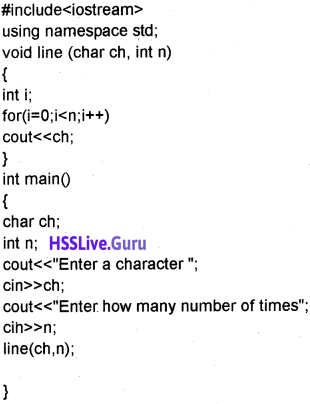
Plus One Computer Science Chapter Wise Questions and Answers Chapter 10 Functions 3

Question 12.
Read the following function
int fib(int n)
{
if (n<3)
return 1;
else
return (fib(n – 1) + fib(n – 2));
}

  1. What is the speciality of this function
  2. How does it work?
  3. What will be the output of the following code?

Answer:

  1. This function is a recursive function. That means the function calls itself.
  2. It works as follows
    • if i = 1, The function fib calls with value 1. i.e. fib(1) returns 1
    • if i = 2, The function fib calls with value 2. i.e. fib(2) returns 1
    • if i = 3, The function fib calls with value 3. i.e. fib(3) returns fib(2) + fib(1) i.e. it calls the function again.
      So the result is 1 + 1 = 2
    • if i = 4, The function fib calls with value 4. i.e. fib(4) returns fib(3) + fib(2) i.e. it calls the function again.
      So the result is 2 + 1 = 3
  3. The output will be as follows 1 1 2 3

Question 13.
Explain scope rules of functions and variables in a C++ program
Answer:
Local variable or function:
A variable or function declared inside a function is called local variable or function. This cannot be accessed by the out-side of the function.
eg:
main()
{
int k; // local variable
cout<<sum(a,b); // local function
}

Global variable or function:
A variable or function declared out side of a function is called global variable or function. This can be accessed by any statements.
eg:
int k; // global variable
int sum(int a, int b); // global function
main()
{
}

Plus One Computer Science Chapter Wise Questions and Answers Chapter 10 Functions

Question 14.
Briefly explain default arguments Default arguments.
Answer:
A default value can be set for a parameter (argument) of a function. When the user does not give a value the function will take the default value. An important thing remember,is an argument cannot have a default value unless all arguments on its right side must have default value.
Functions with valid default arguments are given below

  • float area(int x, int y, int z = 30);
  • float area(int x, int y = 20, int z = 30);
  • float area(int x = 10, int y = 20, int z = 30);

Functions with invalid default arguments are given below

  • float area(int x = 10, int y, int z);
  • float area(int x, int y = 20, int z);
  • float area(int x = 10, int y = 20, int z);

Question 15.
How to pass an array to function.
Answer:
By using call by reference method we can send an array as argument. We have to send only the array name and its data type. The array name holds the starting address and will access the subsequent elements of an array.
The following example shows this
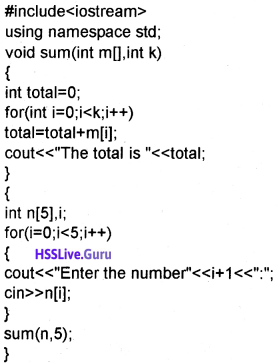
Plus One Computer Science Chapter Wise Questions and Answers Chapter 10 Functions 4

Question 16.
How to pass a structure to a function.
Answer:
A structure can be passed as argument to a function either call by value or call by reference method. An example is given below to read name and age of a structure and pass it to a function.
Plus One Computer Science Chapter Wise Questions and Answers Chapter 10 Functions 5

Question 17.
Write a program to read a character and check whether it is alphabet or not. If it is an alphabet check whether it is upper case or lower case?
Answer:
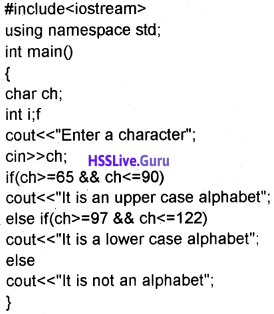
Plus One Computer Science Chapter Wise Questions and Answers Chapter 10 Functions 6

Question 18.
Write a program to read 2 strings and join them 2 string.
Answer:
Plus One Computer Science Chapter Wise Questions and Answers Chapter 10 Functions 7

Question 19.
Write a program to read 2 strings and compare it 2 string.
Answer:
Plus One Computer Science Chapter Wise Questions and Answers Chapter 10 Functions 8
Plus One Computer Science Chapter Wise Questions and Answers Chapter 10 Functions 9

Question 20.
Write a program to read a string and display the number of alphabets and digits and special characters.
Answer:
Plus One Computer Science Chapter Wise Questions and Answers Chapter 10 Functions 10

Question 21.
Write a program to perform the following opera-tions on a string

  1. Length of a string
  2. Search a character
  3. Display the string

Answer:
Plus One Computer Science Chapter Wise Questions and Answers Chapter 10 Functions 11
Plus One Computer Science Chapter Wise Questions and Answers Chapter 10 Functions 13

Plus One Computer Science Chapter Wise Questions and Answers Chapter 10 Functions

Question 22.
Write short notes about conversion functions.
Answer:
The header file stdlib.h is used for conversion functions.Following are the important conversion functions
1. itoa():
It is used to convert an integer into a string.
eg:
int n = 100;
charstr[20];
itoa(n,str,10);

2. Itoa():
It is used to convert an long into a string.
eg:
long n = 1002345L
char str[20];
ltoa(n,str,10);

3. atoi():
It is used to convert a string into integer
eg:
int n;
str[] = “123”
n = atoi(str);

4. atoll():
It is used to convert a string into long
eg:
long n;
str[] = “123456”
n = atol(str);

Question 23.
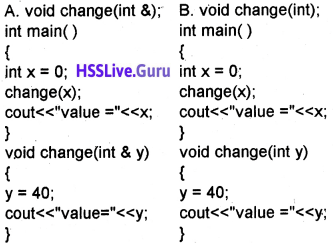
Plus One Computer Science Chapter Wise Questions and Answers Chapter 10 Functions 14

  1. Predict the output of both programs.
  2. Justify your predictions.

Answer:
1. A. Output
value = 40

B. output
value = 0

2. In the first case (A) the argument x is passed by reference method. So the changes made in the function reflects in main()

In the second case (B) the argument x is passed by value method. So the changes made in the function will not reflect in main()

Question 24.
Consider the following C++ function.
int recfact(int x)
{
if(x == 0)
return 1;
else
return x * recfact(x – 1);
}

  1. What type of function is this? Explain. (2 Scores)
  2. What is the output of the above function when x = 5

Answer:

  1. recursive function. The abilty of a function to call itself is called recursion. A function is said to be recursive if a statement in the body of the function calls itself.
  2. Output 120

Plus One Computer Science Chapter Wise Questions and Answers Chapter 10 Functions

Question 25.
void initialise()
{
int k = 10;
}
int main()
{
int a, b;
float marks;
a = 20;
cout<<“First value =”<< a;
initialise();
b = k + a;
cout<<“New value =”<<b;
}

  1. Identify the error in the above code and explain its reasons.
  2. Correct the errors.

Answer:

  1. K is a local variable in the function initialize 0. It is not accessible in main()
  2. Making the variable K as global we can correct the error.

Question 26.
Write a program to read 2 strings and join them using string function.
Answer:
#include<iostream>
#include<cstring>
#include<cstdio>
using namespace std;
int main()
{
char str1 [50],str2[50],str[100];
cout<<“Enter a string:”; gets(strl);
cout<<“Enter another string:”; gets(str2);
strcat(str,str1);
strcat(str,str2);
cout<<“The concatenated string is”<<str;
}

Plus One Computer Science Chapter Wise Questions and Answers Chapter 10 Functions

Question 27.
Consider the following code.
#include<iostream>
#include<cstdlib>
using namespace std;
int main()
{
char str1 [] = “123”,str2[] = “45”;
int a,b;
a = atoi(str1);
b = atoi(str2);
cout<<a + b;
}
What will be the output and give the reason?
Answer:
The output is 123 + 45 = 168. Here the conversion function atoi is used to convert the string “123” into integer 123 and “45” into integer 45 so the result.

Question 28.
Name the different methods used for passing arguments to a function. Write the difference between them with examples. (MARCH-2015)
Answer:
Methods of calling functions:
Two types call by value and call by reference.
1. Call by value:
In call by value method the copy of the original value is passed to the function, if the function makes any change will not affect the original value.
Example
Plus One Computer Science Chapter Wise Questions and Answers Chapter 10 Functions 15
Plus One Computer Science Chapter Wise Questions and Answers Chapter 10 Functions 16

2. Call by reference:
In call by reference method the address of the original value is passed to the function, if the function makes any change will affect the original value.
Example
Plus One Computer Science Chapter Wise Questions and Answers Chapter 10 Functions 17

Question 29.
Write a C++ program to display the simple interest using function. (SAY-2015) (3)
Answer:
include < iostream>
using namespace std;
float Simplelnt (float p, int n, float r)
{
return (p*n*r/100);
}
int main()
{
float p, r, SI;
int n;
cout<<“Enter values for p,n,r:”; cin>>p>>n>>r;
SI = Simplelnt (p,n,r); cout<<“simple interest is”<<SI;
}

Plus One Computer Science Chapter Wise Questions and Answers Chapter 10 Functions

Question 30.
Write a function’s definition of the above type to find the sum of matural numbers from 1 to N. (Hint: If the value of N is 5, the answer will be 1 + 2 + 3 + 4 + 5 = 15). (MARCH – 2016) (3)
Answer:
int sum (int n)
{
if (n == 0)
return 0;
else
return (n + sum (n – 1));
}

Question 31.
A program requires functions for adding 2 numbers, 3 numbers and 4 numbers, How can you provide a solution by writing a single functio0n? (SCERT SAMPLE -1) (3)
Answer:
It can be solved by writing function with default values.
eg: int add (int n1, int n2, int n3 = 0, int n4 = 0)
{
return (n1 + n2 + n3 + n4);
}
This function can be invoked by the following function calling
1. add (5,2);
2. add (5,2,7);
3. add (5,2,7,10);

The 1. Call returns 5 + 2 = 7
2. Call returns 5 + 2 + 7 = 14
3. Call returns 5 + 2 + 7 + 10 = 24

Question 32.
Explain the difference between call-by-value method and call-by-reference method with the help of examples. (SCERT SAMPLE – II) (3)
Answer:
Methods of calling functions:
Two types call by value and call by reference.
1. Call by value:
In call by value method the copy of the original value is passed to the function, if the ’ function makes any change will not affect the original value.
Example
Plus One Computer Science Chapter Wise Questions and Answers Chapter 10 Functions 18
Plus One Computer Science Chapter Wise Questions and Answers Chapter 10 Functions 19

2. Call by reference:
In call by reference method the address of the original value is passed to the function, if the function makes any change will affect the original value.
Example
Plus One Computer Science Chapter Wise Questions and Answers Chapter 10 Functions 20

Plus One Computer Science Chapter Wise Questions and Answers Chapter 10 Functions

Question 33.
Explain recursive functions with the help of a suitable example. (SAY-2016) (3)
Answer:
A function calls itself is called recursive function.
#include<iostream>
using namespace std;
void convert(int n)
{
if(n>1)
convert(n/2);
cout<<n % 2;
}
int main()
{
convert(7);
}
Here the function convert is a recursive function, that means it calls itself and output of the above program is 111.

Question 34.
Name the built-in function to check whether a character is alphanumeric or not. (MARCH-2017) (3)
Answer:
isalnum()

Question 35
Briefly explain the three components in the structure of a C++ program. (MARCH-2017) (3)
Answer:
1. Preprocessor directives:
A C++ program starts with the preprocessor directive i.e., # .include, #define, #undef, etc, are such a preprocessor directives. By using #include we can link the header files that are needed to use the functions. By using #define we can define some constants.
eg: #define x 100. Here the value of x becomes 100 and cannot be changed in the program. No semicolon is needed.

2. Header files:
A header file is a pre stored file that helps to use some operators and functions. To write C++ programs the header files are must. Following are the header files iostream

  • iomanip
  • cstdio
  • cctype
  • cmath
  • cstring

The syntax for including a header file is as follows
#include<name of the header file>
eg: #include<iostream>

3. The main function:
The main function is the first function which is invoked at the time of execution and the program ends within main(). The other functions are invoke from main().

Question 36.
Explain the difference between call by value method and call by reference method with the help of examples. (MARCH-2017) (3)
Answer:
Two types are call by value and call by reference.
1. Call by value:
In call by value method the copy of the original value is passed to the function, if the function makes any change wilt not affect the original value.
Example
Plus One Computer Science Chapter Wise Questions and Answers Chapter 10 Functions 21

2. Call by reference:
In call by reference method the address of the original value is passed to the function, if the function makes any change will affect the original value.
Example
Plus One Computer Science Chapter Wise Questions and Answers Chapter 10 Functions 22
Plus One Computer Science Chapter Wise Questions and Answers Chapter 10 Functions 23

Plus One Functions Five Mark Questions and Answers

Question 1.
Short notes about character functions and string functions
Answer:
A. Character functions:
1. isalnum():
t is used to check whether a character is alphabet or digit. It returns a non zero value if it is an alphabet or digit otherwise it returns zero.

2. isalpha():
It is used to check whether a character is alphabet or not. It returns a non zero value if it is an alphabet otherwise it returns zero.

3. isdigit():
It is used to check whether a character is digit or not. It returns a non zero value if it is digit otherwise it returns zero.

4. islower():
It is used to check whether a character is lower case alphabet or not. It returns a non zero value if it is a lowercase alphabet otherwise it returns zero.

5. isupper():
It is used to check whether a character is upper case alphabet or not. It returns a non zero value if it is an upper case alphabet otherwise it returns zero.

6. tolower():
It is used to convert the alphabet into lower case

7. toupper():
It is used to convert the alphabet into upper case

B. String functions:

1. strcpy():
This function is used to copy one string into another

2. strcat():
This function is used to concatenate(join) second string into first string

3. strlen():
This function is used to find the length of a string.

4. strcmp():
This function is used to compare 2 strings. If the first string is less than second string then it returns a negative value. If the first string is equal to the second string then it returns a value zero and if the first string is greater than the second string then it returns a positive value.

Plus One Computer Science Chapter Wise Questions and Answers Chapter 10 Functions

Question 2.
Write functions to perform the following operations

  1. sqrt()
  2. power of 2 numbers
  3. sin
  4. cos

Answer:
Plus One Computer Science Chapter Wise Questions and Answers Chapter 10 Functions 24
Plus One Computer Science Chapter Wise Questions and Answers Chapter 10 Functions 25

Question 3.
Write a C++ program to display the roots of quadratic equation. (SAY-2015) (5)
Answer:
#include<iostream>
#include<cmath>
Plus One Computer Science Chapter Wise Questions and Answers Chapter 10 Functions 26

Question 4.
Explain ‘Call by Value’ and ‘Call by Reference’ methods of function calling with the help of a suitable example. (SAY-2016)
Answer:
Two types are call by value and call by reference.
1. Call by value:
In call by value method the copy of the original value is passed to the function, if the function makes any change will not affect the original value.
Example
Plus One Computer Science Chapter Wise Questions and Answers Chapter 10 Functions 27
Plus One Computer Science Chapter Wise Questions and Answers Chapter 10 Functions 29

2. Call by reference:
In call by reference method the address of the original value is passed to the function, if the function makes any change will affect the original value.
Example
Plus One Computer Science Chapter Wise Questions and Answers Chapter 10 Functions 30

Plus One Computer Science Chapter Wise Questions and Answers Chapter 10 Functions

Question 5.
Define network topology. Explain any four network topologies in detail. (SAY-2016)
Answer:
Network topologies:
Physical or logical arrangement of computers on a network is called structure or topology. It is the geometrical arrangement of computers in a network. The major topologies developed are star, bus, ring, tree and mesh

1. Star Topology:
A star topology has a server all other computers are connected to it. If computer A wants to transmit a message to computer B. Then computer A first transmit the message to the server then the server retransmits the message to the computer B.

That means all the messages are transmitted through the server. Advantages are add or remove workstations to a star network is easy and the failure of a workstation will not effect the other. The disadvantage is that if the server fails the entire network will fail.

2. Bus Topology:
Here all the computers are attached to a single cable called bus. Here one computer transmits all other computers listen. Therefore it is called broadcast bus. The transmission from any station will travel in both the direction. The connected computers can hear the message and check whether it is for them or not.

Advantages are add or remove computer is very easy. It requires less cable length and the installation cost is less. Disadvantage is fault detection is very difficult because of no central computer.

3. Ring Topology:
Here all the computers are connected in the shape of a ring and it is a closed loop. Here also there is no central computer. Here a computer transmits a message, which is tagged along with its destination computer’s address. The message travels in one direction and each node check

whether the message is for them. If not, it passes to the next node. FIt requires only short cable length. If a single node fails, at least a portion of the network will fail. To add a node is very difficult.

4. Hybrid Topology:
It is a combination of any two or more network topologies. Tree topology and mesh topology can be considered as hybrid topology.
(a) Tree Topology:
The structure of a tree topology is the shape of an inverted tree with a central node and branches as nodes. It is a variation of bus topology. The data transmission takes place in the way as in bus topology. The disadvantage is that if one node fails, the entire portion will fail.

(b) Mesh Topology:
In this topology each node is connected to more than one node. It is just like a mesh (net). There are multiple paths between computers. If one path fails, we can transmit data through another path.