Plus One Economics Chapter Wise Questions and Answers Chapter 6 Rural Development

Students can Download Chapter 6 Rural Development Questions and Answers, Plus One Economics Chapter Wise Questions and Answers helps you to revise the complete Kerala State Syllabus and score more marks in your examinations

Kerala Plus One Economics Chapter Wise Questions and Answers Chapter 6 Rural Development

Plus One Economics Rural Development One Mark Questions and Answers

Question 1.
Rural developments include:
(i) education and skill developments
(ii) land reforms
(iii) measures for alleviation of poverty
(iv) all of the above
Answer:
(iv) all of the above

Question 2.
Shift of workforce from agriculture to other allied activities like livestock, poultry, fisheries, etc, is known as.
Answer:
Diversification.

Question 3.
Golden revolution is associated with?
(i) Horticulture
(ii) Livestock
(iii) Fisheries
(iv) Pulses
Answer:
(i) Horticulture

Plus One Economics Chapter Wise Questions and Answers Chapter 6 Rural Development

Question 4.
How many banks were nationalised in 1969?
(i) 6
(ii) 9
(iii) 14
(iv) 20
Answer:
(iii) 14

Question 5.
White revolution is related to
(i) Bamboo
(ii) Cash crop
(iii) Milk
(iv) Foodgrain
Answer:
(iii) Milk

Question 6.
Blue revolution is related to
(i) Milk
(ii) Fish
(iii) Egg
(iv) None of these
Answer:
(ii) Fish

Question 7.
Which among the following is an advantage of organic fanning
(i) It is labour intensive
(ii) It is environment-friendly
(iii) It uses locally produced organic inputs
(iv) All the above
Answer:
(iv) All the above

Question 8.
Complete the following statement.
The credit provisions of SHGs are generally referred to as ………………..
Answer:
Microcredit programs.

Plus One Economics Chapter Wise Questions and Answers Chapter 6 Rural Development

Question 9.
“Regulated Market yards benefit farmers as well as consumers”. Do you agree with this statement?
Answer:
Yes, I agree with this statement that the Regulated Market yields benefit farmers as well as consumers.

Plus One Economics Rural Development Two Mark Questions and Answers

Question 1.
What is TANWA?
Answer:
TANWA stands for Tamil Nadu Women in Agriculture. It is a project initiated in Tamil Naud to train women in latest agricultural techniques. It includes women to actively participate in raising agricultural productivity and family income. They promote small scale household activities like soap manufacturing, doll making etc.

Question 2.
Name few horticultural crops.
Answer:
Names of horticultural crops are:

  • Fruits
  • Vegetables
  • Medicinal plants

Plus One Economics Rural Development Three Mark Questions and Answers

Question 1.
Complete the following.
a. Percentage of population living in the rural area is
(i) 25%
(ii) 50%
(iii) 75%
(iv) 90%
b. NABARD is the open bank providing credit to sector
(i) ombined sector
(ii) industrial sector
(iii) agricultural sector
(iv) tertiary sector
c. The Golden revolution was a period of very high productivity in
(i) food grain production
(ii) horticulture
(iii) organic farming
(iv) pisciculture
Answer:
a. (iii) 75%
b. (iii) agricultural sector
c. (ii) horticulture

Question 2.
Why the co-operative marketing could not gain momentum in India?
Answer:
Co-operative marketing has failed to gain adequate success in India because of inadequate coverage of farmer members and lack of appropriate link between marketing and processing management.

Question 3.
What do you mean by organic farming?
Answer:
Eco-friendly technology of cultivation is known as organic farming, it is the farming without using chemical fertilizers or pesticides. It uses natural mannure.

Plus One Economics Chapter Wise Questions and Answers Chapter 6 Rural Development

Question 4.
Give reasons for the declining share of agriculture in GDP of India.
Answer:
After the initiation of reforms, the growth rate of agriculture sector has declined to 2.3% during the 1990s which was lower than earlier years. The reasons for this decline are inadequate infrastructure, alternate employment opportunities in the industry or service sector, increase in casualisation of employment in agriculture, etc.

Question 5.
Explain the term ‘golden revolution’.
Answer:
The growth of horticulture sector at a spectacular speed is called ‘Gloden Revolution’. The period between 1991 – 2003 is known as the period of golden revolution. During this period, the investment in horticulture became highly productive and the sector emerged as a sustainable livelihood option. Thus India could become leading producer of mangoes, bananas, coconuts etc.

Question 6.
Name a few traditional industries in India.
Answer:
The traditional industries of India are:

  • Pottery
  • Crafts
  • Handloom
  • Textiles
  • Bamboo

Question 7.
Prepare a note on ‘Kudumbashree’ in Kerala.
Answer:
Kudumbasree is a women-oriented community-based poverty reduction programme being implemented in kerala. The objective of this group is to encourage savings. The small savings in women’s group creates more employment and productive atmosphere in women’s groups.

Question 8.
Prepare a note on NABARD?
Answer:
NABARD stands for National Bank for Agriculture and Rural Development. It was established in 1982, July. It has been assigned the role performed by agricultural refinance and development corporation and also the role performed by RBI for rural credit. NABARD provides short term loans for agricultural operation.

Plus One Economics Rural Development Four Mark Questions and Answers

Question 1.
What are the alternative channels available for agricultural marketing? Give examples:
Answer:
Following are the alternative channels available for agricultural marketing.

  1. Co-operative Credit Societies
  2. Reserve Bank of India
  3. Regional Rural Banks
  4. Commercial Banks
  5. NABARD
  6. Self Help Groups (SHGs)

Plus One Economics Chapter Wise Questions and Answers Chapter 6 Rural Development

Question 2.
Critically appraise Rural banking operations in the light of recent farmers suicides in India.
Answer:
Operation of rural banking had a positive effect on rural farm and non-farm output, income, and employment. Farmers were given a variety of loans for meeting production needs. This helped India to achieve food security and to gain a huge buffer stock of grains.

However our banking system in the rural area could not meet all loan needs of the farmers. Some of the farmers still depend on local moneylenders. This system failed to develop a culture of deposit mobilization. Agriculture loan default was very high.

Question 3.
Mention some obstacles that hinder the mechanism of agricultural marketing.
Answer:
The farmers suffer from many problems relating to agricultural marketing. Some obstacles that hinder the mechanism of agricultural marketing are mentioned below.

  • faulty weighing
  • manipulation of accounts
  • forced to sell at lower prices
  • lack of proper storage facilities
  • lack of infrastructure facilities
  • inadequate coverage of farmers by cooperatives
  • inefficient financial management

Question 4.
Match the following.
Plus One Economics Chapter Wise Questions and Answers Chapter 6 Rural Development img1
Answer:
Plus One Economics Chapter Wise Questions and Answers Chapter 6 Rural Development img2

Question 5.
‘Rainbow revolution is meant for overall agricultural development’, comment.
Answer:
The rainbow revolution is meant for overall development of Indian agriculture. Under rainbow revolution, the following revolutions are included.
Plus One Economics Chapter Wise Questions and Answers Chapter 6 Rural Development img3

Plus One Economics Rural Development Five Mark Questions and Answers

Question 1.
State whether true or false.

  1. Organic food has higher nutritional value compared to non-organic food
  2. Ten commercial banks were nationalized in 1969
  3. Golden revolution happened in fisheries
  4. SHG stands for Social Health Groups
  5. Use of chemical fertilizers lead to pollution.

Answer:

  1. True
  2. False. Fourteen commercial banks were nationalized in 1969
  3. False. Golden revolution happened in horticulture
  4. False. SHG stands for Self Help Groups
  5. True

Question 2.
“Organic farming and sustainable development are closely related to each other”. Substantiate.
Answer:
In recent years, awareness of the harmful effect of chemical-based fertilizers and pesticides on our health is on a rise. Conventional agriculture relies heavily on chemical fertilizers and toxic pesticides etc., which enter the food supply, penetrate the water sources, harm the livestock, deplete the soil and devastate natural eco-systems.

Efforts in evolving technologies which are ecofriendly are essential for sustainable development and one such technology which is eco-friendly is organic farming. In short, organic agriculture is a whole system of farming that restores, maintains and enhances the ecological balance.

There is an increasing demand for organically grown food to enhance food safety throughout the world. Thus it can be stated that organic farming and sustainable development are closely related to each other.

Plus One Economics Chapter Wise Questions and Answers Chapter 6 Rural Development

Question 3.
Identify the benefits and limitations of organic farming.
Answer:
A. Benefits of Organic Farming
1. Organic agriculture offers a means to substitute costlier agricultural inputs with locally produced organic inputs that are cheaper and thereby generate good returns on investment.

2. Organic agriculture also generates incomes through international exports as the demand for organically grown crops is on a rise. Studies across countries have shown that organically grown food has more nutritional value than chemical farming thus providing us with healthy foods.

3. Since organic farming requires more labour input than conventional farming, India will find organic farming an attractive proposition

4. the organic produce is pesticide-free and produced in an environmentally sustainable way

5. Organic fanning helps in sustainable development of agriculture and India has a clear advantage in producing organic products for both domestic and international markets.

B. Limitations of organic farming
1. Popularizing organic farming requires awareness and willingness on the part of farmers to adapt to new technology.

2. Inadequate infrastructure and the problem of marketing the products are major concerns which need to be addressed apart from appropriate agriculture policy to promote organic farming.

3. It has been observed that the yields from organic farming are less than modem agricultural farming in the initial years. Therefore, small and marginal farmers may find it difficult to adapt to large scale production.

4. Organic produce may also have more blemishes . and a shorter shelf life than sprayed produce. Moreover choice in production of off-season crops is quite limited inorganic farming.

Question 4.
Narrate the importance of agricultural diversification in promoting rural sector?
Answer:
Agricultural diversification is a system of fanning that encourages production of a variety of plant and animals and their products. Non-farm employment provides greater income stability, economies of size also reduces uncertainty of business. It involves maximum number of persons as it is labour intensive in nature.

The majority of small and marginal farmers cultivate mainly low-value subsistence crops. In the absence of farm and non-farm employment opportunities, they are forced to live below poverty line. So this problem is solved with the help of commercialisation and diversification of small farmers within and outside agriculture and their proper integration with local and global markets.

This is helpful not only in liberating the small and marginal farmers from the poverty trap, but also to meet the country’s growing demands for fruits, vegetables, milk and milk products, meat, fishes, eggs, etc. which generally show rising trends with increasing levels of per capita income in the economy.

Question 5.
“Rural development focuses on actions for the development of the areas that are lagging behind in the overall development of the development of the village economy” point out the areas of rural development.
Answer:
Rural development is quite a comprehensive term but it essentially means a plan of action for the development of areas which are lagging behind in socio-economic development. Some of the areas which are challenging and need fresh initiatives for development in India include

a. Development of human resources including:

  1. Literacy, more specifically, female literacy, education and skill development
  2. Health, addressing both sanitation and public health

b. Land reforms

c. Development of infrastructure development like electricity, irrigation, credit, marketing, transport facilities including construction of village roads and feeder roads to nearby highways, facilities for agriculture research and extension, and information dissemination

d. Introduction of special measures for alleviation of poverty and bringing about significant improvement in the living conditions of the weaker sections of the population emphasizing access to productive employment opportunities.

Plus One Economics Chapter Wise Questions and Answers Chapter 6 Rural Development

Question 6.
Explain some measures taken by the government to improve agricultural marketing.
Answer:
Agricultural marketing encompasses all activities in moving farm products from the producers to the final consumers such as storage, transport, processing, etc. In India, agricultural marketing was regarded as operationally inefficient and exploitative in character. Hence to improve the position of agricultural marketing following things are required :

  1.  Facilities for storing goods.
  2. Adequate and economical transport.
  3. Eliminination of intermediaries.
  4. Basic information of market conditions to get better prices for the produce.

The above mentioned requirements for efficient agricultural marketing can be also classified into the following.

  1. Promotion of cooperative agricultural marketing societies.
  2. Developing regulated markets where marketing practices have been standardized so as to provide encouragement to farmers to come to mandis to dispose off their produce and prevent them from exploitation in the hand of Dallas.
  3. Granding and standardisation of produce to help the farmer to fetch better prices.
  4. Developing warehousing facilities, road transport, etc.
  5. Declaration of support price that offers a minimum price to the farmers for their produce.

Plus Two Maths Chapter Wise Questions and Answers Chapter 8 Application of Integrals

Students can Download Chapter 8 Application of Integrals Questions and Answers, Plus Two Maths Chapter Wise Questions and Answers helps you to revise the complete Kerala State Syllabus and score more marks in your examinations.

Kerala Plus Two Maths Chapter Wise Questions and Answers Chapter 8 Application of Integrals

Plus Two Maths Application of Integrals Four Mark Questions and Answers

Question 1.
Consider the following figure.
Plus Two Maths Application of Integrals 4 Mark Questions and Answers 1

  1. Find the point of intersection (P) of the given parabola and the line. (2)
  2. Find the area of the shaded region. (2)

Answer:
1. We have, y = x2 and y = x ⇒ x = x2
⇒ x2 – x = 0 ⇒ x(x – 1) = 0 ⇒ x = 0, 1
When x = 0, y =0 and x = 1, y = 1.
Therefore the points of intersections are (0, 0) and(1, 1).

2. Required area
Plus Two Maths Application of Integrals 4 Mark Questions and Answers 2

Question 2.
1. Find the point of intersection ‘p’ of the given parabola and the line. (2)
Plus Two Maths Application of Integrals 4 Mark Questions and Answers 3
2. Find the area of the shaded region. (2)
Answer:
1. Given, y = x2, y = 2x
⇒ 2x = x2 ⇒ x2 – 2x = 0 ⇒ x(x – 2) = 0 ⇒ x = 0, 2
We have, y = 2x
⇒ when x = 0 ⇒ y = 0, when x = 2 ⇒ y = 4
‘P’ has co-ordinate (2, 4)

2. Area = \(\int_{0}^{2} 2 x d x-\int_{0}^{2} x^{2} d x=\left(x^{2}\right)^{2}-\left(\frac{x^{3}}{3}\right)_{0}^{2}=4-\frac{8}{3}=\frac{12-8}{3}=\frac{4}{3}\).

Plus Two Maths Chapter Wise Questions and Answers Chapter 8 Application of Integrals

Question 3.
Consider the following figure.
Plus Two Maths Application of Integrals 4 Mark Questions and Answers 4

  1. Find the point of Intersection P of the circle x2 + y2 = 32 and the line y = x. (1)
  2. Find the area of the shaded region. (3)

Answer:
1. x2 + x2 = 32 ⇒ 2x2 = 32 ⇒ x2 = 16 = 4
Therefore the point of intersection P is (4, 4).

2. We have x2 + y2 = 32 ⇒ y = \(\sqrt{32-x^{2}}\).
The required area =
Plus Two Maths Application of Integrals 4 Mark Questions and Answers 5
= 8 + [8π – 8 – 4π] = 4π.

Question 4.

  1. Shade the area enclosed by x2 = 4y, y = 2, y = 4 and the y-axis in the first quadrant. (2)
  2. Find the area of the region bound by x2 = 4y, y = 2, y = 4 and the y-axis in the first quadrant. (2)

Answer:
1.
Plus Two Maths Application of Integrals 4 Mark Questions and Answers 6

2. Area
Plus Two Maths Application of Integrals 4 Mark Questions and Answers 7

Plus Two Maths Chapter Wise Questions and Answers Chapter 8 Application of Integrals

Question 5.

  1. Draw a rough sketch of the graph of the function y2 = 4x. (2)
  2. Find the area by the curve and the line x= 2. (2)

Answer:
1.
Plus Two Maths Application of Integrals 4 Mark Questions and Answers 8

2. Area
Plus Two Maths Application of Integrals 4 Mark Questions and Answers 9

Plus Two Maths Application of Integrals Six Mark Questions and Answers

Question 1.

  1. Draw the graph of y2 = 4x and y = x. (2)
  2. Find the points of intersection of y2 = 4x and y = x. (2)
  3. Find the area bounded by the graphs.(2)

Answer:
1. y2 = 4x is a parabola and y = x is a straight line passing through the origin.
Plus Two Maths Application of Integrals 4 Mark Questions and Answers 10

2. x2 = 4x ⇒ x2 – 4x = 0 ⇒ x(x – 4) = 0 ⇒ x = 0, 4
When x = 0, y = 0 and when x = 4, y =4. Therefore the points of intersection are (0, 0) and (4, 4).

3. Area bounded by the graphs = Area under the parabola in the first quadrant – Area under the line.
Plus Two Maths Application of Integrals 4 Mark Questions and Answers 11

Plus Two Maths Chapter Wise Questions and Answers Chapter 8 Application of Integrals

Question 2.

  1. Draw the graph of the function y = x2 and x = y2 in a coordinate axes. (2)
  2. Find the point of intersection of the above graphs. (2)
  3. Find the area of the region bounded by the above two curves. (2)

Answer:
1. The two function are parabolas as shown in the figure.
Plus Two Maths Application of Integrals 4 Mark Questions and Answers 12

2. We have, y = x2 and x = y2
x = (x2)2 ⇒ x – x4 = 0 ⇒ x(1 – x3) = 0 ⇒ x = 0, 1
When x= 1, y= 1 and x = 0, y = 0.
Therefore the point is (0, 0) and (1, 1).

3. The required area = \(\int_{0}^{1} \sqrt{x} d x-\int_{0}^{1} x^{2} d x\)
Plus Two Maths Application of Integrals 4 Mark Questions and Answers 13

Question 3.
Using the figure answer the following questions
Plus Two Maths Application of Integrals 4 Mark Questions and Answers 14

  1. Find the area of the shaded region as the sum of the area of two triangles. (2)
  2. Define the function of the given graph. (2)
  3. Verify the area of the shaded region using integration. (2)

Answer:
1. Area = Area of ∆OAD + Area of ∆ ABC
\(\frac{1}{2}\) × 3 × 3 + \(\frac{1}{2}\) × 2 × 2 = \(\frac{9}{2}\) + 2 = \(\frac{13}{2}\).

2. Area = \(\int_{0}^{5}\)f(x) dx = \(\int_{0}^{3}\)(-x + 3) dx + \(\int_{3}^{5}\)(x – 5) dx
Plus Two Maths Application of Integrals 4 Mark Questions and Answers 15
Therefore verified.

Plus Two Maths Chapter Wise Questions and Answers Chapter 8 Application of Integrals

Question 4.
The figure given below contains a straight line L with slope \(\sqrt{8}\) and a circle.
Plus Two Maths Application of Integrals 4 Mark Questions and Answers 16

  1. Find the equation of the line L and circle. (1)
  2. Find the point of intersection P. (2)
  3. Find the area of the shaded region. (3)

Answer:
1. The line L passes through origin and have slope 3, therefore its equation is y = \(\sqrt{8}\) x. The circle passes through origin and have radius 3, therefore its equation is x2 + y2 = 9.

2. We have, y =3x and x2 + y2 = 9
⇒ x2 + (\(\sqrt{8}\)x)2 = 9 ⇒ 9x2 = 9
⇒ x = 1
∴ y = \(\sqrt{8}\) × 1 = \(\sqrt{8}\).
Therefore, coordinate of ‘P’ is (1, \(\sqrt{8}\)).

3. Area of the shaded region
Plus Two Maths Application of Integrals 4 Mark Questions and Answers 17

Plus Two Maths Chapter Wise Questions and Answers Chapter 8 Application of Integrals

Question 5.
Using the given figure answer the following
Plus Two Maths Application of Integrals 4 Mark Questions and Answers 18

  1. Define the equation of the circle and ellipse in the figure. (1)
  2. Find the area of the ellipse using integration. (4)
  3. Find the area of the shaded region. (Use formula to find the area of the circle.) (1)

Answer:
1. From the figure equation of the circle is x2 + y2 = 4 and that of the ellipse is \(\frac{x^{2}}{4}+\frac{y^{2}}{1}=1\).

2. We have, \(\frac{x^{2}}{4}+\frac{y^{2}}{1}=1\)
⇒ y2 = 1 ⇒ y = \(\frac{1}{2} \sqrt{4-x^{2}}\)
Area of the ellipse = 4 \(\int_{0}^{2}\)y dx
Plus Two Maths Application of Integrals 4 Mark Questions and Answers 19

3. Area of the circle of radius 2 = π (2)2 = 4π
∴ Area of the shaded region = Area of the circle – Area of the ellipse
= 4π – 2π = 2π.

Question 6.

  1. Find the area bounded by the curve y = sin x with X – axis, between x = 0 and x = 2π. (2)
  2. Find the area of the region bounded by the curve y = x2 and y = |x| (4)

Answer:
1. Area of y = sin x in each loop is same. Therefore;
2\(\int_{0}^{\pi}\)sin xdx = \(-2(\cos x)_{0}^{\pi}\) = -2 (cos π – cos0)
= -2(-1 – 1) = 4

2.
Plus Two Maths Application of Integrals 4 Mark Questions and Answers 20
Area
Plus Two Maths Application of Integrals 4 Mark Questions and Answers 21

Plus Two Maths Chapter Wise Questions and Answers Chapter 8 Application of Integrals

Question 7.
Using integration, find the area of the region bounded by the triangle whose vertices are(-1, 1), (0, 5) and (3, 2). (6)
Answer:
Plus Two Maths Application of Integrals 4 Mark Questions and Answers 22
Equation of BC is \(\frac{y-5}{1-5}=\frac{x-0}{-1-0}\)
⇒ y – 5 = 4x ⇒ 4x – y + 5 = 0 ⇒ y = 4x + 5
Equation of AB is x + y – 5 = 0 ⇒ y = 5 – x
Equation of AC is x – 4y + 5 = 0 ⇒ y = \(\frac{x}{4}+\frac{5}{2}\)
The required area = Area of the region PABCQP – Area of the region PACQP
Plus Two Maths Application of Integrals 4 Mark Questions and Answers 23

Question 8.
Consider the functions f(x) = sin x and g(x) = cosx in the interval [0, 2π]

  1. Find the x coordinates of the meeting points of the functions. (1)
  2. Draw the rough sketch of the above functions. (2)
  3. Find the area enclosed by these curves in the given interval. (3)

Answer:
1. f(x) = sin x and g(x) = cos x meet at multiples of \(\frac{\pi}{4}\)
x = \(\frac{\pi}{4}\), \(\frac{5 \pi}{4}\).

2.
Plus Two Maths Application of Integrals 4 Mark Questions and Answers 24

3. Area = 2{Area under f(x) = sinx from \(\frac{\pi}{4}\) to π – Area under g(x) = cosx from \(\frac{\pi}{4}\) to \(\frac{\pi}{2}\)}
Plus Two Maths Application of Integrals 4 Mark Questions and Answers 25

Plus Two Maths Chapter Wise Questions and Answers Chapter 8 Application of Integrals

Question 9.

Evaluate \(\int_{0}^{r} \sqrt{r^{2}-x^{2}} d x\), where r is a fixed positive number. Hence prove the area of the circle of radius r is π r2. (2)
Find the area of the circle, x2 + y2 = 16 which is exterior to parabola y2 = 6x. (4)

Answer:
1.
Plus Two Maths Application of Integrals 4 Mark Questions and Answers 26
Plus Two Maths Application of Integrals 4 Mark Questions and Answers 27

2. Given, x2 + y2 = 16 and y2 = 6x ⇒ x2 + 6x = 16 ⇒ x2 + 6x – 16 = 0 ⇒ (x + 8)(x – 2) = 0 ⇒ x = -8, 2.
Plus Two Maths Application of Integrals 4 Mark Questions and Answers 28
Area = Area of the circle – Interior area of the parabola.
Plus Two Maths Application of Integrals 4 Mark Questions and Answers 29

Plus Two Maths Chapter Wise Questions and Answers Chapter 8 Application of Integrals

Question 10.
Using the figure answer the following questions
Plus Two Maths Application of Integrals 4 Mark Questions and Answers 30

  1. Define the equation of the ellipse and circle in the given figure. (1)
  2. Find the area of the ellipse using integration. (4)
  3. Find the area of the shaded region. (Area of the circle can be found using direct formula). (1)

Answer:
1. Equation of the ellipse is \(\frac{x^{2}}{4}+\frac{y^{2}}{1}=1\) and circle is x2 + y2 = 1.

2. We have, \(\frac{x^{2}}{4}+\frac{y^{2}}{1}=1\)
⇒ y2 = 1 ⇒ y = \(\frac{1}{2} \sqrt{4-x^{2}}\)
Area of the ellipse = 4 \(\int_{0}^{2}\)y dx
Plus Two Maths Application of Integrals 4 Mark Questions and Answers 31

3. Area of the circle = πr2 = π × 1 = π
Required area = Area of ellipse – area of the circle = 2π – π = π.

Plus One Economics Chapter Wise Questions and Answers Chapter 5 Human Capital Formation in India

Students can Download Chapter 5 Human Capital Formation in India Questions and Answers, Plus One Economics Chapter Wise Questions and Answers helps you to revise the complete Kerala State Syllabus and score more marks in your examinations

Kerala Plus One Economics Chapter Wise Questions and Answers Chapter 5 Human Capital Formation in India

Plus One Economics Human Capital Formation in India One Mark Questions and Answers

Question 1.
As per 2011 census, the literacy rate in India was.
(i) 74%
ii) 78%
(iii) 80%
(iv) 82%
Answer:
(i) 74%

Question 2.
Which among the following is related to health sector?
(i) UGC
(ii) NCERT
(iii) ICMR
(iv) AICTE
Answer:
(iii) ICMR

Question 3.
The state in which the literacy rate is the highest in the country is ……………..
(i) Delhi
(ii) Bihar
(iii) Mizoram
(iv) Kerala
Answer:
(iv) Kerala

Plus One Economics Chapter Wise Questions and Answers Chapter 5 Human Capital Formation in India

Question 4.
The Adult literacy rate among females in India in the year2000 was ………………..
(i) 68.4%
(ii) 61.9%
(iii) 45.4%
(iv) 37.9%
Answer:
(iii) 45.4%

Question 5.
State true or false:
‘New Educational Policy was announced in 1987-88’.
Answer:
True.

Question 6.
Which state is having highest literacy rate in India according to 2011 census?
(i) Kerala
(ii) Punjab
(iii) Manipur
(iv) Hariyana
Answer:
(i) Kerala

Plus One Economics Human Capital Formation in India Two Mark Questions and Answers

Question 1.
Mention two government organizations that regulate the health and education sector.
Answer:
1. Organizations that regulate the education sector:

  • The ministries of education at the union and state level
  • National Council of Educational Research and Training (NCERT)
  • University Grants Commission (UGC)
  • All India Council of Technical Education (AICTE)

2. Organizations that regulate the health sector:

  • The ministries of health at the union and state level
  • Indian Council for Medical Research (ICMR)

Plus One Economics Chapter Wise Questions and Answers Chapter 5 Human Capital Formation in India

Question 2.
Classify the following into preventive medicines, curative medicines, and social medicines.

  1. Provision of clean drinking water.
  2. Good sanitation
  3. Medical intervention during illness
  4. Vaccination

Answer:

  • Preventive Medicine – Vaccination
  • Curative Medicine – Medical intervention during illness.
  • Social Medicine – Provision of clean drinking water, good sanitation

Question 3.
Classify the following into the features of human capital and human development

  1. Education and health are considered as a means to increase human productivity.
  2. Education and health are integral to human well-being.
  3. Human beings are treated as a means to an end.
  4. Human beings are treated as ends in themselves.

Answer:
a. Human Capital:
1. Education and health are considered as a means to increase human productively.
3. Human beings are treated as a means to an end.
b. Human development:
2. Education and health are integral to human well being.
4. Human beings are treated as ends in themselves.

Question 4.
Name the two major sources of human capital in a country.
Answer:
Two major sources of human capital in a country are:

  1. Investment in education and
  2. Investment in health.

Question 5.
Bring out the need for on-the-job training for a person.
Answer:
Firms give on-the-job-training to enhance the productive skills of the workers so as to enable them to absorb new technologies and modern ideas. It can be given in two ways:

  1. Workers may be trained in the firm itself under the assistance of an experienced worker.
  2. Workers may be sent off the firm campus for the training.

Plus One Economics Human Capital Formation in India Three Mark Questions and Answers

Question 1.
Give full form of the following

  1. GER
  2. SSA

Answer:

  1. GER – Gross Enrolment Ratio
  2. SSA – Sarva Shiksha Abhiyan

Plus One Economics Chapter Wise Questions and Answers Chapter 5 Human Capital Formation in India

Question 2.
Find the odd one out

  1. Roads, factory, teachers, power plants
  2. Teachers, doctors, ports, scientists
  3. UGC, NCERT, SCERT, NREGP

Answer:

  1. Teachers. Others are physical capital
  2. Ports. Others are human capital
  3. NREGP. Others are educational regulatory institutions

Question 3.
“Adequate education and training to farmers can raise productivity in farms.”
Do you agree or not? Substantiate your answer.
Answer:
Yes, I do agree to the statement that adequate education and training to farmers can raise productivity in farms.
This is because the attainment of more information and training will help the farmers to attain more knowledge about new methods of farming and plant protection. The application of the new knowledge in the farms will enable them to raise productivity in the farms so that the overall productivity in the agricultural sector can be improved.

Question 4.
What do you mean by Human Development Index? How it is calculated?
Answer:
The quality of life index prepared and published by United Nations Development Programme is termed as Human Development Index. HDI studies the following three basic human capabilities:

  1. Living a Long Life (Longevity)
  2. Being Knowledgable (Educational Attainment)
  3. Enjoying decent standard of living (Real Per Capita GDP)

In orderto calculate HDI we are required to construct the following three indices.
1. Life expectancy index: This index measures the degree of the achievement of the country regarding the expectancy of the people in a country. The value of index varies between 0-1.

2. Educational attainment index: This index measures the level of educational attainment of the people. The value of this index also varies between 0-1. Higher index shows higher level of educational attainment.

3. Real GDP per capita index: Real GDP is calculated at constant price. It shows the changes in physical production in real terms. Per capita, real GDP is GDP apanstant price divided by population. It is better measure of the quality of life of the people as compared to per capita income.
Plus One Economics Chapter Wise Questions and Answers Chapter 5 Human Capital Formation in India img1

Plus One Economics Human Capital Formation in India Four Mark Questions and Answers

Question 1.
Point out the major problems of educational development in India.
Answer:
The major problems of educational development in India are pointed out below.

  • Wastage of resources.
  • Illiteracy
  • Disparities in standard
  • Lack of funds
  • Problems of brain drain.

Plus One Economics Chapter Wise Questions and Answers Chapter 5 Human Capital Formation in India

Question 2.
Discuss the following as a resource of human capital formation

  1. Health infrastructure
  2. Expenditure on migration

Answer:
1. Health infrastructure:
Expenditure on health is an important source of human capital formation. Health expenditure directly increases the supply of healthy labour force and is a source of human capital formation.

Preventive medicine, social medicine, curative medicine, and provision of clean drinking water and good sanitation are the various forms of health expenditure. In short provision of health facilities directly improve the efficiency of human capital.

2. Expenditure on migration:
Existence of unemployment is the main reason for the rural-urban migration in India. People migrate in search of jobs. Technically qualified persons migrate to other countries because of higher salaries that they may get in other countries.

Migration in any of these cases involves cost of transport, higher cost of living in the migrated places. The enhanced earnings in the new place outweigh the cost of migration. Hence expenditure on migration is a source of human capital formation.

Question 3.
Bring out the differences between human capital and human development.
Answer:

Human capital Human development
1. Considers education and health to increase productivity. 1. It is based on the idea that education and health are integral to human well being.
2. Treats human beings as a means to achieve higher productivity or the end. 2. It is a broader concept which considers human beings as ends in themselves.

Question 4.
The following table shows the indicators of development in Education and health sectors. Analyze the table and make inference.
Plus One Economics Chapter Wise Questions and Answers Chapter 5 Human Capital Formation in India img2
Answer:
1. The per capita income of the country was Rs.3687 in the year 1951. This value gradually increased over the years and in 2001, the real per capita income became Rs. 10306. this increase is a good sign of development as far a developing country like India is concerned.

2. Crude Death rate (Per 1000 population) of the country Was 25.1 in1951 which has fallen to 8.1 in 2001. Similarly, the infant mortality rate in India also declined significantly from 146 in 1951 to 63 in 2001. This shows the developments undergone in the health sector of the country.

3. Another important achievement in the field of education is rising literacy rate. It was 16.67% in 1951 whereas, the rate increased to 65.2% in 2001. The above table shows India’s achievements in the field of education, health and per capita income since independence. In all these three fields, country made very significant development during the last 50 years.

Plus One Economics Human Capital Formation in India Five Mark Questions and Answers

Question 1.
Trace the relationship between human capital and economic growth.
Answer:
Economic growth means the increase in real national income of a country. The contribution of the educated person to economic growth is more than that of an illiterate person. Education and health are important factors of economic growth.

Human capital contributes not only towards increasing labour productivity but also stimulates innovations and creates the ability to absorb new technologies. Education provides knowledge to understand changes in society and scientific advancements. Higher-income causes building of high level of human capital and also the high level of human capital causes growth of income.

Plus One Economics Chapter Wise Questions and Answers Chapter 5 Human Capital Formation in India

Question 2.
“The percentage of ‘education expenditure of total government expenditure’ indicates the importance of education in the scheme of things before the government”. Critically analyze the changes in government spending on education.
Answer:
The government is supposed to make expenditure on education so as to improve the efficiency of human capital in the country. The percentage of ‘education expenditure of GDP’ expresses how much of our income is being committed to the development of education in the country.

During 1952-2002, education expenditure as percentage of total government expenditure increased from 7.92 to 13.17 and as percentage of GDP increased from0.64 to 4.02. Throughout this period the increase in education expenditure has not been uniform and there has been irregular rise and fall.

In addition to lowering expenditure on education, there exists a regional disparity in case of spending on education in various parts of the country. For example, the per capita education expenditure differs considerably across states from as high as Rs 3,440 in Lakshadweep to as low as Rs 386 in Bihar. This leads to differences in educational opportunities and attainments across states.

Thus it can be concluded that the government is not giving proper attention on the education sector. The relevance of education in the development of the country is to be recognized and therefore, given top priority to the expenditure in this sector.

Question 3.
“Physical capital is well distinguished from human capital”. Narrate them distinguishing points of physical capital and human capital.
Answer:
Physical capital is well distinguished from human capital. The major points of differences are given below.

1. Physical capital is tangible and can be easily sold in the market like any other commodity. Human capital is intangible; it is endogenously built in the body and mind of its owner.

2. Human capital is not sold in the market; only the services of human capital are sold and hence the necessity of the owner of the human capital to be present in the place of production. The physical capital is separable from its owner, whereas, human capital is inseparable from its owner.

3. The two forms of capital differ in terms of mobility across space. Physical capital is completely mobile between countries except for some artificial trade restrictions. Human capital is not perfectly mobile between countries as movement is restricted by nationality and culture.

4. In the case of human capital, depreciation takes place with ageing but can be reduced, to a large extent, through continuous investment in education, health, etc. This investment also facilitates the human capital to cope with change in technology which is not the case with physical capital.

5. Nature of benefits flowing from human capital are different from that of physical capital. Human capital benefits not only the owner but also society in general. This is called external benefit. An educated person can effectively take part in a democratic process and contribute to the socio-economic progress of a nation. A healthy person, by maintaining personal hygiene and sanitation, stops the spread of contagious diseases and epidemics.

6. Human capital creates both private and social benefits, whereas physical capital creates only private benefit. That is, benefits from a capital good flow to those who pay the price for the product and services produced by it.

Question 4.
Make some argument in favour of the need for different forms of government intervention in education and health sectors.
Answer:
Both education and health have been considered as important for human capital formation. The provision of basic education and health facilities has been accepted as a goal in All societies.

It is important that these facilities be made available free for the poor classes who can not afford them in order to ensure better skills and health of manpower. However, the private sector will not be forthcoming in making large investments in nonprofitable or free distribution of such services. Hence, the government has to play an important role.

Plus Two Maths Chapter Wise Questions and Answers Chapter 9 Differential Equations

Students can Download Chapter 9 Differential Equations Questions and Answers, Plus Two Maths Chapter Wise Questions and Answers helps you to revise the complete Kerala State Syllabus and score more marks in your examinations.

Kerala Plus Two Maths Chapter Wise Questions and Answers Chapter 9 Differential Equations

Plus Two Maths Differential Equations Three Mark Questions and Answers

Question 1.
y = e2x(a + bx), a and b are arbitrary constants.
Answer:
y = e2x(a + bx) ____(1)
Differentiating with respect to x,
\(\frac{d y}{d x}\) = e2xb + (a + bx)2e2x
\(\frac{d y}{d x}\) = 2y + be2x ⇒ \(\frac{d y}{d x}\) – 2y = be2x ____(2)
Differentiating (2) with respect to x,
Plus Two Maths Differential Equations 3 Mark Questions and Answers 1

Plus Two Maths Chapter Wise Questions and Answers Chapter 9 Differential Equations

Question 2.
y = ex(acosx + 6sinx), a and b are arbitrary constants.
Answer:
y = ex(acosx + 6sinx) ___(1)
Differentiating with respect to x,
\(\frac{d y}{d x}\) = ex(-asinx + bcosx) + ex(acosx + bsinx) \(\frac{d y}{d x}\) = ex(-asin x + b cos x) + y
\(\frac{d y}{d x}\) – y = ex(-a sin x + b cos x) ____(2)
Differentiating (2) with respec to x,
Plus Two Maths Differential Equations 3 Mark Questions and Answers 2

Question 3.
y = c1ex + c2 e-x , c1 and c1 are arbitrary constants.
Answer:
y = c1ex + c2 e-x ___(1)
Differentiating with respect to x,
\(\frac{d y}{d x}\) = c1ex + c2 e-x __(2)
Differentiating (2) with respect to x,
Plus Two Maths Differential Equations 3 Mark Questions and Answers 3

Plus Two Maths Chapter Wise Questions and Answers Chapter 9 Differential Equations

Question 4.
(x – a)2 + 2y2 = a2, a is a arbitrary constants.
Answer:
(x – a)2 + 2y2 = a2 ___(1)
Differentiating with respect to x,
Plus Two Maths Differential Equations 3 Mark Questions and Answers 4

Question 5.
Find the equation of a curve passing through the point (0, -2) given that at any point (x, y) on the curve, the product of the slope of its tangent and y coordinate of the point is equal to the x coordinate of the point.
Answer:
y\(\frac{d y}{d x}\) = x ⇒ ydy = xdx
Integrating on both sides,
∫ydy = ∫xdx + c
⇒ \(\frac{y^{2}}{2}=\frac{x^{2}}{2}\) + c ____(1)
Since it passes through (0, -2),
Plus Two Maths Differential Equations 3 Mark Questions and Answers 5

Plus Two Maths Chapter Wise Questions and Answers Chapter 9 Differential Equations

Question 6.
Form the DE representing the family of parabolas having a vertex at origin and axis along positive direction of x-axis.
Answer:
Let (a, 0) be focus of the given family of parabolas.
y2 = 4ax ____(1)
Differentiating with respect to x,
Plus Two Maths Differential Equations 3 Mark Questions and Answers 6
Plus Two Maths Differential Equations 3 Mark Questions and Answers 7

Question 7.
For the DE xy \(\frac{d y}{d x}\) = (x + 2)(y + 2), find the solution curve passing through the point(1,- 1).
Answer:
xy \(\frac{d y}{d x}\) = (x + 2)(y + 2)
⇒ \(\frac{y}{y+2} d x=\frac{x+2}{x} d x\)
Integrating on both sides,
Plus Two Maths Differential Equations 3 Mark Questions and Answers 8
⇒ y – 2 log|y + 2| = x + 2log|x| + c ____(1)
Since it passes through (1, -1),
⇒ -1 – 2log|-1 + 2| = 1 + 2log|l| + c
⇒ -2 = c
(1) ⇒ y – 2log|y + 2| = x + 2log|x| – 2.

Plus Two Maths Chapter Wise Questions and Answers Chapter 9 Differential Equations

Question 8.
Solve the initial value problem: \(\frac{d y}{d x}\) = y tan 2x; y(0) = 2.
Answer:
\(\frac{d y}{d x}\) = y tan 2x
⇒ \(\frac{d y}{y}\) tan 2xdx,
This is a variable type
∴∫\(\frac{d y}{y}\) = ∫tan 2xdx ⇒ log y = \(\frac{1}{2}\) log|sec 2x| + c
Given y(0) = 2 ⇒ log 2 = \(\frac{1}{2}\) log|sec 0| + c ⇒ c = log 2
log y = \(\frac{1}{2}\) log|sec 2x| + log 2 ⇒
Plus Two Maths Differential Equations 3 Mark Questions and Answers 9

Plus Two Maths Differential Equations Four Mark Questions and Answers

Question 1.
(i) Consider the differential equation given below. (1)
\(\frac{d^{4} y}{d x^{4}}-\sin \left(\frac{d^{3} y}{d x^{3}}\right)=0\). Write the order and degree of the DE (if defined)
(ii) Find the Differential equation satisfying the family of curves y2 = a(b2 – x2), a and b are arbitrary constants. (3)
Answer:
(i) 4; degree is not defined

(ii) y2 = a(b2 – x2) ____(1)
Differentiating with respect to x,
2y \(\frac{d y}{d x}\) = -a2x ⇒ y\(\frac{d y}{d x}\) = -ax ____(2)
Differentiating (2) with respect to x,
Plus Two Maths Differential Equations 3 Mark Questions and Answers 10
Which is the differential equation.

Plus Two Maths Chapter Wise Questions and Answers Chapter 9 Differential Equations

Question 2.

  1. Find the Differential equation satisfying the family of curves y = ae3x + be-2x, a and b are arbitrary constants. (3)
  2. Hence write the degree and order of the DE. (1)

Answer:
1. y = ae3x + be-2x ____(1)
Differentiating with respect to x,
\(\frac{d y}{d x}\) = ae3x × 3 + be-2x × -2 ____(2)
Differentiating (2) with respect to x,
⇒ \(\frac{d^{2} y}{d x^{2}}\) = 9ae3x + 4be-2x ____(3)
Now, (3) + 2 × (2) ⇒ \(\frac{d^{2} y}{d x^{2}}+2 \frac{d y}{d x}=15 a e^{3 x}\)
Plus Two Maths Differential Equations 3 Mark Questions and Answers 11
Using (4), (5) in (1), we have,
Plus Two Maths Differential Equations 3 Mark Questions and Answers 12

2. Order: 2; degree: 1.

Question 3.
Consider the equation of all circles which pass through the origin and whose centres are on the x-axis.

  1. Define the general equation of the circle.(1)
  2. Find the DE corresponding to the above equation. (3)

Answer:
1. The general equation of the circle, passing through the origin and whose centers lies on x-axis can be taken as (x – h)2 + y2 = h2 where h being an arbitrary constant.

2. Simplifying (x – h)2 + y2 = h2 we get,
x2 – 2hx + h2 + y2 = h2 ⇒ x2 – 2hx + h2 = 0 _____(1)
Differentiating we get,
2x + 2y \(\frac{d y}{d x}\) – 2h = 0 ⇒ h = x + y \(\frac{d y}{d x}\)
Substituting in (1) we can eliminate h
Plus Two Maths Differential Equations 3 Mark Questions and Answers 13

Plus Two Maths Chapter Wise Questions and Answers Chapter 9 Differential Equations

Question 4.
Find a particular solution satisfying the given condition. (x3 + x2 + x +1)\(\frac{d y}{d x}\) = 2x2 + x, y = 1, when x = 0.
Answer:
Plus Two Maths Differential Equations 3 Mark Questions and Answers 14
Integrating on both sides,
∫dy = ∫\(\frac{2 x^{2}+x}{\left(x^{2}+1\right)(x+1)} d x\)
Splitting into partial fractions we have, (see Unit:7)
Plus Two Maths Differential Equations 3 Mark Questions and Answers 15
Plus Two Maths Differential Equations 3 Mark Questions and Answers 16

Plus Two Maths Chapter Wise Questions and Answers Chapter 9 Differential Equations

Question 5.

  1. Write the degree of the DE y’ = 2xy. [0, 1, 2, 3] (1)
  2. Express y’ = 2xy in the form Mdx = Ndy. Where M is a function of x and N is the function of y. (2)
  3. Solve y’ = 2xy, y(0) = 1 (1)

Answer:

1. Degree = 1

2. We have, \(\frac{d y}{d x}\) = 2xy ⇒ \(\frac{d y}{y}\) = 2xdx, which is of the form Mdx = Ndy.

3. Solution is ∫\(\frac{d y}{y}\) = 2∫xdx ⇒ log|y| = x2 + c
Given y(0) = 1 ⇒ log|1| = 0 + c ⇒ c = 0
⇒ log|y| = x2 ⇒ y = ex2.

Question 6.
Solve the following DE \(\frac{d y}{d x}=\frac{y^{2}-x^{2}}{2 x y}\).
Answer:
\(\frac{d y}{d x}=\frac{y^{2}-x^{2}}{2 x y}\), this is a Homogeneous DE.
Therefore, put y = vx and \(\frac{d y}{d x}\) = v + x\(\frac{d v}{d x}\) to convert it into variable separable form.
The DE becomes,
Plus Two Maths Differential Equations 3 Mark Questions and Answers 17
Plus Two Maths Differential Equations 3 Mark Questions and Answers 18
Therefore integrating we get,
Plus Two Maths Differential Equations 3 Mark Questions and Answers 19
Plus Two Maths Differential Equations 3 Mark Questions and Answers 20

Plus Two Maths Chapter Wise Questions and Answers Chapter 9 Differential Equations

Question 7.
Solve the linear differential equation \(x \frac{d y}{d x}-y=(x-1) e^{x}\).
Answer:
Given, x\(\frac{d y}{d x}\) – y = (x – 1)ex, dividing both sides by x ,we get
Plus Two Maths Differential Equations 3 Mark Questions and Answers 21
Solution is
y × IF = ∫Q(IF)dx + c
Plus Two Maths Differential Equations 3 Mark Questions and Answers 22

Question 8.
(i) Choose the correct answer from the bracket. The solution of the differential equation xdy + ydx = 0 represents (1)
(a) a rectangular hyperbola
(b) a parabola whose centre is origin
(c) a straight line whose centre is origin
(d) a circle whose centre is origin.
(ii) From the DE of the family of circles touching the x-axis at origin. (3)
Answer:
(i) (c) a straight line whose centre is origin.

(ii) Let (0, a) be the centre of the circle. Therefore the equation of the circle is
x2 + (y – a)2 = a2
⇒ x2 + y2 = 2ay
⇒ \(\frac{x^{2}+y^{2}}{y}\) = 2a ____(1)
Plus Two Maths Differential Equations 3 Mark Questions and Answers 23
Differentiating with respect to x,
Plus Two Maths Differential Equations 3 Mark Questions and Answers 24

Plus Two Maths Chapter Wise Questions and Answers Chapter 9 Differential Equations

Question 9.
Solve the DE x2\(\frac{d y}{d x}\) = x2 – 2y2 + xy.
Answer:
x2\(\frac{d y}{d x}\) = x2 – 2y2 + xy
Plus Two Maths Differential Equations 3 Mark Questions and Answers 25
this is a Homogeneous DE.
Put y = vx and \(\frac{d y}{d x}=v+x \frac{d v}{d x}\)
Plus Two Maths Differential Equations 3 Mark Questions and Answers 26
Integrating on both sides,
Plus Two Maths Differential Equations 3 Mark Questions and Answers 27

Question 10.
Choose the correct answer from the bracket

  1. The DE \(\frac{d y}{d x}+\frac{y}{x}\) = ex, x > 0 is of order …..[0,1,2,3] (1)
  2. The integrating factor \(\frac{d y}{d x}+\frac{y}{x}\) = ex, is……..[x, ex, -x, e-x] (1)
  3. Solve \(\frac{d y}{d x}+\frac{y}{x}\) = ex (2)

Answer:
1. Order = 1

2. \(\frac{d y}{d x}+\frac{y}{x}\) = ex is of the form \(\frac{d y}{d x}\) + Py = Q,
where P = \(\frac{1}{x}\), Q = ex
IF = e∫Pdx = e∫\(\frac{1}{x}\)dx = elogx = x

3. Solution is y.IF = ∫ex. IFdx
⇒ yx = ∫x.exdx ⇒ yx = x.ex – ∫exdx
⇒ yx = x.ex – ex + c ⇒ yx = ex(x – 1) + c.

Plus Two Maths Chapter Wise Questions and Answers Chapter 9 Differential Equations

Question 11.
Solve the DE \(\frac{d y}{d x}=\frac{x+y}{x-y}\).
Answer:
\(\frac{d y}{d x}=\frac{x+y}{x-y}\), this is a Homogeneous DE.
Put y = vx and \(\frac{d y}{d x}\) = v + x\(\frac{d v}{d x}\)
Plus Two Maths Differential Equations 3 Mark Questions and Answers 28
Integrating on both sides,
Plus Two Maths Differential Equations 3 Mark Questions and Answers 29

Plus Two Maths Differential Equations Six Mark Questions and Answers

Question 1.
Consider the DE \(\frac{d y}{d x}=\frac{y^{3}+3 x^{2} y}{x^{3}+3 x y^{2}}\)

  1. Identify the DE ? Give reason. (1)
  2. Explain the method of solving the DE. (1)
  3. Solve the DE. (4)

Answer:
1. Given DE is a Homogeneous DE. Since y3 + 3x2y and x3 + 3xy2 are Homogeneous functions of same degree (deg = 3).

2. By giving a substitution y = v x and \(\frac{d y}{d x}\) = v + x\(\frac{d y}{d x}\)
we can convert the DE into variable separable.

3. Now we have, \(\frac{d y}{d x}=\frac{y^{3}+3 x^{2} y}{x^{3}+3 x y^{2}}\)
Plus Two Maths Differential Equations 3 Mark Questions and Answers 30
∴ Integrating we get,
\(\int \frac{1+3 v^{2}}{2 v\left(1-v^{2}\right)} d v=\int \frac{d x}{x}\)
Plus Two Maths Differential Equations 3 Mark Questions and Answers 31
\(\frac{1}{2}\) log v – log(1 – v2) = log x + log c
Plus Two Maths Differential Equations 3 Mark Questions and Answers 32

Plus Two Maths Chapter Wise Questions and Answers Chapter 9 Differential Equations

Question 2.
Consider the D.E \(\frac{d y}{d x}+\frac{y}{x}=x^{2}\)

  1. Find degree and order of DE . (1)
  2. Solve the D.E. (4)
  3. Find the particular solution when x = 1, y = 1. (1)

Answer:
1. Degree: 1, Order: 1.

2. The given D.E is first order linear DE of the form
\(\frac{d y}{d x}\) + Py = Q. Comparing we get, P = \(\frac{1}{x}\), Q = x2
∴ ∫Pdx = ∫\(\frac{1}{x}\)dx = logx
Integrating factor (I.F) = e∫Pdx = elogx = x
y.x = ∫x2.xdx + c = ∫x3 dx + c
⇒ y.x = \(\frac{x^{4}}{4}\) + c ___(1)

3. Given, y = 1 when x = 1, then (1)
⇒ 1 × 1 = \(\frac{1}{4}\) + c ⇒ c = \(\frac{3}{4}\)
Therefore particular solution is
y.x = \(\frac{x^{4}}{4}\) + \(\frac{3}{4}\) ⇒ 4xy = x3 + 3.

Plus Two Maths Chapter Wise Questions and Answers Chapter 9 Differential Equations

Question 3.
Consider the equation.\(\frac{d y}{d x}\) + y = sin x

  1. What is the order and degree of this equation? (1)
  2. Find the integrating factor. (2)
  3. Solve this equation. (3)

Answer:
1. Order = 1, Degree = 1

2. Given, \(\frac{d y}{d x}\) + y = sin x is of the form
\(\frac{d y}{d x}\) + Py = Q ⇒ P = 1, Q = sinx
Integrating factor = e∫Pdx = e∫1dx = ex

3. Therefore solution is
y.IF = ∫Q.IFdx + c ⇒ yex = ∫ex sinxdx + c ____(1)
∫sinx.exdx = ex sinx – ∫cosx.exdx
= ex sin x – cosx.ex – ∫sinx.ex dx
⇒ 2∫ex sin xdx = ex(sin x – cos x)
⇒ ∫ex sinxdx = \(\frac{e^{x}}{2}\)(sinx – cosx)
(1) ⇒ yex = \(\frac{e^{x}}{2}\)(sinx – cosx) + c.

Plus Two Maths Chapter Wise Questions and Answers Chapter 9 Differential Equations

Question 4.
Considerthe D.E (x2 – 1)\(\frac{d y}{d x}\) + 2(x + 2)y = 2(x + 1)

  1. Find \(\frac{d y}{d x}\), degree and order of the above differential equation. (1)
  2. Find the integrating factor of the above differential equation. (2)
  3. Solve the differential equation. (3)

Answer:
1. Given, (x2 – 1)\(\frac{d y}{d x}\) + 2(x + 2)y = 2(x + 1)
Plus Two Maths Differential Equations 3 Mark Questions and Answers 33
Here, Degree = 1, Order = 1.

2. The given DE is of the form \(\frac{d y}{d x}\) + Py = Q
Where,
Plus Two Maths Differential Equations 3 Mark Questions and Answers 34
Splitting it into partial fractions we get,
Plus Two Maths Differential Equations 3 Mark Questions and Answers 35
Put x = 1, ⇒ 6 = 2B ⇒ B = 3,
put x = -1, ⇒ 2 = -2A ⇒ A = -1
Plus Two Maths Differential Equations 3 Mark Questions and Answers 36

3. Solution is y × IF = ∫Q × IFdx + c
Plus Two Maths Differential Equations 3 Mark Questions and Answers 37

Plus Two Maths Chapter Wise Questions and Answers Chapter 9 Differential Equations

Question 5.
(i) The degree of the differential Equation \(\frac{d^{2} y}{d x^{2}}+\cos \left(\frac{d y}{d x}\right)=0\) is
(a) 2
(b) 1
(c) 0
(d) Not defined
(ii) Solve \(\frac{d y}{d x}\) + 2y tanx = sinx; y = 0, x = \(\frac{\pi}{3}\) (5)
Answer:
(i) (d) Not defined.

(ii) \(\frac{d y}{d x}\) + 2y tanx = sinx
Then, P = 2tanx, Q = sinx
IF = e∫Pdx = e∫2tanxdx = e2log sec x = sec2 x Solution is; y × IF = ∫Q(IF)dx + c
⇒ ysec2 x = ∫sinx sec2 xdx + c
⇒ ysec2 x = ∫tanx secx dx + c
⇒ ysec2x = secx + c
Here; y = 0, x = \(\frac{\pi}{3}\)
⇒ 0 × sec2 \(\frac{\pi}{3}\) = sec\(\frac{\pi}{3}\) + c ⇒ c = -2
⇒ ysec2 x = secx – 2.

Question 6.
(i) The order of the differential equation \(x^{4} \frac{d^{2} y}{d x^{2}}=1+\left(\frac{d y}{d x}\right)^{3}\) is
(a) 1
(b) 3
(c) 4
(d) 2
(ii) Find the particular solution of the (1 + x2) \(\frac{d y}{d x}\) + 2 xy = \(\frac{1}{1+x^{2}}\); y = 0, when x = 1 (5)
Answer:
(i) (d) 2

(ii) (1 + x2) \(\frac{d y}{d x}\) + 2 xy = \(\frac{1}{1+x^{2}}\); y = 0, when x = 1
Plus Two Maths Differential Equations 3 Mark Questions and Answers 38
⇒ 0(1 + 12) = tan-11 + c ⇒ c = \(-\frac{\pi}{4}\)
⇒ y(1 + x2) = an-1x – \(\frac{\pi}{4}\).

Plus Two Maths Chapter Wise Questions and Answers Chapter 2 Inverse Trigonometric Functions

Students can Download Chapter 2 Inverse Trigonometric Functions Questions and Answers, Plus Two Maths Chapter Wise Questions and Answers helps you to revise the complete Kerala State Syllabus and score more marks in your examinations.

Kerala Plus Two Maths Chapter Wise Questions and Answers Chapter 2 Inverse Trigonometric Functions

Plus Two Maths Inverse Trigonometric Functions Three Mark Questions and Answers

Question 1.
Prove the following
Plus Two Maths Inverse Trigonometric Functions 3 Mark Questions and Answers 1
Answer:
Plus Two Maths Inverse Trigonometric Functions 3 Mark Questions and Answers 2

Plus Two Maths Chapter Wise Questions and Answers Chapter 2 Inverse Trigonometric Functions
Plus Two Maths Inverse Trigonometric Functions 3 Mark Questions and Answers 3
Plus Two Maths Inverse Trigonometric Functions 3 Mark Questions and Answers 4

Plus Two Maths Chapter Wise Questions and Answers Chapter 2 Inverse Trigonometric Functions

Question 2.
Find the value of
Plus Two Maths Inverse Trigonometric Functions 3 Mark Questions and Answers 5
Answer:
Plus Two Maths Inverse Trigonometric Functions 3 Mark Questions and Answers 6

Question 3.
If tan-1x + tan-1y + tan-1z = π, show that x + y + z = xyz
Answer:
Given;
tan-1x + tan-1y + tan-1z = π
⇒ tan-1x + tan-1y = π – tan-1z
Plus Two Maths Inverse Trigonometric Functions 3 Mark Questions and Answers 7
⇒ x + y + z = xyz.

Plus Two Maths Chapter Wise Questions and Answers Chapter 2 Inverse Trigonometric Functions

Question 4.
Match the following
Plus Two Maths Inverse Trigonometric Functions 3 Mark Questions and Answers 8
Answer:
Plus Two Maths Inverse Trigonometric Functions 3 Mark Questions and Answers 9

Question 5.
Solve 2 tan-1(cos x) = tan-1(2 cos x)
Answer:
2 tan-1(cosx) = tan-1(2cosx)
⇒ \(\frac{2 \cos x}{1-\cos ^{2} x}\) = 2cosx
⇒ 1 = 1 – cos2 x ⇒ 1 = sin2x
⇒ x = ±\(\frac{\pi}{2}\).

Plus Two Maths Chapter Wise Questions and Answers Chapter 2 Inverse Trigonometric Functions

Question 6.
Solve the following

  1. 2tan-1(cosx) = tan-1(2cosecx)
  2. tan-12x + tan-13x = \(\frac{\pi}{4}\)

Answer:
1. 2tan-1(cosx) = tan-1(2cosecx)
Plus Two Maths Inverse Trigonometric Functions 3 Mark Questions and Answers 10

2. tan-12x + tan-13x = \(\frac{\pi}{4}\)
Plus Two Maths Inverse Trigonometric Functions 3 Mark Questions and Answers 11
⇒ (6x – 1)(x + 1) = 0
⇒ x = \(\frac{1}{6}\), x = – 1
Since x = – 1 does not satisfy the equation, as the LHS becomes negative. So x = \(\frac{1}{6}\).

Plus Two Maths Chapter Wise Questions and Answers Chapter 2 Inverse Trigonometric Functions

Question 7.
Solve 2 tan-1(cos x) = tan-1(2 cos x)
Answer:
2 tan-1(cos x) = tan-1(2 cos x)
⇒ \(\frac{2 \cos x}{1-\cos ^{2} x}\) = 2cosx
⇒ 1 = 1 – cos2 x
⇒ 1 = sin2 x ⇒ x = ±\(\frac{\pi}{2}\)

Plus Two Maths Inverse Trigonometric Functions Four Mark Questions and Answers

Question 1.
Prove that \(\sin ^{-1} \frac{12}{13}+\cos ^{-1} \frac{4}{5}+\tan ^{-1} \frac{63}{16}=\pi\)
Answer:
Plus Two Maths Inverse Trigonometric Functions 4 Mark Questions and Answers 12

Plus Two Maths Chapter Wise Questions and Answers Chapter 2 Inverse Trigonometric Functions
Plus Two Maths Inverse Trigonometric Functions 4 Mark Questions and Answers 13

Question 2.

  1. Find the principal value of sec-1\(\left(-\frac{2}{\sqrt{3}}\right)\) (1)
  2. if sin\(\left(\sin ^{-1}\left(\frac{1}{5}\right)+\cos ^{-1}(x)\right)=1\), then find the value of x. (3)

Answer:
1. principal value of:
Plus Two Maths Inverse Trigonometric Functions 4 Mark Questions and Answers 14

2. find the value of x:
Plus Two Maths Inverse Trigonometric Functions 4 Mark Questions and Answers 15

Plus Two Maths Chapter Wise Questions and Answers Chapter 2 Inverse Trigonometric Functions

Question 3.
Solve the following
Plus Two Maths Inverse Trigonometric Functions 4 Mark Questions and Answers 16
Answer:
Plus Two Maths Inverse Trigonometric Functions 4 Mark Questions and Answers 17

Plus Two Maths Chapter Wise Questions and Answers Chapter 2 Inverse Trigonometric Functions
Plus Two Maths Inverse Trigonometric Functions 4 Mark Questions and Answers 18
Plus Two Maths Inverse Trigonometric Functions 4 Mark Questions and Answers 19
Plus Two Maths Inverse Trigonometric Functions 4 Mark Questions and Answers 20
The value x = –\(\frac{\sqrt{3}}{\sqrt{28}}\) makes the LHS negative, so rejected.

Plus Two Maths Chapter Wise Questions and Answers Chapter 2 Inverse Trigonometric Functions

Question 4.
(i) Choose the correct answer from the bracket. cos(tan-1 x), |x| < 1 is equal to (1)
Plus Two Maths Inverse Trigonometric Functions 4 Mark Questions and Answers 21
Plus Two Maths Inverse Trigonometric Functions 4 Mark Questions and Answers 22
Answer:
Plus Two Maths Inverse Trigonometric Functions 4 Mark Questions and Answers 23
Plus Two Maths Inverse Trigonometric Functions 4 Mark Questions and Answers 24
Plus Two Maths Inverse Trigonometric Functions 4 Mark Questions and Answers 25
(draw a right triangle to convert ‘tan’ to ‘sin’).

Plus Two Maths Chapter Wise Questions and Answers Chapter 2 Inverse Trigonometric Functions

Question 5.
(i) In which quadrants are the graph of cos-1 (x) lies, x ∈ [-1,1 ] (1)
(ii) If cos-1x + cos-1y = \(\frac{\pi}{3}\), then
sin-1x + sin-1y = ……… (3)
(a) \(\frac{2 \pi}{3}\)
(b) \(\frac{\pi}{3}\)
(c) \(\frac{\pi}{6}\)
(d) \(\frac{\pi}\)
(iii) If tan-1x + tan-1y = \(\frac{\pi}{4}\) then prove that x + y + xy = 1 (2)
Answer:
(i) First and Second quadrant
Plus Two Maths Inverse Trigonometric Functions 4 Mark Questions and Answers 27
Plus Two Maths Inverse Trigonometric Functions 4 Mark Questions and Answers 28
⇒ x + y = 1 – xy ⇒ x + y + xy = 1.

Plus Two Maths Chapter Wise Questions and Answers Chapter 2 Inverse Trigonometric Functions

Question 6.
(i) sin(tan-1(1)) is equal to
Plus Two Maths Inverse Trigonometric Functions 4 Mark Questions and Answers 29
Plus Two Maths Inverse Trigonometric Functions 4 Mark Questions and Answers 30
Answer:
Plus Two Maths Inverse Trigonometric Functions 4 Mark Questions and Answers 31
Plus Two Maths Inverse Trigonometric Functions 4 Mark Questions and Answers 32

Plus Two Maths Inverse Trigonometric Functions Six Mark Questions and Answers

Question 1.
Show that sin-1\(\frac{3}{5}\) – sin-1\(\frac{8}{17}\) = cos-1\(\frac{84}{85}\).
Answer:
Plus Two Maths Inverse Trigonometric Functions 6 Mark Questions and Answers 34
Plus Two Maths Inverse Trigonometric Functions 6 Mark Questions and Answers 35
(draw a right triangle to convert ‘tan’ to ‘cos’).

Plus Two Maths Chapter Wise Questions and Answers Chapter 2 Inverse Trigonometric Functions

Question 2.
(i) Choose the correct answer from the Bracket.
If cos-1x = y, then y is equal to (1)
(a) π ≤ y ≤ π
(b) 0 ≤ y ≤ π
(c) \(-\frac{\pi}{2}\) ≤ y ≤ \(\frac{\pi}{2}\)
(d) 0 ≤ y ≤ π
(ii) Find the value of cos-1 cos\(\left(\frac{7 \pi}{3}\right)\) (3)
(iii) Solve for x if, tan-1\(\left(\frac{1+x}{1-x}\right)\) = 2 tan-1x (2)
Answer:
(i) Range of cos-1x is [0, π] ⇒ 0 ≤ y ≤ π

(ii) Here \(\left(\frac{7 \pi}{3}\right)\) lie outside the interval [0, π]. TO make it in the interval proceed as follows.
Plus Two Maths Inverse Trigonometric Functions 6 Mark Questions and Answers 36
Plus Two Maths Inverse Trigonometric Functions 6 Mark Questions and Answers 37

Plus Two Physics Chapter Wise Questions and Answers Chapter 15 Communication Systems

Students can Download Chapter 15 Communication Systems Questions and Answers, Plus Two Physics Chapter Wise Questions and Answers helps you to revise the complete Kerala State Syllabus and score more marks in your examinations.

Kerala Plus Two Physics Chapter Wise Questions and Answers Chapter 15 Communication Systems

Plus Two Physics Communication Systems NCERT Text Book Questions and Answers

Question 1.
Frequencies in the UHF range normally propagate by means of:
(a) ground waves
(b) sky waves
(c) surface waves
(d) space waves
Answer:
(d) space waves.

Plus Two Physics Chapter Wise Questions and Answers Chapter 15 Communication Systems

Question 2.
Digital signals
(i) do not provide a continuous set of values
(ii) represent values as discrete steps,
(iii) can utilize only binary system, and
(iv) can utilize decimal as well as binary system. Which of the following options is True:

(a) Only (i) and (ii)
(b) Only (ii) and (iii)
(c) Only (i), (ii) and (iii) but not (iv)
(d) All the above (i) to (iv)
Answer:
(c) because decimal system implies continuous set of values.

Question 3.
Is it necessary for a transmitting antenna to be at the same height as that of the receiving antenna for line of sight communication? A T.V. transmitting antenna is 81 m tall. How much service area it can cover if the receiving antenna is at the ground level.
Answer:
No.

Plus Two Physics Chapter Wise Questions and Answers Chapter 15 Communication Systems

Question 4.
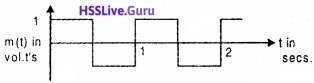
A modulating signal is a square wave as shown below:
Plus Two Physics Communication Systems NCERT Text Book Questions and Answers 1
The carrier wave is given by c (t) = 2 sing (8πt) volts.

  1. Sketch the amplitude modulation wave form.
  2. What is the modulation index?

Answer:
1. amplitude modulation wave form is as shown below:
Plus Two Physics Communication Systems NCERT Text Book Questions and Answers 2

2. µ = 0.5

Plus Two Physics Communication Systems One Mark Questions and Answers

Question 1.
For base station to mobile communication, the required frequency band is
(a) 540 – 1600 kHz
(b) 200 – 325 MHz
(c) 5.9 – 6.42 GHz
(d) 840 – 935 MHz
Answer:
(d) 840 – 935 MHz.

Plus Two Physics Chapter Wise Questions and Answers Chapter 15 Communication Systems

Question 2.
What do you mean by modulation index in AM?
Answer:
It is the ratio of the change in amplitude of the modulated carrier wave to the amplitude of the original carrier wave.

Question 3.
A communication between a fixed base station and several mobile units, located on ships or aircraft utilizing two way radio communication in the VHF and UHF is of frequency band
(a) 3 to 30 MHz
(b) 30 to 300 MHz
(c) 30 to 470 MHz
(d) 30 to 600 MHz
Answer:
(c) 30 to 470 MHz.

Plus Two Physics Chapter Wise Questions and Answers Chapter 15 Communication Systems

Question 4.
Which of the following frequency/frequencies will be suitable for beyond the horizon communication using sky waves?
(a) 10 kHz
(b) 10 MHz
(c) 1 GHz
(d) 1000 GHz
Answer:
(b) 10 MHz.

Question 5.
What are the different types of message signals used in a communication system?
Answer:
The different type of message signals are voice, music, picture and computer data.

Plus Two Physics Chapter Wise Questions and Answers Chapter 15 Communication Systems

Question 6.
What do you mean by modulation index in AM?
Answer:
It is the ratio of the change in amplitude of the modulated carrier wave to the amplitude of the original carrier wave.

Plus Two Physics Communication Systems Two Mark Questions and Answers

Question 1.
Arrange the contents in the table in the most appropriate way.

A B
Low frequency ratio waves Space wave propagation
Television transmission Ground wave propagation
High frequency radio wave Geo stationary satellite
Microwaves Sky wave propagation

Answer:

A B
Low frequency ratio waves Ground wave propagation
Television transmission Space wave propagation
High frequency radio wave Sky wave propagation
Microwaves Geo stationary satellite

Plus Two Physics Chapter Wise Questions and Answers Chapter 15 Communication Systems

Question 2.
What is the modulation index of AM, if the voltage amplitude of the carrier wave is 2kV and side band voltage amplitude is 200V.
Answer:
Plus Two Physics Communication Systems Two mark Questions and Answers 3

Question 3.
100 Hz is an audio frequency. Its wave length is 3000 km. What is the minimum length of the antenna to transmit this wave?
Answer:
C = νλ
3 × 108 = 100 × λ
λ = \(\frac{3 \times 10^{8}}{100}\)m = 3 × 10⁶m
Length of antenna I = \(\frac{\lambda}{4}=\frac{3 \times 10^{6}}{4}\) = 7.5 × 10⁵m.

Plus Two Physics Communication Systems Three Mark Questions and Answers

Question 1.
An expert said that it is necessary to modulate low frequency signals to sent long distances.

  1. What is meant by modulation
  2. What are the different types of modulation

Answer:
1. Modulation is the process of super posing a low frequency (audio signal) information on to a high frequency carrier wave.

2. Three types of modulation using sinusoidal carrier waves

  • Amplitude modulation
  • Frequency modulation
  • Phase modulation

Plus Two Physics Chapter Wise Questions and Answers Chapter 15 Communication Systems

Question 2.
The type of communication system needed fora given signal depends on the band of frequencies in the signal

  1. What are the different types of message signals used in a communication systems. (1)
  2. Match the bandwidth given in Column B with the signal given in Column A.
   Column A Column B
speech signals 6 MHz
Music signals 2.8 kHz
Video signals 20 kHz
TV signal 4.2 MHz

Answer:
1. The different type of message signals are voice, music, picture and computer data.

2.

   Column A Column B
speech signals 2.8 kHz
Music signals 20 kHz
Video signals 4.2 MHz
TV signal 6 MHz

Plus Two Physics Chapter Wise Questions and Answers Chapter 15 Communication Systems

Plus Two Physics Communication Systems Four Mark Questions and Answers

Question 1.
The height of a transmitting antenna is 200m. Radius of earth is 6.4 × 10⁶m
1. Which one of the following is used in TV transmission?

  • Sky wave
  • Space wave
  • Groundwave
  • None of these

2. Find the range upto which the above antenna gives transmission signal.

3. Why is it necessary to use satellite for long distance transmission?
Answer:
1. Space wave

2.
Plus Two Physics Communication Systems Four mark Questions and Answers 4

3. Space waves can not be reflected back by iono sphere. Space wave can be reflected back to earth by making use of artificial satellite.

Plus Two Physics Chapter Wise Questions and Answers Chapter 15 Communication Systems

Question 2.
A radio transmitter, microwave transmitter, and a microwave receivers are placed in a hilly area.

  1. Will the radio receiver in the house get the signal from the radio transmitter? Justify.
  2. In this situation, what are your suggestions for proper communication? Are Microwaves suitable there?

Answer:

  1. Yes. Because wavelength of radio wave is larger than microwave.
  2. To have large coverage, increase the height of antenna or stations. Microwaves are not suitable for this kind of transmission.

Question 3.
The given block diagram shows general form of a communication system.
Plus Two Physics Communication Systems Four mark Questions and Answers 5
1. Identify the parts X and Yin the diagram.
2. What is the difference between

  • transmitter and receiver
  • Attenuation and Amplification

3. Repeaters are used;

  • To decrease the range of a communication system.
  • To increase the range of a communication system
  • Both (i) and (ii)

Answer:
1. X-transmitter, Y-receiver.

2. difference between:

  • A transmitter converts message signal into a form suitable for transmission. A receiver receives the transmitted signal and reconstructs the message signal.
  • The loss of strength of signal while passing through the medium is known as attenuation. The process of increasing the amplitude of a signal is known as amplification.

3. Repeaters are used to increase the range of a communication system.

Plus Two Physics Chapter Wise Questions and Answers Chapter 15 Communication Systems

Question 4.
The given figure shows the various propagation modes of e.m. waves for communication.
Plus Two Physics Communication Systems Four mark Questions and Answers 6

  1. Identify the propagation modes in A, B, C
  2. Why transmission of TV signals via sky wave is not possible?
  3. A radio can tune to any station in 7.5 MHz. to 12 MHz. What is the corresponding wavelength band?

Answer:
1. A – ground wave, B – space wave, and C – sky wave.

2. TV signals are in the range of 100 to 220MHz. Ionosphere cannot reflect these waves.

3. Wave length corresponding to 100 MHz is
Plus Two Physics Communication Systems Four mark Questions and Answers 7
Wavelength corresponding to 220 MHz is
Plus Two Physics Communication Systems Four mark Questions and Answers 8
the wavelength band is 25m to 40m.

Plus Two Physics Chapter Wise Questions and Answers Chapter 15 Communication Systems

Question 5.
To transmit signals in the range 30 – 300 MHz space wave propagation is used

  1. What is meant by space wave propagation?
  2. Why it is called Line of Sight (LOS)?
  3. Derive an expression for area covered by a sig¬nal if height of antenna is h

Answer:

  1. In space wave propagation, wave travels in straight line from transmitting antenna to the receiving antenna.
  2. Because the receiving antenna and transmitting antenna should be in line of sight of wave.
  3. Range of signal from the antenna d = \(\sqrt{2 \mathrm{Rh}}\)

∴ Area A = πd2 = π (\(\sqrt{2 \mathrm{Rh}}\))2
A = π 2Rh.

Plus Two Physics Chapter Wise Questions and Answers Chapter 15 Communication Systems

Question 6.
In the broadcast mode of communication, modulation is necessary.

  1. What do you mean by modulation? (1)
  2. Why modulation is necessary? (2)
  3. What do you mean by modulation index in AM? (1)

Answer:
1. Modulation is the process by which some characteristics, like amplitude, frequency or phase angle of a high frequency carrier wave is varied in accordance with the instantaneous value of the audio signal.

2. Modulation is necessary due to the following reasons.

  • The height of the transmitting antenna should be at least 1/4th of the wave length. So to transmit audio frequency, we need very long antenna.
  • The power radiated by an antenna is inversely proportional to the square of the wavelength. In audio frequency, wavelength is higher.

3. It is the ratio of the change in amplitude of the modulated carrier wave to the amplitude of the original carrier wave.

Plus Two Physics Chapter Wise Questions and Answers Chapter 15 Communication Systems

Question 7.
The given figure shows the frequency spectrum of an amplitude-modulated wave.
Plus Two Physics Communication Systems Four mark Questions and Answers 9

  1. What are the names of (ωc – ωm) and (ωc + ωm). (1)
  2. What is the value of amplitude of (ωc – ωm) if modulation is µ? (1)
  3. What is the modulation index of AM, if the voltage amplitude of the carrier wave is 2kV and side band voltage amplitude is 200V. (2)

Answer:
1. Lower side band frequency and upper side band frequency.

2. Value of the amplitude of the side band frequency is As = \(\frac{\mu A_{c}}{2}\) where Ac is amplitude of carrier.

3.
Plus Two Physics Communication Systems Four mark Questions and Answers 10

Plus Two Computer Science Chapter Wise Questions and Answers Chapter 11 Advances in Computing

Students can Download Chapter 11 Advances in Computing Questions and Answers, Plus Two Computer Science Chapter Wise Questions and Answers helps you to revise the complete Kerala State Syllabus and score more marks in your examinations

Kerala Plus Two Computer Science Chapter Wise Questions and Answers Chapter 11 Advances in Computing

Plus Two Computer Science Advances in Computing One Mark Questions and Answers

Question 1.
Which among the following are true regarding distributed computing?
i) Different parts of a program are run simultaneously on two or more computers.
ii) Distributed systems fail even if one node fails to function.
iii) A lot of extra programming is required to set up a distributed system.
iv) All the different processors share memory.
(a) i & ii are correct
(b) iii & iv are correct
(c) i & iii are correct
(d) ii & iv are correct
Answer:
(c) i & iii are correct

Question 2.
______ computing provides users access to computational power just like electricity through wall sockets.
(a) Parallel
(b) Grid
(c) Cluster
(d) Serial
Answer:
(b) Grid

Question 3.
A pattern or a model in the study of any subject of complexity is called ______.
Answer:
paradigm

Question 4.
____ is a method of computing in which large problems can be divided into smaller ones and this smaller one are distributed among several computers.
Answer:
distributed computing.

Plus Two Computer Science Chapter Wise Questions and Answers Chapter 11 Advances in Computing

Question 5.
_____ is the advantage of distributed computing where we can add computers according to the workload.
Answer:
Scalability.

Question 6.
Multiple processors are used in _____ computing
(a) serial
(b) parallel
(c) standalone
(d) none of these
Answer:
(b) parallel

Question 7.
Single processor is used in _____ computing.
(a) serial
(b) parallel
(c) standalone
(d) none of these
Answer:
(a) serial

Question 8.
One instruction is executed on a single processor at any moment in _____ computing.
Answer:
Serial.

Question 9.
More than one instruction is executed on multiple processors at any moment of time in _____ computing.
Answer:
Parallel.

Question 10.
_____ is the fastest supercomputer used by Indian Institute of Tropical meteorology
Answer:
ADITYA

Question 11.
______ computing uses millions of computers and in which computational power(resources, services, data) is readily available like electric power.
Answer:
Grid computing.

Plus Two Computer Science Chapter Wise Questions and Answers Chapter 11 Advances in Computing

Question 12.
Here a group of Internet-connected computers, storage devices, etc are linked together and work like a single computer. Which is this computing
Answer:
Cluster computing

Question 13.
It is an emerging computing technology. Herewith the use of Internet and central remote servers to maintain data and applications. Name this computing
Answer:
Cloud computing.

Question 14.
From the following which is not the cloud service model
(a) SaaS
(b) PaaS
(c) laaS
(d) NaaS
Answer:
(d) NaaS

Question 15.
SaaS stands for _____.
Answer:
Software as a Service

Question 16.
PaaS stands for _____.
Answer:
Platform as a Service.

Question 17.
laaS stands for _____.
Answer:
Infrastructure as a Service.

Question 18.
Expand LAMP
Answer:
Linux, Apache Server, MySQL, and PHP.

Question 19.
Al stands for _____.
Answer:
Artificial Intelligence

Plus Two Computer Science Chapter Wise Questions and Answers Chapter 11 Advances in Computing

Question 20.
The first definition of Artificial Intelligence was established by _______.
Answer:
Alan Turing.

Question 21.
Al was first coined by ______ in 1956.
Answer:
John MacCarthy

Question 22.
With the help of _____ computer can solve the tasks such as playing chess, proving mathematical theorems, natural language processing, medical diagnosis, etc.
Answer:
Artificial Intelligence.

Question 23.
____ is a test of a machine’s ability to exhibit intelligent behaviour equivalent to, or indistinguishable from, that of a human.
Answer:
Turing Test.

Question 24.
NLP stands for _____.
Answer:
Natural Language Processor.

Question 25.
ASR stands for _____.
Answer:
Automatic Speech Recognition

Question 26.
OCR stands for
Answer:
Optical Character Recognition

Question. 27
HCR stands for _____.
Answer:
Handwritten Character Recognition.

Question. 28
GIS stands for ______.
Answer:
Geographical Information System.

Question. 29
CAD stands for ______.
Answer:
Computer-Aided Design

Question. 30
Which of the following is not a distributed computing paradigm?
(a) grid
(b) cloud
(c) cluster
(d) serial
Answer:
(d) serial

Plus Two Computer Science Chapter Wise Questions and Answers Chapter 11 Advances in Computing

Question. 31
The study of control and communication between man and machine is called _____.
Answer:
Cybernetics

Question. 32
In Artificial Intelligence, ANN stands for
(a) Artificial Network of Neural.
(b) Advanced Neural Network
(c) Artificial Neural Network
(d) Architectural Neural Network
Answer:
(c) Artificial Neural Network

Question 33.
Which among the following is the capability that is required by a computer to pass Turing Test?
i. Natural Language Processing (NLP)
ii. Knowledge representation
iii. Machine learning
iv. Computer Vision
(a) i & ii only
(b) i.ii & iii only
(c) iii & iv only
(d) All of the above
Answer:
(d) All of the above

Plus Two Computer Science Advances in Computing Two Mark Questions and Answers

Question 1.
Differentiate the terms intelligence and wisdom.
Answer:
The ability to draw useful inferences from the available knowledge is generally referred as intelligence. Wisdom is the maturity of mind that directs its intelligence to achieve desirable goals.

Plus Two Computer Science Chapter Wise Questions and Answers Chapter 11 Advances in Computing

Question 2.
Find the suitable match.
Plus Two Computer Science Chapter Wise Questions and Answers Chapter 11 Advances in Computing img1
Answer:
1 – c
2 – d
3 – b
4 – a

Question 3.
Find the suitable match.
Plus Two Computer Science Chapter Wise Questions and Answers Chapter 11 Advances in Computing img2
Answer:
1 – b
2 – c
3 – d
4 – a

Question 4.
Classify the following as SaaS, PaaS, and laaS. Adobe Creative Cloud. Google App Engine, Microsoft Office 365, Amazon Web Services.
Answer:

  • SaaS: Adobe Creative Cloud, Microsoft Office 365
  • PaaS: Google App Engine
  • laaS: Amazon Web Services

Plus Two Computer Science Chapter Wise Questions and Answers Chapter 11 Advances in Computing

Question 5.
Question Text:
Pick the odd one out. The services of cloud computing include:
(a) Software as a Service
(b) Hardware as a Service
(c) Platform as a Service
(d) Infrastructure as a Service
Answer:
(b) Hardware as a Service. The others are cloud computing paradigm

Question 6.
Question Text:
State whether the following statements are true or false.

  1. Clusters provide computational power through parallel processing.
  2. Even if anyone of the computers fails, cluster computing as a whole will work.

Answer:

  1. True
  2. True

Question 7.
The following organisations plan to buy cloud computing service for their IT requirements. Suggest the cloud computing model that suits their need.

  1. Hari & Co. requires spreadsheets and presentation software.
  2. Tomy & Co. requires to install their own software for their accounting needs in a LAMP platform.
  3. Raju & Co. requires to use MySQL for their database needs.
  4. Joy & Co. requires 1 TB hard disk space, 2 GB RAM and processing power.

Answer:

  1. SaaS
  2. PaaS
  3. SaaS
  4. laaS

Question 8.
Consider the following statements about distributed computing and state True/False.
1. In distributed computing, parts of a program are run simultaneously from two or more computers which are communicating with each other.
2. WWW is an example for large distributed computing.
Answer:

  1. True
  2. True

Plus Two Computer Science Chapter Wise Questions and Answers Chapter 11 Advances in Computing

Question 9.
Parallel computing is faster than serial computing. Mention the limitations in implementing parallel computing.
Answer:
Disadvantages:

  • Implementing this is more complex than serial application
  • Significant changes must be made to make the programs machine-independent

Question 10.
What do you mean by Distributed computing?
Answer:
Distributed computing is a method of computing in which large problems can be divided into smaller ones and these smaller ones are distributed among several computers. The solution for the smaller ones are computed separately and simultaneously. Finally, the results are assembled to get the desired overall solution.

Plus Two Computer Science Advances in Computing Three Mark Questions and Answers

Question 1.
Differentiate between Bioinformatics and Biometrics.
Answer:
1. Biometrics:
Biometrics refers to the unique characteristics of a human being to recognize an individual such as fingerprints, face recognition, iris, retina, etc. Biometrics are used to record attendance
Eg. In banks, employee login is restricted by using fingerprint reader

2. Bioinformatics:
It is a computer technology to the management of biological information. By the help of a computer analyse the fingerprints, DNA, iris, retina, etc and identifying the concerned person.

Question 2.
Briefly explain the Turing test.
Answer:
The Turing test is a test of a machine’s ability to exhibit intelligent behaviour equivalent to, or indistinguishable from, that of a human. The test involves a human judge engages in natural language conversations with a human and a machine designed to generate performance indistinguishable from that of a human being.

All participants are separated from one another. If the judge cannot reliably tell the machine from the human, the machine is said to have passed the test. The test does not check the ability to give the correct answer to questions; it checks how closely the answer resembles typical human answers. Turing predicted that by 2000 computer would pass the test.

Plus Two Computer Science Chapter Wise Questions and Answers Chapter 11 Advances in Computing

Question 3.
Draw the knowledge pyramid and briefly explain the terms in it.
Answer:
Plus Two Computer Science Chapter Wise Questions and Answers Chapter 11 Advances in Computing img3
Data is termed as a collection of mere symbols. While processing data we get information and knowledge is the organized information. It can be a piece of information that helps in decision making. The ability to draw useful inferences from the available knowledge is generally referred as intelligence. Wisdom is the maturity of mind that directs its intelligence to achieve desirable goals.

Question 4.
Compare grid computing and cloud computing paradigms of distributed computing.
Answer:
1. Grid computing:
It is a system in which millions of computers, smartphones, satellites, telescopes, cameras, sensors, etc. are connected each other as a cyber world in which computational power (resources, services, data) is readily available like electric power. Any information at any time at any place can be made available in our fingertips. This is used in disaster management, weather forecasting, market forecasting, bio information, etc.

2. Cloud computing:
It is an emerging computing technology. Herewith the use of Internet and central remote servers to maintain data and applications. Example for this is Email service, Office Software(word processor, spreadsheets, presentations, database, etc), graphics software, etc. The information is placed in a central remote server just like clouds in the sky hence the name cloud computing

Question 5.
What is cluster computing? Write its advantages and disadvantages.
Answer:
Cluster means groups. Here a group of Internet-connected computers, storage devices, etc are linked together and work like a single computer. It provides computational power through parallel processing. Its cost is less and used for scientific applications.

Advantages

  • Price-performance ratio: The performance is high ‘ and the cost is less.
  • Availability: If one group of system fails the other group will do the work.
  • Scalability: Computers can be easily added according to the workload increases.

Disadvantages

  • Programmability issues: Different computers uses different software and hardware hence the issues.
  • Problem in finding fault: Fault detection is very difficult

Plus Two Computer Science Chapter Wise Questions and Answers Chapter 11 Advances in Computing

Question 6.
The distributed computing method has some advantages and disadvantages. What are they?
Answer:
Advantages

  • Economical: Reduces the computing cost hence it is economical
  • Speed: The workload of the entire system is less hence the speed is high.
  • Reliability: When one computer in the network fails the entire work will not be blocked, i.e. the other computers will do the work properly.
  • Scalability: We can add computers according to the workload.

Disadvantages

  • Complexities: The proper division of the problems and reassembling of the result is a major complex task.
  • Security: Security measurements to be taken to keep track of the sent data packets otherwise it can be used for illegal purposes.
  • Network reliance: Some occasions in case of network failure, the entire system may become unstable.

Question 7.
Most of the companies are opting for cloud computing for their IT requirement. Explain the advantages that they gain from this.
Answer:
Advantages

  • Cost savings: Companies can reduce costs by using cloud computing
  • scalability/ Flexibility: More resources are used when the workload increases.
  • Reliability: It is reliable and helps in disaster recovery
  • Maintenance: The service provider do system maintenance, then reducing maintenance requirements.
  • Mobile accessible: Employees can do their job even when they are in move.

Question 8.
Match the following.
Plus Two Computer Science Chapter Wise Questions and Answers Chapter 11 Advances in Computing img4
Answer:
i – b
ii – c
iii – d
iv – a

Question 9.
Explain the advantages and disadvantages of distributed computing.
Answer:
Advantages

  • Economical: Reduces the computing cost hence it is economical
  • Speed: The workload of the entire system is less hence the speed is high.
  • Reliability: When one computer in the network fails the entire work will not be blocked, i.e. the other computers will do the work properly.
  • Scalability: We can add computers according to the workload.

Disadvantages

  • Complexities: The proper division of the problems and reassembling of the result is a major complex task.
  • Security: Security measurements to be taken to keep track of the sent data packets otherwise it can be used for illegal purposes.
  • Network reliance: Some occasions in case of network failure, the entire system may become unstable.

Plus Two Computer Science Chapter Wise Questions and Answers Chapter 11 Advances in Computing

Question 10.
Write down the merits and demerits of parallel computing.
Answer:
Advantages

  • If one or more node fails, the entire system will not failed instead it works with reduced performance. This method is called fault tolerance.
  • Sharing computing power and storage resources with each other.
  • Distributing tasks to different nodes hence reduce the load of entire system. It is called load sharing
  • Scaling can be easily done.

Disadvantages

  • Implementing this is more complex than serial application
  • Significant changes must be made to make the programs machine-independent

Question 11.
Explain Grid computing with merits and demerits.
Answer:
It is a system in which millions of computers, smartphones, satellites, telescopes, cameras, sensors, etc. are connected each other as a cyber world in which computational power (resources, services, data) is readily available like electric power. Any information at any time at any place can be made available in our fingertips. This is used in disaster management, weather forecasting, market forecasting, bio information, etc.
Advantages

  • It is used to solve more complex problems in a short time.
  • Existing hardware used efficiently
  • Scalable: The number of computers can be added according to the workload increases

Disadvantages

  • Processing speed is less
  • Different computers uses different software and the licensing issues may effect the working of application

Question 12.
Explain cluster computing with its merits.
Answer:
Cluster means groups. Here a group of Internet connected computers, storage devices, etc are linked together and work like a single computer. It provides Computational power through parallel processing. Its cost is less and used for scientific applications.
Advantages

  • Price-performance ratio: The performance is high and the cost is less.
  • Availability: If one group of system fails the other group will do the work.
  • Scalability: Computers can be easily added according to the workload increases.

Question 13.
What is cloud computing?
Answer:
It is an emerging computing technology. Herewith the use of Internet and central remote servers to maintain data and applications. Example for this is Email service, Office Software(word processor, spreadsheets, presentations, database, etc), graphics software, etc. The information is placed in a central remote server just like clouds in the sky hence the name cloud computing.

Question 14.
Explain the Turing test
Answer:
The Turing test is a test of a machine’s ability to exhibit intelligent behaviour equivalent to, or indistinguishable from, that of a human. The test involves a human judge engages in natural language conversations with a human and a machine designed to generate performance indistinguishable from that of a human being.

All participants are separated from one another. If the judge cannot reliably tell the machine from the human, the machine is said to have passed the test. The test does not check the ability to give the correct answer to questions; it checks how closely the answer resembles typical human answers. Turing predicted that by 2000 computer would pass the test.

Plus Two Computer Science Chapter Wise Questions and Answers Chapter 11 Advances in Computing

Question 15.
Compare parallel and serial computing.
Answer:
The difference between these two is given below.

Serial computing Parallel computing
A single processor is used Multiple processors are used with shared memory
A problem is divided into a series of instructions A problem is divided into smaller ones that can be solved simultaneously
Instructions executed sequentially Instructions executed simultaneously
One instruction is executed on a single processor at any moment More than one instruction is executed on multiple processors at any moment of time.

Plus Two Computer Science Advances in Computing Five Mark Questions and Answers

Question 1.
Explain the three cloud service models.
Answer:
Cloud service models (3 major services):
1. Software as a Service (SaaS):
A SaaS provider company provides more services on demand such as they allow to access both resources and applications.
Examples are Google Docs, Adobe creative cloud, Microsoft Office 365, Facebook.com, etc.

2. Platform as a Service(PaaS):
A PaaS provider company provides subscribers access to the components that they, require to develop and operate applications over the Internet.
Example: LAMP platform(Linux, Apache Server, MySQL, and PHP), ASP.NET, PHP and Python, Google’s App Engine, Microsoft Azure, Force.com, etc.

3. Infrastructure as a Service(laaS):
It provides basic storage devices and computing capabilities as standardized services over the network.
Example: Amazon Web Services, Joyent, AT&T, GoGrid, etc.

Question 2.
What are the applications of Computational Intelligence? Explain?
Answer:
Application of Computational Intelligence
A. Biometrics:
Biometrics refers to the unique characteristics of a human being to recognize an individual such as fingerprints, face recognition, iris, retina, etc. Biometrics are used to record attendance
Eg. In banks employee login is restricted by using fingerprint readers.

B. Robotics:
It is a branch of scientific study associated with the design, manufacturing and controls the movements of the robots. Robotics are used in all areas. Some of them are discussed below.

1. Uses in vehicle manufacturing industry: Robots are used to do all tasks such as welding, cutting, lifting, sorting and bending. Since it is a machine, it can operate for long hours untiringly.

2. Exploration of outer space:
Robots are very much useful in this field such as they are used to do all the tasks related to launch a satellite.

3. In intelligent homes:
Robots are used in home segments to safe guard the home, automatically open the gate, doors and windows, etc.

4. Exploration in difficult environments:
Human beings are not ready to work situations like too hot and too cold. Since it is a machine robots are used instead of human beings. Robots are used in oil filed etc.

5. Uses in military:
Unmanned air crafts and vehicles are controlled by robots. Drones and computer controlled cameras are used in Military service.

6. Uses in agriculture:
Nowadays in India, the agriculture field is also in mechanization trend. Hence increase productivity.

C. Computer vision:
The world is changed from 2 dimensional images to 3 dimensional. 3D TVs are available in the market. Multiple cameras are used to capture the images and merge them to form 3D pictures. 3D scanners are used in the Medical filed to diagnose the diseases

D. Natural Language Processing:
It deals with how computers communicate just like a human being communicate naturally. Natural languages are languages spoken by the people. To achieve this ability to communicate like a human being is a laborious task. NLP is further be classified into two, Natural Language Understanding(NLU) and Natural Language Generation(NLG).

  • NLU – The ability to understand languages like English, Malayalam, etc.
  • NLG – It is deal with creation of output, i.e. generate words and giving reply.

E. Automatic Speech Recognition(ASR):
To login some computers, laptops .tabs, smartphones, etc, and to open some gates, doors, etc you have say the password orally. The computer recognizes the speech and opens the device to them.

Such devices are working based upon NLP technology and this system is called Automatic Speech Recognition(ASR) system. To implement this system the requirements, are mica or a telephone and convert the oral instruction into written text. Examples are Apple iOS, Google, etc.

F. Optical Character Recognition(OCR) and Handwritten Character Recognition Systems. (HCR):
It is used to read text from a paper as an image and translate this image into a form that computer can manipulate. For example, if we want to enter the text contents of a book by typing using a keyboard will take more time. Instead of this by using OCR and HCR we can easily do this. OCR is expensive. HCR system reads handwritten texts and converts it into computer-readable form

G. Bioinformatics:
It is a computer technology to the management of biological information. By the help of a computer analyse the fingerprints, DNA, iris, retina, etc and identifying the concerned person.
Three goals of bioinformatics.:

  1. Organise: Huge amount of data organized to access information easily and to add new information when it is produced
  2.  Develop tools: Develop new tools to analyse data efficiently.
  3. Analysis: With thw help of these tools analyse the data and produce results.

H. Geographical Information System:
Geosynchronous satellite moves at the same Revolutions Per Minute(RPM) as that of the earth in the same direction. Thus both the earth and the satellite complete one revolution exactly in the same time and hence the relative position of the ground station with respect to the satellite never changes.

Geographic Information System(GIS) technology is developed from digital cartography and Computer-Aided Design(CAD) database management system. GIS as the name implies capturing, storing for future reference, checking and displaying data related to various positions on earth’s surface.

GIS can be applied in many areas such as soil mapping, agricultural mapping, forest mapping, e-Governance, etc. GIS is used in development planning like strategic rural and urban planning, infrastructure planning, precision agriculture planning, etc.

Plus Two Computer Science Chapter Wise Questions and Answers Chapter 11 Advances in Computing

Question 3.
Explain cloud computing paradigm and its three models of services in detail.
Answer:
It is an emerging computing technology. Herewith the use of Internet and central remote servers to maintain data and applications. Example for this is Email service, Office Software (word processor, spreadsheets, presentations, database, etc), graphics software, etc. The information is placed in a central remote server just like clouds in the sky hence the name cloud computing.
Cloud service models (3 major services):
1. Software as a Service(SaaS)
A SaaS provider company provides more services on demand such as they allow to access both resources and applications.
Examples are Google Docs, Adobe creative cloud, Microsoft Office 365, Facebook.com, etc.

2. Platform as a Service(PaaS)
A PaaS provider company provides subscribers access to the components that they require to develop and operate applications over the Internet.
Example: LAMP platform(Linux, Apache Server, MySQL, and PHP), ASP.NET, PHP and Python, Google’s App Engine, Microsoft Azure, Force.com, etc.

3. Infrastructure as a Service(laaS)
It provides basic storage devices and computing capabilities as standardized services over the network.
Example: Amazon Web Services, Joyent, AT&T, GoGrid, etc.

Question 4.
List and explain any three biologically inspired algorithms/paradigms that simulate natural intelligence, which led to the development of intelligent systems.
Answer:
Computational Intelligence paradigms Computational Intelligence is the ability to make a computer to face and solve real-life problems just like a intelligent man do it. It includes Artificial Neural Networks(ANN), Evolutionary Computation(EC), Swarm Intelligence(SI) and Fuzzy Systems(FS).

A. Artificial Neural Networks (ANN):
The brain is a complex, nonlinear and parallel computer with ability to perform tasks such as recognise pattern, perception and motor control. ANN is the method of simulate biological neural systems to learn, memorise and generalize like human beings. A human brain cortex consists of 10-500 billion neurons with 60 trillion synapses(a synapse is a structure that permits a neuron to pass electrical)

B. Evolutionary Computation (EC):
It is the simulation of the natural evolution, i.e. survival of the fittest. In the surrounding, we can see that the stronger must win and others will lose. EC applied for data mining, fault diagnosis, classification, scheduling, etc.

C. Swarm Intelligence (SI):
Swarm Intelligence is the study of behaviour of colonies or groups of social animals, birds, insects, ants, etc. How they communicate and create and manage their own colonies beautifully.

D. Fuzzy Systems:
Human beings use common sense while facing a problem, just like human beings fuzzy systems can also use common sense and behave like human beings. Fuzzy systems is used to control gear transmission and raking systems, control lifts, home appliances, controlling traffic signals, etc.

Plus Two Computer Science Chapter Wise Questions and Answers Chapter 11 Advances in Computing

Question 5.
One of the recent developments in Computer Science is the use of computational intelligence in different real life applications. Briefly explain any five areas of application of computational intelligence.
Answer:
A. Biometrics:
Biometrics refers to the unique characteristics of a human being to recognize an individual such as fingerprints, face recognition, iris, retina, etc. Biometrics are used to record attendance Eg. In banks employee login is restricted by using fingerprint readers.

B. Robotics:
It is a branch of scientific study associated with the design, manufacturing and control the movements of the robots. Robotics are used in all areas.

C. Computer vision:
The world is changed from 2-dimensional images to 3 dimensional. 3D TVs are available in the market. Multiple cameras are used to capture the images and merge them to form 3D pictures. 3D scanners are used in the Medical field to diagnose the diseases

D. Natural Language Processing:
It deals with how computers communicate just like a human being communicate naturally. Natural languages are languages spoken by the people. To achieve this ability to communicate like a human being is a laborious task. NLP is further be classified into two, Natural Language Understanding (NLU) and Natural Language Generation (NLG).

  • NLU- The ability to understand the languages like English, Malayalam, etc.
  • NLG- It is deal with creation of output, i.e. generate words and giving reply.

E. Automatic Speech Recognition(ASR):
To login some computers, laptops, tabs, smartphones, etc, and to open some gates, doors, etc you have say the password orally. The computer recognizes the speech and opens the device to them. Such devices are working based upon NLP technology and this system is called Automatic Speech Recognition(ASR) system.

To implement this system the requirements are a mica or a telephone and convert the oral instruction into written text. Examples are Apple iOS, Google, etc.

F. Optical Character Recognition(OCR) and Handwritten Character Recognition Systems. (HCR):
It is used to read text from a paper as an image and translate this image into a form that computer can manipulate. For example, if we want to enter the text contents of a book by typing using a keyboard will take more time. Instead of this by using OCR and HCR we can easily do this. OCR is expensive. HCR system reads handwritten texts and converts it into computer-readable form.

G. Bioinformatics:
It is a computer technology to the management of biological information. By the help of a computer analyse the fingerprints, DNA, iris, retina, etc and identifying the concerned person.
Three goals of bioinformatics.

  1. Organise
  2. Develop tools
  3. Analysis

H. Geographical Information System:
Geosynchronous satellite moves at the same Revolutions Per Minute(RPM) as that of the earth in the same direction. Thus both the earth and the satellite complete one revolution exactly in the same time and hence the relative position of the ground station with respect to the satellite never changes.

Geographic Information System(GIS) technology is developed from digital cartography and Computer-Aided Design(CAD) database management system. GIS as the name implies capturing, storing for future reference, checking and displaying data related to various positions on earth’s surface. GIS can be applied in many areas such as soil mapping, agricultural mapping, forest mapping, e-Governance, etc.

GIS is used in development planning like strategic rural and urban planning, infrastructure planning, precision agriculture planning, etc.

Plus Two Maths Chapter Wise Questions and Answers Chapter 3 Matrices

Students can Download Chapter 3 Matrices Questions and Answers, Plus Two Maths Chapter Wise Questions and Answers helps you to revise the complete Kerala State Syllabus and score more marks in your examinations.

Kerala Plus Two Maths Chapter Wise Questions and Answers Chapter 3 Matrices

Plus Two Maths Matrices Three Mark Questions and Answers

Question 1.
Find the value of a, b and c from the following equations;
\(\left[\begin{array}{cc}{a-b} & {2 a+c} \\{2 a-b} & {3 c+d}
\end{array}\right]=\left[\begin{array}{cc}{-1} & {5} \\{0} & {13}\end{array}\right]\).
Answer:
Given;
\(\left[\begin{array}{cc}{a-b} & {2 a+c} \\{2 a-b} & {3 c+d}
\end{array}\right]=\left[\begin{array}{cc}{-1} & {5} \\{0} & {13}\end{array}\right]\)
⇒ a – b = -1, 2a + c = 5, 2a – b = 0, 3c + d = 13
⇒ a – b = -1
2a – b = 0
– a = -1
⇒ a = 1
We have, a – b = -1 ⇒ 1 – b = -1 ⇒ b = 2
⇒ 2a + c = 5 ⇒ 2 + c = 5 ⇒ c = 3
⇒ 3c + d = 13 ⇒ 9 + d = 13 ⇒ d = 4.

Plus Two Maths Chapter Wise Questions and Answers Chapter 3 Matrices

Question 2.
Simplify cosx\(\left[\begin{array}{cc}{\cos x} & {\sin x} \\{-\sin x} & {\cos x}\end{array}\right]\) + sinx\(\left[\begin{array}{cc}{\sin x} & {-\cos x} \\{\cos x} & {\sin x}\end{array}\right]\).
Answer:
Plus Two Maths Matrices 3 Mark Questions and Answers 1

Question 3.
Solve the equation for x, y z and t; if
\(2\left[\begin{array}{ll}{x} & {z} \\{y} & {t}\end{array}\right]+3\left[\begin{array}{cc}{1} & {-1} \\{0} & {2}\end{array}\right]=3\left[\begin{array}{ll}{3} & {5} \\{4} & {6}\end{array}\right]\).
Answer:
Plus Two Maths Matrices 3 Mark Questions and Answers 2
⇒ 2x + 3 = 9 ⇒ x = 3
⇒ 2z – 3 = 15 ⇒ z = 9
⇒ 2y = 12 ⇒ y = 6
⇒ 2t + 6 = 18 ⇒ t = 6.

Plus Two Maths Chapter Wise Questions and Answers Chapter 3 Matrices

Question 4.
Find A2 – 5A + 6I If A = \(\left[\begin{array}{ccc}{2} & {0} & {1} \\{2} & {1} & {3} \\{1} & {-1} & {0}\end{array}\right]\)
Answer:
Plus Two Maths Matrices 3 Mark Questions and Answers 3
A2 – 5A + 6I
Plus Two Maths Matrices 3 Mark Questions and Answers 4

Question 5.
If A = \(\left[\begin{array}{cc}{3} & {-2} \\{4} & {-2}\end{array}\right]\) find k so that A2 = kA – 2I.
Answer:
Plus Two Maths Matrices 3 Mark Questions and Answers 5
Given A2 = kA – 2I
Plus Two Maths Matrices 3 Mark Questions and Answers 6
1 = 3k – 2 ⇒ k = 1.

Plus Two Maths Chapter Wise Questions and Answers Chapter 3 Matrices

Question 6.
Express A = \(\left[\begin{array}{ccc}{-1} & {2} & {3} \\{5} & {7} & {9} \\{-2} & {1} & {1}
\end{array}\right]\) as the sum of a symmetric and skew symmetric matrix.
Answer:
Plus Two Maths Matrices 3 Mark Questions and Answers 7
P = 1/2 (A + AT) is symmetric.
Q = 1/2 (A – AT) is skew symmetric.
Plus Two Maths Matrices 3 Mark Questions and Answers 8

Question 7.
Find the inverse of the following using elementary transformations.
Plus Two Maths Matrices 3 Mark Questions and Answers 9
Answer:
(i) Let A = I A
Plus Two Maths Matrices 3 Mark Questions and Answers 10

Plus Two Maths Chapter Wise Questions and Answers Chapter 3 Matrices

(ii) Let A = IA
Plus Two Maths Matrices 3 Mark Questions and Answers 11

(iii) Let A = IA
Plus Two Maths Matrices 3 Mark Questions and Answers 12

(iv) Let A = IA
Plus Two Maths Matrices 3 Mark Questions and Answers 13

Plus Two Maths Chapter Wise Questions and Answers Chapter 3 Matrices

Question 8.
Find the inverse of the matrix A = \(\left[\begin{array}{cc}{2} & {3} \\{-1} & {5}\end{array}\right]\) using row transformation.
Answer:
A = \(\left[\begin{array}{cc}{2} & {3} \\{-1} & {5}\end{array}\right]\)
Let A = IA
Plus Two Maths Matrices 3 Mark Questions and Answers 14

Question 9.
\(A=\left[\begin{array}{ll}{2} & {3} \\{4} & {5} \\{2} & {1}\end{array}\right] B=\left[\begin{array}{ccc}{1} & {-2} & {3} \\{-4} & {2} & {5}\end{array}\right]\)

  1. Find AB
  2. If C is the matrix obtained from A by the transformation R1 → 2R1, find CB

Answer:
Plus Two Maths Matrices 3 Mark Questions and Answers 15

(ii) Since C is the matrix obtained from A by the transformation R1 → 2R1
⇒ C = \(\left[\begin{array}{ll}{4} & {6} \\{4} & {5} \\{2} & {1}\end{array}\right]\)
Then CB can be obtained by multiplying first row of AB by 2.
CB = \(\left[\begin{array}{ccc}{-20} & {-4} & {42} \\{-16} & {2} & {37} \\{-2} & {-2} & {11}
\end{array}\right]\).

Plus Two Maths Chapter Wise Questions and Answers Chapter 3 Matrices

Question 10.
Construct a 3 × 4 matrix whose elements are given by

  1. ay = \(\frac{|-3 i+j|}{2}\) (2)
  2. aij = 2i – j (2)

Answer:
Plus Two Maths Matrices 3 Mark Questions and Answers 16
a13 = 0, a14 = \(\frac{1}{2}\), a21 = \(\frac{5}{2}\), a22 = 2, a23 = \(\frac{3}{2}\), a24 = 1, a31 = 4, a32 = \(\frac{7}{2}\), a33 = 3, a34 = \(\frac{5}{2}\)
Plus Two Maths Matrices 3 Mark Questions and Answers 17
Plus Two Maths Matrices 3 Mark Questions and Answers 18
a11 = 1, a12 = 0, a13= -1, a14 = -2, a21 = 3, a22 = 2, a23 = 1, a24 = 0, a31 = 5, a32 = 4, a33 = 3, a34 = 2
Plus Two Maths Matrices 3 Mark Questions and Answers 19

Plus Two Maths Chapter Wise Questions and Answers Chapter 3 Matrices

Question 11.
Express the following matrices as the sum of a Symmetric and a Skew Symmetric matrix.
(i) \(\left[\begin{array}{ccc}{6} & {-2} & {2} \\{-2} & {3} & {-1} \\{2} & {-1} & {3}
\end{array}\right]\)
(ii) \(\left[\begin{array}{ccc}{3} & {3} & {-1} \\{-2} & {-2} & {1} \\{-4} & {-5} & {2}
\end{array}\right]\)
Answer:
Plus Two Maths Matrices 3 Mark Questions and Answers 20
Plus Two Maths Matrices 3 Mark Questions and Answers 21
Plus Two Maths Matrices 3 Mark Questions and Answers 22
Plus Two Maths Matrices 3 Mark Questions and Answers 23

Plus Two Maths Chapter Wise Questions and Answers Chapter 3 Matrices

Question 12.
If A = \(\left[\begin{array}{ccc}{2} & {4} & {3} \\{1} & {0} & {6} \\{0} & {-2} & {-3}\end{array}\right]\)

  1. Find 3A. (1)
  2. Find AT (1)
  3. Evaluate A + AT , is it symmetric? Justify your answer. (1)

Answer:
1. 3A = \(\left[\begin{array}{ccc}{6} & {12} & {9} \\{3} & {0} & {18} \\{0} & {-6} & {-9}
\end{array}\right]\)

2. AT = \(\left[\begin{array}{ccc}{2} & {1} & {0} \\{4} & {0} & {-2} \\{3} & {6} & {-3}
\end{array}\right]\)

3. A + AT
Plus Two Maths Matrices 3 Mark Questions and Answers 24
The elements on both sides of the main diagonal are same. Therefore A + AT is a symmetric matrix.

Plus Two Maths Matrices Four Mark Questions and Answers

Question 1.
Consider the following statement: P(n) : An = \(\left[\begin{array}{cc}{1+2 n} & {-4 n} \\{n} & {1-2 n}\end{array}\right]\) for all n ∈ N

  1. Write P (1). (1)
  2. If P(k) is true, then show that P( k + 1) is also true. (3)

Answer:
1. P(1) : A = \(\left[\begin{array}{cc}{1+2} & {-4} \\{1} & {1-2}\end{array}\right]=\left[\begin{array}{cc}{3} & {-4} \\{1} & {-1}\end{array}\right]\)

2. Assume that P(n) is true n = k
Plus Two Maths Matrices 3 Mark Questions and Answers 25
Hence P(k+1) is true n ∈ N.

Plus Two Maths Chapter Wise Questions and Answers Chapter 3 Matrices

Question 2.
Find the matrices A and B if 2A + 3B = \(\left[\begin{array}{ccc}{1} & {2} & {-1} \\{0{1} & {2} & {4}\end{array}\right]\) and A + 2B = \(\left[\begin{array}{lll}{2} & {0} & {1} \\{1} & {1} & {2} \\{3} & {1} & {2}\end{array}\right]\).
Answer:
Plus Two Maths Matrices 3 Mark Questions and Answers 26
Solving (1) and (2) ⇒ 2 × (2)
Plus Two Maths Matrices 3 Mark Questions and Answers 27
Plus Two Maths Matrices 3 Mark Questions and Answers 28
Question 3.

  1. Construct a 3 × 3 matrix A = [aij] where aij – 2(i – j) (3)
  2. Show that the matrix A is skew-symmetric. (1)

Answer:
1.
Plus Two Maths Matrices 3 Mark Questions and Answers 29

2.
Plus Two Maths Matrices 3 Mark Questions and Answers 30
Therefore A is skew-symmetric matrix.

Plus Two Maths Chapter Wise Questions and Answers Chapter 3 Matrices

Question 4.
Consider the following statement P(n ): An = \(\left[\begin{array}{cc}{\cos n \theta} & {\sin n \theta} \\{-\sin n \theta} & {\cos n \theta}\end{array}\right]\) for all n ∈ N

  1. Write P(1). (1)
  2. If P (k) is true then show that P (k+1) is true (3)

Answer:
1.
Plus Two Maths Matrices 3 Mark Questions and Answers 31

2. Assume that P(n) is true for n = k
Plus Two Maths Matrices 3 Mark Questions and Answers 32
P(k+1) = Ak+1
Plus Two Maths Matrices 3 Mark Questions and Answers 33
∴ P(k+1) is true. Hence true for all n ∈ N.

Question 5.
A = \(\left[\begin{array}{lll}{1} & {2} & {2} \\{2} & {1} & {2} \\{2} & {2} & {1}\end{array}\right]\), then

  1. Find 4A and A2 (2)
  2. Show that A2 -4A = 5I3 (2)

Answer:
1.
Plus Two Maths Matrices 3 Mark Questions and Answers 34

2.
Plus Two Maths Matrices 3 Mark Questions and Answers 35

Plus Two Maths Chapter Wise Questions and Answers Chapter 3 Matrices

Question 6.
Let A = \(\left[\begin{array}{lll}{2} & {1} & {3} \\{4} & {1} & {0}\end{array}\right]\) and B= \(\left[\begin{array}{cc}{1} & {-1} \\{0} & {2} \\{5} & {0}\end{array}\right]\)

  1. Find AT and BT (1)
  2. Find AB (1)
  3. Show that (AB)T = BT AT (2)

Answer:
1.
Plus Two Maths Matrices 3 Mark Questions and Answers 36

2.
Plus Two Maths Matrices 3 Mark Questions and Answers 37

3.
Plus Two Maths Matrices 3 Mark Questions and Answers 38
∴ (AB)T = BT AT.

Plus Two Maths Chapter Wise Questions and Answers Chapter 3 Matrices

Question 7.
A = \(\left[\begin{array}{ccc}{1} & {-3} & {1} \\{2} & {0} & {4} \\{1} & {2} & {-2}\end{array}\right]\) Express A as the sum of a symmetric and skew symmetric matrix.
Answer:
Plus Two Maths Matrices 3 Mark Questions and Answers 39
\(\frac{1}{2}\) (A + AT) + \(\frac{1}{2}\) (A – AT)
Plus Two Maths Matrices 3 Mark Questions and Answers 40

Question 8.

  1. Consider a 2 × 2 matrix A = [aij], where aij = \(\frac{(i+j)^{2}}{2}\)
  2. Write the transpose of A. (2)
  3. Show that A is symmetric. (2)

Answer:
1. A = \(\left[\begin{array}{ll}{2} & {\frac{9}{2}} \\{\frac{9}{2}} & {8}\end{array}\right]\)

2. AT = \(\left[\begin{array}{ll}{2} & {\frac{9}{2}} \\{\frac{9}{2}} & {8}\end{array}\right]\)

3. AT = A therefore symmetric matrix.

Plus Two Maths Chapter Wise Questions and Answers Chapter 3 Matrices

Question 9.
A = \(\left[\begin{array}{ll}{6} & {5} \\{7} & {6}\end{array}\right]\) is a matrix

  1. What is the order of A. (1)
  2. Find A2 and 12 A. (2)
  3. If f(x) = xT – 12x +1; find f(A). (1)

Answer:
1. Order of A is 2 × 2.

2.
Plus Two Maths Matrices 3 Mark Questions and Answers 41

3. f(x) = x2 – 12x + 1 ⇒ f(A) = A2 – 12A + I
Plus Two Maths Matrices 3 Mark Questions and Answers 42

Plus Two Maths Matrices Six Mark Questions and Answers

Question 1.
Let A = \(\left[\begin{array}{ll}{2} & {4} \\{3} & {2}\end{array}\right]\), B = \(\left[\begin{array}{cc}{1} & {3} \\{-2} & {5}\end{array}\right]\), C = \(\left[\begin{array}{rr}{-2} & {5} \\{3} & {4}\end{array}\right]\)
Find each of the following
(i) A + B; A – B
(ii) 3A – C
(iii) AB
(iv) BA
Answer:
Plus Two Maths Matrices 3 Mark Questions and Answers 43
Plus Two Maths Matrices 3 Mark Questions and Answers 44
Plus Two Maths Matrices 3 Mark Questions and Answers 45
Plus Two Maths Matrices 3 Mark Questions and Answers 46

Plus Two Maths Chapter Wise Questions and Answers Chapter 3 Matrices

Question 2.
Let A = \(\left[\begin{array}{ll}{1} & {2} \\{3} & {4}\end{array}\right]\); B = \(\left[\begin{array}{ll}{2} & {1} \\{4} & {5}\end{array}\right]\); C = \(\left[\begin{array}{ccc}{1} & {-1} \\{0} & {2}\end{array}\right]\)
(i) Find A + B and A – B (2)
(ii) Show that (A + B) + C = A + (B + C) (2)
(iii) Find AB and BA
Answer:
Plus Two Maths Matrices 3 Mark Questions and Answers 47
Plus Two Maths Matrices 3 Mark Questions and Answers 48
∴ (A + B) + C = A + (B + C)
Plus Two Maths Matrices 3 Mark Questions and Answers 49

Question 3.
A = \(\left[\begin{array}{ccc}{-1} & {0} & {2} \\{4} & {0} & {-3}\end{array}\right]\), B = \(\left[\begin{array}{cc}{0} & {2} \\{-1} & {3} \\{0} & {4}\end{array}\right]\)

  1. What is the order of matrix AB ? (1)
  2. Find AT, BT (2)
  3. Verify (AB)T = BT AT (3)

Answer:
1. Order of AB is 2 × 2. Since order of A is 2 × 3 and B is 3 × 2.

2.
Plus Two Maths Matrices 3 Mark Questions and Answers 50

3.
Plus Two Maths Matrices 3 Mark Questions and Answers 51
(AB)T = BT AT.

Plus Two Maths Chapter Wise Questions and Answers Chapter 3 Matrices

Question 4.
Let A = \(\left[\begin{array}{rrr}{1} & {2} & {-3} \\{2} & {1} & {-1}\end{array}\right]\), B = \(\left[\begin{array}{ll}{2} & {3} \\{5} & {4} \\{1} & {6}\end{array}\right]\)
(i) FindAB. (1)
(ii) Find AT, BT & (AB)T (3)
(iii) Verify that (AB)T = BT AT (2)
Answer:
Plus Two Maths Matrices 3 Mark Questions and Answers 52
Plus Two Maths Matrices 3 Mark Questions and Answers 53
Plus Two Maths Matrices 3 Mark Questions and Answers 54

Question 5.
If A = \(\left[\begin{array}{c}{-2} \\{4} \\{5}\end{array}\right]\), B = \(\left[\begin{array}{lll}{1} & {3} & {6}\end{array}\right]\)
(i) Find AT, BT (1)
(ii) Find (AB)T (2)
(iii) Verify (AB)T = BT AT (3)
Answer:
Plus Two Maths Matrices 3 Mark Questions and Answers 55
Plus Two Maths Matrices 3 Mark Questions and Answers 56
Plus Two Maths Matrices 3 Mark Questions and Answers 57

Plus Two Maths Chapter Wise Questions and Answers Chapter 3 Matrices

Question 6.
Let A = \(\left[\begin{array}{cc}{3} & {1} \\{-1} & {2}\end{array}\right]\)
(i) Find A2 (1)
(ii) Show that A2 – 5A + 7I = 0 (1)
(iii) Using this result find A-1 (2)
(iv) Slove the following equation using matrix: 3x + y = 1, – x + 2y = 2.
Answer:
Plus Two Maths Matrices 3 Mark Questions and Answers 58
Plus Two Maths Matrices 6 Mark Questions and Answers 59

(iii) A2 – 5A + 7I = 0 ⇒ A2 – 5A = -7I,
multiplying by A-1 on both sides,
⇒ A – 5I = -7 A-1
Plus Two Maths Matrices 6 Mark Questions and Answers 60

(iv) The equation can be represented in matrix form as follows, AX = B ⇒ X = A-1B
Plus Two Maths Matrices 6 Mark Questions and Answers 61

Plus Two Maths Chapter Wise Questions and Answers Chapter 3 Matrices

Question 7.
A = \(\left[\begin{array}{ccc}{1} & {2} & {3} \\{3} & {-2} & {1} \\{4} & {2} & {1}
\end{array}\right]\)
(i) Show that A3 – 23A – 40I = 0 (3)
(ii) Hence find A-1 (3)
Answer:
Plus Two Maths Matrices 6 Mark Questions and Answers 62
A3 – 23A – 40I = 0
Plus Two Maths Matrices 6 Mark Questions and Answers 63

(ii) A-1A3 – 23 A-1A – 40A-1I = 0
⇒ A2 – 23I – 40A-1 = 0
Plus Two Maths Matrices 6 Mark Questions and Answers 64

Plus Two Maths Chapter Wise Questions and Answers Chapter 3 Matrices

Question 8.
A is a third order square matrix and \(a_{i j}=\left\{\begin{aligned}-i+2 j & \text { if } i=j \\i \times j & \text { if } i \neq j\end{aligned} \text { and } B=\left[\begin{array}{lll}{2} & {1} & {1} \\{1} & {1} & {5} \\{1} & {5} & {2}\end{array}\right]\right.\)

  1. Construct the matrix A. (1)
  2. Interpret the matrix A. (1)
  3. Find AB – BA. (3)
  4. Interpret the matrix AB – BA. (1)

Answer:
1. a11 = 1, a12 = 2, a13 = 3, a21 = 2, a22 = 2, a23 = 6, a31 = 3, a32 = 6, a33 = 3
A = \(\left[\begin{array}{lll}{1} & {2} & {3} \\{2} & {2} & {6} \\{3} & {6} & {3}\end{array}\right]\)

2. Now,
Plus Two Maths Matrices 6 Mark Questions and Answers 65
Therefore A is symmetric matrix.

3.
Plus Two Maths Matrices 6 Mark Questions and Answers 66
Plus Two Maths Matrices 6 Mark Questions and Answers 67

Plus Two Maths Chapter Wise Questions and Answers Chapter 3 Matrices
Plus Two Maths Matrices 6 Mark Questions and Answers 68

4.
Plus Two Maths Matrices 6 Mark Questions and Answers 69
= -(AB – BA)
∴ skew symmetric matrix.

Question 9.
Find x and y if
Plus Two Maths Matrices 6 Mark Questions and Answers 70
Answer:
Plus Two Maths Matrices 6 Mark Questions and Answers 71
Plus Two Maths Matrices 6 Mark Questions and Answers 72

Plus Two Maths Chapter Wise Questions and Answers Chapter 3 Matrices
Plus Two Maths Matrices 6 Mark Questions and Answers 73
Plus Two Maths Matrices 6 Mark Questions and Answers 74

Question 10.
Given that A + B = \(\left[\begin{array}{ll}{2} & {5} \\{7} & {8}\end{array}\right]\) and A – B = \(\left[\begin{array}{ll}{6} & {8} \\{4} & {3}\end{array}\right]\)

  1. Find 2A. (1)
  2. Find A2 – B2. (3)
  3. Is it equal to (A + B) (A – B)? Give reason (2)

Answer:
1. 2A = A + B + A – B
Plus Two Maths Matrices 6 Mark Questions and Answers 75

Plus Two Maths Chapter Wise Questions and Answers Chapter 3 Matrices

2.
Plus Two Maths Matrices 6 Mark Questions and Answers 76

3. (A + B)(A – B)
Plus Two Maths Matrices 6 Mark Questions and Answers 77
(A + B)(A – B) = A2 + AB – BA – B2
≠ A2 – B2
∵ AB ≠ BA.

Plus Two Maths Chapter Wise Questions and Answers Chapter 3 Matrices

Question 11.
(i) Consider A = \(\left[\begin{array}{lll}{1} & {x} & {1}\end{array}\right]\), B = \(\left[\begin{array}{ccc}{1} & {3} & {2} \\{2} & {5} & {1} \\{15} & {3} & {2}
\end{array}\right]\), C = \(\left[\begin{array}{l}{1} \\{2} \\{x}\end{array}\right]\) (2)

A – Matrix B – Order
A 3 × 1
B 1 × 1
BC 2 × 2
ABC 3 × 3
1 × 3

(ii) Find x if ABC = 0 (4)
Answer:
(i)

A – Matrix B – Order
A 1 × 3
B 3 × 3
BC 3 × 1
ABC 1 × 1

(ii) Given, ABC = 0
Plus Two Maths Matrices 6 Mark Questions and Answers 78
⇒ x2 + 16x + 28 = 0
⇒ (x + 14)(x + 2) = 0
⇒ x = -14, -2.

Plus Two Computer Science Chapter Wise Questions and Answers Chapter 4 Web Technology

Students can Download Chapter 4 Web Technology Questions and Answers, Plus Two Computer Science Chapter Wise Questions and Answers helps you to revise the complete Kerala State Syllabus and score more marks in your examinations

Kerala Plus Two Computer Science Chapter Wise Questions and Answers Chapter 4 Web Technology

Plus Two Computer Science Web Technology One Mark Questions and Answers

Question 1.
Specify an attribute of the HTML tag.
Answer:
DIR: Indicates documents direction. It can take values rtl or ltr.
Eg. <HTML DIR= “rtl”> This specify that document is to read from right to left.

Question 2.
Mention the default value of size attribute of <BASEFONT> tag.
Answer:
3.

Question 3.
Name the tag which has ‘Noshade’ attribute.
Answer:
<HR>Tag

Question 4.
Maximum possible value of the size attribute of the <BASEFONT>tag?
Answer:
7.

Question 5.
Salim developed a personal website. In which he has to create an e-mail link. Can you suggest the protocol used to achieve this task?
Answer:
Mailto.
Eg. <A href= “Mailto:cgj@rediffmail.Com” >Mail to me</A>.

Plus Two Computer Science Chapter Wise Questions and Answers Chapter 4 Web Technology

Question 6.
You want to connect your webpage to the web portal www.yahoo.com. Mention the tag that can be used for this.
Answer:
<A> Anchor Tag
Eg. <Ahref=”www. yahoo.com”>Yahoo</A)

Question 7.
Specify the main attribute of <IMG> tag used to include an image file in web page.
Answer:
SRC. It specify the name of the image file to be included in the page.
Eg. <IMG SRC= “C:/home.Jpg”>

Question 8.
Select the attribute associated with <IMG> tag from the following: (Name, size, Align, value)
Answer:
Align

Question 9.
Write HTML code forgiving hyperlink in webpage.
Answer:
<A HREF= “page2.htm”>Page2</A>

Question 10.
The default colour of Vlink is ________
(a) Blue
(b) Green
(c) Red
(d) Yellow
Answer:
(c) Red

Question 11.
ThedefauKcolour of A link is ________
(a) Blue
(b) Green
(c) Red
(d) Yellow Green
Answer:
(b) Green

Plus Two Computer Science Chapter Wise Questions and Answers Chapter 4 Web Technology

Question 12.
Saritha is assigned the task of writing explanatory notes in an HTML code. Which tag she can utilize.
Answer:
Explanatory notes can be given using <comment> tag. Using two mark up elements. as<!— and →

Question 13.
Pick the odd man out.
(a) BODY
(b) HTML
(c) CENTER
(d) ALIGN
Answer:
(d) ALIGN, all others are tag

Question 14.
Your school has a web site, www.myschool.otg. You want to create a link to this site from your website. Write the code for implementing this.
Answer:
<A href=”www.myschool.org”>My School</A>

Question 15.
HTML was developed by ________
Answer:
Tim Berners-Lee

Question 16.
What are the two major sections of an HTML document?
Answer:
Head section and Body section

Question 17.
An HTML file is saved with _____ extension.
(a) .vbp
(b) .mdb
(c) .htm
(d) .frm
Answer:
(c) .htm or .html

Question 18.
The software used to view web page is _____
(a) Notepad
(b) web browser
(c) Webserver
(d) Web Editor
Answer:
(b) web browser

Question 19.
The default alignment of image in HTML is _____
(a) Left
(b) Right
(c) Center
(d) Inline with content
Answer:
(a) Left

Plus Two Computer Science Chapter Wise Questions and Answers Chapter 4 Web Technology

Question 20.
_______ is an alternative for centralizing a paragraph other than using <P> tag
(a) <AUGN>
(b) <C>
(c) <CENTER>
(d) <CENTRE
Answer:
(c) <CENTER>

Question 21.
______ attribute Of <A> tag specifies the URL of the hyper linked document.
(a) Name
(b) Target
(c) HREF
(d) SRC
Answer:
(c) HREF

Question 22.
What does HTML stands for?
Answer:
Hyper Text Markup Language

Question 23.
Communication on web can be classified into _____ and ______ .
Answer:
Client to Server and Server to Server

Question 24.
The protocol which is responsible for splitting the data into smaller packets is _____
Answer:
TCP.

Question 25.
The protocol which is responsible for the routing of data packets through the correct destination is _____
Answer:
IP (Internet Protocol)

Question 26.
TCP/IP stands for
Answer:
Transmission Control Protocol/lntenet Protocal

Question 27.
Identify the protocol responsible for e-mail communication.
Answer:
(a) DNS
(b) HTTP
(c) TCP/IP
(d) SMTP
Answer:
(d) SMTP

Question 28.
In server to server communication, authentication is done with help of _____
(a) HTTP
(b) Digital certificate
(c) Client
(d) DNS
Answer:
(b) Digital certificate

Plus Two Computer Science Chapter Wise Questions and Answers Chapter 4 Web Technology

Question 29.
Which server acts between merchant server and bank server for transferring data in encrypted format?
Answer:
Payment Gateway

Question 30.
Identify the name of a place where servers and networking systems are placed with high security.
(a) Head office
(b) DNS
(c) Data centre
(d) IIS
Answer:
(c) Data centre

Question 31.
Identify the port number which requests for the service of sending e-mail communication.
(a) 22
(b) 25
(c) 53
(d) 80
Answer:
(b) 25

Question 32.
The IP address corresponding to a domain name is ______ presenting server.
Answer:
DNS

Question 33.
Programs embedded in HTML documents are termed as ______
Answer:
Scripts

Question 34.
Running of ____ scripts can be blocked by the user
(a) Client side
(b) Server side .
(c) Both client side and server side.
(d) None of these
Answer:
(a) Client side

Question 35.
A platform-independent serverside scripting language is ______
Answer:
PHP

Question 36.
Which among the following tools is used for easy formatting and defining style of a document written in HTML?
(a) Ajax
(b) CSS
(c) JSP
(d) JavaScript
Answer:
(b) CSS

Question 37.
Pick the Odd one from the following list and give reason. (IMG, FONT, BR, ALIGN, PRE)
Answer:
ALIGN which is an attribute, all others are tags.

Question 38.
Choose the correct HTML statement to display an image with file name “kerala.jpg” as the background of the web page.
(a) <IMG src=”kerala.jpg”>
(b) <BODYbgcolor=”kerala.jpg”>
(c) <BODY src=”kerala.jpg”>
(d) <BODY background=”kerala.jpg”>
Answer:
(d) <BODYbackground=”kerala.jpg”>

Plus Two Computer Science Chapter Wise Questions and Answers Chapter 4 Web Technology

Question 39.
Two of the following HTML tags have same attribute ‘Align’. Identify them.
(<IMG>, <MARQUEE>, <B>, <P>, <BODY>)
Answer:
<IMG> AND <P>

Question 40.
Identify the correct HTML statement to draw a horizontal line with half the width of the screen.
(a) <HR width=“50%” size= “3″>
(b) <HR size= “50%” width= “3″>
(c) <HR length=“50%” size= “3″>
(d) <HR width= “50%” length= “3″>
Answer:
(a) <HR width=“50%” size= “3″>

Question 41.
A student wants to display a poem in a web page just like as he entered in the text editor. Which tag in HTML will help him?
Answer:
<PRE>tag

Question 42.
A student created a web page about his school. The school name is displayed in the page. He wanted to change the style, colour, and size of the school name. Identify the most appropriate tag in HTML needed for that.
Answer:
<FONT> tag

Plus Two Computer Science Web Technology Two Mark Questions and Answers

Question 1.
A student developed a web page about India. He wanted to display a scrolling text moving from right side to left side with a background colour blue.
The text is “I Love My Country”.

  1. Identify the tag needed for it.
  2. Write the HTML statement to do the task.

Answer:

  1. <MARQUEE>
  2. <MARQUEE direction=”left” bgcolor=”blue” > I Love My country </MARQUEE>

Plus Two Computer Science Chapter Wise Questions and Answers Chapter 4 Web Technology

Question 2.
Write HTML statement for displaying the following text items:

  1. A2B3
  2. A>B

Answer:

  1. A <SUB>2</SUB> B <SUP>3</SUP>
  2. A&gt;B

Question 3.
Two HTML tags are given. They are <BODY> and <FONT>. Identify and write the attribute of each from the following list. (Size, Text, Link, Bgcolor, Color)
Answer:
The attributes of <BODY> tag are Text, Link and Bgcolor The attributes of <FONT> tag are size and color.

Question 4.
Write the use of Border and Alt attribute of <IMG> tag.
Answer:
Border: This attribute is used forgiving border to an image
Alt: This attribute is sued for giving an alternate text. When there is no image in the specified location or the browser doesn’t support the image them this text will be displayed.

Question 5.
When a client send request to a server, the server must know which service is demanded by the client.

  1. How does the server identify the type of service requested?
  2. Write the name of any one of the services in the Webserver.

Answer:

  1. Port number
  2. Any service like FTP, SMTP, HTTP etc

Question 6.
Following are steps for searching the IP address of a domain name by a browser. Rearrange them in proper order.

  1. Look in the local memory of ISP
  2. Look in the DNS servers starting from the root server .
  3. Look in the local memory of brower
  4. Look in the local memory of Operating System

Answer:
Correct order is 3, 4, 1, 2

Plus Two Computer Science Chapter Wise Questions and Answers Chapter 4 Web Technology

Question 7.
Categorise the following tags into Container tags and empty tags.
<B>, <BR>, <A>,<FRAME>, <FRAMESET>, <LI>, <HR>
Answer:
1. Container tags:
<B>, <A>,<FRAMESET>

2. Empty tags:
<BR>, <HR>, <LI>, <FRAME>

Question 8.
Write the HTML statement to get the following output.

  1. Commerce
  2. Humanities

Answer:

  1. <B>Commerce</B>
  2. <l>Humanities</l>

Question 9.
Write the HTML statement to get the following output.

  1. H2SO4
  2. a2 + b2
  3. Computer

Answer:

  1. H<sub>2</sub>SO<sub>4</sub>
  2. a<sup>2</sup> + b<sup>2</sup>
  3. <b>Computer</b>

Question 10.
Write HTML code to display as follows.
The <IMG> tag is used for placing images
Answer:
The &lt IMG &gt tag is used for placing images.

Question 11.
Name some browsers.
Answer:

  1. Internet Explorer
  2. Netscape Navigator
  3. Opera
  4. Eudora

Question 12.
What is a website?
Answer:
A website is a collection of webpages. A webpage is created by using HTML tags.

Question 13.
What is the role of attributes in an HTML tag?
Answer:
Attributes are parameters for providing additional information within a tag. Attribute values specify certain characteristics of the tag.
Eg: <P align=”right”>

Question 14.
What is HTML?
Answer:
HTML stands for HyperText Markup Language. It is used to create web pages. It has two types of tags empty and container. The important thing we have to remember in container tag is first opened tag must be closed last.

Plus Two Computer Science Chapter Wise Questions and Answers Chapter 4 Web Technology

Question 15.
Name the main attributes of the <HR> tag.
Answer:

  • Size: It specifies the line thickness
  • Width: It specifies the length
  • Noshade: It specifies no shade is given for the line.
  • Color: It specifies the color.

Question 16.
Mary wants to display her name in various head-ings. Name the heading tags available in HTML.
Answer:
Heading can be given in six levels from <H1> to <H6>.The tag <H1> produces big heading. The tag <H6> produces small heading. The heading size re¬duce from <H1> to <H6> sequentially.

Question 17.
Differentiate between <FONT> and <BASEFONT>tags
Answer:
<BASEFONT>tag sets the normal font for the entire document text. The font specified will be taken as the default font for the entire document. The main attributes are size, face, and color. The <FONT> tag defines the font characteristics of the text enclosed. <Font> tag change the font property of the text enclosed within <Font> and </Font> whereas <BaseFont> tag specifies the default font characteristics.

Question 18.
Explain the different types of hyperlinks.
Answer:
The two types of Hyper Links are

  1. External HyperLink: This is used two connect the locations of two different web pages
  2. Internal HyperLink: This is used to connect the different locations of the same web page

Question 19.
Write the HTML code to display the following list:

  • Form
  • TextBox
  • Label
  • Command Button

Answer:
<html>
<head>
<title>
list
</title>
</head>
<body bgcolor=”vbcyan”>
<ul type=”circle”>
<li>Form
<li>TextBox
<li>Label
<li>CommandButton</ul>
</body>
</html>

Question 20.
The body section forms the content displayed in the browser window. Briefly explain any four attributes in the BODY tag.
Answer:

  1. Bgcolor – It is used to set background colour
  2. Background – It is used to set a background picture
  3. Text – it is used to set the foreground colour
  4. Left margin – It is used to set the left margin

Plus Two Computer Science Chapter Wise Questions and Answers Chapter 4 Web Technology

Question 21.
HTML has the facility to provide External Jinks as well as Internal links.

  1. Which tag is used to include an External link?
  2. How will you construct an Internal link?

Answer:
1. Anchor Tag i.e. <a href=”filename”>

2. Internal link is used to link two places of the same web page
<html>
<head>
<title>
Internal link
</title>
</head>
<body bgcolor=”vbcyan”>
<a name=top href=#bottom>Goto Bottom</a>
<ul type=”circle”>
<li>Form
<li>TextBox
<li>Label
<li>CommandButton
</ul>
<a name=bottom href=#top>Goto top</a>
</body>
</html>

Question 22.
Categorise the following tags in HTML and write the criterian for the categorisation.
<BR>, <P>, <BODY>, <B>, <HR>, <IMG>
Answer:
1. Empty tag:
<BR>
<HR>
<IMG>
2. Container tag
<P>
<BODY>
<B>

Question 23.
Differentiate empty tags and container tag with example.
Answer:
1. Empty tags: It has opening tag only, no closing tag
Eg; <hr>, <br> etc
2. Container tag: It as both opening and closing tag.
Eg: <html> </html>
<body></body>etc.

Question 24.
Write True or False

  1. Text is an attribute of <BODY> tag to insert a text matter in the web page.
  2. <EM> tag functions similar to <l> tag.

Answer:

  1. False
  2. True

Plus Two Computer Science Web Technology Three Mark Questions and Answers

Question 1.
Write and explain any four text formatting tags in HTML.
Answer:
Text formatting tags are given below.

  1. <B>: This tag is based to make the text Bold Eg: <B> Computer application </B>
  2. <l>: This tag is used to make the text in italics eg: <l> computer aplication</l>
  3. <U>: This tag is used to underline the text eg: <U> computer aplication</U>
  4. <S>: This tag is used for striking out the text eg: <S> computeraplication</S>

Plus Two Computer Science Chapter Wise Questions and Answers Chapter 4 Web Technology

Question 2.
Match the following.
Plus Two Computer Science Chapter Wise Questions and Answers Chapter 4 Web Technology img1
Answer:
Correct match as given below

  • <H2> – Heading-Align
  • <MARQUEE> – Scrolling text – Bgcolor
  • <IMG> – Inserting picture-Src

Question 3.
Briefly explain the use of tags <Q>, <PRE> and <ADDRESS> tags.
Answer:

  1. <Q>: It is used to give text within double quotes
  2. <PRE>: This tag is used to display the content as we entered in the text editor.
  3. <ADDRESS>: This tag is used to provide information of the author or owner

Question 4.
Write a HTML code to develop a web page about Kerala state as shown below:
Plus Two Computer Science Chapter Wise Questions and Answers Chapter 4 Web Technology img2
The specifications for the page are:

  1. The main heading must be of bigger in size, centralised and bold.
  2. Subheadings must be lesser size than main heading and in italics.
  3. There should be a picture at the center of the page with filename“tree.jpg”.
  4. The background colour of the page must me blue.

Answer:
<HTML>
<HEAD>
<TITLE>Kerala State</TITLE>
</HEAD>
<BODY bgcolor = “blue”>
<center> <H1> kerala state </H1 >
<I><H2> <br> God’s own country </H2></l> </center>
<img src = “tree.jpg” align = “middle”>
<br>
Capital: Thimvanthapuram </BODY>
</HTML>

Question 5.
PHP is a popular scripting language.

  1. Write whether it is client side or server side.
  2. Write a brief note on PHP.

Answer:

  1. Server side
  2. PHP (PHP Hypertext Preprocessor)
    • It is an open-source, general-purpose scripting language.
    • It is a server-side scripting language
    • Introduced by Rasmus Lendorf
    • A PHP file with extension .php
    • It support database programming the default * DBMS is MySQL
    • It is platform-independent
    • PHP interpreter in Linux is LAMP(Linux, Apache, MySQL, PHP)

Plus Two Computer Science Chapter Wise Questions and Answers Chapter 4 Web Technology

Question 6.
How client side scripting differs from server side scripting?
Answer:
Following are the differences

Client-Side Scripting Server Side Scripting
Script is copied to client browser To the webserver.
Executed by the client. Executed by the server and result gets back to the browser window
Used for Client level validation Connect to the database in the server
It is possible to block by the user Cannot possible
Client-side scripts depend on the type and version of the browser It does not depend on the type and version of the browser

Question 7.
Briefly explain the two types of communication on the web.
Answer:
The two types of communication on the web are given below.
1. Client to Web server communication:
This communication is carried out. between client to the webserver (shopping site). The technology used to protect data that are transferred from client to web server is https.

2. Web server to web server communication:
This communication is usually carried out between web sever (seller) to another web server (normally bank). For the safe transaction. Digital certificate issued by third-party web sites are used.

Question 8.
Compare static and dynamic webpages.

Static web pages Dynamic web pages
Content and layout is fixed Content and layout is changed frequently
Never use database Database is used
Run by browser It runs on the server and result get back to the client(browser)
Easy to develop Not at all easy

Question 9.
Differentiate Empty tag and Container tag.
Answer:
There are two types of tags, opening tag, and closing tag
1. Empty tag: It has only opening tag and no closing tag
Eg: <br>, <hr>,..

2. Container tag: It has both opening and closing tags. This tag contains some text data
Eg:<html>, <head>, <body>,….

Question 10.
Create a webpage using HTML to display the following message.
Answer:
‘The symbol H2O represents water’.
<HTML>
<HEAD>
<TITLE>Subscript</TITLE>
</HEAD>
<Body>
<B>’The symbol H<SUB>2</SUB>O represents water’<B> .
</Body>
</HTML>

Question 11.
While designing a webpage Neena wants to explain the meaning of each step. Can you help her?
Answer:
Neena can use Comments while writing the code. It is a good programming practice. Comments improve readability. It is not the part of a program. Comments <!—and —>
Eg.
<!—This is used to display an information—> <HTML>
<!—head section—>
<HEAD>
<TITLE>Subscript</TITLE>
</HEAD>
<!—BODY section—>
<Body>
<B> The symbol H <SUB>2</SUB>O represents water’</B>
</Body>
</HTML>

Question 12.
Complete the following table.
Plus Two Computer Science Chapter Wise Questions and Answers Chapter 4 Web Technology img3
Answer:
Plus Two Computer Science Chapter Wise Questions and Answers Chapter 4 Web Technology img4

Question 13.
Give HTML tag to display the sentence “WELCOME TO HTML” as centralized heading, having red colour.
Answer:
<HTML>
<HEAD><TITLE>My page</TITLE></HEAD> <BODY>
<FONTCOLOR=“RED”>
<H1 ALIGN= “CENTER”>WELCOME TO HTML</ H1>
</FONT>
</BODY>
<HTML>

Plus Two Computer Science Chapter Wise Questions and Answers Chapter 4 Web Technology

Question 14.
Explain the Main attributes of font tag.
Answer:
<FONT>tag defines the font properties of text en-closed
The main attributes are:

  1. Face – This specifies the type of font.
  2. Color – This specifies the colour of the text enclosed
  3. Size – This specifies the font size
    Eg. <FONT Face= “Arial” size = “3” color= “magenta”>

Question 15.
John visited a website, it is found that when clicking on a particular text the browser open a new web page. Name the feature and Identify the tag used for this purpose. Write the HTML code to link to a file name “main.html”.
Answer:

  1. Hyper Linking. By clicking on hypertext we can see or go to other webpages or to other section of same document.
  2. <A> tag is used
  3. <A href=”main.htmr>Main</A>

Question 16.
Antony visited his school website, he could not see the picture of his school instead of that there is a text message “Your browser could not support images”. Why it is happened and write the html code for this.
Answer:
Because the browser he used cannot load the image. He can use Alt attribute of IMG Tag.
<IMG SRC =“D:\school.jpg” Alt-Your browser could not support images”>

Question 17.
Suppose you want to display a picture named school.jpg located in the ‘Photos’ subdirectory of the directory ‘My documents’ of C drive in your web page.

  1. Name the tag used for this purpose.
  2. Write HTML code for the web page.

Answer:
1. <IMG>tag. It is used to display images in webpage.

2. code for the web page.
<HEAD><TITLE>
</HEAD>
<Body>
<IMG SRC= ‘C:/My documents/Photos/School.jpg’></Body>
<html>

Plus Two Computer Science Web Technology Five Mark Questions and Answers

Question 1.
Explain the main list tags in HTML?
Answer:
HTML provides three basic types of lists- unordered, ordered and definition list.
1. Unordered list:
Unordered list arranges the list items with bullet symbols in front. <UL> and </UL> tag encloses an Unordered list. List items are specified by <LI> tag. The tag <UL> can take values square, circle or disc. The default type is disc.
Eg: <UL>
<LI>COMPUTER
<LI>BIOLOGY
</UL>

2. Ordered list:
In Ordered list, the list items are numbered in sequence. <OL> and </OL> tag encloses an Ordered list. List items are specified by <LI> tag. The tag <OL> can take values as follows

  1. type = 1 for 1,2,3
  2. type = i for i, ii, iii
  3. type = I fori, II, III,….
  4. type = afora,b,c,…
  5. type = AforA,B,C

Eg:<OL>
<LI>COMPUTER
<LI>BIOLOGY
</OL>

3. Definition List:
It is formed by a group of definitions and their descriptions. No bullet symbol or number is provided for the list items. The <DL> and </DL> tags enclose the definition list. The <DT> tag contains the definition term and <DD> tag specifies the description.
Eg: <DL>
<DT>Echeque
<DD>Electronic cheque
</DL>

Plus Two Computer Science Chapter Wise Questions and Answers Chapter 4 Web Technology

Question 2.
Explain the use of <BODY> tag and list any four of its attributes
Answer:
Web page contents are given int the body section. Attributes of body tag are:
1. BGCOLOR – Specifies background color for the document Body
Eg. <BODY BGCOLOR= “RED”>

2. BACKGROUND – Sets the image as background for the document body
Eg. <BODY BACKGROUNG= “C:\result.jpg”>

3. TEXT – Specifies the color of the text content of the page
Eg. <BODYTEXT= “Red”>

4. LINK – Specifies colour of the hyperlinks that are not visited by the user

5. ALINK – Specifies the colour of hyperlinks

6. VLINK – Specifies the color of hyperlinks which are already visited by the viewer.
Eg. < BODY ALINK= “Cyan” LINK=” Magenta” VLINK= “Orange”>

7. Left margin and Right margin-Sets margin from left and top of the document window.

Plus Two Computer Science Chapter Wise Questions and Answers Chapter 2 Concepts of Object-Oriented Programming

Students can Download Chapter 2 Concepts of Object-Oriented Programming Questions and Answers, Plus Two Computer Science Chapter Wise Questions and Answers helps you to revise the complete Kerala State Syllabus and score more marks in your examinations

Kerala Plus Two Computer Science Chapter Wise Questions and Answers Chapter 2 Concepts of Object-Oriented Programming

Plus Two Computer Science Concepts of Object-Oriented Programming One Mark Questions and Answers

Question 1.
Protecting data from access by unauthorized function is Data
(a) Polymorphism
(b) encapsulation
(c) data abstraction
(d) Inheritance
Answer:
(b) encapsulation

Question 2.
The act of partitioning a program into individual compoents is called,
(a) Polymorphism
(b) encapsulation
(c) data abstraction
(d) modularity
Answer:
(d) modularity

Question 3.
Which of the following is not an OOP concept?
(a) Overloading
(b) procedural programming
(c) data abstraction
(d) Inheritance
Answer:
(b) Procedural programming

Question 4.
The ability for a message or data to be processed in more than one form is called 6303 message or data.
(a) Polymorphism
(b) encapsulation
(c) data abstraction
(d) Inheritance
Answer:
(a) Polymorphism

Plus Two Computer Science Chapter Wise Questions and Answers Chapter 2 Concepts of Object-Oriented Programming

Question 5.
C++ is a ……. language.
(a) Qbject based
(b) non-procedural
(c) Object-oriented
(d) procedural
Answer:
(c) Object-oriented

Question 6.
Which of the following is not a characteristic of OOP?
(a) It emphasises more on procedure rather than data.
(b) It models real world
(c) It wraps up related data items and associated functions in the unit.
(d) None of the above
Answer:
(a) It emphasises more on procedure rather than data.

Question 7.
Which among the following is true about OOPs.
(a) It supports data abstraction
(b) It supports polymorphism
(c) It supports structured programming.
(d) It supports all the above
Answer:
(d) It supports all the above

Question 8.
Identify the correct statements from the following.
(a) Procedural programming approach aims more at procedures.
(b) The object-oriented approach views a problem in terms of objects involved.
(c) Real life cannot be modeled in OOP.
(d) Procedures takes a secondary status in object-oriented approach.
Answer:
(a), (b), (d)

Question 9.
“One form many behaviours” represents
(a) modularity
(b) Abstraction
(c) polymorphism
(d) Inheritance
Answer:
(c) polymorphism

Question 10.
What do you understand by programming paradigm?
Answer:
Paradigm means organizing principle of a program. It is an approach to programming.

Plus Two Computer Science Chapter Wise Questions and Answers Chapter 2 Concepts of Object-Oriented Programming

Question 11.
What are the characteristics of procedural paradigm? Procedural programming.
Answer:
In procedural paradigm, the emphasis is on doing things. Data is the reason for a program’s existence. Yet data is given second class status while programming.

Question 12.
Which of the following is not a programming paradigm?
Answer:
(a) Object oriented
(b) Procedure oriented
(c) Both a and b
(d) Standard
Answer:
(d) Standard. This is not a programming paradigm

Question 13.
In programming, modules are composed of
(a) data types
(b) functions
(c) statements
(d) programs
Answer:
(b) functions

Plus Two Computer Science Chapter Wise Questions and Answers Chapter 2 Concepts of Object-Oriented Programming

Question 14.
The following function prototypes implement an OOP concept. Identify the concept and explain it.
Answer:
Polymorphism

Plus Two Computer Science Concepts of Object-Oriented Programming Two Mark Questions and Answers

Question 1.
State whether the following statements are true or false.

  1. In procedural oriented programming, data is the reason for a program’s existence.
  2. The real word concept gets simplified using concept of abstraction.

Answer:
1. False. In procedural programming, the emphasis is on doing actions or operations. Here data is not secure.

2. True. The real world concept gets simplified using concept of abstraction. In object-oriented programming the problems are viewed in terms of objects involved. Thus modeling real-world becomes easy in object oriented programming. Objects essential features alone are represented. This property is known as data abstraction.

Question 2.
How does inheritance support ‘reusability’?
Answer:
Inheritance allows the addition of additional features to an existing class without modifying it. One can derive a new class (subclass) from an existing one and add new features to it. There is reduction in amount of typing and efforts.

Question 3.
Define the termbase class, subclass and the relationship between a base class and subclass.
Answer:
Inheritance is the capability of a class to inherit properties from another class. That class that inherits from other class is subclass and the other class is base class. For eg: when we say that the class ‘student’ inherits from the class ‘person’, then ‘person’ is a base class of ‘student’ and ‘student’ is a subclass of ‘person’.

Question 4.
How the data is hidden and safe if encapsulation is implemented?
Answer:
Encapsulation is the way of combining both data and the functions that operate on that data. Encapsulation is most often achieved through information hiding, which is the process of hiding all the secrets of an object that do not contribute to its essential characteristics. The structure of an object is hidden.

Plus Two Computer Science Chapter Wise Questions and Answers Chapter 2 Concepts of Object-Oriented Programming

Question 5.
Differentiate object and Class.
Answer:
An object is an identifiable entity with some characteristics and behavior. It represents an entity that can store data and its associated functions. A class is a group of objects that share common properties and relationships. It represents a group of similar objects

Question 6.
Distinguish class and object with the help of examples.
Answer:

  • Class – A class is a collection of objects with similar attributes.
  • Object – An object is an instance of the class. Furniture class is an example for class. Chair, Table, etc. are the instances ie. objects of the class furniture

Question 7.
When we switch on the computer, booting takes place. We do not know what all things are happening inside. Identify the OOP concept that resembles this scenario. Give another situation that resembles this concept.
Answer:
Data abstraction: It refers to the act of representing essential features without including the background details. Switchboard is an example for this.

Question 8.
Which of the following members of a C++ class data type are hidden from accessing?
(a) Private and protected members
(b) Private and public members
(c) Public and protected members
(d) Private, public and protected members
Answer:
(a) Private and protected members

Plus Two Computer Science Chapter Wise Questions and Answers Chapter 2 Concepts of Object-Oriented Programming

Question 9.
Explain how operator overloading implements polymorphism.
Answer:
Polymorphism is the ability for a message or data to be processed in more than one form. This is achieved by function overloading, operator overloading and dynamic binding.

Plus Two Computer Science Concepts of Object-Oriented Programming Three Mark Questions and Answers

Question 1.
You have seen a flask. When you put some ice-cubes in it, it will stay there for hours without melting and when you pour some hot water it will stay hot.

  1. Name the OOP feature that we can correlate with this situation.
  2. Write a short note about that feature

Answer:
1. Polymorphism

2. Polymorphism is an essential feature of object oriented programming. Polymorphism means having many forms. It is the capability of an object to behave differently in response to a message or action. That is, the same operation is performed differently depending upon the type of data it is working with. Polymorphism is implemented in C++ in two ways, compile time polymorphism and runtime polymorphism

Question 2.
Suppose your school is selected as the venue for conducting District youth festival. For the smooth functioning of the programme different committees are formed and each committee is assigned separate duties.

  1. Which OOP feature can be correlated to this situation?
  2. Write a brief note on that feature

Answer:
1. Modularity

2. When programs become larger, the program is broken into functions or modules. A module is separate unit in itself. Each unit can be compiled separately. All modules work hand in hand in order to achieve the program’s goal. The act of partitioning a program into individual unit is called modularity. It reduces program’s complexity.

Plus Two Computer Science Chapter Wise Questions and Answers Chapter 2 Concepts of Object-Oriented Programming

Question 3.
You have seen the enquiry machine in a railway station. The user just types in a few details like train number, station, and date. The details of train, seat availability, fare, etc. will be displayed. The user is not aware of its working. Which OOP feature can you correlate with this situation?
Answer:
Data Abstraction:
Data abstraction is an important feature of OOP. It refers to the act of representing essential features without including the background details or explanations. Abstraction supports data hiding so that only the relevant information is expressed to the user and the rest of the information remains hidden from the user.

Question 4.
The famous luxury ship ‘TITANIC’ has provided all facilities like food, entertainment and medical aid available at that time for its passengers. Can you correlate this with any of the OOP features you have left. Justify.
Answer:
Encapsulation:
Encapsulation is the most fundamental concept of OOP. Placing data and functions together is the central idea of object oriented programming. This is known as Encapsulation

Question 5.
Using a real world example explain the concept of inheritance.
Answer:
Parent child relationship is the best example of inheritance. Child derives properties of parents. C++ supports inheritance.

It is the capability of one class to inherit properties from another class. In other words, inheritance is the process of creating new classes called derived classes, from existing base classes. The derived class inherits all the properties of base class but can add features of its own. The base class is unchanged by this process.
Plus Two Computer Science Chapter Wise Questions and Answers Chapter 2 Concepts of Object-Oriented Programming img1

Plus Two Computer Science Chapter Wise Questions and Answers Chapter 2 Concepts of Object-Oriented Programming

Question 6.
In an ATM machine the user will be given options to access their account details, withdraw money, deposit money, etc. only. The background details are not shown to the user.

  1. Name the object oriented feature that we can correlate with this situation.
  2. Briefly explain about the feature.

Answer:
1. Data abstraction

2. Abstraction refers to the act of representing essential features without including the background details or explanations. Abstraction supports data fiding so that only the relevant information is expressed to the user and the rest of information remains hidden from the user.

Question 7.
Consider the diagram. Can you correlate any OOP feature from this? Write a note on the feature.
Plus Two Computer Science Chapter Wise Questions and Answers Chapter 2 Concepts of Object-Oriented Programming img2
Answer:
Data Encapsulation. Placing data and functions together is the central idea of object oriented programming. This is encapsulation. It is a way to implement abstraction by wrapping up data and associated functions into a single unit.

Question 8.
Consider the following statements.
6 + 9 = 15 but ‘x’ + ‘yz’ = ‘xyz’ Which OOP feature can you infer from the above. Explain.
Answer:
Polymorphism. Polymorphism is the ability for a message or data to be processed in more than one form. The same operation is performed differently depending upon type of data it is working with.

Question 9.
Abstraction and encapsulation are complementary concepts of OOP. Justify.
Answer:
Abstraction and encapsulation are complementary concepts of OOP. Abstraction refers to the act of representing essential features without including the background details. Encapsulation is wrapping up of data and functions into a single unit. Abstraction focuses upon the observable behaviour of an object, whereas encapsulation focuses upon the implementation that gives rise to this behaviour

Plus Two Computer Science Chapter Wise Questions and Answers Chapter 2 Concepts of Object-Oriented Programming

Question 10.
Write four reasons for the increasing complexity of procedural programming.
Answer:
Following are the main reasons of increasing the procedural language complexity.

  1. Data is undervalued
  2. Adding new data requires modifications to all/many functions.
  3. Creating new data types is difficult
  4. Provides poor real world modeling

Question 11.
List the advantages of Object Oriented Programming.
Answer:

  1. OOP allows modularity (divide the large programs into smaller ones.)
  2. it is good for defining abstract data types
  3. It allows data abstraction
  4. It allows code reusability
  5. Real life entities can be easily created
  6. It supports to create new data types.

Question 12.
Identify a suitable attribute from the 2nd column and an associated behaviour from 3rd column for each object in the 1st column.
Plus Two Computer Science Chapter Wise Questions and Answers Chapter 2 Concepts of Object-Oriented Programming img3
Answer:
i) → b → 4
ii) → d → 3
iii) → a → 2

Plus Two Computer Science Chapter Wise Questions and Answers Chapter 2 Concepts of Object-Oriented Programming

Question 13.
“School kalolsavam” is organised with the help of various committees. Each committee is assigned with a specific task. Identify the OOP concept that is analogous to this situation. Give another real life case that resembles with this concept.
Answer:
The OOP concept used in this situation is modularity. Consider the situation to fill up the application forms of students in a class. Suppose one application form takes nearly 5 minutes of time.

So a class teachers will take 5 * 50 = 250 minutes to fill up the application forms of the entire class. Instead of this, the teacher distributes the application forms to the students, that takes only 5 minutes and teachers gives 5 minutes instructures to the students how to fill up the forms:

Next 5 minutes enough for the students to complete the work. After that the next 5 minutes to return back the filled up application forms. So the entire work will take only 5 + 5 + 5 + 5 = 20 minutes

Question 14.
Look at the following figure:
Plus Two Computer Science Chapter Wise Questions and Answers Chapter 2 Concepts of Object-Oriented Programming img4

  1. Identify the OOP concept shown by the figure.
  2. Write short note about this concept.

Answer:
1. Inheritance

2. Inheritance is the capability Of one class of things to inherit properties from another class. The class from which attributes are inherited is called the base class. The inherited class is called derived class.