Plus Two Maths Chapter Wise Questions and Answers Chapter 1 Relations and Functions

Students can Download Chapter 1 Relations and Functions Questions and Answers, Plus Two Maths Chapter Wise Questions and Answers helps you to revise the complete Kerala State Syllabus and score more marks in your examinations.

Kerala Plus Two Maths Chapter Wise Questions and Answers Chapter 1 Relations and Functions

Plus Two Maths Relations and Functions Three Mark Questions and Answers

Question 1.
Show that the relation R in the set is given by A = {x ∈ Z, 0 = x = 12}
R = {(a,b): a – b is a multiple of 4}
Answer:
Given; R = {(a,b): a – b is a multiple of 4}
Clearly a – a = 0 is a multiple of 4. So
(a, a) ∈ R, hence Reflexive
(a,b) ∈ R ⇒ a  -b is a multiple of 4, imply that b – a is a multiple of 4 ⇒ (b, a) ∈ R So Symmetric.
(a, b), (b, c) ∈ R ⇒ a – b and b – c are multiple of 4.
a – b + b – c is a multiple of 4
a – c is a multiple of 4 ⇒ (a, c) ∈ R So Transitive.
Hence R is an equivalence Relation.

Plus Two Maths Chapter Wise Questions and Answers Chapter 1 Relations and Functions

Question 2.
Let R be a Relation in the set A = {1, 2, 3, 4, 5, 6} defines as R = {(x,y): y = 2x – 1}

  1. Write R in roster form and find it’s domain and range
  2. Is R an equivalence relation ? Justify.

Answer:
1. R ={(1, 1), (2, 3), (3, 5)}
Domain = {1, 2, 3} ; Range ={1, 3, 5}

2. Since (2, 2) ∉ R, R is not reflexive
(2, 3) ∈ R but (3, 2) ∉ R
R is not symmetric.
(2, 3) ∈ R, (3, 5) ∉ R but, (2, 5) ∉ R
R is not transitive
∴ R is not an equivalence relation.

Question 3.
Plus Two Maths Relations and Functions 3 Mark Questions and Answers 1
Answer:
Given;
Plus Two Maths Relations and Functions 3 Mark Questions and Answers 2

Plus Two Maths Chapter Wise Questions and Answers Chapter 1 Relations and Functions

Question 4.
Let ‘ * ’ is a binary operation on the set Q of rational numbers as follows;

  1. a * b = a – b
  2. a * b = a + ab
  3. a * b = a2 + b2
  4. a * b = (a – b)2

Find which of the binary operation are commutative and associative. Also find the identity element if exists.
Answer:
1. Given; a * b = a – b
b * a = b – a ≠ a – b = a * b
Hence not commutative.
Now; a * (b * c) = a * (b – c)
= a – (b – c) – a – b + c
(a * b) * c = (a – b) * c = a – b – c
a * (b * c) ≠ (a * b) * c
Hence not associative.
Now; a * e = a ⇒ a – e = a ⇒ e = 0
e * a = a ⇒ e – a = a ⇒ e = 2a
a * e ≠ e * a.
So identity element does not exist.

Plus Two Maths Chapter Wise Questions and Answers Chapter 1 Relations and Functions

2. Given; a * b = a + ab
b * a = b + ab ≠ a + ab = a * b
Hence not commutative.
Now; a * (b * c) = a * (b + bc)
= a + a(b + be) = a + ab + abc
(a * b) * c = (a + ab) * c
= a + ab + c(a + ab)
= a + ab + ac + abc
a * (b * c) * (a * b) * c
Hence not associative.
Now; a * e = a ⇒ a + ae = a ⇒ e = 0
e * a = a ⇒ e + ea = a ⇒ e = \(\frac{a}{1+a}\)
a * e ≠ e * a.
So identity element does not exist.

3. Given; a * b = a2 + b2
b * a = b2 + a2 = a2 + b2 = a * b
Hence commutative.
Now; a * (b * c) = a* (b2 + c2) = a2 + (b2 + c2)2
(a * b) * c = (a2 + b2) * c
= (a2 + b2)2 + c2
a * (b * c) ≠ (a * b) * c
Hence not associative.
Now; a * e – a ⇒ a2 + e2 = a
⇒ e = \(\sqrt{a-a^{2}}\) ∉ Q
So identity element does not exist.

Plus Two Maths Chapter Wise Questions and Answers Chapter 1 Relations and Functions

4. Given; a * b = (a – b)2
b * a = (b – a)2 = (a – b)2 = a * b
Hence commutative.
Now; a * (b * c) = a * (b – c)2 (a – (b-c)2)2
(a * b) * c – (a – b)2 * c = ((a – b)2 – c)2
a * (b * c) ≠ (a * b) * c
Hence not associative.
Now; a * e = \(\sqrt{a}\) ⇒ e = a – \(\sqrt{a}\) ∉ Q
So identity element does not exist.

Question 5.
Show that the relation R on the set of natural numbers defined as R: { (x, y): y – x is a multiple of 2} is an equivalance relation
Answer:
Since x – x = 0 is multiple of 2, (x, x)∈ R
Therefore reflexive.
If y – x is a multiple of 2 then x – y is also a multiple of 2. Therefore (x, y) ∈ R ⇒ (y, x) ∈ R. Hence symmetric.
If y – x is a multiple of 2 and z-y is a multiple of 2, then their sum y – x + z – y = z – x is a multiple of 2. Therefore (x, y), (y, z) ∈ R ⇒ (x, z) ∈ R
Hence transitive.
Therefore R is an equivalance relation.

Plus Two Maths Chapter Wise Questions and Answers Chapter 1 Relations and Functions

Question 6.
Consider f : [3, ∞) → [1, ∞) given by f(x) = x2 – 6x + 10. Find f-1
Answer:
f(x) = (x – 3)2 + 1
y = (x – 3)2 + 1
⇒ (x – 3)2 = y – 1
⇒ x = \(\sqrt{y-1}\) + 3
∴ f-1(x) = \(\sqrt{x-1}\) + 3

Question 7.
‘*’ be a binary operation on N × N defined as (a, b) * (c, d) – (ac, bd)

  1. Show that * is commutative.
  2. Find the identity element of * if any
  3. Write an element of N × N which has an inverse.

Answer:
1. (a, b) * (c, d) = (ac, bd) = (ca, db)
= (c, d) * (a, b)
Hence * is commutative.

2. (a, b) * (e, e) = (a, b)
⇒ (ae, be) = (a, b)
⇒ ae = a ⇒ e = 1
⇒ be = b ⇒ e = 1
Therefore (1,1) is the identity element.

3. Invertible element is (1,1).

Plus Two Maths Chapter Wise Questions and Answers Chapter 1 Relations and Functions

Question 8.
Show that the relation R in the set R of Real numbers defined asR = {(a, b): a ≤ b2} is neither reflexive, nor symmetric nor transitive.
Answer:
a ≤ a2 is not true for all a. So (a, a) ∉ R hence not Reflexive.
(a, b) ∈ R ⇒ a ≤ b2 does not imply that b ≤ a2. So (b, a) ∉ R, hence not Symmetric. (a, b),(b, c) ∈ R ⇒ a ≤ b2 and b ≤ c2 does not imply that a ≤ c2. So (a, c) ∉ R, hence not Transitive.

Question 9.
Consider f :R+ → [-5, ∞) given by f(x) = 9x2 + 6x – 5. Show that fis invertible with f-1(y) = \(\frac{\sqrt{y+6}-1}{3}\)
Answer:
Plus Two Maths Relations and Functions 3 Mark Questions and Answers 3
f is invertible and f-1(y) = \(\frac{\sqrt{y+6}-1}{3}\).

Plus Two Maths Chapter Wise Questions and Answers Chapter 1 Relations and Functions

Question 10.
Let A = R – {3} and B = R – {1} consider the function f: A → B defined by f(x) = \(\frac{x-2}{x-3}\) is f one-one and onto? Justify your answer.
Answer:
Given; f: A → B, A = R – {3} and B = R – {1}
f(x1) = f(x2) ⇒ \(\frac{x_{1}-2}{x_{1}-3}=\frac{x_{2}-2}{x_{2}-3}\)
⇒ (x1 – 2)(x2 – 3) = (x2 – 2)(x1 – 3)
⇒ x1x2 – 2x2 – 3x1 + 6 = x2x1 – 2x1 – 3x2 + 6
⇒ -2x2 – 3x1 = – 2x1 – 3x2 ⇒ x1 = x2
Hence one-one
Let y ∈ B ⇒ f(x) = y ⇒ \(\frac{x-2}{x-3}\) = y
⇒ x – 2 = xy – 3y
⇒ x – xy = 2 – 3y
⇒ x(1 – y) = 2 – 3y ⇒ x = \(\frac{2-3 y}{1-y}\) ∈ A=
Hence onto. Therefore bijective.

Plus Two Maths Chapter Wise Questions and Answers Chapter 1 Relations and Functions

Question 11.
Plus Two Maths Relations and Functions 3 Mark Questions and Answers 4
Answer:
Plus Two Maths Relations and Functions 3 Mark Questions and Answers 5
Plus Two Maths Relations and Functions 3 Mark Questions and Answers 6

Plus Two Maths Relations and Functions Four Mark Questions and Answers

Question 1.
The relation R defined in the set A = {-1, 0, 1} as R = {(a,b):a = b2}

  1. Check whether R is reflexive, symmetric and transitive.
  2. Is R an equivalence relation

Answer:
1. (-1, -1) ∉ R, R is not reflexive
(-1,1) ∈ R but (1, -1) ∉ R, R is not symmetric
(-1,1) ∈ R, (1, 1) ∈ R and (-1, 1) ∈ R,
R is transitive.

2. R is not reflexive, not symmetric and not transitive. So R is not an equivalence relation.

Plus Two Maths Chapter Wise Questions and Answers Chapter 1 Relations and Functions

Question 2.
Let A = {1, 2, 3}. Give an example of a relation on A which is

  1. Symmetric but neither reflexive nor transitive.
  2. Transitive but neither reflexive nor symmetric.

Answer:
1. R = {(1, 2),(2, 1)}
(1, 1) ∉ R ⇒ R is not reflexive
(1, 2) ∈ R ⇒ (2, 1) ∈ R, R is symmetric
(1, 2) ∈ R, (2, 1) ∈ R but (1,1) ∉ R,
R is not transitive

2. R = {(1, 2),(1, 3),(2, 3)}
(1, 1) ∉ R ⇒ R is not reflexive
(1, 2) ∈ R ⇒ but (2,1) ∉ R, R is not symmetric
(1, 2) ∈ R, (2, 3) ∈R ⇒ (1, 3) ∈ R,
R is transitive.

Question 3.
Find fog and gof if

  1. f(x) – |x| and g(x) – |3x + 4|
  2. f(x) = 16x4 and g(x) = x \(\frac{1}{4}\)

Answer:
1. Given; f(x) = |x| and g(x) = |3x + 4|
fog(x) = f(g(x))
= f(|3x + 4|) = ||3x + 4|| = |3x + 4|
gof(x) = g(f(x)) = g(|x|) = |3|x| + 4|

2. fog(x) = f(g(x)) = g(x\(\frac{1}{4}\)) = 16(x\(\frac{1}{4}\))4 = x
gof (x) = g(f(x)) = g(16x4) = (16x4)\(\frac{1}{4}\) = 4x.

Plus Two Maths Chapter Wise Questions and Answers Chapter 1 Relations and Functions

Question 4.
Consider the binary operation* : Q → Q where Q is the set of rational numbers is defined as a * b = a + b – ab

  1. Find 2 * 3 (1)
  2. Is identity for * exist? If yes, find the identity element. (2)
  3. Are elements of Q invertible? Is yes, find the inverse of an element in Q (1)

Answer:
1. 2 * 3 = 2 + 3 – 6 = -1.

2. a * e = a ⇒ a + e – ae = a
⇒ e(1 – a) – 0 ⇒ e = 0
e * a = a ⇒ e + a – ea = a
⇒ e(1 – a) = 0 ⇒ e = 0 is the identity element.

3. a * b = 0 ⇒ a + b – ab = 0 ⇒ b = \(\frac{a}{a-1}\)

Plus Two Maths Chapter Wise Questions and Answers Chapter 1 Relations and Functions

Question 5.
‘*’ is a binary operation on R defined as a * b = 2ab

  1. Determine whether * is commutative and associative
  2. Find the identity element if exists.
  3. Find the inverse element, if exists

Answer:
1. a * b = 2ab = 2ba = b * a
Therefore commutative
a * (b * c) = a * (2bc) = 4abc
(a * b) * c = (2ab) * c = 4 abc
Therefore is associative.

2. a * e = a ⇒ 2ae = a ⇒ e = \(\frac{1}{2}\)
e * a = a ⇒ 2ea = a ⇒ e = \(\frac{1}{2}\)
Therefore identity element is \(\frac{1}{2}\).

3. a * b = \(\frac{1}{2}\) ⇒ 2ab = \(\frac{1}{2}\) ⇒ b = \(\frac{1}{4a}\), a ≠ 0.

Plus Two Maths Chapter Wise Questions and Answers Chapter 1 Relations and Functions

Question 6.

  1. If f: R – {2} → R – {2}, defined by f(x) = \(\frac{2 x-3}{x-2}\) then find fof
  2. Which of the following satisfies the condition f-1 ≠ f.

(a) f : R – {0} → R – {0}, f(x) = \(\frac{1}{x}\)
(b) f :R → R, f(x) = -x
(c) f : R – {-1} → R – {-1}, f(x) = \(\frac{x}{x+1}\)
(d) f: R – {2} → R – {2}, f(x) = \(\frac{2 x-3}{x-2}\)

Answer:
1. fof(x) = f(f(x)) = f\(\left(\frac{2 x-3}{x-2}\right)\)
Plus Two Maths Relations and Functions 4 Mark Questions and Answers 7

2. Following satisfies the condition f-1 ≠ f:
(a) f : R – {0} → R – {0}, f(x) = \(\frac{1}{x}\)
(b) f :R → R, f(x) = -x
The graph of functions in (a) and (b) symmetric with respect to the line y = x. The function in (d) we have already shown that fof (x) = x. So the answer is (c)
f : R – {-1} → R – {-1}, f(x) = \(\frac{x}{x+1}\).

Plus Two Maths Chapter Wise Questions and Answers Chapter 1 Relations and Functions

Question 7.
If f :R → R is a function defined by f(x) = 3x – 2

  1. Show that f is one-one.
  2. Find fof(x).
  3. Find the inverse of f if exists.

Answer:
1. f(x1) = f(x2)
⇒ 2x1 – 3 = 2x2 – 3 ⇒ x1 = x2
Therefore one-one.

2. fof(x) = f(f(x)) = f(3x – 2)
f (x) = 3(3x – 2) – 2 = 9x – 6 – 2 = 9x – 8.

3. Let g(x) = \(\frac{x+2}{3}\)
fog(x) = f(g(x))
= f\(\left(\frac{x+2}{3}\right)\) = 3\(\left(\frac{x+2}{3}\right)\) – 2 = x
Similarly we can show that
gof(x) = g(f(x)) = x
Therefore; f-1 = \(\frac{x+2}{3}\).

Plus Two Maths Chapter Wise Questions and Answers Chapter 1 Relations and Functions

Question 8.
Let A = N × N and be the binary operation. On A defined by (a, b) * (c, d) = (a+c, b+d). Show that ‘ * ’ is commutative and associative. Find the identity for ‘ * ’ on A if any.
Answer:
Given; A = N × N and
(a, b) * (c, d) = (a + c, b + d)
(c, d) * (a, b) = (c + a, d + b)
= (a + c, b + d) = (a, b) * (c, d))
Hence commutative.
Now; (a, b) * [(c, d) * (e, f)] = (a, b) * [c + e, d+f]
= (a + c + e, b + d + f)
[(a, b) * (c, d)] * (e, f) = [a + c, b + d] * (e, f)
= (a + c + e, b + d + f)
Hence associative.
(a, b) * (e, e) = (a, b) ⇒ (a + e, b + e) = (a, b)
⇒ a + e = a, b + e = b ⇒ e=0, e = 0 ⇒ (0,0) ∉ A
So identity element does not exist.

Plus Two Maths Chapter Wise Questions and Answers Chapter 1 Relations and Functions

Question 9.
If f(x) = \(\left(\frac{4x+3}{6x-4}\right)\), x ≠ \(\frac{2}{3}\)

  1. Show that fof{x)=x, for all x ≠ \(\frac{2}{3}\).
  2. What is the inverse of ‘f?

Answer:
1.
Plus Two Maths Relations and Functions 4 Mark Questions and Answers 10
2. Since; fof(x) = x
f is the inverse of it self.

Plus Two Maths Chapter Wise Questions and Answers Chapter 1 Relations and Functions

Question 10.
1. Let f be a function defined by f(x) = \(\sqrt{x}\) is a function if it defined from (1)
(a) f : N → N
(b) f : R → R
(c) f : R → R+
(d) f : R+ → R+
2. Check the injectivity and surjectivity of the following functions (3)
(a) f : N → N defined by f(x) = x3
(b) f : R → R given by f(x) = [x]
Answer:
1.
(d) f : R+ → R+

2.
(a) For x, y ∈ N,
f(x) = f(y) ⇒ x3 = y3 ⇒ x = y
Therefore, f is injective
For 2 ∈ N, there does not exist x in the domain N such that f(x) = x3 = 2.
∴ f is not surjective.

(b) f : R → R given by f(x) = [x]
It seen that f(1.1) = 1 and f(1.8) = 1;
But 1.1 ≠ 1.8;
∴ f is not injective
There does not exist any element x ∈ R
such that f(x) = 0.7
∴ f is not surjective.

Plus Two Maths Relations and Functions Six Mark Questions and Answers

Question 1.
Consider the function f(x) \(=\frac{x+1}{x-1}\); x ≠ 1
1. fof(2) = ____
(a) 1
(b) 2
(c) 3
(d) 4
2. What is the inverse of f?
3. f(3) + f-1(3)
Answer:
1. fof(2):
(b) 2
Plus Two Maths Relations and Functions 6 Mark Questions and Answers 11

2. Let g : range of f → R- {1} inverse of f Let ‘y be any arbitrary element in the range of f
then y = f(x) = \(\frac{x+1}{x-1}\)
⇒ xy – y = x + 1 ⇒ x(y – 1) = y +1
Plus Two Maths Relations and Functions 6 Mark Questions and Answers 12
Let us defi ne g : range of f → R- {1} as
Plus Two Maths Relations and Functions 6 Mark Questions and Answers 13

3. f(3) = 2, f-1(3) = 2
f(3) + f-1(3) = 2 + 2 = 4.

Plus Two Maths Chapter Wise Questions and Answers Chapter 1 Relations and Functions

Question 2.
1. Show that the function f: R → R defined by f(x) = 2x – 3 is one-one and onto. Find f-1
2. Which of the following figure represents the graph of a function on R which is onto but not one-one.
Plus Two Maths Relations and Functions 6 Mark Questions and Answers 14
Plus Two Maths Relations and Functions 6 Mark Questions and Answers 15
3. Write a function on R which is onto but not one-one
Answer:
1. f(x) = 2x – 3
f(x1) = f(x2)
⇒ 2x1 – 3 = 2x2 – 3 ⇒ x1 = x2
Therefore f is one-one.
Let f(x) = yeR, then
y = 2x – 3 ⇒ 2x = y + 3 ⇒ x = \(\frac{y+3}{2}\) ∈ R
Therefore f is onto. Then f-1(x) = \(\frac{x+3}{2}\).

2. Option (c)
[(b),(c),(d) are not one-one since for different values of x, we have same value of y. ie; horizontal line meets at more than one point, (b) and (d) are not onto since range and codomain are different].

3. f(x) = x2, f : R → [0, ∞) (Any other function).

Plus Two Maths Chapter Wise Questions and Answers Chapter 1 Relations and Functions

Question 3.
A = {1, 2, 3, 4, 6}, * is a binary operation on A is defined as a * b = HCF of a and b.

  1. Represent * with the help of an operation table.
  2. Find the identity element.
  3. Write a commutative binary operation on A with 3 as the identity element. (Hint: Operation table may be used.

Answer:
1.
Plus Two Maths Relations and Functions 6 Mark Questions and Answers 16

2. From the table it is clear that the identity element is 6.

3. We can write any operation table which is commutative with 3 as the identity element.
Plus Two Maths Relations and Functions 6 Mark Questions and Answers 17

Plus Two Maths Chapter Wise Questions and Answers Chapter 1 Relations and Functions

Question 4.
Let * be a binary operation on the set of all real numbers R defined by a * b = a + b + a2b for a, b R.

  1. Find 2 * 6 and 6 * 2. (2)
  2. Prove that * is neither commutative nor associative. (2)
  3. Find the identity elements in R if exists. (2)

Answer:
1. a * b = a + b + a2b
2 * 6 = 2 + 6 + 22 × 6 = 8 + 24 = 32
6 * 2 = 6 + 2 + 62 × 2 = 8 + 72 = 80.

2. a * b = a + b + a2b a * b ≠ b * a
b * a = b + a + b2a
∴ is not commutative.
(ab)c = (a + b + a2b) c
= a + b + a2b + c + (a + b + a2b)2c
a * (b * c) = a * (b + c + b2c)
= a + b + c + b2c + a2(b + c + b2c)
∴ is not associative.

3. Let e is the identity element.
∴ a * e = a ⇒ a + e + a2e = a ⇒ e(1 + a2) = 0
∴ e = 0
∴ e * a = a ⇒ e + a + e2a = a ⇒ e + e2a = 0
⇒ e(1 + ae) = 0
⇒ e = 0; (1 + ae) = 0
ea = -1 ⇒ e = – \(\frac{1}{a}\)
Identity element does not exists.

Plus Two Maths Chapter Wise Questions and Answers Chapter 1 Relations and Functions

Question 5.

  1. Consider f: {3, 4, 5, 6} → {8, 10, 12, 13, 14} And f = { (3, 8), (4, 10), (5, 12), (6, 14)}. State whether f has inverse ? Give reason. (2)
  2. Consider f : R → R given by f(x) = 3x + 2 Show that f is invertible. Find the inverse of f

Answer:
1. Distinct elements in set {3, 4, 5, 6} has distinct images, under f.
∴ f is one- one
But 14 in the codomain has no pre image.
∴ f is not onto.
∴ f has no inverse.

2. f(x) = 3x + 2; then
f(x1) = f(x2) = 3x2 + 2 ⇒ x1= x2
Hence F is one – one
For y ∈ R, let y = 3x + 2 ⇒ x = \(\frac{y-2}{3}\) ∈ R
Plus Two Maths Relations and Functions 6 Mark Questions and Answers 18

Plus Two Chemistry Chapter Wise Questions and Answers Chapter 4 Chemical Kinetics

Students can Download Chapter 4 Chemical Kinetics Questions and Answers, Plus Two Chemistry Chapter Wise Questions and Answers helps you to revise the complete Kerala State Syllabus and score more marks in your examinations.

Kerala Plus Two Chemistry Chapter Wise Questions and Answers Chapter 4 Chemical Kinetics

Plus Two Chemistry Chemical Kinetics One Mark Questions and Answers

Question 1.
The rate of a reaction is expressed as
Plus Two Chemistry Chapter Wise Questions and Answers Chapter 4 Chemical Kinetics one marks q1 img
The reaction is
(a) 4A + B → 2C + 3D
(b) B + 3D → 4A + 2C
(c) A + B → C + D
(d) B + D → A + C
Answer:
(b) B + 3D → 4A + 2C

Question 2.
Order of a reaction can
(a) rational
(b) zero
(c) integer
(d) all the above
Answer:
(d) all the above

Question 3.
The unit of rate constant for a zero order reaction is.
(a) L s-1
(b) L mol-1 s-1
(c) mol L-1 s-1
(d) mol s-1
Answer:
(c) mol L-1 s-1

Plus Two Chemistry Chapter Wise Questions and Answers Chapter 4 Chemical Kinetics

Question 4.
The expression for half-life period of a first order is ___________
Answer:
t1/2 = \(\frac{0.693}{k}\)

Question 5.
A plot of log k vs \(\frac{1}{T}\) helps to calculate
(a) Energy of activation
(b) Rate constant of the reaction
(c) Order of the reaction
(d) Energy of activation as well as the frequency factor.
Answer:
(d) Energy of activation as well as the frequency factor

Question 6.
When the initial concentration of the reactant in a reaction is doubled the half life period of the reaction gets halved. The order of the reaction is _____
Answer:
2

Question 7.
In first order reaction, the concentration of the reactant decreases from 0.6 M to 0.3 M in 30 minutes. The time taken for the concentration to change from 0.1 M to 0.25 M is
Answer:
60 minute

Question 8.
The rate constant of a first order reaction is doubled when the temperature is increased from 20°C to 25°C. How many times to rate constant will increase if the temperature is raised from 20°C to 40°C
Answer:
16

Plus Two Chemistry Chapter Wise Questions and Answers Chapter 4 Chemical Kinetics

Question 9.
The unit mol L-1 s-1 is meant for the rate constant of the reaction having the order _____
Answer:
Zero

Question 10.
If the activation energy for the forward reaction is 150 kJ/mol and that of the reverse reaction is 260 kJ/ mol. What is the enthalpy change?
Answer:
110 kJ/mol

Plus Two Chemistry Chemical Kinetics Two Mark Questions and Answers

Question 1.
Explain a graphical method for determination of activation energy.
Answer:
Activation energy can be determined graphically from the Ink vs 1/T graph. From the graph,
In k = ln(Ae-Ea/RT)
In k = In A + in e-Ea/RT
In k = In A + -Ea /RT
This is in the form of y = mx + c
When a graph is plotted between 1/T and ln k, a straight line is obtained.
Slope of the line = Ea/R
Therefore, Ea = slope × R

Question 2.
Choose the correct answer. The equation for t1/2 of first order reaction is

  1. t1/2 = 0.693/k
  2. t1/2 = [R]0/2k

Answer:
1. t1/2 = 0.693/k

Plus Two Chemistry Chapter Wise Questions and Answers Chapter 4 Chemical Kinetics

Question 3.
In a Chemistry class, teacher asked to write the rate expressions for the reaction,
NO2 + CO → NO + CO2-
Student 1 wrote: Rate ∝ [NO1/2] [CO]
Student 2 wrote: Rate ∝ [NO1/2] [NO1/2]

  1. Which is correct?
  2. Justify your answer.

Answer:

  1. Student 2 is correct.
  2. In fact the reaction takes place in 2 steps. They are,

Plus Two Chemistry Chapter Wise Questions and Answers Chapter 4 Chemical Kinetics two marks q3 img 1

According to the law of chemical kinetics, the rate of a reaction is determined by the slowest step. Here step 1 is the slowest step i.e., rate determining step. By the law of mass action, rate of a chemical reaction is directly proportional to the product of molar concentration of the reactants.
rate = k[NO2][NO2]= k[NO2]2

Question 4.
What do you mean by rate of a reaction? Explain the method for the determination of the rate of reaction.
Answer:
Rate of a chemical reaction is the amount of product formed in unit time or the amount of reactant that reacted in unit time.
Rate = dx/dt. Here dx represents the amount of the product formed in a small interval of time dt.

Question 5.
1. Mention the order of the following reactions:

  • CH3COOC2H5 + H2O → CH3COOH + C2H5OH
  • C12H22O11 + H2O → C6H12O6 + C6H12O6

2. Unit of the rate constant of a reaction depends on the order of the reaction. If the concentration is expressed in mol/L and time in second. Find the unit of k for zero, first and second order reactions.
Answer:
1. Order of the reactions:

  • Pseudo 1st order
  • Pseudo 1st order

2. Zero order = L-1 mol1 s-1
1st order = s-1
2nd order = L mol-1 s-1

Plus Two Chemistry Chapter Wise Questions and Answers Chapter 4 Chemical Kinetics

Question 6.
Match the following:

Type of reaction Order
Photochemical 3
Nuclear reaction 2
2NO + O2 → 2NO2 1
N2 + O2 → 2NO 0

Answer:

Type of reaction Order
Photochemical 0
Nuclear reaction 1
2NO + O2 → 2NO2 3
N2 + O2 → 2NO 2

Question 7.
Mention the factors that affect the rate of a chemical reaction.
Answer:
The various factors that affect the rate of a chemical reaction are:

  • Concentration of reactants
  • Temperature of reaction
  • Presence of catalyst
  • Nature of reactants
  • Surface area
  • Exposure to radiation

Plus Two Chemistry Chemical Kinetics Three Mark Questions and Answers

Question 1.
Derive the expression for the half-life of a chemical reaction of first order?
Answer:
For a first order reaction,
Plus Two Chemistry Chapter Wise Questions and Answers Chapter 4 Chemical Kinetics three marks q1 img 2
Thus, for a first order reaction, half-life period is constant, i.e., it is independent of initial concentration of the reacting species.

Question 2.
Say True or False.

  1. The rate of the reaction NO2 + CO → NO + CO2 can be written as a rate a [NO2]1 [CO]1.
  2. The reaction NO2 + CO → NO + CO2 takes place through one step.
  3. If a reaction takes place through more than two steps, the rate of the reaction is determined by the slowest step.

Answer:

  1. False
  2. False
  3. True

Question 3.
The rate of a chemical reaction is influenced by many factors.

  1. Write any five factors influencing rate of a reaction.
  2. Write a short note about temperature dependence of rate of a reaction.

Answer:

  1. Nature of the reactants, concentration of the reactants, temperature, pressure, catalyst, surface area, influence of radiation.
  2. Usually the rate of chemical reaction increases when the temperature increases. The rate of a chemical reaction is found to be twice that of the original value for every 10° raise of temperature.

Plus Two Chemistry Chapter Wise Questions and Answers Chapter 4 Chemical Kinetics

Question 4.
Consider the statement: “Sum of average kinetic energy and activation energy is equal to threshold energy”.

  1. Is this correct?
  2. Define activation energy.
  3. Name the two methods used to determine the activation energy.

Answer:

  1. Yes.
  2. The excess amount of energy that is to be given to the reactant molecules in order to involve in a chemical reaction is called activation energy.
  3. Theoretical method and graphical method.

Question 5.
“Nuclear reactions are first order reactions.”

  1. Do you agree?
  2. What do you mean by order of a reaction?
  3. Write two differences between order and molecularity.

Answer:

  1. Yes.
  2. Order of a chemical reaction is the sum of the powers of the concentration terms which occur in the rate expression.
  3. Two differences between order and molecularity:
    • Order: Experimental, can be zero.
    • Molecularity: Theoretical, cannot be zero.

Question 6.
Analyse the statements:
Statement 1: “Half life of every reactions depend upon the initial amount.’’
Statement 2: “Half life depends on the initial amount except in the case of first order reactions.”

  1. Which statement is correct?
  2. Give the expressions for half life of a first order reaction. State how it is related to the initial concentration.
  3. Show that t1/2 of zero order reaction depends on initial amount?

Answer:
1. Statement 2.

2. t1/2 = \(\frac{0.693}{k}\)
t1/2 of a first order reaction is independent of the initial concentration of the reacting species.

3. For a zero order reaction,
Plus Two Chemistry Chapter Wise Questions and Answers Chapter 4 Chemical Kinetics three marks q6 img 3
Where [R]0 is the initial amount.
i.e., t1/2 of zero order reaction is directly proportional to the initial amount.

Question 7.
A relation is given below. Answer the following questions.
Average kinetic energy + Activation energy = Threshold energy

  1. Explain Average Kinetic Energy, Activation Energy, and Threshold Energy.
  2. Give the equation showing the relation between rate constant and temperature and explain the terms.
  3. Name the above equation.

Answer:
1. Average kinetic Energy – The energy possessed by the reactant molecules which are involved in a chemical reaction.
Threshold energy – The minimum amount of energy required for the reactant molecules in order to involve in a chemical reaction.
Activation Energy – The excess amount of energy that is to be given to the reactant molecules in order to involve in a chemical reaction.

2. k = A e-Ea/RT

  • A → constant (frequency factor)
  • T → Temperature in Kelvin
  • Ea → Activation energy
  • K → Rate constant

3. Arrhenius equation.

Plus Two Chemistry Chapter Wise Questions and Answers Chapter 4 Chemical Kinetics

Question 8.
Inversion of sucrose in presence of dilute acid is said to be pseudo first order reaction.

  1. Why is it said to be so?
  2. Give another example of pseudo order reaction.

Answer:
1.
Plus Two Chemistry Chapter Wise Questions and Answers Chapter 4 Chemical Kinetics three marks q8 img 4
The rate depends only on the concentration of sucrose and it is independent of the concentration of water. Thus, the reaction appears to be of second order but actually follows first order kinetics,

2. Hydrolysis of ester in presence of acid.
Plus Two Chemistry Chapter Wise Questions and Answers Chapter 4 Chemical Kinetics three marks q8 img 5

Question 9.
For a reaction A + B → C + D, the rate equation is given by, r = k[A] [B],

  1. What is the order of the above reaction?
  2. Find the unit of k in the above rate equation.
  3. What happens to the order of the reaction if‘B’is taken in large excess?

Answer:

  1. 2nd order
  2. L mol-1s-1
  3. If B is taken in large excess, the reaction behaves as 1st order reaction. Such reactions are called pseudo 1st order reactions.

Question 10.
For a reaction A → P, the rate of the reaction doubles when the concentration of A is increased by two times.

  1. Determine the order of the reaction.
  2. Derive an expression to determine the 14th life period of above order reaction.

Answer:

  1. First order reaction.
  2. 1/4th life of a first order reaction can be determined as follows.

Question 11.
Fora reaction A + B → products, the rate equation is given as rate = k[A]1/2 [B]2

  1. What is the order of the above reaction?
  2. Distinguish between order and molecularity.

Answer:
1. Order of the reaction = \(2+\frac{1}{2}=\frac{5}{2}\)
2.

Molecularity Order
1. Experimental 1. Theoretical
2. Can be zero 2. Can not be zero
3. Can be a fraction 3. Cannot be a fraction
4. No.of reacting species taking part in an elementary reaction, which must collide simultane­ously to bring about a chemical reaction 4. Sum of the powers of the concentration of the reactants in the rate law expression

Question 12.
For the reaction:
2A + B → A2B
the rate = k[A][B]2 with k = 2.0 × 10⁻⁶ mol-2 L2 s-1. Calculate the initial rate of the reaction when [A] = 0.1 mol L-1 [B] = 0.2 mol L-1. Calculate the rate of reaction after [A] is reduced to 0.06 mol L-1.
Answer:
Initial rate = k[A][B]2
But [A] = 0.1 M, [B] = 0.2 M and
k = 2.0 × 10⁻⁶ mol-2 L2 s-1
∴ Initial rate
= 2.0 × 10⁻⁶ mol-2 L2 s-1 × 0.1 M × (0.2 M)2
= 8 × 10⁻⁹ M s-1

From the equation 2A + B → A2B it is clear that when 2 moles of A are used then 1 mol of B is used in the same time. Therefore, when A has been reduced to 0.06 M , 0.04 M of A and hence 0.02 M of B have reacted. Thus,
Concentration of A left = [A] = 0.06 M
Concentration of B left = [B] = (0.2 M – 0.02 M) = 0.18 M
Rate = k[A][B]2
= 2.0 × 10⁻⁶ mol-2 L2 s-1 × 0.06M × (0.18 M)2
= 3.89 × 10⁻⁹M s-1

Question 13.
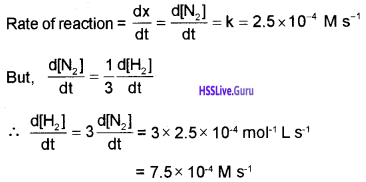
The decomposition of NH3 on platinum surface is zero order reaction. What are the rates of production of N2 and H2 if k = 2.5 × 10⁻⁴ mol-1 L s-1?
Answer:
The decomposition of NH3 is
2NH3 → N2 + 3H2
Rate of reaction,
Plus Two Chemistry Chapter Wise Questions and Answers Chapter 4 Chemical Kinetics three marks q13 img 7
where k is the rate constant. Since, reaction is of zero order,
Plus Two Chemistry Chapter Wise Questions and Answers Chapter 4 Chemical Kinetics three marks q13 img 8

Plus Two Chemistry Chapter Wise Questions and Answers Chapter 4 Chemical Kinetics

Question 14.
The rate constant of a first order reaction is 60 s-1. How much time will it take to reduce the initial concentration of the reactant to its 1/16th value?
Answer:
Rate constant of reaction, k = 60 s-1
t15/16 = ?
Rate constant of first order reaction is given as,
Plus Two Chemistry Chapter Wise Questions and Answers Chapter 4 Chemical Kinetics three marks q14 img 9

Question 15.
The rate of a reaction quadruples when the temperature changes from 293 K to 313 K. Calculate the energy of activation of the reaction assuming that it does not change with temperature.
Answer:
T1 = 293K, T2 = 313K
According to Arrhenius equation,
Plus Two Chemistry Chapter Wise Questions and Answers Chapter 4 Chemical Kinetics three marks q15 img 10
2.303 × 8.314 J K-1 mol-1 × 4585.45 K × 0.6021
= 52863.33 J mol-1 = 52.86 kJ mol-1

Plus Two Chemistry Chemical Kinetics Four Mark Questions and Answers

Question 1.
Plus Two Chemistry Chapter Wise Questions and Answers Chapter 4 Chemical Kinetics four marks q1 img

  1. Which type of the reaction is this?
  2. Write the order and molecularity of the reaction.
  3. What is the unit of rate constant?
  4. Write the 3 steps involved in this reaction?

Answer:

  1. Photochemical reaction
  2. Order = 0 Molecularity = 2
  3. L-1 mol1 sec-1
  4. Initiation, propagation, termination

Question 2.
K = Ae-Ea/RT

  1. Write the name of this equation.
  2. What do you mean by Ea?
  3. Draw the graph between 1/T and Ink.
  4. Write the significance of k.

Answer:
1. Arrhenius equation.

2. The excess amount of energy that is to be given to the reactant molecules in order to involve in a chemical reaction is called activation energy (Ea)

3.
Plus Two Chemistry Chapter Wise Questions and Answers Chapter 4 Chemical Kinetics four marks q2 img 11

4. By noting the value of k, we can predict the speed of a chemical reaction. In the case of a fast reaction, the value of k is high and in the case of a slow reaction value of k is small. By noting the unit of rate constant, we can predict the order of chemical reaction.

Plus Two Chemistry Chapter Wise Questions and Answers Chapter 4 Chemical Kinetics

Question 3.
Match the following:

First order reaction 2NO + O2 → 2NO2
Second order reaction CH3CHO → CH4 + CO
Third order reaction Photochemical
11/2 order reaction N2 + O2 → 2NO
Zero order reaction H2O → 2H2O + 1/2O2

Answer:

First order reaction H2O2 → H2O + 1/2O2
Second order reaction N2 + O2 → 2NO
Third order reaction 2NO + O2 → 2NO2
11/2 order reaction CH3CHO → CH4 + CO
Zero order reaction Photochemical

Question 4.
Consider the reaction
Plus Two Chemistry Chapter Wise Questions and Answers Chapter 4 Chemical Kinetics four marks q3 img 12
Answer the following questions

  1. Write down 2 steps through which the reaction takes place.
  2. Find out the slowest step.
  3. Which is the rate-determining step?
  4. Find out the order of the reaction.

Answer:
1. 2H2O2 + I → H2O + IO
H2O2 + IO → H2O + I + O2

2. 2H2O2 + I → H2O + IO

3. 2H2O2 + I → H2O + IO

4. Order = 2

Question 5.
A chemical reaction is conducted within two hours. But after one hour half of the product is obtained.

  1. Name the term used to designate this time?
  2. Give the expression for this term if it is a first order reaction.
  3. Calculate the rate constant of the above reaction.

Answer:

  1. Half life of a chemical reaction.
  2. t1/2 = \(\frac{0.693}{k}\)
  3. k = \(=\frac{0.693}{t_{1 / 2}}=\frac{0.693}{1 \mathrm{hr}}\) = 0.693 hr-1

Question 6.

  1. Define half-life period of a reaction.
  2. A first order reaction is found to have a rate constant k = 5.5 × 10⁻¹⁴ s-1. Find the half-life period of the reaction.

Answer:
1. Time in which the concentration of the reactant is reduced to one half of its initial concentration.
2.
Plus Two Chemistry Chapter Wise Questions and Answers Chapter 4 Chemical Kinetics four marks q6 img 13

Question 7.
Order of a reaction is an experimental quantity.
(1) Calculate the overall order of a reaction which has the rate expression:
a) Rate = k[A]1/2[B]3/2
b) Rate = k[A]3/2[B]-1
(2) The initial concentration of N2O5 in the following first order reaction N2O6 (g) → 2NO2(g) + 1/2 O2(g) was 1.24 × 10⁻² mol/L at 318 K.

The concentration of N2O5, after 60 min was 0.20 × 10⁻²  mol/L. Calculate the rate constant of the reaction at 318 K.
Answer:
Plus Two Chemistry Chapter Wise Questions and Answers Chapter 4 Chemical Kinetics four marks q7 img 14

Question 8.
1. Write the rate expression for the following reaction.
2N2O5(g) → 4NO2(g) + O2(g)
2. For a hypothetical reaction, aX + bY → Products, the rate law is given as \(\frac{d x}{d t}\) = k[X]2[Y]1/2. What happens to the rate of the reaction when

  • The concentration of ‘X’ is doubled keeping that of ‘Y’ constant.
  • The concentration of both ‘Y’ is doubled keeping that of ‘X’ constant.

Answer:
1. Rate expression:
Plus Two Chemistry Chapter Wise Questions and Answers Chapter 4 Chemical Kinetics four marks q8 img 15
2.

  • Increases by 4 times
  • Increases by \(\sqrt{2}\) times.

Question 9.
1. Identify the reaction order.

  • k= 2.3 × 10⁻⁵ L/mol/s
  • k= 3 × 10⁻⁴ s-1

2. Calculate the activation energy. The rate constants of a reaction are 1 × 10⁻³ s-1 and 2 × 10⁻³ s-1 at 30°C and 40°C respectively.
Answer:
1. The reaction order:

  • Second order
  • First order

2.
Plus Two Chemistry Chapter Wise Questions and Answers Chapter 4 Chemical Kinetics four marks q9 img 16

Plus Two Chemistry Chapter Wise Questions and Answers Chapter 4 Chemical Kinetics

Question 10.
For a reaction A + B → Product, the rate law is given by r= k[A] [B],

  1. What is the order of the reaction?
  2. What will be the effect of temperature on rate constant?
  3. Can activation energy for reactions be zero? Justify your answer.

Answer:
1. Order is the sum of the powers of the concentration terms in the rate law.
rate = K [A]x [B]y
∴ Order = x + y

2. According to Arrhenius equation, at a particular temperature for a definite value of activation energy, rate constant,
k ∝ e-1/T

3. If average kinetic energy of reactant molecule is equal to threshold energy, then activation energy can be zero.

Plus Two Chemistry Chemical Kinetics NCERT Questions and Answers

Question 1.
For the reaction:
2A + B → A2B
the rate = k[A][B]2 with k = 2.0 × 10⁻⁶ mol-2 L2 s-1. Calculate the initial rate of the reaction when [A] = 0.1 mol L-1 [B] = 0.2 mol L-1. Calculate the rate of reaction after [A] is reduced to 0.06 mol L-1.
Answer:
Initial rate = k[A][B]2
But [A] = 0.1 M, [B] = 0.2 M and
k = 2.0 × 10⁻⁶ mol-2 L2 s-1
Initial rate
= 2.0 × 10⁻⁶ mol-2 L2 s-1 × 0.1 M × (0.2 M)2
= 8 × 10⁻⁹ M s-1

From the equation 2A + B → A2B it is clear that when 2 moles of A are used then 1 mol of B is used in the same time. Therefore, when A has been reduced to 0.06 M , 0.04 M of A and hence 0.02 M of B have reacted. Thus,
Concentration of A left = [A] = 0.06 M.
Concentration of B left = [B] = (0.2 M – 0.02 M) = 0.18 M
Rate = k[A][B]2
= 2.0 × 10⁻⁶ mol-2 L2 s-1 × 0.06M × (0.18 M)2
= 3.89 × 10⁻⁹M s-1

Question 2.
Mention the factors that affect the rate of a chemical reaction.
Answer:
The various factors that affect the rate of a chemical reaction are:

  • Concentration of reactants
  • Temperature of reaction
  • Presence of catalyst
  • Nature of reactants
  • Surface area
  • Exposure to radiation

Plus Two Chemistry Chapter Wise Questions and Answers Chapter 4 Chemical Kinetics

Question 3.
The decomposition of NH3 on platinum surface is zero order reaction. What are the rates of production of N2 and H2 if k = 2.5 × 10⁻⁴ mol-1 L s-1?
Answer:
The decomposition of NH3 is
2NH3 → N2 + 3H2
Rate of reaction,
Plus Two Chemistry Chapter Wise Questions and Answers Chapter 4 Chemical Kinetics three marks q13 img 7
where k is the rate constant. Since, reaction is of zero order,
Plus Two Chemistry Chapter Wise Questions and Answers Chapter 4 Chemical Kinetics three marks q13 img 8

Question 4.
The rate constant of a first order reaction is 60 s-1. How much time will it take to reduce the initial concentration of the reactant to its 1/16th value?
Answer:
Rate constant of reaction, k = 60 s-1
t15/16 = ?
Rate constant of first order reaction is given as,
Plus Two Chemistry Chapter Wise Questions and Answers Chapter 4 Chemical Kinetics three marks q14 img 9

Question 5.
The rate of a reaction quadruples when the temperature changes from 293 K to 313 K. Calculate the energy of activation of the reaction assuming that it does not change with temperature.
Answer:
T1 = 293K, T2 = 313K
According to Arrhenius equation,
Plus Two Chemistry Chapter Wise Questions and Answers Chapter 4 Chemical Kinetics three marks q15 img 10
2.303 × 8.314 J K-1 mol-1 × 4585.45 K × 0.6021
= 52863.33 J mol-1 = 52.86 kJ mol-1

Plus Two Computer Science Chapter Wise Questions and Answers Chapter 1 Structures and Pointers

Students can Download Chapter 1 Structures and Pointers Questions and Answers, Plus Two Computer Science Chapter Wise Questions and Answers helps you to revise the complete Kerala State Syllabus and score more marks in your examinations

Kerala Plus Two Computer Science Chapter Wise Questions and Answers Chapter 1 Structures and Pointers

Plus Two Computer Science Structures and Pointers One Mark Questions and Answers

Question 1.
Name a method used to put logically related elements in one unit.
Answer:
Structure or class

Question 2.
…………… keyword is used to specify a structure.
Answer:
struct.

Question 3.
State True or False.
Answer:
‘A structure can be assigned to another structure only if both the structures are of same structure type’.

Question 4.
A structure brings together a group of
(a) Items of the same data type
(b) Integers with user defined names.
(c) Related data items and functions, if needed.
(d) None of the above
Answer:
(c) Related data items and functions, if needed.

Question 5.
Pick the odd one out from the following.
(a) int
(b) struct
(c) char
(d) long
Answer:
(b) struct

HSSLive.Guru

Question 6.
Select the structure member operator. Structure member operator select
(a) *
(b) .
(c) ®
(d) [ ]
Answer:
(b) .

Question 7.
The address of a computer memory starts at ………
(a) 0
(b) 1
(c) 1024
(d) none of these
Answer:
(a) 0

Question 8.
The area used for dynamic memory allocation is called
(a) heap
(b) stack
(c) RAM
(d) Hard Disk
Answer:
(a) heap

Question 9.
Given int *P, x = 35; P = &x; what is the value of *P?
(a) 34
(b) 35
(c) 0
(d) none of these
Answer:
(b) 35

Question 10.
int *P; p is having the address 2340. What will be the value of P after the execution of the statements P++; P = P – 3;
(a) 2340
(b) 2342
(c) 2338
(d) 2332
Answer:
(d) 2332

HSSLive.Guru

Question 11.
Dynamic allocation means memory allocation at the time of ……….
(a) compilation
(b) debugging
(c) execution
(d) programming
Answer:
(c) execution

Question 12.
The ‘new’ operator should be matched with a ……….
(a) pointer
(b) reference
(c) delete
(d) address
Answer:
(c) delete

Question 13.
In the declaration void ff (int &, float &); the parameters are passed by …….
(a) reference
(b) value
(c) pointers
(d) default
Answer:
(a) reference

Question 14.
Using ……… the memory location of a variable can be directly accessed and manipulated.
Answer:
Pointers.

Question 15.
Anil argued that memory can be allocated as and when required during runtime. Do you agree with this opinion? Justify.
Answer:
Yes. Memory can be allocated during run time using the operator new.

HSSLive.Guru

Question 16.
Name the unary operator that returns the address of its operand.
Answer:
& operator. Operator (Address operator)

Question 17.
Which among the following operators cannot be used with pointers?
(a) +
(b) –
(c) /
(d) None of these
Answer:
(c) /

Question 18.
The address of the first byte is known as
(a) start
(b) Base address
(c) int address
(d) none of these
Answer:
(b) Base address

Question 19.
What are the free store operators?
Answer:
‘new’ and ‘delete’ operators.

Question 20.
Give the syntax of new operator.
Answer:
= new ;
eg: int *P = new int;

HSSLive.Guru

Question 21.
What does the following stmt mean?
int *P = new int [15];
Answer:
Allocating memory for an integer array of 15 elements.

Question 22.
The ……. operator reverses the action of the ‘new’ operator.
Answer:
delete.

Question 23.
Which operator is used to access individual elements of a structure ora class while using pointer variables?
Answer:
(a) *
(b) .
(c) ?
(d) None of these
Answer:
(b) .

Question 24.
A pointer is
(a) the address of a variable
(b) an indication of the variable to be accessed next
(c) a variable for storing addresses
(d) the datatype of an address variable
Answer:
(c) a variable for storing addresses

Question 25.
The expression * test can be said to ‘test
(a) be a ponterto test
(b) refer to the contents of test
(c) dereference test
(d) refer to the value of the variable pointed to by test
Answer:
(d) refer to the value of the variable pointed to by test

HSSLive.Guru

Question 26.
The expression double * can be said to double*
(a) be a pointer pointing to variable double
(b) refer to contents of double
(c) be a pointer to a double type value
(d) refer to the value of the variable pointed to by double.
Answer:
(c) be a pointer to a double type value

Question 27.
The new operator –
(a) returns a pointer to a variable
(b) creates a variable called new
(c) obtains memory for a new variable
(d) tells how much memory is available
Answer:
(c) obtains memory for a new variable

Question 28.
Write a declaration for an array of 8 pointers to float float values
(a) float a []
(b) float*[*a] [8]
(c) float *a[8]
(d) float [*a][8]
Answer:
(b) float*[*a] [8]

Question 29.
A pointer to void can hold pointers to ………….
(a) void
(b) int
(c) float
(d) any data type
Answer:
(d) any data type

Question 30.
The contents of two pointers that point to adjacent variable of type float differ by
(a) 4
(b) 2
(c) 1
(d) 8
Answer:
(a) 4

Question 31.
In the …….. memory allocation, the amount of memory to be allocated is not known beforehand
(a) Static
(b) binding
(c) object
(d) dynamic
Answer:
(d) dynamic

HSSLive.Guru

Question 32.
Improper use of ‘new’ and ‘delete’ may lead to ….. ‘new’, ‘delete’ operator
(a) increase of memory
(b) memory leaks
(c) destruction of memory
(d) syntax errors
Answer:
(b) memory leaks

Question 33.
If ‘p’ is pointer to the variable ‘x’, which of the following statement are correct.
(a) ‘p’ and ‘x’ may be of different data types
(b) if ‘p’ points to ‘x’, then ‘x’ also points to ‘p’
(c) the statement x = &p is valid
(d) *p will give the value of the variable ‘x’
Answer:
(d) *p will give the value of the variable ‘x’

Question 34.
Suppose ‘m’ is a float variable. Another variable ‘ptr’ stores the address of it, which is 2001. After the operation ptr++, it will point to the location having address ………. Why?
(a) 2002
(b) 2003
(C) 2004
(d) 2005
Answer:
(d) 2005 (add the size of its data type, 2001 + 4)

Question 35.
State True of False.
‘Only integers can be added or subtracted from pointers’.
Answer:
True

Question 36.
Give the syntax for delete operator, delete operator
Answer:
delete pointer-variable;

Question 37.
What does the following statement mean?
delete [ ] marks;
Answer:
Deallocating marks array

Question 38.
Name the operator that returns the data value stored in the area being pointed to by the pointer.
Answer:
* Operator

HSSLive.Guru

Question 39.
If the name of an array is a pointer to its first ele¬ment, how to move to third element.
Answer:
Array name +2 gives the address of third element

Question 40.
What does the following statement mean?
int * ptr [10];
Answer:
An array of 10 integer pointers

Question 41.
State True of False.
‘It is faster to use an element pointer rather than an index when scanning arrays’.
Answer:
True.

Question 42.
S[0] is not equal to S[0]
(a) *(S+0)
(b) *S
(c) *(s)
(d) S
Answer:
(d) S

Question 43.
Which of the following declaration is valid?
(a) int*p = &a,
(b) int&p = *a,
(c) int &p = &a,
(d) int a = &p;
Answer:
(a) int*p = &a,

Question 44.
*p means ……….
(a) address of p
(b) value of p
(c) address of variable pointed to which p points
(d) value of virile to which p points
Answer:
(a) address of p

Question 45.
& p means ……..
(a) address of p
(b) value of p
(c) address of variable pointed to which p points
(d) value of variable to which p points
Answer:
(a) address of p

Question 46.
State True of False.
‘Only integers can be added or substracted from pointers’.
Answer:
True.

HSSLive.Guru

Question 47.
Read the following statements:
(i) While defining a structure in C++, tag may be omitted.

(ii) The data contained in a structure variable can be copied into another variable only if both of them are declared using the same structure tag.

(iii) Elements of a structure is referenced by structure_name.element

(iv) A structure can contain another structure.

Now, Choose the correct option from the following:
(a) Statements (i) and (ii) are true
(b) Statements (ii) and (iv) are true
(e) Statements (i), (ii) and (iv) are true
(d) Statements (i) and (iii) are true
Answer:
(d) Statements (i) and (iii) are true

Question 48.
Choose the correct syntax for accessing a structure element.
(a) structure_name.element_name;
(b) element_name.structure_name;
(c) structure_variable.element_name;
(d) element_name.structure_variable;
Answer:
(c) structure_variable.element_name;

Question 49.
Which one of the following is not correct about a pointer.
Answer:
(a) A pointer stores address
(b) A Pointer stores L-value of a variable
(c) A Pointer points to a memory location
(d) A pointer stores R-Value of a variable
Answer:
(d) A pointer stores R-Value of a variable

Question 50.
The following are some pointer variable declarations.
(a) float *ptr;
(b) int ptr*;
(c) short *ptr1,*ptr2;
(d) double ptr;
Choose the correct declaration
(i) a and b
(ii) a and c
(iii) a and d
(iv) a only
Answer:
(ii) a and c

HSSLive.Guru

Question 51.
The address of operator (&) is used for
(a) Obtaining R-Value of a variable
(b) Obtaining L-Value of a variable
(c) Obtaining content of a variable
(d) None of these
Answer:
(b) Obtaining L-Value of a variable

Question 52.
Differentiate static and dynamic memory allocation.
Answer:
When the amount of memory to be allocated is known in advance and memory is allocated during compilation itself, it is referred to as static memory allocation. When the amount of memory to be allocated is not known in advance and it is required to allocate memory as and when required during run time, it is known as dynamic memory allocation.

Question 53.
If a memory allocated using the dynamic memory allocation operator new, is not deallocated using the operator delete, a problem is occurred. Name that problem.
Answer:
Memory leak

Question 54.
There is no chance of memory leak in static memory allocation”. Say True/False. Justify.
Answer:
The operating system takes the responsibility of memory allocation and deallocation without users instruction.

Question 55.
Write a C++ code segment to declare an integer pointer variable named p and store the address of an integer variable n into the pointer variable p.
Answer:
int * p, n; p = &n;

Question 56.
Consider the following code segment in C++. If a is stored at memory location 4020 and size of int is 4, then predict the output.
int *x, a;
x = &a;
cout << x ++ << “\n”; .
cout << ++ x;
Answer:
4020
4028

HSSLive.Guru

Question 57.
Choose the operator which is not associated with a pointer variable.
(a) *
(b) .
(c) &
(d) →
Answer:
(b) .

Question 58.
The arrow (→) operator is used for accessing
(a) structure element using structure variable.
(b) structure element using a structure name.
(c) structure element using structure pointer variable.
(d) structure element using structure tag.
Answer:
(c) structure element using structure pointer variable.

Question 59.
Write a C++ statement to declare an array, using character pointer variable, which can store names of 60 students in a class.
Answer:
char*name[60];

Question 60.
Read the following statements.
(i) A structure which contains another structure is called self referential structure.
(ii) A structure which, contains pointer to another structure is called self referential structure
(iii) A structure which contains another structure is called nested structure.
(iv) A structure which contains pointer to same structure is called self referential structure
Now, choose the correct option from the following
(a) statements (i) and (ii) are true
(b) statements (i) and (iii) are correct
(c) statements (ii) and (iii) are correct
(d) statements (iii) and (iv) are correct
Answer:
(d) statements (iii) and (iv) are correct

Question 61.
Structure is a …………………. data type.
Fill up the blank by choosing correct option from the following.
(a) Fundamental
(b) Derived
(c) User defined
(d) Built in
Answer:
(c) User defined

HSSLive.Guru

Question 62.
Write the declaration statement of a student structure variable named ‘s’ which is initialized with admission number 19, name as ‘Aysha’ and mark as 75.
Answer:
student s = {19,“aysha”,75};

Question 63.
“The dot(.) operator cannot be used for Recessing structure member by using structure pointer variable” Say True or False. Justify your answer.
Answer:
False. Arrow (→) operator is used for accessing structure member by using structure pointer variable.

Plus Two Computer Science Structures and Pointers Two Mark Questions and Answers

Question 1.
Write C++ statement for the following.

  1. To declare an integer variable named ‘x’ using new operator.
  2. To initialize the integer pointer variable x with value 5.
  3. To declare a dynamic array of ten integers named x.

Answer:

  1. int*x = newint;
  2. int*x = newint(5);
  3. int *x = new int[10];

Question 2.
Consider the following C++ program code to store address of an integer variable a into a pointer variable p
int a = 5,*p;
P = a;
cout<< p;
Identify the error in the above program segment and correct the error.
Answer:
P = a is the error because p is an integer pointer and can store only address. The correct code is p = &a;

Question 3.
Correct the program code given below:
int a = 5;
float *p;
p = &a;
cout << p;
Answer:
float*p; is to be corrected as int *p;
or
int a = 5; is to be corrected as float a = 5;

HSSLive.Guru

Question 4.
Calculate the memory requirement for the following structure variable s1.
[Consider the size of int = 4, char = 1 and float = 4]
struct student
{
int mo;
char name[25];
float height;
}s1;
Answer:
Plus Two Computer Science Chapter Wise Questions and Answers Chapter 1 Structures and Pointers img1

Question 5.
Consider the following array initialisation, int ar[5]={-2,-4,-6,2,4}; If first element of array is stored at 2050 and size of int is 4, find the output of the following.

  1. cout<< *ar+*(ar+3);
  2. cout<< ar+*(ar+4);

Answer:
1.
*ar = -2
*(ar + 3) = 2 (fourth element)
Hence *ar + *(ar + 3) = -2 + 2 = 0
Hence output is 0

2.
Here ar = 2050 (starting address)
and * (ar + 4) = *(2050 + 4*4)
= *(2050+16)
= *(2066)
= 4 (fifth element)
Hence ar + * (ar + 4)
= 2050 + 4
= 2054

Question 6.
Match the following:
Plus Two Computer Science Chapter Wise Questions and Answers Chapter 1 Structures and Pointers img2
Answer:
a – iii
b – iv
c – ii
d – i

Question 7.
Complete the following table. The table is differentiating array and structure.
Plus Two Computer Science Chapter Wise Questions and Answers Chapter 1 Structures and Pointers img3
Answer:
Plus Two Computer Science Chapter Wise Questions and Answers Chapter 1 Structures and Pointers img4

Question 8.
Identify the errors in the following code fragment and correct it.
struct sample
{
int x;
float y;
} S1 ,S2;
void main()
{Struct test
int a;
float 6;
}T1,T2;
T1 = T2;
T1=S1;
}
Answer:
The assignment T1 = S1 is not correct. It is a variable of type test and S1 is a variable of type sample. So it cannot be assigned.

Question 9.
When a C++ program is executed, the primary memory allocated for it is organized in a particular manner to deal with runtime memory allocation, function calls, variables, etc. Show a diagrammatic representation of it with brief explanation.
Answer:
After compilation of C++ creates four distinct regions of memory used for distinct functions:

STACK 3

HEAP 4

Global Program
Variables Code
2 1

The first area (1) is used for storing the compiled code of the program. The second area (2) is used for storing global variables of the program. It remains in memory till the program ends. The third region (3) known as the stack is used for holding the return addresses of function calls, arguments passed to the function, etc. The last region heap is used for dynamic allocation.

HSSLive.Guru

Question 10.
Analyze the following C++ statements and predict
the output.
int k = 4 ;
int *p ;
p = &k ;
cout<< k ;
cout<< *p;
cout<< *p++ ;
cout<< *(&k);
Answer:
4, 4, 4, 4

Question 11.
A boy wrote a C++ program that uses several pointer variables out of which some are used for dynamic allocation. He did not use the ‘delete’ operator anywhere in the program. While running the program, the computer got stuck up after some time. Predict the reason for this kind of situation, in connection with the above program code
Answer:
The situation is called memory leak. The memory allocated using ‘new’ should be properly deallocated using ‘delete’. If any function forgets to deallocate the memory using ‘delete’ which was allocated using the ‘new’ operator, it consumes some memory in every execution.

Thus a part of memory disappears with its every execution and it has some adverse effect on the system. This situation is called memory leak.

Question 12.
Is there any difference between structure and array? Explain.
Answer:
Yes. An array can hold multiple elements of same datatype whereas a structure can hold multiple elements of different data types.

Question 13.
Write a C++ structure definition to store the student details given below:

  1. Admission number
  2. Name
  3. Marks in six subjects

Answer:
Struct student
{
intAdmno;
charname[30];
int mark[6];
}

HSSLive.Guru

Question 14.
Observe the following layout of data,
Plus Two Computer Science Chapter Wise Questions and Answers Chapter 1 Structures and Pointers img5

  1. Name the data type in C++ used to represent the above data format.
  2. Write the definition for implementing the above layout.

Answer:
1. Structure

2. struct Account
{
int accno;
char name[30];
struct lastdate
{
int day;
int month;
int year;
} tdate;
float balanceamt;
}

Question 15.
Consider the following code segment.
struct student
{
int rollno;
char name[20];
struct date
{
int day;
int month;
int year;
} birthday;
char batch[30];
int score;
}
Write valid statements in C++ to accept the name and date of birth of a student.
Answer:
gets(S1 .name);
S1.birthday.day=25;
S1.birthday.month=5;
S1.birthday. year=1991;

Question 16.
Why do we need structure variables, once a structure is defined in program?
Answer:
Structure specification is merely a data type definition. Memory allocation does not take place during specification. To handle data, memory locations are needed. For memory allocation, variables are to be declared. Hence structure variable is essential for handling structured data in programs.

Question 17.
With an example explain how structures can be initialized.
Answer:
Student stud = {“Athul”, 17,101, “XII Science”};
The above statement initializes structure variable stud of type student which has data members name, age, roll no, batch.

HSSLive.Guru

Question 18.
Can we declare a structure within another structure? Explain.
Yes. We can declare a structure as a member of another structure. It is known as nested structure.

Question 19.
What does the following statement mean?
Answer:
It is accessing the element of a nested structure. S is a structure variable that contains another structure variable dob. ‘month’ is a member of inner structure variable dob. This statement assigns a value 10 to the member month.

Question 20.
Thomas says that name of an array is a pointer by default. Do you agree with him? Justify.
Answer:
Yes. C++ takes the array name as the address of its first element. That is, the name of an array is actually a pointer pointing to the first element of an array.

Question 21.
Distinguish between
int * ptr = new int (5);
int * ptr = new int [5];
Answer:
The first statement allocates memory of one integer to ptr and initialized it with value 5. The second statement allocates memory of 5 contiguous integers (ie. an array of 5 integers) and stores begining address in pointer ptr.

Question 22.
Give the syntax to declare an integer 2D array dy namically.
Answer:
int * ptr = new int [m*n];
where m and n are rows and columns

Question 23.
The array of character pointers is generally preferred over two dimensional array of characters. Justify.
Answer:
The array of character pointers is preferred. There are two reasons:
1. An array of pointers makes more efficient use of available memory by consuming lesser number of bytes to store the strings.

2. An array of pointers makes the manipulation of the strings much easier. One can easily exchange the positions of the strings in the array of pointers without actually touching their memory locations.

Question 24.
Predict the errors in the following code fragment in C++.
1. float f= 1.42;
float *a;
a = f;
2. int *p,*q;
p = q + 1;
Answer:

  1. a=&f is correct
  2. No values assigned for p and q.

Question 25.
Define a structure in C++ to store book details such as book id, book name, price, and author name.
Answer:
Structure is a group of different types of logically related data referenced by a single name,
struct book
{
int book id;
charbook_name[40];
float price;
chart author_name[40];
};

HSSLive.Guru

Question 26.
Complete the following structure definition, to store students details with appropriate values. Students details are roll number, name and height.
Plus Two Computer Science Chapter Wise Questions and Answers Chapter 1 Structures and Pointers img6
Answer:
struct students
{
short rno;
char name[25];
float height;
};

Question 27.
Correct the following structure definition to represent an employee with employee code, employee name, and salary.
Answer:
Employee struct
{
ecode int;
char name[25];
salary double;
}

Question 28.
Consider the array declaration. Assume that the first element of array is stored in 2020 location,
int a[] = {2,5,8,9,4},*p1 ,*p2;
p1 = a;
p2 = &a[0];
cout<< p1<< “\t”<< p2;
Predict the output and justify.
Answer:
p1 = a means, the array name is the starting address of an array.
That means p1 = 2020
p2 = &a[0] means p2 = 2020
Hence the output is 2020 2020

Plus Two Computer Science Structures and Pointers Three Mark Questions and Answers

Question 1.
Explain the type of structure defined below and calculate the number of bytes required to store the structure variable s1. [Considerthe size of int as 4 bytes and char as 1 byte]
struct student
{
int mo, mark;
char name[25];
struct date
{
int dd, mm, yy;
}doj;
}s1;
Answer:
A structure contains another structure, then it is called nested structure.
Plus Two Computer Science Chapter Wise Questions and Answers Chapter 1 Structures and Pointers img7

Question 2.
Define a structure to represent employee details. Employee details are employee code, employee name, date of joining and place of employee.
Answer:
struct employee
{
int empcode; ,
char name [40];
struct date
{
int day;
int month;
int year;
}doj;
char place [40];
};

HSSLive.Guru

Question 3.
“Self referential structure can be used for implementing linked list”. Justify the statement.
Answer:
A structure contains an element that is a pointer to the same structure is called self referential structure. Eg: struct date {
int dd, mm, yyyy;
date *ptr;
};
So self referential structure can be used for implementing linked list.

Question 4.
Write a program in C++ to copy one string to another without using strcpy() function.
Answer:
#include
using name space std; intmain()
{
charstr [ ] = “computer”;
char * sptr;
sptr = str;
cout<< str<< endl;
cout<< sptr<< endl;
}
This code copies the string str to sptr;

Question 5.
Define a structure in C++ to store students’ details such as admission number, name, address. Address contains house number, street name and city name.
Answer:
Structure is a group of different types of logically related data referenced by a single name,
struct student
{
int adm_No;
char name[40];
struct
{
int house_no;
charstreet_name[40];
charcity_name[40];
} address;
};

Question 6.
A structure variable can be declared along with structure definition.” Justify this statement with an ex-ample.
Answer:
Yes, it is possible that, a structure variable can be declared along with structure definition itself.
Syntax:
struct struet_name
{
Data members;
} structure variables;
Eg: struct date
{
intdd;
int mm;
intyyyy;
}d1,d2,d3;

Question 7.
Identify and correct the error in the following code fragment.
struct first {
int a; float b;
}S1;
struct second {
int a;
float b;
}S2;
S1 = S2;
Answer:
The assignment S1 = S2 is not right. Because S1 and S2 are different structure variables. C++ does not permit different structure variable assignment.

HSSLive.Guru

Question 8.
Write structure definitions for structures containing the following.

  1. book no, book name, price
  2. item no, item name, price, monthly sales for last 4 months.

Answer:
1. struct book
{
long bookno;
char bookname[50];
float price;
};

2. struct item
{
int itemno;
char itemname[50];
float price;
int sale[4];
}

Question 9.
Assume that in a city, two football matches are going to be held. The coordinators of the match have decided to sell the tickets in two different styles. For the first match, the tickets will be sold one month in advance, but for the second one, tickets will be available from the stadium on the very same day of the match.

  1. Correlate this situation with the memory allocation techniques in C++.
  2. Compare the merits and demerits of the two in relation with the given context.

Answer:
1. Static and dynamic memory allocation.

2. Every data and instruction data is being executed must be allocated some area in the main memory. The main memory can be allocated in two methods.

  • Static memory allocation
  • Dynamic memory allocation

When the amount of memory to be allocated is known in advance and memory is allocated during compilation itself, it is referred to as static memory allocation. When the amount of memory to be allocated is not known in advance and it is required to allocate memory as and when required during run time, it is known as dynamic memory allocation.

Question 10.
When a C++ program is compiled, the compiler allocates 20 bytes of memory and when the same program is executed 10 more bytes of memory were allocated

  1. How do you account for these two types of memory allocations?
  2. Name the operator used for the second type of memory allocation and also write the syntax.

Answer:
1. Static and dynamic memory allocation.

2. ‘new’ operator is used for dynamic allocation of memory syntax,
datatype ‘pointer variable = new datatype;
eg: int *ptr = new int;

HSSLive.Guru

Question 11.
Justify the following statements

  1. In C++, the ‘delete’ operator performs the reverse action of ‘new’ operator.
  2. If ‘arr’ is the name of an array, then arr++ is not a valid statement
  3. If ‘k’ is a long variable with address 1001 and it is stored by a pointer variable ‘p’, then ‘p + 1 ’ will point to the location with address 1005.

Answer:
1. In C++, the ‘delete’ operator performs the reverse action of ‘new’ operator. In C++, both ‘new’ and ‘delete’ operators are used for dynamic allocation and deallocation of memory respectively, ie. For allocation of memory at runtime new operator is used. For deallocation of memory that have been allocated by the new operator, ‘delete’ operator is used.

2. arr++ is not a valid statement. Because the base address of an array can not change. Array name gives the base address of the array.

3. Pointer variable hold the address of memory location where the data is stored. So incrementing the pointer variable is adding the size of the data type. Long data type takes 4 bytes of memory. So incrementing the pointer variable P makes it point to the address 1005.

Question 12.
Discuss the similarity and differences of a structure as compared to an array and a class.
Answer:

Structures Array
1. It is a user defined data type 1. Predefined data type
2. It is a collection of different types of logically related data under one name. 2. Collection of data elements of same data type having a common name
3. Elements referenced using dot operator (.) 3. Elements references using its subscripts (position value)
4. When an element of a structure becomes another structure nested structure and complex structures are formed 4. When an element of another becomes another array, multidimensional arrays are formed.
5. Structures contain array as its elements 5. Array of structure can be formed

Question 13.
Considerthe following code fragment.
char nam[ ] = “COMPUTER”
for(int i = 0; nam[i]!= ‘\0’; i++)
cout << nam[i];
Rewrite the above code to get the same output using a character pointer variabe.
Answer:
char nam [ ] = “computer”
char*P;
for (P = nam; *P!= ‘\0’; P++)
cout<< *P;

HSSLive.Guru

Question 14.
Match the following.
Plus Two Computer Science Chapter Wise Questions and Answers Chapter 1 Structures and Pointers img8
Answer:
1 – b
2 – c
3 – d
4 – a

Question 15.
How is dynamic memory allocation different from static memory allocation?
Answer:
In the static memory allocation, the amount of memory to be allocated is predicted and pre known. This memory is allocated during the compilation itself. All the declared variables declared normally, are allocated memory statically.

In the dynamic memory allocation, the amount of memory to be allocated is not known beforehand. It is allocated during run time as and when required. The memory is dynamically allocated using new1 operator.

The objects that are allocated memory statically have the lifetime as their scope allows, as decided by the compiler. And the objects that are allocated memory dynamically have the lifetime as decided by the programmer. That is until the programmer explicitly deallocates the memory, such objects live in the memory.

Plus Two Computer Science Structures and Pointers Five Mark Questions and Answers

Question 1.
Read the following structure definition and answer the following questions:
struct Book
Computer Science
{
int book_no;
charbk_name [20];
struct
{
short dd;
short mm;
short yy;
} dt_of_purchase;
float price;
};
a) Write a C++ statement to declare a variable to refer to the details of a book. What is the memory requirement of this variable? Justify your answer.

b) Write a C++ statement to initialize this variable with the details of your Computer Science textbook.

c) Write C++ statement (s) to display the details of the book.

d) The missing of structure tag in the inner structure does not cause any error. state whether this is true or false. Give reason.
Answer:
a) Book b;
The memory requirements are as follows:
Plus Two Computer Science Chapter Wise Questions and Answers Chapter 1 Structures and Pointers img9
Plus Two Computer Science Chapter Wise Questions and Answers Chapter 1 Structures and Pointers img10
d) This is true. There is no need to mention the structure tag because it is declared inside the structure.

HSSLive.Guru

Question 2.
You are given an assignment by the teacher to write a C++ program that accepts the age of ’n’ people who attended a medical camp. The value of ‘n’ is not known beforehand. Its value is to be accepted at the time of running the program. The program should print the average age as the final output. Develop the code.
Answer:
Plus Two Computer Science Chapter Wise Questions and Answers Chapter 1 Structures and Pointers img11

Question 3.
How are the following related?

  1. Structure and array
  2. Structure and class

Answer:
1. Structure and array:
Structure and array are both derived data types in C++.: a Structure is a user defined data type while an array is a derived data type. Structure is a collection related data items that can be of different data types. Array is also a collection of elements of same data type Thus both array and structured allow several values to be treated together as a single data object.

2. Structure and class:
Structure and class are both user defined data types. Structure is a collection of related data items while class is a collection of data and functions. Hence structure plus related functions form a class.

Plus Two Chemistry Chapter Wise Questions and Answers Chapter 3 Electrochemistry

Students can Download Chapter 3 Electrochemistry Questions and Answers, Plus Two Chemistry Chapter Wise Questions and Answers helps you to revise the complete Kerala State Syllabus and score more marks in your examinations.

Kerala Plus Two Chemistry Chapter Wise Questions and Answers Chapter 3 Electrochemistry

Plus Two Chemistry Electrochemistry One Mark Questions and Answers

Question 1.
The metal which acts as the anode in Daniell cell is _______
Answer:
Zinc

Question 2.
Electrolysis of dilute H2SO4 liberates ________ gas at cathode.
Answer:
Hydrogen

Question 3.
The charge required to reduce 1 mole of I2 to I is
(a) 96500 C
(b) 2 × 96500 C
(c) \(\frac{1}{2}\) × 96500 C
(d) 4 × 96500 C
Answer:
(b) 2 × 96500 C

Plus Two Chemistry Chapter Wise Questions and Answers Chapter 3 Electrochemistry

Question 4.
Of the following metals that cannot be obtained by electrolysis of the aqueous solution of their salts are
(a) Ag and Mg
(b) Ag and Al
(c) Mg and Al
(d) Cu and Cr
Answer:
(c) Mg and Al

Question 5.
Chemically, rust is _______
Answer:
Hydrated ferric oxide (Fe2O3.xH2O)

Question 6.
One of your friends argues that in the laboratory CuS04 is not stored in Aluminium bottles.

  1. Do you agree?
  2. Justify.

Answer:
1. Yes.

2. Aluminium displaces copper from copper sulphate solution. Because, in electrochemical series Al stands before copper. The reduction potential of Cu is greater than that of Al. Greater the value of reduction potential, more easily is the substance reduced.
(Al+3/Al) = – 1.66 V,
(Cu+2/Cu)= + 0.34V

Question 7.
Arrange the following metals in the order in which they displace each other from the solution of their salts:
Al, Cu, Fe, Mg and Zn
Answer:
The correct order is Mg, Al, Zn, Fe, Cu

Question 8.
The conductivity of 0.20 M solution of KCl at 298 K is 0.0248 S cm-1. Calculate the molar conductivity.
Answer:
Plus Two Chemistry Chapter Wise Questions and Answers Chapter 3 Electrochemistry one mark q8 img 1

Question 9.
The limiting molar conductivity of HCl, CH3COONa and NaCl are respectively 425, 90 and 125 mho cm2mol-1 at 25°C. The molar conductivity of 0.01 m. CH3COOH solution is 7.5 mho cm2 mol-1 at the same temperature. The degree of dissociation of 0.1 as acetic acid solution at the same temperature is _________
Answer:
0.02

Question 10.
The ion of least limiting molar conductivity among the following is
(a) SO2-4
(b) H+
(c) Ca2+
(d) CH3COO
Answer:
(d) CH3COO

Plus Two Chemistry Chapter Wise Questions and Answers Chapter 3 Electrochemistry

Question 11.
Standard electrode potential of three metals XY and Z are 0.52V, 2.87 V and -0.44 V respectively. The reducing power of these metals are
Answer:
Y > Z > X

Question 12.
A current of strength of 9.65 ampere is passed through excess fused AlCl3 for 5 hours. How many liters of chlorine will be liberated at STP.
Answer:
20.16

Question 13.
Consider the following four electrodes
P = Cu2+(.0001 M/Cu(s) Q = Cu2+(0.1 M)/Cu(s)
R = Cu2+(0.01 M)/Cu(s) S = Cu2+(0.001 M)Cu(s)
If the standard reduction potential of Cu2+/Cu is +.34V the reduction potential in volts of the above electrode follows the order.
Answer:
Q > R > P

Plus Two Chemistry Electrochemistry Two Mark Questions and Answers

Question 1.
Resistance of lead is greater than that of gold.

  1. Do you agree?
  2. What do you mean by resistance?
  3. What do you mean by resistivity?

Answer:

  1. Yes.
  2. Resistance is the hindrance offered by a substance to the flow of electricity through it.
  3. Resistivity is the resistance of a conductor of length 1 cm and area of cross section 1 cm2.

R ∝ \(\frac{\ell}{\mathrm{A}}\) Or R = ρ\(\frac{\ell}{\mathrm{A}}\) where R → Resistance
and ρ → resistivity.
When l = 1 cm and A = 1 cm2
then, R = ?

Question 2.
In the chemistry lab, a student immersed two platinum electrodes in a solution of CuSO4 and electric current was passed through the solution. After sometime he noticed that the colour of CuSO4 disappeares with the evolution of a gas at the electrode. In his Practical Log, he recorded that the colourless solution contains H2SO4.

  1. Is it true?
  2. Comment on his findings and justify your answer.

Answer:
1. Yes.

2. When aqueous CuSO4 solution is electrolysed using Pt electrodes, Cu is deposited at the cathode and O2 is liberated at the anode.
CuSO4(aq) → Cu2+(aq) + SO42-(aq)
Cu2+(aq) + 2\(\bar { e }\) → Cu(s) (at cathode)
H2O(l) → 2H+(aq) + 1/2 O2(g) + 2\(\bar { e }\) (at anode)
Thus, H2SO4 is formed as the secondary product.

Question 3.
Consider the argument, “On the basis of position in the electrochemical series, Al does not displace hydrogen from water and acids

  1. Do you agree with the argument?
  2. Substantiate your answer.

Answer:

  1. No.
  2. Metals which are above hydrogen in the electro chemical series can displace H2 from acids, i.e., elements having lower reduction potential than hydrogen, can liberate H2 from acids and water. Al displaces hydrogen from water and acids.

Plus Two Chemistry Chapter Wise Questions and Answers Chapter 3 Electrochemistry

Question 4.
How much electricity in Faraday is required to produce

  1. 20.0 g of Ca from molten CaCl2?
  2. 45.0 g of Al from molten Al2O3?

(Hint: Atomic masses – Ca: 40 u, Al: 27 u)
Answer:
1. The electrode reaction is Ca2+(aq) + 2e → Ca(s)
Electricity required to produce 40 g Ca = 2 F
Electricity required to produce 20 g Ca = 1 F

2. The electrode reaction is.
Al3+(aq) + 3e → Al(s)
Electricity required to produce 27 g of Al = 3 F
Electricity required to produce 45 g Al = 5 F

Question 5.
In a debate, a student said “Electrolytes dissolved in water dissociate into constituent ions”. His friend supported this statement and said “The degree of dissociation of an electrolyte increase with the increasing concentration of the electrolyte.”

  1. Do you agree with these statements?
  2. If you agree or not, give the reason.

Answer:

  1. The first statement is correct, but the second statement is wrong.
  2. Degree of dissociation of an electrolyte increases with dilution and not by increasing the concentration.

Question 6.
The standard electrode potential of the elements A, B and C are 0.68, – 2.50 and – 0.50 volts respectively.

  1. Arrange them in the order of their reducing power.
  2. Justify your answer.

Answer:

  1. B < C < A
  2. Greater the value of reduction potential, greater will be the reducing power.

Question 7.
In a standard hydrogen electrode, is it possible to replace the Platinum wire in the glass tube with Aluminium wire? Justify your answer.
Answer:
No. Platinum is an inert electrode and moreover the coefficient of cubical expansion of platinum is equal to that of glass. But, aluminium being an active metal will interfere in the cell reaction.

Question 8.
Listen to the following statements.
“Zinc displaces silver from AgNO3 solution, because standard oxidation potential of zinc is greaterthan that of silver”.

  1. Is it true?
  2. What happens when we use copper instead of zinc?
  3. Justify your answer.

Answer:

  1. Yes.
  2. Copper also displaces Ag from AgNO3 solution.
  3. In electrochemical series, Cu lies above Ag. The reduction potential of copper is +0.34 V. But in the case of silver, the reduction potential is +0.80 V.

Plus Two Chemistry Chapter Wise Questions and Answers Chapter 3 Electrochemistry

Question 9.
“Metal having -ve reduction potential when dipped in the solution of its own ion has a tendency to go into the solution”.

  1. Analyse the above statement.
  2. Compare the reduction potential of H+ ion with that of other metal ions.

Answer:

  1. The statement is correct.
  2. The reduction electrode potentials of elements lying above hydrogen in the electrochemical series are negative while those of elements lying below hydrogen are positive. The standard potential for the reaction 2H+ + 2e → H2(g) is taken as 0.00 V.

Question 10.
Consider the statement ‘Specific conductance increases on dilution’.

  1. Is it true?
  2. What is your opinion about it? Justify.
  3. Define specific conductance and give its equation.

Answer:

  1. No.
  2. This is because, the number of ions per unit volume that carry the current in a solution decreases on dilution.
  3. Specific conductance/Conductivity of a conductor is the conductance offered by the conductor of unit length and unit area of cross section.

k = \(\frac{l}{R A}=\frac{1}{R} \times \frac{l}{A}\) where \(\frac{l}{A}\) is the cell constant.

Question 11.
Write Nernst equation and calculate the emf of the following cell at 298 K.
Plus Two Chemistry Chapter Wise Questions and Answers Chapter 3 Electrochemistry two mark q11 img 2
Answer:
Plus Two Chemistry Chapter Wise Questions and Answers Chapter 3 Electrochemistry two mark q11 img 3

Question 12.
The resistance of a conductivity cell containing 0.001 M KCl solution at 298 K is 1500 Ω. What is the cell constant if conductivity of 0.001 M KCl solution at 298 K is 0.146 × 10⁻³ S cm-1?
Answer:
Cell constant = \(\frac{\text { Conductivity }}{\text { Conductance }}\)
i.e., Cell constant = Conductivity × Resistance
= 0.146 × 10⁻³ S cm-1 × 1500 Ω
= 0.219 cm-1

Question 13.

  1. Give the name for the iron coated with the Zinc.
  2. Can we store Cl2 gas in copper vessel? Give reason.
    (E°(Cu2+/ Cu) = + 0.34 V E°(Cl2/Cl) = +1 -36 V)(2)
  3. The equilibrium constant of a reaction which is difficult to calculate can be calculated by knowing the standard potential of the cell in which reaction takes place. Give the mathematical expression relating equilibrium constant and cell potential (2)

Answer:

  1. Galvanised iron
  2. No. Since the reduction potential of chlorine is greater than that of copper, chlorine reacts with copper to form cuprous chloride. E°(Cl2/Cl) > (E°(Cu2+/ Cu))
  3. cell = \(\frac{2.303 \mathrm{RT}}{\mathrm{nF}} \log \mathrm{K}_{\mathrm{c}}\)

where E°cell is the standard cell potential (E°cell = E°cathode – E°anode and Kc is the equilibrium constant of the cell reaction.

Plus Two Chemistry Electrochemistry Three Mark Questions and Answers

Question 1.
Corrosion causes huge loss of metals.

  1. Can you suggest two examples of corrosion from everyday life?
  2. Suggest any two factors which enhance the rate of corrosion.
  3. What is the chemical name of rust?

Answer:

  1. Rusting of iron, Tarnishing of silver
  2. two factors which enhance the rate of corrosion.
    • Presence of impurities
    • Air and moisture
  3. Hydrated ferric oxide (Fe2O3.xH2O)

Plus Two Chemistry Chapter Wise Questions and Answers Chapter 3 Electrochemistry

Question 2.
Write a note on primary cells, secondary cells and fuel cells.
Answer:

Primary cell Secondary cell
Electrode reaction cannot be reversed. Electrode reaction can be reversed by an external electric energy source.
Reaction occurs only once & after use they become dead; not chargeable. Reaction can occur many times in both directions; Rechargeable
Can’t be reused Can be reused
Cannot be recharged Can be recharged

Question 3.
Various factors influence the conductance of solutions.

  1. What do you mean by conductance?
  2. Write its formula.
  3. Write the factors influencing it.

Answer:
1. It is also defined as the reciprocal of resistance. It is denoted by C.

2. Conductance, C = \(\frac{1}{\mathrm{R}}\)
But, R = ρ\(\frac{l}{A}\)
∴ C = \(\frac{1}{\rho} \frac{\mathrm{A}}{\ell}\)

3. The factors influencing it.

  • The nature of the electrolyte added.
  • Nature of solvent and its viscosity.
  • Concentration of the solution.
  • Temperature.

Question 4.
The position of some metals in the electrochemical
series in the decreasing order of electropositive
character is given:
Mg > Al > Zn > Cu > Ag

  1. What would happen if a copper spoon is used to stir a solution of aluminium?
  2. Is there any reaction?
  3. Comment on your response and justify.

Answer:

  1. Nothing will happen. The Al solution can be safely stirred using a Cu spoon.
  2. No.
  3. The Cu spoon will not react with the solution of Al. Greater the value of reduction potential of a metal, more easily it is reduced. The element having low reduction potential is more reactive and is oxidised. Cu has greater reduction potential than Al and is more active metal than Cu.

Question 5.
In the lab a student added a zinc piece to CuSO4 solution,

  1. What may be his observation?
  2. What did that observation indicate?
  3. Give reason for the above observation.

[Hint: Process related to electrolysis]
Answer:

  1. Zinc pieces will dissolve in CuSO4 solution and the intensity of the blue colour of CuSO4 solution decreases.
  2. Zinc displaces copper from copper sulphate solution.
  3. Lower the value of reduction potential more easily is the substance oxidised and greater the value of reduction potential, more easily is the substance reduced. Zinc is more reactive. Hence Zinc displaces copper from copper sulphate solution.

Question 6.
Observe the given figure.

  1. Identify the process.
  2. Identify A and B.
  3. Illustrate the mechanism of this process.

Plus Two Chemistry Chapter Wise Questions and Answers Chapter 3 Electrochemistry three mark q6 img 4

Answer:

  1. Electrolysis.
  2. A: Anode B: Cathode
  3. During electrolysis, initially the electrolyte gets ionised. On passing electricity, the ions migrate to oppositely charged electrodes. Cations move towards cathode and anions move towards anode. Cations gain electrons from cathode while anions give out electrons to anode during discharge. The movement of ions in solution is responsible for conduction of electricity.

Plus Two Chemistry Chapter Wise Questions and Answers Chapter 3 Electrochemistry

Question 7.
In the Chemistry lab the teacher told the students to label some electrolytes suitably. The labelling given by one student is as given:
Strong electrolyte – H2SO4, NH4OH, KOH, Ca(OH)2
Weak electrolytes – NaOH, HCN, NaCl, HCl

  1. Is it correct? Justify.
  2. Correct it.
  3. What do you mean by electrolysis?

Answer:

  1. No.
  2. Strong electrolytes – H2SO4, KOH, HCl, NaOH, NaCl
    Weak electrolytes – NH4OH, HCN, Ca(OH)2
  3. The process of chemical decomposition of electrolyte by the passage of electricity through its molten or dissolved state is called electrolysis.

Question 8.
This figure shows the corrosion of iron.
Plus Two Chemistry Chapter Wise Questions and Answers Chapter 3 Electrochemistry three mark q8 img 5

  1. What happens to a metal during corrosion – oxidation or reduction?
  2. Explain the electrochemical theory of rusting of iron.
  3. Write two examples for metals which undergo corrosion.

Answer:
1. Oxidation.

2. The impure surface of iron behaves like as electrochemical cell. Pure iron functions as the anode while the impure surface acts as cathode. The electrolyte is moisture containing dissolved O2 or CO2.
At anode: 2Fe(s) → 2Fe2+(aq) + 4e
At cathode: 4H+(eq) + O2(g) + 4e → 2H2O(l)
The overall reaction is
2Fe(s) + O2(g) + 4H+(aq) → 2Fe2+(aq) + 2H2O(l)
Ferrous ions so formed are oxidised by atmospheric oxygen to ferric ions. The rust formed is chemically hydrated ferric oxide (Fe2O3.xH2O)

2Fe2+(aq) + 2H2O + 1/2 O2 → Fe2O3 + 4H+
Fe2O3 + xH2O → Fe2O3.xH2O (rust)

3. Iron and Copper.

Question 9.
In an experimental set-up for the measurement of potential of a half-cell using the reference electrode and a salt bridge, the salt bridge was suddenly removed.

  1. What happens to the voltage when the salt bridge is removed?
  2. Justify your answer.
  3. Write any two examples of inert electrolytes used for the construction of salt bridge.

Answer:

  1. Voltage ceases.
  2. When the salt bridge is removed the migration of ions between the half cells is hindered which results in the accumulation of charge near the electrodes. This decreases the cell voltage.
  3. KCl, NH4NO3

Plus Two Chemistry Chapter Wise Questions and Answers Chapter 3 Electrochemistry

Question 10.
In the class, teacher wrote some ions on the black board. It is given below.
Plus Two Chemistry Chapter Wise Questions and Answers Chapter 3 Electrochemistry three mark q10 img 6

  1. Which among the ions, gain electron more easily?
  2. Is it true that the reduction potential of hydrogen is less than that of Na and Mg?
  3. Justify your answer.

Answer:

  1. Mg2+
  2. No. The reduction potential of hydrogen is greater than that of both Na and Mg.
  3. In electrochemical series, sodium and magnesium lie above hydrogen. Standard reduction potential of hydrogen electrode is taken as zero volt.

Question 11.
Plus Two Chemistry Chapter Wise Questions and Answers Chapter 3 Electrochemistry three mark q11 img 7

  1. What does this figure represent?
  2. What is its potential?
  3. How can we construct this?

Answer:

  1. SHE (Standard Hydrogen Electrode) Or NHE (Normal Hydrogen Electrode).
  2. Its potential is taken as zero.
  3. It consists of a platinum wire sealed into a glass tube carrying a platinum foil, coated with finely divided Pt, at one end. The electrode is dipped in an aqueous acid solution of 1M concentration. Pure hydrogen gas at 1 bar pressure is bubbled through the solution at 298 K.

Question 12.
Given the standard electrode potential values
(Al3+/Al) = -1 -66 v E°(Zn2+/Zn) = -0.764 V.

  1. Draw a neat diagram of galvanic cell using the above electrodes and write the cell reaction.
  2. Calculate the emf of the above cell.

Answer:
1.
Plus Two Chemistry Chapter Wise Questions and Answers Chapter 3 Electrochemistry three mark q12 img 8

2. Cell emf, Ecell = E°(Zn2+/Zn) – E°(Al3+/Al)
= – 0.764 – (-1.66) = + 0.896 V

Question 13.
Depict the galvanic cell in which the reaction Zn(s) + 2Ag+(aq) → Zn2+ + 2Ag(s) takes place. Further show:

  1. Which of the electrodes is negatively charged?
  2. The carriers of current in the cell.
  3. Individual reaction at each electrode.

Answer:
The electrochemical cell which will involve the given cell reaction is depicted as Zn(s) | Zn2+(aq) || Ag+(aq) | Ag(s)

  1. In this cell, the electrode Zn(s) | Zn2+(aq) will act as negative terminal and Ag | Ag+(aq) electrode will act as positive terminal.
  2. The conventional current will flow from silver to zinc electrode in the external circuit.
  3. Individual reaction at each electrode.
    • Cathodic reaction: 2Ag+(aq) + 2e → 2Ag(s)
    • Anodic reaction: Zn(s) → Zn2+(aq) + 2e

Question 14.
How much electricity in terms of Faraday is required to produce

  1. 20.0 g of Ca from molten CaCl2?
  2. 40.0 g of Al from molten Al2O3?

Answer:
1. The electrode reaction is
Ca2++ 2e → Ca
Electricity required to produce 40 g of Ca = 2 F
Electricity required to produce 20 g of Ca = 1 F

2. The electrode reaction is Al3+ + 3e → Al
Electricity required to produce 27 g of Al = 3 F
Electricity required to produce 40 g of Al = \(\frac{3 \mathrm{F} \times 40}{27}\) = 4.44 F

Plus Two Chemistry Chapter Wise Questions and Answers Chapter 3 Electrochemistry

Question 15.
We can calculate the molar conductivity of NH4OH at infinite dilution if Λ° of Ba(OH)2, BaCl2 and NH4Cl are known.

  1. Can you agree with this statement? Explain the law behind it.
  2. Give the equation for Λ° of NH4OH from the above data.

Answer:
1. Yes. According to Kohlrausch’s law the molar conductivity of an electrolyte at infinite dilution is equal to the sum of the molar ionic conductivities of the cations and anions at infinite dilution.

2. Plus Two Chemistry Chapter Wise Questions and Answers Chapter 3 Electrochemistry three mark q15 img 9

Question 16.

  1. Represent the cell in which the following reaction takes place.
    Mg(s) + 2Ag2+(0.0001M) → Mg2+(0.130M) + 2 Ag(s). Calculate its Ecell if E°cell = + 3.17 V.
  2. Discuss the variation of molar conductivity with concentration for acetic acid and KCI.

Answer:
1. Mg(s) | Mg2+(0.130M) || Ag+(0.0001M) | Ag(s)

2. Conductivity decreases with dilution because the number of ions per unit volume that carry the current in a solution decreases on dilution. For strong electrolytes molar conductivity increases steadily with increase in dilution due to decrease in interionic attraction. For weak electrolytes molar conductivity increases with dilution due to increase in degree of dissociation.
Plus Two Chemistry Chapter Wise Questions and Answers Chapter 3 Electrochemistry three mark q16 img 10

Question 17.

  1. Write the relation between molar conductance and molarity of an electrolyte solution.
  2. λm of NaCl, HCl and CH3COONa are 126.4, 425.9 and 91 S cm2 mol-1 respectively. Calculate the λm of acetic acid.

Answer:
1. Λm = \(\frac{1000 \mathrm{k}}{\mathrm{M}}\)

2. Λ°CH3COOH = Λ°CH3COONa + Λ°HCl – Λ°NaCl
= 91 + 425.9 – 126.4
= 390.5 Ω-1 cm2 mol-1

Question 18.
Certain cells are given below.

  1. Classify them into primary, secondary and fuel cells. (Mercury cell, Nickel-Cadmium cell, Lead storage battery, H2- O2 cell, Dry cell)
  2. Represent the cell in which the overall reaction is,
    Cd + 2Ag+ → Cd2+ + 2Ag

Answer:
1. Primary cells: Mercury cell, Dry cell
Secondary cells: Nickel-Cadmium cell, Lead storage battery.
Fuel cell : H2 – O2 cell

2. Cd → Cd2+ + 2e (Oxidation half cell)
2Ag+ + 2e → 2Ag (Reduction half cell)
Therefore the cell is represented as Cd | Cd2+ || Ag+ | Ag

Plus Two Chemistry Electrochemistry Four Mark Questions and Answers

Question 1.
Every conductivity cell has a definite value for its cell constant.

  1. What is cell constant?
  2. How is it related with specific conductance?
  3. Calculate the cell constant of a conductivity cell containing 0.05M KCl solution, whose resistance is 100 ohm and conductivity is 0.0075 ohm-1 cm-1.

Answer:
1. The quantity \(\ell / \mathrm{A}\) is called cell constant.
A = Area of cross section of the electrodes.
\(\ell\) = distance of separation of two electrodes.

2. Specific conductance = Cell constant × Conductance

3. Cell constant = Specific conductance × Resistance
= 0.0075 ohm 1 cm-1 × 100 ohm = 0.75 cm-1

Plus Two Chemistry Chapter Wise Questions and Answers Chapter 3 Electrochemistry

Question 2.

  1. Explain the working of a H2 – O2 fuel cell.
  2. What are the advantages of fuel cells over other cells?

Answer:
1. In H2 – O2 fuel cell, hydrogen and oxygen are bubbled through porous carbon electrodes into concentrated aqueous NaOH solution, which acts as the electrolyte. The electrode reactions are,
Anode: 2H2(g) + 4 OH(aq) → 4 H2O(l) + 4 \(\bar { e }\)
Cathode: O2(g) + 2 H2O(l) + 4 \(\bar { e }\) → 4 OH(aq)
Overall reaction: 2H2(g) + O2(g) → 2 H2O(l)

2. The advantages of fuel cells over other cells

  • They are pollution free.
  • More efficient than conventional methods.
  • Runs continuously as long as the reactants are supplied.
  • Electrodes are not affected.

Question 3.
Consider the equation, λmHCl = λmH+ + λmCl

  1. Is the above equation correct?
  2. Explain the law.
  3. Write the application of this law.

Answer:
1. The above equation is correct.

2. Kohlrausch’s law. Molar conductance at infinite dilution of an electrolyte is the sum of the molar ionic conductivities at infinite dilution of the cations and anions present in the solution.

3. The application of this law:

  • To find the molar conductivity at infinite dilution (Λ°m) of weak electrolytes.
  • To find the degree of dissociation (α) of weak electrolytes.
    α = \(\frac{\Lambda_{m}}{\Lambda_{m}^{0}}\)
  • To determine the dissociation constant of weak electrolytes.
    Ka = \(\frac{\mathrm{c}_{\alpha}^{2}}{1-\alpha}\)

Question 4.
1. Depict the galvanic cell in which the reaction Zn(s) + 2Ag+(aq) → Zn2+(aq) + 2Ag(s) takes place.
2. Further show

  • Which of the electrodes is negatively charged?
  • The carriers of current in the cell.
  • Individual reaction at each electrode.

Answer:
1. Zn(s) | Zn2+(aq) || Ag+(aq) | Ag(s)

2. Further show

  • Zn electrode is negatively charged (Anode).
  • Ions
  • Individual reaction at each electrode.
    • At anode : Zn(s) → Zn2+(aq) + 2e
    • At cathode : 2Ag+(aq) + 2e → 2Ag(s)

Plus Two Chemistry Chapter Wise Questions and Answers Chapter 3 Electrochemistry

Question 5.

  1. It is not possible to determine the molar conductivity of weak electrolytes at infinite dilution graphically. Do you agree with this? Justify your answer.
  2. Calculate the molar conductivity of NH4OH at infinite dilution if molar conductivity at infinite dilution of Ba(OH)2, BaCl2, and NH4Cl are 523.4, 280 and 130 ohm-1 cm2 mol-1 respectively.

Answer:
1. Yes. I agree with this statement because for weak electrolytes such as acetic acid, molar conductivity increases rapidly with dilution.
Hence, the plot of Λm against \(\sqrt{\mathrm{C}}\) (C = concentration of electrolyte) is not linear. Therefore the value of Λ°m for weak electrolytes cannot be obtained by extraploting the graph.
Plus Two Chemistry Chapter Wise Questions and Answers Chapter 3 Electrochemistry four mark q5 img 11

Question 6.
Standard reduction potentials of some elements are given below.
Al = – 1.66 V, Cd = – 0.40 V, Ag = + 0.80 V & Au = + 1.36 V

  1. Which of these can displace hydrogen from hydrochloric acid. Why?
  2. Construct a galvanic cell using any two electrodes. Write the cell reaction and calculate the standard emf.

Answer:
1. Al and Cd can displace hydrogen from HCl. Metals with low reduction potential than H (i.e., with -ve value) can liberate H2 from acids.

2.

Plus Two Chemistry Chapter Wise Questions and Answers Chapter 3 Electrochemistry four mark q6 img 12

Question 7.
Molar conductance at infinite dilution of acetic acid cannot be determined experimentally.

  1. How can it be determined?
  2. State the law.
  3. Give two sets of electrolytes which can be used to find out the molar conductance of acetic acid at infinite dilution.

Answer:

  1. It can be determined using Kohlrausch’s law of independent migration of ions.
  2. Molar conductivity at infinite dilution of an electrolyte is the sum of molar ionic conductivities of the cation and anion at infinite dilution.
  3. CH3COONa, HCl, NaCl & CH3COOK, HCl, KCl.

Question 8.
An electrochemical cell is a combination of two half cells consisting of a metal with its own ions in solution.

  1. Represent the Daniell cell.
  2. cathode and E°anode for the above cell are + 0.34 V and – 0.76 V respectively. Calculate the E°cell?
  3. Give the graphical interpretation of the following graph.

Plus Two Chemistry Chapter Wise Questions and Answers Chapter 3 Electrochemistry four mark q8 img 13
Answer:

  1. Zn(s) | Zn2+(aq) || Cu2+(aq) | Cu(s)
  2. cell = E°cathode – E°anode = (-0.34V) – (-0.76V) = +1.1V
  3. The graph indicates the variation of conductance with dilution for strong and weak electrolytes. For both of them Λm increases with dilution. For strong electrolytes like KCl, the graph is a straight line since the variation is linear. But for weak electrolytes like CH3COOH the graph is a curve due to step increase in the value of molar conductance near infinite dilution.

Question 9.
The standard electrode potential of some electrodes are given below.

  • Ag+/Ag = + 0.80 V
  • Fe2+/Fe = – 0.44 V
  • Cu2+/Cu = + 0.34 V
  • Al3+/Al = – 1.66 V

Construct 4 possible electrochemical cells and calculate the cell potential of the corresponding cells?
Answer:
Plus Two Chemistry Chapter Wise Questions and Answers Chapter 3 Electrochemistry four mark q9 img 14

Question 10.

  1. What do you mean by cells?
  2. What is the difference between primary cells and secondary cells?
  3. Fill in the following table:

Plus Two Chemistry Chapter Wise Questions and Answers Chapter 3 Electrochemistry four mark q10 img 15
Answer:
1. Cells are the devices in which chemical energy is converted into electrical energy.

2.

Primary cell Secondary cell
Electrode reaction cannot be reversed. Electrode reaction can be reversed by an external electric energy source.
Reaction occurs only once & after use they become dead; not chargeable. Reaction can occur many times in both directions; Rechargeable
Can’t be reused Can be reused
Cannot be recharged Can be recharged

3.

  • a – Zinc
  • b – Graphite
  • c – Zinc-Amalgam
  • d – HgO and Carbon
  • e – Paste of NH4Cl and ZnCl2
  • f – Paste of KOH and ZnO

Plus Two Chemistry Chapter Wise Questions and Answers Chapter 3 Electrochemistry

Question 11.
Iron gets destroyed due to continuous contact with the environment.

  1. Name the phenomenon.
  2. Suggest some prevention methods.
  3. Explain any one prevention method

Answer:
1. Corrosion

2. Some prevention methods

  • By using non-metallic coating
  • By using metallic coating
  • Cladding
  • Cathodic protection
  • Alloy formation

3. Metallic coating or electroplating iron is coated with zinc. Iron thus obtained is called galvanised iron. Coating of an electropositive metal on the metal surface.

Question 12.
Corrosion causes enormous damage to various articles made of metal.

  1. What do you mean by corrosion?
  2. What is barrier protection?
  3. Name any two metals which can be used as sacrificial electrodes in the electrochemical method of protecting iron.

Answer:
1. Destruction of a metal.

2. In this method, a barrier film is introduced between metal and atmospheric oxygen and moisture. Painting or with a thin film of oil or grease electroplaing.

3. Two metals which can be used as sacrificial electrodes in the electrochemical method of protecting iron

  • Mg
  • Zn

Question 13.
Scientists suggest fuel cells as an alternative for conventional methods of power generation.

  1. What are fuel cells?
  2. Give the overall cell reaction of the H2 – O2 fuel cell. Also draw a neat labelled diagram of this cell.
  3. What are the advantages of the fuel cells?

Answer:
1. Fuel cells are Galvanic cells designed to convert the energy of combustion of fuels directly into electrical energy.

2. The overall reaction taking place in an H2 – O2 fuel cell is 2H2(g) + O2(g) → 2H2O(l)
Plus Two Chemistry Chapter Wise Questions and Answers Chapter 3 Electrochemistry four mark q13 img 16

3. Advantages:

  • High efficiency
  • Steady voltage
  • Pollution free

Question 14.
Certain cells are given below.

  1. In Daniel cell, if Zn electrode is replaced by Mg what happens? Why?
  2. Zinc displaces copper from copper sulphate solution while copper doesn’t replace zinc from zinc sulphate solution. Justify your answer.

Answer:
1. If Zinc electrode is replaced by Mg, a greater voltage (> 1.1 V) will be produced by the cell. Because Mg lies above Zn in electrochemical series.
Mg2+Mg) = -2.36 V
Zn2+Zn) = -0.76 V
i. e., Mg is a stronger reducing agent than Zn.

2. Zinc lying above hydrogen in the electrochemical series has relatively greater tendency to lose electrons. Hence Zn is capable of displacing hydrogen from acids. Moreover, a more active metal Zn, displaces, a less reactive copper from the salt solution. But Cu, being less active than Zn cannot displace Zn from its salt, ZnSO4.

Plus Two Chemistry Electrochemistry NCERT Questions and Answers

Question 1.
Depict the galvanic cell in which the reaction Zn(s) + 2Ag+(aq) → Zn2+ + 2Ag(s) takes place. Further show:

  1. Which of the electrodes is negatively charged?
  2. The carriers of current in the cell.
  3. Individual reaction at each electrode.

Answer:
The electrochemical cell which will involve the given cell reaction is depicted as Zn(s) | Zn2+(aq) || Ag+(aq) | Ag(s)

1. In this cell, the electrode Zn(s) | Zn2+(aq) will act as negative terminal and Ag | Ag+(aq) electrode will act as positive terminal.

2. The conventional current will flow from silver to zinc electrode in the external circuit.

3. Individual reaction at each electrode:

  • Cathodic reaction: 2Ag+(aq) + 2e → 2Ag(s)
  • Anodic reaction: Zn(s) → Zn2+(aq) + 2e

Plus Two Chemistry Chapter Wise Questions and Answers Chapter 3 Electrochemistry

Question 2.
The resistance of a conductivity cell containing 0.001
M KCl solution at 298 K is 1500 Ω. What is the cell constant if conductivity of 0.001 M KCl solution at 298 K is 0.146 × 10⁻³ S cm-1?
Answer:
Cell constant = \(\frac{\text { Conductivity }}{\text { Conductance }}\)
i.e., Cell constant = Conductivity × Resistance = 0.146 × 10⁻³ S cm-1 × 1500 Ω
= 0.219 cm-1

Question 3.
How much electricity in Faraday is required to produce

  1. 20.0 g of Ca from molten CaCl2?
  2. 40.0 g of Al from molten Al2O3?

Answer:
1. The electrode reaction is
Ca2+(aq) + 2e → Ca(s)
Electricity required to produce 40 g Ca = 2 F
Electricity required to produce 20 g Ca = 1 F

2. The electrode reaction is
Al3+(aq) + 3e → Al(s)
Electricity required to produce 27 g of Al = 3 F
Electricity required to produce 40 g Al = \(\frac{3 F \times 40}{27}\) = 4.44 F

Question 4.
The conductivity of 0.20 M solution of KCl at 298 K is 0.0248 S cm-1. Calculate the molar conductivity.
Answer:
Plus Two Chemistry Chapter Wise Questions and Answers Chapter 3 Electrochemistry one mark q8 img 1

Plus Two Computer Science Chapter Wise Questions and Answers Chapter 5 Web Designing Using HTML

Students can Download Chapter 5 Web Designing Using HTML Questions and Answers, Plus Two Computer Science Chapter Wise Questions and Answers helps you to revise the complete Kerala State Syllabus and score more marks in your examinations

Kerala Plus Two Computer Science Chapter Wise Questions and Answers Chapter 5 Web Designing Using HTML

Plus Two Computer Science Web Designing Using HTML One Mark Questions and Answers

Question 1.
Name the tag to which the attribute frame is associated.
Answer:
<Table>
Frame attribute specifies the border lines around the table. Possible values are void, box, above, below, hsides, Hsides, Lhs, Rhs Eg. <Table Frame = “below”>

Question 2.
The tag used to create combo in HTML is _______
Answer:
<Select>

Question 3.
The option attribute is associated with _______ <tag>
Answer:
<Select>

Question 4.
Consider the following.
<FRAMESET Cols= “50%, *”>
What will be the output of the above HTML statement?
Answer:
It divides browser window with frames of equal width in column-wise.
Plus Two Computer Science Chapter Wise Questions and Answers Chapter 5 Web Designing Using HTML img1

Question 5.
Consider the following.
<FRAMESET Rows= “50%,*”>
What will be the output of the above HTML statement?
Answer:
It divides browser Window into two frames in row-wise equally.
Plus Two Computer Science Chapter Wise Questions and Answers Chapter 5 Web Designing Using HTML img2

Question 6.
<Select> Tag create ______ in HTML.
Answer:
Combo box

Plus Two Computer Science Chapter Wise Questions and Answers Chapter 5 Web Designing Using HTML

Question 7.
The default align value for a table is ______
(a) Left
(b) Right
(c) Center
(d) Justify
Answer:
(a) Left

Question 8.
A submit button can be created by____ tag
(a) <SUBMIT>
(b) <INPUT>
(c) <SELECT>
(d) <ACTION>
Answer:
(b) <INPUT>

Question 9.
_____ Tag enclosed the heading cells in a table.
(a) <TABLE>
(b) <TR>
(c) <TH>
(d) <TD>
Answer:
(c) <TH>

Question 10.
______ is an empty tag.
(a) <FRAME>
(b) <FORM>
(c) < FRAMESET
(d) <TABLE>
Answer:
(a) <FRAME>

Question 11.
Pick the odd one out. Justify your answer
(a) NOFRAME
(b) Body
(c) SRC
(d) HEAD
Answer:
(c) SRC. It is an attribute. All other are tags.

Question 12.
Name the tag which is used as an attribute to another tag?
Answer:
<Center>or<Frame>

Question 13.
The borderlines around a table is specified by _____ Attribute.
(a) Frame
(b) cellborder
(c) Background
(d) Border
Answer:
(d) Border

Question 14.
To change the background colour of a table, which attribute of <table>tag is used for this purpose.
Answer:
BGCOLOR – This attribute specifies the background colour of the table.
<TABLE B0RDER=2 BGCOLOR= “Blue”>

Question 15.
Which tag is used to divide the window more than one?
Answer:
<Frameset>

Question 16.
_____ tag is used to pass information from web viewers to web server.
Answer:
<Form>

Question 17.
_______ tag provides a label for the form control.
Answer:
<Label>

Question 18.
A_____ has no <body> section.
Answer:
<Frameset> tag

Question 19.
A <frameset> tag no _____ tag.
Answer:
<Body> tag

Plus Two Computer Science Chapter Wise Questions and Answers Chapter 5 Web Designing Using HTML

Question 20.
Name the attribute used to merge two or more rows of a table in an HTML document.
Answer:
Rowspan

Question 21.
In HTML ______ tag is used to create a row in a table
Answer:
<TR>

Question 22.
The space between the bonder of the cell and its content can be adjusted by an attribute of the < TABLE > tag. Identify this attribute.
Answer:
Cell padding

Question 23.
Give the value of the frame attribute of <TABLE> tag to get the outer border only.
Answer:
box.

Question 24.
Baiju wants to place a picture in a table cell. Which attribute of the <TD> tag will be used for this.
Answer:
Background

Question 25.
_____ tag forms the definition term in a definition
(a) <DD>
(b) <DT>
(c) <DL>
(d) <DR>
Answer:
(b) <DT>

Question 26.
Name the possible values of type attribute of UnOrdered list.
Answer:
tag <UL> can take values square, circle or disc

Question 27.
To create a list using Upper case letters use ______?
Answer:
<OLType=”A”>

Question 28.
To create a list using Lower case letters use ______?
Answer:
<OLType=”a”>

Question 29.
To start a list from the count of 3 using _____?
Answer:
a <OLstart=”3”>

Question 30.
Mr. Suresh wants to prepare a list of students with register number. But he wants to start numbering from 5? How can it be done using HTML?
Answer:
Ordered list is used for this <OL start = “5”>

Question 31.
Pick the wrong one from the statements given below:
(a) <OL>and <UL> have Type attribute
(b) Default numbering scheme in <OL> is 1,2, 3…
(c) In Definition List, <DD> tag is used to give definition of terms
(d) Start attribute, of ordered list, should always be set to 1
Answer:
(d) Start attribute, of ordered list, should always be set to 1

Question 32.
Which of the following is the correct way to create an email link?
(a) <A href= “abc@xyz”>
(b) <mail href= “abc@xyz”>
(c) <mail> “abc@xyz”>
(d) <A href= “mailto: abc@xyz”>
Answer:
(d) <A href= “mailto: abc@xyz”>

Plus Two Computer Science Chapter Wise Questions and Answers Chapter 5 Web Designing Using HTML

Question 33.
There are two web pages in the class project created by Mathew. The second page should appear in the browser when clicked at a particular text in the first page. What do you call this feature? Name the tag and attribute needed for creating such a feautre
Answer:
This feature is called link
Tag used is <A> and attribute is HREF

Question 34.
Observe the table with two rows. Which of the following is used with TD tag to merge the cells C and D?
Plus Two Computer Science Chapter Wise Questions and Answers Chapter 5 Web Designing Using HTML img3
(a) Merge=colspan 2
(b) Rowspan= “2”
(c) Colspan= “2″
(d) Merge=raw2
Answer:
(c) Colspan= “2″

Question 35.
Why do we use <NOFRAME> tag?
Answer:
<NOFRAME> tag is used to give content when some browser that does not support frameset.

Question 36.
Which of the following tag is used to create a list box in a html Form?
(a) <SUBMIT>
(b) <INPUT>
(c) <SELECT>
(d) <ACTION>
Answer:
(c) <SELECT>

Question 37.
The tag used for creating a drop down list in HTML is ______
Answer:
<select> tag

Plus Two Computer Science Web Designing Using HTML Two Mark Questions and Answers

Question 1.
Manju wants to display 3 web pages on the same screen horizontally. Which HTML statements can be used for this?
Answer:
<Frameset Rows=“33%, *, * ” >
<Frame SRC = Page1. html>
<Frame SRC = Page2. html>
<Frame SRC – Page3. html>
< / Frameset >

Question 2.
Adithya College of Engineering wants to Create its web site, in which the home page is to be designed as a combination of two Vertical panes.
Answer:

  1. Suggest suitable tags used for this.
  2. Write the HTML statements to get this type of page

Answer:
1. < Frame set > and < Frame > tags

2. < Frameset cols = “ 50%, * ” >
< Frame SRC = “ Page1. HTML” >
< Frame SRC = “ Page2. HTML ” >
< / Frameset >

Question 3.
‘Kerala Communication channel’ conducts a TV program based on Education policies of Kerala Govt. They want to take the feedback from the viewers through their website.

  1. While creating this site, which type of tag is used to accept multiple line of text from the viewers,
  2. Name any two attributes of this tag.

Answer:

  1. <TEXTAREA>
  2. Cols, rows, name

Question 4.
Distinguish between cell spacing and cell padding attribute of <Table> tag.
Answer:

  1. Cellspacing: It specifies the space between two table cells
  2. Cellpadding: It specifies the space between cell border and content

Plus Two Computer Science Chapter Wise Questions and Answers Chapter 5 Web Designing Using HTML

Question 5.
Match the following.
Plus Two Computer Science Chapter Wise Questions and Answers Chapter 5 Web Designing Using HTML img4
Answer:
Plus Two Computer Science Chapter Wise Questions and Answers Chapter 5 Web Designing Using HTML img5

Question 6.
Differentiate <frame> and <frameset> tags.
Answer:
The <frameset> tag defines the frame sections and the <frame> tag specifies the pages to be loaded in each frame
<FRAMESET> tag And <FRAME>tag Attributes of <FRAMESET>

  • Rows: Used to divide screen in row wise
  • Cols: Used to divide screen in column wise Attributes of <FRAME>
  • SRC: Specifies name of web page to be loaded in Frame
  • Scrolling: Enables the web page displayed to be scrolled

Eg: <FRAMESET Cols=“50%,*”>
< FRAME SRC=“page1.html”>
< FRAME SRC=“page2.html”>
</FRAMESET>

Question 7.
How can you merge cells in a table?
Answer:
By using attributes Colspan or Rowspan
1. colspan: It Is used to span or to stretch a cell, over a number of columns.
Eg: <TD Colspan=3> spans the cell over three columns

2. rowspan: It is used to span or to stretch a cell over a number of rows.
Eg: <TD Rowspan=3> spans the cell over three rows.

Question 8.
Raju created a web page as follows:
<HTML>
<HEAD>
<TITLE>SampieTable</TITLE>
</HEAD>
<BODY>
<TABLE><TR><TH>Roll.No.</TH><TH>Name
</TH><TR>
<TR><TD>1</TD><TD>Raju</TD></TR>
<TR><TD>2</TD><TD>Ramu</TD></TR>
</TABLE>
</BODY>
</HTML>
But he is unable to view any tabular format in the . web page, when it is displayed in the browser.
Find the reason for it and correct the same.
Answer:
Without the “Border” attribute it never shows tabular form, Border attribute is missing.
<TABLE BORDER=3>

Question 9.
Name the possible values of type attribute of Ordered list.
Answer:
Values as follows

  1. type = 1 for 1, 2, 3,….
  2. type = i for i, ii, iii ……..
  3. type = I for I, II, III …….
  4. type = a for a, b, c,…
  5. type = A for A, B, C ………

Question 10.
Predict the output of the following HTML segment.
<OLType = “1” start = “5”>
<Li> Chocolate</Li>
<Li> Milk </Li>
<Li> Coffee</Li>
</OL>
Answer:
5. Chocolate
6. Milk
7. Coffee

Question 11.
Compare the use of Type attribute in Ordered and Unordered list in HTML?
Answer:
1. Unordered List (<UL>) – Items are displayed with square, circle or disc in front.
Eg: <UL TYPE=”circle”>

2. Ordered List (<OL>) – Items are displayed with the following type values.
Type = 1 for 1, 2, 3,
Type = i for i, ii, iii
Type = I for I, II, III
Type = a for a, b, c,
Type = A for A, B, C
Eg: <OLTYPE=”A”>

Question 12.
Differentiate internal linking and external linking with examples.
Answer:
1. External Linking -: Used to connect two different webpages
Eg:<A href = “School. html”> School</A>

2. Internal linking: Internal links are given to a section in the same document.
<A href =“#top”>Goto Top </A>
<A href = “#bottom>Goto Bottom </A>

Question 13.
While moving the mouse pointer over a web page, the mouse pointem changes its shape to hand icon symbol.

  1. Give reason for this change in mouse pointer.
  2. Name the tag and attributes used for it.

Answer:

  1. It is a hyper link
  2. <A> tag, href attribute

Question 14.
HTML has facility to provide external and internal hyper links.

  1. Which tag is used to include a hyperlink?
  2. Explain two attributes needed for creating internal

Answer:

  1. <A>
  2. name, href

Question 15.
Match the following.

EMBED href
OL loop
A start
BGSOUND hidden

Answer:
EMBED- hidden, OL – start, A – href, BGSOUND – loop

Question 16.
Categorize the following tags into container tags and empty tags.
<A>, <FRAME>, <FRAMESET>, <INPUT>
Answer:
1. Empty tags
<FRAME> & <INPUT>

2. Container tags
<FRAMESET> & <A>

Plus Two Computer Science Chapter Wise Questions and Answers Chapter 5 Web Designing Using HTML

Question 17.
The <FORM> tag is used to accept data and communicate with a server program.

  1. Name any two attributes of FORM tag.
  2. How will you create a “SUBMIT” button and a “RESET” button within the FORM tag?

Answer:

  1. Action, Method
  2. <INPUT Type = “submit”>
    <INPUT Type = “reset”>

Question 18.
Aliya wants to display three webpages (A.htm, B.htm, C.htm) on the same screen horizontally at the ratio 20%, 40%, 40%. Write the HTML code for the same.
Answer:
<FRAMESET ROWS=”20%, 40%, 40%”>
<FRAME Src= “A.html”>
<FRAME Src= “B.html”>
<FRAME Src= “C.html”>
</FRAMESET >

Question 19.
Distinguish Cellspacing and Cellpadding attributes of <TABLE> tag.
Answer:
Cell spacing: Specifies space between table cells Cell padding- Specifies space between cell border and content.

Plus Two Computer Science Web Designing Using HTML Three Mark Questions and Answers

Question 1.
Point out the difference between relative and absolute URL.
Answer:
URL means uniform Resource Locator.
Two type of URL
1. Relative URL – Here we explicitly give the web site address
Eg: <A href=http://www.hscap.kerala.gov.in>

2. Absolute URL – Here we implicitly give the web site address. The path is not specified here.
Eg: Consider the web pages index.html and school.html saved in folder C:\BVM.The file indexs.html contains the following.
<A href=”school.html”>. Here we did not specify the full path of the file school.html. But this implicitly points to the file stored in C:\BVM

Question 2.
Name the tag which is used to play the music in background while the webpage is being viewed.
Answer:
<BGSOUND>
<HTML>
<HEAD>
<Title> Table </Title>
</HEAD>
<BODY>
<Table Border = “1”>
<TR align = “Center”>
<TH COLSPAN = “2” > ANIMALS</TH>
</TR>
<TR align-‘center”>
<TD> WILD <BR>BEAR, TIGER</TD> <TD>DOMESTIC <BR>GOAT, DOG</TD>
</TR>
</TABLE>
</BODY>
</HTML>

Question 3.
Differentiate <FRAME>, <FRAMESET> and <NOFRAME> tags.
Answer:

  1. <FRAMESET> tag is used to divide the window more than one pane. It has no body section.
  2. <FRAME> It specifies the pages within a frameset.
  3. <NOFRAME> <NOFRAME> tag is used to give content when some browser that does not support frameset.

Question 4.
In a web page, user needs to enter the address of persons. Name the tag used for this. List and explain any two main attributes of it.
Answer:
<TEXTAREA>. This is used to enter multiple lines in a Text Box of a web page. Main attributes are

  1. Rows: Specifies the height of text area control, ie. The number of Lines the Text Area should have
  2. Cols: Specifies width ie number of characters per line.
  3. Name: Gives a variable name to the Text Area control. Eg: <TEXTAREA Name = ”Address” Cols = 20 Rows = 5>

Plus Two Computer Science Chapter Wise Questions and Answers Chapter 5 Web Designing Using HTML

Question 5.
Consider the following table.
Plus Two Computer Science Chapter Wise Questions and Answers Chapter 5 Web Designing Using HTML img6
Write the HTML code for the above.
Answer:
<HTML>
<HEAD>
<TITLE>TABLE</TITLE>
</HEAD>
<BODY>
<CENTER><B>TABLE</CENTER>
<TABLE BORDER = 1>
<TR>
<TH>Batch</TH>
<TH>Boys</TH>
<TH>Girls</TH>
</TR>
<TR>
<TH>Science</th>
<TD>25</TD>
<TD>26</TD>
</TR>
<TR>
<TH>COMMERCE</TH>
<TD>20</TD>
<TD>30</TD>
</TR>
</TABLE>
</BODY>
</HTML>

Question 6.
Name the tag which permits a user to add more than one web page in a single window. List any attributes of it with explanation.
Answer:
<FRAMESET> tag and <FRAME>tag Attributes of <FRAMESET>

  1. Rows: Used to divide screen in row wise
  2. Cols: Used to divide screen in column wise Attributes of <FRAME>
  3. SRC: Specifies name of web page to be loaded in Frame
  4. NAME: Gives a name for the frame.

Eg. <FRAMESET Rows= “50%,*”>
<FRAME SRC= “page1.html”> <FRAMESRC=“page2.htm”>
</FRAMESET>

Question 7.
In VB, a Programmer can use Option Button, Text Box, Combo box, etc. to accept inputs from the user. But in HTML <INPUT> tag is used for creating ail the above controls. Which attributes of the <INPUT> tag is used for this. List and explain the possible values of it.
Answer:
The ‘type’ attribute of <INPUT> tag is used to create different control. The main values of type attribute is given below.

  1. Text: Creates a single line Text Box. Eg. <INPUT Type= “Text”>
  2. Password: creates a password box in which characters are displayed by symbols like asterisk(*) Eg. <INPUTType= “Password”>
  3. Check Box: Creates a check box. Eg. INPUT Type = “Check Box”>
  4. Radio: Creates option button (Radio Button) Eg. <INPUT Type= “Radio” Name=“sex” Value= “M”>Male
  5. Reset: Creates reset button. It is used to clear all the data entered Eg. <INPUT Type=“Reset”>
  6. Submit: Creates a submit Button. When click on it data Entered in the form will sent to web server. Eg. INPUT Type = “Submit”>

Question 8.
Write the HTML code for the following.
Plus Two Computer Science Chapter Wise Questions and Answers Chapter 5 Web Designing Using HTML img7
Answer:
<HTML>
<HEAD>
<TITLE>TABLE</TITLE>
</HEAD>
<BODY>
<TABLE BORDER = ”1”>
<TR>
<TH> Computer </TH>
<TH> Acer </TH>
<TH>HP</TH>
</TR>
<TR>
<TH>PC</TH>
<TD>30,000</TD>
<TD>32,000</TD>
</TR>
<TR>
<TH>Laptop</TH>
<TD colspan = 2>40,000</TD>
</TR>
</Table>
</Body>
</HTML>

Question 9.
Write the HTML Code for the following.
Plus Two Computer Science Chapter Wise Questions and Answers Chapter 5 Web Designing Using HTML img8
Answer:
<HTML>
<HEAD>
<TITLE>TABLE EXAMPLE</TITLE>
</HEAD>
<BODY>
<TABLE BORDER = ‘1’>
<TR>
<TH>Subject</TH>
<TH>Type of<BR>Exam</TH>
<TH>Mark</TH>
</TR>
<TR>
<TH Rowspan=2>Computer<BR>Application</TH> <TH>Theory</TH>
<TD>42</TD>
</TR>
<TR>
<TH>Practical</TH>
<TD>26</TD>
</TR>
</Table>
</Body>
</HTML>

Plus Two Computer Science Chapter Wise Questions and Answers Chapter 5 Web Designing Using HTML

Question 10.
Name the attributes in HTML, which can present in more than one tag.
Answer:
The attributes are

  1. Border: lt can act in <Table> and in <Frameset>Tag.
  2. Bgcolor: It can act in <Table> and in <Body>tag.
  3. Type: It can act in <OL> and in <lnput>tag.

Question 11.
What are the main attributes of the <Form> tag?
Answer:
1. Method:
It determines the method of submission of form data to the server. Get and Post are the two form submission methods. Post method is used to pass large volume of data. Also, post method is more secure as data entered is not visible during submission. The get method is faster and is used to send lesser volume of data and it is not secure.

2. Action:
The URL of the server side program to process the form data is specified by the Action attribute.
Eg: <Form Action=”http://www.scert.com/asp/. process. asp”>

Question 12.
What are the difference between get method and post method?
Answer:

Post Method Get Method
It is used to pass large volume of data
The data is not visible during submission
It is slower.
It is secure.
It is used to pass lesser volume of date
The data is visible, during submission
It is faster
It is not secure

Question 13.
Lena wants to create a web page, to select the district name from a combo. By default the combo box contain the district Trichur. Help her to do so.
Answer:
<HTML>
<HEAD>
<TITLE>COMBOBOX</TITLE>
</HEAD>
<BODY>
DISTRICT
<SELECT>
<OPTION SELECTED>TRICHUR <OPTION>ERNAKULAM <OPTION>PALAKKAD </SELECT>
</BODY>
</HTML>

Question 14.
Ram creates a web page to record the sex of a student. But he has made a mistake that the student can select both male and female choices at a time. What is the reason for the same? Help him to correct the mistake.
Answer:
To record sex of student radio buttons are used. Usu-ally radio buttons are provided as a group from which exactly one can be selected at a time by giving the same name for both radio buttons. But here Ram did not give same narfie for both buttons. Therefore the mistake. The correct code is as follows,
<HTML>
<HEAD>
<TITLE>RADIO BUTTON</TITLE>
</HEAD>
<BODY>
sex<input type=”radio” name=’’sex” value= “Male”> Male
<input type=”radio” name=”sex” value= “Female”> Female
</BODY>
</HTML>

Question 15.
Explain the attributes of <Frameset> Tag.
Answer:

  1. Cols: It determines the dimension of vertical frames(Columns) in the frameset page. Eg: <Frameset Cols=”50%,*”> creates two vertical frames with equal width
  2. Rows: It determines the dimension of horizontal frames(Rows) in the frameset page. Eg: <Frameset Rows=”50%,*”> creates two horizontal frames with equal height.
  3. Border: It specifies the thickness of the border for the frames.
  4. Border color: It specifies the colour for the frame border.

Plus Two Computer Science Chapter Wise Questions and Answers Chapter 5 Web Designing Using HTML

Question 16.
Explain the attributes of <Frame tag>
Answer:

  1. Src: It specifie the URL of the document to be loaded in the frame.
  2. Scrolling: It indicates scroll bar is to be shown in the frame or not, values are yes, no or auto
  3. No resize: It stops the resizing of the frame, no value is to be assigned.
  4. Margin width and Marginheight: It sets the hori¬zontal and vertical margins, values are in pixels.
  5. Name: It gives a name for the frame.
  6. Target: It specifies the target frame.

Question 17.
Mr. Sonet visited a website that contains two frames. He tries to resize the first frame by mouse.But he failed to do so. What is the reason behind. Explain?
Answer:
This is because the web designer used Noresize attribute of frame tag while he design the page. No resize attribute stops the resizing of the frame, no value is to be assigned.
Eg: <frame src=”page1.html” noresize>

Question 18.
We know that an HTML document contains two sec¬tions head and body section. While designing a web page as follows what will happen?
Answer:
<html>
<head>
</head>
<body>
<frameset cols=”50%,*”>
<frame src=”page1 .html” noresize> <frame src=”page2.html”>
</frameset>
</body>
</html>
There is no output because a <frameset> tag has no body tag. It is very important. So the correct code is as follows,
<html>
<head>
</head>
<frameset cols=”50%,*”>
<frame src=”page1 .html” noresize>
<frame src=”page2.html”>
</frameset>
</html>

Question 19.
Create a web page as follows to display a list contains items.
Plus Two Computer Science Chapter Wise Questions and Answers Chapter 5 Web Designing Using HTML img9
Answer:
T0 create a list box set the size property of <Select> tag to more than 1.
<html>
<head>
</head>
<body>
House Hold ltems<Br>
<select size=3>
<option>TV
<option>Fridge
<option selected>Washing Machine </select>
</body>
</html>

Question 20.
In VB there are separate controls to create List Box and Combo Box. But in HTML these controls can be created by using a single tag.

  1. Name the tag used for this?
  2. Which attribute is used for this and how?

Answer:
1. < SELECT >

2. Size attribute
< SELECT Size = 1> gives combo box
< SELECT Size = 3> gives a list box

Plus Two Computer Science Chapter Wise Questions and Answers Chapter 5 Web Designing Using HTML

Question 21.
Write HTML code for creating the following webpage using tag.
Plus Two Computer Science Chapter Wise Questions and Answers Chapter 5 Web Designing Using HTML img10
Answer:
<HTML>
<HEAD>
<TITLE>List Tag</TITLE.
</HEAD>
<BODY>
<H2 Align=”centre” ><B>Net Link Ltd></ B><H2><BR>
<H2 Align=”centre”><B>Bangalore></B></H2><BR>
<HR>
<B>Our products</B>
<BR>
<OLtype=1>
<LI>Television <LI>Washing Machine <UL>
<LI><Model 2005XP Series <LI> Model 2006 ST Series </UL>
</OL>
</Body>
</HTML>

Question 22.
Write the HTML code for creating the following web page using List tag.
Plus Two Computer Science Chapter Wise Questions and Answers Chapter 5 Web Designing Using HTML img11
Answer:
HTML>
<HEAD>
<TITLE>Definition List Tag</TITLE>
</HEAD>
<BODY>
<H1 Align= “center“><B>COMPUTER TERMS</B>< H1><BR>
<DL>
<DT>CPU
<DD>Central Processing Unit <DT>ALU
<DD>Arithmetic and Logic Unit <DT>WWW <DD>World Wide Web </DL>
</BODY>
</HTML>

Question 23.
What will be the output of the following?
<html>
<head>
</head>
<body>
<OL type=”A” start=5>
<LI>COMPUTER
<LI>BIOLOGY
</OL>
</body>
</html>
Answer:
The output is as follows
E.COMPUTER, F.BIOLOGY

Question 24.
Find the errors from the following and correct it.

  1. <ULtype=”A” start=5>
  2. <IMG src=”picture.jpg”size=100>
  3. <HTML>
    <HEAD><TITLE></HEAD></TITLE> <BODY>This is a sample web page</BODY>

Answer:

  1. UL has only specified types and has no start attribute
  2. IMG has no size attribute, use height or width attribute
  3. <HTML>
    <HEAD><TITLE></TITLE></HEAD> <BODY>This is a sample web page</BODY> </HTML>

Plus Two Computer Science Chapter Wise Questions and Answers Chapter 5 Web Designing Using HTML

Question 25.
Your brother requested you to prepare a list of best friends, from your class using HTML.

  1. Which type of list you will prefer?
  2. Write HTML code to create such a list of 4 students.

Answer:
1. Ordered List<OL> Can be used

2. <HTML>
<HEAD>
<Title>list<Title>
</HEAD>
<BODY>< center><B><U>List of best studentsc/ B></U></Center>
<OL type=1>
<LI> Christeena
<LI>Vijitha
<LI>Archa
<U>Tija
</OL>
</BODY>
</HTML>

Question 26.
Ravi wants to display the name of 6 subjects as a list by using Upper case Roman Numerals. Help him to do so.
Answer:
<OL type= “I”>
<LI>English
<LI> Sanskrit
<LI>Business studies
<LI>Accountancy
<LI>Economics
<LI>Computer Applications
</OL>

Question 27.
Your class selected you as the group leader of Group V. In your group there are 5 students with Roll No. 20 to 24. Prepare a list using appropriate tag in HTML.
Answer:
<html>
<head>
<title>
Ordered list </title>
</head>
<body>
<B><U>Group V</U></B>
<OL start = 20>
<LI>Manisha
<LI>Anisha
<LI>Nisha
<LI>lsha
<LI>Sha
</OL>
</body>
</html>

Question 28.
Write HTML code to get the following output.
Plus Two Computer Science Chapter Wise Questions and Answers Chapter 5 Web Designing Using HTML img12
Answer:
<html>
<head>
<title>
Unordered list </title>
</head>
<body>
<OL type=”a”> <LI><B>Computer</B> <UL >
<LI>Laptop
<LI>desktop
</UL>
</OL>
</body>
</html>

Plus Two Computer Science Chapter Wise Questions and Answers Chapter 5 Web Designing Using HTML

Question 29.
Write HTML code to get the following table as output.
Plus Two Computer Science Chapter Wise Questions and Answers Chapter 5 Web Designing Using HTML img13
Answer:
<html>
<head>
<title>
Table
</title>
</head>
<body>
<table border=1> <tr>
<th>Name
<th>Score
</tr>
<tr>
<td>Raju
<td>90
</tr>
<tr>
<td>Reena
<td>84
</tr>
</table>
</body>
</html>

Question 30.
Write the tags to define the following:

  • Text Box
  • Subnnit Button
  • Reset Button
  • Radio Button

Answer:

  • .<input type=”text” name=”txtname”>
  • .<input type=”Submit” value=”Send”>
  • .<input type=”Reset” value=”Clear”>
  • .<input type=”Radio” name=”Sex” value= “Male”>Male <input type=”Radioi’ name=”Sex’’ value=” Female”>Female

Plus Two Computer Science Web Designing Using HTML Five Mark Questions and Answers

Question 1.
Write an HTML code to create a web page with 3 frames as shown below:
Plus Two Computer Science Chapter Wise Questions and Answers Chapter 5 Web Designing Using HTML img14
Answer:
Step 1: Take a notepad, type the following and save it as main.html on Desktop.
<html>
<head>
<title>
Main page </title>
</head>
<body bgcolor = “red”>
<center> main page.
</center>
</body>
</html>

Step 2: Take another notepad, type the following and save it as page1.html on Desktop.
<html>
<head>
<title>
pagel
</title>
</head>
<body bgcolor = “yellow”>
<center> page 1 </center>
</body>
</html>

Step 3: Take another notepad, type the following and save it as page 2.html on Desktop.
<html>
<head>
<title> page 2 </title>
</head>
<body bgcolor = “blue”>
<center> page 2 </center>
</body>
</html>

step 4: Take another notepad, type the following and save it as frame.html on Desktop.
<html>
<head>
<title> frame </title>
</head>
<frameset rows = “30%, *”>
<frame src = “main.html ”>
<frameset cols = “50%, *”>
<frame src = “page1.html”>
<frame src= “page2.htmr>
</frameset>
</frameset>
</html>

Step 5. Finally run the frame.html file.

Plus Two Computer Science Chapter Wise Questions and Answers Chapter 5 Web Designing Using HTML

Question 2.
Explain any three attributes of <FORM>tag.
Answer:
1. Action – Here we give the name of program (including the path) stored in the Webserver.

2. Method – There are 2 types of methods get and post.

Get method Post method
1. Faster 1. Slower
2. To send small volume of data 2. To send large volume of data
3. Less secure 3. More secure
4. Data visible during submission 4. Data not visible during submission

3. Target – Specifies the target window for displaying the result. Values are given below.

  • _blank-Opens in a new window
  • _self-Opens in the same frame
  • _parent – Opens in the parent frameset
  • _top-Opens in the main browser window
  • name – Opens in the window with the specified name.

Question 3.
Explain the attributes of <Table> tag?
Name any six attributes of <table> tag that determine the general layout of table.
Answer:

  1. Border: It specifies the thickness of the border lines around the table
  2. Bordercolor: It specifies the colour for border lines
  3. Align: It specifies the table alignment, the values can b,e left, right or center
  4. Bgcolor: It specifies the back ground colour for the table.
  5. Cellspacing: It specifies the space between two table cells
  6. Cellpadding: It specifies the space between cell border and content
  7. Cols: It specifies the number of columns
  8. Width: It determines the table width
  9. Frame: It specifies the border lines around the table, values are void, border, box, above, below,…

Question 4.
Explain the attributes of <TH> and <TD>?
Answer:

  1. Align: It specifies the horizontal alignment of the content, the values can be left, right, center and justify.
  2. Valign: It specifies the vertical alignment of the content, the values can be top, middle, Bottom, and baseline.
  3. Bgcolor: It specifies the background colour for the cell.
  4. Colspan: It is used to span or to stretch a cell over a number of columns. Eg: <TD Colspan=3> spans the cell over three columns
  5. Rowspan: It is used to span or to stretch a cell over a number of rows. Eg: <TD Rowspan=3> spans the cell over three rows.

Question 5.
Create an HTML page as shown below using lists.
The recipe for preparation
1. The ingredients
•100g flour
• 10g sugar
• 1 cup water
• 2 egg
• Salt and pepper

2. The procedure
A. Mix dry ingredients thoroughly
B. Pour in wet ingradients
C. Mix for 10 mts
D. Bake for 1 hr at 100 degree C temperature <HTML>
Answer:
<HTML>
<HEAD>
<TITLE>
List Demo </TITLE>
</HEAD>
<BODY Bgcolor = “Green”>
The recipe for preparation <OL>
<LI> The ingredients </LI>
<ULtype=”disc”>
<LI> 100 g flour </LI>
<LI> 10 g Sugar </LI>
<LI> 1 cup water </LI>
<LI>2egg </LI>
<LI> Salt and pepper </LI>
</UL>
<LI> The procedure </LI>
<OL TYPE =”A”>
<LI> Mix dry ingredients thoroughly </LI>
<LI> Pour in wet ingredients </LI>
<LI> Mix for 10 mts </LI>
<LI> Bake for 1 hr at 100 degree C temperature </LI>
</OL>
</OL>
</BODY>
</HTML>

Plus Two Computer Science Chapter Wise Questions and Answers Chapter 5 Web Designing Using HTML

Question 6.
Create HTML code for the following output.
1. Flowers
• Jasmine
• Rose
• Lily
2. Vegetables
• Beetroot
• Cabbage
• Cucumber
3. Fruits
i. Apple
ii. Orange
iii. Pineapple
Answer:
<HTML>
<HEAD>
<TITLE>
Nested List </TITLE>
</HEAD>
<BODY Bgcolor = “Blue”> <OL>
<LI> Flowers </LI>
<UL TYPE=”disc”>
<LI> Jasmine </LI>
<LI> Rose </LI> <LI>Lily</LI>
</UL>
<LI> Vegetables </LI>
<ULTYPE=”disc”>
<LI>Beetroot</LI>
<LI>Cabbage</LI>
<LI>Cucumber</LI>
</UL>
<LI> Fruits</LI>
<OL type=T> <LI>Apple</LI> <LI>Orange</LI> <LI>Pineapple</LI>
</OL> </OL>
</BODY>
</HTML>

Plus Two Chemistry Chapter Wise Questions and Answers Chapter 2 Solutions

Students can Download Chapter 2 Solutions Questions and Answers, Plus Two Chemistry Chapter Wise Questions and Answers helps you to revise the complete Kerala State Syllabus and score more marks in your examinations.

Kerala Plus Two Chemistry Chapter Wise Questions and Answers Chapter 2 Solutions

Plus Two Chemistry Solutions One Mark Questions and Answers

Question 1.
Which of the following is a liquid in solid type solution?
(a) glucose dissolved in water
(b) Camphor in N2
(c) amalgam of Hg with Na
(d) Cu dissolved in Au
Answer:
(c) amalgam of Hg with Na

Question 2.
The concentration term used when the solute is present in trace quantities is _______
Answer:
ppm (parts per million)

Question 3.
A binary solution of ethanol and n-heptane is an example of
(a) ideal solution
(b) Non-ideal solution with +ve deviation
(c) Non-ideal solution with -ve deviation
(d) unpredictable behaviour
Answer:
(b) Non-ideal solution with +ve deviation

Plus Two Chemistry Chapter Wise Questions and Answers Chapter 2 Solutions

Question 4.
A solution which has higher osmotic pressure as compared to other solution is known as _____
Answer:
Hypertonic

Question 5.
Which of the following solutions will have the highest boiling point at 1 atm pressure?
(a) 0.1M FeCl3
(b) 0.1MBaCl2
(c) 0.1MNaCl
(d) 0.1Murea
Answer:
(a) 0.1M FeCl3

Question 6.
1 kilogram of sea water sample contains 6 mg of dissolved O2. The concentration of O2 in the sample in ppm is
Answer:
6.0

Question 7.
The amount of solute (molar mass 60 g mol-1) that must be added to 180 g of water so that the vapour pressure of water is lowered by 10% is
Answer:
60 g

Plus Two Chemistry Chapter Wise Questions and Answers Chapter 2 Solutions

Question 8.
The correct equation for the degree of association (a) of an associating solute ‘n‘ molecules of which undergoes association in solution is
Answer:
a = \(\frac{n(i-1)}{1-n}\)

Question 9.
A solution is prepared by dissolving 10 g NaOH in 1250 ml of a solvent of density 0.8 ml/g. The molarity of the solution is _______
Answer:
0.25

Question 10.
If the elevation in boiling point of a solution of non volatile, non electrolyte in a solvent (Kb = xk. kg mol-1) is 7 K, then the depression in freezing point would be kf = ZK kg mol-1
Answer:
\(\frac{Y Z}{x}\)

Plus Two Chemistry Solutions Two Mark Questions and Answers

Question 1.
Match the terms of list A with those in list B.

A B
Raoult’s Law. Colligative property.
Henry’s Law. Ideal solution.
Elevation of boiling point. Solution of gases in liquids.
Benzene + Toluene. Vapour pressure of solutions.

Answer:

A B
Raoult’s Law. Vapour pressure of solutions.
Henry’s Law. Solution of gases in liquids.
Elevation of boiling point. Colligative property.
Benzene + Toluene. Ideal solution.

Plus Two Chemistry Chapter Wise Questions and Answers Chapter 2 Solutions

Question 2.
At a particular temperature, the vapour pressure of two liquids A and B are 120 and 180 mm of Hg respectively. Two moles of A and 3 Moles of B are mixed to form an ideal solution. What is the vapour pressure for the solution?
Answer:
A = 120mm of Hg
B= 180 mm of Hg
χA = 2/5
χB =3/5
PA = P°A × χA
= 120 × 2/5 = 48 mm of Hg
PB = P°B × χB
= 180 × 3/5 = 108 mm of Hg
Ps = PA + PB
= 108 + 48 = 156 mm of Hg

Question 3.
Find the volume of H2O that should be added to 300 mL of 0.5 M NaOH so as to prepare a solution of 0.2 M.
Answer:
M1V1 = M2V2
300 × 0.5 = V2 × 0.2
V2 \(\frac{300 \times 5}{2}\) = 750 mL
H2O to be added = 750 mL – 300 mL = 450mL

Question 4.
Calculate the osmotic pressure of 5% solution of urea at 27°C?
Answer:
Mass of urea, WB = 5 g
R = 0.0821 L atm K-1 mol-1
T = 273 + 27°C = 300 K
Molecular mass of urea, MB = 60 g mol-1
V = 100 mL = 0.1L
Plus Two Chemistry Chapter Wise Questions and Answers Chapter 2 Solutions two marks q4 img 1
= 20.53 atm

Plus Two Chemistry Chapter Wise Questions and Answers Chapter 2 Solutions

Question 5.
Osmotic pressure of 1M solution of NaCl is approximately double than that of 1M sugar solution. Why?
Answer:
Osmotic pressure is a colligative property and it depends on the number of solute particles present in the solution. In solution, each NaCl unit undergoes dissociation to form two particles (NaCl → Na+ + Cl) and hence osmotic pressure of 1M NaCl is twice that of 1M sugar solution. Sugar molecules does not undergo association or dissociation in solution.

Question 6.
What do you mean by ideal solution?
Answer:
Ideal solution is a solution which obeys Raoult’s law over the entire range of concentration and temperature, i.e., for an ideal solution having two volatile components A and B.
PA = P°A χA, PB = P°B χB,
Ps = PA + PB =P°A χA + P°B χB

Question 7.
Many countries use desalination plants to meet their potable water requirements. Comment on the phenomenon behind it.
Answer:
This is based on reverse osmosis. When a pressure more than osmotic pressure is applied, pure water is squezed out of the sea water through a semi-permeable
Plus Two Chemistry Chapter Wise Questions and Answers Chapter 2 Solutions two marks q7 img 2

Question 8.
Movement of solvent molecules through a semipermeable membrane from pure solvent to the solution side is called osmosis.
What are the following

  1. Isotonic solution
  2. Hypertonic solution?

Answer:
1. Isotonic solution:
If the osmotic pressure of the two solutions are equal, they are called isotonic solutions.

2. Hypertonic solution:
A solution having higher osmotic pressure than another solution is called hypertonic solution.

Plus Two Chemistry Chapter Wise Questions and Answers Chapter 2 Solutions

Question 9.
What is meant by azeotrope?
Answer:
Liquid mixtures which distil without change in composition are called azeotropic mixtures or azeotropes.

Plus Two Chemistry Solutions Three Mark Questions and Answers

Question 1.
A student was asked to define molality. Then he answered that it is the number of gram moles of the solute dissolved per litre of the solution.

  1. Is it correct?
  2. Can you help the student to define molality?
  3. Calculate the molality of a solution containing 20 g of NaOH in 250 g of H2O.

Answer:

  1. It is not correct.
  2. It is the number of moles of the solute present in 1000 g of the solvent. Molality can be determined by using the formula.
    Molality, m = \(\frac{\text { Mass of the solute in gram } \times 1000}{\text { Molar mass of the solute } \times \text { Mass of the solvent in gram }}\)
  3. Molality, m = \(\frac{20 \times 1000}{40 \times 250}\) = 2 m

Question 2.
The graph of non-ideal solution showing -ve deviation as drawn by a student is given below:
Plus Two Chemistry Chapter Wise Questions and Answers Chapter 2 Solutions three marks q2 img 3

  1. Is this diagram correct?
  2. Substantiate your argument with a suitable example.

Answer:

  1. No.
  2. Because this graph shows the non-ideal solution showing +ve deviation and not -ve deviation. Consider a solution obtained by mixing chloroform and acetone. Here chloroform molecule is able to form hydrogen bond with acetone molecule as shown below:

Plus Two Chemistry Chapter Wise Questions and Answers Chapter 2 Solutions three marks q2 img 4
As a result of this, vapour pressure of the solution decreases. Due to this, boiling point increases. The volume of the solution is less than the expected value. The mixing process is exothermic. So the actual graph is as given below:
Plus Two Chemistry Chapter Wise Questions and Answers Chapter 2 Solutions three marks q2 img 5

Question 3.
Some words are missed in the following paragraph. Add suitable words in the blanks:
If osmotic pressure of 2 solutions are equal they are called ______(a)_____ solution. The solution which is having ______(b)______ osmotic pressure is called hypertonic solution and the solution which is having lower osmotic pressure is called ______(c)_____ solution.
Answer:

  1. Isotonic
  2. Higher
  3. Hypotonic

Plus Two Chemistry Chapter Wise Questions and Answers Chapter 2 Solutions

Question 4.
The solubility of gases depends upon some factors.

  1. Can you suggest the factors?
  2. Which is the law behind it?
  3. What are the limitations of this law?

Answer:

  1. Nature of the gas, Nature of the solvent, Pressure, Temperature
  2. Henry’s law. It states that the mass of a gas dissolved per unit volume of the solvent at a given temperature is proportional to the pressure applied on it.
  3. Henry’s law is valid only under the following conditions:
    • The pressure of the gas is not too high.
    • The temperature is not too low.
    • The gas is not highly soluble.

Question 5.
A solution of 12.5 g of an organic solute in 170g of H2O a boiling point elevation of 0.63 K. Calculate the molecular mass of the solute (K2=0.52 K/m).
Answer:
Kb for water = 0.52 K Kg mol-1
WA = 170g
ΔTb = 0.63 K
WB = 12.5 g
MB = ?
Plus Two Chemistry Chapter Wise Questions and Answers Chapter 2 Solutions three marks q5 img 6

Question 6.
Find the freezing point of the solution containing 3.6 g of glucose dissolved in 50 g of H20. (Kf for H2O = 1.86 K/m).
Answer:
Mass of glucose, WB = 3.6 g
Molecular mass of glucose = 180 g mol-1
Mass of solvent, WA = 50 g
Kf for H2O = 1.86 K/m = 1.86 K kg-1 mol-1
Plus Two Chemistry Chapter Wise Questions and Answers Chapter 2 Solutions three marks q6 img 7
i.e., ΔTf = T°f – Tf= 0.744 K
∴ Freezing point of the solution, Tf = T°f – ΔT
= 273 K – 0.744 K = 272.3 K

Question 7.
Raw mangoes shrivel when pickled in brine solution.

  1. Name the process behind this.
  2. Define that process.

Answer:

  1. Osmosis
  2. When a solution is separated from its solvent by a semipermeable membrane, the solvent flows into the solution through the semipermeable membrane. This process is called osmosis.

Plus Two Chemistry Chapter Wise Questions and Answers Chapter 2 Solutions

Question 8.
200 cm3 of an aqueous of a protein contains 1.26 g of the protein. The osmotic pressure of such a solution at 300 K is found to be 2.57 × 10⁻³ bar. Calculate the molar mass of the protein.
Answer:
Plus Two Chemistry Chapter Wise Questions and Answers Chapter 2 Solutions three marks q8 img 8

Question 9.
What type of deviation from Rauolt’s law is exhibited by a mixture of phenol and aniline? Explain with the help of graph.
Answer:
Negative deviation.
Plus Two Chemistry Chapter Wise Questions and Answers Chapter 2 Solutions three marks q9 img 9
In this case the intermolecular hydrogen bonding between phenolic proton and lone pair on nitrogen atom of aniline is stronger than the respective intermolecular hydrogen bonding between similar molecules. Thus, escaping tendency of the particles decreases in solution and hence the liquid mixture shows negative deviation.

Question 10.
Wilted flowers revive when placed in fresh water.

  1. Identify and define the phenomenon.
  2. Mixing of acetone and CHCl3 results in a reduction in volume. What type of deviation from Raoult’s law is observed here? Give reason.
  3. Benzoic acid dissolved in benzene shows double of its molecular mass. Explain.

Answer:
1. Osmosis. It is the phenomenon of flow of solvent from pure solvent into a solution or from a solution of lower concentration into a solution of higher concentration through a semi-permeable membrane.

2. Negative deviation. Here chloroform molecule is able to form hydrogen bond with acetone molecule.
Plus Two Chemistry Chapter Wise Questions and Answers Chapter 2 Solutions three marks q10 img 10
Thus escaping tendency of the particles decreases in solution and hence the liquid mixture shows negative deviation.

3. Benzoic acid undergoes association in solution.
2C6H5COOH \(\rightleftharpoons \) (C6H5COOH)2 Thus, the number of particles as well as colligative properties decreases. So molecular mass increases.

Question 11.
A solution is obtained by mixing 300 g of 25 % solution and 400 g of 40 % solution by mass. Calculate the mass percentage of the resulting solution.
Answer:
Mass of solute in 300 g of 25 % solution
\(\frac{300 \times 25}{100}\) = 75 g
Mass of solute in 400 g of 40 % solution
\(\frac{400 \times 40}{100}\) = 160 g
Total mass of solute = (75 + 160) g = 235 g
Total mass of solution = (300 + 400) g = 700 g
Mass % of solute in resulting solution = \(\frac{235 \times 100}{700}\) = 33.57%
Mass % of solvent (water) in resulting solution
= 100 – 33.57 = 66.43%

Question 12.
A graph showing vapour pressure against mole fraction of an ideal solution with volatile components A and B are shown below:
Plus Two Chemistry Chapter Wise Questions and Answers Chapter 2 Solutions three marks q12 img 11

  1. Which law is supported by the graph?
  2. State the law.
  3. Resketch the graph if the attraction between A and B is greater than that between A-A and B-B.

Answer:

  1. Raoult’s law.
  2. Raoult’s law states that vapour pressure of a volatile component in a solution is the product of vapour pressure of that component in the pure form and mole fraction of that component in the solution.
  3. If the A-B attraction is greater than A-A and B-B attractions the liquid mixture behaves as a non-ideal solution with negative deviation.

Plus Two Chemistry Chapter Wise Questions and Answers Chapter 2 Solutions three marks q12 img 12

Question 13.
Concentrated nitric acid used in the laboratory work is 68% nitric by mass in aqueous solution. What should be the molarity of such a sample of the acid if the density of the solution is 1.504 g mL-1?
Answer:
Plus Two Chemistry Chapter Wise Questions and Answers Chapter 2 Solutions three marks q13 img 13

Plus Two Chemistry Chapter Wise Questions and Answers Chapter 2 Solutions

Question 14.
Why does gases always tend to be less solube in liquids as the temperature is raised?
Answer:
Dissolution of gases is exothermic process. It is because of the fact this process involves decrease of entropy (ΔS < 0). Thus, increase of temperature tends to push the equilibrium,
Gas + Solvent \(\rightleftharpoons \) Solution; ΔH = -ve
in the backward direction, thereby, supressing the dissolution.

Question 15.
The vapour pressure of water is 12.3 kPa at 300 K. Calculate vapour pressure of 1 molal solution of a non-volatile solute in it.
Answer:
H2O= 12.3 kPa
1000
In 1 molal solution, nsolute = 1; nH2O= \(\frac{1000}{18}\) = 55.5
∴ χH2O = \(\frac{55.5}{55.5+1}\)
Vapour pressure of the solution, Ps = P°H2O × χH2O
= 0.982 × 12.3 = 12.08 kPa

Question 16.
Determine the osmotic pressure of a solution prepared by dissolving 25 mg of K2SO4 in 2 litre of water at 25°C, assuming that it is completely dissociated.
Answer:
Since K2SO4 is completely dissociated as K2SO4 → 2K+ + SO42- Thus, i = 3
Osmotic pressure of the solution, π = i CRT
\(\frac{3 \times 25 \times 10^{-3} \mathrm{g} \times 0.0821 \mathrm{L} \mathrm{atm} \mathrm{K}^{-1} \mathrm{mol}^{-1} \times 298.15 \mathrm{K}}{174 \mathrm{g} \mathrm{mol}^{-1} \times 2 \mathrm{L}}\)
= 5.27 × 10⁻³ atm

Question 17.
Solution of sucrose is prepared by dissolving 34.2 g of it in 1000 g of water. Find out the freezing point of the solution, if Kf of water is 1.86 K/kg/mol? (Molecular mass of sucrose is 342 g/mol).
Answer:
ΔTf = kf × m
=1.86 K kg mol-1 × \(\frac{34.2 \mathrm{g} \times 1000 \mathrm{g} \mathrm{kg}^{-1}}{342 \mathrm{g} \mathrm{mol}^{-1} \times 1000 \mathrm{g}}\) = 0.186K
Tf = OK – 0.186 K
Freezing point of the solution = – 0.186 K

Plus Two Chemistry Chapter Wise Questions and Answers Chapter 2 Solutions

Question 18.
At 300 K, 36 g of glucose present in a litre of its solution has an osmotic pressure of 4.98 bar. If the osmotic pressure of the solution is 1.52 bars at the same temperature, what would be its concentration?
Answer:
In the first case, π1 = C1RT
i.e., 4.98 bar = \(\frac{36 \mathrm{g} \times \mathrm{R} \times 300 \mathrm{K}}{180 \mathrm{g} \mathrm{mol}^{-1}}\) ——– (1)
In second case, π2 = C2RT
i.e., 1.52 bar = C2R × 300 K ———- (2)
Plus Two Chemistry Chapter Wise Questions and Answers Chapter 2 Solutions three marks q18 img 14

Question 19.
A solution containing 12.5 g of non-electrolytic substance in 175 g of water gave boiling point elevation of 0.70 K. Calculate the molecular mass of the substance? (Kb for water = 0.52 K kg mol-1)
Answer:
Molecular mass of the solute, MB = \(\frac{1000 \mathrm{K}_{\mathrm{b}} \mathrm{W}_{\mathrm{B}}}{\mathrm{W}_{\mathrm{A}} \Delta \mathrm{T}_{\mathrm{b}}}\)
\(\frac{1000 \mathrm{g} \mathrm{kg}^{-1} \times 0.52 \mathrm{K} \mathrm{kg}^{-1} \mathrm{mol}^{-1} \times 12.5 \mathrm{g}}{175 \mathrm{g} \times 0.70 \mathrm{K}}\)
= 53.06 mol-1

Question 20.

  1. “For any solution the partial vapour pressure of each volatile component in the solution is directly proportional to its mole fraction. Name the law stated above.
  2. Study the graph. What phenomenon it denotes? Based on your observation predict the reason for the greater volatility of a mixture of carbon disulphide and acetone?

Plus Two Chemistry Chapter Wise Questions and Answers Chapter 2 Solutions three marks q20 img 15

Answer:

  1. Raoult’slaw
  2. Positive deviation from Raoult’s law. In a solution formed by adding CS2 to acetone, the dipolar interactions between solute-solvent molecules are weaker than the respective interactions among the solute-solute and solvent-solvent molecules. Thus, the escaping tendency of the particles increases and the solution shows +ve deviation.

Question 21.

  1. To get hard boiled eggs, common salt is added to water during boiling. Give reason.
  2. Which colligative property is more suitable for the determination of molecular mass of polymers? Give the expression to determine molecular mass by this method.

Answer:

  1. The egg which is placed in sodium chloride solution will shrink due to osmosis of water out of the egg and thus get hardened.
  2. Osmotic pressure method.

Question 22.
18 g of glucose is dissolved in 1kg of water in a beaker. At what temperature will water boil at 1.013 bar? (Kb for water is 0.52 K kg mol-1)
Answer:
Number of moles of glucose = 18/180 = 0.1 mol.
Mass of solvent = 1 kg.
Morality of glucose , m = \(\frac{n_{8}}{W_{A}}\)
= \(\frac{0.1 \mathrm{mol}}{1 \mathrm{kg}}\) = 0.1 mol/Kg
Elevation of boiling point ΔTb = Kb × m
= 0.52 K kg/mol × 0.1 mol/kg = 0.052 K
Since water boils at 373.15 K at 1.013 bar pressure, the boiling point of solution will be 373.15 K + 0.052 K = 373.202 K

Plus Two Chemistry Solutions Four Mark Questions and Answers

Question 1.
Colligative properties are exhibited by dilute solutions.

  1. What do you mean by colligative properties?
  2. Which are the four colligative properties?

Answer:

  1. Colligative properties are those properties of dilute solutions of non-volatile solutes whose value depend upon the number of solute particles irrespective of their nature relative to the total number of particles present in the solution.
  2. The four colligative properties
    • Relative lowering of vapour pressure
    • Elevation of boiling point
    • Depression of freezing point
    • Osmotic pressure

Plus Two Chemistry Chapter Wise Questions and Answers Chapter 2 Solutions

Question 2.
PA = P°A χA
PB = P°B χB
ΔmixV = O

  1. Arun said to Subin that it is the condition for a type of solutions.
  2. Identify the type of solutions.
  3. What are the differences between ideal and non-ideal solutions?

Answer:
1. Ideal solutions.

2. Vapour pressure of a volatile component in the solution is the product of vapour pressure of pure component and mole fraction of that component in the solution.

3.

Plus Two Chemistry Chapter Wise Questions and Answers Chapter 2 Solutions four marks q2 img 16

Question 3.

  1. What are the characteristics of a non-ideal solution?
  2. Explain +ve and -ve deviations from Raoult’s law with suitable examples.

Answer:
1. The characteristics of a non-ideal solution

  • Does not obey Raoult’s law over the entire range or concentration. Fora non-ideal solution having two volatile components A and B,
    PA ≠ P°A χA
    PB ≠ P°B χB
  • Volume of mixing not equal to zero, DmixV10
  • Enthalpy of mixing not equal to zero, DmixH10

2.
Plus Two Chemistry Chapter Wise Questions and Answers Chapter 2 Solutions four marks q3 img 17

Question 4.
Osmosis and osmotic pressure are two important terms related to solutions.

  1. Explain these terms.
  2. How will he determine the molar mass of a substance by this method?

Answer:
1. The phenomenon of the spontaneous flow of a solvent from a solution of lower concentration to higher concentration, separated by a semipermeable membrane is called osmosis.

The excess hydrostatic pressure that builds up when the solution is separated from the solvent by a semipermeable membrane is called osmotic pressure.

2. Osmotic pressure (p) is proportional to the molar concentration/molarity (C) of the solution at a given temperature (T K).
π = CRT, where R is the gas constant.
π = \(\frac{n_{\mathrm{B}}}{V}\) RT, where nB is the number of moles of the solute and V is the volume of the solution in litres.
π V = nBRT
π V = \(\frac{w_{B}}{M_{B}}\)RT, where WB is the mass of the solute and MB is the molar mass of the solute.
Or MB = \(\frac{\mathrm{W}_{\mathrm{B}} \mathrm{RT}}{\pi \mathrm{V}}\)
Osmotic pressure measurement is widely used to determine molar mass of proteins, polymers and other macro molecules.

Question 5.
The value of molecular mass determined by colligative property measurement is sometimes abnormal.

  1. Explain these abnormalities in the case of benzoic acid in benzene and KCl in water.
  2. What is van’t Hoff factor?

Answer:
1. This is caused by dissociation in the case of KCl and association in the case of acetic acid. KCl in aqueous solution undergoes dissociation as KCl → K+ + Cl
Molecules of ethanoic acid (acetic acid) dimerises in benzene due to hydrogen bonding. As a result of dimerisation the actual number of solute particles in solution is decreased. As colligative property decreases molecular mass increases.
Plus Two Chemistry Chapter Wise Questions and Answers Chapter 2 Solutions four marks q5 img 18

Plus Two Chemistry Chapter Wise Questions and Answers Chapter 2 Solutions

Question 6.
The partial pressure of the gas in vapour phase is proportional to the mole fraction of the gas in the solution. This is the commonly used law for expressing the solubility of gas in liquid.

  1. Name the law. Write its mathematical expression.
  2. What are the factors affecting the solubility of a gas in a liquid? Explain.

Answer:
1. Roult’s law.
For an ideal solution containing two volatile components A and B,
PA = P°A χA,
PB = P°B χB and
P[Total] = PA + PB = P°A χA + P°B χB

2. The factors affecting the solubility of a gas in a liquid:

  • Nature of the gas and the liquid – Each gas has a characteristic solubility in a particular liquid at a particular temperature and pressure.
  • Temperature – solubility of a gas in a liquid is an exothermic process. Hence according to Le Chatelier’s principle solubility of gases in liquids decreases with rise in temperature.
  • Pressure – According to Henry’s law, solubility of a gas in a liquid is directly proportional to the pressure of the gas.

Question 7.
Concentration of solution may be expressed in different ways.

  1. Mention any one of the concentration terms.
  2. What are colligative properties?
  3. Show that elevation in boiling point is a colligative property.

Answer:
1. Molarity – It is the number of moles of the solute present in one litre of the solution.

2. Colligative properties are those properties which depends only on the number of solute particles.

3. ΔTb = Kbm
= \(\mathrm{k}_{\mathrm{b}} \frac{\mathrm{n}_{\mathrm{B}} \times 1000}{\mathrm{W}_{\mathrm{A}}}\)
i.e., ΔTb α nB i.e., elevation of boiling point depends on number of moles of solute. Hence, it is a colligative property.

Plus Two Chemistry Solutions NCERT Questions and Answers

Question 1.
Concentrated nitric acid used in the laboratory work is 68% nitric by mass in aqueous solution. What should be the molarity of such a sample of the acid if the density of the solution is 1.504 g mL-1?
Answer:
Plus Two Chemistry Chapter Wise Questions and Answers Chapter 2 Solutions three marks q13 img 13

Question 2.
Why does gases always tend to be less solube in liquids as the temperature is raised?
Answer:
Dissolution of gases is an exothermic process. It is because of the fact this process involves decrease of entropy (ΔS < 0). Thus, increase of temperature tends to push the equilibrium,
Gas + Solvent \(\rightleftharpoons \) Solution; ΔH = -ve
in the backward direction, thereby, supressing the dissolution

Plus Two Chemistry Chapter Wise Questions and Answers Chapter 2 Solutions

Question 3.
The vapour pressure of water is 12.3 kPa at 300 K. Calculate vapour pressure of 1 molal solution of a non-volatile solute in it.
Answer:
H2O= 12.3 kPa
1000
In 1 molal solution, nsolute = 1; nH2O= \(\frac{1000}{18}\) = 55.5
∴ χH2O = \(\frac{55.5}{55.5+1}\)
Vapour pressure of the solution, Ps = P°H2O × χH2O
= 0.982 × 12.3 = 12.08 kPa

Question 4.
Determine the osmotic pressure of a solution prepared by dissolving 25 mg of K2SO4 in 2 litre of water at 25°C, assuming that it is completely dissociated.
Answer:
Since K2SO4 is completely dissociated as K2SO4 → 2K+ + SO42- Thus, i = 3
Osmotic pressure of the solution, π = i CRT
\(\frac{3 \times 25 \times 10^{-3} \mathrm{g} \times 0.0821 \mathrm{L} \mathrm{atm} \mathrm{K}^{-1} \mathrm{mol}^{-1} \times 298.15 \mathrm{K}}{174 \mathrm{g} \mathrm{mol}^{-1} \times 2 \mathrm{L}}\)
= 5.27 × 10⁻³ atm

Plus Two Computer Science Chapter Wise Questions and Answers Chapter 3 Data Structures and Operations

Students can Download Chapter 3 Data Structures and Operations Questions and Answers, Plus Two Computer Science Chapter Wise Questions and Answers helps you to revise the complete Kerala State Syllabus and score more marks in your examinations

Kerala Plus Two Computer Science Chapter Wise Questions and Answers Chapter 3 Data Structures and Operations

Plus Two Computer Science Data Structures and Operations One Mark Questions and Answers

Question 1.
Write down the full form of FIFO.
Answer:
First In First Out

Question 2.
A queue is implemented in a ………… manner
(a) fifo
(b) filo
(c) life
(d) lilo
Answer:
(a) fifo

Question 3.
People waiting in a cinema theatre counter for taking tickets is an example for …………
(a) stack
(b) queue
(c) array
(d) none of these
Answer:
(b) queue

Plus Two Computer Science Chapter Wise Questions and Answers Chapter 3 Data Structures and Operations

Question 4.
A linked list is a linear collection of data elements called ………….
Answer:
nodes

Question 5.
A stack can be grow or shrink, so it can be considered as ……………… data structure.
Answer:
dynamic

Question 6.
The data structure in which elements are arranged in non-sequence is named as type of data structure.
(a) Heterogeneous data structure
(b) Synthetic data structure
(c) Linear data structure
(d) Non-linear data structure
Answer:
(c) Linear data structure

Question 7.
Consider the following two statements.
(i). Memory of size dynamic data structures can be changed during execution.
(ii). Static data structures are associated with primary memory
(a) Statement (i) and statement (ii) are not true
(b) Statement (i) is true and statement (ii) is false
(c) Statement (i) is false and statement (ii) is true
(d) Statement (i) and statement (ii) are false
Answer:
(a) Statement (i) and statement (ii) are not true

Plus Two Computer Science Chapter Wise Questions and Answers Chapter 3 Data Structures and Operations

Question 8.
……………… is a data structure in which items are added at one end and removed from the other,
(a) Stack
(b) Queue
(c) List
(d) None of the above
Answer:
(b) Queue

Question 9.
…………………. is very useful in situation when data have to be stored and then retrieved in reverse order,
(a) Stack
(b) Queue
(c) List
(d) Link list
Answer:
(a) Stack

Question 10.
Which of the following data structure is linear type?
(a) Graph
(b) Trees
(c) Binary tree
(d) Stack
Answer:
(d) Stack

Question 11.
Combining the elements of two sorted data structures to form a new one is referred as
(a) Merging
(b) Sorting
(c) Traversal
(d) Searching
Answer:
(a) Merging

Question 12.
Which term is applicable with stack data structure?
(a) LILO
(b) FILO
(c) LIFO
(d) FIFO
Answer:
(c) LIFO

Question 13.
Placing glasses one above another can be considered similar to ……….. data structure.
(a) Queue
(b) Stack
(c) Record
(d) Graph
Answer:
(b) Stack

Plus Two Computer Science Chapter Wise Questions and Answers Chapter 3 Data Structures and Operations

Question 14.
Each node containing data and a pointerto the next node is applicable with …………. data structure.
(a) Array
(b) Linked List
(c) Stack
(d) Queue
Answer:
(b) Linked List

Question 15.
Identify and correct mistake in the following Stack – PUSH algorithm,
start
if stack is full
return null
endif
top = top -1
stack[top] = data
stop
Answer:
top = top – 1 is to be replaced by top = top + 1

Question 16.
People waiting in a cinema theatre counter for taking tickets is an example for ………………
(a) stack
(b) queue
(c) array
(d) none of these
Answer:
(b) queue

Plus Two Computer Science Concepts of Object-Oriented Programming Two Mark Questions and Answers

Question 1.
A word, say “computer” is stored in an array. Another array is to be created by storing the reverse of the word. How can stack support you to perform this task? Explain the algorithm.
Answer:
This can be performed by pushing each character of the word “computer” onto a stack as it is read. After the word is finished, then the characters are popped off the stack, so they will come in the reverse order such as “retupmoc” in the desired output.

Plus Two Computer Science Chapter Wise Questions and Answers Chapter 3 Data Structures and Operations

Question 2.
Name the principle by which tickets are issued in a Cinema Ticket counter. Which data structure supports this principle?
Answer:
It is an example for Queue. Here the persons are added at the back end and tickets are issued to the front end. The FIFO method is used.

Question 3.
Define stack. Write down short notes about stack.
Answer:
A stack is a linear structure in which items can be added or removed only at one end called top. Add an item into the stack is called push and deleting an item from the stack is called pop.

Question 4.
Write short notes about queue.
Answer:
A queue is also a linear structure in which the items can be added at the back end called rear and the items are removed from the front end. There are two operations adding an item at the rear end and removing an item from the front end.

Question 5.
Write an algorithm for Push operation on a stack;
Answer:

  • Step 1: If top = N. Then print “OVERFLOW” and return
  • Step 2: Set top = top + 1
  • Step 3: Set Stack[top] = item
  • Step 4: stop

Question 6.
Write an algorithm for Pop operation on a stack;
Answer:

  • Step 1: If top = Null. Then print “UNDERFLOW” and return
  • Step 2: Set item=Stack[top]
  • Step 3: Set-top = top – 1
  • Step 4: stop

Question 7.
A linked list containing all the name of students in your class is to be created. Write its C++ structure to define the node.
Answer:
struct node
{
char name[15];
node *link;
}

Plus Two Computer Science Chapter Wise Questions and Answers Chapter 3 Data Structures and Operations

Question 8.
Write a short note about circular queue.
Answer:
ClrcularQueue Is a linear data structure in which the operations are performed based on FIFO (First In First Out) principle and the last position is connected back to the first position to make a circle.

Question 9.
With suitable diagrams and notes, Explain the different classifications of data structures.
Plus Two Computer Science Chapter Wise Questions and Answers Chapter 2 Concepts of Object-Oriented Programming img1

Plus Two Computer Science Concepts of Object-Oriented Programming Three Mark Questions and Answers

Question 1.
Write an algorithm for inserting an element into a queue
Answer:

  • Step 1: If front = 1 and rear = N or front =rear + 1. Then print “OVERFLOW” and return
  • Step 2: If front = Null then Set front = 1 and rear = 1 Else if rear = N then set rear * 1 Else Set rear* rear + 1 End if
  • Step 3: Set Queue[rear] = item
  • Step 4: stop

Question 2.
Write an algorithm for deleting an element from a queue
Answer:

  • step 1: If front = Null then print “UNDERFLOW” and return
  • Step 2: Set item = Queue[front]
  • Step 3: If front = rearthen Set front = Null and rear = Null Else if front = N then set front = 1 Else Set front = front + 1 End if
  • Step 4; stop

Question 3.
Write the steps for inserting a new element to a queue.
Answer:

  • Step 1: If front = 1 and rear = N or front = rear +1 Then print “ OVERFLOW and return
  • Setp 2: If front = Null then Setfront = 1 and rear = 1 Else if near = N then Set rear * 1 Else Set rear* rear + 1 End if
  • Step 3: Set queue [rear] * item.
  • Step 4: Stop

Plus Two Computer Science Chapter Wise Questions and Answers Chapter 3 Data Structures and Operations

Question 4.
Write the steps for deleting an element from a queue
Answer:
Deletion operation
It is. the process of deleting(removing) a data item. from the queue from the front. If the queue is empty ‘ v ‘.and we try to delete an item from the queue makes 1 the queue underflow. Algorithm is given below

  • Step 1: If front = Null then print “UNDERFLOW: and return
  • Step 2: Set item = Queue [front]
  • Step 3: If front = Null and rear = Null Else if front N then set front = 1 Else Set front = front + 1 End if
  • Step 4: stop

Question 5.
Write the steps for deleting a node from a linked list?
Answer:
Deletion from a linked list
It is the removal of a node from the data structure.

  • Step 1: Get the address of the previous node (POS – 1) and next node (POS + 1) in the pointers PreNode and PostNode respectively.
  • Step 2: Copy the contents of PostNode into the link part of node at position (POS – 1).
  • Step 3: Free the node at position POS.

Plus Two Computer Science Concepts of Object-Oriented Programming Five Mark Questions and Answers

Question 1.
Prepare a short note about all the operations associated with data structures:
Answer:
Operations on data structures

  1. Traversing – Accessing or visiting or reading all elements of a data structure is called Traversal.
  2. Searching – Searching is the process of finding elements in a data structure
  3. Inserting – It is the process of adding new data at particular location is called insertion.
  4. Deleting – It is the process of removing a particular element from the data structure.
  5. Sorting – Arranging elements in a particular order(ascending or descending) is called sorting. Examples are bubble sort and selection sort.
  6. Merging – This is the process of combining two sorted data structure and form a new one.

Plus Two Computer Science Chapter Wise Questions and Answers Chapter 3 Data Structures and Operations

Question 2.
You are given a queue containing 50 students. Who will get the first chance and who will be irt the last position if the queue is in linear form.

  1. In which position you add a new student?
  2. In which problem you remove a student?
  3. Which operations are performed for this purpose?
  4. Write all steps for adding new students to a queue
  5. Write all steps for removing a student from the queue?

Answer:
1. At the back or rear position
2. From the front position
3. Add a new student to the queue is insertion and removing a student from the queue is called deletion
4.

  • Step 1: If front =1 and rear=N or front =rear+1. Then print “OVERFLOW” and return
  • Step 2: If front = Null then Set front = 1 and rear =1 Else if rear 3 N then set rear = 1 Else Set rear = rear+1 End if
  • Step 3: Set Queue[rear]=item Step 4: Stop

5.

  • Step 1: If front = Null then print “UNDERFLOW and return
  • Step 2: Set item = Queue[front]
  • Step 3: If front = rear then Set front Null and rear =Null Else if front N then set front = 1Else Set front = front + 1 End if
  • Step 4: stop

Question 3.
Class teacher said to the class leader to collecting their observation books and place them in a table one by one. Teacher should take books one by one from this group always from the top. Suppose that books be arranged in linear form from bottom to top

  1. In which position a new book can be placed?
  2. How can a book be taken from this group?
  3. Which operations are performed for this purpose?
  4. Write all steps for adding new books to this group or
  5. Write all steps for removing books one by one from this group.

Answer:
1. At the top
2. From the top.
3. To place a new book it is push operation and taking books from the stack is pop operation
4.

  • Step 1: If top = Null. Then print “UNDERFLOW” and return
  • Step 2: Set item = Stack[top]
  • Step 3: Set-top = top – 1
  • Step 4: stop

5.

  • Step 1: If front = 1 and rear=N or front =rear+1. Then print “OVERFLOW and return”
  • Step 2: If front = Null then Set front = 1 and rear =1 Else if rear = N then set rear = 1 Else Set rear = rear + 1
    End if

Plus Two Economics Chapter Wise Questions and Answers Chapter 5 The Government: Budget and The Economy

Students can Download Chapter 5 The Government: Budget and The Economy Questions and Answers, Plus Two Economics Chapter Wise Questions and Answers helps you to revise the complete Kerala State Syllabus and score more marks in your examinations

Kerala Plus Two Economics Chapter Wise Questions and Answers Chapter 5 The Government: Budget and The Economy

Plus Two Economics The Government: Budget and The Economy One Mark Questions and Answers

Question 1.
Balanced budget multiplier will be always equal to:
(i) 0
(ii) 1
(iii) ∞
(iv) -1
Answer:
(ii) 1

Question 2.
Which among the following is a tax revenue?
(i) Fees
(ii) Fine
(iii) GST
(iv) Profit
Answer:
(iii) GST

Question 3.
IF MPC = 0.5,What is the value of tax multiplier
(i) 0.5
(ii) 0
(iii) 1
(iv) 2
Answer:
(iii) 1

Question 4.
Identify indirect tax from the following
(i) Income tax
(ii) Profession tax
(iii) Wealth tax
(iv) Customs duty
Answer:
(iv) Customs duty.

HSSLive.Guru

Question 5.
Which of the following is not a major item of revenue expenditure?
(i) defence service
(ii) subsidies
(iii) interest payment
(iv) acquisition of land
Answer:
(iv) acquisition of land

Plus Two Economics The Government: Budget and The Economy Two Mark Questions and Answers

Question 1.
Classify the following aspects into a table as Revenue Expenditure and Capital Expenditure
Subsidies, Grants to state, Loans to foreign government, Capital projects of plants, investment in shares, Loans to state government, Salary to government staff, interest payment.
Answer:

Revenue expenditure

Capital Expenditure

  • Subsidies
  • Salary to government staff
  • Interest payment.
  • Grants to state
  • Loans to a foreign government
  • Capital projects of plants
  • Loans to the state government
  • Investment in shares

Question 2.
State the objectives of government budget.
Answer:

  • To achieve economic growth
  • To reduce inequalities of income and wealth
  • To achieve economic stability

Question 3.
Find the odd man out and reason.

  1. Excise duty, fees, fines, penalties.
  2. Income tax, sales tax, customs duty, excise duty.

Answer:

  1. Excise duty. Others are non-tax revenue
  2. Income tax. Others are indirect taxes.

Question 4.
Which of the following is revenue receipt
(a) Taxes
(b) Revenue from fees, penalties
(c) All the above
(d) None of the above
Answer:
(c) All the above

Question 5.
Classify the following into revenue expenditure and capital expenditure. (2)
(a) Interest payment on debit.
(b) Investment in share
(c) Land and advances by central government to state.
(d) Grant given to state government.
Answer:

  • a & d Revenue expenditure
  • b & c Capital expenditure

HSSLive.Guru

Question 6.
MGNREGA aims to increase the purchasing power of the lower income group.

  1. How does this affect the value of mpc and Aggregate Demand of our economy?
  2. Can the government reduce economic inequality through this scheme? How?

Answer:

  1. High value of mpc and AD increases
  2. Yes. Income of poor sections increases

Question 7.
Which of the following diagrams represent proportional taxation? Substantiate your answer.
Plus Two Economics Chapter Wise Questions and Answers Chapter 5 The Government Budget and The Economy img1
Answer:
C. Because of tax rate increases in proportion to the change in income.

Question 8.
Name the economic terms.

  1. The receipts of the government which are non- redeemable
  2. The receipts of the government which creates liability

Answer:

  1. Revenue Receipts
  2. Capital Receipts

Question 9.
Prove that the value of Balanced Budget Multiplier is equal to one.
Answer:
\(\frac{1}{1-c}+\frac{-c}{1-c}\)

Plus Two Economics The Government: Budget and The Economy Three Mark Questions and Answers

Question 1.
Do you agree to the saying the revenue expenditure should not exceed revenue receipts. Substantiate your answer.
Answer:
Yes, I do agree to the saying the revenue expenditure should not exceed revenue receipts. The fact is that the revenue expenditure is non-developmental expenditure. Therefore, borrowing for meeting revenue expenditure has to be avoided.

Question 2.
“The proportional income tax acts as an automatic stabilizer”. Do you agree? Substantiate.
Answer:
Yes, I agree with this statement. The proportional income tax acts as an automatic stabilizer – a shock absorber because it makes disposable income, and thus consumer spending, less sensitive to fluctuations in GDP. When GDP rises, disposable income also rises but by less than the rise in GDP because a part of it is siphoned off as taxes.

This helps limit the upward fluctuation in consumption spending. During a recession when GDP falls, disposable income falls less sharply, and consumption does not drop as much as it otherwise would have fallen had the tax liability been fixed. This reduces the fall in aggregate demand and stabilizes the economy.

HSSLive.Guru

Question 3.
‘Deficits are not desirable for a government’ discuss the issue of deficit reduction.
Answer:
Government deficit can be reduced by an increase in taxes or reduction in expenditure. In India, the government has been trying to increase tax revenue with greater reliance on direct taxes (indirect taxes are regressive in nature -they impact all income groups equally).

There has also been an attempt to raise receipts through the sale of shares in PSUs. However, the major thrust has been towards reduction in government expenditure. This could be achieved through making government activities more efficient through better planning of programmes and better administration.

Question 4.
The Government of India is spending huge amount of money on various activities. This paved the way for the growth of public expenditure and external borrowings. Do you support external borrowings for meeting public expenditure? Substantiate your answer.
Answer:
1. It is true that the Government of India is spending huge amount of money on various activities such as defence, urbanization, development programmes, welfare activities, etc.

2. It is desirable for the modem state to spend more for the welfare of the people. However, huge expenses have caused burden for the government.

3. Therefore, I do not support external borrowings for meeting public expenditure. This is because; borrowing from abroad will again bring another burden on the government in the form of interest payment.

Question 5.
Are fiscal deficits necessarily inflationary?
Answer:
Fiscal deficits are generally treated as inflationary. Increase in govt, expenditure and cuts in taxes both leads to government deficit. Increased govt, expenditure and reduced taxes tend to increase the aggregate demand. Generally firms are not able to produce higher quantities that are demanded at the going prices.

This leads to inflationary pressure. However, there is a solution to this inflationary pressure. Economy can utilizatfle unutilized resources and raise production. Therefore, the deficit cannot be inflationary when an economy has unutilized the resources.

HSSLive.Guru

Question 6.
Classify the following into public and private goods. List out two features of public goods. Road, cars, clothes, national defence.
Answer:

  1. Road, national defence are public goods
  2. Cars, clothes are private goods

Two features of public goods are nonrivalry in consumption and non excludability.

Question 7.
Reducing inequalities is an objective of Indian Five year plans. Observe the following tax proportions in the total tax revenue.
Plus Two Economics Chapter Wise Questions and Answers Chapter 5 The Government Budget and The Economy img2

  1. Which of the above tax proportions help to reduce the economic inequality in society? How?
  2. Direct taxes are progressive and Indirect taxes are regressive in nature. Substantiate.

Answer:

  1. A, The higher income group contribute more.
  2. In progressive taxes more income contributed by the richer sections In regressive taxes more income contributed by the poor sections.

Question 8.
The government of India spent ₹27000 crores under the scheme MGNREGA in 2015-16. Suppose the mpc of India is 0.6. Calculate the impact of this spending on the equilibrium income of the economy.
Answer:
Equilibrium income = Autonomous Govt, expenditure × multiplier Here, multiplier (k) is
\(\frac{1}{1-\mathrm{mpc}}=\frac{1}{1-0.6}=\frac{1}{0.4}=2.5\)
∴ Equilibrium income = 27000 × 2.5 = 67500.

Plus Two Economics The Government: Budget and The Economy Five Mark Questions and Answers

Question 1.
Classify the following aspects into a table as tax revenue and nontax Revenue. Fees and fines, Dividends from PSU, Income tax, Special assessment, Escheats, Excise duties, Customs duties, wealth tax.
Answer:

Tax Revenue Non- tax Revenue
  • Income tax
  • Excise duties
  • Customs duties
  • Wealth tax
  • Fees and fines
  • Dividends from PSU
  • Special assessment
  • Escheats

Question 2.
If the marginal propensity to consume
a) Govt. Expenditure multiplier
b) Tax multiplier
Answer:
Plus Two Economics Chapter Wise Questions and Answers Chapter 5 The Government Budget and The Economy img3

HSSLive.Guru

Question 3.
Match column B and C with column A.
Plus Two Economics Chapter Wise Questions and Answers Chapter 5 The Government Budget and The Economy img4
Answer:
Plus Two Economics Chapter Wise Questions and Answers Chapter 5 The Government Budget and The Economy img5

Question 4.
Find the odd one out

  1. income tax, sales tax, wealth tax, excise duty
  2. fine, corporate tax, fees
  3. dividends, fees and fines, borrowings, grants
  4. balanced budget, supplementary budget, surplus, budget.

Answer:

  1. Income tax. Others are indirect taxes
  2. Corporate tax. Others are non-tax revenues
  3. Borrowings. Others are non-tax revenues
  4. Supplementary budget. This is prepared during abnormal times.

Question 5.
Assume that marginal propensity to consume is 0.5, and change in government expenditure is ₹400. Calculate
a) government expenditure multiplier
b) equilibrium income
Answer:
Plus Two Economics Chapter Wise Questions and Answers Chapter 5 The Government Budget and The Economy img6

Question 6.
Discuss the issue of deficit reduction.
Answer:
if the government increases taxes or decreases expenditure then the fiscal deficit gets reduced. Indian government is trying to reduce the fiscal deficit by increasing tax revenue by selling the share of PSUs and by reducing the government expenditure.

The deficit reduction influences the different sectors of an economy in different ways. The government is trying to fill the gap of reduced fiscal deficit by making government activities more efficient through better planning of programmes and better administration.

The cutting back government programmes in vital areas like agriculture, education, health, poverty alleviation has adverse effect on the economy. The same fiscal measures can lead to a large or small deficit government by the state of the economy. During recession period GDP falls which reduces tax revenue which increase the fiscal deficit.

HSSLive.Guru

Question 7.
Point out the main objectives of public expenditure.
Answer:
The main objectives of public expenditure are pointed out below

  1. for satisfaction of collective needs of the people
  2. forsmooth functioning of government machinery
  3. for economic and social welfare of the people
  4. for creation of infrastructure
  5. for controlling depressionary tendencies
  6. for accelerating the speed of economic development
  7. for reducing regional disparities of growth.

Question 8.
Explain why the tax multiplier is smaller in absolute value than the government expenditure multiplier.
Answer:
The tax multiplier is smaller in absolute value compared to the govt, expenditure multiplier. This is because, the govt, expenditure directly affect the total expenditure and taxes enter the multiplier, process and put impact on the disposable income.

Disposable income influences the consumption expenditure of households. Therefore, the tax multiplier is always less in absolute value than the govt, expenditure multiplier.

For example, assume that MPC = 0.75, then
Govt, expenditure multiplier \(=\frac{1}{1-c}\), C stands for MPC
\(=\frac{1}{1-0.75}=\frac{1}{0.25}=4\)
Tax multiplier = \(\frac{-c}{1-c}=\frac{-0.75}{1-0.75}=\frac{-0.75}{0.25}\)
= -3 (absolute value is 3)
Thus, it is clear from the example, that tax multiplier is smallerthan govt. expenditure multiplier.

Question 9.
Plus Two Economics Chapter Wise Questions and Answers Chapter 5 The Government Budget and The Economy img7
Answer:
Plus Two Economics Chapter Wise Questions and Answers Chapter 5 The Government Budget and The Economy img8

HSSLive.Guru

Question 10.
Match column B and C with Column A.
Plus Two Economics Chapter Wise Questions and Answers Chapter 5 The Government Budget and The Economy img9
Answer:
Plus Two Economics Chapter Wise Questions and Answers Chapter 5 The Government Budget and The Economy img10

Question 11.
If MPC = 0.5, calculate
a) Tax multiplier
b) Govt, expenditure multiplier
Answer:
Plus Two Economics Chapter Wise Questions and Answers Chapter 5 The Government Budget and The Economy img11

Question 12.
Classify the following budget receipts into revenue receipts and capital receipts.
Borrowing, tax revenue, fines and penalties, fees, Recovery of loans, disinvestment, special assessment, small savings.
Answer:
1. Revenue receipts

  • Tax revenue
  • Fees
  • Fines and penalties
  • Special assessment

2. Capital receipts

  • Borrowings
  • Disinvestment
  • Recovery of loans
  • Small Savings

Question 13.
Distinguish between deficit and debt. Asses to what extent a government can borrow.
Answer:
Budget deficit is the difference between the yearly revenue and expenditure of the government. Debt is the accumulated deficit. The government can finance the budgetary deficit by borrowing, taxation or printing new currencies. To what extent the government can borrow is based on two issues.

  1. Whether the debt is a burden
  2. How the debt is financed.

When the government borrows it transfers the burden of reduced consumption to future generation. The future tax would increase, hence a fall in disposable income and consumption in future. If the government borrows too much the saving available to private sector may fall.

It is also argued that the consumer spending is based not only on their current income but also on their expected future income. There is another argument, debt does not matter because we owe to ourselves. This is because although there is a transfer of resources between generation, purchasing power remain within the nation. Any debt from foreign involves a burden.

Question 14.
Calssify the following into allocation, distribution and stabilization function of the government. (5)

  1. The government increases the defence expenditure. .
  2. The government reduces the subsidies on chemical fertilizers.
  3. The government increases the rate of interest.
  4. The government increases investment.
  5. The government spends on building new roads.
  6. The government increases the income tax.

Answer:

  • 1, 5 allocation function
  • 2, 6 distribution function
  • 3, 4 stabilization function

Allocation function refers to the provision of public goods by the government. Stabilization function refers to the reduction of fluctuations in the economy by influency of the aggregate demand.

HSSLive.Guru

Question 15.
“Provision of Public good is inevitable to maintain social justice.”
Evaluate the statement in light of the experience of our State in General Education and Public Health.
Answer:
Health and Education Indicators of Kerala. Government can achieve this which Market economy can’t.
\(=\frac{1-c}{1-c}=1\)

Plus Two Economics The Government: Budget and The Economy Eight Mark Questions and Answers

Question 1.
Calculate

  1. fiscal deficit,
  2. revenue deficit and
  3. primary deficit

on the basis of the facts given below.
Borrowing – 40,000
Budget deficit – 60,000
Revenue receipts – 60,000
Interest payments – 20,000
Revenue expenditure – 80,000
Answer:
1. Fiscal deficit = Budget deficit + borrowing
= 60000 + 40000 = 1,00,000

2. Revenue deficit = Revenue expenditure – Revenue receipts
= 80000 – 60000 = 20,000

3. Primary deficit = Fiscal deficit – Interest payments
= 100000 – 20000 = 80,000

Question 2.
Construct a flow chart showing budget receipts and expenditure of the government.
Answer:
Budget Receipts and Expenditure of the government
Plus Two Economics Chapter Wise Questions and Answers Chapter 5 The Government Budget and The Economy img12

HSSLive.Guru

Question 3.
Conduct a discussion on different concepts of deficits.
Answer:
When a government spends more than it collects by way of revenue, it incurs a budget deficit. There are various measures that capture government deficit and they have their own implications for the economy. The important concepts of deficits are discussed below.

1. Revenue Deficit:
The revenue deficit refers to the excess of government’s revenue expenditure over revenue receipts.

2. Fiscal Deficit:
Fiscal deficit is the difference between the government’s total expenditure and its total receipts excluding borrowing.
Gross fiscal deficit = Total expenditure – (Revenue receipts + Non-debt creating capital receipts

3. Primary Deficit:
We must note that the borrowing requirement of the government includes interest obligations on accumulated debt. To obtain an estimate of borrowing on account of current expenditures exceeding revenues, we need to calculate what has been called the primary deficit. It is simply the fiscal deficit minus the interest payments.
Gross primary deficit = Gross fiscal deficit – net interest liabilities.

Question 4.
Represent in the diagram the effect of the following on the equilibrium level of income

  1. Effect of higher government expenditure
  2. Effect of a reduction in taxes

Answer:
1. Effect of higher government expenditure
When there is higher government expenditure, the aggregate expenditure curve will shift upward. This will lead to an increase in equilibrium level of income. This effort is shown in the diagram.

2. Effect of a reduction in taxes
When there is a tax cut, there will be an increase in consumption and output. Therefore, the equilibrium level Of income increases as shown in the diagram.
Plus Two Economics Chapter Wise Questions and Answers Chapter 5 The Government Budget and The Economy img12

Question 5.
The equilibrium of an economy is given below.

  1. What is fiscal policy?
  2. Identify the level of equilibrium in an economy and show the seperate diagram the effect of an increased govt, expenditure and an increased tax on the level of output.

Plus Two Economics Chapter Wise Questions and Answers Chapter 5 The Government Budget and The Economy img14
Answer:
1. The policy of the government related to taxation and govt, expenditure is known as fiscal policy.
2. OY is the equilibrium level of output. The effects of an increased govt, expenditure is shown in the diagram below.
Plus Two Economics Chapter Wise Questions and Answers Chapter 5 The Government Budget and The Economy img15
Govt, expenditure is one of the components of AD. AD = C + I + G + (x – m)
So the AD curve shifts upward when there is an increase in the govt, expenditure. As a result the equilibrium changes from e to e1. The level of output increases from y to y1.

It can be seen from the diagram that the increase in govt, expenditure is from A to A1 But the output increased from y to y1 This is because of multiplier effect. The effect of an increased tax on the level of output is given in the diagram below.

Plus Two Economics Chapter Wise Questions and Answers Chapter 3 Money and Banking

Students can Download Chapter 3 Money and Banking Questions and Answers, Plus Two Economics Chapter Wise Questions and Answers helps you to revise the complete Kerala State Syllabus and score more marks in your examinations

Kerala Plus Two Economics Chapter Wise Questions and Answers Chapter 3 Money and Banking

Plus Two Economics Money and Banking One Mark Questions and Answers

Question 1.
At liquidity trap, speculative demand for money becomes:
(a) zero
(b) unity
(c) infinity
(d) negative
Answer:
(c) infinity

Question 2.
RBI was established in:
(a) 1930
(b) 1935
(c) 1947
(d) 1949
Answer:
(b) 1935

Question 3.
Money Multiplier = ?
(a) M – H
(b) M + H
(c) \(\frac{M}{H}\)
(d) \(\frac{H}{M}\)
Answer:
(c) \(\frac{M}{H}\)

Question 4.
High powered money is equal to:
(a) DD + CU
(b) CU + R
(c) DD + R
(d) None of these
Answer:
(b) CU + R

HSSLive.Guru

Question 5.
Identify the agency responsible for issuing Rs. 1 currency note in India.
(a) RBI
(b) Ministry of Finance
(c) Ministry of Commerce
(d) Niti Aayog
Answer:
(b) Ministry of Finance

Question 6.
When r = min Speculative Demand for Money becomes
(a) Zero
(b)One
(c) Infinity
(d)GreaterthanOne
Answer:
(c) Infinity

Plus Two Economics Money and Banking Two Mark Questions and Answers

Question 1.
M1 = CU + DD.
M2 = M1+ Savings deposits with Post Office savings banks.
M3= M1 + Net time deposits of commercial banks.
M4 = M3 + Total deposits with Post Office savings.
Answer:
M4 and M2 are narrow money.
M3 and M4 are broad money.

HSSLive.Guru

Question 2.
The RBI is known as the lender of last resort. Give reason for this.
Answer:
The Reserve Bank of India plays a crucial role here. In case of a crisis, it stands by the commercial banks as a guarantor and extends loans to ensure the solvency of the latter. This system of guarantee assures individual account holders that their banks will be able to pay their money back in case of a crisis and there is no need to panic thus avoiding bank runs. This role of the monetary authority is known as the lender of last resort.

Question 3.
What do you mean by double coincidence of wants? To which system is it associated with?
Answer:
By double coincidence of wants, we mean the need to have mutually exchangeable goods and the compulsion for exchange. This system is associated with the barter system.

Question 4.
Make pairs.
Credit money, gold coins, full bodied money, representative full-bodied money, cheques, paper money.
Answer:

  • Credit money – cheques
  • Full bodied money – gold coins
  • Representative full bodied money – paper money

Question 5.
Give examples for fiat money and legal tender money.
Answer:

  • Fiat money: Money with no intrinsic value Eg. Currency notes, coins.
  • Full-bodied money: Money whose face value is equal to the intrinsic value Eg. Gold coins, silver coins.
  • Legal tender money: Money issued by the monetary authority or the government which cannot be refused by anyone. Eg. Currency notes.

Question 6.
The speculative demand function is infinitely elastic. Do you agree?
Answer:
Yes, speculative demand for money is infinitely elastic.

Question 7.
Mr. Ramu sells his coconut to purchase tapioca from his neighbour Mr. Bhaskara.

  1. What type of transaction is this?
  2. Suggest other types of transaction in an economy

Answer:

  1. Barter System
  2. Money transaction

Question 8.
The price of 1 kg rice is ₹50. Identity the functions of money mentioend in the above statement.
(a) Medium of exchange
(b) Unit of account
(c) Store of value
(d) means of deffered payment
Answer:
(b) Unit of account

HSSLive.Guru

Question 9.
An individual exchanges coconut for rice.

  1. Identify the system of exchange mentioned in the above statement.
  2. List out anyone drawback of such system

Answer:

  1. Barter system
  2. Absence of double coincidence of wants

Question 10.
Explain the relationship between the aggregate transaction demand for money and the nominal GDP.
Answer:
There is a positive relationship between the value of transaction and nominal GDP. AN increase in the nominal GDP implies and increase in the total value of transaction and a greater transaction demand for money.

Plus Two Economics Money and Banking Three Mark Questions and Answers

Question 1.
Match columns B and C with A.
Plus Two Economics Chapter Wise Questions and Answers Chapter 3 Money and Banking img1
Answer:
Plus Two Economics Chapter Wise Questions and Answers Chapter 3 Money and Banking img2

Question 2.
Classify the following into the functions of central bank and commercial banks.
Note issue, accepting deposits, lender of last resort, lending money, credit creation, discounting bill of exchange, adviser to the government, publication of reports.
Answer:

Functions of the central bank

Functions commercial banks

  • Note issue
  • lender of last resort
  • adviser to the government
  • publication of reports
  • accepting deposits
  • lending money
  • credit creation
  • discounting bill of exchange

Question 3.
‘Every loan creates a credit’. How can you connect this with the function of commercial bank?
Answer:
Banks can create credit. When a person goes to the bank and asks for a loan by providing required security, the bank grants the loan. The loan amount is not directly paid to the borrower in cash. Instead, it is deposited into an account operated by the borrower. Thus, every loan creates a deposit. This is known as credit creation.

Question 4.
How do changes in cash reserve ratio affect the availability of credit? Explain.
Answer:
The commercial banks have to keep a fraction of its deposits as reserves in the form of cash with the central bank. When this cash reserve ratio is increased, the liquidity of banks reduces and so does their credit creating capacity. This lowers excess demand in an economy. To increase demand, the cash reserve ratio is lowered so that the banks can create more credit.

HSSLive.Guru

Question 5.
Point out the instruments of monetary policy.
Answer:
The instruments of monetary policy of RBI are:

  • Open market operations
  • Bank rate
  • Varying reserve requirements
  • Margin requirements
  • Moral suation
  • Direct action

Question 6.
The transaction demand for money is written as, \(\mathrm{M}_{\mathrm{T}}^{\mathrm{d}}\)= K.T. What does \(\mathrm{M}_{\mathrm{T}}^{\mathrm{d}}\), K and T denote?
Answer:
In the equation\(\mathrm{M}_{\mathrm{T}}^{\mathrm{d}}\)= K.T.

  • \(\mathrm{M}_{\mathrm{T}}^{\mathrm{d}}\) stands for stock of demand for money.
  • K stands for a positive fraction.
  • T stands for total value of transactions in the economy.

Question 7.
Define money. What are the main functions of money?
Answer:
Functions of Money:
Nowadays, no economies can sustain without money. Money performs the functions of medium of exchange, measure of value, store of value and the standard of deferred payments. The functions of money are classified into primary functions, secondary functions, and contingent functions.

  1. Primary functions
  2. Secondary functions

Question 8.
Write down the equation of speculative demand for money. Prove that when r = rmax the speculative demand for money is zero.
Answer:
Plus Two Economics Chapter Wise Questions and Answers Chapter 3 Money and Banking img3

Question 9.
Identify and explain the situation shown in the diagram.
Plus Two Economics Chapter Wise Questions and Answers Chapter 3 Money and Banking img4
Answer:
Liquidity Trap:
A situation in the economy may arise when everyone will hold their wealth in money balance. If additional money is injected into the economy, it will not be used to purchase bonds. It will be used to satisfy the people’s drawing for money balance without lowering the rate of interest. Such a situation is called ‘liquidity trap’.

HSSLive.Guru

Question 10.
K = 1/2, GDP Deflator =1.2, Real GDP = 1000. Cal¬culate Transaction Demand for Money.
Answer:
\(\begin{aligned}
&=\frac{1}{2} \times 1.2 \times 1000\\
&=\frac{1200}{2}=600
\end{aligned}\)

Plus Two Economics Money and Banking Four Mark Questions and Answers

Question 1.
Make a tabular presentation of the measure of money supply in India.
Answer:
The total stock of money in circulation among the public at a particular point of time is called money supply. RBI publishes figures for four alternative measures of money supply, viz. M1 M2 M3and M4. They are defined as follows.

Measure Constituents of money supply
M1 Currency + Demand Deposits + other deposits
M2 M1 + Savings deposits with Post Office savings banks
M3 M1 + Net time deposits of commercial banks
M4 Total deposits with Post Office savings organizations (excluding National Savings Certificates)

Question 2.
Define money multiplier. Derive the formula of money multiplier.
Answer:
We define money multiplier as the ratio of the stock of money to the stock of high powered money in an economy, viz. MIH. Clearly, its value is greater than 1. We need not always go through the round effects in order to compute the value of the money multiplier. By definition, money supply is equal to currency plus deposits.

M = CU + DD = (1 + cdr) DD where, cdr = CU/DD. Assume, for simplicity, that treasury deposit of the Government with RBI is zero. High powered money then consists of currency held by the public and reserves of the commercial banks, which include vault cash and banks’ deposits with RBI. Thus H = CU + R = cdr.DD + rdr.DD = (cdr+ rdr)DD Thus the ratio of money supply to high powered money.

\(\mathrm{M} / \mathrm{H}=\frac{1+\mathrm{cdr}}{\mathrm{cdr}+\mathrm{rdr}}>1\) as rdr < 1
This is precisely the measure of the money multiplier.

HSSLive.Guru

Question 3.
Classify the following into appropriate titles.
Answer:

  • national clearinghouse
  • agency function
  • credit creation
  • banker’s bank
  • lending money
  • custodian of foreign exchange reserves oil
  • discounting bills of exchange
  • lender of last resort
  • adviser of government

Answer:
1. Functions of central bank

  • Banker’s bank
  • Custodian of foreign exchange reserves
  • Lender of last resort
  • Adviser of government Functions of

2. commercial banks

  • National clearing house
  • Agency function
  • Credit creation
  • Lending money
  • Discounting bills of exchange

Question 4.
Prepare a note on High Powered Money.
Answer:
The total liability of the monetary authority of the country, RBI, is called the monetary base or high powered money. It consists of currency (notes and coins in circulation with the public and vault cash of commercial banks) and deposits held by the Government of India and commercial banks with RBI.

If a member of the public produces a currency note to RBI the latter must pay her value equal to the figure printed on the note. Similarly, the deposits are also refundable by RBI on demand from deposit – holders. These items are claims which the general public, government or banks have on RBI and hence are considered to be the liability of RBI.

High powered money then consists of currency held by the public and reserves of the commercial banks, which include vault cash and banks’ deposits with RBI. Thus H = CU + R.

The following figure shows the High Powered Money in relation to Total Money Supply.
Plus Two Economics Chapter Wise Questions and Answers Chapter 3 Money and Banking img5

HSSLive.Guru

Question 5.
Rewrite statement if they are wrong.

  1. The most liquid form of asset is shares of companies.
  2. Demand deposit^usually carry high interest rates.
  3. The responsibility of note issue in India is with the State Bank of India.
  4. Canara Bank in India is a private sector bank.

Answer:

  1. The most liquid form of asset is money
  2. Demand deposits usually carries no interest
  3. The responsibility of note issue in India is with RBI
  4. Canara Bank is a private sector bank.

Question 6.
Suppose a bond promises ₹500 at the end of two years with no intermediate return. If the rate of interest is 5 percent per annum, what is the price of the bond?
Answer:
Let the price of the bond = x
Then,
Plus Two Economics Chapter Wise Questions and Answers Chapter 3 Money and Banking img6

Question 7.
Identify the condition for money market equilibrium.
Answer:
Money market is in equilibrium when money supply and money demand are equal, that is Ms = Md Here money supply is determined by RBI ie. Ms = Ms.

Money demand has 2 components namely Transaction demand (Mtd) and Speculative demand (Msd)
Therefore, the equilibrium condition is, Ms = Mtd + msd

Question 8.
Explain why speculative demand for money is inversely related to the rate of interest.“The speculative money demand function is infinitely elastic”. Prove this statement with the help of a diagram showing the relation between the speculative demand for money and liquidity trap.
Answer:
Total demand for money in an economy is composed of transaction demand and speculative demand. The speculative demand for money is inversely related to the market rate of interest. When the rate of interest is high then everyone expects it to fall in future as there is surety about future capital gain.

Thus everyone becomes ready to convert the speculative money balance into bonds. When rate of interest falls and reach its minimum level, everyone put whatever wealth they acquire in the form of money and the speculative demand for money is infinite.
Plus Two Economics Chapter Wise Questions and Answers Chapter 3 Money and Banking img7

Question 9.
Distinguish between the CDR and RDR, CDR, RDR
Answer:
Currency Deposit Ratio (CDR) is the ratio of money held by the public in currency to that they hold in bank deposit.
Cdr= CU\DD

The Reserve Deposit Ration (RDR) banks hold a part of the money people keep in this bank deposit as reserve money. Reserve money consists of two things. Vault cash in banks and deposits of commercial banks with RBI. It is the proportion of total deposits commercial banks keep as reserve

Plus Two Economics Money and Banking Five Mark Questions and Answers

Question 1.
The central bank adjusts the monetary instruments in relations with the economic situations.

  1. Do you agree to this statement?
  2. Also, define the terms

Answer:

  1. Yes, I do agree to this statement
  2. The terms

1. Bank Rate:
The rate of interest payable by commercial banks to RBI if they borrow money from the latter in case of a shortage of reserves.

2. Cash Reserve Ratio (CRR):
The fraction of their deposits which the commercial banks are required to keep with RBI.

3. Statutory Liquidity Ratio (SLR):
The fraction of their total demand and time deposits in which the commercial banks are required by RBI to invest in specified liquid assets.

4. Repo rate:
The rate at which commercial banks borrow from the central bank.

5. Reverse Repo Rate:
The rate at which the central bank borrow from the commercial banks.

HSSLive.Guru

Question 2.
Give appropriate terms for the following.

  1. The total liability of the monetary authority of India.
  2. System of exchange of goods for goods.
  3. My = K.T.
  4. The proportion of the total deposits commercial banks keep as resources in RBI
  5. Revenue expenditure – Revenue Receipts on lays
  6. Total expenditure – (Revenue receipt + Nondebt creating capital receipts)

Answer:

  1. High powered money
  2. Barter system
  3. Transaction demand for money
  4. Cash reserve ratio
  5. Revenue deficit
  6. Fiscal deficit

Question 3.
Draw a flow chart showing broad classification of commercial banks in India.
Answer:
Plus Two Economics Chapter Wise Questions and Answers Chapter 3 Money and Banking img8

Question 4.
Prepare a table pointing out major differences between commercial banks and central bank.
Answer:

Plus Two Economics Chapter Wise Questions and Answers Chapter 3 Money and Banking img9

Question 5.
Anand, a 12th class student went to SBT and met the manager. He asked manager about major functions performed by the bank. What may be the answer given by the manager?
Answer:
Functions of commercial banks
A. Accepting deposits of 3 kinds

  • Current account deposits
  • Fixed-term deposits
  •  Saving account deposits

B. Giving loans and advances

  • Cash credit
  • Demand loans
  • Short term loans

C. Agency functions

  • Transfer of funds
  • Collection of funds
  • Payments of various items
  • Purchase and sale of shares and securities
  • Collection of dividends
  • Trustees and executors of property
  • Letter of references

D. Financing of foreign trade
E. Supply of liquidity
F. Performing general utility functions

HSSLive.Guru

Question 6.
The data is related to the money supply in India
Plus Two Economics Chapter Wise Questions and Answers Chapter 3 Money and Banking img10

  1. Distinguish M1 and M3.
  2. Identify the aggregate monetary resources in 2002 and calculate the percentage change in 2003.

Answer:
1. M1 = Cu + DD
Cu = Currency and coin held by the people.
DD = Demand deposit in commercial banks. M3 = M1 + Net time deposit of commercial banks,

2. M3 is the aggregate monetary resources that is in 2002 it is 1498355.
The percentage change in 2003
\(=\frac{1725222-1498355}{1498355} \times 100=15.14\)

Plus Two Economics Money and Banking Eight Mark Questions and Answers

Question 1.
Prepare a seminar paper on functions of Central Bank.
Respected teacher and dear friends,
I am supposed to present a seminar paper on ‘the functions of the central bank’. In this paper, I would like to include the definition of a central bank in the first part and its functions in the second part of my seminar paper. In the words of R.P. Kent, ‘a central bank is an institution charged with the responsibility of maintaining the expansion and contraction of money in the interest of general public welfare”.

Functions of central bank The central bank in every country performs some common functions which are pointed out below (explain them in detail).

  1. Note issue
  2. Banker’s bank
  3. Banker, agent, and adviserto the government
  4. Custodian of foreign exchange reserves
  5. Lender of last resort
  6. Controller of credit and money supply
  7. Publication of reports.

Thus it is clear that a central bank performs various functions in order to control the economy as a whole.

HSSLive.Guru

Question 2.
Consumer prices in India increased 4.88% in November 2017.

  1. Name the policy and its three instruments that are used to control inflation.
  2. Explain how these three policy instruments are used to control the inflation.

Answer:
Monetary policy is the policy used to control inflation. Its three instruments are
1. Open market operation:
The RBI sells and buys government securities in the open market. This is known as open market operation. At the time of high inflation, RBI sells government securities to the public. The money from the economy flow to the RBI. Since the money in the economy falls the demand for goods and services too will fall and the price will come down. So the inflation is controlled.

2. Changes in the bank rate:
When inflation is high RBI will raise the bank rate. At higher bank rate people will demand less loans, they will save more. This will lead to a reduction in the demand, the price level too will fall. An increased bank rate also will lead to a fall in the money supply.

3. Varying the reserve requirement:
At the time of high inflation, the RBI can make necessary changes in the various reserve requirements like CRR, CDR, SLR etc. At the time of inflation RBI raises the CRR, that means more money has to be kept in the RBI. This will reduce the money supply in the economy. So the demand will come down and the general price level too.

Question 3.
Mr. Ramu is a farmer. He has a surplus of rice which he wishes to exchange for clothing. But he may not be able to find any person who demand rice with a surplus of clothing. This is one of the problems in Barter System.

  1. Can you identify other drawbacks of the Barter System?
  2. How did invention of money help to overcome these drawbacks of Barter System?

Answer:
1. drawbacks of Barter System.

  • Lack of double coincidence of wants
  • Difficulty in store of value
  • Difficulty in measuring value

2. Functions of Money:
Nowadays, no economy can sustain without money. Money performs the functions of medium of exchange, measure of value, store of value and the standard of deferred payments. The functions of money are clas¬sified into primary functions, secondary functions, and contingent functions.

A. Primary functions:
1. Medium of exchange:
The most important function of money is that it acts as a medium of exchange. It acts as a link between the buyer and the seller. Money mostly solves the issues of barter economy.

2. Standard of value:
Money acts as a conve-nient unit of account. When we purchase or sell goods, its value can be expressed in monetary terms. We express the value of goods in terms of money. Examples are : price per Kg of sugar is Rs. 30, price per meter of cloth is Rs. 25 and price per liter of milk is Rs. 20, etc.

B. Secondary functions:
1. Standard of deferred payments:
Deferred ‘ payments are those payments which are to be made in the future. Money is used as a unit of deferred payments. It helps in credit transactions. The money helps the consumer to purchase goods and services when they require it and the payment can be made in the future.

2. Store of value:
The money can be stored as an instrument for storing the value. The purchasing power of money can be transferred to the future from the current period. Thus, wealth can be stored in liquid form.

3. Transfer of value:
Transfer of value indicates the movement of value of goods from one place to another which are durable and immovable in nature. Money helps in the movement of transfer of value. For instance, the goods or property of a person can transfer to another person in terms of money.

C. Contingent function:
Money performs contingent functions as well. The initiative of the money in terms of development of a nation is termed as contingent function of money. The following are the contingent functions of money.

1. Distribution of national income:
The contribution of various sectors of the economy towards national income is measured in terms of money. Money is used to measure national income and the productivity of various sectors of the economy.

2. Basis of credit:
The industrial activities of a nation are totally depended on the availability of credit facilities. The credit facilities are to-tally depended on the availability of money.

3. Solvency:
The ability or the capacity of a firm or an institution to repay its debt is known as solvency. If a person is financially sound enough to clear off his debt is known as a solvent. On the other hand, if a person fails to clear off his debt is known as a bankrupt.

4. Utilization of resources:
Money is a common measuring of rod. Money helps the producer to measure the value of his output. Money helps the fuller utilization of resources.

HSSLive.Guru

Question 4.
a. Identify and explain the theory behind the diagram.
Plus Two Economics Chapter Wise Questions and Answers Chapter 3 Money and Banking img11
b. When the economy reaches to Liquidity trap, how does it affect the Speculative demand for money?
Answer:
a. Liquidity Preference theory Keynes defines the rate of interest as the reward for parting with liquidity for a specified period of time. According to him, the rate of interest is determined by the demand for and supply of money.

Demand for money:
Liquidity preference means the desire of the public to hold cash. According to Keynes, there are three motives behind the desire of the public to hold liquid cash:

  1. the transaction motive,
  2. the precautionary motive, and
  3. the speculative motive.

1. Transactions Motive:
The transactions motive relates to the demand for money or the need of cash for the current transactions of individual and business exchanges. Individuals hold cash in order to bridge the gap between the receipt of income and its expenditure. This is called the income motive.

The businessmen also need to hold ready cash in order to meet their current needs like payments for raw materials, transport, wages, etc. This is called the business motive.

2. Precautionary motive:
Precautionary motive for holding money refers to the desire to hold cash balances for unforeseen contingencies. Individuals hold some cash to provide for illness, accidents, unemployment and other unforeseen contingencies.

Similarly, businessmen keep cash in reserve to tide over unfavorable conditions or to gain from unexpected deals.
Keynes holds that the/ransaction and precautionary motives are relatively interesting inelastic, but are highly income elastic. The amount of money held under these two motives (M1 is a function (L)) of the level of income (Y) and is expressed as M1 = L1 (Y)

3. Speculative Motive:
The speculative motive relates to the desire to hold one’s resources in liquid form to take advantage of future changes in the rate of interest or bond prices. Bond prices and the rate of interest are inversely related to each other.

If bond prices are expected to rise, i.e., the rate of interest is expected to fall, people will buy bonds to sell when the price later actually rises. If, however, bond prices are expected to fall, i.e., the rate of interest is expected to rise, people will sell bonds to avoid losses.

According to Keynes, the higher the rate of interest, the lower the speculative demand for money, and lower the rate of interest, the higher the speculative demand for money. Algebraically, Keynes expressed the speculative demand for money as M2 = L2(r)
Where,
L2 is the speculative demand for money, and r is the rate of interest. Geometrically, it is a smooth curve which slopes dovynward from left to right. Now, if the total liquid money is denoted by M, the transactions plus precautionary motives by Mi and the speculative motive by M2, then M = M1 + M2.

Since M1= (Y) and M2= L2 (r), the total liquidity preference function is expressed as M = L (Y, r). Supply of Money : The supply of money refers to the total quantity of money in the country. Though the supply of money is a function of the rate of interest to a certain degree, yet it is considered to be fixed by the monetary authorities. Hence the supply curve of money is taken as perfectly inelastic represented by a vertical straight line.

Determination of the Rate of Interest: Like the price of any product, the rate of interest is determined at the level where the demand for money equals the supply of money. In the following figure, the vertical line QM represents the supply of money and L the total demand for money curve. Both the curve intersect at E2 where the equilibrium rate of interest OR is established. ,

Plus Two Economics Chapter Wise Questions and Answers Chapter 3 Money and Banking img12

If there is any deviation from this equilibrium position an adjustment will take place through the rate of interest, and equilibrium E2will be re-established. At the point, E1the supply of money OM is greater than the demand for money OM1.

Consequently, the rate of interest will start declining from OR1 till the equilibrium rate of interest OR is reached. Similarly at OR2level of interest rate, the demand for money OM2is greater than the supply of money OM. As a result, the rate of interest OR2will starts rising till it reaches the equilibrium rate OR.

It may be noted that, if the supply of money is increased by the monetary authorities, but the liquidity preference curve L remains the same, the rate of interest will fall. If the demand for money increases and the liquidity preference curve shifts upward, given the supply of money, the rate of interest will rise.

b. Speculative demand for money becomes infinitely elastic.

Plus Two Physics Chapter Wise Questions and Answers Chapter 12 Atoms

Students can Download Chapter 12 Atoms Questions and Answers, Plus Two Physics Chapter Wise Questions and Answers helps you to revise the complete Kerala State Syllabus and score more marks in your examinations.

Kerala Plus Two Physics Chapter Wise Questions and Answers Chapter 12 Atoms

Plus Two Physics Atoms NCERT Text Book Questions and Answers

Question 1.
What is the shortest wavelength present in the Paschen series of spectral lines?
Answer:
Since
Plus Two Physics Atoms NCERT Text Book Questions and Answers 1
For Paschen series, n1 = 3 and n2 = ∞
Plus Two Physics Atoms NCERT Text Book Questions and Answers 2

Plus Two Physics Chapter Wise Questions and Answers Chapter 12 Atoms

Question 2.
The radius of the innermost electron orbit of a hydrogen atom is 5.3 × 10⁻¹¹ m. What are the radii of the n = 2 and m = 3 orbits?
Answer:
Given r1 = 5.3 × 10⁻¹¹m
n1 = 1, n2 = 2, r2 = ?
n3 = 3, r3 = ?
Since r ∝ n2
∴ r1 ∝ n12
And r2 ∝ n22
Plus Two Physics Atoms NCERT Text Book Questions and Answers 3
or r2 = 4 × r1 = 4 × 5.3 × 10-11
or e2 = 2.12 × 10⁻¹⁰m
Also r3 ∝ n32
Plus Two Physics Atoms NCERT Text Book Questions and Answers 4
or r3 = 9r1 = 9 × 5.3 × 10-11
or r3 = 4.77 × 10⁻¹⁰m.

Plus Two Physics Chapter Wise Questions and Answers Chapter 12 Atoms

Question 3.
A 12.5 eV electron beam is used to bombard gaseous hydrogen at room temperature. What series of wavelength will be emitted?
Answer:
First excitation energy
E = E2 – E1 = -3.4 – (-13.6) = 10.2 eV
Second excitation energy
E = E3 – E1 = -1.51 -(-13.6) = 12.09 eV
Third excitation energy
E = E4 – E1 = -0.85 – (-13.6) = 12.75 eV
Second incident beam has energy = 12.5 eV
So only first two lines in the Lyman series of wave-length 103 nm and 122 nm will be emitted.
Also E3 – E2 = -1.51 – (-3.4) = 4.91 eV
i.e, first line in the Balmer series of wavelength 656nm will also be emitted.

Plus Two Physics Chapter Wise Questions and Answers Chapter 12 Atoms

Question 4.
In accordance with the Bohr’s model, find the quantum number that characterises the earth’s revolution around the sun in an orbit of radius 1.5 × 10¹¹ m with orbital speed 3 × 10⁴ ms-1.
Answer:
Here r= 1.5 × 10¹¹ m,
v = 3 × 10⁴ ms-1, m = 6 × 1024kg, n = ?
Plus Two Physics Atoms NCERT Text Book Questions and Answers 5

Plus Two Physics Atoms One Mark Questions and Answers

Question 1.
A radioactive nucleus emits beta particle. The parent and daughter nuclei are
(a) isotopes
(b) isotones
(c) isomers
(d) isobars
Answer:
(d) isobars

Plus Two Physics Chapter Wise Questions and Answers Chapter 12 Atoms

Question 2.
Consider an electron in the nth orbit of a hydrogen atom in the Bohr model. The circumference of the orbit can be expressed in terms of de Broglie wavelength λ of that electron as
(a) (0.529) nλ
(b) \(\sqrt{n} \lambda\)
(c) (13.6)λ
(d) nλ
Answer:
(d) nλ

Question 3.
The ionization energy of hydrogen atom is 13.6 eV. Find the energy corresponding to a transition between 3rd and 4th orbit.
Answer:
E = E4 – E3
Plus Two Physics Atoms One Mark Questions and Answers 6
= -0.85 + 1.51 = 0.66 eV.

Plus Two Physics Chapter Wise Questions and Answers Chapter 12 Atoms

Question 4.
If 13.6 eV energy is required to ionize the hydrogen atom, then the energy required to remove an electron from n = 2 is
(a) 10.2 eV
(b) 0 eV
(c) 3.4 eV
(d) 6.8 eV
Answer:
(c) 3.4 eV
Explanation:
Plus Two Physics Atoms One Mark Questions and Answers 7
= 3.4 eV.

Question 5.
In the Bohr model of the hydrogen atom, the lowest orbit corresponds to
(a) infinite energy
(b) maximum energy
(c) minimum energy
(d) zero energy
Answer:
(c) minimum energy.

Plus Two Physics Chapter Wise Questions and Answers Chapter 12 Atoms

Question 6.
Write down the Balmerformula for wavelength of Ha line.
Answer:
Plus Two Physics Atoms One Mark Questions and Answers 8

Plus Two Physics Atoms Two Mark Questions and Answers

Question 1.
Given Rydberg constant as 1.097 × 10⁻⁷m-1. Find the longest and shortest wavelength limit of Baler Series.
Answer:
\(\bar{v}=\frac{1}{\lambda}=R_{H}\left[\frac{1}{n_{1}^{2}}-\frac{1}{n_{2}^{2}}\right]\)
Longest wavelength n1 = 2 and n2 = 3
Plus Two Physics Atoms Two Mark Questions and Answers 9
Shortest Wavelength n1 = 2 and n2 = α
Plus Two Physics Atoms Two Mark Questions and Answers 10

Plus Two Physics Chapter Wise Questions and Answers Chapter 12 Atoms

Plus Two Physics Atoms Three Mark Questions and Answers

Question 1.
Bohr combined classical and early quantum concept and gave his theory in the form of three postulates.

  1. The total energy of an electron in ground state of hydrogen atom is -13.6eV. What is the significance of negative sign?
  2. The radius of innermost electron orbit of hydrogen atom is 5.3 × 10¹¹m. What are the radii of n = 2 and n = 3 orbits?

Answer:
1. Negative sign implies that the electrons are strongly bounded to the nucleus.

2. rn = n2a0 = 5.3 × 10⁻¹¹m
r1 = a0 = 5.3 × 10⁻¹¹m
r2 = 4a0 = 21.2 × 10⁻¹¹m
r3 = 9a0 = 47.7 × 10⁻¹¹m.