Plus One Chemistry Notes Chapter 11 The p Block Elements

Students can Download Chapter 11 The p Block Elements Notes, Plus One Chemistry Notes helps you to revise the complete Kerala State Syllabus and score more marks in your examinations.

Kerala Plus One Chemistry Notes Chapter 11 The p Block Elements

Introduction
There are six groups of p-block elements in the periodic table numbering from 13to 18. Boron, carbon, nitrogen, oxygen, fluorine and helium head the groups. Their valence shell electronic configuration is ns² np1-6(except for He). The inner core of the electronic configuration may, however, differ. The difference in inner core of elements greatly influences their physical properties (such as atomic and ionic radii, ionisation enthalpy, etc.) as well as chemical properties.

Plus One Chemistry Notes Chapter 11 The p Block Elements

In groups 13, 14 and 15, the group oxidation state is the most stable state for lighter elements of the group. However, the oxidation state two units less than the group oxidation state becomes progressively more stable down a group. This is due to the reluctance of ns² electrons to participate in bond formation in the case of heavier elements. This phenomenon is known as inert pair effect. Since p-block contains non-metals (and metalloids), these elements have higher electronegativities and higher ionisation enthalpies. In contrast to metals which form cations, non-metals readily form anions.

The combined effect of size and availability of cf orbitals considerably influences the ability of these elements to form π bonds. The first member of a group differs from the heavier members in its ability to form pπ -pπ multiple bonds to itself ( e.g., C=C, C° C, N° N) and to other second row elements e.g., C=0, C=N, C° N, N=0). This type of π – bonding is not particularly strong for the heavier p-block elements. The heavier elements do form π bonds but this involves d orbitals.

Group 13 Elements: The Boron Family

Electronic Configuration
The outer electronic configuration of these elements is ns² np¹. This difference in electronic structures affects the other properties and consequently the chemistry of all the elements of this group.

Atomic Radii
On moving down the group, atomic radius is expected to increase. However, a deviation can be seen. Atomic radius of Ga is less than that of Al. This can be understood from the variation in the inner core of the electronic configuration. The presence of additional 10 d-electrons offer only poor screening effect for the outer electrons from the increased nuclear charge in gallium. Consequently, the atomic radius of gallium (135 pm) is less than that of aluminium (143 pm).

Ionization Enthalpy
The ionisation enthalpy values as expected from the general trends do not decrease down the group. The decrease from B to Al is associated with increase in size. The observed discontinuity in the ionisation enthalpy values between Al and Ga, and between In and Tl are due to inability of d- and f-electrons, which have low screening effect, to compensate the increase in nuclear charge.

Electronegativity
Down the group, electronegativity first decreases from B to Al and then increases marginally.

Physical Properties
Boron is non-metallic in nature. It is extremely hard and black coloured solid. It exists in many allotropic forms.

Chemical Properties
Oxidation state and trends in chemical reactivity The sum of its first three ionization enthalpies of boron is very high due to its small size. This prevents it to form +3 ions and forces it to form only covalent compounds. But as we move from BtoAl.the sum of the first three ionisation enthalpies of Al considerably decreases, and is, therefore, able to form Al3+ ions. The tendency to behave as Lewis acid decreases with the increase in the size down the group. BCl3 easily accepts a lone pair of electrons from ammonia to form BCl3.NH3.
Plus One Chemistry Notes Chapter 11 The p Block Elements 1

i) Reactivity towards air
Boron has crystalline form which is unreactive. Alu-minium forms a very thin oxide layer on the surface which protects the metal from further attack.
Plus One Chemistry Notes Chapter 11 The p Block Elements 2

ii) Reactivity towards acids and alkalies
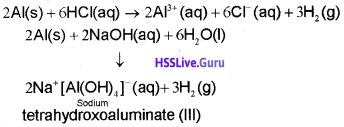
Boron does not react with acids and alkalies even at moderate temperature, but aluminium has amphoteric character.
Plus One Chemistry Notes Chapter 11 The p Block Elements 3

iii) Reactivity towards halogens
2E(s) + 3X2(g) → 2EX3(S) (X = F, Cl, Br, I)

Important Trends And Anomalous Properties Of Boron
The tri-chlorides, bromides and iodides of all these elements being covalent in nature are hydrolysed in water. Species like tetrahedral [M(OH)4] and octahedral [M(H2O)6]3+, except in boron, exist in aqueous medium. The monomeric trihalides, being electron deficient, are strong Lewis acids. Boron trifluoride easily reacts with Lewis bases such as NH3 to complete octet around boron.
F3B+: NH3 → F3B ← NH3

Plus One Chemistry Notes Chapter 11 The p Block Elements

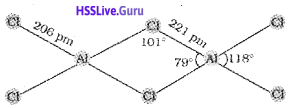
It is due to the absence of d orbitals that the maximum covalence of B is 4. Since the d orbitals are available with Al and other elements, the maximum covalence can be expected beyond 4. Most of the other metal halides (e.g., AlCl3 are dimerised through halogen bridging (e.g., Al2Cl6). The metal species ‘ completes its octet by accepting electrons from halogen in these halogen bridged molecules.

Some Important Compounds Of Boron

Borax
It is the most important compound of boron. Formula of the compound is Na2B4O7.10H2O . In fact it contains the tetranuclear units [B4O5(OH)4]2- and correct formula; therefore, is Na2[B4O5(OH)4].8H2O.
Plus One Chemistry Notes Chapter 11 The p Block Elements 4

On heating, borax first loses water molecules. On further heating it turns into a transparent liquid, which solidifies into glass like material known as borax bead.
Plus One Chemistry Notes Chapter 11 The p Block Elements 5

Orthoboric acid
Orthoboric acid, H3B03 is a white crystalline solid, with soapy touch. It is sparingly soluble in water but highly soluble in hot water.
Na2B4O7 + 2HCl + 5H2O → 2NaCl + 4B(OH)3

Boric acid is a weak monobasic acid. It is not a protonic acid but acts as a Lewis acid by accepting electrons from a hydroxyl ion:
B(OH)3 +2HOH → [B(OH)4] + H3O+

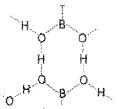
Structure of boric acid is given below.
Plus One Chemistry Notes Chapter 11 The p Block Elements 6

Diborane (B2H6)
The simplest boron hydride is diborane (B2H6). Diborane can be prepared by treating BF3 with lithium aluminium hydride in ether. A convenient laboratory method is oxidation of sodium borohydride with iodine.
2NaBH4 + l2 → B2H6 + 2Nal +H2

On a commercial scale, diborane is produced by the action of BF3 on sodium hydride.
Plus One Chemistry Notes Chapter 11 The p Block Elements 7

Diborane is a colourless toxic gas. It catches fire on exposure to air releasing large amount of energy.
B2H6+ 6H2O → 2B(OH)3 + 6H2

Plus One Chemistry Notes Chapter 11 The p Block Elements

Reaction of diborane with NH3 gives an addition product B2H6.2NH3 which on heating gives borazine (B3N3H3), commonly known as inorganic benzene due to its structural similarity with benzene. Boron forms a series of hydridoborates, the most important being (BH4).NaBH4 (sodium borohydride) is a good reducing agent.

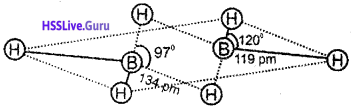
Each boron atom in B2H6 is sp³ hybridised. The structure contains two types of H- atoms the four-terminal hydrogen atoms and two bridged hydrogen atoms. The four-terminal H atoms and two B atoms lie in the same plane. Above and below this plane lie the bridged H atoms. B-H bonds formed by the terminal hydrogen atoms are normal covalent bonds while the bridge B-H bonds are three centre two-electron bonds. Each B atom forms four bonds even though boron has only three valence electrons. Hence B2H6 is an electron deficient compound.

Group 14 Elements: The Carbon Family
Carbon, silicon, germanium, tin, and lead form the carbon family.
Occurrence:
Carbon is widely distributed in nature in the free and combined states. Graphite, diamond, coal, etc are elemental forms of carbon while in the combined state it occurs as metal carbonates, hydrocarbons and CO2 in air. Silicon is present in nature as silica and silicates. Ge is found only in traces. Tin occurs as cassiterite (SnO2) and lead as galena (PbS)

Electronic Configuration
The valence shell electronic configuration of these elements is ns²np². The inner core of the electronic configuration of elements in this group also differs.

Covalent Radius
There is a considerable increase in covalent radius from C to Si, thereafter from Si to Pb a small increase in radius is observed. This is due to the presence of completely filled d and f orbitals in heavier members.

Ionization Enthalpy
The first ionization enthalpy of group 14 members is higher than the corresponding members of group 13. The influence of inner core electrons is visible here also. In general, the ionisation enthalpy decreases down the group.

Electronegativity
Due to small size, the elements of this group are slightly more electronegative than group 13 elements. The electronegativity values for elements from Si to Pb are almost the same.

Plus One Chemistry Notes Chapter 11 The p Block Elements

Physical Properties
All group 14 members are solids. Carbon and silicon are non-metals, germanium is a metalloid, whereas tin and lead are soft metal.

Chemical Properties Oxidation states and trends in chemical reactivity
The group 14 elements have four electrons in outermost shell. The common oxidation states exhibited by these elements are +4 and +2.
Carbon also exhibits negative oxidation states. Since the sum of the first four ionization enthalpies is very high, compounds in +4 oxidation state are generally covalent in nature. In heavier members the tendency to show +2 oxidation state increases in the sequence Ge<Sn (i) Reactivity towards oxygen
All members when heated in oxygen form oxides. There are mainly two types of oxides, monoxide, and dioxide of formula MO and MOs respectively.

(ii) Reactivity towards water
Plus One Chemistry Notes Chapter 11 The p Block Elements 8

(iii) Reactivity towards halogen
These elements can form halides of formula MX2, and MX4 (where X = F, Cl, Br, I). Except carbon, all other members react directly with halogen under suitable condition to make halides.

Hydrolysis can be understood by taking the example of SiCl4. It undergoes hydrolysis by initially accepting lone pair of electrons from water molecule in d orbitals of Si, finally leading to the formation of Si(OH)4 as shown below:
Plus One Chemistry Notes Chapter 11 The p Block Elements 9

Important Trends And Anomalous Behaviour Of Carbon
Carbon differs from rest of the members of its group. It is due to its smaller size, higher electronegativity, higher ionisation enthalpy and unavailability of d orbitals. In carbon, only s and p orbitals are available for bonding and, therefore, it can accommodate only four pairs of electrons around it. This would limit the maximum covalence to four whereas other members can expand their covalence due to the presence of d orbitals.
Carbon has the ability to form pπ – pπ multiple bonds with itself and with other atoms of small size and high electronegativity.

Few examples are: C=C, C° C, C=0, C=S, and C° N. Carbon atoms have the tendency to link with one another through covalent bonds to form chains and rings. This property is called catenation.

Plus One Chemistry Notes Chapter 11 The p Block Elements

Allotropes Of Carbon

Diamond
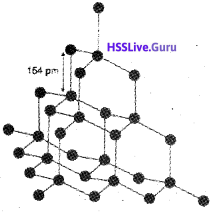
It has a crystalline lattice. In diamond, each carbon atom undergoes sp³ hybridisation and linked to four other carbon atoms by using hybridised orbitals in tetrahedral fashion. The C-C bond length is 154 pm. In this structure, directional covalent bonds are present throughout the lattice. It is very difficult to break extended covalent bonding and, therefore, diamond is a hardest substance on the earth. It is used as an abrasive for sharpening hard tools.
Plus One Chemistry Notes Chapter 11 The p Block Elements 10

Graphite
Graphite has layered structure. Layers are held by van der Waals forces and distance between two layers is 340 pm. Each layer is composed of planar hexagonal rings of carbon atoms. C—C bond length within the layer is 141.5 pm. Each carbon atom in hexagonal ring undergoes sp² hybridisation and makes three sigma bonds with three neighbouring carbon atoms. Fourth electron forms a π bond. The electrons are delocalised over the whole sheet. Electrons are mobile and, therefore, graphite conducts electricity along the sheet. Graphite cleaves easily between the layers and, therefore, it is very soft and slippery. For this reason graphite is used as a dry lubricant in machines running at high temperature, where oil cannot be used as a lubricant.
Plus One Chemistry Notes Chapter 11 The p Block Elements 11

Fullerenes
Fullerenes are prepared by heating graphite in an electric arc in the presence of helium or argon. The sooty material formed by condensation of the vapours consists of C60 with smaller amounts of C70 and other fullerenes. C60 is named as Buckminster fullerence. The general name fullerence refers to the family of spheroidal carbon-cage molecules. The shape of C60 resembles that of a soccer ball. It contains twelve five-membered rings and twenty 6-membered rings of carbon. The 6-membered rings are fused both to other five and six membered rings. However, the 5-membered rings are fused only to six-membered rings. Both carbon-carbon single (1.435 Å) and double (1.383 Å) bonds are present in this structure. Carbon black, coke and charcoal are impure amorphous forms of graphite or fullerenes. Carbon black is formed by burning hydrocarbon in limited supply of air. Charcoal and coke are obtained by heating wood and coal respectively in the absence of air.

Uses of Carbon
Being good conductor, graphite is used for electrodes in batteries and industrial electrolysis. Crucibles made from graphite are inert to dilute acids and alkalies. Being highly porous, activated charcoal is used in adsorbing poisonous gases. Diamond is a precious stone and used in jewellery.

Some Important Compounds Of Carbon And Silicon
Oxides of Carbon
Two important oxides of carbon are carbon monoxide, CO and carbon dioxide, CO2.

Carbon Monoxide
Direct oxidation of C in limited supply of oxygen or air yields carbon monoxide.
Plus One Chemistry Notes Chapter 11 The p Block Elements 12
On commercial scale it is prepared by the passage of steam over hot coke. The mixture of CO and H2 thus produced is known as water gas or synthesis gas.
Plus One Chemistry Notes Chapter 11 The p Block Elements 13
When air is used instead of steam, a mixture of CO and N2 is produced, which is called producer gas.
Plus One Chemistry Notes Chapter 11 The p Block Elements 14
Water gas and producer gas are very important industrial fuels. Carbon monoxide in water gas or producer gas can undergo further combustion forming carbon dioxide with the liberation of heat. CO arises has the ability to form a complex with haemoglobin, which is about 300 times more stable than the oxygen-haemoglobin complex. This prevents haemoglobin in the red blood corpuscles from carrying oxygen round the body and ultimately resulting in death.

Plus One Chemistry Notes Chapter 11 The p Block Elements

Carbon Dioxide
It is prepared by complete combustion of carbon and carbon-containing fuels in excess of air.
Plus One Chemistry Notes Chapter 11 The p Block Elements 15
On commercial scale it is obtained by heating limestone. Carbon dioxide, which is normally present to the extent of ~0.03 % by volume in the atmosphere, is removed from it by the process known as photosynthesis. It is the process by which green plants convert atmospheric CO2 into carbohydrates such as glucose. The overall chemical change can be expressed as:

The increase in combustion of fossil fuels and decomposition of limestone for cement manufacture in recent years seem to increase the CO2 content of the atmosphere. This may lead to increase in green house effect and thus, raise the temperature of the atmosphere which might have serious consequences. Carbon dioxide can be obtained as a solid in the form of dry ice by allowing the liquified CO2 to expand rapidly. Dry ice is used as a refrigerant for ice-cream and frozen food.
Plus One Chemistry Notes Chapter 11 The p Block Elements 16
Resonance structures of carbon dioxide

Silicon Dioxide, SiO2
Quartz, cristobatite and tridymite are some of the crystalline forms of silica, and they are interconvertible at suitable temperature. In Silicon dioxide, each silicon atom is covalently bonded in a tetrahedral manner to four oxygen atoms. Each oxygen atom in turn covalently bonded to another silicon atoms.
Plus One Chemistry Notes Chapter 11 The p Block Elements 17

Silicones
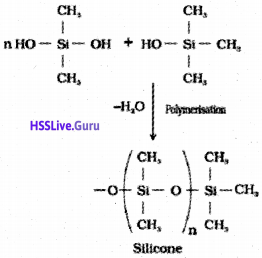
They are a group of organosilicon polymers, which have (R2SiO) as a repeating unit. The starting materials for the manufacture of silicones are alkyl or aryl substituted silicon chlorides, RnSiCl(4-n), where R is alkyl or aryl group.
Plus One Chemistry Notes Chapter 11 The p Block Elements 18

Silicates
The basic structural unit of silicates if SiO44- tertrahedra. Feldspar, zerolites, mica, asbestose, etc. are examples of silicates. In silicates, either the SiO44- will be present as discrete units or several such units are joined togetherth rough sharing of corner of the tetrahedra using one to four oxygen atoms per silicate unit. Like this, different silicates assume different forms such as chain, ring, sheet or three-dimensional structures. Glass and cement are examples of man-made silicates.
Plus One Chemistry Notes Chapter 11 The p Block Elements 19

Zeolites
Zeolites are alumino silicates. If a few Si atoms of the three-dimensional network structure of SiO2 are replaced by Al atoms, the resulting structure is called alumino silicate structure. This structure evidently has negative charge and Na+.K+ pr Ca2+ ions balance the negative charge. Zeolites are used as catalysts in petrochemical industry for cracking of hydrocarbons. ZSM-5 is a type of zeolite used in the conversion of alcohol to gasoline. Zeolites are also used in softening hard water.

Plus One Chemistry Notes Chapter 10 The s Block Elements

Students can Download Chapter 10 The s Block Elements Notes, Plus One Chemistry Notes helps you to revise the complete Kerala State Syllabus and score more marks in your examinations.

Kerala Plus One Chemistry Notes Chapter 10 The s Block Elements

Introduction
Group 1 of the periodic table consists of the elements: Lithium, Sodium, Potassium, Rubidium, Caesium and Francium. They are collectively known as alkali metals.

Group 2 consists of Beryllium, Mgnesium, Calcium, Strontium, Barium and Radium. These elements except of beryllium are known as the alkaline earth metals. The general electronic configuration of s-block elements is [noble gasjns1 for alkali metals and [noble gas] ns² for alkaline earth metals. The first elements of Group 1 and Group 2 respectively exhibit diagonal similarity, which is commonly referred to as diagonal relationship in the periodic table. The diagonal relationship is due to the similarity in ionic sizes and /or charge/radius ratio of the elements.

Group 1 Elements: Alkali Metals

1) Electronic Configuration:
All the alkali metals have one valence electron, ns¹ outside the noble gas core. The loosely held s-electron readily lose electron to give monovalent M+ ions.

2) Atomic And Ionic Radii:
The atomic and ionic radii of alkali metals increase on moving down the group. Hence, ionization enthalpies of the alkali metals are considerably low and decrease down the group.

3) Hydration Enthalpy:
The hydration enthalpies of alkali metal ions decrease with increase in ionic sizes. Li+ > Na+ > K+ > Rb+ > Cs+ Li+ has maximum degree of hydration and for this reason lithium salts are mostly hydrated, e.g., LiCl- 2H2O

Plus One Chemistry Notes Chapter 10 The s Block Elements

Physical Properties
When heat is supplied to alkali metal or its salt the electrons are excited to higher energy levels. As these electrons return to their original level; radiations are emitted which fall in the visible region of electromagnetic spectrum. Thus they appear coloured. Li imparts crimson red colour, K gives violet colour and Na gives golden yellow colour to the flame.

Chemical Properties
The reactivity of these metals increases with their size. They burn vigorously in oxygen forming oxides. Lithium forms monoxide, sodium forms peroxide, the other metals form superoxides. The superoxide O2 ion is stable only in the presence of large cations such as K, Rb, Cs.
4Li + O2 → 2LizO(oxide)
2Na + O2 → Na2O2 (peroxide)
M + O2 → MO2(superoxide)
(M=K, Rb, Cs)
Because of their high reactivity towards air and water, they are normally kept in kerosene oil.lt may be noted that although lithium has most negative E° value.
Plus One Chemistry Notes Chapter 10 The s Block Elements 1

They also react with proton donors such as alcohol, gaseous ammonia and alkynes.AII the alkali metal hydrides are ionic solids with high melting points.
2M + H2 → 2M+H.

Plus One Chemistry Notes Chapter 10 The s Block Elements

The alkali metals readily react vigorously with halogens to form ionic halides, M+X. However, lithium halides are somewhat covalent. It is because of the high polarisation capability of lithium-ion. The alkali metals are strong reducing agents, lithium being the most and sodium the least powerful. The alkali metals dissolve in liquid ammonia giving deep blue solutions. The solutions are paramagnetic and on standing slowly liberate hydrogen.

General Characteristics Of The Compounds Of The Alkali Metals

Oxides And Hydroxides
Reactivity of alkali metals with oxygen increases down the group. Lithium, when heated in air, forms the normal oxide (Li2O) while sodium forms the per-oxide (Na2O2). Potassium, Rubidium and caesium form superoxides (MO2).
4Li + O2 → 2Li2O; 2Na+ O2 → Na2O2; K + O2 → KO2

The normal oxides dissolve in water to form hydroxides (MOH) which are strong bases. However, LiOH is only slightly soluble in water and it decomposes on heating. The peroxides and superoxides also dis-solve in water to form basic hydroxides. The basic character of alkali metal hydroxides increases down the group.

Halides
Alkali metals react vigorously with halogens to form metal halides of the general formula MX. 2M+X2 → 2MX X=F, Cl, Br or l and M= alkali metal Reactivity of alkali metal towards halogen increases from Li to Cs. Halides of alkali metals are ionic compounds readily soluble in water. But LiF is almost insoluble due to high lattice energy.

Anomalous Properties Of Lithium
The anomalous behaviour of lithium is due to the :

  1. exceptionally small size of its atom and ion, and
  2. high polarising power (i.e., charge/ radius ratio).

As a result, there is increased covalent character of lithium compounds which is responsible for their solubility in organic solvents.

Points Of Similarities Between Lithium And Magnesium
The similarity between lithium and magnesium is particularly striking and arises because of their similar sizes: atomic radii, Li = 152 pm, Mg= 160 pm; ionic radii: Li+ = 76 pm, Mg2+ = 72 pm. The main points of similarity are:

  1. Both lithium and magnesium are hander and lighter than other elements in the respective groups.
  2. Lithium and magnesium react slowly with water. Their oxides and hydroxides are much less soluble and their hydroxides decompose on heating. Both form a nitride, Li3N and Mg3N2, by direct combination with nitrogen.
  3. The oxides, Li2O and MgO do not combine with excess oxygen to give any superoxide.
  4. The carbonates of lithium and magnesium decompose easily on heating to form the oxides and CO2.

Some Important Compounds Of Sodium Sodium Carbonate (Washing Soda), Na2CO3.10H2O
Sodium carbonate is generally prepared by Solvay Process.
The equations for the complete process may be written as:
2NH3 + H2O + CO2 → (NH4)2CO3
(NH4)2CO3 + H2O + CO2 → 2NH4HCO3
NH4HCO3 +NaCl → NH4Cl + NaHCO3
2NaHCO3 → Na2CO3 +CO2 +H2O

Plus One Chemistry Notes Chapter 10 The s Block Elements

In this process, NH3 is recovered when the solution containing NH4Cl is treated with Ca(OH)2. On heating washing soda becomes monohydrate and then completely anhydrous i.e., soda ash.

Sodium Chloride, NaCl
The most abundant source of sodium chloride is seawater. Common salt is generally obtained by evaporation of seawater. Crude sodium chloride, generally obtained by crystallisation of brine solution, contains sodium sulphate, calcium sulphate, calcium chloride and magnesium chloride as impurities. Calcium chloride, CaCl2, and magnesium chloride, MgCl2 are impurities because they are deliquescent (absorb moisture easily from the atmosphere). To obtain pure sodium chloride, the crude salt is dissolved in minimum amount of water and filtered to remove insoluble impurities. The solution is then saturated with hydrogen chloride gas. Crystals of pure sodium chloride separate out. Calcium and magnesium chloride, being more soluble than sodium chloride, remain in solution.

Uses:

  • It is used as a common salt or table salt for domestic purpose.
  • It is used for the preparation of Na2O2, Na0H and Na2CO3.

Sodium Hydroxide (Caustic Soda), NaOH
Sodium hydroxide is generally prepared commercially by the electrolysis of sodium chloride in Castner-Kellner cell. A brine solution is electrolysed using a mercury cathode and a carbon anode.
Plus One Chemistry Notes Chapter 10 The s Block Elements 2
The amalgam is treated with water to give sodium hydroxide and hydrogen gas.
2 Na – amalgam + 2H2O → 2NaOH + 2Hg +H2
The sodium hydroxide solution at the surface reacts with the C02 in the atmosphere to form Na2CO3.

Plus One Chemistry Notes Chapter 10 The s Block Elements

Uses:
It is used in (i)the manufacture of soap, paper, artificial silk and a number of chemicals,(ii) in petroleum refining, (iii) in the purification of bauxite, (iv) in the textile industries for mercerising cotton fabrics and (v) for the preparation of pure fats and oils.

Biological Importance Of Sodium And Potassium
Sodium ions participate in the transmission of nerve signals. The concentration gradient of Na+ and K+ demonstrates that-a discriminatory mechanism called sodium-potassium pump, operates across the cell membranes.

Group 2 Elements: Alkaline Earth Metals
The group 2 elements (except beryllium) are known as alkaline earth metals. The first element beryllium differs from the rest of the members and shows diagonal relationship to aluminium.
1) Electronic Configuration:
These elements have two electrons in the s-orbital of the valence shell. Their general electronic configuration may be represented as [noble gas] ns².

2) Atomic And Ionic Radii:
Within the group, the atomic and ionic radii increase with increase in atomic number due to the increased nuclear charge in these elements. They have low ionisation enthalpy and it decreases down the group with increase in size.

3) Hydration Enthalpy:
Hydration enthalpies of alkaline earth metal ions decrease with increase in ionic size down the group. Be2+ > Mg2+ > Ca2+ > Sr2+ > Ba2+ The hydration enthalpies of alkaline earth metal ions are larger than those of alkali metal ions.

Physical Properties
Calcium, Strontium and Barium impart characteristic brick red, crimson and apple green colours respectively to the flame. Inflame the electrons are excited to higher energy levels and when they drop back to the ground state, energy is emitted in the form of visible light. The electrons in Be and Mg are too strongly bound to get excited by flame. Hence, these elements do not impart any colour to the flame.

Plus One Chemistry Notes Chapter 10 The s Block Elements

Chemical Properties
The alkaline earth metals are less reactive than the alkali metals. The reactivity of these elements increases on going down the group.
Reactivity towards air and water Beryllium and Magnesium are kinetically inert to oxygen and water because of the formation of an oxide film on their surface. However, powdered beryllium burns brilliantly on ignition in air to give BeO and Be3N2.
Reactivity towards halogen
M + X2 → MX2 (X = F, Cl, Br, I)

Reactivity towards hydrogen
All the elements except beryllium form their hydrides, MH2.BeH2, however, can be prepared by the reaction of BeCl2 with LiAlH4.
2BeCl2 +LiAlH4 → 2BeH2 +LiCl + AlCl3

Plus One Chemistry Notes Chapter 10 The s Block Elements

Reactivity towards acids:
The alkaline earth metals readily react with acids liberating dihydrogen.

General Characteristics Of Compounds Of The Alkaline Earth Metals
i) Oxides and Hydroxides: Alkaline earth metals burn in air or oxygen to form their oxides. (Oxides are also prepared by the thermal decomposition of their carbonates). Be, Mg and Ca form monoxides (MO). The tendency to form peroxide increases as the size of the metal ion increases. Strontium and barium form peroxides (MO2)
2M + O2 → MO (M = Be, Mg or Ca)
M+O2 → MO2 (M = Sr or Ba)

BeO is amphoteric in character, while the oxides of the rest of the elements in group 2 are basic. The oxides of Ca, Sr and Ba react with water to form their corresponding hydroxides.

The hydroxides of alkaline earth metals are bases except Li(OH)2 which is amphoteric. The basic strength increases from Mg(OH)2 to Ba(OH)2. The solubility and thermal stability of hydroxides increase downward in the group. Be(OH)2 and Mg(OH)2 are almost insoluble. Ca(OH)2 is sparingly soluble, while Sr(OH)2 and Ba(OH)2 are increasingly more soluble.

ii) Halides: Group 2 metals directly combine with halogen to form divalent halides of the formula

The s-Block Elements
MX2 where X is the halogen. The metal halides are also formed by the action of halogen acids on metals, their oxides, carbonates and hydroxides. BeCl2 is, however, prepared by passing Cl2 over a hot mixture of BeO and coke.
In contrast to the halides of other alkaline earth metals, beryllium halides are covalent. In the solid-state BeCl2 has a polymeric chain structure involving Be-CI-Be bridges. The anhydrous halides are hygroscopic and form hydrates such as MgCl2.6H2O, CaCl2.6H2O etc. Due to this reason, anhydrous calcium chloride is widely used as a dehydrating agent. Fluorides are relatively less soluble due to high lattice energies,

Plus One Chemistry Notes Chapter 10 The s Block Elements

iii) Salts of Oxoacids:
The alkaline earth metals also form salts of oxoacids. Some of these are : Carbonates, Sulphates and Nitrates.

Anomalous Behaviour Of Beryllium
Beryllium differs from the rest element in many of its properties. These are

  1. Beryllium has high ionisation enthalpy.
  2. Small size of Be atom
  3. Be does not exhibit coordination number more than four.
  4. The oxides and hydroxides of Be are amphoteric in nature.

Diagonal Relationship Between Beryllium And Aluminium
The ionic radius of Be2+ is estimated to be same as that of the Al3+ ion. Hence Be resembles Al in some ways. Some of the similarities are:

  1. Like AI, Be is not readily attacked by acids because of the presence of an oxide film on the surface of the metal.
  2. Beryllium hydroxide dissolves in excess of alkali to give a beryllate ion just as aluminium hydroxide gives aluminate ion.
  3. The chlorides of both Be and Al have Ch bridged chloride structure in vapour phase. Both the chlorides are soluble in organic solvents and are strong Lewis acids. They are used as Friedel Craft catalysts.
  4. Be and Al ions have strong tendency to form complexes, BeF42-, AlF63-.

Some Important Compounds Of Calcium
Important compounds of calcium and their preparations are given below.

Calcium Oxide Or Quick Lime, CaO
It is prepared by the following reaction.
CaCO3 \(\rightleftharpoons \) Ca0 + CO2
CO2 is removed as soon as it is produced to enable the reaction to proceed to completion.
CaO + H2O → Ca(OH)2
This process is called slaking of lime. CaO is a basis oxide.

Uses:

  • Primary material for manufacturing cement
  • It is used in the manufacturing of caustic soda
  • Used to purify sugar

Calcium Hydroxide (Slaked Lime), Ca(OH)2
It is prepared by adding water to CaO. The aqueous solution of Ca(OH)2 is known as lime water and the suspension of slaked lime is known as milk of lime. When CO2 is passed through lime water it turns milky due to the formation of CaCO3
Ca(OH)2 + CO2 → CaCO3 +H2O

Uses:

  • It is used in whitewash due to its disinfectant nature.
  • Used in the preparation of bleaching powder.
  • Used to purify sugar.

Calcium Carbonate, CaCO2
It occurs in limestone, chalk, marble etc.
It can be prepared by the following reactions.
Ca(OH)2 + CO2 → CaCO3 + H2O
CaCl2 + Na2CO3 → CaCO3 + 2NaCl
CaCO3 reacts with dilute acids to liberate carbon dioxide.

Uses:

  • It is used as a flux in the extraction of metals.
  • It is used as the building material of quick lime.

Calcium Sulphate (Plaster Of Paris), CaSO4.½H2O
It is obtained by heating gypsum (CaSO2.2H2O)
Plus One Chemistry Notes Chapter 10 The s Block Elements 3
Above 393K anhydrous calcium sulphate is formed. This is known as ‘dead burnt plaster’

Used:

  • It is used in building industry as well as plasters.
  • Used to make casts of statues.

Cement
Cement is prepared by combining CaO with other materials such as clay with silica, SiO2 along with Oxides of Al, iron and magnesium. The average composition of portland cement is:
CaO, 50-60%;
SiO2, 20-25%;
Al2O3, 5-10%;
MgO, 2-3%;
Fe2O3, 1-2% and
SO3, 1-2%.
When limestone and clay are heated we get cement clinker. This clinker is mixed with gypsum to form cement.

Setting of Cement:
When mixed with water the setting of cement takes place to give a hard mass. It is due to the rearrangement and hydration of molecules of constituents. Gypsum is added to slow down the setting process so it gets sufficiently hardened.

Uses:

  • Used in construction of building.

Biological Importance Of Magnesium And Calcium
Human body contains about 25g of Mg and 1200g of Ca. Mg is a cofactor in enzymes which use ATP in phosphate transfer process in our body. Photosynthesis in plants takes place in presence of chlorophyll which contains Mg. About 99% of body calcium is found in teeth and bones. Calcium concentration in plasma is regulated at 100mg/litre in presence of hormones such as calcitonin and parathyroid hormone.

Plus One Chemistry Chapter Wise Questions and Answers Chapter 13 Hydrocarbons

Students can Download Chapter 13 Hydrocarbons Questions and Answers, Plus One Chemistry Chapter Wise Questions and Answers helps you to revise the complete Kerala State Syllabus and score more marks in your examinations.

Kerala Plus One Chemistry Chapter Wise Questions and Answers Chapter 13 Hydrocarbons

Plus One Chemistry Hydrocarbons One Mark Questions and Answers

Question 1.
Which of the following cannot be prepared by Wurtz reaction?
a) CH4
b) C2H6
c) C3H8
d) C4H8
Answer:
a) CH4

Question 2.
The cyclic polymerization of propane produces __________ .
Answer:
1, 3, 5-trimethylbenzene

Question 3.
The reaction
Plus One Chemistry Chapter Wise Questions and Answers Chapter 13 Hydrocarbons 1
a) Hydration
b) Dehydration
c) Dehydrogenation
d) Dehalogenation
Answer:
b) Dehydration

Question 4.
Say TRUE or FALSE.
Calcium carbide on hydrolysis gives ethylene.
Answer:
False

Plus One Chemistry Chapter Wise Questions and Answers Chapter 13 Hydrocarbons

Question 5.
3-Hexyne reacts with Na/liquid NH3 to produce
a) cis-3-Hexene
b) trans-3-Hexene
c) 3-Hexylamine
d) mm2-Hexylamine
Answer:
b) trans-3-Hexene

Question 6.
Fill in the blanks after finding the correct relationship
CH3 – O – CH3 : Ether, CH3-CH2-OH: …………….
Answer:
Alcohol

Question 7.
Choose the correct answer from the brackets given below:
1) General formula of alkene (CnH2n, CnH4n-2)
2) The 2 different forms of elemental carbon (Bitumen, Diamond, Charcoal, Coke, Led, Graphite)
3) Find the odd man out. Give reason (C2H4, C3H6, C4H8, C2H6)
Answer:
1) CnH2n
2) Diamond, graphite
3) C2H6. It is an alkane. All others are alkenes.

Question 8.
The structural formula of a compound and the name given by a student to it is given below:
Plus One Chemistry Chapter Wise Questions and Answers Chapter 13 Hydrocarbons 2
Answer:
The name given by the student is wrong. The correct name of the compound is 3-Ethyl -2-methyl nonane.

Question 9.
Which is not the isomer of CH3-CH2-O-CH2-CH3? (1)
a) CH3-O-CH2-CH2-CH3
b) CH3-CH2-CH2-CH2-OH
c) CH3-CH2-CO-CH3
d) CH3-CH2(OH)-CH-CH3
Answer:
c) CH3CH2COCH3

Question 10.
Gammexane has the formula
Answer:
C6H6Cl6

Question 11.
Bayer’s reagent is __________ .
Answer:
dil. alkaline KMnO4

Question 12.
The electrophile attacking benzene during nitration is __________ .
Answer:
NO2+

Question 13.
The compound that is least readily nitrated is __________ .
a) phenol
b) Toluene
c) Ethylbenzene
d) Benzoic acid
e) Xylene
Answer:
d) Benzoic acid

Plus One Chemistry Chapter Wise Questions and Answers Chapter 13 Hydrocarbons

Question 14.
The hydrocarbon formed when Beryllium carbide is treated with water is __________ .
Answer:
Methane

Plus One Chemistry Hydrocarbons Two Mark Questions and Answers

Question 1.
The lUPAC names of 2 compounds with their structural formulae is given below. Make out the errors and correct them.
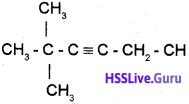
A. 2, 2-Dimethyl-3-hexyne
Plus One Chemistry Chapter Wise Questions and Answers Chapter 13 Hydrocarbons 3
B. 1-Butyne
CH3-CH2-CH=CH3
Answer:
A is wrong. The strucutral formula of 2,2-Dimethyl -3- hexyne is
Plus One Chemistry Chapter Wise Questions and Answers Chapter 13 Hydrocarbons 4

Question 2.
Is there an organic compound named 2-Ethylpentane? Why? If no, write the correct answer.
Answer:
No. When an ethyl group comes with the second carbon atom, the longest chain will have 6 carbon atoms. Hence its correct name will be 3-Methyl hexane.
Plus One Chemistry Chapter Wise Questions and Answers Chapter 13 Hydrocarbons 5

Question 3.
Write down 2 similarities and 2 difference of the hydrocarbons given below:
Plus One Chemistry Chapter Wise Questions and Answers Chapter 13 Hydrocarbons 6
Answer:

Similarities Dissimilarities
Both are unsaturated compounds Both have different functional group
Both hydrocarbons have same word root One hydrocarbon is alkene and the other is alkyne

Question 4.
An equation for combined Chemical reaction of acetylene is given below:
Plus One Chemistry Chapter Wise Questions and Answers Chapter 13 Hydrocarbons 7
Find the products X’ and ‘Y’?
Answer:
Plus One Chemistry Chapter Wise Questions and Answers Chapter 13 Hydrocarbons 8

Question 5.
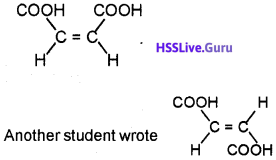
In a Chemistry class, teacher asked students to write the geometrical form of dicarboxylic acid with the formula C4H4O4. For this question, one student wrote
Plus One Chemistry Chapter Wise Questions and Answers Chapter 13 Hydrocarbons 9
Both of them argued fortheir answers. Hearing this argument teacher told that both of them are right and she also explained the reason for it. Can you write the answer given by the teacher?
Answer:
Two geometrical isomers are possible for dicarboxylic acid. They are cis and transform. In the cis form, similar groups are present on the same side of the double bond whereas in transform, identical groups are present on different side of the double bond.

Question 6.
Match the following:

Inductive effect CH3-CH = CH2
Electrometric effect C6H5-NO2
Hyper conjugation CH3-CH2 – Br
Resonance effect CH3-CH2(+)

Answer:

Inductive effect CH3 – CH2 (+)
Electrometric effect CH3 – CH2 – Br
Hyper conjugation CH3-CH = CH2
Resonance effect C6H5-NO2

Question 7.
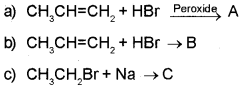
Addition of HBr to propene yields 2-bromopropane, what happens if benzoyl peroxide is added to the above reaction.
Answer:
When propene is allowed to react with HBr in the presence of peroxide, 2 bromo propane is obtained as the minor product and this is called peroxide effect. Anti markonikov’s rule.

Plus One Chemistry Hydrocarbons Three Mark Questions and Answers

Question 1.
Reactions
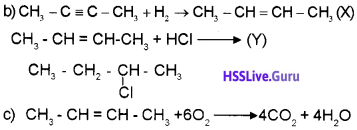
CH3-C ≡ C-CH3 + H2
Reaction: 2
X + HCl → Y
a) What type of reaction is reaction 1 ?
b) Find X and Y.
c) Which are the different products obtained from the reaction of X with oxygen?
Answer:
a) Addition reaction
Plus One Chemistry Chapter Wise Questions and Answers Chapter 13 Hydrocarbons 10

Question 2.
Plus One Chemistry Chapter Wise Questions and Answers Chapter 13 Hydrocarbons 11
Here are some functional groups. You are supposed to form 3 structures of hydrocarbons using 3 different functional groups and try to find their names.
Answer:
Plus One Chemistry Chapter Wise Questions and Answers Chapter 13 Hydrocarbons 12

Question 3
CH3 – CH2 – CH2 – CH2 – OH, CH3 – CH2 – CH – CH3
i)For which isomerism can the example above be considered?
ii) Define it.
Answer:
i)Position isomerism
ii) Position isomerism arises as a result of the difference in the position of double bond, triple bond or functional group.

Plus One Chemistry Chapter Wise Questions and Answers Chapter 13 Hydrocarbons

Question 4.
Explain the following with necessary chemicals equations.
i) Wurtz reaction
ii) Kolbe’s reaction
iii) Ozonolysisof alkenes
Answer:
i) Wurtz reaction – when alkyl halide is allowed to react with metallic sodium in presence of dry ether an alkane is obtained.
Plus One Chemistry Chapter Wise Questions and Answers Chapter 13 Hydrocarbons 13
ii) Kolbes reaction – When a solution of sodium acetate is electrolized, ethane is obtained.
Plus One Chemistry Chapter Wise Questions and Answers Chapter 13 Hydrocarbons 14
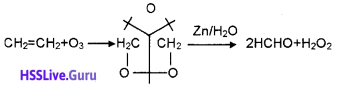
iii) Ozonolysis ofalkene: When an alkene is allowed to react with ozone, an ozonide is obtained. This on hydrolysis gives Aldehyde or ketone. The whole process is called ozonolysis.
Plus One Chemistry Chapter Wise Questions and Answers Chapter 13 Hydrocarbons 15

Question 5.
b) Complete the reaction:
Plus One Chemistry Chapter Wise Questions and Answers Chapter 13 Hydrocarbons 15
Answer:
Plus One Chemistry Chapter Wise Questions and Answers Chapter 13 Hydrocarbons 17

Question 6
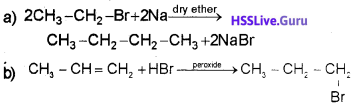
1. Explain the reaction between sodium metal and bromoethane in dry ether. (3)
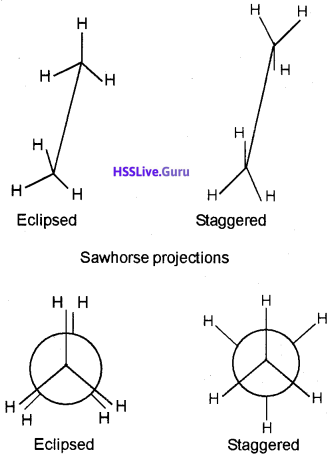
2. Draw Sawhorse and Newman’s projections of the different conformers of ethane.
Answer:
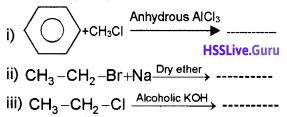
1. 2CH3CH2Br + 2Na → CH3-CH2-CH2-CH3 + 2NaBr
2.
Plus One Chemistry Chapter Wise Questions and Answers Chapter 13 Hydrocarbons 18

Question 7.
Analyse the given reactions, give the major products. Justify your answer.
a) HBris added to 1-Butene two products are obtained.
b) Action of excess chlorine with benzene in dark.
c) Addition of chlorine to benzene in uv light.
Answer:
Plus One Chemistry Chapter Wise Questions and Answers Chapter 13 Hydrocarbons 19
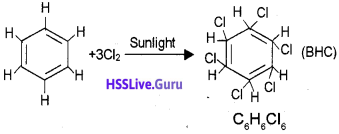
c) When Benzene is allowed to react with chlorine in presence of sunlight. Benzene hexa chloride (BHC) is obtained.
Plus One Chemistry Chapter Wise Questions and Answers Chapter 13 Hydrocarbons 20

Question 8.
Predict the product in the following reactions and identify the rules:-
Plus One Chemistry Chapter Wise Questions and Answers Chapter 13 Hydrocarbons 21
Answer:
a) When propene is allowed to react with HBr in the presence of peroxide, 2-Bromo propane is obtained as the minor product. (Peroxide effect, Kharasch effect or Anti Markownikoffs rule of addition).
Plus One Chemistry Chapter Wise Questions and Answers Chapter 13 Hydrocarbons 22

Question 9.
Write any two necessary condition for a compound to be aromatic. Convert Acetylene to benzene.
Answer:
Cyclic, Planar and should contain (4n+2)π electrons.
Plus One Chemistry Chapter Wise Questions and Answers Chapter 13 Hydrocarbons 23

Plus One Chemistry Hydrocarbons Four Mark Questions and Answers

Question 1.
Match the following:
Plus One Chemistry Chapter Wise Questions and Answers Chapter 13 Hydrocarbons 24
Answer:
Plus One Chemistry Chapter Wise Questions and Answers Chapter 13 Hydrocarbons 25

Question 2.
Fill in the blanks:
Plus One Chemistry Chapter Wise Questions and Answers Chapter 13 Hydrocarbons 26
Answer:
Plus One Chemistry Chapter Wise Questions and Answers Chapter 13 Hydrocarbons 27

Question 3.
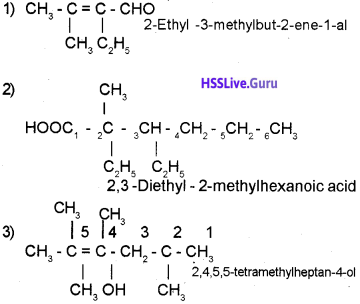
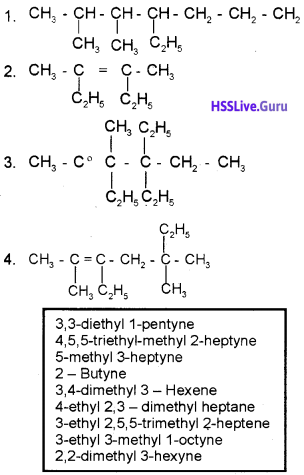
Given below are the structures of some hydrocarbons. Pick out the correct IUPAC names for them from the box.
Plus One Chemistry Chapter Wise Questions and Answers Chapter 13 Hydrocarbons 28
Answer:
1) 4 – Ethyl -2, 3-dimethyl heptane
2) 3, 4-Dimethyl hex – 3-ene
3) 4, 5, 5- triethyl 3 methyl 2 heptyne
4) 3ethyl-2, 5, 5, trimethylheptane

Plus One Chemistry Chapter Wise Questions and Answers Chapter 13 Hydrocarbons

Question 4.
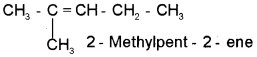
a) I am an unsaturated hydrocarbon.
b) My wordroot is pent.
c) My suffix is ene. The double bond lies between 2nd and 3rd carbon atoms.
d) l have a branch of methyl group on my second carbon atom. Who am I?
Answer:
Plus One Chemistry Chapter Wise Questions and Answers Chapter 13 Hydrocarbons 29

Question 5.
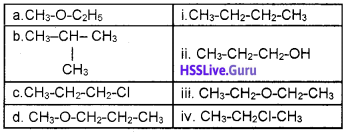
From the given table find out the isomer pairs and which type of isomerism they have?
Plus One Chemistry Chapter Wise Questions and Answers Chapter 13 Hydrocarbons 30
Answer:
Isomer pairs
a – ii – functional group isomerism
b – i – chain isomerism
c-iv-position isomerism
d – iii – metamerism Question 6

Qn 6.
Given below is the structural formula of a compound written by a student.
Plus One Chemistry Chapter Wise Questions and Answers Chapter 13 Hydrocarbons 31
i) Draw all the possible conformers of the compound?
ii) Arrange them in the order of stability?
Answer:
i)
Plus One Chemistry Chapter Wise Questions and Answers Chapter 13 Hydrocarbons 32
ii) Eclipsed

Question 7.
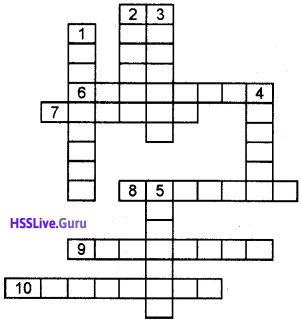
A cross word puzzle.
Down
1. Two or more compounds having the same
molecular formula but different physical or chemical properties are known as isomers and the phenomenon is known as
2. Hydrocarbons having the general formula CnH2n.
3. IUPAC name of C6H5CH3.
4. ………….. is added to the word root to show whether the hydrocarbon is saturated or unsaturated.
5. Hydrocarbons contain carbon-carbon triple bond.

Cross
6. From where does the inorganic compounds mainly originate from?
7. Name the alkene with the moelcular formula C10H20
8. Prefix of the functional group carboxylic acid.
9. Compounds with two rings.
10. Compounds having same molecular formula but different arrangements of carbon atoms on either side of the same functional group are called ……..
Plus One Chemistry Chapter Wise Questions and Answers Chapter 13 Hydrocarbons 33
Answer:
Plus One Chemistry Chapter Wise Questions and Answers Chapter 13 Hydrocarbons 34

Question 8.
1. Name the product obtained when HBr is added to propene. Why?
2. Acetylene is more acidic than ethylene or ethane. Why?
Answer:
1. When propene is treated with HBr, both 2-bromopnopane and 1-bromopropane are formed as products. The major product is2-Bromo-propane. This is due to the rule known as Markonikoffs rule of addition. It states that when a hydrogen halide is added to an unsymmetrical alkene, the halogen atom will goes to the doubly bonded carbon containing lesser number of hydrogen atoms.

2. In Acetylene, the hybridisation of carbon is sp and hence 50% s-character is present.

Plus One Chemistry Chapter Wise Questions and Answers Chapter 13 Hydrocarbons

Question 9.
a) How will you prepare butane in the laboratory using ethyl bromide (CH3CH2Br) as one of the raw materials. Write relevant equation.
Plus One Chemistry Chapter Wise Questions and Answers Chapter 13 Hydrocarbons 35
Identify the product ‘X’. Statethe law that explains the formation of X.
Answer:
Plus One Chemistry Chapter Wise Questions and Answers Chapter 13 Hydrocarbons 36
The law of Anti-Markownikoff’s rule of addition explains the formation of 1 -Bromopropane.

Question 10.
1. Addition of HBrto propene yields 2-Bromopropane, while in the presence of Benzoyl peroxide. The same reaction yields 1-Bromopropane. Give reason. Justify your answer.
2. Three compounds are given. Benzene, m- dinitrobenzene and toluene. Identify the compound which will undergo nitration most easily and why?
Answer:
1. When propene is allowed to react with HBr in the presence of “peroxide” 2-Bromopropane is obtained as the minor product. (Peroxide effect or Kharach effect or Anti-Markownikoff’s role of addition) Peroxide effect is applicable only in the case of HBr.
Plus One Chemistry Chapter Wise Questions and Answers Chapter 13 Hydrocarbons 37

2. Toluene. This is because the -CH3 group, being an activating group activates the benzene ring towards electrophilic substitution in toluene.

Question 11.
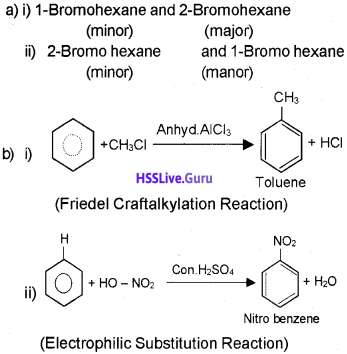
a) Write IUPAC names of the products obtained by addition reactions of HBr to hex-1-ene:
i) In the absence of peroxide.
ii) In the presence of peroxide.
b) Howwill you convert:
i) Benzene to toluene
ii) Benzene to nitrobenzene
Answer:
Plus One Chemistry Chapter Wise Questions and Answers Chapter 13 Hydrocarbons 38

Question 12.
The equations for two chemical reactions are given below:
i) CH ≡ CH + HCl → A → B
ii) OH4 + O2 → C + D
Which are the products A, B, C, and D?
Answer:
Plus One Chemistry Chapter Wise Questions and Answers Chapter 13 Hydrocarbons 39

Question 13.
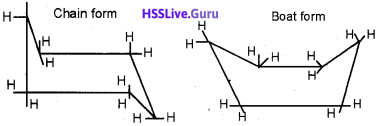
The 2 conformations shown below belongs to the compound cyclohexane. Infinite number of conformations are possible for cyclo hexane. But these 2 conformations given below has a peculiarity. Try to find it. Also, define the terms conformers and the phenomenon conformation?
Plus One Chemistry Chapter Wise Questions and Answers Chapter 13 Hydrocarbons 40
Answer:
Infinite number of conformations are possible for cyclohexane. Out of it chair conformation is the most stable one and the boat conformation is the least stable form.

The different arrangement of a compound which arises as a result of rotation about carbon single bond are called conformers and the phenomenon is called conformation.
Plus One Chemistry Hydrocarbons NCERT Questions and Answers

Question 1.
How do you account for formation of ethane during chlorination of methane? (3)
Answer:
Chlorination of methane takes place through a free radical chain mechanism as given below:
Plus One Chemistry Chapter Wise Questions and Answers Chapter 13 Hydrocarbons 41
From the above mechanism, it is evident that during chain propagation step, CH3free radicals areproduced. In the chain termination step, the two free CH3 radicals may combine together to form ethane (CH3-CH3) molecule.

Plus One Chemistry Chapter Wise Questions and Answers Chapter 13 Hydrocarbons

Question 2.
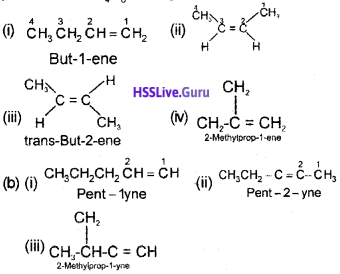
For the following compounds, write structural formulas and IUPAC names for all possible isomers having the number of double or triple bond as indicated: (4)
a) C4H8 (one double bond)
b) C3H8 (one triple bond)
Answer:
a) Isomers of C4H8 having one double bond are:
Plus One Chemistry Chapter Wise Questions and Answers Chapter 13 Hydrocarbons 47

Question 3.
What are the necessary conditions for any compound to show aromaticaly? (3)
Answer:
The conditions for a compound to show aromaticity are:
i) The molecule must be cyclic
ii) It must have a conjugated system of (4n+2) π- electrones
iii) The molecule must be planar so that delocalization of π-electrones can take place.

Question 4
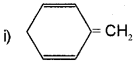
Explain why the following system are not aromatic?
Plus One Chemistry Chapter Wise Questions and Answers Chapter 13 Hydrocarbons 42
Answer:
Plus One Chemistry Chapter Wise Questions and Answers Chapter 13 Hydrocarbons 43
It dose not contain all the π- electrons in the ring. Therefore, it is not an aromatic compound.
Plus One Chemistry Chapter Wise Questions and Answers Chapter 13 Hydrocarbons 44
It contains only four electrons, therefore, the system is not aromatic because it dose not contain (4n + 2) π- electrones.
Plus One Chemistry Chapter Wise Questions and Answers Chapter 13 Hydrocarbons 45
Cyclootatetraene is a conjugated system having 8 π-electrons.
Therefore, the molecule is not contain (4n+2) π-electrons.

Question 5.
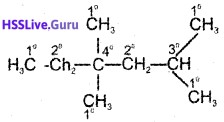
In the alkane, H2CCH2C(CH3)2 CH2CH(CH3)2, identify 1°, 2°, 3° carbon atoms and give the total number of atoms bonded to each one of these.
Answer:
Plus One Chemistry Chapter Wise Questions and Answers Chapter 13 Hydrocarbons 46
1° Carban atoms = 5
Hydrogen atoms attached to 1° carbon atoms = 15 2° Carbon atoms = 2
Hydrogen atoms attached to 2° carbon atoms = 4 3° Carbon atom = 1
Hydrogen atoms attached to 3° carbon atom = 1

Plus One Chemistry Chapter Wise Questions and Answers Chapter 13 Hydrocarbons

Question 6.
What effect does branching of an alkane chain has on its melting point?
Answer:
As the branching increases melting point increases.

Question 7.
Why does benzene undergo electrophilic subsitution easily and nucleophilic substitutions with difficulty? (2)
Answer:
Benzene molecule has two n cloud rings, one above and the other below the plane of atoms. Therefore, it is likely to be attached by electrophiles which subsequently brings about substitution.

The nucleophiles would be repelled by the π-electron rings and hence benzene reacts with nucleophiles with difficulty.

Plus One Chemistry Notes Chapter 5 States of Matter

Students can Download Chapter 5 States of Matter Notes, Plus One Chemistry Notes helps you to revise the complete Kerala State Syllabus and score more marks in your examinations.

Kerala Plus One Chemistry Notes Chapter 5 States of Matter

Introduction
The observable characteristics of chemical systems represent bulk properties of matter. Chemical properties do not depend the physical state of matter but chemical reactions do.

Inter Molecular Forces
Intermolecular forces are the forces of attraction and repulsion between interacting particles (atoms and molecules). This term does not include the electrostatic forces that exist between the two oppositely charged ions and the forces that hold atoms of a molecule together i.e., covalent bonds.

Dispersion Forces Or London Forces
A nonpolar atom or molecule has a positive centre surrounded by a symmetrical negative electron cloud. The displacement of electron cloud creates an instantaneous dipole temporarily. This instantaneous dipole distorts the electron distribution of other atoms or molecules which are close to it and induces dipole in them also. In this way, a large number of nonpolar molecules become temporarily polar and they mutually attracted by weak attractive forces. These forces are very weak and are known to operate in all types of molecules.

Dipole-Dipole Forces
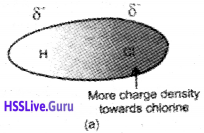
These type of interactions occur in polar molecules having permanent dipoles such as HCl, HBr, H2S, etc. Such molecules possess partial charges of opposite sign at their ends. The positive end of one molecule attracts the negative end of the other molecule and vice versa. A simple example is the of H-Cl in which chlorine being more electronegative acquires slight negative charge whereas hydrogen becomes slightly positively charged. The dipole-dipole inter-action then takes place in H-Cl as follows.
Plus One Chemistry Notes Chapter 5 States of Matter 1

Dipole-Induced Dipole Forces
These type of interactions are found in a mixture, containing polar and nonpolar molecules. When a nonpolar molecule is brought neara polar molecule, the positive end of the polar molecule attracts the electron cloud of the nonpolar molecule. Thus a polarity is induced in the nonpolar molecule. Then there will be attractive interacting between the polar molecule and the induced dipole of the nonpolar molecule.

Hydrogen Bond
Hydrogen bond can be defined as the attractive force which binds hydrogen atom of one molecule with the electronegative atom (F, O or N) of another molecule. When hydrogen is bonded to strongly electronegative element ‘X’, the electron pair shared between the two atoms moves far away from hydrogen atom. As a result, the hydrogen atom becomes, highly electropositive with respect to the other atom ‘X’. Since there is displacement of electrons towards X, the hydrogen acquires fractional positive charge (δ+) while ‘X’ attain fractional negative charge (δ). This results in the formation of a polar molecule having electrostatic force of attraction which can be represented as: Hδ+ – Xδ-

Plus One Chemistry Notes Chapter 5 States of Matter

The magnitude of H-bonding depends on the physical state of the compound. It is maximum in the solid state and minimum in the gaseous state. Thus, the hydrogen bonds have strong influence on the structure and properties of the compounds.

Types of Hydrogen Bonds
There are two types of hydrogen bonds

  1. Intermolecular hydrogen bond
  2. Intramolecular hydrogen bond

1. Intermolecular hydrogen bond:
It is formed between two different molecules of the same or different compounds. For example, H-bond in case of HF molecule, alcohol or water molecules, etc.

2. Intramolecular hydrogen bond:
It is formed when hydrogen atom is in between the two highly electronegative (F, O, N) atoms present within the same molecule. For example, in o-Nitrophenol the hydrogen is in between the two oxygen atoms as shown below:

Thermal Energy
Thermal energy is the energy of a body arising from motion of its atoms or molecules. It is directly proportional to the temperature of the substance. The movement of particles using thermal energy is called thermal motion.

Intermolecular Forces Vs Thermal Interactions
Intermolecular forces tend to keep the molecules together but thermal energy of the molecules tends to keep them apart. Three states of matter are the result of balance between intermolecular forces and the thermal energy of the molecules.

The Gaseous State

  • Gases are highly compressible.
  • Gases exert pressure equally in all directions.
  • Gases have much lower density than the solids and liquids.
  • The volume and the shape of gases are not fixed. These assume volume and shape of the container.
  • Gases mix evenly and completely in all proportions without any mechanical aid.

The Gas Laws

Boyle’s Law (Pressure – Volume Relationship)
On the basis of his experiments, Robert Boyle reached to the conclusion that at constant temperature, the pressure of a fixed amount of gas
varies inversely with its volume. This is known as Boyle’s law. It can be written as p ∝ \(\frac{1}{V}\)
where temperature(T) and number of moles(n)are constant.

Plus One Chemistry Notes Chapter 5 States of Matter

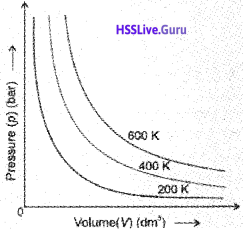
If a fixed amount of gas at constant temperature T occupying volume V1 at pressure p1 undergoes expansion, so that volume becomes V2 and pressure becomes p2, then according to Boyle’s law :
p1V1 = p2V2 = constant
\(\Rightarrow \frac{p_{1}}{p_{2}}=\frac{V_{2}}{V_{1}}\)
Plus One Chemistry Notes Chapter 5 States of Matter 2
Here T is constant and the graph is called isotherm

Charles’ Law (Temperature – Volume Relationship)
Charles’ law, which states that pressure remaining constant, the volume of a fixed mass of a gas is directly proportional to its absolute temperature. According to this law
Plus One Chemistry Notes Chapter 5 States of Matter 3

Here we use new temperature scale called the kelvin temperature scale or Absolute temperature scale, t °C in Celsius scaleis equal to (273.15+t) kelvin in kelvin scale.
Plus One Chemistry Notes Chapter 5 States of Matter 4

Each line of the volume vs temperature graph is called isobar. The lowest hypothetical or imaginary temperature at which gases are supposed to occupy zero volume is called Absolute zero.
We can see that the volume of the gas at – 273.15 °C will be zero.

Gay Lussac’s Law (Pressure-Temperature Relationship)
The relationship between pressure and temperature was given by Joseph Gay Lussac and is known as Gay Lussac’s law. It states that at constant volume, pressure of a fixed amount of a gas varies directly with the temperature. Mathematically,
P ∝ T
⇒ \(\frac{p}{T}\) = constant
This relationship can be derived from Boyle’s law and Charles’ Law.Each line of Pressure vs temperature (kelvin) graph at constant molar volume is called isochore.

Avogadro Law (Volume -Amount Relationship)
In 1811 Italian scientist Amedeo Avogadro tried to combine conclusions of Dalton’s atomic theory and Gay Lussac’s law of combining volumes which is now known as Avogadro law. It states that equal volumes of all gases under the same conditions of temperature and pressure contain equal number of molecules.

Mathematically we can write v α n where n is the number of moles.

Plus One Chemistry Notes Chapter 5 States of Matter

The number of molecules in one mole of a gas has been determined to be 6.022 *1023and is known as Avogadro constant. A gas that follows Boyle’s law, Charles’ law and Avogadro law strictly is called an ideal gas.

Ideal Gas Equation
The combination of Boyle’s law, Charles’ law, and Avagadro’s law leads to an equation which gives the combined effect of change of temperature and pressure on the volume of a gas.
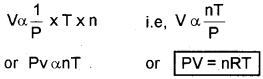
According to Boyle’s law, V α \(\frac{1}{P}\) ——- (i) (at constant T and n)
According to Charles’ Law, V α T ——- (ii) (at constant P and n)
According to Avogardro’s Law, V α n ——- (iii) (at constant T and P
Plus One Chemistry Notes Chapter 5 States of Matter 5

Where R is a constant known as the universal gas constant. The equation is known as ideal gas equation.
Density and Molar Mass of a Gaseous Substance
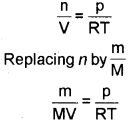
Ideal gas equation can be rearranged as follows:
Plus One Chemistry Notes Chapter 5 States of Matter 6
we get \(\frac{d}{M}=\frac{p}{R T}\)
(where d is the density)
On rearranging equation we get the relationship for calculating molar mass of a gas.
\(M=\frac{d R T}{p}\)

Dalton’s Law of Partial Pressures
The law was formulated by John Dalton in 1801. It states that the total pressure exerted by the mix-ture of non-reactive gases is equal to the sum of the partial pressures of individual gases.
PTotal = P1 + P2 + P3 + ………. (at constant T, V)

where ptotal is the total pressure exerted by the mixture of gases and p1, p2, p3 etc. are partial pressures of gases.

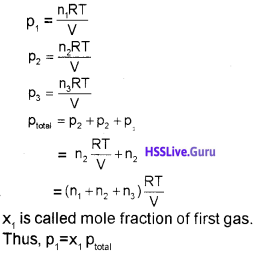
Partial pressure in terms of mole fraction
Plus One Chemistry Notes Chapter 5 States of Matter 7

Kinetic Molecular Theory Of Gases
Maxwell, Boltzmann, and others put forward a theoretical model of the gas. The theory is known as
Kinetic molecular theory of gases or microscopic
model of gases.
Postulates of kinetic molecular theory.

  1.  All gases are made up of a large number of extremely small particles called molecules.
  2. The molecules are separated from one another by large distances so that the actual volume of the molecules is negligible as compared to the total volume of gas.
  3. The molecules are in a state of continuous rapid motion in all directions. During their motion, they keep on colliding with one another and also with the walls of the container.
  4. Molecular collisions are perfectly elastic i.e. there is no net loss or gain of energy in their collisions. However, there may be redistribution of energy during such collisions.
  5. There are no attractive forces between the molecules. They move completely independent of each other.
  6. The pressure exerted by the gas is due to the bombardment of its molecules on the walls of the container.
  7. At any instant, different molecules possess different velocities and hence different energies. However, the average kinetic energy of the molecules is directly proportional to its absolute temperature.

Behaviour Of Real Gases:
Deviation From Ideal Gas Behaviour
There are two types of curves are seen in the graph. In the curves for dihydrogen and helium, as the pressure increases the value of pV also increases. The second type of plot is seen in the case of other gases like carbon monoxide and methane. In these plots first, there is a negative deviation from ideal behaviour, the pV value decreases with increase in pressure and reaches to a minimum value characteristic of a gas. After that pV value starts increasing. The curve then crosses the line for ideal gas and after that shows positive deviation continuously. It is thus, found that real gases do not follow ideal gas equation perfectly under all conditions.
Plus One Chemistry Notes Chapter 5 States of Matter 8

We find that two assumptions of the kinetic theory do not hold good. These are

  1. There is no force of attraction between the molecules of a gas.
  2. Volume of the molecules of a gas is negligibly small in comparison to the space occupied by the gas.

If assumption (a) is correct, the gas will never liquify. This means that forces of repulsion are powerful enough and prevent squashing of molecules in tiny volume. If assumption (b) is correct, the pressure vs volume graph of experimental data (real gas) and that theoritically calculated from Boyles law (ideal gas) should coincide.

Plus One Chemistry Notes Chapter 5 States of Matter

The volume occupied by the molecules also becomes significant because instead of moving in volume V, these are now restricted to volume (V-nb) where nb is approximately the total volume occupied by the molecules themselves. Here, b is a constant. Having taken into account the corrections for pressure and volume, we can rewrite equation as This equation is known as van der Waals’ equation.

Value of ‘a’ is measure of magnitude of intermolecular attractive forces within the gas and is independent of temperature and pressure.
Real gases show ideal behaviour when conditions of temperature and pressure are such that the intermolecular forces are practically negligible. The real gases show ideal behaviour when pressure approaches zero.

The deviation from ideal behaviour can be measured in terms of compressibility factor Z, which is the ratio of product pV and nRT. Mathematically
\(z=\frac{p V}{n R T}\)

For ideal gas Z = 1 at all temperatures and pressures because pV = nRT.
At high pressure, all the gases have Z > 1. These are more difficult to compress. At intermediate pressures, most gases have Z < 1. The temperature at which a real gas obeys ideal gas law over an appreciable. range of pressure is called Boyle temperature or Boyle point.

Liquefaction Of Gases
The highest temperature at which liquefaction of the gas first occurs is called Critical temperature (T<sub>c</sub>). Volume of one mole of the gas at critical temperature is called critical volume (V<sub>c</sub>) and pressure at this temperature is called critical pressure (P<sub>c</sub>).
The critical temperature, pressure, and volume are called critical constants.

Liquid State
Intermolecular forces are stronger in liquid state than in gaseous state.

Vapour Pressure
The pressure exerted by the vapour on the walls of the container is known as vapour pressure.

Surface Tension
Liquids tend to minimize their surface area. The molecules on the surface experience a net downward force and have more energy than the molecules in the bulk, which do not experience any net force. This characteristic property of liquids is known as surface tention. Liquids tend to have minimum number of molecules at their surface due to surface tention.
Plus One Chemistry Notes Chapter 5 States of Matter 9

If surface of the liquid is increased by pulling a molecule from the bulk, attractive forces will have to be overcome. This will require expenditure of energy. The energy required to increase the surface area of the liquid by one unit is defined as surface energy.

Viscosity
It is a common observation that certain liquids flow faster than others. For example, liquid like water, ether, etc. flow rapidly while liquids like glycerine, castor oil, honey, etc. flow slowly. These differences in flow rates result from a property known as viscosity. Every liquid has some internal resistance to flow. This internal resistance to flow possessed by a liquid is called its viscosity. Liquids which flow slowly have high internal resistance and are said to have high viscosity. On the other hand, liquids which flow rapidly have low internal resistance and are said to have low viscosity.

Plus One Chemistry Notes Chapter 5 States of Matter

Viscosity is also related to intermolecular forces in liquids. If the intermolecular forces are large, the vis-cosity will be high. Viscosity of a liquid decreases with rise in temperature. This is because at higher temperature the attractive forces between molecules are overcome by the increased kinetic energies of the molecules.

Ncert Supplementary Syllabus

Kinetic Energy And Molecular Speeds
Molecules of gases remain in continuous motion. While moving they collide with each other and with the walls of the container. This results in change of their speed and redistribution of energy. So the speed and energy of all the molecules of the gas at any instant are not the same. Thus, we can obtain only average value of speed of molecules. If there are n number of molecules in a sample
and their individual speeds are u1, u2, ……… un, then average speed of molecules uav can be calculated as follows:
\(u_{a v}=\frac{u_{1}+u_{2}+\ldots u_{n}}{n}\)

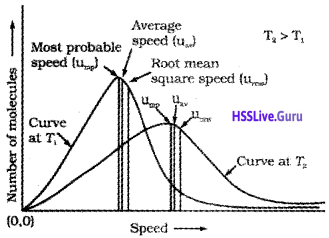
Maxwell and Boltzmann have shown that actual distribution of molecular speeds depends on temperature and molecular mass of a gas. Maxwell derived a formula for calculating the number of molecules possessing a particular speed. Fig. A(1) shows schematic plot of number of molecules vs. molecular speed at two different temperatures T1 and T2 (T2 is higher than T1). The distribution of speeds shown in the plot is called Maxwell-Boltzmann distribution of speeds.
Plus One Chemistry Notes Chapter 5 States of Matter 10

The graph shows that number of molecules possessing very high and very low speed is very small. The maximum in the curve represents speed possessed by maximum number of molecules. This speed is called most probable speed, ump. This is very close to the average speed of the molecules. On increasing the temperature most probable speed increases. Also, speed distribution curve broadens at higher temperature. Broadening of the curve shows that number of molecules moving at higher speed increases. Speed distribution also depends upon mass of molecules. At the same temperature, gas molecules with heavier mass have slower speed than lighter gas molecules. For example, at the same temperature, lighter nitrogen molecules move faster than heavier chlorine molecules. Hence, at any given temperature, nitrogen molecules have higher value of most probable speed than the chlorine molecules. Though at a particular temperature the individual speed of molecules keeps changing, the distribution of speeds remains same.
Plus One Chemistry Notes Chapter 5 States of Matter 11

The kinetic energy of a particle is given by the expression:
Kinetic Energy = \(\frac{1}{2}\) mu²
Therefore, if we want to know average translational kinetic energy, \(\frac{1}{2} m \overline{u^{2}}\) , for the movement of a gas particle in a straight line, we require the value of mean of square of speeds, \(\overline{u^{2}}\), of all molecules. This is represented as follows:
\(u^{2}=\frac{u_{1}^{2}+u_{2}^{2}+\ldots . u_{n}^{2}}{n}\)

Plus One Chemistry Notes Chapter 5 States of Matter

The mean square speed is the direct measure of the average kinetic energy of gas molecules. If we take the square root of the mean of the square of speeds then we get a value of speed which is different from most probable speed and average speed. This speed is called root mean square speed and is given by the expression as follows:
\(u_{m s}=\sqrt{u_{2}}\)

Root mean square speed, average speed and the most probable speed have following relationship:
urms uav ump

The ratio between the three speeds is given below:
ump : uav : urms :: 1 : 1.128 : 1.224

Plus One Chemistry Notes Chapter 8 Redox Reactions

Students can Download Chapter 8 Redox Reactions Notes, Plus One Chemistry Notes helps you to revise the complete Kerala State Syllabus and score more marks in your examinations.

Kerala Plus One Chemistry Notes Chapter 8 Redox Reactions

Introduction
The reaction which involve both oxidation and reduction reactions is called Redox reaction.

Classical Idea Of Redox Reactions Oxidation And Reduction Reactions
“Oxidation” is defined as the addition of oxygen/electronegative element to a substance or removal of hydrogen/electropositive element from a substance. Examples of oxidation:

  1. Addition of oxygen 2Mg + O2 → 2MgO
  2. Removal of hydrogen 2H2S + O2 → 2S + 2H2O
  3. Addition of electronegative element Mg + Cl2 → MgCl2

The term reduction been broadened these days to include removal of oxygen/electronegative element from a substance or addition of hydrogen /electropositive element.

  1. Removal of electronegative element FeCl3 + H2 → 2FeCl2 + 2HCl
  2. Removal of Oxygen (2H2O → 2Hg + O2)
  3. Addition of Hydrogen (H2 + Cl2 → 2HCl)

Redox Reactions In Terms Of Electron Transfer Reactions
According to electronic concept, the processes which involves loss of electrons are called oxidation reactions. Similarly, processes which involve gain of electrons are called reduction reactions.
The atom which reduced, act as oxidising agent and the atom which oxidised act as reducing agent.For example;
2Na(s) + Cl2(g) → 2Na+Cl(s) or 2NaCl(s)
Here Na is oxidised and Cl is redused.

Competitive Electron Transfer Reaction
Place a strip of metallic zinc in an aqueous solution of copper nitrate. You may notice that the strip becomes coated with reddish metallic copper and the blue colour of the solution disappears. Formation of Zn2+ ions among the products can easily be judged when the blue colour of the solution due to Cu2+ has disappeared. The reaction is,
Zn(s) + Cu2+(aq) → Zn2+(aq) + Cu(s) zinc is oxidised, releasing electrons, something must be reduced, accepting the electrons lost by zinc. Copper ion is reduced by gaining electrons from the zinc.

Oxidation Number
Oxidation number of an element may be defined as the charge which an atom of the element has or appears so have when present in the combined state in a compound.

  1. Electrons shared between two like atoms are divided equally between the sharing atoms.
  2. Electrons shared between two unlike atoms are counted with the more electronegative atom. Atoms can assume positive, zero or negative values of oxidation numbers depending on their state of combination. Oxidation number can be a fraction in some cases.

Plus One Chemistry Notes Chapter 8 Redox Reactions

The rules for calculation of oxidation number are:
1. In elements, in the free or the uncombined state, each atom bears an oxidation number of zero. Evidently each atom in H2 has the oxidation number zero.

2. For ions composed of only one atom, the oxidation number is equal to the charge on the ion. Thus Na+ ion has an oxidation number of +1, Mg2+ion, +2, Fe3+ ion, +3, Cl ion, -1, O2- ion, -2; and so on. In their compounds all alkali metals have oxidation number of +1, and all alkaline earth metals have an oxidation number of +2. Aluminium is regarded to have an oxidation number of +3 in all its compounds.

3. The oxidation number of oxygen in most compounds is-2. However, we come across two kinds of exceptions here.in peroxides (e.g., H2O2, Na2O2), each oxygen atom is assigned an oxidation number of—1, in superoxides (e.g., KO2, RbO2) each oxygen atom is assigned an oxidation number of -(½). The second exception appears rarely, i.e. when oxygen is bonded to fluorine. In such compounds e.g., oxygen difluoride (OF2) and dioxygen difluoride (O2F2), the oxygen is assigned an oxidation number of +2 and +1, respectively. The number assigned to oxygen will depend upon the bonding state of oxygen but this number would now be a positive figure only.

4. The oxidation number of hydrogen is +1, except when it is bonded to metals in binary compounds (that is compounds containing two elements). For example, in LiH, NaH, and CaH2, its oxidation number is —1.

5. In all its compounds, fluorine has an oxidation number of-1. Other halogens (Cl, Br, and I) also have an oxidation number of-1, when they occur as halide ions in their compounds. Chlorine, bromine and iodine when combined with oxygen, for example in oxoacids and oxoanions, have positive oxidation numbers.

6. The algebraic sum of the oxidation number of all the atoms in a compound must be zero. In polyatomic ion, the algebraic sum of all the oxidation numbers of atoms of the ion must equal the charge on the ion. Thus, the sum of oxidation number of three oxygen atoms and one carbon atom in the carbonate ion, (CO3)2- must equal -2. A term that is often used interchangeably with the oxidation number is the oxidation state. Oxidation state of a metal is a compound is sometimes represented by Stock notation. According to this, the oxidation number is written as Roman numeral in parenthesis after the symbol of the metal in the molecular formula. e.g.,Fe(ll)0, Sn(IV), Cl4,Mn(IV)O2.

Problem
Using Stock notation, represent the following compounds HAUCl4, Ti2O, FeO, Fe2O3, Cul, CuO, MnO and MnO2.

Solution
By applying various rules of calculating the oxidation number of the desired element in a compound, the oxidation number of each metallic element in its compound is as follows:
HAuCl4 → Au has 3
Tl2O → Tl has 1
FeO → Fe has 2
Fe2O3 → Fe has 3
Cul → Cu has 1
CuO → Cu has 2
MnO → Mn has 2
MnO2 → Mn has 4

Therefore, these compounds may be represented as
HAU(III)Cl4, Tl2(I)O, Fe(II)O, Fe2(III)O3, Cu(I)l, Cu(II)O, Mn(II)O, Mn(IV)O2.

Plus One Chemistry Notes Chapter 8 Redox Reactions

In terms of oxidation number, oxidation may be defined as a chemical change in which there occurs an increase in the oxidation number of an atom or atoms. Reduction may be defined as a chemical change in which there occurs a decrease in the oxidation number of an atom or atoms. Thus, a redox reaction may be defined as a reaction in which the oxidation number of atoms undergoes a change.

Types Of Redox Reactions
1. Combination Reactions:
A combination reaction may be denoted in the manner
A + B → C
Plus One Chemistry Notes Chapter 8 Redox Reactions 1

2. Decomposition Reaction:
Decomposition reactions are the opposite of combination reactions.
For example, 2H2O → 2H2 + O2

3. Displacement Reaction:
In a displacement reaction, an ion (or an atom) in a compound is replaced by an ion (or an atom) of another element. It may be denoted as:
X +YZ → XZ + Y
Displacement reactions fit into two categories:
metal displacement and non-metal displacement.

a) Metal displacement:
A metal in a compound can be displaced by another metal in the uncombined state.
CuSO4(aq) + Zn(s) → Cu(s) + ZnSO4(aq)

b) Non-metal displacement:
The non-metal displacement redox reactions include hydrogen displacement and a rarely occurring reaction involving oxygen displacement.
2Na(s) + 2H2O(I) → 2NaOH(aq) + H2(g)

The power of these elements as oxidising agents decreases as we move down from fluorine to iodine in group 17 of the periodic table.

Note:
fluorine is the strongest oxidising agent; there is no way to convert F ions to F2 by chemical means. The only way to achieve F2 from F is to oxidise electrolytically,

4. Disproportionation Reactions:
In a disproportionation reaction an element in one oxidation state is simultaneously oxidised and reduced.

Balancing Of Redox Reactions
There are two ways to balance a redox equation.
They are oxidation number method and Half Reaction Method.

a) Oxidation Number Method
The various steps involved in this method are:

  1. Write the skeletal equation and assign oxidation numbers to each element. Identify the elements undergoing change in oxidation number.
  2. Find out the increase or decrease of oxidation number per atom. Multiply the increase or decrease of oxidation number with number of atoms undergoing the change.
  3. Multiply the formulae of the oxidising agent and the reducing agent by suitable integers so as to equalize the total increase or decrease in oxidation number as determined in the above step.
  4. Balance the equation with respect to all atoms other the term reduction has than oxygen and hydrogen.
  5. Balance oxygen atoms by adding equal number of H2O molecules to the side deficient in oxygen atoms.
  6. For reaction taking place in acidic medium, add H+ ions to the side of deficient in hydrogen atoms.
  7. For reaction taking place in basic medium, add H2O molecules to the side deficient in hydrogen atoms and simultaneously add equal number of OH ions on the other side of the equation.

Problem
Permanganate ion reacts with bromide ion in basic medium to give manganese dioxide and bromate ion. Write the balanced ionic equation forthe reaction.
Solution:
The skeletal ionic equation is:
MnO4(aq) + Br(aq) → MnO2(s) + BrO3(aq)

Assign oxidation numbers for Mn and Br
Plus One Chemistry Notes Chapter 8 Redox Reactions 2
this indicates that permanganate ion is the oxidant and bromide ion is the reductant.

Calculate the increase and decrease of oxidation number, and make the increase equal to the decrease.
Plus One Chemistry Notes Chapter 8 Redox Reactions 3
As the reaction occurs in the basic medium, and the ionic charges are not equal on both sides, add 2 OH ions on the right to make ionic charges equal.
2MnO4(aq) + Br(aq) → 2MnO2(s) + BrO3(aq) + 2OH(aq)

Plus One Chemistry Notes Chapter 8 Redox Reactions

Finally, count the hydrogen atoms and add appropri- ‘ ate number of water molecules (i.e. one H20 molecule) on the left side to achieve balanced redox change.
2MnO4(aq) + Br(aq) → 2MnO2(s) + Br03(aq) + 2OH(aq)

b) Half Reaction Method
This method involves identifying the oxidation and reduction reactions in the given skeletal equation and then splitting the reaction accordingly as two half reactions. Each half reaction is then balanced systematically in various steps as outlined below.

Step 1.
Write the skeletal equation and identify the oxidant and reductant.

Step 2.
Write the half reactions for oxidation and reduction separately.

Step 3.
Balance the half reaction with respect to atoms that undergo change in oxidation number. Add electron to whichever side is necessary, to make up for difference in ON.

Step 4.
Balance O-atoms by adding proper number of H2O molecules to the side deficient in oxygen atoms.

Step 5.
For ionic equations in acid medium, add sufficient H+ ions to the side deficient in hydrogen. If the reaction occurs in basic medium, add sufficient H2O molecules to the side deficient in H atoms to balance H atoms and equal number of hydroxyl ions on the opposite side.

Step 6.
Equalise the number of electrons lost or gained by multiplying the half reaction with suitable integer and add the half reactions to get the final balanced equation.

Problem
Permanganate (VII) ion, MnO4 in basic solution oxidises iodide ion, l to produce molecular iodine (l2) and manganese (IV) oxide (MnO2). Write a balanced ionic equation to represent this redox reaction.
Solution:
Plus One Chemistry Notes Chapter 8 Redox Reactions 4
Plus One Chemistry Notes Chapter 8 Redox Reactions 5

Redox Reactions As The Basis For Titrations
In redox systems, the titration method can be adopted to determine the strength of a reductant/ oxidant using a redox sensitive indicator. The usage of indicators in redox titration is illustrated below:
1. In one situation, the reagent itself is intensely coloured, e.g., permanganate ion, MnO4. Here MnO4 – acts as the self indicator. The visible endpoint, in this case, is achieved after the last of the reductant (Fe2+ or C2O42-) is oxidised and the first lasting tinge of pink colour appears at MnO4 concentration as low as 10-6 mol dm-3 (10-6 mol L-1), This ensures a minimal ‘overshoot’ in colour beyond the equivalence point, the point where the reductant and the oxidant are equal in terms of their mole stoichiometry.

2. If there is no dramatic auto-colour change (as with Mn04 – titration), there are indicators which are oxidised immediately after the last bit of the reactant is consumed, producing a dramatic colour change. The best example is afforded by Cr2072-, which is not a self-indicator, but oxidises the indicator substance diphenylamine just after the equivalence point to produce an intense blue colour, thus signalling the endpoint.

Redox Reactions And Electrode Pro-Cesses
When zinc rod is dipped in copper sulphate solution, zinc gets oxidised to Zn2+ while Cu2+ ions are reduced to Cu due to direct transfer of electrons. However, if a zinc rod dipped in ZnSO4 solution taken in a breaker is connected externally by a conducting wire to a copper rod placed in CuSO4 solution in another beaker, electrons are transferred indirectly from Zn to Cu. Now, each beaker contains both the oxidised and reduced form of the same substance ‘ called a redox coupe. In this experiment the redox couples developed are Zn2+/Zn and Cu2+/Cu When the solutions in the two beakers (called electrodes) are joined by a salt bridge (a U-tube containing a solution of KCl, solidified in presence of agar-agar), electrons flow from Zn to Cu while current flows in the reverse direction. The salt bridge provides electrical continuity between the solutions without allowing them to mix with each other. The flow of current is due to a potential difference between Cu and Zn electrodes (or half cells). This experimental set up gives an electrochemical cell or galvanic cell.

Plus One Chemistry Notes Chapter 8 Redox Reactions

The potential of an electrode is a measure of its ability to lose (oxidation) or gain (reduction) electrons. When the concentrations of solutions in the half cells are unity and the temperature is 298 K, the potential of each electrode is known as Standard Electrode Potential (E°). By convention, E° of hydrogen electrode is zero volts and the potential of other electrodes will be a measure of the relative tendency of the active species to be in oxidised/reduced form. A negative E°shows that the redox couple is a stronger reducing agent than H+/H2 couple.

A positive E° shows that the redox couple is a weaker reducing agent than H+/H2 couples. The values of standard reduction potentials of various electrodes are given in the increasing order in an electrochemical series (electromotive series)

Plus One Chemistry Notes Chapter 4 Chemical Bonding and Molecular Structure

Students can Download Chapter 4 Chemical Bonding and Molecular Structure Notes, Plus One Chemistry Notes helps you to revise the complete Kerala State Syllabus and score more marks in your examinations.

Kerala Plus One Chemistry Notes Chapter 4 Chemical Bonding and Molecular Structure

Introduction
Matter is made up of different type of elements. The attractive force which holds the constituents together is called a chemical bond.

Kossel-Lewis Approach To Chemical Bonding
The bond between constituents are formed by the sharing of a pair of electrons or their transfer. G.N. Lewis introduced simple notations to represent these outer shell electrons in an atom. These notations are called Lewis symbols.
Plus One Chemistry Notes Chapter 4 Chemical Bonding and Molecular Structure 1

Significance of Lewis Symbols :
The number of dots around the symbol represents the number of valence electrons. This number of valence electrons helps to calculate the common or group valence of the element. The group valence of the elements is generally either equal to the number of dots in Lewis symbols or8 minus the number of dots or valence electrons.

Kossel, in relation to chemical bonding, drew attention to the following facts:
The bond formed, as a result of the electrostatic attraction between the positiveand negative ions was termed as the electrovalent bond. The electrovalence is thus equal to the number of unit charge (s) on the ion.
In terms of Lewis structures
Plus One Chemistry Notes Chapter 4 Chemical Bonding and Molecular Structure 2

1. According to electronic theory of chemical bond¬ing, atoms can combine either by transfer of valence electrons from one atom to another (gaining or losing) or by sharing of valence electrons in order to have an octet in their valence shells. This is known as octet rule.

2. Covalent Bond, Langmuir in 1919 refined the Lewis postulations by abandoning the idea of the stationary cubical arrangement of the octet, and by introducing the term covalent bond.

Plus One Chemistry Notes Chapter 4 Chemical Bonding and Molecular Structure

By Lewis – Langmuir theory the formation of chlorine molecule is as follows :
Plus One Chemistry Notes Chapter 4 Chemical Bonding and Molecular Structure 3
In water molecule covalent bond is as follows:
Plus One Chemistry Notes Chapter 4 Chemical Bonding and Molecular Structure 4

when two atoms share one electron pair they are said to be joined by a single covalent bond. If two atoms share two pairs of electrons, the covalent bond between them is called a double bond. And when combining atoms share three electron pairs as in the case of N2 molecule a triple bond a triple bond is formed.

  • The total number of electrons required for writing the structures are obtained by adding the valence electrons of the combining atoms.
  • For anions, each negative charge would mean addition of one electron. For cations, each positive charge would result in subtraction of one electron from the total number of valence electrons.
  • The least electronegative atom occupies the central position in the molecule/ion.

Formal charge
Formal charge (F.C.) on an atom in a Lewis structure = total number of valence electrons in the free atom— total number of non bonding (lone pairjelectrons—(1/2) total number of bonding(shared)electrons.

Let us consider the ozone molecule (O3).
The Lewis structure of O3 may be drawn as:
Plus One Chemistry Notes Chapter 4 Chemical Bonding and Molecular Structure 5

The atoms have been marked as 1,2 and 3. The formal charge on:

  • The central O atom marked 1 = 6 – 2- \(\frac{1}{2}\)(6) = +1
  • The end O atom marked 2 = 6 – 4 – \(\frac{1}{2}\)(4) = o
  • The end O atom marked 3 = 6 – 6 – \(\frac{1}{2}\)(2) = -1

Hence, we represent O3 along with the formal changes as follows:
Plus One Chemistry Notes Chapter 4 Chemical Bonding and Molecular Structure 6

Limitations of the Octet Rule
There are three types of exceptions to the octet rule. The incomplete octet of the central atom In some compounds, the number of electrons surrounding the central atom is less than eight. This is especially the case with elements having less than four valence electrons.
Some compounds are BCl3, AlCl3 and BF3.
Plus One Chemistry Notes Chapter 4 Chemical Bonding and Molecular Structure 7

Odd-electron molecules
In molecules with an odd number of electrons like nitric oxide, NO and nitrogen dioxide, NO2, the octet rule is not satisfied for all the atoms.
Plus One Chemistry Notes Chapter 4 Chemical Bonding and Molecular Structure 8

The expanded octet
In a number of compounds of these elements there are more than eight valence electrons around the central atom.Some examples are given below.
Plus One Chemistry Notes Chapter 4 Chemical Bonding and Molecular Structure 9

Ionic Or Electrovalent Bond
The formation of a positive ion involves ionization, i.e., removal of electrons from the neutral atom and that of the negative ion involves the addition of electron(s) to the neutral atom.

Plus One Chemistry Notes Chapter 4 Chemical Bonding and Molecular Structure

A qualitative measure of the stability of an ionic compound is provided by its enthalpy of lattice formation and not simply by achieving octet of electrons around the ionic species in gaseous state.

Lattice Enthalpy
The Lattice Enthalpy of an ionic solid is defined as the energy required to completely separate one mole of a solid ionic compound into gaseous constituentions.

Bond Parameters

Bond Length
It may be defined as the equilibrium distance between the centres of the nuclei of the two bonded i atoms in a molecule. Bond length are measured by spectroscopic, X-ray diffraction and electron diffraction techniques. It is usually expressed in Angstrom units (A°) or picometres (pm)
1 A° = 10-10m and 1 pm = 10-12m

Bond Angle
It is defined as the angle between the orbitals containing bonding electron pairs around the central atom in a molecule.

Bond Enthalpy
It is defined as the amount of energy required to break one mole of bonds of a particular type between two atoms in a gaseous state.

Bond Order:
In the Lewis description of covalent bond, the bond order is given by the number of bonds between the two atoms in a molecule. For example, the bond order in H2 is one, in O2 is two and in N2 is three. Isoelectronic molecules and ions have identical bond orders. For example N2, CO and NO+ have bond order 3. It is found that as the bond order increases, bond enthalpy increases and bond length decreases.

Resonance Structures
It is often observed that a single Lewis structure is inadequate for the representation of a molecule in conformity with its experimentally determined parameters. As in the case of O3.
Plus One Chemistry Notes Chapter 4 Chemical Bonding and Molecular Structure 10

O3 is represented by the above 3 structures. These are called canonical structures.

Experimentally determined oxygen-oxygen bond lengths in the O3 molecule are same (128 pm). Thus the oxygen-oxygen bonds in the O3 molecule are intermediate between a double and a single bond. According to the concept of resonance, the canonical structures of the hybrid describes the molecule accurately.

Some of the other examples of resonance structures are provided by the carbonate ion and the carbon dioxide molecule.

Polarity of Bonds
In reality no bond or a compound is either completely covalent or ionic. Even in case of covalent bond between two hydrogen atoms, there is some ionic character. As a result of polarisation, the molecule possesses the dipole moment. Which can be defined as the product of the magnitude of the charge and the distance between the centres of positive and negative charge. It is usually designated by a Greek letter Mathematically, it is expressed as follows: Dipole moment (µ) = change (Q) X distance of separation (r)

Plus One Chemistry Notes Chapter 4 Chemical Bonding and Molecular Structure

In case of polyatomic molecules, the dipole moment not only depend upon the individual dipole moments of bonds known as bond dipoles but also on the spatial arrangement of various bonds in the molecule.lt is due to the shifting of electrons to the side of more eletro negative element. For example,
Plus One Chemistry Notes Chapter 4 Chemical Bonding and Molecular Structure 11
The shifting of electrons is represented by an arrow. In case of H2O the resultant dipole moment is given by the following figure:
Plus One Chemistry Notes Chapter 4 Chemical Bonding and Molecular Structure 12

Fajans Rules:
Just as all the covalent bonds have some partial ionic character, the ionic bonds also have partial covalent character. The partial covalent character of ionic bonds was discussed by Fajans in terms of the following rules:

  • The smaller the size of the cation and the larger the size of the anion, the greater the covalent character of an ionic bond.
  • The greater the charge on the cation, the greater the covalent character of the ionic bond.
  • For cations of the same size and charge, the one, with electronic configuration (n-1)d”ns°, typical of transition metals, is more polarising than the one with a noble gas configuration, ns2 np6, typical of alkali and alkaline earth metal cations.

The cation polarises the anion, pulling the electronic charge toward itself and thereby increasing the electronic charge between the two. This is precisely what happens in a covalent bond, i.e., buildup of electron charge density between the nuclei. The polarising power of the cation, the polarisability of the anion and the extent of distortion (polarisation) of anion are the factors, which determine the per cent covalent character of the ionic bond.

The Valence Shell Electron Pair Repul-Sion (Vspert) Theory
The main postulates of VSEPR theory are as follows:

  • The shape of a molecule depends upon the number of valence shell electron pairs (bonded or nonbonded) around the central atom.
  • Pairs of electrons in the valence shell repel one another since their electron clouds are negatively charged.
  • These pairs of electrons tend to occupy such positions in space that minimise repulsion and thus maximise distance between them.
  • The valence shell is taken as a sphere with the electron pairs localising on the spherical surface at maximum distance from one another.
  • A multiple bond is treated as if it is a single electron pair and the two or three electron pairs of a multiple bond are treated as a single super pair.
  • Where two or more resonance structures can represent a molecule, the VSEPR model is applicable to any such structure.

The repulsive interaction of electron pairs de-crease in the order:
Lone pair (lp) – Lone pair (lp) > Lone pair (lp) – Bond pair (bp) > Bond pair (bp) – Bond pair (bp)

Valence Bond Theory
Valence bond theory was introduced by Heitlerand London (1927) and developed further by Pauling and others. A discussion of the valence bond theory is based on the knowledge of atomic orbitals, electronic configurations of elements, the overlap criteria of atomic orbitals, the hybridization of atomic orbitals and the principles of variation and superposition. First, we consider the formation of H2. When the attractive forces become greater than the repulsive forces, the molecule is formed and the system gets minimum energy. Because energy is released when a bond is formed. The energy so released is called bond enthalpy.

Orbital Overlap Concept
When two atoms approach each other, their atomic orbitals undergo partial interpenetration. This partial interpenetration of atomic orbitals is called overlapping of atomic orbitals. The electrons belonging to these orbitals are said to be shared and this results in the formation of a covalent bond. The main ideas of orbital of overlap concept of formation of covalent bonds are

  • Covalent bonds are formed by the overlapping of half filled atomic orbitals present in the valence shell of the atoms taking part in bonding.
  • The orbitals undergoing overlapping must have electrons with opposite spins.
    Overlapping of atomic orbitals results in decrease of energy and formation of covalent bond.
  • The strength of a covalent bond depends upon the extent of overlapping. The greater the overlapping, the stronger is the bond formed.

The above treatment of formation of covalent bond involving the overlap of half-filled atomic orbitals is called valence bond theory.

Types of Overlapping and Nature of Covalent Bonds
The covalent bond may be classified into two types depending upon the types of overlapping:
(i) Sigma(σ) bond, and
(ii) pi(π) bond

(i) Sigma( σ) bond :
This type of covalent bond is formed by the end to end (hand-on) overlap of bonding orbitals along the internuclear axis. This is called as head on overlap or axial overlap. This can be formed by any one of the following types of combinations of atomic orbitals.
s-s overlapping:
In this case, there is overlap of two half filled s-orbitals along the internuclear axis as shown below:
Plus One Chemistry Notes Chapter 4 Chemical Bonding and Molecular Structure 13

s-p overlapping:
This type of overlap occurs between half filled s-orbitals of one atom and half filled p-orbitals of another atom.
Plus One Chemistry Notes Chapter 4 Chemical Bonding and Molecular Structure 14

p-p overlapping :
This type of overlap takes place between half filled p-orbitals of the two approaching atoms.
Plus One Chemistry Notes Chapter 4 Chemical Bonding and Molecular Structure 15

(ii) pi(π) bond :
In the formation of n bond the atomic orbitals overlap in such a way that their axes remain parallel to each other and perpendicular to the internuclear axis. The orbitals formed due to side wise overlapping consists of two saucer type charged clouds above and below the plane of the participating atoms.
Plus One Chemistry Notes Chapter 4 Chemical Bonding and Molecular Structure 16

Strength of Sigma and pi Bonds
Basically the strength of a bond depends upon the extent of overlapping. In case of sigma bond, the overlapping of orbitals takes place to a larger extent. Hence, it is stronger as compared to the pi bond where the extent of overlapping occurs to a smaller extent. Further, it is important to note that pi bond between two atoms is formed in addition to a sigma bond. It is always present in the molecules containing multiple bond (double ortriple bonds).

Hybridisation
Hybridisationis defined as the process of intermixing of the orbitals of slightly different energies so as to redistribute their energies, resulting in the formation of new set of orbitals of equivalent energies and shape.

The number of hybrid orbitals is equal to the number of the atomic orbitals that get hybridised.

These hybrid orbitals are stable due to their arrangement which provides minimum repulsion between electron pairs. Therefore, the type of hybridisation indicates the geometry of the molecules.

Plus One Chemistry Notes Chapter 4 Chemical Bonding and Molecular Structure

It is not necessary that only half filled orbitals participate in hybridisation. In some cases, even filled orbitals of valence shell take part in hybridisation.

Types of Hybridisation
There are various types of hybridisation involving s, p and d orbitals. The different types of hybridisation are as under:

(I) sp hybridisation:
This type of hybridisation involves the mixing of one s and one p orbital resulting in the formation of two equivalent sp hybrid orbitals. Each sp hybrid orbitals has 50% s-character and 50% p-character. Such a molecule in which the central atom is sp- hybridised and linked directly to two other central atoms possesses linear geometry.The two sp hybrids point in the opposite direction which provides more effective overlapping resulting in the formation of stronger bonds.

Example of molecule having sp hybridisation BeCl2:
The ground state electronic.configuration of Be is 1s²2s². In the exited state one of the 2s-electrons is promoted to vacant 2p orbital to account for its divalency. One 2s and one 2p-orbitalsget hybridised to form two sp hybridised orbitals. These two sp hybrid orbitals are oriented in opposite direction forming an angle of 180°. Each of the sp hybridised orbital overlaps with the 2p-orbital of chlorine axially and form two Be-Cl sigma bonds.

II) sp² hybridisation :
In this hybridisation there is involvement of one s and two p-orbitals in orderto form three equivalent sp² hybridised orbitals. For example, in BCl2 molecule, the ground state electronic configuration of central boron atom is 1s²2s²2p¹. In the excited state, one of the 2s
electrons is promoted to vacant 2p orbital as a result boron has three unpaired electrons.

These three orbitals (one 2s and two 2p) hybridise to form three sp2 hybrid orbitals. The three hybrid orbitals so formed are oriented in a trigonal planar arrangement and overlap with 2p orbitals of chlorine to form three B-Cl bonds. Therefore, in BCl3 the geometry is trigonal planar with ClBCl bond angle of 120°
Plus One Chemistry Notes Chapter 4 Chemical Bonding and Molecular Structure 17

III) sp³ hybridisation:
This type of hybridisation can be explained by taking the example of CH4 molecule in which there is mixing of one s-orbital and three p-orbitals of the valence shell to form four sp³ hybrid orbital of equivalent energies and shape.

There is 25% s-character and 75% p-character in each sp³ hybrid orbital. The four sp3 hybrid orbitals so formed are directed towards the four corners of the tetrahedron.

The angle between sp³ hybrid orbital is 109.5°
Plus One Chemistry Notes Chapter 4 Chemical Bonding and Molecular Structure 18

The structure of NH3 and H2O molecules can also be explained with the help of sp3hybridisation. In NH3, the valence shell (outer) electronic configuration of nitrogen in the ground state is 2s²\(p_{x}^{1} 2 p_{y}^{1} 2 p_{z}^{1}\) having three unpaired electrons in the sp³ hybrid orbitals and a lone pair of electrons is present in the fourth one. These three hybrid orbitals overlap with 1s orbitals of hydrogen atoms to form three N-H sigma bonds. Due to the force of repulsion, the molecule gets distorted and the bond angle is reduced to 107° from 109.5°. The geometry of such a molecule will be pyramidal.
Plus One Chemistry Notes Chapter 4 Chemical Bonding and Molecular Structure 19

Other Examples of sp³, sp² and sp Hybridisation:
sp³ Hybridisation in C2H6 molecule:
In ethane molecule both the carbon atoms assume sp3 hybrid state. One of the four sp³ hybrid orbitals of carbon atom overlaps axially with similar orbitals of other atom to form sp³-sp³ sigma bond while the other three hybrid orbitals of each carbon atom are used in forming sp³-s sigma bonds with hydrogen atoms Therefore in ethane C-C bond length is 154 pm and each C-H bond length is 109 pm.

sp² Hybridisation in C2H4:
In the formation of ethene molecule, one of the sp² hybrid orbitals of carbon atom overlaps axially with sp² hybridised orbital of another carbon atom to form C-C sigma bond. While the other two sp² hybrid orbitals of each carbon atom are used for making sp²-s sigma bond with two hydrogen atoms. The unhybridised orbital (2px or 2py) of one carbon atom overlaps sidewise with the similar orbital of the other carbon atom to form weak π bond, which consists of two equal electron clouds distributed above and below the plane of carbon and hydrogen atoms.

Plus One Chemistry Notes Chapter 4 Chemical Bonding and Molecular Structure

Thus, in ethene molecule, the carbon-carbon bond consists of one sp²-sp² sigma bond and one pi (π) bond between p orbitals which are not used in the hybridisation and are perpendicular to the plane of molecule; the bond length is 134 pm. The C-H bond is sp^s sigma with bond length 108 pm. The H-C-H bond angle is 117.6° while the H-C-C angle is 121°.

sp Hybridisation in C2H2:
In the formation of ethyne molecule, both the carbon atoms undergo sp- hybridisation having two unhybridised orbital i.e., 2py and 2px. One sp hybrid orbital of one carbon atom overlaps axially with sp hybrid orbital of the other carbon atom to form C-C sigma bond, while the other hybridised orbital of each carbon atom overlaps axially with the half filled s orbital of hydrogen atoms forming σ bonds. Each of the two unhybridised p orbitals of both the carbon atoms overlaps sidewise to form two π bonds between the carbon atoms. So the triple bond between the two carbon atoms is made up of one sigma and two pi bonds

Hybridisation of Elements involving d-Orbitals
The elements present in the third period contain d orbitals in addition to s and p orbitals. The energy of the 3d orbitals are comparable to the energy of the 3s and 3p orbitals. The energy of 3d orbitals are also comparable to those of 4s and 4p orbitals. As a consequence the hybridisation involving either 3s, 3p, and 3d or 3d, 4s and 4p is possible. However, since the difference in energies of 3p and 4s orbitals is significant, no hybridisation involving 3p, 3d and 4s orbitals is possible.

1. Formation of PCl5 (sp³d hybridisation):
The ground state and the excited state outer electronic configurations of phosphorus (Z=15) are represented below.
Plus One Chemistry Notes Chapter 4 Chemical Bonding and Molecular Structure 20

Now the five orbitals (i.eone s, three p, and one d orbitals) are available for hybridisation to yield a set of five sp3d hybrid orbitals which are directed towards the five comers of a trigonal bipyramidal.
Plus One Chemistry Notes Chapter 4 Chemical Bonding and Molecular Structure 21

Three sigma bond known as equatorial bonds lie in one plane and make an angle of 120° with each other.
The remaining two P-Cl bonds(called axial bonds)-one lying above and the other lying below the equatorial plane, make an angle of 90° with the plane.

As the axial bond pairs suffer more repulsive interaction from the equatorial bond pairs, therefore axial bonds have been found to be slightly longer and hence slightly weaker than the equatorial bonds; which makes PCl5 molecule more reactive.

Plus One Chemistry Notes Chapter 4 Chemical Bonding and Molecular Structure

2. Formation of SF6 (sp³d² hybridisation):
In SF6 the central sulphur atom has the ground state outer electronic configuration 3s²3p4. In the exited state the available six orbitals i.e., one s, three p and two d are singly occupied by electrons. These orbitals hybridise to form six new sp³d² hybrid orbitals, which are projected towards the six corners of a regular octahedron in SF6. These six sp³d² hybrid orbitals overlap with singly occupied orbitals of fluorine atoms to form six S-F sigma bonds. Thus SF6 molecule has a regular octahedral geometry.
Plus One Chemistry Notes Chapter 4 Chemical Bonding and Molecular Structure 22

The structure of SF6 is given below.
Plus One Chemistry Notes Chapter 4 Chemical Bonding and Molecular Structure 23

Molecular Orbital Theory
Molecular orbital (MO) theory was developed by F. Hund and R.S. Mulliken in 1932. The salient features of this theory are :

  • The electrons in a molecule are present in the various molecular orbitals as the electrons of atoms are present in the various atomic orbitals.
  • The atomic orbitals of comparable energies and proper symmetry combine to form molecular orbitals.
  • While an electron in an atomic orbital is influenced by one nucleus, in a molecular orbital it is influenced by two or more nuclei depending upon the number of atoms in the molecule. Thus, an atomic orbital is monocentric while a molecular orbital is polycentric.
  • The number of molecular orbital formed is equal to the number of combining atomic orbitals. When two atomic orbitals combine, two molecular orbitals are formed. One is known as bonding molecular orbital while the other is called antibonding molecular orbital.
  • The bonding molecular orbital has lower energy and hence greater stability than the corresponding antibonding molecular orbital.
  • Just as the electron probability distribution around a nucleus in an atom is given by an atomic orbital, the electron probability distribution around a group of nuclei in a molecule is given by a molecular orbital.
  • The molecular orbitals like atomic orbitals are filled in accordance with the aufbau principle obeying the Pauli’s exclusion principle and the Hund’srule.

Formation of Molecular Orbitals
Linear Combination of Atomic Orbitals (LCAO)
The atomic orbitals of these atoms may be represented by the wave functions ψA and ψB. The formation of molecular orbitals is the linear combination of atomic orbitals that can take place by addition and by subtraction of wave functions of individual atomic orbitals as shown below.
Plus One Chemistry Notes Chapter 4 Chemical Bonding and Molecular Structure 24
Energy Level Diagram for Molecular orbitals
Plus One Chemistry Notes Chapter 4 Chemical Bonding and Molecular Structure 25
The increasing order of energies of various molecular orbitals for O2 and F2 is given below:
σ1s < σ*1s < σ2s < σ*2s < σ2px <(π2px = π2py) <(π*2px = π*2pz) < σ*2px

This sequence of energy levels of molecular orbitals is not correct for the remaining molecules Li2, Be2, B2, C2, N2. For molecules such as B2, C2, N2 etc. the increasing order of energies of various molecular orbitals is
σ1s < σ*1s < σ2s < σ*2s <(π2px = π2py) < σ2px <(π*2px = π*2pz) < σ*2pz

Plus One Chemistry Notes Chapter 4 Chemical Bonding and Molecular Structure

The important characteristic feature of this order is that the energy of σ 2pz molecular orbital is higher than that of π2px and π2py molecular orbitals. If the bonding influence is stronger a stable molecule results and if the antibonding influence is stronger,the molecule is unstable.

Bonding In Some Homonuclear Diatomic Molecules
Bond Order:
Bond order is defined as half of the difference between the number of electrons in the bonding molecular orbitals and that in the antibonding molecular orbitals.
Nh – N
i.e. Bond Order= \(\frac{N_{b}-N_{a}}{2}\). Where Nb is the number of electrons in the bonding molecular orbitals and Na is the number of electrons in the antibonding mo-lecular orbitals.

Significance of bond order:
Bond order conveys the following important informations about a molecule.
i) If the value of bond order is positive, it indicates a stable molecule and if the value of bond order is negative or zero, the molecule is unstable and is not formed.
ii) Bond dissociation energy of a diatomic molecule is directly proportional to the bond order of the molecule. The greater the bond order, the higher is the bond dissociation energy.
iii) Bond order is inversely proportional to the bond length. The higherthe bond ondervalue, smaller is the bond length. For example, the bond length in N2 molecule (having bond order 3) is less than that in O2 molecule (having bond order 2).

Magnetic character:
If all the electrons in the mol-ecules of a substance are paired, the substance will be diamagnetic. On the other hand, if there are un-paired electrons in the molecule, the substance will be paramagnetic.

Hydrogen Bonding
Hydrogen bond can be defined as the attractive force which binds hydrogen atom of one molecule with the electronegative atom (F, O orN) of another molecule. When hydrogen is bonded to strongly electronegative element ‘X’, the electron pair shared between the two atoms moves far away from hydrogen atom. As a result the hydrogen atom becomes, highly electropositive with respect to the other atom ‘X’. Since there is displacement of electrons towards X, the hydrogen acquires fractional positive charge (δ+) while ‘X’ attain fractional negative charge (δ). This results in the formation of a polar molecule having electrostatic force of attraction which can be represented as: Hδ+ – Xδ-

The magnitude of H-bonding depends on the physical state of the compound. It is maximum in the solid state and minimum in the gaseous state. Thus, the hydrogen bonds have strong influence on the structure and properties of the compounds.

Types of Hydrogen Bonds
There are two types of hydrogen bonds

  1. Intermolecular hydrogen bond
  2. Intramolecular hydrogen bond

1. Intermolecular hydrogen bond:
It is formed between two different molecules of the same or different compounds. For example, H-bond in case of HF molecule, alcohol or water molecules, etc.

2. Intramolecular hydrogen bond:
It is formed when hydrogen atom is in between the two highly electronegative (F, O, N) atoms present within the same molecule. For example, in o-Nitrophenol the hydrogen is in between the two oxygen atoms as shown below:

Plus One Chemistry Chapter Wise Questions and Answers Chapter 11 The p Block Elements

Students can Download Chapter 11 The p Block Elements Questions and Answers, Plus One Chemistry Chapter Wise Questions and Answers helps you to revise the complete Kerala State Syllabus and score more marks in your examinations.

Kerala Plus One Chemistry Chapter Wise Questions and Answers Chapter 11 The p Block Elements

Plus One Chemistry The p Block Elements One Mark Questions and Answers

Question 1.
The aqueous solution of borax is
a) Acidic
b) Alkaline
c) Neutral
d) Amphoteric
Answer:
b) Alkaline

Question 2.
Say TRUE or FALSE.
Boron in aqueous solution forms B3+ ion.
Answer:
False

Question 3.
Which of the halide of group 14 does not exist?
a) CF4
b) Cl4
c) SiF4
d) Pbl4
Answer:
d) Pbl4

Question 4.
Orthoboric acid, H3BO3 is a
a) Protonic acid
b) Arrhenius acid
c) Lewis acid
d) Bronsted-Lowery acid
Answer:
c) Lewis acid

Plus One Chemistry Chapter Wise Questions and Answers Chapter 11 The p Block Elements

Question 5.
The zeolite used as a catalyst in petrochemical industries for cracking of hydrocarbons and isomerization is _________ .
Answer:
ZSM-5

Question 6.
Dry ice is __________ .
Answer:
Solid CO2

Question 7.
Thermodynamically most stable allotrope of carbon is __________ .
Answer:
Graphite

Question 8.
The alkalimetal used in solar cells is __________ .
Answer:
Cs (Caesium)

Question 9.
Acidity is in the order
Answer:
BBr3 > BCl3 > BF3

Question 10.
AlCl3 fumes in most air because
Answer:
HCl is formed due to hydrolysis in moist air

Plus One Chemistry The p Block Elements Two Mark Questions and Answers

Question 1.
Silicon belongs to the carbon family. Graphite is an important allotrope of carbon. But Si does not form an analogue of graphite. What are the possible reasons?
Answer:
Silicon atom is much bigger in size than carbon. Si-Si bond energy is less than C-C bond energy and also Si does not form compounds in sp² hybrid state.

Question 2.
Boron is an element with atomic number 5.
a) Write down the electronic configuration of boron.
b) Mention any two uses of boron.
c) Write down some compounds of boron.
Answer:
a) 1s²2s²2p¹
b) To increase the hardness of the steel.
Used as the semiconductor in electronic devices.
c) Diborane, borax, orthoboric acid, boron trifluoride

Question 3.
Answer the questions, with the help of the following:

  • Hard solid
  • Melting point above 450 K.
  • Four allotropic forms are known.
  • Low electrical conductivity.
  • Mass number! 3

1. Which is the element?
2. Write any two uses of this element.
3. Plus One Chemistry Chapter Wise Questions and Answers Chapter 11 The p Block Elements 1
4. Write any three compounds of this element.
Answer:
1. Boron
2. To increase hardness of steel
As semiconductor in electric devices
3. 2B
4. Diborane, Borax, Boric acid

Plus One Chemistry Chapter Wise Questions and Answers Chapter 11 The p Block Elements

Question 4.
1. Write any two allotropic forms of carbon.
2. C + ½ O2 → …………….
3. Write any two uses of carbon monoxide.
4. How is carbon dioxide produced?
5. What is the hardest element/form of an element in the world?
Answer:
1. Diamond, Graphite
2. CO (Carbon monoxide)
3. Reducing agent in metallurgy
Used in the manufacture of methanol
4. Carbon dioxide is formed by the complete combustion of carbon.
C + O2 → CO2
5. Diamond

Question 5.
From the compounds of group 14 elements write an appropriate example for each of the following:

No. Type of compound Name/ Formulae of example
1. A strong reducing oxide
2. A giant covalent oxide
3. A strongly reducing chloride
4. A covalent chloride not hydrolysed by water

Answer:
1-CO
2-SiO2
3-SnCl2
4-CCl4

Question 6.
Diborane has an unusual structure. Justify the statement with figure.
Answer:
In diborane, each Batom uses sp³ hybrid orbitals for bonding. Out of the four sp³ hybrid orbitals on each B atom, one is without an electron. The terminal B-H bonds are normal 2-centre-2-electron bonds but the two bridge bonds are 3-centre-2-electron bonds. The 3-centre-2-electron bridge bonds are also referred to as banana bonds.
Plus One Chemistry Chapter Wise Questions and Answers Chapter 11 The p Block Elements 2

Question 7.
Match the following:

A B
CO i. A semi conductor in electronic devices
H2 ii. Reducing agent in metallurgy
O3 iii. Thermal decomposition of Ammonia
Boron iv. Used as a chemical reagent in organic chemistry

Answer:
CO – ii,
N2 – iii,
O3 – iv,
Boron – i

Question 8.
BCl3 fumes in moist air.
1. Give reason.
2. Write down a balanced equation that can reveal the answer.
Answer:
1. When water of moist air reacts with boron halide hydrogen chloride is formed which causes fumes,

2. BCl3 + 3H2O → H3BO3 + 3HCl

Plus One Chemistry Chapter Wise Questions and Answers Chapter 11 The p Block Elements

Question 9.
‘Generally, non-metal oxides are basic.’
1. Do you agree?
2. What do you meant by oxides?
3. Which are the different types of oxides?
4. Give examples for each type of oxides.
Answer:
1. No. Generally, non metallic oxides are acids.
2. The binary compounds formed by the combination of oxygen with metals or nonmetals are called oxides.
3. Acidic oxides, basic oxide, amphoteric oxide, neutral oxide.
4. Acidic oxide → SO2, NO2
Basic oxide → MgO
Amphoteric oxide → Al2O3, ZnO
Neutral oxide → CO, N2O

Question 10.
Match the following:
1. Borane – H3BO3
2. Boric acid – Na2B4O7.10H2O
3. Borax – Amphoteric oxide
4. Al2O3 – Boron hydride
Answer:
1. Borane – Boron hydride
2. Boric acid – H3BO3
3. Borax – Na2B4O7.10H20
4. Al2O3 – Amphoteric oxide

Question 11.
How diborane reacts with
1. Oxygen?
2. Water?
Answer:
1. Diborane catches fire spontaneously upon exposure to air. It burns in oxygen releasing an enormous amount of energy.
B2H6 + 3O2 → B2O2 + 3H2O; ∆rHΘ -1976 kJ mol-1

2. Diborane is readily hydrolysed by water to give boric acid.
B2H6(g) + 6H2O(l) → 2B(OH)3(aq) + 6H2(g)

Question 12.
1. CCl4 cannot be hydrolysed. Give reason.
2. Draw the structure of the dimer of AlCl3.
Answer:
1. Carbon has no d orbitals to accommodate the lone pair of electrons from oxygen atom of H20.
2.
Plus One Chemistry Chapter Wise Questions and Answers Chapter 11 The p Block Elements 3

Question 13.
1. Draw the structure of boric acid.
2. Starting from borax how will you prepare boric acid? (Write the chemical equation).
Answer:
1.
Plus One Chemistry Chapter Wise Questions and Answers Chapter 11 The p Block Elements 4
2. Na2B4O7 + 2HCl + 5H2O → 2NaCl + 4B(OH)3.

Question 14.
CO2 is a gas but SiO2 is a solid. Give reason.
Answer:
CO2 exists as discrete molecules due to the formation of pπ -pπ double bond between carbon and oxygen. But SiO2 has a three dimensional network structure in which each Si atom is covalently bonded in a tetrahedral manner to four oxygen atoms.

Question 15.
1. What are zeolites?
2. What is ZSM-5?
Answer:
1. Zeolites are aluminosilicates with three-dimensional network structure in which Al atoms replace few Si atoms. Cations such as Na+, K+ or Ca2+ balance the negative charge of aluminosilicate anion.

2. ZSM-5 is a zeolite catalyst used in petrochemical industry to convert alcohols directly into gasoline.

Plus One Chemistry The p Block Elements Three Mark Questions and Answers

Question 1.
Explain the following:
1. Allotropy
2. Coke and Charcoal
Answer:
1. The phenomenon of existence of an element in two or more forms, which have different physical properties but almost similar chemical properties, is called allotropy and the different forms are called allotropes.

2. Coke and Charcoal are amorphous forms of carbon. Coke is formed-by the destructive distillation of coal. It is used as a fuel and also as a reducing agent in metallurgy.

Question 2.
Give justifications.
1. The first ionisation enthalpy of carbon is greater than that of boron, whereas the reverse is correct for the second ionisation enthalpy.
2. Graphite is a better lubricant on moon than that on earth.
Answer:
1. This is because carbon has greater nuclear charge. For second ionisation enthalpy, an electron is to be removed from 2p of carbon while in boron the second electron is in 2s orbital. Removal of a 2s electron is more difficult due to the high penetrating power of 2s orbital.

2. Graphite contains hexagonal sheets of carbon held together by weak van der Waals’ forces and low density. In the moon, the different layers experience less weight due to less gravitational force and the density is still reduced. The lighter layers can easily slide over another to make graphite more lubricating on the moon than on earth.

Question 3.
1. Identify the compound with the following structure:
Plus One Chemistry Chapter Wise Questions and Answers Chapter 11 The p Block Elements 5
2. Mention the angles a & b.
3. Write down the corresponding elements in the figure.
1……………..
2……………..
3……………..
4……………..
5……………..
6……………..
Answer:
a) Diborane(B2H6).
b) a-97°
b-120°
c) 1-H, 2-H, 3-B, 4-B, 5-H, 6-H

Question 4.
The simplest boron hydride is diborane.
1. Write down the molecular formula of diborane.
2. Distinguish between terminal hydrogen and bridging hydrogen atoms of diboran.
Answer:
1. B2H6

2. In diborane, four hydrogen atoms and two boron atoms are present in a single plane. These hydrogen atoms are called terminal atoms. The terminal B-H bonds are regular two centre-two electron bonds. The remaining two hydrogen atoms above and below this plane are called bridging hydrogen atoms. The two bridge bonds (B-H-B) are three centre-two electron bonds.

Plus One Chemistry Chapter Wise Questions and Answers Chapter 11 The p Block Elements

Question 5.
1. How is orthoboric acid prepared?
2. Account for the acidic nature of orthoboric acid.
Answer:
1. Orthoboric acid is prepared by acidifying an
aqueous solution of borax.
Na2B4O7 + 2HCl + 5H2O → 2NaCl + 4B(OH)3

2. Orthoboric acid is a weak nonobasic acid. It acts as a Lewis acid by accepting electrons from a hydroxyl ion.
B(OH)3 + 2HOH → [B(OH)3] + H3O+

Question 6.
1. How is diborane prepared in the laboratory?
2. BCl3 is a good Lewis acid. Why?
Answer:
1. Diborane can be conveniently prepared in the laboratory by the oxidation of sodium borohydride with iodine.
2NaBH4 + l2 → B2H6 + 2Nal + H2

2. In BCl3, the central boron atom contains only six electrons. Hence, it has the tendency to accept electrons and acts as a Lewis acid.

Question 7.
1. Name the allotropes of carbon.
2. Carbon monoxide is highly poisonous. Do you agree? Justify.
Answer:
1. Graphite, diamond and fullerene.

2. I agree with this statement. Because, CO has strong and reversible binding with haemoglobin resulting in the formation of carboxyhaemoglobin. This reduces the amount of haemoglobin available in blood for oxygen transport. This causes laboured respiration, muscle weakness and even death.

Question 8.
1. Diamond is hard and non conducting while graphite is soft and conducting. Why?
2. Explain the action of heat on boric acid.
3. What is inorganic benzene? How is it formed?
Answer:
1. In diamond, all the carbon atoms are in sp³ hybridised state. Due to this closely packed arrangement, it is hard. Since, there are no free electrons it is an insulator. But in graphite, the carbon atoms are in sp² hybridised state. It is a good conductor due to the presence of delocalised electrons between the layers. Graphite cleaves easily between the layers. Therefore, It is very soft and slippery.

2. On heating, orthoboric acid above 370 K forms metaboric acid, HBO2 which on further heating yields boric oxide, B2O3.
Plus One Chemistry Chapter Wise Questions and Answers Chapter 11 The p Block Elements 6

3. B3N3H6 is called Inorganic benzene. It is obtained by heating diborane with ammonia.

Question 9.
1. Explain the difference in properties of diamond and graphite on the basis of their structures.
2. How do you explain the lower atomic radius of gallium as compared to aluminium?
Answer:
1. In diamond, all the carbon atoms are in sp³ hybridised state. As a result of this hybridisation, a closely packed arrangement is present in diamond and it explains the hardness of diamond. Due to the absence of electrons, diamond is an insulator.

In graphite, the carbon atoms are in sp² hybridised state. As a result of this hybridisation, graphite has a layered structure with hexagonal rings. Each layer can slide over the other which explains the lubricating property of graphite.

2. This can be explained on the basis of the variation in the inner core of the electronic configuration. The presence of additional 10 d-electrons offer only poor screening effect for the outer electrons from the increased nuclear charge in gallium. Consequently, the atomic redius of gallium (135 pm) is less than that of aluminium (143 pm).

Plus One Chemistry Chapter Wise Questions and Answers Chapter 11 The p Block Elements

Question 10.
1. Boron resembles silicon in many of its properties. What is this resemblance generally known as?
2. What is dry ice? What is it used for?
3. What are silicones? How do they differ from silicates?
Answer:
1. Diagonal relationship

2. Carbon dioxide can be obtained as a solid in the form of dry ice, by allowing the liquified CO2 to expand rapidly.
Dry ice is used as a refrigerant for ice-cream and frozen food.

3. Silicones are a group of organosilicon polymers containing R2SiO repeating units.
Silicates are minerals with SiO44- as the basic structural unit. In silicates either the discrete unit is present or a number of such units are joined together via corners by sharing 1, 2, 3 or 4 oxygen atoms per silicate units.

Plus One Chemistry The p Block Elements Four Mark Questions and Answers

Question 1.
Match the following:
Plus One Chemistry Chapter Wise Questions and Answers Chapter 11 The p Block Elements 7
Answer:
1 – c – f
2 – a – h
3 – b – g
4 – d – e

Question 2.
a) Elements of group 13 are
1) Al, Cr, Cd, Ga, Ti
2) B, C, Si, Ga, Ti
3) B, Al, Ga, Ti, In
4) B, Al, Cr, Ca, Ti
b) Which of the following is not a mineral of boron? (borax, bauxite, colemanite, tincal)
c) In the reaction between NH3 and BF3 ammonia acts as
(Lewis base, Lewis acid, brownsted base)
d) Diamond and Graphite are carbon’s
(isotropic forms, allotropic forms, isotopic forms, amorphous form)
Answer:
a) 3) B, Al, Ga, TI, In
b) Bauxite
c) Lewis base
d) allotropic forms

Plus One Chemistry Chapter Wise Questions and Answers Chapter 11 The p Block Elements

Question 3.
The hydrides of boron are called boranes.
1. How diborane reacts with ammonia?
2. Account for the exceptional hardness of diamond.
Answer:
1. Diborane reacts with ammonia to give B2H6.2NH3
initially, which can be formulated as [BH2(NH3)2]+[BH4]. Further heating gives borazine, B3N3H6 known as ‘inorganic benzene’ in view of its ring structure with alternate B-H and N-H groups,

2. In diamond, all the carbon atoms are in sp3 hybridised state. As a result of this hybridisation, a rigid three dimensional network of carbon atom is generated with directional covalent bonds throughout the lattice. It is very difficult to break this network structure.

Plus One Chemistry The p Block Elements NCERT Questions and Answers

Question 1.
Why does boron trifluoride behave as a Lewis acid? (2)
Answer:
The B atom in BF3 has only 6 electrons in the valence shell and thus needs two more electrons to complete its octet. Therefore, it easily accepts a pair of electrons from nucleophiles such as F, NH3, (C2H5)2O, RCH2OH etc. and thus behaves as a Lewis acid.

Question 2.
Explain why is there a phenomenal decrease in ionisation enthalpy from carbon to silicon? (2)
Answer:
Due to increase in atomic size and screening effect the force of attraction of the nucleus for the valence electron decreases considerably in Si as compared to C. As a result, there is a phenomenal decrease in ionisation enthalpy from carbon to silicon.

Plus One Chemistry Chapter Wise Questions and Answers Chapter 11 The p Block Elements

Question 3.
Consider the compounds, BCl3 and CCl4. How will they behave with water? (2)
Answer:
The B atom in BCl3 has only six electrons in the valence shell and hence is an electron-deficient molecule. It easily accepts a pair of electrons donated by water and hence BCl3 undergoes hydrolysis to form boric acid (H3BO3) and HCl.
BCl3 + 3H2O → H3BO3 + 3HCl

In contrast, C atom in CCl4 has 8 electrons in the valence shell. Therefore, it is an electron-precise molecule. As a result, it neither accepts nor donates a pair of electrons. In simple words, it does not accept a pair of electrons from H2O molecule and hence CCl4 does not undergo hydrolysis in water.

Question 4.
Aluminium trifluoride is insoluble in anhydrous HF but dissolves on addition of NaF. Aluminium trifluoride precipitates out of the resulting solution when gaseous BF3 is buddled through. Give reasons. (3)
Answer:
Anhydrous HF is a covalent compound and is strongly H-bonded. Therefore, it does not give free F ions and hence AlF3 does not dissolve in HF. In contrast, NaF is an ionic compound and hence F ions are easily available. As a result, it combines with AlF3 to form the soluble complex.
3NaF + AlF3 → Na3[AlF3]

On bubbling gaseous BF3, AlF3 is precipitated. It is because BF3 is a stronger Lewis acid than AlF3. This is attributed to smaller size and higher electronegativity of Boron. As a result of this B has much higher tending to form complexes than Al. Therefore, when BF3 is added to the above solution, AlF3 gets precipitated.
Na3[AlF6] + 3BF3 → 3Na[BF4] + AlF3(s)

Plus One Chemistry Chapter Wise Questions and Answers Chapter 11 The p Block Elements

Question 5.
In some of the reactions, thallium resembles aluminium, whereas in others it resembles with group 1 metals. Support this statement by giving some evidences. (3)
Answer:
Aluminium shows a uniform oxidation state of+3 in its compounds. Like aluminium, thallium also shows +3 oxidation state in some of its compounds like TlCl3, Tl2O3, etc. Al is known to form octahedral complexes like [AlF6]3-. Similarly, Tl also forms octahedral complexes as [TlF6]3-.

Thallium also resembles group 1 metals. Like group 1 metals which show a stable oxidation state of +1 in their compounds Tl, due to inert pair effect, also shows +1 oxidation state in some of its compounds such as Tl2O, TlCl, TlClO4, etc. Similarly, like group 1 oxides, Tl2O is strongly basic.

Plus One Chemistry Notes Chapter 1 Some Basic Concepts of Chemistry

Students can Download Chapter 1 Some Basic Concepts of Chemistry Notes, Plus One Chemistry Notes helps you to revise the complete Kerala State Syllabus and score more marks in your examinations.

Kerala Plus One Chemistry Notes Chapter 1 Some Basic Concepts of Chemistry

INTRODUCTION
Chemistry is the branch of science which deals with the composition, properties and transformation of matter. These aspects can be best understood in terms of basic constituents of matter: atoms and molecules. That is why chemistry is called the sci-ence of atoms and molecules.

IMPORTANCE OF CHEMISTRY
Chemistry plays an important role in almost all walks of life. In recent years chemistry has tackled with a fair degree of success some of the pressing aspects of environmental degradation. Safer alternatives to environmentally hazardous refrigerants like CFCs, responsible for ozone depletion in the stratosphere, have been successfully synthesised.

NATURE OF MATTER
Matter is anything which has mass and occupies space. Matter can exist in three physical states: solid, liquid and gas.

At the macroscopic or bulk level, matter can be clas-sified as mixtures or pure substances.
A material containing only one substance is called a pure substance. Materials containing more than one substance are called mixtures. Pure substances are further classified into two types: elements and com¬pounds. Mixtures are also of two types: homoge¬neous mixtures and heterogeneous mixtures. A mix¬ture is said to be homogeneous if it has same com¬position throughout. Some examples of homoge¬neous mixtures are air, gasoline, kerosene, milk, alloys, etc. Heterogeneous mixtures are the mixtures which have different composition in different parts. Some examples of heterogeneous mixtures are iron and sulphur, muddy water, etc.

PROPERTIES OF MATTER AND THEIR MEASUREMENT
Every substances has characteristic properties. These are classified into two categories – physical properties and chemical properties.
Physical properties are those properties which can be measured or observed without changing the iden¬tity or the composition of the substance. Some ex¬amples of physical properties are colour, odour, melt¬ing point, boiling point, density, etc. chemical properties are characteristic reactions of different substances; these include acidity or basic¬ity, combustibility, etc.

THE INTERNATIONAL SYSTEM OF UNITS (SI UNITS)
A unit may be defined as the standard of reference chosen to measure any physical quantity. There are many different systems of units.
The improved metric system of units accepted inter-nationally is called International System of Units or SI units. The SI system has seven base units from which all other units are derived.

UNCERTAINTY IN MEASUREMENT
Scientific measurements involving some measuring devices have some degree of uncertainty. The magnitude of uncertainty depends on the accuracy of the measuring device and also on the skill of its operator.
The closeness of a set of values obtained from identical measurements of a quantity is known as precision of the measurement.
The term accuracy is defined as the closeness of a measurement or a set of measurements to its true value.

SIGNIFICANT FIGURES
The total number of digits in a measurement is called the number of significant figures. It includes the num¬ber of figures that are known with certainty plus the last uncertain digit, beginning with the first non-zero digit.
1) All non-zero digits are significant. For example, in 285 cm, there are three significant figures and in 0.25 mL, there are two significant figures.

Plus One Chemistry Notes Chapter 1 Some Basic Concepts of Chemistry

2) Zeros preceding to first non-zero digit are not significant. Such zero indicates the position of decimal point. Thus, 0.03 has one significant figure and 0.0052 has two significant figures.
3) Zeros between two non-zero digits are significant. Thus, 2.005 has four significant figures.

4) Zeros at the end or right of a number are significant provided they are on the right side of the decimal point. For example,0.200 g has three significant figures. But, if otherwise, the zeros are not significant. For example, 100 has only one significant figure.

5) Exact numbers have an infinite number of significant figures. For example, in 2 balls or 20 eggs, there are infinite significant figures as these are exact numbers and can be represented by writing infinite number of zeros after placing a decimal i.e.,2 = 2.000000 or 20 = 20.000000

LAWS OF CHEMICAL COMBINATIONS
Law of Conservation of Mass
It states that matter can neither be created nor destroyed.
This law was put forth by Antoine Lavoisier in 1789.

Law of Definite Proportions
This law was given by, a French chemist, Joseph Proust. He stated that a given compound always contains exactly the same proportion of elements by weight. It is sometimes also referred to as Law of definite composition.

Plus One Chemistry Notes Chapter 1 Some Basic Concepts of Chemistry

Law of Multiple Proportions
This law was proposed by Dalton in 1803. According to this law, if two elements can combine to form more than one compound, the masses of one element that combine with a fixed mass of the other element, are in the ratio of small whole numbers.

Gay Lussac’s Law of Gaseous Volumes
This law was given by Gay Lussac in 1808. He observed that when gases combine or are produced in a chemical reaction they do so in a simple ratio by volume provided all gases are at same temperature and pressure.

Avogadro Law
In 1811, Avogadro proposed that equal volumes of gases at the same temperature and pressure should contain equal number of molecules Avogadro made a distinction between atoms and molecules which is quite understandable in the present times.

DALTON’S ATOMIC THEORY
The main postulates of the theory are:-

  1. Matter is made up of extremely small, indivisible particles called atoms.
  2. Atoms of the same element are identical in all respects i.e. size and mass.
  3. Atoms of different elements are different, i.e., they possess different sizes, shapes, masses, and chemical properties.
  4. Atoms of different elements may combine with each other in a simple whole number ratio to form compound atoms or molecules.
  5. Atoms can neither be created nor destroyed, i.e., atoms are indestructible.

ATOMIC AND MOLECULAR MASSES
ATOMIC MASS
The mass of an atom is extremely small. These are very inconvenient for calculations. This difficulty was overcome by expressing atomic masses as relative masses, i.e., with respect to the mass of an atom of a standard substance. The scale in which the relative masses are expressed is called atomic mass unit scale or amu scale. One atomic mass unit (amu) is equal to one-twelfth (1/ 12) the mass of an atom of carbon-12. Recently the symbol ‘u’ (unified mass) is used in place of amu.
Plus One Chemistry Notes Chapter 1 Some Basic Concepts of Chemistry image 1

AVERAGE ATOMIC MASS
The atomic masses of many elements have fractional values because they exist as mixture of isotopes.
In the case of such elements, the atomic mass is taken as the average of the atomic masses of the various isotopes. For example, ordinary chlorine is a mixture of two isotopes with atomic masses 35 u and 37 u and they are present in the ration 3:1. Therefore,
Atomic mass of Chlorine = \(\frac{35 \times 3+37 \times 1}{3+1}\) = 35.5u

Plus One Chemistry Notes Chapter 1 Some Basic Concepts of Chemistry

MOLECULAR MASS
Molecular mass is the sum of atomic masses of the elements present in a molecule.
For example, molecular mass of water
= 2 x atomic mass of hydrogen + 1 x atomic mass of oxygen
= 2 × (1.008u) + 1 × 16.00 u
= 18.02 u

FORMULA MASS
In ionic compounds, we use formula mass instead of molecular mass. Formula mass of an ionic compound is the sum of the atomic masses of all atoms in a formula unit of the compound.

MOLE CONCEPT AND MOLAR MASSES
‘Mole’ was introduced as the seventh base quantity for the amount of substance in SI system. One mole is the amount of a substance that contains as many particles or entities as there are atoms in exactly 12 g (or 0.012 kg) of the 12C isotope. This number is known as ‘Avogadro constant’ (NA = 6.022 × 10²³). The mass of one mole of a substance in grams is called its molar mass. The molar mass is numerically equal to atomic/ molecular/ formula mass in u.

PERCENTAGE COMPOSITION
One can check the purity of a sample by analysing its mass percentage
Mass % of an element in a compound =
Plus One Chemistry Notes Chapter 1 Some Basic Concepts of Chemistry image 2

EMPIRICAL FORMULA FOR MOLECULAR FORMULA
An empirical formula represents the simplest whole number ratio of various atoms present in a compound whereas the molecular formula shows the exact number of different types of atoms present in a molecule of a compound.

Problem 1.2
A compound contains 4.07 % hydrogen, 24.27 % carbon and 71.65 % chlorine. Its molar mass is 98.96 g. What are its empirical and molecular formulae?
Solution:
Step 1. Conversion of mass per cent to grams.
Since we are having mass per cent, it is convenient to use 100 g of the compound as the starting material. Thus, in the 100 g sample of the above compound, 4.07g hydrogen is present, 24.27g carbon is present and 71.65 g chlorine is present.

Step 2. Convert into number moles of each element
Divide the masses obtained above by respective atomic masses of various elements.
Plus One Chemistry Notes Chapter 1 Some Basic Concepts of Chemistry image 3

Step 3. Divide the mole value obtained above by the smallest number
Since 2.021 is smallest value, division by it gives a ratio of 2:1:1 for H:C:CI.
In case the ratios are not whole numbers, then they may be converted into whole number by multiplying by the suitable coefficient.

Step 4. Write empirical formula by mentioning the numbers after writing the symbols of respective elements.
CH2Cl is, thus, the empirical formula of the above compound.

Step 5. Writing molecular formula
a) Determine empirical formula mass. Add the atomic masses of various atoms present in the empirical formula.
ForCH2Cl, empirical formula mass is 12.01 + 2 1.008 + 35.453 = 49.48 g

b) Divide Molar mass by empirical formula mass
Plus One Chemistry Notes Chapter 1 Some Basic Concepts of Chemistry image 4
c) Multiply empirical formula by ‘n’ obtained above to get the molecular formula
Empirical formula = CH2Cl, n = 2.
Molecular formula = 2 × [CH2Cl]=C2H4Cl2

STOICHIOMETRY AND STOICHIOMETRIC CALCULATIONS
‘Stoichiometry’ deals with the calculation of masses (sometimes volumes also) of the reactants and prod¬ucts involved in a chemical reaction. The coefficients of reactants and products in a balanced chemical equation is called the stoichiometric coefficients.

LIMITING REAGENT
The amount of the product obtained in a chemical reaction is determined by the amount of the reactant that is completely consumed in the reaction. This reactant is called the limiting reagent. Thus, limiting reagent may be defined as the reactant which is com¬pletely consumed in a reaction containing two or more reactants.

REACTIONS IN SOLUTIONS
1. Mass per cent :
It is obtained by the following relation:
Plus One Chemistry Notes Chapter 1 Some Basic Concepts of Chemistry image 5
2.Mole Fraction :
It is the ratio of number of moles of a particular component to the total number of moles of the solution. If a substance ‘A’ dissolves in substance ‘B’ and their number of moles are nA and nB respectively; then the mole fractions of A and B are given as
Plus One Chemistry Notes Chapter 1 Some Basic Concepts of Chemistry image 6
3. Molarity :
It is the most widely used unit and is denoted by M. It is defined as the number of moles of the solute in 1 litre of the solution.
Plus One Chemistry Notes Chapter 1 Some Basic Concepts of Chemistry image 7
4. Molality :
It is defined as the number of moles of solute present in 1 kg of solvent. It is denoted by ‘m’.
Plus One Chemistry Notes Chapter 1 Some Basic Concepts of Chemistry image 8

Note :
Molarity of a solution changes with temeprature. But molality of a solution does not change with temperature since mass remains unaffected with temperature.

Plus One Chemistry Chapter Wise Questions and Answers Chapter 14 Environmental Chemistry

Students can Download Chapter 13 Hydrocarbons Questions and Answers, Plus One Chemistry Chapter Wise Questions and Answers helps you to revise the complete Kerala State Syllabus and score more marks in your examinations.

Kerala Plus One Chemistry Chapter Wise Questions and Answers Chapter 14 Environmental Chemistry

Plus One Chemistry Environmental Chemistry One Mark Questions and Answers

Question 1.
The greatest affinity for haemoglobin is shown by
a) NO
b) CO
c) O2
d) CO2
Answer:
b) CO

Question 2.
London smog is ___________ in nature.
Answer:
reducing

Question 3.
Addition of phosphate fertilizers into water leads to
a) Increased growth of decomposers
b) Reduced algal growth
c) Increased algal growth
d) Nutrient enrichment
Answer:
d) Nutrient enrichment

Plus One Chemistry Chapter Wise Questions and Answers Chapter 14 Environmental Chemistry

Question 4.
Which of the following is a viable particulate?
a) Algae
b) Smoke
c) Mist
d) Fumes
Answer:
a) Algae

Question 5.
Which of the following is not a greenhouse gas?
a) CO2
b) CH4
c) O2
d) Water vapour
Answer:
c) O2

Question 6.
Methyl isocyanate is prepared by the action of ___________ on methyl amine
Answer:
COCl2

Question 7.
In a photo chemical smog the gas that causes eye irritation is ___________ .
a) CO2
b) CH4
c) PAN
d) Acrolein
e) both (c) and (d)
Answer:
PAN

Question 8.
Super sonic jet planes can contribute to zone depletion by introduction of the gas straight to the stratosphere
Answer:
NO

Plus One Chemistry Chapter Wise Questions and Answers Chapter 14 Environmental Chemistry

Question 9.
The difference between the amounts of dissolved oxygen in a sample of water saturated with oxygen and that after incubation for a period of 5 days is known as.
Answer:
BOD

Question 10.
Excess of nitrate ions in drinking water causes.
Answer:
Methenoglobinemia

Plus One Chemistry Environmental Chemistry Two Mark Questions and Answers

Question 1.
Write the equation for the combustion of ethane.
a) Complete combustion
b) Incomplete combustion
Answer:
a) 2C2H6(g) +7O2 → 4CO2(g) + 6H2O(v)
b) 2C2H6(g)+5O2 → 4CO(g) + 6H2O(v)

Question 2.
Write the three common pollutants.
Answer:
1. Gases such as CO and SO2
2. Compounds of metals like lead, mercury, zinc.
3. Radioactive substance

Plus One Chemistry Chapter Wise Questions and Answers Chapter 14 Environmental Chemistry

Question 3.
Three equations are given below. After studying it, write about Acid rain.
(1) CO2(g) + H2O(l) → 2H+ (aq) + CO32-(aq)
(2) 2SO2(g) + O2(g) +2H2O(l) → 2H2SO4(aq)
(3) 4NO2(g) + O2(g) + 2H2O(l) → 2HNO3 (aq)
Answer:
Oxides of Sulphur and Nitrogen, mist of HCI and Phosphoric acid, etc. present in polluted airdissolve in rain water making it more acidic. This is known as acidic rain. SO2 and NO2 present in polluted air are the major contributors of acid rain.
2SO2(g) +O2(g) + 2H2O(l) → 2H2SO4(aq)
4NO2(g) +O2(g) + 2H2O(l) → 2HNO3(aq)

Question 4.
Marble of Taj Mahal reacts with acid rain. What is its result?
Answer:
The marble with which Taj Mahal is made is continuously eaten away by acid rain. It is due to the presence of chemical factories in Agra. The acids present in acid rain react with marble and making the marble dull and rough.
CaCO3 + H2SO4 → CaSO4 +H2O + CO2

Question 5.
Why usage of chlorofluorocarbons being discouraged? or Explain ozone layer depletion?
Answer:
The decomposition of CFC’s destroying ozone. CF2Cl2(g) + hv → Cl(h) + CF2Cl(g)
The reactive Cl atom reacts with O3 to form ClO radical. Cl(g) + O3 → ClO(g) + O2(g)
Thus each Cl atom produced, can destroy many O3 molecules. This leads to ozone depletion.

Plus One Chemistry Chapter Wise Questions and Answers Chapter 14 Environmental Chemistry

Question 6.
What is meant by BOD?
Answer:
It is biochemical oxygen demand. It is the amount of dissolved oxygen required by micro-organisms to oxidise organic and inorganic matter present in polluted water.

Question 7.
1. How we can control air pollution?
2. How does the soil pollution occur?
Answer:
1. Air pollution can be controlled by the following ways.
• Exhaust to oxidize CO to CO2.
• CO2 level can be maintained by planting trees.
• Hydrogen gas is looked upon as pollution less future fuel.
• The large amount of nitrogen oxides emitted from power plant can be removed by scrubbing it with H2SO4.
2. It occurs due to
• Indiscriminate use of fertilizers, pesticides etc.
• Dumping of waste materials.
• Deforestation

Question 8.
What do you mean by greenhouse effect?
Answer:
Global warming is caused by the excess amount of CO2 in the atmosphere. When CO2 accumulate due to the decrease of trees it will increase the temperature of earth. This leads to melting of ice. So the sea level rises.

Question 9.
What do you mean by global warming?
Answer:
As more and more infrared radiations are trapped, the atmosphere becomes hotter and the global temperature rises up. This is known as global warming. There has been a marked increase in the levels of CO2 in the atmosphere due to severe deforestation and burning of fossil fuels.

Question 10.
Give two examples in which green chemistry has been applied.
Answer:
1) Oxidative cracking process in the formation of ethylene is a significant step.
2) Fuel cells for cellular phones have been developed. This cell last for the full life time of the phone.

Plus One Chemistry Chapter Wise Questions and Answers Chapter 14 Environmental Chemistry

Question 11.
Oxygen play a key role in the troposphere while ozone in the stratosphere.
i) How is ozone formed in the atmosphere?
ii) What are the causes of depletion of ozone layer?
Answer:
i) By electric discharge of O2 during lightning.
ii) UV radiations enter to the earth surface and it causes skin diseases.

Question 12.
No new industries are allowed in thickly populated cities by Government order. Why such an order is issued?
Answer:
The city will be destroyed due to acid rain caused by industrial pollution. The Govt, order was to protect the environment (orthe city).

Question 13.
Discuss the importance of dissolved oxygen in water.
Answer:
It helps living organisms in water. They inhale dissolved oxygen in water.

Question 14.
Define environmental chemistry.
Answer:
Environmental chemistry is defined as the branch of science which deals with the chemical processes occurring in the environment. It involves the study of origin, transport, reactions, effects and the fates of chemical species in the environment.

Plus One Chemistry Chapter Wise Questions and Answers Chapter 14 Environmental Chemistry

Question 15.
Explain tropospheric pollution.
Answer:
Tropospheric pollution occurs due to the presence of gaseous and the particulate pollutants.
• Gaseous air pollutants. These include mainly oxides of sulphur (SO2, SO3), oxides of nitrogen (NO, NO2) and oxides of carbon (CO, CO2) in addition , to hydrogen sulphide (H2S), Hydrocarbons, ozone and other oxidants.
• Particulate pollutants. These include dust, mist, fumes, smoke, smog, etc.

Question 16.
Which gases are responsible for greenhouse effect? List some of them.
Answer:
The main gas responsible for greenhouse effect is CO2. Other greenhouse gases are methane, nitrous oxide, water vapours, chlorofluorocarbons (CFC’s) and ozone.

Question 17.
A large number of fish are suddenly found floating dead on a lake. There is no evidence of toxic dumping but you find an abundance of phytoplankton. Suggest a reason for the fish kill.
Answer:
Excessive phytoplankton (organic pollutants such as leaves, grass, trash, etc) present in water is biodegradable. A large population of bacteria decomposes this organic matter in water. During this process they consume the oxygen dissolved in water. Water has already limited dissolved oxygen (≈10 ppm) which gets is further depleted. When the level of dissolved oxygen falls below 6 ppm, the fish cannot survive. Hence, they die and float dead in water.

Question 18.
How can domestic waste be used as mannure?
Answer:
Domestic waste comprises two types of materials, biodegradable such as leaves, rotten food, etc, and non-biodegradable such as plastics, glass, metal scrap, etc. The non-biodegradable waste is sent to industry for recycling. The biodegradable waste should be deposited in the land fills. With the passage of time, it is converted into compost manure.

Question 19.
For your agricultural field or garden, you have developed a compost producing pit. Discuss the process in the light of bad odour, flies and recycling of wastes for a good produce.
Answer:
The compost producing pit should be set up at a suitable place or in a tin to protect ourselves from bad odour and flies. It should be kept covered so that flies cannot make entry into it and the bad odour is minimized. The recyclable material like plastics, glass, newspapers, etc., should be sold to the vendor who further sells it to the dealer. The dealer further supplies it to the industry involved in recycling process.

Plus One Chemistry Environmental Chemistry Three Mark Questions and Answers

Question 1.
Fish grow in cold water as well as in warm water.
1. Do you agree? What is the reason?
2. pH of rain water is 5.6. Is it true? What is the reason?
Answer:
1. No. Fish grow in cold water. Warm water contains less dissolved O2 than cold water,

2. Normally rain water contains dissolved CO2 and hence it shows acidic pH of 5.6.
H2O + CO2 \(\rightleftarrows \) H2CO3 or 2H+ + CO2
When pH of rain water became below 5.6, it becomes acid rain.

Question 2.
Write the mechanism of formation of photochemical smog.
Answer:
At high temp, the petrol and diesel engines, N2 & O2 combine to form NO which is emitted into atmosphere. NO is then oxidised in airto form NO2 which absorbs sunlight and form NO and free O atom.
Plus One Chemistry Chapter Wise Questions and Answers Chapter 14 Environmental Chemistry 1
The O atoms being reactive and combine with O2 to form O3.
O2 (g) + O(g) → O3(g)
The O3 react with NO formed by the photochemical decomposition of NO2.
NO(g) + O3(g) → NO2(g) + O2(g)
NO2 and O3 are good oxidising agents and they react with unburnt hydrocarbons in the polluted airto form substances such as acrolein and formaldehyde. These are the main substances of photochemical smog.

Question 3.
1. What are the major pollutants of water?
2. What is meant by eutrophication?
Answer:
1. Micro-organism present in domestic sewages, organic wastes, plant nutrients, toxic metals, sediments, pesticides and radioactive substances,

2. Addition of P to water as PO43- ion encourages the formation of algae which reduces the dissolved oxygen content of water. This is called eutrophication.

Plus One Chemistry Chapter Wise Questions and Answers Chapter 14 Environmental Chemistry

Question 4.
1. Acid rain causes extensive damage to vegetation and aquatic life. )
i) What do you mean by acid rain?
ii) Name the chemicals responsible for acid rain.
2. List gases which are responsible for greenhouse effect.
Answer:
1. i) When the pH of the rain water drops below 5.6, it is called acid rain.
ii) Oxides of nitrogen and sulphur mist of hydrochloric acid and phosphoric acid etc.

2. Such as carbon dioxide, methane, ozone, chlorofluorocarbon compounds (CFC).

Question 5.
Statues and monuments in India such as Tajmahal are affected by acid rain. How?
Answer:
The statues of monuments in India are affected by acid rain. For example, the air in the vicinity of Taj Mahal contains very high levels of oxides of sulphur and nitrogen. This results in acid rain which reacts with marble of Taj Mahal causing pitting.
CaCO3 + H2SO4 → CaSO4 + H2O + CO2
CaCO3 + 2HNO3 → Ca(NO3)2 +H2O + CO3.
As a result, the monument is being slowly eaten away and the marble is getting decolourised and lustreless. Thus, acid rain is considered as a threat to Taj Mahal.

Plus One Chemistry Chapter Wise Questions and Answers Chapter 14 Environmental Chemistry

Question 6.
1. Writethree major consequences of air pollution.
2. Write any two suitable methods to control air pollution.
Answer:
1. We cannot get pure oxygen for inspire.
Air pollution causes global warming.
It leads to acid rain.
It leads to diseases.

2. Plant trees.
Reduce the use of motor vehicles.
Do not burn plastics.

Question 7.
Carbon monoxide gas is more dangerous than carbon dioxide gas. Why?
Answer:
CO combines with haemoglobin to forms a complex entity, carboxyhaemoglobin which is about 300 times more stable than oxy-haemoglobin. In blood, when the concentration of carboxyhaemoglobin reaches 3 -4%, the oxygen-carrying capacity of the blood is significantly reduced. In other words, the body becomes oxygen-starved. This results into headache, nervousness, cardiovascular disorder, weak eyesight etc.

Plus One Chemistry Environmental Chemistry Four Mark Questions and Answers

Question 1.
Classify the following pollutants:
(a) Carbon monoxide (CO)
(b) Detergents
(c) Plastic
(d) DDT
(e) Sewage
(f) Cigarette smoke
Answer:

Type of Pollution
Air Water Soil
CO
Cigarette
smoke
DDT
Detergent
Sewage
DDT
Plastic

Question 2.
As a result of stratospheric pollution, the ozone layer is destructed.
a) What is ozone layer?
b) How is it useful to us?
c) Write a harmful effect of ozone layer depletion.
Answer:
a) The layer of ozone seen in stratosphere is called ozone layer.
b) Ozone layer plays a significant role in protecting earth from UV rays.
c) Due to ozone layer depletion agricultural crops were found to give reduced yields. Small aquatic organisms which are very sensitive are destroyed due to the increase in the level of UV radiation.

Plus One Chemistry Chapter Wise Questions and Answers Chapter 14 Environmental Chemistry

Question 3.
a) What is smog?
b) What are the adverse effects of photochemical smog?
c) Write any two methods to control photochemical smog.
Answer:
a) Smog is a mixture of smoke and fog. This is the most common example of air pollution that occurs in many cities throughout the world. There are two types of smog:
1) Classical smog
2) Photochemical smog

b) Adverse effects of photochemical smog:
• Eye irritants
• Nose irritation
• Head ache
• Chest pain
• Dryness of throat
• Cough
• Difficulty in breathing

c) 1) Use catalytic converters in automobiles.
2) Plant certain plants (e.g. Pinus) which can metabolise nitrogen oxide.

HSSLive Plus Two Study Material / Question Bank Kerala

HSSLive.Guru providing HSE Kerala Board Syllabus HSSLive Higher Secondary SCERT Plus Two Study Material, Question Bank, Quick Revision Notes, Chapter Wise Notes, Chapter Wise Previous Year Important Questions and Answers, Previous Year Sample Question Papers with Answers based on CBSE NCERT syllabus in both English Medium and Malayalam Medium for Class 12.

HSSLive Plus Two Study Material / Question Bank Kerala

HSSLive Plus Two Previous Year Question Papers and Answers Kerala

Here HSSLive.Guru have given HSSLive Higher Secondary Kerala Plus Two Previous Year Sample Question Papers with Answers.

HSSLive Kerala Plus Two Notes Chapter Wise Kerala

Here HSSLive.Guru have given HSSLive Higher Secondary Kerala Plus Two Chapter Wise Quick Revision Notes.

HSSLive Plus Two Chapter Wise Questions and Answers Kerala

Here HSSLive.Guru have given HSSLive Higher Secondary Kerala Plus Two Chapter Wise Questions and Answers.

HSSLive Plus Two Chapter Wise Previous Year Questions and Answers Kerala

Here HSSLive.Guru have given HSSLive Higher Secondary Kerala Plus Two Chapter Wise Previous Year Important Questions and Answers.