Resource Utilisation and Sustainability Class 8 Notes Questions and Answers Social Science Chapter 6

By reviewing Kerala Syllabus 8th Standard Social Science Notes Pdf and Class 8 Social Science Chapter 6 Resource Utilisation and Sustainability Notes Questions and Answers Kerala SCERT Solutions, students can improve their conceptual understanding.

Class 8 Social Science Chapter 6 Resource Utilisation and Sustainability Notes Questions and Answers

Class 8 Social Science Resource Utilisation and Sustainability Notes Questions and Answers

Class 8 Social Science Chapter 6 Question Answer Kerala Syllabus

Question 1.
For what purposes gold is being used?
Answer:

  • Manufacturing of electronic goods
  • Pharmaceutical manufacturing
  • Jewellery making
  • Investment purposes

Question 2.
Apart from gold, can you mention other materials used to meet the needs in our daily life?
Answer:
Iron, Aluminium, Copper, Rubber, Plastic, etc.

Question 3.
a) Can we use all the natural resources as we wish?
b) Why can’t all resources be used the same way?
Answer:
a) No

  • Not available everywhere
  • Runs out with use
  • Environmental impact

Resource Utilisation and Sustainability Class 8 Notes Questions and Answers Social Science Chapter 6

Question 4.
Water, Metals, Solar energy, Coal, Wind and Petroleum.
Classify and list out renewable and non-renewable resources from the above given resources.
Answer:

Renewable Non-Renewable
• Water
• Solar-energy
• Wind
• Metals
• Coal
• Petroleum

Question 5.
Petroleum, iron ore, bauxite.
Identify the minerals containing metal from the list provided.
Answer:
Iron ore, Bauxite.

Question 6.
Identify the uses of the given metallic and non-metallic minerals and complete the table.
Answer:

Metallic minerals and uses Non-metallic minerals and uses
• Iron – Construction • Graphite – Pencil making
• Gold – Making ornaments • Petrol – Fuel for vehicles and machines
• Copper – Electrical Industry, Utensils • Clay – Making bricks, pottery

Question 7.
Locate in the map the major minerals and the states where they are distributed.
Resource Utilisation and Sustainability Class 8 Notes Questions and Answers Social Science Chapter 6 1
Resource Utilisation and Sustainability Class 8 Notes Questions and Answers Social Science Chapter 6 2
Answer:

Minerals States
Gold Madhya Pradesh, Andhra Pradesh, Kerala, Karnataka and Jharkhand
Iron Odisha, Jharkhand, Chhattisgarh,Uttar Pradesh,Karnataka,Rajasthan, Tamil Nadu, Kerala, Maharashtra.
Coal Odisha, Jharkhand, Maharashtra, West Bengal,Meghalaya,Arunachal Pradesh, Assam,Uttar Pradesh, Ladakh.
Manganese Karnataka, Andhra Pradesh,Maharashtra,Odisha, West Bengal, Madhya Pradesh, Rajasthan, Bihar.

Resource Utilisation and Sustainability Class 8 Notes Questions and Answers Social Science Chapter 6

Question 8.
Look at the map and complete the given table.
Resource Utilisation and Sustainability Class 8 Notes Questions and Answers Social Science Chapter 6 3
Resource Utilisation and Sustainability Class 8 Notes Questions and Answers Social Science Chapter 6 4
Answer:

Major manufacturing industries States
Iron-Steel Industry Odisha,West Bengal,Chhattisgarh
Cotton Industry Tamil Nadu,Andhra Pradesh,Gujarat,Maharashtra, West Bengal, Bihar.
Petrochemical Industry Gujarat, Maharashtra, Assam.
Silk Industry Tamil Nadu, Bihar, Andhra Pradesh, Maharashtra,, Telangana, Karnataka, Madhya Pradesh, Uttar Pradesh, Rajasthan.

Question 9.
‘Iron industry is the foundation of the Indian economy.’ Discuss and write notes.
Answer:
The extent of industrial growth of each country is determined on the basis of iron and steel consumption. The iron and steel industry supports the other industries and service sectors and increases the country’s income. In addition, by creating employment opportunities, the standard of living of the people is also raised. In this way, the iron and steel industry plays an important role in the growth of the Indian economy.

Question 10.
In the given map, locate the iron and steel industries and the states where they are located.
Resource Utilisation and Sustainability Class 8 Notes Questions and Answers Social Science Chapter 6 5
Resource Utilisation and Sustainability Class 8 Notes Questions and Answers Social Science Chapter 6 6
Answer:

States Iron and Steel industries
Odisha Rourkela, Paradweep, Kendujhargarh
Jharkhand Bokaro, Jamshedpur
West Bengal Bumpur, Durgapur
Chhattisgarh Raigarh, Bhilai
Maharashtra Chandrapur
Karnataka Ballari
Andhra Pradesh Visakhapatnam
Tamil Nadu Salem

Question 11.
Identify the factors that influenced the Tata Iron and Steel Plant from the figure.
Resource Utilisation and Sustainability Class 8 Notes Questions and Answers Social Science Chapter 6 7
Answer:

  • Availability of water (river)
  • Proximity to port (Kolkata)
  • Market (Kolkata, Mumbai)
  • Availability of Raw Materials
  • Availability of cheap electricity
  • Availability of skilled workers

Question 12.
Resource Utilisation and Sustainability Class 8 Notes Questions and Answers Social Science Chapter 6 8
Did you notice the news headlines above? What are the problems mentioned here?
Answer:

  1. Water scarcity
  2. Air pollution
  3. Slum Settlements
  4. Water Pollution

Question 13.
Discuss the issues related to pollution and prepare placards, posters and slogans to create awareness.
Answer:
(Hints)
Issues related to pollution – Air pollution, Water pollution, Soil pollution, Urban problems, etc.
Slogans:

  • “Be Part of the Solution, Not the Pollution”
  • “Clean City, Green City, My Dream City”
  • “Every Drop Matters-Say No to Water Waste!”

Resource Utilisation and Sustainability Class 8 Notes Questions and Answers Social Science Chapter 6

Question 14.
Organise a debate on ‘Manufacturing Industries: Prospects and Constraints’.
Answer:
(Hints: Organise a debate by using the given prospects and constraints)
Prospects:

  • Economic Growth
  • Employment Generation
  • Development of Infrastructure
  • Self-Reliance
  • Improves Living Standards

Constraints:

  • Environmental Pollution
  • Overuse of Resources
  • Labour Exploitation
  • Urban Problems

Question 15.
Discuss in different groups the various activities that you can do in school to conserve resources and prepare a concept map and present it.
Answer:
(Hints: prepare a concept map regarding the given resource conserving activities.)
Activities for Conserving Resources in School:

  • Energy Conservation:
    • Turn off lights and fans when not in use.
    • Use LED bulbs in classrooms.
  • Water Conservation:
    • Fix leaking taps and pipes immediately.
    • Start a “Water Savers Club” to check daily usage.
  • Paper Conservation:
    • Use both sides of paper for writing.
    • Start a “Paper Reuse Box” for scraps.
  • Recycling and Waste Management:
    • Set up separate bins for plastic, paper, and organic waste.
    • Conduct recycling drives for old notebooks and newspapers.

Class 8 Resource Utilisation and Sustainability Questions and Answers Extended Activities

Question 1.
Collect pictures of important minerals and prepare an album.
Answer:
Resource Utilisation and Sustainability Class 8 Notes Questions and Answers Social Science Chapter 6 9

Question 2.
Organise an awareness class in your area about pollution.
Answer:
(Hints)

  • Form a Team
  • Fix the Date, Time & Venue
  • Prepare the Content
    • What is pollution? (Air, Water, Soil, Noise)
    • Causes of pollution
    • Effects on health and the environment
    • Simple steps to reduce pollution
  • Create Visual Aids (Posters, charts, banners, and models)
  • Interactive Activities

Question 3.
Prepare a digital magazine on the conservation of resources.
Answer:
(Hints: Prepare a digital magazine including the given steps)

  1. Step 1: Choose a Title and Theme
  2. Step 2: Design the Cover Page
  3. Step 3: Add Contents
  4. Step 4: Add a Fun Zone
  5. Step 5: Use Visuals (Images, clipart, icons, and simple charts)
  6. Step 6: Final Page – Conclusion

Question 4.
Organise an awareness class on sustainable development in your area.
Answer:
(Hints)

  • Form a Team
  • Fix the Date, Time & Venue
  • Prepare the Content
    • What is Sustainable Development?
    • Key Goals of Sustainable Development:
    • How it affects our community and future
  • Create Visual Aids (Posters, charts, banners)
  • Interactive Activities

Question 5.
Prepare and include a map of India’s mineral resources and manufacturing industries in ‘My own atlas.
Answer:
Resource Utilisation and Sustainability Class 8 Notes Questions and Answers Social Science Chapter 6 1
Resource Utilisation and Sustainability Class 8 Notes Questions and Answers Social Science Chapter 6 3

Resource Utilisation and Sustainability Class 8 Notes Questions and Answers Social Science Chapter 6

Resource Utilisation and Sustainability Class 8 Notes Pdf

Std 8 Social Science Resource Utilisation and Sustainability Notes

  • Anything that is environmentally available, technologically accessible, culturally acceptable and capable of meeting our needs is called a resource.
  • Humans are considered resources as they can create many resources using their abilities, skills and technology.
  • Depending on human needs any object can be turned into a resource with time and technology. Likewise, human skills are also used as resources. This is called human resource.
  • On the basis of origin, resources can be mainly classified into two.
    • Natural resources
    • Man-made resources
  • Minerals are naturally forming organic and inorganic substances with chemical and physical properties.
  • Minerals which will be mixed with impurities are mined from the earth in raw form. This is called ore.
  • Minerals can be classified into two types based on their composition and physical characteristics.
    • Metallic Minerals
    • Non-Metallic Minerals
  • Minerals distributed across various states of India, play an important role in the country’s production and industrial sectors.
  • The iron and steel industry is called a basic industry as it provides the raw materials and products required for other industries.
  • India is one of the largest producers of iron and steel in the world.
  • The beginning of the modern iron and steel industry in India dates back to 1907 when the Tata Iron and Steel Company (TISCO) was established at Sakchi (Jamshedpur).
  • Indian Iron and Steel Company (IISCO) came into existence in West Bengal in 1919 and Mysore Iron and Steel (Visvesvaraya Iron and Steel) Company in Karnataka in 1923.
  • Odisha is the major iron and steel industrial state of India.
  • Both geographical and non-geographical factors influence the distribution of manufacturing industries.
  • A five-year plan is a system designed by the government to achieve set goals for the economic and social progress of a country within a five-year period.
  • Pollution is the undesirable consequences on the physical, chemical or biological characteristics of air, water and soil.
  • Conservation of resources is the process of ensuring their availability by avoiding over-exploitation through judicious use.
  • Sustainable development aims to meet the needs of the present without compromising the ability of future generations to meet their own needs.

INTRODUCTION

The Earth’s natural resources are essential for meeting the basic needs of human beings, such as food, water, shelter, and energy. However, the rapid growth of population and industries has led to the overuse and misuse of these resources. The chapter “Resource Utilisation and Sustainability” helps us understand how to use resources wisely and efficiently, without harming the environment. However, it also highlights the negative effects of industrial growth, such as pollution, which harms the environment and human health. To solve these problems, the chapter stresses the need for the conservation of resources and promotes sustainable practices that protect nature while supporting development.

RESOURCES
Metals like gold, iron, silver, etc. are available from nature. Besides, physical materials such as air, water and soil are also used to fulfil our needs.

  • Anything that, is environmentally available, technologically accessible, culturally acceptable and capable of meeting our heeds is called a resource.
  • Resources include not only material things like water, air and soil but also non-material things like knowledge and health.
  • Humans are considered resources as they can create many resources using their abilities, skills and technology.
  • Depending on human needs any object can be turned into a resource with time and technology. Likewise, human skills are also used as resources. This is called human resource.
  • On the basis of origin, resources can be mainly classified into two.

Resource Utilisation and Sustainability Class 8 Notes Questions and Answers Social Science Chapter 6 10
The availability and renewability of natural resources varies. Resources can be classified into two categories based on their renewable potential.

Renewable Resources Non-Renewable Resources
• Resources that do not get depleted after use and can be reused are renewable resources.
• These are resources that are continuously produced in nature and are always readily available to man.
• Examples: Sunlight, wind, and waves
• Non-renewable resources have been formed over millions of years and they decrease in quantity with use.
• Examples: iron, gold, coal, and petroleum.

A fully solar-powered airport

Kochi International Airport is the first airport in the world to run entirely on solar energy. It is the first airport in India to be started as a public-private partnership initiative.

Mumbai High (Bombay High)
Mumbai High is a large oil field located 160 km away in the Arabian Sea. It is one of the largest offshore oil fields in India. Discovered in 1974, this oil field is managed by the Oil and Natural Gas Corporation (ONGC).

Kolar Gold Mine
Resource Utilisation and Sustainability Class 8 Notes Questions and Answers Social Science Chapter 6 11
It is the oldest and largest gold mine in India. In 1804, when John Warren made a resource map for the British government, the village of Urigam in Karnataka and its surrounding area was found as the land of gold. This is renamed as K.G.F. (Kolar Gold Field). From 1880 to 1956, the Kolar Gold Field (K.G.F) produced more than 800 tonnes of gold and marked India’s place on the world gold map. Kolar in. Karnataka became one of the oldest industrial cities in India due to its gold deposits.

MINERALS

  • Minerals are naturally forming organic and inorganic substances with chemical and physical properties. Examples: petroleum, iron ore, and bauxite.
  • We cannot use these minerals directly.
  • Minerals found in the Earth’s crust in the form of ores become usable only after mining and processing.
  • Minerals which will be mixed with impurities are mined from the earth in raw form. This is called ore.
  • These ores can be converted into valuable minerals only through refining processes.

Minerals can be classified into two types based on their composition and physical characteristics.
Resource Utilisation and Sustainability Class 8 Notes Questions and Answers Social Science Chapter 6 12

Resource Utilisation and Sustainability Class 8 Notes Questions and Answers Social Science Chapter 6

METALLIC MINERALS

  • They are naturally occurring substances in nature that contain traces of metal.
  • The metal extracted from the metallic minerals through the refining process is usually hard and lustrous.
  • Example: Extraction of aluminium from bauxite.
  • Metallic minerals are classified into two types based on the presence of iron.
Ferrous metals Non-ferrous metals
Appear grey Appear in different colours
Magnetic in nature Non-magnetic
Heavy Relatively light weight

Iron Ores

Based on the iron content, iron ore can be classified into four-Magnetite; Hematite Limonite, and Siderite. Magnetite is called black ore. Good quality magnetite is found in Tamil Nadu, Karnataka, Jharkhand, Goa and Andhra Pradesh.

NON-METALLIC MINERALS

  • Minerals that do not contain metals are called non-metallic minerals.
  • For non-metallic minerals properties such as hardness, lustre and ductility are relatively low.
  • Non-metallic minerals are classified into two groups
    • organic minerals and inorganic minerals.
  • Biominerals such as coal and petroleum contain organic components whereas inorganic minerals such as graphite and clay contain inorganic components.

India is rich in diverse minerals. The country’s geological features have contributed to its mineral diversity. Minerals are unevenly distributed in different states of India.

Mining

It is the process of finding and extracting valuable materials from the Earth’s surface or underground. Mining is classified into surface mining and underground mining.

MANUFACTURING INDUSTRIES IN INDIA
Minerals distributed across various states of India, play an important role in the country’s production and industrial sectors. Minerals which are extracted through different refining processes are the main raw materials for industries. On the basis of raw materials, manufacturing industries can be main classified as follows.
Resource Utilisation and Sustainability Class 8 Notes Questions and Answers Social Science Chapter 6 13

  • Among the mineral-based industries, the iron and steel industry is the foundation of industrial development.
  • The iron and steel industry is called a basic industry as it provides the raw materials and products required for other industries.
  • Iron and steel industry is also known as heavy industry. India is one of the largest producers of iron and steel in the world.

Heavy Industry

Iron and steel industries are also called heavy industries due to the large amount of raw materials used and the size and weight of the products from them.

IRON AND STEEL INDUSTRY IN INDIA
The extent of industrial growth of each country is determined on the basis of iron and steel consumption. The iron and steel industry supports the other industries and service sectors and increases the country’s income. In addition, by creating employment opportunities, the standard of living of the people is also raised. In this way, the iron and steel industry plays an important role in the growth of the Indian economy.

  • Since ancient times, Indians have been well-versed in metallurgy.
  • The beginning of the modern iron and steel industry in India dates back to 1907 when the Tata Iron and Steel Company (TISCO) was established at Sakchi (Jamshedpur).
  • Indian Iron and Steel Company (IISCO) came into existence in West Bengal in 1919 and Mysore Iron and Steel (Visvesvaraya Iron and Steel) Company in Karnataka in 1923.

After independence, the iron and steel industry in India grew rapidly. During the Second Five-Year Plan, three integrated iron and steel projects were started at Bhilai, Rourkela and Durgapur with the help of the Soviet Union, Germany and Britain respectively. Later, the management and responsibility of these were taken over by the government organisation, Steel Authority of India Limited (SAIL).
Resource Utilisation and Sustainability Class 8 Notes Questions and Answers Social Science Chapter 6 5

  • Odisha is the major iron and steel industrial state of India.
  • The reasons for the growth of the iron and steel industry in Odisha compared to other states of India are:
    • Odisha’s geographical location and mineral and water availability
    • High grade iron ore deposits are found in Keonjhar, Sundargarh and Mayurbhanj districts and coal in the Talchcr region.
    • An excellent railway network and highways connecting the factories of Rourkela and Kalinganagar with the main markets of India facilitated industrial development.
    • long coastline and ports facilitated domestic and
      international trade, making Odisha the centre of the iron and steel industry.

FACTORS INFLUENCING THE DISTRIBUTION OF MANUFACTURING INDUSTRIES
• Both geographical and non-geographical factors influence the distribution of manufacturing industries.
Resource Utilisation and Sustainability Class 8 Notes Questions and Answers Social Science Chapter 6 14

Manufacturing Industry

In the manufacturing industry, the raw materials are processed using machines to make highly valuable products for marketing in local and distant markets.

Five-Year Plan
A five-year plan is a system designed by the government to achieve set goals for the economic and social progress of a country within a five-year period.

POLLUTION

  • Pollution is the undesirable consequences on the physical, chemical or biological characteristics of air, water and soil.
  • Unscientific human activities cause pollution. This threatens the sustainability of the Earth and affects the regenerative capacity of the environment.

VARIOUS TYPES OF POLLUTION

  • Air Pollution: Thc smoke emitted from industries which contain toxic gases such as sulphur dioxide, carbon dioxide, carbon monoxide and methane, pollute the atmosphere. This poses a serious threat to nature and human health.
  • Water Pollution: Waste water discharged from industries and toxins from chemical industries pollute rivers, lakes and other water bodies. It harmfully affects aquatic life and humans.
  • Soil Pollution: The waste and e-waste emitted from industries alter the natural structure of the soil. This has a detrimental effect on the agricultural sector and the environment.
  • Noise Pollution: Excessive noise emitted from industries adversely affects the physical and mental health of the people in the surrounding areas.

Problems created by Industries

  • Resource Depletion: Unscientific use of resources in industries to increase production leads to resource depletion and environmental problems. Examples include deforestation, loss of soil fertility, and depletion of water and mineral resources.
  • Regional Inequality: The unbalanced distribution of natural resources and inadequate basic facilities have resulted in a concentration of industrial development in certain regions. Differences can be seen in the income and living standards of the people in these areas. This causes regional disparity in industrially backward areas.
  • Migration: Migration is the permanent or temporary movement of people from one region to another. People migrate from less developed areas to developed industrial areas for employment and better living conditions. As a result of this, population density increases in this area.
  • Urbanisation: Urbanisation is the increase in size and population of cities as a result of migration from rural areas to urban areas and natural population growth in cities. This has led to a massive increase in the size and population of cities and it results in socio-economic and environmental changes.

Resource Utilisation and Sustainability Class 8 Notes Questions and Answers Social Science Chapter 6

CONSERVATION OF RESOURCES
Conservation of resources is the process of ensuring their availability by avoiding over-exploitation through judicious use. The objectives of conservation of resources are to conserve resources for future generations, maintain the balance of the environment, and minimise impacts on nature and human beings.

The main resource conservation methods are:

  • Recycling of resources
  • Water conservation
  • Energy conservation
  • Forest conservation
  • Soil conservation
  • Air conservation
  • Mineral Resource conservation

The concept of resource conservation is to prevent the depletion of natural resources and ensure their availability for future generations. Currently, sustainable development is an important policy followed by the countries of the world to conserve resources.

SUSTAINABLE DEVELOPMENT
• Sustainable development aims to meet the needs of the present without compromising the ability of future generations to meet their own needs.

Economic growth can be achieved through a balance between the welfare of the environment and the standard of living of the people. Recycling, reducing usage, and reusing resources are ways to achieve sustainable development. The Sustainable Development Goals are a collection of seventeen goals proposed by the United Nations in 2015 to achieve them by 2030.
Resource Utilisation and Sustainability Class 8 Notes Questions and Answers Social Science Chapter 6 15

Constitution of India: Rights and Duties Class 8 Notes Questions and Answers Social Science Chapter 5

By reviewing Kerala Syllabus 8th Standard Social Science Notes Pdf and Class 8 Social Science Chapter 5 Constitution of India: Rights and Duties Notes Questions and Answers Kerala SCERT Solutions, students can improve their conceptual understanding.

Class 8 Social Science Chapter 5 Constitution of India: Rights and Duties Notes Questions and Answers

Class 8 Social Science Constitution of India: Rights and Duties Notes Questions and Answers

Class 8 Social Science Chapter 5 Question Answer Kerala Syllabus

Question 1.
What were the factors that influenced the inclusion of Fundamental Rights in the Constitution of India? Complete the list.
Answer:

  • Denial of rights experienced during colonial rule
  • Existing conditions in the world
  • Experiences from freedom struggles
  • Ideas from the Indian Renaissance Movement

Question 2.
Have you noticed any violations of the right to equality enshrined in the Constitution of India? Write down what they are.
Answer:

  • Caste discrimination
  • Gender inequality

Question 3.
Which right does the below picture indicate?
Constitution of India Rights and Duties Class 8 Notes Questions and Answers Social Science Chapter 5 1
Answer:
Right to Freedom of Speech and Expression, which is part of the Right to Freedom under the Indian Constitution.

Constitution of India: Rights and Duties Class 8 Notes Questions and Answers Social Science Chapter 5

Question 4.
Organise a panel discussion on ‘Freedom Guaranteed by the Constitution in personal life’.
Answer:
(Hints)

  • Topic: Freedom in Personal Life
  • Freedom of Speech – We can express our views.
  • Freedom of Religion – We can follow any religion.
  • Freedom of Movement – We can live or travel anywhere in India.
  • Right to Education – All children can get free education.

Question 5.
Organise a discussion and prepare a note on the topic ‘Religious Freedom Strengthens Indian Secularism.’
Answer:
(Hints: Prepare a note by including the following points)

  • India is a secular country, meaning it treats all religions equally.
  • Religious freedom allows people to follow, practice, and spread any religion.
  • It helps different communities live together peacefully.
  • No religion is given special treatment by the government.
  • This freedom builds respect, unity, and equality among people.

Question 6.
One of the exploitations against children is given in the picture. What other exploits have you noticed? Note down.
Constitution of India Rights and Duties Class 8 Notes Questions and Answers Social Science Chapter 5 2
Answer:

  • Lack of nutritious food
  • Child Labour
  • Deny of education

Question 7.
What are the minority groups in our state? Enquire and write.
Answer:

  • Linguistic minorities
  • Christians, Sikhs, Buddhists and Zoroastrians
  • Religious Minorities (Parsis)
  • Cultural Minorities

Question 8.
Why is it said that the right to constitutional remedies is the most important of the fundamental rights?
Answer:

  • It gives safety and security for the individual.
  • It protects all other rights.

Question 9.
Organise a discussion and prepare a report on the topic ‘Role of fundamental rights in the dignified life of man.’
Answer:
(Hints)
Topic: Role of Fundamental Rights in the Dignified Life of Man

  • Fundamental rights help every person live with freedom, respect, and safety.
  • They give us the right to speak freely, study, practice religion, and be treated equally.
  • These rights protect us from injustice and unfair treatment.
  • They help people grow, express themselves, and live without fear.
  • Rights like education, equality, and protection from exploitation are very important for a good life.

Question 10.
What aspects of social life do the directive principle of state policy touch upon? List them.
Answer:

  1. Socio-economic justice
  2. Equal pay for equal work
  3. People’s welfare
  4. Right to education

Constitution of India: Rights and Duties Class 8 Notes Questions and Answers Social Science Chapter 5

Question 11.
Some of the Fundamental Duties mentioned in the Indian Constitution are given below. Find out from the last part of the textbook what other duties Indian citizens have to perform according to the Constitution and discuss and make a note.
• Obey the Constitution and respect its ideals, institutions, national flag and national anthem.
• Nurture and pursue the noble ideals that inspired our national struggle for freedom
Answer:
• Protect the country and do national service when called.
• Preserving the environment.

Class 8 Constitution of India: Rights and Duties Questions and Answers Extended Activities

Question 1.
Organise an interview with experts in law on The Role of Courts in Protecting Fundamental Rights.’
Answer:
(Hints: conduct an interview based on the following questions and elaborate on the interview.)

  • What are fundamental rights?
  • Who protects these rights?
  • What can people do if their rights are denied?
  • Why is the court important?
  • Can children also have rights?
  • What is your message to students?

Question 2.
‘To enjoy fundamental rights in its full sense, fundamental duties need to be properly performed. Organise a panel discussion on this topic.
Answer:
(Hints)
Panel Discussion: To Enjoy Fundamental Rights, We Must Do Our Duties
Host: Welcome, everyone! Today, we are discussing why fulfilling our fundamental duties is essential to enjoy our fundamental rights.
Student 1: We all have rights, such as freedom of speech and the right to education. But we must also follow rules and respect others.
Student 2: Yes! If we don’t fulfil our duties, such as keeping the country clean and obeying laws, our rights won’t work well.
Student 3: Imagine if no one followed traffic rules. Then even the right to safety won’t help us!
Student 4: True! Duties like protecting nature, helping others, and loving our country make society better. Host: Great points! So, we learned that rights and duties go together. If we all do our part, everyone can enjoy their rights happily.

Question 3.
Collect newspaper articles on fundamental rights, directive principles and fundamental duties and prepare a digital album.
Answer:
(Hints)
Constitution of India Rights and Duties Class 8 Notes Questions and Answers Social Science Chapter 5 3

Constitution of India: Rights and Duties Class 8 Notes Pdf

Std 8 Social Science Constitution of India: Rights and Duties Notes

  • In the preamble of Indian Constitution, it is declared that justice, liberty, equality and fraternity shall be protected for all citizens.
  • The Constituent Assembly came into existence on December 6, 1946.
  • There are certain fundamental rights that are internationally recognised as human rights and that are essential to the dignity, liberty and survival of citizens in a democratic system.
  • Fundamental rights are such rights recognised, protected and enforced by states.
  • The fundamental rights are enshrined in Part III of the Constitution of India.
  • The Directive Principle of state policy is found in Articles 36 to 51, Part IV of the Constitution.
  • DPSP covers economic, social, educational, and international matters.
  • DPSP is divided into 3 parts: Liberal ideas, Socialist ideas Gandhian Rights and duties are two sides of the same coin. Our Constitution enshrines certain duties that citizens have to fulfill.
  • The Sardar Swaran Singh Committee was appointed by the Central Government in 1976 to submit recommendations on the fundamental duties of citizens.
  • A new Part (IVA) containing the Fundamental Duties was included in the Constitution as part of the 42nd Constitutional Amendment in 1976. Accordingly, the Fundamental Duties became part of the Constitution as Article 51A.
  • When citizens enjoy their fundamental rights, they should also be aware of their fundamental duties.

INTRODUCTION

This chapter, “Constitution of India: Rights and duties” begins with the importance of the Constitution of India, which is the highest law of our country. It gives us certain rights that help us live freely, safely, and with respect. These are called Fundamental Rights, and every citizen has them. The Constitution also gives Directive Principles of State Policy, which are ideas to guide the government in making good laws for the welfare of all people. Along with rights, we also have Fundamental Duties. These are the things we must do as responsible citizens, like obeying the law, helping our country, and protecting the environment. While rights give us freedom, duties help keep the country strong and united. So, our Constitution teaches us to enjoy our rights and also do our duties.

Constitution of India: Rights and Duties Class 8 Notes Questions and Answers Social Science Chapter 5

RIGHTS

  • In the preamble of Indian Constitution, it is declared that justice, liberty, equality and fraternity shall be protected for all citizens.
  • These are enshrined in the Constitution as fundamental rights and guiding principles of state policy.
  • Along with that, the basic duties of the citizens towards the nation and society are also mentioned in the Constitution.

Constitution of India Rights and Duties Class 8 Notes Questions and Answers Social Science Chapter 5 4
What are the rights mentioned in the conversation?
Answer:

  • Freedom of Expression
  • Rights to be protected from exploitation.

Apart from these what are the other rights you want?
Answer:

  • Freedom of Education
  • Freedom of equality
  • Rights are accepted claims recognised by society.
  • They are enforced by the state through laws.
  • In a democracy, it is the government’s duty to protect rights.
  • Rights are listed in the Constitution of democratic countries.
  • The list limits the government’s power to interfere with individual rights.
  • It also provides a way to seek justice if rights are violated.

CONSTITUENT ASSEMBLY

The Constituent Assembly came into existence on December 6, 1946. Dr. Rajendra Prasad was
the Chairman of the House and India’s first Prime Minister Jawaharlal Nehru was the Chairman of the three main sub-committees. The assembly had three hundred and eighty-nine members at the time of its formation and was reconstituted with two hundred ninety-nine members after the independence in 1947.

HUMAN RIGHTS

  • Every human has the right to live with dignity and equality.
  • No discrimination based on caste, religion, race, colour, region, language, or gender.
  • Human rights protect the dignity and individuality of all people worldwide.

FUNDAMENTAL RIGHTS

  • There are certain fundamental rights that are internationally recognised as human rights and that are essential to the dignity, liberty and survival of citizens in a democratic system.
  • Fundamental rights are such rights recognised, protected and enforced by states.
  • In the constitutions of various countries in the world, some important rights have been included as fundamental rights based on specific conditions of each country.
  • Some important events in human history led to the concept of fundamental rights.

Constitution of India Rights and Duties Class 8 Notes Questions and Answers Social Science Chapter 5 5
Magna Carta
The Magna Carta is the earliest written document of rights in Britain. The term ‘Magna Carta’ means ‘big document.’ It is an official document declaring that the king and his government are not above the law, In 1215, the people forced King John, the then ruler of England, to sign this document. It later became the basis for the British Parliament’s powers and legal principles. England’s Petition of Rights and Bill of Rights were shaped by the influence of Magna Carta.

FUNDAMENTAL RIGHTS IN INDIAN CONSTITUTION

  • There are several factors that influenced the framers of the Constitution to include Fundamental Rights in the Constitution of India.
  • The main factor is the denial of rights that the Indian people had to suffer during the British rule.
  • The values upheld by the freedom struggle and the ideas of the Indian Renaissance Movement are other factors that influenced the fundamental rights in the Constitution.
  • The fundamental rights are enshrined in Part III of the Constitution of India.

Constitution of India Rights and Duties Class 8 Notes Questions and Answers Social Science Chapter 5 6

RIGHT TO EQUALITY
Constitution of India Rights and Duties Class 8 Notes Questions and Answers Social Science Chapter 5 7

RIGHT TO FREEDOM
The rights and freedom mentioned in Article 19 are as follow:
Constitution of India Rights and Duties Class 8 Notes Questions and Answers Social Science Chapter 5 8
• Apart from these, rights such as right to education, right to life and individual freedom are enshrined in Articles 20 to 22. These are subject to reasonable restrictions in the context of national integrity, sovereignty and security.

RIGHT TO EDUCATION ACT – 2009
Education was declared a fundamental right under Article 21A by the 86th Constitutional Amendment Act in 2002. In 2009, Parliament passed the Right to Education Act. The Act came into effect in April 2010. This Act ensures free, compulsory and quality education for all children between the age group of six and fourteen.
Constitution of India Rights and Duties Class 8 Notes Questions and Answers Social Science Chapter 5 9
Constitution of India Rights and Duties Class 8 Notes Questions and Answers Social Science Chapter 5 10

WRITS

  1. Habeas Corpus: A court order that requires the custodian of an unlawfully detained person to bring the person before the court.
  2. Mandamus: An order issued when a court finds that an officer’s failure to perform his statutory duty has prejudiced the rights of another person.
  3. Prohibition: An order of the Supreme Court or High Court prohibiting lower courts from hearing a case outside their jurisdiction.
  4. Quo Warranto: An order issued by a court restraining an officer from holding a position for which he is not entitled.
  5. Certiorari: An order to transfer a case pending in a lower court to a higher court.

Constitution of India: Rights and Duties Class 8 Notes Questions and Answers Social Science Chapter 5

DIRECTIVE PRINCIPLES OF STATE POLICY (DPSP)

  • DPSP: Aim to ensure socio-economic justice and create a welfare state.
  • Found in Articles 36 to 51, Part IV of the Constitution.
  • Not enforceable by courts, but guides the government in making laws and policies.
  • Covers economic, social, educational, and international matters.
  • Divided into three types:
    • Liberal ideas
    • Socialist ideas
    • Gandhian ideas
LIBERAL IDEAS SOCIALIST IDEAS GANDHIAN IDEAS
Promote international peace and security. Wage for livelihood for workers. Organise Gram Panchayats.
Uniform Civil Code for citizens. Equal pay for equal work for men and women. Fostering cottage industries.
Equal justice and free legal aid. Participation of workers in the management of industries. Agriculture and animal husbandry.
Provision of care and education for children under six years of age. Right to employment. Prohibition of consumption of intoxicating drinks and drugs injurious to health.
Environment, livestock and wildlife conservation. Ensure regular and humane working conditions and maternity benefits. Uplift of Scheduled 2 Castes and Scheduled Tribes and other weaker sections.

FUNDAMENTAL RIGHTS AND DIRECTIVE PRINCIPLES:
DIFFERENCE

FUNDAMENTAL RIGHTS DIRECTIVE PRINCIPLES
It can be reinstated through the courts. Cannot go to court for enforcement.
Mainly ensures individual freedom. Aims at the welfare of all sections of society.
Legally enforceable by law. Not legally enforceable.
Found in Part III of the Constitution. Found in Part IV of the Constitution.
Helps in achieving political democracy. Helps in achieving social and economic democracy.
Amendment is difficult. Amendment is easier through legislation.
Limits government powers. Guides government in making policies.

FUNDAMENTAL DUTIES

  • Sardhar Vallabhbhai patel (first deputy prime minister and home minister of India) suggested that Indian citizen should have regular responsibility along with rights.
  • Rights and duties are two sides of the same coin. Our Constitution enshrines certain duties that citizens have to fulfill.
  • The Sardar Swaran Singh Committee was appointed by the Central Government in 1976 to submit recommendations on the fundamental duties of citizens.
  • Taking into consideration the recommendations of the Committee, a new Part (IVA) containing the Fundamental Duties was included in the Constitution as part of the 42nd Constitutional Amendment in 1976. Accordingly, the Fundamental Duties became part of the Constitution as Article 51A.
  • When citizens enjoy their fundamental rights, they should also be aware of their fundamental duties.
“Every Indian must remember that he is an Indian and he has every; right in his country but with certain duties ”
– Sardar Vallabhbhai Patel

Constitution of India Rights and Duties Class 8 Notes Questions and Answers Social Science Chapter 5 11

Basic Economic Problems and the Economy Class 8 Notes Questions and Answers Social Science Chapter 4

By reviewing Kerala Syllabus 8th Standard Social Science Notes Pdf and Class 8 Social Science Chapter 4 Basic Economic Problems and the Economy Notes Questions and Answers Kerala SCERT Solutions, students can improve their conceptual understanding.

Class 8 Social Science Chapter 4 Basic Economic Problems and the Economy Notes Questions and Answers

Class 8 Social Science Basic Economic Problems and the Economy Notes Questions and Answers

Class 8 Social Science Chapter 4 Question Answer Kerala Syllabus

Question 1.
List the basic and gratifying needs in our life.
Answer:

Basic needs Gratifying needs
Food, Clothing, Shelter, Medicine, Roads, Education, Clean Water. Luxury cars, Expensive jewellery, Costly dresses, Luxury homes.

Question 2.
Suppose the school decides to produce the vegetables needed for your school’s noon-meal scheme. What are the decisions to be taken regarding vegetable farming? List them.
Answer:
a) What to produce?

  • Choose seasonal vegetables (spinach, brinjal, cucumber, etc.)
  • Choose a place with adequate sunlight and water level on the outskirts of the school. Install drip irrigation or sprinkler system for watering.
  • Make the soil effective with organic manure.
  • Take care of agriculture with the help of students, teachers and parents.
  • Conduct regular monitoring for pesticides, weed control, etc.

b) How to produce?

  • Budget preparation: Prepare funding for seeds, fertilisers and watering supplies.
  • Marketing/Use: Include the produced vegetables in the school mid-day meal scheme.

c) For whom to produce?
• Considering the needs of the school, economic and environmental goods will be produced and used for the school lunch and will provide financial profit.

Basic Economic Problems and the Economy Class 8 Notes Questions and Answers Social Science Chapter 4

Question 3.
What are the products that produced in your area that meet your needs? Are they sufficient for your use?
Answer:
Products: Vegetables, Fruits, Coconut, Milk, Fish, etc.
No one region produces all the products needed to meet their needs. Similarly, products produced in one region may be needed by people in other regions. Some of these products are sufficient, like vegetables and coconut, which are available locally. However, for other needs like wheat, pulses, or packaged goods, we depend on products from other areas. In some seasons, the local production may be less due to weather conditions, so we also rely on nearby markets.

Question 4.
Look at the given pictures.
a) What difference can be seen in the making of chapati in figures 4.3 and 4.4?
b) What factors of production are mostly used here?
Basic Economic Problems and the Economy Class 8 Notes Questions and Answers Social Science Chapter 4 1
Answer:
a) In Figure 4.3, chapatis are made manually by people, while in Figure 4.4, chapatis are produced in large quantities using machines.
b) Fig 4.3 – Labour, Fig 4.4 – Machines (Capital)

Question 5.
Observe the given pictures related to agriculture and note down what factors of production are used more.
Basic Economic Problems and the Economy Class 8 Notes Questions and Answers Social Science Chapter 4 2
Answer:
Fig 4.5 – Labour, Fig 4.6 – Machines (Capital)

Question 6.
List the production activities in your area using labour intensive technique and capital intensive technique.
Basic Economic Problems and the Economy Class 8 Notes Questions and Answers Social Science Chapter 4 3
Answer:

Labour intensive technique Capital intensive technique
• Building construction
• Small-scale farming
• Small production units led by Kudumbashree
• Mechanized production units
• Industrial-based agriculture
• Large-scale industrial units

Question 7.
Look at the situations given below. Identify and write down with which basic economic problem each situation is connected.
Basic Economic Problems and the Economy Class 8 Notes Questions and Answers Social Science Chapter 4 4
Answer:

Members of a Kudumbashree unit decided to start a production unit. Many opinions arose among the members. What will be the basic issue they have to decide? What to Produce?
At the end of the discussions, it was decided to lease some land and cultivate it. The right proportion of labourers and machinery to prepare the land for agriculture was discussed. To what basic economic problem does this relate? How to Produce?
There are families which do not grow vegetables in the area where the Kudumbashree unit works. They also need vegetables. The Kudumbashree unit aims to sell the surplus to those in need. The profit from agriculture has to be distributed among the members. To what basic economic problem does this relate? For Whom to Produce?

Basic Economic Problems and the Economy Class 8 Notes Questions and Answers Social Science Chapter 4

Question 8.
Organise a panel discussion and prepare a report on ‘Characteristics of Different Types of Economies’.
Answer:
(Hints)
Step 1: Choose the Topic (Characteristics of Different Types of Economies)
DIFFERENT TYPES OF ECONOMIES
Economy can be classified into three on the basisc of ownership of factors of production.
Basic Economic Problems and the Economy Class 8 Notes Questions and Answers Social Science Chapter 4 5

Features of the Economies
Capitalist Economy Socialist Economy Mixed Economy
• All persons have the right to own property.
• Maximum profit.
• Limited government intervention.
• Individuals can store resource and use it to produce goods and services as they want.
• The consumer has complete freedom in the market (consumer sovereignty).
• Competition among industries.
• Active participation of government in economic development can be seen today in many countries that follow capitalist economy.
• Ownership of the factors of production is vested in the government.
• Social welfare is the main objective.
• Government’s control over the market.
• The central planning committee utilises resources keeping in view the availability of resources and national objectives.
• Reducing inequality in income and wealth.
• A centralised planning committee will take decisions on economic activities.
• Intervention of private enterprises is also seen in today’s socialist economy.
• Coexistence of private and public sector.
• Profitability and social welfare become the main objectives.
• Individual freedom in economic activities.
• Financial planning for preparation of government schemes.
• Government regulation of commodity prices in certain sectors.
• Government gives priority to essential goods and services.
• In a mixed economy,basic economic problems are solved through markets and centralised planning systems.
• India has adopted a mixed economy after independence.

Knowledge Economy
A knowledge economy refers to an economic system in which knowledge and skills are the conductors of growth and innovation. In this economy, knowledge is considered as a key resource. Its creation, dissemination and application are crucial to economic development.

Step 2: Select Panel Members
Step 3: Set up the Stage
Step 4: Start the Discussion
Step 5: Question & Answer Session
Step 6: Summarize and Conclude
Step 7: Prepare the report (Title and Date of the discussion, Names and roles of Panelists, Main points discussed under each economy type, etc)

Question 9.
Find out which of the ideas given below are related to the ideas of different economists.
Answer:

  • The rise of the smart phone industries led to the decline of the tape recorder, video player and film camera industries – J. A. Schumpeter
  • Government intervention is needed to solve economic problems – J. M. Keynes
  • Trade between two countries can benefit both countries and increase the welfare of the people – David Ricardo
  • The basis of production is the labour of the workers – Karl Marx

Question 10.
Names of some economists of India and their thoughts are given below. Find the missing ones.
Basic Economic Problems and the Economy Class 8 Notes Questions and Answers Social Science Chapter 4 6
Answer:
Basic Economic Problems and the Economy Class 8 Notes Questions and Answers Social Science Chapter 4 7

Class 8 Basic Economic Problems and the Economy Questions and Answers Extended Activities

Question 1.
Visit any production unit or farm in your neighbourhood and prepare necessary questionnaires to collect information to find out how various goods are produced.
Answer:
(Hint: Questionnaire for a Farm Visit)

  • What is the name of this institution/farm?
  • How many workers are usually employed on your farm?
  • Do you use traditional or modern farming methods?
  • What kind of soil and water sources do you use?
  • Do you use chemical or organic fertilizers?
  • What kind of machines or tools do you use for farming?
  • What steps do you follow from sowing to harvesting?
  • How do you store or preserve the products after harvest?
  • Do you face any problems in marketing your products?

Question 2.
Organise a seminar on characteristics of labour intensive technique and capital intensive technique.
Answer:
(Hints: Conduct a seminar including the given characteristics of labour intensive technique and capital intensive technique.)
HOW TO PRODUCE?

  • How to produce is a problem related to the choice of technologies.
  • What technology to be used depends on the resources available in that region. There will be a difference in the method of production depending on the availability of resources.
  • The Same Product can be produced using different proportions of labour and capital.
  • The method of production using more labour and less capital is called ‘Labour Intensive Technique’.
  • The method of production using more capital and less labour is palled ‘Capital Intensive Technique’.
  • The method of production should be decided keeping in mind the needs of the country and the availability of factors of production.
Characteristics of Labour Intensive Technique Characteristics of Capital Intensive Technique
Production involving more labourers Less demand for labourers
Low level of capital utilisation Utilises more capital investment
A production method that requires more time Ensures productivity
Eco-friendly production method Depends more on technology
Limited use of technology Less time for production

Question 3.
Find out with the help of the teacher which of the following countries have economies in which the government owns and controls most of the means of production.
India, the USA, China, Canada, Sweden, Denmark, England, Cuba, Australia, Pakistan, Sri Lanka.
Answer:
China and Cuba (Socialist Economy)

  • Mixed Economy: India, Pakistan, Sri Lanka, Sweden, Denmark, Canada, Australia, England.
  • Capitalist Economy: USA

Basic Economic Problems and the Economy Class 8 Notes Questions and Answers Social Science Chapter 4

Basic Economic Problems and the Economy Class 8 Notes Pdf

Std 8 Social Science Basic Economic Problems and the Economy Notes

  • The essential needs for the survival of life such as food, clothing and shelter can be called basic needs.
  • There are certain needs that make our life more comfortable and happy. These are called gratifying needs.
  • Human needs are numerous and need to be prioritised to be fulfilled.
  • Characteristics of Needs:
    • Human needs are diverse and innumerable
    • Some needs can be met alone and others through collective efforts
    • A need once fulfilled may be repeated
    • Needs vary with time, place and individuals
    • With human progress, needs also change
  • There are three basic economic problems that a country faces in relation to the production process of goods and services.
    • What to produce?
    • How to produce?
    • For whom to Produce?
  • Each country has to prioritise what to produce using the available resources.
  • How to produce is a problem related to the choice of technologies.
  • The method of production using more labour and less capital is called ‘Labour Intensive Technique’.
  • The method of production using more capital and less labour is called ‘Capital Intensive Technique’.
  • The question for whom to produce means how goods and services produced are distributed among the people.
  • An economy is the way a country organises the production, distribution and consumption of various goods and services.
  • Economy can be classified into three on the basis of ownership of factors of production. Socialist economy, Capitalist economy, Mixed economy.
  • Economics is the discipline that deals with all these economic activities.
  • In earlier times economics was known as the science of wealth.
  • Adam Smith, is known as the Father of Economics.
  • Indian Economists have given great contribution to the development of economics.

INTRODUCTION

Every society, whether rich or poor, faces certain fundamental economic problems due to the scarcity of resources and the unlimited nature of human wants. The chapter “Basic Economic Problems and the Economy” explores these core issues—what to produce, how to produce, and for whom to produce. It also explains how different economic systems such as capitalist, socialist, and mixed economies address these problems in ‘their own ways and the prominent thinkers who played a key role in the development of economics. Understanding these concepts helps us grasp how resources are allocated efficiently and how economies function to meet the needs of the people.

BASIC NEEDS AND GRATIFYING NEEDS

  • Needs are fulfilled through proper use of various goods and services.
  • The essential needs for the survival of life such as food, clothing and shelter can be called basic needs.
  • There are certain needs that make our life more comfortable and happy. These are called gratifying needs. Examples for this include the use of luxury cars, expensive jewellery and costly dresses.

Demands multiply along with progress. But resources may not increase in proportion to demands. We use goods and services with or without payment. Human needs are numerous and need to be prioritised to be fulfilled. Individuals prioritise fulfillment of basic needs. In this way, the country produces many goods and services to fulfill the various needs of man.

Characteristics of Needs

  • Human needs are diverse and innumerable
  • Some needs can be met alone and others through collective efforts
  • A need once fulfilled may be repeated
  • Needs vary with time, place and individuals
  • With human progress, needs also change

BASIC ECONOMIC PROBLEMS
There are three basic economic problems that a country faces in relation to the production process of goods and services:
Basic Economic Problems and the Economy Class 8 Notes Questions and Answers Social Science Chapter 4 8

WHAT TO PRODUCE?

  • Each country has to prioritise what to produce using the available resources. Once it is decided what to produce, the question as how much to produce becomes relevant.
  • A country has to produce many goods and services.
  • If the country decides to produce more of any one commodity or service, it will have to limit the resources that can be used to produce other goods.
  • For example, a country facing food shortage will have to devote a greater share of its available resources to food production. Similarly, it is necessary to decide what industries to start and how many units if it is decided to manufacture industrial products.
  • The country takes such decisions to achieve a balance between the needs of the society and the quantity of products produced in the country.

FOR WHOM TO PRODUCE?

  • Production should be done to meet the needs of the people.
  • The question for whom to produce means how goods and services produced are distributed among the people.
  • Production activities should be planned in such a way that available resources are utilised to benefit everyone in the society.
  • Goods and services are produced through the combined action of factors of production such as land, labour, capital and organisation.
  • The value of the goods produced has to be distributed on the basis of the factors of production according to their share.
  • Product value must be distributed as rent to land, wages to labour, interest to capital, and profit to organisation. That means, how the income from production distributed is also important.

ECONOMY
The basic economic problems that exist all over the world are solved through different economies.

  • An economy is the way a country organises the production, distribution and consumption of various
    goods and services.
  • The function of every economy is to satisfy human needs through the use of the available resources.

Basic Economic Problems and the Economy Class 8 Notes Questions and Answers Social Science Chapter 4 9

ECONOMICS
Economics is the discipline that deals with all these economic activities. It also includes budget, banking, market, and goods and services that we use in our daily life.

Western Economic Thinkers

  • In earlier times economics was known as the science of wealth.
  • Adam Smith, who is known as the Father of Economics, was the main proponent of this.
  • Alfred Marshall formulated economics as the science that deals with welfare.
  • Lionel Robbins envisioned economics as the branch that deals with the relationship between human wants and limited resources.

Basic Economic Problems and the Economy Class 8 Notes Questions and Answers Social Science Chapter 4

IDEAS THAT INSPIRED THE DEVELOPMENT OF ECONOMICS

Basic Economic Problems and the Economy Class 8 Notes Questions and Answers Social Science Chapter 4 10 • British economist David Ricardo came up with the theory that trade between two countries can increase the welfare of both countries.
• His ‘Theory of Rent’ regarding the lease of land is very famous.
Basic Economic Problems and the Economy Class 8 Notes Questions and Answers Social Science Chapter 4 11 • German economist and philosopher Karl Marx developed the ‘Theory of Surplus Value’.
• According to Marx, the basis of production is the labour of the workers. But only a small portion of this is given to the labourer and the majority is kept by the capitalist.
Basic Economic Problems and the Economy Class 8 Notes Questions and Answers Social Science Chapter 4 12 • He is an economist who argued for the theory of government intervention in the economic sector.
• He opined that economic problems can be solved to some extent through government intervention.
Basic Economic Problems and the Economy Class 8 Notes Questions and Answers Social Science Chapter 4 13 • J.A. Schumpeter, a native of the Czech Republic, developed the concept of ‘Creative Destruction.
• Industries and technologies create new opportunities and growth through innovation.
• But he also opined that existing industries and technologies are disrupted or destroyed by innovation.

Indian Economic Thinkers

  • Indian Economists have given great contribution to the development of economics.
  • Chanakya in ancient India, who devised an efficient tax system for the country’s economic development and Dadabhai Naoroji, the originator of The Drain Theory, are prominent among them.
  • Mahatma Gandhi, Father of our Nation, describes the economic visions in his books Hind Swaraj and India of My Dreams.

Gandhiji’s Economic Thoughts

  • Gandhiji envisioned an economy based on self-sufficiency and decentralisation.
  • Rural industries need to be nurtured to increase employment opportunities locally.
  • Expand local markets for marketing locally produced goods.
  • Economic inequality should be alleviated to ensure social justice.

Amartya Kumar Sen

  • He is the first Indian economist to win the Nobel Prize in Economics.
  • He was awarded the Nobel Prize in 1998 for his outstanding contributions to Welfare Economics.
  • Amartya Kumar Sen’s thoughts on Welfare Economics:
    • Emphasis should be placed on education, health care and social justice to achieve economic progress.
    • Gender equality and women empowerment are essential for the progress of the country.
    • Economic development should be evaluated on the basis of its influence on human rights and freedoms.

Abhijit Vinayak Banerjee

  • Indian-American economist Abhijit Vinayak Banerjee was awarded the 2019 Nobel Prize in Economics for devising an experimental approach to global poverty eradication.
  • He shared the Nobel Prize with Esther Duflo and Michael Kremer.

Movements of the Earth: Rotation and Revolution Class 8 Notes Questions and Answers Social Science Chapter 3

By reviewing Kerala Syllabus 8th Standard Social Science Notes Pdf and Class 8 Social Science Chapter 3 Movements of the Earth: Rotation and Revolution Notes Questions and Answers Kerala SCERT Solutions, students can improve their conceptual understanding.

Class 8 Social Science Chapter 3 Movements of the Earth: Rotation and Revolution Notes Questions and Answers

Class 8 Social Science Movements of the Earth: Rotation and Revolution Notes Questions and Answers

Class 8 Social Science Chapter 3 Question Answer Kerala Syllabus

Question 1.
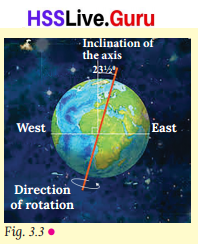
Look at the given figure and answer the following questions related to rotation.
Movements of the Earth Rotation and Revolution Class 8 Notes Questions and Answers Social Science Chapter 3 1
Answer:
Movements of the Earth Rotation and Revolution Class 8 Notes Questions and Answers Social Science Chapter 3 2

Direction of the Earth’s rotation West to East
Tilt of the Earth’s axis 23 1/2°

Question 2.
Some facts related to rotation are given below. Complete the table by finding out the reasons behind these facts.
Answer:

The sun rises in the east and sets in the west. The direction of rotation of the Earth is from west to east.
Freely moving bodies get deflected in their direction in both hemispheres. Coriolis effect.

Movements of the Earth: Rotation and Revolution Class 8 Notes Questions and Answers Social Science Chapter 3

Question 3.
Have you identified 2024 as a leap year from the given calendar?
Find out five consecutive leap years after 2024.
Movements of the Earth Rotation and Revolution Class 8 Notes Questions and Answers Social Science Chapter 3 3
Answer:
The next five leap years after 2024 are: 2028, 2032, 2036, 2040, 2044.

Question 4.
Observe the picture and find answers
Movements of the Earth Rotation and Revolution Class 8 Notes Questions and Answers Social Science Chapter 3 4
a. On which latitude do the Sun’s rays fall vertically?
b. On which days does this happen?
Answer:
a. Equator
b. 21st March and 23rd September

Question 5.
Find out the duration of daytime at your place on 21st March and 23rd September based on the time of sunrise and sunset given in the calendar.
Answer:
Duration of daytime in march 21st is 12 hours and in September 23rd is 12 hours.

Question 6.
a. In which direction does the apparent position of the sun shift from 21st March onwards?
b. On which latitude do the sun’s rays fall vertically on 21st June?
Movements of the Earth Rotation and Revolution Class 8 Notes Questions and Answers Social Science Chapter 3 5
Answer:
a. From March 21st, the relative position of the Sun in the Northern Hemisphere moves towards the northern line.
b. On June 21st, the Sun’s rays fall vertically directly above the northern line.

Question 7.
The table showing the length of day in different latitudes on the summer solstice (June 21) is given below.

Latitude Length of the day
90° North 24 hours
66 1/2° North 24 hours
23 1/2° North 13 hours 27 minutes
12 hours
23 1/2° South 10 hours 33 minutes
66 1/2° South Nil
90° South Nil

What are the changes that happen to the length of day in the southern hemisphere on the summer solstice (June 21)?
Answer:
On the summer solstice (June 21), the Southern Hemisphere is tilted away from the Sun. As a result, the length of the day decreases as we move from the equator towards the South Pole. At 23 1/2° South, the day is shorter than 12 hours (10 hours 33 minutes), and it continues to decrease. At 66 1/2° South and 90° South, there is no daylight at all (0 hours), meaning these areas experience polar night.

Movements of the Earth: Rotation and Revolution Class 8 Notes Questions and Answers Social Science Chapter 3

Question 8.
What will be the duration of the night in the southern polar regions when there is daylight for six months in the northern polar regions?
Answer:
The southern polar regions experience continuous darkness. Therefore, the duration of the night in the southern polar regions during this period is six months.

Question 9.
a. In which direction does the Sun’s apparent position shift from 23rd September onwards?
b. On which latitude do the Sun’s rays fall vertically on 22nd December?
Movements of the Earth Rotation and Revolution Class 8 Notes Questions and Answers Social Science Chapter 3 6
Answer:
a. The Sun’s apparent position shifts from the equator to the Tropic of Capricorn during the period from 23rd September to 22nd December. As
b. On December 22, the sun’s rays fall vertically directly above the southern hemisphere.

Question 10.
The table shows the duration of daytime in different latitudes on the winter solstice (December 22). What are the changes that happen to the length of the day in the northern hemisphere on the Winter Solstice (December 22)?

Latitude Length of the day
90° North Nil
66 1/2° North Nil
23 1/2° North 10 hours 33 minutes
12 hours
23 1/2°  South 13 hours 27 minutes
66 1/2°  South 24 hours
90° South 24 hours

Answer:
On December 22 (Winter Solstice), the Northern Hemisphere has its shortest day.

Question 11.
Complete the table.
Movements of the Earth Rotation and Revolution Class 8 Notes Questions and Answers Social Science Chapter 3 7
Answer:
Movements of the Earth Rotation and Revolution Class 8 Notes Questions and Answers Social Science Chapter 3 8

Question 12.
Observe the table about the different seasons in northern and southern hemispheres and write the answers for the questions given below.
Movements of the Earth Rotation and Revolution Class 8 Notes Questions and Answers Social Science Chapter 3 9
a. What change happens to the apparent movement of the Sun when it is summer season in the northern hemisphere?
b. What will the season be in the northern hemisphere when it is autumn in the southern hemisphere?
c. Which season is experienced in the southern hemisphere from 23rd September to 22nd December?
d. Name the season in the southern hemisphere when the Sun’s apparent position shifts from the Tropic of Capricorn to the equator.
Answer:
a. From the Tropic of Cancer to the Equator
b. Spring
c. Spring
d. Summer

Question 13.
What will be the time at 1° East and 1° West when it is 10:00 A.M. at Greenwich Meridian (0° longitude)?
Movements of the Earth Rotation and Revolution Class 8 Notes Questions and Answers Social Science Chapter 3 10
Answer:
Movements of the Earth Rotation and Revolution Class 8 Notes Questions and Answers Social Science Chapter 3 11

Movements of the Earth: Rotation and Revolution Class 8 Notes Questions and Answers Social Science Chapter 3

Question 14.
When it is 9.00 P.M. at Greenwich Meridian (0° longitude) what will (he time be at 30° East?
Movements of the Earth Rotation and Revolution Class 8 Notes Questions and Answers Social Science Chapter 3 12
Answer:
Movements of the Earth Rotation and Revolution Class 8 Notes Questions and Answers Social Science Chapter 3 13

Question 15.
What is the time difference between Greenwich Meridian (0° longitude) and Indian Standard Meridian (82 1/2° East)?
Answer:
The Indian Standard Meridian is at 82 1/2° East of the Greenwich Meridian (0°).
Since the Earth rotates 15° per hour, each 1° = 4 minutes of time.
Time difference = 82 1/2° × 4
= 330 Minutes
= 330/ 60
= 5 hours 30 minutes

Question 16.
In Figure given below what is the time and date at 180° East and 180° West when it is December 25 evening 6 p.m. at Greenwich Meridian?
Movements of the Earth Rotation and Revolution Class 8 Notes Questions and Answers Social Science Chapter 3 14
Answer:

  • At 180° East: 180° × 4 minutes =12 hours ahead of GMT
    So, 6:00 p.m. + 12 hours = 6:00 a.m., December 26
  • At 180° West: 180° × 4 minutes = 12 hours behind GMT
    So, 6:00 p.m. – 12 hours = 6:00 a.m.. December 25

Class 8 Movements of the Earth: Rotation and Revolution Questions and Answers Extended Activities

Question 1.
Observe the changes in nature during the different seasons in your locality and note down the same in the Social Science Observation Book.
Answer:
(Hints)

Seasons Changes
Spring • The weather is pleasant.
• Flowers bloom everywhere.
• Trees grow new green leaves.
• Birds are active and chirping.
Summer • Days are hot and sunny.
• People wear light cotton clothes.
• Water levels go down.
• Fans and coolers are used more.
Autumn • Leaves change colour and fall from trees.
• The weather becomes cooler.
• The sky is usually clear.
• Fields are harvested in many areas.
Winter • Days are cold, nights are colder.
• People wear sweaters and jackets.
• Mornings may be foggy.
• Trees may look bare.

Question 2.
Calculate the time duration of day and night in your place on 22nd December and 21st June based on the time of sunrise and sunset.
Answer:
In our area, on December 22, sunrise is at 6:43 am and sunset is at 6:06 pm. The length of the day is 11 hours and 23 minutes. On June 21, sunrise is at 6:08 am and sunset is at 6:45 pm. The length of the day is 12 hours and 37 minutes.

Movements of the Earth: Rotation and Revolution Class 8 Notes Pdf

Std 8 Social Science Movements of the Earth: Rotation and Revolution Notes

  • Rotation is the spinning of the Earth on its imaginary axis.
  • The direction of rotation of the Earth is from the west to the east.
  • The sun rises in the east and sets in the west.
  • The time taken for the Earth to complete one rotation is 24 hours (23 hours 56 minutes 4 seconds).
  • While rotating on its axis, the Earth revolves around the Sun in a fixed orbit. This is known as Revolution.
  • The time taken to complete one revolution in the elliptical orbit is 365 days.
  • 365 days is considered as one year for practical convenience.
  • The tilt of the Earth’s axis is maintained at an angle of 23 1/2° throughout the revolution, and the Sun’s apparent position moves northward and southward between the Tropic of Cancer and the Tropic of Capricorn.
  • 21st March is known as Spring Equinox and 23rd September is Autumnal Equinox.
  • Similar to the Earth and the Moon, the Sun also has two movements – rotation and revolution.
  • Due to the apparent shift in the position of the Sun, different places experience specific weather patterns. These patterns are known as seasons.
  • The revolution of the Earth and variations in the availability of solar energy are the reasons for the occurrence of the seasons.
  • The Earth takes 24 hours to complete one rotation or to spin 360° on its axis. This is the time taken to complete one rotation.
  • The time calculated based on the length of the shadow and position of the Sun is termed as the Local time.
  • Time worldwide is calculated based on GMT.

INTRODUCTION

This chapter, “Movements of the Earth: Rotation and Revolution”, helps us to understand how the movements of the Earth affect our daily life. The Earth rotates on its axis, causing day and night. It also revolves around the Sun, leading to the change of seasons like summer, winter, spring, and autumn. Due to these movements, the Sun appears to move across the sky. This phenomenon is known as the apparent movement of the Sun. These movements help us measure time, and since different places on Earth experience different times, the world is divided into time zones. By learning about rotation, revolution, and their impact on seasons and time, we can gain a deeper understanding of the world around us.

Movements of the Earth: Rotation and Revolution Class 8 Notes Questions and Answers Social Science Chapter 3

ROTATION

  • Rotation is the spinning of the Earth on its imaginary axis.
  • The direction of rotation of the Earth is from the west to the east.
  • The sun rises in the east and sets in the west.

Movements of the Earth Rotation and Revolution Class 8 Notes Questions and Answers Social Science Chapter 3 15

DAY AND NIGHT

  • The time taken for the Earth to complete one rotation is 24 hours (23 hours 56 minutes 4 seconds).
  • The Earth receives light from the Sun.
  • During rotation, the part of the Earth facing the Sun has daytime and the other part experiences night.
  • The imaginary line that demarcates day and night on the Earth is called the Circle of Illumination.
  • This circle of illumination is not parallel to the Earth’s Axis.

Movements of the Earth Rotation and Revolution Class 8 Notes Questions and Answers Social Science Chapter 3 16

Mars & Uranus
The direction of rotation of all planets except the Mars and the Uranus is from the west to the east.
The direction of rotation of Mars and Uranus is in the opposite direction, that is, from the east to the west.

CORIOLIS EFFECT
Movements of the Earth Rotation and Revolution Class 8 Notes Questions and Answers Social Science Chapter 3 17

REVOLUTION

  • While rotating on its axis, the Earth revolves around the Sun in a fixed orbit. This is known as Revolution.
  • The time taken to complete one revolution in the elliptical orbit is 365 days.
  • 365 days is considered as one year for practical convenience.
  • The fraction of 14 days is added once in 4 years to February, making it 29 days. Thus, the year that has 366 days is called a leap year.

Movements of the Earth Rotation and Revolution Class 8 Notes Questions and Answers Social Science Chapter 3 18

PERIHELION AND APHELION

  • Since the Earth’s orbit is elliptical, there is a difference in the distance between the Earth and the Sun.
  • The day on which the Earth comes closest to the Sun during revolution (147 million kilometres) is known as Perihelion.
  • This happens in the month of January (around 3rd January). The distance between the Sun and the Earth will be at a maximum (152 million kilometres) in the month of July (around 4th July). This is called Aphelion.
  • The speed of revolution of the Earth is around 30 km per second. The distance between the Earth and the Sun causes a difference in gravitational force and the speed of revolution.

Movements of the Earth Rotation and Revolution Class 8 Notes Questions and Answers Social Science Chapter 3 19
Precession
Precession is another movement of the Earth, like rotation and revolution. This is the axial rotation of the Earth. As given in the picture, when the Earth takes twenty-four hours to complete one rotation, it takes around 26000 years for the Earth’s axis to complete one circle slowly.
Movements of the Earth Rotation and Revolution Class 8 Notes Questions and Answers Social Science Chapter 3 20

APPARENT MOVEMENT OF THE SUN

  • The tilt of the Earth’s axis is maintained at an angle of 23 1/2° throughout the revolution, and the Sun’s apparent position moves northward and southward between the Tropic of Cancer and the Tropic of Capricorn.
  • This apparent shift in the Sun’s position is called the apparent movement of the Sun.

Movements of the Earth Rotation and Revolution Class 8 Notes Questions and Answers Social Science Chapter 3 21

EQUINOX

  • During the Revolution, on 21st March and 23rd September, the sun’s rays fall vertically on the equator.
  • The duration of day and night will be equal on both hemispheres on these days.
  • These days are called equinoxes. 21st March is known as Spring Equinox and 23rd September is Autumnal Equinox.

Movements of the Earth: Rotation and Revolution Class 8 Notes Questions and Answers Social Science Chapter 3

SUMMER SOLSTICS
Movements of the Earth Rotation and Revolution Class 8 Notes Questions and Answers Social Science Chapter 3 22

Movements of the Sun

Similar to the Earth and the Moon, the Sun also has two movements- rotation and revolution. The Sun completes its rotation on its axis in 27 days. It takes around 230 to 250 million years for the solar system, including the sun, to revolve around the centre of the Galaxy, called the Milky Way.

WINTER SOLSTICS
Movements of the Earth Rotation and Revolution Class 8 Notes Questions and Answers Social Science Chapter 3 23

Aurora

Aurora is seen in the polar regions during winter months when strong solar winds are experienced. Aurora is the natural coloured light in the atmosphere at high latitudes. It is called Arora Borealis in the Northern Polar region and Aurora Australis in the Southern polar region.

  • Following the winter solstice (December 22), the apparent movement of the Sun from Tropic of Capricorn (23/1/2° South) to Tropic of Cancer (23/1/2° North) is known as the apparent movement of the Sun towards the North (Uttarayanam).
  • The shift in the apparent position of the Sun after the Summer Solstice (June 21) from the Tropic of Cancer (23 1/2° North) to Tropic of Capricorn (23/1/2° South) is known as the apparent movement of the Sun towards South (Dakshinayanam).

Movements of the Earth Rotation and Revolution Class 8 Notes Questions and Answers Social Science Chapter 3 24

SEASONS

  • Due to the apparent shift in the position of the Sun, different places experience specific weather patterns. These patterns are known as seasons.
  • The revolution of the Earth and variations in the availability of solar energy is the reason for the occurrence of the seasons.
  • The occurrence of spring, summer, autumn and winter in a cyclical manner during a year is called seasonal change.

Different seasons and their Characteristics

Spring • Plants bloom and produce fruits.
• During this period duration of daytime gradually increases.
Summer • High atmospheric temperature
• Generally longer days
Autumn • Trees shed their leaves before the arrival of winter.
• During this period duration of daytime gradually decreases.
Winter • low atmospheric temperature
• SnowfallGenerally longer nights

Movements of the Earth Rotation and Revolution Class 8 Notes Questions and Answers Social Science Chapter 3 25

TIME
Movements of the Earth Rotation and Revolution Class 8 Notes Questions and Answers Social Science Chapter 3 26

  • The Earth takes 24 hours to complete one rotation or to spin 360° on its axis.
  • This is the time taken to complete one rotation.
    • If it takes 1 hour to turn 15°, how much time will it take to turn 1°?
      15° = 1 hour = 60 minutes
      1° = \(\frac{60}{15}\) = 4 minutes
      The proportionate time difference for 1° longitudinal extent is 4 minutes.

LOCAL TIME

  • In the early days, local time was calculated based on the shadow and the overhead position of the Sun.
  • It was considered to be noon when the Sun is vertically overhead. Length of the shadow is the shortest at this time.
  • Thus, the time calculated based on the length of the shadow and position of the Sun is termed as the Local time.

STANDARD TIME
Movements of the Earth Rotation and Revolution Class 8 Notes Questions and Answers Social Science Chapter 3 27

Movements of the Earth: Rotation and Revolution Class 8 Notes Questions and Answers Social Science Chapter 3

GREENWICH MEAN TIME

  • Circles of latitude decrease in size from equator to poles, but all longitudes are equal semi-circles.
  • The Prime Meridian (0° meridian) passes through the Royal Observatory, Greenwich (England).
  • The local time at the Prime Meridian is called Greenwich Mean Time (GMT).
  • Time worldwide is calculated based on GMT.
  • As Earth rotates west to east, time adds 4 minutes per degree east and subtracts 4 minutes per degree west of Greenwich.

INDIAN STANDARD TIME

  • There’s a 30° longitudinal difference between Arunachal Pradesh (97°.25’ East) and Gujarat (68°.7’ East).
  • This creates a 2-hour local time difference between the two ends of India.
  • To avoid confusion, a Standard Time is set for the whole country.
  • The 82 1/2° East longitude is chosen as the Standard Meridian of India.
  • The local time at this meridian is called the Indian Standard Time (IST).

TIME ZONES

  • Based on international understanding, the world has been divided into 24 zones with 1 hour difference. These are time zones. Each time zone has 15° longitudinal distance.
  • Countries like Russia, the U.S.A., and Australia, with large longitudinal extensions, have many time
    Zones and standard time.

INTERNATIONAL DATE LINE

  • 180° East and 180° West refer to the same longitude.
  • There’s a 24-hour time difference across this line.
  • Eastward travellers lose a day, while westward travellers gain a day.
  • This line is called the International Date Line (IDL).
  • Based on global agreement, IDL marks the change of calendar date.
  • To avoid two dates in one country, the line is adjusted to skip populated areas in the Pacific Ocean.
  • Earth’s rotation and revolution affect time, seasons, and daily life.
  • These changes impact the social and cultural life of people worldwide.

Movements of the Earth Rotation and Revolution Class 8 Notes Questions and Answers Social Science Chapter 3 28
Movements of the Earth Rotation and Revolution Class 8 Notes Questions and Answers Social Science Chapter 3 29

Towards the Emergence of the National Movement Class 8 Notes Questions and Answers Social Science Chapter 2

By reviewing Kerala Syllabus 8th Standard Social Science Notes Pdf and Class 8 Social Science Chapter 2 Towards the Emergence of the National Movement Notes Questions and Answers Kerala SCERT Solutions, students can improve their conceptual understanding.

Class 8 Social Science Chapter 2 Towards the Emergence of the National Movement Notes Questions and Answers

Class 8 Social Science Towards the Emergence of the National Movement Notes Questions and Answers

Class 8 Social Science Chapter 2 Question Answer Kerala Syllabus

Towards the Emergence of the National Movement Class 8 Notes Questions and Answers Social Science Chapter 2 1
Question 1.
Did you listen to the conversation given above? This is a part of the play Nil Darpan written by Bengali literary and social reformer Dinabandhu Mitra. What can be learned from this Conversation?
Answer:

  • The need to fight against foreign tyranny
  • Emancipation from economic exploitation
  • The need to stand together.
  • The importance of achieving rights.

Question 2.
How did Western education help in developing nationalism among Indians? Discuss and prepare notes.
Answer:
Modern education spread in India at the beginning of the nineteenth century. The English educated Indians became conscious of democracy, freedom, egalitarianism, equal justice, scientific temper and civil rights. Indians who got acquainted with these new ideas wondered how their country came under the British rule. They constantly talked about the need to end the British rule. English became the common language of exchange of ideas for people coming from different parts of the country. Western education helped Indians to understand about the economic and social weaknesses of the country. This led to the emergence of nationalism.

Towards the Emergence of the National Movement Class 8 Notes Questions and Answers Social Science Chapter 2

Question 3.
Prepare a short description on ‘The Role of Press in Developing Nationalism.’
Answer:
Many newspapers in English and regional languages came into existence at that time. The social reformer Raja Ram Mohan Roy pioneered journalism in India. The newspapers he started were Sambad Kaumudi in Bengali and Mirat ul-Akbar in Persian. Such newspapers were able to respond and criticise the British policies, and patronise a critical mindset against exploitation. Some important newspapers which played a decisive role in the development of modern ideas and nationalism are:

  • Amrita Bazar Patrika: Bengali
  • The Hindu, The Times of India: English
  • Mathrubhumi, Al Ameen: Malayalam

Question 4.
Prepare a note analysing the activities of Raja Ram Mohan Roy, Jyotirao Phule and Pandita Ramabai.
Answer:
SOCIAL REFORM MOVEMENTS

  • Modern education helped to realise the need to eliminate false beliefs and superstitions that prevailed in society.
  • Through social reform activities, the self-confidence of Indians grew and this led to the growth of nationalism.

Early Reformers in India and their activities:
Raja Ram Mohan Roy
Raja Ram Mohan Roy initiated social reforms in India. Bom in Bengal in 1772, he had profound knowledge in Hinduism, Islam, Christianity, and Judaism. Roy was a multilingual scholar, influenced by the ideals of French Revolution.
Towards the Emergence of the National Movement Class 8 Notes Questions and Answers Social Science Chapter 2 2
Jyotirao Phule
Jyotirao Phule was a social reformer who fought for the rights of people who were considered lower caste in Maharastra and for the women. He formed an organisation named Satyashodhak Samaj for social reformation. This organisation made efforts for widow marriage and to provide protection to children of widows. He established many educational institutions for Women and Dalits. The people of Maharashtra respectfully called him ‘Mahatma’. His life partner, Savitribai Phule also accompanied him in all his activities. Savitribai also participated in educational activities by establishing several schools for girls and night schools.

Pandita Ramabai

  • Pandita Ramabai was a feminine presence in the field of social reforms.
  • A native of Karnataka, Ramabai mastered languages such as Sanskrit, Marathi and Bengali.
  • Ramabai was honoured with the title of ‘Pandita’ by the teachers of the University of Calcutta for her Knowledge in Sanskrit literature.

Pandita Ramabai fought against child marriage and started several schools for the education of widows and girls. An organisation called ‘Arya Mahila Samaj’ was established for such activities. A shelter called ‘Sharada Sadan’ was started for the rehabilitation of widows, and a project called Mukti Mission was started to provide vocational training for women. She participated in the conference of the Indian National Congress held in Bombay in 1889.

Other Important Social Reform Movements of India and their Founders.

Social Reform Movements Founders
Prarthana Samaj Atmaram Pandurang
Arya Samaj Swami Dayananda Saraswati
Aligarh Movement Sir Syed Ahmad Khan
Theosophical Society Madame Blavatsky, Colonel Olcott
Ramakrishna Mission Swami Vivekananda
Hitakarini Samaj Veeresalingam Pantulu
Swabhimana Prasthanam E. V. Ramasamy Naicker
Sree Narayana Dharma Paripalana Yogam Sree Narayana Guru
Sadhujana Paripalana Sangham Ayyankali

Question 5.
Prepare a seminar paper on the topic ‘Factors that contributed to the growth of Indian nationalism.’ Indicators:
• Economic policy
• Social reform movements
• Literature and newspapers
• Western education
• Transportation and communication
Answer:
Economic policy: India had become a colony for the collection of raw materials for the British industries and also a market for the British products. Economic exploitation was the aim of the British. The policies adopted by them for this led to unemployment and poverty in India. Various categories like farmers, artisans, small traders and tribal communities started fighting against the British.

Social reform movements: Modern education helped to realise the need to eliminate false beliefs and superstitions that prevailed in society. Raja Ram Mohan Roy, Jyotirao Phule and Pandita Ramabai were among the early social reformers of India who worked for social reform. Through social reform activities, the self-confidence of Indians grew and this led to the growth of nationalism.

Literature and newspapers: Literary works and newspapers played an important role in spreading nationalism in India. The protest against the British had reflections in literature. The sufferings, neglect and exploitation faced by the people in different parts of the country became themes in literary works. The works of prominent writers like Dinabandhu Mitra, Bankim Chandra Chatterjee, Rabindranath Tagore, Vallathol Narayana Menon, and Subramania Bharati played an important role in inculcating nationalism among the people.

Modern education spread in India at the beginning of the nineteenth century. The English educated Indians became conscious of democracy, freedom, egalitarianism, equal justice, scientific temper and civil rights. Indians who got acquainted with these new ideas wondered how their country came under the British mle. They constantly talked about the need to end the British rule. English became the common language of exchange of ideas for people coming from different parts of the country. Western education helped Indians to understand about the economic and social weaknesses of the country. This led to the emergence of nationalism.

Western education: Modern education spread in India at the beginning of the nineteenth century. The English educated Indians became conscious of democracy, freedom, egalitarianism, equal justice, scientific temper and civil rights. Indians who got acquainted with these new ideas wondered how their country came under the British mle. They constantly talked about the need to end the British -mle. English became the common language of exchange of ideas for people coming from different parts of the country. Western education helped Indians to understand about the economic and social weaknesses of the country. This led to the emergence of nationalism.

Transportation and communication: The British expanded transport and communication facilities in India for trade, industry, and military purposes. They started the railways, postal system, and telegraph services. They also improved the road transport system to ease the movement of goods. These facilities helped people to travel to all parts of India, communicate and understand each other. In this way, the idea of nationalism emerged and the national movement strengthened. The implementation of a unified administrative system, legal system, and currency system also created a sense of unity among the people.

Towards the Emergence of the National Movement Class 8 Notes Questions and Answers Social Science Chapter 2

Question 6.
Discuss and list the limitations of early political movements.
Answer:

  1. The organisations did not have an all-India character.
  2. The activities were confined to certain provinces and regions.
  3. The people could not be politically aware.

Question 7.
What have you learned regarding the formation of the Indian National Congress?
Answer:

  1. Indian National Congress was formed in 1885.
  2. The chief organiser was Allan Octavian Hume.
  3. There were 72 participants.
  4. W. C. Banerjee presided over the meeting.

Question 8.
The early objectives of the Indian National Congress helped to develop a sense of nationalism in India. Discuss.
Answer:

  1. The declared objectives of the Indian National Congress are given below.
  2. To foster friendly relation among political activists in different parts of India.
  3. To foster and strengthen a sense of national unity irrespective of caste, religion and province.
  4. Formulate and give shape to common needs and present them to the British Government.
  5. Form a public opinion and organise people in the country.
  6. Allow centres in India for All India Competitive Examinations as well.

Question 9.
What was the real motive behind the partition of Bengal?
Answer:
The British authorities devised various strategies to weaken the Congress-led struggles. The most important of these was the Partition of Bengal. The aim was to divide the province of Bengal into two which was the stronghold of the nationalist movement.

Question 10.
List the facts that can be gleaned about the Swadeshi Movement from this description.
Towards the Emergence of the National Movement Class 8 Notes Questions and Answers Social Science Chapter 2 3
‘In the days of strength, the Swadeshi movement coloured the fabric of our social and domestic life. Wedding presents comprising foreign materials which could be made in India were returned. Priests often objected to officiating at ceremonies in which things were offered to the gods. Guests refused to participate in celebrations where foreign salt and sugar used.’
Answer:

  • Wedding gifts which included foreign objects were returned.
  • Priests often objected to officiating at ceremonies in which things were offered to the gods.
  • Guests refused to participate in celebrations where foreign salt and sugar used.

Question 11.
Compare the working methods of the moderates with that of the extremists in the Indian National Movement and prepare a note.
Answer:

Moderates Extremists
• There were differences of opinion among the leaders regarding the working methods of the Indian National Congress.
• The early leadership was not ready for an open struggle against the British. They were known as moderates.
• Chief among them were Pherozshah Mehta, Gopalakrishna Gokhale and Dadabhai Naoroji.
• They propagated their ideas through peaceful and bloodless struggles, meetings, speeches and resolutions.
• A group, dissatisfied with the ideas and activities of the moderates, became strong in the Congress. They were known as extremists.
• Bal Gangadhara Tilak, Bipin Chandra Pal and Lala Lajpat Rai were prominent among them.
• Their mode of action was quite different from those of the moderates.
• They adopted revolutionary methods of action like swadeshi and boycott to argue that freedom could be achieved only through strong open struggle.

Towards the Emergence of the National Movement Class 8 Notes Questions and Answers Social Science Chapter 2

Question 12.
Prepare a seminar paper on the topic “The influence of Swadeshi Movement in the Indian freedom struggle.”
Answer:
Important points for seminar paper preparation:

  • The protests following the partition of Bengal in 1905 developed into a major movement known as the Swadeshi Movement.
  • The aim of the Swadeshi movement was to boycott British products and thus eliminate the government’s income from trade.
  • Many textile mills, soap factories, match factories, handloom establishments, national banks and insurance companies were started.
  • Bengal Chemical Store started by Acharya P. C. Roy, Swadeshi Store started by Rabindranath Tagore, the Swadeshi Steem Navigation Company started under the leadership of V. Chidambaram Pillai and the Steel Factory established by Jamshedji Tata were formed as part of the Swadeshi Movement.
  • The Swadeshi movement took the national struggle to the common man.

Question 13.
The Partition of Bengal and the Minto-Morley Reforms are examples of the British policy of ‘divide and rule. Record your response to this statement.
Answer:
Partition of Bengal: The British authorities devised various strategies to weaken the Congress-led struggles. The most important of these was the Partition of Bengal. The aim was to divide the province of Bengal into two which was the stronghold of the nationalist movement. Lord Curzon, the British Viceroy, argued that the existing province of Bengal was vast and partition was necessary for efficient administration. Bengal was divided into East Bengal and West Bengal. East Bengal was a Muslim-majority region and West Bengal was a Hindu-majority region.

Minto-Morley Reforms: In Minto Morley reforms of 1909 the main provisions is the provision of separate constituencies for Muslims and expansion of the functions and powers of the legislatures. The intention behind these reforms was to divide the people on the basis of religion.

Class 8 Towards the Emergence of the National Movement Questions and Answers Extended Activities

Question 1.
Add more dialogues to the play ‘Nil Darpan’ and perform a role play.
Answer:
(Hints)

  • Step 1: Understand the Story (Nil Darpan shows how Indian farmers were forced by British planters to grow indigo, which destroyed their land and lives. The farmers start to resist together.)
  • Step 2: Choose Characters
  • Step 3: Add Simple Dialogues
  • Step 4: Practice the Role Play
  • Step 5: Use Simple Props and Costumes
  • Step 6: Perform in Class

Question 2.
Prepare a digital magazine/digital presentation including various social reformers in India and their activities.
Answer:

Social Reformer Their Activities
Towards the Emergence of the National Movement Class 8 Notes Questions and Answers Social Science Chapter 2 4 • Born in Bengal in 1772, he had profound knowledge in Hinduism, Islam, Christianity, and Judaism.
• Roy was a multilingual scholar, influenced by the ideals of French Revolution.
• Started many schools to impart modern education.
• Started Brahma Samaj.
• Fought against social evils.
Towards the Emergence of the National Movement Class 8 Notes Questions and Answers Social Science Chapter 2 5 • He fought for the rights of people who were considered lower caste in Maharastra and for the women.
• He formed an organisation named Satyashodhak Samaj.
• This organisation made efforts for widow marriage and to provide protection to children of widows.
• He established many educational institutions for Women and Dalits.
Towards the Emergence of the National Movement Class 8 Notes Questions and Answers Social Science Chapter 2 6 • She was a feminine presence in the field of social reforms.
• She fought against child marriage and started several schools for the education of widows and girls.
• An organisation called ‘Arya Mahila Samaj’ was established for her activities.
• A shelter called ‘Sharada Sadan’ was started for the rehabilitation of widows.
• A project called Mukti Mission was started to provide vocational training for women.

Question 3.
Collect and perform nationalistic poems and songs.
Answer:
(Hints: Some examples for nationalistic poems and Songs)

  • “Vande Mataram” by Bankim Chandra Chatterjee.
  • “Where the Mind is Without Fear” by Rabindranath Tagore.

Towards the Emergence of the National Movement Class 8 Notes Pdf

Std 8 Social Science Towards the Emergence of the National Movement Notes

  • Before independence, India was divided into many princely states. Segregation existed in all spheres like caste, religion, dress, language and culture.
  • In the second half of the nineteenth century, beyond all differences, a sense of unity emerged among Indians.
  • A strong anti-British feeling was the basis of this sense of unity of the Indian people. This sense of unity is called Nationalism.
  • Economic Policy, Western Education, Literature and Newspapers, Social Reform Movements, Transport and, Communication etc are paved The way for the emergence of nationalism.
  • New political organisations were formed in the second half of the nineteenth century.
  • The Indian National Congress, a national organization, was formed in 1885.
  • The declared objectives of the Indian National Congress are:
    • To foster friendly relation among political activists in different parts of India.
    • To foster and strengthen a sense of national unity irrespective of caste, religion and province.
    • Formulate and give shape to common needs and present them to the British Government.
    • Form a public opinion and organise people in the country.
    • Allow centres in India for All India Competitive Examinations as well.
  • The British authorities devised various strategies to weaken the Congress-led struggles. The most important of these was the Partition of Bengal.
  • Bengal was divided into East Bengal and West Bengal. East Bengal was a Muslim-majority region and West Bengal was a Hindu-majority region.
  • The main mode of struggle of the Swadeshi movement was the use of Indian goods and the boycott of British goods.
  • The Swadeshi Movement was able to spread the Indian freedom movement at the national level and contribute the Swadeshi as a new way of freedom struggle.
  • The Swadeshi Movement brought the national struggle closer to the common people.
  • Swadeshi Samitis were voluntary organisations that worked to spread the message of the Swadeshi Movement and organise the people.
  • There were differences of opinion among the leaders regarding the working methods of the Indian National Congress.
  • Another group, dissatisfied with the ideas and activities of the moderates, became strong in the Congress. They were known as extremists.
  • The differences between the moderates and the extremists became acute at the Surat Congress conference in 1907. It even became impossible to continue the conference. These developments led to a split in the Congress.
  • The main provisions of the Minto Morley reforms were the provision of separate constituencies for Muslims and expansion of the functions and powers of the legislatures.
  • Lala Lajpat Rai, Bal Gangadhara Tilak and Bipin Chandra Pal were extremist leaders who emphasised the need to end British rule by giving more strength to the Swadeshi movement.
  • During the First World War, which started in 1914, political activities were revived. It was led by an organisation called the Home Rule League.
  • The aim of the Home Rule League was Home Rule or Self-Government.
  • Annie Besant is the first woman president of the Indian National Congress.
  • The annual conference of the Congress in 1916 was held in Lucknow.
  • The various exploitative policies of the British and the resistance of the Indian people against them led to the growth of Indian nationalism.

Towards the Emergence of the National Movement Class 8 Notes Questions and Answers Social Science Chapter 2

INTRODUCTION

This Lesson mainly discusses the emergence of the Indian national movement. There are several factors that have led to the emergence of Indian nationalism. The early political movements in India were regional in nature. The first political movement to emerge in India on a national basis was the Indian National Congress. Differences of opinion arose among the leaders of the Indian National Congress, and the Congress split into two groups: Moderates and Extremists..The Swadeshi Movement was an important struggle in the history of the Indian national movement. This period also witnessed the formation of revolutionary movements that differed from the struggle style of the Indian National Congress.

NATIONALISM

  • Before independence, India was divided into many princely states. Segregation existed in all spheres like caste, religion, dress, language and culture.
  • But in the second half of the nineteenth century, beyond all such differences, a sense of unity emerged among Indians.
  • A strong anti-British feeling was the basis of this sense of unity of the Indian people. This sense of unity is called Nationalism.
    Factors that Strengthen Indian Nationalism

ECONOMIC POLICY
India had become a colony for the collection of raw materials for the British industries and also a market for the British products. Economic exploitation was the aim of the British. The policies adopted by them for this led to unemployment and poverty in India. As a result, various categories like farmers, artisans, small traders and tribal communities started fighting against the British. Dadabhai Naoroji, R. C. Dutt, and Mahadev Govind Ranade carried out detailed studies about the economic exploitation by the British. They were the early leaders of the Indian National Movement.

WESTERN EDUCATION
Modern education spread in India at the beginning of the nineteenth century. English education was propagated by the British to highlight their superiority, to subjugate Indians culturally, and mould a section of Indians who would be sympathetic to them. But the English educated Indians became conscious of democracy, freedom, egalitarianism, equal justice, scientific temper and civil rights. Indians who got acquainted with these new ideas wondered how their country came under the British rule. They constantly talked about the need to end the British rule. English became the common language of exchange of ideas for people coming from different parts of the country. Western education helped Indians to understand about the economic and social weaknesses of the country. This led to the emergence of nationalism.

LITERATURE AND NEWSPAPERS
The protest against the British had reflections in literature. The sufferings, neglect and exploitation faced by the people in different parts of the country became themes in literary works. The works of prominent writers of that time like Dinabandhu Mitra, Bankim Chandra Chatterjee, Rabindranath Tagore, Vallathol Narayana Menon, and Subramania Bharati played an important role in inculcating nationalism among the people.

Major national literary figures Language
• Bankim Chandra Chatterjee
• Rabindranath Tagore
Bengali
• Lakshminath Bezbaruah Assamese
• Vishnushastri Chiplunkar Marathi
• Subramania Bharati Tamil
• Bharatendu Harishchandra
• Premchand
Hindi
• Altaf Hussain Hali Urdu
• Vallathol Narayana Menon Malayalam

Many newspapers in English and regional languages came into existence at that time. The social reformer Raja Ram Mohan Roy pioneered journalism in India. The newspapers he started were Sambad Kaumudi in Bengali and Mirat uI-Akbar in Persian. Such newspapers were able to respond and criticise the British policies, and patronise a critical mindset against exploitation.

News Paper Language
Amrita Bazar Patrika Bengali
The Hindu English
The Times of India
Mathrubhumi Malayalam
Al Ameen

The British saw the newspapers as a weapon of propaganda against them and took measures to control them. Important among these is the Vernacular Press Act enacted by Lord Lytton. Indian people stood united against such laws.
Towards the Emergence of the National Movement Class 8 Notes Questions and Answers Social Science Chapter 2 7

Towards the Emergence of the National Movement Class 8 Notes Questions and Answers Social Science Chapter 2

TRANSPORT AND COMMUNICATION
The British expanded transport and communication facilities in India for trade, industry, and military purposes. They started the railways, postal system, and telegraph services. They also improved the road transport system to ease the movement of goods. These facilities helped people to travel to all parts of India, communicate and understand each other. In this way, the idea of nationalism emerged and the national movement strengthened. The implementation of a unified administrative system, legal system, and currency system also created a sense of unity among the people.

FORMATION OF POLITICAL ORGANISATIONS
The opinion that organisations should be formed to unite the people against the British emerged from different parts of India. As a result, new political organisations were formed in the second half of the nineteenth century.

Early political movements Centre of activity National leaders who led the movements
Indian Association Calcutta Surendranath Banerjee, Ananda Mohan Bose
Madras Mahajan Sabha Madras M. Veeraraghavachariar, G. Subramania Iyer, Ananda Charlu
Bombay Presidency Association Bombay Pherozeshah Mehta, K. T. Telang, Badruddin Tyabji

These organisations were not an all India by nature. Their activities were confined to certain provinces and territories. Such organisations led by the rich and the middle class failed to create awareness among the masses politically. In this context, the need to form an all-India organisation was strengthened.

FORMATION OF ALL INDIA ORGANISATION
On December 28, 1885, at 12 noon, a meeting was held in a spacious room at the Gokuldas Tejpal Sanskrit College, Bombay. Seventy-two persons had assembled there. They had worked as representatives of some important organisations in different regions of India. They were different personalities in terms of language, religion and recognition in society. One of the organisers was an Englishman, Allan Octavian Hume. W. C. Banerjee, a lawyer, presided over the meeting that day.

  • The main objective of this conference was to form a general opinion among the social and political activists from different regions.
  • Every year in December, the annual conference of the Indian National Congress was held in different parts of the country.
  • The important leaders of that time were Dadabhai Naoroji, Surendranath Banerjee, Pherozshah Mehta, Badruddin Tyabji, Gopalakrishna Gokhale, Balagangadhara Tilak, P. Ananda Charlu, R. C. Dutt and Ananda Mohan Bose.

Towards the Emergence of the National Movement Class 8 Notes Questions and Answers Social Science Chapter 2 8
Sir.C Sankaran Nair
The first Malayali who became the President of the Indian National Congress. He presided over the Amaravathi Congress in 1897.

PARTITION AND DIVISION
The British authorities devised various strategies to weaken the Congress-led struggles. The most important of these was the Partition of Bengal. The aim was to divide the province of Bengal into two which was the stronghold of the nationalist movement. Lord Curzon, the British Viceroy, argued that the existing province of Bengal was vast and partition was necessary for efficient administration.

Partition of Bengal: Bengal was divided into East Bengal and West Bengal. East Bengal was a Muslim-majority region and West Bengal was a Hindu-majority region.

On October 16, 1905, when the partition was effected, mourning was observed throughout Bengal. A hartal was observed in Calcutta. People also gathered in the streets singing the patriotic song ‘ Amar Sonar Bangla’ composed by Rabindranath Tagore. These protests turned into a massive strike. This is known as the ‘Swadeshi Movement’. The Indian National Movement was energised by the Swadeshi Movement.

The main mode of struggle of this movement was the use of Indian goods and the boycott of British goods. Selfreliance was the main concept of the Swadeshi Movement. The meaning and purpose of the Swadeshi Movement was to promote the success of Swadeshi industries and other enterprises, which meant boycotting British products and thus depriving the government of trade revenue. As part of this,

  • Many textile mills, soap factories, match factories, handloom establishments, national banks and insurance companies were started.
  • Bengal Chemical Store started by Acharya P. C. Roy, Swadeshi Store started by Rabindranath Tagore, the Swadeshi Steem Navigation Company started under the leadership of V. Chidambaram Pillai and the Steel Factory established by Jamshedji Tata were formed as part of the Swadeshi Movement.
  • Such campaigns created awareness of the ideas of the Swadeshi Movement and had a great influence on the Indian people. Through this, the common people, women and students of India became participants in a political movement for the first time.
  • The influence of this movement was felt in the fields of culture, education, economy and politics.
  • The Swadeshi Movement was able to spread the Indian freedom movement at the national level and contribute the Swadeshi as a new way of freedom struggle. The Swadeshi Movement brought the national struggle closer to the common people.

Swadeshi Samitis were voluntary organisations that worked to spread the message of the Swadeshi Movement and organise the people. The Swadeshi Bandhab Samiti formed by Ashwini Kumar Dutt is important here. The main objectives are:

  • Provide physical training to volunteers.
  • Help those who suffer from epidemics and other ailments.
  • Establish Swadeshi Yidyalayas.

MODERATES AND EXTREMISTS
There were differences of opinion among the leaders regarding the working methods of the Indian National Congress. The early leadership was not ready for an open struggle against the British. They were known as moderates. Chief among them were Pherozshah Mehta, Gopalakrishna Gokhale and Dadabhai Naoroji. They propagated their ideas through peaceful and bloodless struggles, meetings, speeches and resolutions.

Another group, dissatisfied with the ideas and activities of the moderates, became strong in the Congress. They were known as extremists. Bal Gangadhara Tilak, Bipin Chandra Pal and Lala Lajpat Rai were prominent among them. Their mode of action was quite different from those of the moderates. They adopted revolutionary methods of action like swadeshi and boycott to argue that freedom could be achieved only through strong open struggle.

  • The differences between the moderates and the extremists became acute at the Surat Congress conference in 1907. It even became impossible to continue the conference. These developments led to a split in the Congress.
  • The British took advantage of the split in the Congress very skillfully. This allowed the British to implement their policy of divide and rule more effectively.
  • The British took strict action against the extremists.
  • The leaders were arrested and jailed. Many leaders, including Balagangadhara Tilak, were exiled and many leaders quit politics.
  • The British implemented some administrative reforms to mitigate popular anger and influence moderates in Congress. The Minto Morley reforms of 1909 were of this type. The main provisions of this reform were the provision of separate constituencies for Muslims and expansion of the functions and powers of the legislatures.

Lal-Bal-Pal
Lala Lajpat Rai, Bal Gangadhara Tilak and Bipin Chandra Pal were extremist leaders who emphasised the need to end British rule by giving more strength to the Swadeshi movement. These leaders are collectively known as Lal-Bal-Pal.

Formation of All India Muslim League

A Muslim delegation led by Aga Khan met Lord Minto at Simla and put forward some demands. They demanded special representation for their community at all levels of government and separate constituencies for Muslims. The Viceroy’s response to these demands was quite favourable. This led to the formation of a separate political organisation for the Muslims and in 1906 the All India Muslim League was founded.

Towards the Emergence of the National Movement Class 8 Notes Questions and Answers Social Science Chapter 2

HOME RULE LEAGUE
During the First World War, which started in 1914, political activities were revived. It was led by an organisation called the Home Rule League. The Home Rule League helmed under the leadership of Annie Besant and Bal Gangadhara Tilak gained popular support in the cities and villages. The aim of this organisation was Home Rule or Self-Government. Annie Besant and Bal Ganghadhara Tilak travelled across the country to promote the Home Rule League and set up many branches. Realising that the Home Rule League’s activities were a threat to British supremacy, the government arrested and imprisoned Annie Besant. Later, she was released from jail and was elected the President of the Congress in Calcutta Conference in 1917. Annie Besant is the first woman president of the Indian National Congress.

UNITY IN LUCKNOW
The annual conference of the Congress in 1916 was held in Lucknow. This conference was notable due to some important decisions. In this conference it was decided that the moderates and extremists should unite and the Indian National Congress and the All India Muslim League should work together.

By Alternative Means
In contrast to the Indian National Congress’s method of struggle, some formed secret revolutionary organisations and resorted to armed struggle. They believed that the Western empire could only be overthrown through violence.

Revolutionary organisations Place Leadership
Anusheelan Samiti Bengal Sachindra Nath Sanyal, Aurobindo Ghosh
Bharat Mata Association Madras Neelakanta Brahmachari, Vanchi Iyer, Aj it Singh
Yugantar Party Bengal Rash Behari Bose, Khudiram Bose
Ghadar party America Lala Hardayal

The various exploitative policies of the British and the resistance of the Indian people against them led to the growth of Indian nationalism. With the formation of the Indian National Congress, the resistance of the Indian people against the British took an organised form. The Swadeshi Movement against the partition of Bengal was the most powerful popular movement of that time. Later, with Gandhiji taking the lead, the freedom struggle became more popular and powerful.

Class 8 Maths Chapter 6 New Numbers Questions and Answers Kerala Syllabus

Students often refer to Kerala State Syllabus SCERT Class 8 Maths Solutions and Class 8 Maths Chapter 6 New Numbers Questions and Answers Notes Pdf to clear their doubts.

SCERT Class 8 Maths Chapter 6 Solutions New Numbers

Class 8 Kerala Syllabus Maths Solutions Chapter 6 New Numbers Questions and Answers

New Numbers Class 8 Questions and Answers Kerala Syllabus

Coloured Numbers & Below Zero (Page No. 98)

Question 1.
Calculate the following.
(i) 4 – 9
(ii) 14 – 29
(iii) 5 – 10
(iv) 25 – 65
(v) \(\frac{1}{2}-\frac{3}{4}\)
(vi) \(\frac{1}{3}-\frac{1}{2}\)
Answer:
(i) 4 – 9 = -(9 – 4) = -5

(ii) 14 – 29 = -(29 – 14) = -15

(iii) 5 – 10 = -(10 – 5) = -5

(iv) 25 – 65 = -(65 – 25) = -40

(v) \(\frac{1}{2}-\frac{3}{4}=-\left(\frac{3}{4}-\frac{1}{2}\right)=-\left(\frac{3}{4}-\frac{2}{4}\right)=-\left(\frac{3-2}{4}\right)=-\frac{1}{4}\)

(vi) \(\frac{1}{3}-\frac{1}{2}=-\left(\frac{1}{2}-\frac{1}{3}\right)=-\left(\frac{3}{6}-\frac{2}{6}\right)=-\frac{1}{6}\)

Addition and Subtraction (Page No. 99)

Question 1.
Calculate the following.
(i) -4 + 9
(ii) -9 + 4
(iii) -15 + 8
(iv) -8 + 15
(v) \(-\frac{1}{2}+\frac{3}{4}\)
(vi) \(-\frac{3}{4}+\frac{1}{2}\)
Answer:
(i) -4 + 9 = 9 – 4 = 5

(ii) -9 + 4 = 4 – 9 = -(9 – 4) = -5

(iii) -15 + 8 = 8 – 15 = -(15 – 8) = -7

(iv) -8 + 15 = 15 – 8 = 7

(v) \(-\frac{1}{2}+\frac{3}{4}=\frac{3}{4}-\frac{1}{2}=\frac{1}{4}\)

(vi) \(-\frac{3}{4}+\frac{1}{2}=\frac{1}{2}-\frac{3}{4}=-\left(\frac{3}{4}-\frac{1}{2}\right)=-\frac{1}{4}\)

Class 8 Maths Chapter 6 New Numbers Questions and Answers Kerala Syllabus

Subtracting Again (Page No. 100)

Question 1.
Do the computations below:
(i) -3 – 1
(ii) -9 + 4
(iii) -10 – 4
(iv) -7 – 8
(v) -1 – 1
(vi) -10 + 20
(vii) 8 – 12
(viii) \(1 \frac{1}{2}-7 \frac{1}{2}\)
(ix) -25 – 3\(\frac {1}{2}\)
(x) \(-\frac{1}{2}-\frac{1}{4}\)
(xi) \(-2 \frac{1}{2}-1 \frac{1}{2}\)
(xii) \(-3 \frac{1}{2}+3 \frac{1}{2}\)
Answer:
(i) -3 – 1 = -(3 + 1) = -4

(ii) -9 + 4 = 4 – 9
= -(9 – 4)
= -5

(iii) -10 – 4 = (10 + 4) = -14

(iv) -7 – 8 = -(7 + 8) = -15

(v) -1 – 1 = -(1 + 1) = -2

(vi) -10 + 20 = 20 – 10 = 10

(vii) 8 – 12 = -(12 – 8) = -4

(viii) \(1 \frac{1}{2}-7 \frac{1}{2}\) = (1 – 7) + \(\left(\frac{1}{2}-\frac{1}{2}\right)\)
= -(7 – 1)
= -6

(ix) -25 – 3\(\frac {1}{2}\)= -(25 + 3\(\frac {1}{2}\)) = -28\(\frac {1}{2}\)

(x) \(-\frac{1}{2}-\frac{1}{4}=-\left(\frac{1}{2}+\frac{1}{4}\right)=-\frac{3}{4}\)

(xi) \(-2 \frac{1}{2}-1 \frac{1}{2}\) = -(2 + 1) – \(\left(\frac{1}{2}+\frac{1}{2}\right)\) = -4

(xii) \(-3 \frac{1}{2}+3 \frac{1}{2}=3 \frac{1}{2}-3 \frac{1}{2}\) = 0

Class 8 Maths Chapter 6 Kerala Syllabus New Numbers Questions and Answers

Class 8 Maths New Numbers Questions and Answers

Question 1.
The maximum temperature for seven consecutive days in a city is 26°C, and the minimum temperature is 21°C. The temperature difference is,
(a) 6°
(b) 5°
(c) 10°
(d) 9°
Answer:
(b) 5°
26 – 21 = 5

Question 2.
If x, y are any two positive numbers, and x < y, then x – y is
(a) Zero
(b) Negative numbers
(c) Positive numbers
(d) Impossible to express exactly
Answer:
(b) Negative number
If x < y then x – y = -(y – x)

Question 3.
If x = -1, y = 3, then x + y is
(a) -1 – 3
(b) 3 – 1
(c) 3 + 1
(d) -3 – 1
Answer:
(b) 3 – 1
If x and y be positive numbers, -x + y = y – x

Question 4.
Considering the temperature at which the water becomes ice is 0°C, then the temperature which represents 7 degrees less than this is,
(a) 0 – 1
(b) 0 – 7
(c) 7 + 7
(d) 7 – 0
Answer:
(b) 0 – 7

Class 8 Maths Chapter 6 New Numbers Questions and Answers Kerala Syllabus

Question 5.
\(3 \frac{1}{3}-1 \frac{1}{3}\) is equal to,
(a) 1
(b) 2
(c) 3
(d) -2
Answer:
(b) 2

Question 6.
Calculate the following.
(i) 3 – 5
(ii) 11 – 12
(iii) 18 – 27
(iv) 37 – 73
(v) \(\frac{1}{3}-\frac{1}{4}\)
(vi) \(\frac{1}{5}-\frac{1}{10}\)
Answer:
(i) 3 – 5 = -(5 – 3) = -2
(ii) 11 – 12 = -(12 – 11) = -1
(iii) 18 – 27 = -(27 – 18) = -9
(iv) 37 – 73 = -(73 – 37) = -36
(v) \(\frac{1}{3}-\frac{1}{4}=\frac{4}{12}-\frac{3}{12}=\frac{4-3}{12}=\frac{1}{12}\)
(vi) \(\frac{1}{5}-\frac{1}{10}=\frac{2}{10}-\frac{1}{10}=\frac{2-1}{10}=\frac{1}{10}\)

Question 7.
Calculate the following.
(i) -7 + 11
(ii) -11 + 17
(iii) -20 + 28
(iv) -11 + 15
(v) \(-\frac{1}{3}+\frac{3}{5}\)
(vi) \(-\frac{3}{5}+\frac{1}{4}\)
Answer:
(i) -7 + 11 = 11 – 7 = 4
(ii) -11 + 17 = 17 – 11 = 6
(iii) -20 + 28 = 28 – 20 = 8
(iv) -11 + 15 = 15 – 11 = 4
(v) \(-\frac{1}{3}+\frac{3}{5}=-\frac{5}{15}+\frac{9}{15}=\frac{9}{15}-\frac{5}{15}=\frac{4}{15}\)
(vi) \(-\frac{3}{5}+\frac{1}{4}=-\frac{12}{20}+\frac{5}{20}=\frac{5}{20}-\frac{12}{20}=-\left(\frac{12}{20}-\frac{5}{20}\right)=-\frac{7}{20}\)

Question 8.
Calculate the following.
(i) -10 – 11
(ii) -8 – 4
(iii) -20 – 8
(iv) -6 – 9
(v) -3 – 3
(vi) -17 + 23
(vii) 19 – 27
Answer:
(i) -10 – 11 = -(10 + 11) = -21
(ii) -8 – 4 = -(8 + 4) = -12
(iii) -20 – 8 = -(20 + 8) = -28
(iv) -6 – 9 = -(6 + 9) = -15
(v) -3 – 3 = -(3 + 3) = -6
(vi) -17 + 23 = 23 – 17 = 6
(vii) 19 – 27 = -(27 – 19) = -8

Question 9.
(a) What is 1 – 2?
(b) Find 1 – 2 + 3 – 4 + 5 – 6 + 7 – 8 + 9 – 10.
Answer:
(a) -(2 – 1) = -1
(b) -1 – 1 – 1 – 1 – 1 = -5

Question 10.
Using this equation x2 – y2 = (x + y)(x – y)
(a) What is 22 – 12?
(b) What is 92 – 102?
(c) Find 12 – 22 + 32 – 42 + …… + 92 – 102?
Answer:
(a) (2 + 1)(2 – 1) = 3 × 1 = 3
(b) -19
(c) -3 – 7 – 9 – 11 – 15 – 19 = -(3 + 7 + 9 + 11 + 15 + 19) = -64

Class 8 Maths Chapter 6 New Numbers Questions and Answers Kerala Syllabus

Question 11.
Write the following in the simplified form.
\(\frac{12-11+10-9+8-7}{6-5+4-3+2-1}\)
Answer:
\(\frac{12-11+10-9+8-7}{6-5+4-3+2-1}=\frac{1+1+1}{1+1+1}=\frac{3}{3}\) = 1

Question 12.
Look at the pattern given below:
1 + 2 + 3 = 2 × 3 = 6
1 + 2 + 3 + 4 + 5 = 3 × 5 = 15
1 + 2 + 3 + 4 + 5 + 6 + 7 = 4 × 7 = 28
(a) Write the sum of the first 9 natural numbers?
(b) Write the sum of the first 25 natural numbers?
(c) What is -1 – 2 – 3 …. -49?
Answer:
(a) 1 + 2 + 3 + 4 + 5 + 6 + 7 + 8 + 9 = 5 × 9 = 45
(b) 13 × 25 = 325
(c) -(1 + 2 + 3 + …… + 49) = -(12 × 49) = -637

Question 13.
Look at the pattern given below:
1 + 3 = 4 = 22
1 + 3 + 5 = 9 = 32
1 + 3 + 5 + 7 = 16 = 42
(a) Complete the next line.
(b) Find the sum of the first 10 odd numbers.
(c) What is the 20th odd number?
(d) What is -1 – 3 – 5 – …….. – 39?
Answer:
(a) 1 + 3 + 5 + 7 + 9 = 25 = 52
(b) 102 = 100
(c) 39
(d) -(1 + 3 + 5 + ……… + 39) = -400

Question 14.
Given below is an unfinished magic square made up of positive numbers and negative numbers. The sum of the numbers in rows, columns, and diagonals is equal.
Class 8 Maths Chapter 6 New Numbers Questions and Answers Kerala Syllabus Extra Questions Q14
Find x + y?
Answer:
Consider the number that can be written in the top right side of the column, be A.
-7 + 6 + A = x + y + A
⇒ -7 + 6 = x + y
⇒ x + y = 6 – 7
⇒ x + y = -1

Question 15.
Calculate \(\frac{1}{7}-\frac{3}{7}+\frac{5}{7}-\frac{7}{7}+\cdots+\frac{21}{7}\)
Answer:
\(\frac{1-3+5-7+9-11+13-15+17-19+21}{7}=\frac{-10+21}{7}\) = \(\frac {11}{7}\)

Class 8 Maths Chapter 6 Notes Kerala Syllabus New Numbers

→ On a number line, the numbers written on the right side of 0 are called positive numbers.

→ Subtracting a positive number from a smaller positive number gives the negative of the number obtained by subtracting the smaller from the larger.
For example: we can write, 2 – 3 = -(3 – 2) = -1

→ x – y = -(y – x) for all positive numbers x and y and x < y

→ Adding the negative of a positive number to a positive number means subtracting the first number from the second.

→ -x + y = y – x for all positive numbers x and y.

→ If from the negative of a positive number, we subtract a positive number, we get the negative of the sum of these positive numbers

→ -x – y = -(x + y) for any two positive numbers x and y.

Class 8 Maths Chapter 6 New Numbers Questions and Answers Kerala Syllabus

Positive numbers, along with the negative signs, are used to describe some specific situations. This type of representation is needed in certain situations. Such as, to express the temperature when the water turns into ice, is less than zero degrees Celsius. To represent these types of numbers, 1°C, -5 °C, we use negative signs with positive numbers. The theoretical minimum temperature is -273.15°C. On the Kelvin scale, this is called absolute zero temperature. In this unit, a new type of number is introduced for the first time. These numbers are the negatives of the positive numbers. Such numbers written with a minus sign are called negative numbers. This makes the word new numbers meaningful.

Coloured Numbers
In a calculating machine, the calculations are done in the order given below:
Class 8 Maths Chapter 6 New Numbers Questions and Answers Kerala Syllabus Notes 1
The values given as input and the values obtained as output are natural numbers.
What is the smallest input value that can be given to get the very smallest output?
Answer:
The smallest output is 1
1 + 10 = 11
11 × 3 = 33
33 + 10 = 43
43 × 3 = 129

Arun and Vinu are in a game. The one who wins the game gets a score of 3, and the one who fails in the game gets a score of 1. Arun wins 6 games. Vinu receives 18 points. How many games are there?
Answer:
Arun wins 6 games. That means Vinu fails in 6 games.
That means, in the score of 18 scored by Vinu, 6 points are obtained from failure.
12 is the score obtained by Vinu in winning the game. That means the score of 4 games.
The total number of games is 6 + 4 = 10.

Below Zero
On a number line, the numbers written on the right side of 0 are called positive numbers. There are different types of numbers, such as natural numbers, integers.
When a – symbol is written along with 2, we can read it as -2. It is a negative number.

Subtracting a positive number from a smaller positive number gives the negative of the number obtained by subtracting the smaller from the larger.
In algebraic form: x – y = -(y – x) for all 0 < x < y

From the two positive numbers, subtract the larger from the smaller.
10 and 13 are two positive numbers.
From the smaller number 10, the larger number is subtracted.
When 13 is subtracted from 10, first 10 is subtracted and then 3 is also subtracted.
When 10 is subtracted from 10, we get 0. And 3 is subtracted from 0, we get -3.
If 13 is subtracted from 10, we get -3. Another way we can say it is that, to subtract 13 from 10, subtract 10 from 13, and put the negative sign with the value.

For example, the normal temperature in a place is 10°C. But in the case of extreme cold, it decreases to 20°C. In the case of extreme cold, what is the temperature?
Answer:
10 – 20 = -(20 – 10) = -10
To subtract 20 from 10, we can subtract 10 from 20 and put the negative sign along with the value.

Worksheet – 1

Question 1.
Find \(7 \frac{1}{2}-10 \frac{1}{2}\)?
Answer:
\(7 \frac{1}{2}-10 \frac{1}{2}=-\left(10 \frac{1}{2}-7 \frac{1}{2}\right)\) = -3

Question 2.
Complete the following calculations.
(a) \(\frac{1}{3}-\frac{1}{2}\)
(b) \(3 \frac{1}{3}-5 \frac{1}{2}\)
Answer:
Class 8 Maths Chapter 6 New Numbers Questions and Answers Kerala Syllabus Notes 2

Worksheet – 2

Question 1.
What should be subtracted from 11\(\frac {1}{3}\) to set 14\(\frac {1}{3}\)?
Answer:
Number should be subtracted = \(11 \frac{1}{3}-14 \frac{1}{3}\)
= \(-\left(14 \frac{1}{3}-11 \frac{1}{3}\right)\)
= \(-\left(3+11 \frac{1}{3}-11 \frac{1}{3}\right)\)
= -3

Class 8 Maths Chapter 6 New Numbers Questions and Answers Kerala Syllabus

Question 2.
What should be subtracted from 7\(\frac {1}{3}\) to get 11\(\frac {2}{3}\)?
Answer:
Number should be subtracted = \(7 \frac{1}{3}-11 \frac{2}{3}\)
= \(-\left(11 \frac{2}{3}-7 \frac{1}{3}\right)\)
= \(-\left((11-7)+\left(\frac{2}{3}-\frac{1}{3}\right)\right)\)
= \(-4 \frac{1}{3}\)

Adding and Subtracting
Adding the negative of a positive number to a positive number means subtracting the first number from the second.
In algebraic form: -x + y = y – x for all positive numbers x and y.

Worksheet – 3

Question 1.
Find \(-1 \frac{1}{2}+3 \frac{1}{2}\)?
Answer:
\(-1 \frac{1}{2}+3 \frac{1}{2}=3 \frac{1}{2}-1 \frac{1}{2}\)
= (3 – 1) + \(\left(\frac{1}{2}-\frac{1}{2}\right)\)
= 2 + 0
= 2

Question 2.
Find \(-3 \frac{1}{5}+7 \frac{2}{5}\)?
Answer:
\(-3 \frac{1}{5}+7 \frac{2}{5}=7 \frac{2}{5}-3 \frac{1}{5}=(7-3)+\left(\frac{2}{5}-\frac{1}{5}\right)=4 \frac{1}{5}\)

Worksheet – 4

Question 1.
Calculating the following:
(a) -6 + 5
(b) \(-3 \frac{1}{2}+1 \frac{1}{2}\)
(c) -11 + 7 – 12 + 4
(d) -10 + 11 – 12 + 13 – …… + 19 – 20 + 21
Answer:
(a) -6 + 5 = 5 – 6
= -(6 – 5)
= -1
(b) \(-3 \frac{1}{2}+1 \frac{1}{2}=1 \frac{1}{2}-3 \cdot \frac{1}{2}=-\left(3 \frac{1}{2}-1 \frac{1}{2}\right)\) = -2
(c) -11 + 7 – 12 + 4 = (7 – 11) + (4 – 12)
= -(11 – 7) – (12 – 4)
= -4 – 8
= -12
(d) -10 + 11 – 12 + 13 …. + 19 – 20 + 21 = (11 – 10) + (13 – 12) + ….. + (21 – 20)
= 1 + 1 + 1 + 1 + 1 + 1
= 6

Subtracting Again
If from the negative of a positive number, we subtract a positive number, we get the negative of the sum of these positive numbers.
In algebraic form: -x – y = -(x + y) for any two positive numbers x and y.

Class 8 Maths Chapter 7 Bisectors Questions and Answers Kerala Syllabus

Students often refer to Kerala State Syllabus SCERT Class 8 Maths Solutions and Class 8 Maths Chapter 7 Bisectors Questions and Answers Notes Pdf to clear their doubts.

SCERT Class 8 Maths Chapter 7 Solutions Bisectors

Class 8 Kerala Syllabus Maths Solutions Chapter 7 Bisectors Questions and Answers

Bisectors Class 8 Questions and Answers Kerala Syllabus

Bisectors of Lines (Page No. 107)

Draw the figures below using only a ruler and a compass.

Question 1.
Square of sides 4\(\frac {1}{4}\) centimetres.
Answer:
Draw a line 8.5 cm long.
Draw its perpendicular bisector.
Each portion is of length 4\(\frac {1}{4}\) cm.
Marking half the length of the line on the perpendicular bisector.
Complete the square.
Class 8 Maths Chapter 7 Bisectors Questions and Answers Kerala Syllabus Page 107 Q1

Question 2.
Rectangle of sides 5\(\frac {1}{4}\) centimeters and 3\(\frac {1}{4}\) centimeters.
Answer:
Draw a line AB of length, \(5 \frac{1}{4}+3 \frac{1}{4}=8 \frac{1}{2}\) cm
Draw the perpendicular bisector of the line.
Half of the length of the line is 4.25 cm.
Mark the midpoint as M.
Mark a point P on AB which is 1cm away from the point M.
AP = 5\(\frac {1}{4}\) cm and BP = 3\(\frac {1}{4}\) cm.
Draw a perpendicular from P to AB and mark a point C on it such that PB = PC.
Draw a square APCD.
Class 8 Maths Chapter 7 Bisectors Questions and Answers Kerala Syllabus Page 107 Q2

Class 8 Maths Chapter 7 Bisectors Questions and Answers Kerala Syllabus

Question 3.
Equilateral triangle of side 2.75 centimetres.
Answer:
Draw a line of length 2.75 × 4 = 11 cm.
Draw the perpendicular bisector of the line.
Divides it into two equal parts.
Agai,n draw the perpendicular bisector for the one part, \(\frac {1}{4}\) is a part of 11 cm.
The length of one part is 2.75 cm.
Draw an equilateral triangle with this length as its sides.
Class 8 Maths Chapter 7 Bisectors Questions and Answers Kerala Syllabus Page 107 Q3

Question 4.
Triangle of area 9 square centimetres and one side 4.5 centimetres.
Answer:
The area of the square is 2 × 9 = 18 sq.cm.
One side is 4.5 cm, and the other side is 4 cm.
One of its diagonals makes two equal triangles.
The area of a triangle is 9 sq cm, and one side is 4.5 cm.
A line AP of length 8.5 cm.
Mark the point B such that AB = 4.5 cm
Draw a perpendicular to the line through B and mark a point C on it such that BP = BC.
Draw the square ABCD.
Draw the diagonal of AC and mark the triangle as ABC.
Class 8 Maths Chapter 7 Bisectors Questions and Answers Kerala Syllabus Page 107 Q4

Rhombuses (Page No. 111, 112)

Question 1.
Draw a rhombus with each pair of lengths given below for the diagonals:
(i) 6 centimetres, 4 centimetres
(ii) 6.5 centimetres, 4 centimetres
(iii) 6 centimetres, 4.5 centimetres
Answer:
(i) Draw a line 6 cm long.
Draw its perpendicular bisector.
The diagonals of a rhombus are perpendicular bisectors of each other.
Class 8 Maths Chapter 7 Bisectors Questions and Answers Kerala Syllabus Page 111 Q1

(ii) Draw a line 6.5 cm long.
Draw its perpendicular bisector.
Draw the rhombus.
Class 8 Maths Chapter 7 Bisectors Questions and Answers Kerala Syllabus Page 111 Q1.1

(iii) Draw a line 6 cm long.
Draw its perpendicular bisector.
Draw the rhombus.
Class 8 Maths Chapter 7 Bisectors Questions and Answers Kerala Syllabus Page 111 Q1.2

Question 2.
The picture shows the quadrilateral formed by joining the midpoints of a rectangle:
Class 8 Maths Chapter 7 Bisectors Questions and Answers Kerala Syllabus Page 111 Q2
(i) Are the diagonals of this quadrilateral parallel to the sides of the rectangle? Why?
(ii) Is this quadrilateral a rhombus? Why?
Answer:
(i) Square ABCD. AD and BC are equal and parallel.
These are perpendicular to AB.
So the line PR is parallel to AB and CD.
Similarly, the line SQ is parallel to AD and BC.
The diagonals of PQRS are parallel to the sides of ABCD.

(ii) Since P, Q, R, and S are the midpoints of the sides, the diagonals of PQRS are perpendicular bisectors of each other.
PQRS is a rhombus.
Class 8 Maths Chapter 7 Bisectors Questions and Answers Kerala Syllabus Page 111 Q2.1

Question 3.
Draw a rhombus with diagonals 6.5 centimetres and 4.5 centimetres.
Answer:
Draw a square with side lengths of 6.5 cm and 4.5 cm.
Draw the perpendicular bisectors of length and breadth.
These lines pass through the midpoint of the sides.
Join the midpoints of the sides.
Class 8 Maths Chapter 7 Bisectors Questions and Answers Kerala Syllabus Page 111 Q3

Question 4.
Prove that each diagonal of a rhombus bisects the angles at the vertices it joins.
Answer:
Consider the rhombus ABCD.
AC and BD are the diagonals.
Class 8 Maths Chapter 7 Bisectors Questions and Answers Kerala Syllabus Page 111 Q4
Diagonals are the perpendicular bisectors of each other.
The four sides are equal.
In triangle ACD, AD = CD.
So the angles opposite to these sides are equal.
That is x = y.
Diagonals bisect the angle at the vertices they join.

Class 8 Maths Chapter 7 Bisectors Questions and Answers Kerala Syllabus

Question 5.
Draw a square with diagonals 7 centimetres.
Answer:
Draw a line 7 cm long.
Draw the perpendicular bisector of the line.
Mark the midpoint as O.
Draw a circle considering the line as the diameter.
Complete the square.
Class 8 Maths Chapter 7 Bisectors Questions and Answers Kerala Syllabus Page 111 Q5

Question 6.
Draw this picture.
Class 8 Maths Chapter 7 Bisectors Questions and Answers Kerala Syllabus Page 111 Q6
Answer:
Class 8 Maths Chapter 7 Bisectors Questions and Answers Kerala Syllabus Page 111 Q6.1

Bisector of an Angle (Page No. 115)

Question 1.
Draw the angles below:
(i) \(37 \frac{1}{2}^{\circ}\)
(ii) \(62 \frac{1}{2}^{\circ}\)
Answer:
Draw an angle of 75°.
Draw the arc in such a way that it cuts the sides at a fixed radius with the corner at the centre.
An isosceles triangle is obtained by joining the points that intersect the sides by the arc.
The perpendicular from the vertex is the angle bisector.
For this, consider the centre as the points that intersect the sides and draw arcs of the same radius that intersect each other.
Complete the bisector by drawing a line that joins this point with the vertex.
Class 8 Maths Chapter 7 Bisectors Questions and Answers Kerala Syllabus Page 115 Q1

Question 2.
Use only a ruler and a compass to draw the following:
(i) The angles below.
(a) 45°
(b) 135°
(c) 75°
(d) 15°
(ii) The triangle with one side of length 6 centimetres and angle \(67 \frac{1}{2}^{\circ}\) and \(22 \frac{1}{2}^{\circ}\) at its ends.
Answer:
(i) (a) 45°
Draw a line and mark a point on it.
Draw the perpendicular to the line through the point.
Draw the angle bisector for the angle formed at 90°.
This forms a 45° angle.
Class 8 Maths Chapter 7 Bisectors Questions and Answers Kerala Syllabus Page 115 Q2

(b) 135°
Draw a line and mark a point on it.
Draw the perpendicular to the line through the point.
Draw the angle bisector for the angle formed at 90°.
Draw an angle 45°
90 + 45 = 135.
Class 8 Maths Chapter 7 Bisectors Questions and Answers Kerala Syllabus Page 115 Q2.1

(c) 75°
First, draw a 90° angle.
Inside this angle, draw a 60° angle.
Draw the angle bisector for the 30° angle formed along with these.
15 + 60 = 75
Class 8 Maths Chapter 7 Bisectors Questions and Answers Kerala Syllabus Page 115 Q2.2

(d) 15°
Draw a 60° angle and mark the angle bisector of this.
Draw a 30° angle and mark the angle bisector of this.
We get a 15° angle.

(ii) Draw a 6 cm long line.
Draw an angle of 135° on one end and 45° on the other end.
Use only the compass and scale for the construction (above construction).
Draw a triangle with the angle bisectors of this.
Class 8 Maths Chapter 7 Bisectors Questions and Answers Kerala Syllabus Page 115 Q2.3

Class 8 Maths Chapter 7 Kerala Syllabus Bisectors Questions and Answers

Class 8 Maths Bisectors Questions and Answers

Question 1.
Which of the following is a quadrilateral in which all the angles are equal?
(a) Rhombus
(b) Rectangle
(c) Parallelogram
(d) Square
Answer:
(d) Square
All angles are 90 °.

Question 2.
Two statements are given below:
(i) The diagonals of all parallelograms bisect each other perpendicularly.
(ii) The diagonal of a rhombus bisects each other perpendicularly.
(a) (i) and (ii) are true
(b) Only (i) is true
(c) Only (ii) is true
(d) (i) and (ii) are not true
Answer:
(c) Only (ii) is true.

Class 8 Maths Chapter 7 Bisectors Questions and Answers Kerala Syllabus

Question 3.
If a 145° angle is divided equally, then what is the measure of one part?
(a) 75°
(b) 70°
(c) \(40 \frac{1^{\circ}}{2}\)
(d) \(72 \frac{1^{\circ}}{2}\)
Answer:
(d) \(72 \frac{1^{\circ}}{2}\)

Question 4.
What are the measures needed to draw a fixed rhombus?
(a) Only the length of its sides
(b) One diagonal and one side
(c) Two diagonals
(d) Perimeter
Answer:
(c) Two diagonals

Question 5.
The line l1 is perpendicular to l2. The line l2 is perpendicular to l3.
(i) l1 and l3 are perpendicular lines.
(ii) l1 and l3 are parallel lines.
(a) (i) and (ii) are true
(b) (i) and (ii) are false
(c) (i) is true (ii) is false
(d) (i) is false (ii) is true
Answer:
(d) (i) is false (ii) is true

Question 6.
Draw a 7.5-centimeter-long line and construct a right triangle whose perpendicular sides are 3.75 centimeters long.
Answer:
Draw a 7.5 cm long line.
Draw the perpendicular bisector of this line.
Complete the right triangle by drawing the half length of the line on the perpendicular line.
Class 8 Maths Chapter 7 Bisectors Questions and Answers Kerala Syllabus Extra Questions Q6

Question 7.
Draw an isosceles triangle whose length of one side is 9.5 centimetres, and the height of this side is 4.75 centimetres.
Answer:
Draw a line of length 9.5 cm.
Draw the perpendicular bisector of this line.
Mark the half-length of the line on the top of its perpendicular bisector.
From this point, join both ends of the line and form a triangle.
Class 8 Maths Chapter 7 Bisectors Questions and Answers Kerala Syllabus Extra Questions Q7

Question 8.
Draw a square with a perimeter is 23 centimeters.
Answer:
Draw a line of length 11.5 centimeters.
Draw the perpendicular bisector of the line.
Mark the half-length of the line on the perpendicular bisector.
Complete the square.
One side = \(\frac {11.5}{2}\) cm
Perimeter = 4 × \(\frac {11.5}{2}\) = 23 cm
Class 8 Maths Chapter 7 Bisectors Questions and Answers Kerala Syllabus Extra Questions Q8

Question 9.
Draw a line 7.5 cm long and divide it into two equal parts. Draw an equilateral triangle with a perimeter of 11.25 cm.
Answer:
Draw a line of length 7.5 cm.
Draw a perpendicular bisector of the line.
Length of one side = \(\frac {7.5}{2}\) cm
Draw an equilateral triangle by considering the half length as the side.
Class 8 Maths Chapter 7 Bisectors Questions and Answers Kerala Syllabus Extra Questions Q9

Question 10.
Draw a square with the length of its diagonals as 6.5 centimetres.
Answer:
Draw a line of length 6.5 cm.
Draw the perpendicular bisector of this line.
Take the midpoint of the line as the center and draw a circle with half the length of the line as its radius.
Draw a square by joining the ends of the line with the points on the perpendicular bisector where the circle touches it.
Class 8 Maths Chapter 7 Bisectors Questions and Answers Kerala Syllabus Extra Questions Q10

Question 11.
Draw a rhombus with the length of its diagonals as 6 centimetres and 8.5 centimetres.
Answer:
Draw the perpendicular bisector for one of its diagonals.
Draw the rhombus by marking the length of the other diagonal on the perpendicular bisector.
Class 8 Maths Chapter 7 Bisectors Questions and Answers Kerala Syllabus Extra Questions Q11

Question 12.
Draw \(22 \frac{1}{2}^{\circ}\) cone using scale and compass.
Answer:
Draw a line and mark a point on it.
Draw a perpendicular line through the point.
A 90° angle is formed. Draw the angle bisector.
A 45° angle is formed. Draw the angle bisector.
\(22 \frac{1}{2}^{\circ}\) angle is formed.
Class 8 Maths Chapter 7 Bisectors Questions and Answers Kerala Syllabus Extra Questions Q12

Question 13.
Draw a right triangle with two angles of 45° and a length of its hypotenuse of 4.75 centimetres.
Answer:
Draw a line of length 9.5 cm.
Draw its perpendicular bisector.
The part of the line on one side of the perpendicular bisector will be 4.75 cm.
The angle between the line and the perpendicular bisector is 90°.
Draw the angle bisector.
Draw a perpendicular from one end of the line to the angle bisector.
It forms a right triangle.
Class 8 Maths Chapter 7 Bisectors Questions and Answers Kerala Syllabus Extra Questions Q13

Question 14.
Draw a right triangle with one angle 30° and the length of its hypotenuse as 4.25 centimetres.
Answer:
Draw a line of length 8.5 cm.
Draw its perpendicular bisector.
The half length of the line is 4.25 cm.
Draw an angle of 60° to the vertex that intersects the bisector.
Draw a perpendicular from one end of the line to the side of its angle.
It forms a 30° – 60° – 90° right triangle.
The hypotension will be 4.25 cm.

Class 8 Maths Chapter 7 Bisectors Questions and Answers Kerala Syllabus

Question 15.
The length of the side of an isosceles triangle is 4.25 centimetres. Draw the triangle with the height of its side as 7 centimetres.
Answer:
Draw a line of length 9.5 cm.
Draw the perpendicular bisector of the line.
One side of the bisector is 4.25 cm.
Draw the perpendicular bisector for the 4.25 cm line.
Mark the height on the perpendicular bisector and complete the triangle.

Class 8 Maths Chapter 7 Notes Kerala Syllabus Bisectors

→ A perpendicular line that passes through the midpoint of a line is called a perpendicular bisector. Any point on the perpendicular bisector of a line is at the same distance to its endpoints.

→ The perpendicular bisector of the line is the line joining the points that are at equal distance from the endpoints of a line.

→ Rhombuses are the quadrilaterals with opposite sides parallel. A parallelogram with four sides of the same length is called rhombus.

→ For a rhombus, the diagonals are perpendicular bisectors of each other. The converse is also true. The quadrilateral with its diagonals are perpendicular bisectors of each other is a rhombus.

→ If the diagonals of a quadrilateral are of the same length and are perpendicular bisectors of each other, then it forms a square.

→ The diagonals of a rectangle are equal and bisect each other. But they will not be a perpendicular bisector.

→ Any point on the bisector of an angle is at the same perpendicular distance from the sides of the angle.

→ Similarly, any point at the same perpendicular distance from two sides of an angle lies on the bisector of that angle.

Class 8 Maths Chapter 7 Bisectors Questions and Answers Kerala Syllabus

As the word implies, bisectors divide equally. All lines that divide a line into equal parts are called bisectors of the line. We can draw many bisectors to a line, but a line which is perpendicular to a line is called the perpendicular bisector. In this chapter, we are discussing the geometrical concepts related to the construction of a perpendicular bisector. This concept is used in many situations. The basic idea behind the construction of the geometrical shape rhombus is that the diagonals are perpendicular bisectors of each other. In this chapter, we also discuss the bisector of the angle. The geometrical concepts of bisectors are essential for the further study of triangles and circles.

Bisectors of Lines
The point on a line at the same distance from both ends of a line is the midpoint of the line.
For example, a line of length 6 cm is equally spaced from both ends of the line, and the point on the line is 3 cm from both ends.
But what about the point that is 4 centimetres away from both sides?
To find that point, take 4 cm on a compass and mark it from both ends.
The point where they meet is 4 cm from the endpoints.
In this way, a point can be drawn at a distance of 5 cm from both ends of the line.
In this way, many points at the same distance can be drawn from both sides.
The line they are attached to will go through the midpoint of the line drawn first.

What can we understand from this?
To draw the perpendicular bisector of the line, mark the points at the same distance from both endpoints.
Let’s see how we can express this concept geometrically.
Class 8 Maths Chapter 7 Bisectors Questions and Answers Kerala Syllabus Notes 1
P is a point on the perpendicular bisector of the line AB.
M is the midpoint of AB.
AMP and BMP are right-angled triangles.
Using Pythagoras’ theorem,
AM2 + MP2 = AP2, BM2 + MP2 = BP2
AM = BM, and MP is a common line, so AP2 = BP2, AP = BP.

Worksheet – 1

Question 1.
Draw a 7.5-centimetre-long line and construct the perpendicular bisector.
Answer:
Draw a 7.5 cm line AB.
Considering the endpoints A and B as the centres, mark two arcs that cut each other.
Take a little distance more and draw another two arcs that intersect each other.
Draw a line through the point where the arcs intersect each other.
This is the perpendicular bisector of the first line.

Rhombuses
The shapes with four sides are called quadrilaterals.
The quadrilaterals with opposite sides that are parallel will be one of the following.
Class 8 Maths Chapter 7 Bisectors Questions and Answers Kerala Syllabus Notes 2
In this, we learn about rhombuses. And understand the characteristics of others.
The opposite sides of all these forms are parallel. But a different shape is formed when certain other characteristics are combined.

A diagonal is a line that joins the opposite corners.
The diagonals of a square and a rhombus are equal.
The diagonals of a quadrilateral and a rhombus are not equal, but they bisect each other.
Diagonals of a rhombus bisect each other perpendicularly.

Let us look at the characteristics of a square and a rhombus.
The sides are equal. Diagonals are perpendicular bisectors.
A rhombus can be drawn using the idea that the diagonals are perpendicular bisectors.

Worksheet – 2

Draw a rhombus with one angle of 40° and one side 5 centimetres.
Answer:
Draw an angle of 40°.
Draw a circle with a radius of 5 centimetres and consider the vertex as the centre.
Mark the points that cut the sides of the angle by the circle.
Draw a line parallel to the side of the angle through these points.
The sides of the angle and the lines together form a parallelogram.
Class 8 Maths Chapter 7 Bisectors Questions and Answers Kerala Syllabus Notes 3

Worksheet – 3

Draw a rhombus with the length of its diagonal as 6 centimetres.
Answer:
Draw a 6 cm long line AC.
Draw the perpendicular bisector of this line.
Draw a circle by considering the midpoint of the line as its centre.
Mark the points where the circle divides the perpendicular bisectors as C and D.
Draw a rectangle ABCD.
ABCD is a rhombus.
When did it become a square?
Class 8 Maths Chapter 7 Bisectors Questions and Answers Kerala Syllabus Notes 4

Class 8 Maths Chapter 7 Bisectors Questions and Answers Kerala Syllabus

Bisector of an Angle
It’s a view from the perpendicular bisector to the angle bisector.
We know about the isosceles triangles. Two sides are equal.
If we draw a perpendicular bisector to the third side, it will pass through the opposite corner.
This line will divide the opposite angle into two equal parts. So this line is also called the angle bisector.

Worksheet – 4

Draw an angle of 40° and construct its angle bisector.
Answer:
Draw a 40° angle.
Draw a circle by considering the vertex A as the centre.
The circle cuts the sides of the angle at the points B and C.
Draw the triangle ABC. The triangle ABC is isosceles.
Draw the perpendicular bisector of BC. This line is the bisector of angle A.
Class 8 Maths Chapter 7 Bisectors Questions and Answers Kerala Syllabus Notes 5

Class 8 Maths Chapter 4 Polygons Questions and Answers Kerala Syllabus

Students often refer to Kerala State Syllabus SCERT Class 8 Maths Solutions and Class 8 Maths Chapter 4 Polygons Questions and Answers Notes Pdf to clear their doubts.

SCERT Class 8 Maths Chapter 4 Solutions Polygons

Class 8 Kerala Syllabus Maths Solutions Chapter 4 Polygons Questions and Answers

Polygons Class 8 Questions and Answers Kerala Syllabus

Names & Angles (Page No. 65)

Question 1.
The sum of the angles of a polygon is 1980°. What is the sum of the angles of a polygon with one side more? And for a polygon with one side less?
Answer:
When the number of sides increases by 1 angle sum increases by 180°.
Angle sum is 1980 + 180 = 2160°
When the number of sides decreases by 1 angle sum decreases by 180°.
Angle sum 1980 – 180 = 1800°

Question 2.
What is the sum of the angles of a 27-sided polygon?
Answer:
Angle sum of a polygon having n sides is 180° × (n – 2)
Angle sum 180 × 25 = 4500°

Question 3.
The sum of the angles of a polygon is 8100°. How many sides does it have?
Answer:
Sum of the angles = (n – 2) × 180°
Where n is the number of sides.
∴ (n – 2) × 180 = 8100
⇒ n – 2 = \(\frac {8100}{180}\) = 45
⇒ n = 45 + 2
⇒ n = 47

Class 8 Maths Chapter 4 Polygons Questions and Answers Kerala Syllabus

Question 4.
Is the sum of the angles of any polygon equal to 1000°? Explain.
Answer:
Inner angle sum is always a multiple of 180.
1000 is not a multiple of 180.
Angle sum cannot be 1000°.

Question 5.
A 20-sided polygon has equal angles. How much is each angle?
Answer:
Angle sum of a 20 sided polygon = 180 × (20 – 2)
= 180 × 18
= 3240°
One inner angle = \(\frac {3240}{20}\) = 162

Outer Angles (Page No. 71)

Question 1.
We have seen that in a triangle, the outer angle at any vertex is equal to the sum of the inner angles at the other two vertices; and in a quadrilateral, the sum of the outer angles at any two vertices is equal to the sum of the inner angles at the other two vertices. So, here are some possible investigations:
(i) Is there any such relation between the inner and outer angles of a pentagon?
(ii) And in a hexagon?
(iii) Is there a general relation that is true for all polygons?
Answer:
(i) Angles of a pentagon are a, b, c, d, e.
Angle sum = a + b + c + d + e = 180 × 3 = 540°.
Outer angles are 180 – a, 180 – b, 180 – c.
Sum = 540 – (a + b + c)
Sum of two inner angles = 540 – (540 – c + d)) = c + d
The sum of two inner angles is equal to the sum of the other three outer angles.

(ii) Angles are x1, x2, x3, x4, x5, x6
Two inner angles are x1, x2
Sum of four outer angles = 180 – x3 + 180 – x4 + 180 – x5 + 180 – x6 = 720 – (x3 + x4 + x5 + x6)
Sum of four outer angles = 720 – (720 – (x1 + x2) = x1 + x2
The sum of two inner angles is equal to the sum of the other outer angles.

(iii) The angles of a polygon having n sides: x1, x2,…, xn
Excluding these two inner angles, there will be n – 3 outer angles.
Sum of the outer angles = 180 – x3 + 180 – x4 + ……. + 180 – xn
Sum of n – 3 outer angles = 180 × (n – 2) – (x3 + x4 + …… + xn)
= 180(n – 2) – (180(n – 2) – (x1 + x2))
= x1 + x2

Textbook Page No. 72

Question 1.
All inner angles of an 18-sided polygon are equal.
(i) How much is each outer angle?
(ii) How much is each inner angle?
Answer:
(i) Outer angles are equal.
One outer angle = \(\frac {360}{18}\) = 20°
(ii) One inner angle = 180 – 20 = 160°

Question 2.
(i) In which polygon is the sum of outer angles of a polygon, one from each vertex, equal to the sum of its inner angles?
(ii) In which polygon is the sum of the outer angles twice the sum of the inner angles?
(iii) In which polygon is the sum of the outer angles half the sum of the inner angles?
(iv) In which polygon is the sum of the outer angles one-third the sum of the inner angles?
Answer:
(i) Sum of the outer angles 360°.
Since the outer angle sum is 360°.
∴ 180 × (n – 2) = 360
⇒ n – 2 = 2
⇒ n = 4
Number of sides 4.
The polygon is a Quadrilateral.

(ii) Sum of the outer angles 360°.
The sum of the inner angles is 180°.
The polygon is a Triangle.

(iii) Sum of the outer angles = 2 × 360 = 720
∴ 180 × (n – 2) = 720
⇒ n – 2 = 4
⇒ n = 6
The polygon is a Hexagon.

(iv) The sum of the inner angles is three times the sum of the outer angles.
180 × (n – 2) = 3 × 360
⇒ n – 2 = \(\frac{3 \times 360}{180}\) = 6
⇒ n = 8
Number of sides = 8
The polygon is an Octagon.

Regular Polygons (Page No. 77, 78)

Question 1.
(i) Draw a hexagon of equal sides with angles different.
(ii) Draw a hexagon of equal angles with different sides.
Answer:
Class 8 Maths Chapter 4 Polygons Questions and Answers Kerala Syllabus Page 77 Q1

Question 2.
The picture shows a regular hexagon with vertices on a circle. Prove that the length of its sides is equal to the radius of the circle.
Class 8 Maths Chapter 4 Polygons Questions and Answers Kerala Syllabus Page 77 Q2
Answer:
Inner angle sum = 180 × (6 – 2)
= 180 × 4
= 720°
All angles are equal.
One angle = \(\frac {720}{6}\) = 120°
Bisectors of angles pass through the centre.
That is angle around the centre will be divided into six equal parts.
Length of side is equal to radius.

Class 8 Maths Chapter 4 Polygons Questions and Answers Kerala Syllabus

Question 3.
Draw a regular octagon (eight sides) of sides 3 centimetres.
Answer:
Angle sum of octagon = 180 × (8 – 2) = 1080
One angle of regular octagon = \(\frac {1080}{8}\) = 135°
Draw a line AB of length 3 cm.
With B as the centre, draw a 135° angle and mark C at a distance of 3 cm away.
Continue this process.
Class 8 Maths Chapter 4 Polygons Questions and Answers Kerala Syllabus Page 77 Q3

Question 4.
Draw a circle of radius 3 centimetres and draw a regular octagon with all vertices on this circle.
Answer:
Draw the circle, its diameter, and its perpendicular bisector.
Now the angle around the centre is divided into four equal parts.
Bisect the angles again and complete the octagon.

Question 5.
The picture below shows a regular hexagon and a triangle joining its alternate vertices:
Class 8 Maths Chapter 4 Polygons Questions and Answers Kerala Syllabus Page 77 Q5
Is this an equilateral triangle? Why?
Answer:
Class 8 Maths Chapter 4 Polygons Questions and Answers Kerala Syllabus Page 77 Q5.1
Triangles around the middle triangles are equal.
Sum of the small angles = 180 – 120 = 60°
One small angle = 30°
Angles of middle triangle are 30 + 30 = 60°
This is an equilateral triangle.

Question 6.
The picture below shows a regular hexagon and a quadrilateral joining four of its vertices:
Class 8 Maths Chapter 4 Polygons Questions and Answers Kerala Syllabus Page 77 Q6
Is this quadrilateral a rectangle? Why?
Answer:
Class 8 Maths Chapter 4 Polygons Questions and Answers Kerala Syllabus Page 77 Q6.1
One angle of a regular hexagon = 180 × (6 – 2) ÷ 6 = 120°
Look at the triangles on the sides of the quadrilateral.
These are isosceles triangles.
Angles are 30°, 30°, 120°
One angle of the quadrilateral = 120 – 30 = 90°
This is a rectangle.

Question 7.
Calculate the inner angle and the outer angle of a regular polygon of 15 sides.
Answer:
Measure of one outer angle = \(\frac {360}{15}\) = 24°
Measure of one inner angle = 180 – 24 = 156°

Question 8.
An outer angle of a regular polygon is 20°. How many sides does it have?
Answer:
Outer angle sum = 360°
All outer angles are equal.
One angle is \(\frac {360}{20}\) = 18°

Question 9.
An inner angle of a regular polygon is 168°. How many sides does it have?
Answer:
One outer angle = 180 – 168 = 12°
Number of sides = \(\frac {360}{12}\) = 30

Class 8 Maths Chapter 4 Kerala Syllabus Polygons Questions and Answers

Class 8 Maths Polygons Questions and Answers

Question 1.
A regular polygon has an inner and outer angle sum equal. Which of the following is that polygon?
(a) Equilateral triangle
(b) Square
(c) Regular pentagon
(d) Regular hexagon
Answer:
(b) Square

Question 2.
Two statements are given below.
p1: Whatever the number of sides of a polygon, the outer angle sum is 360°.
p2: inner angle sum increases by 180° if the number of sides increases by 1.
(a) p1 and p2 are true
(b) p1 is true p2 is false
(c) p1 is false p2 is true
(d) p1 and p2 are false
Answer:
(a) p1 and p2 are true

Class 8 Maths Chapter 4 Polygons Questions and Answers Kerala Syllabus

Question 3.
A polygon has 7 sides
(a) What is the sum of its inner angles?
(b) What is the sum of the outer angles?
Answer:
(a) Angle sum of a polygon of n sides is 180° × (n – 2)
Angle sum is 180° × 5 = 900°
(b) 360°

Question 4.
A polygon has an inner angle sum that is two times the outer angle sum.
(a) What is its inner angle sum?
(b) Find the number of sides of the polygon.
Answer:
(a) 2 × 360 = 720°
(b) 180 × (n – 2) = 720
⇒ n – 2 = 4
⇒ n = 6

Question 5.
Find the sum of the angles marked in the star.
Class 8 Maths Chapter 4 Polygons Questions and Answers Kerala Syllabus Extra Questions Q5
Answer:
Diagram
Class 8 Maths Chapter 4 Polygons Questions and Answers Kerala Syllabus Extra Questions Q5.1
In triangle BQD, the sum of the marked angles is the outer angle at Q.
In triangle PCE, the marked angle sum is the outer angle at P.
All marked angles make the sum 180°.

Question 6.
A polygon has all inner angles equal. There are 18 sides.
(a) What is the inner angle sum?
(b) Find the measure of an inner angle?
(c) What is the measure of one outer angle?
Answer:
(a) 180 × (18 – 2) = 2880°
(b) \(\frac {2880}{18}\) = 160°
(c) 180 – 160 = 20°

Question 7.
This is the section of a regular polygon.
Class 8 Maths Chapter 4 Polygons Questions and Answers Kerala Syllabus Extra Questions Q7
(a) What are the angles of a triangle?
(b) What is an outer angle?
(c) How many sides does this polygon have?
Answer:
(a) 18°, 18°, 144°
(b) 180 – 144 = 36°
(c) \(\frac {360}{6}\) = 10

Question 8.
Draw a circle of radius 3 cm and construct an equilateral triangle with corners on the circle.
Answer:
Divide the angle around the centre into three equal parts by drawing radii.

Question 9.
A regular polygon has 15 sides.
(a) What is the measure of an outer angle?
(b) What is the inner angle of this polygon?
(c) Find the inner angle sum.
Answer:
(a) \(\frac {360}{15}\) = 24
(b) 180 – 24 = 156°
(c) 15 × 156 = 2340°

Class 8 Maths Chapter 4 Polygons Questions and Answers Kerala Syllabus

Question 10.
The diagram shows an equilateral triangle, a square, and one diagonal of the square. What is the value of?
Class 8 Maths Chapter 4 Polygons Questions and Answers Kerala Syllabus Extra Questions Q10
Answer:
An equilateral triangle has one inner angle = 60°
Square has inner angle = 90°
A diagonal divides it into 45° each.
x = 60 + 45 = 105°

Question 11.
Squares are drawn on the sides of a regular hexagon. Find x.
Class 8 Maths Chapter 4 Polygons Questions and Answers Kerala Syllabus Extra Questions Q11
Answer:
One inner angle of a regular hexagon is 120°.
Two squares in a corner make the angles 90°.
Angle around the corner is 360°.
x = 360° – (120° + 90° + 90°) = 60°

Question 12.
The measure of one outer angle of a regular polygon is 40°.
(a) What is the measure of one inner angle?
(b) Find the number of sides of this polygon?
Answer:
(a) 140°
(b) \(\frac {360}{40}\) = 9

Question 13.
The measure of an outer angle of a regular polygon is 2x, and the measure of an inner angle is 4x.
(a) Use the relationship between inner and outer angles to find x.
(b) Find the measure of one inner and outer angle.
(c) Find the number of sides in the polygon and the type of polygon.
Answer:
(a) The sum of the inner angles at a corner is 180°.
⇒ 6x = 180
⇒ x = 30
(b) Angles are 60°, 120°
(c) Regular hexagon

Question 14.
The measure of one interior angle of a regular polygon is 144°. How many sides does it have?
Answer:
One outer angle is 180 – 144 = 36°
Number of sides = \(\frac {360}{36}\) = 10

Question 15.
Five angles of a hexagon have measures 100°, 110°, 120°, 130°, 140°. What is the measure of the sixth angle?
Answer:
The inner angle sum of the hexagon is 720°.
Sixth angle = 720 – (100 + 110 + 120 + 130 + 140)
= 720 – 600
= 120°

Class 8 Maths Chapter 4 Notes Kerala Syllabus Polygons

→ Sum of the angles of a triangle is 180°. Polygons can be divided into triangles by drawing diagonals.

→ Inner angle sum of a polygon is the product of 180° and 2 less than the number of sides.

→ Using algebra for the number of sides n, then the inner angle sum is 180° × (n – 2).

→ When the number of sides increases by 1, the sum of the inner angles increases by 180°.

→ If the number of sides decreases by 1, then the angle sum decreases by 180°.

→ The sum of the inner angle and outer angle at the corner of a polygon is 180°.

Class 8 Maths Chapter 4 Polygons Questions and Answers Kerala Syllabus

→ Outer angle of a triangle when one side is extended is the sum of the inner angles of the other two corners.

→ Outer angle sum of a polygon is 360°.

→ One angle of a regular polygon of n sides is 180° × \(\frac{n-2}{n}\).

→ Outer angles are 360° × \(\frac {1}{n}\).

Polygons are closed figures with lines. The polygon having 3 sides is called a triangle. A polygon having 4 sides is a quadrilateral, a polygon with five sides pentagon.
Class 8 Maths Chapter 4 Polygons Questions and Answers Kerala Syllabus Notes 1
Polygons are named based on the number of sides. The relation between sides and inner angle sum, sum of the inner angle and outer angle at a corner, sum of the outer angles, and angle around a point are discussed in this unit.

Names
A polygon is defined as a two-dimensional shape formed with straight lines. A polygon cannot have curves, and its lines should be fully connected. For example, triangles, rectangles, pentagons etc.
Class 8 Maths Chapter 4 Polygons Questions and Answers Kerala Syllabus Notes 2
The polygons depend upon their sides. Triangles have three sides, quadrilaterals have four sides, and pentagons have five sides. There can be any number of sides for a polygon.

Regular polygon
If the polygon has sides of the same length and angles of the same size is called a regular polygon.
Class 8 Maths Chapter 4 Polygons Questions and Answers Kerala Syllabus Notes 3

Angles
The sum of the three angles of a triangle is 180°.
The sum of all four angles of a rectangle is 360°.

In the case of a quadrilateral,
Class 8 Maths Chapter 4 Polygons Questions and Answers Kerala Syllabus Notes 4
If we draw a diagonal, then two of its angles are split into two. The quadrilateral is also now split into two triangles.
Class 8 Maths Chapter 4 Polygons Questions and Answers Kerala Syllabus Notes 5
If we add up all the angles of both the triangles, it amounts to adding all the angles of the quadrilateral.
Therefore, the sum of the angles of a quadrilateral = 2 × the Sum of the angles of a triangle
= 2 × 180°
= 360°
That means the sum of the angles of a quadrilateral is 360°.
The sum of the angles of a pentagon is 360° + 180° = 540°
The sum of the angles of a hexagon is 540° + 180° = 720°

The sum of the angles of a polygon is 180° multiplied by two less than the number of sides.

The sum of the angles of a polygon of ‘n’ sides is (n – 2) × 180°.

For example: Find the sum of the angles of a polygon of 20 sides.
Answer:
(20 – 2) × 180° = 18 × 180°
= (182 × 10)°
= 3240°

Worksheet – 1

Question 1.
What is the sum of the angles of a polygon with 102 sides?
Answer:
Sum of angles = (n – 2) × 180°
= (102 – 2) × 180°
= 100 × 180°
= 18000°

Class 8 Maths Chapter 4 Polygons Questions and Answers Kerala Syllabus

Question 2.
The sum of angles of a polygon is 10440°. Then
(a) The sum of angles of a polygon with one more side = 10440 + ________ = ________
(b) The sum of angles of a polygon with one side less = 10440 – ________ = ________
Answer:
(a) 10440 + 180 = 10620°
(b) 10440 – 180 = 10260°

Question 3.
The sum of angles of a polygon is 6300°. How many sides does it have?
Answer:
Sum of angles = (n – 2) × 180°
∴ (n – 2) × 180° = 6300
⇒ n – 2 = \(\frac {6300}{180}\) = 35
⇒ n = 35 + 2
⇒ n = 37

Question 4.
The number of triangles formed by drawing diagonals from one vertex of a polygon is 18. Then
(a) What is the sum of the angles of the polygon?
(b) What is the number of sides of the polygon?
Answer:
(a) 18 × 180° = 3240°
(b) Number of sides = 18 + 2 = 20

Outer Angles
An angle formed outside the triangle at a vertex by extending a side is called an outer angle of the triangle. The angle at this vertex of the triangle is called an interior angle.
Class 8 Maths Chapter 4 Polygons Questions and Answers Kerala Syllabus Notes 6
The sum of the inner and outer angles of a triangle is 180°.
In any triangle, the sum of the inner and outer angles at each vertex is 180°.

In any triangle, since the sum of all three inner angles is 180°, the sum of two inner angles is equal to the third inner angle subtracted from 180°. And this equals the outer angle at the third vertex.

The same reason holds, even if we change the inner angles. That is, in any triangle, the outer angle at any vertex is equal to the sum of the inner angles at the other two vertices.

If we take one outer angle at each vertex,
The sum of the outer angles of a triangle is 360°.
The sum of the outer angles of a quadrilateral is 360°.
The sum of the outer angles of a polygon is 360°.

In general, for a polygon with n vertices,
The sum of all angles is n × 180°
Sum of inner angles is (n – 2) × 180°
The sum of the outer angles is 360°.

The sum of the outer angles at any two vertices of a quadrilateral is equal to the sum of the inner angles at the other two vertices.

Worksheet – 2

Question 1.
Compute all outer angles and inner angles of the triangle and the sum of outer angles.
Class 8 Maths Chapter 4 Polygons Questions and Answers Kerala Syllabus Notes 7
Answer:
Remaining inner angle = 180° – (77° + 58°)
= 180° – 135°
= 45°
Outer angles are = 180° – 58°, 180° – 77°, 180° – 45° = 122°, 103°, 135°
Sum of outer angle is = 122° + 103° + 135° = 360°

Question 2.
Compute all outer angles and inner angles of the quadrilateral and the sum of outer angles.
Class 8 Maths Chapter 4 Polygons Questions and Answers Kerala Syllabus Notes 8
Answer:
Remaining inner angle of quadrilateral is = 360° – (87° + 97° + 90°)
= 360° – 274°
= 86°
or
180° – 94° = 86°
Outer angles are 180° – 86°, 180° – 87°, 180° – 97°, 180° – 90° = 94°, 93°, 83°, 90°
Sum of outer angles = 93° + 83° + 90° + 94° = 360°

Class 8 Maths Chapter 4 Polygons Questions and Answers Kerala Syllabus

Question 3.
Find x from the figure.
Class 8 Maths Chapter 4 Polygons Questions and Answers Kerala Syllabus Notes 9
Answer:
From the figure.
∠ACB = 180° – 130° = 50°
∠BAC = 180° – (41 + 50) = 89°
∴ x = 180° – 89° = 91°
Class 8 Maths Chapter 4 Polygons Questions and Answers Kerala Syllabus Notes 10

Regular Polygons
Polygons with the lengths of sides equal and the sizes of angles equal are called regular polygons.
In a regular polygon of n sides
Each inner angle is \(\frac{n-2}{n}\) × 180°
Each outer angle is \(\frac {1}{n}\) × 360°

Worksheet – 3

Question 1.
In the figure, ABCD is a square. ‘O’ is the centre of the circle. Find the measure of ∠ACD, ∠AOD.
Class 8 Maths Chapter 4 Polygons Questions and Answers Kerala Syllabus Notes 11
Answer:
∠ACD = ∠CAD
= \(\frac{\left(180^{\circ}-\angle \mathrm{ADC}\right)}{2}\)
= \(\frac{\left(180^{\circ}-90^{\circ}\right)}{2}\)
= \(\frac {90}{2}\)
= 45°
OA = OD
∴ ∠OAD = ∠ODA = 45°
∴ ∠AOD = 180° – (45° + 45°) = 90°

Question 2.
In the figure ABCDE is a regular pentagon ‘O’ is the centre of the circle.
Class 8 Maths Chapter 4 Polygons Questions and Answers Kerala Syllabus Notes 12
Find
(i) ∠ABD
(ii) ∠ACD
(iii) ∠AOD
(iv) Is there any relation between these angles?
(v) Find ∠AED.
Answer:
(i) ABCDE is a regular pentagon.
So each angle will be \(\frac {540}{5}\) = 108°
also BC = DC means in ∠CBD = ∠CDB
= \(\frac{180^0-108^0}{2}\)
= \(\frac {72}{2}\)
= 36°
∴ ∠ABD = 108 – 36 = 72°

(ii) Considering ΔBAC, we will get
∠BAC = ∠BCA
= \(\frac{180^0-108^0}{2}\)
= \(\frac {72}{2}\)
= 36°
∴ ∠ACD = 108° – 36° = 72°

(iii) In a regular pentagon, if a circle passes through all the vertices, as from each vertex, if we join to the centre of the circle, all angles formed in the centre will be equal.
Class 8 Maths Chapter 4 Polygons Questions and Answers Kerala Syllabus Notes 13
It will be \(\frac {360}{5}\) = 72°
So ∠AOD = 2 × 72° = 144°

(iv) Here ∠ABD = ∠ACD
also ∠AOD = 2 × ∠ABD = 2 × ∠ACD

(v) ∠AED = \(\frac {540}{5}\) = 108°

Class 8 Maths Chapter 4 Polygons Questions and Answers Kerala Syllabus

Question 3.
In the figure, ABCDEF is a regular hexagon. ‘O’ is the centre of the circle. Find
(i) ∠ABF
(ii) ∠ACF
(iii) ∠ADF
(iv) ∠AEF
(v) ∠AOF
(vi) Is there is any relation between these angles? Find ∠BDF and ∠BAF also.
Class 8 Maths Chapter 4 Polygons Questions and Answers Kerala Syllabus Notes 14
Answer:
(i) ∠BAF = \(\frac {720}{6}\) = 120° because ABCDEF is regular hexagon.
AB = AF, so ∠ABF = ∠AFB
= \(\frac{180^{\circ}-120^{\circ}}{2}\)
= 30°
∴ ∠ABF = 30°

(ii) From the figure
∠BCF = \(\frac {120}{2}\) = 60°
∠BCA = \(\frac{\left(180^{\circ}-120^{\circ}\right)}{2}\) = 30°
∴ ∠ACF = 60° – 30° = 30°

(iii) As above ∠ADF = 30°

(iv) ∠AEF = \(\frac{\left(180^{\circ}-120^{\circ}\right)}{2}\) = 30

(v) As we know, in the case of a regular pentagon, here
∠AOF = \(\frac {360}{6}\) = 60°
Class 8 Maths Chapter 4 Polygons Questions and Answers Kerala Syllabus Notes 15

(vi) ∠ABF = ∠ACF = ∠ADF
also ∠AOF = 2 × ∠ABF = 2 × ∠ACF = 2 × ∠ADF
∠BDF = 2 × 30° = 60°
∠BAF = \(\frac {720}{6}\) = 120°.

Class 8 Basic Science Chapter 9 Important Questions Kerala Syllabus Cells and Cell Clusters

The comprehensive approach in SCERT Class 8 Basic Science Textbook Solutions Chapter 9 Cells and Cell Clusters Important Questions ensure conceptual clarity.

Cells and Cell Clusters Extra Questions and Answers Class 8 Basic Science Chapter 9 Kerala Syllabus

Cells and Cell Clusters Class 8 Important Questions

Question 1.
Choose the correct answer.
Statement 1: Theodor Schwann discovered that all plants are made of cells.
Statement 2: Matthias Jakob Schleiden discovered that all animals are made of cells.
(A) Statement 1 and 2 are correct
(B) Statement 1 and 2 are incorrect
(C) Statement 1 is correct Statement 2 is incorrect
(D) Statement 1 is incorrect Statement 2 is correct
Answer:
(B) Statement 1 and 2 are incorrect

Question 2.
Which statement is not true regarding the cell theory?
(A) Only animals are made of cells
(B) All living things are made of one or more cells.
(C) The cell is the basic unit of life.
(D) New cells are formed from pre-existing cells.
Answer:
(A) Only animals are made of cells

Question 3.
Complete the statement.
In sufficient light, the human eye can distinguish between two points 0.2 millimetres apart. This distance is known as the eye’s ………………………..
Answer:
Resolution

Question 4.
Which of the following statements is correct regarding electron microscopes?
(A) It helps in seeing up to a thousand times larger.
(B) It helps in detailed observation of living cells, viruses and molecular structures.
(C) It uses electron beam.
(D) It uses light.
Answer:
(B) and (C).

Question 5.
Choose the correct answer and write it down.
Which cannot be observed under a normal microscope.
(a) Mitochondria
(b) Virus
(c) Bacterium
(d) Paramecium
Answer:
(b) Virus

Class 8 Basic Science Chapter 9 Important Questions Kerala Syllabus Cells and Cell Clusters

Question 6.
Identify and fill in the word pairs. Also, write the relationship between the word pairs.
The energy production centre of the cell: Mitochondria
Protein production centre: ………………..
Answer:
Ribosome, cell organelles and their functions.

Question 7.
Which one is isolated? Write the common characteristic of the others.
Mitochondria, lysosomes, ribosomes, and Golgi apparatus
Answer:
Lysosome, other organelles found in both plant and animal cells

Question 8.
What is the function of the plant tissue shown in the picture?
Class 8 Basic Science Chapter 9 Important Questions Kerala Syllabus Cells and Cell Clusters 1
Answer:
Providing strength and support to plant parts (Sclerenchyma)

Question 9.
Who invented the electron microscope?
Answer:
German scientists Ernest Raska and Max Knoll invented the electron microscope

Question 10.
Choose and write the correct pairs.
(A) Matthias Jacob Schleiden discovered that all plants are made of cells
(B) Theodor Schwann – introduced the idea that new cells arise from existing cells
(C) Rudolf Virchow discovered that all animals are made of cells
(D) Ernst Ruska and Max Knoll invented the electron microscope.
Answer:
(A) Matthias Jacob Schleiden discovered that all plants are made of cells and (D) Ernst Ruska and Max Knoll invented the electron microscope.

Question 11.
Complete the illustration.
Class 8 Basic Science Chapter 9 Important Questions Kerala Syllabus Cells and Cell Clusters 2
Answer:
(a) All organisms are made up of one or more cells.
(b) New cells originate from pre-existing cells.

Question 12.
List the statements given below.
(A) Multiple lenses are used.
(B) Objects can be seen up to ten times larger.
(C) Only one lens is used.
(D) Objects can be seen up to a thousand times larger.

Simple microscope Compound microscope

Answer:
Simple microscope: (B) and (C).
Compound microscope: (A) and (D)

Class 8 Basic Science Chapter 9 Important Questions Kerala Syllabus Cells and Cell Clusters

Question 13.
Completed the table.

Feature Compound microscope Electron microscope
The need for light ……(a)…… An electron beam is used instead of light.
Magnification Power Up to 1000 times. ……(b)……
Lens ……(c)…… ……(d)……

Answer:
(a) Light is needed,
(b) Magnifies objects more than a million times,
(c) Using multiple lenses,
(d) Electromagnets are used.

Question 14.
What is the role of the following in preparing the object of observation?
(a) Stain
(b) Glycerin
Answer:
(a) Stain – to give colour to the object of observation
(b) Glycerin – to prevent the object of observation from drying out

Question 15.
If there is a mistake in the statements given below, correct the mistake by changing only the underlined word.
a) The cell wall is the hard outer layer of the cell membrane.
b) The cell membrane provides protection and shape to the cell.
c) The cell wall in plants is mainly made of cellulose.
d) Substances enter and leave the cell through the Golgi apparatus.
Answer:
b) The cell wall provides protection and shape to the cell.
d) Substances enter and leave the cell through the cell membrane.

Question 16.
Write the differences between cytoplasm and protoplasm.
Answer:
Cytoplasm is a jelly-like fluid that fills the cell. It maintains all the organelles in their place and serves as the medium for chemical reactions.
Protoplasm consists of all the components inside the cell membrane, including the nucleus and cytoplasm.

Question 17.
Observe the picture and answer the questions below.
Class 8 Basic Science Chapter 9 Important Questions Kerala Syllabus Cells and Cell Clusters 3
(a) Which organelle is represented by the picture?
(b) What is the function of this organelle?
Answer:
(a) Endoplasmic reticulum

(b) These organelles appear as a network of tubules within the cell, serve as pathways for conducting materials. It helps in the synthesis and removal of materials required by the cell.

Question 18.
Observe the picture and answer the questions below.
Class 8 Basic Science Chapter 9 Important Questions Kerala Syllabus Cells and Cell Clusters 4
(a) Which is the complex tissue represented by the picture?
(b) What is the function of this complex tissue?
Answer:
(a) Xylem
(b) The conduction of water and salt to the leaves takes place through the xylem.

Question 19.
Choose the answer to the statements given below from the box and write it down.

Muscle tissue, Connective tissue, Epithelial tissue, Neural tissue

a) Connects different parts of the body.
b) Controls and coordinates bodily functions.
Answer:
a) Connective tissue
b) Neural tissue

Class 8 Basic Science Chapter 9 Important Questions Kerala Syllabus Cells and Cell Clusters

Question 20.
Observe the picture and answer the questions below.
Class 8 Basic Science Chapter 9 Important Questions Kerala Syllabus Cells and Cell Clusters 5
(a) Which are the organelles indicated by A and B in the picture?
(b) What is the function of these organelles?
Answer:
(a) A – Mitochondria, B – Centriole
(b) A – Mitochondria – Energy production centre of the cell. It stores the energy obtained from the oxidation of glucose and distributes it as needed.
B – Centriole – Helps in cell division

Question 21.
Copy the picture and identify and mark the parts according to the statements given below.
Class 8 Basic Science Chapter 9 Important Questions Kerala Syllabus Cells and Cell Clusters 6
(a) The control center of the cell.
(b) The energy production center of the cell.
Answer:
Class 8 Basic Science Chapter 9 Important Questions Kerala Syllabus Cells and Cell Clusters 7

Question 22.
Arrange the items in the box in order of their size.

Red blood cell, protein, animal cell, mitochondria, paramecium, virus

Answer:
Protein, virus, Mitochondria, red blood cell, animal cell, paramecium.

Question 23.
Choose the answer to the statements given below from the box and write it down.

Theodor Schawnn, Ernst Ruska, Anton van Leeuwenhoek, Max Knoll, Robert Hooke, Rudolf Virchow, Matthias Jakob Schleiden

(a) Invented the electron microscope.
(b) Small parts like boxes that are stacked are called ‘cells’, meaning chambers.
(c) Found that all plants are made of cells.
(d) Introduced the idea that new cells arise from existing cells.
(e) Observed water taken from a pond with the help of a better microscope and discovered microorganisms in it.
(f) Found that all animals are made of cells
Answer:
(a) Ernst Ruska, Max Knoll
(b) Robert Hooke
(c) Matthias Jakob Schleiden
(d) Rudolf Virchow
(e) Anton van Leeuwenhoek
(f) Theodor Schwann.

Question 24.
From the statements given below, select and write the one related to the compound microscope.
(a) Requires light.
(b) Magnifies objects more than a million times.
(c) Uses electron beams
(d) Magnifies up to a thousand times.
(e) Uses multiple lenses
(f) Uses electromagnets.
Answer:
(a) Requires light, (d) Magnifies up to a thousand times,(e) Uses multiple lenses

Question 25.
Observe the picture and answer the questions below.
Class 8 Basic Science Chapter 9 Important Questions Kerala Syllabus Cells and Cell Clusters 8
(a) What does the picture indicate?
(b) What are the parts indicated by A and B?
(c) What are the characteristics of the part indicated by A?
Answer:
(a) Nucleus

(b) A – Chromatin reticulum B – Nucleolus

(c) Characteristics of chromatin reticulum: Chromatin network is the structure that appears like a network of threads within the nucleoplasm. During cell division, these chromatin networks condense into chromosomes.

Question 26.
Complete the illustration.
Class 8 Basic Science Chapter 9 Important Questions Kerala Syllabus Cells and Cell Clusters 9
Answer:
(a) Chloroplast,
(b) They contain pigments that impart red, orange and yellow colours. They attract the animals for pollination and seed dispersal,
(c) Leucoplasts.

Question 27.
List the statements given below.
(a) Thin cell wall. Intercellular spaces are present.
(b) Cell wall made of substances like cellulose and pectin.
(c) Helps maintain the shape of plant parts.
(d) Cells in some parts have the ability to divide.
(e) Performs functions like photosynthesis and food storage.
(f) The cell wall is thicker only in some parts.

Collenchyma Parenchyma

Answer:

Collenchyma Parenchyma
(b), (c), (f), (a), (d), (e).

Class 8 Basic Science Chapter 9 Important Questions Kerala Syllabus Cells and Cell Clusters

Question 28.
What are the different types of meristematic tissues?
Answer:
Meristems are actively dividing cells that are of three major types: apical meristem, lateral meristem and intercalary meristem. The apical meristem is seen at the tip of the root and stem. Those seen at the lateral sides are called the lateral meristem. In monocot plants, the meristem seen between two nodes is called the intercalary meristem.

Question 29.
Observe the picture and answer the questions below.
Class 8 Basic Science Chapter 9 Important Questions Kerala Syllabus Cells and Cell Clusters 10
(a) Which animal tissue is represented in the picture?
(b) What are the functions of this animal tissue?
Answer:
(a) Neural tissue
(b) Makes impulse transmission possible. It controls and coordinates bodily activities.

Question 30.
Stem cells have special importance in modern medicine.
(a) What are stem cells?
(b) What are the characteristics of stem cells?
Answer:
(a) Stem cells are specialised cells that can develop into various types of cells such as muscle cells, nerve cells, blood cells, etc.

(b) Stem cells have the ability to create new types of cells. Hence, they are referred to as the body’s master cells. Stem cells help to eliminate damaged cells, promote the growth of new cells and maintain healthy tissues. In modem medicine, stem cells hold significant importance.

Question 31.
What was the contribution of Robert Hooke and Anton van Leeuwenhoek to cell biology?
Answer:
Robert Hooke, a scientist, was observing a thin piece of cork through his microscope. He observed small parts like boxes stacked together. He called them ‘cells’, meaning chambers. Anton van Leeuwenhoek observed water taken from a pond with the help of a much better microscope and discovered microorganisms in it.

Question 32.
What is cell biology?
Answer:
Cell biology is the study of cells.

Question 33.
Write down the scientists who made important discoveries in the field of cell biology and their discoveries.
Answer:
HISTORY OF CELL BIOLOGY

  • Cell biology is the study of cells.
  • Matthias Jakob Schleiden discovered that all plants are composed of cells.
  • Theodor Schwann discovered that all animals are composed of cells.
  • Rudolf Virchow introduced the concept that new cells are formed from pre-existing cells.

Cell Theory

    • All organisms are made up of one or more cells.
    • The cell is the basic unit of life.
    • New cells originate from pre-existing cells.
  • Different types of microscopes are used to observe very small or tiny cells. In simple microscopes, lenses are used to magnify objects.
  • The human eye can distinguish two spots having a distance of 0.2 mm in adequate light. This distance is called the resolution of the eye.
  • A lens is required to distinguish spots having a distance of less than 0.2 mm.
  • A simple microscope in which a single lens is used can magnify an object upto 10 times than its original size.
  • A compound microscope, in which more than one lens is used, can magnify an object up to 1000 times.
  • The magnification power of a lens is its ability to magnify objects. If eye piece lens magnifies the object to 10 x (10 times) and objective lens magnifies it into 40 x (40 times), the magnification power of the lens is 400 x.

Electron microscope

  • An instrument that magnifies objects more than a million times.
  • It helps to observe cells, viruses and molecular structure in detail.
  • In an electron microscope electron beam is used instead of light.
  • In 1934, German scientists Ernest Raska and Max Knoll invented the electron microscope.
  • In an electron microscope, electromagnetic lenses are used to focus a beam of electrons onto the specimen, allowing for much higher resolution imaging compared to light microscopes.

Class 8 Basic Science Chapter 9 Important Questions Kerala Syllabus Cells and Cell Clusters

Question 34.
What is cell theory?
Answer:
In the 19th century, the cell theory was formed by synthesizing all the observations by various scientists. It is the basic theory of cell biology.

Question 35.
What are the ideas in cell theory?
Answer:
Cell Theory

    • All organisms are made up of one or more cells.
    • The cell is the basic unit of life.
    • New cells originate from pre-existing cells.
  • Different types of microscopes are used to observe very small or tiny cells. In simple microscopes, lenses are used to magnify objects.
  • The human eye can distinguish two spots having a distance of 0.2 mm in adequate light. This distance is called the resolution of the eye.
  • A lens is required to distinguish spots having a distance of less than 0.2 mm.
  • A simple microscope in which a single lens is used can magnify an object upto 10 times than its original size.
  • A compound microscope, in which more than one lens is used, can magnify an object up to 1000 times.
  • The magnification power of a lens is its ability to magnify objects. If eye piece lens magnifies the object to 10 x (10 times) and objective lens magnifies it into 40 x (40 times), the magnification power of the lens is 400 x.

Question 36.
What are the uses of lenses in microscopes?
Answer:
Various types of microscopes are used to observe microscopic cells. In ordinary microscopes, lenses help to magnify objects.

Question 37.
What is resolution?
Answer:
In sufficient light, the human eye can distinguish between two points 0.2 millimetres apart. This distance is the resolution of the eye. A lens is required to distinguish points less than 0.2 millimetres apart.

Question 38.
How is a simple microscope different from a compound microscope?
Answer:
A simple microscope, which uses only a single lens, can magnify objects up to ten times. However, a compound microscope, which uses multiple lenses, can magnify objects up to a thousand times.

Question 39.
What is the magnification power?
Answer:
The Magnification power of a lens is its ability to magnify objects. If eye piece lens magnifies the object to 10 x (10 times) and objective lens magnifies it into 40 x (40 times), the magnification power of the lens is 400 x.

Question 40.
What are the features of an electron microscope?
Answer:
An electron microscope is an instrument that magnifies objects more than a million times. It helps to observe cells, viruses and molecular structure in detail. In an electron microscope electron beam is used instead of light. In 1934, German scientists Ernest Raska and Max Knoll invented the electron microscope. In an electron-microscope, electromagnetic lenses are used to focus a beam of electrons onto the specimen, allowing for much higher resolution imaging compared to light microscopes.

Class 8 Basic Science Chapter 9 Important Questions Kerala Syllabus Cells and Cell Clusters

Question 41.
What are the different types of electron microscopes in use today?
Answer:
a) Transmission electron microscope (TEM): Sends electrons through a very thin sample. Provides 2D images.

b) Scanning electron microscope (SEM): Sends electrons across the surface of an object. Provides 3D images.

c) Scanning Transmission Electron Microscope (STEM): Combines TEM and SEM techniques. Provides high-quality images.

Question 42.
What is a cell wall? Write its characteristics.
Answer:
The cell wall is the tough outer layer of the cell membrane. It provides protection and shape to the cell. The cell wall in plants is made primarily of a substance called cellulose.

Question 43.
Which is known as the cell membrane or plasma membrane?
Answer:
The cell membrane is a thin, flexible layer that surrounds the cell.

Question 44.
What is the function of the cell membrane?
Answer:
Substances enter and exit the cell through the cell membrane.

Question 45.
Why plasma membrane is known as a semi-permeable membrane?
Answer:
The plasma membrane does not allow all substances to pass through. Therefore, the plasma membrane is known as the semi-permeable membrane.

Question 46.
What are cell organelles?
Answer:
Organelles are the parts found in the cytoplasm that perform functions necessary for the survival of the cell. The main organelles are the cytoplasm, Golgi apparatus, endoplasmic reticulum, and mitochondria.

Question 47.
Prepare a note about the nucleus of a cell.
Answer:
The Nucleus is the centre that controls the cell. Chromatin network is the structure that appears like a network of threads within the nucleoplasm. During cell division, these chromatin networks condense into chromosomes. There is also a part called nucleolus within the nucleus.

Class 8 Basic Science Chapter 9 Important Questions Kerala Syllabus Cells and Cell Clusters

Question 48.
What are the characteristics and functions of parenchyma?
Answer:
They contain living cells, a thin cell wall, and intercellular spaces are present. Perform functions such as photosynthesis and food storage. Cells in some parts have the ability to divide.

Question 49.
List the characteristics and functions of collenchyma.
Answer:
Collenchyma tissues are made up of living cells. The cell wall is made of substances such as cellulose and pectin. The cell wall is thicker only in some parts. Its function is to help maintain the shape of plant parts.

Question 50.
Describe the characteristic features and functions of sclerenchyma tissues.
Answer:
Sclerenchyma is a tissue composed of dead cells, characterised by a thick cell wall. The cell wall is of uniform thickness throughout, providing strength and support to plant parts.

Question 51.
Make a note of the differences between simple tissues and complex tissues.
Answer:
Tissues that are composed of similar types of cells are known as simple tissues. Parenchyma, collenchyma, and sclerenchyma are examples of simple tissues.

Xylem and phloem are made up of cells of different shapes and sizes. Therefore, they are called complex tissues. The transport of water and salts to the leaves takes place through the xylem. The phloem tissues transport the food produced by the leaves to various parts.

Question 52.
What are permanent tissues? Give some examples.
Answer:
Cells that have lost the ability to divide are called permanent tissues. Parenchyma, sclerenchyma, collenchyma, xylem, and phloem are examples of permanent tissues.

Question 53.
Plants like bamboo do not gain weight. Why?
Answer:
Lateral meristem helps in gaining weight. Lateral meristem is not found in plants like bamboo. Therefore, plants like bamboo do not gain weight.

Question 54.
What are the different types of animal tissues?
Answer:
Epithelial tissue, connective tissue, muscle tissue, and neural tissue.

Class 8 Basic Science Chapter 9 Important Questions Kerala Syllabus Cells and Cell Clusters

Question 55.
What are stem cells? What is their speciality?
Answer:
Stem cells are specialized cells in the body that can develop into different types of cells, such as muscle cells, nerve cells, and blood cells. They are called the master cells of the body because they can create new types of cells. Stem cells help new cells to grow by replacing worn-out cells and heal wounds.

Question 56.
Write the characteristic features of different types of animal tissues.
Answer:

Animal tissues Characteristic features
Epithelial tissue • Covers and protects the surfaces of the body and internal organs.
• Helps in the absorption of various substances.
• It produces secretions like mucus.
Connective tissue • Provides support to various parts of the body.
• Connects various parts together.
• Bone, blood, fibrous tissue, etc. are connective tissues.
Muscle tissue • Helps in body movement and locomotion.
• Composed of cells capable of contraction and relaxation.
Neural tissue • Makes impulse transmission possible.
• Controls and coordinates bodily activities.

Class 8 Basic Science Chapter 8 Important Questions Kerala Syllabus Origin of Life, Origin of Living Things

The comprehensive approach in SCERT Class 8 Basic Science Textbook Solutions Chapter 8 Origin of Life, Origin of Living Things Important Questions ensure conceptual clarity.

Origin of Life, Origin of Living Things Extra Questions and Answers Class 8 Basic Science Chapter 8 Kerala Syllabus

Origin of Life, Origin of Living Things Class 8 Important Questions

Question 1.
Choose the correct answer.
Statement 1: Fossil studies also show that Pakicetus, the ancestor of the whales, had the physical characteristics of a wolf, as well as a body structure suitable for swimming.
Statement 2: The ancestor of the Whales was an ancient mammal called Pakicetus, which lived 60 million years ago.
(a) Statements 1 and 2 are correct.
(b) Statements 1 and 2 are wrong
(c) Statement 1 is true and Statement 2 is false
(d) Statement 1 is false and Statement 2 is true
Answer:
(c) Statement 1 is true and Statement 2 is false

Question 2.
Scientists who advanced the theory of chemical evolution
(a) Harold Urey, Stanley Miller
(b) Oparin, Haldane
(c) Sidney Fox, Joan Oro
(d) Watson, Crick
Answer:
(b) Oparin, Haldane

Question 3.
Complete the statement.
The ancestor of all whale species, including the blue whale, was an ancient mammal called …………………….
Answer:
Pakicetus

Question 4.
From the given below, select and write the one related to prokaryotes.
(a) Fewer organelles
(b) Organelles with membrane
(c) membrane bound nucleus
(d) membrane bound nucleus absent
(e) More organelles
Answer:
(a) and (d)

Question 5.
Identify and complete the word pairs. Also, write the relationship between the word pairs.
4 – 4.6 billion years : Origin of the Earth:: 2.5 – 541 million years : ……………………….
Answer:
Multicellular organisms, such as eukaryotes, timeline and animals

Class 8 Basic Science Chapter 8 Important Questions Kerala Syllabus Origin of Life, Origin of Living Things

Question 6.
How did life originate on Earth?
Answer:
Scientists believe that life originated on Earth about 3.5 billion years ago.

Question 7.
What are the theories related to the origin of life?
Answer:
Theories related to the origin of life: Panspermia theory, Chemical evolution theory

Question 8.
What are the characteristics of prokaryotes?
Answer:
Few organelles, no membrane-bound organelles, and no membrane-bound nucleus.

Question 9.
Over time, complex organisms evolved into the plants and animals we see today.
(a) When is life thought to have originated on Earth?
(b) What conditions led to the formation of complex organisms?
Answer:
(a) Scientists believe that life originated on Earth about 3.5 billion years ago.
(b) Some of the simpler organisms released oxygen through photosynthesis, which led to the formation of more complex organisms.

Question 10.
Complete the list.

Theory Explanation
Panspermia hypothesis …………..(a)…………………
…………….(b)…………… Life emerged as a result of the chemical reactions that took place in the ocean under unique conditions on the early Earth.

Answer:
(a) Life originated on another planet and arrived on Earth by chance as microorganisms or as particles. These tiny particles of life are called panspermia.
(b) Chemical evolution theory

Question 11.
The names of the scientists who made contributions that validate how the primitive cell was formed through the process of chemical evolution are given below. Write their contributions.
(a) Sidney Fox
(b) Joan Oro
Answer:
Sydney Fox: Demonstrated that molecules similar to proteins can be artificially produced
Joan Oro: The nitrogenous base adenine, one of the main building blocks of nucleic acids, was artificially produced.

Question 12.
List the statements given below.
(a) More organelles
(b) Organelles are not membrane-bound
(c) No membrane-bound nucleus
(d) There is a membrane-bound nucleus

Prokaryotic cell Eukaryotic cell

Answer:
Prokaryotic cell: (b) and (c), Eukaryotic cell: (a) and (d).

Class 8 Basic Science Chapter 8 Important Questions Kerala Syllabus Origin of Life, Origin of Living Things

Question 13.
Explain the theory of chemical evolution?
Answer:
The theory of chemical evolution explains that life arose as a result of the combination of chemicals in the ocean under unique conditions on early Earth. Although many theories have emerged over time to explain the origin of life, the theory of chemical evolution is the one that-is most supported by evidence and has received the most acceptance in the scientific world.

Question 14.
Observe the illustration and answer the questions below.
Class 8 Basic Science Chapter 8 Important Questions Kerala Syllabus Origin of Life, Origin of Living Things 1
(a) Which process does the illustration indicate?
(b) Explain the process that the illustration indicates.
Answer:
(a) Formation of organelles found in cells.

(b) Eukaryotic cell engulfs small aerobic bacteria. Instead of digesting the small cell, it protects it. Gradually, these become mitochondria.
Eukaryotic cell engulfs small photosynthetic bacteria. Instead of digesting the photosynthetic bacteria, it – protects it. Gradually, these become chloroplasts.

Question 15.
The stages in which various living things evolved from prokaryotes are given below. Write them in chronological order.
(a) Dinosaurs
(b) Origin of the Earth
(c) Emergence of mammals, origin of humans
(d) Multicellular organisms called eukaryotes
(e) Unicellular prokaryotes with simple structures
(f) Plants and animals on land
Answer:
(b), (e), (d), (f), (a), (c)

Question 16.
What is the Cosmic Calendar?
Answer:
The cosmic calendar is a depiction of the chronology from the creation of the universe to the emergence of man in an easy-to-understand way. If a calendar were prepared assuming the age of the universe to be just one year, one second in that calendar would be equivalent to approximately 438 years.

Question 17.
Choose and write the correct pairs.
(a) 4 – 4.6 billion years ago: Origin of the Earth
(b) 3.5 – 2.5 billion years ago: Multicellular organisms called eukaryotes
(c) 541 – 252 million years ago: Plants and animals on land
(d) 252 – 66 million years ago: Single-celled prokaryotes with simple structures
(e) 66 million years ago to the present: Emergence of mammals, origin of humans
Answer:
(a), (c), (e).

Question 18.
Observe the illustration and answer the questions below.
Class 8 Basic Science Chapter 8 Important Questions Kerala Syllabus Origin of Life, Origin of Living Things 2
(a) Who performed the experiment shown in the illustration?
(b) What is the source of energy in this experiment?
(c) How does this experiment validate the theory of chemical evolution?
Answer:
(a) Harold Urey and Stanley Miller

(b) Electric spark

(c) This experiment was conducted by artificially recreating the conditions of the primitive Earth in the laboratoiy. This experiment was able to produce amino acids, which are organic molecules. This experiment proved that organic molecules can be formed from inorganic components under suitable conditions.

Question 19.
Observe the illustration and answer the questions below.
Class 8 Basic Science Chapter 8 Important Questions Kerala Syllabus Origin of Life, Origin of Living Things 3
(a) Which theory related to the origin of life is indicated in the illustration?
(b) Explain the theory.
(c) Complete the illustration.
Answer:
(a) Chemical evolution theory
(b) The chemical evolution theory explains that life emerged as ,a result of the combination of chemicals in the ocean under special conditions on the early Earth.
(c) A – Sunlight, lightning, ultraviolet rays, volcanic eruptions B – The complex molecule called nucleic acid and the lipid envelope are formed.

Class 8 Basic Science Chapter 8 Important Questions Kerala Syllabus Origin of Life, Origin of Living Things

Question 20.
Complete the list.

Scientist Contributions
…………..(a)………….. They together proved that the fundamental units responsible for the origin of life can form from simple gases.
Sidney Fox …………..(b)…………..
Joan Oro …………..(c)…………..

Answer:
(a) Harold Urey, Stanley Miller
(b) Proved that molecules similar to proteins can be synthesised artificially.
(c) Adenine, one of the key building blocks of nucleic acids, was artificially synthesised.

Question 21.
Observe the picture and answer the questions below.
Class 8 Basic Science Chapter 8 Important Questions Kerala Syllabus Origin of Life, Origin of Living Things 4
(a) Which cell is indicated in the figure?
(b) What are the characteristics of this cell?
Answer:
(a) Eukaryotic cell
(b) More organelles, membrane-bound organelles, and a membrane-bound nucleus.

Question 22.
Arrange based on the cosmic calendar

Land plants, eukaryotes, mammals, vertebrates, humans, dinosaurs

Answer:
Eukaryotes, vertebrates, land plants, dinosaurs, mammals, humans

Question 23.
Explain the evolutionary history of the whale.
Answer:
The ancestor of whales, including the blue whale, was an ancient mammal called Pakicetus, which lived 50 million years ago. Fossil studies show that this creature had the physical characteristics of a wolf, as well as a body structure suitable for swimming. As its descendants spent more time in the water, their legs evolved to resemble paddles. The evolutionary history of whales is evidence that organisms change as part of their adaptation to changing conditions. All living things, including humans, have a fascinating history of this kind of evolution.

Question 24.
Who are the scientists who made contributions that validate the formation of the primitive cell through the process of chemical evolution?
Answer:
Harold Urey, Stanley Miller: They together proved that the fundamental units responsible for the origin of life can form from simple gases.
Sydney Fox: Proved that molecules similar to proteins can be synthesised artificially.
Joan Oro: Adenine, one of the key building blocks of nucleic acids, was artificially synthesised.

Class 8 Basic Science Chapter 8 Important Questions Kerala Syllabus Origin of Life, Origin of Living Things

Question 25.
Explain the Harold Urey and Stanley Miller experiments.
Answer:
Among the many experimental evidence supporting the theory of chemical evolution, the most notable is the Urey-Miller experiment. This experiment was conducted in a laboratory by artificially recreating the conditions of the primitive Earth. This experiment was able to produce amino acids, which are organic molecules. This experiment proved that organic molecules can form from inorganic components under suitable conditions.
Class 8 Basic Science Chapter 8 Important Questions Kerala Syllabus Origin of Life, Origin of Living Things 5

Question 26.
What changes occurred in the primitive cell?
Answer:
The primitive cell is composed of nucleic acids capable of self-replication and a lipid membrane that surrounds it. Cells such as bacteria evolved from this primitive cell. These first, simple organisms are called prokaryotes.

Question 27.
How did complex organisms evolve from primitive cells?
Answer:
About 3.8 billion years ago, primitive cells evolved from molecules in Earth’s oceans. Prokaryotic cells evolved 3.5 billion years ago. About 2.5 billion years ago, photosynthesis began, bringing oxygen to the atmosphere. Later, eukaryotic cells with organelles such as mitochondria and chloroplasts evolved. Then came simple multicellular organisms, and about 800 million years ago, more complex organisms had formed.