Early States Class 6 Notes Questions and Answers Social Science Chapter 2

By reviewing Kerala Syllabus 6th Standard Social Science Notes Pdf English Medium and Class 6 Social Science Chapter 2 Early States Notes Questions and Answers Kerala SCERT Solutions, students can improve their conceptual understanding.

Class 6 Social Science Chapter 2 Early States Notes Questions and Answers

Class 6 Social Science Early States Notes Questions and Answers

Class 6 Social Science Chapter 2 Question Answer Kerala Syllabus

Question 1.
Early States Class 6 Notes Questions and Answers Social Science Chapter 2 1
“Friends, are you familiar with this symbol? The Olympics, in which the whole world enthusiastically participates today, originated in ancient Greece. The democracy that originated in the Greek city-state of Athens is our greatest contribution to the world. Greece is located in southeastern Europe. My country is rich in geographical features such as isolated valleys located high above the sea level, hills, and small mountains.
You should listened to Athena’s description. What are the details you have got from it?
Answer:

  • The Olympics started in ancient Greece.
  • Democracy began in Athens.
  • Greece is in Southeastern Europe.
  • Greece has rich geographical features.

Question 2.
Identify and write down the major city-states that existed in ancient Greece.
Early States Class 6 Notes Questions and Answers Social Science Chapter 2 2
Answer:

  • Sparta
  • Athens
  • Thebes
  • Corinth

Early States Class 6 Notes Questions and Answers Social Science Chapter 2

Question 3.
Present the characteristics of Athens and Sparta in dialogue form.
Early States Class 6 Notes Questions and Answers Social Science Chapter 2 3
Answer:
Early States Class 6 Notes Questions and Answers Social Science Chapter 2 4

i. Athens

  • The initial form of democracy originated in the Greek city-state of Athens.
  • All men having citizenship in Athens participated in electing rulers and making laws.
  • Women, slaves, and foreigners did not have citizenship status.
  • The political body of Athens was known as the ‘Assembly’.
  • A system of education that gave importance to art and culture.
  • Two years of compulsory military service for boys.
  • A strong navy and military.

ii. Sparta

  • Sparta had an aristocratic rule.
  • The education system in Sparta emphasized traditional values and military training.
  • Boys were required to serve in the military for twenty-three years.

Question 4.
Create a wall magazine with pictures and information about Greeks who contributed to history, philosophy and literature.
Answer:
Early States Class 6 Notes Questions and Answers Social Science Chapter 2 5

Question 5.

“Friends… Our country, Iran has Persian cultural heritage. The Persian empire was the most important empire that existed at that time. The Persian empire was a mixture of diverse cultures, languages and traditions as different geographical territories were part of this empire. Persepolis was the capital of this empire”.

You have listened to Jahan’s description who represented Iran in the cultural exchange programme. What are the ideas that we get from Jahan’s description?
Answer:

  • Iran has a Persian Cultural heritage
  • The Persian Empire was a very powerful and influential empire of its time.
  • The empire encompasses a diverse range of cultures, languages, traditions, and regions.

Question 6.
Prepare questions and answers to organise a quiz on the Persian Empire and its culture.
Answer:
(Hints)
1. What was the capital city of the Persian Empire?
Answer:
Persepolism

2. Who was the founder of the Persian Empire?
Answer:
Cyrus the Great

3. Which empire did Persia fight in the Greco-Persian Wars?
Answer:
The Greek city-states

4. Which Persian king built a large road system to connect the empire?
Answer:
Darius I

5. What was the religion of many Persians called?
Answer:
Zoroastrianism

Early States Class 6 Notes Questions and Answers Social Science Chapter 2

Question 7.
Note down the information got from Elena’s description of ancient Rome.

“Hi friends…my name is Elena. My country Italy was part of the Roman Empire. The city of Rome is considered to be the birthplace of Western civilization. The expression ’all roads lead to Rome’ itself indicates the Importance of this empire. In the early days, Rome was a monarchy. However, in the in the course of time, rebellions arose against the rulers who were not concerned about the people and the monarchy ended in the 6th century BCE. Then, a new system of government called the ‘Republic’ came into existence in Rome. The rise of the ‘Republic’ was a major turning point in the history of ancient Rome”.

Answer:

  • Rome is considered the birthplace of Western civilisation.
  • Rome was a monarchy.
  • Monarchy was ended in 6th century BCE.
  • A new system of government called the ‘Republic’ was formed.

Question 8.
Make a note on the different administrative systems that existed in Rome.
Answer:
Administrative Systems in Ancient Rome
1. Monarchy (753 BCE – 509 BCE)

  • Rome was ruled by kings.
  • The king held supreme power in law, religion, and the army.
  • A council of elders (Senate) advised the king.

2. Republic (509 BCE – 27 BCE)

  • Rome became a republic after overthrowing the last king.
  • Power was held by elected officials:
  • Consuls: Two leaders elected yearly to lead the army and government.
  • Senate: A powerful body of former officials who advised the consuls.
  • Assemblies: Groups of citizens who voted on laws and leaders.

3. Empire (27 BCE – 476 CE)

  • Started with Augustus Caesar, the first emperor.
  • The emperor held all power – military, political, and religious.
  • The Senate still existed but had little real power.

Question 9.
Complete the worksheet given below.
Early States Class 6 Notes Questions and Answers Social Science Chapter 2 6
Answer:

  1. Discovery and use of iron
  2. Expansion in agricultural production
  3. Increase in production
  4. Surplus production
  5. Trade centers
  6. Urban centers
  7. Janapadas

Question 10.
Discuss and prepare a note on how Magadha which was a Mahajanapada, grew into powerful Maurya Kingdom.
Answer:
From Magadha to the Maurya Kingdom

Magadha was one of the strongest Mahajanapadas (big kingdoms) in ancient India. It was located in present-day Bihar. Magadha grew powerful because:

  • It had rich land and plenty of iron, which helped in making strong weapons.
  • It was near important rivers like the Ganga, which helped in farming and transport.
  • The kings had strong armies and used war elephants.

Later, Chandragupta Maurya defeated the last king of Magadha and started the Maurya Empire. With the help of his clever advisor Chanakya, Chandragupta made Magadha into a much bigger and powerful kingdom – the Maurya Kingdom.

Question 11.
Analyse the common characteristics in the ideals of Jainism and Buddhism.
Answer:

  • Do not hurt anyone
  • Always speak the truth
  • Do not steal
  • Be kind and good

Early States Questions and Answers Extended Activities

Question 1.
Mark the countries -Greece, Italy, Iran, and India—on a world map and include it in your Social Science Observation Book.
Answer:
Early States Class 6 Notes Questions and Answers Social Science Chapter 2 7

Early States Class 6 Notes Questions and Answers Social Science Chapter 2

Question 2.
Collect more information about the state formation in the ancient world and prepare either a magazine or a digital album on the topic.
Answer:
(Hints)
State Formation in the Ancient World
Project – Magazine / Digital Album

  • Early humans were hunters and moved from place to place.
  • Later, they settled near rivers and started farming.
  • Leaders were chosen to manage people – they became kings.
  • Big cities grew with rules, soldiers, and buildings.
  • This led to the birth of ancient states or kingdoms.

Famous Ancient States

  • Mesopotamia – near Tigris River
  • Egypt – near Nile River
  • Indus Valley – in India and Pakistan
  • China – near Yellow River

Fun Ideas for Your Project

  • Draw pyramids or palaces
  • Paste pictures of ancient kings
  • Make a mini timeline of early state

Question 3.
Collect stories related to Vardhamana Mahavira and Gautama Buddha and present it in your Social Science Club.
Answer:
Story of Vardhamana Mahavira: Vardhamana Mahavira was bom into a royal family. At the age of 30, he left his home in search of truth. He lived a simple life, meditated, and practiced nonviolence. One day, he saw a snake in pain but did not hurt it. Instead, he showed kindness. From this, people learned compassion for all living beings.
Lesson: Always be kind and do no harm to others.

Story of Gautama Buddha: Gautama Buddha was bom as Prince Siddhartha. He lived a comfortable life but once saw an old man, a sick person, and a dead body. This made him think deeply about life. He left his palace to find the meaning of life. After many years of meditation, he gained enlightenment under a Bodhi tree.
Lesson : True happiness comes from understanding and helping others.

Question 4.
Observe an atlas and locate Rajgir and Patna in modern India. Mark them on a map of India, and add it to your Social Science Observation Book.
Answer:
Early States Class 6 Notes Questions and Answers Social Science Chapter 2 8

Early States Class 6 Notes Pdf

Std 6 Social Science Early States Notes

  • A city and a number of surrounding villages came together and began to transform into city-states. These city-states were known as ‘Polis’.
  • Athens and Sparta were the major city-states of Greece.
  • The initial form of democracy originated in the Greek city-state of Athens.
  • All men having citizenship in Athens participated in electing rulers and making laws.
  • Women, slaves and foreigners did not have citizenship status.
  • “Democracy” is the name of the system by which the people elect their rulers.
  • The political body of Athens was known as the ‘Assembly’.
  • The Histories is a famous work based on the Greco-Persian Wars. It is considered to be the first historical work in the world.
  • It was written by Herodotus, who is known as the Father of History.
  • Socrates, Plato and Aristotle were the major Greek philosophers who have influenced the world.
  • The prominent rulers of the Persian Empire were Cyrus, Darius I and Xerxes
  • Rome is considered the birthplace of western civilization.
  • “Janapadas” emerged around urban centres.
  • Jainism was a philosophy that emerged in India during the 6th century BCE.
  • Buddhism was another major philosophy that emerged in ancient India.

INTRODUCTION

This chapter, “Early States” helps us to understand about the political and philosophical developments that took place in different parts of the world during this period. We also become familiar with the changes that happened in the fields such as state formation, administrative systems and cultural advancements. From 6th century BCE onwards, new perspectives began to form in all domains of human life across the world. Lets study about the Athens and Sparta, the two important Greek city states, Jainism, Buddhism, Roman and Persian Empire in detail.

Early States Class 6 Notes Questions and Answers Social Science Chapter 2

GREEK CITY-STATES

  • In ancient Greece, villages were the main settlements.
  • As agriculture and trade developed, cities were formed.
  • Eventually, a city and a number of surrounding villages came together and began to transform into city-states. These city-states were known as ‘Polis’.
    • Seas or high mountains separated these city-states of ancient Greece from each other. So each city-state was isolated.
    • Consequently, a uniform administrative system was lacking in ancient Greece.
    • Athens and Sparta were the major city-states of Greece.

ATHENS

  • The initial form of democracy originated in the Greek city-state of Athens.
  • All men having citizenship in Athens participated in electing rulers and making laws.
  • Women, slaves and foreigners did not have citizenship status.
  • It was during the time of Pericles that democracy began to expand in Athens. The political body of Athens was known as the ‘Assembly’.
  • “Democracy” is the name of the system by which the people elect their rulers.

The Citizens of Athens

Not everyone was considered a citizen in Athens. To get citizenship, there were conditions such as a person had to be a free man and have both parents as Athenians.

Early States Class 6 Notes Questions and Answers Social Science Chapter 2 9
Pericles
It was during the reign of Pericles, one of Athens’ most powerful rulers, that Athens achieved a prominent status among the Greek city-states. Pericles maintained the idea that power should be shared among all citizens rather than being concentrated in a single individual.

SPARTA
Early States Class 6 Notes Questions and Answers Social Science Chapter 2 10

MARATHON RACE
During the Greco-Persian War, the Greeks and the Persians fought at Marathon, located about 26 miles from Athens. The Greeks emerged victorious in this battle. A messenger was sent to Athens to deliver the news of their triumph. After running the entire distance, he joyfully shouted, “Rejoice, we have won!”. As he ran a very long distance, he died immediately. In memory of this event, the long-distance race came to be known as the Marathon Race.

HERODOTUS AND THUCYDIDES
The Histories is a famous work based on the Greco-Persian Wars. It is considered to be the first historical work in the world. It was written by Herodotus, who is known as the Father of History. The Peloponnesian War between Sparta and Athens was recorded by the historian Thucydides. The name of this work is History of the Peloponnesian War.

GREEK PHILOSOPHERS
• Socrates, Plato and Aristotle were the major Greek philosophers who have influenced the world.
Early States Class 6 Notes Questions and Answers Social Science Chapter 2 11

PERSIAN EMPIRE
• The prominent rulers of the Persian Empire were Cyrus, Darius I and Xerxes
Early States Class 6 Notes Questions and Answers Social Science Chapter 2 12

Early States Class 6 Notes Questions and Answers Social Science Chapter 2

ZOROASTRIAN PHILOSOPHY
Early States Class 6 Notes Questions and Answers Social Science Chapter 2 13

ROMAN EMPIRE

  • Rome is considered the birthplace of western civilization.
  • In the Roman Republic instead of a King, governance was entrusted to elected officials known as
    ‘Consuls’,
  • In 1st century BCE, Julis Caesar who held the office of consul, ended the republican system and assumed power as a dictator.

Early States Class 6 Notes Questions and Answers Social Science Chapter 2 14

CULTURAL CONTRIBUTIONS OF ROME
Contributions of Rome remain in areas such as language, literature, art and urban planning. The Aqueducts which are arched canals built to supply water and vast and open venue called Colosseum are the cultural contributions of Rome.

STATE FORMATION IN INDIA
FROM “JANAPADAS” TO “MAHAJANAPADAS”

  • “Janapadas” emerged around urban centres.
  • Fertile river banks and abundant forests made certain “Janapadas” more powerful. The stronger Janapadas that conquered neighbouring Janapadas evolved into “Mahajanapadas”.
  • This period of the Mahajanapadas is known as the ‘Second Urbanisation’ in India.

JANAPADAS

‘Janapada’ means ‘the land where people reside.’ People who established agricultural fields and residential zones in resource-rich areas started to settle there. This is how “Janapadas” were formed.

THE SIXTEEN “MAHAJANAPADAS”

Kamboja, Gandhara, Magadha, Anga, Vajji, Malla, Kashi, Vatsa, Koshala, Chedi, Panchala, Ashmaka, Avanti, Shurasena, Kuru, and Matsya were the sixteen Mahajanapadas.

MAGADHA ROSE TO PROMINENCE
• In the 6th century BCE, among the sixteen Mahajanapadas, Magadha became a prominent force.
Early States Class 6 Notes Questions and Answers Social Science Chapter 2 15

THE MAURYA KINGDOM

  • In 321 BCE, Chandragupta Maurya defeated Dhanananda, the ruler of Magadha and captured power.
  • It was Chandragupta Maurya who established the Maurya kingdom by annexing nearby regions to Magadha.
  • It was Kautilya, also known as Chanakya, his minister who helped Chandragupta Maurya to transform Magadha into an expansive kingdom and in establishing an efficient administrative system.
  • Asoka, the eminent Mauryan ruler, expanded the kingdom further by conquering regions like Kashmir and Kalinga (present-day coastal Odisha).

RULERS OF MAGADHA: Bimbisara, Ajatasatru, Mahapadma Nanda, Dhanananda

KAUTILYA’S ARTHASHASTRA

We get information about the Maurya kingdom from “Arthashastra” written by Kautilya. This work describes how a king should govern and expand his kingdom. It offers detailed descriptions on protecting the state from invasions, collecting taxes, and so on.

Early States Class 6 Notes Questions and Answers Social Science Chapter 2

PHILOSOPHIES OF ANCIENT INDIA
JAINISM

  • Jainism was a philosophy that emerged in India during the 6th century BCE.
  • It was propagated by Vardhamana Mahavira.
  • He was the 24th Tirthankara of Jainism. He is also known as ‘Jina,’ meaning “the conqueror of worldly desires.”

Early States Class 6 Notes Questions and Answers Social Science Chapter 2 16
Tirthankaras: The term “Tirthankara” means one who has attained wisdom through asceticism. According to Jain beliefs, there were twenty-four Tirthankaras.

BUDDHISM

  • Buddhism was another major philosophy that emerged in ancient India.
  • It was founded by Gautama Buddha.
  • His original name was Siddhartha. After attaining enlightenment at Bodh Gaya in Bihar, he came to be known as Gautama Buddha.

IDEALS OF BUDDHISM
Early States Class 6 Notes Questions and Answers Social Science Chapter 2 17
Charvaka Philosophy: Another philosophy that existed in ancient India was Charvaka Philosophy. It was also known as Lokayata. Charvaka philosophy gave importance to the principle of enquiry rather than that of belief.

Early Humans and Civilizations Class 6 Notes Questions and Answers Social Science Chapter 1

By reviewing Kerala Syllabus 6th Standard Social Science Notes Pdf English Medium and Class 6 Social Science Chapter 1 Early Humans and Civilizations Notes Questions and Answers Kerala SCERT Solutions, students can improve their conceptual understanding.

Class 6 Social Science Chapter 1 Early Humans and Civilizations Notes Questions and Answers

Class 6 Social Science Early Humans and Civilizations Notes Questions and Answers

Class 6 Social Science Chapter 1 Question Answer Kerala Syllabus

Question 1.
The following is a passage from Jawaharlal Nehru’s book, “Letters from a Father to His Daughter.”
Early Humans and Civilizations Class 6 Notes Questions and Answers Social Science Chapter 1 1
a) What is the historical remain that Jawaharlal Nehru mentions here?
b) According to him, where was it obtained from?
Answer:
a) Skull of earliest men.
b) Heidelberg

Question 2.
Look at the family tree that Sinu prepared including members of his family’s previous generations. In this way, details of how many generations of your family can you find?
Early Humans and Civilizations Class 6 Notes Questions and Answers Social Science Chapter 1 2
Answer:
(Hints: Ask your parents and grandparents about their parents names. This will help you find 3 or 4 generations of your family.)

Early Humans and Civilizations Class 6 Notes Questions and Answers Social Science Chapter 1

Question 3.
Prepare a note including the various stages of human evolution and their characteristics.
Answer:
The evolution of humans took place through various stages over millions of years. It began with primates, a group of mammals that includes monkeys, apes, and humans. From them evolved hominoids, who walked on four legs. Later came the hominids, who developed the ability to walk’ on two legs, allowing them to use their hands for other tasks. One of the early hominids was Australopithecus, which showed both human like and ape-like features. From this stage, the Homo group evolved. The first in this group was Homo habilis, known as “the tool makers,” who used simple tools. They were followed by Homo erectus, “the upright humans,” who could walk fully upright and had learned to use fire. Finally came Homo sapiens, “the wise or thinking man,” who developed language, culture, and advanced tools. Modem humans belong to this group.

Question 4.
Write the characteristics of the Palaeolithic, Mesolithic and Neolithic periods on strips and place them in a bowl. Arrange the charts with the names of these Stone Age periods in the classroom. The children may pick the strips from the bowl and paste them on the corresponding chart in the correct order.
Answer:
Early Humans and Civilizations Class 6 Notes Questions and Answers Social Science Chapter 1 3

Question 5.
Observe the pictures given below. What materials are they made of?
Early Humans and Civilizations Class 6 Notes Questions and Answers Social Science Chapter 1 4
Answer:
Fig 1 : Stone , Fig 2: Metal

Question 6.
Compare and prepare a note on the features of human life in the Stone Age and the Bronze Age.
Answer:

Human life in the Stone Age Human life in the Bronze Age
Stone tools Bronze tools
Agriculture Started Expanding agriculture
Invented the wheel Centres were established for product exchange
Started making pottery Cities and towns were formed
Animal skin, bark of trees and leaves used for clothing Made Ornaments using metals

Question 7.
Observe the given Map and identify the river valleys where the major Bronze Age civilizations developed and complete the table.
Early Humans and Civilizations Class 6 Notes Questions and Answers Social Science Chapter 1 5
Early Humans and Civilizations Class 6 Notes Questions and Answers Social Science Chapter 1 6
Answer:

Civilization Rivers
Mesopotamian Euphrates, Tigris
Egyptian Nile River
Harappan Indus River
Chinese Hwang-Ho

Early Humans and Civilizations Class 6 Notes Questions and Answers Social Science Chapter 1

Question 8.
Prepare a note on the cultural contributions of the Mesopotamians.
Answer:

  • The first people who contributed to the development of urban life in Mesopotamia were the Sumerians.
  • The major cities of Mesopotamian civilization included Ur, Uruk, Lagash, and others.
  • The writing system of the Mesopotamians was known as Cuneiform.
  • The oldest written code of law in the world is the Code of Hammurabi, which existed during the reign of the Babylonian ruler Hammurabi.
  • The temples of the Mesopotamians were known as Ziggurats. These temples were mainly built in cities.

Question 9.
How many months are there in the calendar we use now? Does each month have thirty days? Look at the calendar at your home and find out how many days are there in each month and write it down.
Answer:
It has 12 months in a year.
No, not all months have 30 days. Some have 31 days, and one month (February) has 28 or 29 days.

  • January – 31 days
  • February – 28 days (29 in a leap year)
  • March – 31 days
  • April – 30 days
  • May – 31 days
  • June – 30 days
  • July – 31 days
  • August – 31 days
  • September – 30 days
  • October – 31 days
  • November – 30 days

Question 10.
Find out the features of the writing system that existed in Mesopotamia, Egypt and China and complete the table.
Early Humans and Civilizations Class 6 Notes Questions and Answers Social Science Chapter 1 7
Answer:

Civilization Scripts Features
Mesopotamia Cuneiform • They were written on clay tablets.
• It was a wedge shaped pictographic script.
Egypt Hieroglyphics • The script was a combination of signs and letters.
• It is read from right to left.
China Pictographic Script • Images were used instead of letters

Question 11.
Look at the given map, find out and list the major cities of the Harappan civilization.
Early Humans and Civilizations Class 6 Notes Questions and Answers Social Science Chapter 1 8
Answer:

  • Mohenjodaro
  • Harappa
  • Lothal
  • Kalibangan

Question 12.
Observe the pictures given below. What details about the handicraft of the Harappans can be obtained from these pictures? Find out and complete the concept map.
Early Humans and Civilizations Class 6 Notes Questions and Answers Social Science Chapter 1 9
Early Humans and Civilizations Class 6 Notes Questions and Answers Social Science Chapter 1 10
Answer:
Early Humans and Civilizations Class 6 Notes Questions and Answers Social Science Chapter 1 11

Early Humans and Civilizations Class 6 Notes Questions and Answers Social Science Chapter 1

Early Humans and Civilizations Questions and Answers Extended Activities

Question 1.
Prepare a picture album of the tools used by humans in different phases of Stone Age.
Answer:
Early Humans and Civilizations Class 6 Notes Questions and Answers Social Science Chapter 1 12

Question 2.
Collect more information on the topic “Bronze Age Civilizations and Human Progress” and prepare a digital presentation.
Indicators:
• Mesopotamian civilization
• Egyptian civilization
• Chinese civilization
• Harappan civilization
Answer:
(Hint: You can use the given details to create slides in PowerPoint, Google Slides, or any other presentation software.)
• Slide 1: Title Slide (Topic: Bronze Age Civilizations and Human Progress)

• Slide 2: What is the Bronze Age?

  • The Bronze Age started about 5000 years ago.
  • People made tools and weapons from bronze (a metal).
  • They built cities, started farming, and used writing.
  • It was the beginning of human progress.

• Slide 3: Mesopotamian Civilization

  • Place: Between Tigris and Euphrates rivers (Iraq).
  • People wrote using cuneiform on clay tablets.
  • Built ziggurats (temples).
  • Code of Hammurabi – one of the earliest law codes

• Slide 3: Egyptian Civilization

  • Place: Along the Nile River.
  • Hieroglyphics were the script.
  • Built big pyramids for pharaohs (kings).
  • Used the calendar to measure time.

• Slide 4: Chinese Civilization

  • Place: Along the banks of river Hwang-Ho.
  • Agriculture was the foundation.
  • Script: Pictographic Script.

• Slide 5: Harappan Civilization

  • Place: Along the Indus Valley.
  • Also known as the Indus Valley Civilization.
  • Had well-planned cities.
  • They used symbols instead of letters to write.

• Slide 6: Human Progress (Learned to write and read, lived in organized cities, made beautiful tools and art, etc.)

• Slide 7: Conclusion & Add Pictures for each civilization.

Question 3.
Prepare a digital album by collecting pictures that showcase the features of Bronze Age civilizations.
Answer:
Early Humans and Civilizations Class 6 Notes Questions and Answers Social Science Chapter 1 13

Question 4.
Make a clay tablet, inscribe a script you know, allow it to dry and display it in the Social Science Lab.
Answer:
(Hints)
• Take a small piece of clay, flatten it like a tablet, use a stick to write any script you know (like English or Malayalam), let it dry, and keep it in the Social Science Lab to show others.

Early Humans and Civilizations Class 6 Notes Questions and Answers Social Science Chapter 1

Question 5.
Find out and prepare a list of major cities situated in river valleys.
Answer:

City River valley Civilization
Ur Euphrates River Mesopotamian Civilization
Memphis Nile River Egyptian Civilization
Harappa Ravi River Indus Valley Civilization
Mohenjodaro Indus River Indus Valley Civilization
Anyang Hwang-Ho River Chinese Civilization

Early Humans and Civilizations Class 6 Notes Pdf

Std 6 Social Science Early Humans and Civilizations Notes

  • Human fossils are important sources that help us to learn about the history of early humans.
  • Fossils are the remains of ancient plants, animals and humans.
  • Human evolution began from primates, a category of mammals.
  • It was Charles Darwin who proposed a scientific view on the origin of human beings.
  • Charles Darwin suggested that humans have originated through organic changes that took place over a long period of time. He called this process ‘evolution’.
  • Homo habilis, Homo erectus and Homo sapiens were the subgroups of Homo.
  • The human species to which we belong is Homo sapiens.
  • Chronologically, history is divided into two periods – Before Common Era (BCE) and Common Era (CE).
  • Since stones were used as weapons, this period is called the Stone Age.
  • Based on the development achieved over time in weapons and tools made of stones, the Stone Age can be divided into three stages.
    • Palaeolithic age
    • Mesolithic age
    • Neolithic age
  • Agriculture began in the Neolithic period.
  • Copper was the first metal used by humans.
  • The period when humans used weapons and tools made of metals is called the Metal Age.
  • The period when weapons and tools made of bronze were used is known as the Bronze Age.
  • The word ‘Mesopotamia’ means ‘the land between rivers’.
  • Mesopotamian civilization consisted of four different civilizations which were Sumerian, Babylonian, Assyrian, and Chaldean.
  • The writing system of the Mesopotamians was known as Cuneiform.
  • Egyptian civilization flourished in the Nile Valley.
  • The main feature of the Egyptian civilization is the pyramids.
  • Mathematics and Medical Science achieved significant advancement in Egypt.
  • Chinese civilization originated along the banks of river Hwang-Ho.
  • Harappan civilization was a civilization that existed in the Indus Valley during the Bronze Age.
  • Harappa was the first city to be discovered. That is why this civilization is called the Harappan Civilization.
  • The main feature of the Harappan civilization was town planning.
  • The drainage system was another important feature of the Harappan,civilization.
  • Mohenjodaro was the major city of the Harappan civilization.
  • Harappan people had their own writing system. They used symbols instead of letters to write.

INTRODUCTION

Recording human history of ancient period is a very difficult and laborious task. Since no written evidence is available we rely only on archaeological evidence, to learn about humans and their lives in prehistoric times. Historians have recorded the history of humans since the beginning by analyzing such archaeological evidences. While fossil remains provide evidence of humans that evolved millions of years ago, stone weapons, tools, and cave paintings tell us about people in the Stone Age. The beginning of agriculture and the development of settled life during the Neolithic period were milestones in human history. The civilizations that emerged in different parts of the world during the Bronze Age reveal the history of the achievements of humans during that period. It is the knowledge and practices formed in ancient civilizations that laid the foundation for our culture. We can use such reminders of the past as stepping stones for the future.

ORIGIN AND EVOLUTION OF HUMANS
If we can go back thousands of generations, we can reach the early humans.

  • Human fossils are important sources that help us to learn about the history of early humans.
  • It is by scientifically calculating the age of such fossils that the history of the origin and evolution of humans is written.
  • Fossils are the remains of ancient plants, animals and humans. These are generally embedded in rocks and have been preserved for millions of years.

HUMAN EVOLUTION
It was Charles Darwin who proposed a scientific view on the origin of human beings. He suggested that humans have originated through organic changes that took place over a long period of time. He called this process ‘evolution’. He presented the Theory of Human Evolution in his book ‘On the Origin of Species’, published in 1859.

ANCESTORS OF HUMANS
Early humans evolved millions of years ago. Human evolution began from primates, a category of mammals.

Various stages of evolution
• Homo habilis, Homo erectus and Homo sapiens were the subgroups of Homo. The human species to which we belong is Homo sapiens.
Early Humans and Civilizations Class 6 Notes Questions and Answers Social Science Chapter 1 14

Early Humans and Civilizations Class 6 Notes Questions and Answers Social Science Chapter 1

BCE and CE
Chronologically, history is divided into two periods – Before Common Era (BCE) and Common Era (CE). Based on the birth of Jesus Christ, earlier it was divided into BC and AD. The period before the birth of Christ was known as BC (Before Christ) and the period after the birth of Christ was known as AD (Anno Domini). These days, it is known as BCE and CE respectively.
Early Humans and Civilizations Class 6 Notes Questions and Answers Social Science Chapter 1 15
• A century denotes hundred years. A million years denotes ten lakh years.

Charles Darwin

Charles Darwin was born in England on February 12, 1809. He is a naturalist who helped in understanding the processes that led to the origin of life on earth and the diversity of living organisms. Charles Darwin explained through his theory of evolution that all living species evolved over a period of time and took millions of years to reach its present form.

VARIOUS STAGES OF HUMAN DEVELOPMENT

  • Early humans lived in the forests. They lived by gathering fruits and vegetables and hunting animals to eat their meat.
  • They used rough stones from their surroundings as weapons.
  • Since stones were used as weapons, this period is called the Stone Age.
  • Based on the development achieved over time in weapons and tools made of stones, the Stone Age can be divided into three stages.

Early Humans and Civilizations Class 6 Notes Questions and Answers Social Science Chapter 1 16
Characteristics of the various Stone Age periods:
Early Humans and Civilizations Class 6 Notes Questions and Answers Social Science Chapter 1 17

BEGINNING OF AGRICULTURE AND SETTLED LIFE

  • Agriculture began in the Neolithic period.
  • As humans started farming, it became necessary for them to settle near the farmlands.
  • They settled near their farms to maintain the crops, protect the fields from wild animals and to care for their domesticated animals.

Early Humans and Civilizations Class 6 Notes Questions and Answers Social Science Chapter 1 18
Early Humans and Civilizations Class 6 Notes Questions and Answers Social Science Chapter 1 19
Bhimbetka
Bhimbetka in Madhya Pradesh is an important rock shelter in India which was inhabited by stone age humans. The paintings inside this cave tell us about the varied ways of life of ancient humans. These cave paintings are also a proof of their communication.

FROM STONE TO METAL

  • Copper was the first metal used by humans.
  • The period when humans used weapons and tools made of metals is called the Metal Age.
  • Since copper was not strong enough for tilling the soil and cutting trees, they mixed copper and tin to make a harder and stronger alloy called bronze.
  • The period when weapons and tools made of bronze were used is known as the Bronze Age.
  • With the use of bronze tools, there occurred significant changes in human life.

Early Humans and Civilizations Class 6 Notes Questions and Answers Social Science Chapter 1 20

BRONZE AGE CIVILIZATIONS
• As a result of the changes that have occurred in human life in the Bronze Age, civilizations were formed centered around cities.
Early Humans and Civilizations Class 6 Notes Questions and Answers Social Science Chapter 1 21
Bronze Age civilizations formed in river valleys. Because
Early Humans and Civilizations Class 6 Notes Questions and Answers Social Science Chapter 1 22

Early Humans and Civilizations Class 6 Notes Questions and Answers Social Science Chapter 1

MESOPOTAMIAN CIVILIZATION

  • The word ‘Mesopotamia’ means ‘the land between rivers’.
  • This region lies between the Euphrates and the Tigris rivers.
  • This region is presently a part of Iraq.
  • Mesopotamian civilization consisted of four different civilizations which were Sumerian, Babylonian, Assyrian, and Chaldean.

Urban Life and Art of Writing

  • The Sumerians were the first people who contributed to the development of urban life in Mesopotamia.
  • The major cities of Mesopotamian civilization were Ur, Uruk, Lagash, and so on.
  • The writing system of the Mesopotamians was known as Cuneiform.

Early Humans and Civilizations Class 6 Notes Questions and Answers Social Science Chapter 1 23
Contributions of the Mesopotamians
Early Humans and Civilizations Class 6 Notes Questions and Answers Social Science Chapter 1 24

EGYPTIAN CIVILIZATION

  • Egyptian civilization flourished in the Nile Valley. The main city of the Egyptian civilization was Cairo.
  • The Egyptian kings were known as ‘Pharaohs’.
  • The main feature of the Egyptian civilization is the pyramids.
  • Agriculture was the main livelihood of the people. Wheat, barley, millet, fruits, flax, cotton, and so on grew abundantly in the Nile river basin.
  • This agricultural prosperity facilitated the development of a civilization in the Nile Valley. Hence, Egypt is called the ‘Gift of the Nile’.

Early Humans and Civilizations Class 6 Notes Questions and Answers Social Science Chapter 1 25
Art of Writing
Early Humans and Civilizations Class 6 Notes Questions and Answers Social Science Chapter 1 26

Achievements in Science

  • Mathematics and Medical Science achieved significant advancement in Egypt.
  • The Egyptians laid the foundation of geometry in Mathematics.
  • Addition and subtraction were their contributions.
  • Their solar calendar consisted of twelve months of thirty days each, and an added five days to complete a year of 365 days.

CHINESECIVILIZATION

  • Chinese civilization originated along the banks of river Hwang-Ho.
  • Agriculture was the foundation of this civilization as well.
  • They were also experts in weaving, pottery, and silk production.
  • They made excellent bronze sculptures.

Writing System

  • The Chinese had a writing system since ancient times.
  • The pictographic script, that used pictures instead of letters, was common. Gradually, they developed symbols to use in place of pictures.
  • That script still exists in China with modifications.

HARAPPAN CIVILIZATION
It was a civilization that existed in the Indus Valley during the Bronze Age. It is generally considered to have existed from about 2600 BCE to 1900 BCE.

  • Harappa was the first city to be discovered. That is why this civilization is called the Harappan Civilization.
  • Since it emerged in the Indus Valley, it is also known as the Indus Valley Civilization.
  • This civilization developed around urban centres. Therefore, this civilization is termed as the first
    urbanization in India.

Early Humans and Civilizations Class 6 Notes Questions and Answers Social Science Chapter 1 27

Town Planning

  • The main feature of the Harappan civilization was town planning.
  • They built houses on both sides of the streets. They used burnt bricks for the purpose of construction.
  • The drainage system was another important feature of the Harappan civilization.
  • The cities and drains were planned in such a way that the waste water from the houses was drained out of the city through the drains in the streets.

Early Humans and Civilizations Class 6 Notes Questions and Answers Social Science Chapter 1

Great Bath of Mohenjodaro
Mohenjodaro was the major city of the Harappan civilization. The Great Bath is the most distinctive structure of this city. There were flights of steps on both sides to enter this tank and it had bathrooms. There was also arrangement for filling fresh water and draining out waste water.

Granary
Agriculture was the main livelihood of the Harappan people. Evidences of rice cultivation have been found from sites like Rangpur and Lothal in Gujarat. The granary is the most significant historical remain found in Harappa. It was used to store and preserve grains.

Handicrafts
The Harappans were skilled in handicrafts. Necklaces, bracelets and earrings made of gold, silver, beads and shells were widely used. They made seals from clay and stones. The toys, clay pots and bronze statues found in Harappan cities all show the artistic skills of the Harappan people.

Art of Writing
Harappan people had their own writing system. They used symbols instead of letters to write. Their art of writing is mostly found on seals.

Decline of Harappan Civilization
Harappan cities faced decline around 1900 BCE. There are different opinions about the decline of Harappan civilization.
Early Humans and Civilizations Class 6 Notes Questions and Answers Social Science Chapter 1 28

Class 6 Basic Science Chapter 5 Important Questions Kerala Syllabus Association of Substances

The comprehensive approach in SCERT Class 6 Basic Science Textbook Solutions Chapter 5 Association of Substances Important Questions ensure conceptual clarity.

Association of Substances Extra Questions and Answers Class 6 Basic Science Chapter 5 Kerala Syllabus

Association of Substances Class 6 Important Questions

Question 1.
a) It is prescribed to “Shake well before use” outside the bottles of medicine given to small children having fever. Give reason.
b) Glucose solution and bottles of medicine given to patients are mixtures. How do they differ from each other?
Answer:
a) Substances present in bottle are heterogeneous mixtures. They settle down at the bottom. We shake the bottle well to get same properties throughout all its parts.

b) Glucose solution is a homogeneous mixture. The particles present in glucose solution are not visible. Bottle of medicine is a heterogeneous mixture in which particles are visible clearly.

Question 2.
a) What is a molecule?
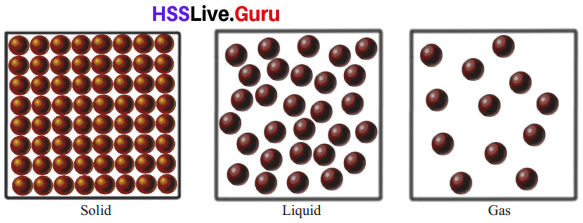
b) Arrangement of molecules in solids, liquids and gases are shown below. Identify the states A, B and C.
Class 6 Basic Science Chapter 5 Important Questions Kerala Syllabus Association of Substances 1
c) Substances in w hich state of matter has a definite shape. Why?
d) Gases can spread fast. Why?
Answer:
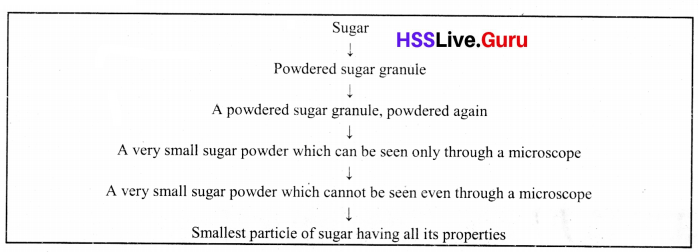
a) Molecule is the smallest particle of a substance having all its properties. All substances are made up of molecules.

b) A : liquid state, B : gaseous state, C : solid state

c) In solids, molecules are closely packed and the attraction between molecules are very strong. So solids have a definite shape.

d) Gases have a lot of space between the molecules and does not have strong force of attraction between them. They can move freely in all directions quickly. Hence gases can spread fast.

Class 6 Basic Science Chapter 5 Important Questions Kerala Syllabus Association of Substances

Question 3.
Identify whether the statements given below are true or false. Also correct the false statements.
a) Buttermilk is a homogeneous mixture.
b) Gold jewels are a kind of solution.
c) All mixtures are solutions.
d) Sand mixed with iron dust can be separated by blowing air.
Answer:
a) False. Buttermilk is a heterogeneous mixture.
b) True.
c) False. All mixtures are not solutions. Solutions are homogeneous mixtures.
d) False. Sand mixed with iron dust can be separated by using a magnet.

Question 4.
Some solutions are given below. Categorise them appropriately.
(Vinegar, copper sulphate solution, ammonia solution, soda water, soap solution, dilute acid, tap water, sanitizer, salt solution)
Answer:

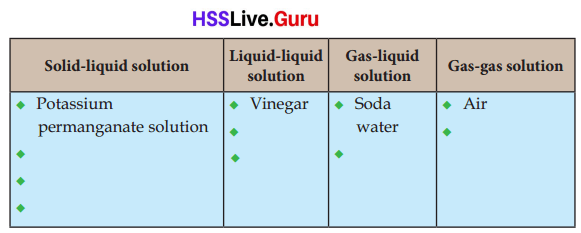
Solid-liquid solution Liquid-liquid solution Gas-liquid solution
• Salt solution
• Copper sulphate solution
• Soap solution
• Vinegar
• Dilute acid
• Sanitizer
• Soda water
• Ammonia solution
• Tap water

Question 5.
Analyse the different substances given below. Choose the appropriate ones and complete the concept map.

Homogeneous mixtures, Water, Sugar solution. Concrete, Mixtures, Fruit salad. Soda water. Oxygen

Class 6 Basic Science Chapter 5 Important Questions Kerala Syllabus Association of Substances 2
Answer:
a) Water
b) Oxygen
c) Mixtures
d) Homogeneous mixtures
e) Sugar solution
f) Soda water
g) Concrete
h) Fruit salad

Question 6.
Analyse the components of air shown below and answer the questions given below.

Gas Quantity
Nitrogen 78%
Carbon dioxide 0.04%
Oxygen 21%
Others 0.96%

a) Which component of air is seen in large quantity?
b) Which component of air is used up by plants during photosynthesis?
c) Air is said to be a mixture. Why?
d) Point out a situation that adversely effects the equilibrium of components of air?
Answer:
a) Nitrogen (78%)
b) Carbon dioxide
c) Air has more than one substance such as nitrogen, oxygen, carbon dioxide etc and is said to be a mixture.
d) Burning plastics’causes mixing of toxic substances with air.

Question 7.
a) What is meant by homogeneous mixture and heterogeneous mixture?
b) Categorize the following mixtures into homogeneous mixtures and heterogeneous mixtures.

Salt solution, Gold jewels, Pickle powder. Ayurvedic medicines, Vinegar, Washing powder

Answer:
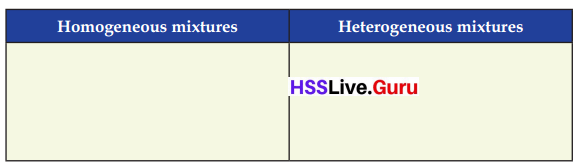
a) The mixture that shows the same properties throughout all its parts is called a homogeneous mixture. The mixture that shows different properties in different parts is called a heterogeneous mixture.

b) Homogeneous mixtures: Salt solution, Gold jewels, Vinegar.
Heterogeneous mixtures: Pickle powder, Ayurvedic medicines, Washing powder.

Class 6 Basic Science Chapter 5 Important Questions Kerala Syllabus Association of Substances

Question 8.
Analyse the table given below and complete the table appropriately

Substance Components involved Pure substance/Mixture
Copper sulphate solution a) b)
Hot water c) d)
Aluminium e) f)
Soda water g) h)

Answer:
a) Copper sulphate, water
b) Mixture
c) Water
d) Pure substance
e) Aluminium
f) Pure substance
g) Carbon dioxide, water
h) Mixture

Question 9.
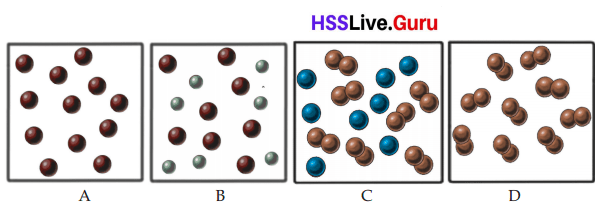
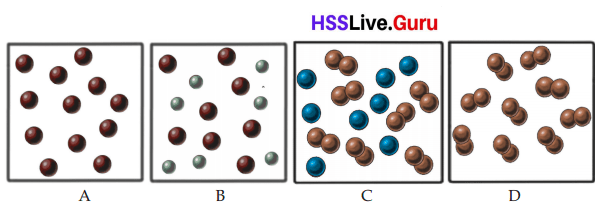
Note the illustration showing the molecules in different substances and answer the following questions.
Class 6 Basic Science Chapter 5 Important Questions Kerala Syllabus Association of Substances 3
a) Which of the above represents pure substances?
b) Which of the above represents mixtures?
c) What is the basis of your findings?
Answer:
a) Pure substances are P and S
b) Mixtures are Q and R
c) Pure substances are substances made up of same type of molecules.
Mixtures have different types of molecules in them.

Question 10.
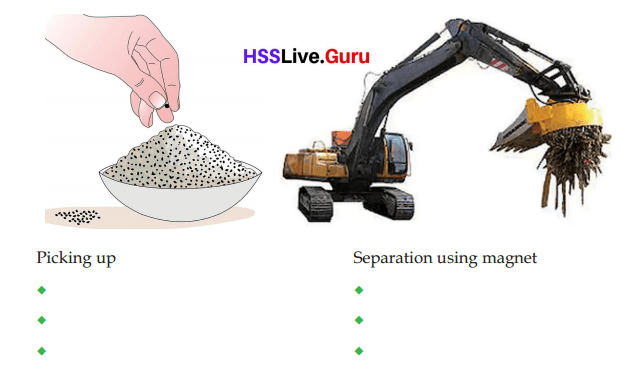
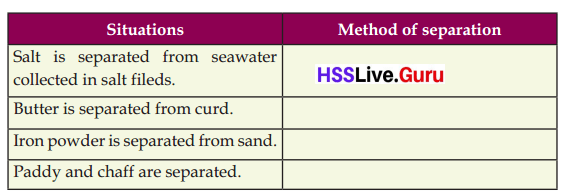
Complete the table related to the methods of separation of mixtures.

Situations Method of separation Associated property of components
Separating salt from seawater a) Water changes to vapour
Separating tea leaves from tea b) c)
Separating chaff from paddy d) Difference in weight of the components
Separating Iron powder from sand. e) f)

Answer:
a) Evaporation
b) Filtration
c) Difference in size of the components
d) Winnowing
e) Separation using magnet
f) Attraction of iron by a magnet

Class 6 Basic Science Chapter 4 Important Questions Kerala Syllabus Flowering and Fruiting

The comprehensive approach in SCERT Class 6 Basic Science Textbook Solutions Chapter 4 Flowering and Fruiting Important Questions ensure conceptual clarity.

Flowering and Fruiting Extra Questions and Answers Class 6 Basic Science Chapter 4 Kerala Syllabus

Flowering and Fruiting Class 6 Important Questions

Question 1.
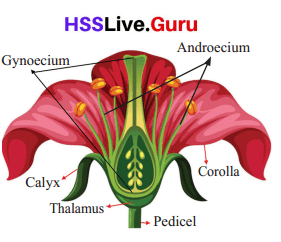
‘Calyx, Corolla, Androecium and Gynoecium are the four main parts seen in a flower. A flower with all these four parts is a complete flower.’
a) Draw and label these 4 four parts in a flower.
b) Do all plants flower?
c) Give some examples of non-flowering plants.
Answer:
a) Class 6 Basic Science Chapter 4 Important Questions Kerala Syllabus Flowering and Fruiting 1
a) No
b) Cycas, Pine, Ferns and algae

Question 2.
Observe the picture given below and answer the following questions.
Class 6 Basic Science Chapter 4 Important Questions Kerala Syllabus Flowering and Fruiting 2
a) Differentiate between the androecium and the gynoecium of a flower.
b) ‘Fruits and seeds are produced from flowers through reproduction.’ What are the benefits of flowering in plants?
Answer:
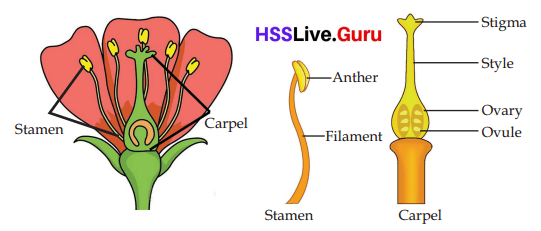
a) Androecium is the male reproductive organ of a flower, which is composed of stamens. Stamens have parts called fdaments and anthers. Pollen grains are present in the anther chambers. Pollen grains contain male gametes.
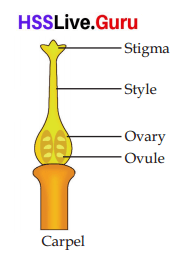
Gynoecium is the female reproductive part of a flower. It is composed of carpels. The carpel consists of stigma, style and ovary. The egg or female gamete is found within the ovule in the ovary.

b) Benefits of flowering in plants:

  • Fruit is formed from a flower.
  • Helps in seed production
  • Helps in the development of new plants.

Class 6 Basic Science Chapter 4 Important Questions Kerala Syllabus Flowering and Fruiting

Question 3.
a) Flowers are attractive and appear in different colours and shapes, why?
b) Are gardens the only place where we find flowers?
Answer:
a) Flowers are attractive and appear in different colours and shapes to attract pollinators who help in pollen transfer.
b) No, flowers grow on land, in the ocean, in lakes and rivers, on mountain tops and in the desert.

Question 4.
‘A flower with all four parts, such as Calyx, Corolla, Androecium and Gynoecium, is called a complete flower.’
a) Are all flowers alike? In what respects are they different?
b) Mention the names of flowers you know?
Answer:
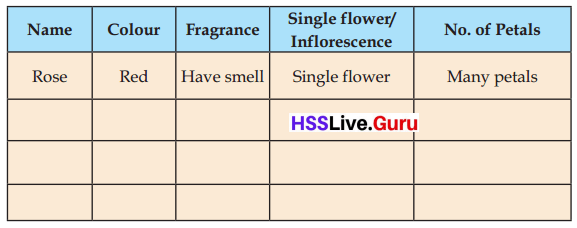
a) No, not all flowers are alike. They differ in number of petals, colour, size, shape and fragrance.
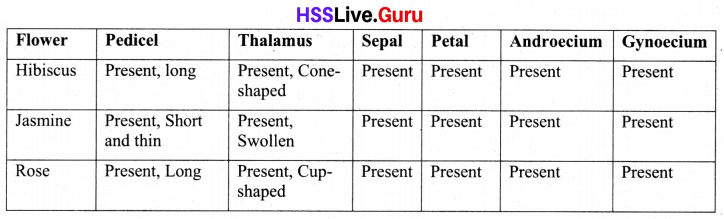
b) Hibiscus, Jasmine, Rose, Marigold.

Question 5.
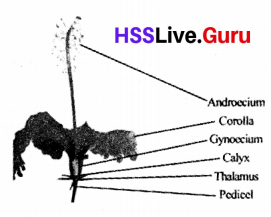
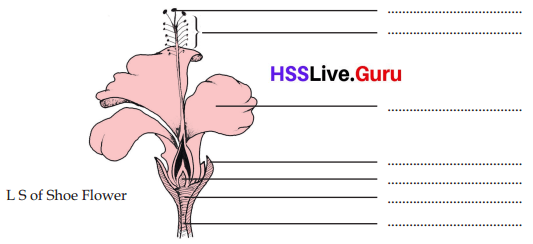
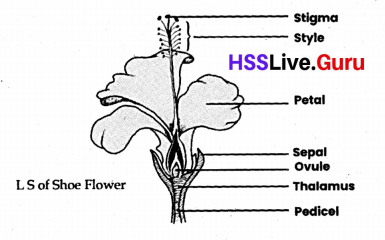
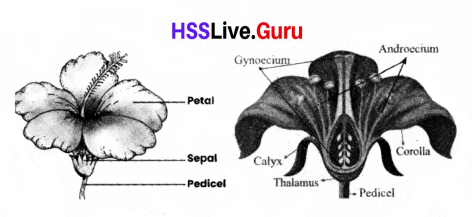
A) You are provided with a Hibiscus flower. The teacher asked you to label the different parts of the hibiscus flower. Draw and Label.
Class 6 Basic Science Chapter 4 Important Questions Kerala Syllabus Flowering and Fruiting 3
B) Do all the flowers have the same parts?
Answer:
A) Class 6 Basic Science Chapter 4 Important Questions Kerala Syllabus Flowering and Fruiting 4
B) No, some flowers have both male and female parts in a single flower while some have separate male and female parts.

Question 6.
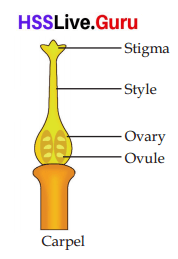
Observe the figure of the carpel of a flower given below.
Class 6 Basic Science Chapter 4 Important Questions Kerala Syllabus Flowering and Fruiting 5
(a) Name and label the parts indicated as (a), (b), (c), and (d) in the figure.
(b) Where does pollen grains found?
(c) Where is the female gamete seen?
Answer:
a) Class 6 Basic Science Chapter 4 Important Questions Kerala Syllabus Flowering and Fruiting 6
(b) Pollen grains are found inside the anther chambers
(c) The egg or female gamete is found within the ovule in the ovary.

Question 7.
Observe the table given below.

Flower Observation
Tomato Androecium and gynoecium are found in the same flower.
Papaya Androecium and gynoecium are found in different flowers on the same plant.

(a) What are unisexual flowers?
(b) Differentiate between Dioecious and Monoecious Plants.
(c) Is the flower of brinjal unisexual or bisexual? Why?
Answer:
(a) Flowers that possess either an androecium or a gynoecium are called unisexual flowers.

(b) If the male and female flowers are found in different plants, such plants are called dioecious plants. Examples of dioecious plants are date palm, nutmeg and papaya.
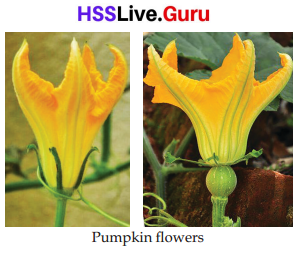
Monoecious plants have both male and female flowers in the same plant. Cucumber, pumpkin, ash gourd, snake gourd, coconut, etc. are monoecious plants.

(c) Brinjal flowers are bisexual because they contain both male and female reproductive organs within the same flower. Specifically, they have both stamens (male) and pistils (female).

Class 6 Basic Science Chapter 4 Important Questions Kerala Syllabus Flowering and Fruiting

Question 8.
A list of plants is given in the box below.

Maize, Coconut, Papaya, Pumpkin, Date palm. Watermelon, Cycas, Lady’s finger, Tomato, Cucumber, Kiwi

Classify these plants as plants with both the sex organs are found in the same plant and on different plants. Give them suitable headings too.
Answer:

Monoecious plants Dioecious plants
Maize
Coconut
Pumpkin
Watermelon
Lady’s finger
Tomato
Cucumber
Papaya
Date palm
Cycas
Kiwi

Question 9.
What is a male flower? Give examples?
Answer:
Flowers that have only androecium are called male flowers.
Eg: Pumpkin, cucumber, bittergourd.

Question 10.
The names of some flowers are given below. Classify them into unisexual and bisexual flowers. What inferences can be drawn by examining the table?

Oleander, pumpkin, bittergourd, rose, hibiscus, clitoria, sunflower, mango, hibiscus, snake gourd, watermelon and papaya.

Answer:

Unisexual flowers Bisexual flowers
Pumpkin
Bittergourd
Snakegourd
Watermelon
Papaya
Oleander
Rose
Hibiscus
Sunflower
Mango

From this table, we can understand that,
→ Some plants have androecium and gynoecium in the same flower and are called bisexual flowers.
→ While some plants have androecium and gynoecium in separate flowers are called unisexual flowers.

Question 11.
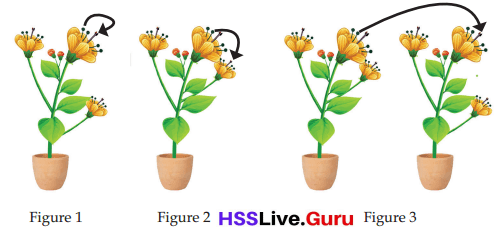
Class 6 Basic Science Chapter 4 Important Questions Kerala Syllabus Flowering and Fruiting 7
a) Observe the Figure. These are two hibiscus plants. What are the ways in which pollination may occur in these plants?
b) In which plants does the pollination occur through the wind?
c) Draw and label the parts of the Gynoecium.
Answer:
a) In Hibiscus, pollination can occur through two ways, self-pollination and cross-pollination. The figure indicates cross-pollination.

b) Paddy, Wheat, Maize, Sugarcane

c) Class 6 Basic Science Chapter 4 Important Questions Kerala Syllabus Flowering and Fruiting 6

Question 12.
Observe the pictures given below.
Class 6 Basic Science Chapter 4 Important Questions Kerala Syllabus Flowering and Fruiting 8
a) In which among the given plants does self-pollination not take place?
b) Justify your findings.
c) Self-pollination takes place in two ways. Explain them.
Answer:
a) Nutmeg

b) Nutmeg is a dioecious plant, i.e., the male and female reproductive organs are on separate trees.

c) Self-pollination occurs in two primary ways: autogamy and geitonogamy. Autogamy involves pollen transfer from the anther to the stigma of the same flower, while geitonogamy involves pollen transfer between different flowers on the same plant.

Question 13.
Parts like petals, androecium, etc., wither and fail down after fertilisation. The pedicel. Thalamus and calyx become stronger. Explain the reason.
Answer:
The function of petals to attract pollinating agents, and the function of the androecium is to produce and store pollen grains. So they go off after fertilisation. Pedicel grows stronger to support the fruit. The thalamus becomes stronger, on which the ovary develops into a fruit. The calyx is present in some plants, which grows strong to support the fruit.

Question 14.
A) What do you mean by fertilisation?
B) Where does fertilisation take place?
Answer:
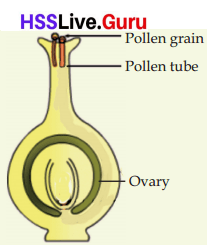
A) Fertilisation is the fusion of a male gamete with the female gamete (egg). Fruit is formed in the plants after fertilisation.
B) Fertilisation takes place in the ovary of the gynoecium.

Class 6 Basic Science Chapter 4 Important Questions Kerala Syllabus Flowering and Fruiting

Question 15.
Write whether the following statements are true or false.
A) In cashew, the fruit develops from the pedicel.
B) In apple and saberjelly, fruits develop from the ovary.
C) Only cross-pollination occurs in unisexual plants.
D) Only cross-pollination occurs in bisexual plants.
Answer:
A) Correct
B) False. In Apple and Saberjelly Fruits developed from thalamus.
C) Correct
D) False. Both self-pollination and cross-pollination occurs in bisexual plants.

Question 16.
Observe the given statements about different types of fruits.

• Jackfruit and custard apple are multiple fruits
• Lady’s finger and grapes are simple fruits
• Tomato and custard apple are aggregate fruits
• Jackfruit and blackberry are multiple fruits

a) Find out the right one from the above statements.
b) Write down the peculiarities of simple fruits, aggregate fruits and multiple fruits.
c) Find out the odd one out.
1. Apple
2. Cashew apple
3. Safarjal
4. Jackfruit
Answer:
a) Lady’s finger and grapes are simple fruits, Jackfruit and blackberry are multiple fruits

b)

Fruits Peculiarities
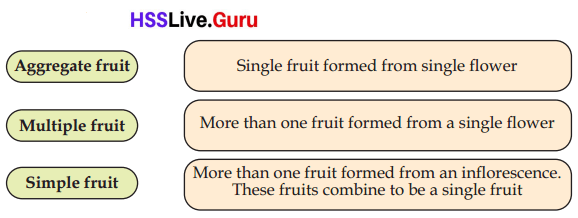
Simple fruits Fruit that is formed from a single flower
Aggregate fruits A fruit that develops from a single flower with multiple ovaries
Multiple fruits. Fruits formed from an inflorescence are combined together to a single fruit.

Question 17.
A. Complete the concept map given below.
Class 6 Basic Science Chapter 4 Important Questions Kerala Syllabus Flowering and Fruiting 9
B. Write any one difference between aggregate fruit and multiple fruit.
Answer:
A. a) Tomato,
b) Mango,
c) Custard apple,
d) Aggregate fruit,
e) Multiple fruit,
f) Pineapple,
g) Cashew,
h) Apple

B. Aggregate fruits are fruits that develop from a single flower with multiple ovaries. Fruits formed from an inflorescence that are combined together into a single fruit are called multiple fruits.

Question 18.
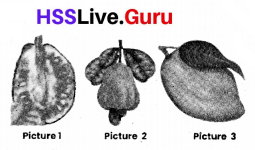
Observe the pictures
Class 6 Basic Science Chapter 4 Important Questions Kerala Syllabus Flowering and Fruiting 10
A. What types of fruits are shown in pictures 1 and 3? What are their peculiarities?
B. Name another fruit similar to the picture (2).

The ovary of a flower develops into fruit and the ovule into seed.

C. Explain the above statement based on the picture (2).
Answer:
A. Picture 1- Multiple fruits, Picture 3 – Simple fruit
Fruits formed from an inflorescence that are combined together into a single fruit are called multiple fruits, and a fruit that is formed from a single flower is called a simple fruit.

B. Apple (Pseudo fruit)

C. Picture 2 (Cashew) indicates a pseudo fruit. In normal flowers, the ovary develops into fruit. Sometimes, parts of the flower other than the ovary also become fruit. These are pseudo-fruits.

Question 19.
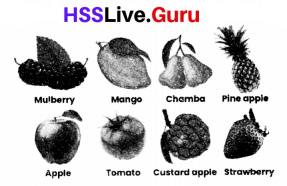
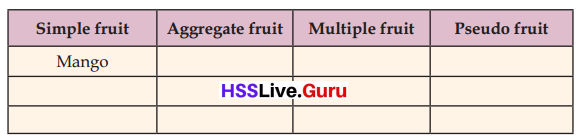
a) Observe the figures given below and complete the table.
Class 6 Basic Science Chapter 4 Important Questions Kerala Syllabus Flowering and Fruiting 11

Fruits types Examples
Simple fruits Mango …….(a)…….
Aggregate fruit …….(b)……. Custard apple
Multiple fruit Pineapple …….(c)…….
Pseudo fruit …….(d)……. Apple

What happens to the following parts when a flower becomes a fruit?
i. Androecium
ii. Ovary
iii. Sepals
iv. Ovule
Answer:
a) (a) Tomato,
(b) Strawberry,
(c) Mulberry,
(d) Chamba

b) Androecium – Dries up and is shed
Ovary – Develops into a fruit.
Sepals – Persistent (remain attached to the developing fruit) or, in some cases, shed off.

Ovule – Develops into a seed

Class 6 Basic Science Chapter 4 Important Questions Kerala Syllabus Flowering and Fruiting

Question 20.
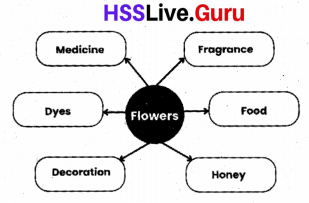
There are so many benefits from flowers.
(a) What is floriculture?
(b) List some benefits of floriculture.
(c) Give some examples of commercially grown flowering plants.
Answer:
(a) Flower farming or floriculture is the process of developing, growing and nurturing flowering and ornamental plants commercially.

(b) Benefits of floriculture:

  • Used for spiritual rituals and pujas
  • Used for decorations
  • Food and medicinal resources
  • Manufacturing of perfumes and dyes
  • Gardening and landscaping
  • Job opportunities and economic growth

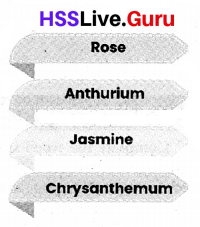
(c) Rose, Anthurium, Orchid, Chrysanthemum, Jasmine, Lotus, Vanilla, etc.

Class 6 Basic Science Chapter 3 Important Questions Kerala Syllabus Let’s Stand Straight

The comprehensive approach in SCERT Class 6 Basic Science Textbook Solutions Chapter 3 Let’s Stand Straight Important Questions ensure conceptual clarity.

Let’s Stand Straight Extra Questions and Answers Class 6 Basic Science Chapter 3 Kerala Syllabus

Let’s Stand Straight Class 6 Important Questions

Question 1.
How do skeletons help animals?
Answer:

  • Provide shape and strength to the body.
  • Help in movement.

Question 2.
What will happen if there is no skeleton?
Answer:
There would be no structures or shape to the body, and the individual would be unable to walk and run.

Question 3.
Why do birds have lighter skeletons compared to many other animals?
Answer:
Birds have lighter skeletons because their bones contain air cavities (empty spaces filled with air), which helps them fly.

Class 6 Basic Science Chapter 3 Important Questions Kerala Syllabus Let's Stand Straight

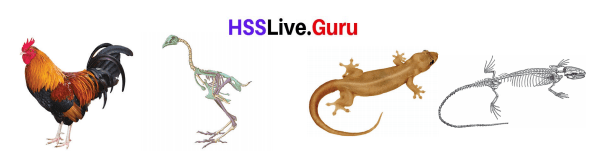
Question 4.
Can you identify the animals to which these skeletons belong? Write down your answers.

Answer:
a) Hen
b) Lizard
c) Cow

Question 5.
Choose the correct statements from the following:
a. Birds have lighter skeletons compared to many other animals
b. Birds have air cavities in the bones
c. Birds have no air cavities
d. Birds have a harder skeleton
Answer:
a. Birds have lighter skeletons compared to many other animals,
b. Birds have air cavities in the bones

Question 6.
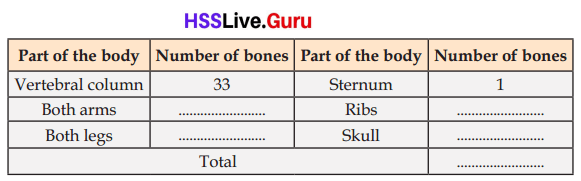
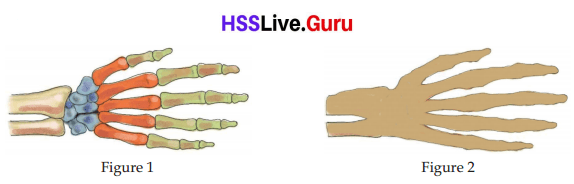
Choose the correct number of bones and complete the table
[33, 32, 22, 24]

Skull (a)
Ribs (b)
Vertebral column (c)
In each hand (d)

Answer:
(a) 22
(b) 24
(c) 33
(d) 32

Question 7.
Bones give shape and strength to our body. They also help in movement
a) Complete the table below.

Ribs 12 Pairs bend to form like a cage (i)
Vertebral Column (ii) Helps to maintain an erect posture and facilitates body movement.
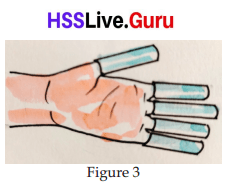
Bones in the hand Small bones are joined in fingers. Long bones are seen in the arm and forearm. (iii)
Bones in the leg Big thigh bones. (iv)

b) Which is the biggest bone in the human body
Answer:
a) (i) Protects internal organs like the heart and lungs.
(ii) Made up of 33 small bones called vertebrae, arranged one above the other.
(iii) Helps to grasp and handle objects
(iv) Supports the weight of the body and enables locomotion (walking, running jumping, etc.)

b) Femur is the largest bone in human body.

Question 8.
Observe the picture.
Class 6 Basic Science Chapter 3 Important Questions Kerala Syllabus Let's Stand Straight 2
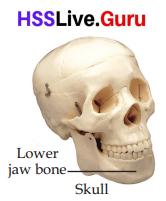
A) Identify and write the bones marked a, b and c
B) Write the function of any two bones labelled in the skeleton.
C) The movable bone in the skull ……………………..
Answer:
A) a) Skull
b) Ribs cage
c) Femur

B) Skull: Protect the brain from injury
Ribs cage: Protects internal organs such as the heart and lungs.

C) Lower jawbone

Question 9.
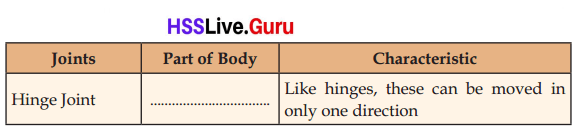
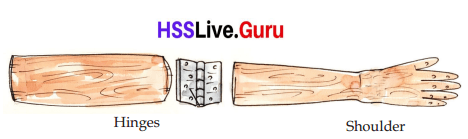
It’s of different body parts, and their characteristics are listed below. Read them. Arrange the table in the correct order.

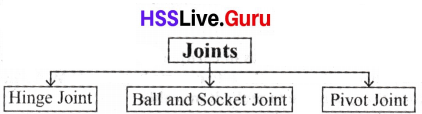
Body parts Joints Characteristics
Knee Pivot joint Can be moved in many directions
Neck Ball and socket joint Can be moved in only one direction
Shoulder Joint Hinge joint Can be moved in both directions

Answer:

Body parts Joints Characteristics
Knee Hinge joint Can be moved in only one direction
Neck Pivot joint Can be moved in both directions
Shoulder Joint Ball and socket joint Can be moved in many directions

Class 6 Basic Science Chapter 3 Important Questions Kerala Syllabus Let's Stand Straight

Question 10.
Look at the picture of the joint
Class 6 Basic Science Chapter 3 Important Questions Kerala Syllabus Let's Stand Straight 3
a) Identify the joint?
b) Write the procedure and material needed for making a model of this joint by using easily available objects.
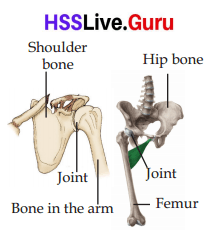
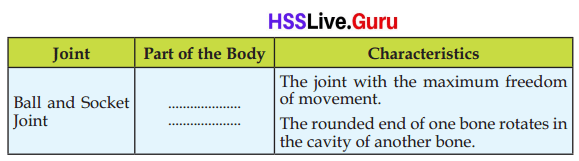
c) Write the body parts in which the ball and socket joint is seen. Write their features?
Answer:
a) Ball and socket joint

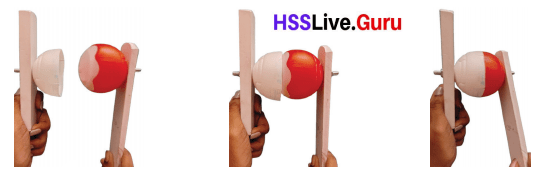
b) Materials: 2 ice cream balls (big – 1, small – 1), Wooden scale – 2, Nuts and bolts – 2

Cut off a small part of the big ice cream ball in such a way that the small ice cream ball remains fitted inside it. Fix the two ice cream balls on the wooden scales using nuts and bolts, as shown in the picture. Hold the scale with the large ice cream ball in one hand and try rotating the scale with the small ice cream ball, It resembles the movement of the shoulder.
Class 6 Basic Science Chapter 3 Important Questions Kerala Syllabus Let's Stand Straight 4
c) Shoulder joints, Hip joints
• The joint, with the maximum freedom of movement.
• The rounded end of one bone rotates in the cavity of another bone.

Question 11.
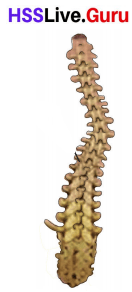
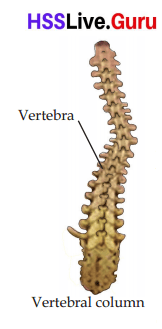
a) Identify the parts of the human skeleton given below
Class 6 Basic Science Chapter 3 Important Questions Kerala Syllabus Let's Stand Straight 5
b) (i) Which parts of the skeleton protect the internal organs like the heart, brain, and spinal cord?
(ii) Write the peculiarity of any one part of the skeleton.
c) Which is the biggest bone in the human body
d) Which is the smallest bone in the human body
Answer:
a) Vertebral Column

b) (i) Skull: Protects the brain.
Rib Cage: Protects the heart and lungs.
Vertebral Column: Protects the spinal cord.
(ii) Ribs enfold and protect the heart, lungs, and some major blood vessels.
Ribs are strong and flexible

c) Femur is the largest bone

d) Stapes is the smallest bone in our body.

Question 12.
a) Which among the substances given below can be used to make a model of a pivot joint?

Powder tin, small ball, Lids, Head of a doll, Hinges

b) What will be the difficulties faced by us if there are no joints in our body?
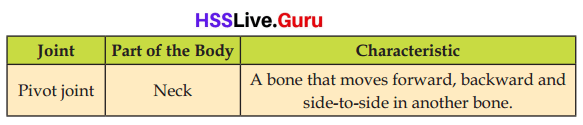
c) Write the body parts in which Pivot joints is seen. Write their features.
Answer:
a) Powder tin, Head of a doll
b) We wouldn’t be able to bend, twist, or move any part of our body.
c) Neck
The bone that moves forward, backwards and side to side in another bone

Question 13.
Some activities are given below.
a) Rotates the arm in a circle.
b) Bending the knee to sit down
c) Turning the neck to look in both directions.
Class 6 Basic Science Chapter 3 Important Questions Kerala Syllabus Let's Stand Straight 6
A) Write the names of the joints that help perform the activities listed above.
B) hat can we do before taking a person with a fracture to the hospital?
Answer:
A) a) Ball and socket joint
b) Hinge Joint
c) Pivot Joint

B)

  • Don’t move the injured part
  • Use a splint
  • Apply Ice
  • Seek medical help immediately.

Question 14.
Observe the Picture
Class 6 Basic Science Chapter 3 Important Questions Kerala Syllabus Let's Stand Straight 7
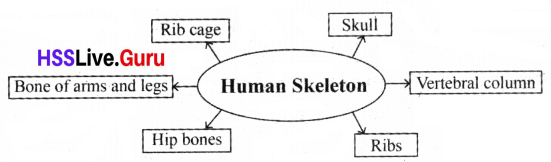
A) W rite down the name of the major organ protected inside the skull.
B) How many bones are there in the Adult human body?
C) How many bones are there in Skull?
D) What are the main parts of Human skeleton
Answer:
A) Brain
B) 206
C) 22
D) The skull, vertebral column, ribs, rib cage, bones of the arms and legs, and hipbones together form the human skeleton.

Question 15.
A) What are cartilages?
B) Where are cartilages found in the human body?
Answer:
A) Cartilages are flexible parts that provide support and strength to the body, like bones. They are softer than bones and are found in both the human body and the bodies of other animals.

B) Primarily, cartilages are found in the ears, nose, elbows, knees, ankles, trachea and the discs between the vertebrae.

Class 6 Basic Science Chapter 3 Important Questions Kerala Syllabus Let's Stand Straight

Question 16.
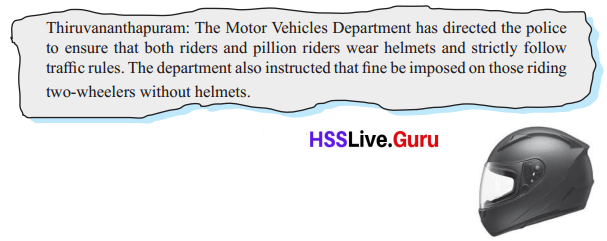
Write the necessity of wearing a helmet while travelling on two-wheelers.
Answer:
Reduce injuries

  • Protect your head
  • Protect your eyes and face from wind, dust, bugs, and little stones.

Question 17.
Which activity is not to be given to a person whose vertebral column is injured?
i. Protect the body part without movement
ii. Carry him on the shoulder
iii. Make him lie on a broad wood plank
Answer:
ii. Carry him on the shoulder

Question 18.
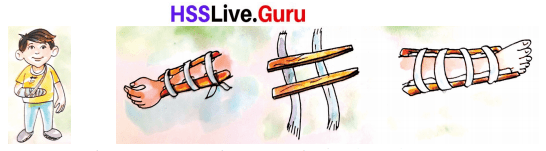
Your friend fell down during 9 football game and fractured his arm.
Class 6 Basic Science Chapter 3 Important Questions Kerala Syllabus Let's Stand Straight 8
a) What first aid should be provided to someone with a fracture?
b) Why do we use the metal rod for fixing a fractured bone?
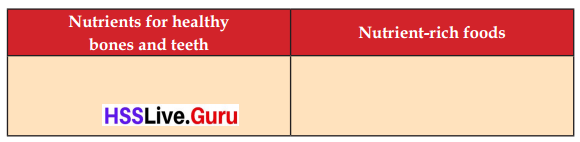
c) What nutrients and nutrient-rich foods should the child eat for strong bones, as advised by the doctor?
Answer:
a) Immobilise the Injured Area

  • Bandage the injured part using a splint.
  • Apply Cold (Ice Pack)
  • A person with a bone fracture should be taken to the hospital immediately after receiving first aid.

b) It helps the bones to stay stable and heal quickly.

c) Calcium: The primary mineral component of bones, essential for bone formation and strength. Milk, yogurt, cheese, paneer, ragi, etc.
Vitamin D: Fatty fish, egg yolks, fortified milk, fortified cereals, and exposure to sunlight (the body produces Vitamin D when skin is exposed to sunlight).
Protein: provides the framework (collagen) onto which calcium and other minerals are deposited. Lean meats (chicken, fish), eggs, dairy products, pulses, etc.

Question 19.
A) What is a fracture?
B) How can a fracture be identified?
C) How many types of fractures are there? What are they?
Answer:
A) A fracture is the breaking or cracking of a bone.

B)

  • Pain in the injured area.
  • Difficulty in moving the injured part.
  • Differences when compared with similar parts.

C)

  • Fractures can occur in three ways.
  • Simple Fracture: This is when a bone cracks, breaks, or dislocates but doesn’t pierce through the skin.
  • Compound Fracture: The bone breaks and pierces through the skin and muscles, often causing open wounds.
  • Complicated Fracture: This is a type of compound fracture where the broken bone injures nearby internal organs.

Question 20.
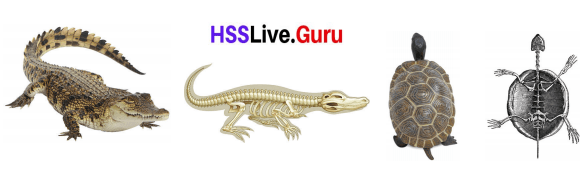
Observe the picture
Class 6 Basic Science Chapter 3 Important Questions Kerala Syllabus Let's Stand Straight 9
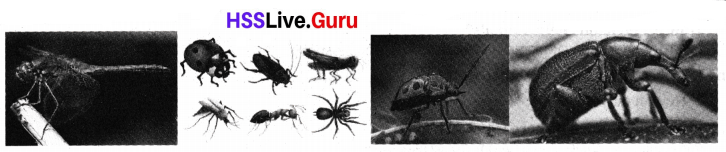
Classify the given organisms based on their skeletons.

(i) Exoskeleton
(ii) (iii)
Fish (iv)

Answer:
(i) Endoskeleton
(ii) House Lizards
(iii) Beetle
(iv) Snail

Question 21.
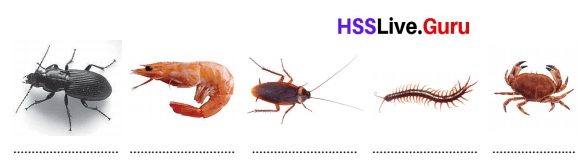
Observe the pictures
Class 6 Basic Science Chapter 3 Important Questions Kerala Syllabus Let's Stand Straight 10
a) What is the difference between the skeletons of a cockroach and Lizard?
b) What are the similarities between endoskeleton and exoskeleton?
Answer:
a) Cockroaches have an exoskeleton, and lizards possess an endoskeleton.
b) Both skeletons provide structural support.
Both exoskeletons and endoskeletons allow animals to move about and protect their internal organs.

Class 6 Basic Science Chapter 3 Important Questions Kerala Syllabus Let's Stand Straight

Question 22.
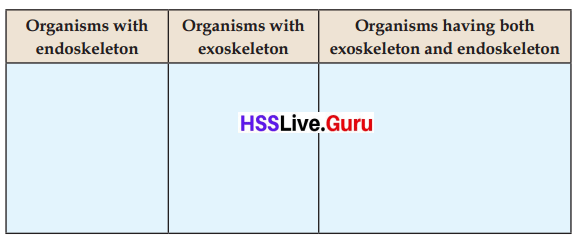
Classify the following organisms into those having an Endoskeleton, an Exoskeleton and both.

Cockroach, Lizard, Turtle, Crocodile, Hen, Snail, Prawns,
Crab, Centipede, Beetle, Birds, Cow, Cat, Dog

Answer:

Organism With an Endoskeleton Organism with an Exoskeleton An organism having both an exoskeleton and an endoskeleton
Lizard Cockroach Turtle
Hen Snail Crocodile
Birds Prawns
Cow Crab
Cat Centipede
Dog Beetle

Question 23.
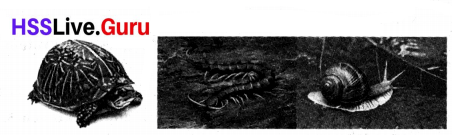
Analyze the pictures and answer the following questions:
Class 6 Basic Science Chapter 3 Important Questions Kerala Syllabus Let's Stand Straight 11
a) Name the type of skeleton present in this snail and centipede.
b) Name the organism that has both exoskeleton and endoskeleton.
c) How does the outer skeleton benefit the organisms
Answer:
a) Exoskeleton
b) Turtle
c) They help to protect and give shape to their body and offer protection from enemies.

Association of Substances Class 6 Notes Questions and Answers Basic Science Chapter 5 Kerala Syllabus

Reviewing Std 6 Basic Science Notes Pdf English Medium and Kerala Syllabus Class 6 Basic Science Chapter 5 Association of Substances Question Answer SCERT Solutions Notes Pdf can uncover gaps in understanding.

Class 6 Basic Science Chapter 5 Association of Substances Question Answer Notes

Basic Science Class 6 Chapter 5 Question Answer Notes Association of Substances

Association of Substances Class 6 Questions and Answers Notes

Let Us Assess

Question 1.
A drink is prepared by mixing salt and sugar to soda water.
a) What are the components of this mixture?
b) Is this drink a homogeneous or heterogeneous mixture?
Answer:
a) Salt, sugar, carbon dioxide, water
b) Homogeneous mixture

Question 2.
One spoon of salt is added to a glass of water. There is undissolved salt in the glass. What should be done to make it a homogenous mixture?
Answer:
Stir the solution well – this helps the salt dissolve completely in water and becomes a homogenous mixture.

Association of Substances Class 6 Notes Questions and Answers Basic Science Chapter 5 Kerala Syllabus

Question 3.
Examine the following statements about iron, brass, gold ornament, bronze, carbon dioxide and aluminium. Tick (✓) the correct ones among these.
a) All these are not pure substances.
b) Brass, Iron and bronze are metallic mixtures.
c) Gold ornament is a mixture.
d) Carbon dioxide and aluminium are pure substances.
Answer:
a) ✓
b) ✓
c) ✓
d) ✓

Basic Science Class 6 Chapter 5 Question Answer Kerala Syllabus

Question 1.
About what snack is the boy talking about? Find out the different items seen in this snack?
Answer:
Groundnut, fried gram, peanut, sweet balls, chips, cashew etc.
New substances are produced by mixing different items not only for preparing food, but also in the fileds of agriculture, health, construction etc.

Question 2.
What are the substances used to make concrete?
Answer:
Cement, sand, gravel and water

Question 3.
Which are the household biowastes used to make compost?
Answer:
Vegetable peels, food waste, meat or fish waste, cow dung, dry leaves etc.

Question 4.
What are the peculiarities of concrete, compost and mixture?
Answer:
They are made by mixing more than one substance.

Question 5.
Which are the ingredients usually used in salad and mango pickle?
Answer:
Salad: Onion, tomato, salt, carrot, cucumber, chilli, curd etc
Mango pickle: Mango, Salt, pickle powder, garlic, vinegar etc.

Mixtures

A mixture is a combination of more than one substance

Association of Substances Class 6 Notes Questions and Answers Basic Science Chapter 5 Kerala Syllabus

Question 6.
Analysing the above table, answer the following questions
a. Do all the ingredients in the mixtures you have prepared belong to the same state of matter?
Answer:
No. They belong to different states of matter.

b. Which are the mixtures in which a solid is dissolved in a liquid?
Answer:
Salt water, sugar solution, potassium permanganate solution, Blue vitriol.

c. Are there any mixtures of two solids?
Answer:
Rava-salt mixture, Bengal gram-paddy mixture, Iron-chalk mixture, Iron-salt mixture, Rava-sugar mixture.

d. Which are the mixtures with more than one solid dissolved in a liquid?
Answer:
Potassium permanganate and salt dissolved in water, Potassium permanganate and blue vitriol dissolved in water.
Now let’s find out more about mixtures

e. Mixtures in which all components are visible
Answer:
Chalk powder in water. Iron powder mixed with chalk powder, iron powder mixed with salt.

f. Mixtures in which all components are not visible
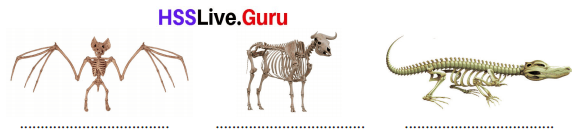
Answer:
Salt solution, sugar solution, Blue vitriol, potassium permanganate solution.

Solutions

Solutions are formed by dissolving a solute in a solvent.
Solute is a substance that dissolves in a solvent.
Solvent is the substance in which other materials get dissolved. It is more in quantity.
Solute + Solvent → Solution

Question 7.
Find more examples for solutions and discuss their components.
Association of Substances Class 6 Notes Questions and Answers Basic Science Chapter 5 Kerala Syllabus 1
Answer:

Solid-liquid solution Liquid-liquid solution Gas-liquid solution Gas-gas solution
• Potassium permanganate solution
• Blue vitriol
• Salt solution
• Sugar solution
• Baking soda solution
• Soap solution
• Vinegar
• Dilute acid
• Alcohol and water
• Kerosene and petrol
• Sanitizer
• Gasoline
• Soda water
• Liquor ammonia (Ammonia solution)
• Crude oil
• Tap water
• Hydrochloric acid
• Air
• LPG
• Water gas
• Producer gas
• Welding gas
• Biogas

Experiment
Take equal quantities of water in glasses of same size. Prepare the following and observe.
Mixture 1 Water with sugar dissolved in it
Mixture 2 Salt solution
Mixture 3 Water mixed with chalk powder

Question 8.
Examine the mixtures you have prepared and discuss the following
a. Are these mixtures alike?
Answer:
No They are not alike.

b. What are the similarities between sugar solution and salt solution?
Answer:
The particles present in them are not visible. The particles do not settle down at the bottom.

c. What is the difference between water mixed with chalk powder and salt solution?
Association of Substances Class 6 Notes Questions and Answers Basic Science Chapter 5 Kerala Syllabus 2
Answer:

  • The particles present in water mixed with chalk powder are visible clearly. The particles settle down at the bottom.
  • The particles present in salt solution are not visible. The particles do not settle down at the bottom.

Experiment
Ake sugar solution in a glass. Take the same amount of water and sugar in a similar glass and keep it unstirred. Using a straw, carefully taste from different parts of the water with dissolved sugar and the unstirred mixture of sugar and water. Record the differences in taste in the table below.
Association of Substances Class 6 Notes Questions and Answers Basic Science Chapter 5 Kerala Syllabus 3

Association of Substances Class 6 Notes Questions and Answers Basic Science Chapter 5 Kerala Syllabus

Question 9.
Analy se the above table and answer the following
a. Is the sweetness the same everywhere in the well-stirred sugar solution?
Answer:
Yes, sweetness is the same everywhere in the well-stirred sugar solution.

b. What about the taste of the solution taken from different parts of the unstirred sugar solution?
Answer:
Taste of the solution taken from different parts of the unstirred sugar solution is different.

c. Aren’t the components the same in both? Yet what could be the reason for the difference in taste?
Answer:
Yes, the components are the same in both mixtures.
The amount of dissolved sugar is not the same everywhere. Hence the taste is different in different parts.
The water with dissolved sugar is a homogeneous mixture and the water with undissolved sugar is a heterogeneous mixture.

Homogeneous Mixtures and Heterogeneous Mixtures

The mixture that shows the same properties throughout all its parts is called a homogeneous mixture. The mixture that shows different properties in different parts is called a heterogeneous mixture.

Question 10.
Examine the following issues based on the concepts you have understood.
a. Are the mixtures with dissolved salt and that with undissolved salt the same? How are they different?
Answer:
No, The water with dissolved sugar is a homogeneous mixture and the water with undissolved sugar is a heterogeneous mixture.

b. Is the mixture of chalk powder and w ater, homogeneous or heterogeneous? Why?
Answer:
The chalk powder mixed with water is a heterogeneous mixture because it shows different properties in different parts.

c. Are compost, concrete mix and the edible mixture, homogenous or heterogeneous? Why? Discuss.
Answer:
They are heterogeneous mixtures because they show different properties in different parts.

Question 11.
Classify the mixtures you have prepared so far into homogeneous mixtures and heterogeneous mixtures and write them in the table below.
Association of Substances Class 6 Notes Questions and Answers Basic Science Chapter 5 Kerala Syllabus 4
Answer:

Homogeneous mixtures Heterogeneous mixtures
• Salt solution
• Sugar solution
• Blue vitriol
• Vinegar
• Soda water
• Soap solution
• Potassium permanganate solution
• Rava mixed with sugar
• Rava mixed with salt
• Rava mixed with iron  powder
• Sugar mixed with iron powder
• Salt mixed with sugar
• Iron-chalk mixture
• Iron-salt mixture

Question 12.
All solutions are mixtures, but not all mixtures are solutions. Why?
Answer:
A mixture is a combination of more than one substance. All solutions are homogeneous mixtures. But all mixtures are not homogeneous in nature. So all mixtures are not solutions.

Question 13.
Which components of air are being used in activities such as respiration and photosynthesis?
Answer:
During respiration, oxygen is taken in by animals, humans and carbon dioxide is given out.
During photosynthesis, carbon dioxide is used up by the plants and oxygen is given out.

Question 14.
What will happen if the level of carbon dioxide increases and that of oxygen decreases in air? Discuss.
Association of Substances Class 6 Notes Questions and Answers Basic Science Chapter 5 Kerala Syllabus 5
Answer:
If the level of carbon dioxide increases in air, it increases the level of atmospheric temperature.
If the level of oxygen decreases in air, it causes threat to the existence of living organisms.
The smoke produced by burning plastic contains various toxic substances. If these substances get mixed with air, it will affect the equilibrium of air and can have adverse effects on the health of living beings including humans.

Hide and Seek of a Solute
Sugar solution has both water and sugar. But we cannot see the sugar once it is dissolved in water. Let’s find out what happened to sugar.
Materials required: Large plastic jar (1 litre), gravel (500 g), green gram 100 g, Rava 100 g.

Activity
Put the gravel in a plastic jar and shake it well. Using a marker pen, mark the level of gravel on the outer surface of the jar. Add some green gram to this and stir the jar. Write the measurement in the table. Then put some Rava in the plastic jar and shake it well. Record the observations in the table below.

Activity Height of gravel in the jar
After shaking and pressing the gravel in the jar 16 cm
After adding the green gram in the jar and shaking it 16 cm
After adding the rava in the jar and shaking it well 16 cm

Association of Substances Class 6 Notes Questions and Answers Basic Science Chapter 5 Kerala Syllabus

Question 15.
Analyse the table above and answer the following
a. Does the level of the gravel inside the jar change after adding green gram and rava and shaking them down? Why?
Answer:
No change in the level of gravel. Because green gram and rava occupies the space between the gravel pieces.

b. Where have the green grams settled?
Answer:
The green grams have settled in the spaces between the gravel pieces inside the jar.

c. Where have the rava grains settled?
Answer:
The rava grains have settled in the spaces between the green grams and the gravel pieces inside the jar.

d. When rava and green gram are added to the gravel in the jar and shaken, was there any difference in the total space required for all the three?
Answer:
No change in the total space required.

e. How can green gram stay along with gravel and rava grains settle in between the two?
Answer:
Rava grains are even smaller than green gram, so they can settle in the tiny spaces between both the gravel and green gram.

In this experiment, we can see two substances occupying the space between the gravel pieces. The same thing happen when substances dissolve in water. When sugar dissolves in water, the smaller sugar particles occupies the empty spaces between the particles of water. By tasting the sugar solution obtained by dissolving sugar in water we can understand the presence of sugar in it.

Question 16.
Explain the following in terms of arrangement of molecules.
a. In which state of matter are the molecules the closest?
Answer:
In solid state

b. In which state of matter are the molecules the farthest?
Answer:
In gaseous state

c. Why do solids have a definite shape while gases and liquids don’t have?
Answer:
In solids, molecules are closely packed and the attraction between molecules are very strong. So solids have a definite shape. Compared to solids, molecules of liquids and gases are far apart and does not have strong force of attraction between the molecules. Hence liquids and gases does not have a definite shape.

d. Why are liquids able to flow?
Answer:
The molecules of liquids does not have strong force of attraction between them. The molecules in liquids are loosely packed and can slide over each other. That’s why liquids can flow.

e. How can gases spread fast?
Answer:
Gases have a lot of space between the molecules and does not have strong force of attraction between them. They can move freely in all directions quickly. Hence gases can spread fast.

f. Solids cannot flow or spread. Why?
Answer:
In solids, the molecules are closely packed and have strong force of attraction between them. They have very little space between the molecules and move very slowly. Hence, solids cannot flow or spread like gases.

Atoms

Atoms are smaller particles than molecules. Molecules are made up of atoms. A water molecule is formed by combining two hydrogen atoms and one oxygen atom. A sugar molecule consists of 12 carbon atoms, 22 hydrogen 3 atoms and 11 oxygen atoms.

Question 17.
Note the illustration showing the molecules in different substances and answer the following
Association of Substances Class 6 Notes Questions and Answers Basic Science Chapter 5 Kerala Syllabus 5
a. How many types of molecules are there in Substance A?
Answer:
Only one type of molecule

b. What about B?
Answer:
Two types of molecules

c. Which substances have different types of molecules?
Answer:
B and C

d. Which substances have the same type of molecules?
Answer:
A and D

Pure substances

Pure substances are substances made up of same type of molecules. Mixtures will have different molecules in them.

e. From the above illustrations of substances A, B, C and D, identify pure substances and mixtures.
Answer:
Pure substances: A and D
Mixtures: B and C

f. Are mixtures pure substances? Why? Discuss.
Answer:
Mixtures have different types of molecules in them. So they are not pure substances.

g. Water without any impurities is a pure substance. Why?
Answer:
Water is a substance made up of same type of molecules. So water without any impurities is a pure substance.
Other examples of pure substances include Iron, copper, carbon, oxygen, hydrogen, carbon dioxide etc.

Association of Substances Class 6 Notes Questions and Answers Basic Science Chapter 5 Kerala Syllabus

Question 18.
Classify the following substances as pure substances and mixtures and complete the table appropriately.
Answer:

Substance Molecules involved Pure substance/ Mixture
Porridge Water, salt and other substances Mixture
Pencil graphite Graphite Pure substance
Sugar Sugar Pure substance
Soda water Carbon dioxide, water Mixture
Buttermilk Water, salt and other substances Mixture
Pure water Water Pure substance
Potassium permanganate Potassium permanganate Pure substance
Gold jewels Gold, silver and copper Mixture
Gold Gold Pure substance

Question 19.
Find more examples for pure substances and mixtures and complete the table.
Association of Substances Class 6 Notes Questions and Answers Basic Science Chapter 5 Kerala Syllabus 6
Answer:
Association of Substances Class 6 Notes Questions and Answers Basic Science Chapter 5 Kerala Syllabus 7

Question 20.
How can we separate the components from the following mixtures?
a. Rice mixed with stones
b. A mixture of sand and iron powder
Answer:
a. Picking up
b. Separation using magnet

Question 21.
Which are the components of these two mixtures?
Answer:
a. Rice mixed with stones: Rice, stone
b. A mixture of sand and iron powder: Sand, iron powder

Question 22.
Examine the following questions and answer them.
a. Do rice and stone have same colour? Do they have same shape and size?
Answer:
Rice and stone do not have same colour, shape or size.

b. The components of which of these mixtures can be separated by hand?
Answer:
The components of rice mixed with stones.

c. If the stones have the same size and colour that of rice, would it be possible to separate them by
hand?
Answer:
Not possible

d. Can iron dust be seperate from sand?
Answer:
Not possible

e. Can iron powder be separated from sand by making use of any other property of iron powder?
Answer:
By using magnet, iron powder be separated from sand.

f. Which properties of the components do we make use of in these two methods of separation?
Answer:
Colour, shape, size, magnetic property

g. Find out more instances of separating components in the same way and list them in the table below.
Association of Substances Class 6 Notes Questions and Answers Basic Science Chapter 5 Kerala Syllabus 8
Answer:

Picking up Separation using magnet
• Separating stones from rice
• Separating stones from green gram
• Separating fallen leaves from grass
• Separating iron dust from sand
• Separating iron objects from scrap materials
• Separating iron screws from plastic bits

The properties of the components are made use of in the process of their separation.

Association of Substances Class 6 Notes Questions and Answers Basic Science Chapter 5 Kerala Syllabus

Question 23.
Discuss the different types of separation used in the following situations. Find out the properties of the components utilized in each situation.
a. How do we separate tea dust from tea?
Answer:
By Filtration.
Property: Difference in the size of the components.

b. How are small stones removed from rice while washing it before cooking?
Answer:
By hand picking
Property: Difference in shape, colour and size of the components.

c. Which are the ways by which muddy water can be purified?
Answer:
Sedimentation, decantation and filtration
Property: Difference in weight and size of the components.

d. How are gravel and other waste materials separated from the sand used for construction works?
Answer:
Sieving
Property: Difference in the size of the components.

Question 24.
There are even more methods of separation. Observe the pictures.
Analyse each image. Using the clues, find the methods for separating the components. Tabulate them.
Association of Substances Class 6 Notes Questions and Answers Basic Science Chapter 5 Kerala Syllabus 9
Association of Substances Class 6 Notes Questions and Answers Basic Science Chapter 5 Kerala Syllabus 10
Answer:

Situations Method of separation
Salt is separated from seawater collected in salt fields. Evaporation
Butter is separated from curd. Churning
Iron powder is separated from sand. Separation using magnet
Paddy and chaff are separated. Winnowing

Question 25.
Front the table, identify the context that utilises the change of state of matter for the separation of dissolved component.
Answer:
Salt is separated from seawater collected in salt fields Here water!liquid) changes into water vapour(gas).

Question 26.
How is the process of separating butter from curd different from others?
Answer:
Butter is separated by rotating the curd very fast in a chumer.

Question 27.
Which situation makes use of the magnetic property of the component for separation?
Answer:
Iron powder is separated from sand.

Question 28.
Which property is used to separate chaff from paddy?
Answer:
Difference in weight of the components.

In short, the method of separation varies according to the nature of the components. We should be able to make new substances when needed and also make use of the different methods of separation in our daily life.

Class 6 Basic Science Chapter 5 Question Answer Extended Activities

Question 1.
Let’s make an overflow jar.
Pour some coconut oil in a glass tumbler filled with water and observe. How can we separate a mixture of oil and water?
Shall we make a device for this! Draw an outline for this purpose and discuss your idea in the group. What materials can be used for this? List them out.
Association of Substances Class 6 Notes Questions and Answers Basic Science Chapter 5 Kerala Syllabus 11
How can these be used for making this device? Think about it in groups and find a suitable method. Present it in class and modify. Make the device. Write a note on this method of preparation in your Science Diary. Using this device, separate the oil from water.
Answer:
Oil and water can be separated using a device called a separating funnel.

  • Oil floats on water because it is lighter.
  • We can use a bottle with a tap or small hole at the bottom.
  • Let the oil and water settle.
  • Then open the tap and let water flow out first.
  • Close the tap when oil reaches the tap.

Materials needed:

  • A transparent plastic bottle
  • A small tap or pipe (for the bottom)
  • A stand to hold the bottle
  • Oil and water mixture

We made a simple device to separate oil and water. Oil floats on water. We used a bottle with a tap to let the water out first. This helped us separate the two liquids easily.

Association of Substances Class 6 Notes Questions and Answers Basic Science Chapter 5 Kerala Syllabus

Question 2.
Prepare a note on natural drinks consumed during summer, their method of preparation and present it in the class.
Answer:
Natural drinks like lemon juice, coconut water, etc are healthy and provides cooling in summer. They are easy to make at home using natural ingredients.
Ingredients needed for making Lemon Juice: Lemon, Water, Sugar and salt Method:

  • Squeeze one lemon in a glass of water.
  • Add sugar and a pinch of salt.
  • Stir well and serve with ice cubes.

Association of Substances Notes Pdf

Association of Substances Class 6 Notes Kerala Syllabus

  • A mixture is a combination of more than one substance.
  • Solutions are formed by dissolving a solute in a solvent.
    Solute + Solvent → Solution
  • The mixture that shows the same properties throughout all its parts is called a homogeneous mixture.
  • The mixture that shows different properties in different parts is called a heterogeneous mixture.
  • Molecule is the smallest particle of a substance having all its properties. All substances are made up of molecules.
  • Molecules are made up of atoms.
  • Pure substances are substances made up of same type of molecules. Mixtures will have different molecules in them.
  • We use different methods for separating different mixtures.
    Eg: Picking up, Separation using magnet, Sedimentation, Decantation, Filtration, Evaporation, Winnowing, Churning etc.
  • The properties of the components of mixture are made use of in the process of their separation.
  • The method of separation varies according to the nature of the components such as difference in shape, colour, size and weight of the components.

INTRODUCTION

We use a variety of substances in our daily life. We can see a wide variety of substances around us. Some substances are made up of same type of molecules. They are pure substances. Some substances are made up of different types molecules. They are mixtures. This chapter gives an idea about the arrangement of molecules in different states of matter and the special features of each state in detail. In this chapter we will leam about the types of mixtures, their characteristics and the different methods used to separate components of a mixture. It helps us to make new substances when needed and to make use of the different methods of separation to lead our daily life in a better way.

Let’s make Mixtures
Materials required : Water, salt, sugar, chalk powder, lemon, blue vitriol, potassium permanganate, iron powder, rava, green gram, bengal gram, paddy, transparent vessels, glass tumblers, small vessels and spoons

Mixture prepared Components
Lime juice Lemon, sugar, water
Salt solution Salt, water
Rava-salt mixture Rava, salt
Potassium permanganate solution Potassium permanganate, water
Bengal gram-paddy mixture Bengal gram, paddy
Blue vitriol (a solution of copper sulphate in water) Copper sulphate, water
Iron-chalk mixture Iron powder, chalk powder
Iron-salt mixture Iron powder, salt
Sugar solution Sugar, water
Rava-sugar mixture Rava, sugar
Potassium permanganate and salt dissolved in water Potassium permanganate, salt, water
Potassium permanganate and blue vitriol dissolved in water Potassium permanganate, blue vitriol, water

Mixtures in Daily Life

  • Most of the food items that we eat are mixtures. Various mixtures are included in our food for a healthy life.
  • The air we breathe is a mixture.
    The components of air are shown below.
Gas Quantity
Nitrogen 78%
Carbon dioxide 0.04%
Oxygen 21%
Others 0.96%

Air is a mixture because it contains various components such as nitrogen, oxygen, carbon dioxide and other gases. These components in air should be maintained in the same quantity

BUILDING BLOCKS OF MATTER
We cannot directly see the sugar particles in the sugar solution. But the sweetness of sugar is present everywhere in the solution.
Sugar is hiding in water as very small granules. The properties of sugar are given below.
Colour : White, Taste : Sweet, State : Solid
Crush a little sugar. Take a small granule of it and examine. It is seen that the granule possess all the above features.

Let’s see how sugar grains can be made even smaller, and still retain all the properties of sugar.
Materials required: Sugar, small hammer, microscope, slide, cover slip, brush.

Activity
Take some sugar in a paper, keep it on a firm surface and crush it with a hammer. Take the smallest granule from it and it tastes sweet.

Pick one of these small granules of sugar with a brush and place it on a slide and observe under a microscope. Then the small granule appear big. It could be made even smaller again. The smallest sugar granule that cannot be seen with an ordinary microscope also shows all the properties of sugar.
Such small particles are molecules. All substances are made up of their molecules. A molecule will have all the properties of that substance.
Look at the illustration.
Association of Substances Class 6 Notes Questions and Answers Basic Science Chapter 5 Kerala Syllabus 12
Smallest particle of sugar having all its properties

Association of Substances Class 6 Notes Questions and Answers Basic Science Chapter 5 Kerala Syllabus

Now you have understood what the molecule of a substance is and how small it is.

Molecule

Molecule is the smallest particle of a substance having all its properties. All substances are made up of molecules.

Sugar retains its sweetness equally everywhere in the solution though it is invisible in sugar solutions. The sugar molecules in sugar solution spread throughout the water. Hence sugar solution is a homogeneous mixture.

Molecules Near and Far
Matter has solid, liquid and gaseous states. Check the illustration given below to know how the molecules are arranged in solids, liquids and gases around us.
Association of Substances Class 6 Notes Questions and Answers Basic Science Chapter 5 Kerala Syllabus 13

PURE SUBSTANCES
A mixture is a combination of more than one substance. So there will be more than one type of molecule in a mixture.

SEPARATING MIXTURES
Mixtures are the combination of more than one substance.

Flowering and Fruiting Class 6 Notes Questions and Answers Basic Science Chapter 4 Kerala Syllabus

Reviewing Std 6 Basic Science Notes Pdf English Medium and Kerala Syllabus Class 6 Basic Science Chapter 4 Flowering and Fruiting Question Answer SCERT Solutions Notes Pdf can uncover gaps in understanding.

Class 6 Basic Science Chapter 4 Flowering and Fruiting Question Answer Notes

Basic Science Class 6 Chapter 4 Question Answer Notes Flowering and Fruiting

Flowering and Fruiting Class 6 Questions and Answers Notes

Let Us Assess

Question 1.
Compare the flowers and fruits of mango, banana and jackfruit plants and write the differences.
Answer:
Mango, banana, and jackfruit flowers and fruits differ significantly in appearance and structure.

Plants Mango Banana Jackfruit
Flowers Small,    fragrant, yellowish Bisexual flowers that grow in clusters. Emerge at the end of a bunch of developing bananas, often with a large, maroon-purple bract (a covering sheath). Unisexual flowers Small, yellow flowers that are borne on the tree trunk or branches. Unisexual flowers
Fruits Fleshy fruit with a single seed, Simple fruit A berry, often seedless or with tiny seeds. False fruit A multiple fruit, meaning it develops from many flowers fused together.

Question 2.
Which of the following statements regarding coconut is NOT true?
a) It is a monoecious plant.
b) Coconut has separate male and female flowers.
c) Coconuts are produced from female flowers. .
d) Androecium and gynoecium are present in the same flower.
Answer:
b) Coconut has separate male and female flowers.

Flowering and Fruiting Class 6 Notes Questions and Answers Basic Science Chapter 4 Kerala Syllabus

Question 3.
Draw and match the correct ones.
Flowering and Fruiting Class 6 Notes Questions and Answers Basic Science Chapter 4 Kerala Syllabus 1
Answer:
Flowering and Fruiting Class 6 Notes Questions and Answers Basic Science Chapter 4 Kerala Syllabus 2

Basic Science Class 6 Chapter 4 Question Answer Kerala Syllabus

Question 1.
‘Teacher, do all flowers produce fruits?’ Have you noticed the children’s doubt? What is your opinion?
Answer:
No. Not all flowers produce fruit.

Question 2.
Some of the flowers seen around you are given in the picture below. Which of these flowers can you identify? Identify the flowers in the picture along with your friends and note them.
Flowering and Fruiting Class 6 Notes Questions and Answers Basic Science Chapter 4 Kerala Syllabus 3
Answer:
Mukkutti, Thumba, Thottavadi (Mimosa), Kanikkonna

• All flowers are not similar.
• They are different in different ways, such as their colour, fragrance, type of inflorescence, number of petals, etc.

Question 3.
Observe the flowers around you. Identify their diversity and complete the list given below.
Flowering and Fruiting Class 6 Notes Questions and Answers Basic Science Chapter 4 Kerala Syllabus 4
Answer:

Name Colour Fragrance Single flower/ inflorescence No. of petals
Rose Red Have smell Single flower Many petals
Jasmin White Have smell Single flower Five (Many in some varieties)
Hibiscus White, pink, red, orange, yellow, purple, and even shades of blue No specific smell Single flower Many
Thechi (Ixora) Red subtle, sweet fragrance Single flower Four

Question 4.
Do flowers have only petals? Are there no other parts? Observe them. Are the parts the same in all the flowers you have observed?
Answer:
A flower has different parts. According to plant type, parts differ:

Question 5.
Visit your school garden and find out which plants are non-flowering and record it.
Answer:
Ferns, Mosses, Conifers, Cycads, Horsetails, etc. (You can find more from your garden…)

Flowering and Fruiting Class 6 Notes Questions and Answers Basic Science Chapter 4 Kerala Syllabus

Question 6.
What are the benefits of flowering in plants?
Answer:
Flowering and Fruiting Class 6 Notes Questions and Answers Basic Science Chapter 4 Kerala Syllabus 5

  • Fruit is formed from a flower.
  • Helps in seed production
  • Helps in the development of new plants.

Question 7.
Which are the parts of a stamen?
Answer:
A stamen consists of a filament and an anther.

Question 8.
Where are pollen grains found?
Answer:
Pollen grains are found inside the anther chambers

Question 9.
Which are the parts of the carpel?
Answer:
A carpel consists of stigma, style, and ovary. Ovules can be seen inside the ovary.

Question 10.
Where is the female gamete seen?
Answer:
The egg or female gamete is found within the ovule in the ovary.

Question 11.
Given below is a picture showing the longitudinal section of a shoe flower. Label the parts on it.
Flowering and Fruiting Class 6 Notes Questions and Answers Basic Science Chapter 4 Kerala Syllabus 6
Answer:
Flowering and Fruiting Class 6 Notes Questions and Answers Basic Science Chapter 4 Kerala Syllabus 7

Flowering and Fruiting Class 6 Notes Questions and Answers Basic Science Chapter 4 Kerala Syllabus

Question 12.
Can a flower have more than one ovary? What is your guess?
Answer:
Yes. Some flowers can have more than one ovary (multiple ovaries).
E.g., Champak, lotus, custard apple and Polyalthia (multiple ovaries in a single flower).

Question 13.
Are the flowers of pumpkin unisexual? Discuss and write in the Science Diary.
Answer:
Yes, the flowers of pumpkin plants are unisexual. This means that a single pumpkin plant will produce two different kinds of flowers: Male flowers (These flowers contain only the male reproductive parts (stamens) and female flowers (These flowers contain only the female reproductive parts (pistil/carpel).

Question 14.
Is the lady’s finger flower unisexual or bisexual? Why? Discuss and record the assumptions in the Science Diary.
Answer:
The lady’s finger flower (also known as okra) is bisexual. This means that each individual lady’s finger flower contains both the male reproductive parts (stamens, which produce pollen) and the female reproductive parts (pistil/carpel, which contains the ovary and develops into the fruit).

Question 15.
Observe the flowers around you and find out the unisexual and bisexual flowers. Write your findings in your Science Diary. Present in the class.
Answer:

Unisexual Flowers Bisexual Flowers
Bitter gourd Shoe flower
Papaya Brinjal
Cucumber Tomato

Question 16.
Discuss which type of flowers is more common among the ones you have observed, unisexual or bisexual?
Answer:
Bisexual flowers are far more common than unisexual flowers among flowering plants. The vast majority of flowering plant species (around 90%) bear bisexual flowers. These flowers are often referred to as “perfect” because they contain both male (stamens) and female (pistil) reproductive organs within the same flower. Having both reproductive parts in one flower can be very efficient for self-pollination, or even for cross-pollination when a single pollinator visit can pick up and deliver pollen.

Question 17.
Shouldn’t the male gamete and the egg fuse for the flower to produce a seed? How is this possible?
Answer:
Yes, the fusion of a male gamete (sperm) with the egg cell is essential for seed formation in flowering plants. This process is possible through Double fertilisation in flowering plants.

Question 18.
Don’t the pollen grains need to reach the stigma of the gynoecium for the male gamete and the egg to fuse? How does this happen?
Answer:
Yes, pollen grains must reach the stigma of the gynoecium for fertilisation to occur. This process is called pollination.

Question 19.
Observe the given pictures.
Flowering and Fruiting Class 6 Notes Questions and Answers Basic Science Chapter 4 Kerala Syllabus 8
What are the reasons for insects and birds getting attracted to flowers? Write down your guess.
Answer:
Insects and birds are primarily attracted to flowers for food and, in the case of insects, for breeding purposes. Flowers provide them with nectar and pollen, which serve as sources of nutrition. For insects, flowers also offer a place to lay their eggs. Additionally, the bright colours, patterns, and scents of flowers play a crucial role in attracting them.

Flowering and Fruiting Class 6 Notes Questions and Answers Basic Science Chapter 4 Kerala Syllabus

Question 20.
How do flowers benefit when insects collect honey from the flowers? Do they help to pollinate flowers? Discuss.
Answer:
Flowers benefit from bees collecting nectar because it facilitates pollination, a crucial process for plant reproduction. Bees, in turn, gain a vital food source (nectar and pollen) from the flowers. When bees move from flower to flower collecting pollen, they also deposit pollen grains onto the flowers, thereby pollinating them.

Question 21.
What factors help in pollination?
Answer:
Pollination is facilitated by both abiotic (non-living) and biotic (living) factors. Abiotic factors include wind and water. Biotic factors include insects, birds, and other animals.

Question 22.
Are insects and birds the only pollinators? Besides living beings, which are the other pollinators? Observe the pictures below and identify the pollinators.
Flowering and Fruiting Class 6 Notes Questions and Answers Basic Science Chapter 4 Kerala Syllabus 8
No, insects and birds are not the only pollinators. While they are important, other living creatures, such as bats, butterflies, moths, and even some mammals, also play a role. Additionally, non-living factors like wind and water can also be pollinators.
From the pictures given above,
Black pepper – Pollination is facilitated by water
Rice – Pollination is facilitated by wind

Question 23.
Do plants pollinated in this way require factors such as colour, nectar, and fragrance to attract pollinators? Record your assumptions in the Science Diary.
Answer:
No, plants pollinated by water and wind typically do not require any factors like bright colours, nectar, and fragrance to attract pollinators.

Question 24.
Which are the pollinators you have come to know about so far?
Answer:
Insects, bees, wasps, flies, butterflies, moths, wind and water.

Question 25.
In the figures you have observed, in which flowers does self-pollination take place? In which flower does cross-pollination take place? Find and write.
Flowering and Fruiting Class 6 Notes Questions and Answers Basic Science Chapter 4 Kerala Syllabus 10
Answer:
Figure 1 – Self-pollination. It occurs in flowers that are bisexual and have both male and female reproductive parts. Here, self-pollination happens between the same flower.
Figure 2 – Self-pollination, happens between two flowers of the same plant.
Figure 3 – Cross-pollination, happens between two different flowers of different plants.

Question 26.
Analyse the given statements regarding pollination. Put (✓) a mark against the correct one.
Answer:

  • In dioecious plants, only cross-pollination takes place. (✓)
  • In monoecious plants, only cross-pollination takes place
  • Both self-pollination and cross-pollination take place in bisexual flowers. (✓)

Flowering and Fruiting Class 6 Notes Questions and Answers Basic Science Chapter 4 Kerala Syllabus

Question 27.
What happens to the pollen grain after pollination?
Answer:
After pollination, the pollen grain grows down through the style towards the ovary in the form of a tube, (pollen tube).

Question 28.
How does the male gamete reach the ovary?
Answer:
The male gamete reaches the ovary through the pollen tube and fuses with the egg.

Question 29.
What is fertilisation?
Answer:
The process of fusion of the male gamete and the egg in the ovary to form a zygote is called fertilisation.

Question 30.
By what name is the fertilised egg known?
Answer:
The fertilised egg is known as a zygote

Question 31.
The picture shows the changes in the tomato flower after fertilisation. Analyse the pictures and find out the changes that occur to the parts mentioned below. Discuss and write.
Flowering and Fruiting Class 6 Notes Questions and Answers Basic Science Chapter 4 Kerala Syllabus 11
Answer:
Petals – Withers off
Sepals – Persistent (remain attached to the developing fruit)
Pedicel – Remains and becomes part of the fruit stalk.
Ovary – Develops into fruit
Androecium – Dries up and is shed.

After fertilisation, the zygote develops into an embryo, the ovule becomes a seed, and the ovary develops into a fruit.

Flowering and Fruiting Class 6 Notes Questions and Answers Basic Science Chapter 4 Kerala Syllabus

Question 32.
Haven’t you realised that if a flower has more than one ovary, it will produce more than one fruit?
Answer:
Yes. Flowers with multiple ovaries can produce multiple fruits.

Question 33.
Find more examples of aggregate fruits and write them in your Science Diary.
Answer:
Raspberries, blackberries, and strawberries.

Question 34.
Do all the fruits that we see develop from ovaries? How’ about a cashew fruit? Observe the pictures.
Which part of the cashew looks like a fruit? How is cashew different from other fruits? Discuss.
Flowering and Fruiting Class 6 Notes Questions and Answers Basic Science Chapter 4 Kerala Syllabus 12
Answer:
No, not all fruits develop solely from the ovary. While most fruits do, some, like the cashew and apple, are considered “false fruits” or “Pseudo fruits” because parts of the flower other than the ovary contribute to their development. In cashews, the fleshy, pear-shaped structure we often see is not the true fruit; the true fruit is the kidney-shaped nut that grows at the end of this structure. In Cashew, the pedicel develops into a fruit.

• In normal flowers, the ovary develops into fruit.
• Sometimes, parts of the flower other than the ovary also become fruit. These are pseudo-fruits.
• In cashew the pedicel develops into fruits.
• In apple and saberjelly, the thalamus grows and becomes fruit. They are also called pseudo-fruits.

Question 35.
Classify and tabulate the following fruits and present them in the class.
Mango, Pineapple, Papaya, Custard apple, Cashew apple, Strawberry, Guava, Rose apple, Polyalthia fruit, Apple, Breadfruit.
Flowering and Fruiting Class 6 Notes Questions and Answers Basic Science Chapter 4 Kerala Syllabus 13
Answer:

Simple fruit Aggregate fruit Multiple fruit Pseudo fruit
Mango Custard apple. Jackfruit Cashew
Guava Strawberry Pine apple Apple
Papaya Polyalthia fruit Breadfruit. Rose apple

Question 36.
How to a flower benefit us? Are they useful only in pleasing our eyes? Complete the word sun given below. Discuss the uses of flowers, make notes and present it in the class.
Flowering and Fruiting Class 6 Notes Questions and Answers Basic Science Chapter 4 Kerala Syllabus 14
Answer:
Flowering and Fruiting Class 6 Notes Questions and Answers Basic Science Chapter 4 Kerala Syllabus 15

Question 37.
Isn’t it profitable to grow flowers commercially?
Answer:
Yes, commercial flower farming can be profitable, but it depends on several factors.

• Flower farming or floriculture is the process of developing, growing and nurturing flowering and ornamental plants commercially.
• Flowers are not merely wonderful sights that refresh our eyes, but they also have many other benefits as well.
• The main function of flowers is to produce seeds and maintain the generation of plants. Let us conserve plants and flowers.

Flowering and Fruiting Class 6 Notes Questions and Answers Basic Science Chapter 4 Kerala Syllabus

Question 38.
What are the benefits of farming flowers? Discuss.
Answer:
Flowering and Fruiting Class 6 Notes Questions and Answers Basic Science Chapter 4 Kerala Syllabus 16

Question 39.
Which are the commercially grown flowering plants?
Answer:
Flowering and Fruiting Class 6 Notes Questions and Answers Basic Science Chapter 4 Kerala Syllabus 17

Class 6 Basic Science Chapter 4 Question Answer Extended Activities

Question 1.
Collect different kinds of flowers from your surroundings and prepare a flower carpet or organise a flower show in the class.
Answer:
Here are some hints to make your flower show a success, tailored for your location and the likely types of flowers you’ll find:
Hints for Display & Arrangement of Flowers:
a) Vary Heights and Textures: Encourage participants to use flowers of different sizes and shapes to create visual interest. Tall flowers at the back, shorter ones in front.

b) Colour Harmony & Contrast:

  • Monochromatic: All shades of one colour (e.g., different reds of hibiscus).
  • Complementary: Colours opposite on the colour wheel (e.g., orange marigolds with blue flowers if you find them).
  • Analogous: Colours next to each other on the colour wheel (e.g., red, orange, yellow).

c) Creative “Vases” / Containers:

  • Recycled Items: Old glass bottles, plastic containers, coconut shells (polished, if possible!), tin cans (decorated). This promotes eco-friendliness.
  • Natural Elements: Bamboo sections, hollowed-out gourds.
  • Simple is Best: Sometimes, a single beautiful flower in a simple bottle is more impactful than a crowded arrangement.

d) Storytelling with Flowers: Encourage students to give their arrangements a “title” or tell a short story about where they found the flowers or what inspired their arrangement. This adds a personal touch.

e) Small Details Matter: A few pebbles at the bottom of a clear vase, a ribbon tied around a container, or even a small drawing next to the display can enhance its appeal.

Question 2.
Flowers can be dried and preserved just like leaves in a herbarium. Select suitable flowers. Press them by keeping it inside a paper or book. Keep the flowers for about two weeks inside the paper. Display it in class.
Answer:
Drying and preserving flowers is a fantastic way to appreciate their beauty over time, and it teaches a bit about botany too.

Here are some types of flowers common in our area that press well, and why:

  1. Hibiscus (Chemparathi): Petals are relatively thin and often separate easily. They come in vibrant colours (red, pink, white, yellow).
  2. Bougainvillaea: The colourful “bracts” (which look like petals) are very thin and papery, making them ideal for pressing.
  3. Jasmine: Small, delicate, and often single-layered. They flatten very well.
  4. Ixora (Thechi): The small individual flowers are good for pressing. You can press whole clusters if they are thin enough, or separate individual blooms.
  5. Marigold (Genda): While the large, fluffy ones can be challenging, the smaller, single-layered marigolds or individual petals from larger ones press well and retain their yellow/orange colours.
  6. Ferns and Small Leaves: These are excellent for adding greenery and textural contrast to your pressed flower display, just like in a herbarium.

Flowering and Fruiting Notes Pdf

Flowering and Fruiting Class 6 Notes Kerala Syllabus

  • All flowers are not similar. They differ in various ways, such as their colour, fragrance, type of inflorescence, and number of petals, among others.
  • A flower has different parts. According to plant type, parts differ.
  • Calyx, Corolla, Androecium and Gynoecium are the four main parts seen in a flower. A flower with all these four parts is a complete flower.
  • There are flowering plants as well as non-flowering plants in the plant world. Cycas, Pine, Ferns, etc., are some of the non-flowering plants.
  • Fruit is formed from the flower, and a new plant arises from the seed within the fruit.
  • Fruits and seeds are produced from flowers through reproduction.
  • Flowers that possess either an androecium or a gynoecium are unisexual flowers. Bisexual flowers have both androecium and gynoecium in the same flower.
  • If the male and female flowers are found in different plants, such plants are called dioecious plants. Monoecious plants have both male and female flowers in the same plant.
  • The transfer of pollen grains from the anther to the stigma is considered pollination. Insects and birds play a crucial role in the process of pollination. These are pollinators.
  • Transfer of pollen grains to the stigma of the same flower or the stigma of another flower of the same plant is self-pollination. Cross-pollination is the transfer of pollen grains from one flower to the stigma of a flower of another plant of the same species.
  • The process of fusion of the male gamete and the egg to form a zygote is called fertilisation.
  • After fertilisation, the zygote develops into an embryo, the ovule becomes a seed, and the ovary develops into a fruit.
  • A simple fruit is a fruit that is formed from a single flower.
  • A fruit that develops from a single flower with multiple ovaries is called an aggregate fruit.
  • Fruits formed from an inflorescence are combined together to a single fruit. Such fruits are called multiple fruits.
  • The inflorescence is defined as the arrangement of a cluster of flowers on a floral axis. .
  • Sometimes, parts of the flower other than the ovary also become fruit. These are pseudo-fruits.
  • Flower farming or floriculture is the process of developing, growing and nurturing flowering and ornamental plants commercially.

Flowering and Fruiting Class 6 Notes Questions and Answers Basic Science Chapter 4 Kerala Syllabus

INTRODUCTION

Have you ever wondered how our favourite fruits like mangoes, apples, or even a tiny tomato come to be? It all starts with something beautiful and amazing: flowers!

In this chapter, we will explore the wonderful world of flowering and fruiting. We’ll learn how a tiny little bud transforms into a colourful flower, what the different parts of that flower are, and how that flower, in turn, helps to create the delicious fruits and seeds we see all around us. It’s a fascinating journey that plants undertake to ensure new plants can grow, and it’s crucial for all the living things on Earth, including us.

PARTS OF FLOWERS
Flowering and Fruiting Class 6 Notes Questions and Answers Basic Science Chapter 4 Kerala Syllabus 18

Parts Functions
Pedicel Attaches the flower to the stem.
Thalamus Provides a seat for other parts of the flower.
Calyx Formed of sepals. Protects the flower bud by covering it.
Corolla Formed of petals. Gives beauty and charm to the flower
Androecium Formed of stamens. The male reproductive part of the flower.
Gynoecium The female reproductive part of the flower. Gynoecium consists of one or more carpels.

LET’S OBSERVE AND LEARN
Aim: To observe each part of the flower closely.
Material required: Different types of flowers, a hand lens, forceps and a sheet of white paper.
Procedure:

  • Observe each flower with a hand lens.
  • Carefully separate the parts of a flower you have observed and display it on a sheet of paper.
  • Prepare a longitudinal section of gynoecium with the help of your teacher and observe it using a hand lens.
    Observation: You can see the four parts, namely sepals, petals, androecium and gynoecium, in the flower.

Complete Flower

Calyx, Corolla, Androecium and Gynoecium are the four main parts seen in a flower. A flower with all these four parts is a complete flower.

PROJECT
Observe the different types of flowers in your home and school. Record the observations in the table below.
Flowering and Fruiting Class 6 Notes Questions and Answers Basic Science Chapter 4 Kerala Syllabus 19
Assumptions:
Most of the flowers we see in our surroundings are complete flowers. But some lack certain parts. The shape and size of the pedicel and thalamus are different in each flower. Sepals, petals, stamens and carpels are present, but their number varies in different ranges.

NON-FLOWERING PLANTS

  • All plants do not have flowers.
  • There are flowering plants as well as non-flowering plants in the plant world.
  • Cycas, Pine, Ferns, etc., are some of the non-flowering plants.
  • Apart from these, small plants like algae also do not have flowers.

Flowering and Fruiting Class 6 Notes Questions and Answers Basic Science Chapter 4 Kerala Syllabus 20

FRUIT AND SEED

  • Fruit is formed from the flower, and a new plant arises from the seed within the fruit.
  • Fruits and seeds are produced from flowers through reproduction.

Androecium:
• The male reproductive organ of a flower, which is composed of stamens. Stamens have parts called filaments and anthers. Pollen grains are present in the anther chambers. Pollen grains contain male gametes.

Gynoecium:
• Gynoecium is the female reproductive part of a flower. It is composed of carpels. The carpel consists of stigma, style and ovary. The egg or female gamete is found within the ovule in the ovary.
Flowering and Fruiting Class 6 Notes Questions and Answers Basic Science Chapter 4 Kerala Syllabus 21

Flowering and Fruiting Class 6 Notes Questions and Answers Basic Science Chapter 4 Kerala Syllabus

MALE AND FEMALE FLOWERS
ACTIVITY:
Aim: To find out whether androecium and gynoecium are found within the same flower in all the flowers you have observed.
Materials required: Flowers of lady’s finger and pumpkin, hand lens
Procedure: Observe the flowers of lady’s finger and the pumpkin using a hand lens and find out their androecium and gynoecium.

Observation:

Flower Observation
Lady’s finger Androecium and gynoecium are found in the same flower.
Pumpkin Androecium and gynoecium are found in different flowers on the same plant.

Conclusion: In some flowers, the androecium and gynoecium are found in the same flower. But there are plants in which the androecium and gynoecium are seen in separate flowers.

Unisexual and Bisexual Flowers

• Flowers that possess either an androecium or a gynoecium are unisexual flowers.
• Bisexual flowers have both androecium and gynoecium in the same flower.
• Male flowers are flowers with androecium only.
• Female flowers are flowers with gynoecium only.

MALE AND FEMALE PLANTS
• There are plants with only male flowers and plants with only female flowers around us.
• Plants with only male flowers are called male plants, and plants with female flowers only are called female plants.

Dioecious and Monoecious Plants

• If the male flowers and female flowers are found in different plants, such plants are called dioecious plants. Examples of dioecious plants are date palm, malabar tamarind, nutmeg and papaya.
• Monoecious plants have both male and female flowers in the same plant. Cucumber, pumpkin, ash gourd, snake gourd, coconut etc. are monoecious plants

FRIENDS OF FLOWERS (POLLINATION)

Pollination

• The transfer of pollen grains from the anther to the stigma is considered pollination.
• Insects and birds help in the process of pollination. These are pollinators.

SELF-POLLINATION AND CROSS-POLLINATION

  • Transfer of pollen grains to the stigma of the same flower or the stigma of another flower of the same plant is self-pollination.
  • Cross-pollination is the transfer of pollen grains from one flower to the stigma of a flower of another plant of the same species.

FERTILISATION
Flowering and Fruiting Class 6 Notes Questions and Answers Basic Science Chapter 4 Kerala Syllabus 22

  • After pollination, the pollen grain grows down through the style towards the ovary in the form of a tube.
  • The male gamete reaches the ovary through this tube and fuses with the egg.
  • The process of fusion of the male gamete and the egg to form a zygote is called fertilisation.

Flowering and Fruiting Class 6 Notes Questions and Answers Basic Science Chapter 4 Kerala Syllabus

FRUITS

  • The ovary of a flower develops into fruit after fertilisation.
  • There exists a relation between the number of ovaries in flowers and the number of fruits produced.
  • If a flower has a single ovary, then it produces a single fruit. E.g., Bitter gourd
  • Like bitter gourd’s flower, the flowers of mango, lady’s finger, pea, papaya, etc., also have only one ovary.
  • Asimple fruit is a fruit that is formed from a single flower.E.g., Apple, banana, cherry pear, plum, tomato
  • A fruit that develops from a single flower with multiple ovaries is called an aggregate fruit. E.g., Custard apple.

INFLORESCENCE

  • The inflorescence is defined as the arrangement of a duster of flowers on a floral axis.
  • The fruits formed from the inflorescences of the mango tree and the banana plant are seen as separate fruits.
  • But fruits formed from the inflorescence of a jackfruit tree combine to form a single fruit.
  • Fruits formed from an inflorescence are combined together to a single fruit. Such fruits are called multiple fruits.
  • Pineapple, wild jackfruit and breadfruit are examples of multiple fruits.

Let’s Stand Straight Class 6 Notes Questions and Answers Basic Science Chapter 3 Kerala Syllabus

Reviewing Std 6 Basic Science Notes Pdf English Medium and Kerala Syllabus Class 6 Basic Science Chapter 3 Let’s Stand Straight Question Answer SCERT Solutions Notes Pdf can uncover gaps in understanding.

Class 6 Basic Science Chapter 3 Let’s Stand Straight Question Answer Notes

Basic Science Class 6 Chapter 3 Question Answer Notes Let’s Stand Straight

Let’s Stand Straight Class 6 Questions and Answers Notes

Let Us Assess

Question 1.
Which of the following is not a function of the skeleton?
a. Give shape
b. Gives stability
c. Provides protection
d. Gives energy
Answer:
d. Gives energy

Question 2.
Draw and match the correct ones.
Let's Stand Straight Class 6 Notes Questions and Answers Basic Science Chapter 3 Kerala Syllabus 1
Answer:
Ball and Socket Joint → The round end of one bone rotates in the cavity of another bone.
Hinge Joint → Can move only to one side.
Pivot Joint → One bone rotates on the other to both sides.

Let's Stand Straight Class 6 Notes Questions and Answers Basic Science Chapter 3 Kerala Syllabus

Question 3.
Which food items should be included in a healthy diet for strong bones?
Answer:
Calcium: Found in dairy products like milk, yoghurt.
Protein: Important for bones, and found in meat, poultry, fish, eggs, dairy, and beans.
Magnesium: Found in leafy green vegetables, nuts, seeds, whole grains, and cheese.

Question 4.
Your friend fell down during a football game and fractured his arm. What first aid would you give?
Answer:

  • Keep it Still (Use a Splint)
  • Put Something Cold on It.
  • Get help immediately

Basic Science Class 6 Chapter 3 Question Answer Kerala Syllabus

Let's Stand Straight Class 6 Notes Questions and Answers Basic Science Chapter 3 Kerala Syllabus 2
Question 1.
Are all fishes the same? How are they different from each other?
Answer:
Size
Colour

Question 2.
Shall we make a model of a fish? What materials are required for this?
Answer:
Materials Required:

  • Fabric
  • Buttons or beads (for eyes)
  • Midribs of a coconut palm
  • Glue or thread

Steps to Make the Fish Model:
Fish Model :1

  • Gut two pieces of fabric in the shape of a fish, each the size of your palm.
  • Decorate the fabric fish by sticking buttons or beads as its eyes.

Let's Stand Straight Class 6 Notes Questions and Answers Basic Science Chapter 3 Kerala Syllabus 3

Question 3.
Now, hold the tail portion of the fish and try to make it stand upright. Does the fish stand straight?
Answer:
No

Fish Model: 2

  • Cut the midribs of coconut palms and join them together to create the shapes shown in the picture. Use glue or thread to secure them.
  • Stick the fish-shaped fabric pieces onto both sides of the palm rib structure.

Let's Stand Straight Class 6 Notes Questions and Answers Basic Science Chapter 3 Kerala Syllabus 4

Let's Stand Straight Class 6 Notes Questions and Answers Basic Science Chapter 3 Kerala Syllabus

Question 4.
Hold this fish by its tail portion and make it stand straight. Didn’t you succeed? What could be the reason for this? Discuss.
Answer:
Yes
The coconut palm ribs are like bones for fabric fish. They are stiff and strong. When you put these ribs inside the soft fabric fish, they give it a strong “skeleton”. This “skeleton” helps the fish stay firm and not flop over, so it can stand up straight when you hold its tail.

Question 5.
What differences did you observe between the fish made only with fabric and the fish made with fabric and palm ribs?
Let's Stand Straight Class 6 Notes Questions and Answers Basic Science Chapter 3 Kerala Syllabus 5
Answer:

Fish made with fabrics Fish made with fabrics and palm ribs
• Does not stand straight
• Lacks rigidity.
• Stands straight
• The palm ribs provide a rigid internal support structure.

Question 6.
a) Fabric pieces ere used ¡n both instances. Then why is it that only the second fish you made stood
straight?
Answer:
Palm ribs were used to make the second fish.

b) Palm ribs were used to make the second fish. What could be the reason for that?
Answer:
To give a shape
To give support
To provide stiffness

Question 7.
You must have observed real fish
a) When you eat fish, don’t you see the fish bones inside it?
Answer:
Yes

b) Don’t they resemble the part made with palm ribs in the fish you had made? Observe the picture and find out.
Let's Stand Straight Class 6 Notes Questions and Answers Basic Science Chapter 3 Kerala Syllabus 6
Answer:
Yes

c) Do only fish have such parts
Answer:
All living things have such parts
Let's Stand Straight Class 6 Notes Questions and Answers Basic Science Chapter 3 Kerala Syllabus 7
This internal framework, made of bones, is called the skeleton. The skeleton’s primary role is to provide shape and support to the body of an animal, preventing it from collapsing and allowing it to stand and move.

Question 8.
a) Observe the pictures given below. These are the skeletons of various animals. Can you identify the animals to which these skeletons belong? Write down your answers.
Let's Stand Straight Class 6 Notes Questions and Answers Basic Science Chapter 3 Kerala Syllabus 8
Answer:
Bat
Cow or Ox
Lizard

b) How could you identify the animal by observing the skeleton?
Ans:
Each animal’s skeleton has a distinct form that is characteristic of its species.

Question 9.
Skeletons have weight, then how are birds able to fly?
Answer:
Birds have air cavities (empty spaces filled with air) in their bones.

  • This makes their skeleton lighter compared to other organisms.
  • This adaptation helps birds to fly.

Question 10.
Penguins cannot fly. Why is it that some birds cannot fly? Write your findings in the Science Diary.
Answer:

  • The body is too Heavy
  • Very small wings
  • The body shape is not suitable for flying.

Question 11.
Find out and list the birds that can’t fly.
Answer:
Emus, Kiwis, Ostriches, Cassowary, Kakapo, Penguins
Let's Stand Straight Class 6 Notes Questions and Answers Basic Science Chapter 3 Kerala Syllabus 9

Let's Stand Straight Class 6 Notes Questions and Answers Basic Science Chapter 3 Kerala Syllabus

Question 12.
Which parts have long bones?
Answer:
Arms and legs

Question 13.
Where are the short bones found?
Answer:
Short bones are found in the wrists and ankles.

Question 14.
Examine which bone moves while chewing food.
Answer:
Lower jaw bones

Question 15.
Write down the name of the major organ protected inside the skull.
Answer:
The major organ protected inside the skull is the brain. Skull also provides protection to sensory organs such as the eyes, ears, nose, and tongue.

Question 16.
Observe the picture of the skull to understand the importance given by the human body places on protecting the brain.
Answer:

  • The skull is made of strong bone to protect the brain from injury.
  • It covers the brain fully from all sides.
  • Small openings are provided only for nerves and blood vessels. .
  • It acts like a helmet for the brain.

Question 17.
Can you explain the need for wearing helmets while riding two-wheelers? Discuss in the class and write it in your Science Diary.
Answer:

  • Protection Against Head and Brain Injuries
  • Protection for Face and Jaw.
  • Enhanced Visibility and Awareness.
  • Reduced Risk of Serious Injury.

Question 18.
Where is our vertebral column found?
Answer:
Our vertebral column, also known as the spine or backbone, is found in the back of our body.

Question 19.
Where are the ribs located?
Answer:
The ribs are located in the chest cavity, forming a cage-like structure called the rib cage.

Let's Stand Straight Class 6 Notes Questions and Answers Basic Science Chapter 3 Kerala Syllabus

Question 20.
Answer the following questions and write them in your science diary
a) How many bones are there in the skull?
Answer:
22

b) Among the bones in the skull, which one is capable of movement?
Answer:
Lower Jawbone.

c) How many vertebrae are there in the vertebral column?
Answer:
33

d) Which is the protective covering of the spinal cord?
Answer:
Vertebral column

e) What is the main function of the vertebral column?
Answer:
Supports the body, allows movement, and protects the spinal cord.

f) Which bones protect the heart and lungs?
Answer:
Rib cage

g) Which are the major organs protected by the skull?
Answer:
Brain and Sensory organs

BONES IN ARMS AND LEGS
Let's Stand Straight Class 6 Notes Questions and Answers Basic Science Chapter 3 Kerala Syllabus 10
Question 21.
How many bones are there in each human arm?
Answer:
Each human arm has 32 bones.

Question 22.
How many bones are there in each human leg?
Answer:
Each human leg has 31 bones.

Question 23.
Which is the longest bone in the Human body ,
Answer:
Femur

Question 24.
Do the arms have more mobility than the legs ?
Answer:
Yes, arms have more mobility than legs primarily due to the design of the shoulder joint compared to the hip joint, and their different primary functions.

Question 25.
Humans have the ability to stand on two legs. Bones in the legs are stronger than those in the arms. Why is it so?
Answer:

  • Humans stand and walk using their legs.
  • Legs support the entire weight of the body.
  • To carry this weight, leg bones need to be very strong.
  • Arms do not carry body weight, so their bones are lighter.
  • Strong leg bones help in balance, walking, and running

Question 26.
Why does the number of bones in the human body decrease from about 300 at birth to 206 in adulthood?
Answer:
At birth, our body has about 300 bones. As we reach adulthood, many of these bones fuse together, reducing the total number to 206.

Let's Stand Straight Class 6 Notes Questions and Answers Basic Science Chapter 3 Kerala Syllabus

Question 27.
Calculate the total number of bones in the human body.
Let's Stand Straight Class 6 Notes Questions and Answers Basic Science Chapter 3 Kerala Syllabus 11
Answer:

Part of the body Number of bones Part of the body Number of Bones
Vertebral column 33 Sternum 1
Both arms 64 Ribs 24
Both legs 62 Skull 22
Total 206

Question 28.
Bones are responsible for the production of blood cells and the storage of minerals. Consolidate the functions of bones and write them in your Science Diary.
Answer:

  • The skeleton gives shape to the body
  • Provide Support
  • Protection
  • Bones help in movement

Question 29.
Let’s do an activity.
Take thin pipes used for wiring and put it on your fingers as shown in figure. Now, try writing in a book with that hand using a pen. Are you able to write? What is the reason?
Let's Stand Straight Class 6 Notes Questions and Answers Basic Science Chapter 3 Kerala Syllabus 12
Answer:
No, the main reason is that the thin pipes act like splints or casts on your fingers.

  • Prevents Bending at Joints
  • Reduce flexibility
  • Loss of Grip strength and control

Question 30.
What if all the bones in our body were just a single bone? What difficulties would we face?
Answer:

  • No Bending or Moving
  • No protection for organs
  • No shape

We are able to move our bones because we have joints.

Question 31.
Complete the table and discuss the location and characteristics of hinge joints.
Let's Stand Straight Class 6 Notes Questions and Answers Basic Science Chapter 3 Kerala Syllabus 13
Answer:

Joints Part of the Body Characteristic
Hinge Joint Elbow, Knee, Fingers, Toes Like hinges, these can be moved in only one direction

Question 32.
a) Let’s create a model of a hinge joint.
To make a hinge joint, make separate pieces of cardboard or multiwood in the shapes of the parts of a hand, as shown in the picture. How can these two parts be joined? Write in your Science Diary how these parts can be joined using a hinge to make it movable.
Let's Stand Straight Class 6 Notes Questions and Answers Basic Science Chapter 3 Kerala Syllabus 14
Answer:
Align the pieces: Place the two cardboard/multiwood pieces next to each other, with the ends you want to join. Imagine them as the upper arm and forearm meeting at the elbow.

• Position the hinge: Place the hinge over the joint where the two pieces meet.

• Attach the hinge: If using multiwood, you would typically use small screws to attach each side of the hinge to its respective multiwood piece. If using cardboard, you would use strong adhesive, like hot glue or super glue, to firmly attach each leaf of the hinge to the cardboard pieces. You might also reinforce it with tape if needed.

Once the hinge is securely attached to both pieces, they will be able to move around the hinge’s central pin, mimicking the bending motion of a hinge joint in the body, like an elbow or a knee.

b) What are the similarities between the movement of the elbow and that of the model of the hand?
Answer:
The biggest similarity is that both can only move in one direction, like a door.

BALL AND SOCKET JOINT
Question 33.
Is the movement of the shoulder joint similar to that of the elbow and knee?
Answer:
No, the movement of the shoulder joint is not similar to that of the elbow and knee joints.

Let's Stand Straight Class 6 Notes Questions and Answers Basic Science Chapter 3 Kerala Syllabus

Question 34.
Try moving your arms sideways. Can’t the shoulder joint be moved in all directions? How is this possible?
Answer:
This is possible because the shoulder joint is a special type of joint called a Ball and Socket Joint.
Let's Stand Straight Class 6 Notes Questions and Answers Basic Science Chapter 3 Kerala Syllabus 15

  • The ball and socket joint is the joint with maximum freedom of movement.
  • It is arranged in such a way that the round end of one bone (ball) is able to rotate in the cavity (socket) of another bone.
  • Therefore, it is called the ball-and-socket joint. This type of joint is found in the shoulder and hip.

Question 35.
Identify the areas in our body where ball-and-socket joints are found. Complete the table and write it in your science diary
Let's Stand Straight Class 6 Notes Questions and Answers Basic Science Chapter 3 Kerala Syllabus 16
Answer:

Joint Part of the Body Characteristics
Ball and Socket Joint Shoulder, Hip The joint with the maximum freedom of movement.
The rounded end of one bone rotates in the cavity of another bone.

Let’s create a model of the ball-and-socket joint.
Make use of the materials provided for that.
Materials: 2 ice cream balls (big – 1, small – 1), Wooden scale – 2, Nuts and bolts – 2 each
Cut off a small part of the big ice cream ball in such a way that the small ice cream ball remains fitted inside it. Fix the two ice cream balls on the wooden scales using nuts and bolts, as shown’in the picture. Hold the scale with the large ice cream ball in one hand and try rotating the scale with the small ice cream ball. It resembles the movement of the shoulder.
Let's Stand Straight Class 6 Notes Questions and Answers Basic Science Chapter 3 Kerala Syllabus 17

Question 36.
What is the peculiarity of the neck joint? How much can it be rotated?
Answer:
It is possible to move it forward, backwards, towards the left, and right. This type of joint is called a pivot joint.

Observe the table showing the body parts where pivot joints are found and their characteristics.
Let's Stand Straight Class 6 Notes Questions and Answers Basic Science Chapter 3 Kerala Syllabus 18

Let’s make a model of the pivot joint.
To make a model of the pivot joint, take a powder tin. Fix the head of a doll on the lid of the powder tin to make a model of the pivot joint. Just as we turn our neck sideways, the doll’s neck can also be turned.

Question 37.
List out the three types of Joints in our body and their characteristics in the table.
Answer:

Type of joints Characteristics
Hinge joint Movement only in one direction (e.g., Elbow, Knee, Fingers)
Ball and socket joint The joint with the maximum freedom of movement. The rounded end of one bone rotates in the cavity of another bone.(e.g., Shoulder, Hip)
Pivot Joint A bone that moves forward, backwards and side-to-side in another bone, (e.g., Neck)

Question 38.
Look at the child’s right arm in the picture. What happened. Why is it necessary to keep it bound in such a way?
Let's Stand Straight Class 6 Notes Questions and Answers Basic Science Chapter 3 Kerala Syllabus 19
Answer:
The Right arm of the child has a fracture.

  • To immobilize the arm
  • To support the arm
  • To Protect the arm from further injury
  • To Reduce pain

Question 39.
Prepare a note on different types of fractures and present it before the class.
Answer:

  • Simple Fracture: This is when a bone cracks, breaks, or dislocates but doesn’t pierce through the skin.
  • Compound Fracture: The bone breaks and pierces through the skin and muscles, often causing open wounds.
  • Complicated Fracture: This is a type of compound fracture where the broken bone injures nearby internal organs.

Question 40.
How can we understand if there is a fracture?
Answer:
Pain in the injured area.
Difficulty in moving the injured part.
Differences when compared with similar parts.
If these symptoms are present, administer first aid immediately.

X-Ray
• X-rays were discovered in 1895.
• The discoverer was Wilhelm Conrad Rontgen,
• X-rays have the property of being able to pass through muscles but not through bones.

Question 41.
What is the first aid that should be provided to someone with a fracture?
Answer:

  • Immobilize the Injured Area
  • Bandage the injured part using a splint.
  • Apply cold (Ice Pack) .
  • A person with a bone fracture should be taken to the hospital immediately after giving first aid.

Question 42.
a) What happens if the fractured part is moved or shaken?
b) How can we keep it immobilised?
Answer:
a) Movement directly irritates the broken bone ends and surrounding injured tissues, resulting in severe pain.

b) Use a Splint: A splint helps to hold the injured part still and prevents movement at the fracture site, as well as at the joints above and below it.

• The splint should be made with a strong plate of wood, metal or plastic. Do not try to move the injured part.
Let's Stand Straight Class 6 Notes Questions and Answers Basic Science Chapter 3 Kerala Syllabus 20

Let's Stand Straight Class 6 Notes Questions and Answers Basic Science Chapter 3 Kerala Syllabus

Question 43.
Why do we use a metal rod to fix a fractured bone?
Answer:
Usually, the fractured part is properly joined and fixed by screwing on metal rods. This helps the bones stay stable and heal quickly.
Let's Stand Straight Class 6 Notes Questions and Answers Basic Science Chapter 3 Kerala Syllabus 21

Knee replacement is a surgical procedure to replace a diseased or worn-out knee bone with an artificial one made of ceramic, metal, and plastic.
■ Wear and tear of the knee caused by weight gain and decreased bone calcium.
■ Knee pain is associated with ageing.

Question 44.
List the nutrients and nutrient-rich foods that are necessary for the health of bones and teeth.
Let's Stand Straight Class 6 Notes Questions and Answers Basic Science Chapter 3 Kerala Syllabus 22
Answer:

Nutrients for healthy bones and teeth Nutrient-rich foods
Calcium Dairy products (milk, yoghurt, cheese), leafy green vegetables, sardines, and fortified cereals.
Vitamin D Fatty fish, fortified milk and cereals, egg yolks, and sun exposure
Magnesium Leafy green vegetables, nuts, seeds, legumes, whole grains, dark chocolate
Protein Meat, poultry, fish, eggs, dairy, legumes, nuts, seeds
Zinc Meat, shellfish, legumes, nuts, seeds, whole grains, dairy

Milk and eggs are served in your school because they are essential for the health of your bones.

BONES INSIDE THE EAR
• Our ear has three parts. The middle ear contains three small bones:
■ Malleus
■ Incus
■ Stapes
• These bones are capable of vibration. We hear sounds because of the vibrations they produce.
• When these bones vibrate, sound is transmitted from the outer ear to the inner ear.
• The stapes is the smallest bone in the human body.
• The femur is the largest bone in the human body.

Question 45.
Which animal is seen in the picture? Have you observed where its skeleton is situated?
Let's Stand Straight Class 6 Notes Questions and Answers Basic Science Chapter 3 Kerala Syllabus 23
Answer:
Yes, for a snail, its skeleton is situated on the outside of its body. This is called an exoskeleton, which is the shell you see.

Question 46.
All the animals listed below have a skeleton outside their bodies. Identify and write their names.
Let's Stand Straight Class 6 Notes Questions and Answers Basic Science Chapter 3 Kerala Syllabus 24
Answer:
Beetle, prawns, cockroach, centipede, and crab

Question 47.
How does the outer skeleton benefit these organisms?
Answer:
They help to protect and give shape to their body and offer protection from enemies.

Question 48.
Can both exoskeleton and endoskeleton be found in the same organism?
Answer:
Animals like turtles, crocodiles and alligators have both endoskeleton and exoskeleton.
Let's Stand Straight Class 6 Notes Questions and Answers Basic Science Chapter 3 Kerala Syllabus 25

Question 49.
Classify some familiar organisms into those having an endoskeleton, an exoskeleton, and both.
Let's Stand Straight Class 6 Notes Questions and Answers Basic Science Chapter 3 Kerala Syllabus 26
Answer:

Organism with endoskeleton Organism with exoskeleton Organism having both exoskeleton and endoskeleton
Human, Fish, Birds, Dog, Cow, Snake Cockroach, Crab, Prawn, Snail, Beetle, Centipede Crocodile/Alligator, Turtle
Exoskeleton:
■ Most invertebrates have an exoskeleton.
■ Insects represent the largest number of living beings with exoskeletons.
■ Organisms with an endoskeleton can also have parts similar to an exoskeleton.
Examples include the scales of fish and reptiles, feathers of birds, hair, nails, horns, and hooves of animals.

Class 6 Basic Science Chapter 3 Question Answer Extended Activities

Question 1.
Haven’t you ever seen a variety of insects and beetles with colorful exoskeletons? Collect pictures of such organisms and prepare a digital album.
Answer:
To prepare a digital album, use a search engine like Google Images. You can search for things like:

  • Colourful insects with an exoskeleton
  • Jewel beetles
  • Rainbow insects
  • Dragonflies

Add descriptions: For each picture, write down the name of the insect and maybe one interesting fact about its exoskeleton.
Let's Stand Straight Class 6 Notes Questions and Answers Basic Science Chapter 3 Kerala Syllabus 27

Let's Stand Straight Class 6 Notes Questions and Answers Basic Science Chapter 3 Kerala Syllabus

Question 2.
Observe animals and see how they can move their body parts.
Answer:

Animals Movement of their body part
Humans Use our legs to walk, run, and jump, and our arms to grab things. Our fingers are very flexible, allowing us to write and pick up small objects with ease. Our neck allows us to turn our head to look around.
Dogs/Cats They walk and run on four legs. Their tails can wag side-to-side or up and down. They can bend their backs to stretch or pounce.
Birds They use their wings to fly and their legs to walk, hop, or perch on branches. Their necks are very flexible, allowing them to preen their feathers.
Fish They move through water by swishing their tails from side to side and using their fins for balance and steering.
Snakes They don’t have legs, but they move by wiggling their entire body from side to side or by pushing off surfaces with their scales.
Insects They use their legs to walk, run, or climb. Some have wings to fly. Their antennae can move to sense and detect smells.

Question 3.
Let’s construct a pivot joint.
Take a wooden block measuring 15 cm. Secure it to a table using a screw, as shown in the picture, so that it can be turned in any desired direction. Fix the stoppers -A and B on both sides above and below the ends of the piece of wood as shown in the figure. Try turning the wooden block. Don’t you see a movement similar to that of a pivot joint?
Let's Stand Straight Class 6 Notes Questions and Answers Basic Science Chapter 3 Kerala Syllabus 28
Answer:
This activity is a great way to understand a pivot joint.

This movement is very similar to how a pivot joint works in our body (like in your neck). Your head can turn from side to side, but it doesn’t spin all the way around like a propeller. The wooden block model shows how one part (the block) can rotate or pivot around another part (the screw fixed to the table) within certain limits.

Let’s Stand Straight Notes Pdf

Let’s Stand Straight Class 6 Notes Kerala Syllabus

  • The skeletal system is the framework that gives living things their shape, support, and protection.
  • The human skeleton is made up of key components: the skull, vertebral column (spine), ribs (forming the rib cage), and the bones of the arms and legs, and hipbones.
  • Bones provide rigidity and shape to the body
  • At birth, humans have about 300 bones, which fuse to 206 bones in adulthood.
  • Bones are crucial for blood cell production and mineral storage.
  • Skull: Made of 22 bones, it protects the brain and sensory organs (eyes, ears, nose, tongue). Only the lower jawbone is movable. Wearing a helmet is crucial for protecting the skull and brain from injury.
  • Vertebral Column (Spine/Backbone): Consists of 33 vertebrae. It provides support for standing and walking and protects the spinal cord.
  • Ribs: There are 12 pairs of ribs that form the rib cage. They protect vital organs, such as the heart, lungs, and major blood vessels.
  • Arm and Leg Bones: Each arm has 32 bones, and each leg has 31 bones.
  • The femur (thigh bone) is the longest bone in the human body.
  • Leg bones are stronger than arm bones because they support the entire body weight for standing and movement.
  • The stapes in the ear is the smallest bone in the human body.
  • Cartilages are flexible tissues, softer than bones, found in areas like the bars, nose, and between vertebrae, providing support and strength.
  • Joints are where two or more bones meet, enabling movement. Without joints, our body would be a single, immovable bone
    • Hinge Joint: Allows movement in one direction (like a door hinge). Found in the elbow, knee, fingers, and toes.
    • Ball and Socket Joint: Offers the maximum freedom of movement (a rounded bone end rotates in a cavity). Found in the shoulder and hip.
    • Pivot Joint: Allows for rotational movement around a single axis. Found in the neck, allowing head movement forward, backwards, and side-to-side.
  • A fracture is a bone breaking or cracking.
  • First aid for a fracture: Immobilise the injured area (e.g., using a splint) to prevent further damage and reduce pain, and then seek immediate medical attention.
  • Bone Health: Requires nutrients like Calcium, Vitamin D, Magnesium, Protein, and Zinc. Foods like dairy, leafy greens, fatty fish, nuts, and seeds are beneficial.
  • Endoskeleton: Skeleton present inside the body. Exoskeleton: Skeleton present outside the body.
  • Some animals, like snails, beetles, prawns, crabs, millipedes, and cockroaches, have skeletons on the outside of their bodies called exoskeletons.
  • Exoskeletons provide protection and shape and offer defence against enemies.
  • Animals like turtles and crocodiles have both an endoskeleton (internal) and an exoskeleton (external).
  • Even animals with endoskeletons can have external features similar to exoskeletons, such as fish scales, bird feathers, and animal hair, nails, and hooves.

Let's Stand Straight Class 6 Notes Questions and Answers Basic Science Chapter 3 Kerala Syllabus

INTRODUCTION

This chapter explores the skeletal system, the framework that provides shape, support, and protection to living things. We will learn about the human skeleton, including key components- such as the skull and spine, and understand how joints enable movement. Additionally, we will discover animals with external skeletons, such as snails and crabs.

Haven’t you noticed that there are different kinds of fish in the water bodies near your school or home? It might also have many varieties of colourful fish. A picture of a pond is given below. See how beautiful the fish in it are! Observe each fish carefully.

SKELETON
The skeleton is the framework of bones that provides support and shape to the body and protects certain internal organs.

BONES ARE INSIDE US TOO
We also have bones inside our body. When you touch and examine different parts of your body, like your hands, legs, fingers, and head, you’ll notice that all bones are not the same.

THE HUMAN SKELETON
The skull, vertebral column, ribs, rib cage, bones of the arms and legs, and hipbones together form the human skeleton.
Let's Stand Straight Class 6 Notes Questions and Answers Basic Science Chapter 3 Kerala Syllabus 29

SKULL
The skull is made up of 22 bones.
Let's Stand Straight Class 6 Notes Questions and Answers Basic Science Chapter 3 Kerala Syllabus 30

HELMET: THE SHIELD OF LIFE
Pay attention to the news report:
Let's Stand Straight Class 6 Notes Questions and Answers Basic Science Chapter 3 Kerala Syllabus 31

VERTEBRAL COLUMN
Let's Stand Straight Class 6 Notes Questions and Answers Basic Science Chapter 3 Kerala Syllabus 32

  • The vertebral column is a series of bones that help the body stand straight and move.
  • The bones in the vertebral column are called vertebrae.
  • The vertebral column consists of 33 vertebrae.
  • The spinal cord, which is an important part of the nervous system, passes through the vertebral column.
  • It acts as a protective shield for the spinal cord.
  • If the vertebral column is severely damaged, it will be difficult to stand or walk.

RIBS
Let's Stand Straight Class 6 Notes Questions and Answers Basic Science Chapter 3 Kerala Syllabus 33

  • There are 12 pairs of ribs in the human body.
  • The ribs enfold and protect the heart, lungs, and some major blood vessels.
  • The ribs are connected to the vertebral column at the back and to the sternum in front.

CARTILAGES

  • Cartilages are flexible parts that provide support and strength to the body, like bones.
  • They are softer than bones and are found in both the human body and the bodies of other animals.
  • Primarily, cartilages are found in the ears, nose, elbows, knees, ankles, trachea and the discs between the vertebrae.

JOINTS
A joint is the part where two or more bones meet. There are different types of joints in the human body. Some joints are movable, and some are immovable.
Let's Stand Straight Class 6 Notes Questions and Answers Basic Science Chapter 3 Kerala Syllabus 34
The picture of the bones in the human hand (Figure 1) and a model made of cardboard (Figure 2) are provided below. Carefully observe the figures and identify the differences between the two figures in relation to the movement of the hand.
Let's Stand Straight Class 6 Notes Questions and Answers Basic Science Chapter 3 Kerala Syllabus 35
Figure 1: Has Joints, can bend, very flexible
Figure 2: No Joints, cannot bend, very stiff.

Let's Stand Straight Class 6 Notes Questions and Answers Basic Science Chapter 3 Kerala Syllabus

HINGE JOINT
The bones in the elbow and knee can be moved only in one direction. This type of joint, found in the elbow and knee, is called a hinge joint.

PIVOT JOINT
A pivot joint is a type of joint in the body that allows for rotational movement around a single axis.

FRACTURE
A fracture is the breaking or cracking of a bone. Fractures can occur in three ways, such as a simple fracture, a compound fracture, or a complicated fracture.

EXOSKELETON AND ENDOSKELETON
Let's Stand Straight Class 6 Notes Questions and Answers Basic Science Chapter 3 Kerala Syllabus 36
Snails, some types of beetles, mussels and crabs have thick outer covers. Organisms such as millipedes, centipedes, cockroaches, and prawns have relatively thin shells. Such coverings outside the body are called an exoskeleton.

Animals such as cats, frogs, mice, cows and humans have skeletons inside their body. This is the endoskeleton.

WONDERS FROM EXOSKELETON
All of these are made from the exoskeletons of various dead organisms.
Let's Stand Straight Class 6 Notes Questions and Answers Basic Science Chapter 3 Kerala Syllabus 37
Make crafts using these types of exoskeletons of mussels, clams and conchs available around you and display them at home and in the class.

Class 6 Basic Science Chapter 2 Important Questions Kerala Syllabus Marvel of the Magnetic Realm

The comprehensive approach in SCERT Class 6 Basic Science Textbook Solutions Chapter 2 Marvel of the Magnetic Realm Important Questions ensure conceptual clarity.

Marvel of the Magnetic Realm Extra Questions and Answers Class 6 Basic Science Chapter 2 Kerala Syllabus

Marvel of the Magnetic Realm Class 6 Important Questions

Question 1.
A) A boy brought a magnet from a broken loudspeaker near various objects. He found that some objects attracted him, while others did not. The objects are given below. Classify them and list them Cardboard, piece of steel, iron nail, eraser, plastic pen, piece of glass, coin, bike key

Objects attracted by magnet Objects that are not attracted by the magnet

B) What are the objects that are attracted to magnets and the objects that are not attracted to magnets called?
C) Suggest a way to quickly collect pins that have fallen on the ground.
Answer:

Objects attracted by magnet Objects that are not attracted by the magnet
Piece of steel
Iron nail
Coin
Bike key
Cardboard
Eraser
Plastic Pen
Piece of glass

B) The substances that are attracted by magnet are called Magnetic substances. Those substances that are not attracted by a magnet are called Non-magnetic substances.

C) Wrap a magnet in paper, tie it to a string, and drag it across the floor. The pins will stick to the magnet.

Class 6 Basic Science Chapter 2 Important Questions Kerala Syllabus Marvel of the Magnetic Realm

Question 2.
A) Write the names of the magnets given below.
Class 6 Basic Science Chapter 2 Important Questions Kerala Syllabus Marvel of the Magnetic Realm 1
B) Write an experiment to observe the magnetic field around a magnet.
Answer:
A) a) Bar magnet
b) Magnetic needle
c) U magnet
d) Ring magnet

B) Place a sheet of glass on top of two books of the same size, spaced apart. Place a bar magnet under the sheet of glass. Sprinkle iron powder on top of the sheet of glass. Tap the sheet of glass lightly. The iron powder aligns in a specific way. This indicates a magnetic field.

Question 3.
Observe the pictures given below.
Class 6 Basic Science Chapter 2 Important Questions Kerala Syllabus Marvel of the Magnetic Realm 2
A) Write the names of the magnets given in the pictures.
B) Which among the given magnets is used in mini motor?
C) Write the other two devices in which magnet is used.
D) Among the following, which alloy is used to make magnet?
1) Lodestone
2) Alnico
3) Neodymium
4) Samarium
Answer:
A) Picture – 1: Bar magnet
Picture – 2: U magnet
Picture – 3: Ring magnet
Picture – 4: Arc magnet

B) Arc magnet

C) Speaker, Electric bells

D) Alnico

Question 4.
A) What is the directional property of a magnet?
B) Write the name of a device that uses this property of a magnet.
C) Write how to make such a device.
Answer:
A) A freely suspended magnet always rests in the North-South direction. This is the directional property of a magnet.

B) Compass

C) Materials we need:

  • Magnet
  • Needle
  • Thread
  • Cork

Thread the needle. Hold the thread and rub the needle from one end to the other end with a magnet for about 50 times in the same direction. The needle is threaded for holding it conveniently and for safety.
Class 6 Basic Science Chapter 2 Important Questions Kerala Syllabus Marvel of the Magnetic Realm 3
Take a small cork. After removing the thread, pierce the needle into the cork as shown in the figure. Otherwise, you can glue the needle to the top of the cork.
Class 6 Basic Science Chapter 2 Important Questions Kerala Syllabus Marvel of the Magnetic Realm 4
Place this cork in a bowl of water. We can see that the needle points in the North – South direction. We can also see that the needle returns to its original position if we change the direction of cork. We can make use of this device as a compass to find direction.

Question 5.
Observe the pictures related to magnets.
Class 6 Basic Science Chapter 2 Important Questions Kerala Syllabus Marvel of the Magnetic Realm 5
A) Which of these pictures is correct?
B) Which pictures indicate the like poles?
C) Which property of a magnet is used by the navigators to find the direction?
Name a device in which this property of magnetism is used.
Answer:
A) i) and iii) are correct pictures
B) i) or iv)
C) Directional property.
Device – Compass

Class 6 Basic Science Chapter 2 Important Questions Kerala Syllabus Marvel of the Magnetic Realm

Question 6.
A) Imagine that you are standing in an unknown place. You can’t see the sun due to the rain. Can you find out the directions with the help of a bar magnet?
B) What are the uses of the north-south directive property of magnets?
Answer:
A)Yes, we can find out the direction with the help of a bar magnet. Suspend a magnet freely in the air it aligns in the north-south direction. N Marking on the magnet indicates the North pole, and S marking on the magnet indicates the South pole. If your face is towards the north, then the right side will be towards the south.

B)

  • In ships to find the direction
  • To know the direction inside a forest
  • To know the direction for building a house

Question 7.
A) Does a magnet attract another magnet? Write an activity to prove it.
B) Examine the figures given below. Which of them is correct?
Class 6 Basic Science Chapter 2 Important Questions Kerala Syllabus Marvel of the Magnetic Realm 6
Answer:
A) Aim: To prove whether a magnet attracts another magnet.
Materials required: Two magnets on which N and S are marked
Activity: Take two magnets on which N and S are marked. Place one of them on a surface. Bring the pole of the other magnet to the middle of this magnet.
Observation: The first magnet moves towards the second magnet.
Inference: Like poles repel and unlike poles attract.

B) The figures (a) and (c) are correct.

Question 8.
Write an activity to check whether the attractive power of the magnet same everywhere.
Answer:
To verify whether the magnetic field’s attractive power is uniform throughout.
Materials required: Magnet, needle, scale and stand.

Activity: Suspend the needle using the thread in such a way that it is balanced. Place the scale on the table in such a way that one end of it is below the needle. Move the magnet on the scale from the other end to the side of the needle. Stop moving the magnet when the attractive force is felt on the needle. Measure the distance to the needle. Slowly move the magnet towards the needle. Observe the changes in the needle in each instance.

Observation: There is a change in the attractive force. As the magnet comes close to the needle, it experiences a strong attractive force. The attractive force decreases when a magnet moves away from the needle.

Inference: The Attractive power of a magnet is not the same everywhere. As the distance between the magnet and magnetic substance increases force of attraction decreases.

Question 9.
A) What are the like and unlike poles of magnets?
B) The picture in which two bar magnets are arranged in different ways is given in the first column. Analyze the picture and fill in the other columns.
Class 6 Basic Science Chapter 2 Important Questions Kerala Syllabus Marvel of the Magnetic Realm 7
C) What feature of the poles helped the table analysis?
Answer:
A) The same poles of different magnets are called like poles, and their different poles are called unlike poles. Like poles repel and unlike poles attract.

B) Class 6 Basic Science Chapter 2 Important Questions Kerala Syllabus Marvel of the Magnetic Realm 8

C) Like poles of a magnet repel and unlike poles of a magnet attracts

Question 10.
A) Write how to make a magnet using a battery.
B) An electromagnet is a temporary magnet. Why?
C) What is a permanent magnet? Give an example.
Answer:
A) Materials we need
• 9V battery, connector
• Insulated copper wire
• Soft iron nail
• Pins
Wind the insulated copper wire around an iron nail as shown in the figure.
Class 6 Basic Science Chapter 2 Important Questions Kerala Syllabus Marvel of the Magnetic Realm 9
Make sure to have many coils. Remove the insulation from both ends of the copper wire. Connect these ends to the battery using a connector. Bring the tip of the nail close to a few pins. We can see that the iron nail will attract the pins. If we disconnect the battery, the iron nail will lose its magnetic power.

B) An iron rod becomes a magnet only when there is an electric current. When the electric current is disconnected, the magnetic force is lost. Therefore, an electromagnet is a temporary magnet.

C) The magnets in which the magnetic property persists for a long time are called permanent magnets. Example: Lodestone, Alnico

Class 6 Basic Science Chapter 2 Important Questions Kerala Syllabus Marvel of the Magnetic Realm

Question 11.
A) Write the names of some devices that use magnets.
B) Write which property of magnets is utilised in any two devices.
Answer:
A)

  • Electric bell
  • Electric crane
  • Generator
  • Loudspeaker
  • Magnetic compass

B) Electric crane – Magnet can attract magnetic substances.
Compass – When suspended freely, magnets always align in the North – South direction. (Directional property)

Class 6 Basic Science Chapter 1 Important Questions Kerala Syllabus Food for Health

The comprehensive approach in SCERT Class 6 Basic Science Textbook Solutions Chapter 1 Food for Health Important Questions ensure conceptual clarity.

Food for Health Extra Questions and Answers Class 6 Basic Science Chapter 1 Kerala Syllabus

Food for Health Class 6 Important Questions

Question 1.
A) Complete the below given table by writing the major nutrients present in each food items.

Food item Nutrients
Rice
Fish
Oil
Fruits and vegetables

B) Which is the food item that constitutes the major part of your diet? Why do you include this item in higher quantity?
C) Carbohydrates are present plenty in cereals and tubers. In what form it is present in them?

Answer:
A)

Food item Nutrients
Rice Carbohydrate
Fish Protein
Oil Fat
Fruits and vegetables Vitamins and minerals

B) Rice. Rice contains more carbohydrates, which provide more energy to our body to work.
C) In the form of starch

Question 2.
A) Which is the test used to identify the presence of starch in food. Explain.
B) Complete the given table.

Food item Colour formed on adding iodine Inference
Ash gourd
Wheat flour
Potato
Egg
Tapioca
Milk

Answer:
A) Iodine test. The iodine test is used to find out the presence of starch in food. Two or three drops of diluted iodine solution is added to the test tube /beaker in which the food item is taken, which is to be checked for the presence of starch. A deep blue colour is formed when starch reacts with iodine solution.

B)

Food item Colour formed on adding iodine Inference
Ash gourd No colour change Absence of starch
Wheat flour Light blue colour Presence of starch
Potato Deep blue colour Presence of starch
Egg No colour change Absence of starch
Tapioca Deep blue colour Presence of starch
Milk No colour change Absence of starch

Class 6 Basic Science Chapter 1 Important Questions Kerala Syllabus Food for Health

Question 3.
A) Which among the following food items will you include in your diet if you avoid rice for a day. Why? Egg, Banana, Tapioca, milk
B) Which nutrient provides energy in the absence of carbohydrates?
C) Write if the following statements are true or false. Correct the false statement.
i. Vitamins A, D, E and K are water-soluble.
ii. Vitamin B and C are water-soluble
Answer:
A) Tapioca, because it contains plenty of Carbohydrates which provides energy to our body.

B) Protein

C) i. False. Vitamin A, D, E and K are fat soluble
ii. True

Question 4.
A) How can we detect the presence of fat in food item?
B) Complete the table given below.

Vitamins Soluble in fat Soluble in water Benefits to our body
a) A
b) B
c) C
d) D
e) E
k) K

Answer:
A) Materials Required: A white paper, the food item that we want to test,
Procedure: Rub the food item on a paper. Let it dry in the sun and observe. If the paper is oily even after it is dried, we may conclude that the food contains fat.

Inference: Oily patches show the presence of fat in food items.

B)

Vitamins Soluble in fat Soluble in water Benefits to our body
a) A Yes No Maintains the health of eyes, skin and hair
b) B No Yes Maintains the health of brain, nerves, heart and skin
c) C No Yes For the health of teeth, gum, blood vessels and for immunity
d) D Yes No For the health of bones and teeth and for immunity.
e) E Yes No For proper functioning of nerves
k) K Yes No For blood clotting when wounds occur

Question 5.
A) Jesna include fat in her diet in order to get vitamins. Is she correct. Why?
B) What is the advantage of supplying green gram as part of the mid day meal in school?
C) …………………… colour is formed when starch reacts with iodine solution.
Answer:
A) Jesna is correct because certain vitamins dissolve only in Fat. To get these vitamins, it is essential to include fat in our diet.

B) Green gram has a high amount of protein content, which is required for the health of muscles, hair and skin. They also provide energy. Therefore, green gram is supplied as part of the mid-day meal in schools.

C) Deep blue colour.

Question 6.
A) What do you mean by proteins? What are its functions?
B) Arathy does not like Fish, Eggs, Nuts, Meat, etc. The lower intake of these food items will lead to a deficiency of which nutrient?
C) Name the diseases caused by the deficiency of this nutrient?
Answer:
A) Protein is a nutrient essential for growth and body building. Protein is required for the health of muscles, hair and skin. It also provides energy.

B) Fish, eggs, nuts and meat contain protein. The lower intake of these food items will lead to the deficiency of protein.

C) The deficiency of protein leads to diseases like kwashiorkor and marasmus.

Question 7.
A) Write down the name of any one deficiency disease of the following minerals and vitamins?
Vitamin A, B, C, D, Iron and iodine
B) Which vitamin helps in the clotting of blood in wounds?
C) The Vitamin that is synthesized in the body from sunlight.
Answer:
A) Vitamin A – Night blindness
Vitamin B – Mouth Ulcer
Vitamin C – Scurvy
Vitamin D – Rickets
Iron – Anaemia
Iodine – Goitre

B) Vitamin K

C) Vitamin D

Question 8.
A) The symptoms found in some children who participated in the medical camp are given below.
Child 1 -Paleness
Child 2 – Low vision in dim light
Child 3 – Wound in mouth
Child 4 – Swelling in the throat
Observe the symptoms of diseases of children mentioned above. Complete the table which shows deficiency diseases and deficient nutrients in each child.

Child 1 Deficiency diseases Nutrient
Anaemia Iron
Child 2
Child 3
Child 4

B) Write the food items to be included in the diet of a child suffering from night blindness. (Annual 2024)
Answer:
A) Child 2 – Night blindness, Vitamin A
Child 3 – Mouth sores (mouth ulcer), Vitamin B
Child 4 – Goitre, Iodine

B) A child suffering from night blindness should include food items rich in vitamin A, like fish, leafy vegetables, egg, milk products, amaranthus, moringa leaves, carrots, etc., in their diet.

Class 6 Basic Science Chapter 1 Important Questions Kerala Syllabus Food for Health

Question 9.
The opinion of a child is given below.
“Cholesterol affects our health badly. So I decided to avoid food containing cholesterol completely ”
A) Write the need for including food items containing fat in our diet.
B) It is not good to have fatty food more. Why?
C) Which among the following turn to blue when they are added with iodine.

Milk, tapioca, egg, rice water

1) Milk, tapioca
2) Tapioca, rice water
3) Tapioca, egg
4) All (Term II, 2024)
Answer:
A) Certain vitamins dissolve only in Fat. To get these vitamins, it is essential to include fat in our diet.

B) Fatty foods and fried items contain a high amount of fat in it. High intake of these items increases the level of cholesterol in our blood. If there is excess cholesterol in the blood, it gets deposited in the inner wall of blood vessels and prevents blood flow. This may cause fatal diseases like stroke and heart failure.

C) Tapioca and rice water turn blue when they are added with iodine.

Question 10.
A) Class 6 Basic Science Chapter 1 Important Questions Kerala Syllabus Food for Health 1
Why did the teacher disagree to the student’s opinion?
B) What are the problems of increasing the fat level in food?
C) Some habits to control the fat level in body are given below. Analyse these statements and identify the correct one.

1. Exercise daily.
2. Avoid fried food items.
3. Take protein-rich diet.
4. Take only carbohydrate-rich food regularly (Term II, 2023)

Answer:
A) Even though too much fat leads to cholesterol and cardiac diseases, fats help us to absorb vitamins. That is, certain vitamins dissolve only in Fat. To get these vitamins, it is essential to include fat in our diet. So, one could not completely avoid fat in their day. A small amount of fat is to be included in the diet. That is why the teacher disagreed with the student’s opinion.

B) Fatty foods and fried items contain a high amount of fat in it. High intake of these items increases the level of cholesterol in our blood. If there is excess cholesterol in the blood, it gets deposited in the inner wall of blood vessels and prevents blood flow. This may cause fatal diseases like stroke and heart failure.

C)

  1. Exercise daily
  2. Avoid fried food items

Question 11.
A) Most of the students were detected with night blindness in a medical camp conducted in a school. The doctor said that this problem can be cured through food. List out the food items suggested by the doctor.
B) Which vitamin is lost when the food is cooked, keeping the vessel open?
C) Ramu used plenty of milk and seafood in his diet. But the doctor found that he has a calcium deficiency. Find out the reason behind this problem from the following.
1. Insufficient intake of water.
2. Insufficient intake of Vitamin C-rich food.
3. Insufficient exposure to sunlight.
4. Insufficient intake of protein-rich food. (Term II, 2023)
Answer:
A) Night blindness is caused due to deficiency of Vitamin A. The food items rich in vitamin A, like carrots, fish, milk products, amaranthus, moringa leaves, egg, and spinach, are suggested by the doctor.

B) Vitamin C is lost when the food is cooked, keeping the vessel open.

C) Insufficient exposure to sunlight.

Question 12.
Vegetable Production and Consumption.
A study report that the consumption of vegetables in the diet of people is decreasing while the activities to increase the vegetable production are going on.
Vegetable consumption is decreasing.
Diseases are increasing
Nutrition deficiency diseases are on the rise in the country. The new generation is averse to eating vegetables.
– Have you read the newspaper reports given above.
A. Conducting an interview with a doctor to know more about deficiency diseases. Prepare a questionnaire for this purpose.
B. Iron is a mineral that is abundant in leafy vegetables. Name an iron deficiency disease? (Term II, 2022)
Answer:
A. Questions for questionnaire:
a) How-do deficiency diseases occur?
b) Is there any disease caused by over nutrition?
c) Which are the nutrition deficiency diseases?
d) What do you mean by nutrient deficiency diseases?
e) Name a disease caused by the deficiency of iodine.

B. Anaemia

Question 13.
Check the list of food items.
A. Arrange the food items in the table given below.
Wheat, vegetables, tapioca, rice, cashew nuts, sunflower oil, coconut oil, leafy vegetable meat, ghee, groundnut, palm oil, potatoes, green gram, fruits, bran of cereals.

Nutrients
Carbohydrate Protein ………………….. Fat
Tapioca ………………….. Fruits …………………..
………………….. ………………….. ………………….. …………………..
………………….. ………………….. ………………….. …………………..
………………….. ………………….. ………………….. …………………..

A. Protein is the major nutrient that helps for the development and growth of the body. Name the disease caused by the deficiency of protein.
Answer:

Nutrients
Carbohydrate Protein Vitamins and minerals Fat
Tapioca Cashew nuts Fruits Sunflower oil
Wheat Meat Leafy vegetables Coconut oil
Rice Ground nut Bran of cereals Ghee
Potatoes Green gram Vegetables Palm oil

B. Kwashiorkor

Question 14.
A) What do you mean by non-nutrient components?
B) Write two examples of non-nutrient components.
C) How do fibres help our body?
D) What are the problems caused by the excessive intake of food made of maida flour which contains very little fibre?
Answer:
A) Non-nutrient components are those with no nutritional value and no energy or calories, which are necessary only in small quantities for the body.

B) Water and fibres

C) Fibres provide no nutrients to the body. They facilitate digestion and egestion of faeces through the large intestine.

D) The problems are:

  • It leads to an increased risk of w eight gain
  • Risk of obesity
  • Constipation and digestive problems
  • Risk of raising cholesterol

Class 6 Basic Science Chapter 1 Important Questions Kerala Syllabus Food for Health

Question 15.
A) Water is a non-nutrient component, but it is very important for our body. Why?
B) How will you get all the nutrients to your body?
C) Complete the illustration, adding more information.
Class 6 Basic Science Chapter 1 Important Questions Kerala Syllabus Food for Health 2
Answer:
A) We know that about 70% of our body is comprised of water. Water is essential for physiological activities like digestion, circulation and excretion.

B) A person who eats a healthy, balanced diet that includes proteins, vitamins, minerals, fats, carbohydrates, and water will get the nutrients they need.

C)
Class 6 Basic Science Chapter 1 Important Questions Kerala Syllabus Food for Health 3

Question 16.
A) Observe the food chart prepared by three students. Whose food chart is more balanced why?

Time Anil Mini Sinan
Morning Idli
Sambar
Milk
Porotta
Egg Curry
Milk
Idli
Chutney
Noon Rice
Peas Curry
Amaranthus
Fish
Rice
Chicken Curry
Sambar
Rice
Fish Curry
Night Banana
Chapati
Vegetable Kuruma
Chapati
Potato Curry
Chapati
Egg Curry

B) Complete the given chart of a balanced diet.
Class 6 Basic Science Chapter 1 Important Questions Kerala Syllabus Food for Health 4
Answer:
A) Anil’s food chart is more balanced because Anil included the food items that contain nutrients needed for our body in the correct proportion. But Mini and Sinan’s food chart doesn’t contain any fruits.

B) Class 6 Basic Science Chapter 1 Important Questions Kerala Syllabus Food for Health 5

Question 17.
A) Arrange the nutrients given below based on the quantity in which they are required from higher amount to lower (Proteins, carbohydrates, fats, minerals).
Class 6 Basic Science Chapter 1 Important Questions Kerala Syllabus Food for Health 6
B) Class 6 Basic Science Chapter 1 Important Questions Kerala Syllabus Food for Health 7
Analyse the two statements. What is your inference?
C) Veena’s mother always cover the vessel while cooking vegetables. Why?
Answer:
A) Carbohydrates → protein → minerals → fat (The proportion of these nutrients will vary according to the age of the people, gender, and their health status. This answer is based on the pie chart from the SCERT class 6 textbook page no. 22).

B) Vitamins and minerals are nutrients that are inevitable for proper health and the smooth functioning of physiological activities. They are required only in small quantities. Fruits and vegetables are the storehouses of vitamins and minerals. They help us protect against some diseases and help us stay healthy.

C) Fruits and vegetables contain vitamin C in them. When they are cooked, the vitamin C in them dissolves in steam. It goes out of the vessel with the steam. So it is better to cover the vessel while cooking them.

Question 18.
A) Check whether true or false
a) Vitamin A and B are water-soluble
b) Vitamin A and D are water-soluble
c) Vitamin B and C are water-soluble
d) Vitamin B and D are water-soluble
B) Infants who have not started taking food items are exposed to mild sunlight for a short time. Why?
C) Is it advisable to wash vegetables after chopping them? Why?
Answer:
A) a) False
b) False
c) True
d) False

B) Because vitamin D is synthesised in the body from sunlight. So, infants who have not started taking food items are exposed to mild sunlight to get Vitamin D.

C) No, it is not advisable to wash vegetables after chopping them. Fruits and vegetables are rich in vitamins and minerals. Certain vitamins are soluble in water. When we wash vegetables after chopping them, they lose vitamins.

Class 6 Basic Science Chapter 1 Important Questions Kerala Syllabus Food for Health

Question 19.
A) What are some food items that provide water to our body?
B) What is the significance of having fruits and vegetables?
C) Do you think that we have to take all types of food in equal quantities?
D) Choose which habit is to be avoided to prevent loss of nutrients in food.
a) Covering the vessel while cooking.
b) Washing vegetables after cutting them.
c) Consuming fruits and vegetables fresh.
Answer:
A) Cucumber, oranges, watermelon, tomatoes and spinach.

B) Vitamins and minerals are nutrients that are inevitable for proper health and the smooth functioning of physiological activities. They are required in small quantities. Fruits and vegetables are the storehouses of vitamins and minerals, and they contain fibres which help in digestion.

C) No, we should include the food items that contain all the nutrient components in adequate quantities and correct proportions.

D) b) Washing vegetables after cutting them.