Plus One Malayalam Textbook Answers Unit 4 Chapter 2 Anukampa

Kerala State Board New Syllabus Plus One Malayalam Textbook Answers Unit 4 Chapter 2 Anukampa Text Book Questions and Answers, Summary, Notes.

Kerala Plus One Malayalam Textbook Answers Unit 4 Chapter 2 Anukampa

Anukampa Questions and Answers

Plus One Malayalam Textbook Answers Unit 4 Chapter 2 Anukampa 1

Plus One Malayalam Textbook Answers Unit 4 Chapter 2 Anukampa 2

Plus One Malayalam Textbook Answers Unit 4 Chapter 2 Anukampa 3

Plus One Malayalam Textbook Answers Unit 4 Chapter 2 Anukampa 4

Plus One Malayalam Textbook Answers Unit 4 Chapter 2 Anukampa 5

Plus One Malayalam Textbook Answers Unit 4 Chapter 2 Anukampa 6

Plus One Malayalam Textbook Answers Unit 4 Chapter 2 Anukampa 7

Plus One Malayalam Textbook Answers Unit 4 Chapter 2 Anukampa 8

Plus One Malayalam Textbook Answers Unit 4 Chapter 2 Anukampa 9

Plus One Malayalam Textbook Answers Unit 4 Chapter 2 Anukampa 10

Plus One Malayalam Textbook Answers Unit 4 Chapter 2 Anukampa 11

Plus One Malayalam Textbook Answers Unit 4 Chapter 2 Anukampa 12

Plus One Malayalam Textbook Answers Unit 4 Chapter 2 Anukampa 13

Plus One Malayalam Textbook Answers Unit 4 Chapter 2 Anukampa 14

Plus One Malayalam Textbook Answers Unit 4 Chapter 2 Anukampa 15

Plus One Malayalam Textbook Answers Unit 4 Chapter 2 Anukampa 16

Plus One Malayalam Textbook Answers Unit 4 Chapter 2 Anukampa 17

Plus One Malayalam Textbook Answers Unit 4 Chapter 2 Anukampa 18

Plus One Malayalam Textbook Answers Unit 4 Chapter 2 Anukampa 19

Plus One Malayalam Textbook Answers Unit 4 Chapter 2 Anukampa 20

Plus One Malayalam Textbook Answers Unit 4 Chapter 2 Anukampa 21

Plus One Malayalam Textbook Answers Unit 4 Chapter 2 Anukampa 22

Plus One Malayalam Textbook Answers Unit 4 Chapter 2 Anukampa 23

Plus One Malayalam Textbook Answers Unit 4 Chapter 2 Anukampa 24

Anukampa Summary

Anukampa Summary 1

Anukampa Summary 2

Anukampa Summary 3

Anukampa Summary 4

Anukampa Summary 5

Anukampa Summary 6

Anukampa Summary 7

Anukampa Summary 8

Anukampa Summary 9

Anukampa Summary 10

Anukampa Summary 11

Plus One Malayalam Textbook Answers Unit 4 Chapter 3 Muhyadheen Mala

Kerala State Board New Syllabus Plus One Malayalam Textbook Answers Unit 4 Chapter 3 Muhyadheen Mala Text Book Questions and Answers, Summary, Notes.

Kerala Plus One Malayalam Textbook Answers Unit 4 Chapter 3 Muhyadheen Mala

Muhyadheen Mala Questions and Answers

Plus One Malayalam Textbook Answers Unit 4 Chapter 3 Muhyadheen Mala 1

Plus One Malayalam Textbook Answers Unit 4 Chapter 3 Muhyadheen Mala 2

Plus One Malayalam Textbook Answers Unit 4 Chapter 3 Muhyadheen Mala 3

Plus One Malayalam Textbook Answers Unit 4 Chapter 3 Muhyadheen Mala 4

Plus One Malayalam Textbook Answers Unit 4 Chapter 3 Muhyadheen Mala 5

Plus One Malayalam Textbook Answers Unit 4 Chapter 3 Muhyadheen Mala 6

Plus One Malayalam Textbook Answers Unit 4 Chapter 3 Muhyadheen Mala 7

Plus One Malayalam Textbook Answers Unit 4 Chapter 3 Muhyadheen Mala 8

Plus One Malayalam Textbook Answers Unit 4 Chapter 3 Muhyadheen Mala 9

Plus One Malayalam Textbook Answers Unit 4 Chapter 3 Muhyadheen Mala 10

Plus One Malayalam Textbook Answers Unit 4 Chapter 3 Muhyadheen Mala 11

Plus One Malayalam Textbook Answers Unit 4 Chapter 3 Muhyadheen Mala 12

Plus One Malayalam Textbook Answers Unit 4 Chapter 3 Muhyadheen Mala 13

Muhyadheen Mala Summary

Muhyadheen Mala Summary 1

Muhyadheen Mala Summary 2

Muhyadheen Mala Summary 3

Muhyadheen Mala Summary 4

Muhyadheen Mala Summary 5

Plus One Physics Chapter Wise Questions and Answers Chapter 3 Motion in a Straight Line

Students can Download Chapter 3 Motion in a Straight Line Questions and Answers, Plus One Physics Chapter Wise Questions and Answers helps you to revise the complete Kerala State Syllabus and score more marks in your examinations.

Kerala Plus One Physics Chapter Wise Questions and Answers Chapter 3 Motion in a Straight Line

Plus One Physics Motion in a Straight Line One Mark Questions and Answers

Engineering Physics MCQ PDF arranged chapterwise! Start practicing now for exams, online test.

Question 1.
Which of the followig curves does not represent motion in one dimension?

Answer:
(b) In one dimensional motion, the body can have at a time one value of velocity but not two values of velocities.

Question 2.
Free fall of an object (in vacuum) is a case of motion with
(a) Uniform velocity
(b) Uniform acceleration
(c) Variable acceleration
(d) Uniform speed
Answer:
(b) Uniform acceleration:
Free fall of an object (in vacuum) is a case of motion with uniform acceleration.

Plus One Physics Chapter Wise Questions and Answers Chapter 3 Motion in a Straight Line

Question 3.
The area under velocity-time graph fora particle in a given interval of time represents
(a) velocity
(b) acceleration
(c) work done
(d) displacement
Answer:
(d) displacement:
Area under velocity-time graph represents displacement of a particle in a given interval of time.

Question 4.
The velocity-time graph of a body moving in straight line is shown in the figure. The displacement and distance travelled by the body in 6s are respectively
Plus One Physics Chapter Wise Questions and Answers Chapter 3 Motion in a Straight Line - 1
(a) 8, 16m
(b) 16m, 8m
(c) 16m, 16m,
(d) 8m, 8m
Answer:
(a) 8, 16m
Plus One Physics Chapter Wise Questions and Answers Chapter 3 Motion in a Straight Line - 2
Displacement is equal to area under the velocity time graph with proper sign.
∴ Displacement = 4 × 2 – 2 × 2 + 2 × 2 = 8m
Distance is equal to total area under the speed time graph.
∴ Distance = 4 × 2 + 2 × 2 + 2 × 2 = 16m.

Plus One Physics Chapter Wise Questions and Answers Chapter 3 Motion in a Straight Line

Question 5.
A cartravels half the distance with constant velocity of 40 kmph and the remaining half with a constant velocity 60 kmph. The average velocity of the car in kmph is
(a) 40
(b) 45
(c) 48
(d) 50
Answer:
(c) 48
Average velocity = νav = \(\frac{s}{\frac{s}{80}+\frac{s}{120}}\) = 48kmph.

Question 6.
Two objects A and B travel from P to Q through two different paths as shown in figure. If both A and B takes the same time interval to travel from P to Q, then which of the following statements are true?
Plus One Physics Chapter Wise Questions and Answers Chapter 3 Motion in a Straight Line - 3
(a) A and B have same speed.
(b) A and B have same velocity
(c) A and B have same average velocity.
(d) The speed of A is greater than that of B
(e) The speed of B isgreaterthanthatofA
Answer:
(d) The speed of A is greater than that of B.

Question 7.
The acceleration of a moving object is equal to the
(a) gradient of a displacement-time graph
(b) gradient of a velocity-time graph
(c) area below a speed-time graph
(d) area below a displacement – time graph
(e) area below a velocity-time graph
Answer:
(b) Gradient of a velocity-time graph.

Plus One Physics Chapter Wise Questions and Answers Chapter 3 Motion in a Straight Line

Question 8.
A ball is thrown vertically upwards and comes back. Which of the following graph represents the velocity-time graph of the ball during its flight?
Plus One Physics Chapter Wise Questions and Answers Chapter 3 Motion in a Straight Line - 4
Answer:
Plus One Physics Chapter Wise Questions and Answers Chapter 3 Motion in a Straight Line - 5

Question 9.
The magnitude of average velocity is equal to average speed. In which case this condition is satisfied?
Answer:
When a particle is moving with constant velocity, the magnitude of its average velocity is equal to average speed.

Question 10.
Can a body be said to be at rest as well as in motion at the.same time?
Answer:
Yes, rest and motion are relative terms. A body at rest with respect to one body may be in motion with respect to another body.

Question 11.
What conclusion can you draw if the average velocity is equal to instantaneous velocity?
Answer:
The particle is moving with constant velocity.

Plus One Physics Chapter Wise Questions and Answers Chapter 3 Motion in a Straight Line

Question 12.
Two cars are moving in such a way that their relative velocity is zero. Which of the following graph represent this situation?
Plus One Physics Chapter Wise Questions and Answers Chapter 3 Motion in a Straight Line - 6
Answer:
(a) b

Question 13.
The speed-time graph is shown in figure. Is it possible.
Plus One Physics Chapter Wise Questions and Answers Chapter 3 Motion in a Straight Line - 7
Answer:
No speed cannot be negative.

Question 14.
Why the speed of the object can never be negative?
Answer:
Speed is distance covered per unit time. Since distance cannot be negative, speed cannot be negative.

Question 15.
Is it possible that the velocity of an object be in a direction other than the direction of acceleration? If yes, give an example.
Answer:
Yes. A body is moving with decreasing velocity.

Question 16.
Is it possible to have the rate of change of velocity constant while the velocity itself changes both in magnitude and direction? If yes, give an example.
Answer:
Yes. Projectile motion.

Plus One Physics Chapter Wise Questions and Answers Chapter 3 Motion in a Straight Line

Question 17.
If the acceleration of the particle is constant in magnitude but not in direction, what type of path does the body flow?
Answer:
Circular path.

Question 18.
Two stones of different sizes are dropped simultaneously from the top of a building. Which stone would reach earlier? Why?
Answer:
Both reach at ground simultaneously. Acceleration is same for both stones.

Question 19.
A piece of paper and iron piece are dropped simultaneously from the same point in vacum. Which one will reach at ground earlier?
Answer:
Both reach at ground simultaneously.

Question 20.
Is it possible that your cycle has a southward velocity but northward acceleration? If yes, give an example.
Answer:
Yes, when brakes are applied to a moving cycle, the directions of velocity and acceleration becomes opposite.

Plus One Physics Motion in a Straight Line Two Mark Questions and Answers

Question 1.
An ant is moving through a graph paper along x-axis. A boy observes that the ant covers 1mm in every second.

  1. What type of motion is this?
  2. When the boy is in school bus he observe the speedometer of the bus. Which speed is observed by the speedometer?

Answer:

  1. Uniform motion or uniform velocity
  2. Instantaneous speed (Ratio of the displacement to small interval of time).

Plus One Physics Chapter Wise Questions and Answers Chapter 3 Motion in a Straight Line

Question 2.
Match the following
Plus One Physics Chapter Wise Questions and Answers Chapter 3 Motion in a Straight Line - 8
Answer:
a. (c)
b. (d)
c. (b)
d. (a)

Question 3.
Some examples of motion are given below. State in each case if the motion is one, two or three dimension

  1. A Kite flying on a windy day.
  2. A speeding car on a long straight highway.
  3. A carrom coin rebounding from the side of the board.
  4. A planet revolving around its star.

Answer:

  1. 3 Dimensional motion
  2. 1 Dimensional motion
  3. 2 Dimensional motion
  4. 2 Dimensional motion

Plus One Physics Motion in a Straight Line Three Mark Questions and Answers

Question 1.
Two bodies start moving in the same straight line at the same instant of time from the same origin. The first body moves with a constant velocity of 40 m/s and the second starts from rest with a constant acceleration of 4 m/s2.

  1. What is uniform speed?
  2. Find the time that elapses before the second catches the first body.

Answer:
1. A body is said to be uniform if it travels equal displacements in equal intervals of time.

2. Distance travelled by first body in a time t
S1 = Vt
S1 = 40 × t
Distance travelled by second body in a time t
S2 = ut + \(\frac{1}{2}\) at2
S2 = \(\frac{1}{2}\) × 4 × t2
When these two bodies meet,
S1 = S2
40 × t = \(\frac{1}{2}\) × 2
t = 20 s.

Plus One Physics Chapter Wise Questions and Answers Chapter 3 Motion in a Straight Line

Question 2.
Velocity time graph of a moving object is shown below.
Plus One Physics Chapter Wise Questions and Answers Chapter 3 Motion in a Straight Line - 9

  1. What is the acceleration of the object?
  2. Draw displacement – time graph for the above motion shown in the graph.

Answer:
1. Acceleration = 0

2.
Plus One Physics Chapter Wise Questions and Answers Chapter 3 Motion in a Straight Line - 10

Question 3.
Two straight lines drawn on the same displacement time graph make angles 30° and 60° with time axis respectively in the figure.
Plus One Physics Chapter Wise Questions and Answers Chapter 3 Motion in a Straight Line - 11

  1. Which line represents greater velocity?
  2. What is the ratio of the velocity of line A to the velocity of line B?

Answer:
1. B

2.
Plus One Physics Chapter Wise Questions and Answers Chapter 3 Motion in a Straight Line - 12

Question 4.
A particle starts from rest and its acceleration a plotted against time t is shown below.
Plus One Physics Chapter Wise Questions and Answers Chapter 3 Motion in a Straight Line - 13

  1. This body is at
    • constant acceleration
    • variable acceleration
    • constant velocity
    • rest
  2. Plot the corresponding velocity (V) against time (t)
  3. Plot the corresponding displacement (S) against time (t)

Answer:
1. Constant acceleration

2.
Plus One Physics Chapter Wise Questions and Answers Chapter 3 Motion in a Straight Line - 14

3.
Plus One Physics Chapter Wise Questions and Answers Chapter 3 Motion in a Straight Line - 15

Plus One Physics Chapter Wise Questions and Answers Chapter 3 Motion in a Straight Line

Question 5.
Displacement is a vector quantity which distance is a scalar quantity.

  1. Distinguish between scalar and vector quantities.
  2. An athlete runs along a circular track of radius 50m. Find the distance travelled and the displacement of the athlete when he coveres % of the circle.
  3. What is the distance travelled by a body in a time t having an initial velocity u and moving with uniform acceleration ‘a’?

Answer:
1. A physical quantity having both magnitudes and direction is called vecter. A physical quantity having only magnitude is called scalar.

2.
Plus One Physics Chapter Wise Questions and Answers Chapter 3 Motion in a Straight Line - 16
Displacement AD
Plus One Physics Chapter Wise Questions and Answers Chapter 3 Motion in a Straight Line - 17
Distance, ABCD = AB + BC + CD
Plus One Physics Chapter Wise Questions and Answers Chapter 3 Motion in a Straight Line - 18
Distance = \(\frac{3}{2}\) πr

3. c = ut + \(\frac{1}{2}\) at2

Plus One Physics Chapter Wise Questions and Answers Chapter 3 Motion in a Straight Line

Question 6.
“The aerial distance between two towers is 4km. But speedometer of car shows 5.6km when travel from one tower to another”

  1. By reading this statement explain the concept of distance and displacement.
  2. What is the numerical ratio of displacement of object to distance? Explain.
  3. A particle is moving along a circular trace of radius ‘R’. What is the distance travelled and displacement of the particle in half revolution?

Answer:
1. Distance os the length of the path covered by the object. It is a scalar quantity. Displacement is the length between initial point and final point.

2. \(\frac{\text { displacement }}{\text { distance }} \leq 1\)
For the straight-line path, displacement is equal to the distance travelled. But for the curved path displacement is less than the distance travelled.

3. distance = πR
displacement = R + R = 2R.

Plus One Physics Motion in a Straight Line Four Mark Questions and Answers

Question 1.
A stone is thrown upwards from the ground with a velocity ‘u’.

  1. What is the maximum height attained by the stone?
  2. Check the correctness of the equation obtained in (a) using the method of dimensional analysis.
  3. Draw the position-time graph of the stone during its return journey. (g = 10m/s2)

Answer:
1. V2 = u2 + 2as
0 = u2 + 2gH
H = u2/2g

2. H = \(\frac{u^{2}}{2 g}\)
When we write the above equation in terms of dimension, we get
Plus One Physics Chapter Wise Questions and Answers Chapter 3 Motion in a Straight Line - 19
This means that, H= \(\frac{u^{2}}{2 g}\) is dimensionally correct.

3.
Plus One Physics Chapter Wise Questions and Answers Chapter 3 Motion in a Straight Line - 20

Plus One Physics Chapter Wise Questions and Answers Chapter 3 Motion in a Straight Line

Question 2.
Gopal dropped an apple from the top of his flat at a height of 10m. He told his sister Seetha on the ground below that it will reach the ground in 2 seconds after he drops it.

  1. Can she catch it after 2 seconds?
  2. Derive suitable relation for time of fall.
  3. Draw the velocity-time graph of the above body (assume the body rebounds from the floor)

Answer:
1. No.
Plus One Physics Chapter Wise Questions and Answers Chapter 3 Motion in a Straight Line - 21

2. S = ut + 1/2at2
h = 0 + 1/2gt2
If ball is dropped from a height ‘h’, we can write.
\(\sqrt{\frac{2 h}{g}}\) = t.

3.
Plus One Physics Chapter Wise Questions and Answers Chapter 3 Motion in a Straight Line - 22

Plus One Physics Chapter Wise Questions and Answers Chapter 3 Motion in a Straight Line

Question 3.
A car of mass 1000 kg starts from rest at t = 0 and under goes acceleration as shown in figure.
Plus One Physics Chapter Wise Questions and Answers Chapter 3 Motion in a Straight Line - 23

  1. Draw the corresponding velocity-time graph.
  2. What is the retarding force acting on the car?
  3. What is the total distance travelled by the car during t = 0 to t = 4 sec.

Answer:
1.
Plus One Physics Chapter Wise Questions and Answers Chapter 3 Motion in a Straight Line - 24

2. Retarding acceleration, a = -3m/s2
∴ Retarding force F = ma
= 1000 × 3 = 3000N.

3. Area of velocity time gives distance.
∴ Area = \(\frac{1}{2}\)bh = \(\frac{1}{2}\) × 4 × 6
Distance = 12m.

Plus One Physics Chapter Wise Questions and Answers Chapter 3 Motion in a Straight Line

Question 4.
A tow rope used to pull the car of mass 700kg will break if the tension exceeds 1500N.

  1. Calculate the maximum acceleration with which the car can be pulled through a level road
  2. Calculate the minimum time required to bring the car to work station 500m away from the break point

Answer:
1. T = ma
1500= 700 × a
a = \(\frac{1500}{700}\) = 2.14 m/s2.

2. S = ut + 1/2 at2
500= 0 + 1/2 × (2.14) × t2
t = \(\sqrt{\frac{2 \times 500}{2.14}}\) = 21.61sec.

Question 5.
1. Figure shows the position-time graph of one-dimensional motion of a particle. Is it correct to say from the graph that the particle moves in a straight line for t ≤ 0 and on a parabolic path fort> 0? Justify your answer.
Plus One Physics Chapter Wise Questions and Answers Chapter 3 Motion in a Straight Line - 25
2. Can a body have an acceleration without velocity? Justify your answer with a physical situation.
3. The table given below shows the velocity of a car at different times.
Plus One Physics Chapter Wise Questions and Answers Chapter 3 Motion in a Straight Line - 26
a. Draw acceleration time graph
b. Find the distance travelled by the car in 6 sec.
Answer:
1. No. initially the body remains at rest and then the body moves with constant acceleration in a straight line.

2. Yes, considerthe oscillation of simple pendulum. At extreme position, velocity becomes zero and acceleration is non – zero value.

3. The velocity of a car at different times:
a. acceleration a = \(\frac{16-4}{1-0}\) = 5 m/s2
This value (acceleration is constant through-out the motion. Hence the acceleration time graph will be a straight line parallel to time axis.
Plus One Physics Chapter Wise Questions and Answers Chapter 3 Motion in a Straight Line - 27

b. S = ut + \(\frac{1}{2}\) + 2at2
= 11 × 6 + \(\frac{1}{2}\) × 5 × 62
S = 156m.

Plus One Physics Chapter Wise Questions and Answers Chapter 3 Motion in a Straight Line

Question 6.
The relative velocity of a body A with respect to a body B is the time rate at which body A changes its position with respect to body B.

  1. If VA and VB are the velocities of A and B moving in opposite directions, what is the relative velocity of A with respect to B?
  2. Two trains along the same straight rails are moving with constant velocity of 60 km/h and 30 km/b towards each other. If at time t = 0, the distance between them is 90km, find the time when they collide.
  3. The velocity-time graph of two bodies A and B make angles of 30° and 60° with the time axis, what is the ratio of their acceleration?

Answer:
1. VBA = VA + VB

2. Relative velocity = 60 + 30
= 90km/h
∴ Hence t = \(\frac{\text { displacement }}{\text { relative velocity }}\)
= \(\frac{90}{90}\) = 1h.

3. Slope of velocity time graph gives acceleration. Hence
Plus One Physics Chapter Wise Questions and Answers Chapter 3 Motion in a Straight Line - 28

Plus One Physics Motion in a Straight Line Five Mark Questions and Answers

Question 1.
A balloon is ascending at the rate of 14 ms-1 and at a height of 98 m above the ground. A stone is dropped from it.

  1. State whether the motion of the balloon is accelerated or retarded.
  2. After how much time does the stone reach the ground?
  3. Determine the velocity with which the stone strikes the ground.

Answer:
1. The motion of balloon is uniform motion. It has neither acceleration nor retardation.

2. u = 14m/s, a = -9.8, S = -98 m.
S = ut + \(\frac{1}{2}\) at2
98 = 14 t – \(\frac{1}{2}\) × 9.8 t2
4.9 t2 – 14 t – 98 = 0
Solvingthisweget t = 6.123 sec

3. ν2 = u2 + 2as
ν2 = (14)2 + 2 x 9.8 x 98
= 196 + 1920.8
ν2 = 2116.8
ν2 = \(\sqrt{2116.8}\) = 45.99 m/s.

Plus One Physics Chapter Wise Questions and Answers Chapter 3 Motion in a Straight Line

Question 2.
A particle is moving along x-axis with a uniform positive acceleration.

  1. Draw the position-time graph for its motion.
  2. Obtain the expression for the displacement by drawing velocity-time graph.
  3. A ball is thrown vertically upwards with a velocity of 20 ms-1 from the top of the tower of height 25m from the ground. How long does it remain in air?(g = 10 ms-2)

Answer:
1.
Plus One Physics Chapter Wise Questions and Answers Chapter 3 Motion in a Straight Line - 29

2.
Plus One Physics Chapter Wise Questions and Answers Chapter 3 Motion in a Straight Line - 30
Consider a body moving with an acceleration ‘a’. Let ‘u’ be the initial velocity at t = 0 and final velocity ‘v’ at t = t. The area of velocity-time graph gives displacement. This is a quadratic equation. Hence t can be found using this formula
Plus One Physics Chapter Wise Questions and Answers Chapter 3 Motion in a Straight Line - 31

Plus One Physics Chapter Wise Questions and Answers Chapter 3 Motion in a Straight Line

Question 3.

  1. State the difference between speed and velocity. Can a body move with uniform speed but with variable velocity? Explain with the help of an example.
  2. Show that a body thrown vertically upwards returns with the same magnitude of velocity.

Answer:
1. Speed is scalar quantity but velocity is a vector quantity. If a body moving along the circumstance of a circle with uniform speed, its velocity changes continuously with time.

2.
Plus One Physics Chapter Wise Questions and Answers Chapter 3 Motion in a Straight Line - 32
Consider a body projected upward from a point A with a velocity ‘u’. If the body reaches at B, the displacement becomes zero. Hence time taken to reach at B can be found.
S = ut + 1/2 at2
0 = ut + 1/2 × 10 t2
ut = 5t2
t = \(\frac{u}{5}\) ____(1)
The velocity at B can be found using the formula
VB = u + at _____(2)
substitute eq(1) in eq(2)
VB = u + 10\(\frac{u}{5}\)
= u – 2u
VB = -u
∴ VA = -VB

Plus One Physics Motion in a Straight Line NCERT Questions and Answers

Question 1.
In which of the following examples of motion, can the body be considered approximately a point object:
(a) a railway carriage moving without jerks between two stations.
(b) a monkey sitting on top of a man cycling smoothly on a circular track.
(c) a spinning cricket ball that turns sharply on hitting the ground.
(d) a tumbling beaker that has slipped off the edge of a table.
Answer:
(a) (b)

Plus One Physics Chapter Wise Questions and Answers Chapter 3 Motion in a Straight Line

Question 2.
The position time (x-t) graphs for two children A and B returning from their school O to their homes P and Q respectively are shown in the following figure Choose the correct entries in the brackets as follows:
Plus One Physics Chapter Wise Questions and Answers Chapter 3 Motion in a Straight Line - 33

  1. (A/B) lives closer to the school than (B/A)
  2. (A/B) starts from the school earlier than (B/A)
  3. (A/B) walks faster than (B/A)
  4. A and B reach home at the (same/different) time
  5. (A/B) overtakes (B/A) on the road (once/twice).

Answer:
1. It is clear from the graph that OQ > OP. So, A lives closer to the school than B.

2. The position-time graph of A starts from the origin (t = 0) while the position-time graph of B starts from C which indicates that B started later than A after a time interval OC. So, A started earlier than B.

3. The speed is represented by the steepness (or slope) of the position-time graph. Since the position-time graph of B is steeper than the position-time of graph A, therefore, we conclude that B is faster than A.

4. Corresponding to both P and Q, the time interval is the same, i.e., OD. This indicates that both A and B reach their homes at the same time.

5. The position-time graphs intersect at the point K. This indicates that B crosses A. Since there is only one point of intersection, therefore, the two cyclists cross each other only once.
Plus One Physics Chapter Wise Questions and Answers Chapter 3 Motion in a Straight Line - 35

Plus One Physics Chapter Wise Questions and Answers Chapter 3 Motion in a Straight Line

Question 3.
A car moving along a straight highway with speed of 126 kmh-1 is brought to a stop within a distance of 200m. What is the retardation of the car (assumed uniform), and how long does it take for the car to stop?
Answer:
Initial velocity,
u = 126kmh-1 = 126 × \(\frac{5}{18}\) ms-1 = 35m-1
Final velocity, ν = 0;
Distance, S = 200m
Using ν2 – u2 = 2aS,
02 – 35 × 35 = 2a × 200
or
a = \(-\frac{35 \times 35}{400}\)ms-2
= 3.06ms-2
So, the retardation of the car is 3.06 ms-2
Using ν = u + at,
0 = 35-3.06 × t
or
3.06t = 35
t = \(\frac{35}{3.06}\)s = 11.4s.

Plus One Physics Chapter Wise Questions and Answers Chapter 3 Motion in a Straight Line

Question 4.
On a two-lane road, car A is travelling with a speed of 36kmh-1 Two cars B and C approach car A in opposite directions with a speed of 54 kmh-1 each. At a certain instant, when the distance AB is equal to AC, both being I km, B decides to overtake A before C does. What minimum acceleration of car B is required to avoid an accident?
Answer:
νA = 36kmh-1
= 36 × \(\frac{5}{18}\)ms-1 = 10ms-1
νB = νC = 54ms-1
= 54 × \(\frac{5}{18}\)ms-1 = 15ms-1
Plus One Physics Chapter Wise Questions and Answers Chapter 3 Motion in a Straight Line - 36
Relative velocity of B w.r.t. A, νBA = 5 ms-1
Relative velocity of C w.r.t.A, νCA= 25ms-1
Time taken by C to cover distance AC
= \(\frac{1000 m}{25 m s-1}\) = 40s
Now, forB, 1000 = 5 × 40 + \(\frac{1}{2}\)a × 40 × 40
On simplification, a = 1 ms-2.

Question 5.
Read each statement below carefully and state with reasons and examples, if it is true or false; A particle in one-dimensional motion.

  1. with zero speed at an instant may have non-zero acceleration at that instant,
  2. with zero speed may have non-zero velocity,
  3. with constant speed must have zero accelera¬tion,
  4. with positive value of acceleration must be speed-ing up.

Answer:

  1. True
  2. False
  3. True
  4. False

For (1), consider a ball thrown up. At the highest point, speed is zero but the acceleration is non-zero, For (2), if a particle has non-zero velocity, it must have speed, For (3), if the particle rebounds instantly with the same speed, it implies infinite acceleration which is physically impossible. For (4), true only when the chosen positive direction is along the direction of motion.

Plus One Physics Chapter Wise Questions and Answers Chapter 3 Motion in a Straight Line

Question 6.
A man walks on a straight road from his home to a market 2.5 km away with a speed of 5kmh-1. Finding the market closed, he instantly turns and walks back home with a speed of 7.5kmh-1. What is the magnitude of average velocity, and average speed of the man over the following intervals of time:

  1. 0 to 30 min,
  2. 0 to 50 min,
  3. 0 to 40 min?

Answer:
Average speed overthe interval of time from 0 to 30min
= \(\frac{2.5 \mathrm{km}}{30 \mathrm{min}}=\frac{2.5 \mathrm{km}}{\frac{1}{2} \mathrm{h}}\)
= 5kmh-1
Magnitude of average velocity overthe interval of time from 0 to 30 min is 5kmh-1. This is because the “distance travelled” and the ‘magnitude of displacement’ over the interval of time from 0 to 30 min are equal. Distance covered from 30 to 50 minutes
= 7.5kmh-1 × \(\frac{20}{60}\) h = 2.5km
Total distance covered from 0 to 50 minute
= 2.5 km+ 2.5 km = 5km
Total time = 50min = \(\frac{50}{60}\) h = \(\frac{5}{6}\) h
Average speed overthe interval of time from 0 to 50min
= \(\frac{5 \mathrm{km}}{5 / 6 \mathrm{h}}\) = 6kmh-1
The displacement overthe interval of time from 0 to 50 min is zero. So the magnitude of average velocity is zero. Distance covered from 30 to 40 min
= 7.5kmh-1 × \(\frac{1}{6}\) h = 1.25km
Total distance covered from 0 to 40 minute
= 2.5 km + 1.25 km = 3.75km
Average speed overthe interval of time from 0 to 40min
= \(\frac{3.75 \mathrm{km}}{\frac{40}{60} \mathrm{h}}\) = 5.625kmh-1
The “magnitude of displacement” is (2.5 -1.25) km, i.e., 1.25 km.
Time interval = \(\frac{2}{3}\)h
The ‘magnitude of average velocity’ = \(\frac{1.25 \mathrm{km}}{2 / 3 \mathrm{h}}\),
= 1.875 kmh-1.

Plus One Physics Chapter Wise Questions and Answers Chapter 3 Motion in a Straight Line

Question 7.
Look at the graphs (a) to (d) in the following figure carefully and state, with reasons, which of these cannot possibly represent one-dimensional motion of the particle.
Plus One Physics Chapter Wise Questions and Answers Chapter 3 Motion in a Straight Line - 37
Answer:
None of the four graphs can represent one-dimensional motion of the particle. In fact, all the four graphs are impossible.

  1. A particle cannot have two different positions at the same time.
  2. A particle cannot have velocity in opposite directions at the same time.
  3. Speed is always positive (non-negative).
  4. Total path length of a particle can never decrease with time.

Note: The arrows on the graphs are meaningless.

Question 8.
The x-t plot of one-dimensional motion of a particle. Is it correct to say from the graph that the particle moves in a straight line for t < 0 and on a parabolic path for t > 0? If not, suggest a suitable physical context for this graph.
Plus One Physics Chapter Wise Questions and Answers Chapter 3 Motion in a Straight Line - 38
Answer:
No, wrong, x-t plot does not show the trajectory of a particle. Context: A body is dropped from a tower (x = 0) at t = 0.

Plus One Physics Chapter Wise Questions and Answers Chapter 3 Motion in a Straight Line

Question 9.
The velocity-time graph of a particle in one-dimensional motion is shown below. Which of the following formulae are correct for describing the motion of the particle over the time interval from t1 to t2?
Plus One Physics Chapter Wise Questions and Answers Chapter 3 Motion in a Straight Line - 39
(a) x(t2) = x(t1) + ν(t1)(t2 – t1) + \(\frac{1}{2}\) a(t2 – t1)2
(b) ν(t2) = ν(t1) + a(t2 – t1)
(c) νaverage = [x(t2) – x(t1)]/(t2 – t1)
(d) aaverage = [ν(t2) – ν(t1)]/(t2 – t1)
(e) x(t2) = x(t1)+ νav (t21) +\(\frac{1}{2}\) aav(t2 – t1)2
(f) x(t2) – x(t1) = Area underthe ν – 1 curve bounded by t-axis and the dotted lines.
Answer:
(c), (d), (f)
Explanation: It is clear from the shape of ν – t graph that acceleration of the particle is not uniform between time intervals t1 and t2. [Note that the given ν – t graph is not straight.] The equations (a), (b) and (e) represent uniform acceleration.

Plus One Chemistry Chapter Wise Questions and Answers Chapter 7 Equilibrium

Students can Download Chapter 7 Equilibrium Questions and Answers, Plus One Chemistry Chapter Wise Questions and Answers helps you to revise the complete Kerala State Syllabus and score more marks in your examinations.

Kerala Plus One Chemistry Chapter Wise Questions and Answers Chapter 7 Equilibrium

Plus One Chemistry Equilibrium One Mark Questions and Answers

Question 1.
Equilibrium in a system having more than one phase is called _________
Answer:
heterogeneous

Question 2.
Addition of a catalyst to a chemical system at equilibrium would result in
a) Increase in the rate of forward reaction
b) Increase in the rate of reverse reaction
c) A new reaction path
d) Increase in the amount of heat evolved in the reaction
Answer:
c) A new reaction path

Question 3.
With increase in temperature, equilibrium constant of a reaction
a) Always increases
b) Always decreases
c) May increase or decrease depending upon the number of moles of reactants and products
d) May increase or decrease depending upon whether reaction is exothermic or endothermic
Answer:
d) May increase or decrease depending upon whether reaction is exothermic or endothermic

Question 4.
Water is a conjugate base of ____________ .
Answer:
H3O+

Plus One Chemistry Chapter Wise Questions and Answers Chapter 7 Equilibrium

Question 5.
Which of the following substances on dissolving in water will give a basic solution?
a) Na2CO3
b) Al2(SO4)3
c) NH4Cl
d) KNO3
Answer:
a) Na2CO3

Question 6.
Choose the correct answer for the reaction,
N2(g) + 3H2(g) \(\rightleftharpoons \) 2NH3(g); ∆rH = -91.8 kJ mol-1 The concentration of H2(g) at equilibrium can be increased by
1) Lowering the temperature
2) Increase the volume of the system.
3) Adding N2 at constant volume.
4) Adding H2 at constant volume.
Answer:
2) and 4) are correct.

Question 7.
Conjugate base of a strong acid is a
Answer:
Weak base

Question 8.
The expression forostwald dilution law is
Answer:
Ka = Cα²

Question 9.
The hydroxyl ion concentration in a solution having pH = 4 will be
Answer:
10-14

Question 10.
A mono protic acid in 1M solution is 0.01 % ionized the dissociation constant of this acid is
Answer:
10-8

Question 11.
A certain buffer solution contains equal concentration of x and Hx. The Kafor Hx is 10-6 pH of buffer is
Answer:
6

Question 12.
In the equilibrium reaction
CaCO3(s) → CaO(s) + CO2(g) the equilibrium constant is given by —–
Answer:
PCO2

Question 13.
Congugate base of a strong acid is a _________ .
a) Strong base
b) Strong acid
c) Weak acid
d) Weak base
e) Salt
Answer:
d) Weak base

Question 14.
The species acting both as bronsted acid and base is _________ .
Plus One Chemistry Chapter Wise Questions and Answers Chapter 7 Equilibrium 1
Answer:
b) HSO4

Question 15.
PH of .01 M KOH solution will be _________ .
Answer:
12

Plus One Chemistry Equilibrium Two Mark Questions and Answers

Question 1.
“High pressure and low temperature favours the formation of ammonia in Haber’s process.” Analyse the statement and illustrate the conditions using Le-Chatliers principle?
Answer:
The given statement is correct.
N2(g) + 3H2(g) \(\rightleftharpoons \) 2NH3(g); ∆rH =-91.8 kJ mol-1 Since the number of moles decreases in the forward reaction a high pressure of ~ 200 atm is applied. Since the forward reaction is exothermic the optimum temperature of ~ 700 K is employed for maximum yield of ammonia.

Question 2.
“Chemical equilibrium is dynamic in nature”. Analyse the statement and justify your answer.
Answer:
At equilibrium the reaction does not stop. Both forward and backward reactions are taking place at equal rates. Thus, at equilibrium two exactly opposite changes occur at the same rate. Hence, chemical equilibrium is dynamic in nature.

Question 3.
Pressure has no influence in the following equilibrium: N2(g) + O2(g) \(\rightleftharpoons \) 2NO(g)

  1. Do you agree with this?
  2. What is the reason for this?

Answer:

  1. Yes.
  2. Here the total number of moles of the reactants is equal to that of the products. Hence pressure is having no influence in this equilibrium.

Question 4.
During a class room discussion a student is of the view that the value of equilibrium constant can be influenced by catalyst.

  1. Do you agree with the statement?
  2. Justify the role of catalyst in an equilibrium reaction?

Answer:

  1. No.
  2. Catalyst does not affect the equilibrium composition of a reaction mixture. It does not appear in the balanced chemical equation or in the equilibrium constant expression. It only helps to attain the equilibrium state in a faster rate.

Question 5.
What is the equilibrium constant (K) in the following cases?

  1. Reaction is reversed.
  2. Reaction is divide by 2.
  3. Reaction is multiplied by 2.
  4. Reaction is splitted into two.

Answer:

  1. 1/K
  2. √K
  3. K2
  4. K1K2

Question 6.
1. What is homogeneous equilibrium?
2. Suggest an example for this.
Answer:
1. The equilibrium in which the reactants and products are in the same phase,

2. N2(g) + 3H2(g) \(\rightleftharpoons \) 2NH3(g)
In this equilibrium, the reactants and products are in the gaseous phase.

Plus One Chemistry Chapter Wise Questions and Answers Chapter 7 Equilibrium

Question 7.
The equilibrium constants for two reactions are given. In which case the yield of product will be the maximum?
For first reaction: K1 = 3.2 × 10⁻⁶
For second reaction: K2 = 7.4 × 10⁻⁶
Answer:
Higher the value of K, greater will be the yield of product. So maximum yield will be in the second case.

Question 8.
Write an expression for equilibrium constant, Kc forthe ‘ reaction, 4NH3(g) + 5O2(g) \(\rightleftharpoons \) 4NO(g) + 6H2O(g)
Answer:
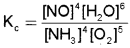
Plus One Chemistry Chapter Wise Questions and Answers Chapter 7 Equilibrium 2

Question 9.
1. State Henry’s law.
2. Suggest an example fora gas in liquid equilibrium.
Answer:
1. The mass of a gas dissolved in a given mass of a solvent at any temperature is directly proportional to the pressure of the gas above the solvent.

2. Equilibrium between the CO2 molecules in the. gaseous state and the CO2 molecules dissolved in water under pressure,
CO2(g) \(\rightleftharpoons \) CO2(in solution)

Question 10.
1. What is heterogeneous equilibrium?
2. Suggest an example forthis.
Answer:
1. Equilibrium in a system having more than one phase is called heterogeneous equilibrium

2. Equilibrium between solid Ca(OH)2 and its saturated solution:
Ca(OH)2(s) + (aq) \(\rightleftharpoons \) Ca2+(aq) + 2OH(aq)

Question 11.
For the equilibrium 2SO3(g) → 2SO2(g) + O2(g), Kc at 47 °C 3.25 × 10⁻⁹ mol per litre. What will be the value of Kp at this temperature (R = 8.314 J K-1mol-1).
Answer:
R = 8.314 J K-1 mol-1 ∆n = 3 – 2 = 1
T = 47 °C = 273 + 47 = 320 K
Kc = 3.25 × 10⁻⁹
Kp = Kc (RT)∆n
= 3.25 × 10⁻⁹ (8.314 × 320)1
= 3.25 × 10-9 × 8.314 × 320 = 8.65 × 10⁻¹²

Learn how to find Kp from pressures, and see examples that walk through sample problems step-by-step for you to improve your chemistry knowledge and skills.

Question 12.
The pH of a sample of vinegar is 3.76. Calculate the concentration of hydrogen ions in it.
Answer:
pH= -log[H+] = 3.76
log[H+] = – 3.76
[H+] = antilog of (- 3.76) = 1.738 × 10⁻⁴ mol L-1

Question 13.
The equilibrium constant can be expressed in terms of partial pressure as well as concentration.
1. Give the relation between Kp and Kc.
2. What is the relation between Kp and Kc for the reaction, N2(g) + O2(g) \(\rightleftharpoons \) 2NO(g)?
Answer:
1. Kp = Kc(RT)∆n, where ∆n = (number of moles of gaseous products) – (number of moles of gaseous reactants).

2. Here, ∆n = 2 – 2 = 0
Kp = Kc(RT)∆n , Kp = Kc (RT)°
∴ Kp = Kc

Question 14.
1. Explain Arrhenius concept of acids and bases with suitable examples.
2. How proton exists in aqueous solution? Give reason.
Answer:
1. According to Arrhenius theory, acids are substances that dissociates in water to give hydrogen ions, H+(aq) and bases are substances that produce hydroxyl ions, OH(aq). Forexample, HCl is an Arrhenius acid and NaOH is an Arrhenius base.

2. In aqueous solution the proton bonds to the oxygen atom of a solvent water molecule to give trigonal pyramidal hydronium ion, H3O+(aq). This is because a bare proton, H+ is very reactive and cannot exist freely in aqueous solutions.

Question 15.
1. What is an acidic buffer?
2. Suggest an example for an acidic buffer.
Answer:
1. An acidic buffer is a buffer solution having pH less than 7. It is prepared by mixing a weak acid and its salt formed with a strong base.

2. Mixture of acetic acid (CH3COOH) and sodium acetate (CH3COONa) is an example for an acidic buffer. Its pH is around 4.75.

Question 16.
1. What is a basic buffer?
2. Suggest an example for basic buffer.
Answer:
1. A basic buffer is a buffer solution having pH greater than 7. It is prepared by mixing a weak base and its salt formed with a strong acid.

2. Mixture of ammonium hydroxide (NH4OH) and ammonium chloride (NH4CI) is an example for a basic buffer. Its pH is around 9.25.

Plus One Chemistry Equilibrium Three Mark Questions and Answers

Question 1.
The concentration of reactant and products for the reaction, H2(g) + l2(g) \(\rightleftharpoons \) 2Hl(g) are recorded as follows:

Reactant or Product Molar Concentration
H2 0.080
l2 0.060
HI 0.490

a) Write down the expressions for equilibrium constant of the above reaction.
b) Calculate the equilibrium constant at the temperature 298 K if [Hl] = 0.49 M, [H2]=0.08 M and [l2]=0.06 M.
Answer:
Plus One Chemistry Chapter Wise Questions and Answers Chapter 7 Equilibrium 3

Question 2.
1. When equilibrium is reached in a chemical reaction?
2. What is the influence of molar concentration in a reaction at equilibrium?
3. Write the expression for equilibrium constant for the decomposition of NH4CI by the reaction,
NH4Cl \(\rightleftharpoons \) NH3+HCl
Answer:
1. When the rate of forward reaction is equal to rate of backward reaction, the chemical reaction is said to be in equilibrium.

2. Rate of chemical reaction is directly proportional to the product of molar concentration of the reactants.

3. \(\mathrm{K}=\frac{\left[\mathrm{NH}_{3}\right] \mathrm{HCl}}{\left[\mathrm{NH}_{4} \mathrm{Cl}\right]}\)

Plus One Chemistry Chapter Wise Questions and Answers Chapter 7 Equilibrium

Question 3.
1. What is meant by Kp?
2. How Kp is related to Kc?
Answer:
1. Kp is the equilibrium constant in terms of the partial pressures of the reactants and products (Pressure should be expressed in bar as standard state is 1 bar). It is used for reactions involving gases.

2. Kp = Kc (RT)∆n
where R = universal gas constant, T = absolute temperature and ∆n = number of moles of gaseous product(s) – number of moles of gasesous reactant(s).

Question 4.
a) What do you mean by equilibrium constant?
b) Write any two characteristics of equilibrium constant.
c) Write an expression for equilibrium constant of the reaction, 2SO2(g) + O2(g) \(\rightleftharpoons \) SO3(g).
Answer:
a) Equilibrium constant at a given temperature is the ratio of product of molar concentrations of the products to that of the reactants, each concentration term being raised to the respective stoichiometric coefficients in the balanced chemical equation.

b) 1. The value of equilibrium constant is independent of the initial concentrations of the reactants and products.
2. Equilibrium constant is temperature dependent having one unique value for a particular reaction represented by a balanced equation at a given temperature.

Question 5.
2NO2(g) \(\rightleftharpoons \) N2O4(g); ∆H = -52.7 kJ mol-1
1. What change will happen if we increase the temperature?
2. What is the effect of increase in pressure in the above equilibrium?
3. What happens when N2O4 is removed from the reaction medium?
Answer:
1. Since the forward reaction is exothermic, on increasing temperature the rate of backward reaction (endothermic reaction) increases.

2. Since the number of moles decreases in the forward reaction, on increasing pressure, the rate of forward reaction increases.

3. Rate of forward reaction increases.

Question 6.
Consider this reaction:
CO(g) + 2H2(g) \(\rightleftharpoons \) CH3OH(g); ∆rH = -92 kJ mol-1
Explain the influence of the following on the basis of
Le Chatelier’s principle.
1. Decrease in pressure.
2. Increase in temperature.
3. Increase in the partial pressure of hydrogen.
Answer:
1. On decreasing pressure the reaction shifts in the direction in which there is increase in the number of moles. Thus, the rate of backward reaction increases on decreasing pressure.

2. On increasing temperature, the rate of endothermic reaction increases. Here, backward reaction is endothermic. Hence, on increasing temperature the rate of backward reaction increases.

3. Hydrogen, being a reactant increase in its partial pressure increases the rate of forward reaction.

Question 7.
The equilibrium showing dissociation of phosgene gas is given below:
COCl2(g) \(\rightleftharpoons \) CO(g) + Cl2(g)
When a mixture of these three gases at equilibrium is compressed at constant temperature, what happens to
1. The amount of CO in mixture?
2. The partial pressure of COCl2?
3. The equilibrium constant for the reaction?
Answer:
1. Amount of CO decreases, because the system favours the reaction in which number of moles decreases with increase of pressure i.e., backward reaction.

2. Increases.
3. Equilibrium constant remains the same since temperature is constant.

Question 8.
The equilibrium constant of the reaction H2(g) + l2(g) \(\rightleftharpoons \) 2Hl(g) is 57 at 700 K. Now, give the equilibrium constants for the following reactions at the same temperature:
Plus One Chemistry Chapter Wise Questions and Answers Chapter 7 Equilibrium 4
Answer:
Plus One Chemistry Chapter Wise Questions and Answers Chapter 7 Equilibrium 5

Question 9.
1. What are buffer solutions?
2. Which of the following are buffer solutions?
NaCl + HCl
NH4Cl + NH4OH
HCOOH + HCOOK
3. What is the effect of pressure on the following equilibria?
i) Ice \(\rightleftharpoons \) Water
ii) N2(g) + O2(g) \(\rightleftharpoons \) 2N0(g)
Answer:
1. These are solutions which resist change in pH on dilution or with the addition of small amounts of acid or alkali.

2. NH4Cl + NH4OH

3. i) When pressure is increased the melting point of ice decreases and hence the rate of forward reaction will increase.
ii) Pressure has no effect in this equilibrium because there is no change in the number of moles of the gaseous reactants and products.

Question 10.
The aqueous solution of the compounds NaCl, NH4Cl and CH3COONa show different pH.

  1. Identify the acidic, basic and neutral solution among them.
  2. The concentration of hydrogen ion in a soft drink is 4 × 10⁻⁴. What is its pH?

Answer:

  1. Acidic-aqueous solution of NH4Cl Neutral – aqueous solution of NaCl Basic – aqueous solution of CH3COONa
  2. pH = – log[H+] = – log[4 × 10⁻⁴] = 3.398

Question 11.
1. What is pH? What is its significance?
2. The concentration of hydrogen ion in a sample of soft drink is 3.8 × 10⁻³. What is its pH?
Answer:
1. pH is a logarithmic scale used to express the hydronium ion concenration in molarity more conveniently. The pH of a solution is defined as negative logarithm to the base 10 of the activity of hydrogen ion. pH = — log \({ { a }_{ { H }^{ + } } }\) = —log[H+]

2. [H+] = 3.8 × 10⁻³
pH = -log[H+]
= -log [3.8 × 10⁻³] = -(-2.42) = 2.42

Question 12.
1. State the Le-Chatelier’s principle.
2. Apply the above principle in the following equilibrium and predict the effect of pressure.
CO(g) + 3H2(g) \(\rightleftharpoons \) CH4(g) + H2O(g)
Answer:
1. The Le Chateliers principle states that a change in any of the factors that determine the equilibrium conditions of a system will cause the system to change in such a manner so as to reduce or to counteract the effect of the change.

2. On increasing pressure the rate of forward reaction increases. This is because number of moles decreases in the forward reaction. In other words, the value of Qc decreases on increasing pressure. As Qc < Kc, the reaction proceeds in the forward direction.

Plus One Chemistry Chapter Wise Questions and Answers Chapter 7 Equilibrium

Question 13.
1. Explain Lewis concept of acids and bases.
2. Why does BF3 act as a Lewis acid?
Answer:
1. A Lewis acid can be defined as a species which accepts electron pair and a Lewis base is a species which donates an electron pair.

2. In BF3, the boron atom is electron deficient and it accepts a lone pair of electron. So it acts as a Lewis acid.

Question 14.
1. How the value of AG influence the direction of an equilibrium process?
2. The equilibrium constant for a reaction is 8. What will be the value of ∆G at 27 °C?
Answer:
1. If ∆G is negative, then the reaction is spontaneous and proceeds in the forward direction.
If ∆G is positive, then reaction is considered non- spontaneous. instead, as reverse reaction would have a negative ∆G, the products of the forward reaction shall be converted to the reactants.
If ∆G is 0, reaction has achieved equilibrium. At this point, there is no longer any free energy to drive the reaction.
2.
Plus One Chemistry Chapter Wise Questions and Answers Chapter 7 Equilibrium 6

Question 15.
1. What is common ion effect?
2. Suggest an example for this effect.
Answer:
1. Common ion effect may be defined as the suppression of the dissociation of a weak electrolyte by the addition of some strong electrolyte containing a common ion.

2. The dissociation equilibrium of NH4OH is shifted towards left in presence of NH4Cl having the common ion, NH4+.

Question 16.
1. Predict whether an aqueous solution of (NH4)2SO4 is acidic, basic or neutral?
2. Justify your answer.
Answer:
1. An aqueous solution of (NH4)2SC4 is acidic in nature.

2. (NH4)2SO4 is formed from weak base, NH4OH, and strong acid, H2SO4. In water, it dissociates completely
(NH4)2SO4(aq) → 2NH4+ (aq) + SO42- (aq)
NH4+ ions undergoes hydrolysis to form NH4OH and H+ ions.
NH4+(aq) + H2O(l) \(\rightleftharpoons \) NH4OH(aq) + H+(aq)
NH4OH is a weak base and therefore remains almost unionised in solution. This results in increased H+ ion concentration in solution making the solution acidic.

Question 17.
1. What are sparingly soluble salts? Suggest an example.
2. Define solubility product constant, Ksp.
3. Obtain the relation between solubility product constant (Ksp) and solubility (S), of a solid salt of general formula Mxp+ Xyq-.
Answer:
1. Sparingly soluble salts are those salts with solubility less than 0.01 M.
e.g. BaSO4

2. The solubility product of a sparingly soluble salt at a given temperature is defined as the product of the concentrations of its ions in the saturated solution, with each concentration term raised to the power equal to the number of times the ion occurs in the equation representing the dissociation of the electrolyte.

3. The equilibrium in the saturated solution of the salt can be represented as,
Plus One Chemistry Chapter Wise Questions and Answers Chapter 7 Equilibrium 17

Question 18.
The Le Chatelier’s principle is applicable to physical and chemical equilibria.
1. What are the factors which can influence the equilibrium state of a system?
2. Explain the factors affecting the chemical equilibrium on the basis of Le Chatelier’s principle taking Haber’s process for the manufacture of ammonia as an example.
Answer:
1. The following factors can influence the equilibrium state of a system:

  • Change in concentration of the reactants or products.
  • Change in temperature.
  • Change in pressure.
  • Addition of inert gas.
  • Presence of catalyst.

2. N2(g) + 3H2(g) \(\rightleftharpoons \) 2NH3(g); ∆rH = -91.8 kJ mol-1
When concentration of N2 or H2 is increased, a good yield of NH3 can be achieved. The rate of forward reaction can also be increased by removing NH3 from the reaction mixture.

When pressure is increased, the system will try to decrease pressure and for this system will proceed in that direction where there is minimum number of moles i.e., forward reaction. Thus, a good yield of NH3 can be achieved by increasing pressure.

Since the formation of NH3 is an exothermic reaction, a good yield of NH3 can be achieved by decreasing the temperature. But if the temperature is decreased to very low value the reactant molecules do not have sufficient energy to interact. Hence, an optimum temperature of 500°C is used.

Plus One Chemistry Chapter Wise Questions and Answers Chapter 7 Equilibrium

Question 19.
1. Soda water is prepared by dissolving CO2 in water under high pressure. What is the principle involved in this process?
2. At 1000 K, equilibrium constant Kc for the reaction 2SO3(g) \(\rightleftharpoons \) 2SO2(g) + O2(g) is 0.027. What is the value of Kp at this temperature?
Answer:
1. Henry’s law
2. Kp =Kc(RT)∆n
∆n = 3.2 = 1
Kp = 0.027 × (0.0831 × 1000)1 = 2.2437

Question 20.
1. For the reaction PCL \(\rightleftharpoons \) PCl3 +Clc
i) Write the expression of Kc.
ii) What happens if pressure is increased?
2. Write the conjugate acid and base of the following species:
i) H20 ii) HCO;
3. Name the phenomenon involved in the preparation of soap by adding NaCI.
Answer:
1. i) \(\kappa_{c}=\frac{\left[\mathrm{PC}_{3}\right]\left[\mathrm{Cl}_{2}\right]}{\left[\mathrm{PCl}_{5}\right]}\)
ii) If we increase the pressure the system will try to decrease the pressure. For this system will proceed in the direction where there is minimum number of moles, i.e., rate of backward reaction increases by decreasing the pressure.

2. i) Conjugate acid of H2O is H3O+
Conjugate base of H2O is OH”
ii) Conjugate acid of HCO,” is H2CO3 Conjugate base of HCO3 is CO32-

3. Common ion effect.

Question 21.
a) The pH of black coffee is 5.0. Calculate the hydrogen ion concentration.
b) The Ksp of barium sulphate is 1.5 × 10⁻⁹. Calculate the solubility of barium sulphate in pure water.
Answer:
Plus One Chemistry Chapter Wise Questions and Answers Chapter 7 Equilibrium 7

Question 22.
1. What is conjugate acid-base pair?
2. Illustrate with an example.
Answer:
1. The acid-base pairthat differs only by one proton is called conjugate acid-base pair. Such acid-base pairs are formed by loss or gain of a proton.

2. Consider the ionization of hydrochloric acid in water.
Plus One Chemistry Chapter Wise Questions and Answers Chapter 7 Equilibrium 8
HCl(aq) acts as an acid by donating a proton to H2O molecule which acts as a base because it accepts the proton. The species H2O+ is produced when water accepts a proton from HCl. Therefore, Cl is the conjugate base of HCl and HCl is the conjugate acid of Cl. Similarly, H2O is the conjugate base of H2O+ and H3O++ is the conjugate acid of the base H2O.

Question 23.
1. What are the applications of equilibrium constant?
2. What is meant by reaction quotient, Qc?
3. Predict the direction of net reaction in the following cases:
i) Qc < Kc
ii) Qc > Kc
iii) Qc = Kc
Answer:
1. The applications of equilibrium constant are:
• To predict the extent of a reaction on the basis of its magnitude.
• To predict the direction of the reaction.
• To calculate equilibrium concentrations.

2. Reaction quotient, Qc at a given temperature is defined as the ratio of the product of concentrations of the reaction products to that of the reactants, each concentration term being raised to their individual stoichiometric coefficients in the balanced chemical equation, where the concentrations are not necessarily equilibrium values.

3. i) When Qc > Kc, the reaction will proceed in the
direction of reactants (reverse reaction), i.e., net reaction goes from right to left.
ii) When Qc < Kc, the reaction will proceed in the direction of products (forward reaction), i.e., net reaction goes from left to right.
iii) When Qc = Kc, the reaction mixture will be at equilibrium, i.e., no net reaction occurs.

Question 24.
Solubility product helps to predict the precipitation of salts from solution.
1. Find the relation between solubility (S) and solubility product (Ksp) of calcium fluoride and zirconium phosphate.
2. The solubility product of two sparingly soluble salts XY2 and AB are 4 × 10-15 and 1.2 × 10⁻¹⁶ respectively. Which salt is more soluble? Explain.
Answer:
1. The equilibrium in the saturated solution of calcium fluoride can be represented as,
CaF2(s) \(\rightleftharpoons \) Ca2+(aq) + 2F(aq)
Ksp = [Ca2+][F]2 = S.(2S)2 = 4S3
The equilibrium in the saturated solution of zirconium phosphate can be represented as,
Zr3(PO4)4(s) \(\rightleftharpoons \) 3Zr4+(aq) + 4PO43-(aq)
Ksp = [Zr4+]3[PO43-]4 = (3S)3.(4S)4 = 6912S7

2. XY2 is more soluble than AB.
Plus One Chemistry Chapter Wise Questions and Answers Chapter 7 Equilibrium 9

Question 25.
a) How common ion effect can influence the solubility of ionic salts?
b) What is the application of common ion effect in gravimetric estimation?
Answer:
1. In a salt solution, if we increase the concentration of any one of the ions, according to Le Chatelier’s principle, it should combine with the ion of its opposite charge and some of the salt will be precipitated till Ksp = Qsp. Similarly, if the concentration of one of the ions is decreased, more salt will dissolve to increase the concentration of both the ions till Ksp = Qsp.

2. The common ion effect is used for almost complete precipitation of a particular ion as its sparingly soluble salt, with very low value of solubility product for gravimetric estimation.

Plus One Chemistry Equilibrium Four Mark Questions and Answers

Question 1.
Match the following:
Plus One Chemistry Chapter Wise Questions and Answers Chapter 7 Equilibrium 10
Answer:
Plus One Chemistry Chapter Wise Questions and Answers Chapter 7 Equilibrium 11

Question 2.
In Contact process, SO3 is prepared by the oxidation of SO2 as per the following reaction:
2SO2(g) + O2(g) \(\rightleftharpoons \) 2SO3(g); ∆H = -189.4
a) What happens to the rate of forward reaction when i) temperature is increased?
ii) pressure is decreased?
iii) a catalyst V2O5 is added?
b) Calculate the pH of 0.01 M H2SO4 solution. Also, calculate the hydroxyl ion concentration in the above solution.
Answer:
1. D When temperature is increased, the rate of forward reaction decreases since it is exothermic.
ii) When pressure is decreased the rate of forward reaction decreases since it is associated with decrease in number of moles.
iii) When a catalyst V2O5 is added the rate of both forward and backward reactions are increased by the same extent and equilibrium is reached earlier.
2.
Plus One Chemistry Chapter Wise Questions and Answers Chapter 7 Equilibrium 12

Question 3.
Calculate the [H+] in the following biological fluids whose pH are given in brackets.
i) Human muscle fluid (6.83)
ii) Human stomach fluid (1.22)
iii) Human blood (7.38)
iv) Human saliva (6.4)
Answer:
i) pH =-log[H+] = 6.83
log[H+] = – 6.83
[H+] = antilog (- 6.83) = 1.48 × 10⁻⁷ mol L-1
ii) [H+] = antilog (- 1.22) = 6.03 × 10⁻² mol L-1
iii) [H+] = antilog (- 7.38) = 4.17 × 10⁻⁸ mol L-1
iv) [H+] = antilog (- 6.4) = 3.98 × 10⁻⁷ mol L-1

Question 4.
The pH value of a solution determines whether it is acidic, basic or neutral in nature.
1. The concentration of hydrogen ion in the sample of a soft drink is 3.8 × 10⁻³ mol/L. Calculate its pH. Also predict whether the above solution is acidic, basic or neutral.
2. The dissociation constants of formic acid (HCOOH) and acetic acid (CH3COOH) are 1.8 × 10⁻⁴and 1.8 × 10⁻⁴ respectively. Which is relatively more acidic? Justify your answer.
Answer:
1. pH = – log[H+] = – log[3.8 × 10⁻³] = 2.42
Since pH is less than 7, it is an acidic solution,

2. HCOOH is more acidic.
Ka value is directly proportional to the acid strength, i.e., greater the Ka value, stronger is the acid.

Question 5.
a) Write the expression for Henderson – Hasselbalch equation for i) An acidic buffer & ii) A basic buffer.
b) Calculate the pH of a solution which is 0.1 M in
CH3COOH and 0.5 M in CH3COONa. Ka for CH3COOH is 1.8 × 10⁻⁶.
Answer:
Plus One Chemistry Chapter Wise Questions and Answers Chapter 7 Equilibrium 13

Plus One Chemistry Equilibrium NCERT Questions and Answers

Question 1
A liquid is in equilibrium with its vapour in a sealed containerat a fixed temperature. The volume of the container is suddenly increased. (3)
a) What is the initial effect of the change on vapour pressure?
b) How do rates of evaporation and condensation change initially?
c) What happens when equilibrium is restored finally and what will be the final vapour pressure?
Answer:
a) Vapour pressure decreases due to increase in volume.
b) Rate of evaporation remains same and rate of condensation decreases.
c) Finally the same vapour pressure is restored and the rate of evaporation becomes equal to the rate

Question 2.
The concentration of hydrogen ion in a sample of soft drink is 3.8 × 10⁻³ M. What is its pH? (2)
Answer:
pH = -log[H+]
= -log (3.8 × 10⁻³) = 2.42

Plus One Chemistry Chapter Wise Questions and Answers Chapter 7 Equilibrium

Question 3.
The pH of a sample of vinegar is 3.76. Calculate the concentration of hydrogen ion in it. (2)
Answer:
H= -log [H+]
or log [H+] = -3.76 = -4.24
[H+] = antilog (-3.76) = 1.74 × 10⁻⁴M

Question 4.
The ionization constants of HF, HCOOH and HCN at 298 K are 6.8 × 10⁻⁴, 1.8 × 10⁻⁴ and 4.8 × 10⁻⁹ respectively. Calculate the ionization constants of the corresponding conjugate base. (3)
Answer:
The relation between ionization constant of an acid and that of its conjungate base is Ka x Kb = Kw
Plus One Chemistry Chapter Wise Questions and Answers Chapter 7 Equilibrium 14

Question 5
The ionization constant of nitrous acid is 4.5 x 10⁻⁴. Calculate the pH of 0.04 M sodium nitrite solution and also its degree of hydrolysis. (2)
Answer:
Sodium nitrite is a salt of strong base and weak acid. Its degree of hydrolysis, h is given by the relation.
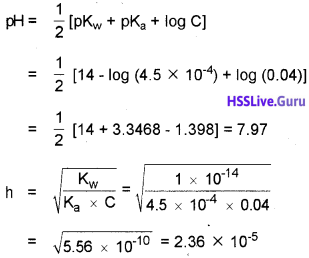
Plus One Chemistry Chapter Wise Questions and Answers Chapter 7 Equilibrium 15

Question 6
A 0.02 M solution of pyridinium hydrochloride has pH = 3.44. Calculate the ionization constant of pyridine. (2)
Answer:
Pyridinium hydrochloride is a salt of a weak base (pyridine) and a strong acid (HCl). The pH of an aqueous solution of this salt is given by the relation:
Plus One Chemistry Chapter Wise Questions and Answers Chapter 7 Equilibrium 16

Plus One Maths Model Question Paper 3

Kerala Plus One Maths Model Question Paper 3

Time Allowed: 2 1/2 hours
Cool off time: 15 Minutes
Maximum Marks: 80

General Instructions to Candidates :

  • There is a ‘cool off time’ of 15 minutes in addition to the writing time .
  • Use the ‘cool off time’ to get familiar with the questions and to plan your answers.
  • Read instructions carefully .
  • Read questions carefully before you answering.
  • Calculations, figures and graphs should be shown in the answer sheet itself.
  • Malayalam version of the questions is also provided.
  • .Give equations wherever necessary.
  • Electronic devices except non programmable calculators are not allowed in the Examination Hall.

Plus One Maths Previous Year Question Papers and Answers

Questions 1 to 7 carry 3 score each. Answer any 6.
Plus One Maths Model Question Papers Paper 3A
Question 1.
a. Write set is the subset of all the given sets?
(a) {1,2,3,….}
(b) {1}
(c) {0}
(d) {}
b. Write down the power set of A = {1,2,3}
Plus One Maths Model Question Papers Paper 3Q1

Question 2.
In any triangle ABC, prove that
a(SinB- sinC) + b(sinC- sinA) +c(sinA- sinB) = 0
Plus One Maths Model Question Papers Paper 3Q2

Question 3.
a. Solve x2 + 2 = 0
b. Find the multiplicative inverse of 2-3i
a. x2 + 2 = 0
Plus One Maths Model Question Papers Paper 3Q3

Question 4.
a. Solve
Plus One Maths Model Question Papers Paper 3Q4
b. Find the graphical solution of the above inequality.
Plus One Maths Model Question Papers Paper 3Q4.1
Plus One Maths Model Question Papers Paper 3Q4.2

Question 5.
a. A committee of 7 has to be formed from 9 boys and 4 girls. In how many ways can this be done when the committee consists of atmost 3 girls,
b. Find n if 2nC3: nC3 = 12 : 1
Plus One Maths Model Question Papers Paper 3Q5

Question 6.
a. The new coordinates of the points (2, 5) if the origin is shifted to the point (1, 1) by translation of axes.
A) (3, 1) B(1, 3) C (-1, 3) D (3, -1)
b. Find what the equation x+ xy – 3y2– y + 2 = 0 becomes when the origin is shifted to the point (1,1)?
Plus One Maths Model Question Papers Paper 3Q6

Question 7.
Evaluate :
Plus One Maths Model Question Papers Paper 3Q7

Questions from 8 to 17 carry 4 score each. Answer any 8.
Plus One Maths Model Question Papers Paper 3B

Question 8.
Plus One Maths Model Question Papers Paper 3Q8

Question 9.
Consider the statement 1.3 + 2.32 + 3.33
Plus One Maths Model Question Papers Paper 3Q9
a. Verify whether the statement is true for n =1.
b. Prove the result by using principle of mathematical induction.
Plus One Maths Model Question Papers Paper 3Q9.1

Question 10.
a. Express (1 + i)3 + (1 – i)3 in a + ib form.
b. Find the polar form of the complex number – 1 – i.
Plus One Maths Model Question Papers Paper 3Q10

Question 11.
solve the following linear inequalities graphically:
Plus One Maths Model Question Papers Paper 3Q11

Question 12.
a. “P=
Plus One Maths Model Question Papers Paper 3Q12
b. The letters of the word FATHER be permuted and arranged in a dictionary, find the rank of the word FATHER?
Plus One Maths Model Question Papers Paper 3Q12.1

Question 13.
a. The distance of the point P(1,-3) from the line 2y – 3x = 4 is
A) 13
B)  \(\frac { 7 }{ 13 } \sqrt { 3 } \)
C) √13
D) None of these
b. Reduce the equation√3x + y + 8 = 0 in to normal form. Find the values of P and ω
imagee

Question 14.
a. A conic with e = 0 is known as
A) a parabola
B) an ellipse
C) a hyperbola
D) a circle
b. Consider the circle x+ y+ 8x + 10y – 8 = 0
i) Find the centre C and radius ‘r’.
ii) Find the equation of the circle with centre at C and passing through the point (1, 2)
Plus One Maths Model Question Papers Paper 3Q14

Question 15.
a. What is the perpendicular distance from the point P(6,7,8) from XY plane.
A) 8
B) 7
C) 6
D) 9
b. Find the equation of the set of points P, the sum of whose distances from A(4,0,0) and B(-4,0,0) is equal to 10.
Plus One Maths Model Question Papers Paper 3Q15

Question 16.
a. Convert 20°40‘ into radian measure.
b. If sin x = \(\frac { 12 }{ 13 } \) and x is an acute angle, find the value of cos 2x.
c. Prove that
\(\frac { sinx-sin\quad 3x }{ { sin }^{ 2 }x-{ cos }^{ 2 }x } \)
= 2 sin x.
Plus One Maths Model Question Papers Paper 3Q16

Question 17.
a. Write the component statements of the following statement: All prime numbers are either even or odd
b. Verify by the method of contradiction, p = √7 is irrational
Plus One Maths Model Question Papers Paper 3Q17

Questions from 18 to 24 carry 6 score each. Answer any 5.
Plus One Maths Model Question Papers Paper 3B
Question 18.
a. Write the interval (6,12) in the set-builder form.
b. Draw the Venn diagram of the following sets :
i) A’ ∩ B’
ii)A – B
c. In a group of 65 people, 40 like cricket, 10 like both cricket and tennis. How many like tennis? How many like tennis only and not cricket?
Plus One Maths Model Question Papers Paper 3Q18

Question 19.
a. Write the number of terms in the expansion of (a – b)2n
b. Find the general term in the expansion of (x2– yx)12, x ≠ 0
c. Find the coefficient of xy3 in the expansion of (x + 2y)9
Plus One Maths Model Question Papers Paper 3Q19

Infinite Series calculator is a free online tool that gives the summation value of the given function for the given limits.

Question 20.
a. The common ratio of the G.P is \(\frac { -4 }{ 5 } \) and the sum to infinity is \(\frac { -80 }{ 9 } \). Find the first term.
b. Evaluate:
Plus One Maths Model Question Papers Paper 3Q20
c. Find the sum of first n terms of the series : 0.6+0.66+0.666+…….to n terms.
Plus One Maths Model Question Papers Paper 3Q20.1

Question 21.
a. Find the derivative of xn from first principles.
Plus One Maths Model Question Papers Paper 3Q21

Question 22.
a. Find the point of intersection of the lines 2x + y = 5 and x + 3y + 8 = 0.
b. Find the equation of a line passing through the point of intersection of the above lines and parallel to the line 3x + 4y =7.
c. Find the distance between these two paralle lines.
Plus One Maths Model Question Papers Paper 3Q22

Question 23.
a. Find the Mean deviation of the data 3, 10, 10, 4, 7, 10, 5 from mean is ………
Plus One Maths Model Question Papers Paper 3Q23
b. Calculate mean, variance and standard deviation of the following distribution:
Plus One Maths Model Question Papers Paper 3Q23.1

Question 24.
a. In aleap year the probability of having 53 Sundays is ……..
Plus One Maths Model Question Papers Paper 3Q24
b. Events E and F are such that P (not E or not F) = 0.25, state whether E and F are mutually exclusive.
c. How many points are there in a sample space, if a card is selected from a pack of 52 cards.
Plus One Maths Model Question Papers Paper 3Q24.1

Answer

Answer 1.
a. d) { }
b. P(A)={{1,2,3}, {1,2}, {2,3}, {1,3}, {1}, {2}, {3}, ø}

Answer 2.
LHS = a (sinB-sinC) + 6(sinC-sinA) +c (sinA-sinB)
= 2R sin A(sinB-sinC) + 2R sin B (sinC-sinA)+2R sinC (sinA – sinB)
= 2R [sin A sin B – sinAsinC + sinB sinC – sinBsinA + sinCsinA – sin C sinB]
= 2R x 0 = 0 = RHS

Answer 3.
Plus One Maths Model Question Papers Paper 3A3

Answer 4.
Plus One Maths Model Question Papers Paper 3A4
Plus One Maths Model Question Papers Paper 3A4.1

Answer 5.
Plus One Maths Model Question Papers Paper 3A5

Answer 6.
a. B) (1, 3) since [2 – 1, 5 – 2]
b. Let the coordinates of a point P changes from (x,y) to (X,Y) when origin is shifted to (1,1)
∴ x = X + 1, y = Y + 1 Substituting in the given equation, we get
(X+1)2 + (X + 1) (7 + 1) -3 (7 + 1)2 -(7 + 1) + 2 = 0
⇒ X2+2X + 1 + XY + X+ Y+ 1-3 (P + 27 + 1) – (7+ 1) + 2 – 0
⇒ X2 – 3Y2 + XY + 3X- 6Y = 0
∴ Equation in new system is
X– 3Y2 + XY + 3X -6Y = 0

Answer 7.
Plus One Maths Model Question Papers Paper 3A7

Answer 8.
Plus One Maths Model Question Papers Paper 3A8

Answer 9.
Plus One Maths Model Question Papers Paper 3A9
Plus One Maths Model Question Papers Paper 3A9.1

Answer 10.
Plus One Maths Model Question Papers Paper 3A10

Answer 11.
Plus One Maths Model Question Papers Paper 3A11

Answer 12.
a. D
b. The alphabetical order of the word ‘ FATHER are A, E, F, H, R, T No. of words beginning with
Plus One Maths Model Question Papers Paper 3A12

Answer 13.
Plus One Maths Model Question Papers Paper 3A13

Answer 14.
a. D
b. Comparing x2 + y1 – 8x +10 y – 12 = 0 with
Plus One Maths Model Question Papers Paper 3A14

Answer 15.
a. A. 8 [ || perpendicular distance of a point from XY plane = z coordinate
b. Let P(x, y, z) be the point such that PA + PB = 10
Plus One Maths Model Question Papers Paper 3A15

Answer 16.
Plus One Maths Model Question Papers Paper 3A16
Plus One Maths Model Question Papers Paper 3A16.1

Answer 17.
a. p: All prime numbers are even. q: All prime numbers are odd
b. Let us assume that √7 is a rational number
∴ √7 = , where a and b are co-prime, i.e. a and b have no common factors, which implies that 7b– a2 ⇒ 7 divides a.
∴ there exists an integer ‘k’ such that a = 7k
a= 49k2 ⇒ 7b= 49k2⇒b2= 7k2 7 divides b.
i.e., 7 divides both a and b, which is contradiction to our assumption that a and b have no common factor.
∴ our supposition √7 is wrong, is an irrational number.

Answer 18.
a. {x : x ∈ R, 6 < x ≤ 12}
Plus One Maths Model Question Papers Paper 3A18
Plus One Maths Model Question Papers Paper 3A18.1

Answer 19.
a. Number of terms in expansion can be given by 2n + 1
b. General term can be given by
Plus One Maths Model Question Papers Paper 3A19

Answer 20.
Plus One Maths Model Question Papers Paper 3A20
Plus One Maths Model Question Papers Paper 3A20.1

Answer 21.
Plus One Maths Model Question Papers Paper 3A21

Answer 22.
a.  2x + y =5 ……………. (1)
x + 3y = -8………………….. (2)
(1) x 3 – (2) ⇒
6x + 3y = 15 x + 3y = -8
(-) (-) (+)
————-
5x  = 7 7
∴ x = 7/5
Plus One Maths Model Question Papers Paper 3A22
b. Slope of the required line, m = \(-\frac { 3 }{ 4 } \)
|| slope of the parallel line Equation of the line is y – y = m (x – x1)
Plus One Maths Model Question Papers Paper 3A22.1
Plus One Maths Model Question Papers Paper 3A22.2

Answer 23.
a. b
Plus One Maths Model Question Papers Paper 3A23
Plus One Maths Model Question Papers Paper 3A23.1
c. The parallel lines 15x + 20y – 57 = 0 and
3x + 4y – 7 = 0 ⇒15x + 20y – 35=0 x ing by 5
Parallel distance
Plus One Maths Model Question Papers Paper 3A23.2

Answer 24.
a. (b) 7/3
b. (not E or not F)
= P(E ‘∪ F’) = P(E ∩ F)’ = 1 = 1P(E ∩ F)
⇒ 0.25 = 1 -P(E n F) ⇒ p(E ∩ F) = 1 -0.25 = 0.75 ≠ 0
⇒ E and F are not mutually exclusive
c. 52

Plus One Maths Previous Year Question Papers and Answers

Plus One Malayalam Textbook Answers Unit 1 Chapter 2 Ormayude Njarambu

Kerala State Board New Syllabus Plus One Malayalam Textbook Answers Unit 1 Chapter 2 Ormayude Njarambu Text Book Questions and Answers, Summary, Notes.

Kerala Plus One Malayalam Textbook Answers Unit 1 Chapter 2 Ormayude Njarambu

Ormayude Njarambu Questions and Answers

Plus One Malayalam Textbook Answers Unit 1 Chapter 2 Ormayude Njarambu 1

Plus One Malayalam Textbook Answers Unit 1 Chapter 2 Ormayude Njarambu 2

Plus One Malayalam Textbook Answers Unit 1 Chapter 2 Ormayude Njarambu 3

Plus One Malayalam Textbook Answers Unit 1 Chapter 2 Ormayude Njarambu 4

Plus One Malayalam Textbook Answers Unit 1 Chapter 2 Ormayude Njarambu 5

Plus One Malayalam Textbook Answers Unit 1 Chapter 2 Ormayude Njarambu 6

Plus One Malayalam Textbook Answers Unit 1 Chapter 2 Ormayude Njarambu 7

Plus One Malayalam Textbook Answers Unit 1 Chapter 2 Ormayude Njarambu 8

Plus One Malayalam Textbook Answers Unit 1 Chapter 2 Ormayude Njarambu 9

Plus One Malayalam Textbook Answers Unit 1 Chapter 2 Ormayude Njarambu 10

Plus One Malayalam Textbook Answers Unit 1 Chapter 2 Ormayude Njarambu 11

Plus One Malayalam Textbook Answers Unit 1 Chapter 2 Ormayude Njarambu 12

Plus One Malayalam Textbook Answers Unit 1 Chapter 2 Ormayude Njarambu 13

Plus One Malayalam Textbook Answers Unit 1 Chapter 2 Ormayude Njarambu 14

Plus One Malayalam Textbook Answers Unit 1 Chapter 2 Ormayude Njarambu 15

Plus One Malayalam Textbook Answers Unit 1 Chapter 2 Ormayude Njarambu 16

Plus One Malayalam Textbook Answers Unit 1 Chapter 2 Ormayude Njarambu 17

Plus One Malayalam Textbook Answers Unit 1 Chapter 2 Ormayude Njarambu 18

Plus One Malayalam Textbook Answers Unit 1 Chapter 2 Ormayude Njarambu 19

Plus One Malayalam Textbook Answers Unit 1 Chapter 2 Ormayude Njarambu 20

Plus One Malayalam Textbook Answers Unit 1 Chapter 2 Ormayude Njarambu 21

Plus One Malayalam Textbook Answers Unit 1 Chapter 2 Ormayude Njarambu 22

Plus One Malayalam Textbook Answers Unit 1 Chapter 2 Ormayude Njarambu 23

Plus One Malayalam Textbook Answers Unit 1 Chapter 2 Ormayude Njarambu 24

Plus One Malayalam Textbook Answers Unit 1 Chapter 2 Ormayude Njarambu 25

Plus One Malayalam Textbook Answers Unit 1 Chapter 2 Ormayude Njarambu 26

Plus One Malayalam Textbook Answers Unit 1 Chapter 2 Ormayude Njarambu 27

Plus One Malayalam Textbook Answers Unit 1 Chapter 2 Ormayude Njarambu 28

Plus One Malayalam Textbook Answers Unit 1 Chapter 2 Ormayude Njarambu 29

Plus One Malayalam Textbook Answers Unit 1 Chapter 2 Ormayude Njarambu 30

Plus One Malayalam Textbook Answers Unit 1 Chapter 2 Ormayude Njarambu 31

Plus One Malayalam Textbook Answers Unit 1 Chapter 2 Ormayude Njarambu 32

Plus One Malayalam Textbook Answers Unit 1 Chapter 2 Ormayude Njarambu 33

Plus One Malayalam Textbook Answers Unit 1 Chapter 2 Ormayude Njarambu 34

Plus One Malayalam Textbook Answers Unit 1 Chapter 2 Ormayude Njarambu 35

Plus One Malayalam Textbook Answers Unit 1 Chapter 2 Ormayude Njarambu 36

Plus One Malayalam Textbook Answers Unit 1 Chapter 2 Ormayude Njarambu 37

Plus One Malayalam Textbook Answers Unit 1 Chapter 2 Ormayude Njarambu 38

Plus One Malayalam Textbook Answers Unit 1 Chapter 2 Ormayude Njarambu 39

Plus One Malayalam Textbook Answers Unit 1 Chapter 2 Ormayude Njarambu 40

Plus One Malayalam Textbook Answers Unit 1 Chapter 2 Ormayude Njarambu 41

Plus One Malayalam Textbook Answers Unit 1 Chapter 2 Ormayude Njarambu 42

Plus One Malayalam Textbook Answers Unit 1 Chapter 2 Ormayude Njarambu 43

Plus One Malayalam Textbook Answers Unit 1 Chapter 2 Ormayude Njarambu 44

Plus One Malayalam Textbook Answers Unit 1 Chapter 2 Ormayude Njarambu 45

Plus One Malayalam Textbook Answers Unit 1 Chapter 2 Ormayude Njarambu 46

Plus One Malayalam Textbook Answers Unit 1 Chapter 2 Ormayude Njarambu 47

Plus One Malayalam Textbook Answers Unit 1 Chapter 2 Ormayude Njarambu 48

Plus One Malayalam Textbook Answers Unit 1 Chapter 2 Ormayude Njarambu 49

Plus One Malayalam Textbook Answers Unit 1 Chapter 2 Ormayude Njarambu 50

Plus One Malayalam Textbook Answers Unit 1 Chapter 2 Ormayude Njarambu 51

Plus One Malayalam Textbook Answers Unit 1 Chapter 2 Ormayude Njarambu 52

Plus One Malayalam Textbook Answers Unit 1 Chapter 2 Ormayude Njarambu 53

Plus One Malayalam Textbook Answers Unit 1 Chapter 2 Ormayude Njarambu 54

Plus One Malayalam Textbook Answers Unit 1 Chapter 2 Ormayude Njarambu 55

Plus One Malayalam Textbook Answers Unit 1 Chapter 2 Ormayude Njarambu 56

Plus One Malayalam Textbook Answers Unit 1 Chapter 2 Ormayude Njarambu 57

Plus One Malayalam Textbook Answers Unit 1 Chapter 2 Ormayude Njarambu 58

Plus One Malayalam Textbook Answers Unit 1 Chapter 2 Ormayude Njarambu 59

Plus One Malayalam Textbook Answers Unit 1 Chapter 2 Ormayude Njarambu 60

Plus One Malayalam Textbook Answers Unit 1 Chapter 2 Ormayude Njarambu 61

Plus One Malayalam Textbook Answers Unit 1 Chapter 2 Ormayude Njarambu 62

Plus One Malayalam Textbook Answers Unit 1 Chapter 2 Ormayude Njarambu 63

Plus One Malayalam Textbook Answers Unit 1 Chapter 2 Ormayude Njarambu 64

Plus One Malayalam Textbook Answers Unit 1 Chapter 2 Ormayude Njarambu 65

Plus One Malayalam Textbook Answers Unit 1 Chapter 2 Ormayude Njarambu 66

Plus One Malayalam Textbook Answers Unit 1 Chapter 2 Ormayude Njarambu 67

Plus One Malayalam Textbook Answers Unit 1 Chapter 2 Ormayude Njarambu 68

Plus One Malayalam Textbook Answers Unit 1 Chapter 2 Ormayude Njarambu 69

Plus One Malayalam Textbook Answers Unit 1 Chapter 2 Ormayude Njarambu 70

Plus One Malayalam Textbook Answers Unit 1 Chapter 2 Ormayude Njarambu 71

Ormayude Njarambu Summary

Ormayude Njarambu Summary 1

Ormayude Njarambu Summary 2

Ormayude Njarambu Summary 3

Ormayude Njarambu Summary 4

Ormayude Njarambu Summary 5

Ormayude Njarambu Summary 6

Plus One Malayalam Textbook Answers Unit 3 Ullariv

Kerala State Board New Syllabus Plus One Malayalam Textbook Answers Unit 3 Ullariv Text Book Questions and Answers, Summary, Notes.

Kerala Plus One Malayalam Textbook Answers Unit 3 Ullariv

Ullariv Questions and Answers

Plus One Malayalam Textbook Answers Unit 3 Ullariv 1

Plus One Malayalam Textbook Answers Unit 3 Ullariv 2

Plus One Malayalam Textbook Answers Unit 3 Ullariv 3

Plus One Malayalam Textbook Answers Unit 3 Ullariv 4

Plus One Malayalam Textbook Answers Unit 3 Ullariv 5

Plus One Malayalam Textbook Answers Unit 3 Ullariv 6

Plus One Malayalam Textbook Answers Unit 3 Ullariv 7

Ullariv Summary

Ullariv Summary 1

Ullariv Summary 2

Ullariv Summary 3

Ullariv Summary 4

Ullariv Summary 5

Plus One Malayalam Textbook Answers Unit 1 Chapter 1 Sandarsanam

Kerala State Board New Syllabus Plus One Malayalam Textbook Answers Unit 1 Chapter 1 Sandarsanam Text Book Questions and Answers, Summary, Notes.

Kerala Plus One Malayalam Textbook Answers Unit 1 Chapter 1 Sandarsanam

Sandarsanam Questions and Answers

Plus One Malayalam Textbook Answers Unit 1 Chapter 1 Sandarsanam 1

Plus One Malayalam Textbook Answers Unit 1 Chapter 1 Sandarsanam 2

Plus One Malayalam Textbook Answers Unit 1 Chapter 1 Sandarsanam 3

Plus One Malayalam Textbook Answers Unit 1 Chapter 1 Sandarsanam 4

Plus One Malayalam Textbook Answers Unit 1 Chapter 1 Sandarsanam 5

Plus One Malayalam Textbook Answers Unit 1 Chapter 1 Sandarsanam 6

Plus One Malayalam Textbook Answers Unit 1 Chapter 1 Sandarsanam 7

Plus One Malayalam Textbook Answers Unit 1 Chapter 1 Sandarsanam 8

Plus One Malayalam Textbook Answers Unit 1 Chapter 1 Sandarsanam 9

Plus One Malayalam Textbook Answers Unit 1 Chapter 1 Sandarsanam 10

Plus One Malayalam Textbook Answers Unit 1 Chapter 1 Sandarsanam 11

Plus One Malayalam Textbook Answers Unit 1 Chapter 1 Sandarsanam 12

Plus One Malayalam Textbook Answers Unit 1 Chapter 1 Sandarsanam 13

Plus One Malayalam Textbook Answers Unit 1 Chapter 1 Sandarsanam 14

Plus One Malayalam Textbook Answers Unit 1 Chapter 1 Sandarsanam 15

Plus One Malayalam Textbook Answers Unit 1 Chapter 1 Sandarsanam 16

Plus One Malayalam Textbook Answers Unit 1 Chapter 1 Sandarsanam 17

Plus One Malayalam Textbook Answers Unit 1 Chapter 1 Sandarsanam 18

Plus One Malayalam Textbook Answers Unit 1 Chapter 1 Sandarsanam 19

Plus One Malayalam Textbook Answers Unit 1 Chapter 1 Sandarsanam 20

Plus One Malayalam Textbook Answers Unit 1 Chapter 1 Sandarsanam 21

Plus One Malayalam Textbook Answers Unit 1 Chapter 1 Sandarsanam 22

Plus One Malayalam Textbook Answers Unit 1 Chapter 1 Sandarsanam 23

Plus One Malayalam Textbook Answers Unit 1 Chapter 1 Sandarsanam 24

Plus One Malayalam Textbook Answers Unit 1 Chapter 1 Sandarsanam 25

Plus One Malayalam Textbook Answers Unit 1 Chapter 1 Sandarsanam 26

Plus One Malayalam Textbook Answers Unit 1 Chapter 1 Sandarsanam 27

Plus One Malayalam Textbook Answers Unit 1 Chapter 1 Sandarsanam 28

Plus One Malayalam Textbook Answers Unit 1 Chapter 1 Sandarsanam 29

Plus One Malayalam Textbook Answers Unit 1 Chapter 1 Sandarsanam 30

Plus One Malayalam Textbook Answers Unit 1 Chapter 1 Sandarsanam 31

Plus One Malayalam Textbook Answers Unit 1 Chapter 1 Sandarsanam 32

Plus One Malayalam Textbook Answers Unit 1 Chapter 1 Sandarsanam 33

Plus One Malayalam Textbook Answers Unit 1 Chapter 1 Sandarsanam 34

Plus One Malayalam Textbook Answers Unit 1 Chapter 1 Sandarsanam 35

Plus One Malayalam Textbook Answers Unit 1 Chapter 1 Sandarsanam 36

Plus One Malayalam Textbook Answers Unit 1 Chapter 1 Sandarsanam 37

Plus One Malayalam Textbook Answers Unit 1 Chapter 1 Sandarsanam 38

Plus One Malayalam Textbook Answers Unit 1 Chapter 1 Sandarsanam 39

Plus One Malayalam Textbook Answers Unit 1 Chapter 1 Sandarsanam 40

Plus One Malayalam Textbook Answers Unit 1 Chapter 1 Sandarsanam 41

Plus One Malayalam Textbook Answers Unit 1 Chapter 1 Sandarsanam 42

Plus One Malayalam Textbook Answers Unit 1 Chapter 1 Sandarsanam 43

Plus One Malayalam Textbook Answers Unit 1 Chapter 1 Sandarsanam 44

Plus One Malayalam Textbook Answers Unit 1 Chapter 1 Sandarsanam 45

Plus One Malayalam Textbook Answers Unit 1 Chapter 1 Sandarsanam 46

Plus One Malayalam Textbook Answers Unit 1 Chapter 1 Sandarsanam 47

Plus One Malayalam Textbook Answers Unit 1 Chapter 1 Sandarsanam 48

Plus One Malayalam Textbook Answers Unit 1 Chapter 1 Sandarsanam 49

Plus One Malayalam Textbook Answers Unit 1 Chapter 1 Sandarsanam 50

Plus One Malayalam Textbook Answers Unit 1 Chapter 1 Sandarsanam 51

Plus One Malayalam Textbook Answers Unit 1 Chapter 1 Sandarsanam 52

Plus One Malayalam Textbook Answers Unit 1 Chapter 1 Sandarsanam 53

Plus One Malayalam Textbook Answers Unit 1 Chapter 1 Sandarsanam 54

Plus One Malayalam Textbook Answers Unit 1 Chapter 1 Sandarsanam 55

Plus One Malayalam Textbook Answers Unit 1 Chapter 1 Sandarsanam 56

Plus One Malayalam Textbook Answers Unit 1 Chapter 1 Sandarsanam 57

Plus One Malayalam Textbook Answers Unit 1 Chapter 1 Sandarsanam 58

Plus One Malayalam Textbook Answers Unit 1 Chapter 1 Sandarsanam 59

Plus One Malayalam Textbook Answers Unit 1 Chapter 1 Sandarsanam 60

Plus One Malayalam Textbook Answers Unit 1 Chapter 1 Sandarsanam 61

Plus One Malayalam Textbook Answers Unit 1 Chapter 1 Sandarsanam 62

Plus One Malayalam Textbook Answers Unit 1 Chapter 1 Sandarsanam 63

Plus One Malayalam Textbook Answers Unit 1 Chapter 1 Sandarsanam 64

Plus One Malayalam Textbook Answers Unit 1 Chapter 1 Sandarsanam 65

Plus One Malayalam Textbook Answers Unit 1 Chapter 1 Sandarsanam 66

Plus One Malayalam Textbook Answers Unit 1 Chapter 1 Sandarsanam 67

Plus One Malayalam Textbook Answers Unit 1 Chapter 1 Sandarsanam 68

Plus One Malayalam Textbook Answers Unit 1 Chapter 1 Sandarsanam 69

Plus One Malayalam Textbook Answers Unit 1 Chapter 1 Sandarsanam 70

Plus One Malayalam Textbook Answers Unit 1 Chapter 1 Sandarsanam 71

Plus One Malayalam Textbook Answers Unit 1 Chapter 1 Sandarsanam 72

Plus One Malayalam Textbook Answers Unit 1 Chapter 1 Sandarsanam 73

Plus One Malayalam Textbook Answers Unit 1 Chapter 1 Sandarsanam 74

Plus One Malayalam Textbook Answers Unit 1 Chapter 1 Sandarsanam 75

Plus One Malayalam Textbook Answers Unit 1 Chapter 1 Sandarsanam 76

Plus One Malayalam Textbook Answers Unit 1 Chapter 1 Sandarsanam 77

Plus One Malayalam Textbook Answers Unit 1 Chapter 1 Sandarsanam 78

Plus One Malayalam Textbook Answers Unit 1 Chapter 1 Sandarsanam 79

Plus One Malayalam Textbook Answers Unit 1 Chapter 1 Sandarsanam 80

Plus One Malayalam Textbook Answers Unit 1 Chapter 1 Sandarsanam 81

Plus One Malayalam Textbook Answers Unit 1 Chapter 1 Sandarsanam 82

Plus One Malayalam Textbook Answers Unit 1 Chapter 1 Sandarsanam 83

Plus One Malayalam Textbook Answers Unit 1 Chapter 1 Sandarsanam 84

Plus One Malayalam Textbook Answers Unit 1 Chapter 1 Sandarsanam 85

Plus One Malayalam Textbook Answers Unit 1 Chapter 1 Sandarsanam 86

Plus One Malayalam Textbook Answers Unit 1 Chapter 1 Sandarsanam 87

Plus One Malayalam Textbook Answers Unit 1 Chapter 1 Sandarsanam 88

Sandarsanam Summary

Sandarsanam Summary 1

Sandarsanam Summary 2

Sandarsanam Summary 3

Sandarsanam Summary 4

Sandarsanam Summary 5

Sandarsanam Summary 6

Sandarsanam Summary 7

Sandarsanam Summary 8

Sandarsanam Summary 9

Sandarsanam Summary 10

Sandarsanam Summary 11

Plus One Malayalam Textbook Answers Unit 2 Chapter 2 Cinemayum Samoohavum Kalavupoya Cyclum

Kerala State Board New Syllabus Plus One Malayalam Textbook Answers Unit 2 Chapter 2 Cinemayum Samoohavum Kalavupoya Cyclum Text Book Questions and Answers, Summary, Notes.

Kerala Plus One Malayalam Textbook Answers Unit 2 Chapter 2 Cinemayum Samoohavum Kalavupoya Cyclum

Cinemayum Samoohavum Kalavupoya Cyclum Questions and Answers

Plus One Malayalam Textbook Answers Unit 2 Chapter 2 Cinemayum Samoohavum 1

Plus One Malayalam Textbook Answers Unit 2 Chapter 2 Cinemayum Samoohavum 2

Plus One Malayalam Textbook Answers Unit 2 Chapter 2 Cinemayum Samoohavum 3

Plus One Malayalam Textbook Answers Unit 2 Chapter 2 Cinemayum Samoohavum 4

Plus One Malayalam Textbook Answers Unit 2 Chapter 2 Cinemayum Samoohavum 5

Plus One Malayalam Textbook Answers Unit 2 Chapter 2 Cinemayum Samoohavum 6

Plus One Malayalam Textbook Answers Unit 2 Chapter 2 Cinemayum Samoohavum 7

Plus One Malayalam Textbook Answers Unit 2 Chapter 2 Cinemayum Samoohavum 8

Plus One Malayalam Textbook Answers Unit 2 Chapter 2 Cinemayum Samoohavum 9

Plus One Malayalam Textbook Answers Unit 2 Chapter 2 Cinemayum Samoohavum 10

Plus One Malayalam Textbook Answers Unit 2 Chapter 2 Cinemayum Samoohavum 11

Plus One Malayalam Textbook Answers Unit 2 Chapter 2 Cinemayum Samoohavum 12

Plus One Malayalam Textbook Answers Unit 2 Chapter 2 Cinemayum Samoohavum 13

Plus One Malayalam Textbook Answers Unit 2 Chapter 2 Cinemayum Samoohavum 14

Plus One Malayalam Textbook Answers Unit 2 Chapter 2 Cinemayum Samoohavum 15

Plus One Malayalam Textbook Answers Unit 2 Chapter 2 Cinemayum Samoohavum 16

Plus One Malayalam Textbook Answers Unit 2 Chapter 2 Cinemayum Samoohavum 17

Plus One Malayalam Textbook Answers Unit 2 Chapter 2 Cinemayum Samoohavum 18

Plus One Malayalam Textbook Answers Unit 2 Chapter 2 Cinemayum Samoohavum 19

Plus One Malayalam Textbook Answers Unit 2 Chapter 2 Cinemayum Samoohavum 20

Plus One Malayalam Textbook Answers Unit 2 Chapter 2 Cinemayum Samoohavum 21

Plus One Malayalam Textbook Answers Unit 2 Chapter 2 Cinemayum Samoohavum 22

Plus One Malayalam Textbook Answers Unit 2 Chapter 2 Cinemayum Samoohavum 23

Plus One Malayalam Textbook Answers Unit 2 Chapter 2 Cinemayum Samoohavum 24

Plus One Malayalam Textbook Answers Unit 2 Chapter 2 Cinemayum Samoohavum 25

Plus One Malayalam Textbook Answers Unit 2 Chapter 2 Cinemayum Samoohavum 26

Plus One Malayalam Textbook Answers Unit 2 Chapter 2 Cinemayum Samoohavum 27

Plus One Malayalam Textbook Answers Unit 2 Chapter 2 Cinemayum Samoohavum 28

Plus One Malayalam Textbook Answers Unit 2 Chapter 2 Cinemayum Samoohavum 29

Plus One Malayalam Textbook Answers Unit 2 Chapter 2 Cinemayum Samoohavum 30

Plus One Malayalam Textbook Answers Unit 2 Chapter 2 Cinemayum Samoohavum 31

Plus One Malayalam Textbook Answers Unit 2 Chapter 2 Cinemayum Samoohavum 32

Plus One Malayalam Textbook Answers Unit 2 Chapter 2 Cinemayum Samoohavum 33

Plus One Malayalam Textbook Answers Unit 2 Chapter 2 Cinemayum Samoohavum 34

Plus One Malayalam Textbook Answers Unit 2 Chapter 2 Cinemayum Samoohavum 35

Plus One Malayalam Textbook Answers Unit 2 Chapter 2 Cinemayum Samoohavum 36

Plus One Malayalam Textbook Answers Unit 2 Chapter 2 Cinemayum Samoohavum 37

Plus One Malayalam Textbook Answers Unit 2 Chapter 2 Cinemayum Samoohavum 38

Plus One Malayalam Textbook Answers Unit 2 Chapter 2 Cinemayum Samoohavum 39

Cinemayum Samoohavum Kalavupoya Cyclum Summary

Cinemayum Samoohavum Summary 1

Cinemayum Samoohavum Summary 2

Cinemayum Samoohavum Summary 3

Cinemayum Samoohavum Summary 4

Cinemayum Samoohavum Summary 5

Cinemayum Samoohavum Summary 6

Cinemayum Samoohavum Summary 7

Cinemayum Samoohavum Summary 8

Cinemayum Samoohavum Summary 9

Cinemayum Samoohavum Summary 10

Cinemayum Samoohavum Summary 11

Cinemayum Samoohavum Summary 12

Cinemayum Samoohavum Summary 13

Cinemayum Samoohavum Summary 14

Cinemayum Samoohavum Summary 15

Cinemayum Samoohavum Summary 16

Cinemayum Samoohavum Summary 17

Cinemayum Samoohavum Summary 18

Cinemayum Samoohavum Summary 19

Cinemayum Samoohavum Summary 20

Cinemayum Samoohavum Summary 21

Cinemayum Samoohavum Summary 22

Cinemayum Samoohavum Summary 23

Cinemayum Samoohavum Summary 24

Plus One Malayalam Textbook Answers Unit 4 Chapter 6 Shasthrakriya

Kerala State Board New Syllabus Plus One Malayalam Textbook Answers Unit 4 Chapter 6 Shasthrakriya Text Book Questions and Answers, Summary, Notes.

Kerala Plus One Malayalam Textbook Answers Unit 4 Chapter 6 Shasthrakriya

Shasthrakriya Questions and Answers

Plus One Malayalam Textbook Answers Unit 4 Chapter 6 Shasthrakriya 1

Plus One Malayalam Textbook Answers Unit 4 Chapter 6 Shasthrakriya 2

Plus One Malayalam Textbook Answers Unit 4 Chapter 6 Shasthrakriya 3

Plus One Malayalam Textbook Answers Unit 4 Chapter 6 Shasthrakriya 4

Plus One Malayalam Textbook Answers Unit 4 Chapter 6 Shasthrakriya 5

Plus One Malayalam Textbook Answers Unit 4 Chapter 6 Shasthrakriya 6

Plus One Malayalam Textbook Answers Unit 4 Chapter 6 Shasthrakriya 7

Plus One Malayalam Textbook Answers Unit 4 Chapter 6 Shasthrakriya 8

Plus One Malayalam Textbook Answers Unit 4 Chapter 6 Shasthrakriya 9

Plus One Malayalam Textbook Answers Unit 4 Chapter 6 Shasthrakriya 10

Plus One Malayalam Textbook Answers Unit 4 Chapter 6 Shasthrakriya 11

Plus One Malayalam Textbook Answers Unit 4 Chapter 6 Shasthrakriya 12

Plus One Malayalam Textbook Answers Unit 4 Chapter 6 Shasthrakriya 13

Plus One Malayalam Textbook Answers Unit 4 Chapter 6 Shasthrakriya 14

Plus One Malayalam Textbook Answers Unit 4 Chapter 6 Shasthrakriya 15

Plus One Malayalam Textbook Answers Unit 4 Chapter 6 Shasthrakriya 16

Plus One Malayalam Textbook Answers Unit 4 Chapter 6 Shasthrakriya 17

Plus One Malayalam Textbook Answers Unit 4 Chapter 6 Shasthrakriya 18

Plus One Malayalam Textbook Answers Unit 4 Chapter 6 Shasthrakriya 19

Plus One Malayalam Textbook Answers Unit 4 Chapter 6 Shasthrakriya 20

Plus One Malayalam Textbook Answers Unit 4 Chapter 6 Shasthrakriya 21

Plus One Malayalam Textbook Answers Unit 4 Chapter 6 Shasthrakriya 22

Plus One Malayalam Textbook Answers Unit 4 Chapter 6 Shasthrakriya 23

Plus One Malayalam Textbook Answers Unit 4 Chapter 6 Shasthrakriya 24

Plus One Malayalam Textbook Answers Unit 4 Chapter 6 Shasthrakriya 25

Plus One Malayalam Textbook Answers Unit 4 Chapter 6 Shasthrakriya 26

Plus One Malayalam Textbook Answers Unit 4 Chapter 6 Shasthrakriya 27

Plus One Malayalam Textbook Answers Unit 4 Chapter 6 Shasthrakriya 28

Plus One Malayalam Textbook Answers Unit 4 Chapter 6 Shasthrakriya 29

Plus One Malayalam Textbook Answers Unit 4 Chapter 6 Shasthrakriya 30

Plus One Malayalam Textbook Answers Unit 4 Chapter 6 Shasthrakriya 31

Plus One Malayalam Textbook Answers Unit 4 Chapter 6 Shasthrakriya 32

Plus One Malayalam Textbook Answers Unit 4 Chapter 6 Shasthrakriya 33

Plus One Malayalam Textbook Answers Unit 4 Chapter 6 Shasthrakriya 34

Plus One Malayalam Textbook Answers Unit 4 Chapter 6 Shasthrakriya 35

Plus One Malayalam Textbook Answers Unit 4 Chapter 6 Shasthrakriya 36

Plus One Malayalam Textbook Answers Unit 4 Chapter 6 Shasthrakriya 37

Plus One Malayalam Textbook Answers Unit 4 Chapter 6 Shasthrakriya 38

Plus One Malayalam Textbook Answers Unit 4 Chapter 6 Shasthrakriya 39

Plus One Malayalam Textbook Answers Unit 4 Chapter 6 Shasthrakriya 40

Plus One Malayalam Textbook Answers Unit 4 Chapter 6 Shasthrakriya 41

Plus One Malayalam Textbook Answers Unit 4 Chapter 6 Shasthrakriya 42

Plus One Malayalam Textbook Answers Unit 4 Chapter 6 Shasthrakriya 43

Plus One Malayalam Textbook Answers Unit 4 Chapter 6 Shasthrakriya 44

Plus One Malayalam Textbook Answers Unit 4 Chapter 6 Shasthrakriya 45

Plus One Malayalam Textbook Answers Unit 4 Chapter 6 Shasthrakriya 46

Plus One Malayalam Textbook Answers Unit 4 Chapter 6 Shasthrakriya 47

Plus One Malayalam Textbook Answers Unit 4 Chapter 6 Shasthrakriya 48

Plus One Malayalam Textbook Answers Unit 4 Chapter 6 Shasthrakriya 49

Plus One Malayalam Textbook Answers Unit 4 Chapter 6 Shasthrakriya 50

Plus One Malayalam Textbook Answers Unit 4 Chapter 6 Shasthrakriya 51

Plus One Malayalam Textbook Answers Unit 4 Chapter 6 Shasthrakriya 52

Plus One Malayalam Textbook Answers Unit 4 Chapter 6 Shasthrakriya 53

Plus One Malayalam Textbook Answers Unit 4 Chapter 6 Shasthrakriya 54

Plus One Malayalam Textbook Answers Unit 4 Chapter 6 Shasthrakriya 55

Plus One Malayalam Textbook Answers Unit 4 Chapter 6 Shasthrakriya 56

Plus One Malayalam Textbook Answers Unit 4 Chapter 6 Shasthrakriya 57

Plus One Malayalam Textbook Answers Unit 4 Chapter 6 Shasthrakriya 58

Plus One Malayalam Textbook Answers Unit 4 Chapter 6 Shasthrakriya 59

Plus One Malayalam Textbook Answers Unit 4 Chapter 6 Shasthrakriya 60

Plus One Malayalam Textbook Answers Unit 4 Chapter 6 Shasthrakriya 61

Plus One Malayalam Textbook Answers Unit 4 Chapter 6 Shasthrakriya 62

Plus One Malayalam Textbook Answers Unit 4 Chapter 6 Shasthrakriya 63

Plus One Malayalam Textbook Answers Unit 4 Chapter 6 Shasthrakriya 64

Plus One Malayalam Textbook Answers Unit 4 Chapter 6 Shasthrakriya 65

Plus One Malayalam Textbook Answers Unit 4 Chapter 6 Shasthrakriya 66

Plus One Malayalam Textbook Answers Unit 4 Chapter 6 Shasthrakriya 67

Plus One Malayalam Textbook Answers Unit 4 Chapter 6 Shasthrakriya 68

Plus One Malayalam Textbook Answers Unit 4 Chapter 6 Shasthrakriya 69

Plus One Malayalam Textbook Answers Unit 4 Chapter 6 Shasthrakriya 70

Plus One Malayalam Textbook Answers Unit 4 Chapter 6 Shasthrakriya 71

Plus One Malayalam Textbook Answers Unit 4 Chapter 6 Shasthrakriya 72

Plus One Malayalam Textbook Answers Unit 4 Chapter 6 Shasthrakriya 73

Plus One Malayalam Textbook Answers Unit 4 Chapter 6 Shasthrakriya 74

Plus One Malayalam Textbook Answers Unit 4 Chapter 6 Shasthrakriya 75

Plus One Malayalam Textbook Answers Unit 4 Chapter 6 Shasthrakriya 76

Plus One Malayalam Textbook Answers Unit 4 Chapter 6 Shasthrakriya 77

Plus One Malayalam Textbook Answers Unit 4 Chapter 6 Shasthrakriya 78

Plus One Malayalam Textbook Answers Unit 4 Chapter 6 Shasthrakriya 79

Plus One Malayalam Textbook Answers Unit 4 Chapter 6 Shasthrakriya 80

Plus One Malayalam Textbook Answers Unit 4 Chapter 6 Shasthrakriya 81

Plus One Malayalam Textbook Answers Unit 4 Chapter 6 Shasthrakriya 82

Plus One Malayalam Textbook Answers Unit 4 Chapter 6 Shasthrakriya 83

Plus One Malayalam Textbook Answers Unit 4 Chapter 6 Shasthrakriya 84

Plus One Malayalam Textbook Answers Unit 4 Chapter 6 Shasthrakriya 85

Plus One Malayalam Textbook Answers Unit 4 Chapter 6 Shasthrakriya 86

Plus One Malayalam Textbook Answers Unit 4 Chapter 6 Shasthrakriya 87

Plus One Malayalam Textbook Answers Unit 4 Chapter 6 Shasthrakriya 88

Plus One Malayalam Textbook Answers Unit 4 Chapter 6 Shasthrakriya 89

Plus One Malayalam Textbook Answers Unit 4 Chapter 6 Shasthrakriya 90

Plus One Malayalam Textbook Answers Unit 4 Chapter 6 Shasthrakriya 91

Plus One Malayalam Textbook Answers Unit 4 Chapter 6 Shasthrakriya 92

Plus One Malayalam Textbook Answers Unit 4 Chapter 6 Shasthrakriya 93

Plus One Malayalam Textbook Answers Unit 4 Chapter 6 Shasthrakriya 94

Plus One Malayalam Textbook Answers Unit 4 Chapter 6 Shasthrakriya 95

Plus One Malayalam Textbook Answers Unit 4 Chapter 6 Shasthrakriya 96

Shasthrakriya Summary

Shasthrakriya Summary 1

Shasthrakriya Summary 2

Shasthrakriya Summary 3

Shasthrakriya Summary 4