Plus One Physics Chapter Wise Questions and Answers Chapter 6 Work, Energy and Power

Students can Download Chapter 6 Work, Energy and Power Questions and Answers, Plus One Physics Chapter Wise Questions and Answers helps you to revise the complete Kerala State Syllabus and score more marks in your examinations.

Kerala Plus One Physics Chapter Wise Questions and Answers Chapter 6 Work, Energy and Power

Plus One Physics Work, Energy and Power One Mark Questions and Answers

Question 1.
Find the odd one out and find the relation connecting the remaining quantities. Joule, Calorie, Kilowatt, electron volt.
Answer:
kilowatt, unit of power
1 calorie = 4.2 joule
1 electron volt = 1.6 × 10⁻¹⁹J.

Question 2.
What is the work done by the tension in the string of simple pendulum?
Answer:
Zero

Question 3.
When is the exchange of energy is maximum during an elastic collision?
Answer:
When mass of two colliding bodies are same, there will be maximum exchange of energy.

Plus One Physics Chapter Wise Questions and Answers Chapter 6 Work, Energy and Power

Question 4.
In atom, an electron is revolving around the nucleus. What is the work done?
Answer:
Work done is zero because work done by centripetal force is zero.

Question 5.
What is the type of collision when macroscopic particles collide?
Answer:
Perfectly inelastic collision.

Question 6.
Name the parameter which is a measure of degree of elasticity of a body.
Answer:
Coefficient of restitution.

Plus One Physics Chapter Wise Questions and Answers Chapter 6 Work, Energy and Power

Question 7.
What is the source of kinetic energy for falling rain drops?
Answer:
Gravitational potential energy.

Plus One Physics Work, Energy and Power Two Mark Questions and Answers

Question 1.
The law of conversation of energy states that energy can neither be created nor be destroyed but can only change from one form into another. A bus and a car, moving with the same kinetic energy are brought to rest by applying an equal retardation force by the breaking systems. Which one will come to rest at a shorter distance? Give the reason behind your answer.
Answer:
Change in K.E. = Force × Displacement
1/2 mv2 = F × S
ie. KE α s
KEcar α Scar _____(1)
KEbus α Sbus ______(2)
Plus One Physics Work, Energy and Power Two Mark Questions and Answers 1
ie. Scar = Sbus
Both will travel equal distance.

Plus One Physics Chapter Wise Questions and Answers Chapter 6 Work, Energy and Power

Question 2.
A body constrained to move alomg the Z-axis of a co-ordinate system is subjected to a constant force \(\bar{F}=(\hat{i}+2 \hat{\jmath}+3 \hat{k}) N\)

  1. What is the magnitude of force along z direction.
  2. What is the work done by this force in moving the body over a distance of 4m along z-axis.

Answer:

  1. 3N
  2. Work done = Force × Displacement = 3 × 4 = 12J.

Question 3.
Match the following
Plus One Physics Work, Energy and Power Two Mark Questions and Answers 2
Answer:
Collision of two balls – inelastic – TE and momentum Collision of two molecules – elastic – KE, TE, and momentum.

Plus One Physics Work, Energy and Power Three Mark Questions and Answers

Question 1.
A car of mass 1000kg moving with a speed 18mk/h on a horizontal road collides with a horizontally mounted spring of spring constant 6.25 × 10³N/m

  1. What do you mean by Spring constant.
  2. What is the maximum compression of the spring?

Answer:
1. Spring constant is the force required to stretch the spring by a unit distance.

2. \(\frac{1}{2}\)mv2 = \(\frac{1}{2}\)kx2, 18km/h = 5m/s.
Plus One Physics Work, Energy and Power Three Mark Questions and Answers 3
x = 2m.

Plus One Physics Chapter Wise Questions and Answers Chapter 6 Work, Energy and Power

Question 2.
A man tries to lift a mass 200kg with a force 100N

  1. Is he doing work? Explain.
  2. If yes, find the amount of work done If No, find the force required to lift it.
  3. If it is lifted to 2m in 10 seconds, find his power.

Answer:

  1. No work is done, as there is no displacement, 100N force is insufficient to raise 200kg.
  2. Force required to lift 200 kg = 200 × 9.8 = 1960N
  3. Power = \(\frac{m g h}{t}=\frac{200 \times 9.8 \times 2}{10}\) = 392W.

Plus One Physics Chapter Wise Questions and Answers Chapter 6 Work, Energy and Power

Question 3.
Two cricket balls are colliding each other.

  1. Name the collision
  2. Say whether law of conservation of Kinetic Energy hold good in this case. Why?
  3. State and prove the other conservation law applicable here.

Answer:

  1. Inelastic collision
  2. No, Total KE before collision is not equal to total KE after collision.
  3. Proof and statement of law of conservation of momentum.

Plus One Physics Work, Energy and Power Four Mark Questions and Answers

Question 1.
Two cars A and B travelling with speeds 20m/s and 10m/s respectively applies breaks,.so that A comes to rest in 15 second and B in 7.5s

  1. From the graph determine which of the two cars travelled further after brakes were applied and by how much distance it travelled?
  2. Draw the velocity time graph of A and B in the same graph.
  3. In the above process ,the wear and tear of which the car gets affected more ?

Answer:
1. The area of velocity time graph gives displacement distance travelled by the car A, SA = 1/2 × 20 × 15 = 150 m
distance travelled by the car B, SB = 1/2 × 10 × 7.5 = 37.5.

2.
Plus One Physics Work, Energy and Power Four Mark Questions and Answers 4

3. Wear and tear gets affected more for the car A.

Plus One Physics Chapter Wise Questions and Answers Chapter 6 Work, Energy and Power

Question 2.
A sphere of mass m is moving with a velocity u and makes a head on collision with another identical mass which is at rest. It is observed that the stationary mass starts moving with a lesser velocity than u, after the collision.

  1. Which physical quantity is conserved here?
  2. Define coefficient of restitution.
  3. Determine the ratio of the velocities of the two spheres after elastic collision if ‘e’ is the coefficient of restitution.

Answer:
1. conservation of linear momentum.

2. It is defined as the ratio of relative velocity of separation after collision to the relative velocity of approach before collision.

3. Coefficient of restitution,
e = \(\frac{v_{2}-v_{1}}{u_{1}-u_{2}}\)
in this cos u1 = u, u2 = 0, v1 = 0, v2 = u
∴ e = \(\frac{u-0}{u-0}\)
e = 1.

Question 3.
From the table given below

  1. Draw the force displacement curve
  2. Analyse the graph & find the type of force involved
  3. Estimate the workdone

Plus One Physics Work, Energy and Power Four Mark Questions and Answers 5
Answer:
1.
Plus One Physics Work, Energy and Power Four Mark Questions and Answers 6

2. Workdone by a variable force.

3. Workdone = Area of the graph
= \(\frac{1}{2}\)bh
= \(\frac{1}{2}\)5 × 10 = 25J.

Plus One Physics Chapter Wise Questions and Answers Chapter 6 Work, Energy and Power

Question 4.
Raju increased the speed of moving mass ‘50 kg’ from 2 m/s to 4m/s.

  1. How much force will be required, if velocity change takes place with in 0.2 sec?
  2. How much work is done by Raju?

Answer:
1. F = mass × acceleration
= 50 × \(\frac{(4-2)}{0.2}\)
= 500N.

2. w = \(\frac{1}{2}\)mv2 – \(\frac{1}{2}\)mu2.
=\(\frac{1}{2}\)50 (42 – 22)
= 300 J.

Plus One Physics Work, Energy and Power Five Mark Questions and Answers

Question 1.
A car and a truck have the same kinetic energies at a certain instant while they are moving along two parallel roads. (Assume that the truck is heavier than the car)

  1. Which one will have greater momentum?
  2. Write the relationship between kinetic energy and linear momentum.
  3. If the mass of truck is 100 times greater than that of the car, find the ratio between their velocities.

Answer:
1. Kinetic energy, of car, K.Ec = \(\frac{P_{c}^{2}}{2 m_{c}}\)
Kinetic energy of truck,
Plus One Physics Work, Energy and Power Five Mark Questions and Answers 7
Since mc < mt
Hence Pt > Pc
∴ momentum of truck is greater than car.

2. KE = P2/2m.

3. KEc = KEt
1/2mc Vc2 = 1/2 x mtVt2
But mt = 100mc
\(V_{t}^{2}=\frac{V_{c}^{2}}{100}\)
Velocity of truck, Vt = \(\frac{V_{c}}{10}\)
ratio of velocity, 10Vt = Vc
10:1.

Plus One Physics Chapter Wise Questions and Answers Chapter 6 Work, Energy and Power

Question 2.
Raju dropped a rubber ball of mass m from a height h to the ground. He observed that the ball rebounds vertically and along the same line to a height h1, which is less than h.

  1. Is it an elastic or inelastic collision?
  2. Find the velocity with which it strikes the ground?
  3. If it is replaced by a solid aluminium ball, then what happens to the height of rebound?
  4. If the rubber ball is allowed to fall on a spring placed on the ground then what change will Raju notice in the height of rebound?

Answer:
1. Inelastic collision.

2. The velocity with which ball strikes the ground,
v2 = u2 + 2as
v2 = 0 + 2g × h
v = \(\sqrt{2 g h}\).

3. Height of rebound decreases.

4. Height of rebound depends on the state of potential energy stored in the spring. If ball falls on a compressed spring, the height of rebound increases due to potential energy given by the spring to bail.

Plus One Physics Chapter Wise Questions and Answers Chapter 6 Work, Energy and Power

Question 3.
A man tries to lift a mass 200kg with a force 100N.

  1. Is he doing work? Explain.
  2. If it is lifted to 2m in 10s, find the power.
  3. Show that total mechanical energy is conserved fora freely falling body.

Answer:
1. No. Force required to lift the body is 2000N (w = mg = 200 × 10). But the applied force is 100N. Hence there is no displacement due to this applied force.

2. Power P = \(\frac{w}{t}=\frac{m g h}{t}=\frac{200 \times 10 \times 2}{10}\) = 400 watt.

3.
Plus One Physics Work, Energy and Power Five Mark Questions and Answers 8
Consider a body of mass ‘m’ at a height h from the ground.
Total energy at the point A
Potential energy at A,
PE = mgh
Kinetic energy, KE = \(\frac{1}{2}\) mv2 = 0
(since the body at rest, v = 0).
∴ Total mechanical energy = PE + KE
= mgh + 0 = mgh
Total energy at the point B
The body travels a distance x when it reaches B. The velocity at B, can be found using the formula.
v2 = u2 + 2as
v2 = 0 + 2 gx

Plus One Physics Chapter Wise Questions and Answers Chapter 6 Work, Energy and Power
∴ KE at B, = \(\frac{1}{2}\) mv2
= \(\frac{1}{2}\) m2gx
= mgx
P.E. at B, = mg(h – x)
Total mechanical energy = PE + KE
= mg(h – x) + mgx
= mgh
Total energy at C
Velocity at C can be found using the formula
v2 = u2 + 2as
v2 = 0 + 2 gh
∴ KE at C, = \(\frac{1}{2}\)mv2
= \(\frac{1}{2}\)m2gh
= mgh
P.E. at C = 0
Total energy = PE + KE = 0 + mgh = mgh.

Question 4.
An elevator of total mass 1800kg is moving up with a constant speed of 2m/s. A frictional force of 400N acts on this motion.

  1. The direction of frictional force is______
    • Opposite to direction of motion
    • In the direction of motion
  2. What is the work done by gravitational force.
  3. What is the total work done by the elevator?

Answer:
1. Opposite to direction of motion

2. w = F × V
w = mg × 2
= 1800 × 10 × 2
w = 36000J

3. P = Ptotal × V
= (mg + Ffricti0n) × V
= (1800 × 10 + 4000) × 2
= (18000 + 4000) × 2
P = 44000w.

Plus One Physics Chapter Wise Questions and Answers Chapter 6 Work, Energy and Power

Question 5.
A stone of mass ‘m’ is to be thrown to a height h

  1. What is the acceleration of the stone?
  2. With what minimum velocity should it be thrown.
  3. At what height does the KE and PE become equal?
  4. Find the velocity at that height

Answer:
1. g or 9.8m/s.

2. v = 0, a = -g, S = h
Substitute this values in
V2 = u2 + 2as we get
0 = u2 – 2gh
u = \(\sqrt{2 g h}\)

3. at \(\frac{h}{2}\)., KE and PE are equal.

4. V2 = U2 + 2aS
= U2 – 2g \(\frac{h}{2}\) (u2 = 2gh) = U2 – \(\frac{U^{2}}{2}\),
V2 = \(\frac{U^{2}}{2}\),
V = \(\frac{U}{\sqrt{2}}\).

Question 6.
A toy gun, with a spring compresser 3cm is used to project a stone of mass 50gm to a height of 10m.

  1. What is the potential energy of spring.
  2. How much it should be compressed to throw the stone to a height 5m.
  3. Find out the physical constant associated with the spring.

Answer:
1. PE of the spring = PE of the mass at the height h
= mgh = 0.050 × 9.8 × 10
= 5 × 9.8 = 4.9J

2. \(\frac{1}{2}\)kx12 = mgh1
\(\frac{1}{2}\)kx22 = mgh2
Plus One Physics Work, Energy and Power Five Mark Questions and Answers 9

3. physical constant associated with the spring constant
\(\frac{1}{2}\)kx2 = mgh
Plus One Physics Work, Energy and Power Five Mark Questions and Answers 10

Plus One Physics Chapter Wise Questions and Answers Chapter 6 Work, Energy and Power

Question 7.
Find the odd one out and find the relation connecting the remaining quantities. Joule, Calorie, Kilowatt, electron volt.
Answer:
kilowatt, unit of power
1 calorie = 4.2 joule
1 electron volt = 1.6 × 10⁻¹⁹J.

Question 8.
Atoy gun, with aspring compresser3cm is used to project a stone of mass 50gm to a height of 10m.

  1. What is the potential energy of spring.
  2. How much it should be compressed to throw the stone to a height 5m.
  3. Find out the physical constant associated with the spring.

Answer:
1. PE of the spring = PE of the mass at the height h
= mgh = 0.050 × 9.8 × 10
= 5 × 9.8 = 4.9J

2. \(\frac{1}{2}\)kx12 = mgh1
\(\frac{1}{2}\)kx22 = mgh2
Plus One Physics Work, Energy and Power Five Mark Questions and Answers 11

3. physical constant associated with the spring constant
\(\frac{1}{2}\)kx2 = mgh
Plus One Physics Work, Energy and Power Five Mark Questions and Answers 12

Plus One Physics Chapter Wise Questions and Answers Chapter 6 Work, Energy and Power

Question 9.
Plus One Physics Work, Energy and Power Five Mark Questions and Answers 13
A graph paper is fitted on a board as shown in figure. Near to the graph paper a spring is placed. A pencil is attached to the end of the spring as shown in figure. The pencil is free to move on the graph paper. A stone of mass 50 gm is placed 1m above the spring. [Spring constant k = 98N/m]

  1. The energy possessed by the stone due to its height is called_______
  2. If this stone falls on the spring, find the length of mark that produced on the graph paper due to pencil [The change in P E of stone due to compression may be negleted]
  3. What will happen to the length of mark, if spring having smaller spring constant is used? Justify.

Answer:
1. Potential energy.

2. \(\frac{1}{2}\)kx2 = mgh
\(\frac{1}{2}\) × 98 × x2 = 50 × 10-3 × 9.8 × 1
x2 = 100 × 104
x = 10cm.

3. The length of mark will be decreased. Compression of spring depends on spring constant.

Plus One Physics Work, Energy and Power NCERT Questions and Answers

Question 1.
The sign of work done by a force on a body is important to understand. State carefully if the following quantities are positive or negative:

  1. work done by a man in lifting a bucket out of a well by means of a rope tied to the bucket.
  2. work done by gravitational force in the above case.
  3. work done by friction on a body sliding down an inclined plane.
  4. work done by an applied force on a body moving on a rough horizontal plane with uniform velocity.
  5. work done by the resistive force of air on vibrating pendulum in bringing it to rest.

Answer:

  1. +ve
  2. -ve
  3. -ve
  4. +ve
  5. -ve

Plus One Physics Chapter Wise Questions and Answers Chapter 6 Work, Energy and Power

Question 2.
The potential energy function fora particle executing linear simple harmonic motion is given by
V(x) = \(\frac{k x^{2}}{2}\), where k is the force constant of the oscillator, For k = 0.5N nm-1, the graph of V(x) versus x is shown. Show that a particle of total energy 1 J moving under this potential must ‘turn back’ when it reaches x = ± 2m.
Answer:
We know that maximum potential energy = total energy
∴ (\(\frac{1}{2}\)kx2) max = 1 joule or \(\frac{1}{2}\) × 0.5 × (x2)max = 1
or (x2)max = 4 or (x)max = ± 2m.

Question 3.
Choose the correct alternative:

  1. When a conservative force does positive work on a body, the potential energy of the body increases/ decreases/remains unaltered.
  2. Work done by a body against friction always results in a loss of its kinetic/potential energy.
  3. The rate of change of total momentum of a many particle system is proportional to the external force/sum of the internal forces on the system.
  4. In an inelastic collision of two bodies, the quantities which do not change after the collision are the total kinetic energy/total linear momentum/ total energy of the system of two bodies.

Answer:

  1. decreases
  2. kinetic energy
  3. external force
  4. total linear momentum and also total energy (if the system of two bodies is isolated).

Plus One Physics Chapter Wise Questions and Answers Chapter 6 Work, Energy and Power

Question 4.
State if each of the following statements is true or false.

  1. In an elastic collision of two bodies, the momentum and energy of each body is conserved.
  2. Total energy of a system is always conserved, no matter what internal and external forces on the body are present.
  3. Work done in the motion of a body over a closed loop is zero for every force in nature.
  4. In an inelastic collision, the final kinetic energy is always less than the initial kinetic energy of the system.

Answer:

  1. False
  2. False
  3. False
  4. False (true usually but not always).

Question 5.
A rain drop of radius 2mm falls from a height of 500m above the ground. It falls with decreasing acceleration (due to viscous resistance of the air) untill at half its original height, it attains its maximum (terminal) speed, and moves with uniform speed thereafter. What is the work done by the gravitational force on the drop in the first and second half of its journey? What is the work done by the resistive force in the entire journey if its speed on reaching the ground is 10ms-1?
Answer:
r = 2 × 10⁻³m,
volume = \(\frac{4}{3} \times \frac{22}{7}\) (2 × 10⁻³)3 m3
p = 1000kgm-3,
h = 250m
W= \(\frac{4}{3} \times \frac{22}{7}\) × 8 × 10-9 × 1000 × 9.8 × 250J = 0.082J
Data reamains unchanged in the next half.

Plus One Physics Chapter Wise Questions and Answers Chapter 6 Work, Energy and Power

Question 6.
A bullet of mass 0.012kg and horizontal speed 70ms-1 strikes a block of wood of mass 0.4kg and instantly comes to rest with respect to the block. The block is suspended from the ceiling by means of thin wires. Calculate the height to which the block rises. Also, estimate the amount of heat produced in the block.
Answer:
If V be the velocity of the block after collision, the using law of conservation of momentum, we get
0.012 × 70 + 0 = (0.012 + 0.4)V
or V = \(\frac{0.012 \times 70}{0.412}\) ms-1 = 2.04ms-1
If h be the height through which block rises, then
(M + m) gh = \(\frac{1}{2}\) (M + m)V2
or h = \(\frac{v^{2}}{2 g}\) or
h = \(\frac{2.04 \times 2.04}{2 \times 9.8}\)m = 0.212m = 21.2 cm
Amount of heat produced in the block = loss of K.E.
= \(\frac{1}{2}\) × 0.012 × 70 × 70 – \(\frac{1}{2}\) × 0.412 × 2.04 × 2.04
= 29.4J – 0.857J = 28.543J.

Plus One Physics Chapter Wise Questions and Answers Chapter 8 Gravitation

Students can Download Chapter 8 Gravitation Questions and Answers, Plus One Physics Chapter Wise Questions and Answers helps you to revise the complete Kerala State Syllabus and score more marks in your examinations.

Kerala Plus One Physics Chapter Wise Questions and Answers Chapter 8 Gravitation

Plus One Physics Gravitation One Mark Questions and Answers

Question 1.
If a satellite of mass m is revolving around the earth with distance rfrom centre, then total energy is
Plus One Physics Chapter Wise Questions and Answers Chapter 8 Gravitation - 1
Answer:
(c) \(-\frac{G M m}{2 r}\)
The satellite revolving around the earth has two types of energies.
1. Gravitational potential energy U due to position of the satellite is given by
U = \(-\frac{\mathrm{GMm}}{\mathrm{r}}\).

2. Kinetic energy K due to orbital velocity of satellite is given by
Plus One Physics Chapter Wise Questions and Answers Chapter 8 Gravitation - 2

Plus One Physics Chapter Wise Questions and Answers Chapter 8 Gravitation

Question 2.
The dimensions of universal gravitational constant are
(a) [M-2L3T-2]
(b) [M-2L2T-1]
(c) [M-1L3T-2]
(d) [ML2T-1]
Answer:
(c) [M-1L3T-2]
According to Newton’s law of gravitation
Plus One Physics Chapter Wise Questions and Answers Chapter 8 Gravitation - 3

Question 3.
When a radius of earth is reduced by 1% without changing the mass, then change in the acceleration due to gravity will be
(a) increased by 2%
(b) decreased by 1.5%
(c) increased by 1 %
(d) decreased by 1 %
Answer:
(a) increased by 2%

Question 4.
The kinetic energy of a satellite is 2MJ. What is the total energy of the satellite?

(a) -2M J
(b) -1MJ
(c) -1/2MJ
(d) -4MJ
Answer:
(a) -2MJ
Total energy of satellite – Kinetic energy of satellite.

Plus One Physics Chapter Wise Questions and Answers Chapter 8 Gravitation

Question 5.
If total energy of this stone is negative, can it escape from the earth’s surface? Justify.
Answer:
It will not escape as the force is attractive.

Question 6.
Why a man can jump higher on the moon than on earth?
Answer:
The value of g on the moon is one sixth of that on earth.

Question 7.
The gravitational potential energy of a body of mass ‘m’ is -107J. What energy is required to project the body out of gravitational field of earth?
Answer:
107J

Question 8.
How much energy is required by a satellite to keep it orbiting? Neglect air resistance.
Answer:
No energy is required because work done by centripetal force is zero.

Question 9.
What would happen to an artificial satellites, if its orbital velocity is slightly decreased due to some defects in it?
Answer:
It will fall on to earth.

Question 10.
Why a tennis ball bounces higher on hills than in plain?
Answer:
As height increases ‘g’ decreases. The value of g on hills is less than that on the surface of earth. Hence tennis ball bounces higher on hills than in plains.

Plus One Physics Chapter Wise Questions and Answers Chapter 8 Gravitation

Question 11.
The orbiting velocity of an earth-satellite is 8 km/s. What will be the escape velocity?
Answer:
Ve = \(\sqrt{2}\) V0
Ve = \(\sqrt{2}\) × 8 = 11.3 kms-1.

Plus One Physics Gravitation Two Mark Questions and Answers

Question 1.
1. A comet orbits the sun in a highly elliptical orbit. Does the comet have a constant

  • linear speed
  • total energy
  • angular momentum

2. What are the consequences if the angular momentum is conserved?
Answer:
1. Highly elliptical orbit:

  • No
  • Yes
  • Yes

2. consequences if the angular momentum:

  • Areal velocity of planet becomes constant
  • Angular velocity changes according to the position of planet around sun.

Plus One Physics Chapter Wise Questions and Answers Chapter 8 Gravitation

Question 2.
Fill in the blanks
R – Radius of earth, g – Acceleration due to gravity h – Height from surface of earth, d – Depth from surface of earth
Plus One Physics Chapter Wise Questions and Answers Chapter 8 Gravitation - 4
Answer:
a) g(h) = g(1 – \(\frac{2 h}{R}\))
b) Variation of g with depth
c) g Decreases with depth
d) (Change with radius (polar, equitorial org is maximum on the earth’s surface)

Plus One Physics Gravitation Three Mark Questions and Answers

Question 1.
The Earth moving round the Sun in a circular orbit is acted upon by a force.

  1. Name the force acting on the Earth.
  2. Obtain a mathematical expression for the force.
  3. What is the work done by the force?

Answer:

  1. Centripetal force
  2. Fe = ma
    Fc = m \(\frac{v^{2}}{r}\)
  3. zero. (Displacement is always perpendicular to centripetal force).

Plus One Physics Chapter Wise Questions and Answers Chapter 8 Gravitation

Question 2.
Escape velocity of objects in a planet depends on the mass and size of the planet.

  1. Write down the expression for the escape velocity on the surface of the earth.
  2. What is its value on the surface of our planet?
  3. Give the reason why the moon does not have an atmosphere around it.

Answer:

  1. Escape velocity Ve = \(\sqrt{\frac{2 G M}{R}}\)
  2. 11.2km/sec
  3. The escape velocity of moon is very low. Hence all the gas molecules can escape from the moon’s surface.

Question 3.
The acceleration due to gravity is measured using ticker timer and is found to be 9.8ms-2

  1. What does the value 9.8 for the acceleration implies?
  2. One of your friends argues that the acceleration due to gravity at the centre of earth is infinity. Do you agree with it?
  3. Justify your answer with mathematical support.

Answer:
1. An acceleration of 9.8m2 implies that velocity change by 9.8ms1 in every second.

2. No, at centre g = 0

3. At centre d = R
gd = g × 0 = 0
Plus One Physics Chapter Wise Questions and Answers Chapter 8 Gravitation - 5

Plus One Physics Gravitation Four Mark Questions and Answers

Question 1.
A body of mass ‘m’ falls freely under gravity, near the surface of earth.

  1. Will the acceleration of the body change if a part of the mass is thrown away from it?
  2. What will be the free fall acceleration if it is falling from a height equal to R, the radius of earth?
  3. If the mass is taken to the moon’s surface, will the free fall acceleration increase or decrease?

Answer:
1. No. The acceleration of body does not depend on the mass of falling body.

2. We know acceleration due to gravity
Plus One Physics Chapter Wise Questions and Answers Chapter 8 Gravitation - 6

3. Decrease.

Plus One Physics Chapter Wise Questions and Answers Chapter 8 Gravitation

Question 2.
Geo Stationary satellites are commonly used for communication purpose.

  1. Name one geostationary satellite of earth.
  2. What are the requirements of a geostationary satellite for its orbital motion.
  3. Explain the phenomenon of ‘weightlessness’ in orbiting satellites.
  4. Distinguish between gravitational mass and inertial mass.

Answer:

  1. INSAT.
  2. The period of this satellite must be same as the period of the rotation of earth about its own axis. Its direction of rotation must be the same as that of the earth (from west to east).
  3. The weight of satellite is used for providing centripetal force required for rotation. Hence anybody inside the satellite appears to be weightlessness.
  4. The mass related with newtons second law of motion is called inertial mass. But the mass related with newtons law of gravitation is called gravitational mass.

Question 3.

  1. What is acceleration due to gravity?
  2. Does a body have the same weight at the equator and at the poles? Explain.
  3. If the value of gravitational constant is 6.6 × 10⁻¹¹ Nm2kg-2 and g = 9.8 m/s2, find the mass of the earth. Given, radius is 6.4 × 10⁶m.

Answer:
1. 9.8 m/se2

2. No. The weight of the body depends on the acceleration due to gravity at a place. The magnitude of acceleration due to gravity at equator and poles are different.

3.
Plus One Physics Chapter Wise Questions and Answers Chapter 8 Gravitation - 7

Question 4.
Two identical satellites are orbiting in circular orbits around the earth at heights R and 3R respectively from the surface of the earth. The radius of the earth is R.

  1. Define orbital velocity.
  2. What is its value on the surface of the earth?
  3. How do you compare the periods of revolution of these two satellites?

Answer:
1. The minimum velocity required for a satellite to revolve around earth in a stable orbit is called orbital velocity.

2.
Plus One Physics Chapter Wise Questions and Answers Chapter 8 Gravitation - 8

3.
Plus One Physics Chapter Wise Questions and Answers Chapter 8 Gravitation - 9

Plus One Physics Chapter Wise Questions and Answers Chapter 8 Gravitation

Question 5.
The uniform acceleration produced in a freely falling body due to gravitational pull of the earth is known as acceleration due to gravity.

  1. What is the value of acceleration due to gravity on the surface of earth.
  2. Obtain an expression for acceleration due to gravity at a depth ‘d’ from the surface of earth
  3. What is the value of gat the centre of earth?

Answer:
1. 9.8m/s-2

2.
Plus One Physics Chapter Wise Questions and Answers Chapter 8 Gravitation - 10
If we assume the earth as a sphere of radius R with uniform density?
mass of earth = volume × density
Plus One Physics Chapter Wise Questions and Answers Chapter 8 Gravitation - 11
Substituting eq(1) in eq(2), we get
g = \(\frac{4}{3}\) πGRρ ……(3)
Therefore the acceleration due to gravity at a depth d is given by
gd = \(\frac{4}{3}\) πG(R – d)ρ ……(4)
eq(4)/eq(3) and solving we get
Plus One Physics Chapter Wise Questions and Answers Chapter 8 Gravitation - 12
gd = g(1 – d/R)
The above equation shows that, when depth increases g decreases.

3. Increase.

Plus One Physics Gravitation Five Mark Questions and Answers

Question 1.
Earth can be treated as a sphere of radius R and mass M. A is a point at a height h above the Earth’s surface and B is another point at a depth h1 below the Earth’s surface. The acceleration due to gravity at Earth’s surface is g.

  1. Obtain a formula to evaluate the acceleration due to gravity at A.
  2. What is the value of acceleration due to gravity at B?
  3. If we move from equator to pole, the value of g.
    • increases
    • decreases
    • remains the same
    • first increases and then decreases
    • first decreases and then increases
  4. What is the value of g at the centre of Earth? Explain.

Answer:
1. The acceleration due to gravity on the surface of earth,
g = \(\frac{G m}{R^{2}}\) …..(1)
At a height h, the acceleration due to gravity can be written as,
Plus One Physics Chapter Wise Questions and Answers Chapter 8 Gravitation - 13
eq(1)/eq(2) and solving we get
gh = g(1 – \(\frac{2 h}{R}\))
This equation shows that acceleration due to gravity decreases as height increases. The above equation is valid when h << R.

2.
Plus One Physics Chapter Wise Questions and Answers Chapter 8 Gravitation - 14

3. Increase

4. Zero. At centre, the force acting on the body is zero.

Plus One Physics Chapter Wise Questions and Answers Chapter 8 Gravitation

Question 2.
Fora particle to leave from earth’s gravitational field it should be projected with a minimum velocity.

  1. Name the velocity.
  2. Derive an expression for this velocity.
  3. What is the magnitude of this velocity when this particle is projected from another planet whose mass and radius is twice that of the earth?

Answer:
1. Escape velocity

2. Expression for escape speed:
Force on a mass m at a distance r from the centre of earth = \(\frac{G M m}{r^{2}}\)
Work done in taking the body to infinity from surface of earth,
Plus One Physics Chapter Wise Questions and Answers Chapter 8 Gravitation - 15
This energy is given in the form of K.E. = \(\frac{1}{2}\)mve2,
where ve is the escape speed.
Plus One Physics Chapter Wise Questions and Answers Chapter 8 Gravitation - 16
This escape velocity \(\sqrt{2 \mathrm{Rg}}\) is estimated to be 11.2 km/son the earth.

3. Escape velocity of planet,
Plus One Physics Chapter Wise Questions and Answers Chapter 8 Gravitation - 17

Plus One Physics Chapter Wise Questions and Answers Chapter 8 Gravitation

Question 3.
Moon is the only satellite of earth. Mass of moon is very much lower than that of earth.

  1. Is there any difference in gravitational force of moon and earth? Explain.
  2. Deduce an equation for gravitational potential energy.
  3. A girl argues that even today if we visit moon, we can see the foot steps of Neil Armstrong. What is your opinion?

Answer:
1. Yes. Gravitational force of earth longer than gravitational force of moon.

2. Expression for gravitational P.
Plus One Physics Chapter Wise Questions and Answers Chapter 8 Gravitation - 18
Consider the earth as a uniform sphere of radius R and mass M. Considera point A at distance ‘r’ from the centre of earth. P is another point at a distance ‘x’ from O. Q lies at distance dx from P.

By definition, the gravitational potential energy of the body at point A, is the work done in bringing the body of mass ‘m’ from infinity to that point A The gravitational force on the body at the point P.
is given by F = \(\frac{G M m}{x^{2}}\).
If the body is displaced from P to Q Work done, dw = F.dx
= \(\frac{G M m}{x^{2}}\) Therefore, workdone in bringing the body from infinity to the point A,
Plus One Physics Chapter Wise Questions and Answers Chapter 8 Gravitation - 19
Since this workdone is stored inside the body as its gravitational potential energy, the gravitational potential energy (U) of a body of mass m at distance rfrom the centre of the earth is given by,
Plus One Physics Chapter Wise Questions and Answers Chapter 8 Gravitation - 20
The gravitational potential energy of a body at a point is defined as the amount of workdone in bringing the body from infinity to that point without acceleration.

3. There is no atmosphere on the moon. Hence we can see the foot steps of Neil Armstrong.

Plus One Physics Gravitation NCERT Questions and Answers

Question 1.
Suppose there existed a planent that went around the Sun twice as fast as the earth. What would be its orbital size as compared to that of the earth?
Answer:
Te = 1 year, Tp = \(\frac{1}{2}\) year, Rp = ?, Re = 1 AU
Using Kepler’s third law
Plus One Physics Chapter Wise Questions and Answers Chapter 8 Gravitation - 21

Plus One Physics Chapter Wise Questions and Answers Chapter 8 Gravitation

Question 2.
lo, one of the satellites of Jupiter has an orbital period of 1.769 days and the radius of the orbit is 4.22 × 10⁸m. Show that the mass of the Jupiter is about one-thousandth that of the Sun.
Answer:
Plus One Physics Chapter Wise Questions and Answers Chapter 8 Gravitation - 22
Substituting the given data for Jupiter
Mass of Jupiter
Plus One Physics Chapter Wise Questions and Answers Chapter 8 Gravitation - 23
Substituting the known data forthe revolution of earth around Sun,
Plus One Physics Chapter Wise Questions and Answers Chapter 8 Gravitation - 24

Question 3.
Let us assume that our galaxy consists of 2.5 × 10¹¹ stars each of one solar mass. How long will a star at a distance of 50,000 ly from the galactic centre take to complete on revolution? Take the diameter of the Milky way to be 105ly.
Answer:
Plus One Physics Chapter Wise Questions and Answers Chapter 8 Gravitation - 24

Plus One Physics Chapter Wise Questions and Answers Chapter 8 Gravitation

Question 4.
A rocket is fired from the earth towards the Sun. At what distance from the earth’s centre is the gravitational force on the rocket zero? Mass of the Sun = 2 × 1030 kg, Mass of the earth = 6 × 1024kg. Neglect the effect of other planets etc. (Orbital radius = 1.5 × 10¹¹m).
Answer:
Mass of Sun, M = 2 × 1030 kg
Mass of Earth m = 6 × 1024kg.
Distance between Sun and Earth, r= 1.5 × 10¹¹m
Suppose, at the point P, the gravitational force on the rocket due to earth = gravitational force on the rocket due to Sun
Let x be the distance of the point P from the earth
Plus One Physics Chapter Wise Questions and Answers Chapter 8 Gravitation - 26

Question 5.
How will you “weigh the Sun’, that is estimate its mass? The mean orbital radius of the earth around the Sun is 1.5 × 10⁸km.
Answer:
For the revolution of earth around sun, the gravitational force between the sun and the earth provides the necessary centripetal force.
Plus One Physics Chapter Wise Questions and Answers Chapter 8 Gravitation - 27

Plus One Physics Chapter Wise Questions and Answers Chapter 8 Gravitation

Question 6.
A geostationary satellite orbits the earth at a height of nearly 36,000km from the surface of the earth. What is the potentional due to earth’s gravity at the site of this sattelite? (Take the potential energy at infinity to be zero). Mass of the earth = 6 × 1024 kg., radius of earth = 6,400 km.
Answer:
Required potential
Plus One Physics Chapter Wise Questions and Answers Chapter 8 Gravitation - 28

Question 7.
A satum year is 29.5 times the earth year. How far is the saturn from the sun if the earth is 1.50 × 10⁸km away from the sun?
Answer:
We know that T2 α R3
Plus One Physics Chapter Wise Questions and Answers Chapter 8 Gravitation - 29
where subscripts s and e refer to the satum and earth respectively.
Now \(\frac{T_{s}}{T_{e}}\) = 29.5 (given); Re = 1.50 × 10⁸km
Plus One Physics Chapter Wise Questions and Answers Chapter 8 Gravitation - 30
Rs = Re × [(29.5)2]1/3 = 1.50 × 108 × (870.25)1/3km
= 1.43 × 10⁹km = 1.43 × 10¹²m.

Plus One Physics Chapter Wise Questions and Answers Chapter 8 Gravitation

Question 8.
A body weighs 63N on the surface of the earth. What is the gravitational force on it due to the earth at a height equal to half the radius of the earth?
Answer:
Let gh be the acceleration due to gravity at a height equal to half the radius of the earth (h = R/2) and g its value on earth’s surface. Let the body have mass m, we know that
Plus One Physics Chapter Wise Questions and Answers Chapter 8 Gravitation - 31
Let W be the weight of body on the surface of earth and Wh the weight of the body at height h.
Then,
Plus One Physics Chapter Wise Questions and Answers Chapter 8 Gravitation - 32

Plus One Chemistry Chapter Wise Questions and Answers Chapter 2 Structure of Atom

Students can Download Chapter 2 Structure of Atom Questions and Answers, Plus One Chemistry Chapter Wise Questions and Answers helps you to revise the complete Kerala State Syllabus and score more marks in your examinations.

Kerala Plus One Chemistry Chapter Wise Questions and Answers Chapter 2 Structure of Atom

Plus One Chemistry Structure of Atom One Mark Questions and Answers

Question 1.
Which of the following is not true for cathode rays?
a) They possess kinetic energy
b) They are electromagnetic waves
c) They produce heat
d) They produce mechanical pressure
Answer:
b) They are electromagnetic waves

Question 2.
The mass of the electron = ________ kg
Answer:
9.11 × 10⁻³¹ kg

Question 3.
Bohr’s orbits are called stationary states because
a) Electrons in them are stationary
b) Their orbits have fixed radii
c) The electrons in them have fixed energy
d) The protons remain in the nuclei and are stationary
Answer:
c) The electrons in them have fixed energy

Plus One Chemistry Chapter Wise Questions and Answers Chapter 2 Structure of Atom

Question 4.
The metal which gives photoelectrons most easily is
a) Lithium
b) Sodium
c) Calcium
d) Cesium
Answer:
d) Cesium

Question 5.
The orbitals having same energy are called ________ orbitals.
Answer:
degenerate

Question 6.
Match the following:

  1. Spherically symmetrical – d
  2. Dumb-bell – s
  3. Doubly dumb-bell – p

Answer:

  1. Spherically symmetrical – s
  2. Dumb-bell – p
  3. Doubly dumb-bell – d

Question 7.
Which of the following set of quantum numbers is correct for an electron in 4/ orbital
a) n = 4 l = 4 ml = -4 ms = +14
b) m = 4 l = 3 ml = +4 ms = +14
c) n = 4 l = 3 ml = -3 ms =-14
d) n = 4 l = 3 ml = +4 ms = -14
Answer:
c) n = 4 l = 3 ml = -3 ms = -14

Question 8.
The limiting line of Balmer Series has the frequency of ________ .
Answer:
8.23 × 10¹⁴

Question 9.
The number of orbitals and the maximum number of electrons that can be accommodated in a principal quantum level are
Answer:
n2 & 2n2

Question 10.
If the uncertainty in position and momentum of a particle like electrons are equal the uncertainty in velocity is ________
Answer:
\(\triangle V=\frac { 1 }{ 2m } \sqrt { \frac { h }{ \pi } } \)

Question 11.
The total energy of an electron in a Bohr orbit is given by ________
Answer:
\(\frac{-Z e^{2}}{8 \pi \varepsilon_{0} r}\)

Plus One Chemistry Structure of Atom Two Mark Questions and Answers

Question 1.
Match the following:

Series Region
Lyman Infrared
Balmer Ultraviolet
Paschen Infrared
Brackett Visible

Answer:

Series Region
Lyman Ultraviolet
Balmer Visible
Paschen Infrared
Brackett Infrared

Question 2
Of the following which is/are correct? Give justification.
a) n = 2 l = 1 m = 0 s = +½
b) n = 3 l = 3 m = 2 s =-½
c) n = 4 l = 3 m = 1 s = +½
d) n = 3 l = 2 m = 3 s = +½
Answer:
a) n = 2 f = 1 m = 0 s = +½
c) n = 4 f = 3 m=1 s= -½
Option b) is wrong because when n = 3, ^ =0, 1, 2
Option d) is wrong because when l = 2, m = -2, -1, 0, 1, 2

Question 3.
Match the following:
1. Anode rays – Nucleus
2. Cathode rays – Plum-pudding model
3. J.J Thomson – Proton
4. Thea-particle scattering experiment – Electron
Answer:
1. Anode rays – Proton
2. Cathode rays – Electron
3. J.J Thomson – Plum-pudding model
4. Thea-particle scattering experiment – Nucleus

Question 4.
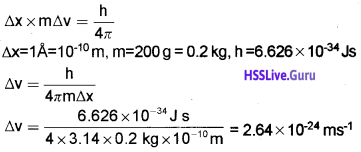
Calculate the uncertainty in the determination of velocity of a ball of mass 200 g, if the uncertainty in the determination of position is 1 A.
[h=6.626 × 10⁻³⁴ J s]
Answer:
Plus One Chemistry Chapter Wise Questions and Answers Chapter 2 Structure of Atom 1

Question 5.
Which among the following sets of quantum numbers is/are not possible?
a) n = 3, l = 2, m = 0, s = +½
b) n = 2, l= 1, m = 0, s = +½
c) n = 1, l= 0, m = 0, s = -½
d) n = 4, l = 2, m = 2, s = -½
Answer:
All sets are possible.

Plus One Chemistry Chapter Wise Questions and Answers Chapter 2 Structure of Atom

Question 6.
1. How many sub-shells are associated with n = 4?
2. How many electrons will be present in the sub-shells having ms value of –\(\frac{1}{2}\) for n = 4?
Answer:
1. For n = 4, l can have values 0, 1, 2, 3. Thus, there are four sub-shells in n = 4 energy level.
These four sub-shells are 4s, 4p, 4d and 4f.

2. For n = 4, the number of orbitals = (4)2 = 16.
Each orbital can have one electron with ms = –\(\frac{1}{2}\).
Thus, there are 16 electrons in sub-shells having n = 4 and ms = –\(\frac{1}{2}\)

Question 7.
i) Name the principle which restricts the pairing of electrons in degenerate orbitals. .
ii) How many electrons can be accomodated in the sub-shell having n = 4 and l = 2?
Answer:
i) Hund’s rule of maximum multiplicity,
ii) 10 electrons (4d sub-shell).

Question 8.
If the electron is to be located within 5 x 10⁻⁵A°, what will be the uncertainty in its velocity?
(Mass of the electron = 9.1 x 10⁻³¹ kg).
Answer:
According to Heisenberg’s uncertainty principle,
Plus One Chemistry Chapter Wise Questions and Answers Chapter 2 Structure of Atom 2

Question 9.
Nitrogen laser produces a radiation at a wavelength of 337.1 nm. If the number of photons emitted is 5.6 x 1024per second, calculate the power of this laser.
Answer:
Plus One Chemistry Chapter Wise Questions and Answers Chapter 2 Structure of Atom 3

Plus One Chemistry Structure of Atom Three Mark Questions and Answers

Question 1.
Fill in the blanks suitably by studying the relationship of the given pairs:

  1. Lyman : Ultraviolet:: Balmer: ……………..
  2. s-subshell:spherical:: p-subshell: …………….
  3. Rydberg’s formula: \(\frac{1}{\lambda}=R\left[\frac{1}{n_{1}^{2}}-\frac{1}{n_{2}^{2}}\right]\) :: de Broglie relation:

Answer:

  1. Balmer: Visible
  2. psubshell: dumb-bell
  3. de Broglie relation: \(\lambda=\frac{h}{m v}\)

Question 2.
Fill in the blanks:

Shell n value I value
K 1 0
L 2 ……
M 0, 1, 2
N 4 …….

Answer:

Shell n-value l-value
K 1 0
L 2 0, 1
M 3 0, 1, 2
N 4 0, 1, 2, 3

Question 3.
Filling of electrons in the orbitals on a ground state atom is governed by three rules.
a) Which are the three rules?
b) State any one of them.
Answer:
a) 1) Aufbau principle
2) Pauli’s exclusion principle
3) Hund’s rule of maximum multiplicity

b) Hund’s rule of maximum multiplicity – electron pairing in orbitals of same energy will not take place until each degenerate orbital of a given subshell is singly occupied.

Question 4.
During a class room discussion, one of your friends argued that, “we can’t determine both position and velocity of an electron”.

  1. Is it true?
  2. Which principle is behind your answer?
  3. State it.

Answer:

  1. Yes. It is true.
  2. Heisenberg’s uncertainty principle.
  3. Heisenberg’s uncertainty principle states that it is not possible to determine simultaneously both position and momentum of a microscopic moving particle such as electron with absolute accuracy.

Plus One Chemistry Chapter Wise Questions and Answers Chapter 2 Structure of Atom

Question 5.
The arguments of two students is as given:
Student 1 : “We need four quantum numbers to represent an electron in a multi-electron atom.”
Student 2 : “We need only first three quantum numbers to represent an electron in a multi-electron atom.”
a) Which are the four quantum numbers?
b) Who is correct? Why?
c) Write the possible four quantum numbers of the valence electron of Na atom.
Answer:
a) The four quantum numbers are:
i) Principal quantum number (n)
ii) Azimuthal quantum number (l)
iii) Magnetic quantum number (ml)
iv) Spin quantum number (ms)

b) The argument of student 1 is correct. If there are two electrons in the same subshell the first three quantum numbers become the same. Hence we need fourth quantum number to identify the electron.

c) n = 3, l = 0, m = 0, s = +½

Question 6.
a) Identify the experiment associated with the following figure:
Plus One Chemistry Chapter Wise Questions and Answers Chapter 2 Structure of Atom 4
b) Explain the experiment done by Rutherford and give its observations.
c) Write the concludions of the experiment.
Answer:
a) It is the figure of α -particle scattering experiment (gold foil experiment).

b) In this experiment, a stream of high energy α – particles from a radioactive source was directed at a thin foil of gold metal which had a circular fluorescent zinc sulphide screen around it. Whenever α-particles struck the screen, a tiny flash of light was produced at that point. The α-particles striking the gold foil were analysed. It was observed that:

  1. Most of the α – particles passed through gold foil undeflected.
  2. A small fraction of the α – particles are deflected by small angles.
  3. A very few α – particles(1 in 20,000) bounced back i.e., deflected by nearly 180°.

c) Rutherford drew the following conclusions regard¬ing the structure of atom from this experiment:

  1. Most of the space in the atom is empty as most of the α – particles passed through the foil undeflected.
  2. The positive charge of the atom is concentrated in a very small volume (called nucleus) that repelled and deflected the positively charged α – particles.
  3. Volume occupied by the nucleus is negligibly small as compared to the total volume of the atom.

Question 7.
The 4s subshell has more energy than 3p subshell.
a) Is it true? Justify your answer.
b) StateAufbau principle.
Answer:
a) Yes. For both 4s and 3p subshells the (n+l) value is 4. But 4s, with high value of ‘n’ has higher en¬ergy.
b) Aufbau principle – In the ground state of the atoms, the orbitals are filled in order of their increasing energies.

Question 8.
Two students were analysing the electronic configurations of the first 30 elements of the Periodic Table as part of an assignment. They found that two elements showed difference from other twenty eight elements.

  1. Which are the two elements?
  2. Write their electronic configurations.
  3. Why they show this anomalous behaviour?

Answer:
1. 24Cr and 29Cu.
2. 24Cr = 1s2 2s2 2p6 3s2 3p6 4s1 3d5 and 29Cu = 1s2 2s2 2p6 3s2 3p6 4s1 3d10
3. This is due to the fact that exactly half filled and completely filled orbitals (i.e., d5, d10) have extra stability due to symmetrical distribution of electrons and maximum exchange energy.

Question 9.
Three box diagrams of 2p3 configuration are given below:
i)Plus One Chemistry Chapter Wise Questions and Answers Chapter 2 Structure of Atom 5

  1. Which one is correct?
  2. Name the principle behind your answer.
  3. State the principle.

Answer:

  1. The correct one is (ii).
  2. Hund’s rule of maximum multiplicity.
  3. Pairing of electrons in the orbitals belonging to the same subshell does not take place until each orbital belonging to that subshell has got one electron each i.e., it is singly occupied.

Question 10.
J.J. Thomson proposed his atom model in 1898.

  1. Explain Thomson’s model of atom.
  2. Why Thomson’s atom model is called plum pudding model or watermelon model?
  3. What is the limitation of Thomson’s atom model?

Answer:
1. J.J. Thomson proposed that an atom possess a spherical shape in which the positive charge is uniformly distributed. The electrons are embedded into it in such a manner as to give the most stable electrostatic arrangement. The mass of the atom is assumed to be uniformly distributed over the atom. This model explained the overall neutrality of the atom.

2. Thomson’s model of atom can be visualised as a pudding or watermelon of positive charge with electrons embedded into it like the plums or seeds.

3. Thomson’s model was not consistent with the results of later experiments. It failed to explain the observations of Rutherford’s α-particle scattering experiment.

Question 11.
A student argued that the 3d orbitals will be filled only after the 4s orbital is completely filled in accordance with aufbau principle. Then another student opposed by saying that it is not true for certain elements like Cr and Cu.
a) Whose argument is correct?
b) Write electronic configurations of 24Crand 29Cu. Justify your answer.
Answer:
a) Both arguments are correct.
b) Cr and Cu have anomalous electronic configurations. This is because half filled and completely filled sub-shells have extra stability due to the symmetrical distribution of electrons maximum exchange energy.
24Cr = 1 s2 2s2 2p6 3s2 3p6 3d5 4s1 OR [Ar]3d5 4s1 This is due to the extra stability of half filled 3d5 sub-shell.

29Cu = 1s2 2s2 2p6 3s2 3p6 3d10 4s1 OR [Ar]3d10 4s1 This is due to the extra stability of completely filled 3d10 sub-shell.

Plus One Chemistry Chapter Wise Questions and Answers Chapter 2 Structure of Atom

Question 12.
a) What are the atomic numbers of elements whose
outermost electronic configurations are given by
i) 3s1
ii) 3p5?
b) Which of the following are isoelectronic species?
Na+, K+, Mg2+,Ca2+, S2-,Ar
c) What will be the wavelength of a ball of mass 0.1 kg moving with a velocity of 10 ms-1? m
Answer:
a) i) 3s1-Atomic number is 11 (Na)
ii) 3p5 -Atomic number is 17 (Cl)

b) Na+, Mg2+ (both of them have same no. of electrons, i.e., 10 each)
Plus One Chemistry Chapter Wise Questions and Answers Chapter 2 Structure of Atom 6

Question 13.
Quantum numbers are a set of four numbers used to designate electron in an atom.

  1. How many electrons in an atom can have the following quantum numbers, n = 1, l = 0 ?
  2. Give the quantum numbers of the valence electron of an atom with atomic number 13.
  3. Draw the shape of orbital having n = 1 and l = 0.

Answer:
1. 2 electrons (i.e., 1s orbital)
2. The element with atomic number 13 is aluminium. 13Al ⇒ [Ne] 3s23p1+
The valence electron is in the 3p orbital. Hence, the quantum numbers for the valence electron are n = 3, l= 1, m = -1, 0 +1
3. It is the 1s orbital
Plus One Chemistry Chapter Wise Questions and Answers Chapter 2 Structure of Atom 7

Question 14.
a) i) What is meant by line spectra or atomic spectra?
ii) Name the series of lines in the hydrogen spectrum belonging to the visible region.
iii) What is the wave length of light emitted when the electron in a hydrogen atom undergoes transmission from n = 4 to n = 2? (RH= 109677 cm-1)
b) State the principles/rules for filling of orbitals in atoms.
Answer:
a) i) Line spectra or atomic spectra are the spectra obtained from excited atoms due to emission of radiation. The emitted radiation is identified by the appearance of bright lines.
ii) Balmer series
iii) n1 = 2, n2 = 4
Plus One Chemistry Chapter Wise Questions and Answers Chapter 2 Structure of Atom 8

b)

  1. Aufbau principle: In the ground state of the atoms, the orbitals are filled in order of their increasing energies.
  2. Pauli’s exclusion principle: No two electrons in an atom can have the same set of four quantum numbers.
  3. Hund’s rule of maximum multiplicity: Pairing of electrons in the orbitals belonging to the same subshell does not take place until each orbital belonging to that subshell has got one electron each i.e., it is singly occupied.

Question 15.
Line emission spectra are often called finger print of atoms.
a) Justify the above statement.
b) Yellow light emitted from a sodium lamp has a wave length (X) of 580 nm. Calculate the frequency and wave number of this yellow light.
Answer:
a) Each element has a unique line emission spectrum. The characteristic lines in atomic spectra can be used in chemical analysis to identify unknown atoms in the same way as finger prints are used to identify people.
Plus One Chemistry Chapter Wise Questions and Answers Chapter 2 Structure of Atom 9

Question 16.
1. How many orbitals are possible in a p-subshell. Which are they?
2. What is the shape of p-orbital?
3. Sketch the boundary surface diagrams of 2p orbitals.
Answer:
1. Three.
These are px, py and pz orbitals.
2. Dumb-bell shaped.
3.
Plus One Chemistry Chapter Wise Questions and Answers Chapter 2 Structure of Atom 10

Question 17.
Electronic configuration of an element written by a student is given below:
Plus One Chemistry Chapter Wise Questions and Answers Chapter 2 Structure of Atom 11
a) Which rule is violated here?
b) Give the correct configuration.
c) What is the uncertainty in position of an electron if the uncertainty in its velocity is 1.159×10⁷ m/s?
Answer:
a) Hund’s rule of maximum multiplicity.
Plus One Chemistry Chapter Wise Questions and Answers Chapter 2 Structure of Atom 12

Plus One Chemistry Structure of Atom Four Mark Questions and Answers

Question 1.
Bohr’s model of hydrogen atom is a modification of
Rutherford’s model.
a) Write any two merits of Bohr’s model.
b) Write any two demerits of Bohr’s model.
Answer:
a)

  1. Bohr’s model could explain the stability of an atom.
  2. Bohr’s model could explain the atomic spectrum of hydrogen.

b)

  1. Failed to explain the finer details of hydrogen atom spectrum observed by using sophisticated spectroscopic techniques.
  2. It could not explain the ability of atoms to form molecules by chemical bonds.

Plus One Chemistry Chapter Wise Questions and Answers Chapter 2 Structure of Atom

Question 2.
Consider the statement, “The two electrons of He atom have the same set of quantum numbers.”

  1. Do you agree?
  2. Name the principle applied here.
  3. State the principle.
  4. Write the all quantum numbers of outer electrons of the atom.

Answer:

  1. No.
  2. Pauli’s exclusion principle.
  3. No two electrons in an atom can have same set of four quantum numbers.
  4. Forthe1st electron: n = 2, l = 0, m = 0, s = +½.
    For the 2nd electron: n = 2, l = 0, m = 0, s = -½

Question 3.
Complete the following table with respect to the va¬lence electron of each element.
Plus One Chemistry Chapter Wise Questions and Answers Chapter 2 Structure of Atom 13
Answer:
Plus One Chemistry Chapter Wise Questions and Answers Chapter 2 Structure of Atom 14

Question 4
Analyse the following figure showing transitions of electrons in the hydrogen atom.
Plus One Chemistry Chapter Wise Questions and Answers Chapter 2 Structure of Atom 15
a) Name the series (a), (b), (c), (d) and (e).
b) Mention the region of the spectrum in which each series belongs to.
c) Explain how they are obtained.
d) Calculate the wave length of the first line of series (b).
[RH = 109677 cm-1]
Answer:
(a) = Lyman series,
(b) = Balmer series,
(c) = Paschen series,
(d) = Brackett series,
(e) = Pfund series

b)
Lyman series – UV region
Balmer series – Visible region
Paschen series – Infrared region
Brackett series – Infrared region
Pfund series – Infrared region

c) In hydrogen atom there is one electron which is present in first orbit in ground state. When energy is supplied this electron may be excited to some higher energy level. Since in a sample of hydrogen there are large number of atoms, the electrons in different atoms absorb different amounts of energies and are excited to different higher energy levels. Now, from excited states, the electron may return to ground state in one or more jumps. These different downward jumps are associated with different amounts of energies and hence result in the emission of radiations of different wavelengths which appear as different lines in the hydrogen spectrum.
Series – Obtained when electron jumps from any of the higher energy levels to
Lyman series – 1st energy level
Balmer series – 2nd energy level
Paschen series – 3rd energy level
Brackett series – 4th energy level
Pfund series – 5th energy level

d) n1 = 2, n2 = 3, RH = 109677 cm-1
Plus One Chemistry Chapter Wise Questions and Answers Chapter 2 Structure of Atom 16

Question 5.
Quantum numbers are the address of an electron in an atom. Justify the statement by explaining different quantum numbers.
Answer:
Quantum numbers are certain numbers which are used to identify an electron in an atom.
The following four quantum numbers are used for this purpose.
1. Principal quantum number (n):
It determines the size and to large extent the energy of the orbital. It also identifies the shell. The value of ‘n’ ranges from 1 to a. With increase in the value of ‘n’, the number of allowed orbitals increases and are given by ‘n2’. All the orbitals of a given value of ‘n’ constitute a single shell of atom and are represented by letters K (n = 1), L (n = 2), M (n = 3), N (n = 4) etc. The size and energy of the orbital will increase with increase of ‘n’.

2. Azimuthal/Orbital angular momentum/Subsidiary quantum number (l): It defines the three dimensional shape of the orbital. For a given value of n, l can have n values ranging from 0 to (n-1). It gives an idea regarding the subshell in which the electrons are present.
Plus One Chemistry Chapter Wise Questions and Answers Chapter 2 Structure of Atom 17

3. Magnetic quantum number (ml):
It gives information about the spatial orientation of the orbital with respect to standard set of coordinate axis. For any sub-shell, (2l+1) values of ml are possible ranging from -l to +l including zero. The permitted values of ml gives the number of orbitals in that sub-shell.

4. Spin quantum number (ms) :
It refers to the orientation of the spin of the electron. An orbital can have two electrons. If an electron is spinning in the clockwise direction, it is given a spin quantum number value of+1/2 and if an electron is spinning in the anti-clockwise direction it is given spin quantum number value of -1/2. These are called two spin states of the electron and are represented by two arrows ↑ (spin up) and ↓. (spin down). Thus, the two electrons in an orbital should have opposite spins.

Question 6.
Dual nature of matter was proposed by Louis de Broglie.
a) Calculate the de Broglie wavelength associated with an electron with velocity equal to that of light.
b) State Heisenberg’s uncertainty principle and give its mathematical expression.
Answer:
Plus One Chemistry Chapter Wise Questions and Answers Chapter 2 Structure of Atom 18
b) It states that it is impossible to determine simultaneously, the exact position and exact momentum (or velocity) of an electron.
Mathematically, it can be given as in the equation
Plus One Chemistry Chapter Wise Questions and Answers Chapter 2 Structure of Atom 19
∆x ⇒ uncertainty in position of the particle
∆px ⇒ uncertainty in momentum of the particle
∆vx ⇒ uncertainty in velocity of the particle
m ⇒ mass of the particle and
h ⇒ the Planck’s constant

Plus One Chemistry Chapter Wise Questions and Answers Chapter 2 Structure of Atom

Question 7.
Rutherford’s atom model had strong similarity to a small scale solar system. (4)
a) What are the important features of Rutherford’s. nuclear model of atom?
b) What are the drawbacks of Rutherford’s model of atom?
Answer:
a) i) The positive charge and most of the mass of the atom is densely concentrated in extremely small region of the atom called nucleus.
ii) The nucleus is surrounded by electrons that ’ move around the nucleus with a very high speed in circular paths called orbits.
iii) Electrons and the nucleus are held together by electrostatic forces of attraction.

b) i) It failed to explain the stability of atom,
ii) It says nothing about the electronic structure of atoms.

Question 8.
a) Calculate the momentum of a particle which has de Broglie wave length of 250 pm. (4)
b) The distribution of electron into orbitals of an atom is called its electronic configuration.
i) Give the valence shell electronic configuration of chromium atom.
ii) Which among the following configurations is more.stable, d4 ord5? Justify your answer.
Answer:
a) According to the de Broglie matter wave equation
Plus One Chemistry Chapter Wise Questions and Answers Chapter 2 Structure of Atom 20
b) i) 24Cr → 1s2 2s2 2p6 3s2 3p6 3d5 4s1
ii) d5 is more stable.
The d5 configuration is half filled. It has symmetrical distribution of electrons and maximum exchange energy. Hence, it has extra stability compared to d4 configuration.

Question 9.
a) Name and state the principle, which restricts the maximum number of electrons in an orbital to be two.
b) Using s, p, d, f notation represent the sub-shell with the following quantum numbers.
i) n = 1, l = 0
ii) n = 4, l=3
c) The uncertainty in the position and velocity of a particle are 10 cm and 5.27 × 10³m/s respectively. Calculate the mass of the particle (h=6.626 × 10⁻³⁴ J s).
Answer:
a) Pauli’s exclusion principle
No two electrons in an atom can have the same set of four quantum numbers.
b) i) 1s ii) 4f
c) According to Heisenberg’s uncertainty principle,
Plus One Chemistry Chapter Wise Questions and Answers Chapter 2 Structure of Atom 21

Question 10.
The photoelectric effect was first observed by H.Hertz.
a) What is photoelectric effect?
b) What are the observations of photoelectric effect experiment?
Answer:
a) It is the phenomenon of ejection of electrons when certain soft metals like potassium, rubidium, cae-sium, etc. are exposed to a beam of light.
b) i) The electrons are ejected from the metal surface as soon as the beam of light strikes the surface of metal.
ii) The number of electrons ejected is proportional to the intensity or brightness of light.
iii) For each metal, there is a characteristic minimum frequency (υ0), known as threshold frequency below which photoelectric effect is not observed.

Question 11.
A mathematical representation is given below:
\(\Delta x \times \Delta p_{x} \geq \frac{h}{4 \pi}\)
a) Which principle is illustrated by this equation?
b) If the position of the electron is measured within an accuracy of ±0.002 nm, calculate the uncertainty in the momentum of the electron.
c) Using s, p, d notation represent the sub-shell with the following quantum numbers:
i) n = 3 l = 2
ii) n = 5 l = 1
Answer:
a) Heisenberg’s uncertainty principle.
Plus One Chemistry Chapter Wise Questions and Answers Chapter 2 Structure of Atom 22

Plus One Chemistry Structure of Atom NCERT Questions and Answers

Question 1.

  1. Calculate the number of electrons which will together weigh one gram.
  2. Calculate the mass and charge of one mole of electrons.

Answer:
1. Mass of one electron = 9.11 × 10⁻³¹ kg
∴ Number of electrons in one gram = \(\frac{10^{-3} \mathrm{kg}}{9.11 \times 10^{-31} \mathrm{kg}}=1.098 \times 10^{27}\)

2. Mass of one electron = 9.11 × 10⁻³¹ kg
∴ Mass of 1 mole of electrons = 9.11 × 10-31 kg × 6.022 × 1023 = 5.486 x 10⁻⁷ kg
Charge on one electron = 1.602 × 10⁻¹⁹ C
∴ Charge on one mole of electrons
= (1.602 × 10⁻¹⁹C) × (6.022 × 10²³)
= 9.65 × 10⁴ C.

Question 2.
Write the complete symbol forthe atom with the given atomic number (Z) and atomic mass (A):
i) Z = 17, A = 35
ii) Z = 92, A = 233
iii) Z = 4, A = 9
Answer:
Plus One Chemistry Chapter Wise Questions and Answers Chapter 2 Structure of Atom 23

Question 3.
Electro.magnetic radiation of wavelength 242 nm is just sufficient to ionise the sodium atom. Calculate the ionisation energy of sodium in kJ mol-1.
Answer:
Ionisation energy of sodium = Energy of one photon of radiation of wavelength.
Energy of photon = hυ
Plus One Chemistry Chapter Wise Questions and Answers Chapter 2 Structure of Atom 24

Question 4.
What is the number of photons of light with a wavelength of 4000 pm that provide 1 J energy?
Answer:
Suppose N photons of the light with wavelength 4000 pm can provide 1 J of energy.
Energy of N photons = Nhυ
Plus One Chemistry Chapter Wise Questions and Answers Chapter 2 Structure of Atom 25

Question 5.
Calculate the wavelength of an electron moving with a velocity of 2.05 × 10⁷m S-1. (2)
Answer:
Plus One Chemistry Chapter Wise Questions and Answers Chapter 2 Structure of Atom 26

Plus One Physics Notes Chapter 12 Thermodynamics

Students can Download Chapter 12 Thermodynamics Notes, Plus One Physics Notes helps you to revise the complete Kerala State Syllabus and score more marks in your examinations.

Kerala Plus One Physics Notes Chapter 12 Thermodynamics

Summary
Thermo dynamics is the branch of Physics that deals with concept of heat and temperature, their inter-conversions and other forms of energy. In thermo dynamics state of system is specified by macroscopic variables such as pressure, temperature, volume, mass, composition… etc.

Thermo Equilibrium
Thermo dynamic equilibrium:
A system is said to be in thermodynamic equilibrium if the macroscopic variables used to describe the system does not change with time.
Eg: Agas enclosed in a rigid container (characterized by P, V, T, m, and composition) The equilibrium of a thermodynamic system depends on surroundings and nature of wall that separates the system from surroundings. The wall can be

  • Adiabatic wall – It does not allow flow of heat (energy).
  • Diathermic wall – It allows the flow of heat (so that it can comes to thermal equilibrium).

Plus One Physics Notes Chapter 12 Thermodynamics

Zeroth Law Of Thermodynamics
Zeroth law of thermodynamics gives concept of temperature. R.H Fowler formulated this law in 1931. According to Zeroth law of thermodynamics, the systems in thermal equilibrium with a third system separately are in thermal equilibrium with each other.

Let A & B are in thermal equilibrium with each other. If they are separately in thermal equilibrium with C, then the three systems are in thermal equilibrium
(TA = TB = TC).

Heat, Internal Energy And Work
Internal Energy (U):
internal energy of a gas is the sum of potential energy and kinetic energy (translational kinetic energy, rotational kinetic energy and vibrational energy) Internal energy is a thermodynamic variable and hence it depends on state of the thermodynamic system.

Heat and Work:
The internal energy of a system can be changed either by heat or by work. Heat is energy transfer between a system and surroundings due to temperature difference. Work is mode of energy transfer brought about by means like moving piston (it is not due to temperature difference)

First Law Of Thermodynamics
According to first law of thermodynamics, heat supplied to a system is used to increase its internal energy and to do work.
If ∆Q is heat supplied to the system, ∆W is work done by the system and Au is change in internal energy, then ∆Q = ∆U + AW
Note:

  • If the entire heat supplied to the system is used to do work, then ∆Q = ∆W
  • The work done against constant pressure, ∆W = P∆V, ∆Q = ∆U + P∆V.

Specific Heat Capacity
Molar specific heat capacity of solid:
Consider a solid consisting of N atoms. Each atom have an average energy 3KBT, where KB is Botlzman constant. Total energy for one,mole
U = 3KBT × NA
NA is avagadro number.
At constant pressure, ∆Q = ∆U + P∆V
For solid ∆V is negligible ∆Q = ∆U
Molar specific heat capacity
Plus One Physics Notes Chapter 12 Thermodynamics 1

Plus One Physics Notes Chapter 12 Thermodynamics
Thus molar specific heat capacity of solids is found to be 3R. But at low temperature molar specific heat capacity is not a constant.
Specific heat capacity of water:
The specific heat capacity of water is 4186 J Kg-‘K1. But the specific heat capacity of water changes with temperature as shown.
Plus One Physics Notes Chapter 12 Thermodynamics 2
Mayor’s Relation; Cp – Cv = R
If molar specific heat capacity of constant pressure is Cp and that at constant volume is Cv then Cp – Cv = R, for an ideal gas.
Proof:
According to 1st law of thermodynamics
∆Q = ∆U + P∆V
If ∆Q heat is absorbed at constant volume (∆V = 0)
Plus One Physics Notes Chapter 12 Thermodynamics 3

Plus One Physics Notes Chapter 12 Thermodynamics
From ideal gas equation for one mole PV = RT Differentiating w.r.t. temperature (at constant pressure)
Plus One Physics Notes Chapter 12 Thermodynamics 4
Substituting in equation (2)
Plus One Physics Notes Chapter 12 Thermodynamics 5
Equation (4) – Equation (1), we get Cp – Cv = R.

Thermodynamic State Variable And Equation Of State
Extensive and Intensive variables:
Thermodynamic variables can be extensive or intensive. Extensive variables depend on size of the system.
Eg: mass, internal energy, volume.
Intensive variables are independent of size of system.
Eg: Pressure, temperature, density.
Equation of state:
The relation between state variables of a system is called equation of state. For an ideal gas equation of state is PV = µRT

Thermodynamic process
1. Quasi-static process:
The thermodynamic process in which thermo dynamic variables (P, V, T… etc) changes so slowly that the system remains in thermal and mechanical equilibrium is called quasi static (nearly static) process. In quasi-static process change in temperature or pressure will be infinitesimally small. The different types of quasi static process are listed in the above table.

2. Work done in isothermal process:
For an isothermal process, the equation of state is
PV = constant = µRT
P = \(\frac{\mu \mathrm{RT}}{\mathrm{V}}\)
Let a system undergoes an isothermal process at temperature T, from the state (P1, V1) to (P2, V2). Let ‘DV’ be a small charge in volume due to pressure P.
Then work done (for ∆V)
∆W = P∆V
Plus One Physics Notes Chapter 12 Thermodynamics 6

Plus One Physics Notes Chapter 12 Thermodynamics
Plus One Physics Notes Chapter 12 Thermodynamics 7

3. Work done by adiabatic process:
Let an ideal gas undergoes adiabatic charge from (P1, V1) to (P2, V2). The equation for adiabatic charge is PVγ = constant = k
Plus One Physics Notes Chapter 12 Thermodynamics 8
from equation (a) P1V1γ = P2V2γ = k
Plus One Physics Notes Chapter 12 Thermodynamics 9

Plus One Physics Notes Chapter 12 Thermodynamics
Substituting ideal gas equation.
Plus One Physics Notes Chapter 12 Thermodynamics 10
Note:

  1. The graph connecting P and V of isothermal process is called isotherm.
  2. In adiabatic process
    • T1 < T2, then work is done on gas (w < 0)
    • T1 > T2, then work is done by gas (w > 0)
  3. For Isothermal process
    • V1 < V2, w > 0 work is done by gas
    • V1 > V2, w < 0 work is done on gas.
  4. In isochoric process no work is done on or by gas because volume is constant.

Cyclic process:
In cyclic process, the system returns to its initial state such that change in internal energy is zero. The P – V diagram for cyclic process will be closed loop and area of this loop gives work done or heat absorbed by system.
Plus One Physics Notes Chapter 12 Thermodynamics 11

Heat Engines
Heat engines converts heat energy into mechanical energy. Heat engine is a device by which a system is made to undergo a cyclic process that results in conversion of heat to work.
Heat engines consists of:

  1. Working substance (the system which undergoes cyclic process) eg: mixture of fuel vapor and air in diesel engine, steam in steam engine.
  2. An external reservoir at a high temperature (T1) – it is the source of heat.
  3. An external reservoir at low temperature (T2) or sink

Plus One Physics Notes Chapter 12 Thermodynamics 12

Plus One Physics Notes Chapter 12 Thermodynamics
Working:
The working substances absorbs an energy Q1 from source reservoir at a temperature T1. It undergoes cyclic process and releases heat Q2 to cold reservoir. The change in heat (Q1 – Q2) is converted in to work (mechanical energy).
Efficiency of heat engine (η):
The efficiency of heat engine is the ratio of work done to input heat.
Plus One Physics Notes Chapter 12 Thermodynamics 13
Note:

  • Q2 = 0, η = 1. When entire heat input is converted into work heat engine is 100% efficient. But practically 100% efficiency cannot be achieved. It is limited by second law of thermodynamics.
  • Heat engine can be external combustion engine or internal combustion engine.

In external combustion engine, the fuel (system) is heated by external furnace.
Eg.: Steam engine.
In internal combustion engine, fuel is heated internally by exothermic chemical reactions.
Eg: Diesel engine, Patrol engine.

Plus One Physics Notes Chapter 12 Thermodynamics

Refrigerators And Heat Pumps
Refrigerator is reverse of heat engine, the device used to cool a portion of space (inside a chamber) is refrigerator. The device used to pump heat into a portion of space (to warm-up room) is called heat pump.

In both devices, the working substance absorbs heat Q2 from cold reservoir at temperature T2. Some external work (by compression of gas by electric means) is done on it and heat Q1 is supplied to hot reservoir at T1.
Plus One Physics Notes Chapter 12 Thermodynamics 14
The working cycle of refrigerator:
In refrigerator the working substance is a gas (freon)

Step1: The gaseous working substance is converted into vapor- liquid mixture at lower temperature (T2)
Step 2: The cold fluid absorbs heat from region to be cooled (cold reservoir) and convert it into vapor.
Step 3: The vapor is heated by external work.
Step 4: The vapor release heat to surroundings and then comes to initial temperature T2.

The coefficient of performance (α):
The coefficient of performance of refrigerator is defined as
α = \(\frac{Q_{2}}{W}\)
where Q2 is heat extracted from cold reservoir and W is work done on system.
Note:

  • The working substance in refrigerator is termed as refrigerant.
  • For heat engine η can not exceed 1. But α can be greater than one.

Second law of Thermo dynamics
Kelvin – Plank statement:
No process is possible whose sole result is the absorption of heat from a reservoir and complete conversion of heat into work.
Clausius statement:
No process is possible whose sole result is the transfer of heat from a colder object to hotter object.

Plus One Physics Notes Chapter 12 Thermodynamics

Reversible And Irreversible Processes
A themodynamic process is said to be reversible if the process can bring both system and surrounding back to the original state without any change.

A reversible thermodynamic process is ideal case. Most thermodynamic processes are irreversible because the process involves dissipative effects like friction, viscous force etc. and during such process, system passes through non-equilibrium states.
Note: Condition for a thermodynamic process to be reversible is

  1. Quasi static
  2. non-dissipative

Question 1.
What is the importance of reversibility in thermo dynamics?
Answer:
The main concern of thermodynamics is efficiency with which heat can be converted into work. According to second law of thermodynamics, the efficiency can not be 100%. The heat engine can have highest efficiency only if the cyclic process is reversible.

Carnot’S Engine
Carnot’s theorem:
Sadi carnot proposed Carnot’s theorem. According to Carnot’s theorem

  1. No engine operating between two temperature can have efficiency more than that of Carnot’s engine,
  2. The efficiency of Carnot’s engine is independent of nature of working substance.

Carnot’s engine:
A reversible heat engine operating between two temperatures is called Carnot’s engine.
Carnot’s cycle:
The Carnot cycle consists of two isothermal processes and two adiabatic processes.
Plus One Physics Notes Chapter 12 Thermodynamics 15
The cylindar is placed on the source. The gas expands and temperature increases. This is the first stroke of the heat engine. The expansion is an isothermal expansion.

During this expansion the working substance originally at the state A (P1, V1, T1) has new variable (P2, V2, T1). The variation A to B is shown byAB in v-p graph.

During the second stroke, the cylinder is placed on the stand and the gas is allowed to expand further and reaches the state C. The new Co-ordinate are (P3, V3, T2).

Plus One Physics Notes Chapter 12 Thermodynamics

This expansion is adiabatic expansion. The third stroke is carried out when cylinder is placed on the zink. The cylinder undergoes for isothermal compression and coordinate becomes (P4, V4, T2).

In the fourth and final stroke, the cylinder is placed on the non conducting stand. The gas is compressed back to state A. This is adiabatic compression.

1. The work done by gas in one Carnot cycle
Step 1: Isothermal expansion : The gas absorbs heat Q, from hot reserviorand undergoes Isothermal expansion.
[(P1, V1, T1) → (P2, V2, T2)]
Plus One Physics Notes Chapter 12 Thermodynamics 16

Step 2: Adiabatic expansion
[(P2, V2, T1) → (P3, V3, T2)]
Plus One Physics Notes Chapter 12 Thermodynamics 17

Step 3: Isothermal compression: The gas releases heat Q2 to cold reservoir at T2.
[(P3, V3, T2) → (P4, V4, T2)]
Plus One Physics Notes Chapter 12 Thermodynamics 18

Step 4: Adiabatic compression
[(P4, V4, T2) → (P1, V1, T1)]
Plus One Physics Notes Chapter 12 Thermodynamics 19

Plus One Physics Notes Chapter 12 Thermodynamics

2. Efficiency of Carnot’s engine:
Plus One Physics Notes Chapter 12 Thermodynamics 20
In adiabatic expansion from
(P2, V2, T1) to (P3, V3, T2)
Plus One Physics Notes Chapter 12 Thermodynamics 21
In adiabatic compression
(P4, V4, T2) to (P1, V1, T1)
Plus One Physics Notes Chapter 12 Thermodynamics 22
Plus One Physics Notes Chapter 12 Thermodynamics 23

Plus One Physics Notes Chapter 12 Thermodynamics
Thus equation (b) becomes η = 1 – \(\frac{T_{2}}{T_{1}}\) ……..(3)
Comparing this with equation (a)
Plus One Physics Notes Chapter 12 Thermodynamics 24
Note:

  • The equation
  • Shows that efficiency of heat engine is independent of nature of working substance.

Plus One Physics Notes Chapter 11 Thermal Properties of Matter

Students can Download Chapter 11 Thermal Properties of Matter Notes, Plus One Physics Notes helps you to revise the complete Kerala State Syllabus and score more marks in your examinations.

Kerala Plus One Physics Notes Chapter 11 Thermal Properties of Matter

Summary
Temperature And Heat
Temperature is a measure of hotness of a body. Heat is a form of energy transferred between two system (or system and surrounding) by virtue of temperature difference. The SI unit of heat is Joule (J) and that of tempera-ture is Kelvin (K).

Measurement Of Temperature
The instrument used to measure temperature is thermometer. The different temperature scales are Kelvin scale, Degree Celsius scale, and Fahrenheit scale. If t1 and tc are temperature in Fahrenheit scale and Celsius scale, then their linear relationship is given by
Plus One Physics Notes Chapter 11 Thermal Properties of Matter 1
This relation can be graphically represented as shown
Plus One Physics Notes Chapter 11 Thermal Properties of Matter 2

Plus One Physics Notes Chapter 11 Thermal Properties of Matter
If T is temperature in kelvin scale, then
T = tc + 273.15.
A comparison of the three temperature scales is shown
Plus One Physics Notes Chapter 11 Thermal Properties of Matter 3

Ideal Gas Equation & Absolute Temperature Boyle’s law:
At constant temperature, pressure is inversely proportional to volume.
p α \(\frac{1}{V}\)
PV = constant _______(1)
Charle’s law: At constant pressure, volume is directly proportional to temperature
v α T
\(\frac{V}{T}\) = constant ______(2)
Combining (1) and (2), we get PV
\(\frac{PV}{T}\) = constant T
This is called ideal gas law. Generally, the law can be expressed for any quantity of dilute gas as
Plus One Physics Notes Chapter 11 Thermal Properties of Matter 4
µ is the number of moles in given gas and R is universal gas constant.
The value of R is 8.31 J mol-1 k-1.
Absolute Temperature:
The minimum value of temperature for ideal gas is – 273.15°C (OK). This temperature is called absolute zero. On kelvin scale -273.15°C is taken as zero point.
Note:
The absolute temperature for a gas can be obtained by extrapolating the pressure versus temperature graph as shown below.
Plus One Physics Notes Chapter 11 Thermal Properties of Matter 5

Plus One Physics Notes Chapter 11 Thermal Properties of Matter

Thermal Expansion
The change in temperature of a body may change its length, area or volume. The fractional change in dimension [ratio of change in dimension to original dimension] is proportional to change in temperature.

The corresponding proportionally constant is called coefficient of thermal expansion or thermal expansivity. Thermal expansion can be defined as ratio of increase in dimension of body to increase in temperature.

There are different three types of thermal expansion, which are shown in the table given below
Note: (1)
Show that the coefficient of volume expansion for ideal gas is reciprocal of temperature
v = 1/T)
Proof: Ideal Gas Equation is
Plus One Physics Notes Chapter 11 Thermal Properties of Matter 6
At constant pressure P∆V = µR∆T ______(2).
Dividing we get
Plus One Physics Notes Chapter 11 Thermal Properties of Matter 7
Anomalous behavior of water:
Generally volume of liquid increases with temperature .When water is heated, its volume starts to decrease from 0°C and reaches minimum at 4°C. Hence density of water is maximum at 4°C.
Plus One Physics Notes Chapter 11 Thermal Properties of Matter 8

Plus One Physics Notes Chapter 11 Thermal Properties of Matter
Question 1.
Derive the following relations

  1. αa = 2αl
  2. αv = 3αl

Answer:
Consider a cube of length ‘l’. Due to the increase in temperature ‘∆T’, length of cube increases by ∆l in all directions.
Coefficient of linear expansion, αl = \(\frac{\Delta \ell}{\ell \Delta \mathrm{T}}\)
1. Increase in area of cube ∆A
= Final area – initial area
= (l + ∆l)2 – l2 = 2 × l × ∆l
[Neglecting ∆l2]
Area expansivity
Plus One Physics Notes Chapter 11 Thermal Properties of Matter 9
Therefore, αa = 2 . αl.

2. Due to ‘∆T ’ the increase in volume of cube,
∆V = (l + + ∆l)3 – l3
= 3l2∆l2
[Neglecting ∆l2 & ∆l3]
Plus One Physics Notes Chapter 11 Thermal Properties of Matter 10
Therefore, αv = 3 . αl.
Plus One Physics Notes Chapter 11 Thermal Properties of Matter 11

Plus One Physics Notes Chapter 11 Thermal Properties of Matter

Specific Heat Capacity
Heat capacity:
Heat capacity (S) of substance is the quantity of heat required to increase the temperature of whole substance.
If ∆Q is the amount of heat required to increase the temperature by ∆T the heat capacity.
Plus One Physics Notes Chapter 11 Thermal Properties of Matter 12
Specific heat capacity:
Specific heat capacity of a substance is defined as amount of heat required to increase temperature of unit mass of substance by one unit.
If ∆Q is amount of heat absorbed by substance of mass m and ∆T is change in temperature, then specific heat capacity is
Plus One Physics Notes Chapter 11 Thermal Properties of Matter 13
The SI unit of specific heat capacity is J Kg-1K-1.
Molar specific heat capacity (C):
Molar specific heat capacity of a substance is the amount of heat required to increase the temperature of 1 mole of substance by one unit.
Its unit is J mol-1 K-1.
If a sample has ‘µ’ moles of substance, then its molar specific heat capacity is given by
Plus One Physics Notes Chapter 11 Thermal Properties of Matter 14
Molar specific capacity are of two types:

  • molar specific capacity at constant volume (CV)
  • molar specific heat capacity at constant pressure (CP).

Plus One Physics Notes Chapter 11 Thermal Properties of Matter

Note:

  • Water has high specific heat capacity. So it is used as coolant in automobile radiators and as a heater in hot water bags.
  • Due to high specific heat capacity of water, land is more warmer than water during daytime.

Calorimetry
Calorimetry means measurement of temperature. Calorimeter is a device used to measure heat. Calorimeter consists of a metallic vessel and a stirrer of same type. The vessel is kept inside a wooden jacket.

The wooden jacket contains insulating mate-rials like glass, wool etc. and hence it prevent heat loss. This jacket has a small opening at top and a thermometer is inserted into this hole.

Change Of State
A transition from one state (solid, liquid or gas) to another state is called change of state. There are four such transitions of state.

Change of state Name of transition
Solid → Liquid
Liquid → gas
Liquid → solid
Solid  → gas (without forming liquid)
Melting
Vapurization
Fusion
Sublimation

Plus One Physics Notes Chapter 11 Thermal Properties of Matter

During change of state, the two different state coexist in thermal equilibrium and temperature remains constant until the completion of change of state.

Melting point:
The temperature at which solid and liquid coexist in thermal equilibrium with each other is called melting point. The melting point decreases with pressure

Boiling point.
The temperature at which liquid and vapour state of substance coexist in thermal equilibrium with each other is called boiling point. The boiling point increases with increase in pressure and it decreases with decrease in pressure.

Regelation
Plus One Physics Notes Chapter 11 Thermal Properties of Matter 15
Take an ice block. Put a metal wire over the ice block and attach 5 kg. blocks at the two ends of wire as shown. Then we can see that the metal wire passes through the ice block to the other side without splitting it.

Explanation: The melting point of ice just below the wire decreases due to increase in pressure. As ice melts wire passes and refreeze (due to decrease in pressure). This process is called regelation.

Question 2.
Cooking is difficult at high altitude. Why?
Answer:
At high altitude, pressure is low. Boiling point decreases with decrease in pressure.

Question 3.
For cooking rice pressure cooker is preferred. Why?
Answer:
In pressure cooker, boiling point of water is increased by increasing pressure. Thus rice can be cooked at high temperature.

Plus One Physics Notes Chapter 11 Thermal Properties of Matter

Question 4.
You might have observed the bubbles of steam coming from bottom of vessel when water is heated. These bubbles disappear as it reaches top of liquid just before boiling and they reach the surface at the time of boiling. Explain the reason?
Answer:
Just before boiling, the bottom of liquid will be warm and at the top, liquid will be cool. So the bubbles of steam formed at bottom rises to cooler water and condense, hence they disappear. At the time of boiling, temperature of entire mass of water will be 100°C. Now the bubbles reaches top and then escape.

1. Latent Heat:
The amount of heat per unit mass transferred during change of state of substance is called latent heat of substance for the process.
Eg: Latent heat of vaporization (Lv), Latent heat of fusion (Lf).
If ‘m’ is quantity of substance which undergoes change of state and Q is amount of heat required, then latent heat
L = \(\frac{Q}{m}\)
Latent heat is characteristic of substance and it depends on pressure. Its unit is JKg-1.

Question 5.
Draw the temperature versus heat diagram for water. Mark the three phases of water (including its change of state).
Give reasons forthe following

  1. The slope of phase line during change of state iszero.
  2. The slope of phase line forthe three phases are different.

Plus One Physics Notes Chapter 11 Thermal Properties of Matter 16
Answer:

  1. During change of state temperature remains constant.
  2. Specific heats of different phases are different.

Plus One Physics Notes Chapter 11 Thermal Properties of Matter

Question 6.
Burns from steam are usually more serious than boil-ing water. Why?
Answer:
Latent heat of vaporization for water is 22.6 × 10⁵J Kg-1 (ie; 22.6 × 10⁵J heat is required to convert 1 kg of water into steam at 100°C). So at 100°C, steam carries 22.6 × 10⁵J. (more heat than water).

Heat Transfer
Heat transfer occurs due to temperature difference. The three modes of heat transfer are

  1. conduction
  2. convection
  3. radiation.

1. Conduction:
In conduction, heat transfers between two adjacent parts of a body due to temperature difference. Heat conduction can be considered as time rate of heat flow (heat current). At steady state the time rate of heat flow (H) is proportional to temperature difference ∆T area of cross section (A) and inversely proportional to length of conductor (L).
Plus One Physics Notes Chapter 11 Thermal Properties of Matter 17
K is called thermal conductivity.
Its unit is JS-1m-1K-1 or Wm-1K-1.

Question 7.
Some cooking pots have copper coating on its bottom. Why?
Answer:
Because of high thermal conductivity of copper, it distributes heat over the bottom of pot very quickly and promotes uniform cooking.

Note: In the house with concrete roof, a layer of insulatiori is made on the ceiling to prevent heat transfer and hence to keep the room cooler.

2. Convection:
In convection, different parts of fluid moves from one point to other. Convection can be natural of forced.
In natural convection when fluid is heated, it expands and becomes less dense. It then rises up and colder part replaces it. This process goes on as a cycle.

Plus One Physics Notes Chapter 11 Thermal Properties of Matter

Question 8.
Explain the reason for sea breeze
Answer:
During the day, land heats up more quickly than water in lake (due to high specific heat capacity of water). The air on the surface of earth gets heated, expands, becomes less dense and rises up. The colder air (wind) replaces the space created by hot air. It creates a sea breeze. At night the land loses its heat very quickly than water. So water remains more warmer at night.
Plus One Physics Notes Chapter 11 Thermal Properties of Matter 18
Note: In forced convection, material is forced to move by pump or by other physical means. Some examples are cooling system of automobile engines, heart that circulate blood throughout our body.

3. Radiation:
In radiation, energy is transferred in the form of electromagnetic radiation called heat radiation. Medium is not required for heat transfer. Earth receives energy from sun by means of radiation.

Thermal radiation:
The electromagnetic radiation entitled by a body by virtue of its temperature is called thermal radiation.

Question 9.
The untensils for cooking purpose are blackened at the bottom. Why?
Answer:
This is to absorb maximum heat from fire and hence to fast up cooking.

4. Black body radiation:
Black body:
A black body is one which absorbs radiations of all wavelengths incident on it. When a black body is heated it will emit radiations of all possible wavelengths. The wavelengths emitted by a perfect black body are called black body radiations.
Energy distribution in a black body radiation:
Plus One Physics Notes Chapter 11 Thermal Properties of Matter 19

Plus One Physics Notes Chapter 11 Thermal Properties of Matter
Lummer and Pringsheim performed an experiment to study the distribution of energy (among the radiation emitted by a black body) at different temperatures.
Result of experiment:
1. Fora given temperature the energy distribution is not uniform.

2. The energy associated with both longer and shorter wavelength of radiation emitted is small.

3. For each temperature there exists a particular wavelength corresponding to which the energy associated is maximum (λm).

4. This maximum energy carrying wavelength (λm) decreases with an increase in temperature of the black body.
Plus One Physics Notes Chapter 11 Thermal Properties of Matter 20

5. The area under each curve represents the total energy emitted by the body at a particular temperature.

This area increases with increase of temperature. It is found that area is directly proportional to the fourth power of absolute temperature,
ie. E a T4
Wein’s displacement law:
Wein’s displacement law states that the product of the wavelength corresponding to maximum energy (λm) and the absolute temperature of black body is constant.
ie. λmT = constant
The value of the constant (Wein’s constant) is 2.9 × 10⁻³mK.
This law explains why the colour of a piece of iron heated in a hot flame first becomes dull red, then reddish yellow and finally white hot.

Wein’s law is useful for estimating the surface temperatures of moon, sun and other stars. If red and blue stars emit radiations of continuous wavelengths, then blue star is hotter than red star.

Stefan’s law of radiation:
Stefan’s law states that the total radiant energy emitted persecond from unit area of the surface of a black body is directly proportional to the fourth power of its absolute temperature.
E a T4
E = sT4

Green house effect:
The earth surface is a source of thermal radiation because it absorbs energy received from sun. The wavelength of this radiation lies in the infrared region. But a larger portion of this radiation is absorbed by greenhouse gases, (CO2, CH4, etc).

This heats up the atmosphere. The net result is heating up of earths surface and atmosphere. This is known green house effect.

Plus One Physics Notes Chapter 11 Thermal Properties of Matter

Newtons laws of cooling
According to Newton’s law of cooling the rate of loss of heat is directly proportional to difference of temperature between the body and its surroundings.
Plus One Physics Notes Chapter 11 Thermal Properties of Matter 21
T1 is temperature of surrounding medium and T2 is temperature of body. K is constant that depends on nature of surface and area of exposed surface.
Note:

  • The law is applicable for small temperature difference.
  • For small temperature difference, cooling occurs due to a combination of conduction, convection, and radiation.
  • The graph between difference in temperature and time is as shown in figure.

Plus One Economics Chapter Wise Questions and Answers Chapter 9 Environment Sustainable Development

Students can Download Chapter 9 Environment Sustainable Development Questions and Answers, Plus One Economics Chapter Wise Questions and Answers helps you to revise the complete Kerala State Syllabus and score more marks in your examinations

Kerala Plus One Economics Chapter Wise Questions and Answers Chapter 9 Environment Sustainable Development

Plus One Economics Environment Sustainable Development One Mark Questions and Answers

Question 1.
What is the name of UNCED seminal report?
Answer:
Our Common Future.

Question 2.
Protecting future generations is emphasised by which of the following?
(i) Brundtland commission
(ii) Our common future
(iii) UNCED
(iv) Herman Daly
Answer:
(i) Bmndtland commission

Question 3.
Kyoto protocol was signed in ______ .
(i) 1990
(ii) 1992
(iii) 1997
(iv) 1999
Answer:
(iii) 1997

Plus One Economics Chapter Wise Questions and Answers Chapter 9 Environment Sustainable Development

Question 4.
In which state, Chipko Movement took place?
(i) Karnataka
(ii) Punjab
(iii) Himachal Pradesh
(iv) U.P.
Answer:
(iii) Himachal Pradesh

Question 5.
Identify the strategy for sustainable development.
(i) Wind energy
(ii) Solar energy
(iii) Gobar gas
(iv) All the above
Answer:
(iv) All the above

Plus One Economics Environment Sustainable Development Two Mark Questions and Answers

Question 1.
How does the UNCED define sustainable development?
Answer:
The UNCED defines sustainable development as the development that meets the need of the present generation without compromising the ability of the future generation to meet their own needs.

Question 2.
Explain the supply-demand reversal of environmental resources.
Answer:
In the initial stages of development, the demand for environmental resources was less than that of supply. But now the world is faced with increased demand for environmental resources, but their supply is limited due to overuse and misuse.

Plus One Economics Chapter Wise Questions and Answers Chapter 9 Environment Sustainable Development

Question 3.
Give two instances of

  1. overuse of environmental resources
  2. misuse of environmental resources

Answer:
1. Overuse of environmental resources:

  • land
  • forests

2. Misuse of environmental resources:

  • electricity,
  • water

Question 4.
Classify the following into renewable and non-renewable resources.
[Coal, Forest resources, Fish, Petrol]
Answer:
1. Renewable

  • Forest resources
  • Fish

2. Non-renewable

  • Coal
  • Petrol

Question 5.
A few terms are given below. Make pairs of them.
[Growth, Development, Unidimensional, Multi dimensional]
Answer:

  • Unidimensional – Growth
  • Multidimensional – Development

Question 6.
Outline the steps involved in attaining sustainable development in India.
Answer:
The steps involved in attaining sustainable development in India are:
1. decreasing the absolute poverty of the poor by providing employment opportunities

2. providing livelihood in such a manner that can minimize resource depletion, environmental degradation, cultural disruption, and social instability.

Question 7.
Two major environmental issues facing the world today are ………. and ……………
Answer:
Ozone depletion and global warming.

Question 8.
What is sustainable development?
Answer:
Sustainable development is a development that meets the needs of the present generation without compromising the ability of the future generation to meet their own needs.

Plus One Economics Chapter Wise Questions and Answers Chapter 9 Environment Sustainable Development

Question 9.
Make a list of items that can be recycled.
Answer:
The following are the things that can be recycled

  1. Plastic
  2. Papers
  3. Polythene
  4. Glass, and
  5. Certain categories of waste of industries

Question 10.
What happens when the rate of resource extraction exceeds that of their regeneration?
Answer:
If the rate of resource extraction exceeds that of their regeneration, the environment fails to sustain life by providing genetic and biodiversity. This will result in an economic crisis. The rising population in developing countries and the affluent consumption of resources have placed a huge stress on environments.

Question 11.
Give a short narration of ‘Chipko movement’.
Answer:
‘Chipko Movement’ was started in Karnataka to save trees. The word ‘Chipko’ means ‘to hug’. On 8th September 1983, 160 men, women and children hugged the trees in Salkani forest in Sirsi and forced the woodcutters to leave the ultimate aim of this movement is to save trees.

Plus One Economics Environment Sustainable Development Three Mark Questions and Answers

Question 1.
What are the opportunity costs of negative environmental impacts?
Answer:

  1. As the reserves are exhausted huge amount of money should be spent on research to explore new resources.
  2. Health cost of degraded environmental quality.
  3. Increased financial commitment for the government due to global warming and ozone depletion.

Question 2.
What do you mean by ‘Green net national income’? How is it calculated?
Answer:
Green net national income is the difference between net national income and depreciation of natural capital. It can be calculated using the following formula.
Green net national income = Net national income – depletion of natural resources – environmental degradation.

Question 3.
Match the columns
Plus One Economics Chapter Wise Questions and Answers Chapter 9 Environment Sustainable Development img1
Answer:
Plus One Economics Chapter Wise Questions and Answers Chapter 9 Environment Sustainable Development img2

Plus One Economics Environment Sustainable Development Four Mark Questions and Answers

Question 1.
Keeping in view your locality, suggest any four strategies of sustainable development.
Answer:
The following strategies can be adopted for the sustainable development of our locality.

  • Use of solar power through photovoltaic cells
  • The practice of bio composting
  • Generating wind power
  • Using bio pest control

Plus One Economics Chapter Wise Questions and Answers Chapter 9 Environment Sustainable Development

Question 2.
Differentiate between natural capital and man made capital?
Answer:
1. Natural capital refers to the sum total of the natural resources and environment available to a country as a free gift of nature.

2. On the other hand, man-made capital refers to the stock of all such things which are produced by man for use as means of production.

Question 3.
Fill in the blanks

  1. Coal is a …………… energy
  2. Burning of fossil fuel leads to …………
  3. Bio composts are used in …………… farming
  4. CFCs cause ……………… depletion

Answer:

  1. non-renewable
  2. global warming
  3. organic
  4. ozone

Question 4.
List out the functions of the environment.
Answer:
The environment performs four vital functions which
are listed out below:
1. It supplies resources:
resources here include both renewable and nonrenewable resources. Renewable resources are those which can be used without the possibility of the resource becoming depleted or exhausted.

That is, a continuous supply of the resource remains available. Examples of renewable resources are the trees in the forests and the fishes in the ocean. Nonrenewable resources, on the other hand, are those which get exhausted with extraction and use, for example, fossil fuel.

2. It assimilates waste

3. It sustains life by providing genetic and biodiversity and

4. It also provides aesthetic services like scenery etc.

Question 5.
Identify the factors contributing to land degradation in India?
Answer:
The following are the factors responsible for land degradation in India.

  1. loss of vegetation occurring due to deforestation.
  2. shifting cultivation.
  3. forest fires.
  4. unsustainable fuelwood extraction.
  5. overgrazing.
  6. non-adoption of soil conservation measures.

Question 6.
“The environmental crisis is a recent phenomenon”. Do you agree?
Answer:
Yes, environment crisis is a recent phenomenon. In early days, when civilisation just began, before the phenomenal increase in population and growth of industrialisation, the demand for environmental resources was within the carrying capacity of the environment and so the pollution was also within the absorptive capacity, of the environment.

Therefore, environmental problems did not arise. But with the advent of industrialisation and outbreak of population, environmental problems arisen and the resources for both production and consumption proved to be beyond the rate of regeneration of the resources and the absorptive capacity of the environment.

Plus One Economics Environment Sustainable Development Five Mark Questions and Answers

Question 1.
Account for the current environmental crisis.
Answer:
Environment performs four functions, namely, supplies resources, assimilates wastes, sustains life and provides aesthetic services. But the rising population of the developing countries, the affluent consumption and production standards of the developing countries and industrial revolution have brought the situation of environmental crisis i.e., it all had put great pressure on the first two functions of the environment.

Many resources have become extinct and the wastes generated are beyond the absorptive capacity of environment. The crisis has worsened by the drying up of rivers. Besides, the intensive and extensive extraction of both renewable and non-renewable resources has exhausted some of these vital resources and thus we are compelled to spend huge resources on technology and research to explore new resources.

The situation becomes more worsened with the current issues of global warming and ozone depletion. They also put great strain on government’s finite financial resources.

Plus One Economics Chapter Wise Questions and Answers Chapter 9 Environment Sustainable Development

Question 2.
In 2007 Nobel Prize for Peace was awarded to an individual Algore and an institution IPCC, both engaged in creating awareness about the consequences of global warming. Suggest some measures to keep global warming under control.
Answer:
Global warming refers to the increase in the atmosphere temperature. The temperature increases due to the emission of greenhouse gases. Greenhouse gases are emerged from the burning of biomass and from the consumption of petrol, coal, etc, can absorb temperature.
This can be reduced by :

  1. Reducing pollution and waste.
  2. Using more solar, wind and tidal energy.
  3. New technology and eco-friendly means of production.
  4. Afforestation
  5. Effective rules and its implementation.

Plus One Economics Environment Sustainable Development Eight Mark Questions and Answers

Question 1.
Prepare a Seminar Report on “Strategies for Sustainable Development”
[Hint: A Seminar Report should have a title, Introduction, Content, and conclusion].
Answer:
“Strategies for Sustainable Development”.
Introduction:
The plus one commerce batch of (Name of school) conducted a seminar on the topic “Strategies for Sustainable Development” on 12/09/ 2017 at 11.0 a.m with the ample guidance of our economics teacher. Our class was divided into five groups to cover the entire area of the topic. Each group focused on two points each. They focused on the area given to them and the group leader presented the seminar paper after required preparation.

Content:
Sustainable development is, in this sense, a development that meets the basic needs of all, particularly the poor majority, for employment, food, energy, water, housing, and ensures growth of agriculture, manufacturing, power, and services to meet these needs.

1. Strategies for sustainable development use of non-conventional Sources of Energy:
India, as you know, is hugely dependent on thermal and hydropower plants to meet its power needs. Both of these have adverse environmental impacts. Thermal power plants emit large quantities of carbon dioxide which is a greenhouse gas. It also produces fly ash which, if not used properly, can cause pollution of water bodies, land and other components of the environment.

2. LPG, Gobar Gas in Rural Areas:
Households in rural areas generally use wood, dung cake or other biomass as fuel. This practice has several adverse implications like deforestation, reduction in green cover, wastage of cattle dung and air pollution. To rectify the situation, subsidized LPG is being provided.

In addition, gobar gas plants are being provided through easy loans and subsidy. As far as liquefied petroleum gas (LPG) is concerned, it is a clean fuel it reduces household pollution to a large extent. Also, energy wastage is minimized

3. CNG in Urban Areas:
In Delhi, the use of Compressed Natural Gas (CNG) as fuel in public transport system has significantly lowered air pollution and the air has become cleaner in the last few years.

4. Wind Power:
In areas where speed of wind is usually high, windmills can provide electricity without any adverse impact on the environment. Wind turbines move with the wind and electricity is generated.

Plus One Economics Chapter Wise Questions and Answers Chapter 9 Environment Sustainable Development

5. Solar Power through Photovoltaic Cells:
India is naturally endowed with a large quantity of solar energy in the form of sunlight. With the help of photovoltaic cells, solar energy can be converted into electricity. These cells use special kind of materials to capture solar energy and then convert the energy into electricity.

6. Mini hydel Plants:
In mountainous regions, streams can be found almost everywhere. A large percentage of such streams are perennial. Mini-hydel plants use the energy of such streams to move small turbines.

7. Traditional Knowledge and Practices:
Traditionally, Indian people have been close to their environment. They have been more a component of the environment and not its controller.

If we look back at our agriculture system, health care system, housing, transport, etc., we find that all practices have been environment-friendly. Only recently have we drifted away from the traditional systems and caused large scale damage to the environment and also our rural heritage.

8. Bio-composting:
In our quest to increase agricultural production during the last five decades or so, we almost totally neglected the use of compost and completely switched over to chemical fertilizers.

9. Bio-pest Control:
With the advent of green revolution, the entire country entered into a frenzy to use more and more chemical pesticides for higher yield. Soon, the adverse impacts began to show; food products were contaminated, soil, water bodies, and even groundwater were polluted with pesticides.

Conclusion:
All five groups presented their topics with necessary facts and figures. After the presentation, there was a question-answer session. The active participation of everyone made this session live and interesting. On the whole, the seminar was a big success.


Plus One Bussiness Studies Chapter Wise Questions and Answers Chapter 7 Formation of a Company

Students can Download Chapter 7 Formation of a Company Questions and Answers, Plus One Business Studies Chapter Wise Questions and Answers helps you to revise the complete Kerala State Syllabus and score more marks in your examination

Kerala Plus One Bussiness Studies Chapter Wise Questions and Answers Chapter 7 Formation of a Company

Plus One Formation of a Company One Mark Questions and Answers

Question 1.
Application for approval of name of a company is to be made to
Answer:
Registrar of companies.

Question 2.
A prospectus is issued by
Answer:
Public company

Question 3.
Preliminary contracts are signed
Answer:
Before the incorporation

Question 4.
At which stage in the formation of a company does it interact with SEBI
Answer:
Capital subscription

Plus One Bussiness Studies Chapter Wise Questions and Answers Chapter 7 Formation of a Company

Question 5.
The first stage in the formation of a company is __________
Answer:
Promotion

Question 6.
“I undertake to form a new company and carry out all the preliminary work in connection with its establishment” Who am I?
Answer:
Promoter

Question 7.
Preliminary Contracts are signed
1. Before the incorporation
2. After incorporation but before capital subscription
3. After incorporation but before of commencement of business
4. After commencement business
Answer:
1. Before the incorporation

Question 8.
Spot the odd one and state the reason
1. Memorandum of Association
2. Articles of Association
3. Certificate of incorporation
4. Certificate of commencement of business
Answer:
5. Certificate of commencement of business

Question 9.
_____________ is the magnacarta of the company.
Answer:
Memorandum of Association

Question 10.
_____________ is the birth certificate of a company.
Answer:
Certificate of incorporation

Plus One Bussiness Studies Chapter Wise Questions and Answers Chapter 7 Formation of a Company

Question 11.
The procedure for conducting company meetings, voting, quorum, poll and proxy will be mentioned in the
1. Prospectus
2. Memorandum of Association
3. Articles of Association
Answer:
3. Articles of Association

Question 12.
The provision regarding the internal management of a company will appear in its
Answer:
Articles of Association

Question 13.
Public Companies need __________ to commence the business.
Answer:
Certificate of commencement of business

Question 14.
Directors of a public Ltd. Co. decided to give advertisement in all newspapers for subscribing their shares. Identify the document given below
1. table A
2. memorandum of association
3. prospectus
Answer:
3. Prospectus

Question 15.
This clauses is the form of a declaration, it states that the subscribers express the willingness and agreement to form a company. Name the clause of memorandum of association.
Answer:
Association Clause

Question 16.
This clause specifies the name of the state where the registered office of the Co. is situated. Identify the clause.
Answer:
Situation clause

Question 17.
This clause specifies the name of the company.
Answer:
Name clause

Plus One Bussiness Studies Chapter Wise Questions and Answers Chapter 7 Formation of a Company

Question 18.
Identify the document in which the following information about a company can be found.

  1. Object with which the company is formed.
  2. Rules and regulations of internal management
  3. Investing deposits from the public
  4.  Acknowledgement of debt in a company

Answer:

  1. Memorandum of Association
  2. Articles of Association
  3. Mutual fund
  4. Debenture

Question 19.
TABLE A is a model of _________ given in companies Act.
Answer:
Articles of Association

Question 20.
Identify the documents in which following information about a company is found.

  1. Authorized capital
  2.  Rules and regulation for internal management.
  3.  Date of opening and closing of subscription list.

Answer:

  1. Memorandum of Associaiton
  2. Articles of Association
  3. Prospectus

Question 21.
Identify the relevant clauses in the memorandum of association in which the following information can be included.

  1. The registered office is in Kerala.
  2. Statutory declaration by members
  3. Ram Limited
  4. The scope of activities of company

Answer:

  1. Situation clause
  2. Association clause
  3. Name clause
  4. Object clause

Question 22.
State the odd item in the case of a private limited company.
1. memorandum of association
2. articles of association
3. certificate of incorporation
4. certificate of commencement of business
Answer:
4. Certificate of Commencement of business

Question 23.
Mention the name of the certificates/documents relating to following activities / formalities

  1. The certificate issued by the Registrar of companies certifying that the company has come into existence.
  2. The document, which contains the various rules and regulations that govern the management of the company.
  3. The document that defines the objectives of the company.

Answer:

  1. Certificate of Incorporation
  2. Articles of Association
  3. Memorandum of Association

Plus One Bussiness Studies Chapter Wise Questions and Answers Chapter 7 Formation of a Company

Question 24.
Name the following documents.

  1. The document issued by the company to the public to invite them to subscribe its share capital.
  2. The document that binds a member with the company, company with members and members with members.
  3. The document that contains rules for internal management of the company.
  4. The document that specifies the aims of the company.
  5. The document issued by the public company which does not want to issue a prospectus.

Answer:

  1. Prospectus
  2. Articles of Association
  3. Articles of Association
  4. Memorandum of Association
  5. Statement in lieu of Prospectus

Plus One Formation of a Company Two Mark Questions and Answers

Question 1.
Name the stages in the formation of a company?
Answer:

  1. Promotion
  2. Incorporation
  3. Capital subscription
  4. Commencement of business (2)

Question 2.
Name the stages in the formation of a company. (2)
Answer:

  1. Promotion
  2. Incorporation
  3. Commencement of business

Question 3.
What do you mean by promotion? (2)
Answer:
The identification of business opportunities, analysis of its prospects and initiating steps to form a joint stock company is called promotion.

Question 4.
For incorporating a private limited company, Deepthi Pvt. Ltd., the directors submit all relevant documents to the registrar of company except Articles of Association. But the registrar insists that, registration will not be granted without filing Articles of Association. But the directors of Deepthi Pvt. Ltd., argue that the provisions of ‘Table A’ can be adopted in the absence of Articles of Association. Whose argument is correct? Justify your answer. (2)
Answer:
The argument of the Company Registrar is right because filing of Articles of association is compulsory for Pvt. Ltd company by shares.

Plus One Bussiness Studies Chapter Wise Questions and Answers Chapter 7 Formation of a Company

Question 5.
Arya Ltd. commences its business immediately on getting the certificate of incorporation. The registrar of companies serves a notice to them for remitting a fine of ₹500 for everyday of its operation. Is it legally enforceable? Give your suggestion. (2)
Answer:
Yes. Public Ltd. Company can commence business only after getting the certificate of commencement of business.

Question 6.
It is proposed to conduct a seminar on the topic ‘important documents in the formation of joint stock company’ in your class. You are selected as the leader of one of the groups and are directed to submit a seminar paper for the same. Suggest valuable points that should be included in the paper. (2)
Answer:

  1. Memorandum of Association
  2. Articles of Association
  3. Prospectus

Question 7.
What do you mean by Minimum Subscription? (2)
Answer:
Minimum subscription is the minimum amount of shares that must be subscribed by the public. This amount is stated in the prospectus. A company can allot shares only after receiving minimum subscription.

Question 8.
I lay down the charter or the constitution of the company. I define the object and powers of the company.

  1. Identify who am I?
  2. Also name my companion who provides rules and regulations for the internal management of the company. (Both are two documents). (2)

Answer:

  1. Memorandum of Association
  2. Articles of Association

Plus One Formation of a Company Three Mark Questions and Answers

Question 1.
Is it necessary for a public company to get its shares listed on a stock exchange? What happens if a public company fails to get the permission from stock exchange? (3)
Answer:
Yes. A public company must list its shares with at least any one of the stock exchange for the allotment of shares. Therefore, the promoters must apply in a stock exchange for permission to deal in its shares or debentures. If permission is not granted before the expiry of ten weeks from the date of Closure of subscription list, the allotment shall become void and the application money must be returned to the applicants within eight days.

Question 2.
State the difference between certificate of incorporation and certificate of commencement of business. (3)
Answer:
Certificate of Incorporation gives legal status to the company. It is also known as birth certificate of the company. But certificate of commencement of business allows to start the operation.

These two certificates are required by the public limited company, but in case of private limited company only certificate of Incorporation is required to start the operation.

Plus One Bussiness Studies Chapter Wise Questions and Answers Chapter 7 Formation of a Company

Question 3.
Nisha, Shani and Sheena are promoters of a public company. But they do not want to raise capital by approaching the public. They decide to raise capital by issuing shares to a few persons. Is it possible? If yes, what document is used for raising capital? (3)
Answer:
Yes. They can raise capital by issuing shares to a few persons. For this they can issue Statement in lieu of prospectus.

Plus One Formation of a Company Four Mark Questions and Answers

Question 1.
Identify the documents required for commencing business for the following companies. (4)

  1. Athira Pvt. Ltd.
  2. Aditya Ltd.

Answer:
1. Athira Pvt. Ltd – A private company must file the following documents for commencing business

  • Certificate of incorporation
  • Statutory declaration duly verified by one of the directors.

2. Aditya Ltd., a public company, must file the following documents for commencing business.

  • Certificate of incorporation
  • Certificate of commencement of business
  • Prospectus
  • Statutory declaration duly verified by one of the directors.

Question 2.
The details of a proposed private company having limited liability is given below. You are required to identify as to which clauses in the Memorandum of Association have to be rightly inserted. (4)
Proposed names:
Mahatma Gandhi Khadi – Company
Premier Mills (P) Ltd.
Kerala Government Khadi Company
Sobha Co-operative Company
Maximum capital which can be collected is 20 lakhs rupees
Nature of shares
Equity shares at Rs. 10/- share

Address:
Pushpa Nivas Kodunganoor (P.O)
Thiruvananthapuram 13
Kerala State
India.

Nature of business:
To produce Khadi clothes through machine To stitch Khadi ready wears Name of the persons who are wishing to form the company
P. Sudarsanan
K. Muraleedharan Nair
S. Renjith
Answer:

  1. Name clause
  2. Capital clause
  3. Situation clause
  4. Object clause
  5. Association clause

Plus One Formation of a Company Five Mark Questions and Answers

Question 1.
“Promoter would be personally liable for the preliminary contracts, if they are not ratified by the company after incorporation. Analyse the statement. (5)
Answer:
Promotion:
Promotion is the first stage in the formation of a company. The identification of business opportunities, analysis of its prospects and initiating steps to form a joint stock company is called promotion. The person who undertakes to form a company is called promoter.

Functions of a Promoter:

1. Identification of business opportunity:
The first and foremost activity of a promoter is to identify a business opportunity.

Plus One Bussiness Studies Chapter Wise Questions and Answers Chapter 7 Formation of a Company

2. Feasibility studies:
After identifying a business opportunity, the promoters undertake some feasibility studies to determine the viability and profitability of the proposed activity.

  • Technical feasibility – To determine whether the raw materials or technology is easily available
  • Financial feasibility – To determine the total estimated cost of the project
  • Economic feasibility – To determine the I profitability of the proposed project

3. Name approval:
After selecting the name of company the promoters submit an application to the Registrar of companies for its approval. The selected name is not the same or identical to an existing company.

4. Fixing up signatories to the Memorandum of Association:
Promoters have to decide about the members who will be signing the Memorandum of Association of the proposed company.

5. Appointment of professional:
Promoters appoint merchant bankers, auditors etc. to assist them in the preparation of necessary documents.

6. Preparation of necessary documents:
The promoters prepare certain legal documents which are to be submitted to the Registrar of companies. They are

  • Memorandum of Association
  • Articles of Association,
  • Consent of proposed Directors
  • Agreement, if any, with proposed managing or whole time director
  • Statutory declaration

Position of Promoters:
The promoter is neither an agent nor a trustee of the company. The promoter stands in the fiduciary relationship with the company. He should not make any secret profits out of the dealings. Any, such gains are to be disclosed. The promoter must act honestly, in good faith and in the best interest of the company.

The promoter is personally liable for all the preliminary contracts with the other parties before incorporation. The promoter is also liable for any omission of facts or false statements in the prospectus.

Question 2.
Memorandum of Association is the charter or magna carta of the company. Elucidate the statement. (5)
Answer:
Memorandum of Association:
It is the charter or magnacarta of the company. It defines the objects of the company and provides the framework beyond which the company cannot operate. It lays down the relationship of the company with outside world.

Memorandum of Association must be printed, divided into paragraphs, numbered consecutively. The Memorandum of Association must be signed by at least seven persons in case of a public company and by two persons in case of a private company.

Contents of Memorandum of Association
Plus One Bussiness Studies Chapter Wise Questions and Answers Chapter 7 Formation of a Company 1
1. The name clause:
Under this clause the name of the company is mentioned. A company can select any name subject to the following restrictions.

  • The proposed name should not be identical with the name of another company
  • A name which can mislead the public
  • In case of a public company the name should end with the word ‘Limited’ and in case of a private company the name should end with the word ‘Private Limited’
  • The name must not directly or indirectly imply any participation of the Central or State Govt.
  • The name must not suggest any connection or patronage of a national hero
  • It should not include the word cooperative.

2. Registered office clause:
This clause contains the name of the state, in which the registered office of the company is proposed to be situated. It must be informed to the Registrar within thirty days of the incorporation of the company.

Plus One Bussiness Studies Chapter Wise Questions and Answers Chapter 7 Formation of a Company

3. Objects clause:
This is the most important clause of the memorandum. It defines the purpose for which the company is formed. A company is not legally entitled to undertake an activity, which is beyond the objects stated in this clause.

4. Liability clause:
It states that the liability of members is limited to the face value of shares held by them or the amount guaranteed to be paid on winding up.

5. Capital clause:
This clause specifies the maximum capital which the company will be authorised to raise through, the issue of shares.

6. Association clause:
In this clause, the signatories to the Memorandum of Association state their intention to be associated with the company and also give their consent to purchase qualification shares.

Question 3.
Explain the contents of prospectus. (5)
Answer:
Prospectus:
Prospectus is a document issued by the public companies inviting the public to subscribe for shares or debentures of the company. It contains all information regarding the company’s affairs and its future prospects. A prospectus must be dated and signed by all the directors. A copy of the prospectus must be filed with Registrar before it is issued to public.

Contents of prospectus

  1. Name and address of the registered office of the company.
  2. Main objects of the company.
  3. Classes of shares and debentures.
  4. Name, address and occupation of the signatories to the memorandum.
  5. Details of the borrowing powers of the company.
  6. Name, address and occupation of the directors and managing director.
  7. Name and address of the promoters.
  8. Minimum subscription.
  9. Time of opening and closing of subscription.
  10.  The amount payable on application and allotment of each class of shares.
  11.  Name of underwriters.
  12.  Details of preliminary expenses.
    Companies which do not want to issue a prospectus may submit a statement in lieu of prospectus to the Registrar of Companies. It is a copy of the prospectus but is not issued to the public.

Question 4.
The details of a proposed limited company are given below. You are required to identify them as to which clause of the memorandum of association they have to be inserted. (5)

  1. Proposed name: Jnana Construction Company Ltd
  2. Maximum Capital: ₹10,00,000
  3. Registered office: Kollam
  4. Nature of liability: Limited
  5. Nature of Business: Construction company
  6. Names of promoters: Jnana, Akshara, Pooja, Ajay

Answer:

  1. Name clause
  2. Capital clause
  3. Situation / Domicile clause
  4. Liability clause
  5. Object clause
  6. Association clause

Plus One Bussiness Studies Chapter Wise Questions and Answers Chapter 7 Formation of a Company

Question 5
A public company can commence business only after getting the certificate of commencement of business. Abhijith, a plus two student wants to know the conditions to be fulfilled to obtain the certificate of commencement of business.
Answer:
Plus One Bussiness Studies Chapter Wise Questions and Answers Chapter 7 Formation of a Company 2
Commencement of Business:
A public company can commence business only after getting certificate of commencement of business from the Registrar. The company must file the following documents to obtain the certificate of commencement of business.

  1. Declaration that the minimum subscription has been received in cash to allot shares.
  2. A declaration that all directors have taken up and paid for their qualification shares
  3. A statutory declaration stating that necessary legal formalities have been complied with has to be filed.

The Registrar shall examine these documents. If these are found satisfactory, a ‘Certificate of Commencement of Business’ will be issued. This certificate is conclusive evidence that the company is entitled to do business. With the grant of this certificate the formation of a public company is complete and the company can legally start doing business.
Documents used in the formation of a company

Plus One Formation of a Company Six Mark Questions and Answers

Question 1.
I govern the internal affairs of the company. Explain who am ‘I’? List out my contents.
OR
For the purpose of registering a new company, the promoter requires a document containing the rules and regulations governing its internal affairs. (6)

  1. What is that document? Explain.
  2. State the contents of this statement.

Answer:
Articles of Association:
The Articles of Association is the second important document of a company. The Articles define the rights, duties and powers of the officers and the Board of directors. It contains the rules regarding internal management of the company. It shows the relationship between the company and its members.

Contents of Articles of Association:

  1. The share capital of the company and its division.
  2. Rights of each class of shareholders.
  3. Details of contracts made with different parties.
  4. Procedure for making allotment of shares.
  5. Procedure for issuing share certificate.
  6. Procedure for transfer and transmission of shares.
  7. Procedure for forfeiture and reissue of shares.
  8. Procedure for conducting meetings, voting, proxy and poll
  9. Procedure for appointing, removal and remuneration of directors.
  10. Procedure for declaration of and payment of dividend.
  11. Keeping books of account and audit of the company.
  12. Procedure regarding alteration of share capital.
  13. Procedure regarding winding up of the company.

Plus One Bussiness Studies Chapter Wise Questions and Answers Chapter 7 Formation of a Company

Table A:
A public limited company may adopt Table A which is a model set of articles given in the Companies Act. Table A is a document containing rules and regulations for the internal management of a company. If a company adopts Table A, there is no need to prepare separate Articles of Association.

Question 2.
Vishnu, a promoter of a public company, approaches you to get information relating to raising of capital from public. As a commerce student mention the document required for inviting the public to purchase or subscribe to its shares and debentures. Explain. (6)
Answer:
Prospectus:
Prospectus is a document issued by the public companies inviting the public to subscribe for shares or debentures of the company. It contains all information regarding the company’s affairs and its future prospects. A prospectus must be dated and signed by all the directors. A copy of the prospectus must be filed with Registrar before it is issued to public.

Contents of prospectus:

  1. Name and address of the registered office of the company.
  2. Main objects of the company.
  3. Classes of shares and debentures.
  4. Name, address and occupation of the signatories to the memorandum.
  5. Details of the borrowing powers of the company.
  6. Name, address and occupation of the directors and managing director.
  7. Name and address of the promoters.
  8. Minimum subscription.
  9. Time of opening and closing of subscription.
  10. The amount payable on application and allotment of each class of shares.
  11. Name of underwriters.
  12. Details of preliminary expenses.

Companies which do not want to issue a prospectus may submit a statement in lieu of prospectus to the Registrar of Companies. It is a copy of the prospectus but is not issued to the public.

Question 3.
It is often said that Memorandum of Association and Articles of Association are the first and second important documents of a company. As a commerce student can you differentiate between these two documents? (6)
Answer:

Memorandum of Association Articles of Association
It defines the object for which the company is formed They are rules of internal management of the company. They indicate how the objectives of the company are to be achieved
It is the main document of the company It is a subsidiary document of the Memorandum of Association
It defines the relationship of the company with outsiders It defines the relationship of the company with members
Acts beyond the Memorandum of Association are invalid and cannot be ratified. Acts beyond the Articles of Association can be ratified by the members. But they do not violate memorandum
Filing of Memorandum is compulsory Filing of Articles is not compulsory for public company
Alteration of Memorandum is very difficult It can be altered by passing a special resolution

Plus One Formation of a Company Eight Mark Questions and Answers

Question 1.
Explain the steps in the incorporation of a company. (8)
Answer:
Incorporation:
A company comes into existence only when it is registered with the Registrar of Companies. For this purpose the promoter has to take the following steps:
Steps for Incorporation

1. Application for incorporation:
Promoters make an application for the incorporation of the company to the Registrar of companies.

2. Filing of documents:
The following documents must be filed with the Registrar of Companies for incorporation.

  • The Memorandum of Association duly stamped, signed and witnessed
  • Articles of Association duly stamped, signed and witnessed
  • Written consent of the proposed directors
  • Agreement, if any, with proposed managing or whole time director
  • A copy of the Registrar’s letter approving the name of the company.
  • Statutory declaration
  • A notice about the exact address of the registered office.
  • Documentary evidence of payment of registration fees.

The Registrar verifies the entire document submitted. If he is satisfied then he enters the name of the company in his Register. After the registration, the Registrar issues a Certificate called Certificate of Incorporation. This is called the birth certificate of the company. With effect from November 1, 2000, the Registrar of Companies allots a CIN (Corporate Identity Number) to the Company.

Effect of the Certificate of Incorporation:
Certificate of Incorporation is the conclusive evidence of the legal existence of the company. A private company can commence its business after receiving Certificate of Incorporation. The certificate of incorporation is the birth certificate of the company.

Plus One Bussiness Studies Chapter Wise Questions and Answers Chapter 7 Formation of a Company

Question 2.
Explain the contents of Memorandum of Association.

Plus One Bussiness Studies Chapter Wise Questions and Answers Chapter 7 Formation of a Company 1
Answer:
Memorandum of Association: It is the charter or magnacarta of the company. It defines the objects of the company and provides the framework beyond which the company cannot operate. It lays down the relationship of the company with outside world.

Memorandum of Association must be printed, divided into paragraphs, numbered consecutively. The Memorandum of Association must be signed by at least seven persons in case of a public company and by two persons in case of a private company.

Contents of Memorandum of Association:

Plus One Bussiness Studies Chapter Wise Questions and Answers Chapter 7 Formation of a Company 1
1. The name clause:
Under this clause the name of the company is mentioned. A company can select any name subject to the following restrictions.

  • The proposed name should not be identical with the name of another company
  • A name which can mislead the public
  • In case of a public company the name should end with the word ‘Limited’ and in case of a private company the name should end with the word ‘Private Limited’
  • The name must not directly or indirectly imply any participation of the Central or State Govt.
  • The name must not suggest any connection or patronage of a national hero
  • It should not include the word co operative.

2. Registered office clause:
This clause contains the name of the state, in which the registered office of the company is proposed to be situated. It must be informed to the Registrar within thirty days of the incorporation of the company.

3. Objects clause:
This is the most important clause of the memorandum. It defines the purpose for which the company is formed. A company is not legally entitled to undertake an activity, which is beyond the objects stated in this clause.

4. Liability clause:
It states that the liability of members is limited to the face value of shares held by them or the amount guaranteed to be paid on winding up.

5. Capital clause:
This clause specifies the maximum capital which the company will be authorised to raise through, the issue of shares.

6. Association clause:
In this clause, the signatories to the Memorandum of Association state their intention to be associated with the company and also give their consent to purchase qualification shares.

Plus One Bussiness Studies Chapter Wise Questions and Answers Chapter 7 Formation of a Company

Question 3.
Mr. Hemand, a Gulf returnee, intends to start a business in the form of private limited company. But he lias no clear idea about the business opportunities in Kerala and the formalities to be followed in the formation of company. (8)

  1. As a commerce student can you suggest a specialised person who would undertake all activities for the formation of a company?
  2. Explain the functions of those specialised persons.

Answer:

Promotion:
Promotion is the first stage in the formation of a company. The identification of business opportunities, analysis of its prospects and initiating steps to form a joint stock company is called promotion. The person who undertakes to form a company is called promoter.

Functions of a Promoter:

1. Identification of business opportunity:
The first and foremost activity of a promoter is to identify a business opportunity.

2. Feasibility studies:
After identifying a business opportunity, the promoters undertake some feasibility studies to determine the viability and profitability of the proposed activity.

  • Technical feasibility – To determine whether the raw materials or technology is easily available
  • Financial feasibility – To determine the total estimated cost of the project
  • Economic feasibility – To determine the I profitability of the proposed project

3. Name approval:
After selecting the name of company the promoters submit an application to the Registrar of companies for its approval. The selected name is not the same or identical to an existing company.

4. Fixing up signatories to the Memorandum of Association:
Promoters have to decide about the members who will be signing the Memorandum of Association of the proposed company.

5. Appointment of professional:
Promoters appoint merchant bankers, auditors, etc. to assist them in the preparation of necessary documents.

6. Preparation of necessary documents:
The promoters prepare certain legal documents which are to be submitted to the Registrar of companies. They are

  • Memorandum of Association
  • Articles of Association,
  • Consent of proposed Directors
  • Agreement, if any, with proposed managing or whole time director
  • Statutory declaration

Position of Promoters:
The promoter is neither an agent nor a trustee of the company. The promoter stands in the fiduciary relationship with the company. He should not make any secret profits out of the dealings. Any, such gains are to be disclosed. The promoter must act honestly, in good faith and in the best interest of the company.

The promoter is personally liable for all the preliminary contracts with the other parties before incorporation. The promoter is also liable for any omission of facts or false statements in the prospectus.

Plus One Zoology Notes Chapter 2 Animal Kingdom

Students can Download Chapter 2 Animal Kingdom Notes, Plus One Zoology Notes helps you to revise the complete Kerala State Syllabus and score more marks in your examinations.

Kerala Plus One Zoology Notes Chapter 2 Animal Kingdom

BASIS OF CLASSIFICATION:
The fundamental features used in animal classification are:

  1. Arrangement of cells
  2. body symmetry
  3. nature of coelom
  4. patterns of digestive
  5. circulatory or reproductive systems.

Plus One Zoology Notes Chapter 2 Animal Kingdom

Levels of Organisation:

In sponges, the cells are arranged as loose cell aggregates, i.e. they exhibit cellular level of organisation. Some division of labour (activities) occur among the cells.
In Echinoderms and Chordates, organs are associated to form functional systems, it is concerned with a specific physiological function. This is called organ system level of organisation.

For example, the digestive system in Platyhelminthes has only a single opening to the outside of the body that serves as both mouth and anus, and is hence called incomplete. A complete digestive system has two openings, mouth and anus.
The circulatory system are of two types:

(i) Open type in which the blood is pumped out of the heart and the cells and tissues are directly bathed in it.
(ii) Closed type in which the blood is circulated through a series of vessels of varying diameters (arteries, veins and capillaries).

Symmetry:
Animals can be categorised on the basis of their symmetry.

Sponges are asymmetrical, i.e., any plane that passes through the centre does not divide them into equal halves
When any plane passing through the central axis of the body divides the organism into two identical halves, it is called radial symmetry. eg: Coelenterates, ctenophores and echinoderms
Animals like annelids, arthropods, etc. where the body is divided into identical left and right halves in only one plane, It is called bilateral symmetry.

Plus One Zoology Notes Chapter 2 Animal Kingdom

Diploblastic and Triploblastic Organisation:

Animals in which the cells are arranged in two embryonic layers, an external ectoderm and an internal endoderm, are called diploblastic animals, eg: coelenterates.
An undifferentiated layer, mesoglea, is present in between the ectoderm and the endoderm. The developing embryo has a third germinal layer, mesoderm, in between the ectoderm and endoderm, they are called triploblastic animals eg: platyhelminthes to chordates

Plus One Zoology Notes Chapter 2 Animal Kingdom 1

Coelom:
The body cavity, which is lined by mesoderm is called coelom. Animals possessing coelom are called coelomates e.g.annelids, molluscs, arthropods, echinoderms, hemichordates and chordates. In some animals, the body cavity is not lined by mesoderm, instead, the mesoderm is present as scattered pouches in between the ectoderm and endoderm.

Such animals are called pseudocoelomates, eg: aschelminthes. The animals in which the body cavity is absent are called acoelomates, eg: platyhelminthes
Plus One Zoology Notes Chapter 2 Animal Kingdom 2

Segmentation:

In some animals, the body is externally and internally divided into segments. For example, in earthworm, the body shows this pattern called metameric segmentation and the phenomenon is known as metamerism.

Notochord:
Notochord is a mesodermally derived rod-like structure formed on the dorsal side during embryonic development in some animals. Animals with notochord are called chordates and those animals which do not form this structure are called non-chordates, eg: porifera to echinoderms.

CLASSIFICATION OF ANIMALS:
Plus One Zoology Notes Chapter 2 Animal Kingdom 3

Plus One Zoology Notes Chapter 2 Animal Kingdom

Phylum – Porifera:
Members are commonly Known as sponges. They are marine and asymmetrical animals. These are primitive multicellular animals and have cellular level of organisation.

  1. Sponges have a water transport or canal system. Water enters through minute pores (ostia) in the body wall into a central cavity, spongocoel (Choanocytes or collar cells line the spongocoel and the canals), from where it goes out through the osculum.
  2. This pathway of water transport is helpful in food gathering, respiratory exchange and removal of waste.
  3. Digestion is intracellular. The body is supported by a skeleton made up of spicules or spongin fibres.
  4. Sexes are not separate (hermaphrodite)
  5. Sponges reproduce asexually by fragmentation
  6. Fertilisation is internal and development include larval stage which is.morphologically distinct from the adult.

Examples: Sycon (Scypha), Spongilla (Fresh water sponge) and Euspongia (Bath sponge).
Plus One Zoology Notes Chapter 2 Animal Kingdom 4

Phylum – Coelenterata (Cnidaria):
They are aquatic, marine and radially symmetrical animals
1. The name cnidaria is derived from the cnidoblasts or cnidocytes present on the tentacles and the body. Cnidoblasts are used for anchorage, defense and for the capture of prey.

2. Cnidarians are dipioblastic animals. They have a central gastrovascular cavity with a single opening, hypostome.

3. Digestion is extracellular and intracellular. For example , corals have a skeleton composed of calcium carbonate.

4. Cnidarians exhibit two basic body forms called polyp and medusa

Plus One Zoology Notes Chapter 2 Animal Kingdom 5

Structure of polyp and medusa:
Polyps are sessile and cylindrical form eg: Hydra, Adamsia, etc. whereas, medusa are umbrella-shaped and free-swimming like Aurelia or jelly fish. They exhibit alternation of generation (Metagenesis), i.e. polyps produce medusae asexually and medusae form the polyps sexually (eg: Obelia).

Examples: Physalia (Portuguese man-of-war), Adamsia (Sea anemone),Pennatula (Sea-pen), Gorgonia (Sea-fan) and Meandrina (Brain coral).
Plus One Zoology Notes Chapter 2 Animal Kingdom 6

Plus One Zoology Notes Chapter 2 Animal Kingdom

Phylum – Ctenophora:
They incude sea walnuts or comb jellies are marine, radially symmetrical, dipioblastic organisms with tissue level of organisation.

  1. The body bears eight external rows of ciliated comb plates, which help in locomotion
  2. Digestion is both extracellular and intracellular.
  3. Bioluminescence is well-marked in ctenophores.
  4. Sexes are not separate. Reproduction takes place only by sexual means.
  5. Fertilisation is external with indirect development.

Examples: pleurobrachia and ctenoplana.
Plus One Zoology Notes Chapter 2 Animal Kingdom 7

Phylum – Platyhelminthes:

  1. They have flattened body and called as flatworms
  2. Flatworms are bilaterally symmetrical, triploblastic and acoelomate animals with organ level of organisation.
  3. Hooks and suckers are present in the parasitic forms. Some of them absorb nutrients from the host directly through their body surface.
  4. Specialised cells called flame cells help in osmoregulation and excretion.
  5. Sexes are not separate.
  6. Fertilisation is internal and development is through many larval stages. Some members like Planaria possess high regeneration capacity.

Examples: (a) Taenia (Tapeworm), (b) Fasciola (Liver fluke).
Plus One Zoology Notes Chapter 2 Animal Kingdom 8

Phylum – Aschelminthes:
The body is circular and called as roundworms. They may be freeliving, aquatic and terrestrial or parasitic in plants and animals.

  1. Roundworms have organ-system level of body organisation.
  2. They are bilaterally symmetrical, triploblastic and pseudocoelomate animals.
  3. Alimentary canal is complete and called as muscular pharynx. An excretory tube removes body wastes from the body cavity through the excretory pore.
  4. Sexes are separate (dioecious)
  5. Fertilisation is internal and development may be direct or indirect.

Examples Ascaris (Round Worm), Wuchereria (Filaria worm), Ancylostoma (Hookworm).
Plus One Zoology Notes Chapter 2 Animal Kingdom 9

Plus One Zoology Notes Chapter 2 Animal Kingdom

Phylum – Annelida:
They may be aquatic (marine and fresh water) orterrestrial; free-living, and sometimes parasitic.

  1. They exhibit organ-system level of body organisation and bilateral symmetry. They are triploblastic, metamerically segmented and coelomate animals.
  2. Their body surface is distinctly marked out into segments or metameres and hence, the phylum called as Annelida.
  3. Aquatic annelids like Nereis possess lateral appendages, parapodia, which help in swimming.
  4. A closed circulatory system is present.
  5. Nephridia help in osmoregulation and excretion.
  6. Neural system consists of paired ganglia connected by lateral nerves to a double ventral nerve cord.
  7. Nereis, an aquatic form, is dioecious, but earthworms and leeches are monoecious.
  8. Reproduction is sexual. Examples: Nereis, Pheretima (Earthworm) and Hirudinaria (Blood sucking leech).
    Plus One Zoology Notes Chapter 2 Animal Kingdom 10

Phylum – Arthropoda:
This is the largest phylum includes insects.

  1. They have organ-system level of organisation.
  2. They are bilaterally symmetrical, triploblastic. segmented and coelomate animals.
  3. The body of arthropods is covered by chitinous exoskeleton.
  4. The body consists of head, thoraxand abdomen. They have jointed appendages (arthros-joint, poda-appendages).
  5. Respiratory organs are gills, book gills, book lungs or tracheal system.
  6. Circulatory system is of open type. Sensory organs like antennae, eyes (compound and simple),
  7. statocysts or balance organs are present.
  8. Excretion takes place through malpighian tubules. They are mostly dioecious.
  9. Fertilisation is usually internal.
  10. They are mostly oviparous.

Example:

  1. Economically important insects: Apis (Honey bee), Bombyx (Silkworm), Laccifer(Lac insect)
  2. Vectors: Anopheles, Culexand Aedes(Mosquitoes)
  3. Gregarious pest: Locusta (Locust)
  4. Living fossil: Limulus (King crab).

Plus One Zoology Notes Chapter 2 Animal Kingdom 11

Phylum – Mollusca:
This is the second largest animal phylum

  1. Molluscs are terrestrial or aquatic (marine or freshwater) having an organ- system level of organisation.
  2. They are bilaterally symmetrical, triploblastic and coelomate animals.
  3. Body is covered by a calcareous shell and is unsegmented with a distinct head, muscular foot and visceral hump.
  4. The space between the hump and the mantle is called the mantle cavity in which feather-like gills are present. They have respiratory and excretory functions.
  5. The anterior head region has sensory tentacles. The mouth contains a file¬like rasping organ for feeding, called radula.
  6. They are usually dioecious and oviparous with indirect development.

Examples: Pila (Apple snail), Pinctada (Pearl oyster), Sepia (Cuttlefish), Loligo (Squid), Octopus (Devil fish), Aplysia (Seahare), Dentalium (Tusk shell) and Chaetopleura (Chiton).
Plus One Zoology Notes Chapter 2 Animal Kingdom 12

Plus One Zoology Notes Chapter 2 Animal Kingdom

Phylum – Echinodermata:

  1. These animals have an endoskeleton of calcareous ossicles,
  2. All are marine with organ-system level of organisation.
  3. The adult echinoderms are radially symmetrical but larvae are bilaterally symmetrical.
  4. They shows water vascular system which helps in locomotion, capture and transport of food and respiration.
  5. They are triploblastic and coelomate animals.
  6. Digestive system is complete with mouth on the lower (ventral) side and anus on the upper (dorsal) side.
  7. An excretory system is absent. Sexes are separate.
  8. (Reproduction is sexual. Fertilisation is usually external.
  9. Development is indirect with free-swimming larva.

Examples: Asterias (Starfish), Echinus (Sea urchin), Antedon (Sea lily), Cucumaria (Sea cucumber) and Ophiura (Brittle star).
Plus One Zoology Notes Chapter 2 Animal Kingdom 13

Phylum – Hemichordata:
Hemichordata is placed as a separate phylum under non-chordata.

  1. This phylum consists of a small group of worm-like marine animals with organ-system level of organisation.
  2. They are bilaterally symmetrical, triploblastic and coelomate animals.
  3. The body is cylindrical and is composed of an anterior proboscis, a collar and a long trunk.
  4. Circulatory system is of open type.
  5. Respiration takes place through gills.
  6. Excretory organ is proboscis gland. Sexes are separate.
  7. Fertilisation is external. Development is indirect. Examples: Balanoglossus and Saccoglossus.

Plus One Zoology Notes Chapter 2 Animal Kingdom 14

Plus One Zoology Notes Chapter 2 Animal Kingdom

Phylum – Chordata:
It is characterised by the presence of a notochord, a dorsal hollow nerve cord and paired pharyngeal gill slits These are bilaterally symmetrical, triploblastic, coelomate with organ- system level of organisation. They possess a post anal tail and a closed circulatory system.
Comparison of Chordates and IMon-chordates:
Plus One Zoology Notes Chapter 2 Animal Kingdom 15
Plus One Zoology Notes Chapter 2 Animal Kingdom 16

Phylum Chordata is divided into three subphyla:

  1. Urochordata or Tunicata
  2. Cephalochordata &
  3. Vertebrata.

Subphyla Urochordata and Cephalochordata are often referred to as protochordates and are exclusively marine. In Urochordata, notochord is present only in larval tail, while in Cephalochordata, it extends from head to tail region. Examples: Urochordata – Ascidia, Salpa.Doliolum; Cephalochordata – Branchiostoma (Amphioxus or Lancelet).
Plus One Zoology Notes Chapter 2 Animal Kingdom 17

All vertebrates are chordates but all chordates are not vertebrates.why?
The members of subphylum Vertebrata possess notochord during the embryonic period. The notochord is replaced by a cartilaginous or bony vertebral column in the adult. Thus all vertebrates are chordates but all chordates are not vertebrates.

Vertebrates have a ventral muscular heart with two, three or four chambers, kidneys for excretion and osmoregulation and paired appendages which may be fins or limbs.
The subphylum Vertebrata is further divided as follows:
Plus One Zoology Notes Chapter 2 Animal Kingdom 18

Plus One Zoology Notes Chapter 2 Animal Kingdom

Class – Cyclostomata:

  1. All living members of the class Cyclostomata are ectoparasites on some fishes. They have gill slits for respiration.
  2. Cyclosiomes have a sucking and circular mouth without jaws
  3. Their body is devoid of scales and paired fins
  4. Cranium and vertebra! column are cartilaginous. Circulation is of closed type.
  5. Cyclostomes are marine but migrate for spawning to freshwater. After spawning, within a few days, they die. Their larvae, after metamorphosis, return to the ocean.

Examples: Petromyzon (Lamprey) and Myxine (Hagfish).
Plus One Zoology Notes Chapter 2 Animal Kingdom 19

Class – Chondrichthyes:

  1. have cartilaginous endoskeleton Mouth is located ventrally.
  2. Notochord is persistent throughout life.
  3. Gil! slits are separate and without operculum (gill cover).
  4. The skin is tough, containing minute placoid scales.
  5. Teeth are modified placoid scales
  6. These animals are predaceous.
  7. Due to the absence of air bladder, they have to swim constantly to avoid sinking.
  8. Heart is two-chambered (one auricle and one ventricle). ,
  9. Some of them have electric organs (e.g., Torpedo) and some possess poison sting (e g., Trygon).
  10. They are cold-blooded (poikilothermous) animals, i.e., they lack the capacity to regulate their body temperature.
  11. Sexes are separate.
  12. In males pelvic fins bearclaspers.
  13. They have internal fertilisation and many of them are viviparous.

Examples: Scoliodon (Dog fish), Pristis (Sawfish), Carcharodon (Great white shark), Trygon (Sting ray).
Plus One Zoology Notes Chapter 2 Animal Kingdom 20

Plus One Zoology Notes Chapter 2 Animal Kingdom

Class- Osteichthyes:
It includes both marine and fresh water fishes with bony endoskeleton.

  1. They have four pairs of gills which are covered by an operculum on each side.
  2. Skin is covered with cycloid/ctenoid scales.
  3. Air bladder is present which regulates buoyancy.
  4. Heart is two chambered (one auricle and one ventricle).
  5. They are cold-blooded animals. Sexes are separate.
  6. Fertilisation is usually external.
  7. They are mostly oviparous and development is direct.

Examples: Marine – Exocoetus (Flying fish), Hippocampus (Sea horse); Freshwater – Labeo Rohu), Catla (Katla), Clarias (Magur); Aquarium – Betta (Fighting fish), Pterophyllum (Angel fish).
Plus One Zoology Notes Chapter 2 Animal Kingdom 21

Class – Amphibia:
Amphibians can live in aquatic as well as terrestrial habitats.

  1. Most of them have two pairs of limbs. Body is divisible into head and trunk.
  2. The amphibian skin is moist (without scales). The eyes have eyelids.
  3. A tympanum represents the ear.
  4. Alimentary canal, urinary and reproductive tracts open into a common chamber called cloaca which opens to the exterior.
  5. Respiration is by gills, lungs and through skin.
  6. The heart is three chambered (two auricles and one ventricle).
  7. These are cold-blooded animals.
  8. Sexes are separate. Fertilisation is external.
  9. They are oviparous and development is direct or indirect.

Examples: Bufo (Toad), Rana (Frog), Hyla (Tree frog), Salamandra (Salamander), Ichthyophis (Limbless amphibia).
Plus One Zoology Notes Chapter 2 Animal Kingdom 22

Plus One Zoology Notes Chapter 2 Animal Kingdom

Class-Reptilia:
The class name represents crawling mode of locomotion.(Latin, repere or reptum, to creep or crawl).

  1. They are mostly terrestrial animals and their body is covered by dry and cornified skin, epidermal scales or scutes.
  2. They do not have external ear openings.
  3. Tympanum represents ear.
  4. Heart is usually three-chambered, but four-chambered in crocodiles.
  5. Reptiles are poikilotherms.
  6. Snakes and lizards shed their scales as skin cast.
  7. Sexes are separate. Fertilisation is internal.
  8. They are oviparous and development is direct.

Examples: Chelone (Turtle), Testudo (Tortoise), Chameleon (Tree lizard),Calotes (Garden lizard), Crocodilus (Crocodile), Alligator (Alligator). Hemidactylus (Wall lizard), Poisonous snakes – Naja (Cobra), Bangarus (Krait), Vipera (Viper).
Plus One Zoology Notes Chapter 2 Animal Kingdom 23

Class-Aves:
Plus One Zoology Notes Chapter 2 Animal Kingdom 24
The characteristic features of Aves (birds) are:

  1. The forelimbs are modified into wings.
  2. They possess beak
  3. The hind limbs have scales and are modified for walking, swimming or clasping the tree branches.
  4. Skin is dry without glands except the oil gland at the base of the tail.
  5. Endoskeleton is fully ossified (bony) and the long bones are hollow with air cavities (pneumatic).
  6. The digestive tract of birds has additional chambers, the crop and gizzard.
  7. Heart is completely four chambered.
  8. They are warm-blooded (homoiothermic) animals, i.e.,they are able to maintain a constant body temperature.
  9. Respiration is by lungs.
  10. Air sacs connected to lungs supplement respiration.
  11. sexes are separate. Fertilisation is internal.
  12. They are oviparous and development is direct.

Example: Corvus (Crow), Columba (Pigeon), Psittacula (Parrot), Struthio (Ostrich), Pavo (Peacock), modytes (Penguin), Neophron (Vulture).

Plus One Zoology Notes Chapter 2 Animal Kingdom

Class – Mammalia:

  1. 1. The characteristic is the presence of milk producing glands (mammary glands) They have two pairs of limbs, adapted for walking, running, climbing, burrowing, swimming or flying
  2. The skin of mammals is unique in possessing hair
  3. extemal ears or pinnae are present.
  4. Different types of teeth are present in the jaw.
  5. Heart is four chambered. They are homoiothermous.
  6. Respiration is by lungs. Sexes are separate and fertilisation is internal.
  7. They are viviparous with few exceptions and development is direct.

Examples: Oviparous – Ornithorhynchus{Platypus)\Viviparous – Macropus (Kangaroo), Pteropus (Flying fox), Camelus (Camel), Macaca(Monkey), Rattus (Rat), Canis (Dog), Fells (Cat), Elephas (Elephant), Equus (Horse), Delphinus (Common dolphin), Balaenoptera (Blue whale), Panthera tigris(Tiger), Panthera leo(Lion).
Plus One Zoology Notes Chapter 2 Animal Kingdom 25


Plus One Economics Notes Chapter Wise HSSLive Kerala

HSE Kerala Board Syllabus HSSLive Plus One Economics Notes Chapter Wise Pdf Free Download in both English Medium and Malayalam Medium are part of SCERT Kerala HSSLive Plus One Notes. Here HSSLive.Guru has given Higher Secondary Kerala Plus One Economics Chapter Wise Quick Revision Notes based on CBSE NCERT Syllabus.

Board SCERT, Kerala
Text Book NCERT Based
Class Plus One
Subject Economics
Chapter All Chapters
Category Kerala Plus One

Kerala Plus One Economics Notes Chapter Wise

Economics: Indian Economic Development

Economics: Statistics for Economics

We hope the given HSE Kerala Board Syllabus HSSLive Plus One Economics Notes Chapter Wise Pdf Free Download in both English Medium and Malayalam Medium will help you. If you have any query regarding Higher Secondary Kerala Plus One Economics Chapter Wise Quick Revision Notes based on CBSE NCERT syllabus, drop a comment below and we will get back to you at the earliest.

HSSLive Plus One

Plus One Physics Notes Chapter 8 Gravitation

Students can Download Chapter 8 Gravitation Notes, Plus One Physics Notes helps you to revise the complete Kerala State Syllabus and score more marks in your examinations.

Kerala Plus One Physics Notes Chapter 8 Gravitation

Summary
Introduction
Gravitational force is one of the fundamental forces exist in nature. All celestial bodies in the universe are moving under the influence of the gravitational force.

Kepler’S Laws
The three laws of Kepler are Known as

  1. Law of orbits
  2. Law of areas
  3. Law of periods

1. Law of Orbits: All planets move in elliptical orbits with the sun situated at one of the foci of the ellipse.
Ellipse:
An ellipse is the path traced out by a planet around the sun. The closest point ‘P’ is called the perihelion and Athe aphelion. The semimajor axis is half the distance AP.
Plus One Physics Notes Chapter 8 Gravitation 1
Drawing an ellipse:
Plus One Physics Notes Chapter 8 Gravitation 2
Select two points F1 and F2. Take a length of a string and fix its ends at F1 and F2 by pins. With the tip of a pencil stretch the string and then draw a closed curve. F1 and F2 are called the focii.

Plus One Physics Notes Chapter 8 Gravitation

2. Law of areas: The line that joins any planet to the sun sweeps equal areas in equal intervals of time, ie. aerial velocity is constant
Proof:
Plus One Physics Notes Chapter 8 Gravitation 3
Let the sun be at the origin and let the position and momentum of the planet be denoted by \(\overrightarrow{\mathrm{r}}\) and \(\overrightarrow{\mathrm{p}}\). Let ∆\(\overrightarrow{\mathrm{A}}\) be the area swept out by the planet of mass m in time interval A t.
From the figure:
Plus One Physics Notes Chapter 8 Gravitation 4
But we know angular momentum of a planet is constant because the gravitational force is central force. Hence we get \(\frac{\Delta \overline{\mathrm{A}}}{\Delta \mathrm{t}}\) = a constant.
Note:

  1. Gravitational force is a central force. If direction of force on the planet is along the vector joining sun and planet, it is called central force.
  2. The law of area is the consequence of conservation of angular momentum.

3. Law of periods (Kepler’s third law): The square of the time period of revolution of a planet is proportional to the cube of the semi major axis of the ellipse traced out by the planet.
T2 α a3
Where ‘a’ is semi major axis.

Plus One Physics Notes Chapter 8 Gravitation

Universal Law Of Gravitation
On the basis of Keplers laws and observations of motion of planets, Newton gave a universal law of force acting between any two particles of matter.

Statement:
Every body in the universe attracts each other with a force which is directly proportional to the product of their masses and inversely proportional to the square of the distance between them.
Explanation
Plus One Physics Notes Chapter 8 Gravitation 5
Consider two masses m1 and m2 separated by a distance r. The force of attraction between two particles can be written as
Plus One Physics Notes Chapter 8 Gravitation 6
The above equation can be written in vector form as
Plus One Physics Notes Chapter 8 Gravitation 7
\(\hat{\mathbf{r}}\) is the unit vector from m1 to m2. G is a constant called the gravitational constant. In S.l. Unit G = 6.67 × 10⁻¹¹ Nm2 × \(\bar{g}^{2}\).
Note:

  1. The negative sign of gravitational force shows it is an attractive force.
  2. \(\vec{F}_{12}=-\vec{F}_{21}\) ie; force on Ist particle due to IInd particle = – force on IInd particle due to Ist particle.

Deduction of Kepler’s third law:
Planet of mass m is orbiting around the sun of mass M in circular orbit of radius r, with constant angular velocity w, then.
Centripetal force = Gravitational force.
Plus One Physics Notes Chapter 8 Gravitation 8

Plus One Physics Notes Chapter 8 Gravitation
The above result holds equally good for elliptical orbit provided we replace r with a. (the semi major axis of the elli pse)

The Gravitational Constant
The value of the gravitational constant G can be determined experimentally. This was first done by English scientist Henry Cavendish in 1798.
Cavendish experiment to determine gravitational constant:
Plus One Physics Notes Chapter 8 Gravitation 9
Two equal masses (m) are attached at two ends of the rod of length L. The bar is suspended from a rigid support by a fine wire. When two large lead spheres are brought close to small ones from opposite sides as shown, a deflecting torque is produced.
deflecting torque τ = F × L
= \(\frac{G M m}{d^{2}}\) × L
Where d is the distance between m and M. Due to this deflecting torque a restoring couple is produced on the wire.
For equilibrium,
Deflecting couple = Restoring couple
Plus One Physics Notes Chapter 8 Gravitation 10
Where ‘C’ is the restoring couple per unit twist and θ is the angle of rotation. Knowing C, θ, d, M, m and L, we can calculate G. The currently accepted
value is G = 6.67 × 10⁻¹¹ Nm2/kg2

Question 1.
is it possible to shield a body from gravitational effect?
Answer:
It is not possible to shield a body from gravitational effect because the gravitational force does not depend on the nature of the intervening medium.

Plus One Physics Notes Chapter 8 Gravitation

Acceleration Due To Gravity Of The Earth
Acceleration due to gravity is the acceleration experienced by a body falling freely towards the earth.
Relation between acceleration due to gravity and gravitational constant:
Consider a body of mass ‘m’ at a distance ‘r’ from centre of earth. According to Newton law of
Gravitation, F = \(\frac{\mathrm{GMm}}{\mathrm{r}^{2}}\) ______(1)
Force acting on mass ‘m’
F = mg ______(2)
comparing eq(1) and eq(2)
g = \(\frac{G M}{r^{2}}\)
On the surface of earth r = R.
∴ acceleration due to gravity on the surface of earth
Plus One Physics Notes Chapter 8 Gravitation 11
The value of g is 9.8 m/s2. There is a slight variation for g from place to place depending on the height or depth of the place.

Question 2.
Where is the maximum value of g on the surface of earth. Why?
Answer:
It is on the poles. The distance between the pole and centre of earth is minimum at the poles. Hence
g = \(\frac{G M}{R^{2}}\) is maximum at the poles.

Question 3.
There is a popular statement regarding Convendish: “Cavendish weighed the earth”. Comment on this statement.
Answer:
Acceleration due to gravity g = \(\frac{G M}{R^{2}}\)
∴ M = \(\frac{\mathrm{gR}^{2}}{\mathrm{G}}\)
Knowing g, R, and G, we can find the mass of earth. The value of G is experimentally found out by Covendish. This is the reason for the above statement.

Plus One Physics Notes Chapter 8 Gravitation

Acceleration Due To Gravity Below And Above The Surface Of Earth
1. Variation of ‘g’ with altitude:
The acceleration due to gravity on the surface of earth,
g = \(\frac{G M}{R^{2}}\) _____(1)
Plus One Physics Notes Chapter 8 Gravitation 12
At a height h, the acceleration due to gravity can be written as,
gh = \(\frac{\mathrm{Gm}}{(\mathrm{R}+\mathrm{h})^{2}}\) _____(2)
eq(1)/eq(2)
Plus One Physics Notes Chapter 8 Gravitation 13
This equation shows that acceleration due to gravity decreases as height increases. The above equation is valid when h<<R.

2. Variation of g with depth:
Plus One Physics Notes Chapter 8 Gravitation 14
If we assume the earth as a sphere of radius R with uniform density r,
mass of earth = volume × density
M = \(\frac{4}{3}\) πR3 ρ _____(1)
We know acceleration due to gravity on the surface, GM
g = \(\frac{G M}{R^{2}}\) ______(2)
Substituting eq(1) in eq(2), we get
Plus One Physics Notes Chapter 8 Gravitation 15

Plus One Physics Notes Chapter 8 Gravitation
g = \(\frac{4}{3}\) πGRρ ______(3)
Therefore the acceleration due to gravity at a depth d is given by
gd = \(\frac{4}{3}\) πG(R – d)ρ _______(4)
eq(4)/eq(3)
Plus One Physics Notes Chapter 8 Gravitation 16
The above equatiqn shows that, when depth increases g decreases.

Gravitational Potential Energy
Gravitational potential energy:
The gravitational potential energy of a body at a point is defined as the amount of workdone in bringing the body from infinity to that point without acceleration.
Expression for gravitational P.E:
Plus One Physics Notes Chapter 8 Gravitation 17
Consider the earth as a uniform sphere of radius R and mass M. Consider a point A at distance ‘r’ from the centre of earth. P is another point at a distance ‘x’ from O. Q lies at distance dx from P.

By definition, the gravitational potential energy of the body at point A, is the work done in bringing the body of mass ‘m’ from infinity to that point A. The gravitational force on the body at the point P is given by F = \(\frac{\mathrm{GMm}}{\mathrm{x}^{2}}\).
If the body is displaced from P to Q Work done,
dw = F.dx
= \(\frac{\mathrm{GMm}}{\mathrm{x}^{2}}\). Therefore, workdone in bringing the body from infinity to the point A,
Plus One Physics Notes Chapter 8 Gravitation 18

Plus One Physics Notes Chapter 8 Gravitation
Since this workdone is stored inside the body as its gravitational potential energy, the gravitational potential energy (U) of a body of mass m at distance r from the centre of the earth is given by,
Plus One Physics Notes Chapter 8 Gravitation 19
Question 4.
Gravitational potential energy at a point, U = \(\frac{-\mathrm{GMm}}{\mathrm{r}}\)

  1. What is meant by negative sign in the above equation.
  2. What is the value of U at r = ∞

Answer:

  1. Negative sign shows that the potential energy is due to attractive gravitational force. It means, to bring a body from infinity to point P, work has been done by the gravitational field of earth, ie; by attractive force.
  2. When r = ∞, the gravitational potential energy becomes zero.

Note: Maximum value of gravitational potential energy is zero.
Gravitational Potential:
The gravitational potential at a point is the amount of workdone in bringing a unit mass from infinity to that point without acceleration.
Explanation
Gravitational potential energy of mass m at a point is v = \(\frac{-\mathrm{GMm}}{\mathrm{r}}\)
If we take, m = 1 we get gravitational potential.
∴ Gravitational potential v = \(\frac{-G M}{r}\)
Note: The gravitational potential at infinity is taken to be zero.

Question 5.
What is the difference between gravitational potential energy and gravitational potential?
Answer:
Gravitational potential energy of mass m at a distance ‘r’ from centre of earth.
w = \(\frac{-\mathrm{GMm}}{\mathrm{r}}\)
But gravitational potential at a distance r from the centre of earth, w = \(\frac{-G M}{r}\)
From the equation we can understand that, gravitational potential energy depends on the mass of the body. But gravitational potential at point is independent of the mass of the body.

Plus One Physics Notes Chapter 8 Gravitation

ESCAPE SPEED
The minimum speed with which a body is projected so that it never returns to the earth is called escape
speed or escape velocity.
Expression for escape speed:
Force on a mass m at a distance r from the centre of earth = \(\frac{\mathrm{GMm}}{\mathrm{r}^{2}}\)
Work done for giving small displacement dr,
Plus One Physics Notes Chapter 8 Gravitation 20
Work done in taking the body to infinity from surface of earth,
Plus One Physics Notes Chapter 8 Gravitation 21
This energy is given in the form of K.E. = \(\frac{1}{2}\)mv2e
where ve is the escape speed
Plus One Physics Notes Chapter 8 Gravitation 22

Plus One Physics Notes Chapter 8 Gravitation
This escape velocity \(\sqrt{2 \mathrm{Rg}}\) estimated to be 11.2 km/s on the earth. But escape velocity of moon is 2.3 km/s.
Note: Escape velocity is independent of mass of the escaping body.

Question 6.
Moon has no atmosphere. Why?
Answer:
Escape velocity on moon is 2.3 km/s. The r.m.s. velocity of the gas molecules is greater than this value. Gas molecules easily escape from the surface of moon. Hence there is no atmosphere on moon.

Earth Satellites
Satellites:
The moon is the natural satellite of the earth. It goes round the earth in about 27.3 days almost in a circular. Orbit of radius 3.84 × 10⁵ km. The gravitational force of attraction between the earth and the moon supplies the necessary centripetal force to keep the moon in its circular orbit.
Artificial Satellites:
A man made satellite is called an artificial satellite.
eg: INSAT, EDUSATetc.
Orbital velocity of a satellite:
Orbital velocity of a satellite is the velocity required for a satellite to revolve round the earth in a fixed orbit.
Expression for orbital velocity:
Consider a satellite of mass m revolving with orbital velocity ‘v’ around the earth at a height ‘h’ from the surface of earth. Let M be the mass of earth and R be radius of earth.
Plus One Physics Notes Chapter 8 Gravitation 23
The gravitational force of attraction between earth and satellite.
Plus One Physics Notes Chapter 8 Gravitation 24
Centripetal force required forthe satellite
Plus One Physics Notes Chapter 8 Gravitation 25
For stable rotation,
Centripetal force = Gravitational force
Plus One Physics Notes Chapter 8 Gravitation 26

Plus One Physics Notes Chapter 8 Gravitation
The above equation shows that orbital velocity decreases as h increases.
Period of satellite:
Period of satellite is time taken by the satellite to revolve once around the planet in a fixed orbit.
Plus One Physics Notes Chapter 8 Gravitation 27
Plus One Physics Notes Chapter 8 Gravitation 28
Case -1
For a minimum orbit
For a satellite very close to the surface of earth, h can be neglected in comparison to R.
ie; R + h ≈ R
Plus One Physics Notes Chapter 8 Gravitation 29
Where T0 is called period of minimum orbit. If we substitute the value g = 9.8 m/s2 and R = 6400 km,
We get
Plus One Physics Notes Chapter 8 Gravitation 30
T0 = 85 minutes.

Plus One Physics Notes Chapter 8 Gravitation

Energy Of An Orbiting Satellite
The kinetic energy of the satellite in a circular orbit at height h from surface of earth with speed vis k.E
= \(\frac{1}{2}\) mv2
Plus One Physics Notes Chapter 8 Gravitation 31
The potential energy at distance (R+h) from the centre of the earth is P.E = \(\frac{-G M m}{(R+h)}\)
∴ Total energy E = k.E. + p.E
Plus One Physics Notes Chapter 8 Gravitation 32

Question 7.
What is the physical meaning of -ve energy?
Answer:
If total energy of satellite is negative, it moves in a closed path. This satellite can’t escape from earth’s gravitational field.

Question 8.
What is the condition fortotal energy to escape from earth’s gravitational field.
Answer:
If total energy of satellite is zero or positive, it can escapes to infinity.

Geostationary And Polar Satellites
A geostationary satellite is a satellite which appears to be stationary in the sky. The period of this satellite must be the same as the period of the rotation of the earth about its own axis. Its direction of rotation is from west to east.

Question 9.
Calculate the height of geostationary satellite.
Answer:
If h is the height of satellite, period
Plus One Physics Notes Chapter 8 Gravitation 33
Substituting the value of
T = 24 × 60 × 60 sec., and
R= 6400 × 1000 m g = 9.8 m/s2
we get
Plus One Physics Notes Chapter 8 Gravitation 34

Plus One Physics Notes Chapter 8 Gravitation
R + h = 42648.54 km.
h = 42648.54 – R = 42648.54 – 6380
h = 36268.54 km.
Example: INSAT
Polar satellite:
Plus One Physics Notes Chapter 8 Gravitation 35
Polar satellite orbits in the north-south direction. The height of polar satellite is 500 to 800 km. Since its time period is around 100 minutes, it crosses any altitude many times a day. The camera fixed on the satellite can view small strips of the earth in one orbit.

Adjacent strips are viewed in the next orbit. So that in effect the whole earth can be viewed strip by strip during the entire day. This type of satellite is used for remote sensing, meteorology and environmental studies.

Plus One Physics Notes Chapter 8 Gravitation

Weightlessness
A satellite can be considered to be a continuously falling body. Since a freely falling body experiences weightlessness, the satellite and object inside it feel weightlessness.