Plus One Business Studies Notes Chapter 12 International Business – II

Students can Download Chapter 12 International Business – II Notes, Plus One Business Studies Notes helps you to revise the complete Kerala State Syllabus and score more marks in your examinations.

Kerala Plus One Business Studies Notes Chapter 12 International Business – II

Contents

  • Export procedure – Export documents
  • Import procedure – import documents
  • Foreign Trade Promotion Measures
  • International trade Institutions
  • World Bank – IDA – IFC – MIGA – IMF – WTO

Plus One Business Studies Notes Chapter 12 International Business - II

Export Procedure:
1. Receipt of enquiry and sending quotations:
The prospective buyer of a product sends an enquiry to different exporters requesting them to send information about price, quality, terms of payment etc. The exporter sends a reply to the enquiry in the form of a quotation referred to as proforma invoice.

2. Receipt of order or indent:
If the buyer is satisfied with the export price and other terms and conditions, he places the order or indent for the goods.

3. Assessing importer’s creditworthiness and securing a guarantee for payments:
After receipt of the indent, the exporter makes necessary enquiry about the creditworthiness of the importer. To mimimise the risk, most exporters demand a letter of credit from the importer.

4. Obtaining export license:
The exporter must apply for export license to the appropriate authority. The following procedure is followed for obtaining the export license.

  1. Opening a bank account in any bank authorised by the Reserve Bank of India
  2. Obtaining Import Export Code (IEC) number
  3. Registration cum Membership Certificate (RCMC) from appropriate export promotion council
  4. Registering with Export Credit and Guarantee Corporation (ECGC) in order to safeguard against risks of non payments.

5. Obtaining pre-shipment finance:
After obtaining the export license, the exporter approaches his banker in order to obtain pre-shipment finance for carrying out production.

6. Production or procurement of goods:
Exporter, after obtaining the pre-shipment finance from the bank, proceeds to get the goods ready as per the orders of the importer.

7. Pre-shipment inspection:
Quality control and pre shipment inspection is compulsory in India as per Quality Control and Inspection Act. Inspection certificate is provided by Export Inspection Council. The customs authority permits the shipment of goods only if there is inspection certificate.

8. Excise clearance:
According to Central Excise Tariff Act, excise duty on the material used in manufacturing goods is to be paid. For this purpose exporter apply to the concerned Excise Commissioner in the region with an invoice.

But in many cases the government exempts payment of excise duty or later on refunds it if the goods so manufactured are meant for exports. The refund of excise duty is known as duty drawback.

9. Obtaining certificate of origin:
In order to obtain Tariff concessions or other exemptions, the importer may ask the exporter to send certificate of origin.

10. Reservation of shipping space:
The exporting firm applies to the shipping company for provision of shipping space. Then the shipping company issues a shipping order. A shipping order is an instruction to the captain of the ship that the specified goods after their customs clearance at a designated port be received on board.

11. Packing and forwarding:
The goods are then properly packed and marked with necessary details such as name and address of the importer, gross and net weight, port of shipment and destination, country of origin, etc. The exporter then makes necessary arrangement for transportation of goods to the port,

12.Insurance of goods:
In order to protect the goods against the risk of loss or damage the exporter gets the goods insured with an insurance company.

Plus One Business Studies Notes Chapter 12 International Business - II

13.Customs clearance:
The goods must be cleared from the customs before these can be loaded on the ship. For obtaining customs clearance, the exporter prepares the shipping bill. Shipping bill contains particulars of the goods being exported, the name of the ship, the port at which goods are to be discharged, exporter’s name and address, etc. Five copies of the shipping bill along with the following documents are then submitted to the Customs Appraiser at the Customs House.

  • Export Contract or Export Order
  • Letter of Credit
  • Commercial Invoice
  • Certificate of Origin
  • Certificate of Inspection, where necessary
  • Marine Insurance Policy

14. Obtaining mates receipt:
A mate receipt is a receipt issued by the commanding officer of the ship when the cargo is loaded on board, and contains the information about the name of the vessel, berth, date of shipment, description of packages, condition of the cargo at the time of receipt on board the ship etc.

15. Payment of freight and issuance of bill of lading:
The clearing & forwarding agent (C&F agent) hands overthe mate s receipt to the shipping company for the computation of freight. After receipt of the freight, the shipping company issues a bill of lading which serves as an evidence that the shipping company has accepted the goods for carrying to the designated destination.

16. Preparation of invoice:
The exporter prepares an invoice for the dispatched goods. Invoice contains information regarding the quantity of goods sent & the amount to be paid by the importer. It is duly attested by the customs.

17.Securing payment:
After the shipment of goods, the exporter informs the importer about the shipment of goods. Various documents like certified copy of invoice, bill of lading, packing list, insurance policy, certificate of origin and letter of credit are sent by the exporter through his bank.

These documents are required by the importer for getting the goods cleared from customs. The exporter get payment from his bank on the submission of necessary documents called negotiations of the documents.

Documents for Export Transaction:
A. Documents related to goods:
1. Export Invoice:
It is a seller’s bill which contains information about goods like quantity, number of packages, marks on packing, name of ship, port of destination, terms of delivery &, payments etc.

2. Packing List:
A packing list is a statement of the number of cases or packs and the details of the goods contained in these packs.

3. Certificate of Origin:
This is a certificate which specifies the country in which the goods are being produced. This certificate enables the importer to claim tariff concessions or other exemptions.

Plus One Business Studies Notes Chapter 12 International Business - II

4. Certificate of Inspection:
For ensuring quality, the government has made inspection of certain goods compulsory by some authorised agency like export Inspection council of India (EICI) etc. After inspecting the goods, the agency issues a certificate of inspection that the consignment has been inspected as required under the export (Quality Control & Inspection) Act, 1963.

B. Documents Related to Shipment:
1. Mate’s Receipt:
A mate receipt is a receipt Issued by the commanding officer of the ship when the cargo is loaded on board, and contains the information about the name of the vessel, berth, date of shipment, description of packages, condition of the cargo at the time of receipt on board the ship etc.

2. Shipping Bill:
The shipping bill is the main document on the basis of which customs office grants permission for the export. It contains full details regarding the goods being exported name of the vessel, exporter s name & address, country of final destination etc.

3. Bill of lading:
It is a document issued by the shipping company after the cargo is loaded on the ship. It is an acknowledgement of goods by the shipping company. It is a document which shows the title to the goods and is freely transferable by endorsement and delivery.

4. Airway Bill:
It is a document issued by the airline company acknowledging the receipt of goods for transshipment through air carriage.

5. Marine Insurance Policy:
It is a certificate of insurance contract whereby the insurance company agrees in consideration of premium to indemnify the insured against loss incurred by perils of the sea.

6. Cart Ticket:
It is also known as cart chit or gate pass. It is prepared by the exporter and contains details regarding export cargo like number of packages, shipping bill number, port of destination etc.

C. Document related to payment:
1. Letter of credit:
A letter of credit is a guarantee issued by the importer’s bank that it will honour up to a certain amount the payment of export bills to the bank of the exporter.

2. Bill of Exchange:
In export & import transaction, exporter draws the bill on the importer asking him to pay a specified amount to a certain person or the bearer of the instrument. The documents required by the importer for claiming title of exported goods are passed on to him only when the importer accepts this bill.

3. Bank Certificate of Payment:
It is a certificate that the necessary documents relating to the particular export consignment have been negotiated and payment has been received in accordance with the exchange control regulations.

Plus One Business Studies Notes Chapter 12 International Business - II

Import Procedure:
1. Trade enquiry:
It is a written request by the importer to the exporters for supply of relevant information regarding the price, quality, quantity and various terms and conditions of export etc. Then, the exporter prepares the quotation and sends it to the importer. The quotation is known as proforma invoice.

2. Obtaining import license:
In India it is compulsory to get the IEC number from the Directorate General Foreign Trade ( DGFT).

3. Obtaining foreign exchange:
As foreign exchange transactions are controlled by Reserve Bank of India, the importer has to submit an application along with necessary documents to the RBI to issue foreign exchange.

4. Placing order or indent:
After obtaining the import license, the importer places an import order or indent with the exporter for supply of the specified products. It contains information about the price, quality, quantity of goods ordered, ports of shipment and destination etc..

5. Obtaining letter of credit:
The importer must obtain letter of credit from his bank and send it to the exporter.

6. Arranging for finance:
The importer should make arrangements in advance to pay to the exporter on arrival of goods at the port.

7. Receipt of shipment advice:
After loading the goods on the ship, exporter dispatches the shipment advice to the importer. A shipment advice contains information about the shipment of goods.

8. Retirement of import documents:
After shipping the goods, the overseas supplier prepares necessary documents and hands overto his banker for their onward transmission to the importer when he accepts the bill of exchange. The acceptance of bill of exchange for the purpose of getting delivery of the documents is known as retirement of import documents.

9. Arrival of goods:
When the goods arrive in the importer’s country, the person in charge of the carrier informs the officer in charge at the dock or the airport about it. He provides a document called import general manifest for unloading of cargo. Import general manifest is a document that contains the details of the imported goods.

10. Customs clearance and release of goods:
All the goods imported into India have to pass through customs clearance after they cross the Indian borders. The importer must fulfill the following formalities for clearing the goods.

  • Endorsement for delivery
  • Payment of dock charges
  • Bill of entry

Plus One Business Studies Notes Chapter 12 International Business - II

Documents used in an Import Transaction:

  1. Trade enquiry:
  2. Proforma invoice
  3. Import order or indent
  4. Letter of credit
  5. Shipment advice
  6. Bill of lading
  7. Airway Bill
  8. Bill of entry

Bill of entry:
It is a form supplied by the customs office to the importer who filled it at the time of receiving the goods. It has to be in triplicate and is to be submitted to the customs office. It contains information such as name and address of the importer, name of the ship, number of packages, description of goods, quantity and value of goods, name and address of the exporter, port of destinations, customs duty payable etc.

Foreign Trade Promotion Measures and Schemes:
1. Duty drawback scheme: it refers to the refund of customs and excise duties paid on imported inputs used in the manufacture of export goods.

2. Export manufacturing under bond scheme:
Under this facility firms can produce goods without payment of excise and other duties. The firms can avail this facility after giving an undertaking (i.e. bond) that they are manufacturing goods for export purposes.

3. Exemption from payment of sales taxes:
Goods meant for export purposes are not subject to sales tax. Income derived from export operations had been exempt from payment of income tax. Now this benefit of exemption from income tax is available only to 100 per cent Export Oriented Units (100 per cent EOUs) and units set up in Export Processing Zones (EPZs) or Special Economic Zones (SEZs) for selected years.

4. Advance license scheme:
It is a scheme under which an exporter is allowed duty free supply of domestic as well as imported inputs required for the manufacture of export goods.

5. Export Promotion Capital Goods Scheme (EPCG):
The main objective of this scheme is to encourage the import of capital goods for export production. This scheme allows export firms to import capital goods at zero or concessional rate of import duty.

6. Scheme of recognising export firms as export house, trading house and superstar trading house:
The registered exporters having a record of export performance over a number of years are granted the status of export houses/ trading houses/star trading houses/super star trading houses subject to the fulfillment of annual average export performance.

7. Export of Services:
In order to boost the export of services, various categories of service houses have been recognised, i.e. Service Export House, International Service Export House, International Star Service Export House.

8. Export finance:
Two types of export finances are made available to the exporters by authorised banks. They are termed as pre-shipment finance and post shipment finance. Pre shipment finance is provided to an exporter for financing the purchase, processing, manufacturing or packaging of goods for export purpose. Post-shipment finance is provided to the exporter from the date of extending the credit after the shipment of goods to the export country.

9. Export Processing Zones (EPZs):
They are industrial estates, which form special enclaves separated from the domestic tariff areas. These are usually situated near seaports or airports. They are intended to provide an internationally competitive duty free environment for export production at low cost. They can import capital goods and raw materials for production of export goods without license.

10. 100 percent Export Oriented Units (100 percent EOUs):
These units are established with the main purpose of exporting their entire production except those which are specifically permitted to be sold in the domestic market.

11 .Special Economic Zone (SEZ):
It is specifically a delineated duty free enclave, which is deemed to be a foreign territory for the purpose of trading and imposing duties. It provided an internationally competitive and duty free environment for the production of export of goods.

Plus One Business Studies Notes Chapter 12 International Business - II

International Trade Institutions:
Government has set up from time to time various institutions in order to facilitate the process of foreign trade. The Department of Commerce in the Ministry of Commerce is the apex body responsible for regulation and administration of the country’s external trade.
Other organizations are:

  1. Export Promotion Councils
  2. Commodity Boards
  3. Export Inspection Council
  4. Indian Institute of foreign trade
  5. State Trading Organisation.

All these organizations help exporters by way of promotion of specific export products, quality inspection, participation in trade fairs and exhibitions, conducting training programmes, carrying out overseas researches, disseminating product and market information, and providing packaging consultancy and testing.

Trade Agreements:
At the international level, there are various international organisations such as the World Bank, IMF and WTO for fostering economic cooperation, trade and investments . among the countries.
1. World Bank:
The International Bank for reconstruction and development i.e. World Bank was established in 1945, whose main objectives were to aid the task of reconstruction of the war affected economies of Europe and assist in the development of the underdeveloped nations of the world.
Functions:

  • To bring about economic growth and widen the scope of international trade.
  • To develop infrastructural facilities such as ‘ energy, transportation etc.
  • To help different countries for raising cash crops so that their income rises.
  • In addition to providing financial assistance for infrastructure development, agriculture, industry, health etc.

2. International Development Association (IDA):
International Development Association (IDA) was set up in 1960 as a part of the World Bank. IDA was established soft loans primarily to provide soft loans to the poorest countries. So it is called the Soft Loan Window of the IBRD.
Objectives of IDA:

  1. To provide development finance on easy terms to the less developed countries
  2. To provide assistance for poverty eradication in the poorest countries
  3. To provide finance at concessional interest rates in order to promote economic development, raise productivity and living standards in less developed nations
  4. To extend macro economic management services relating to health, education, nutrition, human resource development and population control.

3. International Finance Corporation (IFC):
IFC was established in July 1956 in orderto provide finance to the private sector of developing countries. All the members of the World Bank are eligible to become members of IFC.

Plus One Business Studies Notes Chapter 12 International Business - II

4. The Multinational Investment Guarantee Agency (MIGA)
The Multinational Investment Guarantee Agency was established in April 1988 to supplement the functions of the World Bank and IFC.
Objectives of MIGA:

  • To encourage direct foreign investment into the developing countries
  • To. provide insurance cover to investors against political risks
  • To provide guarantee against noncommercial risks
  • To insure new investments and expansion of existing investments
  • To provide promotional and advisory services
  • To establish credibility.

5. International Monetary Fund (IMF) International Monetary Fund:
it is the second international organization next to the World Bank. It came into existence in 1945 and its objective is the maintenance of exchange rates and providing short term loans to the countries facing short term foreign exchange problems.
Objectives of IMF:

  1. To provide international monetary cooperation through a permanent institution.
  2. To facilitate expansion of balanced growth of international trade and to promote and maintain high levels of employment.
  3. To promote exchange rate stability among member countries.
  4. To help in the establishment of International Payment System.

World Trade Organisation:
The General Agreement for Tariffs and Trade (GATT) was transformed into World Trade Organisation (WTO) with effect from 1 st January 1995. The headquarters of WTO are situated at Geneva, Switzerland.

The World Trade Organization deals with the global rules of trade between nations. Its main function is to ensure that trade flows as smoothly, predictably and freely as possible.

It is concerned with solving trade problems between countries and providing a forum for multilateral trade negotiations. It has a global status similar to that of the IMF and the World Bank. India is a founding member of WTO.
Objectives of WTO:

  1. To ensure reduction of tariffs and other trade barriers imposed by different countries
  2. To engage in activities which improve the standards of living, create employment, increase Income, facilitate higher production and trade
  3. To facilitate the optimal use of the world’s resources
  4. To promote an integrated, more viable and durable trading system.

Functions of WTO:

  1. To remove barriers of International trade.
  2. To Act as a dispute settlement body.
  3. To ensure that all the rules regulations prescribed in the Act are duly followed by the member countries for the settlement of their disputes.
  4. Laying down a commonly accepted code of conduct for international trade.
  5. To consult with IMF, IBRD and its affiliated agencies to bring better understanding and cooperation in global economic policy making.

Plus One Business Studies Notes Chapter 12 International Business - II

Benefits of WTO:

  1. It helps to promote international peace and facilitates international business
  2. All disputes between member nations are settled with mutual consultations
  3. It makes international trade and relations very smooth and predictable.
  4. Free trade improves the standard of living of the people by increasing the income level
  5. Free trade provides an opportunity for getting varieties of qualitative products
  6. Economic growth has been increased
  7. The system encourages good government.

Plus One Accountancy Chapter Wise Questions and Answers Chapter 11 Structuring Database for Accounting

Students can Download Chapter 11 Structuring Database for Accounting Questions and Answers, Plus One Accountancy Chapter Wise Questions and Answers helps you to revise the complete Kerala State Syllabus and score more marks in your examinations.

Kerala Plus One Accountancy Chapter Wise Questions and Answers Chapter 11 Structuring Database for Accounting

Plus One Accountancy Structuring Database for Accounting One Mark Questions and Answers

Question 1.
_______are known facts that can be recorded and which have implicit meaning.
Answer:
Data.

Question 2.
Data transformation is called_______.
Answer:
Information

Question 3.
Anything in the real world with independent existence is called______.
Answer:
Entity

Plus One Accountancy Chapter Wise Questions and Answers Chapter 11 Structuring Database for Accounting

Question 4.
______represents the database at collection of tables comprising different volumes.
Answer:
Relational Data Model (RDM)

Question 5.
_______is a collection of concepts used to describe the structure of a database.
Answer:
Data Model

Question 6.
A______does not have key attributes of its own.
Answer:
Weak entity

Question 7.
Each simple attribute of an entity type is associated with a value set called______of values.
Answer:
Time ware

Question 8.
When structure of AIS is based on both human and computer resources, it is called______AIS.
Answer:
Liveware

Question 9.
SQL stands for_______.
Answer:
Structured Query Language

Plus One Accountancy Chapter Wise Questions and Answers Chapter 11 Structuring Database for Accounting

Question 10.
_______is a collection of all entity instances of a particular entity type.
Answer:
Entity Set

Question 11.
Qualification of a person is a______attribute.
Answer:
Multi-valued

Question 12.
Height of a person is______attribute.
Answer:
Single valued

Plus One Accountancy Structuring Database for Accounting Two Mark Questions and Answers

Question 1.
What is Database?
Answer:
Database can be defined as “any organised collection of information. It is a centrally controlled integrated collection of logically organised data.
For example: a data regarding purchase order may be required by accountants, financial manager, and purchase managers. In such a case, interrelated data should be properly organised and stored. Such a collection of interrelated data are called ‘database’.

Plus One Accountancy Chapter Wise Questions and Answers Chapter 11 Structuring Database for Accounting

Question 2.
What do you mean by DBMS?
Answer:
A Database Management system is a software system that manages the creation and use of databse. It is a general purpose software system which helps the users in the process of defining, creating, updating, reading, maintaining and protecting the database. All access to the database is through the database management system. It helps the users to obtain data in a more orderly and logical fashion.

Question 3.
What are the functions of DBMS in a supermarket?
Answer:
With the help of DBMS the present volume of sales is known and this information together with past records and perhaps statistics obtained from market research, forms some of the data needed for sales forecasting which in turn influence stock control. Computers are widely used in everyday cash transactions. Computer help to minimise excess stock and release money for other purpose.

Question 4.
What is meant by Null value? What-are the reasons that lead to their occurrence in database relations?
Answer:
Absence of a data item is represented by a special value called null value. There are three situation which may require the use of null values.

  • When a particular attributes doesnot apply to an entity.
  • Value of an attribute is unknown, although it exists.
  • Unknown because it does not exist.

Plus One Accountancy Chapter Wise Questions and Answers Chapter 11 Structuring Database for Accounting

Question 5.
What do you mean by Multi-valued attribute? How is it different from complex and composite attribute?
Answer:
An attribute with multiple values for an entity is called multivalued attributes. For example the qualifications of a person.
The composite attributes can be divided into smaller sub-parts to represent some more basic attributes with independent meanings. For example – Name of a person that is normally subdivided into First name, Middle name, and Last name is a composite attribute.

The composite and Multi-valued attributes may be grouped into constitute “Complex ones”. The paren-thesis () are used for showing grouping of components of composite attributes. The braces {} are used for showing the multi-valued attributes.

Question 6.
State main categories of data model.
Answer:

  1. Relational Data Model
  2. Hierarchical model
  3. Network model

Question 7.
What is a participation role? State the circumstances under which the use of role names becomes necessary in description of relationship types.
Answer:
Each entity type that participates in a relationship type plays a particular role in the relationship. The role name signifies the role that a participating entity of an entity type plays in each relationship instance.

In PREPARED BY relationship type, EMPLOYEE plays the role of document creator and voucher plays the role of document created. Entity TEACHER and Entity STUDENT are related with a relationship TEACHER – teach – STUDENT. The teaches is a participating role in the entity set TEACHER and STUDENT.

Plus One Accountancy Chapter Wise Questions and Answers Chapter 11 Structuring Database for Accounting

Question 8.
Distinguish between stored and derived attribute.
Answer:
Two or more attributes may be related in such a way that one or more becomes basic while other becomes dependent on that basic attribute.
E.g.:- Date of birth of a person is a stored attribute while age of that person is derived attribute.

Plus One Accountancy Structuring Database for Accounting Three Mark Questions and Answers

Question 1.
What are the functions of DBMS in the following organisations?

  1. Insurance
  2. Railway
  3. Bank
  4. Telecom department
  5. Payroll department

Answer:

  1. Insurance – To enter the data relating to the amounts of insurance premium paid, date of payment, date of maturity, etc. and to retrieve the same.
  2. Railway – For reservation of railway tickets.
  3. Bank – Money can be deposited in one bank and be withdrawn from another bank.
  4. Telecom department – Enter customers details, amount of bill, date of payment, etc.
  5. Payroll department – To enter the name of the employee, amount and date of payment and type of employees.

Plus One Accountancy Chapter Wise Questions and Answers Chapter 11 Structuring Database for Accounting

Question 2.
What is meant by Key attributes of an Entity type?
Answer:
Every entity has one of its attributes, which contains unique values for identifying the entity instances is called identifier or key attributes of an entity type.
For example, “RollNo” as attribute of Entity type ‘Student’ has unique values through which a student instance can be identified. Similarly, code is a key attribute of entity type ‘Accounts’ because its data values are required to be unique.

Question 3.
What do you understand by relationship type? How is it different from relationship instance and relationship set?
Answer:
Whenever entities from different entity types are related to one another in a particular manner, they constitute a relationship type. The relationship prepared by between the two entity types vouchers and employees associates each voucher with the employees who prepared it.

Similarly, the relationship authorised by between the two entity types, vouchers and employees associate each voucher with the employee who authorises it.

The degree of a relationship type is the number of participating entity types. A relationship type of de-gree two is called binary and that of degree three is called ternary. AVOUCHER (entity), Authorised by (relationship) and EMPLOYEES (entity) together signify a binary relationship.

ASUPPLIER (entity) SUPPLY (relationship) PARTS (entity) to PROJECT (entity) signify a ternary relationship because three entities, namely supplier, parts, and projects are participating in supply relationship in any transaction.
Relationship sets

  • 1: 1 (one to one relationship set)
  • 1: M (one to many relationship set)
  • M: M (Many to many relationship set)

Plus One Accountancy Chapter Wise Questions and Answers Chapter 11 Structuring Database for Accounting

Question 4.
What do you understand by the concept of weak entity used in data modelling? Explain the relevance of owner entity type, partial key and identifying relationship in the context of such modelling.
Answer:
Weak Entity Types:
Entity Types, which do not have identifier (or key attributes) of their own are, called weak entity types. Such entity types are identified by some of their attribute values. These other entity types are called identifying or owner entity type. Accordingly, the relationship type that relates a weak entity type to its owner is called identifying relationship of the weak entity.

A weak entity type always has a total participation constraint (existence dependency) with respect to its identifying relationship because it cannot be identified without its owner entity, eg. a voucher may be accompanied by a set of support documents such as bills, issued by other parties to the transaction, details of which need to be stored. Such SUPPORT DOCUMENT entity type which is used to keep track of support documents attached to each voucher via 1:N relationship is a weak entity.

This is because they are identified as distinct entities only after determining the particular voucher. A weak entity type normally has a partial key, which is a set to attribute that can uniquely identify weak entities that are related to the same owner entity.

Assuming that two support documents of a voucher do not have the same document Id, the said id can be a good partial key. Otherwise a composite attribute of all the weak entity’s attributes will be the partial key.

Question 5.
Define foreign key. How is this concept useful in relational data model? Illustrate with suitable example.
Answer:
While key and entity constraints are specified on individual relation, the referential integrity constraints is specified between two or more relations. This constraint is specified to maintain consistency among the typles of such relations.

Accordingly, a tuple in one relation that refers to another relation must refer to an existing tuple in that other relation. In referencing Accounts type, Accounts relation uses its attributes Type, which acts as foreign key to reference the tuples of relation Accounts type through its primary key Catld.

The value of Type cannot be null because of total participation of Accounts in classify relationship.
Say e.g. there are two tables EMP (EMPNO, ENM, SAL, DPTNO (Foreign key)
DEPT (DPTNO (Primary key), DNM, LOC)
The foreign key DPTNO of EMP table takes its value as a reference from DEPT TABLE DPTNO.

Plus One Accountancy Chapter Wise Questions and Answers Chapter 11 Structuring Database for Accounting

Question 6.
What integrity constraints are specified on database scheme? Why each is considered important?
Answer:
While key and entity constraints are specified on invidividual relation, the referential integrity is specified between two or more relations. This constraint is specified to maintain consistency among the tuples of such relations.

Accordingly, a tuple in one relation that refers to another relation must refer to an existing tuple in that other relation. In referencing Accounts Type, Accounts relation uses its attribute Type, which acts as foreign key to reference the tuples of relation Accounts Type through its primary key Catld. The value of Type cannot be null because of total participation of Accounts in classify relationship.

For example, there are two tables EMP (EMPNO, ENM, SAL, DPTNO (Foreign Key) DEPT (DPTNO {Primary key}, DNM, LOC). The foreign key DPTNO of EMP table takes its value as a reference from DEPT TABLE DPTNO.

Question 7.
In relational data model, a row is called______,a column header is called on_____and the table as
such is called a______.
Answer:

  • a row is called a tuple
  • a column header is called an attribute
  • The table is called a relation.

Plus One Accountancy Structuring Database for Accounting Four Mark Questions and Answers

Question 1.
Explain Entities and Attributes.
Answer:
Entities
Anything in the real world with independent existence is called entity such as an object with physical existence (example – car, person, house) or conceptual existence (example – job, university, account, voucher, a company). In accounting reality, there exist five entities – Accounts, vouchers, employees, accounts type and support documents.

Attributes
Attributes are some properties of interest or characteristics that further describe the entity such as height, weight and date of birth in case of a person and code and name in case of accounts. An entity has a value for each of its attributes, which is the data stored in the database.

In the context of the accounting reality, the following, attributes specific to each entity types have been stated below as:

Entity type List of attributes
1. Accounts type → Catld, Category
2. Accounts  → Code, Name, Type
3. Employees → Empld, Fname, Minit, Lname, Superld
4. Vouchers  → Vno, Date, Debit, Credit, Amount, Narration,  PrepBy
5. Support Documents → Sno, dDate, Name

Plus One Accountancy Chapter Wise Questions and Answers Chapter 11 Structuring Database for Accounting

Question 2.
Discuss the process of designing a Database for Accounting.
Answer:
The process of designing a database for accounting is described below:
1. Reality:
It refers to some aspect of real world situation, for which database is to be designed. In the case of accounting, it is accounting reality that is to be expressed with complete description.

2. ER Design:
This is formal blue print, a pictorial presentation, in which Entity Relations Model concepts are used to represent description of reality.

3. Relational Data Model:
It represents a collection of related data values and hence typically corresponds to real world entity or relationship. It consists of rows and columns.

The table name and column name are used to help in interpreting the meaning of volumes of each rows. Each row of a table is called a data record. All values in a column, which belongs to a particular domain, are of same data type.

4. Normalisation:
This is the process of refining a database design through which the possibility of duplicate or redundant data items is reduced or eliminated.

5. Refinement:
This is the outcome of the process of normalisation. The final database design is arrived at after the process of normalisation is completed. The following chart showing the process of designing a Database for Accounting:
Plus One Accountancy Structuring Database for Accounting Four Mark Questions and Answers 1

Plus One Accountancy Chapter Wise Questions and Answers Chapter 11 Structuring Database for Accounting

Question 3.
What do you mean by Entity Type? How it is different from entity set?
Answer:
Entity Types and Entity Sets
An entity type is defined as a collection of entities, which share a common definition in terms of their attributes. Each entity type is assigned a name for its subsequent identification. The attributes of entity type are used to describe it in the database. The value of attributes of an entity belonging to entity type are known as “Entity Instance”.

An entity set is a collection of all entity instances of a particular entity type. An entity type is described by a set of attributes called “Schema”. The set of entities pertaining to a particular entity type share the same set of attributes. The collection of entities of a particular entity type is grouped into entity set, called the extension of the entity type.
For example: Entity type: Accounts
Plus One Accountancy Structuring Database for Accounting Four Mark Questions and Answers 2
Entity set: Collection of entity instances of an entity
Extension or Instances of entity type:
Plus One Accountancy Structuring Database for Accounting Four Mark Questions and Answers 3

Question 4.
Discuss the basic concepts of Entity Relationship (ER) Model. Illustrate as to how an ER model is diagrammed.
Answer:
It is a popular conceptual data model, which is mostly used in database-oriented applications. The major elements of ER model are entities, attributes, identifiers and relationships that are used to express a reality for which a database is to be designed.

The model is best depected with the help of ER symbols, the list and description of which is shown in figure below. The formal blue print with a pictorial presentation of ER model is called as ER Diagram. While preparing an ER Diagram, the following symbols are used to represent different types of entities, attributes, identifiers, and relationships.

The elements of ER model that are meant to describe and display the reality are discussed in the context of an accounting reality given below.
Plus One Accountancy Structuring Database for Accounting Four Mark Questions and Answers 4

Plus One Accountancy Chapter Wise Questions and Answers Chapter 11 Structuring Database for Accounting

Question 5.
Discuss the different types of update operations in relation to the integrity constraints which must be satisfied in a relational database model.
Answer:
The following are the update operations in a relation base model. The three basic types of updates are as given below:
1. insert:
This operation is performed to add a new tuple in a relation, eg. an attempt to add another record of an account with data values corresponding to Code, Name and its Type to Accounts relation shall be made by performing insert operation. The insert operation is capable of violating any of the four constraints.

2. Delete:
This operation is carried out to remove a tuple from a relation. A particular data record from a table can be removed by performing such a operation. The delete operation can violate only referential integrity, if tuple being removed is referred by foreign key from other tuples in the database.

3. Modify:
The operation aims at causing a change in the values of some attribute in existing tuples. This is useful in modifying existing values of an accounting record in a data table. Usually, this operation does not cause problems provided the modification is directed on neither primary key or foreign key.

Whenever applied, these operations must enforce integrity constraints specified on relational database schema. Retrieval operation on Relational Data Model does not cause violation of any integrity constraints.

Plus One Accountancy Structuring Database for Accounting Eight Mark Questions and Answers

Question 1.
Discuss the steps you would take to transform an ER Model into various relations of Relational Data Model. Give suitable examples.
Answer:
The rules or guidelines required to design the relational database scheme attempt to provide a step by step procedure that transforms ER design into Relational Data Model design to constitute the desired database.
The following specific steps are required to cause its transformation into relational data model.
1. Create a Relation for Every Strong Entity:
For each strong entity type (which has primary key) in ER schema, a separate relation that includes all the simple attributes of that entity is created.

Either choose bn of the key attributes of such an entity as the primary key for this relation, or choose a set of simple attributes that uniquely identify this entity as the primary key of the relation so created,

eg. employee entity is strong because its finds its primary key in Empld which is one of its unique attribute. Therefore, a separate relation for employee has been created as shown below.

Plus One Accountancy Chapter Wise Questions and Answers Chapter 11 Structuring Database for Accounting

Employee (Empld, Fname, Minit, Lname, Address, PhoneNo, Superld). Similarly, separate relations need be created for the following strong entities whose Primary key attribute have been underlined.

  • Accounts (Code, Name, Type)
  • Vouchers (VNo, vDate, amount, narration)
  • Accounts Type (Catld, Category)

2. Create a separate relation for each weak entity type:
Every weak entity has an owner entity and an identifying relationship through which such weak entity type is identified. For every weak entity type, a separate relation is created by including its attributes. The primary key of this new relation is the combination of its unique attribute(s) for a particular tuple of the owner relation along with primary key attribute of such owner relation.

Furthermore, the primary key of owner entity is included as foriegn key in such a relation key of owner entity and the partial key of weak entity, eg. Support entity, with Vouchers as its owner Entity, does not have a primary key of its own.

It has partial key which is the Sno assigned to each document. Therefore, the Primary key of Vouchers, Vno along with Sno is designed as composite key for support entity and the relation so formed is shown below as
Support (vNo, Sno, dName, sDate)

3. Identify Entity Types Participating in Binary 1: N Relationship Type:
Identify the first relation on n-side of relationship and second on 1-side of such relationship. The primary key of second relation should be included in first relation as its foreign key. eg. An employee can authorize a number of vouchers. It implies that Vouchers entity participates in Auth.

Plus One Accountancy Chapter Wise Questions and Answers Chapter 11 Structuring Database for Accounting

By relationship on n-side while Employees entity participates in same relationship on 1-side. Therefore, the vouchers relation as already formed above in step 1, must also include as foreign key the primary key of Employees, which is Empld.

4. Identify Entity Types Participating in Binary M: N Relationship Type:
For each binary M: N relationship type, create a new relation to represent such relationship. This new relation should include as foreign keys, the primary keys of the relations that represent the participating entity types.

Plus One Chemistry Notes Chapter 14 Environmental Chemistry

Students can Download Chapter 14 Environmental Chemistry Notes, Plus One Chemistry Notes helps you to revise the complete Kerala State Syllabus and score more marks in your examinations.

Kerala Plus One Chemistry Notes Chapter 14 Environmental Chemistry

Introduction
Environmental chemistry deals with various chemical phenomena occurring in the environment. Environmental chemistry deals with the study of the origin, transport, reactions, effects and fates of chemical species in the environment.

Environmental Pollution
The undesirable changes which have harmful effect on plants, animals and human beings is called environmental pollution. A substance, which causes pollution, is known as pollutant.

Atmospheric Pollution
The atmosphere that surrounds the earth is not of ‘ the same thickness at all heights. There are concentric layers of air or regions and each layer has different density. The lowest region of atmosphere in which the human beings along with other organisms live is called troposphere. Above the troposphere, lies stratosphere. Troposphere is a turbulent, dusty zone containing air, much water vapour and clouds. This is the region of strong air movement and cloud formation. The stratosphere, on the other hand, contains dinitrogen, dioxygen, ozone and little water vapour. Atmospheric pollution is generally studied as tropospheric and stratospheric pollution. The presence of ozone in the stratosphere prevents about 99.5 per cent of the sun’s harmful ultraviolet (UV) radiations from reaching the earth’s surface and thereby protecting humans and other animals from its effect.

Plus One Chemistry Notes Chapter 14 Environmental Chemistry

Tropospheric Pollution
Tropospheric pollution occurs due to the presence of undesirable solid or gaseous particles in the air. The following are the major gaseous and particulate pollutants present in the troposphere:
1) Gaseous air pollutants:
These are oxides of sulphur, nitrogen and carbon, hydrogen sulphide, hydrocarbons, ozone and other oxidants.
2) Particulate pollutants:
These are dust, mist, fumes, smoke, smog, etc.

1. Gaseous air pollutants
a) Oxides of Sulphur:
Oxides of sulphur are produced when sulphur containing fossil fuel is burnt. It has been reported that even a low concentration of sulphur dioxide causes respiratory diseases e.g., asthma, bronchitis, emphysema in human beings. Sulphur dioxide causes irritation to the eyes, resulting in tears and redness. High concentration of SO2 leads to stiffness of flower buds which eventually fall off from plants.
2SO2 (g) + O2 (g) → 2SO3 (g)
The reaction can also be promoted by ozone and hydrogen peroxide.
SO2 (g) + O3 (g) → SO3 (g) + O2 (g)
SO2(g) + H2O2(l) → H2SO4(aq)

b) Oxides of Nitrogen :
Plus One Chemistry Notes Chapter 14 Environmental Chemistry 1
NO reacts instantly with oxygen to give NO2
2NO(g) + O2 (g) → 2NO2 (g)

Rate of production of N02 is faster when nitric oxide reacts with ozone in the stratosphere.
NO(g) + O3 (g) → NO2 (g) + O2 (g)

The irritant red haze in the traffic and congested places is due to oxides of nitrogen. Higher concentrations of NO2 damage the leaves of plants and retard the rate of photosynthesis. Nitrogen dioxide is a lung irritant that can lead to an acute respiratory disease in children. It is toxic to living tissues also. Nitrogen dioxide is also harmful to various textile fibres and metals.

c) Hydrocarbons:
Hydrocarbons are composed of hydrogen and carbon only and are formed by incomplete combustion of fuel used in automobiles. Hydrocarbons are carcinogenic, i.e., they cause cancer. They harm plants by causing ageing, breakdown of tissues and shedding of leaves, flowers and twigs.

d) Oxides of Carbon :
i) Carbon monoxide:
Carbon monoxide is mainly released into the air by automobile exhaust. Other sources, which produce CO, involve incomplete combustion of coal, firewood, petrol, etc. Many vehicles are poorly maintained and several have inadequate pollution control equipment resulting in the release of greater amount of carbon monoxide and other polluting gases. CO binds to haemoglobin to form carboxyhaemoglobin, which is about 300 times more stable than the oxygen-haemoglobin complex. In blood, when the concentration of carboxyhaemoglobin reaches about 3-4 per cent, the oxygen carrying capacity of blood is greatly reduced. This oxygen deficiency results into headache, weak eyesight, nervousness and cardiovascular disorder. This is the reason why people are advised not to smoke. In pregnant women who have the habit of smoking the increased CO level in blood may induce premature birth, spontaneous abortions and deformed babies.

Plus One Chemistry Notes Chapter 14 Environmental Chemistry

ii) Carbon dioxide:
Carbon dioxide (CO2) is released into the atmosphere by respiration, burning of fossil fuels for energy, and by decomposition of limestone during the manufacture of cement. It is also emitted during volcanic eruptions. Carbon dioxide gas is confined to troposphere only. Normally it forms about 0.03 per cent by volume of the atmosphere. With the increased use of fossil fuels, a large amount of carbon dioxide gets released into the atmosphere. Excess of CO2 in the air is removed by green plants and this maintains an appropriate level of CO2 in the atmosphere. Green plants require CO2 for photosynthesis and they, in turn, emit oxygen, thus maintaining the delicate balance. As you know, deforestation and burning of fossil fuel increases the CO2 level and disturb the balance in the atmosphere. The increased amount of CO2 in the air is mainly responsible for global warming.

Global Warming and Greenhouse Effect
Greenhouse effect:
Though carbon dioxide is not toxic, the excess concentration of it can lead to changes in climatic conditions, especially by raising the global tempreature. Greenhouse ef- feet is the phenomenon in which earth’s atmosphere traps the heat from the sun and prevents it from escaping into outer space resulting in the rise of atmospheric temperature.

The earth’s atmosphere allows most of the sunlight that falls on it to pass through and heats the surface of the earth. But the heat radiated by the heated surface in the form of infrared radiation is absorbed by greenhouse gases such as CO2, CH4, O3, chlorofluoro carbon compound, water vapour etc. Thus these gases prevent the heat radiation of the earth to go out in space.

As more and more infrared, radiations are trapped, the atmosphere becomes hotter and the global temperature rises up. This is known as global warming. There has been a marked increase in the levels of carbon dioxide in the atmosphere due to severe deforestation and burning of fossil
fuels. An increase in average global temperature is likely to increase infectious diseases such as yellow fever, dengue fever etc. Global warming leads to heating up of water which in turn results in an increase of water level in oceans, lakes, etc.

Acid Rain
Rain water has a pH of 5.6 due to the presence of H+ ions formed by the reaction of rainwater with carbon dioxide present in the atmosphere.
H2P(l) + CO2(g) \(\rightleftharpoons \) H2CO3(aq)
H2CO3(aq) \(\rightleftharpoons \) H+(aq) + HCO3(aq)

Plus One Chemistry Notes Chapter 14 Environmental Chemistry

When the pH of the rain water drops below 5.6, it is called acid rain. Acid rain is a byproduct of a variety of human activities that emit the oxides of sulphur and nitrogen in the atmosphere. As mentioned earlier, burning of fossil fuels (which contain sulphur and nitrogenous matter) such as coal and oil in power stations and furnaces or petrol and diesel in motor engines produce sulphur dioxide and nitrogen oxides. SO2 and NO2 after oxidation and reaction with water are major contributors to acid rain because polluted air usually contains particulate matter that catalyse the oxidation.
2SO2(g) + O2 (g) + 2H2O(I) 2H2SO4(aq)
4NO2(g) + O2(g) + 2H2O(I) 4HNO3(aq)

Ammonium salts are also formed and can be seen as an atmospheric haze (aerosol of fine particles). Aerosol particles of oxides or ammonium salts in raindrops result in wet deposition. S02 is also absorbed directly on both solid and liquid ground surfaces and is thus deposited as dry-deposition. Acid rain is harmful for agriculture, trees and plants as it dissolves and washes away nutrients needed for their growth. It causes respiratory ailments in human beings and animals. When acid rain falls and flows as ground water to reach rivers, lakes etc. it affects plants and animal life in aquatic ecosystem. It corrodes water pipes resulting in the leaching of heavy metals such as. iron, lead arid copper into the drinking water. Acid rain damages buildings and other structures made of stone or metal. The Taj Mahal in India has been affected by acid rain.

2. Particulate pollutants
The term particulate refers to finely divided solid or liquid particles suspended in air. The particulates usually present in atmosphere are fly ash, soot, dust, metal particles, asbestos dust, solid hydrocarbons, smoke, sulphuric acid and nitric acid mists.

Minute living organisms such as fungi, moulds, algae etc. dispersed in air are called viable particulates. Particles formed either by breakdown of larger materials or by condensation of minute particles are called non-viable particulates, eg: Mists, fumes, smoke, dust etc.

Smog
The word smog is derived from smoke and fog.
This is the most common example of air pollution that occurs in many cities throughout the world. There are two types of smog:

a) Classical smog
occurs in cool humid climate. It is a mixture of smoke, fog and sulphur dioxide. Chemically it is a reducing mixture and so it is also called as reducing smog.

b) Photochemical smog
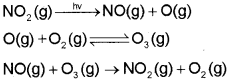
occurs in warm, dry and sunny climate. The main components of the photochemical smog result from the action of sunlight on unsaturated hydrocarbons and nitrogen oxides produced by automobiles and factories. Photochemical smog has high concentration of oxidising agents and is, therefore, called as oxidising smog. Formation of photochemical smog – When fossil fuels are burnt, a variety of pollutants are emitted into the earth’s troposphere. Two of the pollutants that are emitted are hydrocarbons (unburnt fuels) and nitric oxide (NO). When these pollutants build up to sufficiently high levels, a chain reaction occurs from their interaction with sunlight in which NO is converted into nitrogen dioxide (NO2). This NO2, in turn, absorbs energy from sunlight and breaks up into nitric oxide and free oxygen atom.
Plus One Chemistry Notes Chapter 14 Environmental Chemistry 2

Ozone is a toxic gas and both NO2 and O3 are strong oxidising agents and can react with the unburnt hydrocarbons in the polluted air to produce chemicals such as formaldehyde, acrolein and peroxyacetyl nitrate (PAN).
Plus One Chemistry Notes Chapter 14 Environmental Chemistry 3

Effects of photochemical smog
Both ozone and PAN act as powerful eye irritants. Ozone and nitric oxide irritates the nose and throat and their high concentration causes headache, chest pain, dryness of the throat, cough and difficulty in breathing. Photochemical smog leads to cracking of rubber and extensive damage to plant life. It also causes corrosion of metals, stones, building materials, rubber and painted surfaces. Catalytic converters are used in the automobiles, which prevent the release of nitrogen oxide and hydrocarbons to the atmosphere. Certain plants e.g., Pinus, Juniparus, Quercus, Pyrus and Vitis can metabolise nitrogen oxide and therefore, their plantation could help in this matter.

Stratospheric Pollution
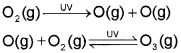
Formation and Breakdown of Ozone
Plus One Chemistry Notes Chapter 14 Environmental Chemistry 4
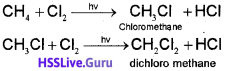
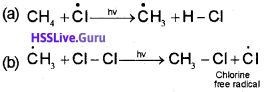
The main reason of ozone layer depletion is believed to be the release of chlorofluorocarbon compounds (CFCs), also known as freons. These compounds are non-reactive, non-flammable, non-toxic organic molecules and therefore used in refrigerators, air conditioners, in the production of plastic foam and by the electronic industry for cleaning computer parts etc. Once CFCs are released in the atmosphere, they mix with the normal atmospheric gases and eventually reach the stratosphere. In stratosphere, they get broken down by powerful UV radiations, releasing chlorine free radical.
Plus One Chemistry Notes Chapter 14 Environmental Chemistry 5

Plus One Chemistry Notes Chapter 14 Environmental Chemistry

The chlorine radicals are continuously regenerated and cause the breakdown of ozone. Thus, CFCs are transporting agents for continuously generating chlorine radicals into the stratosphere and damaging the ozone layer. Antarctica reported about depletion of ozone layer commonly known as ozone hole over the South Pole. It was found that a unique set of conditions was responsible for the ozone hole. In summer season, nitrogen dioxide and methane react with chlorine monoxide and chlorine atoms forming chlorine sinks, preventing much ozone depletion, whereas in winter, special type of clouds called polar stratospheric clouds are formed over Antarctica. These polar stratospheric clouds provide surface on which chlorine nitrate formed gets hydrolysed to form hypochlorous acid. It also reacts with hydrogen chloride produced as per reaction to give molecular chlorine.
Plus One Chemistry Notes Chapter 14 Environmental Chemistry 6

When sunlight returns to the Antarctica in the spring, the sun’s warmth breaks up the clouds and HOCl and Cl2 are photolysed by sunlight, as given in reactions.
Plus One Chemistry Notes Chapter 14 Environmental Chemistry 7

Water Pollution
Causes of Water Pollution
(i) Pathogens:
The most serious water pollutants are the disease causing agents called pathogens. Pathogens include bacteria and other organisms that enter water from domestic sewage and animal excreta. Human excreta contain bacteria such as Escherichia coli and Streptococcus faecalis which cause gastrointestinal diseases.

Plus One Chemistry Notes Chapter 14 Environmental Chemistry

Dissolved oxygen (DO) in water:
The concentration of dissolved oxygen in water is of vital importance to aquatic life. Growth of fish is inhibited if the dissolved oxygen level in waterfalls below 6 ppm. Pollution causes decrease in DO level.

Dissolved oxygen (DO) in water is consumed by micro-organisms to oxidise organic matter in sewage. Deoxygenation of water may also take place by the bio-oxidation of nitrogeneous matter.

Biochemical oxygen demand (BOD) :
It is the amount of dissolved oxygen required by microorganisms to oxidise organic and inorganic matter present in polluted water. It is generally expressed in ppm (parts per million). ‘Clean water1 would have a BOD value less than 5 ppm while highly contaminated water (say, river water) could have a BOD value 17 ppm or more.

Plus One Chemistry Notes Chapter 14 Environmental Chemistry

The amount of oxygen in ppm that would be required to oxidise all the contaminants in water is called chemical oxygen demand (COD).

Nowadays most of the detergents available are biodegradable. However, their use can create other problems. The bacteria responsible for degrading biodegradable detergent feed on it and grow rapidly. While growing, they may use up all the oxygen dissolved in water. The lack of oxygen kills all other forms of aquatic life such as fish and plants. Fertilizers contain phosphates as additives. The addition of phosphates in water enhances algae growth. This process in which nutrient enriched water bodies support a dense plant opulation, which kills animal life by depriving it of oxygen and results in subsequent loss of biodiversity is known as Eutrophication.

International Standards for Drinking Water
The International Standards for drinking water are given below and they must be followed.

Fluoride:
For drinking purposes, water should be tested for fluoride ion concentration. Its deficiency in drinking water is harmful to man and causes diseases such as tooth decay etc. Soluble fluoride is often added to drinking water to bring its concentration upto 1 ppm or 1 mg dm-3. The F ions make the enamel on teeth much harder by converting hydroxyapatite, [3(Ca3(PO4)2.Ca(OH)2], the enamel on the surface of the teeth, into much harder fluorapatite, [3(Ca3(PO4)2.CaF2]. However, F- ion concentration above 2 ppm causes brown mottling of teeth. At the same time, excess fluoride (over 10 ppm) causes harmful effect to bones and teeth, as reported from some parts of Rajasthan.

Lead:
Drinking water gets contaminated with lead when lead pipes are used for transportation of water. The prescribed upper limit concentration of lead in drinking water is about 50 ppb. Lead can damage kidney, liver, reproductive system etc.

Sulphate:
Excessive sulphate (>500 ppm) in drinking water causes laxative effect, otherwise, at moderate levels it is harmless.

Nitrate:
The maximum limit of nitrate in drinking water is 50 ppm. Excess nitrate in drinking water can cause disease such as methemoglobinemia (‘blue baby’ syndrome).

Soil Pollution
Any factor which destroys the quality, texture and mineral content of the soil or which disturbs the biological balance of the organisms in the soil is referred to as soil pollutant.

Soil pollution has adverse effect on plant growth. Soil pollution is mainly due to

  • Indiscriminate use of fertilizers, pesticides etc.
  • Dumping of waste materials.
  • Deforestation.

Large number of pesticides are used to save plants from pests, rats, insects, fungi etc. Chlorinated hydrocarbons, malathion, aldrin, DDT, BHC etc. are some substances used extensively in agriculture. Herbicides are used to kill weeds. Sodium chlorate (NaClO3), sodium arsenite (Na3AsO3) etc. are widely used as herbicides. Inorganic arsenic compounds are toxic to mammals. Fungicides are important because they counter the growth of fungi. Organo-mercury compounds are used to fungicides. However, these compounds break down in the soil causing harmful effects on human beings. Dumping of paper, plastics and other toxic substances in the soil creates serious problems. A large number of heavy metals get deposited in the soil around smelting industries. These effluents, in the long run, pollute the soil.

Plus One Chemistry Notes Chapter 14 Environmental Chemistry

Control of environmental pollution
Both industrial and domestic wastes need treatment for safe disposal, (i) Recycling of wasters not only saves the cost on raw materials but also reduces waste disposal costs. Collection and recycling of glass, metal scrap, plastics etc. are some examples of industrial recycling, (ii) Sewage water is filtered to remove large solids and then allowed to settle. Solids can settle as a sludge at the bottom while oil, grease etc. float at the surface which can be skimmed off. The sludge is dried and incinerated at high temperature (above 1000°C) in presence of oxygen. Sewage sludge can be degraded by anaerobic digestion by micro-organisms.

Green Chemistry
Introduction
Green chemistry is a way of thinking and is about utilising the existing knowledge and principles of chemistry and other sciences to reduce the adverse impact on environment. Green chemistry is a production process that would bring about minimum pollution or deterioration to the environment. The byproducts generated during a process, if not used gainfully, add to the environmental pollution. Such processes are not only environmentally unfriendly but ‘ also cost-ineffective. The waste generation and its disposal both are economically unsound. Utilisation of existing knowledge base for reducing the chemical hazards along with the developmental activities is the foundation of green chemistry. It is well-known that organic solvents such as benzene, toluene, carbon tetrachloride etc., are highly toxic. One should be careful while using them.

Green Chemistry In Day-To-Day Life
i) Dry Cleaning of Clothes
Tetra chlroroethene (Cl2C=CCl2) was earlier used as solvent for dry cleaning. The compound contaminates the ground water and is also a suspected carcinogen. Replacement of halogenated solvent by liquid CO2 will result in less harm to ground water. These days hydrogen peroxide (H2O2) is used for the purpose of bleaching clothes in the process of laundry, which gives better results and makes use of lesser amount of water.

ii) Bleaching of Paper
Chlorine gas was used earlier for bleaching paper. These days, hydrogen peroxide (H2O2) with suitable catalyst, which promotes the bleaching action of hydrogen peroxide, is used.

iii) Synthesis of Chemicals
Ethanal (CH3CHO) is now commercially prepared by one step oxidation of ethene in the presence of ionic catalyst in aqueous medium with a yield of 90%.
Plus One Chemistry Notes Chapter 14 Environmental Chemistry 8

Plus One Business Studies Notes Chapter 11 International Business – I

Students can Download Chapter 11 International Business – I Notes, Plus One Business Studies Notes helps you to revise the complete Kerala State Syllabus and score more marks in your examinations.

Kerala Plus One Business Studies Notes Chapter 11 International Business – I

Contents

  • Meaning – reasons for international business Differences between Foreign business and Domestic business
  • Scope and Benefits of international business
  • Modes of entry into international business – Exporting and Importing – advantages – Limitations
  • Contract Manufacturing – advantages – limitations
  • Licensing and Franchising – advantages – limitations
  • Joint Venture – advantages – limitations
  • Wholly Owned Subsidiaries – advantages – limitations

International or external business can be defined as those business activities that take place beyond the geographical boundaries of a country. In other words buying and selling of goods and services between two countries are called external trade.

It involves not only the international movements of goods and services, but also of capital, personnel, technology and intellectual property like patents, trademarks, know how and copyrights.

Plus One Business Studies Notes Chapter 11 International Business - I

Reasons for international business:
1. Because of unequal distribution of natural resources and differences in productivity levels, a country cannot produce all that they need

2. Labour productivity and production costs differ among nations due to various socio-economic, geographical and political reasons.

3. Availability of various factors of production such as labour, capital and raw materials differ among nations.

Differences between International Business and Domestic Business:

Domestic Business International Business.
Both the buyers and sellers are from the same country Buyers and sellers are from different Countries
Various stakeholders such as suppliers, employees, middlemen .shareholders and partners are usually citizens of the same country Various stakeholders such as suppliers, employees, middlemen, shareholders and partners are from different nations
The factors of production Like capital, labour and raw material can move freely within the country There are, restrictions on free mobility of factors of production across countries
Domestic markets are relative more homogeneous in nature International markets lack homogeneity due to differences, in languages, preferences customs etc across markets.
Business systems and practices are relatively more homogeneous within a country Business systems and practices vary considerably across countries.
It has to face the political system and risk of only one country Different countries have different forms of political systems and risk.
Business laws, regulations and economic policies are uniformly applicable within a country. Business laws, regulations and economic policies are differ widely among nations.
Currency of domestic country is used. They use different currencies for business transactions.

Scope of International Business:
1. Merchandise exports and imports:
merchandise exports means sending tangible goods abroad, merchandise imports means bringing tangible goods from a foreign country to one’s own country. It is also known as trade in goods (visible trade), include only tangible goods and exclude services.

2. Service exports and imports:
It involves trade in intangibles. It is also known as invisible trade which includes services received from other countries or services rendered to other countries. eg: Tourism and travel, communication, marketing, transportation services etc.

3. Licensing and franchising:
Permitting another party in a foreign country to produce and sell goods under their trademarks, patents or copyright in lieu of some fee is called licensing. Franchising is similar to licensing, but it is a term used in connection with the provision of services.

4. Foreign investments:
Foreign investment involves investments of funds abroad in exchange for financial return. Foreign investment can be of two types.
(a) Direct investments:
Direct investment takes place when a company directly invests in properties such as plant and machinery in foreign countries with a view to undertaking production and marketing of goods and services in those countries. This is also known as Foreign Direct Investment, i.e., FDI.

(b)Portfolio investment:
Under portfolio investment, a company makes investment by acquiring shares or providing loans to a foreign company and earns income by way of dividends or interest on loans.

In this investor does not get directly involved in production or marketing of goods. It simply earns an income by investing in shares, bonds, bills, or notes in a foreign country or providing loans to foreign business firms.

Plus One Business Studies Notes Chapter 11 International Business - I

Benefits of International Business:
The benefits of international business to the nations and business firms are.
Benefits to Nations:
1. Earning of foreign exchange:
It helps a country team foreign exchange which can be used for importing capital goods, technology, petroleum products and fertilisers, pharmaceutical products, etc.

2. More efficient use of resources:
External trade enables a country to utilize the available resources in the best possible manner.

3. Improving growth prospects and employment potentials:
External trade helps to accelerate the economic growth and employment opportunities of a country.

4. Increased standard of living:
Foreign trade helps in raising the standard of living of a country.

5. International relation:
External trade helps to promote harmonious and cordial relationship among the nations.

Benefits to Firms:
1. Prospects for higher profits:
When the domestic prices are lower, business firms can earn more profits by selling their products in countries where prices are high.

2. Increased capacity utilisation:
It help firms in using their surplus production capacities and improving the profitability of their operations. Large scale production helps to reduce the cost of production.

3. Prospects for growth:
It helps firms in improving their growth prospects by creating demands for their products in foreign countries.

4. Enhances competition:
External trade enhances competition, which compels the domestic firms to improve technology of production, production process and quality of the products.

5. Improved business vision:
It improves business vision as it makes firms to grow, more competitive and diversified.

Mode of Entry into International Business:
1. Exporting and Importing:
When goods are sold to a foreign country, it is called export trade. When goods are purchasing from a foreign country, it is called import trade.
Advantages:

  • It is the easiest way of gaining entry into international markets.
  • Business firms are not required to invest that much time and money in host countries.
  • It is less risky as compared to other modes of entry into international business

Limitations:

  • It involves additional packaging, transportation and insurance costs.
  • Exporting is not possible in case the foreign country restricts imports.
  • The export firms do not have much contact with the foreign markets.

2. Contract Manufacturing (Outsourcing):
When a firm enters into a contract with one or a few local manufacturers in foreign countries to get certain goods produced as per its specifications it is called contract manufacturing. It is also known as outsourcing and it can take place in following forms.

  • Production of certain components
  • Assembly of components into final products
  • Complete manufacture of the products

Advantages:

  • It Permits the international firms to get the goods produced on a large scale without requiring investment in setting up production facilities.
  • There is no investment risk involved in the foreign countries.
  • It helps to get the products at lower cost
  • Local producers in foreign countries can ensure greater utilization of their idle production capacities.

Limitations:
(a) It may affect the quality of the products.

(b) Local manufacturer in the foreign country loses his control over the manufacturing process because goods are produced strictly as per the terms and specifications of the contract.

(c) The local firm cannot sell the contracted output as per their will.

3. Licensing and Franchising:
Licensing is a contractual arrangement in which one firm grants access to its patents, trade secrets or technology to another firm in a foreign country for a fee called royalty. The firm that grants permission is known as licensor and the firm that receives the rights to use technology or patents is called the licensee.

Plus One Business Studies Notes Chapter 11 International Business - I

Franchising is similar to licensing. But it is used in connection with the provision of services. The parent company is called the franchiser and the other party to the agreement is called franchisee.
Advantages:

1. It is a less expensive mode of entering into international business.

2. There is no investment risk

3. Since the business in the foreign country is managed by the licensee/franchisee who is a local person, there are lower risks of business takeovers or government interventions.

4. Since licensee/franchisee is a local person, he has greater market knowledge and customer contacts. It helps the licensor/franchiser in successfully conducting its marketing operations.

Limitations:
(a) The licensee can start marketing an identical product under a slightly different brand name.

(b) Trade secrets may lose in the foreign markets.

(c) Conflicts often develop between the licensor/franchiser and licensee/franchisee oyer issues such as maintenance of accounts, payment of royalty, etc.

4. Joint Ventures:
Joint venture means establishing a firm that is jointly owned by two or more independent firms. It can be brought into existence in three major ways.

  • Foreign investor buying an interest in a local firm.
  • Local firm acquiring an interest in an existing foreign firm.
  • Both the foreign and local entrepreneurs jointly forming a new enterprise

Plus One Business Studies Notes Chapter 11 International Business - I

Advantages:

  1. Since the local partner also contributes to the equity capital, the international firm has less financial burden to expand the business globally.
  2. It helps to execute large projects requiring huge capital outlays and manpower.
  3. The foreign business firm benefits from local partner’s knowledge of the host countries.
  4. The foreign business firm shares cost and risks with local partner. So they can enter into foreign market very easily and without high risk.

Limitations:

  1. Foreign firms entering into joint ventures share the technology and trade secrets with local firms. It leads to leakage of technology and secrets to others.
  2. The dual ownership arrangement may lead to conflicts

5. Wholly Owned Subsidiaries:
The parent company (holding company) acquires full control over the foreign company by making 100% investment in its equity capital. It is called wholly owned subsidiaries. It can be established in either of the two ways. i.e.

  • Setting up a new firm altogether to start operations in a foreign country
  • Acquiring an existing firm in the foreign country

Advantages:

  1. The parent firm is able to exercise full control over its operations in foreign countries.
  2. It is not required to disclose its technology or trade secrets to others.

Limitations:

  1. It is not suitable for small and medium size firms which do not have enough funds to invest abroad.
  2. The parent company alone has to bear the entire losses.
  3. It is subject to higher political risk.

Plus One Physics Notes Chapter 10 Mechanical Properties of Fluids

Students can Download Chapter 10 Mechanical Properties of Fluids Notes, Plus One Physics Notes helps you to revise the complete Kerala State Syllabus and score more marks in your examinations.

Kerala Plus One Physics Notes Chapter 10 Mechanical Properties of Fluids

Summary
Introduction
Unlike a solid, a fluid has no definite shape. Fluid is that which can flow. Liquids and gases are fluids. A fluid has no definite shape. It assumes the shape of the container.
Difference between the liquids and gases:

  • Liquid is incompressible, while a gas is compressible.
  • Liquid has a free surface, while a gas no free surface.

Common properties of liquids and gases:

  • Liquids and gases can flow
  • Liquids and gases can exert pressure on the walls of the container.

Plus One Physics Notes Chapter 10 Mechanical Properties of Fluids

Pressure
In fluids, the molecules are free to move. When they move, they collide with the walls of the container and exert a force on the walls. The force is acting normal to the surface. The force acting per unit area normal to the surface is called pressure.

ie; P = F/A. Its unit is N/m2 or Pascal (Pa), Another common unit of pressure is atmosphere. The pressure exerted by the atmosphere at sea level is called the atmospheric pressure.
I atm = 1.0313 × 10⁵Pa
Properties of Fluid Pressure:

  • The pressure will be equal at any point on the same horizontal level of a liquid at rest.
  • The pressure will be the same in all directions at any point in a liquid at rest.

Plus One Physics Notes Chapter 10 Mechanical Properties of Fluids 1

Question 1.
When a surface is immersed in a liquid, what is the direction of pressure on the surface?
Plus One Physics Notes Chapter 10 Mechanical Properties of Fluids 2
Answer:
The direction of pressure is always normal to the surface.
Density:
The density r for a fluid of mass m occupying volume V
Plus One Physics Notes Chapter 10 Mechanical Properties of Fluids 3
The density of water at 4°C (277k) is 1 × 10³kg m-3
Relative density:
The relative density of a substance is the ratio of its density to the density of water at 4°C. The relative density of aluminium is 2.7. Its density is 2.7 × 10³kg m-3.
1. Variation of pressure with Depth:
Plus One Physics Notes Chapter 10 Mechanical Properties of Fluids 4

Plus One Physics Notes Chapter 10 Mechanical Properties of Fluids
Consider a fluid at rest in a container. Consider a cylindrical element of fluid having base area ‘A’ and height ‘h’. Let P1 and P2 be pressures at points 1 and 2 respectively.
The force at top of cylindrical element F1 = P1A
This force is acting vertically down ward.
Similarly, the force at bottom F2 = P2A
This force is acting vertically upward.
∴ Total force acting on the cylindrical element of fluid = P2A – P1A
The fluid is at rest. Hence, Net force on the cylindrical element of fluid = Weight of cylindrical element of fluid.
ie.: (P2 – P1)A = mg
(P2 – P1)A = vρg (∴ m = ρv)
(P2 – P1)A = Ahρg (∴ v = Ah)
P2 – P1 = hρg _____(1)
The above equation shows that pressure difference depends on the vertical distance h between the points (1 and 2), density of the fluid, acceleration due to gravity.
Gauge Pressure:
If the point 1 is shifted to the top of fluid, P1 may be replaced by atmospheric pressure ‘Pa’. Let pressure at bottom of cylindrical element be ‘P\ then from eq (1), we can write
P – Pa = hρg
P = Pa + hρg
The above equation shows that, the pressure P (below the surface of a liquid open to the atmosphere) is greater than atmospheric pressure by an amount rgh. The excess pressure (P – Pa) at depth h is called guage pressure.

Plus One Physics Notes Chapter 10 Mechanical Properties of Fluids

Hydrostatic paradox:
Question 2.
In which points (see figure) pressure is maximum?
Plus One Physics Notes Chapter 10 Mechanical Properties of Fluids 5
Answer:
The liquid pressure is the same at all points (A, B, C). Because all the points lie at same horizontal level. The pressure at A, B and C do not depend upon base area or shape of the container. This paradox is called hydrostatic paradox.

2.  Atmospheric pressure and Gauge pressure:
Atmospheric pressure:
The pressure exerted by the atmosphere at any point is due to the weight of air above that point. At sea level the atmospheric pressure is maximum and is taken as 1 atmosphere.
1 atm = 1.013 × 10⁵ Pa
Mercury Barometer:
Italian scientist Evangelista Torricelli (1608 -1647) devised a method for measuring atmospheric pressure. This device is known as mercury barometer.
Plus One Physics Notes Chapter 10 Mechanical Properties of Fluids 6

Plus One Physics Notes Chapter 10 Mechanical Properties of Fluids
A long glass tube closed at one end is filled with mercury. Then it is inverted in a mercury reservoir. The mercury level inside the tube falls up to a height 76 cm.

Consider two points A and B in the reservoir. Since the reservoir is open to the atmosphere, the pressure at,
P0 = Pa (atmospheric pressure).
The pressure at B is PB = Hrg
The points A and B lie at same level, hence
pressure at A = pressure at B
Pa = PB
ie; Pa = Hrg
In the experiment, it is found that the mercury column in the barometer has a height of about 76 cm at sea level. 76 cm of mercury = 1 atm.
Different unit of pressure:
1 mm of mercury = 1 torr
1 torr= 133 Pa
1 bar= 105 Pa
Open – Tube Manometer:
Plus One Physics Notes Chapter 10 Mechanical Properties of Fluids 7
open-tube manometer is a useful instrument for measuring pressure differences. This device consists of a U shaped tube containing liquid of density r. One end is open to the atmosphere and other end is connected to the system whose pressure is to be measured.

The pressure ‘P’ at A is equal to the pressure at B.
ie: P = Pa + hρg
(or) P – Pa = hρg
P is called absolute pressure.

3. Hydraulic Machines:
Hydraulic machines are based on Pascal’s law. Examples of hydraulic machines:

  • Hydraulic Lift
  • Hydraulic press
  • Hydraulic brake.

Plus One Physics Notes Chapter 10 Mechanical Properties of Fluids

Pascal’s Law:
Whenever external pressure is applied on any part of a fluid contained in a vessel, it is transmitted undiminished and equally in all directions.

Hydraulic lift:
Plus One Physics Notes Chapter 10 Mechanical Properties of Fluids 8
A hydraulic lift is used to lift heavy load. Consider a liquid enclosed in a vessel with two cylinders C1 and C2 attached as shown in the figure. The cylinders are provided with two pistons having areas A1 and A2 respectively.
If F1 is the force exerted on the area A1.
pressure P1 = \(\frac{F_{1}}{A_{1}}\)
If F2 is the force exerted on the area A2,
pressure P2 = \(\frac{F_{2}}{A_{2}}\)
According to pascal’s law P1 = P2 ie;
Plus One Physics Notes Chapter 10 Mechanical Properties of Fluids 9
Using this method we can lift heavy load by applying small force.
Hydraulic Brake:
Plus One Physics Notes Chapter 10 Mechanical Properties of Fluids 10
Hydraulic brake is based on Pascals law. When the brake pedal (F) is pressed, a pressure is produced on liquid. This pressure will reach at A1 and A2. Due to large area of A1 and A2, a large force is produced. This large force will push brake shoes (S1 ans S2) in to the inner rim of wheel. Hence the motion of wheel will be retarded.

Plus One Physics Notes Chapter 10 Mechanical Properties of Fluids

Streamline Flow
Fluid dynamics:
The study of the fluids in motion is known as fluid dynamics.
Steady Flow:
The flow of the fluid is said to be steady if at any given point, the velocity of each fluid particle remains constant in time. The path taken by a fluid particle under a steady flow is a streamline.
Turbulent flow:
As the speed of flow increase, at a certain speed the stream line flow stops and irregular flow starts. This irregular flow is called turbulent.
Plus One Physics Notes Chapter 10 Mechanical Properties of Fluids 11
The speed at which the turbulent flow starts is called critical speed.
Equation of continuity:
Flow rate of a incompressible fluid is constant
ie Av = cont.
Where A is the area of cross section of flow and v is the velocity of flow. ‘Av’ is also called volume flux.
Proof:
Consider a flow of incompressible liquid. Let P, R and Q be three points of a flow. Consider three planes perpendicular to direction of flow at P, R and Q.
Plus One Physics Notes Chapter 10 Mechanical Properties of Fluids 12
Let AP, AR and AQ be the area of cross section and VP, VR and VQ be the corresponding speeds at P, R, Q respectively.
The mass of liquid passing through area AP in a time Dt, MP = AP VP rP ∆t
Similarly, MR = AR VR rR ∆t
MQ = AQ VQ rQ ∆t
But we know rP = rR = rQ = r
Hence we get MP = AP VP r ∆t
MR = AR VRr ∆t
MQ = AQ VQ r ∆t
the mass of liquid flowing out = the mass flowing in
ie; MP = MR = MQ
∴ APVP = ARVR = AQVQ
Plus One Physics Notes Chapter 10 Mechanical Properties of Fluids 13

Plus One Physics Notes Chapter 10 Mechanical Properties of Fluids

Bernoulli’S Principle
Bernoulli’s theorem:
As we move along a streamline the sum of the pressure (p), the kinetic energy per unit volume \(\frac{\rho v^{2}}{2}\) and the potential energy per unit volume (ρgh) remains a constant.

(OR)

The total energy of an incompressible non-viscous liquid flowing from one place to another without friction is a constant. Mathematically Bernoulli’s theorem can be written as
Plus One Physics Notes Chapter 10 Mechanical Properties of Fluids 14
Proof:
Plus One Physics Notes Chapter 10 Mechanical Properties of Fluids 15
Consider an incompressible liquid flowing through a tube of non uniform cross section from region 1 to region 2. Let P1 be the pressure, A1 the area of cross section and V1 the speed of flow at the region 1.

The corresponding values at region 2 are P2, A2, and V2 respectively. Region 1 is at a height h1 and region 2 is at a height h2.
The workdone on the liquid in a time ∆t at the region 1 is given by
W1 = force × distance
= P1A1∆ x1
= P1∆V1 (∵ A1∆x1 = ∆V)
Where ∆x1 is the displacement produced at region 1, during the time interval ∆t.
Similarly, the workdone in a time ∆t at the region 2 is given by,
W2 = -P2 A2 ∆ x2
W2 = -P2 ∆ V2
[Here -ve sign appears as the direction of \(\vec{p}\) and ∆x are in opposite directions.]
Net workdone
DW = P1 ∆ V1 – P2 ∆ V2

Plus One Physics Notes Chapter 10 Mechanical Properties of Fluids
According the equation of continuity
∆V1 = ∆V2 = ∆V
∆W= P1 ∆ V – P2 ∆ V
∆W = (P1 – P2) ∆ V _____(1)
This work done changes the kinetic energy, pressure energy and potential energy of the fluid.
If ∆m is the mass of liquid passing through the pipe in a time ∆t. the change in Kinetic energy is
Plus One Physics Notes Chapter 10 Mechanical Properties of Fluids 16
Change in gravitational potential energy is given by
∆p.E = ∆mgh2 – ∆mgh1
∆p.E = ∆mg(h2 – h1) ______(3)
According to work-energy theorem work done is equal to the change in kinetic energy plus the change in potential energy.
ie; ∆w = ∆kE + ∆PE ______(4)
Substituting eq. 1, 2 and 3 in eq. 4, we get
Plus One Physics Notes Chapter 10 Mechanical Properties of Fluids 17
Dividing by ∆V , we get
Plus One Physics Notes Chapter 10 Mechanical Properties of Fluids 18

Plus One Physics Notes Chapter 10 Mechanical Properties of Fluids
Case – 1
When the fluid at rest, its velocity is zero everywhere. Hence Bernoullis equation becomes
p1 + ρgh1 = P2 + ρgh2
(P1 – P2) = ρg(h2 – h1 )
Note: Bernoullis law is conservation law of energy for a flowing liquid.

1. Speed of Afflux: Torricellis law:
Torricellis law may be stated as the velocity of afflux through a hole at a depth ‘h’ will be equal to the velocity gained by a freely falling body when it travels a distance ‘h’. ie; v = \(\sqrt{2 \mathrm{gh}}\).
Proof
Consider a tank containing a liquid of density r with a small hole in its side. Let Y1 be the height of the hole, and y2 be height of water in the tank. Applying Bernoullis equation at points (1) and (2) we get
Plus One Physics Notes Chapter 10 Mechanical Properties of Fluids 19
(∵ P1 = Pa, the atmospheric pressure).
If the cross sectional area of the tank A2 is much larger than that of the hole (ie; A2 >> A1 ), we take
v2 ≈ 0.
∴ eq(1) can be written as.
Plus One Physics Notes Chapter 10 Mechanical Properties of Fluids 20
Note: The equation (2) shows that the speed of afflux is determined by the container pressure. Such a situation occurs in rocket propulsion.

2. Venturi – meter:
Plus One Physics Notes Chapter 10 Mechanical Properties of Fluids 21

Plus One Physics Notes Chapter 10 Mechanical Properties of Fluids
A venturimeter is used to measure the flow of a liquid. It is based on Bernoullis theorem. Venturimeter consists of a horizontal tube of nonuniform cross section. A manometer (U tube) is attached to it as shown in the figure.

When a liquid flows through the tube, the manometer level falls in the limb (1) and rises in the limb (2). Let ‘h’ be the height difference of the manometer liquid in the two limbs. Let A be the cross-sectional area and V1 the velocity at the wide limb(1) and V2 be the corresponding values at the narrow limb (2).
According to Bernoullis theorem
Plus One Physics Notes Chapter 10 Mechanical Properties of Fluids 22
Where ρm is the density of manometer liquid.
Plus One Physics Notes Chapter 10 Mechanical Properties of Fluids 23
Using the above equation, the rate of flow can be measured.
Atomiser (application of Bernoulli’s theorem):
Plus One Physics Notes Chapter 10 Mechanical Properties of Fluids 24

Plus One Physics Notes Chapter 10 Mechanical Properties of Fluids
Atomiser is used for getting a fine spray of perfumer or insecticide. It consists of a cylinder with a piston. A small vessel containing liquid to be sprayed is attached to the cylinder. When the piston is moved forward air is blown out through a small opening of the cylinder.

As the velocity of flow of air increases, the pressure at the opening decreases. Due to the lower pressure at the opening, the liquid rises through the narrow tube and gets sprayed out along with air.

Blood flow and heart attack:
Bernoulli’s principle helps in explaining blood flow in artery. The artery may get constricted due to the accumulation of plaque on its inner walls. The speed of blood flow increases at which plaque is deposited. The increase in speed will lowers the pressure inside the artery and it may collapse due to the external pressure. This may result in heart attack.

4. Dynamic lift:
Dynamic lift is the force that acts on a body by virtue of its motion through a fluid (air). (This dynamic lift can be partly explained on the basis of Bernoulli’s principle)
Example:

  1. Ball moving without spin
  2. Ball moving with spin
  3. Aerofoil or lift on aircraft wing.

1. Ball moving without spin:
Plus One Physics Notes Chapter 10 Mechanical Properties of Fluids 25
When a ball move in air without spinning, the velocity of fluid (air) above and below the ball is the same. Hence pressure difference between above and below is zero. Therefore there is no upward or downward force on the ball.

2. Ball moving with spin:
Plus One Physics Notes Chapter 10 Mechanical Properties of Fluids 26

Plus One Physics Notes Chapter 10 Mechanical Properties of Fluids
When a ball is thrown in a air with spin, air will be dragged along with it. Therefore the velocity of air above (larger) and below (smaller) are different. This difference in the velocities of air results in the pressure difference between the lower and upper faces and there is a net upward force on the ball. This dynamic lift due to spinning is called Magnus effect.

3. Aerofoil or lift on aircraft wing:
Plus One Physics Notes Chapter 10 Mechanical Properties of Fluids 27
An aerofoil is a solid piece, shaped to provide an upward vertical force as it moves horizontally through air. Due to the curved shape at the top, the velocity of the air on the top side increases. Due to increase in velocity, the pressure at this region decreases. Thus an upward force develops on the aerofoil. This principle is applied in the design of the wings of aeroplanes.

Viscosity
Viscosity is liquid friction. When liquid layer moves over another liquid layer, there is a force of friction between the liquid layers, opposing the motion of layers.

Laminar flow:
When a liquid flows on a surface, the layer of liquid in contact with the surface will be rest. The velocity of the layer increases as the distance of the layer from the surface increases. The velocity is maximum on the top most layer. This type of flow is known as laminar.

Coefficient of viscosity:
The coefficient of viscosity for a fluid is defined as the ratio of shearing stress to the strain rate. Explanation:
Plus One Physics Notes Chapter 10 Mechanical Properties of Fluids 28
Consider a portion of liquid having shape ABCD. When this liquid flows, it take the shape AEFD after a short interval of time Dt
During this time interval the liquid has undergone a shear strain of \(\frac{\Delta \mathbf{x}}{\ell}\). Since, the stress in a flowing fluid increases with time, we take rate.
ie. strain rate = \(\frac{\Delta \mathbf{x}}{\ell \Delta t}\)
Plus One Physics Notes Chapter 10 Mechanical Properties of Fluids 29

Plus One Physics Notes Chapter 10 Mechanical Properties of Fluids
Unit of viscosity:
The SI unit of viscosity is poiseiulle (PI). Its another units are NSm-2 or PaS.
Note:

  • Blood is thicker (more viscous) than water. The relative viscocity (n/nwater) of blood remains constant between 0° C and 37° C.
  • The viscocity of liquid decreases with temperature while it increases in the case of gases.

1. Stokes law:
If a body is moving through a fluid, its velocity is influenced by the viscosity of the medium. Consider a small sphere of radius ‘a’ falling under gravity in air: The viscocity of air opposes the motion of the sphere. This opposing force is called viscous force and can be written as.
F = 6πaηv
This is called stokes, formula.
Where η is the coefficient of viscocity of the medium and v is the velocity of the body.

(i) Terminal velocity:
The constant velocity attained by a body as it falls down through a fluid medium is called the terminal velocity.
Expression for terminal velocity:
Considers sphere of radius ‘a’ densitity r falling through a liquid of density s and viscocity h. The viscous force acting on the sphere can be written as
F = 6πaηv
Where v is the velocity of sphere. This force is acting in upward direction. When the body comes down its velocity will increase. Hence the viscous force will also increases.

When the viscous force is equal to the weight of the body in the medium. The net force on the body is zero. Now the body falls without acceleration. It moves with a constant velocity called the terminal velocity.
The weight of a body in a medium,
Plus One Physics Notes Chapter 10 Mechanical Properties of Fluids 30
When body has terminal velocity, we can write.
Plus One Physics Notes Chapter 10 Mechanical Properties of Fluids 31

Reynolds Number
The turbulence in a fluid is determined by a dimension parameter called Reynolds number.
Reynolds number Re = \(\frac{\rho \mathbf{v d}}{\eta}\)
Where ‘r is the density of a fluid, V- the speed of flow of the liquid, ‘d’- the dimension of pipe, h- viscocity of the liquid. Re – the dimensionless number. The flow is streamline when the Re is below 1000, unsteady when Re is in between 1000 and 2000 and turbulent when Re > 2000.
Critical velocity:
The maximum velocity of a fluid in a tube for which the flow remains streamlined is called its critical velocity.
Critical velocity v = \(\frac{R_{e} \eta}{\rho d}\).

Plus One Physics Notes Chapter 10 Mechanical Properties of Fluids

Surface Tension
Liquids acquire a free surface when poured in a container. These surfaces possess some additional. energy. This phenomenon is known as surface tension.

1. Surface Energy:
Question 4.
What is the reason for surface tension?
Plus One Physics Notes Chapter 10 Mechanical Properties of Fluids 32
Answer:
Consider a liquid enclosed in a vessel as shown in figure. Let A, B, and C be three molecules in the liquid. For a molecule A, the forces of attraction on the molecule are equal in all directions. Hence net force on it is zero. Consider a molecule B near the surface. In this case the molecule is partially outside the liquid. So there is a net downward force.

Consider another molecule Con the surface of liquid. Half of the sphere is outside the liquid. Hence the downward force on molecule is maximum. This, when a molecule comes to the surface, it is doing work to overcome this downward pull. The work done resides as RE. in the molecule on the surface. Thus molecule on the surface of liquid have P.E. This energy is called the surface energy.
Note:
1. To increase the area of surface of a liquid, work has to be done. This energy is required to increase the surface area.

Plus One Physics Notes Chapter 10 Mechanical Properties of Fluids

2. Surface energy and surface tension:
Question 5.
Show that Surface tension is equal to surface energy per unit area.
Plus One Physics Notes Chapter 10 Mechanical Properties of Fluids 33
Answer:
Consider a horizontal liquid film as shown in figure. The bar at one end of film is free to move. Move the bar a small distance as shown in figure. Since the area of the surface increases, some work has to be done against an internal force.
workdone W = Fd _____(1)
This workdone is stored as additional energy in the film. If the surface energy of the film is S per unit area, the workdone to increase the surface area.
W = S × increase in area
W = S × 2/d ______(2)
Where 2/d is the increase in area due to two sides of film.
equating eq(1) and eq(2),we get
S 2/d = Fd
Plus One Physics Notes Chapter 10 Mechanical Properties of Fluids 34
This quantity S is the magnitude of surface tension. It is equal to the surface energy per unit area.

Plus One Physics Notes Chapter 10 Mechanical Properties of Fluids

3. Angle of contact:
Angle of contact is the angle between the solid surface and the tangent drawn to the liquid surface at the point of contact inside the liquid.

If angle of contact of liquid is acute(<90°), the meniscus in the tube will be concave. The liquid level in the tube will rise to a certain height. This is called capillary rise. If the angle of contact is obtuse (>90°), the liquid level falls in the tube. This is called capillary fall or capillary depression.

4. Drops and bubbles:
Due to surface tension, the liquid surface always tends to have the minimum surface area. For a given volume, a sphere has a minimum surface area. Hence, srnail drops and bubbles of a liquid assume spherical shape.

On the other hand, for bigger drops the effect of gravity predominates over surface tension and the drop gets flattened.

(i) Excess of pressure inside a spherical drop The molecules near the surface of a drop experience a resultant pull inwards due to surface tension. Because of this inward pull, the pressure inside is greater than the outside.

Due to the forces of surface tension, the drop tends to contract. But due to excess inside pressure, the drop tends to expand. When the drop is in equilibrium, these two forces will be equal and opposite.

Expression for excess pressure inside a liquid-drop:
Plus One Physics Notes Chapter 10 Mechanical Properties of Fluids 35

Plus One Physics Notes Chapter 10 Mechanical Properties of Fluids
Consider a drop of liquid of radius r. Let pi and po be the values of pressure inside and outside the drop. Let the radius of liquid of drop increases by a small amount Dr under the pressure difference.
The outward force acting on the surface of the drop,
f = pressure difference × surface area,
ie. f = (pi – po)4pr2
If the radius of liquid drop is increased by Dr due to the above force
The work done (DW) = f.Dr
= (pi – po)4pr2Dr _____(1)
The increase in surface area of the drop
= 4p(r + Dr)2 – 4pr2
= 4p(r2 + 2rDr + Dr2) – 4pr2 = 8prDr [ Neglecting Dr2]
If S is the surface tension of the liquid, the work done to increase the surface area,
DW = Increase in surface area × surface tension
DW= 8prDr.S _____(2)
From equation (1) and (2), we get 2S
pi – po = \(\frac{2 \mathrm{S}}{\mathrm{r}}\).

Plus One Physics Notes Chapter 10 Mechanical Properties of Fluids

(ii) Expression for excess pressure inside a spherical bubble:
A liquid bubble has air both inside and outside it. Hence, it has two surfaces;
Hence the total increase in the surface area, = 16prDr
The workdone to increase the surface area,
= 16prDrS ______(3)
From equation (1) and (3) we get,
pi – po = \(\frac{4 \mathrm{S}}{\mathrm{r}}\)

5. Capillary rise:
A tube of very fine core is called a capillary tube. When a capillary tube is dipped in a liquid, the liquid immediately rises in the tube. This phenomena is called capillarity or capillary rise. In the case of mercury, capillary depression is observed.
Expression for capillary rise:
Plus One Physics Notes Chapter 10 Mechanical Properties of Fluids 36
Consider a capillary tube of radius ‘a’ dipped in a liquid of density rand surface tension S. If the liquid has a concave meniscus it will rise in the capillary tube. Let h be the rise of the liquid in the tube. Let p1 be the pressure on the concave Side of the meniscus and p0, that on the other side.
The excess pressure on the concave side of the meniscus can be written as
pi – po = \(\frac{2 \mathrm{S}}{\mathrm{r}}\) _____(1)
Where R is the radius of the concave meniscus. The tangent to the meniscus at the point A makes an angle q with the wall of the tube.
In the right angled triangle ACO
Plus One Physics Notes Chapter 10 Mechanical Properties of Fluids 37

Plus One Physics Notes Chapter 10 Mechanical Properties of Fluids
substituting the values of R in the equation (1)
Plus One Physics Notes Chapter 10 Mechanical Properties of Fluids 38
Considering two points M and N in the same horizontal level of a liquid at rest,
pressure at N = pressure at M
But pressure at M = pi, the pressure over the concave meniscus and pressure at N = po + hrg
∴ po = po + hrg
or pi – po = hrg ______(3)
From equations (2) and (3), we get
hρg = \(\frac{2 \mathrm{S} \cos \theta}{\mathrm{a}}\)
Plus One Physics Notes Chapter 10 Mechanical Properties of Fluids 39
case-1
For water q = 0, ie. cosq = 1
hence S = \(\frac{1}{2}\) haρg

6. Detergents and Surface Tension:
Dirty clothes containing grease and oil stains sticking on them cannot be cleaned by soaking them in water. – This is because water will not wet greasy dirt. If water could wet grease, then the flow of water would carry away some greasy dirt.

Plus One Physics Notes Chapter 10 Mechanical Properties of Fluids

But, by adding detergent or soap to water, the greasy dirt can be removed. The molecules of the detergent are hairpin shaped. When the detergent is added to water, one end of hair pin shaped molecule get attached to the water surface and other end to stain.

This results in the formation of water – grease interface. Thus surface tension between water and grease reduces. Hence dirt can be removed by the moving water.

Plus One Chemistry Notes Chapter 13 Hydrocarbons

Students can Download Chapter 13 Hydrocarbons Notes, Plus One Chemistry Notes helps you to revise the complete Kerala State Syllabus and score more marks in your examinations.

Kerala Plus One Chemistry Notes Chapter 13 Hydrocarbons

Introduction
The compounds formed by carbon and hydrogen are called Hydrocarbons.

Classification
Hydrocarbons are broadly classified into two main classes. Open chain hydrocarbons and closed chain or cyclic hydrocarbons.

Open chain hydrocarbons are hydrocarbons containing open chain of carbon atoms in their molecules. The chain may be straight or branched. These compounds are also called aliphatic hydrocarbons. They are further divided into three classes: Alkanes, alkenes, and alkynes.

Plus One Chemistry Notes Chapter 13 Hydrocarbons

Closed chain or cyclic hydrocarbons are hydrocarbons having closed chains or righs in their molecules. They are further divided into two categories: Alicyclic hydrocarbons and aromatic hydrocarbons. Alicyclic hydrocarbons contain ring or closed chain of carbon atoms, but resemble aliphatic compounds in most of their properties. Aromatic hydrocarbons contain at least one benzene ring which is a hexagonal ring of carbon atoms with three double bonds in alternate positions.

ALkanes
Alkanes are saturated aliphatic hydrocarbons containing only carbon-carbon single bonds in their molecules. They can be represented by the general formula cn H2n+2 Where n may have values 1, 2, 3, ………… Since they are relatively inert towards most of the common reagents, they are called paraffins (Latin : parum = Little, affinis = affinity)

Nomenclature
Nomenclature of alkanes has already been discussed in Unit =12 ‘

Preparation:
Petroleum and natural gas are the main sources of alkanes. However, alkanes can be prepared by following methods:
1. From unsaturated hydrocarbons
Dihydrogen gas adds to alkenes and alkynes in the presence of finely divided catalysts like platinum, palladium or nickel to form alkanes. This process is called hydrogenation. These metals adsorb dihydrogen gas on their surfaces and activate the hydrogen – hydrogen bond.

Platinum and palladium catalyse the reaction at room temperature but higher temperature and pressure are required.
Plus One Chemistry Notes Chapter 13 Hydrocarbons 1

2. From alkyl halides
i) Alkyl halides (except fluorides) on reduction with zinc and dilute hydrochloric acid give alkanes.
Plus One Chemistry Notes Chapter 13 Hydrocarbons 2
ii) Alkyl halides on treatment with sodium metal in dry ether (free from moisture) solution give higher alkanes. This reaction is known as Wurtz reaction and is used for the preparation of higher alkanes containing even number of carbon atoms.
Plus One Chemistry Notes Chapter 13 Hydrocarbons 3

3. From carboxylic acids
i) Sodium salts of carboxylic acids on heating with soda lime (mixture of sodium hydroxide and calcium oxide) give alkanes containing one carbon atom less than the carboxylic acid. This process of elimination of carbon dioxide from a carboxylic acid is known as Decarboxylation.
Plus One Chemistry Notes Chapter 13 Hydrocarbons 4
Sodium ethanoate

Plus One Chemistry Notes Chapter 13 Hydrocarbons

ii) Kolbe’s electrolytic method:
An aqueous solution of sodium or potassium salt of a carboxylic acid on electrolysis gives alkane containing even number of carbon atoms at the anode.
2CH3COONa+ +2H2O
Sodium acetate
-Electrolysis
CH3 – CH3 +2CO2 +H2 +2NaOH
The reaction is supposed to follow the following path:
Plus One Chemistry Notes Chapter 13 Hydrocarbons 5
Methane cannot be prepared by this method.

Properties
Physical properties:
Alkanes are almost non-polar molecules because of the covalent nature of C-C and C-H bonds and due to very little difference of electronegativity between carbon and hydrogen atoms. They possess weak van der Waals’ forces. Due to the weak forces, the first four members, C1 to C4 are gases, C5 to C17 are liquids and those containing 18 carbon atoms or more are solids at 298 K. It is generally observed that in relation to solubility of substances in solvents, polar substances are soluble in polar solvents, whereas the non-polar ones in non-polar solvents i.e., like dissolves like. There is a steady increase in boiling point with increase in molecular mass.

Plus One Chemistry Notes Chapter 13 Hydrocarbons

Chemical properties
As already mentioned, alkanes are generally inert towards acids, bases, oxidising and reducing agents. However, they undergo the following reactions under certain conditions.

1. Substitution reactions
One or more hydrogen atoms of alkanes can be replaced by halogens, nitro group, and sulphonic acid group. Halogenation takes place either at higher temperature (573-773 K) or in the presence of diffused sunlight or .ultraviolet light. Lower alkanes do not undergo nitration and sulphonation reactions. These reactions in which hydrogen atoms of alkanes are substituted are known as substitution reactions. As an example,chlorination of methane is given below:

Halogenation
Plus One Chemistry Notes Chapter 13 Hydrocarbons 6
It is found that the rate of reaction of alkanes with halogens is F2 > Cl2 > Br2 > l2. Rate of replacement of hydrogens of alkanes is :3° > 2° > 1 °. Fluorination is too violent to be controlled, lodination is very slow and a reversible reaction. It can be carried out in the presence of oxidizing agents like HIO3 or HNO3.
CH4 +I2 \(\rightleftharpoons \) CH3I+HI
HIO3 +5HI → 3l2 +3H2O
Halogenation is supposed to proceed via free radical chain mechanism involving three steps namely initiation, propagation, and termination as given below:

Mechanism
i) Initiation :
The reaction is initiated by homolysis of chlorine molecule in the presence of light or heat. The Cl-Cl bond isweakerthantheC-C and C-H bond and hence is easiest to break.
Plus One Chemistry Notes Chapter 13 Hydrocarbons 7

ii) Propagation:
It involves the following steps
Plus One Chemistry Notes Chapter 13 Hydrocarbons 8
Two such steps given below explain how more highly halogenated products are formed.
Plus One Chemistry Notes Chapter 13 Hydrocarbons 9

iii) Termination :
The reaction stops after some time due to consumption of reactants and / or due to the following side reactions:
The possible chain terminating steps are :
Plus One Chemistry Notes Chapter 13 Hydrocarbons 10
Though in (c), CH3-Cl, the one of the products is formed but free radicals are consumed and the chain is terminated. The above mechanism helps us to understand the reason for the formation of ethane as a byproduct during chlorination of methane.

2. Combustion
Plus One Chemistry Notes Chapter 13 Hydrocarbons 11

3. Controlled oxidation
Plus One Chemistry Notes Chapter 13 Hydrocarbons 12
iv) Ordinarily alkanes resist oxidation but alkanes having tertiary H atom can be oxidized to corresponding alcohols by potassium permanganate.
Plus One Chemistry Notes Chapter 13 Hydrocarbons 13

4. Isomerisation
n-Alkanes on heating in the presence of anhydrous aluminum chloride and hydrogen chloride gas isomerise to branched-chain alkanes. Major products are given below. Minor products are generally not reported in organic reactions.
Plus One Chemistry Notes Chapter 13 Hydrocarbons 14

5. Aromatization
n-Alkanes having six or more carbon atoms on heating to 773 K at 10-20 atmospheric pressure in the presence of oxides of vanadium, molybdenum or chromium supported over alumina get dehydrogenated and cyclised to benzene and its homologues. This reaction is known as aromatization or reforming.
Plus One Chemistry Notes Chapter 13 Hydrocarbons 15

6. Reaction with steam
Plus One Chemistry Notes Chapter 13 Hydrocarbons 16

7. Pyrolysis
Higher alkanes on heating to higher temperature decompose into lower alkanes, alkenes etc. Such a decomposition reaction into smaller fragments by the application of heat is called pyrolysis or cracking.
Plus One Chemistry Notes Chapter 13 Hydrocarbons 17
Preparation of oil gas or petrol gas from kerosene oil or petrol involves the principle of pyrolysis.
Plus One Chemistry Notes Chapter 13 Hydrocarbons 18

Conformations
The C-C bonds in alkanes are sigma bonds. Carbon atoms connected through sigma bonds in alkanes can undergo rotation about the bond axis. As a result of this rotation, a large number of different spatial arrangements of atoms of groups attached to the carbon atoms are possible. These different spatial arrangements are called conformations. Thus, the different spatial arrangements of atoms in a molecule which arise due to free rotation about carbon-carbon single bond are called conformations.

Plus One Chemistry Notes Chapter 13 Hydrocarbons

Conformations of ethene:
Ethane molecule (C2H6) contains a carbon-carbon single bond with each carbon atom attached to three hydrogen atoms. Considering the ball and stick model of ethane, keep one carbon atom stationary and rotate the other carbon atom around the C-C axis. This rotation results into infinite number of spatial arrangements of hydrogen atoms attached to one carbon atom with respect to the hydrogen atoms attached to the other carbon atom. These are called conformational isomers (conformers). There are two extreme cases. One such confirmation in which hydrogen atoms attached to two carbons are as closed together as possible is called eclipsed conformation and the other in which hydrogens are as far apart as possible is known as the staggered conformation. Any other intermediate conformation is called a skew conformation. lt may be remembered that in all the conformations, the bond angles and the bond lengths remain the same. Eclipsed and the staggered conformations can be represented by Sawhorse and Newman projections.

1. Sawhorse projection
C-C bond is represented by straight line. Upper end of the line is slightly tilted. The front carbon is shown by the lower end of the line and the rear carbon is represented by upper end. The angle between C-H bonds is 120°. Sawhorse projections of eclipsed and staggered conformations are depicted below.
Plus One Chemistry Notes Chapter 13 Hydrocarbons 19

2. Newman projections
In this projection, the molecule is viewed at the C-C bond head on. The carbon atom nearer to the eye is represented by a point. Three hydrogen atoms attached to the front carbon atom are shown by three lines drawn at an angle of 120° to each other. The rear carbon atom (the carbon atom away from the eye) is represented by a circle and the three hydrogen atoms are shown attached to it by the shorter lines drawn at an angle of 120° to each other.
Plus One Chemistry Notes Chapter 13 Hydrocarbons 20

Relative stability of conformations:
As mentioned earlier, in staggered form of ethane, the electron clouds of carbon-hydrogen bonds are as far apart as possible. Thus, there are minimum repulsive forces, minimum energy and maximum stability of the molecule. On the other hand, when the staggered form changes into the eclipsed form, the electron clouds of the carbon-hydrogen bonds come closer to each other resulting in increase in electron cloud repulsions. To check the increased repulsive forces, molecule will have to possess more energy and thus has lesser stability. As already mentioned, the repulsive interaction between the electron clouds, which affects stability of a conformation, is called torsional strain.

Plus One Chemistry Notes Chapter 13 Hydrocarbons

Magnitude of torsional strain depends upon the angle of rotation about C-C bond. This angle is also called dihedral angle or torsional angle. Of all the conformations of ethane, the staggered form has the least torsional strain and the eclipsed form, the maximum torsional strain. Thus it may be inferred that rotation around C-C bond in ethane is not completely free. The energy difference between the two extreme forms is of the order of is very small.

Alkenes
Alkenes are unsaturated hydrocarbons containing a carbon-carbon double bond. Acyclic alkenes with one double bond have the general formula CnH2n. Thus they are isomeric with cycloalkanes. They are also known as olefins (Greek word olefiant = oil forming) because the lower members of this family form oily products when treated with chlorine.

We have already seen that a carbon-carbon double bond consists of a sigma bond and a pi-bond. A pi-bond is weaker than a sigma – bond because sidewise overlapping takes place to smaller extent. It should be noted that a double bond is shorter than a single bond. Again, the C-H bond length in ethene is slightly shorter than that in alkanes because it is formed by the overlap of sp² hybrid orbitals of carbon.

Isomerism in Alkenes
Alkenes show chain isomerism, position isomerism and geometrical isomerism,
i) Chain Isomerism :
The simplest alkene which can exhibit isomerism is butene (C4 H8). It exists as two chain isomers.
Plus One Chemistry Notes Chapter 13 Hydrocarbons 21

ii) Position isomerism :
Position isomers of alkenes differ in the position of double bond.
Plus One Chemistry Notes Chapter 13 Hydrocarbons 21

iii) Geometrical isomerism :
The isomers which have the same structural formula but differ in spatial arangement of atoms or groups about the double bond are called geometrical isomers and the phenomenon is known as geometrical isomers of but 2 ene are given below.
Plus One Chemistry Notes Chapter 13 Hydrocarbons 23

The geometrical isomer with similar groups on the same side of the double bond is called the cis isomer while the other isomer with similar groups on opposite side is called the trans isomer. Because of this reason geometrical isomerism is also called cistrans isomerism.

Plus One Chemistry Notes Chapter 13 Hydrocarbons

Hindered rotation about carbon-carbon double bond is responsible for the existence of geometrical isomers. As we know, C=C consists of a sigma bond and a pi bond. Due to the presence of pi bond, the groups or atoms attached to doubly bonded carbon atoms cannot rotate about it. They can do so only by breaking the pi-electron cloud.

Preparation
1) From alkynes:
Partially deactivated palladised charcoal is known as Lindlar’s catalyst is used Alkenes thus obtained are having cis geometry. However, alkynes on reduction with sodium in liquid ammonia form trans alkenes.
Plus One Chemistry Notes Chapter 13 Hydrocarbons 24

2) From alkyl halides:
Alkyl halides (R-X)on heating with alcoholic potash eliminate one molecule of halogen acid to form alkenes. This reaction is known as dehydrohalogenation i.e., removal of halogen acid. This is example of β-elimination reaction, since hydrogen atom is eliminated from the β-carbon atom(carbon atom next to the carbon to which halogen is attached).
Plus One Chemistry Notes Chapter 13 Hydrocarbons 25
It is observed that for halogens, the rate is:iodine > bromine > chlorine, while for alkyl groups it is: tert > secondary > primary.

3) From vicinal dihalides :
Dihalides in which two halogen atoms are attached to two adjacent carbon atoms are known as vicinal dihalides. Vicinal dihalides on treatment with zinc metal lose a molecule of ZnX2 form an alkene. This reaction is known as dehalogenation.
CH2Br – CH2Br + Zn CH2 = CH2 + ZnBr2

Plus One Chemistry Notes Chapter 13 Hydrocarbons

4) From alcohols by acidic dehydration:
Alcohols on heating with concentrated sulphuric acid form alkenes with the elimination of one water molecule. Since a water molecule is eliminated from the alcohol molecule in the presence of an acid, this reaction is known as acidic dehydration of alcohols. This reaction is also the example of β-elimination reaction since-OH group takes out one hydrogen atom from the β-carbon atom.
Plus One Chemistry Notes Chapter 13 Hydrocarbons 26

Chemical Properties
1) Addition of dihydrogen:
Alkenes add up one molecule of dihydrogen gas in the presence of finely divided nickel, palladium or platinum to form alkanes

2) Addition of halogens :
Plus One Chemistry Notes Chapter 13 Hydrocarbons 27

3) Addition of hydrogen halides:
Hydrogen halides (HCl, HBr,HI) add up to alkenes to form alkyl halides. The order of reactivity of the hydrogen halides is HI > HBr> HCI. Like addition of halogens to alkenes, addition of hydrogen halides is also an example of electrophilic addition reaction. Addition reaction of HBr to symmetrical alkenes Addition reactions of HBr to symmetrical alkenes (similar groups attached to double bond) take place by electrophilic addition mechanism.
Plus One Chemistry Notes Chapter 13 Hydrocarbons 28

Addition reaction of HBr to unsymmetrical alkenes (Markovnikov Rule)
There are two possible products in the following reaction
Plus One Chemistry Notes Chapter 13 Hydrocarbons 29
Markovnikov, a Russian chemist made generalisations about such reactions. It to frame a rule called Markovnikov rule. The rule states that negative part of the addendum (adding molecule) gets attached to that carbon atom which possesses lesser number of hydrogen atoms. Thus according to this rule, product I i.e., 2- bromopropane is expected. In actual practice, this is the principal product of the reaction.

Plus One Chemistry Notes Chapter 13 Hydrocarbons

Anti Markovnikov addition or peroxide effect or Kharash effect
In the presence of peroxide, addition of HBr to unsymmetrical alkenes like propene takes place contrary to the Markovnikov rule. This happens only with HBr but not with HCI and HI. This addition reaction was observed by M.S. Kharash and F.R. Mayo in 1933. This reaction is known as peroxide or Kharash effect or addition reaction anti to Markovnikov rule.

4) Addition of sulphuric acid:
Cold concentrated sulphuric acid adds to alkenes in accordance with Markovnikov rule to form alkyl hydrogen sulphate by the electrophilic addition reaction.
Plus One Chemistry Notes Chapter 13 Hydrocarbons 30

5) Addition of water :
In the presence of a few drops of concentrated sulphuric acid alkenes react with water to form alcohols, in accordance with the Markovnikov rule.
Plus One Chemistry Notes Chapter 13 Hydrocarbons 31

6) Oxidation:
Alkenes on reaction with cold,dilute, aqueous solution of potassium permanganate (Baeyer’s reagent) produce vicinal glycols. Decolorisation of KMnO. solution is used as a test for unsaturation.
Plus One Chemistry Notes Chapter 13 Hydrocarbons 32
b) Acidic potassium permanganate or acidic potassium dichromate oxidises alkenes to ketones and/or acids depending upon the nature of the alkene and the experimental conditions.
Plus One Chemistry Notes Chapter 13 Hydrocarbons 33

7) Ozonolysis:
Ozonolysis of alkenes involves the addition of ozone molecule to alkene to form ozonide, and then cleavage of the ozonide by Zn- H20 to smaller molecules. This reaction is highly useful in detecting the position of the double bond in alkenes or other unsaturated compounds.
Plus One Chemistry Notes Chapter 13 Hydrocarbons 34

8) Polymerisation:
You are familiar with polythene bags and polythene sheets. Polythene is obtained by the combination of large number of ethene molecules at high temperature, high pressure and in the presence of a catalyst. The large molecules thus obtained are called polymers. This reaction is known as polymerisation. The simple compounds from which polymers are made are called monomers. Other alkenes also undergo polymerisation.
Plus One Chemistry Notes Chapter 13 Hydrocarbons 35

Alkynes
Like alkenes, alkynes are also unsaturated hydrocarbons. They contain at least one triple bond between two carbon atoms. The number of hydrogen atoms is still less in alkynes as compared to alkenes or alkanes. Their general formula is CnH2n-2 Alkynes show chain isomerism and position isomerism.

i) Chain isomerism :
Alkynes having five or more carbon atoms show chain isomerism due to different structures of the carbon chain. For example, the chain isomers of C5H8 are
Plus One Chemistry Notes Chapter 13 Hydrocarbons 36

ii) Position isomerism:
Butyne and higher alkynes show position isomerism. For example, the position isomers of butyne are
Plus One Chemistry Notes Chapter 13 Hydrocarbons 37

Structure Of Triple Bond
Each carbon atom of ethyne has two sp hybridised orbitals. Carbon-carbon sigma (σ)bond is obtained by the head-on overlapping of the two sp hybridised orbitals of the two carbon atoms. The remaining sp hybridised orbital of each carbon atom undergoes overlapping along the internuclear axis with the 1s orbital of each of the two hydrogen atoms forming two C-H sigma bonds. H-C-C bond angle is of 180°. Each carbon has two unhybridised p orbitals which are perpendicular to each other as well as to the plane of the C-C sigma bond. The 2p orbitals of one carbon atom are parallel to the 2p orbitals of the other carbon atom, which undergo lateral or sideways overlapping to form two pi (π) bonds between two carbon atoms. Thus ethyne molecule consists of one C-C σ bond, two C-H σ bonds, and two C-C π bonds. The strength of C ≡ C bond is more than those of C=C bond and C-C bond.

Preparation
1. From calcium carbide:
Plus One Chemistry Notes Chapter 13 Hydrocarbons 38
2. From vicinal dihalides:
Plus One Chemistry Notes Chapter 13 Hydrocarbons 39

Properties

Physical properties
Physical properties of alkynes follow the same trend of alkenes and alkanes. First three members are gases, the next eight are liquids and the higher ones are solids. All alkynes are colourless. Ethyene has characteristic odour. Other members are odourless. Alkynes are weakly polar in nature. They are lighter than water and immiscible with water but soluble in organic solvents like ethers, carbon tetrachloride, and benzene. Their melting point, boiling point and density increase with increase in molar mass.

Chemical Properties
Acidic Character Of Alkyne

A. Acidic character of alkyne:
The acidic character of acetylene and other l-alkynes can be explaned on the basis of the sp hybridisation state of the triply bonded carbon atom. We know that an electron in s-orbital is more tightly held than that in a p-orbital because s-electrons are more close to the nucleus. Now, sp hybridised orbital has greater s-character (50%) as compared to sp² (33%) and sp³ (25%) hybrid orbitals. Due to large s-character, the electrons in sp hybridised orbitals are held more tightly by the nucleus. Thus, sp hybridised carbon is more electronegative than sp² or sp³ hybridised carbon atoms. Due to this, the hydrogen atom attached to sp hybridised carbon atom develops slight positive charge and is acidic in character.

B. Addition reactions:
Plus One Chemistry Notes Chapter 13 Hydrocarbons 40
The addition product formed depends upon stability of vinylic cation. Addition in unsymmetrical alkynes takes place according to Markovnikov rule. Majority of the reactions of alkynes are the examples of electrophilic addition reactions. A few addition reactions are given below:
(i) Addition of dihydrogen
Plus One Chemistry Notes Chapter 13 Hydrocarbons 41
(ii) Addition od halogens
Plus One Chemistry Notes Chapter 13 Hydrocarbons 42
(iii) Addition of hydrogen halides :
Two molecules of hydrogen halides (HCl, HBr,HI) add to alkynes to form gem dihalides (in which two halogens are attached to the same carbon atom)
Plus One Chemistry Notes Chapter 13 Hydrocarbons 43
(iv) Addition of water:
Plus One Chemistry Notes Chapter 13 Hydrocarbons 44
(v) Polymerisation
(a) Linear polymerisation:
Under suitable conditions, linear polymerisation of ethyne takes place to produce polyacetylene or polyethyne which is a high molecularweight polyene containing repeating units . of (CH = CH – CH = CH) and can be represented as —(CH = CH – CH = CH)n — Under special conditions, this polymer conducts electricity.

Plus One Chemistry Notes Chapter 13 Hydrocarbons

Thin-film of polyacetylene can be used as electrodes in batteries. These films are good conductors, lighter and cheaper than the metal conductors.

(b) Cyclic polymerisation:
Plus One Chemistry Notes Chapter 13 Hydrocarbons 45

Aromatic Hydrocarbons
Aromatic compounds are a class of compounds having characteristic stability in spite of having double bonds in their structure. Simple aromatic compounds contain one or more benzene rings. They are known as benzenoid aromatic compounds. There is yet another series of compound which exhibit aromatic properties but lack benzene like structures. They are called non-benzenoid aromatic compounds. Heterocyclic compounds such as pyrrole, thiophene etc. are simple examples of non-benzenoid aromatic compounds. Structures of some simple arenes (benzenoid) are given below.

Resonance and stability of benzene
According to resonance theory, benzene is a resonance hybrid of the two Kekule structures I & II shown below.
Plus One Chemistry Notes Chapter 13 Hydrocarbons 46

These two structures I & II are known as canonical structures of benzene. The actual structure of benzene is intermediate between the two Kekule structures and is referred to as the resonance hybrid. As a result of resonance, all carbon-carbon bond lengths in benzene become equal and lie in between C=C and C-C bond length.

Plus One Chemistry Notes Chapter 13 Hydrocarbons

Further, a resonance hybrid will always be more stable than any of the contributing (or canonical) structures. Thus the actual molecule of benzene is more stable than either of the two Kekule structures. The difference between the energy of the most stable contributing structure and the energy of the resonance hybrid is known as resonance energy. Resonance energy of benzene has been found to be about 150 kJ mol-1.

Aromaticity
Benzene was considered as parent ‘aromatic’ compound. Now, the name is applied to all the ring systems whether or not having benzene ring, possessing following characteristics.
i) Planarity
ii) Complete delocalisation of the π electrons in the ring
iii) Presence of (4n + 2)π electrons in the ring where n is an integer (n = 0, 1,2,…).

This is often referred to as Hiickel Rule.
Some examples of aromatic compounds are given below:
Plus One Chemistry Notes Chapter 13 Hydrocarbons 47

Preparation of Benzene
Benzene is commercially isolated from coal tar. However, it may be prepared in the laboratory by the following methods.
i) Cyclic polymerisation of ethyne: (Section 13.4.4)
ii) Decarboxylation of aromatic acids:
Sodium salt of benzoic acid on heating with sodalime gives benzene.
Plus One Chemistry Notes Chapter 13 Hydrocarbons 48
iii) Reduction of Phenol
Plus One Chemistry Notes Chapter 13 Hydrocarbons 49

Properties

Physical Properties
Aromatic hydrocarbons are non- polar molecules and are usually colourless liquids or solids with a characteristic aroma. You are also familiar with naphthalene balls which are used in toilets and for preservation of clothes because of unique smell of the compound and the moth repellent property. Aromatic hydrocarbons are immiscible with water but are readily miscible with organic solvents. They bum with sooty flame.

Chemical properties
Arenes are characterised by electrophilic substitution reactions. However, under special conditions they can also undergo addition and oxidation reactions.

Plus One Chemistry Notes Chapter 13 Hydrocarbons

Electrophilic substitution reactions
The common electrophilic substitution reactions of arenes are nitration, halogenation, sulphonation, Friedel Craft’s alkylation and acylation reactions in which attacking reagent is an electrophile (E+)
i) Nitration:
Plus One Chemistry Notes Chapter 13 Hydrocarbons 50
ii) Halogenation:
Arenes react with halogens in the presence of a Lewis acid like anhydrous FeCl3, FeBr3 or AlCl3 to yield haloarenes.
Plus One Chemistry Notes Chapter 13 Hydrocarbons 51
iii) Sulphonation:
Plus One Chemistry Notes Chapter 13 Hydrocarbons 52
iv) Friedel-Crafts alkylation reaction:
Plus One Chemistry Notes Chapter 13 Hydrocarbons 53
v) Friedel-Crafts acylation reaction:
The reaction of benzene with an acyl halide or acid anhydride in the presence of Lewis acids (AlCl3) yields acyl benzene
Plus One Chemistry Notes Chapter 13 Hydrocarbons 54

If excess of electrophilic reagent is used, further substitution reaction may take place in which other hydrogen atoms of benzene ring may also be successively replaced by the electrophile. For example, benzene on treatment with excess of chlorine in the presence of anhydrous AlCl3 in dark yields hexachlorobenzene (C6Cl6).
Plus One Chemistry Notes Chapter 13 Hydrocarbons 55

a) Generation of electrophile EA :
During chlorination, alkylation and acylation of benzene, an-hydrous AlCl3, being a Lewis acid helps in generation of the elctrophile Cl, R. RCO (acylium ion) respectively by combining with the attacking reagent.
Plus One Chemistry Notes Chapter 13 Hydrocarbons 56

In the case of nitration, the electrophile, nitronium ion, NO2+ is produced by transfer of a proton (from sulphuric acid) to nitric acid in the following manner:
Plus One Chemistry Notes Chapter 13 Hydrocarbons 57

It is interesting to note that in the process of generation of nitronium ion, sulphuric acid serves as an acid and nitric acid as a base.
Thus, it is a simple acid-base equilibrium,

b) Formation of Carbocation (arenium ion):
Attack of electrophile results in the formation of σ – complex or arenium ion in which one of the carbon is sp³ hybridised and the arenium ion gets stabilised by resonance. Sigma complex or arenium ion loses its aromatic character because delocalisation of electrons stops at sp³ hybridised carbon.
Plus One Chemistry Notes Chapter 13 Hydrocarbons 58
The areneium ion gets stabilised by resonance:
Plus One Chemistry Notes Chapter 13 Hydrocarbons 59

c) Removal of proton:
Plus One Chemistry Notes Chapter 13 Hydrocarbons 60
Addition reactions
Plus One Chemistry Notes Chapter 13 Hydrocarbons 61
Combustion:
Plus One Chemistry Notes Chapter 13 Hydrocarbons 62

Directive Influence Of A Functional Group In Monosubstituted Benzene
In benzene all the six hydrogen atoms are equivalent. There fore, replacement of anyone hydrogen atom by a substituent gives a single monosubstituted derivative of benzene. However, when a monosubstituted product is converted into a disubstituted benzene derivative, three different isomers can be obtained. They are,
Plus One Chemistry Notes Chapter 13 Hydrocarbons 63

Carcinogenicity And Toxicity
Benzene and polynuclear hydrocarbons containing more than two benzene ring fused together are toxic and said to posses cancer producing (carcinogenic) property. They are formed due to the incomplete combustion of organic materials like tobacco, coal, and petroleum.

Plus One Business Studies Notes Chapter 10 Internal Trade

Students can Download Chapter 10 Internal Trade Notes, Plus One Business Studies Notes helps you to revise the complete Kerala State Syllabus and score more marks in your examinations.

Kerala Plus One Business Studies Notes Chapter 10 Internal Trade

Contents

  • Internal Trade – Meaning – Types
  • Whole Sale Trade – Meaning – Function – Services to producers and retailers
  • Retail Trade – Meaning – functions – services to producers/wholesalers and consumers
  • Types of Retail trade – Itinerant Traders – Fixed shop retailers
  • Departmental Store – Meaning – Features Advantages – Limitations
  • Multiple shop – Meaning – Features – Advantages Limitations
  • Mail order business – Meaning – Features Advantages – Limitations
  • Consumer co – operative store – Meaning Features – Advantages – Limitations
  • Supermarket – Meaning – Features – Advantages Limitations
  • Vending Machines – Meaning
  • Role of Chamber of Commerce and Industry

Plus One Business Studies Notes Chapter 10 Internal Trade

Internal Trade:
Buying and selling of goods and services within the boundaries of a nation are called internal trade. Internal trade can be classified into two broad categories viz.

  • Wholesale trade
  • Retail trade

Wholesale Trade:
Wholesale trade means buying goods in large quantities from the producers and selling them in smaller quantities to the retailers. Wholesalers acts as an important link between manufacturers and retailers.
Functions of Wholesaler:
1. Buying and assembling:
The wholesalers buy goods from different producers and keep them in a central place.

2. Warehousing:
The goods are to be kept in the I warehouses till they are sold to retailers.

3. Grading and packing:
The goods purchased are sorted out on the basis of quality and size. This is called grading. After grading they are packed in attractive packages

4. Pricing:
The wholesaler fix the price of products

5. Transportation:
The wholesalers move the goods from the production centre to the retail shop

6. Risk bearing:
They assume the risk like change in demand, spoilage, theft during transportation etc.

7. Financing:
Wholesalers purchase goods on cash basis from manufacturers and sell them to the retailers on credit basis.

8. Market information:
Wholesalers collect various market information for the benefits of manufacturers so that they can change the products accordingly

Services of Wholesalers to Manufacturers:
1. Facilitating large scale production:
As the wholesalers place bulk orders, the producers are able to undertake production on a large scale and take advantages of economies of scale.

2. Risk bearing:
Wholesaler deals in goods in their own name and bear variety of risks such as the risk of fall in prices, theft, pilferage spoilage, fire etc.

3. Financial assistance:
Wholesalers provide financial assistance to the manufacturers by making cash payment for the purchased goods.

4. Expert advice:
Wholesaler provide various useful information regarding the customer preference, market conditions etc to the manufacturer.

5. Help in marketing function:
As the wholesalers place bulk orders, it relieves the producer from many marketing activities and he can concentrate on production.

6. Storage facilities:
Wholesalers hold the goods in their own warehouses. It reduces the burden of storage of goods by the manufacturers.

7. Facilitate production continuity:
The wholesalers facilitate continuity of production activity throughout the year by purchasing the goods as and when these are produced

Services of Wholesalers to Retailers:
1. Availability of goods:
The wholesalers make the products of various manufacturers readily available to the retailers.

2. Marketing support:
They undertake advertisements and other sales promotional activities to induce customers to purchase the goods.

3. Grant of credit:
The wholesalers generally provide credit facilities to the retailers.

4. Specialised knowledge:
Wholesalers know the pulse of the market. They inform the retailers about the new products, their uses, quality, prices, etc.

5. Risk sharing:
Wholesalers sell goods to retailers in small quantities and thus retailers do not face the risk of storage, pilferage, reduction in prices etc.

Plus One Business Studies Notes Chapter 10 Internal Trade

Retail Trade:
Buying of goods in large quantities from the wholesalers and selling them in small quantities to the ultimate consumers is known as retail trade. Retailers serve as an important link between the producers and consumers in the distribution of products and services.
Functions of Retailers:

  1. A retailer collects different varieties of goods. So he can satisfy different types of customers.
  2. A retailer provides market information to wholesalers and manufacturers.
  3. A retailer is in close contact with consumers. So he can persuade the consumers to buy the product.
  4. Retailers locate their business in residential areas. It helps the consumers to purchase the product easily.
  5. The retailers provide credit facilities to the consumers.
  6. Retailers provide after sales services to attract consumers.

Services of Retailers to Manufacturers and Wholesalers:
1. Retailers help manufacturers & wholesalers in the distribution of their goods & services to the ultimate consumers.

2. Retailers undertake personal selling efforts and thus, help manufacturers and wholesalers to increase the sale of the products.

3. Retailers help manufacturers and wholesalers to operate production on a large scale by undertaking distribution of goods.

4. As retailers are in constant touch with customers, they can provide various market information such as the tastes, preferences and attitudes etc. of consumers to the producers.

5. Retailers participate in various sales promotional activities conducted by producers and wholesalers.

Services Retailers to Consumers:

  1. Retailers provide goods to consumers according to their requirements.
  2. Retailers keep large varieties of products of different manufacturers. It enable the customers to select goods according to their choice.
  3. Retailers provide important information about the new products to the consumers.
  4. Retailers also provide after sales services in the form of home delivery etc. to the customers.
  5. Retailers often supply goods on credit to the customers.
  6. Retailers keep ready stock of the products needed by the consumers.

Plus One Business Studies Notes Chapter 10 Internal Trade

Differences between wholesaler and Retailer:

Wholesaler Retailers
1. They organize business on a large scale. They organized business on a small scale.
2. Huge capital is required. Less capital is required.
3. They have direct contact with producers. They have direct contact with consumers.
4. Act as a link between producer and retailer. Act as a link between wholesaler and consumer.
5. Location of business is not important. Location business is important.
6. They do not provide after sales services. They provide after sales services.
7. They deal in large quantities of goods. They deal in small quantities of goods.

Types of Retail Trade:
Retail trade can be classified into following two categories on the basis whether or not they have a fixed place of business.

  • Itinerant Retailers
  • Fixed shop Retailers

Itinerant Retailers:
The retailers who do not have a fixed place of business to operate from are called itinerant retailers. They have to move from one place to another along with their goods in search of consumers.
Characteristics of itinerant retailers:

  1. They are small traders having limited resources.
  2. They generally deal in consumer products of daily use.
  3. They emphasize on providing greater customer services.
  4. They do not have any fixed place to operate from.

Types of itinerant retailers:
1. Peddlers and hawkers:
They cany the products on a bicycle, a hand cart, a cycle-rickshaw or on their heads, and move from place to place to sell their products at the doorstep of the customers. They generally deal in non-standardised and low- value products such as toys, vegetables, fruits etc.

2. Market traders:
They are the small retailer who open their shops at different places and sell the goods on fixed days such as every Saturday or Tuesday. These trader deals in single line of goods such as toys, readymade garment crockery, etc.

3. Street traders:
These traders display their articles on busy streets, bus stand, railway stations etc. They sell low priced articles like pen, books, magazines, hand kerchiefs etc. They do not change their place of business frequently.

4. Cheap jacks:
They are small retailers who have independent shops of a temporary nature in a business locality. They keep on changing their business from one locality to another but not very frequently. They deal in consumer items such as repair of watches, shoes, buckets etc.

Fixed Shop Retailers:
Retailers who maintain permanent establishment to sell their goods are called fixed shop retailers. Following are the main characteristics of fixed shop retailers.

  1. They have greater resources and operate on a relatively large scale.
  2. They deal in durable as well as non-durable goods.
  3. They provide greater services to the customers such as home delivery, repairs, credit facilities etc.

Types of Fixed Shop Retailers:
The fixed-shop retailers can be classified into two. They are:

  • Small shop-keepers
  • Large retailers

Plus One Business Studies Notes Chapter 10 Internal Trade

Fixed Shop Small Retailers:
1. General stores:
These shops carry stock of a variety of products required to satisfy the day-to-day needs of the consumers residing in nearby localities. They deal products of daily use such as grocery items, soft drinks, Stationary etc.

2. Speciality shops:
These retail stores specialise in the sale of a specific line of products. For example, shops selling children’s garments, men’s wear, ladies shoes, toys and gifts, school uniforms etc. The speciality shops are generally located in a central place where a large number of customers can be attracted.

3. Street stall holders:
These shops are generally located at street crossings or in the main street. They usually display their goods on a table or by fixing shelf on the wall. Low priced articles such as pen, cosmetics, magazines etc. are sold in these stalls. .

4. Secondhand goods shop:
These shops deal in secondhand goods such as books, clothes, furniture, automobile etc. People who cannot afford to buy new articles, generally, becomes their customers.

Fixed shop large retailers:
Departmental stores:
A departmental store is a large scale retail shop selling a wide variety of goods in different departments under one and management. Each department deals in separate line of goods like stationary, books, furniture, clothing etc. Consumers can purchase all goods from the departmental store.
Features of a departmental store:

  1. It Is a large scale retail organization.
  2. A number of retail shops in the same building.
  3. It offers a wide variety of products under one roof.
  4. It is located at central places of the city
  5. The products are arranged in separate departments
  6. Sales, control and management are centralized
  7. It offers various services and facilities like free home delivery etc

Advantages:

  1. Central locations: As these stores are usually located at central places they attract a large number of customers
  2. Convenience in buying: By offering large variety of goods under one roof, the departmental stores provide great convenience to customers in buying almost all goods of their requirements at one place.
  3. Attractive services: A departmental store aims at providing maximum services to the customers.
  4. Economy of large-scale operations: As these stores are organised in a very large-scale, the benefits of large-scale operations are available to them
  5. Mutual advertisement:-All the departments are under one roof, so there is economy in advertising
  6. Risk distribution: If there is a loss in one department, it may be compensated from the profit of other departments
  7. Increased sales: Central location, mutual advertisement etc. will help a departmental store to increase its sales.

Limitations:
1. Lack of personal attention:
Because of the large- scale operations, it is very difficult to provide adequate personal attention to the customers in these stores.

2. Inconvenient location:
As a departmental store is generally situated at a central location, it is not convenient for the consumers who reside away from town.

3. High price:
A departmental store charges high price for the products because of high operating cost.

4. High operating cost:
As these stores give more emphasis on providing services, their operating costs tend to be high.

5. High advertisement cost:
The success and prosperity of a departmental store depends on advertisement. Therefore, it should spent large amount on advertisement.

6. Lack of effective control:
Departmental store works through a large number of departments. It creates so many problems.

7. High risk:
A departmental store keeps a large stock of goods. So changes in fashion, taste, price etc will affect the profitability of the business.

Plus One Business Studies Notes Chapter 10 Internal Trade

Chain Stores or Multiple Shops:
Multiple shop is a system of branch shops operated under a centralised management and dealing in similar line of goods. Branches are located through out the nation.
Features of multiple shops:

  1. It deals in one or two lines of products.
  2. All branches are dealing in similar goods
  3. It has centralized management and unified system of control
  4. It eliminates middlemen.
  5. It works on cash and carry principle
  6. It has centralized buying and decentralized selling.
  7. There is uniformity in operation in all branches.
  8. It deals in goods of daily use and durables.

Advantages:

  1. It enjoys economies of bulk purchase because the goods for all branches are purchased by head office.
  2. There is no risk of bad debts because all sales are on cash basis.
  3. The advertisements for all branches are done by the head office. So there is economy in advertisement.
  4. Multiple shops are located in towns and cities. They attract a large number of customers.
  5. All branches of multiple shops are uniform in style, design and display of goods.
  6. All the branches sell quality goods at uniform prices. It creates public confidence.
  7. The economy in large scale buying, centralized management, etc. reduce the cost of operations.
  8. Products having no demand in one branch can be transferred to another branch. It reduces business risk.
  9. Multiple shops enjoy the benefits of quick turn over because of country wide location.

Limitations:

  1. The multiple shops deal only in a limited range of products. So consumers have very little choice.
  2. They will not provide any credit facilities to consumers.
  3. There is lack of personal touch between the company and consumers because branches are managed by salaried managers.
  4. Branch manager is only a salaried employee. He has no initiative to increase the profits.
  5. As these shops deal in a limited line of goods, fall in demand will affect the business.

Difference between Departmental stores and Multiple shops:

Departmental store Multiple shop
Located at the centre of big cities. Locate near residential areas
Prices of articles may be different in departmental store All the shops charge the same price.
High price Comparatively low
Deals in all kinds of goods Deals in limited line of goods
Offers credit facilities Sell goods on cash basis
Requires more capital Comparatively less capital is required.
Goods cannot be transferred from one department to another. Goods can be transferred from one branch to another branch.
They deal in products of various manufactures. They deal in products of only one manufacturer.
Operating costs is very high Operating cost is comparatively low

Plus One Business Studies Notes Chapter 10 Internal Trade

Mail Order Houses/shopping by Post:
Mail order business is a form of retailing where the business transactions are done through post or mail. Under this system orders for goods, delivery of goods and payment is made through VPP (Value Payable Post).

Under this arrangement, the goods are delivered to the customers only on making full payment for the same. There is generally no direct personal contact between the buyers and the sellers in this type of trading.
This type of business is suitable for products that can be:

  1. graded and standardised
  2. easily transported at low cost
  3. have ready demand in the market
  4. are available in large quantity throughout the year
  5. involve least possible competition in the market
  6. can be described through pictures.

Bulky, heavy and perishable products are not suitable for this type of business.
Advantages:

  1. It needs only limited capital because there is no need of building and other infra structural facilities.
  2. Unnecessary middlemen between the buyers and sellers are eliminated.
  3. Since the mail order houses do not extend credit facilities to the customers, there are no chances of any bad debt.
  4. Under this system goods are delivered at the doorstep of the customers. This results in great convenience to the customers.
  5. There is a wider scope for business.
  6. It helps to avoid overstocking of goods as goods are collected only when the orders are received.

Disadvantages:

  1. It has to spend a large amount for advertisement.
  2. There is no direct personal contact between the buyer and the seller.
  3. The buyer qannot inspect the goods personally before purchasing.
  4. They are not suitable for heavy and perishable goods.
  5. They do not provide credit facilities to customers.
  6. There may be delay in getting goods.

Consumer Cooperative Store:
It is a retail store formed by the consumers on the basis of principles of co-operation. Thses stores are owned and managed by consumers. They deal all types of consumer goods.
Features of Consumers Co-operative:

  1. It is a voluntary association of consumers.
  2. The liability of members is limited.
  3. Consumers can purchase quality goods at lowest cost from these stores.
  4. Democratic control is exercised.
  5. It eliminates middlemen

Advantages:

  1. Consumers can purchase quality goods at lowest cost from consumers co-operative store.
  2. There is no bad debts as goods are sold on cash basis.
  3. Economies of large scale purchasing can be enjoyed.
  4. Less advertisement expenses are required.
  5. It restricts monopoly and wasteful competition.

Disadvantages:

  1. A consumer co-operative store can collect low capital. So they cannot start business on a large scale.
  2. The management of a consumer co-operative store is inefficient.
  3. It lacks proper warehousing facilities.
  4. It will not attract consumers because of no credit facilities.

Plus One Business Studies Notes Chapter 10 Internal Trade

Supermarkets/Super Bazaar:
Supermarket is a large scale retail organisation selling a wide variety of consumer goods. The important feature of supermarket is the absence of salesman to help consumers in selecting goods. Hence supermarket is also called ‘Self Service Store’.
Features of Super Market:

  1. They are located at the centre of a town.
  2. They sell goods on cash basis only.
  3. They deal wide variety of goods.
  4. There is no salesman to help consumers

Advantages:

  1. Consumers can purchase everything from supermarket
  2. There is no bad debt as sales are on cash basis only.
  3. They are located at the centre of a town.
  4. It attracts a large number of consumers.
  5. Consumers can select goods according to their taste and preferences.
  6. Variety of goods is available in a supermarket.

Disadvantages:

  1. Large premises at central location is not available easily.
  2. It lacks personal advice of salesman
  3. They do not provide credit facilities to customers.
  4. The employees in a supermarket do not take initiative to increase sales.
  5. It requires huge capital investment.
  6. It is not suitable for products which require personal selling.
  7. There is no personal contact with consumers.

Vending Machines:
They are coin operated machines which are used in selling several products such as milk, soft drinks, chocolates, platform tickets etc in many countries. The latest area in which this concept is getting popular is the cpse of Automated Teller Machines (ATM) in the banking service.

However, the installation cost and expenditure on regular maintenance and repair of these machines are quite high. Moreover, the consumers can neither see the product before buying nor can return the unwanted goods.

Role of Chambers of Commerce and Industry in Promotion of Internal Trade:
Association of business and industrial houses are formed to promote and protect their common interest and goals. They undertake following functions.

  1. The chamber of commerce and Industry help in the inter-state movement of goods through various activities.
  2. They ensure that imposition of octroi and other local taxes do not affect trade adversely.
  3. They also undertake marketing of agro products and related issues.
  4. They interact with the Government to make laws relating to weights and measures and protection of brands.
  5. They discuss with government to get sound infrastructure so that business activities could be undertaken easily

Plus One Business Studies Notes Chapter 9 Small Business

Students can Download Chapter 9 Small Business Notes, Plus One Business Studies Notes helps you to revise the complete Kerala State Syllabus and score more marks in your examinations.

Kerala Plus One Business Studies Notes Chapter 9 Small Business

Contents

  • Small business – Meaning and Nature – administrative setup – Role of Small Business in India – Problems of Small Business
  • Government assistance to small industries- Institutional support
  • NABARD
  • RSBDC
  • NSIC
  • SIDBI
  • NCEUS
  • RWED
  • WASME
  • SFURTI
  • DIC
  • Government assistance to small industries – Incentives

Plus One Business Studies Notes Chapter 9 Small Business

Types of Small business units in India:
On the basis of the capital invested, small business units can be categorized into various categories.
They are:
1. Small scale industry:
A small scale industrial undertaking is defined as one in which the investment in fixed assets of plant and machinery does not exceed rupees one crore.

2. Ancillary small industrial unit:
An ancillary industrial unit is one which supplies not less than 50% of its output to another parental unit. It can manufacture parts, components, subassemblies, tools or intermediate products for the parent unit. Also it can do business on its own.

3. Export oriented units:
Export-Oriented unit is one which exports more than 50% of its output and wherein investment in plant and machinery does not exceed rupees one core.

4. Small scale industries owned and managed by women entrepreneurs:
An enterprise promoted by women entrepreneurs is a small scale industrial unit in which she/they individually or jointly have share capital of not less than 51 percent. Such units gets concessions offered by the government, like low interest rates on loans, etc.

5. Tiny Industrial Unit:
A tiny unit is defined as an industrial or business enterprise whose investment in plant and machinery is not more than ₹ 25lakhs.

6. Small scale service and business enterprise:
It is one whose investment in fixed assets of plant and machinery excluding land and building does not exceed ₹ 10 lakhs.

7. Micro business enterprises:
Micro enterprises are those whose investment in plant and machinery does not exceed rupees one lakh.

8. Village industries:
Village Industry has been defined as means any industry located in a rural area which produces any goods, renders any service with or without the use of power and in which fixed capital investment per head does not exceeds ₹ 50,000.

9. Cottage industries:
cottage industries are characterised by certain features

  • These are organised by individuals, with private resources;
  • Normally use family labour and locally available talent;
  • The equipment used is simple
  • Capital investment is small
  • Produce simple products, normally in their own premises;
  • Production of goods using indigenous technology.

Plus One Business Studies Notes Chapter 9 Small Business 1

Plus One Business Studies Notes Chapter 9 Small Business

Administrative setup for the Small scale, Agro and Rural Industries:
For the promotion and development of small scale industries in India, Government created two ministries, i.e
1. Ministry of Small Scale Industries:
The Ministry of Small Scale Industries designs policies, programmes, and schemes for the promotion and growth of SSIs. The Small Industries Development Organisation (SIDO) is responsible for implementing and monitoring of various policies and programmes formulated.

2. Ministry of Agro and Rural Industries:
Ministry of Agro and Rural Industries is the nodal agency for coordination and development of Village and Khadi industries, tiny and micro enterprises in both urban and rural areas.

Various programs and policies are implemented by the ministry through the Khadi and Village Industries Commission (KVIC), Handicrafts Board, Coir Board, Silk Board etc.

State Governments also provide different promotional and developmental projects and schemes to provide a number of supporting incentives for development and promotion of SSIs. These are executed through the State Directorate of Industries and District Industries Centres (DICs).

Role of small business in India:

  1. Small industries are labour intensive and less capital intensive. They generate more number of employment opportunities.
  2. The share of product from small industries is 45% of total export from India. So it earn valuable foreign exchange
  3. Small scale Industries produces a wide variety of goods e.g. readymade garments, stationery, soaps, leather goods, plastic and rubber goods.
  4. The contribution of small industries to the balanced regional development of the country is very significant.
  5. Small industries provide ample opportunity for entrepreneurship.
  6. It enjoys the advantage of low cost of production because they used local resources in their product.
  7. Due to the small size of the organisation, quick and timely decisions can be taken without consulting many people.
  8. Small industries are best suited for the products which are designed according to the taste, needs and preferences of the customers.
  9. Small industries maintain good personal relations with both customers and employees.

Role of small business in Rural India:

  1. Cottage and rural industries provide employment opportunities in the rural areas especially for the traditional artisans and the weaker sections of society.
  2. It prevents migration of rural population to urban areas in search of employment.
  3. Small business helps to eradicate poverty, income inequalities etc in rural area.
  4. Small scale industries are powerful instrument for the accelerated industrial growth and creating productive employment in rural and backward areas.

Problems of small business:
Small businesses are faced with the following problems.

1. Small scale industries find it difficult to get adequate finance from banks and other financial institutions.

2. They are not able to get quality raw materials at reasonable prices.

3. Small business is generally operated by people who may not have all the managerial skills required to run the business.

4. Small business firms cannot afford to pay higher salaries to the employees. So productivity per employee is relatively low and employee turnover is generally high.

5. Small business depends excessively on middlemen for marketing the products. Middlemen exploit them by paying low price and delayed payments.

6. Small business organization uses out dated technology to produce products. So they cannot compete with global enterprises with low quality products.

7. Due to lack of marketing skills or lack of demand, many small business firms have to operate below full capacity.

8. Use of outdated technology results low productivity and uneconomical production.

9. Small-scale units find it very difficult to compete .with the product of multinational companies which are comparatively very cheap and of better quality

10. Other important problems are poor project planning, inefficient management, transportation problems, lack of power, and lack of adequate warehousing, etc.

Plus One Business Studies Notes Chapter 9 Small Business

Government assistance to small Industries and Small Business:
A. Institutional Support:
1. National Bank for Agriculture and Rural Development (NABARD):
NABARD was set up in 1982 to promote integrated rural development.
Functions of NABARD:

  • It provides financial support to small Industries, cottage and village industries and agriculture.
  • It provides counseling and consultancy services.
  • It also organises training and development programme for rural entrepreneurs.

2. The Rural Small Business Development Centre (RSBDC:
It aims at providing management and technical support to current and prospective micro and small entrepreneurs in rural areas. RSBDC has organized several programmes on rural entrepreneurship, skill upgradation workshops, training programmes etc.

3. National small Industries Corporation (NSIC):
This was set up in 1955 to promote, aid and foster the growth of small scale units in India.
Functions of NSIC:

  • It supplies imported machines and raw materials to small scale industries on easy hire-purchase schemes.
  • It exports the products of small units.
  • It provides technology to small scale Industries.
  • Helps in up-gradation of technology
  • Provides advisory service
  • Developing software technology parks and technology transfer centres.

4. Small Industries Development Bank of India (SIDBI):
SIDBI was set up in 1980. SIDBI is the main financial Institution for financing and development of small Business in India.
Functions of SIDBI.

  • Helps SSI unit for modernisation and technology upgradation by providing loan
  • Meet working capital requirements of SSI.
  • Provides means forthe rehabilitation of sick units
  • Provides service like leasing, hire purchase, venture capital financing etc.
  • Provide equity support to small entrepreneurs.

5. The National Commission for Enterprises in the Unorganised Sector (NCEUS):
The NCEUS was constituted in September, 2004, with the following objectives.

  • To recommend measures for improving the productivity of small enterprises
  • To generate more employment opportunities in rural areas
  • To enhance the competitiveness of the sector in the emerging global environment.
  • To link the sector with other institutions in the areas of credit, raw materials, infrastructure, technology upgradation etc.

6. Rural and Women Entrepreneurship Development (RWED):
RWE provides the following services.

  • Creating a business environment that encourages initiatives of rural and women entrepreneurs.
  • Enhancing the human and institutional capacities required to foster entrepreneurial dynamism and enhance productivity.
  • Providing training manuals for women entrepreneurs and training them.
  • Rendering all types of advisory services.

7. World Association for Small and Medium Enterprises (WASME):
It is the only International Non-Governmental Organisation of micro, small and medium enterprises based in India, which set up an International Committee for Rural Industrialisation. Its aim is to develop an action plan model for sustained growth of rural enterprises.

There are several schemes to promote the non-farm sector initiated by the Government of India, i.e. IRDP, PMRY, TRYSEM, JRY, Development of Women and Children in Rural Areas (DWCRA) etc.

8. Scheme of Fund for Regeneration of Traditional Industries (SFURTI):
To make the traditional industries more productive and competitive, the Central Government set up a fund with ₹ 100 crores. The main objectives of the scheme are as follows:

  • To develop clusters of traditional industries in various parts of the country
  • To make traditional industries competitive, profitable and sustainable
  • To create employment opportunities in traditional industries.

Plus One Business Studies Notes Chapter 9 Small Business

9. The District Industries Centers (DICs):
DICs were established in May 1978. District Industries Centers is the institution at the district level which provides all the services and support facilities to the entrepreneurs for setting up small and village industries.

Identification of suitable schemes, preparation of feasibility reports, arranging for credit, machinery and equipment, provision of raw materials and other extension services are the main activities undertaken by these centers.

B. Incentives:
The incentives offered by the government to develop backward areas are:

  1. Availability of land at concessional rate.
  2. Supply power at a concessional rate of 50% or exempt such units from payment in the initial years.
  3. Water is supplied on a no-profit, no-loss basis or with 50 percent concession or exemption from water charges for a period of 5 years.
  4. All union territories, industries are exempted from sales tax,
  5. Most states have abolished octroi.
  6. Units located in backward areas get scarce raw materials at concessional rates.
  7. Subsidy of 10-15% for building capital assets. Loans are offered at concessional rates.
  8. Some states encourage setting up of industrial estates in backward areas.
  9. Exemption from paying taxes for 5 or 10 years is given to industries established in backward, hilly and tribal areas.

Plus One Physics Notes Chapter 9 Mechanical Properties of Solids

Students can Download Chapter 9 Mechanical Properties of Solids Notes, Plus One Physics Notes helps you to revise the complete Kerala State Syllabus and score more marks in your examinations.

Kerala Plus One Physics Notes Chapter 9 Mechanical Properties of Solids

Summary
Introduction
Elasticity:
The property of a material by virtue of which it regains its original shape on the removal of the deforming force is called elasticity. The deformation caused is known as elastic deformation.

Plasticity:
The property of a material by virtue of which it does not regain its original shape on the removal of the deforming force is called plasticity. The substance which shows this property is called plastic.

Elastic Behavior Of Solids
In a solid, each atoms (or molecule) is surrounded by neighboring atoms (or molecules). These atoms are bonded by inter atomic forces. When a solid is deformed, the atoms are displaced from their equilibrium positions. When the deforming force is removed, the interatomic force bring back atoms into its original position. Thus body regains its original shape and size.

Plus One Physics Notes Chapter 9 Mechanical Properties of Solids

Stress And Strain Stress
It is the restoring force developed per unit area of cross section
Plus One Physics Notes Chapter 9 Mechanical Properties of Solids 1
S.I unit of stress is Nm2 or Pascal (Pa) and its dimensional formula is [ML-1 T-2]. The restoring force is equal and opposite to the external applied force.
Strain:
The effect of stress on a body is called strain. Strain is measured as the ratio of the change in dimension produced to the original dimension.
Plus One Physics Notes Chapter 9 Mechanical Properties of Solids 2
Different types of Stress and Strain:
There are three ways in which a solid may change its dimensions when an external force acts on it. Hence there are three types of stress and corresponding strain.
Plus One Physics Notes Chapter 9 Mechanical Properties of Solids 3
1. Tensile Stress and Longitudinal Strain:
When the forces acting on the body produces an elongation along its length, then we call the stress as tensile stress (see figure).
Plus One Physics Notes Chapter 9 Mechanical Properties of Solids 4
When the forces acting on the body produces a compression along its length, then we call the stress as compressive stress. The tensile stress produces a change in the length (∆L). Hence the longitudinal strain can be written as
Longitudinal strain = \(\frac{\text { Change in length }}{\text { Original length }}\)
Longitudinal strain = \(\frac{\Delta \mathrm{L}}{\mathrm{L}}\)
Where ‘L’ is the original length.

Plus One Physics Notes Chapter 9 Mechanical Properties of Solids

2. Tangential (or) Shearing Stress and Shearing Strain:
Plus One Physics Notes Chapter 9 Mechanical Properties of Solids 5
If two equal and opposite deforming forces are applied parallel to cross-sectional area of the cylinder as shown in figure, there is a relative displacement between the opposite faces of the cylinder. The restoring force per unit area developed due to the applied tangential force is known as tangential or shearing stress.

As a result of applied tangential force, there is a relative displacement between opposite faces of the cylinder (see figure). The strain so produced is known a shearing strain. Shearing strain can be written as,
Plus One Physics Notes Chapter 9 Mechanical Properties of Solids 6
Where θ is the angular displacement of the cylinder from the vertical (original position of the cylinder). Since θ is very small, tanθ ≈ θ.

3. Hydraulic Stress and Volume Strain:
Plus One Physics Notes Chapter 9 Mechanical Properties of Solids 7
Consider a solid placed inside the fluid. The force applied by the fluid acts in perpendicular direction at each point of the surface. This leads to decrease in its volume without any change of its geometrical shape.

The internal restoring force per unit area in this case is known as hydraulic stress. The strain produced by a hydraulic pressure is called volume strain. The volume stress can be written as
Volume strain = \(\frac{\text { Change in volume }}{\text { Original volume }}=\frac{\Delta \mathrm{V}}{\mathrm{V}}\)
Note: Hydraulic Stress is equal to the hydraulic pressure.

Hooke’S Law
Hooke’s law:
For small deformations, the stress and strain are proportional to each other, ie: stress ∝ strain. Stress = k × strain Where k is the proportionality constant and is known as modulus of elasticity.

Plus One Physics Notes Chapter 9 Mechanical Properties of Solids

Stress Strain Curve
Plus One Physics Notes Chapter 9 Mechanical Properties of Solids 8
A typical graph for stress – strain graph for a metal is given in the figure.
Region OA:
In the region between O to A, the curve is linear. Hence in this region Hooke’s law is obeyed. The body regains its original dimensions when the applied force is removed. In this region the material behaves as an elastic body.

Region AB:
In this region stress and strain are not proportional. The material returns to its original dimension when the applied force (stress) is removed. The point B in the curve is known as yield point (also known as elastic limit) and corresponding stress is yield strength of the material.

Region BD:
If the applied force exceeds the yield strength, strain increases rapidly for a small change in the stress. When the applied force (stress) is removed at ‘C’, the body does not regain it’s original dimension, (even when the stress is zero, the strain is not zero).

This deformation is said to be plastic deformation and the material is said to have a permanent set. The point D on the graph is the ultimate tensile strength of the material.

Region DE:
Beyond this point D, additional strain is produced even by a reduced applied force and fracture occurs at the point E. The point E is called fracture point. If the ultimate strength (D) and fracture point (E) are close, the material is said to be brittle. If they are far apart, the material is said to be ductile.

Plus One Physics Notes Chapter 9 Mechanical Properties of Solids

Elastomers:
For rubber like materials, even for a small stress, the strain produced will be very high. Such materials are called elastomers.
Plus One Physics Notes Chapter 9 Mechanical Properties of Solids 9
There is no plastic flow region in the curves for elastomer materials. The elastic tissues of our blood vessel (aorta) is another example for elastomer.
Note: elastomer materials do not obey Hooke’s law.

Elastic Moduli
According to Hooke’s law
Plus One Physics Notes Chapter 9 Mechanical Properties of Solids 10
where k is called modulus of elasticity.
Depending on different types of stress and strain, there are 3 types of modulus of elasticity.
Different types of modulus of elasticity

  1. Young’s modulus (Y)
  2. Shear modulus (G)
  3. Bulk modulus (B)

1. Youngs Modulus:
Young’s modulus is defined as the ratio of tensile stress (α) to the longitudinal strain (ε).
ie; Youngs modulus Y = \(\frac{\text { tensile stress }}{\text { longitudinal strain }}\)
Y = \(\frac{\alpha}{\varepsilon}\)
Explanation:
Consider a wire of length L and area of cross section a, fixed at one end and loaded at the free end with a weight mg. Let l be the elongation. Then tensile strain α = \(\frac{F}{a}\)
Longitudinal strain ε = \(\frac{l}{L}\)
Plus One Physics Notes Chapter 9 Mechanical Properties of Solids 11

2. Determination of youngs modulus of the material of a wire:
Experimental setup:
Plus One Physics Notes Chapter 9 Mechanical Properties of Solids 12
An experimental arrangement to determine the young’s modulus of a wire is shown in the figure. It consists of two long straight wires A and B. (The wire Ais called reference wire and B is called experimental wire).

A millimeter scale (main scale) is fixed near to the wire A. At bottom of wire A there is a pan to place a weight. The wire B also carries a pan in which known weights can be placed. At bottom of wire B, there is a pointer. A vernier scale is attached to this pointer. This vernier scale of B and main scale of A are placed very close to each other.

Plus One Physics Notes Chapter 9 Mechanical Properties of Solids

Determination of Young’s modulus:
Keep the wires (A and B) as straight by placing sufficient load at pans and note down initial reading. Then the experimental wire (B) is loaded with more weights. Note down the reading again. The difference between initial reading and final reading gives the elongation.

Let rand L be the initial radius and length of the experimental wire, then the area of cross section of the wire is πr2. Let µ be the mass that
produced an elongation ∆L in the wire.
Plus One Physics Notes Chapter 9 Mechanical Properties of Solids 13

3. Shear Modulus:
Plus One Physics Notes Chapter 9 Mechanical Properties of Solids 14
The ratio of shearing stress to the corresponding shearing strain is called the shear modulus of the material (represented by G). It is also called the modulus of rigidity.
Plus One Physics Notes Chapter 9 Mechanical Properties of Solids 15
But from figure tanθ = \(\frac{\Delta x}{L}\) = tanθ ≈ θ
∴ G = \(\frac{F}{A \theta}\) The shearing stress αs can also be expressed as αs = Gθ.

Plus One Physics Notes Chapter 9 Mechanical Properties of Solids

4. Bulk modulus (B):
When a body is immersed in a fluid, it undergoes a hydraulic stress (equal in magnitude to the hydraulic pressure.) This leads to the decrease in the volume of the body. This decrease in volume produces a strain is called volume strain.

The ratio of hydraulic stress to the corresponding hydraulic strain is called the bulk modulus. It is denoted by symbol B. ie; Bulk modulus
Plus One Physics Notes Chapter 9 Mechanical Properties of Solids 16
The minus sign indicates the fact that with an increase in pressure, a decrease in volume • occurs. S.l. unit of bulk modulus is the same as that of pressure ie; Nm-2 (or) Pa.
Compressibility (k):
The reciprocal of the bulk modulus is called
compressibility, k = \(\frac{1}{B}\)
Note: Bulk modulus of solids > Bulk modulus of liquid > Bulk modulus of gases.

Question 1.
Solids are least compressible but gases are most compressible. Why?
Answer:
The molecules in solids are strongly coupled with neighboring atoms. But molecules in gases are very poorly coupled to their neighbors.

5. Poisson’S Ratio
When a wire is subjected to an extension along its length there will be contraction perpendicular to the length. The strain perpendicular to the applied force is called lateral strain. The strain parallel to the applied force is called longitudinal strain.

Within the elastic limit, lateral strain is directly proportional to the longitudinal strain. The ratio of the lateral strain to the longitudinal strain is called Poisson’s ratio.
Plus One Physics Notes Chapter 9 Mechanical Properties of Solids 17
If the original diameter of the wire is d and the contraction of the wire under stress is Dd, lateral strain = \(\frac{\Delta \mathrm{d}}{\mathrm{d}}\)
If the original length of the wire is L and the elongation under stress is DL, then
Plus One Physics Notes Chapter 9 Mechanical Properties of Solids 18

Plus One Physics Notes Chapter 9 Mechanical Properties of Solids
Poisson’s ratio is a ratio of two strains. Hence it is a pure number and has no units or dimensions.
For steel the value is between 0.28 and 0.30.

6. Elastic potential energy in a stretched wire:
When a wire is stretched, work is done against the inter molecular forces. This work is stored in the wire as elastic potential energy.

Consider a wire of length L and area of cross section stretched by a force F. Let l be the elongation. Then stretching force increases uniformly from 0 to F. Therefore the average force
Plus One Physics Notes Chapter 9 Mechanical Properties of Solids 19
Displacement of free end = l
∴ Workdone in stretching = Fav × l
= \(\frac{1}{2}\)Fl = \(\frac{1}{2}\) × Force × extension
This work is stored as the elastic potential energy of the wire
ie. U = \(\frac{1}{2}\) × Fl
Volume of wire =AL
Workdorie in stretching per unit volume, U = \(\frac{\frac{1}{2} F \ell}{A L}\)
Plus One Physics Notes Chapter 9 Mechanical Properties of Solids 20
Stress = Y × strain ______(3)
Sub(3) in (2)
U = 1/2 × Y × strain × strain
U = 1/2 × Y × (strain)2.

Plus One Physics Notes Chapter 9 Mechanical Properties of Solids

Applications Of Elastic Behavior Of Materials

  1. Metallic ropes are used in the cranes for lifting the load because of its high elasticity.
  2. While designing bridges and buildings, beams and columns are widely used. Bending of beams and columns under a load depends upon the Young’s modulus of the material used. To reduce the bending of a beam for a given load, material with larger youngs modulus is to be used.
  3. The maximum height of the mountain is limited by the elastic properties of the rock which hold the mountain.

Question 2.
Find the radius of the rope that used to lift 10 tons(10000Kg). Elastic limit (maximum stress) of steel is 30 × 107 N/m2
Answer:
The condition to withstand a force of 100 metric ton,
Plus One Physics Notes Chapter 9 Mechanical Properties of Solids 21

Question 3.
What is meant by buckling?
Plus One Physics Notes Chapter 9 Mechanical Properties of Solids 22
Answer:
If the load is not properly placed on a beam, the beam will bend side wise as shown in figure. This bending is called buckling.

Plus One Physics Notes Chapter 9 Mechanical Properties of Solids

Question 4.
Why the beams used in construction of bridges have a cross-section of the type I?
Answer:
Consider a solid rectangular beam of length l, breadth b and thickness d. If we place a load Mg at its centre, there will be a depression at the centre.
Plus One Physics Notes Chapter 9 Mechanical Properties of Solids 23
To reduce the depression at the centre, we have to increase d. But when d is large the beam will buckle unless the load is at the centre. This buckling can be avoided if the beam is given the section of the letter I. Such a beam is called I form girder.
It has following advantages

  • It reduces the weight of the beam
  • It saves material
  • It prevents buckling

Plus One Physics Notes Chapter 9 Mechanical Properties of Solids

Question 5.
Find the height of mountain from the data given below. Maximum shearing stress = 30 × 107 N/m2 Density of material of mountain = 3 × 10³ Kgm-3
Answer:
The force per unit area due to the weight of the mountain (at a depth h) is hrg. The material at the bottom experiences this force. The sides of the mountain are free. Hence the shear component is (hrg) itself.
∴ Shearing stress = hrg
30 × 107 = h × 3 × 103 × 10
h = 10 km
which is more than the height of Mount Everest.

Plus One Accountancy Chapter Wise Questions and Answers Chapter 12 Accounting System Using Database Management System

Students can Download Chapter 12 Accounting System Using Database Management System Questions and Answers, Plus One Accountancy Chapter Wise Questions and Answers helps you to revise the complete Kerala State Syllabus and score more marks in your examinations.

Kerala Plus One Accountancy Chapter Wise Questions and Answers Chapter 12 Accounting System Using Database Management System

Plus One Accountancy Accounting System Using Database Management System One Mark Questions and Answers

Question 1.
Reports, the need for which is not anticipated is called_______reports.
Answer:
Casual

Question 2.
_______query does not involve use of any query function to produce a summary of data.
Answer:
Simple

Question 3.
_______query prompts the user to enter criteria for selecting a set of records.
Answer:
Parameter

Plus One Accountancy Chapter Wise Questions and Answers Chapter 12 Accounting System Using Database Management System

Question 4.
______clause is used to specify the fields to display data or information.
Answer:
SELECT

Question 5.
______is meant to include page number, data and time of report.
Answer:
Design view

Question 6.
The purpose of______is to organise the information of report into categories whereas______arranges information into numerical or alphabetical order.
Answer:
Sorting, sorting order

Question 7.
When saved as_______,the contents of reports can not be modified by the user.
Answer:
Snap shot

Plus One Accountancy Accounting System Using Database Management System Two Mark Questions and Answers

Question 1.
List out the ways in which quarries may be created in MS-access.
Answer:

  1. Wizard method
  2. Design method
  3. SQL view method

Plus One Accountancy Chapter Wise Questions and Answers Chapter 12 Accounting System Using Database Management System

Question 2.
List the structure of a good report created in Access.
Answer:
A good report created in Access may be designed using seven sections which taken together constitutes the structure of report design. The structure of a good report should have the following sections in it.

  1. Report Header
  2. Page Header
  3. Group Header
  4. Details
  5. Group Footer
  6. Page Footer
  7. Report Footer

Question 3.
List the ways to refine the design of a report.
Answer:
The design of the report created by any methods can be improved upon by making the following additions and modifications to the report.

  1. Adding Dates and Page Numbers
  2. Adding and Deleting Report Controls
  3. Conditionally Formatting Report Controls
  4. Grouping Levels and Sorting Order

Plus One Accountancy Chapter Wise Questions and Answers Chapter 12 Accounting System Using Database Management System

Question 4.
What do you understand by saving a report as snap-shot?
Answer:
When a report is created it become important to save it in such a manner so that it can be viewed whenever the user feel like doing so. In this context through a snapshot a report may be saved in such a manner so as to be viewed by others without the help of Access. This becomes possible by saving the report as a snapshot file.

As a result, a high quality picture image of each page of report is created with Adobe Acrobat sofware. Other users of the report can then view the report and print any of its pages without being able to modify its contents.

Plus One Accountancy Accounting System Using Database Management System Three Mark Questions and Answers

Question 1.
State what do you understand by accounting reports?
Answer:
An accounting report is basically the physical form of accounting information. Accounting reports are reports which display information that is acquired from data processing and transformed in an organised manner. Here it is worth mentioning that a report is prepared with a definite objective.

Every report is a collection of related information for a particular need and purpose and must meet the twin objectives of reporting; First to reduce the level of uncertainty that is faced by a decision-maker; second to influence the behaviour (or positive actions) of the decision-maker.
Reports can be classified into two broad categories.
Plus One Accountancy Accounting System Using Database Management System Three Mark Questions and Answers 1

Question 2.
Discuss the capabilities of MS Access
Answer:
Capabilities of MS Access are as follows:

  1. Storing the data in an organised manner.
  2. Enforcing data integrity constraints.
  3. Representing complex relationship among data.
  4. Restricting unauthorised assess to database.
  5. Allowing fast retrieval of data with or without processing by using SQL.
  6. Flexibility to create multiple user interface.

Plus One Accountancy Chapter Wise Questions and Answers Chapter 12 Accounting System Using Database Management System

Question 3.
What do you mean by Query in Access. Name the types of queries.
Answer:
A query is a request for data or information from a database table. This data may be generated as results returned by structured query language (SQL) or as pictorials, graphic or complex results.
A query is used to extract data from a database in a readable format according to the users request.
Types of queries:
There are several types of queries in access that are used to generate information. Such queries are called “select queries” because they are used to “select” records with a given set of fileds. There are three types of queries.

  1. Simple query
  2. Parameter queries
  3. Summary queries

Question 4.
With the help of an example, briefly state the meaning of parameter queries.
Answer:
A parameter Query is a query that asks you for one or more pieces of information before displaying the data sheet. A parameter query prompts the user to enter Parameters, or criteria through an input box, for selecting a set of records.

A parameter query is useful when there is a need to repeat the same query with different criteria. The criteria, is not constant as in the case of the simple query. While extracting the transactions to prepare ledger accounts, the same set of queries need to be executed for different account codes. Consider the following SQL statement.
Plus One Accountancy Accounting System Using Database Management System Three Mark Questions and Answers 2
In the above query, the PARAMETERS clause is meant to declare the variable Account No. This SQL statement, when executed, prompts the user to provide the value of Account No.

Plus One Accountancy Chapter Wise Questions and Answers Chapter 12 Accounting System Using Database Management System

Question 5.
Briefly state the purpose of functions in SQL environment.
Answer:
SQL (Structured Query Language) is the most popular query language for relational DBMS, and most of the commercial relational database management system use SQL or a variant of SQL.

The original version of SQL was called SEQUEL. SEQUEL is a relational Query Language based on neither relational algebra nor relational calculus. It is a non-procedural language where the concept of universal quantifiers is not used.

A block-structured format of English key words is used in this query language. It is intended for interactive use by people who are not specialists in computers. There are three types of functions that are used in SQL statements.
Plus One Accountancy Accounting System Using Database Management System Three Mark Questions and Answers 3

Plus One Accountancy Accounting System Using Database Management System Four Mark Questions and Answers

Question 1.
What do you mean by programmed and casual reports?
Answer:
Accouting information, generated by processing accounting data is gathered to generate an accounting report. An accounting report, in order to be useful, must display information context in such a manner so as to give confidence to the user, influence his behaviour and prompt him to take positive action. Accounting reports can be classified into two broad categories ie. Programmed Report and Casual Report.
1. Programmed Reports:
Programmed reports are reports which contain information useful for decision making in those situations which the users have anticipated to occur. There are two types of reports within this report type.

a. Scheduled Reports:
The reports, which are produced according to a given time frame, are called scheduled reports. The time frame may be daily, weekly, monthly, quarterly or yearly. Some Statement of Cash transactions (Cash book), Statement of Ageing Accounts, Closing Stock Report, Profit and Loss Account and Balance Sheet, etc.

b. On-Demand Reports:
The reports, which are generated only on the triggering of some event, are called on demand reports. Some examples of an demand reports are a Customer’s Statement of Account, Inventory Reorder Report, Stock in hand Report for a Selected Group of items, etc.

2. Casual Reports:
Casual reports are those reports, the need for which is not anticipated, the information content of which may be useful but casually required. These adhoc reports and are generated casually by executing some simple queries without requiring much of professional assistance. As opposed to programmed reports, casual reports are generated as and when required.

Plus One Accountancy Chapter Wise Questions and Answers Chapter 12 Accounting System Using Database Management System

Question 2.
Describe and discuss the procedure of creating the receipts side of a cash book.
Answer:
As it is known to all a Cash book is a type of accounting report. The procedure of creating the receipts side of cash book is same as reports generation. In the process of producing receipts side of a cash book, it is necessary to retrieve a set of processed data records which provide information on code (Account Number), Name of Account, Particulars and credit Balance with reference of each account where cash account is debited.

Receipt side of cash book deals with the cash receipts. In the process of creating receipts side we have to find out the amount and particulars of the transaction in which cash is received ie. cash account is debited. For creating it, first we have to find out these amounts and a particular set of SQL statement and save them into Database after giving particular name to each query.

After creating the SQL statement now we will start the process of MS Access Database. Select create report in design view and query (Last Saved). This respond to give blank report design dividend into three sections page header, detail and page footer and of available fields of Query.

Here, we design our report with the tools provided by Access like giving name to the report, defining its size and colour. After this we select the all fields from our Query and drag and drop them into the Detail section. By applying some arithmetical calculations provided by Access we get the receipt, side of cash book.

Plus One Accountancy Accounting System Using Database Management System Five Mark Questions and Answers

Question 1.
“MS-Access supports different data types”. What are the different data types?
Answer:
The following are the different data types:

  1. Text: It is used for a string of character: Words or numbers that are not to be used in arithmetic calculations. The maximum length for a text field is 255 characters. It is the default data type. For example – Job name, Job department, Job type.
  2. Memo: It is used for storing comments and is capable of accommodating 65,536 characters.
  3. Number: It is meant to store numbers, which could be integers, long integers, bytes, single, double or decimal types. For example – Job unit, Job ID.
  4. Date / Time: It is used to store dates, time or a combination of both. For example – Job time.
  5. Currency: It is used for storing numbers in terms of Dollars, Rupees or other currencies.
  6. Auto Number: It is a numeric data automatically entered by access.
  7. Yes / No: It is to declare a logical field which may have only one of the two opposite values alternatively given as: Yes or No, On or Off, True or False.
  8. OLE object: OLE stands for Object Linking and Embedding. It refers to an object that could be a photograph, barcode image or another document created in another software application.
  9. Hyperlink: This data type is meant to store a Universal Resource Locator (URL) and e-mail addresses.

Plus One Accountancy Chapter Wise Questions and Answers Chapter 12 Accounting System Using Database Management System

Question 2.
Briefly explain in steps the method of creating a query, using wizard.
Answer:
In order to create a query using Wizard, the following steps are required.
1. Select Queries from Objects list given in LHS (Left Hand Side) of Database window.

2. Double click at Create Query by Using Wizard given on the RHS (Right Hand Side). Immediately, there is a window titled ‘Simple Query Wizard’ that prompts the user to select a field from a table or an existing query that is to be included in the query being created. Many such fields may be selected according to the information requirement of the query.

The tables (or queries) being chosen represents the data source of the query being created. The fields being selected imply the data items to be displayed by the query. Use arrow buttons or double click at the list of fields on LHS of this window to select fields.

3. Click at Next after the desired fields have been selected. If the selected fields include a number or currency field, the designer is prompted to choose an option button to specify whether the query to be created is a summary or detail query.

  • If details option is chosen, the execution of query results in displaying records from data source.
  • If summary option is selected, the user is prompted to indicate the type of summarisation required: Sum, Average, Minimum and Maximum with respect to the field of summarisation. Clicking at check boxes against different types of summarisation specifies this. Click OK.

4. Click at Next and specify the name of the query being created % Finish to save and execute the query. The results of the query are displayed in datasheet view.

Question 3.
State the procedure for creating ledger in MS Access.
Answer:
Financial Accounting Reports can be generated in MS Access easily. Ledger is one of the financial reports through which accounting transactions are shown in a particular account, during a given period of time. A ledger contains eight columns as follows:
Plus One Accountancy Accounting System Using Database Management System Five Mark Questions and Answers 4
For creating a ledger in MS Access it is necessary to retrieve a set of processed data recordes each of which provide information code (Account Number), Name of Account, Particulars, Date Debit Balance and Credit Balance with reference to each particular account.

For creating Ledger in MS Access we have to take the following steps: First of all, we will selecte the Design View method to generate a Ledger as follows:
1. Select Reports from the object list in Database window.

2. Click at New Button. This displays the New Report Windows.

3. Select Design view and Query L from combo control.

4. Click OK,
Now, the Access will display a blank report which will be there in three sections as Page header, Detail, and Page Footer. The above blank report will be displayed horizontally. Now it will show a list of available fields of Query L for embedding on to this blank design report.
5. Now it’s time to Click at properties of report and select data tab to define the record sources as Query L. This gives a list of available fields of Query L.
6. Now page header and footer will be choose by clicking at the part of report design. As we click, access will provide two more sections ie. Page header and Page footer.

7. Now we will describe the specifications by clicking at the icon of toolbar and pick up a label control to be placed at Page Header section and assign set it caption property to (Account name), Font size to 12. Font colour to Back, Text align to left and Font weight to Bold.

8. Select all the fields of Query L by clicking at every field while keeping the Ctrl key pressed. Drag and Drop the selected field on Details Section.

9. Select the label control of all the six fields by clicking at each while keeping the shift key pressed. Right click at select label control and choose Cut. Place the mouse at Page Header Section and paste these Control.

10. Choose the properties provided by Access.

11. Align the test controls in Detail section.

12. Select the text controls and Amount field and modify their properties.

The above mentioned is the simple procedure through which we can create Ledger in MS Access.

Plus One Accountancy Chapter Wise Questions and Answers Chapter 12 Accounting System Using Database Management System

Question 4.
Discuss with a set of inter-related data tables, the basics of creating queries in MS Access?
Answer:
It is a well know fact that Relational Database management system stores data in different table (relations) so that there is no or minimum data redundancy. But for a complete view of data stored across various tables is achieved only by executing Queries based on SQL. A query is capable of displaying record containing field from across a number of data tables.

In other words SQL has statement for data defini-tion, query and update. Besides this, it has the ca-pability to define user oriented views of database; specify security and authorisation, define integrity constraints and various other operations. Various SQL statements are used to create queries for inter-related data tables.

Some of the basics of creating queries in MS Access with a set of inter related data table are here with the help of the following statements.
Plus One Accountancy Accounting System Using Database Management System Five Mark Questions and Answers 5
If we talk about the above query the vouchers table has been joined with Accounts table on the basis of Code field of Accounts and Debit field of Vouchers. The result record set has been grouped on the basis of Code and name of accounts. The sum of amount of each group has been ascertaining and displayed.

We can take another example to understand it better:
Plus One Accountancy Accounting System Using Database Management System Five Mark Questions and Answers 6
In the above query, vouchers table, Account table and Account type table are joined on the basis of Debit Field, code field respectively to retrieve Code, Name, and Category of Expense account which have been debited.

Question 5.
Explain the data base design for Model-I for produc-ing the receipts the series of SQL statements for producing the payment side of cash book for Model- II.
Answer:
The following series of SQL Statement retrieve a record set of producing the payment side of cash . book of Model II.
1. SQL Statement
Plus One Accountancy Accounting System Using Database Management System Five Mark Questions and Answers 7

2. SQL Statement
Plus One Accountancy Accounting System Using Database Management System Five Mark Questions and Answers 8

3. SQL Statement
Plus One Accountancy Accounting System Using Database Management System Five Mark Questions and Answers 9
This SQL Statement is source as Query D1.

4. SQL Statement
Plus One Accountancy Accounting System Using Database Management System Five Mark Questions and Answers 10

Plus One Accountancy Chapter Wise Questions and Answers Chapter 12 Accounting System Using Database Management System
This SQL Statement is saved as Query D2.

5. SQL Statement
Plus One Accountancy Accounting System Using Database Management System Five Mark Questions and Answers 11

Plus One Accountancy Accounting System Using Database Management System Six Mark Questions and Answers

Question 1.
Briefly explain the set of SQL statements to produce the receipts side of a cash book for ModeII.
Answer:
The following series of SQL statement retrieve a record set for producing the receipts side of cash book for ModeII.
1. To find the total amount by which the cash account is debited. In order to ascertain the total amount by which every transaction cash account has been debited, the following SQL statement is formed.
Plus One Accountancy Accounting System Using Database Management System Six Mark Questions and Answers 12
This SQL statement gives the code and amount from which cash is received. This SQL statement is saved as Query Cl.

2. To generate the total of Receipt side. The following SQL Statement is formed.
Plus One Accountancy Accounting System Using Database Management System Six Mark Questions and Answers 13
This SQL statement is save as Query C2.

3. To find the record set which consist of account code, Name of account, credit amount and date. The following SQL statement is formed.
Plus One Accountancy Accounting System Using Database Management System Six Mark Questions and Answers 14

Plus One Accountancy Chapter Wise Questions and Answers Chapter 12 Accounting System Using Database Management System

Question 2.
Describe in steps the design view method to create a query in MS Access?
Answer:
Design Method:
In order to create a query by design method, the following steps are required.
1. Select Queries from Objects list given in LHS of database window. Double click at Create Query by Using Design View given on the RHS.

2. Access responds by displaying a Select Query and Show Tables Window. The select query window is vertically divided into two panes, upper pane and lower pane. The upper pane is meant to display data sources (Tables or Existing Queries) and the lower pane, which is also called Query By Example (QBE) grid, has one column each for field to be included in query being created.

The row of this grid shows field name, table (or query), sort order, whether the selected field is shown in the query results or not and also the criteria that have been applied to the field or fields to restrict the query results.

The Show Table Window is meant to add tables, queries or both to the upper pane of Select Query Window. If closed, the show Table Window can be recalled by a right click at upper pane % show table.

3. Click at View item of Menu bar % Total and then % Table Names.

4. Click at field row of first column of QBE grid to select the fields to be included in the query. The process is repeated for second and subsequent columns of grid to include more fields in the query. This process of selection constitutes the data items to be displayed by SELECT clause of SQL statement.

5. The name of table or query is displayed, in accordance with selection of fields. Such tables or queries constitute the data sources shown after FROM clauses of SQL statement. However, the initial selection a table/ query in the second row of QBE grid restricts the choice of fields to the selected table/query only.

6. Click at row of grid to specify the Group by clause and aggregate functions so that a summary query is created.

7. Click at row of grid to specify the sort order (Ascending or descending) on field(s). The selected fields for sort order are shown after ORDER BY clause of SQL statement in which ascending order is the choice of default.

8. Click at row to check for the selected field to be displayed in the query result. The field(s) may be selected only for the purpose of specifying the sort order or criteria.

9. Click at row ofthe grid to specify the criteria to limit the records to be displayed by the query being created. The specified criteria result in a conditional expression, which is shown after the WHERE clause of SQL statement.

10. Click File % Save (or Press Ctrl + S) to save a query. A dialog box prompts the user to specify the name of the query being created. By default a generic name appears which can be accepted or rewritten with a desired name.

Plus One Accountancy Chapter Wise Questions and Answers Chapter 12 Accounting System Using Database Management System

Question 3.
Explain MS Access and its components.
Answer:
MS Access is one of the popularly used Database Management System (DBMS) to create, store and manage database. It is popularly called Access. Access is functionally available with the following seven object classes. Each of these object classes is capable of creating their respective object replicas.

  1. Tables: This object class allows a database designer to create the data tables with their respective field names, data type, and properties.
  2. Queries: The stored data is processed using the query facility to produce desired information.
  3. Forms: This object class allows the designer to create an appropriate user interface to formally interact with back end database defined by the tables and queries.
  4. Reports: This object class is used to create various reports. Such reports are designed in access according to the requirement of end user.
  5. Pages: This object class is meant to create data access pages which can be posted on a website of an organisation using internet.
  6. Macros: A macro is a list of macro-oriented actions that runs as a unit.
  7. Modules: These are the foundation of any application and allow the designer to create a set of programming instructions called functions or sub-routines that can be used throughout the application.

Plus One Accountancy Accounting System Using Database Management System Eight Mark Questions and Answers

Question 1.
Discuss the SQL view method of creating a query.
Answer:
SQL View Method:
A query may be directly specified in Select Query Pane by a right click at table pane % SQL view. The upper and lower panes of selected query window are substituted by a pane to specify the SQL Statement that is written by using keyboard.

The desired SQL statement is directly okeyed in on this pane and saved in the same manner as described for design method. While forming the SQL statement, the following clauses are normally used for generating information (or Select) queries.

1. SELECT:
This clause is used to specify the fields to display data or information. Consider the following SQL statement segment.
SELECT code, Name, Amount
The fields Code, Name and Amount after SELECT clause indicate the data items to be displayed by the query statement.

2. FROM:
This clause is meant to indicate the source of data in terms of tables or queries or a combination of both. Two tables are joined by specifying a JOIN Clauuse based on a condition of Join. There can be three types of Join, Inner, Left and Right.

3. INNER:
This join clause is meant to display only exactly matching records between two data sources. Consider the following SQL statement segment.
FROM Accounts INNER JOIN Account Type
ON (Catld = Type)
In the above statement, only those records of Accounts and Account Type table constitute the source of query data, which match exactly on Catld = Type.

4. LEFT:
With this Join, all the records in the primary table in the relationship are displayed irrespective whether there are matching records in the related table or not. Consider the following SQL statement segment.
FROM Accounts LEFT JOIN Account Type
ON (Catld = Type)
In the above statement, all records of Accounts along with matching records of Account Type table constitute the source of query data, the matching condition is Catld = Type.

5. RIGHT:
With this join, all the records of related table in the relationship are displayed irrespective whether there are matching records in the primary table or not. Consider the following SQL statement.
FROM Accounts RIGHT JOIN Account Type
ON (Catld = Type)
In the above statement, all records of Account Type along with matching records of Accounts table constitute the source of query data. The matching condition is Catld = Type.

6. WHERE:
This clause in SQL statement is used to provide the condition to restrict the records to be returned by query. The resultant records of query must satisfy the condition which is specified after WHERE clause. This is meant to filter records returned by the query.

Plus One Accountancy Chapter Wise Questions and Answers Chapter 12 Accounting System Using Database Management System

7. ORDER BY:
This clause is meant to specify the order in which the resultant records of query are required to appear. The basis of ordering is determined by the list of fields specified after the order by clause. Consider the following SQL statement segment.
ORDER BY Type, Code
The above statement in the context of Accounts table implies that the resultant record set is ordered by the Type field of Accounts and within Type, by Code field of Accounts.

8. GROUP BY:
The group by clause is used in the SQL statement to enable grouping of records for creating summary query. The fields after GROUP BY clause constitute the basis of grouping for owhich summary results are obtained. Consider the following SQL statement.
Plus One Accountancy Accounting System Using Database Management System Eight Mark Questions and Answers 15
In the above SQL statement, the GROUP BY clause uses Debit account codes as the basis for computing the sum of amount of voucher. The total amount, by which every transacted account has been debited, is given by this SQL statement. In this statement, sum of amount is found for each group of records formed using GROUP BY clause.

Question 2.
Describe the series of SQL statements to produce trial balance data base design for Model-ll is used.
Answer:
Model II:
The following series of SQL statements retrieve the record set for producing trial balance when database design for Model-ll is used. In addition to this, the accounts have been categorised within the trial balance according to the Account Type: Expenses, Revenues, Assets, and Liabilities.

1. To find the Total Amount by which the Accounts have been Debited:
The transacted accounts in design of Model-ll have been stored in AccCode of Vouchers Main and Code of Vouchers Detail:
The following SQL statement is formed to generate the relevant information from Vouchers Details.
Plus One Accountancy Accounting System Using Database Management System Eight Mark Questions and Answers 16
voucherMain.Vno= VouchersDetails.Vno
Plus One Accountancy Accounting System Using Database Management System Eight Mark Questions and Answers 17
Similarly, the following SQL statement is formed to generate the required information from Vouchers Main table.
Plus One Accountancy Accounting System Using Database Management System Eight Mark Questions and Answers 18
Plus One Accountancy Accounting System Using Database Management System Eight Mark Questions and Answers 26
voucherMain.Vno= VouchersDetails.Vno
WHERE Type = 1
GROUP BY AccCode;
Both the SQL statements are meant to extract similar sets of records, but from different sources. Therefore, the resultant record set of these SQL statements have been horizontally merged using UNION clause as shown below.
Plus One Accountancy Accounting System Using Database Management System Eight Mark Questions and Answers 19
The above SQL statement is saved as Query 101 for its subsequent use. The total of debit amount in this query represents the Total with positive amounts.

2. To find the Total Amount by which the accounts have been credited:
In order to ascertain the total amount by which every transacted account has been credited, a query similar to that in (a) need to be formed.

This is achieved by substituting Debitfield in SELECT and GROUP BY clause by Credit field and the sum of amount generated by sum(Amount) is multiplied by -1 so that the final amount assigned to Total field is always negative. Accordingly, the following SQL statement is formed.
Plus One Accountancy Accounting System Using Database Management System Eight Mark Questions and Answers 20

Plus One Accountancy Chapter Wise Questions and Answers Chapter 12 Accounting System Using Database Management System
In the above SQL statement, the sum of amount has been multiplied by -1 to ensure that the amount of credit is always negative just as amount of debit is taken as positive. This query is saved as Query 102 for its subsequent use.

3. To find a collective record set of Accounts with their Debit and Credit totals:
A collective record set is generated by forming a union query between Query 101 and Query 102 to ensure that the debit and credit amount with respect to each account becomes available for generating the net amount.
Accordingly, the following SQL statement is formed.
Plus One Accountancy Accounting System Using Database Management System Eight Mark Questions and Answers 21
The above SQL statement causes horizontal merger of record sets returned by Query101 and Query102. This SQL statement is saved as Query103 for its subsequent use in next query.

4. To find the Net Amount with which an account has been Debited or Credited:
To generate the net amount, an SQL statement similar to Query04 (designed for query(d) of Model-1) above, is formed as shown below, except that its source of data is Query103 instead of Query03.
Plus One Accountancy Accounting System Using Database Management System Eight Mark Questions and Answers 22
This query is save as Query104 for its subsequent use in generating a record set, giving details of information for trial balance.

5. To find the Record set which consists of Account Code, Name of Account Debit Amount and Credit Amount:
This query, which is meant to provide relevant information to the trial balance report, is similar to Query 05 (designed and discussed in (e) of Model-1). Accordingly, the following SQL statement is formed by changing the source of data from Query 05 to Query 105 as shown below.
Plus One Accountancy Accounting System Using Database Management System Eight Mark Questions and Answers 23
In above SQL statement, the results of Query104 and data stored in accounts table has been used. This SQL statement is saved as Queryl05 for providing source of information to Trial Balance Report.

Trial Balance with Sorting and Grouping Levels:
In order to prepare a trial balance with all the account duly grouped by and sorted within category of accounts, two additional queries (vi) and (vii) are required.

6. To Find the Record Set of Accounts with their Category and Category ID:
Accounts table is related to Account Type table vide Type field. The following SQL statement, using INNER JOIN clause, is formed to retrieve the relevant fields of various accounts.
SELECT Accounts.Code, Accounts. Name, Category, Catld FROM Accounts
INNER JOIN AccountType ON
Accounts.Type = Account type.Catld;
This SQL statement is saved as Query 106 for its subsequent use in next query.

Plus One Accountancy Chapter Wise Questions and Answers Chapter 12 Accounting System Using Database Management System

7. To Find the Record Set consisting of Account Code, Name of Account, Debit Amount and Credit Amount along with Category Details:
This query, when compared with (v) above, reveals that two additional fields Category and Catld are required. Accordingly, the SQL statement stored as Query105 is modified by substituting Accounts table with Query106 to form the following statement.

SELECT a.Code, b.name AS (Name of Account), IIF (a.Net>0, a.Net, null) AS Debit, IIF (a.Net<0, abs(a.Net), null) AS Credit, Category, Catld FROM Queryl 04 AS a. Query106 AS b WHERE a.code = b.code;
This SQL statement is saved as Query107 to provide information details for designing trial balance with grouping and sorting of the accounts.

Question 3.
Using Model-III discuss the series of SQL statements to produce a trial balance up to a particular date.
Answer:
The following series of SQL statement retrieves a record set for producing trial balance when data base is design for ModeII.
1. To find the total amount by which the account have been debited. The following SQL statement will be formed.
Plus One Accountancy Accounting System Using Database Management System Eight Mark Questions and Answers 24
GROUP BY clause retrieves the rows of vouchers table accounts wise because the debit field refers to account code. This SQL statement is saved as Query 01. The total of debit amount in this query is given by total yield with positive amounts.

2. To find the total amount by which the accounts have been credited. The following SQL statement will be formed.
Plus One Accountancy Accounting System Using Database Management System Eight Mark Questions and Answers 25
The sum of amount generated by Sum(amount) is multiplied by -1 so that the final amount assigned to total field is always negative. The purpose of using negative values is to differentiate between debit and credit totals for each account and also to facilitate the simple arithmetic summation for obtaining the net amount. This SQL statement is saved as Query 01.

3. To generate a collective record set of accounts with their debit and credit totals. Well this collective record set will be generated by executing a union query between Query01 and Query 02. The following SQL statement will be followed in this case.
SELECT*
FROM Query01
UNION SELECT*
FROM Query 02
This SQL statement is saved as Query 03.

4. To generate the net amount with which an account has been debited and credited. The following SQL statement will be formed
SELECT Code, Sum(Total) AS Net
FROM Query 03
GROUP BY Code
A positive net amount implies a debit and negative amount means a credit balance corresponding to an account code. This SQL statement is saved as Query 04 used in generating record set for trial balance.

Plus One Accountancy Chapter Wise Questions and Answers Chapter 12 Accounting System Using Database Management System

5. To find that record set which consists of account code, name of account, debit amount and credit amount. The following SQL statement will be formed
SELECT a.Code, b. Name AS (Name of Account),
IIF (a.Net>0, a.Net, null) AS Debit,
IIF (a.Net>0, abs(a.Net), null) AS Credit,
FROM Query 04 AS a, Accounts ASb
WHERE a.code=b.code;
This SQL statement is saved as Query05 for providing the necessary information content for Trial Balance Report.