Plus One Business Studies Notes Chapter 8 Sources of Business Finance

Students can Download Chapter 8 Sources of Business Finance Notes, Plus One Business Studies Notes helps you to revise the complete Kerala State Syllabus and score more marks in your examinations.

Kerala Plus One Business Studies Notes Chapter 8 Sources of Business Finance

Contents

  • Meaning, Nature and Significance of Business finance
  • Equity shares – Features -Merits – Demerits
  • Preference shares – Features – Types – Merits – Demerits
  • Retained earnings – Features – Merits – Demerits
  • Debentures – Features – Types – Merits – Demerits
  • Public deposits – Features – Merits – Demerits
  • Commercial Banks – Features – Merits – Demerits
  • Financial institutions – Features – Merits – Demerits
  • Trade credit – Features – Merits – Demerits
  • Factoring – Features – Merits – Demerits
  • Lease financing – Features – Merits – Demerits
  • Commercial paper – Features – Merits – Demerits
  • International financing – ADR – GDR – FCCB
  • Factors affecting the choice of the source of fund Finance is the life blood of any business. The requirements of funds by business to carry out its various activities are called business finance.

Plus One Business Studies Notes Chapter 8 Sources of Business Finance

Nature of Business Finance:
1. Fixed capital requirements:
In order to start a business funds are needed to purchase fixed assets like land and building, plant and machinery. This is called fixed capital requirement.

2. Working Capital requirements:
A business needs funds for its day to day operation. This is known as working Capital requirements. Working capital is required for purchase of raw materials, to pay salaries, wages, rent and taxes.

Classification of Sources of Funds:
Plus One Business Studies Notes Chapter 8 Sources of Business Finance 1
1. Period Basis:
On the basis of period, the different sources of funds cari divided into 3. They are long-term sources, medium-term sources and short-term sources.
(a) Long Term Sources:
The amount of funds required by a business for more than five years is called long-term finance. Generally this type
of finance is required for the purchase of fixed assets like land and building, plant and machinery furniture etc. It include sources such as shares and debentures, long-term borrowings and loans from financial institutions.

(b) Medium Term Sources:
Where the funds are required for a period of more than one year but less than five years, is called medium-term sources. These sources include borrowings from commercial banks, public deposits, lease Financing and loans from financial institutions. This type of finance is required for modernization, renovation, special promotional programmes etc.

(c) Short Term Sources:
Short-term funds are those which are required for a period not exceeding one year. These sources include Trade credit, loans from commercial banks and commercial papers, etc. Short-term finance is used for financing of current assets such as accounts receivable and inventories.

2. Ownership Basis:
On the basis of ownership, the sources can be classified into ‘owner’s funds’and ‘borrowed funds’.
(a) Owners Fund:
It represent the amount of capital provided by owners and the amount of profit retained in the business. It is a permanent source of capital. Equity shares and retained earnings are the two important sources of ownership capital.

(b) Borrowed Funds:
It refers to funds mobilized from outsiders. It include loans from commercial banks, loans from financial institutions, issue of debentures, public deposits and trade credit.

Such sources provide funds for a specified period, on certain terms and conditions and have to be repaid with interest after the expiry of that period. Borrowed funds are provided on the security of some fixed assets.

3. Source of generation:
Another basis of categorising the sources of funds can be whether the funds are generated from within the organisation or from external sources.
(a) Internal sources:
Internal sources of funds are those that are generated from within the business. eg: ploughing back of profit, disposing of surplus stock etc.

(b) External sources:
External sources of funds are those that are generated from outside the business. eg: issue of debentures, borrowing from commercial banks and financial institutions and accepting public deposits.

SOURCES OF FINANCE:

  • Issue of shares- (Equity and Preference Shares)
  • Ploughing Back of Profit
  • Issue of debentures
  • Loan from Commercial bank
  • Loan from Financial institutions
  • Public deposits
  • Lease Financing
  • Long Term and Medium Term Sources of Finance
  • Short Term Sources of Finance International Sources of Finance.

Plus One Business Studies Notes Chapter 8 Sources of Business Finance 2
A business can raise funds from various sources. They are:

Plus One Business Studies Notes Chapter 8 Sources of Business Finance

Issue of shares:
The capital of a company is divided into smaller units called share. Those who subscribe the shares of a company are known as ‘shareholders’. Two types shares may be issued by a company to raise capital. They are:

  1. Equity Shares
  2. Preference Shares

1. Equity Shares:
Equity shares represents the ownership capital of a company. They do not enjoy any preferential right in the matter of claim of dividend or repayment of capital. Equity share holders do not get a fixed dividend but are paid on the basis of earnings by the company. They bear the maximum risk. Equity shareholders are the owners of the company. They have right to vote and participate in the management.
Merits:

  • Equity shares are suitable for investors who are willing to assume risk for higher returns
  • Payment of equity dividend is not compulsory.
  • Equity capital serves as permanent capital as it is to be repaid only at the time of liquidation of a company.
  • Equity shares do not carry any charge on the assets of the company.
  • They have right to vote and participate in the management.
  • Equity capital provides credit worthiness to the company

Limitations:

  1. Investors who want steady income may not prefer equity shares.
  2. The cost of equity shares is generally more as compared to the cost of raising funds through other sources.
  3. Issue of additional equity shares dilutes the voting power, and earnings of existing equity shareholders.
  4. Issue of Equity shares is time consuming.

2. Preference Share:
The capital raised by issue of preference shares is called preference share capital. The preference shareholders enjoy a preferential right over equity shareholders in two ways:

  • The right to get a fixed rate of dividend.
  • The right to claim repayment of capital in the event of winding up of the company.

Preference shareholders generally do not enjoy any voting rights. A company can issue different types of preference shares.

Types of Preference Shares:
1. Cumulative and Non-cumulative Preference Share:
in cumulative preference shares, the unpaid dividends are accumulated and carried forward for payment in future years. On the other hand, in non- cumulative preference share, the dividend is not accumulated if it is not paid out of the current year’s profit.

2. Participating and Non-participating Preference Share:
Participating preference shares have a right to share the profit after making payment to the equity shares. The non-participating preference shares do not enjoy such a right.

3. Convertible and Non-convertible Preference Share:
The preference shares which can be converted into equity shares after a specified period of time are known as convertible preference share. Non-convertible shares cannot be converted into equity shares.

4. Redeemable and Irredeemable Preference Share:
Redeemable preference shares are those where the company undertakes to repay it after a specified period. Where the amount of the preference shares is refunded only at the time of liquidation, are known an irredeemable preference shares.
Merits:

  1. Preference shares provide reasonably steady income in the form of fixed rate of return and safety of investment.
  2. Preference shares are useful for those investors who want fixed rate of return with comparatively low risk
  3. It does not affect the control of equity share holders because they have no voting right.
  4. Preference shares do not create arty charge on the assets of the company.
  5. They have a preferential right of repayment of capital over equity shareholders in the event of liquidation of a company.

Limitations:

  1. Preference shareholders have no voting right.
  2. The dividend paid is not deductible from profit for income tax.
  3. These shares may not attract investors who are expecting higher returns.
  4. The rate of dividend on preference shares is generally higher than the rate of interest on debentures.

Plus One Business Studies Notes Chapter 8 Sources of Business Finance

Differences between Equity shares and Preference shares:

Equity Shares Preference Shares
It is compulsory to issue these shares. It is not compulsory to issue these shares
Rate of dividend varies according to the profits of the company Rate of dividend is fixed
Face value is lower Face value is higher
No priority in dividend and repayment of capital Priority in dividend and repayment of capital
It cannot be redeemed It can be redeemed
Risk is high Risk is low
They have voting rights They do not have voting rights
They can participate in the management They can not participate in the management

Retained Earnings (Ploughing Back of Profit):
A company generally does not distribute all its earnings amongst the shareholders as dividends. A portion of the net earnings may be retained in the business for use in the future. This is known as retained earnings. It is a source of internal financing or self financing or ‘ploughing back of profits’.
Merits:

  1. It is a permanent source of funds available to an organization
  2. No costs in the form of interest, dividend or flotation cost.
  3. It is more dependable than external sources.
  4. There is no commitment to pay dividend.
  5. It increases the financial strength and earning capacity of the business.
  6. Control over the management of the company remains unaffected.
  7. It does not require the security of assets.
  8. It may lead to increase in the market price of the equity shares of a company

Limitations:

  1. Retained profits cause dissatisfaction among the shareholder because they get low dividend.
  2. It attract competition in the market
  3. It may attract government regulations.
  4. It leads the management to manipulate the value of shares
  5. It is uncertain source of fund because it is available only when profits are high.

Debentures:
A debenture is a document issued by a company under its seal to acknowledge its debt. Debenture holders are, therefore, termed as creditors of the corrfpany. Debenture holders are paid a fixed rate of interest.
Types of Debentures:
1. Secured and Unsecured Debentures:
Secured (Mortgaged) debentures are debentures which are secured by a charge on the assets of the company. Unsecured (Simple or naked) debentures do not carry any charge or security on the assets of the company.

2. Registered and Bearer Debentures:
In the case registered debentures, the name, address and other details of the debenture holders are entitled in the books of the company. The debentures which are transferable by mere delivery are called bearer (Unsecured) debentures.

3. Convertible and Non-convertible Debentures:
Convertible debentures are those debentures that can be converted into equity shares afterthe expiry of a specified period. On the other hand, nonconvertible debentures are those which cannot be converted into equity shares.

4. First and Second:
Debentures that are repaid before other debentures are repaid are known as first debentures. The second debentures are those which are paid afterthe first debentures have been paid back.
Merits:

  1. It. is preferred by investors who want fixed income at lesser risk
  2. Debenture holder do not have voting right
  3. Interest on Debentures is a tax deductable expense
  4. It does not dilute control of equity shareholders on management
  5. Debentures are less costly as compared to cost of preference shares.
  6. They guarantee a fixed rate of interest
  7. It enables the company to take the advantage of trading on equity.
  8. The issue of debentures is suitable when the sales and earnings are relatively stable

Limitations:

  1. It is not suitable for companies with unstable future earnings.
  2. The company has to mortgage its assets to issue debentures.
  3. Debenture holders do not enjoy any voting rights.
  4. In case of redeemable debentures, the company has to make provisions for repayment on the specified date, even during periods of financial difficulty.
  5. With the new issue of debentures, the company’s capability to further borrow funds reduces.

Plus One Business Studies Notes Chapter 8 Sources of Business Finance

Differences between Shares and Debentures:

Shares Debentures
Shareholders are the owners of the company Debenture holders are the creditors of the company
Shareholders get dividends Debenture holders get interest
Shareholders have voting right Debenture holders have no voting right
No security is required to issue shares Generally debentures are secured
Shares are not redeemable Debentures are redeemable
Share capital is payable after paying all outside liabilities Debenture holders have the priority of repayment over shareholders

Public Deposits:
The deposits that are raised by organisations directly from the public are known as public deposits. Rates of interest offered on public deposits are usually higher than those allowed by commercial banks.

Companies generally invite public deposits for a period up to three years. This is regulated by the R.B.I. and can not exceed 25% of its paid up share capital and reserves.
Merits:

  1. The procedure for obtaining public deposits is simpler than share and Debenture.
  2. Cost of public deposits is generally lower than the cost of borrowings from banks
  3. Public deposits do not usually create any charge on the assets of the company
  4. They do not have voting right therefore the control of the company is not diluted
  5. Interest paid on public deposits is tax deductable.

Limitations:

  1. New companies generally find it difficult to raise funds through public deposits
  2. They are not secured.
  3. They are costly as most Of the companies have to offer high interest.
  4. It is an unreliable source of finance as the public may not respond when the company needs money

Commercial Banks:
Commercial Banks give loan and advances to business in the form of cash credit, overdraft, term loans, discounting of bills, letter of credit etc. Rate of interest on loan is fixed.
Merits:

  1. Commercial Bank provide timely financial assistance to business.
  2. Secrecy is maintained about loan taken from a Commercial Banks.
  3. This is the easier source of finance as there is no need to issue prospectus and underwriting for raising funds.
  4. Loan from a bank is a flexible source of finance.

Limitations:

  1. Funds are generally available for short periods
  2. Banks may ask for security of assets and personal sureties for sanctioning loan.
  3. In some cases, difficult terms and conditions are imposed by banks for the grant of loan

Plus One Business Studies Notes Chapter 8 Sources of Business Finance

Financial Institutions:
The state and central government have established many financial institutions to provide finance to companies. These institutions aim at promoting the industrial development of a country, these are also called ‘development Bank’.

These are IFCI, ICICI, IDBI and LIC, UTI. This source of financing is considered suitable when large funds for longer duration are required for expansion, reorganisation and modernisation of an enterprise.
Merits:

  1. Financial Institution provide long term finance which is not provided by Commercial Bank
  2. These institutions provide financial, managerial and technical advice and consultancy to business firms.
  3. It increases the goodwill of the borrowing company in the capital market.
  4. As repayment of loan can be made in easy installments, it does not prove to be much of a burden on the business.
  5. The funds are made available even during periods of depression, when other sources of finance are not available.

Limitations:

  1. The procedure for granting loan is time consuming due to rigid criteria and many formalities.
  2. Financial Institution place restrictions on the powers of the borrowing company.
  3. Financial institutions may have their nominees on the Board of Directors of the borrowing company thereby restricting the autonomy of the company.

Trade Credit:
Trade credit is a short term source of financing. The credit extended by one trader to another for purchasing goods or services is known as trade credit. The terms of trade credit vary from one industry to another and are specified on the invoice. Trade credit facilitates the traders to purchase goods without irpmediate payment.
Merits:

  1. Trade credit is a convenient and continuous source of funds
  2. It does not create any charge on the assets of the firm.
  3. Trade credit may be readily available in case the credit worthiness of the customers is known to the seller
  4. Trade credit needs to promote the sales of an organisation.

Limitations:

  1. It may induce a firm to indulge in overtrading.
  2. Only limited amount of funds can be generated through trade credit;
  3. It is generally a costly source of funds as compared to other sources of fund.

Factoring:
Factoring is a method of raising short-term finance for the business in which the business can take advance money from the bank against the amount to be realised from the debtors. By this method, the firm shifts the responsibility of collecting the outstanding amount from the debtors on payment of a specified charge.

There are two methods of factoring-recourse and non-recourse. Under recourse factoring, the client is not protected against the risk of bad debts. Under non recourse factoring, full amount of invoice is paid to the client in the event of the debt becoming bad.
Merits:

  1. Obtaining funds through factoring is cheaper than bank credit
  2. Factoring provides steady cash inflow so that the company is able to meet its liabilities promptly.
  3. It is flexible and ensures cash inflows from credit sales.
  4. It does not create any charge on the assets of the firm;
  5. The company can concentrate on important areas of business as the responsibility of credit control is shouldered by the factor.
  6. Factors may give useful information about the credit standing of customers.

Limitations:

  1. This source is expensive
  2. The advance finance provided by the factor firm is generally available at a higher interest cost.
  3. The factor is a third party to the customer who may not feel comfortable while dealing with it.

Plus One Business Studies Notes Chapter 8 Sources of Business Finance

Lease Financing:
A lease is a contractual agreement whereby the owner of an asset (lessor) grants the right to use the asset to the other party (lessee). The lessor charges a periodic payment for renting of an asset for some specified period called lease rent.
Merits:

  1. It enables the lessee to acquire the asset with a lower investment;
  2. Lease rentals paid by the lessee are deductible for computing taxable profits;
  3. It provides finance without diluting the ownership or control of business
  4. The lease agreement does not affect the debt raising capacity of an enterprise;
  5. Simple documentation makes it easierto finance assets.

Limitations:

  1. A lease arrangement may impose certain restrictions on the use of assets.
  2. The normal business operations may be affected in case the lease is not renewed.
  3. The lessee never becomes the owner of the asset.

Commercial Paper(CP):
It is an unsecured promissory note issued by a firm to raise funds for a short period. The maturity period of commercial paper usually ranges from 90 days to 364 days. Being unsecured, only firms having good credit rating can issue the CP and its regulation comes under the purview of the Reserve Bank of India.
Merits:

  1. A commercial paper does not contain any restrictive conditions;
  2. As it is a freely transferable instrument, it has high liquidity;
  3. A commercial paper provides a continuous source of funds.
  4. They are cheaper than a bank loan.

Limitations:

  1. Only financially sound and highly rated firms can raise money through commercial papers
  2. The size of money that can be raised through commercial paper is limited
  3. Commercial paper is an impersonal method of financing. Extending the maturity of a CP is not possible.
  4. Issue of commercial paper is very closely regulated by the RBI guidelines.

International Financing:
1. Commercial Banks:
Commercial banks all over the world extend foreign currency loans for business purposes. Standard chartered is a major source of foreign currency loan to the Indian industry.

2. International Agencies and Development Banks:
A number of international agencies and development banks provide long and medium term loans and grants to promote the development of economically backward areas in the world. Eg. International Finance Corporation (IFC), EXIM Bank and Asian Development Bank.

3. International Capital Markets:
(a) Global Depository Receipts (GDR’s):
Uhder GDR, shares of the company are first converted into depository receipts by international banks. These depository receipts are denominated in US dollars. Then these depository receipts are offered for sale globally through foreign stock exchanges.

GDR is a negotiable instrument and can be traded freely like any other security. The holder of GDRs are entitled for dividend just like shareholders. But they do not enjoy the voting rights. Many Indian companies like ICICI, Wipro etc. have raised foreign capital through issue of GDRs.
Feature of GDR:

  1. GDR can be listed and traded on a stock exchange of any foreign country other than America.
  2. It is negotiable instrument.
  3. A holder of GDR can convert it into the shares.
  4. Holder gets dividends
  5. Holder does not have voting rights.
  6. Many Indian companies such as Reliance, Wipro and ICICI have issue GDR.

(b) American Depository Receipts (ADR’s):
The depository receipts issued by a company in the USA are known as American Depository Receipts.
Feature of ADR:

  1. It can be issued only to American Citizens.
  2. It can be listed and traded is American stock exchange.
  3. Indian companies such as Infosys, Reliance issued ADR

Plus One Business Studies Notes Chapter 8 Sources of Business Finance

Differences between ADR and GDR:

ADR GDR
They issued and traded in USA They issued and traded in European capital market
Both individual and institutional investors can make investment Only institutional investors can make investment
It can be converted into shares and shares into ADR Once converted into shares, it cannot be converted back
Legal and accounting costs are high Legal and accounting costs are less

Foreign Currency Convertible Bonds (FCCB’s):
Foreign currency convertible bonds are equity linked debt securities that are to be converted into equity or depository receipts after a specific period.

The FCCB’s are issued in a foreign currency and carry a fixed interest rate. These are listed and traded in foreign stock exchange and similar to the debenture.
Factors affecting the choice of the source of funds:
The factors that affect the choice of source of finance are
1. Cost:
The cost of procurement of funds and cost of utilising the funds should be taken into account while deciding about the source of funds that will be used by an organization.

2. Financial strength and stability of operations:
In the choice of source of funds, business should be in a sound financial position so as to be able to repay the principal amount and interest on the borrowed amount. When the earnings of the organisation are not stable, it can issue equity shares to collect the fund.

3. Form of organisation and legal status:
The form of business organisation and status influences the choice of a source for raising money.

4. Purpose and time period:
Business should plan according to the time period for which the funds are required. A short-term need can be met through borrowing funds at low rate of interest through trade credit, commercial paper, etc. For long term finance, sources such as issue of shares and debentures are more appropriate.

5. Risk profile:
Business should evaluate each of the source of finance in terms of the risk involved.

6. Control:
business firm should choose a source keeping in mind the extent to which they are willing to share their control over business.

7. Effect on credit worthiness:
The dependence of business on certain sources may affect its credit worthiness in the market.

8. Flexibility and ease:
Another aspect affecting the choice of a source of finance is the flexibility and ease of obtaining funds.

9. Tax benefits:
Various sources may also be weighed in terms of theirtax benefits. For example, while the dividend on preference shares is not tax deductible, interest paid on debentures and loan is tax deductible.

Plus One Zoology Notes Chapter 1 The Living World

Students can Download Chapter 1 The Living World Notes, Plus One Zoology Notes helps you to revise the complete Kerala State Syllabus and score more marks in your examinations.

Kerala Plus One Zoology Notes Chapter 1 The Living World

WHAT IS ‘LIVING’?
The features of living organisms are

Growth, reproduction, ability to sense environment etc.

Plus One Zoology Notes Chapter 1 The Living World

All living organisms grow, increase the mass and increase the number of individuals are the characteristics of growth.

  • In plants, growth by cell division occurs continuously throughout their life span.
  • In animals, growth is seen only up to a certain age.
  • Unicellular organisms also grow by cell division it can be seen in in-vitro cultures by simply counting the number of cells under the microscope.
Reproduction, likewise, is a characteristic of living organisms.
  • In multicellular organisms, reproduction refers to the production of progeny possessing features more or less similar to those of parents.
  • Fungi multiply and spread due to the millions of asexual spores they produce.
  • In lower organisms like yeast and hydra reproduce by budding.
  • In Planaria (flatworms) a fragmented organism regenerates the lost part of its body and becomes a new organism.
  • The fungi, the filamentous algae, the protonema of mosses etc multiply by fragmentation.
Another characteristic of life is metabolism.

All living organisms are made of chemicals. These chemicals are constantly being made and changed into some other biomolecules. There are thousands of metabolic reactions occurring simultaneously inside all living organisms.

Metabolism is a defining feature of all living organisms without exception, isolated metabolic reactions in vitro are not living things but surely living reactions.

Hence Cellular organisation of the body is the defining feature of life forms
  • All organisms, from the prokaryotes to the most complex eukaryotes can sense and respond to environmental cues.
  • Photoperiod affects reproduction in seasonal breeders, both plants and animals.
  • All organisms are ‘aware’ of their surroundings.
  • Human being is the only organism who is aware of himself, i.e. self-consciousness.
Consciousness therefore, becomes the defining property of living organisms.

Living organisms are self-replicating, evolving and self-regulating interactive systems capable of responding to external stimuli. All living organisms are linked to one another by the sharing of the common genetic material, but to varying degrees.

Plus One Zoology Notes Chapter 1 The Living World

DIVERSITY IN THE LIVING WORLD:

The number of species comes to the range between 1.7 – 1.8 million. This refers to biodiversity of organisms on earth.

Nomenclature:
There are millions of plants and animals in the world; their names need to be standardised all overthe world. This process is called nomenclature.

Identification:
Nomenclature or naming is only possible when the organism is described correctly and the name is attached to. This is identification.

For plants, scientific names are based on agreed principles and criteria, which are provided in International Code for Botanical Nomenclature (ICBN). For animals International Code of Zoological Nomenclature (ICZN). Biologists follow universally accepted principles to provide scientific names.

Each name has two components – the Generic name and the specific epithet. This type of naming with two components is called Binomial nomenclature. This was given by Carolus.

For example the scientific name of mango is written as Mangifera indica. In this name Mangifera represents the genus while indica, is a particular species, or a specific epithet Other universal rules of nomenclature are as follows:

1. Biological names are generally in Latin and written in italics.
2. The first word in a biological name represents the genus while the second is the specific
3. The first word denoting the genus starts with a capital letter while the specific epithet starts
with a small letter
4. Name of the author appears after the specific epithet, eg: Mangifera indica Linn. It indicates that this species was first described by Linnaeus

Classification:
It is the process by which anything is grouped into categories based on some easily observable characters. Hence, based on characteristics, all living organisms can be classified into different taxa. This process of classification is taxonomy.

Hence, characterisation, identification, classification and nomenclature are the processes that are basic to taxonomy. Sytematics include identification, nomenclature and classification. It also takes into account evolutionary Ktogdom relationships between organisms.

The word systematics is derived from the Latin word ‘systems’ which means systematic arrangement of organisms. Linnaeus used Systems Naturae as the title of his publication.

Plus One Zoology Notes Chapter 1 The Living World

TAXONOMIC CATEGORIES:
It involves hierarchy of steps that represents a rank or category. Since all categories together constitute the taxonomic hierarchy. Each category, referred to as a unit of classification termed as taxon Insects represent a group of organisms sharing common features like three pairs of jointed legs. It means insects are recognisable give the rank. Each rank or taxon represents a unit of classification.

Common categories as kingdom, phylum or division (for plants), class, order, family, genus and species. In the plant and animal kingdoms species is lowest category.This helps in identifying similarities and dissimilarities among the individuals of the same kind of organisms as well as of Other kinds of organisms.
Plus One Zoology Notes Chapter 1 The Living World 1

Species:
The group of individual organisms with fundamental similarities are called species. The species distinguish from other closely related species based on the distinct morphological differences.

For example Mangifera indica, Solanum tuberosum (potato) and Panthera leo (lion). All the three names, indica, tuberosum and leo, represent the specific epithets, while the first words Mangifera, Solanum and Panthera are genera.

Genus:
Genus comprises a group of related species which has more common characters For example, potato, tomato and brinjal are three different species but all belong to the genus Solanum. Lion (Panthera leo), leopard (P pardus) and tiger (P. tigris) with several commodes features are all species of the genus Panthera.

Family:
Family, has a group of related genera with number of similarities. Families are characterised on the basis of both vegetative and reproductive features of plant species.

Solanum, Petunia and Datura are placed in the family Solanaceae. Genus Panthera, comprising lion, tiger, leopard is put along with genus, Fells (cats) in the family Felidae

Plus One Zoology Notes Chapter 1 The Living World

Order:
Order is the assemblage of families which exhibit a few similar characters. The similar characters are less in number as compared to different genera included in a family.

Plant families like Convolvulaceae, Solanaceae are included in the order polymoniales mainly based on the floral characters. The animal order, Carnivora, includes families like Felidae and Cancidae.

Class:
This category includes related orders. For example, order Primata comprising monkey, gorilla and gibbon is placed in class Mammalia The order Carnivora that includes animals like tiger, cat and dog belongs to the Class Mammalia also.

Phylum:
It includes animals like fishes, amphibians, reptiles, birds along with mammals.

They have common features like presence of notochord and dorsal hollow neural system, are included in phylum Chordata.

In the case of plants, classes with a few similar characters are placed in the category called Division.

Kingdom:
All animals belonging to various phyla are assigned to the highest category called Kingdom Animalia The Kingdom Plantae, comprises all plants from various divisions.

The taxonomic categories starting with species and ends in kingdom are arranged in ascending order. From species to kingdom, the number of common characteristics goes on decreasing.

TAXONOMICAL AIDS:
The collection of specimens of plant and animal species is essential for taxonomic studies. These are also fundamental to systematics.

Herbarium:
It is a store house of collected plant specimens that are dried, pressed and preserved on sheets. These sheets are arranged according to a universally accepted system of classification. The descriptions on herbarium sheets, become a store house or repository for future use.

The herbarium sheets also carry a label providing information about date and place of collection. Herbaria also serve as quick referral systems in taxonomical studies.
Plus One Zoology Notes Chapter 1 The Living World 2

Botanical Gardens:
These are the collections of living plants for reference. Plant species in these gardens are grown for identification purposes. and each plant is labelled indicating its botanical/scientific name and its family.

The famous botanical gardens are at Kew (England), Indian Botanical Garden, Howrah (India) and at National Botanical Research Institute, Lucknow (India).

Plus One Zoology Notes Chapter 1 The Living World

Museum:
Museums have collections of preserved plant and animal specimens for study and reference. Specimens are preserved in the containers or jars in preservative solutions. Plant and animal specimens may also be preserved as dry specimens.

Insects are preserved in insect boxes after collecting, killing and pinning. Larger animals like birds and mammals are usually stuffed and preserved. Museums have collections of skeletons of animals also.

Zoological Parks:
These are the places where wild animals are kept in protected environments under human care that helps to learn about their food habits and behavior.

Key:
It is used for identification of plants and animals based on the similarities and dissimilarities. The keys are based on the contrasting characters in a pair called couplet. The choice made between two opposite options results in the acceptance and rejection.

Plus One Zoology Notes Chapter 1 The Living World

Each statement in the key is called a lead. Separate taxonomic keys are required for each taxonomic category such as family, genus and species for identification purposes. Flora, manuals, monographs and catalogues help in correct identification.

Flora contains the actual account of habitat and distribution of plants of a given area.
Manuals are useful in providing information for identification of names of species found in an area.
Monographs contain information on any one taxon.

Plus One Zoology Notes Chapter 1 The Living World 3

Plus One Physics Notes Chapter 3 Motion in a Straight Line

Students can Download Chapter 3 Motion in a Straight Line Notes, Plus One Physics Notes helps you to revise the complete Kerala State Syllabus and score more marks in your examinations.

Kerala Plus One Physics Notes Chapter 3 Motion in a Straight Line

Summary
Motion In A Straight Line
In this chapter, we shall learn how to describe motion. For this, we develop the concepts of velocity, acceleration and relative velocity. We also develop a set of simple equations called Kinematic equations.

  • Motion: Motion is change in position of an object with time.
  • Rectilinear motion: The motion along a straight line is called rectilinear motion.
  • Point object: If the distance travelled by the body is very large compared with its size, the size of the body may be neglected. The body under such a condition may be taken as a point object. The point object can be represented by a point.

Example:

  • The length of bus may be neglected compared with the length of the road it is running.
  • The size of planet is ignored compared with the size of the orbit in which it is moving.

Plus One Physics Notes Chapter 3 Motion in a Straight Line

Position, Path Length And Displacement
1. Reference point, Frame of reference:
In order to specify position of object, we take reference point and a set of axes. Consider a rectangular coordinate system consisting of three mutually perpendicular axes, labelled x, y, and z axes. The point of intersection of these three axes is called origin (O) and serves as the reference point.

The coordinates (x, y, z) of an object describe the position of the object. To measure time, we place a clock in this coordinate system. This coordinate system along with a clock is called a frame of reference.
Plus One Physics Notes Chapter 3 Motion in a Straight Line 1
Straight-line motion in coordinate system
Plus One Physics Notes Chapter 3 Motion in a Straight Line 2
To describe the motion along a straight line we can choose x-axis. The position of a carat different time are given in the figure 3.1. The position to the right of 0 is taken as positive and to the left of 0 as negative. The position coordinates of point P and Q are +360m +240m. The position coordinate of R is-120m.

2. Path Length (Distance):
The total length of the path travelled by an object is called path length.
Explanation:
Consider a car moving along straight line. The positions of car at different time are given in the x-axis. (See figure 3.1)
Case-1:
The car moves from 0 to P. In this case the distance moved by car is OP = +360.
Case-2:
The car moves from 0 to P and then moves back from P to Q.
In this case, the distance travelled is OP + PQ = +360 + (+120) = +480m.

Plus One Physics Notes Chapter 3 Motion in a Straight Line

3. Displacement:
The distance between initial point and final point is called displacement.

OR

The change of position of the particle in a particular direction is called displacement.
Explanation:
Consider a car moving along a straight line. The positions of car at different time is given in the x-axis.
See figure (3.1)
Let us take two cases
Case-1:
The car moves from 0 to P, in this case displacement = (360 – 0) = 360
Case-2:
The car moves from 0 to P and moves back from P to Q.
In this case,
Displacement = 240m
Let x1 and x2 be the positions of an object at time t1 and t2. Then displacement in time Dt = (t2 – t1) can be written as Dx = x2 – x1
If x1 < x2, Dx is positive and if x2 < x1, Dx is negative.
Note: The magnitude of displacement may or may not be equal to the path length traversed by an object.

4. Position Time Graph:
Motion of an object can be represented by a position-time graph.
Position time graph for a stationary object:
For a stationary object, the position does not change with time. Hence the position time graph will be a straight line parallel to time axis.
Plus One Physics Notes Chapter 3 Motion in a Straight Line 3
Position time graph in a uniform motion:
Uniform motion:
A body is said to be uniform motion, if it undergoes equal displacements in equal intervals of time. In uniform motion velocity is constant The figure below shows the positiontime graph of such a motion.
Plus One Physics Notes Chapter 3 Motion in a Straight Line 4

Plus One Physics Notes Chapter 3 Motion in a Straight Line
Question 1.
The position-time of a car is given below. Analyze the graph and explain the motion of car.
Plus One Physics Notes Chapter 3 Motion in a Straight Line 5
Answer:
The car starts from rest a time t=0s from the origin 0 and picks up speed till t=10s. After 10 sec, the car moves with uniform speed till t=18 sec. Then the brakes are applied and the car stops at t = 20s and x = 296m.

Question 2.
Draw the position-time for an object

  1. moving with positive velocity
  2. moving with negative velocity.

Answer:
1.
Plus One Physics Notes Chapter 3 Motion in a Straight Line 6

2.
Plus One Physics Notes Chapter 3 Motion in a Straight Line 7

Plus One Physics Notes Chapter 3 Motion in a Straight Line

Average Velocity And Average Speed
1. Average Velocity:
The average velocity of a particle is the ratio of the total displacement to the time interval.
Plus One Physics Notes Chapter 3 Motion in a Straight Line 8
Explanation:
To explain average velocity, consider a position time graph of a body given below.
Plus One Physics Notes Chapter 3 Motion in a Straight Line 9
Let x1 be the position of body at a time t1 and x2 be the position at t2.
The average velocity during the time interval Dt = (t2 – t1)
Plus One Physics Notes Chapter 3 Motion in a Straight Line 10
where Dx = x2 – x1, and Dt = t2 – t1,
\(\overline{\mathbf{v}}\) is the average velocity.

Question 3.
Find the slope of position time graph given below of uniform motion and explain the result.
Plus One Physics Notes Chapter 3 Motion in a Straight Line 11
Answer:
Plus One Physics Notes Chapter 3 Motion in a Straight Line 12
Slope of displacement time graph gives average velocity.

Plus One Physics Notes Chapter 3 Motion in a Straight Line

Question 4.
Displacement time graph of a car is given below.

  1. Find the average velocity during the time interval 5 to 7 sec.
  2. Find the average velocity by taking slope in the interval 5 to 7 sec.

Plus One Physics Notes Chapter 3 Motion in a Straight Line 13
Answer:
1.
Plus One Physics Notes Chapter 3 Motion in a Straight Line 14

2. Slope, tan q
Plus One Physics Notes Chapter 3 Motion in a Straight Line 15
In this case, slope and average velocity are equal in the same interval.

2. Average Speed:
Average speed of a particle is the ratio of the total distance to total time taken.
Plus One Physics Notes Chapter 3 Motion in a Straight Line 16
Question 5.
A car is moving along a straight line. Say OP in figure. It moves from 0 to P in 18s and returns from P to Q in 6s. What are the average velocity and average speed of the car in going?

  1. From 0 to P? and
  2. from 0 to P and back to Q. (See Figure 3.1)

Answer:
1. Average velocity
Plus One Physics Notes Chapter 3 Motion in a Straight Line 17
Average speed
Plus One Physics Notes Chapter 3 Motion in a Straight Line 18

In this case the average speed is equal to the magnitude of the average velocity.

2. In this case
Average velocity
Plus One Physics Notes Chapter 3 Motion in a Straight Line 19
Average speed
Plus One Physics Notes Chapter 3 Motion in a Straight Line 20
In this case the average speed is not equal to the magnitude of the average velocity. This happens because the motion here involves change in direction. So that the distance is greater than displacement.
Note: In general, the velocity is always less than or equal to speed.

Plus One Physics Notes Chapter 3 Motion in a Straight Line

Instantaneous Velocity And Speed
Nonuniform Motion:
A body is said to be nonuniform motion, if it undergoes unequal displacements in equal intervals of time.

OR

A body moving with varying velocity is called nonuniform motion.

1. Instantaneous Velocity:
Question 6.
Why the concept of instantaneous velocity is introduced?
Answer:
In nonuniform motion the average velocity tells us how fast the object has been moving over a given interval. But it does not tell us how it moves at different instants during that interval. For this we define instantaneous velocity. The velocity at an instant is called instantaneous velocity.
Explanation:
Position-time of a body moving along a straight line is given below.
Plus One Physics Notes Chapter 3 Motion in a Straight Line 21
Let us find average velocity in the interval 2 sec (3s to 5s), centered at t = 4 sec. In this case, the slope of line P1P2 give the value of average velocity, ie. Slope of P1P2,
Plus One Physics Notes Chapter 3 Motion in a Straight Line 22
Decrease the value of Dt from 2.to 1 sec. (ie. 3.5 to 4.5 sec). Then line P1P2 becomes Q1Q2. Then the slope of gives average velocity overthe interval 3.5 sec to 4.5sec.
ie. slope of Q1Q2
Plus One Physics Notes Chapter 3 Motion in a Straight Line 23
In the limit Dt ® 0, gives the instantaneous velocity at t = 4sec and its value is nearly 3.84m/s.

Question 7.
When average velocity of a body becomes instantaneous velocity?
Answer:
In the limit, Dt goes to zero, the average velocity becomes instantaneous velocity.
Plus One Physics Notes Chapter 3 Motion in a Straight Line 24

Plus One Physics Notes Chapter 3 Motion in a Straight Line
But lim \(\lim _{\Delta t \rightarrow 0} \frac{\Delta x}{\Delta t}=\frac{d x}{d t}\)
\Instantaneous velocity,
Plus One Physics Notes Chapter 3 Motion in a Straight Line 25
Here \(\frac{d x}{d t}\) is the differential coefficient of x with respect to time. It is the rate of change of position with respect to time at an instant.

Question 8.
The table given below gives the value of \(\frac{\Delta x}{\Delta t}\) for Dt equal to 2s, 1s, 0.55, 0.1s and 0.01s centered at t = 4 sec. (See figure given above). What conclusions can be made from this table?
Answer:
The value of average velocity \(\left(\frac{\Delta x}{\Delta t}\right)\) becomes instantaneous velocity (3.8 m/s), in the limit of Dt goes to zero, (ie Dt is infinitesimally small).

Question 9.
The position of an object moving along x-axis is given by x = a + bt2 where a = 8.5m, b = 2.5 m/s2 and t is measured in seconds

  1. What is the velocity at t = 0s and t = 2s.
  2. What is the average velocity between t = 2s and t = 4s?

Answer:
1.
Plus One Physics Notes Chapter 3 Motion in a Straight Line 26
when t = 0
we get v = 2 × 2.5 × 0
v = 0
when t = 2sec
v = 2 × 2.5 × 2 v = 10m/s.

2. The average velocity
Plus One Physics Notes Chapter 3 Motion in a Straight Line 27
Note: If a body is moving with constant velocity, the average velocity is the same as instantaneous velocity at all instants.

Plus One Physics Notes Chapter 3 Motion in a Straight Line

2. Instantaneous Speed:
The speed at an instant is called instantaneous speed.
Note:

  • The average speed over a finite interval of time is greater or equal to the magnitude of the average velocity.
  • Instantaneous speed at an instant is equal to the magnitude of the instantaneous velocity at that instant.

Acceleration
1. Average Acceleration:
Average acceleration of a particle is ratio of the change in velocity to the time interval.
Plus One Physics Notes Chapter 3 Motion in a Straight Line 28
Explanation
Consider a body moving along a straight line. Let v1 and v2 be the instantaneous velocities at time t1 and t2 respectively.
Plus One Physics Notes Chapter 3 Motion in a Straight Line 29
Plus One Physics Notes Chapter 3 Motion in a Straight Line 30
where Dv = change in velocity, Dt = Time interval

2. Instantaneous Acceleration:
Acceleration at any instant is called instantaneous acceleration.
Explanation
In the limit Dt ® 0, (Dt goes to zero) the average acceleration becomes instantaneous acceleration.
ie. Instantaneous acceleration
Plus One Physics Notes Chapter 3 Motion in a Straight Line 31
Instantaneous acceleration is the rate of change of velocity with respect to time.

3. Uniform Acceleration:
A body is said to be in uniform acceleration, if velocity changes equally in equal intervals of time.

Plus One Physics Notes Chapter 3 Motion in a Straight Line

Question 10.
The velocities of two bodies A and B are given in the tables. From this table, find which body is moving with uniform acceleration. Explain.
Body A
Plus One Physics Notes Chapter 3 Motion in a Straight Line 32
Body B
Plus One Physics Notes Chapter 3 Motion in a Straight Line 33
Answer:
The body A is moving with uniform acceleration be-cause the velocity of body increases at the rate of 2 m/s2.
The body B is moving with constant velocity. Hence this motion is called uniform motion.

4. Velocity-Time Graph For Uniformly Accelerated Motion:
Plus One Physics Notes Chapter 3 Motion in a Straight Line 34
An example for velocity-time of a uniformly accelerated motion is given in the above figure.
Let vt1 and vt2 be the velocities at instants t1 and t2respectively.
The slope of graph in the interval (t2 – t1) can be written as,
Plus One Physics Notes Chapter 3 Motion in a Straight Line 35
∴ tan q = acceleration
Thus the slope of the velocity-time gives the acceleration of the particle.

Question 11.
Velocity-time of a body is given below. From this graph draw corresponding acceleration time graph.
Plus One Physics Notes Chapter 3 Motion in a Straight Line 36
Answer:
The slope of velocity-time graph increases in the interval (0 – 10) sec which means that acceleration of the body increases in this interval.

Velocity is constant in the interval (10 – 18) sec. Hence ’ the slope is zero which means that acceleration is zero in this range.

The slope in the interval (18 – 20) sec is constant and negative. Hence acceleration in this is a negative value. The acceleration – time graph for the above motion is given below.
Plus One Physics Notes Chapter 3 Motion in a Straight Line 37

Plus One Physics Notes Chapter 3 Motion in a Straight Line

Question 12.
The position-time graph of a car is given below.
Plus One Physics Notes Chapter 3 Motion in a Straight Line 38

  1. Draw corresponding velocity-time graph. Explain the reason for your answer.
  2. From velocity-time graph draw acceleration-time graph and identify the regions of
  • positive acceleration
  • Negative acceleration
  • zero acceleration.

Answer:
1. In the time interval (0 – t1) sec, the slope of x – t graph increases which means that velocity is increasing in this time interval.

In the time interval (t1 – t2) sec, slope is constant. Hence velocity remains constant in this time interval.

In the time interval (t2 – t3) sec, the slope is decreasing and finally becomes zero. Which means that velocity decreases to zero.
Plus One Physics Notes Chapter 3 Motion in a Straight Line 39

2. Slope is constant throughout the interval (0 – t1) sec which means that acceleration constant.

In the interval (t1 – t2) sec, slope is zero. Which means that acceleration is zero in this region.

Slope is constant (but negative) in the interval (t2 – t3)sec. Hence acceleration is constant and negative in this time interval.
Plus One Physics Notes Chapter 3 Motion in a Straight Line 40

Plus One Physics Notes Chapter 3 Motion in a Straight Line

Question 13.
Find the region of

  1. positive acceleration
  2. zero acceleration
  3. negative acceleration from the above x-t graph

Answer:

  1. Region OA – Positive acceleration
  2. Region AB – zero acceleration
  3. Region BC – Negative acceleration

Question 14.
Match the following.
Plus One Physics Notes Chapter 3 Motion in a Straight Line 41
Answer:
1) – d, 2) – c, 3) – b, 4) – a.

5. Area Under Velocity-Time Graph:
Area under velocity-time graph represents the displacement over a given time interval.
Explanation
Consider a body moving with constant velocity v. Its velocity-time graph is given below.
Plus One Physics Notes Chapter 3 Motion in a Straight Line 42
The area of the rectangle has height v and bast t. Therefore,
Plus One Physics Notes Chapter 3 Motion in a Straight Line 43
Note: The acceleration and velocity of a body cannot change values abruptly at an instant. Changes are always continuous.

Plus One Physics Notes Chapter 3 Motion in a Straight Line

Kinematic Equations For Uniformly Accelerated Motion
For uniformly accelerated motion, we can derive some simple equations.

  1. Velocity-time relation
  2. Position-time relation
  3. Position-velocity relation

These equations are called kinematic equations for uniformly accelerated motion.
1. Velocity-Time Relation:
Plus One Physics Notes Chapter 3 Motion in a Straight Line 44
Consider a body moving along a straight line with uniform acceleration ‘a’. Let ‘u’ be initial velocity and ‘v ‘ be the final velocity at time t.
We know acceleration a = \(\frac{\text { Change in velocity }}{\text { Time interval }}\)
a = \(\frac{v-u}{t}\)
at = v – u
Plus One Physics Notes Chapter 3 Motion in a Straight Line 45

2. Position-Time Relation:
Plus One Physics Notes Chapter 3 Motion in a Straight Line 46
Consider a body moving along a straight line with uniform acceleration a. Let ‘u’ be initial velocity and ‘v’ be the final velocity. ‘S’ is the displacement travelled by the body during the time interval ‘t‘.
Displacement of the body during the time interval t,
S = average velocity × time
\(S=\left(\frac{v+u}{2}\right) t\) _____(1)
But v = u + at ____(2)
Substitute eq.(2) in eq.(1), we get
Plus One Physics Notes Chapter 3 Motion in a Straight Line 47
Plus One Physics Notes Chapter 3 Motion in a Straight Line 48

3. Position-Velocity Relation:
\(S=\left(\frac{v+u}{2}\right) t\) _____(1)
But v = u + at
\(\frac{v-u}{a}\) = t _____(2)
Substitute eq.(2) in eq.(1)
Plus One Physics Notes Chapter 3 Motion in a Straight Line 49
2as = v2 – u2
v2 – u2 = 2as
Plus One Physics Notes Chapter 3 Motion in a Straight Line 50
Free-fall:
An object released (near the surface of earth) is accelerated towards the earth. If air resistance is neglected, the object is said to be in free fall. The acceleration due to gravity near the surface of earth is 9.8 m/s2.
Note: Free-fall is a case of motion with uniform acceleration.

Question 15.
A body is allowed to fall freely. Draw the following graph.

  1. Acceleration-time
  2. Velocity-time
  3. Position-time

Answer:
1.
Plus One Physics Notes Chapter 3 Motion in a Straight Line 51

2.
Plus One Physics Notes Chapter 3 Motion in a Straight Line 52

3.
Plus One Physics Notes Chapter 3 Motion in a Straight Line 53

Stopping distance of vehicles:
When brakes are applied to a moving vehicle, the distance it travels before stopping is called stopping distance.

Plus One Physics Notes Chapter 3 Motion in a Straight Line

Question 16.
Derive an expression for stopping distance of a vehicle in terms of initial velocity (u) and retardation (a).
Answer:
Let the distance travelled by the vehicle before it stops be ‘s’.
Then we can find ‘s’ using the formula
v2 = u2 + 2as
0 = u2 + -2as
Plus One Physics Notes Chapter 3 Motion in a Straight Line 54

3.7 Relative Velocity
Suppose the distance between two bodies changes with time in magnitude, or in direction or in both. Then each body is said to have a velocity relative to the other.

For example, consider two cars A and B moving in the same direction with equal velocities. To a person in A, the car B would appear to be rest.

Hence the velocity of B relative to A is zero.
ie. VBA = 0
Similarly, the velocity of A with respect to B is zero.
or VAB = 0
Let A be moving with a velocity VA and B be moving with a greater velocity VB in the same direction. Then the person in A feels that the car B is moving away from him with a velocity VBA. The velocity of B relative to A
Plus One Physics Notes Chapter 3 Motion in a Straight Line 55
For an observer in B, the car A is going back with a velocity. The velocity of A relative to B
VAB = -(VB – VB).

Question 17.
The position-time graph of two bodies A and B (at different situations) are given in the following graphs. Find the relative velocities of the following graph.
Plus One Physics Notes Chapter 3 Motion in a Straight Line 56
Plus One Physics Notes Chapter 3 Motion in a Straight Line 57
Plus One Physics Notes Chapter 3 Motion in a Straight Line 58

Plus One Physics Notes Chapter 3 Motion in a Straight Line
Answer:
a) The slope of Aand B are equal. Hence velocity of A and B are equal. So velocity of A with respect to B, VAB = 0

b) The body A and B meet at t = 3sec
Plus One Physics Notes Chapter 3 Motion in a Straight Line 59
Velocity of A w.r. to B, VAB = VA – VB
= 20-10 = 10 m/s Velocity of B w.r. to A, VBA = VB – VA
= 10 – 20 = -10 m/s

c) The body A and B meet at t = 1 sec.
The velocity of body in the interval t = 1 sec,
Plus One Physics Notes Chapter 3 Motion in a Straight Line 60
Velocity of A w. r. to B,
VAB = VA – VB
= 20 – 10 = 30 m/s
Similarly velocity of B w.r. to A,
VBA = VB – VA
= 10 – +20 = -30 m/s
The magnitude of VBA or VAB (=30 m/s) is greater than the magnitude of velocity A or that of B.

Plus One Chemistry Notes Chapter 12 Organic Chemistry: Some Basic Principles and Techniques

Students can Download Chapter 12 Organic Chemistry: Some Basic Principles and Techniques Notes, Plus One Chemistry Notes helps you to revise the complete Kerala State Syllabus and score more marks in your examinations.

Kerala Plus One Chemistry Notes Chapter 12 Organic Chemistry: Some Basic Principles and Techniques

Introduction
The element carbon organic chemistry the element carbon has the unique property called catenation due to which it forms covalent bonds with other carbon atoms. It also forms covalent bonds with atoms of other elements like hydrogen, oxygen, nitrogen, sulphur, phosphorus and halogens. The resulting compounds are studied under a separate branch of chemistry called organic chemistry.

General Introduction
In early years of chemistry, compounds were classified into two types. Compounds derived from non-living sources such as rocks, minerals etc. were called ‘inorganic compounds’ and those derived from plants and animals were regarded as ‘organic compounds’. On account of the special nature of organic compounds and their occurrence in living world alone, it was believed that they were produced by a vital force existing in living organisms. This led to the belief that such compounds could not be synthesised in the laboratory. However in 1828, F. Wohler succeeded in preparing urea (an organic compound) from an inorganic material, ammonium cyanate.

Tetravalance Of Carbon

Shapes of Organic Compounds
Carbon (atomic number 6) has the ground state electronic configuration 1 s² 2s²p¹x2p¹y2p°z. Carbon attains noble gas configuration only by sharing electrons with other atoms. Carbon atom, therefore, forms four covalent bonds in all its compounds.

Plus One Chemistry Notes Chapter 12 Organic Chemistry: Some Basic Principles and Techniques

During the formation of bonds (which is an energy releasing process) the two electrons in the 2s orbital get unpaired and one is promoted to the empty 2pz orbital. This corresponds to the excited state of carbon which has four half-filled orbitals (four valence electrons). The shapes of molecules such as methane (CH4), ethene (C2H4) and ethyne (C2H2) are explained in terms of the use of sp³, sp² and sp hybridised orbitals by the carbon atoms in the respective molecules.

Structural Representations Of Organic Compounds

Complete, Condensed and Bond-line Structural Formulas
Structures of organic compounds are represented in several ways. The Lewis structure or dot structure, dash structure, condensed structure and bond line structural formulas are some of the specific types. In Lewis structures bonds are represented by lines and lone pair electrones by dots. For example,
Plus One Chemistry Notes Chapter 12 Organic Chemistry Some Basic Principles and Techniques 1
In bond-line structural representation of organic compounds, carbon and hydrogen atoms are not shown and the lines representing carbon-carbon bonds are drawn in a zig-zag fashion. The only atoms specifically written are oxygen, chlorine, nitrogen etc. The terminals denote methyl (-CH3) groups.
Plus One Chemistry Notes Chapter 12 Organic Chemistry Some Basic Principles and Techniques 2

Classification Of Organic Compounds
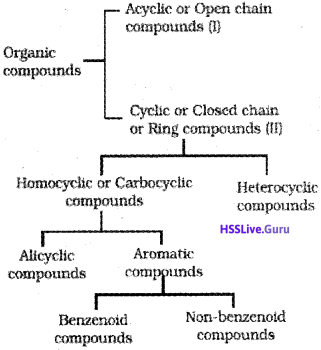
Plus One Chemistry Notes Chapter 12 Organic Chemistry Some Basic Principles and Techniques 3

I. Acyclic or open chain compounds
These compounds are also called as aliphatic compounds and consist of straight or branched chain compounds, for example:
Plus One Chemistry Notes Chapter 12 Organic Chemistry Some Basic Principles and Techniques 4

II. Alicyclic or closed chain or ring compounds
Alicyclic (aliphatic cyclic) compounds contain carbon atoms joined in the form of a ring (homocyclic). Sometimes atoms other than carbon are also present in the ring (heterocyclic). Some examples of this type of compounds are:
CycloiTexane Tetrahydrofuran These exhibit some of the properties similar to those of aliphatic compounds ane:
Plus One Chemistry Notes Chapter 12 Organic Chemistry Some Basic Principles and Techniques 5

Aromatic compounds
Aromatic compounds are special types of compounds. You will learn about these compounds in detail in Unit 13. These include benzene and other related ring compounds (benzenoid). Like alicyclic compounds, aromatic comounds may also have hetero atom in the ring. Such compounds are called heterocyclic aromatic compounds. Some of the examples of various types of aromatic compounds are:

Benzenoid aromatic compounds
Plus One Chemistry Notes Chapter 12 Organic Chemistry Some Basic Principles and Techniques 6
Non-benzenoid compound
Plus One Chemistry Notes Chapter 12 Organic Chemistry Some Basic Principles and Techniques 7
Heterocyclic aromatic compounds
Plus One Chemistry Notes Chapter 12 Organic Chemistry Some Basic Principles and Techniques 8

Organic compounds can also be classified on the basis of functional groups, into families or homolo-gous series.

Homologous series
Homologous series may be defined as a series of similarly constituted organic compound in which the members possess the same functional group and have similar chemical properties and the neighbouring (or consecutive) members differ by – CH2 unit in their molecular formula,
eg: Alkane family (Cn H2n+2), alkenes (CnH2n) alcohols (Cn H2n+1OH).

Nomenclature Of Organic Compounds
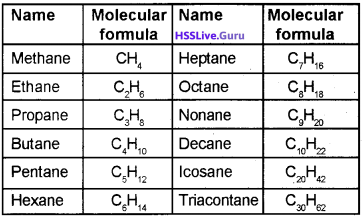
IUPAC names of unbrached saturated hydrocarbons
Plus One Chemistry Notes Chapter 12 Organic Chemistry Some Basic Principles and Techniques 9

Nomenclature of branched chain alkanes:
We encounter a number of branched chain alkanes. The rules for naming them are given below.
1. First of all, the longest carbon chain in the molecule is identified.For example,
Plus One Chemistry Notes Chapter 12 Organic Chemistry Some Basic Principles and Techniques 10
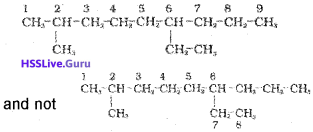
2. The numbering is done in such a way that the branched carbon atoms get the lowest possible numbers.
Plus One Chemistry Notes Chapter 12 Organic Chemistry Some Basic Principles and Techniques 11
and the numbering is not from right to left.

3. The names of alkyl groups attached as a branch are then prefixed to the name of the parent alkane and position of the substituents is indicated by the appropriate numbers. If different alkyl groups are present, they are listed in alphabetical order. Thus, name for the compound shown above is: 6- Ethyl-2- methylnonane.
[Note: the numbers are separated from the groups by hyphens and there is no break between methyl and nonane.]

4. If two or more identical substituent groups are present then the numbers are separated by commas. The names of identical substituents are not repeated, instead prefixes such as di (for 2), tri (for 3), tetra (for 4), Penta (for 5), Hexa (for 6) etc. are used. While writing the name of the substituents in alphabetical order, these prefixes, however, are not considered. Thus, the following compounds are named as:
Plus One Chemistry Notes Chapter 12 Organic Chemistry Some Basic Principles and Techniques 12

5. If the two substituents are found in equivalent positions, the lower number is given to the one coming first in the alphabetical listing. Thus, the following compound is 3-Ethyl-6-methyl octane and ‘ not6-Ethyl-3-methyl octane.
Plus One Chemistry Notes Chapter 12 Organic Chemistry Some Basic Principles and Techniques 13

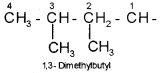
6. The branched alkyl groups can be named by following the above mentioned procedures. However, the carbon atom of the branch that attaches to the root alkane is numbered 1 as exemplified below.
Plus One Chemistry Notes Chapter 12 Organic Chemistry Some Basic Principles and Techniques 14

Cyclic Compounds
A saturated monocyclic compound is named by prefixing ‘cyclo’ to the corresponding straight chain alkane. If side chains are present, then the rules given above are applied. Names of some cyclic compounds are given below.
Plus One Chemistry Notes Chapter 12 Organic Chemistry Some Basic Principles and Techniques 15

Nomenclature Of Organic Compounds Having Functional Group (S)
When a functional group (other than C=C and -C ≡ C) is present in the molecule, it is indicated by adding secondary suffix after the primary suffix. The terminal ‘e’ of the primary suffix is removed before adding secondary suffix (whose name begins with a, i, o, u or y). It is to be noted that some functional group such as alkoxy (-OR), nirto (-NO2), halogeno etc. are indicated by the prefixes.

Plus One Chemistry Notes Chapter 12 Organic Chemistry: Some Basic Principles and Techniques

For example, CH3-CH2-OH Ethane -e+ol = Ethanol (using secondary suffix) CH3-CH2-CHO Propane -e+al = Propanal (using secondary suffix) CH3-CH2-NO2 Nitroethane (using prefix)

The systematic name of an organic compound containing functional group can be derived using the following sequence of steps.

The longest carbon chain (parent chain) containing the functional groups is identified. This gives the word root. The name of the compound is then obtained as follows:
Prefixes – word root – primary suffix – secondary suffix The following examples will illustrate the rules
Plus One Chemistry Notes Chapter 12 Organic Chemistry Some Basic Principles and Techniques 16

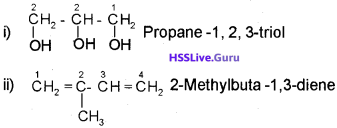
In case of compounds containing more than one similar functional group, the world di, tri etc is added before the secondary suffix which indicates the functional group. In doing so, the last letter ‘e’ of the parent alkane has to be retained. However, the endingne of the parent alkane is dropped in case of compounds having more than one double or triple bond. For example,
Plus One Chemistry Notes Chapter 12 Organic Chemistry Some Basic Principles and Techniques 17

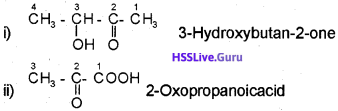
If the molecule contains two or more different functional groups, the parent chain must contain maximum possible number of functional groups. The carbon atoms in the parent chain are numbered in such a way that the functional group of higher priority gets the lower number. The priority of various functional groups follows the order.

COOH>-CO-O-CO->-COOR>-COCI>-CONH2>-CN>- HC=O>CO>-OH>-NH2>>C=C<-C≡C->-X>-NO2>R-
The functional group with higher priority is indicated by suitable secondary suffix and the other functional groups are treated as substituents which are specified by suitable prefixes.
For example,
Plus One Chemistry Notes Chapter 12 Organic Chemistry Some Basic Principles and Techniques 18

Nomenclature of Substituted Benzene Compounds
For IUPAC nomenclature of substituted benzene compounds, the substituent is placed as prefix to the word benzene as shown in the following examples.
Plus One Chemistry Notes Chapter 12 Organic Chemistry Some Basic Principles and Techniques 19

If benzene ring is disubstituted, the position of substituents is defined by numbering the carbon atoms of the ring such that the substituents are located at the lowest numbers possible. For example, the compound(b) is named as 1, 3-Dibromobenzene and not as 1,5 dibromobenzene. Substituent of the base compound is assigned number 1 and then the direction of numbering is chosen such that the next substituent gets the lowest number. The substituents appear in the name in alphabetical order. Some examples are given below.
Plus One Chemistry Notes Chapter 12 Organic Chemistry Some Basic Principles and Techniques 20

In the trivial system of nomenclature the terms ortho (o), meta (m) and para (p) are used as prefixes to indicate the relative positions 1,2-;1,3- and Ir-respectively. Thus, 1,3-dibromobenzene (b) is named as m-dibromobenzene (meta is abbreviated as m-) and the other isomers of dibromobenzenel, 2-(a) and 1,4-(c), are named as ortho (or just o-) and para (or just p-)-dibromobenzene, respectively. The substituents appear in the name in alphabetical order.

Plus One Chemistry Notes Chapter 12 Organic Chemistry: Some Basic Principles and Techniques

Isomerism
The phenomenon of existence of two or more compounds possessing the same molecular formula but different properties is known as isomerism. Such compounds are called as isomers.

Structural Isomerism
Compounds having the same molecular formula but different structures (manners in which atoms are linked) are classified as structural isomers. Some typical examples of different types of structural isomerism are given below:

(i) Chain isomerism:
When two or more compounds have similar molecular formula but different carbon skeletons, these are referred to as chain isomers and the phenomenon is termed as chain isomerism.
Plus One Chemistry Notes Chapter 12 Organic Chemistry Some Basic Principles and Techniques 21

ii) Position isomerism:
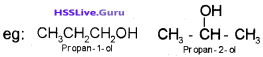
When two or more compounds differ in the position of substituent atom or functional group on the carbon skeleton, they are called position isomers and this phenomenon is termed as position isomerism.
Plus One Chemistry Notes Chapter 12 Organic Chemistry Some Basic Principles and Techniques 22

iii) Functional group isomerism :
Two or more compounds having the same molecularformula but different functional groups are called functional isomers and this phenomenon is termed as functional group isomerism.

iv) Metamerism :
It arises due to different alkyl chains on either side of the functional group in the molecule. For example, CaH10O represents Methoxypropane (CH3OC3H7) and Ethoxyethane (C2H5OC2H5).

Fundamental Concepts In Organic Reaction Mechanism
An organic reaction takes place by the attack of a reagent on an organic compound which is designated as a substrate. The steps of an organic reaction showing the breaking and formation of bonds in such substrate leading to the formation of the final product are referred to as its mechanism.

Plus One Chemistry Notes Chapter 12 Organic Chemistry: Some Basic Principles and Techniques

Fission Of A Covalent Bond
A covalent bond can be broken in two different ways,

(i) Homolytic fission :
If a covalent bond breaks in such a way that each atom takes away one electron of the shared pair. It is called homolytic fission or homolysis. The fragments with odd or unpaired electrons formed by homolysis are known as free radicals. For example,
Plus One Chemistry Notes Chapter 12 Organic Chemistry Some Basic Principles and Techniques 23

Usually homolysis occurs at high temperature or in presence of high energy radiations. Reactions occurring through homolytic fission are known as free radical reactions (non-polar reactions).

(ii) Heterolytic fission :
When a covalent bond breaks in such a way that both the electrons of the covalent bond are taken away by one of the bonded atoms, the mode of cleavage is called heterolytic cleavage or heterolysis. The products of heterolysis of a covalent bond are positive and negative ions, eg:
Plus One Chemistry Notes Chapter 12 Organic Chemistry Some Basic Principles and Techniques 24

Inductive Effect (I Effect)
It is the permanent polarisation of a sigma bond in a molecule by the influence of an adjacent polar bond or group.

For illustration, let us consider a carbon chain in which one terminal carbon atom is joined to a chlorine atom. Since the chlorine atom is more electronegative than carbon, the sigma electrons of the C-Cl bond are displaced towards the chlorine atom. As a result, the chlorine atom acquires a small negative charge and C acquires a small positive charge as shown below. The magnitude of+charge is of the order C1 > C2 >C3.
Plus One Chemistry Notes Chapter 12 Organic Chemistry Some Basic Principles and Techniques 25

This type of electron displacement of sigma electrons along a saturated carbon chain due to the presence of an electron-withdrawing group (or electron-donating group) is called Inductive effect:

Plus One Chemistry Notes Chapter 12 Organic Chemistry: Some Basic Principles and Techniques

This effect decreases sharply with increasing dis-tance from the substituent and becomes negligible afterthe third carbon in a chain. Atoms orgroups of atoms that attract or withdraw electrons from a chain are said to have electron withdrawing inductive effect or-l effect, eg:,
-NO2 >- CN >- COOH >- F >- Cl >- Br >-l

Atoms or groups which push or donate electrons to a carbon chain are said to have electron releasing inductive effect or + l effect. Alkyl groups have +l effect and the order of + l effect of alkyl groups is
Plus One Chemistry Notes Chapter 12 Organic Chemistry Some Basic Principles and Techniques 26

Resonance Structure
There are many organic molecules whose behaviour cannot be explained by a single Lewis structure. An example is that of benzene. Its cyclic structure containing alternating C-C single and C=C double bonds shown is inadequate for explaining its characteristic properties.
Plus One Chemistry Notes Chapter 12 Organic Chemistry Some Basic Principles and Techniques 27

As per the above representation, benzene should exhibit two different bond lengths, due to C-C single and C=C double bonds. Thus, the structure of benzene cannot be represented adequately by the above structure. Further, benzene can be represented equally well by the energetically identical structures I and ll. The actual structure of benzene cannot be adequately represented by any of these structures, rather it is a hybrid of the two structures (I and II) called resonance structures.

Plus One Chemistry Notes Chapter 12 Organic Chemistry: Some Basic Principles and Techniques

The resonance structures are hypothetical and individually do not represent any real molecule. They contribute to the actual structure in proportion to their stability. The energy of actual structure of the molecule (the resonance hybrid) is lower than that of any of the canonical structures. The difference in energy is called the resonance stabilisation energy or simply the resonance energy. The more the number of important contributing structures, the more is the resonance energy. Resonance is particularly important when the contributing structures are equivalent in energy.

Resonance Effect
The resonance effect is defined as ‘the polarity produced in the molecule by the interaction of two π- bonds or between a π-bond and lone pair of electrons present on an adjacent atom’.The effect is transmitted through the chain. There are two types of resonance or mesomeric effect designated as R or M effect.
(i) Positive Resonance Effect (+R effect)
In this effect, the transfer of electrons is away from an atom or substituent group attached to the conjugated system. This electron displacement makes certain positions in the molecule of high electron densities.

(ii) Negative Resonance Effect (- R effect)
This effect is observed when the transfer of electrons is towards the atom or substituent group attached to the conjugated system.The atoms or substituent groups, which represent +R or-R electron displacement effects are as follows:
+R effect: – halogen, -OH, -OR, -OCOR, -NH2, – NHR,-NR2,-NHCOR,
– R effect: – COOH, -CHO, >C=O, – CN, -NO2

Electromeric Effect (E – Effect)
This is temporary effect which involves the complete transfer of n electrons of a multiple bond to one of the bonded atoms in presence of an attacking reagent. However, when the attacking reagent is removed, the polarised molecule shifts back to its original electronic condition.

With transfer of π electrons takes place towards the attacking reagent the effect is called +E effect and when the transfer of π electrons occurs-S away from the attacking reagent the effect is called -E effect.

Hyperconjugation
Hyperconjugation is a general stabilising interaction. It involves delocalisation of σ electrons of C—H bond of an alkyl group directly attached to an atom of unsaturated system or to an atom with an unshared p orbital. The σ electrons of C—H bond of the alkyl group enter into partial conjugation with the attached unsaturated system or with the unshared p orbital. Hyperconjugation is a permanent effect.

Methods Of Purification Of Organic Compounds
Sublimation:
On heating, some solid substances change from solid to vapour state without passing through liquid state. The purification technique based on the above principle is known as sublimation and is used to separate sublimable compounds from nonsublimable impurities.

Plus One Chemistry Notes Chapter 12 Organic Chemistry: Some Basic Principles and Techniques

Crystallisation:
It is based on the difference in the solubilities of the compound and the impurities in a suitable solvent. The impure compound is dissolved . in a solvent in which it is sparingly soluble at room temperature but appreciably soluble at higher temperature. The solution is concentrated to get a nearly saturated solution. On cooling the solution, pure compound crystallises out and is removed by filtration. The filtrate (mother liquor) contains impurities and small quantity of the compound.

Distillation:
This important method is used to separate (i) volatile liquids from non-volatile impurities and (ii) the liquids having sufficient difference in their boiling points. Liquids having different boiling points vaporise at different temperatures. The vapours are cooled and the liquids so formed are collected separately. Chloroform (b.p 334 K) and aniline (b.p. 457 K) are easily separated by the technique of distillation. On boiling, the vapours of lower boiling component are formed first. The vapours are condensed by using a condenser and the liquid is collected in a receiver. The vapours of higher boiling component form later and the liquid can be collected separately.

Fractional Distillation:
If the difference in boiling points of two liquids is not much, simple distillation cannot be used to separate them. The vapours of such liquids are formed within the same temperature range and are condensed simultaneously. The technique of fractional distillation is used in such cases. In this technique, vapours of a liquid mixture are passed through a fractionating column before condensation. The fractionating column is fitted over the mouth of the round bottom flask. Vapours of the liquid with higher boiling point condense before the vapours of the liquid with lower boiling point. The vapours rising up in the fractionating column become richer in more volatile component. By the time the vapours reach to the top of the fractionating column, these are rich in the more volatile component. The vapours become richer in low boiling component. On reaching the top, the vapours become pure in low boiling component and pass through the condenser and the pure liquid is collected in a receiver.

After a series of successive distillations, the remaining liquid in the distillation flask gets enriched in high boiling component. Each successive condensation and vaporisation unit in the fractionating column is called a theoretical plate. One of the technological applications of fractional distillation is to separate different fractions of crude oil in petroleum industry. Distillation under reduced pressure: This method is used to purify liquids having very high boiling points and those, which decompose at or below their boiling points. Such liquids are made to boil at a temperature lower than their normal boiling points by reducing the pressure on their surface. A liquid boils at a temperature at which its vapour pressure is equal to the external pressure. The pressure is reduced with the help of a water pump or vacuum pump. Glycerol can be separated from spent-lye in soap industry by using this technique.

Plus One Chemistry Notes Chapter 12 Organic Chemistry: Some Basic Principles and Techniques

Steam Distillation:
This technique is applied to separate substances which are steam volatile and are immiscible with water. In steam distillation, steam from a steam generator is passed through a heated flask containing the liquid to be distilled. The mixture of steam and the volatile organic compound is condensed and collected. The compound is later separated from water using a separating funnelAniline is separated by this technique from aniline-water mixture.

Differential Extraction:
When an organic compound is present in an aqueous medium, it is separated by shaking it with an organic solvent in which it is more soluble than in water. The organic solvent and the aqueous solution should be immiscible with each other so that they form two distinct layers which can be separated by separatory funnel. The organic solvent is later removed by distillation or by evaporation to get back the compound.

Chromatography:
The name chromatography is based on the Greek word chroma, for colour since the method was first used for the separation of coloured substances found in plants. In this technique, the mixture of substances is applied onto a stationary phase, which may be a solid ora liquid.

A pure solvent, a mixture of solvents, or a gas is allowed to move slowly over the stationary phase. The components of the mixture get gradually separated from one another. The moving phase is called the mobile phase. Based on the principle involved, chromatography is classified into different categories. Two of these are:

  1. Adsorption chromatography, and
  2. Partition chromatography.

1. Adsorption Chromatography:
Adsorption chromatography is based on the fact that different compounds are adsorbed on an adsorbent to different degrees. Commonly used adsorbents are silica gel and alumina. When a mobile phase is allowed to move over a stationary phase (adsorbent), the components of the mixture move by varying distances over the stationary phase. Following are two main types of chromatographic techniques based on the principle of differential dsorption.

  1. Column chromatography, and
  2. Thin layer chromatography.

Column Chromatography
Column chromatography involves separation of a mixture overa column of adsorbent (stationary phase) packed in a glass tube. The column is fitted with a stopcock at its lower soluble in the organic solvent. The mixture adsorbed on adsorbent is placed on the top of the adsorbent column packed in a glass tube. An appropriate eluant which is a liquid or a mixture of liquids is allowed to flow down the column slowly. Depending upon the degree to which the compounds are adsorbed, complete separation takes place. The most readily adsorbed substances are retained near the top and others come down to various distances in the column.
Plus One Chemistry Notes Chapter 12 Organic Chemistry Some Basic Principles and Techniques 28

Thin layer chromatography (TLC) is another type of adsorption chromatography, which involves separation of substances of a mixture over a thin layer of an adsorbent coated on glass plate. A thin layer of an adsorbent (silica gel or alumina) is spread overa glass plate of suitable size. The plate is known as thin layer chromatography plate or chrome plate. The solution of the mixture to be separated is applied as a small spot about 2 cm above one end of the TLC plate. The glass plate is then placed in a closed jar containing the eluant. As the eluant rises up the plate, the components of the mixture move up along with the eluant to different distances depending on their degree of adsorption and separation takes place. The relative adsorption of each component of the mixture is expressed in terms of its retardation factor i.e. Rf value
Rf = x/y

Plus One Chemistry Notes Chapter 12 Organic Chemistry: Some Basic Principles and Techniques

Where distance moved by the substance from base line is x and distance moved by the solvent from base line is y. The spots of coloured compounds are visible on TLC plate due to their original colour. Another detection technique is to place the plate in a covered jar containing a few crystals of iodine. Spots of compounds, which adsorb iodine, will show up as brown spots. Sometimes an appropriate reagent may also be sprayed on the plate. For example, amino acids may be detected by spraying the plate with ninhydrin solution.

Partition Chromatography:
Partition chromatography is based on continuous differential partitioning of components of a mixture between stationary and mobile phases. Paper chromatography is a type of partition chromatography. In paper chromatography, a special quality paper known as chromatography paper is used. Chromatography paper contains water trapped in it, which acts as the stationary phase. A strip of chromatography paper spotted at the base with the solution of the mixture is suspended in a suitable solvent ora mixture of solvents. This solvent acts as the mobile phase. The solvent rises up the paper by capillary action and flows over the spot. The paper selectively retains different components according to their differing partition in the two phases. The paper strip so developed is known as a chromatogram. The spots of the separated coloured compounds are visible at different heights from the position of initial spot on the chromatogram. The spots of the separated colourless compounds may be observed either under ultraviolet light or by the use of an appropriate spray reagent as discussed under thin layer chromatography.

Qualitative Analysis Of Organic Compounds
Thin layer chromatography (TLC) is another type of adsorption chromatography, which involves separation of substances of a mixture over a thin layer of an adsorbent coated on glass plate. A thin
The elements present in organic compounds are carbon and hydrogen. In addition.to these, they may also contain oxygen, nitrogen, sulphur, halogens and phosphorus.

Detection of Carbon and Hydrogen
Carbon and hydrogen are detected by heating the compound with copper(ll) oxide. Carbon present in the compound is oxidised to carbon dioxide (tested with lime-water, which develops turbidity) and hydrogen to water (tested with anhydrous copper sulphate, which turns blue).
Plus One Chemistry Notes Chapter 12 Organic Chemistry Some Basic Principles and Techniques 29

Detection of Other Elements
Nitrogen, sulphur, halogens and phosphorus present in an organic compound are detected by “Lassaigne’s test”. The elements present in the compound are converted from covalent form into the ionic form by fusing the compound with sodium metal. Following reactions take place:
Plus One Chemistry Notes Chapter 12 Organic Chemistry Some Basic Principles and Techniques 30

C, N, Sand X come from organic compound. Cyanide, sulphide and halide of sodium so formed on sodium fusion are extracted from the fused mass by boiling it with distilled water. This extract is known as sodium fusion extract.

1. Test for Nitrogen
The sodium fusion extract is boiled with iron(ll) sulphate and then acidified with concentrated sulphuric acid. The formation of Prussian blue colour confirms the presence of nitrogen. Sodium cyanide first reacts with iron(ll) sulphate and forms sodium hexacyanoferrate(ll). On heating, with concentrated sulphuric acid some iron(ll) ions are oxidised to iron(lll) ions which react with sodium hexacyanoferrate(ll) to produce iron(lll) hexacyanoferrate(ll) (ferric ferrocyanide) which is Prussian blue in colour.
Plus One Chemistry Notes Chapter 12 Organic Chemistry Some Basic Principles and Techniques 31

2. Test for Sulphur
1. The sodium fusion extract is acidified with acetic acid and lead acetate is added to it. A black precipitate of lead sulphide indicates the presence of sulphur.
Plus One Chemistry Notes Chapter 12 Organic Chemistry Some Basic Principles and Techniques 32

2. On treating sodium fusion extract with sodium nitroprusside, appearance of a violet colour further indicates the presence of sulphur.
Plus One Chemistry Notes Chapter 12 Organic Chemistry Some Basic Principles and Techniques 33

In case, nitrogen and sulphur both are present in an organic compound, sodium thiocyanate is formed. It gives blood-red colour and no Prussian blue since there are no free cyanide ions.
Plus One Chemistry Notes Chapter 12 Organic Chemistry Some Basic Principles and Techniques 34

If sodium fusion is carried out with excess of sodium, the thiocyanate decomposes to yield cyanide and sulphide. These ions give their usual tests.
NaSCN + 2Na → NaCN + Na2S

Plus One Chemistry Notes Chapter 12 Organic Chemistry: Some Basic Principles and Techniques

3. Test for Halogens
The sodium fusion extract is acidified with nitric acid and then treated with silver nitrate. A white precipitate, soluble in ammonium hydroxide shows the presence of chlorine, a yellowish precipitate, sparingly soluble in ammonium hydroxide shows the presence of bromine and a yellow precipitate, insoluble in ammonium hydroxide shows the presence of iodine.
X + Ag+ → AgX

X represents a halogen – Cl, Br or I. If nitrogen or sulphur is also present in the compound, the sodium fusion extract is first boiled with concentrated nitric acid to decompose cyanide or sulphide of sodium formed during Lassaigne’s test. These ions would otherwise interfere with silver nitrate test for halogens.

4. Test for Phosphorus
The compound is heated with an oxidising agent (sodium peroxide). The phosphorus present in the compound is oxidised to phosphate. The solution is boiled with nitric acid and then treated with ammonium molybdate. A yellow colouration or precipitate indicates the presence of phosphorus.
Plus One Chemistry Notes Chapter 12 Organic Chemistry Some Basic Principles and Techniques 35

Quantitative Analysis
The percentage composition of elements present in an organic compound is determined by the methods based on the following principles:

Carbon and Hydrogen
Both carbon and hydrogen are estimated in one experiment. A known mass of an organic compound is burnt in the presence of excess of oxygen and copper(ll) oxide. Carbon and hydrogen in the compound are oxidised to carbon dioxide and water respectively.
CxHy + (x + y /4)O2 → xCO2 +(y/2)H2O

The mass of water produced is determined by passing the mixture through a weighed U-tube containing anhydrous calcium chloride. Carbon dioxide is absorbed in another U-tube containing concentrated solution of potassium hydroxide. These tubes are connected in series. The increase in masses of calcium chloride and potassium hydroxide gives the amounts of water and carbon dioxide from which the percentages of carbon and hydrogen are calculated. Let the mass of organic compound be m g, mass of water and carbon dioxide produced be m1 and m2g respectively;
Plus One Chemistry Notes Chapter 12 Organic Chemistry Some Basic Principles and Techniques 36

Nitrogen
There are two methods for estimation of nitrogen: (i) Dumas method and (ii) Kjeldahl’s method.
(i) Dumas method:
The nitrogen containing organic compound, when heated with copper oxide in an atmosphere of carbon dioxide, yields free nitrogen in addition to carbon dioxide and water.
CxHyNz+(2x + y/2)CuO → x CO2 + y / 2H2O +Z / 2N2 + (2x + y / 2)CU

Traces of nitrogen oxides formed, if any, are reduced to nitrogen by passing the gaseous mixture over a heated copper gauze. The mixture of gases so produced is collected over an aqueous solution of potassium hydroxide which absorbs carbon dioxide. Nitrogen is collected in the upper part of the graduated tube. Let the mass of organic compound = m g Volume of nitrogen collected = V1 mL
Room temperature = T1K
Volume of nitrogen at STP = 7\(\frac{p_{1} v_{1} \times 273}{760 \times T_{1}}\) (LetitbeVmL)

Plus One Chemistry Notes Chapter 12 Organic Chemistry: Some Basic Principles and Techniques

Where p1 and V1 are the pressure and volume of nitrogen, p,is different from the atmospheric pressure at which nitrogen gas is collected. The value of pt is obtained by the relation;
p1 Atmospheric pressure-Aqueous tension 22400 mL N2 at STP weighs 28 g.
\frac{p_{1} v_{1} \times 273}{760 \times T_{1}}

(ii) Kjeldahl’s method:
The compound containing nitrogen is heated with concentrated sulphuric acid. Nitrogen in the compound gets converted to ammonium sulphate.The resulting acid mixture is then heated with excess of sodium hydroxide. The liberated ammonia gas is absorbed in an excess of standard solution of sulphuric acid. The amount of ammonia produced is determined by estimating the amount of sulphuric acid consumed in the reaction. It is done by estimating unreacted sulphuric acid left after the absorption of ammonia by titrating it with standard alkali solution. The difference between the initial amount of acid taken and that left after the reaction gives the amount of acid reacted with ammonia.
taken = V mL
Volume of NaOH of molarity, M. used for titration of excess of H2SO4 = V1 mL
V1L of NaOH of molarity M= V1 /2 mL of H2SO4 0f molarity M
Volume of H2SO4 of molarity M unused= (V-1/1/2) mL (V-1/1/2) mL of H2S04 of molarity M = 2(V-V1/2) mL of NH3 solution of molarity M.
1000 mL of 1 M NH3 solution contains 17g NH3 or 14 g of N
2(V-V1/2) mL of NH3 solution of molarity M contains:
Plus One Chemistry Notes Chapter 12 Organic Chemistry Some Basic Principles and Techniques 38
Kjeldahl method is not applicable to compounds containing nitrogen in nitro and azo groups and nitrogen present in the ring (e.g. pyridine) as nitrogen of these compounds does not change to ammonium sulphate under these conditions.

Halogens
Carius method: A known mass of an organic compound is heated with fuming nitric acid in the presence of silver nitrate contained in a hard glass tube known as Carius tube, in a furnace. Carbon and hydrogen present in the compound are oxidised to carbon dioxide and water. The halogen present forms the corresponding silver halide (AgX). It is filtered, washed, dried and weighed.
Let the mass of organic compound taken = m g
Mass of AgX formed = m, g
1 mol of AgX contains 1 mol of X
Mass of halogen in m1g of AgX
Plus One Chemistry Notes Chapter 12 Organic Chemistry Some Basic Principles and Techniques 38

Sulphur
A known mass of an organic compound is heated in a Carius tube with sodium peroxide or fuming nitric acid. Sulphur present in the compound is oxidised to sulphuric acid. It is precipitated as barium sulphate by adding excess of barium chloride solution in water. The precipitate is filtered, washed, dried and weighed. The percentage of sulphur can be calculated from the mass of barium sulphate. Let the mass of organic compound taken = m g and the mass of barium sulphate formed = m1 g
1 mol of BaSO4 = 233 g BaSO4 = 32 g sulphur
Plus One Chemistry Notes Chapter 12 Organic Chemistry Some Basic Principles and Techniques 40

Phosphorus
A known mass of an organic compound is heated with fuming nitric acid whereupon phosphorus present in the compound is oxidised to phosphoric acid. It is precipitated as ammonium phosphomolybdate, (NH4)3PO4.12MoO3, by adding ammonia and ammonium molybdate. Alternatively, phosphoric acid may be precipitated as MgNH4PO4 by adding magnesia mixture which on ignition yields Mg2P2O7. Let the mass of organic compound taken = m g and mass of ammonium phospho molydate = m1g.
Molar mass of (NH4)3PO4.12MoO3 = 1877 g.
Plus One Chemistry Notes Chapter 12 Organic Chemistry Some Basic Principles and Techniques 41

where, 222 u is the molar mass of Mg2P2O7, m, the mass of organic compound taken, mv the mass of Mg2P2O7 formed and 62, the mass of two phosphorus atoms present in the compound Mg2P2O7.

Plus One Chemistry Notes Chapter 12 Organic Chemistry: Some Basic Principles and Techniques

Oxygen
The percentage of oxygen in an organic compound is usually found by difference between the total percentage composition (100) and the sum of the percentages of all other elements. However, oxygen can also be estimated directly as follows:

A definite mass of an organic compound is decomposed by heating in a stream of nitrogen gas. The mixture of gaseous products containing oxygen is passed over red-hot coke when all the oxygen is converted to carbon monoxide. This mixture is passed through warm iodine pentoxide (IJOJ) when carbon monoxide is oxidised to carbon dioxide producing iodine.
Plus One Chemistry Notes Chapter 12 Organic Chemistry Some Basic Principles and Techniques 42

The percentage of oxygen can be derived from the amount of carbon dioxide or iodine produced.
Let the mass of organic = mg compund taken
Mass of carbon dioxide = m1g
44g carbon dioxide = 32 g oxygen
Plus One Chemistry Notes Chapter 12 Organic Chemistry Some Basic Principles and Techniques 43

Presently, the estimation of elements in an organic compound is carried out by using microquantities of substances and automatic experimental techniques. The elements, carbon, hydrogen and nitrogen present in a compound are determined by an apparatus known as CHN elemental analyser. The analyser requires only a very small amount of the substance (1 -3 mg) and displays the values on a screen within a short time.

Plus One Chemistry Notes Chapter 6 Thermodynamics

Students can Download Chapter 6 Thermodynamics Notes, Plus One Chemistry Notes helps you to revise the complete Kerala State Syllabus and score more marks in your examinations.

Kerala Plus One Chemistry Notes Chapter 6 Thermodynamics

Introduction
The study of energy transformations forms the subject matter or thermodynamics.

Thermodynamic Terms
The system and the surroundings
A system in thermodynamics refers to that part of universe in which observations are made and remain-ing universe constitutes the surroundings. The surroundings include everything other than the system. System and the surroundings together constitute the universe.

Types Of The System
1. Open System:
In an open system, there is exchange of energy and matter between system and surroundings

2. Closed System:
In a closed system, there is no exchange of matter, but exchange of energy is possible between system and the surroundings

3. Isolated System:
In an isolated system, there is no exchange of energy or matter between the system and the surroundings. The presence of reactants in a thermos flask or any other closed insulated vessel is an example of an isolated system.

The State Of The System
The state of a system means the condition of the system when is macroscopic properties have definite values. If any of the macroscopic properties of the system changes, the state of the system will change. A process is said to occur when the state of the system changes.
The measurable properties required to describe the state of a system are called state variables or state functions. Temperature, pressure, volume, composition etc. are state variables.

The Internal Energy as a State Function
1. Work:
The system which can’t exchange heat between the system and surroundings through its boundary is called adiabatic system. The manner in which the state of such a system may be changed will be called adiabatic process. Adiabatic process is a process in which there is no transfer of heat between the system and surroundings.
Internal energy, U, of the system is a state function. The positive sign expresses that wad is positive when work is done on the system. Similarly, if the work is done by the system, wad will be negative.

2. Heat:
A system change its internal energy by ex-change of heat. The q is positive, when heat is transferred from the surroundings to the system and q is negative when heat is transferred from system to the surroundings. first law of thermodynamics, which states that The energy of an isolated system is constant.
i. e., ∆U = q + w
It is commonly stated as the law of conservation of energy i.e., energy can neither be created nor be destroyed.

Applications
Work
The work done due to expansion or compression of a gas against an opposing external pressure is called the pressure – volume type of work. It is a kind of mechanical work.

If Y is the initial volume and Vf is the final volume of a certain amount of gas and Pex is the external pressure, then the work involved in the process is given by
w = – Pex (Vf – Vi) or w = -Pex ∆V

The negative sign of this expression is required to obtain conventional sign for w.

Plus One Chemistry Notes Chapter 6 Thermodynamics

It must be noted that the above expression gives the work done by the gas in irreversible expansion or compression

Work done in isothermal reversible expansion (or compression) of a gas is given by the relation
wrev =-2.303 nRT log \(\frac{V_{f}}{V_{i}}\)
Where n = the number of moles of the gas

Free expansion
Expansion of a gas in vaccum is called free expansion. Since P = 0 in vacuum, work done in free expansion = 0
Isothermal and free expansion of an ideal gas.
1. For isothermal irreversible change q= -w = pex (Vf – Vi)
2. For isothermal reversible change
q = -w = nRT In \(\frac{V_{f}}{V_{i}}\)
= 2.303 nRT log \(\frac{V_{f}}{V_{i}}\)
3. For adiabatic change q = 0, ∆U = wad

Enthalpy, H
1. A useful new state function:
We know that the heat absorbed at constant volume is equal to change in the internal dnergy i.e., ∆U= qp

We may write equation as ∆U=qp – p∆V at constant pressure, where qp is heat absorbed by the system and -pAV represent expansion work done by the system.

We can rewrite the above equation as U2 -U1 = qp – p(V2 – V1)

On rearranging, we get qp = (U2 +pV2) = (U1 +pV1) Now we can define another thermodynamic function, the enthalpy H [Greek word enthalpien, to warm or heat content] as :
H=U+PV

so, equation becomes qp = H2 – H1 = ∆H

Although q is a path dependent function, H is a state function because it depends on U, p and V, all of which are state functions.

Therefore, ∆H is independent of path. Hence,qp is also independent of path.

Plus One Chemistry Notes Chapter 6 Thermodynamics

For finite changes at constant pressure, we can write ∆H = ∆U + ∆pV

It is important to note that when heat is absorbed by the system at constant pressure, we are actually measuring changes in the enthalpy. Remember ∆H = qp heat absorbed by the system at constant pressure.

∆H is negative for exothermic reactions which evolve heat during the reaction and ∆H is positive for endothermic reactions which absorb heat from the surroundings.

2. Extensive and Intensive Properties:
An extensive property is a property whose value depends on the quantity or size of matter present, in the system. For example, mass, volume, internal energy, enthalpy, heat capacity, etc. Those properties which do not depend on the quantity or size of matter present are known as intensive properties. For example temperature, density, pressure, etc.

3. Heat Capacity:
The heat required to rise the temperature of the system in case of heat absorbed by the system.

The increase of temperature is proportional to the heat transferred q = coeff × ∆T

The magnitude of the coefficient depends on the size, composition, and nature of the system. We can also write it as q = C ∆T

The coefficient, C is called the heat capacity. Water has a large heat capacity i.e., a lot of energy is needed to raise its temperature. C is directly proportional to amount of substance. The molar heat capacity of a substance, Cm = \(\frac{C}{n}\), is the heat capacity for one mole of the substance and is the quantity of heat needed to raise the temperature of one mole by one degree Celsius (or one kelvin).

Specific heat, also called specific heat capacity is the quantity of heat required to raise the temperature of one unit mass of a substance by one degree Celsius (or one kelvin). q = c × m × ∆T

4. The relationship between Cp and Cv for an ideal gas:
At constant volume, the heat capacity, C is denoted by Cv and at constant pressure, this is denoted by Cp. Let us find the relationship between the two. We can write equation for heat, q at constant volume as qv=Cv ∆T = ∆U at constant pressure as qp = Cp∆T = ∆H

The difference between Cp and Cv can be derived for an ideal gas as:
For a mole of an ideal gas, ∆H = ∆U + ∆(pV)
= ∆U + ∆(RT)
= ∆U + R∆T
On putting the values ∆H of ∆H and we have
Cp∆T = Cv∆T
Cp = Cv +R
Cp – Cv = R

Measurement Of ∆U And ∆H: Calorimetry
We can measure energy changes associated with chemical or physical processes by an experimental technique called calorimetry.

1. ∆U measurements:
Here, a steel vessel (the bomb) is immersed in a water bath. The whole device is called calorimeter. The steel vessel is immersed in water bath to ensure that no heat is lost to the surroundings. A combustible substance is burnt in pure dioxygen supplied in the steel bomb. Heat evolved during the reaction is transferred to the water around the bomb and its temperature is monitored. Since the bomb calorimeter is sealed, its volume does not change i.e., the energy changes associated with reactions are measured at constant volume. Under these conditions, no work is done as the reaction is carried out at constant volume in the bomb calorimeter. Even for reactions involving gases, there is no work done as ∆V = 0.
Plus One Chemistry Notes Chapter 6 Thermodynamics 1

2. ∆H measurements:
Measurement of heat change at constant pressure (generally under atmospheric pressure) can be done in a calorimeter at constant p

In an exothermic reaction, heat is evolved, and system loses heat to the surroundings.

Plus One Chemistry Notes Chapter 6 Thermodynamics

Therefore, qp will be negative and ∆rH will also be negative. Similarly in an endothermic reaction, heat is absorbed, qp is positive and ∆rH will be positive.

Enthalpy Change, ∆rH Of A Reaction – Reaction Enthalpy
The enthalpy change accompanying a reaction is called the reaction enthalpy.
The reaction enthalpy change is denoted by ∆rH
rH = (sum of enthalpies of products) – (sum of enthalpies of reactants)

1. Standard enthalpy of reactions:
The standard enthalpy of reaction is the enthalpy change for a reaction when all the participating substances are in their standard states.
The standard state of a substance at a specified temperature is its pure form at 1 bar.

2. Enthalpy changes during phase transformations:
The enthalpy change that accompanies melting of one mole of a solid substance in standard state is called standard enthalpy of fusion or molar enthalpy of fusion ∆fusH°.

Amount of heat required to vaporize one mole of a liquid at constant temperature and under standard pressure (1bar) is called its standard enthalpy of vaporization or molar enthalpy of vaporization ∆vapH°. And that of sublimation is called Standard enthalpy of sublimation, ∆subH°.

3. Standard enthalpy of formation
The standard enthalpy change for the formation of one mole of a compound from its elements in their most stable states of aggregation (also known as reference states) is called Standard Molar Enthalpy of Formation( ∆fH°).

Hess’s Law of Constant Heat Summation Hess’s Law:
If a reaction takes place in several steps then its standard reaction enthalpy is the sum of the standard enthalpies of the intermediate reactions into which the overall reaction may be divided at the same temperature.

Enthalpies For Different Types Of Reactions
1. Standard enthalpy of combustion
Enthalpy of combustion of a substance is defined as the enthalpy change accompanying the complete combustion of one mole of the substance in excess of air or oxygen.

Standard enthalpy of combustion is defined as the enthalpy change accompanying the complete combustion of one mole of the substance in excess of air or oxygen when all the reactants and products are tin their standard states at the specified temperature. It is denoted as ∆cH°.
For example, the complete combustion of one mole of methane evolves 890.3 kJ of heat. Thus, the enthalpy of combustion of methane is- 890.3 kJ mol-1.

Combustion reactions are always accompanied by the evolution of heat. Hence enthalpy of combustion is always negative.

2. Enthalpy of atomization (symbol: ∆aH°)
It is the enthalpy change on breaking one mole of bonds completely to obtain atoms in the gas phase.

3. Bond Enthalpy (symbol: ∆bondH°)
The bond dissociation enthalpy is the change in enthalpy when one mole of covalent bonds of a gaseous covalent compound is broken to form products in the gas phase.

Lattice Enthalpy
The lattice enthalpy of an ionic compound is the enthalpy change which occurs when one mole of an ionic compound dissociates into its ions in gaseous state.

Spontaneity
A process which has an urge or a natural tendency to occur under a given set of conditions is known as a spontaneous process.
Some of the spontaneous process need no initiation, i.e., they take place by themselves. Dissolution of common salt in water, evaporation of water in an open vessel, combination of NO and oxygen to form NO2, neutralisation reaction between NaOH and HCl, etc. are examples of such processes. But some other spontaneous processes need initiation. For example, hydrogen reacts with oxygen to form water only when initiated by passing an electric spark. Once initiated, it occurs by itself.

1. Is decrease in enthalpy a criterion for spontaneity?
By analogy, we may be tempted to state that a chemical reaction is spontaneous in a given direction, because decrease in energy has taken place, as in the case of exothermic reactions.lt becomes obvious that while decrease in enthalpy may be a contributory factor for spontaneity, but it is not true for all cases.

2. Entropy and spontaneity
Entropy(S) is the measure of the degree of randomness or disorder in the system. The greater the disorder in an isolated system, the higher is the entropy. The crystalline solid state is the state of lowest entropy (most ordered), The gaseous state is state of highest entropy. ∆S is independent of path.

Plus One Chemistry Notes Chapter 6 Thermodynamics

∆S is related with q and T for a reversible reaction as: ∆S = \(\frac{q_{\text {rev }}}{T}\)

When a system is in equilibrium, the entropy is maximum, and the change in entropy, ∆S = 0.

3. Gibbs energy and spontaneity
we define a new thermodynamic function the Gibbs energy or Gibbs function, G, as G = H – TS

Gibbs energy change is a better parameter to determine the spontaneity or feasibility of a process. It can be summarised as follows.
i) If ∆G is negative (i.e., <0) the precess will be spontaneous. ii) If ∆G is zero, the precess is in equilibrium state. iii) If ∆G is positive (i.e., >0), the process is non- spontaneous in the forward direction. The reverse process may be spontaneous.

Ncert Supplementary Syllabus

Enthalpy of Dilution
It is known that enthalpy of solution is the enthalpy change associated with the addition of a specified amount of solute to the specified amount of solvent at a constant temperature and pressure. This argument can be applied to any solvent with slight modification. Enthalpy change for dissolving one mole of gaseous hydrogen chloride in 10 mol of water can be represented by the following equation.
HCl(g) + 10 aq. → HCl. 10 aq. ∆H = -69.01 kJ/mol

Let us consider the following set of enthalpy changes:
(S- 5) HCl(g) + 25 aq. → HCl.25 aq. ∆H = -72.03 kJ/mol
(S-2) HCtlgi + 40 aq. → HCl.40 aq. ∆H = -72.79 kJ/mol
(S-3) HCl(g) + ∞ aq. → HCl. ∞aq. ∆H = -74.85 kJ/mol

The values of ∆H show general dependence of the enthalpy of solution on amount of solvent. As more and more solvent is used, the enthalpy of solution approaches a limiting value, i.e, the value in infinitely dilute solution. For hydrochloric acid this value of AH is given above in equation (S-3).
If we subtract the first equation (equation S-1) from the second equation (equation S-2) in the above set of equations, we obtain

Plus One Chemistry Notes Chapter 6 Thermodynamics

This value (-0.76kJ/mol) of ∆H is enthalpy of dilution. It is the heat withdrawn from the
HCl.25 aq. + 15 aq. → HCl.40 aq.
∆H = [ -72.79 – (-72.03)] kJ/mol
= -0.76 kJ/mol

This value (-0.76kJ/mol) of ∆H is enthalpy of dilution. It is the heat withdrawn from the surroundings when additional solvent is added to the solution. The enthalpy of dilution of a solution is dependent on the original concentration of the solution and the amount of solvent added.

Entropy and Second Law of Thermodynamics
We know that for an isolated system the change in energy remains constant. Therefore, increase in entropy in such systems is the natural direction of a spontaneous change. This, in fact, is the second law of thermodynamics. Like first law of thermodynamics, second law can also be stated in several ways. The second law of thermodynamics explains why spontaneous exothermic reactions are so common. In exothermic reactions, heat released by the reaction increases the disorder of the surroundings and overall entropy change is positive which makes the reaction spontaneous.

Absolute Entropy and Third Law of Thermodynamics
Molecules of a substance may move in a straight line in any direction, they may spin like a top and the bonds in the molecules may stretch and compress. These motions of the molecule are called translational, rotational and vibrational motion respectively. When temperature of the system rises, these motions become more vigorous and entropy increases. On the other hand, when temperature is lowered, the entropy decreases. The entropy of any pure crystalline substance approaches zero as the temperature approaches absolute zero. This is called third law of thermodynamics. This is so because there is perfect order in a crystal at absolute zero.

Plus One Chemistry Notes Chapter 6 Thermodynamics

The statement is confined to pure crystalline solids because theoretical arguments and practical evidences have shown that entropy of solutions and super cooled liquids is not zero at 0 K. The importance of the third law lies in the fact that it permits the calculation of absolute values of entropy of pure substance from thermal data alone. For a pure substance, this can be done by summing \(\frac{q_{\text {rev }}}{T}\) increments from 0 K to 298 K. Standard entropies can be used to calculate standard entropy changes by a Hess’s law type of calculation.

Plus One Chemistry Notes Chapter 9 Hydrogen

Students can Download Chapter 9 Hydrogen Notes, Plus One Chemistry Notes helps you to revise the complete Kerala State Syllabus and score more marks in your examinations.

Kerala Plus One Chemistry Notes Chapter 9 Hydrogen

Introduction
Hydrogen has the simplest atomic structure all the elements around us in nature. It consists of only one proton and one electron.

Position Of Hydrogen In The Periodic Table
Hydrogen is the first element in the periodic table. Hydrogen has electronic configuration 1 s1. On one hand, its electronic configuration is similar to the outer electronic configuration (ns¹) of alkali metals. On the other hand, it is short by one electron to the corresponding noble gas configuration, helium (1s²). It has resemblace to both alkali metals and halogens.

Dihydrogen, H2

Isotopes Of Hydrogen
There are three isotopes of hydrogen with mass numbers 1,2 and 3. They are called protium, deuterium and tritium respectively. Their natural abundances . are in the ratio l:1.56 × 10⁻²: 1 × 10-17 respectively.

  1. Protium (ordinary hydrogen)(\(_{ 1 }^{ 1 }{ H }\)): It is the most abundant isotope of hydrogen. Its nucleus contains one proton and no neutron.
  2. Deuterium (heavy hydrogen, \(_{ 1 }^{ 2 }{ H }\) or D): Heavy hydrogen is prepared from heavy water (D2O) which is obtained by electrolysis of ordinary water.
  3. Tritium has 2 neutrons in the nucleus.

Preparation Of Dihydrogen, H2
It is usually prepared by the following reactions:
Plus One Chemistry Notes Chapter 9 Hydrogen 1
3. Reaction of steam on hydrocarbons or coke at high temperatures in the presence of catalyst yields hydrogen.
Plus One Chemistry Notes Chapter 9 Hydrogen 2
The mixture of CO and H2 is called water gas. As this mixture of CO and H2 is used for the synthesis of methanol and a number of hydrocarbons, it is also called synthesis gas or ‘syngas’. Nowadays ‘syngas’ is produced from sewage, sawdust, scrap wood, newspapers etc. The process of producing ‘syngas’ from coal is called ‘coal gasification’.
Plus One Chemistry Notes Chapter 9 Hydrogen 3
This reaction is called water-gas shift reaction.

Properties Of Dihydrogen

Physical Properties
Dihydrogen is a colourless, odourless, tasteless, combustible gas. It is lighter than air and insoluble in water.

Chemical Properties
Dihydrogen is not particularly reactive because of its high bond dissociation enthalpy. However, hydrogen forms compounds with almost all elements at high temperature or in presence of catalysts.
Reaction with halogens:
H2 (g) + X2(g) → 2HX(g) (X = F, Cl, Br, l)
Reaction with dioxygen:
Plus One Chemistry Notes Chapter 9 Hydrogen 4

Uses Of Hydrogen

  1. Hydrogen is used in the manufacture of ammonia by Haber process, water gas, fertilisers etc.
  2. It is used in the hydrogenation of vegetable oils and as a reducing agent.
  3. It is used in the production of methanol and synthetic petrol.
  4. Liquid hydrogen is used in as rocket fuel along with liquid oxygen.
  5. It is used in oxy-hydrogen torch used for welding.

Hydrides
Hydrogen can form binary compounds with almost all elements. These are known as hydrides.
The hydrides are classified into three categories:

  1. Ionic or saline or salt like hydrides
  2. Covalent or molecular hydrides
  3. Metallic or non-stoichiometric hydrides

Ionic Or Saline Hydrides
These are stoichiometric compounds of dihydrogen formed with most of the s-block elements which are highly electropositive in character. However, significant covalent character is found in the lighter metal hydrides such as LiH, BeH2 and MgH2.

Covalent Or Molecular Hydride
Dihydrogen forms molecular compounds with most of the p-block elements. Most familiar examples are CH4, NH3, H2O and HF. For convenience hydrogen compounds of nonmetals have also been considered as hydrides. Molecular hydrides are further classified according to the relative numbers of electrons and bonds in their Lewis structure into :

  1. electron-deficient,
  2. electron-precise,and
  3. electron-rich hydrides.

Group13 elements form electron deficient compounds. They act as Lewis acids i.e., electron acceptors. eg.B2H6 Group 14 elements form electron precise compounds. They have required number of electrons. eg.CH4. Electron-rich hydrides have excess electrons which are present as lone pairs. Elements of group 15-17 form such compounds. (NH3 has 1 – lone pair, H2O – 2 and HF -3 lone pairs).They will behave as Lewis bases.

Metallic Or Non-Stoichiometric (Or Interstitial) Hydrides
These are formed by many d-block and f-block elements. However, the metals of group 7, 8 and 9 do not form hydride. Even from group 6, only chromium forms CrH. These hydrides conduct heat and electricity though not as efficiently as their parent metals do. Unlike saline hydrides, they are almost always nonstoichiometric, being deficient in hydrogen. For example, LaH2.87 & YbH2.55

Plus One Chemistry Notes Chapter 9 Hydrogen

Water
Water is a colourless tasteless liquid. A major part of all living organisms is made up of water.The unusual properties of water is due to the presence of extensive hydrogen bonding between water molecules.

Structure Of Water
In the gas phase water is a bent molecule with a bond angle of 104.5°, and O-H bond length of 95.7 pm
Plus One Chemistry Notes Chapter 9 Hydrogen 5
(a) The bent structure of water;
(b) the water molecule as a dipole

Structure Of Ice
The crystalline form of water is ice. At atmospheric pressure, ice crystallises in the hexagonal form, but at very low temperatures it condenses to cubic form. Hydrogen bonding gives ice a rather open type structure with wide holes. These holes can hold some other molecules of appropriate size interstitially. Density of ice is less than that of water. Therefore, an ice cube floats on water. In winter season ice formed on the surface of a lake provides thermal insulation which ensures the survival of the aquatic life.

Chemical Properties of Water
1) Amphoteric Nature:
It has the ability to act as an acid as well as a base i.e., it behaves as an amphoteric substance. In the Bronsted sense it acts as an acid with NH3 and a base with H2S.
Plus One Chemistry Notes Chapter 9 Hydrogen 6

2) Redox Reactions Involving Water
Water can be reduced and oxidised:
2H2O(l) + 2Na(s) → 2NaOH(aq) + H2(g): reduction Water is oxidised to O2 during photosynthesis
6CO2(g) +12H2O(I) → C6H12O6 (aq) + 6H2O(I) + 6O2(g)

3) Hydrolysis Reaction:
Due to high dielectric constant, it has a very strong hydrating tendency.
P4O10(s) + 6H2O(l) → 4H3PO4(aq)

Plus One Chemistry Notes Chapter 9 Hydrogen

4) Hydrates Formation:
From aqueous solutions, many salts can be crystallised as hydrated salts. Such an association of water is of different types viz.,
i) Coordinated water e.g.,
[Cr(H2O)6]3+3Cl
ii) Interstitial water.g., BaCl2.2H2O
iii) hydrogen-bonded water.g.,
[Cu(H2O)4]2+ SO42-.H2O in CuSO4.5H2O

Hard And Soft Water
Water which produces lather with soap solution readily is called soft water. For example, rainwater, distilled water etc. Water which does not produce lather with soap solution readily is called hard water, eg: Sea water, water from certain rivers.

Hardness of water is due to the presence of bicarbonates, chlorides and sulphates of calcium and magnesium. The calcium and magnesium ions present in hard water form insoluble salts with soap and prevent the formation of lather.
Plus One Chemistry Notes Chapter 9 Hydrogen 7

Temporary Hardness
Temporary hardness is due to the presence of mag-nesium and calcium hydrogencarbonates.
It can be removed by boiling.
Plus One Chemistry Notes Chapter 9 Hydrogen 8

Permanent Hardness
It is due to the presence of soluble salts of magnesium and calcium in the form of chlorides and sulphates in water. Permanent hardness is not removed by boiling. It can be removed by the following methods:
i) Treatment with washing soda (sodium carbonate):
Washing soda reacts with soluble calcium and magnesium chlorides and sulphates in hard water to form insoluble carbonates.
MCl2 → MCO3 ↓ 2NaCl (M=Mg, Ca)
MSO4 + Na2CO3 → MCO3 ↓ +NaSO4

Plus One Chemistry Notes Chapter 9 Hydrogen

ii) Calgon’s method:
Sodium hexametaphosphate (Na6P6O18), commercially called ‘calgon’, when added to hard water, the following reactions take place.
Na6P6O18 → Na+ + Na4P6O182- (M=Mg, Ca)
M2+ + Na4P6O182- → [Na2MP6O18]2- + 2Na+

iii) Ion-exchange method:
This method is also called zeolite/perm utit process. Hydrated sodium aluminium silicate iszeolite/permutit.Forthe sake of simplicity, sodium aluminium silicate (NaAlSiO4) can be written as NaZ.
2NaZ(s) + M2+(aq) → MZ2(s) + 2Na+(aq) (M=Mg, Ca)
MZ2 (S) + 2NaCl(aq) → 2NaZ(s) + MCl2(aq)

iv) Synthetic resins method:
Nowadays hard . water is softened by using synthetic cation exchangers. This method is more efficient than zeolite process.Ion exchange resin (RSO3H) is changed to RNa by treating it with NaCI. Here R is resin anion.
2RNa(s) + M2+(aq) → R2M(s) + 2Na+(aq)

The resin exchanges Na+ ions with Ca2+ and Mg2+ ions present in hard waterto make the water soft.

HYDROGEN PEROXIDE (H2O2)
It can be prepared by the following methods.
Plus One Chemistry Notes Chapter 9 Hydrogen 9

Structure
Hydrogen peroxide has a non-planar structure.
Plus One Chemistry Notes Chapter 9 Hydrogen 10

Chemical Properties
i) Oxidising action in acidic medium
PbS(s) + 4H2O2(aq) → PbSO4(s) + 4H2O(l)

ii) Reducing action in acidic medium
HOCl + H2O → H3O+ +Cl + O2

iii) Oxidising action in basic medium
Mn2+ +H2O2 → Mn4+ + 2OH

iv) Reducing action in basic medium
2MnO4 + 3H2O2 → MnO2 + O2 + 2H2O + OH

Uses

  1. As a bleaching agent for textiles, wood and paper pulp
  2. In the manufacture of chemicals such as sodium perborate, epoxides etc.
  3. A dilute solution of H2O2 is used as a disinfectant. This solution is used as an antiseptic for wounds, teeth and ears under the name perhydrol.
  4. iv) It is used in pollution control treatment of domestic and industrial effluents.

Heavy water. D2O
It is extensively used as a moderator in nuclear reactors and in exchange reactions for the study of reaction mechanisms. It can be prepared by exhaustive electrolysis of water or as a by-product in some fertilizer industries.lt is used for the preparation of other deuterium compounds.

Dihydrogen As A Fuel
Due to extensive use, our reserves of fossil fuels are fast depleting. A prospective alternative in this regard is what is known as hydrogen economy. The major idea behind hydrogen economy is the storage and transportation of energy in the form of gaseous and liquid hydrogen. Hydrogen can replace fossil fuels in automobiles, and coal or coke in industrial processes involving reduction. Hydrogen fuel can release more energy per unit weight of the fuel than our conventional fuels. Hydrogen oxygen fuel cells can be used for generating power in automobiles. Liquid hydrogen has already been used as rocket fuel along with liquid oxygen.

Plus One Chemistry Notes Chapter 9 Hydrogen

The technology involves the production of bulk quantities of hydrogen and its storage in liquid form in vacuum insulated cryogenic tanks. Transport of liquid hydrogen by road or rail, or through pipelines is feasible. Certain metal alloys can be used as smaller storage units for hydrogen.

Plus One Business Studies Notes Chapter 3 Private, Public and Global Enterprises

Students can Download Chapter 3 Private, Public and Global Enterprises Notes, Plus One Business Studies Notes helps you to revise the complete Kerala State Syllabus and score more marks in your examinations.

Kerala Plus One Business Studies Notes Chapter 3 Private, Public and Global Enterprises

Contents

  • Private sector and Public sector – Meaning
  • Departmental Undertakings – Meaning – Features Advantages & Disadvantages
  • Public Corporation – Meaning – Features Advantages & Disadvantages
  • Government Company – Meaning – Features Advantages & Disadvantages
  • Changing Role of Public Sector – Public Sector Reforms since 1991
  • Global Enterprises – Meaning – Features Joint Ventures – Meaning – Benefits

Plus One Business Studies Notes Chapter 3 Private, Public and Global Enterprises

The economy may be classified into two sectors viz., private sector and public sector:
1. Private Sector:
The private sector consists of business owned by individuals or a group of individuals. The various forms of organisation are sole proprietorship, partnership, joint Hindu family, cooperative and company.

2. Public Sector:
The business units owned, managed and controlled by the central, state or local government are termed as public sector enterprises or public enterprises. These are also known as public sector undertakings.

Characteristics of Public Sector Enterprises:

  1. The public enterprises are owned and managed by the central or state government, or by the local authority.
  2. The public enterprises get their capital from Government Funds
  3. The main objective of public sector enterprises is providing the service or commodity at reasonable prices.
  4. Public sector enterprises concentrate on providing public utility services like transport, electricity, telecommunication etc.
  5. Public enterprises are are accountable to the public through the Parliament.

Forms of organizing Public sector Enterprises

  1. Departmental Undertaking
  2. Statutory Corporation (public corporation)
  3. Government Company

Plus One Business Studies Notes Chapter 3 Private, Public and Global Enterprises 1

Departmental Undertaking:
This is the oldest and most common form of organization. These are established as departments of the ministry and are financed, managed and controlled by either central govt, or state govt.. They are managed by government employees and work under the control of a minister. eg: Railways, Post & Telegraph, All India Radio, Doordarshan, Defense undertakings etc.

Features

  1. The enterprise is financed by annual appropriation from the budget of the Government and all revenue is paid to the treasury.
  2. The enterprise is subject to accounting and audit control.
  3. It is subject to the direct control of the ministry.
  4. Its employees are govt, employees and are recruited and appointed as per govt, rules.
  5. They are accountable to the concerned ministry.

Merits:

  1. These undertakings facilitate the Parliament to exercise effective control over their operations.
  2. These ensure a high degree of public accountability.
  3. The revenue earned by the enterprise goes directly to the treasury and hence is a source of income for the Government.
  4. Where national security is concerned, this form is most suitable since it is under the direct control and supervision of the concerned Ministry.

Limitations:

  1. Departmental undertakings lack flexibility because its policies cannot be changed instantly.
  2. The employees are not allowed to take independent decisions, without the approval of the ministry concerned. This leads to delay in decision making.
  3. These enterprises are unable to take advantage of business opportunities.
  4. There is red tapism in day-to-day operations.
  5. There is a lot of political interference through the ministry.
  6. These organisations are usually insensitive to consumer needs and do not provide adequate services to them.

Plus One Business Studies Notes Chapter 3 Private, Public and Global Enterprises

Statutory Corporations ( Public Corporation):
Statutory corporations are public enterprises brought into existence by a Special Act of the Parliament. The Act defines its powers and functions, rules and regulations governing its employees and its relationship with government departments. eg: LIC, IFCI, RBI, SBI, ONGC, UTI, Air India etc.
Features:

  1. Statutory corporations are set up under an Act of Parliament and are governed by the provisions of the Act.
  2. It is wholly owned by the state.
  3. It has a separate legal entity, i.e it can sue and be sued, enter into contract and acquire property in its own name.
  4. It is usually independently financed.
  5. It is not subject to budget, accounting, and audit laws.
  6. The employees of these enterprises are not government or civil servants.

Merits:

  • They enjoy independence in their functioning and a high degree of operational flexibility
  • It enjoys administrative and financial autonomy
  • Since they are autonomous organizations, they can frame their own policies and procedures
  • A statutory corporation is a valuable instrument for economic development

Limitations:

  • A statutory corporation does not enjoy as much operational flexibility
  • Government and political interference has always been there in major decisions
  • Where there is dealing with public, rampant corruption exists
  • Commercial principles are ignored in the operation of public corporations which leads to inefficiency.

Government Company:
A Government Company is established under the Indian Companies Act, 1956. According to the Indian . Companies Act 1956, a government company means any company in which not less than 51 percent of the paid up capital is held by the central Private, Public and Global Enterprises government, or by any state government or partly by central government and partly by one or more state governments.
Features:

  1. It is registered under the Companies Act, 1956.
  2. It has a separate legal entity. It can sue and be sued and can acquire property in its own name.
  3. The management of the company is regulated by the provisions of the Companies Act.
  4. Employees are recruited and appointed as per the rules and regulations contained in Memorandum and Articles of association.
  5. These companies are exempted from the accounting and audit rules and procedures.
  6. The government company obtains its funds from government shareholdings and other private shareholders.

Merits:

  1. It has a separate legal entity, apart from the Govt.
  2. It enjoys flexibility and autonomy in all management decisions
  3. These companies by providing goods and services at reasonable prices are able to control the market.
  4. The formation of a Government company is easy as compared to other forms of Government enterprises.
  5. It can appoint professional managers on high salaries.

Limitations:

  1. It evades constitutional responsibility as it is not directly answerable to parliament.
  2. They are autonomous only in name. Company is operated by the controlling ministry.
  3. The law relating to the companies, in general is meaningless for the government companies, as it requires fulfillment of various formalities.

Plus One Business Studies Notes Chapter 3 Private, Public and Global Enterprises

Comparative Features of the various forms of Public Enterprises:
Plus One Business Studies Notes Chapter 3 Private, Public and Global Enterprises 2

Role and importance of Public Sector:
1. Development of infrastructure:
It is the responsibility of the Government to provide infrastructural facilities to the core sector which requires huge capital investment, complex and upgraded technology etc.

2. Regional balance:
The government is responsible for developing all regions and states in a balanced way and removing regional disparities.

3. Economies of scale:
Public sector enterprises are large in size and are, able to avail the advantages of large scale operations.

4. Check over concentration of economic power:
The development of public enterprises prevents concentration of economic power and wealth in the hands of private sector.

5. Employment opportunities:
Public sector enterprises helps to generate a large number of employment opportunities.

6. Import substitution:
It is also necessary for the economic progress of the country that industries which can decrease imports and increase exports are only promoted. Public enterprises also ensure promotion of such industries.

Public Sector Reforms:
In the industrial policy 1991, the govt, of India introduced four major reforms in public sector.
They are:
1. Reduction in number of industries reserved for public sector:
The number of industries reseved for public sector is reduced from 17 to 8 in 1991. But in 2001 it is again reduced to 3 industries. These three industries are atomic energy, arms and rail transport.

2. Memorandum of Understanding (MOU):
Under this govt, lays down performance targets for the management and gives greater autonomy to hold the management accountable for the results.

3. Disinvestment:
Disinvestment involves the sale of equity shares to the private sector and public. The objective was to raise resources and encourage wider participation of the general public in the ownership of these enterprises.

4. Restructure and Revival:
All public sector sick units were referred to Board of Industrial and financial Reconstruction (BIFR). Units which were potentially viable were restructured and which could not be revived were closed down by the board.

Plus One Business Studies Notes Chapter 3 Private, Public and Global Enterprises

Objectives of privatizing public sector enterprises:

  1. Releasing the large amount of public resources locked up in nonstrategic Public Sector Enterprises (PSEs), so that they may be utilized on other social priority areas such as basic health, family welfare and primary education.
  2. Reducing the huge amount of public debt and interest burden;
  3. Transferring the commercial risk to the private sector so that the funds are invested in able projects;
  4. Freeing these enterprises from government control and introduction of corporate governance; and
  5. In many areas where the public sector had a monopoly, for example, telecom sector the consumers have benefitted by more choices, lower prices and better quality of products and services.

Global enterprises (Multi National Companies):
Global enterprises are huge industrial organisations which extend their industrial and marketing operations through a network of their branches in several countries. Their branches are also called Majority Owned Foreign Affiliates (MOFA).

They are characterised by their huge size, large number of products, advanced technology, marketing strategies and network of operations all over the world. Eg. Pepsi, Coca Cola, Cadbury, Sony, Susuki etc.
Features of MNCs:
1. Huge capital resources:
Multinational companies have the ability to raise huge funds from different sources such as equity shares, debentures, bonds etc. They can also borrow from financial institutions and international banks.

2. Foreign collaboration:
Global enterprises usually enter into agreements relating to the sale of technology, production of goods, use of brand name etc. with local firms in the host countries.

3. Advanced technology:
Multinational companies can possess latest and advanced technology so that they can provide quality products.

4. Product innovation:
Multinational companies are able to conduct sophisticated research so that they can develop new products.

5. Marketing strategies:
They use aggressive marketing strategies in order to increase their sales in a short period. Their advertising and sales promotion techniques are normally very effective.

6. International Market:
They operate through a network of subsidiaries, branches and affiliates in host countries. Due to their giant size, they occupy a dominant position in the market.

7. Centralised control:
They have their headquarters in their home country and exercise control over all branches and subsidiaries.

Plus One Business Studies Notes Chapter 3 Private, Public and Global Enterprises

Joint Ventures:
When two or more independent firms together establish a new enterprise by pooling their capital, technology and expertise, it is known as a joint venture. The risks and rewards of the business are also shared.

The aim of joint venture is business expansion, development of new products or moving into new markets, particularly in another country. Benefits
1. Increased resources and capacity:
Since two or more firms join together to form a joint venture, there is availability of increased capital and other resources, able to face market challenges and take advantage of new opportunities.

2. Access to new markets and distribution networks:
A foreign company gain access to the vast Indian market by entering into a joint venture with Indian Company. They can also take advantage of the established distribution channels.

3. Access to technology:
It provides access to advanced techniques of production which increases efficiency and then helps in reduction in cost and improvement in quality of product.

4. Innovation:
Foreign partners can come up with innovative products because of new ideas and technology.

5. Low cost of production:
Low cost of raw materials, technically qualified workforce, management professionals, excellent manpower etc. helps to reduce cost of production and it results increased productivity.

6. Established brand name:
When one party has well established brands and goodwill, the other party gets its benefits.

Plus One Physics Notes Chapter 7 Systems of Particles and Rotational Motion

Students can Download Chapter 7 Systems of Particles and Rotational Motion Notes, Plus One Physics Notes helps you to revise the complete Kerala State Syllabus and score more marks in your examinations.

Kerala Plus One Physics Notes Chapter 7 Systems of Particles and Rotational Motion

Summary
Introduction
In the earlier chapters we discussed the motion of particle. We applied the results of our study to the motion of bodies of finite size.

A large class of problems with extended bodies can be solved by considering them to be rigid bodies. Ideally a rigid body is a body with a perfectly definite and unchanging shape. The distances between different pairs of particles of such a body do not change.

(i) Basically a rigid body can have two types of motion.

  1. translational
  2. Rotational motion

1. Translational motion:
Plus One Physics Notes Chapter 7 Systems of Particles and Rotational Motion 1
In pure translational motion, at any instant of time every particle of the body has the same velocity. Explanation
Consider a rectangular block moving down along an inclined plane as shown in the figure: This body is rigid. Hence all the particles have same velocity. Any points like P1 or P2 of the body moves with the same velocity at any instant of time.

Plus One Physics Notes Chapter 7 Systems of Particles and Rotational Motion

2. Rotational motion:
In pure rotational motion at any instant of time every particle of the body have different velocities. Explanation
Plus One Physics Notes Chapter 7 Systems of Particles and Rotational Motion 2
Consider a cylinder rolling down along inclined plane as shown in figure. Points P1, P2, P3 and P4 have different velocities (shown by arrows) at any instant of time.
Note: The above figure shows a combination motion of both translational and rotational motion.

Centre Of Mass
The centre of mass of a system of particles is the point where all the mass of the system may be assumed to be concentrated.
Position vector of two particle system:
Plus One Physics Notes Chapter 7 Systems of Particles and Rotational Motion 3
Consider two particles of masses m1 and m2 with position vectors \(\vec{r}_{1}\) and \(\vec{r}_{2}\) respectively with respect to the origin O. Now the position coordinate of the center of mass C is defined as.
Plus One Physics Notes Chapter 7 Systems of Particles and Rotational Motion 4
X, Y and Z coordinate of centre of mass of two particle system
Plus One Physics Notes Chapter 7 Systems of Particles and Rotational Motion 5
Position vector of N particle system:
Consider a system of N particles of mass m1, m2…….,mN with position vectors \(\vec{r}_{1}, \vec{r}_{2}, \ldots \ldots \ldots \vec{r}_{N}\) respectively. Then the centre of mass of the system of N particle is defined as
Plus One Physics Notes Chapter 7 Systems of Particles and Rotational Motion 6

Plus One Physics Notes Chapter 7 Systems of Particles and Rotational Motion
Position vector of CM of continuous distribution of mass:
If body is continuous distribution of mass, we divide the body into n small elements of mass: Dm1, Dm2,………..DmN. Let r1, r2,……….rN be the position vectors of those small elements respectively.
Then position vector of CM is,
Plus One Physics Notes Chapter 7 Systems of Particles and Rotational Motion 7
when we take N as bigger ((Dmi) becomes smaller) the summation can be changed into integration.
Plus One Physics Notes Chapter 7 Systems of Particles and Rotational Motion 8

Motion Of Centre Of Mass
Velocity of centre of mass. The position vector of the centre of mass of N particle system is given
Plus One Physics Notes Chapter 7 Systems of Particles and Rotational Motion 9
Differentiating the position vector of C.M., we get velocity of CM. ie;
Plus One Physics Notes Chapter 7 Systems of Particles and Rotational Motion 10
Acceleration of centre of mass:
Acceleration of centre of mass a = \(\frac{\mathrm{d}}{\mathrm{dt}} \overrightarrow{\mathrm{v}}\)
Plus One Physics Notes Chapter 7 Systems of Particles and Rotational Motion 11
Plus One Physics Notes Chapter 7 Systems of Particles and Rotational Motion 12

Plus One Physics Notes Chapter 7 Systems of Particles and Rotational Motion
Force acting on the centre of mass:
Force acting on the centre of mass = Total mass at the centre of mass × acceleration of the centre of mass.
ie; \(\overrightarrow{\mathrm{F}}\) = M\(\overrightarrow{\mathrm{a}}\) ______(1)
But F = Finternal + Fextenal
By Newton’s third law, sum of the internal forces is zero.
∴ F = Fextenal
Therefore eq(1) becomes
Plus One Physics Notes Chapter 7 Systems of Particles and Rotational Motion 13
Therefore the centre of mass moves as if it were a particle of mass equal to the total mass of the system and all the external forces are acting on it.

Linear Momentum Of A System Of Particles
Momentum of centre of mass
Velocity of centre of mass,
Plus One Physics Notes Chapter 7 Systems of Particles and Rotational Motion 14
The equation means that, the total momentum of a system of particles is equal to the product of the total mass of the system and the velocity of its centre of mass.
Momentum conservation and centre of mass motion:
statement:
The total momentum of the centre of mass is conserved if no external force acts.
Proof:
According to Newton’s second law, rate of change momentum of centre of mass is directly proportional s to force acting on it.
Plus One Physics Notes Chapter 7 Systems of Particles and Rotational Motion 15
If the total external force acting on the system is zero; the centre of mass moves with a constant velocity.
Application of the idea of centre of mass:

1. Explosion of a shell inflight
Plus One Physics Notes Chapter 7 Systems of Particles and Rotational Motion 16
Consider a shell projected into air. If it is not exploded, its path will be a parabola. If it is exploded in air, the centre of mass follows the same parabolic path. Because the forces due to explosion are internal. Internal force can’t change the direction of centre of mass.
Note: External force can change the direction of centre of mass

2. Decay of radio active nuclei at rest:
Plus One Physics Notes Chapter 7 Systems of Particles and Rotational Motion 17

Plus One Physics Notes Chapter 7 Systems of Particles and Rotational Motion
Consider radioactive decay of radium nucleus moving along a straight line. A radium nucleus disintegrates into a nucleus of radon and an alpha particle. The two particles produced in the decay move in different directions. But the centre of mass (of radon and α particle) moves along a straight line, because the force leading to decay is internal. Internal force can’t change the direction of centre of mass.

Centre of mass frame:
If we observe this decay from the frame of reference in which the centre of mass (of a particle and radon) at rest, the product particle seems to be moving in opposite direction along a straight line.
Plus One Physics Notes Chapter 7 Systems of Particles and Rotational Motion 18
In centre of mass frame, the motion of product particles become simple.

3. Binary stars:
Plus One Physics Notes Chapter 7 Systems of Particles and Rotational Motion 19
Consider the trajectories of the two stars of equal mass as shown in figure. If there are no external forces, the centre of mass moves along a straight line as shown in figure.

Centre of mass frame of Binary stars:
If we look the trajectories of S1 and S2 from the centre of mass frame, we find that these two stars are moving in a circle as shown in figure.
Plus One Physics Notes Chapter 7 Systems of Particles and Rotational Motion 20

Plus One Physics Notes Chapter 7 Systems of Particles and Rotational Motion
In this frame of reference, the trajectories of the stars are a combination of

  1. uniform motion in a straight line of the centre of mass and
  2. circular orbits of the stars about the centre of mass.

Vector Product Of Two Vectors
The vector product of two vectors \(\overrightarrow{\mathrm{a}}\) and \(\overrightarrow{\mathrm{b}}\) is
Plus One Physics Notes Chapter 7 Systems of Particles and Rotational Motion 21
Plus One Physics Notes Chapter 7 Systems of Particles and Rotational Motion 22
Screw rule:
Rotate a right handed screw from \(\overrightarrow{\mathrm{a}}\) to \(\overrightarrow{\mathrm{b}}\). Then the direction of advance of the. tip of the screw gives the direction of (\(\overrightarrow{\mathrm{a}}\) × \(\overrightarrow{\mathrm{b}}\))
Plus One Physics Notes Chapter 7 Systems of Particles and Rotational Motion 23
Right hand rule:
Curl the fingers of the right hand from \(\overrightarrow{\mathrm{a}}\) to \(\overrightarrow{\mathrm{b}}\) along the shorter angle. Then the direction in which the thumb points gives the direction of (\(\overrightarrow{\mathrm{a}}\) × \(\overrightarrow{\mathrm{b}}\)).
Plus One Physics Notes Chapter 7 Systems of Particles and Rotational Motion 24
Properties of cross product:
Plus One Physics Notes Chapter 7 Systems of Particles and Rotational Motion 25
Note:
If \(\hat{i}, \hat{j}, \hat{\mathbf{k}}\) occur cyclically in the above vector product relation, the vector product is positive. If \(\hat{i}, \hat{j}, \hat{\mathbf{k}}\) do not occur in cyclic order, the vector product is negative.

Question 1.
Plus One Physics Notes Chapter 7 Systems of Particles and Rotational Motion 26
Answer:
Plus One Physics Notes Chapter 7 Systems of Particles and Rotational Motion 27

Plus One Physics Notes Chapter 7 Systems of Particles and Rotational Motion

Angular Velocity And Its Relation With Linear Velocity
In earlier chapter, we treated angular velocity as scalar. But angular velocity is a vector quantity. The relation between angular velocity and linear velocity can be written in vector notation as
Plus One Physics Notes Chapter 7 Systems of Particles and Rotational Motion 28
Direction of angular velocity:
Plus One Physics Notes Chapter 7 Systems of Particles and Rotational Motion 29
Consider a body moving along the circumference of circle of radius ‘r’with velocity v. Then the direction of angular velocity will be perpendicular to both \(\overrightarrow{\mathbf{V}}\) and \(\overrightarrow{\mathbf{r}}\) (along the axis of rotation).
Plus One Physics Notes Chapter 7 Systems of Particles and Rotational Motion 30
The figure(1) shows the direction of w, if body rotates in clockwise direction.
Plus One Physics Notes Chapter 7 Systems of Particles and Rotational Motion 31
The figure(2) shows the direction of w, if body rotates in anticlockwise direction.
1. Angular acceleration:
Rate of change of angular velocity is called angular acceleration.
angular acceleration \(\vec{\alpha}=\frac{\mathrm{d} \vec{\omega}}{\mathrm{dt}}\)
If the axis of rotation is fixed, the direction of ω and hence α is fixed. In this case the vector equation reduces to scalar equation.
Plus One Physics Notes Chapter 7 Systems of Particles and Rotational Motion 32

Torque And Angular Momentum
Torque and angular momentum are important quantities to discuss the motion of rigid bodies.

1. Moment of force (Torque)
Torque (or the moment) of a force of about a point is the rotating effect of the force about that point.
Explanation
Plus One Physics Notes Chapter 7 Systems of Particles and Rotational Motion 33
If f is the force acting at a point A, then torque about a point O is given by
Plus One Physics Notes Chapter 7 Systems of Particles and Rotational Motion 34
Plus One Physics Notes Chapter 7 Systems of Particles and Rotational Motion 35
Where \(\overrightarrow{\mathbf{r}}\) is the position vector of the point A from the point O. Torque is a vector quantity. The direction of torque is (given by right hand screw rule). Perpendicular to both \(\overrightarrow{\mathbf{r}}\) and \(\overrightarrow{\mathbf{f}}\).
Unit:
The unit of torque is Nm.
Note:

  • If the turning tendency of the force is anticlockwise, then the torque is positive and if it is clockwise, then torque is negative.
  • Torque has dimensions ML2T-2. Its dimensions are the same as those of work or energy. Torque is. vector, while work is scalar.
  • Torque plays the same role in rotational motion as force does in translational motion.

Couple:
Two equal and opposite forces, separated by a distance, constitute a couple.

Moment of couple (Torque):
The moment of couple is the product of either of the forces and the perpendicular distance between them.

Plus One Physics Notes Chapter 7 Systems of Particles and Rotational Motion

Question 2.
The door is a rigid body which can rotate about a fixed axis passing through the hinges. What makes the door rotate?
Answer:
A force applied to the hinge line can’t produce any rotation. But a force of given magnitude applied at right angles to the door at its outer edge is most effective in producing motion. The rotational analogue of force is moment of force. It is also referred to as torque.

Question 3.
When you fix a handle on a door where do you fix it?
Answer:
You fix it in such a way that the torque is maximum. For this the lever arm must be maximum. So the handle is fixed as far away from the hinges as possible Note: A couple produces rotation without translation motion.

2. Angular momentum of a particle:
Angular momentum of a particle about a point is defined as the moment of its linear momentum about that point.
Explanation
Plus One Physics Notes Chapter 7 Systems of Particles and Rotational Motion 36
Considers particle of mass ‘m’ and linear momentum \(\overrightarrow{\mathbf{p}}\) at a position \(\overrightarrow{\mathbf{r}}\) relative to the origin O. The angular momentum \(\overrightarrow{\mathbf{l}}\) of the particle can be written as (with respect to the origin O).
Plus One Physics Notes Chapter 7 Systems of Particles and Rotational Motion 37
Note:

  • The quantity angular momentum is the rotational analogue of linear momentum.
  • Direction of \(\overrightarrow{\mathbf{l}}\) is given by right hand screw rule, (angular momentum is perpendicular to both \(\overrightarrow{\mathbf{r}}\) and \(\overrightarrow{\mathbf{p}}\)).

Relation between angular momentum and torque:
Angular momentum of a particle,
Plus One Physics Notes Chapter 7 Systems of Particles and Rotational Motion 38
When differentiate on both side, we get
Plus One Physics Notes Chapter 7 Systems of Particles and Rotational Motion 39
Plus One Physics Notes Chapter 7 Systems of Particles and Rotational Motion
ie The rate of change of angular momentum is the torque applied to it. This is similar to force equal to rate of change of linear momentum.

Torque and angular momentum for a system of particles:
Consider a system having n particles. The total angular momentum of system is the vector sum of angular momentum of individual particles.
∴ total angular momentum of system,
Plus One Physics Notes Chapter 7 Systems of Particles and Rotational Motion 40
\(\frac{\mathrm{dL}}{\mathrm{dt}}=\tau\) _____(1)
But Στi = τ is the total torque acting on the system of particle. Actually torque acting on a system is sum of external torque (τext) and internal torque (τint)
ie. τ = τext + τint
But τint = 0, because internal torque arises due to action – reaction pair. Action reaction pair for a system is zero.
∴ τ = τext ______(2)
substituting eq(2) is eq (1) we get
\(\frac{\mathrm{d} \overrightarrow{\mathrm{L}}}{\mathrm{dt}}=\tau_{\mathrm{ext}}\)
The above equation means that, the time rate of the total angular momentum of a system of particles about a point is equal to the sum of the external torques acting on the system taken about the same point.

Conservation of angular momentum of a system:
For a system of particles,
Plus One Physics Notes Chapter 7 Systems of Particles and Rotational Motion 41
Plus One Physics Notes Chapter 7 Systems of Particles and Rotational Motion 42
If the total external torque on a system of particles is zero, then the total angular momentum of the system is conserved.
Note: The statement that the total angular momentum is conserved means that each of these three components (Lx, Ly, Lz) is conserved.

Plus One Physics Notes Chapter 7 Systems of Particles and Rotational Motion

Equilibrium Of A Rigid Body
A rigid body is said to be in a mechanical equilibrium, if both it’s linear momentum and angular momentum are not changing with time.

(or)

A body is said to be in mechanical equilibrium, if the body has neither linear acceleration nor angular acceleration. A body moving with constant momentum is said to . be in translational equilibrium. Similarly a body with constant angular momentum is said to be in rotational equilibrium.

Condition for translational equilibrium:
If the total force acting on a rigid body is zero, the body, moves with constant linear momentum (or zero linear acceleration). The body moving with constant linear momentum is said to be in translational equilibrium Undertranslational equilibrium, the total force acting on the rigid body is zero.
Plus One Physics Notes Chapter 7 Systems of Particles and Rotational Motion 43
Condition for rotational equilibrium:
If the total torque acting on rigid body is zero, the total angular momentum of the body does not change. Then the body is said to be in rotational equilibrium. Mathematical condition for rotational equilibrium is
Plus One Physics Notes Chapter 7 Systems of Particles and Rotational Motion 44
Principles of moments:
Plus One Physics Notes Chapter 7 Systems of Particles and Rotational Motion 45
Consider a lever pivoted at some origin (say fulcrum) in mechanical equilibrium. Let \(\overrightarrow{\mathrm{f}}_{1}\) and \(\overrightarrow{\mathrm{f}}_{2}\) he the forces acting at A and B as shown in figure. Let \(\overrightarrow{\mathrm{R}}\) be the reaction of the support at the fulcrum. For translational equilibrium
Plus One Physics Notes Chapter 7 Systems of Particles and Rotational Motion 46
For rotational equilibrium, sum of moments must be zero.
ie d1f1 + -d2f2 = 0
d1f1 = d2f22 ______(2)
In the case of lever, f1 is used to lift some weight. Hence f1 is called load and its distance from the fulcrum d1 is called load arm. Force f2 is the effort applied to lift the load, distance d2 is called effort arm.
Hence d1f1 = d2f2 can be written as
load arnn × load = effort arm × effort
The above equation expresses the principle of moments for a lever.
The ratio \(\frac{f_{1}}{f_{2}}\) is called mechanical advantage (MA)
Note:
High value of mechanical advantage means that a small effort can be used to lift a large load.
Examples for level

  • See – saw
  • Beam balance

1. Centre of gravity:
Centre of gravity of a body is that point through which the net gravitational force acts. The centre of gravity of a body may not be the same as its centre of mass. For a body of very large dimensions, the value of acceleration due to gravity is different for its different parts. In this situation the centre of gravity does not coincide with the centre of mass.

If the size of the body is small, the value of acceleration due to gravity is same for its different parts. In this situation, the centre of gravity of the body coincides with the centre of mass. Torque due to gravity.

Plus One Physics Notes Chapter 7 Systems of Particles and Rotational Motion

Moment Of Inertia
A body at rest cannot rotate by itself. A body in uniform rotation cannot stop by itself. This inability of a material body is called rotational inertia. It depends on the mass of the body and axis of rotation. In other words it depends on a quantity called moment of inertia.

a. Moment of inertia of a particle:
Consider a particle of mass ‘m’ capable of rotation about an axis AB.
Plus One Physics Notes Chapter 7 Systems of Particles and Rotational Motion 47
Let ‘r’ be the perpendicular distance of particle from AB. The moment of inertia of the particle about AB is defined as the product of mass of the particle and square of the distance between the particle and the axis of rotation.
Plus One Physics Notes Chapter 7 Systems of Particles and Rotational Motion 48

b. Moment of inertia of a rigid body:
Plus One Physics Notes Chapter 7 Systems of Particles and Rotational Motion 49
Consider a rigid body capable of rotation about an axis AB. Let the body consisting of particles of , masses, m1, m2, m3……….mn at distances r1, r2, r3………..rn
Then by definition, moment of inertia of m, about AB = m1r12.
M.I of m2 about AB = m2r22
————————–
M.I. of mn about AB = mnrn2
Therefore total moment of inertia of the body about
I = m1r12 + m2r22 + ………………mnrn2
Plus One Physics Notes Chapter 7 Systems of Particles and Rotational Motion 50

c. Moment of inertia of a ring about an axis through its centre and perpendicular to its plane:
Consider ring of mass M and radius R. AB the axis of rotation. Let ‘m’ be the mass of small section on the circumference of the ring.
Plus One Physics Notes Chapter 7 Systems of Particles and Rotational Motion 51
M.I. of ‘m’about AB = mR2
∴ Total moment of inertia about AB,
I = ΣmR2
Plus One Physics Notes Chapter 7 Systems of Particles and Rotational Motion 52
where Σm = M.

d. Moment of inertia of pair of small masses attached to the two ends of massless rod:
Consider a rigid massless rod of length / with a pair of small masses, rotating about an axis through the centre of mass perpendicular to the rod. Each mass M/2 is at a distance 1/2 from the axis of rotation.
Plus One Physics Notes Chapter 7 Systems of Particles and Rotational Motion 53
∴ Total moment of inertia
Plus One Physics Notes Chapter 7 Systems of Particles and Rotational Motion 54
Radius of gyration:
Radius of gyration of a body is the square root of ratio of moment of inertia and total mass of the body
Plus One Physics Notes Chapter 7 Systems of Particles and Rotational Motion 55

Plus One Physics Notes Chapter 7 Systems of Particles and Rotational Motion

Question 10.
Why do the concept of radius of gyration introduce?
Answer:
The moment of inertia of a body is given by
I = Σmr2
From the above equation it is clear that, we have to find the product of mass and the square of distances from the axis of rotation for all particles and then sum all these products. But the concept of radius of gyration simplifies the above problem.

In this method we find the centre of mass. Then we find a distance to any axis from this centre of mass, in such a way that the moment of inertia of this point (centre of mass) may be equal to that of I = Σmr2. This distance from the axis of rotation to centre of mass is called radius of gyration. Practical utility of moment of inertia.

Question 11.
In a fly wheel (or) wheels of vehicles, most of the mass is concentrated at the rim? Explain why?
Answer:
(i) Flywheel:
The machines (such as steam engine, automobile engine etc) that produce rotational motion have a disc with large moment of inertia.

This disc is called fly wheel. Because of its large moment of inertia, the flywheel resists the sudden increase or decrease of the speed of the vehicle. It allows a gradual change in the speed and prevents the jerky motions. Thus fly wheel gives a smooth ride forthe passengers on the vehicle.

(ii) The wheels of vehicles:
The moment of inertia of wheels is increased by concentrating most of the mass at the rim of the wheel. If such a wheel gain or loses some K.E of rotation \(\left(\frac{1}{2} I \omega^{2}\right)\) brings a relatively smaller change in its angular speed w(∵ I is large) Hence such a flywheel helps in maintaining uniform rotation.

1. K.E of rotating body:
Consider a body rotating about an axis passing through some point O with uniform angular velocity ω. The body can be considered to be made up of a number of particles of masses m1, m2, m3 etc.

At distances r1, r2, r3 etc. All the particles will have same angular velocity ω. But their linear velocities will be different say v1, v2, v3 etc.
Plus One Physics Notes Chapter 7 Systems of Particles and Rotational Motion 56

Plus One Physics Notes Chapter 7 Systems of Particles and Rotational Motion
Plus One Physics Notes Chapter 7 Systems of Particles and Rotational Motion 57

Theorems Of Perpendicular And Parallelaxes
Theorem of perpendicular axes:
The moment of inertia of a planar body (lamina) about an axis perpendicular to its plane is equal to the sum of its moments of inertia about two perpendicular axes concurrent with perpendicular axis lying in the plane of the body.

(or)

Moment of inertia of a plane lamina about the z-axis is equal to sum of the moments of inertia about x axis and the y axis, if planer lamina lies in xy plane.
Explanation
Plus One Physics Notes Chapter 7 Systems of Particles and Rotational Motion 58
Let Ix and Iy be the moments of inertia of the lamina about ox and oy. Let Iz be the moment of inertia of the lamina about an axis perpendicular to the lamina and passing through ‘0’ (about z axis) Then by perpendicular axis theorem.
Plus One Physics Notes Chapter 7 Systems of Particles and Rotational Motion 59

Question 12.
M.l of disc about one of its diameters.
Answer:
According perpendicular axis theorem, Iz = Ix + Iy
But in case Ix = Iy
Iz = 2 Ix _____(1)
But we know Iz = MR2/2 _____(2)
sub(2) in (1), we get \(\frac{\mathrm{MR}^{2}}{2}\) = 2 Ix
Ix = \(\frac{M R^{2}}{4}\)
The moment of inertia about any diameter is \(\frac{M R^{2}}{4}\).

1. Theorem of parallel axis:
The moment of inertia of a body about any axis is equal to the sum of the moment of inertia of the body about a parallel axis passing through its centre of mass and the product of its mass and the square of the distance between the two parallel axes.

Explanation
Let I be the moment of inertia of a-body about an axisAB. Let I0 be moment of inertia about the axis CD parallel to AB and passing through the centre of gravity (G of the body). Let M be the mass of the body and ‘a’ be the distance between the two axes. Then by parallel axes theorem.
I = Io + Ma2

Plus One Physics Notes Chapter 7 Systems of Particles and Rotational Motion

Question 13.
What is the moment of inertia of rod of mass M, length l about an axis perpendicular to it through one end.
Plus One Physics Notes Chapter 7 Systems of Particles and Rotational Motion 60
Answer:
Consider a rod of mass M and length l, rotating about an axis passing through one end. Let dx be a small element at a distance x from the axis of rotation.
mass of the element dx, dm = \(\frac{M}{l}\)dx
∴ M.I of length small element, dl = \(\frac{M}{l}\) dx x2
Plus One Physics Notes Chapter 7 Systems of Particles and Rotational Motion 61
Moment of inertia of a ring about a tangent:
Consider a ring of mass M and radius R. If this ring is rotating about tangent, we can use parallel axis theorem.
According to parallel axis theorem,
Plus One Physics Notes Chapter 7 Systems of Particles and Rotational Motion 62

Kinematics Of Rotational Motion About A Fixed Axis
The quantities ‘q’, w and ‘α’ in rotational motion has corresponding quantities in translational motion (x, ‘v’ and a respectively). For translational motion, we have
v = u + at
v2 = u2 + 2as
s = ut+ \(\frac{1}{2}\) at2
putting u = w1, v = w2 and s = q, we get the equations of motion in rotational motion.
w2 = w1 + αt
ω22 = ω12 + 2αθ
θ = ω1t + \(\frac{1}{2}\) αt2

Plus One Physics Notes Chapter 7 Systems of Particles and Rotational Motion

Dynamics Of Rotational Motion About A Fixed Axis
Table 7.2 lists quantities associated with linear motion and their analogues in rotational motion.
a. Work done by a torque:
Plus One Physics Notes Chapter 7 Systems of Particles and Rotational Motion 63
Consider a particle at P1. Let r1 be the position vector at time t = 0. This position vector makes an angle q with x – axis. Let particle be acted by a force \(\overrightarrow{\mathrm{F}}_{1}\). Due to this force the particle subtends an angle dq and reaches at p11.

ds is the linear displacement due to the force \(\overrightarrow{\mathrm{F}}_{1}\) This force makes angle with α1, the position vector r1.f1 is the angle made by \(\overrightarrow{\mathrm{F}}_{1}\) with linear displacement.
Form the triangle the workdone for small displacement ds,
Plus One Physics Notes Chapter 7 Systems of Particles and Rotational Motion 64
Substituting the eq(2) in (1) we get
dW1 = τ1
For rigid body, there are many particles. Hence total work done on it.
dW1 = (τ1 + τ2 +……….)dθ
Plus One Physics Notes Chapter 7 Systems of Particles and Rotational Motion 65
Where τ is the total torque acting oh the body.

b. Rateofwork done by torque:
Instantaneous power due to torque.
We know dw = τ dθ
dividing both sides by dt, we have \(\frac{d w}{d t}=\tau \frac{d \theta}{d t}\)
P = τω
Plus One Physics Notes Chapter 7 Systems of Particles and Rotational Motion 66

c. Angular acceleration:
Rate of change of angular velocity is called angular acceleration.
Angular acceleration α = \(\frac{\mathrm{d} \omega}{\mathrm{dt}}\).

d. Relation between torque and angular acceleration:
The rate at which work is done on the body is equal to the rate at which kinetic energy increases.
Plus One Physics Notes Chapter 7 Systems of Particles and Rotational Motion 67
τω = Iωα
τ = Iα
Note:
Just as force (F = ma) produces acceleration, torque produces angular acceleration in a body.
Newtons second law in rotation about a fixed axis
Plus One Physics Notes Chapter 7 Systems of Particles and Rotational Motion 68
The angular acceleration is directly proportional to the applied torque and is inversely proportional to the moment of inertia of the body for rotation about a fixed axis.

Plus One Physics Notes Chapter 7 Systems of Particles and Rotational Motion

Angular Momentum In Case Of Rotation About A Fixed Axis
Plus One Physics Notes Chapter 7 Systems of Particles and Rotational Motion 69
Consider a rigid body rotating about a given axis with a uniform angular velocity w. Let the body consist of n particles of masses m1, m2, m3…………mn at perpendicular distances r1, r2, r3………..rn respectively from the axis of rotation.
If v1, v2, v3…………vn are the linear velocities of the
respective particles, then
v1 = r1w, v2 = r2w, v3 = r3w……….
The linear momentum of particle of mass m1 is,
P1 = m1v1
P1 = m1r1w.
The angular momentum of this particle about the given axis,
l1 = p1 x r1
= (m1 v1) x r1
v1 = r1w
= m1r12w
Similarly angular momentum of second particle
l2 = m2r22w
Angular momentum of the about the given axis,
Plus One Physics Notes Chapter 7 Systems of Particles and Rotational Motion 70

1. Conservation of angular momentum:
Conservation of angular momentum and moment of inertia. When there is no external torque, the total angular momentum of a body or a system of bodies are a constant.
Plus One Physics Notes Chapter 7 Systems of Particles and Rotational Motion 71
L = constant
But L = Iω
∴ Iω = a constant
Application

Question 14.
If the polar ice cap melts what will happen to the length of the day?
Answer:
For earth, angular momentum is a constant (Lw = constant, ie no torque acts on the earth). When the polar ice cap melts, the water thus formed will flow down to the equtorial region. The accumulation of water in equatorial line will increase the moment of inertia I of earth. In order to keep the angular momentum as a constant, w will decrease. The decrease in ‘w’ will increase the length of day.

Question 15.
If the earth loses the atmosphere what will happen to the length of the day?
Answer:
For earth, the angular momentum (L = Iw) is a constant, because there is no torque acting on it. When earth loses the atmosphere, I decreases and w increases to keep L as constant. Hence length of the day decreases.

Plus One Physics Notes Chapter 7 Systems of Particles and Rotational Motion

Question 16.
A girl standing on a turn table. What happens to the rotation speed, if she stretches her hand?

Answer:
If a girl rotating with a uniform speed on turn table, it’s angular momentum (L = Iw) will be a constant. When she suddenly stretches her hand, I increases and w decreases to keep L as constant.

Question 17.
How does a circus acrobat and a divertake advantage of conservation of angular momentum?
Answer:
The diver while leaving the spring board, is throwing himself in a rotating, motion. When he brings his hands and legs close, I decrease and w increases. But before reaching water he will stretch his hands and legs. Hence I increases and w decreases. So that he gets a smooth entry into the water.

Rolling Motion
Plus One Physics Notes Chapter 7 Systems of Particles and Rotational Motion 72

Question 18.
A wheel rolling uniformly along a level road is shown in the figure. The centre is moving with speed (VCM). Find resultant velocities at P1, P2 and P0.
Answer:
We know that the translational velocity of body is equal to the velocity of centre of mass. The velocity of centre of mass VCM = Rw. Where R is the radius of wheel.
Velocity at P1:
The point at P1 has two velocities.

  • Linear velocity (Vl)
  • Translational velocity (Vt)

The linear velocity at P1, Vl = Rw.
Translational velocity at P1, Vt = Rw
[∵ translational velocities are same for all points on the wheel and its value equal to velocity of centre of mass].
The direction of Vl and Vt are same at P1.
Hence total velocity at
Plus One Physics Notes Chapter 7 Systems of Particles and Rotational Motion 73

Velocity at P2:
Linear velocity at P2, Vl = rw
[where r is the distance of P2 from centre of mass]
translational velocity at P2, Vt = Rw.
∴ Total velocity at
Plus One Physics Notes Chapter 7 Systems of Particles and Rotational Motion 74

Velocity at P0:
Linear velocity at P0, \(\overrightarrow{\mathrm{V}}_{l}\) = Rω Translational at P0, Vt = Rw.
The direction of Vland Vt are opposite.
∴ Hence total velocity,
Plus One Physics Notes Chapter 7 Systems of Particles and Rotational Motion 75
= -Rw + Rw = 0
which means that the point P0 is instantaneously at rest. Hence the friction at P0 is zero. As a result rolling friction becomes less than the kinetic friction.
Note: The condition that P0 is instantaneously at rest requires VCM = Rw. Thus for the disc the condition for rolling without slipping is,
VCM = RW.

Plus One Physics Notes Chapter 7 Systems of Particles and Rotational Motion

1. Kinetic energy of rolling motion (without slipping):
In this case kinetic energy has two parts,

  • due to the linear motion of centre of mass
  • due to the rotational motion of the body.

Plus One Physics Notes Chapter 7 Systems of Particles and Rotational Motion 76
K.E in terms of radius of gyration:
Moment of inertia I = mk2
where K is the radius of gyration of the body and v = Rw.
Substituting I, and V in eq(1), we get
Plus One Physics Notes Chapter 7 Systems of Particles and Rotational Motion 77

Plus One Business Studies Notes Chapter 5 Emerging Modes of Business

Students can Download Chapter 5 Emerging Modes of Business Notes, Plus One Business Studies Notes helps you to revise the complete Kerala State Syllabus and score more marks in your examinations.

Kerala Plus One Business Studies Notes Chapter 5 Emerging Modes of Business

Contents

  • E-business – Meaning and scope of e-business – Differences between traditional and e-business – Benefits and Limitations of e-business
  • Online transactions – Steps -e-business risk – Resources required for e-buisness
  • Outsourcing – Meaning – features – Benefits and Concerns of outsourcing – Types of outsourcing services

Plus One Business Studies Notes Chapter 5 Emerging Modes of Business

e-Business (Electronic Business):
e-business may be defined as the conduct of industry, trade and commerce using the computer networks. Computer network means internet, e-business versus e-commerce e-business is a wider term which includes e-commerce and other electronically conducted business functions such as production, accounting, finance, personnel etc.

e-commerce covers a firms interactions with its customers and suppliers over the internet, e-business is, therefore, clearly much more than buying and selling over the internet, i.e., e-commerce.

Various constituents of e-business:
1. B2B Commerce:
It is that business activity in which two business units make electronic transaction.
Eg. making enquiries seeking or placing orders, communicating supply of goods, making payments, and so on.

2. B2C Commerce:
When the transaction is between business and consumers, it is called Business to Consumers. It enables a business firm to be in touch with its customers on round the clock basis. It involves consumers placing order on line, electronic payment etc.

3. Intra-B Commerce:
It means interaction and dealings among various departments and persons within the firm. For example, the marketing department may interact regularly with the production department and other departments that help in attaining efficient inventory handling, better cash management, timely and sufficient provision of customer services, and so on.

4. C2C Commerce:
Under it, both the parties involved in electronic transaction are customers. It is required for buying and selling of those goods for which there are no established markets. For example, selling used books and household equipments.

Benefits of e-Business:

  1. e-business is relatively easy to start and requires lower capital.
  2. Customers can buy goods at any time from any seller located in different parts of the world.
  3. Business transactions can .be made easily and speedily.
  4. It helps the business units to operate at the national as well as the global level.
  5. It helps to reduce clerical and paper work.
  6. It helps to eliminate middlemen.
  7. Any company can launch its new product in the market through the medium of E-Business.
  8. It improves the brand image of the company.

Limitations of e-Business:

  1. It lacks personal touch with customers, which makes it unsuitable for medical, legal services etc.
  2. The transaction can be finalised quickly, but physical delivery of goods often takes long time and be delayed.
  3. For successful implementation of e business, the parties to the transactions have to be familiar with computers.
  4. It leads to leakage of confidential information such as credit card details. Also there are problems of virus and hacking.
  5. It is difficult to establish identity of the parties .

Plus One Business Studies Notes Chapter 5 Emerging Modes of Business

Differences between Traditional business and e-business:

Traditional business e- business
Its formation is difficult Its formation is easy
Investment is very high Investment is low
Physical presence is required Physical presence is not required
Location is important Location is not important
Operating cost is high Operating cost is low
Contact with suppliers and customers is through intermediaries Direct contact with the suppliers and customers
Business process cycle is long Business process cycle is shorter
Inter personal touch is high Personal touch is less
Limited market coverage Access to the global market
Communication is in hierarchical order Communication is in non hierarchical order
Transaction risk is less Transaction risk is high

On line Transactions:
On line transaction means receiving information about goods, placing an order, receiving delivery and making payment through medium of internet.

Buying / Selling Process:
Plus One Business Studies Notes Chapter 5 Emerging Modes of Business 1

Steps involved in online purchase:
1. Register with the online vendor by filling-up a registration form.

2. Place the order for the items put by customer in his virtual shopping cart, an on-line record of what has been picked up while browsing the Online store.

3. Payment for the purchases through online shopping may be done in a number of ways: i.e Cash on delivery, cheque, net banking transfer, debit/credit card.

Net Banking Transfer:
Modem banks provide to their customers the facility of electronic transfer of funds over the net. In this case, the buyer may transferthe transaction amount to the account of the online vendor who may, then, proceed to arrange for the delivery of goods.

Debit card:
The holder of a debit card can buy goods from approved shops without paying cash against the balance in his bank account. Every purchase reduces bank balance. Debit card is issued to bank account holders only and against the amount deposited with the bank.

Credit cards:
A credit card is an instrument issued by a bank in the name of the customer providing credit up to a specified amount. The person holding a valid credit card uses it for purchasing goods from approved shops without paying cash. The payment is made by the bank to the sellers. The buyers have to pay for the purchase within the credit period.

Plus One Business Studies Notes Chapter 5 Emerging Modes of Business

Security and safety of e- Business:
There are three types Of possible risks as listed below:
(a) Transaction risks:

  1. Seller may deny that customer ever placed the order or the customer may deny that he ever placed the order. It is called “Default on Order taking/Giving”.
  2. Goods may be delivered at wrong address or wrong goods may be delivered which is referred as “Default on Delivery”.
  3. Seller may complaint that he didn’t receive payment while customer may claim that payment was over. This is referred as “Default
    Payment”.

(b) Data storage and transmission risks:

  1. VIRUS (Vital Information & Resources Under Siege): Virus can disrupt functioning, damage the data and even may cause complete destruction of the system.
  2. Interception: Data maybe intercepted in the course of transmission

(c) Risks of threat to intellectual property and privacy:

  1. Once the information is made available over the internet, it moves out of the private domain. So important information may be copied by others.
  2. When data furnished goes in the hands of others they may start dumping with lot of advertising & promotional literature into our e-mail box.

Resources Required for Successful e-Business Implementation:
The resources required for the e-Business are:

  1. Computer system
  2. Internet connection and technically qualified work force
  3. A well developed web page
  4. Effective telecommunication system
  5. A good system for making payment using credit instruments.

Plus One Business Studies Notes Chapter 5 Emerging Modes of Business

Outsourcing or Business Process Outsourcing (BPO):
Outsourcing is a management strategy by which an organisation contracts out its major non-core functions to specialized service providers with a view to benefit from their expertise, efficiency and cost effectiveness, and allow managers to concentrate on their core activities.
Merits of outsourcing:

  1. It provides an opportunity to the organisation to concentrate on areas in which it has core competency or strength.
  2. It helps better utilisation of its resources as the management can focus its attention on selected activities and attain higher efficiency.
  3. It helps the organisation to get an expert and specialised service at competitive prices. It helps in improved service and reduction in costs.
  4. It facilitates inter-organisational knowledge sharing and collaborative learning.
  5. It enables expansion of business as resources saved from outsourcing can be used for expanding the production capacity and diversified products.

Limitations of outsourcing

  1. It reduces confidentiality as outsourcing involves sharing a lot of information with others.
  2. It may be opposed by labour unions who feel threatened by possible reduction in their employment.
  3. In the name of cost cutting, unlawful activities such as child labour, wage discrimination maybe encouraged in other countries.
  4. The organisation hiring others may face the problem of loss of managerial control because it is more difficult to manage outside service providers than managing one’s own employees.
  5. It causes unemployment in the home country.

Plus One Physics Notes Chapter 5 Law of Motion

Students can Download Chapter 5 Law of Motion Notes, Plus One Physics Notes helps you to revise the complete Kerala State Syllabus and score more marks in your examinations.

Kerala Plus One Physics Notes Chapter 5 Law of Motion

Summary
Introduction
In this chapter we are going to learn about the laws that governs the motion of bodies.
Inertia:
The inability of a body to change by itself it’s state of rest or uniform motion along a straight line is called inertia.
Examples of inertia:
1. When a fast moving bus is suddenly stopped, a standing passenger tends to fall in the forward direction.
Explanation
The passenger has the same velocity as that of the bus. When the bus stops suddenly the lower part of his body is brought to rest suddenly because of the friction between his feet and floor of the bus. But the upper part continues to move because of its inertia.

Plus One Physics Notes Chapter 5 Law of Motion

2. When a bus suddenly takes off, a standing passenger tends to fall in the backward direction. This is because the lower part of the body gets a speed when the bus picks up speed and upper part continues to be at rest because of its inertia.

3. Consider a person sitting inside a stationary train and tossing a coin. The coin falls into his own hand. If he repeats the experiment when the train is moving with uniform speed, then also the coin falls into his own hand.

4. Cleaning a carpet by beating is in accordance with law of inertia.

5. Rabbit chased by a dog runs in zigzag manner. This is to take advantage of the large inertia of the massive dog.

6. A person chased by an elephant runs in a zigzag manner or in a circle. This is to take the advantage of the large inertia of the massive elephant.

Newton’s Laws:
Newton built on Galileo’s ideas and laid the foundation of mechanics in terms of three laws.

  • Newtons first law
  • Newtons second law
  • Newtons third law

Newton’s First Law Of Motion
Everybody continues in its state of rest or of uniform motion along a straight line unless it is compelled by an external unbalanced force to change that state:
Note: Newton’s first law of motion brings the idea of inertia. Inertia of a body is measured by the mass of the body. Heavier the body, greater is the force required to change its state and hence greater is its inertia.

Plus One Physics Notes Chapter 5 Law of Motion

Newton’s Second Law Of Motion
Linear Momentum (\(\vec{p}\)):
Momentum of a body is defined as the product of its mass m and velocity \(\vec{v}\)
Plus One Physics Notes Chapter 5 Law of Motion 1
Explanation
Momentum of a body can be produced or destroyed by the application of force on it. Therefore, momentum of a body is measured by the force required to stop the body in unit time.
Force required to stop a moving body depends upon

  1. mass of the body
  2. velocity of the body.

1. Mass of the body:
When a ball and a big stone are allowed to fall from the same height, we find that a greater force is required to stop the big piece of stone than the ball. Thus larger the mass of a body, greater is its linear momentum.

2. Velocity of the body:
A bullet thrown with the hand can be stopped easily than the same bullet fired from the gun. Therefore, langerthe velocity of a body, greater is its linear momentum.
Note: Momentum is a vector quantity. Its unit is Kgms-1
Newton’s Second Law of motion:
The rate of change of momentum of a body is directly proportional to the applied force and takes place in the direction in which the force acts. Mathematically this can be written as
Plus One Physics Notes Chapter 5 Law of Motion 2

Question 1.
Derive F = ma from Newton’s Second law.
Answer:
Consider a body of mass ‘m’ moving with a momentum \(\vec{p}\). Let \(\vec{F}\) be the force acting on it for time internal Dt. Due to this force the momentum is changed from \(\vec{p}\) to p + Dp. Then according to Newtons second law, we can write
Plus One Physics Notes Chapter 5 Law of Motion 3
Where K is a constant proportionality. When we take the limit ∆t → 0, we can write
Plus One Physics Notes Chapter 5 Law of Motion 4

Plus One Physics Notes Chapter 5 Law of Motion
Unit of force:
Unit of force is newton. 1N = 1Kgms-2
Force in terms of the components:
We know force is a vector, Hence we can write as
Plus One Physics Notes Chapter 5 Law of Motion 5
Plus One Physics Notes Chapter 5 Law of Motion 6
Impulsive force:
The forces which act on bodies for short time are called impulsive forces.
Example:

  • In hitting a ball with a bat
  • In firing a gun

Impulse:
An impulse force does not remain constant, but changes from zero to maximum. This impulsive force is not easy to measure, because it changes with time. In such a case, we measure the total effect of the force called impulse.

The impulse of a force is the product of the average force and the time for which it acts.
Plus One Physics Notes Chapter 5 Law of Motion 7
Relation between impulse and momentum:
We know from Newtons second law
F = \(\frac{\Delta p}{\Delta t}\)
Plus One Physics Notes Chapter 5 Law of Motion 8
R.H.S. is the impulse and L.H.S. is change of momentum ie; change of momentum = impulse.

Question 2.
When we jump to hard soil there is greater discomfort than when we jump to loose soil. Why?
Answer:
F = \(\frac{\Delta p}{\Delta t}\). When we jump to hard soil, Dt is small and F is large. When we jump to loose soil it takes more time for the body to come to rest. Therefore, Dt is large and F will be small.

Question 3.
A cricketer draws his hand while catching a cricket ball. Why?
Answer:
When cricketer draws his hand, the Dt will increase. Hence F acting on the hand will decrease.

Plus One Physics Notes Chapter 5 Law of Motion

Newtons Third Law Of Motion
Statement:
To every action, there is always an equal and opposite reaction.
Explanation: When a book is placed on the table, the weight of the book acts on the table downwards. The table exerts an equal force on the book in the upward direction. If the force applied by the book on the table is action, the force applied by the table on the book is reaction.

Question 4.
If action and reaction are equal and opposite, why they do not cancel?
Answer:
Though action and reaction are equal and opposite, they do not cancel each other because action is on one body and reaction is on another body.
Consider a pair of bodies A and B. According to the
third law FAB = – FBA
(force on A by B) = – (force on B by A).

Conservation Of Momentum
Second law and third law lead to conservation of linear momentum.
Statement:
When there is no external force on a body (or system), the total momentum remains constant.

Proof in the case of a single body:
According to Newtons second law, F = \(\frac{d p}{d t}\). if F = 0, we get p = constant. Which means that momentum of a body remains constant, if there is no external force acting on it.

Conservation of momentum in the case of firing a gun:
Consider a gun of mass M and bullet of mass ‘m’ at rest. On firing the gun exerts a force F on the bullet and bullet exerts an equal force -F in the opposite direction. Because of this action and reaction (due to firing), the gun acquires a momentum Pg and bullet acquires a momentum Pb.
Momentum before firing
The bullet and gun are at rest. Hence momentum before firing = M × 0 + m × 0
Momentum before firing = 0 ________(1)
Momentum after firing
According to Newtons second law, the change in
momentum of bullet. ∆Pb = Pb – 0 = F∆t ______(2)
Since initially both are rest,
Dp = final momentum – initial
momentum Similarly the change in momentum of gun
∆pg = pg – 0 = -F∆t _______(3)
∴ Total momentum after firing = pb + pg
= F∆t + – F∆t.
Total momentum after firing = 0 _______(4)
from eq (1) and eq (4), we get,
Total momentum before firing = Total momentum after firing.

Plus One Physics Notes Chapter 5 Law of Motion

Conservation of momentum in the case of two colliding bodies:
Plus One Physics Notes Chapter 5 Law of Motion 9
Consider two bodies A and B with initial momenta PA and PB. After collision, they acquire momenta P1A and P1g respectively.
According to Newton’s second law, the change in momentum of A due to the collision with B,
Plus One Physics Notes Chapter 5 Law of Motion 10
Similarly the change in momentum of B due to the collision with A, FBA∆t = P1B – PB
Plus One Physics Notes Chapter 5 Law of Motion 11
[Where Dt is time for which the two bodies are in contact].
According Newton’s third law, we can write
FAB = -FBA
Plus One Physics Notes Chapter 5 Law of Motion 12
Total momentum before collision = Total momentum after collision.
Note: Conservation linear momentum is always satisfied for elastic collision and inelastic collision.

Equilibrium Of A Particle
Equilibrium of a particle in mechanics refers to the situation, when the net external force on the particle is zero.

Common Forces In Mechanics
There are two types of forces commonly used in mechanics,

  1. Contact forces
  2. Non contact forces

1. Contact forces:
A contact force on an object arises due to contact with some other object. Example : Friction, viscosity, air resistance etc.

2. Non contact forces:
A non contact force on an object arises due to non contact with some other object
Example: Gravitational force

Friction:
Friction is the force that develops at the surfaces of contact of two bodies and impedes (opposes) their relative motion.
There are different types of friction.
Plus One Physics Notes Chapter 5 Law of Motion 13

  • Static friction: The opposing force that comes into play when one body tends to move over the surface of another (but the actual motion has yet not started)
  • Limiting friction (fs): The maximum value of static friction is called limiting friction.
  • Kinetic friction (fk)(or) dynamic friction: Kinetic friction or dynamic friction is the opposing force that comes into play when one body is actually moving’overthe surface of another body.
  • Sliding friction: The opposing force that comes into play when one body is actually sliding over the surface of the other body is called sliding friction.
  • Rolling friction: The opposing force that comes into play when one body is actually rolling over the surface of the other body is called rolling friction.

Laws of static Friction:

  • The force of maximum static friction is directly proportional to the normal reaction
  • The force of static friction is opposite to the direction in which the body tends to move.
  • The force of static friction is parallel to the surfaces in contact.
  • The force of maximum static friction is independent of the area of contact (as long as the normal reaction remains constant).
  • The force of static friction depends only on the nature of surfaces in contact.

Plus One Physics Notes Chapter 5 Law of Motion

a. Laws of Kinetic friction:

  1. The force of Kinetic friction is proportional to normal reaction.
  2. The force of Kinetic friction is opposite to the dh rection in which the body moves.
  3. The force of Kinetic friction is parallel to the surfaces in contact.
  4. The force of Kinetic friction is independent of the area contact (as long as the normal reaction remains constant)
  5. The force of Kinetic friction depends on the nature of surface.
  6. Force of Kinetic friction is almost independent of the speed.
  7. Force of Kinetic friction is less than force of static friction.

b. Coefficient of static friction:
The force of static friction (fs)max is directly proportional to the normal reaction N
(fs)max α N
Plus One Physics Notes Chapter 5 Law of Motion 14
Where ms is called coefficient of static friction.
Definition of ms
Coefficient of static friction is the ratio of the force of the maximum static friction to the nprmal reaction.

c. Coefficient of Kinetic friction:
The force of kinetic friction is directly proportional to the normal reaction N.
i e (fk)max α N
Plus One Physics Notes Chapter 5 Law of Motion 15
Where µk is called coefficient of Kinetic friction.
Definition of µk
Coefficient of Kinetic friction is the ratio of the force of Kinetic friction to the normal reaction.

d. Angle of friction:
Angle of friction is the angle whose tangent gives the coefficient of friction.
Plus One Physics Notes Chapter 5 Law of Motion 16

Plus One Physics Notes Chapter 5 Law of Motion
Proof:
Consider a body placed on a surface. Let N be the normal reaction and flimit is the limiting friction. Let ‘θ’ be the angle between Resultant vector and normal reaction. From the triangle OBC,
Plus One Physics Notes Chapter 5 Law of Motion 17
∴ tanθ = µ
Angle of repose:
The angle of repose is the angle of the inclined plane at which a body placed of it just begins to slide.
Explanation
considers body placed on a inclined plane. Gradually increase the angle of inclination till the body placed on its surface just begins to slide down. If α is the inclination at which the body just begins to slide down, then α is called angle of repose.
Plus One Physics Notes Chapter 5 Law of Motion 18
The limiting friction F acts in upward direction along the inclined plane. When the body just begins to move, we can write
F = mg sin α ______(1)
from the figure normal reaction,
N = mg cos α ______(2)
dividing eq (1) by eq (2)
Plus One Physics Notes Chapter 5 Law of Motion 19
Note: Angle of repose is equal to angle of friction.
Rolling friction:
Why rolling friction is less than kinetic friction?
When a body rolls over a plane, there is just one point of contact between the body and plane. The relative motion between point and plane is zero. Hence in this ideal situation, kinetic friction becomes zero.
Advantages of friction

  • Friction helps us to walk on the ground.
  • Friction helps us to hold objects.
  • Friction helps in striking matches.
  • Friction helps in driving automobiles.
  • Friction is helpful in stopping a vehicle etc.

Disadvantages of friction

  • Friction produces wear and tear.
  • Friction leads to wastage of energy in the form of heat.
  • Friction reduces the efficiency of the engine etc.

Steps to reduce friction

  • Polishing the surfaces in contact
  • Use of lubricants
  • Ball bearing placed between moving parts of machine.

Plus One Physics Notes Chapter 5 Law of Motion

Circular Motion
When a body moves along circumstances of a circle, there is an acceleration towards it’s centre. This acceleration is called centripetal acceleration. The force providing this acceleration is called centripetal force.
Centripetal force f = \(\frac{\mathrm{mv}^{2}}{\mathrm{R}}\)

  1. For a stone rotated in a circle by a string, the centripetal force is provided by the tension in the string.
  2. The centripetal force for motion of a planet around the sun is the gravitational force on the planet due to sun.
  3. For a car on circular road, the centripetal force is provided by the friction between tire and road.

1. Motion of a car on a level road:
Plus One Physics Notes Chapter 5 Law of Motion 20
Consider a vehicle moving overa level curved road. The two forces acting on it are

  • Weight (mg) vertically down
  • The reaction (N)

The normal reaction can’t produce sufficient centripetal force required for circular motion. The centripetal force for circular motion is provided by friction. This friction opposes the motion of the car moving away from the circular road. Hence condition for circular motion can be written as Centripetal force ≤ force of friction
Plus One Physics Notes Chapter 5 Law of Motion 21
The maximum speed of circular motion of the car
vmax = \(\sqrt{\mu_{s} \mathrm{rg}}\)

Question 5.
Why surface of the road is kept inclined to the horizontal?
Answer:
Consider a vehicle moving along a level curved road. The vehicle will have a tendency to slip outward. This outward slip is prevented by frictional force. But friction causes unnecessary wear and tear. More over, for typical value of µ and R the maximum speed v = \(\sqrt{\mu_{s} \mathrm{rg}}\) rg will be very small.

These defects can be avoided if we raise the outer edge of the road slightly above the inner edge. This process is called banking of curve. The angle made by the surface of the road with the horizontal is called the angle of banking.

2. Motion of a car on a banked road:
Plus One Physics Notes Chapter 5 Law of Motion 22
Plus One Physics Notes Chapter 5 Law of Motion 23
Consider a vehicle along a curved road with angle of banking q. Then the normal reaction on the ground will be inclined at an angle q with the vertical.

Plus One Physics Notes Chapter 5 Law of Motion

The vertical component can be divided into N Cosq (vertical component) and N sinq (horizontal component). Suppose the vehicle has a tendency to slip outward. Then the frictional force will be developed along the plane of road as shown in the figure. The frictional force can be divided into two components. Fcosq (horizontal component) and F sinq (vertical component).
From the figure are get
N cos q = F sinq + mg
N cosq – F sinq = mg ______(1)
The component Nsinq and Fsinq provide centripetal force. Hence
Plus One Physics Notes Chapter 5 Law of Motion 24
Dividing both numerator and denominator of L.H.S by N cosq. We get
Plus One Physics Notes Chapter 5 Law of Motion 25
This is the maximum speed at which vehicle can move over a banked curved road.

Plus One Physics Notes Chapter 5 Law of Motion
Optimum speed:
Optimum speed is the speed at which a vehicle can move over a curved banked road without using unnecessary friction.
When a car is moved with optimum speed Vo, m can be taken as zero.
putting m = 0 in the above equation we get
Plus One Physics Notes Chapter 5 Law of Motion 26