Plus One Business Studies Notes Chapter 2 Forms of Business Organisation

Students can Download Chapter 2 Forms of Business Organisation Notes, Plus One Business Studies Notes helps you to revise the complete Kerala State Syllabus and score more marks in your examinations.

Kerala Plus One Business Studies Notes Chapter 2 Forms of Business Organisation

Contets

  • Sole Proprietorship – Meaning – Features Advantages & Disadvantages
  • Joint Hindu Family Business (H.U.F) – Meaning – Features – Advantages & Disadvantages
  • Partnership – Meaning – Features – Advantages & Disadvantages – Types of Partners – Types of Partnership – Partnership Deed – Registration
  • Co operative Society – Meaning – Features Advantages & Disadvantages – Types of Co-operative Societies
  • Joint Stock Company- Meaning – Features – Advantages & Disadvantages – Types of Companies-Choice of form of Business organisation

Plus One Business Studies Notes Chapter 2 Forms of Business Organisation

Various forms of business organisations are:

(a) Sole proprietorship,
(b) Joint Hindu family business,
(c) Partnership,
(d) Cooperative societies, and
(e) Joint stock company.
Plus One Business Studies Notes Chapter 2 Forms of Business Organisation 1

Sole proprietorship:
Sole proprietorship refers to a form of business organization which is owned, managed and controlled by an individual who is the recipient of all profits and bearer of all risks. It is the most common form of business organization.
Features:

  1. The sole trader is the single owner and manager of the business.
  2. The formation of a sole proprietorship is very easy. There are no legal formalities to form and close a sole proprietorship.
  3. The liability of a sole trader is unlimited, i.e. in case of loss, his personal properties can be used to pay the business liabilities.
  4. The entire profit of the sole trading business goes to the sole proprietor. If there is any loss it is also to be borne by the sole proprietor alone.
  5. The sole trader has full control over the affairs of the business. So he can take quick decisions.
  6. A sole trading concern has no legal existence separate from its owner.
  7. The death, insolvency etc. of a sole trader causes discontinuity of business.

Merits:
1. Easy formation:
The formation of a sole proprietorship is very easy. There are no legal formalities to form and close a sole proprietorship.

2. Quick Decision:

The sole trader has full control over the affairs of the business. So he can take quick decisions and prompt actions in all business matters.

3. Motivation:
The entire profit of the sole trading business goes to the sole proprietor. It motivates him to work hard.

4. Secrecy:
A sole trader can keep all the information related to business operations and he is not bound to publish firm’s accounts.

5. Close Personal Relation:

The sole proprietor can maintain good personal contact with the customers and employees and thus, business runs smoothly.

Limitations

  1. Limited capital: A sole trader can start business only on a small scale because of limited capital.
  2. Lack of Continuity: Death, insolvency or illness of a proprietor affects the business and can lead to its closure.
  3. Limited managerial ability: A sole proprietor may not be an expert in every aspect of management.
  4. Unlimited liability: The liability of a sole trader is unlimited, i.e. in case of loss, his personal properties can be used to pay off the business liabilities.
  5. Suitability: Sole proprietorship is suitable in the following cases.
    • Where the market is limited, localized and customers demand personalized services. Eg. tailoring, beauty parlour etc.
    • Where goods are unstandardized like artistic jewellery.
    • Where lower capital, limited risk & limited managerial skills are required as in case of retail store.

Plus One Business Studies Notes Chapter 2 Forms of Business Organisation

Joint Hindu Family Business (HUF):
It refers to a form of organisation where in the business is owned and carried on by the members of a joint Hindu family. It is also known as Hindu Undivided Family Business (H.U.F). It is governed by Hindu succession Act, 1956. It is found only in India.

The business is controlled by the head of the family who is the eldest member and is called karta. All members have equal ownership right over the property of an ancestor and they are known as co-parceners.

Features
1. Formation:
For a Joint Hindu family business there should be at least two members in the family and some ancestral property to be inherited by them.

2. Membership:

Membership by virtue of birth in the family.

3. Liability:
The Karta has unlimited liability. Every other coparcener has a limited liability up to his share in the HUF property.

4. Control:
The control of the family business lies with the karta. He takes all the decisions and is authorised to manage the business.

5. Continuity:

The business is not affected by the death of the Karta as in such cases the next senior male member becomes the Karta.

6. Minor Members:
The basis of membership in the business is birth in the family. Hence, minors can also be members of the business.

Merits
1. Effective control:
The karta has absolute decision making power. This avoids conflicts among members

2. Continuity of business:
The death of the karta will not affect the business as the next eldest member will then take up the position

3. Limited liability of members:
The liability of all the co-parceners except the karta is limited to their share in the business.

4. Increased loyalty:
Members are likely to work with dedication, loyalty and care, because the work involves the family name.

Limitation
1. Limited capital:
The capital of HUF is limited since the ancestral property only can be used for the business. This reduces the scope for business growth.

2. Unlimited liability:
The liability of Karta is unlimited. His personal property can be used to repay business debts.

3. Dominance of karta:
There is a possibility of differences of opinion among the members of the Joint Family. It may affect the stability of the business.

4. Limited managerial skills:
The karta may not be an expert in all areas of management. It may affect the profitability of the business.

Plus One Business Studies Notes Chapter 2 Forms of Business Organisation

Partnership:
The Indian Partnership Act, 1932 defines partnership as “the relation between persons who have agreed to share the profit of the business carried on by all or any one of them acting for all.”
Features

  1. Formation: For the formation of a partnership, agreement between partners is essential.
  2. Liability: The partners of a firm have unlimited liability. The partners are jointly and individually liable for payment of debts.
  3. Risk bearing: The profit or loss shall be shared among the partners equally or in agreed ratio.
  4. Decision making and control: The activities of a partnership firm are managed through the joint efforts of all the partners.
  5. Lack of Continuity: The retirement, death, insolvency, insanity etc of any partner brings the firm to an end.
  6. Membership: There must be at least two persons to form a partnership. The maximum number of persons is ten in banking business and twenty in non banking business.
  7. Mutual agency: In partnership, every partner is both an agent and a principal.

Merits of Partnership:
Plus One Business Studies Notes Chapter 2 Forms of Business Organisation 2

1. Easy formation and closure:
A partnership firm can be formed and closed easily without any legal formalities.

2. Balanced decision making:
In partnership, decisions are taken by all partners. So they can take better decisions regarding their business.

3. Division of labour:
Division of labour is possible in partnership firm. Duties can be assigned to different partners according to their ability.

4. Large funds:
In a partnership, the capital is contributed by a number of partners. So they can start business on a large scale.

5. Sharing of risk:
The risks involved in running a partnership firm are shared by all the partners. This reduces the anxiety, burden and stress on individual partners..

6. Secrecy:
A partnership firm is not legally required to publish its accounts and submit its reports. Hence it can maintain confidentiality of information relating to its operations.

Limitations of Partnership:
1. Unlimited liability:
The partners of a firm have unlimited liability. The partners are jointly and individually liable for payment of debts.
Plus One Business Studies Notes Chapter 2 Forms of Business Organisation 3

2. Limited resources:
There is a restriction on the number of partners. Hence capital contributed by them is also limited.

3. Possibility of conflicts:
Lack of mutual understanding and co-operation among partners may affect the smooth working of the partnership business.

4. Lack of continuity:
The retirement, death, insolvency, insanity etc of any partner brings the firm to an end.

5. Lack of public confidence:
A partnership firm is not legally required to publish its financial reports. As a result, the confidence of the public in partnership firms is generally low.

Plus One Business Studies Notes Chapter 2 Forms of Business Organisation

Types of Partners:
1. Active partner:
A partner who contribute capital and takes active part in the business is called an active partner.

2. Sleeping (Dormant partner):
Partners who do not take part in the day to day activities of the business are called sleeping partners. He contributes capital, share profits and losses and has unlimited liability.

3. Secret partner:
A secret partner is one whose association with the firm is unknown to the general public. He contributes to the capital, takes part in the management, shares its profits and losses, and has unlimited liability.

4. Nominal partner (Quasi Partner):
A nominal partner neither contributes capital nor takes any active part in the management of the business. He simply lend his name to the firm. But, he is liable to third parties for all the debts of the firm.

5. Partner by estoppel:
If a partner by his talk or action leads others to believe that he is a partner in a firm, then he is known as partner by estoppel. However, he is liable to third parties.

6. Partner by holding out:
if a partner declares that a particular person is a partner of their firm, and such a person does not disclaim it, then he/she is known as ‘Partner by Holding out’. Such partners are not entitled to profits but are liable to third parties.

7. Minor Partner:
A minor can be admitted to the benefits of a partnership firm with the mutual consent of all other partners. In such cases, his liability will be limited to the extent of the capital contributed by him.

He will not be eligible to take an active part in the management of the firm. But, a minor can share only the profits and cannot be asked to bear the losses. However, he can inspect the accounts of the firm.
Plus One Business Studies Notes Chapter 2 Forms of Business Organisation 4

Plus One Business Studies Notes Chapter 2 Forms of Business Organisation

Types of Partnerships:
On the basis of duration, there are two types of partnerships:

  1. Partnership at will
  2. Particular partnership

1. Partnership at will:
This type of partnership exists at the will of the partners. It can continue as long as the partners want and is terminated when any partner gives a notice of withdrawal from partnership to the firm.

2. Particular partnership:
Partnership formed for the accomplishment of a particular project or for a specified time period is called particular partnership.

On the basis of liability, the two types of partnerships are:

  1. General partnership
  2. Limited partnership

1. General Partnership:
In general partnership, the liability of partners is joint and unlimited. Registration of the firm is optional. The existence of the firm is affected by the death, lunacy, insolvency or retirement of the partners.

2. Limited Partnership:
In limited partnership, the liability of at least one partner is unlimited whereas the rest may have limited liability. Registration of such partnership is compulsory. Such a partnership does not get terminated with the death, lunacy or insolvency of the limited partners. This form of partnership is permitted in India after the introduction of Small Enterprise Policy in 1991.

Partnership Deed:
The written agreement which specifies the terms and conditions that govern the partnership is called the partnership deed;
Contents

  1. Name of firm
  2. Nature of business and location of business
  3. Duration of business
  4. Investment made by each partner
  5. Profit sharing ratio
  6. Rights, duties and powers of the partners
  7. Salaries and withdrawals of the partners
  8. Terms governing admission, retirement and expulsion of a partner
  9. Interest on capital and interest on drawings
  10. Procedure for dissolution of the firm
  11. Preparation of accounts and their auditing
  12. Method of solving disputes

Registration of partnership:
According to Indian Partnership Act 1932, registration of a partnership is not compulsory, it is optional. However, they can register with the Registrar of firms of the state in which the firm is situated.
Procedure for Registration:

  1. 1. Submission of application in the prescribed form to the Registrar of firms. The application should contain the following particulars:
    • Name of the firm
    • Location of the firm
    • Names of other places where the firm carries on business
    • The date when each partner joined the firm
    • Names and addresses of the partners
    • Duration of partnership. This application should be signed by all the partners.
  2. Deposit of required fees with the Registrar of Firms.
  3. The Registrar after approval will make an entry in the register of firms and will subsequently issue a certificate of registration. The consequences of non-registration of a firm are as follows:
    • A partner of an unregistered firm cannot file suit against the firm or other partner.
    • The firm cannot file a suit against third party.
    • The firm cannot file a case against its partner.

Plus One Business Studies Notes Chapter 2 Forms of Business Organisation

Co-operative Society:
The cooperative society is a voluntary association of persons, who join together with the motive of welfare of the members. The basis of co-operation is self help through mutual help, the motto is “each for all and all for each”.

The cooperative society is compulsorily required to be registered under the Cooperative Societies Act 1912. At least ten persons are required to form a society. The capital of a society is raised from its members through issue of shares.

Features:
The important features of a co-operative society are:

  1. Voluntary membership: The membership of a cooperative society is voluntary. Membership is open to all, irrespective of their religion, caste, and gender.
  2. Legal status: Registration of a cooperative society is compulsory.
  3. Limited liability: The liability of the members of a cooperative society is limited to the extent of the amount contributed by them as capital.
  4. Control: Management and control lies with the managing committee elected by the members.
  5. Service motive: ‘Self help through mutual help’ or ‘each for all and’ all for each’ is the foundation of co-operative society.

Merits:
Plus One Business Studies Notes Chapter 2 Forms of Business Organisation 5

  1. Equality in voting status: The principle of ‘one man one vote’governs the cooperative society.
  2. Limited liability: The liability of members of a cooperative society is limited to the extent of their capital contribution.
  3. Stable existence: Death, insolvency or insanity of the members do not affect continuity of a cooperative society.
  4. Economy in operations: Co-operative society aims to eliminate middlemen. This helps in reducing cost.
  5. Support from government: A co-operative society gets support from the government in the form of low taxes, subsidies and low interest rates on loans.
  6. Easy formation: The cooperative society can be started with a minimum often members. Its registration procedure is simple involving a few legal formalities

Limitations:
Plus One Business Studies Notes Chapter 2 Forms of Business Organisation 6
1. Limited resources:
Resources of a cooperative society consists of limited capital contributions of the members.

2. Inefficiency in management:
Cooperative societies are unable to attract and employ expert managers because of their inability to pay them high salaries.

3. Lack of secrecy:
As a result of open discussions in the meetings of members it is difficult to maintain secrecy about the operations of a cooperative society.’

4. Government control:
cooperative societies have to comply with several rules and regulations related to auditing of accounts, submission of accounts, etc. It affects its freedom of operations.

5. Differences of opinion:
The different viewpoints of members in a co-operative society may lead to difficulties in decision making.

Plus One Business Studies Notes Chapter 2 Forms of Business Organisation

Types of co-operative society:
1. Consumer’s cooperative societies:
The consumer cooperative societies are formed to protect the interests of consumers. The society aims at eliminating middlemen to achieve economy in operations. It purchases goods in bulk directly from the wholesalers and sells goods to the members at the lowest price.

2. Producer’s cooperative societies:
These societies are set up to protect the interest of small producers. It supplies raw materials, equipment and other inputs to the members and also buys their output for sale.

3. Marketing cooperative societies:
Such societies are established to help small producers in selling their Products. It collects the output of individual members and sell them at the best possible price. Profits are distributed to members.

4. Farmer’s cooperative societies:
These societies . are established to protect the interests of farmers by providing better inputs at a reasonable cost. Such societies provide better quality seeds, fertilizers, machinery and other modern techniques for use in the cultivation of crops.

5. Credit cooperative societies:
Credit cooperative societies are established for providing easy credit on reasonable terms to the members. Such societies provide loans to members at low rates of interest.

Joint Stock company:
A company may be defined as a voluntary association of persons having a separate legal entity, with perpetual succession and a common seal. It is an artificial person created by law. The companies in India are governed by the Indian . Companies Act, 1956.

The capital of the company is divided into smaller parts called ‘shares’ which can be transferred freely, (except in a private company). The shareholders are the owners of the company. The company is managed by Board of Directors, elected by shareholders.
Features:
1. Incorporated association:
A company is an incorporated association, i.e. Registration of a company is compulsory under the Indian Companies Act, 1956.

2. Separate legal entity:
A company is an artificial person created by law. Company has a separate legal entity apart from its members. It can enter into contracts, own property, sue and be sued, borrow and lend money etc.

3. Formation:
The formation of a company is a time consuming, expensive and complicated process.

4. Perpetual succession:
A company has a continuous existence. Its existence not affected by death, insolvency or insanity of shareholders. Members may come and go, but the company continues to exist.

5. Control:
The management and control of the affairs of the company is in the hands of Board of directors who are elected the representatives of the shareholders.

6. Liability:
The liability of the shareholders is limited to the extent of the face value of shares held by them.

7. Common seal:
The Company being an artificial person acts through its Board of Directors. All documents issued by the company must be authenticated by the company seal.

8. Transferability of shares:
Shares of a joint stock company are freely transferable except in case of a private company.

Merits:
Plus One Business Studies Notes Chapter 2 Forms of Business Organisation 7
1. Limited liability:
The liability of the shareholders is limited to the extent of the face value of shares held by them. This reduces the degree of risk borne by an investor.

2. Transferability of shares:
Shares of a public company are freely transferable . It provides liquidity to the investor.z

3. Perpetual existence:
A company has a continuous existence. Its existence not affected by death, insolvency or insanity of shareholders.

4. Scope for expansion:
A company has large financial resources. So it can start business on a large scale.

5. Professional management:
A company can afford to pay higher salaries to specialists and professionals. This leads to greater efficiency in the company’s operations.

6. Public confidence:
A company must publish its audited annual accounts. So it enjoys public confidence.

Limitations:
Plus One Business Studies Notes Chapter 2 Forms of Business Organisation 8
1. Difficulty in formation:
The formation of a company is very difficult. It requires greater time, effort and extensive knowledge of legal requirements.

2. Lack of secrecy:
It is very difficult to maintain secrecy in case of public company, as company is required to publish its annual accounts and reports.

3. Impersonal work:
It is difficult for the owners and top management to maintain personal contact with the employees, customers and creditors.

4. Numerous regulations:
The functioning of a company is subject to many legal provisions and compulsions. This reduces the freedom of operations of a company.

5 Delay in decision making:
A company takes important decisions by holding company meetings. It requires a lot of time.

6. Oligarchic management:
Theoretically, a company is democratically managed but actually it is managed by few people, i.e board of directors. The Board of Directors enjoy considerable freedom in exercising their power which they sometimes ignore the interest of the shareholders.

7. Conflict in interests:
There may be conflict of interest amongst various stakeholders of a company. It affects the smooth functioning of the company.

8. Lack of motivation:
The company is managed by board of directors. They have little interest to protect the interest of the company.

Plus One Business Studies Notes Chapter 2 Forms of Business Organisation

Types of Companies:
A company can be either a private or a public company.
Private Company:
A private company means a company which:

  1. restricts the right of members to transfer its shares
  2. has a minimum of 2 and a maximum of 50 members
  3. does not invite public to subscribe to its share capital
  4. must have a minimum paid up capital of Rs.1 lakh

It is necessary for a private company to use the word private limited after its name.

Privileges of a private company:

  1. A private company can be formed by only two members.
  2. There is no need to issue a prospectus
  3. Allotment of shares can be done without receiving the minimum subscription.
  4. A private company can start business as soon . as it receives the certificate of incorporation.
  5. A private company needs to have only two directors.
  6. A private company is not required to keep an index of members.
  7. There is no restriction on the amount of loans to directors in a private company.

Public Company:
A public company means a company which is not a private company. As perthe Indian Companies Act, a public company is one which:

  1. has a minimum paid-up capital of Rs. 5 lakhs
  2. has a minimum of 7 members and no limit on maximum members
  3. can transfer its shares
  4. can invite the public to subscribe to its shares.

A private company which is a subsidiary of a public company is also treated as a public company. A public company’must use the word limited after its name

Difference between a public company and private company:
Plus One Business Studies Notes Chapter 2 Forms of Business Organisation 9

Plus One Business Studies Notes Chapter 2 Forms of Business Organisation

A Comparative assessment of different forms of business organisation:

Plus One Business Studies Notes Chapter 2 Forms of Business Organisation 11

Choice of business organisation:
The important factors determining the choice of organization are:
1. Cost and Ease of formation:
From the point of view of cost, sole proprietorship is the preferred form as it involves least expenditure and the legal requirements are minimum. Company form of organisation, is more complex and involves greater costs.

2. Liability:
In case of sole proprietorship and partnership firms, the liability of the owners/ partners is unlimited. In cooperative societies and companies, the liability is limited. Hence, from the point of view of investors, the company form of organisation is more suitable as the risk involved is limited.

3. Continuity:
The continuity of sole proprietorship and partnership firms is affected by death, insolvency or insanity of the owners. However, such factors do not affect the continuity of cooperative societies and companies. In case the business needs a permanent structure, company form is more suitable.

4. Management ability:
If the organisation’s operations are complex in nature and require professionalized management, company form of organisation is a better alternative.

5. Capital:
If the scale of operations is large, company form may be suitable whereas for medium and small sized business one can opt for partnership or sole proprietorship.

6. Degree of control:
If direct control over business and decision making power is required, proprietorship may be preferred. But if the owners do not mind sharing control and decision making, partnership or company form of organisation can be adopted.

7. Nature of business:
If direct personal contact is needed with the customers, Sole proprietorship may be more suitable. Otherwise, the company form of organisation may be adopted.


Plus One Business Studies Notes Chapter 4 Business Services

Students can Download Chapter 4 Business Services Notes, Plus One Business Studies Notes helps you to revise the complete Kerala State Syllabus and score more marks in your examinations.

Kerala Plus One Business Studies Notes Chapter 4 Business Services

Contents

  • Meaning – Nature of Service – Differences between Services and Goods – Types of services
  • Banks – Types of banks – Commercial bank – Functions of Commercial bank – e-Banking – Benefits of e-banking
  • Insurance – Functions of insurance – Principles of insurance
  • Types of insurance – Life insurance – Fire insurance – Marine insurance
  • Communication services – Postal services Telecom services
  • Transportation – Functions of Transportation
  • Warehouse – Functions – Types of warehouses Services are those identifiable, essentially intangible activities that provides satisfaction of wants. For example, consulting a doctor for medical help, getting legal opinion from an advocate etc.

Plus One Business Studies Notes Chapter 4 Business Services

Nature of Services:
1. Intangibility:
Services are intangible, i.e., they cannot be touched. They are experiential in nature, eg: Treatment by a doctor.

2. Inconsistency:
Since there is no tangible product, services have to be performed according to the demand and expectations of the different customers, eg: Mobile services/Beauty parlour.

3. Inseparability:
Another important characteristic of services is the simultaneous activity of production and consumption being performed, i.e. They are inseparable, eg: ATM may replace clerk but presence of customer is a must.

4. Less Inventory:
Services cannot be stored for future use.

5. Involvement:
Participation of the customer in the service delivery is a must.

Difference between Services and Good:

Service Goods
An activity or process.

e.g., watching a movie in a cinema hall

A physical object, e.g.,

a video cassette of movie

Heterogeneous Homogenous
Intangible e.g., doctor treatment Tangible e.g., medicines
Different customers having different Demands, e.g. mobile services Different customers getting

standardised demands fulfilled.

Simultaneous production and consumption, eating an ice-cream in a restaurant Separation of production and consumption, e.g.,

purchasing

ice cream from a store

Cannot be kept in stock. Can be kept in stock
participation of customers at the time of service delivery Involvement at the time of delivery not possible

Types of service:
1. Business Services:
Business services are those services which are used by business enterprises for the conduct of their activities. For example, banking, insurance etc.

2. Social Services: Social services are generally provided voluntarily in pursuit of certain social goals. Eg. improve the standard of living for weaker sections of society, to provide educational services to their children etc.

3. Personal Services: Personal services are those services which are experienced differently by different customers, eg: tourism, restaurants, etc. Banking.

According to Banking Regulation Act 1949, banking means “accepting, for the purpose of lending and investment of deposits of money from the public, repayable on demand or otherwise and withdrawable by cheques, draft, order or otherwise”. Banks can be classified into the following:

  1. Commercial banks
  2. Cooperative banks
  3. Specialised banks
  4. Central bank

1. Commercial Banks:
Commercial Banks are banking institutions that accept deposits and grant short-term loans and advances to their customers. There are two types of commercial banks, public sector and private sector banks.
(a) Public Sector Bank:
Public sector banks are those banks, which are owned and managed by the Government. eg. SBI, PNB, IOB etc. Presently there are 28 public sector banks in India

(b) Private Sector Bank:
Private sector banks are owned and managed by private parties. Eg. HDFC Bank, ICICI Bank, Kotak Mahindra Bank and Jammu and Kashmir Bank etc. ICICI bank is the largest private sector bank in India.

2. Cooperative Banks:
Cooperative Banks are governed by the provisions of State Cooperative Societies Act. They managed on the principles of co-operation, self help and mutual help.

3. Specialised Banks:
Specialised banks are foreign exchange banks, industrial banks, development banks, export-import banks which provide financial aid to industries, joint venture projects and foreign trade.

4. Central Bank:
The Central bank supervises, controls and regulates the activities of all the commercial banks of that country. It also acts as a government banker. It controls and coordinates currency and credit policies of any country. The Reserve Bank of India is the central bank of our country.

Plus One Business Studies Notes Chapter 4 Business Services

Insurance:
Insurance is an agreement between two parties whereby one party undertakes, in exchange for a consideration, to pay the other party an agreed sum of money to compensate the loss, damage or injury caused as a result of some unforeseen events.

  • Policy: The agreement or contract entered into by the insured and insurer is known as a ‘policy’.
  • Insurer: The firm which insures the risk of loss is known as ‘insurer’.
  • Insured: The person whose risk is insured is called ‘insured’.
  • Premium: The consideration in return for which the insurer agrees to compensate the insured is known as ‘Premium’.

Functions of Insurance:
1. Providing certainty:
Insurance provides certainty of payment for the risk of loss. The insurer charges premium for providing the certainty

2. Protection:
Insurance provides protection from probable chances of loss.

3. Risk sharing:
Insurance helps in sharing of risk. The premium collected from a large number of people are used for compensating the loss of a few.

4. Assist in capital formation:
The accumulated funds of the insurer received by way of premium are invested in various income generating schemes.

Principles of Insurance:
Plus One Business Studies Notes Chapter 4 Business Services 1
1. Utmost good faith:
The insured must disclose all material facts about the subject matter to the insured. Otherwise the insurer can cancel the contract. The insurer must disclose all the terms and conditions jn the insurance contract to the insured.

2. Insurable interest:
The insured must have an insurable interest in the subject matter of insurance. Insurable interest means the interest shown by the insured in the continued existence of the subject matter or the financial loss he is subjected to on the happening of an event against which it has been insured.

3. Indemnity:
All insurance contracts, except life insurance are contracts of indemnity. According to the principle of indemnity, in the event of occurrence of loss, the insured will be indemnified to the extent of the actual value of his loss or the sum insured which ever is less. The objective behind this principle is nobody should treat insurance contract as the source of profit.

4. Subrogation:
According to this principle, after the insured is compensated for the loss to the property insured by him the right of ownership of such property passes on to the insurer. This is because the insured should not be allowed to make any profit, by selling the damaged property.

5. Causa proxima:
When the loss is the result of two or more causes, the proximate cause for the loss alone will be considered by the insurance company for admitting the claim.

6. Contribution:
In certain cases, the same subject matter is insured with one or more insurer. In case there is a loss, the insured is eligible to receive a claim only up to the amount of actual loss suffered by him.

7. Mitigation of loss:
This principle states that it is the duty of the insured to take reasonable steps to minimize the loss or damage to the insured property. If reasonable care is not taken then the claim from the insurance company may be rejected.

Types of Insurance:
Plus One Business Studies Notes Chapter 4 Business Services 2

Plus One Business Studies Notes Chapter 4 Business Services

Life Insurance:
It is a contract whereby the insurer undertakes to pay a certain sum of money either on the death of the insured or on the expiry of a specified period of time in consideration of a certain amount (premium) paid by the insured either in lump sum or in installments.
Elements of Life insurance contract:

  1. The life insurance contract must have all the essentials of a valid contract
  2. Life insurance is a contract of utmost good faith
  3. The insured must have insurable interest in the life assured
  4. Life insurance is not a contract of indemnity

Types of life insurance policies:
1. Whole Life Policy:
In this kind of policy, the sum assured becomes payable only on the death of the policy holder.

2. Endowment Life Policy:
Here, the sum assured becomes payable either at the end of the stipulated period or on the premature death of the policyholder which ever is earlier.

3. Joint Life Policy:
Under this policy, the lives of two or more persons are insured jointly. The sum assured becomes payable on the death of any one, to the survivor. Usually, this policy is taken up by husband and wife jointly or by two partners of the firm.

4. Annuity Policy:
Under this policy, the assured sum or policy money is payable after the assured attains a certain age in monthly, quarterly, half yearly or annual installments.

5. Children’s Endowment Policy:
This policy is taken by a person for his/ her children to meet the expenses of their education or marriage. The agreement states that a certain sum will be paid by the insurer when the children attain a particular age.

Fire Insurance:
Fire insurance is a contract whereby the insurer, in consideration of premium, undertakes to compensate the insured for the loss or damage suffered due to fire. The premium is payable in single installment.
A claim for loss by fire must satisfy the two following conditions:

  • There must be actual loss;
  • Fire must be accidental and non intentional.

Elements of Fire insurance contract:

  1. The insured must have insurable interest in the subject matter.
  2. Fire insurance is a contract of utmost good faith.
  3. It is a contract of indemnity.
  4. Fire must be the proximate cause of damage or loss.

Marine Insurance:
Marine insurance is an agreement by which the insurance company agrees to indemnify the owner of a ship or cargo against risks which are incidental to marine adventures. eg: collision with other ship, collision of ship with the rocks, fire, storm etc. Marine insurance insures ship hull, cargo and freight.
Elements of Marine insurance contract:

  1. Marine insurance is a contract of indemnity
  2. It is a contract of utmost good faith
  3. Insurable interest must exist at the time of loss
  4. The principle of causa proxima will apply to it.

There are three types of Marine insurance. They are:
Ship or hull insurance:
when the owner of a ship is insured against loss on account of perils of the sea, it is known as Ship or Hull insurance.

Cargo insurance:
Marine insurance that covers the risk of loss of cargo is known as Cargo Insurance.

Freight insurance:
The shipping company may seek insurance of the risk of loss of freight. Such a marine insurance is known as freight insurance.

Plus One Business Studies Notes Chapter 4 Business Services

Differences between Life, Fire and Marine insurance:
Plus One Business Studies Notes Chapter 4 Business Services 3

Communication services:
Communication services are helpful to business for establishing links with the outside world viz., suppliers, customers, competitors etc. The main services which help business can be classified into postal and telecom.
1. Postal services:
Indian post and telegraph department provides various postal services across India. Various facilities provided by postal department are:
(a) Financial facilities:
They provide postal banking facilities to the general public and mobilise their savings through the saving schemes like public provident fund (PPF), Kisan Vikas Patra, National Saving Certificate, Recurring Deposit Scheme and Money Order facility.
(i) Mail facilities: Mail services consist of

  • Parcel facilities that is transmission of articles from one place to another
  • Registration facility to provide security of the transmitted articles
  • Insurance facility to provide insurance cover for all risks in the course of transmission by post.

(b) Allied Postal Services

  1. Greetings Post: Greetings card can be sent through post offices.
  2. Media Post: Corporate can advertise their brands through post cards, envelops etc.
  3. Speed Post: It allows speedy transmission of articles to people in specified cities.
  4. e-bill post: The post offices collect payment of telephone, electricity, and water bills from the consumers.
  5. Courier Services: Letters, documents, parcels etc. can be sent through the courier service.

2. Telecom Services:
The various types of telecom services are
1. Cellular mobile services:
Mobile communication device including voice and non-voice messages, data services and PCO services utilising any type of network equipment within their service area.

2. Radio paging services:
It means of transmitting information to persons even when they are mobile.

3. Fixed line services:
It includes voice and non-voice messages and data services to establish linkage for long distance traffic.

4. Cable services:
Linkages and switched services within a licensed area of operation to operate media services which are essentially one way entertainment related services.

5. VSAT services (Very small Aperture Terminal):
It is a Satellite based communication service. It offers government and business agencies a highly flexible and reliable communication solution in both urban and rural areas.

6. DTH services (Direct to Home):
It is a Satellite based media services provided by cellular companies with the help of small dish antenna and a set up box.

Plus One Business Studies Notes Chapter 4 Business Services

Transportation:
Transport refers to the activity that facilitates physical movement of goods and individuals from one place to another transportation removes the hindrance of place, i.e., it makes goods available to the consumer from the place of production.
Functions of Transport:

  1. Helps in the movement of goods and materials from one place to another
  2. Helps in the stabilisation of prices.
  3. Helps in the social, economic and cultural development of the country
  4. Helps in national and international trade
  5. Facilitates large scale production
  6. Generates employment opportunities
  7. Increases growth of towns and cities
  8. Connects all part of the world

Types of Transport:

  1. Land Transport
    • Road Transport
    • Rail Transport
    • Pipeline Transport
  2. Water Transport
    • Inland water Transport
    • Ocean Transport
  3. Air Transport.

Warehousing:
Warehousing means holding or preserving goods in huge quantities from the time of their purchase or production till their consumption. Warehousing is one of the important auxiliaries to trade. It creates time utility by bridging the time gap between production and consumption of goods.
Functions of Warehousing

  1. Warehouse helps in supplying the goods to the customers when it is needed.
  2. By maintaining a balance of supply of goods warehousing leads to price stabilization.
  3. By keeping the goods in the warehouse, the trader can relieve himself of the responsibility of keeping of goods.
  4. The warehouse performs the function of dividing the bulkquantity of goods into smaller quantities.
  5. Warehousing helps in the seasonal storage of goods to select businesses.
  6. The functions of grading, branding and packing of goods can be done in warehouses.
  7. The warehousing receipt can be used as a collateral security for obtaining loans.

Types of Warehouses:
Plus One Business Studies Notes Chapter 4 Business Services 4
(a) Private warehouses: Private warehouses are owned by big business concerns or wholesalers for keeping their own products.

(b) Public warehouses:
They are owned by some agencies, offer storage facilities to the public after charging certain fees. The working of public warehouses is subject to some govt, regulations. They are also known as Duty paid warehouses.

(c) Bonded warehouses:
These warehouses are used to keep the imported goods before the payment of import duties. It offers many advantages to the importer, i.e. The importer can releases the goods in part by paying the proportionate amount of duty. The goods can be branded, blended and packed in the warehouse itself.

(d) Government warehouses:
These warehouses are fully owned and managed by the government. For example, Food Corporation of India, State Trading Corporation, and Central Warehousing Corporation.

(e) Co-operative warehouses:
Marketing co-operative societies and agricultural oo operative societies have set up their own warehouses for members of their cooperative society.

Plus One Chemistry Notes Chapter 11 The p Block Elements

Students can Download Chapter 11 The p Block Elements Notes, Plus One Chemistry Notes helps you to revise the complete Kerala State Syllabus and score more marks in your examinations.

Kerala Plus One Chemistry Notes Chapter 11 The p Block Elements

Introduction
There are six groups of p-block elements in the periodic table numbering from 13to 18. Boron, carbon, nitrogen, oxygen, fluorine and helium head the groups. Their valence shell electronic configuration is ns² np1-6(except for He). The inner core of the electronic configuration may, however, differ. The difference in inner core of elements greatly influences their physical properties (such as atomic and ionic radii, ionisation enthalpy, etc.) as well as chemical properties.

Plus One Chemistry Notes Chapter 11 The p Block Elements

In groups 13, 14 and 15, the group oxidation state is the most stable state for lighter elements of the group. However, the oxidation state two units less than the group oxidation state becomes progressively more stable down a group. This is due to the reluctance of ns² electrons to participate in bond formation in the case of heavier elements. This phenomenon is known as inert pair effect. Since p-block contains non-metals (and metalloids), these elements have higher electronegativities and higher ionisation enthalpies. In contrast to metals which form cations, non-metals readily form anions.

The combined effect of size and availability of cf orbitals considerably influences the ability of these elements to form π bonds. The first member of a group differs from the heavier members in its ability to form pπ -pπ multiple bonds to itself ( e.g., C=C, C° C, N° N) and to other second row elements e.g., C=0, C=N, C° N, N=0). This type of π – bonding is not particularly strong for the heavier p-block elements. The heavier elements do form π bonds but this involves d orbitals.

Group 13 Elements: The Boron Family

Electronic Configuration
The outer electronic configuration of these elements is ns² np¹. This difference in electronic structures affects the other properties and consequently the chemistry of all the elements of this group.

Atomic Radii
On moving down the group, atomic radius is expected to increase. However, a deviation can be seen. Atomic radius of Ga is less than that of Al. This can be understood from the variation in the inner core of the electronic configuration. The presence of additional 10 d-electrons offer only poor screening effect for the outer electrons from the increased nuclear charge in gallium. Consequently, the atomic radius of gallium (135 pm) is less than that of aluminium (143 pm).

Ionization Enthalpy
The ionisation enthalpy values as expected from the general trends do not decrease down the group. The decrease from B to Al is associated with increase in size. The observed discontinuity in the ionisation enthalpy values between Al and Ga, and between In and Tl are due to inability of d- and f-electrons, which have low screening effect, to compensate the increase in nuclear charge.

Electronegativity
Down the group, electronegativity first decreases from B to Al and then increases marginally.

Physical Properties
Boron is non-metallic in nature. It is extremely hard and black coloured solid. It exists in many allotropic forms.

Chemical Properties
Oxidation state and trends in chemical reactivity The sum of its first three ionization enthalpies of boron is very high due to its small size. This prevents it to form +3 ions and forces it to form only covalent compounds. But as we move from BtoAl.the sum of the first three ionisation enthalpies of Al considerably decreases, and is, therefore, able to form Al3+ ions. The tendency to behave as Lewis acid decreases with the increase in the size down the group. BCl3 easily accepts a lone pair of electrons from ammonia to form BCl3.NH3.
Plus One Chemistry Notes Chapter 11 The p Block Elements 1

i) Reactivity towards air
Boron has crystalline form which is unreactive. Alu-minium forms a very thin oxide layer on the surface which protects the metal from further attack.
Plus One Chemistry Notes Chapter 11 The p Block Elements 2

ii) Reactivity towards acids and alkalies
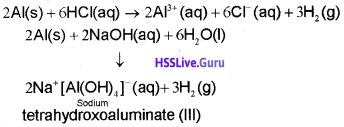
Boron does not react with acids and alkalies even at moderate temperature, but aluminium has amphoteric character.
Plus One Chemistry Notes Chapter 11 The p Block Elements 3

iii) Reactivity towards halogens
2E(s) + 3X2(g) → 2EX3(S) (X = F, Cl, Br, I)

Important Trends And Anomalous Properties Of Boron
The tri-chlorides, bromides and iodides of all these elements being covalent in nature are hydrolysed in water. Species like tetrahedral [M(OH)4] and octahedral [M(H2O)6]3+, except in boron, exist in aqueous medium. The monomeric trihalides, being electron deficient, are strong Lewis acids. Boron trifluoride easily reacts with Lewis bases such as NH3 to complete octet around boron.
F3B+: NH3 → F3B ← NH3

Plus One Chemistry Notes Chapter 11 The p Block Elements

It is due to the absence of d orbitals that the maximum covalence of B is 4. Since the d orbitals are available with Al and other elements, the maximum covalence can be expected beyond 4. Most of the other metal halides (e.g., AlCl3 are dimerised through halogen bridging (e.g., Al2Cl6). The metal species ‘ completes its octet by accepting electrons from halogen in these halogen bridged molecules.

Some Important Compounds Of Boron

Borax
It is the most important compound of boron. Formula of the compound is Na2B4O7.10H2O . In fact it contains the tetranuclear units [B4O5(OH)4]2- and correct formula; therefore, is Na2[B4O5(OH)4].8H2O.
Plus One Chemistry Notes Chapter 11 The p Block Elements 4

On heating, borax first loses water molecules. On further heating it turns into a transparent liquid, which solidifies into glass like material known as borax bead.
Plus One Chemistry Notes Chapter 11 The p Block Elements 5

Orthoboric acid
Orthoboric acid, H3B03 is a white crystalline solid, with soapy touch. It is sparingly soluble in water but highly soluble in hot water.
Na2B4O7 + 2HCl + 5H2O → 2NaCl + 4B(OH)3

Boric acid is a weak monobasic acid. It is not a protonic acid but acts as a Lewis acid by accepting electrons from a hydroxyl ion:
B(OH)3 +2HOH → [B(OH)4] + H3O+

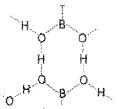
Structure of boric acid is given below.
Plus One Chemistry Notes Chapter 11 The p Block Elements 6

Diborane (B2H6)
The simplest boron hydride is diborane (B2H6). Diborane can be prepared by treating BF3 with lithium aluminium hydride in ether. A convenient laboratory method is oxidation of sodium borohydride with iodine.
2NaBH4 + l2 → B2H6 + 2Nal +H2

On a commercial scale, diborane is produced by the action of BF3 on sodium hydride.
Plus One Chemistry Notes Chapter 11 The p Block Elements 7

Diborane is a colourless toxic gas. It catches fire on exposure to air releasing large amount of energy.
B2H6+ 6H2O → 2B(OH)3 + 6H2

Plus One Chemistry Notes Chapter 11 The p Block Elements

Reaction of diborane with NH3 gives an addition product B2H6.2NH3 which on heating gives borazine (B3N3H3), commonly known as inorganic benzene due to its structural similarity with benzene. Boron forms a series of hydridoborates, the most important being (BH4).NaBH4 (sodium borohydride) is a good reducing agent.

Each boron atom in B2H6 is sp³ hybridised. The structure contains two types of H- atoms the four-terminal hydrogen atoms and two bridged hydrogen atoms. The four-terminal H atoms and two B atoms lie in the same plane. Above and below this plane lie the bridged H atoms. B-H bonds formed by the terminal hydrogen atoms are normal covalent bonds while the bridge B-H bonds are three centre two-electron bonds. Each B atom forms four bonds even though boron has only three valence electrons. Hence B2H6 is an electron deficient compound.

Group 14 Elements: The Carbon Family
Carbon, silicon, germanium, tin, and lead form the carbon family.
Occurrence:
Carbon is widely distributed in nature in the free and combined states. Graphite, diamond, coal, etc are elemental forms of carbon while in the combined state it occurs as metal carbonates, hydrocarbons and CO2 in air. Silicon is present in nature as silica and silicates. Ge is found only in traces. Tin occurs as cassiterite (SnO2) and lead as galena (PbS)

Electronic Configuration
The valence shell electronic configuration of these elements is ns²np². The inner core of the electronic configuration of elements in this group also differs.

Covalent Radius
There is a considerable increase in covalent radius from C to Si, thereafter from Si to Pb a small increase in radius is observed. This is due to the presence of completely filled d and f orbitals in heavier members.

Ionization Enthalpy
The first ionization enthalpy of group 14 members is higher than the corresponding members of group 13. The influence of inner core electrons is visible here also. In general, the ionisation enthalpy decreases down the group.

Electronegativity
Due to small size, the elements of this group are slightly more electronegative than group 13 elements. The electronegativity values for elements from Si to Pb are almost the same.

Plus One Chemistry Notes Chapter 11 The p Block Elements

Physical Properties
All group 14 members are solids. Carbon and silicon are non-metals, germanium is a metalloid, whereas tin and lead are soft metal.

Chemical Properties Oxidation states and trends in chemical reactivity
The group 14 elements have four electrons in outermost shell. The common oxidation states exhibited by these elements are +4 and +2.
Carbon also exhibits negative oxidation states. Since the sum of the first four ionization enthalpies is very high, compounds in +4 oxidation state are generally covalent in nature. In heavier members the tendency to show +2 oxidation state increases in the sequence Ge<Sn (i) Reactivity towards oxygen
All members when heated in oxygen form oxides. There are mainly two types of oxides, monoxide, and dioxide of formula MO and MOs respectively.

(ii) Reactivity towards water
Plus One Chemistry Notes Chapter 11 The p Block Elements 8

(iii) Reactivity towards halogen
These elements can form halides of formula MX2, and MX4 (where X = F, Cl, Br, I). Except carbon, all other members react directly with halogen under suitable condition to make halides.

Hydrolysis can be understood by taking the example of SiCl4. It undergoes hydrolysis by initially accepting lone pair of electrons from water molecule in d orbitals of Si, finally leading to the formation of Si(OH)4 as shown below:
Plus One Chemistry Notes Chapter 11 The p Block Elements 9

Important Trends And Anomalous Behaviour Of Carbon
Carbon differs from rest of the members of its group. It is due to its smaller size, higher electronegativity, higher ionisation enthalpy and unavailability of d orbitals. In carbon, only s and p orbitals are available for bonding and, therefore, it can accommodate only four pairs of electrons around it. This would limit the maximum covalence to four whereas other members can expand their covalence due to the presence of d orbitals.
Carbon has the ability to form pπ – pπ multiple bonds with itself and with other atoms of small size and high electronegativity.

Few examples are: C=C, C° C, C=0, C=S, and C° N. Carbon atoms have the tendency to link with one another through covalent bonds to form chains and rings. This property is called catenation.

Plus One Chemistry Notes Chapter 11 The p Block Elements

Allotropes Of Carbon

Diamond
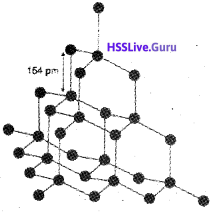
It has a crystalline lattice. In diamond, each carbon atom undergoes sp³ hybridisation and linked to four other carbon atoms by using hybridised orbitals in tetrahedral fashion. The C-C bond length is 154 pm. In this structure, directional covalent bonds are present throughout the lattice. It is very difficult to break extended covalent bonding and, therefore, diamond is a hardest substance on the earth. It is used as an abrasive for sharpening hard tools.
Plus One Chemistry Notes Chapter 11 The p Block Elements 10

Graphite
Graphite has layered structure. Layers are held by van der Waals forces and distance between two layers is 340 pm. Each layer is composed of planar hexagonal rings of carbon atoms. C—C bond length within the layer is 141.5 pm. Each carbon atom in hexagonal ring undergoes sp² hybridisation and makes three sigma bonds with three neighbouring carbon atoms. Fourth electron forms a π bond. The electrons are delocalised over the whole sheet. Electrons are mobile and, therefore, graphite conducts electricity along the sheet. Graphite cleaves easily between the layers and, therefore, it is very soft and slippery. For this reason graphite is used as a dry lubricant in machines running at high temperature, where oil cannot be used as a lubricant.
Plus One Chemistry Notes Chapter 11 The p Block Elements 11

Fullerenes
Fullerenes are prepared by heating graphite in an electric arc in the presence of helium or argon. The sooty material formed by condensation of the vapours consists of C60 with smaller amounts of C70 and other fullerenes. C60 is named as Buckminster fullerence. The general name fullerence refers to the family of spheroidal carbon-cage molecules. The shape of C60 resembles that of a soccer ball. It contains twelve five-membered rings and twenty 6-membered rings of carbon. The 6-membered rings are fused both to other five and six membered rings. However, the 5-membered rings are fused only to six-membered rings. Both carbon-carbon single (1.435 Å) and double (1.383 Å) bonds are present in this structure. Carbon black, coke and charcoal are impure amorphous forms of graphite or fullerenes. Carbon black is formed by burning hydrocarbon in limited supply of air. Charcoal and coke are obtained by heating wood and coal respectively in the absence of air.

Uses of Carbon
Being good conductor, graphite is used for electrodes in batteries and industrial electrolysis. Crucibles made from graphite are inert to dilute acids and alkalies. Being highly porous, activated charcoal is used in adsorbing poisonous gases. Diamond is a precious stone and used in jewellery.

Some Important Compounds Of Carbon And Silicon
Oxides of Carbon
Two important oxides of carbon are carbon monoxide, CO and carbon dioxide, CO2.

Carbon Monoxide
Direct oxidation of C in limited supply of oxygen or air yields carbon monoxide.
Plus One Chemistry Notes Chapter 11 The p Block Elements 12
On commercial scale it is prepared by the passage of steam over hot coke. The mixture of CO and H2 thus produced is known as water gas or synthesis gas.
Plus One Chemistry Notes Chapter 11 The p Block Elements 13
When air is used instead of steam, a mixture of CO and N2 is produced, which is called producer gas.
Plus One Chemistry Notes Chapter 11 The p Block Elements 14
Water gas and producer gas are very important industrial fuels. Carbon monoxide in water gas or producer gas can undergo further combustion forming carbon dioxide with the liberation of heat. CO arises has the ability to form a complex with haemoglobin, which is about 300 times more stable than the oxygen-haemoglobin complex. This prevents haemoglobin in the red blood corpuscles from carrying oxygen round the body and ultimately resulting in death.

Plus One Chemistry Notes Chapter 11 The p Block Elements

Carbon Dioxide
It is prepared by complete combustion of carbon and carbon-containing fuels in excess of air.
Plus One Chemistry Notes Chapter 11 The p Block Elements 15
On commercial scale it is obtained by heating limestone. Carbon dioxide, which is normally present to the extent of ~0.03 % by volume in the atmosphere, is removed from it by the process known as photosynthesis. It is the process by which green plants convert atmospheric CO2 into carbohydrates such as glucose. The overall chemical change can be expressed as:

The increase in combustion of fossil fuels and decomposition of limestone for cement manufacture in recent years seem to increase the CO2 content of the atmosphere. This may lead to increase in green house effect and thus, raise the temperature of the atmosphere which might have serious consequences. Carbon dioxide can be obtained as a solid in the form of dry ice by allowing the liquified CO2 to expand rapidly. Dry ice is used as a refrigerant for ice-cream and frozen food.
Plus One Chemistry Notes Chapter 11 The p Block Elements 16
Resonance structures of carbon dioxide

Silicon Dioxide, SiO2
Quartz, cristobatite and tridymite are some of the crystalline forms of silica, and they are interconvertible at suitable temperature. In Silicon dioxide, each silicon atom is covalently bonded in a tetrahedral manner to four oxygen atoms. Each oxygen atom in turn covalently bonded to another silicon atoms.
Plus One Chemistry Notes Chapter 11 The p Block Elements 17

Silicones
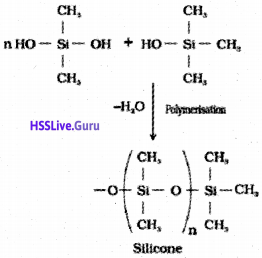
They are a group of organosilicon polymers, which have (R2SiO) as a repeating unit. The starting materials for the manufacture of silicones are alkyl or aryl substituted silicon chlorides, RnSiCl(4-n), where R is alkyl or aryl group.
Plus One Chemistry Notes Chapter 11 The p Block Elements 18

Silicates
The basic structural unit of silicates if SiO44- tertrahedra. Feldspar, zerolites, mica, asbestose, etc. are examples of silicates. In silicates, either the SiO44- will be present as discrete units or several such units are joined togetherth rough sharing of corner of the tetrahedra using one to four oxygen atoms per silicate unit. Like this, different silicates assume different forms such as chain, ring, sheet or three-dimensional structures. Glass and cement are examples of man-made silicates.
Plus One Chemistry Notes Chapter 11 The p Block Elements 19

Zeolites
Zeolites are alumino silicates. If a few Si atoms of the three-dimensional network structure of SiO2 are replaced by Al atoms, the resulting structure is called alumino silicate structure. This structure evidently has negative charge and Na+.K+ pr Ca2+ ions balance the negative charge. Zeolites are used as catalysts in petrochemical industry for cracking of hydrocarbons. ZSM-5 is a type of zeolite used in the conversion of alcohol to gasoline. Zeolites are also used in softening hard water.

Plus One Chemistry Notes Chapter 10 The s Block Elements

Students can Download Chapter 10 The s Block Elements Notes, Plus One Chemistry Notes helps you to revise the complete Kerala State Syllabus and score more marks in your examinations.

Kerala Plus One Chemistry Notes Chapter 10 The s Block Elements

Introduction
Group 1 of the periodic table consists of the elements: Lithium, Sodium, Potassium, Rubidium, Caesium and Francium. They are collectively known as alkali metals.

Group 2 consists of Beryllium, Mgnesium, Calcium, Strontium, Barium and Radium. These elements except of beryllium are known as the alkaline earth metals. The general electronic configuration of s-block elements is [noble gasjns1 for alkali metals and [noble gas] ns² for alkaline earth metals. The first elements of Group 1 and Group 2 respectively exhibit diagonal similarity, which is commonly referred to as diagonal relationship in the periodic table. The diagonal relationship is due to the similarity in ionic sizes and /or charge/radius ratio of the elements.

Group 1 Elements: Alkali Metals

1) Electronic Configuration:
All the alkali metals have one valence electron, ns¹ outside the noble gas core. The loosely held s-electron readily lose electron to give monovalent M+ ions.

2) Atomic And Ionic Radii:
The atomic and ionic radii of alkali metals increase on moving down the group. Hence, ionization enthalpies of the alkali metals are considerably low and decrease down the group.

3) Hydration Enthalpy:
The hydration enthalpies of alkali metal ions decrease with increase in ionic sizes. Li+ > Na+ > K+ > Rb+ > Cs+ Li+ has maximum degree of hydration and for this reason lithium salts are mostly hydrated, e.g., LiCl- 2H2O

Plus One Chemistry Notes Chapter 10 The s Block Elements

Physical Properties
When heat is supplied to alkali metal or its salt the electrons are excited to higher energy levels. As these electrons return to their original level; radiations are emitted which fall in the visible region of electromagnetic spectrum. Thus they appear coloured. Li imparts crimson red colour, K gives violet colour and Na gives golden yellow colour to the flame.

Chemical Properties
The reactivity of these metals increases with their size. They burn vigorously in oxygen forming oxides. Lithium forms monoxide, sodium forms peroxide, the other metals form superoxides. The superoxide O2 ion is stable only in the presence of large cations such as K, Rb, Cs.
4Li + O2 → 2LizO(oxide)
2Na + O2 → Na2O2 (peroxide)
M + O2 → MO2(superoxide)
(M=K, Rb, Cs)
Because of their high reactivity towards air and water, they are normally kept in kerosene oil.lt may be noted that although lithium has most negative E° value.
Plus One Chemistry Notes Chapter 10 The s Block Elements 1

They also react with proton donors such as alcohol, gaseous ammonia and alkynes.AII the alkali metal hydrides are ionic solids with high melting points.
2M + H2 → 2M+H.

Plus One Chemistry Notes Chapter 10 The s Block Elements

The alkali metals readily react vigorously with halogens to form ionic halides, M+X. However, lithium halides are somewhat covalent. It is because of the high polarisation capability of lithium-ion. The alkali metals are strong reducing agents, lithium being the most and sodium the least powerful. The alkali metals dissolve in liquid ammonia giving deep blue solutions. The solutions are paramagnetic and on standing slowly liberate hydrogen.

General Characteristics Of The Compounds Of The Alkali Metals

Oxides And Hydroxides
Reactivity of alkali metals with oxygen increases down the group. Lithium, when heated in air, forms the normal oxide (Li2O) while sodium forms the per-oxide (Na2O2). Potassium, Rubidium and caesium form superoxides (MO2).
4Li + O2 → 2Li2O; 2Na+ O2 → Na2O2; K + O2 → KO2

The normal oxides dissolve in water to form hydroxides (MOH) which are strong bases. However, LiOH is only slightly soluble in water and it decomposes on heating. The peroxides and superoxides also dis-solve in water to form basic hydroxides. The basic character of alkali metal hydroxides increases down the group.

Halides
Alkali metals react vigorously with halogens to form metal halides of the general formula MX. 2M+X2 → 2MX X=F, Cl, Br or l and M= alkali metal Reactivity of alkali metal towards halogen increases from Li to Cs. Halides of alkali metals are ionic compounds readily soluble in water. But LiF is almost insoluble due to high lattice energy.

Anomalous Properties Of Lithium
The anomalous behaviour of lithium is due to the :

  1. exceptionally small size of its atom and ion, and
  2. high polarising power (i.e., charge/ radius ratio).

As a result, there is increased covalent character of lithium compounds which is responsible for their solubility in organic solvents.

Points Of Similarities Between Lithium And Magnesium
The similarity between lithium and magnesium is particularly striking and arises because of their similar sizes: atomic radii, Li = 152 pm, Mg= 160 pm; ionic radii: Li+ = 76 pm, Mg2+ = 72 pm. The main points of similarity are:

  1. Both lithium and magnesium are hander and lighter than other elements in the respective groups.
  2. Lithium and magnesium react slowly with water. Their oxides and hydroxides are much less soluble and their hydroxides decompose on heating. Both form a nitride, Li3N and Mg3N2, by direct combination with nitrogen.
  3. The oxides, Li2O and MgO do not combine with excess oxygen to give any superoxide.
  4. The carbonates of lithium and magnesium decompose easily on heating to form the oxides and CO2.

Some Important Compounds Of Sodium Sodium Carbonate (Washing Soda), Na2CO3.10H2O
Sodium carbonate is generally prepared by Solvay Process.
The equations for the complete process may be written as:
2NH3 + H2O + CO2 → (NH4)2CO3
(NH4)2CO3 + H2O + CO2 → 2NH4HCO3
NH4HCO3 +NaCl → NH4Cl + NaHCO3
2NaHCO3 → Na2CO3 +CO2 +H2O

Plus One Chemistry Notes Chapter 10 The s Block Elements

In this process, NH3 is recovered when the solution containing NH4Cl is treated with Ca(OH)2. On heating washing soda becomes monohydrate and then completely anhydrous i.e., soda ash.

Sodium Chloride, NaCl
The most abundant source of sodium chloride is seawater. Common salt is generally obtained by evaporation of seawater. Crude sodium chloride, generally obtained by crystallisation of brine solution, contains sodium sulphate, calcium sulphate, calcium chloride and magnesium chloride as impurities. Calcium chloride, CaCl2, and magnesium chloride, MgCl2 are impurities because they are deliquescent (absorb moisture easily from the atmosphere). To obtain pure sodium chloride, the crude salt is dissolved in minimum amount of water and filtered to remove insoluble impurities. The solution is then saturated with hydrogen chloride gas. Crystals of pure sodium chloride separate out. Calcium and magnesium chloride, being more soluble than sodium chloride, remain in solution.

Uses:

  • It is used as a common salt or table salt for domestic purpose.
  • It is used for the preparation of Na2O2, Na0H and Na2CO3.

Sodium Hydroxide (Caustic Soda), NaOH
Sodium hydroxide is generally prepared commercially by the electrolysis of sodium chloride in Castner-Kellner cell. A brine solution is electrolysed using a mercury cathode and a carbon anode.
Plus One Chemistry Notes Chapter 10 The s Block Elements 2
The amalgam is treated with water to give sodium hydroxide and hydrogen gas.
2 Na – amalgam + 2H2O → 2NaOH + 2Hg +H2
The sodium hydroxide solution at the surface reacts with the C02 in the atmosphere to form Na2CO3.

Plus One Chemistry Notes Chapter 10 The s Block Elements

Uses:
It is used in (i)the manufacture of soap, paper, artificial silk and a number of chemicals,(ii) in petroleum refining, (iii) in the purification of bauxite, (iv) in the textile industries for mercerising cotton fabrics and (v) for the preparation of pure fats and oils.

Biological Importance Of Sodium And Potassium
Sodium ions participate in the transmission of nerve signals. The concentration gradient of Na+ and K+ demonstrates that-a discriminatory mechanism called sodium-potassium pump, operates across the cell membranes.

Group 2 Elements: Alkaline Earth Metals
The group 2 elements (except beryllium) are known as alkaline earth metals. The first element beryllium differs from the rest of the members and shows diagonal relationship to aluminium.
1) Electronic Configuration:
These elements have two electrons in the s-orbital of the valence shell. Their general electronic configuration may be represented as [noble gas] ns².

2) Atomic And Ionic Radii:
Within the group, the atomic and ionic radii increase with increase in atomic number due to the increased nuclear charge in these elements. They have low ionisation enthalpy and it decreases down the group with increase in size.

3) Hydration Enthalpy:
Hydration enthalpies of alkaline earth metal ions decrease with increase in ionic size down the group. Be2+ > Mg2+ > Ca2+ > Sr2+ > Ba2+ The hydration enthalpies of alkaline earth metal ions are larger than those of alkali metal ions.

Physical Properties
Calcium, Strontium and Barium impart characteristic brick red, crimson and apple green colours respectively to the flame. Inflame the electrons are excited to higher energy levels and when they drop back to the ground state, energy is emitted in the form of visible light. The electrons in Be and Mg are too strongly bound to get excited by flame. Hence, these elements do not impart any colour to the flame.

Plus One Chemistry Notes Chapter 10 The s Block Elements

Chemical Properties
The alkaline earth metals are less reactive than the alkali metals. The reactivity of these elements increases on going down the group.
Reactivity towards air and water Beryllium and Magnesium are kinetically inert to oxygen and water because of the formation of an oxide film on their surface. However, powdered beryllium burns brilliantly on ignition in air to give BeO and Be3N2.
Reactivity towards halogen
M + X2 → MX2 (X = F, Cl, Br, I)

Reactivity towards hydrogen
All the elements except beryllium form their hydrides, MH2.BeH2, however, can be prepared by the reaction of BeCl2 with LiAlH4.
2BeCl2 +LiAlH4 → 2BeH2 +LiCl + AlCl3

Plus One Chemistry Notes Chapter 10 The s Block Elements

Reactivity towards acids:
The alkaline earth metals readily react with acids liberating dihydrogen.

General Characteristics Of Compounds Of The Alkaline Earth Metals
i) Oxides and Hydroxides: Alkaline earth metals burn in air or oxygen to form their oxides. (Oxides are also prepared by the thermal decomposition of their carbonates). Be, Mg and Ca form monoxides (MO). The tendency to form peroxide increases as the size of the metal ion increases. Strontium and barium form peroxides (MO2)
2M + O2 → MO (M = Be, Mg or Ca)
M+O2 → MO2 (M = Sr or Ba)

BeO is amphoteric in character, while the oxides of the rest of the elements in group 2 are basic. The oxides of Ca, Sr and Ba react with water to form their corresponding hydroxides.

The hydroxides of alkaline earth metals are bases except Li(OH)2 which is amphoteric. The basic strength increases from Mg(OH)2 to Ba(OH)2. The solubility and thermal stability of hydroxides increase downward in the group. Be(OH)2 and Mg(OH)2 are almost insoluble. Ca(OH)2 is sparingly soluble, while Sr(OH)2 and Ba(OH)2 are increasingly more soluble.

ii) Halides: Group 2 metals directly combine with halogen to form divalent halides of the formula

The s-Block Elements
MX2 where X is the halogen. The metal halides are also formed by the action of halogen acids on metals, their oxides, carbonates and hydroxides. BeCl2 is, however, prepared by passing Cl2 over a hot mixture of BeO and coke.
In contrast to the halides of other alkaline earth metals, beryllium halides are covalent. In the solid-state BeCl2 has a polymeric chain structure involving Be-CI-Be bridges. The anhydrous halides are hygroscopic and form hydrates such as MgCl2.6H2O, CaCl2.6H2O etc. Due to this reason, anhydrous calcium chloride is widely used as a dehydrating agent. Fluorides are relatively less soluble due to high lattice energies,

Plus One Chemistry Notes Chapter 10 The s Block Elements

iii) Salts of Oxoacids:
The alkaline earth metals also form salts of oxoacids. Some of these are : Carbonates, Sulphates and Nitrates.

Anomalous Behaviour Of Beryllium
Beryllium differs from the rest element in many of its properties. These are

  1. Beryllium has high ionisation enthalpy.
  2. Small size of Be atom
  3. Be does not exhibit coordination number more than four.
  4. The oxides and hydroxides of Be are amphoteric in nature.

Diagonal Relationship Between Beryllium And Aluminium
The ionic radius of Be2+ is estimated to be same as that of the Al3+ ion. Hence Be resembles Al in some ways. Some of the similarities are:

  1. Like AI, Be is not readily attacked by acids because of the presence of an oxide film on the surface of the metal.
  2. Beryllium hydroxide dissolves in excess of alkali to give a beryllate ion just as aluminium hydroxide gives aluminate ion.
  3. The chlorides of both Be and Al have Ch bridged chloride structure in vapour phase. Both the chlorides are soluble in organic solvents and are strong Lewis acids. They are used as Friedel Craft catalysts.
  4. Be and Al ions have strong tendency to form complexes, BeF42-, AlF63-.

Some Important Compounds Of Calcium
Important compounds of calcium and their preparations are given below.

Calcium Oxide Or Quick Lime, CaO
It is prepared by the following reaction.
CaCO3 \(\rightleftharpoons \) Ca0 + CO2
CO2 is removed as soon as it is produced to enable the reaction to proceed to completion.
CaO + H2O → Ca(OH)2
This process is called slaking of lime. CaO is a basis oxide.

Uses:

  • Primary material for manufacturing cement
  • It is used in the manufacturing of caustic soda
  • Used to purify sugar

Calcium Hydroxide (Slaked Lime), Ca(OH)2
It is prepared by adding water to CaO. The aqueous solution of Ca(OH)2 is known as lime water and the suspension of slaked lime is known as milk of lime. When CO2 is passed through lime water it turns milky due to the formation of CaCO3
Ca(OH)2 + CO2 → CaCO3 +H2O

Uses:

  • It is used in whitewash due to its disinfectant nature.
  • Used in the preparation of bleaching powder.
  • Used to purify sugar.

Calcium Carbonate, CaCO2
It occurs in limestone, chalk, marble etc.
It can be prepared by the following reactions.
Ca(OH)2 + CO2 → CaCO3 + H2O
CaCl2 + Na2CO3 → CaCO3 + 2NaCl
CaCO3 reacts with dilute acids to liberate carbon dioxide.

Uses:

  • It is used as a flux in the extraction of metals.
  • It is used as the building material of quick lime.

Calcium Sulphate (Plaster Of Paris), CaSO4.½H2O
It is obtained by heating gypsum (CaSO2.2H2O)
Plus One Chemistry Notes Chapter 10 The s Block Elements 3
Above 393K anhydrous calcium sulphate is formed. This is known as ‘dead burnt plaster’

Used:

  • It is used in building industry as well as plasters.
  • Used to make casts of statues.

Cement
Cement is prepared by combining CaO with other materials such as clay with silica, SiO2 along with Oxides of Al, iron and magnesium. The average composition of portland cement is:
CaO, 50-60%;
SiO2, 20-25%;
Al2O3, 5-10%;
MgO, 2-3%;
Fe2O3, 1-2% and
SO3, 1-2%.
When limestone and clay are heated we get cement clinker. This clinker is mixed with gypsum to form cement.

Setting of Cement:
When mixed with water the setting of cement takes place to give a hard mass. It is due to the rearrangement and hydration of molecules of constituents. Gypsum is added to slow down the setting process so it gets sufficiently hardened.

Uses:

  • Used in construction of building.

Biological Importance Of Magnesium And Calcium
Human body contains about 25g of Mg and 1200g of Ca. Mg is a cofactor in enzymes which use ATP in phosphate transfer process in our body. Photosynthesis in plants takes place in presence of chlorophyll which contains Mg. About 99% of body calcium is found in teeth and bones. Calcium concentration in plasma is regulated at 100mg/litre in presence of hormones such as calcitonin and parathyroid hormone.

Plus One Physics Notes Chapter 6 Work, Energy and Power

Students can Download Chapter 6 Work, Energy and Power Notes, Plus One Physics Notes helps you to revise the complete Kerala State Syllabus and score more marks in your examinations.

Kerala Plus One Physics Notes Chapter 6 Work, Energy and Power

Summary
The Scalar Product
Plus One Physics Notes Chapter 6 Work, Energy and Power 1
The scalar product (or) dot product of any two vectors \(\overrightarrow{\mathrm{A}}\) and \(\overrightarrow{\mathrm{B}}\) is defined as
Plus One Physics Notes Chapter 6 Work, Energy and Power 2
Where ‘q’ is the angle between \(\overrightarrow{\mathrm{A}}\) and \(\overrightarrow{\mathrm{B}}\)
Note: The dot product of A and B is a scalar quantity. Geometrical meaning of \(\overrightarrow{\mathrm{A}}\) . \(\overrightarrow{\mathrm{B}}\)
We know \(\overrightarrow{\mathrm{A}}\) . \(\overrightarrow{\mathrm{B}}\) = ABcosθ
= A(Bcosθ)
= B(A cosθ)
Plus One Physics Notes Chapter 6 Work, Energy and Power 3

Plus One Physics Notes Chapter 6 Work, Energy and Power
Plus One Physics Notes Chapter 6 Work, Energy and Power 4
Properties
Plus One Physics Notes Chapter 6 Work, Energy and Power 5

Question 1.
Plus One Physics Notes Chapter 6 Work, Energy and Power 6
Answer:
Plus One Physics Notes Chapter 6 Work, Energy and Power 7

Work Energy Theory
Statement:
The change in kinetic energy of a particle is equal to the work done on it by the net force.
Proof:
We know v2 = u2 + 2as
v2 – u2 = 2as
Multiplying both sides with m/2; we get
Plus One Physics Notes Chapter 6 Work, Energy and Power 8

Plus One Physics Notes Chapter 6 Work, Energy and Power

Work
Definition:
The work done by the force is defined as the product of component of the force in the direction of the displacement and the magnitude of this displacement.
Explanation
Plus One Physics Notes Chapter 6 Work, Energy and Power 9
Plus One Physics Notes Chapter 6 Work, Energy and Power 10
Consider a constant force \(\overrightarrow{\mathrm{F}}\) acting on an object of mass m. The object undergoes a displacement d in the positive x direction as shown in the figure. The projection of \(\overrightarrow{\mathrm{F}}\) on d is Fcosθ.
Hence work done w = Fcosθ. d
Plus One Physics Notes Chapter 6 Work, Energy and Power 11
There are three types of workdone

  1. positive workdone
  2. negative workdone
  3. zero workdone

1. Positive workdone:
Work will be positive, if the displacement has a component in the direction of the force. The angle between force and displacement is zero for positive workdone.
When q = 0 w = Fd
Example

  • A person carrying a load climbing up a staircase
  • A body being pushed along a surface
  • A body falling under gravitation force.

2. Negative workdone:
Work will be negative, if the displacement has a component opposite to the force F. The angle between force and displacement lies between 90° and 180°.
Example

  • When a person carrying a load on his head climbs down a staircase, (applied force by him on the load is upwards and the displacement is opposite to it)
  • When a body slides along a rough surface the displacement is opposite to the frictional force. Therefore the workdone by the frictional force is negative.

Plus One Physics Notes Chapter 6 Work, Energy and Power

3. Zero work done:
Work will be zero, if there is no component along the direction of force. The angle between applied force and displacement is 90°.
Example
1. When a person carrying a load on his head walks along a level road, the displacement is perpendicular to the force and therefore the work done is zero.
Plus One Physics Notes Chapter 6 Work, Energy and Power 12
2. In uniform circular motion the centripetal force is along the radius and direction of displacement is along the tangent.
Plus One Physics Notes Chapter 6 Work, Energy and Power 13

Kinetic Energy
Kinetic energy is the energy possessed by the body because of it’s motion. Kinetic energy of a body of mass m and velocity v,
Plus One Physics Notes Chapter 6 Work, Energy and Power 14

Workdone By Variable Force
Plus One Physics Notes Chapter 6 Work, Energy and Power 15
Consider a body moving from xi to xf under a variable force. The variation of force with position is shown in graph. Consider a small AB = Dx. The force in this interval is nearly a constant.

Plus One Physics Notes Chapter 6 Work, Energy and Power

Hence workdone to move a body from A to B is. Dw = F(x) Dx.F(x)dx gives the area of rectangle ABCD. When we add successive rectangular areas, we get total work as
Plus One Physics Notes Chapter 6 Work, Energy and Power 16
When we take Dx tends to zero, the summation can be replaced integration.
Plus One Physics Notes Chapter 6 Work, Energy and Power 17

Work Energy Theory For A Variable Force
Work energy theorem for a variable force can be derived from work energy theorem of constant force. According work energy theorem for constant force, Change in kE = work done
dk = dw
dk = F dx
Integrating from the initial position (xi) to (xf) we get
Plus One Physics Notes Chapter 6 Work, Energy and Power 18

Concept Of Potential Energy
Potential energy of a body is the energy possessed by it because of its position.
Explanation
Considera mass ‘m’on the surface of the earth. If this mass is raised to height ‘h’ against force of gravity,
work done w = Force × displacement
w = mg × h
w = mgh
This work gets stored as gravitational potential energy.
ie; Gravitational energy V = mgh.

1. Relation between gravitational potential and gravitational force:
If we take negative of the derivative of V(h) with respect to height (h), we get
Plus One Physics Notes Chapter 6 Work, Energy and Power 19
Where F is gravitational force. The above equation shows that gravitational force is the negative derivative of gravitational potential.

Plus One Physics Notes Chapter 6 Work, Energy and Power

2. Relation between kinetic energy and gravitational potential energy:
Considera body of mass ‘m’ at a height ‘h’ from the surface of the earth. The potential energy at height h
pE = mgh ______(1)
If the body is allowed to fall from this height, it attains kinetic energy,
kE = \(\frac{1}{2}\)mv2 _______(2)
But velocity at surface can be found from the formula
v2 = u2 + 2as
v2 = 2gh [Since u = 0, a = g, s = h]
Substituting this value in eq(2), we get
kE = \(\frac{1}{2}\) m2gh
kE = mgh
kE = pE [∵ pE = mgh]
Plus One Physics Notes Chapter 6 Work, Energy and Power 20
Properties of conservative force:

  • A force is conservative, if it can be derived from a scalar quantity (ie F = – \(\frac{d V}{d x}\))
  • The workdone by the conservative force depends only on the end points.
  • The workdone by conservative force in a closed path is zero.

Conservation of mechanical energy for a freely falling body:
Plus One Physics Notes Chapter 6 Work, Energy and Power 21
Consider a body of mass ‘m’ at a height h from the ground.
Total energy at the point A
Potential energy at A,
PE = mgh
Kinetic energy, KE = \(\frac{1}{2}\)mv2 = 0
(since the body at rest, v = 0).
∴ Total mechanical energy = PE + KE = mgh + 0
= mgh.

Total energy at the point B
The body travels a distance x when it reaches B. The velocity at B, can be found using the formula.
v2 = u2 + 2as
v2 = 0 + 2 gx
∴ KE at B, = \(\frac{1}{2}\)mv2
\(\frac{1}{2}\)m2gx
= mgx
P.E. at B, = mg (h – x)
Total mechanical energy = PE + KE
= mg (h – x) + mgx = mgh.

Plus One Physics Notes Chapter 6 Work, Energy and Power

Total energy at C
Velocity at C can be found using the formula
v2 = u2 + 2as
v2 = 0 + 2gh
∴ KE at C, = \(\frac{1}{2}\)mv2
\(\frac{1}{2}\)m2gh
= mgh
P.E. at C = 0
Total energy = PE + KE
= 0 + mgh = mgh.

The Potential Energy Of A Spring
Hooks law:
The restoring force developed in the spring is proportional to the displacement x and it is opposite to the displacement,
ie Fα – x
Plus One Physics Notes Chapter 6 Work, Energy and Power 22
Where k is a constant called the spring constant.
Potential energy stored in a spring:
Plus One Physics Notes Chapter 6 Work, Energy and Power 23
Consider a massless spring fixed to a rigid support at one end and a body attached to the other end. The body moves on a frictionless surface.

If a body is displaced by a distance dx, The work done for this displacement
dw = Fdx
∴ Total work done to move the body from x = 0 to x
Plus One Physics Notes Chapter 6 Work, Energy and Power 24
Plus One Physics Notes Chapter 6 Work, Energy and Power 25
This workdone is stored a potential energy in a spring. Hence potential energy of a spring.
Plus One Physics Notes Chapter 6 Work, Energy and Power 26
Spring force is a conservative force:
If the spring is displaced from an initial position xi to xf and again to xi;
Plus One Physics Notes Chapter 6 Work, Energy and Power 27

Plus One Physics Notes Chapter 6 Work, Energy and Power
W = 0
This zero workdone means that spring force is conservative.
Energy of a oscillating spring at any point:
Plus One Physics Notes Chapter 6 Work, Energy and Power 28
If the block of mass ‘m’ (attached to massless spring) is extended to xm and released, it will oscillate in between +xm and -xm. The total mechanical energy at any point x, (lies between -xm and +xm) is
Plus One Physics Notes Chapter 6 Work, Energy and Power 29
This block mass ‘m’ has maximum velocity at equilibrium equi¬librium position (x = 0). At this position, the potential energy stored in a spring is completely converted in to kinetic energy.
Plus One Physics Notes Chapter 6 Work, Energy and Power 30
Graphical variation of energy
Plus One Physics Notes Chapter 6 Work, Energy and Power 31

The Law Of Conservation Of Energy
Statement:
Energy cannot be created or destroyed. It can be transformed from one form to another.

Question 2.
Prove conservation of energy for a freely falling body.
Answer:
Conservation of mechanical energy for a freely falling body:
Plus One Physics Notes Chapter 6 Work, Energy and Power 32
Consider a body of mass ‘m’ at a height h from the ground.
Total energy at the point A
Potential energy at A,
PE = mgh
Kinetic energy, KE = \(\frac{1}{2}\)mv2 = 0
(since the body at rest, v = 0).
∴ Total mechanical energy = PE + KE = mgh + 0
= mgh.

Plus One Physics Notes Chapter 6 Work, Energy and Power

Total energy at the point B
The body travels a distance x when it reaches B. The velocity at B, can be found using the formula.
v2 = u2 + 2as
v2 = 0 + 2 gx
∴ KE at B, = \(\frac{1}{2}\)mv2
\(\frac{1}{2}\)m2gx
= mgx
P.E. at B, = mg (h – x)
Total mechanical energy = PE + KE
= mg (h – x) + mgx = mgh.

Total energy at C
Velocity at C can be found using the formula
v2 = u2 + 2as
v2 = 0 + 2gh
∴ KE at C, = \(\frac{1}{2}\)mv2
\(\frac{1}{2}\)m2gh
= mgh
P.E. at C = 0
Total energy = PE + KE
= 0 + mgh = mgh.

Various Form Of Energy
1. Heat:
Heat is a one form of energy, it is the internal energy of molecule.

2. Chemical energy:
Chemical energy arises from the fact that the molecules participating in the chemical reaction have different binding energies.

If the total energy of the reactants is more than the products of the reaction, heat is released and the reaction is said to be exothermic reaction. If the heat is absorbed in chemical reaction it is called endothermic.

3. Electrical energy:
The flow of electrons produce electric current.

4. The equivalence of mass and energy Mass and energy are equivalent and are related by the relation. E = mc2, where C, the speed of light in. vacuum.

Question 3.
How much energy will be liberated, when 1 Kg. matter converts in to energy?
Answer:
Energy liberated E = mc2
E = 1 × (3 × 108)2
= 9 × 10¹⁶J.

5. Nuclear energy:
Nuclear energy is obtained from the sun. In this case four light hydrogen nuclei fuse to form a helium nucleus, whose mass is less than the sum of the masses of the reactants. This mass difference (called the mass defect on) is the source of energy.

Plus One Physics Notes Chapter 6 Work, Energy and Power

Power
Power is defined as the time rate at which work is done.
Plus One Physics Notes Chapter 6 Work, Energy and Power 33
Expression for power in terms of F and V:
The work done (dw) by a force F for a displacement dr is
Plus One Physics Notes Chapter 6 Work, Energy and Power 34
Plus One Physics Notes Chapter 6 Work, Energy and Power 35
Where \(\overrightarrow{\mathrm{V}}\) is the instantaneous velocity when the force is \(\overrightarrow{\mathrm{F}}\).
Unit:
Unit of power is watt. 1 watt = 1J/S.
There is another unit of power, namely the horse power (hp)
1 hp = 746w
Kilowatt hour kwh:
Kilowatt hour (kwh) is the unit of energy used to mea-sure electrical energy. One kilowatt hour is the energy consumed in one hour at the rate of 1000 watts/ second.
1 kwh = 1000 watts × 60 × 60 seconds
= 3.6 × 10⁶ws
1 kwh = 3.6 × 10⁶J
Note : kwh is a unit of energy and not of power.

Collisions
There are two types of collisions.

  1. Elastic collision
  2. Inelastic collision

1. Elastic collision:
Elastic collision is one in which both momentum and kinetic energy are conserved.
Eg:

  • collision between molecules and atoms
  • collision between subatomic particles.

Characteristics of elastic collision:

  • Momentum is conserved
  • Total energy is conserved
  • K. E. is conserved
  • Forces involved during collision are conservative forces

2. Inelastic collision:
Inelastic collision is one in which the momentum is conserved, but KE is not conserved.
Example.

  • Mud thrown on a wall
  • Any collision between macroscopic bodies in every day life.

Characteristics of inelastic collision:

  • Momentum is conserved
  • Total energy is conserved
  • K.E. is not conserved
  • Forces involved are not conservative
  • Part or whole of the KE is converted into other forms of energy like heat, sound, light etc.

Plus One Physics Notes Chapter 6 Work, Energy and Power

2. Collisions in one Dimension:
If the initial velocities and final velocities of both the bodies are along the straight line, then it is called one dimensional motion.
Plus One Physics Notes Chapter 6 Work, Energy and Power 36
Consider two bodies of masses m1 and m2 moving with velocities u1 and u2 in the same direction and in the same line. If u1 > u2 they will collide. After collision let v1 and v2 be their velocities.
By conservation of linear momentum.
m1u1 + m2u2 = m1v1 + m2v2 ______(1)
m1u1 – m2u2 = m1v1 – m2v2 ______(2)
This is an elastic collision, hence K.E. is conserved.
Plus One Physics Notes Chapter 6 Work, Energy and Power 37
Plus One Physics Notes Chapter 6 Work, Energy and Power 38

Plus One Physics Notes Chapter 6 Work, Energy and Power
To find v1 and v2:
Plus One Physics Notes Chapter 6 Work, Energy and Power 39
Plus One Physics Notes Chapter 6 Work, Energy and Power 40
Discussion
Case -1 Mass of two bodies are equal
(i.e. m1 = m2 = m). Substitute these values in (7) and (8), we have
Plus One Physics Notes Chapter 6 Work, Energy and Power 41
ie. bodies exchange their velocities.

Plus One Physics Notes Chapter 6 Work, Energy and Power

Case – 2 (If u2 =0 and m2 >> m1 ie; m1 – m2 ≈ -m2, m1 + m2 ≈ -m2)
Plus One Physics Notes Chapter 6 Work, Energy and Power 42
The second body remains at rest while the first body rebounds with the same velocity.
Collisions in Two Dimensions:
Plus One Physics Notes Chapter 6 Work, Energy and Power 43
Consider two bodies of masses m1 and m2 moving with velocities u1 and u2 along parallel lines. If u1 > u2 they will collide. Let v1 and v2 be their velocities after collision along directions θ1 and θ2. v1 and v2 can be resolved in to v1 cosθ1, v2cosθ2 parallel to x axis and v1 sinθ1 and v2sinθ2 parallel to y axis.
By conservation of momentum parallel to X-axis,

Plus One Physics Notes Chapter 6 Work, Energy and Power
m1u1 + m2u2 = m1v1 cosθ1 + m2v2 cosθ2
By conservation of momentum parallel to y-axis.
m1v1sinθ1 + m2v2 sinθ2 = 0 + 0 = 0
By conservation of energy
Plus One Physics Notes Chapter 6 Work, Energy and Power 44

Plus One Chemistry Chapter Wise Questions and Answers Chapter 13 Hydrocarbons

Students can Download Chapter 13 Hydrocarbons Questions and Answers, Plus One Chemistry Chapter Wise Questions and Answers helps you to revise the complete Kerala State Syllabus and score more marks in your examinations.

Kerala Plus One Chemistry Chapter Wise Questions and Answers Chapter 13 Hydrocarbons

Plus One Chemistry Hydrocarbons One Mark Questions and Answers

Question 1.
Which of the following cannot be prepared by Wurtz reaction?
a) CH4
b) C2H6
c) C3H8
d) C4H8
Answer:
a) CH4

Question 2.
The cyclic polymerization of propane produces __________ .
Answer:
1, 3, 5-trimethylbenzene

Question 3.
The reaction
Plus One Chemistry Chapter Wise Questions and Answers Chapter 13 Hydrocarbons 1
a) Hydration
b) Dehydration
c) Dehydrogenation
d) Dehalogenation
Answer:
b) Dehydration

Question 4.
Say TRUE or FALSE.
Calcium carbide on hydrolysis gives ethylene.
Answer:
False

Plus One Chemistry Chapter Wise Questions and Answers Chapter 13 Hydrocarbons

Question 5.
3-Hexyne reacts with Na/liquid NH3 to produce
a) cis-3-Hexene
b) trans-3-Hexene
c) 3-Hexylamine
d) mm2-Hexylamine
Answer:
b) trans-3-Hexene

Question 6.
Fill in the blanks after finding the correct relationship
CH3 – O – CH3 : Ether, CH3-CH2-OH: …………….
Answer:
Alcohol

Question 7.
Choose the correct answer from the brackets given below:
1) General formula of alkene (CnH2n, CnH4n-2)
2) The 2 different forms of elemental carbon (Bitumen, Diamond, Charcoal, Coke, Led, Graphite)
3) Find the odd man out. Give reason (C2H4, C3H6, C4H8, C2H6)
Answer:
1) CnH2n
2) Diamond, graphite
3) C2H6. It is an alkane. All others are alkenes.

Question 8.
The structural formula of a compound and the name given by a student to it is given below:
Plus One Chemistry Chapter Wise Questions and Answers Chapter 13 Hydrocarbons 2
Answer:
The name given by the student is wrong. The correct name of the compound is 3-Ethyl -2-methyl nonane.

Question 9.
Which is not the isomer of CH3-CH2-O-CH2-CH3? (1)
a) CH3-O-CH2-CH2-CH3
b) CH3-CH2-CH2-CH2-OH
c) CH3-CH2-CO-CH3
d) CH3-CH2(OH)-CH-CH3
Answer:
c) CH3CH2COCH3

Question 10.
Gammexane has the formula
Answer:
C6H6Cl6

Question 11.
Bayer’s reagent is __________ .
Answer:
dil. alkaline KMnO4

Question 12.
The electrophile attacking benzene during nitration is __________ .
Answer:
NO2+

Question 13.
The compound that is least readily nitrated is __________ .
a) phenol
b) Toluene
c) Ethylbenzene
d) Benzoic acid
e) Xylene
Answer:
d) Benzoic acid

Plus One Chemistry Chapter Wise Questions and Answers Chapter 13 Hydrocarbons

Question 14.
The hydrocarbon formed when Beryllium carbide is treated with water is __________ .
Answer:
Methane

Plus One Chemistry Hydrocarbons Two Mark Questions and Answers

Question 1.
The lUPAC names of 2 compounds with their structural formulae is given below. Make out the errors and correct them.
A. 2, 2-Dimethyl-3-hexyne
Plus One Chemistry Chapter Wise Questions and Answers Chapter 13 Hydrocarbons 3
B. 1-Butyne
CH3-CH2-CH=CH3
Answer:
A is wrong. The strucutral formula of 2,2-Dimethyl -3- hexyne is
Plus One Chemistry Chapter Wise Questions and Answers Chapter 13 Hydrocarbons 4

Question 2.
Is there an organic compound named 2-Ethylpentane? Why? If no, write the correct answer.
Answer:
No. When an ethyl group comes with the second carbon atom, the longest chain will have 6 carbon atoms. Hence its correct name will be 3-Methyl hexane.
Plus One Chemistry Chapter Wise Questions and Answers Chapter 13 Hydrocarbons 5

Question 3.
Write down 2 similarities and 2 difference of the hydrocarbons given below:
Plus One Chemistry Chapter Wise Questions and Answers Chapter 13 Hydrocarbons 6
Answer:

Similarities Dissimilarities
Both are unsaturated compounds Both have different functional group
Both hydrocarbons have same word root One hydrocarbon is alkene and the other is alkyne

Question 4.
An equation for combined Chemical reaction of acetylene is given below:
Plus One Chemistry Chapter Wise Questions and Answers Chapter 13 Hydrocarbons 7
Find the products X’ and ‘Y’?
Answer:
Plus One Chemistry Chapter Wise Questions and Answers Chapter 13 Hydrocarbons 8

Question 5.
In a Chemistry class, teacher asked students to write the geometrical form of dicarboxylic acid with the formula C4H4O4. For this question, one student wrote
Plus One Chemistry Chapter Wise Questions and Answers Chapter 13 Hydrocarbons 9
Both of them argued fortheir answers. Hearing this argument teacher told that both of them are right and she also explained the reason for it. Can you write the answer given by the teacher?
Answer:
Two geometrical isomers are possible for dicarboxylic acid. They are cis and transform. In the cis form, similar groups are present on the same side of the double bond whereas in transform, identical groups are present on different side of the double bond.

Question 6.
Match the following:

Inductive effect CH3-CH = CH2
Electrometric effect C6H5-NO2
Hyper conjugation CH3-CH2 – Br
Resonance effect CH3-CH2(+)

Answer:

Inductive effect CH3 – CH2 (+)
Electrometric effect CH3 – CH2 – Br
Hyper conjugation CH3-CH = CH2
Resonance effect C6H5-NO2

Question 7.
Addition of HBr to propene yields 2-bromopropane, what happens if benzoyl peroxide is added to the above reaction.
Answer:
When propene is allowed to react with HBr in the presence of peroxide, 2 bromo propane is obtained as the minor product and this is called peroxide effect. Anti markonikov’s rule.

Plus One Chemistry Hydrocarbons Three Mark Questions and Answers

Question 1.
Reactions
CH3-C ≡ C-CH3 + H2
Reaction: 2
X + HCl → Y
a) What type of reaction is reaction 1 ?
b) Find X and Y.
c) Which are the different products obtained from the reaction of X with oxygen?
Answer:
a) Addition reaction
Plus One Chemistry Chapter Wise Questions and Answers Chapter 13 Hydrocarbons 10

Question 2.
Plus One Chemistry Chapter Wise Questions and Answers Chapter 13 Hydrocarbons 11
Here are some functional groups. You are supposed to form 3 structures of hydrocarbons using 3 different functional groups and try to find their names.
Answer:
Plus One Chemistry Chapter Wise Questions and Answers Chapter 13 Hydrocarbons 12

Question 3
CH3 – CH2 – CH2 – CH2 – OH, CH3 – CH2 – CH – CH3
i)For which isomerism can the example above be considered?
ii) Define it.
Answer:
i)Position isomerism
ii) Position isomerism arises as a result of the difference in the position of double bond, triple bond or functional group.

Plus One Chemistry Chapter Wise Questions and Answers Chapter 13 Hydrocarbons

Question 4.
Explain the following with necessary chemicals equations.
i) Wurtz reaction
ii) Kolbe’s reaction
iii) Ozonolysisof alkenes
Answer:
i) Wurtz reaction – when alkyl halide is allowed to react with metallic sodium in presence of dry ether an alkane is obtained.
Plus One Chemistry Chapter Wise Questions and Answers Chapter 13 Hydrocarbons 13
ii) Kolbes reaction – When a solution of sodium acetate is electrolized, ethane is obtained.
Plus One Chemistry Chapter Wise Questions and Answers Chapter 13 Hydrocarbons 14
iii) Ozonolysis ofalkene: When an alkene is allowed to react with ozone, an ozonide is obtained. This on hydrolysis gives Aldehyde or ketone. The whole process is called ozonolysis.
Plus One Chemistry Chapter Wise Questions and Answers Chapter 13 Hydrocarbons 15

Question 5.
b) Complete the reaction:
Plus One Chemistry Chapter Wise Questions and Answers Chapter 13 Hydrocarbons 15
Answer:
Plus One Chemistry Chapter Wise Questions and Answers Chapter 13 Hydrocarbons 17

Question 6
1. Explain the reaction between sodium metal and bromoethane in dry ether. (3)
2. Draw Sawhorse and Newman’s projections of the different conformers of ethane.
Answer:
1. 2CH3CH2Br + 2Na → CH3-CH2-CH2-CH3 + 2NaBr
2.
Plus One Chemistry Chapter Wise Questions and Answers Chapter 13 Hydrocarbons 18

Question 7.
Analyse the given reactions, give the major products. Justify your answer.
a) HBris added to 1-Butene two products are obtained.
b) Action of excess chlorine with benzene in dark.
c) Addition of chlorine to benzene in uv light.
Answer:
Plus One Chemistry Chapter Wise Questions and Answers Chapter 13 Hydrocarbons 19
c) When Benzene is allowed to react with chlorine in presence of sunlight. Benzene hexa chloride (BHC) is obtained.
Plus One Chemistry Chapter Wise Questions and Answers Chapter 13 Hydrocarbons 20

Question 8.
Predict the product in the following reactions and identify the rules:-
Plus One Chemistry Chapter Wise Questions and Answers Chapter 13 Hydrocarbons 21
Answer:
a) When propene is allowed to react with HBr in the presence of peroxide, 2-Bromo propane is obtained as the minor product. (Peroxide effect, Kharasch effect or Anti Markownikoffs rule of addition).
Plus One Chemistry Chapter Wise Questions and Answers Chapter 13 Hydrocarbons 22

Question 9.
Write any two necessary condition for a compound to be aromatic. Convert Acetylene to benzene.
Answer:
Cyclic, Planar and should contain (4n+2)π electrons.
Plus One Chemistry Chapter Wise Questions and Answers Chapter 13 Hydrocarbons 23

Plus One Chemistry Hydrocarbons Four Mark Questions and Answers

Question 1.
Match the following:
Plus One Chemistry Chapter Wise Questions and Answers Chapter 13 Hydrocarbons 24
Answer:
Plus One Chemistry Chapter Wise Questions and Answers Chapter 13 Hydrocarbons 25

Question 2.
Fill in the blanks:
Plus One Chemistry Chapter Wise Questions and Answers Chapter 13 Hydrocarbons 26
Answer:
Plus One Chemistry Chapter Wise Questions and Answers Chapter 13 Hydrocarbons 27

Question 3.
Given below are the structures of some hydrocarbons. Pick out the correct IUPAC names for them from the box.
Plus One Chemistry Chapter Wise Questions and Answers Chapter 13 Hydrocarbons 28
Answer:
1) 4 – Ethyl -2, 3-dimethyl heptane
2) 3, 4-Dimethyl hex – 3-ene
3) 4, 5, 5- triethyl 3 methyl 2 heptyne
4) 3ethyl-2, 5, 5, trimethylheptane

Plus One Chemistry Chapter Wise Questions and Answers Chapter 13 Hydrocarbons

Question 4.
a) I am an unsaturated hydrocarbon.
b) My wordroot is pent.
c) My suffix is ene. The double bond lies between 2nd and 3rd carbon atoms.
d) l have a branch of methyl group on my second carbon atom. Who am I?
Answer:
Plus One Chemistry Chapter Wise Questions and Answers Chapter 13 Hydrocarbons 29

Question 5.
From the given table find out the isomer pairs and which type of isomerism they have?
Plus One Chemistry Chapter Wise Questions and Answers Chapter 13 Hydrocarbons 30
Answer:
Isomer pairs
a – ii – functional group isomerism
b – i – chain isomerism
c-iv-position isomerism
d – iii – metamerism Question 6

Qn 6.
Given below is the structural formula of a compound written by a student.
Plus One Chemistry Chapter Wise Questions and Answers Chapter 13 Hydrocarbons 31
i) Draw all the possible conformers of the compound?
ii) Arrange them in the order of stability?
Answer:
i)
Plus One Chemistry Chapter Wise Questions and Answers Chapter 13 Hydrocarbons 32
ii) Eclipsed

Question 7.
A cross word puzzle.
Down
1. Two or more compounds having the same
molecular formula but different physical or chemical properties are known as isomers and the phenomenon is known as
2. Hydrocarbons having the general formula CnH2n.
3. IUPAC name of C6H5CH3.
4. ………….. is added to the word root to show whether the hydrocarbon is saturated or unsaturated.
5. Hydrocarbons contain carbon-carbon triple bond.

Cross
6. From where does the inorganic compounds mainly originate from?
7. Name the alkene with the moelcular formula C10H20
8. Prefix of the functional group carboxylic acid.
9. Compounds with two rings.
10. Compounds having same molecular formula but different arrangements of carbon atoms on either side of the same functional group are called ……..
Plus One Chemistry Chapter Wise Questions and Answers Chapter 13 Hydrocarbons 33
Answer:
Plus One Chemistry Chapter Wise Questions and Answers Chapter 13 Hydrocarbons 34

Question 8.
1. Name the product obtained when HBr is added to propene. Why?
2. Acetylene is more acidic than ethylene or ethane. Why?
Answer:
1. When propene is treated with HBr, both 2-bromopnopane and 1-bromopropane are formed as products. The major product is2-Bromo-propane. This is due to the rule known as Markonikoffs rule of addition. It states that when a hydrogen halide is added to an unsymmetrical alkene, the halogen atom will goes to the doubly bonded carbon containing lesser number of hydrogen atoms.

2. In Acetylene, the hybridisation of carbon is sp and hence 50% s-character is present.

Plus One Chemistry Chapter Wise Questions and Answers Chapter 13 Hydrocarbons

Question 9.
a) How will you prepare butane in the laboratory using ethyl bromide (CH3CH2Br) as one of the raw materials. Write relevant equation.
Plus One Chemistry Chapter Wise Questions and Answers Chapter 13 Hydrocarbons 35
Identify the product ‘X’. Statethe law that explains the formation of X.
Answer:
Plus One Chemistry Chapter Wise Questions and Answers Chapter 13 Hydrocarbons 36
The law of Anti-Markownikoff’s rule of addition explains the formation of 1 -Bromopropane.

Question 10.
1. Addition of HBrto propene yields 2-Bromopropane, while in the presence of Benzoyl peroxide. The same reaction yields 1-Bromopropane. Give reason. Justify your answer.
2. Three compounds are given. Benzene, m- dinitrobenzene and toluene. Identify the compound which will undergo nitration most easily and why?
Answer:
1. When propene is allowed to react with HBr in the presence of “peroxide” 2-Bromopropane is obtained as the minor product. (Peroxide effect or Kharach effect or Anti-Markownikoff’s role of addition) Peroxide effect is applicable only in the case of HBr.
Plus One Chemistry Chapter Wise Questions and Answers Chapter 13 Hydrocarbons 37

2. Toluene. This is because the -CH3 group, being an activating group activates the benzene ring towards electrophilic substitution in toluene.

Question 11.
a) Write IUPAC names of the products obtained by addition reactions of HBr to hex-1-ene:
i) In the absence of peroxide.
ii) In the presence of peroxide.
b) Howwill you convert:
i) Benzene to toluene
ii) Benzene to nitrobenzene
Answer:
Plus One Chemistry Chapter Wise Questions and Answers Chapter 13 Hydrocarbons 38

Question 12.
The equations for two chemical reactions are given below:
i) CH ≡ CH + HCl → A → B
ii) OH4 + O2 → C + D
Which are the products A, B, C, and D?
Answer:
Plus One Chemistry Chapter Wise Questions and Answers Chapter 13 Hydrocarbons 39

Question 13.
The 2 conformations shown below belongs to the compound cyclohexane. Infinite number of conformations are possible for cyclo hexane. But these 2 conformations given below has a peculiarity. Try to find it. Also, define the terms conformers and the phenomenon conformation?
Plus One Chemistry Chapter Wise Questions and Answers Chapter 13 Hydrocarbons 40
Answer:
Infinite number of conformations are possible for cyclohexane. Out of it chair conformation is the most stable one and the boat conformation is the least stable form.

The different arrangement of a compound which arises as a result of rotation about carbon single bond are called conformers and the phenomenon is called conformation.

Plus One Chemistry Hydrocarbons NCERT Questions and Answers

Question 1.
How do you account for formation of ethane during chlorination of methane? (3)
Answer:
Chlorination of methane takes place through a free radical chain mechanism as given below:
Plus One Chemistry Chapter Wise Questions and Answers Chapter 13 Hydrocarbons 41
From the above mechanism, it is evident that during chain propagation step, CH3free radicals areproduced. In the chain termination step, the two free CH3 radicals may combine together to form ethane (CH3-CH3) molecule.

Plus One Chemistry Chapter Wise Questions and Answers Chapter 13 Hydrocarbons

Question 2.
For the following compounds, write structural formulas and IUPAC names for all possible isomers having the number of double or triple bond as indicated: (4)
a) C4H8 (one double bond)
b) C3H8 (one triple bond)
Answer:
a) Isomers of C4H8 having one double bond are:
Plus One Chemistry Chapter Wise Questions and Answers Chapter 13 Hydrocarbons 47

Question 3.
What are the necessary conditions for any compound to show aromaticaly? (3)
Answer:
The conditions for a compound to show aromaticity are:
i) The molecule must be cyclic
ii) It must have a conjugated system of (4n+2) π- electrones
iii) The molecule must be planar so that delocalization of π-electrones can take place.

Question 4
Explain why the following system are not aromatic?
Plus One Chemistry Chapter Wise Questions and Answers Chapter 13 Hydrocarbons 42
Answer:
Plus One Chemistry Chapter Wise Questions and Answers Chapter 13 Hydrocarbons 43
It dose not contain all the π- electrons in the ring. Therefore, it is not an aromatic compound.
Plus One Chemistry Chapter Wise Questions and Answers Chapter 13 Hydrocarbons 44
It contains only four electrons, therefore, the system is not aromatic because it dose not contain (4n + 2) π- electrones.
Plus One Chemistry Chapter Wise Questions and Answers Chapter 13 Hydrocarbons 45
Cyclootatetraene is a conjugated system having 8 π-electrons.
Therefore, the molecule is not contain (4n+2) π-electrons.

Question 5.
In the alkane, H2CCH2C(CH3)2 CH2CH(CH3)2, identify 1°, 2°, 3° carbon atoms and give the total number of atoms bonded to each one of these.
Answer:
Plus One Chemistry Chapter Wise Questions and Answers Chapter 13 Hydrocarbons 46
1° Carban atoms = 5
Hydrogen atoms attached to 1° carbon atoms = 15 2° Carbon atoms = 2
Hydrogen atoms attached to 2° carbon atoms = 4 3° Carbon atom = 1
Hydrogen atoms attached to 3° carbon atom = 1

Plus One Chemistry Chapter Wise Questions and Answers Chapter 13 Hydrocarbons

Question 6.
What effect does branching of an alkane chain has on its melting point?
Answer:
As the branching increases melting point increases.

Question 7.
Why does benzene undergo electrophilic subsitution easily and nucleophilic substitutions with difficulty? (2)
Answer:
Benzene molecule has two n cloud rings, one above and the other below the plane of atoms. Therefore, it is likely to be attached by electrophiles which subsequently brings about substitution.

The nucleophiles would be repelled by the π-electron rings and hence benzene reacts with nucleophiles with difficulty.

Plus One Computer Science Notes Chapter 10 Functions

Students can Download Chapter 10 Functions Notes, Plus One Computer Science Notes helps you to revise the complete Kerala State Syllabus and score more marks in your examinations.

Kerala Plus One Computer Science Notes Chapter 10 Functions

Concept of modular programming:
The process of converting big and complex programs into smaller programs is known as modularisation. This small programs are called modules or sub programs or functions. C++ supports modularity in programming called functions
Merits of modular programming:

  • It reduces the size of the program
  • Less chance of error occurrence
  • Reduces programming complexity
  • Improves reusability

Demerits of modular programming:
While dividing the program into smaller ones extra care should be taken otherwise the ultimate result will not be right.

Plus One Computer Science Notes Chapter 10 Functions

Functions in C++:
Some functions that are already available in C++ are called pre-defined or built in functions. In C++, we can create our own functions for a specific job or task, such functions are called user defined functions. A C++ program must contain a main() function. A C++ program may contain many lines of statements(including so many functions) but the execution of the program starts and ends with main() function.

Pre-defined functions:
To invoke a function that requires some data for performing the task, such data is called parameter or argument. Some functions return some value back to the called function.

String functions:
To manipulate string in C++ a header file called string.h must be included.
1. strlen():
to find the number of characters in a string(i.e. string length).
Syntax: strlen(string);
eg:
cout<<strien(“Computer”); It prints 8.

2. strcpy():
It is used to copy second string into first string.
Syntax: strcpy(string1, string2);
eg:
strcpy(str,”BVM HSS”);
cout<<str; It prints BVM HSS.

3. strcat():
It is used to concatenate second string into first one.
Syntax: strcat(string1,string2)
eg:
strcpy(str1,’’Hello”);
strcpy(str2,” World”);
strcat(str1 ,str2);
cout<<str1; It displays the concatenated string “Hello World”

4. strcmp():
It is used to compare two strings and returns an integer.
Syntax: strcmp(string1,string2)

  • if it is 0 both strings are equal.
  • if it isgreaterthan 0(i.e. +ve) stringl is greater than string2
  • if it is less than 0(i.e. -ve) string2 is greater than stringl

eg:
#include<iostream>
#include<cstring>
using namespace std;
int main()
{
char str1 [10],str2[10];
strcpy(str1,”Kiran”);
strcpy(str2,”Jobi”);
cout<<strcmp(str1 ,str2);
}
It returns a +ve integer.

Plus One Computer Science Notes Chapter 10 Functions

5. strcmpi():
It is same as strcmpO but it is not case sensitive. That means uppercase and lowercase are treated as same.
eg: “ANDREA” and “Andrea” and “andrea” these are same.
#include<iostream>
#include<cstring>
using namespace std;
int main()
{
char str1 [10],str2[10];
strcpy(str1,”Kiran”);
strcpy(str2,”KIRAN”);
cout<<strcmpi(str1 ,str2);
}
It returns 0. That is both are same.

Mathematical functions:
To use mathematical functions a header file called math.h must be included.
1. abs():
To find the absolute value of an integer.
eg: cout<<abs(-25); prints 25.
Cout<<abs(+25); prints 25.

2. sqrt():
To find the square root of a number.
eg: cout<<sqrt(49); prints 7.

3. pow():
To find the power of a number.
Syntax. pow(number1, number2)
eg: cout<<pow(2,10); It is equivalent to 210. It prints 1024.

4. sin():
To find the sine value of an angle and the angle must be in radian. To convert an angle into radian multiply by 3.14(“) and divide by 180.
float x = 60 × 3.14/180;
cout<<sin(x); prints 0.86576.

5. cos():
To find the cosine value of an angle and the angle must be in radian. To convert an angle into radian multiply by 3.14(“) and divide by 180.
float x = 60 × 3.14/180;
cout<<cos(x); prints 0.50046.

Plus One Computer Science Notes Chapter 10 Functions

Character functions:
To manipulate character in C++ a header file called ctype.h must be included.
1. isupper():
To check whether a character is in uppercase or not. If the character is in uppercase it returns a value 1 otherwise it returns 0.
Syntax: isupper(charch);

2. islower():
To check whether a character is in lowercase or not. If the character is in lowercase it returns a value 1 otherwise it returns 0.
Syntax: islower(char ch);

3. isalpha():
To check whether a character is an alphabet or not. If the character is an alphabet it returns a value 1 otherwise it returns 0.
Syntax: isalpha(char ch);

4. isdigit():
To check whether a character is a digit or not. If the character is a digit it returns a value 1 otherwise it returns 0.
Syntax: isdigit(charch);

5. isalnum():
To check whether a character is an alphanumeric or not. If the character is an alphanumeric it returns a value 1 otherwise it returns 0.
Syntax: isalnum(char ch);

6. toupper():
It is used to convert the given character into uppercase.
Syntax: toupper(char ch);

7. tolower():
It is used to convert the given character into lowercase.
Syntax: tolower(char ch);

Conversion functions:
Some occasions we have to convert a data type into another for this conversion functions used. The header file stdlib.h must be included.
1. itoa():
It is used to convert an integer value to string type.
Syntax: itoa(int v, char str, int size); This function has 3 arguments, first one is the integer to be converted, second is the string variable to store and third is the size of the string.
eg: itoa(“123”,str,4);
cout<<str;

2. atoi():
It Is the opposite of itoa( ). That is it converts a string into integer.
Syntax: atoi(str);

I/O Manipulating function:
It is used to manipulate I /O operations in C++. The header file iomanip.h must be included,
(a) setw(): It is used to set the width for the subsequent string.
Syntax: setw(size);

User defined functions:
Syntax: Return type Function_name(parameterlist)
{
Body of the function
}

  • Return type: It is the data type of the value returned by the function to the called function;
  • Function name: A name given by the user.

Different types of User defined functions.

  • A function with arguments and return type.
  • A function with arguments and no return type.
  • A function with no arguments and with return type.
  • A function with no arguments and no return type.

Plus One Computer Science Notes Chapter 10 Functions

Prototype of functions:
Consider the following codes
Method 1:
#include<iostream>
using namespace std;
int sum(int n1,int n2)
{
return(n1 + n2);
}
int main()
{
int n1 ,n2;
cout<<“Enter 2 numbers:”;
cin>>n1>>n2;
cout<<“The sum is “<<sum(n1,n2);
}

Method 2:
#include<iostream>
using namespace std;
int main()
{
int n1 ,n2;
cout<<“Enter 2 numbers:”;
cin>>n1>>n2;
cout<<“The sum is “<<sum(n1,n2);
}
int sum(int n1 ,int n2)
{
return(n1 + n2); ‘
}
In method 1 the function is defined before the main function. So there is no error. In method 2 the function is defined after the main function and there is an error called “function sum should have a prototype”.

This is because of the function is defined after the main function. To resolve this a prototype should be declared inside the main function as follows.

Method 3:
#include<iostream>
using namespace std;
int main()
{
int n1,n2;
int sum(int.int);
cout<<“Enter 2 numbers:”;
cin>>n1>>n2;
cout<<“The sum is “<<sum(n1,n2);
}
int sum(int n1,int n2)
{
retum(n1 + n2);
}

Functions with default arguments:
We can give default values as arguments while declaring a function. While calling a function the user doesn’t give a value as arguments the default value will be taken. That is we can call a function with or without giving values to the default arguments.

Methods of calling functions:
Two types call by value and call by reference.
1. Call by value:
In call by value method the copy of the original value is passed to the function, if the function makes any change will not affect the original value.

2. Call by reference:
In call by reference method the address of the original value is passed to the function, if the function makes any change will affect the original value.

Plus One Computer Science Notes Chapter 10 Functions

Scope and life of variables and functions:
1. Local scope:
A variable declared inside a block can be used only in the block. It cannot be used any other block.
eg:
#include<iostream>
using namespace std;
int sum(int n1,int n2)
{
int s;
s = n1 + n2;
return(s);
}
int main()
{
int n1,n2;
cout<<“Enter 2 numbers:”;
cin>>n1>>n2;
cout<<“The sum is “<<sum(n1,n2);
}
Here the variable s is declared inside the function sum and has local scope;

2. Global scope:
A variable declared outside of all blocks can be used any where in the program.
#include<iostream>
using namespace std;
int s;
int sum(int n1,int n2)
{
s = n1 + n2;
return (s);
}
int main()
{
int n1 ,n2;
cout<<“Enter 2 numbers :”;
cin>>n1>>n2;
cout<<“The sum is “<<sum(n1 ,n2);
}
Here the variable s is declared out side of all functions and we can use variable s any where in the program

Recursive functions:
A function calls itself is called recursive function.

Plus One Chemistry Notes Chapter 5 States of Matter

Students can Download Chapter 5 States of Matter Notes, Plus One Chemistry Notes helps you to revise the complete Kerala State Syllabus and score more marks in your examinations.

Kerala Plus One Chemistry Notes Chapter 5 States of Matter

Introduction
The observable characteristics of chemical systems represent bulk properties of matter. Chemical properties do not depend the physical state of matter but chemical reactions do.

Inter Molecular Forces
Intermolecular forces are the forces of attraction and repulsion between interacting particles (atoms and molecules). This term does not include the electrostatic forces that exist between the two oppositely charged ions and the forces that hold atoms of a molecule together i.e., covalent bonds.

Dispersion Forces Or London Forces
A nonpolar atom or molecule has a positive centre surrounded by a symmetrical negative electron cloud. The displacement of electron cloud creates an instantaneous dipole temporarily. This instantaneous dipole distorts the electron distribution of other atoms or molecules which are close to it and induces dipole in them also. In this way, a large number of nonpolar molecules become temporarily polar and they mutually attracted by weak attractive forces. These forces are very weak and are known to operate in all types of molecules.

Dipole-Dipole Forces
These type of interactions occur in polar molecules having permanent dipoles such as HCl, HBr, H2S, etc. Such molecules possess partial charges of opposite sign at their ends. The positive end of one molecule attracts the negative end of the other molecule and vice versa. A simple example is the of H-Cl in which chlorine being more electronegative acquires slight negative charge whereas hydrogen becomes slightly positively charged. The dipole-dipole inter-action then takes place in H-Cl as follows.
Plus One Chemistry Notes Chapter 5 States of Matter 1

Dipole-Induced Dipole Forces
These type of interactions are found in a mixture, containing polar and nonpolar molecules. When a nonpolar molecule is brought neara polar molecule, the positive end of the polar molecule attracts the electron cloud of the nonpolar molecule. Thus a polarity is induced in the nonpolar molecule. Then there will be attractive interacting between the polar molecule and the induced dipole of the nonpolar molecule.

Hydrogen Bond
Hydrogen bond can be defined as the attractive force which binds hydrogen atom of one molecule with the electronegative atom (F, O or N) of another molecule. When hydrogen is bonded to strongly electronegative element ‘X’, the electron pair shared between the two atoms moves far away from hydrogen atom. As a result, the hydrogen atom becomes, highly electropositive with respect to the other atom ‘X’. Since there is displacement of electrons towards X, the hydrogen acquires fractional positive charge (δ+) while ‘X’ attain fractional negative charge (δ). This results in the formation of a polar molecule having electrostatic force of attraction which can be represented as: Hδ+ – Xδ-

Plus One Chemistry Notes Chapter 5 States of Matter

The magnitude of H-bonding depends on the physical state of the compound. It is maximum in the solid state and minimum in the gaseous state. Thus, the hydrogen bonds have strong influence on the structure and properties of the compounds.

Types of Hydrogen Bonds
There are two types of hydrogen bonds

  1. Intermolecular hydrogen bond
  2. Intramolecular hydrogen bond

1. Intermolecular hydrogen bond:
It is formed between two different molecules of the same or different compounds. For example, H-bond in case of HF molecule, alcohol or water molecules, etc.

2. Intramolecular hydrogen bond:
It is formed when hydrogen atom is in between the two highly electronegative (F, O, N) atoms present within the same molecule. For example, in o-Nitrophenol the hydrogen is in between the two oxygen atoms as shown below:

Thermal Energy
Thermal energy is the energy of a body arising from motion of its atoms or molecules. It is directly proportional to the temperature of the substance. The movement of particles using thermal energy is called thermal motion.

Intermolecular Forces Vs Thermal Interactions
Intermolecular forces tend to keep the molecules together but thermal energy of the molecules tends to keep them apart. Three states of matter are the result of balance between intermolecular forces and the thermal energy of the molecules.

The Gaseous State

  • Gases are highly compressible.
  • Gases exert pressure equally in all directions.
  • Gases have much lower density than the solids and liquids.
  • The volume and the shape of gases are not fixed. These assume volume and shape of the container.
  • Gases mix evenly and completely in all proportions without any mechanical aid.

The Gas Laws

Boyle’s Law (Pressure – Volume Relationship)
On the basis of his experiments, Robert Boyle reached to the conclusion that at constant temperature, the pressure of a fixed amount of gas
varies inversely with its volume. This is known as Boyle’s law. It can be written as p ∝ \(\frac{1}{V}\)
where temperature(T) and number of moles(n)are constant.

Plus One Chemistry Notes Chapter 5 States of Matter

If a fixed amount of gas at constant temperature T occupying volume V1 at pressure p1 undergoes expansion, so that volume becomes V2 and pressure becomes p2, then according to Boyle’s law :
p1V1 = p2V2 = constant
\(\Rightarrow \frac{p_{1}}{p_{2}}=\frac{V_{2}}{V_{1}}\)
Plus One Chemistry Notes Chapter 5 States of Matter 2
Here T is constant and the graph is called isotherm

Charles’ Law (Temperature – Volume Relationship)
Charles’ law, which states that pressure remaining constant, the volume of a fixed mass of a gas is directly proportional to its absolute temperature. According to this law
Plus One Chemistry Notes Chapter 5 States of Matter 3

Here we use new temperature scale called the kelvin temperature scale or Absolute temperature scale, t °C in Celsius scaleis equal to (273.15+t) kelvin in kelvin scale.
Plus One Chemistry Notes Chapter 5 States of Matter 4

Each line of the volume vs temperature graph is called isobar. The lowest hypothetical or imaginary temperature at which gases are supposed to occupy zero volume is called Absolute zero.
We can see that the volume of the gas at – 273.15 °C will be zero.

Gay Lussac’s Law (Pressure-Temperature Relationship)
The relationship between pressure and temperature was given by Joseph Gay Lussac and is known as Gay Lussac’s law. It states that at constant volume, pressure of a fixed amount of a gas varies directly with the temperature. Mathematically,
P ∝ T
⇒ \(\frac{p}{T}\) = constant
This relationship can be derived from Boyle’s law and Charles’ Law.Each line of Pressure vs temperature (kelvin) graph at constant molar volume is called isochore.

Avogadro Law (Volume -Amount Relationship)
In 1811 Italian scientist Amedeo Avogadro tried to combine conclusions of Dalton’s atomic theory and Gay Lussac’s law of combining volumes which is now known as Avogadro law. It states that equal volumes of all gases under the same conditions of temperature and pressure contain equal number of molecules.

Mathematically we can write v α n where n is the number of moles.

Plus One Chemistry Notes Chapter 5 States of Matter

The number of molecules in one mole of a gas has been determined to be 6.022 *1023and is known as Avogadro constant. A gas that follows Boyle’s law, Charles’ law and Avogadro law strictly is called an ideal gas.

Ideal Gas Equation
The combination of Boyle’s law, Charles’ law, and Avagadro’s law leads to an equation which gives the combined effect of change of temperature and pressure on the volume of a gas.
According to Boyle’s law, V α \(\frac{1}{P}\) ——- (i) (at constant T and n)
According to Charles’ Law, V α T ——- (ii) (at constant P and n)
According to Avogardro’s Law, V α n ——- (iii) (at constant T and P
Plus One Chemistry Notes Chapter 5 States of Matter 5

Where R is a constant known as the universal gas constant. The equation is known as ideal gas equation.

Density and Molar Mass of a Gaseous Substance
Ideal gas equation can be rearranged as follows:
Plus One Chemistry Notes Chapter 5 States of Matter 6
we get \(\frac{d}{M}=\frac{p}{R T}\)
(where d is the density)
On rearranging equation we get the relationship for calculating molar mass of a gas.
\(M=\frac{d R T}{p}\)

Dalton’s Law of Partial Pressures
The law was formulated by John Dalton in 1801. It states that the total pressure exerted by the mix-ture of non-reactive gases is equal to the sum of the partial pressures of individual gases.
PTotal = P1 + P2 + P3 + ………. (at constant T, V)

where ptotal is the total pressure exerted by the mixture of gases and p1, p2, p3 etc. are partial pressures of gases.

Partial pressure in terms of mole fraction
Plus One Chemistry Notes Chapter 5 States of Matter 7

Kinetic Molecular Theory Of Gases
Maxwell, Boltzmann, and others put forward a theoretical model of the gas. The theory is known as
Kinetic molecular theory of gases or microscopic
model of gases.
Postulates of kinetic molecular theory.

  1.  All gases are made up of a large number of extremely small particles called molecules.
  2. The molecules are separated from one another by large distances so that the actual volume of the molecules is negligible as compared to the total volume of gas.
  3. The molecules are in a state of continuous rapid motion in all directions. During their motion, they keep on colliding with one another and also with the walls of the container.
  4. Molecular collisions are perfectly elastic i.e. there is no net loss or gain of energy in their collisions. However, there may be redistribution of energy during such collisions.
  5. There are no attractive forces between the molecules. They move completely independent of each other.
  6. The pressure exerted by the gas is due to the bombardment of its molecules on the walls of the container.
  7. At any instant, different molecules possess different velocities and hence different energies. However, the average kinetic energy of the molecules is directly proportional to its absolute temperature.

Behaviour Of Real Gases:
Deviation From Ideal Gas Behaviour
There are two types of curves are seen in the graph. In the curves for dihydrogen and helium, as the pressure increases the value of pV also increases. The second type of plot is seen in the case of other gases like carbon monoxide and methane. In these plots first, there is a negative deviation from ideal behaviour, the pV value decreases with increase in pressure and reaches to a minimum value characteristic of a gas. After that pV value starts increasing. The curve then crosses the line for ideal gas and after that shows positive deviation continuously. It is thus, found that real gases do not follow ideal gas equation perfectly under all conditions.
Plus One Chemistry Notes Chapter 5 States of Matter 8

We find that two assumptions of the kinetic theory do not hold good. These are

  1. There is no force of attraction between the molecules of a gas.
  2. Volume of the molecules of a gas is negligibly small in comparison to the space occupied by the gas.

If assumption (a) is correct, the gas will never liquify. This means that forces of repulsion are powerful enough and prevent squashing of molecules in tiny volume. If assumption (b) is correct, the pressure vs volume graph of experimental data (real gas) and that theoritically calculated from Boyles law (ideal gas) should coincide.

Plus One Chemistry Notes Chapter 5 States of Matter

The volume occupied by the molecules also becomes significant because instead of moving in volume V, these are now restricted to volume (V-nb) where nb is approximately the total volume occupied by the molecules themselves. Here, b is a constant. Having taken into account the corrections for pressure and volume, we can rewrite equation as This equation is known as van der Waals’ equation.

Value of ‘a’ is measure of magnitude of intermolecular attractive forces within the gas and is independent of temperature and pressure.
Real gases show ideal behaviour when conditions of temperature and pressure are such that the intermolecular forces are practically negligible. The real gases show ideal behaviour when pressure approaches zero.

The deviation from ideal behaviour can be measured in terms of compressibility factor Z, which is the ratio of product pV and nRT. Mathematically
\(z=\frac{p V}{n R T}\)

For ideal gas Z = 1 at all temperatures and pressures because pV = nRT.
At high pressure, all the gases have Z > 1. These are more difficult to compress. At intermediate pressures, most gases have Z < 1. The temperature at which a real gas obeys ideal gas law over an appreciable. range of pressure is called Boyle temperature or Boyle point.

Liquefaction Of Gases
The highest temperature at which liquefaction of the gas first occurs is called Critical temperature (T<sub>c</sub>). Volume of one mole of the gas at critical temperature is called critical volume (V<sub>c</sub>) and pressure at this temperature is called critical pressure (P<sub>c</sub>).
The critical temperature, pressure, and volume are called critical constants.

Liquid State
Intermolecular forces are stronger in liquid state than in gaseous state.

Vapour Pressure
The pressure exerted by the vapour on the walls of the container is known as vapour pressure.

Surface Tension
Liquids tend to minimize their surface area. The molecules on the surface experience a net downward force and have more energy than the molecules in the bulk, which do not experience any net force. This characteristic property of liquids is known as surface tention. Liquids tend to have minimum number of molecules at their surface due to surface tention.
Plus One Chemistry Notes Chapter 5 States of Matter 9

If surface of the liquid is increased by pulling a molecule from the bulk, attractive forces will have to be overcome. This will require expenditure of energy. The energy required to increase the surface area of the liquid by one unit is defined as surface energy.

Viscosity
It is a common observation that certain liquids flow faster than others. For example, liquid like water, ether, etc. flow rapidly while liquids like glycerine, castor oil, honey, etc. flow slowly. These differences in flow rates result from a property known as viscosity. Every liquid has some internal resistance to flow. This internal resistance to flow possessed by a liquid is called its viscosity. Liquids which flow slowly have high internal resistance and are said to have high viscosity. On the other hand, liquids which flow rapidly have low internal resistance and are said to have low viscosity.

Plus One Chemistry Notes Chapter 5 States of Matter

Viscosity is also related to intermolecular forces in liquids. If the intermolecular forces are large, the vis-cosity will be high. Viscosity of a liquid decreases with rise in temperature. This is because at higher temperature the attractive forces between molecules are overcome by the increased kinetic energies of the molecules.

Ncert Supplementary Syllabus

Kinetic Energy And Molecular Speeds
Molecules of gases remain in continuous motion. While moving they collide with each other and with the walls of the container. This results in change of their speed and redistribution of energy. So the speed and energy of all the molecules of the gas at any instant are not the same. Thus, we can obtain only average value of speed of molecules. If there are n number of molecules in a sample
and their individual speeds are u1, u2, ……… un, then average speed of molecules uav can be calculated as follows:
\(u_{a v}=\frac{u_{1}+u_{2}+\ldots u_{n}}{n}\)

Maxwell and Boltzmann have shown that actual distribution of molecular speeds depends on temperature and molecular mass of a gas. Maxwell derived a formula for calculating the number of molecules possessing a particular speed. Fig. A(1) shows schematic plot of number of molecules vs. molecular speed at two different temperatures T1 and T2 (T2 is higher than T1). The distribution of speeds shown in the plot is called Maxwell-Boltzmann distribution of speeds.
Plus One Chemistry Notes Chapter 5 States of Matter 10

The graph shows that number of molecules possessing very high and very low speed is very small. The maximum in the curve represents speed possessed by maximum number of molecules. This speed is called most probable speed, ump. This is very close to the average speed of the molecules. On increasing the temperature most probable speed increases. Also, speed distribution curve broadens at higher temperature. Broadening of the curve shows that number of molecules moving at higher speed increases. Speed distribution also depends upon mass of molecules. At the same temperature, gas molecules with heavier mass have slower speed than lighter gas molecules. For example, at the same temperature, lighter nitrogen molecules move faster than heavier chlorine molecules. Hence, at any given temperature, nitrogen molecules have higher value of most probable speed than the chlorine molecules. Though at a particular temperature the individual speed of molecules keeps changing, the distribution of speeds remains same.
Plus One Chemistry Notes Chapter 5 States of Matter 11

The kinetic energy of a particle is given by the expression:
Kinetic Energy = \(\frac{1}{2}\) mu²
Therefore, if we want to know average translational kinetic energy, \(\frac{1}{2} m \overline{u^{2}}\) , for the movement of a gas particle in a straight line, we require the value of mean of square of speeds, \(\overline{u^{2}}\), of all molecules. This is represented as follows:
\(u^{2}=\frac{u_{1}^{2}+u_{2}^{2}+\ldots . u_{n}^{2}}{n}\)

Plus One Chemistry Notes Chapter 5 States of Matter

The mean square speed is the direct measure of the average kinetic energy of gas molecules. If we take the square root of the mean of the square of speeds then we get a value of speed which is different from most probable speed and average speed. This speed is called root mean square speed and is given by the expression as follows:
\(u_{m s}=\sqrt{u_{2}}\)

Root mean square speed, average speed and the most probable speed have following relationship:
urms uav ump

The ratio between the three speeds is given below:
ump : uav : urms :: 1 : 1.128 : 1.224

Plus One Chemistry Notes Chapter 8 Redox Reactions

Students can Download Chapter 8 Redox Reactions Notes, Plus One Chemistry Notes helps you to revise the complete Kerala State Syllabus and score more marks in your examinations.

Kerala Plus One Chemistry Notes Chapter 8 Redox Reactions

Introduction
The reaction which involve both oxidation and reduction reactions is called Redox reaction.

Classical Idea Of Redox Reactions Oxidation And Reduction Reactions
“Oxidation” is defined as the addition of oxygen/electronegative element to a substance or removal of hydrogen/electropositive element from a substance. Examples of oxidation:

  1. Addition of oxygen 2Mg + O2 → 2MgO
  2. Removal of hydrogen 2H2S + O2 → 2S + 2H2O
  3. Addition of electronegative element Mg + Cl2 → MgCl2

The term reduction been broadened these days to include removal of oxygen/electronegative element from a substance or addition of hydrogen /electropositive element.

  1. Removal of electronegative element FeCl3 + H2 → 2FeCl2 + 2HCl
  2. Removal of Oxygen (2H2O → 2Hg + O2)
  3. Addition of Hydrogen (H2 + Cl2 → 2HCl)

Redox Reactions In Terms Of Electron Transfer Reactions
According to electronic concept, the processes which involves loss of electrons are called oxidation reactions. Similarly, processes which involve gain of electrons are called reduction reactions.
The atom which reduced, act as oxidising agent and the atom which oxidised act as reducing agent.For example;
2Na(s) + Cl2(g) → 2Na+Cl(s) or 2NaCl(s)
Here Na is oxidised and Cl is redused.

Competitive Electron Transfer Reaction
Place a strip of metallic zinc in an aqueous solution of copper nitrate. You may notice that the strip becomes coated with reddish metallic copper and the blue colour of the solution disappears. Formation of Zn2+ ions among the products can easily be judged when the blue colour of the solution due to Cu2+ has disappeared. The reaction is,
Zn(s) + Cu2+(aq) → Zn2+(aq) + Cu(s) zinc is oxidised, releasing electrons, something must be reduced, accepting the electrons lost by zinc. Copper ion is reduced by gaining electrons from the zinc.

Oxidation Number
Oxidation number of an element may be defined as the charge which an atom of the element has or appears so have when present in the combined state in a compound.

  1. Electrons shared between two like atoms are divided equally between the sharing atoms.
  2. Electrons shared between two unlike atoms are counted with the more electronegative atom. Atoms can assume positive, zero or negative values of oxidation numbers depending on their state of combination. Oxidation number can be a fraction in some cases.

Plus One Chemistry Notes Chapter 8 Redox Reactions

The rules for calculation of oxidation number are:
1. In elements, in the free or the uncombined state, each atom bears an oxidation number of zero. Evidently each atom in H2 has the oxidation number zero.

2. For ions composed of only one atom, the oxidation number is equal to the charge on the ion. Thus Na+ ion has an oxidation number of +1, Mg2+ion, +2, Fe3+ ion, +3, Cl ion, -1, O2- ion, -2; and so on. In their compounds all alkali metals have oxidation number of +1, and all alkaline earth metals have an oxidation number of +2. Aluminium is regarded to have an oxidation number of +3 in all its compounds.

3. The oxidation number of oxygen in most compounds is-2. However, we come across two kinds of exceptions here.in peroxides (e.g., H2O2, Na2O2), each oxygen atom is assigned an oxidation number of—1, in superoxides (e.g., KO2, RbO2) each oxygen atom is assigned an oxidation number of -(½). The second exception appears rarely, i.e. when oxygen is bonded to fluorine. In such compounds e.g., oxygen difluoride (OF2) and dioxygen difluoride (O2F2), the oxygen is assigned an oxidation number of +2 and +1, respectively. The number assigned to oxygen will depend upon the bonding state of oxygen but this number would now be a positive figure only.

4. The oxidation number of hydrogen is +1, except when it is bonded to metals in binary compounds (that is compounds containing two elements). For example, in LiH, NaH, and CaH2, its oxidation number is —1.

5. In all its compounds, fluorine has an oxidation number of-1. Other halogens (Cl, Br, and I) also have an oxidation number of-1, when they occur as halide ions in their compounds. Chlorine, bromine and iodine when combined with oxygen, for example in oxoacids and oxoanions, have positive oxidation numbers.

6. The algebraic sum of the oxidation number of all the atoms in a compound must be zero. In polyatomic ion, the algebraic sum of all the oxidation numbers of atoms of the ion must equal the charge on the ion. Thus, the sum of oxidation number of three oxygen atoms and one carbon atom in the carbonate ion, (CO3)2- must equal -2. A term that is often used interchangeably with the oxidation number is the oxidation state. Oxidation state of a metal is a compound is sometimes represented by Stock notation. According to this, the oxidation number is written as Roman numeral in parenthesis after the symbol of the metal in the molecular formula. e.g.,Fe(ll)0, Sn(IV), Cl4,Mn(IV)O2.

Problem
Using Stock notation, represent the following compounds HAUCl4, Ti2O, FeO, Fe2O3, Cul, CuO, MnO and MnO2.

Solution
By applying various rules of calculating the oxidation number of the desired element in a compound, the oxidation number of each metallic element in its compound is as follows:
HAuCl4 → Au has 3
Tl2O → Tl has 1
FeO → Fe has 2
Fe2O3 → Fe has 3
Cul → Cu has 1
CuO → Cu has 2
MnO → Mn has 2
MnO2 → Mn has 4

Therefore, these compounds may be represented as
HAU(III)Cl4, Tl2(I)O, Fe(II)O, Fe2(III)O3, Cu(I)l, Cu(II)O, Mn(II)O, Mn(IV)O2.

Plus One Chemistry Notes Chapter 8 Redox Reactions

In terms of oxidation number, oxidation may be defined as a chemical change in which there occurs an increase in the oxidation number of an atom or atoms. Reduction may be defined as a chemical change in which there occurs a decrease in the oxidation number of an atom or atoms. Thus, a redox reaction may be defined as a reaction in which the oxidation number of atoms undergoes a change.

Types Of Redox Reactions
1. Combination Reactions:
A combination reaction may be denoted in the manner
A + B → C
Plus One Chemistry Notes Chapter 8 Redox Reactions 1

2. Decomposition Reaction:
Decomposition reactions are the opposite of combination reactions.
For example, 2H2O → 2H2 + O2

3. Displacement Reaction:
In a displacement reaction, an ion (or an atom) in a compound is replaced by an ion (or an atom) of another element. It may be denoted as:
X +YZ → XZ + Y
Displacement reactions fit into two categories:
metal displacement and non-metal displacement.

a) Metal displacement:
A metal in a compound can be displaced by another metal in the uncombined state.
CuSO4(aq) + Zn(s) → Cu(s) + ZnSO4(aq)

b) Non-metal displacement:
The non-metal displacement redox reactions include hydrogen displacement and a rarely occurring reaction involving oxygen displacement.
2Na(s) + 2H2O(I) → 2NaOH(aq) + H2(g)

The power of these elements as oxidising agents decreases as we move down from fluorine to iodine in group 17 of the periodic table.

Note:
fluorine is the strongest oxidising agent; there is no way to convert F ions to F2 by chemical means. The only way to achieve F2 from F is to oxidise electrolytically,

4. Disproportionation Reactions:
In a disproportionation reaction an element in one oxidation state is simultaneously oxidised and reduced.

Balancing Of Redox Reactions
There are two ways to balance a redox equation.
They are oxidation number method and Half Reaction Method.

a) Oxidation Number Method
The various steps involved in this method are:

  1. Write the skeletal equation and assign oxidation numbers to each element. Identify the elements undergoing change in oxidation number.
  2. Find out the increase or decrease of oxidation number per atom. Multiply the increase or decrease of oxidation number with number of atoms undergoing the change.
  3. Multiply the formulae of the oxidising agent and the reducing agent by suitable integers so as to equalize the total increase or decrease in oxidation number as determined in the above step.
  4. Balance the equation with respect to all atoms other the term reduction has than oxygen and hydrogen.
  5. Balance oxygen atoms by adding equal number of H2O molecules to the side deficient in oxygen atoms.
  6. For reaction taking place in acidic medium, add H+ ions to the side of deficient in hydrogen atoms.
  7. For reaction taking place in basic medium, add H2O molecules to the side deficient in hydrogen atoms and simultaneously add equal number of OH ions on the other side of the equation.

Problem
Permanganate ion reacts with bromide ion in basic medium to give manganese dioxide and bromate ion. Write the balanced ionic equation forthe reaction.
Solution:
The skeletal ionic equation is:
MnO4(aq) + Br(aq) → MnO2(s) + BrO3(aq)

Assign oxidation numbers for Mn and Br
Plus One Chemistry Notes Chapter 8 Redox Reactions 2
this indicates that permanganate ion is the oxidant and bromide ion is the reductant.

Calculate the increase and decrease of oxidation number, and make the increase equal to the decrease.
Plus One Chemistry Notes Chapter 8 Redox Reactions 3
As the reaction occurs in the basic medium, and the ionic charges are not equal on both sides, add 2 OH ions on the right to make ionic charges equal.
2MnO4(aq) + Br(aq) → 2MnO2(s) + BrO3(aq) + 2OH(aq)

Plus One Chemistry Notes Chapter 8 Redox Reactions

Finally, count the hydrogen atoms and add appropri- ‘ ate number of water molecules (i.e. one H20 molecule) on the left side to achieve balanced redox change.
2MnO4(aq) + Br(aq) → 2MnO2(s) + Br03(aq) + 2OH(aq)

b) Half Reaction Method
This method involves identifying the oxidation and reduction reactions in the given skeletal equation and then splitting the reaction accordingly as two half reactions. Each half reaction is then balanced systematically in various steps as outlined below.

Step 1.
Write the skeletal equation and identify the oxidant and reductant.

Step 2.
Write the half reactions for oxidation and reduction separately.

Step 3.
Balance the half reaction with respect to atoms that undergo change in oxidation number. Add electron to whichever side is necessary, to make up for difference in ON.

Step 4.
Balance O-atoms by adding proper number of H2O molecules to the side deficient in oxygen atoms.

Step 5.
For ionic equations in acid medium, add sufficient H+ ions to the side deficient in hydrogen. If the reaction occurs in basic medium, add sufficient H2O molecules to the side deficient in H atoms to balance H atoms and equal number of hydroxyl ions on the opposite side.

Step 6.
Equalise the number of electrons lost or gained by multiplying the half reaction with suitable integer and add the half reactions to get the final balanced equation.

Problem
Permanganate (VII) ion, MnO4 in basic solution oxidises iodide ion, l to produce molecular iodine (l2) and manganese (IV) oxide (MnO2). Write a balanced ionic equation to represent this redox reaction.
Solution:
Plus One Chemistry Notes Chapter 8 Redox Reactions 4
Plus One Chemistry Notes Chapter 8 Redox Reactions 5

Redox Reactions As The Basis For Titrations
In redox systems, the titration method can be adopted to determine the strength of a reductant/ oxidant using a redox sensitive indicator. The usage of indicators in redox titration is illustrated below:
1. In one situation, the reagent itself is intensely coloured, e.g., permanganate ion, MnO4. Here MnO4 – acts as the self indicator. The visible endpoint, in this case, is achieved after the last of the reductant (Fe2+ or C2O42-) is oxidised and the first lasting tinge of pink colour appears at MnO4 concentration as low as 10-6 mol dm-3 (10-6 mol L-1), This ensures a minimal ‘overshoot’ in colour beyond the equivalence point, the point where the reductant and the oxidant are equal in terms of their mole stoichiometry.

2. If there is no dramatic auto-colour change (as with Mn04 – titration), there are indicators which are oxidised immediately after the last bit of the reactant is consumed, producing a dramatic colour change. The best example is afforded by Cr2072-, which is not a self-indicator, but oxidises the indicator substance diphenylamine just after the equivalence point to produce an intense blue colour, thus signalling the endpoint.

Redox Reactions And Electrode Pro-Cesses
When zinc rod is dipped in copper sulphate solution, zinc gets oxidised to Zn2+ while Cu2+ ions are reduced to Cu due to direct transfer of electrons. However, if a zinc rod dipped in ZnSO4 solution taken in a breaker is connected externally by a conducting wire to a copper rod placed in CuSO4 solution in another beaker, electrons are transferred indirectly from Zn to Cu. Now, each beaker contains both the oxidised and reduced form of the same substance ‘ called a redox coupe. In this experiment the redox couples developed are Zn2+/Zn and Cu2+/Cu When the solutions in the two beakers (called electrodes) are joined by a salt bridge (a U-tube containing a solution of KCl, solidified in presence of agar-agar), electrons flow from Zn to Cu while current flows in the reverse direction. The salt bridge provides electrical continuity between the solutions without allowing them to mix with each other. The flow of current is due to a potential difference between Cu and Zn electrodes (or half cells). This experimental set up gives an electrochemical cell or galvanic cell.

Plus One Chemistry Notes Chapter 8 Redox Reactions

The potential of an electrode is a measure of its ability to lose (oxidation) or gain (reduction) electrons. When the concentrations of solutions in the half cells are unity and the temperature is 298 K, the potential of each electrode is known as Standard Electrode Potential (E°). By convention, E° of hydrogen electrode is zero volts and the potential of other electrodes will be a measure of the relative tendency of the active species to be in oxidised/reduced form. A negative E°shows that the redox couple is a stronger reducing agent than H+/H2 couple.

A positive E° shows that the redox couple is a weaker reducing agent than H+/H2 couples. The values of standard reduction potentials of various electrodes are given in the increasing order in an electrochemical series (electromotive series)

Plus One Physics Notes Chapter 2 Units and Measurement

Students can Download Chapter 2 Units and Measurement Notes, Plus One Physics Notes helps you to revise the complete Kerala State Syllabus and score more marks in your examinations.

Kerala Plus One Physics Notes Chapter 2 Units and Measurement

Summary
Introduction

a. Fundamental or base quantities:
Physics is based on measurement of physical quantities. Certain physical quantities are chosen as fundamental or base quantities. Length, mass, time, electric current thermodynamic temperature, amount of substance and luminous intensity are such base quantities.

b. Units: Fundamental Units and Derived Units Unit:
Measurement of any physical quantity is made by comparing it with a standard. Such standard of measurement are known as unit. If length of rod is 5 m, it means that the length of rod is 5 times the standard unit ‘metre’.

Fundamental Unit:
The unit of fundamental or base quantities are called fundamental or base units. The base units are listed in table.

Base quantity Base unit
Length Metre
Mass kilogram
Time Second
Electric current Ampere
Thermodynamic Temperature Kelvin
Amount of Substance mole
Luminous Intensity Candela

Plus One Physics Notes Chapter 2 Units and Measurement

Derived Unit
The units of other physical quantities can be expressed as combination of base units. Such units are called derived units.
Example: Unit of force is kgms-2 (or Newton). Unit of velocity is ms-1.

The International System Of UnitsDerived Unit
System of Units: A complete set of fundamental and derived units is called a system of unit.

a. Different system of units:
The different systems of units are CGS system FPS (or British) system, MKS system and SI system. A comparison of these systems of unit is given in the table below, (for length, mass and time)
Plus One Physics Notes Chapter 2 Units and Measurement - 1
Note: The first three systems of units were used in earlier time. Presently we use SI system.

b. International System Of Unit (Si Unit):
The internationally accepted system of unit for measurement is system international d’ unites (French for International System of Units). It is abbreviated as SI.

The SI system is based on seven fundamental units and these units have well defined and internationally accepted symbols, (given in table – 2.1)

c. Solid Angle and Plane Angle:
Other than the seven base units, two more units are defined.
1. Plane angle (dq): It is defined as ratio of length of arc (ds) to the radius, r.
Plus One Physics Notes Chapter 2 Units and Measurement - 2
Plus One Physics Notes Chapter 2 Units and Measurement - 3
The unit of plane angle is radian. Its symbol is rad.

2. Solid Angle (dW): It is defined as the ratio of the intercepted area (dA) of spherical surface, to square of its radius.
Plus One Physics Notes Chapter 2 Units and Measurement - 4
Plus One Physics Notes Chapter 2 Units and Measurement - 5
The unit of solid angle is steradian. The symbol is Sr.

Plus One Physics Notes Chapter 2 Units and Measurement

Measurement Of Length
Two methods are used to measure length

  • direct method
  • indirect method.

The metre scale, Vernier caliper, screwgauge, spherometer are used in direct method for measurement of length. The indirect method is used if range of length is beyond the above ranges.

1. Measurement Of Large Distances:
Parallax Method:
Parallax method is used to find distance of planet or star from earth. The distance between two points of observation (observatories) is called base. The angle between two directions of observation at the two points is called parallax angle or parallactic angle (q).

Parallax Method
The planet ‘s’ is at a distance ‘D’ from the surface of earth. To measure D, the planet is observed from two observatories A and B (on earth). The distance between A and B is b and q be the parallax angle between direction of observation from A and B.
Plus One Physics Notes Chapter 2 Units and Measurement - 6

AB can be considered as an arch A h B of length ‘b’ of a circle of radius D with its center at S. (Because q is very small, \(\frac{b}{D}\)<<1], Thus from arch-radius relation.
Plus One Physics Notes Chapter 2 Units and Measurement - 7
Thus by measuring b and q distance to planet can be determined. The size of planet or angular diameter of planet can be measured using the value of D. If the angle a (angle between two directions of observation of two diametrically opposite points on planet) is measured using a
Plus One Physics Notes Chapter 2 Units and Measurement - 8
Plus One Physics Notes Chapter 2 Units and Measurement - 9
Where d is diameter of planet.

2. Estimation Of Very Small Distances:
Size Of Molecule
Electron microscope can measure distance of the order of 0.6A0 (wavelength of electron).

Plus One Physics Notes Chapter 2 Units and Measurement

3. Range Of Lengths:
The size of the objects in the universe vary over a very wide range. The table (given below) gives the range and order of lengths and sizes of some objects in the universe.
Plus One Physics Notes Chapter 2 Units and Measurement - 10
Units for short and large lengths
1 fermi = 1f = 10-15m
1 Angstrom = 1A° = 10-10m
1 astronomical unit = 1AU = 1.496 × 10¹¹m
1 light year = 1/y = 9.46 × 10¹⁵m
(Distance that light travels with velocity of 3 × 10⁸ m/s in 1 year)
1 par sec = 3.08 × 10¹⁶m = 3.3 light year
(par sec is the distance at which average radius of earth’s orbit subtends an angle of 1 arc second).

Measurement Of Mass
Mass is basic property of matter. The S.l. unit of mass is kg. While dealing with atoms and molecules, the kilogram •is an inconvenient unit. In this case there is an important standard unit called the unified atomic mass unit( u).
1 unified atomic mass unit = lu
= (1/12)th of the mass of carbon-12

1. Range Of Masses:
The masses of the objects in the universe vary over a very wide range which is given in the table.
Plus One Physics Notes Chapter 2 Units and Measurement - 11

Plus One Physics Notes Chapter 2 Units and Measurement

Measurement Of Time
To measure any time interval we need a clock. We now use an atomic standard of time, which is based on the periodic vibrations produced in a cesium atom. This is the basis of the cesium clock sometimes called atomic clock.

Definition of second:
One second was defined as the duration of 9, 192, 631, 770 internal oscillations between two hyperfine levels of Cesium-133 atom in the ground state.
Range and Order of time intervals
Plus One Physics Notes Chapter 2 Units and Measurement - 12

Accuracy, Precision Of Instruments And Errors In Measurement
Error:
The result of every measurement by any measuring instrument contains some uncertainty. This uncertainty is called error.

Systematic errors:
The systematic errors are those errors that tend to be in one direction, either positive or negative.

Sources of systematic errors

  1. Instrumental errors
  2. Imperfection in experimental technique or procedure
  3. personal errors

1. Instrumental errors:
Instrumental error arise from the errors due to imperfect design or calibration of the measuring instrument.
eg: In Vernier Callipers, the zero mark of vernier scale may not coincide with the zero mark of the main scale.

2. Imperfection in experimental technique or procedure:
To determine the temperature of a human body, a thermometer placed under the armpit will always give a temperature lower than the actual value of the body temperature. Other external conditions (such as changes in temperature, humidity, velocity……..etc) during the experiment may affect the measurement.

3. Personal Errors:
Personal error arise due to an individual’s bias, lack of proper setting of the apparatus or individual carelessness etc.

Random errors
The random errors are those errors, which occur irregularly and hence are random with respect to sign and size. These can arise due to random and unpredictable fluctuations in experimental conditions (eg. unpredictable fluctuations in temperature, voltage supply, etc.)

Plus One Physics Notes Chapter 2 Units and Measurement

Least Count Error
The smallest value that can be measured by the measuring instrument is called its least count. The least count error is the error associated with the resolution of the instrument. By using instruments of higher precision, improving experimental technique etc, we can reduce least count error.

1. Absolute Error, Relative Error And Percentage Error:
The magnitude of the difference between the true value of the quantity and the measured value is called absolute error in the measurement. Since the true value of the quantity is not known, the arithmetic mean of the measured values may be taken as the true value.

Explanation:
Suppose the values obtained in several measurements are a1, a2, a3,………,an. Then arithmetic mean can be written as
Plus One Physics Notes Chapter 2 Units and Measurement - 13
The absolute error,
∆a1 = amean – a1
∆a2 = amean – a2
∆an = amean – an

a. Mean absolute error:
The arithmetic mean of all the absolute errors is known as mean absolute error. The mean absolute error in the above case,
Plus One Physics Notes Chapter 2 Units and Measurement - 14

b. Relative error:
The relative error is the ratio of the mean absolute error (Damean) to the mean value (amean).
Plus One Physics Notes Chapter 2 Units and Measurement - 15

Plus One Physics Notes Chapter 2 Units and Measurement

c. Percentage error:
The relative error expressed in percent is called the percentage error (da).
Plus One Physics Notes Chapter 2 Units and Measurement - 16
Example:
Question 1.
When the diameter of a wire is measured using a screw gauge, the successive readings are found to be 1.11 mm, 1.14mm, 1.09mm, 1.15mm and 1.16mm. Calculate the absolute error and relative error in the measurement.
Answer:
The arithmetic mean value of the measurement is
Plus One Physics Notes Chapter 2 Units and Measurement - 17
The absolute errors in the measurements are
1.13 – 1.14 = 0.02mm
1.13 – 1.14 = -0.01mm
1.13 – 1.09 = 0.04mm
1.13 – 1.15 =-0.02 mm
1.13 – 1.16 = 0.03mm
The arithmetic mean of the absolute errors
Plus One Physics Notes Chapter 2 Units and Measurement - 18
Percentage of relative error
Plus One Physics Notes Chapter 2 Units and Measurement 19

2. Combination Of Errors:
When a quantity is determined by combining several measurements, the errors in the different measurements will combine in some way or other.

Plus One Physics Notes Chapter 2 Units and Measurement

a. Error of a sum or a difference:
Rule: when two quantities are added or subtracted, the absolute error in the final result is the sum of the absolute errors in the individual quantities.
Explanation:
Let two quantities A and B have measured values A ± DA and B ± DB respectively. DA and DB are the absolute errors in their measurements. To find the error Dz that may occur in the sum z = A + B,
Consider
z + ∆z = (A ± ∆A) + B ± ∆B = (A + B) ± ∆A ± ∆B
The maximum possible error in the value of z is given by,
Plus One Physics Notes Chapter 2 Units and Measurement 20
Similarly, it can be shown that, the maximum error in the difference.
Z = A – B is also given by
Plus One Physics Notes Chapter 2 Units and Measurement 21

b. Error of product ora quotient:
Rule: When two quantities are multiplied or divided, the relative error in the result is the sum of the relative errors in the multipliers.
Explanation:
Suppose Z=AB and the measured values of A and B are A + DA and B + DB. They
Z + DZ = (A + DA) (B + DB)
= AB ± BDA ± ADB ± DADB
Dividing LHS by Z and RHS by AB, we get
Plus One Physics Notes Chapter 2 Units and Measurement 22

c. Errors in case of a measured quantity raised to a power:
Suppose Z = A2
Plus One Physics Notes Chapter 2 Units and Measurement 23

Plus One Physics Notes Chapter 2 Units and Measurement
Hence, the relative error in A2 is two time the error in A.
In general, if \(Z=\frac{A^{P} B^{q}}{C^{T}}\)
Then
Plus One Physics Notes Chapter 2 Units and Measurement 24
Hence the rule: The relative error in a physical quantity raised to the power K is the K times the relative error in the individual quantity.

Significant Figures
Every measurement involves errors. Hence the result of measurement should be reported in a way that indicates the precision of measurement.

Normally, the reported result of measurement is a number that includes all digits in the number that are known reliable plus the first digit that is uncertain. The reliable digits plus the first uncertain digit are known as significant digits or significant figures.
Example:

  • The length of a rod measured is 3.52cm. Here there are 3 significant figures. The digits 3 and 5 are reliable and the last digit 2 is uncertain.
  • The mass of a body measured as 3.407g. Here there are four significant figures. The figure 7 is uncertain.

When the measurement becomes more accurate, the number of significant figure is increased.
Rules to find significant figures:
1. All the non zero digits are significant.
Example:
Question 1.
Find significant figure of

  • 2500
  • 263.25

Answer:

  • In this case, there are two nonzero numbers. Hence significant figure is 2.
  • In this, there are 5 nonzero numbers. Hence significant figure is 5.

2. All the zeros between two nonzero digits are significant, no matter where the decimal point is,
Example:
Question 2.
Find the significant figure

  • 2.05
  • 302.005
  • 2000145

Answer:

  • Significant figure is 3
  • Significant figure is 6
  • Significant figure is 7

3. If the number is less than 1, the zeros on the right of decimal point but to the left to the first nonzero digits are not significant.
Example:
Question 1.
Find the significant figure of

  • 0.002308
  • 0.000135

Answer:

  • 4 significant figures
  • 3 significant figures

4. The terminal zeros in a number without a deci¬mal point are not significant.
Example:
Question 1.
Find the significant figure of

  • 12300
  • 60700

Answer:

  • 3
  • 3

Note: But if the number obtained is on the basis of actual measurement, all zeros to the right of last non zero digit are significant.
Example: If distance is measured by a scale as 2010m. This contain 4 significant figures.

Plus One Physics Notes Chapter 2 Units and Measurement

5. The terminal zeros in a number with a decimal point are significant.
Example:
Question 1.
Find the significant figure of

  • 3.500
  • 0.06900
  • 4.7000

Answer:

  • 4
  • 4
  • 5

Method to find significant figures through scientific notation:
In this notation, every number is expressed as a × 10b, where a is a number between 1 and 10 and b is any positive or negative power. In this method, we write the decimal after the first digit.
Example:
4700m =4.700 × 10³m
The power of 10 is irrelevant to the determination of significant figures. But all zeros appearing in the base number in the scientific notation are significant. Hence each number in this case has 4 significant figures.
Significant figures in numbers:-

Numbers Significant figures
1374 4
13.74 4
0.1374 4
0.01374 4
013740 5
1374.0 5
5100 2
51.00 4
5.100 4
3.51 × 10³ 3
2.1 × 10⁻² 2
0.4 × 10⁻⁴ 1

a. Rules for Arithmetic operations with significant figures:
1. Rules for multiplication or division:
In multiplication or division, the computed result should not contain greater number of significant digits than in the observation which has the fewest significant digits.
Examples:
(i) 53 × 2.021 =107.113
The answer is 1.1 × 10² since the number 53 has only 2 significant digits.

(ii) 3700 10.5 = 352.38
The answer is 3.5 × 10² since the minimum number of significant figure is 2 (in the number 3700)

2. Rules for Addition and Subtraction:
In addition or substraction of given numbers, the same number of decimal places is retained in the result as are present in the number with minimum number of decimal places.
Examples:
(i) 76.436 +
12.5
88.936
The answer is 88.9, since only one decimal place is found in the number 12.5.

(ii) 43.6495 +
4.31
47.9595
The answer is 47.96 since only two decimal places are to be retained.

Plus One Physics Notes Chapter 2 Units and Measurement

(iii) 8.624 –
3.1726
5.4514
The answer is 5.451

(iv) 6.5 × 10⁻⁵ – 2.3 × 10-6 = 6.5 × 10⁻⁵ – 0.23 × 10-5
= 6.27 × 10⁻⁵
The answer is = 6.3 × 10⁻⁵

Dimensions And Dimensional Analysis
All physical quantities can be expressed in terms of seven fundamental quantities. (Mass, length, time, temperature, electric current, luminous intensity and amount of substance). These seven quantities are called the seven dimensions of the physical world.

The dimensions of the three mechanical quantities mass, length and time are denoted by M, L and T. Other dimensions are denoted by K (for temperature), I (for electric current), cd (for luminous intensity) and mol (for the amount of substance).

The letters [L], [M], [T] etc. specify only the nature of the unit and not its magnitude. Since area may be regarded as the product of two lengths, the dimensions of area are represented as [L] × [L] = [L]2.

Similarly, volume being the product of three lengths, its dimensions are represented by [L]3. Density being mass per unit volume, its dimensions are M/L3 or M1L3.

Thus, the dimensions of a physical quantity are the powers to which the fundamental units of length, mass, time must be raised to represent it.
Note: The dimensions of a physical quantity and the dimensions of its unit are the same.

Plus One Physics Notes Chapter 2 Units and Measurement

Dimensional Formula And Dimensional Equations
An equation obtained by equating a quantity with its dimensional formula is called dimensional equations of the physical quantities.
Examples:
Consider for example, the dimensions of the following physical quantities.
1. Velocity: Velocity = distance/ time = L/T = L1T-1 \The dimension of velocity are, zero in mass, 1 in length and-1 in time.

2. Acceleration:
Acceleration = \(\frac{\text { Change in velocity }}{\text { time }}=\frac{L^{1} T^{-1}}{T}=L^{1} T^{-2}\)

3. Force: Force = mass × acceleration
Dimensions of force = M × L1T-2 = M1L1T -2
That is, the dimensions of force are 1 in mass, 1 in length and -2 in time.

4. Momentum: Momentum = mass × velocity
Dimensions of momentum = M × L1T-1 = M1L1T -1

5. Moment of a force: Moment = force × distance
Dimensions of moment = M1L1T-2 × L = M1L2T -2

6. Impulse: Impulse = force × time
Dimensions of impulse = M1L1T-2 × T = M1L1T -1

7. Work: Work = force × distance
Dimensions of work = M1L1T-2 × L = M1L2T -2

8. Energy: Energy = Work done
Dimensions of energy = dimensions of work = M1L2T-2.

9. Power: Power = work/time
Dimensions of power \(=\frac{M^{2} L^{2} T^{-2}}{T}p\) = M1L2T-3

Plus One Physics Notes Chapter 2 Units and Measurement

Dimensional Analysis And Its Applications
The important uses of dimensional equations are:

  1. To check the correctness of an equation.
  2. To derive a correct relationship between different physical quantities.
  3. To convert one system of units into another.

1. Checking the correctness of an equation:
For the correctness of an equation, the dimensions on either side must be the same. This ‘ is known as the principle of homogeneity of dimensions.

If an equation contains more than two terms, the dimensions of each term must be the same. Thus, if x = y + z, Dimensions of x = dimensions of y = dimensions of z
Example :
Question 1.
Check the correctness of the equation s = ut + 1/2at2 by the method of dimensions.
Dimensions of, s = L1
Dimensions of, u = L1T-1
Dimensions of, ut = L1T-1 × T1 = L1
Dimensions of, a = L1T-2
Dimensions of, at2 = L1T-2 × T2 = L1
The constant 1/2 has no dimensions. Each term has dimension L1.
Therefore, dimensions of, ut + 1/2 at2 = 1
Thus, either side of the equation has the same dimen¬sion L1 and hence the equation is dimensionally correct.
Note: Even though the equation is dimensionally correct, it does not mean that the equation is necessarily correct. For instance the equation s = ut + at2 is also dimensionally correct, though the correct equation, s = ut + 1/2 at2.

2. Deriving the correct relationship between different physical quantities:
The principle of homogeneity of dimensions also helps to derive a relationship between the different physical quantities involved. This method is known as dimensional analysis.
Example :
Question 1.
Deduce an expression for the period of oscillation of a simple pendulum.
The period of the simple pendulum may possibly depend upon

  • The mass of the bob, m
  • The length of the pendulum, I
  • Acceleration due to gravity, g
  • The angle of swing, q

Plus One Physics Notes Chapter 2 Units and Measurement

Let us write the equation for the time period as t = kma lb gc θd
where, k is a constant having no dimensions; a, b, c are to be found out. ’
The dimensions of, t = T1
Dimensions of m = M1
Dimensions of, l = L1
Dimensions of, g = L1T-2
Angle q has no dimensions (since, q = arc/radius = L/L) Equating the dimensions of both sides of the equation, we get,
T1 = MaLb (L1T-2)c
ie. T1 = MaLb+cT-2c
The dimensions of the terms on both sides must be the same. Equating the powers of M, L and T.
a = 0; b + c = 0; -2c = 1
∴ c = \(\frac{-1}{2}\), b = c = \(\frac{1}{2}{/latex]
Hence, the equation becomes,
t = kl1/2, 2g-1/2
ie, t = k[latex]\sqrt{l/g}\)
Experimentally, the value of k is found to be 2p.
Limitations of Dimensional Analysis:
The method of dimensional analysis has the following limitations:

  • It gives no information about the dimensionless constant involved in the equation.
  • The method is not applicable to equations involving trigonometric and exponential functions.
  • This method cannot be employed to derive the exact form of the relationship, if it contains sum
    of two, or more terms.
  • If the given physical quantity depends on more than three unknown quantities, the method fails.

3. Conversion of one system of units to another:
Suppose we have a physical quantity of dimensions a, b and c in mass, length and time. The dimensional formula for the quantity is therefore, MaLbTc. Let its numerical value be n, in one system in which the fundamental units of mass, length and time are M1, L1 and T1 respectively. Then, the magnitude of the physical quantity
= n1 M1aL1bT1c
Also, let the numerical value of the same quantity be n2 in another system where the fundamental units of mass, length and time are M2, L2 and T2respectively. Then the magnitude of the quantity
= n2 M2aL2bT2c
Equating, n2 M2aL2bT2c =
n1 M1aL1bT1c
Plus One Physics Notes Chapter 2 Units and Measurement 25

Plus One Physics Notes Chapter 2 Units and Measurement
Example :
Question 1.
Find the number of dynes in one newton.
Answer:
Dyne is the unit of force in the C.G.S. system and newton is the S.I.unit. The dimensional formula for force is M1L1T-2. In eqn. (1) let the suffix 1 refer to quantities in S.I and 2 those in the C.G.S. system.
Here, a = 1, b = 1 and c = 2
Plus One Physics Notes Chapter 2 Units and Measurement 26
and n1 = 1 (ie. one Newton)
By eqn. (1),
n2 = 1 (1000)1 (100)1 (1)-2 = 105
ie. 1 newton = 105 dynes.