Plus Two Maths Previous Year Question Paper March 2018

Kerala State Board New Syllabus Plus Two Maths Previous Year Question Papers and Answers.

Kerala Plus Two Maths Previous Year Question Paper March 2018 with Answers

Board SCERT
Class Plus Two
Subject Maths
Category Plus Two Previous Year Question Papers

Time : 2 1/2 Hours
Cool off time : 15 Minutes
Maximum : 80 Score

General Instructions to Candidates :

  • There is a ‘Cool off time’ of 15 minutes in addition to the writing time.
  • Use the ‘Cool off time’ to get familiar with questions and to plan your answers.
  • Read questions carefully before you answering.
  • Read the instructions carefully.
  • When you select a question, all the sub-questions must be answered from the same question itself.
  • Calculations, figures and graphs should be shown in the answer sheet itself.
  • Malayalam version of the questions is also provided.
  • Give equations wherever necessary.
  • Electronic devices except non-programmable calculators are not allowed in the Examination Hall.

Question 1 to 7 carry 3 scores each. Answer any six questions. (6 × 3 = 18)

Question 1.
If f(x) = \(\frac{x}{x-1}\), x ≠ 1
i) Find fof (x)
ii) Find the inverse of f.
Answer:
Plus Two Maths Previous Year Question Paper March 2018, 1

Question 2.
Using elementary row operations, find the inverse of the matrix \(\left[\begin{array}{cc}
1 & 2 \\
2 & -1
\end{array}\right]\)
Answer:
Plus Two Maths Previous Year Question Paper March 2018, 2

Question 3.
i) f(x) is a strictly increasing function, if f'(x) is ………..
a) positive
b) negative
c) 0
d) None of these,
ii) Show that the function f given by f(x) = x3 – 3x2 + 4x, x ∈ R is strictly increasing.
Answer:
i) a) Positive.
ii) f(x) = x3 – 3x2 + 4x
= 3 (x2 – 2x + 1 – 1 + \(\frac{4}{3}\)) = 3((x + 1)2 + \(\frac{1}{3}\)) > 0

Question 4.
i) \(\int_{0}^{a}\)f(a – x)dx = …………
Plus Two Maths Previous Year Question Paper March 2018, 3
Answer:
Plus Two Maths Previous Year Question Paper March 2018, 4

Question 5.
Find the area of the region bounded by the curve y2 = x’, x-axis and the lines x = 1 and x = 4.
Answer:
Plus Two Maths Previous Year Question Paper March 2018, 5

Question 6.
Find the general solution of the differential equation x \(\frac{d y}{d x}\) + 2y = x2 log x
Plus Two Maths Previous Year Question Paper March 2018, 6
Solution is
Plus Two Maths Previous Year Question Paper March 2018, 7

Question 7.
A manufacturer produces nuts and bolts. It takes 1 hour of work on Machine A and 3 hours on Machine B to produce a package of nuts. It takes 3 hours on Machine A and 1 hour on Machine B to produce a package of bolts. He earns profit of Rs. 17.50 per package on nuts and Rs. 7.00 per package on bolts. Formulate the above LPp if the Machine operates for at most 12 hours a day.
Answer:
Let x packet of nuts and y packets of bolts.
Maximise: Z=17. 5x + 7y
Subject to
x + 3y ≤ 12; 3x + y ≤ 12; x, y ≥ O

Questions 8 to 17 carry 4 scores each. Answer any 8. (8 × 4 = 32)

Question 8.
Let A = N × N and ‘*’ be a binary operation on A defined by
(a, b)*(c, d)=(a + c, b + d)
i) Find (1, 2) * (2, 3)
ii) Prove that * is commutative.
iii) Prove that * is associative.
Answer:
i) (1, 2)*(2, 3)=(1 + 2, 2 + 3) = (3, 5)
ii) (c, d)*(a, b) = (c + a, d + b)
= (a + c, b + d) = (a, b)* (c, d)
iii) (a, b)*[(c, d)*(e, f)] = (a, b)*(c + e, d + f)
= (a + c + e, b + d + f)
[(a, b) * (c, d)] * (e, f) = (a + c, b + d) * (e, f)
= (a + c + e, b + d + f)

Question 9.
i) Identify the function from the above graph
Plus Two Maths Previous Year Question Paper March 2018, 8
a) tan-1x
b) sin-1x
c) cos-1x
d) cos ec-1x
ii) Find the domain and range of the function represented in above graph.
iii) Prove that \(\tan ^{-1} \frac{1}{2}+\tan ^{-1} \frac{2}{11}=\tan ^{-1} \frac{3}{4}\)
Answer:
i) sin-1x
Plus Two Maths Previous Year Question Paper March 2018, 9

Question 10.
i) \(\frac{d\left(a^{x}\right)}{d x}\) = ………..
a) ax
b) log(ax)
c) ax log a
d) xax-1
ii) Find \(\frac{d y}{d x}\) if xy = yx
Answer:
i) ax loga
ii) Given; yx = xy, taking log on both sides;
x log y = y log x,
Differentiating with respect to x;
Plus Two Maths Previous Year Question Paper March 2018, 10

Question 11.
i) Find the slope of the tangent to the curve y = (x – 2)2 at x = 1.
ii) Find a point at which the tangent to the curve y = (x – 2)2 is parallel to the chord joining the point A (2, 0) and B (4, 4)
iii) Find the equation of the tangent to the above curve and parallel to the line AB.
y2 = 4ax, a > 0 and x2 = 4ay, a > 0
Answer:
i) \(\frac{d y}{d x}\) = 2(x – 2) ⇒ Slope = 2(1 – 2) = -2
ii) Slope of AB = \(\frac{y_{2}-y_{1}}{x_{2}-x_{1}}=\frac{4-0}{4-2}=2\)
Here 2(x – 2) = 2 ⇒ x = 3, y = 1
iii) Equation of the tangent line is
y – 1 = 2 (x – 3) ⇒ 2x – y = 5

Question 12.
\(\int_{0}^{2}\)(x2 +1)dx as the limit of a sum.
Answer:
Here; f(x) = x2 + 1; a = 0, b = 2 ⇒ h = \(\frac{2}{n}\)
\(\int_{0}^{2}\)(x2 +1)dx
\(\lim _{h \rightarrow 0}\) h[f(0) + f(0 + h) + f(0 + 2h)+…+ f(0 + (n – 1)h)]
\(\lim _{h \rightarrow 0}\) h (1 + (h2 + 1)+((2h) + 1)+…+[(n – 1)h2] + 1]
Plus Two Maths Previous Year Question Paper March 2018, 11

Question 13.
Consider the following figure:
Plus Two Maths Previous Year Question Paper March 2018, 12
i) Find the point of intersection ‘P’ of the circle x2 + y2 = 50 and the line y = x
ii) Find the area of the shaded region.
Answer:
i) point of intersection is x2 + x2 = 50 ⇒ x2 = 25 ⇒ ±5; y = ±5
point P is (5, 5)
Plus Two Maths Previous Year Question Paper March 2018, 13

Question 14.
i) The degree of the differential equation \(x y\left(\frac{d^{2} y}{d x^{2}}\right)^{2}+x^{4}\left(\frac{d y}{d x}\right)^{3}-y \frac{d y}{d x}=0\) is ………
a) 4
b)3
c)2
d)1
ii) Find the general solution of the differential equation
sec2 x tan ydx + sec2 y tan xdy = 0
Answer:
i) c
ii) Given; sec2x tan ydx + sec2y tan xdy = 0
Plus Two Maths Previous Year Question Paper March 2018, 14
log tanx = -log tany + c
log tan x + log tan y = c

Question 15.
i) Prove that for any vector \(\bar{a}, \bar{b}, \bar{c}\)
\([\bar{a}+\bar{b}, \bar{b}+\bar{c}, \bar{c}+\bar{a}]=2\left[\begin{array}{lll}
\bar{a} & \bar{b} & \bar{c}
\end{array}\right]\)
ii) Show that if \(\bar{a}+\bar{b}, \bar{b}+\bar{c}, \bar{c}+\bar{a}\) are coplanar then \(\bar{a}, \bar{b}, \bar{c}\) are also coplanar.
Answer:
Plus Two Maths Previous Year Question Paper March 2018, 15

Question 16.
i) Find the equation of a plane which makes x,y,z intercepts respectively as 1, 2, 3.
ii) Find the equation of a plane passing through the point (1, 2, 3) which is parallel to above plane.
Answer:
\(\frac{x}{1}+\frac{y}{2}+\frac{z}{3}\) ⇒ 6x + 3y + 2z = 6
ii) Equation of the parallel plane passing
6(x – 1) + 3( y – 2) + 2(z – 3) = 0
⇒ 6x + 3y + 2z – 18 = 0

Question 17.
Solve the LPP graphically:
Minimise z = -3x + 4y
Subject to constraints:
x + 2y ≤ 8; 3x + 2y ≥ l2; x, y ≥ 0
Answer:
x + 2y = 8

X 0 8
Y 4 0

3x + 12y = 12

X 0 4
Y 6 0

Plus Two Maths Previous Year Question Paper March 2018, 16
The corner points are O(0, 0), A(4, 0), B(2, 3), C(0, 4)

Corner point Z = -3x + 4y
O(0, 0) Z = 0 + 0 = 0
A(4, 0) Z = -12 + 0 = -12
B(2, 3) Z = -6 + 12 = 6
C(0, 4) Z = 0 + 16 = 16

Z attains minimum at (4,0).

Questions from 18 to 24 carry 6 scores each. Answer any 5. (5 × 6 = 30)

Question 18.
i) Find x and y if \(x\left[\begin{array}{l}
2 \\
3
\end{array}\right]+y\left[\begin{array}{c}
-1 \\
1
\end{array}\right]=\left[\begin{array}{c}
10 \\
5
\end{array}\right]\)
ii) Express the matrix \(\left[\begin{array}{ccc}
2 & -2 & -4 \\
-1 & 3 & 4 \\
1 & -2 & -3
\end{array}\right]\) as the sum of a symmetric and a skew symmetric matrices.
Answer:
Given; 2x – y = 10; 3x + y = 5
5x = 15 ⇒ x = 3; y = -4
Plus Two Maths Previous Year Question Paper March 2018, 17
Plus Two Maths Previous Year Question Paper March 2018, 18

Question 19.
i) Prove that \(\left|\begin{array}{ccc}
a & b & c \\
a+2 x & b+2 y & c+2 z \\
x & y & z
\end{array}\right|=0\)
ii) If A = \(\left[\begin{array}{ccc}
1 & -1 & 2 \\
0 & 2 & -3 \\
3 & -2 & 4
\end{array}\right]\), B = \(\left[\begin{array}{ccc}
-2 & 0 & 1 \\
9 & 2 & -3 \\
6 & 1 & -2
\end{array}\right]\)
a) Prove that B = A-1
b) Using Asolve the system of linear equations given below:
x – y + 2z = 1; 2y – 3z = 1; 3x – 2y + 4z = 2
Answer:
Plus Two Maths Previous Year Question Paper March 2018, 19
iii) Matrix form of the system of linear equation is
Plus Two Maths Previous Year Question Paper March 2018, 20
Plus Two Maths Previous Year Question Paper March 2018, 21

Question 20.
i) Prove that the function defined by f(x) = cos x2 is a continuous function.
ii) a) If y = \(e^{a \cos ^{-1} x}\), -1 ≤ x ≤ 1, show that
\(\frac{d y}{d x}=\frac{-a e^{a \cos ^{-1} x}}{\sqrt{1-x^{2}}}\)
b) Hence prove that
\(\left(1-x^{2}\right) \frac{d^{2} y}{d x^{2}}-x \frac{d y}{d x}-a^{2} y=0\)
Answer:
i) f(x) = cosx; g(x) = x2 both are continuous.
Composition two continuous function is again continuous.
fog(x) = f(g(x)) = cos(x2)
Plus Two Maths Previous Year Question Paper March 2018, 22

Question 21.
Evaluate the following:
Plus Two Maths Previous Year Question Paper March 2018, 23
Answer:
Plus Two Maths Previous Year Question Paper March 2018, 24
Plus Two Maths Previous Year Question Paper March 2018, 25

Question 22.
i) lf \(\bar{a}\) = 3i + 2j + 2k, \(\bar{b}\) = i + 2j – 2k
a) Find \(\bar{a}\) + \(\bar{b}\), \(\bar{a}\) – \(\bar{b}\)
b) Find a unit vector perpendicular to both \(\bar{a}\) + \(\bar{b}\), \(\bar{a}\) – \(\bar{b}\)
ii) Consider the points A(1, 2, 7); B(2, 6, 3); C (3, 10, -1)
a) Find \(\overline{A B}, \overline{B C}\)
b) Prove that A, B, C are collinear points.
Answer:
Plus Two Maths Previous Year Question Paper March 2018, 26

Question 23.
i) Find the angle between the lines \(\frac{x-2}{2}=\frac{y-1}{5}=\frac{z+3}{-3}\) and \(\frac{x+2}{-1}=\frac{y-4}{8}=\frac{z-5}{4}\)
ii) Find the shortest distance between the pair of lines
\(\bar{r}\) = (i + 2j + 3k) + λ(i – 3j + 2k)
\(\bar{r}\) = (4i + 5j +6k) + μ(2i + 3j + k)
Answer:
Plus Two Maths Previous Year Question Paper March 2018, 27
Plus Two Maths Previous Year Question Paper March 2018, 28

Question 24.
i) The probability distribution of a random variable is given by P(x). What is Σp(x)?
ii) The following is a probability distribution function of a random variable.

X -5 -4 -3 -2 -1 0
P(x) k 2k 3k 4k 5k 7k
X 1 2 3 4 5
P(x) 8k 9k 10k 11k 12k

a) Find k
b) P(x > 3)
c) P(-3 < x < 4)
d) P(x < -3)
Answer:
Σp(x) = 1

ii) a) k + 2k + 3k + 4k + 5k + 7k
+ 8k + 9k + 10k + 11k + 12k = 1
72k = 1 ⇒ k = \(\frac{1}{72}\)
b) P(x > 3) = P(4) + P(5) = 23k = \(\frac{23}{72}\)
c) P(-3 < x < 4) = P(-2) + P(-1) + P(0) + P(1) + P > (2)+ P > (3) = 43k = \(\frac{43}{72}\)
d) P(x < -3) = P(-5) + P(-4) = 3k = \(\frac{3}{72}\)

Plus Two Economics Chapter Wise Questions and Answers Chapter 2 Theory of Consumer Behaviour

Students can Download Chapter 2 Theory of Consumer Behaviour Questions and Answers, Plus Two Economics Chapter Wise Questions and Answers helps you to revise the complete Kerala State Syllabus and score more marks in your examinations.

Kerala Plus Two Economics Chapter Wise Questions and Answers Chapter 2 Theory of Consumer Behaviour

Plus Two Economics Theory of Consumer Behaviour One Mark Questions and Answers

Question 1.
Suppose a consumer’s preferences are monotonic. Which bundle of goods the consumer will select over the bundle (15,15), (10,12) and (12,12).
Answer:
Consumer prefers the bundle (15,15) over the other bundles.

Question 2.
In drawing an individual demand curve, all but one of the following are kept constant.
(a) Price of the commodity
(b) Price of other commodities
(c) Income of the consumer
(d) Taste and preference of the consumer
Answer:
(b) Price of other commodities

Question 3.
Find out economic terms.

  1. Bundles that are on or below the budget line.
  2. Consumer prefers the bundle which has more of the goods compared to the other bundle.
  3. A group of indifference curves.

Answer:

  1. Budget set
  2. Monotonic preferences
  3. Indifference map

HSSLive.Guru

Question 4.
Slope of indifference curve shows.
(a) Price ratio (rule)
(b) DMRS
(c) DMU
(d) None of these
Answer:
(b) DMRS

Question 5.
In the case of inferior goods, the relationship between income and quantity demanded in.
(a) negative
(b) positive
(c) constant
(d) cannot be predicted
Answer:
(a) negative

Question 6.
Elasticity in a rectangulas hyperbola is:
(a) 0
(b) a
(c) 1
(d) 0.5
Answer:
(c) 1

Question 7.
Rise in demand due to fall in price is called:
(a) Increase in demand
(b) Expansion of demand
(c) Contraction of demand
(d) Decrease in demand
Answer:
(b) Expansion of demand

HSSLive.Guru

Question 8.
If demand falls from 100 to 75 units due to rise in price from 10 to 15, the value of elasticity is…
(a) 1
(b) 0.5
(c) 0
(d) 2
Answer:
(b) 0.5

Plus Two Economics Theory of Consumer Behaviour Two Mark Questions and Answers

Question 1.
Suppose Raju is indifferent to bundles (8,7) and (7,7). Are the preferences of Raju are monotonic?
Answer:
No, if his preferences are monotonic, he will prefer the bundle (8,7) over (7,7).

Question 2.
Consider a market where there are 3 consumers and suppose their demands for the good are given as follows:
Plus Two Economics Chapter Wise Questions and Answers Chapter 2 Theory of Consumer Behaviour img1
Calculate the market demand for the good.
Answer:
Plus Two Economics Chapter Wise Questions and Answers Chapter 2 Theory of Consumer Behaviour img2

Question 3.
Complete the following table.
Plus Two Economics Chapter Wise Questions and Answers Chapter 2 Theory of Consumer Behaviour img3
Answer:
Plus Two Economics Chapter Wise Questions and Answers Chapter 2 Theory of Consumer Behaviour img4

Question 4.
Pick out the odd one and justify your answer. Bread and butter, Pen and Ink, Butter and Jam, Tennis ball and Tennis racket.
Answer:
Butter and Jam. Others are complementary goods.

HSSLive.Guru

Question 5.
State the law of demand. Test the applicability of the law in the status symbol goods.
Answer:
Law of demand – “other things remaining the same as the price of a commodity falls, its quantity demanded increases and vice versa”.

Certain ostentatious goods like luxury cars; diamonds, etc. are exceptions to the law of demand. These goods are considered as status symbol goods consumed by the rich. The status goes up as price increases. Therefore, the demand for these goods increases as their price increases.

Question 6.
The demand function of a commodity is Q = 30 – 2 P. If it is a free good, quantity demanded would be.
Answer:
If the commodity is a free good, the price = 0
Q = 30 – 2 × 0
= 30 – 0 = 30

Question 7.
When the elasticity of demand for a product is unitary,

  1. Name the shape of the demand curve?
  2. Give the value of price elasticity of demand?

Answer:

  1. Rectangular hyperbola
  2. Value of price elasticity of demand is unity

Question 8.
Consider the demand curve D(p) = 10 – 3p. What is the elasticity at price 2?
Answer:
D(P) = 10 – 3p
Since P = 2, we get
D(P) = 10 – 3 × 2
= 10 – 6 = 4
Σd = \(\frac{\Delta Q}{\Delta P}=\frac{4}{2}\) = 2
Thus there is elastic demand.

Plus Two Economics Theory of Consumer Behaviour Three Mark Questions and Answers

Question 1.
Suppose a consumer buys bundles of good 1 and good 2. His income is given as ‘M’ and it is fully spent. If the prices of good 1 and good 2 are P1 and P2 respectively, state the consumer’s budget constraint.
Answer:
We assume that the consumer buys bundles of good 1 and good 2. The consumer’s consumption expenditure is limited by his income. Given the prices of good 1 and good 2 as P1 and P2 respectively and his income as ‘M’, consumer’s budget constraint can be represented as P1X1 + P2X2 ≤ M

HSSLive.Guru

Question 2.
Match the following
Plus Two Economics Chapter Wise Questions and Answers Chapter 2 Theory of Consumer Behaviour img5
Answer:
Plus Two Economics Chapter Wise Questions and Answers Chapter 2 Theory of Consumer Behaviour img6

Question 3.
Given below an indifference curve.
Plus Two Economics Chapter Wise Questions and Answers Chapter 2 Theory of Consumer Behaviour img7

  1. State the meaning of an indifference curve.
  2. Identify the points A, B, C and D on the 1C.

Answer:
1. An indifference curve shows different bundles that give the consumer the same level of satisfaction. In other words, an indifference curve joins all points representing bundles which are considered indifferent by the consumer.

2. Points A and B are on the indifference curve indicating the same level of satisfaction. Point C lies above the indifference curve representing the preferred bundles. Point D lies below the indifference curve showing the inferior bundles.

Question 4.
Two demand function equations are given below.
QD1 = 60 – 10P
QD2 = 80 -10P
a. Derive two demand schedules forthe above de-mand functions (Take the values of P as 1,2,3,4,5)
QD1= 60- 10P
QD2 = 80 – 10P
P = 1,2,3,4,5
Answer:
Plus Two Economics Chapter Wise Questions and Answers Chapter 2 Theory of Consumer Behaviour img8

Question 5.
Fora linear demand curve,
d (p) = a – bp; 0 < p < a/b = 0; p> a/b

  1. State the meaning of ‘a’ and -b?
  2. What does the slope of the demand curve mean?

Answer:

  1. In the equation of linear demand curve, ‘a’ is the vertical intercept and-b is the slope of the demand curve.
  2. The slope of the demand curve measures the rate at which demand changes with respect to its price.

HSSLive.Guru

Question 6.
Observe the three budget lines drawn below.
Plus Two Economics Chapter Wise Questions and Answers Chapter 2 Theory of Consumer Behaviour img9
If AB is The Intial Budget Line, What Causes The Shift in budget line.

  1. from ABtoAB
  2. from ABtoA

Answer:

  1. Fall in price of good 1
  2. A rise in income or fall in prices of both good 1 & good 2.

Question 7.
Choose the correct answer from the given multiple choices.
1. Which of the following goods has more elastic demand?

  • Rice
  • Computer
  • Electricity
  • Life-saving drugs
  • Salt

2. Identify the nature of demand curve when elasticity of demand is equal to one.

  • Perfectly elastic demand
  • Rectangular hyperbola
  • Parallel to Vertical axis.
  • Perfectly inelastic demand
  • Parallel to horizontal axis

Answer:

  1. computer
  2. rectangular hyperbola

Question 8.
Compare the slope of the budget line and slope of the indifference curve.
Answer:
The slope of the indifference curve shows the rate at which the consumer is willing to substitute with others. Here the substitution is in terms of satisfaction. The slope of the budget line shows the rate at which a consumer is able to substitute our good for others. Here the substitution is in terms of price.

HSSLive.Guru

Question 9.
Indicate for each of the following situations whether it would shift the demand curve upward or downward

  1. The price of substitute falls.
  2. Consumer’s income increases
  3. There is sudden rise in population.
  4. Complementary goods become more expensive.
  5. There is possibility of further fall in price, nilei
  6. New cheaper substitutes of the commodity appear in the market.

Answer:

  1. downward
  2. upward
  3. upward
  4. downward
  5. downward
  6. downward

Question 10.
Classify the following goods into two based on their elasticity.
Petrol, medicine, tomatoes, car, garments, salt
Answer:

Elastic Demand Inelastic Demand
Tomatoes Petrol
Garments Medicine
Car Salt

Question 11.
Imagine that you are the finance minister of Kerala. You want to raise more tax revenue. How will you use elasticity in your tax proposals?
Answer:
As finance minister, I will raise taxes on goods like cigarettes, liquor, and luxury products. These goods have inelastic demand and therefore, their demand will not decline in proportion to the price rise. This will help to raise more tax revenue.

Question 12.
Categorize the following into substitutes and complementaries.
Coffee and tea, pen and ink, bread and jam, scooter and petrol, shoes and chappels, airplane and train.
Answer:
1. Substitutes:

  • Coffee and tea
  • Shoes and chapels
  • Airplane and train

2. Complementaries:

  • pen and ink
  • bread and jam
  • scooter and petrol

HSSLive.Guru

Question 13.
The price of X falls from ₹8 per unit to t 6. Consequently, the quantity demanded increased from 80 to 100. Calculate the price elasticity of demand.
Answer:
\(\frac{\Delta Q}{\Delta P} \times \frac{P}{2}\)
ΔQ = 20
ΔP = 2
P = 8
Q = 80
ep = \(\frac{20}{2} \times \frac{8}{80}=\frac{160}{160}=1\)
ep = 1
This is unitary elastic demand

Question 14.
State whether true or falls

  1. The demand curve is generally sloping upward
  2. Demand for cosmetic is elastic
  3. Utility is want satisfying power of a commodity

Answer:

  1. False. Demand curve slops downward.
  2. True
  3. True

Question 15.
What do you mean by inferior goods? Give some example?
Answer:
Inferior goods are those goods whose demand decreases with rise in the income and demand increases with the fall in the income.

Question 16.
Give an account of price elasticity of demand.
Answer:
Price elasticity of demand is a measure used in economics to show the responsiveness, or elasticity, of the quantity, demanded of a good or service to a change in its price. It was devised by Alfred Marshall. The formula for the
Plus Two Economics Chapter Wise Questions and Answers Chapter 2 Theory of Consumer Behaviour img11
The above formula usually yields a negative value, due to the inverse nature of the relationship between price and quantity demanded, as described by the “law of demand”.

This measure of elasticity is sometimes referred to as the own-price elasticity of demand for a good, i.e., the elasticity of demand with respect to the good’s own price, in order to distinguish it from the elasticity of demand for that good with respect to the change in the price of some other good, i.e., a complementary or substitute good. The latter type of elasticity measure is called a cross-price elasticity of demand.

Question 17.
Given the level of income and market prices, the rational consumer wants to attain the maximum level of satisfaction. Using the budget line and indifference curve that you have studied, answer the following questions.

  1. Construct a diagram showing the consumer’s equilibrium.
  2. What condition is satisfied at this equilibrium point?

Answer:
1.
Plus Two Economics Chapter Wise Questions and Answers Chapter 2 Theory of Consumer Behaviour img12
2. Price ratio = Marginal Rate of Substitution

HSSLive.Guru

Question 18.
Two diagrams related to demand are given below. What do they represent?
Plus Two Economics Chapter Wise Questions and Answers Chapter 2 Theory of Consumer Behaviour img13
Answer:

  • Figure 1 – Movement along the demand curve due to change in price.
  • Figure 2 – Shift in demand due to change in non price factor.

Question 19.
If other things remaining same, graphically explain what happens to the demand curve for chicken if there is

  1. An increase in the price of fish.
  2. A decrease in family income.
  3. An increase in the price of chicken.

Answer:
1.
Plus Two Economics Chapter Wise Questions and Answers Chapter 2 Theory of Consumer Behaviour img14
2.
Plus Two Economics Chapter Wise Questions and Answers Chapter 2 Theory of Consumer Behaviour img15

Plus Two Economics Theory of Consumer Behaviour Four Mark Questions and Answers

Question 1.
“Price elasticity of demand is different at different points on the linear demand curve” Prove this point diagrammatically.
Answer:
On the linear demand curve, Price elasticity of demand varies from point to point. It can be seen from the linear demand given below. As we move from the higher point to lower point the value of elasticity goes on decreasing.
Plus Two Economics Chapter Wise Questions and Answers Chapter 2 Theory of Consumer Behaviour img16

Question 2.
Locate the optimum bundle of the consumer in a diagram. Also, suggest the conditions for the consumer’s optimum.
Answer:
The optimum bundle of the consumer is located at the point where the budget line is tangent to one of the indifference curves. It is drawn below.
Plus Two Economics Chapter Wise Questions and Answers Chapter 2 Theory of Consumer Behaviour img17

  1. Condition I: Budget line should be tangent to the indifference Curve
  2. Condition II: Slope of 1C (MRSxy) should be equal to slope of budget line (Price Ratio)

HSSLive.Guru

Question 3.
Draw a demand curve at all points of which price elasticity remains the same. Also, name the demand curve and give the equation for it.
Answer:
Plus Two Economics Chapter Wise Questions and Answers Chapter 2 Theory of Consumer Behaviour img18
The demand curve at which all points represent same elasticity is called a rectangular hyperbola. The equation is xy = c, where, x and y are two variables and c is a constant. With such a demand curve, no matter at what point, the consumer consumes at a constant rate.

Question 4.
Gopan buys 8 kg of rice at price ₹15 per kg. It is found that the price elasticity of demand is 2. At what price he will buy 13 kg of rice?
Answer:
Price elasticity of demand means the degree of responsiveness of demand due to change in price. The formula for price elasticity of a product is,
Ep = \(\frac{\Delta Q}{\Delta P} \times \frac{P}{Q}\)
Here the price elasticity of demand = 2
\(\frac{\Delta Q}{\Delta P} \times \frac{P}{Q}\) = 2
\(\Delta P=\frac{8.12}{2}\)
ΔP = 4.06
new price is 13 – 4.06 = 8.96

Question 5.
Show how the following changes affect the budget line
Answer:

  1.  Increase in income of the consumer
  2. Decrease in income
  3. Fall in the price of good 1
  4. Rise in the price of good 1

Answer:
Plus Two Economics Chapter Wise Questions and Answers Chapter 2 Theory of Consumer Behaviour img19
Plus Two Economics Chapter Wise Questions and Answers Chapter 2 Theory of Consumer Behaviour img19.

Question 6.
Suppose there are 2 consumers in the market for a good and their demand function are as follows Find out market demand function.
Answer:
First individuals demand function Second individual’s demand function = d2 (P) = 30 – 2p
∴ Market demand function = d1 (P) = d2 (P)
= 20 – p + 30 – 2p
= 50-3p

HSSLive.Guru

Question 7.
Derive the slope of budget line, using symbols?
Answer:
The slope of the budget line measures the amount of change in good 2 required per unit of change in good 1 along the budget line. Consider any two points (X1, x2) and (x1 + ΔX1,x2 + Δx2) on the budget line.
Plus Two Economics Chapter Wise Questions and Answers Chapter 2 Theory of Consumer Behaviour img20

Question 8.
When price of orange is ₹4, consumer buys 50 units of it. The price elasticity is -2. How many units will the consumer buy at ₹3 per unit of orange?
Answer:
Σ d = -2
When P = 4, q = 50
When P = 3, q = ?
Plus Two Economics Chapter Wise Questions and Answers Chapter 2 Theory of Consumer Behaviour img21
100 = 4 Δ q
Δ q = 100/4 =25
∴ New quantity = q + Δ q
= 50 + 25 = 75

Plus Two Economics Theory of Consumer Behaviour Five Mark Questions and Answers

Question 1.
The consumer has an income of Rs. 100. He wants to consume two goods X and Y. Prices of X and Y are Rs. 20 and 10 respectively.

  1. State the equation of the budget line.
  2. How much of good X he can buy if he spends entire income on good X.
  3. How much of good Y he can buy if he spends entire income on good Y.

Answer:
1. The equation of the budget line is given as P1 + P2X2=M
Where P1 and P2 are prices of good 1 and good 2 respectively. X1 and X2 are quantities of two goods. ‘M’ denotes the income of the consumer.

2. 5 units of good X.

3. 10 units of good Y

HSSLive.Guru

Question 2.
A consumer wants to consume two goods. The prices of the two goods are ₹4 and ₹5 respectively. The consumer’s income is ₹20.

  1. Write down the equation of the budget line
  2. How much of good 1 can the consumer consume if he spends his entire income on the good?
  3. How much of good 2 can the consumer consume if he spends his entire income on the good?
  4. What is the slope of the budget line?

Answer:
1. the equation of the budget line is p1x1+ p2x2= M
where P1 and P2 are prices of good1 and good 2. x-s and x2 are quantities of goods and M is his money income,

2. X1 = M/ P1
= 20/4 = 5 units
X2 = M/ P2
= 20/5 = 4 units

3. slope of the budget line is
= -P1/P2
= -4/5
= – 0.8 units

Question 3.
One important factor influencing demand is price of the product.

  1. Can you make a list of four other factors that influence the demand for a good?
  2. Also, establish the relationship between the factor identified and the demand for the product.
Factor influencing Demand Relationship between demand and the factor
Price of the product Inversely related

Answer:

  • Column 1. Income, price of substitutes, advertisement, tastes & preferences
  • Column 2. Positive, Negative, Positive, Positive

Question 4.
A few goods are given below. State whether the demand for the product is elastic or inelastic. Justify your answer.
Rice, salt, car, life-saving drugs, computer, electricity
Answer:

  1. Rice – Inelastic – Essential good Car – Elastic – Luxury good.
  2. Salt – Inelastic- Insignificant share in total expenditure. Life saving drugs – Inelastic – Not possible to postpone purchase.
  3. Computer- Elastic demand,Non-essential good. Electricity – Inelastic – No substitutes

Question 5.
As you know elasticity of demand is influenced by several factors. Observing the nature of good given in the first column, complete the following table. Write whether the demand for the product is elastic or in¬elastic and also the reason.
Plus Two Economics Chapter Wise Questions and Answers Chapter 2 Theory of Consumer Behaviour img23
Answer:
Column 2 – Column 3
Elastic – luxury product
Elastic – close substitutes are available
Elastic – no substitute
Elastic – Essential good

HSSLive.Guru

Question 6.
The diagram below shows the demand curves of commodities and b which are complementary to each other.
Plus Two Economics Chapter Wise Questions and Answers Chapter 2 Theory of Consumer Behaviour img24

  1. What are complementary goods?
  2. Write two examples each for commodity
  3. The diagram shows the changes in the demand curve of commodity ‘b’ due to a fall in the price of commodity ‘a’.

Answer:

  1. Complementary goods are those goods demanded jointly for the consumption of one good, it requires other good too.
  2. Car, petrol, mobile phone, sim card, etc.
  3. When the price of ‘a1 comes down more of ‘a’ will be demanded. This would result in an increase in the demand for its complementary ‘b’.

Plus Two Economics Chapter Wise Questions and Answers Chapter 2 Theory of Consumer Behaviour img25

Plus Two Economics Theory of Consumer Behaviour Eight Mark Questions and Answers

Question 1.
Prepare a seminar paper on the measurement of price elasticity of demand.
Answer:
Methods of measuring elasticity
Elasticity can be measured by using methods such as percentage method, linear method/point method, and expenditure method.
The detailed descriptions of the methods are as follows:
1. Percentage method:
Percentage method is also known as the proportionate method. As per percentage method estimate the elasticity of demand by dividing the percentage change in quantity demanded by the percentage change in price as given earlier. Thus, the formula for estimating elasticity of demand through percentage method is given as The procedure of computing elasticity using percentage method is provided in the example: 1.

2. Linear method/point method:
It is popularly known as the mathematical method of measuring price elasticity of demand. It is also known as point method of measuring elasticity of demand. The elasticity would be different on different points in a straight-line demand curve.
Plus Two Economics Chapter Wise Questions and Answers Chapter 2 Theory of Consumer Behaviour img26
The following points can be observed from the above figure:
a. When a straight-line demand curve cut the X-axis, the elasticity of demand would be zero (eD = 0) (perfect inelastic demand).

b. The elasticity of demand at the midpoint on a straight-line demand curve would be one (eD = 1) (unitary elastic demand).

c. When a straight-line demand curve cut the Y-axis, the elasticity of demand would be zero (eD = a) (perfect elastic demand).

d. Between the midpoint and the point where the demand curve cuts the X-axis on a straight line would be less than one (inelastic demand) (eD = <1).

e. Between the midpoint and the point where the demand curve cuts the Y-axis on a straight line would be more than one (elastic demand) (eD>1).

3. Expenditure method:
The total expenditure on a commodity can be find out by multiplying the quantity of commodity with its price. As per expenditure method, the price elasticity is measured by comparing the change in price and the change in total expenditure. Three possibilities may occur in this context.

a. If the total expenditure does not change even if there is a price change, then elasticity would be 1 or unity (eD = 1)

b. If the total expenditure decreases as a result of increase in price or total expenditure increases as a result of fall in price, it would be more elastic (eD> 1).

c. If the total expenditure increases as a result of decrease in price or total expenditure decreases as a result of rise in price, it would be less elastic (eD = <1).

HSSLive.Guru

Question 2.
The demand curve for apple is given below. Show the effect on the demand curve for apple due to the following factors.
Plus Two Economics Chapter Wise Questions and Answers Chapter 2 Theory of Consumer Behaviour img27

  1. A newspaper report stating the health benefit of apple
  2. The price of apple increases.
  3. What is price elasticity of demand? What do you think about the price elasticity of apple. Justify your answer.

Answer:
1. The demand curve for apple shifts rightward. Taste and preference arise in favour of apple.
Plus Two Economics Chapter Wise Questions and Answers Chapter 2 Theory of Consumer Behaviour img28
2. There is a movement along the demand curve. This is due to an increase in price. Quantity demand of apple falls.
Plus Two Economics Chapter Wise Questions and Answers Chapter 2 Theory of Consumer Behaviour img29
3. It is the responsiveness of quantity demanded to a change in price.
\(\mathrm{Ped}=\frac{\% \mathrm{Δad}}{\% \mathrm{ΔP}}\)

Plus Two Chemistry Notes Chapter 3 Electrochemistry

Students can Download Chapter 3 Electrochemistry Notes, Plus Two Chemistry Notes helps you to revise the complete Kerala State Syllabus and score more marks in your examinations.

Kerala Plus Two Chemistry Notes Chapter 3 Electrochemistry

Electrochemistry-
branch of chemistry which deals with the inter-relationship between electrical energy and chemical changes.

Electrolysis – The chemical reaction occuring due to the passage of electric current (i.e., electrical energy is converted into chemical energy).

Electrochemical reaction –
The chemical reaction in which electric current is produced (i.e., chemical energy is converted into electrical energy). Example: Galvanic cell

Electrochemical Cell: – (Galvanic Cell/Voltaic Cell) :
It converts chemical energy into electrical energy during redox reaction, e.g. Daniell Cell
The cell reaction is
Zn(s) + Cu2+ (aq) Zn2+(aq) + Cu(s)
It has a potential equal to 1.1 V.
3 Electrochemistry
If an external opposite potential is applied in the Daniell ce|l, the following features are noted:
a) When Eext < 1.1 V,
(i) electrons flow from Zn rod to Cu rod and hence current flows from Cu rod to Zn rod.
(ii) Zn dissolves at anode and Cu deposits at cathode.

b) When Eext= 1.1 V,
(i) No flow of electrons or current,
(ii) No chemical reaction.

c) When Eext > 1.1 V
(i) Electrons flow from Cu to Zn and current flows from Zn to Cu.
(ii) Zn is deposited at the Zn electrode and Cu dissolves at Cu electrode.

Plus Two Chemistry Notes Chapter 3 Electrochemistry

Galvanic Cells :
In this device, the Gibbs energy of the spontaneous redox reaction is converted into electrical work.

The cell reaction in Daniell cell is a combination of the following two half reactions:

  1. Zn(s) → Zn2+(aq) + 2 \(\overline { e } \) (oxidation half reaction/ anode reaction)
  2. Cu2+(aq) + 2 \(\overline { e } \) → Cu(s) (reduction half-reaction/ cathode reaction)

These reactions occur in two different vessels of the Daniell cell. The oxidation half reaction takes place at Zn electrode and reduction half reaction takes place at Cu electrode. The two vessels are called half cells or redox couple. Zn electrode is called oxidation half cell and Cu electrode is called reduction half cell. The two half-cells are connected externally by a metallic wire through a voltmeter and switch. The electrolyte of the two half-cells are connected internally through a salt bridge.

Salt Bridge :
It is a U-shaped glass tube filled with agar-agar filled with inert electrolytes like KCl, KNO3, NH4NO3.

Functions of Salt Bridge :

  1. It maintains the electrical neutrality of the solution by intermigration of ions into two half-cells.
  2. It reduces the liquid-junction potential.
  3. It permits electrical contact between the electrode solutions but prevents them from mixing.

Electrode potential –
potential difference developed between the electrode and the electrolyte. According to IUPAC convention, the reduction potential alone is called electrode potential and is represented as \(E_{M^{n+} / M}\)

Standard Electrode Potential :
The electrode potential understandard conditions, (i.e., at 298 K, 1 atm pressure and 1M concentrated solution) is called standard electrode potential. It is represented as EΘ.

Representation of a Galvanic Cell :
A galvanic cell is generally represented by putting a vertical line between metal and electrolyte solution and putting a double vertical line between the two electrolytes connected by a salt bridge.

For example, the Galvanic cell can be represented as,
Zn (s)|Zn2+(aq)||Cu2+(aq)|Cu(s)

Cell Potential or EMF of a Cell :
The potential difference between the two electrodes of a galvanic cell is called cell potential (EMF) and is measured in volts.
EMF = Ecell = Ecathode – Eanode = ERjght – ELeft
Consider a cell, Cu(s) | Cu22+ (aq) || Ag+ (aq) | Ag(s)
Ecell = Ecathode – Eanode = EAg+/Ag – ECu2+/Cu

How to calculate EMF of a cell – Chemistry – Redox Reactions.

Measurement of Electrode Potential using Standard Hydrogen Electrode (SHE)/Normal Hydrogen Electrode :
SHE or NHE consists of a platinum electrode coated with platinum black. The electrode is dipped in an exactly 1 M HCl solution and pure H2 gas at 1 bar is bubbled through it at 298 K. The electrode potential is arbitrarily fixed as zero at all temperatures.
Plus Two Chemistry Notes Chapter 3 Electrochemistry 2

Representation of SHE/NHE :
When SHE acts as anode:
Pt(s), Hsub>2(g, 1 bar) / H+(aq, 1 M)
When SHE acts as cathode:
H+(aq, 1 M)/H2(g, 1 bar), Pt(s)

Plus Two Chemistry Notes Chapter 3 Electrochemistry

Electrochemical Series/Activity series :
The arrangement of various elements in the increasing or decreasing order of their standard electrode potentials.

Applications of Electrochemical Series:
1. To calculate the emf of an electrochemical cell – The electrode with higher electrode potential is taken as cathode and the other as anode.
\(E_{\mathrm{cell}}^{\Theta}=E_{\mathrm{cathode}}^{\Theta}-E_{\mathrm{anodo}}^{\Theta}\)

2. To compare the reactivity of elements – Any metal having lower reduction potential (electode potential) can displace the metal having higher reduction potential from the solutions of their salt, e.g. Zn can displace Cu from solution.
Zn(s) + CuSO4(aq) → ZnSO4(aq) + Cu(s)

3. To predict the feasibility of cell reactions -If EMF is positive, the cell reaction is feasible and if it is negative the cell reaction is not feasible.

4. To predict whether H2 gas will be evolved by reaction of metal with acids – All the metals which have lower reduction potentials compared to that of H2 electrode can liberate H2 gas from acids.

5. To predict the products of electrolysis.

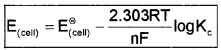
Nernst Equation :
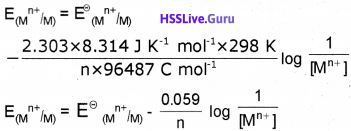
It gives a relationship between electrode potential and ionic concentration of the electrolyte. For the electrode reaction,
Mn+ (aq) + n \(\overline { e } \) → M(s)
the electrode potential at any concentration measured with respect to SHE can be represented by,
Plus Two Chemistry Notes Chapter 3 Electrochemistry 3
R = gas constant (8.314 J K-1 mol-1), T=temperaturein kelvin, n = number of electrons taking part in the electrode reaction, F = Faraday constant (96487 C mol-1)

By converting the natural logarithm to the base 10 and subsitituting the values of R(8.314 J K-1 mol-1),T (298 K) and F (96487 C mol-1) we get,
Plus Two Chemistry Notes Chapter 3 Electrochemistry 4

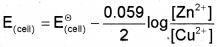
Nernst Equation for a Galvanic Cell :
In Daniell cell, the electrode potential for any concentration of Cu2+ and Zn2+ ions can be written as,
Plus Two Chemistry Notes Chapter 3 Electrochemistry 5
Converting to natural logarithm to the base 10 and substituting the values of R, F and T=298 K, it. reduces to
Plus Two Chemistry Notes Chapter 3 Electrochemistry 6
Consider a general electrochemical reaction,
Plus Two Chemistry Notes Chapter 3 Electrochemistry 7

Equilibrium Constant and Nernst Equation:
Plus Two Chemistry Notes Chapter 3 Electrochemistry 8
where Kc is the equilibrium constant.

Electrochemical Cell and Gibbs Energy of the Reaction (∆rG):
Plus Two Chemistry Notes Chapter 3 Electrochemistry 9

Conductance of Electrolytic Solutions: .Conductors:
A substance which allows the passage of electricity through it. Conductor are classified as,

Metallic or Electronic Conductors:
In these the conductance is due to the movement of electrons and it depends on:

  1. The nature and structure of the metal
  2. Number of valence electrons per atom
  3. Temperature (it decreases with increase in temperature)
    e.g. Ag, Cu, Al etc.

ii. Electrolytic Conductors
Electrolytes – The substances which conduct electricity either in molten state or in solution, e.g. NaCl, NaOH, HCl, H2SO4 etc. The conductance is due to the movement of ions. This is also known as ionic conductance and it depends on:

  1. Nature of the electrolyte
  2. Size of the ions and their solvation
  3. Nature of the solvent and its viscosity
  4. Concentration of the electrolyte
  5. Temperature (it increases with increase in temperature)

Ohm’s law – It states that the current passing through a conductor (I) is directly proportional to the potential difference (V) applied.
i.e., I ∝ V or I = \(\frac{V}{R}\)
where R – resistance of the conductor- unit ohm. In SI base units it is equal to kg m²/s³ A²

Plus Two Chemistry Notes Chapter 3 Electrochemistry

The electrical resistance of any substance/object is directly proportional to its length T, and inversly proportional to its area of cross section ‘A’.
R ∝ \(\frac{\ell}{\mathrm{A}}\) or R = ρ\(\frac{\ell}{\mathrm{A}}\) where,

ρ – (Greek, rho) – resistivity/specific resistance – SI unit ohm metre (Ω m) or ohm cm (Ω cm).

Conductance (G):
inverse or reciprocal of resistance (R).
\(G=\frac{1}{R}=\frac{A}{\rho \ell}=\kappa \frac{A}{\ell}\)
where K = \(\frac{1}{\rho}\) called conductivity or specific conductance (K – Greek, kappa)

SI unit of conductance – S (siemens) or ohm-1.
SI unit of conductivity – S m-1
1 S cm-1 = 100 S m-1

Molar Conductance of a Solution (Λm):
It is the conductance of the solution containing one mole of the electrolyte when placed between two parallel electrodes 1 cm apart. It is the product of specific conductance (K) and volume (V) in cm³ of the solution containing one mole of the electrolyte.
Plus Two Chemistry Notes Chapter 3 Electrochemistry 10
where M is molarity of the solution.
Unit of Λm is ohm’1 cm2 mol’1 Or S cm² mol-1
Λm = \(\frac{K}{C}\) [C-Concentration of the solution.]

Measurement of the Conductivity of Ionic Solutions :
The measurement of an unknown resistance can be done by Wheatstone bridge. To measure resitance of the electrolyte it is taken in a conductivity cell. The resistance of the conductivity cell is given by the equation.
\(R=\rho \frac{\ell}{A}=\frac{1}{\kappa A}\)
Plus Two Chemistry Notes Chapter 3 Electrochemistry 11
The quantity \(\frac{\ell}{\mathrm{A}}\) is called cell constant and isdenoted A by G*. It depends on the distance (/) between the electrodes and their area of cross-section (A).

Variation of Conductivity and Molar Conductivity with Concentration :
Conductivity (K) always decreases with decrease in concentration both for weak and strong electrolytes. This is because the number of ions per unit volume that carry the current in a solution decreases on dilution.

Molar conductivity (Λm) increases with decrease in concentration. This is because the total volume, V of the solution containing one mole of electrolyte also increases.

The variation of molar conductance is different for strong and weak electrolytes,

1. Variation of Λm with Concentration for Strong Electrolytes:
The molar conductance increases slowly with decrease in concentration (or increase in dilution) as shown below:
Plus Two Chemistry Notes Chapter 3 Electrochemistry 12
There is a tendency for Λm to approach a certain limiting value when concentration approaches zero i. e., dilution is infinite. The molar conductance of an electrolyte when the concentration approaches zero is called molar conductance at infinite dilution, Λm or Λ°m. The molar conductance of strong electrolytes obeys the relationship.
Λm = Λ°m -AC1/2 where C = Molar concentration, A = constant for a particular type of electrolyte.
This equation is known as Debye-Huckel-Onsagar equation.

2. Variation of Λm with Concentration for Weak Electrolytes :
For weak electrolytes the change in Λm with dilution is due to increase in the degree of dissociation and consequently increase in the number of ions in total volume of solution that contains 1 mol of electrolyte. Here, Λm increases steeply on dilution, especially near lower concentrations.
Plus Two Chemistry Notes Chapter 3 Electrochemistry 13
Thus, the variation of Λm with √c is very large so that we cannot obtain molar conductance at infinite dilution Λ°m by the extrapolation of the graph.

Kohlrausch’s Law:
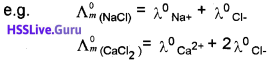
The law states that, the molar conductivity of an electrolyte at infinite dilution is equal to the sum of the molar ionic conductivities of the cations and anions at infinite dilution.
Λ°m = γ+ λ°+ + γ λ°
λ°+ and λ° are the molar conductivities of cations and anions respectively at infinite dilution, Y+ and V. are number of cations and anions from a formula unit of the electrolyte.
Plus Two Chemistry Notes Chapter 3 Electrochemistry 14

Applications of Kohlaransch’s Law
1) To calculate Λ°m of weak electrolytes

2) To calculate degree of dissociation of weak electrolytes
\(\alpha=\frac{\Lambda_{m}}{\Lambda_{m}^{0}}\)

3) To determine the dissociation constant of weak electrolytes
Plus Two Chemistry Notes Chapter 3 Electrochemistry 15

Electrolytic Cell and Electrolysis:
In an electrolytic cell, external source of voltage is used to bring about a chemical reaction. Electrolysis is the phenomenon of chemical decomposition of the electrolyte caused by the passage of electricity through its molten or dissolved state from an external source.

Plus Two Chemistry Notes Chapter 3 Electrochemistry

Quantitative Aspects of Electrolysis
Faraday’s Laws of Electrolysis First Law:
The amount of any substance liberated or deposited at an electrode is directly proportional to the quantity of electricity passing through the
electrolyte.
w α Q where ‘Q’ is the quantity of electric charge in coulombs.
w = ZQ .
w = Zlt
(∵ Q = It) where T is the current in amperes , ‘t’ is the time in seconds and ‘Z’ is a constant called electrochemical equivalent.

Second Law:
The amounts of different substances liberated by the same quantity of electricity passing through the electrolytic solution are proportional to their chemical equivalent weights.
Plus Two Chemistry Notes Chapter 3 Electrochemistry 16
The quantity of electricity required to liberate/deposit 1 gram equivalent of any substance is called Faraday constant ‘F’.
1 F = 96487 C/mol ≈ 96500 C/mol

Products of Electrolysis:
It depend on the nature of the material being electrolysed and the type of electrodes being used.

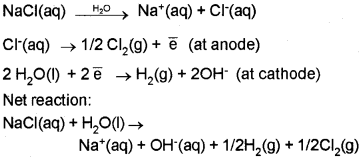
Electrolysis of Sodium Chloride:
When electricity is passed through molten NaCl, Na is deposited at the cathode and Cl2 is liberated at the anode.
Na+(aq) + \(\overline { e } \) → Na(s) (Reduction at cathode)
Cl(aq) → ½ Cl2(g) + \(\overline { e } \) (Oxidation at anode)

When concentrated aqueous solution of NaCl is electrolysed, Cl2 is liberated at anode, but at cathode H2 is liberated instead of Na deposition due to the high reduction potential of hydrogen.
Plus Two Chemistry Notes Chapter 3 Electrochemistry 17
The resultant solution is alkaline due to the formation of NaOH.

Electrolysis of CuSO4 :
When aqueous CuSO4 solution is electrolysed using Pt electrodes, Cu is deposited at the cathode and O2 is liberated at the anode.
Cu2+(aq) + 2 \(\overline { e } \) → Cu(s) (at cathode)
H2O(l) → 2H+(aq) + 1/2 O2(g) + 2 \(\overline { e } \) (at anode)

If Cu electrode is used, Cu is deposited at cathode and an equivalent amount of Cu dissolves in solution from the anode (because oxidation potential of Cu is higherthan that of water).
Cu2+(aq) + 2 \(\overline { e } \) → Cu(s) (at cathode)
Cu(s) → Cu2+(aq) + 2\(\overline { e } \) (atanode)

Commercial Cells (Batteries)
The electrochemical cells can be used to generate electricity. They are two types:
i) Primary Cells:
Cells in which the electrode reactions cannot be reversed by external energy. These cells cannot be recharged, e.g. Dry cell, Mercury cell.

ii) Secondary Cells :
Cells which can be recharged by passing current through them in the opposite direction so that they can be used again.
e.g. Lead storage battery, Nickel-Cadmium cell.

Primary Cells
a) Dry Cell:
Anode – Zn container
Cathode – Carbon (graphite) rod surrounded by powdered MnO2 and carbon.
Electrolyte – moist paste of NH4Cl and ZnCl2
The electrode reactions are :
Anode : Zn → Zn2+ + 2 \(\overline { e } \)
Cathode: MnO2 + NH4+ + \(\overline { e } \) → MnO(OH) + NH3
Dry cell has a potential of nearly 1.5 V.

Plus Two Chemistry Notes Chapter 3 Electrochemistry

b) Mercury Cell:
Anode – Zn amalgam (Zn/Hg)
Cathode – paste of HgO and carbon
Eelectrolyte – paste of KOH and ZnO. The electrode reactions are,
Anode : Zn/Hg + 2OH → ZnO(s) + H2O + 2 \(\overline { e } \)
Cathode : HgO + H2O + 2 \(\overline { e } \) → Hg(l) + 2 OH
Overall reaction : Zn/Hg + HgO(s) → ZnO(s)+ Hg(l)
The cell potential = 1.35 V

2. Secondary Cells
a) Lead Storage Battery :
Anode – lead plates
Cathode – grids of lead plates packed with lead dioxide (PbO2)
Electrolyte – 38% (by weight) soution of H2SO4.
The cell reactions when the battery is in use are,
Anode: Pb(s) + SO42-(aq) → PbSO4 + 2 \(\overline { e } \)
Cathode: PbO2(s) + SO42-(aq) + 4H+(aq) + 2 \(\overline { e } \) → PbSO4(s) + 2H2O(I)
The overall cell reaction is,
Pb(s) + PbO2(s) + 2H2SO4(aq) → 2PbSO4(s) + 2H2O(l)

The emf of the cell depends on the concentration of H2SO4. On recharging the battery the reaction is reversed and PbSO4(s) on anode is converted to Pb and PbSO4(s) at cathode is converted into PbO2.

b) Nickel-Cadmium Cell:
Anode- Cd
Cathode – metal grid containing nickel (IV) oxide. Electrolyte – KOH solution. The overall cell reaction during discharge is,
Cd(s) +2 Ni(OH)3(s) → CdO(s) + 2Ni(OH)2(s) + H2O(l)

3) Fuel Cells :
These are Galvanic cells designed to convert the energy of combustion of fuels directly into electrical energy.

H2 – O2 fuel cell – In this, hydrogen and oxygen are bubbled through porous carbon electrodes into concentrated aqueous NaOH solution, which acts as the electrolyte.
Plus Two Chemistry Notes Chapter 3 Electrochemistry 18
The electrode reactions are,
Anode : 2H2(g) + 4OH(aq) → 4H2O(l) + 4\(\overline { e } \)
Cathode : O2(g) + 2H2O(l) + 4\(\overline { e } \) → 4OH(aq)
Overall reaction : 2H2(g) + O2(g) → 2H2O(l)

Advantages of Fuel Cells –
pollution free, more efficient than conventional methods, Runs continuously as long as the reactants are supplied, electrodes are not affected.

Plus Two Chemistry Notes Chapter 3 Electrochemistry

Other examples:
CH4 – O2 fuel cell, CH3OH – O2 fuel cell

Corrosion :
Any process of destruction and consequent loss of a solid metallic material by reaction with moisture and other gases present in the atmosphere. More reactive metals are corroded more easily. Corrosion is enhanced by the presence of impurities, air & moisture, electrolytes and defects in metals.
Examples: Rusting of iron, tarnishing of Ag.

Mechanism:
In corrosion a metal is oxidised by loss of electrons to O2 and form oxides. It is essentially an electro chemical phenomenon. At a particular spot of an object made of iron, oxidation take place and that spot behaves as anode.
2 Fe(s) → 2 Fe2+ + 4\(\overline { e } \)E° = -0.44 V

Electrons released at anodic spot move through metal and go to another spot on the metal and reduce 02 in presence of H+. This spot behaves as cathode.
O2(g) + 4 H+(aq) + 4\(\overline { e } \) → 2 H2O(l) E° = 1.23 V

The overall reaction is,
2 Fe(s) + O2(g)+ 4H+(aq) → 2 Fe2+ + 2H2O(I) E° = 1,67V

The ferrous ions are further oxidised by atmospheric 02 to ferric ions and form hydrated ferric oxide (rust) Fe2O3.xH2O

Prevention of Corrosion
1) Barrier Protection:
Coating the surface with paints, grease, metals like Ni, Cr, Cu etc.

2) Sacrificial Protection:
Coating the surface of iron with a layer of more active metals like Zn, Mg, Al etc. The process of coating a thin film of Zn on iron is known as galvanisation.

3) Anti-rust Solutions:
Applying alkaline phosphate/ alkaline chromate on iron objects which provide a protectve insoluble film. Also, the alkaline nature of the solutions decreases the availability of H+ ions and thus decreases the rate of corrosion.

Plus Two Chemistry Notes Chapter 2 Solutions

Students can Download Chapter 2 Solutions Notes, Plus Two Chemistry Notes helps you to revise the complete Kerala State Syllabus and score more marks in your examinations.

Kerala Plus Two Chemistry Notes Chapter 2 Solutions

Solutions:
homogeneous mixtures of two or more pure substances, having uniform composition and properties throughout. The substances forming a solution are called components.

Solvent and Solute:
The component that is present in the largest quantity is known as solvent.

One or more components present in the solution other than solvent are called solutes. e.g. In sugar solution, water is the solvent and sugar is the solute.

Binary solution:
A solution containing only two components.

Aqueous solutions:
solutions in which the solvent is water.

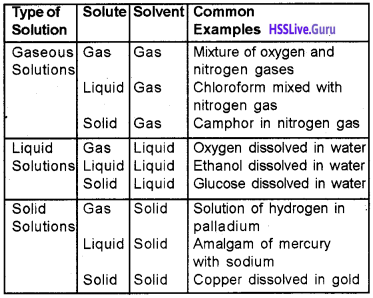
Types of Solutions
Plus Two Chemistry Notes Chapter 2 Solutions 1

Expressing Concentration of Solutions :
The concentration of a solution is defined as the amount of solute present in the given quantity of the solution.

1. Mass percentage (w/w) :
The mass % of a component in a given solution is the mass of the component (solute) per 100 g of solution.
Plus Two Chemistry Notes Chapter 2 Solutions 2
e.g. 10% glucose solution means 10 g of glucose dissolved in 90 g of water resulting in a 100 g solution.

2. Volume percentage (v/v) :
The volume % of a component in a given solution is the volume of the component per 100 volume of solution.
Plus Two Chemistry Notes Chapter 2 Solutions 3
Example:
10% ethanol solution means 10 mL of ethanol dissolved in 90 mL of water.

Plus Two Chemistry Notes Chapter 2 Solutions

3. Mass by volume percentage (w/v):
It is the mass of solute dissolved in 100 mL of the solution. Used in medicine and pharmacy.

4. Parts per million (ppm):
It is the parts of a solute (component) per million parts of the solution. When a solute is present in very minute amounts, parts per million (ppm) is used.
Plus Two Chemistry Notes Chapter 2 Solutions 4

This osmotic pressure calculator is a tool that helps you calculate the pressure required to completely stop the osmosis process.

5. Mole fraction (X):
ratio of number of moles of one component to the total number of moles of all the components present in the solution.
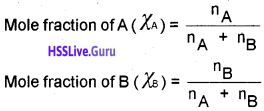
Plus Two Chemistry Notes Chapter 2 Solutions 5

For a binary solution, nA be the number of moles of A and nB be the number of moles of B.
Plus Two Chemistry Notes Chapter 2 Solutions 6

The sum of mole fractions of all the components present in the solution is always equal to 1.
i.e., χA + χB = 1
Fora solution containing ‘i’ number of components,
χ1 + χ2 +……………… + χi = 1
Mole fraction is independent of temperature.

6. Molarity (M):
number of moles of solute dissolved in one litre of the solution.
Plus Two Chemistry Notes Chapter 2 Solutions 7

7. Molality (m):
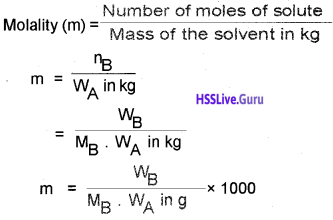
number of moles of solute per kilogram of the solvent.
Plus Two Chemistry Notes Chapter 2 Solutions 8

The mole fraction equation tells you that the mole fraction of carbon tetrachloride is 2/9 = 0.22.

Solubility:
Solubility of a substance is its maximum amount that can be dissolved in a specified amount of solvent at a particular temperature.

Factors affecting solubility
Nature of the solute, nature of the solvent, temperature ‘ and pressure

Solubility of Solids in Liquids :
Like dissolves like:
Polar solutes are soluble in polar solvents and non-polar solutes are soluble in non-polar solvents.

Unsaturated solution:
Solution in which more solute can be dissolved at the same temperature.

Plus Two Chemistry Notes Chapter 2 Solutions

Saturated solution:
Solution in which no more solute can be dissolved at the same temperature and pressure.

Effect of temperature :
Solubility increases with temperature if the reaction is endothermic. Solubility decreases with temperature if the reation is exothermic.

Effect of pressure :
Pressure does not have any significant effect on solubility of solids in liquids because solids and liquids are highly incompressible and practically remain unaffected by changes in pressure.

Solubility of a Gas in a Liquid :
It is greately affected by pressure and temperature.

Effect of pressure
Henry’s law :
The law states that at a constant temperature, the solubility of a gas in a liquid is directly proportional to the pressure of the gas.
The most commonly used form of Henry’s law states that the partial pressure of the gas in the vapour phase (p) is proportional to the molefraction of the gas (χ) in the solution.
P = KH
where KH is the Henry’s law constant.
Different gases have different KH values at the same temperature. Thus, KH is a function of the nature of the gas.

Higher the value of KH at a given pressure, the lower is the solubility of the gas in the liquid.

The solubility of gases increase with decrease of temperature. Therefore, aquatic species are more comfortable in cold waters rather than in hot waters.

Applications of Henry’s law
1. To increase the solubility of CO2 in soft drinks and soda water, the bottle is sealed under high pressure.
2. To avoid bends (a medical condition which is painful and dangerous to life caused by the formation of bubbles of N2 in the blood) the tanks used by scuba divers are filled with air diluted with He (11.7% He, 56.2% N2 and 32.1% O2).
3. At high altitudes, low pressure leads to low concentrations of O2 in blood. It causes climbers to become weak and unable to think clearly (anoxia).

Plus Two Chemistry Notes Chapter 2 Solutions

Effect of temperature :
Dissoloution of gases in liquids is an exothermic process. Hence, according to Le Chatelier’s principle solubility of gases in liquids decreases with rise in temperature.

Vapour Pressure of Liquid Solutions

Vapour Pressure of Liquid-Liquid Solutions:
Consider the two volatile liquids denoted as ‘A’ and ‘B’. When both liquids are taken in a closed vessel, both components would evaporate and an equilibrium would be established between liquid and vapour phase.
Let, PA– Partial vapour pressure of component A’
PB – Partial vapour pressure of component ‘B’
χA Mole fraction of A
χB Moiefraction of B

Raoult’s Law :
The law states that fora solution of volatile liquids, the partial vapour pressure of each component in the solution is directly proportional to its mole fraction.
For component ‘A’
PA ∝ χA.
PA= P°A χA
where P°A is the vapour pressure of pure component ‘A’ at the same temperature.
Similarly, for component ‘B’
PB ∝ χB
PB= P°B χB
where PB° is the vapour pressure of pure component ‘B’. Rauolt’s law also states that, at a given temperature for a solution of volatile liquids, the partial vapour pressure of each component is equal to the product of the vapour pressure of pure component and its mole fraction.

According to Dalton’s law of partial pressures,
Total pressure, P[Total] = PA + PB
Plus Two Chemistry Notes Chapter 2 Solutions 9

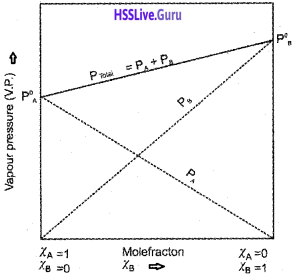
A plot of PA or PB versus the mole fractions χA and χB for a solution gives a linear plot as shown in the figure.
Plus Two Chemistry Notes Chapter 2 Solutions 10

Raoult’s Law as a special case of Henry’s Law:
According to Raoult’s law, the vapour pressure of volatile liquid in a solution is proportional to its mole fraction, i.e., Pi = Pi° χi

According to Henry’s law, the vapour pressure of a gas in a liquid is proportional to its mole fraction, i. e., p=KHχ

Thus, Raoult’s law becomes a special case of Henry ’s law in which KH becomes equal to Pi°.

Vapour Pressure of Solution of Solids in Liquids:
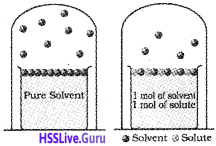
If a non-volatile solute is added to a solvent to give a solution, the surface of solution has both solute and solvent molecules; thereby the fraction of surface covered by the solvent molecules gets reduced. Consequently, the number of solvent molecules escaping from the surface is reduced. Hence, the vapour pressure of solution is lower than vapour pressure of pure solvent.
Plus Two Chemistry Notes Chapter 2 Solutions 11

General form of Raoult’s Law:
For any solution, the partial vapour pressure of each volatile component in the solution is directly proportional to its mole fraction.

In a binary solution, let us denote the solvent by ‘A’ and solute by ‘B’.
According to Raoult’s law,
PA ∝ χA
PA = PA° χA
Total pressure, P = PA Here, PB = 0
(∵ solute is non-volatile)
P = PA° χA
For binary solution,
χA + χB = 1
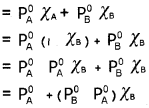
χA = 1 – χB
Thus, the above equation becomes,
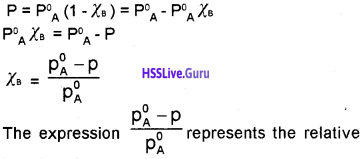
Plus Two Chemistry Notes Chapter 2 Solutions 12
lowering of vapour pressure.

Ideal and Non-ideal Solutions :
Ideal Solutions:
The solutions which obey Raoult’s law over the entire range of concentrations.

Important properties of Ideal Solutions
i. PA = P°A χA ; PB = P°B χB
ii. Enthalpy of mixing is zero (∆mixH = 0)
iii. Volume of mixing is zero (∆mixV = 0)

If the intermolecular attractive forces between A – A and B – Bare nearly equal to those between A – B, it leads to the formation of ideal solution.

Plus Two Chemistry Notes Chapter 2 Solutions

Examples:

  1. Solution of n-hexane and n-heptane
  2. Solution of bromoethane and chloroethane
  3. Solution of benzene and toluene

Non-ideal Solutions :
solutions which do not obey Raoult’s law overthe entire range of concentration. The vapour pressure of such solutions is either higher or lower than that predicted by Raoult’s law.

If the vapour pressure is higher, it exhibits positive deviation and if the vapour pressure is lower it exhibits negative deviation from the Raoult’s law.

Solutions showing positive deviation :
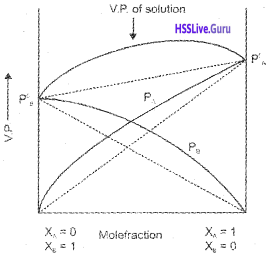
the intermolecular attractive forces between the solute- solvent molecules are weaker than those between the solute-solute and solvent-solvent molecules. Thus, in such solutions molecules will find it easier to escape than in pure state. This will increase the vapour pressure and results in the positive deviation.
Plus Two Chemistry Notes Chapter 2 Solutions 13
(dotted line represents graph for ideal solution).
Examples:
Ethanol + Water, Ethanol + Acetone, CCl4 + Chloroform, C6H6 + Acetone , n-Hexane + Ethanol

Solution showing negative deviation:
In the case of negative deviation, the intermolecular attractive forces between solvent-solute molecules are greater than those between solvent-solvent and solute-solute molecules and leads to decrease in the vapour pressure.
Plus Two Chemistry Notes Chapter 2 Solutions 14

Examples:
1. Mixture of phenol and aniline – In this case the intermolecular hydrogen bonding between phenolic proton and lone pair on nitrogen atom of aniline is stronger than the respective intermolecular hydrogen bonding between similar molecules.
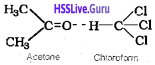
2. Mixture of acetone and chloroform – Here chloroform molecule is able to form hydrogen bond with acetone molecule.
Plus Two Chemistry Notes Chapter 2 Solutions 15

3. H2O + HCl, (4) H2O + HNO3, (5) CHCl3 + (C2H5)2O

Azeotropes:
binary mixtures having same composition in liquid and vapour phase and boil at a constant temperature. It is not possible to separate the components of azeotropes by fractional distillation.

Plus Two Chemistry Notes Chapter 2 Solutions

Solutions which show large positve deviation from Raoult’s law form minimum boiling azeotrope at a specific composition. For example, ethanol-water mixture forms a minimum boiling azeotrope (b.p. 351.1 K) when approximately 95% by volume of ethanol is reached.

The solutions that show large negative deviation from Raoult’s law form maximum boiling azeotrope at a specific composition. For example, nitric acid and water form a maximum boiling azeotrope (b.p. 393.5 K) at the approximate composition, 68% nitric acid and 32% water by mass.

Colligative Properties :
properties which depend on the number of solute particles irrespective of their nature relative to the total number of particles present in the solution. These are,
i. Relative lowering of vapour pressure of the solvent \(\left(\frac{\Delta p_{1}}{p_{1}^{0}}\right)\)
ii. Elevation of boiling point of the solvent (∆Tb)
iii. Depression of freezing point of the solvent (∆Tf)
iv. Osmotic pressure of the solution (π)

Relative Lowering of Vapour Pressure:
When a non-volatile solute (B) is dissolved in a liquid solvent (A), the vapour pressure of the solvent is lowered. This phenomenon is called lowering of vapour pressure. It depends only on the concentration of the solute particles and it is independent of their identity. The relation between vapour pressure of solution, mole fraction and vapour pressure of the solvent is given as,
PA = χAA ……………(1)
The lowering of vapour pressure of solvent ∆ PA is given as,
∆ PA = P°A – PA ……………(2)
Substitute the equation (1) in (2)
∆ PA = P°A – P°AχA
= P°A(1 – χA)
∆ PA = P°AχB …………..(3) ∵ (1 – χA) = χB
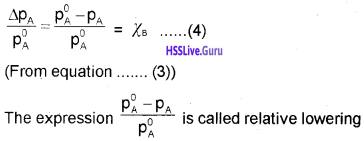
The relative lowering of vapour pressure is given as,
Plus Two Chemistry Notes Chapter 2 Solutions 16
of vapour pressure and is equal to the mole fraction of solute.
From equation (4),
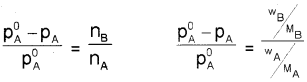
Plus Two Chemistry Notes Chapter 2 Solutions 17
For dilute solutions nB < < nA, hence neglecting nB In the denominator, the above equation becomes,
Plus Two Chemistry Notes Chapter 2 Solutions 18
where wA and wB are the masses and MA and MB are the molar masses of solvent and solute respectively.
Plus Two Chemistry Notes Chapter 2 Solutions 19

Elevation of boiling point (∆Tb):
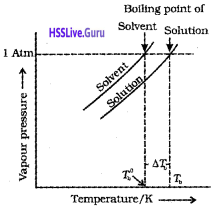
The boiling point of a solution is higher than that of the pure solvent. The elevation in the boiling point depends ‘ on the number of solute molecules rather than on their nature.
Plus Two Chemistry Notes Chapter 2 Solutions 20

Let T°b be the boiling point of pure solvent and Tb be the boiling point of solution. The increase in the boiling point ∆Tb = Tb – T°b is known as elevation of boiling point.

Plus Two Chemistry Notes Chapter 2 Solutions

For a dilute solution, the elevation of boiling point ( ∆Tb) is directly proportional to the molal concentration of the solute in a solution (i.e., molality).
∆Tb ∝ m
∆Tb = Kbm …………(1)

where, m → molality and Kb → Boiling Point Elevation Constant/Molal Elevation Constant/ Ebullioscopic Constant.
Unit of Kb is K kg mol-1 Or K m-1
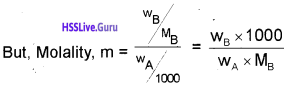
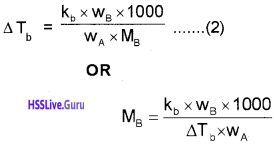
Plus Two Chemistry Notes Chapter 2 Solutions 21
Substituting the value of‘m’ in equation (1),
Plus Two Chemistry Notes Chapter 2 Solutions 22

Depression of Freezing point (∆Tf) :
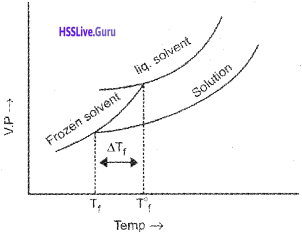
The lowering of vapour pressure of a solution causes a lowering of the freezing point compared to that of the pure solvent.
Plus Two Chemistry Notes Chapter 2 Solutions 23
Let T°f be the freezing point of pure solvent and Tf be the freezing point of solution.
Depression in freezing point ∆Tf= T°f – Tf
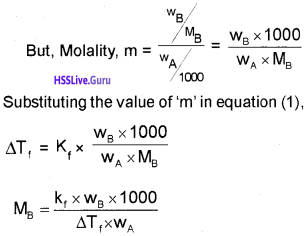
For a dilute solution, depression of freezing point (∆Tf) is directly proportioned to molality (m) of the solution. Thus,
∆Tf ∝ m
∆Tf = Kfm ………………(1)
where, Kf – Freezing Point Depression Constant/ Molal Depression Constant/Cryoscopic Constant.
Unit of Kf is K kg mol-1 Or K m-1
Plus Two Chemistry Notes Chapter 2 Solutions 24
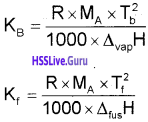
[Note: The values of Kb and Kf, depend upon the nature of the solvent. They Can be ascertained from the following equations:
Plus Two Chemistry Notes Chapter 2 Solutions 25
where,
R → Gas constant, MA → Molar mass of solvent
Tb → Boiling point of pure solvent of kelvin
Tf → Freezing point of pure solvent in kelvin
fusH → Enthalpy of fusion, ∆vapH → enthalpy of vapourisation.
For water, Kb = 0.52 K kg mol-1 and Kf = 1.86 K kg mol-1]

Osmosis and Osmotic Pressure:
The process of flow of the solvent molecules from pure solvent to the solution through semipermeable membrane (SPM) is called osmosis.

Semi Permeable Membrane :
The membrane which allows the passage of solvent molecules but ’ not the solute molecule is called SPM.

Example:
Parchment paper, Pig’s bladder, Cell wall, Film of cupric ferrocyanide.

Plus Two Chemistry Notes Chapter 2 Solutions

Osmotic Pressure (π):
the excess pressure which must be applied to a solution to prevent osmosis or the pressure that just stops the flow of solvent.

Osmotic pressure (π) is proportional to the molarity (C) of the solution at a given temperature (T K).
π = CRT, where R is the gas constant.
π = \(\frac{n_{B}}{V}\)RT, where nc is the number of moles of the solute and V is the volume of the solution in litres.
π = nBRT
π V= \(\frac{\mathrm{W}_{\mathrm{B}}}{\mathrm{M}_{\mathrm{B}}}\)RT , where wB is the mass of the solute and MB is the molar mass of the solute.
Or MB = \(\frac{\mathbf{w}_{\mathrm{B}} \mathrm{RT}}{\pi \mathrm{V}}\)

Osmotic pressure measurement is widely used to determine molar mass of proteins, polymers and other macro molecules.

Advantages of osmotic pressure method:
i) pressure measurement is around the room temperature
ii) molarity of the solution is used instead of molality
iii) the magnitude of osmotic pressure is large compared to other colligative properties even for very dilute solutions.

Isotonic Solution :
Two solutions having same (equal) osmotic pressure at a given temperature. A 0.9% solution of NaCI (normal saline solution) is isotonic with human blood, and it is safe to inject intravenously.

Hypertonic Solution :
A solution having higher osmotic pressure than another solution.
Hypotonic Solution :
A solution having lower osmotic pressure than another solution.

Reverse Osmosis:
flow of the pure solvent from solution side to solvent side through semipermeable membrane when a pressure larger than the osmotic pressure is applied to the solution side.

Uses of reverse osmosis:
Desalination of sea water, Purification of water.

Plus Two Chemistry Notes Chapter 2 Solutions

Abnormal Molar Mass :
In some cases, the molar mass determined by colligative properties do not agree with the theoretical values. This is due to association ordissociation of the solute particles in the solution.

Association of Solute Particles :
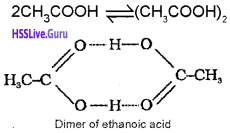
When solute particles undergo association the number of the solute particles in the solution decreases. Consequently, the experimental values of colligative properties are less than the expected values, e.g. Molecules of ethanoic acid (acetic acid) dimerise in benzene due to intermolecular hydrogen bonding.
Plus Two Chemistry Notes Chapter 2 Solutions 26
Similarly, benzoic acid undergo dimerisation when dissolved in benzene.

Dilution Factor Formula (Equation) … We can cancel each side down using their largest common factor to get the simplest integer expression of the dilution

Dissociation of Solute Particles :
When the solute particles dissociate or ionise in the solvent, the number of particles in solution increases and so the experimental values of the colligative properties are higher than the calculated values.
e.g. KCl in water ionises as
KCl → K+ + C
Molar mass either lower or higher than the expected or normal value is called as abnormal molar mass.

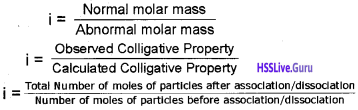
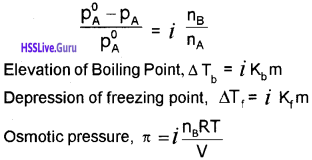
van’t Hoff factor (i):
It accounts for the extent of association or dissociation.
Plus Two Chemistry Notes Chapter 2 Solutions 27

Significance of van’t Hoff factor.
i > 1 ⇒ there is dissociation of solute particles.
i < 1 ⇒ there is association of solute particles.
i < 1 ⇒ there is no dissociation and association of solute particles.

Inclusion of van’t Hoff factor modifies the equations for colligative properties as follows:
Relative lowering of vapour pressure of solvent,
Plus Two Chemistry Notes Chapter 2 Solutions 28

Plus Two Physics Notes Chapter 12 Atoms

Students can Download Chapter 12 Atoms Notes, Plus Two Physics Notes helps you to revise the complete Kerala State Syllabus and score more marks in your examinations.

Kerala Plus Two Physics Notes Chapter 12 Atoms

Introduction
What is the arrangement of +ve charge and the electrons inside the atom? In other words, what is the structure of an atom?

Alpha-particle Scattering And Rutherford’s Nuclear Model Of Atom
Rutherford’s scattering experiment:
Plus Two Physics Notes Chapter 12 Atoms - 1

Experimental arrangement:
α particles are incident on a gold foil (very small thickness) through a lead collimator. They are scattered at different angles. The scattered particles are counted by a particle detector.

Observations:
Most of the alpha particles are scattered by small angles. A few alpha particles are scattered at an angle greater than 90°.

Plus Two Physics Notes Chapter 12 Atoms

Conclusions

  1. Major portion of the atom is empty space.
  2. All the positive charges of the atom are concentrated in a small portion of the atom.
  3. The whole mass of the atom is concentrated in a small portion of the atom.

Rutherford’s model of atom

  1. The massive part of the atom (nucleus) is concentrated at the centre of the atom.
  2. The nucleus contains all the positive charges of the atom.
  3. The size of the nucleus is the order of 10-15m.
  4. Electrons move around the nucleus in circular orbits.
  5. The electrostatic force of attraction (between proton and electron) provides centripetal force.

1. Alpha-particle trajectory and Impact parameter:
The impact parameter is the perpendicular distance of the initial velocity vector of the a particle from the centre of the nucleus.
Plus Two Physics Notes Chapter 12 Atoms - 2
It is seen that an α particle close to the nucleus (small impact parameter) suffers large scattering. In case of head-on collision, the impact parameter is minimum and the α particle rebounds back. For a large impact parameter, the α particle goes nearly undeviated and has a small deflection.

2. Electron orbits (Rutherford model of atom):
In Rutherford atom model, electrons are revolving around the positively charged nucleus. The electro-static force of attraction between the positive charge and negative charge provide centripetal force required for rotation.
For a dynamically stable orbit,
Centripetal force = Electrostatic force of attraction
Fc = Fe
Plus Two Physics Notes Chapter 12 Atoms - 3
Thus the relation between the orbit radius and the electrons velocity,
Plus Two Physics Notes Chapter 12 Atoms - 4
Total energy of electron of Hydrogen atom (Rutherford model atom):
From eq. (1), we get
Plus Two Physics Notes Chapter 12 Atoms - 5

Plus Two Physics Notes Chapter 12 Atoms
∴ Kinetic energy of electron
KE = \(\frac{1}{2}\)mv2 ……….(3)
Substituting eq.(2) in eq. (3) we get
KE = \(\frac{e^{2}}{8 \pi \varepsilon_{0} r}\) …………(4)
The electrostatic potential energy of hydrogen atom
\(\frac{e^{2}}{8 \pi \varepsilon_{0} r}\)
u = \(\frac{-e^{2}}{4 \pi \varepsilon_{0} r}\) ………..(5)
∴ The total energy E of the electron in a hydrogen atom
E = K.E + Potential energy (U)
Plus Two Physics Notes Chapter 12 Atoms - 6
The total energy of the electron is negative. This implies that the electron is bound to the nucleus.
If E is positive, the electron will escape from the nucleus.

Atomic Spectra
There are two types of spectra

  1. Emission spectra
  2. Absorption spectra

1. Emission spectra:
When an atomic gas or vapor is excited, the emitted radiation has a spectrum which contains certain wavelength only. A spectrum of this kind is termed as emission line spectrum. It consists of bright lines on a dark background.

Absorption spectra:
When white light passed through a gas, the transmitted light has spectrum contain certain wavelength only. A spectrum of this kind is termed as absorption line spectrum. It consists of dark lines on a bright background.

1. Spectral series:
Plus Two Physics Notes Chapter 12 Atoms - 7
The frequencies of the light emitted by a particular element exhibit some regular pattern. Hydrogen is the simplest atom and therefore, has the simplest spectrum, the spacing between lines of the hydrogen spectrum decreases in a regular way. Each of these sets is called a spectral series.

The first such series was observed by a Johann Jakob Balmer in the visible region of the hydrogen spectrum. This series is called Balmer series. Balmer found a simple empirical formula for the observed wavelengths.
Plus Two Physics Notes Chapter 12 Atoms - 8
where λ is the wavelength, R is a constant called the Rydberg constant, and n may have integral values 3, 4, 5, etc. The value of R is 1.097 × 10⁷m-1. This equation is also called Balmer formula.

Other series of spectra for hydrogen were discovered. These are known, as Lyman, Paschen, Brackett, and Pfund series. These are represented by the formulae:
Lyman series:
Plus Two Physics Notes Chapter 12 Atoms - 9

Plus Two Physics Notes Chapter 12 Atoms
Balmer series:
Plus Two Physics Notes Chapter 12 Atoms - 10
Paschen series:
This series is in the infrared region. For this series the electron must jump from higher orbit to the third orbit.
Plus Two Physics Notes Chapter 12 Atoms - 11
Bracket series:
This series is the infrared region, for this the electron must jump from higher energy level to fourth orbit.
Plus Two Physics Notes Chapter 12 Atoms - 12
P-fund series:
This series is in the infrared region.
Plus Two Physics Notes Chapter 12 Atoms - 13

Bohr Model Of Hydrogen Atom
Limitations of Rutherford model:
1. Circular motion is an accelerated motion, an accelerated charge emit radiations. So that electron should emit radiation. Due to this emission of radiation, the energy of the electron decreases. Thus the atom becomes unstable.

2. There is no restriction for the radius of the orbit. So that electron can emit radiations of any frequency.

Bohr postulates:
Bohr combined classical and early quantum concepts and gave his theory in the form of three postulates.

  • Electrons revolve round the positively charged nucleus in circular orbits.
  • The electron which remains in a privileged path cannot radiate its energy.
  • The orbital angular momentum of the electron is an integral multiple of h/π.
  • Emission or Absorption of energy takes place when an electron jumps from one orbit to another.

Radius of the hydrogen atom:
Consider an electron of charge ‘e’ and mass m revolving round the positively charged nucleus in circular orbit of radius ‘r’. The force of attraction between the nucleus and the electron is
Plus Two Physics Notes Chapter 12 Atoms - 14
This force provides the centripetal force for the orbiting electron
Plus Two Physics Notes Chapter 12 Atoms - 15

Plus Two Physics Notes Chapter 12 Atoms
According to Bohr’s second postulate, we can write
Angular momentum, mvr \(=\frac{n h}{2 \pi}\).
ie. v = \(\frac{n h}{2 \pi m r}\) _____(4)
Substituting this value of ‘v’ in equation (2), we get
Plus Two Physics Notes Chapter 12 Atoms - 16
Energy of the hydrogen atom:
The K.E. of revolving electron is
K.E\(=\frac{1}{2}\) mv2 ______(6)
Substituting the value of equation (3) in eq.(6), we get
K.E = \(\frac{1}{2} \frac{e^{2}}{4 \pi \varepsilon_{0} r}\) ______(7)
The potential energy of the electron,
P.E = \(\frac{-e^{2}}{4 \pi \varepsilon_{0} r}\) _______(8)
ie. The Total energy of the hydrogen atom is,
T.E = Ke + PE
Plus Two Physics Notes Chapter 12 Atoms - 17
Substituting the value of equation (5) in equation (9) we get
Plus Two Physics Notes Chapter 12 Atoms - 18

Plus Two Physics Notes Chapter 12 Atoms

1. Energy levels
Ground state (E1):
Ground state is the lowest energy state, in which the electron revolving in the orbit of smallest radius.
For ground state n = 1
∴ Energy of hydrogen atom E1 = \(\frac{-13.6}{n^{2}}\) = -13.6 ev.

Excited State (E2):
When hydrogen atom receives energy, the electrons may raise to higher energy levels. Then atom is said to be in excited state.

First Excited state:
For first excited state n = 2
∴ Energy of first excited state E2 = \(\frac{-13.6}{2^{2}}\) = -3.04ev
Similarly energy of second excited state
E3 = \(\frac{-13.6}{3^{2}}\) = -1.51ev

Energy difference between E1 and E2 of H atom:
The energy required to exist an electron in hydrogen atom to its first existed state.
∆E = E2 – E1 = 3.4 – 13.6 = 10.2eV.

Ionization energy:
Ionization energy is the minimum energy required to free the electron from the ground state of atom. (ie. n = 1 to n = ∞)
The ionization of energy of hydrogen atom = 13.6 ev

2. Energy level diagram of hydrogen atom:
Plus Two Physics Notes Chapter 12 Atoms - 19
Note:
An electron can have any total energy above E = 0ev. In such situations electron is free. Thus there is a continuum of energy states above E = 0ev.

The Line Spectra Of The Hydrogen Atom
According to the third postulate of Bohr’s model, when an atom makes a transition from higher energy state (ni) to lower energy state (nf), photon of energy hvif is emitted.
ie. hνif = Eni – Enf

Get and Sign Counting Atoms Calculator Form.

Plus Two Physics Notes Chapter 12 Atoms

De Broglie’s Explanation Of Bohr’s Second Postulate Of Quantization
Louis de Broglie argued that the electron in its circular orbit, behalf as a particle wave. Particle waves can produce standing waves under resonant conditions.
The condition to get standing wave,
2πrn = nλ
n = 1, 2, 3……..
The quantized electron orbits and energy states are due to the wave nature of the electron.

DeBroglie’s Proof for Bohr’s second postulate:
According to De Broglie, the electron in a circuit orbit is a particle wave. The particle wave can produce standing waves under resonant conditions. The condition for resonance for an electron moving in nth circular orbit of radius rn,
2πrn = nλ______(1)
n = 1, 2, 3………
If the speed of electron is much less than the speed of light, wave length
Plus Two Physics Notes Chapter 12 Atoms - 20

Plus Two Physics Notes Chapter 12 Atoms
Note:
The quantized electron orbits and energy states are due to the wave nature of the electron.

Limitations of Bohr atom model:

  1. The Bohr model is applicable to hydrogenic atoms. It cannot be extended to many electron atoms such as helium
  2. The model is unable to explain the relative intensities of the frequencies in the spectrum.
  3. Bohr model could not explain fine structure of spectral lines.
  4. Bohr theory could not give a satisfactory explanation for circular orbit.

Plus Two Computer Application Model Question Paper 2

Kerala Plus Two Computer Application Model Question Paper 2

Time: 2 Hours
Cool off time: 15 Minutes
Maximum: 60 Scores

  • There is a ‘cool off time’ of 15 minutes in addition to the writing time of 2 hrs.
  • Use the ‘cool off time’ to get familiar with the questions and to plan your answers.
  • Read questions carefully before you answering.
  • Read the instructions carefully.
  • Calculations, figures and graphs should be shown in the answer sheet itself.
  • Malayalam version of the questions is also provied.
  • Give equations wherever necessary.
  • Electronic devices except non programmable calculators are not allowed in the Examination Hall.

Plus Two Computer Application Previous Year Question Papers and Answers

Part A

Answer all questions from 1 to 5
Plus Two Computer Application Model Question Papers Paper 2A

Question 1.
In C+ + , the array index starts with
Plus Two Computer Application Model Question Papers Paper 2Q1

Question 2.
State whether the following statement is true or false:
A link from one section to another section of the same HTML document is known as external linking.
Plus Two Computer Application Model Question Papers Paper 2Q2

Question 3.
…………….protocol helps e-mail communication.
Plus Two Computer Application Model Question Papers Paper 2Q3

Question 4.
…………..is a fully integrated business management system.
Plus Two Computer Application Model Question Papers Paper 2Q4

Question 5.
Cyber terrorism is a type of cyber crime against…………………
Plus Two Computer Application Model Question Papers Paper 2Q5

Part B

Answer any nine questions from 6 to 16
Plus Two Computer Application Model Question Papers Paper 2B

Question 6.
Write the output of the following JavaScript code. Give reason.
Plus Two Computer Application Model Question Papers Paper 2Q6
Plus Two Computer Application Model Question Papers Paper 2Q6.1

Question 7.
Write any 3 attributes used in <BODY> tag.
Plus Two Computer Application Model Question Papers Paper 2Q7

Question 8.
There are two web pages in the class project created by Mathew. The second page should appear in the browser when clicked at a particular text in the first page. What do you call this feature? Name the tag and attribute needed for creating such a feature.
Plus Two Computer Application Model Question Papers Paper 2Q8

Question 9.
“CSS plays an important role in developing websites today”. Write the advantages of using CSS in websites?
Plus Two Computer Application Model Question Papers Paper 2Q9

Question 10.
Raju wishes to host a website for his family. What are the advantages that free web hosting companies provide?
Plus Two Computer Application Model Question Papers Paper 2Q10
Plus Two Computer Application Model Question Papers Paper 2Q10.1

Question 11.
How many distinct tuples and attributes are there in a relation with cardinality 22 and degree 7.
Plus Two Computer Application Model Question Papers Paper 2Q11

Question 12.
Create a table named Stock and apply table constraints to it.
Plus Two Computer Application Model Question Papers Paper 2Q12

Question 13.
What are the risks of ERP implementation?
Plus Two Computer Application Model Question Papers Paper 2Q13

Question 14.
“Non-local nature of cyber crime creates problems to the investigators”. Explain.
Plus Two Computer Application Model Question Papers Paper 2Q14

Question 15.
Discuss the different technologies that are used to enhance data communication features of GSM.
Plus Two Computer Application Model Question Papers Paper 2Q15

Question 16.
What is a GPS?
Plus Two Computer Application Model Question Papers Paper 2Q16

Part C

Answer any nine questions from 17 to 27
Plus Two Computer Application Model Question Papers Paper 2C

This page features a Fibonacci calculator generating both retracement and extension values for both uptrends and downtrends.

Question 17.
Write a C++ program to display n terms of the Fibonacci series.
Plus Two Computer Application Model Question Papers Paper 2Q17

Question 18.
Distinguish between switch and else if ladder statements.
Plus Two Computer Application Model Question Papers Paper 2Q18

Question 19.
Identify the built-in functions needed for following cases:
a. To convert the letter ‘c’ to ‘C’.
b. To check whether a given character is alphabet or not.
c. To combine strings “comp” and “uter” to make “computer”.
Plus Two Computer Application Model Question Papers Paper 2Q19

Question 20.
Explain any three stream functions for I/O operation.
Plus Two Computer Application Model Question Papers Paper 2Q20

Question 21.
What is the difference between <UL> tag and <0L> tag?
Plus Two Computer Application Model Question Papers Paper 2Q21

Question 22.
Create a web page that displays sum of numbers upto a given limit.
Plus Two Computer Application Model Question Papers Paper 2Q22

Question 23.
What are the data types in JavaScript?
Plus Two Computer Application Model Question Papers Paper 2Q23

Question 24.
How data is organized in DBMS
Plus Two Computer Application Model Question Papers Paper 2Q24

Question 25.
List any five built-in functions of SQL.
Plus Two Computer Application Model Question Papers Paper 2Q25

Question 26.
“Awareness is the best way to protect ourselves in cyberspace”. Comment.
Plus Two Computer Application Model Question Papers Paper 2Q26

Question 27.
Normally a function has its prototype and definition.
a. Write the function prototyping of a user defined function Max ( ) which accepts two integer values and return the larger between them.
b. Write the definition of the Max ( ) function.

Part D

Answer any two questions from 28 to 30
Plus Two Computer Application Model Question Papers Paper 2D

Question 28.
Suggest some safety measures taken for using internet ?
Plus Two Computer Application Model Question Papers Paper 2Q28

Question 29.
Suppose you are browsing the website www.prdkerala.org. Explain hoVy the DNS resolves the IP address.
Plus Two Computer Application Model Question Papers Paper 2Q29

Question 30.
Explain the various functional units of Enterprise Resource Planning.
Plus Two Computer Application Model Question Papers Paper 2Q30

ANSWERS

Answer 1.
0

Answer 2.
false

Answer 3.
Simple Mail Transfer Protocol

Answer 4.
Enterprise Resource Planning (ERP)

Answer 5.
governments

Answer 6.
101
Variable x is a string. So string addition takes place as y is also treated as string.

Answer 7.

  1. Background: This attribute sets an image as background for the documents body.
  2. Bgcolor: This attribute specifies a colour for the background of the document body.
  3. Text: This attribute specifies the colour of the text content in the page.

Answer 8.
Link <A>, Href

Answer 9.
It is a style sheet language used for describing the formatting of a document written in HTML. A CSS file allows us to separate HTML content from its style. The advantage of CSS is that we can reuse the same code for all the pages. This also reduces the size of the web page thereby providing faster downloads for web pages.

Answer 10.
Free hosting provides web hosting service free of charge. Some free web hosting sites provide the facility to upload the files of our website in their server. Free web hosting services usually provide either their own subdomain or as a directory service for accessing our websites. Some free web hosting companies provide domain name registration services also.

Answer 11.
Number of tuples = 22
Attributes = 7

Answer 12.

CREATE TABLE Stock(code CHAR (2) PRIMARY KEY AUTO_
INCREMENT, name VARCHAR (25) NOT NULL,
purchase DATE, rate DECIMAL (10, 2), ay INT, UNIQUE (code, name));

Answer 13.

  1.  High cost: The cost of implementation and configuration of ERP software is high.
  2. Time consuming: The ERP implementation is performed in many phases, so it consumes much time.
  3. Requirement of additional trained staf: Trained staffs are needed to run ERP system.
  4. Operational and maintanance issue: The implementation process is a continuous process, so maintenance of an ERP system is very difficult.

Answer 14.
An important aspect of cyber crime is its non-local character. A crime can occur in-jurisdictions separated by vast distances. That is, an attacker may operate from a country and attack a destination in some other country. So the investigating team and the judiciary of different countries . must keep hand in hand. Due to the anonymous nature of the Internet, it is possible for people to engage in a variety of criminal activities. People commit cyber crimes knowingly or unknowingly.

Answer 15.
GPRS (General Packet Radio Services) is a packet oriented mobile data service on the 2G on GSM. EDGE (Enchanced Data rates for GSM Evolution) is three times faster than GPRS. It is used for voice communication as well as an internet connection.

Answer 16.
Global Positioning System (GPS) is space based satellite navigation system that provides location and time information in all weather conditions, anywhere on or near the Earth where there is an unobstructed line of sight to 4 or more GPS satellites.

Answer 17.

# include <iostream>
Using namespace std;
int main( )
{
int num, sum = 0, dig;
cout<<“Enter a number";
cin>>num;
while (num>0)
{
dig = num%10;
sum = sum + dig;
num = num/10;
}
cout<<“Sum of the digits of the input number = ”<<sum;
return 0;
}

Answer 18.
switch:

  • Permits multiple branching.
  • Evaluates conditions with equality operator only.
  • Case constant must be an integer or a character type value.
  • When no match is found, default statement is executed.
  • break statement is required to exit from switch statement.
  • More efficient when the same variable or expression is compared against a set of values for equality,

else if ladder:

  • Permits multiple branching.
  • Evaluates any relational or logical expression.
  • Condition may include range of values and floating point constants.
  • When no expression evaluates to True, else block is executed.
  • Program control automatically goes out after the completion of a block.
  • More flexible and versatile compared to . switch.

Answer 19.
a. toupper ( )
b. isalpha ( )
c. strcat ( )

Answer 20.
i. get ( ). It can accept a single character or multiple characters (string) through the keyboard. To accept a string, an array name and size are to be given as arguments.

eg., ch = cin.get(ch);
cin.get (ch);
cin.get (str,10);

ii. getline ( ). It accepts a string through the keyboard. The delimiter will be Enter key, the number of characters or a specified character.

eg., cin.getline(strjen);
cin.getline(str,len,ch);

iii. write ( ). This function displays the string contained in the argument.

eg., char str [ 10] = “hello”;
cout.write (str,10);

Answer 21.
We can create an unordered list with the tag pair<UL> and </UL>. Each item in the list is presented by using the tag pair <LI> and </LI>. HTML provides the tag pair <OL> and </OL> to create an ordered list. The items in the ordered list are presents by <LI> tag in <OL> element.

Answer 22.

<HTML>
<HEAD>
<TITLE> JavaScript-Sum</TITLE>
<SCRIPT Language = “JavaScript”> function Sumlimit( )
{
var sum = 0, i, I;
l=Number(document.frmSum.txtLimit.value);
for (i = 1; i<=l; i+ + )
sum + = i;
document.frmSum. txtSum.value = sum;
}
</SCRIPT>
</HEAD>
<BODY>
<FORM Name = “frmSum”>
<CENTER>
Enter the limit
<INPUTType = “text” Name = “txtLimit”> <BR> <BR>
Sum of Numbers
<INPUTType = “text” Name = “txtSum”>
<BR> <BR>
<INPUT Type = “button” Value = “Show"
onClick = “sumLimit()”>
</ CENTER>
</FORM>
</BODY>
</HTML>

Answer 23.
The three primitive data types in JavaScript are Number, String and Boolean.
Number: They include integers, floating point numbers and signed numbers.
Strings: A string is a combination of characters, numbers or symbols enclosed within double quotes.
Boolean: A boolean data can be either True or False ( without double quates).

Answer 24.
Data is organized as fields, records and files.
Fields: A field is the smallest unit of stored data. Each field consists of data of a specific type, eg., Name, Marks.
Record: A record is a collection of related fields.
File: A file is a collection of all occurrence of same type of records.

Answer 25.
SUM(): Total of the values in the column.
AVG ( ): Average of the values in the column.
MIN ( ): Smallest value in the coluqin.
MAX( ): Largest value in the column.
COUNT ‘( ): Number of non NULL values in the column.

Answer 26.
Awareness is the first step in protecting ourselves, our family and our business. We should remember that our actions over the internet are being monitored by several others. Some of the ethical practices over the internet are:

  • Use anti-virus, firewall, and spam blocking software for your PC.
  • Ensure security of websites (https and padlock) while conducting online cash transactions.
  • Do not respond or act on e-mails sent from unknown sources.
  • Use unique and complex passwords for accounts and change your passwords on a regular basis.

Answer 27.

a. int Max (int x, int y);
b. int Max (int a, int b)
{
if (a > b)
return a;
else
return b;
}

Answer 28.
a. Use antivirus, firewall and spam blocking software on your PC.
b. Ensure secure websites for financial transactions.
c. Do not respond or act on email sent from unknown sources.
d. Use complex passwords and change it frequently.
e. Don’t hide your identity and fool others.
f. Do not use bad languages on e-mail and social networks.
g. Do not click on pop-up ads.

Answer 29.
The following steps illustrate how the DNS resolves the IP address:

  • All browsers store the IP addresses of the recently visited websites in its cache. Therefore, the browser first searches its local memory (mini cache) to see whether it has the IP address of this domain. If found, the browser uses it.
  • If it is not found in the browser cache, it checks the operating system’s local cache for the IP address.
  • If it is not found there, it searches the DNS server of the local ISP.
  • In the absence of the domain name in the ISP’s DNS server, the ISP’s DNS server initiates a recursive search starting from the root server till it receives the IP address.
  • The ISP’s DNS server returns this IP address to the browser.
  • The browser connects to the web server using the IP address of website and the webpage is displayed in the browser window. If the IP address is.not found, it returns the message ‘Server not found’ in the browser window.

Answer 30.

  1. Financial module. This module collects financial data from various department and generate various reports.
  2. Manufacturing module. This module manages and provides information for the entire production process.
  3. Production planning module. This module is used for the utilization of resources in an optimized way so as to maximize the production and minimize the loss.
  4. Inventory control module. It manages the stock requirement for an organization.
  5. Purchasing module. This module is responsible for the availability of raw material in the right time at the right price.

Plus Two Computer Application Previous Year Question Papers and Answers

Plus Two Malayalam Textbook Answers Unit 4 Madhyamam

Kerala State Board New Syllabus Plus Two Malayalam Textbook Answers Unit 4 Madhyamam Text Book Questions and Answers, Summary, Notes.

Kerala Plus Two Malayalam Textbook Answers Unit 4 Madhyamam

Madhyamam Questions and Answers

Plus Two Malayalam Textbook Answers Unit 4 Madhyamam 1

Plus Two Malayalam Textbook Answers Unit 4 Madhyamam 2

Plus Two Malayalam Textbook Answers Unit 4 Madhyamam 3

Plus Two Malayalam Textbook Answers Unit 4 Madhyamam 4

Plus Two Malayalam Textbook Answers Unit 4 Madhyamam 5

Plus Two Malayalam Textbook Answers Unit 4 Madhyamam 6

Plus Two Malayalam Textbook Answers Unit 4 Madhyamam 7

Plus Two Malayalam Textbook Answers Unit 4 Madhyamam 8

Plus Two Malayalam Textbook Answers Unit 4 Madhyamam 9

Plus Two Malayalam Textbook Answers Unit 4 Madhyamam 10

Plus Two Malayalam Textbook Answers Unit 4 Madhyamam 11

Plus Two Malayalam Textbook Answers Unit 4 Madhyamam 12

Plus Two Malayalam Textbook Answers Unit 4 Madhyamam 13

Plus Two Malayalam Textbook Answers Unit 4 Madhyamam 14

Plus Two Malayalam Textbook Answers Unit 4 Madhyamam 15

Plus Two Malayalam Textbook Answers Unit 4 Madhyamam 16

Plus Two Malayalam Textbook Answers Unit 4 Madhyamam 17

Madhyamam Summary

Madhyamam Summary 1

Madhyamam Summary 2

Madhyamam Summary 3

Madhyamam Summary 4

Plus Two Malayalam Textbook Answers Unit 3 Chapter 5 Yamunothriyude Ooshmalathayil

Kerala State Board New Syllabus Plus Two Malayalam Textbook Answers Unit 3 Chapter 5 Yamunothriyude Ooshmalathayil Text Book Questions and Answers, Summary, Notes.

Kerala Plus Two Malayalam Textbook Answers Unit 3 Chapter 5 Yamunothriyude Ooshmalathayil

Yamunothriyude Ooshmalathayil Questions and Answers

Plus Two Malayalam Textbook Answers Unit 3 Chapter 5 Yamunothriyude Ooshmalathayil 1

Plus Two Malayalam Textbook Answers Unit 3 Chapter 5 Yamunothriyude Ooshmalathayil 2

Plus Two Malayalam Textbook Answers Unit 3 Chapter 5 Yamunothriyude Ooshmalathayil 3

Plus Two Malayalam Textbook Answers Unit 3 Chapter 5 Yamunothriyude Ooshmalathayil 4

Plus Two Malayalam Textbook Answers Unit 3 Chapter 5 Yamunothriyude Ooshmalathayil 5

Plus Two Malayalam Textbook Answers Unit 3 Chapter 5 Yamunothriyude Ooshmalathayil 6

Plus Two Malayalam Textbook Answers Unit 3 Chapter 5 Yamunothriyude Ooshmalathayil 7

Plus Two Malayalam Textbook Answers Unit 3 Chapter 5 Yamunothriyude Ooshmalathayil 8

Plus Two Malayalam Textbook Answers Unit 3 Chapter 5 Yamunothriyude Ooshmalathayil 9

Plus Two Malayalam Textbook Answers Unit 3 Chapter 5 Yamunothriyude Ooshmalathayil 10

Plus Two Malayalam Textbook Answers Unit 3 Chapter 5 Yamunothriyude Ooshmalathayil 11

Plus Two Malayalam Textbook Answers Unit 3 Chapter 5 Yamunothriyude Ooshmalathayil 12

Plus Two Malayalam Textbook Answers Unit 3 Chapter 5 Yamunothriyude Ooshmalathayil 13

Plus Two Malayalam Textbook Answers Unit 3 Chapter 5 Yamunothriyude Ooshmalathayil 14

Plus Two Malayalam Textbook Answers Unit 3 Chapter 5 Yamunothriyude Ooshmalathayil 15

Plus Two Malayalam Textbook Answers Unit 3 Chapter 5 Yamunothriyude Ooshmalathayil 16

Plus Two Malayalam Textbook Answers Unit 3 Chapter 5 Yamunothriyude Ooshmalathayil 17

Plus Two Malayalam Textbook Answers Unit 3 Chapter 5 Yamunothriyude Ooshmalathayil 18

Plus Two Malayalam Textbook Answers Unit 3 Chapter 5 Yamunothriyude Ooshmalathayil 19

Plus Two Malayalam Textbook Answers Unit 3 Chapter 5 Yamunothriyude Ooshmalathayil 20

Plus Two Malayalam Textbook Answers Unit 3 Chapter 5 Yamunothriyude Ooshmalathayil 21

Plus Two Malayalam Textbook Answers Unit 3 Chapter 5 Yamunothriyude Ooshmalathayil 22

Plus Two Malayalam Textbook Answers Unit 3 Chapter 5 Yamunothriyude Ooshmalathayil 23

Plus Two Malayalam Textbook Answers Unit 3 Chapter 5 Yamunothriyude Ooshmalathayil 24

Plus Two Malayalam Textbook Answers Unit 3 Chapter 5 Yamunothriyude Ooshmalathayil 25

Plus Two Malayalam Textbook Answers Unit 3 Chapter 5 Yamunothriyude Ooshmalathayil 26

Plus Two Malayalam Textbook Answers Unit 3 Chapter 5 Yamunothriyude Ooshmalathayil 27

Plus Two Malayalam Textbook Answers Unit 3 Chapter 5 Yamunothriyude Ooshmalathayil 28

Plus Two Malayalam Textbook Answers Unit 3 Chapter 5 Yamunothriyude Ooshmalathayil 29

Plus Two Malayalam Textbook Answers Unit 3 Chapter 5 Yamunothriyude Ooshmalathayil 30

Plus Two Malayalam Textbook Answers Unit 3 Chapter 5 Yamunothriyude Ooshmalathayil 31

Plus Two Malayalam Textbook Answers Unit 3 Chapter 5 Yamunothriyude Ooshmalathayil 32

Plus Two Malayalam Textbook Answers Unit 3 Chapter 5 Yamunothriyude Ooshmalathayil 33

Plus Two Malayalam Textbook Answers Unit 3 Chapter 5 Yamunothriyude Ooshmalathayil 34

Plus Two Malayalam Textbook Answers Unit 3 Chapter 5 Yamunothriyude Ooshmalathayil 35

Plus Two Malayalam Textbook Answers Unit 3 Chapter 5 Yamunothriyude Ooshmalathayil 36

Plus Two Malayalam Textbook Answers Unit 3 Chapter 5 Yamunothriyude Ooshmalathayil 37

Plus Two Malayalam Textbook Answers Unit 3 Chapter 5 Yamunothriyude Ooshmalathayil 38

Yamunothriyude Ooshmalathayil Summary

Yamunothriyude Ooshmalathayil Summary 1

Yamunothriyude Ooshmalathayil Summary 2

Yamunothriyude Ooshmalathayil Summary 3

Yamunothriyude Ooshmalathayil Summary 4

Yamunothriyude Ooshmalathayil Summary 5

Plus Two Malayalam Textbook Answers Unit 2 Chapter 2 Agnivarnante Kalukal

Kerala State Board New Syllabus Plus Two Malayalam Textbook Answers Unit 2 Chapter 2 Agnivarnante Kalukal Text Book Questions and Answers, Summary, Notes.

Kerala Plus Two Malayalam Textbook Answers Unit 2 Chapter 2 Agnivarnante Kalukal

Agnivarnante Kalukal Questions and Answers

Plus Two Malayalam Textbook Answers Unit 2 Chapter 2 Agnivarnante Kalukal 1

Plus Two Malayalam Textbook Answers Unit 2 Chapter 2 Agnivarnante Kalukal 2

Plus Two Malayalam Textbook Answers Unit 2 Chapter 2 Agnivarnante Kalukal 3

Plus Two Malayalam Textbook Answers Unit 2 Chapter 2 Agnivarnante Kalukal 4

Plus Two Malayalam Textbook Answers Unit 2 Chapter 2 Agnivarnante Kalukal 5

Plus Two Malayalam Textbook Answers Unit 2 Chapter 2 Agnivarnante Kalukal 6

Plus Two Malayalam Textbook Answers Unit 2 Chapter 2 Agnivarnante Kalukal 7

Plus Two Malayalam Textbook Answers Unit 2 Chapter 2 Agnivarnante Kalukal 8

Plus Two Malayalam Textbook Answers Unit 2 Chapter 2 Agnivarnante Kalukal 9

Plus Two Malayalam Textbook Answers Unit 2 Chapter 2 Agnivarnante Kalukal 10

Plus Two Malayalam Textbook Answers Unit 2 Chapter 2 Agnivarnante Kalukal 11

Plus Two Malayalam Textbook Answers Unit 2 Chapter 2 Agnivarnante Kalukal 12

Plus Two Malayalam Textbook Answers Unit 2 Chapter 2 Agnivarnante Kalukal 13

Plus Two Malayalam Textbook Answers Unit 2 Chapter 2 Agnivarnante Kalukal 14

Plus Two Malayalam Textbook Answers Unit 2 Chapter 2 Agnivarnante Kalukal 15

Plus Two Malayalam Textbook Answers Unit 2 Chapter 2 Agnivarnante Kalukal 16

Plus Two Malayalam Textbook Answers Unit 2 Chapter 2 Agnivarnante Kalukal 17

Plus Two Malayalam Textbook Answers Unit 2 Chapter 2 Agnivarnante Kalukal 18

Plus Two Malayalam Textbook Answers Unit 2 Chapter 2 Agnivarnante Kalukal 19

Plus Two Malayalam Textbook Answers Unit 2 Chapter 2 Agnivarnante Kalukal 20

Plus Two Malayalam Textbook Answers Unit 2 Chapter 2 Agnivarnante Kalukal 21

Plus Two Malayalam Textbook Answers Unit 2 Chapter 2 Agnivarnante Kalukal 22

Plus Two Malayalam Textbook Answers Unit 2 Chapter 2 Agnivarnante Kalukal 23

Plus Two Malayalam Textbook Answers Unit 2 Chapter 2 Agnivarnante Kalukal 24

Plus Two Malayalam Textbook Answers Unit 2 Chapter 2 Agnivarnante Kalukal 25

Plus Two Malayalam Textbook Answers Unit 2 Chapter 2 Agnivarnante Kalukal 26

Plus Two Malayalam Textbook Answers Unit 2 Chapter 2 Agnivarnante Kalukal 27

Plus Two Malayalam Textbook Answers Unit 2 Chapter 2 Agnivarnante Kalukal 28

Plus Two Malayalam Textbook Answers Unit 2 Chapter 2 Agnivarnante Kalukal 29

Plus Two Malayalam Textbook Answers Unit 2 Chapter 2 Agnivarnante Kalukal 30

Plus Two Malayalam Textbook Answers Unit 2 Chapter 2 Agnivarnante Kalukal 31

Plus Two Malayalam Textbook Answers Unit 2 Chapter 2 Agnivarnante Kalukal 32

Plus Two Malayalam Textbook Answers Unit 2 Chapter 2 Agnivarnante Kalukal 33

Plus Two Malayalam Textbook Answers Unit 2 Chapter 2 Agnivarnante Kalukal 34

Plus Two Malayalam Textbook Answers Unit 2 Chapter 2 Agnivarnante Kalukal 35

Plus Two Malayalam Textbook Answers Unit 2 Chapter 2 Agnivarnante Kalukal 36

Plus Two Malayalam Textbook Answers Unit 2 Chapter 2 Agnivarnante Kalukal 37

Plus Two Malayalam Textbook Answers Unit 2 Chapter 2 Agnivarnante Kalukal 38

Plus Two Malayalam Textbook Answers Unit 2 Chapter 2 Agnivarnante Kalukal 39

Plus Two Malayalam Textbook Answers Unit 2 Chapter 2 Agnivarnante Kalukal 40

Plus Two Malayalam Textbook Answers Unit 2 Chapter 2 Agnivarnante Kalukal 41

Plus Two Malayalam Textbook Answers Unit 2 Chapter 2 Agnivarnante Kalukal 42

Plus Two Malayalam Textbook Answers Unit 2 Chapter 2 Agnivarnante Kalukal 43

Plus Two Malayalam Textbook Answers Unit 2 Chapter 2 Agnivarnante Kalukal 44

Plus Two Malayalam Textbook Answers Unit 2 Chapter 2 Agnivarnante Kalukal 45

Plus Two Malayalam Textbook Answers Unit 2 Chapter 2 Agnivarnante Kalukal 46

Plus Two Malayalam Textbook Answers Unit 2 Chapter 2 Agnivarnante Kalukal 47

Plus Two Malayalam Textbook Answers Unit 2 Chapter 2 Agnivarnante Kalukal 48

Plus Two Malayalam Textbook Answers Unit 2 Chapter 2 Agnivarnante Kalukal 49

Plus Two Malayalam Textbook Answers Unit 2 Chapter 2 Agnivarnante Kalukal 50

Plus Two Malayalam Textbook Answers Unit 2 Chapter 2 Agnivarnante Kalukal 51

Plus Two Malayalam Textbook Answers Unit 2 Chapter 2 Agnivarnante Kalukal 52

Agnivarnante Kalukal Summary

Agnivarnante Kalukal Summary 1

Agnivarnante Kalukal Summary 2

Agnivarnante Kalukal Summary 3

Agnivarnante Kalukal Summary 4

Agnivarnante Kalukal Summary 5

Agnivarnante Kalukal Summary 6

Agnivarnante Kalukal Summary 7

Agnivarnante Kalukal Summary 8

Agnivarnante Kalukal Summary 9

Agnivarnante Kalukal Summary 10

Agnivarnante Kalukal Summary 11

Agnivarnante Kalukal Summary 12

Agnivarnante Kalukal Summary 13

Agnivarnante Kalukal Summary 14

Agnivarnante Kalukal Summary 15

Agnivarnante Kalukal Summary 16

Agnivarnante Kalukal Summary 17

Agnivarnante Kalukal Summary 18

Agnivarnante Kalukal Summary 19

Agnivarnante Kalukal Summary 20

Agnivarnante Kalukal Summary 21

Agnivarnante Kalukal Summary 22

Agnivarnante Kalukal Summary 23

Plus Two Malayalam Textbook Answers Unit 4 Chapter 1 Vaamkhadayude Hridayathudippukal

Kerala State Board New Syllabus Plus Two Malayalam Textbook Answers Unit 4 Chapter 1 Vaamkhadayude Hridayathudippukal Text Book Questions and Answers, Summary, Notes.

Kerala Plus Two Malayalam Textbook Answers Unit 4 Chapter 1 Vaamkhadayude Hridayathudippukal

Vaamkhadayude Hridayathudippukal Questions and Answers

Plus Two Malayalam Textbook Answers Unit 4 Chapter 1 Vaamkhadayude Hridayathudippukal 1

Plus Two Malayalam Textbook Answers Unit 4 Chapter 1 Vaamkhadayude Hridayathudippukal 2

Plus Two Malayalam Textbook Answers Unit 4 Chapter 1 Vaamkhadayude Hridayathudippukal 3

Plus Two Malayalam Textbook Answers Unit 4 Chapter 1 Vaamkhadayude Hridayathudippukal 4

Plus Two Malayalam Textbook Answers Unit 4 Chapter 1 Vaamkhadayude Hridayathudippukal 5

Plus Two Malayalam Textbook Answers Unit 4 Chapter 1 Vaamkhadayude Hridayathudippukal 6

Plus Two Malayalam Textbook Answers Unit 4 Chapter 1 Vaamkhadayude Hridayathudippukal 7

Plus Two Malayalam Textbook Answers Unit 4 Chapter 1 Vaamkhadayude Hridayathudippukal 8

Plus Two Malayalam Textbook Answers Unit 4 Chapter 1 Vaamkhadayude Hridayathudippukal 9

Plus Two Malayalam Textbook Answers Unit 4 Chapter 1 Vaamkhadayude Hridayathudippukal 10

Plus Two Malayalam Textbook Answers Unit 4 Chapter 1 Vaamkhadayude Hridayathudippukal 11

Plus Two Malayalam Textbook Answers Unit 4 Chapter 1 Vaamkhadayude Hridayathudippukal 12

Plus Two Malayalam Textbook Answers Unit 4 Chapter 1 Vaamkhadayude Hridayathudippukal 13

Plus Two Malayalam Textbook Answers Unit 4 Chapter 1 Vaamkhadayude Hridayathudippukal 14

Plus Two Malayalam Textbook Answers Unit 4 Chapter 1 Vaamkhadayude Hridayathudippukal 15

Plus Two Malayalam Textbook Answers Unit 4 Chapter 1 Vaamkhadayude Hridayathudippukal 16

Plus Two Malayalam Textbook Answers Unit 4 Chapter 1 Vaamkhadayude Hridayathudippukal 17

Plus Two Malayalam Textbook Answers Unit 4 Chapter 1 Vaamkhadayude Hridayathudippukal 18

Plus Two Malayalam Textbook Answers Unit 4 Chapter 1 Vaamkhadayude Hridayathudippukal 19

Plus Two Malayalam Textbook Answers Unit 4 Chapter 1 Vaamkhadayude Hridayathudippukal 20

Plus Two Malayalam Textbook Answers Unit 4 Chapter 1 Vaamkhadayude Hridayathudippukal 21

Plus Two Malayalam Textbook Answers Unit 4 Chapter 1 Vaamkhadayude Hridayathudippukal 22

Plus Two Malayalam Textbook Answers Unit 4 Chapter 1 Vaamkhadayude Hridayathudippukal 23

Plus Two Malayalam Textbook Answers Unit 4 Chapter 1 Vaamkhadayude Hridayathudippukal 24

Plus Two Malayalam Textbook Answers Unit 4 Chapter 1 Vaamkhadayude Hridayathudippukal 25

Plus Two Malayalam Textbook Answers Unit 4 Chapter 1 Vaamkhadayude Hridayathudippukal 26

Plus Two Malayalam Textbook Answers Unit 4 Chapter 1 Vaamkhadayude Hridayathudippukal 27

Plus Two Malayalam Textbook Answers Unit 4 Chapter 1 Vaamkhadayude Hridayathudippukal 28

Plus Two Malayalam Textbook Answers Unit 4 Chapter 1 Vaamkhadayude Hridayathudippukal 29

Plus Two Malayalam Textbook Answers Unit 4 Chapter 1 Vaamkhadayude Hridayathudippukal 30

Plus Two Malayalam Textbook Answers Unit 4 Chapter 1 Vaamkhadayude Hridayathudippukal 31

Plus Two Malayalam Textbook Answers Unit 4 Chapter 1 Vaamkhadayude Hridayathudippukal 32

Plus Two Malayalam Textbook Answers Unit 4 Chapter 1 Vaamkhadayude Hridayathudippukal 33

Plus Two Malayalam Textbook Answers Unit 4 Chapter 1 Vaamkhadayude Hridayathudippukal 34

Plus Two Malayalam Textbook Answers Unit 4 Chapter 1 Vaamkhadayude Hridayathudippukal 35

Plus Two Malayalam Textbook Answers Unit 4 Chapter 1 Vaamkhadayude Hridayathudippukal 36

Plus Two Malayalam Textbook Answers Unit 4 Chapter 1 Vaamkhadayude Hridayathudippukal 37

Plus Two Malayalam Textbook Answers Unit 4 Chapter 1 Vaamkhadayude Hridayathudippukal 38

Plus Two Malayalam Textbook Answers Unit 4 Chapter 1 Vaamkhadayude Hridayathudippukal 39

Plus Two Malayalam Textbook Answers Unit 4 Chapter 1 Vaamkhadayude Hridayathudippukal 40

Plus Two Malayalam Textbook Answers Unit 4 Chapter 1 Vaamkhadayude Hridayathudippukal 41

Plus Two Malayalam Textbook Answers Unit 4 Chapter 1 Vaamkhadayude Hridayathudippukal 42

Plus Two Malayalam Textbook Answers Unit 4 Chapter 1 Vaamkhadayude Hridayathudippukal 43

Plus Two Malayalam Textbook Answers Unit 4 Chapter 1 Vaamkhadayude Hridayathudippukal 44

Plus Two Malayalam Textbook Answers Unit 4 Chapter 1 Vaamkhadayude Hridayathudippukal 45

Plus Two Malayalam Textbook Answers Unit 4 Chapter 1 Vaamkhadayude Hridayathudippukal 46

Plus Two Malayalam Textbook Answers Unit 4 Chapter 1 Vaamkhadayude Hridayathudippukal 47

Plus Two Malayalam Textbook Answers Unit 4 Chapter 1 Vaamkhadayude Hridayathudippukal 48

Plus Two Malayalam Textbook Answers Unit 4 Chapter 1 Vaamkhadayude Hridayathudippukal 49

Plus Two Malayalam Textbook Answers Unit 4 Chapter 1 Vaamkhadayude Hridayathudippukal 50

Plus Two Malayalam Textbook Answers Unit 4 Chapter 1 Vaamkhadayude Hridayathudippukal 51

Plus Two Malayalam Textbook Answers Unit 4 Chapter 1 Vaamkhadayude Hridayathudippukal 52

Plus Two Malayalam Textbook Answers Unit 4 Chapter 1 Vaamkhadayude Hridayathudippukal 53

Plus Two Malayalam Textbook Answers Unit 4 Chapter 1 Vaamkhadayude Hridayathudippukal 54

Plus Two Malayalam Textbook Answers Unit 4 Chapter 1 Vaamkhadayude Hridayathudippukal 55

Plus Two Malayalam Textbook Answers Unit 4 Chapter 1 Vaamkhadayude Hridayathudippukal 56

Plus Two Malayalam Textbook Answers Unit 4 Chapter 1 Vaamkhadayude Hridayathudippukal 57

Plus Two Malayalam Textbook Answers Unit 4 Chapter 1 Vaamkhadayude Hridayathudippukal 58

Vaamkhadayude Hridayathudippukal Summary

Vaamkhadayude Hridayathudippukal Summary 1

Vaamkhadayude Hridayathudippukal Summary 2

Vaamkhadayude Hridayathudippukal Summary 3

Vaamkhadayude Hridayathudippukal Summary 4

Vaamkhadayude Hridayathudippukal Summary 5

Vaamkhadayude Hridayathudippukal Summary 6

Vaamkhadayude Hridayathudippukal Summary 7

Vaamkhadayude Hridayathudippukal Summary 8

Vaamkhadayude Hridayathudippukal Summary 9

Vaamkhadayude Hridayathudippukal Summary 10

Vaamkhadayude Hridayathudippukal Summary 11

Vaamkhadayude Hridayathudippukal Summary 12