Plus Two Physics Notes Chapter 10 Wave Optic

Students can Download Chapter 10 Wave Optic Notes, Plus Two Physics Notes helps you to revise the complete Kerala State Syllabus and score more marks in your examinations.

Kerala Plus Two Physics Notes Chapter 10 Wave Optic

Introduction
In 1678, the Dutch physicist Christian Huygens put forward the wave theory of light. We will discuss in this chapter.

Wavefront:
The wavefront is defined as the locus of all points which have the same phase of vibration. The rays of light are normal to the wavefront. Wavefront can be divided into 3.

  1. Spherical wavefront
  2. Cylindrical wavefront
  3. Plane wavefront.

Plus Two Physics Notes Chapter 10 Wave Optic

1. Spherical Wavefront:
Plus Two Physics Notes Chapter 10 Wave Optic - 1
The wavefront originating from a point source is spherical wavefront.

2. Cylindrical Wavefront:
Plus Two Physics Notes Chapter 10 Wave Optic - 2
If the source is linear, the wavefront is cylindrical.

3. Plane wavefront:
If the source is at infinity, we get plane wavefront.
Plus Two Physics Notes Chapter 10 Wave Optic - 3

Huygen’s Principle
According to Huygen’s principle

  1. Every point in a wavefront acts as a source of secondary wavelets.
  2. The secondary wavelets travel with the same velocity as the original value.
  3. The envelope of all these secondary wavelets gives a new wavefront.

Plus Two Physics Notes Chapter 10 Wave Optic

Refraction And Reflection Of Plane Waves Using Hygens Principle
1. Refraction of a plane wave. (To prove Snell’s law):
AB is the incident wavefront and c1 is the velocity of the wavefront in the first medium. CD is the refracted wavefront and c2 is the velocity of the wavefront in the second medium. AC is a plane separating the two media.
Plus Two Physics Notes Chapter 10 Wave Optic - 4
The time taken for the ray to travel from P to R is
Plus Two Physics Notes Chapter 10 Wave Optic - 5
O is an arbitrary point. Hence AO is a variable. But the time to travel a wavefront from AB to CD is constant. In order to satisfy this condition, the term containing AO in eq.(2) should be zero.
Plus Two Physics Notes Chapter 10 Wave Optic - 6
where 1n2 is the refractive index of the second medium w.r.t. the first. This is the law of refraction.

Plus Two Physics Notes Chapter 10 Wave Optic

2. Reflection of plane wave by a plane surface:
Plus Two Physics Notes Chapter 10 Wave Optic - 7
AB is the incident wavefront and CD is the reflected wavefront, ‘i’ is the angle of incidence and ‘r’ is the angle of reflection. Let c1 be the velocity of light in the medium. Let PO be the incident ray and OQ be the reflected ray.
The time taken for the ray to travel from P to Q is
Plus Two Physics Notes Chapter 10 Wave Optic - 8
O is an arbitrary point. Hence AO is a variable. But the time to travel for a wave front from AB to CD is a constant. So eq.(2) should be independent of AO. i.e., the term containing AO in eq.(2) should be zero. AO
∴ \(\frac{A O}{C_{1}}\)(sin i – sin r) = 0
sin i – sin r= 0
sin i = sin r
i = r
This is the law of reflection.
Behavior of wave frond as they undergo refraction or reflection.

a. Wave frond through the prism:
Plus Two Physics Notes Chapter 10 Wave Optic - 9
Consider a plane wave passing through a thin prism. The speed of light waves is less in glass. Hence the lower portion of the incoming wave frond will get delayed. So outgoing wavefrond will be tilted as shown in the figure.

b. Wave frond through a thin convex lens:
Plus Two Physics Notes Chapter 10 Wave Optic - 10

Plus Two Physics Notes Chapter 10 Wave Optic
Consider a plane wave passing through a thin convex lens. The central part of the incident plane wave travels through the thickest portion of lens.

Hence central part get delayed. As a result the emerging wavefrond has a depression at the centre. Therefore the wave front becomes spherical and converges to a point F.

c. Plane wave incident on a concave mirror:
Plus Two Physics Notes Chapter 10 Wave Optic - 11
A plane wave is incident on a concave mirror and on reflection we have spherical wave converging to the focul point F.

3. The Doppler Effect:
There is an apparent change in the frequency of light when the source or observer moves with respect to one another. This phenomenon is known as Doppler effect in light.

When the source moves away from the observer the wavelength as measured by the source will be larger. The increase in wavelength due to Doppler effect is called as red shift.

When waves are received from a source moving towards the observer, there is an apparent decrease in wavelength, this is referred to as blue shift.

Mathematical expression for Doppler shift:
The Doppler shift can be expressed as
Plus Two Physics Notes Chapter 10 Wave Optic - 12
Vradial is the component of source velocity along the line joining the observer to the source.

Plus Two Physics Notes Chapter 10 Wave Optic

Coherent And Incoherent Addition Of Waves
Super position principle:
According to superposition principle, the resultant displacement produced by a number of waves at a particular point in the medium is the vector sum of the displacements produced by each of the waves.

Coherent sources:
Two sources are said to be coherent, if the phase difference between the displacements produced by each of the waves does not change with time.

Incoherent sources:
Two sources are said to be coherent, if the phase difference between the displacements produced by each of the waves changes with time.

Constructive interference:
Consider two light waves meet together at a point. If we get maximum displacement at the point of meeting, we call it as constructive interference.

Destructive interference:
Consider two lightwaves meet together at a point. If we get minimum displacement at the point of meeting, we call it as destructive interference.

Mathematical condition for Constructive interference and Destructive interference:
Plus Two Physics Notes Chapter 10 Wave Optic - 13
Consider two sources S1 and S2. Let P be point in the region of s1 and s2. The displacement produced by the source s1 at P.
y1 = a cos ωt
Similarly, the displacement produced by the source s2 at P
y2 = a cos (ωt + Φ)
Where Φ is the phase difference between the displacements produced by s1 and s2
The resultant displacement at P,
Y = y1 + y2
= a cos ωt + a cos (ωt + Φ)
= a (cos ωt + cos (ωt + Φ))
Plus Two Physics Notes Chapter 10 Wave Optic - 14

Plus Two Physics Notes Chapter 10 Wave Optic
Therefore total intensity at P,
Plus Two Physics Notes Chapter 10 Wave Optic - 15

Constructive interference:
If we take phase difference Φ = 0, ±2π, ±4π……., we get maximum intensity (4I0) at P. This is the mathematical condition for constructive interference. The condition for constructive interference can be written in the form of path difference between two waves.
Plus Two Physics Notes Chapter 10 Wave Optic - 16
Where n = 0, 1, 2, 3……..

Destructive interference:
If we take phase difference Φ = ±π, ±3π, ±5π………., we get zero intensity at P. This is the mathematical condition for destructive interference. The condition for destructive interference can be written in the form of path difference between two waves.
Plus Two Physics Notes Chapter 10 Wave Optic - 17
Where n = 0, 1, 2, 3……..

Interference Of Light Waves And Youngs Double Slit Experiment
Young’s double-slit experiment:
Plus Two Physics Notes Chapter 10 Wave Optic - 18
The experiment consists of a slit ‘S’. A monochromatic light illuminates this slit. S1 and S2 are two slits in front of the slit ‘S’. A screen is placed at a suitable distance from S1 and S2. Light from S1 and S2 falls on the screen. On the screen interference bands can be seen.

Explanation:
If crests (ortroughs) from S1 and S2 meet at certain points on the screen, the interference of these points will be constructive and we get bright bands on the screen.

At certain points on the screen, crest and trough meet together. Destructive interference takes place at those points. So we get dark bands.

Expression for band width:
Plus Two Physics Notes Chapter 10 Wave Optic - 19
S1 and S2 are two coherent sources having wave length λ. Let ‘d’ be the distance between two coherent sources. A screen is placed at a distance D from sources. ‘O’ is a point on the screen equidistant from S1 and S2.
Hence the path difference, S1O – S2O = 0
So at ‘O’ maximum brightness is obtained.
Let ‘P’ be the position of nth bright band at a distance xn from O. Draw S1A and S2B as shown in figure. From the right angle ∆S1AP
we get, S1P2 = S1A2 + AP2
S1P2 = D2 + (Xn – d/2)2 = D2 + Xn2 – Xnd + \(\frac{d^{4}}{4}\)
Similarly from ∆S2BP we get,
S2P2 = S2B2 + BP2
S2P2 = D2 + (Xn + d/2)2
Plus Two Physics Notes Chapter 10 Wave Optic - 20

Plus Two Physics Notes Chapter 10 Wave Optic
S2P2 – S1P2 = 2xnd
(S2P + S1P)(S2P – S1P) = 2xnd
But S1P ≈ S2P ≈ D
∴ 2D(S2P – S1P) = 2xnd
i.e., path difference S2P – S1P = \(\frac{x_{n} d}{D}\) ____(1)
But we know constructive interference takes place at P, So we can take
(S2P – S1P) = nλ
Hence eq(1) can be written as
Plus Two Physics Notes Chapter 10 Wave Optic - 21
Let xn+1 be the distance of (n+1)th bright band from centre o, then we can write
Plus Two Physics Notes Chapter 10 Wave Optic - 22
This is the width of the bright band. It is the same for the dark band also.

Diffraction
The bending of light round the comers of the obstacles is called diffraction of light.

1. The single slit diffraction:
Plus Two Physics Notes Chapter 10 Wave Optic - 23
Consider a single slit AC having length ‘a’. A screen is placed at suitable distance from slit. B is midpoint of slit, A straight line through B (perpendicular to the plane of slit), meets the screen at O. AD is perpendicular CP.

Calculation of path difference:
Consider a point P on the screen having a angle θ with normal AE. The path difference between the rays (coming from the bottom and top of the slit) reaching at P,
CP – AP = CD
(CP – AP) = a sin θ
path difference, (CP – AP) = a θ______(1)
[for small θ. sin θ ≈ θ]

(I) Position of maximum intensity:
Consider the point ‘O’, the path difference between the rays (coming from AB and BC) reaching at O is zero. Hence constructive interference takes place at ‘O’. Thus maximum intensity is obtained. This point is called central maximum or the principal maximum.

(II) Position of secondary minima:
Let P be a point on the screen such that the path difference between the rays AP and CP be λ.
ie, CP – AP = λ______(2)
Substituting eq (1) in eq (2) we get
θ = λ
(or) θ = \(\frac{\lambda}{a}\)______(3)
Let the slit AC be imagined to be split into two equal halves AB and BC. For every point in AB, there is a corresponding point in BC such hat the distance between the points are equal to a/2 Consider two points K and L such that, KL = a/2. There fore, the path difference between the rays (coming form K and L) at P is,.
LP – KP = \(\frac{a}{2}\)θ_______(4)
Substituting (3) in (4) we get
Plus Two Physics Notes Chapter 10 Wave Optic - 24

Plus Two Physics Notes Chapter 10 Wave Optic
This means that the rays (coming from K and L) reaching at P are out of phase and cancel each other. Hence the intensity at P becomes zero.
In otherwards, at angle θ = \(\frac{\lambda}{\mathrm{a}}\)
The intensity becomes zero.
Similarly on the lower half of the screen, the intensity is zero for which θ = – \(\frac{\lambda}{\mathrm{a}}\)
The general equation for zero intensity can be written as
θ = \(\pm \frac{n \lambda}{a}\)
Where n = 1, 2, 3,…
For first minima n = 1, and second minima n = 2.

(III) Position of Secondary maxima:
Let P be a point on the screen, such that
CP – AP = \(\frac{3}{2}\)λ
From eq (1),we know (CP – AP) = aθ
Therefore aθ = \(\frac{3}{2}\)λ
The wave front AC can be divided into three equal parts.

The rays from first and second parts will cancel each other and the rays from third part will reach at P. Hence the point P becomes bright.

Similarly the next maximum occurs at θ = \(\frac{5}{2}\)\(\frac{λ}{a}\)
The general equation for maximum can be written
\(\theta=\pm \frac{(2 n+1) \lambda}{2 a}\)

1. (a) Intensity Distribution on the screen of diffraction pattern:
Plus Two Physics Notes Chapter 10 Wave Optic - 25

(b) Comparison between interference and diffraction bands:
Interference:

  • Interference is due to superposition of waves coming from two wavefronts.
  • Interference bands are of equal width.
  • Minimum intensity regions are perfectly dark.
  • All the bright bands are of equal intensity.

Diffraction:

  • Diffraction is due to the superposition of waves coming from different parts of the same wave front.
  • Diffraction bands are of unequal width.
  • Minimum intensity regions are not perfectly dark.
  • All bright bands are not of the same intensity.

2. Seeing The Single Slit Diffraction Pattern:
Plus Two Physics Notes Chapter 10 Wave Optic - 26
Take two razor blades and an electric bulb. Hold the two blades as shown in the figure. Observe the glowing bulb through the slit. A diffraction pattern can be seen.

3. Resolving Power Of Optical Instruments:
Resolving power of optical instrument:
The ability of an optical instrument to form distinctly separate images of the two closely placed objects is called is resolving power.

Explanation:
Plus Two Physics Notes Chapter 10 Wave Optic - 27
The image of a point object formed by a ideal lens is a point only. But because of diffraction effect, instead of point image, we get a diffraction pattern. Diffraction pattern consists of a bright central circular region surrounded by concentric dark and light rings.

Plus Two Physics Notes Chapter 10 Wave Optic

Let us discuss three cases; when we observe two point object through a lens.

1. Unresolved:
If central maxima of two diffraction pattern are overlapped, the image is unresolved. This image can’t be viewed clearly.

2. Just resolved:
If central maxima of two diffraction pattern are just separated, the image is just resolved. In this case image is just distinqushed.

3. Resolved:
If central maxima of two diffraction pattern are separated, the image is resolved. This image can be viewed clearly.

Limit of resolving power of optical instrument:
The minimum distance of separation between two points so that they are just resolved by the optical instrument is known as its limit of resolution. Resolving power is also defined as reciprocal of limit of resolution.
Plus Two Physics Notes Chapter 10 Wave Optic - 28

1. Telescope and resolving power:
Plus Two Physics Notes Chapter 10 Wave Optic - 29
Telescope consist of two convex lenses called eyepiece and objective .The light falling on objective lens undergoes for diffraction. Hence a diffraction pattern of bright and dark rings is produced around central bright region as shown in figure.
The radius of central bright region,
Plus Two Physics Notes Chapter 10 Wave Optic - 30
This radius can be written in terms of angular width,
∆θ ≈ \(\frac{0.61 \lambda}{\mathrm{a}}\)
Where a is the radius and f – focal length of objective lens. λ is the wave length of light used.

This angular width of central bright region is related to resolving power of telescope. When angular width of spot increases, resolving power decreases.
Plus Two Physics Notes Chapter 10 Wave Optic - 31
The limit of resolution of telescope, ∆θ ≈ \(\frac{0.61 \lambda}{\mathrm{a}}\)
This equation shows that telescope will have better resolving power if ‘a’ is large and λ is small.

2. Microscope and resolving power:
Plus Two Physics Notes Chapter 10 Wave Optic - 32
In microscope the object (microscopic size) is placed slightly beyond f (focal length of objective lens). When the separation between two points in a microscopic specimen is comparable to the wavelength λ of light, the diffraction effect become important.
Plus Two Physics Notes Chapter 10 Wave Optic - 33
Where nsinβ is called numerical aperture, n is the refractive index of liquid used in microscope, β is the half angle of the cone of light from the microscopic object with objective lens.
The limit of resolution of microscope dmin = \(\frac{1.22 f \lambda}{2 n \sin \beta}\)
This equation also can be written as dmin = \(\frac{1.22 \lambda}{2 \tan \beta}\)

Note: Telescope is used to resolve objects at far distance but microscope is used to produce magnification of near objects.

Plus Two Physics Notes Chapter 10 Wave Optic

4. The Validity Of Ray Optics:
Fresnel distance is the distance beyond which the diffraction properties becomes significant, (ie. the ray optics is converted into wave optics).
Fresnel distance, zF = \(\frac{\mathrm{a}^{2}}{\lambda}\)
Where ‘a’ is the size of the aperture
For distances much smaller than zF, the spreading due to diffraction is smaller compared to the size of the beam. It becomes comparable when the distance is approximately zF. For distances much greater than zF, the spreading due to diffraction dominates over that due to ray optics.

Polarisation
Plus Two Physics Notes Chapter 10 Wave Optic - 34
Consider a long string that is held horizontally, the other end of which is assumed to be fixed. If we move the end of the string up and down in a periodic manner, a wave will propagate in the +xdirection (see above figure). Such a wave can be described by the following equation
y(x,t) = a sin (kx – ωt)
where ‘a’ represent the amplitude and k = 2π/λ represents the wavelength associated with the wave.

Since the displacement (which is along the y-direction) is at right angles to the direction of propagation of the wave, this wave is known as a transverse wave.

Also, since the displacement is in the/direction, it is often called to as a y-polarised wave. Since each point on the string moves on a straight line, the wave is also called to as a linearly polarised wave.

The string always remains confined to the x-y plane and therefore it is also called to as a plane polarised wave.

In a similar manner we can consider the vibration of the string in the x-z plane generating a z-polarised wave whose displacement will be given by
z(x,t) = a sin (kx – ωt)

Unpolorised wave:
If the plane of vibration of the string is changed randomly in very short intervals of time, then it is known as an unpolarized wave.

(a) Polarization property of light:
When light passes through certain crystals like tourmaline, the vibrations of electric field vector are restricted. This property exhibited by light is known as polarization.

Note:

  1. Polarization is the property of light which reveals that light is a transverse wave.
  2. A sound wave can’t be polarized because sound wave is a longitudinal wave.

Polarizer and analyzer:
When an unpolarized light passes through a tourmaline crystal T1, the light coming out of T1 is plane polarized.
Plus Two Physics Notes Chapter 10 Wave Optic - 35
In order to check the polarization, another tourmaline crystal T2 is kept parallel to T1.

When we look through T2 we get maximum intensity. Then T2 is rotated through 90°. If no light is coming, we can say that light from T1 is plane polarized.

Polarizer: The crystal which produces polarized light is known as polarizer.

Analyzer: The crystal which is used to check weather the light is polarized or not is called the analyzer or detector.

Law of Malus: This law states that when a beam of plane polarized light is incident on an analyzer, the intensity (I) of the emergent light is directly proportional to the square of the cosine of the angle (θ) between the polarizing directions of the polarizer and the analyzer.
Plus Two Physics Notes Chapter 10 Wave Optic - 36

Plus Two Physics Notes Chapter 10 Wave Optic
I = Im cos2θ
where Im is the maximum intensity.

1. Polarisation By Scattering:
Plus Two Physics Notes Chapter 10 Wave Optic - 37
The nunpolarized light incident on a dust particle in atmosphere, it is absorbed by electrons in the dust particle. The electrons in the dust particle reradiate light in all directions. This phenomenon is called scattering.

Explanation:
Let a beam of unpolarized light be incident on a dust particle along x-axis. The electrons in the dust particle absorb light and behave as a oscillating dipole. This dipole emit light in all directions.

When an observer observe this particle along y-axis, the observer can receive light from the electron vibrating in z-axis. This light is linearly polarised in z-direction (its plane of polarisation is yz).

This polarised light is represented by dots in the picture. This explains the polarisation of scattered light from the sky.

2. Polarization By Reflection:
At a particular angle of incidence on a medium, the reflected lights is fully polarized. This angle is known as polarizing angle or Brewster’s angle. At polarizing angle, the reflected and refracted rays are mutually perpendicular.

Brewster’s law:
Brewster’s law states that the tangent of the polarizing angle is equal to the refractive index of the material of the reflector.
Plus Two Physics Notes Chapter 10 Wave Optic - 38
Let ‘Q ’ be the polarizing angle and ‘n’ be the refractive index of the medium then,
tan θ = n
At polarizing angle, r + θ =90°.

Proof:
Consider an unpolarized light coming from air and is incident on a medium having refractive index n. Let θ be the angle of incidence, Φ be the angle of reflection and ‘r’ be the angle of refraction.
Using snells law, we can write
n = \(=\frac{\sin \theta}{\sin r}\) ______(1)
At the polarizing angle reflected and refracted light are mutually perpendicular
ie. Φ – 90 + r = 180°
∴ r = 90 – Φ______(2)
Substituting eq (2) in eq(1), we get
Plus Two Physics Notes Chapter 10 Wave Optic - 39

Plus Two Physics Notes Chapter 10 Wave Optic
But we know
Angle of incidence (θ) = angle of reflection(Φ)
∴ n = \(\frac{\sin \theta}{\cos \theta}\)
n = tanθ

Plus Two Accountancy Notes Chapter 1 Overview of Computerised Accounting System

Students can Download Chapter 1 Overview of Computerised Accounting System Notes, Plus Two Accountancy Notes helps you to revise the complete Kerala State Syllabus and score more marks in your examinations.

Kerala Plus Two Accountancy Notes Chapter 1 Overview of Computerised Accounting System

Introduction
Computerised Accounting System refers to the process of accounting transaction through the use of hardware and software in order to produce accounting records and reports, i.e. Journals, Ledgers, Trial Balance, Profit and Loss Account and Balance Sheet.

Plus Two Accountancy Notes Chapter 1 Overview of Computerised Accounting System

Data and Information
Data is raw, unorganised facts that need to be processed. Data can be something simple and useless until it is organised. When data is processed, organised, structured or presented in a given context so as to make it useful, it is called information. A computer is an information processing machine. Computers process data to produce information.
Example:
Plus Two Accountancy Notes Chapter 1 Overview of Computerised Accounting System 1

Components of Computerised Accounting System (CAS)

  1. Procedure: A logical sequence of actions to perform a task.
  2. Data: The raw fact for any business operation.
  3. People: Users of computerised accounting system
  4. Hardware: The physical components of a computer.
  5. Software: A set of programmes to do a work.

Salient Features of Computerised Accounting System (CAS)
1. Simple and Integrated:
Computerised accounting system is designed to integrate all the business operations such as sales, finance, purchase, etc.

2. Accuracy and speed:
Computrised Accounting system provides data entry forms for fast and accurate data entry of the transactions.

3. Scalability:
The system can cope easily with the increase in the volume of business transactions. The software can be used for any size and type of the organisation.

4. Security:
This system is highly secured and the data and information can be kept confidential.

5. Reliability:
Computerised accounting system makes sure that the critical financial information is accurate, controlled and safe from data corruption.

Plus Two Accountancy Notes Chapter 1 Overview of Computerised Accounting System

Grouping of Accounts
Grouping of accounts means classifying the ledger accounts and organising them under major heads of accounts. These main groups ascertain whether a ledger affects profits and Loss Account as a revenue item or it affects the Balance Sheet. It helps in presenting summarised reports and information. Basically, there are Five account groups viz. Capital, Assets, Liabilities, Income, and Expenditure.

1. Reserved or Default Groups:
All accounting packages have predefined account groups. They are called reserved groups. They are:

  • Account groups of Trading Account
  • Account groups of Profit and Loss Account
  • Account groups of Balance Sheet

2. Account groups of Trading Account:

  • Sales Account
  • Purchases Account
  • Direct Expenses Account
  • Direct Incomes Account

3. Account groups of Profit and Loss Account:

  • Indirect Incomes
  • Indirect Expenses

4. Account groups of Balance Sheet:
A. Liability Side

  1. Capital account
  2. Reserves and Surplus
  3. Loans
  4. Long Term Liabilities
  5. Current Liabilities
    • Sundry creditors
    • Bank overdraft
    • Outstanding expenses
    • Provisions

Plus Two Accountancy Notes Chapter 1 Overview of Computerised Accounting System

B. Assets side

  1. Fixed Assets
  2. Investments
  3. Current Assets
    • Cash in hand
    • Cash at bank
    • Sundry Detors
    • Stock in hand
  4. Miscellaneous Expenses

Codification of Accounts
Giving a numerical number or alphabet or both to a particular account for identification is known as codification of accounts.
1. Types of Codes:
a. Sequential codes:
Here numbers or alphabets are.assigned in consecutive order. These codes are applied primarily to source documents such as cheques, invoices, etc.
(i) Name of customers:
Plus Two Accountancy Notes Chapter 1 Overview of Computerised Accounting System 2
(ii) Name of suppliers:
Plus Two Accountancy Notes Chapter 1 Overview of Computerised Accounting System 3

b. Block Codes:
In Block codes, a range of numbers is alloted to a particular account group. Here, numbers within a range follow sequential coding scheme.
Room Numbering System of a Lodge:
Plus Two Accountancy Notes Chapter 1 Overview of Computerised Accounting System 4
Coding of Dresses:
Plus Two Accountancy Notes Chapter 1 Overview of Computerised Accounting System 5

Plus Two Accountancy Notes Chapter 1 Overview of Computerised Accounting System

c. Mnemonic codes:
A mnemonic code consists of alphabets or abbreviations as symbols to codify an account.
Plus Two Accountancy Notes Chapter 1 Overview of Computerised Accounting System 6
Plus Two Accountancy Notes Chapter 1 Overview of Computerised Accounting System 7

Methodology to Develop Coding Structure
Let us examine the 15 digit Goods and Services Tax Identification Number (GSTIN). GSTIN is a 15 digit unique code which is assigned to each tax payer, which will be statewise and PAN-based.
GSTIN Format or Structure:
Plus Two Accountancy Notes Chapter 1 Overview of Computerised Accounting System 8
From the above details, we can identify that GSTIN is a combination of state code, PAN, number of registration within the state, default digit and check code to detect errors.
Another Example:
Let us examine how to develp a coding strucutre for students in Thrissur district under DHSE. The first step is to develop hierarchy of the school system and attributes of the students.

Entry year 4 digit
School code 5 digit
Course code 2 digit
Roll Number 2 digit

Plus Two Accountancy Notes Chapter 1 Overview of Computerised Accounting System

Thus we allocate 13 digit code to a student.
Plus Two Accountancy Notes Chapter 1 Overview of Computerised Accounting System 9

Security Features of Computerised Accounting Software
Every accounting software ensures data security, safety and confidentiality by providing the features like Password Security, Data Audit and Data Vault.
1. Password Security:
Password is the key to allow the access to the system. Computerised accounting system protects the unauthorised persons from accessing to the business data. Only authorised person, who is supplied with the password, can enter to the system.

2. Data Audit:
It enables one to know as to who and what changes have been made in the original data there by helping and fixing the responsibility of the person who has manipulated the data and ensures data integrity.

3. Data Vault:
Software provides additional security through data encryption. Encryption means scrambling the data so as to make its interpretation impossible.

Advantages of Computerised Accounting System (CAS)

  1. Financial reports can be prepared in time.
  2. Alterations and additions in transactions are easy and gives the changed result in all books of accounts instantly.
  3. It ensures effective control over the system.
  4. Economy in the processing of accounting data.
  5. Confidentiality of data is maintained.
  6. The closing balance of one financial year is automatically carried forward to next financial year.

Plus Two Accountancy Notes Chapter 1 Overview of Computerised Accounting System

Limitations of Computerised Accounting System

  1. Faster Obsolescence of technology necessitates frequently upgradation in accounting software.
  2. Data may be lost or corrupted due to power interruption.
  3. Un programmed reports can not be generated.
  4. Alterations in transactions are easy. This reduces the reliability of accounting work.
  5. Work with CAS is expensive.

Accounting Information System (AIS)
Accounting Information System (AIS) and its various subsystems may be implemented through Compterised Accounting System (CAS). Such system of AIS are described below.
Plus Two Accountancy Notes Chapter 1 Overview of Computerised Accounting System 10

Plus Two Accountancy Notes Chapter 1 Overview of Computerised Accounting System

  1. Cash and Bank subsystem: Receipts and payments of cash.
  2. Sales and Accounts Receivable sub system: Maintaining of sales and Receivables ledgers.
  3. Inventory subsystem: Purchase and sale of goods. Specifying the price, quantity, and date.
  4. Purchase and Accounts Payable sub system: Maintaing of purchase and payable leadgers.
  5. Pav Roll Accounting sub system: Payment of salaries and wages.
  6. Fixed Assets Accounting sub system: Purcahses, additions, sale and usage of fixed assets.
  7. Expense Accounting sub system: Various types of expenses.
  8. Tax Accounting sub system: Deals with GSTIN, Income Tax etc.
  9. Final Accounts sub system: Preparation of final accounts.
  10. Costing sub system: Ascertainment of cost of goods produced.
  11. Budget sub system: Preparation of budgets.
  12. Management information sub system (MIS): Preparation of reports that are vital for management decision making.

Plus Two Accountancy Notes Chapter 5 Dissolution of Partnership

Students can Download Chapter 5 Dissolution of Partnership Notes, Plus Two Accountancy Notes helps you to revise the complete Kerala State Syllabus and score more marks in your examinations.

Kerala Plus Two Accountancy Notes Chapter 5 Dissolution of Partnership

Summary
Dissolution of Partnership Firm
When the partnership between all the partners of a firm comes to an end it is called dissolution of partnership firm. When the firm is dissolved, it leads to the closure of the business – firm’s book of accounts are closed, assets of the firm realised, liabilities are paid off and whatever remains is paid to the partners in settlement oftheir accounts.

Dissolution of Partnership
When the relation of partnership among different partners changes without affecting the entity of the firm, it is called dissolution of partnership. Dissolution of partnership takes place in the case of admission, retirement, death etc. This does not necessarily involve dissolution of partnership firm.

Plus Two Accountancy Notes Chapter 5 Dissolution of Partnership

Modes of dissolution of firm

  1. Dissolution by agreement
  2. Compulsary dissolution
  3. Dissolution on the happening of certain contingencies.
  4. Dissolution by notice
  5. Dissolution by court

Accounting treatment
The following accounts are prepared on dissolution.

Realisation account
Realisation account is a nominal account prepared for the purpose of closing the accounts of assets and liabilities and for finding out the profit or loss on realisation of assets and payment of liabilities. The profit or loss on realisation is transferred to partners’ capital accounts in their profit sharing ratio.

Capital accounts of partners
Each, partner’s capital account is credited with accumulated profit and realisation profit, if any, and debited with accumulated loss and realisation loss. After making any other adjustments, as per agreement, the balance in the capital account represents the amount due to or due from each partner. Partners’ capital accounts are closed by paying off orbringing in cash, as the case may be.

Plus Two Accountancy Notes Chapter 5 Dissolution of Partnership

Cash/Bank account
After entering the cash realised from assets and paying towards liabilities and realisation expenses the balance in this account equals the balance in the capital accounts of all partners. When settlement is made cash/bank account and partners’ capital accounts wil automatically be closed.

Journal entries usually passed at the time of dissolution of a partnership firm are the following
1. For closing the accounts of assets and transferring the same to realisation account.
Plus Two Accountancy Notes Chapter 5 Dissolution of Partnership 1

2. For closing the accounts of liabilities and transferring to realisation account.
Plus Two Accountancy Notes Chapter 5 Dissolution of Partnership 2

3. For transferring provisions relating to assets if any
Plus Two Accountancy Notes Chapter 5 Dissolution of Partnership 3

4. For transferring provisions relating to liabilities
Plus Two Accountancy Notes Chapter 5 Dissolution of Partnership 4

5. (i) On realising or selling the assets
Plus Two Accountancy Notes Chapter 5 Dissolution of Partnership 5

(ii) If an asset is taken over by a partner
Plus Two Accountancy Notes Chapter 5 Dissolution of Partnership 6

Plus Two Accountancy Notes Chapter 5 Dissolution of Partnership

6. (i) On paying the liabilities (external)
Plus Two Accountancy Notes Chapter 5 Dissolution of Partnership 7

(ii) If a partner agrees to discharge a liability
Plus Two Accountancy Notes Chapter 5 Dissolution of Partnership 8

7. (i) When realisation expense is met by the firm
Plus Two Accountancy Notes Chapter 5 Dissolution of Partnership 9

(ii) If realisation expense is paid by a partner Realisation a/c
Plus Two Accountancy Notes Chapter 5 Dissolution of Partnership 10

8. (i) For the amount realized from new or unrecorded asset
Plus Two Accountancy Notes Chapter 5 Dissolution of Partnership 11

(ii) If an unrecorded or new asset is taken over by a partner
Plus Two Accountancy Notes Chapter 5 Dissolution of Partnership 12

Plus Two Accountancy Notes Chapter 5 Dissolution of Partnership

9. (i) If any new or unrecorded liability is paid
Plus Two Accountancy Notes Chapter 5 Dissolution of Partnership 13

(ii) If any new or unrecorded liability is taken over by a partner
Plus Two Accountancy Notes Chapter 5 Dissolution of Partnership 14

10. For transferring realisation profit to partners’ capital
Plus Two Accountancy Notes Chapter 5 Dissolution of Partnership 15

11. For transferring accumulated profits and reserves.
Plus Two Accountancy Notes Chapter 5 Dissolution of Partnership 16

12. On discharge of loans to partners
Plus Two Accountancy Notes Chapter 5 Dissolution of Partnership 17

13. For cash brought in by a partner, if required so
Plus Two Accountancy Notes Chapter 5 Dissolution of Partnership 18

14. For cash paid off to a partner, as the case
Plus Two Accountancy Notes Chapter 5 Dissolution of Partnership 19

Plus Two Accountancy Notes Chapter 4 Reconstitution of a Partnership Firm – Retirement/Death of a Partner

Students can Download Chapter 4 Reconstitution of a Partnership Firm – Retirement/Death of a Partner Notes, Plus Two Accountancy Notes helps you to revise the complete Kerala State Syllabus and score more marks in your examinations.

Kerala Plus Two Accountancy Notes Chapter 4 Reconstitution of a Partnership Firm – Retirement/Death of a Partner

Summary
Retirement of a partner
A partner’s withdrawal from the business with the consent of other partners or as per the provisions of the partnership deed or by giving notice of retirement is called retirement of a partner.

Accounting problems on retirement
Accounting problems that arise on the retirement of a partner are as follows
(a) New profit sharing ratio:
It is the ratio in which the remaining partners will share future profits after the retirement of any partner.
New share = Old share + acquired share from outgoing partner.

Plus Two Accountancy Notes Chapter 4 Reconstitution of a Partnership Firm - Retirement/Death of a Partner

(b) Gaining Ratio:
The ratio in which the continuing partners decide to share the outgoing partner’s profit is called gaining ratio.
Gaining ratio = New ratio – Old ratio

(c) Treatment of goodwill:
A partner who is retiring from the firm is entitled to his share of goodwill. It is fair and equitable to compensate the retiring partner for the respective share of goodwill by the continuing partners in their gaining ratio.

I. When goodwill does not appear in the books.
A. Goodwill is raised at its full value and retained-in the books as such. The journal entry is,
Plus Two Accountancy Notes Chapter 4 Reconstitution of a Partnership Firm - Retirement Death of a Partner 1

B. Goodwill is raised at its full value and written off immediately.
The journal entry is
Plus Two Accountancy Notes Chapter 4 Reconstitution of a Partnership Firm - Retirement Death of a Partner 2

C. Goodwill is raised to the extent of retiring partner’s share and written off immediately.
Plus Two Accountancy Notes Chapter 4 Reconstitution of a Partnership Firm - Retirement Death of a Partner 3
Plus Two Accountancy Notes Chapter 4 Reconstitution of a Partnership Firm - Retirement Death of a Partner 4

Plus Two Accountancy Notes Chapter 4 Reconstitution of a Partnership Firm - Retirement/Death of a Partner

D. No goodwill is raised at all in firm’s books.
Journal entry is
Plus Two Accountancy Notes Chapter 4 Reconstitution of a Partnership Firm - Retirement Death of a Partner 5

II. When goodwill already appearing in the books.
(i) If the book value of goodwill is lower than its present value
Journal entry is:
Plus Two Accountancy Notes Chapter 4 Reconstitution of a Partnership Firm - Retirement Death of a Partner 6
To All partners cap a/c (in old ratio)

(ii) If the book value of goodwill is greater than its current value:
Journal entry is:
Plus Two Accountancy Notes Chapter 4 Reconstitution of a Partnership Firm - Retirement Death of a Partner 7

Accumulated profits/losses:
Reserves and accumulated profits/losses belong to all the partners and hence should be transferred to capital accounts of all partners.
(i) For transfer of accumulated Profits (Reserves)
Plus Two Accountancy Notes Chapter 4 Reconstitution of a Partnership Firm - Retirement Death of a Partner 8

(ii) For transfer accumulated losses
Plus Two Accountancy Notes Chapter 4 Reconstitution of a Partnership Firm - Retirement Death of a Partner 9

(e) Revaluation of assets and liabilities:
Same as in the case of admission.

Plus Two Accountancy Notes Chapter 4 Reconstitution of a Partnership Firm - Retirement/Death of a Partner

(f) Settlement of accounts:
The total amount due to the retiring partner may be paid in one lump sum or instalments with interest.
(i) When retiring partner is paid cash in full.
Plus Two Accountancy Notes Chapter 4 Reconstitution of a Partnership Firm - Retirement Death of a Partner 10

(ii) When retiring partner’s whole amount is treated as loan.
Plus Two Accountancy Notes Chapter 4 Reconstitution of a Partnership Firm - Retirement Death of a Partner 11

(iii) When retiring partner is partly paid in cash and the remaining amount treated as loan.
Plus Two Accountancy Notes Chapter 4 Reconstitution of a Partnership Firm - Retirement Death of a Partner 12

(iv) When loan a/c is settled by paying in instalment includes principal and interest.
Plus Two Accountancy Notes Chapter 4 Reconstitution of a Partnership Firm - Retirement Death of a Partner 13

(g) Adjustment of capitals of continuing partners:
At the time of retirement the remaining partners may decide to keep their capitals in their profit sharing ratio.
Total capital = Combined adjusted capital of remaining partners.
Plus Two Accountancy Notes Chapter 4 Reconstitution of a Partnership Firm - Retirement Death of a Partner 14

Plus Two Accountancy Notes Chapter 4 Reconstitution of a Partnership Firm - Retirement/Death of a Partner

Death of a Partner:
Death, being a natural phenomenon, may take place at any time. A partnership comes to an end on the death of any one of the partners, although the firm may continue with the remaining partners. The accounting treatment for various adjustments in case of death of a partner is similar to that of a retiring, partner.

According to Section 37 of the Partnership Act, the executors of the deceased partner are entitled, at their choice, to interest at 6% p.a. on the amount due, from the date of death till the date of payment or that portion of profit earned by the firm with the help of the amount due to the deceased partner.

The amount due to the deceased partner may be paid off immediately to his legal heirs, or executors. Whenever a firm is not in a position to make the final payment immediately in cash, the same is transferred to his executor’s loan account. The Journal entry will be:
Plus Two Accountancy Notes Chapter 4 Reconstitution of a Partnership Firm - Retirement Death of a Partner 15
Afterwards, the balance appearing in this account can be paid off in instalments. On payment of instalments periodically, as agreed, the journal entry will be:
Plus Two Accountancy Notes Chapter 4 Reconstitution of a Partnership Firm - Retirement Death of a Partner 16

Plus Two Chemistry Notes Chapter 6 General Principle and Processes of Isolation of Elements

Students can Download Chapter 6 General Principle and Processes of Isolation of Elements Notes, Plus Two Chemistry Notes helps you to revise the complete Kerala State Syllabus and score more marks in your examinations.

Kerala Plus Two Chemistry Notes Chapter 6 General Principle and Processes of Isolation of Elements

Metallurgy – the entire scientific and technological processes used for isolation of the metal from their ores. The extraction and isolation of metals from ores involve the following major steps.
1. Concentration of the ore
2. Isolation/extraction of the metal from its concentrated ore and
3. Purification or refining of the metals

Minerals:
Naturally occuring chemical substance in the earth’s crust obtainable by mining.

Plus Two Chemistry Notes Chapter 6 General Principle and Processes of Isolation of Elements

Ores:
minerals from which the metals are economically and profitably extracted. All ores are minerals but all minerals are not ores.

Gangue :
earthly matter or unwanted materials present in ore.

Occurrence of Metals :
Metals are present in earth’s crust as oxides, sulphides, carbonates etc.
Plus Two Chemistry Notes Chapter 6 General Principle and Processes of Isolation of Elements 1

Concentration (dressing or benefaction) of Ores:
process of removal of gangue or matrix from the ore. The different process used are:

Hydraulic Washing or Gravity Seperation:
It is based on the differences in gravities. An upward stream of running water is used to wash the powdered ore. The lighter gangue particles are washed away and the heavier ores are left behind.

Magnetic Separation:
It is based on differences in magnetic properties of the ore components. It is carried out if either the ore or the gangue is capable of being attracted by the magnetic field. The powdered ore is carried on a conveyer belt which passes over a magnetic roller.

Froth Floatation Method:
used to separate sulphide ore from the gangue. Here a suspension of the powdered sulphide ore is agitated with collectors and froth stabilisers by passing a forceful current of air. The froth formed which carries the mineral particles is skimmed off and then dried.

‘Depressants’ are used to separate two sulphide ores. e.g. in case of an ore containing ZnS and PbS, the depressant used is NaCN. It selectively prevents ZnS from coming to the froth but allows PbS to come with the froth.

Leaching:
a method of ore concentration by dissolving the ore in a suitable solvent.

a) Leaching of Alumina from Bauxite:
The powdered bauxite ore is digested with concentrated solution of NaOH at 473-523 K and 35 – 36 bar pressure. The Al2O3 is leached out as sodium aluminate leaving the impurities behind. But the impurity SiO2 is also leached out as sodium silicate.
Al2O3 (S)+ 2 NaOH(aq) +3H2O(l) → 2Na[Al(OH)4](aq)

The aluminate solution is neutralised with CO2 gas and hydrated Al2O3 precipitated. At this stage, the slution is seeded with freshly prepared samples of hydrated Al2O3 which induces the precipitation. The sodium silicate remains in the solution.
2Na[Al(OH)4](aq) + CO2(g) → Al2O3 + xH2O(s) + 2 NaHCO3(aq)

The hydrated alumina is filtered, dried and heated to give back pureAl2O3.
Plus Two Chemistry Notes Chapter 6 General Principle and Processes of Isolation of Elements 2

Plus Two Chemistry Notes Chapter 6 General Principle and Processes of Isolation of Elements

b) Other example:
In the metallurgy of silver and gold, the ore is treated with a dilute solution of NaCN or KCN. Later the metal ion in the solution is replaced by Zn metal, which acts as the reducing agent.
4M(s) + 8CN–(aq) + 2 H2O(aq) + O2(g) → 4[M(CN)2]–(aq) + 4 OH–(aq) (M = Ag or Au)
2[M(CN)2]–(aq) + Zn(s) [Zn(CN)4]2-(aq) + 2 M(s)

Extraction of Crude Metal from Concentrated Ore:
The concentrated ore must be converted to oxide and then reduced to metal. It involves two steps.
a) Conversion to Oxide
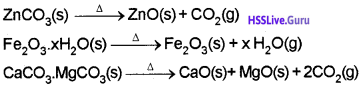
i) Calcination:
process in which the ore is heated strongly in the absence of air.
Plus Two Chemistry Notes Chapter 6 General Principle and Processes of Isolation of Elements 3

ii) Roasting:
process of heating the ore in a regular supply of air in a furnace at a temperature below the melting point of the metal.
2 ZnS + 3O2 → 2 ZnO + 2SO2
2PbS + 3O2 → 2PbO + 2SO2
2CU2S + 3O2 → 2Cu2O + 2SO2

Flux:
substance which combines with gangue present in the ore and form easily fusible materials called the slag.
Flux + Gangue → Slag (fusible)
FeO + SiO2 → FeSiO3 (Slag)

b) Reduction of Oxide to the Metal:
The metal oxide is reduced by reducing agents (e.g. C, CO or even another metal) which combine with the oxygen of, the metal oxide.
MxOy + yC → xM + yCO

Thermodynamic Principles of Metallurgy:
All those metals which have more negative Gibbs energies of formation of their oxides can reduce the oxides of other metals whose Gibbs energies of formation are less negative.

Ellingham Diagram:
graph of variation of ∆rGΘ vs. T for the formation of metal oxide from metals.
Plus Two Chemistry Notes Chapter 6 General Principle and Processes of Isolation of Elements 4

When the value of ∆G is negative in the equation ∆G = ∆H —T∆S then the reaction will proceed. If ∆S is positive, on increasing the temperature(T), the value of T∆S would increase (∆H < T∆S) and then AG will become -ve.

If the reactants and products of the coupled reaction (reduction of the metal oxide and oxidation of the reducing agent) are put together in a system and the net ∆G of the two possible reacfions is -ve, the overall reaction will occur.

Applications of Ellingham Diagram

  1. It provides a sound basis for considering the choice of reducing agent in the reduction of oxides.
  2. It helps in predicting the feasibility of thermal reduction of an ore.

Limitations of Ellingham Diagram

  1. It does not say about the kinetics of the reduction process.
  2. The interpretations of ∆rGΘ is based on equilibrium constant, K. Thus it is presumed that the reactants and products are in equilibrium. But this is not always true due to changes in entropy values associated with phase transformations.

a) Extraction of Iron from its Oxides:
The concentrated ore is mixed with lime stone and coke and fed into a Blast furnace from its top. Here the oxide is reduced to metal.
FeO(s) + C(s) → Fe(s/ \(\ell \)) + CO(g)

Two simpler reactions such as reduction of FeO and oxidation of coke(C) are are coupled in this process so that the Gibbs energy change of the net reaction is negative.

In Blast furnace, above 710 °C (983 K) coke (C) reduces FeO to Fe. At temperatures below 710 °C (983 K) CO reduces Fe3O4 and Fe2O3to FeO. Hot air is blown from the bottom of the furnace and coke is burnt to give temperature up to 2200 K.

Reactions at lower temperature range (500 – 800 K) –
3Fe2O3 + CO → 2Fe3O4 + CO2
Fe3O4 + 4CO → 3Fe + 4CO2
Fe2O3 + CO → 2FeO + CO2

Reactions athighertemperature range (900 -1500 K) –
C + CO2 → 2CO
FeO + CO → Fe + CO2

Lime stone is decomposed to CaO which removes silicate impurity of the ore as slag.
CaCO3 → CaO + CO2
CaO + SiO2 → CaSiO3

Plus Two Chemistry Notes Chapter 6 General Principle and Processes of Isolation of Elements

Pig iron – iron obtained from the blast furnace which containes about 4% carbon and many impurities.
Cast iron – It contains 3% carbon.
Wrought iron or malleable iron – purest form of commercial iron.

Preparation of Wrought Iron:
It is prepared from; cast iron by oxidising impurities in a reverberatory furnace lined with haematite, which oxidises C to CO.
Fe2O3 + 3C → 2Fe + 3CO

Limestone is added as a flux and S, Si and P are oxidised and passed into the slag. The metal is • recovered and freed from the slag by passing through
rollers.

b) Extraction of Copper:
The sulphide ore (Cu2S) is roasted to give oxide (Cu2O).
2Cu2S + 3O2 → 2Cu2O + 2SO2

The oxide can then be easily reduced to metallic copper using coke. This is because the Cu,Cu2O line is almost at the top in the Ellingham diagram.
Cu2O + C → 2Cu + CO

The ore is heated in a reverberatory furnace after mixing with silica. The iron oxide ‘slags of as iron silicate and copper forms copper matte. This contains Cu2S and FeS. Matte is heated in silica lined converter. The remaining Fe is converted to FeSiO3. The remaining Cu2S and Cu2O undergoes self oxidation-reduction to form blister copper.
2Cu2O + Cu2S → 6 Cu + SO2

The solidified copper obtained has blistered appearance due to the evolution of SO2 and so it is called blister copper.

c. Extraction of Zinc from Zinc Oxide:
ZnO is reduced to metallic Zn by heating with coke.
Plus Two Chemistry Notes Chapter 6 General Principle and Processes of Isolation of Elements 5

The metal is distilled of and collected by rapid chilling.

Electrochemical Principles of Metallurgy:
The metal ions in solution or molten state are reduced by electrolysis or adding some reducing element. For the reduction to be feasible E® should be positive so that ∆GΘ is negative (∆GΘ = – nFEΘ)- During electrolysis, the less reactive metal will come out of the solution and the more reactive metal will go to the solution, e.g.
Cu2+(aq) + Fe(s) → Cu(s) + Fe2+(aq)

More reactive metals have large negative EΘ values. So their reduction is difficult. Sometimes a flux is added for making the molten mass more conducting.

Extraction of Aluminium (Hall-Heroult Process):
Purified Al2O3 is mixed with Na3AlF6 or CaF2 to lower the melting point of the mix and bring conductivity. The fused matrix is electrolysed. Steel cathode and graphite anode are used.
Plus Two Chemistry Notes Chapter 6 General Principle and Processes of Isolation of Elements 6

The electrode reactions are:
At cathode : Al3+(melt) + 3e– → Al(l)
At anode : C(s) + O2-(melt) → CO(g) + 2e
C(s) + 2O2- (melt) → CO2(g) + 4e–

Disadvantage:
For each kg of aluminium produced, about 0.5 kg of carbon anode is burnt away as CO and CO2.
The overall reaction is,
2Al2O3 + 3C → 4Al + 3 CO2

Refining:
For obtaining high purity metal, several techniques are used.

a) Distillation:
The impure metal is evaporated to get pure metal, e.g. low boiling metals like Zn, Hg

b) Liquation:
low melting metals like tin and lead are made to flow on sloping surface and thus seperated from high melting impurities.

c) Electrolytic Refining:
Anode – impure metal, Cathode – strip of same metal in pure form, Electrolyte – soluble salt of the same metal. On electrolysis pure metal is deposited at the cathode.
e.g. Electrolytic refining of Cu.

Plus Two Chemistry Notes Chapter 6 General Principle and Processes of Isolation of Elements

Anode:
impure Cu, Cathode: pure Cu strip, Electrolyte: acidified solution of CuSO4

During electrolysis Cu in the pure form istransfered from the anode to the cathode. Impurities deposit as anode mud which contains valuable elements like Sb, Se, Te, Ag, Au and Pt. Recovery of these elements meets the cost of refining.

Zn is also refined by electrolytic process.

d) Zone Refining:
This method is based on the principle that the impurities are more soluble in the melt than in the solid state of the metal. A circular mobile heater is fixed atone end of a rod of the impure metal. The molten zone moves along with the heater. As the heater moves forward, the pure metal crystallises out of the melt. The process is repeated several times. At one end impurities get concentrated. This end is cut off. e.g., Ge, Si, B, Ga and In.

e) Vapour Phase Refining:
the metal is converted into its volatile compound. It is then decomposed to give pure metal.

Requirements for vapour phase refining:
1. The metal should form a volatile compound with an available reagent.
2. The volatile compound should be easily decomposable, so that the recovery is easy.

i) Mond Process for Refining Nickel:
Nickel is heated in a stream of CO forming a volatile complex, nickel tetracarbonyl.

The nickel tetracarbonyl is heated at high temperature so that it is decomposed to give pure Ni.

ii) van Arkel Method for Refining Zr or Ti:
The crude metal is heated in an evacuated vessel with l2. The metal iodide being more covalent, volatilises.
Zr + 2l2 → Zrl4 (volatile)

The metal iodide is decomposed on a tungsten filament at 1800 K. The pure metal is deposited on the filament.
Zrl4 → Zr + 2l2

Similarly, Ti can be purified.
Ti + 2l2 → Til4 (volatile)
Til4 → Ti + 2 l2

f) Chromatographic Methods:
based on the principle that different components of a mixture are differently adsorbed on an adsorbent.The mixture containing different metal ions are added into the chromatographic column. Different components are adsorbed at different levels on the column. The adsorbed components are removed (eluted) by using suitable solvents (eluant). Column chromatography is very useful for purification of elements which are available in minute quantities, e.g. Inner transition metals are refined by this method.

Uses of Aluminium, Copper, Zinc and Iron
1. Aluminium:
aluminium foils are used as wrappers for chocolates, fine dust of Al is used in paints and lacqures, in the extraction of Cr and Mn from thier oxides, as electricity conductors, for making alloys, e.g. Duralumin (Al + Mg), Alnico (Al + Ni + Co).

2. Copper:
for making wires used in electrical industry, for making water pipes and steam pipes, for making alloys, e.g. brass (Cu + Zn), bronze (Cu + Sn)

3. Zinc:
for galvanising iron, in batteries, as constituent of many alloys, e.g. brass (Cu – 60%, Zn – 40%), german silver (Cu 25-30%, Zn-25-30%, Ni 40 – 50%), zinc dust is used as a reducing agent in the manufacture of dye-stuffs, paints etc.

Plus Two Chemistry Notes Chapter 6 General Principle and Processes of Isolation of Elements

4. Iron:
Cast lron:
for casting stoves, railway sleepers, gutter pipes, toys etc; in the manufacture of wrought iron and steel

Wrought Iron:
in making anchors, wires, bolts, chains and agricultural implements.

Steel:
Nickel steel is used for making cables, automobiles and aeroplane parts, pendulum, measuring tapes; Chrome steel is used for cutting tools and crushing machines; Stainless steel is used for cycles, automobiles, utensils, pens etc.

Plus Two Accountancy Notes Chapter 3 Reconstitution of a Partnership Firm – Admission of Partner

Students can Download Chapter 3 Reconstitution of a Partnership Firm – Admission of Partner Notes, Plus Two Accountancy Notes helps you to revise the complete Kerala State Syllabus and score more marks in your examinations.

Kerala Plus Two Accountancy Notes Chapter 3 Reconstitution of a Partnership Firm – Admission of Partner

Summary
Reconstitution of a partnership firm
Reconstitution of a partnership firm means a change in the nature of relationship amongst members, effected through a fresh agreement under which the existing business continues.

Mode of reconstitution
Reconstitution of a partnership firm usually takes place in any of the following ways:

  1. Change in the profit sharing ratio of the existing partners
  2. Admission of a partner
  3. Retirement of a partner
  4. Death of a partner

Plus Two Accountancy Notes Chapter 3 Reconstitution of a Partnership Firm - Admission of Partner

Admission of a partner
Inclusion of a person as partner to an existing partnership firm is called admission of a partner. Acquisition of rights by a new partner:

  1. right to share the assets of the firm
  2. right to share profits/losses of the firm

Accounting problems at the time of admission

  1. Capital of new partner
  2. Calculation of new profit sharing ratio
  3. Calculation of sacrificing ratio
  4. Treatment of goodwill
  5. Revaluation of assets and liabilities
  6. Adjustment of reserves and accumulated profits/ losses
  7. Adjustment of capital accounts of partners

New profit sharing ratio
The ratio in which the old partners and new partner share the future profit after the admission is new ratio.
New ratio = old ratio – sacrificing ratio

Sacrificing ratio
The ratio in which the old partners agree to sacrifice their share of profit in favour of the incoming partner is called sacrificing ratio.
Sacrificing ratio = old ratio – New ratio

Plus Two Accountancy Notes Chapter 3 Reconstitution of a Partnership Firm - Admission of Partner

Goodwill
Goodwill is the value of the reputation of a firm in respect of profits in future over and above the normal profits. It is an invisible intangible asset. Thus goodwill really arises only if a firm is able to earn super profit.
Treatment of goodwill (Different situations):

  1. Premium paid directly
  2. Premium brought in cash and retained in business
  3. Premium brought in cash and half the amount withdrawn by partners
  4. Premium brought in kind
  5. New partner brings in only a portion of the goodwill in cash
  6. New partner is not in a position to bring premium in cash
  7. Goodwill existing in the books at the time of admission

Methods of valuation of goodwill:
1. Average profit method:
Goodwill = \(\frac{\text { Total profit }}{\text { No. of years }}\) × No. of years purchase

2. Super profit method:
Normal Profit = Cap employed × \(\frac{N R R}{100}\)
Average Profit = \(\frac{\text { Total profit }}{\text { No. of years }}\)
Super profit = Average profit – Normal profit
Goodwill = Super Profit × No. of years purchase

3. Capitalisation method:
(a) Capitalising the average profit:
Goodwill = Capitalised value of average profit – capital employed – Total assets (excluding goodwill) – outside liabilities
Capital employed = Total Asset – Outside liabilities.

(b) Capitalisation of superprofit
Goodwill = Super profit × \(\frac{100}{\mathrm{NRR}}\)

Treatment of goodwill:
Premium method – When the new partner brings cash for his share of goodwill.
(i) When this amount is paid directly/ privately to the old partner by new partner.
No entry is needed.

Plus Two Accountancy Notes Chapter 3 Reconstitution of a Partnership Firm - Admission of Partner

(ii) When the amount is paid through firm
Plus Two Accountancy Notes Chapter 3 Reconstitution of a Partnership Firm - Admission of Partner 1
To Old partner’s capital A/c (Sacrificing Ratio)

(iii) When the old partners decide to withdraw their amounts (full or part)
Plus Two Accountancy Notes Chapter 3 Reconstitution of a Partnership Firm - Admission of Partner 2
When goodwill already exists in books, the existing goodwill must be written off by debiting the old partners in their old ratio.
Plus Two Accountancy Notes Chapter 3 Reconstitution of a Partnership Firm - Admission of Partner 3
If they decide to retain goodwill as such, the amount to be brought in by the new partner will have to be proportionately reduced.

Revaluation of Assets and Reassessment of liabilities
Assets and liabilities are revalued at the time of admission. The account opened for this purpose is called revaluation account. The Journal entries recorded for revaluation of assets and reassessment of liabilities are as follows:
1. For increase in the value of an asset
Plus Two Accountancy Notes Chapter 3 Reconstitution of a Partnership Firm - Admission of Partner 4

2. For reduction in the value of an asset
Plus Two Accountancy Notes Chapter 3 Reconstitution of a Partnership Firm - Admission of Partner 5

3. For appreciation in the amount of a liability
Plus Two Accountancy Notes Chapter 3 Reconstitution of a Partnership Firm - Admission of Partner 8

4. For reduction in the amount of a liability
Plus Two Accountancy Notes Chapter 3 Reconstitution of a Partnership Firm - Admission of Partner 9

5. For an unrecorded asset
Plus Two Accountancy Notes Chapter 3 Reconstitution of a Partnership Firm - Admission of Partner 10

6. For an unrecorded liability
Plus Two Accountancy Notes Chapter 3 Reconstitution of a Partnership Firm - Admission of Partner 11

Plus Two Accountancy Notes Chapter 3 Reconstitution of a Partnership Firm - Admission of Partner

7. For transfer of gain on Revaluation in credit balance
Plus Two Accountancy Notes Chapter 3 Reconstitution of a Partnership Firm - Admission of Partner 12

8. For transferring loss on revaluation
Plus Two Accountancy Notes Chapter 3 Reconstitution of a Partnership Firm - Admission of Partner 13

Adjustment for reserves and accumulated Profits/Losses
Items like reserve and accumulated profits/losses appearing in the balance sheet should be distributed to old partners at the time of admission of a partner.
1. Reserve and Profit & Loss A/c if any on the liability side of balance sheet Reserve A/c Dr.
Plus Two Accountancy Notes Chapter 3 Reconstitution of a Partnership Firm - Admission of Partner 6

2. Profit & Loss A/c on the asset side of balance sheet
Plus Two Accountancy Notes Chapter 3 Reconstitution of a Partnership Firm - Admission of Partner 7

Plus Two Accountancy Notes Chapter 3 Reconstitution of a Partnership Firm - Admission of Partner

Adjustment of capital accounts of partners
It may sometimes be agreed that the capitals of all partners should be in proportion to their respective share in profits. This can be effected in two ways:

  1. Adjustment of old partners’ capital accounts on the basis of incoming partner’s capital
  2. Bringing in proportionate capital by the incoming partner based on the capitals of existing partners.

Change in profit sharing ratio
Sometimes, the existing partners may decide to change their profit sharing ratio. In such a case, those who gain must compensate the others who have made the sacrifice on account of change in profit sharing ratio.

Plus Two Accountancy Notes Chapter 2 Spread Sheet

Students can Download Chapter 2 Spread Sheet Notes, Plus Two Accountancy Notes helps you to revise the complete Kerala State Syllabus and score more marks in your examinations.

Kerala Plus Two Accountancy Notes Chapter 2 Spread Sheet

Spreadsheet – Meaning
Spreadsheet application is a computer program that allows to record, calculate and compare numerical or financial data. Using a spreadsheet program. We can store a lot of data in the worksheet and also arrange and analyse the data by using different functions and formulae for meaningful object.

It is used to establish relationship between two or more sets of data. Libre Office Calc, MS Office Excel, Open Office Spreadsheet etc. are examples of spreadsheet software.

Plus Two Accountancy Notes Chapter 2 Spread Sheet

Features of Spreadsheet

  1. A spreadsheet is a configuration of rows and columns.
  2. A spreadsheet is also known as worksheet.
  3. Spreadsheet application allows to enter (ie., add) and process data.
  4. It makes quick and easy financial and numerical analysis of data.
  5. The data stored in the spreadsheet can be converted into graphs, charts etc.
  6. It can be used to store, arrange and filter data.

Introduction to Libre Office Calc
Libre Office Calc is one of the best spreadsheet applications, which can be used to calculate, analyse and manage data. It is a Free and Open Source Software (FOSS). Libre Office Calc is available for a variety of platforms including Linux, OSX, Microsoft windows and Free BSD.
1. Features of Libre Office Calc:

  • It is a spreadsheet application.
  • It is both free software and open source software.
  • It can be used to calculate, analyse and manage data.
  • The worksheet in Libre Office Calc contains Rows and Columns in a Table format.

Basic concept of Libre Office Calc Spread Sheet
(a) Workbook:
A file in spreadsheet is known as a workbook. A work book is a collection of a number of work sheets.

(b) Work sheets:
The work area which consists of rows and columns in a spreadsheet is called worksheet. By default three worksheets – sheet-1, sheet-2, sheet-3 are available in work book.

(c) Active work sheet:
The worksheet which is available to the user for carrying out operations is called active work sheet. The name of the active worksheet will be shown in bold letters in the Sheet Tab at bottom of work sheet.

(d) Sheet Tab:
It shows the name of the work sheet at bottom left of the screen. Additional sheets can be added by clicking on the right hand side of the sheet Tab.

Plus Two Accountancy Notes Chapter 2 Spread Sheet

(e) Rename:
The Sheet-1, Sheet-2, and Sheet-3 etc. can be renamed by right clicking the mouse over the worksheet and selecting “Rename” option.

(f) Rows:
Rows are the horizontal vectors in the worksheet. These are numbered numerically
from Top to Bottom.

(g) Columns:
Columns are vertical vectors in the worksheet. These are referred by alpha characters from left to right such as A, B, C, …, AA, AB, AC …etc.

(h) Cell:
The intersection of a row and a column is called a cell. A cell is identified by a combination of an alpha – numeric character eg: A1, B6, C10, etc. This alpha numeric character is called cell address. Hence each cell has a unique address.

(i) Active cell:
When we start Libre Office Calc, the pointer (cursor) points the first cell ie., A1, and this cell is called the active cell. The active cell is distinguished by a dark box called cell pointer. We can move the cell pointer by using the arrow keys UP, DOWN, LEFT and RIGHT.

(j) Cell Reference:
A cell reference identifies location of a cell or group of selected cells in spreadsheet.

(i) Types of Cell References:
1. Relative Cell references:
By default cell reference is relative; which means that as a formula or function is copied and pasted to other cells, the cell references in the formula or function change to reflect the new location.

2. Absolute Cell reference:
The absolute cell reference consist of the column letter and row number surrounded by dollar ($) signs. Eg $A$5. An absolute cell reference is used when we want a cell reference to stay fixed on a specific cell.

Plus Two Accountancy Notes Chapter 2 Spread Sheet

3. Mixed cell reference:
It is a combination of relative and absolute cell references that holds either row or column constant when the formula or function is copied to another location.

(k) Inserting Rows and Columns:
We can add or delete Rows and Columns in a spreadsheet. To add column, click at the column header (right click on the mouse) there we get an option to add column.

Likewise, we can add rows. To delete the column, click the column header (right click on the mouse) there we get an option to delete column. Likewise we can remove rows.

(l) Ranges:
Range is a group of adjacent cells that forms a rectangular area. A range is specified by giving the address for first cell in range and the last cell in the rage, eg: range starting from A10 to A20 is written asA10:A20 where colon (:) is the range operator.

(m) Spreadsheet navigation:
We can move around a worksheet through four arrow keys. ie;

  • Left arrow key
  • Right arrow key
  • Up arrow key
  • Down arrow key

The mouse can also be used for navigation in spreadsheet except data entry. Some common operations/navigations are listed below:

Movement Key stroke (Press Key)
One cell up Up arrow key/Shift+Enter key
One cell down Down arrow key/ Enter key
One cell right Right arrow key/Tab key
One cell left Left arrow key/Shift + Tab key
Top of sheet (Cell A1) Ctrl + Home Key
Move to last cell containing data Ctrl + End Key
Move to beginning of the Row Home Key or Ctrl+Left arrow key
Move to last filled cell in column End key

Plus Two Accountancy Notes Chapter 2 Spread Sheet

(n) Labels:
A descriptive information for rows or columns in the form of a text, or a special character is called Label.
Eg: Name, Roll No, Address

(o) Formula:
The formula means a mathematical calculation on a set of cells. The formula must start with an = (equal to) sign. When a cell contains a formula, it often contains reference to other cells.
Eg: = Basic pay + DA + HRA.

Spreadsheet Functions
Functions:
A function is a special key word which can be entered into a cell in order to perform and process the data which is appended within brackets. There is a function button f(x) on the formula bar.

When we click on it, function offers assistance through Function Wizard. Alternatively we can enter the function directly into the formula bar. A function is a build in set of formulae which starts with an ‘equal to sign’ (=).
Eg =SUM (), =AVERAGE (), =COUNT() etc.
There are twelve different categories of functions available in LibreOffice Calc. Important functions are

  • Date and Time Function
  • Financial Function
  • Logical Function
  • Mathematical Function
  • Look Up and Reference Function
  • Statistical Function

Date and Time Functions
These functions are used for inserting, editing and manipulating date and time. “Date” must be entered with quotation marks. Libre Office Calc internally handleds a date/time value as a numerical value. The most commonly used Date and Time Functions are:

1. TODAY ():
It is the function for today’s date in the worksheet. This helps to update the date value when we reopen the spreadsheet or modify the values of the document.
Syntax: =TODAY()

2. NOW ():
It is the function for today’s date and present time. This helps to update the date and the time value when the cell value is modified.
Syntax: =NOW()

3. YEAR ():
It helps to update the year for the given date value
Syntax: = YEAR (Date value) or = YEAR (“Date”)

Plus Two Accountancy Notes Chapter 2 Spread Sheet

4. MONTH ():
It helps to update the month for the given date value. The month is recorded as an integer between 1 and 12.
Syntax: =MONTH(“date”) or =MONTH (date value)

5. DAY ():
It helps to update the day of the given date value. The day is recorded as an integer between 1 and 31
Syntax: = DAY(“Date”) or = DAY (date value)

6. DATEVALUE ():
This function converts the given date into the corresponding date number. By default 31/12/1899 has the value as 1.
Syntax: =DATEVALUE (“Date”)

7. DATE ():
This function calculates a date specified by year, month, day and displays it in the cell’s formatting.
Syntax: = DATE (Year; Month; Day)

Mathematical Functions
The following mathematical functions are very useful in business applications.

1. SUM ():
This function adds all the numbers in a range of cells. The AutoSum (S) button can also be used directly for summation of values from cells.
Syntax:=SUM (number 1, number 2,…….)

2. SUM IF ():
It returns the sum of the cells as per a given criteria.
Syntax: = SUMIF (range, “criteria”, sum_range) where

  • Range is the range of cells to evaluate.
  • Criteria defines which cells will be added.
  • Sum_range, is the range from which values are summed.

3. ROUND ():
This function rounds a number to specified number of digits or decimal places.
Syntax: = ROUND (Number, Count)
Plus Two Accountancy Notes Chapter 2 Spread Sheet 1

Plus Two Accountancy Notes Chapter 2 Spread Sheet

4. ROUNDUP():
Rounds a number up, away from zero without considering the value next to the rounding digit.
Syntax: = ROUNDUP (Number, Count)
Plus Two Accountancy Notes Chapter 2 Spread Sheet 2

5. ROUNDDOWN ( ):
Rounds a number down towards zero without considering the value next to the rounding digit.
Syntax: = ROUNDDOWN (Number, Count)
Plus Two Accountancy Notes Chapter 2 Spread Sheet 3

Statistical Functions
Statistical function operates on a set of data and give summarised results. Libreoffice Calc provides a number of statistical functions. They are

1. COUNT ():
This function used to count the number of cells in a range contains numbers only.
Syntax :=COUNT(Value 1, Value2,…)
or := COUNT (Range)

2. COUNTA():
This function used to count the number of ceils In a range contains any value. It will count number, text, time, date, logical values, error code, etc. In other words, this function counts the number of cells that are not empty in a range.
Syntax: = COUNTA (Value 1, Value 2….) or = COUNTA (Range)

3. COUNTBLANK():
This function in LibreOffice Calc count the number of empty cells in the given range. It is the opposite function of COUNTA.
Syntax: =COUNTBLANK (Range)

4. COUNTIF():
This function counts the number of cells within a given range that meet the criteria or condition.
Syntax: COUNTIF (Range, Criteria)

5. ROWS():
This function returns the number of rows in a reference or array.
Syntax = ROWS (Array)
Where Array is the reference or named area whose total number of rows is to be determihed.

Plus Two Accountancy Notes Chapter 2 Spread Sheet

6. Columns ():
This function returns the number of columns in an array or reference
Syntax: = COLUMNS (Array)
Where Array is the reference to a cell range whose total number of columns is to be found.

Text Manipulation Function
There are two types of Text Manipulation Functions in LibreOffice Calc. They are

1. TEXT ( ):
This function converts a number or I numerical value into text according to a defined format.
Syntax: TEXT (Number, Format)
This function is useful in situations to display numbers in a more readable format.

2. CONCATENATE ( ):
This function is used to combines several text strings in different cells into one string.
Syntax:=CONCATENATE (“Text 1 ”, “…..”,“ Text n”)

Logical Functions
Logical functions are used for comparison and checking a test condition. The major logical functions are IF, AND and OR.

1. IF ():
This function is used to test a condition. When the condition is TRUE, then first action is taken. When it is FALSE, then the second action is taken.
Syntax: IF (Test, Then value, Otherwise value)

2. NESTED IF ()
Libre Office Calc allows to include one function inside another function. It is called nesting of functions. The IF function can be nested, when you have multiple condition to meet.
Syntax: =IF (Test_1, Then value_1, If (Test_2, Then value _2, If (_____)))

3. AND ():
This function gives only a TRUE or FALSE answer.
Syntax: =AND (Logical value 1, Logical value 2,…)

4. OR ():
Returns TRUE if atleast one argument is TRUE. This function returns the value FALSE, If all the arguments have the logical value FALSE
Syntax: = OR (Logical value 1, Logical value 2,…)

Plus Two Accountancy Notes Chapter 2 Spread Sheet

Spreadsheet Reference Functions
The important spreadsheet reference functions are

1. LOOKUP () functions:
The LOOKUP function returns a value either from a one-row or one-column range or from an array. The lookup function has two syntax forms: Vector form and Array form.

The vector form of LOOUP looks in a one-row or one-column range (known as a vector) for a value, and then returns a value from the same position in a second one-row or one-column range.

The array form of LOOKUP looks in the first row or column of an array for the specified value, and then returns a value from the same position in the last row or column of the array.

  • LOOKUP (Vector from)
    Syntax: =LOOKUP (search criterion, Search vector, Result vector)
  • LOOKUP (Array form)
    =(LOOKUP (lookup_value, array)

2. VLOOK UP ():
VLOOK UP is the vertical LOOKUP function. Use VLOOK UP to search the first column (columns are vertical) of a block of data and return the value from another column in the same row.
Syntax: = VLOOKUP (Search criterion; Array; Index; Sort Order)

3. HLOOKUP ( ):
It is the Horizontal LOOKUP function, searches for a value in the first row of a table array and returns the corresponding value in ‘ the same column from another row of the same table array.
Syntax: -HLOOKUP (search criteria; index; sorted)

Financial Functions
The major financial functions of LibreOffice Calc are discussed below:

1. ACCRINT ():
This function returns the accrued interest for a security that pays periodic interest.
Syntax:= ACCRINT(Issue, First_nterest, settlement, rate, Par, frequency, basis, calc_method)

2. CUMIPMT():
This function returns the cumulative interest paid between two periods.
Syntax: = CUMIPMT (Rate, NPER, PV, S, E, Type)

3. PV():
This function is used to calculate the amount of money needed to be invested at a fixed rate today, to receive a specific amount, over a specified number of periods.
Syntax: = PV (Rate, NPER, Pmt, FV, Type)

4. PMT ():
PMT function calculates the equal periodic payment for an annuity with constant interest rates.
Syntax: = PMT (Rate, NPER, PV, FV, Type)

5. FV():
This function calculates the future value of an investment based on periodic, constant payment and a constant interest rate.
Syntax: = FV (RATE, NPER, PMT, PV, TYPE)

6. RATE ():
This function returns the interest rate per period of an annuity.
Syntax: = RATE (NPER, PMT, PV, FV, Type, Guess)

7. NPV ():
This function calculates the net present value of an investment by using a discount rate and a series of future payments (negative values) and income (positive values)
Syntax:- NPV(Rate, Value 1, Value 2,….)

Plus Two Accountancy Notes Chapter 2 Spread Sheet

Data Entry, Text Management, and Cell Formatting
In any computerised business application, the basic requirement is to input data, which may be either for processing or to update various data elements. In both the cases, data should be correct, accurate and should be in proper format.

Data Entry
Libreoffice Calc facilitates fast data entry. Some of the methods for data entry are mentioned below:

1. The data fill options:
The ‘fill’ command can be used to fill data into worksheet cells. To fill quickly in several types of data series, we select cells and drag the fill handle (A fill handle is the small black square in the lower-right corner of the selection). When we point to the fill handle, the pointer changes to + symbol.

2. Import/Copy Data from other sources:
This method will transfer data into required cells by copying or importing an external file to calc sheet.

3. Data validation:
This is a feature to define restrictions on type of data entered into a cell. We can configure data validation rules for cells data that will not allow users to enter invalid data. There may be warning messages when users tries to type wrong data in the cell.

Data Formatting
Formatting of spread sheets makes easier to read and understand the important information. On the Ribbon there are several tools and shortcuts to format spreadsheets effectively. Some of them are explained below.

1. Number formatting:
Number formatting includes adding percent symbols (%), commas(,), decimal places (.), and currency signs (?) date (dd/mm/yyyy), time (HH: mm), scientific values and as well as some special formats to a spreadsheet.

2. Currency:
If we enter a financial value with the currency sign, calc assigns a currency format to the cell along with the entry.

3. Dates:
If we enter the date, that follows one of the built-In Calc number formats, such as 01/06/2018 or 01 June 2018, the program assigns a Date format that follows the pattern of the date.

Plus Two Accountancy Notes Chapter 2 Spread Sheet

4. Changing cell colours:
Select the range to format. From the Toolbar, select format and click on cells to display format cells dialog box and choose background tab. The back ground tab provide Background colourforthe cell. Select the desired colour from the colour pallets. Then click OK to make necessary changes.

5. Create a custom cell border:
We can create a cell style that includes a custom border, and can apply to that cell style when we want to display the custom border around selected cells.

  • Select the properties option on the side bar (Right)
  • Click cell appearance
  • We can modify cell border properties

6. Conditional formatting:
We can apply conditional formatting to a cell range, a table, or a Pivot Table report. A conditional format changes the appearance of a cell range based on a condition or criteria. If the condition is true, the cell range is formatted based on that condition; if the condition is false, the cell range is not formatted based on that condition.

Changing The Alignment Of Data In Cells
There are several options to change the alignment of text (Data) in cells.

1. Text Formatting:
We can format the text in the cell in the following way.

  • The font style can be changed
  • The font size can be changed
  • If we need bold letters, Italics, or underlined, choose from appropriate field.
  • The back ground colour can be changed
  • The text alignment in the cell either is left, right, center or justify
  • The position in the cell ie., Top, Center or Bottom of the cell can be selected.
  • The borders to the cell can choose from the appropriate field.
  • Different types of borders can be given in the field.

All these actions are also given in property windows appears on the right of the work sheet.

Plus Two Accountancy Notes Chapter 2 Spread Sheet

2. Merging a range of cells:
Merged cells are’ a single cell that is created by combining two or more selected cells. When two or more adjacent horizontal or vertical cells are merged, the cells become one large cell and displayed across multiple columns or rows. The contents of cell appear in the centre of the merged cell.

3. Split a merged cell:
Select the merged cell which we want to split into two. When we select a merged cell, the merge and centre button also appears selected in the Alignment group on the Home Tab. Click merge and centre.

4. Formatting a table:
There are predefined table styles or quick styles that we can use to quickly, format a table. Select cells where the Table hasto be inserted. Then select the format option in the menu bar, in the dropdown menu select the auto format. We can select the predefined table format.

5. Headers and Footers:
In calc spreadsheet, headers and footers are lines of text that are printed at the top (Header) and bottom (footer) of each page in the menu bar. They contain descriptive text such as titles, dates, and / or page numbers and are used to add information to a printed spreadsheet. These options are available under insert option in the menu bar.

Output Reports
We can print entire or partial worksheets and work books, one at a time, or several at once.

1. Page set Up:
We can customize our output Report by editing the page set up option.

2. Print Out:
Before Printing, we have to verify print preview which gives an idea about how the print out may come. The modification can be done by this verification.

3. Defining the Print:
By default, Libre Office Calc prints all data on the current worksheet. The print area can be customized/defined by using Dialog Box option.

4. Preparation of reports using Pivot Tables:
A Pivot Table is a way to present information in a report format. A PivotTable report provides enhanced layout, attractive and formatted report with improved readability. There are two types of data table.

  • One-Variable Data Table
  • Two-Variable Data Table

The one variable Data Table allows us to identify a single decision variable in our model and see how changing the values for that variable affect the values calculated by one or more formulas in our model.

The two variable Data table allows us to Specify two decision variables and a variety of inputs and only a single formula.

Plus Two Accountancy Notes Chapter 2 Spread Sheet

Common Error Codes (Messages) in Libre Office Calc
Libre Office Calc provides some messages for errors of miscalculation, incorrect use of functions, invalid cell references, and values, and other user initiated mistakes. Some of the error codes/messages are given below.
Plus Two Accountancy Notes Chapter 2 Spread Sheet 4

Plus Two Accountancy Notes Chapter 2 Accounting for Partnership – Basic Concepts

Students can Download Chapter 2 Accounting for Partnership – Basic Concepts Notes, Plus Two Accountancy Notes helps you to revise the complete Kerala State Syllabus and score more marks in your examinations.

Kerala Plus Two Accountancy Notes Chapter 2 Accounting for Partnership – Basic Concepts

Summary
Partnership – Definition
The relation between persons who have agreed to share the profits of a business carried on by all or any of them acting for all.
Features

  • Number of persons – A minimum of two persons. Maximum: 10 – Banking business; others 20.
  • Agreement
  • Business – profit seeking and lawful
  • Sharing of profits
  • Agency – principal relationship
  • Utmost good faith
  • Unlimited liability
  • No separate legal existence

Plus Two Accountancy Notes Chapter 2 Accounting for Partnership - Basic Concepts

Partnership deed
A document containing the terms of partnership as agreed to by the partners.
Contents of deed
Name of firm, name of partners, nature and place of business, date of commencement and duration, capital, division of profit, operation of bank accounts, interest on capital and drawings, ascertainment of goodwill, settlement of accounts, etc.

Provisions of partnership act 1932, applicable to accounting
Rules applicable in the absence of partnership deed

Profit sharing equal
Interest on capital no
Interest on loan 6%
Interest on drawings no
Remuneration to partners no

Preparation of Capital Accounts
(i) Fixed Capital:
Original capital invested by any partner remains the same unless additional capital is brought in or part of the capital is withdrawn as per agreement. Each partner will have two accounts –

  • partner’s capital account
  • partner’s current account. All adjustments like salary, interest on capital, interest on drawings, drawings, share of profit/loss, etc., are shown in current account. Capital account remains fixed.

Proforma of Partners’ Capital Account Partner’s Capital Account
Plus Two Accountancy Notes Chapter 2 Accounting for Partnership - Basic Concepts 1

Plus Two Accountancy Notes Chapter 2 Accounting for Partnership - Basic Concepts
Partner’s Current Account
Plus Two Accountancy Notes Chapter 2 Accounting for Partnership - Basic Concepts 2

(ii) Fluctuating Capital:
Only one account, i.e., capital account is maintained. All adjustments like drawings, interest on drawings, interest on capital, salary, share of profit/ loss, etc. are shown in the capital account itself.
Proforma of Partners’ Capital Account
Plus Two Accountancy Notes Chapter 2 Accounting for Partnership - Basic Concepts 3

Profit and loss appropriation account
This is a nominal account prepared to show how net profit has been distributed among the partners. This
is an extension of profit and loss account.

Journal Entries:
1. Transfer of the balance of Profit and Loss Account to
Profit and Loss Appropriation Account:
(a) If Profit and Loss Account shows a
credit balance (net profit) :
Profit and Loss A/c Dr.
To Profit and Loss Appropriation A/c.

Plus Two Accountancy Notes Chapter 2 Accounting for Partnership - Basic Concepts

(b) If Profit and Loss Account shows a debit balance (net loss)
Profit and Loss Appropriation A/c Dr.
To Profit and Loss A/c.

2. Interest on Capital:
(a) For crediting interest on capital to partner’s
capital account :
Interest on Capital A/c Dr.
To Partner’s Capital/ Current A/cs(individually)

(b) For transferring interest on capital to
Profit and Loss Appropriation Account :
Profit and Loss Appropriation A/c Dr.
To Interest on Capital A/c

3. Interest on Drawings:
(a) For charging interest on drawings to
partners’ capital accounts :
Partners Capital/Current A/c’s (individually) Dr.
To Interest on Drawings A/c

(b) For transferring interest on drawings to
Profit and Loss Appropriation Account :
Interest on Drawings A/c Dr.
To Profit and Loss Appropriation A/c

4. Partner’s Salary:
(a) For crediting partner’s salary to partner’s
capital account :
Salary to Partner A/c Dr.
To Partner’s Capital/CurrentA/c’s (individually)

Plus Two Accountancy Notes Chapter 2 Accounting for Partnership - Basic Concepts

(b) For transferring partner’s salary to
Profit and Loss Appropriation Account :
Profit and Loss Appropriation A/c Dr.
To Salary to Partner’s A/c

5. Partner’s Commission:
(a) For crediting commission to a partner,
to partner’s capital account :
Commission to Partner A/c Dr.
To Partner’s Capital/ Current A/c’s (individually)

(b) For transferring commission paid to
partners to Profit and Loss Appropriation Account.
Profit and Loss Appropriation A/c Dr.
To Commission to Partners Capital/ CurrentA/c

6. Share of Profit or Loss after appropriations:
If Profit:
Profit and Loss Appropriation A/c Dr.
To Partner’s Capital/Current A/c’s (individually)
If Loss:
Partner’s Capital/CurrentA/c’s (individually) Dr.
To Profit and Loss Appropriation A/c

The Proforma of Profit and Loss Appropriation Account is given as follows
Profit and Loss Appropriation Account:
Plus Two Accountancy Notes Chapter 2 Accounting for Partnership - Basic Concepts 4

Plus Two Accountancy Notes Chapter 2 Accounting for Partnership - Basic Concepts

Interest on capital
Interest on capital payed to partner’s as a compensation for their capital contribution to the firm. It is allowed at an agreed rate on the amount of capital (at the beginning and on additions) with reference to time.

Interest on drawing
Interest to be charged on the withdrawals made by the partners if it has been specifically metioned in the partnership deed. It is calculated with reference to time at an agreed rate on the amount of withdrawal.
Calculation of interest on drawings under different situations
(I) When the amount is withdrawn every month
(a) When the amount is withdrawn at the beginning of each month:
Average period = 6.5 months
Interest on drawings = Total drawings × \(\frac{6.5}{12} \times \frac{\text { Rate }}{100}\)

(b) When the amount is withdrawn at the end of each month
Average period = 5.5 months
Interest on drawings = Total drawings × \(\frac{5.5}{12} \times \frac{\text { Rate }}{100}\)

(c) When the amount is withdrawn in the middle of the month.
Average period = 6 months
Interest and drawings = Total drawings × \(\frac{6}{12} \times \frac{\text { Rate }}{100}\)

(II) When fixed amount is withdrawn quarterly
(a) If the amount is withdrawn at the beginning of each quarter.
interest on drawings= Total drawings × \(\frac{7.5}{12} \times \frac{\text { Rate }}{100}\)

(b) If the amount is withdrawn at the end of each year
Interest on drawings = Total drawing × \(\frac{4.5}{12} \times \frac{\text { Rate }}{100}\)

Plus Two Accountancy Notes Chapter 2 Accounting for Partnership - Basic Concepts

(III) When varying amounts are withdrawn at different intervals.
Interest on drawings = Sum of Product × \(\frac{Rate}{100} \times \frac{\text {1 }}{12}\)
Sum of Product = Withdrawal amount × Remain-ing months in the year.

Guarantee of profit to a partner
Sometimes, on admission of a new partner, the existing partners may give an assurance to the incoming partner that he shall be given a minimum amount of profit irrespective of the firm’s actual profits. This is called guarantee of profit to a partner.

The guarantee may be given either by all the partners or by one of the partners. If the share of profit of the new partner is more than the guaranteed amount, then he will get his actual share of profit.

Past Adjustments
Sometimes, after closing the books of accounts it is found that certain items are left out by mistake or have been wrongly treated. In such a case necessary adjustments are carried out in partners’ capital accounts through an account called ‘profit and loss adjustment account’.

Plus Two Accountancy Notes Chapter 2 Accounting for Partnership - Basic Concepts

Preparation of final accounts of a partnership firm
There is not much difference in the final accounts of a sole trading concern and that of a partnership firm. The only difference is the division of profit among the partners for which a profit and loss appropriation account has to be prepared.

Plus Two Accountancy Notes Chapter 1 Accounting for Not For Profit Organisation

Students can Download Chapter 1 Accounting for Not For Profit Organisation Notes, Plus Two Accountancy Notes helps you to revise the complete Kerala State Syllabus and score more marks in your examinations.

Kerala Plus Two Accountancy Notes Chapter 1 Accounting for Not For Profit Organisation

Summary
Not for Profit Organisation – Meaning
Meant for rendering sevices to members and to the community and not for making profit.

Accounting Records
Cash book, ledger accounts of all incomes, expenses, assets, and liabilities, stock register of assets and consumables.

Plus Two Accountancy Notes Chapter 1 Accounting for Not For Profit Organisation

Financial Statements
Receipt and payment account, Income and expenditure account and Balance sheet.

Receipt and Payment Account
Cash book in a summary form and is a real account; receipts on the debit side and payments on the credit side. Balance in the account is cash balance.

Receipts And Payments Account
The format of receipts and Payments account is given below:
Dr.
Plus Two Accountancy Notes Chapter 1 Accounting for Not For Profit Organisation - 1

Plus Two Accountancy Notes Chapter 1 Accounting for Not For Profit Organisation
Income and Expenditure Account
It is a nominal account, debited with all expenses and losses and credited with all incomes and gains of revenue nature only. Difference in the account is either surplus or deficit.

The format of Income and Expenditure Account is given below:
Income and expenditure of______(Name of organisation) for the year ended______(date)
Plus Two Accountancy Notes Chapter 1 Accounting for Not For Profit Organisation 2

Plus Two Accountancy Notes Chapter 1 Accounting for Not For Profit Organisation
Balance Sheet
Prepared to ascertain the financial position at the end of an accounting period, assets on the right side and liabilities on the left side.

The format of Balance sheet is given below
Balance sheet of_____(Name of the organisation) as on______(Date)
Plus Two Accountancy Notes Chapter 1 Accounting for Not For Profit Organisation 3

Plus Two Accountancy Chapter Wise Questions and Answers Chapter 5 Dissolution of Partnership

Students can Download Chapter 5 Dissolution of Partnership Questions and Answers, Plus Two Accountancy Chapter Wise Questions and Answers helps you to revise the complete Kerala State Syllabus and score more marks in your examinations.

Kerala Plus Two Accountancy Chapter Wise Questions and Answers Chapter 5 Dissolution of Partnership

Plus Two Accountancy Dissolution of Partnership One Mark Questions and Answers

Question 1.
Which is not correct in the case of Dissolution of Partnership
(a) The original partnership agreement is terminated
(b) Some partners continue in the business
(c) No partner to continue in the business
(d) A new partnership comes in to existence
Answer:
(c) No partner to continue in the business

Question 2.
Dissolution of partnership does not lead to
(a) Termination of the original partnership agreement
(b) Dissolution of the existing partnership
(c) Coming in to existence of a new partnership
(d) Dissolution of the firm
Answer:
(d) Dissolution of the firm

Plus Two Accountancy Chapter Wise Questions and Answers Chapter 5 Dissolution of Partnership

Question 3.
Realisation Account is a
(a) Nominal Account
(b) Real Account
(c) Personal Account
(d) None of these
Answer:
(a) Nominal Account

Question 4.
The Account prepared at the time of dissolution of a partnership firm
(a) Revaluation Account
(b) P&L Adjustment A/c
(c) P&L Appropriation A/c
(d) Realisation Account
Answer:
(d) Realisation Account

Question 5.
The Realization account is closed by transferring the profit or loss to
(a) Partner’s Capital Accounts
(b) Partner’s Loan Account
(c) Bank Account
(d) Balance Sheet
Answer:
(a) Partner’s Capital Account

Question 6.
The Loan from Mrs.of a partner is credited to
(a) Her Capital Account
(b) Husband’s Capital Account
(c) Husband’s Loan Account
(d) Realisation Account
Answer:
(d) Realisation Account

Plus Two Accountancy Chapter Wise Questions and Answers Chapter 5 Dissolution of Partnership

Question 7.
On dissolution of partnership Firm, amount realised from unrecorded asset is credited to.
(a) Realisation A/c
(b) Re-Valuation A/c
(c) Capital A/c
(d) Goodwill A/c
Answer:
(a) Realisation A/c.

Question 8.
Entry for closing Provision for Bad debts at the time of dissolution of firm is_______.
Answer:
Provision for baddebt a/c Dr. To Realisation

Question 9.
Should you pass any entry for the payment of creditors worth Rs. 5000 on dissolution. If they accept stock of the same value? If yes, what is the journal entry?
Answer:
Creditors takes over stock of the same value. So no journal entry is need to be passed.

Question 10.
A firm is compulsorily dissolved when all partners or when all except one partner become insolvent – True or False
Answer:
True.

Question 11.
Unrecorded liabilities when paid by a partner are shown in_______.
Answer:
Debit of realisation a/c

Plus Two Accountancy Chapter Wise Questions and Answers Chapter 5 Dissolution of Partnership

Question 12.
On dissolution of a firm, bank overdraft is transferred.
(a) cash a/c
(b) bank a/c
(c) Realisation a/c
(d) capital a/c
Answer:
(c) Realisation a/c

Question 13.
On dissolution of the firm, partners capital accounts are closed through_______account.
Answer:
Cash/Bank Account

Plus Two Accountancy Dissolution of Partnership Two Mark Questions and Answers

Question 1.
What do you mean by Dissolution of partnership?
Answer:
Dissolution of partnership means termination of the existing partnership agreement between the partners. This may due to admission, retirement or death of a partner. In the case of dissolution of partnership, the firm continues to exist.

Question 2.
What is meant by Dissolution of firm?
Answer:
Termination of the partnership agreement between all the partners is known as dissolution of firm. In the case of dissolution of firm, the firm ceases to exist and the business of the firm is closed.

Question 3.
Why the balance at bank is not transferred to the Realisation A/c on the dissolution of a Partnership? Answer:
On the dissolution of a partnership the balance at bank is not transferred to the Realisation A/c be cause, there is no need to realise the same.

Plus Two Accountancy Chapter Wise Questions and Answers Chapter 5 Dissolution of Partnership

Question 4.
How will you settle firm’s debts and private debts of partner’s on the dissolution of a firm?
Answer:
Since the liability of partners is unlimited their private assets can be used to pay off the firm’s debts. But they will have the right to use their assets for paying their private debts first. They need to contribute only the remaining assets.

Question 5.
What is Realisation Account?
Answer:
Realisation Account is an account prepared at the time of dissolution of a partnership firm. It is to close the assets and liabilities and to find out the profit or loss and for the payment of liabilities.

Question 6.
What is the Accounting treatment of settlement with the creditors through transfer of an asset?
Answer:
Settlement with the creditors through transfer of assets require no entry. It is because the liability to the creditors has already been closed by transferring the same to realization account. The asset account also was closed by transferring to the same account.

Question 7.
How goodwill is treated on dissolution of the firm ?
Answer:
On dissolution of firm goodwill is treated like the other assets. It is transferred to realization account at its balance sheet amount. The amount realized for goodwill if any, is credited to realization account.

Plus Two Accountancy Chapter Wise Questions and Answers Chapter 5 Dissolution of Partnership

Question 8.
Complete the series

  1. Sacrificing ratio: admission: Gainining ratio:?
  2. Dissolution: Realisation A/c: Reconstitution: ?
  3. Trading A/c: Profit and Loss A/c: Profit and Loss A/c:?
  4. Balance of capital A/c: Balance sheet Balance of profit and loss appropriation a/c:?

Answer:

  1. S.R. (Sacrificing Ratio) : Admission, G.R (Gaining Ratio) : Retirement
  2. Dissolution : Realisation a/c Reconstitution: Revaluation a/c
  3. Trading a/c : P&La/c, P & L a/c : P & L appropriation a/c
  4. Balance of capital a/c : B/S, Balance of P & L appropciation a/c : Capital a/c.

Plus Two Accountancy Dissolution of Partnership Three Mark Questions and Answers

Question 1.
Which are the cases where a partnership is dissolved?
Answer:
Following are the cases in which a partnership is dissolved.

  1. Change in the profit sharing ratio
  2. Admission of a partner
  3. Retirement, death of a partner
  4. Insolvency of a partner
  5. Completion of the venture for which it is formed
  6. Expiry of the period

Plus Two Accountancy Chapter Wise Questions and Answers Chapter 5 Dissolution of Partnership

Question 2.
Toya and Soya are partners sharing profits and losses equally. They decided to dissolve the firm on 15th March, 2005 which resulted in a loss of Rs. 30,000. The capital accounts of Toya and Soya was Rs. 20,000 and Rs. 30,000 respectively. The cash account showed a balance of Rs. 20,000. You are required to pass journal entries for

  1. Transfer of loss to the capital accounts of partners.
  2. Making final payments to the partners.

Answer:
Plus Two Accountancy Chapter Wise Questions and Answers Chapter 5 Dissolution of Partnership - 1

Plus Two Accountancy Dissolution of Partnership Five Mark Questions and Answers

Question 1.
Distinguish between dissolution of partnership and dissolution of firm.
Answer:
Plus Two Accountancy Chapter Wise Questions and Answers Chapter 5 Dissolution of Partnership - 2

Plus Two Accountancy Chapter Wise Questions and Answers Chapter 5 Dissolution of Partnership

Question 2.
How the accounts are settled on dissolution?
Answer:
On dissolution of a firm, the assets are realized (disposed) and the liabilities are paid off. Balance if any is shared among the partners. According to the Partnership Act, the following rules can be followed for the settlement of accounts.
1. Loss is to be paid first out of profits, next out of capital and last out of the private assets of partners in their ratio.

2. Amount realized from the assets of the firm shall be used in the following order

  • Paying the realisation expenses
  • Paying the liabilities to outsiders
  • Paying the loans from partners
  • Paying the capital of the partners
  • Surplus if any is to be distributed to partners

Question 3.
Explain the different modes of dissolution of a partnership firm.
Answer:
Different modes of dissolution of a partnership firm are the following
(i) Dissolution by Agreement (section 40)
A firm is formed by an agreement between the partners. So it may be dissolved by the partnership agreement or with the consent of all the partners.

(ii) Compulsory Dissolution (Section 41)
A firm is dissolved compulsorily in the following cases

  1. When all the partners or all except one become insane or insolvent.
  2. When the business of the firm becomes illegal.
  3. When all the partners except one retire.
  4. When all the partners or all except one die.
    • When the period of partnership expires,
    • When the venture for which the partnership was formed becomes complete.

Plus Two Accountancy Chapter Wise Questions and Answers Chapter 5 Dissolution of Partnership

(iii) Dissolution on the happening of contingencies(42)
A firm may be dissolved on the happening of the following contingencies or events

  1. On the death of a partner
  2. On the insolvency of a partner

(iv) Dissolution by Notice (Sec 43)
If the partnership is a partnership at will, it can be dissolved by a partner by giving a notice to the other partners showing his will to dissolve the firm.

(v) Dissolution by Court (Sec 44)
A Court may issue an order to a partnership firm to dissolve the same on the suit of a partner in the following circumstances

  1. If a partner becomes insane
  2. If a partner becomes in capable of performing his duties
  3. If a partner is found guilty of misconduct affecting the firm
  4. If a partner intentionally and continuously commits breach of contract
  5. If a partner transfers his interest in the firm to an outsider.
  6. If the business of the firm cannot be carried on except at a loss
  7. lf the court thinks it just and equitable to dissolve the firm

Question 4.
Differentiate between Realisation Account and Revaluation Account.
Answer:
Plus Two Accountancy Chapter Wise Questions and Answers Chapter 5 Dissolution of Partnership - 3

Plus Two Accountancy Chapter Wise Questions and Answers Chapter 5 Dissolution of Partnership

Question 5.
What entry would you pass for the following transaction on the dissolution of a firm having partners Vishal and Rakesh.

  1. An unrecorded asset realised Rs. 6200.
  2. Dissolution expenses amounted to Rs. 3200.
  3. Creditors already transferred to realisation account were paid Rs. 88,000.
  4. Stock worth Rs. 5400 already transferred to realisation account was sold for Rs. 4100.
  5. Profit on realisation Rs. 48000 to be distributed between partners, Vishal and Rakesh?

Answer:
Plus Two Accountancy Chapter Wise Questions and Answers Chapter 5 Dissolution of Partnership - 4

Plus Two Accountancy Chapter Wise Questions and Answers Chapter 5 Dissolution of Partnership

Question 6.
Boby, Jestin, and Sudheer are in partnership in the ratio of 3:2:3. They have decided to dissolve the firm. On the date of dissolution total creditors were Rs.16,000; Bills discounted Rs. 2,650 during the year, has become a real liability which has to be paid, through this has not been recorded anywhere in the books of accounts. Their capital account balances were Boby Rs. 12000; Jestin Rs. 10000; Sudheer Rs. 8000 respectively. Boby advanced Rs. 14000 besides his capital account.
Find out

  1. Total Sundry Assets
  2. Realisation Account
  3. Capital accounts of partners

Answer:
Balance Sheet
Plus Two Accountancy Chapter Wise Questions and Answers Chapter 5 Dissolution of Partnership - 5
Realisation A/c
Plus Two Accountancy Chapter Wise Questions and Answers Chapter 5 Dissolution of Partnership - 6
Capital A/cs
Plus Two Accountancy Chapter Wise Questions and Answers Chapter 5 Dissolution of Partnership - 7

Plus Two Accountancy Dissolution of Partnership Eight Mark Questions and Answers

Question 1.
Appu and Chinku were partners in a firm sharing profits and losses in the ratio of 4: 3. Their Balance Sheet as on 31st December 2005 was as follows.
Plus Two Accountancy Chapter Wise Questions and Answers Chapter 5 Dissolution of Partnership - 8
Plus Two Accountancy Chapter Wise Questions and Answers Chapter 5 Dissolution of Partnership - 9
The firm is dissolved as on the Balance sheet date. The assets were realized as follows.

Sundry Debtors Rs. 14,000
Stock-in-trade Rs. 21,000
Furniture Rs. 17,500
Machinery Rs. 25,000

Plus Two Accountancy Chapter Wise Questions and Answers Chapter 5 Dissolution of Partnership

Sundry Creditors were paid at a discount of 15%. The expenses on realisation amounted to Rs. 2,500. Pass journal entries and prepare ledger accounts on dissolution of the firm.
Answer:
Journal
Plus Two Accountancy Chapter Wise Questions and Answers Chapter 5 Dissolution of Partnership - 10
Plus Two Accountancy Chapter Wise Questions and Answers Chapter 5 Dissolution of Partnership - 11
Realisation Account
Plus Two Accountancy Chapter Wise Questions and Answers Chapter 5 Dissolution of Partnership - 12

Plus Two Accountancy Chapter Wise Questions and Answers Chapter 5 Dissolution of Partnership
Partners’ Capital Account
Plus Two Accountancy Chapter Wise Questions and Answers Chapter 5 Dissolution of Partnership - 13
Bank Account
Plus Two Accountancy Chapter Wise Questions and Answers Chapter 5 Dissolution of Partnership - 14
General Reserve Account
Plus Two Accountancy Chapter Wise Questions and Answers Chapter 5 Dissolution of Partnership - 15

Question 2.
The following is the Balance Sheet of Felix, Edwin, and Abel sharing profits and losses in the ratio of 2: 1: 1 as on 31th March 2005.
Plus Two Accountancy Chapter Wise Questions and Answers Chapter 5 Dissolution of Partnership - 16
Plus Two Accountancy Chapter Wise Questions and Answers Chapter 5 Dissolution of Partnership - 17
The firm is dissolved. Sundry debtors realized Rs. 25.0 and stock Rs. 17,000. Trade mark and goodwill became valueless. Edwin agrees to discharge the bank loan. Creditors are paid Rs. 25,000 in full settlement, realisation expenses amounted to Rs. 6.0 paid by Felix. Pass journal entries and prepare ledger accounts.
Answer:
Journal
Plus Two Accountancy Chapter Wise Questions and Answers Chapter 5 Dissolution of Partnership - 18

Plus Two Accountancy Chapter Wise Questions and Answers Chapter 5 Dissolution of Partnership
Plus Two Accountancy Chapter Wise Questions and Answers Chapter 5 Dissolution of Partnership - 19
Realisation Account
Plus Two Accountancy Chapter Wise Questions and Answers Chapter 5 Dissolution of Partnership - 20
Partner’s Capital Account
Plus Two Accountancy Chapter Wise Questions and Answers Chapter 5 Dissolution of Partnership - 21
Bank Account
Plus Two Accountancy Chapter Wise Questions and Answers Chapter 5 Dissolution of Partnership - 22

Plus Two Accountancy Chapter Wise Questions and Answers Chapter 5 Dissolution of Partnership
Notes:

  • If nothing is given in the question, it is assumed that the assets(real) are realized and liabilities are paid off at their book value.
  • Partners loan is not transferred to realisation account but paid directly.

Question 3.
Anu and Binu were partners sharing profits and losses in the ratio of 1/2 and 3/4. Their Balance Sheet as on 30th June 2004 was as follows.
Plus Two Accountancy Chapter Wise Questions and Answers Chapter 5 Dissolution of Partnership - 23
The firm is dissolved. Furniture and Machinery realized 10% less than their book values. Rs.20,000 is collected from debtors. Anu took over the stock at Rs. 25,000. The firm had an unrecorded liability on outstanding expenses Rs.2,500. Realisation expenses amounted to Rs. 2,000. Record journal entries and prepare ledger accounts.
Answer:
Journal
Plus Two Accountancy Chapter Wise Questions and Answers Chapter 5 Dissolution of Partnership - 24

Plus Two Accountancy Chapter Wise Questions and Answers Chapter 5 Dissolution of Partnership
Realisation Account
Plus Two Accountancy Chapter Wise Questions and Answers Chapter 5 Dissolution of Partnership - 25
Partner’s Capital Account
Plus Two Accountancy Chapter Wise Questions and Answers Chapter 5 Dissolution of Partnership - 26
Bank Account
Plus Two Accountancy Chapter Wise Questions and Answers Chapter 5 Dissolution of Partnership - 27

Question 4.
S.Raj, Narchison, and Boby are partners sharing profits in the ratio of 2:2:1, Whose ledger accounts on 31.03.06 reveal the following balances.
Plus Two Accountancy Chapter Wise Questions and Answers Chapter 5 Dissolution of Partnership - 28
The firm dissolved on the above date.

  1. During the years S.Raj withdraw from Bank Rs. 6,000 for his personal purpose which has not been brought into the records.
  2. Rs. 10,000 was realised on account of unrecorded investments which was totally utilised for a liability on account of a claim payable to customers and the balance has been paid in cash.
  3. Fixed Assets realised more than 10% of book value.
  4. Sundry debtors could be collected only to the extend of 90% of the book value.

Prepare necessary accounts.
Answer:
1. Realisation A/c
Plus Two Accountancy Chapter Wise Questions and Answers Chapter 5 Dissolution of Partnership - 29

Plus Two Accountancy Chapter Wise Questions and Answers Chapter 5 Dissolution of Partnership
Capital Account
Plus Two Accountancy Chapter Wise Questions and Answers Chapter 5 Dissolution of Partnership - 30
Bank A/c
Plus Two Accountancy Chapter Wise Questions and Answers Chapter 5 Dissolution of Partnership - 31

Question 5.
Mr. White and Mr. Black are partners sharing profits in the ratio of 3:2. They decided to close the firm and their Balance sheet is given below.
Balance sheet as on 31.03.2005
Plus Two Accountancy Chapter Wise Questions and Answers Chapter 5 Dissolution of Partnership - 32
Assets realised as follows:
Building – 32,000, Debtors – 28,000, Furniture – 36,000 Liabilities settled as follows. Plant has been taken over by bank at Rs. 66,000 in respect of the loan granted by the bank and the rest has been paid in cash. Creditors are settled at Rs. 30,000. Realisation expenses came to Rs. 1,000 which have been met by Mr. Black. Prepare necessary accounts to dissolve the firm.
Answer:
Realisation A/c
Plus Two Accountancy Chapter Wise Questions and Answers Chapter 5 Dissolution of Partnership - 33

Plus Two Accountancy Chapter Wise Questions and Answers Chapter 5 Dissolution of Partnership
Capital A/c
Plus Two Accountancy Chapter Wise Questions and Answers Chapter 5 Dissolution of Partnership - 34
Bank A/c
Plus Two Accountancy Chapter Wise Questions and Answers Chapter 5 Dissolution of Partnership - 35

Question 6.
Ali, Banu, and Cini were in partnership who have dissolved their firm on 31.10.2006 on which date their Balance sheet stood as follows.
Balance sheet as on 31.10.2006.
Plus Two Accountancy Chapter Wise Questions and Answers Chapter 5 Dissolution of Partnership - 36

  1. Bank passbook shows its balance to be Rs. 21,300. The difference is due to realisation of a claim directly credited to Bank Account.
  2. Bills Receivable collected Rs. 300 less.
  3. Stock has been utilized to settle the loan with Biju.
  4. Unrecorded electronic equipments worth Rs.5000 has been utilised for settling the liability on account of Bills payable.
  5. Land and Buildings was realised at Rs. 2,40,000.
  6. All other assets were realised and liabilities were settled at book value.

Prepare necessary accounts.
Answer:
Realisation A/c
Plus Two Accountancy Chapter Wise Questions and Answers Chapter 5 Dissolution of Partnership - 37

Plus Two Accountancy Chapter Wise Questions and Answers Chapter 5 Dissolution of Partnership
Capital A/cs
Plus Two Accountancy Chapter Wise Questions and Answers Chapter 5 Dissolution of Partnership - 38
Cash A/c
Plus Two Accountancy Chapter Wise Questions and Answers Chapter 5 Dissolution of Partnership - 39

Question 7.
Sam, Zen, and Jhony are in partnership sharing profits and losses in the ratio 3:2:1. Their Balance sheet as on 31st December, 2004 was as follows.
Plus Two Accountancy Chapter Wise Questions and Answers Chapter 5 Dissolution of Partnership - 40
The firm was dissolved on the above date with the following terms.

  1. Building was taken over by Sam at book value and he agreed to discharge the creditors.
  2. Accured interest was not collected, where as there was a contingent liability of Rs. 600 which was met.
  3. Assets realised as follows: Plant – 25000, Stock – 5000, Debtors – 4600
  4. Realisation expenses amounted to Rs. 600 You are required to prepare
    • Realisation account
    • Capital accounts
    • Cash account

Answer:
Realisation A/c
Plus Two Accountancy Chapter Wise Questions and Answers Chapter 5 Dissolution of Partnership - 41
Capital A/cs
Plus Two Accountancy Chapter Wise Questions and Answers Chapter 5 Dissolution of Partnership - 42

Plus Two Accountancy Chapter Wise Questions and Answers Chapter 5 Dissolution of Partnership
Cash A/c
Plus Two Accountancy Chapter Wise Questions and Answers Chapter 5 Dissolution of Partnership - 43

Question 8.
Joe, Maggi, and Hassan were partners sharing profits and losses in the ratio of 1:2:2. Their Balance sheet as on 31 December 2004 was as follows.
Plus Two Accountancy Chapter Wise Questions and Answers Chapter 5 Dissolution of Partnership - 44
The partners agreed to dissolve the firm on the following terms.

  1. Assets realised as follows:
    Land and Building Rs. 1,20,000 Stock 40,000
    Accounts receivable 15,000
  2. Expenses on dissolution is Rs. 3000
  3. A creditor accepts office equipments for Rs. 7000 and the remaining creditors were paid in full by cheque.
  4. The joint life insurance policy was surrendered for Rs.9000. Prepare realisation a/c, capital accounts and bank account.

Answer:
Realisation A/c
Plus Two Accountancy Chapter Wise Questions and Answers Chapter 5 Dissolution of Partnership - 45

Plus Two Accountancy Chapter Wise Questions and Answers Chapter 5 Dissolution of Partnership
Capital A/c
Plus Two Accountancy Chapter Wise Questions and Answers Chapter 5 Dissolution of Partnership - 46
Bank A/c
Plus Two Accountancy Chapter Wise Questions and Answers Chapter 5 Dissolution of Partnership - 47