Plus Two Chemistry Notes Chapter 1 The Solid State

Students can Download Chapter 1 The Solid State Notes, Plus Two Chemistry Notes helps you to revise the complete Kerala State Syllabus and score more marks in your examinations.

Kerala Plus Two Chemistry Notes Chapter 1 The Solid State

General Characteristics of Solid State
Definite mass, volume and shape; short inter molecular distances; strong intermolecular forces; constituent particles have fixed position and can only oscillate about their mean positions; incompressible and rigid.

Classification of Solids:
1. Crystalline Solids :
The constituent particles are well orderly arranged. It has long range orcfe/-which means that there is a regular pattern of arrangement of particles which repeats itself periodically overthe entire crystal, e.g. NaCl, Quartz.

2. Amorphous Solids (Greek amorphos = no form):
The constituent particles are irregularly arranged; i.e. they have irregular shape, the arrangement of constituent particles in this solid has only short range order, e.g. rubber, quartz, glass, plastic.

Amorphous solids have a tendency to flow slowly, therefore these are called pseudo solids or supercooled liquids, e.g. Glass – Glass flows down very slowly and makes the bottom portion slightly thicker.

Crystalline solids are anisotropic in nature (i.e. their physical properties like electrical resistance or refractive index show different values in different directions). Amorphous solids on the other hand are isotropic, (i.e. their physical properties would be same along any direction)

Difference between Crystalline and Amorphous Solids
Plus Two Chemistry Notes Chapter 1 The Solid State 1

Classification of Crystalline Solids:
Crystalline solids can be classified on the basis of nature of intermolecular forces operating in them into four categories.

Plus Two Chemistry Notes Chapter 1 The Solid State

Molecular Solids :
In this, molecules are the constituent particles, they are of three categories:

a. Non-polar Molecular Solids :
They are formed by the regular arrangement of either atoms or non-polar molecules held by weak dispersion forces or London forces. They have low melting points and are liquids or gases at room temperature and pressure, e.g. solid forms of argon, He, H2 and Cl2, l2.

b. Polar Molecular Solids :
In these polar molecules are held by relatively stronger dipole-dipole interaction. They are soft and non-conductors of electricity e.g. solid forms of HCl, SO2, NH3.

c. Hydrogen bonded Molecular Solids :
Strong H- bonding binds the molecules of these solids. They are non-conductors of electricity and are volatile liquids or soft solids.
e.g. Ice (Solid H2O)

Ionic Solids :
In these ions are held together by strong coulombic (electrostatic) forces. They are hard and brittle in nature and have high melting point and boiling points. They are electrical insulators in the solid stale, but in molten state/solutions conduct electricity because ions become free to move.
e.g. NaCl, KCl, KNO3 etc.

Metallic Solids :
In these positive ions are surrounded by and held together by a sea of free electrons. These free and mobile electrons are responsible for high electrical and thermal conductivity. Due to this mobile electrons metals have lustre and colour, e.g. Gold, Silver etc.

Covalent or Network Solids:
They have covalent bonds between adjacent non-metal atoms which are held strongly in their positions. They have high melting points and are insulators, e.g. Diamond, SiC Graphite is an exceptional case – it is soft and conducts electricity due to its typical layer structure.

Crystal Lattice and Unit Cells
The three dimensional arrangement of constituent particles in a crystal, represented by points is called crystal lattice/space lattice.

Unit Cell:
The smallest repeating portion of space lattice/crystal lattice. A unit cell is characterised by,
1. The distance along with three edges: a, b & c
2. Angle between the edges:
α (between b & c)
β (between a & c)
γ (between a & b)

Primitive and Centred Unit Cells
a. Primitive Unit Cell :
the constituent particles are present only on the corner positions of unit cell.

b. Centred Unit Cells
i. Body-Centred Unit Cell (bcc) :
The constituent particles at all the corners as well as at the centre of the unit cell.
ii. Face-Centred Unit Cell (fee) :
The constituent particles at all the corners as well as at the centre of the each face.
iii. End-Centred Unit Cell:
One constituent particle is present at the centre of any two opposite faces besides the one present at its corners.
Plus Two Chemistry Notes Chapter 1 The Solid State 2

Seven Primitive Unit Cells and their Possible Variations as Centred Unit Cells:
Plus Two Chemistry Notes Chapter 1 The Solid State 3

Number of Atoms in a Unit Cell
1. Primitive Cubic Unit Cell or Simple Cubic Unit Cell:
Primitive cubic unit cell has atoms only at its corner. Each atoms at a corner is shared between eight adjacent unit cells. Therefore the contribution of an atom/molecule to a particular unit cell is 1/8
Plus Two Chemistry Notes Chapter 1 The Solid State 4
Total number of atoms in unit cell = 8 × 1/8 = 1

Plus Two Chemistry Notes Chapter 1 The Solid State

2. Body Centred Cubic Unit Cell (bcc):
In bcc unit cell, particles are present not only at the eight corners but also at the centre of the cube.
Plus Two Chemistry Notes Chapter 1 The Solid State 5
In a bcc unit cell:
i. 8 corners x 1/8 per corner atom = 8 × 1/8 = 1 atom

ii. 1 body centre atom = 1×1 = 1 atom
∴ Total number of atoms per unit cell = 1 + 1=2 atoms

3. Face Centred Cubic Unit Cell :
A fee unit cell contains atoms at all the corners as well as at the centre of 6 faces of the cube. The atoms at the face centre is shared between two adjacent unit cells and the contribution is only ½ to the unit cell.
Plus Two Chemistry Notes Chapter 1 The Solid State 6
In a fcc unit cell:
i. 8 comers x 1/8 per corner atom = 8 × 1/8 = 1 atom
ii. 6 face centre x ½ atom per unit cell = 6 × ½ = 3 atoms
∴ Total number of atoms per unit cell = 1+3 = 4 atoms

Close Packed Structures:
In solids, the constituent particles (considered as identical hard spheres) are close-packed, leaving the minimum vaccnt space.

Coordination number (C.N.) :
The number of nearest neighbouring particles (spheres) in a crystal lattice is called coordination number.

a. Close Packing in One Dimension :
In this arrangment, each sphere is in contact with two of its neighbours. The cordination number is two.
Plus Two Chemistry Notes Chapter 1 The Solid State 7

b. Close Packing in Two Dimensions :
Two dimensional close packing can be done in two different ways:

i. Square Close Packing (scp):
The second row is placed in contact with the first one such that the spheres are exactly above those of the first row. The spheres of the two rows are aligned horizontally as well as vertically. Each sphere is in contact with four of its neighbours. Thus coordination number is 4. This is also known as AAA type arrangment.
Plus Two Chemistry Notes Chapter 1 The Solid State 8

ii. Hexagonal Close Packing (hep) :
The spheres in every second row are placed in the depressions of the first row. The spheres in the third row are seated in the depressions of the second row and so on. The fourth layer is aligned with the second layer. Hence this type of arrangement is of ABAB type. Each sphere is in contact with 6 neighbouring spheres. Thus the C.N. is 6.

In hexagonal close packing, particles are more closely packed than in square close packing. Hence, it is more efficient than square close packing.

Plus Two Chemistry Notes Chapter 1 The Solid State

c. Close Packing in Three Dimensions :
i. Three-dimensional close packing from two-dimensional square close-packed layers :
the second layer is placed over the first layer such that the spheres of the upper layers are exactly above those of the first layer. Here, spheres of both the layers are perfectly aligned horizontally as well as vertically. This type of arrangement has AAA type pattern. This arrangement generates the simple cubic lattice.
Plus Two Chemistry Notes Chapter 1 The Solid State 9

ii. Three dimensional close packing from two-dimensional hexagonal close-packed layers
a. Placing second layer over the first layer :
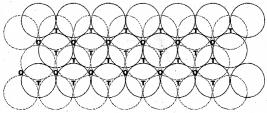
The spheres of the second layer are placed in the depressions of the first 2 dimensional hep layer. Wherever a sphere of the second layer is above the triangular void of the first layer (or vice versa) a tetrahedral void is formed.|
Plus Two Chemistry Notes Chapter 1 The Solid State 10
The vaccant space/sites in close packed structure are called voids/interstitial voids.

Tetrahedral void (td void) :
The vacant space surrounded by 4 spheres are called tetrahedral voids.
Plus Two Chemistry Notes Chapter 1 The Solid State 11
Octahedral void (oh void):
The vaccant space surrounded by six spheres in a close packed arrangement.
Plus Two Chemistry Notes Chapter 1 The Solid State 12
If ‘N’ is the number of spheres in close packed structure,

b. Placing third layer over the second layer :
If particles in the third layer are arranger) in the tetrahedral voids, the spheres of the third layer are exactly aligned with those of the first layer. Thus, the pattern of spheres is repeated in alternate layers. This is known as ABAB or hexagonal close packed (hep) structure, e.g. Mg, Zn, Cd etc.
Plus Two Chemistry Notes Chapter 1 The Solid State 13

If particles in the third layer are arranged in the octahedral voids, spheres of the fourth layer are aligned with those of the first layer. Thus, ABCABC … arrangement is obtained. This is known as cubic close packed (ccp) structure or face-centred cubic (fee) structure, e.g. Cu, Ag, Au etc.
Plus Two Chemistry Notes Chapter 1 The Solid State 14

Both the hep and ccp are highly efficient and 74% space in the crystal is filled. Coordination number is 12 in either of these two structures.
Plus Two Chemistry Notes Chapter 1 The Solid State 15

Packing Efficiency
It is the percentage of total space filled by the particles.
Let ‘a’ be the edge length of a unit cell and ‘r’ the radius of sphere.

Packing Efficiency in ccp and hep Structures:
In the case of ccp and hep, the edge length,
Plus Two Chemistry Notes Chapter 1 The Solid State 16

Packing Efficiency of Body Centred Cubic Structures :
In this case radius of a sphere,
Plus Two Chemistry Notes Chapter 1 The Solid State 17

Packing Efficiency in Simple Cubic Lattice :
In simple cubic lattice edge length, ‘a’ and radius of the sphere ‘r’ are related as,
a = 2r
r = a/2
We know that a simple cubic unit cell contains only one sphere.
Plus Two Chemistry Notes Chapter 1 The Solid State 18

Calculations Involving Unit Cell Dimensions :
Edge length of unit cell = a
Volume of the unit cell = a³
Mass of unit cell = Number of atoms in unit cell × mass of each atom = z × m
Mass of an atom in unit cell m = \(\frac{M}{N_{A}}\) (M-molar mass)
Plus Two Chemistry Notes Chapter 1 The Solid State 19
Note:
The density of the unit cell is the same as the density of the substance.

Imperfection in Solids :
The crystal defects are irregularities in the arrangement of constituent particles. There are two types of defects:
1. Point Defects:-
Irregularities from ideal arrangement around a point or an atom.
2. Line Defects:-
Irregularities/deviations from ideal arrangement in entire rows of lattice points.

Plus Two Chemistry Notes Chapter 1 The Solid State

Point Defects:
They can be classified into three types – stoichiometric defects, impurity defects and non-stoichiometric defects.

a. Stoichiometric Defects:
These are the point defects that do not disturb the stoichiometry of the solid. They are also called intrinsic or thermodynamic defects. These are of two types:
i. Vacancy Defect:
When some of the lattice sites are vacant (missing of constituent particles), the crystal is said to have vacancy defect. As a result density of the substance decreases.

ii. Interstitial Defect:
When some constituent particles occupy an interstitial site, the crystal is said to have interstitial defect.

There are two types of stoichiometric defects in ionic solids : Schottky Defect and Frenkel Defect.

Schottky Defect:
It arises due to the missing of equal number of cations and anions from their normal positions leaving behind a pair of holes. It is observed in ionic compounds having high coordination numberwith ions of almost similar size. Since equal number of cations and anions are missing they maintain electrical neutrality. Density of the substance decreases.
e.g. NaCl, KCl, CsCl and AgBr.
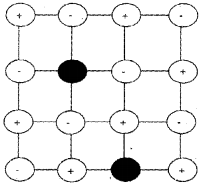
Plus Two Chemistry Notes Chapter 1 The Solid State 20

Frenkel Defect:
It arises due to an ion, usually cation which is dislocated from its normal site to an interstitial site. It creates a vaccancy defect at its original site and an interstitial defect at its new location. This is also called dislocation defect. It is usually observed in ionic compounds having low coordination number and crystals with anions much larger in size than the cations. Since no ions are missing, density of the solid does not change, e.g. ZnS, AgCI, AgBrandAgl.
Note: AgBr shows both Schottky as well as Frenkel defects.
Plus Two Chemistry Notes Chapter 1 The Solid State 21

Note: AgBr shows both Schottky as well as Frenkel defects.

b. Impurity Defects :
Defect caused by foreign ions. e.g. If molten NaCl containing a little amount of SrCl2 is crystallised, some of the sites of Na+ ions are occupied by Sr2+. Each Sr2+ replaces two Na+ ions. It occupies the site of one Na+ ion and the othersite remains vaccant. The cationic vaccancies thus pro duced are equal in number to that of Sr2+ ions. Another example is the solid solution of CdCl2 and AgCl.
Plus Two Chemistry Notes Chapter 1 The Solid State 22

c. Non-Stoichiometric Defects:
The stoichiometry of the crystal is altered due to defects. These defects are of two types:
i. Metal Excess Defect
ii. Metal Deficiency Defect

Plus Two Chemistry Notes Chapter 1 The Solid State

i. Metal Excess Defect
1. Due to anionic vacancies :
A compound may have excess of metal ion if a negative ion is absent from its lattice site leaving a hole which is occupied by electron. The anionic sites occupied by unpaired electrons are called F-centres. (German word Farbenzenter means colour centre). These can impart colourto the crystal by excitation of electrons when they absorb energy from visible light, e.g. When crystals of NaCl are heated in an atmosphere of Na vapour, F-centres are formed. As a result, the crystal has an excess of sodium which imparts yellow colour.
Excess Li in LiCl – imparts pink colour
Excess K in KCl – imparts violet(lilac) colour
Plus Two Chemistry Notes Chapter 1 The Solid State 23

2. Metal excess defect due to extra cations at interstitial sites :
Here, electrical neutrality is maintained by the presence of an electron in the interstitial site. e.g. Zinc oxide (ZnO) is white in colour at room temperature. On heating it loses O2 and turns yellow.
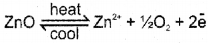
Plus Two Chemistry Notes Chapter 1 The Solid State 24
Now there is excess of zinc in the crystal and its formula becomes Zn1+x O. The excessZn2+ ions move to interstitial sites and electrons move to neighbouring interstitial sites.

ii. Metal Deficiency Defect
1. Due to cation vaccancies:
A positive ion is missing from its lattice postion and the extra negative charge thus created is balanced by the adjacent metal ion which attains one additional positive charge.
e.g. FeO. It is mostly found with a composition of Fe0.95O. In crystal of FeO some Fe2+ cations are missing and the loss of positive charge is made up by the presence of required number of Fe3+ ions. As a result, the crystal has metallic lustre. Other example is FeS (fool’s gold).

2. Due to the presence of anions in interstitial site:
An extra negative ion would occupy an interstitial site and the extra negative charge thus formed is balanced by an adjacent cation possessing additonal positive change. This defect is not common because anions are bigger than cations and cannot be occupied in interstitial sites.

Properties of Solids
Electrical Properties :
Solids can be classified into 3 types on the basis of their conductivities.

1. Conductors :
Solids with conductivities of the order of 104 to 107 ohm-1 m-1. Metals are good conductors of electricity and the conductivity is in the order of 107 ohm-1 m-1.

ii. Insulators :
The solids which almost do not allow the passage of electricity, e.g. S, P, wood, paper, rubber. Conductivity order 10-20– 10-10 ohm-1 m-1

iii. Semiconductors :
The solids whose conductivity lies between metallic conductors and insulators. Conductivity range from 10-6 to 104 ohm-1 m-1 (or 10-8 to 102 ohm-1cm-1).

Oxides like TiO, VO, ReO3 etc. are good conductors. But oxides like Ti2O3, V2O3 etc. behave as insulators at centain termperature. TiO2, V2O5 etc. are perfect insulators. The conductivity of semiconductors increases with temperature while that of metals decreases with temperature.

Conduction of Electricity in Metals :
Metals conduct electricity in solid as well as molten state through movement of electrons. The conductivity of metals depend upon the number of valence electrons available per atom. The atomic orbitals of metal atoms form molecular orbitals which are so close in energy to each other as to form a band. If this band is partially filled or if overlap with a higher energy unoccupied conduction band, then the electrons can flow easily under an applied electric field.
Plus Two Chemistry Notes Chapter 1 The Solid State 25

Conduction of Electricity in Semiconductors :
Here, the energy gap between the valence band and conduction band is small. Therefore some electrons may jump to conduction band and show some conductivity. Electrical conductivity of semi conductors increases with rise in temperature, since more electrons can jump to conduction band. This type of semiconductors are known as intrinsic semiconductors, e.g. Silicon, Germanium.

The conductivity of intrinsic semi conductors is increased by adding appropriate amount of suitable impurities, which introduce electronic defects. This process is called dopping. It can be done in two ways:

a. By adding electron rich impurities (n-type semiconductors) :
If Si and Ge are dopped with group 15 elements like P or As, the 5th electron is extra and becomes delocalised which is responsible for electrical conductivity. Since conductivity is due to the negatively charged electron it is called n-type semiconductor.

Plus Two Chemistry Notes Chapter 1 The Solid State

b. By adding electron deficit impurities (p-type semi conductors):
If Si and Ge are dopped with group 13 elements like B, Al or Ga an electron deficient bond or electron hole is produced. Under the influence of electric field, electrons move towards the positively charged plate through electronic holes. It appears as if electron holes are positively charged and are moving towards negatively charged plate. This type semi conductors are called p-type semi conductors.

Application of n-type and p-type semi conductors:

  1. Diode is a combination of n-type and p-type semi conductors and is used as a rectifier.
  2. The npn and pnp types of transistors are used to amplify radio or audio signals.
  3. Photo-diode is used for conversion of light energy into electrical energy.

Magnetic Properties :
Every substance has some magnetic properties associated with it. Each electron in an atom behaves like a tiny magnet. Its magnetic moment originates from two types of motions.
i. Electron’s orbital motion around the nucleus
ii. Electron’s spin around its own axis
Magnetic moment is measured in Bohr magneton
(B.M), µB. 1 B.M. = 9.27 × 10⁻²⁴ A m2
Magnetic properties are of 5 types:

i. Paramagnetism :
It is due to the presence of one or more unpaired electrons. Paramagnetic substances are weakly attracted by a magnetic field.
e.g. O2, Cu2+, Fe3+, Cr3+ Ni2+, VO, VO2, CuO, NO

ii. Diamagnetism :
It is due to paired electrons in the substance. Diamagnetic substances are weakly repelled by a magnetic field.
e.g. H2O, NaCl, C6H6, TiO2, N2

iii. Ferromagnetism :
It is considered as an extreme case of paramagentism and is caused by spontaneous alignment of magnetic domains (metal ions grouped into small regions) in the direction of the magnetic field. Ferromagnetic substances are strongly attracted by magnetic field. They retain a permanent magnetism even when the field is removed, e.g. Fe, Co, Ni, Alloys of Fe, Co and Ni, CrO2 Once such a material is magnetised, it remains permanently magnetised.
Alignment of magnetic moments: ↑↑↑↑↑↑

iv. Antiferromagnetism:
It arises due to the alignment of magnetic domains in opposite direction and the resulting moment is zero. Antiferromagnetic substances are expected to possess paramagnetism or ferromagnetism on the basis of unpaired electrons but actually they possess zero net magnetic moment.
e.g. MnO, MnO2, Mn2O3, FeO, NiO, CuO
Alignment of magnetic moments: ↑↓↑↓↑↓

v. Ferrimagnetism :
It is due to the alignment of magnetic moments in opposite directions in unequal numbers resulting in a net magnetic moment. These substances are expected to possess large magnetism on the basis of unpaired electrons but actually have small net magnetic moment and are weakly attracted by magnetic field as compared to ferromagnetic substances.
e.g. Fe3O4 (magnetite), MgFe2O4 & ZnFe2O4.
Alignment of magnetic moments: ↑↑↓↑↑↓
Plus One Chemistry Chapter Wise Questions and Answers Chapter 2 Structure of Atom

Students can Download Chapter 2 Structure of Atom Questions and Answers, Plus One Chemistry Chapter Wise Questions and Answers helps you to revise the complete Kerala State Syllabus and score more marks in your examinations.

Kerala Plus One Chemistry Chapter Wise Questions and Answers Chapter 2 Structure of Atom

Plus One Chemistry Structure of Atom One Mark Questions and Answers

Question 1.
Which of the following is not true for cathode rays?
a) They possess kinetic energy
b) They are electromagnetic waves
c) They produce heat
d) They produce mechanical pressure
Answer:
b) They are electromagnetic waves

Question 2.
The mass of the electron = ________ kg
Answer:
9.11 × 10⁻³¹ kg

Question 3.
Bohr’s orbits are called stationary states because
a) Electrons in them are stationary
b) Their orbits have fixed radii
c) The electrons in them have fixed energy
d) The protons remain in the nuclei and are stationary
Answer:
c) The electrons in them have fixed energy

Plus One Chemistry Chapter Wise Questions and Answers Chapter 2 Structure of Atom

Question 4.
The metal which gives photoelectrons most easily is
a) Lithium
b) Sodium
c) Calcium
d) Cesium
Answer:
d) Cesium

Question 5.
The orbitals having same energy are called ________ orbitals.
Answer:
degenerate

Question 6.
Match the following:

  1. Spherically symmetrical – d
  2. Dumb-bell – s
  3. Doubly dumb-bell – p

Answer:

  1. Spherically symmetrical – s
  2. Dumb-bell – p
  3. Doubly dumb-bell – d

Question 7.
Which of the following set of quantum numbers is correct for an electron in 4/ orbital
a) n = 4 l = 4 ml = -4 ms = +14
b) m = 4 l = 3 ml = +4 ms = +14
c) n = 4 l = 3 ml = -3 ms =-14
d) n = 4 l = 3 ml = +4 ms = -14
Answer:
c) n = 4 l = 3 ml = -3 ms = -14

Question 8.
The limiting line of Balmer Series has the frequency of ________ .
Answer:
8.23 × 10¹⁴

Question 9.
The number of orbitals and the maximum number of electrons that can be accommodated in a principal quantum level are
Answer:
n2 & 2n2

Question 10.
If the uncertainty in position and momentum of a particle like electrons are equal the uncertainty in velocity is ________
Answer:
\(\triangle V=\frac { 1 }{ 2m } \sqrt { \frac { h }{ \pi } } \)

Question 11.
The total energy of an electron in a Bohr orbit is given by ________
Answer:
\(\frac{-Z e^{2}}{8 \pi \varepsilon_{0} r}\)

Plus One Chemistry Structure of Atom Two Mark Questions and Answers

Question 1.
Match the following:

Series Region
Lyman Infrared
Balmer Ultraviolet
Paschen Infrared
Brackett Visible

Answer:

Series Region
Lyman Ultraviolet
Balmer Visible
Paschen Infrared
Brackett Infrared

Question 2
Of the following which is/are correct? Give justification.
a) n = 2 l = 1 m = 0 s = +½
b) n = 3 l = 3 m = 2 s =-½
c) n = 4 l = 3 m = 1 s = +½
d) n = 3 l = 2 m = 3 s = +½
Answer:
a) n = 2 f = 1 m = 0 s = +½
c) n = 4 f = 3 m=1 s= -½
Option b) is wrong because when n = 3, ^ =0, 1, 2
Option d) is wrong because when l = 2, m = -2, -1, 0, 1, 2

Question 3.
Match the following:
1. Anode rays – Nucleus
2. Cathode rays – Plum-pudding model
3. J.J Thomson – Proton
4. Thea-particle scattering experiment – Electron
Answer:
1. Anode rays – Proton
2. Cathode rays – Electron
3. J.J Thomson – Plum-pudding model
4. Thea-particle scattering experiment – Nucleus

Question 4.
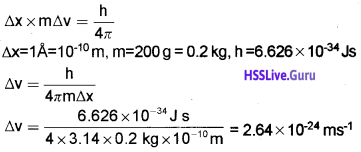
Calculate the uncertainty in the determination of velocity of a ball of mass 200 g, if the uncertainty in the determination of position is 1 A.
[h=6.626 × 10⁻³⁴ J s]
Answer:
Plus One Chemistry Chapter Wise Questions and Answers Chapter 2 Structure of Atom 1

Question 5.
Which among the following sets of quantum numbers is/are not possible?
a) n = 3, l = 2, m = 0, s = +½
b) n = 2, l= 1, m = 0, s = +½
c) n = 1, l= 0, m = 0, s = -½
d) n = 4, l = 2, m = 2, s = -½
Answer:
All sets are possible.

Plus One Chemistry Chapter Wise Questions and Answers Chapter 2 Structure of Atom

Question 6.
1. How many sub-shells are associated with n = 4?
2. How many electrons will be present in the sub-shells having ms value of –\(\frac{1}{2}\) for n = 4?
Answer:
1. For n = 4, l can have values 0, 1, 2, 3. Thus, there are four sub-shells in n = 4 energy level.
These four sub-shells are 4s, 4p, 4d and 4f.

2. For n = 4, the number of orbitals = (4)2 = 16.
Each orbital can have one electron with ms = –\(\frac{1}{2}\).
Thus, there are 16 electrons in sub-shells having n = 4 and ms = –\(\frac{1}{2}\)

Question 7.
i) Name the principle which restricts the pairing of electrons in degenerate orbitals. .
ii) How many electrons can be accomodated in the sub-shell having n = 4 and l = 2?
Answer:
i) Hund’s rule of maximum multiplicity,
ii) 10 electrons (4d sub-shell).

Question 8.
If the electron is to be located within 5 x 10⁻⁵A°, what will be the uncertainty in its velocity?
(Mass of the electron = 9.1 x 10⁻³¹ kg).
Answer:
According to Heisenberg’s uncertainty principle,
Plus One Chemistry Chapter Wise Questions and Answers Chapter 2 Structure of Atom 2

Question 9.
Nitrogen laser produces a radiation at a wavelength of 337.1 nm. If the number of photons emitted is 5.6 x 1024per second, calculate the power of this laser.
Answer:
Plus One Chemistry Chapter Wise Questions and Answers Chapter 2 Structure of Atom 3

Plus One Chemistry Structure of Atom Three Mark Questions and Answers

Question 1.
Fill in the blanks suitably by studying the relationship of the given pairs:

  1. Lyman : Ultraviolet:: Balmer: ……………..
  2. s-subshell:spherical:: p-subshell: …………….
  3. Rydberg’s formula: \(\frac{1}{\lambda}=R\left[\frac{1}{n_{1}^{2}}-\frac{1}{n_{2}^{2}}\right]\) :: de Broglie relation:

Answer:

  1. Balmer: Visible
  2. psubshell: dumb-bell
  3. de Broglie relation: \(\lambda=\frac{h}{m v}\)

Question 2.
Fill in the blanks:

Shell n value I value
K 1 0
L 2 ……
M 0, 1, 2
N 4 …….

Answer:

Shell n-value l-value
K 1 0
L 2 0, 1
M 3 0, 1, 2
N 4 0, 1, 2, 3

Question 3.
Filling of electrons in the orbitals on a ground state atom is governed by three rules.
a) Which are the three rules?
b) State any one of them.
Answer:
a) 1) Aufbau principle
2) Pauli’s exclusion principle
3) Hund’s rule of maximum multiplicity

b) Hund’s rule of maximum multiplicity – electron pairing in orbitals of same energy will not take place until each degenerate orbital of a given subshell is singly occupied.

Question 4.
During a class room discussion, one of your friends argued that, “we can’t determine both position and velocity of an electron”.

  1. Is it true?
  2. Which principle is behind your answer?
  3. State it.

Answer:

  1. Yes. It is true.
  2. Heisenberg’s uncertainty principle.
  3. Heisenberg’s uncertainty principle states that it is not possible to determine simultaneously both position and momentum of a microscopic moving particle such as electron with absolute accuracy.

Plus One Chemistry Chapter Wise Questions and Answers Chapter 2 Structure of Atom

Question 5.
The arguments of two students is as given:
Student 1 : “We need four quantum numbers to represent an electron in a multi-electron atom.”
Student 2 : “We need only first three quantum numbers to represent an electron in a multi-electron atom.”
a) Which are the four quantum numbers?
b) Who is correct? Why?
c) Write the possible four quantum numbers of the valence electron of Na atom.
Answer:
a) The four quantum numbers are:
i) Principal quantum number (n)
ii) Azimuthal quantum number (l)
iii) Magnetic quantum number (ml)
iv) Spin quantum number (ms)

b) The argument of student 1 is correct. If there are two electrons in the same subshell the first three quantum numbers become the same. Hence we need fourth quantum number to identify the electron.

c) n = 3, l = 0, m = 0, s = +½

Question 6.
a) Identify the experiment associated with the following figure:
Plus One Chemistry Chapter Wise Questions and Answers Chapter 2 Structure of Atom 4
b) Explain the experiment done by Rutherford and give its observations.
c) Write the concludions of the experiment.
Answer:
a) It is the figure of α -particle scattering experiment (gold foil experiment).

b) In this experiment, a stream of high energy α – particles from a radioactive source was directed at a thin foil of gold metal which had a circular fluorescent zinc sulphide screen around it. Whenever α-particles struck the screen, a tiny flash of light was produced at that point. The α-particles striking the gold foil were analysed. It was observed that:

  1. Most of the α – particles passed through gold foil undeflected.
  2. A small fraction of the α – particles are deflected by small angles.
  3. A very few α – particles(1 in 20,000) bounced back i.e., deflected by nearly 180°.

c) Rutherford drew the following conclusions regard¬ing the structure of atom from this experiment:

  1. Most of the space in the atom is empty as most of the α – particles passed through the foil undeflected.
  2. The positive charge of the atom is concentrated in a very small volume (called nucleus) that repelled and deflected the positively charged α – particles.
  3. Volume occupied by the nucleus is negligibly small as compared to the total volume of the atom.

Question 7.
The 4s subshell has more energy than 3p subshell.
a) Is it true? Justify your answer.
b) StateAufbau principle.
Answer:
a) Yes. For both 4s and 3p subshells the (n+l) value is 4. But 4s, with high value of ‘n’ has higher en¬ergy.
b) Aufbau principle – In the ground state of the atoms, the orbitals are filled in order of their increasing energies.

Question 8.
Two students were analysing the electronic configurations of the first 30 elements of the Periodic Table as part of an assignment. They found that two elements showed difference from other twenty eight elements.

  1. Which are the two elements?
  2. Write their electronic configurations.
  3. Why they show this anomalous behaviour?

Answer:
1. 24Cr and 29Cu.
2. 24Cr = 1s2 2s2 2p6 3s2 3p6 4s1 3d5 and 29Cu = 1s2 2s2 2p6 3s2 3p6 4s1 3d10
3. This is due to the fact that exactly half filled and completely filled orbitals (i.e., d5, d10) have extra stability due to symmetrical distribution of electrons and maximum exchange energy.

Question 9.
Three box diagrams of 2p3 configuration are given below:
i)Plus One Chemistry Chapter Wise Questions and Answers Chapter 2 Structure of Atom 5

  1. Which one is correct?
  2. Name the principle behind your answer.
  3. State the principle.

Answer:

  1. The correct one is (ii).
  2. Hund’s rule of maximum multiplicity.
  3. Pairing of electrons in the orbitals belonging to the same subshell does not take place until each orbital belonging to that subshell has got one electron each i.e., it is singly occupied.

Question 10.
J.J. Thomson proposed his atom model in 1898.

  1. Explain Thomson’s model of atom.
  2. Why Thomson’s atom model is called plum pudding model or watermelon model?
  3. What is the limitation of Thomson’s atom model?

Answer:
1. J.J. Thomson proposed that an atom possess a spherical shape in which the positive charge is uniformly distributed. The electrons are embedded into it in such a manner as to give the most stable electrostatic arrangement. The mass of the atom is assumed to be uniformly distributed over the atom. This model explained the overall neutrality of the atom.

2. Thomson’s model of atom can be visualised as a pudding or watermelon of positive charge with electrons embedded into it like the plums or seeds.

3. Thomson’s model was not consistent with the results of later experiments. It failed to explain the observations of Rutherford’s α-particle scattering experiment.

Question 11.
A student argued that the 3d orbitals will be filled only after the 4s orbital is completely filled in accordance with aufbau principle. Then another student opposed by saying that it is not true for certain elements like Cr and Cu.
a) Whose argument is correct?
b) Write electronic configurations of 24Crand 29Cu. Justify your answer.
Answer:
a) Both arguments are correct.
b) Cr and Cu have anomalous electronic configurations. This is because half filled and completely filled sub-shells have extra stability due to the symmetrical distribution of electrons maximum exchange energy.
24Cr = 1 s2 2s2 2p6 3s2 3p6 3d5 4s1 OR [Ar]3d5 4s1 This is due to the extra stability of half filled 3d5 sub-shell.

29Cu = 1s2 2s2 2p6 3s2 3p6 3d10 4s1 OR [Ar]3d10 4s1 This is due to the extra stability of completely filled 3d10 sub-shell.

Plus One Chemistry Chapter Wise Questions and Answers Chapter 2 Structure of Atom

Question 12.
a) What are the atomic numbers of elements whose
outermost electronic configurations are given by
i) 3s1
ii) 3p5?
b) Which of the following are isoelectronic species?
Na+, K+, Mg2+,Ca2+, S2-,Ar
c) What will be the wavelength of a ball of mass 0.1 kg moving with a velocity of 10 ms-1? m
Answer:
a) i) 3s1-Atomic number is 11 (Na)
ii) 3p5 -Atomic number is 17 (Cl)

b) Na+, Mg2+ (both of them have same no. of electrons, i.e., 10 each)
Plus One Chemistry Chapter Wise Questions and Answers Chapter 2 Structure of Atom 6

Question 13.
Quantum numbers are a set of four numbers used to designate electron in an atom.

  1. How many electrons in an atom can have the following quantum numbers, n = 1, l = 0 ?
  2. Give the quantum numbers of the valence electron of an atom with atomic number 13.
  3. Draw the shape of orbital having n = 1 and l = 0.

Answer:
1. 2 electrons (i.e., 1s orbital)
2. The element with atomic number 13 is aluminium. 13Al ⇒ [Ne] 3s23p1+
The valence electron is in the 3p orbital. Hence, the quantum numbers for the valence electron are n = 3, l= 1, m = -1, 0 +1
3. It is the 1s orbital
Plus One Chemistry Chapter Wise Questions and Answers Chapter 2 Structure of Atom 7

Question 14.
a) i) What is meant by line spectra or atomic spectra?
ii) Name the series of lines in the hydrogen spectrum belonging to the visible region.
iii) What is the wave length of light emitted when the electron in a hydrogen atom undergoes transmission from n = 4 to n = 2? (RH= 109677 cm-1)
b) State the principles/rules for filling of orbitals in atoms.
Answer:
a) i) Line spectra or atomic spectra are the spectra obtained from excited atoms due to emission of radiation. The emitted radiation is identified by the appearance of bright lines.
ii) Balmer series
iii) n1 = 2, n2 = 4
Plus One Chemistry Chapter Wise Questions and Answers Chapter 2 Structure of Atom 8

b)

  1. Aufbau principle: In the ground state of the atoms, the orbitals are filled in order of their increasing energies.
  2. Pauli’s exclusion principle: No two electrons in an atom can have the same set of four quantum numbers.
  3. Hund’s rule of maximum multiplicity: Pairing of electrons in the orbitals belonging to the same subshell does not take place until each orbital belonging to that subshell has got one electron each i.e., it is singly occupied.

Question 15.
Line emission spectra are often called finger print of atoms.
a) Justify the above statement.
b) Yellow light emitted from a sodium lamp has a wave length (X) of 580 nm. Calculate the frequency and wave number of this yellow light.
Answer:
a) Each element has a unique line emission spectrum. The characteristic lines in atomic spectra can be used in chemical analysis to identify unknown atoms in the same way as finger prints are used to identify people.
Plus One Chemistry Chapter Wise Questions and Answers Chapter 2 Structure of Atom 9

Question 16.
1. How many orbitals are possible in a p-subshell. Which are they?
2. What is the shape of p-orbital?
3. Sketch the boundary surface diagrams of 2p orbitals.
Answer:
1. Three.
These are px, py and pz orbitals.
2. Dumb-bell shaped.
3.
Plus One Chemistry Chapter Wise Questions and Answers Chapter 2 Structure of Atom 10

Question 17.
Electronic configuration of an element written by a student is given below:
Plus One Chemistry Chapter Wise Questions and Answers Chapter 2 Structure of Atom 11
a) Which rule is violated here?
b) Give the correct configuration.
c) What is the uncertainty in position of an electron if the uncertainty in its velocity is 1.159×10⁷ m/s?
Answer:
a) Hund’s rule of maximum multiplicity.
Plus One Chemistry Chapter Wise Questions and Answers Chapter 2 Structure of Atom 12

Plus One Chemistry Structure of Atom Four Mark Questions and Answers

Question 1.
Bohr’s model of hydrogen atom is a modification of
Rutherford’s model.
a) Write any two merits of Bohr’s model.
b) Write any two demerits of Bohr’s model.
Answer:
a)

  1. Bohr’s model could explain the stability of an atom.
  2. Bohr’s model could explain the atomic spectrum of hydrogen.

b)

  1. Failed to explain the finer details of hydrogen atom spectrum observed by using sophisticated spectroscopic techniques.
  2. It could not explain the ability of atoms to form molecules by chemical bonds.

Plus One Chemistry Chapter Wise Questions and Answers Chapter 2 Structure of Atom

Question 2.
Consider the statement, “The two electrons of He atom have the same set of quantum numbers.”

  1. Do you agree?
  2. Name the principle applied here.
  3. State the principle.
  4. Write the all quantum numbers of outer electrons of the atom.

Answer:

  1. No.
  2. Pauli’s exclusion principle.
  3. No two electrons in an atom can have same set of four quantum numbers.
  4. Forthe1st electron: n = 2, l = 0, m = 0, s = +½.
    For the 2nd electron: n = 2, l = 0, m = 0, s = -½

Question 3.
Complete the following table with respect to the va¬lence electron of each element.
Plus One Chemistry Chapter Wise Questions and Answers Chapter 2 Structure of Atom 13
Answer:
Plus One Chemistry Chapter Wise Questions and Answers Chapter 2 Structure of Atom 14

Question 4
Analyse the following figure showing transitions of electrons in the hydrogen atom.
Plus One Chemistry Chapter Wise Questions and Answers Chapter 2 Structure of Atom 15
a) Name the series (a), (b), (c), (d) and (e).
b) Mention the region of the spectrum in which each series belongs to.
c) Explain how they are obtained.
d) Calculate the wave length of the first line of series (b).
[RH = 109677 cm-1]
Answer:
(a) = Lyman series,
(b) = Balmer series,
(c) = Paschen series,
(d) = Brackett series,
(e) = Pfund series

b)
Lyman series – UV region
Balmer series – Visible region
Paschen series – Infrared region
Brackett series – Infrared region
Pfund series – Infrared region

c) In hydrogen atom there is one electron which is present in first orbit in ground state. When energy is supplied this electron may be excited to some higher energy level. Since in a sample of hydrogen there are large number of atoms, the electrons in different atoms absorb different amounts of energies and are excited to different higher energy levels. Now, from excited states, the electron may return to ground state in one or more jumps. These different downward jumps are associated with different amounts of energies and hence result in the emission of radiations of different wavelengths which appear as different lines in the hydrogen spectrum.
Series – Obtained when electron jumps from any of the higher energy levels to
Lyman series – 1st energy level
Balmer series – 2nd energy level
Paschen series – 3rd energy level
Brackett series – 4th energy level
Pfund series – 5th energy level

d) n1 = 2, n2 = 3, RH = 109677 cm-1
Plus One Chemistry Chapter Wise Questions and Answers Chapter 2 Structure of Atom 16

Question 5.
Quantum numbers are the address of an electron in an atom. Justify the statement by explaining different quantum numbers.
Answer:
Quantum numbers are certain numbers which are used to identify an electron in an atom.
The following four quantum numbers are used for this purpose.
1. Principal quantum number (n):
It determines the size and to large extent the energy of the orbital. It also identifies the shell. The value of ‘n’ ranges from 1 to a. With increase in the value of ‘n’, the number of allowed orbitals increases and are given by ‘n2’. All the orbitals of a given value of ‘n’ constitute a single shell of atom and are represented by letters K (n = 1), L (n = 2), M (n = 3), N (n = 4) etc. The size and energy of the orbital will increase with increase of ‘n’.

2. Azimuthal/Orbital angular momentum/Subsidiary quantum number (l): It defines the three dimensional shape of the orbital. For a given value of n, l can have n values ranging from 0 to (n-1). It gives an idea regarding the subshell in which the electrons are present.
Plus One Chemistry Chapter Wise Questions and Answers Chapter 2 Structure of Atom 17

3. Magnetic quantum number (ml):
It gives information about the spatial orientation of the orbital with respect to standard set of coordinate axis. For any sub-shell, (2l+1) values of ml are possible ranging from -l to +l including zero. The permitted values of ml gives the number of orbitals in that sub-shell.

4. Spin quantum number (ms) :
It refers to the orientation of the spin of the electron. An orbital can have two electrons. If an electron is spinning in the clockwise direction, it is given a spin quantum number value of+1/2 and if an electron is spinning in the anti-clockwise direction it is given spin quantum number value of -1/2. These are called two spin states of the electron and are represented by two arrows ↑ (spin up) and ↓. (spin down). Thus, the two electrons in an orbital should have opposite spins.

Question 6.
Dual nature of matter was proposed by Louis de Broglie.
a) Calculate the de Broglie wavelength associated with an electron with velocity equal to that of light.
b) State Heisenberg’s uncertainty principle and give its mathematical expression.
Answer:
Plus One Chemistry Chapter Wise Questions and Answers Chapter 2 Structure of Atom 18
b) It states that it is impossible to determine simultaneously, the exact position and exact momentum (or velocity) of an electron.
Mathematically, it can be given as in the equation
Plus One Chemistry Chapter Wise Questions and Answers Chapter 2 Structure of Atom 19
∆x ⇒ uncertainty in position of the particle
∆px ⇒ uncertainty in momentum of the particle
∆vx ⇒ uncertainty in velocity of the particle
m ⇒ mass of the particle and
h ⇒ the Planck’s constant

Plus One Chemistry Chapter Wise Questions and Answers Chapter 2 Structure of Atom

Question 7.
Rutherford’s atom model had strong similarity to a small scale solar system. (4)
a) What are the important features of Rutherford’s. nuclear model of atom?
b) What are the drawbacks of Rutherford’s model of atom?
Answer:
a) i) The positive charge and most of the mass of the atom is densely concentrated in extremely small region of the atom called nucleus.
ii) The nucleus is surrounded by electrons that ’ move around the nucleus with a very high speed in circular paths called orbits.
iii) Electrons and the nucleus are held together by electrostatic forces of attraction.

b) i) It failed to explain the stability of atom,
ii) It says nothing about the electronic structure of atoms.

Question 8.
a) Calculate the momentum of a particle which has de Broglie wave length of 250 pm. (4)
b) The distribution of electron into orbitals of an atom is called its electronic configuration.
i) Give the valence shell electronic configuration of chromium atom.
ii) Which among the following configurations is more.stable, d4 ord5? Justify your answer.
Answer:
a) According to the de Broglie matter wave equation
Plus One Chemistry Chapter Wise Questions and Answers Chapter 2 Structure of Atom 20
b) i) 24Cr → 1s2 2s2 2p6 3s2 3p6 3d5 4s1
ii) d5 is more stable.
The d5 configuration is half filled. It has symmetrical distribution of electrons and maximum exchange energy. Hence, it has extra stability compared to d4 configuration.

Question 9.
a) Name and state the principle, which restricts the maximum number of electrons in an orbital to be two.
b) Using s, p, d, f notation represent the sub-shell with the following quantum numbers.
i) n = 1, l = 0
ii) n = 4, l=3
c) The uncertainty in the position and velocity of a particle are 10 cm and 5.27 × 10³m/s respectively. Calculate the mass of the particle (h=6.626 × 10⁻³⁴ J s).
Answer:
a) Pauli’s exclusion principle
No two electrons in an atom can have the same set of four quantum numbers.
b) i) 1s ii) 4f
c) According to Heisenberg’s uncertainty principle,
Plus One Chemistry Chapter Wise Questions and Answers Chapter 2 Structure of Atom 21

Question 10.
The photoelectric effect was first observed by H.Hertz.
a) What is photoelectric effect?
b) What are the observations of photoelectric effect experiment?
Answer:
a) It is the phenomenon of ejection of electrons when certain soft metals like potassium, rubidium, cae-sium, etc. are exposed to a beam of light.
b) i) The electrons are ejected from the metal surface as soon as the beam of light strikes the surface of metal.
ii) The number of electrons ejected is proportional to the intensity or brightness of light.
iii) For each metal, there is a characteristic minimum frequency (υ0), known as threshold frequency below which photoelectric effect is not observed.

Question 11.
A mathematical representation is given below:
\(\Delta x \times \Delta p_{x} \geq \frac{h}{4 \pi}\)
a) Which principle is illustrated by this equation?
b) If the position of the electron is measured within an accuracy of ±0.002 nm, calculate the uncertainty in the momentum of the electron.
c) Using s, p, d notation represent the sub-shell with the following quantum numbers:
i) n = 3 l = 2
ii) n = 5 l = 1
Answer:
a) Heisenberg’s uncertainty principle.
Plus One Chemistry Chapter Wise Questions and Answers Chapter 2 Structure of Atom 22

Plus One Chemistry Structure of Atom NCERT Questions and Answers

Question 1.

  1. Calculate the number of electrons which will together weigh one gram.
  2. Calculate the mass and charge of one mole of electrons.

Answer:
1. Mass of one electron = 9.11 × 10⁻³¹ kg
∴ Number of electrons in one gram = \(\frac{10^{-3} \mathrm{kg}}{9.11 \times 10^{-31} \mathrm{kg}}=1.098 \times 10^{27}\)

2. Mass of one electron = 9.11 × 10⁻³¹ kg
∴ Mass of 1 mole of electrons = 9.11 × 10-31 kg × 6.022 × 1023 = 5.486 x 10⁻⁷ kg
Charge on one electron = 1.602 × 10⁻¹⁹ C
∴ Charge on one mole of electrons
= (1.602 × 10⁻¹⁹C) × (6.022 × 10²³)
= 9.65 × 10⁴ C.

Question 2.
Write the complete symbol forthe atom with the given atomic number (Z) and atomic mass (A):
i) Z = 17, A = 35
ii) Z = 92, A = 233
iii) Z = 4, A = 9
Answer:
Plus One Chemistry Chapter Wise Questions and Answers Chapter 2 Structure of Atom 23

Question 3.
Electro.magnetic radiation of wavelength 242 nm is just sufficient to ionise the sodium atom. Calculate the ionisation energy of sodium in kJ mol-1.
Answer:
Ionisation energy of sodium = Energy of one photon of radiation of wavelength.
Energy of photon = hυ
Plus One Chemistry Chapter Wise Questions and Answers Chapter 2 Structure of Atom 24

Question 4.
What is the number of photons of light with a wavelength of 4000 pm that provide 1 J energy?
Answer:
Suppose N photons of the light with wavelength 4000 pm can provide 1 J of energy.
Energy of N photons = Nhυ
Plus One Chemistry Chapter Wise Questions and Answers Chapter 2 Structure of Atom 25

Question 5.
Calculate the wavelength of an electron moving with a velocity of 2.05 × 10⁷m S-1. (2)
Answer:
Plus One Chemistry Chapter Wise Questions and Answers Chapter 2 Structure of Atom 26

Plus One Economics Notes Chapter Wise HSSLive Kerala

HSE Kerala Board Syllabus HSSLive Plus One Economics Notes Chapter Wise Pdf Free Download in both English Medium and Malayalam Medium are part of SCERT Kerala HSSLive Plus One Notes. Here HSSLive.Guru has given Higher Secondary Kerala Plus One Economics Chapter Wise Quick Revision Notes based on CBSE NCERT Syllabus.

Board SCERT, Kerala
Text Book NCERT Based
Class Plus One
Subject Economics
Chapter All Chapters
Category Kerala Plus One

Kerala Plus One Economics Notes Chapter Wise

Economics: Indian Economic Development

Economics: Statistics for Economics

We hope the given HSE Kerala Board Syllabus HSSLive Plus One Economics Notes Chapter Wise Pdf Free Download in both English Medium and Malayalam Medium will help you. If you have any query regarding Higher Secondary Kerala Plus One Economics Chapter Wise Quick Revision Notes based on CBSE NCERT syllabus, drop a comment below and we will get back to you at the earliest.

HSSLive Plus One

Plus One Chemistry Notes Chapter 14 Environmental Chemistry

Students can Download Chapter 14 Environmental Chemistry Notes, Plus One Chemistry Notes helps you to revise the complete Kerala State Syllabus and score more marks in your examinations.

Kerala Plus One Chemistry Notes Chapter 14 Environmental Chemistry

Introduction
Environmental chemistry deals with various chemical phenomena occurring in the environment. Environmental chemistry deals with the study of the origin, transport, reactions, effects and fates of chemical species in the environment.

Environmental Pollution
The undesirable changes which have harmful effect on plants, animals and human beings is called environmental pollution. A substance, which causes pollution, is known as pollutant.

Atmospheric Pollution
The atmosphere that surrounds the earth is not of ‘ the same thickness at all heights. There are concentric layers of air or regions and each layer has different density. The lowest region of atmosphere in which the human beings along with other organisms live is called troposphere. Above the troposphere, lies stratosphere. Troposphere is a turbulent, dusty zone containing air, much water vapour and clouds. This is the region of strong air movement and cloud formation. The stratosphere, on the other hand, contains dinitrogen, dioxygen, ozone and little water vapour. Atmospheric pollution is generally studied as tropospheric and stratospheric pollution. The presence of ozone in the stratosphere prevents about 99.5 per cent of the sun’s harmful ultraviolet (UV) radiations from reaching the earth’s surface and thereby protecting humans and other animals from its effect.

Plus One Chemistry Notes Chapter 14 Environmental Chemistry

Tropospheric Pollution
Tropospheric pollution occurs due to the presence of undesirable solid or gaseous particles in the air. The following are the major gaseous and particulate pollutants present in the troposphere:
1) Gaseous air pollutants:
These are oxides of sulphur, nitrogen and carbon, hydrogen sulphide, hydrocarbons, ozone and other oxidants.
2) Particulate pollutants:
These are dust, mist, fumes, smoke, smog, etc.

1. Gaseous air pollutants
a) Oxides of Sulphur:
Oxides of sulphur are produced when sulphur containing fossil fuel is burnt. It has been reported that even a low concentration of sulphur dioxide causes respiratory diseases e.g., asthma, bronchitis, emphysema in human beings. Sulphur dioxide causes irritation to the eyes, resulting in tears and redness. High concentration of SO2 leads to stiffness of flower buds which eventually fall off from plants.
2SO2 (g) + O2 (g) → 2SO3 (g)
The reaction can also be promoted by ozone and hydrogen peroxide.
SO2 (g) + O3 (g) → SO3 (g) + O2 (g)
SO2(g) + H2O2(l) → H2SO4(aq)

b) Oxides of Nitrogen :
Plus One Chemistry Notes Chapter 14 Environmental Chemistry 1
NO reacts instantly with oxygen to give NO2
2NO(g) + O2 (g) → 2NO2 (g)

Rate of production of N02 is faster when nitric oxide reacts with ozone in the stratosphere.
NO(g) + O3 (g) → NO2 (g) + O2 (g)

The irritant red haze in the traffic and congested places is due to oxides of nitrogen. Higher concentrations of NO2 damage the leaves of plants and retard the rate of photosynthesis. Nitrogen dioxide is a lung irritant that can lead to an acute respiratory disease in children. It is toxic to living tissues also. Nitrogen dioxide is also harmful to various textile fibres and metals.

c) Hydrocarbons:
Hydrocarbons are composed of hydrogen and carbon only and are formed by incomplete combustion of fuel used in automobiles. Hydrocarbons are carcinogenic, i.e., they cause cancer. They harm plants by causing ageing, breakdown of tissues and shedding of leaves, flowers and twigs.

d) Oxides of Carbon :
i) Carbon monoxide:
Carbon monoxide is mainly released into the air by automobile exhaust. Other sources, which produce CO, involve incomplete combustion of coal, firewood, petrol, etc. Many vehicles are poorly maintained and several have inadequate pollution control equipment resulting in the release of greater amount of carbon monoxide and other polluting gases. CO binds to haemoglobin to form carboxyhaemoglobin, which is about 300 times more stable than the oxygen-haemoglobin complex. In blood, when the concentration of carboxyhaemoglobin reaches about 3-4 per cent, the oxygen carrying capacity of blood is greatly reduced. This oxygen deficiency results into headache, weak eyesight, nervousness and cardiovascular disorder. This is the reason why people are advised not to smoke. In pregnant women who have the habit of smoking the increased CO level in blood may induce premature birth, spontaneous abortions and deformed babies.

Plus One Chemistry Notes Chapter 14 Environmental Chemistry

ii) Carbon dioxide:
Carbon dioxide (CO2) is released into the atmosphere by respiration, burning of fossil fuels for energy, and by decomposition of limestone during the manufacture of cement. It is also emitted during volcanic eruptions. Carbon dioxide gas is confined to troposphere only. Normally it forms about 0.03 per cent by volume of the atmosphere. With the increased use of fossil fuels, a large amount of carbon dioxide gets released into the atmosphere. Excess of CO2 in the air is removed by green plants and this maintains an appropriate level of CO2 in the atmosphere. Green plants require CO2 for photosynthesis and they, in turn, emit oxygen, thus maintaining the delicate balance. As you know, deforestation and burning of fossil fuel increases the CO2 level and disturb the balance in the atmosphere. The increased amount of CO2 in the air is mainly responsible for global warming.

Global Warming and Greenhouse Effect
Greenhouse effect:
Though carbon dioxide is not toxic, the excess concentration of it can lead to changes in climatic conditions, especially by raising the global tempreature. Greenhouse ef- feet is the phenomenon in which earth’s atmosphere traps the heat from the sun and prevents it from escaping into outer space resulting in the rise of atmospheric temperature.

The earth’s atmosphere allows most of the sunlight that falls on it to pass through and heats the surface of the earth. But the heat radiated by the heated surface in the form of infrared radiation is absorbed by greenhouse gases such as CO2, CH4, O3, chlorofluoro carbon compound, water vapour etc. Thus these gases prevent the heat radiation of the earth to go out in space.

As more and more infrared, radiations are trapped, the atmosphere becomes hotter and the global temperature rises up. This is known as global warming. There has been a marked increase in the levels of carbon dioxide in the atmosphere due to severe deforestation and burning of fossil
fuels. An increase in average global temperature is likely to increase infectious diseases such as yellow fever, dengue fever etc. Global warming leads to heating up of water which in turn results in an increase of water level in oceans, lakes, etc.

Acid Rain
Rain water has a pH of 5.6 due to the presence of H+ ions formed by the reaction of rainwater with carbon dioxide present in the atmosphere.
H2P(l) + CO2(g) \(\rightleftharpoons \) H2CO3(aq)
H2CO3(aq) \(\rightleftharpoons \) H+(aq) + HCO3(aq)

Plus One Chemistry Notes Chapter 14 Environmental Chemistry

When the pH of the rain water drops below 5.6, it is called acid rain. Acid rain is a byproduct of a variety of human activities that emit the oxides of sulphur and nitrogen in the atmosphere. As mentioned earlier, burning of fossil fuels (which contain sulphur and nitrogenous matter) such as coal and oil in power stations and furnaces or petrol and diesel in motor engines produce sulphur dioxide and nitrogen oxides. SO2 and NO2 after oxidation and reaction with water are major contributors to acid rain because polluted air usually contains particulate matter that catalyse the oxidation.
2SO2(g) + O2 (g) + 2H2O(I) 2H2SO4(aq)
4NO2(g) + O2(g) + 2H2O(I) 4HNO3(aq)

Ammonium salts are also formed and can be seen as an atmospheric haze (aerosol of fine particles). Aerosol particles of oxides or ammonium salts in raindrops result in wet deposition. S02 is also absorbed directly on both solid and liquid ground surfaces and is thus deposited as dry-deposition. Acid rain is harmful for agriculture, trees and plants as it dissolves and washes away nutrients needed for their growth. It causes respiratory ailments in human beings and animals. When acid rain falls and flows as ground water to reach rivers, lakes etc. it affects plants and animal life in aquatic ecosystem. It corrodes water pipes resulting in the leaching of heavy metals such as. iron, lead arid copper into the drinking water. Acid rain damages buildings and other structures made of stone or metal. The Taj Mahal in India has been affected by acid rain.

2. Particulate pollutants
The term particulate refers to finely divided solid or liquid particles suspended in air. The particulates usually present in atmosphere are fly ash, soot, dust, metal particles, asbestos dust, solid hydrocarbons, smoke, sulphuric acid and nitric acid mists.

Minute living organisms such as fungi, moulds, algae etc. dispersed in air are called viable particulates. Particles formed either by breakdown of larger materials or by condensation of minute particles are called non-viable particulates, eg: Mists, fumes, smoke, dust etc.

Smog
The word smog is derived from smoke and fog.
This is the most common example of air pollution that occurs in many cities throughout the world. There are two types of smog:

a) Classical smog
occurs in cool humid climate. It is a mixture of smoke, fog and sulphur dioxide. Chemically it is a reducing mixture and so it is also called as reducing smog.

b) Photochemical smog
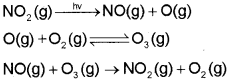
occurs in warm, dry and sunny climate. The main components of the photochemical smog result from the action of sunlight on unsaturated hydrocarbons and nitrogen oxides produced by automobiles and factories. Photochemical smog has high concentration of oxidising agents and is, therefore, called as oxidising smog. Formation of photochemical smog – When fossil fuels are burnt, a variety of pollutants are emitted into the earth’s troposphere. Two of the pollutants that are emitted are hydrocarbons (unburnt fuels) and nitric oxide (NO). When these pollutants build up to sufficiently high levels, a chain reaction occurs from their interaction with sunlight in which NO is converted into nitrogen dioxide (NO2). This NO2, in turn, absorbs energy from sunlight and breaks up into nitric oxide and free oxygen atom.
Plus One Chemistry Notes Chapter 14 Environmental Chemistry 2

Ozone is a toxic gas and both NO2 and O3 are strong oxidising agents and can react with the unburnt hydrocarbons in the polluted air to produce chemicals such as formaldehyde, acrolein and peroxyacetyl nitrate (PAN).
Plus One Chemistry Notes Chapter 14 Environmental Chemistry 3

Effects of photochemical smog
Both ozone and PAN act as powerful eye irritants. Ozone and nitric oxide irritates the nose and throat and their high concentration causes headache, chest pain, dryness of the throat, cough and difficulty in breathing. Photochemical smog leads to cracking of rubber and extensive damage to plant life. It also causes corrosion of metals, stones, building materials, rubber and painted surfaces. Catalytic converters are used in the automobiles, which prevent the release of nitrogen oxide and hydrocarbons to the atmosphere. Certain plants e.g., Pinus, Juniparus, Quercus, Pyrus and Vitis can metabolise nitrogen oxide and therefore, their plantation could help in this matter.

Stratospheric Pollution
Formation and Breakdown of Ozone
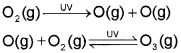
Plus One Chemistry Notes Chapter 14 Environmental Chemistry 4
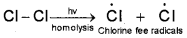
The main reason of ozone layer depletion is believed to be the release of chlorofluorocarbon compounds (CFCs), also known as freons. These compounds are non-reactive, non-flammable, non-toxic organic molecules and therefore used in refrigerators, air conditioners, in the production of plastic foam and by the electronic industry for cleaning computer parts etc. Once CFCs are released in the atmosphere, they mix with the normal atmospheric gases and eventually reach the stratosphere. In stratosphere, they get broken down by powerful UV radiations, releasing chlorine free radical.
Plus One Chemistry Notes Chapter 14 Environmental Chemistry 5

Plus One Chemistry Notes Chapter 14 Environmental Chemistry

The chlorine radicals are continuously regenerated and cause the breakdown of ozone. Thus, CFCs are transporting agents for continuously generating chlorine radicals into the stratosphere and damaging the ozone layer. Antarctica reported about depletion of ozone layer commonly known as ozone hole over the South Pole. It was found that a unique set of conditions was responsible for the ozone hole. In summer season, nitrogen dioxide and methane react with chlorine monoxide and chlorine atoms forming chlorine sinks, preventing much ozone depletion, whereas in winter, special type of clouds called polar stratospheric clouds are formed over Antarctica. These polar stratospheric clouds provide surface on which chlorine nitrate formed gets hydrolysed to form hypochlorous acid. It also reacts with hydrogen chloride produced as per reaction to give molecular chlorine.
Plus One Chemistry Notes Chapter 14 Environmental Chemistry 6

When sunlight returns to the Antarctica in the spring, the sun’s warmth breaks up the clouds and HOCl and Cl2 are photolysed by sunlight, as given in reactions.
Plus One Chemistry Notes Chapter 14 Environmental Chemistry 7

Water Pollution
Causes of Water Pollution
(i) Pathogens:
The most serious water pollutants are the disease causing agents called pathogens. Pathogens include bacteria and other organisms that enter water from domestic sewage and animal excreta. Human excreta contain bacteria such as Escherichia coli and Streptococcus faecalis which cause gastrointestinal diseases.

Plus One Chemistry Notes Chapter 14 Environmental Chemistry

Dissolved oxygen (DO) in water:
The concentration of dissolved oxygen in water is of vital importance to aquatic life. Growth of fish is inhibited if the dissolved oxygen level in waterfalls below 6 ppm. Pollution causes decrease in DO level.

Dissolved oxygen (DO) in water is consumed by micro-organisms to oxidise organic matter in sewage. Deoxygenation of water may also take place by the bio-oxidation of nitrogeneous matter.

Biochemical oxygen demand (BOD) :
It is the amount of dissolved oxygen required by microorganisms to oxidise organic and inorganic matter present in polluted water. It is generally expressed in ppm (parts per million). ‘Clean water1 would have a BOD value less than 5 ppm while highly contaminated water (say, river water) could have a BOD value 17 ppm or more.

Plus One Chemistry Notes Chapter 14 Environmental Chemistry

The amount of oxygen in ppm that would be required to oxidise all the contaminants in water is called chemical oxygen demand (COD).

Nowadays most of the detergents available are biodegradable. However, their use can create other problems. The bacteria responsible for degrading biodegradable detergent feed on it and grow rapidly. While growing, they may use up all the oxygen dissolved in water. The lack of oxygen kills all other forms of aquatic life such as fish and plants. Fertilizers contain phosphates as additives. The addition of phosphates in water enhances algae growth. This process in which nutrient enriched water bodies support a dense plant opulation, which kills animal life by depriving it of oxygen and results in subsequent loss of biodiversity is known as Eutrophication.

International Standards for Drinking Water
The International Standards for drinking water are given below and they must be followed.

Fluoride:
For drinking purposes, water should be tested for fluoride ion concentration. Its deficiency in drinking water is harmful to man and causes diseases such as tooth decay etc. Soluble fluoride is often added to drinking water to bring its concentration upto 1 ppm or 1 mg dm-3. The F ions make the enamel on teeth much harder by converting hydroxyapatite, [3(Ca3(PO4)2.Ca(OH)2], the enamel on the surface of the teeth, into much harder fluorapatite, [3(Ca3(PO4)2.CaF2]. However, F- ion concentration above 2 ppm causes brown mottling of teeth. At the same time, excess fluoride (over 10 ppm) causes harmful effect to bones and teeth, as reported from some parts of Rajasthan.

Lead:
Drinking water gets contaminated with lead when lead pipes are used for transportation of water. The prescribed upper limit concentration of lead in drinking water is about 50 ppb. Lead can damage kidney, liver, reproductive system etc.

Sulphate:
Excessive sulphate (>500 ppm) in drinking water causes laxative effect, otherwise, at moderate levels it is harmless.

Nitrate:
The maximum limit of nitrate in drinking water is 50 ppm. Excess nitrate in drinking water can cause disease such as methemoglobinemia (‘blue baby’ syndrome).

Soil Pollution
Any factor which destroys the quality, texture and mineral content of the soil or which disturbs the biological balance of the organisms in the soil is referred to as soil pollutant.

Soil pollution has adverse effect on plant growth. Soil pollution is mainly due to

  • Indiscriminate use of fertilizers, pesticides etc.
  • Dumping of waste materials.
  • Deforestation.

Large number of pesticides are used to save plants from pests, rats, insects, fungi etc. Chlorinated hydrocarbons, malathion, aldrin, DDT, BHC etc. are some substances used extensively in agriculture. Herbicides are used to kill weeds. Sodium chlorate (NaClO3), sodium arsenite (Na3AsO3) etc. are widely used as herbicides. Inorganic arsenic compounds are toxic to mammals. Fungicides are important because they counter the growth of fungi. Organo-mercury compounds are used to fungicides. However, these compounds break down in the soil causing harmful effects on human beings. Dumping of paper, plastics and other toxic substances in the soil creates serious problems. A large number of heavy metals get deposited in the soil around smelting industries. These effluents, in the long run, pollute the soil.

Plus One Chemistry Notes Chapter 14 Environmental Chemistry

Control of environmental pollution
Both industrial and domestic wastes need treatment for safe disposal, (i) Recycling of wasters not only saves the cost on raw materials but also reduces waste disposal costs. Collection and recycling of glass, metal scrap, plastics etc. are some examples of industrial recycling, (ii) Sewage water is filtered to remove large solids and then allowed to settle. Solids can settle as a sludge at the bottom while oil, grease etc. float at the surface which can be skimmed off. The sludge is dried and incinerated at high temperature (above 1000°C) in presence of oxygen. Sewage sludge can be degraded by anaerobic digestion by micro-organisms.

Green Chemistry
Introduction
Green chemistry is a way of thinking and is about utilising the existing knowledge and principles of chemistry and other sciences to reduce the adverse impact on environment. Green chemistry is a production process that would bring about minimum pollution or deterioration to the environment. The byproducts generated during a process, if not used gainfully, add to the environmental pollution. Such processes are not only environmentally unfriendly but ‘ also cost-ineffective. The waste generation and its disposal both are economically unsound. Utilisation of existing knowledge base for reducing the chemical hazards along with the developmental activities is the foundation of green chemistry. It is well-known that organic solvents such as benzene, toluene, carbon tetrachloride etc., are highly toxic. One should be careful while using them.

Green Chemistry In Day-To-Day Life
i) Dry Cleaning of Clothes
Tetra chlroroethene (Cl2C=CCl2) was earlier used as solvent for dry cleaning. The compound contaminates the ground water and is also a suspected carcinogen. Replacement of halogenated solvent by liquid CO2 will result in less harm to ground water. These days hydrogen peroxide (H2O2) is used for the purpose of bleaching clothes in the process of laundry, which gives better results and makes use of lesser amount of water.

ii) Bleaching of Paper
Chlorine gas was used earlier for bleaching paper. These days, hydrogen peroxide (H2O2) with suitable catalyst, which promotes the bleaching action of hydrogen peroxide, is used.

iii) Synthesis of Chemicals
Ethanal (CH3CHO) is now commercially prepared by one step oxidation of ethene in the presence of ionic catalyst in aqueous medium with a yield of 90%.
Plus One Chemistry Notes Chapter 14 Environmental Chemistry 8

Plus One Chemistry Notes Chapter 13 Hydrocarbons

Students can Download Chapter 13 Hydrocarbons Notes, Plus One Chemistry Notes helps you to revise the complete Kerala State Syllabus and score more marks in your examinations.

Kerala Plus One Chemistry Notes Chapter 13 Hydrocarbons

Introduction
The compounds formed by carbon and hydrogen are called Hydrocarbons.

Classification
Hydrocarbons are broadly classified into two main classes. Open chain hydrocarbons and closed chain or cyclic hydrocarbons.

Open chain hydrocarbons are hydrocarbons containing open chain of carbon atoms in their molecules. The chain may be straight or branched. These compounds are also called aliphatic hydrocarbons. They are further divided into three classes: Alkanes, alkenes, and alkynes.

Plus One Chemistry Notes Chapter 13 Hydrocarbons

Closed chain or cyclic hydrocarbons are hydrocarbons having closed chains or righs in their molecules. They are further divided into two categories: Alicyclic hydrocarbons and aromatic hydrocarbons. Alicyclic hydrocarbons contain ring or closed chain of carbon atoms, but resemble aliphatic compounds in most of their properties. Aromatic hydrocarbons contain at least one benzene ring which is a hexagonal ring of carbon atoms with three double bonds in alternate positions.

ALkanes
Alkanes are saturated aliphatic hydrocarbons containing only carbon-carbon single bonds in their molecules. They can be represented by the general formula cn H2n+2 Where n may have values 1, 2, 3, ………… Since they are relatively inert towards most of the common reagents, they are called paraffins (Latin : parum = Little, affinis = affinity)

Nomenclature
Nomenclature of alkanes has already been discussed in Unit =12 ‘

Preparation:
Petroleum and natural gas are the main sources of alkanes. However, alkanes can be prepared by following methods:
1. From unsaturated hydrocarbons
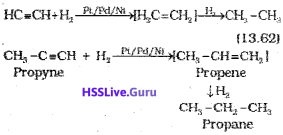
Dihydrogen gas adds to alkenes and alkynes in the presence of finely divided catalysts like platinum, palladium or nickel to form alkanes. This process is called hydrogenation. These metals adsorb dihydrogen gas on their surfaces and activate the hydrogen – hydrogen bond.

Platinum and palladium catalyse the reaction at room temperature but higher temperature and pressure are required.
Plus One Chemistry Notes Chapter 13 Hydrocarbons 1

2. From alkyl halides
i) Alkyl halides (except fluorides) on reduction with zinc and dilute hydrochloric acid give alkanes.
Plus One Chemistry Notes Chapter 13 Hydrocarbons 2
ii) Alkyl halides on treatment with sodium metal in dry ether (free from moisture) solution give higher alkanes. This reaction is known as Wurtz reaction and is used for the preparation of higher alkanes containing even number of carbon atoms.
Plus One Chemistry Notes Chapter 13 Hydrocarbons 3

3. From carboxylic acids
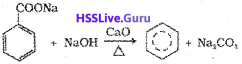
i) Sodium salts of carboxylic acids on heating with soda lime (mixture of sodium hydroxide and calcium oxide) give alkanes containing one carbon atom less than the carboxylic acid. This process of elimination of carbon dioxide from a carboxylic acid is known as Decarboxylation.
Plus One Chemistry Notes Chapter 13 Hydrocarbons 4
Sodium ethanoate

Plus One Chemistry Notes Chapter 13 Hydrocarbons

ii) Kolbe’s electrolytic method:
An aqueous solution of sodium or potassium salt of a carboxylic acid on electrolysis gives alkane containing even number of carbon atoms at the anode.
2CH3COONa+ +2H2O
Sodium acetate
-Electrolysis
CH3 – CH3 +2CO2 +H2 +2NaOH
The reaction is supposed to follow the following path:
Plus One Chemistry Notes Chapter 13 Hydrocarbons 5
Methane cannot be prepared by this method.

Properties
Physical properties:
Alkanes are almost non-polar molecules because of the covalent nature of C-C and C-H bonds and due to very little difference of electronegativity between carbon and hydrogen atoms. They possess weak van der Waals’ forces. Due to the weak forces, the first four members, C1 to C4 are gases, C5 to C17 are liquids and those containing 18 carbon atoms or more are solids at 298 K. It is generally observed that in relation to solubility of substances in solvents, polar substances are soluble in polar solvents, whereas the non-polar ones in non-polar solvents i.e., like dissolves like. There is a steady increase in boiling point with increase in molecular mass.

Plus One Chemistry Notes Chapter 13 Hydrocarbons

Chemical properties
As already mentioned, alkanes are generally inert towards acids, bases, oxidising and reducing agents. However, they undergo the following reactions under certain conditions.

1. Substitution reactions
One or more hydrogen atoms of alkanes can be replaced by halogens, nitro group, and sulphonic acid group. Halogenation takes place either at higher temperature (573-773 K) or in the presence of diffused sunlight or .ultraviolet light. Lower alkanes do not undergo nitration and sulphonation reactions. These reactions in which hydrogen atoms of alkanes are substituted are known as substitution reactions. As an example,chlorination of methane is given below:

Halogenation
Plus One Chemistry Notes Chapter 13 Hydrocarbons 6
It is found that the rate of reaction of alkanes with halogens is F2 > Cl2 > Br2 > l2. Rate of replacement of hydrogens of alkanes is :3° > 2° > 1 °. Fluorination is too violent to be controlled, lodination is very slow and a reversible reaction. It can be carried out in the presence of oxidizing agents like HIO3 or HNO3.
CH4 +I2 \(\rightleftharpoons \) CH3I+HI
HIO3 +5HI → 3l2 +3H2O
Halogenation is supposed to proceed via free radical chain mechanism involving three steps namely initiation, propagation, and termination as given below:

Mechanism
i) Initiation :
The reaction is initiated by homolysis of chlorine molecule in the presence of light or heat. The Cl-Cl bond isweakerthantheC-C and C-H bond and hence is easiest to break.
Plus One Chemistry Notes Chapter 13 Hydrocarbons 7

ii) Propagation:
It involves the following steps
Plus One Chemistry Notes Chapter 13 Hydrocarbons 8
Two such steps given below explain how more highly halogenated products are formed.
Plus One Chemistry Notes Chapter 13 Hydrocarbons 9

iii) Termination :
The reaction stops after some time due to consumption of reactants and / or due to the following side reactions:
The possible chain terminating steps are :
Plus One Chemistry Notes Chapter 13 Hydrocarbons 10
Though in (c), CH3-Cl, the one of the products is formed but free radicals are consumed and the chain is terminated. The above mechanism helps us to understand the reason for the formation of ethane as a byproduct during chlorination of methane.

2. Combustion
Plus One Chemistry Notes Chapter 13 Hydrocarbons 11

3. Controlled oxidation
Plus One Chemistry Notes Chapter 13 Hydrocarbons 12
iv) Ordinarily alkanes resist oxidation but alkanes having tertiary H atom can be oxidized to corresponding alcohols by potassium permanganate.
Plus One Chemistry Notes Chapter 13 Hydrocarbons 13

4. Isomerisation
n-Alkanes on heating in the presence of anhydrous aluminum chloride and hydrogen chloride gas isomerise to branched-chain alkanes. Major products are given below. Minor products are generally not reported in organic reactions.
Plus One Chemistry Notes Chapter 13 Hydrocarbons 14

5. Aromatization
n-Alkanes having six or more carbon atoms on heating to 773 K at 10-20 atmospheric pressure in the presence of oxides of vanadium, molybdenum or chromium supported over alumina get dehydrogenated and cyclised to benzene and its homologues. This reaction is known as aromatization or reforming.
Plus One Chemistry Notes Chapter 13 Hydrocarbons 15

6. Reaction with steam
Plus One Chemistry Notes Chapter 13 Hydrocarbons 16

7. Pyrolysis
Higher alkanes on heating to higher temperature decompose into lower alkanes, alkenes etc. Such a decomposition reaction into smaller fragments by the application of heat is called pyrolysis or cracking.
Plus One Chemistry Notes Chapter 13 Hydrocarbons 17
Preparation of oil gas or petrol gas from kerosene oil or petrol involves the principle of pyrolysis.
Plus One Chemistry Notes Chapter 13 Hydrocarbons 18

Conformations
The C-C bonds in alkanes are sigma bonds. Carbon atoms connected through sigma bonds in alkanes can undergo rotation about the bond axis. As a result of this rotation, a large number of different spatial arrangements of atoms of groups attached to the carbon atoms are possible. These different spatial arrangements are called conformations. Thus, the different spatial arrangements of atoms in a molecule which arise due to free rotation about carbon-carbon single bond are called conformations.

Plus One Chemistry Notes Chapter 13 Hydrocarbons

Conformations of ethene:
Ethane molecule (C2H6) contains a carbon-carbon single bond with each carbon atom attached to three hydrogen atoms. Considering the ball and stick model of ethane, keep one carbon atom stationary and rotate the other carbon atom around the C-C axis. This rotation results into infinite number of spatial arrangements of hydrogen atoms attached to one carbon atom with respect to the hydrogen atoms attached to the other carbon atom. These are called conformational isomers (conformers). There are two extreme cases. One such confirmation in which hydrogen atoms attached to two carbons are as closed together as possible is called eclipsed conformation and the other in which hydrogens are as far apart as possible is known as the staggered conformation. Any other intermediate conformation is called a skew conformation. lt may be remembered that in all the conformations, the bond angles and the bond lengths remain the same. Eclipsed and the staggered conformations can be represented by Sawhorse and Newman projections.

1. Sawhorse projection
C-C bond is represented by straight line. Upper end of the line is slightly tilted. The front carbon is shown by the lower end of the line and the rear carbon is represented by upper end. The angle between C-H bonds is 120°. Sawhorse projections of eclipsed and staggered conformations are depicted below.
Plus One Chemistry Notes Chapter 13 Hydrocarbons 19

2. Newman projections
In this projection, the molecule is viewed at the C-C bond head on. The carbon atom nearer to the eye is represented by a point. Three hydrogen atoms attached to the front carbon atom are shown by three lines drawn at an angle of 120° to each other. The rear carbon atom (the carbon atom away from the eye) is represented by a circle and the three hydrogen atoms are shown attached to it by the shorter lines drawn at an angle of 120° to each other.
Plus One Chemistry Notes Chapter 13 Hydrocarbons 20

Relative stability of conformations:
As mentioned earlier, in staggered form of ethane, the electron clouds of carbon-hydrogen bonds are as far apart as possible. Thus, there are minimum repulsive forces, minimum energy and maximum stability of the molecule. On the other hand, when the staggered form changes into the eclipsed form, the electron clouds of the carbon-hydrogen bonds come closer to each other resulting in increase in electron cloud repulsions. To check the increased repulsive forces, molecule will have to possess more energy and thus has lesser stability. As already mentioned, the repulsive interaction between the electron clouds, which affects stability of a conformation, is called torsional strain.

Plus One Chemistry Notes Chapter 13 Hydrocarbons

Magnitude of torsional strain depends upon the angle of rotation about C-C bond. This angle is also called dihedral angle or torsional angle. Of all the conformations of ethane, the staggered form has the least torsional strain and the eclipsed form, the maximum torsional strain. Thus it may be inferred that rotation around C-C bond in ethane is not completely free. The energy difference between the two extreme forms is of the order of is very small.

Alkenes
Alkenes are unsaturated hydrocarbons containing a carbon-carbon double bond. Acyclic alkenes with one double bond have the general formula CnH2n. Thus they are isomeric with cycloalkanes. They are also known as olefins (Greek word olefiant = oil forming) because the lower members of this family form oily products when treated with chlorine.

We have already seen that a carbon-carbon double bond consists of a sigma bond and a pi-bond. A pi-bond is weaker than a sigma – bond because sidewise overlapping takes place to smaller extent. It should be noted that a double bond is shorter than a single bond. Again, the C-H bond length in ethene is slightly shorter than that in alkanes because it is formed by the overlap of sp² hybrid orbitals of carbon.

Isomerism in Alkenes
Alkenes show chain isomerism, position isomerism and geometrical isomerism,
i) Chain Isomerism :
The simplest alkene which can exhibit isomerism is butene (C4 H8). It exists as two chain isomers.
Plus One Chemistry Notes Chapter 13 Hydrocarbons 21

ii) Position isomerism :
Position isomers of alkenes differ in the position of double bond.
Plus One Chemistry Notes Chapter 13 Hydrocarbons 21

iii) Geometrical isomerism :
The isomers which have the same structural formula but differ in spatial arangement of atoms or groups about the double bond are called geometrical isomers and the phenomenon is known as geometrical isomers of but 2 ene are given below.
Plus One Chemistry Notes Chapter 13 Hydrocarbons 23

The geometrical isomer with similar groups on the same side of the double bond is called the cis isomer while the other isomer with similar groups on opposite side is called the trans isomer. Because of this reason geometrical isomerism is also called cistrans isomerism.

Plus One Chemistry Notes Chapter 13 Hydrocarbons

Hindered rotation about carbon-carbon double bond is responsible for the existence of geometrical isomers. As we know, C=C consists of a sigma bond and a pi bond. Due to the presence of pi bond, the groups or atoms attached to doubly bonded carbon atoms cannot rotate about it. They can do so only by breaking the pi-electron cloud.

Preparation
1) From alkynes:
Partially deactivated palladised charcoal is known as Lindlar’s catalyst is used Alkenes thus obtained are having cis geometry. However, alkynes on reduction with sodium in liquid ammonia form trans alkenes.
Plus One Chemistry Notes Chapter 13 Hydrocarbons 24

2) From alkyl halides:
Alkyl halides (R-X)on heating with alcoholic potash eliminate one molecule of halogen acid to form alkenes. This reaction is known as dehydrohalogenation i.e., removal of halogen acid. This is example of β-elimination reaction, since hydrogen atom is eliminated from the β-carbon atom(carbon atom next to the carbon to which halogen is attached).
Plus One Chemistry Notes Chapter 13 Hydrocarbons 25
It is observed that for halogens, the rate is:iodine > bromine > chlorine, while for alkyl groups it is: tert > secondary > primary.

3) From vicinal dihalides :
Dihalides in which two halogen atoms are attached to two adjacent carbon atoms are known as vicinal dihalides. Vicinal dihalides on treatment with zinc metal lose a molecule of ZnX2 form an alkene. This reaction is known as dehalogenation.
CH2Br – CH2Br + Zn CH2 = CH2 + ZnBr2

Plus One Chemistry Notes Chapter 13 Hydrocarbons

4) From alcohols by acidic dehydration:
Alcohols on heating with concentrated sulphuric acid form alkenes with the elimination of one water molecule. Since a water molecule is eliminated from the alcohol molecule in the presence of an acid, this reaction is known as acidic dehydration of alcohols. This reaction is also the example of β-elimination reaction since-OH group takes out one hydrogen atom from the β-carbon atom.
Plus One Chemistry Notes Chapter 13 Hydrocarbons 26

Chemical Properties
1) Addition of dihydrogen:
Alkenes add up one molecule of dihydrogen gas in the presence of finely divided nickel, palladium or platinum to form alkanes

2) Addition of halogens :
Plus One Chemistry Notes Chapter 13 Hydrocarbons 27

3) Addition of hydrogen halides:
Hydrogen halides (HCl, HBr,HI) add up to alkenes to form alkyl halides. The order of reactivity of the hydrogen halides is HI > HBr> HCI. Like addition of halogens to alkenes, addition of hydrogen halides is also an example of electrophilic addition reaction. Addition reaction of HBr to symmetrical alkenes Addition reactions of HBr to symmetrical alkenes (similar groups attached to double bond) take place by electrophilic addition mechanism.
Plus One Chemistry Notes Chapter 13 Hydrocarbons 28

Addition reaction of HBr to unsymmetrical alkenes (Markovnikov Rule)
There are two possible products in the following reaction
Plus One Chemistry Notes Chapter 13 Hydrocarbons 29
Markovnikov, a Russian chemist made generalisations about such reactions. It to frame a rule called Markovnikov rule. The rule states that negative part of the addendum (adding molecule) gets attached to that carbon atom which possesses lesser number of hydrogen atoms. Thus according to this rule, product I i.e., 2- bromopropane is expected. In actual practice, this is the principal product of the reaction.

Plus One Chemistry Notes Chapter 13 Hydrocarbons

Anti Markovnikov addition or peroxide effect or Kharash effect
In the presence of peroxide, addition of HBr to unsymmetrical alkenes like propene takes place contrary to the Markovnikov rule. This happens only with HBr but not with HCI and HI. This addition reaction was observed by M.S. Kharash and F.R. Mayo in 1933. This reaction is known as peroxide or Kharash effect or addition reaction anti to Markovnikov rule.

4) Addition of sulphuric acid:
Cold concentrated sulphuric acid adds to alkenes in accordance with Markovnikov rule to form alkyl hydrogen sulphate by the electrophilic addition reaction.
Plus One Chemistry Notes Chapter 13 Hydrocarbons 30

5) Addition of water :
In the presence of a few drops of concentrated sulphuric acid alkenes react with water to form alcohols, in accordance with the Markovnikov rule.
Plus One Chemistry Notes Chapter 13 Hydrocarbons 31

6) Oxidation:
Alkenes on reaction with cold,dilute, aqueous solution of potassium permanganate (Baeyer’s reagent) produce vicinal glycols. Decolorisation of KMnO. solution is used as a test for unsaturation.
Plus One Chemistry Notes Chapter 13 Hydrocarbons 32
b) Acidic potassium permanganate or acidic potassium dichromate oxidises alkenes to ketones and/or acids depending upon the nature of the alkene and the experimental conditions.
Plus One Chemistry Notes Chapter 13 Hydrocarbons 33

7) Ozonolysis:
Ozonolysis of alkenes involves the addition of ozone molecule to alkene to form ozonide, and then cleavage of the ozonide by Zn- H20 to smaller molecules. This reaction is highly useful in detecting the position of the double bond in alkenes or other unsaturated compounds.
Plus One Chemistry Notes Chapter 13 Hydrocarbons 34

8) Polymerisation:
You are familiar with polythene bags and polythene sheets. Polythene is obtained by the combination of large number of ethene molecules at high temperature, high pressure and in the presence of a catalyst. The large molecules thus obtained are called polymers. This reaction is known as polymerisation. The simple compounds from which polymers are made are called monomers. Other alkenes also undergo polymerisation.
Plus One Chemistry Notes Chapter 13 Hydrocarbons 35

Alkynes
Like alkenes, alkynes are also unsaturated hydrocarbons. They contain at least one triple bond between two carbon atoms. The number of hydrogen atoms is still less in alkynes as compared to alkenes or alkanes. Their general formula is CnH2n-2 Alkynes show chain isomerism and position isomerism.

i) Chain isomerism :
Alkynes having five or more carbon atoms show chain isomerism due to different structures of the carbon chain. For example, the chain isomers of C5H8 are
Plus One Chemistry Notes Chapter 13 Hydrocarbons 36

ii) Position isomerism:
Butyne and higher alkynes show position isomerism. For example, the position isomers of butyne are
Plus One Chemistry Notes Chapter 13 Hydrocarbons 37

Structure Of Triple Bond
Each carbon atom of ethyne has two sp hybridised orbitals. Carbon-carbon sigma (σ)bond is obtained by the head-on overlapping of the two sp hybridised orbitals of the two carbon atoms. The remaining sp hybridised orbital of each carbon atom undergoes overlapping along the internuclear axis with the 1s orbital of each of the two hydrogen atoms forming two C-H sigma bonds. H-C-C bond angle is of 180°. Each carbon has two unhybridised p orbitals which are perpendicular to each other as well as to the plane of the C-C sigma bond. The 2p orbitals of one carbon atom are parallel to the 2p orbitals of the other carbon atom, which undergo lateral or sideways overlapping to form two pi (π) bonds between two carbon atoms. Thus ethyne molecule consists of one C-C σ bond, two C-H σ bonds, and two C-C π bonds. The strength of C ≡ C bond is more than those of C=C bond and C-C bond.

Preparation
1. From calcium carbide:
Plus One Chemistry Notes Chapter 13 Hydrocarbons 38
2. From vicinal dihalides:
Plus One Chemistry Notes Chapter 13 Hydrocarbons 39

Properties

Physical properties
Physical properties of alkynes follow the same trend of alkenes and alkanes. First three members are gases, the next eight are liquids and the higher ones are solids. All alkynes are colourless. Ethyene has characteristic odour. Other members are odourless. Alkynes are weakly polar in nature. They are lighter than water and immiscible with water but soluble in organic solvents like ethers, carbon tetrachloride, and benzene. Their melting point, boiling point and density increase with increase in molar mass.

Chemical Properties
Acidic Character Of Alkyne

A. Acidic character of alkyne:
The acidic character of acetylene and other l-alkynes can be explaned on the basis of the sp hybridisation state of the triply bonded carbon atom. We know that an electron in s-orbital is more tightly held than that in a p-orbital because s-electrons are more close to the nucleus. Now, sp hybridised orbital has greater s-character (50%) as compared to sp² (33%) and sp³ (25%) hybrid orbitals. Due to large s-character, the electrons in sp hybridised orbitals are held more tightly by the nucleus. Thus, sp hybridised carbon is more electronegative than sp² or sp³ hybridised carbon atoms. Due to this, the hydrogen atom attached to sp hybridised carbon atom develops slight positive charge and is acidic in character.

B. Addition reactions:
Plus One Chemistry Notes Chapter 13 Hydrocarbons 40
The addition product formed depends upon stability of vinylic cation. Addition in unsymmetrical alkynes takes place according to Markovnikov rule. Majority of the reactions of alkynes are the examples of electrophilic addition reactions. A few addition reactions are given below:
(i) Addition of dihydrogen
Plus One Chemistry Notes Chapter 13 Hydrocarbons 41
(ii) Addition od halogens
Plus One Chemistry Notes Chapter 13 Hydrocarbons 42
(iii) Addition of hydrogen halides :
Two molecules of hydrogen halides (HCl, HBr,HI) add to alkynes to form gem dihalides (in which two halogens are attached to the same carbon atom)
Plus One Chemistry Notes Chapter 13 Hydrocarbons 43
(iv) Addition of water:
Plus One Chemistry Notes Chapter 13 Hydrocarbons 44
(v) Polymerisation
(a) Linear polymerisation:
Under suitable conditions, linear polymerisation of ethyne takes place to produce polyacetylene or polyethyne which is a high molecularweight polyene containing repeating units . of (CH = CH – CH = CH) and can be represented as —(CH = CH – CH = CH)n — Under special conditions, this polymer conducts electricity.

Plus One Chemistry Notes Chapter 13 Hydrocarbons

Thin-film of polyacetylene can be used as electrodes in batteries. These films are good conductors, lighter and cheaper than the metal conductors.

(b) Cyclic polymerisation:
Plus One Chemistry Notes Chapter 13 Hydrocarbons 45

Aromatic Hydrocarbons
Aromatic compounds are a class of compounds having characteristic stability in spite of having double bonds in their structure. Simple aromatic compounds contain one or more benzene rings. They are known as benzenoid aromatic compounds. There is yet another series of compound which exhibit aromatic properties but lack benzene like structures. They are called non-benzenoid aromatic compounds. Heterocyclic compounds such as pyrrole, thiophene etc. are simple examples of non-benzenoid aromatic compounds. Structures of some simple arenes (benzenoid) are given below.

Resonance and stability of benzene
According to resonance theory, benzene is a resonance hybrid of the two Kekule structures I & II shown below.
Plus One Chemistry Notes Chapter 13 Hydrocarbons 46

These two structures I & II are known as canonical structures of benzene. The actual structure of benzene is intermediate between the two Kekule structures and is referred to as the resonance hybrid. As a result of resonance, all carbon-carbon bond lengths in benzene become equal and lie in between C=C and C-C bond length.

Plus One Chemistry Notes Chapter 13 Hydrocarbons

Further, a resonance hybrid will always be more stable than any of the contributing (or canonical) structures. Thus the actual molecule of benzene is more stable than either of the two Kekule structures. The difference between the energy of the most stable contributing structure and the energy of the resonance hybrid is known as resonance energy. Resonance energy of benzene has been found to be about 150 kJ mol-1.

Aromaticity
Benzene was considered as parent ‘aromatic’ compound. Now, the name is applied to all the ring systems whether or not having benzene ring, possessing following characteristics.
i) Planarity
ii) Complete delocalisation of the π electrons in the ring
iii) Presence of (4n + 2)π electrons in the ring where n is an integer (n = 0, 1,2,…).

This is often referred to as Hiickel Rule.
Some examples of aromatic compounds are given below:
Plus One Chemistry Notes Chapter 13 Hydrocarbons 47

Preparation of Benzene
Benzene is commercially isolated from coal tar. However, it may be prepared in the laboratory by the following methods.
i) Cyclic polymerisation of ethyne: (Section 13.4.4)
ii) Decarboxylation of aromatic acids:
Sodium salt of benzoic acid on heating with sodalime gives benzene.
Plus One Chemistry Notes Chapter 13 Hydrocarbons 48
iii) Reduction of Phenol
Plus One Chemistry Notes Chapter 13 Hydrocarbons 49

Properties

Physical Properties
Aromatic hydrocarbons are non- polar molecules and are usually colourless liquids or solids with a characteristic aroma. You are also familiar with naphthalene balls which are used in toilets and for preservation of clothes because of unique smell of the compound and the moth repellent property. Aromatic hydrocarbons are immiscible with water but are readily miscible with organic solvents. They bum with sooty flame.

Chemical properties
Arenes are characterised by electrophilic substitution reactions. However, under special conditions they can also undergo addition and oxidation reactions.

Plus One Chemistry Notes Chapter 13 Hydrocarbons

Electrophilic substitution reactions
The common electrophilic substitution reactions of arenes are nitration, halogenation, sulphonation, Friedel Craft’s alkylation and acylation reactions in which attacking reagent is an electrophile (E+)
i) Nitration:
Plus One Chemistry Notes Chapter 13 Hydrocarbons 50
ii) Halogenation:
Arenes react with halogens in the presence of a Lewis acid like anhydrous FeCl3, FeBr3 or AlCl3 to yield haloarenes.
Plus One Chemistry Notes Chapter 13 Hydrocarbons 51
iii) Sulphonation:
Plus One Chemistry Notes Chapter 13 Hydrocarbons 52
iv) Friedel-Crafts alkylation reaction:
Plus One Chemistry Notes Chapter 13 Hydrocarbons 53
v) Friedel-Crafts acylation reaction:
The reaction of benzene with an acyl halide or acid anhydride in the presence of Lewis acids (AlCl3) yields acyl benzene
Plus One Chemistry Notes Chapter 13 Hydrocarbons 54

If excess of electrophilic reagent is used, further substitution reaction may take place in which other hydrogen atoms of benzene ring may also be successively replaced by the electrophile. For example, benzene on treatment with excess of chlorine in the presence of anhydrous AlCl3 in dark yields hexachlorobenzene (C6Cl6).
Plus One Chemistry Notes Chapter 13 Hydrocarbons 55

a) Generation of electrophile EA :
During chlorination, alkylation and acylation of benzene, an-hydrous AlCl3, being a Lewis acid helps in generation of the elctrophile Cl, R. RCO (acylium ion) respectively by combining with the attacking reagent.
Plus One Chemistry Notes Chapter 13 Hydrocarbons 56

In the case of nitration, the electrophile, nitronium ion, NO2+ is produced by transfer of a proton (from sulphuric acid) to nitric acid in the following manner:
Plus One Chemistry Notes Chapter 13 Hydrocarbons 57

It is interesting to note that in the process of generation of nitronium ion, sulphuric acid serves as an acid and nitric acid as a base.
Thus, it is a simple acid-base equilibrium,

b) Formation of Carbocation (arenium ion):
Attack of electrophile results in the formation of σ – complex or arenium ion in which one of the carbon is sp³ hybridised and the arenium ion gets stabilised by resonance. Sigma complex or arenium ion loses its aromatic character because delocalisation of electrons stops at sp³ hybridised carbon.
Plus One Chemistry Notes Chapter 13 Hydrocarbons 58
The areneium ion gets stabilised by resonance:
Plus One Chemistry Notes Chapter 13 Hydrocarbons 59

c) Removal of proton:
Plus One Chemistry Notes Chapter 13 Hydrocarbons 60
Addition reactions
Plus One Chemistry Notes Chapter 13 Hydrocarbons 61
Combustion:
Plus One Chemistry Notes Chapter 13 Hydrocarbons 62

Directive Influence Of A Functional Group In Monosubstituted Benzene
In benzene all the six hydrogen atoms are equivalent. There fore, replacement of anyone hydrogen atom by a substituent gives a single monosubstituted derivative of benzene. However, when a monosubstituted product is converted into a disubstituted benzene derivative, three different isomers can be obtained. They are,
Plus One Chemistry Notes Chapter 13 Hydrocarbons 63

Carcinogenicity And Toxicity
Benzene and polynuclear hydrocarbons containing more than two benzene ring fused together are toxic and said to posses cancer producing (carcinogenic) property. They are formed due to the incomplete combustion of organic materials like tobacco, coal, and petroleum.

Plus One Chemistry Notes Chapter 12 Organic Chemistry: Some Basic Principles and Techniques

Students can Download Chapter 12 Organic Chemistry: Some Basic Principles and Techniques Notes, Plus One Chemistry Notes helps you to revise the complete Kerala State Syllabus and score more marks in your examinations.

Kerala Plus One Chemistry Notes Chapter 12 Organic Chemistry: Some Basic Principles and Techniques

Introduction
The element carbon organic chemistry the element carbon has the unique property called catenation due to which it forms covalent bonds with other carbon atoms. It also forms covalent bonds with atoms of other elements like hydrogen, oxygen, nitrogen, sulphur, phosphorus and halogens. The resulting compounds are studied under a separate branch of chemistry called organic chemistry.

General Introduction
In early years of chemistry, compounds were classified into two types. Compounds derived from non-living sources such as rocks, minerals etc. were called ‘inorganic compounds’ and those derived from plants and animals were regarded as ‘organic compounds’. On account of the special nature of organic compounds and their occurrence in living world alone, it was believed that they were produced by a vital force existing in living organisms. This led to the belief that such compounds could not be synthesised in the laboratory. However in 1828, F. Wohler succeeded in preparing urea (an organic compound) from an inorganic material, ammonium cyanate.

Tetravalance Of Carbon

Shapes of Organic Compounds
Carbon (atomic number 6) has the ground state electronic configuration 1 s² 2s²p¹x2p¹y2p°z. Carbon attains noble gas configuration only by sharing electrons with other atoms. Carbon atom, therefore, forms four covalent bonds in all its compounds.

Plus One Chemistry Notes Chapter 12 Organic Chemistry: Some Basic Principles and Techniques

During the formation of bonds (which is an energy releasing process) the two electrons in the 2s orbital get unpaired and one is promoted to the empty 2pz orbital. This corresponds to the excited state of carbon which has four half-filled orbitals (four valence electrons). The shapes of molecules such as methane (CH4), ethene (C2H4) and ethyne (C2H2) are explained in terms of the use of sp³, sp² and sp hybridised orbitals by the carbon atoms in the respective molecules.

Structural Representations Of Organic Compounds

Complete, Condensed and Bond-line Structural Formulas
Structures of organic compounds are represented in several ways. The Lewis structure or dot structure, dash structure, condensed structure and bond line structural formulas are some of the specific types. In Lewis structures bonds are represented by lines and lone pair electrones by dots. For example,
Plus One Chemistry Notes Chapter 12 Organic Chemistry Some Basic Principles and Techniques 1
In bond-line structural representation of organic compounds, carbon and hydrogen atoms are not shown and the lines representing carbon-carbon bonds are drawn in a zig-zag fashion. The only atoms specifically written are oxygen, chlorine, nitrogen etc. The terminals denote methyl (-CH3) groups.
Plus One Chemistry Notes Chapter 12 Organic Chemistry Some Basic Principles and Techniques 2

Classification Of Organic Compounds
Plus One Chemistry Notes Chapter 12 Organic Chemistry Some Basic Principles and Techniques 3

I. Acyclic or open chain compounds
These compounds are also called as aliphatic compounds and consist of straight or branched chain compounds, for example:
Plus One Chemistry Notes Chapter 12 Organic Chemistry Some Basic Principles and Techniques 4

II. Alicyclic or closed chain or ring compounds
Alicyclic (aliphatic cyclic) compounds contain carbon atoms joined in the form of a ring (homocyclic). Sometimes atoms other than carbon are also present in the ring (heterocyclic). Some examples of this type of compounds are:
CycloiTexane Tetrahydrofuran These exhibit some of the properties similar to those of aliphatic compounds ane:
Plus One Chemistry Notes Chapter 12 Organic Chemistry Some Basic Principles and Techniques 5

Aromatic compounds
Aromatic compounds are special types of compounds. You will learn about these compounds in detail in Unit 13. These include benzene and other related ring compounds (benzenoid). Like alicyclic compounds, aromatic comounds may also have hetero atom in the ring. Such compounds are called heterocyclic aromatic compounds. Some of the examples of various types of aromatic compounds are:

Benzenoid aromatic compounds
Plus One Chemistry Notes Chapter 12 Organic Chemistry Some Basic Principles and Techniques 6
Non-benzenoid compound
Plus One Chemistry Notes Chapter 12 Organic Chemistry Some Basic Principles and Techniques 7
Heterocyclic aromatic compounds
Plus One Chemistry Notes Chapter 12 Organic Chemistry Some Basic Principles and Techniques 8

Organic compounds can also be classified on the basis of functional groups, into families or homolo-gous series.

Homologous series
Homologous series may be defined as a series of similarly constituted organic compound in which the members possess the same functional group and have similar chemical properties and the neighbouring (or consecutive) members differ by – CH2 unit in their molecular formula,
eg: Alkane family (Cn H2n+2), alkenes (CnH2n) alcohols (Cn H2n+1OH).

Nomenclature Of Organic Compounds
IUPAC names of unbrached saturated hydrocarbons
Plus One Chemistry Notes Chapter 12 Organic Chemistry Some Basic Principles and Techniques 9

Nomenclature of branched chain alkanes:
We encounter a number of branched chain alkanes. The rules for naming them are given below.
1. First of all, the longest carbon chain in the molecule is identified.For example,
Plus One Chemistry Notes Chapter 12 Organic Chemistry Some Basic Principles and Techniques 10
2. The numbering is done in such a way that the branched carbon atoms get the lowest possible numbers.
Plus One Chemistry Notes Chapter 12 Organic Chemistry Some Basic Principles and Techniques 11
and the numbering is not from right to left.

3. The names of alkyl groups attached as a branch are then prefixed to the name of the parent alkane and position of the substituents is indicated by the appropriate numbers. If different alkyl groups are present, they are listed in alphabetical order. Thus, name for the compound shown above is: 6- Ethyl-2- methylnonane.
[Note: the numbers are separated from the groups by hyphens and there is no break between methyl and nonane.]

4. If two or more identical substituent groups are present then the numbers are separated by commas. The names of identical substituents are not repeated, instead prefixes such as di (for 2), tri (for 3), tetra (for 4), Penta (for 5), Hexa (for 6) etc. are used. While writing the name of the substituents in alphabetical order, these prefixes, however, are not considered. Thus, the following compounds are named as:
Plus One Chemistry Notes Chapter 12 Organic Chemistry Some Basic Principles and Techniques 12

5. If the two substituents are found in equivalent positions, the lower number is given to the one coming first in the alphabetical listing. Thus, the following compound is 3-Ethyl-6-methyl octane and ‘ not6-Ethyl-3-methyl octane.
Plus One Chemistry Notes Chapter 12 Organic Chemistry Some Basic Principles and Techniques 13

6. The branched alkyl groups can be named by following the above mentioned procedures. However, the carbon atom of the branch that attaches to the root alkane is numbered 1 as exemplified below.
Plus One Chemistry Notes Chapter 12 Organic Chemistry Some Basic Principles and Techniques 14

Cyclic Compounds
A saturated monocyclic compound is named by prefixing ‘cyclo’ to the corresponding straight chain alkane. If side chains are present, then the rules given above are applied. Names of some cyclic compounds are given below.
Plus One Chemistry Notes Chapter 12 Organic Chemistry Some Basic Principles and Techniques 15

Nomenclature Of Organic Compounds Having Functional Group (S)
When a functional group (other than C=C and -C ≡ C) is present in the molecule, it is indicated by adding secondary suffix after the primary suffix. The terminal ‘e’ of the primary suffix is removed before adding secondary suffix (whose name begins with a, i, o, u or y). It is to be noted that some functional group such as alkoxy (-OR), nirto (-NO2), halogeno etc. are indicated by the prefixes.

Plus One Chemistry Notes Chapter 12 Organic Chemistry: Some Basic Principles and Techniques

For example, CH3-CH2-OH Ethane -e+ol = Ethanol (using secondary suffix) CH3-CH2-CHO Propane -e+al = Propanal (using secondary suffix) CH3-CH2-NO2 Nitroethane (using prefix)

The systematic name of an organic compound containing functional group can be derived using the following sequence of steps.

The longest carbon chain (parent chain) containing the functional groups is identified. This gives the word root. The name of the compound is then obtained as follows:
Prefixes – word root – primary suffix – secondary suffix The following examples will illustrate the rules
Plus One Chemistry Notes Chapter 12 Organic Chemistry Some Basic Principles and Techniques 16

In case of compounds containing more than one similar functional group, the world di, tri etc is added before the secondary suffix which indicates the functional group. In doing so, the last letter ‘e’ of the parent alkane has to be retained. However, the endingne of the parent alkane is dropped in case of compounds having more than one double or triple bond. For example,
Plus One Chemistry Notes Chapter 12 Organic Chemistry Some Basic Principles and Techniques 17

If the molecule contains two or more different functional groups, the parent chain must contain maximum possible number of functional groups. The carbon atoms in the parent chain are numbered in such a way that the functional group of higher priority gets the lower number. The priority of various functional groups follows the order.

COOH>-CO-O-CO->-COOR>-COCI>-CONH2>-CN>- HC=O>CO>-OH>-NH2>>C=C<-C≡C->-X>-NO2>R-
The functional group with higher priority is indicated by suitable secondary suffix and the other functional groups are treated as substituents which are specified by suitable prefixes.
For example,
Plus One Chemistry Notes Chapter 12 Organic Chemistry Some Basic Principles and Techniques 18

Nomenclature of Substituted Benzene Compounds
For IUPAC nomenclature of substituted benzene compounds, the substituent is placed as prefix to the word benzene as shown in the following examples.
Plus One Chemistry Notes Chapter 12 Organic Chemistry Some Basic Principles and Techniques 19

If benzene ring is disubstituted, the position of substituents is defined by numbering the carbon atoms of the ring such that the substituents are located at the lowest numbers possible. For example, the compound(b) is named as 1, 3-Dibromobenzene and not as 1,5 dibromobenzene. Substituent of the base compound is assigned number 1 and then the direction of numbering is chosen such that the next substituent gets the lowest number. The substituents appear in the name in alphabetical order. Some examples are given below.
Plus One Chemistry Notes Chapter 12 Organic Chemistry Some Basic Principles and Techniques 20

In the trivial system of nomenclature the terms ortho (o), meta (m) and para (p) are used as prefixes to indicate the relative positions 1,2-;1,3- and Ir-respectively. Thus, 1,3-dibromobenzene (b) is named as m-dibromobenzene (meta is abbreviated as m-) and the other isomers of dibromobenzenel, 2-(a) and 1,4-(c), are named as ortho (or just o-) and para (or just p-)-dibromobenzene, respectively. The substituents appear in the name in alphabetical order.

Plus One Chemistry Notes Chapter 12 Organic Chemistry: Some Basic Principles and Techniques

Isomerism
The phenomenon of existence of two or more compounds possessing the same molecular formula but different properties is known as isomerism. Such compounds are called as isomers.

Structural Isomerism
Compounds having the same molecular formula but different structures (manners in which atoms are linked) are classified as structural isomers. Some typical examples of different types of structural isomerism are given below:

(i) Chain isomerism:
When two or more compounds have similar molecular formula but different carbon skeletons, these are referred to as chain isomers and the phenomenon is termed as chain isomerism.
Plus One Chemistry Notes Chapter 12 Organic Chemistry Some Basic Principles and Techniques 21

ii) Position isomerism:
When two or more compounds differ in the position of substituent atom or functional group on the carbon skeleton, they are called position isomers and this phenomenon is termed as position isomerism.
Plus One Chemistry Notes Chapter 12 Organic Chemistry Some Basic Principles and Techniques 22

iii) Functional group isomerism :
Two or more compounds having the same molecularformula but different functional groups are called functional isomers and this phenomenon is termed as functional group isomerism.

iv) Metamerism :
It arises due to different alkyl chains on either side of the functional group in the molecule. For example, CaH10O represents Methoxypropane (CH3OC3H7) and Ethoxyethane (C2H5OC2H5).

Fundamental Concepts In Organic Reaction Mechanism
An organic reaction takes place by the attack of a reagent on an organic compound which is designated as a substrate. The steps of an organic reaction showing the breaking and formation of bonds in such substrate leading to the formation of the final product are referred to as its mechanism.

Plus One Chemistry Notes Chapter 12 Organic Chemistry: Some Basic Principles and Techniques

Fission Of A Covalent Bond
A covalent bond can be broken in two different ways,

(i) Homolytic fission :
If a covalent bond breaks in such a way that each atom takes away one electron of the shared pair. It is called homolytic fission or homolysis. The fragments with odd or unpaired electrons formed by homolysis are known as free radicals. For example,
Plus One Chemistry Notes Chapter 12 Organic Chemistry Some Basic Principles and Techniques 23

Usually homolysis occurs at high temperature or in presence of high energy radiations. Reactions occurring through homolytic fission are known as free radical reactions (non-polar reactions).

(ii) Heterolytic fission :
When a covalent bond breaks in such a way that both the electrons of the covalent bond are taken away by one of the bonded atoms, the mode of cleavage is called heterolytic cleavage or heterolysis. The products of heterolysis of a covalent bond are positive and negative ions, eg:
Plus One Chemistry Notes Chapter 12 Organic Chemistry Some Basic Principles and Techniques 24

Inductive Effect (I Effect)
It is the permanent polarisation of a sigma bond in a molecule by the influence of an adjacent polar bond or group.

For illustration, let us consider a carbon chain in which one terminal carbon atom is joined to a chlorine atom. Since the chlorine atom is more electronegative than carbon, the sigma electrons of the C-Cl bond are displaced towards the chlorine atom. As a result, the chlorine atom acquires a small negative charge and C acquires a small positive charge as shown below. The magnitude of+charge is of the order C1 > C2 >C3.
Plus One Chemistry Notes Chapter 12 Organic Chemistry Some Basic Principles and Techniques 25

This type of electron displacement of sigma electrons along a saturated carbon chain due to the presence of an electron-withdrawing group (or electron-donating group) is called Inductive effect:

Plus One Chemistry Notes Chapter 12 Organic Chemistry: Some Basic Principles and Techniques

This effect decreases sharply with increasing dis-tance from the substituent and becomes negligible afterthe third carbon in a chain. Atoms orgroups of atoms that attract or withdraw electrons from a chain are said to have electron withdrawing inductive effect or-l effect, eg:,
-NO2 >- CN >- COOH >- F >- Cl >- Br >-l

Atoms or groups which push or donate electrons to a carbon chain are said to have electron releasing inductive effect or + l effect. Alkyl groups have +l effect and the order of + l effect of alkyl groups is
Plus One Chemistry Notes Chapter 12 Organic Chemistry Some Basic Principles and Techniques 26

Resonance Structure
There are many organic molecules whose behaviour cannot be explained by a single Lewis structure. An example is that of benzene. Its cyclic structure containing alternating C-C single and C=C double bonds shown is inadequate for explaining its characteristic properties.
Plus One Chemistry Notes Chapter 12 Organic Chemistry Some Basic Principles and Techniques 27

As per the above representation, benzene should exhibit two different bond lengths, due to C-C single and C=C double bonds. Thus, the structure of benzene cannot be represented adequately by the above structure. Further, benzene can be represented equally well by the energetically identical structures I and ll. The actual structure of benzene cannot be adequately represented by any of these structures, rather it is a hybrid of the two structures (I and II) called resonance structures.

Plus One Chemistry Notes Chapter 12 Organic Chemistry: Some Basic Principles and Techniques

The resonance structures are hypothetical and individually do not represent any real molecule. They contribute to the actual structure in proportion to their stability. The energy of actual structure of the molecule (the resonance hybrid) is lower than that of any of the canonical structures. The difference in energy is called the resonance stabilisation energy or simply the resonance energy. The more the number of important contributing structures, the more is the resonance energy. Resonance is particularly important when the contributing structures are equivalent in energy.

Resonance Effect
The resonance effect is defined as ‘the polarity produced in the molecule by the interaction of two π- bonds or between a π-bond and lone pair of electrons present on an adjacent atom’.The effect is transmitted through the chain. There are two types of resonance or mesomeric effect designated as R or M effect.
(i) Positive Resonance Effect (+R effect)
In this effect, the transfer of electrons is away from an atom or substituent group attached to the conjugated system. This electron displacement makes certain positions in the molecule of high electron densities.

(ii) Negative Resonance Effect (- R effect)
This effect is observed when the transfer of electrons is towards the atom or substituent group attached to the conjugated system.The atoms or substituent groups, which represent +R or-R electron displacement effects are as follows:
+R effect: – halogen, -OH, -OR, -OCOR, -NH2, – NHR,-NR2,-NHCOR,
– R effect: – COOH, -CHO, >C=O, – CN, -NO2

Electromeric Effect (E – Effect)
This is temporary effect which involves the complete transfer of n electrons of a multiple bond to one of the bonded atoms in presence of an attacking reagent. However, when the attacking reagent is removed, the polarised molecule shifts back to its original electronic condition.

With transfer of π electrons takes place towards the attacking reagent the effect is called +E effect and when the transfer of π electrons occurs-S away from the attacking reagent the effect is called -E effect.

Hyperconjugation
Hyperconjugation is a general stabilising interaction. It involves delocalisation of σ electrons of C—H bond of an alkyl group directly attached to an atom of unsaturated system or to an atom with an unshared p orbital. The σ electrons of C—H bond of the alkyl group enter into partial conjugation with the attached unsaturated system or with the unshared p orbital. Hyperconjugation is a permanent effect.

Methods Of Purification Of Organic Compounds
Sublimation:
On heating, some solid substances change from solid to vapour state without passing through liquid state. The purification technique based on the above principle is known as sublimation and is used to separate sublimable compounds from nonsublimable impurities.

Plus One Chemistry Notes Chapter 12 Organic Chemistry: Some Basic Principles and Techniques

Crystallisation:
It is based on the difference in the solubilities of the compound and the impurities in a suitable solvent. The impure compound is dissolved . in a solvent in which it is sparingly soluble at room temperature but appreciably soluble at higher temperature. The solution is concentrated to get a nearly saturated solution. On cooling the solution, pure compound crystallises out and is removed by filtration. The filtrate (mother liquor) contains impurities and small quantity of the compound.

Distillation:
This important method is used to separate (i) volatile liquids from non-volatile impurities and (ii) the liquids having sufficient difference in their boiling points. Liquids having different boiling points vaporise at different temperatures. The vapours are cooled and the liquids so formed are collected separately. Chloroform (b.p 334 K) and aniline (b.p. 457 K) are easily separated by the technique of distillation. On boiling, the vapours of lower boiling component are formed first. The vapours are condensed by using a condenser and the liquid is collected in a receiver. The vapours of higher boiling component form later and the liquid can be collected separately.

Fractional Distillation:
If the difference in boiling points of two liquids is not much, simple distillation cannot be used to separate them. The vapours of such liquids are formed within the same temperature range and are condensed simultaneously. The technique of fractional distillation is used in such cases. In this technique, vapours of a liquid mixture are passed through a fractionating column before condensation. The fractionating column is fitted over the mouth of the round bottom flask. Vapours of the liquid with higher boiling point condense before the vapours of the liquid with lower boiling point. The vapours rising up in the fractionating column become richer in more volatile component. By the time the vapours reach to the top of the fractionating column, these are rich in the more volatile component. The vapours become richer in low boiling component. On reaching the top, the vapours become pure in low boiling component and pass through the condenser and the pure liquid is collected in a receiver.

After a series of successive distillations, the remaining liquid in the distillation flask gets enriched in high boiling component. Each successive condensation and vaporisation unit in the fractionating column is called a theoretical plate. One of the technological applications of fractional distillation is to separate different fractions of crude oil in petroleum industry. Distillation under reduced pressure: This method is used to purify liquids having very high boiling points and those, which decompose at or below their boiling points. Such liquids are made to boil at a temperature lower than their normal boiling points by reducing the pressure on their surface. A liquid boils at a temperature at which its vapour pressure is equal to the external pressure. The pressure is reduced with the help of a water pump or vacuum pump. Glycerol can be separated from spent-lye in soap industry by using this technique.

Plus One Chemistry Notes Chapter 12 Organic Chemistry: Some Basic Principles and Techniques

Steam Distillation:
This technique is applied to separate substances which are steam volatile and are immiscible with water. In steam distillation, steam from a steam generator is passed through a heated flask containing the liquid to be distilled. The mixture of steam and the volatile organic compound is condensed and collected. The compound is later separated from water using a separating funnelAniline is separated by this technique from aniline-water mixture.

Differential Extraction:
When an organic compound is present in an aqueous medium, it is separated by shaking it with an organic solvent in which it is more soluble than in water. The organic solvent and the aqueous solution should be immiscible with each other so that they form two distinct layers which can be separated by separatory funnel. The organic solvent is later removed by distillation or by evaporation to get back the compound.

Chromatography:
The name chromatography is based on the Greek word chroma, for colour since the method was first used for the separation of coloured substances found in plants. In this technique, the mixture of substances is applied onto a stationary phase, which may be a solid ora liquid.

A pure solvent, a mixture of solvents, or a gas is allowed to move slowly over the stationary phase. The components of the mixture get gradually separated from one another. The moving phase is called the mobile phase. Based on the principle involved, chromatography is classified into different categories. Two of these are:

  1. Adsorption chromatography, and
  2. Partition chromatography.

1. Adsorption Chromatography:
Adsorption chromatography is based on the fact that different compounds are adsorbed on an adsorbent to different degrees. Commonly used adsorbents are silica gel and alumina. When a mobile phase is allowed to move over a stationary phase (adsorbent), the components of the mixture move by varying distances over the stationary phase. Following are two main types of chromatographic techniques based on the principle of differential dsorption.

  1. Column chromatography, and
  2. Thin layer chromatography.

Column Chromatography
Column chromatography involves separation of a mixture overa column of adsorbent (stationary phase) packed in a glass tube. The column is fitted with a stopcock at its lower soluble in the organic solvent. The mixture adsorbed on adsorbent is placed on the top of the adsorbent column packed in a glass tube. An appropriate eluant which is a liquid or a mixture of liquids is allowed to flow down the column slowly. Depending upon the degree to which the compounds are adsorbed, complete separation takes place. The most readily adsorbed substances are retained near the top and others come down to various distances in the column.
Plus One Chemistry Notes Chapter 12 Organic Chemistry Some Basic Principles and Techniques 28

Thin layer chromatography (TLC) is another type of adsorption chromatography, which involves separation of substances of a mixture over a thin layer of an adsorbent coated on glass plate. A thin layer of an adsorbent (silica gel or alumina) is spread overa glass plate of suitable size. The plate is known as thin layer chromatography plate or chrome plate. The solution of the mixture to be separated is applied as a small spot about 2 cm above one end of the TLC plate. The glass plate is then placed in a closed jar containing the eluant. As the eluant rises up the plate, the components of the mixture move up along with the eluant to different distances depending on their degree of adsorption and separation takes place. The relative adsorption of each component of the mixture is expressed in terms of its retardation factor i.e. Rf value
Rf = x/y

Plus One Chemistry Notes Chapter 12 Organic Chemistry: Some Basic Principles and Techniques

Where distance moved by the substance from base line is x and distance moved by the solvent from base line is y. The spots of coloured compounds are visible on TLC plate due to their original colour. Another detection technique is to place the plate in a covered jar containing a few crystals of iodine. Spots of compounds, which adsorb iodine, will show up as brown spots. Sometimes an appropriate reagent may also be sprayed on the plate. For example, amino acids may be detected by spraying the plate with ninhydrin solution.

Partition Chromatography:
Partition chromatography is based on continuous differential partitioning of components of a mixture between stationary and mobile phases. Paper chromatography is a type of partition chromatography. In paper chromatography, a special quality paper known as chromatography paper is used. Chromatography paper contains water trapped in it, which acts as the stationary phase. A strip of chromatography paper spotted at the base with the solution of the mixture is suspended in a suitable solvent ora mixture of solvents. This solvent acts as the mobile phase. The solvent rises up the paper by capillary action and flows over the spot. The paper selectively retains different components according to their differing partition in the two phases. The paper strip so developed is known as a chromatogram. The spots of the separated coloured compounds are visible at different heights from the position of initial spot on the chromatogram. The spots of the separated colourless compounds may be observed either under ultraviolet light or by the use of an appropriate spray reagent as discussed under thin layer chromatography.

Qualitative Analysis Of Organic Compounds
Thin layer chromatography (TLC) is another type of adsorption chromatography, which involves separation of substances of a mixture over a thin layer of an adsorbent coated on glass plate. A thin
The elements present in organic compounds are carbon and hydrogen. In addition.to these, they may also contain oxygen, nitrogen, sulphur, halogens and phosphorus.

Detection of Carbon and Hydrogen
Carbon and hydrogen are detected by heating the compound with copper(ll) oxide. Carbon present in the compound is oxidised to carbon dioxide (tested with lime-water, which develops turbidity) and hydrogen to water (tested with anhydrous copper sulphate, which turns blue).
Plus One Chemistry Notes Chapter 12 Organic Chemistry Some Basic Principles and Techniques 29

Detection of Other Elements
Nitrogen, sulphur, halogens and phosphorus present in an organic compound are detected by “Lassaigne’s test”. The elements present in the compound are converted from covalent form into the ionic form by fusing the compound with sodium metal. Following reactions take place:
Plus One Chemistry Notes Chapter 12 Organic Chemistry Some Basic Principles and Techniques 30

C, N, Sand X come from organic compound. Cyanide, sulphide and halide of sodium so formed on sodium fusion are extracted from the fused mass by boiling it with distilled water. This extract is known as sodium fusion extract.

1. Test for Nitrogen
The sodium fusion extract is boiled with iron(ll) sulphate and then acidified with concentrated sulphuric acid. The formation of Prussian blue colour confirms the presence of nitrogen. Sodium cyanide first reacts with iron(ll) sulphate and forms sodium hexacyanoferrate(ll). On heating, with concentrated sulphuric acid some iron(ll) ions are oxidised to iron(lll) ions which react with sodium hexacyanoferrate(ll) to produce iron(lll) hexacyanoferrate(ll) (ferric ferrocyanide) which is Prussian blue in colour.
Plus One Chemistry Notes Chapter 12 Organic Chemistry Some Basic Principles and Techniques 31

2. Test for Sulphur
1. The sodium fusion extract is acidified with acetic acid and lead acetate is added to it. A black precipitate of lead sulphide indicates the presence of sulphur.
Plus One Chemistry Notes Chapter 12 Organic Chemistry Some Basic Principles and Techniques 32

2. On treating sodium fusion extract with sodium nitroprusside, appearance of a violet colour further indicates the presence of sulphur.
Plus One Chemistry Notes Chapter 12 Organic Chemistry Some Basic Principles and Techniques 33

In case, nitrogen and sulphur both are present in an organic compound, sodium thiocyanate is formed. It gives blood-red colour and no Prussian blue since there are no free cyanide ions.
Plus One Chemistry Notes Chapter 12 Organic Chemistry Some Basic Principles and Techniques 34

If sodium fusion is carried out with excess of sodium, the thiocyanate decomposes to yield cyanide and sulphide. These ions give their usual tests.
NaSCN + 2Na → NaCN + Na2S

Plus One Chemistry Notes Chapter 12 Organic Chemistry: Some Basic Principles and Techniques

3. Test for Halogens
The sodium fusion extract is acidified with nitric acid and then treated with silver nitrate. A white precipitate, soluble in ammonium hydroxide shows the presence of chlorine, a yellowish precipitate, sparingly soluble in ammonium hydroxide shows the presence of bromine and a yellow precipitate, insoluble in ammonium hydroxide shows the presence of iodine.
X + Ag+ → AgX

X represents a halogen – Cl, Br or I. If nitrogen or sulphur is also present in the compound, the sodium fusion extract is first boiled with concentrated nitric acid to decompose cyanide or sulphide of sodium formed during Lassaigne’s test. These ions would otherwise interfere with silver nitrate test for halogens.

4. Test for Phosphorus
The compound is heated with an oxidising agent (sodium peroxide). The phosphorus present in the compound is oxidised to phosphate. The solution is boiled with nitric acid and then treated with ammonium molybdate. A yellow colouration or precipitate indicates the presence of phosphorus.
Plus One Chemistry Notes Chapter 12 Organic Chemistry Some Basic Principles and Techniques 35

Quantitative Analysis
The percentage composition of elements present in an organic compound is determined by the methods based on the following principles:

Carbon and Hydrogen
Both carbon and hydrogen are estimated in one experiment. A known mass of an organic compound is burnt in the presence of excess of oxygen and copper(ll) oxide. Carbon and hydrogen in the compound are oxidised to carbon dioxide and water respectively.
CxHy + (x + y /4)O2 → xCO2 +(y/2)H2O

The mass of water produced is determined by passing the mixture through a weighed U-tube containing anhydrous calcium chloride. Carbon dioxide is absorbed in another U-tube containing concentrated solution of potassium hydroxide. These tubes are connected in series. The increase in masses of calcium chloride and potassium hydroxide gives the amounts of water and carbon dioxide from which the percentages of carbon and hydrogen are calculated. Let the mass of organic compound be m g, mass of water and carbon dioxide produced be m1 and m2g respectively;
Plus One Chemistry Notes Chapter 12 Organic Chemistry Some Basic Principles and Techniques 36

Nitrogen
There are two methods for estimation of nitrogen: (i) Dumas method and (ii) Kjeldahl’s method.
(i) Dumas method:
The nitrogen containing organic compound, when heated with copper oxide in an atmosphere of carbon dioxide, yields free nitrogen in addition to carbon dioxide and water.
CxHyNz+(2x + y/2)CuO → x CO2 + y / 2H2O +Z / 2N2 + (2x + y / 2)CU

Traces of nitrogen oxides formed, if any, are reduced to nitrogen by passing the gaseous mixture over a heated copper gauze. The mixture of gases so produced is collected over an aqueous solution of potassium hydroxide which absorbs carbon dioxide. Nitrogen is collected in the upper part of the graduated tube. Let the mass of organic compound = m g Volume of nitrogen collected = V1 mL
Room temperature = T1K
Volume of nitrogen at STP = 7\(\frac{p_{1} v_{1} \times 273}{760 \times T_{1}}\) (LetitbeVmL)

Plus One Chemistry Notes Chapter 12 Organic Chemistry: Some Basic Principles and Techniques

Where p1 and V1 are the pressure and volume of nitrogen, p,is different from the atmospheric pressure at which nitrogen gas is collected. The value of pt is obtained by the relation;
p1 Atmospheric pressure-Aqueous tension 22400 mL N2 at STP weighs 28 g.
\frac{p_{1} v_{1} \times 273}{760 \times T_{1}}

(ii) Kjeldahl’s method:
The compound containing nitrogen is heated with concentrated sulphuric acid. Nitrogen in the compound gets converted to ammonium sulphate.The resulting acid mixture is then heated with excess of sodium hydroxide. The liberated ammonia gas is absorbed in an excess of standard solution of sulphuric acid. The amount of ammonia produced is determined by estimating the amount of sulphuric acid consumed in the reaction. It is done by estimating unreacted sulphuric acid left after the absorption of ammonia by titrating it with standard alkali solution. The difference between the initial amount of acid taken and that left after the reaction gives the amount of acid reacted with ammonia.
taken = V mL
Volume of NaOH of molarity, M. used for titration of excess of H2SO4 = V1 mL
V1L of NaOH of molarity M= V1 /2 mL of H2SO4 0f molarity M
Volume of H2SO4 of molarity M unused= (V-1/1/2) mL (V-1/1/2) mL of H2S04 of molarity M = 2(V-V1/2) mL of NH3 solution of molarity M.
1000 mL of 1 M NH3 solution contains 17g NH3 or 14 g of N
2(V-V1/2) mL of NH3 solution of molarity M contains:
Plus One Chemistry Notes Chapter 12 Organic Chemistry Some Basic Principles and Techniques 38
Kjeldahl method is not applicable to compounds containing nitrogen in nitro and azo groups and nitrogen present in the ring (e.g. pyridine) as nitrogen of these compounds does not change to ammonium sulphate under these conditions.

Halogens
Carius method: A known mass of an organic compound is heated with fuming nitric acid in the presence of silver nitrate contained in a hard glass tube known as Carius tube, in a furnace. Carbon and hydrogen present in the compound are oxidised to carbon dioxide and water. The halogen present forms the corresponding silver halide (AgX). It is filtered, washed, dried and weighed.
Let the mass of organic compound taken = m g
Mass of AgX formed = m, g
1 mol of AgX contains 1 mol of X
Mass of halogen in m1g of AgX
Plus One Chemistry Notes Chapter 12 Organic Chemistry Some Basic Principles and Techniques 38

Sulphur
A known mass of an organic compound is heated in a Carius tube with sodium peroxide or fuming nitric acid. Sulphur present in the compound is oxidised to sulphuric acid. It is precipitated as barium sulphate by adding excess of barium chloride solution in water. The precipitate is filtered, washed, dried and weighed. The percentage of sulphur can be calculated from the mass of barium sulphate. Let the mass of organic compound taken = m g and the mass of barium sulphate formed = m1 g
1 mol of BaSO4 = 233 g BaSO4 = 32 g sulphur
Plus One Chemistry Notes Chapter 12 Organic Chemistry Some Basic Principles and Techniques 40

Phosphorus
A known mass of an organic compound is heated with fuming nitric acid whereupon phosphorus present in the compound is oxidised to phosphoric acid. It is precipitated as ammonium phosphomolybdate, (NH4)3PO4.12MoO3, by adding ammonia and ammonium molybdate. Alternatively, phosphoric acid may be precipitated as MgNH4PO4 by adding magnesia mixture which on ignition yields Mg2P2O7. Let the mass of organic compound taken = m g and mass of ammonium phospho molydate = m1g.
Molar mass of (NH4)3PO4.12MoO3 = 1877 g.
Plus One Chemistry Notes Chapter 12 Organic Chemistry Some Basic Principles and Techniques 41

where, 222 u is the molar mass of Mg2P2O7, m, the mass of organic compound taken, mv the mass of Mg2P2O7 formed and 62, the mass of two phosphorus atoms present in the compound Mg2P2O7.

Plus One Chemistry Notes Chapter 12 Organic Chemistry: Some Basic Principles and Techniques

Oxygen
The percentage of oxygen in an organic compound is usually found by difference between the total percentage composition (100) and the sum of the percentages of all other elements. However, oxygen can also be estimated directly as follows:

A definite mass of an organic compound is decomposed by heating in a stream of nitrogen gas. The mixture of gaseous products containing oxygen is passed over red-hot coke when all the oxygen is converted to carbon monoxide. This mixture is passed through warm iodine pentoxide (IJOJ) when carbon monoxide is oxidised to carbon dioxide producing iodine.
Plus One Chemistry Notes Chapter 12 Organic Chemistry Some Basic Principles and Techniques 42

The percentage of oxygen can be derived from the amount of carbon dioxide or iodine produced.
Let the mass of organic = mg compund taken
Mass of carbon dioxide = m1g
44g carbon dioxide = 32 g oxygen
Plus One Chemistry Notes Chapter 12 Organic Chemistry Some Basic Principles and Techniques 43

Presently, the estimation of elements in an organic compound is carried out by using microquantities of substances and automatic experimental techniques. The elements, carbon, hydrogen and nitrogen present in a compound are determined by an apparatus known as CHN elemental analyser. The analyser requires only a very small amount of the substance (1 -3 mg) and displays the values on a screen within a short time.

Plus One Chemistry Notes Chapter 6 Thermodynamics

Students can Download Chapter 6 Thermodynamics Notes, Plus One Chemistry Notes helps you to revise the complete Kerala State Syllabus and score more marks in your examinations.

Kerala Plus One Chemistry Notes Chapter 6 Thermodynamics

Introduction
The study of energy transformations forms the subject matter or thermodynamics.

Thermodynamic Terms
The system and the surroundings
A system in thermodynamics refers to that part of universe in which observations are made and remain-ing universe constitutes the surroundings. The surroundings include everything other than the system. System and the surroundings together constitute the universe.

Types Of The System
1. Open System:
In an open system, there is exchange of energy and matter between system and surroundings

2. Closed System:
In a closed system, there is no exchange of matter, but exchange of energy is possible between system and the surroundings

3. Isolated System:
In an isolated system, there is no exchange of energy or matter between the system and the surroundings. The presence of reactants in a thermos flask or any other closed insulated vessel is an example of an isolated system.

The State Of The System
The state of a system means the condition of the system when is macroscopic properties have definite values. If any of the macroscopic properties of the system changes, the state of the system will change. A process is said to occur when the state of the system changes.
The measurable properties required to describe the state of a system are called state variables or state functions. Temperature, pressure, volume, composition etc. are state variables.

The Internal Energy as a State Function
1. Work:
The system which can’t exchange heat between the system and surroundings through its boundary is called adiabatic system. The manner in which the state of such a system may be changed will be called adiabatic process. Adiabatic process is a process in which there is no transfer of heat between the system and surroundings.
Internal energy, U, of the system is a state function. The positive sign expresses that wad is positive when work is done on the system. Similarly, if the work is done by the system, wad will be negative.

2. Heat:
A system change its internal energy by ex-change of heat. The q is positive, when heat is transferred from the surroundings to the system and q is negative when heat is transferred from system to the surroundings. first law of thermodynamics, which states that The energy of an isolated system is constant.
i. e., ∆U = q + w
It is commonly stated as the law of conservation of energy i.e., energy can neither be created nor be destroyed.

Applications
Work
The work done due to expansion or compression of a gas against an opposing external pressure is called the pressure – volume type of work. It is a kind of mechanical work.

If Y is the initial volume and Vf is the final volume of a certain amount of gas and Pex is the external pressure, then the work involved in the process is given by
w = – Pex (Vf – Vi) or w = -Pex ∆V

The negative sign of this expression is required to obtain conventional sign for w.

Plus One Chemistry Notes Chapter 6 Thermodynamics

It must be noted that the above expression gives the work done by the gas in irreversible expansion or compression

Work done in isothermal reversible expansion (or compression) of a gas is given by the relation
wrev =-2.303 nRT log \(\frac{V_{f}}{V_{i}}\)
Where n = the number of moles of the gas

Free expansion
Expansion of a gas in vaccum is called free expansion. Since P = 0 in vacuum, work done in free expansion = 0
Isothermal and free expansion of an ideal gas.
1. For isothermal irreversible change q= -w = pex (Vf – Vi)
2. For isothermal reversible change
q = -w = nRT In \(\frac{V_{f}}{V_{i}}\)
= 2.303 nRT log \(\frac{V_{f}}{V_{i}}\)
3. For adiabatic change q = 0, ∆U = wad

Enthalpy, H
1. A useful new state function:
We know that the heat absorbed at constant volume is equal to change in the internal dnergy i.e., ∆U= qp

We may write equation as ∆U=qp – p∆V at constant pressure, where qp is heat absorbed by the system and -pAV represent expansion work done by the system.

We can rewrite the above equation as U2 -U1 = qp – p(V2 – V1)

On rearranging, we get qp = (U2 +pV2) = (U1 +pV1) Now we can define another thermodynamic function, the enthalpy H [Greek word enthalpien, to warm or heat content] as :
H=U+PV

so, equation becomes qp = H2 – H1 = ∆H

Although q is a path dependent function, H is a state function because it depends on U, p and V, all of which are state functions.

Therefore, ∆H is independent of path. Hence,qp is also independent of path.

Plus One Chemistry Notes Chapter 6 Thermodynamics

For finite changes at constant pressure, we can write ∆H = ∆U + ∆pV

It is important to note that when heat is absorbed by the system at constant pressure, we are actually measuring changes in the enthalpy. Remember ∆H = qp heat absorbed by the system at constant pressure.

∆H is negative for exothermic reactions which evolve heat during the reaction and ∆H is positive for endothermic reactions which absorb heat from the surroundings.

2. Extensive and Intensive Properties:
An extensive property is a property whose value depends on the quantity or size of matter present, in the system. For example, mass, volume, internal energy, enthalpy, heat capacity, etc. Those properties which do not depend on the quantity or size of matter present are known as intensive properties. For example temperature, density, pressure, etc.

3. Heat Capacity:
The heat required to rise the temperature of the system in case of heat absorbed by the system.

The increase of temperature is proportional to the heat transferred q = coeff × ∆T

The magnitude of the coefficient depends on the size, composition, and nature of the system. We can also write it as q = C ∆T

The coefficient, C is called the heat capacity. Water has a large heat capacity i.e., a lot of energy is needed to raise its temperature. C is directly proportional to amount of substance. The molar heat capacity of a substance, Cm = \(\frac{C}{n}\), is the heat capacity for one mole of the substance and is the quantity of heat needed to raise the temperature of one mole by one degree Celsius (or one kelvin).

Specific heat, also called specific heat capacity is the quantity of heat required to raise the temperature of one unit mass of a substance by one degree Celsius (or one kelvin). q = c × m × ∆T

4. The relationship between Cp and Cv for an ideal gas:
At constant volume, the heat capacity, C is denoted by Cv and at constant pressure, this is denoted by Cp. Let us find the relationship between the two. We can write equation for heat, q at constant volume as qv=Cv ∆T = ∆U at constant pressure as qp = Cp∆T = ∆H

The difference between Cp and Cv can be derived for an ideal gas as:
For a mole of an ideal gas, ∆H = ∆U + ∆(pV)
= ∆U + ∆(RT)
= ∆U + R∆T
On putting the values ∆H of ∆H and we have
Cp∆T = Cv∆T
Cp = Cv +R
Cp – Cv = R

Measurement Of ∆U And ∆H: Calorimetry
We can measure energy changes associated with chemical or physical processes by an experimental technique called calorimetry.

1. ∆U measurements:
Here, a steel vessel (the bomb) is immersed in a water bath. The whole device is called calorimeter. The steel vessel is immersed in water bath to ensure that no heat is lost to the surroundings. A combustible substance is burnt in pure dioxygen supplied in the steel bomb. Heat evolved during the reaction is transferred to the water around the bomb and its temperature is monitored. Since the bomb calorimeter is sealed, its volume does not change i.e., the energy changes associated with reactions are measured at constant volume. Under these conditions, no work is done as the reaction is carried out at constant volume in the bomb calorimeter. Even for reactions involving gases, there is no work done as ∆V = 0.
Plus One Chemistry Notes Chapter 6 Thermodynamics 1

2. ∆H measurements:
Measurement of heat change at constant pressure (generally under atmospheric pressure) can be done in a calorimeter at constant p

In an exothermic reaction, heat is evolved, and system loses heat to the surroundings.

Plus One Chemistry Notes Chapter 6 Thermodynamics

Therefore, qp will be negative and ∆rH will also be negative. Similarly in an endothermic reaction, heat is absorbed, qp is positive and ∆rH will be positive.

Enthalpy Change, ∆rH Of A Reaction – Reaction Enthalpy
The enthalpy change accompanying a reaction is called the reaction enthalpy.
The reaction enthalpy change is denoted by ∆rH
rH = (sum of enthalpies of products) – (sum of enthalpies of reactants)

1. Standard enthalpy of reactions:
The standard enthalpy of reaction is the enthalpy change for a reaction when all the participating substances are in their standard states.
The standard state of a substance at a specified temperature is its pure form at 1 bar.

2. Enthalpy changes during phase transformations:
The enthalpy change that accompanies melting of one mole of a solid substance in standard state is called standard enthalpy of fusion or molar enthalpy of fusion ∆fusH°.

Amount of heat required to vaporize one mole of a liquid at constant temperature and under standard pressure (1bar) is called its standard enthalpy of vaporization or molar enthalpy of vaporization ∆vapH°. And that of sublimation is called Standard enthalpy of sublimation, ∆subH°.

3. Standard enthalpy of formation
The standard enthalpy change for the formation of one mole of a compound from its elements in their most stable states of aggregation (also known as reference states) is called Standard Molar Enthalpy of Formation( ∆fH°).

Hess’s Law of Constant Heat Summation Hess’s Law:
If a reaction takes place in several steps then its standard reaction enthalpy is the sum of the standard enthalpies of the intermediate reactions into which the overall reaction may be divided at the same temperature.

Enthalpies For Different Types Of Reactions
1. Standard enthalpy of combustion
Enthalpy of combustion of a substance is defined as the enthalpy change accompanying the complete combustion of one mole of the substance in excess of air or oxygen.

Standard enthalpy of combustion is defined as the enthalpy change accompanying the complete combustion of one mole of the substance in excess of air or oxygen when all the reactants and products are tin their standard states at the specified temperature. It is denoted as ∆cH°.
For example, the complete combustion of one mole of methane evolves 890.3 kJ of heat. Thus, the enthalpy of combustion of methane is- 890.3 kJ mol-1.

Combustion reactions are always accompanied by the evolution of heat. Hence enthalpy of combustion is always negative.

2. Enthalpy of atomization (symbol: ∆aH°)
It is the enthalpy change on breaking one mole of bonds completely to obtain atoms in the gas phase.

3. Bond Enthalpy (symbol: ∆bondH°)
The bond dissociation enthalpy is the change in enthalpy when one mole of covalent bonds of a gaseous covalent compound is broken to form products in the gas phase.

Lattice Enthalpy
The lattice enthalpy of an ionic compound is the enthalpy change which occurs when one mole of an ionic compound dissociates into its ions in gaseous state.

Spontaneity
A process which has an urge or a natural tendency to occur under a given set of conditions is known as a spontaneous process.
Some of the spontaneous process need no initiation, i.e., they take place by themselves. Dissolution of common salt in water, evaporation of water in an open vessel, combination of NO and oxygen to form NO2, neutralisation reaction between NaOH and HCl, etc. are examples of such processes. But some other spontaneous processes need initiation. For example, hydrogen reacts with oxygen to form water only when initiated by passing an electric spark. Once initiated, it occurs by itself.

1. Is decrease in enthalpy a criterion for spontaneity?
By analogy, we may be tempted to state that a chemical reaction is spontaneous in a given direction, because decrease in energy has taken place, as in the case of exothermic reactions.lt becomes obvious that while decrease in enthalpy may be a contributory factor for spontaneity, but it is not true for all cases.

2. Entropy and spontaneity
Entropy(S) is the measure of the degree of randomness or disorder in the system. The greater the disorder in an isolated system, the higher is the entropy. The crystalline solid state is the state of lowest entropy (most ordered), The gaseous state is state of highest entropy. ∆S is independent of path.

Plus One Chemistry Notes Chapter 6 Thermodynamics

∆S is related with q and T for a reversible reaction as: ∆S = \(\frac{q_{\text {rev }}}{T}\)

When a system is in equilibrium, the entropy is maximum, and the change in entropy, ∆S = 0.

3. Gibbs energy and spontaneity
we define a new thermodynamic function the Gibbs energy or Gibbs function, G, as G = H – TS

Gibbs energy change is a better parameter to determine the spontaneity or feasibility of a process. It can be summarised as follows.
i) If ∆G is negative (i.e., <0) the precess will be spontaneous. ii) If ∆G is zero, the precess is in equilibrium state. iii) If ∆G is positive (i.e., >0), the process is non- spontaneous in the forward direction. The reverse process may be spontaneous.

Ncert Supplementary Syllabus

Enthalpy of Dilution
It is known that enthalpy of solution is the enthalpy change associated with the addition of a specified amount of solute to the specified amount of solvent at a constant temperature and pressure. This argument can be applied to any solvent with slight modification. Enthalpy change for dissolving one mole of gaseous hydrogen chloride in 10 mol of water can be represented by the following equation.
HCl(g) + 10 aq. → HCl. 10 aq. ∆H = -69.01 kJ/mol

Let us consider the following set of enthalpy changes:
(S- 5) HCl(g) + 25 aq. → HCl.25 aq. ∆H = -72.03 kJ/mol
(S-2) HCtlgi + 40 aq. → HCl.40 aq. ∆H = -72.79 kJ/mol
(S-3) HCl(g) + ∞ aq. → HCl. ∞aq. ∆H = -74.85 kJ/mol

The values of ∆H show general dependence of the enthalpy of solution on amount of solvent. As more and more solvent is used, the enthalpy of solution approaches a limiting value, i.e, the value in infinitely dilute solution. For hydrochloric acid this value of AH is given above in equation (S-3).
If we subtract the first equation (equation S-1) from the second equation (equation S-2) in the above set of equations, we obtain

Plus One Chemistry Notes Chapter 6 Thermodynamics

This value (-0.76kJ/mol) of ∆H is enthalpy of dilution. It is the heat withdrawn from the
HCl.25 aq. + 15 aq. → HCl.40 aq.
∆H = [ -72.79 – (-72.03)] kJ/mol
= -0.76 kJ/mol

This value (-0.76kJ/mol) of ∆H is enthalpy of dilution. It is the heat withdrawn from the surroundings when additional solvent is added to the solution. The enthalpy of dilution of a solution is dependent on the original concentration of the solution and the amount of solvent added.

Entropy and Second Law of Thermodynamics
We know that for an isolated system the change in energy remains constant. Therefore, increase in entropy in such systems is the natural direction of a spontaneous change. This, in fact, is the second law of thermodynamics. Like first law of thermodynamics, second law can also be stated in several ways. The second law of thermodynamics explains why spontaneous exothermic reactions are so common. In exothermic reactions, heat released by the reaction increases the disorder of the surroundings and overall entropy change is positive which makes the reaction spontaneous.

Absolute Entropy and Third Law of Thermodynamics
Molecules of a substance may move in a straight line in any direction, they may spin like a top and the bonds in the molecules may stretch and compress. These motions of the molecule are called translational, rotational and vibrational motion respectively. When temperature of the system rises, these motions become more vigorous and entropy increases. On the other hand, when temperature is lowered, the entropy decreases. The entropy of any pure crystalline substance approaches zero as the temperature approaches absolute zero. This is called third law of thermodynamics. This is so because there is perfect order in a crystal at absolute zero.

Plus One Chemistry Notes Chapter 6 Thermodynamics

The statement is confined to pure crystalline solids because theoretical arguments and practical evidences have shown that entropy of solutions and super cooled liquids is not zero at 0 K. The importance of the third law lies in the fact that it permits the calculation of absolute values of entropy of pure substance from thermal data alone. For a pure substance, this can be done by summing \(\frac{q_{\text {rev }}}{T}\) increments from 0 K to 298 K. Standard entropies can be used to calculate standard entropy changes by a Hess’s law type of calculation.

Plus One Chemistry Notes Chapter 9 Hydrogen

Students can Download Chapter 9 Hydrogen Notes, Plus One Chemistry Notes helps you to revise the complete Kerala State Syllabus and score more marks in your examinations.

Kerala Plus One Chemistry Notes Chapter 9 Hydrogen

Introduction
Hydrogen has the simplest atomic structure all the elements around us in nature. It consists of only one proton and one electron.

Position Of Hydrogen In The Periodic Table
Hydrogen is the first element in the periodic table. Hydrogen has electronic configuration 1 s1. On one hand, its electronic configuration is similar to the outer electronic configuration (ns¹) of alkali metals. On the other hand, it is short by one electron to the corresponding noble gas configuration, helium (1s²). It has resemblace to both alkali metals and halogens.

Dihydrogen, H2

Isotopes Of Hydrogen
There are three isotopes of hydrogen with mass numbers 1,2 and 3. They are called protium, deuterium and tritium respectively. Their natural abundances . are in the ratio l:1.56 × 10⁻²: 1 × 10-17 respectively.

  1. Protium (ordinary hydrogen)(\(_{ 1 }^{ 1 }{ H }\)): It is the most abundant isotope of hydrogen. Its nucleus contains one proton and no neutron.
  2. Deuterium (heavy hydrogen, \(_{ 1 }^{ 2 }{ H }\) or D): Heavy hydrogen is prepared from heavy water (D2O) which is obtained by electrolysis of ordinary water.
  3. Tritium has 2 neutrons in the nucleus.

Preparation Of Dihydrogen, H2
It is usually prepared by the following reactions:
Plus One Chemistry Notes Chapter 9 Hydrogen 1
3. Reaction of steam on hydrocarbons or coke at high temperatures in the presence of catalyst yields hydrogen.
Plus One Chemistry Notes Chapter 9 Hydrogen 2
The mixture of CO and H2 is called water gas. As this mixture of CO and H2 is used for the synthesis of methanol and a number of hydrocarbons, it is also called synthesis gas or ‘syngas’. Nowadays ‘syngas’ is produced from sewage, sawdust, scrap wood, newspapers etc. The process of producing ‘syngas’ from coal is called ‘coal gasification’.
Plus One Chemistry Notes Chapter 9 Hydrogen 3
This reaction is called water-gas shift reaction.

Properties Of Dihydrogen

Physical Properties
Dihydrogen is a colourless, odourless, tasteless, combustible gas. It is lighter than air and insoluble in water.

Chemical Properties
Dihydrogen is not particularly reactive because of its high bond dissociation enthalpy. However, hydrogen forms compounds with almost all elements at high temperature or in presence of catalysts.
Reaction with halogens:
H2 (g) + X2(g) → 2HX(g) (X = F, Cl, Br, l)
Reaction with dioxygen:
Plus One Chemistry Notes Chapter 9 Hydrogen 4

Uses Of Hydrogen

  1. Hydrogen is used in the manufacture of ammonia by Haber process, water gas, fertilisers etc.
  2. It is used in the hydrogenation of vegetable oils and as a reducing agent.
  3. It is used in the production of methanol and synthetic petrol.
  4. Liquid hydrogen is used in as rocket fuel along with liquid oxygen.
  5. It is used in oxy-hydrogen torch used for welding.

Hydrides
Hydrogen can form binary compounds with almost all elements. These are known as hydrides.
The hydrides are classified into three categories:

  1. Ionic or saline or salt like hydrides
  2. Covalent or molecular hydrides
  3. Metallic or non-stoichiometric hydrides

Ionic Or Saline Hydrides
These are stoichiometric compounds of dihydrogen formed with most of the s-block elements which are highly electropositive in character. However, significant covalent character is found in the lighter metal hydrides such as LiH, BeH2 and MgH2.

Covalent Or Molecular Hydride
Dihydrogen forms molecular compounds with most of the p-block elements. Most familiar examples are CH4, NH3, H2O and HF. For convenience hydrogen compounds of nonmetals have also been considered as hydrides. Molecular hydrides are further classified according to the relative numbers of electrons and bonds in their Lewis structure into :

  1. electron-deficient,
  2. electron-precise,and
  3. electron-rich hydrides.

Group13 elements form electron deficient compounds. They act as Lewis acids i.e., electron acceptors. eg.B2H6 Group 14 elements form electron precise compounds. They have required number of electrons. eg.CH4. Electron-rich hydrides have excess electrons which are present as lone pairs. Elements of group 15-17 form such compounds. (NH3 has 1 – lone pair, H2O – 2 and HF -3 lone pairs).They will behave as Lewis bases.

Metallic Or Non-Stoichiometric (Or Interstitial) Hydrides
These are formed by many d-block and f-block elements. However, the metals of group 7, 8 and 9 do not form hydride. Even from group 6, only chromium forms CrH. These hydrides conduct heat and electricity though not as efficiently as their parent metals do. Unlike saline hydrides, they are almost always nonstoichiometric, being deficient in hydrogen. For example, LaH2.87 & YbH2.55

Plus One Chemistry Notes Chapter 9 Hydrogen

Water
Water is a colourless tasteless liquid. A major part of all living organisms is made up of water.The unusual properties of water is due to the presence of extensive hydrogen bonding between water molecules.

Structure Of Water
In the gas phase water is a bent molecule with a bond angle of 104.5°, and O-H bond length of 95.7 pm
Plus One Chemistry Notes Chapter 9 Hydrogen 5
(a) The bent structure of water;
(b) the water molecule as a dipole

Structure Of Ice
The crystalline form of water is ice. At atmospheric pressure, ice crystallises in the hexagonal form, but at very low temperatures it condenses to cubic form. Hydrogen bonding gives ice a rather open type structure with wide holes. These holes can hold some other molecules of appropriate size interstitially. Density of ice is less than that of water. Therefore, an ice cube floats on water. In winter season ice formed on the surface of a lake provides thermal insulation which ensures the survival of the aquatic life.

Chemical Properties of Water
1) Amphoteric Nature:
It has the ability to act as an acid as well as a base i.e., it behaves as an amphoteric substance. In the Bronsted sense it acts as an acid with NH3 and a base with H2S.
Plus One Chemistry Notes Chapter 9 Hydrogen 6

2) Redox Reactions Involving Water
Water can be reduced and oxidised:
2H2O(l) + 2Na(s) → 2NaOH(aq) + H2(g): reduction Water is oxidised to O2 during photosynthesis
6CO2(g) +12H2O(I) → C6H12O6 (aq) + 6H2O(I) + 6O2(g)

3) Hydrolysis Reaction:
Due to high dielectric constant, it has a very strong hydrating tendency.
P4O10(s) + 6H2O(l) → 4H3PO4(aq)

Plus One Chemistry Notes Chapter 9 Hydrogen

4) Hydrates Formation:
From aqueous solutions, many salts can be crystallised as hydrated salts. Such an association of water is of different types viz.,
i) Coordinated water e.g.,
[Cr(H2O)6]3+3Cl
ii) Interstitial water.g., BaCl2.2H2O
iii) hydrogen-bonded water.g.,
[Cu(H2O)4]2+ SO42-.H2O in CuSO4.5H2O

Hard And Soft Water
Water which produces lather with soap solution readily is called soft water. For example, rainwater, distilled water etc. Water which does not produce lather with soap solution readily is called hard water, eg: Sea water, water from certain rivers.

Hardness of water is due to the presence of bicarbonates, chlorides and sulphates of calcium and magnesium. The calcium and magnesium ions present in hard water form insoluble salts with soap and prevent the formation of lather.
Plus One Chemistry Notes Chapter 9 Hydrogen 7

Temporary Hardness
Temporary hardness is due to the presence of mag-nesium and calcium hydrogencarbonates.
It can be removed by boiling.
Plus One Chemistry Notes Chapter 9 Hydrogen 8

Permanent Hardness
It is due to the presence of soluble salts of magnesium and calcium in the form of chlorides and sulphates in water. Permanent hardness is not removed by boiling. It can be removed by the following methods:
i) Treatment with washing soda (sodium carbonate):
Washing soda reacts with soluble calcium and magnesium chlorides and sulphates in hard water to form insoluble carbonates.
MCl2 → MCO3 ↓ 2NaCl (M=Mg, Ca)
MSO4 + Na2CO3 → MCO3 ↓ +NaSO4

Plus One Chemistry Notes Chapter 9 Hydrogen

ii) Calgon’s method:
Sodium hexametaphosphate (Na6P6O18), commercially called ‘calgon’, when added to hard water, the following reactions take place.
Na6P6O18 → Na+ + Na4P6O182- (M=Mg, Ca)
M2+ + Na4P6O182- → [Na2MP6O18]2- + 2Na+

iii) Ion-exchange method:
This method is also called zeolite/perm utit process. Hydrated sodium aluminium silicate iszeolite/permutit.Forthe sake of simplicity, sodium aluminium silicate (NaAlSiO4) can be written as NaZ.
2NaZ(s) + M2+(aq) → MZ2(s) + 2Na+(aq) (M=Mg, Ca)
MZ2 (S) + 2NaCl(aq) → 2NaZ(s) + MCl2(aq)

iv) Synthetic resins method:
Nowadays hard . water is softened by using synthetic cation exchangers. This method is more efficient than zeolite process.Ion exchange resin (RSO3H) is changed to RNa by treating it with NaCI. Here R is resin anion.
2RNa(s) + M2+(aq) → R2M(s) + 2Na+(aq)

The resin exchanges Na+ ions with Ca2+ and Mg2+ ions present in hard waterto make the water soft.

HYDROGEN PEROXIDE (H2O2)
It can be prepared by the following methods.
Plus One Chemistry Notes Chapter 9 Hydrogen 9

Structure
Hydrogen peroxide has a non-planar structure.
Plus One Chemistry Notes Chapter 9 Hydrogen 10

Chemical Properties
i) Oxidising action in acidic medium
PbS(s) + 4H2O2(aq) → PbSO4(s) + 4H2O(l)

ii) Reducing action in acidic medium
HOCl + H2O → H3O+ +Cl + O2

iii) Oxidising action in basic medium
Mn2+ +H2O2 → Mn4+ + 2OH

iv) Reducing action in basic medium
2MnO4 + 3H2O2 → MnO2 + O2 + 2H2O + OH

Uses

  1. As a bleaching agent for textiles, wood and paper pulp
  2. In the manufacture of chemicals such as sodium perborate, epoxides etc.
  3. A dilute solution of H2O2 is used as a disinfectant. This solution is used as an antiseptic for wounds, teeth and ears under the name perhydrol.
  4. iv) It is used in pollution control treatment of domestic and industrial effluents.

Heavy water. D2O
It is extensively used as a moderator in nuclear reactors and in exchange reactions for the study of reaction mechanisms. It can be prepared by exhaustive electrolysis of water or as a by-product in some fertilizer industries.lt is used for the preparation of other deuterium compounds.

Dihydrogen As A Fuel
Due to extensive use, our reserves of fossil fuels are fast depleting. A prospective alternative in this regard is what is known as hydrogen economy. The major idea behind hydrogen economy is the storage and transportation of energy in the form of gaseous and liquid hydrogen. Hydrogen can replace fossil fuels in automobiles, and coal or coke in industrial processes involving reduction. Hydrogen fuel can release more energy per unit weight of the fuel than our conventional fuels. Hydrogen oxygen fuel cells can be used for generating power in automobiles. Liquid hydrogen has already been used as rocket fuel along with liquid oxygen.

Plus One Chemistry Notes Chapter 9 Hydrogen

The technology involves the production of bulk quantities of hydrogen and its storage in liquid form in vacuum insulated cryogenic tanks. Transport of liquid hydrogen by road or rail, or through pipelines is feasible. Certain metal alloys can be used as smaller storage units for hydrogen.

Plus One Chemistry Notes Chapter 11 The p Block Elements

Students can Download Chapter 11 The p Block Elements Notes, Plus One Chemistry Notes helps you to revise the complete Kerala State Syllabus and score more marks in your examinations.

Kerala Plus One Chemistry Notes Chapter 11 The p Block Elements

Introduction
There are six groups of p-block elements in the periodic table numbering from 13to 18. Boron, carbon, nitrogen, oxygen, fluorine and helium head the groups. Their valence shell electronic configuration is ns² np1-6(except for He). The inner core of the electronic configuration may, however, differ. The difference in inner core of elements greatly influences their physical properties (such as atomic and ionic radii, ionisation enthalpy, etc.) as well as chemical properties.

Plus One Chemistry Notes Chapter 11 The p Block Elements

In groups 13, 14 and 15, the group oxidation state is the most stable state for lighter elements of the group. However, the oxidation state two units less than the group oxidation state becomes progressively more stable down a group. This is due to the reluctance of ns² electrons to participate in bond formation in the case of heavier elements. This phenomenon is known as inert pair effect. Since p-block contains non-metals (and metalloids), these elements have higher electronegativities and higher ionisation enthalpies. In contrast to metals which form cations, non-metals readily form anions.

The combined effect of size and availability of cf orbitals considerably influences the ability of these elements to form π bonds. The first member of a group differs from the heavier members in its ability to form pπ -pπ multiple bonds to itself ( e.g., C=C, C° C, N° N) and to other second row elements e.g., C=0, C=N, C° N, N=0). This type of π – bonding is not particularly strong for the heavier p-block elements. The heavier elements do form π bonds but this involves d orbitals.

Group 13 Elements: The Boron Family

Electronic Configuration
The outer electronic configuration of these elements is ns² np¹. This difference in electronic structures affects the other properties and consequently the chemistry of all the elements of this group.

Atomic Radii
On moving down the group, atomic radius is expected to increase. However, a deviation can be seen. Atomic radius of Ga is less than that of Al. This can be understood from the variation in the inner core of the electronic configuration. The presence of additional 10 d-electrons offer only poor screening effect for the outer electrons from the increased nuclear charge in gallium. Consequently, the atomic radius of gallium (135 pm) is less than that of aluminium (143 pm).

Ionization Enthalpy
The ionisation enthalpy values as expected from the general trends do not decrease down the group. The decrease from B to Al is associated with increase in size. The observed discontinuity in the ionisation enthalpy values between Al and Ga, and between In and Tl are due to inability of d- and f-electrons, which have low screening effect, to compensate the increase in nuclear charge.

Electronegativity
Down the group, electronegativity first decreases from B to Al and then increases marginally.

Physical Properties
Boron is non-metallic in nature. It is extremely hard and black coloured solid. It exists in many allotropic forms.

Chemical Properties
Oxidation state and trends in chemical reactivity The sum of its first three ionization enthalpies of boron is very high due to its small size. This prevents it to form +3 ions and forces it to form only covalent compounds. But as we move from BtoAl.the sum of the first three ionisation enthalpies of Al considerably decreases, and is, therefore, able to form Al3+ ions. The tendency to behave as Lewis acid decreases with the increase in the size down the group. BCl3 easily accepts a lone pair of electrons from ammonia to form BCl3.NH3.
Plus One Chemistry Notes Chapter 11 The p Block Elements 1

i) Reactivity towards air
Boron has crystalline form which is unreactive. Alu-minium forms a very thin oxide layer on the surface which protects the metal from further attack.
Plus One Chemistry Notes Chapter 11 The p Block Elements 2

ii) Reactivity towards acids and alkalies
Boron does not react with acids and alkalies even at moderate temperature, but aluminium has amphoteric character.
Plus One Chemistry Notes Chapter 11 The p Block Elements 3

iii) Reactivity towards halogens
2E(s) + 3X2(g) → 2EX3(S) (X = F, Cl, Br, I)

Important Trends And Anomalous Properties Of Boron
The tri-chlorides, bromides and iodides of all these elements being covalent in nature are hydrolysed in water. Species like tetrahedral [M(OH)4] and octahedral [M(H2O)6]3+, except in boron, exist in aqueous medium. The monomeric trihalides, being electron deficient, are strong Lewis acids. Boron trifluoride easily reacts with Lewis bases such as NH3 to complete octet around boron.
F3B+: NH3 → F3B ← NH3

Plus One Chemistry Notes Chapter 11 The p Block Elements

It is due to the absence of d orbitals that the maximum covalence of B is 4. Since the d orbitals are available with Al and other elements, the maximum covalence can be expected beyond 4. Most of the other metal halides (e.g., AlCl3 are dimerised through halogen bridging (e.g., Al2Cl6). The metal species ‘ completes its octet by accepting electrons from halogen in these halogen bridged molecules.

Some Important Compounds Of Boron

Borax
It is the most important compound of boron. Formula of the compound is Na2B4O7.10H2O . In fact it contains the tetranuclear units [B4O5(OH)4]2- and correct formula; therefore, is Na2[B4O5(OH)4].8H2O.
Plus One Chemistry Notes Chapter 11 The p Block Elements 4

On heating, borax first loses water molecules. On further heating it turns into a transparent liquid, which solidifies into glass like material known as borax bead.
Plus One Chemistry Notes Chapter 11 The p Block Elements 5

Orthoboric acid
Orthoboric acid, H3B03 is a white crystalline solid, with soapy touch. It is sparingly soluble in water but highly soluble in hot water.
Na2B4O7 + 2HCl + 5H2O → 2NaCl + 4B(OH)3

Boric acid is a weak monobasic acid. It is not a protonic acid but acts as a Lewis acid by accepting electrons from a hydroxyl ion:
B(OH)3 +2HOH → [B(OH)4] + H3O+

Structure of boric acid is given below.
Plus One Chemistry Notes Chapter 11 The p Block Elements 6

Diborane (B2H6)
The simplest boron hydride is diborane (B2H6). Diborane can be prepared by treating BF3 with lithium aluminium hydride in ether. A convenient laboratory method is oxidation of sodium borohydride with iodine.
2NaBH4 + l2 → B2H6 + 2Nal +H2

On a commercial scale, diborane is produced by the action of BF3 on sodium hydride.
Plus One Chemistry Notes Chapter 11 The p Block Elements 7

Diborane is a colourless toxic gas. It catches fire on exposure to air releasing large amount of energy.
B2H6+ 6H2O → 2B(OH)3 + 6H2

Plus One Chemistry Notes Chapter 11 The p Block Elements

Reaction of diborane with NH3 gives an addition product B2H6.2NH3 which on heating gives borazine (B3N3H3), commonly known as inorganic benzene due to its structural similarity with benzene. Boron forms a series of hydridoborates, the most important being (BH4).NaBH4 (sodium borohydride) is a good reducing agent.

Each boron atom in B2H6 is sp³ hybridised. The structure contains two types of H- atoms the four-terminal hydrogen atoms and two bridged hydrogen atoms. The four-terminal H atoms and two B atoms lie in the same plane. Above and below this plane lie the bridged H atoms. B-H bonds formed by the terminal hydrogen atoms are normal covalent bonds while the bridge B-H bonds are three centre two-electron bonds. Each B atom forms four bonds even though boron has only three valence electrons. Hence B2H6 is an electron deficient compound.

Group 14 Elements: The Carbon Family
Carbon, silicon, germanium, tin, and lead form the carbon family.
Occurrence:
Carbon is widely distributed in nature in the free and combined states. Graphite, diamond, coal, etc are elemental forms of carbon while in the combined state it occurs as metal carbonates, hydrocarbons and CO2 in air. Silicon is present in nature as silica and silicates. Ge is found only in traces. Tin occurs as cassiterite (SnO2) and lead as galena (PbS)

Electronic Configuration
The valence shell electronic configuration of these elements is ns²np². The inner core of the electronic configuration of elements in this group also differs.

Covalent Radius
There is a considerable increase in covalent radius from C to Si, thereafter from Si to Pb a small increase in radius is observed. This is due to the presence of completely filled d and f orbitals in heavier members.

Ionization Enthalpy
The first ionization enthalpy of group 14 members is higher than the corresponding members of group 13. The influence of inner core electrons is visible here also. In general, the ionisation enthalpy decreases down the group.

Electronegativity
Due to small size, the elements of this group are slightly more electronegative than group 13 elements. The electronegativity values for elements from Si to Pb are almost the same.

Plus One Chemistry Notes Chapter 11 The p Block Elements

Physical Properties
All group 14 members are solids. Carbon and silicon are non-metals, germanium is a metalloid, whereas tin and lead are soft metal.

Chemical Properties Oxidation states and trends in chemical reactivity
The group 14 elements have four electrons in outermost shell. The common oxidation states exhibited by these elements are +4 and +2.
Carbon also exhibits negative oxidation states. Since the sum of the first four ionization enthalpies is very high, compounds in +4 oxidation state are generally covalent in nature. In heavier members the tendency to show +2 oxidation state increases in the sequence Ge<Sn (i) Reactivity towards oxygen
All members when heated in oxygen form oxides. There are mainly two types of oxides, monoxide, and dioxide of formula MO and MOs respectively.

(ii) Reactivity towards water
Plus One Chemistry Notes Chapter 11 The p Block Elements 8

(iii) Reactivity towards halogen
These elements can form halides of formula MX2, and MX4 (where X = F, Cl, Br, I). Except carbon, all other members react directly with halogen under suitable condition to make halides.

Hydrolysis can be understood by taking the example of SiCl4. It undergoes hydrolysis by initially accepting lone pair of electrons from water molecule in d orbitals of Si, finally leading to the formation of Si(OH)4 as shown below:
Plus One Chemistry Notes Chapter 11 The p Block Elements 9

Important Trends And Anomalous Behaviour Of Carbon
Carbon differs from rest of the members of its group. It is due to its smaller size, higher electronegativity, higher ionisation enthalpy and unavailability of d orbitals. In carbon, only s and p orbitals are available for bonding and, therefore, it can accommodate only four pairs of electrons around it. This would limit the maximum covalence to four whereas other members can expand their covalence due to the presence of d orbitals.
Carbon has the ability to form pπ – pπ multiple bonds with itself and with other atoms of small size and high electronegativity.

Few examples are: C=C, C° C, C=0, C=S, and C° N. Carbon atoms have the tendency to link with one another through covalent bonds to form chains and rings. This property is called catenation.

Plus One Chemistry Notes Chapter 11 The p Block Elements

Allotropes Of Carbon

Diamond
It has a crystalline lattice. In diamond, each carbon atom undergoes sp³ hybridisation and linked to four other carbon atoms by using hybridised orbitals in tetrahedral fashion. The C-C bond length is 154 pm. In this structure, directional covalent bonds are present throughout the lattice. It is very difficult to break extended covalent bonding and, therefore, diamond is a hardest substance on the earth. It is used as an abrasive for sharpening hard tools.
Plus One Chemistry Notes Chapter 11 The p Block Elements 10

Graphite
Graphite has layered structure. Layers are held by van der Waals forces and distance between two layers is 340 pm. Each layer is composed of planar hexagonal rings of carbon atoms. C—C bond length within the layer is 141.5 pm. Each carbon atom in hexagonal ring undergoes sp² hybridisation and makes three sigma bonds with three neighbouring carbon atoms. Fourth electron forms a π bond. The electrons are delocalised over the whole sheet. Electrons are mobile and, therefore, graphite conducts electricity along the sheet. Graphite cleaves easily between the layers and, therefore, it is very soft and slippery. For this reason graphite is used as a dry lubricant in machines running at high temperature, where oil cannot be used as a lubricant.
Plus One Chemistry Notes Chapter 11 The p Block Elements 11

Fullerenes
Fullerenes are prepared by heating graphite in an electric arc in the presence of helium or argon. The sooty material formed by condensation of the vapours consists of C60 with smaller amounts of C70 and other fullerenes. C60 is named as Buckminster fullerence. The general name fullerence refers to the family of spheroidal carbon-cage molecules. The shape of C60 resembles that of a soccer ball. It contains twelve five-membered rings and twenty 6-membered rings of carbon. The 6-membered rings are fused both to other five and six membered rings. However, the 5-membered rings are fused only to six-membered rings. Both carbon-carbon single (1.435 Å) and double (1.383 Å) bonds are present in this structure. Carbon black, coke and charcoal are impure amorphous forms of graphite or fullerenes. Carbon black is formed by burning hydrocarbon in limited supply of air. Charcoal and coke are obtained by heating wood and coal respectively in the absence of air.

Uses of Carbon
Being good conductor, graphite is used for electrodes in batteries and industrial electrolysis. Crucibles made from graphite are inert to dilute acids and alkalies. Being highly porous, activated charcoal is used in adsorbing poisonous gases. Diamond is a precious stone and used in jewellery.

Some Important Compounds Of Carbon And Silicon
Oxides of Carbon
Two important oxides of carbon are carbon monoxide, CO and carbon dioxide, CO2.

Carbon Monoxide
Direct oxidation of C in limited supply of oxygen or air yields carbon monoxide.
Plus One Chemistry Notes Chapter 11 The p Block Elements 12
On commercial scale it is prepared by the passage of steam over hot coke. The mixture of CO and H2 thus produced is known as water gas or synthesis gas.
Plus One Chemistry Notes Chapter 11 The p Block Elements 13
When air is used instead of steam, a mixture of CO and N2 is produced, which is called producer gas.
Plus One Chemistry Notes Chapter 11 The p Block Elements 14
Water gas and producer gas are very important industrial fuels. Carbon monoxide in water gas or producer gas can undergo further combustion forming carbon dioxide with the liberation of heat. CO arises has the ability to form a complex with haemoglobin, which is about 300 times more stable than the oxygen-haemoglobin complex. This prevents haemoglobin in the red blood corpuscles from carrying oxygen round the body and ultimately resulting in death.

Plus One Chemistry Notes Chapter 11 The p Block Elements

Carbon Dioxide
It is prepared by complete combustion of carbon and carbon-containing fuels in excess of air.
Plus One Chemistry Notes Chapter 11 The p Block Elements 15
On commercial scale it is obtained by heating limestone. Carbon dioxide, which is normally present to the extent of ~0.03 % by volume in the atmosphere, is removed from it by the process known as photosynthesis. It is the process by which green plants convert atmospheric CO2 into carbohydrates such as glucose. The overall chemical change can be expressed as:

The increase in combustion of fossil fuels and decomposition of limestone for cement manufacture in recent years seem to increase the CO2 content of the atmosphere. This may lead to increase in green house effect and thus, raise the temperature of the atmosphere which might have serious consequences. Carbon dioxide can be obtained as a solid in the form of dry ice by allowing the liquified CO2 to expand rapidly. Dry ice is used as a refrigerant for ice-cream and frozen food.
Plus One Chemistry Notes Chapter 11 The p Block Elements 16
Resonance structures of carbon dioxide

Silicon Dioxide, SiO2
Quartz, cristobatite and tridymite are some of the crystalline forms of silica, and they are interconvertible at suitable temperature. In Silicon dioxide, each silicon atom is covalently bonded in a tetrahedral manner to four oxygen atoms. Each oxygen atom in turn covalently bonded to another silicon atoms.
Plus One Chemistry Notes Chapter 11 The p Block Elements 17

Silicones
They are a group of organosilicon polymers, which have (R2SiO) as a repeating unit. The starting materials for the manufacture of silicones are alkyl or aryl substituted silicon chlorides, RnSiCl(4-n), where R is alkyl or aryl group.
Plus One Chemistry Notes Chapter 11 The p Block Elements 18

Silicates
The basic structural unit of silicates if SiO44- tertrahedra. Feldspar, zerolites, mica, asbestose, etc. are examples of silicates. In silicates, either the SiO44- will be present as discrete units or several such units are joined togetherth rough sharing of corner of the tetrahedra using one to four oxygen atoms per silicate unit. Like this, different silicates assume different forms such as chain, ring, sheet or three-dimensional structures. Glass and cement are examples of man-made silicates.
Plus One Chemistry Notes Chapter 11 The p Block Elements 19

Zeolites
Zeolites are alumino silicates. If a few Si atoms of the three-dimensional network structure of SiO2 are replaced by Al atoms, the resulting structure is called alumino silicate structure. This structure evidently has negative charge and Na+.K+ pr Ca2+ ions balance the negative charge. Zeolites are used as catalysts in petrochemical industry for cracking of hydrocarbons. ZSM-5 is a type of zeolite used in the conversion of alcohol to gasoline. Zeolites are also used in softening hard water.

Plus One Chemistry Notes Chapter 10 The s Block Elements

Students can Download Chapter 10 The s Block Elements Notes, Plus One Chemistry Notes helps you to revise the complete Kerala State Syllabus and score more marks in your examinations.

Kerala Plus One Chemistry Notes Chapter 10 The s Block Elements

Introduction
Group 1 of the periodic table consists of the elements: Lithium, Sodium, Potassium, Rubidium, Caesium and Francium. They are collectively known as alkali metals.

Group 2 consists of Beryllium, Mgnesium, Calcium, Strontium, Barium and Radium. These elements except of beryllium are known as the alkaline earth metals. The general electronic configuration of s-block elements is [noble gasjns1 for alkali metals and [noble gas] ns² for alkaline earth metals. The first elements of Group 1 and Group 2 respectively exhibit diagonal similarity, which is commonly referred to as diagonal relationship in the periodic table. The diagonal relationship is due to the similarity in ionic sizes and /or charge/radius ratio of the elements.

Group 1 Elements: Alkali Metals

1) Electronic Configuration:
All the alkali metals have one valence electron, ns¹ outside the noble gas core. The loosely held s-electron readily lose electron to give monovalent M+ ions.

2) Atomic And Ionic Radii:
The atomic and ionic radii of alkali metals increase on moving down the group. Hence, ionization enthalpies of the alkali metals are considerably low and decrease down the group.

3) Hydration Enthalpy:
The hydration enthalpies of alkali metal ions decrease with increase in ionic sizes. Li+ > Na+ > K+ > Rb+ > Cs+ Li+ has maximum degree of hydration and for this reason lithium salts are mostly hydrated, e.g., LiCl- 2H2O

Plus One Chemistry Notes Chapter 10 The s Block Elements

Physical Properties
When heat is supplied to alkali metal or its salt the electrons are excited to higher energy levels. As these electrons return to their original level; radiations are emitted which fall in the visible region of electromagnetic spectrum. Thus they appear coloured. Li imparts crimson red colour, K gives violet colour and Na gives golden yellow colour to the flame.

Chemical Properties
The reactivity of these metals increases with their size. They burn vigorously in oxygen forming oxides. Lithium forms monoxide, sodium forms peroxide, the other metals form superoxides. The superoxide O2 ion is stable only in the presence of large cations such as K, Rb, Cs.
4Li + O2 → 2LizO(oxide)
2Na + O2 → Na2O2 (peroxide)
M + O2 → MO2(superoxide)
(M=K, Rb, Cs)
Because of their high reactivity towards air and water, they are normally kept in kerosene oil.lt may be noted that although lithium has most negative E° value.
Plus One Chemistry Notes Chapter 10 The s Block Elements 1

They also react with proton donors such as alcohol, gaseous ammonia and alkynes.AII the alkali metal hydrides are ionic solids with high melting points.
2M + H2 → 2M+H.

Plus One Chemistry Notes Chapter 10 The s Block Elements

The alkali metals readily react vigorously with halogens to form ionic halides, M+X. However, lithium halides are somewhat covalent. It is because of the high polarisation capability of lithium-ion. The alkali metals are strong reducing agents, lithium being the most and sodium the least powerful. The alkali metals dissolve in liquid ammonia giving deep blue solutions. The solutions are paramagnetic and on standing slowly liberate hydrogen.

General Characteristics Of The Compounds Of The Alkali Metals

Oxides And Hydroxides
Reactivity of alkali metals with oxygen increases down the group. Lithium, when heated in air, forms the normal oxide (Li2O) while sodium forms the per-oxide (Na2O2). Potassium, Rubidium and caesium form superoxides (MO2).
4Li + O2 → 2Li2O; 2Na+ O2 → Na2O2; K + O2 → KO2

The normal oxides dissolve in water to form hydroxides (MOH) which are strong bases. However, LiOH is only slightly soluble in water and it decomposes on heating. The peroxides and superoxides also dis-solve in water to form basic hydroxides. The basic character of alkali metal hydroxides increases down the group.

Halides
Alkali metals react vigorously with halogens to form metal halides of the general formula MX. 2M+X2 → 2MX X=F, Cl, Br or l and M= alkali metal Reactivity of alkali metal towards halogen increases from Li to Cs. Halides of alkali metals are ionic compounds readily soluble in water. But LiF is almost insoluble due to high lattice energy.

Anomalous Properties Of Lithium
The anomalous behaviour of lithium is due to the :

  1. exceptionally small size of its atom and ion, and
  2. high polarising power (i.e., charge/ radius ratio).

As a result, there is increased covalent character of lithium compounds which is responsible for their solubility in organic solvents.

Points Of Similarities Between Lithium And Magnesium
The similarity between lithium and magnesium is particularly striking and arises because of their similar sizes: atomic radii, Li = 152 pm, Mg= 160 pm; ionic radii: Li+ = 76 pm, Mg2+ = 72 pm. The main points of similarity are:

  1. Both lithium and magnesium are hander and lighter than other elements in the respective groups.
  2. Lithium and magnesium react slowly with water. Their oxides and hydroxides are much less soluble and their hydroxides decompose on heating. Both form a nitride, Li3N and Mg3N2, by direct combination with nitrogen.
  3. The oxides, Li2O and MgO do not combine with excess oxygen to give any superoxide.
  4. The carbonates of lithium and magnesium decompose easily on heating to form the oxides and CO2.

Some Important Compounds Of Sodium Sodium Carbonate (Washing Soda), Na2CO3.10H2O
Sodium carbonate is generally prepared by Solvay Process.
The equations for the complete process may be written as:
2NH3 + H2O + CO2 → (NH4)2CO3
(NH4)2CO3 + H2O + CO2 → 2NH4HCO3
NH4HCO3 +NaCl → NH4Cl + NaHCO3
2NaHCO3 → Na2CO3 +CO2 +H2O

Plus One Chemistry Notes Chapter 10 The s Block Elements

In this process, NH3 is recovered when the solution containing NH4Cl is treated with Ca(OH)2. On heating washing soda becomes monohydrate and then completely anhydrous i.e., soda ash.

Sodium Chloride, NaCl
The most abundant source of sodium chloride is seawater. Common salt is generally obtained by evaporation of seawater. Crude sodium chloride, generally obtained by crystallisation of brine solution, contains sodium sulphate, calcium sulphate, calcium chloride and magnesium chloride as impurities. Calcium chloride, CaCl2, and magnesium chloride, MgCl2 are impurities because they are deliquescent (absorb moisture easily from the atmosphere). To obtain pure sodium chloride, the crude salt is dissolved in minimum amount of water and filtered to remove insoluble impurities. The solution is then saturated with hydrogen chloride gas. Crystals of pure sodium chloride separate out. Calcium and magnesium chloride, being more soluble than sodium chloride, remain in solution.

Uses:

  • It is used as a common salt or table salt for domestic purpose.
  • It is used for the preparation of Na2O2, Na0H and Na2CO3.

Sodium Hydroxide (Caustic Soda), NaOH
Sodium hydroxide is generally prepared commercially by the electrolysis of sodium chloride in Castner-Kellner cell. A brine solution is electrolysed using a mercury cathode and a carbon anode.
Plus One Chemistry Notes Chapter 10 The s Block Elements 2
The amalgam is treated with water to give sodium hydroxide and hydrogen gas.
2 Na – amalgam + 2H2O → 2NaOH + 2Hg +H2
The sodium hydroxide solution at the surface reacts with the C02 in the atmosphere to form Na2CO3.

Plus One Chemistry Notes Chapter 10 The s Block Elements

Uses:
It is used in (i)the manufacture of soap, paper, artificial silk and a number of chemicals,(ii) in petroleum refining, (iii) in the purification of bauxite, (iv) in the textile industries for mercerising cotton fabrics and (v) for the preparation of pure fats and oils.

Biological Importance Of Sodium And Potassium
Sodium ions participate in the transmission of nerve signals. The concentration gradient of Na+ and K+ demonstrates that-a discriminatory mechanism called sodium-potassium pump, operates across the cell membranes.

Group 2 Elements: Alkaline Earth Metals
The group 2 elements (except beryllium) are known as alkaline earth metals. The first element beryllium differs from the rest of the members and shows diagonal relationship to aluminium.
1) Electronic Configuration:
These elements have two electrons in the s-orbital of the valence shell. Their general electronic configuration may be represented as [noble gas] ns².

2) Atomic And Ionic Radii:
Within the group, the atomic and ionic radii increase with increase in atomic number due to the increased nuclear charge in these elements. They have low ionisation enthalpy and it decreases down the group with increase in size.

3) Hydration Enthalpy:
Hydration enthalpies of alkaline earth metal ions decrease with increase in ionic size down the group. Be2+ > Mg2+ > Ca2+ > Sr2+ > Ba2+ The hydration enthalpies of alkaline earth metal ions are larger than those of alkali metal ions.

Physical Properties
Calcium, Strontium and Barium impart characteristic brick red, crimson and apple green colours respectively to the flame. Inflame the electrons are excited to higher energy levels and when they drop back to the ground state, energy is emitted in the form of visible light. The electrons in Be and Mg are too strongly bound to get excited by flame. Hence, these elements do not impart any colour to the flame.

Plus One Chemistry Notes Chapter 10 The s Block Elements

Chemical Properties
The alkaline earth metals are less reactive than the alkali metals. The reactivity of these elements increases on going down the group.
Reactivity towards air and water Beryllium and Magnesium are kinetically inert to oxygen and water because of the formation of an oxide film on their surface. However, powdered beryllium burns brilliantly on ignition in air to give BeO and Be3N2.
Reactivity towards halogen
M + X2 → MX2 (X = F, Cl, Br, I)

Reactivity towards hydrogen
All the elements except beryllium form their hydrides, MH2.BeH2, however, can be prepared by the reaction of BeCl2 with LiAlH4.
2BeCl2 +LiAlH4 → 2BeH2 +LiCl + AlCl3

Plus One Chemistry Notes Chapter 10 The s Block Elements

Reactivity towards acids:
The alkaline earth metals readily react with acids liberating dihydrogen.

General Characteristics Of Compounds Of The Alkaline Earth Metals
i) Oxides and Hydroxides: Alkaline earth metals burn in air or oxygen to form their oxides. (Oxides are also prepared by the thermal decomposition of their carbonates). Be, Mg and Ca form monoxides (MO). The tendency to form peroxide increases as the size of the metal ion increases. Strontium and barium form peroxides (MO2)
2M + O2 → MO (M = Be, Mg or Ca)
M+O2 → MO2 (M = Sr or Ba)

BeO is amphoteric in character, while the oxides of the rest of the elements in group 2 are basic. The oxides of Ca, Sr and Ba react with water to form their corresponding hydroxides.

The hydroxides of alkaline earth metals are bases except Li(OH)2 which is amphoteric. The basic strength increases from Mg(OH)2 to Ba(OH)2. The solubility and thermal stability of hydroxides increase downward in the group. Be(OH)2 and Mg(OH)2 are almost insoluble. Ca(OH)2 is sparingly soluble, while Sr(OH)2 and Ba(OH)2 are increasingly more soluble.

ii) Halides: Group 2 metals directly combine with halogen to form divalent halides of the formula

The s-Block Elements
MX2 where X is the halogen. The metal halides are also formed by the action of halogen acids on metals, their oxides, carbonates and hydroxides. BeCl2 is, however, prepared by passing Cl2 over a hot mixture of BeO and coke.
In contrast to the halides of other alkaline earth metals, beryllium halides are covalent. In the solid-state BeCl2 has a polymeric chain structure involving Be-CI-Be bridges. The anhydrous halides are hygroscopic and form hydrates such as MgCl2.6H2O, CaCl2.6H2O etc. Due to this reason, anhydrous calcium chloride is widely used as a dehydrating agent. Fluorides are relatively less soluble due to high lattice energies,

Plus One Chemistry Notes Chapter 10 The s Block Elements

iii) Salts of Oxoacids:
The alkaline earth metals also form salts of oxoacids. Some of these are : Carbonates, Sulphates and Nitrates.

Anomalous Behaviour Of Beryllium
Beryllium differs from the rest element in many of its properties. These are

  1. Beryllium has high ionisation enthalpy.
  2. Small size of Be atom
  3. Be does not exhibit coordination number more than four.
  4. The oxides and hydroxides of Be are amphoteric in nature.

Diagonal Relationship Between Beryllium And Aluminium
The ionic radius of Be2+ is estimated to be same as that of the Al3+ ion. Hence Be resembles Al in some ways. Some of the similarities are:

  1. Like AI, Be is not readily attacked by acids because of the presence of an oxide film on the surface of the metal.
  2. Beryllium hydroxide dissolves in excess of alkali to give a beryllate ion just as aluminium hydroxide gives aluminate ion.
  3. The chlorides of both Be and Al have Ch bridged chloride structure in vapour phase. Both the chlorides are soluble in organic solvents and are strong Lewis acids. They are used as Friedel Craft catalysts.
  4. Be and Al ions have strong tendency to form complexes, BeF42-, AlF63-.

Some Important Compounds Of Calcium
Important compounds of calcium and their preparations are given below.

Calcium Oxide Or Quick Lime, CaO
It is prepared by the following reaction.
CaCO3 \(\rightleftharpoons \) Ca0 + CO2
CO2 is removed as soon as it is produced to enable the reaction to proceed to completion.
CaO + H2O → Ca(OH)2
This process is called slaking of lime. CaO is a basis oxide.

Uses:

  • Primary material for manufacturing cement
  • It is used in the manufacturing of caustic soda
  • Used to purify sugar

Calcium Hydroxide (Slaked Lime), Ca(OH)2
It is prepared by adding water to CaO. The aqueous solution of Ca(OH)2 is known as lime water and the suspension of slaked lime is known as milk of lime. When CO2 is passed through lime water it turns milky due to the formation of CaCO3
Ca(OH)2 + CO2 → CaCO3 +H2O

Uses:

  • It is used in whitewash due to its disinfectant nature.
  • Used in the preparation of bleaching powder.
  • Used to purify sugar.

Calcium Carbonate, CaCO2
It occurs in limestone, chalk, marble etc.
It can be prepared by the following reactions.
Ca(OH)2 + CO2 → CaCO3 + H2O
CaCl2 + Na2CO3 → CaCO3 + 2NaCl
CaCO3 reacts with dilute acids to liberate carbon dioxide.

Uses:

  • It is used as a flux in the extraction of metals.
  • It is used as the building material of quick lime.

Calcium Sulphate (Plaster Of Paris), CaSO4.½H2O
It is obtained by heating gypsum (CaSO2.2H2O)
Plus One Chemistry Notes Chapter 10 The s Block Elements 3
Above 393K anhydrous calcium sulphate is formed. This is known as ‘dead burnt plaster’

Used:

  • It is used in building industry as well as plasters.
  • Used to make casts of statues.

Cement
Cement is prepared by combining CaO with other materials such as clay with silica, SiO2 along with Oxides of Al, iron and magnesium. The average composition of portland cement is:
CaO, 50-60%;
SiO2, 20-25%;
Al2O3, 5-10%;
MgO, 2-3%;
Fe2O3, 1-2% and
SO3, 1-2%.
When limestone and clay are heated we get cement clinker. This clinker is mixed with gypsum to form cement.

Setting of Cement:
When mixed with water the setting of cement takes place to give a hard mass. It is due to the rearrangement and hydration of molecules of constituents. Gypsum is added to slow down the setting process so it gets sufficiently hardened.

Uses:

  • Used in construction of building.

Biological Importance Of Magnesium And Calcium
Human body contains about 25g of Mg and 1200g of Ca. Mg is a cofactor in enzymes which use ATP in phosphate transfer process in our body. Photosynthesis in plants takes place in presence of chlorophyll which contains Mg. About 99% of body calcium is found in teeth and bones. Calcium concentration in plasma is regulated at 100mg/litre in presence of hormones such as calcitonin and parathyroid hormone.