Kerala Syllabus Class 9 Biology Model Question Paper Set 1 English Medium

Teachers recommend solving Kerala Syllabus 9th Standard Biology Question Paper Set 1 to improve time management during exams.

Kerala Syllabus Std 9 Biology Model Question Paper Set 1 English Medium

Time: 1½ Hours
Max Score: 40 Marks

Instructions:

  • First 15 minutes is given as cool off time. This time is to be spend for reading and understanding the questions.
  • Answer the questions according to the directions.
  • Score and time to be considered while answering.

I. Answer any 4 from questions 1 to 5. Each carries 1 score (4 × 1 = 4)

Question 1.
Identify the process which is not a stage of nutrition.
Mechanical digestion, Absorption, Peristalsis, Ingestion.
Answer:
Peristalsis

Question 2.
Name the scientist who explained the reactions in the dark phase of photosynthesis.
Answer:
Melvin Calvin.

Question 3.
Name the organ where urea is synthesised?
Answer:
Liver

Kerala Syllabus Class 9 Biology Model Question Paper Set 1 English Medium

Question 4.
Name the phase of cellular respiration that takes place in the cytoplasm.
Answer:
Glycolysis.

Question 5.
Who are the chief producers in the ocean ecosystem?
Answer:
Algae and Phytoplanktons

II. Answer any 4 from questions 6 to10. Each carries 2 score (4 × 2 = 8)

Question 6.
One of the phases of photosynthesis is known as the Calvin cycle.
a. Identify the phase.
b. Why it is known as the Calvin cycle?
Answer:
a) Dark phase.
b) The reactions in the dark phase were discovered by the scientist Melvin Calvin.

Question 7.
Write two suitable, examples indicating the role of plants in the mitigation of natural disasters.
Answer:

  • Mangrove forests help in controlling Tsunami to some extent.
  • Bamboo forests, reed, vetiver, lemongrass, etc. protect the river banks from collapsing during flood.
  • Trees and bushes prevent soil erosion and landslides.

Question 8.
Observe the given diagram related to the absorption of substances into lacteals and answer the questions.
Kerala Syllabus Class 9 Biology Model Question Paper Set 1 English Medium 1
a) Identify the process.
b) Which nutrients are absorbed through this process?
Answer:
a) Simple diffusion
b) Fatty acid and glycerol

Question 9.
Respiratory surfaces are different in various organisms. Mention the respiratory surfaces of the given organisms.
a) Fish
b) Earthworm
Answer:
a) Fish – Gills
b) Earthworm – Skin (Cutaneous respiration)

Kerala Syllabus Class 9 Biology Model Question Paper Set 1 English Medium

Question 10.
Given indicators are related to a specific part of the wall of heart. Analyse them and answer the questions.
• Functions like an electric cell.
• Located on the right atrial wall.
a) Which part of the heart is mentioned in the hints?
b) What is its function?
Answer:
a) Pacemaker (Sino atrial node)
b) Initiates the contribution and relaxation of heart and regulates the rate of heartbeat.

III. Answer any 4 from questions 11 to 15. Each carries 3 scores (4 × 3 = 12)

Question 11.
Synthesis of urea takes place in the liver
a) How does Urea synthesis happens?
b) Explain the elimination of urea.
c) What is excretion?
Answer:
a) The ammonia formed in tissues diffuses into blood through tissue fluids and blood transports it to the liver. In liver, with the help of certain enzymes, ammonia combines with carbon dioxide and water to form urea.

b) Kidneys play a major role in the excretion of urine which contains waste materials including urea. Urea is made when foods containing protein (such as meat, poultry, and certain vegetables) are broken down in the body. Urea is carried in the blood to the kidneys. This is where it is removed, along with water and other wastes in the form of urine.

c) Excretion is the process of removal of waste materials from the body.

Question 12.
Why all components in the glomerular filtrate are not present in urine? Find out the components that are reabsorbed and the components that are secreted.
Answer:
Because some of the components in the glomerular filtrate are reabsorbed into the blood and some are secreted into the renal tubules, so that, all compoments in the glomerular filtrate are not present in urine.

Components that are reabsorbed: Glucose, amino acids, NaCI, and other essential salts Components which are secreted: Hydrogen ions, potassium ions, etc.

Question 13.
Observe the picture and answer the following questions.
Kerala Syllabus Class 9 Biology Model Question Paper Set 1 English Medium 2
a) Identify and write‘X’and‘Y’.
b) Write the functions of the delicate and elastic air sacs seen at the end of ‘Y’.
c) How does the volume inside ‘Z’ reduce during expiration? How it is helpful?
Answer:
a) X = Trachea
Y= Bronchiole.
b) The exchange of respiratory gases takes place in these alveoli.
c) The intercostal muscles and diaphragm relaxes to lower the ribs during expiration. Thus the volume of the thoracic cavity decreases.

Question 14.
Complete the illustration related to human circulatory system.
Kerala Syllabus Class 9 Biology Model Question Paper Set 1 English Medium 3
Answer:
i) Double circulation
ii) Systemic circulation
iii) Start from the right ventricle and ends in the left atrium.

Kerala Syllabus Class 9 Biology Model Question Paper Set 1 English Medium

Question 15.
How far is the structure of villus suitable for the absorption process?
Answer:
Villi increase the surface area of absorption of nutrients to a great extent within the small intestine. Absorption of simple nutrients and 90 percent of water takes place through villi. Villi are lined with single-layered epithelial cells, which are the primary surface for nutrient absorption. Blood capillaries within the villus, formed from an arterial branch, absorb glucose, fructose, galactose, and amino acids, and then unite to form veins that exit the villus. Additionally, the lacteal, a branch of the lymph vessel, absorbs fatty acids and glycerol into the lymph.

IV. Answer any 4 from questions 16 to 20. Each carries 4 scores (4 × 4 = 16)

Question 16.
How does the body utilise each nutrient? Find out.
Answer:
Carbohydrates in our body are broken down into simple sugars in the digestive system. Glucose enters the bloodstream and is transported to cells, where it’s used for immediate energy production or stored for later use as glycogen in the liver and muscles.

Proteins are broken down into amino acids during digestion. Amino acids are then absorbed into the bloodstream and used to build, repair, and maintain various body structures and functions. Fats are broken down into fatty acids and glycerol during digestion. Fatty acids are then transported to cells for energy storage or used to build cell membranes and signaling molecules.

Vitamins are absorbed in small amounts from food and transported throughout the body. They work in conjunction with enzymes to regulate numerous metabolic processes.

Question 17.
An illustration related to the circulatory system of human beings is given below. Analyse it and answer the questions.
Kerala Syllabus Class 9 Biology Model Question Paper Set 1 English Medium 4
a) Which letter indicates Pulmonary artery?
b) Which blood vessel is indicated by the letter D?
c) Does the blood that has entered the ventricles return to the atria? Why?
d) What is the importance of double circulation in human?
Answer:
a) A

b) Aorta

c) No, the blood do not flow back to the atria. Because, tricuspid valve and bicuspid valve prevents the backflow of blood from ventricles to atria.

d) The same amount of blood passes through the human heart twice. This type of circulation is called double circulation. It includes pulmonary circulation and systemic circulation. Double circulation helps us to maintain the level of oxygen, in our body.

Question 18.
Redraw the figure given below, name and label the parts based on the indicators.
Kerala Syllabus Class 9 Biology Model Question Paper Set 1 English Medium 5
a) Part where odontoblast cells are seen
b) Tissue that holds the tooth in the gum.
c) The living tissue by which tooth is made.
Answer:
a) Pulp cavity
b) Cementum
c) Dentine

Kerala Syllabus Class 9 Biology Model Question Paper Set 1 English Medium

Question 19.
Plants store glucose in the form of starch.
a) Why do plants store glucose in the form of starch in leaves?
b) If glucose is what all plants prepare, then how could we get starch, protein, and fat from vegetable food items?
c) Why plants are called autotrophs?
Answer:
a) Since glucose is easily soluble in water it cannot be stored in the plant body as such. Therefore, plants store glucose in the form of insoluble starch in leaves.

b) Glucose produced after photosynthesis undergoes many metabolic activities and converts glucose into many nutrient-rich sources like tubers containing starch, legumes containing proteins, oil seeds containing fats, fruits containing fructose, and sugarcane containing sucrose.

c) Plants can produce their own food by photosynthesis and are called autotrophs.

Question 20.
Name the parts related to the human excretory system using the following hints.
a) Ultra filters present in the kidneys
b) Network of minute capillaries present in the Bowman’s capsule
c) Blood vessel which carries blood away from the kidneys
d) Part that carries urine to the urinary bladder.
Answer:
a) Nephrons
b) Glomerulus
c) Renal vein
d) Ureters

Kerala SSLC Social Science Question Paper March 2024 English Medium

Students can read Kerala SSLC Social Science Question Paper March 2024 with Answers English Medium and Kerala SSLC Social Science Previous Year Question Papers with Answers helps you to score more marks in your examinations.

Kerala Syllabus Class 10 Social Science Question Paper March 2024 English Medium

Time: 2½ Hours
Total Score: 80 Marks

Part – A

Question 1.
Identify the tributary of River Kaveri: (1)
(a) Bhima
(b) Sabari
(c) Thungabhadra
(d) Kabani
Answer:
(d) Kabani

Question 2.
Which is the first national level struggle held by the IndianNational Congress under the leadership of Mahatma Gandhi? (1)
(a) Kheda struggle
(b) Non-cooperation movement
(c) Quit India movement
(d) Civil disobedience movement
Answer:
(b) Non-cooperation movement

Question 3.
Identify an example for State Service: (1)
(a) Agriculture Officer
(b) Indian Foreign Service
(c) Indian Police Service
(d) Indian Railway Service
Answer:
(a) Agriculture Officer

Question 4.
Which among the following is a quantitative feature of human resource ? (1)
(a) Education
(b) Life expectancy
(c) Health care
(d) Age structure
Answer:
(d) Age structure

Kerala SSLC Social Science Question Paper March 2024 English Medium

Question 5.
Which Indian city is known as ‘Cottonopolis’ ? (1)
(a) Kolkata
(b) Ahmedabad
(c) Mumbai
(d) Coimbatore
Answer:
(c) Mumbai

Question 6.
Mentionanythree methods of study in Sociology. (3)
Answer:
CENSUS: A Census is a survey used to gather information on a country’s whole population. The best research methodology for sociology is the survey. It facilitates the development of an extensive point of Perspective on the subject derived from information gathered from a sample of chosen individuals. The survey approach is employed when gathering information from a broader population.

SAMPLE SURVEY: Census is not practical in sociological studies, because usually data is not collected from all the people under study but only from a selected group of people. Such studies are called sample surveys. A sample refers to a group or selection ofthe population/universe from which information is to be obtained.

QUESTIONNAIRE: A questionnaire is a list of questions used by researchers to gather information. Respondents are given questionnaires to complete in order to gather data. We refer to the group being studied as responders. The questionnaire responses from the respondents are used to conduct the study.

Question 7.
List out the objectives of the Right to Information Act. (3)
Answer:

  • Prevent corruption,
  • Create responsibility
  • Make the functioning of the government transparent.

Question 8.
What are‘Western disturbances’? (3)
Answer:

  • The cyclones originating in the Mediterranean Sea during winter, gradually shifts towards the east and reaches India.
  • This causes winter rainfall in the northern plains, especially in the Punjab region. The phenomenon is called western disturbance.
  • This rain is much beneficial for the winter crops.
  • Jet streams, the strong upper air currents in the troposphere have a significant role in bringing the western disturbance to India.

Question 9.
Write a short note on tea plantation in India. (3)
Answer:
India is the largest producer of tea in the world. The tea plantations of India are confined to Assam, West Bengal, Kerala, and Tamil Nadu. Hill slopes with a yearly rainfall range of 200 – 250 cm, and a temperature range of 25 – 30° Celsius are most advantageous to tea plantations. Tea is a major- export commodity of India.

Question 10.
Explain any three advantages in developing human resource. (3)
Answer:
Three advantages of developing human resources are:

  • Productivity of the workers increases
  • Economic inequality is reduced
  • Entrepreneurship improves
  • Natural resource is utilised effectively

Question 11.
Arrange the items in column ‘B’ appropriate to column ‘A’.
Answer:

A B
Vaikunda swamikal Samathwasamaj am
Ayyankali Sadhu Jana Paripalana Sangham
Pandit K.P. Karuppan Aaiya Samajam
Vaikkom Abdulkhader Maulavi Thiruvithamkur Muslim Mahajanasabha

Kerala SSLC Social Science Question Paper March 2024 English Medium

Question 12.
What are the factors that made Gandhiji to select salt as a powerful weapon against the British? (4)
Answer:

  • Salt tax constituted two fifth portion of the income collected by the British through taxes.
  • This tax was a heavy burden for the poor people
  • The British government banned small-scale indigenous salt production.
  • There was a three-fold hike in salt prices.
  • The demand for lifting the salt tax was a slogan suitable to inspire all segments of society.
  • Payyannur in Kerala, Vedaranyam in Tamil Nadu, Bombay in Maharashtra, Noakhali in Bengal and North West Frontier Province started to produce salt on their own.
  • Volunteers made salt and distributed it to the public, hoisted national flag and chanted anti- British slogans.

Question 13.
What are the situations when complaints about consumer disputes can be filed ? (4)
Answer:

  • When the purchased product is damaged or defective.
  • Defective services received from government/ non-government/ private institutions.
  • Appropriation of price over and above the amount legally fixed or marked on the outer casing.
  • Violation of the Prevention of adulteration law
  • Sale of products that are harmful to life and safety
  • Loss due to trading methods, which lead to unfair practices and limited consumer freedom.
  • Giving misleading advertisements to increase sales.

Question 14.
Explain the achievements of independent India in the field of space research. (4)
Answer:

  • ISRO established in 1969
  • The 1st Rocket launching station in India was established in Thumba near Trivandrum
  • The st satellite Aarybhatta” was successfully launched in 1975. India has also advanced much in missile – technology Agni and Prithwi
  • India’s 1 st lunar mission “ Chandrayan “ – started in 2008
  • Mangalyan the space mission of India to Mars is the Indian made space research.

Question 15.
Mark and label the given geo information in the outline map of India provided. (4)
(A) River Narmada
(B) Eastern ghats
(C) Malwa plateau
(D) Kochi port
Answer:
Kerala SSLC Social Science Question Paper March 2024 English Medium 1

PART – B

Question 16.
Identify the national leaders known as ‘Lal-Bal-Pal’. (3)
OR
Explain the role of newspapers in the formation of Indian Nationalism.
Answer:
Bala Gangadara Tilak, Lala LajpatRay, and Bipin Chandra Pal
OR

  • Gave information on massacres, oppression and repressive rule in India.
  • Popularized reformative movements against social evils and superstitions.
  • Motivated the people to protest against the British rule and evils in Indian society.
  • Gave information about the global agitations for freedom, democracy and equality.
  • Created public awareness of economic exploitation by the British.
  • Reported the calamities like plague and famines that killed thousands of Indians in various regions

Kerala SSLC Social Science Question Paper March 2024 English Medium

Question 17.
List out the global pressure belts. (3)
OR
Give reasons for the occurrence of seasons.
Answer:
Global pressure belts:
Kerala SSLC Social Science Question Paper March 2024 English Medium 2
The earth’s surface is divided into different pressure belts. These are known as the global pressure belts.

1. Equatorial low pressure belt

  • Situated between 5° North and South latitudes.
  • This pressure belt is also known as ‘doldrum’, meaning ‘the zone with no winds’.
  • High temperature is the reason for the low pressure experienced throughout this zone.

2. Subtropical high pressure belt

  • Located around 30° north and south of the equator.
  • Also known as the horse latitudes.
  • The hot air ascending from the equatorial low pressure belt cools gradually and subsides at the sub tropical zone due to the rotation of the Earth. This is the reason for the occurrence of high pressure all along this zone.

3. Sub polar low pressure belt

  • Lies between roughly 60° and 65° latitudes in both the Northern and Southern Hemispheres.
  • Also known as the temperate convergence zone.
  • The air is cooler in the subpolar low pressure belt zone, which is located near the pole. The Earth’s rotation removes the cold air. Even though it stays relatively near to the surface. This causes the subpolar zone to be under a generally low pressure.

4. Polar high pressure belt

  • Lies between 70° and 90° North and South.
  • Also known as the polar highs,
  • This zone experiences severe cold throughout the year. It is the reason for the high pressure experienced throughout this zone.

OR

  • Rotation of the earth
  • Revolution of the earth
  • Inclination ofthe Earth’s axis
  • Parallelism ofthe earth’s axis

The changing seasons are a result of the Earth’s axial tilt and its orbit around the Sun. With an axis tilted at about 23.5 degrees, the Earth experiences varying sunlight indifferent regions throughout the year. As the Earth orbits further, this pattern reverses, causing alternating seasons in each hemisphere. This axial tilt and orbital motion give rise to the familiar cycle of Spring, Summer, Autumn (Fall), and Winter, creating a rhythmic and anticipated shift in our planet’s climate and surroundings.

Question 18.
Write any three features of permanent land revenue settlement. (3)
Who wrote the play ‘Nil Darpan’ ? How did it influence Indian nationalism.
Answer:

  • Tax collected by the zamindars
  • Zamindars were the owners of entire land
  • Actual farmers became tenants, they had no ownership on the land.
  • Collected 60% of the yield as tax
  • Tax was to be paid even at the time of poor yield.
  • Tax was to paid in cash before the cut of date
    (ANY 3)

OR

  • Nil Darpan, a play written by Dinabandhu Mitra,
  • This play depicted the severe exploitation suffered by the indigo farmers in Bengal.
  • It was staged in many places and greatly influenced the people.
  • Indian Association, a political movement floated by Surendranath Banerjee, campaigned for the welfare of the Bengali farmers taking cue from the issues depicted in Nil Darpan.
  • This play triggered farmers’ unrest in various parts of the country.

Question 19.
Explain the obligatory functions of the State. (4)
OR
What is civic consciousness? Elucidate the importance of clyic consciousness.
Answer:
Functions of state can be classified into discretionary function and obligatory function.

Obligatory functions:

  • Functions that have to be implemented by the state at all times at any cost.
  • Protection of boundaries, Maintaining internal peace, Protection of rights, implementation of Justice.

OR

  • Civic consciousness is the recognition that each citizen is for the society, and the genuine interest of the society is the interest of the citizen. Importance of civic consciousness.
  • Civic consciousness influences the progress of the state and Society.
  • In the absence of civic consciousness, human beings will become selfish.
  • All activities will be for his achievements. This will adversely affect social life. In such a society, there will be no peace or security.

Kerala SSLC Social Science Question Paper March 2024 English Medium

Question 20.
Prepare a note on Public expenditure. (4)
OR
List the features of payment banks.
Answer:
The expenditure incurred by the government is known as public expenditure. Expenditure increases with an increase in the activities of the government. Public expenditure can be classified into two. That is, developmental expenditure and non-developmental expenditure. The expenditure incurred by the government for constructing road?, bridges and harbours, starting up new enterprises, setting up educational institutions, etc., are considered as developmental expenditures. Expenditure incurred for war, interest, pension, etc., are considered as non-developmental expenditures.
OR
Features of payment banks:

  • Accept deposits up to only one lakh rupees from individuals.
  • Provide interest on deposits as specified by the Reserve Bank of India.
  • Charge a specific fee as a commission for bank transactions.
  • Only debit cards will be provided.

Question 21.
What are the theories regarding the origin of State? (4)
OR
Explain the role of associations and media in fostering civic consciousness.
Answer:

1. Divine Right Theory The state is the creation of God. King is the representative of God. King is answerable only to God.
2. Evolutionary Theory The state was an evolution of the family. It was formed by social evolution.
3. Social Contract Theory The Origin of the state was in a social contract.
4. Force Theory Authority of a group. The state came into existence as a result of the establishment of power by the strong over the weak

OR
Association

  • There are several political, social, economic, and cultural associations in our society.
  • Association many a time equips the individuals to work voluntarily with a service mind.
  • Several associations are working in the field of protection of the environment, Human Rights, charity, etc.
  • These associations can create awareness among individuals.

Media

  • Media plays an important role in the formulation of civic consciousness
  • Print and electronic media influence the society
  • News and information reach the masses through the media
  • Media should be independent and impartial.

Question 22.
Explain the two types of remote sensing based on sources of energy. (4)
OR
What is contour interval ? Establish the relationship between the spacing of contours and slope of land form.
Answer:
Remote sensing is the process of gathering data about an object, location, or event using satellites without direct physical interaction.

The invention of photography in the 19th century significantly transformed data collection. By placing cameras on balloons or aircraft, it became possible to capture images of land areas. Satellite-based data collecting began in the 1960s. Various types of scanners were produced for data collection in addition to cameras.

SENSORS – Sensors are the devices used for data collecting in remote sensing. The sensors detect the electromagnetic radiation that is reflected by objects – for example, Cameras and Scanners.

PLATFORM – The structure on which sensors are attached is referred to as the platform. Sensors can be installed on balloons, aircraft, and satellites.

Based on energy sources:
1. Passive remote sensing
2. Active remote sensing

Passive remote sensing – Passive remote sensing involves utilising solar energy to conduct observations. The sensors here do not generate energy automatically.

Active remote sensing – Active remote sensing involves using an artificial source of energy emitted by the sensor to gather data.
OR
Contour Lines
Contour lines are theoretical lines on maps that link locations with the same elevation above sea level. They are depicted in brown. Three aspects can be determined from the contour lines on topographic maps:

  • Altitude of the place
  • Nature of the slope
  • Shape of the Landform.

Contour values – A contour line connects places that are at the same elevation relative to a specific reference level, like mean sea level. Each contour line will indicate the’specific altitude. These are referred to as contour values.

Contour interval.
The difference between the value of two adjacent contours is called contour interval. The contours are closely spaced at certain places and are farther apart elsewhere.

The closely spaced contours represent steep slopes, and the widely spaced contours represent gentle slopes.

Question 23.
Mention the goals of fiscal policy. (4)
OR
List out the ways im which commercial banks accept deposits.
Answer:
Goals of fiscal policy:

  • Attain economic stability
  • Create employment opportunities
  • Control unnecessary expenditure

OR

Ways in which commercial banks accept deposits:

  • Savings Deposit
  • Current Deposit
  • Fixed Deposit
  • Recurring deposits

Question 24.
Write a description on International Date Line. (5)
OR
What are local winds? Write short notes on the following local winds.
(i) Chinook
(ii) Loo
Answer:
Local winds
The winds that blow only during a specific period of the day or the year and cover very small areas.

Chinook is a hot local wind that blows down the eastern slope of the Rockie Mountains in North America. As a result of these winds, the snow along the eastern slopes of the Rockies melts Down. The term Chinook means ‘snow eater’, an apt term that describes its peculiarity. Since this wind reduces the severity of the cold, it is helpful for wheat cultivation in the Canadian lowlands.

Loo is another hot wind blowing in the North Indian plain. These winds blowing from the Rajasthan desert raise the summer temperature ofthe North Indian plains.
OR
International Date Line.

  • The International Date Line is a 180° longitudinal line.
  • There is a 24-hour difference in time on either side of this line.
  • To avoid the 24-hours difference, adjustment have been made to avoid the land areas along the 180° longitudes. It passes only through the ocean. Travellers gain or lose a day by crossing this line. There ends a day and begins another day.

Kerala SSLC Social Science Question Paper March 2024 English Medium

Question 25.
Explain the circumstances that led to the American war oflndependence bdsed dft¥he following hints:
Hints:

  • Mercantilist laws.
  • Continental Congresses

OR
Explain the causes and results of the Second World War.
Answer:
Mercantilism:
The policy implemented by the British merchants with help of their mother land in the American
colonies is known as mercantilism.
Mercantilist Laws:

  • The goods to and from the colonies must be carried only in British ships.
  • The products of the colonies like sugar, wool, cotton, tobacco, etc. could only be exported to England.
  • British stamp must be affixed on all the legal documents, newspapers, pamphlets, license, etc.
  • The colonies must provide food and quarters for the British troops which were maintained in the colonies.
  • Import tax must be paid for the import of tea, glass, paper etc.

First continental congress – 1774:

  • The delegates of the colonies met at Philadelphia
  • To protest against policies and rules imposed by England.

The second continental congress – 1775:

  • The second continental congress hold at Philadelphia
  • Elected George Washington as the commander- in-chief of the Continental Army.

OR
Terms of the Paris Peace Treaties:

  • Paris peace Treaty – 1919: Not provided colony or market for Germany and Italy.
  • War guilt and indemnity imposed on Germany. It paved way to aggressive nationalism in Germany.
  • So they planned to attack weak nations and conquer colonies.

Growth of Nazism and Fascism:

  • Under Hitler Nazism developed in Germany and under Mussolini Fascism originated in Italy. Both of them were aggressive.
  • Mussolini aggressive foreign policy led him to conquer nations like Ethiopia, Albania etc.
  • Hitler adopted,aggressive foreign policy, attacked Austria and Czechoslovakia.

Formation of Military Alliances:

  • Germany, Italy, Japan formed the Axis Powers to capture colonies and spread violence.
  • Against this England, France, China formed a military force. This known as Allied Powers
• Axis Powers • Allied Powers
• Germany, Italy, Japan • England, France, China (later jointed RUSSR and America.)

FAILURE OFLEAGUE OF NATIONS:
League of Nations failed to stall the attack of Allied powers.

POLICY OF APPEASEMENT:

  • When Axis powers attacked other nations Britain and France did not prevent. They considered Soviet Union being a socialist country as their chief enemy.
  • This policy encouraged Fascist attack and is known as’ Policy of Appeasement’.

IMMEDIATE CAUSE:

  • Germany attacked Poland on 1 September.
  • 1939.Thispromptedthealliednationsto declare war against Germany.

EFFECTS OF THE WAR:

  • Over 10 million people died.
  • Economic system of European countries was destroyed.
  • European dominance in world diminished.
  • Freedom movement in Asia and Africa intensified.
  • America and Soviet Union emerged as global powers.
  • UNO was formed.

Kerala Syllabus 10th Standard Textbooks Solutions Guide

Expert Teachers at HSSLive.Guru has created Kerala Syllabus 10th Standard Textbooks Solutions Guide Pdf Free Download all Subjects in both English Medium and Malayalam Medium of Chapter wise Questions and Answers, Notes are part of Kerala SSLC Class 10 Solutions. Here HSSLive.Guru has given SCERT Kerala State Board Syllabus 10th Standard Textbooks Solutions Pdf Part 1 and 2.

We are Provide SSLC English Medium Notes and Kerala State Syllabus 10th Standard Textbooks Malayalam Medium from 10th Textbooks and also Refer the Old Malayalam Text Books to Prepare This Solutions. Students can download SCERT Kerala Textbooks for Class 10 English Malayalam Medium

Kerala State Syllabus 10th Standard Textbooks Solutions

We hope the given Kerala Syllabus 10th Standard Textbooks Solutions Guide Pdf Free Download all Subjects in both English Medium and Malayalam Medium of Chapter wise Questions and Answers, Notes will help you. If you have any queries regarding SCERT Kerala State Board Syllabus 10th Standard Textbooks Answers Guide Pdf of Kerala SSLC Class 10 Part 1 and 2, drop a comment below and we will get back to you at the earliest.

Kerala SSLC Hindi Board Model Paper March 2024 with Answers

Students can read Kerala SSLC Hindi Board Model Paper March 2024 with Answers and Kerala SSLC Hindi Previous Year Question Papers with Answers helps you to score more marks in your examinations.

Kerala Syllabus Class 10 Hindi Board Model Paper March 2024 with Answers

Time: 1½ Hours
Total Score: 40 Marks

सामान्य निर्देश :

  • पहला पंद्रह मिनिट कूल ऑफ़ टाइम है। इस समय प्रश्नों का वाचन करें और उत्तर लिखने की तैयारी करें।
  • वैकल्पिक प्रश्नों में से किसी एक का उत्तर लिखें ।

सूचनाः ‘आई एम कलाम के बहाने’ फिल्मी लेख का यह अंश पढ़ें, प्रश्न 1 से 3 तक के प्रश्नों के उत्तर लिखें।

एक दिन रणविजय को उसके स्कूल में भाषण देने के लिए कहा जाता है। रणविजय परेशान है क्योंकि उसकी हिंदी इतनी अच्छी नहीं है। कलाम यह जानता है कि झट एक अच्छा-सा भाषण लिख अपने दोस्त रणविजय को दे देता है। रणविजय प्रथम पुरस्कार पाता है।

प्रश्न 1.
कौन रणविजय को भाषण लिख देता है ? (1)
(क) राणा सा
(ख) लुसी मैडम
(ग) भाटी सा
(घ) कलाम
उत्तर:
(घ) कलाम

प्रश्न 2.
रणविजय की परेशानी के कारण क्या-क्या हैं ? (2)
उत्तर:
रणविजय को स्कूल में हिन्दी में भाषण देना है। लेकिन उसकी हिन्दी इतनी अच्छी नहीं है ।

Kerala SSLC Hindi Board Model Paper March 2024 with Answers

प्रश्न 3.
रणविजय भाषण प्रतियोगिता में प्रथम पुरस्कार पाता है। इस प्रसंग पर रणविजय और कलाम के बीच की बातचीत लिखें। (4)
अथवा
संकेतों की मदद से कलाम की चरित्रगत विशेषताओं पर टिप्पणी लिखें।
♦ दोस्त की मदद करनेवाला
♦ पढ़ने में तत्पर
♦ बेहतर जीवन चाहनेवाला
उत्तर:
कलाम : क्या हुआ दोस्त ? परेशान क्यों हो ?
रणविजय : कल स्कूल में हिन्दी भाषण देने को कहा है।
कलाम : वह अच्छी बात है न?
रणविजय : तुम जानते है न, मेरी हिन्दी अच्छी नहीं है ।
कलाम : अरे छोडो यार ……… मैं हूँ न ? मैं तुझको भाषण लिख दूँगा ।
रणविजय : तुम? कैसे लिखोगे ?
कलाम : तुम्हें अपने दोस्त पर भरोसा है न ? मैं लिख लूँगा ………. पक्का ।
रणविजय : पर दोस्त ………. मुझे कल एक भाषण चाहिए।
कलाम : चिंता मत करो। रात को लिखकर सुबह दे दूँगा ।
रणविजय : ठीक है यार ।

Or

टिप्पणी
नील माधव पांडा की आई एम कलाम फिल्म का नायक है छोटू उर्फ कलाम । दस साल का कलाम भाटी सा की चाय की दूकान में काम करता है । उसका सपना है स्कूल जाना और पढ़ लिखकर राष्टपति कलाम-सा बनना । उनकेलिए वह अपना नाम खुद कलाम रखता है। कलाम सीखने में तेज़ है । चाय बनना, ऊँट की दवा करना आदि वह जल्दी ही सीख लेता है । वह इतना होशियार है कि झट से विदेशी टूरिस्टों की बोली सीख जाता है और लूसी मैडम का दिल भी जीत लेता है। कलाम अपने भोलापन से ढाणी के राजकुमार रणविजय का दोस्त बन जाता है। बन इतने अकलमंद है कि कुँवार रणविजय के लिए भाषण तक लिखकर देता है और उसको इनाम मिलने का कारण बन जाता है। कलाम एक ईमानदार लड़का है। चोरी का आरोप भी वह सह लेता है । फिर भी दोस्ती का प्रण तोड़ने केलिए तैयार नही होता है ।

सूचनाः’ बीरबहूटी’ कहानी का यह अंश पढ़ें और 4 से 6 तक के प्रश्नों के उत्तर लिखें ।

एक दिन सुरेंदर जी माटसाब ने बेला के बालों में पंजा फँसाया । पर शायद जिस गलती को पाकर वे उसके बाल पकड़कर फेंकनेवाले थे, वह गलती थी ही नहीं। उन्होंने बेला को छोड़ दिया। बेला के भयभीत चेहरे को देखकर साहिल बुरी तरह डर गया था। उसने देखा कि बेला के पाँव अभी भी काँप रहे हैं ।

प्रश्न 4.
सुरेंदर जी माटसाब ने बेला के साथ कैसा व्यवहार किया? (1)
(क) कक्षा से बाहर कर दिया।
(ख) बालों में पंजा फँसाया ।
(ग) बेंच पर खड़ा किया।
(घ) पाठ दस बार लिखने को कहा ।
उत्तर:
(ख) बालों में पंजा फँसाया ।

प्रश्न 5.
सही विकल्प चुनकर लिखें । (1)
(क) वे + के = उसके
(ख) ये + के = उसके
(ग) वह + के = उसके
(घ) यह + के = उसके
उत्तर:
(ग) वह + के = उसके

Kerala SSLC Hindi Board Model Paper March 2024 with Answers

प्रश्न 6.
बेला के भयभीत चेहरे को देखकर साहिल बुरी तरह डर गया था। उस दिन साहिल डायरी लिखता है। वह डायरी कल्पना करके लिखें । (4)
अथवा
♦ कहानी के आधार पर चार सही प्रस्ताव चुनकर लिखें।
♦ बच्चे सुरेंदर जी माटसाब से डरते थे।
♦ सुरेंदर जी माटसाब इतिहास पढ़ाते थे।
♦ सुरेंदर जी माटसाब ने बेला के बालों में पंजा फँसाया ।
♦ भयभीत होकर बेला के पाँव काँप रहे थे।
♦ बेला और साहिल अजमेर के स्कूल में पढ़ते थे।
सुरेंदर जी माटसाब ने बेला की कॉपी को फेंक दिया ।
उत्तर:
साहिल की डायरी
तारीखः
दिनः
समयः
आज मेरे लिए कैसा दिन था, बता नहीं सकता । गणित के माटसाब क्लास में आए। हम सब भयभीत रहे। वे काँपी जाँचने लगे। अचानक उन्होंने काँपी में कोई गलती पाकर बेला के बालों में पंजा फँसाया । गलती न होने से उसे छोड दिया। उसकी भयभीत चेहरा देखकर मैं भी बुरी तरह डर गया। बेला के पाँ काँप रहे थे। मुझे लगा कि वह अभी गिर जाएगी। उसे बहुत शरम आया था। मेरे पास आकर बैठने पर वह मुझे नज़र नहीं मिला न सकी। पूरे दिन वह उदास रही। यह बुरा दिन मैं कैसे भूलूँ ?

or

चार सही प्रस्ताव

  • बच्चे सुरेंदर जी माटसाब से डरते थे।
  • सुरेंदर जी मांदसाब ने बेला के बालों में पंजा फँसाया ।
  • भयभीत होकर बेला के पाँव काँप रहे थे ।
  • सुरेंदर जी माटसाब ने बेला की काँपी को फ़ेंक दिया ।

सूचना:’ हताशा से एक व्यक्ति बैठ गया था’ टिप्पणी का यह अंश पढ़ें और 7 से 9 तक के प्रश्नों के उत्तर लिखें।

सड़क पर घायल पड़े अपरिचित व्यक्ति को देखकर क्या हम कह सकते हैं कि उसे हम नहीं जानते ? वास्तव में हम जानते हैं कि यह व्यक्ति मुसीबत में है और इसे हमारी मदद की ज़रूरत है। यह कविता मनुष्य को मनुष्य की तरह ” जानने” की याद दिलाती है ।

प्रश्न 7.
लेखक के अनुसार मुसीबत में पड़े व्यक्ति को किसकी ज़रूरत है? (1)
(क) किताब की
(ख) खिलौने की
(ग) मदद की
(घ) उपदेश की
उत्तर:
(ग) मदद की

प्रश्न 8.
‘हताशा से एक व्यक्ति बैठ गया था’ कविता क्या संदेश देती है ? (1)
उत्तर:
दो मनुष्यों के बीच मनुष्यता क अहसास यानी मानवीय संवेदना होना ज़रूरी है, जानकारियाँ ज़रूरी नहीं हैं।

प्रश्न 9.
वाक्य पिरामिड की पूर्ति करें । (2)
(सहायता, हमारी)
Kerala SSLC Hindi Board Model Paper March 2024 with Answers 1
उत्तर:
Kerala SSLC Hindi Board Model Paper March 2024 with Answers 2

सूचना: ‘सबसे बड़ा शो मैन’ जीवनी का यह अंश पढ़ें और 10 से 12 तक के प्रश्नों के उत्तर लिखें।

कई लोगों ने माँ से हाथ मिलाकर उसके छोटे बच्चे की तारीफ़ की । चार्ली स्टेज पर पहली बार आया और माँ आखिरी बार ……. दुनिया के सबसे बड़े शो मैन का यह पहला शो था। उसने जन्म ले लिया था ।

प्रश्न 10.
विशेषण शब्द चुनकर लिखें। (1)
(क) हाथ
(ख) पहला
(ग) स्टेज
(घ) दुनिया
उत्तर:
(ख) पहला

प्रश्न 11.
यहाँ ‘सबसे बड़ा शो मैन’ कौन है ? (1)
उत्तर:
चार्ली चैप्लिन

Kerala SSLC Hindi Board Model Paper March 2024 with Answers

प्रश्न 12.
सही मिलान करें । (4)

माँ की आवाज़ फटने से लोग चार्ली की तारीफ़ की।
चार्ली गाना रोककर पैसों की बौछार शुरू हो गई।
चार्ली के गाने से स्टेज पर पैसे बटोरने लगा।
लोगों ने माँ से हाथ मिलाकर चिल्लाने लगे।

अथवा
माँ अपने बेटे के पहले स्टेज शो से बहुत खुश थी। उस दिन के अनुभवों का जिक्र करते हुए माँ ने अपनी सहेली के नाम पत्र लिखा । वह पत्र कल्पना करके लिखें ।
उत्तर:

माँ की आवाज़ फटने से लोग चार्ली की तारीफ़ की।
चार्ली गाना रोककर पैसों की बौछार शुरू हो गई।
चार्ली के गाने से स्टेज पर पैसे बटोरने लगा।
लोगों ने माँ से हाथ मिलाकर चिल्लाने लगे।

माँ का पत्र

स्थानः
तारीख:

प्रिय सहेली,
तुम कैसी हो ? कुशल है न? मैं यहाँ ठीक हूँ। तुम्हारी कोई खबर नहीं कुछ दिनों से। एक खास बात बताने के लिए मैं यह पत्र भेज रही हूँ ।

कल मेरा एक म्यूज़िक प्रोग्राम था। क्या कहूँ ? प्रोग्राम शुरू ही हुआ था। मेरी आवाज़ फटकर फुसफुसाहट में बदल गई। लोग चिल्लाने लगे।

मैं स्टेज से हट गई। मैं इस विचार में था कि क्या करूँ ? तभी मैनेजर ने चार्ली को स्टेज पर ले गया। उसने कमाल कर दिया। लोग खुश हुए। उसे बहुत पैसे भी दिए। इस प्रकार मेरे मान की भी रक्षा हुई । मेरे लाडले को लोग एक शो मैन मान लिया है। लगता है आगे उसका समय रहेगा।

वहाँ तुम्हारी नौकरी कैसे हो रही है? तुम कब यहाँ आओगी? परिवारवालों से मेरा प्रणाम कहना । जवाह पत्र की प्रतीक्षा में,

तुम्हारा मित्र,
(हस्ताक्षर)
नाम

सूचना: ‘दिशाहीन दिशा’ यात्रावृत्त का यह अंश पढें और 13 से 15 तक के प्रश्नों के उत्तर लिखें।

“अब लौट चलें साहब”, कुछ देर बाद उसने कहा, “सर्दी बढ़ रही है और मैं अपनी चादर साथ नहीं लाया । “अविनाश ने झट से अपना कोट उतारकर उसकी तरफ़ बढ़ा दिया। कहा, “लो, तुम यह पहन लो। अभी हम लौटकर नहीं चलेंगे। तुम्हें कोई गालिब की चीज़ याद हो, तो सुनाओ।”

प्रश्न 13.
‘अब लौट चलें साहब’ यह किसने कहा ? (1)
(क) अविनाश ने
(ख) अब्दुल जब्बार ने
(ग) मोन राकेश ने
(घ) गालिब ने
उत्तर:
अब्दुल जब्बार ने

प्रश्न 14.
अनिवानश ने अपना कोट मल्लाह को दे दिया । (2)
क्यों?
उत्तर:
सर्दी बढ़ने से, अपने पास चादर न होने से मल्लाह लौट जाने को कहता है । पर अविनाश कुछ समय और झील की सैर करना चाहता था। यानी उसे लौटने का मन नहीं हो रहा था।

प्रश्न 15.
इस प्रसंग के आधार पर पटकथा का एक दृश्य लिखें। (4)
उत्तर:
पटकथा
सर्दी बढ़ने से मल्लाह लौटने के बारे में कहने पर
स्थान : भोपाल ताल के एक नाव ।
समय : रात के साढ़े ग्यारह बजे ।
पात्र : अविनाश और मल्लाह
आयु : अविनाश 50, मल्लाह – 60
वेषभूषा : अविनाश कुर्ता और पतलून पहने हैं।
घटना : लेखक और अविनाश नाव में लेटे ताल की सवारी करने लगते हैं । तब लेखक मल्लाह से कुछ पूछने लगता है।

संवाद
मल्लाह : अब हम लौट चलें साहब ।
अविनाश : क्यों ? क्या हुआ ?
मल्लाह : सर्दी बढ़ रही है न?
अविनाश : तो क्या ?
मल्लाह . : जी, मैं अपनी चादर साथ नहीं लाया ।
अविनाश : (कोट उतारकर उसकी तरफ बढ़ाते हुए) लो, तुम यह पहन लो। (अभी हम लौटकर नहीं चलेंगे)
मल्लाह : (कोट पहनते हुए) ठीक है साहब । यही तो काफी है।
अविनाश : तुम्हें घर जाने की कोई आवश्यकता है क्या ?
मल्लाह : नहीं साहब । आपकी सैर खतम होने पर ही मैं जाऊँगा ।
अविनाश : ऐसा है तो तुम्हें कोई गालिब की चीज़ याद हो, तो सुनाओ ।
मल्लाह : ज़रूर साहब ।
(मल्लाह वह कोट पहनकर फिर से नाव खोने लगता है ।)

सूचनाः’ ठाकुर का कुआँ’ कहानी का यह अंश पढ़ें, पश्न 16 और 17 के उत्तर लिखें।

ठाकुर ‘कौन है, कौन है ?’ पुकारते हुए कुएँ की तरफ़ आ रहे थे और गंगी जगत से कूदकर भागी जा रही थी। घर पहुँचकर देखा कि जोखू लोटा मुँह से लगाए वही मैला गंदा पानी पी रहा है।

प्रश्न 16.
गंगी को ठाकुर के कुएँ से पानी लेने की अनुमति नहीं थी। क्यों? (1)
(क) कुएँ में पानी कम होने के कारण।
(ख) जातिगत असमानता के कारण।
(ग) कुएँ का पानी गंदा होने के कारण।
(घ) बीमार होने के कारण ।
उत्तर:
जातिगत असमानता के कारण

प्रश्न 17.
दिल्ली की मानवाधिकार समिति ने 5 अप्रैल 2024 को ‘समता दिवस’ मनाने का निश्चय किया है। इस अवसर पर ‘जातिगत भेद-भावः समाज का अभिशाप’ का संदेश देते हुए पोस्टर तैयार करें। (4)
उत्तर:
पोस्टर
Kerala SSLC Hindi Board Model Paper March 2024 with Answers 3

Kerala SSLC Hindi Board Model Paper March 2024 with Answers

सूचना: ‘बच्चे काम पर जा रहे हैं’ कविता की ये पंक्तियाँ पढ़ें, प्रश्न 18 और 19 के के उत्तर लिखें ।

क्या अंतरिक्ष में गिर गई हैं सारी गेंदें
क्या दीमकों ने खा लिया है
सारी रंग-बिरंगी किताबों को
क्या काले पहाड़ के नीचे दब गए हैं सारे
खिलौने
क्या किसी भूकंप में ढह गई हैं
सारे मदरसों की इमारतें

प्रश्न 18.
यहाँ ‘पर्वत’ के अर्थ में प्रयुक्त शब्द कौन-सा है ? (1)
(क) भूकंप
(ख) अंतरिक्ष
(ग) इमारत
(घ) पहाड़
उत्तर:
(घ) पहाड़

प्रश्न 19.
कवि और कविता का परिचय देते हुए कवितांश का आशय लिखें। (4)
उत्तर:
कवितांश का आशय
प्रस्तुत पंक्तियाँ आधुनिक हिंदी के प्रमुख कवि श्री. राजोश जोश की सुन्दर कविता बच्चे काम पर जा रहै हैं से ली गई हैं। इसमें कवि बालश्रम पर तीखा प्रहार करते हैं।

छोटे-छोटे बच्चे पढ़ने के बजाय काम करने केलिए जा रहे हैं। इस भयानक दृश्य देखकर कवि पूछते हैं कि क्या सारी गेंदे अंतरिक्ष में गिर गई है ? सारी रंग बिरंगी किताबों को दीमकों ने खा लिया क्या? क्या सारे खिलौने काले पहाड़ के नीचे दब गए हैं ? क्या सारे मदरसों की इमारतें किसी भूकंप में ढह गई हैं? गेंदें, किताबें, खिलौने, स्कूल की इमारतें, बच्चों के मनोरंजन एवं मानसिक विकास का साधन है। इन सब से ये बच्चे वंचित हैं। बच्चों को पढ़ने व खेलने की सुविधाएँ उपलब्ध कराना हमारा कर्तव्य हैं।

समाज की एक बड़ी समस्या को कविता के द्वारा प्रस्तुत करने में कवि को पूर्ण सफलता मिली है। यह कविता बिलकुल प्रासंगिक और अच्छी है। कविता की भाषा अत्यंत सरल एवं हमें चिंतित करने की प्रेरणा देनेवाली है ।

Kerala SSLC Hindi Question Paper March 2024 with Answers

Students can read Kerala SSLC Hindi Question Paper March 2024 with Answers and Kerala SSLC Hindi Previous Year Question Papers with Answers helps you to score more marks in your examinations.

Kerala Syllabus Class 10 Hindi Question Paper March 2024 with Answers

Time: 1½ Hours
Total Score: 40 Marks

सामान्य निर्देश :

  • पहला पंद्रह मिर्मिट कूल ऑफ़ टाइम है। इस समय प्रश्नों का वाचन करें और उत्तर लिखने की तैयारी करें।
  • वैकल्पिक प्रश्नों में से किसी एक का उत्तर लिखें ।

सूचना : ‘बीरबहूटी’ कहानी का यह अंश पढ़ें, प्रश्न 1 और 2 के उत्तर लिखें।

“मुझे अगले साल अजमेर भेज देंगे। वहाँ एक हॉस्टल है, घर से दूर वहाँ अकेला रहूँगा।” “क्यों साहिल? “पता नहीं क्यों” “तो यानी कि अब तुम फुलेरा में ही नहीं रहोगे?” “नहीं । तुम्हारा रिपोर्ट कार्ड दिखाना ।” साहिल बेला का रिपोर्ट कार्ड देख रहा था और बेला साहिल का |

प्रश्न 1.
साहिल पाँचवीं के बाद कहाँ पढ़ने जाएगा? (1)
(क) अजमेर में
(ख) फुलेरा में
(ग) जयपुर
(घ) दिल्ली में
उत्तर:
(क) अजमेर में

प्रश्न 2.
कहानी के इस प्रसंग के आधार पर पटकथा का एक दृश्य लिखें।. (4)
उत्तर:
पटकथा (पाँचवी कक्षा के रिज़ल्ट आने पर )
स्थान : स्कूल का मैदान
समय : सुबह 11 बजे
पात्र : बेला और साहिल
आयू : ग्यारह साल
वेषभूषा : बैला – फ्रौक पहनी है। साहिल – कुर्ता और पतलून पहना है।
दृश्य का : दोनों पाँचवीं कक्षा के रिज़ल्ट जानने विवरण के बाद दुख के साथ मैदान के एक पेड़ के नीचे खड़े हैं ।

संवाद
बेला : अरे साहिल, छठी कक्षा में तुम कहाँ पढ़ोगे ?
साहिल : अजमेर में और तुम कहाँ पढ़ोगी बेला?
बेला : राजकीय कन्या पाठशाला में । अब तुम वहाँ नहीं रहोगे?
साहिल : नहीं। तुम्हारा रिपोर्ट कार्ड ज़रा दिखाना ।
बेला : ठीक है, तुम्हारा भी दिखाना । (दोनों रिपोर्ट कार्ड एक दूसरे को दिखाते हैं ।)
साहिल : अरे तू रोती क्यों ?
बेला : (हँसते हुए) कुछ नहीं । साहिल अरे तू भी रोता है न ?
साहिल : नहीं तो? अरे वर्ष की संभावना है । हम घर चलें ।
बेला : ठीक है, फिर मिलेंगे ।
साहिल : ठीक है बेला, बाई ।
(दोनों अलग-अलग दिशाओं से अपने घर चले जाते हैं।)

Kerala SSLC Hindi Question Paper March 2024 with Answers

सूचना: ‘सबसे बड़ा शो मैन’ जीवनी का यह अंश पढ़ें और 3 से 5 तक के प्रश्नों के उत्तर लिखें।

कई लोगों ने माँ से हाथ मिलाकर उसके छोटे बच्चे की तारीफ़ की । चार्ली स्टेज पर पहली बार आया और माँ आखिरी बार …….. दुनिया के
सबसे बड़े शो मैन का यह पहला शो था। उसने जन्म ले लिया था ।

प्रश्न 3.
सही प्रस्ताव चुनकर लिखें । (1)
(क) पिंता की आवाज़ फट जाने से चार्ली को स्टेज पर गाना पड़ा।
(ख) माँ की आवाज़ फट जाने से चार्ली को स्टेज पर गाना पड़ा।
(ग) दोस्तों के कहने से चार्ली को स्टेज पर गाना पड़ा।
(घ) आर्केस्ट्रावालों के कहने से चार्ली को स्टेज पर गाना पड़ा।
उत्तर:
(ख) माँ की आवाज़ फट जाने से चार्ली को स्टेज पर गाना पड़ा।

प्रश्न 4.
लोगों ने छोटे बच्चे चार्ली की प्रशंसा क्यों की? (2)
उत्तर:
चार्ली ने अपनी निष्कलंकता से गीत गाकर, बातचीत करके, नृत्य करके और गायकों की नकल उतारकर सबको खुश किया। उसकी प्रस्तुति और मासूमियत से प्रभावित होकर लोगों ने उसकी प्रशंसा की। लोगों ने उसमें एक महान कलाकार को देख लिया था ।

प्रश्न 5.
चार्ली के पहले शो का जिक्र करते हुए रपट तैयार करें। (4)
अथवा
चार्ली स्टेज पर पहली बार आया और माँ आखिरी बार….। उस दिन माँ डायरी लिखती है। यह डायरी कल्पना करके लिखें ।
उत्तर:
रपट (चार्ली का पहला शो )
माँ की आवाज़ फटी: बेटा बना शो मैन
स्थान:- लंदन के प्रसिद्ध थिएटर में पहली बार कदम रखा पाँच साल का बच्चा चार्ली ने स्टेज पर चमत्कार कर दिया । गाते समय अपनी माँ की आवाज़ को फटसे देखकर मैनेजर के साथ वह स्टेज पर लाया गया। चार्ली मासूमियत से गा रहा था कि लोगो खुश होकर स्टेज पर पैसा फेंकने लगे। तब उसने गाना बंद करके पैसे बटोरने के बाद आगे गाने की घोषणा की। इस बात ने हॉल को हँसीगर में बदल दिया । इसके बाद उसने दर्शकों से बातचीत की, नृत्य किया और अपनी माँ सहित संई गायकों की नकल उतारी। दर्शकों ने खुशी से तालियाँ बजाकर चार्ली का अभिनंदन किया। लोगों ने उसमें एक महान कलाकार को देख लिया था ।

अथवा

माँ की डायरी (अपनी हालत और बेटे का पहला शो )
तारीखः
दिनः
समयः
आज का दिन मैं केसे भूलूँ ? दुख और खुशी भरा दिन । मेरा लाड़ला चार्ली आज शो मैन बन गया । उसका पहला शो हमेशा बादों में रहेगा। लगता हैं मैं आगे गा नहीं पाऊँगी । गले में खराबी है । गाते समय मेरी आवाज़ को फटते देखकर मैनेजर के साथ वह स्टेज पर लाया गया। मैं बहुत डर गयी थी। लेकिन बेटा चार्ली ने अपनी निष्कलंकता से गीत गाकर, बातचीत करके, नृत्य करके और गायकों की नकल उतारकर सबको खुश कराने लगा। खूब पैसा भी मिला। शैतान, मेरी फटी आवाज़ का भी नकल उतार दी। हे भगवान । आगे भी मेरा लाड़ला शो में कमाल करे।

सूचना: ‘अकाल और उसके बाद’ कविता की ये पंक्तियाँ पढ़ें, प्रश्न 6 और 7 के उत्तर लिखें।

कई दिनों तक चूल्हा रोया, चक्की रही उदास
कई दिनों तक कानी कुतिया सोई उनके पास कई दिनों
तक लगी भीत पर छिपकलियों की गश्त कई दिनों
तक चूहों की हालत रही शिकस्त ।

प्रश्न 6.
चूल्हा और चक्की के पास कौन सोई ? (1)
उत्तर:
कानी कुतिया

प्रश्न 7.
कवि और कविता का परिचय देते हुए कवितांश का आशय लिखें। (4)
उत्तर:
कवितांश की आशय
प्रस्तुत पंक्तियाँ हिन्दी के प्रमुख कवि नागार्जुन की छोटी कविता अकाल और उसके बाद से ली गई हैं। इसमें कवि ने उनके बिंबों और प्रतीकों से सजाकर अकाल की भीषणता का वर्णन किया है।

अकाल के कारण कई दिनों तक घर में दाना नहीं था। खाना पकाने कोई न जलाने से चूल्हा रो रहा था। और दाना पीसने कोई उपयोग न करने से चक्की उदास पड़ी थी। चूल्हा और चक्की के पास घर की कानी कुतिया अनाज आने की प्रतीक्षा में सो रही थी । भूख से तडपती छिपकलियाँ भी कीड़ों की तलाश में घर की दीवारों पर घूम रही थी।

अकाल में चूहों की हालत भी अनाज के बिना बहुत बुरी थी। कवितांश के ज़रिए कवि यह बताते है कि घर में ग्रस्त अकाल का परिणाम वहाँ के मुष्यों पर ही नहीं सारे जीव-जंतुओं पर भी पड़ रहा है। कवितांश की हर पंक्तियों में कई दिनों तक का प्रयोग अकाल की तीक्षणता को दिखाने के लिए बार बार किया है। कविता में कवि ने अकाल की भीषणता को चित्रित करने में सफल हुए हैं। यह कवितांश बिलकुल प्रासंगिक और अच्छी है । कवितांश में सरल भाषा का प्रयोग किया है।

Kerala SSLC Hindi Question Paper March 2024 with Answers

सूचना: ‘आई एम कलाम के बहाने’ फिल्मी लेख का यह अंश पढ़ें और 8 से 10 तक के प्रश्नों के उत्तर लिखें।

ढाणी पर काम करने वाले और बच्चों की तरह उसे भी सब छोटू कहकर बुलाते हैं। उसकी माँ जैसलमेर के किसी सुदूर देहात से आकर उसे भाटी सा की चाय की थड़ी पर काम करने के लिए छोड़ जाती है।

प्रश्न 8.
सही विकल्प चुनकर लिखें। (1)
(क) वे + की = उसकी
(ख) वह + की = उसकी
(ग) यह + की = उसकी
(घ) ये + की = उसकी
उत्तर:
(ख) वह + की = उसकी

प्रश्न 9.
‘गाँव’ के अर्थ में प्रयुक्त शब्द कौन-सा है ? (1)
(क) काम
(ख) छोटू
(ग) देहात
(घ) थड़ी
उत्तर:
(ग) देहात

प्रश्न 10.
सही मिलान करें । (4)

छोटू ने स्वयं ही कलाम की कलाकारी की प्रशंसा की
रणविजय ने भाषण में कलाम की दिल्ली ले जाने का वादा किया।
दुकानवाले भाटी सा ने अपना नाम कलाम रख लिया।
विदेशी टूरिस्ट लूसी भैडम ने प्रथम पुरस्कार पाया।

उत्तर:

छोटू ने स्वयं ही अपना नाम कलाम रख लिया।
रणविजय ने भाषण में प्रथम पुरस्कार पाया।
दुकानवाले भाटी सा ने कलाम की कलाकारी की प्रशंसा की
विदेशी टूरिस्ट लूसी भैडम ने कलाम की दिल्ली ले जाने का वादा किया।

सूचना: ‘गुठली तो पराई है’ कहानी का यह अंश पढ़ें और 11 से 13 तक के प्रश्नों के उत्तर लिखें।

माँ को बुआ का साथ देता देख गुठली गुस्से के साथ उदास भी हो गई और सीढियों पर बैठ गई। सोचती रही क्या यह घर उसका नहीं ? क्या उसके आम की कैरियाँ वह कभी नहीं खा पाएगी ?

प्रश्न 11.
माँ को बुआ का साथ देता देखकर कौन दुखी हो गई ? (1)
(क) दीदी
(ख) छोटी बहन
(ग) गुठली
(घ) ताईजी
उत्तर:
(ग) गुठली

प्रश्न 12.
सही वाक्य चुनकर लिखें। (2)
(क) गुठली सोचने लगा।
(ख) गुठली सोचनी लगी।
(ग) गुठली सोचनी लगा।
(घ) गुछली सोचने लगी।
उत्तर:
(ख) गुठली सोचनी लगी।

प्रश्न 13.
अक्तूबर 11 ‘अंतर्राष्ट्रीय बालिका दिवस’ हैं। इस अवसर पर ‘हर लड़की आगे बढ़े’ का संदेश देते हुए पोस्टर तैयार करें।
अथवा
अपने घर में पराई का अनुभव होने से गुठली परेशान है। घर के अनुभव बताते हुए वह सहेली के नाम पत्र लिखती है। गुठली का पत्र लिखें ।
उत्तर:
Kerala SSLC Hindi Question Paper March 2024 with Answers 1
अथवा
गुठली का पत्र (बुआ की नसीहतें )

स्थानः
तारीख:

प्रिय सहेली,
तुम कैसी हो ? कुशल है न? मैं यहाँ ठीक हूँ । एक खास बात बताने के लिए मैं यह पत्र भेज रहा हूँ । अपने घर के लोग मुझे पराई घर की चीज़ मानते हैं बुआ, माँ सब यही बीज-बीच में कहती रहती है।

ससुराल ही लड़कियों का अपना घर है । घर में स्वतंत्रता से कुछ करने, चलने या बातचीत करने का भी हक लड़कियों को नहीं। क्या यह सही है ? क्या हमें अपने भाइयों की तरह अपने घर में रहने का अधिकार नहीं ? हम लड़कियों से घर में इतना भेदभाव क्यों? मेरी समझ में नहीं आती। क्या लड़की होना कोई बुरी बात है ? क्या लड़कियों के लिए हमारे संविधान में अलग नियम हैं? मैं इससे बहुत दुखी हूँ। आगे मैं ऐसी व्यवहार सह नहीं सकती। लड़की- लड़के से कभी कम नहीं है। इस रूढि के विरुद्ध मैं ज़रूर आवाज़ उठाऊँगी। क्या तुम भी मेरे साथ होगी ?

वहाँ तुम्हारी पढ़ाई कैसे हो रही हैं ? परिवारवालों से मेरा प्रणाम कहना। जवाब पत्र की प्रतीक्षा में ।
सेवा में तुम्हारी सहेली,
नाम (हस्ताक्षर )
पता। नाम

Kerala SSLC Hindi Question Paper March 2024 with Answers

सूचनाः’ बसंत मेरे गाँव का’ लेख का यह अंश पढ़ें, और 14 से 16 तक के प्रश्नों के उत्तर लिखें।

उत्तराखंड के हिमालयी अंचल में फूदेई से बड़ा बच्चों का कोई दूसरा त्यौहार नहीं है। उधर बच्चे फूलदेई के जश्न में शामिल होते हैं और इधर बड़े ढोल-ढमाऊ की थाप पर चैती गीत गाते हैं ।

प्रश्न 14.
उत्तराखंड के हिमालयी अंचल में बच्चों का सबसे बड़ा त्यौहार कौन-सा है ? (1)
उत्तर:
फूलदेई

प्रश्न 15.
विशेषण शब्द चुनकर लिखें। (1)
(क) ढोल
(ख) जश्न
(ग) दूसरा
(घ) बच्चे
उत्तर:
(ग) दूसरा

प्रश्न 16.
वाक्य पिरामिड की पूत्रि करें । (2)
(बसंत में, चैती)
Kerala SSLC Hindi Question Paper March 2024 with Answers 2
उत्तर:
Kerala SSLC Hindi Question Paper March 2024 with Answers 3

सूचना:’ ठाकुर का कुआँ’ कहानी का यह अंश पढ़ें और 17 और 19 तक के प्रश्नों के उत्तर लिखें।

जोखू ने लोटा मुँह से लगाया तो पानी में सक्त बदबू आई। गंगी से बोला- यह कैसा पानी है ? मारे बास के पिया नहीं जाता। गला सूखा जा रहा है और तू सड़ा पानी पिलाए देती है ।

प्रश्न 17.
‘गली सूखा जा रहा है’ का मतलब क्या है ? (1)
(क) बहुत भूख लग रही है।
(ख) बहुत प्यास लगी रही है।
(ग) बहुत पीड़ा लग रही है।
(घ) बहुत सर्दी लग रही है।
उत्तर:
(ख) बहुत प्यास लगी रही है।

Kerala SSLC Hindi Question Paper March 2024 with Answers

प्रश्न 18.
पानी के सड़ने के क्या-क्या कारण हो सकते हैं? (2)
उत्तर:
कुए में किसी जानवर की लाश पड़कर जल सड़ गया होगा। कोई पेड़-पौधे के पत्ते गिरकर पानी सड़ गया होगा।

प्रश्न 19.
कहानी के इस प्रसंग में जोखू और गंगी के बीच की संभावित बातचीत लिखें । ? (4)
अथवा
संकेतों की सहायता से गंगी की चरित्र पर टिप्पणी लिखें।
♦ आत्मविश्वासी
♦ स्नेहशील
♦ जाति-प्रथा का विरोध करनेवाली
♦ साहसी
उत्तर:
बातचीत – जोखू और गंगी के बीच
जोखू : बहुत प्यास लग रही है। थोडा पानी लाओ ।
गंगी : अभी लाती हूँ।
जोखू : इस पानी में सख्त बदबू है न ।
गंगी : बदबू …. । (संदेह से) वह कैसे…… ज़रा देखूँ…….
जोखू : (थोडी देर बाद) प्यास सह नहीं पाता। ला, थोडा पानी, नाक बंद करके पी लूँ।
गंगी : नहीं बीमारी बढ़ जाएगी । मैं कहीं से दूसरा पानी लाकर देती हूँ।
जोखू : दूसरा पानी ! कहाँ से लाएगी?
गंगी : ठाकुर और साहू के दो कुएँ तो हैं, क्या एक लोटा पानी न भरने देंगे?
जोखू : हाथ पाँव तुडवा आएगी। बैठ चुपके से ।
गंगी : आप चिंता मत कीजिए। मुझे पता है क्या करना है।
जोखू : ठीक है। जल्दी वापस आना।

अथवा

टिप्पणी
प्रेमचंद की कहानी ‘ठाकुर का कुआँ’ का मुख्य पात्र’ गंगी। गंगी एक गरीब और अनपढ़ औरत है। लोग उसे अछूत मानते है। वह जोखू की पत्नी हैं। वह अपने बहुत प्यार करती पति के स्वास्थ्य की चिंता रखनेवाली गृहिणी है। असल में गंगी कई सामाजिक असमानताओं की शिकार हैं। उसका विद्रोही दिल पुरानी रीति रिवाजों और मज़बूरियों पर चोट करता था। लेकिन मन का रोष मन में ही सीमित रहता है। वह बहुत साहसी औरत है । वह हिम्मद के साथ रात को बीमार पति के लिए साफ पानी लाने ठाकुर के कुएँ पर जाती हैं। वह एक समझदार औरत है। उसे ठाकुर के छल-कपट मालूम है। इस प्रकार इसके चरित्र द्वारा प्रेमचंद ने सामाजिक कुरीतियों का विरोध करनेवाली एक सशक्त स्त्री पात्र का सृजन किया हैं।

Plus Two Computer Science Model Question Papers Paper 1

Kerala State Board New Syllabus Plus Two Computer Science Previous Year Question Papers and Answers.

Kerala Plus Two Computer Science Model Question Papers Paper 1 with Answers

Board SCERT
Class Plus Two
Subject Computer Science
Category Plus Two Previous Year Question Papers

Time: 2 Hours
Cool off time : 15 Minutes

General Instructions to candidates

  • There is a ‘cool off time’ of 15 minutes in addition to the writing time of 2 hrs.
  • Your are not allowed to write your answers nor to discuss anything with others during the ‘cool off time’.
  • Use the ‘cool off time’ to get familiar with the questions and to plan your answers.
  • Read questions carefully before you answering.
  • All questions are compulsory and only internal choice is allowed.
  • When you select a question, all the sub-questions must be answered from the same question itself.
  • Calculations, figures and graphs should be shown in the answer sheet itself.
  • Malayalam version of the questions is also provided.
  • Give equations wherever necessary.
  • Electronic devices except non-programmable calculators are not allowed in the Examination Hall.

Answer all questions from 1 to 5. Each carries 1 score. (5 × 1 = 5)

Question 1.
The blueprint or prototype that defines the properties and behaviour of similar objects is called ________
Answer:
class

Question 2.
Write an example of dynamic data structure.
Answer:
stack or queue or linked list

Question 3.
Which is the default port number of HTTP service?
Answer:
80

Question 4.
The attribute required in the <A> tag for internal linking is ________
Answer:
<a href=”#Top”>.
Here href is the attribute and # symbol is essential for internal linking.

Question 5.
SFTP stands for __________
Answer:
Secure Shell File Transfer Protocol

Answer any nine questions from 6 to 16 (2 scores each)

Question 6.
What are the differences between array and structure in C++?
Answer:

Structure Array
1. It is a user-defined data type 1. Predefined data type
2. It is a collection of different types of logically related data under one name. 2. Collection of data elements of the same data type having a common name.
3. Elements referenced using dot operator(.) 3. Elements reference using its subscripts (position value)
4. When an element of a structure becomes another structure nested structure and complex structures are formed 4. When an element of another becomes another array, multidimensional arrays are formed.
5. Structure contains array as its elements. 5. Array of structure can be formed.

Question 7.
How can you create a dynamic array of size N, if N is inputted by the user?
Answer:
int *ptr=new int[N];

Question 8.
What is the advantage of circular queue over linear queue?
Answer:
As the name implies logically the shape of the circular queue is a shape of a circle, The linear queue has some limitations such as some occasions the capacity of the linear queue cannot be used fully. The limitation of the linear queue can overcome by circular queue. Circular queue is a queue in which the two endpoints are connected.

Question 9.
Differentiate alink and vlink attribute in body tag?
Answer:
ALINK – Specifies the colour of hyperlinks
VLINK – Specifies the color of hyperlinks which are already visited by the viewer.
Eg. < BODY ALINK= “Cyan” LINK-“Magenta” VLINK= “Orange”>

Question 10.
Correct the javascript code fragment given below to display the value entered in the text box.

<form Name =‘myform’>
<input a number <input type = “text” name=num>
<input type = “button” value = “check” .........>
</form>
function Myform()
{
num= .........;
alert(num);
}

Answer:
The correct code is as follows:

<html>
<head>
<Script Language="JavaScript">
function Myform()
{
var num;
num=document.myform.num.value;
alert(num);
}
</script>
</head>
<body>
<center>
<form name="myform">
input a number
<inputtype="text" name="num">
<input type="button" value="check"
Click="Myform()">
</form>
</center>
</body>
</html>

Question 11.
Write any two mouse events in javascript and its description.
Answer:

  1. onClick() – This event occurs when the user clicks on an object by using mouse
  2. onMouseEnter() – This event occurs when the mouse pointer is moved onto an object.

Question 12.
Write short notes on primary key and foreign key.
Answer:
Primary key – It is a set of one or more attributes used to uniquely identify a row.
Foreign key – A single attribute or a set of attributes, which is a candidate key in another table is called a foreign key.

Question 13.
Consider the given table PRODUCT and answer the following questions in relational algebra.
a) Select all details of product where quantity is above 60 (1 score)
b) Select Pname and Quantity (1 score)

PIN Pname Quantity Amount
1 Pen 20 40
2 Pencil 30 80
3 Eraser 70 90
4 Sharpner 90 120

Answer:
a) σ Quantity > 60 (PRODUCT)
b) π Pname, Quantity (PRODUCT)

Question 14.
Why do we need a PHP script in Webpages? What type of output is generated when a PHP script is processed?
Answer:
Client-side scripts(JavaScript) are run faster but it has some limitations. The limitations are we can view the source code hence it is less secure. On the other hand, PHP is executed on the server and the result is sent back to the client (browser) so it is impossible to view the source code.

Question 15.
What is e-banking? What are the areas where e-banking is effectively utilized?
Answer:
E-banking (Electronic Banking): Through electronic channels doing all the banking activities at any time and place through the internet. Through this one can transfer funds from our account to another account, hence one can pay bills such as telephone, electricity, purchase tickets(Flight, Train, Cinema, etc).

Question 16.
What is GIS?
Answer:
Geographical Information System: Geographic Information System(GIS) technology is developed from the digital cartography and Computer-Aided Design(CAD) database management system. GIS as the name implies capturing, storing for future reference, checking and displaying data related to various positions on the earth’s surface. GIS-can be applied in many areas such as soil mapping, agricultural mapping, forest mapping, e-Governance, etc.
GIS is used in development planning like strategic rural and urban planning, infrastructure planning, precision agriculture planning, etc.

Answer any nine questions from 17 to 27 (3 scores each)

Question 17.
a) What is the nested structure? (1 score)
b) Consider the following structure definition
struct Student
{
int rno;
char Name [20];
char dob;
}

How can you implement the concept of nested structure using the member ‘dob’?
Answer:
If a structure declaration contains another structure as one of the members, it is called a nested structure.
struct date
{
short day, month, year;
};
struct Student
{
int rno;
charname[20];
date dob;
};

Question 18.
Explain any three concepts of object-oriented programming?
Answer:
Advantages of using OOP are

  1. OOP allows modularity(divide the large programs into smaller ones)
  2. It is good for defining abstract data types.
  3. It allows data abstraction. That is it hides or protects data.
  4. It allows code reusability
  5. Real-life entities can be easily created
  6. It supports creating new data types.

Question 19.
Write an algorithm to remove an item from a Queue?
Answer:
Step 1: If front = Null then print “UNDERFLOW” and return
Step 2: Set item = Queue[front]
Step 3: If front = rear then
Set front = Null and rear = Null
Else if front = N then set front = 1
Else
Set front = front +1
End if
Step 4: stop

Question 20.
List and explain any three attributes of TABLE tag in HTML
Answer:
<Table> Attributes (Any three)

  1. Border – It specifies the thickness of the borderlines.
  2. Border color – Colorful border lines.
  3. Align – Specifies the table alignment in the window.
  4. Bg-color – Specifies background colour.
  5. Cellspacing – Specifies space between table cells.
  6. Cellpadding – Specifies space between cell border and content.
  7. Cols – Specifies the number of columns in the table.
  8. Width – Specifies the table width.
  9. Frame – Specifies the border lines around the table.
  10. Rules – Specifies the rules (lines) and it overrides the border attribute.

Question 21.
What are the different ways to add javascript in a webpage?
Answer:
Ways to add scripts to a web page.
1. Inside <BODY> section
Scripts can be placed inside the <BODY> section.

2. Inside <HEAD> section
Scripts can be placed inside the <HEAD> section. This method is a widely accepted method

3. External (another) JavaScript file
We can write scripts in a file and save it as a separate file with the extension .js. The advantage is that this file can be used across multiple HTML files and can enhance the speed of page loading.

Question 22.
What is meant by web hosting? Briefly explain any two pages of web hosting?
Answer:
Web hosting
Buying or renting storage space to store website in a web server and provide service(made available 24×7) to all the computers connected to the Internet. This is called web hosting. Such service providing companies are called web hosts. Programming languages used are PHP, ASP.NET, JSP.NET, etc.

Types of web hosting
Various types of web hosting services are available. We can choose the web hosting services according to our needs depends upon the storage space needed for hosting, the number of visitors expected to visit, etc.

1. Shared Hosting: This type of hosting shares resources, like memory, disk space, and CPU hence the name shared. Several websites share the same server. This is suitable for small websites that have less traffic and it is not suitable for large websites that have large bandwidth, large storage space, and have a large volume of traffic. Eg: Shared hosting is very similar to living in an Apartment(Villas) complex. All residents are in the same location and must share the available resources(Car parking area, Swimming pool, Gymnasium, playground, etc) with everyone.

2. Dedicated Hosting: A web server and its resources are exclusively for one website that has a large volume of traffic means a large volume of requests by visitors. Some Govt, departments or large organizations require uninterrupted services for that round the clock power supply is needed. It is too expensive but it is more reliable and provides good service to the public.
Eg: It is similar to living in an Our own house. All the resources in your house are only for you. No one else’s account resides on the computer and would not be capable of tapping into your resources.

3. Virtual Private Server (VPS): A VPS is a virtual machine sold as a service by an Internet hosting Service. A VPS runs its own copy of an OS(Operating System) and customers have super level access to that OS instance, so they can install almost any s/w that runs on that OS. This type is suitable for websites that require more features than shared hosting but less features than dedicated hosting.
Eg: It is similar to owning a Condo

Question 23.
Explain the different levels of data abstraction in DBMS?
Answer:
Levels of Database Abstraction

  1. Physical Level (Lowest Level) – It describes how the data is actually stored in the storage medium.
  2. Logical Level (Next Higher Level) – It describes what data are stored in the database.
  3. View Level (Highest level) – It is closest to the users. It is concerned with the way in which the individual users view the data.

Question 24.
Which constraints are used to define the following cases in SQL?
a) set a field to uniquely identify rows in a table.
b) increment the value of a field automatically.
c) set the value of a field to be not null
Answer:
a) Primary key
b) auto increment
c) not null

Question 25.
Consider the data given below
Data in first array: 12, 36, 29, 34, 48
Data in Second array: Pen = 35, Pencil = 40, Eraser = 5, Brush = 25.
a) Name the suitable types of arrays to store these data. (1 score)
b) Write the PHP code to create these arrays to store the data. (2 scores)
Answer:
a) first array – Indexed array
second array – Associated array

b) i) $mark=array(12, 36, 29, 34, 48);
ii) $price=array(“Pen”=>”35″,”Pencil”=>”40″, “Eraser”=>”5”, “Brush”=>”25”);

Question 26.
What is meant by distributed computing? Discuss any two distributed computing Paradigms.
Answer:
Distributed computing is a method of computing in which large problems can be divided into smaller ones and these smaller one are distributed among several computers. The solution for the smaller ones are computed separately and simultaneously. Finally, the results are assembled to get the desired overall solution.

1. Parallel computing
In Serial computation, the problem is divided into a series of instructions and these instructions are executed sequentially, i.e. one after another. Here, only one instruction is executed at a time. But in parallel computing, more than one instruction is executed simultaneously at a time.

2. Grid computing
It is a system in which millions of computers, smartphones, satellites, telescopes, cameras, sensors, etc. are connected to each other as a cyber world in which computational power (resources, services, data) is readily available like electric power. Any information at any time at any place can be made available at our fingertips. This is used in disaster management, weather forecasting, market forecasting, bio information, etc.

Question 27.
What are the different types of interaction between stakeholders in e-Governance?
Answer:
e-Governance facilitates interaction between different stakeholders in governance

  • Government to Government(G2G): Electronically exchanging data or information among Government agencies, departments or organizations.
  • Government to Citizens(G2C): Exchange information between Government and Citizens Government to Business(G2B): Interaction between the Government and Businessmen.
  • Government to Employees(G2E): The exchange of information between the Government and its employees

Answer any two questions from 28 to 30 (5 scores each)

Question 28.
a) Why do we need a dynamic webpage? Give an example.
b) What is the role ofwebservers?
c) Differentiate static webpage and dynamic webpage
Answer:
a) Some pages are displaying the same content(same text, images, etc) every time. Its content is not changing. This type of web page is called a static page. Conventional web pages display static pages and have some limitations.
Advanced tools are used to create web pages dynamic, which means pages are more attractive and interactive. For this JavaScript, VBScript, ASP, JSP, PHP, etc are used.

b) A computer with high storage capacity, high speed, and processing capabilities is called a web server. Hence it is a powerful computer with a server operating system and software for providing services like www, e-mail, etc. Popular server operating systems are Redhat, OpenSUSE, Debian, Ubuntu, Sun Solaris, Microsoft Windows Server, etc.
c)

Static web pages Dynamic web pages
Content and layout is fixed Content and layout is changed frequently
Never use database Run by browser The database is used It runs on the server and result get back to the client (browser)
Easy to develop Not at all easy

Question 29.
a) What is the use of rowspan and colspan in a table in HTML?
b) Correct the given HTML code to get the output as shown in the figure

Science
Roll No. Name
1 Arun
2 Aliya
<html>
<body>
<table>
<tr>
<td align='centre'>science</td>
</tr>
<tr>
<td>Rollno</td?
<td>name</td>
</tr>
<tr>
<td>1</td>
<td>Arun</td>
</tr>
</table>
</body>
</html>

Answer:
a) Colspan – Specifies the number of columns span for the cell.
Rowspan – Specifies the number of rows span for the cell.

b) <html>
<body>
<table border=''1">
<tr>
<td colspan=”2" align=”center”>Science</td>
</tr>
<tr>
<td>Rollno</td>
<td>name</td>
</tr>
<tr> <td>1</td>
<td>Arun</td>
</tr>
<tr>
<td>2</td>
<td>Aliya</td>
</tr>
</table>
</body
</html>

Question 30.
Write SQL queries based on the table EMPLOYEE given below.

EID Name Job Code Salary
1876 Syam ME3 45000
1114 Abdu FA5 32000
1556 John TA1 39000
1354 Dhyana TA1 50000
1130 Dhanam ME3 42000
  1. List EID and name of all employees
  2. Find all employees with Job code TA1 and salary greater than 39000
  3. Find all employees whose name begins with the letter D
  4. Delete all employees with Job code ME3
  5. Display the details of employees in ascending order of salary

Answer:

  1. Select EID, Name from EMPLOYEE;
  2. Select * from EMPLOYEE where JobCode=’TA1′ and Salary>39000;
  3. Select * from EMPLOYEE where Name like ‘D%’;
  4. Delete from EMPLOYEE where JobCode=’ME3′;
  5. Select * from EMPLOYEE order by Salary;

Plus Two Chemistry Notes Chapter 3 Electrochemistry

Students can Download Chapter 3 Electrochemistry Notes, Plus Two Chemistry Notes helps you to revise the complete Kerala State Syllabus and score more marks in your examinations.

Kerala Plus Two Chemistry Notes Chapter 3 Electrochemistry

Electrochemistry-
branch of chemistry which deals with the inter-relationship between electrical energy and chemical changes.

Electrolysis – The chemical reaction occuring due to the passage of electric current (i.e., electrical energy is converted into chemical energy).

Electrochemical reaction –
The chemical reaction in which electric current is produced (i.e., chemical energy is converted into electrical energy). Example: Galvanic cell

Electrochemical Cell: – (Galvanic Cell/Voltaic Cell) :
It converts chemical energy into electrical energy during redox reaction, e.g. Daniell Cell
The cell reaction is
Zn(s) + Cu2+ (aq) Zn2+(aq) + Cu(s)
It has a potential equal to 1.1 V.
3 Electrochemistry
If an external opposite potential is applied in the Daniell ce|l, the following features are noted:
a) When Eext < 1.1 V,
(i) electrons flow from Zn rod to Cu rod and hence current flows from Cu rod to Zn rod.
(ii) Zn dissolves at anode and Cu deposits at cathode.

b) When Eext= 1.1 V,
(i) No flow of electrons or current,
(ii) No chemical reaction.

c) When Eext > 1.1 V
(i) Electrons flow from Cu to Zn and current flows from Zn to Cu.
(ii) Zn is deposited at the Zn electrode and Cu dissolves at Cu electrode.

Plus Two Chemistry Notes Chapter 3 Electrochemistry

Galvanic Cells :
In this device, the Gibbs energy of the spontaneous redox reaction is converted into electrical work.

The cell reaction in Daniell cell is a combination of the following two half reactions:

  1. Zn(s) → Zn2+(aq) + 2 \(\overline { e } \) (oxidation half reaction/ anode reaction)
  2. Cu2+(aq) + 2 \(\overline { e } \) → Cu(s) (reduction half-reaction/ cathode reaction)

These reactions occur in two different vessels of the Daniell cell. The oxidation half reaction takes place at Zn electrode and reduction half reaction takes place at Cu electrode. The two vessels are called half cells or redox couple. Zn electrode is called oxidation half cell and Cu electrode is called reduction half cell. The two half-cells are connected externally by a metallic wire through a voltmeter and switch. The electrolyte of the two half-cells are connected internally through a salt bridge.

Salt Bridge :
It is a U-shaped glass tube filled with agar-agar filled with inert electrolytes like KCl, KNO3, NH4NO3.

Functions of Salt Bridge :

  1. It maintains the electrical neutrality of the solution by intermigration of ions into two half-cells.
  2. It reduces the liquid-junction potential.
  3. It permits electrical contact between the electrode solutions but prevents them from mixing.

Electrode potential –
potential difference developed between the electrode and the electrolyte. According to IUPAC convention, the reduction potential alone is called electrode potential and is represented as \(E_{M^{n+} / M}\)

Standard Electrode Potential :
The electrode potential understandard conditions, (i.e., at 298 K, 1 atm pressure and 1M concentrated solution) is called standard electrode potential. It is represented as EΘ.

Representation of a Galvanic Cell :
A galvanic cell is generally represented by putting a vertical line between metal and electrolyte solution and putting a double vertical line between the two electrolytes connected by a salt bridge.

For example, the Galvanic cell can be represented as,
Zn (s)|Zn2+(aq)||Cu2+(aq)|Cu(s)

Cell Potential or EMF of a Cell :
The potential difference between the two electrodes of a galvanic cell is called cell potential (EMF) and is measured in volts.
EMF = Ecell = Ecathode – Eanode = ERjght – ELeft
Consider a cell, Cu(s) | Cu22+ (aq) || Ag+ (aq) | Ag(s)
Ecell = Ecathode – Eanode = EAg+/Ag – ECu2+/Cu

How to calculate EMF of a cell – Chemistry – Redox Reactions.

Measurement of Electrode Potential using Standard Hydrogen Electrode (SHE)/Normal Hydrogen Electrode :
SHE or NHE consists of a platinum electrode coated with platinum black. The electrode is dipped in an exactly 1 M HCl solution and pure H2 gas at 1 bar is bubbled through it at 298 K. The electrode potential is arbitrarily fixed as zero at all temperatures.
Plus Two Chemistry Notes Chapter 3 Electrochemistry 2

Representation of SHE/NHE :
When SHE acts as anode:
Pt(s), Hsub>2(g, 1 bar) / H+(aq, 1 M)
When SHE acts as cathode:
H+(aq, 1 M)/H2(g, 1 bar), Pt(s)

Plus Two Chemistry Notes Chapter 3 Electrochemistry

Electrochemical Series/Activity series :
The arrangement of various elements in the increasing or decreasing order of their standard electrode potentials.

Applications of Electrochemical Series:
1. To calculate the emf of an electrochemical cell – The electrode with higher electrode potential is taken as cathode and the other as anode.
\(E_{\mathrm{cell}}^{\Theta}=E_{\mathrm{cathode}}^{\Theta}-E_{\mathrm{anodo}}^{\Theta}\)

2. To compare the reactivity of elements – Any metal having lower reduction potential (electode potential) can displace the metal having higher reduction potential from the solutions of their salt, e.g. Zn can displace Cu from solution.
Zn(s) + CuSO4(aq) → ZnSO4(aq) + Cu(s)

3. To predict the feasibility of cell reactions -If EMF is positive, the cell reaction is feasible and if it is negative the cell reaction is not feasible.

4. To predict whether H2 gas will be evolved by reaction of metal with acids – All the metals which have lower reduction potentials compared to that of H2 electrode can liberate H2 gas from acids.

5. To predict the products of electrolysis.

Nernst Equation :
It gives a relationship between electrode potential and ionic concentration of the electrolyte. For the electrode reaction,
Mn+ (aq) + n \(\overline { e } \) → M(s)
the electrode potential at any concentration measured with respect to SHE can be represented by,
Plus Two Chemistry Notes Chapter 3 Electrochemistry 3
R = gas constant (8.314 J K-1 mol-1), T=temperaturein kelvin, n = number of electrons taking part in the electrode reaction, F = Faraday constant (96487 C mol-1)

By converting the natural logarithm to the base 10 and subsitituting the values of R(8.314 J K-1 mol-1),T (298 K) and F (96487 C mol-1) we get,
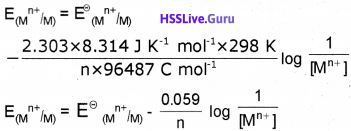
Plus Two Chemistry Notes Chapter 3 Electrochemistry 4

Nernst Equation for a Galvanic Cell :
In Daniell cell, the electrode potential for any concentration of Cu2+ and Zn2+ ions can be written as,
Plus Two Chemistry Notes Chapter 3 Electrochemistry 5
Converting to natural logarithm to the base 10 and substituting the values of R, F and T=298 K, it. reduces to
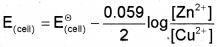
Plus Two Chemistry Notes Chapter 3 Electrochemistry 6
Consider a general electrochemical reaction,
Plus Two Chemistry Notes Chapter 3 Electrochemistry 7

Equilibrium Constant and Nernst Equation:
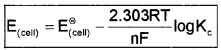
Plus Two Chemistry Notes Chapter 3 Electrochemistry 8
where Kc is the equilibrium constant.

Electrochemical Cell and Gibbs Energy of the Reaction (∆rG):
Plus Two Chemistry Notes Chapter 3 Electrochemistry 9

Conductance of Electrolytic Solutions: .Conductors:
A substance which allows the passage of electricity through it. Conductor are classified as,

Metallic or Electronic Conductors:
In these the conductance is due to the movement of electrons and it depends on:

  1. The nature and structure of the metal
  2. Number of valence electrons per atom
  3. Temperature (it decreases with increase in temperature)
    e.g. Ag, Cu, Al etc.

ii. Electrolytic Conductors
Electrolytes – The substances which conduct electricity either in molten state or in solution, e.g. NaCl, NaOH, HCl, H2SO4 etc. The conductance is due to the movement of ions. This is also known as ionic conductance and it depends on:

  1. Nature of the electrolyte
  2. Size of the ions and their solvation
  3. Nature of the solvent and its viscosity
  4. Concentration of the electrolyte
  5. Temperature (it increases with increase in temperature)

Ohm’s law – It states that the current passing through a conductor (I) is directly proportional to the potential difference (V) applied.
i.e., I ∝ V or I = \(\frac{V}{R}\)
where R – resistance of the conductor- unit ohm. In SI base units it is equal to kg m²/s³ A²

Plus Two Chemistry Notes Chapter 3 Electrochemistry

The electrical resistance of any substance/object is directly proportional to its length T, and inversly proportional to its area of cross section ‘A’.
R ∝ \(\frac{\ell}{\mathrm{A}}\) or R = ρ\(\frac{\ell}{\mathrm{A}}\) where,

ρ – (Greek, rho) – resistivity/specific resistance – SI unit ohm metre (Ω m) or ohm cm (Ω cm).

Conductance (G):
inverse or reciprocal of resistance (R).
\(G=\frac{1}{R}=\frac{A}{\rho \ell}=\kappa \frac{A}{\ell}\)
where K = \(\frac{1}{\rho}\) called conductivity or specific conductance (K – Greek, kappa)

SI unit of conductance – S (siemens) or ohm-1.
SI unit of conductivity – S m-1
1 S cm-1 = 100 S m-1

Molar Conductance of a Solution (Λm):
It is the conductance of the solution containing one mole of the electrolyte when placed between two parallel electrodes 1 cm apart. It is the product of specific conductance (K) and volume (V) in cm³ of the solution containing one mole of the electrolyte.
Plus Two Chemistry Notes Chapter 3 Electrochemistry 10
where M is molarity of the solution.
Unit of Λm is ohm’1 cm2 mol’1 Or S cm² mol-1
Λm = \(\frac{K}{C}\) [C-Concentration of the solution.]

Measurement of the Conductivity of Ionic Solutions :
The measurement of an unknown resistance can be done by Wheatstone bridge. To measure resitance of the electrolyte it is taken in a conductivity cell. The resistance of the conductivity cell is given by the equation.
\(R=\rho \frac{\ell}{A}=\frac{1}{\kappa A}\)
Plus Two Chemistry Notes Chapter 3 Electrochemistry 11
The quantity \(\frac{\ell}{\mathrm{A}}\) is called cell constant and isdenoted A by G*. It depends on the distance (/) between the electrodes and their area of cross-section (A).

Variation of Conductivity and Molar Conductivity with Concentration :
Conductivity (K) always decreases with decrease in concentration both for weak and strong electrolytes. This is because the number of ions per unit volume that carry the current in a solution decreases on dilution.

Molar conductivity (Λm) increases with decrease in concentration. This is because the total volume, V of the solution containing one mole of electrolyte also increases.

The variation of molar conductance is different for strong and weak electrolytes,

1. Variation of Λm with Concentration for Strong Electrolytes:
The molar conductance increases slowly with decrease in concentration (or increase in dilution) as shown below:
Plus Two Chemistry Notes Chapter 3 Electrochemistry 12
There is a tendency for Λm to approach a certain limiting value when concentration approaches zero i. e., dilution is infinite. The molar conductance of an electrolyte when the concentration approaches zero is called molar conductance at infinite dilution, Λm or Λ°m. The molar conductance of strong electrolytes obeys the relationship.
Λm = Λ°m -AC1/2 where C = Molar concentration, A = constant for a particular type of electrolyte.
This equation is known as Debye-Huckel-Onsagar equation.

2. Variation of Λm with Concentration for Weak Electrolytes :
For weak electrolytes the change in Λm with dilution is due to increase in the degree of dissociation and consequently increase in the number of ions in total volume of solution that contains 1 mol of electrolyte. Here, Λm increases steeply on dilution, especially near lower concentrations.
Plus Two Chemistry Notes Chapter 3 Electrochemistry 13
Thus, the variation of Λm with √c is very large so that we cannot obtain molar conductance at infinite dilution Λ°m by the extrapolation of the graph.

Kohlrausch’s Law:
The law states that, the molar conductivity of an electrolyte at infinite dilution is equal to the sum of the molar ionic conductivities of the cations and anions at infinite dilution.
Λ°m = γ+ λ°+ + γ λ°
λ°+ and λ° are the molar conductivities of cations and anions respectively at infinite dilution, Y+ and V. are number of cations and anions from a formula unit of the electrolyte.
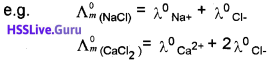
Plus Two Chemistry Notes Chapter 3 Electrochemistry 14

Applications of Kohlaransch’s Law
1) To calculate Λ°m of weak electrolytes

2) To calculate degree of dissociation of weak electrolytes
\(\alpha=\frac{\Lambda_{m}}{\Lambda_{m}^{0}}\)

3) To determine the dissociation constant of weak electrolytes
Plus Two Chemistry Notes Chapter 3 Electrochemistry 15

Electrolytic Cell and Electrolysis:
In an electrolytic cell, external source of voltage is used to bring about a chemical reaction. Electrolysis is the phenomenon of chemical decomposition of the electrolyte caused by the passage of electricity through its molten or dissolved state from an external source.

Plus Two Chemistry Notes Chapter 3 Electrochemistry

Quantitative Aspects of Electrolysis
Faraday’s Laws of Electrolysis First Law:
The amount of any substance liberated or deposited at an electrode is directly proportional to the quantity of electricity passing through the
electrolyte.
w α Q where ‘Q’ is the quantity of electric charge in coulombs.
w = ZQ .
w = Zlt
(∵ Q = It) where T is the current in amperes , ‘t’ is the time in seconds and ‘Z’ is a constant called electrochemical equivalent.

Second Law:
The amounts of different substances liberated by the same quantity of electricity passing through the electrolytic solution are proportional to their chemical equivalent weights.

Plus Two Chemistry Notes Chapter 3 Electrochemistry 16
The quantity of electricity required to liberate/deposit 1 gram equivalent of any substance is called Faraday constant ‘F’.
1 F = 96487 C/mol ≈ 96500 C/mol

Products of Electrolysis:
It depend on the nature of the material being electrolysed and the type of electrodes being used.

Electrolysis of Sodium Chloride:
When electricity is passed through molten NaCl, Na is deposited at the cathode and Cl2 is liberated at the anode.
Na+(aq) + \(\overline { e } \) → Na(s) (Reduction at cathode)
Cl(aq) → ½ Cl2(g) + \(\overline { e } \) (Oxidation at anode)

When concentrated aqueous solution of NaCl is electrolysed, Cl2 is liberated at anode, but at cathode H2 is liberated instead of Na deposition due to the high reduction potential of hydrogen.
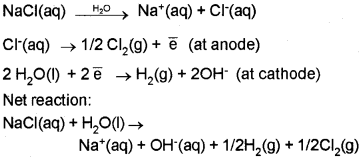
Plus Two Chemistry Notes Chapter 3 Electrochemistry 17
The resultant solution is alkaline due to the formation of NaOH.

Electrolysis of CuSO4 :
When aqueous CuSO4 solution is electrolysed using Pt electrodes, Cu is deposited at the cathode and O2 is liberated at the anode.
Cu2+(aq) + 2 \(\overline { e } \) → Cu(s) (at cathode)
H2O(l) → 2H+(aq) + 1/2 O2(g) + 2 \(\overline { e } \) (at anode)

If Cu electrode is used, Cu is deposited at cathode and an equivalent amount of Cu dissolves in solution from the anode (because oxidation potential of Cu is higherthan that of water).
Cu2+(aq) + 2 \(\overline { e } \) → Cu(s) (at cathode)
Cu(s) → Cu2+(aq) + 2\(\overline { e } \) (atanode)

Commercial Cells (Batteries)
The electrochemical cells can be used to generate electricity. They are two types:
i) Primary Cells:
Cells in which the electrode reactions cannot be reversed by external energy. These cells cannot be recharged, e.g. Dry cell, Mercury cell.

ii) Secondary Cells :
Cells which can be recharged by passing current through them in the opposite direction so that they can be used again.
e.g. Lead storage battery, Nickel-Cadmium cell.

Primary Cells
a) Dry Cell:
Anode – Zn container
Cathode – Carbon (graphite) rod surrounded by powdered MnO2 and carbon.
Electrolyte – moist paste of NH4Cl and ZnCl2
The electrode reactions are :
Anode : Zn → Zn2+ + 2 \(\overline { e } \)
Cathode: MnO2 + NH4+ + \(\overline { e } \) → MnO(OH) + NH3
Dry cell has a potential of nearly 1.5 V.

Plus Two Chemistry Notes Chapter 3 Electrochemistry

b) Mercury Cell:
Anode – Zn amalgam (Zn/Hg)
Cathode – paste of HgO and carbon
Eelectrolyte – paste of KOH and ZnO. The electrode reactions are,
Anode : Zn/Hg + 2OH → ZnO(s) + H2O + 2 \(\overline { e } \)
Cathode : HgO + H2O + 2 \(\overline { e } \) → Hg(l) + 2 OH
Overall reaction : Zn/Hg + HgO(s) → ZnO(s)+ Hg(l)
The cell potential = 1.35 V

2. Secondary Cells
a) Lead Storage Battery :
Anode – lead plates
Cathode – grids of lead plates packed with lead dioxide (PbO2)
Electrolyte – 38% (by weight) soution of H2SO4.
The cell reactions when the battery is in use are,
Anode: Pb(s) + SO42-(aq) → PbSO4 + 2 \(\overline { e } \)
Cathode: PbO2(s) + SO42-(aq) + 4H+(aq) + 2 \(\overline { e } \) → PbSO4(s) + 2H2O(I)
The overall cell reaction is,
Pb(s) + PbO2(s) + 2H2SO4(aq) → 2PbSO4(s) + 2H2O(l)

The emf of the cell depends on the concentration of H2SO4. On recharging the battery the reaction is reversed and PbSO4(s) on anode is converted to Pb and PbSO4(s) at cathode is converted into PbO2.

b) Nickel-Cadmium Cell:
Anode- Cd
Cathode – metal grid containing nickel (IV) oxide. Electrolyte – KOH solution. The overall cell reaction during discharge is,
Cd(s) +2 Ni(OH)3(s) → CdO(s) + 2Ni(OH)2(s) + H2O(l)

3) Fuel Cells :
These are Galvanic cells designed to convert the energy of combustion of fuels directly into electrical energy.

H2 – O2 fuel cell – In this, hydrogen and oxygen are bubbled through porous carbon electrodes into concentrated aqueous NaOH solution, which acts as the electrolyte.
Plus Two Chemistry Notes Chapter 3 Electrochemistry 18
The electrode reactions are,
Anode : 2H2(g) + 4OH(aq) → 4H2O(l) + 4\(\overline { e } \)
Cathode : O2(g) + 2H2O(l) + 4\(\overline { e } \) → 4OH(aq)
Overall reaction : 2H2(g) + O2(g) → 2H2O(l)

Advantages of Fuel Cells –
pollution free, more efficient than conventional methods, Runs continuously as long as the reactants are supplied, electrodes are not affected.

Plus Two Chemistry Notes Chapter 3 Electrochemistry

Other examples:
CH4 – O2 fuel cell, CH3OH – O2 fuel cell

Corrosion :
Any process of destruction and consequent loss of a solid metallic material by reaction with moisture and other gases present in the atmosphere. More reactive metals are corroded more easily. Corrosion is enhanced by the presence of impurities, air & moisture, electrolytes and defects in metals.
Examples: Rusting of iron, tarnishing of Ag.

Mechanism:
In corrosion a metal is oxidised by loss of electrons to O2 and form oxides. It is essentially an electro chemical phenomenon. At a particular spot of an object made of iron, oxidation take place and that spot behaves as anode.
2 Fe(s) → 2 Fe2+ + 4\(\overline { e } \)E° = -0.44 V

Electrons released at anodic spot move through metal and go to another spot on the metal and reduce 02 in presence of H+. This spot behaves as cathode.
O2(g) + 4 H+(aq) + 4\(\overline { e } \) → 2 H2O(l) E° = 1.23 V

The overall reaction is,
2 Fe(s) + O2(g)+ 4H+(aq) → 2 Fe2+ + 2H2O(I) E° = 1,67V

The ferrous ions are further oxidised by atmospheric 02 to ferric ions and form hydrated ferric oxide (rust) Fe2O3.xH2O

Prevention of Corrosion
1) Barrier Protection:
Coating the surface with paints, grease, metals like Ni, Cr, Cu etc.

2) Sacrificial Protection:
Coating the surface of iron with a layer of more active metals like Zn, Mg, Al etc. The process of coating a thin film of Zn on iron is known as galvanisation.

3) Anti-rust Solutions:
Applying alkaline phosphate/ alkaline chromate on iron objects which provide a protectve insoluble film. Also, the alkaline nature of the solutions decreases the availability of H+ ions and thus decreases the rate of corrosion.

Plus Two Chemistry Notes Chapter 2 Solutions

Students can Download Chapter 2 Solutions Notes, Plus Two Chemistry Notes helps you to revise the complete Kerala State Syllabus and score more marks in your examinations.

Kerala Plus Two Chemistry Notes Chapter 2 Solutions

Solutions:
homogeneous mixtures of two or more pure substances, having uniform composition and properties throughout. The substances forming a solution are called components.

Solvent and Solute:
The component that is present in the largest quantity is known as solvent.

One or more components present in the solution other than solvent are called solutes. e.g. In sugar solution, water is the solvent and sugar is the solute.

Binary solution:
A solution containing only two components.

Aqueous solutions:
solutions in which the solvent is water.

Types of Solutions
Plus Two Chemistry Notes Chapter 2 Solutions 1

Expressing Concentration of Solutions :
The concentration of a solution is defined as the amount of solute present in the given quantity of the solution.

1. Mass percentage (w/w) :
The mass % of a component in a given solution is the mass of the component (solute) per 100 g of solution.
Plus Two Chemistry Notes Chapter 2 Solutions 2
e.g. 10% glucose solution means 10 g of glucose dissolved in 90 g of water resulting in a 100 g solution.

2. Volume percentage (v/v) :
The volume % of a component in a given solution is the volume of the component per 100 volume of solution.
Plus Two Chemistry Notes Chapter 2 Solutions 3
Example:
10% ethanol solution means 10 mL of ethanol dissolved in 90 mL of water.

Plus Two Chemistry Notes Chapter 2 Solutions

3. Mass by volume percentage (w/v):
It is the mass of solute dissolved in 100 mL of the solution. Used in medicine and pharmacy.

4. Parts per million (ppm):
It is the parts of a solute (component) per million parts of the solution. When a solute is present in very minute amounts, parts per million (ppm) is used.
Plus Two Chemistry Notes Chapter 2 Solutions 4

This osmotic pressure calculator is a tool that helps you calculate the pressure required to completely stop the osmosis process.

5. Mole fraction (X):
ratio of number of moles of one component to the total number of moles of all the components present in the solution.
Plus Two Chemistry Notes Chapter 2 Solutions 5

For a binary solution, nA be the number of moles of A and nB be the number of moles of B.
Plus Two Chemistry Notes Chapter 2 Solutions 6

The sum of mole fractions of all the components present in the solution is always equal to 1.
i.e., χA + χB = 1
Fora solution containing ‘i’ number of components,
χ1 + χ2 +……………… + χi = 1
Mole fraction is independent of temperature.

6. Molarity (M):
number of moles of solute dissolved in one litre of the solution.
Plus Two Chemistry Notes Chapter 2 Solutions 7

7. Molality (m):
number of moles of solute per kilogram of the solvent.
Plus Two Chemistry Notes Chapter 2 Solutions 8

The mole fraction equation tells you that the mole fraction of carbon tetrachloride is 2/9 = 0.22.

Solubility:
Solubility of a substance is its maximum amount that can be dissolved in a specified amount of solvent at a particular temperature.

Factors affecting solubility
Nature of the solute, nature of the solvent, temperature ‘ and pressure

Solubility of Solids in Liquids :
Like dissolves like:
Polar solutes are soluble in polar solvents and non-polar solutes are soluble in non-polar solvents.

Unsaturated solution:
Solution in which more solute can be dissolved at the same temperature.

Plus Two Chemistry Notes Chapter 2 Solutions

Saturated solution:
Solution in which no more solute can be dissolved at the same temperature and pressure.

Effect of temperature :
Solubility increases with temperature if the reaction is endothermic. Solubility decreases with temperature if the reation is exothermic.

Effect of pressure :
Pressure does not have any significant effect on solubility of solids in liquids because solids and liquids are highly incompressible and practically remain unaffected by changes in pressure.

Solubility of a Gas in a Liquid :
It is greately affected by pressure and temperature.

Effect of pressure
Henry’s law :
The law states that at a constant temperature, the solubility of a gas in a liquid is directly proportional to the pressure of the gas.
The most commonly used form of Henry’s law states that the partial pressure of the gas in the vapour phase (p) is proportional to the molefraction of the gas (χ) in the solution.
P = KH
where KH is the Henry’s law constant.
Different gases have different KH values at the same temperature. Thus, KH is a function of the nature of the gas.

Higher the value of KH at a given pressure, the lower is the solubility of the gas in the liquid.

The solubility of gases increase with decrease of temperature. Therefore, aquatic species are more comfortable in cold waters rather than in hot waters.

Applications of Henry’s law
1. To increase the solubility of CO2 in soft drinks and soda water, the bottle is sealed under high pressure.
2. To avoid bends (a medical condition which is painful and dangerous to life caused by the formation of bubbles of N2 in the blood) the tanks used by scuba divers are filled with air diluted with He (11.7% He, 56.2% N2 and 32.1% O2).
3. At high altitudes, low pressure leads to low concentrations of O2 in blood. It causes climbers to become weak and unable to think clearly (anoxia).

Plus Two Chemistry Notes Chapter 2 Solutions

Effect of temperature :
Dissoloution of gases in liquids is an exothermic process. Hence, according to Le Chatelier’s principle solubility of gases in liquids decreases with rise in temperature.

Vapour Pressure of Liquid Solutions

Vapour Pressure of Liquid-Liquid Solutions:
Consider the two volatile liquids denoted as ‘A’ and ‘B’. When both liquids are taken in a closed vessel, both components would evaporate and an equilibrium would be established between liquid and vapour phase.
Let, PA– Partial vapour pressure of component A’
PB – Partial vapour pressure of component ‘B’
χA Mole fraction of A
χB Moiefraction of B

Raoult’s Law :
The law states that fora solution of volatile liquids, the partial vapour pressure of each component in the solution is directly proportional to its mole fraction.
For component ‘A’
PA ∝ χA.
PA= P°A χA
where P°A is the vapour pressure of pure component ‘A’ at the same temperature.
Similarly, for component ‘B’
PB ∝ χB
PB= P°B χB
where PB° is the vapour pressure of pure component ‘B’. Rauolt’s law also states that, at a given temperature for a solution of volatile liquids, the partial vapour pressure of each component is equal to the product of the vapour pressure of pure component and its mole fraction.

According to Dalton’s law of partial pressures,
Total pressure, P[Total] = PA + PB
Plus Two Chemistry Notes Chapter 2 Solutions 9

A plot of PA or PB versus the mole fractions χA and χB for a solution gives a linear plot as shown in the figure.
Plus Two Chemistry Notes Chapter 2 Solutions 10

Raoult’s Law as a special case of Henry’s Law:
According to Raoult’s law, the vapour pressure of volatile liquid in a solution is proportional to its mole fraction, i.e., Pi = Pi° χi

According to Henry’s law, the vapour pressure of a gas in a liquid is proportional to its mole fraction, i. e., p=KHχ

Thus, Raoult’s law becomes a special case of Henry ’s law in which KH becomes equal to Pi°.

Vapour Pressure of Solution of Solids in Liquids:
If a non-volatile solute is added to a solvent to give a solution, the surface of solution has both solute and solvent molecules; thereby the fraction of surface covered by the solvent molecules gets reduced. Consequently, the number of solvent molecules escaping from the surface is reduced. Hence, the vapour pressure of solution is lower than vapour pressure of pure solvent.
Plus Two Chemistry Notes Chapter 2 Solutions 11

General form of Raoult’s Law:
For any solution, the partial vapour pressure of each volatile component in the solution is directly proportional to its mole fraction.

In a binary solution, let us denote the solvent by ‘A’ and solute by ‘B’.
According to Raoult’s law,
PA ∝ χA
PA = PA° χA
Total pressure, P = PA Here, PB = 0
(∵ solute is non-volatile)
P = PA° χA
For binary solution,
χA + χB = 1
χA = 1 – χB
Thus, the above equation becomes,
Plus Two Chemistry Notes Chapter 2 Solutions 12
lowering of vapour pressure.

Ideal and Non-ideal Solutions :
Ideal Solutions:
The solutions which obey Raoult’s law over the entire range of concentrations.

Important properties of Ideal Solutions
i. PA = P°A χA ; PB = P°B χB
ii. Enthalpy of mixing is zero (∆mixH = 0)
iii. Volume of mixing is zero (∆mixV = 0)

If the intermolecular attractive forces between A – A and B – Bare nearly equal to those between A – B, it leads to the formation of ideal solution.

Plus Two Chemistry Notes Chapter 2 Solutions

Examples:

  1. Solution of n-hexane and n-heptane
  2. Solution of bromoethane and chloroethane
  3. Solution of benzene and toluene

Non-ideal Solutions :
solutions which do not obey Raoult’s law overthe entire range of concentration. The vapour pressure of such solutions is either higher or lower than that predicted by Raoult’s law.

If the vapour pressure is higher, it exhibits positive deviation and if the vapour pressure is lower it exhibits negative deviation from the Raoult’s law.

Solutions showing positive deviation :
the intermolecular attractive forces between the solute- solvent molecules are weaker than those between the solute-solute and solvent-solvent molecules. Thus, in such solutions molecules will find it easier to escape than in pure state. This will increase the vapour pressure and results in the positive deviation.
Plus Two Chemistry Notes Chapter 2 Solutions 13
(dotted line represents graph for ideal solution).
Examples:
Ethanol + Water, Ethanol + Acetone, CCl4 + Chloroform, C6H6 + Acetone , n-Hexane + Ethanol

Solution showing negative deviation:
In the case of negative deviation, the intermolecular attractive forces between solvent-solute molecules are greater than those between solvent-solvent and solute-solute molecules and leads to decrease in the vapour pressure.
Plus Two Chemistry Notes Chapter 2 Solutions 14

Examples:
1. Mixture of phenol and aniline – In this case the intermolecular hydrogen bonding between phenolic proton and lone pair on nitrogen atom of aniline is stronger than the respective intermolecular hydrogen bonding between similar molecules.
2. Mixture of acetone and chloroform – Here chloroform molecule is able to form hydrogen bond with acetone molecule.
Plus Two Chemistry Notes Chapter 2 Solutions 15

3. H2O + HCl, (4) H2O + HNO3, (5) CHCl3 + (C2H5)2O

Azeotropes:
binary mixtures having same composition in liquid and vapour phase and boil at a constant temperature. It is not possible to separate the components of azeotropes by fractional distillation.

Plus Two Chemistry Notes Chapter 2 Solutions

Solutions which show large positve deviation from Raoult’s law form minimum boiling azeotrope at a specific composition. For example, ethanol-water mixture forms a minimum boiling azeotrope (b.p. 351.1 K) when approximately 95% by volume of ethanol is reached.

The solutions that show large negative deviation from Raoult’s law form maximum boiling azeotrope at a specific composition. For example, nitric acid and water form a maximum boiling azeotrope (b.p. 393.5 K) at the approximate composition, 68% nitric acid and 32% water by mass.

Colligative Properties :
properties which depend on the number of solute particles irrespective of their nature relative to the total number of particles present in the solution. These are,
i. Relative lowering of vapour pressure of the solvent \(\left(\frac{\Delta p_{1}}{p_{1}^{0}}\right)\)
ii. Elevation of boiling point of the solvent (∆Tb)
iii. Depression of freezing point of the solvent (∆Tf)
iv. Osmotic pressure of the solution (π)

Relative Lowering of Vapour Pressure:
When a non-volatile solute (B) is dissolved in a liquid solvent (A), the vapour pressure of the solvent is lowered. This phenomenon is called lowering of vapour pressure. It depends only on the concentration of the solute particles and it is independent of their identity. The relation between vapour pressure of solution, mole fraction and vapour pressure of the solvent is given as,
PA = χAA ……………(1)
The lowering of vapour pressure of solvent ∆ PA is given as,
∆ PA = P°A – PA ……………(2)
Substitute the equation (1) in (2)
∆ PA = P°A – P°AχA
= P°A(1 – χA)
∆ PA = P°AχB …………..(3) ∵ (1 – χA) = χB
The relative lowering of vapour pressure is given as,
Plus Two Chemistry Notes Chapter 2 Solutions 16
of vapour pressure and is equal to the mole fraction of solute.
From equation (4),
Plus Two Chemistry Notes Chapter 2 Solutions 17
For dilute solutions nB < < nA, hence neglecting nB In the denominator, the above equation becomes,
Plus Two Chemistry Notes Chapter 2 Solutions 18
where wA and wB are the masses and MA and MB are the molar masses of solvent and solute respectively.
Plus Two Chemistry Notes Chapter 2 Solutions 19

Elevation of boiling point (∆Tb):
The boiling point of a solution is higher than that of the pure solvent. The elevation in the boiling point depends ‘ on the number of solute molecules rather than on their nature.
Plus Two Chemistry Notes Chapter 2 Solutions 20

Let T°b be the boiling point of pure solvent and Tb be the boiling point of solution. The increase in the boiling point ∆Tb = Tb – T°b is known as elevation of boiling point.

Plus Two Chemistry Notes Chapter 2 Solutions

For a dilute solution, the elevation of boiling point ( ∆Tb) is directly proportional to the molal concentration of the solute in a solution (i.e., molality).
∆Tb ∝ m
∆Tb = Kbm …………(1)

where, m → molality and Kb → Boiling Point Elevation Constant/Molal Elevation Constant/ Ebullioscopic Constant.
Unit of Kb is K kg mol-1 Or K m-1
Plus Two Chemistry Notes Chapter 2 Solutions 21
Substituting the value of‘m’ in equation (1),
Plus Two Chemistry Notes Chapter 2 Solutions 22

Depression of Freezing point (∆Tf) :
The lowering of vapour pressure of a solution causes a lowering of the freezing point compared to that of the pure solvent.
Plus Two Chemistry Notes Chapter 2 Solutions 23
Let T°f be the freezing point of pure solvent and Tf be the freezing point of solution.
Depression in freezing point ∆Tf= T°f – Tf
For a dilute solution, depression of freezing point (∆Tf) is directly proportioned to molality (m) of the solution. Thus,
∆Tf ∝ m
∆Tf = Kfm ………………(1)
where, Kf – Freezing Point Depression Constant/ Molal Depression Constant/Cryoscopic Constant.
Unit of Kf is K kg mol-1 Or K m-1
Plus Two Chemistry Notes Chapter 2 Solutions 24
[Note: The values of Kb and Kf, depend upon the nature of the solvent. They Can be ascertained from the following equations:
Plus Two Chemistry Notes Chapter 2 Solutions 25
where,
R → Gas constant, MA → Molar mass of solvent
Tb → Boiling point of pure solvent of kelvin
Tf → Freezing point of pure solvent in kelvin
fusH → Enthalpy of fusion, ∆vapH → enthalpy of vapourisation.
For water, Kb = 0.52 K kg mol-1 and Kf = 1.86 K kg mol-1]

Osmosis and Osmotic Pressure:
The process of flow of the solvent molecules from pure solvent to the solution through semipermeable membrane (SPM) is called osmosis.

Semi Permeable Membrane :
The membrane which allows the passage of solvent molecules but ’ not the solute molecule is called SPM.

Example:
Parchment paper, Pig’s bladder, Cell wall, Film of cupric ferrocyanide.

Plus Two Chemistry Notes Chapter 2 Solutions

Osmotic Pressure (π):
the excess pressure which must be applied to a solution to prevent osmosis or the pressure that just stops the flow of solvent.

Osmotic pressure (π) is proportional to the molarity (C) of the solution at a given temperature (T K).
π = CRT, where R is the gas constant.
π = \(\frac{n_{B}}{V}\)RT, where nc is the number of moles of the solute and V is the volume of the solution in litres.
π = nBRT
π V= \(\frac{\mathrm{W}_{\mathrm{B}}}{\mathrm{M}_{\mathrm{B}}}\)RT , where wB is the mass of the solute and MB is the molar mass of the solute.
Or MB = \(\frac{\mathbf{w}_{\mathrm{B}} \mathrm{RT}}{\pi \mathrm{V}}\)

Osmotic pressure measurement is widely used to determine molar mass of proteins, polymers and other macro molecules.

Advantages of osmotic pressure method:
i) pressure measurement is around the room temperature
ii) molarity of the solution is used instead of molality
iii) the magnitude of osmotic pressure is large compared to other colligative properties even for very dilute solutions.

Isotonic Solution :
Two solutions having same (equal) osmotic pressure at a given temperature. A 0.9% solution of NaCI (normal saline solution) is isotonic with human blood, and it is safe to inject intravenously.

Hypertonic Solution :
A solution having higher osmotic pressure than another solution.
Hypotonic Solution :
A solution having lower osmotic pressure than another solution.

Reverse Osmosis:
flow of the pure solvent from solution side to solvent side through semipermeable membrane when a pressure larger than the osmotic pressure is applied to the solution side.

Uses of reverse osmosis:
Desalination of sea water, Purification of water.

Plus Two Chemistry Notes Chapter 2 Solutions

Abnormal Molar Mass :
In some cases, the molar mass determined by colligative properties do not agree with the theoretical values. This is due to association ordissociation of the solute particles in the solution.

Association of Solute Particles :
When solute particles undergo association the number of the solute particles in the solution decreases. Consequently, the experimental values of colligative properties are less than the expected values, e.g. Molecules of ethanoic acid (acetic acid) dimerise in benzene due to intermolecular hydrogen bonding.
Plus Two Chemistry Notes Chapter 2 Solutions 26
Similarly, benzoic acid undergo dimerisation when dissolved in benzene.

Dilution Factor Formula (Equation) … We can cancel each side down using their largest common factor to get the simplest integer expression of the dilution

Dissociation of Solute Particles :
When the solute particles dissociate or ionise in the solvent, the number of particles in solution increases and so the experimental values of the colligative properties are higher than the calculated values.
e.g. KCl in water ionises as
KCl → K+ + C
Molar mass either lower or higher than the expected or normal value is called as abnormal molar mass.

van’t Hoff factor (i):
It accounts for the extent of association or dissociation.
Plus Two Chemistry Notes Chapter 2 Solutions 27

Significance of van’t Hoff factor.
i > 1 ⇒ there is dissociation of solute particles.
i < 1 ⇒ there is association of solute particles.
i < 1 ⇒ there is no dissociation and association of solute particles.

Inclusion of van’t Hoff factor modifies the equations for colligative properties as follows:
Relative lowering of vapour pressure of solvent,
Plus Two Chemistry Notes Chapter 2 Solutions 28

Plus One Chemistry Chapter Wise Questions and Answers Chapter 7 Equilibrium

Students can Download Chapter 7 Equilibrium Questions and Answers, Plus One Chemistry Chapter Wise Questions and Answers helps you to revise the complete Kerala State Syllabus and score more marks in your examinations.

Kerala Plus One Chemistry Chapter Wise Questions and Answers Chapter 7 Equilibrium

Plus One Chemistry Equilibrium One Mark Questions and Answers

Question 1.
Equilibrium in a system having more than one phase is called _________
Answer:
heterogeneous

Question 2.
Addition of a catalyst to a chemical system at equilibrium would result in
a) Increase in the rate of forward reaction
b) Increase in the rate of reverse reaction
c) A new reaction path
d) Increase in the amount of heat evolved in the reaction
Answer:
c) A new reaction path

Question 3.
With increase in temperature, equilibrium constant of a reaction
a) Always increases
b) Always decreases
c) May increase or decrease depending upon the number of moles of reactants and products
d) May increase or decrease depending upon whether reaction is exothermic or endothermic
Answer:
d) May increase or decrease depending upon whether reaction is exothermic or endothermic

Question 4.
Water is a conjugate base of ____________ .
Answer:
H3O+

Plus One Chemistry Chapter Wise Questions and Answers Chapter 7 Equilibrium

Question 5.
Which of the following substances on dissolving in water will give a basic solution?
a) Na2CO3
b) Al2(SO4)3
c) NH4Cl
d) KNO3
Answer:
a) Na2CO3

Question 6.
Choose the correct answer for the reaction,
N2(g) + 3H2(g) \(\rightleftharpoons \) 2NH3(g); ∆rH = -91.8 kJ mol-1 The concentration of H2(g) at equilibrium can be increased by
1) Lowering the temperature
2) Increase the volume of the system.
3) Adding N2 at constant volume.
4) Adding H2 at constant volume.
Answer:
2) and 4) are correct.

Question 7.
Conjugate base of a strong acid is a
Answer:
Weak base

Question 8.
The expression forostwald dilution law is
Answer:
Ka = Cα²

Question 9.
The hydroxyl ion concentration in a solution having pH = 4 will be
Answer:
10-14

Question 10.
A mono protic acid in 1M solution is 0.01 % ionized the dissociation constant of this acid is
Answer:
10-8

Question 11.
A certain buffer solution contains equal concentration of x and Hx. The Kafor Hx is 10-6 pH of buffer is
Answer:
6

Question 12.
In the equilibrium reaction
CaCO3(s) → CaO(s) + CO2(g) the equilibrium constant is given by —–
Answer:
PCO2

Question 13.
Congugate base of a strong acid is a _________ .
a) Strong base
b) Strong acid
c) Weak acid
d) Weak base
e) Salt
Answer:
d) Weak base

Question 14.
The species acting both as bronsted acid and base is _________ .
Plus One Chemistry Chapter Wise Questions and Answers Chapter 7 Equilibrium 1
Answer:
b) HSO4

Question 15.
PH of .01 M KOH solution will be _________ .
Answer:
12

Plus One Chemistry Equilibrium Two Mark Questions and Answers

Question 1.
“High pressure and low temperature favours the formation of ammonia in Haber’s process.” Analyse the statement and illustrate the conditions using Le-Chatliers principle?
Answer:
The given statement is correct.
N2(g) + 3H2(g) \(\rightleftharpoons \) 2NH3(g); ∆rH =-91.8 kJ mol-1 Since the number of moles decreases in the forward reaction a high pressure of ~ 200 atm is applied. Since the forward reaction is exothermic the optimum temperature of ~ 700 K is employed for maximum yield of ammonia.

Question 2.
“Chemical equilibrium is dynamic in nature”. Analyse the statement and justify your answer.
Answer:
At equilibrium the reaction does not stop. Both forward and backward reactions are taking place at equal rates. Thus, at equilibrium two exactly opposite changes occur at the same rate. Hence, chemical equilibrium is dynamic in nature.

Question 3.
Pressure has no influence in the following equilibrium: N2(g) + O2(g) \(\rightleftharpoons \) 2NO(g)

  1. Do you agree with this?
  2. What is the reason for this?

Answer:

  1. Yes.
  2. Here the total number of moles of the reactants is equal to that of the products. Hence pressure is having no influence in this equilibrium.

Question 4.
During a class room discussion a student is of the view that the value of equilibrium constant can be influenced by catalyst.

  1. Do you agree with the statement?
  2. Justify the role of catalyst in an equilibrium reaction?

Answer:

  1. No.
  2. Catalyst does not affect the equilibrium composition of a reaction mixture. It does not appear in the balanced chemical equation or in the equilibrium constant expression. It only helps to attain the equilibrium state in a faster rate.
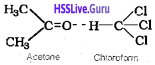
Question 5.
What is the equilibrium constant (K) in the following cases?

  1. Reaction is reversed.
  2. Reaction is divide by 2.
  3. Reaction is multiplied by 2.
  4. Reaction is splitted into two.

Answer:

  1. 1/K
  2. √K
  3. K2
  4. K1K2

Question 6.
1. What is homogeneous equilibrium?
2. Suggest an example for this.
Answer:
1. The equilibrium in which the reactants and products are in the same phase,

2. N2(g) + 3H2(g) \(\rightleftharpoons \) 2NH3(g)
In this equilibrium, the reactants and products are in the gaseous phase.

Plus One Chemistry Chapter Wise Questions and Answers Chapter 7 Equilibrium

Question 7.
The equilibrium constants for two reactions are given. In which case the yield of product will be the maximum?
For first reaction: K1 = 3.2 × 10⁻⁶
For second reaction: K2 = 7.4 × 10⁻⁶
Answer:
Higher the value of K, greater will be the yield of product. So maximum yield will be in the second case.

Question 8.
Write an expression for equilibrium constant, Kc forthe ‘ reaction, 4NH3(g) + 5O2(g) \(\rightleftharpoons \) 4NO(g) + 6H2O(g)
Answer:
Plus One Chemistry Chapter Wise Questions and Answers Chapter 7 Equilibrium 2

Question 9.
1. State Henry’s law.
2. Suggest an example fora gas in liquid equilibrium.
Answer:
1. The mass of a gas dissolved in a given mass of a solvent at any temperature is directly proportional to the pressure of the gas above the solvent.

2. Equilibrium between the CO2 molecules in the. gaseous state and the CO2 molecules dissolved in water under pressure,
CO2(g) \(\rightleftharpoons \) CO2(in solution)

Question 10.
1. What is heterogeneous equilibrium?
2. Suggest an example forthis.
Answer:
1. Equilibrium in a system having more than one phase is called heterogeneous equilibrium

2. Equilibrium between solid Ca(OH)2 and its saturated solution:
Ca(OH)2(s) + (aq) \(\rightleftharpoons \) Ca2+(aq) + 2OH(aq)

Question 11.
For the equilibrium 2SO3(g) → 2SO2(g) + O2(g), Kc at 47 °C 3.25 × 10⁻⁹ mol per litre. What will be the value of Kp at this temperature (R = 8.314 J K-1mol-1).
Answer:
R = 8.314 J K-1 mol-1 ∆n = 3 – 2 = 1
T = 47 °C = 273 + 47 = 320 K
Kc = 3.25 × 10⁻⁹
Kp = Kc (RT)∆n
= 3.25 × 10⁻⁹ (8.314 × 320)1
= 3.25 × 10-9 × 8.314 × 320 = 8.65 × 10⁻¹²

Learn how to find Kp from pressures, and see examples that walk through sample problems step-by-step for you to improve your chemistry knowledge and skills.

Question 12.
The pH of a sample of vinegar is 3.76. Calculate the concentration of hydrogen ions in it.
Answer:
pH= -log[H+] = 3.76
log[H+] = – 3.76
[H+] = antilog of (- 3.76) = 1.738 × 10⁻⁴ mol L-1

Question 13.
The equilibrium constant can be expressed in terms of partial pressure as well as concentration.
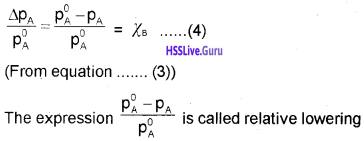
1. Give the relation between Kp and Kc.
2. What is the relation between Kp and Kc for the reaction, N2(g) + O2(g) \(\rightleftharpoons \) 2NO(g)?
Answer:
1. Kp = Kc(RT)∆n, where ∆n = (number of moles of gaseous products) – (number of moles of gaseous reactants).

2. Here, ∆n = 2 – 2 = 0
Kp = Kc(RT)∆n , Kp = Kc (RT)°
∴ Kp = Kc

Question 14.
1. Explain Arrhenius concept of acids and bases with suitable examples.
2. How proton exists in aqueous solution? Give reason.

Answer:
1. According to Arrhenius theory, acids are substances that dissociates in water to give hydrogen ions, H+(aq) and bases are substances that produce hydroxyl ions, OH(aq). Forexample, HCl is an Arrhenius acid and NaOH is an Arrhenius base.

2. In aqueous solution the proton bonds to the oxygen atom of a solvent water molecule to give trigonal pyramidal hydronium ion, H3O+(aq). This is because a bare proton, H+ is very reactive and cannot exist freely in aqueous solutions.

Question 15.
1. What is an acidic buffer?
2. Suggest an example for an acidic buffer.
Answer:
1. An acidic buffer is a buffer solution having pH less than 7. It is prepared by mixing a weak acid and its salt formed with a strong base.

2. Mixture of acetic acid (CH3COOH) and sodium acetate (CH3COONa) is an example for an acidic buffer. Its pH is around 4.75.

Question 16.
1. What is a basic buffer?
2. Suggest an example for basic buffer.
Answer:
1. A basic buffer is a buffer solution having pH greater than 7. It is prepared by mixing a weak base and its salt formed with a strong acid.

2. Mixture of ammonium hydroxide (NH4OH) and ammonium chloride (NH4CI) is an example for a basic buffer. Its pH is around 9.25.

Plus One Chemistry Equilibrium Three Mark Questions and Answers

Question 1.
The concentration of reactant and products for the reaction, H2(g) + l2(g) \(\rightleftharpoons \) 2Hl(g) are recorded as follows:

Reactant or Product Molar Concentration
H2 0.080
l2 0.060
HI 0.490

a) Write down the expressions for equilibrium constant of the above reaction.
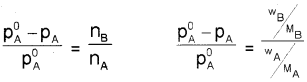
b) Calculate the equilibrium constant at the temperature 298 K if [Hl] = 0.49 M, [H2]=0.08 M and [l2]=0.06 M.

Answer:
Plus One Chemistry Chapter Wise Questions and Answers Chapter 7 Equilibrium 3

Question 2.
1. When equilibrium is reached in a chemical reaction?
2. What is the influence of molar concentration in a reaction at equilibrium?
3. Write the expression for equilibrium constant for the decomposition of NH4CI by the reaction,
NH4Cl \(\rightleftharpoons \) NH3+HCl
Answer:
1. When the rate of forward reaction is equal to rate of backward reaction, the chemical reaction is said to be in equilibrium.

2. Rate of chemical reaction is directly proportional to the product of molar concentration of the reactants.

3. \(\mathrm{K}=\frac{\left[\mathrm{NH}_{3}\right] \mathrm{HCl}}{\left[\mathrm{NH}_{4} \mathrm{Cl}\right]}\)

Plus One Chemistry Chapter Wise Questions and Answers Chapter 7 Equilibrium

Question 3.
1. What is meant by Kp?
2. How Kp is related to Kc?
Answer:
1. Kp is the equilibrium constant in terms of the partial pressures of the reactants and products (Pressure should be expressed in bar as standard state is 1 bar). It is used for reactions involving gases.

2. Kp = Kc (RT)∆n
where R = universal gas constant, T = absolute temperature and ∆n = number of moles of gaseous product(s) – number of moles of gasesous reactant(s).

Question 4.
a) What do you mean by equilibrium constant?
b) Write any two characteristics of equilibrium constant.
c) Write an expression for equilibrium constant of the reaction, 2SO2(g) + O2(g) \(\rightleftharpoons \) SO3(g).
Answer:
a) Equilibrium constant at a given temperature is the ratio of product of molar concentrations of the products to that of the reactants, each concentration term being raised to the respective stoichiometric coefficients in the balanced chemical equation.

b) 1. The value of equilibrium constant is independent of the initial concentrations of the reactants and products.
2. Equilibrium constant is temperature dependent having one unique value for a particular reaction represented by a balanced equation at a given temperature.

Question 5.
2NO2(g) \(\rightleftharpoons \) N2O4(g); ∆H = -52.7 kJ mol-1
1. What change will happen if we increase the temperature?
2. What is the effect of increase in pressure in the above equilibrium?
3. What happens when N2O4 is removed from the reaction medium?
Answer:
1. Since the forward reaction is exothermic, on increasing temperature the rate of backward reaction (endothermic reaction) increases.

2. Since the number of moles decreases in the forward reaction, on increasing pressure, the rate of forward reaction increases.

3. Rate of forward reaction increases.

Question 6.
Consider this reaction:
CO(g) + 2H2(g) \(\rightleftharpoons \) CH3OH(g); ∆rH = -92 kJ mol-1
Explain the influence of the following on the basis of
Le Chatelier’s principle.
1. Decrease in pressure.
2. Increase in temperature.
3. Increase in the partial pressure of hydrogen.
Answer:
1. On decreasing pressure the reaction shifts in the direction in which there is increase in the number of moles. Thus, the rate of backward reaction increases on decreasing pressure.

2. On increasing temperature, the rate of endothermic reaction increases. Here, backward reaction is endothermic. Hence, on increasing temperature the rate of backward reaction increases.

3. Hydrogen, being a reactant increase in its partial pressure increases the rate of forward reaction.

Question 7.
The equilibrium showing dissociation of phosgene gas is given below:
COCl2(g) \(\rightleftharpoons \) CO(g) + Cl2(g)
When a mixture of these three gases at equilibrium is compressed at constant temperature, what happens to
1. The amount of CO in mixture?
2. The partial pressure of COCl2?
3. The equilibrium constant for the reaction?
Answer:
1. Amount of CO decreases, because the system favours the reaction in which number of moles decreases with increase of pressure i.e., backward reaction.

2. Increases.
3. Equilibrium constant remains the same since temperature is constant.

Question 8.
The equilibrium constant of the reaction H2(g) + l2(g) \(\rightleftharpoons \) 2Hl(g) is 57 at 700 K. Now, give the equilibrium constants for the following reactions at the same temperature:
Plus One Chemistry Chapter Wise Questions and Answers Chapter 7 Equilibrium 4
Answer:
Plus One Chemistry Chapter Wise Questions and Answers Chapter 7 Equilibrium 5

Question 9.
1. What are buffer solutions?
2. Which of the following are buffer solutions?
NaCl + HCl
NH4Cl + NH4OH
HCOOH + HCOOK
3. What is the effect of pressure on the following equilibria?
i) Ice \(\rightleftharpoons \) Water
ii) N2(g) + O2(g) \(\rightleftharpoons \) 2N0(g)
Answer:
1. These are solutions which resist change in pH on dilution or with the addition of small amounts of acid or alkali.

2. NH4Cl + NH4OH

3. i) When pressure is increased the melting point of ice decreases and hence the rate of forward reaction will increase.
ii) Pressure has no effect in this equilibrium because there is no change in the number of moles of the gaseous reactants and products.

Question 10.
The aqueous solution of the compounds NaCl, NH4Cl and CH3COONa show different pH.

  1. Identify the acidic, basic and neutral solution among them.
  2. The concentration of hydrogen ion in a soft drink is 4 × 10⁻⁴. What is its pH?

Answer:

  1. Acidic-aqueous solution of NH4Cl Neutral – aqueous solution of NaCl Basic – aqueous solution of CH3COONa
  2. pH = – log[H+] = – log[4 × 10⁻⁴] = 3.398

Question 11.
1. What is pH? What is its significance?
2. The concentration of hydrogen ion in a sample of soft drink is 3.8 × 10⁻³. What is its pH?
Answer:
1. pH is a logarithmic scale used to express the hydronium ion concenration in molarity more conveniently. The pH of a solution is defined as negative logarithm to the base 10 of the activity of hydrogen ion. pH = — log \({ { a }_{ { H }^{ + } } }\) = —log[H+]

2. [H+] = 3.8 × 10⁻³
pH = -log[H+]
= -log [3.8 × 10⁻³] = -(-2.42) = 2.42

Question 12.
1. State the Le-Chatelier’s principle.
2. Apply the above principle in the following equilibrium and predict the effect of pressure.
CO(g) + 3H2(g) \(\rightleftharpoons \) CH4(g) + H2O(g)
Answer:
1. The Le Chateliers principle states that a change in any of the factors that determine the equilibrium conditions of a system will cause the system to change in such a manner so as to reduce or to counteract the effect of the change.

2. On increasing pressure the rate of forward reaction increases. This is because number of moles decreases in the forward reaction. In other words, the value of Qc decreases on increasing pressure. As Qc < Kc, the reaction proceeds in the forward direction.

Plus One Chemistry Chapter Wise Questions and Answers Chapter 7 Equilibrium

Question 13.
1. Explain Lewis concept of acids and bases.
2. Why does BF3 act as a Lewis acid?
Answer:
1. A Lewis acid can be defined as a species which accepts electron pair and a Lewis base is a species which donates an electron pair.

2. In BF3, the boron atom is electron deficient and it accepts a lone pair of electron. So it acts as a Lewis acid.

Question 14.
1. How the value of AG influence the direction of an equilibrium process?
2. The equilibrium constant for a reaction is 8. What will be the value of ∆G at 27 °C?
Answer:
1. If ∆G is negative, then the reaction is spontaneous and proceeds in the forward direction.
If ∆G is positive, then reaction is considered non- spontaneous. instead, as reverse reaction would have a negative ∆G, the products of the forward reaction shall be converted to the reactants.
If ∆G is 0, reaction has achieved equilibrium. At this point, there is no longer any free energy to drive the reaction.
2.
Plus One Chemistry Chapter Wise Questions and Answers Chapter 7 Equilibrium 6

Question 15.
1. What is common ion effect?
2. Suggest an example for this effect.
Answer:
1. Common ion effect may be defined as the suppression of the dissociation of a weak electrolyte by the addition of some strong electrolyte containing a common ion.

2. The dissociation equilibrium of NH4OH is shifted towards left in presence of NH4Cl having the common ion, NH4+.

Question 16.
1. Predict whether an aqueous solution of (NH4)2SO4 is acidic, basic or neutral?
2. Justify your answer.
Answer:
1. An aqueous solution of (NH4)2SC4 is acidic in nature.

2. (NH4)2SO4 is formed from weak base, NH4OH, and strong acid, H2SO4. In water, it dissociates completely
(NH4)2SO4(aq) → 2NH4+ (aq) + SO42- (aq)
NH4+ ions undergoes hydrolysis to form NH4OH and H+ ions.
NH4+(aq) + H2O(l) \(\rightleftharpoons \) NH4OH(aq) + H+(aq)
NH4OH is a weak base and therefore remains almost unionised in solution. This results in increased H+ ion concentration in solution making the solution acidic.

Question 17.
1. What are sparingly soluble salts? Suggest an example.
2. Define solubility product constant, Ksp.
3. Obtain the relation between solubility product constant (Ksp) and solubility (S), of a solid salt of general formula Mxp+ Xyq-.
Answer:
1. Sparingly soluble salts are those salts with solubility less than 0.01 M.
e.g. BaSO4

2. The solubility product of a sparingly soluble salt at a given temperature is defined as the product of the concentrations of its ions in the saturated solution, with each concentration term raised to the power equal to the number of times the ion occurs in the equation representing the dissociation of the electrolyte.

3. The equilibrium in the saturated solution of the salt can be represented as,
Plus One Chemistry Chapter Wise Questions and Answers Chapter 7 Equilibrium 17

Question 18.
The Le Chatelier’s principle is applicable to physical and chemical equilibria.
1. What are the factors which can influence the equilibrium state of a system?
2. Explain the factors affecting the chemical equilibrium on the basis of Le Chatelier’s principle taking Haber’s process for the manufacture of ammonia as an example.
Answer:
1. The following factors can influence the equilibrium state of a system:

  • Change in concentration of the reactants or products.
  • Change in temperature.
  • Change in pressure.
  • Addition of inert gas.
  • Presence of catalyst.

2. N2(g) + 3H2(g) \(\rightleftharpoons \) 2NH3(g); ∆rH = -91.8 kJ mol-1
When concentration of N2 or H2 is increased, a good yield of NH3 can be achieved. The rate of forward reaction can also be increased by removing NH3 from the reaction mixture.

When pressure is increased, the system will try to decrease pressure and for this system will proceed in that direction where there is minimum number of moles i.e., forward reaction. Thus, a good yield of NH3 can be achieved by increasing pressure.

Since the formation of NH3 is an exothermic reaction, a good yield of NH3 can be achieved by decreasing the temperature. But if the temperature is decreased to very low value the reactant molecules do not have sufficient energy to interact. Hence, an optimum temperature of 500°C is used.

Plus One Chemistry Chapter Wise Questions and Answers Chapter 7 Equilibrium

Question 19.
1. Soda water is prepared by dissolving CO2 in water under high pressure. What is the principle involved in this process?
2. At 1000 K, equilibrium constant Kc for the reaction 2SO3(g) \(\rightleftharpoons \) 2SO2(g) + O2(g) is 0.027. What is the value of Kp at this temperature?
Answer:
1. Henry’s law
2. Kp =Kc(RT)∆n
∆n = 3.2 = 1
Kp = 0.027 × (0.0831 × 1000)1 = 2.2437

Question 20.
1. For the reaction PCL \(\rightleftharpoons \) PCl3 +Clc
i) Write the expression of Kc.
ii) What happens if pressure is increased?
2. Write the conjugate acid and base of the following species:
i) H20 ii) HCO;
3. Name the phenomenon involved in the preparation of soap by adding NaCI.
Answer:
1. i) \(\kappa_{c}=\frac{\left[\mathrm{PC}_{3}\right]\left[\mathrm{Cl}_{2}\right]}{\left[\mathrm{PCl}_{5}\right]}\)
ii) If we increase the pressure the system will try to decrease the pressure. For this system will proceed in the direction where there is minimum number of moles, i.e., rate of backward reaction increases by decreasing the pressure.

2. i) Conjugate acid of H2O is H3O+
Conjugate base of H2O is OH”
ii) Conjugate acid of HCO,” is H2CO3 Conjugate base of HCO3 is CO32-

3. Common ion effect.

Question 21.
a) The pH of black coffee is 5.0. Calculate the hydrogen ion concentration.
b) The Ksp of barium sulphate is 1.5 × 10⁻⁹. Calculate the solubility of barium sulphate in pure water.
Answer:
Plus One Chemistry Chapter Wise Questions and Answers Chapter 7 Equilibrium 7

Question 22.
1. What is conjugate acid-base pair?
2. Illustrate with an example.
Answer:
1. The acid-base pairthat differs only by one proton is called conjugate acid-base pair. Such acid-base pairs are formed by loss or gain of a proton.

2. Consider the ionization of hydrochloric acid in water.
Plus One Chemistry Chapter Wise Questions and Answers Chapter 7 Equilibrium 8
HCl(aq) acts as an acid by donating a proton to H2O molecule which acts as a base because it accepts the proton. The species H2O+ is produced when water accepts a proton from HCl. Therefore, Cl is the conjugate base of HCl and HCl is the conjugate acid of Cl. Similarly, H2O is the conjugate base of H2O+ and H3O++ is the conjugate acid of the base H2O.

Question 23.
1. What are the applications of equilibrium constant?
2. What is meant by reaction quotient, Qc?
3. Predict the direction of net reaction in the following cases:
i) Qc < Kc
ii) Qc > Kc
iii) Qc = Kc
Answer:
1. The applications of equilibrium constant are:
• To predict the extent of a reaction on the basis of its magnitude.
• To predict the direction of the reaction.
• To calculate equilibrium concentrations.

2. Reaction quotient, Qc at a given temperature is defined as the ratio of the product of concentrations of the reaction products to that of the reactants, each concentration term being raised to their individual stoichiometric coefficients in the balanced chemical equation, where the concentrations are not necessarily equilibrium values.

3. i) When Qc > Kc, the reaction will proceed in the
direction of reactants (reverse reaction), i.e., net reaction goes from right to left.
ii) When Qc < Kc, the reaction will proceed in the direction of products (forward reaction), i.e., net reaction goes from left to right.
iii) When Qc = Kc, the reaction mixture will be at equilibrium, i.e., no net reaction occurs.

Question 24.
Solubility product helps to predict the precipitation of salts from solution.
1. Find the relation between solubility (S) and solubility product (Ksp) of calcium fluoride and zirconium phosphate.
2. The solubility product of two sparingly soluble salts XY2 and AB are 4 × 10-15 and 1.2 × 10⁻¹⁶ respectively. Which salt is more soluble? Explain.
Answer:
1. The equilibrium in the saturated solution of calcium fluoride can be represented as,
CaF2(s) \(\rightleftharpoons \) Ca2+(aq) + 2F(aq)
Ksp = [Ca2+][F]2 = S.(2S)2 = 4S3
The equilibrium in the saturated solution of zirconium phosphate can be represented as,
Zr3(PO4)4(s) \(\rightleftharpoons \) 3Zr4+(aq) + 4PO43-(aq)
Ksp = [Zr4+]3[PO43-]4 = (3S)3.(4S)4 = 6912S7

2. XY2 is more soluble than AB.
Plus One Chemistry Chapter Wise Questions and Answers Chapter 7 Equilibrium 9

Question 25.
a) How common ion effect can influence the solubility of ionic salts?
b) What is the application of common ion effect in gravimetric estimation?
Answer:
1. In a salt solution, if we increase the concentration of any one of the ions, according to Le Chatelier’s principle, it should combine with the ion of its opposite charge and some of the salt will be precipitated till Ksp = Qsp. Similarly, if the concentration of one of the ions is decreased, more salt will dissolve to increase the concentration of both the ions till Ksp = Qsp.

2. The common ion effect is used for almost complete precipitation of a particular ion as its sparingly soluble salt, with very low value of solubility product for gravimetric estimation.

Plus One Chemistry Equilibrium Four Mark Questions and Answers

Question 1.
Match the following:
Plus One Chemistry Chapter Wise Questions and Answers Chapter 7 Equilibrium 10
Answer:
Plus One Chemistry Chapter Wise Questions and Answers Chapter 7 Equilibrium 11

Question 2.
In Contact process, SO3 is prepared by the oxidation of SO2 as per the following reaction:
2SO2(g) + O2(g) \(\rightleftharpoons \) 2SO3(g); ∆H = -189.4
a) What happens to the rate of forward reaction when i) temperature is increased?
ii) pressure is decreased?
iii) a catalyst V2O5 is added?
b) Calculate the pH of 0.01 M H2SO4 solution. Also, calculate the hydroxyl ion concentration in the above solution.
Answer:
1. D When temperature is increased, the rate of forward reaction decreases since it is exothermic.
ii) When pressure is decreased the rate of forward reaction decreases since it is associated with decrease in number of moles.
iii) When a catalyst V2O5 is added the rate of both forward and backward reactions are increased by the same extent and equilibrium is reached earlier.
2.
Plus One Chemistry Chapter Wise Questions and Answers Chapter 7 Equilibrium 12

Question 3.
Calculate the [H+] in the following biological fluids whose pH are given in brackets.
i) Human muscle fluid (6.83)
ii) Human stomach fluid (1.22)
iii) Human blood (7.38)
iv) Human saliva (6.4)
Answer:
i) pH =-log[H+] = 6.83
log[H+] = – 6.83
[H+] = antilog (- 6.83) = 1.48 × 10⁻⁷ mol L-1
ii) [H+] = antilog (- 1.22) = 6.03 × 10⁻² mol L-1
iii) [H+] = antilog (- 7.38) = 4.17 × 10⁻⁸ mol L-1
iv) [H+] = antilog (- 6.4) = 3.98 × 10⁻⁷ mol L-1

Question 4.
The pH value of a solution determines whether it is acidic, basic or neutral in nature.
1. The concentration of hydrogen ion in the sample of a soft drink is 3.8 × 10⁻³ mol/L. Calculate its pH. Also predict whether the above solution is acidic, basic or neutral.
2. The dissociation constants of formic acid (HCOOH) and acetic acid (CH3COOH) are 1.8 × 10⁻⁴and 1.8 × 10⁻⁴ respectively. Which is relatively more acidic? Justify your answer.
Answer:
1. pH = – log[H+] = – log[3.8 × 10⁻³] = 2.42
Since pH is less than 7, it is an acidic solution,

2. HCOOH is more acidic.
Ka value is directly proportional to the acid strength, i.e., greater the Ka value, stronger is the acid.

Question 5.
a) Write the expression for Henderson – Hasselbalch equation for i) An acidic buffer & ii) A basic buffer.
b) Calculate the pH of a solution which is 0.1 M in
CH3COOH and 0.5 M in CH3COONa. Ka for CH3COOH is 1.8 × 10⁻⁶.
Answer:
Plus One Chemistry Chapter Wise Questions and Answers Chapter 7 Equilibrium 13

Plus One Chemistry Equilibrium NCERT Questions and Answers

Question 1
A liquid is in equilibrium with its vapour in a sealed containerat a fixed temperature. The volume of the container is suddenly increased. (3)
a) What is the initial effect of the change on vapour pressure?
b) How do rates of evaporation and condensation change initially?
c) What happens when equilibrium is restored finally and what will be the final vapour pressure?
Answer:
a) Vapour pressure decreases due to increase in volume.
b) Rate of evaporation remains same and rate of condensation decreases.
c) Finally the same vapour pressure is restored and the rate of evaporation becomes equal to the rate

Question 2.
The concentration of hydrogen ion in a sample of soft drink is 3.8 × 10⁻³ M. What is its pH? (2)
Answer:
pH = -log[H+]
= -log (3.8 × 10⁻³) = 2.42

Plus One Chemistry Chapter Wise Questions and Answers Chapter 7 Equilibrium

Question 3.
The pH of a sample of vinegar is 3.76. Calculate the concentration of hydrogen ion in it. (2)
Answer:
H= -log [H+]
or log [H+] = -3.76 = -4.24
[H+] = antilog (-3.76) = 1.74 × 10⁻⁴M

Question 4.
The ionization constants of HF, HCOOH and HCN at 298 K are 6.8 × 10⁻⁴, 1.8 × 10⁻⁴ and 4.8 × 10⁻⁹ respectively. Calculate the ionization constants of the corresponding conjugate base. (3)
Answer:
The relation between ionization constant of an acid and that of its conjungate base is Ka x Kb = Kw
Plus One Chemistry Chapter Wise Questions and Answers Chapter 7 Equilibrium 14

Question 5
The ionization constant of nitrous acid is 4.5 x 10⁻⁴. Calculate the pH of 0.04 M sodium nitrite solution and also its degree of hydrolysis. (2)
Answer:
Sodium nitrite is a salt of strong base and weak acid. Its degree of hydrolysis, h is given by the relation.
Plus One Chemistry Chapter Wise Questions and Answers Chapter 7 Equilibrium 15

Question 6
A 0.02 M solution of pyridinium hydrochloride has pH = 3.44. Calculate the ionization constant of pyridine. (2)
Answer:
Pyridinium hydrochloride is a salt of a weak base (pyridine) and a strong acid (HCl). The pH of an aqueous solution of this salt is given by the relation:
Plus One Chemistry Chapter Wise Questions and Answers Chapter 7 Equilibrium 16

Plus Two Malayalam Textbook Answers Unit 1 Chapter 1 Kannadi Kanmolavum

Kerala State Board New Syllabus Plus Two Malayalam Textbook Answers Unit 1 Chapter 1 Kannadi Kanmolavum Text Book Questions and Answers, Summary, Notes.

Kerala Plus Two Malayalam Textbook Answers Unit 1 Chapter 1 Kannadi Kanmolavum

Kannadi Kanmolavum Questions and Answers

Plus Two Malayalam Textbook Answers Unit 1 Chapter 1 Kannadi Kanmolavum 1

Plus Two Malayalam Textbook Answers Unit 1 Chapter 1 Kannadi Kanmolavum 2

Plus Two Malayalam Textbook Answers Unit 1 Chapter 1 Kannadi Kanmolavum 3

Plus Two Malayalam Textbook Answers Unit 1 Chapter 1 Kannadi Kanmolavum 4

Plus Two Malayalam Textbook Answers Unit 1 Chapter 1 Kannadi Kanmolavum 5

Plus Two Malayalam Textbook Answers Unit 1 Chapter 1 Kannadi Kanmolavum 6

Plus Two Malayalam Textbook Answers Unit 1 Chapter 1 Kannadi Kanmolavum 7

Plus Two Malayalam Textbook Answers Unit 1 Chapter 1 Kannadi Kanmolavum 8

Plus Two Malayalam Textbook Answers Unit 1 Chapter 1 Kannadi Kanmolavum 9

Plus Two Malayalam Textbook Answers Unit 1 Chapter 1 Kannadi Kanmolavum 10

Plus Two Malayalam Textbook Answers Unit 1 Chapter 1 Kannadi Kanmolavum 11

Plus Two Malayalam Textbook Answers Unit 1 Chapter 1 Kannadi Kanmolavum 12

Plus Two Malayalam Textbook Answers Unit 1 Chapter 1 Kannadi Kanmolavum 13

Plus Two Malayalam Textbook Answers Unit 1 Chapter 1 Kannadi Kanmolavum 14

Plus Two Malayalam Textbook Answers Unit 1 Chapter 1 Kannadi Kanmolavum 15

Plus Two Malayalam Textbook Answers Unit 1 Chapter 1 Kannadi Kanmolavum 16

Plus Two Malayalam Textbook Answers Unit 1 Chapter 1 Kannadi Kanmolavum 17

Plus Two Malayalam Textbook Answers Unit 1 Chapter 1 Kannadi Kanmolavum 18

Plus Two Malayalam Textbook Answers Unit 1 Chapter 1 Kannadi Kanmolavum 19

Plus Two Malayalam Textbook Answers Unit 1 Chapter 1 Kannadi Kanmolavum 20

Plus Two Malayalam Textbook Answers Unit 1 Chapter 1 Kannadi Kanmolavum 21

Plus Two Malayalam Textbook Answers Unit 1 Chapter 1 Kannadi Kanmolavum 22

Plus Two Malayalam Textbook Answers Unit 1 Chapter 1 Kannadi Kanmolavum 23

Plus Two Malayalam Textbook Answers Unit 1 Chapter 1 Kannadi Kanmolavum 24

Plus Two Malayalam Textbook Answers Unit 1 Chapter 1 Kannadi Kanmolavum 25

Plus Two Malayalam Textbook Answers Unit 1 Chapter 1 Kannadi Kanmolavum 26

Plus Two Malayalam Textbook Answers Unit 1 Chapter 1 Kannadi Kanmolavum 27

Plus Two Malayalam Textbook Answers Unit 1 Chapter 1 Kannadi Kanmolavum 28

Plus Two Malayalam Textbook Answers Unit 1 Chapter 1 Kannadi Kanmolavum 29

Plus Two Malayalam Textbook Answers Unit 1 Chapter 1 Kannadi Kanmolavum 30

Plus Two Malayalam Textbook Answers Unit 1 Chapter 1 Kannadi Kanmolavum 31

Plus Two Malayalam Textbook Answers Unit 1 Chapter 1 Kannadi Kanmolavum 32

Plus Two Malayalam Textbook Answers Unit 1 Chapter 1 Kannadi Kanmolavum 33

Plus Two Malayalam Textbook Answers Unit 1 Chapter 1 Kannadi Kanmolavum 34

Plus Two Malayalam Textbook Answers Unit 1 Chapter 1 Kannadi Kanmolavum 35

Plus Two Malayalam Textbook Answers Unit 1 Chapter 1 Kannadi Kanmolavum 36

Plus Two Malayalam Textbook Answers Unit 1 Chapter 1 Kannadi Kanmolavum 37

Plus Two Malayalam Textbook Answers Unit 1 Chapter 1 Kannadi Kanmolavum 38

Plus Two Malayalam Textbook Answers Unit 1 Chapter 1 Kannadi Kanmolavum 39

Plus Two Malayalam Textbook Answers Unit 1 Chapter 1 Kannadi Kanmolavum 40

Plus Two Malayalam Textbook Answers Unit 1 Chapter 1 Kannadi Kanmolavum 41

Plus Two Malayalam Textbook Answers Unit 1 Chapter 1 Kannadi Kanmolavum 42

Plus Two Malayalam Textbook Answers Unit 1 Chapter 1 Kannadi Kanmolavum 43

Plus Two Malayalam Textbook Answers Unit 1 Chapter 1 Kannadi Kanmolavum 44

Plus Two Malayalam Textbook Answers Unit 1 Chapter 1 Kannadi Kanmolavum 45

Plus Two Malayalam Textbook Answers Unit 1 Chapter 1 Kannadi Kanmolavum 46

Plus Two Malayalam Textbook Answers Unit 1 Chapter 1 Kannadi Kanmolavum 47

Plus Two Malayalam Textbook Answers Unit 1 Chapter 1 Kannadi Kanmolavum 48

Plus Two Malayalam Textbook Answers Unit 1 Chapter 1 Kannadi Kanmolavum 49

Plus Two Malayalam Textbook Answers Unit 1 Chapter 1 Kannadi Kanmolavum 50

Plus Two Malayalam Textbook Answers Unit 1 Chapter 1 Kannadi Kanmolavum 51

Plus Two Malayalam Textbook Answers Unit 1 Chapter 1 Kannadi Kanmolavum 52

Plus Two Malayalam Textbook Answers Unit 1 Chapter 1 Kannadi Kanmolavum 53

Plus Two Malayalam Textbook Answers Unit 1 Chapter 1 Kannadi Kanmolavum 54

Plus Two Malayalam Textbook Answers Unit 1 Chapter 1 Kannadi Kanmolavum 55

Kannadi Kanmolavum Summary

Kannadi Kanmolavum Summary 1

Kannadi Kanmolavum Summary 2

Kannadi Kanmolavum Summary 3

Kannadi Kanmolavum Summary 4

Kannadi Kanmolavum Summary 5

Kannadi Kanmolavum Summary 6

Kannadi Kanmolavum Summary 7

Kannadi Kanmolavum Summary 8

Kannadi Kanmolavum Summary 9

Kannadi Kanmolavum Summary 10

Kannadi Kanmolavum Summary 11

Kannadi Kanmolavum Summary 12

Kannadi Kanmolavum Summary 13

Kannadi Kanmolavum Summary 14

Kannadi Kanmolavum Summary 15

Kannadi Kanmolavum Summary 16

Kannadi Kanmolavum Summary 17

Kannadi Kanmolavum Summary 18