Plus One Chemistry Chapter Wise Questions and Answers Chapter 8 Redox Reactions

Students can Download Chapter 8 Redox Reactions Questions and Answers, Plus One Chemistry Chapter Wise Questions and Answers helps you to revise the complete Kerala State Syllabus and score more marks in your examinations.

Kerala Plus One Chemistry Chapter Wise Questions and Answers Chapter 8 Redox Reactions

Plus One Chemistry Redox Reactions One Mark Questions and Answers

Question 1.
In which of the following, oxidation number of chlorine is +5?
a) Cl
b) ClO
c) ClO2
d) ClO3
Answer:
d) ClO3

Question 2.
An oxidising agent is a substance which can
a) Gain electrons
b) Lose an electronegative radical
c) Undergo decrease in the oxidation number of one of its atoms
d) Undergo any one of the above changes
Answer:
d) Undergo any one of the above changes

Question 3.
The arrangement of metals in the order of decreasing tendency to lose electrons is called _________ .
Answer:
Activity series

Plus One Chemistry Chapter Wise Questions and Answers Chapter 8 Redox Reactions

Question 4.
When KMnO4, reacts with acidified FeSO4
a) Only FeSO4 is oxidised
b) Only KMnO4 is oxidised
c) FeSO4 is oxidised and KMnO4 is reduced
d) KMnO4 is oxidised and FeSO4 is reduced
Answer:
c) FeSO4 is oxidised and KMnO4 is reduced

Question 5.
In the disproportionation reaction, which of the following statements is not true?
a) The same species is simultaneously oxidised as well as reduced
b) The reacting species must contain an element having at least three oxidation states
c) The element in the reacting species is present in the lowest oxidation state
d) The element in the reacting species is present in the intermediate oxidation state
Answer:
c) The element in the reacting species is present in the lowest oxidation state

Question 6.
Find the oxidation state of oxygen in OF2.
Answer:
The oxidation number of fluorine in its compounds is always taken as -1.
In OF2
X+ (-1 × 2) = 0
X = +2

Question 7.
The oxidation numbers of chlorine atoms in bleaching powder is _________ .
Answer:
-1

Question 8
SO2 can act as
a) Oxidising agent only
b) Reducing agent only
c) Both oxidising and reducing agents
d) Acid and a reducing agent only
Answer:
c) Both oxidising and reducing agents

Question 9.
In the reaction
2KMnO4 +16HCl → 5Cl2 + MnCl2 + 2KCl + 8H2O the reduction product is _________ .
Answer:
MnCl2

Plus One Chemistry Chapter Wise Questions and Answers Chapter 8 Redox Reactions

Question 10.
The strongest reducing agent is .
a) K
b) Ba
c) Li
d) Na
Answer:
c) Li

Question 11.
Oxidation state of oxygen in H2O2 is _________ .
Answer:
-1

Plus One Chemistry Redox Reactions Two Mark Questions and Answers

Question 1.
Balance the following equation using oxidation number method:
MnO2 + Cl → Mn2+ + Cl2
Answer:
Assigning oxidation numbers:
Plus One Chemistry Chapter Wise Questions and Answers Chapter 8 Redox Reactions 1
Equating the increase and decrease in oxidation number:
MnO2 + 2Cl → Mn2+ + Cl2
Balancing hydrogen and oxygen atoms:
MnO2 + 2Cl + 4H+ → Mn2+ + Cl2 + 2H2O

Question 2.
Balance the following equation using half reaction method:
Cu + NO3 → Cu2+ + NO2
Answer:
Separating into half reactions:
Oxidation half: Cu → Cu2+
Reduction half: NO3 → NO2
Balancing oxygen and hydrogen atoms:
NO3 + 2H+ → NO2 + H2O
Balancing charge by adding electrons and making the number of electrons equal in the two half reactions:
Cu → Cu2+ + 2e
2NO3 + 4H+ + 2e → 2NO2 + 2H2O
Adding the two half reactions to achieve the overall reaction:
Cu + 2NO3 + 4H+ → Cu2+ + 2NO2 + 2H2O

Question 3.
Complete the following ionic equations:

  1. Al3+ + 3e → …………….
  2. MnO42- → + e
  3. K → K+ + ……………
  4. Fe2+ → Fe3+ +

Answer:

  1. Al3+ + 3e → Al
  2. MnO42- → MnO4+ e
  3. K → K+ + e
  4. Fe2+ → Fe3+ + e

Plus One Chemistry Chapter Wise Questions and Answers Chapter 8 Redox Reactions

Question 4.
Find the oxidation number of P in the following compounds:

  1. Na2PO4
  2. H3P2O7
  3. PH3
  4. H3PO4

Answer:

  1. Na2PO4, Oxidation state of P = +6
  2. H4P2O7, Oxidation state of P = +5
  3. PH3, Oxidation state of P = -3
  4. H3PO4, Oxidation state of P = +5

Question 5.
Choose the correct oxidation number of sulphur in the compounds in column Afrom column B.

Column A Column B
Na2SO4 -2
H2sO3 +7
H2S +6
H2S2O7 +4

Answer:

Column A Column B
Na2SO4 +6
H2SO3 +4
H2S -2
H2S2O8 +7

Question 6.
Explain oxidation number and valency.
Answer:
Valency of an atom is its combining capacity and is denoted by a number without sign. The valency of an element is always a whole number.

Oxidation number is a net charge which an atom has or appears to have when the other atoms from the molecule are removed as ions assuming that the shared pair of electrons is with more electronegative atom.

Question 7.
Some rules related to oxidation number are given below. Correct the mistakes.

  • Oxidation number of alkali metals and alkaline earth metals is +2.
  • Oxidation number of hydrogen is always +1.
  • Algebraicsum of oxidation number of all the atoms in an ion is not equal to the charge on the ion.

Answer:

  • Oxidation number of alkali metals is +1.
  • Oxidation number of alkaline earth metals is +2.
  • Oxidation number of H is +1 except in metallic hydrides.

Question 8.
Match the following:

Oxidation number of Cl in Cl2O7 Cu
Oxidant Zn
Stannous Chloride, SnCl2 +7
Oxidation number of C in diamond Get reduced easily
The metal which can’t displace H from dil.HCl Zero
Reducing agent for mercuric chloride

Answer:

Oxidation number of Cl in Cl2O7 +7
Oxidant Get reduced I easily
Stannous Chloride, SnCl2 Reducing agent for mercuric chloride
Oxidation number of C in diamond Zero
The metal which can’t displace H from dil.HCl Cu

Question 9.
1. Calculate the oxidation number of oxygen in OF2 and KO2.
2. When Zn rod is dipped in blue CuSO4 solution ‘ the blue colour of CuSO4 fades due to displacement reaction. Write the reaction and identify the following:
i) The substance oxidised and the substance reduced.
ii) The oxidant and the reductant.
Answer:
1. OF2: x + (-1 × 2) = 0
x – 2 = 0
x = +2
KO2: (+1 × 1) + 2x = 0
1 + 2x = 0
2x = -1
x = –\(\frac{1}{2}\)

2. Zn(s) + CuSO4 (aq) → ZnSO4(aq) + Cu(s)
i) Substance oxidised – Zn
Substance reduced – Cu
ii) Oxidant-Cu
Reductant – Zn

Plus One Chemistry Chapter Wise Questions and Answers Chapter 8 Redox Reactions

Question 10.
a) Calculate the oxidation number of C in CH4 and in CH3Cl.
b) The sum of oxidation numbers of all atoms in a molecule is …………
Answer:
a) CH4:
x + (1 × 4) = 0
x + 4 = 0
x = -4
Oxidation number of C in CH4 is -4.

CH3Cl:
x + (3 × 1) + -1 = 0
x + 3 – 1= 0
x + 2 = 0
x = -2
Oxidation number of C in CH3Cl is -2.

b) Zero

Question 11.
1. Write the oxidation state of each element and identify the oxidising agent and reducing agent in the following reaction:
H2S(g) + Cl2(g) → 2HCl(g) + S(s)
2. Fill in the blanks and classify the following reactions into oxidation and reduction:
i) Mn7+ + 5e → ……………
ii) Sn4+ + …………… → Sn2+
iii) Na → Na+ + ……………
iv) Fe3+ +…………… → Fe2+
Answer:
1.Plus One Chemistry Chapter Wise Questions and Answers Chapter 8 Redox Reactions 2
Reducing agent – H2S
Oxidising agent -Cl2

2. i) Mn7+ + 5e → Mn2+
ii) Sn4+ + 2e → Sn2+
iii) Na → Na+ + e
iv) Fe3+ + e → Fe2+
Oxidation: Reaction (iii)
Reduction: Reactions (i), (ii) and (iv)

Question 12.
Dihydrogen undergoes redox reactions with many metals at high temperature.
a) Write the reaction between hydrogen with sodium.
b) Comment, whether the product formed, is covalent compound or ionic compound.
c) Which is the reducing agent in this reaction?
Answer:
1. 2Na + H2 → 2NaH
2. Ionic compound is formed. When alkali metals react with hydrogen ionic hydrides are formed.
3. Na is the reducing agent.

Plus One Chemistry Chapter Wise Questions and Answers Chapter 8 Redox Reactions

Question 13.
1. Is it possible to keep copper sulphate solution in zinc pot? Why?
2. Assign oxidation numbers of the underlined elements.
i) NaH2\(\underline { P } \)O4
ii) NaH\(\underline { S } \)O4
Answer:
1. No. Zn being more reactive will displace Cu from CuSO4. Thus Cu will be deposited on the vessel.

2. i) NaH2\(\underline { P } \)O4
+1 +(+1 × 2) + x +(-2 × 4) = 0
1 + 2 + x – 8 = 0
x – 5 = 0
x = +5
ii) NaH\(\underline { S } \)O4
+1 + 1 + x +(-2 × 4) = 0
+1 + 1 + x – 8 = 0
x – 6 = 0
x = +6

Question 14.
Identify the substance oxidised, reduced, oxidising agent and reducing agent in the reaction:
2Cu2O + Cu2S → 6Cu + SO2
Answer:

Plus One Chemistry Chapter Wise Questions and Answers Chapter 8 Redox Reactions 3
In this reaction, Cu is reduced from +1 state to zero. oxidation state and S is oxidised from -2 state to +4 state. Cu2O helps S in Cu2S to increase its oxidation number. Therefore, Cu(l) is the oxidising agent. S of Cu2S helps Cu both in Cu2S itself and Cu2O to decrease its oxidation number. Therefore, S of Cu2S is the reducing agent.

Question 15.
Explain the following in terms of electron transfer concept:

  1. Oxidation
  2. Reduction
  3. Oxidising agent
  4. Reducing agent

Answer:

  1. Oxidation: Loss of electron(s) by any species.
  2. Reduction: Gain of electron(s) by any species.
  3. Oxidising agent: Any species which accepts electrons).
  4. Reducing agent: Any species which donates electron^).

Question 16.
Represent the following compounds using Stock notation:
Cu2O, SnCl4, MnO, Fe2O3, V2O5
Answer:
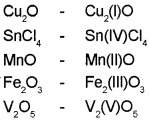
Plus One Chemistry Chapter Wise Questions and Answers Chapter 8 Redox Reactions 4

Question 17.
In a redox reaction, oxidation and reduction occur simultaneously.
a) Write the classical concept of oxidation and reduction.
b) Identify the species undergoing oxidation and reduction in the following reaction:
H2S(S) + Cl2(g) → 2HCl(g) + S(s)
Answer:
1. Oxidation:
addition of oxygen/electronegative element to a substance or removal of hydrogen/ electropositive element from a substance.

Reduction:
removal of oxygen/electronegative element from a substance or addition of hydrogen/ electropositive element to a substance.

2.Oxidised species:
H2S. This is because a more electronegative element, Cl is added to H or a more electro positive element, H has been removed from S.

Reduced species:
Cl. This is due to addition of more electropositive element H to it.

Plus One Chemistry Redox Reactions Three Mark Questions and Answers

Question 1.
An equation is given below:
HNO3+ l2 → HlO3 + NO2 + H2O

  • Find the oxidising agent and reducing agent.
  • Balance the equation using half reaction method.

Answer:
Oxidising agent = HNO3
Reducing agent = l2
Skeletal equation:
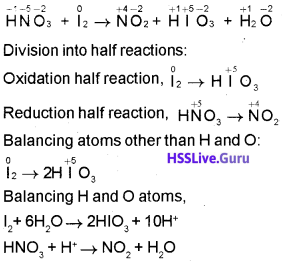
Plus One Chemistry Chapter Wise Questions and Answers Chapter 8 Redox Reactions 5
Balancing the charge on the half reactions by adding electrons and equalising the number of electrons:
Plus One Chemistry Chapter Wise Questions and Answers Chapter 8 Redox Reactions 6

Question 2.
1. Define redox reactions.
2. Predict whether the following reaction is a redox reaction or not? Justify.
Cr2O72- + H2O → 2CrO42- + 2H+
Answer:
1. Redox reactions are those reactions are those reactions in which reduction and oxidation occur simultaneously. These reactions involve change in oxidation state of the interacting species.

2. No.
Because no element undergoes change in oxidation number.

Plus One Chemistry Chapter Wise Questions and Answers Chapter 8 Redox Reactions

Question 3.
a) Find out the oxidising agent and reducing agent in the following reaction:
Cu(s) + 2Ag+(aq) → Cu2+(aq) + 2Ag(s)
b) Balance the following redox reaction in acid medium using oxidation number method.
Cr2O72- + Fe2+ → Cr3+ + Fe3+
Answer:
1. Oxidising agent – Ag
ReducingAgent – Cu

2. Assigning oxidation number:
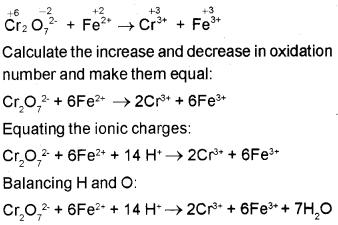
Plus One Chemistry Chapter Wise Questions and Answers Chapter 8 Redox Reactions 7

Question 4.
Calculate the oxidation number of sulphur, chromium and nitrogen in H2SO4, Cr2O72- and NO3.
Answer:
H2SO4
(2 × +1) + x+ (4 × -2) = 0
+2 + x – 8 = 0
x – 6 = 0
x = +6

Cr2O72-
2x + 7 ×-2 = -2
2x = -2 + 14
2x = 12
∴ x = +6

NO3
x + 3 × -2 = -1
x = -1 + 5
x = +4

Question 5.
1. Assign oxidation numbers
(i) P in NaH2PO4
(ii) Mn in KMnO4
(iii) B in NaBH4
(iv) S in H2SO4
2. Identify the oxidising and reducing agents in the following reaction:
CuO + H2 → Cu + H2O
Answer:
1. i) NaH2PO4
Na+1H2+1PO4-2
1+2 + x- 8 = 0
3 + x – 8 = 0
x – 5 = 0
x =+ 5

ii) K+1MnO4-2
1+ x – 8 = 0
x – 7 = 0
x = +7

iii) Na+1BH4+1
1 + x + 1 × 4 = 0
x + 5 = 0
x = -5

iv) H2+1SO4-2
2 + x – 8 = 0
x – 6 = 0
x = +6

2.
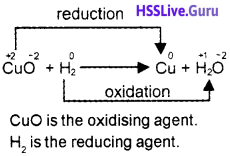
Plus One Chemistry Chapter Wise Questions and Answers Chapter 8 Redox Reactions 8

Question 6.
A copper rod is dipped in silver nitrate solution.

  1. What are the observations?
  2. Write the displacement reaction.
  3. Identify the species getting oxidised and reduced.

Answer:

  1. The colour of the solution changes to blue. Silver is deposited on the copper rod.
  2. Cu(s) +2AgNO3(aq) → Cu(NO3)2(aq) + 2Ag(s)
  3. Oxidised species – Cu Reduced species – Ag+

Plus One Chemistry Chapter Wise Questions and Answers Chapter 8 Redox Reactions

Question 7.
1. Identify the oxidising and reducing agent in the reaction:
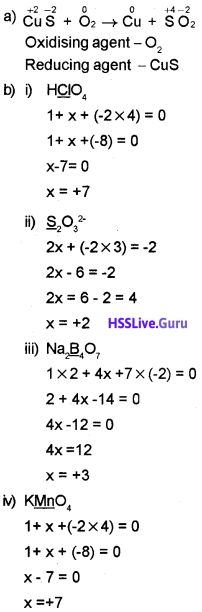
CuS + O2 → Cu + SO2
2. Determine the oxidation number of the underlined element in the following:
Plus One Chemistry Chapter Wise Questions and Answers Chapter 8 Redox Reactions 9
Answer:
Plus One Chemistry Chapter Wise Questions and Answers Chapter 8 Redox Reactions 10

Question 8.
1. Identify the substance oxidised, substance reduced, oxidising agent and reducing agent in the reaction:
Cl2 + 2l → 2Cl +l2

2. Calculate the oxidation number of underlined elements in the following compounds:
i) K2\(\underline { Cr } \)2O7
ii) H\(\underline { H } \)O3
Answer:
1. Cl2 is reduced, therefore Cl2 is the oxidising agent. I’ is oxidised, therefore I” is the reducing agent.

2. i) K2\(\underline { Cr } \)2O7
(+1 × 2) + 2x +(-2 × 7) = 0
+2 + 2x – 14 =0
2x – 12 =0
2x = 12
x = +6
ii) H\(\underline { H } \)O3
(+1 × 1) + x + (-2 × 3) = 0
1+ x – 6 = 0
x – 5 = 0
x = +5

Question 9.
Determine oxidation number of the elements underlined in each of the following.
Plus One Chemistry Chapter Wise Questions and Answers Chapter 8 Redox Reactions 12
Answer:
Plus One Chemistry Chapter Wise Questions and Answers Chapter 8 Redox Reactions 13

Plus One Chemistry Redox Reactions Four Mark Questions and Answers

Question 1.
Permanganate ion (MnO4) reacts with bromide ion (Br) in basic medium to give manganese dioxide
(MnO2) and bromate ion (BrO3).
a) Write the balanced ionic equation for this reaction.
b) Identify the oxidising agent and reducing agent in this reaction.
Answer:
Plus One Chemistry Chapter Wise Questions and Answers Chapter 8 Redox Reactions 14

Question 2.
A redox reaction involves oxidation and reduction.
a) What do you understand by electrode potential?
b) Define a redox couple.
c) Explain the set-up for Daniell cell with a diagram.
d) Write the electrode reactions and overall cell reaction which occur in the Daniel cell.
Answer:
a) The potential difference between metal and its own ion is called electrode potential.

b) A redox couple is defined as the combination of oxidised and reduced forms of a substance taking part in an oxidation or reduction half reaction.

c) Take copper sulphate solution in a beaker and put a copper strip. Take zinc sulphate solution in another beaker and put a zinc rod. The two redox couples are represented as Zn2+/Zn and Cu2+/Cu. Put the beaker containing copper sulphate solution and beaker containing zinc sulphate side by side. Connect two solution by a salt bridge. The Zn and Cu rods are connected by a metalic wire with a provision for ammeter and switch. Transfer of electrons now does not take place directly from Zn to Cu2+, but through metallic wire. The electricity from solution in one beaker to solution in the other beaker flows by the migration of ions through the salt bridge.
Plus One Chemistry Chapter Wise Questions and Answers Chapter 8 Redox Reactions 15

Question 3.
Redox reactions are those in which oxidation and reduction takes place. Explain the different types of redox reactions with suitable examples.
Answer:
Combination Reactions: The reactions in which two substances combine together to form a new compound are called combination reactions. These can be denoted as A+ B → C where either A or B or both A and B should be in the elemental form.
Plus One Chemistry Chapter Wise Questions and Answers Chapter 8 Redox Reactions 16
Decomposition reactions:
The reactions in which a compound breaks up into two or more substances at least one of which is in elemental form are called decompositions reactions.
Plus One Chemistry Chapter Wise Questions and Answers Chapter 8 Redox Reactions 17

Displacement reactions:
The reactions of the type X + YZ → XZ + Y in which an atom or ion in a compound is displaced by an ion (atom) of another element, such that X and Y are in elemental form are called displacement reactions. They are of two categories:
1. Metal displacement reactions: Reactions in which a more electropositive metal displaces a less electropositive metal from its compound.
Plus One Chemistry Chapter Wise Questions and Answers Chapter 8 Redox Reactions 18

2. Non-metal displacement reactions: These are reactions in which a non-metal is displaced by another metal or non-metal.
Plus One Chemistry Chapter Wise Questions and Answers Chapter 8 Redox Reactions 19
Disproportionation reactions: These are special type of redox reactions in which an element in one oxidation state is simultaneously oxidised and reduced. Here one of the reactants should contain an element that should exist in at least three oxidation states. The element in the form of reacting substance is in the intermediate oxidation state; and both higher and lower oxidation states of that element are formed in the reaction.
e.g. The decomposition of hydrogen peroxide.

Plus One Chemistry Chapter Wise Questions and Answers Chapter 8 Redox Reactions 20
Here the oxygen of peroxide, which is present in -1 state, is converted to zero oxidation state in O2 and to -2 state in H2O.

Plus One Chemistry Redox Reactions NCERT Questions and Answers

Question 1.
Fluorine reacts with ice and results in the change :
Plus One Chemistry Chapter Wise Questions and Answers Chapter 8 Redox Reactions 21
Justify that this reaction is a redox reaction.
Answer:
In the given reaction O.N. of F2 changes from zero to -1 in HF and HOF whereas O.N. of oxygen change from -2 in H2O to zero in HOF. Thus, F2 is reduced, whereas oxygen is oxidised and, therefore, it is a redox reaction.

Question 2.
Write formulas for the following compounds:

  1. Mercury (II) chloride
  2. Nickel (II) sulphate
  3. Tin (IV) oxide
  4.  Thallium (I) sulphate
  5. Iron (III) sulphate
  6. Chromium (III) oxide

Answer:

  1. Hg(II)Cl2
  2. Ni(II)SO4
  3. Sn(IV)O2
  4. Tl2(I)SO4
  5. Fe2(III)(SO4)3
  6. Cr2(III)O3

Plus One Chemistry Chapter Wise Questions and Answers Chapter 8 Redox Reactions

Question 3.
The compound AgF2 is unstable. However, if formed, the compound acts as a very strong oxiding agent. Why?
Answer:
In AgF2, oxidation state of Ag is + 2 which is very unstable. Since Ag can exist in a stable state of + 1 it quickly accepts an electron to form the more stable + 1 oxidation state.
Ag2+ + e → Ag+

Question 4.
Consider the reactions:
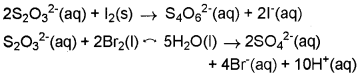
Plus One Chemistry Chapter Wise Questions and Answers Chapter 8 Redox Reactions 22
Why does the same reductant, thiosulphate react differently with iodine and bromine?
Answer:
The average O.N. of S in S2O32- is + 2 while in S4O62- it is + 2.5. The O.N. of S in SO42- is+6. Since Br2 is a stronger oxidising agent that l2, it oxidises S of S2O32- to a higher oxidation state of + 6 and hence forms SO42- ion. l2, however, being a weaker oxidising agent oxidises S of S2O32- ion to a lower oxidation of + 2.5 in S4O62- ion.

Question 5.
Why does the following reaction occur?
XeO64-(aq) + 2F(aq) + 6H+(aq) → XeO3(s) + F2(g) + 3H2O(I)
What conclusion about the compound Na4XeO6 (of which XeO64- is a part) can be drawn from the reaction?
Answer:
The balanced equation along with O.N. of the elements above their symbols will be as:
Plus One Chemistry Chapter Wise Questions and Answers Chapter 8 Redox Reactions 23
In the equation the, O.N. of Xe decreases from + 8 in XeO64- to + 6 in XeO3 while that of F increases from – 1 in F to 0 in F2. Therefore, XeO64- is reduced while F is oxidised. This reaction occurs because Na4XeO6 (0r XeO64-) is stronger oxidising agent than F2.

Kerala Syllabus 7th Standard Hindi Textbook Solutions Answers Notes Pdf

Expert Teachers at HSSLive.Guru has created Kerala Syllabus 7th Standard Hindi Textbook Solutions Answers Notes Pdf Download, SCERT Class 7 Hindi Solutions, 7th Std Hindi Notes Chapters Summary in Malayalam are part of Kerala Syllabus 7th Standard Textbooks Solutions. Here we have given 7th Standard Hindi Textbook Pdf with Answers Kerala Syllabus of 7th Standard Hindi Question Answer Kerala Syllabus Part 1 and Part 2.

Kerala SCERT Class 7 Hindi Solutions

7th Standard Hindi Textbook Pdf with Answers Kerala Syllabus

7th Std Hindi Notes इकाई 1 प्यार

Hindi Class 7 Kerala Syllabus इकाई 2 परिश्रम

SCERT Hindi Class 7 Solutions इकाई 3 मुसकान

Class 7 Hindi Kerala Syllabus इकाई 4 मेल-जोल

Std 7 Hindi Textbook Solutions इकाई 5 नज़ारे

Kerala Syllabus 7th Standard Hindi Textbook Solutions

Class 7 Hindi Kerala Syllabus Chapters Summary

Kerala Syllabus 7th Standard Hindi Notes Pdf

We hope the given Kerala Syllabus 7th Std Hindi Textbook Solutions of SCERT Hindi Class 7 Solutions will help you. If you have any queries regarding Class 7 Hindi Notes Kerala Syllabus Part 1 and Part 2, drop a comment below and we will get back to you at the earliest.

Kerala Syllabus 8th Standard Textbooks Solutions Guide

Expert Teachers at HSSLive.Guru has created Kerala Syllabus 8th Standard Textbooks Solutions Guide Pdf Free Download all Subjects in both English Medium and Malayalam Medium of Chapter wise Questions and Answers, Notes are part of Kerala Class 8 Solutions. Here HSSLive.Guru has given SCERT Kerala State Board Syllabus 8th Standard Textbooks Solutions Pdf Part 1 and Part 2.

Students can download SCERT Kerala Textbooks for Class 8 English Malayalam Medium

Kerala State Syllabus 8th Standard Textbooks Solutions

We hope the given Kerala Syllabus 8th Standard Textbooks Solutions Guide Pdf Free Download all Subjects in both English Medium and Malayalam Medium of Chapter wise Questions and Answers, Notes will help you. If you have any queries regarding SCERT Kerala State Board Syllabus Class 8th Textbooks Answers Guide Pdf of Part 1 and Part 2, drop a comment below and we will get back to you at the earliest.

Plus One Chemistry Notes Chapter 7 Chemical Equilibrium

Students can Download Chapter 7 Chemical Equilibrium Notes, Plus One Chemistry Notes helps you to revise the complete Kerala State Syllabus and score more marks in your examinations.

Kerala Plus One Chemistry Notes Chapter 7 Chemical Equilibrium

Introduction
Chemical equilibria are very important in numerous biological and environmental processes. At equilibrium state, the rate of product formed is equal to the rate of reactants formed. The mixture of reactants and products at equilibrium state is called an equilibrium mixture. A equilibrium mixture involving ions in aqueous solutions which is called as ionic equilibrium

Equilibrium In Physical Processes
Phase transformation processes are the familiar example for equilibrium in Physical process.
They are,
Solid \(\rightleftharpoons \) liquid
Liquid \(\rightleftharpoons \) gas
Solid \(\rightleftharpoons \) gas

Solid Liquid Equilibrium
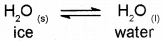
Consider a perfectly insulated thermos flask containing some ice and water at 273 K and normal atmospheric pressure. Since the flask is insulated, there will be no exchange of heat between its contents and the surroundings. It is seen that as long as the temperature remains constant, there is no change in the mass of ice and water. This represents an equilibrium state between ice and water and maybe represented as
Plus One Chemistry Notes Chapter 7 Chemical Equilibrium 1
We observe there is no change in mass of both ice and water. Since the rate of both reactions are equal.
rate of melting = rate of freezing For any pure substance at 1 atmospheric pressure the temperature at which the solid and liquid phases are at equilibrium is called the normal melting point or normal freezing point of the substance.

The equilibrium concentration calculator enables us to find how much the reactants and products.

Liquid – Vapour Equilibrium
In order to understand the liquid-vapour equilibrium, let us consider evaporation of water in a closed vessel. Consider a closed vessel connected to a manometer. The water vapour present in the vessel is first removed by placing some drying agent such as anhydrous calcium chloride in it for some time. The drying agent is then removed. Now the level of mercury in both the limbs of the manometer will be same. Introduce some water into the vessel and allow to stay at room temperature. Now water starts evaporating. A Pressure will gradually develop within the vessel due to the formation of water vapours. The change of pressure can be easily measured from the manometer. As evaporation continues, the pressure goes on increasing and the level of mercury in the right limb of the manometer starts rising. After some time it is observed that pressure becomes constant. This shows that the quantity of water vapour is not increasing any more, although liquid water is still present in the vessel. This indicates that a state of dynamic equilibrium has been attained between liquid water and water vapours.
Plus One Chemistry Notes Chapter 7 Chemical Equilibrium 2

At equilibrium, both reaction take place at the same rate. Thus at equilibrium,
rate of evaporation = rate of condensation

Plus One Chemistry Notes Chapter 7 Chemical Equilibrium

The pressure exerted by the vapours in equilibrium with the liquid at a particular temperature is called
vapour pressure of the liquid.

It may be noted that the equilibrium between the vapours and the liquid is attained only in a closed vessel. If the vessel is open, the vapours leave the vessel and get dispersed. Hence the rate of conden-sation will never become equal to the rate of evapo-ration.

Solid – Vapour Equilibrium
Consider systems where solids sublime to vapour phase, For example,
Plus One Chemistry Notes Chapter 7 Chemical Equilibrium 3

Equilibrium involving Dissolution of Solid or Gas in Liquids
Solids in liquids: In a saturated solution, a dynamic equilibrium exits between the solute molecules in the solid state and in the solution: the rate of dissolution of sugar = rate of crystallisation of sugar. Gases in liquids: This equilibrium is governed by Henry’s law, which states that the mass of a gas dissolved in a given mass of a solvent at any temperature is proportional to the pressure of the gas above the solvent

General Characteristics of Equilibria involving Physical Processes
For the physical processes discussed above, following characteristics are common to the system at equilibrium:

  1. Equilibrium is possible only in a closed system at a given temperature.
  2. Both the opposing processes occur at the same rate and there is a dynamic but stable condition.
  3. All measurable properties of the system remain constant.
  4. When equilibrium is attained for a physical process, it is characterised by constant value of one of its parameters at a given temperature.
  5. The magnitude of such quantities at any stage indicates the extent to which the reaction has proceeded before reaching equilibrium.

Equilibrium In Chemical Processes – Dynamic Equilibrium
Consider a general reversible reaction
A+B \(\rightleftharpoons \) C+D

Suppose the reaction is carried out in a closed container. In the beginning, the concentrations of A and B are maximum and the concentrations of C and D are minimum (equal to zero). As the reaction proceeds, the concentrations of A and B will decrease whereas the concentrations of C and D will increase. Hence the rate of the forward reaction will be high in the beginning and it will decrease gradually because of the fall in concentrations of A and B. On the other hand the velocity of the reverse reaction will be minimum at the beginning and it will increase gradually due to the increase in concentrations of C and D. Finally a stage will be reached when the rate of the forward reaction becomes equal to the rate of the reverse reaction. This state of the system is known as the state of chemical equilibrium. At this state the concentrations of the reactants and the products remain constant.
Plus One Chemistry Notes Chapter 7 Chemical Equilibrium 4
We can also start with C and D and make the reaction to proceed in the reverse direction. The concentration of C and D decreases and A and B increases. Finally, equilibrium is attained. One such example is given.
H2(g) +l2(g) \(\rightleftharpoons \) 2Hl(g)

Law Of Chemical Equilibrium And Equilibrium Constant
The relation between rates of reaction and concentrations was given by Guldberg and Wage in 1864. This relation is known as law of mass action.
The relation is,
\(K_{c}=\frac{[C][D]}{[A][B]}\)
For a general reversible reaction of the type,
aA + bB \(\rightleftharpoons \) cC + dD
the equilibrium constant maybe represented as
\(K_{ c }=\frac { [c]^{ c }[D]^{ d } }{ [A]^{ a }{ \left[ B \right] }^{ b } } \)
The equation is known as the expression for the law of chemical equilibrium.

Chemical Equilibrium

Plus One Chemistry Notes Chapter 7 Chemical Equilibrium

The law of chemical equilibrium or equilibrium law may thus be stated as :
At a given temperature, the product of concentrations of the reaction products raised to the respective stoichiometric coefficient in the balanced chemical equation divided by the prod-uct of concentrations of the reactants raised to their individual stoichiometric coefficients has a constant value. This is known as the Equilibrium Law or Law of Chemical Equilibrium.
If equilibrium constant for the backward reaction is
K’c then K’c = \(\frac{1}{K_{e}}\)

Homogeneous Equilibria
In a homogeneous system, all the reactants and products are in the same phase. For example, in the gaseous reaction,
N2(g) + 3H2(g) \(\rightleftharpoons \) 2NH3(g)

Heterogeneous Equilibria
Equilibrium in a system having more than one phase
is called heterogeneous equilibrium.
For example, H2O(l) \(\rightleftharpoons \) H2O(g)

Applications Of Equilibrium Constants

Predicting the Extent of a Reaction

  • If Kc >103, products predominate over reactants, i.e., if Kc is very large, the reaction proceeds nearly to completion.
  • If Kc < 10-3, reactants predominate over products, i.e., if Kc is very small, the reaction proceeds rarely.
  • If Kc is in the range of 10-3 to 103, appreciable concentrations of both reactants and products are present.

Plus One Chemistry Notes Chapter 7 Chemical Equilibrium 5

Predicting The Direction Of The Reaction
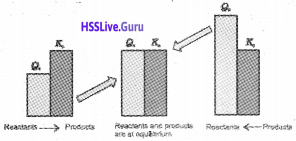
The equilibrium constant is also used to find in which direction the reaction mixture of reactants and products will proceed. For this, we have to calculate the reaction quotient (Qc) and compare with the equilibrium constant (Kc).

The concentrations of the species in Qc are not necessarily equilibrium values.
For a general reaction aA + bB → cC + dD
\(Q_{ c }=\frac { [c]^{ c }[D]^{ d } }{ [A]^{ a }{ \left[ B \right] }^{ b } } \)
If Qc > Kc, the reaction will proceed in the direction of the reactants (i.e., reverse reaction).
If Qc < Kc, the reaction will proceed in the direction of the products (i.e., forward reaction).
If Qc = Kc, the reaction mixture is already at equilibrium.
Plus One Chemistry Notes Chapter 7 Chemical Equilibrium 6

Calculating Equilibrium Concentrations
Step 1.
Write the balanced equation forthe reaction.

Step 2.
Under the balanced equation, make a table that lists foreach substance involved in the reaction:
a) the initial concentration,
b) the change in concentration on going to equilibrium, and
c) the equilibrium concentration.

In constructing the table, define x as the concentration ’ (mol/L) of one of the substances that reacts on going to equilibrium, then use the stoichiometry of the reaction to determine the concentrations of the other substances in terms of x.

Plus One Chemistry Notes Chapter 7 Chemical Equilibrium

Step 3.
Substitute the equilibrium concentrations into the equilibrium equation forthe reaction and solve for x. If you are to solve a quadratic equation choose the mathematical solution that makes chemical sense.

Step 4.
Calculate the equilibrium concentrations from the calculated value of x.

Step 5.
Check your results by substituting them into the equilibrium equation.

Problem
3.00 mol of PCl5 kept in 1L closed reaction vessel was allowed to attain equilibrium at 380 K. Calculate composition of the mixture at equilibrium. Kc = 1.80

Solution
Let x mol of PCl5 dissociated, At equilibrium:
(3 – x) x x
Kc = [PCl3][Cl2][PCl5]
1.8 = x²/(3 – x)
x² + 1.8x – 5.4 = 0
x = [-1.8 ± √(1.8)² – 4(-5.4)]/2
x = [-1.8 ± √3.24 + 21.6]/2
x = [-1.8 ± 4.98]/2
x = [-1.8 + 4.98]/2
x = 1.59
[PCl5] = 3.0 -x = 3 – 1.59 = 1.41 M
[PCl3] = [Cl2] = x = 1.59 M

Relationship Between Equilibrium Constant K, Reaction Quotient Q And Gibbs Energy G

  • ∆G is negative, then the reaction is spontaneous and proceeds in the forward direction.
  • ∆G is positive, then reaction is considered non-spontaneous. Instead, as reverse reaction would have a negative ”G, the products of the forward reaction shall be converted to the reactants.
  • ∆G is O, reaction has achieved equilibrium; at this point, there is no longer any free energy left to drive the reaction.

A mathematical expression of this thermodynamic view of equilibrium can be described by the following equation:

∆G = ∆G° + RT InQ
where, G° is standard Gibbs energy.
At equilibrium, when ∆G = 0 and Q=Kc the equation becomes,
∆G = ∆G° +RTIn K = 0
∆G° = -RTInK
InK = -∆G° / RT
Therefore, K = e∆Gv/RT

Factors Affecting Equilibria
In order to decide what course the reaction adopts and make a qualitative prediction about the effect of a change in conditions on equilibrium we use Le Chatelier’sprinciple. It states that a change in any of the factors that determine the equilibrium conditions of a system will cause the system to change in such a manner so as to reduce or to counteract the effect of the change. This is applicable to both physical and chemical equilibria.

Effect of Concentration Change
When the concentration of any of the reactants or products in a reaction at equilibrium is changed, the composition of the equilibrium mixture changes so as to minimize the effect of concentration changes.

Effect of Pressure Change
A pressure change obtained by changing the volume can affect the yield of products in case of a gaseous reaction where the total number of moles of gaseous reactants and total number of moles of gaseous products are different.

Effect of Inert Gas Addition
If the volume is kept constant and an inert gas such as argon is added which does not take part in the reaction, the equilibrium remains undisturbed. It is because the addition of an inert gas at constant volume does not change the partial pressures orthe molar concentrations of the substance involved in the reaction. So the reaction quotient does not change.

Effect of Temperature Change
Whenever an equilibrium is disturbed by a change in the concentration, pressure or volume, the composition of the equilibrium mixture changes because the reaction quotient, Qc no longer equals the equilibrium constant, Kc However, when a change in temperature occurs, the value of equilibrium constant, Kc is changed. In general, the temperature dependence of the equilibrium constant depends on the sign of ∆H for the reaction.

  • The equilibrium constant for an exothermic reaction (negative ∆H) decreases as the temperature increases.
  • The equilibrium constant for an endothermic reaction (positive ∆H) increases as the temperature increases.

Temperature changes affect the equilibrium constant and rates of reactions.

Effect of a Catalyst
A catalyst increases the rate of the chemical reaction by making available a new low energy pathway for the conversion of reactants to products. It increases the rate of forward and reverse reactions that pass through the same transition state and does not affect equilibrium. Catalyst lowers the activation energy for the forward and reverse reactions by exactly ‘ the same amount.

Ionic Equilibrium In Solution
Michael Faraday classified the substances into two categories based on their ability to conduct electricity. One category of substances conduct electricity in their aqueous solutions and are called electrolytes while the other do not and are thus, referred to as non-electrolytes.

Faraday further classified electrolytes into strong and weak electrolytes.

The ionic strength calculator is a convenient tool to help you calculate the ionic strength of a solution.

Plus One Chemistry Notes Chapter 7 Chemical Equilibrium

Strong electrolytes on dissolution in water are ionized almost completely, while the weak electrolytes are only partially dissociated.

Acids. Bases And Salts

Arrhenius Concept of Acids and Bases
According to Arrhenius theory, acids are substances that dissociates in water to give hydrogen ions H+(aq) and bases are substances that produce hydroxyl ions OH(aq). The ionization of an acid HX (aq) can be represented by the following equations:
HX(aq) → H+(aq) + X(aq)
or
HX(aq) + H2O(l) -> H3O+(aq) + X(aq)

The Bronsted-Lowry Acids and Bases
The Danish chemist, Johannes Bronsted and the English chemist, Thomas M. Lowry gave a more general definition of acids and bases. According to Bronsted-Lowry theory, acid is a substance that is capable of donating a hydrogen ion l-T and bases are substances capable of accepting a hydrogen ion, H+. In short, acids are proton donors and bases are proton acceptors.

Plus One Chemistry Notes Chapter 7 Chemical Equilibrium

The acid-base pair that differs only by one proton is called a conjugate acid-base pair. Therefore, OH is called the conjugate base of an acid H2O and NH4+ is called conjugate acid of the base NH3. If Bronsted acid is a strong acid then its conjugate base is a weak base and vice versa.
Consider the example of ionization of hydrochloric acid in water.
Plus One Chemistry Notes Chapter 7 Chemical Equilibrium 7

Ionization Of Acids And Bases

The Ionization constant of water and its ionic product
Water undergoes self ionisation to a small extent as follows.
Plus One Chemistry Notes Chapter 7 Chemical Equilibrium 8
Since [H2O] is constant, K[H2O]2 may be taken as a new constant Kw. Thus,
Kw= [H3O+][OH]

Where Kw is called ionic product of water. Its value is 1 x10‘14 mol2 L2 at 298 K. In pure water, the concen-tration of hydronium ions and hydroxyl ions are equal. Therefore in pure water,
[H3O+] = [OH] = 1 × 10⁻⁷ mol L-1

Since the ionisation of water increases with increase of temperature, Kw increases with rise of temperature.

Our buffer pH calculator will help you painlessly compute the pH of a buffer based on an acid or a base.

The pH Scale
Hydronium ion concentration in molarity is more conveniently expressed on a logarithmic scale known as the pH scale.

The pH of a solution is defined as the negative logarithm to base 10 of the activity (aH+) of hydrogen ion.
i.e., pH = – log aHH+ = – log {[H+]/,mol L-1}
Acidic solution has pH < 7 Basic solution has pH > 7
Neutral solution has pH = 7

Ionization Constants of Weak Acids
Plus One Chemistry Notes Chapter 7 Chemical Equilibrium 9
Here, c= initial concentration of the undissociated acid, HXat time, t = 0. α = extent up to which HX is ionized into ions.
Ka = c²a² / c(1 – α) = cα²/1 – A
Ka is called the dissociation or ionization constant.

Ionization of Weak Bases
The equilibrium constant for base ionization is called base ionization constant and is represented by Kb.

When equilibrium is reached, the equilibrium constant can be written as:
Kb = (cα)² / c(1 – α) = cα² / (1 – α)
considering the base-dissociation equilibrium reaction:
Kb = [BH+][OH]/[B]
Then multiplying and dividing the above expression by [H+], we get:
Kb = [BH+][OH][H+]/[B][H+]
= {[OH][H+]}{[BH+]/[B][H+]}
= Kw/Ka
Then we get the following relation;
pKa + PKb = pKq = 14 (at 298 K)

Common ion effect in the ionization of Acids and Bases.
Common ion effect my be defined as the suppression of the dissociation of a weak electrolyte (weak acid or weak base) by the addition of some strong electrolyte containing a common ion.

Factors Affecting Acid Strength
Dissociation of an acid depends on the strength and polarity of the H-A bond.
Electronegativity of A increases CH4 < NH3 < H2O < HF Acid strength increases

Common Ion Effect in the Ionization of Acids and Bases
Ka = [H+] [Ac] / [HAc] acetate ions to an acetic acid solution results in decreasing the concentration of hydrogen ions, [H+], Also, if H+ ions are added from an external source then the equilibrium moves in the direction of undissociated acetic acid. This phenomenon is an example of common ion effect.

Hydrolysis of Salts and the pH of their Solutions
Salts formed by the reactions between acids and bases in definite proportions, undergo ionization in water. The cations/anions formed on ionization of salts either exist as hydrated ions in aqueous solutions or interact with water to reform corresponding acids/bases depending upon the nature of salts. The later process of interaction between water and cations/anions or both of salts is called hydrolysis.

Buffer Solutions
The solutions which resist change in pH on dilution or with the addition of small amounts of acid or alkali are called Buffer Solutions.

Solubilityequilibriaof Sparingly Soluble Salts

Solubility Product Constant
The equilibrium between the undisolved solid and the ions in a saturated solution can be represented by the equation:
Plus One Chemistry Notes Chapter 7 Chemical Equilibrium 10
We call Ksp the solubility product constant or simply solubility product.

Thus, solubility product of a salt is the product of concentration of ions in its saturated solution, raised to a power equal to the number of times the ions occur in the equation representing the dissociation of the salt.

Plus One Chemistry Notes Chapter 7 Chemical Equilibrium

The term Ksp in equation is given by Qsp when the concentration of one or more species is not the concentration under equilibrium. Obviously under equilibrium conditions Ksp = Qsp but otherwise it gives the direction of the processes of precipitation or dissolution.

Common Ion Effect on Solubility of Ionic Salts
The solubility of salts of weak acids like phosphates increases at lower pH. This is because at lower pH the concentration of the anion decreases due to its proto-nation. This, in turn, increases the solubility of the salt so that Ksp = Qsp.

Ncert Supplementary Syllabus

Designing Buffer Solution
Knowledge of pKa, pKb and equilibrium constant help us to prepare the buffer solution of known pH. Let us see how we can do this.

Preparation of Acidic Buffer
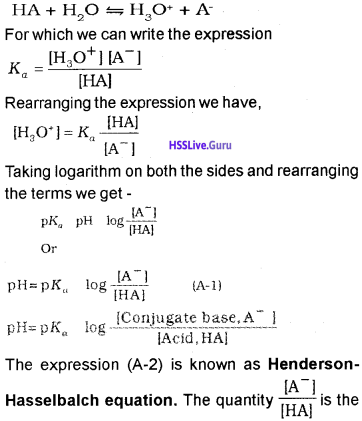
To prepare a buffer of acidic pH we use weak acid and its salt formed with strong base. We develop the equation relating the pH, the equilibrium constant, Ka of weak acid and ratio of concentration of weak acid and its conjugate
base. For the general case where the weak acid HA ionises in water,
Plus One Chemistry Notes Chapter 7 Chemical Equilibrium 11
ratio of concentration of conjugate base (anion) of the acid and the acid present in the mixture. Since acid is a weak acid, it ionises to a very little extent ‘and concentration of [HA] is negligibly different from concentration of acid taken to form buffer. Also, most of the conjugate base, [A], comes from the ionisation of salt of the acid. Therefore, the concentration of conjugate base will be negligibly different from the concentration of salt. Thus, equation (A-2) takes the form: pH-pKa + log\(\frac{[\mathrm{Salt}]}{[\mathrm{Acid}]}\)

Plus One Chemistry Notes Chapter 7 Chemical Equilibrium

In the equation (A-1), if the concentration of [A] is equal to the concentration of [HA], then pH = pKa because value of log 1 is zero. Thus if we take molar concentration of acid and salt (conjugate base) same, the pH of the buffer solution will be equal to the pKa of the acid. So for preparing the buffer solution of the required pH we select that acid whose pKa is close to the required pH. For acetic acid pKa value is 4.76, therefore pH of the buffer solution formed by acetic acid and sodium acetate taken in equal molar concentration will be around 4.76.

A similar analysis of a buffer made with a weak base and its conjugate acid leads to the result,
Plus One Chemistry Notes Chapter 7 Chemical Equilibrium 12

pH of the buffer solution can be calculated by using the equation pH + pOH =14.

We know that pH + pOH = pKw and pKa + pKb = pKw On putting these values in equation (A-3) it takes the form as follows:
Plus One Chemistry Notes Chapter 7 Chemical Equilibrium 13
If molar concentration of base and its conjugate acid (cation) is same then pH of the buffer solution will be same as pKa for the base. pK value for ammonia is 9.25; therefore a buffer of pH close to 9.25 can be obtained by taking ammonia solution and ammonium chloride solution of equal molar concentration. For a buffer solution formed by ammonium chloride and ammonium hydroxide, equation (A-4) becomes:
Plus One Chemistry Notes Chapter 7 Chemical Equilibrium 14
pH of the buffer solution is not affected by dilution because ratio under the logarithmic term remains unchanged.