Plus One Maths Chapter Wise Questions and Answers Chapter 6 Linear Inequalities

Students can Download Chapter 6 Linear Inequalities Questions and Answers, Plus One Maths Chapter Wise Questions and Answers helps you to revise the complete Kerala State Syllabus and score more marks in your examinations.

Kerala Plus One Maths Chapter Wise Questions and Answers Chapter 6 Linear Inequalities

Plus One Maths Linear Inequalities Three Mark Questions and Answers

Question 1.
Solve the following inequalities.

  1. \(\frac{1}{2}\left(\frac{3 x}{5}+4\right) \geq \frac{1}{3}(x-6)\)
  2. \(\left(\frac{2 x-1}{3}\right) \geq \frac{(3 x-2)}{4}-\frac{(2-x)}{5}\) (3 score each)

Answer:
1. Given;
Plus One Maths Linear Inequalities Three Mark Questions and Answers 1
⇒ 3(3x + 20) ≥ 10(x – 6)
⇒ 9x + 60 ≥ 10x – 60
⇒ 9x – 10x ≥ -60 – 60
⇒ -x ≥ -120 ⇒ x ≤ 120

2. Given;
Plus One Maths Linear Inequalities Three Mark Questions and Answers 2
⇒ 20(2x -1) ≥ 3[15x – 10 – 8 + 4x]
⇒ 40x – 20 ≥ 45x – 54 + 12x
⇒ 40x – 20 ≥ 57x – 54
⇒ 40x – 57x ≥ -54 + 20
⇒ -17x ≥ -34 ⇒ x ≤ 2

Plus One Maths Chapter Wise Questions and Answers Chapter 6 Linear Inequalities

Question 2.
1. Which of the following sets of inequality represent the second quadrant? (1)
(a) x < 0, y < 0
(b) x > 0, y > 0
(c) x < 0, y > 0
(d) x > 0, y < 0
2. Write the system of inequalities that represents the shaded rectangle in the figure given below: (2)
Plus One Maths Linear Inequalities Three Mark Questions and Answers 3
Answer:
1. (a) x < 0, y < 0

2. The shaded figure is a rectangle. The side parallel to x axis are y = -1 and y = 1. The side perpendicular to x axis are x = 2 and x = -2. Hence the inequality that represent the shaded region are
-2 ≤ x ≤ 2; -1 ≤ y ≤ 1.

Plus One Maths Chapter Wise Questions and Answers Chapter 6 Linear Inequalities

Question 3.
Find all pairs of consecutive even positive integers both of which are smaller than10 such that their sum is less than 23.
Answer:
Consecutive even positive integers be x and x + 2. Then, x + x + 2 < 23; x + 2 < 10
⇒ 2x < 23 – 2; x < 10 – 2
⇒ x < \(\frac{21}{2}\) = 10.5; x < 8
⇒ 8 < x ≤ 10 Therefore x can take values 9, 10. Hence the pairs are (9, 10), (10, 9).

Question 4.
The longest side of a triangle is 3 times the shortest side and the third side is 2 cm shorter than the longest side. If the perimeter of the triangle is at least 61 cm, find the minimum length of the shortest side.
Answer:
Let the shortest side is x, then;
Longest side = 3x;
Third side = Longest side – 2 = 3x – 2
Perimeter = 3x + 3x – 2 + x ≥ 61 ⇒ 7x – 2 ≥ 61
⇒ 7x ≥ 61 + 2 ⇒ x ≥ \(\frac{63}{7}\) = 9.

Plus One Maths Linear Inequalities Four Mark Questions and Answers

Question 1.
Solve the following system of inequalities graphically.

  1. 2x – y > 1; x – 2y < -1
  2. x + y ≤ 9; y > x; x ≥ 0
  3. x – 2y ≤ 3; 3x + 4y ≥ 12; x ≥ 0, y ≥ 1
  4. 2x + y – 3 ≥ 0; x – 2y + 1 ≥ 0; y ≤ 3 (4 score each)

Answer:
1. 2x – y > 1; x – 2y < -1
Plus One Maths Linear Inequalities Four Mark Questions and Answers 4
Plus One Maths Linear Inequalities Four Mark Questions and Answers 5

Plus One Maths Chapter Wise Questions and Answers Chapter 6 Linear Inequalities

2. x + y ≤ 9; y > x ⇒ x – y < 0
Plus One Maths Linear Inequalities Four Mark Questions and Answers 6
Plus One Maths Linear Inequalities Four Mark Questions and Answers 7

3. x – 2y ≤ 3; 3x + 4y ≥ 12
Plus One Maths Linear Inequalities Four Mark Questions and Answers 8
Plus One Maths Linear Inequalities Four Mark Questions and Answers 9

Plus One Maths Chapter Wise Questions and Answers Chapter 6 Linear Inequalities

4. 2x + y ≥ 3; x – 2y ≤ -1
Plus One Maths Linear Inequalities Four Mark Questions and Answers 10
Plus One Maths Linear Inequalities Four Mark Questions and Answers 11

Plus One Maths Linear Inequalities Practice Problems Questions and Answers

Question 1.
Solve the following inequalities.

  1. 4x + 3 < 5x + 7
  2. 3(x – 1) ≤ 2(x – 3) (1 score each)

Answer:
1. Given; 4x + 3 < 5x + 7
⇒ 4x – 5x < 7 – 3 ⇒ -x < 4 ⇒ x > -4.

2. Given; 3(x – 1) < 2(x – 3)
⇒ 3x – 3 ≤ 2x – 6 ⇒ 3x – 2x ≤ -6 + 3
⇒ x ≤ -3.

Plus One Maths Chapter Wise Questions and Answers Chapter 6 Linear Inequalities

Question 2.
Solve the inequality \(\frac{3(x-2)}{5} \leq \frac{5(2-x)}{3}\).
Answer:
Given; \(\frac{3(x-2)}{5} \leq \frac{5(2-x)}{3}\)
⇒ 9(x – 2) ≤ 25(2 – x)
⇒ 9x – 18 ≤ 50 – 25x
⇒ 9x + 25x ≤ 50 + 18
⇒ 34x ≤ 68 ⇒ x ≤ 2.

Question 3.
Show the solution of each inequality on a number line.

  1. 4x + 3 < 6x + 7
  2. 5x – 3 ≥ 3x – 5
  3. 3(1 – x) < 2(x + 4)
  4. 2 – 3x < 2(x + 6)
  5. -3 ≤ 3 – 2x < 6 (2 score each)

Answer:
1. Given; 4x + 3 < 6x + 7 ⇒ 4x – 6x < 7 – 3
⇒ -2x < 4 ⇒ x > -2
Plus One Maths Linear Inequalities Practice Problems Questions and Answers 12

2. Given; 5x – 3 > 3x – 5 ⇒ 5x – 3x ≥ -5 + 3
⇒ 2x ≥ -2 ⇒ x ≥ 1.
Plus One Maths Linear Inequalities Practice Problems Questions and Answers 13

3. Given; 3(1 – x) < 2(x + 4) ⇒ 3 – 3x < 2x + 8
⇒ -3x – 2x < 8 – 3 ⇒ -5x < 5 ⇒ x > -1.
Plus One Maths Linear Inequalities Practice Problems Questions and Answers 14

4. Given; 2 – 3x < 2(x + 6) ⇒ 2 – 3x < 2x + 12
⇒ -3x – 2x < 12 – 2 ⇒ -5x < 10 ⇒ x > -2
Plus One Maths Linear Inequalities Practice Problems Questions and Answers 15

5. Given; -3 ≤ 3 – 2x < 6
⇒ -3 ≤ 3 – 2x; 3 – 2x < 6
⇒ -3 – 3 ≤ -2x; -2x < 6 – 3
⇒ -6 ≤ -2x; -2x < 3 ⇒ 3 ≥ x; x > \(-\frac{3}{2}\) ⇒ \(-\frac{3}{2}\) < x ≤ 3
Plus One Maths Linear Inequalities Practice Problems Questions and Answers 16

Plus One Maths Chapter Wise Questions and Answers Chapter 6 Linear Inequalities

Question 4.
The marks obtained by a student of class XI in first and second terminal examination are 62 and 48, respectively. Find the minimum marks he should get in the annual examination to have an average of at least 60 marks.
Answer:
Let x denote the mark obtained by the student in Class XI examination, then;
\(\frac{62+48+x}{3}\) ≥ 60 ⇒ 110 + x ≥ 1800 ⇒ x ≥ 70.

Plus One Accountancy Chapter Wise Questions and Answers Chapter 7 Bill of Exchange

Students can Download Chapter 7 Bill of Exchange Questions and Answers, Plus One Accountancy Chapter Wise Questions and Answers helps you to revise the complete Kerala State Syllabus and score more marks in your examinations.

Kerala Plus One Accountancy Chapter Wise Questions and Answers Chapter 7 Bill of Exchange

Plus One Accountancy Bill of Exchange One Mark Questions and Answers

Question 1.
The Maker of the bill of exchange is called the ……….
(a) Drawer
(b) Drawee
(c) Payee
Answer:
(a) Drawer.

Question 2.
Bill of exchange before its acceptance is called is ……………
(a) Bill
(b) Promissory Note
(c) Draft
Answer:
(c) Draft.

Question 3.
When a discounted bill is dishonoured, the ………… account is credited in the books of the drawer,
(a) Bank
(b) Drawee
(c) Payee
Answer:
(a) Bank

Plus One Accountancy Chapter Wise Questions and Answers Chapter 7 Bill of Exchange

Question 4.
A bill is noted when it is
(a) Dishonoured
(b) Honoured
(c) Discounted
(d) Accepted
Answer:
(a) Dishonoured

Question 5.
The process of transferring the ownership of the bill is called
(a) Acceptance
(b) Negotiation
(c) Endorsement
Answer:
(c) Endorsement

Question 6.
The credit instrument which contains a promise made by the debtor to pay a certain sum of money for value received is
(a) Bill of Exchange
(b) Debenture
(c) Promissory Note
(d) Equity Share
Answer:
(c) Promissory Note

Question 7.
A bill of exchange is an Instrument.
Answer:
Negotiable

Question 8.
………………. days of grace are allowed in case of time bills for calculating the date of maturity.
Answer:
Three

Question 9.
If the date of maturity of a bill is on a holiday then the bill will mature on ………….. day.
Answer:
The Previous day

Question 10.
When noting charges are paid finally the amount will
be recovered from
Answer:
Drawee.

Plus One Accountancy Chapter Wise Questions and Answers Chapter 7 Bill of Exchange

Question 11.
Complete the following on the basis of hints given

  1. Dishonour of discounted bill – An entry in the book of drawer.
  2. ………………………………………………. – No entry in the book of drawer.

Answer:
Honouring of discounted bill.

  1. Noting charges incurred – When bill is dishonoured.
  2. Rebate is allowed – …………………….

Answer:
When bill is honoured before due date.

Question 12.
Bill of exchange in Indian languages is called
Answer:
Hundi.

Question 13.
The person to whom the amount mentioned in the promissory note is payable is known as ………………..
Answer:
Promisee.

Question 14.
A person who endorse the promissory note in favour of another is known as ………………..
Answer:
Endorser

Question 15.
In a promissory note, the person who makes the promise to pay is called ……………………
Answer:
Promissor.

Question 16.
Bill of exchange is drawn on the ………….
Answer:
Debtor/Drawee.

Question 17.
The person to whom payment of the bill is to be made is known as ……………….
Answer:
Payee

Question 18.
A promissory note does not require ………..
Answer:
Acceptance.

Question 19.
Making payment of the bill of exchange before the due date is called …………..
Answer:
Retiring of the bill

Question 20.
A bill of exchange accepted without consideration, just to oblige a friend is known as
Answer:
Accommodation Bill

Question 21.
If the proceeds of the bill of exchange is to be paid after a particular period is called …………
Answer:
Time Bill.

Plus One Accountancy Chapter Wise Questions and Answers Chapter 7 Bill of Exchange

Question 22.
Find the odd one and state the reasons.

  1. Bill of exchange, cheque, promissory note, fixed deposit receipt.
  2. Drawer, Drawee, Payee, Endorser.

Answer:

  1. Fixed Deposit Receipt – Others are negotiable instruments
  2. Drawee – Others may be the same person

Question 23.
On the date of maturity, Arun (acceptor) requested to Santhosh (drawer) to cancel the old bill and draw a new bill upon him for a period of 2 months. Santhosh agrees to this. It is a case of ………………
Answer:
Renewal of bill

Plus One Accountancy Bill of Exchange Two Mark Questions and Answers

Question 1.
A bill of exchange must contain “an unconditional promise to pay.” Do you agree with a statement?
Answer:
No. The bill of exchange contains an unconditional order to pay a certain amount on an agreed date.

Question 2.
Define Bill of exchange.
Answer:
According to the Negotiable Instruments Act, 1881 a bill of exchange is “an instrument in writing containing an unconditional order, signed by the maker, directing a certain person to pay a certain sum of money only to, or to the order of a certain person, or to the bearer of the instrument.”

Question 3.
What are the features of bill of exchange?
Answer:
Following are the essential features of a bill of exchange.

  1. It must be in writing.
  2. It must be an order to pay, and not a request to pay.
  3. No condition should be attached to the order.
  4. The drawer must sign the bill
  5. The order must be for the payment of money only.
  6. It should be properly stamped.
  7. The amount mentioned in the bill may be made payable either on demand or after the expiry of a ‘stipulated period.

Question 4.
Who are.the parties to a bill of exchange ?
Answer:
There are three parties to a bill of exchange:

  1. Drawer – He is the creditor who draws a bill of exchange upon the debtor.
  2. Drawee – He is the person upon whom the bill of exchange is drawn. He is the purchaser of the goods on credit and the debtor.
  3. Payee – He is the person to whom payment of the bill is to be made on the maturity date. The drawer and the payee can be one party when payment is to be made to the drawer.

Question 5.
What are days of grace?
Answer:
Three extra days over the nominal due date legally given to the acceptor of a bill to make payment are called days of grace. Days of grace are allowed only in the case of time bills.

Question 6.
Calculate the maturity date of the following bill.

  1. Drawn on January 5th for three months.
  2. Drawn on May 1st for 4 months.

Answer:
1.

  • January 5th to February 5th
  • February 5th to March 5th
  • March 5th to April 5th
  • April 5th + 3 days of grace = April 8th

2.

  • May 1st – June 1st
  • June 1st – July 1st
  • July 1st – August 1st
  • August 1st – September 1st
  • September 1st + 3 days of grace = September 4th

Question 7.
What do you mean by Endorsement?
Answer:
An endorsement is a written order on the back of the instrument by the payee or the holder, for transferring his right to another person. The person who makes the endorsement is called endorser and in whose favour the endorsement is made is called the endorsee.

Plus One Accountancy Chapter Wise Questions and Answers Chapter 7 Bill of Exchange

Question 8.
What is an Accommodation Bill?
Answer:
A bill of exchange and Promissory note may be used for raising funds temporarily. Such a bill is called an ‘accommodation bill’ as it is accepted by the drawee to accommodate the drawer. These are drawn and accepted without consideration with a view to provide funds to one or more parties. There is no trade or debtor-creditor pfifationsip between parties. It is also known as ‘kite bill’ or ‘Wind bill’.

Question 9.
Ram received a bill from Anil on 1/7/2009 for 3 months for Rs. 4,000. Later the bill has been endorsed to Kumar. In this statement identify the parties involved in terms of drawer, drawee endorser and payee.
Answer:

  • Drawer – Ram
  • Drawee – Anil
  • Payee – Kumar
  • Endorsee – Kumar

Question 10.
Manu purchased goods on credit from Kumar for Rs. 40,0 on 1st April 2009. On the same date Kumar draws a bill for 2 months and got it accepted by Manu. What are the options available to Kumar in dealing with the bill?
Answer:
The following options are available to deal with the bill.

  1. He can retain the bill till the date of maturity.
  2. He can get the bill discounted through the bank.
  3. He can endorse the bill in favour of his creditor.
  4. He may sent the bill for collection to the bank.

Question 11.
Mr. Mohan holds a bill of exchange. He approaches a bank to receive the amount of bill before the maturity date. Does he get the money? Write your comments,
Answer:
If the drawer of the bill needs cash immediately or before the maturity date he can discount the bill with the bank. Discounting of the bill means encashing the bill with the banker on the security of the bill before the maturity date. The banker will deduct a certain sum from the bill amount as discount and pays the balance to the holder. The bank will present the bill to the drawee on the due date and get the payment of the bill.

Question 12.
Explain the term “Noting”
Answer:
When a bill of exchange is dishonoured due to nonpayment, it is usual to get it ‘noted’, to establish the matter of dishonour legally. The noting is done by the “Notary public”, who is an officer appointed by the Government for this purpose. Noting authenticates the facts of dishonour.

For providing this service, a number of fees is charged which is called “Noting charges” Noting charges either paid by the holder or any other parties should be borne by the acceptor in the absence of any agreement.

Question 13.
What do you mean by ‘Retiring of Bill’?
Answer:
The acceptor can pay the amount of the bill before its due date. The process of paying the amount of the bills payable before the due date is called retiring the bill. In such case, the holder usually allows some discount to the acceptor of bill. Such a discount is called “rebate on retired bill”. The amount of rebate depends on the period that the bill has yet to run.

Question 14.
What do you mean by Renewal of Bills?
Answer:
process of drawing and accepting a new bill by cancelling the old bill is called renewal of a bill. It is a granting of extension of credit to the acceptor. When this is done the acceptor may have to pay interest for the extended period of credit. It is paid in cash or may be included in the amount of the new bill.

Question 15.
On 1.1.2005 Raju sold goods to Anil for Rs. 20,000/ – and draw upon him a bill for 2 months. Anil accepted the bill and returned it to Raju. Later Raju endorsed the bill to Tom. On the date of maturity the bill was dishonoured.
Give advice to Tom, regarding the steps to be undertaken immediately after the dishonour.
Answer:
1. The holder of the bill, Tom should send a notice of dishonour to the drawer, Raju within a reasonable time. Otherwise, the other parties of the bill may deny their liability.

2. When the bill is dishonoured it is better to get the fact noted with a Notary public.

Plus One Accountancy Chapter Wise Questions and Answers Chapter 7 Bill of Exchange

Question 16.
Identify the endorser, endorsee and type of endorsement from the following
Plus One Accountancy Chapter Wise Questions and Answers Chapter 7 Bill of Exchange 1
Answer:

  • Endorser – Santhosh
  • Endorsee – Arunkumar
  • Type – Conditional Endorsement

Plus One Accountancy Bill of Exchange Three Mark Questions and Answers

Question 1.
Define promissory Note and Point out its Features.
Answer:
According to the Negotiable Instruments Act 1881, a promissory note is “an instrument in writing containing an unconditional undertaking, signed by the maker, to pay a certain sum of money only to or to the order of a certain person, or to the bearer of the instrument.”
The following are the features of promissory note

  1. It must be in writing
  2. It must contain an unconditional promise to pay.
  3. It must be signed by the maker
  4. The person to whom payment is to be made must also be certain.
  5. The amount payable must be certain.
  6. It should be properly stamped.

Question 2.
Who are the parties to a promissory note:
Answer:
There are two parties to a promissory note.
1. The maker or the promisor:
He is the person who makes or draws the promissory notable is the debtor.

2. The payee or the promisee:
He is a person in whose favour the promissiory note is drawn.

Question 3.
Syam sold goods to Anil on credit for Rs. 3,000, on 10th April 2003. He drew a bill on Anil for the amount at 3 months after date. Anil accepted the same and returned it to syam. At maturity, he met his obligation. Pass journal entries in the books of both parties.
Answer:
Book of Syam (Drawer) Journal
Plus One Accountancy Chapter Wise Questions and Answers Chapter 7 Bill of Exchange 2
Book of Anil [Drawee] Journal
Plus One Accountancy Chapter Wise Questions and Answers Chapter 7 Bill of Exchange 3

Question 4.
Haridas discounts a bill for Rs. 10,000 with his banker on 4th February, 2007. The bill was drawn on 1st January for Four months. The discount rate was 12%. p.a. write Journal entries in the book of Haridas.
Answer:
Book of Haridas [Drawer] Journal
Plus One Accountancy Chapter Wise Questions and Answers Chapter 7 Bill of Exchange 4
Plus One Accountancy Chapter Wise Questions and Answers Chapter 7 Bill of Exchange 5
Note: Calculation of discount
Discount = 10.000 × 12/100 × 3/12 = 300 It may be noted that discount has been charged for three months and not for 4 months because the bank will have to wait for 3 months to get the payment of bill on the due date.

Question 5.
From the given specimen of a promissory note identify:-
a) Promisor
b) Promisee
c) Consideration
Plus One Accountancy Chapter Wise Questions and Answers Chapter 7 Bill of Exchange 6
Answer:
Plus One Accountancy Chapter Wise Questions and Answers Chapter 7 Bill of Exchange 7

Plus One Accountancy Bill of Exchange Four Mark Questions and Answers

Question 1.
On January 1st, 2006, Ramesh sold goods worth ₹2,000 to Kannan and drew abill for the amount for 3 months. Kannan accepted the bill and returned it to Ramesh. Ramesh endorsed the bill in favour of Jayan, on 6th January. The bill was duly met on maturity. Pass journal entries in the book of Ramesh, Kannan and Jayan.
Answer:
Book of Ramesh [Drawer] Journal
Plus One Accountancy Chapter Wise Questions and Answers Chapter 7 Bill of Exchange 8
Book of Kannan [Drawee] Journal
Plus One Accountancy Chapter Wise Questions and Answers Chapter 7 Bill of Exchange 9
Book of Jayan [Endorser] Journal
Plus One Accountancy Chapter Wise Questions and Answers Chapter 7 Bill of Exchange 10

Plus One Accountancy Chapter Wise Questions and Answers Chapter 7 Bill of Exchange

Question 2.
On 10th March 2004, Chandran drew and Devan accepted a 2 months bill for Rs. 2000. On April 11 Chandran sends the bill to his bank for collection. On due date the amount is collected. Give journal entries in the book of both the parties.
Answer:
Journal (In the book of Chandran)
Plus One Accountancy Chapter Wise Questions and Answers Chapter 7 Bill of Exchange 11
Journal (In the book of Devan)
Plus One Accountancy Chapter Wise Questions and Answers Chapter 7 Bill of Exchange 12
Plus One Accountancy Chapter Wise Questions and Answers Chapter 7 Bill of Exchange 13

Question 3.
On 1st June 2005, ‘A’ Sold goods to ‘B’ worth Rs.
20,000 and drew on him a bill for 3 months. ‘B’ accepted the same and returned to ‘A’. On 5th June 2005, ‘A’ discounted the bill with his banker and received Rs. 19,000. On the due date, ‘B’ failed to pay the amount and the bill got dishonoured. Pass journal entries in the books of A and B.
Answer:
Book of A [Drawer] Journal
Plus One Accountancy Chapter Wise Questions and Answers Chapter 7 Bill of Exchange 14
Book of B [Drawee] Journal
Plus One Accountancy Chapter Wise Questions and Answers Chapter 7 Bill of Exchange 15

Question 4.
Identify the document shown below and state Any 6 features of the document.
Plus One Accountancy Chapter Wise Questions and Answers Chapter 7 16
Answer:
Document is a Bill of Exchange.
Features:

  1. It contains an order to pay money.
  2. The order shortly be unconditional
  3. The drawer must sign the bill
  4. The drawee must be a certain person.
  5. The order must be for the payment of money only.
  6. It should be properly stamped.

Question 5.
From the given specimen of Bill of exchange, identify:

  1. Drawer
  2. Drawee
  3. Payee
  4. Term of bill
  5. Date of maturity
  6. Consideration on the bill

Plus One Accountancy Chapter Wise Questions and Answers Chapter 7 Bill of Exchange 17
Answer:
Plus One Accountancy Chapter Wise Questions and Answers Chapter 7 Bill of Exchange 18

Plus One Accountancy Chapter Wise Questions and Answers Chapter 7 Bill of Exchange

Question 6.
Complete the following table.
Plus One Accountancy Chapter Wise Questions and Answers Chapter 7 Bill of Exchange 19
Answer:

  1. Debtor
  2. Order or promise, order to make payment
  3. Needs acceptance by drawee/does not need any acceptance.
  4. Three – Drawer, Drawee, Payee Two – Drawer and payee
  5. Drawer has secondary liability.

Question 7.
Complete the journal on the basis of the narration given for a bill of exchange of Rs. 20,000/-
Book of Santhosh Journal
Plus One Accountancy Chapter Wise Questions and Answers Chapter 7 Bill of Exchange 20
Answer:
Journal Book of Santhosh
Plus One Accountancy Chapter Wise Questions and Answers Chapter 7 Bill of Exchange 21

Plus One Accountancy Bill of Exchange Five Mark Questions and Answers

Question 1.
Ajay sold goods to Babu for Rs. 2,700 on 1.1.2007 and immediately drawn a bill for 4 months upon Babu for the same amount Babu accepted the bill and returned it to Ajay. On the 4th February 2007, Babu retires his acceptance under a rebate of 12% p.a. Give journal entries in the books of both the parties.
Answer:
Book of Ajay [Drawer] Journal
Plus One Accountancy Chapter Wise Questions and Answers Chapter 7 Bill of Exchange 22
Plus One Accountancy Chapter Wise Questions and Answers Chapter 7 Bill of Exchange 23
Book of Babu [Drawee] Journal
Plus One Accountancy Chapter Wise Questions and Answers Chapter 7 Bill of Exchange 24

Question 2.
In a classroom debate Mohan argued that a bill of exchange and promissory note are same but syam disagree with him and states that they are different, whose argument is correct? Give reason.
Answer:
The argument of Syam is correct. There are some defference between bill of exchange and promissory note.
Plus One Accountancy Chapter Wise Questions and Answers Chapter 7 Bill of Exchange 25

Question 3.
On January 15th, 2003 ‘N’ draw a bill of Rs. 8000 on his debtor ‘M’ for two months. By the due date of the bill, ‘M’ became insolvent and a dividend of 50 paise in the rupee was received from his estate. Pass Journal entries in the books of N and M.
Answer:
Journal (In the book of ‘N’)
Plus One Accountancy Chapter Wise Questions and Answers Chapter 7 Bill of Exchange 26
Plus One Accountancy Chapter Wise Questions and Answers Chapter 7 Bill of Exchange 27

Plus One Accountancy Chapter Wise Questions and Answers Chapter 7 Bill of Exchange

Question 4.
Identify the types of endorsement from the given format and write short notes on each type.
Plus One Accountancy Chapter Wise Questions and Answers Chapter 7 Bill of Exchange 28
Answer:

  1. Blank Endorsement: The endorser simply puts his signature, without mentioning the name of the endorsee.
  2. Special Endorsement: The endorser mentions the name of the endorsee along with his signature on the back of the Instrument.
  3. Restrictive Endorsement: Restrictlnq further endorsement.
  4. Sans – Recourse Endorsement: If the bill is dishonoured the holder cannot have recourse to the endorser.
  5. Facultative Endorsement: Endorsement made by waiving some right of the endorser.

Question 5.
The transaction between Rajesh and Murali are journalised below. Identify the drawer, drawee/acceptor, amount and term of bill. Also write appropriate narration to each transaction.
Book of Murali Journal
Plus One Accountancy Chapter Wise Questions and Answers Chapter 7 Bill of Exchange 29
Answer:

  1. Drawer – Rajesh
  2. Drawee – Murali
  3. Amount of bill – 10,000/-
  4. Term of bill – 3 Months
  5. Narration:
    • Purchased goods on credit
    • Acceptance given on bill
    • Bill amount paid on the due date

Plus One Accountancy Bill of Exchange Six Mark Questions and Answers

Question 1.
On 5th January 2003, Balu sold goods to Raju for Rs. 2500. Balu drew a 2 months bill on Raju. Raju accepted the bill and returned it to Balu. On 5th March Raju approached Balu with a request to renew the bill for a further period of 2 months. Balu agreed on the proposal for which an interest of Rs. 50 is charged. The second bill is duly accepted and was met on maturity. Give Journal entries in the book of Balu & Raju.
Answer:
Journal (In the book of Balu)
Plus One Accountancy Chapter Wise Questions and Answers Chapter 7 Bill of Exchange 30
Plus One Accountancy Chapter Wise Questions and Answers Chapter 7 Bill of Exchange 31

Question 2.
On January 15, 2012, ‘Syam’ sold goods to’ Naveen’ for Rs.30,000 and drew a bill for the same amount payable after 3 months. The bill was accepted by Naveen. The bill was discounted by Syam from his bank for Rs. 29,500 on January 31,2012. On maturity, the bill was dishonoured. He further agreed to pay Rs. 10,500 in cash including Rs.500 interest and accept a new bill for two months for the remaining Rs.20,000. The new bill was endorsed by Syam in favour of his creditor ‘Kiran’ for settling a debt of Rs.20500. The new bill was duly met by Naveen on maturity.
Record the Journal entries in the book of Syam and Naveen.
Answer:
Journal Entries (in the book of Syam)
Plus One Accountancy Chapter Wise Questions and Answers Chapter 7 Bill of Exchange 32

Plus One Accountancy Chapter Wise Questions and Answers Chapter 7 Bill of Exchange
Journal Entries (in the book of Naveen)
Plus One Accountancy Chapter Wise Questions and Answers Chapter 7 Bill of Exchange 33

Plus One Accountancy Bill of Exchange Eight Mark Questions and Answers

Question 1.
Mr. Anil sold goods to Sunil for Rs. 5,000 on credit and drew a bill for 3 months. Sunil accepted the bill and returned it to Anil. On the due date, the bill was dishonoured, noting charge being Rs. 100. Show journal entries in the books of Anil and Sunil, if

  1. The bill was retained by Mr. Anil.
  2. The bill was endorsed to Mr. Hari.
  3. The bill was discounted with the bank for Rs. 4,800.
  4. The bill was sent to the bank for collection.

Answer:
Book of Anil [Drawer] Journal
1. If the bill is retained
Plus One Accountancy Chapter Wise Questions and Answers Chapter 7 Bill of Exchange 34

2. If the bill was endorsed to Mr. Hari.
Plus One Accountancy Chapter Wise Questions and Answers Chapter 7 Bill of Exchange 35

3. If the bill is discounted with bank.
Plus One Accountancy Chapter Wise Questions and Answers Chapter 7 Bill of Exchange 36

4. If the bill sent for collection
Plus One Accountancy Chapter Wise Questions and Answers Chapter 7 Bill of Exchange 37

Book of Sunil [Drawee] Journal
Plus One Accountancy Chapter Wise Questions and Answers Chapter 7 Bill of Exchange 38

Plus One Maths Chapter Wise Questions and Answers Chapter 15 Statistics

Students can Download Chapter 15 Statistics Questions and Answers, Plus One Maths Chapter Wise Questions and Answers helps you to revise the complete Kerala State Syllabus and score more marks in your examinations.

Kerala Plus One Maths Chapter Wise Questions and Answers Chapter 15 Statistics

Plus One Maths Statistics Three Mark Questions and Answers

Question 1.
Find the mean deviation about the median for the following data: (3 score each)

  1. 13, 17, 16, 14, 11, 13, 10, 16, 11, 18, 12, 17.
  2. 36, 72, 46, 42, 60, 45, 53, 46, 51, 49.

Answer:
1. Arrange the data in the ascending order we have;
10, 11, 11, 12, 13, 13, 14, 16, 16, 17, 17, 18
Here n = 12. So median is the average of 6th and 7th observations.
Therefore; Median, M =\(\frac{13+14}{2}\) = 13.5
Plus One Maths Statistics Three Mark Questions and Answers 1
Mean deviation = \(\frac{\sum_{i=1}^{n}\left|x_{i}-M\right|}{n}=\frac{28}{12}\) = 2.33

2. Arrange the data in the ascending order we have; 36, 42, 45, 46, 46, 49, 51, 53, 60, 72
Here n = 10. So median is the average of 5th and 6th observations.
Therefore; Median, M = \(\frac{46+49}{2}\) = 47.5
Plus One Maths Statistics Three Mark Questions and Answers 2
Mean deviation = \(\frac{\sum_{i=1}^{n}\left|x_{i}-M\right|}{n}=\frac{70}{10}\) = 7.

Plus One Maths Chapter Wise Questions and Answers Chapter 15 Statistics

Question 2.
The mean and standard deviation of marks obtained by 50 students of a class in three subjects, mathematics, Physics, and Chemistry are given below:
Plus One Maths Statistics Three Mark Questions and Answers 3
Which of the three subject shows the highest variability in marks and which shows the lowest?
Answer:
For Mathematics:
\(\bar{x}\) = 42, σ = 12
∴ CV of Mathematics = \(\frac{12}{42}\) × 100 = 28.57%
For Physics:
\(\bar{x}\) = 32, σ = 15
∴ CV of Physics = \(\frac{15}{32}\) × 100 = 46.88%
For Chemistry:
\(\bar{x}\) = 40.9, σ = 20
∴ CV of Chemistry = \(\frac{20}{40.9}\) × 100 = 48.9%
Thus Chemistry with highest CV shows highest variability and Mathematics with lowest CV shows lowest variability.

Plus One Maths Statistics Four Mark Questions and Answers

Question 1.
Find the mean deviation about the mean for the following data: (4 score each)
1.
Plus One Maths Statistics Three Mark Questions and Answers 4
2.
Plus One Maths Statistics Three Mark Questions and Answers 5
Answer:
1.
Plus One Maths Statistics Three Mark Questions and Answers 6
Plus One Maths Statistics Three Mark Questions and Answers 7
Plus One Maths Statistics Three Mark Questions and Answers 8

Plus One Maths Chapter Wise Questions and Answers Chapter 15 Statistics

2.
Plus One Maths Statistics Three Mark Questions and Answers 9
Plus One Maths Statistics Three Mark Questions and Answers 10

Plus One Maths Chapter Wise Questions and Answers Chapter 15 Statistics

Question 2.
Find the mean deviation about the median for the following data: (4 score each)
1.
Plus One Maths Statistics Three Mark Questions and Answers 11
2.
Plus One Maths Statistics Three Mark Questions and Answers 12
Answer:
1.
Plus One Maths Statistics Three Mark Questions and Answers 13
\(\frac{\sum_{i=1}^{n} f_{i}}{2}=\frac{26}{2}\) = 13
The c.f just greater than 13 is 14 and corresponding value of x is 7. Therefore; median, M = 7
Hence; M.D about median
Plus One Maths Statistics Three Mark Questions and Answers 14

2.
Plus One Maths Statistics Three Mark Questions and Answers 15
\(\frac{\sum_{i=1}^{n} f_{i}}{2}=\frac{29}{2}\) = 14.5
The c.f just greater than 14.5 is 21 and corresponding value of x is 30. Therefore; median, M = 30
Hence; M.D about median
Plus One Maths Statistics Three Mark Questions and Answers 16

Plus One Maths Chapter Wise Questions and Answers Chapter 15 Statistics

Question 3.
Find the mean deviation about the mean for the following data: (4 score each)
1.
Plus One Maths Statistics Three Mark Questions and Answers 17
2.
Plus One Maths Statistics Three Mark Questions and Answers 18
Answer:
1.
Plus One Maths Statistics Three Mark Questions and Answers 19
Plus One Maths Statistics Three Mark Questions and Answers 20

2.
Plus One Maths Statistics Three Mark Questions and Answers 47
Plus One Maths Statistics Three Mark Questions and Answers 21

Plus One Maths Chapter Wise Questions and Answers Chapter 15 Statistics

Question 4.
Find the mean deviation about the median for the following data: (4 score each)
1.
Plus One Maths Statistics Three Mark Questions and Answers 22
2.
Plus One Maths Statistics Three Mark Questions and Answers 23
Answer:
1.
Plus One Maths Statistics Three Mark Questions and Answers 24
Median class is the class in which the \(\left(\frac{N}{2}\right)^{th}\) observation lies.
\(\frac{N}{2}=\frac{50}{2}\) = 25
Median class = 20 – 30
M = Median
Plus One Maths Statistics Three Mark Questions and Answers 25
Plus One Maths Statistics Three Mark Questions and Answers 26

2.
Plus One Maths Statistics Three Mark Questions and Answers 27

Plus One Maths Chapter Wise Questions and Answers Chapter 15 Statistics
Median class is the class in which the \(\left(\frac{N}{2}\right)^{th}\) observation lies.
\(\frac{N}{2}=\frac{100}{2}\) = 50
Median class = 35.5 – 40.5
M = Median
Plus One Maths Statistics Three Mark Questions and Answers 28
Plus One Maths Statistics Three Mark Questions and Answers 29

Question 5.
Find the variance and standard deviation of 3, 4, 6, 5, 5, 3, 8, 1, 7, 5
Answer:
Plus One Maths Statistics Three Mark Questions and Answers 30
Plus One Maths Statistics Three Mark Questions and Answers 31
Plus One Maths Statistics Three Mark Questions and Answers 32
\(\frac{259}{10}\) – (4.7)2 = 25.9 – 22.09 = 3.8
Standard Deviation (σ) = \(\sqrt{\text {Variance}}\) = \(\sqrt{3.8}\) =1.95.

Plus One Maths Chapter Wise Questions and Answers Chapter 15 Statistics

Question 6.
Find the variance and standard deviation of
Plus One Maths Statistics Three Mark Questions and Answers 33
Answer:
Plus One Maths Statistics Three Mark Questions and Answers 34
Plus One Maths Statistics Three Mark Questions and Answers 35
Standard Deviation (σ) = \(\sqrt{\text {Variance}}\)
= \(\sqrt{15.08}\) = 3.88.

Plus One Maths Chapter Wise Questions and Answers Chapter 15 Statistics

Question 7.
An analysis of monthly wages paid to workers in two firms A and B, belonging to the same industry, gives the following result.
Plus One Maths Statistics Three Mark Questions and Answers 36

  1. Which firm A or B pays larger amount as monthly wages?
  2. Which firm A or B, shows greater variability in individual wages?

Answer:
1. Firm: A
Number of wages earners (n1) = 586
Number of wages earners (\(\bar{x}_{1}\)) = 5253
Total monthly wages = 5253 × 586 = 3078258
Firm: B
Number of wages earners (n1) = 648
Number of wages earners (\(\bar{x}_{1}\)) = 5253
Total monthly wages = 5253 × 648 = 3403944

2. Since both the firms have same mean of monthly wages, so the firm with greater variance will have more variability in individual wages. Thus firm B will have more variability in individual wages.

Plus One Maths Chapter Wise Questions and Answers Chapter 15 Statistics

Question 8.
The sum and sum of squares corresponding to length x (in cm) and weight y (in gm) of 50 plant products are given below:
Plus One Maths Statistics Three Mark Questions and Answers 37
which is more varying, the length or weight?
Answer:
Here,
Plus One Maths Statistics Three Mark Questions and Answers 38
Now
Plus One Maths Statistics Three Mark Questions and Answers 39
C.V of weight = \(\frac{1.38}{5.22}\) × 100 = 26.44
C.V of weight > C.V of length
Thus weight have more variability than length

Plus One Maths Statistics Six Mark Questions and Answers

Question 1.
Find the variance and standard deviation of
Plus One Maths Statistics Three Mark Questions and Answers 40
Answer:
Plus One Maths Statistics Three Mark Questions and Answers 41

Plus One Maths Chapter Wise Questions and Answers Chapter 15 Statistics
Plus One Maths Statistics Three Mark Questions and Answers 42
Standard Deviation (a) = \(\sqrt{\text {Variance}}\)
= \(\sqrt{223.22}\) = 14.94.

Plus One Maths Statistics Practice Problems Questions and Answers

Question 1.
Find the mean deviation about the mean for the following data: (2 score each)

  1. 4, 7, 8, 9, 10, 12, 13, 17.
  2. 38, 70, 48, 40, 42, 55, 63, 46, 54, 44.

Answer:
1.
Plus One Maths Statistics Three Mark Questions and Answers 43
Plus One Maths Statistics Three Mark Questions and Answers 44

2.
Plus One Maths Statistics Three Mark Questions and Answers 45
Plus One Maths Statistics Three Mark Questions and Answers 46

Plus One Computer Science Chapter Wise Questions and Answers Chapter 9 String Handling and I/O Functions

Students can Download Chapter 9 String Handling and I/O Functions Questions and Answers, Plus One Computer Science Chapter Wise Questions and Answers helps you to revise the complete Kerala State Syllabus and score more marks in your examinations.

Kerala Plus One Computer Science Chapter Wise Questions and Answers Chapter 9 String Handling and I/O Functions

Plus One String Handling and I/O Functions One Mark Questions and Answers

Question 1.
To read a single character for gender i.e. ‘m’ or ‘f’ ________ function is used.
Answer:
(a) getch()
(b) getchar()
(c) gets()
(d) getline()
Answer:
(b) getchar()

Plus One Computer Science Chapter Wise Questions and Answers Chapter 9 String Handling and I/O Functions

Question 2.
To use getchar(), putchar(), gets() and puts(), which header file is used?
(a) iostream
(b) cstdio
(c) input
(d) output
Answer:
(b) cstdio

Question 3.
To use cin and cout, which header file is needed?
(a) iostream
(b) cstdio
(c) input
(d) output
Answer:
(a) iostream

Question 4.
Predict the output of the following code snippet.
#include<cstdio>
int mainO
{
char name[ ] = “ADELINE”;
for(int i=0; name[i]!=’\0′;i++)
putchar(name[i]);
}
Answer:
The output is “ADELINE”.

Question 5.
From the following which is equivalent to the function getc(stdin).
(a) putchar()
(b) gets()
(c) getchar()
(d) puts()
Answer:
(c) getchar()

Question 6.
From the following which is equivalent to the function putc(ch, stdout).
(a) putchar(ch)
(b) ch = gets()
(c) ch = getchar()
(d) puts(ch )
Answer:
(a) putchar(ch)

Plus One Computer Science Chapter Wise Questions and Answers Chapter 9 String Handling and I/O Functions

Question 7.
To print a single character at a time which function is used?
(a) puts()
(b) putchar()
(c) gets()
(d) getchar()
Answer:
(b) putchar()

Question 8.
To read a string _______ function is used.
(a) puts()
(b) putchar()
(c) gets()
(d) getchar()
Answer:
(b) gets()

Question 9.
To print a string _______ function is used.
(a) puts()
(b) putchar()
(c) gets()
(d) getchar()
Answer:
(b) puts()

Question 10.
Consider the following code snippet.
main()
{
char str[80];
gets(str);
for(int i=0. len=0;str[il!=’\0′;i++.len++);
cout<<“The length of the string is ” <<len;
}
Select the equivalent forthe under lined statement from the following
(a) int len = strlen(str)
(b) int len = strcmp(str)
(c) int len = strcount(str)
(d) None of these
Answer:
(a) int len = strlen(str)

Plus One Computer Science Chapter Wise Questions and Answers Chapter 9 String Handling and I/O Functions

Question 11.
Arjun wants to read a string with spaces from the following which is suitable.
(а) cin>>
(b) cin.getline(str,80)
(c) str = getc(stdin)
(d) none of these
Answer:
(b) cin.getline(str,80)

Question 12.
State whether the following statement is true or false. The ‘<<‘ insertion operator stops reading a string when it encounters a space.
Answer:
True

Question 13.
_________ function is used to copy a string to another variable. (SAY-2016) (1)
Answer:
strcpy();

Question 14.

  1. Write the declaration statement for a variable ‘name’ in C++ to store a string of maximum length 30.
  2. Differentiate between the statement cin>>name and gets (name) for reading data to the variable ‘name’. (SAY-2016)

Answer:
1. char name[31];(One for null(\0) character).

OR

cin>> does not allows space. It will take characters up to the space and characters after space will be truncated . Here space is the delimiter. Consider the following code snippet that will take the input upto the space.
#include<iostream>
using namespace std;
int main()
{
char name[20];
cout<<“Enter your name:”;
cin>>name;
cout<<“Hello “<<name;
}
If you input a name “Alvis Emerin” then the output will be Hello Alvis. The string after space is truncated.

2. gets(): This function is used to get a string from the keyboard including spaces. Considerthe following code snippet that will take the input including the space.
#include<iostream>
#include<cstdio>
using namespace std;
int main()
{
char name[20];
cout<<“Enter your name:”;
gets(name);
cout<<“Hello “<<name;
}
If you input a name “Alvis Emerin” then the output will be Hello Alvis Emerin.

Question 15.
What is the advantage of using gets() function in the C++ program to input string data? Explain with an example.
Answer:
gets() function is used to get a string from the keyboard including spaces. Consider the following code snippet that will take the input including the space.
#include<iostream>
#include<cstdio>
using namespace std;
int main()
{
char name[20];
cout<<“Enter your name:”;
gets(name);
cout<<“Hello “<<name;
}
If you input a name “Alvis” then the output is Hello Alvis.

Plus One String Handling and I/O Functions Two Mark Questions and Answers

Question 1.
In a C++ program, you forgot to include the header file iostream. What are the possible errors occur in that Program? Explain?
Answer:
Prototype error. To use cin and cout the header file iostream is a must.

Plus One Computer Science Chapter Wise Questions and Answers Chapter 9 String Handling and I/O Functions

Question 2.
Categorise the following into three according to their relationship
iostream, cstdio, gets(), puts(), getchar(), putchar(), getline(), write(), cin, cout.
Answer:
Plus One Computer Science Chapter Wise Questions and Answers Chapter 9 String Handling and IO Functions 1

Question 3.
Pick the odd one out from the following and give reason.
gets(), getline(), getch() getchar().
Answer:
getline() – It is a stream function whereas the others are console functions.

Question 4.
My_name is a variable contains a string. Write two different C++ statements to display the string. (SAY-2016) (2)
Answer:

  1. cout<<my_name;
  2. puts(my_name);

Question 5.
Suggest most suitable built-in function in C++ to perform the following tasks: (MARCH-2016) (2)

  1. To find the answer for 53
  2. To find the number of characters in the string “KERALA” “HAPPY NEW YEAR”
  3. To get back the number 10 if the argument is 100.

Answer:

  1. pow(5,3);
  2. strlen(“KERALA”)
  3. tolower(‘M’)
  4. sqrt(100);

Question 6.
Read the following C++ statements:
charstr[50];
cin>>str;
cout<<str;
During execution, if the string given as input is “GREEN COMPUTING”, the output will be only the word “GREEN”. Give reason for this. What modification is required to get the original string as output? (SCERT SAMPLE -1) (2)
Answer:
cin>>word;
cout<<word;
It displays “HAPPY” because cin takes characters upto the space. That is space is the delimiter for cin. The string after space is truncated. To resolve this use gets() function.

Because gets() function reads character upto the enter key.
Hence gets(word);
puts(word);
Displays “HAPPY NEW YEAR”

Question 7.
Suppose M[5][5] is a 2D array that contains the elements of a square matrix. Write C++ statements to find the sum of the diagonal elements. (2)
Answer:
gets() function is used to get a string from the keyboard including spaces. To use gets () function the header file cstdio must be included. It reads the characters upto the enter key pressed by the user.
eg:
char name[20];
cout << “Enter your name”;
gets(name);
cout<< “Hello”<< name;
When the user gives Alvis Emerin. It displays as “Hello Alvis Emerin”.

Plus One String Handling and I/O Functions Three Mark Questions and Answers

Question 1.
Suresh wants to print his name and native place using a C++ program. The program should accept name and native place first.
Name is: Suresh Kumar
Address is: Alappuzha
Answer:
#include<iostream>
#include<cstdio>
using namespace std;
int main()
{
char name[20],place[20];
cout<<“Enter your name”;
cin.getline(name,80);
cout<<“Enter your place”;
cin.getline(place,80);
cout<<“Your name is puts(name);
cout<<“Your place is puts(place);
}

Plus One Computer Science Chapter Wise Questions and Answers Chapter 9 String Handling and I/O Functions

Question 2.
“Programming is Fun”. Write a C++ program to read a string like this in lower case and print it in UPPER CASE. With out using toupper() library function.
Answer:
using namespace std;
#include<cstdio>
int main()
{
char line[80];
int i;
puts(Enter the string to convert”);
gets(line);
for(i=0;line[i]!=’\0′;i++)
if (Iine[i]>=97 && line[i]<=122)
line[i]=line[i] – 32;
puts(line);
}

Question 3.
An assignment Kumar has written a C++ program which reads a line of text and print the number of vowels in it. What will be his program code?
Answer:
#include<cstdio>
#include<cctype>
#include<iostream>
using namespace std;
int main()
{
char line[80];
int i,vowel=0;
puts(Enter a string”);
gets(line);
for(i=0;line[i]!=’\0′;i++)
switch(tolower(line[i]))
{
case ‘a’:
case ‘e’:
case ‘i’:
case ‘o’:
case ‘u’:
vowel++;
}
cout<<“The number of vowels is “<<vowel;

Question 4.
What will be the output of the following code if the user enter the value “GOOD MORNING”.
1. char string [80];
gets(string);
cout<<string;

2. char string [80];
cin>>string;
cout<<string;

3. charch;
ch = getchar();
cout<<ch;

4. char string [80];
cin.getline(string,9);
cout<<string;
Answer:

  1. GOOD MORNING
  2. GOOD
  3. G
  4. GOOD MORN

Question 5.
Consider the following code snippet.
int main()
{
int n;
cout<<“Enter a number”;
cin>>n;
cout<<“The number is “<<n;
}
Write down the names of the header files that must be included in this program
Answer:
Here cin and cout are used so the header file iostream must be included.

Plus One Computer Science Chapter Wise Questions and Answers Chapter 9 String Handling and I/O Functions

Question 6.
Write a program to display the following output.
A
BB
CCC
#include<iostream>
using namespace std;
int main()
{
char str[]=”ABC”;
int i,j;
for(i=0;i<3;i++)
{
for(j=0;j<=i;j++)
cout<<str[i];
cout<<endl;
}
}

Question 7.
Distinguish getchar and gets.
Answer:
getchar is a character function but gets is a string function. The header file cstdio.h must be included. It reads a character from the keyboard.
Eg.
char ch;
ch = getchar();
cout<<ch;
gets is used to read a string from the keyboard. It reads the characters upto enter key. The header file cstdio must be included.
char str[80J;
cout<<“Enter a string”;
gets(str);

Question 8.
Distinguish putch and puts.
Answer:
putch is a character function but puts is a string function. The header file cstdio must be included. It prints a character to the monitor.
Eg:
char ch;
ch = getc(stdin);
putch(ch);
puts is used to print a string. The header file stdio.h must be included.
charstr[80];
puts(“Entera string”);
gets(str);
puts(str);

Question 9.
Write a program to check whether a string is palindrome or not. (A string is said to be palindrome if it is the same as the string constituted by reversing the characters of the original string. eg: “MALAYALAM”, “MADAM”, “ARORA”, “DAD”, etc.)
Answer:
#include<iostream>
using namespace std;
int main()
{
char str[40];
int len,i,j;
cout<<“Enter a string:”;
cin>>str;
for(len=0;str[len]!-\0′;len++);
for(i=0,j=len-1;i<len/2;i++,j–)
if(str[i]!=str[j])
break;
if(i==len/2) .
cout<<str<<” is palindrome”;
else
cout<<str<<” is not palindrome”;
}

Question 10.
Explain multi-character function.
Answer:
getline() and write() functions are multi character functions:
1. getline() It reads a line of text that ends with a newline character. It reads white spaces also.
eg:
char line[80];
cin.getline(line,80);

2. write() It is used to display a string.
Eg.
char line[80];
cin.getline(line,80);
cout.write(line,80);

Plus One Computer Science Chapter Wise Questions and Answers Chapter 9 String Handling and I/O Functions

Question 11.
Read a string and print the number of vowels.
Answer:
#include<cstdio>
#include<cctype>
#include<iostream>
using namespace std;
int main()
{
char line[80];
int i,vowel=0;
puts(“Enter a string”);
gets(line);
for(i=0;line[i]!=’\0′;i++)
switch(tolower(line[i]))
{
case ‘a’:
case ‘e’:
case ‘i’;
case ‘o’:
case ‘u’:
vowel++;
}
cout<<“The number of vowels is in the string is “<< vowel;
}

Question 12.
Distinguish between get() and put() functions.
Answer:
get() function:
get() is an input function. It is used to read a single character and it does not ignore the white spaces and newline character.
Syntax is cin.get(variable);
eg: char ch;
cin.get(ch);

put() function:
put() is an output function. It is used to print a character.
Syntax is cout.put(variable);
eg:
charch;
cin.get(ch);
cout.put(ch);

Question 13.
Write a program to read a string and print the number of consonants.
Answer:
#include<iostream>
#include<cstdio>
#include<cctype>
using namespace std;
int main()
{
char str[40],ch;
int consonent = 0,i;
cout<<“Enter a string:”;
gets(str);
for(i=0;str[i]!=’\0′;i++)
{
ch = toupper(str[i]);
if(ch>=’B’ && ch<=’Z’)
if(ch!=’E’&& ch!=’I’&& ch!=’0’&& ch!=’U’)
consonent++;
}
cout<<“The number of consonents is “<<consonent;
}

Plus One Computer Science Chapter Wise Questions and Answers Chapter 9 String Handling and I/O Functions

Question 14.
Write a program to read a string and print the number of spaces.
Answer:
#include<iostream>
#include<cstdio>
using namespace std;
int main()
{
char str[40];
int space=0,i;
cout<<“Enter a string:”;
gets(str);
for(i=0;str[i]!=’\0′;i++)
if(str[i]==32)
space++;
cout<<“The number of spaces is “<<space;
}

Question 15.
Describe in detail about the unformatted console I/O functions.
Answer:
1. Single character functions: This function is used to read or print a character at a time,
(i) getchar():
It reads a character from the keyboard and store it in a character variable.
eg:
char ch;
ch=getchar();

(ii) putchar():
This function is used to print a character on the screen.
eg:
char ch;
ch = getchar();
putchar(ch);

2. String functions This function is used to read or print a string.
(i) gets():
This function is used to read a string from the keyboard and store it in a character variable.
eg:
charstr[80];
gets(str);

(ii) puts():
This function is used to display a string on the screen.
eg:
char str[80];
gets(str);
puts(str);

Question 16.
Write a program to input a string and find the number of uppercase letters, lowercase letters, digits, special characters and white spaces.
Answer:
#include<iostream>
#include<cstdio>
using namespace std;
int main()
{
char str[100];
int i,digit=0, Ualpha=0, Lalpha=0, special=0, wspace=0;
cout<<“Enter a string:”;
gets(str);
for(i=0;str[i]!=’\0′;i++)
if(str[i]>=48 && str[i]<=57)
digit++;
else if(str[i]>=65 && str[i]<=90)
Ualpha++;
else if(str[i]>=97 && str[i]<=122)
Lalpha++;
else if(str[i]==’ ‘ || str[i]==’\t’)
wspace++;
else
special++;
cout<<“The number of alphabets is “<<Ualpha+Lalpha<<
” the number of Uppercase letters is “<<Ualpha<< ” the number of Lowercase letters is “<<Lalpha<<” the number of digits is “<<digit<<” the special characters is “<<special<<” and the number of white spaces is “<<wspace;
}

Plus One Computer Science Chapter Wise Questions and Answers Chapter 9 String Handling and I/O Functions

Question 17.
Write a program to count the number of words in a sentence.
Answer:
#include<iostream>
#include<cstdio>
using namespace std;
int main()
{
int i,words=1;
char str[80];
cout<<“Enter a string\n”;
gets(str);
for(i=0;str[i]!=’\0′;i++)
if(str[i]==32)
words++;
cout<<“The number of words is “<<words;
}

Question 18.
Write a program to input a string and replace all lowercase vowels by the corresponding uppercase letters.
Answer:
#include<iostream>
#include<cstdio>
using namespace std;
int main()
{
char str[100];
int i;
cout<<“Enter a string:”;
gets(str);
for(i=0;str[i]!=\0′;i++)
if(str[i]>=65 && str[i]<=90 || str[i]> = 97 && str[i]<=122)
switch(str[i])
{
case ‘a’:
str[i] = str[i]-32;
break;
case ‘e’:
str[i] = str[i]-32;
break;
case ‘i’:
str[i] = str[i]-32;
break;
case ‘o’: .
str[i] = str[i]-32;
break;
case ‘u’:
str[i] = str[i]-32;
}
cout<<str;
}

Question 19.
Write a program to input a string and display its reversed string using console I/O functions only. For example if the input is “AND” the output should “DNA”.
Answer:
#include<iostream>
using namespace std;
int main()
{
char str[40],rev[40];
int len.ij;
cout<<“Enter a string:”;
cin>>str;
for(len=0;str[len]!=’\0′;len++);
for(i=0,j=len-1 ;i<len;i++,j–)
rev[il=str[j];
rev[i]=’\0′;
cout<<“The reversed string is “<<rev;
}

Plus One Computer Science Chapter Wise Questions and Answers Chapter 9 String Handling and I/O Functions

Question 20.
Write a program to input a word(say COMPUTER) and create a triangle as follows.
C
C O
C O M
C O M P
C O M P U
C O M P U T
C O M P U T E
C O M P U T E R
Answer:
#include<iostream>
#include<cstring>//for strlen()
using namespace std;
int main()
{
charstr[20];
cout<<“enter a word(eg.COMPUTER):”;
cin>>str;
int ij;
for(i=0;i<strlen(str);i++)
{
for(j=0;j<=i;j++)
cout<<str[j]<<“\t”;
cout<<endl;
}
}

Question 21.
Write a program to input a line of text and display the first characters of each word. Use only console I/O functions. For example, if the input is “Save Water, save Nature”, the output should be “SWSN”.
Answer:
#include<iostream>
#include<cstdio>
using namespace std;
int main()
{
int i;
charstr[80];
cout<<“Enter a string\n”;
gets(str);
if(str[0]!=32)
cout<<str[0];
for(i=0;str[i]!=’\0′;i++)
if(str[i]==32 && str[i+1]!=32)
cout<<str[i+1];
}

Plus One Computer Science Chapter Wise Questions and Answers Chapter 12 Internet and Mobile Computing

Students can Download Chapter 12 Internet and Mobile Computing Questions and Answers, Plus One Computer Science Chapter Wise Questions and Answers helps you to revise the complete Kerala State Syllabus and score more marks in your examinations.

Kerala Plus One Computer Science Chapter Wise Questions and Answers Chapter 12 Internet and Mobile Computing

Plus One Internet and Mobile Computing One Mark Questions and Answers

Question 1.
A network of smaller networks that exists all over the world is called ____________
Answer:
Internet

Plus One Computer Science Chapter Wise Questions and Answers Chapter 12 Internet and Mobile Computing

Question 2.
ARPANET means ______
Answer:
Advanced Research Projects Agency Network

Question 3.
Odd one out.
(a) Internet explorer
(b) Mozilla
(c) Netscape navigator
(d) Windows Explorer
Answer:
(d) Windows explorer, the others are browsers.

Question 4.
Odd man out.
(a) Word
(b) Excel
(c) PowerPoint
(d) Mosaic
Answer:
(d) Mosaic. It is a browser, others are MS Office packages.

Question 5.
The interface between user and computer hardware is called operating system then what about the interface between user and internet (www)?
Answer:
Browser

Question 6.
With the help of this the user can search informations provided on the internet. What is it?
Answer:
Browser.

Question 7.
Benhur wants to navigate through the web pages from the following which will help him?
(a) A browser
(b) MS Word
(c) Tally
(d) Paint
Answer:
(a) A browser

Plus One Computer Science Chapter Wise Questions and Answers Chapter 12 Internet and Mobile Computing

Question 8.
I am a piece of software. With the help of me a user can search information from the internet and navigate through the web pages. Who am I?
Answer:
Browser

Question 9.
Anil told you that he was browsing at that time. From the following choose the right one.
(a) He was visiting a website
(b) He was reading a book
(c) He was watching TV
(d) He was sleeping
Answer:
(a) He was visiting a website. The process of visiting a website is called browsing.

Question 10.
___________ is a popular browser commonly used in windows operating system.
(a) Mozilla
(b) Netscape navigator
(c) Mosaic
(d) Internet explorer
Answer:
(d) Internet Explorer

Question 11.
___________ browser is commonly used in Linux.
(a) Internet explorer
(b) Mozilla
(c) Netscape navigator
(d) Mosaic
Answer:
(b) Mozilla

Question 12.
Mr. Asokan wants to go the previous page. From the following which option will help him?
(a) Back button
(b) Refresh
(c) Favorites
(d) Stop
Answer:
(a) Back and forward button

Question 13.
While navigating through a website, sita wants to go back to the home page. From the following which will help her?
(a) Refresh
(b) Search
(c) Home
(d) Mail
Answer:
(c) Home

Question 14.
While surfing a website, Joyson wants to play music or video. Which button will help him?
(a) Home
(b) Search
(c) Media
(d) Mail
Answer:
(c) Media

Plus One Computer Science Chapter Wise Questions and Answers Chapter 12 Internet and Mobile Computing

Question 15.
Purnima wants to know the websites that her brother had visited last week? From the following which will help her?
(a) Media
(b) History
(c) Mail
(d) Search
Answer:
(b) History

Question 16.
While browsing, the internet connection is lost so you want to reload the web page. Which will help for this?
(a) Refresh
(b) Stop
(c) Media
(d) Edit
Answer:
(a) Refresh

Question 17.
The address bar is also known as _________
(a) URL
(b) UDL
(c) KRL
(d) None of these
Answer:
(a) URL

Question 18.
You want to add and organize a website to a list. Which will help for this?
(a) Favorites
(b) Search
(c) Back
(d) Mail
Answer:
(a) Favorites

Question 19.
How can it possible to understand that the browser is retrieving data?
(a) Access indicator icon animates
(b) From the refresh button
(c) From the back button
(d) None of these
Answer:
(a) Access indicator icon animates

Question 20.
The progress of the data being downloaded indicates by the ____________
(a) Address bar
(b) Progression bar
(c) Status bar
(d) None of these
Answer:
(c) Status Bar

Question 21.
Baby wants to download a file The time needed for that depends on the _________ of the file.
(a) Size
(b) Place
(c) Type
(d) None of these
Answer:
(a) Size

Question 22.
Kasim wants to print data on a A4 size paper. From the following which option will help him for that?
(a) Copy
(b) Page setup
(c) Search
(d) Media
Answer:
(b) Page setup

Question 23.
Mr. Franco’s e-mail id is franco@rediffmail.com. He wants to connect this page fastly. From the following which will help him.
(a) Favorite
(b) Search
(c) Refresh
(d) Media
Answer:
(a) Favorite

Plus One Computer Science Chapter Wise Questions and Answers Chapter 12 Internet and Mobile Computing

Question 24.
Mrs. Janaki purchased a product through online and payment was given by credit card. She wants to protect the information about the credit card. How can it be possible from the following?
(а) Security
(b) Favorite
(c) Media
(d) Content
Answer:
(a) Security

Question 25.
Odd man out.
(a) www.google.com
(b) www.yahoo.com
(c) www.altavista.com
(d) www.stmaryshss.com
Answer:
(d) www.stmaryshss.com, the others are search engines.

Question 26.
Alvis got email about some products without his consent. Which type of email is this?
Answer:
Spam

Question 27.
What is the primary thing you have needed to sent an email to your friend?
Answer:
You have need an email id (address)

Question 28.
There is a PTA meeting in your school in the next month. The school authorities want to send the invitation to the parents. Which field of the message structure will help for this?
Answer:
CC or bcc

Question 29.
You want to send an invitation to your friends But the friends should not know that the same invitation is sent by you to others also. Which field of the message structure will help you?
Answer:
bcc

Question 30.
Mr. Lijo wants to send his photograph to his friend by email. Which feature will help him for this?
Answer:
Attachment feature

Question 31.
You got some pictures of Jesus Christ through email from one of your friends. You want to send this pictures to your brother. What button will help you for this?
Answer:
Forward button

Question 32.
You got an email from your father working abroad. You want to send an email without typing his email id. Which button will help you for this?
Answer:
Reply button

Question 33.
You got an email from an Insurance Company you want to store their email id which feature will help you for this?
Answer:
We can add address to Address Book.

Question 34.
Who proposed the idea of www.
Answer:
Tim Berners Lee

Question 35.
The protocol for internet communication is ___________
Answer:
TCP/IP protocol

Plus One Computer Science Chapter Wise Questions and Answers Chapter 12 Internet and Mobile Computing

Question 36.
A short distance wireless Internet access method is ___________.
Answer:
Wi-Fi

Question 37.
Give an example for an e-mail address.
Answer:
jobi_cg@rediffmail.com

Question 38.
Which of the following is not a search engine?
(а) Google
(b) Bing
(c) Face book
(d) Ask
Answer:
(c) Facebook

Question 39.
Name the protocol used for e-mail transmission across Internet.
Answer:
Simple Mail Transfer Protocol(SMTP)

Question 40.
Name three services over Internet.
Answer:
WWW, Search engine, Engine

Question 41.
Each document on the web is referred using ___________
Answer:
Uniform Resource Locator(URL)

Question 42.
The small text files used by browsers to remember our email id’s, user names, etc are known as ____________.
Answer:
Cookies

Question 43.
The act of breaking into secure networks to destroy data is called ___________ hacking.
Answer:
Black hats

Question 44.
SIM is _______
(a) Subscriber Identity Module
(b) Subscriber Identity Mobile
(c) Subscription Identity Module
(d) Subscription Identity Mobile
Answer:
(a) Subscriber Identity Module

Question 45.
The protocol used to send SMS message is _________
Answer:
SS7(Signalling System No.7)

Question 46.

  1. Define Intranet
  2. Write the structure of an e-mail address. (1)

Answer:

  1. Intranet: A private network inside a company or organisation is called intranet,
  2. The structure of the email address is given below username@domainname
    eg: jobi_cg@rediffmail.com

Plus One Computer Science Chapter Wise Questions and Answers Chapter 12 Internet and Mobile Computing

Question 47.

  1. Acquiring information such as username, password, credit card details etc. using misleading websites is known as _______
  2. Pick the odd one out:
    Google, Safari, Mozilla Firefox, Internet explorer.

Answer:

  1. Phishing
  2. Google it is a search engine All others are web browsers

Question 48.
Bluetooth can be used for _________ communication
(i) long distance
(ii) short distance
(iii) mobile phone
(iv) all of these
Answer:
(ii) short distance/(iii) mobile phone

Question 49.
Pick the odd one from the following list
(a) Spam
(b) Trojan horse
(c) Phishing
(d) Firewall
Answer:
(d) Firewall

Question 50.
_________ are small text files that are created in our computer when we use a browser to visit a website.
Answer:
cookies

Question 51.
Which one of the following technologies is used for locating geographic positions according to satellite based navigation system?
(a) MMS
(b) GPS
(c) GSM
(d) SMS
Answer:
(b) GPS

Plus One Internet and Mobile Computing Two Mark Questions and Answers

Question 1.
While walking on the road, Simran saw a notice board contains a text “Browsing” in front of a shop. What is Browsing?

OR

Roopa’s mother told you that Roopa is browsing in her room. What is browsing?
Answer:
The process of visiting the websites of various companies, organization, government, individuals etc is called internet browsing or surfing with the help of a browser software we can browse websites.

Question 2.
How can we know that the browser is working or not?
Answer:
The access indicator icon on the right corner of menu bar animates (rotates), when the browser is retrieving data or working. It is static when the browser is not working.

Plus One Computer Science Chapter Wise Questions and Answers Chapter 12 Internet and Mobile Computing

Question 3.
Discuss the steps to download a file from the website.
Answer:
To download a file from the website click on the link or button provided in the web page, then a dialog box will display. Enter the file name and specify the folder to which the file is to be saved. Then click save button then a window showing the progress of the downloading.

Question 4.
What is a Spamming?
Answer:
Sending an email without recipient’s consent to promote a product or service is called spamming. Such an email is called a spam.

Question 5.
You want to send a picture drawn using MS paint immediately to your friend. What method will you adopt for this, so that your friend receives it within seconds? Explain the steps to perform this operation.
Answer:
E-mail (Electronic mail) can be used. There is a facility called attachment will help you to send files with E-mail to your friend. First open your mail box, then take the option to write mail. Fill the email id and subject in the text boxes namely To and Sub respectively.

You can type text in the area given below. Then press the option attachments then select the picture file then press done and press send button.

Question 6.
What do you mean by an ‘always on’ connection?
Answer:
Wired broadband connection is called ‘always on’ connection because it does not need to dial and connect.

Question 7.
What are wikis?
Answer:
In this we can give our contributions regarding various topics and others can watch and edit the content. So incorrect information, advt, etc. are removed quickly.
eg: www.wikipedia.org.

Question 8.
How does a Trojan horse affect a computer?
Answer:
It appears as a useful software but it is a harmful software and it will delete useful software or files in a computer.

Question 9.
How can multimedia content be sent using mobile phones.
Answer:
MMS (Multi-Media Service) allows sending Multi-Media(text, picture, audio and video file) content using mobile phones. It is an extension of SMS.

Question 10.
What are the functions of a mobile OS?
Answer:
Mobile OS manages the hardware, multimedia functions, Internet connectivity, etc. Popular OSs are Android from Google, iOS from Apple, BlackBerry OS from BlackBerry and Windows Phone from Microsoft.

Question 11.
1. Observe the two figures given
Plus One Computer Science Chapter Wise Questions and Answers Chapter 12 Internet and Mobile Computing 1

  • Write their names
  • What are their uses?
  • Name the device associated with them.

2. RAM cannot be replaced by hard disk in a computer. Why?
Answer:
1. Their names are

  • Bar code, QR code
  • This is used to store all the information about a product such as name, price, batch, Exp. date etc.
  • Barcode Reader, Mobile camera (Mobile camera can be used to read QR code information).

2. RAM means Random Access Memory. It is also called read and write memory. It is used to store operating system, and other programs, The one and only memory that the processor can be accessed is the primary memory. Hence RAM cannot be replaced by hard disk in a computer.

Plus One Computer Science Chapter Wise Questions and Answers Chapter 12 Internet and Mobile Computing

Question 12.
Explain “DOS attack’’ on servers.
Answer:
Denial of Service(DoS) attack:
Its main target is a Web server. Due to this attack the Web server/computer forced to restart and this results refusal of service to the genuine users.

If we want to access a website first you have to type the web site address in the URL and press Enter key, the browser requests that page from the web server. Dos attacks send huge number of requests to the web server until it collapses due to the load and stops functioning.

Question 13.
Find the best matches from the given definitions for the terms in the given list.
(Worm, Hacking, Phishing, Spam)

  1. Unsolicited emails sent indiscriminately.
  2. A technical effort to manipulate the normal behavior of networked computer system.
  3. A stand alone malware program usually makes the data traffic slow.
  4. Attempt to acquire information like usernames and passwords by posing as the original website.
  5. Appear to be a useful software but will do damage like deleting necessary files.

Answer:
Worm – 3
Hacking – 2
Phishing – 4
Spam – 1

Plus One Internet and Mobile Computing Three Mark Questions and Answers

Question 1.
What is a browser?
Answer:
A browser is a piece of software that acts as an interface between the user and the internal working of the internet. With the help of a browser the user can search information on the internet and it allows user to navigate through the web pages. The different browsers are

  • Microsoft internet explorer
  • Mozilla
  • Netscape Navigator
  • Mosaic
  • Opera

Question 2.
Mr. Anirudhan wants to visit the website of Manorama. Their website address is www. manoramaonline.com. How can it be possible?
Answer:
To visit the website of manorama. Anirudhan has to type “www.manoramaonline.com” in the address bar and press the enter key or use the go button. Then the home page of manorama will display. Sometimes while typing the website address on the browser automatically searches and display the homepage.

Question 3.
The education Dept, of Govt, of Kerala declared SSLC results and it is available on the internet your friend wants to save the result in his computer. Help him to do so. .
Answer:
To save the result in his computer to a file by using the ‘save’ or ‘save as’ option of the file menu. When click this option a dialog box will appear then specify the folder whereas the file has to be saved using the dialog box and click OK. To save an image right click on the image, a pop-up menu will appear then choose the save option give a name and press OK.

Question 4.
The application form of Kerala entrance exam can be downloaded from the official website of Kerala govt. What do you mean by downloading?
Answer:
Downloading is the transfer of files or data from one computer to another usually from a server com¬puter to a client computer. The time required to download the file depends on the size of the file. The files may be text, graphics, program, movies, music, etc.

To download a file click on the link or button provided in the web page and specify the folder and filename and there is a window that shows the progress of the file being downloaded.

Question 5.
To apply minority scholarship, a student has to enter his details online, take a printout of this web page then send the application form with this printout to the authorities. Explain how to take a printout of a web page ?
Answer:
To print a web page either select the print command from file menu or use the print button on the standard tool bar. The page setup option is provided in the file menu. It helps to specify the paper size, margins header and footer and also the page orientation. The print preview option helps to view how the page will look after printing.

Plus One Computer Science Chapter Wise Questions and Answers Chapter 12 Internet and Mobile Computing

Question 6.
Mr. Franco’s e-mail id is franco@rediffmail.com. He wants to connect this page fastly and he visited regularly. How can it possible?
Answer:
Mr. Franco regularly visited this site to visit this site he has to type the address repeatedly every time. It is laborious work and it can be avoided if he marks the particular address as favorite. A favorite is a link to a web page. So that he can access that page faster.

To do this click add to favorite option then a dialog box appears that asks for a name for the favorite. To make the web page available offline, then ‘Make available offline1 option has to be checked.

Question 7.
Match the following.

(1) Browser a. File
(2) Menu Bar b. URL
(3) Tool Bar c. Previous page
(4) Address Bar d. Progress
(5) Status Bar e. Mail icon
(6) Back Button f. Mosaic

Answer:
(1) f (2) a (3) e (4) b (5) d (6) c

Question 8.
Noby accessing internet by using a dial-up connection and manu using a direct connection. What is the difference between these two?
Answer:
There are two ways to connect to the internet. First one dialing to an ISP’s computer or with a direct connection to an ISP.
1. Dial-up Connection:
Here the internet connection is established by dialing into an ISP’s computer and they will connect our computer to the internet. It uses Serial Line Internet Protocol (SLIP) or Point to Point Protocol (PPP). It is slower and has a higher error rate.

2. Direct connection:
In direct connection there is a fixed cable or dedicated phone line to the ISP. Here it uses ISDN (Integrated Services Digital Network) a high speed version of a standard phone line. Another method is leased lines that uses fibre optic cables.

Digital Subscribers Line (DSL) is another direct connection, this uses copper wires instead of fibre optic for data transfer. Direct connection provides high speed internet connection and error rate is less.

Question 9.
Explain the different steps happened in between user’s click and the page being displayed.
Answer:

  1. The browser determines the URL selected.
  2. The browser asks the DNS for URLS corresponding IP address (Numeric address)
  3. The DNS returns the address to the browser.
  4. The browser makes a TCP connection using the IP address.
  5. Then it sends a GET request for the required file to the server.
  6. The server collects the file and send it back to the browser.
  7. The TCP connection is released.
  8. The text and the images in the web pages are displayed in the browser.

Plus One Computer Science Chapter Wise Questions and Answers Chapter 12 Internet and Mobile Computing

Question 10.
What is a Spamming?
Answer:
Sending an email without recipient’s consent to promote a product or service is called spamming. Such an email is called a spam.

Question 11.
You wish to visit the website of your school. Name the software required. Which software is available with Windows for this purpose? Give names of other such software.
Answer:
Browsing software or Browser. The browsers are:

  1. Netscape Navigator
  2. Internet Explorer
  3. Mozilla
  4. Opera
  5. Mosaic etc.

Question 12.
Suppose you want to collect information regarding Tsunami using Internet.

  1. Suggest a method for this purpose
  2. Explain one method adopted.

Answer:
A browser is a piece of software that acts as an interface between the user and the internal working of the internet. With the help of a browser the user can search information on the internet and it allows userto navigate through the web pages. The different browsers are

  • Microsoft internet explorer
  • Mozilla
  • Netscape Navigator
  • Mosaic
  • Opera

Question 13.
What is a blog?
Answer:
Conducting discussions about particular subjects by entries or posts. The posts appeared in the reverse chronological order means the most recent post appears first.
eg: Blogger.com, WordPress.com, hsslive.com etc.

Plus One Computer Science Chapter Wise Questions and Answers Chapter 12 Internet and Mobile Computing

Question 14.
What do you mean by phishing.
Answer:
it is an attempt to get others information such as usenames, passwords, bank ale details etc by acting as the authorized website. Phishing websites have URLs and home pages similar to their original ones and mislead others, it is called spoofing.

Question 15.
What is quarantine?
Answer:
When you start an anti-virus program and if any fault found it stops the file from running and stores the file in a special area called Quarantine (isolated area) and can be deleted later.

Question 16.
Compare the intranet and extranet.
Answer:
A private network inside a company or organisation is called intranet and can be accessed by the company’s personnel. But Extranet allows vendors and business partners to access the company resources.

Question 17.
Write short notes on

  1. mobile broadband
  2. Wi-MAX

Answer:

  1. Mobile broadband: Accessing Internet using wireless devices like mobile phones, tablet, USB dongles, etc.
  2. Wi MAX(Wireless Microwave Access): It uses microwaves to transmit information across a network in a range 2GHz to 11GHz over very long distance.

Question 18.
Compare blogs and microblogs.
Answer:
Blogs: Conducting discussions about particular subjects by entries or posts. The posts appeared in the reverse chronological order means the most recent post appears first.
eg: Blogger.com, WordPress.com, hsslive.com etc.

Microblogs: It allows users to exchange short messages, multimedia files, etc.
eg: www.twitter.com

Question 19.
What is firewall?
Answer:
It is a system that controls the incoming and outgoing network traffic by analyzing the data and then provides security to the computer network in an organization from other networks (internet).

Question 20.
XYZ engineering college has advertised that its campus is Wi-Fi enabled. What is Wi-Fi? How is the Wi-Fi facility implemented in the campus.
Answer:
Wi-Fi means Wireless Fidelity. It is a wireless technology. Some organisation offers Wi-Fi facility. Here we can connect internet wirelessly over short distance, using Wi-Fi enabled devices.

It uses radio waves to transmit information across a network in a range 2.4 GHz to 5 GHz in short distance. Nowadays this technology is used to access internet in campuses, hypermarkets, hotels by using Laptops, Desktops, tablet, mobile phones etc.

Plus One Computer Science Chapter Wise Questions and Answers Chapter 12 Internet and Mobile Computing

Question 21.
What is GPS?
Answer:
It is a space based satellite navigation system that provides location and time information in all weather conditions, anywhere on or near the Earth where there is an unobstructed line of sight to four or more GPS satellites. The system provides critical capabilities to military, civil and commercial users around the world.

It is maintained by the United States government and is freely accessible to anyone with a GPS receiver. GPS was created and realized by the U.S. Department of Defense (DoD) and was originally run with 24 satellites. It is used for vehicle navigation, aircraft navigation, ship navigation, oil exploration, Fishing, etc. GPS receivers are now integrated with mobile phones.

Question 22.
Write short notes on SMS.
Answer:
Short Message Service(SMS):
It allows transferring short text messages containing up to 160 characters between mobile phones. The sent message reaches a Short Message Service Center(SMSC), that allows ‘store and forward’ systems. It uses the protocol SS7(Signaling System No7). The first SMS message ‘Merry Christmas’ was sent on 03/12/1992 from a PC to a mobile phone on the Vodafone GSM network in UK.

Question 23.
What is smart card? How it is useful?
Answer:
A smart card is a plastic card with a computer chip or memory that stores and transacts data. A smart card (may be like your ATM card) reader used to store and transmit data. The advantages are it is secure, intelligent and convenient. The smart card technology is used in SIM for GSM phones. A SIM card is used as an identification proof.

Question 24
Social media plays an important role in today’s life. Write notes supporting and opposing its impacts.(3)
Answer:

Advantages of social media:

  • Bring people together: It allows people to maintain the friendship.
  • Plan and organize events: It allows users to plan and organize events.
  • Business promotion: It helps the firms to promote their sales.
  • Social skills: There is a key role of the formation of society.

Disadvantages.

  • Intrusion to privacy: Some people may misuse the personal information.
  • Addiction: sometimes it may waste time and money.
  • Spread rumours: The news will spread very quickly and negatively

Question 25.
One of your friends wants to send an email to his father abroad to convey him birthday wishes with a painting done by him. Explain the structure and working of email to him. (3)
Answer:
The email message contains the following fields.

  1. To: Recipient’s address will be enter here. Multiple recipients are also allowed by using coma.
  2. CC: Enter the address of other recipients to get a carbon copy of the message.
  3. bcc: The address to whom blind carbon copies are to be sent. This feature allows people to send copies to third recipient without the knowledge of primary and secondary recipients.
  4. From: Address of the sender
  5. Reply to: The email address to which replies are to be sent.
  6. Subject: Short summary of the message.
  7. Body: Here the actual message is to be typed.

Question 26.
Briefly explain any three mobile communication services.
Answer:
Mobile communication services.
1. Short Message Service(SMS):
It allows transferring short text messages containing up to 160 characters between mobile phones. The sent message reaches a Short Message Service Center(SMSC), that allows ‘store and forward’ systems. It uses the protocol SS7(Signaling System No7), The first SMS message ‘Merry Christmas’ was sent on 03/12/1992 from a PC to a mobile phone on the Vodafone GSM network in UK.

2. Multimedia Messaging Service (MMS):
It allows sending Multi-Media(text, picture, audio and video file) content using mobile phones. It is an extension of SMS.

3. Global Positioning System(GPS):
It is a space – based satellite navigation system that provides location and time information in all weather conditions, anywhere on or near the Earth where there is an unobstructed line of sight to four or more GPS satellites. The system provides critical capabilities to military, civil and commercial users around the world.

It is maintained by the United States government and is freely accessible to anyone with a GPS receiver. GPS was created and realized by the U.S. Department of Defense (DoD) and was originally run with 24 satellites. It is used for vehicle navigation, aircraft navigation, ship navigation, oil exploration, Fishing, etc. GPS receivers are now integrated with mobile phones.
Plus One Computer Science Chapter Wise Questions and Answers Chapter 12 Internet and Mobile Computing 2

4. Smart Cards:
A smart card is a plastic card with a computer chip or memory that stores and transacts data. A smart card (maybe like your ATM card) reader used to store and transmit data. The advantages are it is secure, intelligent and convenient. The smart card technology is used in SIM for GSM phones. A SIM card is used as an identification proof.

Plus One Computer Science Chapter Wise Questions and Answers Chapter 12 Internet and Mobile Computing

Question 27.
Define Internet. Compare two types of Internet connectivities namely Dial-up and Broadband.
Answer:
Types of connectivity
There are two ways to connect to the internet. First one dialing to an ISP’s computer or with a direct connection to an ISP.

Question 28.
1. your friend does not have an e-mail address. Suggest an e-mail address for him. Starting the advantages of e-mail, explain how it becomes useful for his further communications.

OR

2. List the possible risks while interacting with social media.
Answer:
1. An example of an email id isjobi_cg@rediffmail. com. here jobi_cg is the user name, rediffmail is the portal or website address and.com is the top level domain which identifies the type of organisation. Similarly, we can create an email id, for this type the URL “www.rediffmail.com” and for the new user you have to signup and create an email Id.
The advantages of email are given below:

  1. Speed is high
  2. It is cheap
  3. We can send email to multiple recipients.
  4. Incoming messages can be saved locally.
  5. It reduces the usage of paper.
  6. We can access mail box anytime and from any where.

2. The possible risks while interacting with social media is given below.

  • Intrusion to privacy: Some people may mis use the personal information.
  • Addiction: Sometimes due to addiction it may waste time and money.
  • Spread rumours: The news will spread very quickly and negatively.

Question 29.
Mobile phone technology has evolved through four generations.

  1. Which generation is called Long Terms Evolution?
  2. Explain some major advancements evolved through these generations. (3)

Answer:
1. 4G

2. Generations in mobile communication
The mobile phone was introduced in the year 1946. Early stage it was expensive and limited services hence its growth was very slow. To solve this problem, cellular communication concept was developed in 1960’s at Bell Lab. 1990’s onwards cellular technology became a common standard in our country.

The various generations in mobile communication are:
(a) First Generation networks(1G):
It was developed around 1980, based on analog system and only voice transmission was allowed.

(b) Second Generation networks(2G):
This is the next generation network that was allowed voice and data transmission. Picture message and l\4MS(Multimedia Messaging Service) were introduced. GSM and CDMA standards were introduced by 2G.

(i) Global System for Mobile(GSM):
It is the most successful standard. It uses narrow band TDMA(Time Division Multiple Access), allows simultaneous calls on the same frequency range of 900 MHz to 1800 MHz. The network is identified using the SIM(Subscriber Identity Module).

(a) GPRS(General Packet Radio Services):
It is a packet oriented mobile data service on the 2G on GSM. GPRS was originally standardized by European Telecommunications Standards Institute (ETSI) GPRS usage is typically charged based on volume of data transferred. Usage above the bundle cap is either charged per megabyte or disallowed.

(b) EDGE(Enhanced Data rates for GSM Evolution):
It is three times faster than GPRS. It is used for voice communication as well as an internet connection.

(ii) Code Division Multiple Access(CDMA):
It is a channel access method used by various radio communication technologies. CDMA is an example of multiple access, which is where several transmitters can send information simultaneously over a single communication channel. This allows several users to share a band of frequencies To permit this to be achieved without undue interference between the users, and provide better security.

(c) Third Generation networks(3G):
It allows high data transfer rate for mobile devices and offers high speed wireless broadband services combining voice and data. To enjoy this service 3G enabled mobile towers and hand sets required.

(d) Fourth Generation networks(4G):
lt is also called Long Term Evolution(LTE) and also offers ultra broadband Internet facility such as high quality streaming video. It also offers good quality image and videos than TV.

Plus One Computer Science Chapter Wise Questions and Answers Chapter 12 Internet and Mobile Computing

Question 30.
What is browsing? Briefly explain the steps needed for browsing.
Answer:
The process of visiting a website is called browsing.
Web Browsing steps are given below:

  1. The browser determines the URL entered.
  2. The browser asks the DNS for URLS corresponding IP address (Numeric address)
  3. The DNS returns the address to the browser.
  4. The browser makes a TCP connection using the IP address.
  5. Then it sends a GET request for the required file to the server.
  6. The server collects the file and send it back to the browser.
  7. The TCP connection is released.
  8. The text and the images in the web pages are displayed in the browser.

Question 31.
Susheel’s email id is susheel@amail.com. He sends an email to Rani whose email id is rani@vahoo.com. How is the mail sent from susheel’s computer to Rani’s computer?
Answer:
To send an email first type the recipients address and type the message then click the send button. The website’s server first check the email address is valid, if it is valid it will be sent otherwise the message will not be sent and the sender will get an email that it could not deliver the message.

This message will be received by the recipient’s server and will be delivered to recipient’s mail box. He can read it and it will remain in his mail box as long as he will be deleted. Simple Mail Transfer Protocol(SMTP) is used.
The advantages of email are given below:

  1. Speed is high
  2. It is cheap
  3. We can send email to multiple recipients
  4. Incoming messages can be saved locally
  5. It reduces the usage of paper
  6. We can access mail box anytime and from anywhere.

The disadvantages are:

  1. it requires a computer, a modem, software and internet connection to check mail.
  2. Some mails may contain viruses.
  3. Mail boxes are filled with junk mail. So very difficult to find the relevant mail.

Plus One Internet and Mobile Computing Five Mark Questions and Answers

Question 1.
Your younger brother does not know the structure of an email message. Explain the structure of an email message.
Answer:
The email message contains the following fields:

  1. To: Recipient’s address will be enter here. Multiple recipients are also allowed by using coma.
  2. CC: Enter the address of other recipients to get a carbon copy of the message.
  3. bcc: The address to whom blind carbon copies are to be sent. This feature allows people to send copies to third recipient without the knowledge of primary and secondary recipients.
  4. From: Address of the sender
  5. Reply to: The email address to which replies are to be sent.
  6. Subject: Short summary of the message.
  7. Body: Here the actual message is to be typed

Plus One Computer Science Chapter Wise Questions and Answers Chapter 12 Internet and Mobile Computing

Question 2.
‘Email is the most popular, but most misused service of the internet’. Justify your answer.
Answer:
The advantages of email are given below:

  1. Speed is high
  2. It is cheap
  3. We can send email to multiple recipients
  4. Incoming messages can be saved locally
  5. It reduces the usage of paper
  6. We can access mail box anytime and from anywhere.

The disadvantages are:

  1. it requires a computer, a modem, software and internet connection to check mail.
  2. Some mails may contain viruses
  3. Mail boxes are filled with junk mail. So very difficult to find the relevant mail

Plus One Computer Science Chapter Wise Questions and Answers Chapter 5 Introduction to C++ Programming

Students can Download Chapter 5 Introduction to C++ Programming Questions and Answers, Plus One Computer Science Chapter Wise Questions and Answers helps you to revise the complete Kerala State Syllabus and score more marks in your examinations.

Kerala Plus One Computer Science Chapter Wise Questions and Answers Chapter 5 Introduction to C++ Programming

Plus One Introduction to C++ Programming One Mark Questions and Answers

Question 1.
IDE means _____________
Answer:
Integrated Development Environment

Plus One Computer Science Chapter Wise Questions and Answers Chapter 5 Introduction to C++ Programming

Question 2.
We know that C++ is a high level language. From the following which statement is true.
(a) C++ contains English like statements.
(b) C++ contains mnemonics
(c) C++ contains only 0 and 1
(d) None of these
Answer:
(a) C++ contains English like statements.

Question 3.
C++ is a ______ language.
(a) High level
(b) Low level
(c) Middle level
(d) None of these
Answer:
(a) High level

Question 4.
C++ was developed at ___________
(a) AT & T Bell Laboratory
(b) Sanjose Laboratory
(c) Kansas University Lab
(d) None of these
Answer:
(a) AT & T Bell Laboratory

Question 5.
C++ is a successor of ___________ language
(a) C#
(b) C
(c) java
(d) None of these
Answer:
(b) C

Question 6.
The most adopted and popular approach to write programs is __________
Answer:
Structured programming

Question 7.
From the following which uses OOP concept
(a) C
(b) C++
(c) Pascal
(d) Fortran
Answer:
(b) C++

Question 8.
______________ is the smallest individual unit
Answer:
Token

Question 9
Pick the odd one out
(a) float
(b) void
(c) break
(d) Alvis
Answer:
(d) Alvis, the others are keywords.

Plus One Computer Science Chapter Wise Questions and Answers Chapter 5 Introduction to C++ Programming

Question 10.
Reserved words for the compiler is ____________
(a) Literals
(b) Identifier
(c) Keywords
(d) None of these
Answer:
(c) Keywords

Question 11.
Pick an identifier from the following
(а) auto
(b) age
(c) float
(d) double
Answer:
(b) age

Question 12.
Pick the invalid identifier
(a) name
(b) Date of birth
(c) age
(d) joining time
Answer:
(b) Date of birth, because it contains space.

Question 13.
Pick the octal integer from the following
(a) 217
(b) 0 X 217
(c) 0217
(d) None of these
Answer:
(c) 0217, an octal integer precedes 0

Question 14.
Pick the hexadecimal integer from the following
(a) 217
(b) 0 × 217
(c) 0217
(d) None of these
Answer:
(b) 0 × 217, a hexadecimal integer precedes 0×

Question 15.
From the following pick a character constant
(a) ‘A’
(b) ‘ALL’
(c) ‘AIM’
(d) None of these
Answer:
(a) ‘A’, a character enclosed between single quote

Question 16.
Non graphic symbol can be represented by using ___________
Answer:
Escape Sequence

Plus One Computer Science Chapter Wise Questions and Answers Chapter 5 Introduction to C++ Programming

Question 17.
Manish wants to write a program to produce a beep sound. Which escape sequence is used to get an alert (sound)
(a) \a
(b) \d
(c) Vs
(d) None of these
Answer:
(a) \a.

Question 18.
Ajo wants to print a matter in a new line. Which escape sequence is used for this?
(a) \a
(b) \n
(c) \s
(d) None of these
Answer:
(b) \n

Question 19.
To represent null character is used ______
(a) \n
(b) \0
(c) \f
(d) As
Answer:
(b) \0

Question 20.
State True/ False a string is automatically appended by a null character.
Answer:
True

Question 21.
From the following pick a string constant
(a) ‘a’
(b) “abc”
(c) ‘abc’
(d) None of these
Answer:
(b) “abc”, a character constant must be enclosed between double quotes.

Question 22.
C++ was developed by __________
(a) Bjarne Stroustrup
(b) James Gosling
(c) Pascal
(d) None of these
Answer:
(a) Bjarne stroustrup

Plus One Computer Science Chapter Wise Questions and Answers Chapter 5 Introduction to C++ Programming

Question 23.
From the following which is not a character constant.
(а) ‘c’
(b) ‘e’
(c) ‘d’
(d) “c”
Answer:
(d) “c”, It is a string constant the others are character constant.

Question 24.
From the following which is a valid declaration.
(a) int 91;
(b) int x;
(c) int 9x;
(d) int “x”;
Answer:
(b) int x;

Question 25.
Symbols used to perform an operation is called ____________
(a) Operand
(b) Operator
(c) Variable
(d) None of these
Answer:
(b) Operator

Question 26.
Consider the following
C = A + B. Here A and B are called
(a) Operand
(b) Operator
(c) Variable
(d) None of these,
Answer:
(b) Operand

Question 27.
The execution of a program starts at ________ function
Answer:
main()

Question 28.
The execution of a program ends with ________ function
Answer:
main()

Question 29.
______ is used to write single line comment
(a) //
(b) /*
(c) */
(d) None of these
Answer:
(a) //

Question 30.
const k = 100 means
(a) const float k = 100
(b) const double k = 100
(c) const int k = 100
(d) const char k = 100
Answer:
(c) const int k = 100

Plus One Computer Science Chapter Wise Questions and Answers Chapter 5 Introduction to C++ Programming

Question 31.
Each and every statement in C++ must be end with ________
(а) Semicolon
(b) Colon
(c) full stop
(d) None of these
Answer:
(a) Semicolon

Question 32.
From the following select the input operator
(а) >>
(b) <<
(c) >
(d) <
Answer:
(a) >>

Question 33.
From the following select the output operator
(a) >>
(b) <<
(c) >
(d) <
Answer:
(b) <<

Question 34.
From the following which is known as a string terminator.
(а) ‘\0’
(b) ‘\a’
(c) ‘As’
(d) ‘\t’
Answer:
(a) ‘\0’

Question 35.
Adeline wrote a C++ program namely sum.cpp and she compiled the program successfully with no error. Some files are generated. From the following which file is a must to run the program
(a) sum.exe
(b) sum.obj
(c) sum.vbp
(d) sum.htm
Answer:
(a) sum.exe

Question 36.
Adeline wrote a C++ program namely sum.cpp and she compiled the program successfully with no error. Some files are generated namely sum.obj and sum.exe. From this which file is not needed to run the program
Answer:
sum.obj is not needed and can be deleted.

Question 37.
From the following which is ignored by the compiler
(a) statement
(b) comments
(c) loops
(d) None of these
Answer:
(b) comments

Plus One Computer Science Chapter Wise Questions and Answers Chapter 5 Introduction to C++ Programming

Question 38.
To write a C++ program, from the following which statement is a must
(a) sum()
(b) main()
(c) #include<iostream>
(d) #include<iomanip>
Answer:
(b) main(). A C++ program must contains at least one main() function

Question 39.
State True / False
Comment statements are ignored by the compiler
Answer:
True

Question 40.
More than one input/output operator in a single statement is called _______
Answer:
Cascading of I/O operator

Question 41.
Is 0X85B a valid integer constant in C++? If yes why?
Answer:
Yes. It is a hexadecimal number.

Plus One Introduction to C++ Programming Two Mark Questions and Answers

Question 1.
Mr. Dixon declared a variable as follows
int 9age. Is it a valid identifier. If not briefly explain. the rules for naming an identifier.
Answer:
It is not a valid identifier because it violates the rule
The rules for naming an identifier is as follows:

  1. It must be start with a letter(alphabet)
  2. Under score can be considered as a letter
  3. White spaces and special characters cannot be used.
  4. Key words cannot be considered as an identifier

Question 2.
How many bytes used to store ‘\a’.
Answer:
To store ‘\a’ one byte is used because it is an escape sequence. An escape sequence is treated as one character. To store one character one byte is used.

Question 3.
How many bytes used to store “\abc”.
Answer:
A string is automatically appended by a null character.

  • Here one byte for \a (escape sequence).
  • One byte for character b.
  • One byte for character c.
  • And one byte for null character.
  • So a total of 4 bytes needed to store this string.

Question 4.
How many bytes used to store “abc”.
Answer:
A string is automatically appended by a null character.

  • Here one byte for a.
  • One byte for character b.
  • One byte for character c.
  • And one byte for null character.
  • So a total of 4 bytes needed to store this string.

Plus One Computer Science Chapter Wise Questions and Answers Chapter 5 Introduction to C++ Programming

Question 5.
Consider the following code
int main()
{
cout<<“welcome to C++”;
}
After you compile this program there is an error called prototype error. Why it is happened? Explain.
Answer:
Here we used the output operator cout<<. It is used to display a message “welcome to C++” to use this operator the corresponding header file <iostream> must be included. We didn’t included the header file hence the error.

Question 6.
In C++ the size of the string “book” is 5 and that of “book\n” is 6. Check the validity of the above statement. Justify your answer.
Answer:
A string is automatically added by a null character(\0). The null character is treated as one character. So the size of string “book” is 5. Similarly, a null character (\0) is also added to “book\n”. \n and \0 is treated as single characters. Hence the size of the string “book\n” is 6.

Question 7.
Pick the odd man out. Justify
TOTSAL, TOT_SAL, totsal5, Tot5_sal, SALTOT, tot.sal
Answer:
tot.sal. Because it contains a special character dot(.). An identifier cannot contain a special character. So it is not an identifier. The remaining satisfies the rules of naming identifier. So they are valid identifiers.

Question 8.
Write a C++ statement to print the following sentence. Justify.
“\ is a special character”
answer:
cout<<“\\ is a special character”
\\ is treated as an escape sequence.

Question 9.
A student type a C++ program and saves it in his personal folder as Sample.cpp. After getting the output of the program, he checks the folder and finds three files namely Sample.cpp, Sample.obj and Sample.exe. Write the reasons for the generation of the two files in the folder.
Answer:
After the compilation of the program sample.cpp, the operating system creates two files if there is no error. The files are one object file (sample.obj) and one executable file(sample.exe). Now the source file(sample.cpp) and object file(sample.obj) are not needed and can be deleted. To run the program sample.exe is only needed.

Question 10.
Mention the purpose of tokens in C++. Write names of any four tokens in C++. (2)
Answer:
Token: It is the smallest individual units similar to a word in English or Malayalam language. C++ has 5 tokens.

  1. Keywords
  2. Identifier
  3. Literals (Constants)
  4. Punctuators
  5. Operators

Question 11.
The following are some invalid identifiers. Specify its reason.

  1. Sum of digits
  2. 1 year
  3. First jan
  4. For

Answer:

  1. Sum of digits → space not allowed hence it is invalid
  2. 1 year → First character must be an alphabet hence it is invalid
  3. First.jan → special characters such as dot (.) not allowed hence it is invalid.
  4. For → It is valid. That is it is not the keyword for

Question 12.
Some of the literals in C++ are given below. How do they differ?(5, ‘5’, 5.0, “5”)
Answer:

  • 5 – integer literal
  • ‘5’ – Character literal
  • 5.0 – floating point literal
  • “5”- string literal

Question 13.
Identify the invalid literals from the following and write reason for each:

  1. 2E3.5
  2. “9”
  3. ‘hello’
  4. 55450 (2)

Answer:
1. 2E3.5 → The mantissa part (3.5) will not be a floating point number. Hence it is invalid

3. ‘hello’ → It is a string hence it must be enclosed in double quotes instead of single quotes. It is invalid.

Question 14.
Which one of the following is a user defined name?
(a) Keyword
(b) Identifier
(c) Escape sequences
(d) All of these
Answer:
(b) Identifier

Plus One Computer Science Chapter Wise Questions and Answers Chapter 5 Introduction to C++ Programming

Question 15.
Identify whether the following are valid identifiers or not? If not give the reason.

  1. Break
  2. Simple.interest (2)

Answer:

  1. Break – It is valid( break is the keyword, not Break);
  2. Simple.interest – It is not valid, because dot(.) is used.

Question 16.
Identify the invalid literals from the following and write a reason for each:

  1. 2E3.5
  2. “9”
  3. ‘hello’
  4. 55450 (2)

Answer:
1. Invalid, because exponent part should not be a floating point number

2. valid

Plus One Introduction to C++ Programming Three Mark Questions and Answers

Question 1.
Rose wants to print as follows
\n is used for New Line. Write down the C++ statement for the same.
Answer:
#include<iostream>
using namespace std;
int main()
{
cout<<“\\n is used for New Line”;
}

Question 2.
Alvis wants to give some space using escape sequence as follows
Welcome to C++. Write down the C++ statement for the same
Answer:
#include<iostream>
using namespace std;
int main()
{
cout<<“Welcome to \t C++”;
}

Question 3.
We know that the value of pi = 3.14157, a constant (literal). What is a. constant? Explain it.
Answer:
A constant or a literal is a data item its value doe not change during execution.
1. Integer literals:
Whole numbers without fractional parts are known as integer literals, its value does not change during execution. There are 3 types decimal, octal and hexadecimal.
Eg. For decimal “100, 150, etc

  • For octal 0100, 0240, etc
  • For hexadecimal 0 × 100, 0x1 A, etc

2. Float literals:
A number with fractional parts and its value does not change during execution is called floating point literals.
eg: 3.14157,79.78, etc

3. Character literal:
A valid C++ character enclosed in single

Plus One Computer Science Chapter Wise Questions and Answers Chapter 5 Introduction to C++ Programming

Question 4.
Write a program to print the message “TOBACCO CAUSES CANCER” on screen.
Answer:
#include<iostream>
using namespace std;
int main()
{
cout<<” TOBACCO CAUSES CANCER”;
}

Question 5.
You are supplied with a list of tokens in C++ program, Classify and Categorise them under proper headings.
Explain each category with its features. tot_mark, age, M5, break, (), int, _pay, ;, cin.
Answer:
Plus One Computer Science Chapter Wise Questions and Answers Chapter 5 Introduction to C++ Programming 1

Question 6.
Write a program to print the message “SMOKING IS INJURIOUS TO HEALTH” on screen.
Answer:
#include<iostream>
using namespace std;
int mainO
{
cout<<” SMOKING IS INJURIOUS TO HEALTH”;
}

Plus One Introduction to C++ Programming Five Mark Questions and Answers

Question 1.
Consider the following code
The new line character is \n. The output of the following code does not contain the \n. Why it is happened? Explain.
Answer:
\n is a character constant and it is also known as escape sequence. This is used to represent the non graphic symbols such as carriage return key(enter key), tab key, backspace, space bar, etc. It consists of a backslash symbol and one more characters.
Plus One Computer Science Chapter Wise Questions and Answers Chapter 5 Introduction to C++ Programming 2

Plus One Computer Science Chapter Wise Questions and Answers Chapter 5 Introduction to C++ Programming

Question 2.
You are about to study the fundamentals of C++ programming Language. Do a comparative study of the basics of the new language with that of a formal language like English or Malayalam to familiarize C++? Provide sufficient explanations for the compared items in C++ Language.
Answer:
1. Character set:
To study a language first we have to familiarize the character set. For example, to study English language first we have to study the alphabets. Similarly here the character set includes letters(A to Z & a to z), digits(0 to 9), special characters(+, -, ?, *, /, …..) white spaces(non printable), etc.

2. Token:
It is the smallest individual units similar to a word in English or Malayalam language. C++ has 5 tokens

  • Keywords: These are reserved words for the compiler. We can’t use for any other purposes.
    Eg: float is used to declare variable to store numbers with decimal point. We can’t use this for any other purpose
  • Identifier: These are user defined words. Eg: variable name, function name, class name, object name, etc…
  • Literals (Constants): Its value does not change during execution
    eg: In maths % = 3.14157 and boiling point of water is 100.
  • Punctuators: In English or Malayalam language punctuation mark are used to increase the readability but here it is used to separate the tokens.
    eg:{,}, (,), ……..
  • Operators: These are symbols used to perform an operation(Arithmetic, relational, logical, etc…).

Plus Two Economics Chapter Wise Questions and Answers Chapter 2 National Income Accounting

Students can Download Chapter 2 National Income Accounting Questions and Answers, Plus Two Economics Chapter Wise Questions and Answers helps you to revise the complete Kerala State Syllabus and score more marks in their examinations

Kerala Plus Two Economics Chapter Wise Questions and Answers Chapter 2 National Income Accounting

Plus Two Economics National Income Accounting One Mark Questions and Answers

Question 1.
GNP – depreciation is called
(a) GDP
(b) NNP
(c) PCI
(d) PI
Answer:
(b) NNP

Question 2.
The GDP deflator is equal to
i) Real GDP-Nominal GDP
Plus Two Economics Chapter Wise Questions and Answers Chapter 2 National Income Accounting img1
Answer:
iii) \(\frac{{ No minal GDP }}{\text { Real GDP }} \times 100\)

Question 3.
NFIA is included in:
(a) NNPFC
(b) NDPFC
(c) GDPFC
(d) All the above
Answer:
(a) NNPFC

Question 4.
Which among the following in a flow concept?
(a) export
(b) wealth
(c) capital
(d) foreign exchange reserve
Answer:
(a) export

HSSLive.Guru

Question 5.
When does net factor income from abroad become negative?
(a) NDP < NNP
(b) NNP < NDP
(c) NDP = NNP
(d) none of the above
Answer:
(b) NNP < NDP

Question 6.
When does GDP and GNP of an economy become equal?
(a) When net factor income from abroad is positive
(b) When net factor income from abroad is negative
(c) When net factor income from abroad is zero
(d) None ofthe above.
Answer:
(c) When net factor income from abroad is zero

Plus Two Economics National Income Accounting Two Mark Questions and Answers

Question 1.
Same job is done by a servant and housewife, whose service is included in the national income calculation? Why?
Answer:
Service of a servant is included in the national income calculation, whereas, the service of housewife is not included in the national income. This is because the housewife is not paid for the service she does.

Question 2.
From the following, classify the material into final goods and intermediary goods. Wheat, Bench, Bread, Wood, Rubber, Tyre.
Answer:

Final Goods Intermediary goods
Bench Wheat
Bread Wood
Tyre Rubber

Question 3.
Distinguish between real flow and money flow?
Answer:
Flow of goods and services from firms to households is called real flow. Factors of production receive reward for their services in the form of money. Households use this money to buy goods and services produced by firms. This flow of money from firms to households and back to firms is called money flow.

HSSLive.Guru

Question 4.
Some variables are given below. Classify them into Stock and Flow

  1. Wealth
  2. Income of a household
  3. Consumption
  4. Capital
  5. Money Supply
  6. Capital formation
  7. Inventories
  8. Saving of a household

Answer:
a. Stock

  • Wealth
  • Inventories
  • Capital
  • Money supply

b. Flow

  • Income of a household
  • Consumption
  • Capital formation
  • Saving of a household

Question 5.
GDP = C + I + G + (X – M) = C + S + T Derive the Budget Deficit and Trade Deficit equations from the above identity.
Answer:
GDP = C + I + G + (X – M) = C + S + T
Budget deficit = G – T
Trade deficit = M – X

Plus Two Economics National Income Accounting Three Mark Questions and Answers

Question 1.
“Transfer payments are not included in the national income calculation”. Do you agree? Justify your answer.
Answer:
Yes. Transfer payments like pension, old age pension, etc. are not included in the national income. This is because they are transfer earnings not generated by any economic activity. These payments are usually made by the government out of tax revenue collected from the public. Since these generated incomes are already included in national income calculation there is no need to include transfer payment in the national income calculation again.

Question 2.
State whether the following are included or excluded in the national income.

  1. purchase of second hand goods
  2. operating surplus
  3. production for self-consumption
  4. interest
  5. windfall gains and loses

Answer:

  1. Purchase of second hand goods – excluded
  2. operating surplus – included
  3. old age pension – excluded
  4. Production for self consumption – excluded
  5. interest – included
  6. windfall gains and loses – excluded

Question 3.
Provide appropriate term.
Plus Two Economics Chapter Wise Questions and Answers Chapter 2 National Income Accounting img2
Answer:

  1. Value added
  2. GNP
  3. NNP
  4. NNPFC

HSSLive.Guru

Question 4.
Point out any 3 uses of national income accounting.
Answer:
The uses of national income accounting are given below.

  1. It shows the distribution of national income among the various factors of production.
  2. National income statistics indicate the contribution of different sectors in the economy.
  3. Structural changes in the economy can be assessed by the national income accounting.

Question 5.
Classify the following under proper heads.
Flow of teacher services, Flow of subsidies and taxes, Flow of factor rewards, flow of finished goods, Flow of consumption expenditure, Flow of import goods.
Plus Two Economics Chapter Wise Questions and Answers Chapter 2 National Income Accounting img3
Answer:

Real Flow Money Flow
Flow of teacher services Flow of subsidies and taxes
Flow of finished goods Flow of factor rewards
Flow of import goods Flow of consumption

Question 6.

  • Does not includes prices of imported goods
  • Weights are different
  • It includes all goods and services
  • Includes prices of imported goods
  • Weights are constant
  • Does not include all goods and services

Answer:
a. Consumer price index

  • Includes prices of imported goods
  • Weights are constant
  • Does not include all goods and services

b. GDP deflator

  • Does not include prices of imported goods
  • Weights are different
  • It includes all goods and services

HSSLive.Guru

Question 7.
Assume that there are three goods produced in an economy and they are sold at different prices in dif-ferent years. Calculate GDP Deflator.
Plus Two Economics Chapter Wise Questions and Answers Chapter 2 National Income Accounting img4
Answer:
Plus Two Economics Chapter Wise Questions and Answers Chapter 2 National Income Accounting img5

Question 8.
Calculate Depreciation, Net Indirect Tax and NNPFC from the below data.
GDPMP = 11300
NDPMP = 10300
NDPFC = 10000
NFIA = 1500
Answer:
1. Depreciation = GDPMP – NDPMP
= 11300 – 10300
= 1000

2. Net Indirect tax = NDPMP – NDPFC
= 10300 – 10000 = 300

3. NNPFC = NDPFC + NFIA
= 10000 + 1500
= 11500

Plus Two Economics National Income Accounting Five Mark Questions and Answers

Question 1.
Find the odd one out. Justify your answer.

  1. GNP, NNP, CSO, GDP
  2. Salary, bonus, GPF, free housing, saving
  3. Smuggling, production of wheat, sale of second-hand goods, services of housewives
  4. Services of teacher, services of engineer, services of lawyer, services of housewife
  5. Unemployment allowances, scholarships, old age pension, support price.

Answer:

  1. C.S.O. Others are national income concepts.
  2. Saving. Others come under compensation to employees
  3. Production of wheat. Others are excluded from national income
  4. Services of housewife. Others are included in the national income calculation.
  5. Support price. Others are transfer payments.

Question 2.
Match the following.

A B
NNP GDP – net factor income from abroad
GNP Personal income – direct taxes
Value added GNP-depreciation
GDP at market prices value of output – intermediate consumption
Disposable income GDP at factor cost – net indirect tax

Answer:

A B
NNP GNP – depreciation
GNP GDP – net factor income from abroad
Value added Value of output- intermediate consumption
GDP at market prices GDP at factor cost – net indirect tax
Disposable income Personal income – direct taxes

Question 3.
Categorize the following into stocks and flows, wealth, salary, food grain stock, foreign exchange reserves, export, gross domestic saving, capital, change in money supply, quantity of money, capital formation.
Answer:

Stock Flow
Wealth Export
Foreign exchange reserves Salary
Food grain stock Gross domestic saving
Capital Change in money supply
Quantity of money Capital formation

HSSLive.Guru

Question 4.
The phase of circular flow of income in a two sector economy is given below.
Plus Two Economics Chapter Wise Questions and Answers Chapter 2 National Income Accounting img6

  1. Complete the diagram.
  2. Explain the process of circular flow

Answer:

1.

Plus Two Economics Chapter Wise Questions and Answers Chapter 2 National Income Accounting img7
2. Circular flow of income:
The concept that the aggregate value of goods and services produced in an economy is going around in a circular way. Either as factor payments, or as expenditures on goods and services, or as the value of aggregate production.

Question 5.
Suppose that in a two sector economy the value of finished goods is equal to ₹100 crore and the income generated as factor rewards is also equal to ₹100 crore. The households spend only ₹80 crore.

  1. What will happen to the circular flow?
  2. Which system can be introduced to correct the circular flow?
  3. Name the leakages and injections.

Answer:

  1. There will be a mismatch between the real flow and money flow in the circular flow. In other words, the flow will be broken.
  2. As a corrective measure, the financial system can be introduced.
  3. The leakages is the difference between the income generates and household spending.

This is saving. The injection are the savings that the households, firms and the government take from the financial institutions as borrowings.

HSSLive.Guru

Question 6.
1. Estimate the NI of India and Pakistan from the data given below.
Plus Two Economics Chapter Wise Questions and Answers Chapter 2 National Income Accounting img8
2. Which method is used here?
3. What are the other methods of measuring national income?
Answer:

  1. National income of India = ₹2885 crore
    National income of Pakistan = ₹1860 crore
  2. The method used here is the product method or value added method.
  3. Income method and expenditure method are the other two method of measuring national income.

Question 7.
What do you mean by GDP deflator? How far GDP deflator differs from Consumer Price Index?
Answer:
The ratio of nominal to real GDP is a well known index of prices. This is called GDP Deflator. GDP deflator differs from Consumer Price Index. The major points of difference are given below.

1. The goods purchased by consumers do not represent all the goods which are produced in a country. GDP deflator takes into account all such goods and services.

2. CPI includes prices of goods consumed by the representative consumer; hence it includes prices of imported goods. GDP deflator does not include prices of imported goods.

3. The weights are constant in CPI – but they differ according to production level of each good in GDP deflator.

Question 8.
Write down some of the limitations of using GDP as an index of welfare of a country.
Answer:
GDP is the sum total of value of goods and services created within the geographical boundary of a country in a particular year. It gets distributed among the people as incomes. So we may be tempted to treat higher level of GDP of a country as an index of greater well-being of the people of that country. But there are at least three reasons why this may not be correct. They are discussed below.

1. Distribution of GDP – how uniform is it:
If the GDP of the country is rising, the welfare may not rise as a consequence. This is because the rise in GDP may be concentrated in the hands of very few individuals or firms. For the rest, the income may, in fact, have fallen.

In such a case the welfare of the entire country cannot be said to have increased. If we relate welfare improvement in the country to the percentage of people who are better off, then surely GDP is not a good index.

2. Non-monetary exchanges:
Many activities in an economy are not evaluated in monetary terms. For example, the domestic services women perform at home are not paid for. The exchanges which take place in the informal sector without the help of money are called barter exchanges.

This is a case of underestimation of GDP. Hence GDP calculated in the standard manner may not give us a clear indication of the productive activity and well-being of a country.

3. Externalities:
Externalities refer to the benefits (or harms) a firm or an individual causes to another for which they are not paid (or penalized). Externalities do not have any market in which they can be bought and sold. Therefore, if we take GDP as a measure of welfare of the economy we shall be overestimating the actual welfare.

This was an example of negative externality. There can be cases of positive externalities as well. In such cases, GDP will underestimate the actual welfare of the economy.

HSSLive.Guru

Question 9.
Assume that GDP in the year 2007 was ₹1,200 which rose to ₹1,800 in 2008. Calculate GDP deflator.
Answer:
GDP deflator = Current year GDP / Base year GDP x 100
= 1800/1200 × 100
= 1.5 × 100
= 1.5 (in percentage terms 150)

Question 10.
Relate and complete the identities/equations in column A with column B.
Plus Two Economics Chapter Wise Questions and Answers Chapter 2 National Income Accounting img9
Answer:
Plus Two Economics Chapter Wise Questions and Answers Chapter 2 National Income Accounting img10

Question 11.
Estimate the Gross National Product at market price and GNP at factor cost through the expenditure method.

Item Amount (in Crores)
Inventory investment 15
Net factor income from abroad 10
Personal consumption expenditure 475
Gross residential construction investment 48
Exports 25
Government purchase of goods and services 175
Gross public investment 15
Gross business fixed investment 38
Imports 12
Net indirect tax 8

Answer:
GNPMP = private consumption expenditure + govt, final consumption expenditure( gross fixed capital formation + change in stock or inventory investment) + net export + net factor income from abroad
= 475 + 175 + 101 (i.e., 48 + 15 + 38) + 15 + 13
= ₹779 crores.
GNPC = GNPUD – net indirect taxes
= 779 – 8 = ₹771 crores

Question 12.
Suppose that in a two sector economy, the value o finished goods is equal to ₹200 crore and the income generated as factor rewards is equal to ₹200 crore. The households spend only ₹180 crore. The remaing 20 crore economy saved then.

  1. Is ₹20 (saving) included in the circular flow?
  2. Which system can be introduced to correct the circular flow?
  3. Is saving leakage or injection.

Answer:

  1. No, saving (₹20) is excluded in the circular flow.
  2. Financial system can be introduced to correct the circular flow.
  3. Yes, saving is a leakage.

Question 13.
Fill in the blanks

  1. GNPMP – ……….. = NNPMP
  2. NNPMP – ………… = NNPFC
  3. GDPFC+ – ………… = GDPMP
  4. GDP + -………….. = GNP

Answer:

  1. GNPMP – depreciation = NNPMP
  2. NNPMP – net indirect tax = NNPFC
  3. GDPFC + net indirect tax = GDPMP
  4. GDP + net factor income from aborad = GNP

HSSLive.Guru

Question 14.
Write down the 3 identities of calculating the GDP of a country by the 3 methods. Also briefly explain why each of those should give us the same value of GDP.
Answer:
Gross National Product (GNP) equals Gross National Income equals Gross National Expenditure, i.e.
GNP = GNI = GNE
These are equal because national income is a circular flow of income. Aggregate expenditure is equal to aggregate output which in turn, is equal to aggregate income. However each method has some different items, yet they show exactly identical results.

Their identity can be shown in the following manner:
Reconciling Three Methods of Measuring Gross

Plus Two Economics Chapter Wise Questions and Answers Chapter 2 National Income Accounting img11

Question 15.
The economic recession of 2008 affected the market economics in general and the US in particular. Thou-sands of Indians working abroad lost their job especially in IT and banking sectors and they returned to India. Evaluate its consequences on Indian economy with regard to the following macro variables.

  1. The value of GNP
  2. Gneral unemployment level
  3. Foreign exchange rate

Answer:

  1. The value of GNP decreases due to reduction in NFIA.
  2. General unemployment level increases.
  3. Foreign exchange rate increases.

Plus Two Economics National Income Accounting Eight Mark Questions and Answers

Question 1.
Given below some macro economic indicators. Derive the equations of the following terms:

  1. GNP
  2. NNP
  3. NNP at factor cost
  4. Personal income
  5. Personal disposable income
  6. Private Income
  7. National Disposable Income

Answer:
1. GNP = GDP + Factor income earned by the domestic factors of production employed in the rest of the world – Factor income earned by the factors of production of the rest of the world employed in the domestic economy

2. NNP = GNP – Depreciation

3. NNP at factor cost = National Income (NI) = NNP at market prices – (Indirect taxes – Subsidies)

4. Personal income (PI) = NI – Undistributed profits – Net interest payments made by households – Corporate tax + Transfer payments to the households from the government and firms.

5. Personal Disposable Income (PDI) = PI – Personal tax payments – Non-tax payments.

6. Private Income = Factor income from net domestic product accruing to the private sector + National debt interest + Net factor income from abroad + Current transfers from government + Other net transfers from the rest of the world

7. National Disposable Income = Net National Product at market prices + other current transfers from the rest of the world

HSSLive.Guru

Question 2.
Prepare a seminar report on the topic ‘Measurement of National Income’.
Answer:
Measurement of National Income Respected teachers and dear friends,
The topic of my seminar paper is ‘measurement of national income or the methods of measuring national income’. The concept of national income occupies an important place in economic theory.

National income is the aggregate money value of all goods and services produced in a country during an accounting year. In this seminar paper, I would like to present various methods of measuring national income.

Content:
National income can be measured in different ways. Generally there are three methods for measuring national income. They are

  1. Value-added method
  2. Expenditure method
  3. Income method

1. Value-added method:
The term that is used to denote the net contribution made by a firm is called its value-added. We have seen that the raw materials that a firm buys from another firm which are completely used up in the process of production are called ‘intermediate goods’.

Therefore the value-added of a firm is the value of production of the firm – value of intermediate goods used by the firm. The value-added of a firm is distributed among its four factors of production, namely, labor, capital, entrepreneurship, and land.

Therefore wages, interest, profits, and rents paid out by the firm must add up to the value-added of the firm. Value-added is a flow variable.

2. Expenditure Method:
An alternative way to calculate the GDP is by looking at the demand side of the products. This method is referred to as the expenditure method. The aggregate value of the output in the economy by expenditure method will be calculated.

In this method we add the final expenditures that each firm makes. Final expenditure is that part of expenditure which is undertaken not for intermediate purposes.

3. Income Method:
As we mentioned in the beginning, the sum of final expenditures in the economy must be equal to the incomes received by all the factors of production taken together (final expenditure is the spending on final goods, it does not include spending on intermediate goods).

This follows from the simple idea that the revenues earned by all the firms put together must be distributed among the factors of production as salaries, wages, profits, interest earnings, and rents.
That is GDP = W + P + In + R

Conclusion:
Thus it can be concluded that there are three methods for measuring national income. These methods are value-added method, income method and expenditure method. Usually in estimating national income, different methods are employed for different sectors and sub sectors.

HSSLive.Guru

Question 3.
From the following data, calculate personal income and personal disposable income (₹in Crores).

  1. NDPFC – 8,000
  2. net factor income from abroad – 200
  3. Undistributed profit – 1,000
  4. Corporate tax – 500
  5. Interest received by households – 1,500
  6. Interest paid by households – 1,200
  7. Transfer income – 300
  8. Personal Tax – 500

Answer:
Personal income = NDPfc + Net factor income from abroad – undistributed profits – corporate taxes + transfer payments + net interest received from households.
= 8000 + 200-1000 – 500 + 300 (1500 -1200)
= 7,300 crores
Personal disposable income = Personal income – personal tax
= 7,300 – 500 = 6,800 crores

Question 4.
Production generates income. Prove this statement with the help of a simple two sector model of circular flow of income.
Answer:
circular flow of income:
It is a pictorial representation of interdependence or interrelationship between the various sectors of the economy. It is a concept associated with income earning and spending. The circular flow of income in a simple economy works on the basis of certain assumptions.
They are as follows:

  1. Households and firms are the only two sectors in an economy (2 sector model)
  2. Households supply factor services to firms.
  3. Firms hire factor services households
  4. Household spends their entire income on consumption and thereby no savings are left with them.
  5. Firms sell their entire products to the households
  6. There is no government in the economy.
  7. The economy is not related to any other economies or the economy is a ‘closed’ system. As a result, there is no export or imports from the economy.

In such an economy, there would be two types of markets.
They are:

  1. product-market for goods and services
  2. factor markets for buying and selling various factor services.

The relationship between the sectors of an economy can be explained with the help of a diagram.

Plus Two Economics Chapter Wise Questions and Answers Chapter 2 National Income Accounting img12

The households own the factors of production such as land, labour, capital, and organization. The households sell these factors of production to the firms for producing goods and services are known as real flow. The rewards for factors of production are rent to land, interest to capital, wage to the labour and profit to the entrepreneur is known as the money flow.

Must Read:

ASTRAL Pivot Point Calculator

Plus One Zoology Chapter Wise Questions and Answers Chapter 9 Locomotion and Movement

Students can Download Chapter 9 Locomotion and Movement Questions and Answers, Plus One zoology Chapter Wise Questions and Answers helps you to revise the complete Kerala State Syllabus and score more marks in your examinations.

Kerala Plus One Zoology Chapter Wise Questions and Answers Chapter 9 Locomotion and Movement

Plus One Locomotion and Movement One Mark Questions and Answers

Question 1.
Ribs are attached to
(a) Scapula
(b) Sternum
(c) Clavicle
(d) llium
Answer:
(d) llium

Plus One Zoology Chapter Wise Questions and Answers Chapter 9 Locomotion and Movement

Question 2.
What is the type of movable joint present between the atlas and axis?
(a) Pivot
(b) Saddle
(c) Hinge
(d) Gliding
Answer:
(a) Pivot

Question 3.
ATPase of the muscle is located in
(a) Actinin
(b) Troponin
(c) Myosin
(d) Actin
Answer:
(c) Myosin

Question 4.
Macrophages and leucocytes exhibit
(a) Ciliary movement
(b) Flagellar movement
(c) Amoeboid movement
(d) Gliding movement
Answer:
(c) Amoeboid movement

Question 5.
Which one of the following is not a disorder of bone?
(a) Arthritis
(b) Osteoporosis
(c) Rickets
(d) Atherosclerosis
Answer:
(d) Atherosclerosis

Question 6.
Suggest a suitable word for the fourth place

  1. thin filament : Actin :: Thick filament : ___________
  2. Pelvic girdle : humerus :: Pelvic girdle : ___________

Answer:

  1. myosin
  2. Femur

Question 7.
Copy the paragraph below about the structure of a striated muscle. Choose the words from the following list & fill up the gaps.

Under lightmicroscope, the striated muscle shows ________ (a) band & _______ (b) band. The distance between 2 adjacent Z lines is known as __________ (c).
(sarcomere, lightband, A band, H-zone, M line, darkband)
Answer:
(a) Ligthband
(b) Darkband
(c) Sarcomere

Question 8.
A person is suffering from joint pain. His blood test shown increased amount of Uric acid. What will be the diagnosis?
Answer:
Gout

Plus One Zoology Chapter Wise Questions and Answers Chapter 9 Locomotion and Movement

Question 9.
The infants have 33 vertebrae in the vertebral column. But an adult has only 26 vertebrae. What will happen to the remaining vertebrae.
Answer:
Ulna

Plus One Locomotion and Movement Two Mark Questions and Answers

Question 1.
The axial skeleton contains 80 bones. Make a table according to where it is seen and number of bones present in each section.
Answer:

Skull 29
Vertebral column 26
Ribs 24
Sternum 1
Total 80

Question 2.
One of the following statements is incorrect. Find and correct it.

  1. The number of cervical vertebrae is seven in all mammals except human beings.
  2. Thoracic vertebrae, ribs and sternum together make ribcage.
  3. Accumulation of uric acid in joints leads to gout.

Answer:
Statement 1 is incorrect. The number of cervical vertebrae is seven in all mammals including human beings.

Question 3.
Plus One Zoology Chapter Wise Questions and Answers Chapter 9 Locomotion and Movement - 1

  1. Name the process shown here, which theory explain this process ?
  2. Draw and complete the process.

Answer:
1. Muscle contraction, Sliding – filament theory

2.

Plus One Zoology Chapter Wise Questions and Answers Chapter 9 Locomotion and Movement - 2

Question 4.
Red muscle fibers have greater capacity to do work for a prolonged period where as white muscles suffer from fatigue after a short time. Give reason.
Answer:
Red muscle fibers are red in colour due to the presence of large amount of myoglobin. Myoglobin is an oxygen storing pigment. These muscle also contain plenty of mitochondria which can utilise the large amount of oxygen stored in them for ATP production.

So red muscle fibers have greater capacity to do work for a prolonged period. White muscle fibers possess very less quantity of myoglobin and mitochondria.

Question 5.
Shoulder joints are not very stable. But they are freely movable. Give reason?
Answer:
Shoulder joints are freely movable joint or synovial joint. In this type of joint there is presence of a fluid filled synovial cavity between the articulating surfaces of the two bones. Such an arrangement allows considerable movement.

Plus One Zoology Chapter Wise Questions and Answers Chapter 9 Locomotion and Movement

Question 6.
Name the types of joint between the following.

  1. Atlas/axis
  2. Between Cranial bones
  3. Carpal/Meta carpel of thumb
  4. Between Humerus and pectoral girdle

Answer:

  1. Pivot joint
  2. Fibrous joint
  3. Saddle joint
  4. Ball and socket joint

Question 7.
Analyse the table & fill in the blanks with appropriate words.

Radium Forearm
(a) Femur
Atlas (b)
Frontal bone (c)
Humerus Upper arm

Answer:

Radium Fore arm
Thigh bone Femur
Atlas First vertebrae
Frontal bone Cranium
Humerus Upper arm

Question 8.
The last two pairs of ribs are called floating ribs.

  1. What do you meant by the term floating ribs?
  2. What are true ribs?

Answer:

  1. Last 2 pairs of ribs are not connected ventrally to the sternum. There ribs are called floating ribs.
  2. First seven pairs of ribs are called true ribs. Dorsally, they pre attached to the thoracic vertebrae and ventrally connected to the sternum with the help of hyaline cartilage.

Plus One Zoology Chapter Wise Questions and Answers Chapter 9 Locomotion and Movement

Question 9.
Some joints in the body are characterized by pressure of a fluid filled cavity between articulating surfaces of two bones. Mention the peculiarity of these types of joint and give examples?
Answer:
This type of joint in called synovial joint or freely movable joint and allows considerable movement.
eg:

  1. Ball and socket joint (between humerus and pectoral girdle)
  2. Hinge joint (knee joint)

Question 10.
A muscle cell viewed under a microscope shown the following characters.

  • Sarcolemma – Present
  • Shape – Cylindrical
  • Nucleus – Multinuclear
  • Striation – Present
  1. Identify the muscle cell.
  2. Calcium ions are necessary for muscle contraction.

Answer:

If a muscle is placed in a solution containing calcium ions. Does the muscle contracts? Substantiate.
Answer:

  1. Skeletal muscle
  2. No. For muscle contraction to occur, presence of Ca++ ions intracellularly is needed.

Question 11.
Pictorial representation of tissue is given in a lab diary with only one labelling – intercalated discusing your knowledge about tissue.

  1. Identify the tissue.
  2. Draw the structure of tissue and label the parts.

Answer:
1. Cardiac muscle

2.
Plus One Zoology Chapter Wise Questions and Answers Chapter 9 Locomotion and Movement - 3

Question 12.
You can move your hands at your will. But you can’t move your heart at your will. Comment.
Answer:
Muscles of the hand are skeletal muscles and they are voluntary muscle. Muscles of the heart are cardiac muscles and they are involuntary muscles.

Question 13.
Plus One Zoology Chapter Wise Questions and Answers Chapter 9 Locomotion and Movement - 4

  1. Identify the muscle cell
  2. Mention its function.

Answer:

  1. Non-striated muscle (smooth muscle)
  2. Smooth muscles are involuntary muscles located in the inner visceral organs like alimentary canal, reproductive tract etc. So they help the transportation of food through digestive tract and gamete through the genital tract.

Plus One Zoology Chapter Wise Questions and Answers Chapter 9 Locomotion and Movement

Question 14.
An investigation was arrived out to find the effect of the temperature on muscle contraction. The results are shown in the graph.
Plus One Zoology Chapter Wise Questions and Answers Chapter 9 Locomotion and Movement - 5

  1. Describe and suggest an explanation for one effect of temperature on muscle contraction.
  2. Name the filaments involved in muscle contraction.

Answer:

  1. When temperature increases muscle contraction increases, but when temperature decreases the extend of muscle contraction decreases, but the time remain in the contracted state increases,
  2. Actin and myosin

Question 15.
The red colour of the blood is due to the presence of hemoglobin in it. Certain skeletal muscles are red in colour even though they lack hemoglobin. Now explain how the red muscles have that particular colour.
Answer:
Muscle contains a red coloured oxygen storing pigment called myoglobin. Myoglobin content is high in some skeletal muscles which gives a reddish appearance.

Question 16.
Actin, Troponin, Biceps, Muscles of blood vessels, Muscles of heart, Myosin, Muscles of reproductive tract, Tropomyosin, Muscles of Alimentary canal, Triceps.
Rearrange the terms in four columns on the basis of their similarity and give appropriate headings for each columns.
Answer:
Plus One Zoology Chapter Wise Questions and Answers Chapter 9 Locomotion and Movement - 6

Question 17.
Identify the myofibril and label the parts given below.
Plus One Zoology Chapter Wise Questions and Answers Chapter 9 Locomotion and Movement - 7

Answer:
Plus One Zoology Chapter Wise Questions and Answers Chapter 9 Locomotion and Movement - 8

Plus One Zoology Chapter Wise Questions and Answers Chapter 9 Locomotion and Movement

Question 18.
Length of A band remains unchanged during muscular contraction. Is this statement true or false? Justify.
Answer:
True. A band or anisotropic band is the region where both thick filaments and thin filaments are present. During muscular contraction, the length of thick filament or thin filament does not change.

Question 19.
Match the column I with column II.

Column I Column II
1. Red muscle 1. Pelvic girdle
2. Suture 2. Globular protein
3. Ischium 3. Immovablejoint
4. Troponin 4. Mybglobin
5. Sternum

Answer:

Column I Column II
1. Red muscle 4. Mybglobin
2. Suture 3. Immovable joint
3. Ischium 1. Pelvic girdle
4. Troponin 2. Globular protein

Question 20.
Complete the division of human skeletal system by filling the blanks.
Plus One Zoology Chapter Wise Questions and Answers Chapter 9 Locomotion and Movement - 9
Answer:
(a) Axial
(b) Vertebral column
(c) 12
(d) One

Question 21.
Arrange the following bones into two columns and give proper heading to each columns.
Scapula, Carpals, Femur, Fibula, Tibia, Tarsals, Acetabulum, Metatarsals, Radius, Humerus, Glenoid cavity, Clavicle, Metal Carpals, Phalanges, Patella, Ilium, Ischium, Pubis.
Answer:

Pectoral girdle and
bones of forelimb
Pelvic girdle and Bones
of Hind Limb
Clavicle Ilium
Scapula Ischium
Humerus Pelvis
Radius Femur
Ulna Patella
 Carpals Tibia
Metacarpals Fibula
Phalanges Metatarsal
phalanges

Question 22.
Your lungs and Heart are well protected in a cage. Which bone contributes to it?
Answer:
In an infant, there are 33 vertebrae in the vertebral column. Five of these bones fuse to form the sacrum and four of other join to become the coccyx. As a result, an adult vertebral column has 26 vertebrae.

Question 23.
There are joints at your shoulders and elbows. But their movement is different. Give reason.
Answer:

  • Shoulder joint – Ball and socket joint
  • Elbow joint – Hinge joint

Question 24.
What are the different type of movement shown by human cells?
Answer:
Amoeboid, ciliary and muscular and flagellar movement.

Plus One Zoology Chapter Wise Questions and Answers Chapter 9 Locomotion and Movement

Question 25.
Fill the gaps.
Plus One Zoology Chapter Wise Questions and Answers Chapter 9 Locomotion and Movement - 10

Answer:
Plus One Zoology Chapter Wise Questions and Answers Chapter 9 Locomotion and Movement - 11

Question 26.
Draw a flow chart showing the flow of stimulus that results in muscle contraction. (Start from Neuromuscular junction)
Answer:
Plus One Zoology Chapter Wise Questions and Answers Chapter 9 Locomotion and Movement - 12

Question 27.
Match the following.

A B
a. Fixed joint Shoulder joint
b. Ball and socket joints Wrist and ankle
c. Hinge joints Phalanges of hind limbs
d. Pivot joints Bones of skull
e. Gliding joints Elbow and joints of phalanges
f. Ellipsoid joints Skull and vertebral column.

Answer:

A B
a. Fixed joint Bones of skull
b. Ball and socket joints Shoulder joint
c. Hinge joint Elbow and joints of Phalanges
d. Pivot joint Skull and vertebral column
e. Gliding joint Wrist and ankle
f. Ellipsoid joint Phalanges of hind limbs

Question 28.
Write the odd one out and give the reason for your answer.

  1. Fibrous joints, Ball and socket joints, hinge joints, pivot joints
  2. Humerus, Femur, Radius, Ulna.

Answer:

  1. Fibrous joints: They are immovable joints of the bones of skull whereas all others are freely movable joints.
  2. Femur: It is the thigh bone whereas all other are the bones of the forelimb

Plus One Zoology Chapter Wise Questions and Answers Chapter 9 Locomotion and Movement

Question 29.
Bones of the older people turn brittle and break quickly.

  1. Name the bone disorder stated above.
  2. List any two reasons for the above disorder.

Answer:

  1. Osteoporosis
  2. reasons for the above disorder
    • Imbalance of hormones like thyrocalcitonin, parathyroid and sex hormones.
    • Deficiency of calcium and Vitamin D.

Question 30.
When you ride a bicycle two majorjointsofyourleg should perform properly.

  1. Name the joints.
  2. To which type of synovial joints these belong?

Answer:

  1. Knee joint, Hip Joint
  2. Hinge joint, Ball and Socket joint

Question 31.
In human body different type of movement shown by some cells.

  1. Name the type of movement shown by human sperm.
  2. Which is the part of sperm help this movement?

Answer:

  1. Flagellar movement
  2. Whip like movement of the tail and the middle piece of the sperm

Plus One Locomotion and Movement Three Mark Questions and Answers

Question 1.
State one difference in each of the following pairs on the basis of what is indicated in brackets.

  1. Glenoid cavity and acetabulum (location and function)
  2. Osteoarthritis and Gout (cause)

Answer:
1. Glenoid cavity:
It is a cap like depression in the pectoral girdle to which the head of the humerus fits in.

Acetabulum:
It is a cap like depression present in the pelvic girdle to which head of the femur bone fits in.

2. Osteoarthritis:
It is caused by the degeneration of the articular cartilage.

Gout:
It is caused by accumulation of uric acid crystals.

Question 2.
Plus One Zoology Chapter Wise Questions and Answers Chapter 9 Locomotion and Movement - 13

  1. Observe the diagram and identify the type of joint.
  2. Where can you find this type of joints in your body?
  3. Comment on its ability to move.

Answer:

  1. Ball and socket joint
  2. Shoulder joints and Hip joints
  3. In ball and socket joint, one of the bones forms a ball like head while the other forms a cup like socket into which head fits in. It allows the free movement of the bone with the ball like head.

Plus One Zoology Chapter Wise Questions and Answers Chapter 9 Locomotion and Movement

Question 3.
X-ray photography of forelimb of a person is given here. One of the bones found to be fractured. Name the bone with fracture.
Plus One Zoology Chapter Wise Questions and Answers Chapter 9 Locomotion and Movement - 14
Answer:
a. (i) Across:
1. Hyoid
3. Cranium
4. Pelvic girdle

(ii) Down:
2. Coccyx
5. Ulna

b. Hyoid and cranium

Question 4.
According to colour, muscles are of two types.

  1. Name the two muscles.
  2. Why are they called so?
  3. Give examples.

Answer:

  1. Red muscle and white muscle.
  2. Red muscles contain large amount of mitochondria and myoglobin whereas the white muscles contain only less amount of mitochondria and myoglobin.
  3. Examples
    • Red muscles – Extensor muscles on the back.
    • White muscles – muscles of the eye ball.

Question 5.
Plus One Zoology Chapter Wise Questions and Answers Chapter 9 Locomotion and Movement - 15

  1. Observe the above graph and find out the region of graph where muscle show maximum contraction. Justify your answer.
  2. Name the different types of muscle proteins present in thick and thin filaments.
  3. Ca2+ is necessary for muscle contraction. Why?

Answer:
1. Region 2 During Muscular contraction amount of Ca2+ released from ER is very high.

2. Thick filament – Muscle protein – myosin
Thin filament – Muscle protein – actin, troponin, tropomyosin.

3. Muscle contraction is regulated by a regulator protein troponin. Troponin mask the active site of actin molecule from myosin head, Action potential reaching a muscle cause the ER to release Ca2+.

This Ca2+ bind with the specific site of troponin. It causes a conformational change by which the active site of actin molecule is exposed and it results in cross bridge activity and muscle contraction.

Plus One Zoology Chapter Wise Questions and Answers Chapter 9 Locomotion and Movement

Question 6.
Will muscle contraction occur in the following conditions. Justify your answer.

  1. Troponin is removed from the thin filament.
  2. No ATP is supplied to the muscle.
  3. All endoplasmic reticulum are removed from muscle cells.

Answer:

  1. Muscle contraction occur.
  2. Muscle contraction does not occur. Attachment and detachment of myosin head to actin molecule requires ATP.
  3. No muscle contraction. Ca2+ necessary for muscular contraction is released from endoplasmic reticulum.

Question 7.
The given statements are about the structure of muscles. Categorise them into a table giving appropriate headings.

  1. These muscles have striation.
  2. These are found inside the wall of hollow internal organs.
  3. These muscles have no striations.
  4. They are voluntary muscles.
  5. They are muscles of the arms and legs.
  6. They are involuntary muscles

Answer:

Skeletal Muscle Smooth muscle
1. These muscles have striation 2. These muscles are found inside the wall of hollow internal organs.
4. They are voluntary muscles. 3. These muscles have no striation
5. They are muscles of the arms and legs 6. They are involuntary muscles

Question 8.
Observe the following diagram.
Plus One Zoology Chapter Wise Questions and Answers Chapter 9 Locomotion and Movement - 16

  1. Identify A, B, C, D.
  2. What is Sarcomere?
  3. List out the changes takes place during muscle contraction to ABC and D.

Answer:

  1. Identification
    • A – Sarcomere
    • B – Hzone
    • C – Aband
    • D – Iband
  2. A sarcomere is the region between two adjacent Z line. It is formed of a complete A band in the middle and halves of two I bands present on either side.
  3. the changes takes place during muscle contraction to ABC and D:
    • A – Two Z lines of the sarcomere come close together resulting in the shortening of the sarcomere.
    • B – H – Zone completely disappears.
    • C – No change in the length of A band
    • D – I – band get reduced

Plus One Zoology Chapter Wise Questions and Answers Chapter 9 Locomotion and Movement

Question 9.
Give any example of synovial joint.
Answer:

  1. Ball and socket joint (between humerus and pectoral girdle)
  2. Hinge joint – knee joint

Question 10.
Suppose a person is suffering from calcium deficiency for a prolonged time. How does it affect muscular contraction? (Note: Description necessary)
Answer:
Muscle contraction begins when a nerve impulse reaches at the neuromuscular junction. During this time the sarcoplasmic reticulum releases Ca2+. The Ca2+ binds with the specific site of the troponin of the actin filament.

This causes a conformational change in the troponin molecule and expose the active site on the actin molecule. Myosin filament binds with the active site of actin and there is formation a cross bridge. By the movement of cross bridge contraction occurs.

The contraction is followed by relaxation and it occurs when Ca2+ in pumped back into the sarcoplasmic reticulum. As a result, the troponin molecules became free to mask the active site of the myosin head.

Question 11.
Identify the following diseases noting the symptoms given below

  1. The liver is affected, skin and eyes turn yellow due to the deposit of bile pigments.
  2. Difficulty in breathing causing wheezing due to the inflammation of bronchi and bronchioles.
  3. Chronic disorder in which alveolar walls are damaged mainly due to cigarette smoking.
  4. Auto immune disorder affecting neuro muscular junction leading to fatigue, weakening and paralysis of skeletal muscles.
  5. Inflammation of joints due to deposition of uric and crystals.
  6. Age related disorder due to decreased level of estrogen, characterised by decreased bone mass and increased chances of fractures.

Answer:

  1. Jaundice
  2. Asthma
  3. Emphysema
  4. Myasthenia gravis
  5. Gout
  6. Osteoporosis

Question 12.
Identify the following tissues and write down their location.

  1. Loose connective tissue which stores fat.
  2. Dense connective tissue which connect bone to bone.
  3. A contractile tissue which possess intercalatory disc.

Answer:

  1. Adipose tissue – beneath the skin
  2. Ligament – attach one bone to another
  3. Cardiac muscle – heart

Plus One Locomotion and Movement NCERT Questions and Answers

Question 1.
Define sliding filament theory of muscle contraction.
Answer:
Sliding Filament Theory of Muscle Contraction Mechanism of muscle contraction is best explained by the sliding filament theory which states that contraction of a muscle fibre takes place by the sliding of the thin filaments over the thick filaments.

Plus One Zoology Chapter Wise Questions and Answers Chapter 9 Locomotion and Movement

Question 2.
Describe the important steps in muscle contraction.
Answer:
Muscle contraction is initiated by a signal sent by the central nervous system (CNS) via a motor neuron. A motor neuron alongwith the muscle fibres connected to it constitute a motor unit. The junction between a motor neuron and the sarcolemma of the muscle fibre is called the neuromuscular junction or motor end plate.

1. A neural signal reaching this junction releases a neurotransmitter (Acetylcholine) which generates an action potential in the sarcolemma. This spreads through the muscle fibre and causes the release of calcium ions into the sarcoplasm.

2. Increase in Ca2+ level leads to the binding of calcium with a subunit of troponin on actin filaments and thereby remove the masking of active sites for myosin.

3. Utilising the energy from ATP hydrolysis, the myosin head now binds to the exposed active sites on actin to form a cross bridge. This pulls the attached actin filaments towards the centre of ‘A’ band.

4. The 7’ line attached to these actions are also pulled inwards thereby causing a shortening of the sarcomere, i.e., contraction.

5. It is clear from the above steps, that during shortening of the muscle, i.e., contraction, the T bands get reduced, whereas the A’ bands retain the length.

6. The myosin, releasing the ADP and PI goes back to its relaxed state. A new ATP binds and the cross-bridge is broken. The ATP is again hydroysed by the myosin head and the cycle of cross bridge formation and breakage is repeated causing further sliding.

7. The process continues till the Ca2+ ions are pumped back to the sarcoplasmic cisternae resulting in the masking of actin filaments. This causes the return of 7 lines back to their original position, i.e., relaxation.

Question 3.
Write true or false. If false change the statement so that it is true.

  1. Actin present in thin filament
  2. H-zone of striated muscle fibre represents both thick and thin filaments
  3. The human skeleton has 206 bones
  4. There are 11 pairs of ribs in man.
  5. Stenum is present on the ventral side of the body.

Answer:

  1. True
  2. False, H-zone represents thick filaments
  3. True
  4. False, There are 12 pairs of ribs in man
  5. True

Question 4.
Match column I with column II

Column I Column II
(a) Smooth muscle (i) Myogobin
(b) Tropomyosin (ii) Thin filament
(c) Red muscle (iii) Sutures
(d) Skull (iv) Involuntary

Answer:
(a) – (iv)
(b) – (ii)
(c) – (i)
(d) – (iii)

Plus One Zoology Chapter Wise Questions and Answers Chapter 9 Locomotion and Movement

Question 5.
Name the type of joint between the following

  1. Atlas/axis
  2. Carpal/metacarpal of thumb
  3. Between phalanges
  4. Femur/acetabulum
  5. Between carnival bones
  6. Between public bones in the pelvic girdle

Answer:

  1. Pivot joint
  2. Saddle joint
  3. Gliding joint
  4. Ball and socket joint
  5. Fibrous joint
  6. Cartilaginous

Question 6.
Fill in the blank spaces:

  1. All mamnals (expect a few) have __________ cervical vertebra.
  2. The number of phalanges in each limb of human is __________
  3. Thin filament of myofibril contains 2 ‘F’ actins and two other proteins namely __________ and _________
  4. In a muscle fibre Ca2+ is stored in __________
  5. _______and ________ pairs of ribs are called floating ribs.
  6. The human cranium is made of _________ bones.

Answer:

  1. 7
  2. 14
  3. tropomyosin, troponin
  4. sarcoplasmic reticulum
  5. 11th, 12th
  6. 8

Plus One Locomotion and Movement Multiple Choice Questions and Answers

Question 1.
The muscle band that remains unchanged during contraction and relaxation of the skeletal muscle is
(a) I
(b) H
(c) A
(d) A-line
Answer:
(d) A-line

Question 2.
Intervertebral disc consists of a shock absorber connective tissue known as
(a) hyaline cartilage
(b) elastic cartilage
(c) fibrocartilage
(d) reticulo cartilage
Answer:
(c) fibrocartilage

Plus One Zoology Chapter Wise Questions and Answers Chapter 9 Locomotion and Movement

Question 3.
Common among all mammals is
(a) ventral nerve cord
(b) seven cervical vertebrae
(c) all are carnivores
(d) all are producers
Answer:
(b) seven cervical vertebrae

Question 4.
The lactic acid generated during muscle contraction is converted to glycogen in
(a) muscles
(b) kidney
(c) pancreas
(d) liver
Answer:
(d) liver

Question 5.
Folding and unfolding of actin and myosin leads to amoeboid movement. This is hypothesised by
(a) Allen
(b) Goldacre and Lasch
(c) Berthold
(d) Jennigs
Answer:
(b) Goldacre and Lasch

Question 6.
Muscle fatigue is due to
(a) lactic acid
(b) citric acid
(c) Na
(d) K
Answer:
(a) lactic acid

Question 7.
Which of the following is not syncytial?
(a) Cardiac muscle
(b) Skeletal muscle
(c) Smooth muscle
(d) Interstitial muscle
Answer:
(c) Smooth muscle

Question 8.
Humerus fits into glenoid cavity is example of
(a) ball and socket joint
(b) pivot joint
(c) peg and socket joint
(d) condyloid join
Answer:
(a) ball and socket joint

Plus One Zoology Chapter Wise Questions and Answers Chapter 9 Locomotion and Movement

Question 9.
Human vertebral column is formed by
(a) 21 vertebrae
(b) 30 vertebrae
(c) 26 vertebrae
(d) 33 vertebrae
Answer:
(d) 33 vertebrae

Question 10.
When body part moves towards the median axis is called
(a) abductor
(b) adductor
(c) supinator
(d) pronator
Answer:
(b) adductor

Question 11.
The thin filaments of a muscle fibre are made up of
(a) actin, troponin, tropomyosin
(b) actin, troponin
(c) niyosin, troponin
(d) actin, tropomyosin
Answer:
(a) actin, troponin, tropomyosin

Question 12.
Which of the following pairs is correctly matched?
(a) Cartilaginous joint Skull bones
(b) Hinge joint – Between vertebrae
(c) Fibrous joint – Between phalanges
(d) Gliding joint – Between zygapophyses of the successive vertebrae
Answer:
(d) Gliding joint – Between zygapophyses of the successive vertebrae

Question 13.
Nucleus purposes is found in
(a) brain
(b) nucleus
(c) intervertebral disc
(d) liver
Answer:
(c) intervertebral disc

Question 14.
Total number of bones found in right upper limb is
(a) 25
(b) 26
(c) 30
(d) 60
Answer:
(c) 30

Plus One Zoology Chapter Wise Questions and Answers Chapter 9 Locomotion and Movement

Question 15.
In a vertebrate, which germ layer forms the skeletor muscles?
(a) Ectoderm
(b)Endoderm
(c) Mesoderm
(d) Both (a) and (c)
Answer:
(c) Mesoderm

Question 16.
Where did an epidemic bone softening disease itai- itai occurred first in?
(a) South Korea
(b) Japan
(c) China
(d) Burma
Answer:
(b) Japan

Question 17.
Muscle pump is
(a) beating of heart
(b) squeezing effect of muscles upon veins running through them
(c) peristaltic wave that travel along the alimentar canal
(d) None of the above
Answer:
(b) squeezing effect of muscles upon veins running through them

Question 18.
Slow muscle fibres are found in
(a) eye
(b) leg
(c) stomach
(d) heart
Answer:
(b) leg

Question 19.
The gliding joints are important for gliding movements. One example of such a joint is between the
(a) zygapophyses of adjacent vertebrae
(b) humerous and glenoid cavity
(c) occipital condyle and odontoid process
(d) femur and tibio fibula
Answer:
(a) zygapophyses of adjacent vertebrae

Question 20.
Aqueduct of Sylvius (iter) connects
(a) 1st and 2nd ventricles
(b) 3rd and 4th ventricles
(c) 2nd and 3rd ventricles
(d) 4th and 1st ventricles
Answer:
(b) 3rd and 4th ventricles

Plus One Zoology Chapter Wise Questions and Answers Chapter 9 Locomotion and Movement

Question 21.
Volkmann’s canals occur in
(a) internal ear
(b) liver
(c) cartilage
(d) bone
Answer:
(d) bone

Question 22.
For muscle contraction, in myofibrils the formation, of a protein is essential, such protein discovered by
(a) Jean Hanson
(b) Con and Con
(c) lbert Szent Gyorgyi
(d) Hugh Huxley
Answer:
(c) lbert Szent Gyorgyi

Plus One Economics Chapter Wise Questions and Answers Chapter 9 Uses of Statistical Methods

Students can Download Chapter 9 Uses of Statistical Methods Questions and Answers, Plus One Economics Chapter Wise Questions and Answers helps you to revise the complete Kerala State Syllabus and score more marks in your examinations

Kerala Plus One Economics Chapter Wise Questions and Answers Chapter 9 Uses of Statistical Methods

Plus One Economics Uses of Statistical Methods One Mark Questions and Answers

Question 1.
An essential part of a project report is
(i) Objectives
(ii) Methodology
(iii) Analysis
(iv) All the above
Answer:
(iv) All the above

Plus One Economics Chapter Wise Questions and Answers Chapter 9 Uses of Statistical Methods

Question 2.
Data collection is covered under which part of a project works?
(i) Statement of the problem
(ii) Methodology
(iii) Analysis
(iv) Conclusion
Answer:
(ii) Methodology

Plus One Economics Uses of Statistical Methods Two Mark Questions and Answers

Question 1.
List the statistical tools you use for the analysis of data collected.
Answer:
The following statistical tools can generally be used for the analysis of data collected

  • Measure of central tendency
  • Standard deviation
  • Coefficient of variation
  • Regression
  • Correlation

Plus One Economics Uses of Statistical Methods Three Mark Questions and Answers

Question 1.
Explain the steps towards making a project report.
Answer:
The following are the steps towards making a project report

  1. Identifying a problem or area of study
  2. Choice of target group
  3. Collection of data
  4. Organization and presentation of data
  5. Analysis and interpretation 0 Conclusion
  6. Bibliography

Plus One Economics Chapter Wise Questions and Answers Chapter 9 Uses of Statistical Methods

Question 2.
Write down the features of a good questionnaire.
Answer:
The features of a gdb questionnaire are mentioned
below.

  1. The questionnaire should not be too long.
  2. The number of questions should be as minimum as possible.
  3. The series of questions should move from general to specific.
  4. The questions should be precise and clear.
  5. The questions should not be ambiguous, to enable the respondents to answer quickly, correctly and clearly.
  6. If possible ask ‘yes’ or ‘no’ questions.
  7. The question should not be a leading question, which gives a clue about how the respondent should answer.
  8. The question should not indicate alternatives to the answer.

Plus One Economics Uses of Statistical Methods Five Mark Questions and Answers

Question 1.
Prepare a questionnaire to study the socio-economic conditions of students in your class.
Answer:
Questionnaire to study the socio-economic conditions

1. Name
2. Sex
3. Age
4. Class
5. The community to which you belong to
6. Details of family members:
Plus One Economics Chapter Wise Questions and Answers Chapter 9 Uses of Statistical Methods img1
7. Monthly income of the family

  • below 1000
  • between 1000 and 5000
  • between 5000 and 10000
  • above 10000

8. Do you live in the
a) rental house b) own house

9. Is your house electrified
a) yes b) no

Plus One Economics Chapter Wise Questions and Answers Chapter 9 Uses of Statistical Methods

10. Do you subscribe to the newspaper at home
a) yes b) no

11. Details of amenities at home:

  • cooking gas
  • television
  • bicycle
  • washing machine
  • motorcar
  • scooter
  • refrigerator
  • others

Plus Two Computer Application Chapter Wise Questions and Answers Chapter 3 Functions

Students can Download Chapter 3 Functions Questions and Answers, Plus Two Computer Application Chapter Wise Questions and Answers helps you to revise the complete Kerala State Syllabus and score more marks in your examinations.

Kerala Plus Two Computer Application Chapter Wise Questions and Answers Chapter 3 Functions

Plus Two Computer Application Functions One Mark Questions and Answers

Question 1.
To read a single character for gender i.e. ’rri’ or ’f’.___function is used.
(a) getch()
(b) getchar()
(c) gets()
(d) getline()
Answer:
(b) getchar()

Question 2.
To use getchar(), putchar(), gets() and puts(), which header file is used?
(a) iostream
(b) cstdio
(c) input
(d) output
Answer:
(b) cstdio

Plus Two Computer Application Chapter Wise Questions and Answers Chapter 3 Functions

Question 3.
To use cin and cout, which header file is needed?
(a) iostream
(b) cstdio
(c) input
(d) output
Answer:
(a) iostrem

Question 4.
Predict the output of the following code snippet
#include<cstdio>
int main()
{
char name[ ] = “ADELINE”;
for(int i=0; name[i]!=’\0′;i++)
putchar(name[i]);
}
Answer:
The output is “ADELINE”.

Question 5.
From the following which is equivalent to the function getc(stdin)
(a) putchar()
(b) gets()
(c) getchar()
(d) puts()
Answer:
(c) getchar()

Plus Two Computer Application Chapter Wise Questions and Answers Chapter 3 Functions

Question 6.
From the following which is equivalent to the function putc(ch,stdout)
(a) putchar(ch)
(b) ch=gets()
(c) ch=getchar()
(d) puts(ch)
Answer:
(a) putchar(ch)

Question 7.
To print a single character at a time which function is used?
(a) puts()
(b) putchar()
(c) gets()
(d) getchar()
Answer:
(b) putchar()

Question 8.
To read a string____function is used.
(?) puts()
(b) putchar()
(c) gets()
(d) getchar()
Answer:
(b) gets()

Question 9.
To print a string_____function is used.
(a) puts()
(b) putchar()
(c) gets()
(d) getchar()
Answer:
(b) puts()

Plus Two Computer Application Chapter Wise Questions and Answers Chapter 3 Functions

Question 10.
Consider the following code snippet
main()
{
char str[80];
gets(str);
for(int i=0,len=0;str[i]!-\0′;i++,len++);
cout<<“The length of the string is” <<len;
getch();
}
Select the equivalent for the under lined statement from the following
(a) int len= strlen(str)
(b) int len=strcmp(str)
(c) int len = strcount(str)
(d) None of these
Answer:
(a) int len= strlen(str)

Question 11.
Arjun wants to read a string with spaces from the following which is suitable
(a) cin>>
(b) cin.getline(str,80)
(c) str=getc(stdin)
(d) none of these
Answer:
(b) cin.getline(str,80)

Question 12.
State whether the following statement is true or false. The'<<‘ insertion operator stops reading a string when it encounters a space.
Answer:
True.

Question 13.
The process of dividing big programs into small programs are called____.
Answer:
Modularization.

Plus Two Computer Application Chapter Wise Questions and Answers Chapter 3 Functions

Question 14.
The big programs are divided into smaller programs. This smaller programs are called_____.
Answer:
Functions.

Question 15.
The execution of the program begins at____function.
Answer:
main function.

Question 16.
One of the following is not involved in the creation and usage of a user defined function
(a) Define a function
(b) Declare a function
(c) invoke a function
(d) None of these
Answer:
(d) None of these

Question 17.
The default data type returned by a function is_____.
(a) float
(b) double
(c) int
(d) char
Answer:
(c) int

Question 18.
After the execution of a function, it is returned back to the main function by executing____keyword.
Answer:
return.

Question 19.
Supplying data to a function from the called function by using______.
Answer:
parameters (arguments).

Question 20.
_____keyword is used to give a value back to the called function.
Answer:
return.

Question 21.
____key word is used to specify a function returns nothing.
Answer:
void

Question 22.
One of the following is not necessary in the function declaration. What is it?
(a) name of the function
(b) return type
(c) number and type of arguments
(d) name of the parameters
Answer:
(d) name of the parameters.

Question 23.
A function declaration is also called_____.
Answer:
prototype.

Plus Two Computer Application Chapter Wise Questions and Answers Chapter 3 Functions

Question 24.
Considerthe following declaration
int sum(int a , int b)
{
return a+b;
}
From the following which is the valid function call.
(a) n=sum(10)
(b) n=sum(10, 20)
(c) n=sum(10, 20, 30)
(d) n=sum()
Answer:
(b) n=sum(10, 20)

Question 25.
The ability to access a variable or a function from some where in a program is called_____.
Answer:
scope.

Question 26.
A variable ora function declared within a function is have_____scope.
Answer:
local.

Question 27.
A variable or a function declared out side of all the functions is have_____scope.
Answer:
global.

Question 28.
State True/False

  1. A local variable exist till the end of the program
  2. A global variable destroyed when the sub function terminates

Answer:

  1. False
  2. False

Plus Two Computer Application Chapter Wise Questions and Answers Chapter 3 Functions

Question 29.
consider the following declaration
int x;
int main()
{

}
Here x is a____variable.
Answer:
global.

Question 30.
consider the following declaration
int main()
{
int x;

}
Here x is a_____variable.
Answer:
local.

Question 31.
______parameter is used when the function call does not supply a value for parameters.
Answer:
default.

Question 32.
Consider the following function declaration with optional (default) arguments and state legal or illegal and give the reasons

  1. int sum(int x=10, int y, int z)
  2. int sum(int x=10, int y=20, int z)
  3. int sum(int x=10, int y=20, int z=30)
  4. int sum(int x, int y=20, int z)
  5. int sum(int x, int y=20, int z=30)
  6. int sum(int x, int y, int z=30)
  7. int sum(int x=10, int y, int z=30)

Answer:
There is a rule to make an argument as default argument,i.e., to set an argument with a value that must be in the order from right to left. All the arguments in the right side of an argument must be set first to make an argument as a default argument.

  1. illegal, because y and z are not have values
  2. illegal, because z has no value
  3. legal
  4. illegal, because z has no value
  5. legal
  6. legal
  7. illegal, because x has a value but y has no value.

Question 33.
The parameter used to call a function is called_____.
Answer:
actual parameter.

Plus Two Computer Application Chapter Wise Questions and Answers Chapter 3 Functions

Question 34.
The parameters appear in a function definition are_____.
Answer:
formal parameters.

Question 35.
After the distribution of answer scripts, the teacher gives the Photostat copy of the mark list to the students to check the marks. If the students make any change that do not affect the original mark list. There is a similar situation to pass the arguments to a function. What is this method?
(a) call by value
(b) call by reference
(c) call by address
(d) none of these
Answer:
(a) call by value

Question 36.
Your class teacher gives you the original mark list to check the mark. If you make any change it will affect the original mark list. There is a similar situation to pass the arguments to a function. What is this method?
(a) call by value
(b) call by reference
(c) call by function
(d) none of these
Answer:
(b) call by reference

Question 37.
Consider the following function declaration
int sum(int a, int b)
{
Body
}
Here the arguments are passed by______.
Answer:
call by value method.

Plus Two Computer Application Chapter Wise Questions and Answers Chapter 3 Functions

Question 38.
Consider the following function declaration
int sum(int &a, int &b)
{
Body
}
Here the arguments are passed by______.
Answer:
call by reference method.

Qn. 39
A function calls it self is known as______
Answer:
recursive function.

Question 40.
Varun wants to copy a string by using strcpy() function. From the following which header file is used for this?
(a) cstdio
(b) cmath
(c) cstring
(d) cctype
Answer:
(c) cstring

Question 41.
____is a named group of statements to perform a job /task and returns a value.
Answer:
Function.

Question 42.
To use the function setw(), from the following which header file is used.
Answer:
iomanip.h

Question 43.
In his C++ program Ajith wants to accept a lengthy text of more than one line. Which function in C++ can be used in this situation.
Answer:
gets() function can be used to accept a lengthy text.

Question 44.
Choose the C++ function which can print a string.
(a) getche()
(b) putchar()
(c) getline()
(d) puts()
Answer:
(d) puts()

Plus Two Computer Application Chapter Wise Questions and Answers Chapter 3 Functions

Question 45.
Which of the following is a console function?
(a) getline()
(b) write()
(c) put()
(d) getchar()
Answer:
(d) getchar()

Question 46.
Pick the odd one out and give reason.
(a) abs()
(b) strlen()
(c) strcmp()
(d) strcpy()
Answer:
(a) abs() – it is a mathematical function. All others are string functions.

Question 47.
Consider the following C++ statement and answer the following question:
char Word[10]=”GOOD DAY”;
Identify the correct output statement to display the string
(a) write (word);
(b) cout.write(word);
(c) cout (word);
(d) cout.write (word, 10);
Answer:
(d) cout.write(wond, 10);

Question 48.
When the number -7 is given as the argument of a predefined function in C++, it returns the value 7. Identify the function.
Answer:
abs(): This function returns the absolute value.

Question 49.
Pick out the correct statement for prototype declaration from the following and also explain the various information it contains.
(a) product (int a, int b);
(b) int product (a,b);
(c) int product (int, int);
(d) product (int, int);
Answer:
(c) int product(int, int);
This prototype specifies the return type, name of function, number, and type of arguments.

Plus Two Computer Application Chapter Wise Questions and Answers Chapter 3 Functions

Question 50.
One among the following function prototypes is wrongly written. Identify it. Also given reason.
(a) float test (float);
(b) float test (float, int);
(c) test (float);
(d) int test (int);
Answer:
(c) test(float);
Here the prototype contains no return type.

Question 51.
A user defined function definition is given below. Choose the most appropriate function call statement from the options.
float calc(int x, float y)
{
return (x+y) / 2.0;
}
(a) calc (2, 4)
(b) calc (2.5, 4)
(c) calc (2.5, 4.5)
(d) calc (2, 4.5)
Answer:
(d) calc(2, 4.5);

Question 52.
Which of the following statements are FALSE about a local function?
(a) Declared inside a function
(b) Accessible only within the function it is declared
(c) Accessible from anywhere in the program
(d) Declared outside all other functions
Answer:
c and d are false to a local function.

Plus Two Computer Application Functions Two Mark Questions and Answers

Question 1.
In a C++ program, you forgot to include the header file iostream.h. What are the possible errors occur in that Program? Explain ?
Answer:
Proto type error. To use cin and cout the header file iostream is a must.

Question 2.
Pick the odd one out from the following and give reason.

  • gets()
  • getline()
  • getch()
  • getchar()

Answer:
getline() – It is a stream function where as the others are console functions.

Plus Two Computer Application Chapter Wise Questions and Answers Chapter 3 Functions

Question 3.
Consider the following code snippet.
using namespace std;
int main()
{
int n;
cout<<“Enter a number”; cin>>n;
cout<<‘The number is “<<n;
}
Write down the names of the header files that must be included in this program
Answer:
Here cin and cout are used so the header file iostream must be included.

Question 4.
How does C++ support modularity in programming
Answer:
The process of converting big programs into smaller programs is known as modularisation. This small programs are called modules or sub programs or functions. C++ supports modularity in programming called functions.

Question 5.
The following assignment statement will generate a compilation error.
char str[20]; str=”Computer”
Write a correct C++ statement to perform the same task
Answer:
char str[20] = “Computer”;

OR

char str[20];
strcpy(str,”Computer”); (The header file should be included).

Question 6.
float area(const float pi=3.1415, const float r)
{
r=10;
return pi*r;
}
Is there any problem? If yes what is it?
Answer:
There is an error. The error is , Y is a constant T must be initialised and cannot be changed during execution.

Plus Two Computer Application Chapter Wise Questions and Answers Chapter 3 Functions

Question 7.
What are the jobs of a return statement in a program.
Answer:
In the case of a sub function a return statement helps to terminate the sub function and return back to the main function or called function. But in the case of a main function it terminates the program.

Question 8.
Match the following

(a) strcmp() (1) cctype
(b) tolower() (2) cstring
(c) sqrt() (3) cstdlib
(d) abort () (4) cmath

Answer:
(a) 2
(b) 1
(c) 4
(d) 3

Question 9.
How to invoke a function in C++ program.
Answer:
A function can be called or invoked by providing the name of the function followed by the arguments in parenthesis Eg. sum(m,n);

Question 10.
Briefly explain constant arguments Constant arguments.
Answer:
By using the key word const we can make argument (parameter) of a function as a constant argument.
The value of the const argument cannot be modified within the function.

Question 11.
void initialise()
Plus Two Computer Application Chapter Wise Questions and Answers Chapter 3 Functions - 1

  1. Identify the error in the, above code and explain its reasons.
  2. Correct the errors.

Answer:

  1. K is a local variable in the function initialize() – It is not accessible in main()
  2. Making the variable K as global we can correct the error.

Plus Two Computer Application Chapter Wise Questions and Answers Chapter 3 Functions

Question 12.
List down the advantages of modular programming.
Answer:
Merits of modular programming

  • It reduces the size of the program
  • Less chance of error occurrence
  • Reduces programming complexity
  • Improves reusability

Question 13.
Some statements are given below. Analyse these statements and predict the output:
char str1 (15], str2[15];
str1[15]=” DATA”;
str2[15]=” STORAGE”;
strcat (str2, str1);
cout<<str2;
Answer:
The output is STORAGE DATA. The strings str2 and str1 are concatenated.

Question 14.
If char name [ ] = “Rajeev Kumar”; then what will be output of the following statement? cout<<strlen(name);
Answer:
The length(number of characters) is 12 including space.

Question 15.
Choose the value of ‘n’ after executing the following statements in C++.
char s1[ ]=”KIRAN”; char s2[ ]=”kiran”;
int n = strcmp (s1,s2);
cout<<n;
(a) 0
(b) >0
(c) <0
(d) None of these
Answer:
(c) <0. Here string 2, i.e. s2 is greaterthan string1 i.e. s1.
strcmp()- It is used to compare two strings and returns an integer.
Syntax: strcmp(string1 ,string2)

  • if it is 0 both strings are equal.
  • if it is greater than 0(i.e. +ve) string1 is greater than string2
  • if it is less than 0(i.e. -ve) string2 is greater than string1

Plus Two Computer Application Chapter Wise Questions and Answers Chapter 3 Functions

Question 16.
C++ has a built-in function with which we get the result of 42.

  1. Identify the name of the function.
  2. Identify the header file for the above function.

Answer:

  1. pow(4, 2);
  2. The header file used is cmath.

Question 17.
Consider the following C++ statements and predict the output.
int p=isalpha(‘5’);
cout<<p;
Answer:
0.
isalpha() – To check whether a character is an alphabet or not. If the character is an alphabet it returns a value 1 otherwise it returns 0.

Question 18.
Predict the output of the following C++ statements:

  1. cout<<toupper(‘a’);
  2. cout<<(char) toupper(‘a’);

Answer:

  1. It prints 65
  2. It prints A

Plus Two Computer Application Chapter Wise Questions and Answers Chapter 3 Functions

Question 19.
Differentiate formal arguments and actual arguments.
Answer:
The parameter used to call a function is called actual parameter. The parameters appear in a function definition are formal parameters.

Plus Two Computer Application Functions Three Mark Questions and Answers

Question 1.
Suresh wants to print his name and native place using a C++ program. The program should accept name and native place first
Name is: Suresh Kumar
Address is: Alappuzha
Answer:
# include<iostream>
# include<cstdio>
using namespace std;
int main()
Plus Two Computer Application Chapter Wise Questions and Answers Chapter 3 Functions - 2

Plus Two Computer Application Chapter Wise Questions and Answers Chapter 3 Functions

Question 2.
“Programming is Fun”. Write a C++ program to read a string like this in lowercase and print it in UPPER CASE. Without using toupper() library function.
Answer:
# include<iostream>
# include<cstdio>
using namespace std;
int main()
Plus Two Computer Application Chapter Wise Questions and Answers Chapter 3 Functions - 3
Plus Two Computer Application Chapter Wise Questions and Answers Chapter 3 Functions - 4

Question 3.
An assignment, Kumar has written a C++ program which reads a line of text and print the number of vowels in it. What will be his program code?
Answer:
# include<iostream>
# include<cstdio>
# include<cctype>
using namespace std;
int main()
Plus Two Computer Application Chapter Wise Questions and Answers Chapter 3 Functions - 5

Plus Two Computer Application Chapter Wise Questions and Answers Chapter 3 Functions

Question 4.
Write a program to display the following output
A
BB
CCC
Answer:
# include<iostream>
using namespace std;
int main()
Plus Two Computer Application Chapter Wise Questions and Answers Chapter 3 Functions - 6

Question 5.
Distinguish getchar and gets.
Answer:
getchar is a character function but gets is a string function. The header file cstdio must be included. It reads a character from the keyboard.
Eg.
char ch;
ch=getchar();
cout<<ch;
gets is used to read a string from the key board. It reads the characters upto enter key. The header file
cstdio must be included.
char str[80];
cout<<” Enter a string”;
gets(str);

Question 6.
Write a program to check whether a string is palindrome or not. (A string is said to be palindrome if it is the same as the string constituted by reversing the characters of the original string. Eg. “MALAYALAM”, “MADAM”, “ARORA”, “DAD”, etc.
Answer:
# include<iostream>
using namespace std;
int main()
Plus Two Computer Application Chapter Wise Questions and Answers Chapter 3 Functions - 7

Plus Two Computer Application Chapter Wise Questions and Answers Chapter 3 Functions

Question 7.
Explain multi character function.
Answer:
getline() and write() functions are multi character functions.
1. getline():
It reads a line of text that ends with a newline character. It reads white spaces also.
Eg.
char line[80];
cin.getline(line,80);

2. write():
It is used to display a string.
Eg.
charline[80];
dn.getline(line, 80);
cout.write(line, 80);

Question 8.
Distinguish between get() and put() functions.
Answer:
1. get() function:
get() is an input function. It is used to read a single character and it does not ignore the white spaces and newline character.
Syntax is cin.get(variable);
Eg. char ch;
cin.get(ch);

2. put() function:
put() is an output function. It is used to print a character.
Syntax is cout.put(variable);
Eg. char ch;
cin.get(ch);
cout.put(ch);

Question 9.
Write a program to read a string and print the number of consonents
Answer:
# include<iostream>
# include<cstdio>
# include<cctype>
using namespace std;
int main()
Plus Two Computer Application Chapter Wise Questions and Answers Chapter 3 Functions - 8

Plus Two Computer Application Chapter Wise Questions and Answers Chapter 3 Functions

Question 10.
Write a program to read a string and print the num¬ber of spaces.
Answer:
# include<iostream>
# include<cstdio>
using namespace std;
int main()
Plus Two Computer Application Chapter Wise Questions and Answers Chapter 3 Functions - 9
Plus Two Computer Application Chapter Wise Questions and Answers Chapter 3 Functions - 10

Question 11.
Write a program to count the number of words in a sentence
Answer:
# include<iostream>
# include<cstdio>
using namespace std;
int main()
Plus Two Computer Application Chapter Wise Questions and Answers Chapter 3 Functions - 11

Question 12.
Write a program to input a string and display its reversed string using console I / O functions only. For example if the input is “AND” the output should be “DNA”.
Answer:
# include<iostream>
using namespace std;
int main()
Plus Two Computer Application Chapter Wise Questions and Answers Chapter 3 Functions - 12

Question 13.
Write a program to input a word(say COMPUTER) and create a triangle as follows.
Plus Two Computer Application Chapter Wise Questions and Answers Chapter 3 Functions - 13
Answer:
# include<iostream>
# include<cstring>
using namespace std;
int main()
Plus Two Computer Application Chapter Wise Questions and Answers Chapter 3 Functions - 14

Plus Two Computer Application Chapter Wise Questions and Answers Chapter 3 Functions

Question 14.
Write a program to input a line of text and display the first characters of each word. Use only console I /O functions. For example, if the input is “Save Water, Save Nature”, the output should be “SWSN”.
Answer:
# include<iostream>
# include<cstdio>
using namespace std;
int main()
Plus Two Computer Application Chapter Wise Questions and Answers Chapter 3 Functions - 15

Question 15.
Consider the following code snippet
char ch;
cout<< “Enter an alphabet”; cin>>ch;
cout<<toupper(ch);
What is the output of the above code? Give a sample output. If the above code is used in a computer that has no cctype file, how will you modify the code to get the same output?
Answer:
It reads a character and convert it into uppercase.
Eg:
Enter an alphabet: a
The output is A.
If a computer has no cctype header file the code is as follows.
char ch;
cout<< “Enter an alphabet”; cin>>ch;
if (ch>=97 && ch<<122)
cout<

Question 16.
Read the following program
# include<iostream.h>
int main()
{
cout<<sum(2, 3);
}
int sum(int x, int y)
{return (x + y);}
On compilation on the program, an error will be dis-played. Identify and explain the reason. How can you rectify the problem
Answer:
The compilation of the program starts from the first line and next line and so on( i.e. line by line). While compiling the line cout<<sum(2, 3); The compiler does not understand the word sum(2, 3) because it is not declared yet hence the error prototype required. To rectify this problem there are two methods
First method
Give the function definition just before the main function as follows.
# include<iostream>
using namespace std;
int sum(int x, int y)
{return (x+y);}
int main()
{
cout<<sum(2, 3);
}

Second Method
Give the function declaration(prototype only) in the main function as follows.
# include<iostream>
using namespace std;
int main()
{
int sum(int, int);
cout<<sum(2, 3);
}
int sum(int x, int y)
{return (x+y);}

Plus Two Computer Application Chapter Wise Questions and Answers Chapter 3 Functions

Question 17.
Considering the following function definition;
Plus Two Computer Application Chapter Wise Questions and Answers Chapter 3 Functions - 16
The expected, desired output is 5! = 120
What will be the actual output of the program? It is not the same as above, why? What modification are required in the program to get the desired output.
Answer:
The output is 0! = 120
Because the address of variable ‘a’ is given to the variable ‘n’ of the function fact(call by reference method). So the function changes its value (i.e. n- -) to 0. Hence the result.

To get the desired result call the function as call by value method in this method the copy of the value of the variable ‘a’ is given to the function. So the actual value of ‘a’ will not changed. So instead of int fact(int &n) just write int fact(int n), i.e., no need of & symbol.

Question 18.
A function is defined as follows
int sum (int a, int b=2)
{return (a+b);}
Check whether each of the following function calls is correct or wrong, Justify your answer

  1. cout<<sum(2, 3);
  2. cout<<sum( 2);
  3. cout<<sum();

Answer:
Here the function is declared with one optional argument. So the function call with minimum one argument is compulsory.

  1. 0 It is valid. Here a becomes 2 and b becomes 3.
  2. It is also valid . Here a becomes 2 and b takes the default value 2.
  3. It is not a valid call. One argument is compulsory.

Question 19.
How do two functions exchange data between them? Compare the two methods of data transfer from calling function to called function.
Answer:
There are two methods they are call by value and call by reference
1. call by value:
In call by value method, a copy of the actual parameters are passed to the formal parameters. If the function makes any change it will not affect the original value.

2. call by reference:
In call by reference method, the reference of the actual parameters are passed to the formal parameters. If the function makes any change it will affect the original value.

Plus Two Computer Application Chapter Wise Questions and Answers Chapter 3 Functions

Question 20.
Write down the operation performed by the following statements

  1. int l=strten(“Computer Program”);
  2. charch [] = tolower(“My School”);
  3. cout<<(strcmp(“High”, “Low”)>0 ?

toupper(“High”):tolower(“Low”));
Answer:

  1. The built in function strlen find the length of the string i.e. 16 and assigns it to the variable I.
  2. This is an error because tolower is a character function.
  3. This is also an error because tolower and toupper are character functions.

Question 21.
A line of given length with a particular character is to be displayed. For example, ********** is a line with ten asterisks (*). Define a function to achieve this output
Answer:
#include<iostream>
using namespace std;
void line (char ch, int n)
Plus Two Computer Application Chapter Wise Questions and Answers Chapter 3 Functions - 17

Question 22.
Read the following function
int fib(int n)
{
if (n<3)
return 1;
else
return (fib(n-1) + fib(n-2));
}

  1. What is the speciality of this function
  2. How does it work ?
  3. What will be the output of the following code?

for (int i=1; i<5; i++)
cout<<fib(i)<<‘\t’;
Answer:
1. This function is a recursive function. That means the function calls itself.

2. It works as follows
if i = 1, The function fib calls with value 1. i.e. fib(1) returns 1
if i = 2, The function fib calls with value 2. i.e. fib(2) returns 1
if i = 3, The function fib calls with value 3. i.e. fib(3) returns fib(2) + fib(1) i.e. it calls the function again. So the result is 1 + 1 = 2
if i = 4, The function fib calls with value 4. i.e. fib(4) returns fib(3) + fib(2) i.e. it calls the function again. So the result is 2 + 1 = 3

3. The output will be as follows
1 1 2 3.

Plus Two Computer Application Chapter Wise Questions and Answers Chapter 3 Functions

Question 23.
Explain scope rules of functions and variables in a C++ program
Answer:
1. Local variable or function:
A variable or function declared inside a function is called local variable or function. This cannot be accessed by the outside of the function.
Eg.
main()
{
int k;//local variable ,
cout<<sum(a,b); // local function
}

2. Global variable or function:
A variable or function declared out side of a function is called global variable or function. This can be accessed by any statements.
Eg.
int k; // global variable
int sum(inta, int b); //global function
main()
{
}

Question 24.
Briefly explain default arguments.
Answer:
A default value can be set for a parameter(argument) of a function. When the user does not give a value the function will take the default value. An important thing remember is an argument cannot have a default value unless all arguments on its right side must have default value.

Functions with valid default arguments are given below

  • float area(int x, int y, int z=30);
  • float area(int x, int y=20, int z=30);
  • float area(int x=10, int y=20, int z=30);

Functions with invalid default arguments are given below

  • float area(int x=10, int y, int z);
  • float area(intx, inty=20, int z);
  • float area(int x=10, int y=20, int z);

Question 25.
Write a program to read a character and check whether it is alphabet or not. If it is an alphabet check whether it is upper case or lower case?
Answer:
#include<iostream>
using namespace std;
int main()
Plus Two Computer Application Chapter Wise Questions and Answers Chapter 3 Functions - 18

Plus Two Computer Application Chapter Wise Questions and Answers Chapter 3 Functions

Question 26.
Write a program to read 2 strings and join them
Answer:
# include<iostream>
# include<cstdio>
using namespace std;
int main()
Plus Two Computer Application Chapter Wise Questions and Answers Chapter 3 Functions - 19

Question 27.
Write a program to read 2 strings and compare it.
Answer:
# include<iostream>
# include<cstdio>
# include<cstring>
using namespace std;
int main()
Plus Two Computer Application Chapter Wise Questions and Answers Chapter 3 Functions - 20

Question 28.
Write a program to read a string and display the number of alphabets and digits and special characters.
Answer:
# include<iostream>
# include<cstdio>
using namespace std;
int main()
Plus Two Computer Application Chapter Wise Questions and Answers Chapter 3 Functions - 21
Plus Two Computer Application Chapter Wise Questions and Answers Chapter 3 Functions - 22

Plus Two Computer Application Chapter Wise Questions and Answers Chapter 3 Functions

Question 29.
A. void change(int&);
int main()
Plus Two Computer Application Chapter Wise Questions and Answers Chapter 3 Functions - 23
B. void change(int);
int main()
Plus Two Computer Application Chapter Wise Questions and Answers Chapter 3 Functions - 24

  1. Predict the output of both programs.
  2. Justify your predictions.

Answer:
1. A. Output
value = 40
B. output
value = 0

2. In the first case (A) the argument x is passed by reference method. So the changes made in the function reflects in main()

In the second case (B) the argument x is passed by value method. So the changes made in the function will not reflect in main().

Question 30.
Write a program to read 2 strings and join them using string function
Answer:
# include<iostream>
# include<cstring>
using namespace std;
int main()
Plus Two Computer Application Chapter Wise Questions and Answers Chapter 3 Functions - 25

Plus Two Computer Application Chapter Wise Questions and Answers Chapter 3 Functions

Question 31.
Differentiate the outputs of the folloiwng C++ statements and also give reason

  1. cout< <strcmp(“world”, “WORLD”);
  2. cout<<strcmpi(“world”, “WORLD”);

Answer:

  1. >0 Here first string “world” is greater than “WORLD”.
  2. It prints 0. Because strcmpi is same as strcmp() but it is not case sensitive. That means uppercase and lowercase are treated as same.

Question 32.
Match the following.

1. strcmp() a. To combine two strings
2. strcpy () b. To get 5 from 25
3. strcat () c. To get 10 from -10
4. sqrt () d. To change a to A
5. abs() e. To compare two strings
6. toupper() f. To copy one string another

Answer:
1-e, 2-f, 3-a, 4-b, 5-c, 6-d.

Question 33.
Write a C++ program to find the sum of first ‘N’ natural numbers using a user defined function.
Answer:
# include<iostream>
using namespace std;
int sum(int n)
Plus Two Computer Application Chapter Wise Questions and Answers Chapter 3 Functions - 26

Question 34.
Write the need for function prototype in a C++ program.
Answer:
When the function is defined after the main function then there is an error called “function should have a prototype”. This is because of the function is defined after the main function. To resolve this a prototype should be declared inside the main function.

Question 35.
Write suitable function prototype after reading the following cases.

  • Case I : The function Volume() takes two arguments, one is float the other is int and it returns its volume.
  • Case II : A function Big() has no arguments and no return type.
  • Case III: A function PrintO takes two floating point type arguments and nothing is returned.

Answer:

  • Case I: float Volume(float,int);
  • Case II: void BigO; or void Big(void);
  • Case III : void Print(float,float) or void Print(double,double);

Plus Two Computer Application Chapter Wise Questions and Answers Chapter 3 Functions

Question 36.
Find the error in the following C++ program and rectify it.
#include<iostream>
using namespace std;
int main ()
Plus Two Computer Application Chapter Wise Questions and Answers Chapter 3 Functions - 27
Answer:
Error 1: Here function prototype is missing.
Error 2: no need for variable z.
Error 3: no need of the statement z = x*y;
#include<iostream>
using namespace std;
int multi(int, int);
int main()
Plus Two Computer Application Chapter Wise Questions and Answers Chapter 3 Functions - 28

Question 37.
Consider the following function definition.
int add (int a, int b=2, int c=5)
{
int s = a + b + c;
cout<<“Sum is :”<<s;
}
Predict the output of the above code forthe following function calls:

  1. add (5, 8, 10);
  2. add (5, 8);
  3. add (5);

Answer:

  1. add(5, 8, 10). Here a = 5, b = 8 and c = 10. Then It prints 23(5 + 8 + 10)
  2. add(5, 8). Here a = 5, b = 8 and no value for c then c will take the default value 5. Hence it prints 18(5 + 8 + 5(default value for c)).
  3. add(5). Here a = 5 and no values for b and c, then b and c will take the default values 2 and 5 respectively. Hence it prints 12(5 + 2 + 5(default values for b and c)).

Question 38.
Consider the following C++ program, predict the output and justify it.
#include<iostream>
using namespace std;
intsqr(int&);
int main()
Plus Two Computer Application Chapter Wise Questions and Answers Chapter 3 Functions - 29
Answer:
The output are 25 and 6. Here the function uses call by reference method. The function call sqr(a) passes the original value to the function sqr. The function changes the value of b(here a and b are same) to 6. That means a also becomes 6.

Plus Two Computer Application Chapter Wise Questions and Answers Chapter 3 Functions

Question 39.
Differentiate local variable and global variable in C++ program.
Answer:
1. Local scope:
A variable declared inside a block can be used only in the block. It cannot be used any other block.
Eg: int sum(int n1,int n2)
{
int s;
s=n1+n2;
return(s);
}
Here the variable s is declared inside the function sum and has local scope;

2. Global scope:
A variable declared outside of all blocks can be used anywhere in the program.
Eg:
int s;
intsum(int n1,int n2)
{
s=n1+n2;
return(s);
}
Here the variable s is declared out side of all functions and we can use variable s any where in the program.

Question 40.
Consider the following C++ code fragment and identify the local function and global function. Also justify your selection.
int main()
Plus Two Computer Application Chapter Wise Questions and Answers Chapter 3 Functions - 30
Answer:
Here the function print() is declared inside a function hence it is a local function but the function sum() is declared outside of all functions hence it is called global function.

Plus Two Computer Application Chapter Wise Questions and Answers Chapter 3 Functions

Question 41.
Read the following C++ program and identify the error and give reason.
# include<iostream>
using namespace std;
void disp(int);
int main()
int x=10; disp (x); return 0;
Plus Two Computer Application Chapter Wise Questions and Answers Chapter 3 Functions - 31
Answer:
The variable ‘x’ will not be printed because it is declared in the main() function. That is x is a local variable.

Plus Two Computer Application Functions Five Mark Questions and Answers

Question 1.
What will be the output of the following code if the userenterthe value “GOOD MORNING”

  1. char String [80];
    gets(string);
    cout<<string;
  2. char String [80]; cin>>string;
    cout<<string;
  3. char ch;
    ch=getchar();
    cout<<ch;
  4. char String [80];
    cin.getline(string,9);
    cout<<string;

Answer:

  1. GOOD MORNING
  2. GOOD
  3. G
  4. GOOD MORN

Plus Two Computer Application Chapter Wise Questions and Answers Chapter 3 Functions

Question 2.
Read a string and print the number of vowels.
Answer:
# include<iostream>
# include<cstdio>
# include<cctype>
using namespace std;
int main()
Plus Two Computer Application Chapter Wise Questions and Answers Chapter 3 Functions - 32

Question 3.
Describe in detail about the unformatted console i/o functions.
Answer:

  1. Single character functions: This function is used to read or print a character at a time.
    • getchar(): It reads a character from the keyboard and store it in a character variable.
      Eg. char ch;
      ch=getchar();
    • putchar(): This function is used to print a character on the screen.
      Eg. char ch;
      ch=getcharO;
      putchar(ch);
  2. String functions: This function is used to read or print a string.
    • gets(): This function is used to read a string from the keyboard and store it in a character variable.
      Eg. char str[80];
      gets(str);
    • puts(): This function is used to display a string on the screen.
      Eg. char str[80];
      gets(str);
      puts(str);

Plus Two Computer Application Chapter Wise Questions and Answers Chapter 3 Functions

Question 4.
Write a program to input a string and find the number of uppercase letters, lowercase letters, digits, special characters, and white spaces.
Answer:
# include<iostream>
# include<cstdio>
using namespace std;
int main()
Plus Two Computer Application Chapter Wise Questions and Answers Chapter 3 Functions - 33
Plus Two Computer Application Chapter Wise Questions and Answers Chapter 3 Functions - 34

Question 5.
Write a program to input a string and replace all lowercase vowels by the corresponding uppercase letters.
Answer:
# include<iostream>
# include<cstdio>
using namespace std;
int main()
Plus Two Computer Application Chapter Wise Questions and Answers Chapter 3 Functions - 35
Plus Two Computer Application Chapter Wise Questions and Answers Chapter 3 Functions - 36

Plus Two Computer Application Chapter Wise Questions and Answers Chapter 3 Functions

Question 6.
A list of C++ built in functions are given. Classify them based on the usage and prepare a table with proper group names.

  • strcmp()
  • sin()
  • getch()
  • isalpha()
  • pow()
  • puts()
  • strcat()
  • tolower()
  • getchar()
  • isalnum()
  • sqrt()
  • exp()
  • write()

Answer:
Plus Two Computer Application Chapter Wise Questions and Answers Chapter 3 Functions - 37

Question 7.
The factorial of a number, say N is the product of first N natural numbers. Thus, factorial of 5 can be obtained by taking the product of 5 and factorial of 4. Similarly factorial of 4 be found out by taking the product of 4 and factorial of 3. At last the factorial of 1 is 1 itself. Which technique is applicable to find the factorial of a number in this fashion? Write a C++ function to implement this technique. Also explain the working of the function by giving the number 5 as input.
Answer:
A function calls itself is known as recursion.
# include<iostream>
using namespace std;
int fac(int);
int main()
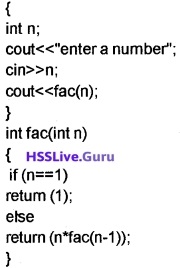
Plus Two Computer Application Chapter Wise Questions and Answers Chapter 3 Functions - 38
The working of this program is as follows. If the value of n is 5 then it calls the function as fac(5). The function returns value 5*fac(4). That means this function calls the function again and returns 5*4*fac(3). This process continues until the value n=1. So the result is 5*4*3*2*1 = 120.

Plus Two Computer Application Chapter Wise Questions and Answers Chapter 3 Functions

Question 8.
Read the following program
# include<iostream>
using namespace std;
int a = 0;
int main ()
Plus Two Computer Application Chapter Wise Questions and Answers Chapter 3 Functions - 39
Write down the value displayed by the output of the above program with suitable explanation. What are the inferences drawn regarding the scope of variables?
Answer:
The output is 061.
1. Global variable: A variable declared out side of all functions it is known as global variable.

2. Local variable: A variable declared inside of a function it is known as local variable.

If a variable declared inside a function(main or other) with the same name of a global variable. The function uses the value of local variable and does not use the value of the global variable.

Here int a=0 is a global variable. In the main function the global variable ‘a’ is used. There is no local vari-able so the value of ‘a’, 0 is displayed. The statement ‘a++’ makes the value of ‘a’ is 1. It calls the function showval with argument ‘a=1’.

The argument ‘x’ will get this value i.e. ‘x=T. But in the function showval there is a local variable ‘a’ its value is 5 is used. So this function returns 6 and it will be displayed. After this the value 1 of the global variable ‘a’ will be displayed. Hence the result 061.

Plus Two Computer Application Chapter Wise Questions and Answers Chapter 3 Functions

Question 9.
The following are function calling statements. Some of them will be executed, while some other generate compilation error. Write down your opinion on each of them with proper justification
Answer:

  1. char ch=getch();
  2. sqrt(25);
  3. strcat (“Computer”, “Program”);
  4. double num = pow(2, 3, 5)
  5. put char(getchar());

Answer:

  1. getch get a character from the console(key board) but does not echo to the screen. So we can’t read a character from the console.
  2. It returns the square root of 25.
  3. It concatenates Program to computer, i.e. we will get a string “computer program”
  4. The function pow should contains only two arguments. But here it contains 3 arguments so it is an error. We can write this function as follows Double num = pow(pow(2, 3, 5)
  5. It reads a character from the console and display it on the screen.

Question 10.
Short notes about character functions and string functions
Answer:
a. Character functions:
1. isalnum(): It is used to check whether a character is alphabet or digit. It returns a non zero value if it is an alphabet or digit otherwise it returns zero.

2. isalpha(): It is used to check whether a character is alphabet or not. It returns a non zero value if it is an alphabet otherwise it returns zero.

3. isdigit(): It is used to check whether a character is digit or not. It returns a non zero value if it is digit otherwise it returns zero.

4. islower(): It is used to check whether a character is lower case alphabet or not. It returns a non zero value if it is a lower case alphabet otherwise it returns zero.

5. isupper(): It is used to check whether a character is upper case alphabet or not. It returns a non zero value if it is an upper case alphabet otherwise it returns zero.

6. tolower(): It is used to convert the alphabet into lowercase.

7. toupper(): It is used to convert the alphabet into upper case.

b. String functions:
1. strcpy(): This function is used to copy one string into another.

2. strcat(): This function is used to concatenate(join) second string into first string.

3. strlen(): This function is used to find the length of a string.

4. strcmp(): This function is used to compare 2 strings. If the first string is less than second string then it returns a negative value. If the first string is equal to the second string then it returns a value zero and if the first string is greater than the second string then it returns a positive value.

Plus Two Computer Application Chapter Wise Questions and Answers Chapter 3 Functions

Question 11.
Write a program to perform the following operations on a string

  1. Length of a string
  2. Search a character
  3. Display the string

Answer:
# include<iostream>
# include<cstdio>
using namespace std;
void len()
Plus Two Computer Application Chapter Wise Questions and Answers Chapter 3 Functions - 40
Plus Two Computer Application Chapter Wise Questions and Answers Chapter 3 Functions - 41
Plus Two Computer Application Chapter Wise Questions and Answers Chapter 3 Functions - 42
Plus Two Computer Application Chapter Wise Questions and Answers Chapter 3 Functions - 43

Plus Two Computer Application Chapter Wise Questions and Answers Chapter 3 Functions

Question 12.
Write functions to perform the following operations.

  1. sqrt()
  2. power of 2 numbers
  3. sin
  4. cos

Answer:
# include<iostream>
# include<cmath>
using namespace std;
void sqroot()
Plus Two Computer Application Chapter Wise Questions and Answers Chapter 3 Functions - 44
Plus Two Computer Application Chapter Wise Questions and Answers Chapter 3 Functions - 45
Plus Two Computer Application Chapter Wise Questions and Answers Chapter 3 Functions - 46

Plus Two Computer Application Chapter Wise Questions and Answers Chapter 3 Functions

Question 13.
Read the following C++ programs and answer the questions:
Case I
# include<iostream>
using namespace std;
Plus Two Computer Application Chapter Wise Questions and Answers Chapter 3 Functions - 47

Case II
# include<iostream>
using namespace std;
Plus Two Computer Application Chapter Wise Questions and Answers Chapter 3 Functions - 48

  1. Identify the type of function call in each case.
  2. How do they differ?

Answer:

  1. In case I the method used is Call by value and in Case II is Call by reference.
  2. There are two methods they are call by value and call by reference

a. call by value:
In call by value method, a copy of the actual parameters are passed to the formal parameters. If the function makes any change it will not affect the original value.

b. call by reference:
In call by reference method, the reference of the actual parameters are passed to the formal parameters. If the function makes any change it will affect the original value.