Plus Two Maths Chapter Wise Previous Questions Chapter 11 Three Dimensional Geometry

Kerala State Board New Syllabus Plus Two Maths Chapter Wise Previous Questions and Answers Chapter 11 Three Dimensional Geometry.

Kerala Plus Two Maths Chapter Wise Previous Questions Chapter 11 Three Dimensional Geometry

Plus Two Maths Three Dimensional Geometry 3 Marks Important Questions

Question 1.
(i)Find the equation of the Plane with intercepts 2, 3, 4 on X, Y, Z axes respectively.)
(ii) Find the distance of the point (- 1, – 2,3) from the Plane \(\bar{r}\)(2i – 3 j + 4k) = 4 (March – 2011)
Answer:
(i) The equation of the plane is \(\frac{x}{2}+\frac{y}{3}+\frac{z}{4}=1\)
(ii) The equation of the plane is 2x – 3y + 4z = 4
Hence the distance \(=\frac{2(-1)-3(-2)+4(3)-4}{\sqrt{4+9+16}}\)
\(=\frac{-2+6+12-4}{\sqrt{4+9+16}}=\frac{12}{\sqrt{29}}\)

Question 2.
Consider the points A(2,2, – 1), B(3,4,2), C(7,0,6)
(i) FindAB.
(ii) Find the Cartesian and vector equation the plane passing through these points. (March – 2011)
Answer:
(i) \(A B=\sqrt{1+4+9}=\sqrt{14}\)
(ii) Cartesian Equation of the plane is
Plus Two Maths Chapter Wise Previous Questions Chapter 11 Three Dimensional Geometry 1
Vector equation is \(\bar{r}\)(5i + 2j – 3k) = 17

Question 3.
Consider the points A(3, – 4, – 5) and 5(2, – 3,1)
(i) Find the vector and Cartesian equation of the Line passing through the points A and B.
(ii) Find the point where the line crosses the XY Plane. (March – 2012)
Answer:
Let \(\bar{a}\) = 3i – 4j – 5k, b = 2i – 3j + k
(i) Vector Equation is \(\bar{r}\) = \(\bar{a}\) + λ(\(\bar{b}\) – \(\bar{a}\)) \(\bar{r}\) = 3i – 4j – 5k + λ( – i + j + 6k)
Cartesian Equation is \(\frac{x-3}{-1}=\frac{y+4}{1}=\frac{z+5}{6}\)

(ii) Let the point be (x, y, 0)
\(\begin{array}{l}
\Rightarrow \frac{x-3}{-1}=\frac{y+4}{1}=\frac{5}{6} \\
\Rightarrow x=\frac{13}{6}, y=\frac{-19}{6}
\end{array}\)
Then the point on the XY Plane is \(\left(\frac{13}{6}, \frac{-19}{6}, 0\right)\)

Question 4.
(i) Find the Cartesian equation of the plane passing through the point (1, 2, -3) perpendicular to the vector 2i – j + 2k.
(ii) Find the angle between the above \(\frac{x-1}{2}=\frac{y-3}{3}=\frac{z}{6}\) (March – 2012)
Answer:
(i) The equation of the Plane is
2(x – 1) – 1(y, -2) + 2(z+3) = 0
⇒ 2x – 2 – y + 2 + 2z + 6 = 0
⇒ 2x – y + 2z + 6 – 0

(ii) Angle between the line and the Plane is
Plus Two Maths Chapter Wise Previous Questions Chapter 11 Three Dimensional Geometry 2

Question 5.
(i) Find the angle between the lines having direction ratios 1, 1, 2 and \(\sqrt{3}-1,-\sqrt{3}-1,4\)
(ii) If the lines \(\frac{x-1}{3}=\frac{y-1}{2 \lambda}=\frac{z-3}{2}\) and \(\frac{x-1}{3 \lambda}=\frac{y-1}{1}=\frac{z-6}{-5}\) are perpendicular, find the value of λ. (May – 2012)
Answer:
Plus Two Maths Chapter Wise Previous Questions Chapter 11 Three Dimensional Geometry 3
(ii) Since they are perpendicular
a1a2 + b1b2 + c1c2 = 0
⇒ 3 x 3λ + 2λ x 1 + 2x – 5 = 0
⇒ 9λ + 2λ – 10 = 0
⇒ 11λ + 10 ⇒ 2 = \(\frac{-10}{11}\)

Question 6.
(i) Find the equation of the Plane passing through the points (3, -1, 2), (5, 2, 4), ( -1, -1, 6)
(ii) Find the perpendicular distance from the point (6, 5, 9) to this plane. (March – 2013)
Answer:
(i) Cartesian Equation of the plane is
Plus Two Maths Chapter Wise Previous Questions Chapter 11 Three Dimensional Geometry 4
(ii) Perpendicular distance
Plus Two Maths Chapter Wise Previous Questions Chapter 11 Three Dimensional Geometry 5

Question 7.
Consider the vector equation of the planes r.(2i + j+k) – 3 and r.(i – j – k) = 4
(i) Find the vector equation of any of the plane at the intersection of the above two planes.
(ii) Find the vector equation of the planes through the intersection of the above two planes and the point (1, 2, -1). (May – 2013)
Answer:
(i) 2x + y + z – 3 + λ(x – y – z – 4) = 0
⇒ (2 + λ)x + (1 – λ)y + (1 – λ)z – 3 – 4λ = 0
Vector equation is
\(\bar{r}\).(2 + λ)i + (1 – λ)y + (1 – λ)k – (3 + 4)λ = 0

(ii) Since passing through (1,2, – 1) we have;
⇒ (2 + λ)1 + (1 – λ)2 + (1 – λ)( -1) – 3 – 4λ = 0
⇒ 2 + λ + 2 – 2λ – 1 + 1 – 3 – 4λ = 0
⇒ 0 – 4λ – 0
⇒ λ = 0

\(\bar{r}\).(2i + j + k) = 3 is required plane. Since the point (1, 2, -1) is a point on the first plane.

Question 8.
Consider the planes2x + y – 2z = 5 and 3x – 6y – 2z = 7
(a) Find their normal vectors.
(b) Find the angle between these two planes. (May – 2014)
Answer:
(a) Normal vectors are 2i + i – 2k; 3i – 6j – 2k
(b) Angle =
Plus Two Maths Chapter Wise Previous Questions Chapter 11 Three Dimensional Geometry 6

Question 9.
(a) If a1, b1, c1 and a2, b2, c2 are the direction ratios of two lines, then write the condition of its perpendicularity.
(b) Find the angle between the lines \(\frac{x+3}{3}=\frac{y-1}{5}=\frac{z+3}{4}\) and \(\frac{x+1}{1}=\frac{y-4}{1}=\frac{z-5}{2}\)
Answer:
(a) a1a2 + b1b2 + c1c2 = 0
Plus Two Maths Chapter Wise Previous Questions Chapter 11 Three Dimensional Geometry 7

Question 10.
Find the shortest distance between the lines \(\bar{r}\) = i + j + λ(2i – j + k) and \(\bar{r}\) = 2i + j – k + µ(3i – 5 j + 2k) (March – 2016)
Answer:
From the given lines we have;
Plus Two Maths Chapter Wise Previous Questions Chapter 11 Three Dimensional Geometry 8

Question 11.
(i) The equation of the line which passes through the point(1,2,3) and parallels to the vector 3i + 2j – 2k is
(a) \(\bar{r}\) = 3i + 2j – 2k + λ(/ + 2j + 3k)
(b) \(\bar{r}\) = 2i – 5k + λ(3/ + 2j – 2k)
(c) \(\bar{r}\) = i + 2j + 3k + λ(-2i + 4j – 2k)
(d) \(\bar{r}\) = i + 2j + 3k + λ(3i + 2j – 2k)
(ii) Find the angle between the pair lines
\(\bar{r}\) = 2i – 5j + k + λ(3i + 2j + 6k) and \(\bar{r}\) = li – 6k + µ(i + 2j + 2k) (May – 2016)
Answer:
(i) (d) \(\bar{r}\) = i + 2j + 3k + λ(3i + 2j – 2k)
(ii) \(\bar{a}\) = 3i + 2j + 6k; \(\bar{b}\) = i + 2j + 2k
\(\cos \theta=\frac{\bar{a} \cdot \bar{b}}{|\bar{a} \| \bar{b}|}=\frac{19}{7 \times 3}=\frac{19}{21}\)

Plus Two Maths Three Dimensional Geometry 4 Marks Important Questions

Question 1.
Consider the lines \(\frac{x-3}{2}=\frac{y-1}{5}=\frac{z+3}{4}\) and \(\frac{x+5}{1}=\frac{y+2}{1}=\frac{z-3}{2}\)
(i) Find the angle between them.
(ii) Find the shortest distance between them. (March – 2011)
Answer:
Plus Two Maths Chapter Wise Previous Questions Chapter 11 Three Dimensional Geometry 9

Question 2.
(i) Find the vector equation of the Plane Passing through the intersection of the Planes \(\bar{r}\).(i + j + k) = 6 and \(\bar{r}\)(2i + 3j + 4k) = – 5 and through the point (1, 1, 1).
(ii) Express the vector equation \(\bar{r}\).(5i + 3j + 4k) = 0 of a Plane in Cartesian form and hence find its perpendicular distance from the origin. (May – 2011)
Answer:
(i) The Cartesian equation of the given planes are x + y + z – 6 = 0 and 2x + 3 – y + 4z + 5 = 0
The family of such planes is x + y + z – 6 + λ(2x + 3y+ 4z + 5) = 0  …..(1)
Since it passes through (1, 1, 1)
Plus Two Maths Chapter Wise Previous Questions Chapter 11 Three Dimensional Geometry 10
Vector Equation is \(\bar{r}\).(20i + 23j + 26k) = 69

(ii) Cartesian Equation is ⇒ 5x + 3y + 4z = 0 Perpendicular distance from origin is
\(=\left|\frac{5 \times 0+3 \times 0+4 \times 0}{\sqrt{25+9+16}}\right|=0\)

Question 3.
Given the Plane 5x – 2y + 4z – 9 = 0
(i) Find the foot of the perpendicular drawn from the origin to the Plane.
(ii) Write the vector and Cartesian equation of this perpendicular. (May – 2011)
Answer:
(i) The equation of the perpendicular line to the given plane 5x – 2y + 4z – 9 = 0 and passing through the origin is
\(\begin{array}{l}
\frac{x-0}{5}=\frac{y-0}{-2}=\frac{z-0}{4}=\lambda \\
\Rightarrow \frac{x}{5}=\frac{y}{-2}=\frac{z}{4}=\lambda
\end{array}\)
Hence any point on this line is (5λ, – 2λ, 4λ). Let this point be on the given plane then
⇒ 5(5λ) – 2( – 2λ) + 4(4λ) – 9 = 0
⇒ λ = 1/5
Then the foot of the perpendicular is
\(\left(5 \times \frac{1}{5},-2 \times \frac{1}{5}, 4 \times \frac{1}{5}\right) \Rightarrow\left(1,-\frac{2}{5}, \frac{4}{5}\right)\)
Since the line is perpendicular to the Plane and passes through the point \(\left(1,-\frac{2}{5}, \frac{4}{5}\right)\)
The Cartesian equation is \(\frac{x}{5}=\frac{y}{-2}=\frac{z}{4}\)
The Vector equation is \(\bar{r}\) = \(\bar{0}\) + λ(5i – 2j + 4k)

Question 4.
(i) The foot of the perpendicular from the origin to a Plane is P(4, – 2,5). Write \(\overline{O P}\)
(ii) Find the equation of the Plane in vector and Cartesian form. (May – 2012)
Answer:
(i) \(\overline{O P}\) = 4i – 2j + 5k
(ii) Then is perpendicular unit vector to the required plane is \(\frac{\overline{O P}}{\overline{O P} \mid}=\frac{4 i-2 j+5 k}{\sqrt{16+4+25}}=\frac{4 i-2 j+5 k}{\sqrt{45}}\)

The perpendicular distance from the origin is \(\sqrt{16+4+25}=\sqrt{45}\)
Vector equation of the Plane can be written as
\(\begin{array}{l}
\vec{r} \cdot \bar{m}=d \Rightarrow \bar{r} \cdot \frac{4 i-2 j+5 k}{\sqrt{45}}=\sqrt{45} \\
\Rightarrow \bar{r} .4 i-2 j+5 k=45
\end{array}\)
Cartesian from is 4x – 2y + 5z = 45

Question 5.
Consider the lines \(\frac{x-3}{3}=\frac{y-8}{-1}=\frac{z-3}{1}\) and \(\frac{x+3}{3}=\frac{y+7}{2}=\frac{z-6}{4}\)
(i) Express the equation to the lines into vector form.
(ii) Find the shortest distance between the lines. (March – 2013)
Answer:
(i) The vector equation;
Plus Two Maths Chapter Wise Previous Questions Chapter 11 Three Dimensional Geometry 11

Question 6.
Consider the Cartesian equation of a line
\(\frac{x-3}{2}=\frac{y+1}{3}=\frac{z-5}{-2}\)
(i) Find its vector equation.
(ii) Find the intersecting point with the plane 5x + 2y – 6z – 7 = 0 (May – 2013)
Answer:
(i) Vector equation of the line is
\(\bar{r}\) = (3i – 1j + 5k) + λ(2i + 3j – 2k)

(ii) Any point on the line is of the form
Plus Two Maths Chapter Wise Previous Questions Chapter 11 Three Dimensional Geometry 12

Question 7.
The foot of the perpendicular drawn from origin to a Plane is (4, -2, 5).
(i) How far is the plane from the origin?
(ii) Find a unit vector perpendicular to that Plane.
(iii) Obtain the equation of the Plane in a general form. (March – 2014)
Answer:
(i) \(\overline{O P}\) = 4i – 2j + 5k
(ii) Then is perpendicular unit vector to the required plane is \(\frac{\overline{O P}}{\overline{O P} \mid}=\frac{4 i-2 j+5 k}{\sqrt{16+4+25}}=\frac{4 i-2 j+5 k}{\sqrt{45}}\)

The perpendicular distance from the origin is \(\sqrt{16+4+25}=\sqrt{45}\)
Vector equation of the Plane can be written as
\(\begin{array}{l}
\vec{r} \cdot \bar{m}=d \Rightarrow \bar{r} \cdot \frac{4 i-2 j+5 k}{\sqrt{45}}=\sqrt{45} \\
\Rightarrow \bar{r} .4 i-2 j+5 k=45
\end{array}\)
Cartesian from is 4x – 2y + 5z = 45

Question 8.
(a) Equation of the plane with intercepts 2, 3, 4 on the x, y, z-axis respectively is
(i) 2x + 3y + 4z = 1
(ii) 2x + 3y + 4z = 12
(iii) 6x + 4y + 3z = 1
(iv) 6x + 4y + 3z = 12

(b) Find the Cartesian equation of the plane passing through the points A(2, 5, -3), B(-2, -3, 5), and C(5, 3, -3). (March – 2016)
Answer:
(a) (iv) 6x + 4y + 3z = 12
(b) Equation of the plane is
Plus Two Maths Chapter Wise Previous Questions Chapter 11 Three Dimensional Geometry 13

Question 9.
(i) The distance of the plane from the point(1, 1, 1)is
(a) 4 units
(b) \(\frac{1}{\sqrt{3}}\) units
(c) \(\frac{4}{\sqrt{3}}\) units
(d) \(\frac{1}{4 \sqrt{3}}\) units

(ii) Find the equation of the plane passing through (1, 0. -2) and perpendicular to each of the planes 2x + y – z = 2 and x – y – z = 3 (May – 2016)
Answer:
(i) (c) \(\frac{4}{\sqrt{3}}\) units
(ii) Equation of the plane passing through (1, 0, -2) is a(x – 1) + b(y – 0) + c(z + 2) = 0……………..(1)
Plane (1) is perpendicular to the given planes
2a + b – c = 0 ……………..(2)
a – b – c = 0 ……………..(3)
Solving (2) and (3) we get;
Plus Two Maths Chapter Wise Previous Questions Chapter 11 Three Dimensional Geometry 14

Question 10.
(i) The linesx – l = y = z is perpendicular to the line
\(\begin{array}{l}
\text { (a) } \frac{x-2}{1}=\frac{y-1}{2}=\frac{z}{-3} \\
\text { (b) } x-2=y-2=z \\
\text { (c) } \frac{x-2}{1}=\frac{y-1}{2}=\frac{z}{3} \\
\text { (d) } x=y=\frac{z}{2}
\end{array}\)

(ii) Find the shortest distance between the lines \(\bar{r}\) = i + 2j + 3k + λ(i + j + k) and \(\bar{r}\) – i + j + k + µ(i + j + k) (March – 2017)
Answer:
Plus Two Maths Chapter Wise Previous Questions Chapter 11 Three Dimensional Geometry 15

Plus Two Maths Three Dimensional Geometry 6 Marks Important Questions

Question 1.
(i) Find the shortest distance between the line \(\frac{x+1}{7}=\frac{y+1}{-6}=\frac{z+1}{1}\) and \(\frac{x-3}{1}=\frac{y-5}{-2}=\frac{z-7}{1}\)
(ii) Find the equation of the Plane passing through one point(-1, 3, 2) and ± r to the planes x + 2y + 3z = 5 and 3x + 3y + z = 0 (March – 2010)
Answer:
Plus Two Maths Chapter Wise Previous Questions Chapter 11 Three Dimensional Geometry 16
(ii) Let the equation of the plane be ax + by + cz + d = 0….(1)
Since (1) is perpendicular to 3x + 2y + 3z = 5, a + 2b + 3c = 0
Since (1) is perpendicular to 3x + 3y + z = 0
3a + 3b + c = 0
Using (2) and (3) we have;
\(\frac{a}{2-9}=\frac{-b}{1-9}=\frac{c}{3-6} \Rightarrow \frac{a}{-7}=\frac{b}{8}=\frac{c}{-3}\)
(1) = -7x + 8y – 3z + d = 0
Since (1) passes through (-1, 3, 2) we have;
⇒ -7 (-1) + 8(3) – 3(2) + d = 0
⇒ 7 + 24 – 6 + d = 0 = d = -25
Therefore the equation of the plane is
(1) ⇒ -7x + 8y – 3z – 25 = 0

Question 2.
(i) (a) A line makes equal angles with the coordinate axis. Find the direction cosines.
(b) Find the equation of the Plane Passing through (1, 1, -1),(2, 3, 5) an (1, 4, -5)
(ii) Find p and q, if the plane x + py + qz = 0 is perpendicular to the plane 3x + 2y + z = 0 and the line \(\frac{x-3}{2}=\frac{y-2}{3}=\frac{z-1}{1}\) (March – 2010)
Answer:
Plus Two Maths Chapter Wise Previous Questions Chapter 11 Three Dimensional Geometry 17
(ii) Since the Plane x + py + qz = 0 is perpendicular to the Line \(\frac{x-3}{2}=\frac{y-2}{3}=\frac{z-1}{1}\) we have their direction ratios proportional. Plane dr’s is 1, p, q and dr’s of Line is 2, 3, 1.
\(\Rightarrow \frac{1}{2}=\frac{p}{3}=\frac{q}{1} \Rightarrow p=\frac{3}{2}, q=\frac{1}{2}\)

Question 3.
Given the straight lines
\(\bar{r}[latex] = 3i + 2j – 4k + 2(i + 2j + 2k) and [latex]\bar{r}[latex] = 5i – 2k + µ(3i + 2j + 6k)
(i) Find the angle between the lines.
(ii) Obtain the unit vector perpendicular to both the lines.
(iii) From the equation of the line perpendicular to the given lines and passing through the point (1, 1, 1). (March – 2014)
Answer:
Plus Two Maths Chapter Wise Previous Questions Chapter 11 Three Dimensional Geometry 18
Plus Two Maths Chapter Wise Previous Questions Chapter 11 Three Dimensional Geometry 19

Question 4.
(a) Write the Cartesian equation of the straight line through the points (1, 2, 3) and along the vector 3i + j +2k
(b) Write a general point on this straight line.
(c) Find the point of intersection of this straight line with the plane 2x + 3y – z + 2 = 0
(d) Find the distance from (1, 2, 3) to the plane 2x + 3y – z + 2 = 0 (March – 2015)
Answer:
(a) Cartesian equation is [latex]\frac{x-x_{1}}{a}=\frac{y-y_{1}}{b}=\frac{z-z_{1}}{c}\), \(\frac{x-1}{3}=\frac{y-2}{1}=\frac{z-3}{2}\)

(b) Let \(\frac{x-1}{3}=\frac{y-2}{1}=\frac{z-3}{2}=\lambda\)
x = 3λ + 1, y = λ + 2, z = 2λ + 3 are the general point of the line.

(c) Equation of the plane is 2x + 3y – z + 20….(1)
putting the values of x, y, z in (1) is
2(3λ + 1) – 3(λ + 2) – (2λ + 3) + 2 = 0
7λ + 7 = 0 ⇒ λ = -1
∴ Point of intersection is x = -3 + 1 = -2; y= -1 + 2 = 1, z= -2 + 3 = 1
ie; (-2, 1, 1)

(d) Distance = \(\frac{2(1)+3(2)-3+2}{\sqrt{4+9+1}}=\frac{7}{\sqrt{14}}\)

Question 5.
Consider a plane passing through the point (5, 2, -4) and perpendicular to the line
\(\bar{r}\) = (i + j) + λ(2i + 3j – k)
(a) Write the equation in cartesian form.
(b) Find its distance from the point (1, 2, -1).
(c) Find the angle made by it with line \(\frac{x-1}{2}=\frac{y-2}{1}=\frac{z-3}{-2}\) (May – 2015)
Answer:
(a) The equation of a plane passing through the point (5, 2, 4) and perpendicular direction ratios 2, 3, -1 is
Plus Two Maths Chapter Wise Previous Questions Chapter 11 Three Dimensional Geometry 20

Plus Two Computer Science Previous Year Question Paper Say 2018

Kerala State Board New Syllabus Plus Two Computer Science Previous Year Question Papers and Answers.

Kerala Plus Two Computer Science Previous Year Question Paper Say 2018 with Answers

Board SCERT
Class Plus Two
Subject Computer Science
Category Plus Two Previous Year Question Papers

Time: 2 Hours
Cool off time: 15 Minutes

General Instructions to candidates

  • There is a ‘cool off-time’ of 15 minutes in addition to the writing time of 2 hrs.
  • You are not allowed to write your answers nor to discuss anything with others during the ‘cool off time’.
  • Use the ‘cool off time’ to get familiar with the questions and to plan your answers.
  • Read questions carefully before you answering.
  • All questions are compulsory and the only internal choice is allowed.
  • When you select a question, all the sub-questions must be answered from the same question itself.
  • Calculations, figures, and graphs should be shown in the answer sheet itself.
  • Malayalam version of the questions is also provided.
  • Give equations wherever necessary.
  • Electronic devices except non-programmable calculators are not allowed in the Examination Hall.

Part – A

Answer all questions from 1 to 5. Each carries 1 score. (5 × 1 = 5)

Question 1.
The ability of data to be processed in more than one form is called ________
Answer:
polymorphism

Question 2.
Each node in a linked list has a ________ to the next node.
Answer:
pointer

Question 3.
NORESIZE is an attribute of ________ tag.
Answer:
<frame>

Question 4.
In client-side scripting, processing is done by ________
Answer:
browser

Question 5.
VPS stands for ________
Answer:
Virtual Private Server

Answer any 9 questions from 6 to 16. Each carries 2 scores. (9 × 2 = 18)

Question 6.
What is the self-referential structure?
Answer:
Self Referential Structures: A structure contains an element that is a pointer to the same structure.
Eg:
struct date
{
int dd, mm, yyyy;
date *ptr;
};

Question 7.
What is the difference between the two declaration statements given below:
(a) int*ptr= new int(10);
(b) int*ptr = new int[10];
Answer:
(a) Dynamic initialization with value 10.
(b) Dynamic array of size 10.

Question 8.
Differentiate static and dynamic data structures. Give an example for each.
Answer:
The main memory can be allocated in two methods.
i) Static memory allocation
ii) Dynamic memory allocation
When the amount of memory to be allocated is known in advance and memory is allocated during compilation itself, it is referred to as static memory allocation.
int x=10;

When the amount of memory to be allocated is not known in advance and it is required to allocate memory as and when required during run time, it is known as dynamic memory allocation.
‘new’ operator is used for dynamic allocation of memory syntax.
datatype *pointer variable = new datatype;
eg: int *ptr=new int;

Question 9.
Categorize the following tags in HTM L appropriately.
<br>, <hl>, <img>, <table>
Answer:

Empty tag container tag
<br> <h1>
<img> <table>

Question 10.
Explain any two data types in JavaScript.
Answer:
Data types in JavaScript
Unlike C++ it uses only three basic data types
1. Number: Any number (whole or fractional) with or without a sign.
Eg: +1977, -38.0003, -100, 3.14157, etc.
2. String: It is a combination of characters enclosed within double-quotes.
Eg: “BVM”, “jobi_cg@rediffmail.com”, etc.
3. Boolean: We can store either true or false. It is case sensitive. That means can’t use TRUE OR FALSE.

Question 11.
Write the JavaScript code to display “Welcome to Kerala” inside the <hl>, tag as shown in the HTML page.
<HTML>
<Body>
<Script lang= “javascript”>
<hl> …………. </hl>
</Body>
</Script>
</HTML>
Answer:
document.write(“Welcome to Kerala”);

Question 12.
Explain any two components of DBMS.
Answer:
Components of DBMS

  • Databases – It is the main component.
  • Data Definition Language (DDL) – It is used to define the structure of a table.
  • Data Manipulation Language (DML) – It is used to add, retrieve, modify and delete records in a database.
  • Users – With the help of programs users interact with the DBMS.

Question 13.
Consider the following table:

S.No. Name Age Total
1. Albert 50 90
2. Einstein 60 95
3. Kalam 70 94
4. Raman 90 98
5. Babbage 95 99

(a) Identify the degree and cardinality of the given table.
(b) Identify a suitable primary key for the given table.
Answer:
(a) Degree 4
Cardinality 5
(b) SI. No is the primary key

Question 14.
Write the output of the following PHP code fragment.
function justA fun ($num)
{
$num = $num * 5 + ($num + 6);
return $num;
}
echo justA fun(100);
Answer:
5*100 + (100 + 6)
= 500 + 106
= 106
Hence the output is 606

Question 15.
Compare serial and parallel computing.
Answer:

Serial computing Parallel computing
A single processor is used Multiple processors are used with shared memory
A problem is divided into a series of instructions A problem is divided into smaller ones that can be solved simultaneously
Instructions executed sequentially Instructions executed simultaneously
One instruction is executed on a single processor at any moment More than one instruction is executed on multiple processors at any moment in time.

Question 16.
How does ICT help students in learning?
Answer:
Advantages of E-Learning:

  • It can offer various courses to a large number of students from distant locations.
  • It saves journey time and money, instructor fees, etc.
  • People can enjoy e-Learning at a lower cost.
  • It enables people to do courses conducted by national or international institutions.

Answer any 9 questions from 17 to 27. Each carries 3 scores. (9 × 3 = 27)

Question 17.
What is a Pointer in C++? Declare a pointer and initialize with the name of your country.
Answer:
Pointer is a variable which points to memory location of some other variable
Syntax:
data_type ‘variable;
#include<iostream>
using namespace std;
intmain()
{
char*ptr=newchar[10]; .
ptr=”India”;
cout<<ptr;
delete ptr;
}

Question 18.
What is Procedural Oriented Programming? What are the disadvantages of Procedural Oriented Programming?
Answer:
A program in procedural language consists of a list of instructions.
Following are the disadvantages of procedural language:
a) Data is undervalued: Here the importance is on doing things rather than the data. The data has the least importance. That is, data is exposed to all and there is a chance to access or destroy this data accidentally or intentionally by many functions on a program.

b) Adding new data requires modifications to all/many functions: A program may contain many functions and these functions may access different data used in different locations. If we add new data items, we will need to modify all the functions that access the data. This is a laborious task.

c) Creating new data types is difficult: In procedural languages, some built-in data types such as int, float, double, and character are available. Extensibility is the ability to create new data types without major rewriting of codes in its basic architecture. Some programming languages are extensible but procedural languages are not extensible.

d) Provides poor real-world modeling: Procedural programming paradigm treats data and functions are different not a single unit. In this Real-life simulations are not possible.

Question 19.
Write an algorithm to add a new item into a queue.
Answer:
An algorithm is given below
Step 1: If front = 1 and rear=N or front=rear + 1
Then print “OVERFLOW” and return
Step 2: If front = Null then
Set front = 1 and rear =1
Else if rear = N then set rear = 1
Else
Set rear = rear +1
End if
Step 3: Set Queue[rear]=item
Step 4: stop

Question 20.
List and explain any three attributes of the INPUT tag in HTML.
Answer:
<Input> It is used to create input controls. Its type of attribute determines the control type.
The main values of type attributes are given below.

  1. Text-To creates a text box.
  2. Password – To create a password text box.
  3. Checkbox – To create a check box.
  4. Radio – To create a radio button.
  5. Reset – To create a Reset button.
  6. Submit – To create a submit button.
  7. Button – To create a button

Question 21.
Consider a string “Gandhiji” Write JavaScript code fragment to do the following tasks:
(a) Convert the string to upper case.
(b) Find the length of the string.
(c) Display the 3rd letter in the string.
Answer:
(a) var x=”Gandhiji”;
alert(x.toUpperCase());

(b) var x=”Gandhiji”;
alert(“The number of characters is “+ x.length);

(c) var x=”Gandhiji”;
alert(x.charAt(2));

Question 22.
What is an FTP client software? Differentiate FTP and SFTP.
Answer:
FTP (File Transfer Protocol) client software:
When a client requests a website by entering the website address. Then FTP client software helps to establish a connection between the client computer and the remote server computer. Unauthorised access is denied by using username and password hence secure our website files for that SSH (Secure Shell) FTP simply SFTP is used. Instead of http.//, it uses ftp.//:

By using FTP client s/w we can transfer(upload)the files from our computer to the web server by using the ‘drag and drop’ method. The popular FTP client software are FileZilla, CuteFTP, SmartFTP, etc.

Question 23.
List and explain different database users in DBMS.
Answer:
Users of Database

  • Database Administrator – It is a person who has central control over the DBMS.
  • Application Programmer – These are computer professionals who interact with the DBMS through programs.
  • Naive users – He is an end-user. He does not know the details of DBMS.

Question 24.
Differentiate DELETE and DROP in SQL. Write the syntax of DELETE and DROP.
Answer:

Delete Drop
It is a DML command It is a DDL command
Used to delete rows in a TABLE Used to delete the whole TABLE
Here Table exists and we can insert rows But here Table does not exist, so not possible to insert rows

Syntax:
Delete from <Table Name> where condition;
DropTable <Table Name>;

Question 25.
Name the different types of arrays in PHP. Explain with an example.
Answer:
Arrays in PHP: In PHP array is a collection of key and value pairs. Unlike C++, in PHP we can use either nonnegative integers or strings as keys.
Different types of arrays in PHP
Indexed arrays
Associate arrays
Multidimensional arrays.

Indexed arrays: The elements in an array can be distinguished as first or second or third etc. by the indices and the index of the first element is zero. In PHP the function array() is used to creating an array.
Syntax: $array_name=array(value1, value2, …….);
OR
$array_variable[key]=value;
Eg:$mark=array(60, 70, 80);
$course=array(“Science”, “Commerce”, “Humanities”);

Associative arrays: Arrays with named keys and string indices are called associative arrays.
Syntax:
$varibale_name=array(key1=>value1, key2=>value2,etc);
Eg:
$course=array (“Computer Science”=>”05”, “Commerce”=>”39”, “Science”=>”01”);

Question 26.
Discuss any three information security laws for protecting information shared over cyberspace.
Answer:
Guidelines for using computers over the internet

  • Emails may contain Viruses so do not open any unwanted emails.
  • Download files from reputed sources (sites).
  • Avoid clicking on pop-up Advt.
  • Most of the Viruses spread due to the use of USB drives so use cautiously.
  • Use a firewall on your computer
  • Use anti-virus and update regularly
  • Use spam blocking software
  • Take backups in regular time intervals
  • Use strong passwords, i.e a mixture of characters (a-z & A-Z), numbers, and special characters.
  • Do not use bad or rude language in social media and emails.
  • Untick ‘Remember Me’ before login.

Question 27.
Briefly explain any three applications of computational intelligence.
Answer:
Computational Intelligence is the ability to make a computer to face and solve real-life problems just like an intelligent man do it. It includes Artificial Neural Networks (ANN), Evolutionary Computation (EC), Swarm Intelligence (SI), and Fuzzy Systems (FS).

A) Artificial Neural Networks (ANN): The brain is a complex, nonlinear and parallel computer with the ability to perform tasks such as recognise the pattern, perception, and motor control. ANN is the method of simulate biological neural systems to learn, memorise, and generalize like human beings. A human brain cortex consists of 10-500 billion neurons with 60 trillion synapses(a synapse is a structure that permits a neuron to pass electrical).

B) Evolutionary Computation (EC): It is the simulation of the natural evolution, i.e. survival of the fittest. In the surrounding, we can see that the stronger must win and others will lose. EC applied for data mining, fault diagnosis, classification, scheduling, etc.

C) Swarm Intelligence (SI): Swarm Intelligence is the study of behaviour of colonies or groups of social animals, birds, insects, ants, etc. How they communicate and create and manage their own colonies beautifully.

D) Fuzzy Systems: Human beings use common sense while facing a problem, just like human beings fuzzy systems can also use common sense and behave like a human being. Fuzzy systems is used to control gear transmission and raking systems, control lifts, home appliances, controlling traffic signals, etc.

Answer any 2 questions from 28 to 30. Each carries 5 scores. (2 × 5 = 10)

Question 28.
(a) Name and explain any two attributes of the FORM tag. (2)
(b) Check the given HTML code. Fill the missing code to generate an output as shown in the figure. (3)
<HTML>
<body>
<form name= ‘loginForm’>
username:
<input type = “text”>
password:
………………………………
<input type = “………… ” value = “Login”>
………………………………
</form>
</body>
</html>
Answer:
a) <Form> attributes
1. Action – Here we give the name of the program (including the path) stored in the Webserver.
2. Method – There are 2 types of methods get and post.
3. Target – Specifies the target window for displaying the result. Values are given below.
_blank – Opens in a new window
_self – Opens in the same frame
_parent – Opens in the parent frameset
_top – Opens in the main browser window
name – Opens in the window with the specified name.

b) <inputtype=”password”>
<inputtype=”submit”>
<inputtype=”reset”>

Question 29.
(a) What are scripts in web programming? (2)
(b) Differentiate Client-side Scripting and Server-side Scripting. (3)
Answer:
a) Scripts are small programs embedded in the HTML pages, to write scripts <SCRIPT> tag is used.
Two types of scripts
1. Client scripts: These are scripts executed by the browser(client) hence reduces network traffic and workload on the server.
2. Server scripts: These are scripts executed by the server and the results as a webpage returned to the client browser.

b)

Client-Side Scripting Server Side Scripting
Script is copied to the client browser Script is copied to the webserver
Executed by the client Executed by the server and result gets back to the browser window
Used for Client level validation Connect to the database in the server
It is possible to block by the user Cannot possible
Client-side scripts depend on the type and version of the browser It does not depend on the type and version of the browser

Question 30.
Write SQL queries based on the table PRODUCT given below:

PID Name Product Price
P1 Lukra Seafood 4000
P5 Exotic Liquids Mineral water 7000
K1 Tokyo Traders Soft drink 5000
R3 Chang Iron 8000
W5 Tokyo Traders Soft drink 3000
  1. Set PID as a primary key.
  2. Display the Name, Price of the product having the highest price.
  3. Change the Name of Supplier ‘Exotic Liquids’ to ‘Singapore Foods.’
  4. Delete all products of supplier ‘Tokyo Traders’.
  5. Display Pname and Supplier of all products in the ascending order of price.

Answer:
create table student(name varchar(20) primarykey, roll no int, marks int);

  1. Create table PRODUCT (PID varchar(2) primarykey, Name varchar(20), Product varchar(20), Price dec(8, 2));
  2. Select Name, Price from PRODUCT where Price=(Select max(Price) from PRODUCT);
  3. Update PRODUCT set Name=”Singapore Foods” where Name=”Exotic Liquids”;
  4. Delete from PRODUCT where-Name=”Tokyo Traders”;
  5. Select Name, Product from PRODUCT order by Price asc;

Plus Two Computer Science Previous Year Question Paper March 2019

Kerala State Board New Syllabus Plus Two Computer Science Previous Year Question Papers and Answers.

Kerala Plus Two Computer Science Previous Year Question Paper March 2019 with Answers

Board SCERT
Class Plus Two
Subject Computer Science
Category Plus Two Previous Year Question Papers

Time: 2 Hours
Cool off time : 15 Minutes

General Instructions to candidates

  • There is a ‘cool off time’ of 15 minutes in addition to the writing time of 2 hrs.
  • You are not allowed to write your answers nor to discuss anything with others during the ‘cool off time’.
  • Use the ‘cool off time’ to get familiar with the questions and to plan your answers.
  • Read questions carefully before you answering.
  • All questions are compulsory and the only internal choice is allowed.
  • When you select a question, all the sub-questions must be answered from the same question itself.
  • Calculations, figures, and graphs should be shown in the answer sheet itself.
  • Malayalam version of the questions is also provided.
  • Give equations wherever necessary.
  • Electronic devices except non-programmable calculators are not allowed in the Examination Hall.

Part – A

Answer all questions from 1 to 5. Each carries 1 score. (5 × 1 = 5)

Question 1.
The wrapping up of data end functions into a single unit is called ______
Answer:
Data Encapsulation

Question 2.
In a linked list, the linked part of the last node contains ________ data.
Answer:
Null Pointer

Question 3.
Give the full form of VPS.
Answer:
Virtual Private Server

Question 4.
The number of rows in a relation is called ________
Answer:
Cardinality

Question 5.
In PHP, arrays that use string keys are called ________
Answer:
Associative array

Answer any 9 questions from 6 to 16. Each carries 2 scores. (9 × 2 = 18)

Question 6.
Define a structure named ‘Time’ with elements hour, minute, and second.
Answer:
struct time
{
int h, m, s;
};

Question 7.
Read the following C++code:
int a[5] = {10, 15, 20, 25, 30};
int *p = a;
Write the output of the following statements:
(a) cout < < * (p + 2); .
(b) cout << * p + 3;
Answer:
(a) 20(Third element)
(b) *p is 10(First element)
So *p+3 = 10 + 3 = 13.

Question 8.
List the different operations performed on data structures.
Answer:
The operations are Traversing, Searching, Inserting(Push), Deleting(Pop), Sorting and Merging

Question 9.
Write HTML tag for the following:

  1. Hyperlink to the website http://WWW.dhsekerala.gov.in
  2. emaillinktodhseexam@gmail.com

Answer:

  1. <a href=”http://www.dhsekerala.gov.in”>
  2. <a href=mailto:”dhseexam@gmail.com”>

Question 10.
Describe the use of ‘action’ and ‘method’ attributes of <FQRM> tag.
Answer:
<Form> attributes

  1. Action – Here we give the name of the program (including the path) stored in the Webserver.
  2. Method – There are 2 types of methods get and post.
Get method Post method
1. Faster 1. Slower
2. To send the small volume of data 2. To send a large volume of data
3. Less secure 3. More secure
4. Data visible during submission 4. Data not visible during submission

Question 11.
Explain the two purposes of the ‘+’ operator used in JavaScript.
Answer:
‘+’ if the operands are numbers then it adds and if one of the operands is a string then it concatenates the string.
eg. 5+3=8
“BVM”+8172=”BVM8172”

Question 12.
The Javascript function given below is used to display the sum of digits of a given number. Fill in the blanks to complete the function.
<Script language = “JavaScript”>
………. sum digit( )
{var n, s;
n = document.frm.txt1. …………;
for (s = 0; ……….; n = n/10)
s = s + ………..;
document.frm.txt2.value = s;
}
</script>
Answer:
function sum digit()
n=document.frm.txt1.value;
for(s=0; n>0: n=n/10)
s=s+n%10;

Question 13.
Explain any two constraints used in SQL.
Answer:
Constraints are used to ensure database integrity.

  1. Not Null – It ensures that a column can never have NULL values.
  2. Unique – It ensures that no two rows have the same value in a column.
  3. Primary key – Similar to unique but it can be used only once in a table.
  4. Default – We can set a default value.
  5. Auto_increment – This constraint is used to perform auto_increment the values in a column. That automatically generates serial numbers. Only one auto_increment column per table is allowed.

Question 14.
List the core data types in PHP.
Answer:
Data types are Integer, Float/Double, Boolean, and String.

Question 15.
What is meant by GIS? Give an example.
Answer:
Geographic Information System (GIS) technology is developed from the digital cartography and Computer-Aided Design (CAD) database management system. GIS as the name implies capturing, storing for future reference, checking, and displaying data related to various positions on the earth’s surface. GIS can be applied in many areas such as soil mapping, agricultural mapping, forest mapping, e-Governance, etc.

Question 16.
Define Infringement.
Answer:
Infringement (Violation): Unauthorized copying or use of Intellectual property rights such as Patents, Copyrights, and Trademarks are called intellectual property Infringement (violation). It is a punishable offense.

  • Patent Infringement
  • Trademark Infringement
  • Copy right Infringement.

Answer any 9 questions from 17 to 27. Each carries 3 scores. (9 × 3 = 27)

Question 17.
What are the different memory allocations used in C++? Explain.
Answer:
The main memory can be allocated in two methods.

  1. Static memory allocation
  2. Dynamic memory allocation

When the amount of memory to be allocated is known in advance and memory is allocated during compilation itself, it is referred to as static memory allocation.

When the amount of memory to be allocated is not known in advance and it is required to allocate memory as and when required during run time, it is known as dynamic memory allocation.

‘new’ operator is used for dynamic allocation of memory syntax,
datatype*pointer variable = new datatype;
eg: int *ptr = new int;

Question 18.
What is polymorphism? Give an example.
Answer:
Polymorphism is the ability for a message or data to be processed in more than one form. This is achieved by function overloading, operator overloading, and dynamic binding.
There are two types of polymorphism.

a) Compile time (early binding/static) polymorphism. It is the ability of the compiler to relate or bind a function call with the function definition during compilation time itself.
Examples are Function overloading and operator overloading.
Function overloading: Functions with the same name and different signatures (the number of parameters or data types are different).

Operator overloading: It gives new meaning to an existing C++ operator.
Eg: we know that + is used to add two numbers, Operator overloading assigns + to a new job such as it concatenates two strings into one string.

b) Run time (late binding/dynamic) polymorphism. It is the ability of the compiler to relate or bind a function call with the function definition during run time. It uses the concept of pointers and inheritance.

Question 19.
Write an algorithm to insert a new item into a Queue.
Answer:
The algorithm is given below:
Step 1: If front = 1 and rear=N or front = rear + 1.
Then print “OVERFLOW” and return
Step 2: If front = Null then
Set front = 1 and rear = 1
Else if rear = N then set rear = 1
Else
Set rear = rear+1
End if
Step 3: Set Queue[rear] = item
Step 4: stop

Question 20.
Differentiate between a static web page and a dynamic web page.
Answer:

Static web pages Dynamic web pages
Content and layout is fixed Content and layout are changed frequently
Never use database Database is used
Run by the browser It runs on the server and the result gets back to the client(browser)
Easy to develop Not at all easy

Question 21.
Briefly explain the different ways in which a JavaScript code can be inserted into a web page.
Answer:
Ways to add scripts to a web page.
1. Inside <BODY> section
Scripts can be placed inside the <BODY> section.

2. Inside<HEAD> section: Scripts can be placed inside the <HEAD> section. This method is a widely accepted method.

3. External (another) JavaScript file: We can write scripts in a file and save it as a separate file with the extension js. The advantage is that this file can be used across multiple HTML files and can be enhanced the speed of the page loading.

Question 22.
Distinguish between shared hosting and dedicated hosting.
Answer:
1. Shared Hosting: This type of hosting shares resources, like memory, disk space, and CPU hence the name shared. Several websites share the same server. This is suitable for small websites that have less traffic and it is not suitable for large websites that have large bandwidth, large storage space, and have a large volume of traffic.

E.g.: Shared hosting is very similar to living in an Apartment (Villas) complex. All residents are in the same location and must share the available resources (Car parking area, Swimming pool, Gymnasium, playground, etc) with everyone.

2. Dedicated Hosting: A web server and its resources are exclusively for one website that has a large volume of traffic mean a large volume of requests by the visitors. Some Govt, departments, or large organizations require uninterrupted services for that round a clock power supply is needed. It is too expensive but it is more reliable and provides good service to the public.

E.g.: It is similar to living in an Our own house. All the resources in your house is only for you. No one else’s account resides on the computer and would not be capable of tapping into your resources.

Question 23.
Explain different levels of data abstraction in DBMS.
Answer:
Database Abstraction: Abstraction means hiding, it hides certain details of how data is stored and maintained.
Levels of Database Abstraction

  1. Physical Level (Lowest Level) – It describes how the data is actually stored in the storage medium.
  2. Logical Level (Next Higher Level) – It describes what data are stored in the database.
  3. View Level (Highest level) – It is closest to the users. It is concerned with the way in which the individual users view the data.

Question 24.
Describe the ‘union’ and ‘intersection’ operations in relational algebra with suitable examples.
Answer:
Union Operation (∪) – All tuples appearing in either or both of two relations.
Intersection operation (∩) – All tuples appearing in both relations.

Question 25.
Write PHP code to display all even numbers below 100.
Answer:
<?php
echo”All even numbers below 100″;
echo”<br>=================”;
for($i=2; $i<=100; $i=$i+2)
{
echo”<br>”.$i; ‘
}

Question 26.
Explain the cloud service models.
Answer:
Cloud service models (3 major services)
1. Software as a Service (SaaS): A SaaS provider company provides more services on demand such as they allow to access both resources and applications.
Examples are Google Docs, Adobe creative cloud, Microsoft Office 365, Facebook.com, etc.

2. Platform as a Service (PaaS): A PaaS provider company provides subscribers access to the components that they require to develop and operate applications over the Internet.
Example: LAMP platform (Linux, Apache Server, MySQL, and PHP), ASP.NET, PHP, and Python, Google’s App Engine, Microsoft Azure, Force.com, etc.

3. Infrastructure as a Service (IaaS): It provides basic storage devices and computing capabilities as standardized services over the network.
Example: Amazon Web Services, Joyent, AT&T, GoGrid, etc.

Question 27.
List and explain any three e-learning tools.
Answer:
e-Learning tools
a) Electronic books reader (eBooks): With the help of a tablet or portable computer or arty another device we can read digital files by using an s/w is called electronic books reader.

b) e-text: The electronic format of textual data is called e-Text.

c) Onlinechat: Real-time exchange of text or audio or video messages between two or more people over the Internet.

d) e-Content: The data or information such as text, audio, video, presentations, images, animations, etc, are stored in electronic format.

e) Educational TV channels: TV channels dedicated only for the e-Learning purpose.
Eg.: VICTERS (Virtual Classroom Technology on Edusat for Rural Schools OR Versatile ICT Enabled Resources for Students).

Answer any 2 questions from 28 to 30. Each carries 5 scores. (2 × 5 = 10)

Question 28.
Explain the various attributes of the <BODY> tag.
Answer:
Attributes of <body> tag
1. BGCOLOR – Specifies the background color for the document body
Eg. <BODY BGCOLOR = ”RED”>

2. BACKGROUND – Sets the image as the background for the document body
Eg. <BODY BACKGROUNG= “C:\result.jpg”>.

3. TEXT-Specifies the color of the text content of the page.
Eg. <BODY TEXT= “Red”>

4. Link – Specifies colour of the hyperlinks that are not visited by the user.

5. ALINK – Specifies the colour of hyperlinks.

6. VLINK – Specifies the color of hyperlinks which are already visited by the viewer. ‘
Eg. < BODY ALINK= “Cyan” LINK-’ Magenta”
VLINK= “Orange”>.

7. Leftmargin and Right margin-Sets margin from the left and top of the document window.

Question 29.
Write HTML code to display the following table in a web page:
Result of ABC school

Year Students Pass Percentage
Registered Passed
2014 200 130 65
2015 200 150 75
2016 200 160 80

Answer:

<html>
<head>
<title>Table
</title>
<body bgcolor=”cyan”>
<h1 align=”center”>Result of ABC school</h1>
<tableborder=”1"align=”center">
<tralign=”center”> •
<th rowspan=”2">Year</th>
<th colspan=”2">Students</th>
<th rowspan=”2">Pass<br>Percentage</th>
</tr>
<tr align=”center”>
<th>Registered</th>
<th>Passed</th>
</tr>
<tr align="center”>
<td>2014</td>
<td>200</td>
<td> 130</td >
<td>65</td>
</tr>
<tralign=”center”>
<td>2015</td>
<td>200</td>
<td>150</td>
<td>75</td>
</tr><tralign=”center”>
<td>2016</td>
<td>200</td>
<td > 160</td >
<td>80</td>
</tr>
</table>
</body>
</html>

Question 30.
A table named ‘student’ with fields Roll no, Name, Batch, Mark, Grade is given. Write SQL statements for the following:

  1. To display the details of all students in the ‘Science’ batch.
  2. To display the details of these students having grade A or A+.
  3. To count the number of students in each batch.
  4. To change the grade of the student to A+ whose Roll no. is 50.
  5. Remove the details of the student whose Roll no. is 10.

Answer:

  1. select * from student where Batch=”Science”;
  2. select * from student where Grade in(“A”,”A+”);
  3. select Batch,count(*) from student group by Batch;
  4. update student set Grade =”A+”; where Roll_no=50;
  5. delete from student where Roll_no =10;

Plus Two Computer Application Previous Year Question Paper Say 2018

Kerala State Board New Syllabus Plus Two Computer Application Previous Year Question Papers and Answers.

Kerala Plus Two Computer Application Previous Year Question Paper Say 2018 with Answers

Board SCERT
Class Plus Two
Subject Computer Application
Category Plus Two Previous Year Question Papers

Time: 2 Hours
Cool off time : 15 Minutes

General Instructions to candidates

  • There is a ‘cool off time’ of 15 minutes in addition to the writing time of 2 hrs.
  • Your are not allowed to write your answers nor to discuss anything with others during the ‘cool off time’.
  • Use the ‘cool off time’ to get familiar with the questions and to plan your answers.
  • Read questions carefully before you answering.
  • All questions are compulsory and only internal choice is allowed.
  • When you select a question, all the sub-questions must be answered from the same question itself.
  • Calculations, figures and graphs should be shown in the answer sheet itself.
  • Malayalam version of the questions is also provided.
  • Give equations wherever necessary.
  • Electronic devices except non-programmable calculators are not allowed in the Examination Hall.

Part – A

Answer all questions from 1 to 5. Each question carries 1 score. (5 × 1 = 5)

Question 1.
Write the name of the built-in function of C++ to convert the given character into its lower case.
Answer:
tolower()

Question 2.
Which is the tag used to create a line break in an HTML page?
Answer:
<br>

Question 3.
A candidate key that is not a primary key is called the _______ key.
Answer:
alternate key

Question 4.
Which is the keyword used in the SQL SELECT command to eliminate duplicate values in the selection.
Answer:
distinct

Question 5.
Expand the term CDMA.
Answer:
Code Division Multiple Access

Part – B

Answer any 9 questions from 6 to 16. Each question carries 2 scores. (9 × 2 = 18)

Question 6.
Write the function prototype for the following function:

  1. A function sum( ) takes two integer arguments and returns integer value.
  2. A function print() has no argements and nonreturn value.

Answer:

  1. int sum(int, int);
  2. void print();

Question 7.
Differentiate actual arguments and formal arguments in C++.
Answer:
The argument that present in the called function is called the formal argument and it is present in the calling function is called an actual argument. The data type of both is the same.

Question 8.
Write the output of the following HTML code:
<OL Type = “I” Start = “10”>
<LI> keyboard </LI>
<LI> mouse </LI>
<LI> light pen </LI>
Answer:
10. keyboard
11. mouse
12. light pen

Question 9.
Describe any four values of Type attributes of the <INPUT> Tag in HTML.
Answer:
<Input> It is used to create input controls. Its type of attribute determines the control type.
Main values of the type attribute are given below.

  1. Text – To create a text box.
  2. Password – To create a password text box.
  3. Checkbox – To create a check box.
  4. Radio – To create a radio button.
  5. Reset – To create a Reset button.
  6. Submit-To creates a submit button.
  7. Button – To create a button

Question 10.
Write a short note on a virtual private server.
Answer:
Virtual Private Server (VPS): A VPS is a virtual machine sold as a service by an Internet hosting Service. A VPS runs its own copy of an OS (Operating System) and customers have super level access to that OS instance, so they can install almost any s/w that runs on that OS. This type is suitable for websites that require more features than shared hosting but fewer features than dedicated hosting.

Question 11.
Define primary key and alternate key.
Answer:
Primary key – It is a set of one or more attributes used to uniquely identify a row.
Alternate key – A candidate key other than the primary key.

Question 12.
Write a short note on UNION operation in Relational algebra.
Answer:
UNION operation: This operation returns a relation consisting of all tuples appearing in either or both of the two specified relations. It is denoted by U. duplicate tuples are eliminated. Union operation can take place between compatible relations only, i.e., the number and type of attributes in both the relations should be the same and also their order.
e.g. SCIENCE U COMMERCE gives all the tuples in both COMMERCE and SCIENCE.

Question 13.
Differentiate the data type CHAR and VARCHAR in SQL.
Answer:
Char – It is used to store a fixed number of characters. It is declared as char (size).
Varchar – It is also used to store characters but it uses only enough memory.
the char data type is fixed length. It allocates maximum memory and maybe there is a chance of memory wastage. But Varchar allocates only enough memory to store the actual size.

Question 14.
Write a short note on Supply Chain Management.
Answer:
Supply Chain Management (SCM): This deals with moving raw materials from suppliers to the company as well as finished goods from the company to customers. The activities include are inventory (raw materials, work in progress, and finished goods) management, warehouse management, transportation management, etc.

Question 15.
Write a short note on the mobile operating system.
Answer:
Mobile Operating System: It is an OS used in handheld devices such as smartphones, tablets, etc. It manages the hardware, multimedia functions, Internet connectivity, etc. Popular OSs are Android from Google, iOS from Apple, BlackBerry OS from BlackBerry, and Windows Phone from Microsoft.

Question 16.
Define the following term:

  1. SIM
  2. MMS

Answer:

  1. The network is identified using the SIM (Subscriber Identity Module).
  2. Multimedia Messaging Service (MMS): It allows sending Multi-Media (text, picture, audio, and video file) content using mobile phones. It is an extension of SMS.

Part – C

Answer any 9 questions from 17 to 27. Each carries 3 scores. (9 × 3 = 27)

Question 17.
Rewrite the following C++ code using the if…else statement:

switch (choice)
{
Case 1:
cout<<"one";
break;
case 0:
cout<<"zero";
break;
default;
cout<<"End"
break;
}
Answer:
if(choice==1)
cout<<“One”;
else if (choice==0)
cout<<“Zero”;
else
cout<<“End”;

Question 18.
Write the output of the following C++ code. Justify your answer.

for(i=1; i<5; i++)
{
cout<<“\t”<<i;
if(i==3)
break;
}

Answer:
This prints 1 2 3. This is because the value of i becomes ‘3’ then the break statement executes, it terminates the loop and hence the output.

Question 19.
Consider the following C++ code :
a) char name [20];
cin>>name;
cout<<name;
b) char name [20];
gets (name);
cout<<name;
Write the output in both cases if the string entered value is “NEW DELHI”. Justify your answer.
Answer:
a) The output is New. This is because of cin operator reads up to the delimiter space. The characters after space will not be read.
b) The output is New Delhi. This is because of the gets() function reads characters upto the user press the enter key, including space.

Question 20.
Define array traversal with an example.
Answer:
Traversal: All the elements of an array is visited and processed is called traversal
Eg:

#include<iostream>
using namespace std;
int main()
{
int n[10], i, sum=0;
for(i=0; i<10; i++)
{
cout<<“Enter value for number”<<i+1<<":";
cin>>n[i];
if(n[i]%5==0)
sum+=n[i];
}
cout<<"The sum of numbers which are exact multiple of 5 is "<<sum;
}

Question 21.
Consider the following function definition in C++:

void sum (int a, int b=10, int c=20)
{
int sum = a + b + c;
cout<<sum:
}

Write the output of the above code for the following function call:
(a) sum (1, 2, 3);
(b) sum (2, 3);
(c) sum (3);
Answer:
a) 6
Here a = 1, b = 2 and c = 3
So the answer is 6

b) 25
Here a = 2, b = 3 and c = 20 (The default value)
So the answer is 25

c) 33
Here a = 3, b = 10 and c = 20 (Default values for b and c)
So the answer is 33

Question 22.
Compare client-side scripting and server-side scripting.
Answer:

Client-Side Scripting Server Side Scripting
The script is copied to the client browser The script is copied to the webserver
Executed by the client Executed by the server and result gets back to the browser window
Used for Client level validation Connect to the database in the server
It is possible to block by the user Cannot possible
Client-side scripts depends on the type and version of the browser It does not depend on the type and version of the browser

Question 23.
Write the HTML code to generate the following table:

Roll No Name Class
100 Vishnu C1
101 Anupama C2
102 Biju A1

Answer:

<html>
<head>
<title>
Table creation
</title>
</head>
<body bgcolor="red">
<table border="1">
<tr align="center">
<th>Roll No</th>
<th> Name</th>
<th> Class</th>
</tr>
<tr align="center">
<td>100</td>
<td> Vishnu</td>
<td> C1</td>
</tr>
<tralign="center">
<td>101</td>
<td> Anupama</td>
<td> C2</td>
</tr>
<tralign="center">
<td> 102</td>
<td> Biju</td>
<td> A1 </td>
</tr>
</table>
</body>
</html>

Question 24.
Classify the following values in JavaScript into suitable data type:
“Hello”, False, 125.0, 148, “True”, True
Answer:
String – “Hello”, “True”
Numeric – 125.0,148
Boolean – False, True

Question 25.
What is Content Management System? Write any two popular CMS software.
Answer:
Content Management System(CMS): CMS is a collection of programs that is used to create, modify, update, and publish website contents. CMS can be downloaded freely and is useful to design and manage attractive and interactive websites with the help of templates that are available in CMS. WordPress, Joomla, etc. are examples of CMS.

Question 26.
Define the following terms:

  1. Cardinality
  2. Schema
  3. Tuple

Answer:

  1. Cardinality – The number of rows.
  2. Schema – The structure of the table is called the schema.
  3. Tuple means the rows.

Question 27.
Explain any three benefits of the ERP system.
Answer:
Benefits of ERP system
1. Improved resource utilization: Resources such as Men, Money, Material, and Machine are utilized maximum hence increase productivity and profit.

2. Better customer satisfaction: Without spending more money and time all the customer’s needs are considered well. Because the customer is the king of the market. Nowadays a customer can track the status of an order by using the docket number through the Internet.

3. Provides accurate information: Right information at the right time will help the company to plan and manage the future cunningly. A company can increase or reduce production based upon the right information hence increase productivity and profit.

4. Decision-making capability: Right information at the right time will help the company to take a good decisions.

5. Increased flexibility: A good ERP will help the company to adopt good things as well as avoid bad things rapidly. It denotes flexibility.

6. Information integrity: A good ERP integrates various departments into a single unit. Hence reduce the redundancy, inconsistency, etc.

Part – D

Answer any 2 questions from 28 to 30. Each question carries 5 scores. (2 × 5 = 10)

Question 28.
Consider the following HTML code and answer the following:
<EM> COMPUTER </EM> <BR>
<STRONG> APPLICATION </STRONG> <BR> <HR>
(a) Name the tag used to make the text as italics and bold in the above code. (1)
(b) What is the purpose of <HR> tag? Explain its any two attributes. (2)
(c) Write the HTML statement to scroll the text given in <EM> from top to bottom. (2)
Answer:
a) for Italics <I> or <i> is used
for bold <strong> or <b> is used
b) <HR> is used to draw a horizontal line. Its attributes are size, width, shade, and color.

c) <html>
<head>
<title>
Demo of Marquee
</title>
</head>
<body bgcolor="red">
<marquee direction="down">
<em>hi welcome to BVM</em>
</marquee>
</body>
</html>

Question 29.
Consider the following JavaScript code:

function print ()
{
var i,
for (i=1; i<=10; ++i)
{
document.write(i);
document.write("<<BR>");
}
}

(i) Write the output of the above code. (1)
(ii) Rewrite the above code using a while loop. (2)
(iii) Modify the above code to find the sum of first 10 counting numbers. (2)
Answer:
i) It prints 1 to 10 line by line

ii) function Print()
{
var i;
i=1;
while(i<= 10)
{
document.write(i);
document.write (" <BR> ");
i++;
}
}
iii) function Print()
{
var i, sum=0;
for(i=1; i<=10; i++)
sum=sum+i;
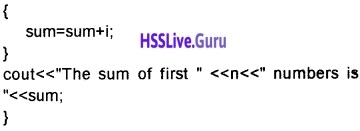
document.write("The sum of first 10 countimg numbers is "+sum);
}

Question 30.
Define constrain. Explain any four-column constraints.
Answer:
Constraints are used to ensure database integrity.

  1. Not Null – It ensures that a column can never have NULL values.
  2. Unique – It ensures that no two rows have the same value in a column.
  3. Primary key – Similar to unique but it can be used only once in a table.
  4. Default – We can set a default value.
  5. Auto_increment – This constraint is used to perform auto_increment the values in a column. That automatically generates serial numbers. Only one auto_increment column per table is allowed.

Plus Two Computer Application Previous Year Question Paper March 2019

Kerala State Board New Syllabus Plus Two Computer Application Previous Year Question Papers and Answers.

Kerala Plus Two Computer Application Previous Year Question Paper March 2019 with Answers

Board SCERT
Class Plus Two
Subject Computer Application
Category Plus Two Previous Year Question Papers

Time: 2 Hours
Cool off time : 15 Minutes

General Instructions to candidates

  • There is a ‘cool off time’ of 15 minutes in addition to the writing time of 2 hrs.
  • Your are not allowed to write your answers nor to discuss anything with others during the ‘cool off time’.
  • Use the ‘cool off time’ to get familiar with the questions and to plan your answers.
  • Read questions carefully before you answering.
  • All questions are compulsory and only internal choice is allowed.
  • When you select a question, all the sub-questions must be answered from the same question itself.
  • Calculations, figures and graphs should be shown in the answer sheet itself.
  • Malayalam version of the questions is also provided.
  • Give equations wherever necessary.
  • Electronic devices except non-programmable calculators are not allowed in the Examination Hall.

Part – A

Answer all questions from 1 to 5. Each carries 1 score. (5 × 1 = 5)

Question 1.
The input operator in C++ is ___________
Answer:
>> or cin >>

Question 2.
_________ character is stored at the end of the string.
Answer:
NULL or ‘\0’

Question 3.
The process of breaking large program into smaller sub-programs is called __________
Answer:
Modularization

Question 4.
Name the keyword used to declare variables in JavaScript.
Answer:
var

Question 5.
Expand MIS.
Answer:
Management Information System

Part – B

Answer any 9 questions from 6 to 16. Each carries 2 scores. (9 × 2 = 18)

Question 6.
List the type modifiers in C++.
Answer:
Type modifiers used in C++ are signed, unsigned, short and long.

Question 7.
Rewrite the following code using for loop:

int x = 1;
start:
cout<<x;
x = x + 5;
if (x < = 50)
goto start;

Answer:

for(x=1; x<=50; x+=5)
cout<<x;

Question 8.

  1. Define an Array.
  2. Initialize an integer array with 5 elements.

Answer:

  1. Array: An array is a collection of elements with the same data type store in contiguous memory location.
  2. int mark[] = {40, 42, 44, 46, 48, 50};

Question 9.
Write the port number for the following web services:

  1. Simple Mail Transfer Protocol.
  2. HTTP secure (HTTPS)

Answer:

  1. 25
  2. 443

Question 10.
What is the use of frame tag in HTML? What is its limitation?
Answer:
frame tag helps to view multiple web pages in a single window. The main limitation is that all browsers not supporting the frame tag.

Question 11.
Write the HTML code to display the following using list tag:
i) Biology Science
ii) Commerce
iii) Humanities
Answer:

<html>
<head>
<title>list demo
</title>
</head>
<body bgcolor="red">
<ol type="i">
<li> Biology Science</li>
<li> Commerce</li>
<li> Humanities</li>
</ol>
</body>
</html>

Question 12.
What is the difference between isNaN() and Number() functions in JavaScript?
Answer:
isNaN() function checks the given value is a number or not. If it is not a number it returns a true value otherwise false.
Number() function converts the data into numerical type.

Question 13.
What is CMS? Give two examples.
Answer:
CMS means Content Management System. It is a collection of programs that are used to create, modify, update, and publish website content. CMS can be downloaded freely and is useful to design and manage attractive and interactive websites with the help of templates that are available in CMS. WordPress, Joomla, etc. are examples of CMS.

Question 14.
First table containing 4 rows and 3 columns, the second table contains 5 rows and 2 columns, then the Cartesian product table contains ______ rows and ______ columns.
Answer:
The number of rows is the product of rows, i.e. 4 × 5 = 20 rows
The number of columns is the sum of columns, i.e. 3+2 = 5 columns

Question 15.
How Business Process Re-Engineering (BPR) is related to Enterprise Resource Planning (ERP)?
Answer:
ERP and BPR will not make much change if they are in stand-alone. To improve the efficiency of an enterprise integrate both ERP and BPR because they are the two sides of a coin. For better results conducting BPR before implementing ERP, will help an enterprise to avoid unnecessary modules from the software.

Question 16.
Define the terms:
i) Cyber Forensics
ii) Infomania
Answer:
i) Cyber Forensics: Critical evidence of a particular crime is available in electronic format with the help of computer forensics. It helps to identify the criminal with help of blood, skin or hair samples collected from the crime site. DNA, polygraph, finger prints are another effective tool to identify the accused person is a criminal or not.

ii) Infomania: Right information at the right time is considered as the key to success. The information must be gathered, stored, managed and processed well. Infomania is the excessive desire (Infatuation) for acquiring knowledge from various modern sources like Internet, Email, Social media, Instant Message Application (WhatsApp) and Smart Phones. Due to this, the person may neglect daily routine such as family, friends, food, sleep, etc. hence they get tired. They give first preference to the Internet than others. They create their own Cyber World and no interaction to the surroundings and the family.

Part – C

Answer any 9 questions from 17 to 27. Each carries 3 scores. (9 × 3 = 27)

Question 17.
Compare the selection statements ‘if’ and ‘switch’.
Answer:
Following are the difference between the switch and if-else if ladder.

  1. Switch can test only for equality but if can evaluate a relational or logical expression.
  2. If else is more versatile.
  3. If else can handle floating values but switch cannot
  4. If the test expression contains more variable if else is used.
  5. Testing a value against a set of constants switch is more efficient than if-else.

Question 18.
Write a program in C++ to accept a string with white space like “good morning” from the keyboard and display the same string.
Answer:

#include<iostream>
#include<cstdio>
using namespace std;
int main()
{
char str[80];
cout<<"Enter a string:";
gets(str);
puts(str);
}

Question 19.
Compare static webpage and dynamic webpage.
Answer:

Static web pages Dynamic web pages
Content and layout is fixed Content and layout is changed frequently
Never use database Database is used
Run by the browser It runs on the server and the result gets back to the client(browser)
Easy to develop Not at all easy

Question 20.
i) What is the use of reserved characters for HTML entities? (1)
ii) List any four reserved characters and their use. (2)
Answer:
(i) HTML entities are used to print reserved characters in HTML.
(ii)

Character Entity Description
&nbsp; Nonbreakable space
&quot; Double quotes
&apos; Single quote
& &amp; Ampersand symbol
< &lt; Less than symbol
> &gt; Greater than symbol
© &copy; Copyright symbol
TM &trade; Trademark symbol
&reg; Registered symbol

Question 21.
Write the built-in JavaScript functions used for the following situation:

  1. Display warning message in the screen.
  2. Character at a particular position.
  3. Convert uppercase to lowercase.

Answer:

  1. alert()
  2. charAt()
  3. toLowerCase()

Question 22.
Write the merits and demerits of free Webhosting.
Answer:
The name implies it is free of cost service and the expense is met by the advertisements. Some service providers allow limited facility such as limited storage space, do not allow multimedia (audio and video) files.

Question 23.
What is the key? Explain any two keys in a relational database management system.
Answer:
Key is used to identify or distinguish a tuple in a relation.

  • Candidate key – It is used to uniquely identify the row.
  • Primary key – It is a set of one or more attributes used to uniquely identify a row.
  • Alternate key – A candidate key other than the primary key.
  • Foreign key – A single attribute or a set of attributes, which is a candidate key in another table is called a foreign key.

Question 24.
Define the term Data independence. Explain different levels of data independence.
Answer:
Data Independence – It is the ability to modify the schema definition in one level without affecting the scheme definition at the next higher level.

  • Physical Data Independence – It is the ability to modify the physical scheme without causing application programs to be rewritten.
  • Logical Data Independence – It is the ability to modify the logical scheme without causing application programs to be rewritten.

Question 25.
Explain any three situations to modify the structure of a table with the help of alter command in SQL.
Answer:
We can alter the table in two ways.
We can add a new column to the existing table using the following syntax,
ALTER TABLE <tablename>ADD(<cloumnname> <type> <constraint>);
We can also change or modify the existing column in terms of type or size using the following syntax,
ALTER TABLE<tablename>MODIFY(<column> <newtype>);

Question 26.
Explain the merits of ERP system.
Answer:
Benefits of ERP system
1. Improved resource utilization: Resources such as Men, Money, Material and Machine are utilized maximum hence increase productivity and profit.

2. Better customer satisfaction: Without spending more money and time all the customer’s needs are considered well. Because the customer is the king of the market. Nowadays a customer can track the status of an order by using the docket number through the Internet.

3. Provides accurate information: Right information at the right time will help the company to plan and manage the future cunningly. A company can increase or reduce production based upon the right information hence increase productivity and profit.

4. Decision-making capability: Right information at the right time will help the company to take a good decision.

5. Increased flexibility: A good ERP will help the company to adopt good things as well as avoid bad things rapidly. It denotes flexibility.

6. Information integrity: A good ERP integrates various departments into a single unit. Hence reduce the redundancy, inconsistency, etc.

Question 27.
Compare GPRS and EDGE.
Answer:
GPRS (General Packet Radio Services): It is a packet-oriented mobile data service on the 2G on GSM. GPRS was originally standardized by European Telecommunications Standards Institute (ETSI) GPRS usage is typically^fiarged based on the volume of data transferred. Usage above the bundle cap is either charged per megabyte or disallowed.

EDGE (Enhanced Data rates for GSM Evolution): It is three times faster than GPRS. It is used for voice communication as well as an internet connection.

Part – D

Answer any 2 questions from 28 to 30. Each carries 5 scores. (2 × 5 = 10)

Question 28.
Identify the built-in C++ function for the following cases:

  1. to convert -25 to 25.
  2. compare ‘computer’ and ‘COMPUTER’ ignoring cases.
  3. to check the given character is a digit or not.
  4. to convert the character from ‘B’ to ‘b’.
  5. to find the square root of 64 or a number.

Answer:

  1. abs()
  2. strcmpi()
  3. isdigit()
  4. tolower()
  5. sqrt()

Question 29.
(i) Write the name of the tag used to group related data in an HTML form. (1)
(ii) Write the HTML code to display the following webpage: (4)
Plus Two Computer Application Previous Year Question Paper March 2019 Q29
Answer:
(i) <fieldset> tag

(ii) <html>
<head>
<title>
login page
</title>
</head>
<BODY BGCOLOR="cyan">
<FORM NAME="frmlogin">
<center>
User Name
<input type="text" name="txtname">
<br><br>
Password
<input type="password" name="txtpass">
<br><br>
<input type="Submit" value="Submit">
<input type="Reset" value="Reset">
</center>
</FORM>
</body>
</html>

Question 30.
Consider the table student with attribute admno, Name, course, percentage. Write the SQL statements to do the following:

  1. Display all the student details. (1)
  2. Modify the course’Commerce1 to’Science1. (1)
  3. Remove the student details with a percentage below 35. (1)
  4. Create a view from the above table with a percentage greater than 90. (2)

Answer:

  1. select * from student;
  2. update student set course=”Science” where course=”Commerce”;
  3. delete from student where percentage<35;
  4. create view stud view as select * from student where percentage > 60;

Plus Two Maths Chapter Wise Previous Questions Chapter 3 Matrices

Kerala State Board New Syllabus Plus Two Maths Chapter Wise Previous Questions and Answers Chapter 3 Matrices.

Kerala Plus Two Maths Chapter Wise Previous Questions Chapter 3 Matrices

Plus Two Maths Matrices 3 Marks Important Questions

Question 1.
Write A as the sum of a symmetric and a skew-symmetric matrix. \(A=\left[\begin{array}{ccc}
1 & 4 & -1 \\
2 & 5 & 4 \\
-1 & -6 & 3
\end{array}\right]\) (March – 2010)
Answer:
Plus Two Maths Chapter Wise Previous Questions Chapter 3 Matrices 1

Question 2.
Consider the matrices
\(A=\left[\begin{array}{lll}
2 & 1 & 3 \\
2 & 3 & 1 \\
1 & 1 & 1
\end{array}\right] \text { and } B=\left[\begin{array}{ccc}
-1 & 2 & 3 \\
-2 & 3 & 1 \\
-1 & 1 & 1
\end{array}\right]\)
(i) Find A+B
(ii) Find (A + B) (A-B) (May -2010)
Answer:
Plus Two Maths Chapter Wise Previous Questions Chapter 3 Matrices 2

Question 3.
Given \(P=\left[\begin{array}{cc}
2 & -3 \\
-1 & 2
\end{array}\right]\) Find the inverse of P by elementary row operation. (March 2011)
Answer:
Plus Two Maths Chapter Wise Previous Questions Chapter 3 Matrices 3

Question 4.
Let \(A=\left[\begin{array}{lll}
3 & 6 & 5 \\
6 & 7 & 8
\end{array}\right] \text { and } C=\left[\begin{array}{ccc}
1 & 2 & -3 \\
4 & 5 & 6
\end{array}\right]\)

(i) Find 2A
(ii) Find the matrix B such that 2A + B = 3C (May 2011)
Answer:
Plus Two Maths Chapter Wise Previous Questions Chapter 3 Matrices 4

Question 5.
Let \(A=\left[\begin{array}{cc}
2 & 4 \\
-1 & 1
\end{array}\right]\)
(i) Apply elementary transformation R → R R1/2 in the matrix A.
(ii) Find the inverse of A by the elementary transformation. (May 2011)
Answer:
Plus Two Maths Chapter Wise Previous Questions Chapter 3 Matrices 5

Question 6.
Consider the matrix \(A=\left[\begin{array}{cc}
3 & 1 \\
-1 & 2
\end{array}\right]\)
(i) Find A2
(ii) Find ksothat A2 = kA – 7I (March – 2012)
Answer:
Plus Two Maths Chapter Wise Previous Questions Chapter 3 Matrices 6

Question 7.
Consider a 2×2 matrix
\(A=\left[a_{i j}\right]$ where $a_{i j}=|2 i-3 j|\)
(i) Write A
(ii) Find A + AT (March – 2012)
Answer:
Plus Two Maths Chapter Wise Previous Questions Chapter 3 Matrices 7

Question 8.
If \(A=\left[\begin{array}{cc}
3 & 1 \\
-1 & 2
\end{array}\right]\) then
(i) Find A2
(ii) Hence show that A2 – 5A + 7I = 0. (March 2013)
Answer:
Plus Two Maths Chapter Wise Previous Questions Chapter 3 Matrices 8

Question 9.
If a matrix \(A=\left[\begin{array}{ll}3 x & x \\ -x & 2 x\end{array}\right]\) is a solution of the equation x2 – 5x + 7 = 0, find any one value of X. (May 2013)
Answer:
Plus Two Maths Chapter Wise Previous Questions Chapter 3 Matrices 9

Question 10.
Consider the matrices \(A=\left[\begin{array}{cc}1 & -2 \\ -1 & 3\end{array}\right]$ and $B=\left[\begin{array}{ll}a & b \\ c & d\end{array}\right]$\) \(A B=\left[\begin{array}{ll}2 & 9 \\ 5 & 6\end{array}\right]\), find the values of a,b,c,d (March – 2014)
Answer:
Plus Two Maths Chapter Wise Previous Questions Chapter 3 Matrices 10

Question 11.
Consider a 2 x 2 matrix A=[aij] Where \(a_{i j}=\frac{(i+2 j)^{2}}{2}\)
(i) Write A
(ii) Find A + AT (March – 2014)
Answer:
Plus Two Maths Chapter Wise Previous Questions Chapter 3 Matrices 11

Question 12.
If X + Y = \(\left[\begin{array}{ll}7 & 0 \\ 2 & 5\end{array}\right]\) and X – Y = \(\left[\begin{array}{ll}3 & 0 \\ 0 & 3\end{array}\right]\) then
(i) Find X and Y.
(ii) Find 2X + Y. (May – 2014)
Answer:
Plus Two Maths Chapter Wise Previous Questions Chapter 3 Matrices 12

Question 13.
i) If A, B are symmetric matrices of same order then AB – BA is always a ………….
A) Skew-Symmetric matrix
B) Symmetric matrix
C) Identity matrix
D) Zero matrix
(ii) For the matrix \(A=\left[\begin{array}{ll}2 & 4 \\ 5 & 6\end{array}\right]\), verify that A + AT is a symmetric matrix. (March – 2015)
Answer:
Plus Two Maths Chapter Wise Previous Questions Chapter 3 Matrices 13

Question 14.
Consider the matrix \(A=\left[\begin{array}{ll}3 & -2 \\ 4 & -2\end{array}\right]\)
(i) Find A2
(ii) Find k so that A2 = kA – 21 (May – 2015)
Answer:
Plus Two Maths Chapter Wise Previous Questions Chapter 3 Matrices 14

Plus Two Maths Matrices 4 Marks Important Questions

Question 1.
(i) Find the value of x and y from the equations \(a\left[\begin{array}{cc}x & 5 \\ 7 & y-3\end{array}\right]+\left[\begin{array}{cc}3 & -4 \\ 1 & 2\end{array}\right]=\left[\begin{array}{cc}7 & 6 \\ 15 & 14\end{array}\right]\)
(ii) Given \(A=\left[\begin{array}{cc}1 & 2 \\ 3 & -1 \\ 4 & 2\end{array}\right], B=\left[\begin{array}{ccc}-1 & 4 & -5 \\ 2 & 1 & 0\end{array}\right]\) Show that AB ≠ BA (March – 2011)
Answer:
Plus Two Maths Chapter Wise Previous Questions Chapter 3 Matrices 15
Plus Two Maths Chapter Wise Previous Questions Chapter 3 Matrices 16

Question 2.
(i) Find a, b matrix \(\left[\begin{array}{ccc}0 & 3 & a \\ b & 0 & -2 \\ 5 & 2 & 0\end{array}\right]\) is skew symmetric matrix.
(ii) Express \(A=\left[\begin{array}{ccc}7 & 3 & -5 \\ 0 & 1 & 5 \\ -2 & 7 & 3\end{array}\right]\) sum of a symmetric and a skew symmetric matrix. (May – 2012)
Answer:
Plus Two Maths Chapter Wise Previous Questions Chapter 3 Matrices 17

Question 3.
Consider the matrices \(A=\left[\begin{array}{cc}2 & -6 \\ 1 & 2\end{array}\right]$ and $A+3 B=\left[\begin{array}{cc}5 & -3 \\ -2 & -1\end{array}\right]\)
(i) Find matrix B
(il) Find matrix AB.
(iii) Find the transpose of B. (May – 2013)
Answer:
Plus Two Maths Chapter Wise Previous Questions Chapter 3 Matrices 18

Question 4.
(i) The value of k such that matrix \(\left[\begin{array}{cc} 1 & k \\ -k & 1 \end{array}\right]\) is symmetric if
(a) 0
(b) 1
(c) – 1
(d) 2

(ii) If \(A=\left[\begin{array}{cc}
\cos \theta & \sin \theta \\
-\sin \theta & \cos \theta
\end{array}\right]\) then prove that \(A^{2}=\left[\begin{array}{cc}
\cos 2 \theta & \sin 2 \theta \\
-\sin 2 \theta & \cos 2 \theta
\end{array}\right]\)
\(\text { (iii) if } A=\left[\begin{array}{ll}
1 & 3 \\
4 & 1
\end{array}\right], \text { then find }\left|3 A^{T}\right|\) (March – 2017)
Answer:
Plus Two Maths Chapter Wise Previous Questions Chapter 3 Matrices 19

Plus Two Maths Matrices 6 Marks Important Questions

Question 1.
Let A be a matrix of order 3 x 3 whose elements are given by aij = 21 – j
(i) Obtain the matrix A.
(ii) Find AT Also express A as the sum of symmetric and skew-symmetric matrix. (March – 2010)
Answer:
Plus Two Maths Chapter Wise Previous Questions Chapter 3 Matrices 20

Question 2.
Consider a 2 x 2 matrix \(A=\left[a_{\theta}\right]\) with aij = 2i + j
(i) Construct A.
(ii) Find A + AT, A – AT
(iii) Express A as sum of a symmetric and skew-symmetric matrix. (May -2015)
Answer:
Plus Two Maths Chapter Wise Previous Questions Chapter 3 Matrices 21
Plus Two Maths Chapter Wise Previous Questions Chapter 3 Matrices 22

Question 3.
(i) \(A=\left[\begin{array}{ll}
0 & 1 \\
0 & 0
\end{array}\right], B=\left[\begin{array}{ll}
1 & 0 \\
0 & 0
\end{array}\right]\) then BA = _____
\(\begin{array}{l}
\text { (a) }\left[\begin{array}{ll}
1 & 0 \\
0 & 1
\end{array}\right] & \text { (b) }\left[\begin{array}{ll}
0 & 1 \\
1 & 0
\end{array}\right] \\
\text { (c) }\left[\begin{array}{ll}
0 & 1 \\
0 & 0
\end{array}\right] & \text { (d) }\left[\begin{array}{ll}
0 & 0 \\
0 & 0
\end{array}\right]
\end{array}\)

(ii) Write \(A=\left[\begin{array}{cc}
3 & 5 \\
1 & -1
\end{array}\right]\) as the sum of a symmetric and a skew symmetric matrix.
(iii) Find the inverse of \(A=\left[\begin{array}{ll}
2 & -6 \\
1 & -2
\end{array}\right]\) (March 2016)
Answer:
Plus Two Maths Chapter Wise Previous Questions Chapter 3 Matrices 23
Plus Two Maths Chapter Wise Previous Questions Chapter 3 Matrices 24

Question 4.
(i) If the matrix A is both symmetric and skew-symmetric, then A is a
(a) diagonal matrix
(b) zero matrix
(c) square matrix
(d) scalar matrix

(ii) If \(A=\left[\begin{array}{cc}
1 & 3 \\
-2 & 4
\end{array}\right]\), then show that

(iii) Hence find A-1 (May 2016)
Answer:
Plus Two Maths Chapter Wise Previous Questions Chapter 3 Matrices 25
Plus Two Maths Chapter Wise Previous Questions Chapter 3 Matrices 26

Question 5.
(i) The number of all possible 2 x 2 matrices with entries O or 1 is
(a) 8
(b) 9
(c) 16
(d) 25

(ii) If the area of a triangle whose vertices are (k,0), (5,0), (0,1) is 10 square units the find k.
(iii) Using elementary transformations find the inverse of the matrix \(\left[\begin{array}{ll}
2 & 1 \\
1 & 1
\end{array}\right]\) (May 2017)
Answer:
Plus Two Maths Chapter Wise Previous Questions Chapter 3 Matrices 27
Plus Two Maths Chapter Wise Previous Questions Chapter 3 Matrices 28

Plus Two Maths Chapter Wise Previous Questions Chapter 2 Inverse Trigonometric Functions

Kerala State Board New Syllabus Plus Two Maths Chapter Wise Previous Questions and Answers Chapter 2 Inverse Trigonometric Functions.

Kerala Plus Two Maths Chapter Wise Previous Questions Chapter 2 Inverse Trigonometric Functions

Plus Two Maths Inverse Trigonometric Functions 3 Marks Important Questions

Question 1.
(i) Find the principal value of \(\cos ^{-1}\left(\frac{\sqrt{3}}{2}\right)\)
(ii) Prove that \(2 \sin ^{-1}\left(\frac{3}{5}\right)=\tan ^{-1}\left(\frac{24}{7}\right)\) (March – 2010)
Answer:
Plus Two Maths Chapter Wise Previous Questions Chapter 2 Inverse Trigonometric Functions 1

Question 2.
Prove \(2 \tan ^{-1} \frac{1}{2}+\tan ^{-1} \frac{1}{7}=\tan ^{-1} \frac{31}{17}\) (March – 2015; March – 2016)
Answer:
Plus Two Maths Chapter Wise Previous Questions Chapter 2 Inverse Trigonometric Functions 2

Plus Two Maths Inverse Trigonometric Functions 4 Marks Important Questions

Question 1.
(i) Find the principal value of \(\cos ^{-1}\left(-\frac{1}{2}\right)\)
(ii) Show that \(\left(\frac{\cos x}{1-\sin x}\right)=\frac{\pi}{4}+\frac{x}{2}\) (March-2011)
Answer:
Plus Two Maths Chapter Wise Previous Questions Chapter 2 Inverse Trigonometric Functions 3

Question 2.
(i) The principal value of \(\cos ^{-1}\left(-\frac{1}{2}\right)\)
(ii)Expresstan \(\tan ^{-1}\left(\frac{\cos x}{1-\sin x}\right)\) in the simplest Form. (May – 2012)
Answer:
Plus Two Maths Chapter Wise Previous Questions Chapter 2 Inverse Trigonometric Functions 4

Question 3.
(i) Write the principal value of \(\sin ^{-1}\left(\frac{1}{2}\right)\)
(ii) Show that \(\sin ^{-1}\left(\frac{3}{5}\right)-\sin ^{-1}\left(\frac{8}{17}\right)=\cos ^{-1}\left(\frac{84}{85}\right)\) (March – 2013, Onam – 2017)
Answer:
Plus Two Maths Chapter Wise Previous Questions Chapter 2 Inverse Trigonometric Functions 5

Question 4.
(a) The principal value of tan’1 (-1) is \(\left[\frac{\pi}{4},-\frac{\pi}{4}, \quad \pi-\frac{\pi}{4}, \quad \pi+\frac{\pi}{4}\right]\)
(b) If \(\tan ^{-1}\left(\frac{x-1}{x-2}\right)+\tan ^{-1}\left(\frac{x+1}{x+2}\right)=\frac{\pi}{4}\) then find the value of x. (May 2014)
Answer:
Plus Two Maths Chapter Wise Previous Questions Chapter 2 Inverse Trigonometric Functions 6
Plus Two Maths Chapter Wise Previous Questions Chapter 2 Inverse Trigonometric Functions 7

Plus Two Maths Inverse Trigonometric Functions 6 Marks Important Questions

Question 1.
Match the following. (1 + 1 + 1 + 3 = 6) (May 2010)
Plus Two Maths Chapter Wise Previous Questions Chapter 2 Inverse Trigonometric Functions 8
Answer:
Plus Two Maths Chapter Wise Previous Questions Chapter 2 Inverse Trigonometric Functions 9

Question 2.
(i) Give an expression for tan(x + y)
(ii) Prove that xy < 1, \(\tan ^{-1} x+\tan ^{-1} y=\tan ^{-1}\left(\frac{x+y}{1-x y}\right)\)
(iii) Using the above result prove that \(\tan ^{-1} \frac{1}{2}+\tan ^{-1} \frac{1}{3}=\frac{\pi}{4}\) (May 2011)
Answer:
Plus Two Maths Chapter Wise Previous Questions Chapter 2 Inverse Trigonometric Functions 10

Question 3.
(i) Show that \(\tan ^{-1} \frac{1}{5}+\tan ^{-1} \frac{1}{7}+\tan ^{-1} \frac{1}{3}+\tan ^{-1} \frac{1}{8}=\frac{\pi}{4}\)
(ii) Given that \(\cot 3 \theta=\frac{3 \cot ^{2} \theta-1}{\cot ^{3} \theta-3 \cot \theta}\), Show that \(\cot ^{-1} \frac{3 x^{2}-1}{x^{3}-3 x}, \quad|x|<\sqrt{3}$ is $3 \cot ^{1} x\) (May 2013 )
Answer:
Plus Two Maths Chapter Wise Previous Questions Chapter 2 Inverse Trigonometric Functions 11
Plus Two Maths Chapter Wise Previous Questions Chapter 2 Inverse Trigonometric Functions 12

Plus One Botany Chapter Wise Questions and Answers Chapter 7 Transport in Plants

Students can Download Chapter 7 Transport in Plants Questions and Answers, Plus One Botany Chapter Wise Questions and Answers helps you to revise the complete Kerala State Syllabus and score more marks in your examinations

Kerala Plus One Botany Chapter Wise Questions and Answers Chapter 7 Transport in Plants

Plus One Botany Transport in Plants One Mark Questions and Answers

Question 1.
Which of the following statements does not apply to reverse osmosis?
(a) it is used for water purification.
(b) In this technique, a pressure greater than the osmotic pressure is applied to the system
(c) It is a passive process
(d) It is an active process
Answer:
(c) It is a passive process

Question 2.
Which one of the following will not directly affect transpiration?
(a) Light
(b) wind speed
(c) temperature
(d) chlorophyll content of leaves
Answer:
(d) chlorophyll content of leaves

Question 3.
The lower surface of leaf will have a number of stomata in a
(a) isobilateral leaf
(b) dorsiventral leaf
(c) both a and b
(d) none of the above
Answer:
(b) dorsiventral leaf

Plus One Botany Chapter Wise Questions and Answers Chapter 7 Transport in Plants

Question 4.
The form of sugar transported through phloem is
(a) Fructose
(b) Sucrose
(c) glucose
(d) ribose
Answer:
(b) sucrose

Question 5.
The process of guttation takes place
(a) when the root pressure is high and the rate of transpiration is low
(b) when the root pressure is low and the rate of transpiration is high
(c) when the root pressure equals the rate of transpiration
(d) when the root pressure, as well as rate of transpiration, are high.
Answer:
(a) when the root pressure is high and the rate of transpiration is low

Question 6.
Which of the following is an example of imbibition
(a) uptake of water by root hair
(b) exchange of gases in stomata
(c) swelling of seed when putting in the soil
(d) opening of stomata
Answer:
(c) swelling of seed when putting in the soil

Question 7.
What will happen to a plant cell when kept in hypotonic solution?
Answer:
Cell become turgid

Question 8.
How are protoplasm of adjacent cells connected to each other?
Answer:
Plasmodesmata

Question 9.
Name the process in which water drops ooze out from margins of leaves.
Answer:
Guttation

Question 10.
The C4 plants are twice as efficient as C3 plants in terms of fixing C02 but lose only as much water as C3 plants for the same amount of C02 fixed.
Answer:
Half

Question 11.
Plants could be grown in a nutrient solution in the complete absence of soil. Name the technique.
Answer:
Hydroponics

Plus One Botany Chapter Wise Questions and Answers Chapter 7 Transport in Plants

Question 12.
Name the hormone which signals the closure of stomata during severe drought or severe solar radiation.
Answer:
Abscisic acid (ABA)

Question 13.
Name the physical phenomena associated with the first step of seed germination.
Answer:
Imbibition

Question 14.
What causes the leaves of grasses to roll in dry weather?
Answer:
Presence of bulliform cells or motor cells

Question 15.
The diagram below shows the cells placed in hypertonic solution and hypotonic solution. If the diagram ‘B’ is ‘turgid’ what will be diagram ‘A’?
Plus One Botany Chapter Wise Questions and Answers Chapter 7 Transport in Plants img1
Answer:
A – Flaccid

Question 16.
The excess of one element may inhibit the uptake of another element. What is this effect called?
Answer:
Toxicity of micronutrients

Question 17.
Name the type of obligatory association found in pinus seeds that promote germination.
Answer:
Mycorrhiza

Question 18.
A plant cell when kept in a certain solution got plasmolysed. What was the nature of this solution?
Answer:
Hypertonic solution

Question 19.
Why turgidity of the cell essential for plants?
Answer:
It helps to maintain plant organs in normal shape

Question 20.
Absorption of water from the soil by dry seeds increases the, thus helping seedlings to come out of the soil.
Answer:
Pressure

Question 21.
A flowering plant is planted in an earthen pot and irrigated. Urea is added to make the plant grow faster, but after some time the plant dies. Give reason.
Answer:
It is due to exosmosis.

Plus One Botany Chapter Wise Questions and Answers Chapter 7 Transport in Plants

Question. 22
Identify a type of molecular movement which is highly selective and requires special membrane proteins, but does not require energy.
Answer:
Facilitated diffusion

Question 23.
Smaller, lipid-soluble molecules diffuse faster through cell membrane, but the movement of hydrophilic substances are facilitated by certain biomolecules. Name it.
Answer:
Protein

Question. 24
The bending of wooden doors during rainy reasons is due to physiological phenomenon. Name it.
Answer:
Imbibition

Plus One Botany Transport in Plants Two Mark Questions and Answers

Question 1.
Give below is a diagram, where hypotonic solution is separated by a semipermeable membrane from a hypertonic solution and kept for a few hours.
Plus One Botany Chapter Wise Questions and Answers Chapter 7 Transport in Plants img2


  1. In which direction will the solvent move? From X to Y or Y to X.
  2. Name the process of movement of the solvent.

Answer:

  1. X to Y
  2. Osmosis

Question 2.
Differences between the following.
Diffusion and Osmosis
Answer:
1. Diffusion:
It is the movement of solute from the region of higher concentration to region of lower concentration.

2. Osmosis:
It is the movement of solvent from the region of higher concentration to region of lower concentration through semipermiable membrane

Question 3.
Differences between Guttation and transpiration
Answer:
1. Guttation:
Loss of water in the form of water droplets from the margin of leaves through hydathode.
2. Transpiration:
It is the loss of water in the form of water vapour from the surface of leaves through stomata.

Question 4.
Both the xylem and phloem are tubular structures. One is unidirectional and the other is bi-directional. Comment on it.
Answer:
Phloem is bidirectional in order to transport prepared food from leaves to different parts of the plant and translocates stored food from downward to upward for the growth of buds.

Question 5.
Ramu while observing the root nodules of pea plant, noticed the pink colour. Sita said that it is due to the presence of a substance. Can you name the substance and write its role.
Answer:
Leg hemoglobin. It is an 02 scavenger. It create anaerobic condition for enzyme Nitrogenase during N2 Fixation

Plus One Botany Chapter Wise Questions and Answers Chapter 7 Transport in Plants

Question 6.
Match the following :

Column A Column B
1) Imbibition

2)  Exosmosis

3) Diffusion

4) Transpiration

a) Leaves

b) Perfumes

c) Dried grapes

d)  Pickles

Answer:

Column A Column B
1) Imbibition

2)  Exosmosis

3) Diffusion

4) Transpiration

Dried grapes

Pickles

Perfumes

Leaves

Question 7.
Water is absorbed by the root hairs, It can move deeper into root layers by two distinct pathways.

  1. Write the name of the pathways.
  2. Which substance controls water transport in the endodermal region?

Answer:

  1. Apoplast pathway & Symplast pathway
  2. Suberin

Question 8.
“Root pressure is inadequate to lift the water molecules in taller plants like Eucalyptus”.

  1. Which theory is successfully explaining the Ascent of sap in plants like Eucalyptus?
  2. Who proposed this theory?

Answer:

  1. Transpiration pull – cohesion tension theory
  2. Dixon & Jolly

Question 9.
Fresh mangoes can survive fora prolonged period of time when they are placed in highly concentrated salt solution. Some physiological changes take place in the cell. Comment on the changes.
Answer:

  • Exosmosis.
  • Bacteria can not survive in hypertonic solutions.

Question 10.
Pure Honey checks the growth of microorganisms. Justify based on your knowledge in osmosis.
Answer:
Pure honey is hypertonic .bacterial cells shrink and die due to plasmolysis.

Question 11.
A fesh mango pieces is placed in water containing high concentration of sodium chloride.
Exosmosis, Plasmolysis, Deplasmolysis, Imbibition

  1. Select and write down the appropriate terms given above to represent the sequence of events leading to shrinking.
  2. What is plasmolysis?

Answer:

  1. Exosmosis – Plasmolysis
  2. The withdrawal of the protoplast from the cell wall due to exosmosis.

Question 12.
Ψws + Ψp

  1. Expand the equation.
  2. Why solute potential is always negative?

Answer:
1.

  • Ψw – Water potential
  • Ψs – Solute potential,
  • Ψp – pressure potential

2. Since adding solute reduces water potential, it is always negative.

Question 13.
Observe the given figure showing the pathways of water movement in the plant body and answer the questions.
Plus One Botany Chapter Wise Questions and Answers Chapter 7 Transport in Plants img3

  1. Identify A and B pathways.
  2. In which of the above pathways does water move beyond endodermis?

Answer:

  1. A – Apoplast pathway
    B – Symplast pathway
  2. Apoplast pathway

Question 14.
Apoplast and symplast pathways are the two distinct pathways of water to move deeper into the root layers. Which is the only pathway through which water can enter the vascular cylinder and why?
Answer:
Symplast – Because endodermal wall is suberised.

Question 15.
When a freshly collected Spirogyra filament is kept in 10% potassium nitrate solution, it is observed that the protoplasm shrinks in size:

  1. What is this phenomenon called?
  2. What will happen if the filament is replaced in distilled water?

Answer:

1. This phenomenon is called plasmolysis. (The shrinkage of protoplast from the cell wall under the influence of a strong solution/ hypertonic solution is called plasmolysis.

2. If filaments are replaced in water the protoplast starts swelling. It comes in contact with cell wall and cell regains its original size.
The swelling up of plasmolyzed protoplast under the influence of a weak solution or water is called deplasmolysis.

Plus One Botany Chapter Wise Questions and Answers Chapter 7 Transport in Plants

Question 16.
1. In an experiment, Deepa put a piece of raw mango in 0.5M salt solution and another piece in 1M salt solution. Which mango piece will get plasmolyzed fast?
2. Water potential of solution A is -0.3 bar and that of solution B is -0.1 bar. If solution A is separated from solution B by a semi-permeable membrane water molecules will flow from to
Answer:

  1. Mango piece put in 1 M salt solution get plasmolysed rapidly than. 0.5M solution.
  2. B (-1.1) to A (-0.3)

Question 17.
An unavoidable waste mechanism is found in higher plants during high temperature.

  1. Name the process.
  2. Why is it said so?

Answer:

  1. Transpiration
  2. It has merits and demerits. Since water and minerals are absorbed and translocated to distant sites by this process but 99% of water absorbed is transpired out.

Question 18.
Water moves up against gravity and even for a tree of 20 m height, the tip receives water within two hours. Which is the most important physiological phenomenon responsible for the upward movement of water is
Answer:
Transpirational pull.

Question 19.
Osmosis is a special kind of diffusion, in which water diffuses across the cell membrane. What are the factors influence rate and direction of osmosis?
Answer:
Pressure and concentration gradient.

Question 20.
When a tea bag is placed in a cup of water, which phenomenon is observed? Explain the phenomenon.
Answer:
Diffusion. It is the movement of molecules from higher concentration to lower concentration.

Question 21.
Phloem transport is bidirectional while xylem transport is unidirectional. Give a reason?
Answer:
Phloem transport is bidirectional because prepared food materials translocated to storage regions. These storage food materials are again transported to growing regions for the growth of buds. So, through phloem downward and upward transport takes place. Xylem transport is unidirectional because water and minerals are absorbed and conducted upwards.

Question 22.
Write the suitable term in each pair

  1. apoplast: through cell wall; ………: through cytoplasm
  2. endosmosis: turgid; exosmosis: ………..
  3. ………..: unidirectional; phloem transport: bidirectional
  4. Mg : macroelement: …………: microelement

Answer:

  1. Symplast
  2. Flaccid
  3. Xylem
  4. Mn

Question 23.
‘Ψw = Ψs + Ψp Expand the equation
Answer:

  • Ψw = Water potential is the sum of
  • Ψs = Solute potential solute potential
  • Ψp = pressure potential and pressure potential.

Question 24.
Bacteria cannot live in highly salted pickle. Why?
Answer:
The bacterial cell undergoes plasmolysis in saltwater. This results shrinking of protoplast. Hence, Bacteria cannot live in saltwater.

Question 25.
Observe the following diagram showing the movement of water in plant cells. Identify 1 & 2.
Plus One Botany Chapter Wise Questions and Answers Chapter 7 Transport in Plants img4
Answer:

  1. Apoplastic pathway
  2. Sym plastic pathway

Question 26.
A few Pieces of potato were weighed and kept in saltwater overnight. In the morning they are weighed again.

  1. What will be the change in weight?
  2. Name the process responsible for the change.

Answer:

  1. The weight of potato is decreased.
  2. Exosmosis results the loss of water from the potato, it leads to plasmolysis.

Plus One Botany Chapter Wise Questions and Answers Chapter 7 Transport in Plants

Question 27.
Before eating Grapes, it is advised to wash them well by keeping them in water for some time to wash off the pesticides on them. However, it is more advisable to keep the Grapes in saltwater than in fresh water to make them safer for consumption. Suggest an explanation for this.
Answer:
The grapes put in saltwater are safer for consumption because poisonous chemicals present in grapes are come out by the process of exosmosis.

Question 28.
The cytoplasm in a plant cell is surrounded by both cell wall and cell membrane. The specificity of transport of substances are mostly across the cell membrane. Give reason.
Answer:
The cell wall is freely permeable to water and substances in solutions but membrane is selectively permeable.

Question 29.
In a girdled plant, when water is supplied to the leaves above the girdle, leaves may remain green for sometime then wilt and ultimately die. What does it indicate?
Answer:
Girdling removes phloem and hence phloem transport is blocked.

Question 30.
Movement of substances in xylem is unidirectional while in phloem it is bidirectional. Why?
Answer:
Xylem conducts”Water and minerals in upward direction only but phloem conducts food in downward direction and in spring season stored food is again transported to upward for bud growth. Hence movement of substances in xylem is unidirectional while in phloem it is bidirectional.

Question 31.
Plants absorb water from the soil through root hairs by two pathways?

  1. Name the pathways
  2. Explain any one of them

Answer:

  1. Apoplastic pathway and symplastic pathway
  2. In apoplastic pathway, water transport takes place through the nonliving part of the cell (cell wall).

Question 32.
What is the water potential of pure water at atmospheric pressure? What happens to it when solutes are added to it?
Answer:
Zero, Water potential is decreased and comes to more negative values.

Question 33.
Transport of hydrophilic substances through cell membrane is difficult. Do you agree ? Give reason.
Answer:
Yes, because the cell membrane contains lipids.

Question 34.
What is meant loading and unloading of phloem?
Answer:
The entering of sugar into sieve tube is called loading and movement of sugar out of sieve tube into storage tissues is called unloading.

Question 35.
Root pressure theory is not adequate for explaining water movement up a long day plant. Why?
Answer:
It is used for explaining water movement up in herbaceous plants but in long plants, it is explained by the transpiration pull theory.

Question 36.
Why is energy required to develop root pressure?
Answer:
Every activity requires energy. Root pressure develops due to activity of living cells of the root.

Question 37.
What happens when a pressure greater than the atmospheric pressure is applied to pure water or a solution?
Answer:
When a pressure greater than atmospheric pressure is applied to pure water or a solution, its water potential is increased.

Question 38.
How is mycoorrhizal association helpful in absorption of water and mineral in plants?
Answer:
Mycorrhizal association help in water and mineral absorption. Fungal hyphae have a very large surface area that absorbs mineral ions and water from a much larger volume of soil.

Question 39.
Give an example for obligate mycorrhizal asociation.
Answer:
Mycorrhizal association is found in pinus seeds i.e Pinus seeds do not germinate and establish without mycorrhiza.

Question 40.
Downhill and uphill movement are used in transport of molecules through membrane.

  1. Which is the above process that requires energy?
  2. Which is the above process not dependent on concentration gradient. Why?

Answer:

  1. uphill transport is active transport requires energy.
  2. Downhill transport, because molecules move from the region of higher concentration to the region of lower concentration.

Plus One Botany Chapter Wise Questions and Answers Chapter 7 Transport in Plants

Question 41.
Two pathways of water movement into the deeper layers of root ie; from epidermis to xylem vessels

  1. Name the two pathways
  2. Which is the substance present in the endodermis block one pathway?

Answer:

  1. Apoplastic pathway and symplastic pathway
  2. suberin in casperian strips

Question 42.
In plants translocation of photosynthates occur in 2 ways but water and mineral transport in one way.

  1. Which is the two way suggested?
  2. Name the conducting channel for both.

Answer:
1. Food translocated from leaves to storage regions called downward transport. During spring season food again transported upward for bud growth. So such type of transport is bidirectional.

2. Food transported through phloem and water and mineral transported through the xylem.

Question 43.
In plants stomata opens during day time and close during night time.
How is decreasing water potential of guard cell affect the opening and closing of stomata?
Answer:
If decreasing the water potential of guard cell, water enters into guard cell from the subsidiary and it becomes turgid, stomata open.

Plus One Botany Transport in Plants Three Mark Questions and Answers

Question 1.
“Water is transient in plants. Less than 1% of water reaching the leaves is used in photosynthesis and plant growth’’. What is the fate of remaining percentage of water? Specify the phenomenon? Give its significance in plants?
Answer:
99% of water absorbed is lost through transpiration.

  1. It provides cooling effect to leaves and other organs.
  2. It promotes mineral absorption.
  3. It helps to maintain the shape and structure of plants by keeping up its turgidity.

Question 2.
What are the factors responsible for ascent of xylem sap in plants?
Answer:

  • Cohesion: The mutual attraction between water molecules
  • Adhesion: The attraction of molecules to polar surface e g., the surface of tracheary elements
  • Surface Tension: The water molecules are attracted to each other in liquid phase more than to water in gas phase.

All these properties provide water high tensile strength (an ability to resist a pulling force) as well as high capillarity (ability to rise in a thin tube).
In plants, capillarity is aided by the small diameter of both tracheids and vessels.

Question 3.
The solution taken in the beaker have lower solute concentration than thistle funel, osmosis starts and continues

  1. What will hapen if more solute is added in the thistle funel ?
  2. Which is the solution mentioned above have higher water potential?
  3. Which is the method possible to change flow of solvent molecules?

Answer:

  1. Diffusion takes place faster
  2. solution was taken in the beaker
  3. apply greater pressure than atmospheric pressure in solution of thistle funel.

Question 4.
Look at the following figure in which two chambers, A and B, containing solutions are separated by a semipermeable membrane. Answer the following questions.
Plus One Botany Chapter Wise Questions and Answers Chapter 7 Transport in Plants img5

  1. Solution of which chamber has a lower water potential
  2. In which direction will osmosis occur?
  3. Which solution has a higher solute potential?
  4. If one chamber has a Ψ of -2000KPa and the other -1000 KPa, which is the chamber that has the higher Ψ?

Answer:

  1. Solution in B chamber has lower water potential.
  2. Osmosis occurs from a to b.
  3. A solution has higher solute potential.
  4. The chamber having -ve 1000K Pa has the higher psi

Plus One Botany Chapter Wise Questions and Answers Chapter 7 Transport in Plants

Question 5.
Identify the following.

  1. Stress hormone
  2. The shrinking of protoplasm due to continuous exosmosis
  3. The positive pressure develops within the xylem of roots due to the absorption of water and minerals.

Answer:

  1. Abscisic acid
  2. Plasmolysis
  3. Root pressure

Plus One Botany Transport in Plants NCERT Mark Questions and Answers

Question 1.
What are the factors affecting the rate of diffusion?
Answer:

  • Factors affecting the rate of diffusion:
  • Gradient of Concentration
  • Permeability of membrane
  • Temperature
  • Pressure

Question 2.
What are porins? What role do they play in diffusion?
Answer:
The porins are proteins that form huge pores in the outer membranes of the plastids, mitochondria and some bacteria allowing molecules up to the size of small proteins to pass through. Thus porins faciliate diffusion.

Question 3.
Decribe the role played by protein pumps during active transport in plants.
Answer:
Active transport uses energy to pump molecules against a concentration gradient. Active transport is carried out by membrane – proteins.

Question 4.
Explain why pure water has maximum water potential?
Answer:
Water molecules possess kinetic energy. In liquid and gaseous form they are in random motion that is both rapid and constant. The greater the concentration of water in a system, the greater is its kinetic energy or ‘water potential’.

Hence, it is obvious that pure water will have the greatest water potential if two systems containing water are in contact, random movement of water molecules will result in net movement of water molecules from the system with higher energy to the one with lower energy. Thus water will move from the system containing water at higher water potential to having low wate potential.

This process of movement of substances down a gradient of free energy is called diffusion. Water. potential is denoted by the Greek symbol Psi and is expressed in pressure units such as pascals(Pa). By convention, the water potential of pure water at standard temperatures, which is not under any pressure, is taken to be zero.

Question 5.
What happens when a pressure greater than the atmospheric pressure is applied to pure water or a solution?
Answer:
Under constant temerature the volume of liquid varies inversely to pressure. Moreover, if greater pressure is applied then it will change the state of the matter from liquid to soild at a given temperature. Any liquid will abide by these laws.

Plus One Botany Chapter Wise Questions and Answers Chapter 7 Transport in Plants

Question 6.
Discuss the factors responsible for ascent of xylem sap in plants.
Answer:
The transpiration driven ascent of xylem sap depends mainly on the following physical properties of water:

  • Cohesion – the mutual attraction between water molecules.
  • Adhesion – the attraction of water molecules to polar surfaces (such as the surface of tracheary elements).
  • Surface Tension – water molecules are attracted to each other in the liquid phase more than to water in the gas phase.

These properties give water high tensile strength, i.e., an ability to resist a pulling force, and high capillarity, I ‘.e., the ability to rise in thin tubes. In plants capillarity is aided by the small diameter of the tracheary elements – the tracheids and vessel elements.

Plus One Botany Transport in Plants Multiple Choice Questions and Answers

Question 1.
Closure of stomata due to water stress is brought about by
(A) Auxin
(B) Ethylene
(C) Abscisic acid
(D) Cytokinin
Answer:
(C) Abscisic acid

Question 2.
The most common type of transpiration is
(A) Stomatal
(B) Cuticular
(C) Lenticular
(D) Foliar
Answer:
(A) Stomatal

Question 3.
All the following include osmosis except
(A) Passage of water from root hair to adjacent cells
(B) Passage of water from lower xylem to upper xylem
(C) Passage of water from xylem vessel to mesophyll cell
(D) The entry of water into root hair from soil solution
Answer:
(B) Passage of water from lower xylem to upper xylem

Question 4.
Stomatal opening and closure are due to
(A) Presence of gases inside leaves
(B) Gene action
(C) Pressure offered by guard cells
(D) Pressure offered by subsidiary cells
Answer:
(C) Pressure offered by guard cells

Question 5.
Translocation of sugars is correlated by
(A) Boron
(B) Iron
(C) Molybdenum
(E) Calcium
Answer:
(A) Boron

Plus One Botany Chapter Wise Questions and Answers Chapter 7 Transport in Plants

Question 6.
Identify the wrong statement of the following
(A) Root pressure is a positive pressure that develops in the xylem sap of the root of some plants.
(B) Water molecules remain attached to one another by a strong mutual force called cohesion force
(C) Guttation is frequently seen in herbaceous plants growing under the conditions of low soil moisture and low atmospheric humidity
(D) In monocot leaves, guard cells remain dumbbell-shaped and their cell walls are thickened only in the middle
Answer:
(C) Guttation is frequently seen in herbaceous plants growing under the conditions of low soil moisture and low atmospheric humidity

Question 7.
In which of the following plants, will there be no transpiration?
(A) Plants living in deserts
(B) Plants growing in hilly regions
(C) Aquatic submerged plants
(D) Aquatic plants with floating leaves
Answer:
(C) Aquatic submerged plants

Question 8.
When a cell is placed in hypertonic solution
(A) Exosmois occurs and the cell becomes turgid
(B) Endosmosis occurs and the cell becomes turgid
(C) Exosmosis occurs and the cell becomes plasmolysed
(D) Endosmosis occurs and the cell becomes plasmolysed
Answer:
(C) Exosmosis occurs and the cell becomes plasmolysed

Question 9.
The thin film of water covering soil particles and held strongly by attractive forces is called
(A) Hygroscopic water
(B) Runaway water
(C) Gravitational water
(D) Capillary water
Answer:
(A) Hygroscopic water

Question 10.
Plants die when over-fertilized because of the fertilizer
(A) Damages the wall of delicate root hairs
(B) Blocks absorption of nitrogenous ions
(C) Causes dehydration of plants by exosmosis
(D) Upsets soil environment by poisoning
Answer:
(C) Causes dehydration of plants by exosmosis

Question 11.
Movement of individual molecules of substance from a region of their higher concentration to a region of their lower concentration is called
(A) Osmosis
(B) Turgor pressure
(C) Diffusion
(D) Osmotic potential
Answer:
(A) Osmosis

Question 12.
The proteins that form large pores in the outer membranes of the plastids, mitochondria, etc are
(A) Porins
(B) Aquaporins
(C) Symporins
(D) Both A & B
Answer:
(A) Porins

Question 13.
Transport of molecules across the membrane in the same direction is
(A) Antiport
(B) Symport
(C) Permeability
(D) Uniport
Answer:
(B) Symport

Question 14.
Rate of osmosis depends on
(A) Diffusion
(B) Pressure gradient
(C) Concentration gradient
(D) BothB&C
Answer:
(D) BothB&C

Question 15.
One of the following is selectively permeable
(A) Tonoplast
(B) Suberised cell wall
(C) Copperferrocyanide membrane
(D) Cellulosic cell wall
Answer:
(A) Tonoplast

Question 16.
What will happen if a flaccid cell is placed in hypotonic solution?
(A) Plasmolysis
(B) Exosmosis
(C) Endosmosis
(D) None of these
Answer:
(C) Endosmosis

Plus One Botany Chapter Wise Questions and Answers Chapter 7 Transport in Plants

Question 17.
Pressure that occurs in a cell due to osmotic diffusion of water inside is called
(A) Osmotic pressure
(B) Turgor pressure
(C) Water pressure
(D) Diffusion pressure
Answer:
(A) Osmotic pressure

Question 18.
Movement of water through the cell wall without crossing any membrane is
(A) Apoplastic
(B) Symplastic
(C) Tonoplastic
(D) Cytoplastic
Answer:
(A) Apoplastic

Question 19.
Cytoplasmic strands that connects two neighbouring cells through
(A) Pits
(B) Semipermiable membrane
(C) Plasmodesmata
(D) Root hair
Answer:
(C) Plasmodesmata

Question 20.
Guttation occurs in leaves through
(A) Stomata
(B) Epithelium
(C) Hydathode
(D) Leaf margin
Answer:
(C) Hydathode

Question 21.
Dry seeds swells when they are placed in water due to
(A) Imbibition
(B) Plasmolysis
(C) Diffusion
(D) Osmosis
Answer:
(A) Imbibition

Question 22.
Transpiration in plants helps to
(A) The supply of water for photosynthesis
(B) Maintains cells turgidity
(C) Transport minerals from the soil to all parts of the plant
(D) All the above
Answer:
(D) All the above

Plus Two Computer Application Chapter Wise Questions and Answers Chapter 1 Review of C++ Programming

Students can Download Chapter 1 Review of C++ Programming Questions and Answers, Plus Two Computer Application Chapter Wise Questions and Answers helps you to revise the complete Kerala State Syllabus and score more marks in your examinations.

Kerala Plus Two Computer Application Chapter Wise Questions and Answers Chapter 1 Review of C++ Programming

Plus Two Computer Application Review of C++ Programming One Mark Questions and Answers

Question 1.
IDE means ______
IDE _______.
Answer:
Integrated Development Environment.

Question 2.
We know that C++ is a high level language. From the following which statement is true.
(a) C++ contains English like statements.
(b) C++ contains mnemonics
(c) C++ contains only 0 and 1
(d) None of these
Answer:
(a) C++ contains English like statements.

Plus Two Computer Application Chapter Wise Questions and Answers Chapter 1 Review of C++ Programming

Question 3.
C++ is a_____language.
(a) High level
(b) Low level
(c) Middle level
(d) None of these
Answer:
(a) High level.

Question 4.
C++ was developed at_______.
(a) AT & T Bell Laboratory
(b) Sanjose Laboratory
(c) Kansas University Lab
(d) None of these
Answer:
(a) AT & T Bell Laboratory.

Question 5.
C++ is a successor of______language.
(a) C#
(b) C
(c) Java
(d) None of these
Answer:
(b) C.

Plus Two Computer Application Chapter Wise Questions and Answers Chapter 1 Review of C++ Programming

Question 6.
The most adopted and popular approach to write programs is_______.
Answer:
Structured programming.

Question 7.
From the following which uses OOP concept.
(a) C
(b) C++
(c) Pascal
(d) Fortran
Answer:
(b) C++.

Question 8.
_____is the smallest individual unit.
Answer:
Token

Question 9.
Pick the odd one out
(a) float
(b) void
(c) break
(d) Alvis
Answer:
(d) Alvis, the others are keywords.

Plus Two Computer Application Chapter Wise Questions and Answers Chapter 1 Review of C++ Programming

Question 10.
Reserved words for the compiler is_______.
(a) Literals
(b) Identifier
(c) Keywords
(d) None of these
Answer:
(c) Key words.

Question 11.
Pick an identifier from the following.
(а) auto
(b) age
(c) float
(d) double
Answer:
(b) age.

Question 12.
Pick the invalid identifier
(a) name
(b) Date of birth
(c) age
(d) joining_time
Answer:
(b) Date of birth, because it contains space.

Plus Two Computer Application Chapter Wise Questions and Answers Chapter 1 Review of C++ Programming

Question 13.
Pick the octal integer from the following.
(a) 217
(b) 0 × 217
(c) 0217
(d) None of these
Answer:
(c) 0217, an octal integer precedes 0.

Question 14.
Pick the hexa decimal integer from the following.
(а) 217
(b) 0 × 217
(c) 0217
(d) None of these
Answer:
(b) 0 × 217, an hexa decimal integer precedes Ox.

Question 15.
From the following pick a character constant.
(a) ’A’
(b) ‘ALL’
(c) ‘AIM’
(d) None of these
Answer:
(a) ‘A’, a character enclosed between single quote.

Plus Two Computer Application Chapter Wise Questions and Answers Chapter 1 Review of C++ Programming

Question 16.
Non graphic symbol can be represented by using______
Answer:
Escape Sequence.

Question 17.
Manish wants to write a program to produce a beep sound. Which escape sequence is used to get an alert (sound).
(a) \a
(b) \d
(c) \s
(d) None of these
Answer:
(a) \a.

Question 18.
Ajo wants to print a matter in a new line. Which es-cape sequence is used for this?
(a) \a
(b) \n
(c) \s
(d) None of these
Answer:
(b) \n.

Question 19.
To represent null character______is used
(a) \n
(b) \0
(c) \f
(d) \s
Answer:
(b) \0.

Question 20.
State True/False a string is automatically appended by a null character.
Answer:
True.

Plus Two Computer Application Chapter Wise Questions and Answers Chapter 1 Review of C++ Programming

Question 21.
From the following pick a string constant.
(a)  ‘a’
(b) “abc”
(c) ‘abc’
(d) None of these
Answer:
(b) “abc”, a character constant must be enclosed between double quotes.

Question 22.
C++ was developed by______
(a) Bjarne Stroustrup
(b) James Gosling
(c) Pascal
(d) None of these
Answer:
(a) Bjarne Stroustrup.

Question 23.
From the following which is not a character constant.
а) ‘c’
b) ‘e’
c) ‘d’
d) “c”
Answer:
(d) “c”, It is a string constant the others are character constant.

Question 24.
From the following which is a valid declaration.
(a) int 91;
(b) int x;
(c) int 9x;
(d) int “x”;
Answer:
(b) int x;

Question 25.
Symbols used to perform an operation is called_______
(a) Operand
(b) Operator
(c) Variable
(d) None of these
Answer:
(b) Operator.

Plus Two Computer Application Chapter Wise Questions and Answers Chapter 1 Review of C++ Programming

Question 26.
Consider the following. C = A + B. Here A and Bare called______
(a) Operand
(b) Operator
(c) Variable
(d) None of these
Answer:
(b) Operand.

Question 27.
The. execution of a program starts at_______function.
Answer:
main()

Question 28.
The execution of a program ends with______function
Answer:
main()

Question 29.
______USed to write single line comment
(a) //
(b) /*
(c) */
(d) None of these
Answer:
(a) //

Question 30.
const k = 100 means const k = 100
(a) const float k = 100
(b) const double k = 100
(c) const int k = 100
(d) const chark = 100
Answer:
(c) const int k = 100

Plus Two Computer Application Chapter Wise Questions and Answers Chapter 1 Review of C++ Programming

Question 31.
Each and every statement in C++ must be end with_____
(а) Semi colon
(b) Colon
(c) full stop
(d) None of these
Answer:
(a) Semi colon

Question 32.
From the following select the input operator.
(a) >>
(b) <<
(c) >
(d) <
Answer:
(a) >>

Question 33.
From the following select the output operator.
(a) >>
(b) <<
(c) >
(d) <
Answer:
(b) <<

Question 34.
In while loop, the loop variable should be updated?
(a) along with while statement
(b) after the while statement
(c) before the while statement
(d) inside the body of while
Answer:
(d) Inside the body of while

Plus Two Computer Application Chapter Wise Questions and Answers Chapter 1 Review of C++ Programming

Question 35.
Adeline wrote a C++ program namely sum.cpp and she compiled the program successfully with no error. Some files are generated. From the following which file is a must to run the program
(a) sum.exe
(b) sum.obj
(c) sum.vbp
(d) sum.htm
Answer:
(a) sum.exe

Question 36.
Adeline wrote a C++ program namely sum.cpp and she compiled the program successfully with no error. Some files are generated namely sum.obj and sum.exe. From this which file is not needed to run the program
Answer:
sum.obj is not needed and can be deleted.

Question 37.
To terminate a program, from the following which is used.
(a) break
(b) continue
(c) end()
(d) exit()
Answer:
(d) exit()

Question 38.
To write a C++ program, from the following which statement is a must.
(a) sum()
(b) main()
(c) #include
(d) #include
Answer:
(b) main(). A C++ program must contains at least one main() function.

Question 39.
State True / False. Comment statements are ignored by the compiler
Answer:
True.

Question 40.
More than one input / output operator in a single statement is called______.
Answer:
Cascading of I/O operator.

Plus Two Computer Application Chapter Wise Questions and Answers Chapter 1 Review of C++ Programming

Question 41.
From the following which is ignored by the compiler.
(a) statement
(b) comments
(c) loops
(d) None of these
Answer:
(b) comments

Question 42.
From the following which is known as string terminator
(a) ‘\0’
(b) ‘\a’
(c) *\s*
(d) ‘\t’
Answer:
(a) ‘\0’

Question 43.
______is the main activity carried out in computers.
Answer:
Data processing.

Question 44.
The data used in computers are different. To differentiate the nature and size of data______is used.
Answer:
Data types.

Question 45.
Classify the following data types.

  1. int
  2. array
  3. function
  4. char
  5. pointer
  6. void
  7. float
  8. double
  9. structure

Answer:

Fundamental data types Derived data types
int array
float function
double pointer
void structure
char

Question 46.
Sheela wants to store her age. From the following which is the exact data type.
(a) void
(b) char
(c) int
(d) double
Answer:
(c) int

Plus Two Computer Application Chapter Wise Questions and Answers Chapter 1 Review of C++ Programming

Question 47.
Integer data type uses_____bytes of memory
(a) 5
(b) 2
(c) 3
(d) 4
Answer:
(b) 2

Question 48.
char data type uses______bytes of memory
(a) 1
(b) 3
(c) 7
(d) 8
Answer:
(a) 1

Question 49.
From the following which data type uses 4 bytes of memory
(a) float
(b) short
(c) char
(d) double
Answer:
(a) float

Question 50.
Full form of ASCII is______.
Answer:
American Standard Code for Information Interchange.

Question 51.
Ramu wants to store the value of From the following which is correct declaration
(а) char pi = 3.14157
(b) int pi = 3.14157
(c) float pi = 3.14157
(d) long pi = 3.14157
Answer:
(c) float pi = 3.14157.

Plus Two Computer Application Chapter Wise Questions and Answers Chapter 1 Review of C++ Programming

Question 52.
From the following which is not true, to give a variable name.
(a) Starting letter must be an alphabet
(b) contains digits
(c) Cannot be a key word
(d) special characters can be used
Answer:
(d) special characters can be used

Question 53.
Pick a valid variable name from the following
(а) 9a
(b) float
(c) age
(d) date of birth
Answer:
(c) age

Question 54.
To perform a unary operation how many number of operands needed?
(a) 2
(b) 3
(c) 1
(d) None of these.
Answer:
(c) 1 (Unary means one)

Question 55.
To perform a binary operation how many number of operands needed?
(a) 2
(b) 3
(c) 1
(d) None of these.
Answer:
(a) 2 (binary means two)

Plus Two Computer Application Chapter Wise Questions and Answers Chapter 1 Review of C++ Programming

Question 56.
To perform a ternary operation how many number of operands needed?
(a) 2
(b) 3
(c) 1
(d) None of these.
Answer:
(b) 3(eg: ternary means three)

Question 57.
In C++ 13 % 26 =_______
(a) 26
(b) 13
(c) 0
(d) None of these
Answer:
13. % is a mod operator i.e. it gives the remainder. Here the remainder is 13.

Question 58.
In C++ 41/2 =______
(a) 20.5
(b) 20
(c) 1
(d) None of these
Answer:
(b) 20. (The actual result is 20.5 but both 41 and 2 are integers so .5 must be truncated).

Question 59.
++ is a_____operator
(a) Unary
(b) Binary
(c) Ternary
(d) None of these
Answer:
(a) Unary.

Question 60.
Conditional operator is______operator
(a) Unary
(b) Binary
(c) Ternary
(d) None of these
Answer:
(c) Ternary

Plus Two Computer Application Chapter Wise Questions and Answers Chapter 1 Review of C++ Programming

Question 61.
% is a_____operator
(a) Unary
(b) Binary
(c) Ternary
(d) None of these
Answer:
(b) Binary

Question 62.
State True/False

  1. Multiplication, division, modulus have equal priority
  2. Logical and (&&) has less priority than logical or ()

Answer:

  1. True
  2. False

Question 63.
______is composed of operators and operands
(a) expression
(b) Key words
(c) Identifier
(d) Punctuators
Answer:
(a) expression

Question 64.
Supply value to a variable at the time of declaration is known as______.
Answer:
Initialisation.

Question 65.
From the following which is initialisation
(a) int k;
(b) int k = 100;
(c) int k[10];
(d) None of these
Answer:
(b) int k= 100;

Plus Two Computer Application Chapter Wise Questions and Answers Chapter 1 Review of C++ Programming

Question 66.
State True/False
In an expression, aH the operands having lower size are converted(promoted) to the data type of the highest sized operand.
Answer:
True

Question 67.
Classify the following as arithmetic / Logical expression.
(a) x + y * z
(b) x < y && y > z
(c) x/y
(d) x > 89 || y < 80
Answer:
(a) and (c) are Arithmetic
(b) and (d) are Logical

Question 68.
Suppose x = 5 and y = 2 then what will be count << (float) x/y.
Answer:
2.5 The integer x is converted to float hence the result.

Question 69.
Considerthe following ,
a = 10; a* = 10;
Then a =______
(a) a = 100
(b) a = 50
(c) a = 10
(d) a = 20
Answer:
(a) a = 100, This short hand means a = a * 10

Question 70.
Consider the following a = 10; a+ = 10; Then a =_____
(a) a = 30
(b) a = 50
(c) a = 10
(d) a = 20
Answer:
(d) a = 20. This short hand means a = a + 10.

Plus Two Computer Application Chapter Wise Questions and Answers Chapter 1 Review of C++ Programming

Question 71.
Pick the odd one out
(a) structure
(b) Array
(c) Pointer
(d) int
Answer:
(d) int, it is fundamental data type the others are derived data types.

Question 72.
From the following select not a character of C++ language
(a) A
(b) 9
(c) \
(d) @
Answer:
(d) @

Question 73.
Consider the following float x = 25.56; cout << (int)x;
Here the data type of the variable is converted. What type of conversion is this?
(a) type promotion
(b) type casting
(c) implicit conversion
(d) None of these
Answer:
(b) type casting (explicit conversion);

Question 74.
From the following which is ignored by the compiler
(a) statement
(b) comments
(c) loops
(d) None of these
Answer:
(b) comments

Question 75.
Multi line comment starts with____and ends with_____
(a) /’ and ‘/
(b) */ and /*
(c) /* and */
(d) ‘/ and /’
Answer:
(c) /* and */

Plus Two Computer Application Chapter Wise Questions and Answers Chapter 1 Review of C++ Programming

Question 76.
Single line comment starts with_____
(a) **
(b) @@
(c) */
(d) //
Answer:
(d) //

Question 77.
Alvin wants to store the value of π From the following which is correct declaration
(a) char pi = 3.14157
(b) const int pi = 3.14157
(c) const float pi = 3.14157
(d) long pi = 3.14157
Answer:
(c) const float pi = 3.14157

Question 78.
To store 70000 which modifier is used with int.
(a) long
(b) short
(c) big
(d) none of these
Answer:
(a) long

Question 79.
To store 60000 which modifier is used with int.
(a) unsigned
(b) short
(c) big
(d) none of these
Answer:
(a) unsigned

Question 80.
Consider x++(post fix form). Select the correct definition from the following
(a) The operation is performed after the value is used
(b) The operation is performed before the value is used
(c) First change then use
(d) None of these
Answer:
(a) The operation is performed after the value is used

Plus Two Computer Application Chapter Wise Questions and Answers Chapter 1 Review of C++ Programming

Question 81.
Consider ++x(pre fix form). Select the correct definition from the following
(a) The operation is performed after the value is used
(b) The operation is performed before the value is used
(c) First use then change
(d) None of these
Answer:
(b) The operation is performed before the value is used

Question 82.
Consider the following int a = 10; float b = 4; cout << a/b; We know that the result is 2.5 a float. What type of conversion is this?
(a) type promotion
(b) type casting
(c) explicit coversion
(d) None of these
Answer:
(a) type promotion (implicit conversion);

Question 83.
From the following which has the major priority?
(а) ++
(b) =
(c) ==
(d) &&
Answer:
(a) ++

Question 84.
One of your friend told you that post increment (eg:x++) has more priority than pre increment (eg: ++x). State True/False
Answer:
It is true.

Question 85.
Raju declared a variable as follows. unsigned number;
So he can a store a number in the range______
(a) 0 to 65535
(b) -32768 to 32767
(c) 0 to 65536
(d) 0 to 95536
Answer:
(a) 0 to 65535. Unsigned uses only 2 bytes of memory but no negative numbers can store.

Plus Two Computer Application Chapter Wise Questions and Answers Chapter 1 Review of C++ Programming

Question 86.
Considerthe following declaration. signed number;
So we can a store a number in the range______
(a) 0 to 65535
(b) -32768 to 32767
(c) 0 to 65536
(d) 0 to 95536
Answer:
(b) -32768 to 32767

Question 87.
Pick the odd one out
(a) long
(b) short
(c) unsigned
(d) int
Answer:
(d) int. It is fundamental type modifiers.

Question 88.
Memory size and sign can be changed using______with fundamental data types.
Answer:
Type modifiers.

Question 89.
“Its value does not change during execution”. What is it?
Answer:
Constant.

Question 90.
“BVMHSS” is called______
(a) integer constant
(b) float constant
(c) string constant
(d) None of these
Answer:
(c) string constant

Plus Two Computer Application Chapter Wise Questions and Answers Chapter 1 Review of C++ Programming

Question 91.
The address of a variable is called______
Answer:
L-value (Location value) of a variable.

Question 92.
The content of a variable is called_______
Answer:
R-value (Read value) of a variable.

Question 93.
Suppose the address of a variable age is 1001 and the content i.e. age = 33. Then what is R-value and L-value?
Answer:
R-value is 33 and L-value is 1001.

Question 94.
A total of 65535 single window +1 application forms are sold in a district. To store the application form, from the following which is valid?
(a) unsigned app_no;
(b) intapp_no;
(c) signed app_no;
(d) none of these
Answer:
(a) unsigned app_no;

Question 95.
is it possible to declare a variable as and when a need arise. What kind of declaration is this?
Answer:
Yes. It is known as Dynamic declaration.

Question 96.
Emerin wants to store a constant value. Which key word is used for this?
Answer:
constant.

Question 97.
Suppose x = 5. Then cout << x++ displays_____
Answer:
5. Here post increment first use the value then incremented.

Plus Two Computer Application Chapter Wise Questions and Answers Chapter 1 Review of C++ Programming

Question 98.
Suppose x = 5. Then cout << ++x displays_____
Answer:
6. Here pre increment first incremented and then use the value.

Question 99.
An if statement contains another if statement completely. Then it is known as______
Answer:
Nested if

Question 100.
From the following which is not optional with switch statement.
Answer:
(a) break
(b) default
(c) case
(d) none of these
Answer:
(c) case.

Question 101.
To exit from a switch statement______is used
(a) quit
(b) exit
(c) break
(d) none of these
Answer:
(c) break

Question 102.
From the following which statement is true for switch statement
(a) switch is used to test the equality
(b) switch is used to test relational or logical expression
(c) switch can handle real numbers case data
(d) none of these
Answer:
(a) switch is used to test the equality

Question 103.
Sonet wants to execute a statement more than once. From the following which is exactly suitable.
(a) if
(b) loop
(c) switch
(d) if-else if ladder
Answer:
(b) loop

Plus Two Computer Application Chapter Wise Questions and Answers Chapter 1 Review of C++ Programming

Question 104.
Odd one out
(a) for
(b) if
(c) switch
(d) if-else if ladder
Answer:
(a) for. It is a loop the others are branching statement

Question 105.
Odd one out
(a) for
(b) if
(c) while
(d) do while
Answer:
(b) if. It is a branching statement and the others are loops.

Question 106.
From the following which loop does the three things, initialisation, checking, and updation.
(a) while
(b) do while
(c) for
(d) none of these
Answer:
(c) for

Question 107.
Predict the output for(i=1;i<=10;i++); cout<<i;
(a) 10
(b) 1 to 10.
(c) 11
(d) None of these
Answer:
(c) 11.

Plus Two Computer Application Chapter Wise Questions and Answers Chapter 1 Review of C++ Programming

Question 108.
From the following which is exit controlled loop
(a) for
(b) while
(c) do while
(d) None of these
Answer:
(c) do while

Question 109.
_____statement is used for unconditional jump from one location to another.
Answer:
goto.

Question 110.
Sunitha wants to skip one iteration. From the following which will help her?
(a) continue
(b) break
(c) for
(d) case
Answer:
(a) continue.

Question 111.
Pick the odd one out from the following. Give reason
1. (a) for
(b) while
(c) do____while
2. (a) if
(b) switch
(c) for
Answer:

  1. do_____while . It is an exit controlled loop others are entry controlled loop
  2. for. It is a loop while others are branching statements.

Plus Two Computer Application Chapter Wise Questions and Answers Chapter 1 Review of C++ Programming

Question 112.
Identify the error in the following C++ statement and correct it. short population = 68000;
Answer:
The maximum number that can store in short type is less than 32767. So to store 68000 we have to use long data type.

Question 113.
What would be the appropriate data type to store the following?

  1. Number of students in a classroom
  2. Age of a student
  3. Average mark of a student
  4. A question mark (?)

Answer:

  1. short or int
  2. short or int
  3. float
  4. char

Question 114.
Pick odd one out from the following loops. Give the reasons.
(a) for
(b) while
(c) do___while
Answer:
(c) do while. This is an exit controlled loop others are entry controlled loop.

Question 115.
Which of the following data types of C++ has no type modifier?
(a) void
(b) int
(c) char
(d) short
Answer:
(a) void

Plus Two Computer Application Review of C++ Programming Two Mark Questions and Answers

Question 1.
Mr. Dixon declared a variable as follows
int 9 age. Is it a valid identifier. If not briefly explain the rules for naming an identifier.
Answer:
It is not a valid identifier because it violates the rule 1. The rules for naming an identifier is as follows.

  • It must be start with a letter(alphabet)
  • Underscore can be considered as a letter
  • White spaces and special characters cannot be used.
  • Key words cannot be considered as an identifier

Plus Two Computer Application Chapter Wise Questions and Answers Chapter 1 Review of C++ Programming

Question 2.
Rose wants to print as follows \n is used for New Line
Write down the C++ statement for the same.
Answer:
# include
using namespace std;
{
cout<<“\\n is used for New Line”;
}

Question 3.
Alvis wants to give some space using escape sequence as follows
Welcome to C++
Write down the C++ statement for the same
Answer:
# include
using namespace std;
int main()
{
cout<<“welcome to \t C++”;
}

Question 4.
How many bytes used to store ‘\a’.
Answer:
To store ‘\a’ one byte is used because it is an escape sequence. An escape sequence is treated as one character. To store one character one byte is used.

Question 5.
How many bytes used to store “\abc”.
Answer:
A string is automatically appended by a null character.
Here one byte for \a(escape sequence).
One byte for character b.
One byte for character c.
And one byte for null character.
So a total of 4 bytes needed to store this string.

Question 6.
How many bytes used to store “abc”.
Answer:
A string is automatically appended by a null character.
Here one byte for a.
One byte for character b.
One byte for character c.
And one byte for null character.
So a total of 4 bytes needed to store this string.

Plus Two Computer Application Chapter Wise Questions and Answers Chapter 1 Review of C++ Programming

Question 7.
We know that the value of pi = 3.14157, a constant (literal). What is a constant? Explain it?
Answer:
A constant ora literal is a data item its value doe not change during execution.

1. Integer literals:
Whole numbers without fractional parts are known as integer literals, its value does not change during execution. There are 3 types decimal, octal, and hexadecimal.
Eg. For decimal 100,150,etc
For octal 0100,0240, etc
For hexadecimal 0 × 100, 0 × 1 A, etc

2. Float literals:
A number with fractional parts and its value does not change during execution is called floating-point literals.
Eg. 3.14157,79.78,etc.

3. Character literal:
A valid C++ character enclosed in single.

Question 8.
Write a program to print the message “TOBACCO CAUSES CANCER” on screen.
Answer:
#include
using namespace std;
int main()
{
cout<<“TOBACCO CAUSES CANCER”;
}

Plus Two Computer Application Chapter Wise Questions and Answers Chapter 1 Review of C++ Programming

Question 9.
Consider the following code
int main()
{
cout<<“welcome to C++”;
}
After you compile this program there is an error called prototype error. Why it is happened? Explain Answer:
Here we used the output operator cout<<. It is used to display a message “welcome to C++” to use this operator the corresponding header file must be included and using namespace std; is also include. We didn’t included the header file hence the error.

Question 10.
You are supplied with a list of tokens in C++ program, Classify and Categorise them under proper headings. Explain each category with its features. tot_mark, age, M5,_____break,(), int, _pay, ; , cin
Answer:
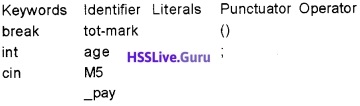
Plus Two Computer Application Chapter Wise Questions and Answers Chapter 1 Review of C++ Programming - 1

Question 11.
In C++ the size of the string “book” is 5 and that of “book\n” is 6. Check the validity of the above statement. Justify your answer.
Answer:
A string is automatically added by a null character(\0). The null character is treated as one character. So the size of string “book” is 5. Similarly, a null character (\0) is also added to “book\n”. \n and \0 is treated as single characters. Hence the size of the string “book\n” is 6.

Question 12.
Is 0 × 85B a valid integer constant in C++? If yes why?
Answer:
Yes. It is a hexa decimal number.

Question 13.
Pick the odd man out. Justify
TOTSAL, TOT_SAL, totsal5, Tot5_sal, SALTOT, tot.sal
Answer:
tot.sal. Because it contains a special character dot(.). An identifier cannot contain a special character. So it is not an identifier. The remaining satisfies the rules of naming identifier. So they are valid identifier.

Question 14.
Write a C++ statement to print the following sentence. Justify “\ is a special character”
Answer:

  1. cout<<“\\ is a special character”
  2. \\ is treated as an escape sequence.

Plus Two Computer Application Chapter Wise Questions and Answers Chapter 1 Review of C++ Programming

Question 15.
A student type a C++ program and saves it in his personal folder as Sample.cpp. After getting the output of the program, he checks the folder and finds three files namely Sample.cpp, Sample.obj and Sample.exe. Write the reasons for the generation of the two files in the folder.
Answer:
After the compilation of the program sample.cpp, the operating system creates two files if there is no error. The files are one object file (sample.obj) and one executable file(sample.exe). Now the source file(sample.cpp) and object file(sample.obj) are not needed and can be deleted. To run the program sample.exe is only needed.

Question 16.
Write a program to print the message “SMOKING IS INJURIOUS TO HEALTH” on screen.
Answer:
#include
using namespace std;
int main()
{
cout<<” SMOKING IS INJURIOUS TO HEALTH”;
}

Question 17.
Consider the following
short number;
number = 76543;
Is it valid. Explain?
Answer:
It is not valid. Because the data type int uses only two bytes(16 bits) of memory. That is we can store a total of 216 = 65536 integers. There are 2 types of integers negative integers and positive integers, i.e. 32768 each.

So we can store a number in between -32768 to +32767 (0 included in the positive section). The number 76543 is bigger than this range. Hence there is an error overflow. To store this number declare the variable is as follows.
long number;

Plus Two Computer Application Chapter Wise Questions and Answers Chapter 1 Review of C++ Programming

Question 18.
Consider the following declaration.
const int bp;
bp = 100;
Is it valid? Explain it?
Answer:
This is not valid. This is an error. A constant variable cannot be modified. That is the error and a constant variable must be initialised. So the correct declaration is as follows, const int bp = 100;

Question 19.
Consider the following statements in C++

  • cout<<41/2;
  • cout<<41/2.0;

Are this two statements give same result? Explain?
Answer:
This two statements do not give same results. The first statement 41/2 gives 20 instead of 20.5. The reason is 41 and 2 are integers. If two operands are integers the result must be integer, the real part must be truncated.

To get floating result either one of the operand must be float. So the second statement gives 20.5. The reason is 41 is integer but 2.0 is a float.

Question 20.
If mark = 70 then what will be the value of variable result in the following result = mark > 50? ‘P’: ‘F’;
Answer:
The syntax of the conditional operator is given below Condition? Value if true: Value if false; Here the conditional operator first checks the condition i.e.,70 > 50 it is true. So ‘P’ is assigned to the variable result. So the result is d ‘P’;

Question 21.
Is it possible to initialise a variable at the time of execution. What kind of initialisation is this? Give an example.
Answer:
Yes it is possible. This is known as Dynamic initialisation. The example is given below
Eg: int a=10, b=5;
int c = a*b;
here the variable c is declared and initialised with the value 10*5.

Plus Two Computer Application Chapter Wise Questions and Answers Chapter 1 Review of C++ Programming

Question 22.
Boolean data type is used to store True / False in C++. Is it true? Is there any data type called Boolean in C++?
Answer:
No there is no data type for storing boolean value true /false. But in C++ non -zero (either negative or positive) is treated as true and zero is treated as false.

Question 23.
Consider the following
n=-15;
if (n)
cout<<“Hello”;
else
cout<<“hai”;
What will be the output of the above code?
Answer:
The output is Hello, because n = -15 a non zero number and it is treated as true hence the result.

Question 24.
Is it possible to declare a variable in between the program as and when the need arise? Then what is it?
Answer:
Yes it is possible to declare a variable in between the program as and when the need arise. It is known as dynamic initialisation.
Eg. int x=10, y=20;
_____
_____
int z=x*y;

Question 25.
charch;
cout<<“Enter a character”; cin>>ch;
Considerthe above code, a user gives 9 to the variable ‘ch’. Is there any problem? Is it valid?
Answer:
There is no problem and it is valid since 9 is a character. Any symbol from the key board is treated as a character.

Plus Two Computer Application Chapter Wise Questions and Answers Chapter 1 Review of C++ Programming

Question 26.
“With the same size we can change the sign and range of data”. Comment on this statement.
Answer:
With the help of type modifiers we can change the sign and range of data with same size. The important modifiers are signed, unsigned, long and short.

Question 27.
Write short notes about C++ short hands?
Answer:
x = x + 10 can be represented as x+=10, It is called short hands in C++. It is faster. This is used with all the arithmetic operators as follows.

Arithmetic Assignment Expression Equivalent Arithmetic Expression
x+ = 10 x = x + 10
x- = 10 x = x -10
x* = 10 x = x * 10
x/ = 10 x = x /10
x% = 10 x = x % 10

Question 28.
What is the role of ‘const’ modifier?
Answer:
This ‘const’ key word is used to declare a constant. Eg. const int bp = 100; By this the variable bp is treated as constant and cannot be possible to change its value during execution.

Question 29.
Specify the most appropriate data type for handling the following data.

  1. Rollno. of a student.
  2. Name of an employee.
  3. Price of an article.
  4. Marks of 12 subjects

Answer:

  1. short Rollno;
  2. charname[20];
  3. float price;
  4. short marks[12];

Question 30.
Write C++ statement for the following.

  1. The result obtained when 5 is divided by 2.
  2. The remainder obtained when 5 is divided by 2.

Answer:

  1. 5/2
  2. 5%2

Question 31.
Predict the output of the following code. Justify.
int k = 5, b = 0;
b = k++ + ++k;
cout<<b; (2 Scores)
Answer:
Output is 12. In this statement first it take the value of k in 5 then increment it K++. So first operand for + is 5. Then it becomes 6. Then ++k makes it 7. This is the second operand. Hence the result is 12.

Plus Two Computer Application Chapter Wise Questions and Answers Chapter 1 Review of C++ Programming

Question 32.
Predict the output.

  1. int sum = 10, ctr= 5;
    sum = sum + ctr __;
    cout<<sum;
  2. int sum = 10, ctr = 5;
    sum = sum + ++ctr; court<<sum;

Answer:

  1. 15
  2. 16

Question 33.
Predict the output
int a;
float b;
a = 5;
cout<<sizeof(a + b/2);
Answer:
Output is 4. Result will be the memory size of floating point number.

Question 34.
Predict the output.
int a, b, c;
a = 5; b = 2;
c = a/b;
cout<<c;
Answer:
Output is 2. Both operands are integers. So the result will be an integer.

Question 35.
Explain cascading of i/o operations.
Answer:
The multiple use of input or output operators in a single statement is called cascading of i/o operators. Eg: To take three numbers by using one statement is as follows cin>>x>>y>>z; To print three numbers by using one statement is as follows. cout<<x<<y<<z;

Plus Two Computer Application Chapter Wise Questions and Answers Chapter 1 Review of C++ Programming

Question 36.
Trace out and correct the errors in the following code fragments

  1. cout<<“Mark=”45;
  2. cin<<“HellowWorld!”;
  3. cout>>”X + Y;
  4. Cout<<‘Good'<<‘Moming’

Answer:

  1. cout<<“Mark=45”;
  2. cout<<“HellowWorld!”;
  3. cout<<X + Y
  4. Cout<<“Good Morning”;

Question 37.
What do you mean by preprocessor directive?
Answer:
A C++ program starts with the preprocessor directive i.e., #include, #define, #undef, etc, are such a preprocessor directives. By using #include we can link the header files that are needed to use the functions. By using #define we can define some constants.
Eg. #definex100. Here the value of x becomes 100 and cannot be changed in the program.

Question 38
Write a program to print a message as ” Hello, Welcome to C++”.
Answer:
#include
using namespace std;
int main()
{
cout<<” Hello, Welcome to C++”;
}

Question 39.
Write a program to generate the following table.

2013 100%
2012 99.9%
2011 95.5%
2010 90.81%
2009 85%

Use a single cout statement for output
Answer:
# include
using namespace std;
int main ()
{
cout<<“2013\t 100%\n2012\t99.9%\n2011\t95.5%\n2010\t90.81%\n2009\t85%”;
}

Plus Two Computer Application Chapter Wise Questions and Answers Chapter 1 Review of C++ Programming

Question 40.
Determine the data type of the following expression If a is an int, b is a float, c is a long int and d is a double
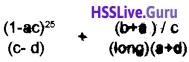
Plus Two Computer Application Chapter Wise Questions and Answers Chapter 1 Review of C++ Programming - 2
Answer:
In type promotion the operands with tower data type will be converted to the highest data type in the expression. So consider the following,
Plus Two Computer Application Chapter Wise Questions and Answers Chapter 1 Review of C++ Programming - 3
= double + long
= double (Which is the highest data type).

Question 41.
White writing a program Geo uses while loop but forgets to update the loop variable. What will happen?
Answer:
The loop variable inside the while loop must be updated otherwise the loop will not be terminated. The loop will be work infinitely.

Question 42.
Draw the flow chart of if statement.
Answer:
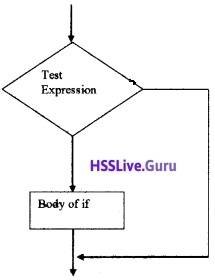
Plus Two Computer Application Chapter Wise Questions and Answers Chapter 1 Review of C++ Programming - 4

Question 43.
Draw the flow chart of if else statement.
Answer:
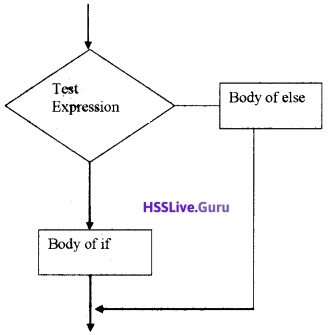
Plus Two Computer Application Chapter Wise Questions and Answers Chapter 1 Review of C++ Programming - 5

Plus Two Computer Application Chapter Wise Questions and Answers Chapter 1 Review of C++ Programming

Question 44.
Write a while loop that display numbers from 500 to 550.
Answer:
int i=500
while (i<=550)
{
cout<<i;
i=i+1;
}

Question 45.
Compare if else and conditional operator?
Answer:
We can use conditional operator as an alternative of if-else statement. The conditional operator is a ternary operator.
The syntax of if-else
if (expression 1)
expression 2;
else
expression 3;
First expression 1 is evaluated if it is true expression 2 will be executed otherwise expression 3 will be executed. Instead of this, we can be written as follows using conditional operator Expression 1? expression 2: expressions;

Question 46.
Draw the flow chart of for loop.
Answer:
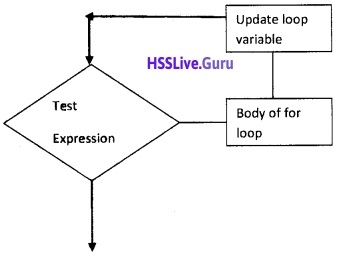
Plus Two Computer Application Chapter Wise Questions and Answers Chapter 1 Review of C++ Programming - 6

Plus Two Computer Application Chapter Wise Questions and Answers Chapter 1 Review of C++ Programming

Question 47.
Find out the error in syntax if any and correct it? esm<oi!Bl
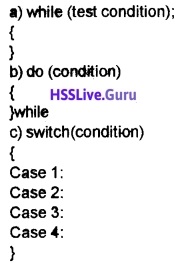
Plus Two Computer Application Chapter Wise Questions and Answers Chapter 1 Review of C++ Programming - 7
Answer:
a) No need of semi colon. The corrected loop is given below
while (test condition)
{
}

b) In do____white loop the while must be end with; semicoion.
do (condition)
{
}while;

c) switch contains expression instead of condition switch(expression)
{
Case 1:
Case 2:
Case 3:
Case 4:
}

Question 48.
State whether the following statements are True or False. In either case Justify your answer

  1. Break statements essential in switch
  2. For loop is an entry controlled loop
  3. Do____white loop is an entry controlled loop
  4. Switch is a selection statement

Answer:

  1. False. It is not essential in single case statement
  2. True. Because it will first check the condition. If it is true then only the body will be executed.
  3. False. It is an exit controlled loop.
  4. True.

Plus Two Computer Application Chapter Wise Questions and Answers Chapter 1 Review of C++ Programming

Question 49.
Given a code segment for(i=1; i<10; i++) cout<<i;

  1. Rewrite the code using do____while loop
  2. What will be the output when i=0? Give reason.

Answer:
1. i=1;
do{
cout<<i;
i++;
}while(i<10);

2. When i=0, it will execute one more time. ie. the for loop execute 9 times but here this loop executes 10 times.

Question 50.
Write the equivalent code for the following statement R=(P<Q?P: Q)
Answer:
if(P<Q)
R=P;
else
R=Q;

Question 51.
Examine the following code snippet and find out the output? What will happen if the statement int ch; is replaced char ch;
int ch;
for(ch=’A’;ch<=’Z’;++ch)
cout<<ch<<”;
Answer:
This code snippet will print 65, 66, 67, ______,90. If the statement int ch; is replaced by char ch; it prints A, B, C,_____,Z.

Question 52.
Your friend usee the following identifiers in a program. Find out the invalid identifiers with reason if not valid, basic pay area, data-of-birth, B3, 9A, switch
Answer:
basic pay – Invalid because white space is not allowed.
area – valid
date-of-birth – Invalid because hyphen(-) is not allowed.
B3 – Valid
9A – Invalid because should not begin with number.
switch – Invalid because keywords not allowed.

Plus Two Computer Application Chapter Wise Questions and Answers Chapter 1 Review of C++ Programming

Question 53.
int x=5;
int y=10;
cout<<(x+y)%2;
Answer:
(x+y) % 2 = (5+10)%2 = 15% 2 =1 It prints 1.

Question 54.
Classify the following C++ tokens in accordance to the table given below.

Plus Two Computer Application Chapter Wise Questions and Answers Chapter 1 Review of C++ Programming - 8
Answer:
keyword: int, do
Identifier: digit, cin(pre defined identifier, eg. int cin; is possible);
Literal: “break”(string literal), 25.6(float literal).
Operator: %(Mod operator), = (assignment operator).

Question 55.
Rewrite the following C++ code using conditional operator.
if (a>b)
max=a;
else
max=b;
Answer:
max=(a>b)?a:b;

Question 56.
Write the C++ expression to calculate the value of the following expression.

  1. x = \(\frac{\left(b^{2}-4 a c\right)}{2 a}\)
  2. y = a2 + 2ab + b2

Answer:

  1. x= (b*b – 4*a*c)/(2*a);
  2. y= a*a + 2*a*b + b*b;

Question 57.
Consider the following code and predict the output. Justify your answer.
for(int i=i;i<10;++i)
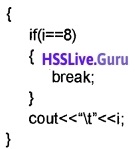
Plus Two Computer Application Chapter Wise Questions and Answers Chapter 1 Review of C++ Programming - 9
Answer:
The output is 1 2 3 4 5 6 7. This loop is used to print 1 to 10 but this loop will terminate when the value of i becomes 8. Hence it prints 1 to 7.

Plus Two Computer Application Chapter Wise Questions and Answers Chapter 1 Review of C++ Programming

Question 58.
Predict the output for the following program code.
for(i=1;i<=10;++i)
{
if (i==7)
coutinue;
cout<<“\t”;
cout<< i;
}
Answer:
The output is 1 2 3 4 5 6 8 9 10.
This loop is used to print 1 to 10 but this loop will by pass one iteration when the value of i becomes 7. Hence it prints 1 to 10 except 7.

Question 59.
How many times the following loop will be executed?
int s = 0, i = 0;
do
{
S+= i;
i++;
} while(i < = 5);
Answer:
This loop will be executed 6 times. The value of i becomes 1 to 6.

Plus Two Computer Application Review of C++ Programming Three Mark Questions and Answers

Question 1.
In a panchayath or municipality, all the houses have a house number, house name, and members. Similar situation is in the case of memory. Explain.
Answer:
The named memory locations are called variable. A variable has three important things

  1. variable name: A variable should have a name
  2. Memory address: Each and every byte of memory has an address. It is also called location (L) value
  3. Content: The value stored in a variable is called content.lt is also called Read(R) value.

Plus Two Computer Application Chapter Wise Questions and Answers Chapter 1 Review of C++ Programming

Question 2.
Briefly explain constants
Answer:
A constant or a literal is a data item its value doe not change during execution. The keyword const is used to declare a constant. Its declaration is as follows
const data type variable name=value;
eg.const int bp = 100;
const float pi = 3.14157;
const char ch = ‘a’;
const char[] = “Alvis”;

1. Integer literals:
Whole numbers without fractional parts are known as integer literals, its value does not change during execution. There are 3 types decimal, octal, and hexadecimal.
Eg. For decimal 100,150,etc
For octal 0100,0240, etc
For hexadecimal 0 × 100, 0 × 1A,etc.

2. Float literals:
A number with fractional parts and its value does not change during execution is called floating point literals.
Eg. 3.14157,79.78,etc.

3. Character literal:
A valid C++ character enclosed in single quotes, its value does not change during execution.
Eg. ‘m’, ‘f, etc.

4. String literal:
One or more characters enclosed in double quotes is called string constant. A string is automatically appended by a null charater(‘\0’)
Eg. “Mary’s”,”India”,etc.

Question 3.
Considerthe following statements
int a=10, x=20;
float b=49000.34, y=56.78;

  1. a=b;
  2. y=x;

Is there any problem for the above statements? What do you mean by type compatibility?
Answer:
Assignment operator is used to assign the value of RHS to LHS. Following are the two chances

  1. The size of RHS is less than LHS. So there is no problem and RHS data type is promoted to LHS. Here it is compatible.
  2. The size of RHS is higher than LHS. Here comes the problem sometimes LHS cannot possible to assign RHS. There may be a chance of wrong answer. Here it is not compatible.
    Here

    • a=b; There is an error since the size of LHS is 2 but the size of RHS is 4.
    • y=x; There is no problem because the size of LHS is 4 and RHS is 2.

Plus Two Computer Application Chapter Wise Questions and Answers Chapter 1 Review of C++ Programming

Question 4.
A company has decided to give incentives to their salesman as per the sales. The criteria is given below.
If the total sales exceeds 10,000 the incentive is 10%

  1. If the total sales >=5,000 and total sales <10,000, the incentive is 6 %
  2. If the total sales >=1,000 and total sales <5,000, the incentive is 3 %

Write a C++ program to solve the above problem and print the incentive after accepting the total sales of a salesman. The program code should not make use of if statement.
Answer:
# include
using namespace std;
int main()
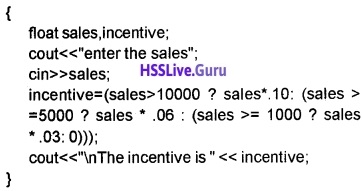
Plus Two Computer Application Chapter Wise Questions and Answers Chapter 1 Review of C++ Programming - 10

Question 5.
A C++ program code is given below to find the value of X using the expression
X = \(\frac{a^{2}+b^{2}}{2 a}\) where a and b are variables 2a
# include
using namespace std;
int main()
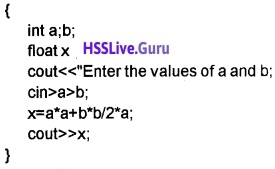
Plus Two Computer Application Chapter Wise Questions and Answers Chapter 1 Review of C++ Programming - 11
Pre did the type of errors during compilation, execution, and verification of the output. Also write the output of two sets of input values

  1. a=4, b=8
  2. a=0, b=2

Answer:
This program contains some errors and the correct program is as follows.
#include
using namespace std;
int main()
Plus Two Computer Application Chapter Wise Questions and Answers Chapter 1 Review of C++ Programming - 12
The output is as follows

  1. a=4 and b= 8 then the output is 10
  2. a=0 and b= 2 then the output is an error divide by zero error(run time error).

Plus Two Computer Application Chapter Wise Questions and Answers Chapter 1 Review of C++ Programming

Question 6.
We know that a program has a structure. Explain the structure of C++ program.
Answer:
A typical C++ program would contain four sections as shown below.
Include files
Function declarations
Function definitions
Main function programs
Eg.
# include
using namespace std;
int sum(int x, int y)
{return (x+y);}
int main()
{
cout<<sum(2,3);
}
}

Question 7.
Write a program to read two numbers and find its sum.
Answer:
#include
using namespace std;
int main()
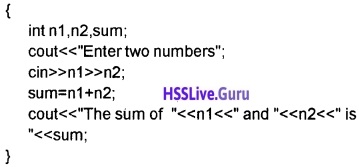
Plus Two Computer Application Chapter Wise Questions and Answers Chapter 1 Review of C++ Programming - 13

Question 8.
Write a program to read three scores and find the average.
Answer:
#include
using namespace std;
int main()
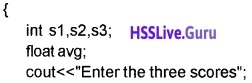
Plus Two Computer Application Chapter Wise Questions and Answers Chapter 1 Review of C++ Programming - 14
Plus Two Computer Application Chapter Wise Questions and Answers Chapter 1 Review of C++ Programming - 15

Question 9.
Write a program to find the area and perimeter of a circle.
Answer:
#include
using namespace std;
int main()
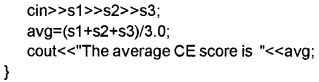
Plus Two Computer Application Chapter Wise Questions and Answers Chapter 1 Review of C++ Programming - 16

Plus Two Computer Application Chapter Wise Questions and Answers Chapter 1 Review of C++ Programming

Question 10.
Write a program to find the simple interest
Answer:
# include
using namespace std;
int main()
Plus Two Computer Application Chapter Wise Questions and Answers Chapter 1 Review of C++ Programming - 17

Question 11.
Write a program to convert temperature from Celsius to Fahrenheit.
Answer:
# include
using namespace std;
int main()
Plus Two Computer Application Chapter Wise Questions and Answers Chapter 1 Review of C++ Programming - 18

Question 12.
Write a program to read weight in grams and convert it into Kilogram.
Answer:
# include
using namespace std;
int main()
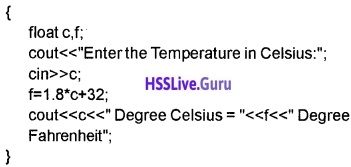
Plus Two Computer Application Chapter Wise Questions and Answers Chapter 1 Review of C++ Programming - 19

Plus Two Computer Application Chapter Wise Questions and Answers Chapter 1 Review of C++ Programming

Question 13.
Write a program to read your height in meter and cm convert it into Feet and inches
Answer:
# include
using namespace std;
int main()
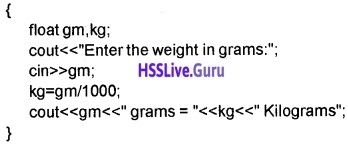
Plus Two Computer Application Chapter Wise Questions and Answers Chapter 1 Review of C++ Programming - 20

Question 14.
Write a program to find the area of a triangle.
Answer:
# include
using namespace std;
int main()
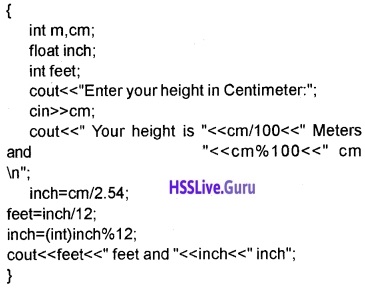
Plus Two Computer Application Chapter Wise Questions and Answers Chapter 1 Review of C++ Programming - 21

Question 15.
Write a program to

  1. print ASCII for a given digit.
  2. print ASCII for backspace.

Answer:
# include
using namespace std;
int main()
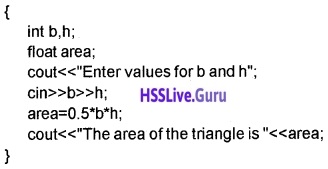
Plus Two Computer Application Chapter Wise Questions and Answers Chapter 1 Review of C++ Programming - 22

Plus Two Computer Application Chapter Wise Questions and Answers Chapter 1 Review of C++ Programming

Question 16.
Write a program to read time in seconds and convert it into hours, minutes and seconds.
Answer:
# include
using namespace std;
int main()
Plus Two Computer Application Chapter Wise Questions and Answers Chapter 1 Review of C++ Programming - 23

Question 17.
Two pairs C++ expressions are given below.

  1. a=10, a==10
  2. b=a++, b=++a
    • How do they differ?
    • What will be the effect of the expression

Answer:
1. = is an assignment operator that assigns a value 10 to the LHS (Left Hand Side)variable a But == is equality operator that checks whether the LHS and RHS are equal or not. If it is equal it returns a true value otherwise false

2. In a++,++is a post(means after the operand) increment operator and in ++a, ++ is a pre(means before the operand) increment operator. They are entirely different.

Post increment:
Here first use the value of ‘a’ and then change the value of ‘a’.
Eg: if a= 10 then b=a++. After this statement b= 10 and a=11

Pre increment:
Here first change the value of a and then use the value of a.
Eg: if a=10 then b=++a. Afterthis statement b=11 and a=11.

Plus Two Computer Application Chapter Wise Questions and Answers Chapter 1 Review of C++ Programming

Question 18.
Consider the following
int a=45.65;
cout<<a;
What is the output of the above. Is it possible to convert a data type to another type? Explain.
Answer:
The output of the code is 45, the floating-point number is converted into integer. It is possible to convert a data type into another data type. Type conversions are two types.

1. Implicit type conversion:
This is performed by C++ compiler internally. C++ converts all the lower sized data type to the highest sized operand. It is known as type promotion. Data types are arranged lower size to higher size is as follows, unsigned int(2 bytes), int(4 bytes), long(4 bytes), unsigned long(4 bytes), float(4 bytes), double(8 bytes), long double(10 bytes).

2. Explicit type conversion:
It is known as type casting. This is done by the programmer. The syntax is given below.
(data type to be converted) expression
Eg.int x=10;
(float) x; This expression converts the data type of the variable from integer to float.

Question 19.
Your friend Arun asked you that is there any loop that will do three things, initialization, testing, and updation. What is your answer? Explain?
Answer:
Yes. There is only one loop namely for loop that will do this three things. The other loops will do the checking only, initialisation must be do before the loop and updation must be inside the loop.
The syntax of for loop is given below
For(initialisation; testing; updation)
{
Body of the for loop;
}

Question 20.
Distinguish between exit(0) function and return statement
Answer:
Both are used to terminate the program but both are different. Return is a keyword and exit(O) is a function. The difference is, we can use more than one exit(0) function but we can use only one return statement in a scope. To use exit(0), the header file cstdlib should be used.

Plus Two Computer Application Chapter Wise Questions and Answers Chapter 1 Review of C++ Programming

Question 21.
Rewrite the program following program using if else
#include
using namespace std;
int main()
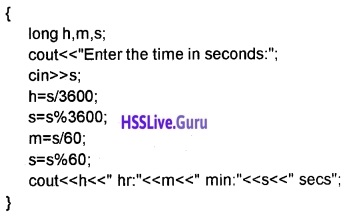
Plus Two Computer Application Chapter Wise Questions and Answers Chapter 1 Review of C++ Programming - 24
Answer:
# include
using namespace std;
int main()
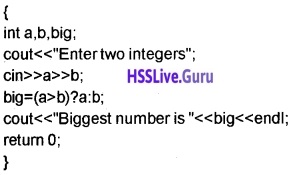
Plus Two Computer Application Chapter Wise Questions and Answers Chapter 1 Review of C++ Programming - 25

Question 22.
Rewrite the following using nested switch construct.
#include
using namespace std;
int main()
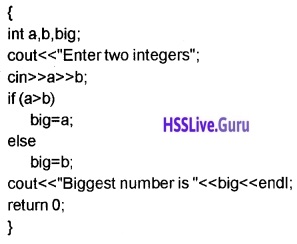
Plus Two Computer Application Chapter Wise Questions and Answers Chapter 1 Review of C++ Programming - 26
Plus Two Computer Application Chapter Wise Questions and Answers Chapter 1 Review of C++ Programming - 27
Answer:
#include
using namespace std;
int main()
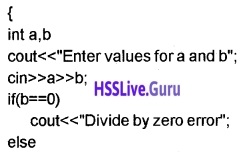
Plus Two Computer Application Chapter Wise Questions and Answers Chapter 1 Review of C++ Programming - 28

Plus Two Computer Application Chapter Wise Questions and Answers Chapter 1 Review of C++ Programming

Question 23.
Consider the following output and write down the code for the same.
Plus Two Computer Application Chapter Wise Questions and Answers Chapter 1 Review of C++ Programming - 29
Answer:
include
using namespace std;
int main()
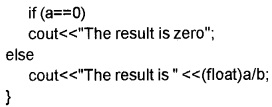
Plus Two Computer Application Chapter Wise Questions and Answers Chapter 1 Review of C++ Programming - 30

Question 24.
Consider the following output and write down the code for the same.
Plus Two Computer Application Chapter Wise Questions and Answers Chapter 1 Review of C++ Programming - 31
Answer:
# include
using namespace std;
int main()
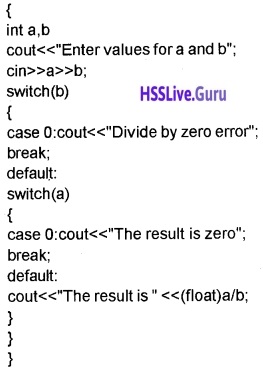
Plus Two Computer Application Chapter Wise Questions and Answers Chapter 1 Review of C++ Programming - 32

Question 25.
Consider the following output and write down the code for the same.
Plus Two Computer Application Chapter Wise Questions and Answers Chapter 1 Review of C++ Programming - 33
Answer:
# include
using namespace std;
int main()
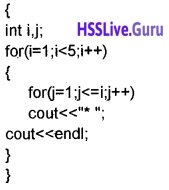
Plus Two Computer Application Chapter Wise Questions and Answers Chapter 1 Review of C++ Programming - 34

Plus Two Computer Application Chapter Wise Questions and Answers Chapter 1 Review of C++ Programming

Question 26.
Consider the following output and write down the code for the same.
Plus Two Computer Application Chapter Wise Questions and Answers Chapter 1 Review of C++ Programming - 35
Answer:
# include
using namespace std;
int main()
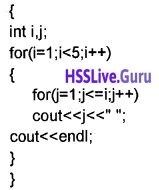
Plus Two Computer Application Chapter Wise Questions and Answers Chapter 1 Review of C++ Programming - 36

Question 27.
Consider the following output and write down the code for the same.
Plus Two Computer Application Chapter Wise Questions and Answers Chapter 1 Review of C++ Programming - 37
Answer:
#include
using namespace std;
int main()
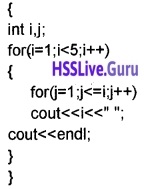
Plus Two Computer Application Chapter Wise Questions and Answers Chapter 1 Review of C++ Programming - 38

Question 28.
Consider the following output and write dawn the code for the same.
Plus Two Computer Application Chapter Wise Questions and Answers Chapter 1 Review of C++ Programming - 39
Answer:
#include
using namespace std;
int main()
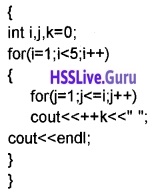
Plus Two Computer Application Chapter Wise Questions and Answers Chapter 1 Review of C++ Programming - 40

Plus Two Computer Application Chapter Wise Questions and Answers Chapter 1 Review of C++ Programming

Question 29.
Write a program to print the sum of first n natural numbers
Answer:
# include
using namespace std;
int main()
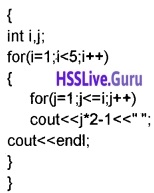
int n,i,sum=0;
cout<<“Entera value torn”; cin>>n;
for(i=1;i<=n;i++)
Plus Two Computer Application Chapter Wise Questions and Answers Chapter 1 Review of C++ Programming - 41

Question 30.
Write a program to read a number and check whether it is palindrome or not
Answer:
# include
using namespace std;
int main()
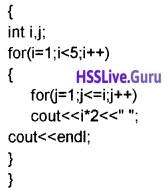
Plus Two Computer Application Chapter Wise Questions and Answers Chapter 1 Review of C++ Programming - 42

Question 31.
Write a program to print the factorial of a number.
Answer:
#include
using namespace std;
int main()
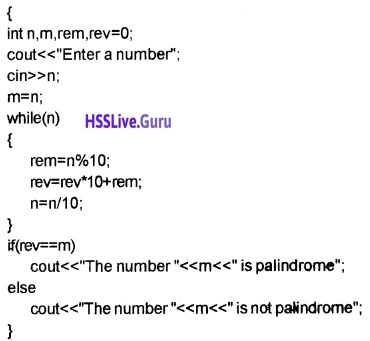
Plus Two Computer Application Chapter Wise Questions and Answers Chapter 1 Review of C++ Programming - 43

Plus Two Computer Application Chapter Wise Questions and Answers Chapter 1 Review of C++ Programming

Question 32.
Write a program to print the Fibonacci series Fibonacci
Answer:
# include
using namespace std;
int main()
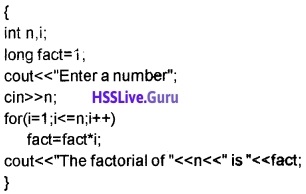
Plus Two Computer Application Chapter Wise Questions and Answers Chapter 1 Review of C++ Programming - 44
Plus Two Computer Application Chapter Wise Questions and Answers Chapter 1 Review of C++ Programming - 45

Question 33.
Write a program to read a number and check whether the given number is Armstrong or not
Answer:
# include
using namespace std;
int main()
Plus Two Computer Application Chapter Wise Questions and Answers Chapter 1 Review of C++ Programming - 46

Question 34.
Distinguish between entry controlled loop and exit controlled loop
Answer:
An entry controlled loop first checks the condition and execute(or enters in to) the body of loop only if it is true. But exit control loop first execute the body of the loop once even if the condition is false then check the condition. The for loop and while loop are entry controlled loops but do-while loop is an exit controtted loop.

Plus Two Computer Application Chapter Wise Questions and Answers Chapter 1 Review of C++ Programming

Question 35.
Write a program to find the largest of 3 numbers
Answer:
#include
using namespace std;
int main()
Plus Two Computer Application Chapter Wise Questions and Answers Chapter 1 Review of C++ Programming - 47

Question 36.
Check whether a given number is prime or not
Answer:
#include
using namespace std;
int main()
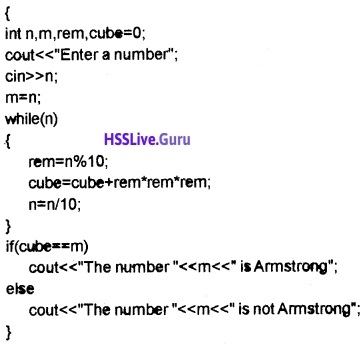
Plus Two Computer Application Chapter Wise Questions and Answers Chapter 1 Review of C++ Programming - 48

Question 37.
Write a program to read number and display its factors.
Answer:
# include
using namespace std;
int main()
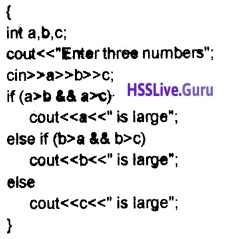
Plus Two Computer Application Chapter Wise Questions and Answers Chapter 1 Review of C++ Programming - 49

Plus Two Computer Application Chapter Wise Questions and Answers Chapter 1 Review of C++ Programming

Question 38.
You are given the heights of 3 students. Write the relevant code segment to find the maximum height?
Answer:
# include
using namespace std;
int main()
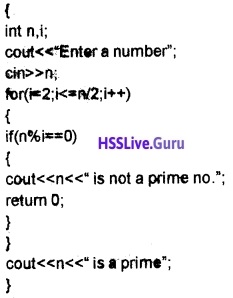
Plus Two Computer Application Chapter Wise Questions and Answers Chapter 1 Review of C++ Programming - 50

Question 39.
Write the easiest code snippet for printing your name 1000 times. Explain
Answer:
# include
using namespace std;
int main()
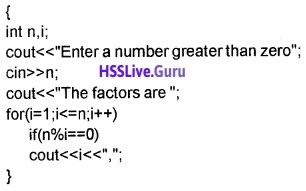
Plus Two Computer Application Chapter Wise Questions and Answers Chapter 1 Review of C++ Programming - 51

Question 40.
Whenever a string is entered the inverse of that string is displayed( eg: if we enter ‘CAR’ the output is ‘RAC’). Write a suitable programme for the output.
Answer:
#include
#include
using namespace std;
int main()
Plus Two Computer Application Chapter Wise Questions and Answers Chapter 1 Review of C++ Programming - 52

Plus Two Computer Application Chapter Wise Questions and Answers Chapter 1 Review of C++ Programming

Question 41.
Write a C++ program to display as follows
Plus Two Computer Application Chapter Wise Questions and Answers Chapter 1 Review of C++ Programming - 53
Answer:
#include
using namespace std;
int main()
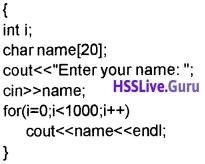
Plus Two Computer Application Chapter Wise Questions and Answers Chapter 1 Review of C++ Programming - 54

OR

#include
using namespace std;
int main()
Plus Two Computer Application Chapter Wise Questions and Answers Chapter 1 Review of C++ Programming - 55

Question 42.
Consider the following code The new line.character is \n. The output of the following code does not contain the \n. Why it is happened? Explain.
Answer:
\n is a character constant and it is also known as escape sequence. This is used to represent the non graphic symbols such as carriage return key(enter key), tab key, back space, space bar, etc. It con¬sists of a back slash symbol and one more characters.

Escape sequence Non-graphic character
\a Audible bell
\b back space
\n for new line
\r carnage return
\t horizontal tab
\v vertical tab
\\ to print \
\’ to print ‘
\” to print ”
\? To print?
\0 null character

Plus Two Computer Application Chapter Wise Questions and Answers Chapter 1 Review of C++ Programming

Question 43.
The Maths teacher gives the following problem to Riya and Raju.
x= 5 + 3 * 6. Riya got x = 48 and Raju got x = 23. Who is right and why it is happened? Write down the operator precedence in detail?
Answer:
Here the answer is x = 23. It is because of precedence of operators. The order of precedence of operators are given below.
Plus Two Computer Application Chapter Wise Questions and Answers Chapter 1 Review of C++ Programming - 56
Here multiplication has more priority than addition.

Question 44.
Rewrite the following code using while and do..while loop.
for(i=1;i<5;++i)
{
cout<<“\n”<<i;
}
Answer:
1. using while loop
i=1;
while(i<=5)
{
cout<<“\n”<<i;
i++;
}

2. using do while loop
i=1;
do
cout<<“\n”<<i;
i++;
}while(i<=5);

Plus Two Computer Application Chapter Wise Questions and Answers Chapter 1 Review of C++ Programming

Question 45.
Rewrite the following C++ code using switch
statement.
Plus Two Computer Application Chapter Wise Questions and Answers Chapter 1 Review of C++ Programming - 57
Answer:
switch(choice)
Plus Two Computer Application Chapter Wise Questions and Answers Chapter 1 Review of C++ Programming - 58

Question 46.
Considerthe following code and predict the output
int a=5, b=6, c=7;
if (a<b) || b>c)
cout<<“\nOne”;
if (a<b&&b>c)
cout<<“\nTwo”; if (! *a>b)
cout<<“\nThree”;
Answer:
case 1:
if(ac)
cout<<“\nOne”;
here ac
5<6 || 6>7
True || False = True.
This condition returns True
Hence it prints One.

case 2:
if(ac)
cout<<“\nTwo”;
here ac
5<6 && 6>7
True && False = False
This condition returns False
Hence it prints nothing.

Case 3:
if(! (a>b))
cout<<“\nThree”); here !(a>b)
! (5 >6)
! (False)
This condition returns True
Hence it prints Three.

Plus Two Computer Application Chapter Wise Questions and Answers Chapter 1 Review of C++ Programming

Question 47.
Match the following

Name Symbol
Modulus operator + +
Logical operator = =
Relational operator =
Assignment operator ?=
Increment operator %
Conditional operator &&

Answer:

Name Symbol
Modulus operator %
Logical operator &&
Relational operator = =
Assignment operator =
Increment operator + +
Conditional operator ?=

Question 48.
Write a C++ program to calculate the simple interest SI, by accepting the value principal amount P, rate of interest R and number of years N using the equation SI = PNR/100.
Answer:
# include
using namespace std;
int main()
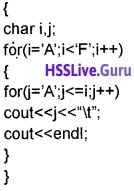
Plus Two Computer Application Chapter Wise Questions and Answers Chapter 1 Review of C++ Programming - 59

Plus Two Computer Application Chapter Wise Questions and Answers Chapter 1 Review of C++ Programming

Question 49.
Rewrite the following conditional statement with ‘if statement in C++.
min=(a<b) ? (a<c? a:c) : (b<c? b:c);
Answer:
if(a<b && a<c)
min=a;
else if(b<c) min=b; else min=c;

Plus Two Computer Application Review of C++ Programming Five Mark Questions and Answers

Question 1.
Define operator and explain operators in detail. Operators
Answer:
An operator is a symbol that performs an operation. The data on which operations are carried out are called operands. Following are the operators.
1. Input(>>) and output(<<) operators are used to perform input and output operation. Eg. cin>>n; cout<<n;

2. Arithmetic operators:
It is a binary operator. It is used to perform addition(+), subtraction (-), division (/), multiplication (*) and modulus (%-gives the remainder) operations.
Eg. If x=10 and y=3 then
Plus Two Computer Application Chapter Wise Questions and Answers Chapter 1 Review of C++ Programming - 60
x/y = 3, because both operands are integer. To get the floating point result one of the operand must be float.

3. Relational operator:
It is also a binary operator. It is used to perform comparison or relational operation between two values and it gives either true(1) or false(O). The operators are <,<=,>,>=,== (equality)and !=(not equal to)
Eg. If x=10 and y=3 then
Plus Two Computer Application Chapter Wise Questions and Answers Chapter 1 Review of C++ Programming - 61

4. Logical operators:
Here AND(&&), OR (||) are binary operators and NOT (!) is a unary operator. It is used to combine relational operations and it gives either true (1) or false (0).
If x=1 and y=0 then
Plus Two Computer Application Chapter Wise Questions and Answers Chapter 1 Review of C++ Programming - 90
Both operands must be true to get a true value in the case of AND (&&) operation
If x=1 and y=0 then
Plus Two Computer Application Chapter Wise Questions and Answers Chapter 1 Review of C++ Programming - 62
Either one of the operands must be true to get a true value in the case of OR(||) operation
If x=1 and y=0 then
Plus Two Computer Application Chapter Wise Questions and Answers Chapter 1 Review of C++ Programming - 63

5. Conditional operator:
It is a ternary operator hence it needs three operands. The operator is?: Syntax: expression? value if true: value if false. First evaluates the expression if it is true the second part will be executed otherwise the third part will be executed.
Eg. If x=10 and y=3 then
x>y? cout<< Here the output is 10.

6. sizeof():
This operator is used to find the size used by each data type.
Eg. sizeof(int) gives 2.

7. Increment and decrement operator:
These are unary operators.

  • Increment operator (++): It is used to increment the value of a variable by one i.e., x++ is equivalent to x=x+1;
  • Decrement operator (–): It is used to decrement the value of a variable by one i.e., x- is equivalent to x = x-1.

8. Assignment operator (=):
It is used to assign the value of a right side to the left side variable.eg. x=5; Here the value 5 is assigned to the variable x.

Plus Two Computer Application Chapter Wise Questions and Answers Chapter 1 Review of C++ Programming

Question 2.
A list of data items are given below
45, 8.432, M, 0.124, 8, 0, 8.1X 1031, 1010, a, 0.00025, 9.2 × 10120, 0471, -846, 342.123E03

  1. Categorise the given data under proper headings of fundamental data types in C++
  2. Explain the specific features of each data type. Also mention any other fundamental data type for which sample data is not given

Answer:
1.
Plus Two Computer Application Chapter Wise Questions and Answers Chapter 1 Review of C++ Programming - 64

2.
(i) int data type:
It is used to store whole numbers without fractional (decimal point) part. It can be either negative or positive. It consumes 4 bytes (32 bits) of memory. i.e. 232 numbers. That is 231 negative numbers and 231 positive numbers (0 is considered as +ve) So a total of 232 numbers. We can store a number in between -231 to + 231-1.

(ii) char data type:
Any symbol from the key board, eg. ‘A’,’?’, ‘9’,___It consumes one byte( 8 bits) of memory. It is internally treated as integers, i.e. 28 = 256 characters. Each character is having a ASCII code, ‘a’ is having ASCI I code 97 and zero is having ASCII code 48.

(iii) float data type:
It is used to store real numbers i.e. the numbers with decimal point. It uses 4 bytes(32 bits) of memory. Eg. 67.89, 89.9 E-15.

(iv) double data type:
It is used to store very large real numbers. It uses 8 bytes(64 bits) of memory.
void data type:- void means nothing. It is used to represent a function returns nothing.

Question 3.
Write valid reasons after reading the following statements in C++ and comment on their correctness by give reasons.

  1. char num = 66;
  2. char num – B’;
  3. 35 and 35L are different
  4. The number 14,016 and OxE are one and the same
  5. Char data type is often said to be an integer type
  6. To store the value 4.15 float data type is preferred over double

Answer:

  1. The ASCII number of B is 66. So it is equivalent.
  2. 35 is of integer type but 35L is Long
  3. The decimal number 14 is represented in octal is 016 and in hexadecimal is OxE.
  4. Internally char data type stores ASCII numbers.
  5. To store the value 4.15 float data type is better because float requires only 4 bytes while double needs 8 bytes hence we can save the memory.

Plus Two Computer Application Chapter Wise Questions and Answers Chapter 1 Review of C++ Programming

Question 4.
Suggest most suitable derived data types in C++ for storing the following data items or statements

  1. 0 Age of 50 students in a class
  2. Address of a memory variable
  3. A set of instructions to find out the factorial of a number
  4. An alternate name of a previously defined variable
  5. Price of 100 products in a consumer store
  6. Name of a student

Answer:

  1. Integer array of size 50
  2. Pointer variable
  3. Function
  4. Reference
  5. Float array of size 100
  6. Character array

Question 5.
Considering the following C++ statements. Fill up the blanks

  1. lf p=5 and q=3 then q%p is _____
  2. If E1 is true and E2 is False then E1 && E2 will be_____
  3. If k=8, ++k <= 8 will be______
  4. If x=2 then (10* ++x) % 7 will be_____
  5. If t=8 and m=(n=3,t-n), the value of m will be______
  6. If i=12 the value i after execution of the expres¬sion i+=i– + –i will be______

Answer:

  1. 3
  2. False
  3. False(++k makes k=9. So 9<=8 is false)
  4. 2(++x becomes 3, so 10 * 3 =30%7 =2)
  5. 5( here m=(n=3,8-3)=(n=3,5), so m=5, The maximum value will take)
  6. Here i=12

i + = i– + –i
here post decrement has more priority than pre decrement. So i — will be evaluated first. Here first uses the value then change so it uses the value 12 and i becomes 11
i + =12 + –i
now i =11.
Here the value of i will be changed and used so i– becomes 10
i + = 12 + 10
= 22
So i = 22 + 10
i = 32
So the result is 32.

Plus Two Computer Application Chapter Wise Questions and Answers Chapter 1 Review of C++ Programming

Question 6.
Analyses the following statements and write Time or False. Justify

  1. There is an Operator in C++ having no special character in it
  2. An operator cannot have more than 2 operands
  3. Comma operator has the lowest precedence
  4. All logical operators are binary in nature
  5. It is not possible to assign the constant 5 to 10 different variables using a single C++ expression
  6. In type promotion the operands with lower data type will be converted to the highest data type in expression

Answer:

  1. True (sizeof operator)
  2. False( conditional operator can have 3 operands
  3. True
  4. False
  5. False(Multiple assignment is possible, eg: a=b=c=___=5)
  6. True

Question 7.
Match the following numbers and data types in C++ to form the most suitable pairs.

1. 142789 a. Signed
2. 240 b. Double
3. -150 c. Long int
4. 8.4 × 10-4000 d. Float
5. 0 e. Long double
6. 0.0008 f. Unsigned short
7. -127 g. Short int
8. 2.8 × 10308 h. Signed char

Answer:

1. 142789 a.  Long int
2. 240 b. Short int
3. -150 c.  Signed
4. 8.4 × 10-4000 d.  Long double
5. 0 e.  Unsigned short
6. 0.0008 f.   Float
7. -127 g.  Signed char
8. 2.8 × 10308 h.  Double

Plus Two Computer Application Chapter Wise Questions and Answers Chapter 1 Review of C++ Programming

Question 8.
#include
using namespace std;
int main()
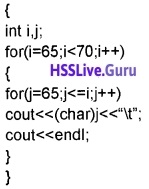
Plus Two Computer Application Chapter Wise Questions and Answers Chapter 1 Review of C++ Programming - 65
Rewrite the above code using if else if ladder.
Answer:
#include
using namespace std;
int main()
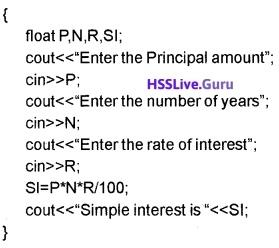
Plus Two Computer Application Chapter Wise Questions and Answers Chapter 1 Review of C++ Programming - 66
Plus Two Computer Application Chapter Wise Questions and Answers Chapter 1 Review of C++ Programming - 67

Question 9.
Consider the following code
# include
using namespace std;
int main()
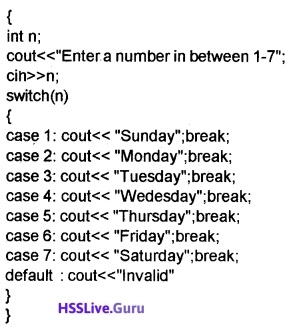
Plus Two Computer Application Chapter Wise Questions and Answers Chapter 1 Review of C++ Programming - 68
Is it possible to rewrite the above program using switch statement? Distinguish between switch and if else if ladder. Answer:
No. It is not possible to write the above code using switch statement. Following are the difference between switch and if else if ladder.

  1. Switch can test only for equality but if can evaluate a relational or logical expression
  2. If else is more versatile
  3. If else can handle floating values but switch can not
  4. If the test expression contains more variable if else is used
  5. Testing a value against a set of constants switch is more efficient than if else

Plus Two Computer Application Chapter Wise Questions and Answers Chapter 1 Review of C++ Programming

Question 10.
Write down the code for the following output using while loop.
Plus Two Computer Application Chapter Wise Questions and Answers Chapter 1 Review of C++ Programming - 69
Answer:
# include
using namespace std;
int main()
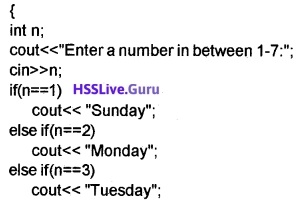
Plus Two Computer Application Chapter Wise Questions and Answers Chapter 1 Review of C++ Programming - 70

Question 11.
“We know that the execution of a program is sequential”. Is it possible to change this sequential manner and explain different jump statements in detail.
Answer:
The execution of a program is sequential but we can change this sequential manner by using jump statements. The jump statements are
1. goto statement:
By using goto we can transfer the control anywhere in the program without any condition. The syntax is goto label; Eg. # include
using namespace std;
int main()
Plus Two Computer Application Chapter Wise Questions and Answers Chapter 1 Review of C++ Programming - 71

2. break statement:
It is used to skip over a part of the code i.e. we can premature exit from a loop such as while, do-while, for or switch. Syntax:
while (expression)
Plus Two Computer Application Chapter Wise Questions and Answers Chapter 1 Review of C++ Programming - 72
The output is
1
2
3
4
5.

3. continue statement:
It bypasses one iteration of the loop.
Syntax:
while (expression)
Plus Two Computer Application Chapter Wise Questions and Answers Chapter 1 Review of C++ Programming - 73
The output is
1
2
3
4
5
6
7
8
9
10.

4. exit(O) function:
It is used to terminate the program. For this the header file cstdlib must be included.

Plus Two Computer Application Chapter Wise Questions and Answers Chapter 1 Review of C++ Programming

Question 12.
Write a program to print the prime numbers less than 100
Answer:
# include
using namespace std;
int main()
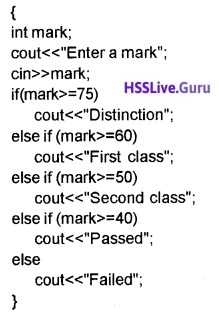
Plus Two Computer Application Chapter Wise Questions and Answers Chapter 1 Review of C++ Programming - 74

Question 13.
Write a program to print the Armstrong numbers less than 1000
Answer:
# include
using namespace std;
int main()
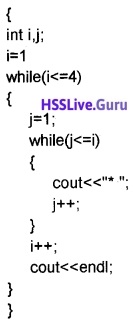
Plus Two Computer Application Chapter Wise Questions and Answers Chapter 1 Review of C++ Programming - 75

Question 14.
Given the total mark of each student in SSLC examination. Write a C++ code fragment to find the grades.
Answer:
# include
using namespace std;
int main()
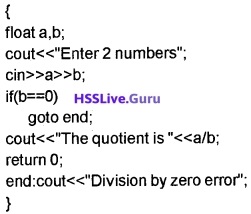
Plus Two Computer Application Chapter Wise Questions and Answers Chapter 1 Review of C++ Programming - 76

Plus Two Computer Application Chapter Wise Questions and Answers Chapter 1 Review of C++ Programming

Question 15.
You are about to study the fundamentals of C++ programming Language. Do a comparative study of the basics of the new language with that of a formal language like English or Malayalam to familiarize C++?. Provide sufficient explanations for the compared items in C++ Language.
Answer:
Character set:
To study a language first we have to familiarize the character set. For example to study English language first we have to study the alphabets. Similarly here the characterset includes letters(A to Z & a to z), digits(0 to 9), special characters(+,-,?,*,/,___) white spaces(non printable) etc. Token: It is the smallest individual units similar to a word in English or Malayalam language. C++ has 5 tokens
1. Keywords:
These are reserved words for the compiler. We can’t use for any other purposes
Eg: float is used to declare variable to store numbers with decimal point. We can’t use this for any other purpose

2. Identifier:
These are user defined words.
Eg: variable name, function name, class name, object name etc….

3. Literals (Constants):
Its value does not change during execution
Eg: In maths pi = 3.14157 and boiling point of water is 100.

4. Punctuators:
In English or Malayalam language punctuation mark are used to increase the read ability but here it is used to separate the tokens.
Eg:{.}.(.)…..

5. Operators:
These are symbols used to perform an operation(Arithmetic, relational, logical,etc…)code, the middle button displays the object and the right button toggles the folder.

Plus Two Computer Application Chapter Wise Questions and Answers Chapter 1 Review of C++ Programming

Question 16.
Plus Two Computer Application Chapter Wise Questions and Answers Chapter 1 Review of C++ Programming - 77
Consider the above data, we know that there are different types of data are used in the computer. Explain different data types used in C++.
Answer:
1. int data type:
It is used to store whole numbers without fractional (decimal point) part. It can be either negative or positive. It consumes 2 bytes(16 bits) of memory.i.e. 216 = 65536 numbers. We can store a number in between -32768 to + 32767.

2. char data type:
Any symbol from the keyboard, eg. ‘A’,’9′,…. It consumes one byte( 8 bits) of memory. It is internally treated as integers, i.e. 28 = 256 characters. Each character is having a ASCII code, ‘a’ is having ASCII code 97 and zero is having ASCII code 48.

3. float data type:
It is used to store real numbers i.e. the numbers with decimal point. It uses 4 bytes(32 bits) of memory. Eg. 67.89, 89.9 E-15.

4. double data type:
It is used to store very large real numbers. It uses 8 bytes(64 bits) of memory.

5. void data type:
void means nothing. It is used to represent a function returns nothing.

Plus Two Computer Application Chapter Wise Questions and Answers Chapter 1 Review of C++ Programming

Question 17.
Explain conditional statements in detail?
Answer:
1. Simple if:
The syntax is given below
if(expression)
statement;
or
if(expression)
{
Block of statements
}
First expression evaluates if it is true then only statement will be executed.
Eg. if (n>0)
cout<<n<<” is positive”;

2. if else:
The syntax is given below.
if (expression)
Plus Two Computer Application Chapter Wise Questions and Answers Chapter 1 Review of C++ Programming - 78
First expression evaluates if it is true statement block 1 will be executed otherwise statement block 2 will be executed. Only one block will be executed at a time so it is called branching statement.
Eg.
if (n>0)
cout<<n<<” is positive”;
else
cout<<n<<” is negative”;

3. if else if ladder:
The syntax will be given below
if (expression 1)
Plus Two Computer Application Chapter Wise Questions and Answers Chapter 1 Review of C++ Programming - 79
Here first expression 1 will be evaluated if it is true only the statement block 1 will be executed otherwise expression 2 will be executed if it is true only the statement block2 will be executed and soon. If all the expression evaluated is false then only statement block n will be evaluated.
Eg.
If(mark>=90)
cout«<<“Your grade is A+”;
Plus Two Computer Application Chapter Wise Questions and Answers Chapter 1 Review of C++ Programming - 80

4. conditional operator:
It is a ternary operator and it is an alternative for if else construct. The syntax is given below. expression 1? expression 2: expression 3; or expression 1? Value if true: value if false; Here expression 1 will be evaluated if it true ex¬pression 2 will be executed otherwise expression 3 will be executed. Eg. n>0?cout<<n<<” is positive”:cout<<n<<” is negative”;

5. Switch:
It is a multiple branch statement. Its syntax is given below.
switch(expression)
Plus Two Computer Application Chapter Wise Questions and Answers Chapter 1 Review of C++ Programming - 81
Plus Two Computer Application Chapter Wise Questions and Answers Chapter 1 Review of C++ Programming - 82

Plus Two Computer Application Chapter Wise Questions and Answers Chapter 1 Review of C++ Programming

Question 18.
Explain different loops in detail?
Answer:
1. For loop:
The syntax of for loop is
for(initialization; checking ; update loop variable)
{
Body of loop;
}
First part, initialization is executed once, then checking is carried out if it is true the body of the for loop is executed. Then loop variable is updated and again checking is carried out this process continues until the checking becomes false. It is an entry controlled loop.
Eg. for(i=1 ,j=1 ;i<=10;i++,j++)
cout<<i<<” * “<<j<<” = “<<i*j;

2. While loop:
It is also an entry controlled loop
The syntax is given below
Loop variable initialised
while(expression)
{
Body of the loop;
Update loop variable;
}
Here the loop variable must be initialised out side the while loop. Then the expression is evaluated if it is true then only the body of the loop will be executed and the loop variable must be updated inside the body. The body of the loop will be executed until the expression becomes false.
Eg.
i=1;
j=1;
while(i<=10)
{
cout<<i<<” * “<<j<<” = “<<i*j;
i++;
j++;
}

3. do While loop:
It is an exit controlled loop.
The syntax is given below
do
{
Statements
}while(expression);
Here the body executes atleast once even if the condition is false. After executing the body it checks the expression if it false it quits the body otherwise the process will be continue.

Plus Two Computer Application Chapter Wise Questions and Answers Chapter 1 Review of C++ Programming

Question 19.
Write a program to find simple interest and compound interest.
Answer:
#include<iostream>
#include<cmath>
using namespace std;
Plus Two Computer Application Chapter Wise Questions and Answers Chapter 1 Review of C++ Programming - 83

Question 20.
Mr. X wants to get an output 9 when inputting 342 and he also wants to get 12 when inputting 651. Write the program and draw a suitable flowchart for X?
Answer:
Flow chart
Plus Two Computer Application Chapter Wise Questions and Answers Chapter 1 Review of C++ Programming - 84
#include
using namespace std;
int main()
Plus Two Computer Application Chapter Wise Questions and Answers Chapter 1 Review of C++ Programming - 85

Plus Two Computer Application Chapter Wise Questions and Answers Chapter 1 Review of C++ Programming

Question 21.
Differentiate break and continue statements with suitable examples.
Answer:
1. break statement:
It is used to skip over a part of the code i.e. we can premature exit from a loop such as while, do-while, for or switch.
Syntax:
while (expression)
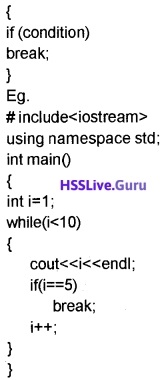
Plus Two Computer Application Chapter Wise Questions and Answers Chapter 1 Review of C++ Programming - 86
The output is
1
2
3
4
5.

2. continue statement:
It bypasses one iteration of the loop.
Syntax :
while (expression)
Plus Two Computer Application Chapter Wise Questions and Answers Chapter 1 Review of C++ Programming - 87
The output is
1
2
3
4
5
6
7
8
9
10.

Plus Two Computer Application Chapter Wise Questions and Answers Chapter 1 Review of C++ Programming

Question 22.
Write a C++ program to print to get the following output.
Plus Two Computer Application Chapter Wise Questions and Answers Chapter 1 Review of C++ Programming - 88
Answer:
#include
using namespace std;
int main()
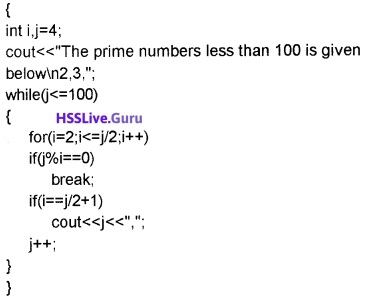
Plus Two Computer Application Chapter Wise Questions and Answers Chapter 1 Review of C++ Programming - 89