HSSLive Plus One Notes Chapter Wise Kerala

HSE Kerala Board Syllabus HSSLive Plus One Notes Chapter Wise Pdf Free Download in both English Medium and Malayalam Medium are part of Plus One Kerala SCERT. Here HSSLive.Guru has given Higher Secondary Kerala Plus One Chapter Wise Quick Revision Notes based on CBSE NCERT syllabus.

HSSLive Plus One Notes Chapter Wise Kerala

Board SCERT, Kerala
Text Book NCERT Based
Class Plus One
Subject All Subjects
Chapter Plus One Notes
Category HSSLive Plus One

We hope the given HSE Kerala Board Syllabus HSSLive Plus One Notes Chapter Wise Pdf Free Download in both English Medium and Malayalam Medium will help you. If you have any query regarding Higher Secondary Kerala Plus One Chapter Wise Quick Revision Notes based on CBSE NCERT syllabus, drop a comment below and we will get back to you at the earliest.

HSSLive Plus One

Plus One Computer Application Notes Chapter Wise HSSLive Kerala

HSE Kerala Board Syllabus HSSLive Plus One Computer Application Notes Chapter Wise Pdf Free Download in both English Medium and Malayalam Medium are part of SCERT Kerala HSSLive Plus One Notes. Here HSSLive.Guru has given Higher Secondary Kerala Plus One Computer Application Chapter Wise Quick Revision Notes based on CBSE NCERT Syllabus.

Board SCERT, Kerala
Text Book NCERT Based
Class Plus One
Subject Computer Application
Chapter All Chapters
Category Kerala Plus One

Kerala Plus One Computer Application Notes Chapter Wise

We hope the given HSE Kerala Board Syllabus HSSLive Plus One Computer Application Notes Chapter Wise Pdf Free Download in both English Medium and Malayalam Medium will help you. If you have any query regarding Higher Secondary Kerala Plus One Computer Application Chapter Wise Quick Revision Notes based on CBSE NCERT syllabus, drop a comment below and we will get back to you at the earliest.

HSSLive Plus One

Plus One Computer Science Previous Year Question Papers and Answers Kerala

HSE Kerala Board Syllabus Plus One Computer Science Previous Year Model Question Papers and Answers Pdf HSSLive Free Download in both English medium and Malayalam medium are part of SCERT Kerala Plus One Previous Year Question Papers and Answers. Here HSSLive.Guru have given Higher Secondary Kerala Plus One Computer Science Previous Year Sample Question Papers with Answers based on CBSE NCERT syllabus.

Board SCERT, Kerala Board
Textbook NCERT Based
Class Plus One
Subject Computer Science
Papers Previous Papers, Model Papers, Sample Papers
Category Kerala Plus One

Kerala Plus One Computer Science Previous Year Question Papers and Answers

We hope the given HSE Kerala Board Syllabus Plus One Computer Science Previous Year Model Question Papers and Answers Pdf HSSLive Free Download in both English medium and Malayalam medium will help you. If you have any query regarding HSS Live Kerala Plus One Computer Science Previous Year Sample Question Papers with Answers based on CBSE NCERT syllabus, drop a comment below and we will get back to you at the earliest.

HSSLive Plus One

Plus One Chemistry Chapter Wise Questions and Answers Chapter 4 Chemical Bonding and Molecular Structure

Students can Download Chapter 4 Chemical Bonding and Molecular Structure Questions and Answers, Plus One Chemistry Chapter Wise Questions and Answers helps you to revise the complete Kerala State Syllabus and score more marks in your examinations.

Kerala Plus One Chemistry Chapter Wise Questions and Answers Chapter 4 Chemical Bonding and Molecular Structure

Plus One Chemistry Chemical Bonding and Molecular Structure One Mark Questions and Answers

Question 1.
The octet rule is not valid for
a) CO2
b)H2O
c) O2
d) CO
Answer:
d) CO

Question 2.
The stability of an ionic crystal depends principally on
a) High electron gain enthalpy of the anion forming species
b) The lattice enthalpy of the crystal
c) Low ionization enthalpy of the cation forming species
d) Low heat of sublimation of cation forming solid
Answer:
b) The lattice enthalpy of the crystal

Question 3.
Which of the following molecules has highest dipole moment?
a) H2S
b)CO2
c) CCl4
d) BF3
Answer:
a) H2S

Question 4.
The d-orbital involved in sp3d hybridization is .
Answer:
dz2

Plus One Chemistry Chapter Wise Questions and Answers Chapter 4 Chemical Bonding and Molecular Structure

Question 5.
Which of the following is paramagnetic and has a bond order of ½?
Plus One Chemistry Chapter Wise Questions and Answers Chapter 4 Chemical Bonding and Molecular Structure 1
Answer:
H2+

Question 6.
Dipole moment µ electric charge ‘e’ and bond length ‘d’are related by the equation.
Answer:
M = e x d

Question 7.
In which of the following carbon atom is sp2 hybridised?
a) CO2
b) C2H6
c) C6H6
d) HCN
e) \(C{ H }_{ 3 }-C\equiv CH\)
Answer:
C6H6

Question 8.
AgF is ionic whereas Agcl is covalent. This can be explained by
Answer:
Faja’ens Rule

Question 9.
The shape of covalent molecule CIF3 is _________
Answer:
T – shaped

Question 10.
The C – O bond order in CO32- is
Answer:
1.33

Plus One Chemistry Chemical Bonding and Molecular Structure Two Mark Questions and Answers

Question 1.
The order of repulsion of electron pairs as written by student is given below:
lone pair-lone pair repulsion < lone pair-bond pair repulsion>bond pair-bond pair repulsion.
1. Can you see anything wrong in this?
If yes, correct it.
2. Name the theory behind this.
Answer:
1. Yes.
Repulsion decreases in the order: lone pair-lone pair repulsion>lone pair-bond pair repulsion> bond pair-bond pair repulsion,

2. VSEPR theory

Question 2.
During a small group discussion in the class room a student argued that in acetylene both the carbon atoms are in sp3 hybridised state.

  1. What is your opinion?
  2. What is the bond angle between carbon atoms in acetylene?

Answer:

  1. The student’s argument is wrong. In acetylene both the carbon atoms are triple bonded and are in sp hybridised state,
  2. 180°

Plus One Chemistry Chapter Wise Questions and Answers Chapter 4 Chemical Bonding and Molecular Structure

Question 3.
Classify the following compounds according to their hybridisation.
CH4, BF3, C2H4, BeF2, C2H2
Answer:
sp3 hybridisation – CH4
sp2 hybridisation – BF3, C2H4
sp hybridisation – BeF2, C2H2

Question 4.
A student arranged the halide ions in the increasing order of polarisability as: F < l < CI < Br
1. Is this the correct order? If not write it in correct order.
2. Justify.
Answer:
1. No.
Polarisability increases in the order: F < Cl <Br < l

2. Polarisability increases when the size of anion increases.

Question 5.
Give any two differences between sigma and pi bonds.
Answer:
Sigma bond (σ) is formed when two atomic orbitals under head-on overlapping. It is a strong bond. Pi(π) bond is formed when atomic orbitals undergo lateral (sidewise) overlapping. It is a weak bond.

Question 6.
Write the type of hybridisation of each carbon in the compound.
CH3-CH=CH-CN
Answer:
Carbon 1 → sp³
Carbon 2 → sp²
Carbon 3 → sp²
Carbon 4 → sp

Plus One Chemistry Chemical Bonding and Molecular Structure Three Mark Questions and Answers

Question 1.
Plus One Chemistry Chapter Wise Questions and Answers Chapter 4 Chemical Bonding and Molecular Structure 2
1. What is meant by the above picture?
2. Which type of bond is present here?
3. Which type of overlapping leads to the formation of π bond?

Answer:

  1. s-s overlapping
  2. A strong sigma bond
  3. This type of covalent bond is formed by the lateral or sidewise overlap of half-filled atomic orbitals.

Question 2.
‘In ethane there are 6 covalent bonds. Five are strong σ bonds and the remaining one is a weak π bond.’

  1. Do you agree with this?
  2. How is a bond different from π bond in the mode of formation?

Answer:

  1. Yes.
  2. Sigma bond is formed by the end to end overlapping of bonding orbitals along the internuclear axis, π bond is formed by the lateral or sidewise overlap of half filled atomic orbitals.

Plus One Chemistry Chapter Wise Questions and Answers Chapter 4 Chemical Bonding and Molecular Structure

Question 3.
Choose the correct molecules from the given clues: H2O, SF6, BF3
1. Clue -1 The central atom is in sp² hybridised state and the molecule has trigonal planar in shape. Clue-2 The bond angle is 120°
2. Clue-1 The number of electron pairs in this molecule is 6.
Clue -2 It has octahedral geometry.
3. Clue-1 The bond angle is reduced from 109° 28′ to 104.5°
Clue-2 It has a bent shape.
Answer:

  1. BF3
  2. SF6
  3. H2O

Question 4.
Give theoretical explanation for the following statements.
1. H2S is acidic while H2O is neutral.
2. Hydrogen chloride gas dissolves in water.
Answer:
1. S-H bond energy is less than that of O-H bond energy. So H+ can be easily generated from H2S.

2. When HCl is treated with H2O it undergoes hydrolysis as per the following reaction and dissolves.
HCl + H2O → H3O+ +Cl

Question 5.
The potential energy level diagram forthe formation of hydrogen molecule as drawn by a student is given below:
Plus One Chemistry Chapter Wise Questions and Answers Chapter 4 Chemical Bonding and Molecular Structure 3
1. Resketch the graph with correct labelling.
2. How can you determine the radius of one hydrogen atom?
Answer:
1.
Plus One Chemistry Chapter Wise Questions and Answers Chapter 4 Chemical Bonding and Molecular Structure 4
2. Bond length in hydrogen molecule is the intermolecular distance between two hydrogen atoms. So, half of the bond length is taken as the radius of hydrogen atom.

Question 6.
Ionisation enthalpy is one of the factors favoring the
formation of ionic bonds.
1. Will you agree with this statement?
2. Explain how?
3. Write anotherfactorfavouring the formation of ionic bonds.
Answer:
1. Yes.

2. In the formation of the ionic bond, a metal atom losses electrons to form cation. This process requires energy equal to the ionisation enthalpy. Lesser the ionisation enthalpy of the metal atom, easier will be the removal of electron from the atom to form cation and hence greater will be the tendency to form ionic bond.

3. Electron gain enthalpy of the element forming anion.

Plus One Chemistry Chapter Wise Questions and Answers Chapter 4 Chemical Bonding and Molecular Structure

Question 7.
Complete the following table:

Sigma bond π -bond
Formation …………. ………….
Strong/Weak …………. ………….
About rotation …………. ………….

Answer:

Sigma bond π -bond
Formation Sigma bond is formed by end to end (or axial) overlap of atomic orbitals π -bond is formed by the sidewise overlap of atomic orbitals
Strong/Weak Strong Weak
About rotation Free rotation Free rotation is not possible

Question 8.
a) The dipole moment of BF3 is zero even though the B – F bonds are polar. Justify.
b) Give the hybridisation involved in the following compounds

  1. NH3
  2. C2H4
  3. SF6
  4. PCl5

c) o-nitro phenol has a lower boiling point than its para isomer. Why?
Answer:
a) In BF3, dut to the symmetric trigonal planar geometry of the molecule, the B – F bond are oriented at an angle of 120°to one another. The three bond moments give a net sum of zero as the resultant of any two is equal and opposite to the third.
Plus One Chemistry Chapter Wise Questions and Answers Chapter 4 Chemical Bonding and Molecular Structure 5
b)

  1. sp³
  2. sp²
  3. sp³d²
  4. sp³d

c) In o-nitrophenol, intramolecular hydrogen bonding is present and there is no association of molecules whereas in p-nitrophenol there is inter-molecular hydrogen bonding which causes association of molecules.
Plus One Chemistry Chapter Wise Questions and Answers Chapter 4 Chemical Bonding and Molecular Structure 6

Question 9.
1. How many a and n bonds are there in the following molecules i) ethane ii) acetylene?
2. BF3 and NH3 are tetra atomic molecules. But the shape of BF3 is different from that of NH3. Explain this using hybridisation.
Answer:
1. i) Ethane – 7σ bonds
ii) Acetylene-3σ bonds and 2 π bonds

2. In BF3 molecule, the ground state electronic configuration of central boron atom is 1s²2s²2p¹. In the excited state, one of the 2s electrons is promoted to vacant 2p orbital. As a result, boron has three unpaired electrons. These three orbitals (one 2s and two 2p) hybridise to form three sp2 hybrid orbitals oriented in a trigonal planar arrangement and overlap with 2 p orbitals of F to form three B – F bonds. Therefore, BF3 molecule has a planar geometry with FBF bond angle of 120°.
Plus One Chemistry Chapter Wise Questions and Answers Chapter 4 Chemical Bonding and Molecular Structure 7
In NH3, the valence shell electronic configuration of N in ground state is 2s² \(2p_{ x }^{ 1 }2{ p }_{ y }^{ 1 }2{ p }_{ z }^{ 1 }\). These four orbitals undergo sp³ hybridisation to form four sp³ hybrid orbitals, three of them containing unpaired electrons and the fourth one containing lone pair. The three hybrid orbitals overlap with 1 s orbitals of hydrogen atoms to form three N – H sigma bonds. Since, the bp-lp repulsion is greater than the bp-bp repulsion, the molecule gets distorted and the bond angle is reduced to 107° from 109.5°. Thus, the geometry of NH3 molecule is trigonal pyramidal.
Plus One Chemistry Chapter Wise Questions and Answers Chapter 4 Chemical Bonding and Molecular Structure 8

Question 10.
Covalent bond is formed by the overlaping of atomic orbitals.
1. What is meant by orbital overlapping?
2. What are the 3 types of overlapping?
Answer:
1. Orbital overlapping is the partial interpenetration or merging of atomic orbitals. It results in the pairing of electrons. Greater the overlap the stronger is the bond formed between two atoms.

2. s-s overlapping
s-p overlapping
p-p overlapping

Question 11.
1. Which among the following will exist He2 or He2+? Explain.
2. H2S is a gas at ordinary condition, while H2O is liquid. Account for the above statement.
3. State the hybridisation in the following molecules,
i) PF6
ii) C2H6
Answer:
1. He2+
Helium molecule contains 4 electrons. Out of this 4 electrons, 2 are present in the bonding molecular orbital and the remaining 2 are present in the anti-bonding molecular orbital.
Bond order = ½ (Nb-Na)
= ½ (2-2) = 0
Hence, He2 cannot exist. The molecular orbital diagram is given below:
Plus One Chemistry Chapter Wise Questions and Answers Chapter 4 Chemical Bonding and Molecular Structure 9
He2+ contains 3 electrons. Out of these 3 electrons, 2 are present in the σ1s level and the remaining one is present in the σ* 1s level.
Bond order = ½ (Nb-Na)
= ½ (2-1) = ½
Since the bond order is half the molecular ion exists but possesses low stability.

2. In H2S, there is no hydrogen bonding whereas in water, molecular association is possible due to intermolecular hydrogen bonding.

3. i) PF5 = sp³d hybridisation
ii) C2H6 = sp³ hybridisation

Plus One Chemistry Chapter Wise Questions and Answers Chapter 4 Chemical Bonding and Molecular Structure

Question 12.
Bond order is a term commonly used in MO theory.
1. How is it calculated?
2. How is it related to bond length and bond energy?
Answer:
1. Bond order = ½ (Nb-Na)
where Nb = No. of electrons occupying bonding orbitals and Na = No. of electrons occupying antibonding orbitals.

2. As the bond order increases, bond length decreases and bond energy increases, i.e., bond order is directly proportional to bond energy and inversely proportional to bond length.

Question 13.
1. Explain the hybridisation and geometry of ethyne.
2. What is the difference between bonding molecular orbital and antibonding molecular orbital?
3. How the magnetic nature of a molecule is related to its electronic structure?
Answer:
1. In the formation of ethyne (C2H2), both the carbon atoms undergo sp hybridisation having two unhybridised orbitals (2px and 2py). One sp hybrid orbital of one carbon atom overlaps axially with sp hybrid orbital of the other carbon atom to form C-C sigma bond, while the other hybridised orbital of each carbon atom overlaps axially with the half filled s orbital of hydrogen atoms forming o bonds. Each of the two unbybridised p orbitals of both the carbon atoms overlaps sidewise to form two K bonds between the carbon atoms. Thus, ethyne has a linear geometry with π bond angle of 180°.
Plus One Chemistry Chapter Wise Questions and Answers Chapter 4 Chemical Bonding and Molecular Structure 10

2. The molecular orbital which has lower energy than the atomic orbital is called bonding molecular orbital and the molecular orbital which has greater energy than the atomic orbital is called anti bonding molecular orbital.

3. If all the molecular orbitals in a molecule are doubly occupied (i.e., paired), the substance is diamagnetic (repelled by magnetic field). It one or more molecular orbitals are singly occupied (i.e., unpaired) it is paramagnetic (attracted by magnetic field).

Question 14.
Molecular Orbital Theory (MOT) is an advanced theory
of chemical bonding.
1. Write the salient features of MOT.
2. What is meant by LCAO? Illustrate using hydrogen molecule.
3. What are the conditions for the combination of atomic orbitals?
Answer:
1.

  • The electrons in a molecule are present in the
    various molecular orbitals.
  • The atomic orbitals of comparable energies and proper symmetry combine to form molecular orbitals.
  • iii) The electron in a molecular orbital is influenced by two or more nuclei depending upon the number of atoms in the molecule.
  • The number of molecular orbitals formed is equal to the number of combining atomic orbitals. When two atomic orbitals combine, two
    molecular orbitals are formed. One is known as bonding molecular orbital while the other is called antibonding molecular orbital.
  • The bonding molecular orbital has lower energy and hence greater stability than the corresponding antibonding molecular orbital.
  • The electron probability distribution around a group of nuclei in a molecule is given by a molecular orbital.
  • The molecular orbitals are filled in accordance with the Aufbau principle obeying the Pauli’s exclusion principle and the Hund’s rule.

2. LCAO refers to the linear combination of atomic orbitals. It is an approximate method used to explain the formation of molecular obritals. Consider hydrogen molecule consisting of two atoms A and B. Each hydrogen atom has one electron in the 1s orbital. The atomic orbitals of these atoms can be represented by the wave functions ψA and ψB. Mathematically, the formation of molecular orbitals can take place by addition and by subtraction of wave functions of individual atomic orbitals.
ψMO = ψA ± ψB
Therefore, the two molecular orbitals σ and σ* are formed as:
σ* = ψA – ψB
The molecular orbital σ formed by the addition of atomic orbitals is called the bonding molecular orbital while the molecular orbital σ* formed by the subtraction of atomic orbital is called antibonding molecular orbital. The energy level diagram is shown below:
Plus One Chemistry Chapter Wise Questions and Answers Chapter 4 Chemical Bonding and Molecular Structure 11

3.

  • The combining atomic orbitals must have the same or nearly same energy.
  • The combining atomic orbitals must have the same symmetry about the molecular axis.
  • The combining atomic orbitals must overlap to the maximum extent.

Question 15.
Consider a reaction PCl5(g) → PC3(g) + Cl2(g)
1. What is the change in hybridisation state of phosphorus?
2. Explain why does PCl5 decomposes easily?
Answer:
1. When PCl5 decomposes to PCl3, the hybridisation of P changes from sp³d to sp³.

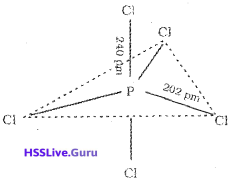
2. In PCl5, the five sp³d orbitals of P overlap with the singly occupied p orbitals of Cl atoms to form five P-CI sigma bonds. Three P-Cl bonds which lie in one plane and make an angle of 120° with each other are called equatorial bonds. The remaining two P – Cl bonds, called axial bonds, one lie above and the other lie below the equatorial plane, make an angle of 90° with the plane. As the axial bond pairs suffer more repulsive interaction from the equatorial bond pairs, axial bonds are slightly longer and hence slightly weaker than the equatorial bonds. This makes PCl5 molecule more reactive and hence it decomposes easily.
Plus One Chemistry Chapter Wise Questions and Answers Chapter 4 Chemical Bonding and Molecular Structure 12

Question 16.
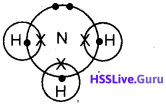
The electron dot structure (Lewis structure) of ammonia molecule is shown below:
Plus One Chemistry Chapter Wise Questions and Answers Chapter 4 Chemical Bonding and Molecular Structure 13
1. Write the number of bond pairs of electrons and lone pairs of electrons in ammonia molecule.
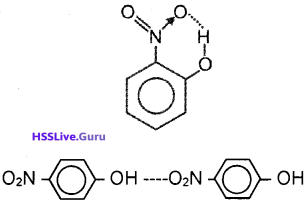
2. The structures of o-nitrophenol and p-nitrophenol are shown in the figure. The former is a steam volatile liquid whereas the latter is a solid. Justify your answer giving reason.
Plus One Chemistry Chapter Wise Questions and Answers Chapter 4 Chemical Bonding and Molecular Structure 14
Answer:
1. Ammonia molecule contains one lone pair of electrons and 3 bond pair of electrons,

2. In o-nitrophenol, there is intramolecular hydrogen bonding and there is no molecular association. But in p-nitro phenol intermolecular hydrogen bonding is present and hence molecular association is possible.

Plus One Chemistry Chemical Bonding and Molecular Structure Four Mark Questions and Answers

Question 1.
Hydrogen bonding is present in NH3 and H2O.
1. What is hydrogen bond?
2. What are different types of hydrogen bonds?
3. Explain the effect of hydrogen bonding.
Answer:
1. Hydrogen bond is defined as the attractive force which binds hydrogen atom of one molecule with the electronegative atom (F, O, N) of the same or another molecule.

2. Intermolecular hydrogen bond and Intramolecular hydrogen bond.

3. Compounds containing hydrogen bonds show higher melting and boiling points. Compounds whose molecules can form hydrogen bonds with water molecules are soluble in water.

Question 2.
Classify the following compounds according to their
shape.
BeF2, BeCl2, CH4, BF3, PCl5, SF6, SbCl5 NH4+, SiF4, AlCl3.
Answer:
Linear – BeF2, BeCl2
Trigonal planar-AlCl3, BF3
Tetrahedral – CH4, NH4+, SiF4
T rigonal bipyramidal – PCl5, SbCl5

Plus One Chemistry Chapter Wise Questions and Answers Chapter 4 Chemical Bonding and Molecular Structure

Question 3.
Benzene is an example of a compound exhibiting resonance.
1. What is meant by resonance?
2. Explain the resonance of ozone.
Answer:
1. When a molecule cannot be represented by a single structure but its characteristic properties can be described by two or more different structures, then the actual molecule is said to be a resonance hybrid of these canonical structures.

2. The resonance in ozone can be represented by the following structures:
Plus One Chemistry Chapter Wise Questions and Answers Chapter 4 Chemical Bonding and Molecular Structure 15
According to structures I and II, there is one single bond and one double bond in ozone molecule. But experiments show that both the oxygen- oxygen bonds are equal and the bond length 128 pm) is intermediate between single (148 pm) and double bond (121 pm) lengths. Hence it is assumed that ozone is a resonance hybrid (structure III) of structures I and II.

Question 4.
Match the following:

No. of electrons pairs Shape of molecule Examples
2 Trigonal planar SF6
4 Linear BeF2, BeCl2
3 Tetrahedral BF3, AlCl3
6 Octahedral CH4, SiF4

Answer:

No. of electrons pairs Shape of molecule Examples
2 Linear BeF2, BeCl2
4 Tetrahedral CH4, SiF4
3 Trigonal planar BF3, AlCl3
6 Octahedral SF6

Question 5.
In the formation of methane, carbon undergoes sp³ hybridisation.

  1. What do you mean by sp³ hybridisation?
  2. Give the % s-character and p-character of an sp³ hybrid orbital.
  3. What is the bond angle in methane?
  4. What is the geometry of methane molecule?

Answer:

  1. sp³ hybridisation involves mixing up of one – s and three-p orbitals of the valence shell of an atom to form four sp³ hybrid orbitals of equivalent energies and shape.
  2. Each sp³ hybrid orbital has 25% s-character and 75% p-character.
  3. The angle between the sp3 hybrid orbitals in methane is 109°28′.
  4. Tetrahedron.

Question 6.
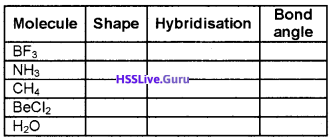
Complete the following table:
Plus One Chemistry Chapter Wise Questions and Answers Chapter 4 Chemical Bonding and Molecular Structure 16
Answer:
Plus One Chemistry Chapter Wise Questions and Answers Chapter 4 Chemical Bonding and Molecular Structure 17

Question 7.
Fill in the blanks:
Plus One Chemistry Chapter Wise Questions and Answers Chapter 4 Chemical Bonding and Molecular Structure 18
Answer:
Plus One Chemistry Chapter Wise Questions and Answers Chapter 4 Chemical Bonding and Molecular Structure 19

Question 8.
Dipole moment is used to predict the shape of
molecules.
1. Justify the statement based on the shapes of CO2 and H2O.
2. Which is having high dipole moment? NH3 or NF3? Why?
Answer:
1. Carbon dioxide is a linear molecule in which the two C=0 bonds are oriented in the opposite directions at an angle of 180°. Hence the two C=0 bond dipoles cancel each other and the resultant dipole moment of CO2 is zero. Thus CO2 is non¬polar molecule
Plus One Chemistry Chapter Wise Questions and Answers Chapter 4 Chemical Bonding and Molecular Structure 20
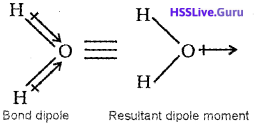
On the other hand, water molecule has a bent structure in which two O-H bonds are oriented at an angle of 104.5°. Therefore, the bond dipoles of two O-H bonds do not cancel each other and the molecule will have a net dipole moment (1.85D).
Plus One Chemistry Chapter Wise Questions and Answers Chapter 4 Chemical Bonding and Molecular Structure 21

2. The dipole moment of NH3 is higher than that of NF3. In both cases, the central N atom has a lone pair whose orbital dipole points away from the N atom. In NH3 the orbital dipole due to the lone pair is in the same direction as the resultant bond dipole of the three N-H bonds. On the other hand, in the case of NF3, the resultant dipole of the three N-F bonds is in the opposite direction to the orbital dipole due to the lone pair. Thus, the orbital dipole due to the lone pair decreases the effect of the resultant N-F bond moments, which results in the low dipole moment of NF3.
Plus One Chemistry Chapter Wise Questions and Answers Chapter 4 Chemical Bonding and Molecular Structure 22

Question 9.
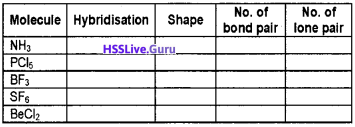
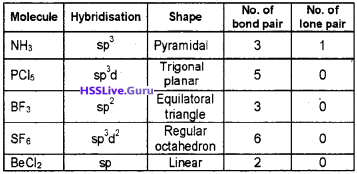
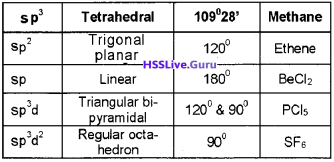
The geometry of a covalent molecule is related to the hybridisation involved in the central atom. Complete the following table:
Plus One Chemistry Chapter Wise Questions and Answers Chapter 4 Chemical Bonding and Molecular Structure 23
Answer:
Plus One Chemistry Chapter Wise Questions and Answers Chapter 4 Chemical Bonding and Molecular Structure 24

Question 10
Depending upon the type of overlapping, covalent bonds are of two types.
a) Name them and give any two difference between them.
b) Find the total number of these two types of bonds ’ in propane and 2-butene.
Answer:
a) Sigma (σ) bond and pi (π) bond.
Sigma (σ) bond:
This type of covalent bond is formed by the end to end overlapping of half-filled atomic orbitals along the internuclear axis. The overlap is also known as head on overlap or axial overlap. The electrons constituting sigma bond are called sigma electrons.

Pi (π) bond:
This type of covalent bond is formed by the lateral or sidewise overlap of half-filled atomic orbitals. The atomic orbitals overlap in such a way that their axes remain parallel to each other and perpendicularto the internuclear axis.
b) 10 σ bond in propane
11 σ bond and 1π bond in 2-butene

Plus One Chemistry Chemical Bonding and Molecular Structure NCERT Questions and Answers

Question 1.
Explain the formation of a chemical bond. (2)
Answer:
According to Kossel-Lewis approach, the formation of chemical bond between the two atoms takes place either by the transference of electrons or by mutual sharing of electrons. However, according to the modem view the formation of chemical bond between the two approaching atoms occurs only if there is a net decrease of energy because of attractive and repulsive forces.

Question 2.
Write the favourable conditions for the formation of ionic bond. (2)
Answer:
Ionic bond is formed by transference of electrons from one atom to another. The favourable conditions for its formation are:

  • Low ionisation enthalpy of element forming cation.
  • More negative value of electron gain enthalpy of element forming the anion and
  • High value of lattice enthalpy of the compound formed.

Plus One Chemistry Chapter Wise Questions and Answers Chapter 4 Chemical Bonding and Molecular Structure

Question 3.
Although geometries of NH3 and H2O molecules are distorted tetrahedral, bond angle in water is less than that in ammonia. Discuss. (2)
Answer:
The difference in bond angles is due to the different numbers of lone pairs and bond pairs in the two species. In NH3, the N atom has two lone pairs and three bond pairs while in H2O, the O atom has two lone pairs and two bond pairs. The repulsive interactions of lone pairs and bond pairs in water are relatively more than those in NH3. Hence, bond angle around central atom in water is relatively smaller (104.5°) than that in NH3 molecule (107°).

Question 4.
Is there any change in the hybridisation of B and N atoms as a result of the following reaction? (2)
BF3 + NH3 → F3B.NH3
Answer:
During combination of species BH3 and NH3, N atom of NH3 is donor and B atom of BF3 is acceptor. The hybrid state of B in BF3 is sp² and that of N in NH3 is sp³. In the compound F3B+-NH3 both N and B atoms are surrounded by four bond pairs. Thus, the hyrid state of both is sp³. Hence during the reaction the hybrid state of B changes from sp² to sp³ but that of N remains the same.

Question 5.
Define hydrogen bond. Is it weaker or stronger than the van der Waals’ forces? (2)
Answer:
Hydrogen bond can be defined as the attractive force which binds hydrogen atom of one molecule with the electronegative atom (F, O or N) of another molecule. Hydrogen bond is stronger than van der Waals’forces because it is a strong dipole-dipole interaction. The van der Waals’ forces, on the other hand, are weak dispersion forces.

Plus One Physics Chapter Wise Questions and Answers Chapter 2 Units and Measurement

Students can Download Chapter 2 Units and Measurement Questions and Answers, Plus One Physics Chapter Wise Questions and Answers helps you to revise the complete Kerala State Syllabus and score more marks in your examinations.

Kerala Plus One Physics Chapter Wise Questions and Answers Chapter 2 Units and Measurement

Plus One Physics Units and Measurement One Mark Questions and Answers

Question 1.
How many seconds are there in a light fermi?
(a) 10-15
(b) 3.0 × 10⁸
(c) 3.33 × 10⁻²⁴
(d) 3.3 × 10⁻⁷
Answer:
(c) 3.33 × 10⁻²⁴
One light fermi is time taken by light to travel a distance of 1 fermi ie. 10-15m
1 light fermi = \(\frac{10^{-15}}{3 \times 10^{8}}\) = 3.33 × 10⁻²⁴s.

Question 2.
Which of the following pairs have same dimensional formula for both the quantities?

  1. Kinetic energy and torque
  2. Resistance and Inductance
  3. Young’s modulus and pressure

(a) (1)only
(b) (2) only
(c) (1) and (3) only
(d) All of three
Answer:
(c) (1) and (3) only

Plus One Physics Chapter Wise Questions and Answers Chapter 2 Units and Measurement

Question 3.
Give four dimensionless physical quantities.
Answer:
Angle, Poisson’s ratio, strain, specific gravity.

Question 4.
The dimensions of plank constant are the same as those of______.
Answer:
Angular momentum

Question 5.
A physical quantity P = \(\frac{\sqrt{a b c^{2}}}{d^{3}}\) measuring a, b, c and d separately with the percentage error of 2% , 3%, 2% and 1% respectively. Minimum amount of error is contributed by the measurement of
(a) b
(b) a
(c) d
(d) c
Answer:
(b) a
P = \(\frac{\sqrt{a b c^{2}}}{d^{3}}\)
Plus One Physics Units and Measurement One Mark Questions and Answers 1
The minimum amount of error is contributed by the measurement of a.

Question 6.
The number of significant figures in 11.118 × 10⁻⁶ is
(a) 3
(b) 6
(c) 5
(d) 4
Answer:
As per rules, number of significant figures in 11.118 × 10⁻⁶ is 5.

Plus One Physics Chapter Wise Questions and Answers Chapter 2 Units and Measurement

Question 7.
What is the number of significant figures in 0.06070?
Answer:
4.

Question 8.
If f = x2, What is the relative error in f?
Answer:
\(\frac{2 \Delta x}{x}\).

Question 9.
Which of the following measurement is more accu¬rate?
(i) 7000m
(ii) 7 × 10²m
(iii) 7 × 10³m
Answer:
(i) 7000 m

Question 10.
Which of the following measurements is most, accurate?
(a) 5.0 cm
(b) 0.005 cm
(c) 5.00 cm
Answer:
(c) Is most accurate because it has three significant figures. Greater is number of significant figures, more accurate is the measurement.
(a) has 2 significant figures
(b) has 1 significant figure.

Plus One Physics Chapter Wise Questions and Answers Chapter 2 Units and Measurement

Question 11.
Name three physical quantities having same dimension.
Answer:
Work, Energy, and Torque.

Plus One Physics Units and Measurement Tw0 Mark Questions and Answers

Question 1.
Using dimensional analysis derive the relation F = ma. Where the symbols have the usual meaning.
Answer:
Force on a body depends on mass(m), acceleration (a) an
F α maabtc
M1L1T-2 = Ma(LT-2)bTc
M1L1T-2 = MaLbT-2a+c
Equating the powers, we get a = 1 ,b = 1, -2b + c = -2, c = 0
F = m1a1t0 = ma.

Plus One Physics Chapter Wise Questions and Answers Chapter 2 Units and Measurement

Question 2.
Use your definition to explain how simple harmonic motion can be represented by the equation y = a sin ωt
(a) Show that the above equation is dimensionally correct
Answer:
Y = a sin ωt
sin ωt has no dimensions. Hence we get L = L
Hence this equation is dimensionaly correct.
Plus One Physics Units and Measurement Two Mark Questions and Answers 2

Question 3.
Fill in the blanks.

  1. The curved surface area of a solid cylinder of radius 2 cm and height 20 cm is_____m2 (Write answer in 3 significant digits)
  2. Im = ______ ly

Answer:
1. Curved area = 2πl
= 2 × 3.14 (2 × 102) × 20 × 102
= 2.51 × 10⁻⁶m2

2. l ly= 9.46 × 10¹⁵ m
lm = \(\frac{l \mathrm{ly}}{9.46 \times 10^{15}}\) ≈ 10-6ly.

Plus One Physics Chapter Wise Questions and Answers Chapter 2 Units and Measurement

Question 4.

  1. Give a physical quantity with a unit and no dimension.
  2. Arrange the following in the descending order.
    1 light year, 1 parsec, 1 astronomical unit

Answer:

  1. Angle has no dimension. But it has unit.
  2. 1 parsec, 1 light year, 1 astronomical unit.

Question 5.
Magnitude of force F experienced by a certain object moving with speed V is given by F = KV2. Where K is a constant. Find the dimensions of K.
Answer:
F = KV2
Plus One Physics Units and Measurement Two Mark Questions and Answers 3

Plus One Physics Chapter Wise Questions and Answers Chapter 2 Units and Measurement

Question 6.
What is the maximum percentage error in the measurement of kinetic energy if percentage errors in mass and speed are 2% and 3% respectively?
Answer:
E = \(\frac{1}{2}\)v2
Plus One Physics Units and Measurement Two Mark Questions and Answers 4
% error in KE = % error in mass + 2 × % error in speed
= 2% + 2 × 3% = 8%.

Question 7.
Solve the following with regard to significant figures.

  1. 5.8 + 0.125
  2. 3.9 × 10⁵ – 2.5 × 10⁴

Answer:
1. 5.8 + 0.125 = 5.925
Rounding to first decimal point, we get 5.9

2. 3.9 × 10⁵ – 2.5 × 104
= 3.5 × 10⁵ – 0.25 × 104
= 3.65 × 10⁵
Rounding to first decimal place, we get 3.6 × 10⁵.

Plus One Physics Chapter Wise Questions and Answers Chapter 2 Units and Measurement

Question 8.
What is maximum fractional error in
i) (a + b)
ii) a – b
iii) ab
iv) \(\frac{a}{b}\)
Given ∆ a and ∆ b are absolute errors in measurements a and b.
Answer:
Plus One Physics Units and Measurement Two Mark Questions and Answers 5

Question 9.

  1. What is the fractional error in an? (Given absolute error in a is ∆ a)
  2. What is absolute error in the measurements according to least count?
    • 3.0 kg
    • 25 s
    • 5.62 cm

Answer:
1. n\(\frac{\Delta a}{a}\)

2. The measurements according to least count:

  • 0.1 kg
  • 1 s
  • 0.01 cm

Plus One Physics Units and Measurement Three Mark Questions and Answers

Question 1.
A stone is thrown upwards from the ground with a velocity ‘u’.

  1. What is the maximum height attained by the stone?
  2. Check the correctness of the equation obtained in (a) using the method of dimensional analysis.

Answer:
1. H = \(\frac{u^{2}}{2 g}\) ___(1)
u = u, v = o, a = -g, h = ?
We can find maximum height using the equation
u2 = u2 + 2as
0 = u2 + 2 × -g × H
2gh = u2
H = \(\frac{u^{2}}{2 g}\)

2. Dimension of H = L
Dimension of u = (LT-1)
Dimensions of time (t) = T
Dimension of g = (LT-2)
substituting these values in eq(1) we get
L = \(\frac{\left(L T^{-1}\right)^{2}}{\left(L T^{-2}\right)}\)
L = L.

Plus One Physics Chapter Wise Questions and Answers Chapter 2 Units and Measurement

Question 2.
Derive an empirical relationship for the force experienced on the car in terms of mass of the car m, velocity v, and radius of the track r using dimensional analysis.
Answer:
Centripetal force may depends on mass (m),radius(r) and velocity(v)
F α marbvc
M1L1T-2 = MaLb(LT-1)c
M1L1T-2 = MaLbLcT-c
M1L1T-2 = MaLb+cT-c
Equating we get a = 1, b + c = 1, c = 2, b = -1
Substituting these values in eq(1),we get
F = \(\frac{M V^{2}}{r}\).

Question 3.
Dimensional formula of a physical quantity indicate how many times fundamental quantity is involved in the measurement of the quantity.

  1. What is the dimensional formula of coefficient of viscosity?
  2. Write any two drawbacks of dimensional analysis.

Answer:
1. F = ηA\(\frac{d V}{d x}\)
Plus One Physics Units and Measurement Three Mark Questions and Answers 6

2. The method of dimensional analysis has the following drawbacks:

  • It gives no information about the dimensionless constant involved in the equation.
  • The method is not applicable to equations involv¬ing trigonometric and exponential functions.
  • This method cannot be employed to derive the • exact form of the relationship if it contains sum
    of two, or more terms.
  • If the given physical quantity depends on more than three unknown quantities, the method fails.

Plus One Physics Chapter Wise Questions and Answers Chapter 2 Units and Measurement

Question 4.
Principle of homogeneity is based on the fact that two quantities of same nature can be added.

  1. What do you mean by principle of homogeneity?
  2. Velocity V depends on the time t as V = at2 + bt + c. Find dimension of constants a, b, and c.

Answer:
1. For the correctness of an equation, the dimensions on either side must be the same. This is known as the principle of homogeneity of dimensions.

2. V = at2 + bt + c
M0L1T-1 = aT2 + bT + c
According to principle of homogenity, we get
aT2 = M0L1T-1
a = \(\frac{\mathrm{M}^{0} \mathrm{L}^{1} \mathrm{T}^{-1}}{\mathrm{T}^{2}}\)
= M0L1T-3.

Question 5.
If x = a + bt + ct2 where x is in meter and t in second.

  1. Find the dimensional formula of ‘b’.
  2. If error in the measurement of time is 2%. What will be the error in x?

Answer:
1. According to principle of homogeneity, the dimensions of both sides must be same.
ie. L = a + bT + cT2
ie : L = bT, b = L/T

2.
Plus One Physics Units and Measurement Three Mark Questions and Answers 7
% error in x = 3 × %. error in ‘t’ = 3 × 2% = 6%.

Plus One Physics Chapter Wise Questions and Answers Chapter 2 Units and Measurement

Question 6.
A physical quantity P is related to four observables a, b, c as P = \(\frac{a^{3} b^{2}}{\sqrt{c d}}\). The % error in the measurement of a, b, c, and d are 1%, 3%, 4%, 2% are respectively.

  1. What do you mean by error in a measurement?
  2. What is the % error in the measurement of P?

Answer:
1. The result of every measurement by any measuring instrument contains some uncertainty. This uncertainty is called error.

2.
Plus One Physics Units and Measurement Three Mark Questions and Answers 8
% error in
P = 3 × 1 + 2 × 3 + 1/2 × 4 + 1/2 × 2
= 3 + 6 + 2+ 1
P = 12%

Question 7.
Rahul measured the height of Ramesh in different trials as 1.67m, 1.65m 1.64m, and 1.63m.

  1. Find the mean absolute error?
  2. Find the percentage error?

Answer:
1. Arithametic mean,
Plus One Physics Units and Measurement Three Mark Questions and Answers 9
amean = 1.645m = 1.65
absolute error,
∆a1 = amean – a1
∆a1 = 1.65 – 1.67 = -0.02
∆a2 = 1.65 – 1.65 = 0
∆a3 = 1.65 – 1.64 = 0.01
∆a4 = 1.65 – 1.63 = 0.02
Mean absolute error
Plus One Physics Units and Measurement Three Mark Questions and Answers 10
= 0.012

2. percentage error = \(\frac{\Delta \mathrm{a}_{\text {mean }}}{\mathrm{a}_{\text {mean }}}\) × 100
= \(\frac{0.012}{1.65}\) × 100
= 0.75%.

Plus One Physics Chapter Wise Questions and Answers Chapter 2 Units and Measurement

Question 8.
In a particular experiment Ramu used the relation F = AB + (P + Q) Y to calculate force.

  1. Which principle is used to check the correctness of the equation (1)
  2. If the dimensional formula of Y is M0L1T-1, then find the dimensional formula of P

Answer:
1. Principle of homogenity

2. F = AB + (P+Q)Y
F = AB + PY + QY
MLT-2 = AB + PY+ QY
According to principle of homogeneity
MLT-2 = PY
M1L1T-2 = P M0L1T-1
ie. P = \(\frac{M^{\prime} L^{1} T^{-2}}{M^{0} L^{1} T^{-1}}\) = M1T-3

Question 9.

  1. Which of the following is precise
    • A vernier calliperse with 40 divisions on sliding scale
    • An optical instrument that can measure length of the order of wavelength of light.
  2. Is it possible to increase the accuracy of screw gauge by increasing the number of divisions on the head scale?

Answer:
1. (i) L.C of vernier caliperse = \(\frac{1}{40}\) = 0.025mm
= 0.025 × 10⁻³m
= 2.5 × 10⁻⁵m.

(ii) L.C of optical instrument = 6000A°
= 6000 × 10-10m
(Taking λ of visible light = 6000°A)= 6 × 10⁻⁷m

2. Yes. Because L.C proportional to number of division on the headscale. So with the increase in number of divisions, the least count will increase. This leads to increase the accuracy of above screw guage.

Plus One Physics Units and Measurement Four Mark Questions and Answers

Question 1.
In an experiment with common balance the mass of a body is found to 2.52g, 2.53g, 2,51g, 2.49g and 2.54g in successive measurements. Calculate

  1. The mean value of the body
  2. Mean absolute error
  3. Percentage error

Answer:
1. Mean value, Mmean
= \(\frac{2.52+2.53+2.51+2.49+2.54}{5}\)
= 2.5g

2. Absolute error,
Absolute error ∆m1 = |2.52 – 2.52| = 0
∆m2 = |2.52 – 2.53| = 0.01
∆m3 = |2.52 – 2.51| = 0.01
∆m4 = |2.52 – 2.49| = 0.03
∆m5 = |2.52 – 2.54| = 0.02
∴ Mean absolute error
\(\frac{0+0.01+0.01+0.03+0.02}{5}\)
∆mmean = 0.014g

3. Percentage error = \(\frac{\Delta \mathrm{m}_{\text {mean }}}{\mathrm{m}_{\text {mean }}}\) × 100
= \(\frac{0.014}{2.52}\) × 100 = 0.556.

Plus One Physics Chapter Wise Questions and Answers Chapter 2 Units and Measurement

Question 2.
While discussing the period of a pendulam, one of the student argued that period depends on the mass of the bob.

  1. What is your opinion?
  2. How will you prove your argument dimensionally?

Answer:

  1. Period is independent of mass of the bob
  2. The principle of homogeneity of dimensions also helps to derive a relationship between the different physical quantities involved; This method is known as dimensional analysis.

The period of the simple pendulum may possibly depend upon:

  • The mass of the bob, m
  • The length of the pendulum, I
  • Acceleration due to gravity, g
  • The angle of swing, q

Let us write the equation for the time period as t = k ma lb gc qd
where, k is a constant having no dimensions; a, b, care to be found out.
The dimensions of, t = T1
Dimensions of. m = M1
Dimensions of, l = L1
Dimensions of, g = L1T-2
Angle q has no dimensions (since, q = arc/radius = L/L)
Equating the dimensions of both sides of the equation, we get,
T1 = MaLb (L1T-2)c
ie. T1 = MaLb+c+ T-2c.
The dimensions of the terms on both sides must be the same. Equating the powers of M, L and T.

Plus One Physics Chapter Wise Questions and Answers Chapter 2 Units and Measurement
a = 0; b + c = 0; -2c = 1
∴ c = \(\frac{1}{2}\), b = c = \(\frac{1}{2}\)
Hence, the equation becomes,
t = kl1/2g-1/2
ie, t = k\(\sqrt{1 / g}\)
Experimentally, the value of k is found to be 2p.

Plus One Physics Units and Measurement Five Mark Questions and Answers

Question 1.
In an experiment with a common balance the mass of a ring found to be 2.52g, 2.5g, 2,51g, 2.49g and 2.54g in successive measurements. Calculate

  1. The mean value of the mass of the ring
  2. The absolute error in each measurement
  3. Mean absolute error
  4. Relative error
  5. Percentage error

Answer:
1. The mean value of the mass of the ring.
Mmean = \(\frac{2.52+2.53+2.51+2.49+2.54}{5}\) = 2.52g.

2. The absolute error in each measurement.
∆m1 = Mmean – m1 = 2.52 – 2.52 = 0.00
∆m2 = Mmean – m2 = 2.52 – 2.53 = -0.01
∆m5 = Mmean – m5 = 2.52 – 2.54 = -0.02

3. mean absolute error = |∆m1| + |∆m2|………..+|∆m5|
= 0.014

4. Relative error = δm = \(\frac{\Delta \mathrm{m}_{\text {mean }}}{\mathrm{m}_{\text {mean }}}=\frac{.014}{2.52}\) = 0.00555

5. Percentage error δm × 100 = 0.555%.

Plus One Physics Units and Measurement NCERT Questions and Answers

Question 1.
Fill in the blanks:

  1. The volume of a cube of side 1 cm is equal to______m3.
  2. The surface area of a solid cylinder of radius 2.0 cm and height 10.0cm is equal to____(mm)2.
  3. A vehicle moving with a speed of 18km h-1 covers_____m in 1s.
  4. The relative density of lead is 11.3.Its density is_____g cm-3or_____kgm-3.

Answer:
1. V = (1 cm)3
= (10-2m)3
= 10-6m3
So, answer is 10-6.

2. Surface area = 2 πrh + 2 × πr2
= 2πr(h + r)
= 2 × \(\frac{22}{7}\) × 2 × 10(10 × 10 + 2 × 10)mm2
= 1 .5 × 104mm2
So, answer is 1.5 × 10⁴

3. 18kmh-1 = \(\frac{18 \times 1000}{3600}\)ms-1
= 5ms-1
So, answer is 5.

4. 11.3, 11.3 × 10³ or 1.13 × 10⁴.

Plus One Physics Chapter Wise Questions and Answers Chapter 2 Units and Measurement

Question 2.
Fill in the blanks by suitable conversion of units:

  1. 1 kgm2s-2 = _____g cm2s-2
  2. 1 m =_____1 y
  3. 3.0 ms2 =______kmh-2
  4. G = 6.67 × 10⁻¹¹ Nm2 (kg)-2 =_____(cm)3s-2g-1

Answer:

  1. 107
  2. 10-16
  3. 3.888 × 10⁴
  4. 6.67 × 10⁻⁸

Question 3.
A calorie is a unit of heat or energy and it equals about 4.2 J, where 1 J = 1 kgm2S-2. Suppose we employ a system of units in which the unit of mass equals α kg, the unit of length equals β metere, the unit of time is second, show that a calorie has a magnitude 4.2 α-1 β-2 γ2 in terms of the new units.
Answer:
1 cal = 4.2kg m2s-2

SI New system
n1 = 4.2 n2 = ?
M1 = 1 kg M2 = α kg
L1 = 1m L2 = β meter
T1 = 1s T2 = γ second

Dimensional formula of energy is [ML2T-2]. Comparing with [MaLbTc], we find that
a = 1, b = 2, c = -2
Plus One Physics Units and Measurement NCERT Questions and Answers 11

Plus One Physics Chapter Wise Questions and Answers Chapter 2 Units and Measurement

Question 4.
Which of the following is the most precise device for measuring length?

  1. A vernier callipers with 20 divisions on the sliding scale.
  2. A screw guage of pitch 1 mm and 100 divisions on the circular scale
  3. An optical instrument that can measure length to within a wavelength of light?

Answer:
The most precise device is one whose least count is the least.
1. Least count = 1SD – 1 VD = 1 SD – \(\frac{19}{20}\) SD
Plus One Physics Units and Measurement NCERT Questions and Answers 12

2. Least count
Plus One Physics Units and Measurement NCERT Questions and Answers 13

3. Wavelength = 10-5 cm = 0.00001 cm
Clearly, the optical instrument is the most precise.

Question 5.
State the number of significant figures in the following:

  1. 0.007m2
  2. 2.64 × 1024kg
  3. 0.2370gcm3
  4. 6.320 J
  5. 6.032 Nm-2
  6. 0.0006032 m2

Answer:

  1. 1
  2. 3
  3. 4
  4. 4
  5. 4
  6. 4

Plus One Physics Chapter Wise Questions and Answers Chapter 2 Units and Measurement

Question 6.
The length, breadth, and thickness of a rectangular sheet of metal are 4.234m, 1.005m and 2.01cm respectively. Give the area and volume of the sheet to correct significant figures.
Answer:
Area of the sheet = 2(l × b + b × t + t × l)
= 2(4.234 × 1.005 + 1.005 × 0.0201 + 0.0201 × 4.234)m2
= 2 (4.255 + 0.0202 + 0.0851)m2
= 2 × 4.3603m2
= 8.7206m2
= 8.72m2
Volume = lbt
4.234 × 1.005 × 0.0201m3
= 0.0855m3

Question 7.
A Physical qunatity P is related to four observables a, b, c and d as follows:
P = \(\frac{\mathrm{a}^{3} \mathrm{b}^{2}}{\sqrt{\mathrm{c}} \mathrm{d}}\). The percentage errors of measurement in a, b,c, and d are 1 %, 3%, 4% and 2% respectively. What is the percentage error in the quantity P? If the value of P calculated using the above relation turns out to be 3.763, to what value should you round off the result?
Answer:
P = \(\frac{\mathrm{a}^{3} \mathrm{b}^{2}}{\sqrt{\mathrm{c}} \mathrm{d}}\)
Plus One Physics Units and Measurement NCERT Questions and Answers 14
% error in P = 3% + 6% + 2%+2% = 13%
3.763 should be rounded off to 3.8.

Plus One Physics Chapter Wise Questions and Answers Chapter 2 Units and Measurement

Question 8.
A famous relation in physics relates ‘moving mass’ m to the ‘rest mass’ m0 of a particle in terms of its speed v and the speed of light c. (This relation first arose as a consequence of special relativity due to Albert Einstein). Boy recalls the relation almost correctly but forgets where to put the constant c. He writes:
\(\frac{m_{0}}{\left(1-v^{2}\right)^{1 / 2}}\)
Guess where to put the missing e.
Answer:
From the given equation, \(\frac{m_{0}}{m}=\sqrt{1-v^{2}}\)
Since left hand side is dimensionless therefore right hand side should be also dimensionless.
Plus One Physics Units and Measurement NCERT Questions and Answers 15
The correct formula is m = m0 \((\sqrt{1-\frac{v^{2}}{c^{2}}})^{-1 / 2}\).

Plus One Computer Science Chapter Wise Questions and Answers Chapter 6 Data Types and Operators

Students can Download Chapter 6 Data Types and Operators Questions and Answers, Plus One Computer Science Chapter Wise Questions and Answers helps you to revise the complete Kerala State Syllabus and score more marks in your examinations.

Kerala Plus One Computer Science Chapter Wise Questions and Answers Chapter 6 Data Types and Operators

Plus One Data Types and Operators One Mark Questions and Answers

Question 1.
___________ is the main activity carried out in computers.
Answer:
Data processing

Plus One Computer Science Chapter Wise Questions and Answers Chapter 6 Data Types and Operators

Question 2.
The data used in computers are different. To differentiate the nature and size of data ___________ is used.
Answer:
Data types

Question 3.
Classify the following data types,
int, array, function, char, pointer, void, float, double, structure
Answer:

Fundamental data types Derived data types
int array
float function
double pointer
void structure
char

Question 4.
Sheela wants to store her age. From the following which is the exact data type.
(a) void
(b) char
(c) int
(d) double
Answer:
(c) int

Question 5
Integer data type uses ________ bytes of memory.
(a) 5
(b) 2
(c) 3
(d) 4
Answer:
(d) 4

Question 6.
char data type ________uses bytes of memory.
(a) 1
(b) 3
(c) 7
(d) 8
Answer:
(a) 1

Plus One Computer Science Chapter Wise Questions and Answers Chapter 6 Data Types and Operators

Question 7.
From the following which data type uses 4 bytes of memory.
(a) float
(b) short
(c) char
(d) double
Answer:
(a) float

Question 8.
Full form of ASCII is ___________
Answer:
American Standard Code for Information Interchange

Question 9.
Ramu wants to store the value of From the following which is correct declaration.
(a) char pi = 3.14157
(b) int pi = 3.14157
(c) float pi = 3.14157
(d) long pi = 3.14157
Answer:
(c) float pi = 3.14157

Question 10.
From the following which is not true, to give a variable name.
(a) Starting letter must be an alphabet
(b) contains digits
(c) Cannot be a keyword
(d) special characters can be used
Answer:
(d) special characters can be used

Question 11.
Pick a valid variable name from the following.
(а) 9a
(b) float
(c) age
(d) date of birth
Answer:
(c) age.

Question 12.
To perform a unary operation how many number of operands needed?
(a) 2
(b) 3
(c) 1
(d) None of these.
Answer:
(c) 1 (Unary means one)

Plus One Computer Science Chapter Wise Questions and Answers Chapter 6 Data Types and Operators

Question 13.
To perform a binary operation how many number of operands needed?
(а) 2
(b) 3
(c) 1
(d) None of these.
Answer:
(a) 2 (binary means two)

Question 14.
To perform a ternary operation how many number of operands needed?
(a) 2
(b) 3
(c) 1
(d) None of these.
Answer:
(b) 3 (eg: ternary means three)

Question 15.
In C++ 13 % 26 =
(a) 26
(b) 13
(c) 0
(d) None of these
Answer:
(b) % is a mod operator i.e. it gives the remainder. Here the remainder is 13.

Question 16.
In C++ 41/2 =
(a) 20.5
(b) 20
(c) 1
(d) None of these
Answer:
(b) 20. (The actual result is 20.5 but both 41 and 2 are integers so .5 must be truncated)

Question 17.
++ is a __________ operator.
(a) Unary
(b) Binary
(c) Ternary
(d) None of these
Answer:
(a) Unary.

Question 18.
Conditional operator is _________ operator.
(a) Unary
(b) Binary
(c) Ternary
(d) None of these
Answer:
(c) Ternary

Question 19.
% is a _______ operator
(a) Unary
(b) Binary
(c) Ternary
(d) None of these
Answer:
(b) Binary

Question 20.
State True/False

  1. Multiplication, division, modulus have equal priority
  2. Logical and (&&) has less priority than logical or ()

Answer:

  1. True
  2. False

Plus One Computer Science Chapter Wise Questions and Answers Chapter 6 Data Types and Operators

Question 21.
_______is composed of operators and operands.
(a) expression
(b) Keywords
(c) Identifier
(d) Punctuators
Answer:
(a) expression

Question 22.
Supply value to a variable at the time of declaration is known as __________.
Answer:
Initialisation

Question 23.
From the following which is initialisation.
(a) int k;
(b) int k = 100;
(c) int k[10];
(d) None of these
Answer:
(b) int k = 100;

Question 24.
State True/False
In an expression all the operands having lower size are converted(promoted) to the data type of the highest sized operand.
Answer:
True

Question 25.
Classify the following as arithmetic/Logical expression.
(a) x + y * z
(b) x < y && y > z
(c) x / y
(d) x > 89 || y < 80
Answer:
(a) and (c) are Arithmetic, (b) and (d) are Logical

Question 26.
Suppose x = 5 and y = 2 then what will be cout<<(float)x/y
Answer:
2.5 The integer x is converted to float hence the result.

Question 27.
Consider the following.
a = 10;
a* =10;
Then a =
(a) a = 100
(b) a = 50
(c) a = 10
(d) a = 20
Answer:
(a) a = 100. This short hand means a = a*10

Question 28.
Consider the following.
a = 10;
a+ = 10;
Then a =
(a) a = 30
(b) a = 50
(c) a = 10
(d) a = 20
Answer:
(d) a = 20. This short hand means a = a + 10

Question 29.
Pick the odd one out
(a) structure
(b) Array
(c) Pointer
(d) int
Answer:
(d) int, it is fundamental data type the others are derived data types

Plus One Computer Science Chapter Wise Questions and Answers Chapter 6 Data Types and Operators

Question 30.
From the following select not a character of C++ language
(a) A
(b) 9
(c) \
(d) @
Answer:
(d) @

Question 31.
Consider the following
float x = 25.56;
cout<<(int)x;
Here the data type of the variable is converted. What type of conversion is this?
(a) type promotion
(b) type casting
(c) implicit conversion
(d) None of these
Answer:
(b) type casting (explicit conversion);

Question 32.
Identify the error in the following C++ statement and correct it.
short population = 68000;
Answer:
The maximum number that can store in short type is less than 32767. So to store 68000 we have to use long data type.

Question 33.
Consider the following statements in C++ if(mark>=18)
cout<<“Passed”;
else
cout<<“Failed”;
Suggest an operator in C++ using which the same output can be produced.
Answer:
Conditional operator (?:)

Plus One Data Types and Operators Two Mark Questions and Answers

Question 1.
Analyses the following statements and write True or False. Justify

  1. There is an Operator in C++ having no special character in it
  2. An operator cannot have more than 2 operands
  3. Comma operator has the lowest precedence
  4. All logical operators are binary in nature
  5. It is not possible to assign the constant 5 to 10 different variables using a single C++ expression
  6. In type promotion the operands with lower data type will be converted to the highest data type in expression.

Answer:

  1. True (sizeof operator)
  2. False(conditional operator can have 3 operands)
  3. True
  4. False
  5. False(Multiple assignment is possible)
    eg: a = b = c ==5
  6. True

Question 2.
Consider the following declaration.
const int bp;
bp = 100;
Is it valid? Explain it?
Answer:
This is not valid. This is an error. A constant variable cannot be modified. That is the error and a constant variable must be initialised. So the correct declaration is as follows, const int bp = 100;

Question 3.
Consider the following statements in C++

  1. cout<<41/2;
  2. cout<<41/2.0;

Are this two statements give same result? Explain?
Answer:
This two statements do not give same results. The first statement 41/2 gives 20 instead of 20.5. The reason is 41 and 2 are integers. If two operands are integers the result must be integer, the real part must be truncated.

To get floating result either one of the operand must be float. So the second statement gives 20.5. The reason 41 is integer but 2.0 is a float.

Plus One Computer Science Chapter Wise Questions and Answers Chapter 6 Data Types and Operators

Question 4.
If mark = 70 then what will be the value of variable result in the following
result = mark > 50? ’P’: ’F’;
Answer:
The syntax of the conditional operator is given below
Condition ? Value if true : Value if false;
Here the conditional operator first checks the condition i.e., 70 > 50 it is true. So ’P’ is assigned to the variable result.
So the result is ’P’;

Question 5.
Is it possible to initialise a variable at the time of execution. What kind of initialisation is this? Give an example
Answer:
Yes it is possible. This is known as Dynamic initialisation. The example is given below
eg: int a = 10, b = 5; int c = a*b; here the variable c is declared and initialised with the value 10*5.

Question 6.
Boolean data type is used to store True/False in C++. Is it true? Is there any data type called Boolean in C++?
Answer:
No there is no data type for storing boolean value true/false. But in C++ non -zero (either negative or positive) is treated as true and zero is treated as false

Question 7.
Consider the following
n=-15;
if (n)
cout<<“Hello”;
else
cout<<“hai”;
What will be the output of the above code?
Answer:
The output is Hello, because n = -15 a non zero number and it is treated as true hence the result.

Question 8.
Is it possible to declare a variable in between the program as and when the need arise? Then what is it?
Answer:
Yes it is possible to declare a variable in between the program as and when the need arise. It is known as dynamic initialisation.
eg. int x = 10, y = 20;
int z = x*y;

Question 9.
char ch;
cout<<“Enter a character”;
cin>>ch;
Consider the above code, a user gives 9 to the variable ‘ch’. Is there any problem? Is it valid?
Answer:
There is no problem and it is valid since 9 is a character. Any symbol from the key board is treated as a character.

Question 10.
“With the same size we can change the sign and range of data”. Comment on this statement.
Answer:
With the help of type modifiers we can change the sign and range of data with same size. The important modifiers are signed, unsigned, long and short.

Question 11.
Write short notes about C++ short hands?
Answer:
x = x + 10 can be represented as x + = 10, It is called shorthands in C++. It is faster. This is used with all the arithmetic operators as follows.

Arithmetic Assignment Expression Equivalent Arithmetic Expression
x+ = 10 x = x + 10
x- = 10 x = x -10
X* = 10 x = x * 10
x/ = 10 x = x /10
x% = 10 x = x % 10

Question 12.
What is the role of ‘const’ modifier?
Answer:
This ‘const’ keyword is used to declare a constant.
eg: const int bp=100;
By this the variable bp is treated as constant and cannot be possible to change its value during execution.

Plus One Computer Science Chapter Wise Questions and Answers Chapter 6 Data Types and Operators

Question 13.
Specify the most appropriate data type for handling the following data.

  1. Roll no. of a student.
  2. Name of an employee.
  3. Price of an article.
  4. Marks of 12 subjects

Answer:

  1. short Roll no;
  2. char name[20];
  3. float price;
  4. short marks[12];

Question 14.
Write C++ statement for the following,

  1. The result obtained when 5 is divided by 2.
  2. The remainder obtained when 5 is divided by 2.

Answer:

  1. 5/2
  2. 5 % 2

Question 15.
Predict the output of the following code. Justify.
int k = 5;
b = 0;
b = k++ + ++k;
cout<<b;
Answer:
Output is 12. In this statement first it take the value of k in 5 then increment it K++. So first operand for + is 5. Then it becomes 6. Then ++k makes it 7. This is the second operand. Hence the result is 12.

Question 16.
Predict the output.
1. int sum = 10, ctr = 5;
sum = sum + ctr–;
cout<<sum;

2. int sum = 10, ctr = 5;
sum = sum + ++ctr;
cout<<sum;
Answer:

  1. 15
  2. 16

Question 17.
Predict the output.
int a;
float b;
a = 5;
cout<<sizeof(a + b/2);
Answer:
Output is 4. Result will be the memory size of floating point number

Plus One Computer Science Chapter Wise Questions and Answers Chapter 6 Data Types and Operators

Question 18.
Predict the output.
int a, b, c;
a = 5;
b = 2;
c = a/b;
cout<<c;
Answer:
Output is 2. Both operands are integers. So the result will be an integer

Question 19.
Explain cascading of i/o operations
Answer:
The multiple use of input or output operators in a single statement is called cascading of i/o operators.
eg: To take three numbers by using one statement is as follows
cin>>x>y>>z;
To print three numbers by using one statement is as follows
cout<<x<<y<<z;

Question 20.
Trace out and correct the errors in the following code fragments

  1. cout<<“Mark =”45;
  2. cin<<“Hellow World!”;
  3. cout>>”X + Y;
  4. Cout<<‘Good,<<‘Morning’

Answer:

  1. cout<<“Mark = 45”;
  2. cout<<“Hellow World!”;
  3. cout<<X + Y;
  4. Cout<<“Good Morning”;

Question 21.
Raju wants to add value 1 to the variable ‘p’ and store the new value in ‘p’ itself. Write four different statements in C++ to do the task.
Answer:

  1. P=P+1;
  2. p++;(post increment)
  3. ++p;(pre increment)
  4. p+=1;(short hand in C++)

Question 22.
Read the following code
char str [30];
cin>>str;
cout<<str;
If we give the input “Green Computing”, we get the output “Green”. Why is it so? How can you correct that? (2)
Answer:
The input statement cin>> cannot read the space. It reads the text up to the space, i.e. the delimiter is space. To read the text up to the enter key gets() or getline() is used.

Question 23.

Name Symbol
(a) Modulus operator (i) ++
(b) Logical Operator (ii) ==
(c) Relational Operator (iii) =
(d) Assignment operator (iv) ?:
(e) Increment operator (v) &&
(f) Conditional Operator (vi) %

Answer:

Name Symbol
(a) Modulus operator (vi) %
(b) Logical Operator (v) &&
(c) Relational Operator (ii) ==
(d) Assignment operator (iii) =
(e) Increment operator (i) ++
(f) Conditional Operator (iv) ?:

Plus One Computer Science Chapter Wise Questions and Answers Chapter 6 Data Types and Operators

Question 24.
Write a C++ expression to. calculate the value of the following equation.
Plus One Computer Science Chapter Wise Questions and Answers Chapter 6 Data Types and Operators 1
Answer:
x = (-b + sqrt(b*b – 4*a*c)/(2*a)

Question 25.
A student wants to insert his name and school address in the C++ program that he has written. But this should not affect the compilation or execution of the program. How is it possible? Give an example.
Answer:
He can use comments to write this information. In C++ comments are used to write information such as programmer’s name, address, objective of the codes etc. in between the actual codes. This is not the part of the programme. There are two types of comments

  1. Single line (//) and
  2. Multi-line (/* and *f)

1. Single line (if):
Comment is used to make a single line as a comment. It starts with //.
eg: /./programme starts here.

2. Multi-line (/* and */):
To make multiple lines as a comment. It starts with /* and ends with */.
Eg: /* this programme is used to find sum of two numbers */

Question 26.
Consider the following C++ statements:
char word [20];
cin>>word;
cout<<word;
gets(word);
puts(word);
If the string entered is “HAPPY NEW YEAR”, predict the output and jsutify your answer.
Answer:
cin>>word;
cout<<word;
It displays “HAPPY” because cin takes characters upto the space. That is space is the delimiter for cin. The string after space is truncated. To resolve this use gets () function. Because gets () function reads character upto the enter key.
Hence
gets(word);
puts(word);
Displays “HAPPY NEW YEAR”

Plus One Computer Science Chapter Wise Questions and Answers Chapter 6 Data Types and Operators

Question 27.
Write the difference between x = 5 and x == 5 in C++.
Answer:
x = 5 means the value 5 of the RHS is assigned to the LHS variable x . Here = is the assignment operator. But x == 5, == this is the relational (comparison) operator. Here it checks whether the value of RHS is equal to the value of LHS and this expression returns a boolean value as a result. It is the equality operation.

Question 28.
1. What is the output of the following program?
# include <iostream.h>
void main ()
{
int a;
a = 5 + 3*5;
cout << a;
}

2. How do 9, ‘9’ and “9” differ in C++ program?
Answer:
Here multiplication operation has more priority than addition.
hence
1. a = 5 + 15 = 20

2. Here 9 is an interger
‘9’ is a character
“9” is a string

Question 29.
Read the following C++ program and predict the output by explaining the operations performed.
#include<iostream.h>
void main ()
{
int a = 5, b = 3;
cout<<a++ /–b;
cout<<a/ (float) b;
}
Answer:
Here a = 5 and b = 3
a++ /– b = 5/2 = 2
That is a++ uses the value 5 and next it changes its value to 6
So a/(float) b = 6/(float)2
= 6/2.0
= 3
So the output is 2 and 3

Question 30.
What is the preprocessor directive statement? Explain with an example.
Answer:
A C++ program starts with the preprocessor directive i.e., # include, #define, #undef, etc, are such a preprocessor directives. By using #include we can link the header files that are needed to use the functions. By using #define we can define some constants.
eg. #define x 100. Here the value of x becomes 100 and cannot be changed in the program. No semicolon is needed.

Plus One Computer Science Chapter Wise Questions and Answers Chapter 6 Data Types and Operators

Question 31.
The following C++ code segment is a part of a program written by Smitha to find the average of 3 numbers.
int a, b, c;
float avg;
cin>>a>>b>>c;
avg = (a + b + c)/3;
cout<<avg; .
What will be the output if she inputs 1, 4 and 5? How can you correct it?
Answer:
= (1 + 4 + 5)/3
= 10/3
= 3.3333
Instead of this 3.3333 the output will be 3. This is because if both operands are integers an integer division will be occurred, that is the fractional part will be truncated. To get the correct output do as follows
case 1: int a,b,c; is replaced by float a,b,c;

OR

case 2: Replace (a + b + c)/3 by (a + b + c)/3.0;

OR

case 3: Type casting.
Replace avg = (a + b + c)/3;
by avg = (float)(a + b + c)/3;

Plus One Data Types and Operators Three Mark Questions and Answers

Question 1.
In a panchayath or municipality all the houses have a house number, house name and members. Similar situation is in the case of memory. Explain
Answer:
The named memory locations are called variable. A variable has three important things

  1. variable name: A variable should have a name
  2. Memory address: Each and every byte of memory has an address. It is also called location (L) value
  3. Content: The value stored in a variable is called content.lt is also called Read(R) value.

Question 2.
Briefly explain constants.
Answer:
A constant or a literal is a data item its value doe not change during execution. The keyword const is used to declare a constant. Its declaration is as follows
const data type variable name = value;
eg.const int bp = 100;
\const float pi = 3.14157;
const char ch = ‘a’;
const char[]=”Alvis”;

1. Integer literals:
Whole numbers without fractional parts are known as integer literals, its value does not change during execution. There are 3 types decimal, octal and hexadecimal.
eg: For decimal 100, 150, etc.
For octal 0100, 0240, etc.
For hexadecimal 0x100, 0x1A, etc.

2. Float literals:
A number with fractional parts and its value does not change during execution is called floating point literals.
eg: 3.14157, 79.78, etc

3. Character literal:
A valid C++ character enclosed in single quotes, its value does not change during execution.
eg: ‘m’, ‘f, etc.

4. String literal:
One or more characters enclosed in double quotes is called string constant. A string is automatically appended by a null character(‘\0’)
eg: “Mary’s”, “India”, etc.

Plus One Computer Science Chapter Wise Questions and Answers Chapter 6 Data Types and Operators

Question 3.
Consider the following statements
int a = 10, x = 20;
float b = 45000.34, y = 56.78;
1. a = b;
2. y = x;
Is there any problem for the above statements? What do you mean by type compatibility?
Answer:
Assignment operator is used to assign the value of RHS to LHS. Following are the two chances
(a) The size of RHS is less than LHS. So there is no problem and RHS data type is promoted to LHS. Here it is compatible.

(b) The size of RHS is higher than LHS. Here comes the problem sometimes LHS cannot possible to assign RHS. There may be a chance of wrong answer. Here it is not compatible.
Here
1. a = b; There is an error since the size of LHS is 2 but the size of RHS is 4.
2. y = x; There is no problem because the size of LHS is 4 and RHS is 2.

Question 4.
A company has decided to give incentives to their salesman as perthe sales. The criteria is given below.
If the total sales exceeds 10,000 the incentive is 10%

  1. If the total sales >= 5,000 and total sales <10,000, the incentive is 6 %
  2. If the total sales >= 1,000 and total sales <5,000, the incentive is 3 %

Write a C++ program to solve the above problem and print the incentive after accepting the total sales of a salesman. The program code should not make use of ‘if’ statement.
Answer:
#include<iostream>
using namespace std;
int mainO
{
float sales,incentive;
cout<<“enter the sales”;
cin>>sales;
incentive = (sales>10000 ? sales*.10: (sales > =5000 ? sales * .06 : (sales >= 1000 ? sales * -03: 0)));
cout<<“\nThe incentive is ” << incentive;
}

Question 5.
A C++ program code is given below to find the value of X using the expression
\(x=\frac{a^{2}+b^{2}}{2 a}\)
where a and b are variables

#include<iostream>
using namespace std;
int main()
{
int a;b;
float x
cout<<“Enter the values of a and b;
cin>a>b;
x = a*a + b*b/2*a;
cout>>x;
}
Predict the type of errors during compilation, execution and verification of the output. Also write the output of two sets of input values

  1. a = 4, b = 8
  2. a = 0, b = 2

Answer:
This program contains some errors and the correct program is as follows.
#include<iostream>
using namespace std;
int main()
{
int a,b;
float x; .
cout<<“Enterthe values of a and b”;
cin>>ab;
x=(a*a + b*b)/(2*a);
cout<<x;
}
The output is as follows

  1. a = 4 and b = 8 then the output is 10
  2. a = 0 and b = 2 then the output is an error divide by zero error(run time error)

Plus One Computer Science Chapter Wise Questions and Answers Chapter 6 Data Types and Operators

Question 6.
A list of data items are given below
45, 8.432, M, 0.124,8 , 0, 8.1 × 1031, 1010, a, 0.00025, 9.2 × 10120, 0471,-846, 342.123E03

  1. Categorise the given data under proper headings of fundamental data types in C++.
  2. Explain the specific features of each data type. Also mention any other fundamental data type for which sample

data is not given
Answer:
1.
Plus One Computer Science Chapter Wise Questions and Answers Chapter 6 Data Types and Operators 2

2. The specific features of each data type.
(i) int data type:
It is used to store whole numbers without fractional (decimal point) part. It can be either negative or positive. It con¬sumes 4 bytes (32 bits) of memory.i.e. 232 . numbers. That is 231 negative numbers and 231 positive numbers (0 is considered as +ve ) So a total of 232 numbers. We can store a number in between -231 to + 231-1.

(ii) char data type:
Any symbol from the keyboard, eg. ‘A’ , ‘?’, ‘9’,…. It consumes one byte( 8 bits) of memory. It is internally treated as integers, i.e. 28 = 256 characters. Each character is having a ASCII code, ‘a’ is having ASCII code 97 and zero is having ASCII code 48.

3. float data type:
It is used to store real numbers i.e. the numbers with decimal point. It uses 4 bytes(32 bits) of memory.
eg: 67.89, 89.9 E-15.

4. double data type:
It is used to store very large real numbers. It uses 8 bytes(64 bits) of memory.

5. void data type:
void means nothing. It is used to represent a function returns nothing.

Question 7.
Write valid reasons after reading the following statements in C++ and comment on their correctness by give reasons.

  1. char num = 66;
    char num = B’;
  2. 35 and 35L are different
  3. The number 14, 016 and OxE are one and the same
  4. Char data type is often said to be an integer type
  5. To store the value 4.15 float data type is preferred over double

Answer:

  1. The ASCII number of B is 66. So it is equivalent.
  2. 35 is of integer type but 35L is Long
  3. The decimal number 14 is represented in octal is 016 and in hexadecimal is OXE.
  4. Internally char data type stores ASCII numbers.
  5. To store the value 4.15 float data type is better because float requires only 4 bytes while double needs 8 bytes hence we can save the memory.

Plus One Computer Science Chapter Wise Questions and Answers Chapter 6 Data Types and Operators

Question 8.
Suggest most suitable derived data types in C++ for storing the following data items or statements

  1. Age of 50 students in a class
  2. Address of a memory variable
  3. A set of instructions to find out the factorial of a number
  4. An alternate name of a previously defined variable.
  5. Price of 100 products in a consumer store
  6. Name of a student

Answer:

  1. Integer array of size 50
  2. Pointer variable
  3. Function
  4. Reference
  5. Float array of size 100
  6. Character array

Question 9.
Considering the following C++ statements. Fill up the blanks

  1. If p = 5 and q = 3 then q%p is _______
  2. If E1 is true and E2 is False then E1 && E2 will be _______
  3. If k = 8, ++k < = 8 will be ________
  4. If x = 2 then (10* ++x) % 7 will be ________
  5. If t = 8 and m = (n=3,t-n), the value of m will be ______
  6. If i = 12 the value i after execution of the expres¬sion i+ = i- – + – -i will be ______

Answer:

  1. 3
  2. False
  3. False(++k makes k = 9. So 9<=8 is false)
  4. 2(++x becomes 3 ,so 10 * 3 = 30%7 = 2)
  5. 5( here m = (n = 3,8-3) = (n = 3,5), so m = 5, The maximum value will take)
  6. Here i = 12

i + = i- – + – -i
here post decrement has more priority than pre decrement. So “i- -” will be evaluated first. Here first uses the value then change so it uses the value 12 and i becomes 11
i + = 12 + – -i
now i = 11.
Here the value of i will be changed and used so “i- -” becomes 10
i + = 12 + 10 = 22
So, i = 22 +10
i = 32
So the result is 32.

Question 10.
The Maths teacher gives the following problem to Riya and Raju.
x = 5 + 3 * 6.
Riya got x = 48 and Raju got x = 23. Who is right and why it is happened? Write down the operator precedence in detail?
Answer:
Here the answer is x = 23. It is because of precedence of operators. The order of precedence of operators are given below.
Plus One Computer Science Chapter Wise Questions and Answers Chapter 6 Data Types and Operators 8
Here multiplication has more priority than addition

Plus One Computer Science Chapter Wise Questions and Answers Chapter 6 Data Types and Operators

Question 11.
Explain the data types’ in C++. (3)
Answer:
Fundamental data types:
It is also called built-in data type. They are int, char, float, double and void
1. int data type:
It is used to store whole numbers without fractional (decimal point) part. It can be either negative or positive. It consumes 4 bytes (32 bits) of memory. i.e. 232 numbers. That is 231 negative numbers and 231 positive numbers (0 is considered as +ve) So a total of 232 numbers. We can store a number in between -231 to + 2311.

2. char data type Any symbol from the keyboard, eg. ‘A’,‘9’, …. It consumes one byte( 8 bits) of memory. It is internally treated as integers, i.e. 28 = 256 characters. Each character is having an ASCII code, ‘a’ is having ASCII code 97 and zero is having ASCII code 48.

3. float data type:
It is used to store real numbers i.e. the numbers with decimal point. It uses 4 bytes(32 bits) of memory.
eg: 67.89, 89.9 E-15.

4. double data type:
It is used to store very large real numbers. It uses 8 bytes(64 bits) of memory.

5. void data type:
Void means nothing. It is used to represent a function returns nothing.

  • User defined Data types: C++ allows programmers to define their own data type. They are Structure(struct), enumeration (enum), union, class, etc.
  • Derived data types: The data types derived from fundamental data types are called Derived data types. They are Arrays, pointers, functions, etc

Question 12.
Predict the output of the following C++ statements.
int a = -5, b = 3, c = 4;
C+ = a++ + –b;
cout<<a<<b<<c;
Answer:
a = -4, b = 2 and c = 1.

Question 13.
Match the following
Plus One Computer Science Chapter Wise Questions and Answers Chapter 6 Data Types and Operators 9
Answer:
Plus One Computer Science Chapter Wise Questions and Answers Chapter 6 Data Types and Operators 10

Question 14.
Write any five unary operators of C++. Why are they called so?
Answer:
A unary operator is an operator that need only one operand to perform the operation. The five unary operators of C++ are given below.
Unary +, Unary -, ++, – – and ! (not)

Plus One Computer Science Chapter Wise Questions and Answers Chapter 6 Data Types and Operators

Question 15.
Write C++ examples for the following:

  1. Declaration statement
  2. Assignment statement
  3. Type casting

Answer:

  1. int age;
  2. age = 16;
  3. avg = (float)a + b + c/3;

Plus One Data Types and Operators Five Mark Questions and Answers

Question 1.

  • Name: Jose
  • Roil no: 20
  • Age: 17
  • Weight: 45.650

Consider the above data, we know that there are different types of data are used in the computer. Explain different data types used in C++.
Answer:
1. int data type:
It is used to store whole numbers without fractional (decimal point) part. It can be either negative or positive. It consumes 4 bytes (32 bits) of memory, i.e. 232 numbers. That is 231 negative numbers and 231 positive numbers (0 is considered as +ve) So a total of 232 numbers. We can store a number in between -231 to + 2311.

2. char data type:
Any symbol from the keyboard, eg. A’,’9′,…. It consumes one byte( 8 bits) of memory. It is internally treated as integers, i.e. 28 = 256 characters. Each character is having a ASCII code, ‘a’ is having ASCII code 97 and zero is having ASCII code 48.

3. float data type:
It is used to store real numbers i.e, the numbers with decimal point. It uses 4 bytes(32 bits) of memory.
eg: 67.89, 89.9 E-15.

4. double data type:
It is used to store very large real numbers. It uses 8 bytes(64 bits) of memory.

5. void data type:
void means nothing. It is used to represent a function returns nothing.

Plus One Computer Science Chapter Wise Questions and Answers Chapter 6 Data Types and Operators

Question 2.
Define an operator and explain operator in detail.
Answer:
An operator is a symbol that performs an operation. The data on which operations are carried out are called operands. Following are the operators
1. lnput(>>) and output(<<):
These operators are used to perform input and output operation.
eg: cin>>n;
cout<<n;

2. Arithmetic operators:
It is a binary operator. It is used to perform addition(+), subtraction(-), division (/), multiplication (*) and modulus (%- gives the remainder) operations.
eg: If x = 10 and y = 3 then
Plus One Computer Science Chapter Wise Questions and Answers Chapter 6 Data Types and Operators 3
x/y = 3, because both operands are integer. To get the floating point result one of the operand must be float.

3. Relational operator:
It is also a binary operator. It is used to perform comparison or relational operation between two values and it gives either true(1) or false(O). The operators are <,<=,>,>=,== (equality)and !=(not equal to)
eg: If x = 10 and y = 3 then
Plus One Computer Science Chapter Wise Questions and Answers Chapter 6 Data Types and Operators 4

4. Logical operators:
Here AND(&&), OR(||) are binary operators and NOT(!) is a unary operator. It is used to combine relational operations and it gives either true(1) or false(O). If x=True and y=False then
Plus One Computer Science Chapter Wise Questions and Answers Chapter 6 Data Types and Operators 5
Both operands must be true to get a true value in the case of AND(&&) operation If x = True and y = False then
Plus One Computer Science Chapter Wise Questions and Answers Chapter 6 Data Types and Operators 6
Either one of the operands must be true to get a true value in the case of OR(||) operation If x = True and y = False then
Plus One Computer Science Chapter Wise Questions and Answers Chapter 6 Data Types and Operators 7

5. Conditional operator:
It is a ternary operator hence it needs three operands. The operator is ?:
Syntax: expression ? value if true : value if false. First evaluates the expression if it is true the second part will be executed otherwise the third part will be executed.
eg: If x = 10 and y = 3 then x>y ? cout<<x : cout<<y;. Here the output is 10

6. sizeof():
This operator is used to find the size used by each data type.
eg. sizeof(int) gives 2.

7. Increment and decrement operator:
These are unary operators.
(a) Increment operator (++): It is used to incre¬ment the value of a variable by one i.e., x++ is equivalent to x = x + 1;
(b) Decrement operator (–): It is used to decre¬ment the value of a variable by one i.e., x-is equivalent to x = x – 1.

8. Assignment operator (=):
lt is used to assign the value of a right side to the left side variable.
eg: x = 5; Here the value 5 is assigned to the variable x.

Plus One Accountancy Chapter Wise Questions and Answers Chapter 10 Applications of Computers in Accounting

Students can Download Chapter 10 Applications of Computers in Accounting Questions and Answers, Plus One Accountancy Chapter Wise Questions and Answers helps you to revise the complete Kerala State Syllabus and score more marks in your examinations.

Kerala Plus One Accountancy Chapter Wise Questions and Answers Chapter 10 Applications of Computers in Accounting

Plus One Accountancy Applications of Computers in Accounting One Mark Questions and Answers

Question 1.
The physical components of computer is called as …………..
(a) Software
(b) Hardware
(c) Liveware
Answer:
(b) Hardware

Question 2.
Set of programs which governs the operation of a computer system is termed …………..
(a) System software
(b) Software
(c) Application of window
Answer:
(b) Software

Question 3.
A centrally controlled integrated collection of data is called ……………
(a) DBMS
(b) Information
(c) Database
Answer:
(c) Database

Plus One Accountancy Chapter Wise Questions and Answers Chapter 10 Applications of Computers in Accounting

Question 4.
Tally is a
(a) Utility software
(b) Application software
(c) Operating system
(d) Connecting software
Answer:
(b) Application software

Question 5.
…………… is a software system that manages the creation of use of database.
(a) Database
(b) DBMS
(c) Management system
Answer:
(b) DBMS

Question 6.
Which one of the following is an output device of a computer?
(a) Mouse
(b) Keyboard
(c) Monitor
(d) Barcode reader
Answer:
(c) Monitor

Question 7.

…………. is the storehouse of a computer.
Answer:
Memory

Question 8.
…………… are set of program designed to carry out operations for a specified application.
Answer:
Application software.

Question 9.
The output obtained from VDU (Visual Display Unit) is termed ………..
Answer:
Hard copy.

Question 10.
The part.of the computer which controls the various operations of a computer is called ………..
Answer:
Control unit.

Question 11.
………….. is temporary memory and anything stored in it will remain there a long as the system is on.
Answer:
RAM (Random Access Memory)

Question 12.
Modern computerised accounting systems are based on the concept of ………..
Answer:
Database.

Question 13.
A sequence of actions taken to transform the data into decision-useful information is called ………..
Answer:
Data processing

Question 14.
The joystick is a …….. device of a computer.
Answer:
Input.

Question 15.
VDU is also called ……….
Answer:
Monitor.

Plus One Accountancy Chapter Wise Questions and Answers Chapter 10 Applications of Computers in Accounting

Question 16.
Complete the series using the hint given.
Hint: System analyst → Human beings → liveware
a. Windows → Operating system → ?
Answer:
Software.

Plus One Accountancy Applications of Computers in Accounting Two Mark Questions and Answers

Question 1.
Match the following.
Plus One Accountancy Chapter Wise Questions and Answers Chapter 10 Applications of Computers in Accounting img1
Answer:
1-b
2-e
3-d
4-c
5-a

Question 2.
What is a computer?
Answer:
Sp A computer is an electronic device that accepts data and instruction as input, stores them, process the data according to the instructions and communicate the results as output.

Question 3.
Hardware includes different devices. Name any four devices.
Answer:
Keyboard, Mouse, Monitor, Processor.

Question 4.
Redraw the given block diagram of a computer correctly:
Plus One Accountancy Chapter Wise Questions and Answers Chapter 10 Applications of Computers in Accounting img2
Answer:
Plus One Accountancy Chapter Wise Questions and Answers Chapter 10 Applications of Computers in Accounting img3

Question 5.
List out any four features of a computer.
Answer:

  1. Highspeed
  2. Large volume of data can be stored.
  3. Accuracy is very high.
  4. Computers are multipurpose information machine ie. versatility.

Question 6.
List out any four limitations of a computer.
Answer:

  1. Computers lacks common sense.
  2. Lack of decision-making skills
  3. Computers have no intelligence.
  4. Computers cannot make judgments based on feelings.

Plus One Accountancy Chapter Wise Questions and Answers Chapter 10 Applications of Computers in Accounting

Question 7.
What is Accounting Information System?
Answer:
Accounting Information System (AIS) is a collection of resources (people and equipment), designed to transform financial and other data into information. Such information is organised in a manner that correct decisions can be based on it.

Question 8.
What are the basic requirements of a computerised accounting system?
Answer:
Every computerised accounting system has two basic requirements.

  1. Accounting Framework: It consists of a set of principles, coding and grouping structure of accounting.
  2. Operating procedure: It is a well defined operating procedure blended suitably with the operating environment of the organisation.

Question 9.
State the various essential features of an accounting report.
Answer:
The accounting report must have the following features it.

  1. Relevance
  2. Timelines
  3. Accuracy
  4. Completeness
  5. Summarisation

Question 10.
Give examples of the relationship between a Human Resource Information System and MIS.
Answer:
There is a relationship between the Human Resource Information System and Management Information System, the following are the example of it.

  1. Hiring employees as per the requirement.
  2. Evaluating the performance of the workers.
  3. Enrolling employees in benefit.

Question 11.
Give examples of two types of Operating System.
Answer:

  • DOS – Disk Operating System
  • Windows – Windows Operating System

Plus One Accountancy Applications of Computers in Accounting Three Mark Questions and Answers

Question 1.
Explain the term ‘Liveware’.
Answer:
People interacting with computers are called Live-ware of the computer system. It consists of the following three groups.
1. System analysts:
System analysts are the people who design data. processing systems.

2. Programmers:
Programmers are the people who write programs for processing data.

3. Operators:
Operators are the people who participate in operating the computer.

Plus One Accountancy Chapter Wise Questions and Answers Chapter 10 Applications of Computers in Accounting

Question 2.
What is the Transaction processing system? Name three components of a Transaction processing system.
Answer:
Transaction processing systems (TPS) are among the earliest computerised systems catering to the requirements of large business enterprises. The purpose of a TPS is to record, process, validate and store transactions that occur in the various functional areas of business for subsequent retrieval and usage.
TPS system has three components:

  • Input-Processing-Output
  • ATM facility.
  • Telephone Account and Airline Seat Reservation System are examples of TPS.

Question 3.
Discuss the different types of accounting packages. The accounting packages are classified into the following categories.
Answer:
1. Ready to use accounting software:
It is relatively easier to learn and people adaptability is very high. It is suited to small/ conventional organisations. The level of secrecy is relatively low. This software offers little scope of linking to other information systems.

2. Customised Accounting software:
Helps to meet the special requirement of the user. It is suited to large and medium organisations and can be linked to the other information system.

3. Tailored:
The accounting software is generally tailored in large business organisations with multi-users and geographically scattered locations. This software requires specialised training for users. The level of secrecy is relatively high and they offer high flexibility in terms of number of users.

Question 4.
“Computers are the servants or masters of human beings.” Elucidate.
Answer:
A computer system have certain special features or advantages which in comparison to human beings become its capabilities.
The advantages of computers are as follows:

  1. High speed
  2. Accuracy
  3. Storage of huge data
  4. Versatility
  5. Deligence

Even though computers possess the above-mentioned features, it suffers from the following limitations:

  1. Computers lack common sense.
  2. Lack of IQ
  3. Lack of decision making skill
  4. No feeling

Question 5.
Find out the odd one and state reasons.

  1. Mouse, Monitor, Programmers, Processor.
  2. DACEASY, FORTRAN, ALU, LINUX
  3. Monitor, Barcode reader, Printer, Plotter

Answer:

  1. Programmers, others are hardware components.
  2. ALU, others are software
  3. Barcode reader, others are output devices.

Plus One Accountancy Applications of Computers in Accounting Four Mark Questions and Answers

Question 1.
Find the odd one and state reason.

  1. Keyboard, Mouse, Light pen, Printer
  2. System Analysts, Language Processors, System software, Utility Programmes.
  3. RAM, Floppy disk, Compact disk, Hard disk
  4. COBOL, C++, DOS, BASIC

Answer:

  1. A printer is an output unit, all others are input units.
  2. System Analyst is a human ware.
  3. RAM is the Internal memory unit, all others are. external memory unit.
  4. DOS is an operating system, all others are computer languages.

Plus One Accountancy Chapter Wise Questions and Answers Chapter 10 Applications of Computers in Accounting

Question 2.
Classify the following into input unit and output unit devices.
Keyboard, Mouse, VDU (Visual Display Unit), Printer, Magnetic tape, Magnetic disk, Light pen, Optical scanner, Plotter, Speech synthesiser, MICR, OCR, Barcode reader, Smart card reader, Speaker, LCD projector.
Answer:

Input devices Output devices
Keyboard VDU
Mouse Printer
Magnetic tape Magnetic Plotter
disk Light Pen Optical Speech Synthesiser
scanner MICR OCR Speaker
Barcode reader Smart LCD projector
card reader

Question 3.
What are the generic consideration before sourcing accounting software?
Answer:
The following factors are considered before sourcing accounting software:

  1. Flexibility
  2. Cost of installation and maintenance
  3. Size of organisation
  4. Ease of adaptation and training needs
  5. Utilities / MIS reports
  6. Expected level of secrecy (Software and data)
  7. Exporting/importing data facility
  8. Vendors reputation and capability

Question 4.
Classify the following components as Hardware, soft-ware and liveware.

  1. Programmers
  2. Keyboard
  3. Windows or Linux
  4. COBOL or C++
  5. Mouse
  6. Assembler or Compiler
  7. Operators
  8. Virus/Antivirus/ Scanners
  9. Monitor
  10. Processor
  11. System Analysts
  12. MS-Excel or MS Office

Answer:
a. Hardware:

  • Keyboard
  • Mouse
  • Monitor
  • Processor

b. Software:

  • Windows or Linux (Operating System)
  • COBOL or C++ (Computer Language)
  • Assembler or Compilers (Language processor)
  • Virus/Antivirus and Scanner (Utility programs)
  • MS Excel or MS Office

c. Liveware:

  • System analyst
  • Programmers
  • Operators

Plus One Accountancy Chapter Wise Questions and Answers Chapter 10 Applications of Computers in Accounting

Question 5.
Complete the following diagrams showing the functional relationship of the various components of computers.
Plus One Accountancy Chapter Wise Questions and Answers Chapter 10 Applications of Computers in Accounting img4
Answer:
a. Input devices:

  1. Keyboard
  2. Mouse
  3. Light pen

b. Output devices:

  1. Monitor
  2. Printers
  3. Plotters

c. CPU:

  1. Memory unit
  2. ALU
  3. Control unit

d. Secondary storage devices:

  1. Floppy disk
  2. Hard disk
  3. Optical disk

Plus One Accountancy Applications of Computers in Accounting Five Mark Questions and Answers

Question 1.
Computerised Accounting is different from Manual accounting. Explain.
Answer:
Computerised accounting is different from manual accounting, the following are the main difference between these two:

Computerised Accounting Manual Accounting
1. In computerised accounting data can be easily processed and statements can be prepared with high speed and accuracy. 1. In manual accounting financial statements cannot be prepared with such speed and accuracy.
2. Mass data can be stored in very small space and brought back very easily. 2. Data are stored in large number of books and retrieval of data is a very tedious job.
3. Coding is essential in computerised accounting. 3. Coding is not essential.
4. Closing entries are not necessary. 4. Closing entries are necessary.
5. The possibility of errors are less in computerised accounting. 5. The possibility of errors are more.

Plus One Accountancy Applications of Computers in Accounting Six Mark Questions and Answers

Question 1.
What are the elements of a computer system?
Answer:
A computer system is a combination of six elements. They are as follows:
1. Hardware:
The physical components of a computer system is termed as Hardware. Eg: Mouse, Keyboard, Monitor, Processor, etc.

2. Software:
Set of programs that govern the operations of a computer system is termed as soft-ware. There are six types of software as follows.

  1. Application software
  2. Operating system
  3. Utility programs
  4. Language processors
  5. System software
  6. Connectivity software

3. People:
People interacting with computers are also called the “live-wave” of the computer system. It consists of the following three groups.

  1. System analysis
  2. Programmers
  3. Operators

4. Procedures:
The procedure means a series of operations in a certain order or manner to achieve desired results. There are three types of procedures which constitute part of computer system

  1. Hardware oriented
  2. Software oriented
  3. Internal procedure

5. Data:
These are facts and may consist of numbers, text, etc. These are gathered and entered into a computer system.

6. Connectivity:
Tie manner in which a particular computer system is connected to others says through telephone lines, microwave transmission, satellite, etc. is the element of connectivity.

Plus One Accountancy Chapter Wise Questions and Answers Chapter 10 Applications of Computers in Accounting

Question 2.
Define computerised accounting. List out various advantages and limitations of computerised accounting system.
Answer:
A computerised accounting system is an accounting information system that processes financial transactions and events to produce reports as per user requirements.
a. Advantages:

  1. Speed
  2. Accuracy
  3. Reliability
  4. Efficiency
  5. Storage and Retrieval
  6. Automated document production
  7. Quality reports
  8. Real-time user interface

b. Limitations:

  1. Huge training costs
  2. Staff opposition
  3. System failure
  4. Breaches of security
  5. Inability to check unanticipated errors

Plus One Chemistry Chapter Wise Questions and Answers Chapter 6 Thermodynamics

Students can Download Chapter 6 Thermodynamics Questions and Answers, Plus One Chemistry Chapter Wise Questions and Answers helps you to revise the complete Kerala State Syllabus and score more marks in your examinations.

Kerala Plus One Chemistry Chapter Wise Questions and Answers Chapter 6 Thermodynamics

Plus One Chemistry Thermodynamics One Mark Questions and Answers

Question 1.
Hot coffee in a thermos flask is an example of system.
Answer:
Isolated

Question 2.
Which of the following statements is incorrect about internal energy?
a) The absolute value of internal energy cannot be determined
b) The internal energy of one mole of a substance is same at any temperature or pressure
c) The measurement of heat change during a reaction by bomb calorimeter is equal to the internal energy change
d) Internal energy is an extensive property
Answer:
b) The internal energy of one mole of a substance is same at any temperature or pressure

Question 3.
For which of the following the standard enthalpy is not zero?
a) C (Diamond)
b) C (Graphite)
c) Liquid mercury
d) Rhombicsulphur
Answer:
a) C (Diamond)

Question 4.
Say TRUE or FALSE?
Any spontaneous process must lead to a net increase in entropy of the universe.
Answer:
TRUE

Question 5.
The ∆H fora reaction is-30 kJ. On the basis of this fact, we can conclude that the reaction
a) Gives off thermal energy
b) Is fast
c) Is slow
d) Is spontaneous
Answer:
a) Gives off thermal energy

Plus One Chemistry Chapter Wise Questions and Answers Chapter 6 Thermodynamics

Question 6.
Write the type of system in each of the following:

  1. Hot water taken in an open vessel
  2. Hot water taken in a closed metallic vessel
  3. Hot water taken in a thermos flask

Answer:

  1. Open system
  2. Closed system
  3. Isolated system

Question 7.
In a reversible process the total change in entropy is ∆s(universe) is
Answer:
Zero

Question 8.
For the reaction Ag2O \(\rightleftharpoons \) 2Ag + \(\frac{1}{2}\)O2(g) ∆S and ∆H are 66J K-1mol-1 and 30.56 Kg mol respectively. The reaction will not be spontaneous at.
Answer:
463K

Question 9.
One mole of methane undergoes combustion to form CO2 and water at 25°C. The difference between ∆U & ∆H will be
Answer:
-2RT

Plus One Chemistry Chapter Wise Questions and Answers Chapter 6 Thermodynamics

Question 10.
A gas expands from 1 l to 6 l against a constant pressure of 1 atm and it absorbs 500J of heat ∆μ is
Answer:
-6.5J

Question 11.
Born Haber cycle is to find out __________
Answer:
lattice energy

Plus One Chemistry Thermodynamics Two Mark Questions and Answers

Question 1.
1. Explain enthalpy of fusion.
2. Give illustration of fusion of ice.
Answer:
1. It is the enthalpy change when one mole of a solid is converted into its liquid at its melting point.

2. Enthalpy of fusion of ice is 6 kJ/mol. From this it is clear that 6 kJ of energy is required to convert one mole of ice (18 g) into water at 0°C.

Question 2.
a) What do you meant by enthalpy of vapourisation?
b) Explain enthalpy of sublimation.
Answer:
a) It is the enthalpy change when one mole of a liquid is converted into its vapour at its boiling point.
b) It is the enthalpy change when one mole of a solid is converted into its vapour at its transition temperature.

Plus One Chemistry Chapter Wise Questions and Answers Chapter 6 Thermodynamics

Question 3.
One equivalent of an acid reacts completely with one equivalent of a base in dilute solution.
1. Which type reaction is this?
2. HCl + NaOH → NaCl + H2O
On the basis of above equation, explain enthalpy of neutralisation.
Answer:
1. Nneutralisation.

2. When one equivalent of HCl (36.5 g) reacts completely with one equivalent of NaOH (40 g), 57.1 kJ energy is liberated.

Question 4.
1. What is the difference between system and surroundings?
2. There are different types of systems. What are they? Explain.
3. Give example for different types of systems.
Answer:
1. A system in thermodynamics refers to that part of universe in which observations are made. The remaining part of the universe other than the system constitutes the surroundings.

2. System is classified into the following three types. Open system: This is a system in which there is exchange of energy and matter between system and surroundings.
Closed system:
This is a system in which there is no exchange of matter, but exchange of energy is possible between system and the surroundings.

Isolated system:
This is a system in which there is no exchange of energy or matter between the • system and the surroundings.

3. Open system
Presence of reactants in an open beaker
Closed system
Presence of reactants in a closed vessel made of conducting material
Isolated system
Presence of reactants in a • thermos flask or any other closed insulated vessel

Plus One Chemistry Chapter Wise Questions and Answers Chapter 6 Thermodynamics

Question 5.
Match the following:

A B
1. Isothermal Temperature varies
2. Adiabatic Temperature constant
3. Isobaric Volume constant
4. Isochoric Pressure constant

Answer:

A B
1. Isothermal Temperature constant
 2.Adiabatic Temperature varies
3. Isobaric Pressure constant
4. Isochoric Volume constant

Question 6.
1. What is meant by enthalpy?
2. Derive an equation for enthalpy change.
3. What is enthalpy change?
Answer:
1. Enthalpy is the sum of internal energy and pressure volume energy.
i.e.,H = U + pV

2. ∆H = ∆U + ∆pV)
∆H = ∆U + p∆V + V∆p
At constant pressure, ∆p=0
∆H = ∆U+p∆V
But ∆U=q+w
∆H=q+w+p∆V
w = -p∆V
i.e; ∆H= q – p∆V + p∆V
∆H = qp

3. Enthalpy change is heat absorbed or released at constant pressure.

Question 7.
1. Find the enthalpy of the reaction,
C(graphite) + O2(g) → CO2(g)
Given,
i) C(graphite)+ ½ O2(g) → CO(g); ∆H =-110.5 kJ mol-1
ii) CO(g) + ½ O2(g) → CO2(g); ∆H =-283.0 kJ mol-1
2. Melting of ice is a spontaneous process. What are the criteria for spontaneity of a process?
Answer:
1. Considerthe reaction,
C(grahite) + O2(g) → CO2 (g); ∆H = x
CO2 can also be prepared through the following two steps:
i) C(graphite)+ ½ O2(g) → CO(g); ∆H =110.5 kJ mol-1
ii) CO(g) + ½ O2(g) → CO2(g); ∆H =-283.0 kJ mol-1
Then by Hess’s law, x = (-110.5+-283.0) kJ=-393.5 kJ

2. Certain endothermic process are found to be spontaneous in nature. Hence, spontaneous behaviour of a process cannot be explained only on the basis of energy consideration.
For a spontaneous process ∆STotal is +ve.
For a nonspontaneous process ∆STotal is -ve.

Question 8.
Explain the following:

  1. Enthalpy of atomization
  2. Enthalpy of solution at infinite dilution

Answer:

  1. It is the enthalpy change on breaking one mole of bonds completely to obtain atoms in the gas phase.
  2. It is the enthalpy change observed on dissolving the substance in an infinite amount of solvent when the interactions between the ions or solute molecules are negligible.

Question 9.
The enthalpy change for the reaction,
N2(g) + 3H2(g) → 2NH3(g) is -92.38 kJ at 298 K.
What is ∆U at 298 K?
Answer:
∆U = ∆H — ∆ngRT
= -92.38 × 10³ J – [-2 × 8.314J K-1 mol-1 × 293 K)]
= -92.38 × 10³J +4.872 × 10³J
= -87.51 × 10³J
= – 87.51 kJ

Plus One Chemistry Chapter Wise Questions and Answers Chapter 6 Thermodynamics

Question 10.
What are the two types of heat capacities? How they are related?
Answer:
The two types of heat capacities are heat capacity at constant pressure (Cp) and heat capacity at constant volume (Cv). These two are related as Cp – Cv = R, where R is the universal gas constant.

Question 11.
Enthalpy and Entropy changes of two reactions are given below: Find out whether they are spontaneous or not at 27°C. Justify.
1. ∆H = 26 kJ/mole, ∆S = 8.3 J/K/mole
2. ∆H = -393.4 kJ/mole, ∆S = 6 J/K/mole
Answer:
1. ∆G = ∆H -T∆S
= 26000 – 300 × 8.3 = 23.510
Since ∆G is positive, the process is non-spontaneous.

2. ∆G = ∆H -T∆S
= -393400 – 300 × 6 = -391600
Since ∆G is negative, the process is spontaneous.

Question 12.
1. What is enthalpy of solution?
2. What is enthalpy of dilution?
Answer:
1. Enthalpy of solution is the enthalpy change associated with the addition of a specified amount of solute to the specified amount of solvent at a constant temperature and pressure.

2. Enthalpy of dilution is the heat withdrawn from the surroundings when additional solvent is added to the solution. It is dependent on the original concentration of the solution and the amount of solvent added.

Question 13.
What is the significance of the second law of thermodynamics in the spontaneity of exothermic and endothermic reactions?
Answer:
The second law of thermodynamics provides explanation for the spontaneity of chemical reactions. In exothermic reactions heat released by the reaction increases the disorder of the surroundings and overall 1 entropy change is positive which makes the reaction spontaneous.

In the case of endothermic reactions, since heat is ‘ absorbed by the system from the surroundings, the entropy change of the surroundings becomes negative (∆Ssurr < 0). In this case the process will be spontaneous only if the entropy change of the reacting system is postive (∆Ssys > 0) and is also greater than ASsurr in magnitude so that the overall entropy change (∆Stotal) is positive.

Question 14.
Explain the importance of third law of thermodynamics.
Answer:
The importance of third law of thermodynamics lies in the fact that it permits the calculation of absolute values of entropy of pure substances from thermal data alone. For a pure substance, this can be done by summing \(\frac { { q }_{ rev } }{ T } \) increments from 0 K to 298 K.
Plus One Chemistry Chapter Wise Questions and Answers Chapter 6 Thermodynamics 1

Question 15.
C12H22O11 + 12O2 → 12CO2 + 11H2O
Consider this equation and answer the following questions.
a) Thermodynamically, which type reaction is this?
b) What is enthalpy of combustion?
c) Give another example.
Answer:
a) Combustion.
b) It is the enthalpy change when one mole of a substance undergoes complete combustion in excess of air or oxygen.
c) C6H12O6 + 6O2 → 6CO2 + 6H2O

Plus One Chemistry Chapter Wise Questions and Answers Chapter 6 Thermodynamics

Question 16.
Bond dissociation energies of hydrogen and nitrogen are 430 kJ and 41.8 kJ respectively and the enthalpy of formation of NH3 is – 46 kJ. What is the bond energy of N-Hbond?
Answer:
3H2 + N2 → 2NH3; AH = -46 kJ
3 × ½H2 + ½N2 → 2 × ½NH3
[(3× ½ × 430) + (½ × 941 .8)] – (3N-H) = – 46
[(3 × 215) + (470.9) + (46)] → [3N-H]
[645 + 470.9 + 46] = 3N-H
N-H = 387.3 kJ

Plus One Chemistry Thermodynamics Three Mark Questions and Answers

Question 1.
In 1840, G.H.Hess (a Russian chemist) proposed an important generalisation of thermochemistry which is known after his name as Hess’s law.
1. State Hess’s law.
2. Give illustration of Hess’s law.
Answer:
1. Enthalpy change in a chemical reaction is same whether it takes place in one step or in more than one step.

2. Considerthe formation of CO2.
C + O2 → CO2; ∆H = x
CO2 can be prepared through the following two steps:
C + ½O2 → CO ; ∆H = y
CO + ½O2 → CO2; ∆H = Z
Then by Hess’s law,
x = y + z

Question 2.
∆U = q-p∆V. If the process is carried out at constant
volume, then ∆V=0. Answer the following questions.
1. Give the equation for ∆U.
2. 1000J was supplied to a system at constant volume. It resulted in the increase of temperature of the system from 45 °C to 50 °C. Calculate the change in internal energy.
Answer:
1. ∆U = qv

2. Since the volume kept constant, ∆V=0
∴ ∆U = qv = 1000J

Question 3.
Thermodynamics deals with macroscopic properties.
1. What is the difference between extensive and intensive properties?
2. Classify the following properties into extensive and intensive.
Pressure, Mass, Volume, Temperature, Density, Heat capacity, Viscosity, Surface tension, Internal • energy, Molar heat capacity, Refractive index, Enthalpy, Specific heat capacity
Answer:
1. Extensive properties are those properties whose value depend on the quantity or size of matter present in the system.
Intensive properties are those properties which do not dependent on the quantity or size of matter present in the system.

2. Extensive properties: Mass, Volume, Heat capacity, Internal energy, Enthalpy Intensive: Pressure, Temperature, Density, Viscosity, Surface tension, Molar heat capacity, Refractive index, Specific heat capacity.

Plus One Chemistry Chapter Wise Questions and Answers Chapter 6 Thermodynamics

Question 4.
1. What is meant by state of the system and state variables?
2. Give any four examples for state variables/state functions.
Answer:
1. The state of a system refers to the conditions of existence of a system when its macroscopic properties have definite values. If any of the macroscopic properties of the system changes, the state of the system will change. The measurable properties required to describe the state of a system are called state variables or state functions. A state function is a property of a system whose value depends only upon the initial and final states of the system and is independent of the path by which this state has been reached. Properties whose values depend on the path followed are called path functions.

2. State variables/State functions – Temperature, Pressure, Enthalpy, Entropy

Question 5.
1. Explain the Zeroth law of thermodynamics.
2. What are the important modes of transference of energy. Explain.
Answer:
1. The Zeroth law of thermodynamics states that if two bodies say, ‘A’ and ‘B’ are in thermal equilibrium with another body say, ‘C’, then the bodies A’ and ‘B’will also be in thermal equilibrium with each other. It provides the basis for the measurement of temperature.

2. The two important modes of transference of energy are heat and work.
Heat:
The exchange of energy, which is a result of temperature difference between system and surroundings is called heat (q).

Work:
The exchange of energy between system and surroundings can occur in the form of work which can be mechanical work, electrical work or pressure-volume work. The exchange of energy as pressure-volume work can occur if system consists of gaseous substance and there is a difference of pressure between system and surroundings.

Question 6.
1. Explain the symbols and sign conventions of heat and work.
2. Explain internal energy.
Answer:
1. Heat is represented by the symbol ‘q’. The ‘q’ is positive, when heat is transferred from the surroundings to the system and ‘q’ is negative when heat is transferred from system to the surroundings.
Work is represented by the symbol ‘w’. The ‘w’ is positive when work is done on the system and ‘w’ is negative when work is done by the system.

2. Every substance is associated with a definite amount of energy due to its physical and chemical constitution. This is called internal energy. It is the sum of the different types of energies such as chemical, electrical, mechanical etc.

Question 7.
Fill in the blanks.

  1. If heat is released, ‘q’ is ……………
  2. For exothermic process ‘∆H’is ………………
  3. If work is done on the system, ‘w’ is ………………
  4. For endothermic process ‘∆H’ is ………………
  5. If work is done by the system, ‘w’ is ………………

Answer:

  1. Negative
  2. Negative
  3. Positive
  4. Positive
  5. Negative

Question 8.
1. What is meant by enthalpy of formation?
2. What is the value of standard enthalpy of formation (∆fH) of an element?
Answer:
1. Enthalpy of formation is the enthalpy change when one mole of a compound is formed from its elements in their most stable states of aggregation (i.e., reference state).

2. Zeno

Question 9.
First Law of thermodynamics is the law of conservation of energy.

  1. Give the mathematical form of the first law.
  2. Write the Gibb’s equation.
  3. What is the sign for ∆G for a spontaneous process?

Answer:

  1. ∆U=q+w w = work done
    q = heat absorbed
  2. G = H- TS or ∆G= ∆H – T∆S
  3.  In the case of spontaneous process ∆G = -ve

Plus One Chemistry Chapter Wise Questions and Answers Chapter 6 Thermodynamics

Question 10.
1. Predict the sign of ∆S for the reaction,
NH3(g) + HCl(g) → NH4Cl(s)
2. The reaction between gaseous hydrogen and chlorine is
H2(g) + Cl2(g) → 2HCl(g); ∆rH = -1840 kJ
i) What is the enthalpy of formation of HCl?
ii) How much heat will be liberated at 298 K and 1 atm for the formation of 365 g of HCl?
Answer:
1. ∆S is negative

2. i) ∆fH = \(\frac{-1840}{2}\) = -920 kJ mol-1
ii) Heat liberated during the formation of 1 mole (36.5 g) of HCl = 920 kJ
∴ Heat liberated during the formation of 365 g of HCl = 9200 kJ

Question 11.
Derive the Meyer’s relationship.
Answer:
We have, q = C × ∆T
At constant volume, qv = Cv × ∆T = ∆U
At constant pressure, qp = Cp × ∆T = ∆H
For 1 mole of an ideal gas,
∆H = ∆U + ∆(pV) = ∆U + ∆(RT) = ∆U + R∆T
∴ ∆H = ∆U + R∆T
On putting the values of ∆H and ∆U,
Cp∆T = Cv∆T + R∆T
Cp = Cv + R
Cp – Cv = R, which is the Meyer’s relationship.

Question 12.
1. In a process 701J of heat is absorbed by a system and 394 J of work is done by the system. What is the change in internal energy for the process?
2. What is free expansion? What is the work done during free expansion of an ideal gas?
Answer:
1. ∆U=q+w = 9 + w = 701J – 394 J = 307J

2. Expansion of a gas in vacuum is called free expansion. No work is done during free expansion of an ideal gas whether the process is reversible or irreversible.

Question 13.
1. Name the instrument used for measuring the ∆U of a process.
2. What is the value of ∆G for a reaction at equilibrium?
3. ∆H and ∆S of a reaction are 30.56 and 0.666 kJ/ mol respectively at 1 atm pressure. Calculate the temperature at which the reaction is in equilibrium.
Answer:
1. Bomb calorimeter
2. Zeno
3. ∆H-T∆S = 0 or ∆H = T∆S
Plus One Chemistry Chapter Wise Questions and Answers Chapter 6 Thermodynamics 2

Question 14.
Thermodynamic process differ based on the manner
in which it is carried out.
1. Distinguish between reversible and irreversible processes.
2. Calculate the amount of work done when 2 moles of a gas expands from a volume of 2 L to 6 L isothermally and irreversibly against a constant external pressure of 1 atm.
Answer:
1.

Reversible process Irreversible process
1) Which can be reversed 1) Which cannot be reversed spontaneous process
2) Takes place infinitesimally slowly 2) Takes place spontaneous
3) Work done maximum 3) Work done minimum

2. w = -p∆V = -1 × (6 – 2)
= – 4 L atm

Plus One Chemistry Chapter Wise Questions and Answers Chapter 6 Thermodynamics

Question 15.
1. What are thermochemical equations?
2. Give an example for a thermochemical equation.
Answer:
1. A balanced chem ical equation together with the value of its ∆rH is called a thermochemical equation.
2.

Question 16.
1. Define lattice enthalpy of an ionic compound.
2. What is Born-Haber cycle?
Answer:
1. The lattice enthalpy of an ionic compound is the enthalpy change which occurs when one mole of an ionic compound dissociates into its ions in gaseous state.

2. It is a simplified method developed by Max Born and Fritz Haberto correlate lattice enthanpies of ionic compounds to otherthermodynamic data.

Question 17.
Predict what happens to entropy in the following changes:

  1. Metal is converted into alloy.
  2. Solute crystallizes from solution.
  3. Hydrogen molecule dissociates.

Answer:

  1. The entropy will increase.
  2. The entropy will decrease.
  3. The entropy will increase.

Question 18.
1. Give the relation between change in enthalpy and change in free energy.
2. Name the above relation.
3. What is the significance of the above relation?
Answer:
1. ∆G = ∆H – T∆S

2. Gibbs equation orGibbs-Helmholtz equation.

3. This relation is used to predict the spontaneity of a process based on the value of ∆G . If ∆G is negatve, the process is spontaneous. If ∆G is positive, the process is non-spontaneous.

Plus One Chemistry Chapter Wise Questions and Answers Chapter 6 Thermodynamics

Question 19.
1. Predict in each of the following whether entropy increases or decreases.
i) Sublimation of camphor
ii) 4Fe(s) + 3O2(g) → 2Fe2O3(g)
2. The equilibrium constant for a reaction at 30 °C
2.5 x 10⁻²⁹. What will be the value of ∆G?
Answer:
1. i) entropy increases
ii) entropy increases
2.
Plus One Chemistry Chapter Wise Questions and Answers Chapter 6 Thermodynamics 4

Question 20.
1. Explain the effect of temperature on the spontaneity of a process based on Gibbs equation.
2. For a reaction 2A(g) + B(g) → 2D(g), enthalpy and entropy changes are – 20.5 kJ mol-1 and – 50.4 J K-1mol-1 respectively. Predict whether the reaction occurs at 25 °C.
Answer:
1. If ∆H is -ve and ∆S is +ve, ∆G would certainly be -ve and the process will be spontaneous at all temperatures.
If both ∆H and ∆S are – ve ∆G would be -ve if ∆H > T∆S
If both ∆H and ∆S are + ve ∆G would be -ve if T∆S > ∆H
If ∆H is +ve and AS is -ve, ∆G would certainly be +ve and the process will be non-spontaneous at all temperatures.

2. According to Gibbs equation, ∆G = ∆H – T∆S
∆G = (-20.5 × 10³)-(298 ×-50.4)
= – 20500 + 15019.2 = – 5480.8 J mol-1
Since ∆G is -ve, the process is spontaneous.

Plus One Chemistry Thermodynamics Four Mark Questions and Answers

Question 1.
1. Explain the first, second and third laws of thermodynamics.
2. What do you meant by entropy?
3. Explain the spontaneous process.
Answer:
1. First law:
Energy can neither be created nor be destroyed. Energy in one form can be converted into another form without any loss or gain.

Second law:
Entropy of the universe increases during a spontaneous process.

Third law:
Entropy of a perfect crystalline substance is zero at absolute zero of temperature.

2. Entropy:
Entropy is a measure of randomness or disorder of a system.

3. Spontaneous process:
A spontaneous process is defined as an irreversible process which has a natural tendency to occur either of its own or after proper initiation under the given set of conditions.

Plus One Chemistry Chapter Wise Questions and Answers Chapter 6 Thermodynamics

Question 2.
U1, q, w, U2 are given. U1 is internal energy, q is absorbed heat, w is work done and U2 is final energy.
a) Derive an equation for ∆U.
b) Give the equation for w.
c) Calculate the change in internal energy of a system which absorbs 200 J of heat and 315 J of work is done by the system.
Answer:
a) U2 = U1 + q +w
U2 – U1 = q + w
or ∆U = q + w
b) w= -p∆V
c) q = 200J
w = -315J
∆U = ?
∆U = q + w
= 200 + {315}
= 200-315 = -115J

Question 3.
a) Predict whether entropy increases or decreases in the following changes:
i) l2(s) → l2(g)
ii) Temperature of a crystalline solid is raised from 0 Kand 115 K.
iii) Freezing of water
b) Calculate the enthalpy of combustion of methane. Given that standard enthalpies of formation of CH4, CO2 and H2O are -75.2, -394 and -285.6 kJ/mol respectively.
Answer:
a) i) Entropy increases
ii) Entropy increases
iii) Entropy decreases
b) The required equation is,
Plus One Chemistry Chapter Wise Questions and Answers Chapter 6 Thermodynamics 5

Plus One Chemistry Thermodynamics NCERT Questions and Answers

Question 1.
In a process, 701 J of heat is absorbed by a system and 394 J of work is done by the system. What is the change in internal energy for the process? (2)
Answer:
Heat absorbed by the system, (q) = + 701 J
Work done by the system (w) = – 304 J
Change in internal energy (∆U) = q + w
= 701 – 394
= 307 J

Question 2.
The reaction of cyanamide, NH2CN (s) with oxygen was carried out in a bomb calorimeter and AU was found to be – 742.7 kJ mol1 at 298 K. Calculate the enthalpy change for the reaction at 298 K. (2)
Answer:
NH2CN(S) + 3/2O2(g) → N2(g) + CO2(g) + H2O(l)
∆U = 742.7 kJ mol-1;
∆n(g) =2 – 3/2= + 0.5
R = 8.314 × 10⁻³kJ K-1 mol-1;
T = 298K
According to the relation, ∆H = ∆U + ∆ngRT
∆H = -742.7 kJ + 0.5 mol × 8.314 × 10-3kJ K-1 mol-1 × 298 K
=-742.7 kJ + 1.239kJ
=-741.5 kJ

Plus One Chemistry Chapter Wise Questions and Answers Chapter 6 Thermodynamics

Question 3.
Calculate the number of kJ of heat necessary to raise the temperature of 60 g of aluminium from 35 °C to 55 °C. Molar heat capacity of Al is 24 J mol-1 K-1. (2)
Answer:
Moles of Al (n) = \(\frac { 60{ g } }{ 27{ g }{ mol }^{ -1 } } \) = 2.22 mol
Molar heat capacity (Cm) = 24 J mol-1 K-1
∆T = 55 °C – 35 C° = 20C° or 20 K
Now, q = Cm × n × ∆T
= 24.0 J mol-1 K-1 × 2.22 mol × 20 K
= 1065.6 J
= 1.067 kJ

Question 4.
The enthalpy of formation of CO(g), CO2 (g), N2O (g), N2O4 (g) are -110, – 393, 81 and 9.7 kJ mol-1 respectively. Find the value of ∆rH for the reaction:
N2O4 (g) + 3CO(g) → N2O(g) + 3CO2(g)
Answer:
Plus One Chemistry Chapter Wise Questions and Answers Chapter 6 Thermodynamics 6

Question 5.
The equilibrium constant for the reaction is 10. Calculate the value of ∆G ; Given R = 8 J K-1 mol-1; T = 300 K.
Answer:
Plus One Chemistry Chapter Wise Questions and Answers Chapter 6 Thermodynamics 7

Question 6
Calculate the entropy change in surroundings when 1.0 mol of HzO (I) is formed under standard conditions. Given ∆fH = – 286 kJ mol-1.
Answer:
Plus One Chemistry Chapter Wise Questions and Answers Chapter 6 Thermodynamics 8

Question 7.
Comment on the thermodynamic stability of NO(g) and NO2 (g) given :
Plus One Chemistry Chapter Wise Questions and Answers Chapter 6 Thermodynamics 9
Answer:
Plus One Chemistry Chapter Wise Questions and Answers Chapter 6 Thermodynamics 10

Plus One Physics Chapter Wise Questions and Answers Chapter 1 Physical World

Students can Download Chapter 1 Physical World Questions and Answers, Plus One Physics Chapter Wise Questions and Answers helps you to revise the complete Kerala State Syllabus and score more marks in your examinations.

Kerala Plus One Physics Chapter Wise Questions and Answers Chapter 1 Physical World

Plus One Physics Physical World One Mark Questions and Answers

Question 1.
The word ‘Science’ originated from a Latin verb. Which is that verb?
Answer:
‘Scientia’ means ‘to know’.

Question 2.
The word physics comes from a Greek word______.
Answer:
‘Fusis’ means ‘nature’.

Plus One Physics Chapter Wise Questions and Answers Chapter 1 Physical World

Question 3.
Name the branch of science that deals with

  1. Study of stars
  2. Study of earth

Answer:

  1. Astronomy
  2. Geology

Plus One Physics Physical World Three Mark Questions and Answers

Question 1.
Fill in the blanks
Plus One Physics Physical World Three Mark Questions and Answers 1
Answer:
Plus One Physics Physical World Three Mark Questions and Answers 2

Plus One Accountancy Chapter Wise Questions and Answers Chapter 8 Financial Statements – I & Financial Statements – II

Students can Download Chapter 8 Financial Statements – I & Financial Statements – II Questions and Answers, Plus One Accountancy Chapter Wise Questions and Answers helps you to revise the complete Kerala State Syllabus and score more marks in your examinations.

Kerala Plus One Accountancy Chapter Wise Questions and Answers Chapter 8 Financial Statements – I & Financial Statements – II

Plus One Accountancy Financial Statements – I & Financial Statements – II One Mark Questions and Answers

Question 1.
Closing stock is valued at
(a) Market Price
(b) Cost Price
(c) Market Price or Cost Price whichever is less.
Answer:
(c) Market Price or Cost Price whichever is less.

Question 2.
Carriage inward is debited to …………… account.
(a) Trading account
(b) Profit and Loss Account
(c) Cash Account
Answer:
(a) Trading Account

Question 3.
Balance Sheet is prepared to find out ……………
(a) Capital
(b) Net Profit
(c) Financial position
Answer:
(c) Financial Position

Plus One Accountancy Chapter Wise Questions and Answers Chapter 8 Financial Statements – I & Financial Statements – II

Question 4.
Gross profit is the difference between ……………..
(a) Sales and Purchases
(b) Sales and total cost
(c) Sales and cost of goods sold
Answer:
(c) Sales and cost of goods sold

Question 5.
Interest on capital is ……………… to the business.
(a) Income
(b) Expenses
(c) Asset
Answer:
(b) Expenses

Question 6.
Wages paid before it has become due is shown in the balance sheet as ……………..
(a) Asset
(b) Liability
(c) Expenses
Answer:
(a) Asset

Question 7.
Ameer’s trial balance contains the following information.

  • Bad debt Rs.400
  • Provision for bad debts Rs. 1600

It is desired to maintain a provision for bad debts at Rs. 1500. The amount to be debited to profit and loss a/c is ………….
(a) Rs. 3500
(b) Rs. 100
(c) Rs. 300
Answer:
(c) Rs. 300

Question 8.
Profit from Profit and Loss account is transferred to …………… account.
(a) Asset account
(b) Capital account
(c) Liability account
Answer:
(b) Capital Account

Question9.
The Financial statements consist of:
(a) Trial Balance
(b) Profit and Loss account
(c) Balance sheet
(d) Both b and c
Answer:
(d) Both b and c

Question 10.
Choose the correct order of ascertainment of the fol¬lowing profits from the profit and loss account:
(a) Operating profit. Net Profit, Gross profit
(b) Operating profit, Gross Profit, Net Profit
(c) Gross Profit, Operating Profit, Net Profit
(d) Gross Profit, Net Profit, Operating Profit
Answer:
(c) Gross profit, Operating profit, Net Profit

Question 11.
Which of the following are not taken into account at the time of calculation of operating profit?
(a) Normal transactions
(b) Abnormal items
(c) Expenses of a purely financial nature
(d) Both a and c
Answer:
(c) Expenses of a purely financial nature

Question 12.
If the insurance premium paid Rs. 1,000 and prepaid insurance of Rs. 400. The amount of insurance premium shown in profit and loss a/c will be:
(a) Rs. 1400
(b) Rs. 1000
(c) Rs. 400
(d) Rs. 600
Answer:
(d) Rs. 600

Question 13.
When the Manager is entitled to a commission of 10% on profits after charging such commission, it is calculated on profits before charging commission by the formula ………….
(a) 10/90
(b) 10/100
(c) 10/110
(d) 90/100
Answer:
(c) 10/110

Question 14.
Profit and Loss Account is an account prepared to find out ………………
Answer:
Net Profit or Net Loss.

Question 15
Income tax paid for the trader from the business is treated as …………..
Answer:
Drawings.

Question 16.
Adjustments are made in the final accounts to satisfy ………. principle of accounting
Answer:
Matching Principle.

Plus One Accountancy Chapter Wise Questions and Answers Chapter 8 Financial Statements – I & Financial Statements – II

Question 17.
Free samples distributed among customer’s will be credited to ……….. account.
Answer:
Advertisement Account.

Question 18.
…………….. is an expenditure of the revenue nature in the current year, the benefit of which accrues gradually or lasts for more than one accounting year.
Answer:
Deferred Revenue Expenditure

Question 19.
EBIT stands for …………………
Answer:
Earnings Before Interest and Tax

Plus One Accountancy Financial Statements – I & Financial Statements – II Two Mark Questions and Answers

Question 1.
Find the odd one and state the reason.

  1. Wages, carriage, Trade expenses, Freight
  2. Income tax paid, Salary paid, Rent paid, Wages paid

Answer:

  1. Trade expense – It is an indirect expense, all others are direct expenses.
  2. Income tax paid – It is a personal expense of the Proprietor, all others are business expenses.

Question 2.
The sales and cost of goods sold by John Brothers are Rs. 40,000 and Rs. 28,000 respectively. What is the amount of his gross profit?
Answer:
Gross profit = Sales – Cost of goods sold
= 40,000 – 28,000 = Rs. 12,000

Question 3.
What are the financial statements?
Answer:
The term Financial Statements generally refers to two statements prepared at the end of an accounting period for an enterprise. These are Trading and Profit and Loss Account, showing profitability of the business operations and Balance sheet, showing the financial position of the enterprises.

Plus One Accountancy Chapter Wise Questions and Answers Chapter 8 Financial Statements – I & Financial Statements – II

Question 4.
A new manufacturer incurred huge expenditure in advertisement. Explain the nature of expenditure.
Answer:
Deferred Revenue Expenditure:
“Expenses incurred today, and the benefit of which accrue gradually in subsequent year is called Deferred Revenue Expenditure. For example Expenses like advertisement, which may be incurred in one lump sum but the benefit of which will be received only within a series of years. The proportionate amount due the current year must be arrived at and debited to the P/L account. The balance must be shown on the assets side of the Balance sheet.

Question 5.
Calculate the value of cost of goods sold.

  • Opening stock – 10,000
  • Net purchases – 5,000
  • Direct expenses – 2,000
  • Closing stock – 10,500

Answer:
Cost of goods sold = Opening stock + Net Purchases + Direct Expenses – Closing stock
= (10,000 + 5000 + 2000) – 10500 = Rs. 6,500

Question 6.
What is Operating profit?
Answer:
Operating profit is the profit earned through the normal operations and activities of the business. Operating profit can be calculated as follows:
Operating profit = (Gross profit – Operating expense) + Operating income.

Or

= Net Profit + Non-operating expenses – Non-operating income.
Examples of non-operating expenses are loss on sale of assets, interest paid etc. Non-operating incomes are dividend received, Profit on sale of assets.

Question 7.
Operating profit earned by M/s. Asoka & Sons in 2010-11 was Rs. 17,00,000. Its non-operating incomes were Rs. 1,50,000 and non-operating expenses were Rs.3,75,000. Calculate the amount of net profit earned by the firm.
Answer:
Net profit = Operating profit – Non-operating expenses + Non operating income = 1700000 – 375000 + 150000 Net Profit =Rs. 1475000

Question 8 .
Explain the treatment of goods distributed as sample to customers.
Answer:
In order to increase sales, goods may be distributed among customers free of cost. Such free goods are in the form of samples for test use. It is in the form of advertisement expense. The amount is to be deducted from the purchases in the trading account. The cost of the sample is to be shown as an expenses in the profit and loss account.

Question 9.
To tally a balance sheet, one has to strictly adhere to the basic accounting equation ‘Asset = Liabilities + Captial’. Do you agree with this statement? Substantiate.
Answer:
Every transaction has two aspects which are equal in value but opposite in nature. One of the aspects will form part of liability and the other one asset. Be¬cause of this feature of accounting equation, a balance sheet is always tallied.

Plus One Accountancy Chapter Wise Questions and Answers Chapter 8 Financial Statements – I & Financial Statements – II

Question 10.

  • Closing stock – Rs. 30,000
  • Sales – Rs. 1,00,000

Gross Profit 20% on sale

  • Purchases – Rs. 60,000
  • Direct Wages – Rs. 7000

Find out opening stock.
Answer:
Opening stock = Sales + Closing stock – (Purchases + Direct Expense + Gross Profit)
= 1,00,000 + 30,000 – (60,000 + 7,000 + 20,000)
= 1,30,000 – 87,000 = 43,000

Question 11.
Provide provision for bad debt @ 10% on debtors from the particulars given below.

  • Good Debts Rs. 10,000
  • Doubtful debts Rs. 50,000
  • Bad debts Rs. 1000

Answer:
Provision for doubtful debts = Doubtful debts × % of provision for bad debt
= 50000 × 10/100 = Rs. 5000

Question 12.
Payment received from debtors does not result a change in the total assets. Comment.
Answer:
When the payment is received from debtors the asset, cash is increased and also a corresponding decrease happens on the asset, Debtors. Therefore, there won’t be any change in the value of total assets in effect.

Question 13.
What is meant by provision for discount on debtors?
Answer:
This is a discount which is being allowed by an enterprise to its debtors to encourage prompt payments. Discount likely to be allowed to customers in an accounting year can be estimated and provided for by creating a provision for discount on debtors. Here, it is to be remembered that provision for discount made on good debtors which are arrived at by deducting further bad debts and the provision for doubtful debts.

Plus One Accountancy Financial Statements – I & Financial Statements – II Three Mark Questions and Answers

Question 1.
Distinguish between capital and revenue expenditure.
Answer:
1. Capital expenditure increases earning capacity of business whereas revenue expenditure is incurred to maintain the earning capacity.

2. Capital expenditure is incurred to acquire fixed assets for operation of business whereas revenue expenditure is incurred on the day-to-day conduct of business.

3. Revenue Expenditure is recurring expenditure but capital expenditure is non-recurring by nature.

Question 2.
Differentiate between Direct and Indirect Expenses.
Answer:
1. Direct Expenses:
Means all expenses directly connected with the manufacture, purchase of goods and bringing them to the point of sale. Direct expenses include carriage inward, freight inwards, octroi, clearing charges, wages, factory lighting, coal, water, gas, fuel, import duty, cotton waste, royalty on production, heating, dock dues, customs duty etc.

2. Indirect expenses:
Are those expenses which are incurred after the manufacturing of goods. In other words, Indirect expenses are those expenses that are incurred to operate a business as a whole. Indirect expense include – carriage outward, rent, rates and tax, office expenses, selling and distribution expenses.

Question 3.
Mention the difference between a Balance Sheet and a Trial Balance. (Any two points).
Answer:

Trial Balance Balance Sheet
1. It is a list of all account balances 1. It is prepared with the balances of real and personal accounts only.
2. It is prepared to check the arithmetical accuracy of books of accounts. 2. It is prepared to ascertain the financial position of the firm.
3. It is prepared frequently. 3. It is usually prepared annually.

Question 4.
Calculate closing stock from the following

  • Sales – 20,000
  • Purchases – 12,300
  • Return inwards – 500
  • Carriage inwards – 400
  • Return outwards – 1,000
  • Gross Profit – 8000

Answer:
Trading Account

Plus One Accountancy Chapter Wise Questions and Answers Chapter 8 Financial Statements – I & Financial Statements – II

Question 5.
On 1st January 2008, a firm had a stock of goods valued at Rs. 10,000. During the year the following transactions took place.

  • Sales – 2,00,000
  • Purchases – 1,20,000
  • Carriage inwards – 500
  • Sales returns – 2,000
  • Purchase returns – 1,000
  • Find out the amount of Gross Profit.

Answer:

  1. Gross Profit = Net Sales – Cost of goods sold
  2. Net sales = 2,00,000 – 2,000 = 1,98,000
  3. Net Purchase = 1,20,000 -1000 = 1,19,000.
  4. Cost of goods sold = 10,000 + 1,19,000 + 500 = 1,29,500
  5. Gross Profit = 1,98,000 – 1,29,500 = Rs. 68,500

Question 6.
What do you mean by Profit and Loss Account.
Answer:
Profit and Loss a/c is an account prepared to find out the net profit earned or net loss incurred by a business during an accounting period. It is debited with all operating expenses and losses and credited with incomes and profit. This account begins with the Gross Profit or Gross Loss brought down from Trading A/c.

If the total of the credit side of this account is more than the total of the debit side, the difference is net profit. If the total of the debit side exceeds the total of the credit side, the difference is net loss. The amount of net profit or net loss transferred to capital account.

Question 7.
From the following information calculate operating profit.

  • Cost of goods sold – Rs. 5,00,000
  • Administrative expenses – 25,000
  • Selling & Distribution expenses – 35,000
  • Net sales – 7,50,000

Answer:

  • Operating Profit = Gross Profit – (Operating expenses + Operating income)
  • Gross Profit = Net sales – Cos of goods sold = 7,50,000-5,00,000 = 2,50,000
  • Operating Expenses = Administration expense + Selling and Distribution exp.
  • Operating Profit = 2,50,000 – (25,000+ 35,000) = Rs. 1,90,000

Question 8.
What do you mean by Deferred Revenue Expenditure? Can you present it with a suitable example?
Answer:
“Deferred Revenue Expenditure is an expenditure of the revenue nature in the current year, the benefit of which accrues gradually or lasts for more than one accounting year.”

Examples are advertisements of usually high amounts, cost of shifting business to a more convenient location, etc. The amounts spend on such expenses would be spread over the period for which the benefit arises. Suppose if a concern spends Rs. 5 lakh for advertisement and it is expected that the benefit of its lasts for 5 years, the amount to be treated as current year’s expenditure is only one fifth (1/5) of Rs. 5 lakhs ie. Rs. 1 lakh. The balance Rs. 4 lakhs would be treated as an asset.

Question 9.
State the reasons why the following items appear or not in the Profit and Loss A/c.

  1. Bad debts
  2. Drawings
  3. Provision for bad debts.

Answer:

  1. Bad debts is an indirect expenditure and hence it appears in the Profit and Loss A/c.
  2. Drawings will reduce the capital a/c. Therefore, it cannot be shown in the P/L a/c.
  3. Provision for bad debt is a charge against profit. Hence it will appear in the P/LA/c.

Plus One Accountancy Chapter Wise Questions and Answers Chapter 8 Financial Statements – I & Financial Statements – II

Question 10.
Mr. Narayanan, an accountant of Samay Ltd wrote off Rs. 2000 as bad debts in the year 2004. The total
Sundry debtors for the year 2005 is Rs. 26,000. During this year half of the bad debts written off in the last year were recovered. Give Journal Entry for the recovery of bad debts and also show how it will be dealt in the financial statement for the year 2005.
Answer:
Plus One Accountancy Chapter Wise Questions and Answers Chapter 8 Financial Statements – I & Financial Statements – II 2

Question 11.
What are adjusting entries? Why are they necessary for preparing final accounts?
Answer:
Entries which are given outside the trial balance are called adjustment entries, to record those entries a proper treatment is required according to the double-entry system. Here it is to be remembered that all the adjustments given outside the Trial Balance are posted at two places.

Adjustment is generally done for those items which are omitted or entered with the wrong amount and/or recorded under wrong heads. The following are reasons for recording or. incorporating these adjustment entries in preparation of final account.

  1. Through these adjustment entries, we come to know the actual figure of profit or loss.
  2. Because of these adjusting entries, we can assess the true financial position of an organisation based on accrual basis of accounting.
  3. These adjustment entries enable us to records the omitted entries and help in rectifying all those errors.
  4. These adjusting entries help in providing depreciation and making different provisions, such as Bad Debts and Depreciation.

Question 12.
What is meant by provision for doubtful debts? How are ‘the relevant accounts prepared and what journal entries are recorded in final accounts? How is the amount for provision for doubtful debts calculated?
Answer:
Provision for doubtful debts is a kind of arrangement about the expect bad debts from the debtors. Generally it is provided after deducting the amount of bad debts from the debtors. As provision for doubtful debts is made after preparing the trial balance, to record it we need a kind of adjustment entry in this regard we prepare debtors account and provision for doubtful debts account. For recording bad debts, the following journal entry is passed.

  • Profit and Loss A/c Dr
    To Provision for Doubtful Debts A/c (Being provision for doubtful debts is created out of current year profits)

Computation of the Amount of Provision for Doubtful Debts As it is given at the end of a trial balance as an adjustment, little another related adjustment may be there for instance bad debts and discount on debtors. In this case provision for doubtful debt will be created after deducting the figure for bad debts out of the debtor figure.

Plus One Accountancy Financial Statements – I & Financial Statements – II Four Mark Questions and Answers

Question 1.
What is Trading Account? Explain its purpose.
Answer:
The trading account is an account which shows the results of buying and selling of goods or services. It contains summarized form of all the transactions occurring during a trading period. This account is credited with direct incomes and debited with direct expenses.

Trading account is prepared to ascertain the gross result of the business. The gross result of the business is either gross profit or gross loss. If the net sales exceeds cost of goods sold then there is gross profit and if the opposite takes place, there is a gross loss.

Gross profit = Net sales – Cost of goods sold Gross Loss = Cost of goods sold – Net Sales Purposes of a trading account are:

  1. To ascertain the gross profit or gross loss.
  2. To enable the management to make a comparison of gross profit or gross loss with that of the previous year.
  3. To ascertain different ratios such as gross profit ratio, ratio of cost of goods sold to sales etc.

Question2.
From the following details, prepare Trading Account.

  • Opening stock – Rs. 12500
  • Purchases – Rs. 22,000
  • Purchase returns – Rs.2000
  • Wages – Rs. 2000
  • Carriage inwards – Rs. 500
  • Sales – Rs. 57,000
  • Sales returns – Rs. 3,000
  • Closing stock – Rs. 15,000

Answer:
Trading Account for the year ended ………..
Plus One Accountancy Chapter Wise Questions and Answers Chapter 8 Financial Statements – I & Financial Statements – II 3

Question 3.
What is a Balance Sheet? Explain the needs for preparing Balance Sheet.
Answer:
A Balance Sheet is a statement prepared to ascertain the true position of assets and liabilities as on a particular date. It is prepared at the end of the accounting period, after the preparation of Trading and Profit and Loss account. It is called Balance sheet, as it is a statement prepared with the balance of accounts left after the preparation of Trading and Profit and Loss account.

It gives clear picture of the financial position of the concern. Accounts of Assets, liabilities and Owner’s equity are shown in the Balance Sheet. Items of liabilities and capital are shown on the left side, known as “liabilities” side and the item of assets are shown on the right-hand side, known as “Assets” side of the balance sheet. Balance sheet is prepared with the following objectives.

  1. To ascertain the financial position of the concern.
  2. To ascertain the nature of assets and liabilities of the firm.
  3. To know about the source and application of funds.
  4. To ascertain working capital as on the date of Balance sheet.
  5. To ascertain the excess of assets over external liabilities.

Question 4.
What do you mean by Grouping and Marshalling of assets and liabilities?
Answer:
1. Grouping:
The term grouping means putting together items of similar nature under a common heading in the Balance sheet.

2. Marshaling:
Marshaling denotes the order in which the assets and liabilities are shown in the Balance sheet. They are arranged in the following two different ways.

a. In the order of liquidity:
Liquidity means the capacity to raise cash, Under these approach assets are presented in the order of their liquidity. ‘Cash’ being the most liquid item, it is shown as the first item whereas the least liquid item such as ‘Goodwill’ is shown as the last one. The most urgent liability is shown first and the least urgent to pay is shown last.

b. In the order of permanence:
Linder this approach, permanent assets, and liabilities are shown first followed by current assets and liabilities. Joint Stock Companies have to prepare their Balance sheet in the order of permanence. This is just the reverse of the order of liquidity.

Plus One Accountancy Chapter Wise Questions and Answers Chapter 8 Financial Statements – I & Financial Statements – II

Question 5.
Show the treatment in financial statements in respect of the following:

  1. Outstanding expenses
  2. Managers commission
  3. Interest on capital

Answer:
1. Outstanding expenses:
Expenses that have been incurred during the current year, but the payment has not been made is called outstanding expenses. It must be added to respective expense account in the Trading and Profit and Loss account. It will be shown on the ‘liability’ side of the Balance sheet.

2. Managers Commission:
Commission on net profit, at a specific percentage, may be allowed to the manager of a business concern. The commission as a percentage of the net profit may be ‘before’ or ‘after’ charging such commission. In the absence of any special instructions, it is assumed that commission is allowed as a percentage of the net profit before charging such commission.

  • If the commission is on the net profit before charging such commission, the formula is
    Profit before commission × \(\frac{\text { rate of commission }}{100}\)
  • If the commission is on the net profit after charging such commission the formula is
    Profit × rate/(100 + rate)
  • The amount of commission must be debited to Profit and Loss account and it must be shown as a liability in the Balance sheet.

3. Interest on capital:
Sometimes interest is paid on the Proprietor’s capital. Interest is allowed at a certain rate on the capital at the beginning of the year. Such interest is an expense to the business and is debited to Profit and Loss Account. It is shown in the liability side by adding the same to capital.

Plus One Accountancy Financial Statements – I & Financial Statements – II Five Mark Questions and Answers

Question 1.
From the following figures, prepare profit and loss account of M/s. Thomas and Sons for the year ended 31.03.2008.

  • Gross Profit – 15000
  • Printing charges – 750
  • Salaries – 5000
  • Carriage outwards – 500
  • Interest received – 2000
  • Bad debts – 500
  • Insurance charges – 400
  • Discount allowed 650
  • Discount received – 750
  • Advertisement – 440

Answer:
Profit and Loss Account of M/s. Thomas & Sons for the year ended 31.03.08
Plus One Accountancy Chapter Wise Questions and Answers Chapter 8 Financial Statements – I & Financial Statements – II 4

Question 2.
Arrange the following assets and liabilities in the order of liquidity and in the order of permanence.
Plus One Accountancy Chapter Wise Questions and Answers Chapter 8 Financial Statements – I & Financial Statements – II 5
Answer:
Plus One Accountancy Chapter Wise Questions and Answers Chapter 8 Financial Statements – I & Financial Statements – II 6
Plus One Accountancy Chapter Wise Questions and Answers Chapter 8 Financial Statements – I & Financial Statements – II 7

Question 3.
Write the adjustment entries for the following:-
a) Salary outstanding Rs. 5000.
b) Insurance prepaid Rs. 5100.
c) Depreciation of Machinery Rs. 4000
d) The commission received in advance Rs. 1000
e) Interest on drawing Rs. 400
Answer:
Plus One Accountancy Chapter Wise Questions and Answers Chapter 8 Financial Statements – I & Financial Statements – II 8

Question 4.
What are the closing entries? Give examples.
Answer:
The preparation of trading and profit and loss account requires that the balances of accounts of all concerned items are transferred to it for its compilation. For transferring the balance of all the ledger account to concerned head is done through closing entries.
For examples:
1. Opening stock account, purchase account, wages account, carriage inward account, and direct expense account are closed by transferring to the debit side of the trading and profit and loss account.
The journal entry is:

  • Trading A/c Dr
  • To opening stock A/c
  • To Purchase A/c
  • To Wages A/c
  • To Carriage inward A/c
  • To Direct Expense A/c

2. The purchase return account is closed by transferring its balance to the purchase account. The journal entry is:

  • Purchase Return A/c Dr
  • To Purchase A/c

3. The sales return account is closed by transferring its balance to the sales account as:

  • Sales A/c Dr
  • To Sales Return A/c

4. The Sales account is closed by transferring its balance to the credit side of the trading and profit and loss account.
The Journal entry is:

  • Sales A/c Dr
  • To Trading A/c

Plus One Accountancy Financial Statements – I & Financial Statements – II Six Mark Questions and Answers

Question 1.
The following are the extracts from Trial Balance of a business.

  • Sundry Debtors = 40,000
  • Bad debts = 4,000
  • Provision for bad debts = 5,000

Additional Information:

  1. Provide further bad debts Rs. 2000
  2. Create 10% provision for bad debts.

Pass Journal entries and show how these items will appear in the final accounts.
Answer:
Journal
Plus One Accountancy Chapter Wise Questions and Answers Chapter 8 Financial Statements – I & Financial Statements – II 9
Plus One Accountancy Chapter Wise Questions and Answers Chapter 8 Financial Statements – I & Financial Statements – II 10

Plus One Accountancy Chapter Wise Questions and Answers Chapter 8 Financial Statements – I & Financial Statements – II

Question 2.
Show the treatment of prepaid expenses,
depreciation, closing stock at the time of preparation of final accounts.

  1. When given inside the trial balance.
  2. When given outside the trial balance.

Answer:
Treatment of prepaid expenses, depreciation and closing stock at the time of preparing the final account.
1. When Given Inside the Trial Balance Prepaid Expenses:
When prepaid expenses are given in the trial balance itself it will be treated as current assets only and will be posted in the Assets Side of the balance sheet. No further adjustment will be required in this case.

Depreciation:
When depreciation is given in the trial balance it will be treated as an expenditure and will be shown in the debit side of the Profit and Loss Account. No further adjustment will be required in this case.

Closing Stock:
When closing stock is given in the trial balance it will purely be treated as assets and will be shown only in the Assets Side of the Balance sheet. No further adjustment will be required in this case.

2. When Given Outside the Trial Balance Prepaid Expenses:
When prepaid expenses are given outside the trial balance it will be treated as an Adjustment and will be posted at two places, first of all, it will be deducted from the concerned expenses in the debit side of Profit and Loss Account and after that, it will be treated as current assets and will be posted in the Assets side of the Balance Sheet.

Depreciation:
When depreciation is given outside the trial balance be treated as an adjustment and will be posted at two places to comply with the rules of the double-entry bookkeeping system. First of all the amount of depreciation will be shown in the debit side of Profit and Loss account as an expenditure and the amount of depreciation will be deducted from the concerned assets in the assets side of Balance Sheet.

Closing Stock:
When closing stock is given outside the trial balance it will purely be treated as an adjustment and will be posted at two places first of all the amount of closing stock will be shown at the credit side of Trading Account and after that it will be shown as an assets in the Assets side of the Balance Sheet.

Plus One Accountancy Financial Statements – I & Financial Statements – II Eight Mark Questions and Answers

Question 1.
The following is the extract takes from the Trial Balance of Vimal.
Trial Balance as on 31.03.2008
Plus One Accountancy Chapter Wise Questions and Answers Chapter 8 Financial Statements – I & Financial Statements – II 11
Adjustments:

  1. Salary outstanding has not been recorded – Rs.8000
  2. Prepaid insurance was meant for Proprietor’s son.
  3. Write off further Rs. 200 as bad debts and make a provision for doubtful debts @ 5%.
  4. Depreciate furniture @ 10%.

You are required to prepare Trading and Profit and Loss Account for the year ended 31.03.2008 and Balance Sheet as on the date.
Answer:
Trading and Profit and Loss a/c for the year ended 31.03.2008
Plus One Accountancy Chapter Wise Questions and Answers Chapter 8 Financial Statements – I & Financial Statements – II 12
Balance sheet as on 31.03.2008
Plus One Accountancy Chapter Wise Questions and Answers Chapter 8 Financial Statements – I & Financial Statements – II 13

Plus One Accountancy Chapter Wise Questions and Answers Chapter 8 Financial Statements – I & Financial Statements – II

Question 2.
Prepare Trading and Profit and Loss a/c for the year ended 31.03.05 and Balance sheet as on that date from the following balance.
Plus One Accountancy Chapter Wise Questions and Answers Chapter 8 Financial Statements – I & Financial Statements – II 14
Plus One Accountancy Chapter Wise Questions and Answers Chapter 8 Financial Statements – I & Financial Statements – II 15
Answer:
Trading and Profit and Loss A/c of Mr. Babu for the year ended 31.03.05
Plus One Accountancy Chapter Wise Questions and Answers Chapter 8 Financial Statements – I & Financial Statements – II 16
Balance Sheet of Mr. Babu as on 31.03.05
Plus One Accountancy Chapter Wise Questions and Answers Chapter 8 Financial Statements – I & Financial Statements – II 17

Question 3.
The following is the Trial Balance of Vineeth as on 30.06.2008.
Plus One Accountancy Chapter Wise Questions and Answers Chapter 8 Financial Statements – I & Financial Statements – II 18
Additional Information:

  1. Closing stock is valued at Rs. 8750.
  2. Provide 5% of debtors for bad debts and 2% of debtors and creditors for discount.
  3. Provide interest on capital at 10% and charge interest on drawings at 5%.
  4. Depreciate delivery van by 20%.
  5. Only one-fifth of advertisement is to be treated as expenses of current year.

Prepare Trading and Profit and Loss A/c for the year ended 30.06.2008 and also a Balance Sheet as on that date.
Answer:
Trading and Profit and Loss A/c for the year ended 30.06.08
Plus One Accountancy Chapter Wise Questions and Answers Chapter 8 Financial Statements – I & Financial Statements – II 19
Balance Sheet as on 30.06.2008
Plus One Accountancy Chapter Wise Questions and Answers Chapter 8 Financial Statements – I & Financial Statements – II 20
Note: Discount on Debtors
= (20000-1000) × 2/100 = 380
Discount on Creditors = 10500 × 2/100 = 210

Plus One Accountancy Chapter Wise Questions and Answers Chapter 8 Financial Statements – I & Financial Statements – II

Question 4.
Prepare Trading and Profit and Loss Account for the year ended 31.03.2005 and a Balance Sheet as on that date from the following balances.
Plus One Accountancy Chapter Wise Questions and Answers Chapter 8 Financial Statements – I & Financial Statements – II 21
Adjustments:

  1. Stock on 31.03.05 Rs. 72,600.
  2. Depreciate Plant and Machinery by 33 1/3%, Furniture by 10% and Freehold property by 5%.
  3. Loose tools valued at Rs. 1,760 on 31.3.05.
  4. Of the Sundry debtors Rs. 660 are bad and should be written off.
  5. Maintain a provision of 5% debtors for doubtful debts.
  6. The Manager is entitled to a commission of 10% of the net profits after charging such commission.

Answer:
1. Trading and Profit and Loss A/c for the year ended 31.03.2005
Plus One Accountancy Chapter Wise Questions and Answers Chapter 8 Financial Statements – I & Financial Statements – II 22
Plus One Accountancy Chapter Wise Questions and Answers Chapter 8 Financial Statements – I & Financial Statements – II 23
Balance Sheet as on 31.03.2005
Plus One Accountancy Chapter Wise Questions and Answers Chapter 8 Financial Statements – I & Financial Statements – II 24
Note: Manager’s Commission:
Net Profit before commission = 49280 (111870-62590)
Therefore, Managers commission @ 10% of Net Profit after charging commission = 49280 × 1°/110 = 4480

Question 5.
The following is the Trial Balance of Balu as on 31/12/2011.
Plus One Accountancy Chapter Wise Questions and Answers Chapter 8 Financial Statements – I & Financial Statements – II 25
Adjustments:

  1. Closing stock Rs. 9,500
  2. Depreciate plant and machinery at 10% p.a
  3. Interest on loan at 12% is due for the whole year.
  4. Write off further Rs.400 as bad debts and provision for bad debts is to be made equal to 5% on debtors.
  5. Provide 2% for discount on debtors.

Prepare Trading and Profit and Loss A/c for the year ended and Balance sheet as on 31/12/2011.
Answer:
Trading and Profit and Loss Account for the year ended 31/12/2011
Plus One Accountancy Chapter Wise Questions and Answers Chapter 8 Financial Statements – I & Financial Statements – II 26
Plus One Accountancy Chapter Wise Questions and Answers Chapter 8 Financial Statements – I & Financial Statements – II 27
Balance sheet as on 31/12/2011
Plus One Accountancy Chapter Wise Questions and Answers Chapter 8 Financial Statements – I & Financial Statements – II 28
Plus One Accountancy Chapter Wise Questions and Answers Chapter 8 Financial Statements – I & Financial Statements – II 29

Question 6.
The following is the Trial Balance of Mahesh as on 31/3/11.
Plus One Accountancy Chapter Wise Questions and Answers Chapter 8 Financial Statements – I & Financial Statements – II 30
Adjustments:

  1. Closing stock Rs. 65,000
  2. Insurance prepaid Rs. 400
  3. Commission earned but not received amounts to Rs. 300
  4. Write off 1/5 of leasehold premises and provide a depreciation of 10% on plant and machinery.
  5. Debtors include goods of the cost of Rs. 4,000 sent on sale or return basis at an invoice price of Rs. 5,000. The goods are likely to be returned.
  6. Transfer 10% of net profit to reserve. Prepare Trading and Profit and Loss A/c and Balance Sheet.

Answer:
Trading and Profit and Loss A/c for the year ended 31/3/2011.
Plus One Accountancy Chapter Wise Questions and Answers Chapter 8 Financial Statements – I & Financial Statements – II 31
Plus One Accountancy Chapter Wise Questions and Answers Chapter 8 Financial Statements – I & Financial Statements – II 32
Balance Sheet as on 31/03/2011
Plus One Accountancy Chapter Wise Questions and Answers Chapter 8 Financial Statements – I & Financial Statements – II 33
Note:
Reserve = 10% of net profit
79,500 -16,800 = 62,700 x 10% = 6,270

Plus One Accountancy Chapter Wise Questions and Answers Chapter 8 Financial Statements – I & Financial Statements – II

Question 7.
From the following balance extracted from the books of M/s. Hariharan Brother, you are required to prepare the trading and profit and loss account and a balance sheet as on December 31, 2005.
Plus One Accountancy Chapter Wise Questions and Answers Chapter 8 Financial Statements – I & Financial Statements – II 34
Adjustments:

  1. Closing stock Rs. 14000
  2. Wages outstanding Rs.600, Salaries outstandings Rs. 1,000, Rent outstanding Rs. 200.
  3. Fire Insurance premium includes Rs.1200 paid in July 01, 2005, to run for one year from July 01, 2005, to June 30, 2006.
  4. Apprenticeship Premium is for three years paid in advance on January 01, 2005.
  5. Stationery bill for Rs. 60 remain unpaid.
  6. Depreciation on Premises @ 5%, furniture @ 10%, Machinery @ 10%.
  7. Interest on loan given accrued for one year @ 7%.
  8. Interest on investment @ 5% for half year to December 31, 2005, has accrued.
  9. Interest on capital to be allowed at 5% for one year.
  10. Interest on drawings to be charged to him ascertained for the year Rs. 160.

Answer:
Books of Hariharan Bros.
Trading and Profit and Loss account for the year ended December 31, 2005
Plus One Accountancy Chapter Wise Questions and Answers Chapter 8 Financial Statements – I & Financial Statements – II 35
Plus One Accountancy Chapter Wise Questions and Answers Chapter 8 Financial Statements – I & Financial Statements – II 36
Balance Sheet as at December 31, 2005
Plus One Accountancy Chapter Wise Questions and Answers Chapter 8 Financial Statements – I & Financial Statements – II 37

Question 8.
Prepare the trading and profit and loss account of M/s.Roni Plastic Ltd. from the following trial balance and a balance sheet as at March 31,2006.
Plus One Accountancy Chapter Wise Questions and Answers Chapter 8 Financial Statements – I & Financial Statements – II 38
Plus One Accountancy Chapter Wise Questions and Answers Chapter 8 Financial Statements – I & Financial Statements – II 39
Adjustments:

  1. Depreciation on land and building at 5% and Motor vehicle at @ 15%.
  2. Interest on loan is @ 5% taken on April 01, 2005
  3. Goods costing Rs. 1200 were sent to a customer on sale on return basis for Rs.1400 on March 30, 2006, and has been recorded in the books as actual sales.
  4. Salaries amounting to Rs. 1400 and Rates amounting to Rs. 800 are due.
  5. The bad debts provision is to be brought up to @ 5% on Sundry debtors.
  6. The closing stock was Rs. 13,700.
  7. Goods costing Rs. 1,000 were taken away by the proprietor for his personal use but not entry has been made in the books of account.
  8. Insurance prepaid Rs. 350.
  9. Provide the Manager’s commission at @ 5% on Net profit after charging such commission.

Answer:
Books of Roni’s Plastic Ltd.
Trading and Profit and Loss account for the year ended December 31, 2006
Plus One Accountancy Chapter Wise Questions and Answers Chapter 8 Financial Statements – I & Financial Statements – II 40
Plus One Accountancy Chapter Wise Questions and Answers Chapter 8 Financial Statements – I & Financial Statements – II 41
Note: New provision for bad debt = (38200 -1400) 5/100 = 1840
Balance Sheet as on 31.3.2006
Plus One Accountancy Chapter Wise Questions and Answers Chapter 8 Financial Statements – I & Financial Statements – II 42

Plus One Accountancy Chapter Wise Questions and Answers Chapter 8 Financial Statements – I & Financial Statements – II

Question 9.
From the following balances extracted from the books of Raga Ltd. prepare a trading and profit and loss account for the year ended December 31, 2011, and a balance sheet as on that date.
Plus One Accountancy Chapter Wise Questions and Answers Chapter 8 Financial Statements – I & Financial Statements – II 43
The additional information is as under

  1. The closing stock was valued at the end of the year 20,000.
  2. Depreciation on plant and machinery charged @ 5% and land and building @ 10%.
  3. Discount on debtors @ 3%.
  4. Make a provision @ 5% on debtors for bad debts.
  5. Salary outstanding was? 100 and wages prepaid was? 40.
  6. The manager is entitled a commission of 5% on net profit after charging such commission.

Answer:
Trading and Profit and Loss Account as on 31st December 2011
Plus One Accountancy Chapter Wise Questions and Answers Chapter 8 Financial Statements – I & Financial Statements – II 44
Balance Sheet as on 31st December 2011
Plus One Accountancy Chapter Wise Questions and Answers Chapter 8 Financial Statements – I & Financial Statements – II 45