Plus One History Chapter Wise Questions and Answers Chapter 5 Nomadic Empires

You can Download Nomadic Empires Questions and Answers, Notes, Plus One History Chapter Wise Questions and Answers Kerala Chapter 5 help you to revise complete Syllabus and score more marks in your examinations.

Kerala Plus One History Chapter Wise Questions and Answers Chapter 5 Nomadic Empires

Question 1.
“The term ‘Nomadic Empires’ might look paradoxical.” Examine the validity of this statement.
Answer:
Nomads are wanderers. They are organized as family groups. There is hardly any difference in their; economic life. Their political system is very ancient and uncivilized. But Empires have physical territories . and boundaries. Politically they are stable. The stability of an empire comes from its complex social and economic structures. It rules a vast region. Naturally, an empire should have an administrative system.

Question 2.
The History of Mongols is written by foreign scholars. Explain.
Answer:
It was Russian scholars who made the most valuable researches about Mongols in the 18th arid 19th centuries. The history of Mongols comes in the form of extensive notes prepared by travelers, merchants, warriors, and collectors of antiquity.

HSSLive.Guru

Question 3.
The goal of Genghis Khan was not merely a fellowship of the Mongol tribes. What were his other aims?
Answer:
Genghis. Khan unified the Mongol people. He reorganized them into a disciplined military power. It helped him in future conquests. His primary aim was to attack China.

Question 4.
The Mongols did not do any agriculture. On the basis of this statement explain what the means of livelihood of the Mongols were.
Answer:
Many Mongols were shepherds whereas others were hunters and gatherers of food. Shepherds had. domesticated horses and sheep. They also tamed cattle, goats, and camels. In the grassy plains of Central Asia (the modem Mongolia), they lived a nomadic life. It was a beautiful region with snow-capped mountains, plains, rivers and a desert (Gobi). The hunters and the gatherers of food lived in the Northern Siberian forests. Compared to the shepherds they were very humble. During the summer they lived by selling animal hides. The climate in their region was harsh. They had (Orig winter and brief, dry summer.

The Mongols did not do any farming. Their economic system was not capable of maintaining places with high or dense population. Therefore they did not have r any cities.

The Mongols lived in tents. They went on roaming the grassy plains with their flocks and herds both in the winter and also summer.

Question 5.
There were some links that kept the various sections and tribes of the Mongols together. Explain.
Answer:
The Mongols included various sections and tribes. There were Tatars, Khitans, Manchus, and Turkish tribes among them. The main link among them was their common language.

HSSLive.Guru

Question 6.
The Great Wall of China was built to protect the agricultural communities of North China from the attacks of the nomads, Based on this statement, describe the relations between the Mongolian nomads and the Chinese agricultural communities.
Answer:
China experienced a lot of problems because of the constant attacks by the nomads and therefore China built fortresses to protect her citizens from these attacks. Connecting these fortresses, China made defensive wall-chain. This is the famous Great Wall of China. This is one of the wonders of the world.

Question 7.
The life of Genghis Khan was full of misery and backlashes. Comment.
Answer:
The real name of Genghis khan is Temujin. He was born in 1162, in a region of the bank of River On on in the Northern side of the present Mongolia. When he was 12, his father was killed. Then it was his mother Hoelun who brought him and brothers up taking a lot of trouble. Temujin faced a lot of problems during the next 12 years. He was caught and was made a slave. Soon after his marriage his wife Borte was kidnapped by some people. Temujin had to fight hard to get his wife back.

By 1209 Genghis Khan defeated the Xi Xia people, in 1213 he crossed the Great Wall and defeated the Chin dynasty. He looted Peking. His fights with the Chin dynasty continued until 1234, Genghis Khan also attacked places like Amu Darya, Transoxiana, and Khwaresmia.

Question 8.
The major part of Genghis Khan’s life was spent on the battlefront. Do you agree with this view? Explain.
Answer:
It is true that the major part of Genghis Khan’s life was spent on the battlefront. His military successes are quite wonderful.
He used new strategies. He also changed traditional strategies that were used in the warfare in the grassy plains. The expertise of the Mongols and Turks in horse-riding gave his army speed and dynamism. These warriors could shoot even as they were riding their horses.

The cavalry in the plains was ready to move with great speed and face any type of weather. The rivers that were frozen during the winter were like highways for the warriors of Genghis Khan and they could easily enter the cities and camps of the enemies.

For the nomads, the fortressed camps of the enemies were hard to conquer. There they suffered huge losses. But Genghis Khan did not mind these obstacles. His engineers made machines to capture the fortresses. They also made firebombs which could be easily carried and used when needed. By using these technically advanced things Genghis Khan was able to defeat his enemies.

HSSLive.Guru

Question 9.
Under the successors of Genghis Khan, the Mongol lost their Western world. Give reasons for this.
Answer:
In the decades after 1203, the Mongolian army faced many defeats. In the 1260s, the Mongols lost their desire to maintain their Western regions. Vienna, Western Europe, and Egypt were once with the Mongols. But their withdrawal from the Hungariari Steppes and their defeat from the Egyptian army caused some new political ideas to emerge in their minds. The internal strife among the Mongols themselves and their over-enthusiasm in conquering China made them lose their Western world.

Question 10.
Prepare a seminar paper on the social-political and military arrangements of the Mongols.
Areas to be considered: Military structure, Courier system, Mongols and the Permanent Settlers, Formation of special hereditary system, Yassa.
Answer:
All the healthy males among the Mongols carried arms. In times of need, they served as an army. In short, the Mongolian army was small and uni-tribal. But with the unification of the different Mongolian tribes and with the wars with different peoples, there were changes in the nature and structure of Genghis Khan’s army. The army became big and multi-tribal. In the army, there were soldiers who accepted the authority of Genghis Khan willingly, like the Turkic Uyghurs and defeated the people like the Keraits. Genghis Khan unified the different tribes of Mongols and made them into a confederacy. He tried to destroy the earlier tribal identities of these tribes.

Genghis Khan organized his army on a decimal basis. The units were in multiples of 10. (10,100, 1000,10000, etc.)

The greatest contribution of Genghis Khan was the courier system called Yam he introduced. This Yam system was a relay system that linked different administrative units of his vast empire. At fixed distances, there were horsemen and messengers for carrying messages. To maintain this communication system, the nomadic Mongols had to give one-tenth of their animals (horses or other animals) to the authorities. This was known as Qubkar (kar means tax-likeour’karam’inMalayalam).

After the death of Genghis Khan, the courier system became more efficient. Its speed and reliance had surprised visitors. The great Khans used this relay system to effectively control their far-flung regions. The defeated people were not happy with the new nomadic rulers. After the attacks that took place in the first half of the 13th century, cities were destroyed, farms were left uncultivated and trade and handloom industries were reduced.

Thousands of people were. killed and many more were made prisoners. Right from the top to the bottom, people suffered different kinds of misery and pain. Since the canals in the internal region of the Iranian plateau were not repaired, the desert expanded. This caused environmental min. A good portion of the Khurasan Region never. recovered from this damage.

Once the attacks were over Europe and China were regionally connected. The trade relations between the two were also better. The trade and travel through the silk route reached their height under the Mongols, But the trade routes did not end with China. They extended to Mongolia, the heart of the Empire and Karakoram. Travel and communication were essential for the stability of the Mongol rule. The travelers were given a pass for their easy travel. Merchants had to give a tax (called Baj tax) for this.
In the 13th century, the contradictions that existed between the nomads and the permanent settlers began to lessen.

The memories of Genghis Khan were cherished by his successors. It was his Yassa (Law) that helped him to be remembered by posterity. In the Assembly of Chiefs (Quriltai) in 1206 Genghis Khan declared his Yassa. It contained administrative controls and laws regarding the organization of hunting, army and postal system. By the middle of the 13th century, the Mongols began to use the word Yassa to mean the “Laws of Genghis Khan”. Thus the Yassa of Genghis Khan helped him in keeping memory alive.

HSSLive.Guru

Question 11.
Sagi: Genghis Khan was an uncivilized attacker.
Usha: He was a great leader.
With whose opinion do you agree? Why?
Answer:
When we think of Genghis khan now, in our imagination, we imagine him to be a violent destroyer of cities and a brute who caused the death of thousands of people. In the 13th century, the city dwellers of China, Iran, and Eastern Europe looked at the Mongols with anger and hatred. But for the Mongols Genghis Khan was their greatest leader. He unified them.

He liberated them from the constant Tribal wars and the exploitation of the Chinese. To the Mongols, he was a great man who brought them prosperity, who formed an intercontinental empire, who recovered the trade routes and markets and who attracted travelers like Marco Polo.

Question 12.
The Mongols have given valuable contributions to world culture. Critically evaluate this statement.
Answer:
The Mongol Khans belonged to different. religious faiths. There were Believers of Shamanism, Buddhists, Christians, and Muslims among them. They did not impose their personal beliefs on others. The Mongol rulers employed members of all races and faiths in their administration and army. Theirs was a multi-racial, multi-lingual and multi-religious rule. Such a rule was quite unusual in those days. The Mongols followed an administrative system that could be imitated by the rulers like the Mughals in India

Plus One Zoology Notes Chapter 4 Biomolecules

Students can Download Chapter 4 Biomolecules Notes, Plus One Zoology Notes helps you to revise the complete Kerala State Syllabus and score more marks in your examinations.

Kerala Plus One Zoology Notes Chapter 4 Biomolecules

Plus One Zoology Notes Chapter 4 Biomolecules

How To Analyse Chemical Composition?
Take any living tissue (a vegetable or a piece of liver, etc.) and grind it in trichloroacetic acid (Cl3CCOOH) using a mortar and a pestle. The thick slurry is formed. Then it is passed through a cheese cloth or cotton getting two fractions.

  1. Acid soluble fraction (Filtrate)
  2. Acid-insoluble fraction.
    • All the carbon compounds from living tissues are called ‘biomolecules’.
    • The tissue is fully burnt, all the carbon compounds are oxidised to gaseous form (C02, water vapour) and are removed.
    • The remaining is called ‘ash’. It contains inorganic elements (like calcium, magnesium etc).
    • Inorganic compounds like sulphate, phosphate, etc., are also seen in the acid-soluble fraction.

Plus One Zoology Notes Chapter 4 Biomolecules 1
Organic compounds under biological view are classified into

  • Amino acids:
  • Nucleotide bases
  • Fatty acids etc.

Amino acids:

  1. They are organic compounds containing four substituent groups occupying the four valency positions.
  2. These are hydrogen, carboxyl group, amino group and a variable group designated as R group.

Plus One Zoology Notes Chapter 4 Biomolecules 2
Plus One Zoology Notes Chapter 4 Biomolecules

Based on the nature of R group there are many amino acids. However, those which occur in proteins are only of twenty one types.
The R group may be

  • Hydrogen (the amino acid is called glycine)
  • A methyl group (alanine)
  • Hydroxyl methyl (serine), etc.

Based on number of amino and carboxyl groups, there are

1. Acidic (eg: glutamic acid)
2. Basic (lysine) and neutral (valine) amino acids
3. Aromatic amino acids (tyrosine, phenylalanine, tryptophan)

A particular property of amino acids is due to ionizable nature of —NH2 and —COOH groups

Fatty acid:
It has a carboxyl group attached to an R group.
The R group could be

  1. A methyl (—CH2)
  2. Ethyl (—C2H5)

Carbon number varies in different fatty acids:

  • Palmitic acid – 16 carbon atoms
  • Arachidonic acid – 20 carbon atoms

Fatty acids are

1. saturated (without double bond)
2. unsaturated (with one or more C = C double bonds)
  • Lipids possess both glycerol and fatty acids.
  • They are monoglycerides, or diglycerides or triglycerides.
  • These are also called fats and oils based on melting point. Oils have lower melting point eg: gingely oil.
  • Some lipids have phosphorous, they are called phospholipids. They are found in cell membrane. eg: lecithin

Nitrogen bases:

  • They are (heterocyclic rings) adenine, guanine, cytosine, uracil, and thymine
  • If they are found attached to a sugar, they are called nucleosides.
  • If a phosphate group is found esterified to the sugar, they are called nucleotides.
  • Nucleic acids like DNA and RNA consist of nucleotides only.
Adenosine, guanosine, thymidine, uridine and cytidine are nucleosides.
Adenylic acid, thymidylic acid, guanylic acid, uridylic acid and cytidylic acid are nucleotides.

Diagrammatic representation of small molecular weight organic compounds in living tissues.
Plus One Zoology Notes Chapter 4 Biomolecules 3

Plus One Zoology Notes Chapter 4 Biomolecules

Primary And Secondary Metabolites:
Primary metabolites:
Organic compounds such as amino acids, sugars, etc.are belongs to primary metabolites. Primary metabolites play important role in normal physiologial processes.

Secondary metabolites:
When analyse plant, fungal and microbial cells the alkaloides, flavonoides, rubber, essential oils, antibiotics, coloured pigments, scents, gums, spices etc are found. These are called secondary metabolites. Many of them are useful to ‘human welfare’ (eg: rubber, drugs, spices, scents and pigments).

Pigments Carotenoids, Ant.hocyanins, etc.
Alkaloids Morphine, Codeine, etc.
Terpenoides Monoterpenes, Diterpenes etc.
Essential oils Lemon grass oil, etc.
Toxins Abrin, Ricin
Lectins Concanavalin A
Drugs Vinblastin, curcumin, etc.
Polymeric substances Rubber, gums, cellulose

Biomacromolecules:
The acid insoluble fraction, has only four types of organic compounds i.e., proteins, nucleic acids, polysaccharides and lipids. These compounds, except lipids, have molecularweights in the range often thousand daltons and above.

Lipids, whose molecularweights do not exceed 800 Da, come under acid insoluble fraction. Hence Lipids are not macromolecules.

Biomicromolecules and biomacromolecules:
Molecular weights less than one thousand dalton are referred to as micromolecules or simply biomolecules while those which are found in the acid insoluble fraction are called macromolecules or biomacromolecules.

Component % of the total cellular mass
Water 70 – 90
Proteins 10 – 15
Carbohydrates 3
Lipids 2
Nucleie acid 5 – 7
Ions 1

Plus One Zoology Notes Chapter 4 Biomolecules

Proteins:
Proteins (heteropolymer)are linear chains of amino acids linked by peptide bonds i.e polymer of amino acids There are 21 types of amino acids (eg: alanine, cysteine, proline, tryptophan, lysine, etc.)
Some Proteins and their Function:

  • Dietary proteins are the source of essential amino acids.
  • Therefore, amino acids are essential or non-essential.
  • Essential amino acids obtained through food.

Proteins carry out many functions in living organisms:

  1. some transport nutrients across cell membrane
  2. some fight infectious organisms
  3. Collagen is the most abundant protein in animal world and
  4. Ribulose bisphosphate Carboxylase – Oxygenase (RUBISCO) is the most abundant protein in the biosphere.
Protein Functions
Collagen Intercellular ground substance
Trypsin Enzyme
Insulin Hormone
Antibody Fights infectious agents
Receptor Sensory reception (smell, taste, hormone, etc.)
GLUT-4 Enables glucose transport into cells

POLYSACCHARIDES
1. Polysaccharides are long chains of sugars.

2. Forexamplecellulose(homopolymer)is a polysaccharide consist of only one type of monosaccharide i.e. glucose.

3. Starch is store house of energy in plant tissues but animals have glycogen as energy source.

4. Inulin is a polymer of fructose.

Plus One Zoology Notes Chapter 4 Biomolecules 4

5. In a polysaccharide eg glycogen, the right end is called the reducing end and the left end is called the non reducing end.

Starch forms helical secondary structures:

  1. Starch can hold l2 molecules in the helical portion. This reaction product blue in colour.
  2. Cellulose does not contain complex helices and hence cannot hold l2.
  3. Cotton fibre is cellulose
  4. The complex polysaccharides have as building blocks such as amino-sugars (eg: glucosamine, N— acetyl galactosamine, etc.).
  5. Exoskeletons of arthropods have a complex polysaccharide called chitin (heteropolymers)

Plus One Zoology Notes Chapter 4 Biomolecules

Nucleic Acids:
Nucleic acids are the another macromolecule that found in the acid insoluble fraction of living tissues. For nucleic acids, the building block is a nucleotide.

Components of nucleic acid:

  1. Heterocyclic compound(adenine, guanine, uracil, cytosine and thymine).
  2. Monosaccharide and
  3. A phosphoric acid or phosphate.

The sugar found in polynucleotides is either ribose (a monosaccharide pentose) or 2’ deoxyribose.

Nature of pentose sugar in DNA and RNA:
A nucleic acid containing deoxyribose is called deoxyribonucleic acid (DNA) while that which contains ribose is called ribonucleic acid (RNA).

Structure Of Proteins (Proteins are heteropolymers containing many amino acids):
Primary structure:
The sequence of amino acid in which the left end represented by the first amino acid (N— terminal amino acid )the right end represented by the last amino acid (C— terminal amino acid). This sequence forms linear structure. It is called the primary structure.
Plus One Zoology Notes Chapter 4 Biomolecules 5
Primary structure of a portion of a hypothetical protein. N and C refer to the two termini of every protein. Single letter codes and three letter abbreviations for amino acids are also indicated.

Secondary structure:
The primary structure have rigid rod like appearance which is folded in the form of a helix (similar to a revolving staircase). It appears as right handed helices. It is called the secondary structure. Secondary structures exhibited by DNA is the Watson-Crick model. In this DNA exists as a double helix.

Tertiary structure:
The long protein chain is also folded upon itself like a hollow wollen ball, it called the tertiary structure. This gives us a 3-dimensional view of a protein. Tertiary structure is necessary for the many biological activities of proteins.
Plus One Zoology Notes Chapter 4 Biomolecules 6

Plus One Zoology Notes Chapter 4 Biomolecules

Quaternary structure:
Some proteins are assembled by more than one polypeptide chains .This is called the quaternary structure Adult human haemoglobin consists of 4 subunits. Two of these are identical to each other. Hence, two subunits are of a type and two subunits are of p type together constitute the human haemoglobin (Hb).

Nature Of bond linking Monomers In A Polymer:
1. Peptide bond:
In a protein, amino acids are linked by a peptide bond which is formed when the carboxyl (—COOH) group of one amino acid reacts with the amino (-NH2) group of the next amino acid with the elimination of a water.

2. Glvcosidic bond:
In a polysaccharide the individual monosaccharides are linked by a glycosidic bond. This bond is also formed by dehydration.
Plus One Zoology Notes Chapter 4 Biomolecules 7

3. Phosphodiester Bond:
In a nucleic acid a phosphate moiety links the 3′-carbon of one sugar of one nucleotide to the 5′-carbon of the sugar of the succeeding nucleotide. The bond between the phosphate and hydroxyl group of sugar is called phosphodiester bond

DNA Structure:

  1. The two strands of polynucleotides are antiparallel i.e., run in the opposite direction.
  2. The backbone is formed by the sugar-phosphate-sugar chain.
  3. The nitrogen bases are A and G of one strand base pairs with T and C, respectively
  4. There are two hydrogen bonds between A and T but three hydrogen bonds are present between G and C.
  5. Each strand appears like a helical staircase.
  6. At each step of ascent, the strand turns 36°.
  7. One full turn of the helical strand have ten steps or ten base pairs.
  8. The pitch is 34A°. The distance between each base pairs is 3.4A°.
  9. This form of DNA is called B-DNA.

Dynamic State Of Body Constituents – Concept Of Metabolism:
Biomolecules are constantly being changed into some other biomolecules and also made from some other biomolecules. This is called turn over. This breaking and making is through chemical reactions constantly occurring in living organisms called as metabolism.

Metabolic reactions and transformation of biomolecules:

  1. removal of CO2 from amino acids making an amino acid into an amine,
  2. removal of amino group in a nucleotide base and
  3. hydrolysis of a glycosidic bond in a disaccharide
    • Majority of these metabolic reactions are always linked to some other reactions. This series of linked reactions called metabolic pathways.
    • These metabolic pathways are similar to the automobile traffic in a city.
    • Another feature of these metabolic reactions is that every chemical reaction is a catalysed reaction.
    • The catalysts which hasten the rate of a given metabolic conversation are also proteins. These proteins with catalytic power are named enzymes.

Plus One Zoology Notes Chapter 4 Biomolecules

Metabolic Basis For Living:

  1. Metabolic pathways involves two processes The synthesis step is called anabolic pathways. The degradation step is called catabolic pathways.
  2. Catabolic pathways lead to the release of energy.
  3. For example, when glucose is degraded to lactic acid in our skeletal muscle, energy is liberated which stored in the form of chemical bonds, when needed, this bond energy is utilized.

Which is the energy currency of a cell?

  • The energy currency in living systems is the bond energy in a chemical called adenosine triphosphate (ATP).

The Living State:

  • All living organisms exist in a steady-state characterised by concentrations of each of these biomolecules.
  • These biomolecules are in a metabolic flux. Any chemical or physical process moves spontaneously to equilibrium.
  • The steady state is a non-equilibirium state. The systems at equilibrium cannot perform work. As living organisms work continuously, they cannot afford to reach equilibrium.
Hence the living state is a non-equilibrium steady-state to be able to perform work.

Metabolism provides a mechanism for the production of energy. Hence the living state and metabolism are synonymous. Without metabolism there cannot be a living state.

Enzymes:

Almost all enzymes are proteins. Some nucleic acids that behave like enzymes are called ribozymes

Enzvme activity:

  • The tertiary structure is biologically active, an active site of an enzyme is a crevice or pocket into which the substrate fits.
  • Thus enzymes, through their active site, catalyse reactions at a high rate.
  • Enzymes are damaged at high temperatures (say above 40°C).
  • Some enzymes isolated from organisms who normally live under extremely high temperatures (eg: hot vents and sulphur springs), are stable and retain their catalytic power even at high temperatures (upto 80° – 90°C).
  • Thermal stability is thus an important quality of such enzymes isolated from thermophilic organisms.

Biomolecules

Plus One Zoology Notes Chapter 4 Biomolecules

Chemical Reactions:
Chemical compounds undergo two types of changes.
1. Physical change:
It involves the change in shape without breaking of bonds. eg: when ice melts into water, or when water becomes a vapour.

2. Chemical reaction/change:
When bonds are broken and new bonds are formed during transformation, this will be called a chemical reaction.Eg. Hydrolysis of starch into glucose is an organic chemical reaction. Rate of a physical or chemical process refers to the amount of product formed per unit time.

Role of enzvme in the rate of chemical reaction:
In the absence of any enzyme this reaction is very slow, with about 200 molecules of H2CO3 being formed in an hour. But using an carbonic anhydrase, the reaction speeds dramatically with about 600,000 molecules being formed every second.

The enzyme has accelerated the reaction rate by about 10 million times. A multistep chemical reaction, when each of the steps is catalysed by the same enzyme complex or different enzymes, is called a metabolic pathway.

  1. In glycolysis glucose becomes pyruvic acid through ten different enzyme catalysed metabolic reactions.
  2. Under normal aerobic conditions, pyruvic acid is formed.
  3. In yeast, during fermentation, the same pathway leads to the production of ethanol (alcohol).
  4. In our skeletal muscle, under anaerobic conditions, lactic acid is formed.

How do Enzymes bring about High Rates of Chemical Conversions?
The chemical which is converted into a product is called a ‘substrate’. Hence enzymes, i.e. proteins with three dimensional structures including an ‘active site’ convert a substrate (S) into a product (P).

What is the transition state?
During the state where substrate is bound to the enzyme active site, a new structure of the substrate called unstable transition state is formed. Then the bond breaking/making is completed, the product is released from the active site. The y-axis represents the potential energy content.

The x-axis represents the progression of the structural transformation or states through the ‘transition state’. If ‘P’ is at a lower level than ‘S’, the reaction is an exothermic reaction one need not to supply energy (by heating) in order to form the product.

However, whether it is an exothermic or spontaneous reaction or an endothermic or energy requiring reaction, the ‘S’ has to go through a much higher energy state or transition state. The difference in average energy content of ‘S’ from that of this transition state is called ‘activation energy’.

Enzymes bring down energy barrier making the transition of ‘S’ to ‘P’ more easy. Catalysed reactions proceed at rates faster than that of uncatalysed ones.
Plus One Zoology Notes Chapter 4 Biomolecules 8

Plus One Zoology Notes Chapter 4 Biomolecules

Nature of Enzyme Action:
Plus One Zoology Notes Chapter 4 Biomolecules 9
Each enzyme (E) has a substrate (S) binding site in its molecule so that a highly reactive enzyme-substrate complex (ES) is produced. This complex is short-lived and dissociates into its products.

The catalytic cycle of an enzyme action can be described in the following steps:

1. First, the substrate binds to the active site of the enzyme.
2. The binding of the substrate induces the enzyme to alter its shape.
3. The active site of the enzyme, now in close proximity of the substrate breaks the chemical bonds of the substrate and the new enzyme- product complex is formed.
4. The enzyme releases the products of the reaction and the free enzyme is ready to bind to another molecule of the substrate.

Factors Affecting Enzyme Activity:
Plus One Zoology Notes Chapter 4 Biomolecules 10
The activity of an enzyme can be affected by temperature, pH, change in substrate concentration.
1. Temperature and pH:
Each enzyme shows its highest activity at a particular temperature and pH called the optimum temperature and optimum pH. Low temperature preserves the enzyme in a temporarily inactive state whereas high temperature destroys enzymatic activity because proteins are denatured by heat.

2. Concentration of Substrate:
With the increase in substrate concentration, the velocity of the enzymatic reaction rises at first. The reaction ultimately reaches a maximum velocity (Vmax) which is not increased by further rise in concentration of the substrate because the enzyme molecules are saturated there are no free enzyme molecules to bind with the additional substrate molecules

Enzyme inhibition:
When the binding of the chemical shuts off enzyme activity, the process is called inhibition and the chemical is called an inhibitor. When the inhibitor closely resembles the substrate in its molecular structure and inhibits the activity of the enzyme, it is known as competitive inhibitor. eg: Inhibition of succinic dehydrogenase by malonate which closely resembles the substrate succinate in structure. Such competitive inhibitors are often used in the control of bacterial pathogens.

Plus One Zoology Notes Chapter 4 Biomolecules

Classification and Nomenclature of Enzymes:
Enzymes are divided into 6 classes.
1. Oxidoreductases/dehvdroaenases:
Enzymes which catalyse oxidoreduction between two substrates S and S’ eg:
Plus One Zoology Notes Chapter 4 Biomolecules 11

2. Transferases:
Enzymes catalysing a transfer of a group, G (other than hydrogen) between a pair of substrate S and S’ eg:
\(\mathbf{S}-\mathbf{G}+\mathbf{S}^{‘} \longrightarrow \mathbf{S}+\mathbf{S}^{‘}-\mathbf{G}\)

3. Hydrolases:
Enzymes catalysing hydrolysis of ester, ether, peptide, glycosidic, C – C, C – halide or P – N bonds.

4. Lyases:
Enzymes that catalyse removal of groups from substrates by mechanisms other than hydrolysis leaving double bonds.
Plus One Zoology Notes Chapter 4 Biomolecules 12

5. Isomerases:
Includes all enzymes catalysing inter-conversion of optical, geometric or positional isomers.

6. Lyases:
Enzymes catalysing the linking together of 2 compounds, eg: enzymes which catalyse joining of C – O, C – S, C – N, P – O etc. bonds.

Co-factors:
Enzymes are composed of one or several polypeptide chains and non-protein constituents called cofactors. They are bound to the enzyme to make the enzyme catalytically active. The protein part of the enzymes is called the apoenzyme.
Three kinds of cofactors are

  1. prosthetic groups
  2. co-enzymes
  3. Metal ions.

1. Prosthetic groups:
They are organic compounds that are tightly bound to the apoenzyme. For example, in peroxidase and catalase, which catalyze the breakdown of hydrogen peroxide to water and oxygen. Haem is the prosthetic group and it is a part of the active site of the enzyme.

Plus One Zoology Notes Chapter 4 Biomolecules

2. Co-enzymes:
They are also organic compounds loosely bound to apoenzyme for catalysis. Co-enzymes serve as co-factors in a number of different enzyme-catalyzed reactions. Many coenzymes are vitamins eg: coenzyme nicotinamide adenine dinucleotide (NAD) and NADP contain the vitamin niacin.

2. Metations:
Zinc is a cofactor for the proteolytic enzyme carboxypeptidase. Catalytic activity is lost when the co-factor is removed from the enzyme.

Plus One Maths Chapter Wise Questions and Answers Chapter 7 Permutation and Combinations

Students can Download Chapter 7 Permutation and Combinations Questions and Answers, Plus One Maths Chapter Wise Questions and Answers helps you to revise the complete Kerala State Syllabus and score more marks in your examinations.

Kerala Plus One Maths Chapter Wise Questions and Answers Chapter 7 Permutation and Combinations

Plus One Maths Permutation and Combinations Three Mark Questions and Answers

Question 1.
Find the number of different signals that can be made by arranging at least three flags in order on a vertical pole, if 6 different coloured flags are available.
Answer:

3 flags 6 × 5 × 4 = 120 ways
4 flags 6 × 5 × 4 × 3 = 360 ways
5 flags 6 × 5 × 4 × 3 × 2 = 720 ways
6 flags 6 × 5 × 4 × 3 × 2 × 1 = 720 ways

Hence the number of different atleast 3 flag signals = 120 + 360 + 720 + 720 = 1920.

Plus One Maths Chapter Wise Questions and Answers Chapter 7 Permutation and Combinations

Question 2.
2. Find the value of n such that

  1. nP5 – 42 × nP3, n>4
  2. (n -1 )P3: nP4 = 1 : 9 (3 score each)

Answer:
1. Given; nP5 = 42 × nP3
⇒ n(n – 1 )(n – 2)(n – 3)(n – 4) = 42 × n(n – 1)(n – 2)
⇒ (n – 3)(n – 4) = 42
⇒ n2 – 7n + 12 = 42
⇒ n2 – 7n – 30 = 0
⇒ (n – 10)(n + 3) = 0
⇒ n = 10; n = -3
The acceptable value is n = 10.

2. Given; 9 × (n – 1)P3 = nP4
Plus One Maths Permutation and Combinations Three Mark Questions and Answers 2

Plus One Maths Chapter Wise Questions and Answers Chapter 7 Permutation and Combinations

Question 3.
Find the value of r if

  1. 5 × 4Pr = 6 × 5Pr – 1
  2. 5Pr = 6Pr – 1 (3 score each)

Answer:
1. Given; 5 × 4Pr = 6 × 5Pr – 1
Plus One Maths Permutation and Combinations Three Mark Questions and Answers 1
⇒ 30 – 11r + r2 = 6
⇒ r2 – 11r + 24 = 0
⇒ (r – 8)(r – 3) = 0
⇒ r = 8, 3
The acceptable answer is r = 3.

2. Given; 5Pr = 6Pr – 1
Plus One Maths Permutation and Combinations Three Mark Questions and Answers 3
⇒ 42 – 13r + r2 = 6
⇒ r2 – 13r + 36 = 0
⇒ (r – 9)(r – 4) = 0
⇒ r = 9, 4
The acceptable answer is r = 4.

Permutation and Combinations

Plus One Maths Chapter Wise Questions and Answers Chapter 7 Permutation and Combinations

Question 4.
The letters of the word TUESDAY are arranged in a line, each arrangement ends in S.

  1. How many different arrangements are possible? (2)
  2. How many of them start with letter D? (1)

Answer:

  1. In the word TUESDAY there are 7 letters. When word end in S, there are only 6 possible arrangements. This can be done in 6! = 720
  2. The word start with D and end in S, this can be done in 5! = 120.

Question 5.
Consider the word ANNAMALAI

  1. How many new words can be formed using the given words? (2)
  2. Among the new words how many of them will begin with A and end with I. (1)

Answer:

  1. In the word ANNAMALAI there are 9 letters, of which A appears 4 times, N appears 2 times and the rest ail are different. Therefore the total number of ways is \(\frac{9 !}{4! \times 2 !}\) = 7560.
  2. The word start with A and end in I, this can be done in \(\frac{7 !}{3! \times 2 !}\) = 420.

Plus One Maths Chapter Wise Questions and Answers Chapter 7 Permutation and Combinations

Question 6.
Find the rank of the word NAAGI, if these words are written as in a dictionary.
Answer:
The order of the letters will be A, A, G, I, N
Plus One Maths Permutation and Combinations Three Mark Questions and Answers 4
Therefore the position of ‘NAAGI’ is 24 + 12 + 12 + 1 = 49.

Question 7.
A committee of 3 persons is to be constituted from a group of 2 men and 3 women.

  1. In how many ways can be done? (1)
  2. How many of these committees would consist of 1 man and 2 women? (2)

Answer:
1. The required number of ways
= 5C3 = 5C2 = \(\frac{5 \times 4}{1 \times 2}\) = 10.

2. One man can be selected in 2C1. 2 women can be selected in 3C2
Therefore required number of ways
= 2C1 × 3C2 = 2 × 3 = 6.

Question 8.
It was found at a certain dinner meeting that after every member had shaken hand with every other members, 45 handshakes were interchanged. How many members were present at the metting?
Answer:
Let n be the member of person present in the meeting. The total number of handshakes is same as the number of ways of selecting 2 persons from among n persons.
The total number of handshakes = nC1 = 45
⇒ \(\frac{n(n-1)}{1 \times 2}\) = 45 ⇒ n2 – n – 90 = 0
⇒ (n – 10)(n + 9) = 0
⇒ n = 10, -9
n = 10 is acceptable.

Plus One Maths Chapter Wise Questions and Answers Chapter 7 Permutation and Combinations

Question 9.
In an exam, Arjun has to select 4 questions from each part. There are 6, 7 and 8 question in Part I, Part II and Part III, respectively. What is the number of possible combinations in which he can choose the question?
Answer:
Selecting 4 questions from Part I = 6C4 = 6C2
Selecting 4 questions from Part II = 7C4 = 7 C3
Selecting 4 questions from Part III = 8C4
The required number of ways
= 6C2 × 7C3 × 8C4 = 15 × 35 × 70 = 36750.

Plus One Maths Permutation and Combinations Four Mark Questions and Answers

Question 1.
Find the number of different 8-letter arrangements that can be made from the letters of the word DAUGHTER so that

  1. all vowels occur together. (2)
  2. all vowels do not occur together. (2)

Answer:
1. DAUGHTER this word has 8 different letters. A, U, E are the vowels. Treat these 3 as one unit, then there are 6 units and can be permuted in 6! ways. The above vowels can be permuted in 3! ways. Hence the total number of words is 6! × 3! = 4320.

2. Number of words all vowels do not occur together = Total number of different words – number of words in which vowels come together
= 8! – 6! × 3! = 6!(8 × 7 – 6) = 2 × 6!(28 – 3)
= 50 × 6! = 36000.

Plus One Maths Chapter Wise Questions and Answers Chapter 7 Permutation and Combinations

Question 2.
How many permutations are there of the 11 letters in MISSISSIPPI

  1. taken all together? (2)
  2. all the I’s not come together? (2)

Answer:
1. In the word MISSISSIPPI there are 11 letters, of which S appears 4 times, I appears 4 times, P appears 2 times and the rest all are different.
Therefore the total number of ways is \(\frac{11 !}{4 ! \times 4 ! \times 2 !}\) = 34650.

2. 4 I’s are kept together and should be counted as one unit, then there are 8 units. The number of ways is \(\frac{8 !}{4 \times 2 !}\) = 840. Therefore the I’s not come together = Total arrangements – 4 I’s together.
= 34650 – 840 = 33810.

Question 3.
Find the number of arrangements of 6 boys and 5 girls in a row so that

  1. no two girls sit together. (2)
  2. boys and girls occupy alternate positions. (2)

Answer:
1. Since no two girls sit together, we have first arrange the 6 boys among themselves. This can be done in 6! ways.
Plus One Maths Permutation and Combinations Four Mark Questions and Answers 5
Now no two girls sit together if we place the girls in between boys. There are 7 places and it should be occupied by 5 girls, can be done in 7P5 ways. Therefore the total number of ways is 6! × 7P5 = 720 × 7 × 6 × 5 × 4 × 3 = 1814400.

2. Boys and girls occupy alternate position can be done as follows. First place the boys whose number is large.
Plus One Maths Permutation and Combinations Four Mark Questions and Answers 6
Boys can be arranged in 6! ways. The place between boys can be filled by 5 girls, can be done in 5! ways. Therefore the total number of ways is 6! × 5! = 720 × 120 = 86400.

Plus One Maths Chapter Wise Questions and Answers Chapter 7 Permutation and Combinations

Question 4.
If the letters of the word DHRONA be permuted and arranged as in a dictionary, find the rank of the word.
Answer:
The order of the letters will be A, D, H, N, O, R
Plus One Maths Permutation and Combinations Four Mark Questions and Answers 7
Plus One Maths Permutation and Combinations Four Mark Questions and Answers 8
Therefore the position of ‘DHRONA’ is 120 + 24 + 6 + 6 + 6 + 2 + 2 + 1 + 1 = 168.

Question 5.
If the letters of the word MOTHER be permuted and arranged as in a dictionary, find the rank of the word.
Answer:
The order of the letters will be E, H, M, O, R, T
Plus One Maths Permutation and Combinations Four Mark Questions and Answers 9
Therefore the position of ‘MOTHER’ is 120 + 120 + 24 + 24 + 6 + 6 + 6 + 2 + 1 = 309.

Plus One Maths Chapter Wise Questions and Answers Chapter 7 Permutation and Combinations

Question 6.
How many

  1. Straight line (2)
  2. Triangles can be formed by joining 12 points, 4 of which are collinear. (2)

Answer:
1. Number of straight lines that can be formed using 12 points = 12C2 = \(\frac{12 \times 11}{1 \times 2}\) = 66. Number of straight lines that can be formed using 4 collinear points = 4C2 = \(\frac{4 \times 3}{1 \times 2}\) = 6.  Since the 4 points are collinear, the required number of lines = 66 – 6 + 1 = 61.

2. Number of triangles that can be formed using 12 points = 12C3 = \(\frac{12 \times 11 \times 10}{1 \times 2 \times 3}\) = 220.
Number of triangles that can be formed using 4 collinear points = 4C3 = 4. Since the 4 points are collinear, the required number of triangles = 220 – 4 = 216.

Question 7.
From 7 men and 4 ladies a committee of 6 is to be formed. In how many ways can this be done when the committee contains

  1. exactly two ladies. (2)
  2. at least two ladies. (2)

Answer:
1. Exactly two ladies can be selected from 4 in 4C2 = \(\frac{4 \times 3}{1 \times 2}\) = 6. The remaining 4 should be selected from 7 men in 7C4 = \(\frac{7 \times 6 \times 5 \times 4}{1 \times 2 \times 3 \times 4}\) = 35. The required number of ways = 6 × 35 = 210.

2. Atleast 2 ladies can be selected as follows;
Plus One Maths Permutation and Combinations Four Mark Questions and Answers 10
The required number of ways = 210 + 140 + 21 = 371.

Plus One Maths Chapter Wise Questions and Answers Chapter 7 Permutation and Combinations

Question 8.
A box contains 6 apples, 5 oranges, and 8 mangoes.

  1. In how many ways a fruit is selected from the box. (1)
  2. In how many different ways can an apple and an orange be selected. (1)
  3. In how many different ways a person take one apple, one orange, and one mango. (2)

Answer:

  1. The box contains 6 + 5 + 8 = 19 fruits, from this one fruit can be selected in 19C1 = 19 ways.
  2. An apple is to be selected from 6 apples and an orange be selected from 5 oranges. The required number of ways = 6C1 × 5C1 = 30.
  3. An apple is to be selected from 6 apples, an orange is to be selected from 5 oranges and one mango is to be selected from 8 mangoes. The required number of ways = 6C1 × 5C 1 × 8C1 = 240.

Question 9.
A student has to answer 6 out of 10 questions which are divided into two parts containing 5 questions each and he is permitted to attempt not more than 4 from any group. In how many ways can he make up his choice?
Answer:
The different possibilities are mentioned below;
Plus One Maths Permutation and Combinations Four Mark Questions and Answers 11
The required number of ways
= 5C1 × 5C2 + 5C3 × 5C3 + 5C2 × 5C1
= 5 × 10 + 10 × 10 + 10 × 5 = 200.

Plus One Maths Chapter Wise Questions and Answers Chapter 7 Permutation and Combinations

Question 10.

  1. How many chords can be drawn through 15 points on a circle? (2)
  2. A bag contains 5 black and 6 red balls. Determine the number of ways in which 2 black and 3 red balls can be selected? (2)

Answer:

  1. Number of chords = 15C2 = \(\frac{15 \times 14}{1 \times 2}\) = 105
  2. Selection of 2 black and 3 red balls = 5C2 × 6C3 = 10 × 20 = 200.

Question 11.

  1. If nC2 = nC8 then find n
  2. Find n if nP5 = 42 × nP3; n> 4

Answer:
1. n = 2 + 8 = 10.

2. DAUGHTER this word has 8 different letters. A, U, E are the vowels. Treat these 3 as one unit, then there are 6 units and can be permuted in 6! ways. The above vowels can be permuted in 3! ways. Hence the total number of words is 6! × 3! = 4320.

Plus One Maths Permutation and Combinations Six Mark Questions and Answers

Question 1.
Find the arrangements of letters of the word INDEPENDENCE. In how many of these arrangements,

  1. do the words start with P. (2)
  2. do all the vowels always occur together. (2)
  3. do the vowels never occur together. (1)
  4. do the words begin with I and end in P? (1)

Answer:
1. In the word INDEPENDENCE there are 12 letters, of which N appears 3 times, E appears 4 times, D appears 2 times and the rest all are different.

When the words start with P, then there are 11 letters to be filled in 11 spaces. Therefore the total number of ways is \(\frac{11 !}{3! \times 2 ! \times 4 !}\) = 138600.

2. The vowels EEEEI are to be kept together and should be treated as one unit. Then these vowels can be arranged in \(\frac{5 !}{4 !}\) ways. This single unit together with 7 letter will count to units, can be arranged in \(\frac{8 !}{3! \times 2 !}\). Therefore the total number of ways \(\frac{5 !}{4 !} \times \frac{8 !}{3 ! \times 2 !}\) = 16800.

3. Number of ways of arrangement with vowels do not come together = Total arrangement – vowels coming together.
= \(\frac{12 !}{3 ! \times 2 ! \times 4 !}\) – 16800 = 1663200 – 16800 = 1646400.

4. When the words start with I and ends with P, then there are 10 letters to be filled in 10 spaces. Therefore the total number of ways is \(\frac{10 !}{3 ! \times 2 ! \times 4 !}\) = 12600.

Plus One Maths Chapter Wise Questions and Answers Chapter 7 Permutation and Combinations

Question 2.
Consider the word ASSASSINATION.

  1. How many permutations are there of the letters of the given word? (2)
  2. How many different ways can be arranged so that the 4S’s come together? (2)
  3. How many different ways can be arranged so that the 4S’s do not come together? (1)
  4. How many begin with A? (1)

Answer:
1. In the word ASSASSINATION there are 13 letters, of which A appears 3 times, S appears 4 times, N appears 2 times, I appears 2 times and the rest all are different. Therefore the total number of ways is \(\frac{13 !}{3! \times 4 ! \times 2 ! \times 2 !}\) = 10810800.

2. 4 S’s are kept together and should be counted as one unit, then there are 10 units. The number of ways is \(\frac{10 !}{3! \times 2 ! \times 2 !}\) = 151200.

3. Number of words in which 4S’s do not come together = Total number of words – 4S’s together = 10810800 -151200 = 10659600.

4. The word will start with any one of the 4 A’s. Then total letter arrange will be 12. Number of words in which begin with A \(\frac{12 !}{2! \times 4 ! \times 2 ! \times 2 !}\) = 2494800.

Plus One Maths Chapter Wise Questions and Answers Chapter 7 Permutation and Combinations

Question 3.
A team of 11 cricket players is to be chosen from 15 players. In how many ways can this be done so as to:

  1. Include a particular player A. (2)
  2. Exclude a particular player B. (2)
  3. Include A and exclude B. (2)

Answer:
1. A particular player A is to be included, then selection of 10 is to be made from 14 players.
The required number of ways 14C10 = 14C4 = \(\frac{14 \times 13 \times 12 \times 11}{1 \times 2 \times 3 \times 4}\) = 7 × 13 × 11 = 1001.

2. A particular player B is to be excluded, then selection of 11 is to be made from 14 players.
The required number of ways = 14C11 = 14C3 = \(\frac{14 \times 13 \times 12}{1 \times 2 \times 3}\)
= 14 × 13 × 2 = 364.

3. A particular player A is to be included and player B is to be excluded, then selection of 10 is to be made from 13 players. The required number of ways
= 13C10 = 13C3 = \(\frac{13 \times 12 \times 11}{1 \times 2 \times 3}\)
= 13 × 2 × 11 = 286.

Plus One Maths Chapter Wise Questions and Answers Chapter 7 Permutation and Combinations

Question 4.
What is the number of ways of choosing 4 cards from a pack of 52 playing cards? In how many of these

  1. four cards are of the same suit, (2)
  2. are face cards, (1)
  3. two are red cards and two are black cards, (2)
  4. cards are of the same colour? (1)

Answer:
Selection of 4 cards from 52 = 52C4
1. There are 4 suits in a pack of 52 playing cards. They are Club, Spade, Diamond, and Heart. Selecting 4 from each can be done in,
= 13C4 + 13C4 + 13C4 + 13C4
= 4 × 13C4 = 4 × \(\frac{13 \times 12 \times 11 \times 10}{1 \times 2 \times 3 \times 4}\) = 2860.

2. There are 12 face cards in a pack of 52 playing cards. Selection 4 cards can be done in 12C4 = 495.

3. There are 26 red cards and 26 black in a pack of 52 playing cards. Selection of 2 cards should be done from each colour, this can be done in 26C2 × 26C2 = (325)2 = 105625.

4. Selection of 4 cards from same colour = 26C4 + 26C4 = 29900

Plus One Maths Permutation and Combinations Practice Problems Questions and Answers

Question 1.
There are 3 routes from place A to place B and 2 routes from place B to place C. Find how many different routes are there from A to C.
Answer:
By fundamental principle of counting, there are 2 × 3 = 6 different ways.

Plus One Maths Chapter Wise Questions and Answers Chapter 7 Permutation and Combinations

Question 2.
How many 3 digit numbers can be formed from the digits 1, 2 and 3, assuming that the repetition of digits is not allowed.
Answer:
Plus One Maths Permutation and Combinations Practice Problems Questions and Answers 12
By fundamental principle of counting, there are 1 × 2 × 3 = 6 different 3 digit numbers.

Question 3.
How many two-digit even numbers with distinct digits can be formed from the digits 1, 2, 3, 4, 5.
Answer:

filled in 4 ways filled by 2, 4 – 2ways

Hence by fundamental principle of counting, there are 4 × 2 = 8 different 2 digit even numbers.

Plus One Maths Chapter Wise Questions and Answers Chapter 7 Permutation and Combinations

Question 4.
Evaluate the following

  1. \(\frac{7 !}{5 !}\)
  2. \(\frac{12 !}{10 ! \times 2 !}\)
  3. 6P4
  4. 9P4
  5. 10P5

Answer:
1. \(\frac{7 !}{5 !}\) = \(\frac{7 \times 6 \times 5 !}{5 !}\) = 45

2.
Plus One Maths Permutation and Combinations Practice Problems Questions and Answers 13

3. 6P4 = 6 × 5 × 4 × 3 = 360

4. 9P4 = 9 × 8 × 7 × 6 = 3024

5. 10P5 = 10 × 9 × 8 × 7 × 6 = 30240

Question 5.
Evaluate the following.

  1. 10C4
  2. 21C3
  3. 19C15
  4. 31C29 (1 score each)

Answer:

  1. 10C4 = \(\frac{10 \times 9 \times 8 \times 7}{1 \times 2 \times 3 \times 4}\) = 10 × 3 × 7 = 210
  2. 21C3 = \(\frac{21 \times 20 \times 19}{1 \times 2 \times 3}\) = 7 × 10 × 19 = 1330
  3. 19C15 = \(\frac{19 \times 18 \times 17 \times 16}{1 \times 2 \times 3 \times 4}\) = = 19 × 3 × 17 × 4 = 3876
  4. 31C29 = \(\frac{31 \times 30}{1 \times 2}\) = 465.

Plus One Maths Chapter Wise Questions and Answers Chapter 7 Permutation and Combinations

Question 6.
How many five digits telephone numbers can be constructed using the digits 0 to 9 if each number starts with 67 and no digit appears more than once?
Answer:
Digits 6, 7 already used, so only 8 digits available to fill remaining 3 places.
Plus One Maths Permutation and Combinations Practice Problems Questions and Answers 14
Hence by fundamental principle of counting there are 8 × 7 × 6 = 336 different 5 digit telephone numbers.

Question 7.
In how many ways can 5 persons sit in a car, two including the driver in the front seat and 3 in the back seat. If two particular person out of the 5 are to avoid the driver’s seat?
Answer:
Plus One Maths Permutation and Combinations Practice Problems Questions and Answers 15
Hence by fundamental principle of counting there are 3 × 4 × 3 × 2 × 1 = 72 different ways.

Question 8.
How many numbers can be formed from the digits 1, 2, 3 and 9 if repetition of digits is not allowed?
Answer:

Single digit 4 ways
Two digit 4 × 3 = 12 ways
Three digit 4 × 3 × 2 = 24 ways
Four digit 4 × 3 × 2 × 1 = 24 ways

Hence the number of total numbers = 4 + 12 + 24 + 24 = 64.

Plus One Maths Chapter Wise Questions and Answers Chapter 7 Permutation and Combinations

Question 9.
How many 3-digit even numbers can be formed from the digit 1, 2, 3, 4, 5, 6 if the digits can be repeated?
Answer:
Plus One Maths Permutation and Combinations Practice Problems Questions and Answers 16
Hence by fundamental principle of counting there are 6 × 6 × 3 = 108 different 3 digit even numbers.

Question 10.
How many 3-digit numbers can be formed from the digits 1, 2, 3, 4 and 5 assuming that

  1. repetition of the digits is allowed? (1)
  2. repetition of the digits is not allowed (1)

Answer:
1.
Plus One Maths Permutation and Combinations Practice Problems Questions and Answers 17
Hence by fundamental principle of counting there are 5 × 5 × 5 = 125 different 3 digit numbers.

2.
Plus One Maths Permutation and Combinations Practice Problems Questions and Answers 18
Hence by fundamental principle of counting there are 5 × 4 × 3 = 60 different 3 digit numbers.

Plus One Maths Chapter Wise Questions and Answers Chapter 7 Permutation and Combinations

Question 11.
How many 8 letter words, with or without meaning, can be formed using the word EQUATION, using each letter exactly once?
Answer:
EQUATION this word has 8 different letters. Different words that can be made from these letters is 81 = 1 × 2 × 3 × 4 × 5 × 6 × 7 × 8 =40320.

Question 12.
Find the number of ways in which the letters of the word ASSISTANT can be arranged among themselves.
Answer:
In the word ASSISTANT there are 9 letters, of which S appears 3 times, A appears 2 times, T appears 2 times and the rest all are different. Therefore the total number of ways is
\(\frac{9 !}{3! \times 2 ! \times 2 !}\) = 15120.

Plus One Chemistry Notes Chapter 7 Chemical Equilibrium

Students can Download Chapter 7 Chemical Equilibrium Notes, Plus One Chemistry Notes helps you to revise the complete Kerala State Syllabus and score more marks in your examinations.

Kerala Plus One Chemistry Notes Chapter 7 Chemical Equilibrium

Introduction
Chemical equilibria are very important in numerous biological and environmental processes. At equilibrium state, the rate of product formed is equal to the rate of reactants formed. The mixture of reactants and products at equilibrium state is called an equilibrium mixture. A equilibrium mixture involving ions in aqueous solutions which is called as ionic equilibrium

Equilibrium In Physical Processes
Phase transformation processes are the familiar example for equilibrium in Physical process.
They are,
Solid \(\rightleftharpoons \) liquid
Liquid \(\rightleftharpoons \) gas
Solid \(\rightleftharpoons \) gas

Solid Liquid Equilibrium
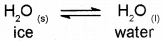
Consider a perfectly insulated thermos flask containing some ice and water at 273 K and normal atmospheric pressure. Since the flask is insulated, there will be no exchange of heat between its contents and the surroundings. It is seen that as long as the temperature remains constant, there is no change in the mass of ice and water. This represents an equilibrium state between ice and water and maybe represented as
Plus One Chemistry Notes Chapter 7 Chemical Equilibrium 1
We observe there is no change in mass of both ice and water. Since the rate of both reactions are equal.
rate of melting = rate of freezing For any pure substance at 1 atmospheric pressure the temperature at which the solid and liquid phases are at equilibrium is called the normal melting point or normal freezing point of the substance.

The equilibrium concentration calculator enables us to find how much the reactants and products.

Liquid – Vapour Equilibrium
In order to understand the liquid-vapour equilibrium, let us consider evaporation of water in a closed vessel. Consider a closed vessel connected to a manometer. The water vapour present in the vessel is first removed by placing some drying agent such as anhydrous calcium chloride in it for some time. The drying agent is then removed. Now the level of mercury in both the limbs of the manometer will be same. Introduce some water into the vessel and allow to stay at room temperature. Now water starts evaporating. A Pressure will gradually develop within the vessel due to the formation of water vapours. The change of pressure can be easily measured from the manometer. As evaporation continues, the pressure goes on increasing and the level of mercury in the right limb of the manometer starts rising. After some time it is observed that pressure becomes constant. This shows that the quantity of water vapour is not increasing any more, although liquid water is still present in the vessel. This indicates that a state of dynamic equilibrium has been attained between liquid water and water vapours.
Plus One Chemistry Notes Chapter 7 Chemical Equilibrium 2

At equilibrium, both reaction take place at the same rate. Thus at equilibrium,
rate of evaporation = rate of condensation

Plus One Chemistry Notes Chapter 7 Chemical Equilibrium

The pressure exerted by the vapours in equilibrium with the liquid at a particular temperature is called
vapour pressure of the liquid.

It may be noted that the equilibrium between the vapours and the liquid is attained only in a closed vessel. If the vessel is open, the vapours leave the vessel and get dispersed. Hence the rate of conden-sation will never become equal to the rate of evapo-ration.

Solid – Vapour Equilibrium
Consider systems where solids sublime to vapour phase, For example,
Plus One Chemistry Notes Chapter 7 Chemical Equilibrium 3

Equilibrium involving Dissolution of Solid or Gas in Liquids
Solids in liquids: In a saturated solution, a dynamic equilibrium exits between the solute molecules in the solid state and in the solution: the rate of dissolution of sugar = rate of crystallisation of sugar. Gases in liquids: This equilibrium is governed by Henry’s law, which states that the mass of a gas dissolved in a given mass of a solvent at any temperature is proportional to the pressure of the gas above the solvent

General Characteristics of Equilibria involving Physical Processes
For the physical processes discussed above, following characteristics are common to the system at equilibrium:

  1. Equilibrium is possible only in a closed system at a given temperature.
  2. Both the opposing processes occur at the same rate and there is a dynamic but stable condition.
  3. All measurable properties of the system remain constant.
  4. When equilibrium is attained for a physical process, it is characterised by constant value of one of its parameters at a given temperature.
  5. The magnitude of such quantities at any stage indicates the extent to which the reaction has proceeded before reaching equilibrium.

Equilibrium In Chemical Processes – Dynamic Equilibrium
Consider a general reversible reaction
A+B \(\rightleftharpoons \) C+D

Suppose the reaction is carried out in a closed container. In the beginning, the concentrations of A and B are maximum and the concentrations of C and D are minimum (equal to zero). As the reaction proceeds, the concentrations of A and B will decrease whereas the concentrations of C and D will increase. Hence the rate of the forward reaction will be high in the beginning and it will decrease gradually because of the fall in concentrations of A and B. On the other hand the velocity of the reverse reaction will be minimum at the beginning and it will increase gradually due to the increase in concentrations of C and D. Finally a stage will be reached when the rate of the forward reaction becomes equal to the rate of the reverse reaction. This state of the system is known as the state of chemical equilibrium. At this state the concentrations of the reactants and the products remain constant.
Plus One Chemistry Notes Chapter 7 Chemical Equilibrium 4
We can also start with C and D and make the reaction to proceed in the reverse direction. The concentration of C and D decreases and A and B increases. Finally, equilibrium is attained. One such example is given.
H2(g) +l2(g) \(\rightleftharpoons \) 2Hl(g)

Law Of Chemical Equilibrium And Equilibrium Constant
The relation between rates of reaction and concentrations was given by Guldberg and Wage in 1864. This relation is known as law of mass action.
The relation is,
\(K_{c}=\frac{[C][D]}{[A][B]}\)
For a general reversible reaction of the type,
aA + bB \(\rightleftharpoons \) cC + dD
the equilibrium constant maybe represented as
\(K_{ c }=\frac { [c]^{ c }[D]^{ d } }{ [A]^{ a }{ \left[ B \right] }^{ b } } \)
The equation is known as the expression for the law of chemical equilibrium.

Chemical Equilibrium

Plus One Chemistry Notes Chapter 7 Chemical Equilibrium

The law of chemical equilibrium or equilibrium law may thus be stated as :
At a given temperature, the product of concentrations of the reaction products raised to the respective stoichiometric coefficient in the balanced chemical equation divided by the prod-uct of concentrations of the reactants raised to their individual stoichiometric coefficients has a constant value. This is known as the Equilibrium Law or Law of Chemical Equilibrium.
If equilibrium constant for the backward reaction is
K’c then K’c = \(\frac{1}{K_{e}}\)

Homogeneous Equilibria
In a homogeneous system, all the reactants and products are in the same phase. For example, in the gaseous reaction,
N2(g) + 3H2(g) \(\rightleftharpoons \) 2NH3(g)

Heterogeneous Equilibria
Equilibrium in a system having more than one phase
is called heterogeneous equilibrium.
For example, H2O(l) \(\rightleftharpoons \) H2O(g)

Applications Of Equilibrium Constants

Predicting the Extent of a Reaction

  • If Kc >103, products predominate over reactants, i.e., if Kc is very large, the reaction proceeds nearly to completion.
  • If Kc < 10-3, reactants predominate over products, i.e., if Kc is very small, the reaction proceeds rarely.
  • If Kc is in the range of 10-3 to 103, appreciable concentrations of both reactants and products are present.

Plus One Chemistry Notes Chapter 7 Chemical Equilibrium 5

Predicting The Direction Of The Reaction
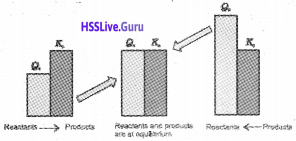
The equilibrium constant is also used to find in which direction the reaction mixture of reactants and products will proceed. For this, we have to calculate the reaction quotient (Qc) and compare with the equilibrium constant (Kc).

The concentrations of the species in Qc are not necessarily equilibrium values.
For a general reaction aA + bB → cC + dD
\(Q_{ c }=\frac { [c]^{ c }[D]^{ d } }{ [A]^{ a }{ \left[ B \right] }^{ b } } \)
If Qc > Kc, the reaction will proceed in the direction of the reactants (i.e., reverse reaction).
If Qc < Kc, the reaction will proceed in the direction of the products (i.e., forward reaction).
If Qc = Kc, the reaction mixture is already at equilibrium.
Plus One Chemistry Notes Chapter 7 Chemical Equilibrium 6

Calculating Equilibrium Concentrations
Step 1.
Write the balanced equation forthe reaction.

Step 2.
Under the balanced equation, make a table that lists foreach substance involved in the reaction:
a) the initial concentration,
b) the change in concentration on going to equilibrium, and
c) the equilibrium concentration.

In constructing the table, define x as the concentration ’ (mol/L) of one of the substances that reacts on going to equilibrium, then use the stoichiometry of the reaction to determine the concentrations of the other substances in terms of x.

Plus One Chemistry Notes Chapter 7 Chemical Equilibrium

Step 3.
Substitute the equilibrium concentrations into the equilibrium equation forthe reaction and solve for x. If you are to solve a quadratic equation choose the mathematical solution that makes chemical sense.

Step 4.
Calculate the equilibrium concentrations from the calculated value of x.

Step 5.
Check your results by substituting them into the equilibrium equation.

Problem
3.00 mol of PCl5 kept in 1L closed reaction vessel was allowed to attain equilibrium at 380 K. Calculate composition of the mixture at equilibrium. Kc = 1.80

Solution
Let x mol of PCl5 dissociated, At equilibrium:
(3 – x) x x
Kc = [PCl3][Cl2][PCl5]
1.8 = x²/(3 – x)
x² + 1.8x – 5.4 = 0
x = [-1.8 ± √(1.8)² – 4(-5.4)]/2
x = [-1.8 ± √3.24 + 21.6]/2
x = [-1.8 ± 4.98]/2
x = [-1.8 + 4.98]/2
x = 1.59
[PCl5] = 3.0 -x = 3 – 1.59 = 1.41 M
[PCl3] = [Cl2] = x = 1.59 M

Relationship Between Equilibrium Constant K, Reaction Quotient Q And Gibbs Energy G

  • ∆G is negative, then the reaction is spontaneous and proceeds in the forward direction.
  • ∆G is positive, then reaction is considered non-spontaneous. Instead, as reverse reaction would have a negative ”G, the products of the forward reaction shall be converted to the reactants.
  • ∆G is O, reaction has achieved equilibrium; at this point, there is no longer any free energy left to drive the reaction.

A mathematical expression of this thermodynamic view of equilibrium can be described by the following equation:

∆G = ∆G° + RT InQ
where, G° is standard Gibbs energy.
At equilibrium, when ∆G = 0 and Q=Kc the equation becomes,
∆G = ∆G° +RTIn K = 0
∆G° = -RTInK
InK = -∆G° / RT
Therefore, K = e∆Gv/RT

Factors Affecting Equilibria
In order to decide what course the reaction adopts and make a qualitative prediction about the effect of a change in conditions on equilibrium we use Le Chatelier’sprinciple. It states that a change in any of the factors that determine the equilibrium conditions of a system will cause the system to change in such a manner so as to reduce or to counteract the effect of the change. This is applicable to both physical and chemical equilibria.

Effect of Concentration Change
When the concentration of any of the reactants or products in a reaction at equilibrium is changed, the composition of the equilibrium mixture changes so as to minimize the effect of concentration changes.

Effect of Pressure Change
A pressure change obtained by changing the volume can affect the yield of products in case of a gaseous reaction where the total number of moles of gaseous reactants and total number of moles of gaseous products are different.

Effect of Inert Gas Addition
If the volume is kept constant and an inert gas such as argon is added which does not take part in the reaction, the equilibrium remains undisturbed. It is because the addition of an inert gas at constant volume does not change the partial pressures orthe molar concentrations of the substance involved in the reaction. So the reaction quotient does not change.

Effect of Temperature Change
Whenever an equilibrium is disturbed by a change in the concentration, pressure or volume, the composition of the equilibrium mixture changes because the reaction quotient, Qc no longer equals the equilibrium constant, Kc However, when a change in temperature occurs, the value of equilibrium constant, Kc is changed. In general, the temperature dependence of the equilibrium constant depends on the sign of ∆H for the reaction.

  • The equilibrium constant for an exothermic reaction (negative ∆H) decreases as the temperature increases.
  • The equilibrium constant for an endothermic reaction (positive ∆H) increases as the temperature increases.

Temperature changes affect the equilibrium constant and rates of reactions.

Effect of a Catalyst
A catalyst increases the rate of the chemical reaction by making available a new low energy pathway for the conversion of reactants to products. It increases the rate of forward and reverse reactions that pass through the same transition state and does not affect equilibrium. Catalyst lowers the activation energy for the forward and reverse reactions by exactly ‘ the same amount.

Ionic Equilibrium In Solution
Michael Faraday classified the substances into two categories based on their ability to conduct electricity. One category of substances conduct electricity in their aqueous solutions and are called electrolytes while the other do not and are thus, referred to as non-electrolytes.

Faraday further classified electrolytes into strong and weak electrolytes.

The ionic strength calculator is a convenient tool to help you calculate the ionic strength of a solution.

Plus One Chemistry Notes Chapter 7 Chemical Equilibrium

Strong electrolytes on dissolution in water are ionized almost completely, while the weak electrolytes are only partially dissociated.

Acids. Bases And Salts

Arrhenius Concept of Acids and Bases
According to Arrhenius theory, acids are substances that dissociates in water to give hydrogen ions H+(aq) and bases are substances that produce hydroxyl ions OH(aq). The ionization of an acid HX (aq) can be represented by the following equations:
HX(aq) → H+(aq) + X(aq)
or
HX(aq) + H2O(l) -> H3O+(aq) + X(aq)

The Bronsted-Lowry Acids and Bases
The Danish chemist, Johannes Bronsted and the English chemist, Thomas M. Lowry gave a more general definition of acids and bases. According to Bronsted-Lowry theory, acid is a substance that is capable of donating a hydrogen ion l-T and bases are substances capable of accepting a hydrogen ion, H+. In short, acids are proton donors and bases are proton acceptors.

Plus One Chemistry Notes Chapter 7 Chemical Equilibrium

The acid-base pair that differs only by one proton is called a conjugate acid-base pair. Therefore, OH is called the conjugate base of an acid H2O and NH4+ is called conjugate acid of the base NH3. If Bronsted acid is a strong acid then its conjugate base is a weak base and vice versa.
Consider the example of ionization of hydrochloric acid in water.
Plus One Chemistry Notes Chapter 7 Chemical Equilibrium 7

Ionization Of Acids And Bases

The Ionization constant of water and its ionic product
Water undergoes self ionisation to a small extent as follows.
Plus One Chemistry Notes Chapter 7 Chemical Equilibrium 8
Since [H2O] is constant, K[H2O]2 may be taken as a new constant Kw. Thus,
Kw= [H3O+][OH]

Where Kw is called ionic product of water. Its value is 1 x10‘14 mol2 L2 at 298 K. In pure water, the concen-tration of hydronium ions and hydroxyl ions are equal. Therefore in pure water,
[H3O+] = [OH] = 1 × 10⁻⁷ mol L-1

Since the ionisation of water increases with increase of temperature, Kw increases with rise of temperature.

Our buffer pH calculator will help you painlessly compute the pH of a buffer based on an acid or a base.

The pH Scale
Hydronium ion concentration in molarity is more conveniently expressed on a logarithmic scale known as the pH scale.

The pH of a solution is defined as the negative logarithm to base 10 of the activity (aH+) of hydrogen ion.
i.e., pH = – log aHH+ = – log {[H+]/,mol L-1}
Acidic solution has pH < 7 Basic solution has pH > 7
Neutral solution has pH = 7

Ionization Constants of Weak Acids
Plus One Chemistry Notes Chapter 7 Chemical Equilibrium 9
Here, c= initial concentration of the undissociated acid, HXat time, t = 0. α = extent up to which HX is ionized into ions.
Ka = c²a² / c(1 – α) = cα²/1 – A
Ka is called the dissociation or ionization constant.

Ionization of Weak Bases
The equilibrium constant for base ionization is called base ionization constant and is represented by Kb.

When equilibrium is reached, the equilibrium constant can be written as:
Kb = (cα)² / c(1 – α) = cα² / (1 – α)
considering the base-dissociation equilibrium reaction:
Kb = [BH+][OH]/[B]
Then multiplying and dividing the above expression by [H+], we get:
Kb = [BH+][OH][H+]/[B][H+]
= {[OH][H+]}{[BH+]/[B][H+]}
= Kw/Ka
Then we get the following relation;
pKa + PKb = pKq = 14 (at 298 K)

Common ion effect in the ionization of Acids and Bases.
Common ion effect my be defined as the suppression of the dissociation of a weak electrolyte (weak acid or weak base) by the addition of some strong electrolyte containing a common ion.

Factors Affecting Acid Strength
Dissociation of an acid depends on the strength and polarity of the H-A bond.
Electronegativity of A increases CH4 < NH3 < H2O < HF Acid strength increases

Common Ion Effect in the Ionization of Acids and Bases
Ka = [H+] [Ac] / [HAc] acetate ions to an acetic acid solution results in decreasing the concentration of hydrogen ions, [H+], Also, if H+ ions are added from an external source then the equilibrium moves in the direction of undissociated acetic acid. This phenomenon is an example of common ion effect.

Hydrolysis of Salts and the pH of their Solutions
Salts formed by the reactions between acids and bases in definite proportions, undergo ionization in water. The cations/anions formed on ionization of salts either exist as hydrated ions in aqueous solutions or interact with water to reform corresponding acids/bases depending upon the nature of salts. The later process of interaction between water and cations/anions or both of salts is called hydrolysis.

Buffer Solutions
The solutions which resist change in pH on dilution or with the addition of small amounts of acid or alkali are called Buffer Solutions.

Solubilityequilibriaof Sparingly Soluble Salts

Solubility Product Constant
The equilibrium between the undisolved solid and the ions in a saturated solution can be represented by the equation:
Plus One Chemistry Notes Chapter 7 Chemical Equilibrium 10
We call Ksp the solubility product constant or simply solubility product.

Thus, solubility product of a salt is the product of concentration of ions in its saturated solution, raised to a power equal to the number of times the ions occur in the equation representing the dissociation of the salt.

Plus One Chemistry Notes Chapter 7 Chemical Equilibrium

The term Ksp in equation is given by Qsp when the concentration of one or more species is not the concentration under equilibrium. Obviously under equilibrium conditions Ksp = Qsp but otherwise it gives the direction of the processes of precipitation or dissolution.

Common Ion Effect on Solubility of Ionic Salts
The solubility of salts of weak acids like phosphates increases at lower pH. This is because at lower pH the concentration of the anion decreases due to its proto-nation. This, in turn, increases the solubility of the salt so that Ksp = Qsp.

Ncert Supplementary Syllabus

Designing Buffer Solution
Knowledge of pKa, pKb and equilibrium constant help us to prepare the buffer solution of known pH. Let us see how we can do this.

Preparation of Acidic Buffer
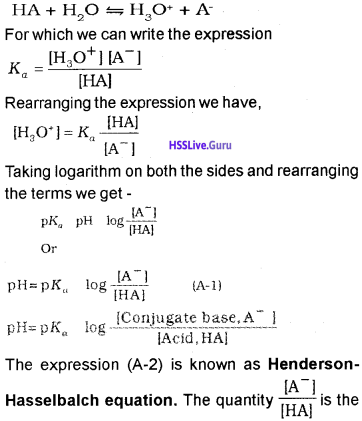
To prepare a buffer of acidic pH we use weak acid and its salt formed with strong base. We develop the equation relating the pH, the equilibrium constant, Ka of weak acid and ratio of concentration of weak acid and its conjugate
base. For the general case where the weak acid HA ionises in water,
Plus One Chemistry Notes Chapter 7 Chemical Equilibrium 11
ratio of concentration of conjugate base (anion) of the acid and the acid present in the mixture. Since acid is a weak acid, it ionises to a very little extent ‘and concentration of [HA] is negligibly different from concentration of acid taken to form buffer. Also, most of the conjugate base, [A], comes from the ionisation of salt of the acid. Therefore, the concentration of conjugate base will be negligibly different from the concentration of salt. Thus, equation (A-2) takes the form: pH-pKa + log\(\frac{[\mathrm{Salt}]}{[\mathrm{Acid}]}\)

Plus One Chemistry Notes Chapter 7 Chemical Equilibrium

In the equation (A-1), if the concentration of [A] is equal to the concentration of [HA], then pH = pKa because value of log 1 is zero. Thus if we take molar concentration of acid and salt (conjugate base) same, the pH of the buffer solution will be equal to the pKa of the acid. So for preparing the buffer solution of the required pH we select that acid whose pKa is close to the required pH. For acetic acid pKa value is 4.76, therefore pH of the buffer solution formed by acetic acid and sodium acetate taken in equal molar concentration will be around 4.76.

A similar analysis of a buffer made with a weak base and its conjugate acid leads to the result,
Plus One Chemistry Notes Chapter 7 Chemical Equilibrium 12

pH of the buffer solution can be calculated by using the equation pH + pOH =14.

We know that pH + pOH = pKw and pKa + pKb = pKw On putting these values in equation (A-3) it takes the form as follows:
Plus One Chemistry Notes Chapter 7 Chemical Equilibrium 13
If molar concentration of base and its conjugate acid (cation) is same then pH of the buffer solution will be same as pKa for the base. pK value for ammonia is 9.25; therefore a buffer of pH close to 9.25 can be obtained by taking ammonia solution and ammonium chloride solution of equal molar concentration. For a buffer solution formed by ammonium chloride and ammonium hydroxide, equation (A-4) becomes:
Plus One Chemistry Notes Chapter 7 Chemical Equilibrium 14
pH of the buffer solution is not affected by dilution because ratio under the logarithmic term remains unchanged.

Plus One Political Science Chapter Wise Questions and Answers Chapter 7 Nationalism

You can Download Nationalism Questions and Answers, Notes, Plus One Political Science Chapter Wise Questions and Answers Kerala Chapter 7 help you to revise complete Syllabus and score more marks in your examinations.

Kerala Plus One Political Science Chapter Wise Questions and Answers Chapter 7 Nationalism

Nationalism Questions and Answers

Question 1.
“Nationalism has got two faces.” Explain.
Answer:
Nationalism has two faces – creative nationalism and destructive nationalism. Creative Nationalism is an emotional and spiritual power that unifies all factors that make up a nation. The creative nationalism we see in India is unity in diversity. Militant and aggressive nationalism is the opposite of creative nationalism. The WW II was the result of the militant and aggressive nationalism of the Nazis and Fascists.

Question 2.
What is nationalism?
Answer:
Nationalism is an emotional and spiritual power that unifies all factors that make up a nation. Nationalism includes national styles, national expectations, national goals, national conflicts, national anthem, national flower, national flag and national symbol. Toynbee defines nationalism as the religion of modern nations.

HSSLive.Guru

Question 3.
“A nation is an imaginary society.” Do you agree with this opinion? Explain.
Answer:
I agree. Nationalism is the feeling that one is the son/daughter of a particular nation even if he/she is living in another country because of his/her work. For example, an Indian may work and live in Dubai or New York. But nationalism reminds him that he is a son of India and he should be loyal to her. He should be proud of the fact that he is an Indian and do all he can to keep her dignity up. The Palestine nationalism was even above territory. Even though there was no territory for Palestine, Palestine nationalism was very strong. The strong nationalism gave birth to the State of Palestine which now consists of West Bank and Gaza Strip.

Question 4.
Give examples of Indian nationalism.
Answer:

  • National Anthem
  • National Flag
  • National symbol
  • Ashoka Pillar

Question 5.
Common political identity is required for nation-building. Explain the factors that contribute towards nationalism.
Answer:
Nationalism is an emotional and spiritual power that unifies all factors of the political theory prevalent in the nation. The nationalism we see in India is unity in diversity. Indian nationalism is the feeling that we all are Indians. Without nationalism, no new nation can originate or survive. It is nationalism that supplies the basis for the building up of a nation. Loyalty to the nation, its strength, its power, and its working and the legality, etc. are emotions that are generated in the minds of people. In the background of nationalism, the common behavior of a nation can be analyzed. Nationalism includes national styles, national expectations, national goals, national conflicts, national anthem, national flower, national flag, and national symbol. Toynbee has said that. Nationalism is the religion of the modern nation. Factors that nourish Nationalism:
a) Shared Beliefs: It is some beliefs that help the formation of a nation. Nation is not a concrete thing like a building, river or forest that we can see and touch. Nation is a concept built around certain beliefs of the people. When we say that a people are a nation, we do not mean their physical behavior. Nation is a vision and a collective fellowship of people who wish to have their own separate identity. It is like a group of a team. They work for a common goal in a common fellowship. A nation can exist only as long as the people are deeply rooted in unity.
b) History: A people who consider themselves as a nation have a sense of a continuous historical existence. It is something that they can look back with pride and look forward to with hope. They have a common history based collective memories, legends and historical documents. Thus they acquire individuality as a nation. We can take our Indian nationalist leaders as examples. We point out our ancient civilization, cultural heritage and other past achievements, thus making a unique identity of our own.
c) Territory: Territory is another essential aspect of a nation. A nation has a separate area of land. There people will have lived together for long, shared their past, bringing a common identity to them. It helps them to think that they are one nation. That is why they can talk about their own country of birth.
d) Shared political ideals: Apart from the sense of a common history and some territory of their own, the people of a nation are persuaded to think of unity because of their common vision and goal for the future. They have some ideals quite peculiar to them and these also make a nation different from others.
e) Common Political Identity: Many people think that just because individuals have a common political vision regarding the society and the government, they can’t form a nation. They feel that something like a common language or common heredity is necessary to have the drive to form a nation. A common language or a common religion might bring about a common cultural Identity. When people celebrate the same feasts on the same day and actively take part in the festivities, they feel some kind of unity. But it is possible that in a democratic setup and democratic values, too much of religion may prove a threat.

Question 6.
Suggest some programs to develop nationalist feelings among students.
Answer:
Celebrating Independence Day, Republic Day and Gandhi Jayanthi in an appropriate manner. The singing of the national anthem every day in school. Organizing Patriotic songs, discussions on important national issues, Debates on issues of national interest, Competitions, etc. Making albums containing the pictures of national leaders, the history of India’s Independent struggle, etc.

Question 7.
What do you understand by the Right to Self-Determination? How has this idea resulted in both the formation of and challenges to nation-states?
Answer:
A nation has the freedom to take decisions on its own and carry them out without being pressurized by any external forces. In the present scenario of globalization and liberalization, there is a threat to the Right to Self-Determination. This will negatively affect nationalism and the continued existence of modem nations.

Question 8.
“Neither descent, nor language, nor religion, nor ethnicity can claim to be a common factor in nationalism all over the word.” Do you agree? Comment.
Answer:
I agree. Much more than the above factors, it is the unity in diversity that influences the nationalism of a nation. Nationalism is strengthened without any difference in religion, tribe, language and region.

Question 9.
Identify the factors leading to the destruction of nationalism.
Answer:
Religious fundamentalism
Casteism
Regionalism
Terrorism
Secessionist tendencies
Economic and Social inequalities
Unemployment
Nepotism
Dictatorship

Question 10.
“We have seen that nationalism can unite people as well as divide them, liberate them as well as generate bitterness and conflict.” Illustrate your answer with suitable examples.
Answer:
Indian nationalism led us to freedom and the integration of the Princely States. It also led to the division of the country. German nationalism led to the unification of Germany and later to World War II.

Question 11.
Prepare a table showing the differences between constructive nationalism and aggressive nationalism.
Answer:

Creative Nationalism Aggressive (Destructive) Nationalism
Creates loyalty Creates hatred.
Unites people Divides people.
Develops sense of freedom & liberates people. Causes conflicts and wars.
Encourages democracy & self rule Develops isolation.
Encourages economic growth Looks at other people with suspicion.
Encourages cultural growth. Develops instability.
Encourages diversity in social, economic and political spheres. Creates many small nations.

Question 12.
It was ………… who called nation as an ‘imaginary society’.
Answer:
Benedict Anderson

Question 13.
A ………….. is a society which shares some special characteristics.
Answer:
Nation

HSSLive.Guru

Question 14.
Which among the following are the factors that constitute a nation?
a) Territory
b) Political identity
c) Common political principles
d) All of the above
Answer:
All of the above

Plus One Political Science Chapter Wise Questions and Answers Chapter 6 Citizenship

You can Download Citizenship Questions and Answers, Notes, Plus One Political Science Chapter Wise Questions and Answers Kerala Chapter 6 help you to revise complete Syllabus and score more marks in your examinations.

Kerala Plus One Political Science Chapter Wise Questions and Answers Chapter 6 Citizenship

Citizenship Questions and Answers

Question 1.
What do you mean by citizenship?
Answer:
Citizenship is the membership of a nation. Citizens are those who are eligible to enjoy all the social and political rights of the nation. Citizens have some special rights and privileges in their own nation. Such special rights to the citizens are called citizenship rights.

Question 2.
Anand visited Germany with his family. There his wife gave birth to a child. Is the child an Indian citizen or not? Explain the process of getting Indian citizenship with suitable examples.
Answer:
The child is eligible for Indian citizenship. According to the citizenship laws of Germany, the child can also claim German citizenship. But a person can be a citizen of only one country.
These are the ways to get Indian citizenship:

  • Natural citizenship by birth
  • Citizenship through heredity
  • Citizenship through Registration
  • Citizenship through long or extended stay Citizenship acquired when an area is merged with the country.

HSSLive.Guru

Question 3.
There are two methods for the acquisition of citizenship. Explain.
Answer:
i) Citizenship by birth
ii) Citizenship by naturalization Citizenship by birth can be of two kinds. The first is through blood relationship. Wherever the child may be born, it will get the citizenship of its father. The second is the Right of Place or Soil of birth. According to this, a child will get the citizenship of the country in which it is born.

Citizenship by naturalization can be of two kinds: One, a person can get the citizenship of a country subject to its laws. Two, a person can get citizenship of a country by long stay there, by taking a pledge, by acquiring property, having a civil or military position, manage, etc. These are some of the different situations in which a person can get citizenship of another country.

Question 4.
Can citizenship be lost? If yes, point out the circumstances.
Answer:
Citizenship can be lost. The following are the circumstances:

  • Refusing citizenship
  • Through marriage
  • Absence for a long period
  • By committing treason

Question 5.
Illustrate full and equal membership.
Answer:
Persons who are eligible to get all the political and rights of a nation are called its citizens. According to Aristotle, the Father of political science, citizens take active part in the ruling of the nation. All the rights given to a citizen as a member of a nation are ‘ citizenship rights. They are given equally to all the citizens.

Question 6.
Every citizen can be assured equal rights. However, everyone is not capable of utilizing equal rights. Explain.
Answer:
A nation gives equal rights to its citizens. But they are not able to use them equally. It is because the knowledge of the citizenship rights is different among various people. Some people may have negative attitude to politics and political systems. Such people also can’t make use the rights assured by the nation.

Question 7.
Picture the various elements of State.
Answer:
Plus One Political Science Chapter Wise Questions and Answers Chapter 6 Citizenship 1
According to modem political theory apart from these 4 factors, there should also be international recognition.

Question 8.
In which year did the Indian Citizenship Act come into existence?
Answer:
1955

Question 9.
According to the Indian Citizenship Act, there are 5 ways to acquire Indian Citizenship. Which are they?
Answer:
According to the Indian Citizenship Act, there are 5 ways to acquire Indian Citizenship. They are:
i) By birth: Anybody born in India on 21 January 1950 or later will be an Indian citizen.
ii) Citizenship by heredity: Anybody born outside India on 21 January 1950 or later will be given Indian citizenship if his father was an Indian citizen at the time of his birth.
iii) Citizenship by Registration: The following can get Indian citizenship through registration:

  • People of Indian origin who have stayed in India continuously for 6 months before submitting the application for registration.
  • People of Indian origin who are staying outside undivided India.
  • Wives of the Indian citizens.
  • Minor children of Indian citizens.
  • Adult citizens of Commonwealth Countries or the Republic of Ireland.

iv) Citizenship through Long Stay: A foreigner can get Indian citizenship through long stay here subject to certain conditions.
v) Citizenship through regions becoming part of India: If any region becomes part of India, the government has the authority to declare the people of that region as Indian citizens.

Question 10.
Point out the circumstances for the termination of Indian Citizenship.
Answer:
Here are the circumstances leading to the termination of Indian Citizenship:

  • Refusing Indian citizenship
  • Through marriage
  • Absence for a long period
  • By committing treason

Question 11.
The importance of global citizenship is enhancing day by day. Point out your arguments in favor of this statement.
Answer:
Through the influence of globalization, open market system is strengthened and the distance between nations is lessened. Because of the growth of technology, the world has become a global village. In the circumstances, importance of global citizenship is enhancing day by day.

Question 12.
Refugees are facing a lot of problems today. State how global citizenship can be helpful for refugees.
Answer:
Many people become refugees because of internal conflicts, external wars and natural disasters like droughts, floods, earthquakes, and tsunamis. In the circumstances, the concept of global citizenship is helpful to them.

Question 13.
Match the following:

A B
i) French Revolution By birth
ii) Getting citizenship Refugee problem
iii) The Prince 1789
iv) Indian Citizenship Right Act Machiavelli
v) Global citizenship 1955

Answer:

A B
i) French Revolution 1789
ii) Getting citizenship By birth
iii) The Prince Machiavelli
iv) Indian Citizenship Right Act 1955
v) Global citizenship Refugee Problem

Question 14.
Write a short note on the topic ‘universal citizenship’
Answer:
Through the influence of globalization, open market system is strengthened and the distance between nations is lessened. Because of the growth of technology the world has become a global village. In the circumstances, importance of global (universal) citizenship is enhancing day by day.

Question 15.
Point out the problems raised in India related to citizenship.
Answer:
Double citizenship: Millions of Indians work abroad and live there permanently and therefore their children face the problem of citizenship. Therefore the demand for double citizenship is increasing. Expatriate Voting Right: Recently the Indian government granted voting rights to the expatriates. This issue is still being discussed.

Question 16.
Point out the importance of global citizenship.
Answer:
The growth in communication has blurred the importance of the boundaries between nations and increased a sense of mutual relation among the people of the world. A nation can’t solve all the problems it faces all by itself. Problems that spread across boundaries are to be solved by the cooperation different governments and people. Because of all this, the advocates of global citizenship say that it is inevitable and all should work for its realization.

Question 17.
National citizenship and global citizenship are equally important. Explain.
Answer:
National citizenship and global citizenship are important in their spheres. Social inequalities and other problems in the country create big threats to the principle of equality in citizenship. Such problems can be solved only by the government and the people of that country. Equal and full citizenship is important for the people of a country. National citizenship is relevant here.

The Concept of global citizenship reminds us that national citizenship is incomplete. We are living in a world that is mutually interconnected. The relations among the various people among the different countries are to be strengthened. There is a need to work with governments and people of other countries. Global citizenship should be complementary to national citizenship. That way Global citizenship deserves serious consideration.

HSSLive.Guru

Question 18.
The relation a person has with his nation is
Answer:
citizenship

Question 19.
What are the circumstances in which one forfeits his citizenship?
a) Renunciation
b) The Government stops it
c) Illegal residence
d) all the above
Answer:
All the above

Question 20.
It was in the year that the Parliament passed a Comprehensive Act on citizenship.
Answer:
1955

Question 21.
How many ways are there to acquire citizenship according to the Constitution?
Answer:
5 ways

Question 22.
It was the ruin of that made the background for the rise of nation-states.
Answer:
Feudalism

Plus One Political Science Chapter Wise Questions and Answers Chapter 5 Rights

You can Download Rights Questions and Answers, Notes, Plus One Political Science Chapter Wise Questions and Answers Kerala Chapter 5 help you to revise complete Syllabus and score more marks in your examinations.

Kerala Plus One Political Science Chapter Wise Questions and Answers Chapter 5 Rights

Rights Questions and Answers

Question 1.
Define the term “Rights”.
Answer:
Rights are some social and political privileges that a person gets as a citizen of a nation, and as a member of a society. According to the famous philosopher Barker: “Rights are the external conditions which are essential for the maximum

Question 2.
Where do rights come from?
Answer:
Natural Rights
Rights given by the society
Rights assured by the Constitution

HSSLive.Guru

Question 3.
Show the features of rights using a chart.
Answer:
Plus One Political Science Chapter Wise Questions and Answers Chapter 5 Rights 1

Question 4.
Which day is observed as the Human Rights Day?
Answer:
December 10

Question 5.
Complete the following flow chart:
Plus One Political Science Chapter Wise Questions and Answers Chapter 5 Rights 2
Answer:
Plus One Political Science Chapter Wise Questions and Answers Chapter 5 Rights 3

Question 6.
Observe the following picture:
Plus One Political Science Chapter Wise Questions and Answers Chapter 5 Rights 4
Explain what the picture relates to.
Answer:
It is a picture related to Human Rights.

Question 7.
Prepare a note on various types of rights.
Answer:

  1. Moral Rights: These are rights based on man’s morality, sense of justice and conscience. They are not guaranteed by law. For example, the poor, the sick and the old have the moral right to get sympathetic consideration by others.
  2. Legal Rights: They are assured the by the Nation.
  3. Natural Rights: They include Right to life, Right for personal freedom, Right to earn wealth.
  4. Civil Rights: They are related to the life, wealth and freedom of individuals. They include the right to live, right to freedom, right to work, right to express one’s views, right to property, right to education, right to religion, right to equality, right to assemble, right to live family life and right to make contracts.
  5. Economic Rights: They are related to economic security and the right to earn one’s livelihood. They include right to work, right to get decent wages, right to leisure, right to have social security and right to earn wealth.
  6. Political Rights: It is the right of an individual to participate in the political matters of the nation. They include right to vote, right to contest in elections, right to be appointed to various posts, right to criticize, and right to make complaints.
  7. Fundamental Rights: These are essential for the full development of one’s personality. The Constitution and ourts ensure these rights. They are Right to Equality (Article 14-18), Right to freedom (19-22), Right against Exploitation (23-24), Right to Religious Freedom (25-28), Cultural and Educational Rights (29-30) & Right to Constitutional Remedies (32).

Question 8.
Find the odd one out:
i) a) Rights are deserved
b) Rights are not absolute
c) Rights are a recognition
d) Rights are an assurance
ii) a) Moral rights
b) Citizenship rights
c) Religious rights
d) Legal rights
Answer:
i) Rights are not absolute
ii) Moral rights

Question 9.
What are the fundamental rights? Prepare a short note.
Answer:
In chapter 3 of the Indian Constitution, from article 12 to 35, the fundamental rights of the Indian citizens are given. Rights are some social and political privileges that a person gets as a citizen of a nation, and as a member of a society. Fundamental rights are the most important of these rights and the Constitution assures the people of these rights. They are legally guaranteed. The fundamental rights are:

  • Right to Equality (article 14-18)
  • Right to freedom (19-22)
  • Right against Exploitation (23-24)
  • Right to Religious Freedom (25-28)
  • Cultural and Educational Rights (29-30)
  • Right to Constitutional Remedies (32)

Question 10.
Which among the following is not a fundamental right?
Religious right, right to equality, right to property, right to freedom.
Answer:
Right to Property

Question 11.
Rights are generally classified into three. Give examples for each of them
Answer:
a) Citizenship Rights: Right to life, Right to freedom.
b) Political rights: Right to vote, Right to criticize
c) Economic rights: Right to work, Right to social security.

Question 12.
“Rights are meaningless, if there is no support of laws and governments.” Do you agree with this statement?
Answer:
Yes, I do agree. Moral rights are rights based on man’s morality, sense of justice and conscience. Rights can be denied. The work of an individual might be against conscience of the society. Even then there are no laws to punish those who breach the moral rights. On the other hand, legal rights are guaranteed by the Constitution and the Courts. Since the nation can punish the offenders, these rights become meaningful.

Question 13.
Mention any four civil rights of the citizens
Answer:
i) Right to life
ii) Right to express one’s opinion
iii) Right to equality
iv) Right to education

Question 14.
Match the following columns appropriately.

A B C
Moral rights Person’s civic life Right to the unemployed for security
Citizenship Rights Participation in nation’s affairs Rights to work
Political rights Natural rights Right to vote
Economic rights Conscience of the Society Right to life
Human rights Profitable work Right of children for parental protection

Answer:

A B C
Moral rights Conscience of the Society Right of children for parental protection
Citizenship Rights Person’s civic life Right to life
Political rights Participation in nation’s affairs Right to vote
Economic rights Profitable work Right to work
Human rights Natural rights Right to the unemployed for security

Question 15.
“Rights and responsibilities are closely related.” Do you agree? Substantiate your answer
Answer:
I do agree. Rights and responsibilities are the two sides of the same coin. As you enjoy your right, you have to carry out your responsibilities. The statement that “My right is your responsibility and your right is my responsibility” shows the relation between rights and responsibilities.

Question 16.
Rights also impose’certain duties on a nation. Illustrate.
Answer:
Rights give the nation the duty to carry out certain responsibilities. Each right shows that a nation should do and should not do. For example, since people have a right to live, the nation has the responsibility of making laws to protect them from others. It asks the nation to punish those who wound or harm us. Imagine that by the “right to life”, a society means “right to a decent and healthy life”. Naturally, the society expects that the nation will take steps to ensure to provide the people with a clean and healthy environment necessary fora good life. The rights of the citizens give the nation the responsibility to act in certain ways. The two examples above prove that.

Question17.
Distinguish between natural and social inequalities.
Answer:
In political theory, inequalities are classified as natural and social inequalities. The inequalities that come from the different abilities and intellectual powers are called natural inequalities. They are quite different from social inequalities. The inequalities that result from one section of the society exploiting another section and denying them equal opportunities are social inequalities.

Question 18.
…………. points out that rights originated even before the coming of nation.
Answer:
Lasky

Question 19.
Which is the Human Rights Day?
a) 10 November
b) 10 December
c) 25 December
d) 24 October
Answer:
10 December

HSSLive.Guru

Question 20.
Pair the following appropriately.
1. Right to Vote
2. Right to work
3. Freedom of Opinion
4. Citizen’s Rights
5. Economic Rights
6. Political Rights
Answer:
Right to Vote → Political Right
Right to Work → Economic Right
Freedom of Opinion → Citizen’s Rights

Plus One Political Science Chapter Wise Questions and Answers Chapter 5 Legislature

You can Download Legislature Questions and Answers, Notes, Plus One Political Science Chapter Wise Questions and Answers Kerala Chapter 5 help you to revise complete Syllabus and score more marks in your examinations.

Kerala Plus one Political Science Chapter Wise Questions and Answers Chapter 5 Legislature

Legislature Questions and Answers

Question 1.
A Parliament is necessary for the existence of democracy. Do you agree? Explain.
Answer:
Legislature is the Committee that makes laws for the day-to-day administration of the country and for the protection of the freedom and rights of its citizens. The laws that are carried out by the Executive are made by the Legislature. The people in a country through their right to’ vote choose their representatives. The Legislature thus established democratically is responsible to the people. In different countries, different types of Legislature can be found. It is based on the relations between the Executive and Legislature that governments are divided into Parliamentary and Presidential systems.

Question 2.
Name the two Houses of Parliament.
Answer:
Lok Sabha and Rajya Sabha

HSSLive.Guru

Question 3.
Who is the present Lok Sabha Speaker?
Answer:
Sumatra Mahakam

Question 4.
What are the powers and functions of Lok Sabha?
Answer:

  • Legislation (law-making)
  • Controlling the Executive
  • Financial responsibilities
  • Representation
  • Discussions
  • Administrative responsibilities
  • Election responsibilities
  • Judicial responsibilities

Question 5.
Prepare a table showing the powers of Lok Sabha and Rajya Sabha.
Answer:
Plus one Political Science Chapter Wise Questions and Answers Chapter 5 Legislature 1
Plus one Political Science Chapter Wise Questions and Answers Chapter 5 Legislature 2

Question 6.
A bill when passed in the Indian Parliament becomes a law. What do you understand by a bill?
Answer:
A bill is the draft of the proposed law. If the Parliament approves the draft, it becomes a law. The law is to be approved by the President.

Question 7.
There are several procedures fora bill presented in the Parliament to become a law. Explain the procedure.
Answer:
Legislative Procedure in India: The procedure for passing the bills in the Parliament is explained in articles 107 to 122. According to that, each bill has to pass through 5 phases including 3 readings in the Houses.
a) First Reading: This is the presentation of the bill. After getting the permission of the House, a member presents the bill with a statement.
If the bill faces opposition, the one who presented the bill and the one objecting it is given opportunity to explain their stands. If the majority votes in favor of the Bill, it is published in the Government Gazette. If the bill is not very controversial, there is a precedent that there is no discussion in the first reading.
b) Second Reading: This is the 2nd phase. At this stage, all the important points of the bill are discussed. The presenter will ask the House to consider it urgently. Or he may request the bill to be sent to a Select Committee ora Joint Committee of both the Houses for consideration. He may also ask the bill to be circulated forgetting public opinion. Normally the bill is sent to a Select Committee.
c) The Committee Stage: This is the 3rd stage. The members to this Committee are appointed by the House. The Committee Chairman decides the time, date and venue of the meeting. The Select Committee will have members from the Opposition. The Members study the bill clause by clause and prepares a report to be presented in the House.
d) Report Stage: This is the 4th stage. The presenter asks the House to discuss the bill on the day it is scheduled for discussion. The Report may be unanimous or with differences in opinion. In the light of the Report, the House discusses each condition in the bill. This discussion may take quite some time. Each item in the bill is discussed extensively and then it is put to vote. During this time serious changes may happen in the bill and therefore this is the most crucial stage.
e) Third Reading: This is the last stage. On the appointed day the bill is presented in the House for final approval. No serious change is brought at this stage. Changes may be orally presented and quickly resolved. At the end of the discussion, the bill is put to vote. If the bill receives favourable vote from the majority of members present and voting, the bill is deemed to have passed. Then the bill is sent to the second House.

Question 8.
Complete the following flow chart
Plus one Political Science Chapter Wise Questions and Answers Chapter 5 Legislature 3
Answer:
Plus one Political Science Chapter Wise Questions and Answers Chapter 5 Legislature 4

Question 9.
Lok Sabha is more powerful than the Rajya Sabha. Comment.
Answer:
The Rights and Responsibilities of the Lok Sabha: The Lok Sabha has Legislative, Financial, Administrative and Election responsibilities. In the matter of ordinary law-making, Lok Sabha has greater power. If a bill passed by the Lok Sabha is rejected by the Rajya Sabha, the President can call a joint meeting of both the Houses. Since Lok Sabha has greater number of members, the Rajya Sabha will have to go with the Lok Sabha verdict. The Rajya can only delay things a bit. A bill may originate in any House, normally important bills are presented first in the Lok Sabha. Financial Bills can originate only in the Lok Sabha. Since the Lok Sabha has the freedom to reject any suggestions on Financial Bills, it has the monopoly over them.

Lok Sabha controls the Executive in the day-to-day administration. The Central Ministry is collectively responsible to the Lok Sabha. The Ministry will have to resign the moment it loses the confidence of the Lok Sabha. It can also bring a Non-Confidence motion. By asking questions, through resolutions and discussions, the Lok Sabha maintains control over the government. When the Appropriation bills are brought, the members get a chance to discuss the successes and failures of each department. Members of the Lok Sabha have voting right in the election of the President and Vice President. It has equal authority with the Rajya Sabha to bring any amendment. It has equal rights with the Rajya Sabha in impeaching the President, in removing Supreme Court and High Court Judges, in approving Resolutions for Emergency and Ordinances.

Question 10.
What do you mean by Money Bill?
Answer:
Money bills are those that deal with economic matters. They can originate only in the Lok Sabha. The process of Money Bill is different. After passing it, the Lok Sabha passes it on to the Rajya Sabha for suggestions. But Rajya Sabha has no power to change it or reject it. In 14 days’ time after the receipt of the bill by the Rajya Sabha, it should send it back to the Lok Sabha with suggestions. The suggestions can be accepted or rejected by the Lok Sabha. If the bill is not returned within 14 days, it will be considered to have been passed by both Houses. The Rajya Sabha has virtually no important role to play in the Money Bills.

Question 11.
How any members are there in the Lok Sabha?
Answer:
It has 545 members – 543 elected and 2 nominated.

Question 12.
Suggest the instruments of Parliamentary control.
Answer:

  • Discussions and debates.
  • Approving of rejecting the laws.
  • Control through finances
  • Motion of No-Confidence

Question 13.
The first item in the time-table of the Parliament is Question-Answer session. Then comes the Zero hour. What do you know about the Zero hour?
Answer:
When the Question-Answer session finishes, the Zero hour starts. It starts at 12 Noon and that is why it is called the Zero hour. During the Zero hour, urgent matters can be raised without giving prior notice.

Question 14.
Point out the importance of the law of anti-defection.
Answer:
Defection is when an elected member of a party refuses to obey party-whip and joins with other parties. Law of anti-defection makes such defections unlawful. The law envisages that the membership of the defected member should be canceled. This law ensures the stability of the government.

Question 15.
How many members are there in the Indian Parliament from Kerala?
Answer:
20 in the Lok Sabha and 9 in the Rajya Sabha.

Question 16.
Prepare a note on Parliamentary supremacy.
Answer:
Although both Britain and India have Parliamentary (Cabinet) System, the Parliaments in both countries do not have the same status. Since Britain has no written constitution, its Parliament has unlimited powers. It can pass or reject any law. Courts can’t question the Parliament there. The Parliament can even ignore Court decisions. In short, there is nothing the Parliament can’t do there.

Question 17.
Match the following:

A B
Lower House of the Parliament 17 April 1952
Upper House of the Parliament Lok Sabha
Formation of the Rajya Sabha Rajya Sabha
Formation of the Lok Sabha 3 April 1952
Parliament 1985
Amendment to Anti-Defection Law Power of Impeachment

Answer:

A B
Lower House of the Parliament Lok Sabha
Upper House of the Parliament Rajya Sabha
Formation of the Rajya Sabha 3 April 1952
Formation of the Lok Sabha 17 April 1952
Parliament Power of Impeachment
Amendment to Anti-Defection Law 1985

Question 18.
What do you mean by Select Committee? How is it formed and operated?
Answer:
When the House wants a bill to be sent to the Select Committee, a Select Committee is formed. A Select Committee is formed to study a bill in detail and make its report. The chairman of the Committee is nominated by the Speaker. After studying the bill carefully, the committee presents its report to the House. When the work is over the Select Committee is disbanded.

Question 19.
Explain (a) Question Hour,
(b) Zero Hour and
(c) Adjournment Motion.
Answer:
Parliament meetings start at 11 a.m. Up to 12 Noon, it will be Question-Answer time. This is the time set apart for the members to ask questions to the Ministers on a particular topic.

When the Question Hour finishes, the Zero Hour starts. Since it starts at 12 Noon it is called the Zero hour. During the Zero hour, urgent matters can be raised without giving prior notice. 5 to 10 minutes are given for each matter. The agenda of the Parliament is pre-determined. But with the permission of the speaker, this can be changed. Keeping the pre-determined agenda away, the Speaker at times allows members to present matters of urgent importance. Adjournment Motion is for that.

Question 20.
The Upper House of the Parliament is …………
Answer:
Rajya Sabha

Question 21.
From which year was Rajya Sabha known by that name?
a) 1950
b) 1951
c) 1954
d) 1956
Answer:
1954

HSSLive.Guru

Question 22.
Lok Sabha was formed on ……….
Answer:
17 April 1952

Question 23.
When does the Zero Hour of the Parliament start?
Answer:
At 12 Noon

Plus one Political Science Chapter Wise Questions and Answers Chapter 4 The Executive

You can Download The Executive Questions and Answers, Notes, Plus One Political Science Chapter Wise Questions and Answers Kerala Chapter 4 help you to revise complete Syllabus and score more marks in your examinations.

Kerala Plus one Political Science Chapter Wise Questions and Answers Chapter 4 The Executive

The Executive Questions and Answers

Question 1.
What is Executive?
Answer:
The different departments of the government like law-making, administration and dispensing justice are vested, through decentralization in the Legislature, Executive and Judiciary respectively. It is the Executive that manages the day-to-day affairs of the nation as per the Constitution and the Laws. It is the Executive that carries out the laws passed by the Legislature.

Question 2.
What are the different types of Executives?
Answer:

  • Nominal Executive and Real Executive
  • Single Executive and Plural Executive
  • Parliamentary System and Presidential System
  • Political and Permanent Executives
  • Hereditary, Elected and Nominated Executives.

Question 3.
According to the Indian Constitution, the President has got a lot of powers. Explain.
Answer:
The Powers of the President are divided into many categories.
a) Executive Powers: As the Head of the Nation, he appoints all the persons holding important posts. The PM, Union Ministers, Governors, Finance Commission, Union Public Service Commission, Election Commission, etc are appointed by him. He also appoints Diplomats, Comptroller, and the Auditor General. He also dismisses them when necessary.
b) Legislative Rights: The President is also part of the Legislature. He has the authority to summon the Parliament, to abrogate it, to address it and to dismiss the LokSabha (85* Article). He nominates Members to the Parliament, issues Ordinances. His prior permission is needed to introduce Bills regarding special subjects like formation of new States and Money Bills. The most important thing is that for any Bill to become Law, his signature is necessary.
c) Judicial Powers: According to Article 72, the President has the power to stop, reduce and even cancel sentences, including death sentence, given by courts, including military courts. He has the power to appoint Supreme Court and High Court judges.
d) Military Powers: The President is the Commander-in-Chief. The authority to appoint Heads of our Armed Forces is vested on him. All his powers as the Commander-in-Chief will be subject to the Laws passed by the Parliament.
e) Emergency Powers: He has Emergency Powers to overcome any Emergency. The Constitution has envisaged three kinds of Emergencies.
i) National Emergency (352): He can declare emergency if there is a war, foreign attack or armed revolution threatening the security of the country or any of its parts. Such emergency needs the ratification of the Parliament in a month and if it is to continue during every six months. When an emergency is in force, the Central Government will have complete control over the State Legislatures and Executives. Moreover, the fundamental rights of the citizens except those in articles 21 and 22 will be suspended. Three times such emergencies were declared (1962, 1971 and 1975).
ii) State Emergencies or President’s Rule (356): This means the President has the power to assume the administration of any State if he feels that the conditions there have become so bad that the State government can’t rule there as per the provision of the Constitution. For that, one of the following conditions must exist: As per article 356, the President gets a report from the State Governor or the State Government fails to carry out the instructions of the Central Government. The Ordinance imposing President’s Rule in any State must be approved by the Parliament in two months’ time. By getting approval from the Parliament after six months, the President’s rule can be extended up to a year.
iii) Economic Emergency: If the President feels that the economic stability of the country is threatened, he can declare an economic emergency. When such an emergency is in place, the entire economic matters will be under the Central Government’s control. Such an emergency has not been declared so far.

HSSLive.Guru

Question 4.
Plus one Political Science Chapter Wise Questions and Answers Chapter 4 The Executive 1
Answer:
Plus one Political Science Chapter Wise Questions and Answers Chapter 4 The Executive 2

Question 5.
What is meant by the Discretionary Powers of the President?
Answer:
Discretionary Powers:

  • The power to send back suggestions to the Cabinet for reconsideration.
  • President’s Veto power: Except the Finance Bill, the President can suspend of deny the Bills passed by the Parliament.
  • In the circumstances when no Party has a clear majority, the President, using his Discretionary Powers, can invite the leader of any party to form the government.

Question 6.
Exhibit in a table the major differences between Parliamentary and Presidential forms of government
Answer:

Parliamentary Form Presidential System
a) In the Parliamentary Form, it is a nominal head that leads the nation. He won’t have any real power. a) In the Presidential form, the President is the Head of the Nation and the real ruler.
b) In the Parliamentary Form, the Executive is responsible to the Legislature. It is the Legislature that decides the duration of the Executive. b) President is chosen for a fixed period. The Parliament has no control over him during this period.
c) Ministers have joint responsibility to the Parliament. c) The Ministers are chosen by the President and they work under him.
d) The Executive and the Legislature have close relations. d) The Executive and Legislature stand separately.
e) The Prime Minister can advise the President to dismiss the Lok Sabha. e) The President has no power to dismiss the Parliament.
f) The President has no say in the matter of choosing the Ministers. He acts on the advice of the Prime Minister. f) The President has the full power to appoint his Secretaries.

Question 7.
“President is only a rubber stamp.” Do you agree with this opinion? Why?
Answer:
I do not fully agree with this opinion. The President is the Commander-in-Chief of the Indian Army. All the decisions taken by the Cabinet are carried out in the name of the President.
The President has Discretionary Powers. The Discretionary Powers are:

  • To send back suggestions to the Cabinet for reconsideration,
  • President’s Veto power: Except the Finance Bill, the President can suspend of deny the Bills passed by the Parliament,
  • In the circumstances when no Party has a clear majority, the President, using his Discretionary Powers, can invite the leader of any party to form the government.

Question 8.
Who were the first President and Vice President of India?
Answer:
Dr. Rajendra Prasad (President) & Dr. S. Radhakrishnan (Vice President).

Question 9.
Find the odd one out:
Answer:

  • American President
  • Indian President
  • Swiss President
  • British Queen

Question 10.
Pick out the one related to bureaucracy:
a) Nominal Executive
b) Permanent Executive
c) Political Executive
d) Multi-Member Executive
Answer:
Permanent Executive

Question 11.
Categorize the following into those related to the President & Vice president.
Answer:
a) Fixed period
b) Ex-officio Chairman of the Rajya Sabha
c) Elected by an Electoral College
d) Will continue in office till the successor joins the post.
e) Calls meetings of Jpoth Houses of the Parliament
f) Takes oath before the Chief Justice of India
g) Appoints the Prime Minister
h) Chosen by the MPs
i) Should be eligible to be a member of the Lok Sabha
Answer:
President:

  • Fixed period
  • Elected by an Electoral College
  • Calls meetings of both Houses of the Parliament
  • Takes oath before the Chief Justice of India
  • Appoints the Prime Minister
  • Should be eligible to be a member of the Lok Sabha

Vice President:

  • Ex-officio Chairman of the Rajya Sabha
  • Will continue in office till the successor joins the post.
  • Chosen by the MP’s

Question 12.
Match the following:

A B
a) Work in the State for which he/she is recruited a) Indian Foreign Service
b) Work in a Central Government Office in the Capital or anywhere in the States. b) State Civil Service
c) Work only in the State allotted. Can go the Centre on deputation. c) All India Services
d) Work abroad for some Indian mission. d) Central Services

Answer:

A B
a) Work in the State for which he/she is recruited b) State Civil Service
b) Work in a Central Government Office in the Capital or anywhere in the States. d) Central Services
c) Work only in the State allotted. Can go the Centre on deputation. c) All India Services
d) Work abroad for some Indian mission. a) Indian Foreign Service

Question 13.
The success of a government largely depends on the efficiency of the bureaucracy. Critically examine this statement.
Answer:
The success of a government depends on the efficiency of its bureaucracy. The Civil Service has many duties to perform
Civil Service Functions:
These can be divided into 4:
a) In the matters of administration, Civil Services have a responsibility to the people. Ruling does not happen in a vacuum. Government officers have responsibility to the Legislature and the public. In fact, government officials are the servants of the public.
b) Civil Service makes its own policy for smooth working. In fact, policy formation takes place in the Cabinet. It will have the approval of the Assembly. But the details regarding their practical implementation are left in the hands of the Civil Service.
c) Theoretically, the power of delegated legislation given to the Executive comes to the Civil Service. Thus Civil Service gives flesh and blood to the laws passed by the Legislature. The Ministers and members of the legislature may not be experts in the laws. Therefore the Civil Service gives expert advice at every stage of lawmaking.
d) Civil Service has the entire responsibility of carrying out the laws. Once a policy is formed and the Legislature makes a Law and it is approved by the Executive, the Civil Service has the duty to carry it out in actual practice.

Question 14.
Complete the following chart on the basis of the classification of Indian Civil Service.
Plus one Political Science Chapter Wise Questions and Answers Chapter 4 The Executive 3
Answer:
Plus one Political Science Chapter Wise Questions and Answers Chapter 4 The Executive 4

Question 15.
Point out the importance and role of Bureaucracy.
Answer:
See the answer to Question Number 13.

Question 16.
Who were the members of the Central Ministry in the last Administration?
Answer:
A.K. Antony, Vayalar Ravi, E. Ahmed, JK.C. Venugopal, K.V. Thomas, and Mullappally Ramachandran.

Question 17.
Explain the functions and powers of the Vice President.
Answer:
Apart from a President, India has a Vice President. He is chosen by the elected members of both Houses of the Parliament. His qualifications and duration of office are like that of the President. If the President’s post falls vacant somehow until it is filled the Vice President carries out the functions of the President. But this can’t last for more than six months. If the President can’t carry out his responsibility because of illness, ill-health or absence, the Vice President carries out the responsibility of the President. Moreover the Vice President is the Chairman of the RajyaSabha.

Question 18.
Nation’s Important Person – the real executive – foundation of the cabinet arch – political executive – incomparable-forms the future of the nation. On the basis of the above indicators, examine the powers and roles of the Prime Minister. Also, evaluate his role in the country.
Answer:
Responsibilities of the Cabinet The Responsibilities of the Cabinet can be grouped into 5: Policy formation, full control over the executive bureaucracy, ensuring cooperation among the departments and deciding their limits, economic control and control in appointments.

The Cabinet decides the common administrative policy of the Indian Union. It discusses all national and international problems and takes decisions on them. Ministers give leadership to the working of different departments. When they carry out their responsibilities, they ensure that they follow the instructions of the cabinet. The Cabinet controls the working of the executive bureaucracy. It is the cabinet that brings unity among the departments and solves any conflict that might arise among them. The Cabinet also decides how much money is to be spent by the Nation and how to find that money through revenue collection. The Cabinet prepares and budget and presents it for the Parliament’s approval. Cabinet decides what the new projects are to be undertaken and what new taxes are to be levied. It is true that the Parliamentary approval is necessary for all this.

Cabinet makes the most important appointments of the Indian Union. It also decides how many times Parliament Meetings have to be called and what should their agenda! be. It takes the initiative in law-making. It presents Bills in both Houses of the Parliament and gets them passed. Without the support of the Cabinet, the Bills presented by private members will be rejected. Thus Cabinet has a big role to play in Parliamentary Democracy.

Prime Minister:
In the Cabinet administrative system, the PM has a big role. The Indian PM has the same status as the British PM. The PM is the first among equals. In Latin, they say ‘primus inter pares’. But the other Ministers are not his subordinates. According to Sir Ivor Jennings, the PM is like the solar system where all the other planets go round the sun. Morley says the PM is the foundation of the Cabinet Arch. Prof. Lasky says that the PM holds the arch up or makes it fall. The PM has many responsibilities. His area of jurisdiction is also great. Constitutionally, the President appoints the PM.. But the President has no choice here. It is simply a mechanical act. The President is obliged to appoint the leader of the Party which has the majority or highest number of seats in the Lok Sabha. But if no party has a clear majority, the President may invite the leader of any Party whom he thinks can form the Cabinet. The President appoints other Ministers on the recommendations of the PM.

Although the PM is free in the appointment of the Cabinet, he will have to take into consideration many things. He will have to give deserving representation to various States, religious communities, minorities, economic interests, political groups and so on. But he has also to consider competence and consensus. The PM can demand the resignation of any Minister at any time. If a Minister refuses to resign, the PM can ask the President to remove him. The precedent is that if a Minister does not agree with any Policy matter, he should resign. People like Shanmukham Shetty, Dr. John Mathai, Shyamaprasad Mukherjee and V.V. Giri, etc. had resigned their posts as ministers.

The PM can shuffle the departments of the Ministers. When a PM resigns, the entire Cabinet resigns with him. Differences among the ministers and departments are solved by the PM. He supervises all departments. He decides the agenda of the Cabinet. He presides over Cabinet meetings. He is the link between the President and the Cabinet. It is through the PM the President gets to know what the government is doing. The secretariat of the PM helps him in doing his work.

The PM has four different positions. He is the leader of his party in the Parliament. By that, he controls the members of his party. Secondly, he is the leader of the Lok Sabha. It is he who represents the Lok Sabha and talks for it. Thirdly, he is the head of the cabinet. That way he is the person with the highest powers in the country. Fourthly he is the link between the President and the Cabinet. He has responsibility towards his party, Parliament and the Nation. He coordinates the work of different departments. In fact, a national election is the election of a PM. As the leader of the nation, the PM is looked upon with respect. Sir Ivor Jennings feels that the status of the PM depends on the person who occupies the position, his competence and his efforts and the leverage the other Ministers allow him. Charismatic leaders like Jawaharlal Nehru might overshadow other Ministers. If the PM is not competent enough, the Cabinet will be under the control of his colleagues and the Party.

Question 19.
Distinguish between single-member and multi-member executive. Give an example for each.
Answer:
Depending on the number of people at the head of the administration of the nation, Executive can be of two kinds – single-member and multi-member executive.
When the executive administration is vested in one person, it is single-member executive. E.g. America. When the executive administration is vested in more than one person equally, it is a multi-member executive.
E.g. Switzerland.

HSSLive.Guru

Question 20.
Who is the Head of the Indian Republic?
Answer:
President

Question 21.
The right of the President to send back bills to the Parliament for reconsideration is known as ………..
Answer:
Veto

Question 22.
By which article of the Constitution is the post of the Vice-President established?
Answer:
a) 62nd
b) 63rd
c) 64th
d) 65th
Answer:
63rd

Question 23.
Who was the first Speaker in India?
Answer:
GV. Mavlankar

Question 24.
The …………. consists of the Governor, Chief Minister, and Ministers.
Answer:
State Executive

Plus One Political Science Chapter Wise Questions and Answers Chapter 3 Election and Representation

You can Download Election and Representation Questions and Answers, Notes, Plus One Political Science Chapter Wise Questions and Answers Kerala Chapter 3 help you to revise complete Syllabus and score more marks in your examinations.

Kerala Plus One Political Science Chapter Wise Questions and Answers Chapter 3 Election and Representation

Election and Representation Questions and Answers

Question 1.
Distinguish between direct democracy and indirect democracy.
Answer:
indirect democracy people directly involve themselves in law-making activities. But in indirect democracy, people elect their Representatives. The representatives carry out different things needed for the people by democracy.

Question 2.
Mention any two merits and demerits of direct democracy.
Answer:
Merits:

  • People directly take part in the discussions and decisions.
  • Since decisions are taken fast, no wasting of time.

Demerits:

  • Not suitable for big nations.
  • Common people won’t have the expertise to make policy decisions.

HSSLive.Guru

Question 3.
Mention any two merits and demerits of indirect democracy.
Answer:
Merits:

  • Suitable for large nations.
  • Elected representatives will be responsible to people.

Demerits:

  • Election process is very expensive.
  • The influence of money and power will be visible in the election.

Question 4.
Adult franchise should be regarded as the basis of representative government. Comment.
Answer:
Merits and demerits of Adult franchise :
The following are the merits pointed out by its supporters:
i) Adult franchise is essential for the success of democracy. Since democracy is the government of the people, forthe people and by the people, for its success Adult franchise is a must.
ii) It leads to national unity: Adult franchise is essential to maintain the unity of the nation. If a section of people is denied the right to vote, they will be reluctant to obey the government. It will ruin the unity of the country. With Adult franchise, all people will think the nation is their own.
iii) It nourishes self-respect: When all the people vote they feel that they are also participating in decision making and they are an integral part of the society. This will nourish their self-respect and will prompt them to be loyal and obedient citizens.
iv) Suitable for the Principle of Equality: Adult franchise holds fast to the principle of equality in political rights. It does not allow controlled franchise which brings inequality. Thus it is highly suitable for the Principle of Equality.
v) An instrument of political education: Adult franchise plays a big role in giving the people political education. Since all the people take part in the election they get an opportunity to think about the nation’s problems. Political parties explain to people their views regarding various issues. This helps in forming strong public opinion and consensus.
vi) It protects minority rights: Adult franchise helps the minorities to play their role in elections. In limited franchise, their rights are not given due respect.
vii) Reduces the chances for revolutions: Adult franchise represents all the people. If the government goes wrong, the people can change it. Thus it reduces the chances for violent revolutions.
viii) It distinguishes between citizens and foreigners: Adult franchise system is not applicable to foreigners. Only the citizens have political rights. Thus Adult franchise distinguishes between citizens and foreigners.

Question 5.
Construct a table showing the merits of Universal Adult Franchise.
Answer:
The merits of Universal Adult franchise:

  • It is necessary for the success of democracy.
  • It leads to national unity.
  • It nourishes self-respect.
  • Suitable for the Principle of Equality.
  • An instrument of political education.
  • It protects minority rights.
  • Reduces the chances for revolutions.
  • It distinguishes between citizens and foreigners.

Question 6.
What are the features of First Past the Post (FPTP) System and Proportional Representation?
Answer:
First Past the Post System: Its features :

  • The entire country is divided into separate constituencies.
  • For each constituency, one representative is elected.
  • The candidate who gets the highest number of votes in the constituency is declared as the winner.
  • In this system, a candidate who gets more votes than the other candidates wins.
  • It is not necessary for a candidate to have a majority (50%+1) to win.
  • This system is also known as plurality system,
  • This is the system suggested by the Constitution.

Proportional Representations:

Its features:
a) A large area is considered as a constituency.
b) There are two different methods in this system:
i) In some countries, the entire country is considered a constituency. Depending on the votes received by each party in the national election, seats are distributed, (e.g. Israel, Netherlands).
ii) In the second method, the country is divided into multi-member constituencies, (e.g. Argentina, Portugal).
c) Each Party prepares a list of candidates for each constituency.
d) It is possible to elect more than one candidate from one constituency.
e) The Voters vote for the Party and not for the candidates.

Question 7.
Point out the salient features of the election system in India.
Answer:

  • Adult franchise
  • Direct election
  • One member constituencies
  • Secret ballot
  • FPTP system
  • Proportional Representation
  • Reservation of constituencies

Question 8.
Why did India adopt the FPTP system?
Answer:
India adopted the FPTP system for the following reasons:

  • It is a simple system without much complication.
  • For a huge sub-continental country like India, it is the most suitable.
  • Voters have the freedom to choose the candidate of their choice.
  • Since in the FPTP system representatives are chosen from one particular area, they can’t run away from their responsibilities.
  • It is excellent for the formation of stable governments.
  • It unites different sections of people. It is a suitable system for serving national interests.
  • Proportional Representation system has many shortcomings and thus FPTP is better.

Question 9.
Match the following:

A B C
Hare System Nomination Constituency
Regional representation Gerrymandering Anglo-Indian
Minority Quota Proportional Representation
Female Voting right Indian Constitution 1950
Senate 2nd House America

Answer:

A B C
Hare System Quota Proportional Representation
Regional representation Gerrymandering Constituency
Minority Nomination Anglo-Indian
Female Voting right Indian Constitution 1950
Senate 2nd House America

Question 10.
Differentiate between public voting and secret voting.
Answer:
There are two ways to vote: Public and Secret. People like Montesquieu and J.S. Mill supported public voting. They argued that voting is a public responsibility and so it should be done in public. Theoretically, public voting might be good, but it has practical problems. Noting by secret ballot is the most popular form today.

Question 11.
Who is the Chief Election Commissioner of India?
Answer:
Y.M. Qureshi

Question 12.
Illustrate how Proportional Representation works in the Rajya Sabha elections?
Answer:
Single Transferable Vote is the basic concept of Proportional Representation. We follow this system in the Rajya Sabha elections. Accordingly, each State is given a quota to the Rajya Sabha. For a candidate to win, he should get the proportional share of the votes. The equation tp decide the quota is as follows:
Plus one Political Science Chapter Wise Questions and Answers Chapter 3 Election and Representation 1
The number of total candidates to be elected +1 )
For example, for the election to the Rajya Sabha, the voters from Kerala are the 140 members of the Kerala Assembly. According to the equation for deciding the quota:
Plus one Political Science Chapter Wise Questions and Answers Chapter 3 Election and Representation 2
The number of total members from Kerala to the Rajya Sabha is 9. One-third of them (that is 3) complete their term every two years. So each time 3 members are elected.

Question 13.
Name the Constitutional institution authorized to conduct elections in India.
Answer:
The Election Commission

Question 14.
Examine the election procedure in India,
Answer:
Normally in India elections to the Lok Sabha take place every five years. For each election, there is a long procedure.
a) Preparing the Voters List – This is the first step. The names of adults living in a constituency for more than a certain period are included in the list.
b) Deciding the boundaries of the constituency: Normally, after each census the boundaries of the Constituencies are decided. This is because of the change in the number of the people.
c) Appointment of the Election Officials: The Election Commission appoints Chief Election Officers, Returning Officers, Presiding Officers, Polling Officers, and Polling Assistants.
d) Fixing polling stations and booths.
e) Notification and Nominations
f) After the notification, Political Parties publish their manifestos.
g) Election Propaganda – After the notification political parties start their Election Propaganda.
h) Voting -Two days before the voting, propaganda has to be stopped. On the voting day, voters go to the booths and vote.
i) Counting Votes
j) Taking the Pledge – The elected members have to take the. pledge before they become members of the House.
k) Presenting election accounts
l) Election-related complaints-Any candidate or voter can give complaints about the election. Such complaints are to be filed in the local High Court.

HSSLive.Guru

Question 15.
The electoral system in India faces a number of challenges like communalism, influence of caste, criminals, money and muscle power. The election rules are to be modified to deal with these negative forces. Suggest the reforms to be implemented to streamline the election process in India
Answer:
i) To prevent money and muscle power:

  • The election expenses must be borne by the Nation.
  • Candidates and parties must present audited accounts of their election expenses.
  • Limit should be put to the election expenses. Those who exceed the limit should be disqualified.
  • Criminals should not be allowed to contest.
  • Strong actions against violent acts like booth-capturing.

ii) To control political parties:

  • In the political parties, democratic and secular values should be stressed.
  • Registration of the parties should be made compulsory.
  • Party officers are to be elected from time to time.
  • Accounts should be audited and published.

iii) To reform the election process and conduct of the
election:

  • Election Commission should be broad-based. Its number should be increased.
  • Identity cards with photos should be made compulsory for voting.
  • Voters’ list must be up-to-date and complete.
  • Make voting compulsory.

iv) For Women Representation:

  • Make reservations in the Assembly and Parliament seats.
  • Give women responsible positions in parties.
  • Take steps to overcome the attitude of the society to keep women away from public and political activities.
  • Political parties must let more women candidates contest.

Question 16.
What do you mean by political minority?
Answer:
The party that got less seats than the winning party is the political minority party

Question 17.
Indian election system is not free from limitations. Explain.
Answer:
Defects of the Indian election system:
a) Influence of money: According to the Company Law 1956, companies can give any amount of money as contributions to the candidate or the political parties. The influence of these rich people will be found in the elected candidates and naturally, they won’t be just or impartial in their decisions.
b) Violence in Politics: Politics becomes an arena where muscle power plays a role. There is impersonation and booth capturing. Agents of rival candidates are attacked. People are threatened and so some people prefer not to vote. With this kind of activities, even criminals and criminally minded people get elected.
c) Influence of Caste and Religion: According to law, no candidate can seek vote in the name of religion, caste, community or language. But many candidates somehow try to exploit these emotions in the voters. Recently the election of a candidate in Punjab was canceled by the Supreme Court as he canvassed votes in the name of religion.
d) Concessions given during Election Time: Governments often embark on people-friendly projects just before the election. There are loan-melas, mid-day meals, and distribution of grains at low prices. This is very unhealthy. Collecting votes by spending public money is very bad.
e) The paradox between votes and seats: In most elections, we see that a party may get more seats but their total votes will be less. In the 1984 election Congress party got only 49.1% of the polled vote and only 30% of the total vote. But in the Lok Sabha, it had % majority. The Assembly elections also give the same picture. This is against the principle of democracy where majority decides things.
f) Defects in the Election Procedure: Lakhs of Indian citizens are denied their voting rights as their names are left out of the voters’ list. Many parties resort to violence and booth capturing.

Question 18.
Limitations of the present election system in India point towards the necessity for electoral reforms. Give suggestions for electoral reforms.
Answer:
See the answer to Question Number 15.

Question 19.
List the major functions of the Election Commission of India.
Answer:
Major functions of the Election Commission of India:
a) Preparing the voters’ list correctly and scientifically. Giving appropriate instructions for its preparations and supervising its making.
b) Conducting the election of the President, Vice President, MPs, and MLAs.
c) Preparing time tables for elections.
d) The Commission has the right to cancel the polling of a particular booth or even the entire constituency if malpractices are detected. Threatening the voters, burning booths, taking away ballot boxes, etc. are very big crimes. If such things happen, the election in that constituency can be canceled. If such things happen only.in some booths, the polling there can be cancelled. On 23 November 1984, the Election Commission ordered re-polling in 78 booths all over the country.
e) The Commission appoints Returning Officers and Asstt. Returning Officers.
f) The Commission allots different political parties their symbols.
g) It is the Commission that approves political parties to contest in the election. It decides what kind of recognition is given to each political party, whether State Level or National Level. In the November 1989 Lok Sabha elections, the Commission recognized 9 parties as National level Parties.
h) The Commission ensures that only those who have voting rights vote. It also has to prevent impersonation during voting.
i) It is the duty of the Commission to establish booths at convenient places so that voters won’t have to
travel long distances.
j) The Commission has to make sure that ballot boxes are collected after the election and kept away securely. It also has to ensure that the counting of votes is done fairly and declare the results.
k) The Commission brings out the code of conduct for the political parties and independent candidates.
l) It also has to control and guide the Officers appointed by the Union Government and State Governments to conduct elections.
m) All election results are declared by the Election Commission.

Question 20.
Explain the features of Hare System.
Answer:
The system of Single Transferable Vote is known as Hare system. The person who invented this system was Thomas Hare, a British man. He mentioned this system in his book “Machinery of Representation” in 1851. Later in his book “The Election of Representatives” he elaborated this concept. Andrea, who was the Finance Minister of Denmark, used this system in his country. Then it was also known as the Andrea System. In giving his vote, the voter gives his preferences and therefore this system is also called Preferential System. In the Republic of Ireland, South Africa and Canada this system is followed.

Question 21.
List the category of people having no voting rights in India.
Answer:
The Indian Constitution gives equal and non- discriminatory voting rights to its citizens. But there are some conditions in which citizens are denied this right. The following groups have no voting rights:

  • Those who have not reached the voting age.
  • Those who do not stay in India.
  • Mentally afflicted people.
  • Criminals (who are punished for corruption and election malpractices).
  • Those whose names do not appear in the voters’ list.

Question 22.
The Direct Representational System prevailing in India
Answer:
First Past the Post System

Question 23.
By what name is the FPTP known?
a) Simple Majority System
b) Relative Majority System
c) Plurality System
d) All of the above
Answer:
All of the above

Question 24.
In 1881, ………… suggested the method for finding the Quota.
Answer:
Henry Richmond Droop

HSSLive.Guru

Question 25.
The proponent of the Hare System is …………
Answer:
Thomas Hare

Question 26.
The first Election Commissioner in India is
Answer:
SukumarSen