Plus One Computer Science Chapter Wise Questions and Answers Chapter 4 Principles of Programming and Problem Solving

Students can Download Chapter 4 Principles of Programming and Problem Solving Questions and Answers, Plus One Computer Science Chapter Wise Questions and Answers helps you to revise the complete Kerala State Syllabus and score more marks in your examinations.

Kerala Plus One Computer Science Chapter Wise Questions and Answers Chapter 4 Principles of Programming and Problem Solving

Plus One Principles of Programming and Problem Solving One Mark Questions and Answers

Question 1.
The process of writing program is called _______.
Answer:
programming or coding

Plus One Computer Science Chapter Wise Questions and Answers Chapter 4 Principles of Programming and Problem Solving

Question 2.
One who writes program is called _________
Answer:
Programmer

Question 3.
The step by step procedure to solve a problem is known as ________
Answer:
Algorithm

Question 4.
Diagrammatic representation of an algorithm is known as __________
Answer:
Flow Chart

Question 5.
Program errors are known as _________
Answer:
bugs

Question 6.
Process of detecting and correcting errors is called ________
Answer:
debugging

Question 7.
Mr. Ramu represents an algorithm by using some symbols. This representation is called _______.
Answer:
Flow Chart

Question 8.
Your computer teacher asked you that which symbol is used to indicate beginning or ending flow chart? What is your answer?
(a) Parallelogram
(b) Rectangle
(c) Oval
(d) Rhombus
Answer:
(c) Oval

Plus One Computer Science Chapter Wise Questions and Answers Chapter 4 Principles of Programming and Problem Solving

Question 9.
You are suffering from stomach ache. The doctor prescribes you for a scanning. This process is related in a phase in programming. Which phase is this?
Answer:
Problem identification

Question 10.
Your friend asked you a doubt that to draw a flow chart parallelogram is used for what purpose?
Answer:
To input/output

Question 11.
Mr. Anil wants to perform a multiplication which symbol is used to represent in a flow chart.
Answer:
It is a processing so rectangle is used

Question 12.
Mr. George wants to check a number is greater than zero and to perform an operation while drawing a flow chart which symbol is used for this?
Answer:
Rhombus

Question 13.
ANSI means ________
Answer:
American National Standards Institute

Question 14.
To indicate the flow of an operation which symbol is used to draw a flow chart.
Answer:
Flow lines with arrow heads

Question 15.
Mr. Johnson is drawing a flow chart but it is not fit in a single page. Which symbol will help him to complete the flow chart?
Answer:
Connectors

Question 16.
Mr. Ravi developed a s/w student information system, He wants to protect the s/w from unauthorized copying. There is an act what is it?
Answer:
Copy right act

Plus One Computer Science Chapter Wise Questions and Answers Chapter 4 Principles of Programming and Problem Solving

Question 17.
Odd man out.
(а) Parallelogram
(b) Oval
(c) Rectangle
(d) Star
Answer:
(d) Star, others are flowchart symbols

Question 18.
Odd man out
(a) Oval
(b) Rhombus
(c) Connector
(d) Triangle
Answer:
(d) Triangle, Others are flowchart symbols

Question 19.
Raju wrote a program and he wants to check the errors and correct if any? What process he has to do for this?
Answer:
debugging

Question 20.
Odd one out.
(a) Problem identification
(b) Translation
(c) debugging
(d) copyright
Answer:
(d) Copy right, others are phases in programming

Question 21.
Odd man out.
(a) syntax error
(b) logical error
(c) Runtime error
(d) printer error
Answer:
(d) Printer error, Others are different types of errors

Question 22.
A computerized system is not complete after the execution and testing phase? What is the next phase to complete the system?
Answer:
Documentation.

Question 23.
Mr. Sathian takes a movie DVD from a CD library and he copies this into another DVD without permission. This process is called _______________
Answer:
Piracy

Question 24.
Mr. Santhosh purchased a movie DVD and he takes several copies without permission. He is a _________
(a) Programmer
(b) Administrator
(c) Pirate
(d) Organizer
Answer:
(c) Pirate

Question 25.
The symbol used for copy right is a _______
(a) @
(b) Copy
(c) &
(d) ©
Answer:
(d) ©

Question 26.
Following are the advantages of flowcharts one among them is wrong. Find it.
(a) Better communication
(b) Effective analysis
(c) proper program documentation
(d) Modification easy
Answer:
(d) Modification easy. It is a disadvantage.

Plus One Computer Science Chapter Wise Questions and Answers Chapter 4 Principles of Programming and Problem Solving

Question 27.
Which flow chart symbol has one entry flow and two exit flows?
Answer:
Diamond

Question 28.
Which flow chart symbol is always used in pair?
Answer:
connector

Question 29.
Program written in HLL is known as ____________
Answer:
Source code

Question 30.
Some of the components in the phases of programming are given below. Write them in order of their occurrence. (1)

  1. Translation
  2. Documentation
  3. Problem identification
  4. Coding of a program

Answer:
The chronological order is as follows

  1. Problem Identification
  2. Coding of a program
  3. Translation
  4. Documentation

Question 31.
_________ is the stage where programming errors are discovered and corrected.
Answer:
Debugging or compiling

Question 32.
Ramesh has written a C++ program. During compilation and execution there were no errors. But he got a wrong output. Name the type of error he faced.
Answer:
Logical Error

Question 33.
Pick out the software which rearranges the scattered files in the hard disk and improves the performance of the system.
(a) Backup software
(b) File compression software
(c) Disk defragmenter
(d) Antivirus software
Answer:
(c) Disk defragmenter

Question 34.
Some phases in programming are given below.

  1. Source coding
  2. Execution
  3. Translation
  4. Problem study

These phases should follow a proper order. Choose the correct order from the following:
(a) 4 → 2 → 3 → 1
(b) 1 → 3 → 2 → 4
(c) 1 → 3 → 4 → 2
(d) 4 → 1 → 3 → 2
Answer:
(d) 4 → 1 → 3 → 2

Question 35.
Which one of the following errors is identified at the time of compilation?
(a) Syntax error
(b) Logical error
(c) Run-time error
(d) All of these
Answer:
(a) Syntax error

Question 36.
Pick the odd one out and give a reason for your finding

Plus One Computer Science Chapter Wise Questions and Answers Chapter 4 Principles of Programming and Problem Solving - 1
Answer:
c. This has one entry flow and more than one exit flow.

OR

b. Used for both input and output.

Plus One Principles of Programming and Problem Solving Two Mark Questions and Answers

Question 1.
A debate on ‘Whether Free Software is to be promoted’ is planned in your class. You are asked to present points in support of Free Software. What would be your arguments, (at least three)?
Answer:
Freedom to use Comparatively cheap Freedom to modify and redistribute

Plus One Computer Science Chapter Wise Questions and Answers Chapter 4 Principles of Programming and Problem Solving

Question 2.
Mr. Roy purchased a DVD of a movie and he found that on the cover there is a sentence copyright reserved and a mark ©. What is it? Briefly explain?
Answer:
It is under the act of copyright and the trademark is © copyright is the property right that arises automatically when a person creates a new work by his own and by Law it prevents the others from the unauthorized or intentional copying of this without the permission of the creator.

Question 3.
Can a person who knows only Malayalam talk to a person who knows only Sanskrit normally consider the corresponding situation in a computer program and justify your answer?
Answer:
Normally it is very difficult to communicate. But it is possible with the help of a translator. Translation is the process of converting programs written in High Level Language into Low Level Language (machine Language). The compiler or interpreter is used for this purpose. It is a program.

Question 4.
Define the term, debugging. Write the names of two phases that are included in debugging. (2)

OR

Define the different types of errors that are encountered during the compilation and running of a program.
Answer:
Debugging:
The program errors are called ‘bugs’ and the process of detecting and correcting errors is called debugging. Compilation and running are the two phases.

OR

In general there are two types of errors syntax errors and logical errors. When the rules or syntax of the language are not followed then syntax errors occurred and it is displayed after compilation.

When the logic of a program is wrong then logical errors occurred and it is not displayed after compilation but it is displayed in the execution and testing phase.

Question 5.
Write an algorithm to input the scores obtained in three unit tests and find the average score.

OR
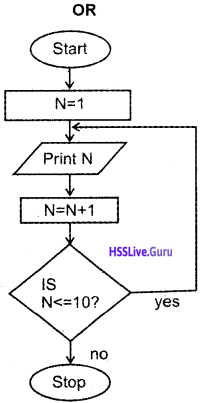
Plus One Computer Science Chapter Wise Questions and Answers Chapter 4 Principles of Programming and Problem Solving - 2
Explain the flowchart and predict the output.
Answer:

  • Step 1: Start
  • Step 2: Read S1, S2, S3
  • Step 3: avg = S1 + S2 + S3/3
  • Step 4: Print avg
  • Step 5: Stop

OR

This flowchart is used to print the numbers as 1,2, 3, ………, 10.

Plus One Computer Science Chapter Wise Questions and Answers Chapter 4 Principles of Programming and Problem Solving

Question 6.
Differentiate between top down design and bottom up design in problem sloving.
Answer:
Bottom up design:
Here also larger programs are divided into smaller ones and the smaller ones are again subdivided until the lowest level of detail has been reached. We start solving from the lowest module onwards. This approach is called Bottom up design.

Question 7.
Answer any one question from 5 (a) and 5 (b).
1. Draw a flowchart for the following algorithm.

  • Step 1: Start
  • Step 2: Input N
  • Step 3: S = 0, K = 1
  • Step 4: S = S + K
  • Step 5: K = K + 1
  • Step 6: If K < = N Then Go to Step 4
  • Step 7: Print S
  • Step 8: Stop

OR

2. Name the two stages in programming where debugging process is involved. What kinds of errors are removed in each of these stages?
Answer:
1.
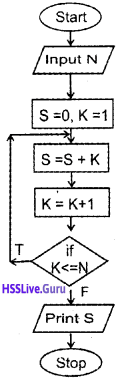
Plus One Computer Science Chapter Wise Questions and Answers Chapter 4 Principles of Programming and Problem Solving 3

2. The two stages are compile time and run time. In the debugging process can remove syntax error, logical error and runtime error.

Question 8.
Answer any one question from 7(1) and 7(2)
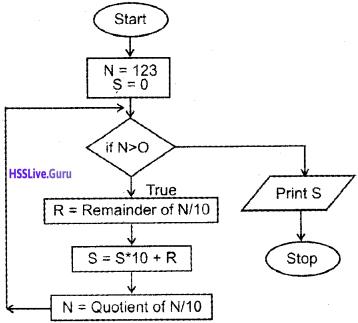
1. Observe the following portion of a flowchart. Fill in the blank symbols with proper instructions to get 321 as the output.
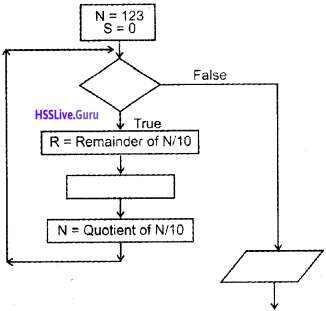
Plus One Computer Science Chapter Wise Questions and Answers Chapter 4 Principles of Programming and Problem Solving 4

2. The following flowchart can be used to print the numbers from 1 to 100. Identify another problem that can be solved using this flowchart and write the required instructions in the symbols.
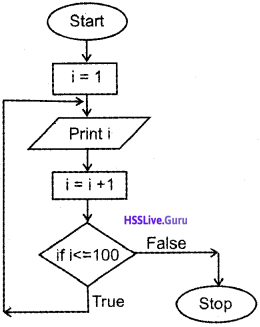
Plus One Computer Science Chapter Wise Questions and Answers Chapter 4 Principles of Programming and Problem Solving 5
Answer:
1.
Plus One Computer Science Chapter Wise Questions and Answers Chapter 4 Principles of Programming and Problem Solving 6

2. The following flowchart can be used to store another problem such as used to print odd numbers lessthan 200.
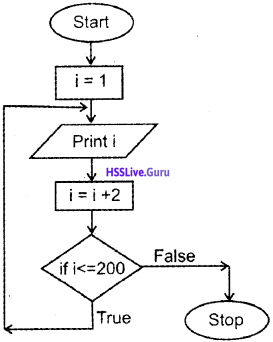
Plus One Computer Science Chapter Wise Questions and Answers Chapter 4 Principles of Programming and Problem Solving 7

Plus One Computer Science Chapter Wise Questions and Answers Chapter 4 Principles of Programming and Problem Solving

Question 9.
Write an algorithm to print the numbers upto 100 in reverse order, That is the output should be as 100, 99, 98, 97, …………., 1

OR

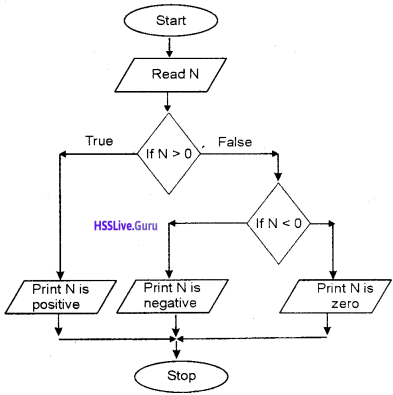
Draw a flow chart to check whether the given number is positive, negative or zero.
Answer:

  • Step 1: Start
  • Step 2: Set i ← 100
  • Step 3: if i <= 0 then go to step 6
  • Step 4: Print i
  • Step 5: Set i ← i — 1 go to step 3
  • Step 6: Stop

OR

Plus One Computer Science Chapter Wise Questions and Answers Chapter 4 Principles of Programming and Problem Solving 8

Plus One Principles of Programming and Problem Solving Three Mark Questions and Answers

Question 1.
When you try to execute a program, there are chances of errors at various stages, Mention the types of errors and explain.
Answer:
1. Syntax error,
eg: 5 = x

2. Logic error:
If the programmer maks any logical mistakes, it is known as logical error.
eg: To find the sum of values A and B and store it in a variable C you have to write C = A + B. Instead of this if you write C = A × B, it is called logic error.

3. Runtime error:
An error occured at run time due to inappropriate data.
eg: To calculate A/B a person gives zero to B. There is an error called division by zero error during run time.

Question 2.
Following is a flow chart to find and display the largest among three numbers. Some steps are missing in the flowchart. Redraw the flow chart by adding necessary steps and specify its purpose. How can this flow chart be modified without using a fourth variable?
Answer:
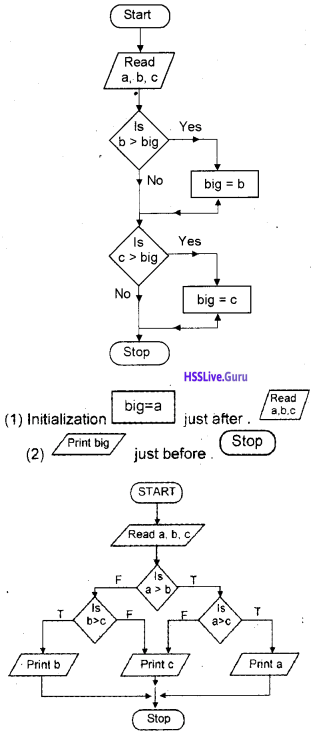
Plus One Computer Science Chapter Wise Questions and Answers Chapter 4 Principles of Programming and Problem Solving 9

Plus One Computer Science Chapter Wise Questions and Answers Chapter 4 Principles of Programming and Problem Solving

Question 3.
A flow chart is given below.
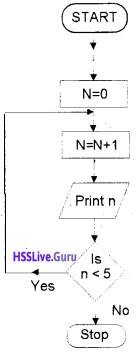
Plus One Computer Science Chapter Wise Questions and Answers Chapter 4 Principles of Programming and Problem Solving 10

  1. What will be the output of the above flow chart?
  2. How can you modify the above flow chart to display the even numbers upto 20, starting from 2.

Answer:
1. 1, 2, 3, 4, 5

2.
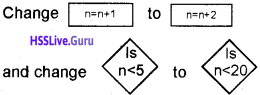
Plus One Computer Science Chapter Wise Questions and Answers Chapter 4 Principles of Programming and Problem Solving 11

Question 4.
Write an algorithm to check whether the given number is even or odd.
Answer:

  • Step 1: Start
  • Step 2: Read a number to N
  • Step 3: Divide the number by 2 and store the remainder in R.
  • Step 4: If R = O Then go to Step 6
  • Step 5: Print “N is odd” go to step 7
  • Step 6: Print “N is even”
  • Step 7: Stop

Question 5.
Write an algorithm to find the largest of 2 numbers?
Answer:

  • Step 1: Start
  • Step 2: Input the values of A, B Compare A and B.
  • Step 3: If A > B then go to step 5
  • Step 4: Print “B is largest” go to Step 6
  • Step 5: Print “A is largest”
  • Step 6: Stop

Question 6.
Write an algorithm to find the sum of n natural numbers and average?
Answer:

  • step 1: Start
  • Step 2: Set i ←1, S 0
  • Step 3: Read a number and set to n
  • Step 4: Computer i and n if i > n then go to step 7.
  • Step 5: Set S ← S + i
  • Step 6: i ← i + 1 go to step 4
  • Step 7: avg ← S/n
  • Step 8: Print “Sum = S and average = avg”
  • Step 9: Stop

Question 7.
Write an algorithm to find the largest of 3 numbers.
Answer:

  • Step 1: Start
  • Step 2: Read 3 numbers and store in A, B, C
  • Step 3: Compare A and B. lf A > Bthengotostep 6
  • Step 4: Compare B and C if C > B then go to step 8
  • Step 5: print “B is largest” go to step 9
  • Step 6: Compare A and C if C > A then go to step 8
  • Step 7: Print”A is largest” go to step 9
  • Step 8: Print “C is largest”
  • Step 9: Stop

Plus One Computer Science Chapter Wise Questions and Answers Chapter 4 Principles of Programming and Problem Solving

Question 8.
Write an algorithm to calculate the simple interest (I =P × N × R/100)
Answer:

  • Step 1: Start
  • Step 2: Read 3 values for P, N, R
  • Step 3: Calculate I ← P × N × R/100
  • Step 4: Print “The simple interest = l”
  • Step 5: Stop

Question 9.
Write an algorithm to calculate the compound interest (C.l = P × (1 + r/100)n – P)
Answer:

  • Step 1: Start
  • Step 2: Read 3 number for p, n, r
  • Step 3: Calculate C.I = p × (1 + r/100)n – p
  • Step 4: Print “The compound Interest = C.l”
  • Step 5: Stop

Question 10.
Write an algorithm to find the cube of first n natural numbers (eg: 1, 8, 27, …., n3)
Answer:

  • Step 1: Star
  • Step 2: Set i ← 1
  • Step 3: Read a number and store in n
  • Step 4: Compare i and n if i > n then go to step 7
  • Step 5: Print i × i × i
  • Step 6: i ← i + 1 go to step 4
  • Step 7: Stop

Question 11.
Write an algorithm to read a number and find its factorial (n ! = n × (n – 1) × (n – 2) ×………..3 × 2 × 1)
Answer:

  • Step 1: Start
  • Step 2: Fact ← 1
  • Step 3: Read a number and store in n
  • Step 4: If n = 0 then go to step 7
  • Step 5: Fact ← Fact × n
  • Step 6: n ← n – 1 go to step 4
  • Step 7: Print “Factorial is fact”
  • Step 8: Stop

Question 12.
Draw a flow chart to find the sum of n natural numbers and average.
Answer:
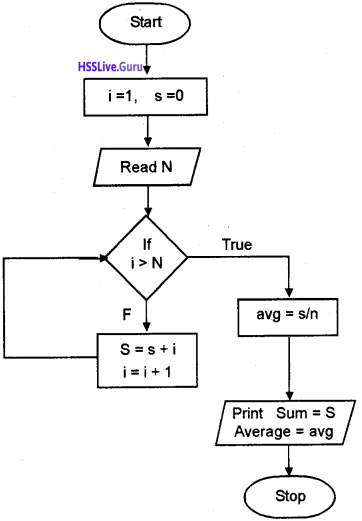
Plus One Computer Science Chapter Wise Questions and Answers Chapter 4 Principles of Programming and Problem Solving 12

Question 13.
Draw a flow chart to find the largest of 3 numbers.
Answer:
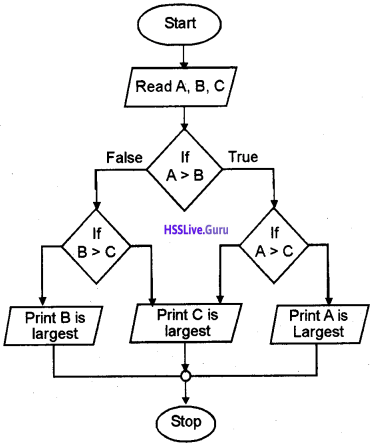
Plus One Computer Science Chapter Wise Questions and Answers Chapter 4 Principles of Programming and Problem Solving 13

Question 14.
Draw a flow chart to find the largest of 2 numbers.
Answer:
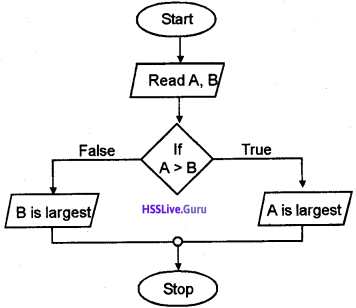
Plus One Computer Science Chapter Wise Questions and Answers Chapter 4 Principles of Programming and Problem Solving 14

Plus One Computer Science Chapter Wise Questions and Answers Chapter 4 Principles of Programming and Problem Solving

Question 15.
Draw a flow chart to check whether the given number is even or odd.
Answer:
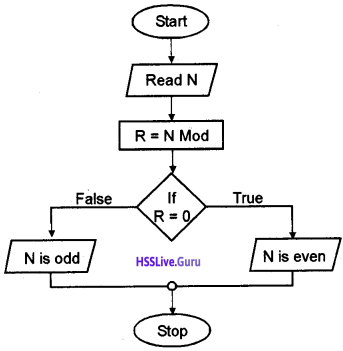
Plus One Computer Science Chapter Wise Questions and Answers Chapter 4 Principles of Programming and Problem Solving 15

Question 16.
Draw a flow chart to calculate simple interest.
Answer:
Plus One Computer Science Chapter Wise Questions and Answers Chapter 4 Principles of Programming and Problem Solving 16

Question 17.
Draw a flow chart to calculate compound interest.
Answer:
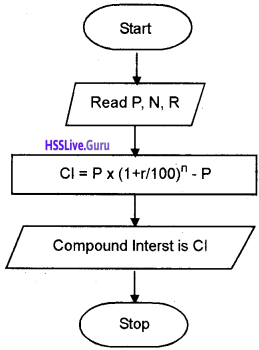
Plus One Computer Science Chapter Wise Questions and Answers Chapter 4 Principles of Programming and Problem Solving 17

Question 18.
Draw a flow chart to find the cube of n natural numbers.
Answer:
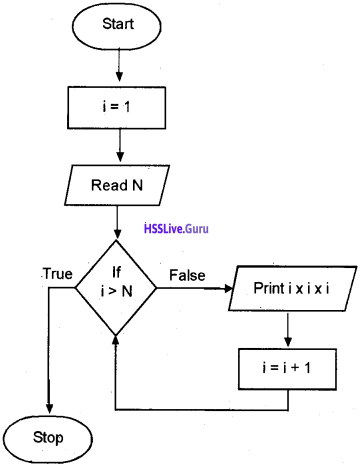
Plus One Computer Science Chapter Wise Questions and Answers Chapter 4 Principles of Programming and Problem Solving 18

Question 19.
Draw a flow chart to read a number and find its factorial.
Answer:
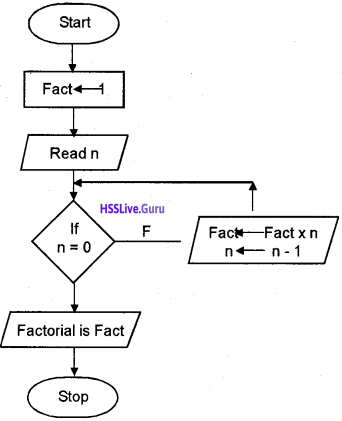
Plus One Computer Science Chapter Wise Questions and Answers Chapter 4 Principles of Programming and Problem Solving 19

Plus One Computer Science Chapter Wise Questions and Answers Chapter 4 Principles of Programming and Problem Solving

Question 20.
Mr. Vimal wants to represent a problem by using a flowchart, which symbols are used for this. Explain.
Answer:
Flow chart symbols are explained below
1. Terminal (Oval)

Plus One Computer Science Chapter Wise Questions and Answers Chapter 4 Principles of Programming and Problem Solving 20
It is used to indicate the beginning and ending of a problem

2. Input/Output (parallelogram)
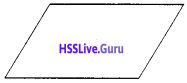
Plus One Computer Science Chapter Wise Questions and Answers Chapter 4 Principles of Programming and Problem Solving 21
It is used to take input or print output.

3. Processing (Rectangle)

Plus One Computer Science Chapter Wise Questions and Answers Chapter 4 Principles of Programming and Problem Solving 22
It is used to represent processing. That means to represent arithmetic operation such as addition, subtraction, multiplication.

4. Decision (Rhombus)

Plus One Computer Science Chapter Wise Questions and Answers Chapter 4 Principles of Programming and Problem Solving 23
It is used to represent decision making. One exit path will be executed at a time.

5. Flowlines (Arrows)
Plus One Computer Science Chapter Wise Questions and Answers Chapter 4 Principles of Programming and Problem Solving 24
It is used to represent the flow of operation

6. Connector
Plus One Computer Science Chapter Wise Questions and Answers Chapter 4 Principles of Programming and Problem Solving 25
These symbols will help us to complete the flow chart, which is not fit in a single page. A connector symbol is represented by a circle and a letter or digit is placed within the circle to indicate the link.

Question 21.
Jeena uses an algorithm to represent a problem while Neena uses flowchart which is better? Justify your answer?
Answer:
Flowchart is better. The advantages of flow chart is given below.
1. Better communication:
A flow chart is a pictorial representation while an algorithm is a step by step procedure to solve a program. A programmer can easily explain the program logic using a flow chart.

2. Effective analysis:
The program can be analyzed effectively through the flow chart.

3. Effective synthesis:
If a problem is big it can be divided into small modules and the solution for each module is represented in flowchart separately and can be joined together final system design.

4. Proper program documentation:
A flow chart will help to create a document that will help the company in the absence of a programmer.

5. Efficient coding:
With the help of a flowchart it is easy to write program by using a computer language.

Plus One Computer Science Chapter Wise Questions and Answers Chapter 4 Principles of Programming and Problem Solving

Question 22.
A flow chart is a better method to represent a program. But it has some limitation what are they?
Answer:
The limitations are given below

  • To draw a flowchart, it is time consuming and laborious work.
  • If any change or modification in the logic we may have to redraw a new flow chart.
  • No standards to determine how much detail can include in a flow chart.

Question 23.

1. Problem identification a. Flowchart
2. Steps to obtain. the solution b. Syntax Error
3. Coding c. Runtime Error
4. Translation d. COBOL
5. Debugging e. X-ray
6. Execution & Testing f. Compiler

Answer:
1 – e
2 – a
3 – d
4 – f
5 – b
6 – c

Question 24.
Alvis executes an error free program but he got an error. Explain different types of error in detail.
Answer:
There are two types of errors in a program before execution and testing phase.They are syntax error and logical error. When the programmer violates the rules or syntax of the programming language then the syntax error occurred.
eg: It involves incorrect punctuation.

Keywords are used for other purposes, violates the structure etc,… It detects the compiler and displays an error message that include the line number and give a clue of the nature of the error, When the programmer makes any mistakes in the logic, that types of errors are called logical error. It does not detect by the compiler but we will get a wrong output.

The program must be tested to check whether it is error free or not. The program must be tested by giving input test data and check whether it is right or wring with the known results. The third type of errors are Runtime errors.

This may be due to the in appropriate data while execution. For example consider B/C. If the end user gives a value zero for c, the execution will be interrupted because division by zero is not possible. These situation must be anticipated and must be handled.

Question 25.
The following are the phases in programming. The order is wrong rearrange them in correct order.

  1. Debugging
  2. Coding
  3. Derive the steps to obtain the solution
  4. Documentation
  5. Translation
  6. Problem identification
  7. Execution and testing

Answer:
The correct order is given below.

  1. Problem identification
  2. Derive the steps to obtain the solution
  3. Coding
  4. Translation
  5. Debugging
  6. Execution and testing
  7. Documentation

Plus One Computer Science Chapter Wise Questions and Answers Chapter 4 Principles of Programming and Problem Solving

Question 26.
Draw a flow chart to input ten different numbers and find their average.
Answer:
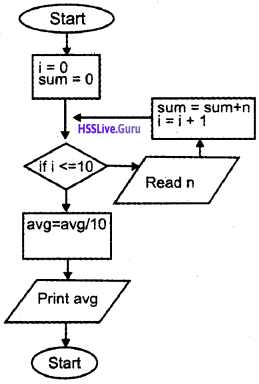
Plus One Computer Science Chapter Wise Questions and Answers Chapter 4 Principles of Programming and Problem Solving 26

Question 27.
Draw the flow chart to find the sum of first N natural numbers.
Answer:
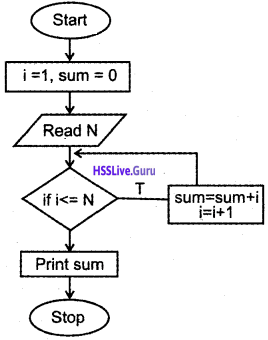
Plus One Computer Science Chapter Wise Questions and Answers Chapter 4 Principles of Programming and Problem Solving 27

Question 28.
Make a flow chart using the given labelled symbols, for finding the sum of all even numbers upto ‘N’

OR

Write an algorithm to accept an integer number and print the factors of it.
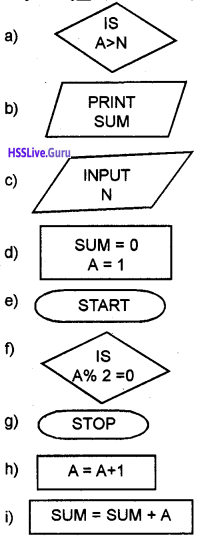
Plus One Computer Science Chapter Wise Questions and Answers Chapter 4 Principles of Programming and Problem Solving 28
Answer:
Draw flowchart in any of the following order
e, c, d, f, i, h, a, b, g
e, d, c, f, i, h, a, b, g
e, c, d, a, f, i, h, b, g
e, d, c, a, f, i, h, b, g

  • Step 1: Start
  • Step 2: Input n
  • Step 3: i = I
  • Step 4: if i <= n/2 then repeat step 5 & 6
  • step 5: if n % i == 0 print i
  • Step 6: i = i + I
  • Step 7: Stop

Plus One Computer Science Chapter Wise Questions and Answers Chapter 4 Principles of Programming and Problem Solving

Question 29.
List the two approaches followed in problem solving or programming. How do they differ?
Answer:
Approaches in problem solving:
(a) Top down design:
Larger programs are divided into smaller ones and solve each tasks by performing simpler activities. This concept is known as top down design in problem solving

(b) Bottom up design:
Here also larger programs are divided into smaller ones and the smaller ones are again subdivided until the lowest level of detail has been reached. We start solving from the lowest module onwards. This approach is called Bottom up design.

Phases in Programming
1. Problem identification:
This is the first phase in programming. The problem must be identified then only it can be solved, for this we may have to answer some questions.

During this phase we have to identify the data, its type, quantity and formula to be used as well as what activities are involved to get the desired out put is also identified for example if you are suffering from stomach ache and consult a Doctor.

To diagnose the disease the Doctor may ask you some question regarding the diet, duration of pain, previous occurrences etc, and examine some parts of your body by using stethoscope X-ray, scanning etc.

2. Deriving the steps to obtain the solution. There are two methods, Algorithm and flowchart, are used for this.
(a) Algorithm:
The step-by-step procedure to solve a problem is known as algorithm. It comes from the name of a famous Arab mathematician Abu Jafer Mohammed Ibn Musaa Al-Khowarizmi. The last part of his name Al-Khowarizmi was corrected to algorithm.

(b) Flowchart:
The pictorial or graphical representation of an algorithm is called flowchart.

Question 30.
Write an algorithm to find the sum of the squres of the digits of a number. (For example, if 235 is the input, the output should be 22 + 32 + 52 = 38)
Answer:

  • Step 1: Start
  • Step 2: Set S = O
  • Step 3: Read N
  • Step 4: if N > O repeat step 5, 6 and 7
  • Step 5: Find the remainder. That is rem = N % 10
  • Step 6 : S = S + rem × rem
  • Step 7 : N = N/10
  • Step 8 : Print S
  • Step 9 : Stop

Question 31.
Consider the following algorithm and answer the following questions:

  • Step 1: Start
  • Step 2 : N = 2, S = 0
  • Step 3: Repeat Step 4, Step 5 while N <= 10
  • Step 4: S = S + N
  • Step 5: N = N + 2
  • Step 6: Print S
  • Step 7: Stop
  1. Predict the output of the above algorithm.
  2. Draw a flowchart for the above algorithm

Answer:
1. The output is 30

2.
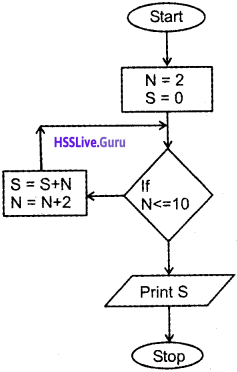
Plus One Computer Science Chapter Wise Questions and Answers Chapter 4 Principles of Programming and Problem Solving 29

Plus One Computer Science Chapter Wise Questions and Answers Chapter 4 Principles of Programming and Problem Solving

Question 32.
“It is better to give proper documentation within the program”. Give a reason.
Answer:
It is the last phase in programming. A computerized system must be documented properly and it is an ongoing process that starts in the first phase and continues till its implementation. It is helpful for the modification of the program later.

Plus One Principles of Programming and Problem Solving Five Mark Questions and Answers

Question 1.
Mr. Arun wants to develop a program to computerize the functions of supermarket. Explain different phases he has to undergo is detail.

OR

Briefly explain different phases in programming.
Answer:
The different phases in programming is given below:
1. Problem identification:
This is the first phase in programming. The problem must be identified then only it can be solved, for this we may have to answer some questions.
During this phase we have to identify the data, its type, quantity and formula to be used as well as what activities are involved to get the desired output is also identified for example if you are suffering from stomach ache and consult a Doctor.

To diagnose the disease the doctor may ask you some question regarding the diet, duration of pain, previous occurrences, etc and examine some parts of your body by using stethoscope X-ray, scanning, etc.

2. Deriving the steps to obtain the solution.
There are two methods, Algorithm and flowchart, are used for this.
(a) Algorithm:
The step-by-step procedure to solve a problem is known as algorithm. It comes from the name of a famous Arab mathematician Abu Jafer Mohammed Ibu Musaa Al-Khowarizmi. The last part of his name Al-Khowafizmi was corrected to algorithm.

(b) Flowchart:
The pictorial or graphical representation of an algorithm is called flowchart.

3. Coding:
The dummy codes (algorithm)or flow chart is converted into program by using a computer language such s Cobol, Pascal, C++, VB, Java, etc.

4. Translation:
The computer only knows machine language. It does not know HLL, but the human beings HLL is very easy to write programs. Therefore a translation is needed to convert a program written in HLL into machine code (object code).

During this step, the syntax errors of the program will be displayed. These errors are to be corrected and this process will be continued till we get “No errors” message. Then it is ready for execution.

5. Debugging:
The program errors are called ‘bugs’ and the process of detecting and correcting errors is called debugging. In general there are two types of errors syntax errors and logical errors. When the rules or syntax of the language are not followed then syntax errors occurred and it is displayed after compilation.

When the logic of a program is wrong then logical errors occurred and it is not displayed after compilation but it is displayed in the execution and testing phase.

6. Execution and Testing:
In this phase the program will be executed and give test data for testing the purpose of this is to determine whether the result produced by the program is correct or not. There is a chance of another type of error, Run time error, this may be due to inappropriate data.

7. Documentation:
It is the last phase in programming. A computerized system must be documented properly and it is an ongoing process that starts in the first phase and continues till its implementation. It is helpful for the modification of the program later.

Plus One Computer Science Chapter Wise Questions and Answers Chapter 4 Principles of Programming and Problem Solving

Question 2.
Briefly explain the characteristic of an algorithm.
Answer:
The following are the characteristics of an algorithm

  1. It must starts with ‘start’ statement and ends with ‘stop’ statement.
  2. it should contains instructions to accept input and these are processed by the subsequent instructions.
  3. Each and every instruction should be precise and must be clear. The instructions must be possible to carry out, for example consider the examples the instruction “Go to market” is precise and possible to carried out but the instruction “Go to hell” is also precise and can not be carried out.
  4. Each instruction must be carried out in finite time by a person with paper and pencil.
  5. The number of repetition of instructions must be finite.
  6. The desired results must be obtained after the algorithm ends.

Plus One Computer Science Chapter Wise Questions and Answers Chapter 2 Data Representation and Boolean Algebra

Students can Download Chapter 2 Data Representation and Boolean Algebra Questions and Answers, Plus One Computer Science Chapter Wise Questions and Answers helps you to revise the complete Kerala State Syllabus and score more marks in your examinations.

Kerala Plus One Computer Science Chapter Wise Questions and Answers Chapter 2 Data Representation and Boolean Algebra

Plus One Data Representation and Boolean Algebra One Mark Questions and Answers

Question 1.
___________ is a collection of unorganized fact.
Answer:
Data

Plus One Computer Science Chapter Wise Questions and Answers Chapter 2 Data Representation and Boolean Algebra

Question 2.
Data can be organized into useful ____________
Answer:
Information

Question 3.
___________ is used to help people to make decision.
Answer:
Information

Question 4.
Processing is a series of actions or operations that convert inputs into __________
Answer:
Output

Question 5.
The act of applying information in a particular context or situation is called ____________
Answer:
Knowledge

Question 6.
What do you mean by data processing?
Answer:
Data processing is defined as a series of actions or operations that converts data into useful information.

Question 7.
Odd man out and justify your answer.
(a) Adeline
(b) 12
(3) 17
(d) Adeline aged 17 years is in class 12.
Answer:
(d) Adeline aged 17 years is in class 12. This is information. The others are data.

Question 8.
Raw facts and figures are known as _______
Answer:
data

Question 9.
Processed data is known as _______
Answer:
Information

Question 10.
Which of the following helps us to take decisions?
(a) data
(b) information
(c) Knowledge
(d) intelligence
Answer:
(b) information

Plus One Computer Science Chapter Wise Questions and Answers Chapter 2 Data Representation and Boolean Algebra

Question 11.
Manipulation of data to get information is known as ___________
Answer:
Data processing

Question 12.
Arrange the following in proper order
Process, Output, Storage, Distribution, Data Capture, Input.
Answer:

  1. Data Capture
  2. Input
  3. Storage
  4. Process
  5. Output
  6. Distribution

Question 13.
Pick the odd one out and give reason:
(a) Calculation
(b) Storage
(c) Comparison
(d) Categorization
Answer:
(b) Storage. It is one of the data processing stage the others are various operations in the stage Process

Question 14.
Information may act as data. State true or False.
Answer:
False

Question 15.
Complete the Series.

  1. (101)2, (111)2, (1001)2, ……….
  2. (1011)2, (1110)2, (10001)2, ………

Answer:

  1. 1011, 1101
  2. 10101, 10111

Question 16.
What are the two basic types of data which are stored and processed by computers?
Answer:
Characters and number

Question 17.
The number of numerals or symbols used in a number system is its _______________
Answer:
Base

Question 18.
The base of decimal number system is ________
Answer:
10

Question 19.
MSD is ________
Answer:
Most Significant Digit

Question 20.
LSD is _________
Answer:
Least Significant Digit

Question 21.
Consider the number 627. Its MSD is _________
Answer:
6

Question 22.
Consider the number 23.87. Its LSD is __________
Answer:
7

Question 23.
The base of Binary number system is ___________
Answer:
2

Plus One Computer Science Chapter Wise Questions and Answers Chapter 2 Data Representation and Boolean Algebra

Question 24.
What are the symbols used in Binary number system?
Answer:
0 and 1

Question 25.
Complete the following series,
(101)2, (111)2, (1001)2
Answer:
1011, 1101

Question 26.
State True or False. In Binary, the unit bit changes either from 0 to 1 or 1 to 0 with each count.
Answer:
True

Question 27.
The base of octal number system is ________
Answer:
8

Question 28.
Consider the octal number given below and fill in the blanks.
0, 1, 2, 3, 4, 5, 6, 7, __
Answer:
10

Question 29.
The base of Hexadecimal number system is ________
Answer:
16

Question 30.
State True or False.
In Positional number system, each position has a weightage.
Answer:
True

Question 31.
In addition to digits what are the letters used in Hexadecimal number system.
Answer:
A(10), B(11), C(12), D(13), E(14), F(15)

Plus One Computer Science Chapter Wise Questions and Answers Chapter 2 Data Representation and Boolean Algebra

Question 32.
Convert (1110.01011)2 to decimal.
Answer:
1110.01011 = 1 × 23 + 1 × 22 + 1 × 21 + 0 × 20 + 0 × 2 – 1 + 1 × 2 – 2 + 0 × 2 – 3 + 1 × 2 – 4 + 1 × 2 – 5
= 8 + 4 + 2 + 0 + 0 + 0.25 + 0 + 0.0625 + 0.03125
= (14.34375)10

Question 33.
1 KB is bytes.
(a) 25
(b) 210
(c) 215
(d) 220
Answer:
(b) 210

Question 34.
The base of hexadecimal number system is ________.
Answer:
16

Question 35.
A computer has no _________
(a) Memory
(b) l/o device .
(c) CPU
(d) IQ
Answer:
(d) IQ

Question 36.
Pick the odd man out.
(AND, OR, NAND, NOT)
Answer:
NOT

Question 37.
Select the complement of X + YZ.
(a) \(\bar{x}+\bar{y}+\bar{z}\)
(b) \(\bar{x} .\bar{y}+\bar{z}\)
(c) \(\bar{x} \cdot(\bar{y}+\bar{z})\)
(d) \(\bar{x}+\bar{y} \cdot \bar{z}\)
Answer:
(c) \(\bar{x} \cdot(\bar{y}+\bar{z})\)

Question 38.
Select the expression for absorption law.
(a) a + a = a
(b) 1 + a = 1
(c) o . a = 0
(d) a + a . b = a
Answer:
(a) a + a . b = a

Question 39.
What is the characteristic of logical expression?
Answer:
Logical expressions yield either true or false values

Question 40.
Name the table used to define the results of Boolean operations.
Answer:
Truth Table

Question 41.
According to ________ law, \(\bar{x}+\bar{y}=\overline{x y}\) and \(\overline{x y}=\bar{x}+\bar{y}\)
Answer:
De Morgan’s law

Plus One Computer Science Chapter Wise Questions and Answers Chapter 2 Data Representation and Boolean Algebra

Question 42.
A NOR gate is ON only when all its inputs are
(a) ON
(b) Positive
(c) High
(d) OFF
Answer:
(d) OFF

Question 43.
The only function of a NOT gate is __________
Answer:
Invert an output signal

Question 44.
NOT gate is also known as _________
Answer:
Inverter

Question 45.
What is the relation between the following statements.
x + 0 = x and x . 1 = x
Answer:
One is the dual of the other expression.

Question 46.
The algebra used to solve problems in digital systems is called __________
Answer:
Boolean Algebra

Question 47.
Pick the one which is not a Basic Gate.
(AND, OR, XOR, NOT)
Answer:
XOR

Question 48.
Select the universal gates from the list. (NAND, NOR, NOT, XOR)
Answer:
NAND, NOR

Question 49.
Which is the final stage in data processing?
Answer:
Distribution of information is the final stage in data processing

Question 50.
Fill up the missing digit.
(41)8 = ( )16
Answer:

  • Step 1: Divide the number into one each and write down the 3 bits equivalent.
  • Step 2: Then divide the number into group of 4 bits starting from the right then write its equivalent hexa decimal.

Plus One Computer Science Chapter Wise Questions and Answers Chapter 2 Data Representation and Boolean Algebra - 1
Answer:
So the answer is 21.

Question 51.
Real numbers can be represented in memory by using __________
Answer:
Exponent and Mantissa

Question 52.
Consider the number 0.53421 x 10⁻⁸ Write down the mantissa and exponent.
Answer:
Mantissa: 0.53421
Exponent: -8

Question 53.
Characters can be represented in memory by using _________
Answer:
ASCII Code

Question 54.
ASCII Code of A’ is __________
Answer:
(100 0001)2 = 65

Question 55.
ASCII Code of’a’ is __________
Answer:
(110 0001)2 = 97

Question 56.
Define the term ‘bit’?
Answer:
A bit stands for Binary digit. That means either 0 or 1.

Plus One Computer Science Chapter Wise Questions and Answers Chapter 2 Data Representation and Boolean Algebra

Question 57.
Find MSD in the decimal number 7854.25
Answer:
Because it has the most weight

Question 58.
ASCII stands for __________.
Answer:
American Standard Code for Information Interchange

Question 59.
List any two image file formats.
Answer:
BMP, GIF

Question 60.
Name the operator which performs logical multiplication.
Answer:
AND

Question 61.
Name a gate which is ON when all its inputs are OFF .
Answer:
NAND or NOR

Question 62.
Specify the laws applied in the following cases.

  1. a (b + c) = ab + ac
  2. (a + b) + c = a + (b + c)

Answer:

  1. Distribution law
  2. Associative law

Question 63.
Pick the correct Boolean expression from the following.
(a) \(A +\bar{A}=163.\)
(b) \(\text { A. } \bar{A}=1\)
(c) \(A \cdot \overline{A B}=A + B\)
(d) A + AB = A
Answer:
(a) & (d)

Question 64.
1’s complement of the binary number 110111 is _________
Answer:
Insert 2 zeroes in the left hand side to make the binary number in the 8 bit form 00110111
To find the 1’s complement, change all zeroes to one and all ones to zero. Hence the answer is 11001000

Plus One Data Representation and Boolean Algebra Two Mark Questions and Answers

Question 1.
Why do we store information?
Answer:
Normally large volume of data has to be given to the computer for processing so the data entry may be taken more days, hence we have to store the data. After processing these stored data, we will get information as a result that must be stored in the computer for future references.

Question 2.
What is source document.
Answer:
Acquiring the required data from all the sources for the data processing and by using this data design a document, that contains all relevant data in proper order and format. This document is called source document.

Question 3.
Briefly explain data, information and processing with real life example.
Answer:
Consider the process of making coffee. Here data is the ingredients – water, sugar, milk and coffee powder
Information is the final product i.e. Coffee Processing is the series of steps to convert the ingredients into final product, Coffee. That is mix the water,sugar and milk and boil it. Finally pour the coffee powder.

Plus One Computer Science Chapter Wise Questions and Answers Chapter 2 Data Representation and Boolean Algebra

Question 4.
ASCII is used to represent characters in memory. Is it sufficient to represent all characters used in the written languages of the world? Propose a solution. Justify.
Answer:
No It is not sufficient to represent all characters used in the written languages of the world because it is a 7 bit code so it can represent 27 = 128 possible codes. To represent all the characters Unicode is used because it uses 4 bytes, so it can represent 232 possible codes.

Question 5.
The numbers in column A have an equivalent number in another number system of column B.
Find the exact matvh

A B
(12)8 (1110)2
F16 25
(19)16 10
(11)8 (13)16
(17)8
9

Answer:

A B
12 10
F (17)8
(19)16 25
(11)8 9

Question 6.

  1. Name various number systems commonly used in computers.
  2. Include each of the following numbers into all possible number systems
    123 569 1101

Answer:

  1. The number system are binary, octal, decimal and hexa decimal
  2. All possible number systems are
    • 123 Octal, decimal and hexa decimal
    • 569 Decimal, hexa decimal
    • 1101 Binary, Octal, Decimal, Hexa decimal

Plus One Computer Science Chapter Wise Questions and Answers Chapter 2 Data Representation and Boolean Algebra

Question 7.
Fill up the missing digit. (Score 2)
If (220)a = (90)b then (451)a = (  )10
Answer:
It contains 2 & 9, so a and b 2, b 8. The values of a can be 8 or 10. The values of b can be 10 or 16. L.H.S > R.H.S. a < b and a b also.
The possible values of a and b are given below.
Plus One Computer Science Chapter Wise Questions and Answers Chapter 2 Data Representation and Boolean Algebra - 2

Question 8.
Convert (106)10 = (  )2?
Answer:
Plus One Computer Science Chapter Wise Questions and Answers Chapter 2 Data Representation and Boolean Algebra - 3

Question 9.
Convert (106)10 = (  )8?
Answer:
Plus One Computer Science Chapter Wise Questions and Answers Chapter 2 Data Representation and Boolean Algebra - 4

Question 10.
(106)10 = (  )16?
Answer:
Plus One Computer Science Chapter Wise Questions and Answers Chapter 2 Data Representation and Boolean Algebra - 5

Question 11.
Convert (55.625)10 = (  )2?
Answer:
First convert 55, for this do the following
Plus One Computer Science Chapter Wise Questions and Answers Chapter 2 Data Representation and Boolean Algebra - 6
Write down the remainders from bottom to top.
(55)10 = (110111 )2
Next convert 0.625, for this do the following.
Plus One Computer Science Chapter Wise Questions and Answers Chapter 2 Data Representation and Boolean Algebra - 7
Write down the remainder from top to bottom. So the answer is
(55.625)10 = (110111.101)2

Question 12.
Convert (55.140625)10 = (  )8?
Answer:
First convert 55, for this do the following.
Plus One Computer Science Chapter Wise Questions and Answers Chapter 2 Data Representation and Boolean Algebra - 8
Write down the remainders from bottom to top.
(55)10 = (67)8
Next convert 0.140625, for this do the following.
Plus One Computer Science Chapter Wise Questions and Answers Chapter 2 Data Representation and Boolean Algebra - 9
Write down the remainders from top to bottom. So the answer is
(55.140625)10 = (67.11 )8

Plus One Computer Science Chapter Wise Questions and Answers Chapter 2 Data Representation and Boolean Algebra

Question 13.
Convert (55.515625)10 = (  )16
Answer:
First convert 55, for this do the following.
Plus One Computer Science Chapter Wise Questions and Answers Chapter 2 Data Representation and Boolean Algebra - 10
Write down the remainders from bottom to top.
ie. (55)10 = (37)16
Next convert .515625
Plus One Computer Science Chapter Wise Questions and Answers Chapter 2 Data Representation and Boolean Algebra - 11
So the answer is
(55.515625)10 = (37.84)16

Question 14.
Convert (101.101)2 = ( )10?
Answer:
101.101 = 1 × 22 + 0 × 21 + 1 × 20 + 1 × 2-1 + 0 × 2-2 + 1 × 2-3 = 4 + 0 + 1 + 1/2 + 0 + 1/8 = 5 + 0.5 + 0.125
(101.101)2 = (5.625)10

Question 15.
Convert (71.24)8 = (  )10?
Answer:
71.24 = 7 × 81 + 1 × 80 + 2 × 8-1 + 4 × 8=2
= 56 + 1 + 2/8 + 4/82
= 57 + 0.25 + 0.0625 (71.24)8
(71.24)8 = (57.3125)10

Question 16.
Convert (AB.88)16 = (  )10?
Answer:
Plus One Computer Science Chapter Wise Questions and Answers Chapter 2 Data Representation and Boolean Algebra - 12
= 160 + 11 + 0.5 + 0.03125
(AB.88)16 = (171.53125)10

Question 17.
Convert (1011)2 = (  )8?
Answer:
Step I: First divide the number into groups of 3 bits starting from the right side and insert necessary zeroes in the left side.
0 0 1 | 0 1 1

Step II: Next write down the octal equivalent.
Plus One Computer Science Chapter Wise Questions and Answers Chapter 2 Data Representation and Boolean Algebra - 13
So the answer is (1011)2 = (13)8.

Question 18.
Convert (110100)2 = (  )16
Answer:

  • Step I: First divide the number into groups of 4 bits starting from the right side and insert necessary zeroes in the left side.
  • Step II: Next write down the hexadecimal equivalent.

Plus One Computer Science Chapter Wise Questions and Answers Chapter 2 Data Representation and Boolean Algebra - 14
So the answer is (110100)2 = (34)16.

Question 19.
(72)8 = ( )2?
Answer:
Write down the 3 bits equivalent of each digit.
Plus One Computer Science Chapter Wise Questions and Answers Chapter 2 Data Representation and Boolean Algebra - 15
So the answer is (72)8 = (111010)2.

Plus One Computer Science Chapter Wise Questions and Answers Chapter 2 Data Representation and Boolean Algebra

Question 20.
Convert (AO)16 = (  )2 ?
Answer:
Write down the 4 bits equivalent of each digit
Plus One Computer Science Chapter Wise Questions and Answers Chapter 2 Data Representation and Boolean Algebra - 16
So the answer is (AO)16 = (1010 0000)2.

Question 21.
Convert (67)8 = (  )16?
Answer:
Step I: First convert this number into binary equivalent for this do the following
Plus One Computer Science Chapter Wise Questions and Answers Chapter 2 Data Representation and Boolean Algebra - 17

Step II: Next convert this number into hexadecimal equivalent for this do the following.
Plus One Computer Science Chapter Wise Questions and Answers Chapter 2 Data Representation and Boolean Algebra - 18
So the answer is (67)8 = (37)16

Question 22.
Convert (A1)16 = (  )8?
Answer:
Step I: First convert this number into binary equivalent. For this do the following
Plus One Computer Science Chapter Wise Questions and Answers Chapter 2 Data Representation and Boolean Algebra - 19

Step II: Next convert this number into octal equivalent. For this do the following.
Plus One Computer Science Chapter Wise Questions and Answers Chapter 2 Data Representation and Boolean Algebra - 20
So the answer is (A1)16 = ( 241)8.

Question 23.
What is the use of the ASCII Code?
Answer:
ASCII means American Standard Code for Information Interchange. It is a 7 bit code. Each and every character on the keyboard is represented in memory by using ASCII Code.
eg: A’s ASCII Code is 65 (1000001), a’s ASCII Code is 97 (1100001)

Question 24.
Pick invalid numbers from the following.

  1. (10101)8
  2. (123)4
  3. (768)8
  4. (ABC)16

Answer:

  1. (10101)8 – Valid
  2. (123)4 – Valid
  3. (768)8 – Invalid. Octal number system does not contain the symbol 8
  4. (ABC)16 – Valid

Question 25.
Convert the decimal number 31 to binary.
Answer:
Plus One Computer Science Chapter Wise Questions and Answers Chapter 2 Data Representation and Boolean Algebra - 21
(31)10 = (11111)2

Plus One Computer Science Chapter Wise Questions and Answers Chapter 2 Data Representation and Boolean Algebra

Question 26.
Find decimal equivalent of (10001 )2
Answer:
Plus One Computer Science Chapter Wise Questions and Answers Chapter 2 Data Representation and Boolean Algebra - 22
= 1 × 24 + 0 × 23 + 0 × 22 + 0 × 21 + 1 × 20
= 16 + 0 + 0 + 0 + 1
= (17)10

Question 27.
If (X)8 =(101011 )2 then find X.
Answer:
Divide the binary number into groups of 3 bits and write down the corresponding octal equivalent.
Plus One Computer Science Chapter Wise Questions and Answers Chapter 2 Data Representation and Boolean Algebra - 23
X = 53

Question 28.
Fill the blanks:
(a) (………..)2 = (AB)16
(b) (——D—–)16 = (1010 1000)2
(c) 0.2510 = (—–)2

Answer:
Write down the 4bit equivalent of each digit
(a) (………..)2 = (AB)16
Plus One Computer Science Chapter Wise Questions and Answers Chapter 2 Data Representation and Boolean Algebra - 24
= (10101011)2
(b) (——D—–)16 = (1010 1000)2
(A D 8)16 =(1010 1101 1000)2

(c) 0.2510 = (—–)2
Plus One Computer Science Chapter Wise Questions and Answers Chapter 2 Data Representation and Boolean Algebra - 25
0.2510 = (0.01)2

Question 29.
Which is the MSB of representation of -80 in SMR?
Answer:
It is 1 because In SMR if the number is negative then the MSB is 1.

Question 30.
Write 28.756 in Mantissa exponent form.
Answer:
28.756 = .28756 × 100
= .28756 × 102
= .28756 E + 2

Question 31.
Represent -60 in 1’s complement form.
Answer:
+60 = 00111100
Change all 1 to 0 and all 0 to 1 to get the 1’s complement.
-60 is in 1’s complement is 11000011

Question 32.
Define Unicode.
Answer:
The limitations to store more characters is solved by the introduction of Unicode. It uses 16 bits so 216 = 65536 characters(i.e, world’s all written language characters) can store by using this.

Question 33.
Substract 1111 from 10101 by using 2’s complement method.
Answer:
To subtract a number from another number find the 2’s complement of the subtrahend and add it with the minuend. Here the subtrahend is 1111 and minuend is 5 bits. So insert a zero. So subtrahend is 01111. First take the 1’s complement of subtrahend and add 1 to it
Plus One Computer Science Chapter Wise Questions and Answers Chapter 2 Data Representation and Boolean Algebra - 26
Here is a carry. So ignore the carry and the result is +ve.
So the answer is 110

Question 34.
You purchased a soap worth Rs. (10010)2 and you gave Rs. (10100)2 and how much rupees will you get back in binary.
Answer:
Substract (10010)2 from (10100)2
Plus One Computer Science Chapter Wise Questions and Answers Chapter 2 Data Representation and Boolean Algebra - 27
You will get rupees (10)2

Plus One Computer Science Chapter Wise Questions and Answers Chapter 2 Data Representation and Boolean Algebra

Question 35.
Draw the logic circuit diagram for the following Boolean expression.
Answer:
Plus One Computer Science Chapter Wise Questions and Answers Chapter 2 Data Representation and Boolean Algebra - 28

Question 36.
Simplify the expression using basic postulates and laws of Boolean algebra.

  1. \(\bar{x}+x \cdot \bar{y}\)
  2. \(x(y+y . z)+y(\bar{x}+x z)\)

Answer:

  1. \(\bar{x}+\bar{y}\)
  2. y

Question 37.
Show \(A(\bar{B}+C)\) using NOR gates only.
Answer:
Plus One Computer Science Chapter Wise Questions and Answers Chapter 2 Data Representation and Boolean Algebra - 29

Question 38.
The following statement Demorgan’s theorem of Boolean algebra. Identify and state ‘Break the line, change the sign’.
Answer:
Demorgan’s theorems,
Demorgan’s first theorem,
\(\overline{x + y}\) = \(\bar{x} . \bar{y}\)
Demorgan’s second theorem,
\(\overline{x – y}\) = \(\bar{x} + \bar{y}\)

Question 39.
Prove algebraically that
\(x \cdot y + x \cdot \bar{y} \cdot z\) = x . y + x . z
Answer:
\(x \cdot y + x \cdot \bar{y} \cdot z\) = \(x(y+\bar{y} . z)\)
= x . (y + z) = x . y + x . z
Hence proved.

Question 40.
State which of the following statements are logical statements.
(a) AND is a logical operator
(b) ADD 3 to y
(c) Go to class
(d) Sun rises in the west.
(e) Why are you so late?
Answer:
(a) and (d) are logical statements because these statements have a truth value which may be true or false.

Question 41.
Express the integer number -39 in sign and magnitude represnetation.
Answer:
First find the binary equivalent of 39 for this do the following
Plus One Computer Science Chapter Wise Questions and Answers Chapter 2 Data Representation and Boolean Algebra - 30
In sign and magnitude representation -39 in 8 bit form is (10100111)2.

Question 42.

  1. Which logic gate does the Boolean expression \(\overline{\mathrm{AB}}\) represent?
  2. Some NAND gates are given. How can we construct AND gate, OR gate and NOT gate using them?

Answer:
1. NAND

2. AND gate
Plus One Computer Science Chapter Wise Questions and Answers Chapter 2 Data Representation and Boolean Algebra - 31

Plus One Computer Science Chapter Wise Questions and Answers Chapter 2 Data Representation and Boolean Algebra

Question 43.
Perform the following number conversions.

  1. (110111011.11011)2 = (….)8
  2. (128.25)10= (…..)8

Answer:
1. 110111011.11011
Step 1: Insert a zero in the right side of the above number and divide the number into groups of 3 bits as follows
110 111 011 . 110 110

Step 2: Write down the corresponding 3 bit binary equivalent of each group
6 7 3 .6 6
Hence the result is (673.66)8

2. It consists of 2 steps.
Step 1: First convert 128 into octal number for this do the following
Plus One Computer Science Chapter Wise Questions and Answers Chapter 2 Data Representation and Boolean Algebra - 32
Write down the remainders from bottom to top.
(128)10 = (200)8

Step 2: Then convert .25 into octal number for this do the following
Plus One Computer Science Chapter Wise Questions and Answers Chapter 2 Data Representation and Boolean Algebra - 33
(0.25)10 = (0.2)8.
Combine the above two will be the result.
(128.25)10= (200.2)8

Question 44.
Represent -38 in 2’s complement form.
Answer:
+38 = 00100110
First take the 1 ’s complement for this change all 1 to 0 and all 0 to 1
Plus One Computer Science Chapter Wise Questions and Answers Chapter 2 Data Representation and Boolean Algebra - 34
2’s complement of -38 is (11011010)8.

Plus One Data Representation and Boolean Algebra Three Mark Questions and Answers

Question 1.
Differentiate manual data processing and electronic data processing?
Answer:
In manual data processing human beings are the processors. Our eyes and ears are input devices. We get data either from a printed paper, that can be read using our eyes or heard with ears. Our brain is the processor and it can process the data, and reach in a conclusion known as result. Our mouth and hands are output devices.

In electronic data processing the data is processing with the help of a computer. In a super market, key board and hand held scanners are used to input data, the CPU process the data, monitor and printers (Bill) are output devices.

Question 2.
Complete the series.

  1. 3248, 3278 ,3328, …., ….
  2. 5678, 5768, 605s, ……, …..

Answer:
1. (324)8 = 3 × 82 + 2 × 81 + 4 × 80
= 3 × 64 + 2 × 8 + 4 × 1
= 192 + 16 + 4 = (212)10

(327)8 = 3 × 82 + 2 × 81 + 7 × 80
= 192 + 16 + 7 = (215)10

(332)8= 3 × 82 + 3 × 81 +2 × 80
= 192 + 24 + 2 = (218)10
So the missing terms are (221)10, (224)10 we have to convert this into octal.
Plus One Computer Science Chapter Wise Questions and Answers Chapter 2 Data Representation and Boolean Algebra - 35
So the missing terms are (335)8, (340)8

2. (567)8 = 5 x 82 + 6 x 81 + 7 x 80
= 5 x 64 + 6 x 8 + 7 x 1
= 320 + 48 + 7 = (375)10

(576)8 = 5 x 82 + 7 x 81 + 6 x 80
= 320 + 56 + 6 = (382)10

(605)8 = 6 x 82 + 0 x 81 + 5 x 80
= 6 + 64 + 0 + 5
= 384 + 0 + 5 = (389)10
So the missing terms are (396)10, (403)10 we have to convert this into octal.
Plus One Computer Science Chapter Wise Questions and Answers Chapter 2 Data Representation and Boolean Algebra - 36
So the missing terms are (614)8, (623)8

Plus One Computer Science Chapter Wise Questions and Answers Chapter 2 Data Representation and Boolean Algebra

Question 3.
Fill up the missing digits.

  1. (4……)8 = (……110)2
  2. (…….7……)8 = (100…….110)2

Consider the following
Plus One Computer Science Chapter Wise Questions and Answers Chapter 2 Data Representation and Boolean Algebra - 37
Answer:
1. 4…….100 and 110……….6
So (46)8 = (100 110)2

2. 100…….4
7……111
110………6
So (476)8 = (100 111 110)2

Question 4.
Fill up the missing numbers.

  1. (A…….)16 = (……..1001)2
  2. (…….B…….)16 = (1000………1111)2

Consider the following:
Plus One Computer Science Chapter Wise Questions and Answers Chapter 2 Data Representation and Boolean Algebra - 38
Plus One Computer Science Chapter Wise Questions and Answers Chapter 2 Data Representation and Boolean Algebra - 39
Answer:
1. A……..1010
1001………9
So (A9)16 = (1010 1001)2

2. B…….1011
1000………8
1111………F
So (8BF)16 = (1000 1011 1111)2

Question 5.
Complete the Series.

  1. 6ADD, 6ADF, 6AE1, ……., …….
  2. 14A9, 14AF, 14B5, …….., ……

Answer:
1. Consider the sequence
6ADD, 6ADF, 6AE1, ………….
Here the ‘numbers’ are
0, 1, 2, 3, 4, 5, 6, 7, 8, 9, A, B, C, D, E, F, 10, 11,——–
The difference between 6ADD & 6ADF is 2
Plus One Computer Science Chapter Wise Questions and Answers Chapter 2 Data Representation and Boolean Algebra - 40
Similarly 6ADF & 6AE1 is 2
Plus One Computer Science Chapter Wise Questions and Answers Chapter 2 Data Representation and Boolean Algebra - 41
So Add 2 to 6AE1 we will ge 6AE3 Then add 2 to 6AE3 we will get 6AE5 Therefore the missing terms 6AE3, 6AE5

2. Consider the sequence.
14A9, 14AF, 14B5, ———
The difference between 14A9 and 14AF is 6.
The normal sequence is
Plus One Computer Science Chapter Wise Questions and Answers Chapter 2 Data Representation and Boolean Algebra - 42
The difference between 14AF and 14B5 is also 6.

The normal sequence is
Plus One Computer Science Chapter Wise Questions and Answers Chapter 2 Data Representation and Boolean Algebra - 43

Similarly the next 6 terms in the sequence are given below.
Plus One Computer Science Chapter Wise Questions and Answers Chapter 2 Data Representation and Boolean Algebra - 44

Similarly the next 6 terms are
Plus One Computer Science Chapter Wise Questions and Answers Chapter 2 Data Representation and Boolean Algebra - 45
So the missing terms are 14BB and 14C1

Plus One Computer Science Chapter Wise Questions and Answers Chapter 2 Data Representation and Boolean Algebra

Question 6.
Find the octal numbers corresponding to the following numbers using shorthand method.

  1. (ADD)16
  2. (DEAD)16

Answer:
1. (ADD)16
Step 1: Write down the 4 bit binary equivalent of each digit
Plus One Computer Science Chapter Wise Questions and Answers Chapter 2 Data Representation and Boolean Algebra - 46

Step 2: Divide this number into groups of 3 bits starting from the right and write down the octal equivalent.
Plus One Computer Science Chapter Wise Questions and Answers Chapter 2 Data Representation and Boolean Algebra - 47
(ADD)(ADD)16 = (5335)(ADD)8

2. (DEAD)16
Step 1: Write down the 4 bit binary equivalent of each digit.
Plus One Computer Science Chapter Wise Questions and Answers Chapter 2 Data Representation and Boolean Algebra - 48

Step 2: Divide this number into groups of 3 bits starting from the right and write down the octal equivalent.
Plus One Computer Science Chapter Wise Questions and Answers Chapter 2 Data Representation and Boolean Algebra - 49
(DEAD)16 = (157255)8

Question 7.
If (126)x = (56)y, then find x and y.
Answer:
L.H.S contains 2 & 6, so x ≠ 2
R.H.S contains 5 & 6, so y ≠ 2
L.H.S > R.H.S
So x < y and x ≠ y also The possible values of x and y are given below.
Plus One Computer Science Chapter Wise Questions and Answers Chapter 2 Data Representation and Boolean Algebra - 50
Case I:
Let x = 8 then y = 10
Plus One Computer Science Chapter Wise Questions and Answers Chapter 2 Data Representation and Boolean Algebra - 51
It is grater than (56)10
so when x = 8 then y ≠ 10

case II:
let x = 8 and y = 16
Plus One Computer Science Chapter Wise Questions and Answers Chapter 2 Data Representation and Boolean Algebra - 52

Question 8.
If (102)x = (42)y then (154)x = (  )y.
Answer:
L.H.S contains 2, so x ≠ 2
R.H.S contains 5 & 4, so y ≠ 2
L.H.S > R.H.S
So x < y and x ≠ y also
The possible values of x and y are given below.
Plus One Computer Science Chapter Wise Questions and Answers Chapter 2 Data Representation and Boolean Algebra - 53
case I:
let x = 8 and y = 10
Plus One Computer Science Chapter Wise Questions and Answers Chapter 2 Data Representation and Boolean Algebra - 54
So when x = 8 then y ≠ 10

case II:
let x = 8 and y = 16
Plus One Computer Science Chapter Wise Questions and Answers Chapter 2 Data Representation and Boolean Algebra - 55
So x = 8 and y = 16
then we have fo find the hexadecimal equivalent of (154)8 For this first convert this into binary thus again convert it into hexadecimal. First write down the 3 bit equivalent of 154.
Plus One Computer Science Chapter Wise Questions and Answers Chapter 2 Data Representation and Boolean Algebra - 56
Then divide this number into groups of 4 bits starting from the right and write down the hexa decimal equivalent.
Plus One Computer Science Chapter Wise Questions and Answers Chapter 2 Data Representation and Boolean Algebra - 57
so the result is (154)8 = (6C)16

Plus One Computer Science Chapter Wise Questions and Answers Chapter 2 Data Representation and Boolean Algebra

Question 9.
Fill up the missing digit.
If (121)a = (441)b then (121)b = (  )10
Answer:
L.H.S. contains 2, so a ≠ 2
R.H.S. contains 4, so b ≠ 2
L.H.S. < R.H.S. So a > b and a b also.
Hence the values of a can be 10 or 16.
The values of b can be 8 or 10.
The possible values of a and b are given below.
Plus One Computer Science Chapter Wise Questions and Answers Chapter 2 Data Representation and Boolean Algebra - 58
Case I:
Let a = 16 and b = 10
(121 )16 = (289)10, so b ≠ 10

Case II:
Let a = 16 and b = 8
(121)16 = (289)10
(441)8 = 4 × 82 + 4 × 81 + 1 × 80
= 256 +32 + 1
= (289)10.
So a = 16 and b = 8.
Then (121)8 = 1 × 82 + 2 × 81 + 1 × 80
= 64 + 16 + 1 = (81)10

Question 10.
Fill up the missing digit. (Score 3)
If (128)a = (450)b then (16)a = (  )10
Answer:
L.H.S. contains 2 & 8, so a 2 and a ≠ 8.
R.H.S. contains 4 and 5, so b ≠ 2.
L.H.S. < R.H.S. so a > b and a ≠ b also.
The possible values of a and b are given below.
Plus One Computer Science Chapter Wise Questions and Answers Chapter 2 Data Representation and Boolean Algebra - 59
Case I:
a = 16 and b = 8
(128)16 = (296)10
(450)8 = (296)10 So a = 16 and b = 8.
Then (16)16 = 1 × 16 + 6 × 160 = (22)10

Question 11.
Fill up the missing digit.
(3A.6D)16 = (  )8
Answer:
Step I: Write down the 4 bits equivalent of each digit.
Plus One Computer Science Chapter Wise Questions and Answers Chapter 2 Data Representation and Boolean Algebra - 60

Step II: Divide this number into groups of 3 bit starting from the right side of the left side of the decimal point and starting from the left side of the right side of the decimal point.
So 00/111/010.011/011/010

Step III: Write the octal equivalent of each group. SO we will get. (72.332)8.
(3A.6D)16 = (72.332)8

Question 12.
What are the various ways to represent integers in computer?
Answer:
There are three ways to represent integers in computer. They are as follows:

  1. Sign Magnitude Representation (SMR)
  2. 1’s Complement Representation
  3. 2’s Complement Representation

1. SMR:
Normally a number has two parts sign and magnitude, eg: Consider a number +5. Here + is the sign and 5 is the magnitude. In SMR the most significant Bit (MSB) is used to represent the sign. If MSB is 0 sign is +ve and MSB is 1 sign is – ve.
eg: If a computer has word size is 1 byte then
Plus One Computer Science Chapter Wise Questions and Answers Chapter 2 Data Representation and Boolean Algebra - 61
Here MSB is used for sign then the remaining 7 bits are used to represent magnitude. So we can represent 27 = 128 numbers. But there are negative and positive numbers. So 128 + 128 = 256 number. The numbers are 0 to +127 and 0 to -127. Here zero is repeated. So we can represent 256 – 1 = 255 numbers.

2. 1 ‘s Complement Representation: To get the 1’s complement of a binary number, just replace every 0 with 1 and every 1 with 0. Negative numbers are represented using 1’s complement but +ve number has no 1’s complement.
eg: To find the 1’s complement of 21 +21 = 00010101
To get the 1 ‘s complement change all 0 to 1 and all 1 to 0.
-21 = 11101010
1’s complement of 21 is 11101010

3. 2’s Complement Representation: To get the 2’s complement of a binary number, just add 1 to its 1’s complement +ve number has no 2’s complement.
eg: To find the 2’s complement of 21 +21 =00010101
First take the 1’s complement for this change all 1 to 0 and all 0 to 1
Plus One Computer Science Chapter Wise Questions and Answers Chapter 2 Data Representation and Boolean Algebra - 62
2’s complement of 21 is 1110 1011

Plus One Computer Science Chapter Wise Questions and Answers Chapter 2 Data Representation and Boolean Algebra

Question 13.
Write short notes about Unicode (3)
Answer:
It is like ASCII Code. By using ASCII, we can represent limited number of characters. But using Unicode we can represent all of the characters used in the written languages of the world.
eg: Malayalam, Hindi, Sanskrit .

Question 14.
Match the following.

1. (106)10 a. (171.53125)10
2. (71.24)8 b. (6a)16
3. (AB.88)16 c. (20)8
4. (10)16 d. (10000000)2
5. (128)10 e. (10)16
6. (16)10 f. (57.3125)10

Answer:
1 – b, 2 – f, 3 – a, 4 – c, 5 – d, 6 – e

Question 15.
Find the largest number in the list.

  1. (1001)2
  2. (A)16
  3. (10)8
  4. (11)10

Answer:
Convert all numbers into decimal
1. (1001)2 = 1 × 23 + 0 × 22 + 0 × 21 + 1 × 20
= 8 + 0 + 0 + 1
= (9)10

2.) (A)16 = (10)10

3. (10)8 = 1 × 81+0 × 80
= (8)10
So the largest number is 4 – (11)10

Question 16.
Subtract 10101 from 1111 by using 2’s complement method.
Answer:
To subtract a number from another number find the 2’s complement of the subtrahend and add it with the minuend. Here subtrahend is 10101 and minuend is 1111 First take the 1’s complement of subtrahend and add 1 to it.
1’s complement of 10101 is 01010 add 1 to it
Plus One Computer Science Chapter Wise Questions and Answers Chapter 2 Data Representation and Boolean Algebra - 63
Here is no carry. So the result, is -ve and take the 2’s complement of 11010 and put a -ve symbol. So 1’s complement of 11010 is 00101 add 1 to this
Plus One Computer Science Chapter Wise Questions and Answers Chapter 2 Data Representation and Boolean Algebra - 64
So the result is -00110

Question 17.
Mr. Geo purchased (10)2 kg sugar @Rs. (110 10)2 and (1010)2 kg Rice @Rs. (10100)2. So how much rupees he has to pay in decimal.
Answer:
Convert each into decimal number system multiply and sum it up.
(10)2 = (2)10

(11010)2 = 1 × 24 + 1 × 23 + 0 × 22 + 1 × 21 + 0 × 21
= 16 +8 + 0 +2 + 0
= (26)10

(1010)2 = 1 × 23 + 0 × 22 + 1 × 21 +0 × 20
= 8 + 0 + 2 + 0
= (10)2

(10100)2 = 1 × 24 + 0 × 23 + 1 × 22 +0 × 21 + 0 × 20
= 16 + 0 + 4 + 0 + 0
= (20)2
therfore 2 × 26 + 10 × 20
= 52 + 200
= 252
So Mr. Geo has to pay Rs. 252/-

Question 18.
Mr. Vimal purchased a pencil @ Rs. (101)2, a pen @ Rs. (1010)2 and a rubber @ Rs. (10)2. So how much rupees he has to pay in decimal.
Answer:
Add 101 + 1010 + 10
Plus One Computer Science Chapter Wise Questions and Answers Chapter 2 Data Representation and Boolean Algebra - 65
then convert (10001)2 into decimal
(10001)2 = 1 × 24 + 0 × 23 + 0 × 22 + 0 × 21 + 1 × 20
= 16 + 0 + 0 + 0 + 1
= (17)10
So Mr. Vimal has to pay Rs. 17/-

Plus One Computer Science Chapter Wise Questions and Answers Chapter 2 Data Representation and Boolean Algebra

Question 19.
Mr. Antony purchased 3 books worth Rs. a total of (1100100)2. Atlast he returned a book worth Rs. (11001)2. So how much amount he has to pay for the remaining two books in decimal number sys¬tem.
Answer:
Plus One Computer Science Chapter Wise Questions and Answers Chapter 2 Data Representation and Boolean Algebra - 66
then convert (1001011 )2 into decimal
(1001011)2 = 1 × 26 + 0 × 25 + 0 × 24 + 1 × 23 + 0 × 22 + 1 × 21 + 1 × 20
=64 + 0 + 0 + 8 + 0 + 2 + 1
= (75)10
So he has to pay Rs. 75/-

Question 20.
Mr. Leones brought two products from a super market a total of Rs. (11010010)2 and he got a dicount of Rs. (1111)2 So how much he has to pay for this products in decimal number system.
Answer:
Substract (1111)2 from (11010010)2
Plus One Computer Science Chapter Wise Questions and Answers Chapter 2 Data Representation and Boolean Algebra - 67
then convert (11000011)2 into decimal
(11000011)2 = 1 × 27 + 1 × 26 + 0 × 25 + 0 × 24 + 0 × 23 + 0 × 22 + 1 × 21 + 1 × 20
=128 + 64 + 0 + 0 + 0 + 0 + 2 + 1
= (195)10

Question 21.
A textile showroom sells shirts with a discount of Rs. (110010)2 on all barads. Mr. Raju wants to buy a shirt worth Rs. (11111000)2. So after discount how much amount he has to pay in decimal.
Answer:
Substract (110010)2 from (11 111 000)2
Plus One Computer Science Chapter Wise Questions and Answers Chapter 2 Data Representation and Boolean Algebra - 68
then convert (11000110)2 into decimal
(11000110)2 = 1 × 27 + 1 × 26 + 0 × 25 + 0 × 24 + 0 × 23 + 1 × 22 + 1 × 21 + 0 × 20
= 128 + 64 + 0 + 0 + 0 + 4 + 2 + 0
= (198)10

Question 22.
Mr. Lijo purchased a product worth Rs. (1110011)2 and he has to pay VAT @ Rs. (1100)2. Then calculate the total amount he has to pay in decimal.
Answer:
Add (1110011)2 and (1100)2
Plus One Computer Science Chapter Wise Questions and Answers Chapter 2 Data Representation and Boolean Algebra - 69
then convert (1111111)2 into decimal
(1111111)2 = 1 × 26 + 1 × 25 + 1 × 24 + 1 × 23 + 1 × 22 + 1 × 21 + 1 × 20
= 64 + 32 + 16 + 8 + 4 + 2 + 1
= (127)10

Question 23.
By using truth table, prove the following laws of Boolean Algebra.

  1. Idempotent law
  2. Involution law

Answer:
1. A + A = A
A = A = A
Plus One Computer Science Chapter Wise Questions and Answers Chapter 2 Data Representation and Boolean Algebra - 70
Plus One Computer Science Chapter Wise Questions and Answers Chapter 2 Data Representation and Boolean Algebra - 71

2. (A1)1 = A
Plus One Computer Science Chapter Wise Questions and Answers Chapter 2 Data Representation and Boolean Algebra - 72

Question 24.
Consider the logical gate diagram.
Plus One Computer Science Chapter Wise Questions and Answers Chapter 2 Data Representation and Boolean Algebra - 73

  1. Find the logical expression for the circuit given.
  2. Find the compliment of the logical expression.
  3. Draw the circuit diagram representing the compliment.

Answer:
1. \((x+\bar{y}) \cdot z\)

2. \((\bar{x} . y)+\bar{z}\)
3.
Plus One Computer Science Chapter Wise Questions and Answers Chapter 2 Data Representation and Boolean Algebra - 74

Plus One Computer Science Chapter Wise Questions and Answers Chapter 2 Data Representation and Boolean Algebra

Question 25.
Draw the logic circuit diagram for the following Boolean expression.
\(A \cdot(\bar{B} + \bar{C})+\bar{A} \bar{B} \bar{C}\)
Answer:
Plus One Computer Science Chapter Wise Questions and Answers Chapter 2 Data Representation and Boolean Algebra - 75

Question 26.
Consider a bulb with three switches x, y and z. Write the Boolean expression representing the following states.

  1. All the switches x, y and z are ON
  2. x is ON and y is OFF or Z is OFF
  3. Exactly one switch is ON.

Answer:

  1. xy . z
  2. \(x \bar{y}+\bar{z}\)
  3. \(x . \bar{y} . \bar{z}+\bar{x} . y . \bar{z}+\bar{x} . \bar{y} . \bar{z}\)

Question 27.
Match the following.

A B
i. Idem potent law a. x + (y + z)=(x + y)+z
ii. Involution law b. x + xy = x
iii. Complementarity law c. x + y = y + x
iv. Commutative law d. xx- 0
v. Absorption law e. x = x
vi. Associative law f. x + x = x

Answer:
i – f, ii – e, iii – d, iv – c, v – b, vi – a

Question 28.
Explain the principle of duality.
Answer:
It states that, starting with a Boolean relation, another Boolean relation can be derived by

  1. Changing each OR sign (+) to a AND sign (.)
  2. Changing each AND sign (.) to an OR sign (+)
  3. Replacing each 0 by 1 and each 1 by 0.

The relation derived using the duality principle is called the dual of the original expression,
eg: x + 0 = x is the dual of x . 1 = x

Question 29.
Draw the circuit diagram for \(F=A \bar{B} C+\bar{C} B\) using NAND gate only.
Answer:
\(F=A \bar{B} C+\bar{C} B\)
= (A NAND (NOT B) NAND C) NAND ((NOT C) NAND B)
Plus One Computer Science Chapter Wise Questions and Answers Chapter 2 Data Representation and Boolean Algebra - 76

Question 30.
Draw a logic diagram for the function f = YZ + XZ using NAND gates only.
Answer:
f = YZ + XZ
= (Y NAND Z) NAND (X NAND Z)
Plus One Computer Science Chapter Wise Questions and Answers Chapter 2 Data Representation and Boolean Algebra - 77

Question 31.
How do you make various basic logic gates using NAND gates.
Answer:
1. AND operation using NAND gate,
A.B = (A NAND B) NAND (A NAND B)
Plus One Computer Science Chapter Wise Questions and Answers Chapter 2 Data Representation and Boolean Algebra - 78

2. OR operation using NAND gate,
A + B = (A NAND A) NAND (B NAND B)
Plus One Computer Science Chapter Wise Questions and Answers Chapter 2 Data Representation and Boolean Algebra - 79

3. NOT operation using NAND gate,
NOT A = (A NAND A)
Plus One Computer Science Chapter Wise Questions and Answers Chapter 2 Data Representation and Boolean Algebra - 80

Plus One Computer Science Chapter Wise Questions and Answers Chapter 2 Data Representation and Boolean Algebra

Question 32.
Which of the following Boolean expressions are correct? Write the correct forms of the incorrect ones.

  1. A + A1 = 1
  2. A + 0 = A
  3. A . 1 = A
  4. A . A1 = 1
  5. A + A . B = A
  6. A . (A + B) = A
  7. A + 1=1
  8. \((\overline{\mathrm{A} . \mathrm{B}})=\overline{\mathrm{A}} . \overline{\mathrm{B}}\)
  9. A + A1B = A + B
  10. A + A = A
  11. A + B . C = (A+B) . (B+C)

Answer:

  1. Correct
  2. Correct
  3. Correct
  4. Wrong, A . A1 = 0
  5. Correct
  6. Correct
  7. Correct
  8. Wrong \(\overline{\mathrm{A} . \mathrm{B}}=\overline{\mathrm{A}}+\overline{\mathrm{B}}\)
  9. Correct
  10. Correct
  11. Wrong, A + B . C = (A + B) . (A + C)

Question 33.
Prove algebraically that (x + y)’ . (x’ + y’) = x’ . y’
Answer:
LHS = (x + y)’ . (x’ + y’)
= (x’ . y’) . (x’ . y’)
= x’ . y’ . x’ + x’ . y’ . y’
= x’ . y’ + x’ . y’
= x ‘. y’ = RHS
Hence proved.

Question 34.
Give the complement of the following Boolean Expression.

  1. (A + B) . (C + D)
  2. (P + Q) + (Q + R) . (R + P)
  3. (B + D’) . (A + C’)

Answer:
1. ((A+B) . (C+D))1 = (A+B)’ + (C+D)’
= A’ . B’ + C’ . D’

2. ((P+Q) + (Q+R) . (R.P))’ = (P+Q) ‘. ((Q+R) . (R+P))’
= P’ . Q’ . (Q+R)’ + (R+P)’
= P’ . Q’ . (Q’ . R’ + R’ . P’),

3. ((B+D’).(A+C’))’ = (B+D’)’0 + (A+C’)’
= B’ . D” + A’ . C”
= B’ . D + A’ . C

Question 35.
State and prove the idempotent law using truth table. Idempotent law
Answer;
Idempotent law states that

  1. A + A = Aand
  2. A . A = A Proof

1. A + A = A
Truth table is as follows:
Plus One Computer Science Chapter Wise Questions and Answers Chapter 2 Data Representation and Boolean Algebra - 81
ie. A + A = A as it is true for both values of A. Hence proved.

2. A . A = A
Truth table is as follows:
Plus One Computer Science Chapter Wise Questions and Answers Chapter 2 Data Representation and Boolean Algebra - 83
ie. A . A = A itself. It is true for both values of A. Hence proved.

Plus One Computer Science Chapter Wise Questions and Answers Chapter 2 Data Representation and Boolean Algebra

Question 36.
State the Absorption laws of Boolean algebra with the help of truth tables.
Answer:
Absorption law states that
A + A . B = A and A . (A + B) = A
Proof:
The Truth table of the expression A + A . B=A is as follows.
Plus One Computer Science Chapter Wise Questions and Answers Chapter 2 Data Representation and Boolean Algebra - 89
Here both columns A and A + A . B are identical. Hence proved.
For A . (A + B) = A, the truth table is as follows:
Plus One Computer Science Chapter Wise Questions and Answers Chapter 2 Data Representation and Boolean Algebra 90
Both columns A & A . (A + B) are identical. Hence proved

Question 37.
State Demorgen’s laws. Prove anyone with truth table method.
Answer:
Demorgan’s first theorem states that (A + B)’ = A’ . B’
ie. the complement of sum of two variables equals product of their complements,

The second theorem states that (A . B)’ = A’ + B’
ie. The complement of the product of two variables equals the sum of the complement of that variables.
Proof:
Truth table of first one is as follows:
Plus One Computer Science Chapter Wise Questions and Answers Chapter 2 Data Representation and Boolean Algebra - 86
From the truth table the columns of both (A + B)’ and A’ . B’ are identical. Hence proved.

Question 38.
Fill in the blanks:

  1. (0.625)10 = (……….)2
  2. (380)10 = (……..)16
  3. (437)8 = (………)2

Answer:

  1. (0.101)2
  2. (17C)16
  3. (100 011 111)2

Question 39.
What do you mean by universal gates? Which gates are called Universal gates? Draw their symbols.

OR

Construct a logical circuit for the Boolean expression \(\bar{a} \cdot b+a \cdot \bar{b}\). Also write the truth table.
Answer:
Universal gates:
By using NAND and NOR gates only we can create other gate hence these gates are called Universal gate.
NAND gate:
Plus One Computer Science Chapter Wise Questions and Answers Chapter 2 Data Representation and Boolean Algebra - 87

NOR gate:
Plus One Computer Science Chapter Wise Questions and Answers Chapter 2 Data Representation and Boolean Algebra - 88

Truth table:
Plus One Computer Science Chapter Wise Questions and Answers Chapter 2 Data Representation and Boolean Algebra 91

Logical circute:
Plus One Computer Science Chapter Wise Questions and Answers Chapter 2 Data Representation and Boolean Algebra 92

Question 40.
Computers uses a fixed number of bits to respresent data which could be a number, a character, image, sound, video etc. Explain the various methods used to represent characters in memory.
Answer:
Representation of characters.
1. ASCII(American Standard Code for Information Interchange):
It is 7 bits code used to represent alphanumeric and some special characters in computer memory. It is introduced by the U.S. government. Each character in the keyboard has a unique number.
eg: ASCII code of ‘a’ is 97.

When you press ‘a’ in the keyboard , a signal equivalent to 1100001 (Binary equivalent of 97 is 1100001) is passed to the computer memory. 27 = 128, hence we can represent only 128 characters by using ASCII. It is not enough to represent all the characters of a standard keyboard.

2. EBCDIC(Extended Binary Coded Decimal Interchange Code):
It is an 8 bit code introduced by IBM(International Business Machine). 28 = 256 characters can be represented by using this.

3. ISCII(Indian Standard Code for Information Interchange):
It uses 8 bits to represent data and introduced by standardization committee and adopted by Bureau of Indian Standards(BIS).

4. Unicode:
The limitations to store more characters is solved by the introduction of Unicode. It uses 16 bits so 216 = 65536 characters (i.e, world’s all written language characters) can store by using this.

Plus One Computer Science Chapter Wise Questions and Answers Chapter 2 Data Representation and Boolean Algebra

Question 41.
Draw the logic circuit for the function
\(f(a, b, c)=a . b . c+\bar{a} . b+a . \bar{b}+a . b . \bar{c}\)

OR

Prove algebrically.
\(x . y+x . \bar{y} . z=x . y .+x . z\)
Answer:
Plus One Computer Science Chapter Wise Questions and Answers Chapter 2 Data Representation and Boolean Algebra 93

OR

\(x \cdot y+x \cdot \bar{y} \cdot z=x \cdot(y+\bar{y} \cdot z)\)
= x . (y + z) = x . y + x . z
Hence proved.

Question 42.
Following are the numbers in various number systems. Two of the numbers are same. Identify them:

  1. (310)8
  2. (1010010)2
  3. (C8)16
  4. (201)10

OR

Consider the following Boolean expression:
(B’ + A)’ = B . A’
Identify the law behind the above expression and prove it using algebriac method.
Answer:
1. (310)8 = 3 * 82 + 1 * 81 + 0 * 80
= 192 + 8 + 0
= (200)10

2. (1010010)2 = 1 × 26+ 0 × 25 + 1 × 24 + 0 × 23 + 0 × 22 + 1 × 21 + 0 × 20
= 64 + 0 + 16 + 0 + 0 + 2 + 0
= (82)10

3. (C8)16 = C × 16 + 8 × 160
= 12 × 16 + 8 × 1
= 192 + 8
= (200)10
Here (a) (310)8 and (C8)16 are same

OR

This is De Morgan’s law (B’ + A’) = (B’)’ . A’
= B . A’
Hence it is proved

Question 43.
Find the decimal equivalent of hexadecimal number (2D)16. Represent this decimal number in 2’s complement form using 8 bit word length.
Answer:
Convert (2D)16 to binary number for this write down the 4 bit binary equivalent of each number
Plus One Computer Science Chapter Wise Questions and Answers Chapter 2 Data Representation and Boolean Algebra 94
(2D)16 = (00101101 )2
First find the 1’s complement of (00101101 )2 and add 1 to it
Plus One Computer Science Chapter Wise Questions and Answers Chapter 2 Data Representation and Boolean Algebra 95
Hence 2’s complement is (11010011)2

Question 44.
Answer any one question from 15(a) and 15(b).
1. Draw the logic circuit for the Boolean expression:
\((A+\overline{B C})+\overline{A B}\)

2. Using algebraic method prove that
\(\bar{Y} \cdot \bar{Z}+\bar{Y} \cdot Z+Y \cdot Z+Y=1\)
Answer:
1.
Plus One Computer Science Chapter Wise Questions and Answers Chapter 2 Data Representation and Boolean Algebra 96

OR

2. L.H.S. = \(\bar{Y} \cdot \bar{Z}+\bar{Y} \cdot Z+Y Z+Y\)
= \(\bar{y} \cdot(\bar{z}+z)+y \cdot(z+1)\)
= \(\bar{y}. 1+\bar{y} \cdot 1=y \cdot y=1\)

Plus One Computer Science Chapter Wise Questions and Answers Chapter 2 Data Representation and Boolean Algebra

Question 45.
With the help of a neat circuit diagram, prove that NAND gate is a universal gate.
Answer:
1. AND operation using NAND gate,
A . B = (A NAND B) NAND (A NAND B)
Plus One Computer Science Chapter Wise Questions and Answers Chapter 2 Data Representation and Boolean Algebra 97

2. OR operation using NAND gate,
A + B = (A NAND A) NAND (B NAND B)
Plus One Computer Science Chapter Wise Questions and Answers Chapter 2 Data Representation and Boolean Algebra 98

3. NOT operation using NAND gate,
NOT A = (A NAND A)
Plus One Computer Science Chapter Wise Questions and Answers Chapter 2 Data Representation and Boolean Algebra 99

Question 46.
Boolean expression:
\((A+\overline{B C})+\overline{A B}\)

OR

Using algebraic method, prove that
\(\bar{Y} \cdot \bar{Z}+\bar{Y} \cdot Z+Y \cdot Z+Y=1\)
Answer:
Plus One Computer Science Chapter Wise Questions and Answers Chapter 2 Data Representation and Boolean Algebra 100

OR

= Y . Z + Y . Z + Y . Z + Y
= Y . (Z + Z) + Y . (Z + 1)
= Y . 1 + Y. 1
= Y + Y
= 1
Hence the result.

Plus One Data Representation and Boolean Algebra Five Mark Questions and Answers

Question 1.
Explain the components of Data processing.
Answer:
Data processing consists of the techniques of sorting, relating, interpreting and computing items of data in orderto convert meaningful information. The components of data processing are given below.

  1. Capturing data: In this step acquire or collect data from the user to input into the computer.
  2. Input: It is the next step. In this step appropriate data is extracted and feed into the computer.
  3. Storage: The data entered into the computer must be stored before starting the processing.
  4. Processing/Manipulating data: It is a laborious work. It consists of various steps like computations, classification, comparison, summarization, etc. that converts input into output.
  5. Output of information: In this stage we will get the results as information after processing the data.
  6. Distribution of information: In this phase the information(result) will be given to the concerned persons/computers.

Plus One Computer Science Chapter Wise Questions and Answers Chapter 2 Data Representation and Boolean Algebra

Question 2.
Define computer. What are the characteristics?
Answer:
A computer is an electronic device used to perform operations at very high speed and accuracy.
Following are the characteristics of the computer.

  1. Speed: It can perform operations at a high speed.
  2. Accuracy: It produces result at a high degree of accuracy.
  3. Diligence: Unlike human beings, a computer is free from monotony, tiredness, lack of concentration etc. We know that it is an electronic ma chine. Hence it can work four hours without making any errors.
  4. Versatility: It is capable of performing many tasks. It is useful in many fields.
  5. Power of Remembering: A computer consists of huge amount of memory. So it can store and recall any amount of information. Unlike human beings, it can store huge amount of data and can be retrieved when needed.

Disadvantages of computer:

  1. No. IQ: It has no intelligent quotient. Hence they are slaves and human beings are the masters. It can’t take its own decisions.
  2. No feelings: Since they are machines they have no feelings and instincts. They can perform tasks based upon the instructions given by the humans (programmers)

Plus One Accountancy Chapter Wise Questions and Answers Chapter 9 Accounts from Incomplete Records

Students can Download Chapter 9 Accounts from Incomplete Records Questions and Answers, Plus One Accountancy Chapter Wise Questions and Answers helps you to revise the complete Kerala State Syllabus and score more marks in your examinations.

Kerala Plus One Accountancy Chapter Wise Questions and Answers Chapter 9 Accounts from Incomplete Records

Plus One Accountancy Accounts from Incomplete Records One Mark Questions and Answers

Question 1.
Single entry system is also known as ………….
(a) Imprest system
(b) Merchandise system
(c) Incomplete system
(d) Cash system
Answer:
(c) Incomplete system

Question 2.
Incomplete records are usually maintained by ………………………
(a) Small traders
(b) Society
(c) Company
(d) Government
Answer:
(a) Small traders

Question 3.
Credit purchase can be ascertained as the balancing figure in the ………………
(a) Total Debtor Account
(b) Total Creditor Account
(c) Statement of Affairs
(d) Balance Sheet
Answer:
(b) Total Creditors Account

Plus One Accountancy Chapter Wise Questions and Answers Chapter 9 Accounts from Incomplete Records

Question 4.
Cash received from debtors can be had from ………………. the account.
(a) Total Debtor
(b) Cash Book
(c) Statement of affairs
(d) Both a & b
Answer:
(d) both a & b.

Question 5.
If capital comparison method of single entry system, the profit or loss is ascertained by
(a) Preparing a statement of affairs
(b) Preparing trading and profit & loss A/c.
(c) Preparing a statement of profit or loss
(d) Both a & c.
Answer:
(d) Both a and c.

Question 6.
Incomplete record mechanism of bookkeeping is:
(a) Scientific
(b) Unscientific
(c) Unsystematic
(d) Both b and C
Answer:
(d) Both b and c

Question 7.
Locate the odd one.
(a) Incomplete system
(b) Unsystematic system
(c) Double-entry system
(d) Single entry system
Answer:
(c) Double-entry system.

Question 8.
……….. account are not kept under single entry system.
Answer:
Impersonal

Question 9.
………….. account is prepared to ascertain credit sale.
Answer:
Total Debtors Account

Question 10.
Bill receivable from debtors during the year can be obtained from ………… account.
Answer:
Bill Receivable

Question 11.
Statement of affairs is prepared to a certain ……………..
Answer:
Capital

Question 12.
Find the odd one and state the reason.

  1. credit sale, sales returns, discount allowed, return outwards.
  2. Credit purchase, endorsement of the bill, return inwards, return to suppliers.

Answer:

  1. return outwards – affected by creditors account, all others are affected by debtors A/c.
  2. return inwards – affected by debtors a/c, all others are affected by creditors A/c.

Plus One Accountancy Chapter Wise Questions and Answers Chapter 9 Accounts from Incomplete Records

Question 13.
Match the following.
Plus One Accountancy Chapter Wise Questions and Answers Chapter 9 Accounts from Incomplete Records 1
Answer:

  • 1 – e
  • 2 – c
  • 3 – d
  • 4 – b
  • 5 – a

Question 14.
What does the missing item of the account represent?
Total Debtors A/c
Plus One Accountancy Chapter Wise Questions and Answers Chapter 9 Accounts from Incomplete Records 2
Answer:
Cash received from Debtors Rs. 32,000

Question 15.
In capital comparison method of single entry system, the profit or loss is ascertained by
(a) Preparing trading and profit and loss A/c.
(b) Preparing statement of affairs.
(c) Preparing statement of profit or loss.
(d) Both b and c.
Answer:
(d) Both b and c

Question 16.
Given the opening and closing balances of bills receivable and cash received on account of bills receivable, balancing bills receivable account will show,
(a) Credit purchase
(b) Credit sales
(c) Bills received during the year
Answer:
(c) Bills received during the year.

Question 17.
Given the opening and closing balance of debtors and the figures of credit sales, the balancing figure of total debtors account will give.
(a) Bills honoured during the year.
(b) Closing balance of bills receivable.
(c) Cash received from debtors.
(d) Cash sales.
Answer:
(c) Cash received from debtors.

Plus One Accountancy Accounts from Incomplete Records Two Mark Questions and Answers

Question 1.
State the meaning of incomplete records.
Answer:
Books of accounts that are not maintained according to the double-entry system are generally referred to as incomplete records. The system is also known as single entry. It is an incomplete, unscientific and unsystematic method of keeping the books of accounts of a trader.

Plus One Accountancy Chapter Wise Questions and Answers Chapter 9 Accounts from Incomplete Records

Question 2.
Complete the following table:
Plus One Accountancy Chapter Wise Questions and Answers Chapter 9 Accounts from Incomplete Records 62
Answer:

  • 2. Credit purchase – Total creditors account
  • 3. Cash sales – Receipt side of cash book
  • 4. Credit sales – Total Debtors Account
  • 5. Capital – Statement of Affairs

Question 3.
Afire occured in the godown of Mr. Asok who keeps his books under single entry and his goods were partly destroyed. Since the goods were insured, he lodged a claim of Rs. 1,00,000/- to the insurance company, out of which only Rs. 60,000 was admitted. On what ground can the Insurance company’s decision be justified?
Answer:
Since, Mr. Asok maintain incomplete records, it is not reliable and scientific. These accounts are not accepted by the Insurance company. It is one of the limitations of single entry.

Plus One Accountancy Accounts from Incomplete Records Three Mark Questions and Answers

Question 1.
Give any five features of single entry system.
Answer:

  1. It is an unscientific, unsystematic and incomplete system.
  2. Mainly personal accounts are prepared by ignoring fully or partially the impersonal accounts.
  3. It is used by small traders.
  4. Profit or loss under this system is only an estimate.
  5. True financial position cannot be ascertained.

Question 2.
Calculate profit or loss from the following information . for the year ended 31.12.2005.
Plus One Accountancy Chapter Wise Questions and Answers Chapter 9 Accounts from Incomplete Records 3
Answer:
Statement of profit or loss for the year ended 31.12.05
Plus One Accountancy Chapter Wise Questions and Answers Chapter 9 Accounts from Incomplete Records 4

Question 3.
Prepare Total Debtors Account from the following information:
Plus One Accountancy Chapter Wise Questions and Answers Chapter 9 Accounts from Incomplete Records 5
Answer:
Total Debtors Account
Plus One Accountancy Chapter Wise Questions and Answers Chapter 9 Accounts from Incomplete Records 6

Question 4.
Calculation of credit purchase by preparing Total creditors account.
Plus One Accountancy Chapter Wise Questions and Answers Chapter 9 Accounts from Incomplete Records 7
Answer:
Plus One Accountancy Chapter Wise Questions and Answers Chapter 9 Accounts from Incomplete Records 8

Plus One Accountancy Chapter Wise Questions and Answers Chapter 9 Accounts from Incomplete Records

Question 5.
Find.out the capital at the beginning.
Plus One Accountancy Chapter Wise Questions and Answers Chapter 9 Accounts from Incomplete Records 9
Answer:
Calculation of Capital at the beginning
Plus One Accountancy Chapter Wise Questions and Answers Chapter 9 Accounts from Incomplete Records 10

Plus One Accountancy Accounts from Incomplete Records Four Mark Questions and Answers

Question 1.
The single entry system of accounting is crude and unsystematic, still is popular among small businessmen. Give reasons.
Answer:
Some businessmen prefer to keep their books under single entry system due to the following reasons.

  1. The system is suitable to small traders which have mainly cash transactions and do not have many assets and liabilities to be recorded in details.
  2. The system is economical since lesser number of books are maintained.
  3. Lack of knowledge about the double-entry system.
  4. Ignorance of businessmen as to the statutory requirements of keeping proper books of accounts.
  5. Intentional omission to take advantage of taxation.

Plus One Accountancy Chapter Wise Questions and Answers Chapter 9 Accounts from Incomplete Records

Question 2.
What are the difference between Balance Sheet and Statement of Affairs?
Answer:

Balance Sheet Statement of Affairs
1. It is prepared on the basis of those books which are maintained under the double-entry system. 1. It is prepared on the basis of information from incomplete records
2. It is prepared to show the financial position of the concern. 2. It is usually prepared to find out capital.
3. Value of asset and liabilities in a Balance Sheet are based on ledger balances 3. Value of assets and liabilities in a statement of affairs are based on estimates
4. Omission of assets or liabilities can easily be found out when Balance sheet disagree. 4. It is difficult to locate omission of assets or liabilities in statement of affairs.

Plus One Accountancy Accounts from Incomplete Records Five Mark Questions and Answers

Question 1.
What are the limitations of incomplete records?
Answer:
Following are the limitations of single entry system

  1. It is not based on the double-entry system, arithmetical accuracy of books of accounts can not proved.
  2. No clear idea about the financial position.
  3. Comparison with previous years performance is not possible due to incomplete information.
  4. It encourage fraud, misappropriation etc. among employess.
  5. In the absense of nominal accounts, it is difficult to determine the exact profit or loss.
  6. It is difficult to obtain loans from bank or other financial institution.

Question 2.
Mention the difference between double-entry system and single entry system or incomplete records.
Answer:
The following are the difference between the double-entry system and single entry system.

Single Entry System Double Entry System
1. Dual aspects of transactions are not recorded. 1. Dual aspects of every transaction are recorded.
2. As trial balance is not prepared, arithmetical accuracy can’t be checked. 2. Trial balance is prepared to check the arithmetical accuracy.
3. Only an estimate of profit can be made 3. Actual net profit can be Calculated
4. Balance sheet can not be prepared to ascertain the financial position 4. Balance sheet can be prepared to ascertain the financial position
5. This system is suitable for sole trader who have a few transaction 5. This is suitable for all types of business all types of business

Question 3.
Final accounts can be prepared from incomplete records. Explain the procedure.
Answer:
Though the records are incomplete, the trader has to ascertain the profit or loss of his business and the position regarding assets and liabilities. Two methods are adopted for ascertainment of profit or loss. They are:

  1. Ascertainment of profit or loss by statement of affair method.
  2. Preparation of profit and loss account and balance sheet under conversion method.

1. Statement of Affair Method:
Under this method, profit or loss can be ascertained by comparing the capital at the beginning and at the end of the financial period. For this purpose, two statements are prepared.

a. Statement of Affairs:
It is a statement prepared by presenting the assets on one side and liabilities on the other side as in the case of a balance sheet. The difference between the totals of the two sides is known as “owners equity or capital”.
Owner equity or capital = Asset – Liabilities

b. Statement of profit or loss:
The statement prepared to ascertain the profit or loss by comparing the opening capital with closing capital is called statement of profit or loss. If the capital at the end of the year exceeds the capital in the beginning of the year, the difference will be treated as “profit.” On the other hand, If the capital in the beginning of the year is more than that at the end of the year, there is “loss.”

2. Conversion Method:
Under single entry system, nominal accounts and real accounts (other than cash) are not maintained. Hence it is not possible to prepare the profit and loss account and balance sheet under the system. In such a situation, financial statements are to be prepared by converting accounts under single entry to that under double entry. This method of preparing financial statements is called conversion method.

Plus One Accountancy Chapter Wise Questions and Answers Chapter 9 Accounts from Incomplete Records

Question 4.
From the following particulars, calculate total sales.
Plus One Accountancy Chapter Wise Questions and Answers Chapter 9 Accounts from Incomplete Records 11
Answer:
Bill Receivable Account
Plus One Accountancy Chapter Wise Questions and Answers Chapter 9 Accounts from Incomplete Records 12
Total Debtors Account
Plus One Accountancy Chapter Wise Questions and Answers Chapter 9 Accounts from Incomplete Records 13

Question 5.
From the following information, calculate the amount total purchase.
Plus One Accountancy Chapter Wise Questions and Answers Chapter 9 Accounts from Incomplete Records 14
Answer:
Bills Payable A/c
Plus One Accountancy Chapter Wise Questions and Answers Chapter 9 Accounts from Incomplete Records 15
Total Creditors A/c
Plus One Accountancy Chapter Wise Questions and Answers Chapter 9 Accounts from Incomplete Records 16

Plus One Accountancy Accounts from Incomplete Records Six Mark Questions and Answers

Question 1.
Sumesh keeps incomplete records. You are required to ascertain the profit or loss for the year ending 3-1.3.2004 from the following information.
Plus One Accountancy Chapter Wise Questions and Answers Chapter 9 Accounts from Incomplete Records 17
He had withdrawn Rs. 5,000 during the year and had introduced Rs. 4,000 from the sale of his personal property.
Answer:
Statement of Affairs as on 01.04.2003
Plus One Accountancy Chapter Wise Questions and Answers Chapter 9 Accounts from Incomplete Records 18
Statement of Affairs as on 31.03.2004
Plus One Accountancy Chapter Wise Questions and Answers Chapter 9 Accounts from Incomplete Records 19
Statement of Profit or Loss for the year ended 31.03.2004.
Plus One Accountancy Chapter Wise Questions and Answers Chapter 9 Accounts from Incomplete Records 20

Plus One Accountancy Accounts from Incomplete Records Eight Mark Questions and Answers

Question 1.
Mr. Murali keeps his books under single entry. He supplies you with the following information from which you are to find out his profit or loss for the year ended 31.3.2007.
Plus One Accountancy Chapter Wise Questions and Answers Chapter 9 Accounts from Incomplete Records 21
He had withdrawn Rs. 3,000 during the year for a private purpose and had introduced fresh capital Rs. 6,000 on 1.10.2006. Bad and doubtful debts provision at 5% is to be made on debtors. Depreciation on plant and machinery at 10% and furniture at 15 % is to be made. Allow 6% interest on capital.
Answer:
Statement of Affairs of Mr. Murali
Plus One Accountancy Chapter Wise Questions and Answers Chapter 9 Accounts from Incomplete Records 22
Statement of profit or loss for the year ended 31.3.07
Plus One Accountancy Chapter Wise Questions and Answers Chapter 9 Accounts from Incomplete Records 23
Plus One Accountancy Chapter Wise Questions and Answers Chapter 9 Accounts from Incomplete Records 24

Plus One Accountancy Chapter Wise Questions and Answers Chapter 9 Accounts from Incomplete Records

Question 2.
Anil carries on a retailer business and does not keep his books on double entry basis. The following particulars are obtained from his books.
Plus One Accountancy Chapter Wise Questions and Answers Chapter 9 Accounts from Incomplete Records 25
His cash transations during the year were given
Plus One Accountancy Chapter Wise Questions and Answers Chapter 9 Accounts from Incomplete Records 26
During the year Anil had taken goods from the business for private consumption which amounted to Rs. 850. Prepare profit and loss account for the year ending 30-06-2005 and a balance sheet as on that date after charging depreciation @ 10% p.a. on the machinery.
Answer:
Statement of Affairs as at 1.7.04
Plus One Accountancy Chapter Wise Questions and Answers Chapter 9 Accounts from Incomplete Records 27
Total Debtors A/c
Plus One Accountancy Chapter Wise Questions and Answers Chapter 9 Accounts from Incomplete Records 28
Total Creditors A/c
Plus One Accountancy Chapter Wise Questions and Answers Chapter 9 Accounts from Incomplete Records 29
Trading and profit and loss account for the year ended 30.06.05
Plus One Accountancy Chapter Wise Questions and Answers Chapter 9 Accounts from Incomplete Records 30
Balance sheet as on 30.06.05
Plus One Accountancy Chapter Wise Questions and Answers Chapter 9 Accounts from Incomplete Records 31

Question 3.
Shankar maintains his book of account on single entry system. Prepare his final accounts from the information supplied for the year ended 30.9.2008 as follows.
Cash transactions during the year.
Plus One Accountancy Chapter Wise Questions and Answers Chapter 9 Accounts from Incomplete Records 32
Particulars of assets and liabilities are given below:
Plus One Accountancy Chapter Wise Questions and Answers Chapter 9 Accounts from Incomplete Records 33
Additional information:

  1. Credit sales for the year Rs. 18,100.
  2. Discount allowed to Debtors Rs. 2,100.
  3. Return outwards during the year Rs. 500.
  4. Salaries outstanding on 30.9.2008 Rs. 3,000.
  5. Provision for doubtful debts is to be created to the extent of Rs. 3,000.
  6. 5% depreciation is to be provided on furniture and land & buildings.

Answer:
Total Debtors A/c
Plus One Accountancy Chapter Wise Questions and Answers Chapter 9 Accounts from Incomplete Records 34
Total Creditors A/c
Plus One Accountancy Chapter Wise Questions and Answers Chapter 9 Accounts from Incomplete Records 35
Cash Book
Plus One Accountancy Chapter Wise Questions and Answers Chapter 9 Accounts from Incomplete Records 36
Statement of Affairs as at 01.10.2007
Plus One Accountancy Chapter Wise Questions and Answers Chapter 9 Accounts from Incomplete Records 37
Trading and profit and loss A/c for the year ended 30.9.2008.
Plus One Accountancy Chapter Wise Questions and Answers Chapter 9 Accounts from Incomplete Records 38
Balance sheet as on 30.09.2008
Plus One Accountancy Chapter Wise Questions and Answers Chapter 9 Accounts from Incomplete Records 39

Plus One Accountancy Chapter Wise Questions and Answers Chapter 9 Accounts from Incomplete Records

Question 4.
Mr. Giri does not keep his books under the double-entry system. The following are his assets and liabilities as on the opening and closing date of 2005.
Plus One Accountancy Chapter Wise Questions and Answers Chapter 9 Accounts from Incomplete Records 40
His Cashbook for the year ended 31.12.05 as follows.
Plus One Accountancy Chapter Wise Questions and Answers Chapter 9 Accounts from Incomplete Records 41
Discount allowed to debtors is Rs. 1,600 and discount allowed by creditors is Rs. 1,300. Bad debts written off is Rs. 400. Provision for bad debts is required at 5%. Depreciation @ 10% is required on furniture. Interest accrued on investments amounts to Rs. 2,200. Prepare Trading and profit and loss A/c and Balance sheet for 2005.
Statement of Affairs as on 01.01.2005
Answer:
Plus One Accountancy Chapter Wise Questions and Answers Chapter 9 Accounts from Incomplete Records 42
Bills Receivable A/c
Plus One Accountancy Chapter Wise Questions and Answers Chapter 9 Accounts from Incomplete Records 43
Bills Payable A/c
Plus One Accountancy Chapter Wise Questions and Answers Chapter 9 Accounts from Incomplete Records 44
Total Debtors A/c
Plus One Accountancy Chapter Wise Questions and Answers Chapter 9 Accounts from Incomplete Records 45
Total Creditors A/c
Plus One Accountancy Chapter Wise Questions and Answers Chapter 9 Accounts from Incomplete Records 46
Trading and Profit & Loss A/c for the year ended 31.12.2005
Plus One Accountancy Chapter Wise Questions and Answers Chapter 9 Accounts from Incomplete Records 47
Balance sheet as on 31.12.2005
Plus One Accountancy Chapter Wise Questions and Answers Chapter 9 Accounts from Incomplete Records 48

Question 5.
Mr. Binu keeps his books under single entry. From the following information, prepare profit and loss account for the year ended 31st December 2004 and a balance sheet as on that date.
Cashbook
Plus One Accountancy Chapter Wise Questions and Answers Chapter 9 Accounts from Incomplete Records 49
Other Information
Plus One Accountancy Chapter Wise Questions and Answers Chapter 9 Accounts from Incomplete Records 50
Answer:
Total Debtors A/c
Plus One Accountancy Chapter Wise Questions and Answers Chapter 9 Accounts from Incomplete Records 51
Total Creditors A/c
Plus One Accountancy Chapter Wise Questions and Answers Chapter 9 Accounts from Incomplete Records 52
Trading and Profit and Loss A/c for the year ended 31.12.2004
Plus One Accountancy Chapter Wise Questions and Answers Chapter 9 Accounts from Incomplete Records 53
Balance Sheet as on 31.12.2004
Plus One Accountancy Chapter Wise Questions and Answers Chapter 9 Accounts from Incomplete Records 54

Plus One Accountancy Chapter Wise Questions and Answers Chapter 9 Accounts from Incomplete Records

Question 6.
Mrs. Bhavana keeps his books by Single Entry System. You’re required to prepare final accounts of her business for the year ended December 31, 2015. Her records relating to cash receipts and cash payments for the above period showed the following particulars.
Summary of Cash
Plus One Accountancy Chapter Wise Questions and Answers Chapter 9 Accounts from Incomplete Records 55
The following information is also available
Plus One Accountancy Chapter Wise Questions and Answers Chapter 9 Accounts from Incomplete Records 56
All her sales and purchases were on credit. Provide depreciation on plant and building by 10% and machinery by 5%. make a provision for bad debts by 5%.
Answer:
Debtor’s Account
Plus One Accountancy Chapter Wise Questions and Answers Chapter 9 Accounts from Incomplete Records 57
Creditor’s Account
Plus One Accountancy Chapter Wise Questions and Answers Chapter 9 Accounts from Incomplete Records 58
Statements of Affairs as on 31st December 2015
Plus One Accountancy Chapter Wise Questions and Answers Chapter 9 Accounts from Incomplete Records 59
Trading and Profit & Loss Account as on 31st December 2015
Plus One Accountancy Chapter Wise Questions and Answers Chapter 9 Accounts from Incomplete Records 60
Balance Sheet as on 31 December 2015
Plus One Accountancy Chapter Wise Questions and Answers Chapter 9 Accounts from Incomplete Records 61

Kerala SSLC Social Science Question Paper March 2019 English Medium

Students can read Kerala SSLC Social Science Question Paper March 2019 with Answers English Medium and Kerala SSLC Social Science Previous Year Question Papers with Answers helps you to score more marks in your examinations.

Kerala Syllabus Class 10 Social Science Question Paper March 2019 English Medium

Instructions:

  • The first 15 minutes is the cool-off time. You may use the time to read the questions and plan your answers.
  • Answer all questions in PART – A. Answer any one from the questions given under each question number in PART – B.

Time: 2½ Hours
Total Score: 80 Marks

Question 1.
Which is the earliest regional struggle conducted by Gandhiji in India? (2)
Answer:
Champaran

Question 2.
“The goal of state is the maximum happiness of the maximum number”. Name the thinker who made this statement. (1)
Answer:
Jermi Bantham

Kerala SSLC Social Science Previous Year Question Paper March 2019 English Medium

Question 3.
Identify the northern mountain range where the major hill stations such as Shimla, Darjeeling, etc., are located: (1)
a) Karakoram
b)Himadri
c) Himachal
d) Siwaliks
Answer:
Himachal

Question 4.
‘Women empowerment is Indian empowerment’ is the slogan of: (1)
a) MUDRA Bank
c) Mahila Bank
c) EXIM Bank of India
d) Development Bank
Answer:
Mahila Bank

Question 5.
The Ganga-Brahmaputra delta region of West Bengal is known for:
a) Tea plantations
b) Wheat cultivation
c) Cotton cultivation
d) Jute cultivation.
Answer:
Jute cultivation

Kerala SSLC Social Science Previous Year Question Paper March 2019 English Medium

Question 6.
Link Column‘A’with appropriate items from column ‘B’. (4)

A B
Asiatic Society of Bengal Mahatma Gandhi
Wardha Education Plan Pandita Ramabai
Banaras Sanskrit College William Jones
Sarada Sadan Jonathan Duncan

Answer:

A B
Asiatic Society of Bengal William Jones
Wardha Education Plan Mahatma Gandhi
Banaras Sanskrit College Jonathan Duncan
Sarada Sadan Pandita Ramabai

Question 8.
Write a note on the north-east monsoon season in India. (3)
Answer:
By the end of September, as the sun is apparently shifts towards the southern hemisphere, intense high pressure develops over the northern plains. k Comparatively low pressure over the Indian Ocean causes wind to blow from the northern part of India towards the south. These winds are dry that do not generally cause any rain in India. This season is known as the retreating monsoon

What is citizenship? Mention the two types of Citizenships. (3)
Answer:
Total and complete membership of a country is called citizenship. Natural and acquired citizenship.

Kerala SSLC Social Science Previous Year Question Paper March 2019 English Medium

Question 9.
Interview and social survey are the two methods of study in sociology. Write a note byjcomparing them. (3)
Answer:
Survey is the most suitable method for the study of sociology. It helps to formulate a comprehensive point of view of the topic, based on the data collected from a group of selected people. Survey method is used when data is to be collected from a larger population.

Interview is a method by which information is collected orally. Interview is the talk between the interviewer and the interviewee. As a method of study interview helps to know and analyse the attitudes, views, beliefs, habits, etc., of the individuals.

Question 10.
Write down the geographical requirements for the cultivation of wheat in India. . . (3)
Answer:
Wheat, the second major food crop produced in India is a rabi crop.

  • Well drained alluvial soil is ideal for wheat cultivation.
  • The crop which is mainly cultivated in temperate . regions requires 10°C to 26°C temperature and 75 cm of rainfall.
  • Wheat cultivation in India is mainly dependent on irrigation as it is a winter crop.

Question 11.
What are the purposes for which the commercial banks provide loans to the public? (3)
Answer:
Agricultural purposes

  • Industrial purposes
  • Constructing houses
  • Purchasing vehicles
  • Purchasing home appliances

Kerala SSLC Social Science Previous Year Question Paper March 2019 English Medium

Question 12.
Elucidate the features of permanent settlement introduced by the British in Bengal. (4)
Answer:
In the permanent land revenue settlement the tax was collected by zamindars.

  • Zamindar was the owner of the entire land where he had the jurisdiction to collect tax.
  • While the zamindars became the owners of the land, the actual farmers became tenants.
  • Farmers were to pay up to 60% of the yield as tax.
  • Tax was to be paid even at the time of poor yield.
  • The tax was to be paid in cash strictly before the cut-off date. (Before introducing this system, tax could be paid in kind)

Question 13.
Explain the qualitative features of human resource. (4)
Answer:
Education

  • Healthcare
  • Training
  • Social capital

Question 14.
Analyse the constructive programmes introduced by Gandhiji as a part of non-cooperation movement.(4)
Answer:
Gandhiji motivated the people to participate in constructive programmes. Inspired by this, people began to make indigenous products, spin khadi cloth using charka, establish national schools and popularise Hindi.

Question 15.
Mark and label the following geographical information in the provided outline map of India. (4)
a) River Narmada
b) East Coastal Plain
c) Tuticorin Port
d) Eastern High Lands
Answer:
For marking the places on the map.

Kerala SSLC Social Science Previous Year Question Paper March 2019 English Medium

Part – B

Question 16.
Who signed the Panchsheel principles with Jawaharlal Nehru? Write any two of the Panchsheel principles. (3)
OR
Prepare a note on Malabar Rebellion.
Answer:
Chou En-lai the then Prime Minister of China.

  • Mutual respect for each other’s territorial integrity and sovereignty.
  • Mutual non-aggression
  • Mutual non-interference in each other’s internal affairs
  • Equality and cooperation for mutual benefit
  • Peaceful co-existence

OR

The Khilafat committee was formed with Kattilasseri Mohamed Moulavi and Mohammed Abdurahiman Sahib as the President and the Secretary respectively. The Khilafat Movement became strong in Malabar. Subsequently, there were direct fights with the British in several places in Malabar. The Mappila peasants of Malabar fought against the British in Eranad, Valluvanad. and Ponnani Taluks. These struggles, in general, are known as Malabar Rebellion (1921).

Question 17.
Why does the atmospheric pressure vary from place to place? (3)
OR
Complete the table appropriately.
Kerala SSLC Social Science Previous Year Question Paper March 2019 English Medium - 1
Answer:
The atmospheric pressure varies from place to place depending on Altitude, Temperature and Humidity.

OR

Day Relative Position of the Sun Speciality of the day
21 March Equator Equinox
21 June Tropic of Cancer Summmer solstice
23 September Equator Equinox
22 December Tropic of Capricorn Winter Solistice

Question 18.
What is instrument of Accession? Name the persons who prepared it. (3)
OR
Explain the resistance of Kerala Varma Pazhassi Raja against the British in Malabar.
Answer:
Patel and V.P. Menon prepared an Instrument of Accession, which stipulated that the princely states had to transfer their control over defence, external affairs, and information and communication to the Government of India.

OR

The British promised Pazfiassi the right to collect tax from Kottayam region as a reward for helping them in the wars against Mysore. The British refused . to keep their promise after the triumph in the battle. Moreover, the British claimed their dominance over Wayanad. Pazhassi Raja organised the people and fought against the British. He unleashed guerilla war against the-British with the help of Chempan Pokker, Kaitheri Ambu Nair, Edachena Kunkan Nair and Thalakkal Chandu, the leader.of the Kurichias in Wayanad.

Question 19.
What do you mean by administrative reforms? Identify the administrative reforms implemented in India. (4)
OR
How can we overcome the challenges faced by Civic Consciousness?
Answer:
A number of steps are taken by the government for increasing the efficiency of the services and to provide service to people in a time bound manner. They are known as administrative reforms.

  • E-governance
  • Right to Information
  • Right to service Act

OR

Each one should evaluate his activities critically.

  • Should work for one’s interest without going against public interest.
  • Be the change which you expect from others.
  • Equal weight should be given to both rights and duties.
  • Individuals should act democratically and tolerably.

Kerala SSLC Social Science Previous Year Question Paper March 2019 English Medium

Question 20.
Distinguish between direct taxes and indirect taxes. (4)
OR
Prepare a short note on different departments and institutions working for the protection of consumer’s interest.
Answer:
Here the burden of the tax is borne by the same person on whom tax is imposed. These types of taxes are called direct taxes. The unique feature of direct tax is that the tax payer undertakes the burden of the tax.

An important feature of indirect tax is that the tax burden can be shifted from the person on whom it is imposed to another person.

OR

  • Legal Metrology : ensures the weights and Department measures standards
  • Food Safety Department : ensures the quality of food products
  • Central Drugs Price : controls price of medicines Control Committee
  • Drugs Control Department : ensures the quality and safety of medicines.
  • Food Safety and Standard : ensures the quality of food Authority of India products at various stages like production, distribution, storage, sale and import.

Question 21.
Explain Central Service with examples. . (4)
OR
Elucidate the role of family in the formation of Civic Consciousness.
Answer:
Recruits at national level
Appoints in central government departments only Eg: Indian Foreign Service, Indian Railway Service

OR

Family has an important role in fostering and maintaining sense of responsibility among its . members. Inspiration and encouragement from the family will develop civic consciousness. The concept that each individual is for the family and the family is for the society should be developed in the family atmosphere.

Kerala SSLC Social Science Previous Year Question Paper March 2019 English Medium

Question 22.
Why do you mean by Remote Sensing? Explain the types of Remote Sensing based on platform. (4)
OR
Identify the features represented by the given map . symbols and also mention the colours by which they are shown in topographical maps.
Kerala SSLC Social Science Previous Year Question Paper March 2019 English Medium - 2
Answer:
A method of collecting information about an object, place or phenomenon without actual physical contact is remote sensing.

Terrestrial Photography: The method of obtaining the earth’s topography using cameras from the ground is known as terrestrial photography.

Aerial Remote Sensing: The method of obtaining photographs of the earth’s surface continuously from the sky by using cameras mounted on aircraft is known as aerial remote sensing.

Satellite Remote Sensing : The process of gathering information using the sensors installed in artificial satellites is known as satellite remote ‘sensing.

OR

Kerala SSLC Social Science Previous Year Question Paper March 2019 English Medium - 3

Question 23.
Mention the situations when complaints about consumer disputes can be filed. – (4)
OR
What are the sources of non-tax revenue of the government of India?
Answer:

  • When the purchased product is damaged or defective.
  • Defective services received from government/ nongovernment/ private institutions.
  • Appropriation of price over and above the amount legally fixed or marked on the outeq casing.
  • Violation of the prevention of adulteration law.
  • Sale of products which are harmful to life and safety.
  • Loss due to trading methods which lead to unfair practices and limited consumer freedom.
  • Giving misleading advertisement for increasing sales.

OR

  • Fees Fines and penalties Grants
  • Fees is the reward collected for the government’s services. License fees, registration fees, tuition fees, etc. are examples.
  • Fines and penalties are punishments for violating the laws.
  • Grants are the financial aid provided by one government of organisations for meeting a specific objective. For example, grants are provided by central and state governments to local self-governments:
  • Interest Government receive interest for loans given to various enterprises, agencies and countries.
  • Profit is the net income received from the enterprises operated by thes government. For example, profit from the Indian Railways.

Question 24.
Describe any two planetary wind systems. (5)
OR
Answer the following questions based on International Date Line.
i) What is International Date Line?
ii) Explain the peculiarity of this line with reason.
iii) Estimate the time at International Date Line when the Greenwich mean time is 12 noon.
Answer:
From subtropical high pressure belt winds blow continuously towards the equatorial low pressure belt. These are known as trade winds. As these winds blow from the northeast in the Northern Hemisphere, they are known as northeast trade winds. The equatorial low pressure zone where the trade winds from both the hemispheres converge is known as the InterTropical Convergence Zone (ITCZ). Winds blow continuously from the sub tropical high pressure zones to these low pressure zones. As the direction of these winds is moslty from the west, they are known as the westerlies. The westerlies are stronger in the Southern Hemisphere than in the Northern Hemisphere. This is due to the vast expanse of oceans in the Southern Hemisphere.

The polar winds are the cold winds that blow from these high pressure areas towards the subpolar low pressure belts. These winds blow from the East in both the hemispheres due to the Coriolis Force. Hence these are known as polar easterlies. These winds play a significant role in determining the climate of North America, the eastern European countries, and Russia, (any two)

OR

i) 180° longitude is called International Date Line since there is 24 hour difference on either side of 180° longitude.
ii) To avoid practical difficulties of IDL passing through land it is passing through sea only.
iii) 12 midnight.

Kerala SSLC Social Science Previous Year Question Paper March 2019 English Medium

Question 25.
Explain the background of the Fresh revolution based on the following hints. (6)
French Society
Thinkers and their ideologies
OR
Explain the features of globalization and its impact on the world.
Answer:
French society was divided into three.
First estate : The Clergies held vast powers they held vast land, collected taxes ‘Tithe’ from the farmers. Exempted from all taxes. Controlled higher position administration and military services.

Second Estate : Nobility engaged in military service. Collected various taxes from farmers. Made farmers work without wages. Exempted from taxes. Led luxurious life. Held vast lands.

The third estate: The middle class they have no role in the administration paid land tax named ‘Tally’ to the government. Low social status. Paid taxes to the clergy and nobles.

Role of thinkers :Voltaire ridiculed the Clergy. Promoted rational * thinking, ideals of equality and humanism. Roussea spelled out the importance of freedom with the statement, “Man is born free, but everywhere he is in chains.’ Declared that the people are the sovereign.

Montesquieu encouraged democracy and the Republic. Suggested division of powers of the – government into legislature, executive andjudiciary.

OR

In globalisation Economic system of the country linked to global economy.

  • The interests and motives of the multinational companies protected.
  • Competition-driven market came into existence.
  • Trans-border flow of products, services, raw materials, capital, latest technology and human resources facilitated.

Challenges of globalisation.
The intervention of multinational companies challenged the concept of nation state.

  • Led to the destruction of indigenous culture.
  • Price of agricultural products plunged
  • Public sector undertakings were destroyed
  • Government withdrew from social service sectors
  • Natural resources were looted.

Plus One Physics Chapter Wise Questions and Answers Chapter 6 Work, Energy and Power

Students can Download Chapter 6 Work, Energy and Power Questions and Answers, Plus One Physics Chapter Wise Questions and Answers helps you to revise the complete Kerala State Syllabus and score more marks in your examinations.

Kerala Plus One Physics Chapter Wise Questions and Answers Chapter 6 Work, Energy and Power

Plus One Physics Work, Energy and Power One Mark Questions and Answers

Question 1.
Find the odd one out and find the relation connecting the remaining quantities. Joule, Calorie, Kilowatt, electron volt.
Answer:
kilowatt, unit of power
1 calorie = 4.2 joule
1 electron volt = 1.6 × 10⁻¹⁹J.

Question 2.
What is the work done by the tension in the string of simple pendulum?
Answer:
Zero

Question 3.
When is the exchange of energy is maximum during an elastic collision?
Answer:
When mass of two colliding bodies are same, there will be maximum exchange of energy.

Plus One Physics Chapter Wise Questions and Answers Chapter 6 Work, Energy and Power

Question 4.
In atom, an electron is revolving around the nucleus. What is the work done?
Answer:
Work done is zero because work done by centripetal force is zero.

Question 5.
What is the type of collision when macroscopic particles collide?
Answer:
Perfectly inelastic collision.

Question 6.
Name the parameter which is a measure of degree of elasticity of a body.
Answer:
Coefficient of restitution.

Plus One Physics Chapter Wise Questions and Answers Chapter 6 Work, Energy and Power

Question 7.
What is the source of kinetic energy for falling rain drops?
Answer:
Gravitational potential energy.

Plus One Physics Work, Energy and Power Two Mark Questions and Answers

Question 1.
The law of conversation of energy states that energy can neither be created nor be destroyed but can only change from one form into another. A bus and a car, moving with the same kinetic energy are brought to rest by applying an equal retardation force by the breaking systems. Which one will come to rest at a shorter distance? Give the reason behind your answer.
Answer:
Change in K.E. = Force × Displacement
1/2 mv2 = F × S
ie. KE α s
KEcar α Scar _____(1)
KEbus α Sbus ______(2)
Plus One Physics Work, Energy and Power Two Mark Questions and Answers 1
ie. Scar = Sbus
Both will travel equal distance.

Plus One Physics Chapter Wise Questions and Answers Chapter 6 Work, Energy and Power

Question 2.
A body constrained to move alomg the Z-axis of a co-ordinate system is subjected to a constant force \(\bar{F}=(\hat{i}+2 \hat{\jmath}+3 \hat{k}) N\)

  1. What is the magnitude of force along z direction.
  2. What is the work done by this force in moving the body over a distance of 4m along z-axis.

Answer:

  1. 3N
  2. Work done = Force × Displacement = 3 × 4 = 12J.

Question 3.
Match the following
Plus One Physics Work, Energy and Power Two Mark Questions and Answers 2
Answer:
Collision of two balls – inelastic – TE and momentum Collision of two molecules – elastic – KE, TE, and momentum.

Plus One Physics Work, Energy and Power Three Mark Questions and Answers

Question 1.
A car of mass 1000kg moving with a speed 18mk/h on a horizontal road collides with a horizontally mounted spring of spring constant 6.25 × 10³N/m

  1. What do you mean by Spring constant.
  2. What is the maximum compression of the spring?

Answer:
1. Spring constant is the force required to stretch the spring by a unit distance.

2. \(\frac{1}{2}\)mv2 = \(\frac{1}{2}\)kx2, 18km/h = 5m/s.
Plus One Physics Work, Energy and Power Three Mark Questions and Answers 3
x = 2m.

Plus One Physics Chapter Wise Questions and Answers Chapter 6 Work, Energy and Power

Question 2.
A man tries to lift a mass 200kg with a force 100N

  1. Is he doing work? Explain.
  2. If yes, find the amount of work done If No, find the force required to lift it.
  3. If it is lifted to 2m in 10 seconds, find his power.

Answer:

  1. No work is done, as there is no displacement, 100N force is insufficient to raise 200kg.
  2. Force required to lift 200 kg = 200 × 9.8 = 1960N
  3. Power = \(\frac{m g h}{t}=\frac{200 \times 9.8 \times 2}{10}\) = 392W.

Plus One Physics Chapter Wise Questions and Answers Chapter 6 Work, Energy and Power

Question 3.
Two cricket balls are colliding each other.

  1. Name the collision
  2. Say whether law of conservation of Kinetic Energy hold good in this case. Why?
  3. State and prove the other conservation law applicable here.

Answer:

  1. Inelastic collision
  2. No, Total KE before collision is not equal to total KE after collision.
  3. Proof and statement of law of conservation of momentum.

Plus One Physics Work, Energy and Power Four Mark Questions and Answers

Question 1.
Two cars A and B travelling with speeds 20m/s and 10m/s respectively applies breaks,.so that A comes to rest in 15 second and B in 7.5s

  1. From the graph determine which of the two cars travelled further after brakes were applied and by how much distance it travelled?
  2. Draw the velocity time graph of A and B in the same graph.
  3. In the above process ,the wear and tear of which the car gets affected more ?

Answer:
1. The area of velocity time graph gives displacement distance travelled by the car A, SA = 1/2 × 20 × 15 = 150 m
distance travelled by the car B, SB = 1/2 × 10 × 7.5 = 37.5.

2.
Plus One Physics Work, Energy and Power Four Mark Questions and Answers 4

3. Wear and tear gets affected more for the car A.

Plus One Physics Chapter Wise Questions and Answers Chapter 6 Work, Energy and Power

Question 2.
A sphere of mass m is moving with a velocity u and makes a head on collision with another identical mass which is at rest. It is observed that the stationary mass starts moving with a lesser velocity than u, after the collision.

  1. Which physical quantity is conserved here?
  2. Define coefficient of restitution.
  3. Determine the ratio of the velocities of the two spheres after elastic collision if ‘e’ is the coefficient of restitution.

Answer:
1. conservation of linear momentum.

2. It is defined as the ratio of relative velocity of separation after collision to the relative velocity of approach before collision.

3. Coefficient of restitution,
e = \(\frac{v_{2}-v_{1}}{u_{1}-u_{2}}\)
in this cos u1 = u, u2 = 0, v1 = 0, v2 = u
∴ e = \(\frac{u-0}{u-0}\)
e = 1.

Question 3.
From the table given below

  1. Draw the force displacement curve
  2. Analyse the graph & find the type of force involved
  3. Estimate the workdone

Plus One Physics Work, Energy and Power Four Mark Questions and Answers 5
Answer:
1.
Plus One Physics Work, Energy and Power Four Mark Questions and Answers 6

2. Workdone by a variable force.

3. Workdone = Area of the graph
= \(\frac{1}{2}\)bh
= \(\frac{1}{2}\)5 × 10 = 25J.

Plus One Physics Chapter Wise Questions and Answers Chapter 6 Work, Energy and Power

Question 4.
Raju increased the speed of moving mass ‘50 kg’ from 2 m/s to 4m/s.

  1. How much force will be required, if velocity change takes place with in 0.2 sec?
  2. How much work is done by Raju?

Answer:
1. F = mass × acceleration
= 50 × \(\frac{(4-2)}{0.2}\)
= 500N.

2. w = \(\frac{1}{2}\)mv2 – \(\frac{1}{2}\)mu2.
=\(\frac{1}{2}\)50 (42 – 22)
= 300 J.

Plus One Physics Work, Energy and Power Five Mark Questions and Answers

Question 1.
A car and a truck have the same kinetic energies at a certain instant while they are moving along two parallel roads. (Assume that the truck is heavier than the car)

  1. Which one will have greater momentum?
  2. Write the relationship between kinetic energy and linear momentum.
  3. If the mass of truck is 100 times greater than that of the car, find the ratio between their velocities.

Answer:
1. Kinetic energy, of car, K.Ec = \(\frac{P_{c}^{2}}{2 m_{c}}\)
Kinetic energy of truck,
Plus One Physics Work, Energy and Power Five Mark Questions and Answers 7
Since mc < mt
Hence Pt > Pc
∴ momentum of truck is greater than car.

2. KE = P2/2m.

3. KEc = KEt
1/2mc Vc2 = 1/2 x mtVt2
But mt = 100mc
\(V_{t}^{2}=\frac{V_{c}^{2}}{100}\)
Velocity of truck, Vt = \(\frac{V_{c}}{10}\)
ratio of velocity, 10Vt = Vc
10:1.

Plus One Physics Chapter Wise Questions and Answers Chapter 6 Work, Energy and Power

Question 2.
Raju dropped a rubber ball of mass m from a height h to the ground. He observed that the ball rebounds vertically and along the same line to a height h1, which is less than h.

  1. Is it an elastic or inelastic collision?
  2. Find the velocity with which it strikes the ground?
  3. If it is replaced by a solid aluminium ball, then what happens to the height of rebound?
  4. If the rubber ball is allowed to fall on a spring placed on the ground then what change will Raju notice in the height of rebound?

Answer:
1. Inelastic collision.

2. The velocity with which ball strikes the ground,
v2 = u2 + 2as
v2 = 0 + 2g × h
v = \(\sqrt{2 g h}\).

3. Height of rebound decreases.

4. Height of rebound depends on the state of potential energy stored in the spring. If ball falls on a compressed spring, the height of rebound increases due to potential energy given by the spring to bail.

Plus One Physics Chapter Wise Questions and Answers Chapter 6 Work, Energy and Power

Question 3.
A man tries to lift a mass 200kg with a force 100N.

  1. Is he doing work? Explain.
  2. If it is lifted to 2m in 10s, find the power.
  3. Show that total mechanical energy is conserved fora freely falling body.

Answer:
1. No. Force required to lift the body is 2000N (w = mg = 200 × 10). But the applied force is 100N. Hence there is no displacement due to this applied force.

2. Power P = \(\frac{w}{t}=\frac{m g h}{t}=\frac{200 \times 10 \times 2}{10}\) = 400 watt.

3.
Plus One Physics Work, Energy and Power Five Mark Questions and Answers 8
Consider a body of mass ‘m’ at a height h from the ground.
Total energy at the point A
Potential energy at A,
PE = mgh
Kinetic energy, KE = \(\frac{1}{2}\) mv2 = 0
(since the body at rest, v = 0).
∴ Total mechanical energy = PE + KE
= mgh + 0 = mgh
Total energy at the point B
The body travels a distance x when it reaches B. The velocity at B, can be found using the formula.
v2 = u2 + 2as
v2 = 0 + 2 gx

Plus One Physics Chapter Wise Questions and Answers Chapter 6 Work, Energy and Power
∴ KE at B, = \(\frac{1}{2}\) mv2
= \(\frac{1}{2}\) m2gx
= mgx
P.E. at B, = mg(h – x)
Total mechanical energy = PE + KE
= mg(h – x) + mgx
= mgh
Total energy at C
Velocity at C can be found using the formula
v2 = u2 + 2as
v2 = 0 + 2 gh
∴ KE at C, = \(\frac{1}{2}\)mv2
= \(\frac{1}{2}\)m2gh
= mgh
P.E. at C = 0
Total energy = PE + KE = 0 + mgh = mgh.

Question 4.
An elevator of total mass 1800kg is moving up with a constant speed of 2m/s. A frictional force of 400N acts on this motion.

  1. The direction of frictional force is______
    • Opposite to direction of motion
    • In the direction of motion
  2. What is the work done by gravitational force.
  3. What is the total work done by the elevator?

Answer:
1. Opposite to direction of motion

2. w = F × V
w = mg × 2
= 1800 × 10 × 2
w = 36000J

3. P = Ptotal × V
= (mg + Ffricti0n) × V
= (1800 × 10 + 4000) × 2
= (18000 + 4000) × 2
P = 44000w.

Plus One Physics Chapter Wise Questions and Answers Chapter 6 Work, Energy and Power

Question 5.
A stone of mass ‘m’ is to be thrown to a height h

  1. What is the acceleration of the stone?
  2. With what minimum velocity should it be thrown.
  3. At what height does the KE and PE become equal?
  4. Find the velocity at that height

Answer:
1. g or 9.8m/s.

2. v = 0, a = -g, S = h
Substitute this values in
V2 = u2 + 2as we get
0 = u2 – 2gh
u = \(\sqrt{2 g h}\)

3. at \(\frac{h}{2}\)., KE and PE are equal.

4. V2 = U2 + 2aS
= U2 – 2g \(\frac{h}{2}\) (u2 = 2gh) = U2 – \(\frac{U^{2}}{2}\),
V2 = \(\frac{U^{2}}{2}\),
V = \(\frac{U}{\sqrt{2}}\).

Question 6.
A toy gun, with a spring compresser 3cm is used to project a stone of mass 50gm to a height of 10m.

  1. What is the potential energy of spring.
  2. How much it should be compressed to throw the stone to a height 5m.
  3. Find out the physical constant associated with the spring.

Answer:
1. PE of the spring = PE of the mass at the height h
= mgh = 0.050 × 9.8 × 10
= 5 × 9.8 = 4.9J

2. \(\frac{1}{2}\)kx12 = mgh1
\(\frac{1}{2}\)kx22 = mgh2
Plus One Physics Work, Energy and Power Five Mark Questions and Answers 9

3. physical constant associated with the spring constant
\(\frac{1}{2}\)kx2 = mgh
Plus One Physics Work, Energy and Power Five Mark Questions and Answers 10

Plus One Physics Chapter Wise Questions and Answers Chapter 6 Work, Energy and Power

Question 7.
Find the odd one out and find the relation connecting the remaining quantities. Joule, Calorie, Kilowatt, electron volt.
Answer:
kilowatt, unit of power
1 calorie = 4.2 joule
1 electron volt = 1.6 × 10⁻¹⁹J.

Question 8.
Atoy gun, with aspring compresser3cm is used to project a stone of mass 50gm to a height of 10m.

  1. What is the potential energy of spring.
  2. How much it should be compressed to throw the stone to a height 5m.
  3. Find out the physical constant associated with the spring.

Answer:
1. PE of the spring = PE of the mass at the height h
= mgh = 0.050 × 9.8 × 10
= 5 × 9.8 = 4.9J

2. \(\frac{1}{2}\)kx12 = mgh1
\(\frac{1}{2}\)kx22 = mgh2
Plus One Physics Work, Energy and Power Five Mark Questions and Answers 11

3. physical constant associated with the spring constant
\(\frac{1}{2}\)kx2 = mgh
Plus One Physics Work, Energy and Power Five Mark Questions and Answers 12

Plus One Physics Chapter Wise Questions and Answers Chapter 6 Work, Energy and Power

Question 9.
Plus One Physics Work, Energy and Power Five Mark Questions and Answers 13
A graph paper is fitted on a board as shown in figure. Near to the graph paper a spring is placed. A pencil is attached to the end of the spring as shown in figure. The pencil is free to move on the graph paper. A stone of mass 50 gm is placed 1m above the spring. [Spring constant k = 98N/m]

  1. The energy possessed by the stone due to its height is called_______
  2. If this stone falls on the spring, find the length of mark that produced on the graph paper due to pencil [The change in P E of stone due to compression may be negleted]
  3. What will happen to the length of mark, if spring having smaller spring constant is used? Justify.

Answer:
1. Potential energy.

2. \(\frac{1}{2}\)kx2 = mgh
\(\frac{1}{2}\) × 98 × x2 = 50 × 10-3 × 9.8 × 1
x2 = 100 × 104
x = 10cm.

3. The length of mark will be decreased. Compression of spring depends on spring constant.

Plus One Physics Work, Energy and Power NCERT Questions and Answers

Question 1.
The sign of work done by a force on a body is important to understand. State carefully if the following quantities are positive or negative:

  1. work done by a man in lifting a bucket out of a well by means of a rope tied to the bucket.
  2. work done by gravitational force in the above case.
  3. work done by friction on a body sliding down an inclined plane.
  4. work done by an applied force on a body moving on a rough horizontal plane with uniform velocity.
  5. work done by the resistive force of air on vibrating pendulum in bringing it to rest.

Answer:

  1. +ve
  2. -ve
  3. -ve
  4. +ve
  5. -ve

Plus One Physics Chapter Wise Questions and Answers Chapter 6 Work, Energy and Power

Question 2.
The potential energy function fora particle executing linear simple harmonic motion is given by
V(x) = \(\frac{k x^{2}}{2}\), where k is the force constant of the oscillator, For k = 0.5N nm-1, the graph of V(x) versus x is shown. Show that a particle of total energy 1 J moving under this potential must ‘turn back’ when it reaches x = ± 2m.
Answer:
We know that maximum potential energy = total energy
∴ (\(\frac{1}{2}\)kx2) max = 1 joule or \(\frac{1}{2}\) × 0.5 × (x2)max = 1
or (x2)max = 4 or (x)max = ± 2m.

Question 3.
Choose the correct alternative:

  1. When a conservative force does positive work on a body, the potential energy of the body increases/ decreases/remains unaltered.
  2. Work done by a body against friction always results in a loss of its kinetic/potential energy.
  3. The rate of change of total momentum of a many particle system is proportional to the external force/sum of the internal forces on the system.
  4. In an inelastic collision of two bodies, the quantities which do not change after the collision are the total kinetic energy/total linear momentum/ total energy of the system of two bodies.

Answer:

  1. decreases
  2. kinetic energy
  3. external force
  4. total linear momentum and also total energy (if the system of two bodies is isolated).

Plus One Physics Chapter Wise Questions and Answers Chapter 6 Work, Energy and Power

Question 4.
State if each of the following statements is true or false.

  1. In an elastic collision of two bodies, the momentum and energy of each body is conserved.
  2. Total energy of a system is always conserved, no matter what internal and external forces on the body are present.
  3. Work done in the motion of a body over a closed loop is zero for every force in nature.
  4. In an inelastic collision, the final kinetic energy is always less than the initial kinetic energy of the system.

Answer:

  1. False
  2. False
  3. False
  4. False (true usually but not always).

Question 5.
A rain drop of radius 2mm falls from a height of 500m above the ground. It falls with decreasing acceleration (due to viscous resistance of the air) untill at half its original height, it attains its maximum (terminal) speed, and moves with uniform speed thereafter. What is the work done by the gravitational force on the drop in the first and second half of its journey? What is the work done by the resistive force in the entire journey if its speed on reaching the ground is 10ms-1?
Answer:
r = 2 × 10⁻³m,
volume = \(\frac{4}{3} \times \frac{22}{7}\) (2 × 10⁻³)3 m3
p = 1000kgm-3,
h = 250m
W= \(\frac{4}{3} \times \frac{22}{7}\) × 8 × 10-9 × 1000 × 9.8 × 250J = 0.082J
Data reamains unchanged in the next half.

Plus One Physics Chapter Wise Questions and Answers Chapter 6 Work, Energy and Power

Question 6.
A bullet of mass 0.012kg and horizontal speed 70ms-1 strikes a block of wood of mass 0.4kg and instantly comes to rest with respect to the block. The block is suspended from the ceiling by means of thin wires. Calculate the height to which the block rises. Also, estimate the amount of heat produced in the block.
Answer:
If V be the velocity of the block after collision, the using law of conservation of momentum, we get
0.012 × 70 + 0 = (0.012 + 0.4)V
or V = \(\frac{0.012 \times 70}{0.412}\) ms-1 = 2.04ms-1
If h be the height through which block rises, then
(M + m) gh = \(\frac{1}{2}\) (M + m)V2
or h = \(\frac{v^{2}}{2 g}\) or
h = \(\frac{2.04 \times 2.04}{2 \times 9.8}\)m = 0.212m = 21.2 cm
Amount of heat produced in the block = loss of K.E.
= \(\frac{1}{2}\) × 0.012 × 70 × 70 – \(\frac{1}{2}\) × 0.412 × 2.04 × 2.04
= 29.4J – 0.857J = 28.543J.

Plus One Physics Chapter Wise Questions and Answers Chapter 8 Gravitation

Students can Download Chapter 8 Gravitation Questions and Answers, Plus One Physics Chapter Wise Questions and Answers helps you to revise the complete Kerala State Syllabus and score more marks in your examinations.

Kerala Plus One Physics Chapter Wise Questions and Answers Chapter 8 Gravitation

Plus One Physics Gravitation One Mark Questions and Answers

Question 1.
If a satellite of mass m is revolving around the earth with distance rfrom centre, then total energy is
Plus One Physics Chapter Wise Questions and Answers Chapter 8 Gravitation - 1
Answer:
(c) \(-\frac{G M m}{2 r}\)
The satellite revolving around the earth has two types of energies.
1. Gravitational potential energy U due to position of the satellite is given by
U = \(-\frac{\mathrm{GMm}}{\mathrm{r}}\).

2. Kinetic energy K due to orbital velocity of satellite is given by
Plus One Physics Chapter Wise Questions and Answers Chapter 8 Gravitation - 2

Plus One Physics Chapter Wise Questions and Answers Chapter 8 Gravitation

Question 2.
The dimensions of universal gravitational constant are
(a) [M-2L3T-2]
(b) [M-2L2T-1]
(c) [M-1L3T-2]
(d) [ML2T-1]
Answer:
(c) [M-1L3T-2]
According to Newton’s law of gravitation
Plus One Physics Chapter Wise Questions and Answers Chapter 8 Gravitation - 3

Question 3.
When a radius of earth is reduced by 1% without changing the mass, then change in the acceleration due to gravity will be
(a) increased by 2%
(b) decreased by 1.5%
(c) increased by 1 %
(d) decreased by 1 %
Answer:
(a) increased by 2%

Question 4.
The kinetic energy of a satellite is 2MJ. What is the total energy of the satellite?
(a) -2M J
(b) -1MJ
(c) -1/2MJ
(d) -4MJ
Answer:
(a) -2MJ
Total energy of satellite – Kinetic energy of satellite.

Plus One Physics Chapter Wise Questions and Answers Chapter 8 Gravitation

Question 5.
If total energy of this stone is negative, can it escape from the earth’s surface? Justify.
Answer:
It will not escape as the force is attractive.

Question 6.
Why a man can jump higher on the moon than on earth?
Answer:
The value of g on the moon is one sixth of that on earth.

Question 7.
The gravitational potential energy of a body of mass ‘m’ is -107J. What energy is required to project the body out of gravitational field of earth?
Answer:
107J

Question 8.
How much energy is required by a satellite to keep it orbiting? Neglect air resistance.
Answer:
No energy is required because work done by centripetal force is zero.

Question 9.
What would happen to an artificial satellites, if its orbital velocity is slightly decreased due to some defects in it?
Answer:
It will fall on to earth.

Question 10.
Why a tennis ball bounces higher on hills than in plain?
Answer:
As height increases ‘g’ decreases. The value of g on hills is less than that on the surface of earth. Hence tennis ball bounces higher on hills than in plains.

Plus One Physics Chapter Wise Questions and Answers Chapter 8 Gravitation

Question 11.
The orbiting velocity of an earth-satellite is 8 km/s. What will be the escape velocity?
Answer:
Ve = \(\sqrt{2}\) V0
Ve = \(\sqrt{2}\) × 8 = 11.3 kms-1.

Plus One Physics Gravitation Two Mark Questions and Answers

Question 1.
1. A comet orbits the sun in a highly elliptical orbit. Does the comet have a constant

  • linear speed
  • total energy
  • angular momentum

2. What are the consequences if the angular momentum is conserved?
Answer:
1. Highly elliptical orbit:

  • No
  • Yes
  • Yes

2. consequences if the angular momentum:

  • Areal velocity of planet becomes constant
  • Angular velocity changes according to the position of planet around sun.

Plus One Physics Chapter Wise Questions and Answers Chapter 8 Gravitation

Question 2.
Fill in the blanks
R – Radius of earth, g – Acceleration due to gravity h – Height from surface of earth, d – Depth from surface of earth
Plus One Physics Chapter Wise Questions and Answers Chapter 8 Gravitation - 4
Answer:
a) g(h) = g(1 – \(\frac{2 h}{R}\))
b) Variation of g with depth
c) g Decreases with depth
d) (Change with radius (polar, equitorial org is maximum on the earth’s surface)

Plus One Physics Gravitation Three Mark Questions and Answers

Question 1.
The Earth moving round the Sun in a circular orbit is acted upon by a force.

  1. Name the force acting on the Earth.
  2. Obtain a mathematical expression for the force.
  3. What is the work done by the force?

Answer:

  1. Centripetal force
  2. Fe = ma
    Fc = m \(\frac{v^{2}}{r}\)
  3. zero. (Displacement is always perpendicular to centripetal force).

Plus One Physics Chapter Wise Questions and Answers Chapter 8 Gravitation

Question 2.
Escape velocity of objects in a planet depends on the mass and size of the planet.

  1. Write down the expression for the escape velocity on the surface of the earth.
  2. What is its value on the surface of our planet?
  3. Give the reason why the moon does not have an atmosphere around it.

Answer:

  1. Escape velocity Ve = \(\sqrt{\frac{2 G M}{R}}\)
  2. 11.2km/sec
  3. The escape velocity of moon is very low. Hence all the gas molecules can escape from the moon’s surface.

Question 3.
The acceleration due to gravity is measured using ticker timer and is found to be 9.8ms-2

  1. What does the value 9.8 for the acceleration implies?
  2. One of your friends argues that the acceleration due to gravity at the centre of earth is infinity. Do you agree with it?
  3. Justify your answer with mathematical support.

Answer:
1. An acceleration of 9.8m2 implies that velocity change by 9.8ms1 in every second.

2. No, at centre g = 0

3. At centre d = R
gd = g × 0 = 0
Plus One Physics Chapter Wise Questions and Answers Chapter 8 Gravitation - 5

Plus One Physics Gravitation Four Mark Questions and Answers

Question 1.
A body of mass ‘m’ falls freely under gravity, near the surface of earth.

  1. Will the acceleration of the body change if a part of the mass is thrown away from it?
  2. What will be the free fall acceleration if it is falling from a height equal to R, the radius of earth?
  3. If the mass is taken to the moon’s surface, will the free fall acceleration increase or decrease?

Answer:
1. No. The acceleration of body does not depend on the mass of falling body.

2. We know acceleration due to gravity
Plus One Physics Chapter Wise Questions and Answers Chapter 8 Gravitation - 6

3. Decrease.

Plus One Physics Chapter Wise Questions and Answers Chapter 8 Gravitation

Question 2.
Geo Stationary satellites are commonly used for communication purpose.

  1. Name one geostationary satellite of earth.
  2. What are the requirements of a geostationary satellite for its orbital motion.
  3. Explain the phenomenon of ‘weightlessness’ in orbiting satellites.
  4. Distinguish between gravitational mass and inertial mass.

Answer:

  1. INSAT.
  2. The period of this satellite must be same as the period of the rotation of earth about its own axis. Its direction of rotation must be the same as that of the earth (from west to east).
  3. The weight of satellite is used for providing centripetal force required for rotation. Hence anybody inside the satellite appears to be weightlessness.
  4. The mass related with newtons second law of motion is called inertial mass. But the mass related with newtons law of gravitation is called gravitational mass.

Question 3.

  1. What is acceleration due to gravity?
  2. Does a body have the same weight at the equator and at the poles? Explain.
  3. If the value of gravitational constant is 6.6 × 10⁻¹¹ Nm2kg-2 and g = 9.8 m/s2, find the mass of the earth. Given, radius is 6.4 × 10⁶m.

Answer:
1. 9.8 m/se2

2. No. The weight of the body depends on the acceleration due to gravity at a place. The magnitude of acceleration due to gravity at equator and poles are different.

3.
Plus One Physics Chapter Wise Questions and Answers Chapter 8 Gravitation - 7

Question 4.
Two identical satellites are orbiting in circular orbits around the earth at heights R and 3R respectively from the surface of the earth. The radius of the earth is R.

  1. Define orbital velocity.
  2. What is its value on the surface of the earth?
  3. How do you compare the periods of revolution of these two satellites?

Answer:
1. The minimum velocity required for a satellite to revolve around earth in a stable orbit is called orbital velocity.

2.
Plus One Physics Chapter Wise Questions and Answers Chapter 8 Gravitation - 8

3.
Plus One Physics Chapter Wise Questions and Answers Chapter 8 Gravitation - 9

Plus One Physics Chapter Wise Questions and Answers Chapter 8 Gravitation

Question 5.
The uniform acceleration produced in a freely falling body due to gravitational pull of the earth is known as acceleration due to gravity.

  1. What is the value of acceleration due to gravity on the surface of earth.
  2. Obtain an expression for acceleration due to gravity at a depth ‘d’ from the surface of earth
  3. What is the value of gat the centre of earth?

Answer:
1. 9.8m/s-2

2.
Plus One Physics Chapter Wise Questions and Answers Chapter 8 Gravitation - 10
If we assume the earth as a sphere of radius R with uniform density?
mass of earth = volume × density
Plus One Physics Chapter Wise Questions and Answers Chapter 8 Gravitation - 11
Substituting eq(1) in eq(2), we get
g = \(\frac{4}{3}\) πGRρ ……(3)
Therefore the acceleration due to gravity at a depth d is given by
gd = \(\frac{4}{3}\) πG(R – d)ρ ……(4)
eq(4)/eq(3) and solving we get
Plus One Physics Chapter Wise Questions and Answers Chapter 8 Gravitation - 12
gd = g(1 – d/R)
The above equation shows that, when depth increases g decreases.

3. Increase.

Plus One Physics Gravitation Five Mark Questions and Answers

Question 1.
Earth can be treated as a sphere of radius R and mass M. A is a point at a height h above the Earth’s surface and B is another point at a depth h1 below the Earth’s surface. The acceleration due to gravity at Earth’s surface is g.

  1. Obtain a formula to evaluate the acceleration due to gravity at A.
  2. What is the value of acceleration due to gravity at B?
  3. If we move from equator to pole, the value of g.
    • increases
    • decreases
    • remains the same
    • first increases and then decreases
    • first decreases and then increases
  4. What is the value of g at the centre of Earth? Explain.

Answer:
1. The acceleration due to gravity on the surface of earth,
g = \(\frac{G m}{R^{2}}\) …..(1)
At a height h, the acceleration due to gravity can be written as,
Plus One Physics Chapter Wise Questions and Answers Chapter 8 Gravitation - 13
eq(1)/eq(2) and solving we get
gh = g(1 – \(\frac{2 h}{R}\))
This equation shows that acceleration due to gravity decreases as height increases. The above equation is valid when h << R.

2.
Plus One Physics Chapter Wise Questions and Answers Chapter 8 Gravitation - 14

3. Increase

4. Zero. At centre, the force acting on the body is zero.

Plus One Physics Chapter Wise Questions and Answers Chapter 8 Gravitation

Question 2.
Fora particle to leave from earth’s gravitational field it should be projected with a minimum velocity.

  1. Name the velocity.
  2. Derive an expression for this velocity.
  3. What is the magnitude of this velocity when this particle is projected from another planet whose mass and radius is twice that of the earth?

Answer:
1. Escape velocity

2. Expression for escape speed:
Force on a mass m at a distance r from the centre of earth = \(\frac{G M m}{r^{2}}\)
Work done in taking the body to infinity from surface of earth,
Plus One Physics Chapter Wise Questions and Answers Chapter 8 Gravitation - 15
This energy is given in the form of K.E. = \(\frac{1}{2}\)mve2,
where ve is the escape speed.
Plus One Physics Chapter Wise Questions and Answers Chapter 8 Gravitation - 16
This escape velocity \(\sqrt{2 \mathrm{Rg}}\) is estimated to be 11.2 km/son the earth.

3. Escape velocity of planet,
Plus One Physics Chapter Wise Questions and Answers Chapter 8 Gravitation - 17

Plus One Physics Chapter Wise Questions and Answers Chapter 8 Gravitation

Question 3.
Moon is the only satellite of earth. Mass of moon is very much lower than that of earth.

  1. Is there any difference in gravitational force of moon and earth? Explain.
  2. Deduce an equation for gravitational potential energy.
  3. A girl argues that even today if we visit moon, we can see the foot steps of Neil Armstrong. What is your opinion?

Answer:
1. Yes. Gravitational force of earth longer than gravitational force of moon.

2. Expression for gravitational P.
Plus One Physics Chapter Wise Questions and Answers Chapter 8 Gravitation - 18
Consider the earth as a uniform sphere of radius R and mass M. Considera point A at distance ‘r’ from the centre of earth. P is another point at a distance ‘x’ from O. Q lies at distance dx from P.

By definition, the gravitational potential energy of the body at point A, is the work done in bringing the body of mass ‘m’ from infinity to that point A The gravitational force on the body at the point P.
is given by F = \(\frac{G M m}{x^{2}}\).
If the body is displaced from P to Q Work done, dw = F.dx
= \(\frac{G M m}{x^{2}}\) Therefore, workdone in bringing the body from infinity to the point A,
Plus One Physics Chapter Wise Questions and Answers Chapter 8 Gravitation - 19
Since this workdone is stored inside the body as its gravitational potential energy, the gravitational potential energy (U) of a body of mass m at distance rfrom the centre of the earth is given by,
Plus One Physics Chapter Wise Questions and Answers Chapter 8 Gravitation - 20
The gravitational potential energy of a body at a point is defined as the amount of workdone in bringing the body from infinity to that point without acceleration.

3. There is no atmosphere on the moon. Hence we can see the foot steps of Neil Armstrong.

Plus One Physics Gravitation NCERT Questions and Answers

Question 1.
Suppose there existed a planent that went around the Sun twice as fast as the earth. What would be its orbital size as compared to that of the earth?
Answer:
Te = 1 year, Tp = \(\frac{1}{2}\) year, Rp = ?, Re = 1 AU
Using Kepler’s third law
Plus One Physics Chapter Wise Questions and Answers Chapter 8 Gravitation - 21

Plus One Physics Chapter Wise Questions and Answers Chapter 8 Gravitation

Question 2.
lo, one of the satellites of Jupiter has an orbital period of 1.769 days and the radius of the orbit is 4.22 × 10⁸m. Show that the mass of the Jupiter is about one-thousandth that of the Sun.
Answer:
Plus One Physics Chapter Wise Questions and Answers Chapter 8 Gravitation - 22
Substituting the given data for Jupiter
Mass of Jupiter
Plus One Physics Chapter Wise Questions and Answers Chapter 8 Gravitation - 23
Substituting the known data forthe revolution of earth around Sun,
Plus One Physics Chapter Wise Questions and Answers Chapter 8 Gravitation - 24

Question 3.
Let us assume that our galaxy consists of 2.5 × 10¹¹ stars each of one solar mass. How long will a star at a distance of 50,000 ly from the galactic centre take to complete on revolution? Take the diameter of the Milky way to be 105ly.
Answer:
Plus One Physics Chapter Wise Questions and Answers Chapter 8 Gravitation - 24

Plus One Physics Chapter Wise Questions and Answers Chapter 8 Gravitation

Question 4.
A rocket is fired from the earth towards the Sun. At what distance from the earth’s centre is the gravitational force on the rocket zero? Mass of the Sun = 2 × 1030 kg, Mass of the earth = 6 × 1024kg. Neglect the effect of other planets etc. (Orbital radius = 1.5 × 10¹¹m).
Answer:
Mass of Sun, M = 2 × 1030 kg
Mass of Earth m = 6 × 1024kg.
Distance between Sun and Earth, r= 1.5 × 10¹¹m
Suppose, at the point P, the gravitational force on the rocket due to earth = gravitational force on the rocket due to Sun
Let x be the distance of the point P from the earth
Plus One Physics Chapter Wise Questions and Answers Chapter 8 Gravitation - 26

Question 5.
How will you “weigh the Sun’, that is estimate its mass? The mean orbital radius of the earth around the Sun is 1.5 × 10⁸km.
Answer:
For the revolution of earth around sun, the gravitational force between the sun and the earth provides the necessary centripetal force.
Plus One Physics Chapter Wise Questions and Answers Chapter 8 Gravitation - 27

Plus One Physics Chapter Wise Questions and Answers Chapter 8 Gravitation

Question 6.
A geostationary satellite orbits the earth at a height of nearly 36,000km from the surface of the earth. What is the potentional due to earth’s gravity at the site of this sattelite? (Take the potential energy at infinity to be zero). Mass of the earth = 6 × 1024 kg., radius of earth = 6,400 km.
Answer:
Required potential
Plus One Physics Chapter Wise Questions and Answers Chapter 8 Gravitation - 28

Question 7.
A satum year is 29.5 times the earth year. How far is the saturn from the sun if the earth is 1.50 × 10⁸km away from the sun?
Answer:
We know that T2 α R3
Plus One Physics Chapter Wise Questions and Answers Chapter 8 Gravitation - 29
where subscripts s and e refer to the satum and earth respectively.
Now \(\frac{T_{s}}{T_{e}}\) = 29.5 (given); Re = 1.50 × 10⁸km
Plus One Physics Chapter Wise Questions and Answers Chapter 8 Gravitation - 30
Rs = Re × [(29.5)2]1/3 = 1.50 × 108 × (870.25)1/3km
= 1.43 × 10⁹km = 1.43 × 10¹²m.

Plus One Physics Chapter Wise Questions and Answers Chapter 8 Gravitation

Question 8.
A body weighs 63N on the surface of the earth. What is the gravitational force on it due to the earth at a height equal to half the radius of the earth?
Answer:
Let gh be the acceleration due to gravity at a height equal to half the radius of the earth (h = R/2) and g its value on earth’s surface. Let the body have mass m, we know that
Plus One Physics Chapter Wise Questions and Answers Chapter 8 Gravitation - 31
Let W be the weight of body on the surface of earth and Wh the weight of the body at height h.
Then,
Plus One Physics Chapter Wise Questions and Answers Chapter 8 Gravitation - 32

Kerala SSLC Chemistry Question Paper March 2019 English Medium

Students can read Kerala SSLC Chemistry Question Paper March 2019 with Answers English Medium and Kerala SSLC Chemistry Previous Year Question Papers with Answers helps you to score more marks in your examinations.

Kerala Syllabus Class 10 Chemistry Question Paper March 2019 with Answers English Medium

General Instructions:

  1. The first 15 minutes is the cool off time. You may use the time to read and plan your answers.
  2. Answer the questions only after reading the instructions and questions thoroughly.
  3. Questions with marks series 1, 2, 3 and 4 are categorized as sections A, B, C and D respectively.
  4. Five questions are given in each section. Answer any four from each section.
  5. Answer each question by keeping the time.

Section – A

(Answer any 4 questions from 1 to 5. Each question carries 1 score) (4 × 1 = 4)

Question 1.
Which of the following molecule can undergo addition reaction? (1)
(methane, ethane, propene, butane)
Answer:
Propene

Kerala SSLC Chemistry Previous Year Question Paper March 2019 English Medium

Question 2.
The glass used to make lenses and prisms is ………(1)
Answer:
Flint glass / optic glass/ Lead glass

Question 3.
Atomic mass of Nitrogen is 14. which of the following sample contain 6.022 x 10²³ Nitrogen atoms? (1)
(7g Nitrogen, 14 g Nitrogen, 28g Nitrogen, 1g Nitrogen)
Answer:
14g nitrogen

Kerala SSLC Chemistry Previous Year Question Paper March 2019 English Medium

Question 4.
The ore of a metal is lighter than the impurities. Which method is suitable for its concentration? (1)
Answer:
Froth floatation process

Question 5.
A fresh piece of Mg ribbon loses its luster after a few days. This is due to the formation of the compound ………..(1)
Answer:
Magnessium oxide/MgO/oxide

Section – B

(Answer any 4 questions from 6 to 10. Each question carries 2 scores)(4 × 2 = 8)

Question 6.
The last subshell of an element is 3p and there are 3 electrons in it.
a) Write the complete electronic configuration of the element. (1)
b) Identify its period and group. (1)
Answer:
a) 1s2 2s2 2p6 3s2 3p3 (2, 8, 5)
b) Period -3 group -15

Kerala SSLC Chemistry Previous Year Question Paper March 2019 English Medium

Question 7.
An iron nail is dipped in CuSO4 solution. (Reactivity order Fe>Cu)
a) What is the change that can be noticed on the iron nail after a while? (1)
b) Write down the chemical equation of the oxidation reaction occurs here. (1)
Answer:
a) Copper gets deposited on iron nail b) Fe → Fe2+ + 2e

Question 8.
4g of NaOH is dissolved in water and the volume is made upto 1 L.
(1 mole of. NaOH = 40 g)
a) Calculate the molarity of the resultant solution. (1)
b) How will you make 1 M solution of NaOH using the same amount (4g) of NaOH? (1)
Answer:
a) Molecular mass of NaOH = 23 + 16 + 1 = 40
Kerala SSLC Chemistry Previous Year Question Paper March 2019 English Medium - 2
b) Dissolve 4g NaOH in water and make up the solution in to 100 mL

Question 9.
Concentrated Cu2S is converted into oxide by roasting.
a) Write the process of roasting. (1)
b) How impurities like sulphur and phosphorus are removed in this process? (1)
Answer:
a) Heating the ore in the presence of air below its melting point.
b) Sulphur and phosphorous are removed as their oxides

Kerala SSLC Chemistry Previous Year Question Paper March 2019 English Medium

Question 10.
Ethanoic acid is an organic compound having industrial values.
a) How ethanoic acid is manufactured industrially?^)
b) Give any one use of ethanoic acid. (1)
a) Ethanoic acid is manufactured by reacting methanol and carbon monoxide in the preence of a catalyst.
Kerala SSLC Chemistry Previous Year Question Paper March 2019 English Medium - 3
b)

  • Production of rayon
  • In rubber and silk industry
  • To produce vinegar

Kerala SSLC Chemistry Previous Year Question Paper March 2019 English Medium

Section – C

(Answer any 4 questions from 11 to 15. Each question carries 3 scores) (4 × 3 = 12)

Question 11.
H2(g) + I02(g) ⇌ 2HI(g)
a) What is the total number of moles of reactants and products in the above reaction. (1)
b) What is the effect of pressure in this reversible reaction? Explain. (2)
Answer:
a) No. of mol of reactants = 2
No. of mol of products =2
b) Pressure has no effect on this reaction. Because there is no change in volume (no.of molecules) due to forward and backward reactions.

Question 12.
The structure of a hydrocarbon is given below:
Kerala SSLC Chemistry Previous Year Question Paper March 2019 English Medium - 4
a) How many C-atoms are there in the main chain?
Which is the word root? (1)
b) Identify the branch and its position number (1)
c) Write the IUPAC name of this compound. (1)
Answer:
a) 5, pent
b) Methyl, 3
c) 3-methyl pentane

Kerala SSLC Chemistry Previous Year Question Paper March 2019 English Medium

Question 13.
The chemical equation for the manufacture of ammonia is N2(g) + 3H2(g) → 2NH3(g)
a) Complete the following: 1 mol N2 + …………H2→ …………NH3 (1)
b) Calculate the amount of H2 required to rea.ct with 28 g of N2 completely. (1)
[Hint: Molecular mass of N2 = 28, H2 = 2]
c) What will be the volume of NH3 formed at STP, if 22.4L of N2 is completely reacted? (1)
Answer:
a) 1 mol N2 + 3mool -H2 → 2 mol NH3
b) 28 g N2 requires 3 mol H2
3 mol H2 = 3 x 2 = 6g
c) NH3 formed when 1 mol (22.4L)
N2 reacts = 2 mol
Volume of 2 mol NH3 at STP = 2 x 22.4 = 44.8L

Question 14.
Consider the metals and solutions given in the box.
Zn, Mg, Cu, Ag, CuSO4 solution, MgSO4 solution
a) Which of the above metals are to be selected to construct a Galvanic cell? (1)
b) Identify the anode and cathode of the cell. (1)
[Hint: Reactivity order Mg > Zn > Cu > Ag]
c) Write the redox reaction taking place in this cell. (1)
Answer:
a) Mg, Cu
b) Anode Mg/MgSO4
Cathode Cu/CuSO4
c)
Kerala SSLC Chemistry Previous Year Question Paper March 2019 English Medium - 5

Question 15.
Alumina is mixed with cryolite and subjected to electrolysis to extract aluminium.
a) Why cryolite is added to alumina? (1)
b) Which are the ions present in alumina? (1)
c) Write the equation of the reduction reaction taking place at negative electrode. (1)
Answer:
a) To lower the melting point of alumina and to increase the electrical conductivity.
b) Al3+, O2-
c) Al3+ + 3e → Al

Kerala SSLC Chemistry Previous Year Question Paper March 2019 English Medium

Section – D

(Answer any 4 questions from 16 to 20. Each question carries 4 scores)(4 × 4 = 16)

Question 16.
Zinc piece and zinc powder are taken in two test tubes and equal’amount of dil. HCl is added.
a) In which test tube does the reaction proceed faster? (1)
b) Give the reason. (2)
c) Give an instance from daily life, where such condition is made use. (1)
Answer:
a) In second test tube (Zinc powder)
b) Total surface area increases on powdering. So the rate of effective collisions increases.
c) • Fire wood catches fire quickly if splitted up into small pieces.
• Vegetables get cooked easily if cut into small pieces.
• Condiments are powdered for quick action.

Question 17.
The structure of two organic compounds are given below:
i) CH3-CH2-CH2-CH2-OH
ii) CH3-CH2-0-CH2-CH3
a) Write the molecular formula of these com-pounds. (1)
b) Which type of isomerism do they exhibit? (1)
c) Explain this isomerism. (1)
d) Write the strucutral formula of a position isomer of compound (i) (1)
Answer:
a) C4H10O
b) Functional group isomerism
c) Compounds having same molecular formula and different structural formula and functional groups are called functional group isomers.
d)
Kerala SSLC Chemistry Previous Year Question Paper March 2019 English Medium - 6

Kerala SSLC Chemistry Previous Year Question Paper March 2019 English Medium

Question 18.
The atomic number of an element is 19.
a) Write the subshell electronic configuration. (1)
b) Identify its group, period, block and oxidation state. (2)
c) Write any one characteristic of the block to which the element belongs., (1)
Answer:
a) 1 s2 2s2 2p6 3s2 3p6 4s1
b) Group -1 Period – 4
Block – s Oxidation state +1
c) Highly electropositive, low ionisation energy.

Question 19.
Two organic reactions are given below:
Kerala SSLC Chemistry Previous Year Question Paper March 2019 English Medium - 7
a) Identify the products A and B (1)
b) Which type of reaction is (i)? (1)
c) The product B has industrial values. Give its name and use. (2)
Answer:
a)
Kerala SSLC Chemistry Previous Year Question Paper March 2019 English Medium - 8
b) Substitution reaction
c) Poly Vinyl chloride (PVC)
PVC is a plastic used for thd manufacture of pipes hoses etc.

Kerala SSLC Chemistry Previous Year Question Paper March 2019 English Medium

Question 20.
Kerala SSLC Chemistry Previous Year Question Paper March 2019 English Medium - 9
a) Give the functions of antipyretics and anti-biotics. (2)
b) Write any two unhealthy practices among people in using medicines. (2)
Answer:
a) Antipyretics – lowers body temperature
Antibiotics – Destroys harmful microbes and prevent their growth.

b)

  • Self treatment
  • Excessive use of medicine
  • Using medicine prescribed for others
  • Using old prescriptions for taking medicines
  • Dont taking medicine at regular intervals.b

Kerala SSLC Physics Model Question Paper Set 3 English Medium

Students can read Kerala SSLC Physics Model Question Paper Set 3 English Medium and Kerala SSLC Physics Previous Year Question Papers helps you to score more marks in your examinations.

Kerala SSLC Physics Model Question Paper Set 3 English Medium

General Instructions:

  1. The first 15 minutes is the cool off time. You may – use the time to read and plan your answers.
  2. Answer the questions only after reading the instructions and questions thoroughly.
  3. Questions with marks series 1, 2, 3 and 4 are categorized as sections A, B, C and D respectively.
  4. Five questions are given in each section. Answer any four from each section.
  5. Answer each question by keeping the time.

Time: 1½ Hours
Total Score: 40 Marks

Section – A

Answer any four questions. Each question carries 1 score. [4 × 1 = 4]

Question 1.
Find the relation and complete the word pair
Transformer: Mutual induction
Inductor : __________.
Answer:
Self induction

Question 2.
Select the odd one
Cock, ammonia, coal tar, Naphtha
Answer:
Naphtha

Question 3.
Write down 2 properties of fuse wire.
Answer:
Low melting point, high resistance

Kerala SSLC Physics Model Question Paper 3 English Medium

Question 4.
Which of the given does not indicate power
I²R, 1/I, IR², V²/R
Answer:
IR²

Question 5.
What is the relation between anlage of incidence and angle of reflection?
Answer:
Equal.

Section – B

Answer any 4 questions. Each question carries 2 score. [4 × 2 = 8]

Question 6.
Write down two advantages and two limitations of Hydrogen as a fuel
Answer:
Advantages:

  1. Greater calorific value
  2. Easily available

Limitations:

  1. Highly inflammable and explosive
  2. Difficult to store and transport.

Kerala SSLC Physics Model Question Paper 3 English Medium

Question 7.
The electricity generated at the power stations is transmitted to distant places in high voltage.
a) What is the voltage at which electricity is generated in the power station?
b) What are the problems facing in long distant power transmission?
Answer:
a) 11 KV
b) Power loss, Voltage drop

Question 8.
Match the following

A B
AC Generator Self Induction
Transformer Slip Ring
Bio mass Mutual Induction
Inductor Green Energy
Methane

Answer:

A B
AC Generator Slip Ring
Transformer Mutual Induction
Bio mass Green Energy
Inductor Self Induction

Question 9.
Kerala SSLC Physics Model Question Paper 3 English Medium 1
a) What is the intensity of current through the circuit?
b) Calculate the heat developed in the circuit for 20 minutes?
Answer:
a) I = \(\frac{V}{R}=\frac{10}{30}\)
= 0.3 A

b) H = I²Rt
= 0.3² × 30 × 20 × 60
= 3240 J

Kerala SSLC Physics Model Question Paper 3 English Medium

Question 10.
Mention the phenomena responsible for the following
a) Formation of rainbow
b) Tyndal effect
Answer:
a) Dispersion
b) Scattering

Section – C

Answer any 4 questions. Each question carries 3 score. [4 × 3 = 12]

Question 11.
Observe carefully the following diagram which show the splitting up of a composite light into its constituent coloures.
Kerala SSLC Physics Model Question Paper 3 English Medium 2
a) Which among the above figure is correct ? Give reason. (2)
b) Write the name of the phenomenon. (1)
Answer:
a)
Kerala SSLC Physics Model Question Paper 3 English Medium 3
Light undergoes refraction and the extend of deviation depends on the wavelength. Violet having least wavelength undergoes maximum deviation and red rays having highest wavelength undergoes minimum deviation.
b) Dispersion.

Question 12.
Thickness of insulated copper wire used in the primary turns and secondary turns of a transformer are not equal.
a) In a step up transformer which set of turns (primary/secondary) is made of thicker copper wire? Justify your answer.  (2)
b) Write down the working principle of transformer.   (1)
Answer:
a) Primary
Reason: In a transformer if there is no power loss, power in the primary coil is equal to the power in the secondary P = Iv, in a step up transformer, in the primary coil, voltage will be low and .current will be high. To carry high current, thick wires are needed.
b) Mutual induction.

Kerala SSLC Physics Model Question Paper 3 English Medium

Question 13.
Wind mill, Hydro electric power, Nuclear reactor and Solar cell are four energy sources.
a) Classify the above four energy sources as green energy and brown energy. (2)
b) What is meant by green energy? (1)
Answer:
a)

Green energy Brown energy
Wind mill Nuclear reactor
Hydro electric power
Solar cell

b) Green energy is the energy produced from natural sources which does not cause environmental pollution.

Question 14.
An electric bulb is labelled 40W, 200V.
a) Calculate the current flowing through it?
b) What is the resistance of the filament?
Answer:
a)
Kerala SSLC Physics Model Question Paper 3 English Medium 4

Question 15.
Kerala SSLC Physics Model Question Paper 3 English Medium 5
a) Identify the figure in which bulbs are being connected in series?
b) Select the figure with which the bulbs connected in parallel?
c) Which circuit is suitable for household circuit? Justify your answer.
Answer:
a)
Kerala SSLC Physics Model Question Paper 3 English Medium 6
b)
Kerala SSLC Physics Model Question Paper 3 English Medium 7
c) Parallel connection.
Each devices can be controlled by separate switches. Voltage remains same. Effective voltage will be very less.

Section – D

Answer any 4 questions. Each question carries 4 score. [4 × 4 = 16]

Question 16.
White light splits into its constituent colours when passed through a glass prism.
a) Name the process of splitting
b) Give the reasons for this type of splitting
c) Draw the diagram for recombining these colours produced by the prism.
Answer:
a) Dispersion
b) Each colour differs in their wavelength. Red having greater wavelength deviates least. Violet having less wavelength deviates most. So colour splitted up.
c)
Kerala SSLC Physics Model Question Paper 3 English Medium 8

Kerala SSLC Physics Model Question Paper 3 English Medium

Question 17.
Analyse the circuit and answer the following questions.
Kerala SSLC Physics Model Question Paper 3 English Medium 9
1) What is the current through A?
2) What is the current through B?
3) What will be the ammetdr reading?
4) To decrease the q reading in the ammeter, how should the resistors be connected?
Answer:
1. Current through A = I1 = \(\frac{v}{R}=\frac{12}{3}\) = 4A
2. Current through B = I2 = \(\frac{v}{R}=\frac{12}{2}\) = 2A
3. Ammeter reading = I1 + I2 = 4 + 2 = 6A
4. Resistors should be connected in parallel. Then effective resistance = 3 + 6 = 9W
I = \(\frac{12}{9}\) = 1.33 A

Question 18.
There are 10000 turns in a transformer. Voltage in the primary is 240 V and current is 0.2 A. The transformer is wound so as to get a current 0.4 A in the secondary.
a) What type of transformer is this?
b) What is the secondary voltage. Also find the number of turns in the secondary.
c) What is the maximum output power that received from this transformer?
Answer:
a) Step up transformer
b)
Kerala SSLC Physics Model Question Paper 3 English Medium 10
c) P = VI = 240 × 0.2
= 48 w

Question 19.
When an object is placed infront of a spherical mirror at a distance 30 cm, the magnification is -1.
a) Write down the properties of the image?
b) What kind of mirror is this?
c) If the object is placed at 10 cm. What changes occur to the properties of the image?
d) Illustrate the conclusions.
Answer:
a) Image will be real, inverted, same size of the object.
b) Concave mirror
c) Image will be erect, virtual and enlarged.
d) 10 cm means object is in between F and P, then the image is erect, enlarged, and virtual behind the mirror.

Kerala SSLC Physics Model Question Paper 3 English Medium

Question 20.
State the Motor Rule. If the directions of current in the conductor and the magnetic field are the same, in which way will the conductor move?
Answer:
A conductor, which can move freely and which is kept in a magnetic field experiences a force when current passes through it and it moves.
If the direction of current in the conductor and the magnetic field are the same, the conductor will not move.

Plus One Physics Notes Chapter 12 Thermodynamics

Students can Download Chapter 12 Thermodynamics Notes, Plus One Physics Notes helps you to revise the complete Kerala State Syllabus and score more marks in your examinations.

Kerala Plus One Physics Notes Chapter 12 Thermodynamics

Summary
Thermo dynamics is the branch of Physics that deals with concept of heat and temperature, their inter-conversions and other forms of energy. In thermo dynamics state of system is specified by macroscopic variables such as pressure, temperature, volume, mass, composition… etc.

Thermo Equilibrium
Thermo dynamic equilibrium:
A system is said to be in thermodynamic equilibrium if the macroscopic variables used to describe the system does not change with time.
Eg: Agas enclosed in a rigid container (characterized by P, V, T, m, and composition) The equilibrium of a thermodynamic system depends on surroundings and nature of wall that separates the system from surroundings. The wall can be

  • Adiabatic wall – It does not allow flow of heat (energy).
  • Diathermic wall – It allows the flow of heat (so that it can comes to thermal equilibrium).

Plus One Physics Notes Chapter 12 Thermodynamics

Zeroth Law Of Thermodynamics
Zeroth law of thermodynamics gives concept of temperature. R.H Fowler formulated this law in 1931. According to Zeroth law of thermodynamics, the systems in thermal equilibrium with a third system separately are in thermal equilibrium with each other.

Let A & B are in thermal equilibrium with each other. If they are separately in thermal equilibrium with C, then the three systems are in thermal equilibrium
(TA = TB = TC).

Heat, Internal Energy And Work
Internal Energy (U):
internal energy of a gas is the sum of potential energy and kinetic energy (translational kinetic energy, rotational kinetic energy and vibrational energy) Internal energy is a thermodynamic variable and hence it depends on state of the thermodynamic system.

Heat and Work:
The internal energy of a system can be changed either by heat or by work. Heat is energy transfer between a system and surroundings due to temperature difference. Work is mode of energy transfer brought about by means like moving piston (it is not due to temperature difference)

First Law Of Thermodynamics
According to first law of thermodynamics, heat supplied to a system is used to increase its internal energy and to do work.
If ∆Q is heat supplied to the system, ∆W is work done by the system and Au is change in internal energy, then ∆Q = ∆U + AW
Note:

  • If the entire heat supplied to the system is used to do work, then ∆Q = ∆W
  • The work done against constant pressure, ∆W = P∆V, ∆Q = ∆U + P∆V.

Specific Heat Capacity
Molar specific heat capacity of solid:
Consider a solid consisting of N atoms. Each atom have an average energy 3KBT, where KB is Botlzman constant. Total energy for one,mole
U = 3KBT × NA
NA is avagadro number.
At constant pressure, ∆Q = ∆U + P∆V
For solid ∆V is negligible ∆Q = ∆U
Molar specific heat capacity
Plus One Physics Notes Chapter 12 Thermodynamics 1

Plus One Physics Notes Chapter 12 Thermodynamics
Thus molar specific heat capacity of solids is found to be 3R. But at low temperature molar specific heat capacity is not a constant.
Specific heat capacity of water:
The specific heat capacity of water is 4186 J Kg-‘K1. But the specific heat capacity of water changes with temperature as shown.
Plus One Physics Notes Chapter 12 Thermodynamics 2
Mayor’s Relation; Cp – Cv = R
If molar specific heat capacity of constant pressure is Cp and that at constant volume is Cv then Cp – Cv = R, for an ideal gas.
Proof:
According to 1st law of thermodynamics
∆Q = ∆U + P∆V
If ∆Q heat is absorbed at constant volume (∆V = 0)
Plus One Physics Notes Chapter 12 Thermodynamics 3

Plus One Physics Notes Chapter 12 Thermodynamics
From ideal gas equation for one mole PV = RT Differentiating w.r.t. temperature (at constant pressure)
Plus One Physics Notes Chapter 12 Thermodynamics 4
Substituting in equation (2)
Plus One Physics Notes Chapter 12 Thermodynamics 5
Equation (4) – Equation (1), we get Cp – Cv = R.

Thermodynamic State Variable And Equation Of State
Extensive and Intensive variables:
Thermodynamic variables can be extensive or intensive. Extensive variables depend on size of the system.
Eg: mass, internal energy, volume.
Intensive variables are independent of size of system.
Eg: Pressure, temperature, density.
Equation of state:
The relation between state variables of a system is called equation of state. For an ideal gas equation of state is PV = µRT

Thermodynamic process
1. Quasi-static process:
The thermodynamic process in which thermo dynamic variables (P, V, T… etc) changes so slowly that the system remains in thermal and mechanical equilibrium is called quasi static (nearly static) process. In quasi-static process change in temperature or pressure will be infinitesimally small. The different types of quasi static process are listed in the above table.

2. Work done in isothermal process:
For an isothermal process, the equation of state is
PV = constant = µRT
P = \(\frac{\mu \mathrm{RT}}{\mathrm{V}}\)
Let a system undergoes an isothermal process at temperature T, from the state (P1, V1) to (P2, V2). Let ‘DV’ be a small charge in volume due to pressure P.
Then work done (for ∆V)
∆W = P∆V
Plus One Physics Notes Chapter 12 Thermodynamics 6

Plus One Physics Notes Chapter 12 Thermodynamics
Plus One Physics Notes Chapter 12 Thermodynamics 7

3. Work done by adiabatic process:
Let an ideal gas undergoes adiabatic charge from (P1, V1) to (P2, V2). The equation for adiabatic charge is PVγ = constant = k
Plus One Physics Notes Chapter 12 Thermodynamics 8
from equation (a) P1V1γ = P2V2γ = k
Plus One Physics Notes Chapter 12 Thermodynamics 9

Plus One Physics Notes Chapter 12 Thermodynamics
Substituting ideal gas equation.
Plus One Physics Notes Chapter 12 Thermodynamics 10
Note:

  1. The graph connecting P and V of isothermal process is called isotherm.
  2. In adiabatic process
    • T1 < T2, then work is done on gas (w < 0)
    • T1 > T2, then work is done by gas (w > 0)
  3. For Isothermal process
    • V1 < V2, w > 0 work is done by gas
    • V1 > V2, w < 0 work is done on gas.
  4. In isochoric process no work is done on or by gas because volume is constant.

Cyclic process:
In cyclic process, the system returns to its initial state such that change in internal energy is zero. The P – V diagram for cyclic process will be closed loop and area of this loop gives work done or heat absorbed by system.
Plus One Physics Notes Chapter 12 Thermodynamics 11

Heat Engines
Heat engines converts heat energy into mechanical energy. Heat engine is a device by which a system is made to undergo a cyclic process that results in conversion of heat to work.
Heat engines consists of:

  1. Working substance (the system which undergoes cyclic process) eg: mixture of fuel vapor and air in diesel engine, steam in steam engine.
  2. An external reservoir at a high temperature (T1) – it is the source of heat.
  3. An external reservoir at low temperature (T2) or sink

Plus One Physics Notes Chapter 12 Thermodynamics 12

Plus One Physics Notes Chapter 12 Thermodynamics
Working:
The working substances absorbs an energy Q1 from source reservoir at a temperature T1. It undergoes cyclic process and releases heat Q2 to cold reservoir. The change in heat (Q1 – Q2) is converted in to work (mechanical energy).
Efficiency of heat engine (η):
The efficiency of heat engine is the ratio of work done to input heat.
Plus One Physics Notes Chapter 12 Thermodynamics 13
Note:

  • Q2 = 0, η = 1. When entire heat input is converted into work heat engine is 100% efficient. But practically 100% efficiency cannot be achieved. It is limited by second law of thermodynamics.
  • Heat engine can be external combustion engine or internal combustion engine.

In external combustion engine, the fuel (system) is heated by external furnace.
Eg.: Steam engine.
In internal combustion engine, fuel is heated internally by exothermic chemical reactions.
Eg: Diesel engine, Patrol engine.

Plus One Physics Notes Chapter 12 Thermodynamics

Refrigerators And Heat Pumps
Refrigerator is reverse of heat engine, the device used to cool a portion of space (inside a chamber) is refrigerator. The device used to pump heat into a portion of space (to warm-up room) is called heat pump.

In both devices, the working substance absorbs heat Q2 from cold reservoir at temperature T2. Some external work (by compression of gas by electric means) is done on it and heat Q1 is supplied to hot reservoir at T1.
Plus One Physics Notes Chapter 12 Thermodynamics 14
The working cycle of refrigerator:
In refrigerator the working substance is a gas (freon)

Step1: The gaseous working substance is converted into vapor- liquid mixture at lower temperature (T2)
Step 2: The cold fluid absorbs heat from region to be cooled (cold reservoir) and convert it into vapor.
Step 3: The vapor is heated by external work.
Step 4: The vapor release heat to surroundings and then comes to initial temperature T2.

The coefficient of performance (α):
The coefficient of performance of refrigerator is defined as
α = \(\frac{Q_{2}}{W}\)
where Q2 is heat extracted from cold reservoir and W is work done on system.
Note:

  • The working substance in refrigerator is termed as refrigerant.
  • For heat engine η can not exceed 1. But α can be greater than one.

Second law of Thermo dynamics
Kelvin – Plank statement:
No process is possible whose sole result is the absorption of heat from a reservoir and complete conversion of heat into work.
Clausius statement:
No process is possible whose sole result is the transfer of heat from a colder object to hotter object.

Plus One Physics Notes Chapter 12 Thermodynamics

Reversible And Irreversible Processes
A themodynamic process is said to be reversible if the process can bring both system and surrounding back to the original state without any change.

A reversible thermodynamic process is ideal case. Most thermodynamic processes are irreversible because the process involves dissipative effects like friction, viscous force etc. and during such process, system passes through non-equilibrium states.
Note: Condition for a thermodynamic process to be reversible is

  1. Quasi static
  2. non-dissipative

Question 1.
What is the importance of reversibility in thermo dynamics?
Answer:
The main concern of thermodynamics is efficiency with which heat can be converted into work. According to second law of thermodynamics, the efficiency can not be 100%. The heat engine can have highest efficiency only if the cyclic process is reversible.

Carnot’S Engine
Carnot’s theorem:
Sadi carnot proposed Carnot’s theorem. According to Carnot’s theorem

  1. No engine operating between two temperature can have efficiency more than that of Carnot’s engine,
  2. The efficiency of Carnot’s engine is independent of nature of working substance.

Carnot’s engine:
A reversible heat engine operating between two temperatures is called Carnot’s engine.
Carnot’s cycle:
The Carnot cycle consists of two isothermal processes and two adiabatic processes.
Plus One Physics Notes Chapter 12 Thermodynamics 15
The cylindar is placed on the source. The gas expands and temperature increases. This is the first stroke of the heat engine. The expansion is an isothermal expansion.

During this expansion the working substance originally at the state A (P1, V1, T1) has new variable (P2, V2, T1). The variation A to B is shown byAB in v-p graph.

During the second stroke, the cylinder is placed on the stand and the gas is allowed to expand further and reaches the state C. The new Co-ordinate are (P3, V3, T2).

Plus One Physics Notes Chapter 12 Thermodynamics

This expansion is adiabatic expansion. The third stroke is carried out when cylinder is placed on the zink. The cylinder undergoes for isothermal compression and coordinate becomes (P4, V4, T2).

In the fourth and final stroke, the cylinder is placed on the non conducting stand. The gas is compressed back to state A. This is adiabatic compression.

1. The work done by gas in one Carnot cycle
Step 1: Isothermal expansion : The gas absorbs heat Q, from hot reserviorand undergoes Isothermal expansion.
[(P1, V1, T1) → (P2, V2, T2)]
Plus One Physics Notes Chapter 12 Thermodynamics 16

Step 2: Adiabatic expansion
[(P2, V2, T1) → (P3, V3, T2)]
Plus One Physics Notes Chapter 12 Thermodynamics 17

Step 3: Isothermal compression: The gas releases heat Q2 to cold reservoir at T2.
[(P3, V3, T2) → (P4, V4, T2)]
Plus One Physics Notes Chapter 12 Thermodynamics 18

Step 4: Adiabatic compression
[(P4, V4, T2) → (P1, V1, T1)]
Plus One Physics Notes Chapter 12 Thermodynamics 19

Plus One Physics Notes Chapter 12 Thermodynamics

2. Efficiency of Carnot’s engine:
Plus One Physics Notes Chapter 12 Thermodynamics 20
In adiabatic expansion from
(P2, V2, T1) to (P3, V3, T2)
Plus One Physics Notes Chapter 12 Thermodynamics 21
In adiabatic compression
(P4, V4, T2) to (P1, V1, T1)
Plus One Physics Notes Chapter 12 Thermodynamics 22
Plus One Physics Notes Chapter 12 Thermodynamics 23

Plus One Physics Notes Chapter 12 Thermodynamics
Thus equation (b) becomes η = 1 – \(\frac{T_{2}}{T_{1}}\) ……..(3)
Comparing this with equation (a)
Plus One Physics Notes Chapter 12 Thermodynamics 24
Note:

  • The equation
  • Shows that efficiency of heat engine is independent of nature of working substance.

Kerala SSLC English Question Paper March 2019 with Answers

Students can read Kerala SSLC English Question Paper March 2019 with Answers and Kerala SSLC English Model Question Papers helps you to score more marks in your examinations.

Kerala Syllabus Class 10 English Question Paper March 2019 with Answers

Instructions:

  • The first fifteen minutes is cool-off time. You may use the time to read the questions and plan the answers.
  • Read the questions carefully before answering.
  • Certain Sections of the questions have choices. Follow the instructions.

Time: 2½  Hours
Maximum: 80 Scores

Questions 1 – 6. Read the excerpt from ‘The Best Investment I Ever Made’ and answer the questions that follow. Each question carries one score. (1 × 6 = 6)

Excuse me, Doctor, I wonder if I might introduce myself.’ He spoke almost breathlessly, offering me the visiting card he held in his hand and studying my face to see if the name meant anything to me. Then, as it plainly did not, he went on with the same awkwardness. ‘If you could spare a few minutes….. my wife and I would like to have a word with you.’

A moment later I was occupying the vacant chair beside them. Haltingly he told me that this had been theirfirstvisittoAmerica. It was not entirely a holiday trip. They had been making a tour of the New England states, inspecting many of the summer recreational camps for young people there. Afterwards, they had visited settlement houses in New York and other cities to study the methods employed in dealing with cases of backward, maladjusted and delinquent youth.

Question 1.
Pick out from the passage the expression that shows the nervousness of the man.
Answer:
spoke almost breathlessly

Kerala SSLC English Previous Year Question Paper March 2019

Question 2.
What did the man request the narrator?
Answer:
The man requested the narrator to spare him a few minutes so that his wife and he could have a word with him.

Question 3.
Why did the man visit the New England states?
Answer:
The man visited New England States to inspect many of the summer recreational camps for young people there. Afterwards they visited settlement houses in New York and other cities to study the methods used in dealing with cases of backward, maladjusted and delinquent youth.

Question 4.
What was the purpose of the man’s visit to settlement houses in New York?
Answer:
To study the methods used in dealing with cases of backward, maladjusted and delinquent youth.

Question 5.
Find out the word from the passage that means ‘having emotional problems’.
Answer:
maladjusted

Question 6.
Pick out the verb phrase from the following sentence. ‘They had been making a tour of the New England states.’
Answer:
had been making

Questions 7 to 10 (Not in the current syllabus)

Questions 7 to 10. Read the lines from ‘A Girl’s Garden’ and answer the questions that follow. Each question carries one score. (1 x 4 = 4)

One day she asked her father
To give her a garden plot
To plant and tend and reap herself,
And he said, ‘Why not’?
In casting about for a corner
He thought of an idle bit
of walled-off ground where a shop had stood,
And he said,‘Just it.’

Question 7. What does the girl want to get from her father?
Question 8. What was the father’s response to the girl’s request?
Question 9. Pick out the expression that describes the land.
Question 10. What do you think about the father in the poem?

Kerala SSLC English Previous Year Question Paper March 2019

Question 11.
Read the following lines from the poem ‘Blowin’ in the Wind’ and attempt a brief appreciation focussing on the theme and poetic devices used. (5)

How many roads must a man walk down
Before you call him a man?
How many seas must a white dove sail
Before she sleeps in the sand?
Yes, and how many times must the cannon balls fly
Before they’re forever banned?
The answer, my friend, is blowin’ in the wind
The answer is blowin’in the wind.

Yes, and how many years can a mountain exist
Before it is washed to the sea?
Yes, and how many years can some people exist
Before they’re allowed to be free?
Yes, and how many times can a man turn his head
And pretend that he just doesn’t see?
The answer, my friend, is blowin’ in the wind
The answer is blowin’ in the wind.
Answer:
Bob Dylan’s “Blowin’ in the Wind” asks a series of rhetorical questions, some gentle, some very penetrating. Rhetorical questions are questions for which the answer is already known. They are actually meant to make us think.

In the first stanza itself the poet asks a number of questions. How many roads should a man walk before he can be called a man? How many seas should a white dove sail before she can rest? How many times should the cannon balls fly before they are banned? The answers are there but nobody wants to find them.

The 2M stanza has also three questions. How long the mountains can last, how long can people live without being free and how many times can a man turn his head and pretend that he just doesn’t see? The answers are blowing in the wind.

The third stanza also has 3 big questions. How many times’ must a man look up before he can see the sky? How many years must one have before he can hear people cry? How many deaths will it take for him to know that too many people have died?

The poem is aimed at our emotions in order to sensitize our consciences. The poet wants to say that enough evil has already occurred in the world and so let us stop it. The language is simple, direct and powerful. The poem reminds us the teaching of Jesus who said, “Let people with eyes see and people with ears hear.” The poem is actually a song and very melodious. There is fine imagery. There is repetition in the poem. Then poem is against war and also against racial discrimination.

Questions 12 to 16. Read the following passage and answer the questions given. Each question carries one score. (1 × 5 = 5)

When I was around four or five j was with mom at a store buying some Christmas gifts. As we were leaving I saw beautiful little dinosaurs that fit perfectly in my hands. I grabbed two of them and hid one in each of my pockets. My pockets were so small that they made me look like I had two turmours on each of my hips. I still remember the rush of energy I got from actually leaving the store undetected.

Well, when my mom and I got to the car, she found them and called the store keeper back and made me apologise. I had the absolute worst social anxiety when I was a kid so I was absolutely sobbing, telling this poor employee how horrible a person I was. I had a mental breakdown, when my.mom cried a while afterwards and bought me a nice milkshake!

Question 12.
Why did the narrator and his mother visit the store?
Answer:
To buy some Christmas gifts.

Kerala SSLC English Previous Year Question Paper March 2019

Question 13.
What did the narrator do when he was leaving the store?
Answer:
He stole two toy dinosaurs from the shop and hid them in his pockets.

Question 14.
‘I still remember the rush of energy I got’. Why do you think the narrator felt so?
Answer:
He felt so because he was able to leave the store without being caught.

Question 15.
What was the reaction of the mother when she found out the mistake made by her son?
Answer:
She called the store keeper and made her son apologize to him for stealing the dinosaurs.

Question 16.
Why did the narrator have a mental breakdown?
Answer:
He had a mental breakdown as he saw his mom crying because of his misconduct and later buying him a nice milkshake. He knew his mother loved him dearly.

Questions 17 to 21. The table given below shows the details of a few great personalities. Study the table and answer the questions that follow. Each question carries one score. (1 × 5 = 5)

Kerala SSLC English Previous Year Question Paper March 2019

Question 17.
Stephen Hawking was a ……………. by profession.
Answer:
Cosmologist

Kerala SSLC English Previous Year Question Paper March 2019

Question 18.
The only novelist in table given is ………………….
Answer:
R.K. Narayan

Question 19.
Who as per the list is the only person bom before 1900?
Answer:
Bertrand Russell

Question 20.
Find out the Indian poet enlisted in the table.
Answer:
K. Satchidanandan

Question 21.
A Japanese film maker in the list above is …………………
Answer:
Akira Kurosawa

Questions 22 – 23. Answer any ONE of the following in about 120 words. (7 × 1 = 7)

Question 22.
Satyajit Ray took pains to shoot the scene with a tiger for his film ‘Goopy Gyne Bagha Byne’. Prepare a write-up describing the difficulties Ray experienced in shooting the scene. (Hints: contacts Bharat Circus – meets the manager – brings the tiger to the location – tiger springs out – controls – calms down – shoots the scene – too dark – retake)
Answer:
As arranged with Mr. Thorat of Bharat Circus, a lorry arrived with two well-fed tigers. He brought two so that if one did not do things properly the other could be used. Atripod was placed facing the bamboo grove to mount the camera. The audience was instructed to get behind the camera. Goopy and Bagha were placed close to the bamboo grove so that they could be seen along with the tiger.

A five-foot iron rod was fixed to the ground, some 30 feet from the area where the tiger was to walk. A tiger-skin collar with a thin wire inside was placed in the neck of the tiger. The door of the cage was opened and the tiger jumped out. But instead of walking calmly it started running and jumping about. When it became calm some shots were taken. But the shots were later found to be dark owing to poor light.

The scenes had to be shot a second time. A bamboo grove near Calcutta in Boral was found. The lorry arrived with Thorat, the tiger, the steel wire, the special collar and the iron rod. The whole village came to watch the shooting. The villagers were told to keep at least 70 feet away from the scene of the shot. Without listening to the instructions, the entire crowd got as close to the camera as they could.

Thorat opened the cage. With a roar the tiger charged towards the crowd. The crowd disappeared as if my magic. Soon the tiger calmed down and the shots were taken as required. This time the tiger and the camera behaved well.

Kerala SSLC English Previous Year Question Paper March 2019

Question 23.
The doctor in the story The Best Investment I Ever Made’ was excited when he recognised Mr. John 31. after a long time. He narrates the whole incident to his friend after a while. Prepare the likely narrative. (Hints : meets Mr. John and his wife – introduce – visiting card – remembers the past – tries to commit suicide – saved – becomes a new man – helping maladjusted and delinquent youth)
Answer:
I met Mr John and his wife in a ship as I was returning home after a trip to New York. I noticed a young man was trying to talk to me. It was Mr. John’s wife who persuaded him to come and talk to me.

John lost his parents and so his uncle got him an employment in a London Lawyer’s office. As he was without friends and relatives, he soon fell into bad company and started living beyond his means. He bet on horses and lost all his savings.

He borrowed money which also he lost. He decided to steal some money from his office and make a final gamble. That also he lost. Now he would be caught and jailed and so he decided to commit suicide. He went to his room and left the gas on.

A policeman and the landlady called a doctor to help him. The doctor revived him. The policeman asked him why he decided to kill himself. He said he stole 7 pounds and 10 shillings from the office safe, If that is not returned, he would be caught and jailed.

In his helpless condition, the three present there – the doctor, the landlady and the policemah – decided to help him. The doctor gave him the money to be put back in the safe. The policeman agreed not to report the case. The landlady agreed to give John free board fora month.

All this helped John to become a good person. He worked hard and became a lawyer and later the director of an organization for the rehabilitation of delinquent youth. He and his wife work hard to help the maladjusted and delinquents. They help these youths to get training in some professions and thus help them to become useful members of the society.

Questions 24 – 26. Answer any TWO of the following. Each question carries five scores. (5 × 2 = 10)

Question 24.
Zahra was disappointed and became angry when she knew that she wouldn’t get her shoes back. Imagine that you meet Zahra and talk about it. Prepare the likely conversation between Zahra and you.
Answer:
I: Good Morning, Zahra!
Zahra: Good Morning, Ibrahim! But actually it is a bad morning for me!
I: Why? What happened?
Zahra: My brother Ali took my school shoes for . repair and he lost them.
I: Lost them! How?
Zahra: He says he left them outside a vegetable shop when he went in to buy some vegetable. When he came back the shoes were gone!
I: Why did you not ask your father to buy you another pair?
Zahra: If I ask my father to buy me another pair, from where will he find the money? And if he comes to know that Ali has lost my shoes, he will beat Ali badly. I don’t want my brother to be beaten. So I am wearing my slippers to school.
I: Won’t the teacher punish you for wearing slippers to school?
Zahra: I will explain to her why I am wearing slippers. She knows we are poor. She is sympathetic and she will understand.
I: Best of luck, Zahra!
Zahra: Thank you, Ibrahim!

Kerala SSLC English Previous Year Question Paper March 2019

Question 25.
Vanka’s Grandfather was sad after he had left the boy at Alyakhin’s work place. He writes his feelings in his diary. Prepare the likely diary entry of the Grandfather.
Answer:
Today is a sad day for me. I have left Vanka with the shoemaker Alyakhin, in Moscow. Vanka will be an apprentice to the shoemaker. I do hope that Alyakhin will treat Vanka properly. I am worried because Vanka is only a 9 year old boy. He is an orphan as his parents have died. In Alyakhin’s place there are other boys who are also apprentices. Those senior boys might rag Vanka and make him do unpleasant things. I have.heard that Alyakhin’s wife is a cruel woman. She also might mistreat Vanka. She has a small baby and maybe she will ask Vanka to take care of that baby.

I think I made a mistake in apprenticing Vanka to Alyakhin. If Vanka were with me he would help me in so many ways. He would help me in the kitchen and in the garden. He could buy things for me. He could take care of my dogs Ka’shtanka and Eel. Eel seemed to love Vanka.

Vanka could grind snuff for me. I remember how he helped me during the last Christmas when I went to the forest to bring a Christmas tree for Miss Olga Ignatevnya. She liked Vanka very much. She used to give him sweets and she taught him to write and read and to count. He too loved her.

I left him with Alyakhin in Moscow for his own welfare. I am 65 years old. I can’t teach Vanka any trade so ; that he can take care of himself when I am no more. It was with this intention I took him to Alyakhin. I only wish Vanka well. I hope he is happy there and will learn the trade of shoe-making so that he can be a successful man later in his life.

Question 26.
The English Club of your school has decided to stage a play based onthe story The Snake and the Mirror’. Draft a notice inviting all teachers and students to watch the play.
Answer:

St. George’S H.S.S.
Edappally

1 December 2019

Notice

The English Club of this School is staging a play titled “The Snake and the Mirror”. It is a hilarious comedy by the famous Malayalam writer Vaikom Muhammed Basheer.
Venue: School Auditorium
Date and Time: 10 December 2019, 3 p.m.

A poor doctor takes a room in a cheap hotel. The room is not electrified and it is infested with rats. He sits down on a chair near a table which has a, mirror on it. As he is sitting and thinking about his future, a cobra lands on his shoulders. What happens then? Come and watch the play!

All the teachers and students of the school are invited!

Raj Job
Secretary

Questions 27 – 31. Answer any THREE of the following. Each question carries six scores. (6 × 3 = 18)

Question 27.
Martha was extremely happy on the day she received the Scholarship Jacket. Imagine that she wrote a letter to her friend describing all the incidents that had happened in the school. Prepare the likely letter.
Answer:
St. Andrew’s School,
Texas, USA
10 May 1018

Dearest Ammini,
I received your letter and I am happy to note that you have done well in your studies.

Here in our school, I had a problem. The school had a tradition to award the Scholarship Jacket to the best Standard VIII student for outstanding performance. It is given during the Passing Out Day every year. I worked hard for it. For all the 8 years of my stay in the school I was on top. I was sure that I would get the Jacket.

But things were not as easy as I thought. I overheard a conversation between Mr. Schmidt and Mr. Boone, both my teachers. It made me sad. What I understood was that ttie Management was planning to give Joann, one of my classmates, the Jacket. Joann is the daughter of a member of the School Board.

With the support of some staff members, he wanted to manipulate things so that his daughter would get the scholarship jacket. She was next to me in performance. A new proposal was made to charge 15 dollars from the student eligible for the Award. He knew that my parents could not afford such a sum and naturally Joanne would get the jacket. The Principal had no choice but to agree with the Board’s decision. He asked me to bring 15 dollars.

I requested my grandfather to give me 15 dollars. But he refused to give me the money. He said that a scholarship jacket is not something to be bought. Fortunately for me, some teachers, especially my history teacher Mr. Schmidt supported my case and argued in the staff meeting that I should be given the jacket whether I pay or not.

The Principal had to reverse his earlier decision, and, to cut a long story short, I was given the Jacket. Oh, I am so happy! Ammini, I will visit you during this vacation. Convey my loving regards to your parents and your brother Jose.

Yours lovingly,
Martha

Kerala SSLC English Previous Year Question Paper March 2019

Question 28.
Prapare a profile of Rabindranath Tagore using the given details.
Born: 7 May, 1861
Place of birth: Calcutta, India
Famous as: Writer, Song Composer, Playwright, Essayist, Painter
Nationality: Indian
Notable works: Gitanjali, The Golden Boat, Chitrangada, The Post Office, Chandalika
Notable Awards: Nobel Prize in Literature
Died: 7 August, 1941
Answer:
Rabindranath Tagore was born in 1861. He was a versatile genius. He was famous as a poet, short story writer, musician, educationist and philosopher. He wrote in Bengali and also in English. He reshaped Bengali literature. He was the first non-European to win the Nobel Prize for Literature.

Some of his world – renowned works are “Gitanjali”, “The Golden Boat”, “Cabuliwalah”, “The Broken Nest” and his autobiographical work “My Boyhood Days”. He has the rare honour or being the author of the national anthems of India and Bangladesh. Tagore breathed his last in 1941.

Question 29.
Think-Tank believes himself to be the most powerful and intellectual creature in the whole Universe. Prepare a character sketch of Think-Tank.
Answer:
Not in the syllabus.

Question 30.
‘A man’s life is shaped by the surroundings in which he lives.’ Imagine you are asked to deliver a speech in the school assembly on this topic. Prepare the speech in the light of the story The Best Investment I Ever Made.’
Answer:
Respected Headmaster, teachers and my dear friends,

Good Morning to you all!

Today I am asked to talk to you on the topic, “A man’s life is shaped by the surroundings in which he lives.” There is no doubt that we are the products of the surroundings in which we live. I can make this very clear by telling you a story written by A. J. Cronin. The story is titled “The Best Investment I Ever Made”. The story is like this: There was a man named John. John lost his parents early in life and so his uncle got him an employment in a London Lawyer’s office.

As he was without friends and relatives, he soon fell into bad company and started living beyond his means. He bet on horses and lost all his savings. He borrowed money which also he lost. He decided to steal some money from his office and make a final gamble. That also he lost. Now he would be caught and jailed and so he decided to commit suicide. He went to his room and turned the gas on.

John was lucky. He did not die. The landlady and the sergeant called a doctor to help him. The doctor soon revived John. The sergeant asked him why he decided to kill himself. He said he stole 7 pounds and 10 shillings from the office safe. If that was not returned, he would be caught and jailed. In his helpless condition, the three present there – the doctor, the landlady and the sergeant – decided to help him.

The doctor gave him the money to be put back in the safe. The sergeant agreed not to report the case. The landlady agreed to give John freeboard for a month. These virtuous acts on the part of his benefactors transformed John. He studies hard and becomes a lawyer and then the director of a charitable organization working for the rehabilitation of maladjusted and delinquent youth.

We see John repaying generosity with generosity. Cronin, the doctor, had made the best investment he had ever made. It is such people that make this world a beautiful place to live in.

Question 31.
Adolf, the little rabbit creates a lot of problems in the narrator’s house. Write a paragraph describing the events that happened in the house.
Answer:
Not in the syllabus.

Question 32.
Complete the following conversation between Martha and Schmidt. (5)
Schmidt: You are getting the scholarship jacket this year, ………… (a) ………….. ?
Martha: Yes sir, I’m very happy to get it.
Schmidt: ……(b)……….?
Martha: Yes. The school board has changed the decision.
Schmidt: That’s good. If you had paid for the jacket, …………. (c) …………….
Marth: My grandpa also said so.
Schmidt: ……….. (d) …………?
Martha: Yes, I have informed this news to my grandpa. He was very happy to learn that.
Schmidt: You had better …………… (e) …………..
Marth: Sure. I’ll ask grandpa to come to the award ceremony.
Answer:
a) aren’t you?
b) Has the school board changed the decision?
c) it wouldn’t be a scholarship jacket.
d) Have you informed your grandpa this news?
e) invite him to the award ceremony.

Kerala SSLC English Previous Year Question Paper March 2019

Question 33.
Complete the following passage choosing the right words from those given in the bracket. (5)
We decided to carry Adolf back to / (a) wild woods. We were about / (b) cry when Father took Adolf / (c) his hands. But it didn’t show any feeling while going away J (d) home. Father told us / (e) it hopped away with utmost indifference. (to, from, the, with, in, that)
Answer:
a) the
b) to
c) in
d) from
e) that

Question 34.
Report the following dialogue.
Vanka: Where are we going?
Grandfather: We are going to Alyakhin, the shoemaker.
You may begin like this:
Vanka asked his grandfather ………….. (a) ……………
Grandfather replied that …………….. (b) ……………..
Answer:
a) where they were going.
b) they were going to Alyakhin, the shoemaker.

Question 35.
There are a few errors in the passage given below. They are underlined. Edit them.
Mr. Thorat had been worked
(a) in the company for many years. He was very strong and look
(b) like a Nepali. Ray tells
(c) him that he wanted a tiger. He was ready to providing
(d) a trained tiger for shooting the scene.
Answer:
a) had been working
b) looked
c) told
d) provide

Question 36.
Complete the following passage choosing appropriate phrasal verbs from the ones given below.
Vanka tried his level best to / (a) the torture his master had inflicted on him. But it was unbearable for him. He tried to / (b) this to other apprentices. But they made fun of him. Then he decided to write a letter to his grandfather hoping he would / (c) the letter and / (d) the troubles Vanka was facing. (go through, put up with, make out, put across)
Answer:
a) put up with
b) put across
c) go through
d) make out

Kerala SSLC English Previous Year Question Paper March 2019