Plus One Chemistry Chapter Wise Questions and Answers Chapter 9 Hydrogen

Students can Download Chapter 9 Hydrogen Questions and Answers, Plus One Chemistry Chapter Wise Questions and Answers helps you to revise the complete Kerala State Syllabus and score more marks in your examinations.

Kerala Plus One Chemistry Chapter Wise Questions and Answers Chapter 9 Hydrogen

Plus One Chemistry Hydrogen One Mark Questions and Answers

Question 1.
In which of the following compounds does hydrogen have an oxidation state of -1?
a) CH4 b) NH3 C) HCl d) CaH2
Answer:
d) CaH2

Question 2.
The radio active isotope of hydrogen is __________ .
Answer:
Tritium

Question 3.
Temporary hardness of water is due to the presence of
a) MgSO4
b)Ca(HCO3)2
c) CaSO4
d) NaHCO3
Answer:
b) Ca(HCO3)2

Question 4.
D2O is used as __________ in nuclear reactors.
Answer:
Moderator

Plus One Chemistry Chapter Wise Questions and Answers Chapter 9 Hydrogen

Question 5.
30 volumes of H2O2 means
a) 30% H2O2 solution
b) 30 cm³ of the solution contains 1 g of H2O2
c) 1 cm³ of the solution liberates 30 cm3 of O2 at STP
d) 30 cm³ of the solution contains 1 mole of H2O2
Answer:
c) 1 cm³ of the solution liberates 30 cm3 of O2 at STP

Question 6.
Name the three isotopes of hydrogen.
Answer:
Plus One Chemistry Chapter Wise Questions and Answers Chapter 9 Hydrogen 1

Question 7.
Dihydrogen is prepared on industrial scale from syngas by
Answer:
Water gas shift reaction

Question 8.
Among the following elements which does not make a hydride is _________
a) Ti
b) Mg
c) Co
d) Pd
Answer:
c)Co

Question 9.
Hydrogen is purified by _________ .
Answer:
Oculusion on pd

Question 10.
H2O2 is _________ .
Answer:
Diamagnetic

Question 11.
Ortho & para hydrogen are __________ .
Answer:
Nuclear spin isomers

Plus One Chemistry Hydrogen Two Mark Questions and Answers

Question 1.
Write one method each for the laboratory preparation of dihydrogen from
i) mineral acid
ii) aqueous alkali.

  1. Which is the catalyst used for the reaction?
  2. Which is the product in this reaction?

Answer:
1.By the reaction of granulated zinc with dilute HCl.
Zn + 2HCl → ZnCl2 + H2

2. By the reaction of zinc with aqueous alkali.
Zn + 2NaOH → Na2ZnO2 + H2

Plus One Chemistry Chapter Wise Questions and Answers Chapter 9 Hydrogen

Question 2.
Classify the following into those causing temporary hardness and permanent hardness:
[Mg(HCO3)2, MgCl2, CaCO3, CaSO4, NaCl, NaHCO3, Ca(HCO3)2]
Answer:
Temporary hardness – Mg (HCO3)2, Ca(HCO3)2
Permanent hardness – MgCl2, CaSO4

Question 3.
The bond angle in water is different from the tetrahedral bond angle.

  1. What is the bond angle and shape of water?
  2. Justify.

Answer:
1. 104.5°

2. There are three types of repulsions in water. They are: Ip – Ip repulsion, Ip – bp repulsion and bp – bp repulsion. In order to minimize the stronger Ip- Ip repulsion, the bond angle is reduced to 104.5° from 109.5°. Thus, the shape of water is distorted tetrahedral or angular.

Question 4.
Among NH3, H2O and HF which would you expect to have highest magnitude of hydrogen bonding? Why?
Answer:
Strength of H-bond depends upon the atomic size and electronegativity of the other atom to which H- atom is covalently bonded. Smaller size and higher electronegativity favour H-bonding. Among N, F and O atoms, F is the smallest and its electronegativity is highest. Hence, HF will have highest magnitude of H-bonding.

Question 5.
1. Soap does not give lather with hard water. Why?
2. What are the disadvantages of hard water?
Answer:
1. Hard water contains Ca+, Mg2+ions in the form of
their bicarbonates, chlorides or sulphates. Hard water forms scum/precipitate with soap. So soap does not give lather with hard water,

2. Hard water is unsuitable for laundry. It is harmful for boilers because of deposition of salts in the form of scale. This reduces the’ efficiency of the boiler.

Plus One Chemistry Chapter Wise Questions and Answers Chapter 9 Hydrogen

Question 6.
Write one example each for the oxidising action of H2O2 in acidic medium and basic medium.
Answer:
In acidic medium, H2O2 oxidises PbS to PbSO4.
PbS(s) + 4H2O2(aq) → PbSO4(s) + 4H2O(l)
In basic medium, H2O2 oxidises Fe2+ to Fe3+.
2Fe2+ + H2O2 → 2Fe3+ + 2OH

Question 7.
Write one example each for the reducing action of H2O2 in acidic medium and basic medium.
Answer:
In acidic medium H2O2 reduces MnO4 to Mn2+.
2MnO4 + 6H+ + 5H2O2 → 2Mn2+ + 8H2O + 5O2
In basic medium H2O2 reduces l2 to l.
l2 + H2O2 + 2OH → 2l + 2H2O + O2

Question 8.
Write two examples for redox reactions involving water.
Answer:
1. Water can be easily reduced to dihydrogen by highly electropositive metals like Na. Here, Na is oxidised to NaOH.
2H2O(I) + 2Na(s) → 2NaOH(aq) + H2(g)

2. With F2, water is oxidised to O2. Here, F2 is reduced to F-.
2F2(g) + 2H2O(l) → 4H+(aq) + 4F(aq) + O2(g)

Question 9.
Distinguish between

  1. Hard and Heavy water
  2. Temporary and permanent hardness of water.

Answer:
1. A sample of water said to be hard water if it does not give lather with soap. Heavy water is the oxide of deuterium (D2O).

2. Temporary hardness is due to the presence of bicarbonate of calcium or magnesium. It can be removed by boiling.

Permanent hardness is due to the presence of chlorides and sulphates of calcium and magnesium. It is not removed by boiling.

Plus One Chemistry Chapter Wise Questions and Answers Chapter 9 Hydrogen

Question 10.
Hydrogen combines with elements to give binary compounds known as hydrides.
1. Name the three categories of hydrides.
2. Classify the given hydrides into different categories: NH3 LiH, TiH, CH4, NaH
Answer:
1. Ionic hydrides, Covalent hydrides and Metallic/ Interstitial hydrides

2. NaH, LiH – Ionic hydrides
NH3, CH4 – Covalent hydrides
TiH – Interstitial hydride

Plus One Chemistry Hydrogen Three Mark Questions and Answers

Question 1.
A chart prepared by a student based on the similarities of hydrogen with alkali metals and halogens is as shown below. Correct the mistakes in it.

Similarities with alkali metals Similarities with halogen
-1 oxidation state Reducing agent + 1 oxidation state High Ionisation energy
Diatomic state During electrolysis, both of them are produced at the cathode
Non metals

Answer:

Similarities with alkali metals Similarities with halogen
+1 oxidation state Reducing agent -1 oxidation state High Ionisation energy
During electrolysis, both of them are produced at the cathode Diatomic state
Non metals

Question 2.
Prepare a short note on different types of hydrides.
Answer:
Hydrogen reacts with metals or non metals to form binary compounds known as hydrides.
Hydrides are mainly classified into the following 3 types:
1. Ionic or salt like hydrides
These are stoichiometric compounds of dihydrogen formed with most of the s-block elements which are highly electropositive in character. These are crystalline, non-volatile and non-conducting in solid state. But their melts conduct electricity and on electrolysis liberate dihydrogen gas at anode. They react violently with water producing dihydrogen gas. e.g. NaH, KH.

2. Covalent hydrides or Molecular hydrides
These are formed by the action between dihydrogen and non metals (p-block elements). Covalent hydrides are classified into electron-deficient (e.g. B2H6), electron-precise (e.g. CH4) and electron-rich hydrides (e.g. NH3).

3. Metallic or Non-stoichiometric or Interstitial hydrides
These are formed by the reaction of dihydrogen with many d-block and f-block elements. These hydrides conduct heat and electricity. They are almost always non- stoichiometric, being deficient in hydrogen, e.g.
LaH2.87,YbH2.55,VH0.56 etc.

Question 3.
Consider the chemical equation and fill in the blanks:

Plus One Chemistry Chapter Wise Questions and Answers Chapter 9 Hydrogen 2

  1. This method is used for the preparation of ……………
  2. The electrode used is …………
  3.  ……….. is produced at cathode.

Answer:

  1. Hydrogen
  2. Platinum
  3. Hydrogen

Question 4.
Analyse the equation: 2Na + H2 → 2NaH

  1. In this chemical equation, H2 reacts with …………
  2. Hydrogen reacts with metals to form …………
  3. Hydrogen is in ………… oxidation state in NaH.

Answer:

  1. Na
  2. Metal hydrides
  3. -1

Question 5.
a) How is hydrogen of high purity prepared?
b) Dihydrogen is relatively inert at room temperature. Give reason.
c) Write any two uses of hydrogen.
Answer:
a) High purity (>99.95%) dihydrogen is obtained by electrolysing warm aqueous barium hydroxide . solution bewteen nickel electrodes.
b) This is due to high H-H bond enthalpy.
c) 1. In oxy-hydrogen torches.
2. Liquid hydrogen is used as a fuel in rockets.

Plus One Chemistry Chapter Wise Questions and Answers Chapter 9 Hydrogen

Question 6.
A sample of cold river water does not easily give lather with soap, but on boiling it does.

  1. Evaluate and write the chemical equation involved.
  2. In some cases, the water does not give ready lather even if it is boiled. Why?

Answer:
1. If the sample of water has temporary hardness, it is removed during boiling. Here, the bicarbonates of magnesium is precipitated as Mg(OH)2 and that of calcium is precipitated as CaCO3.
Plus One Chemistry Chapter Wise Questions and Answers Chapter 9 Hydrogen 3

2. The sample of water might have permanent hardness due to the presence of dissolved chlorides and sulphates of Ca and Mg. This cannot be removed just by boiling.

Question 7.
Hydrogen has three isotopes – Protium, Deuterium and Tritium.
a) Of these which is the radio active one?
b) Name a compound which contains the isotope deuterium.
c) Make a table which shows number of protons, neutrons and electrons in each isotope.
Answer:
a) Tritium
b) Heavy water – D2O
c)

Isotope No. of Protons No. of Neutrons No. of Electrons
Protium 1 0 1
Deuterium 1 1 1
Tritium 1 2 1

Question 8.
What are the three types of hydrates? Give examples for each.
Answer:
1. Hydrates with coordinated water, e.g. [Cr(H2O)6]Cl3.
2. Hydrates with interstitial water, e.g. BaCl2.2H2O
3. Hydrates with hydrogen bonded water, e.g. CuSO4.5H2O.

Question 9.
1. What is meant by amphoteric nature of water?
2. Suggest an example to show this property.
Answer:
1. The amphoteric nature of water means that it has the ability to act as an acid as well as a base.

2. Water acts as an acid with NH3 and a base with H2S.

Plus One Chemistry Chapter Wise Questions and Answers Chapter 9 Hydrogen 4

Question 10.
a) What are the advantages of dihydrogen as a fuel?
b) What are the disadvantages of using dihydrogen as a fuel?
c) What is meant by the term ‘hydrogen economy’?
Answer:
a) 1. It is abundantly available in the combined state as water.
2. Use of dihydrogen as fuel provides pollution free atmosphere because its combustion product is only water.
3. Heat of combustion per gram of dihydrogen is more than twice that of jet fuel.

b) 1. Dihydrogen does not occur in free state in nature.
2. Hydrogen gas has explosive flammability which causes problem to its storage and transportation.
3. A cylinder of compressed dihydrogen weighs about 30 times as much as a tank of petrol containing the same amount of energy.

c) Hydrogen economy refers to the use of dihydrogen as an alternative source of energy. The basic principle of hydrogen economy is storage and transportation of energy in the form of dihydrogen instead of fossil fuels or electric power.

Plus One Chemistry Chapter Wise Questions and Answers Chapter 9 Hydrogen

Question 11.
What do you mean by temporary and permanent hardness? Explain one chemical method each for removing temporary hardness and permanent hardness.
Answer:
Temporary hardness is due to the presence of bicarbonates of calcium or magnesium. Permanent hardness is due to the presence of chlorides and sulphates of calcium or magnesium ions.
Clark’s method :
This method is used for removing temporary hardness. In this method, calculated amount of lime is added to hard water. It precipitates out calcium carbonate and magnesium hydroxide which can be filtered off.
Plus One Chemistry Chapter Wise Questions and Answers Chapter 9 Hydrogen 5
Treatment with washing soda: This method is used to remove permanent hardness. Washing soda reacts with soluble calcium and magnesium chlorides and sulphates in hard water to form insoluble carbonates.

Question 12.
a) Write a method for the preparation of H2O2.
b) What is 100 volume H2O2?
c) Draw the structure of H2O2 in gas phase.
Answer:
a) H2O2 is prepared by acidifying barium peroxide and removing excess water by evaporation under reduced pressure.
BaO2.8H2O(s) + H2SO2(aq) → BaSO4(s) + H2O2(aq) + 8H2O(I)

b) A 30% solution of H2O2 is called 100 volume H2O2. It means that one mL of 30% H2O2 solution will give 100 V of oxygen at STP.

c) H2O2 is has non-planar structure as shown below:
Plus One Chemistry Chapter Wise Questions and Answers Chapter 9 Hydrogen 7

Question 13.
lon exchange process is commonly employed for large scale production of soft water.

  1. What is the basic principle involved in ion exchange method of softening water?
  2. What are inorganic cation exchangers? Give example.

Answer:
1. Adsorption

2. These are complex inorganic salts like sodium- aluminium silicate NaAlSiO4 which can exchange cations such as Ca2+ and Mg2+ ions in hard water for Na+ ions. e.g. Zeolite.

Plus One Chemistry Chapter Wise Questions and Answers Chapter 9 Hydrogen

Question 14.
1. What is heavy water? Mention one use of heavy water.
2. Explain why hydrogen peroxide is not stored in glass vessels.
3. What is calgon? What is its use?
Answer:
1. D2O. Used as moderator in nuclear reactors.

2. To prevent its decomposition.

3. Calgon is chemically sodium hexametaphosphate (Na6P6O18). It is used to remove Ca2+ and Mg2+ ions of hard water by converting them into soluble complexes.
M2+ + Na4P6O182- → [Na2MP6O18]2- + 2Na+ (M = Mg,Ca)

Question 15.
1. Name the oxide of isotope of hydrogen used in nuclear reactor.
2. What are cation exchange resins? What is their role in removing permanent hardness of water?
Answer:
1. Heavy water (D2O).

2. Cation exchange resins contain large organic molecule with -SO3H group and are water insoluble. Ion exchange resin (RSO3H) is changed to RNa by treating with NaCl. The resin exchanges Na+ ions with Ca2+ and Mg2+ ions present in hard water to make the water soft.

Plus One Chemistry Chapter Wise Questions and Answers Chapter 9 Hydrogen

Question 16.
1. What is permuitit? How is it useful in removing permanent hardness of water?
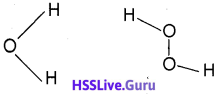
2. Compare the structures of water and hydrogen peroxide.
Answer:
1. Hydrated sodium aluminium silicate is called permutit (NaZ). When it is added to hard water it exchanges Ca2+ and Mg2+ ions with Na+ ions.
2NaZ(s) + M2+(aq) —> MZ2(s) + 2Na+(aq) M = Ma, Ca)

2. Water molecule has an angular or bent shape. H2O2 has a non-planar structure.
Plus One Chemistry Chapter Wise Questions and Answers Chapter 9 Hydrogen 8

Question 17.
1. Give the industrial method of preparation of H2O2.
2. How is heavy water prepared?
3. How is pure de-mineralised water obtained?
Answer:
1. Industrially H2O2 is prepared by the auto-oxidation of 2-ethylanthraquinol.

2. Heavy water is prepared by exhaustive electrolysis of water or as a byproduct in some fertilizer industries.

3. Pure de-mineralised water is obtained by passing water successively through a cation exchange and an anion exchange resins.

In the cation exchange process, the H+ exchanges for Na+, Ca2+, Mg2+ and other cations present in water. This process results in proton release and makes the water acidic.
2RH(s) + M2+(aq) \(\rightleftharpoons \) MR2(s) + 2H+(aq)

In the anion exchange process, the OH exchanges for anions like Cl, HCO3, SO42- etc. present in water.
RNH3+OH(S) + X(aq) \(\rightleftharpoons \) RNH3+X(s) + OH(aq)

The OH ions, thus liberated neutralise the H+ ions set free in the cation exchange process to get pure de-mineralised water.
H+(aq) + OH(aq) → H2O(l)

Question 18.
1. Explain why hydrogen peroxide is stored in coloured plastic bottles.
2. Write any two uses of H2O2.
Answer:
1. In the presence of metal surfaces or traces of alkali (present in glass conatiners), the decomposition of H2O2 (2H2O2 → 2H2O + O2) is catalysed. It is therefore stored in wax-lined glasses or plastic vessels in dark.

2. 1. As a hair bleach and as a mild disinfectant.
2. In the syntheseis of hydroquinone, tartaric acid and certain food products and pharmaceuticals.

Plus One Chemistry Chapter Wise Questions and Answers Chapter 9 Hydrogen

Question 19.
1. A sample of hard water was found to loose its hardness on boiling. Name the type of hardness associated with this sample. 0
2. Write the name and formula of four minerals which cause permanent hardness of water.
3. What are electron deficient hydrides? Whether they behave as Lewis acids or Lewis bases? Why?
Answer:
1. Temporary hardness

2. CaCl2, MgCl2, CaSO4, MgSO4

3. These are covalent hydrides having too few electrons for writing conventional Lewis structure. They act as Lewis acids because they can accept electrons, e.g. B2H6

Plus One Chemistry Hydrogen Four Mark Questions and Answers

Question 1.
Match the following:

A B
Temporary hardness p-block elements
Hydrides Reducing agent
Permanent hardness Chloride
Alkali metals Bicarbonate

Answer:

A B
Temporary hardness Bicarbonate
Hydrides p-block elements
Permanent hardness Chloride
Alkali metals Reducing agent

Question 2.
Certain samples of water do no produce easy lather with soap.

  1. What is this condition of water called?
  2. Which are two types of this condition?
  3. Suggest two methods to change this condition of water.
  4. What are the problems caused by this condition of water?

Answer:

  1. Hardwater.
  2. Temporary hardness and permanent hardness.
  3. By boiling water and by adding Na2CO3
  4. Wastage of soap and boiler explosion.

Question 3.
Match the following:

1. D2O a) Hendry Cavendish
2. Hydrogen b) Water gas
3. Ca + H2 c) 31H
4. C2H4 + H2 d) Heavy water
5. Tritium e) 21H
6. Deuterium f) CaH2
7. CO + H2 g) C2H6
8. CO + Z2 h) Producer gas

Answer:
1) – d)
2) – a)
3) – f)
4) – g)
5) – c)
6) – e)
7) – b)
8) – h)

Question 4.
1. A list of compounds are given below:
H2O, HCl, CH4
Construct chemical reactions to show the preparation of H2 from each of the above compounds.
2. What is syn gas? How is it prepared?
3. What is coal gasification?
4. Explain water gas shift reaction.
Answer:
1.
Plus One Chemistry Chapter Wise Questions and Answers Chapter 9 Hydrogen 9
2. Syn gas is a mixture of CO and H2. It is prepared by passing steam over red hot coke.
Plus One Chemistry Chapter Wise Questions and Answers Chapter 9 Hydrogen 10

3. The process of production of syngas from coal is called coal gasification.

4. The production of dihydrogen can be increased by reacting CO of syngas mixtures with steam in the presence of iron chromate as catalyst. This is called water gas shift reaction.
Plus One Chemistry Chapter Wise Questions and Answers Chapter 9 Hydrogen 11

The CO2 is removed by scrubbing with sodium arsenite solution.

Plus One Chemistry Hydrogen NCERT Questions and Answers

Question 1.
Write the names of isotopes of hydrogen. What is the mass ratio of these isotopes? (2)
Answer:
The various isotopes of hydrogen are:
Plus One Chemistry Chapter Wise Questions and Answers Chapter 9 Hydrogen 12

Question 2.
Why does hydrogen occur in a diatomic form rather than in a monoatomic form under normal conditions? (2)
Answer:
Hydrogen atom has only one electron and thus, to achieve stable inert gas configuration of helium, it shares its single electron with electron of another hydrogen atom to form a stable diatomic molecule. The stability of H2 is further confirmed by the fact, that formation of one mole of gaseous H2 molecules results in the release of 435.8 kJ of energy.
H(g) + H(g) H2(g); ∆H = – 435.8 kJ mol-1

Plus One Chemistry Chapter Wise Questions and Answers Chapter 9 Hydrogen

Question 3.
How do you expect the metallic hydrides to be useful for hydrogen storage? Explain. (2)
Answer:
In some of the transition metal hydrides, hydrogen is absorbed as H-atoms. Due to the inclusion of H- atoms, the metal lattice expands and thus becomes less stable. Therefore, when such metallic hydride is heated, it decomposes to release hydrogen gas and very finely divided metal. The hydrogen evolved in this manner can be used as a fuel. Thus, transition metals or their alloys can act as sponge and can be used to store and transport hydrogen to be used as a fuel.

Question 4.
What causes the temporary and permanent hardness of water? (2)
Answer:
Temporary hardness is caused by presence of bicarbonates of calcium and magnesium, i.e., Ca(HCO3)2 and Mg(HCO3)2 in water whereas permanent hardness is caused by presence of soluble chlorides and sulphates of calcium and magnesium, i.e., CaCl2, CaSO4, MgCl2 and MgSO4 in water.

Question 5.
Write chemical reactions to show amphoteric nature of water. (2)
Answer:
Water is amphoteric in character. It means that it can act as proton donor as well as proton acceptor. When it reacts with acids, (stronger than itself), it behaves as a base. When it reacts with bases (stronger than itself) it acts as an acid.

Plus One Chemistry Chapter Wise Questions and Answers Chapter 9 Hydrogen

Question 6.
Is demineralised or distilled water useful for drinking purposes? If not, how can it be made useful? (2)
Answer:
Demineralised or distilled water is not useful for drinking purposes because it does not contain even useful minerals. Therefore, to make it useful for drinking purposes, useful minerals in proper amounts should be added to demineralised or distilled water.

Question 7.
How does H2O2 behave as a bleaching agent? (2)
Answer:
The bleaching action of H2O2 is due to the nascent oxygen which is liberates on decomposition.
H2O2 → H2O + [O]
The nascent oxygen oxidise the colouring matter to colourless products. Hence, H2O2 is used for the bleaching of delicate maerials like ivory, feather, silk, wool, etc.

Plus One Physics Chapter Wise Questions and Answers Chapter 11 Thermal Properties of Matter

Students can Download Chapter 11 Thermal Properties of Matter Questions and Answers, Plus One Physics Chapter Wise Questions and Answers helps you to revise the complete Kerala State Syllabus and score more marks in your examinations.

Kerala Plus One Physics Chapter Wise Questions and Answers Chapter 11 Thermal Properties of Matter

Plus One Physics Thermal Properties of Matter One Mark Questions and Answers

Question 1.
In which of the following processes, convection does nottake place primarily?
(a) Sea and land breeze
(b) Boiling of water
(c) Warming of glass of bulb due to filament
(d) Heating air around a furnace
Answer:
(c) Warming of glass of bulb due to filament
In convection process, the heat is transferred by the bodily motion of the heated particles. It is not so in case of warming of glass bulb due to filament heating. In fact, warming of glass bulb is due to radiation.

Question 2.
\(\frac{\text { Watt }}{\text { Kelvin }}\) a unit of
(a) Stefan’s constant
(b) Wien’s constant
(c) Cooling’s constant
(d) Thermal conductance
Answer:
(d) Thermal resistance
Plus One Physics Thermal Properties of Matter One Mark Questions and Answers 1

Plus One Physics Chapter Wise Questions and Answers Chapter 11 Thermal Properties of Matter

Question 3.
For measuring temperatures in the range of 2000°C, we should employ
(a) gas thermometer
(b) platinum-rhodium thermometer
(c) barometer
(d) pyrometer
Answer:
(d) pyrometer

Question 4.
There is a hole in metal disc. What happens to the size of metal disc if the metal disc is heated?
Answer:
The size of hole increases.

Question 5.
Which has more specific heat capacity, water, and sand?
Answer:
Water.

Question 6.
Two solid spheres of the same material have the same radius but one is hollow while the other is solid. Both spheres are heated to same temperature. Then
(a) the solid sphere expands more
(b) the hollow sphere expands more
(c) expansion is same for both
(d) nothing can be solid about their relative expansion if their masses are not given
Answer:
(c) expansion is same for both

Plus One Physics Chapter Wise Questions and Answers Chapter 11 Thermal Properties of Matter

Question 7.
The sprinkling of water reduces slightly the temperature of a closed room because
(a) temperature of water is less than that of the room.
(b) specific heat of water is high
(c) water has large latent heat of vaporisation
(d) water is a bad conductor of heat
Answer:
(c) water has large latent heat of vaporisation
When water is sprinkled over a large area, evaporation takes place. As the latent heat of vaporisation is large cooling takes place.

Question 8.
Why specific heat of gas at constant pressure (Cp) is greater than specific heat at constant volume?
Answer:
More heat is required to raise the temperature of gas at constant pressure than at constant volume.

Question 9.
A body is heated. But there is no change in its temperature. Is it possible?
Answer:
Yes. During change of state, there will be no increase in temperature even when heat is supplied.

Question 10.
When boiling water is put in glass tumbler, the tumbler cracks. Why?
Answer:
Glass is poor conductor of heat. So inner and outer surfaces of tumbler suffer uneven expension. Hence it breaks.

Question 11.
A small space is left between two rails on railway track. Why?
Answer:
If no space is left, the rails would bend due to thermal expansion in summer. So small space is left between two rails to allow thermal expansion.

Plus One Physics Chapter Wise Questions and Answers Chapter 11 Thermal Properties of Matter

Question 12.
The pendulum of clock is made of invar, Why?
Answer:
Invar has low value of coefficient of linear expansion. So length of pendulum remains almost same in all seasons. (The change in length affects time period of pendulum).

Question 13.
Tea gets cooled, when sugar is added to it. Why?
Answer:
When sugar is added, heat content of tea gets shared with sugar & hence’ temperature decreases.

Question 14.
Ice covered in gunny bag does not melt for a long time. Why?
Answer:
A gunny bag is poor conduct of heat & hence it does not allow external heat to enter.

Question 15.
Why two layers of cloth of equal thickness provide warmer covering than a single layer of cloth of double the thickness?
Answer:
Because air between two layers of clothes is a bad ‘ conductor of heat.

Plus One Physics Chapter Wise Questions and Answers Chapter 11 Thermal Properties of Matter

Question 16.
On winter nights, we feel warmer when clouds cover the sky than the sky is clear. Why?
Answer:
The clouds are bad conductor of heat. So heat of earth’s atmosphere is not conducted out.

Plus One Physics Thermal Properties of Matter Two Mark Questions and Answers

Question 1.
1. Two bodies at different temperatures T1K and T2K are brought in contact with each other

  • Is the resultant temperature be necessarily (T1 + T2)/2? If not, Why?
  • Should the resultant temperature be between T1 and T1 only? If not, Why?

Answer:
1. Two bodies at different temperatures:

  • The resultant temperature may not be necessarily \(\left(\frac{T_{1}+T_{2}}{2}\right)\). Because specific heat capacity is different for all substances.
  • If heat is not lost to the surroundings, resultant temperature must lie in between T1 and T2.

Plus One Physics Chapter Wise Questions and Answers Chapter 11 Thermal Properties of Matter

Question 2.
A Patient is admitted to hospital. The temperature of the patient is measured by nurse and is found to be 97.6°F

  1. What is meant by temperature?
  2. Convert the temperature (97.6°F) is to centigrade

Answer:
1. Temperature is the degree of hotness.

2.
Plus One Physics Thermal Properties of Matter Two Mark Questions and Answers 2

Question 3.
Why iron rims are heated red hot before being put on the cart wheels?
Answer:
The radius of iron rim is smaller than radius of cart wheel. When iron rim is heated, its radius increases due to thermal expansion. After rim has planted on the wheel, iron rim is allowed to cool. Then it fits tightly on the wheel due to thermal contraction.

Plus One Physics Chapter Wise Questions and Answers Chapter 11 Thermal Properties of Matter

Question 4.
How woolen clothes helps us in winter against cold?
Answer:
Wool is a heat insulator. Moreover, it contains a layer of dry air in it. This air, which is bad conductor of heat does not allow the body heat to escape & it also does not allow external cold to come in. The rough surface of woollen clothes absorbs more and reflects less heat falling on it.

Plus One Physics Thermal Properties of Matter Three Mark Questions and Answers

Question 1.
A Solid material is supplied with heat at constant rate. The temperature of the material is changing with the heat input as shown in figure.

  1. What do the horizontal region AB and CD represent?
  2. What does the slope of DE represent?
  3. The slope of OA is greater than the slope of BC. What does this indicate?

Answer:
Plus One Physics Thermal Properties of Matter Three Mark Questions and Answers 3

  1. Latent heat of fusion, Latent heat of vaporization
  2. It indicates that, the material is in vapour state
  3. It indicates that latent heat of vaporization of the material is greater than the latent heat of fusion.

Plus One Physics Thermal Properties of Matter Four Mark Questions and Answers

Question 1.
A copper block of mass 2.5kg is heated in a furnace to a temperature of 500°C and then placed on a large ice block. What is the maximum amount of ice that can melt? (Specific heat of copper = 0.39Jg-1 K-1; latent heat of fusion of water = 335 Jg-1).
Answer:
Mass, m = 2.5kg
= 2.5 × 10³ g;
Change in temperature, ∆T = 500°C
Specific heat, c = 0.39 Jg-1K-1;
Latent heat of fusion, L = 335Jg-1
If m’ be the mass of ice melted, then m’L = mc ∆T
or m’ × 335 = 2.5 × 103 × 0.39 × 500 2.5 × 103 × 0.39 × 500
or m’ = \(\frac{2.5 \times 10^{3} \times 0.39 \times 500}{335} \mathrm{g}\)
= 1.5 kg.

Plus One Physics Chapter Wise Questions and Answers Chapter 11 Thermal Properties of Matter

Question 2.
Heat from the sun reaches the earth.

  1. Write the method of transmission of heat.
  2. Thermal conductivity of Aluminium is 205 Jm-1s-1deg-1. What do you mean by this?
  3. Birds swell feathers in winter. Why?

Answer:
1. Radiation, conduction, convenction.

2. The coefficient of thermal conductivity of a substance is defind as the quauitity of heat conducted normally persecond through unit area of the substance per unit temperature gradient when the substance attains steady state.

3. By doing so the birds enclose air between the feathers. Air being a poor conductor, prevents the loss of heat from the body of the bird to the cold surroundings.

Question 3.
Two accidents are happened. The first one with water at 100°C and the second one with steam at 100°C.

  1. Which is dangerous burn due to water at 100°C, and bum due to steam at 100°C? Why?
  2. Latent heat of vapourisation of water to 536 cal/g. Explain the idea of latent heat of vopourisation.
  3. Find the heat required to convert 1g of ice at 0°C to steam at 100°C is

Answer:
1. Burn due to steam is more dangerous, because heat content in steam is very high compared to 100°C water.

2. Latent heat of vapourisation is the amount of heat required to change the state of 1 kg water in to vapour.

3. Q = ML + MC∆Q + ML1
Plus One Physics Thermal Properties of Matter Four Mark Questions and Answers 4
= 716 cal.

Plus One Physics Chapter Wise Questions and Answers Chapter 11 Thermal Properties of Matter

Question 4.
When a fluid is heated, the particle rises up.

  1. Name the phenomonon behind it.
  2. Explain the formation of land breeze and sea breeze.

Answer:
1. Convection

2. During the day, land heats up more quickly than, water in lake (due to high specific heat capacity of water). The air on the surface of earth gets heated, expands, becomes less dense and rises up. The colder air (wind) replaces the space created by hot air.

It creates a sea breeze. At night the land loses its heat very quickly than water. So water remains more warmer at night.

Plus One Physics Thermal Properties of Matter NCERT Questions and Answers

Question 1.
A 10kW drilling machine is used to drill a bore in a small aluminium block of mass 8.0kg. How much is the rise in temperature of the block in 2.5 minutes, assuming 50% of power is used up in heating the machine itself or lost to the surroundings? Specific heat of aluminium = 0.19Jg-1 K-1.
Answer:
Power, P = 10 kW
= 10 × 103W
= 104W
Mass, m = 8 kg; Time, t = 2.5min = 150s
Specific heat, c = 0.91Jg-1K-1
= 0.91 × 10³Jkg-1K-1
Energy, Q = pt = 104 × 150J = 1.5 × 10⁶J
It is given that 50% of energy is lost to the. surroundings. So, energy absorbed by the block is given by
Q = \(\frac{1}{2}\) × 1.5 × 10⁶J = 0.75 × 10⁶J
But Q = mc∆T
∴ ∆T
Plus One Physics Thermal Properties of Matter NCERT Questions and Answers 5

Plus One Physics Chapter Wise Questions and Answers Chapter 11 Thermal Properties of Matter

Question 2.
A brass boiler has a base area of 0.15m2 and thickness 1.0cm. It boils water at the rate of 6.0 kg/min when placed on a gas stove. Estimate the temperature of the part of the flame in contact with the boiler. Thermal conductivity of brass = 109 J s-1 m-1K-1;
Heat of vaporisation of water = 2256 × 103 J kg-1.
Answer:
A = 0.15m2, d = 10-2m,
\(\frac{m}{t}=\frac{6}{60}\) kgs-1 = 0.1kgs-1,
K = 109J s-1 m-1 K-1, L = 2256 × 103 Jkg-1,
θ1 = ?,
θ2 = 100°C
Plus One Physics Thermal Properties of Matter NCERT Questions and Answers 6

Plus One Physics Chapter Wise Questions and Answers Chapter 11 Thermal Properties of Matter

Question 3.
Explain why?
(a) A body with large reflectivity is a poor emitter.
(b) A brass tumbler feels much colder than a wooden tray on a chilly day.
(c) An optical pyrometer (for measuring high temperature) calibrated for an ideal black body radiation gives too low a value for the temperature of a red hot iron piece in the open, but gives a correct value for the temperature when the same piece is in the furnace.
(d) The earth without its. atmosphere would be inhospitably cold?
(e) Heating systems based on circulation of steam are more efficient in warming a building than heating system based on circulation of hot water.
Answer:
(a) a body whose reflectivity is large would naturally absorb less heat. So, a body with large reflectivity is a poor.

(b) The thermal conductivity of brass is high i.e., brass „ is a good conductor of heat. So, when a brass tumbler is touched, heat quickly flows from human body to tumbler. Consequently, the tumbler appears colder. On the other hand, wood is a bad conductor, so, heat does not flow from the human body to the wooden tray in this case. Thus, it appears comparatively hotter.

(c) Let T the temperature of the hot iron in the furnace. Heat radiated per second per unit area, E = σT4

Plus One Bussiness Studies Chapter Wise Questions and Answers Chapter 4 Business Services

Students can Download Chapter 4 Business Services Questions and Answers, Plus One Business Studies Chapter Wise Questions and Answers helps you to revise the complete Kerala State Syllabus and score more marks in your examinations

Kerala Plus One Bussiness Studies Chapter Wise Questions and Answers Chapter 4 Business Services

Plus One Business Services One Mark Questions and Answers

Question 1.
Name the type of account opened in a bank with an over draft facility
Answer:
Current Account

Question 2.
DTH services are provided by
Answer:
Cellular companies

Question 3.
CWC Stands for
Answer:
Central warehousing corporation

Question 4.
Mr. James running a software development business, incur heavy expenditure for replacement of computers due to updation in technology. To avoid this expenditure he may opt for
(a) Factoring
(b) Venture capital
(c) Leasing
(d) Merchant banking
Answer:
(c) Leasing

Question 5.
Name the type of account opened in the bank with overdraft facility
Answer:
Current account

Plus One Bussiness Studies Chapter Wise Questions and Answers Chapter 4 Business Services

Question 6.
Classify the following into appropriate categories SBI, Federal Bank, American Express Bank.
Answer:

  • SBI – Public Bank
  • Federal Bank – Private bank
  • American Express bank – Foreign bank

Question 7.
Which among the following helps in issue management of shares,
(a) Mutual fund
(b) Merchant banks
(c) Venture Capital
(d) Factoring
Answer:
(b) Merchant banks

Question 8.
Classify the following bank into Appropriate Categories,

  1. IDBI
  2. HDFC
  3. Axis Bank
  4. Canara Bank
  5. HSFC
  6. CITI Bank

Answer:

  1. IDBI – Private Bank
  2. HDFC – Private Bank
  3. Axis Bank – Public Bank
  4. Canara Bank – Public Bank
  5. HSFC – Private Bank
  6. CITI Bank – Foreign Bank

Question 9.
Which facility allows a current account holder to withdraw more amount than his deposit?
Answer:
Overdraft

Question 10.
Which of the following is not applicable in life insurance contract?
(a) Conditional contact
(b) Unilateral contract
(c) Indemnity contract
(d) None of the above
Answer:
(c) Indemnity contract

Plus One Bussiness Studies Chapter Wise Questions and Answers Chapter 4 Business Services

Question 11.
When the same subject matter is insured with more than one insurer, it is called
Answer:
Double insurance

Question 12.
________ is a contract of insurance entered into by the insurer with another insurer to reduce the risk.
Answer:
Reinsurance

Question 13.
Rajiv insures his shop for ₹5,00,000 against fire. His shop is completely damaged by a mob attack. Rajiv claims ₹5,00,000/- from the insurance company.

  1. Will the company admit the claim of Rajiv?
  2. Which principle of insurance is applicable here?

Answer:

  1. No.
  2. Causa Proxima

Question 14.
Principle of indemnity does not apply to __________
(a) Life insurance
(b) Health insurance
(c) Fire insurance
(d) Marine insurance
Answer:
(a) Life insurance

Question. 15
I will give security against fraudulent practices of employees who deal with cash or other variables. Can you identify me? Explain its features?
Answer:
Fidelity insurance

Question 16.
Govind insures his shop for ₹6,00,000. in a fire accident. The shop incurred a loss of ₹3,00,000. But he claimed for the assured sum. Will the insurance co admit the claim in full? Identify the principle of insurance which is applicable here.
Answer:
No. Principle of indemnity

Question 17.
Life insurance is a contract of ________
Answer:
Guarantee

Question 18.
_______ principle states, the insurer step into the shoes of insured.
Answer:
Subrogation.

Plus One Bussiness Studies Chapter Wise Questions and Answers Chapter 4 Business Services

Question 19.
Jacob purchased a new car for ₹15,00,000 and insured it with National insurance company and Oriental Insurance Company for ₹15,00,000 each. On an accident, the car was damaged completely and he claimed compensation from both companies.

  1. Can he get compensation from both companies?
  2. Identify relevant principle of insurance.

Answer:

  1. No
  2. Principle of Contribution

Question 20.
According to _________ principle, the insured is not allowed to make any profit out of his loss.
Answer:
Indemnity

Question 21.
Rajan wants to take an insurance policy covering the risk arising from the dishonesty of employees. Which type to policy close he have to take?
Answer:
Fidelity insurance

Question 22.
__________ is a contract whereby the insurer, in consideration of premium, undertakes to compensate the insured for the loss or damage suffered due to fire.
Answer:
Fire insurance

Plus One Business Services Two Mark Questions and Answers

Question 1.
Define service and goods. (2)
Answer:
Services are those identifiable and intangible activities that provide satisfaction of wants. Goods is a physical product which can be delivered to a purchaser and involves the transfer of ownership from the seller to customer.

Question 2.
Explain various telecom services available for enhancing business. (2)
Answer:
The various types of telecom services are:

1. Cellular mobile services:
Mobile communication device including voice and non-voice messages, data services and PCO services utilising any type of network equipment within their service area.

2. Radio paging services:
It means of transmitting information to persons even when they are mobile.

3. Fixed line services:
It includes voice and non-voice messages and data services to establish linkage for long distance traffic.

4. Cable services:
Linkages and switched services within a licensed area of operation to operate media services which are essentially one way entertainment related services.

5. VSAT services (Very small Aperture Terminal):
It is a Satellite-based communication service. It offers government and business agencies a highly flexible and reliable communication solution in both urban and rural areas.

6. DTH services (Direct to Home):
It is a Satellite based media services provided by cellular companies with the help of small dish antenna and a set up box.

Question 3.
Mr. Dino is running a textile shop. He insured the shop for ₹1,00,000 against natural calamities. After this the shop was completely destroyed by fire due to electrics short circuit. He claimed for compensation. But the insurance company refused to admit the claim on the ground that the shop was insured against natural calamities. (2)

  1. Can you justify the decision of insurance company.
  2. Which principle of insurance is applicable here.

Answer:

  1. Yes.
  2. Causa proxima. It states that insurance company will admit the claim only if mishap has resulted directly by an event covered by under insurance.

Plus One Bussiness Studies Chapter Wise Questions and Answers Chapter 4 Business Services

Question 4.
Mr. Sabu is running a provision store. He insured the shop for ₹ 50,000 against fire. One day during course of business the shop caught fire and Mr. Sabu purposefully did not take any efforts to minimize the loss. He claimed for compensation. In this situation. (2)

  1. What will be your decision assuming that you are the officer in charge of admitting the claims for insurance company?
  2. Which principle is applicable here?

Answer:

  1. The claim can not be admitted because the insurer did not take any reasonable steps to minimize the loss.
  2. Principle of mitigation of loss

Question 5.
Why do we say that the principle of indemnity is not applicable to life insurance. Illustrate your answer. (2)
Answer:
The loss due to death of the insured cannot be measured in terms of money. So principle of indemnity is not applicable to Life insurance.

Question 6.
Mr. Sibi purchased a new car and it was completely damaged in an accident. Subsequently, he lodged a claim with the insurance company and the same was admitted. Later, the insurance company recovered the destroyed property. (2)

  1. Why did the company take ownership of the car?
  2. State the relevant principle. Explain.

Answer:

  1. Ownership of the damaged car is vested with the insurance company.
  2. According to the principle of subrogation, once the claim of the insured has been settled, the right of ownership of such property passes to .the insurer.

Question 7.
Mr. Anand your friend has started a new business. He decided to open a bank account with SBI. He has only a vague idea about the type of accounts available to the business people. So he seeks your help to choose the most favourable account for him. Give reason. (2)
Answer:
Mr. Anand can open current account. There is no restriction on the frequency and volume of deposits or withdrawals of money.

Question 8.
Match the following

A B
Warehousing Mutual Funds
Unit Trust Of India Hindrance Of Time
Insurance External Comunication
Telecom Causa proxima

Answer:

A B
Warehousing Hindrance Of Time
Unit Trust Of India Mutual Funds
Insurance Causa proxima
Telecom External Comunication

Plus One Business Services Three Mark Questions and Answers

Question 1.
Mr. Janardhanan, a business man, has a current a/c of ₹1,00,000 in the S.B.I. He is in need of another ₹50,000 for the purpose of expansion of his business. By availing which facility, can he have money from the bank? Explain its features. (3)
Answer:
Overdraft: Overdraft is an arrangement where customers are allowed to withdraw up to a level over and above their deposits in the current account. Interest is to be paid only on the actual amount of overdraft availed by him. OD is granted to businessmen against their current account.

Plus One Bussiness Studies Chapter Wise Questions and Answers Chapter 4 Business Services

Question 2.
Write a detailed note on various facilities offered by Indian Postal Department. (3)
Answer:
1. Postal services:
Indian post and telegraph department provides various postal services across India. Various facilities provided by postal department are
(a) Financial facilities:
They provide postal banking facilities to the general public and mobilise their savings through the saving schemes like public provident fund (PPF), Kisan Vikas Patra, National Saving Certificate, Recurring Deposit Scheme and Money Order facility

(b) Mail facilities:
1. Mail services consist of

  • Parcel facilities that is trans-mission of articles from one place to another
  • Registration facility to provide security of the transmitted articles
  •  Insurance facility to provide insurance cover for all risks in the course of transmission by post.

2. Allied Postal Services

  • Greetings Post: Greetings card can be sent through post offices.
  •  Media Post: Corporate can advertise their brands through post cards, envelops etc.
  •  Speed Post: It allows speedy transmission of articles to people in specified cities.
  •  e-bill post: The post offices collect payment of telephone, electricity, and water bills from the consumers.
  •  Courier Services: Letters, documents, parcels etc. can be sent through the courier service.

(2) Telecom Services:
The various types of telecom services are:

1. Cellular mobile services:
Mobile communication device including voice and non-voice messages, data services and PCO services utilising any type of network equipment within their service area.

2. Radio paging services:
It means of transmitting information to persons even when they are mobile.

3. Fixed line services:
It includes voice and non-voice messages and data services to establish linkage for long distance traffic.

4. Cable services:
Linkages and switched services within a licensed area of operation to operate media services which are essentially one way entertainment related services.

5. VSAT services (Very small Aperture Terminal):
It is a Satellite based communication service. It offers government and business agencies a highly flexible and reliable communication solution in both urban and rural areas.

6. DTH services (Direct to Home):
It is a Satellite based media services provided by cellular companies with the help of small dish antenna and a set up box.

Plus One Bussiness Studies Chapter Wise Questions and Answers Chapter 4 Business Services

Question 3.
What is e-banking? What are the advantages of e-banking? (3)
Answer:]
e-banking is a service provided by many banks, that allows a customer to conduct banking transactions, such as managing savings, checking accounts, applying for loans or paying bills over the internet using a personal computer, mobile telephone. Eg. Electronic Fund Transfer (EFT), ATM etc.

Question 4.
Babu insures his shop for ₹3,00,000. In a fire accident the shop burned and incurred a loss of ₹1,50,000. Babu claimed for the assured sum i.e, ₹3,00,000. (3)

  1. Will the insurance company admit the claim in full. Why?
  2. Which principle of insurance is applicable here.

Answer:

  1. No. According to the principle of indemnity, in the event of occurrence of loss, the insured will be indemnified to the extent of actual value of his loss or the sum insured which ever is less,
  2. Principle of Indemnity

Question 5.
Mrs. Anjali has a medical shop and it is insured with two insurers for ₹50,000 each against natural calamities. During the rainy season, the subject matter was partly destroyed by flood. The total amount of loss was estimated at ? 30,000. She claimed compensation from both insurance companies for ₹30,000 each. (3)

  1. Can she get the claim from both the insurers?
  2. Justify your answer with regard to the relevant principle of insurance.

Answer:

  1. No. She cannot get claim from both the insurance.
  2. According to the principle of contribution, the insured is eligible to receive a claim only up to the amount of actual loss suffered by her.

Question 6.
Mr. Joy keep stock of inflammable materials in his shop premises, takes an insurance policy for the shop against fire. But he did not disclose anything about the inflammable materials to the insurance company. Later, the inflammable goods caught fire and the shop was completely destroyed by fire. The insurance company refused to admit the claim of Mr. Joy on the ground that he did not disclose information about the inflammable goods. (3)

  1. Can you justify the decision of the insurance company?
  2. What principle of insurance is applicable here ?

Answer:

  1. Yes.
  2. Principle of utmost good faith. The insured must disclose all material facts about the subject matter to the insurer. Otherwise the insurer can cancel the contract. The insurer must disclose all the terms and conditions in the insurance contract to the insured.

Plus One Business Services Four Mark Questions and Answers

Question 1.
Mr. Surendran is running an electrical shop which is insured against fire for ₹50,000. Due to heavy rainfall his stock was fully damaged and he claimed for compensation. The insurance company refused to admit the claim as goods were not insured against natural calamities. Can you justify the decision of the insurance company? Which principle of insurance is applicable here? (4)
Answer:
Yes. The decision taken by the insurance company is correct. Mr. Surendran has no right to claim compensation from the insurance company. The principle of insurance applicable here is causa proxima. It states that insurance company will admit the claim only if the mishap has resulted directly by an event covered under the insurance. An event covered under the insurance.

Question 2.
Draw a chart showing types of insurance. (4)
Answer:
Plus One Bussiness Studies Chapter Wise Questions and Answers Chapter 4 Business Services 1

Question 3.
Explain the functions of Transport. (4)
Answer:
Functions of Transport:

  1. Helps in the movement of goods and materials from one place to another
  2. Helps in the stabilisation of prices.
  3. Helps in the social, economic and cultural development of the country
  4. Helps in national and international trade
  5. Facilitates large scale production
  6. Generates employment opportunities
  7. Increases growth of towns and cities
  8. Connects all part of the world

Plus One Business Services Five Mark Questions and Answers

Question 1.
Explain the functions of warehousing. (5)
Answer:
Functions of Warehousing:

  1. Warehouse helps in supplying the goods to the customers when it is needed.
  2. By maintaining a balance of supply of goods warehousing leads to price stabilization.
  3. By keeping the goods in the warehouse, the trader can relieve himself of the responsibility of keeping of goods.
  4. The warehouse performs the function of dividing the bulk quantity of goods into smaller quantities.
  5. Warehousing helps in the seasonal storage of goods to select businesses.
  6. The functions of grading, branding and packing of goods can be done in warehouses.
  7. The warehousing receipt can be used as a collateral security for obtaining loans.

Plus One Bussiness Studies Chapter Wise Questions and Answers Chapter 4 Business Services

Question 2.
Name the principle of insurance violated in the following cases. (5)

1. ‘A’does not own the building but is trying to get it insured as a party to the insurance policy.

2.  ‘A’ enters into life insurance contract with LIC of India. ‘A’ was ailing with heart decease but he did not reveal this at the time of entering the contract. ‘

3. ‘B’ enters into insurance contract with two companies ‘C’ and ‘D’. The subject matter is a building worth ₹ 5 lakh. The building caught fire and properties worth ₹3 lakhs were damaged. ‘C’ paid the entire claim and asked ‘D’ to share the claim. ‘D’ denies.

4. Goods worth ₹50,000 are damaged and the insurance company pays the claim to ‘Z’ for the loss. ‘Z’ not only took the compensation for loss but also claims the damaged goods.

5. ‘P’ takes an insurance policy for ₹1 lakh with ‘Q’ company. The goods of ‘P’ are damaged due to fire the loss incurred is ₹25,000. ‘Q’ shall restore the actual loss but ‘P’ claims full amount of the policy.

Answer:

  1. Principle of insurable interest
  2. Principle of utmost good faith
  3. Principle of contribution
  4. Principle of subrogation
  5. Principle of Indemnity

Question 3.
Match A with B and C.

Plus One Bussiness Studies Chapter Wise Questions and Answers Chapter 4 Business Services 2

Answer:

Plus One Bussiness Studies Chapter Wise Questions and Answers Chapter 4 Business Services 3

Plus One Business Services Six Mark Questions and Answers

Question 1.
Distinguish between life insurance and general insurance. (6)
Answer:

Life Insurance Fire insurance Marine Insurance
The subject matter of insurance is human life The subject matter is any asset. The subject matter is a ship, cargo or freight.
it has the elements of protection and investment It has only the element of Protection It has only the element of Protection.
insurable interest exists at the time of contract alone. Insurable interest exists at the time of contract and at the time of loss. Insurable interest exists at the time of contract
Period of coverage is long period Period of coverage is up to one year Marine insurance policy is for one or period of voyage or mixed.
Life insurance is not a contract of indemnity Fie insurance is a contract of indemnity. Marine insurance is a contract of indemnity
Loss Is not measurable. Loss is measurabie. Loss is measurable.
Surrender of policy is possible Surrender of policy is not possible Surrender of policy is not possible
One can insure for any amount in life insurance. The amount of the policy cannot be more than the value of the subject matter. The amount of the policy can be the market value of the ship or cargo.
It is contract of assurance It is contract of insurance It is contract of insurance

Question 2.
I will give security against fraudulent practices of employees who deal with cash or other valuables

  1. Can you identify me?
  2. Explain my features. (6)

Answer:
1. Fidelity insurance.

2. This type of policy is taken by the employer of a fire to cover the risk arising out of fraud or dishonesty of his employees. Banks, Financial institutions and other business firms commonly use such insurance policies.

Plus One Bussiness Studies Chapter Wise Questions and Answers Chapter 4 Business Services

Question 3.
What are services? Explain their distinct characteristics? (6)
Answer:
Nature of Services
1. Intangibility:
Services are intangible, i.e., they cannot be touched. They are experiential in nature, e.g. Treatment by a doctor.

2. Inconsistency:
Since there is no tangible product, services have to be performed according to the demand and expectations of the different customers, e.g. Mobile services/Beauty parlour.

3. Inseparability:
Another important characteristic of services is the simultaneous activity of production and consumption being performed, i.e. They are inseparable, e.g. ATM may replace clerk but presence of customer is a must.

4. Less Inventory:
Services cannot be stored for future use.

5. Involvement:
Participation of the customer in the service delivery is a must.

Plus One Business Services Eight Mark Questions and Answers

Question 1.
Suppose you have visited a commercial bank in your locality. Then what information you have collected from there with regard to. (8)

  1. Deposit schemes
  2. Lending scheme
  3. Other services

Answer:
Functions of Commercial Banks:
a. Acceptance of deposits:
A commercial bank accepts following types of deposits. They are

1. Current deposit:
This type of account is usually opened by business men.lt carries no interest. There are no restrictions on number of deposits or withdrawals.

2. Savings deposit:
Savings accounts are for encouraging savings by individuals. Banks pay rate of interest as decided by RBI on these deposits. Withdrawal from these accounts has some restrictions.

3. Fixed deposit:
Fixed accounts are time deposits with higher rate of interest. They cannot be withdrawn before the maturity period.

Plus One Bussiness Studies Chapter Wise Questions and Answers Chapter 4 Business Services

b. Lending of funds:
The second important function of a commercial bank is to grant loans and advances out of the money received through deposits. These advances can be made in the form of overdrafts, cash credits, discounting trade bills, term loans, consumer credits and other miscellaneous advances.
1. Cash Credit:
Under this arrangement, the bank advances loan up to a specified limit against current assets. The bank opens an account in the name of the borrower and allows him to withdraw the money up to the sanctioned limit. Interest is charged on the amount actually withdraw.

2. Bank Overdraft:
Overdraft is an arrangement where customers are allowed to withdraw up to a level over and above their deposits in the current account. Interest is to be paid only on the actual amount of overdraft availed by him. OD is granted to businessmen against their current account.

3. Discounting of bill of exchange:
Under this, a bank gives money to its customers on the security of a bill of exchange before the expiry of the bill after deducting a small amount of discount.

4. Term Loans:
These loans are provided by the banks to their customers for a fixed period. Interest will be charged to the entire amount of loan.

c. Secondary Functions:
The secondary functions of commercial banks are as under:
1. Agency Functions:

  • Cheque facility: Bank collects customers cheque drawn on other bank. There are two types of cheques mainly
    Bearer cheques, which are encashable immediately at bank counters Crossed cheques which are to be deposited only in the payees account.
  • Payment of insurance premium, telephone charges, collection of dividend etc
  • Purchase and sale of shares and debentures
  • Acting as trustees or executors
  • Providing credit information

2. General utility services:

  • Providing lockers for safe custody of jewellery and others valuables of customers
  • Issuing letter of credit, pay orders, bank draft, credit cards, traveller’s cheques to customers.
  • Underwriting issues of shares and debentures
  • Providing foreign exchange to importers and traveller’s going abroad.

Bank Draft:
It is a financial instrument with the help of which money can be remitted from one place to another. The payee can present the draft on the drawee bank at his place and collect the money. Bank charges some commission for issuing a bank draft.

Pay Order:
It is almost like a bank draft. Banks issue pay order for local purpose and issue bank draft for outstations.

Question 2.
“For the smooth conducting of insurance the insurer and Insured should know the relevant factors underlying the insurance contracts.” In the light of this statement, can you state the principles of Insurance?
Answer:

Plus One Bussiness Studies Chapter Wise Questions and Answers Chapter 4 Business Services 3

1. Utmost good faith:
The insured must disclose all material facts about the subject matter to the insured. Otherwise the insurer can cancel the contract. The insurer must disclose all the terms and conditions jn the insurance contract to the insured.

2. Insurable interest:
The insured must have an insurable interest in the subject matter of insurance. Insurable interest means the interest shown by the insured in the continued existence of the subject matter or the financial loss he is subjected to on the happening of an event against which it has been insured.

3. Indemnity:
All insurance contracts, except life insurance are contracts of indemnity. According to the principle of indemnity, in the event of occurrence of loss, the insured will be indemnified to the extent of the actual value of his loss or the sum insured which ever is less. The objective behind this principle is nobody should treat insurance contract as the source of profit.

4. Subrogation:
According to this principle, after the insured is compensated for the loss to the property insured by him the right of ownership of such property passes on to the insurer. This is because the insured should not be allowed to make any profit, by selling the damaged property.

5. Causa proxima:
When the loss is the result of two or more causes, the proximate cause for the loss alone will be considered by the insurance company for admitting the claim.

6. Contribution:
In certain cases, the same subject matter is insured with one or more insurer. In case there is a loss, the insured is eligible to receive a claim only up to the amount of actual loss suffered by him.

Plus One Bussiness Studies Chapter Wise Questions and Answers Chapter 4 Business Services

7. Mitigation of loss:
This principle states that it is the duty of the insured to take reasonable steps to minimize the loss or damage to the insured property. If reasonable care is not taken then the claim from the insurance company may be rejected.

Question 3.
Prepare a seminar paper on Types of warehouses. (8)
Plus One Bussiness Studies Chapter Wise Questions and Answers Chapter 4 Business Services 5
Answer:
Warehousing:
Warehousing means holding or preserving goods in huge quantities from the time of their purchase or production till their consumption. Warehousing is one of the important auxiliaries to trade. It creates time utility by bridging the time gap between production and consumption of goods.
Functions of Warehousing:

  • Warehouse helps in supplying the goods to the customers when it is needed.
  • By maintaining a balance of supply of goods warehousing leads to price stabilization.
  • By keeping the goods in the warehouse, the trader can relieve himself of the responsibility of keeping of goods.
  • The warehouse performs the function of dividing the bulk quantity of goods into smaller quantities.
  • Warehousing helps in the seasonal storage of goods to select businesses.
  • The functions of grading, branding and packing of goods can be done in warehouses.
  • The warehousing receipt can be used as a collateral security for obtaining loans.

Types of Warehouses:
Plus One Bussiness Studies Chapter Wise Questions and Answers Chapter 4 Business Services 5
1. Private warehouses:
Private warehouses are owned by big business concerns or wholesalers for keeping their own products.

2. Public warehouses:
They are owned by some agencies, offer storage facilities to the public after charging certain fees. The working of public warehouses is subject to some govt, regulations. They are also known as Duty paid warehouses.

3. Bonded warehouses:
These warehouses are used to keep the imported goods before the payment of import duties. It offers many advantages to the importer, i.e. The importer can releases the goods in part by paying the proportionate amount of duty. The goods can be branded, blended and packed in the warehouse itself.

4. Government warehouses:
These warehouses are fully owned and managed by the government. For example, Food Corporation of India, State Trading Corporation, and Central Warehousing Corporation.

5. Co-operative warehouses:
Marketing co operative societies and agricultural oo operative societies have set up their own warehouses for members of their cooperative society.

Plus One Economics Chapter Wise Questions and Answers Chapter 2 Collection of Data

Students can Download Chapter 2 Collection of Data Questions and Answers, Plus One Economics Chapter Wise Questions and Answers helps you to revise the complete Kerala State Syllabus and score more marks in your examinations

Kerala Plus One Economics Chapter Wise Questions and Answers Chapter 2 Collection of Data

Plus One Economics Collection of Data One Mark Questions and Answers

Question 1.
Which among the following is a method of primary data collection?
(i) Direct personal interview
(ii) Telephonic interview
(iii) Mailed questionnaire method
(iv) All the above
Answer:
(iv) All the above

Question 2.
Identify the random sampling method from the following.
(i) Judgment sampling
(ii) Stratified sampling
(iii) Convenience sampling
(iv) Quota sampling
Answer:
(ii) Stratified sampling

Question 3.
Which among the following is a source of secondary data?
(i) CSO
(ii) NSSO
(iii) RGI
(iv) All the above
Answer:
(iv) All the above

Plus One Economics Chapter Wise Questions and Answers Chapter 2 Collection of Data

Question 4.
Identify an advantage of sample method.
(i) Less time consuming
(ii) Less cost is needed
(iii) Gives more reliable information
(iv) All the above
Answer:
(iv) All the above

Question 5.
Name the different types of data.
Answer:
Primary data and secondary data

Plus One Economics Collection of Data Two Mark Questions and Answers

Question 1.
Differentiate between census survey and sample survey.
Answer:
Under census method, we collect information from each and every unit of population relating to the problem under investigation. On the other hand, under-sample method, rather than collecting information about all the units of population, we collect information from a few selected items from population.

Question 2.
Name the two important errors related to sampling?
Answer:

  1. Sampling error.
  2. Non – sampling error.

Question 3.
Give one example of primary data and one example of secondary data.
Answer:
The price of rice collected from a shop is primary data. The price of rice collected from a daily is secondary data.

Question 4.
Do samples provide better results than surveys? Give reasons for your answer.
Answer:
In sample method, we take part of the information. A small number of trained investigators can collect complete data. This information is reliable. In the case of doubt, enquiries can be undertaken for verification. Follow up is made easy in this case. In survey many difficulties are faced when the universe is very large. A large number of investigators are required in surveys. In case of doubts, it is difficult to undertake the enquiry again for verification.

Question 5.
List out the different steps involved in planning the survey.
Answer:

  1. Purpose of the survey
  2. Scope of the survey
  3. Unit of data collection
  4. Sources of data
  5. Technique of data collection
  6. Choice of the frame
  7. Degree of accuracy needed
  8. Miscellaneous considerations

Question 6.
Point out the advantages of sample method over census method?
Answer:
The advantages of sample method over census method are:

  1. Less time consuming
  2. Less cost is needed,
  3. Gives more reliable information
  4. Gives more detailed information.

Plus One Economics Chapter Wise Questions and Answers Chapter 2 Collection of Data

Question 7.
Suppose you want to select 50 households from a total of 5100 households by giving equal opportunity to all the units. Which method you would prefer for this purpose? Substantiate.
Answer:
Simple random sampling is appropriate for this purpose. It refers to that technique in which each and every unit of population has an equal opportunity of being selected in the sample. The selection depends purely on chance. Random samples may be selected by lottery method.

Plus One Economics Collection of Data Three Mark Questions and Answers

Question 1.
What are the advantages of mailed questionnaire method?
Answer:
Advantages of mailed questionnaire method are the following.

  • Least expensive
  • The only method to reach remote areas
  • No influence on respondents
  • Better for sensitive questions

Question 2.
How the non-sampling errors can be controlled?
Answer:
Sampling errors can be controlled by taking the following steps.

  1. Sample should be selected with care.
  2. Scientific methods of data collection should be used.
  3. The investigator should be well trained.
  4. A test check should be done.

Question 3.
List out the errors you would expect in the field survey by census method?
Answer:
Some of the errors expected in the field survey by census method are:

  1. Errors of measurement
  2. Errors due to mishandling of the questionnaire
  3. Recording mistakes
  4. Errors of non-response
  5. Arithmetic errors

Question 4.
Suppose the Wayanad district Panchayat wants to study the literacy of tribal population in the district.

  1. Which method would you suggest for data collection? Why?
  2. Give a popular instance Is this method suitable in all cases? If not, what are the drawbacks.

Answer:
1. I would suggest census method of data collection to the panchayat authorities in this situation. In this method, we get reliable information from all units of the population for which the study is conducted.

2. A popular instance where this method is used is population census conducted ever 10 years.

3. It is not suitable in all cases because there are some drawbacks – the effort, money and time required will be very high.

Question 5.
Give two examples each of sample, population and variable.
Answer:
1. Examples each of samples:

  • A representative group of few individuals taken form a particular locality to study the impact of rise in prices of petroleum products
  • A group of students from the school is selected to study average monthly expenditure

2. Examples each of population:

  • All individuals residing in a particular locality about . whom the information is to be collected
  • All students in a school for whom the information is to be collected.

3. Examples of each of variables:

  • Changing price of petrol
  • Increase or decrease in the production of rice.

Question 6.
List the demerits of telephone interviews.
Answer:
Demerits of telephone interview are:

  • Reactions cannot be watched
  • Limited use
  • Possibility of influencing respondents.

Plus One Economics Chapter Wise Questions and Answers Chapter 2 Collection of Data

Question 7.
Point out the precautions to be taken while using secondary data?
Answer:
While using secondary data it should be ensured that the following precautions are taken

  1. Ability of the collecting organisation
  2. Objective and scope of investigation
  3. Method of collection of secondary data
  4. Time and conditions of collection of data Definition of the unit, and
  5. Accuracy of the data

Question 8.
Point out the advantages of conducting pilot survey.
Answer:
Once the questionnaire is ready, it is advisable to conduct a try out with a small group which is known as Pilot Survey or PreTesting of the questionnaire. The pilot survey helps the investigator in the following ways.

  • The pilot survey helps in providing a preliminary idea about the survey.
  • It helps in pretesting of the questionnaire, so as to know the shortcomings and drawbacks of the questions.
  • Pilot survey also helps in assessing the suitability of questions, clarity of instructions, performance of enumerators and the cost and time involved in the actual survey

Question 9.
Explain the procedure of selecting a random sample of 3 students out of 10 in your class by using random number table.
Answer:
The procedures of selecting a random sample of 3 students out of 10 are as follows

  1. Prepare 10 slips of paper of identical size and shape
  2. Write the names of students on the slips
  3. Place the slips in a box and mix them properly
  4. Draw three slips without looking into the box
  5. The students, whose names appear on the slips drawn, constitute the required random sample.

Question 10.
Mention the important sources of collecting secondary data.
Answer:
The main sources of secondary data can be classified into two. They are:
A. Published sources

  • Government publications
  • Semi government publications
  • International publications
  • Private publications
  • Research publications

B. Unpublished sources

  • Studies made by scholars
  • Studies of various institutions

Question 11.
Prepare a note on NSSO?
Answer:
The National Sample Survey Organisation was established by the Government of India to conduct nationwide surveys on socioeconomic issues. The data collected by NSSO surveys on different socioeconomic subjects are released through reports and its quarterly journal Sarvekshana.

NSSO provides periodic estimates of literacy, school enrolment, utilisaiton of educational services, employment, unemployment, manufacturing and service sector enterprises, morbidity, maternity, child care, utilisation of the public distribution system, etc.

The NSSO also undertakes the fieldwork of annual surveys of industries, conducts crop estimation surveys, collects rural and urban retail prices for complication of consumer price index numbers.

Plus One Economics Chapter Wise Questions and Answers Chapter 2 Collection of Data

Question 12.
“Non-sampling errors are more serious than sampling errors”. Do you agree? Mention the possible nonsampling errors occur in sampling.
Answer:
Yes, I agree with the statement that non-sampling errors are more serious than sampling errors because a sampling error can be minimized by taking a larger sample. It is difficult to minimize non-sampling error, even by taking a large sample. Even a Census can contain nonsampling errors.
Some of the non-sampling errors are:
1. Errors in Data Acquisition:
This type of error arises from recording of incorrect responses. Suppose, the teacher asks the students to measure the length of the teacher’s table in the classroom. The measurement by the students may differ. The differences may occur due to differences in measuring tape, carelessness of the students, etc.

2. Non-Response Errors:
Non-response occurs if an interviewers unable to contact a person listed in the sample or a person from the sample refuses to respond. In this case, the sample observation may not be representative.

3. Sampling Bias:
Sampling bias occurs when the sampling plan is such that some members of the target population could riot possibly be included in the sample.

Plus One Economics Collection of Data Four Mark Questions and Answers

Question 1.
Prepare a chart showing different methods of sampling.
Answer:
Plus One Economics Chapter Wise Questions and Answers Chapter 2 Collection of Data img1

Question 2.
Give the advantages of direct personal interview.
Answer:
Advantages of direct personal interview.

  • Highest response rate
  • Allows use of all types of questions
  • Allow clarification of ambiguous questions
  • Better for using open ended questions

Question 3.
“Certain principles should be kept in mind while drafting a questionnaire” explain.
Answer:
The principles that are to be kept in mind while drafting a questionnaire are given below.

1. The questionnaire should not be too long. The number of questions should be as minimum as possible. Long questionnaires discourage people from completing them.

2. The series of questions should move from general to specific. The questionnaire should start from general questions and proceed to more specific ones.

3. The questions should be precise and clear.

4. The questions should not be ambiguous, to enable the respondents to answer quickly, correctly and clearly.

5. The question should not use double negatives. The questions starting with “Wouldn’t you” or “Don’t you” should be avoided, as they may lead to biased responses.

6. The question should not be a leading question, which gives a clue about how the respondent should answer.

7. The question should not indicate alternatives to the answer.

Plus One Economics Collection of Data Five Mark Questions and Answers

Question 1.
State true or false

  1. there are many sources of data
  2. telephone survey is the most suitable method of collecting data when their population is literate and spread over a large area
  3. data collecting by investigator is called secondary data
  4. non-sampling errors can be minimized by taking large samples
  5. there is a certain bias involved in the non-random selection of samples.

Answer:

  1. true
  2. true
  3. false
  4. false
  5. true

Plus One Economics Collection of Data Eight Mark Questions and Answers

Question 1.
Prepare a seminar report on the topic “methods of collecting primary data”
Answer:
“Methods of collecting primary data”
Introduction:
The plus one commerce batch of (Name of school) conducted a seminar on the topic “methods of collecting primary data” on 05/08/2017 at 11.0 a.m with the ample guidance of our economics teacher. Our class was divided into three groups to cover the entire area of the topic. Each group presented one objective each. They focused on the area given to them and the group leader presented the seminar paper after required preparation.

Content:
There are three basic ways of collecting data:

  1. Personal Interviews,
  2. Mailing (questionnaire) Surveys, and
  3. Telephone Interviews

1. Personal Interviews:
This method is used when the researcher has access to all the members. The researcher (or investigator) conducts face to face interviews with the respondents. Personal interviews are preferred due to various reasons. Personal contact is made between the respondent and the interviewer.

The interviewer has the opportunity of explaining the study and answering any query of the respondents. The interviewer can request the respondent to expand on answers that are particularly important. Misinterpretation and misunderstanding can be avoided.

Watching the reactions of the respondents can provide supplementary information. Personal interview has some demerits too. It is expensive, as it requires trained interviewers. It takes longer time to complete the survey.

Plus One Economics Chapter Wise Questions and Answers Chapter 2 Collection of Data

2. Mailing Questionnaire:
When the data in a survey are collected by mail, the questionnaire is sent to each individual by mail with a request to complete and return it by a given date. The advantages of this method are that it is less expensive. It allows the researcher to have access to people in remote areas too, who might be difficult to reach in person or by telephone.

It does not allow influencing of the respondents by the interviewer. It also permits the respondents to take sufficient time to give thoughtful answers to the questions. The disadvantages of mail survey are that there is less opportunity to provide assistance in clarifying instructions, so there is a possibility of misinterpretation of questions. Mailing is also likely to produce low response rates due to certain factors.

3. Telephone Interviews:
In a telephone interview, the investigator asks questions over the telephone. The advantages of telephone interviews are that they are cheaper than personal interviews and can be conducted in a shorter time. They allow the researcher to assist the respondent by clarifying the questions.

Telephone interview is better in the cases where the respondents are reluctant to answer certain questions in personal interviews. The disadvantage of this method is accessible to people, as many people may not own telephones. Telephone Interviews also obstruct visual reactions of the respondents.

Conclusion:
All the three groups presented their topics with necessary facts and figures. After the presentation, there was the question-answer session. The active participation of everyone made this session live and interesting. On the whole, the seminar was a big success.

Plus One Economics Chapter Wise Questions and Answers Chapter 3 Organisation of Data

Students can Download Chapter 3 Organisation of Data Questions and Answers, Plus One Economics Chapter Wise Questions and Answers helps you to revise the complete Kerala State Syllabus and score more marks in your examinations

Kerala Plus One Economics Chapter Wise Questions and Answers Chapter 3 Organisation of Data

Plus One Economics Organisation of Data One Mark Questions and Answers

Question 1.
Under inclusive method ………….
(a) Upper-class limit is excluded
(b) Lower class limit is excluded
(c) Lower class limit is included
(d) None of the above
Answer:
(c) Lower class limit is included

Question 2.
Which of the following alternatives is true?
The class midpoint is equal to:
(a) The average bf the upper-class limit and the lower class limit.
(b) The product of the upper-class limit and the lower class limit.
(c) The ratio of the upper-class limit and the lower class limit.
(d) None of the above.
Answer:
(a) The average bf the upper-class limit and the lower class limit.

Question 3.
Which of the following alternatives is true?
The frequency distribution of two variables is known as ………
(a) Univariate Distribution
(b) Bivariate Distribution
(c) Multivariate Distribution
(d) None of the above
Answer:
(b) Bivariate Distribution

Question 4.
Which of the following alternatives is true?
Statistical calculations in classified data are based on …………
(a) the actual values of observations
(b) the upper-class limits
(c) the lower class limits
(d) the class midpoints
Answer:
(d) the class midpoints

Plus One Economics Chapter Wise Questions and Answers Chapter 3 Organisation of Data

Question 5.
Which of the following alternatives is true?
Under Exclusive method.
(a) the upper-class limit of a class is excluded in the class interval
(b) the upper-class limit of a class is included in the class interval
(c) the lower class limit of a class is excluded in the class interval
(d) the lower class limit of a class is included in the class interval
Answer:
(a) the upper-class limit of a class is excluded in the class interval

Question 6.
Which of the following alternatives is true?
Range is the ………….
(a) difference between the largest and the smallest observations
(b) difference between the smallest and the largest observations
(c) average of the largest and the smallest observations
(d) ratio of the largest to the smallest observation.
Answer:
(a) difference between the largest and the smallest observations

Plus One Economics Organisation of Data Two Mark Questions and Answers

Question 1.
What is classification?
Answer:
Classification of data is a technique with the help of which data is arranged into different groups or classes according to some common characteristics so as to facilitate the tabulation, analysis, and interpretation.

Question 2.
Distinguish between raw data and classified data.
Answer:
Raw data is the collected information in the form of numerical facts. It is the data collected as it is without any processing. The raw data is summurised and made comprehensible is known as classified data.

Question 3.
Distinguish between frequency table and frequency array.
Answer:
Frequency table is the classification of the data for a continuous variable. Frequency array is the classification of the data for a discrete variable.

Question 4.
Distinguish between univariate frequency distribution and bivariate frequency distribution.
Answer:
The frequency distribution of a single variable is called univariate distribution. The frequency distribution of two variables is known as bivariate frequency distribution.

Plus One Economics Chapter Wise Questions and Answers Chapter 3 Organisation of Data

Question 5.
In a city 45 families were surveyed for the number of domestic appliences they used. Prepare a frequency array based on their replies as recorded below.
1, 3, 2, 2, 2, 2, 1, 2, 2, 3, 3, 3, 3, 2, 4, 2, 7, 2, 0, 3, 1, 3, 3, 2, 3, 2, 2, 6, 1, 6, 2, 1, 5, 1, 5, 3, 4, 2, 4, 3, 4, 3
Answer:
Plus One Economics Chapter Wise Questions and Answers Chapter 3 Organisation of Data img1

Question 6.
Classification of data is a function similar to that of sorting letters in a post office. Do you agree? Explain.
Answer:
Yes, I do agree with the statement that the classification of data is a function similar to that of sorting letters in a post office.

The process of arranging data in groups or classes according to similarities is technically called classification. The classification is somewhat similar to that of sorting letters in a post office. Letters collected in a post office are sorted into different lots on geographical basis.

They are then put in separate bags. Thus by classification, we are trying to make different groups with similar characteristics. Units having a common characteristic place in one class and the whole data are thus divided into a number of classes.

Question 7.
List examples of variables and attributes in your daily life.
Answer:
1. Variables

  • Height
  • Weight
  • Marks obtained in final examination
  • Cricket score

2. Attributes

  • Caste religion
  • Sex
  • Marital status
  • Educational qualification

Plus One Economics Chapter Wise Questions and Answers Chapter 3 Organisation of Data

Question 8.
There are some problems in preparing frequency distribution on the basis of class interval’. Do you agree? Justify.
Answer:
Yes, I agree.
The following problems arise in preparing frequency distribution on the basis of class interval.

  1. Number of class intervals to be formed
  2. Size of class intervals
  3. Class limits.

Plus One Economics Organisation of Data Three Mark Questions and Answers

Question 1.
Answer the following

  1. To arrange things in appropriate order and to put them into homogenous groups means ………..
  2. a variable is continuous when it can be taken within the range ……….
  3. Population refers to ……………

Answer:

  1. classification
  2. any value
  3. both frequency and cumulative frequency

Question 2.
Name the three types of series.
Answer:

  1. Individual series
  2. Discrete series
  3. Continuous series

Plus One Economics Organisation of Data Four Mark Questions and Answers

Question 1.
Can there be any advantage in classifying things?
Answer:
The advantage of classification are the following.

  • It helps in the comparison of data.
  • It helps to understand relationship among variables.
  • It makes statistical analysis easier.
  • It highlights significant features of data at a glance.

Question 2.
State the meaning and example for the following.

  1. Chronological Classification.
  2. Spatial Classification
  3. Qualitative Classification
  4. Quantitative Classification.

Answer:
1. Chronological Classification:
In Chronological classification, data are classified either in ascending or in descending order with reference to time such as years, quarters, months, weeks, etc.
Example: population of India from 1951 to 2011

2. Spatial Classification:
In Spatial Classification the data are classified with reference to geographical locations such as countries, states, cities, districts, etc.
Example: yield of wheat in different states of India.

3. Qualitative Classification:
Attributes can be classified on the basis of either the presence or the absence of a qualitative characteristic. Such a classification of data on attributes is called a Qualitative Classification.
Example: grouping of people on the basis of gender

4. Quantitative Classification:
When the collected data of such characteristics are grouped into classes, the classification is a Quantitative Classification.
Example: marks obtained by students.

Plus One Economics Chapter Wise Questions and Answers Chapter 3 Organisation of Data

Question 3.
What is variable? Distinguish between a discrete and a continuous variable.
Answer:
A simple definition of variable does not tell you how it varies. Different variables vary differently and depending on the way they vary, they are broadly classified into two types:

  1. Continuous and
  2. Discrete.

A continuous variable can take any numerical value. It may take integral values (1, 2, 3, 4,…) or fractional values(1/2, 2/3, 3/4).

Unlike a continuous variable, a discrete variable can take only certain values. Its value changes only by finite “jumps”. It “jumps” from one value to another but does not take any intermediate value between them.

Question 4.
Differentiate between exclusive method and inclusive method.
Answer:
1. exclusive method, the upper-class limit is excluded but the lower class limit of a class is included in the interval.

2. On the other hand, under the inclusive method, the upper-class limit is included in the class interval.

Plus One Economics Organisation of Data Five Mark Questions and Answers

Question 1.
Differentiate between quantitative classification and qualitative classification.
Answer:
Classification done according to quantitative varieties like marks and wages etc. is termed as quantitative classification. On the other hand, classification according to attributes like honesty and beauty is known as qualitative classification.

Question 2.
Prepare a frequency distribution by inclusive and exclusive method for the following data.
28 27 6 16 15 2 14 5 19 25 19 20 28
32 37 13 15 11 32 4 6 9 3 36 12 8
4 1 8 3 18 12 7 17 15 22 29 21 23
2 9 4 10 5 20 20 33 27 21 27 18 9
31 18 9 7 1 26 24 20
Answer:
Plus One Economics Chapter Wise Questions and Answers Chapter 3 Organisation of Data img2

Plus One Economics Organisation of Data Eight Mark Questions and Answers

Question 1.
Define and illustrate the inclusive and exclusive method used in classification of data.
Answer:
1. Inclusive Method:
In comparison to the exclusive method, the Inclusive Method does not exclude the upper-class limit in a class interval. It includes the upper class in a class. Thus both class limits are parts of the class interval.
An example for inclusive method of frequency distribution is given below.
Plus One Economics Chapter Wise Questions and Answers Chapter 3 Organisation of Data img3

2. Exclusive Method:
The classes, by this method, are formed in such a way that the upper-class limit of one class equals the lower class limit of the next class. In this way, the continuity of the data is maintained. That is why this method of classification is most suitable in case of data of a continuous variable. Under the method, the upper-class limit is excluded but the lower class limit of a class is included in the interval.
An example for exclusive method of frequency distribution is given below.
Plus One Economics Chapter Wise Questions and Answers Chapter 3 Organisation of Data img4

Plus One Economics Chapter Wise Questions and Answers Chapter 6 Measures of Dispersion

Students can Download Chapter 6 Measures of Dispersion Questions and Answers, Plus One Economics Chapter Wise Questions and Answers helps you to revise the complete Kerala State Syllabus and score more marks in your examinations

Kerala Plus One Economics Chapter Wise Questions and Answers Chapter 6 Measures of Dispersion

Plus One Economics Measures of Dispersion One Mark Questions and Answers

Question 1.
Find out the measure of dispersion from the following.
Answer:
(i) Range
(ii) Mean deviation
(iii) Standard deviation
(iv) All the above
Answer:
(iv) All the above

Question 2.
Variance is equal to:
(i) SD
(ii) SD²
(iii) √SD
(iv) SD/2
Answer:
(ii) SD²

Question 3.
Lorenz curve is used to measure
Answer:
(i) Literacy rate
(ii) Unemployment
(iii) Inequality
(iv) None of these
Answer:
(iii) Inequality

Plus One Economics Chapter Wise Questions and Answers Chapter 6 Measures of Dispersion

Question 4.
Which is the graphical method of determining dispersion?
(i) Range
(ii) Q.D
(iii) S.D
(iv) Lorenz curve
Answer:
(iv) Lorenz curve

Question 5.
Which among the following is not an absolute measure of dispersion?
(i) Range
(ii) Co-efficient of variation
(iii) Mean deviation
(iv) Standard deviation
Answer:
(ii) Co-efficient of variation

Question 6.
Which of the following is the most widely used measure of dispersion?
(i) Range
(ii) Standard deviation
(iii) Mean deviation
(iv) Quartile deviation
Answer:
(ii) Standard deviation

Question 7.
Which of the following is useful in comparing the variability of two or more distributions?
(i) Lorenz Curve
(ii) Standard deviation
(iii) Mean deviation
(iv) Quartile deviation
Answer:
(iii) Mean deviation

Question 8.
Which of the following is not based on all the values?
(i) Mean deviation from mean
(ii) Mean deviation from median.
(iii) Range
(iv) Standard deviation
Answer:
(iii) Range

Question 9.
Mean deviation
(i) is least when calculated from median and higher when calculated from mean.
(ii) is least when calculated from mean and higher when calculated from median.
(iii) same when calculated from median and mean.
(iv) cannot be calculated either from median or mean.
Answer:
(i) is least when calculated from median and higher when calculated from mean.

Plus One Economics Chapter Wise Questions and Answers Chapter 6 Measures of Dispersion

Question 10.
Mention the purpose for which Lorenz Curve is drawn.
Answer:
Lorenz curve is drawn for the presentation of inequality (or dispersion)

Plus One Economics Measures of Dispersion Two Mark Questions and Answers

Question 1.
Which measure of dispersion is the best and how?
Answer:
Standard deviation is the best measure of dispersion. Because it possesses most of the characteristics of an ideal measure of dispersion.

Question 2.
Range is not based on all the values. Do you agree? Substantiate.
Answer:
Yes, I agree with the statement that range is not based on all the values. It is simply the difference between the largest (L) and the smallest value (S) in a distribution. Therefore, range cannot be considered as a good measure of dispersion.

Question 3.
Give two limitations of range.
Answer:
Given below two limitations of range.

  1. range is unduly affected by extreme values
  2. range is not based on all values.

Question 4.
Differentiate between range and interquartile range.
Answer:
Range is the difference between the value of extreme while interquartile range is the difference between quarter extreme values of the series.

Question 5.
Some measures of dispersion depend upon the spread of values whereas some calculate the variation of values from a central value. Do you agree?
Answer:
Yes, I agree with this statement. Range and quartile deviation measure the dispersion by calculating the spread within which the values lie. That is they de-pend.on the spread of values. On the other hand, mean deviation and standard deviation calculate the variation of value from a central value.

Plus One Economics Chapter Wise Questions and Answers Chapter 6 Measures of Dispersion

Question 6.
Write the merits and demerits of mean deviation.
Answer:
1. Merits

  • It is based on all observations
  • It is less affected by extreme items
  • It is easy to calculate & simple to understand

2. Demerits

  • It ignores + signs
  • It is difficult to compute when
  • or median comes infraction.

Plus One Economics Measures of Dispersion Three Mark Questions and Answers

Question 1.
Calculate coefficient of standard deviation from the following information SD = 22.4, Mean = 159
Answer:
Coefficient of standard deviation = \(\frac{\mathrm{SD}}{\bar{x}} \times 100\)
\(=\frac{22.4}{159} \times 100=0.14 \times 100=14\)

Question 2.
Following are certain measures of dispersion. Classify them into absolute measures and relative measures.
{Range, Coefficient of variation, Mean Deviation, Coefficient of Quartile Deviation, coefficient of Range, Standard deviation}
Answer:
Plus One Economics Chapter Wise Questions and Answers Chapter 6 Measures of Dispersion img1

Question 3.
Find odd ones out and justify your answer.

  1. range, quartile deviation, mode, standard deviation
  2. scatter, spread, variation, correlation
  3. Range, Mean Deviation, coefficient of variation, Standard deviation.

Answer:

  1. Mode. Others are methods of studying measures of dispersion.
  2. Correlation. Others are different expressions of dispersion.
  3. Coefficient of variation. Others are absolute measures of dispersion.

Question 4.
Calculate the coefficient of variation, if,
Number of Boys = 72
Average Height = 68
The variance of distribution = 9
Answer:
Plus One Economics Chapter Wise Questions and Answers Chapter 6 Measures of Dispersion img2

Question 5.
Point out features of good measure of dispersion.
Answer:
The features of a good measure of dispersion are pointed out below:

  • It should be easy to understand
  • It should be simple to calculate
  • It should be rigidly defined
  • It should be based on all observations
  • It should not be affected by extreme values

Plus One Economics Chapter Wise Questions and Answers Chapter 6 Measures of Dispersion

Question 6.
The size of landholdings of 5 persons are given below:

Individuals Land in acres
A 1.5
B 3.0
C 0.5
D 6.0
E 2.0


  1. Analyse the data by measuring the dispersion using the easiest method.
  2. What are the drawbacks of that method?

Answer:
1. Range is the simplest method of studying dispersion.
Range = L – S
where L = Largest item
S = Smallest item
Range = 6 – 0.5 = 5.5 acres
2.

  • It is not based on each and every item of the distribution.
  • It is subject to fluctuations from sample to sample.
  • It cannot be computed in case of open-end classes.

Question 7.
If the sum of 10 values is 100 and the sum of their square is 1090, find the coefficient of variation.
Answer:
Plus One Economics Chapter Wise Questions and Answers Chapter 6 Measures of Dispersion img3

Plus One Economics Measures of Dispersion Four Mark Questions and Answers

Question 1.
In a town, 25% of the persons earned more than Rs 45,000 whereas 75% earned more than 18,000. Calculate the absolute and relative values of dispersion.
Answer:
We get the following information from the above.
Q1 = Rs. 18000 and Q3 = Rs. 45000
Absolute measure of dispersion (quartile deviation)
= Q3 – Q1/2 = 45000 – 18000/2
= Rs. 13500
Relative measure of dispersion (coefficient of Q. D)
= Q3-Q1/Q3 + Q1
= 45000 -18000 / 45000 + 18000
= 27000/63000
= 3/7
= 0.43

Question 2.
What do you mean by dispersion? Name the important methods of measuring dispersion.
Answer:
Dispersion is the extent to which values in a distribution differ from the average of the distribution.
To quantify the extent of the variation, there are certain measures namely:

  1. Range
  2. Quartile Deviation
  3. Mean Deviation
  4. Standard Deviation
  5. Lorenz curve

Question 3.
Mention the merits of standard deviation.
Answer:
Merits of standard deviation are:

  1. It is rigidly defined
  2. It is based on all observations
  3. It takes algebraic signs in consideration
  4. It serves the basis of other measures like correlation.

Question 4.
The number of telephone calls received at an exchange in 245 successive one-minute intervals are shown in the following frequency distribution. Compute the mean deviation about the median.

No. of calls Frequency
0 14
1 21
2 25
3 43
4 51
5 40
6 39
7 12

Answer:
Plus One Economics Chapter Wise Questions and Answers Chapter 6 Measures of Dispersion img4

Plus One Economics Chapter Wise Questions and Answers Chapter 6 Measures of Dispersion

Question 5.
The coefficient of variation of two series are 58% and 69% and their standard deviation are 21.2 and 15.6. Calculate their mean.
Answer:
Plus One Economics Chapter Wise Questions and Answers Chapter 6 Measures of Dispersion img5

Question 6.
Calculate the standard deviation.

Marks Frequency
20 – 40 3
40-80 6
80-100 20
100-120 12
120-140 9

Answer:
Plus One Economics Chapter Wise Questions and Answers Chapter 6 Measures of Dispersion img6

Plus One Economics Measures of Dispersion Five Mark Questions and Answers

Question 1.
Match the following.

A B
Measures of dispersion Karl Pearson
Standard deviation SD2
Graphical method SD/mean x 100
Variance Average of the second order
Quartile deviation Semi-interquartile range
Coefficient of variation Lorenz curve

Answer:

A B
Measures of dispersion Average of the second order
Standard deviation Karl Pearson
Graphical method Lorenz curve
Variance SD2
Quartile deviation Semi-inter quartile range
Coefficient of variation SD/mean x 100

Plus One Economics Measures of Dispersion Eight Mark Questions and Answers

Question 1.
What do you mean by Lorenz curve? Give the steps required in the Construction of the Lorenz Curve.
Answer:
The measures of dispersion discussed so far give a numerical value of dispersion. A graphical measure called Lorenz Curve is available for estimating dispersion. In constructing a Lorenz curve, the following steps are involved.

  1. Calculate class mid-points and find cumulative totals
  2. Calculate cumulative frequencies
  3. Express the grand totals and convert the cumulative totals in these columns into percentages,
  4. Now, on the graph paper, take the cumulative percentages of the variable on Y-axis and cumulative percentages of frequencies on X-axis. Thus each axis will have values from ‘0’to ‘100’.
  5. Draw a line joining Co-ordinate (0, 0) with (100,100). This is called the line of equal distribution
  6. Plot the cumulative percentages of the variable with corresponding cumulative percentages of frequency.
  7. Join these points to get the curve OAC.

Plus One Economics Chapter Wise Questions and Answers Chapter 6 Measures of Dispersion

Question 2.
Calculate

  1. standard deviation and
  2. mean deviation

from the following data.
X = 7, 9, 18, 11, 10, 8, 17, 13, 11, 16
Answer:
Plus One Economics Chapter Wise Questions and Answers Chapter 6 Measures of Dispersion img7
1. Standard deviation
\(s=\sqrt{\frac{\sum d^{2}}{N}}\)
\(=\sqrt{\frac{134}{10}}=3.66\)

2. Median deviation
\(M D=\frac{\Sigma|d|}{N}=\frac{32}{10}=3.2\)

Question 3.
The following table gives the distribution of income of 100 families in a village. Calculate standard deviation.

Income No. of Families
0-1000 18
1000-2000 26
2000-3000 30
3000 – 4000 12
4000 – 5000 10
5000 – 6000 4

Answer:
Plus One Economics Chapter Wise Questions and Answers Chapter 6 Measures of Dispersion img8

Question 4.
Write down the formula for finding out various measures of dispersion.
Answer:
Plus One Economics Chapter Wise Questions and Answers Chapter 6 Measures of Dispersion img9
Plus One Economics Chapter Wise Questions and Answers Chapter 6 Measures of Dispersion img10
Plus One Economics Chapter Wise Questions and Answers Chapter 6 Measures of Dispersion img11

Plus One Zoology Chapter Wise Questions and Answers Chapter 1 The Living World

Students can Download Chapter 1 The Living World Questions and Answers, Plus One zoology Chapter Wise Questions and Answers helps you to revise the complete Kerala State Syllabus and score more marks in your examination

Kerala Plus One Zoology Chapter Wise Questions and Answers Chapter 1 The Living World

Plus One The Living World One Mark Questions and Answers

Question 1.
As we go from species to kingdom in a taxonomic hierarchy, the number of common characteristics
(a) Will decrease
(b) Will increase
(c) Remain same
(d) May increase or decrease
Answer:
(a) Will decrease

Plus One Zoology Chapter Wise Questions and Answers Chapter 1 The Living World

Question 2.
Which of the following ‘suffixes’ used for units of classification in plants indicates a taxonomic category of ‘family’.
(a) -Ales
(b) -Onae
(c) -Aceae
(d) none of the above
Answer:
(c) -Aceae

Question 3.
The term ‘systematics’ refers to:
(a) Identification and classification of plants and animals
(b) Nomenclature and identification of plants and animals
(c) Diversity of kinds of organisms and their relationship
(d) Different kinds of organisms and their classification
answer:
(c) Diversity of kinds of organisms and their relationship

Question 4.
Genus represents
(a) An individual plant or animal
(b) A collection of plants or animals
(c) Group of closely related species of plants or animals
(d) None of these
Answer:
(c) Group of closely related species of plants or animals

Question 5.
The taxonomic unit ‘Phylum’ in the classification of animals is equivalent to which hierarchical level in classfication of plants.
(a) Class
(b) Order
(c) Division
(d) Family
Answer:
(c) Division

Question 6.
Correct and rewrite the following if there is any mistake.
Sativa Oriza, Tigris Panthera
Answer:
Oriza sativa, Panthera tigris

Plus One Zoology Chapter Wise Questions and Answers Chapter 1 The Living World

Question 7.
Kingdom – Carnivora
Phylum – Mammalia
Class – Felidsffe
Order – Chordata
Family – Tigris
Genus – Animalia
Sps – Panthera

Correct the mistakes of the flow chart to get the hierarchical arrangement of tiger in the ascending order.
Answer:
Kingdom – Animalia
Phylum – Chordata
Class – Mammalia
Order – Carnivora
Family – Felidae
Genus – Panthera
Sps – Tigris

Question 8.
Match the following:

  1. A Unit of classification – kingdom
  2. Lowest taxonomic category – Genus
  3. Panthera – Species
  4. Highest Taxonomic category – Taxon

Answer:

  1. A Unit of classification – Taxon
  2. Lowest taxonomic category – Species
  3. Panthera – Genus
  4. Highest Taxonomic category – kingdom

Question 9.
Expand the term ICBN and ICZN.
Answer:
1. ICBN: International Code for Botanical Nomenclature.
2. ICZN: International Code for Zoological Nomenclature.

Question 10.
Given below is the scientific name of Frog. Identify the correctly written name.
(a) Rana Tigrina
(b) Rana tigrina
Answer:
(b) Rana tigrina

Plus One Zoology Chapter Wise Questions and Answers Chapter 1 The Living World

Question 11.
Rearrange the order of classification.
Genus, Family, Phylum, Species, Class, Kingdom, Order
Answer:
Species, Genus, Family, Order, Class, Phylum, Kingdom

Question 12.
Arrange the given terms in their taxonomic hierarchy.
Primata, Homosapien, Chordata, Mammalia, Hominidae.
Answer:
Homosapiens, Hominidae, Primata, Mammalia, Chordata.

Plus One The Living World Two Mark Questions and Answers

Question 1.
You are provided with a stuffed rabbit and a dried leaf. As a student of biology which taxonomic aid will you choose to store them.
Answer:
1. Stuffed rabbit – Museum
2. Dried leaf – Herbarium.

Question 2.
Find the odd one out and give reason.
Herbarium, botanical garden, museum, aquarium
Answer:
Aquarium – Aquarium is not a taxonomical aid.
All other are taxonomical aids.

Plus One Zoology Chapter Wise Questions and Answers Chapter 1 The Living World

Question 3.
Once you visited a museum. There are different kinds of animals and plants are preserved. How these plants and animals all preserved in a museum.
Answer:
Plants and animals are preserved in the containers or jars in preservative solutions. These may also be preserved as dry specimen. Insects are preserved in insect box.

Larger animals like birds and mammals are usually stuffed and preserved. Museums often have collections of skeleton of animals too.

Question 4.
Zoological parks are different from museums. Give reason?
Answer:
Zoological parks are the places where wild animals are kept in protected environments, that the conditions similar to their natural habitats. Museums have collection of preserved plants and animal specimens for study and reference.

Question 5.
Raju collected a skull of an animal and a living rare animal during a study tour. Select the suitable location for each from the list given in the brackets. (Botanical garden, Zoological park, Herbarium, Museum)
Answer:
Skull of an animal – museum
Living rare animal – Zoological park

Question 6.
Distinguish between taxonomic category and taxonomic hierarchy.
Answer:
Classification involves hierarchy of steps in which each step represents a rank or category. Since category is a part of overall taxonomic arrangement, it is called taxonomic category. All the categories together constitute taxonomic hierarchy.

Question 7.
Write the scientific name of following animals.

  1. Lion
  2. Frog
  3. Housefly
  4. Tiger

Answer:

  1. Pantheraleo
  2. Ranatigrina
  3. Musca domestica
  4. Panthera tigris

Plus One Zoology Chapter Wise Questions and Answers Chapter 1 The Living World

Question 8.
Fill in the blank spaces in the table given below.
Plus One Zoology Chapter Wise Questions and Answers Chapter 1 The Living World 1
Answer:

(a) Live
(b) Museum

Question 9.
Panthera jeo is the scientific name of Lion. List the rules you follow to write this scientific name.
Answer:

  1. Biological names are generally in Latin and written in italics.
  2. When handwritten, the words in a biological name are separately underlined.
  3. The first word in a biological name represents the genus and second word represents the species name.
  4. The first name (Genus) starts with capital letter and the second name (species) starts with small letter.

Question 10.
List the advantages of

  1. Taxonomical key
  2. Herbarium

Answer:
1. axonomical key is a taxonomical aid used for identification of plants and animals based on the similarities and dissimilarities. Key are generally analytical in nature.

2. Herbarium is a store house of collected plant specimens that are dried, pressed and preserved on sheets. These specimens, along with their descriptions on herbarium sheets, became a store house or repository for future use. Herbarium serves as quick reference system in taxonomical studies.

Question 11.
Give the terms.

  1. The actual account of habital and distribution of plants of a given area.
  2. Providing information for identification of names of species found in an area.
  3. Contain information on any one taxon.
  4. Identification of plants and animals based on the similarities and dissimilarities.

Answer:

  1. Flora
  2. Manuals
  3. Monographs
  4. Taxonomical key

Plus One Zoology Chapter Wise Questions and Answers Chapter 1 The Living World

Question 12.
Define a taxon. Give some examples of taxon at different hierarchical levels.
Answer:
Each category in the taxonomical hierarchy is considered as a taxonomic unit and is known as a taxon. The taxon used in the classification of animals are kingdom, phylum, class, order, family, genus and species.

Plus One The Living World NCERT Questions and Answers

Question 1.
What do we learn from identification of individuals and populations?
Answer:
In a diverse country like India can learn following things from identification of individuals and population:

  1. Native place
  2. MotherTongue
  3. Costumes
  4. Cuisine
  5. Religion
  6. Caste
  7. Socio-economic Background

Question 2.
Can you identify the correct sequence of taxonomical categories?
(a) Species → Order → Phylum → Kingdom
(b) Genus → Species → Order → Kingdom
(c) Species → Genus → Order → Phylum
Answer:
As clear from the table in previous answer, (a) and (c) are showing the correct order.

Plus One Zoology Chapter Wise Questions and Answers Chapter 1 The Living World

Question 3.
Why are the classification system changing every now and then? ,
Answer:
In any branch of science nothing is written in concrete. Theories keep on changing as more relevant and correct theories are being discovered. In case of living beings certain species become extinct and some new species is being formed in every era.

This process of addition and deletion of species necessitates the continuous change of the classification system.

Question 4.
Define a taxon. Give some examples of taxa at different hierarchical levels.
Answer:
A taxon is a particular level of hierarchy in the system of classification of living beings. The following figure gives taxa at different hierarchical levels:

Plus One Zoology Chapter Wise Questions and Answers Chapter 1 The Living World 2

Plus One The Living World Multiple Choice Questions and Answers

Question 1.
Binomial nomenclature is described in the book
(a) Genera Plantarum
(b) Historia Plantarum
(c) Systema Naturae
(d) Flora Japonica
Answer:
(c) Systema Naturae

Question 2.
Which of the following is not the main criteria for five kingdom system of classification?
(a) Cell structure and thallus organization
(b) Mode of nutrition and reproduction
(c) Phylogenetic relationship.
(d) Gram staining
Answer:
(d) Gram staining

Question 3.
Two plants can be conclusively said to belong to the same species if they
(a) Can reproduce freely with each other and form seeds
(b) have more than 90 percent similar genes
(c) look similar and possess identical secondary metabolites
(d) have same number of chromosomes
Answer:
(a) Can reproduce freely with each other and form seeds

Question 4.
ICZN stands for
(a) International code of Botanical Nomenclature
(b) International code of Zoological Nomenclature
(c) international code of Viral Nomenclature
(d) International code of Zoo Nomenclature
Answer:
(b) International code of Zoological Nomenclature

Plus One Zoology Chapter Wise Questions and Answers Chapter 1 The Living World

Question 5.
In Mangifera indica L. Generic epithet is
(a) Indica
(b) Mangifera
(c) Linnaeus
(d) None of these
Answer:
(b) Mangifera

Question 6.
ICBN stands for
(a) Indian Congress of Biological Names
(b) International Code of Botanical Nomenclature
(c) International Congress of Biological Names
(d) Indian Code of Botanical Nomenclature
Answer:
(b) International Code of Botanical Nomenclature

Question 7.
Taxon is the
(a) taxonomic group of any rank
(b) procedure to assign a scientific name
(c) process of classification
(d) process by which anything is grouped into convenient categories based on characters
Answer:
(a) taxonomic group of any rank

Question 8.
Which of the following is famous for stating that “Population increases much faster than its food supply”?
(a) Fredrick Losch
(b) R Vircow
(c) T R Malthus
(d) Karl Von Baer
Answer:
(c) T R Malthus

Question 9.
Reproduction is the characteristic feature of living organisms. Which of the following can not reproduce?
(a) Amoeba and Paramecium
(b) Fungi and filamentous algae
(c) Humans and Ayes
(d) Mules and worker bees
Answer:
(d) Mules and worker bees

Question 10.
Nicotiana sylvestris flowers only during long days and N.tobacurh flowers only during short days. If raised in the laboratory under different photoperiods, they can be induced to flower at the same time and can be cross fertilized to produce self-fertile offspring. What is the best reason for considering N. sylvestris and N. tobocum to be separate species?
(a) They are physiologically distinct
(b) They are morphologically distinct
(c) They cannot interbreed in nature
(d) They are reproductively distinct
Answer:
(c) They cannot interbreed in nature

Question 11.
Which of the following book is not associated with Carolus Linnaeus, the father of Taxonomy and Nomenclature?
(a) Systema Naturae
(b) Genera Plantarum
(c) Species Plantarurn
(d) Historia Generalis Plantarum
Answer:
(d) Historia Generalis Plantarum

Plus One Zoology Chapter Wise Questions and Answers Chapter 1 The Living World

Question 12.
Philosophie Zoologique, a book written by Jean Baptiste de Lamarck is based on
(a) Survival of the fittest
(b) Natural Selection
(c) Inheritance of acquired characters
(d) Biogenetic law
Answer:
(c) Inheritance of acquired characters

Question 13.
The book “Philosophic Zoologique” was written by
(a) Lamarck
(b) Mendel
(c) Haeckel
(d) Hugo deVries
Answer:
(a) Lamarck

Question 14.
Binomial nomenclature was introduced by
(a) Linnaeus
(b) Darwin
(c) Aristotle
(d) deCandoile
Answer:
(a) Linnaeus

Plus One Bussiness Studies Chapter Wise Questions and Answers Chapter 9 Small Business

Students can Download Chapter 9 Small Business Questions and Answers, Plus One Business Studies Chapter Wise Questions and Answers helps you to revise the complete Kerala State Syllabus and score more marks in your examination

Kerala Plus One Bussiness Studies Chapter Wise Questions and Answers Chapter 9 Small Business

Plus One Small Business Two Mark Questions and Answers

Question 1.
Define small scale industries.
Answer:
Small scale industry:
A small scale industrial undertaking is defined as one in which the investment in fixed assets of plant and machinery does not exceed rupees one crore.

Plus One Bussiness Studies Chapter Wise Questions and Answers Chapter 9 Small Business

Question 2.
State the features of cottage industries.
Answer:
Cottage industries:
cottage industries are characterised by certain features:

  1. These are organised by individuals, with private resources.
  2. Normally use family labour and locally available talent.
  3. The equipment used is simple.
  4. Capital investment is small.
  5. Produce simple products, normally in their own premises.
  6. Production of goods using indigenous technology.

Plus One Small Business Three Mark Questions and Answers

Question 1.
Discuss the problems faced by small scale industries. (3)
Answer:
Problems of small business:
Small businesses are faced with the following problems:

  1. Small scale industries find it difficult to get adequate finance from banks and other financial institutions.
  2. They are not able to get quality raw materials at reasonable prices.
  3. Small business is generally operated by people who may not have all the managerial skills required to run the business.
  4. Small business firms cannot afford to pay higher salaries to the employees. So productivity per employee is relatively low and employee turnover is generally high.
  5. Small business depends excessively on middlemen for marketing the products. Middlemen exploit them by paying low price and delayed payments.
  6. Small business organization uses outdated technology to produce products. So they cannot compete with global enterprises with low quality products.
  7. Due to lack of marketing skills or lack of demand, many small business firms have to operate below full capacity.
  8. Use of outdated technology results low productivity and uneconomical production.
  9. Small-scale units find it very difficult to compete .with the product of multinational companies which are comparatively very cheap and of better quality
  10. Other important problems are poor project planning, inefficient management, transportation problems, lack of power, and lack of adequate warehousing, etc.

Plus One Small Business Four Mark Questions and Answers

Question 1.
Write short note on

  1. NSIC
  2. DIC (4)

Answer:
1. National Small Industries Corporation (NSIC):
This was set up in 1955 to promote, aid and foster the growth of small scale units in India.
Functions of NSIC :

  • It supplies imported machines and raw materials to small scale industries on easy hire-purchase schemes.
  • It exports the products of small units.
  • It provides technology to small scale Industries.
  • Helps in up-gradation of technology
  • Provides advisory service
  • Developing software technology parks and technology transfer centres.

2. The District Industries Centers (DICs):
DICs were established in May 1978. District Industries Centers is the institution at the district level which provides all the services and support facilities to the entrepreneurs for setting up small and village industries. Identification of suitable schemes, preparation of feasibility reports, arranging for credit, machinery and equipment, provision of raw materials and other extension services are the main activities undertaken by these centers.

Plus One Bussiness Studies Chapter Wise Questions and Answers Chapter 9 Small Business

Question 2.
What measures has the government taken to solve the problem of finance and marketing in the small scale sector? (4)
Answer:
Government assistance to small Industries and Small Business:
Institutional Support:
1. National Bank for Agriculture and Rural Development (NABARD):
NABARD was set up in 1982 to promote integrated rural development.
Functions of NABARD:

  • It provides financial support to small Industries, cottage and village industries and agriculture.
  • It provides counseling and consultancy services.
  • It also organises training and development programme for rural entrepreneurs.

2. The Rural Small Business Development Centre (RSBDC):
It aims at providing management and technical support to current and prospective micro and small entrepreneurs in rural areas. RSBDC has organized several programmes on rural entrepreneurship, skill upgradation workshops, training programmes, etc.

3. National small Industries Corporation (NSIC):
This was set up in 1955 to promote, aid and foster the growth of small scale units in India.
Functions of NSIC :

  • It supplies imported machines and raw materials to small scale industries on easy hire-purchase schemes.
  • It exports the products of small units.

4. Small Industries Development Bank of India (SIDBI):
SIDBI was set up in 1980. SIDBI is the main financial Institution for financing and development of small Business in India.
Functions of SIDBI:

  • Helps SSI unit for modernization and technology upgradation by providing loan
  • Meet working capital requirements of SSI.

5. The National Commission for Enterprises in the Unorganised Sector (NCEUS):
The NCEUS was constituted in September, 2004.
The objectives of NCEUS:

  • To recommend measures for improving the productivity of small enterprises
  • To generate more employment opportunities in rural areas

6. Rural and Women Entrepreneurship Development (RWED):
RWE provides the following services:

  • Creating a business environment that encourages initiatives of rural and women entrepreneurs.
  • Enhancing the human and institutional capacities required to foster entrepreneurial dynamism and enhance productivity.
  • Providing training manuals for women entrepreneurs and training them.
  • Rendering all types of advisory services.

7. World Association for Small and Medium Enterprises (WASME):
It is the only International Non-Governmental Organisation of micro, small and medium enterprises based in India, which set up an International Committee for Rural Industrialisation. Its aim is to develop an action plan model for sustained growth of rural enterprises.

There are several schemes to promote the non-farm sector initiated by the Government of India, i.e. IRDP, PMRY, TRYSEM, JRY, Development of Women and Children in Rural Areas (DWCRA) etc.

Plus One Bussiness Studies Chapter Wise Questions and Answers Chapter 9 Small Business

8. Scheme of Fund for Regeneration of Traditional Industries (SFURTI):
To make the traditional industries more productive and competitive, the Central Government set up a fund with₹100 crores.
The main objectives of the scheme are as follows:

  • To develop clusters of traditional industries in various parts of the country
  • To make traditional industries competitive, profitable and sustainable
  • To create employment opportunities in traditional industries.

9. The District Industries Centers (DICs):
DICs were established in May 1978. District Industries Centers is the institution at the district level which provides all the services and support facilities to the entrepreneurs for setting up small and village industries.

Identification of suitable schemes, preparation of feasibility reports, arranging for credit, machinery and equipment, provision of raw materials and other extension services are the main activities undertaken by these centers.

Plus One Small Business Five Mark Questions and Answers

Question 1.
What are the incentives provided by the Government for industries in backward and hilly areas? (5)
Answer:
Incentives:
The incentives offered by the government to develop backward areas are:

  1. Availability of land at concessional rate.
  2. Supply power at a concessional rate of 50% or exempt such units from payment in the initial years.
  3. Water is supplied on a no-profit, no-loss basis or with 50 percent concession or exemption from water charges for a period of 5 years.
  4. All union territories, industries are exempted from sales tax,
  5. Most states have abolished octroi.
  6. Units located in backward areas get scarce raw materials at concessional rates.
  7. Subsidy of 10-15% for building capital asset. Loans are offered at concessional rates.
  8. Some states encourage setting up of industrial estates in backward areas.
  9. Exemption from paying taxes for 5 or 10 years is given to industries established in backward, hilly and tribal areas.

Plus One Bussiness Studies Chapter Wise Questions and Answers Chapter 9 Small Business

Question 2.
Small scale industrial sector has an important role in Indian economy. To meet the financial and developmental needs of small business in India a separate bank had been set up. (5)

  1. Give the name of the bank.
  2. What are its major functions?

Answer:
1. SIDBI: Small Industries Development Bank of India (SIDBI). SIDBI was set up in 1980. SIDBI is the main financial Institution for financing and development of small Business in India.

2. Functions of SIDBI:

  • Helps SSI unit for modernisation and technology upgradation by providing loan
  • Meet working capital requirements of SSI.
  • Provides means forthe rehabilitation of sick units
  • Provides service like leasing, hire purchase, venture capital financing etc.
  • Provide equity support to small entrepreneurs.

Plus One Small Business Six Mark Questions and Answers

Question 1.
Describe the role of small business in rural India. (6)
Answer:
Role of small business in Rural India:

  1. Cottage and rural industries provide employment opportunities in the rural areas especially for the traditional artisans and the weaker sections of society.
  2. It prevents migration of rural population to urban areas in search of employment.
  3. Small business helps to eradicate poverty, income inequalities, etc in rural area.
  4. Small scale industries are powerful instrument for the accelerated industrial growth and creating productive employment in rural and backward areas.

Plus One Small Business Eight Mark Questions and Answers

Question 1.
How do small scale industries contribute to the socio-economic development of India? (8)
Answer:
Role of small business in India:

  1. Small industries are labour intensive and less capital intensive. They generate more number of employment opportunities.
  2. The share of product from small industries is 45% of total export from India. So it earn valuable foreign exchange.
  3. Small scale Industries produces a wide variety of goods e.g. readymade garments, stationery, soaps, leather goods, plastic and rubber goods.
  4. The contribution of small industries to the balanced regional development of the country is very significant.
  5. Small industries provide ample opportunity for entrepreneurship.
  6. It enjoys the advantage of low cost of production because they used local resources in their product.
  7. Due to the small size of the organisation, quick and timely decisions can be taken without consulting many people.
  8. Small industries are best suited for the products which are designed according to the taste, needs and preferences of the customers.
  9. Small industries maintain good personal relations with both customers and employees.

Plus One Economics Chapter Wise Questions and Answers Chapter 1 Statistics for Economics Introduction

Students can Download Chapter 1 Statistics for Economics Introduction Questions and Answers, Plus One Economics Chapter Wise Questions and Answers helps you to revise the complete Kerala State Syllabus and score more marks in your examinations

Kerala Plus One Economics Chapter Wise Questions and Answers Chapter 1 Statistics for Economics Introduction

Plus One Economics Statistics for Economics Introduction One Mark Questions and Answers

Question 1.
The word statistics is used as ……………
(a) Singular
(b) Plural
(c) Both (a) and (b)
(d) None of (a) and (b)
Answer:
(c) Both (a) and (b)

Question 2.
Statistics deals with …………..
(a) Qualitative data
(b) Quantitative data
(c) Both (a) and (b)
(d) None of (a) and (b)
Answer:
(b) Quantitative data

Question 3.
The statistical method to analyze the data maybe ……….
(a) Explanatory
(b) Non-explanatory
(c) Both (a) and (b)
(d) None of (a) and (b)
Answer:
(a) Explanatory

Plus One Economics Chapter Wise Questions and Answers Chapter 1 Statistics for Economics Introduction

Question 4.
Who is known as the father of statistics?
Answer:
Grottfried Achenwale is known as the father of statistics.

Plus One Economics Statistics for Economics Introduction Two Mark Questions and Answers

Question 1.
Distinguish the singular and plural senses of statistics.
Answer:

  • singular sense statistics is the science of collecting, classifying and using statistics or a statistical fact.
  • In plural sense, it means numerical facts systematically collected or it is data.

Question 2.
Classify the following data into qualitative and quantitative.
Height, weight, marks scored in an exam, truth, honesty, beauty, credibility, income.
Answer:

  • Quantitative data: Income, height, weight, marks scored in an exam.
  • Qualitative data: Truth, honesty, beauty, credibility.

Question 3.
Mention a few examples each for quantitative and qualitative data.
Answer:
1. Quantitative data

  • height
  • weight
  • marks
  • price
  • income

Qualitative data

  • colour
  • intelligence
  • attitude
  • honesty
  • beauty

Plus One Economics Chapter Wise Questions and Answers Chapter 1 Statistics for Economics Introduction

Question 4.
Write some examples for distrust of statistics.
Answer:
Distrust of statistics means lack of confidence in statistical statements and statistical methods. Examples of such distrust are:

  • People keep blind faith in statistics. So they are not careful while accepting statistical figures.
  • People manipulate statistical data to present a wrong idea of their interest.

Plus One Economics Statistics for Economics Introduction Three Mark Questions and Answers

Question 1.
Give the limitations of statistics.
Answer:
The limitations of statistics are given below.

  • Statistical laws are true only on average.
  • Statistics can be misused.
  • Statistics deals only with quantitative data.
  • Statistical results lack mathematical accuracy.
  • Statistical facts are collected for a predetermined purpose.

Question 2.
Identify the data from the following statement.

  1. Indian economy grew at an average rate of 7% after the reforms.
  2. RBI increased the bank rate to 6.5.
  3. The percentage of people below poverty line in India is 26.

Answer:

  1. Average growth rate – 7%
  2. Bank rate – 6.5
  3. Percentage of people below poverty line – 26%

Question 3.
Mark the following statements as true or false

  1. statistics can only deal with quantitative data
  2. statistics solves economic problems
  3. statistics is of no use to economics without data.

Answer:

  1. True
  2. True
  3. True

Plus One Economics Chapter Wise Questions and Answers Chapter 1 Statistics for Economics Introduction

Question 4.
Explain how statistics is helpful in the formulation of economic planning.
Answer:
Statistics is the most important tool in economic planning. Economic planning is the best use of national resources, both in planning, without statistics is a leap in the dark. Every phase in planning, drawing a plan, execution, and review is based on statistics. The success of plan depends upon sufficient and accurate statistical data available at all the stages.

Question 5.
Make a list of economic activities found in your daily life.
Answer:
Some of the economic activities found in our daily life are:

  • Teachers teaching in the school.
  • People working in a factory.
  • Doctor treating a patient.
  • Milkman working in a dairy farm.

Question 6.
‘Statistics plays a vital role in policymaking’. Illustrate with examples.
Answer:
The government and the policymakers use statistical data to formulate suitable policies of economic development. No analysis of a problem would be possible without the availability of data on various factors underlying an economic problem. For example, if the government wants to make policy to solve the problem of unemployment and poverty, reliable data are required for it.

The number of persons who are waiting for a job, unemployed, the number of illiterate people, those living below the poverty line, etc are required. If the government wants to help the people affected by the tsunami earthquakes, the bind flu dangers then the data should be collected and put together about disaster’s cost systematically and correctly.

Modern economists include learning the basic skills involved in making useful studies for measuring poverty, how incomes are distributed, how earning opportunities are related to education, how environmental disasters affect our lives and so on.

Question 7.
Write the important functions of statistics.
Answer:
The important functions of statistics are the following:
1. It enables an economist to present economic facts in a precise and definite form that helps in proper comprehension of what is stated.

2. Statistics also helps in condensing the mass of data into a few numerical measures (such as mean, variance, etc., about which you will learn later). These numerical measures help summarize data.

3. Statistics is used in finding relationships between different economic factors. Statistics find economic relationships using data and verifies them.

4. Statistical tools are used in the prediction of future trends. The economist might be interested in predicting the changes in one economic factor due to the changes in another factor.

5. Statistical methods help formulate appropriate economic policies that solve economic problems.

Plus One Economics Chapter Wise Questions and Answers Chapter 1 Statistics for Economics Introduction

Question 8.
The knowledge of statistics is helpful in several ways. List out the beneficiaries of statistics with examples for each.
Answer:
1. The applications of statistics are so numerous and ever interesting. It can be applied to any field of study whether it be trade, sociology, medicine, etc. Its application in economics, business, research, etc are discussed below.

2. In economics variables like income, consumption, input, saving, etc. are systematically and scientifically analyzed and studied with the tools of statistics. Therefore, it is highly useful in economics.

3. With the help of statistical methods abundant quantitative information can be obtained which can help immensely in formulating suitable policies. Statistics are so important to the state that government in most countries is the biggest collector and user of statistical data.

4. There is hardly any research work today that one can complete without statistical data and statistical methods. The statistical tools are highly needed for research.

5. Thus in this respect, the knowledge of statistics is helpful to society in different ways.

Plus One Economics Statistics for Economics Introduction Four Mark Questions and Answers

Question 1.
List out examples for quantitative data and qualitative data.
Answer:
A. Some examples of quantitative data in daily life are:

  1. family income
  2. family expenditure
  3. monthly saving of a family
  4. expenditure on education
  5. expenditure on medical treatment
  6. marks scored in examination

B. Some examples of qualitative data in daily life are:

  1. nationality
  2. sex
  3. religion
  4. caste
  5. colour
  6. educational qualification

Plus One Economics Chapter Wise Questions and Answers Chapter 1 Statistics for Economics Introduction

Question 2.
Distinguish between quantitative and qualitative data.
Answer:
1. Quantitative data are those data which can be measured in numerical terms.
Eg: height, weight, etc.

2. On the other hand, qualitative data are those facts that cannot be numerically measured.
Eg: intelligence, beauty, etc.

Plus One Bussiness Studies Chapter Wise Questions and Answers Chapter 6 Social Responsibilities of Business and Business Ethics

Students can Download Chapter 6 Social Responsibilities of Business and Business Ethics Questions and Answers, Plus One Business Studies Chapter Wise Questions and Answers helps you to revise the complete Kerala State Syllabus and score more marks in your examination

Kerala Plus One Bussiness Studies Chapter Wise Questions and Answers Chapter 6 Social Responsibilities of Business and Business Ethics

Plus One Social Responsibilities of Business and Business Ethics One Mark Questions and Answers

Question 1.
Identify which of the following is not a social responsibility of business _________
1. Offering goods and services at reasonable price.
2. Keeping environment pollution free
3. Giving reasonable pay to workers
4. Help in nation building activities
Answer:
3. Giving reasonable pay to workers

Question 2.
State Bank of India gives scholarship to bright students each year. This is a part of their __________
1. Sales promotion
2. Social responsibility
3. Charity work
4. Business ethics
Answer:
2. Social responsibility

Question 3.
Application of general ethics and principles in business practice is ____________
Answer:
Business ethics

Plus One Bussiness Studies Chapter Wise Questions and Answers Chapter 6 Social Responsibilities of Business and Business Ethics

Question 4.
It is the belief in what is right, proper and just. Identify it.
Answer:
Business ethics

Question 5.
______________ is the code of conduct followed and performed by businessmen.
Answer:
Business ethics

Question 6.
Which among the following is not a case for an ethical activity.
1. child labour
2. equal pay for equal work
3. dumbing of waste in river
4. high usage of preservatives in products.
Answer:
2. Equal pay for equal work

Plus One Social Responsibilities of Business and Business Ethics Two Mark Questions and Answers

Question 1.
Roy and Rejitha joined in a factory as peons on the same day. Both of them are doing 8 hrs work a day. Roy is paid ₹100 while Rejitha ₹80 per day. Do you think the owner of the factory is fair to Rejitha? If not, give your opinion. (2)
Answer:
No. The owner of the factory is not fair to Rejitha. It is the social and moral responsibility of the business to offer equal pay for equal work without considering any caste, sex, etc.

Question 2.
Explain the need for pollution control. (2)
Answer:
Need for Pollution Control:

1. Reduction of health hazard:
Pollution control measures can check diseases like cancer, heart attack & lung complications and support a healthy life on earth.

2. Reduced Risk of Liability:
It is a sound business policy to install pollution control devices in its premises to reduce the risk of liability of paying compensation to the affected people.

3. Cost Saving:
An effective pollution control programme is needed to save costs of operating business.

4. Improved Public Image:
A firm that adopts pollution control measures enjoys a good reputation as a socially responsible enterprise.

5. Other social benefits:
Pollution control results in many other benefits like clearer visibility, cleaner buildings, better quality of life, and the availability of natural products in a purer form.

Plus One Social Responsibilities of Business and Business Ethics Three Mark Questions and Answers

Question 1.
George is working in a manufacturing industry. The manager compels him to do 10hrs work continuously without giving any additional benefits. Do you agree with the manager? Give your suggestions. (3)
Answer:
No. We cannot agree with the decision of the manager. It is against the social responsibility of the business. George has to work only 8 hours a day. Compelling to do 10 (without any additional benefits) hours is a violation of human right. Managers cannot ask a worker to do work continuously without giving remuneration. It is also a violation of human rights.

Plus One Social Responsibilities of Business and Business Ethics Four Mark Questions and Answers

Question 1.
Match column A with columns B and C
Plus One Bussiness Studies Chapter Wise Questions and Answers Chapter 6 Social Responsibilities of Business and Business Ethics 1
Answer:

Plus One Bussiness Studies Chapter Wise Questions and Answers Chapter 6 Social Responsibilities of Business and Business Ethics 2

Plus One Bussiness Studies Chapter Wise Questions and Answers Chapter 6 Social Responsibilities of Business and Business Ethics

Question 2.
Jaleel, owner of a fish stall, usually sells damaged and decayed fish by pouring chemicals, ice, along with sea sand for creating an impression in the minds of consumers that it is newly caught. Is it justifiable from the point of view of business ethics? How will it affect the reputation of the business? (4)
Answer:
Business ethics refer to the socially determined moral principles which should govern business activities.
A few examples of business ethics are

  • charging fair prices from customers
  • providing quality products
  • using fair weights for measurement of commodities
  • giving fair treatment to workers & earning only reasonable profits.

Ethical business behaviour improves public image, earns people’s confidence and trust, and leads to greater success. Selling damaged and decayed fish is unethical.

It will affect the reputation of the business and finally it leads to business loss. He must not goods of low quality for personal gain. No business can make progress without adopting ethical values.

Plus One Social Responsibilities of Business and Business Ethics Five Mark Questions and Answers

Question 1.
Anchu, a stationery dealer distributed good quality products at low price by suffering huge losses, in order to eliminate the competition from Chinju, another stationery dealer, in the same locality. When Chinju stopped her business, Anchu started to supply low quality products at high price. (5)

  1. Can you justify Anchu’s action from point of view of the society?
  2. Give a few undesirable practices which a business follow in a real life situation.

Answer:
1. No. We cannot justify Anchu’s action. It is against business ethics. Business ethics refers to moral values which should be followed in business activities.

2. Examples of unethical practices are

  • Providing low quality products at high prices.
  • Making misleading advertisements.
  • Creating artificial scarcity to increase demand.
  • Keeping false accounts to avoid paying taxes.
  • Acceptance of bribe for personal benefits.
  • Manufacture and sale of adulterated goods.
  • Polluting the environment.
  • Exploiting workers.

Plus One Social Responsibilities of Business and Business Ethics Six Mark Questions and Answers

Question 1.
What steps can an enterprise take to protect the environment from the dangers of pollution? (6)
Answer:
Role of Business in Environmental Protection:

1. A definite commitment by top management to create a work culture for environmental protection

2. Ensuring that commitment of environmental protection is shared throughout the enterprise by all divisions and employees.

3. Developing clear cut policies and programmes for purchasing good quality raw materials, introducing superior technology, using scientific techniques of disposal of waste and developing employee skills for pollution control

4. Complying with the laws and regulations enacted by the Government for prevention of pollution.

5. Participation in government programs relating to management of hazardous substances, cleaning up of polluted rivers, plantation of trees, and checking deforestation.

6. Periodical assessment of pollution control programmes in terms of costs and benefits with a view to improve them.

7. Arranging educational workshops and training materials to share technical information with everyone involved in pollution control.

Plus One Bussiness Studies Chapter Wise Questions and Answers Chapter 6 Social Responsibilities of Business and Business Ethics

Question 2.
Explain the elements of business ethics. (6)
Answer:
Business Ethics:
Ethics is concerned with what is right and what is wrong in human behavior. Business ethics refer to the socially determined moral principles which should govern business activities.

Business ethics is the code of conduct followed and performed by every business. Ethical business behavior improves public image earn’s public confidence and leads to greater success.
Examples of Business Ethics:

  1. Charging fair prices from customers
  2. Using fair weights for measurement of commodities
  3. Giving fair treatment to workers
  4. Earning reasonable profits.
  5. Avoiding adulteration, hoarding etc.
  6. Using environmentally friendly products

Elements of Business Ethics:

1. Top management commitment:
The Chief Executive Officer and higher level managers must give continuous leadership for developing and upholding the moral values of the organisation.

2. Publication of a Code:
‘Code’ refers to a formal written document of the principles, values and standards that guide a firm’s actions. It may cover the areas of fundamental honesty and adherence to laws, product safety and quality, health and safety in the workplace, etc.

3. Establishment of Compliance Mechanism:
A suitable mechanism should be developed to comply with the ethical standards of the enterprise.

4. Employees Involvement:
To make ethical business a reality, employees at all levels must be involved.

5. Measuring Results:
Ethical results must be verified and audited that how far work is being carried according to ethical standards.

Plus One Social Responsibilities of Business and Business Ethics Eight Mark Questions and Answers

Question 1.
Build up arguments for and against social responsibilities. (8)
Answer:
Arguments in favour of Social Responsibility:

1. Justification for Existence and Growth:
The prosperity and growth of business is possible only through continuous service to society.

2. Long term Interest of the firm:
A firm can improve its image and builds goodwill in the long run when its highest goal is to serve the society.

3. Avoidance of government regulations:
Business can avoid the problem of government regulations by voluntarily assuming social responsibilities.

4. Maintenance of society:
Law alone can’t help out people with all the difficulties they face. A socially responsible business can contribute something for social peace and harmony.

5. Availability of resources with business:
Business has valuable financial and human resources which can be effectively used for solving problems of the society.

6. Better environment for doing business:
Social responsibility creates better environment for business operations as it improves quality of life and standard of living of the people.

7. Contribution to social problems:
Some of the social problems have been created by business firms themselves such as pollution, unsafe workplaces, discrimination, etc. Therefore, it is the moral obligation of business to solve such social problems.

Plus One Bussiness Studies Chapter Wise Questions and Answers Chapter 6 Social Responsibilities of Business and Business Ethics

Arguments Against Social Responsibility:

1. Violation of profit maximization objective:
According to this argument, business exists only for the maximum profit to its shareholders and do not have responsibility to the society as a whole.

2. Burden on consumers:
Involvement of business in social responsibilities involve a lot of expenditure which will ultimately be borne by the customers.

3. Lack of Social Skills:
The business firms and managers are not expert to tackle the social problems like poverty, overpopulation etc.

4. Lack of public support:
Business cannot fulfill social responsibility because of lack of public confidence & cooperation.

Question 2.
Mr. Biju, a readymade garment manufacturer, is of the view that “different interest groups always claim some sort of protection from the business as such. These interest groups, no doubt consist of persons connected with business in one way or other, such as shareholders, employees, society and so on”. Do you agree with this statement? Explain. (8) 

OR

“Business is a social institution having responsibilities towards different interest group.” Do you agree. Explain the responsibility towards each group.
Answer:
Social Responsibility towards different interest groups

1. Responsibility towards share holders or owners:

  1. Provide a fair and regular return on the investment of shareholders.
  2. Provide regular and accurate information on the financial position of the firm.
  3. To ensure the safety of their investment.

2. Responsibility Towards the workers:

  1. Providing fair wages
  2. Providing good working conditions and welfare amenities.
  3. Respect democratic rights of workers to form
    unions.

3. Responsibility toward consumers:

  1. Supply right quality and quantity of goods and services at reasonable prices.
  2. Avoiding unfair trade practices like adulteration, poor quality, misleading advertisement etc.
  3. Inform them about new products, its features, uses and other matters relating to the products.
  4. To handle the customers grievance promptly.

4. Responsibility Towards Government:

  1. Respect the laws of the country
  2. Pay taxes regularly and honestly.
  3. act according to the well accepted values of the society.

5. Responsibility towards community:

  1. Make employment opportunities
  2. Protect the environment from pollution.
  3. To uplift the weaker sections of society

Plus One Bussiness Studies Chapter Wise Questions and Answers Chapter 6 Social Responsibilities of Business and Business Ethics

Question 3.
Prosperity and higher living standards are the hallmarks of industrial development for any nation. But during this course, it equally causes damages to the environment. (8)

  1. Explain the different types of pollution.
  2. Substantiate the above statement with regard to various types of pollution.

Answer:
Plus One Bussiness Studies Chapter Wise Questions and Answers Chapter 6 Social Responsibilities of Business and Business Ethics 3

Business & Environmental Protection Causes of Pollution: Many industrial organisations have been responsible for causing air, water, land and noise pollution.

1. Air Pollution:
Air pollution is mainly due to Carbon monoxide emitted by automobiles and smoke and other chemicals from manufacturing plants. It has created a hole in the ozone layer leading to global warming.

2. Water pollution:
Water becomes polluted primarily from chemical and waste dumping. It has led to the death of several animals and posed a serious problem to human life.

3. Land Pollution:
Dumping of toxic wastes reduces the quality of land and making it unfit for agriculture or plantation.

4. Noise Pollution:
Noise caused by the running of factories and vehicles create a serious health hazard such as loss of hearing, malfunctioning of the heart and mental disorders.

Plus One Bussiness Studies Chapter Wise Questions and Answers Chapter 6 Social Responsibilities of Business and Business Ethics

Question 4.
Explain the role of business in environmental protection. (8)
Answer:
Role of Business in Environmental Protection:

  1. A definite commitment by top management to create a work culture for environmental protection
  2. Ensuring that commitment of environmental protection is shared throughout the enterprise by all divisions and employees.
  3. Developing clear cut policies and programmes for purchasing good quality raw materials, introducing superior technology, using scientific techniques of disposal of waste and developing employee skills for pollution control
  4. Complying with the laws and regulations enacted by the Government for prevention of pollution.
  5. Participation in government programs relating to management of hazardous substances, cleaning up of polluted rivers, plantation of trees, and checking deforestation.
  6. Periodical assessment of pollution control programmes in terms of costs and benefits with a view to improve them.
  7. Arranging educational workshops and training materials to share technical information with everyone involved in pollution control.