Plus Two Chemistry Notes Chapter 4 Chemical Kinetics

Students can Download Chapter 4 Chemical Kinetics Notes, Plus Two Chemistry Notes helps you to revise the complete Kerala State Syllabus and score more marks in your examinations.

Kerala Plus Two Chemistry Notes Chapter 4 Chemical Kinetics

Chemical kinetics is the branch of chemistry which deals with the study of the velocity of chemical reactions and their mechanism.

Rate of a Chemical Reaction :
amount of chemical change per unit time.

Average Rate of Reaction:
change in concentration of any one of the reactants or products per unit time. Unit of rate of a reaction mol L-1 s-1 Fora reaction, R → P
Plus Two Chemistry Notes Chapter 4 Chemical Kinetics 1

Instantaneous Rate of Reaction:
the rate of change in concentration of any one of the reactants or products at a particular instant of time for a gven temperature. It may be expressed as \(\frac{dx}{dt}\) where dx is the change in concentration at the instant dt.
For the reaction aA + bB → cC + dD
Plus Two Chemistry Notes Chapter 4 Chemical Kinetics 2

Graphically,- instantaneous rate = slope of the tangent drawn to the concentration vs time graph

corresponding to the time t. i.e., rinst = \(\frac{dx}{dt}\) , where dx and dt are the intercepts.

Plus Two Chemistry Notes Chapter 4 Chemical Kinetics

Factors affecting rate of reaction:
Concentration of reactants, Nature of reactants and products, Temperature, Pressure (for gaseous reactants), Presence of catalyst, Presence of light (radiation)

Rate Expression and Rate Constant:
According to law of mass action, the rate of a chemical reaction is proportional to the product of molar concentrations of the reactants.
Consider a general reaction.
aA + bB → cC + dD
Rate α [A]x [B]y

where exponents ‘x’ and ‘y’ may or may not be equal to ‘a’ and ‘b’ respectively.
The above equation is also written as.
Rate = k[A]x [B]v
or \(\frac{-\mathrm{d}[\mathrm{R}]}{\mathrm{dt}}\) = k[A]x [B]v
where ‘k’ is a proportionality constant called rate constant. The equation is known as rate expression or rate law.

Plus Two Chemistry Notes Chapter 4 Chemical Kinetics

Rate law:
expression in which reaction rate is given in temis of molar concentration of reactants with each term raised to some power, which may or may not be same as the stiochiometric coefficient of the reacting species in a balanced chemical equation.

Order of Reaction :
sum of powers of the concentration of the reactants in the rate law expression. Considers general reaction,
aA + bB → cC + dD
Rate = k[A]x [B]v
Order = x + y

Example: H2 + l2 → 2 HI
Rate = k[H2]¹ [l2]¹, Order = 1 + 1 = 2

Order of a reaction is an experimentally determined quantity. It may be zero, whole number, fractional and even negative.
Elementary reactions –
reactions taking place in one step.

Plus Two Chemistry Notes Chapter 4 Chemical Kinetics

Complex reactions –
reactions involving a sequence of elementary reactions. These may be consecutive reactions, reverse reactions and side reactions.

Some example of reactions of different orders: First Order:
i) Decomposition of N2O5
N2O2 → 2NO2 + ½ O2
Or 2N2O5 → NO2 + O2
Rate = k[N2O5

ii) Decomposition of NH4NO2 in aqueous solution.
NH4NO2 → N2 + 2H2O
Rate = k[NH4NO2

Second order:
i. 2NO2 → 2NO + O2 Rate = k[NO2
ii. H2 + l2 → 2Hl Rate = k[H2]¹[l2

Third order:
i. 2NO + O2 → 2NO2
Rate = k[NO]² [O2
ii. 2NO2 + Cl2 → 2NOCl + O2
Rate = k[NO2]² [Cl2
Plus Two Chemistry Notes Chapter 4 Chemical Kinetics 3

Units of Rate Constant:
For an nth order reaction, the unit of rate constant is given by the formula, mol1-n Ln-1 s-1

Molecularity of a Reaction :
number of reacting species (atoms, ions or molecules) taking part in an elementary reaction, which collide simultaneously in order to bring about a chemical reaction. It is always a whole number.

Reactions which involve simultaneous collision between two species are bimolecular.

Plus Two Chemistry Notes Chapter 4 Chemical Kinetics

When one reacting species is involved in the reaction, it is unimolecular.
Example:
NH4NO2 → N2 +2H2O
O3 → O2 + O

Reactions which involve simultaneous collision between two species are bimolecular.
Example:
2 Hl → H2 + l2

Reactions which involve simultaneous collision between three species are trimolecular or termolecular.
Example :
2 NO + O2 → 2 NO2

The probability that more than 3 molecules can collide and react simultaneously is very small. Hence, molecularity greaterthan 3 is not observed.
In a complex reaction, the slowest step in a reaction determine the rate of reaction, i.e., slowest step is the rate determining step.

Difference between order and molecularity

Order Molecularity
1. It is sum of the powers of the concentration terms in the rate law expression. 1. It is the number of reacting species undergoing simultaneous collision in the reaction.
2. It is determined experimentally. 2. It is a theoretical concept.
3. It can be a whole number, zero or even fraction. 3. It always a whole number.
4. It gives some idea about reaction machanism. 4. It does not tell us the reaction mechanism.

Integrated Rate Equation :
Integrated rate equation gives a relation between concentrations at different times and rate constant.

Zero Order Reaction :
The rate of reaction is independent of the concentration of the reactants.

For a zero order reaction, R → P,
d[R] = – kdt
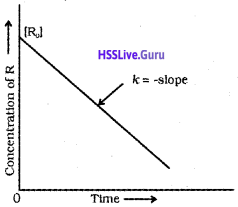
[R] = – kt + [R]0 ………….. (1)
or \(k=\frac{[R]_{0}-[R]}{t}\)

Plus Two Chemistry Notes Chapter 4 Chemical Kinetics

Equation (1) is of the form y = mx + c, equation for a straight line. If we plot [R] versus t, we get a straight line with slope = -k and intercept equal to [R]0

Note:
R0 initial concentration of reacting species (i.e., at time = 0)
R → concentration of reacting species (i.e., at time = t)
Plus Two Chemistry Notes Chapter 4 Chemical Kinetics 4

First Order Reaction
Fora reaction, R → P
Plus Two Chemistry Notes Chapter 4 Chemical Kinetics 5

If we plot a graph between log [R]<sub>0</sub>/[R] vs ‘t’ we get a straight line with slope = k/2.303
Plus Two Chemistry Notes Chapter 4 Chemical Kinetics 6
All natural and artificial radioactive decay take place by first order kinetics.

Half-Life of a Reaction (t½):
time required to reduce the concentration of a reactant to half of its initial concentration.
Forzero order reaction,
\(t_{1 / 2}=\frac{[R]_{0}}{2 k}\)
Derivation.
For a zero order reaction R → P, the rate constant is given by the equation,
Plus Two Chemistry Notes Chapter 4 Chemical Kinetics 7

Derivation:
For a first order reaction R → P, the rate constant is given by the equation,
Plus Two Chemistry Notes Chapter 4 Chemical Kinetics 8
For first order reactio t½ is independent of [R]0.

Pseudo First Order Reaction :
Reaction which appear to be of higher order but actually follow lower order kinetics.

Example:
Acid hydrolysis of ethylacetate.
Plus Two Chemistry Notes Chapter 4 Chemical Kinetics 9
Rate = k[CH3-COOC2H5]

Since the concentration of H2O is quite large and does not change appreciably, it does not appear in the rate law.
Another example: Inversion of cane sugar in presence of dilute acids.
Plus Two Chemistry Notes Chapter 4 Chemical Kinetics 10

Temperature Dependence of the Rate of a Reaction :
The rate of the reaction increases considerably with increase in temperature. For a chemical reaction with rise in temperature by 10°, the rate constant is nearly doubled.

Plus Two Chemistry Notes Chapter 4 Chemical Kinetics

Temperature Coefficient –
The ratio between the rate constant of a reaction at two temperatures differing by 10°.

Arrhenius Equation –
The temperature dependence of the rate of a chemical reaction can be explained by Arrhenius equation.
k = A e-Ea/RT
A → Arrhenius factor or frequency factor or pre-exponential factor
Ea → Activation energy in J mol-1
R → Gas constant
T → Temperature in kelvin

Activation energy (Ea)-
The energy required to form activated complex or intermediate. Some energy is released when the complex decomposes to form products.
Plus Two Chemistry Notes Chapter 4 Chemical Kinetics 11

Most probable kinetic energy –
kinetic energy of maximum fraction of molecules. The peak of the Boltzmann-Maxwell curve corresponds to this.
Plus Two Chemistry Notes Chapter 4 Chemical Kinetics 12

From the Arrhenius equation,
In k = In A \(\frac{E_{a}}{R T}\)
A polt of In k vs. \(\frac{1}{T}\)
Plus Two Chemistry Notes Chapter 4 Chemical Kinetics 13

If k1 and k2 are the rate constants at temperatures T1 and T2 respectively, Arrhenius equation can be written in the form,
Plus Two Chemistry Notes Chapter 4 Chemical Kinetics 15

Effect of Catalyst :
A catalyst is a substance which alters the rate of a reaction without itself undergoing any permanent chemical change. The function of a catalyst is to provide an alternate path of reaction with a lower energy of activation.
Plus Two Chemistry Notes Chapter 4 Chemical Kinetics 14

A small amount of the catalyst can catalyse a large amount of reactants. A catalyst does not alter Gibbs energy ∆ G of a reaction. It does not change the equilibrium constant but helps in attaining the equilibrium faster.

Plus Two Chemistry Notes Chapter 4 Chemical Kinetics

Collision Theory of Chemical Reactions :
It is based on kinetic theory of gases.
1. According to collision theory, the reactant molecules are assumed to be hard spheres and a chemical reaction takes place when reactant molecules collide with one another.

2. All collisions are not effective collisions. An effective collision is that collision which results into chemical reaction.

3. For effective collision, the molecule possess a certain minimum amount of energy called threshold energy and should have proper orientation.

Threshold energy – the minimum amount of energy which the colliding molecules must possess to make an effective collision.

4. Collision frequency (Z) – The number of collisions per second per unit volume of the reaction mixture.

5. To account for effective collisions, the probability or steric factor (P) is considered. It accounts for the fact that in a collision, molecules must be properly oriented.
Rate = PZABe-Ea/RT

Thus, in collision theory activation energy and proper orientation of the molecules together determine the criteria for effective collision and hence the rate of ’ reaction.

Plus Two History Notes Chapter 2 Kings, Farmers and Towns

Students can Download Chapter 2 Kings, Farmers And Towns Notes, Plus Two History Notes helps you to revise the complete Kerala State Syllabus and score more marks in your examinations.

Kerala Plus Two History Notes Chapter 2 Kings, Farmers and Towns

600 BC to 600 CE

1. The long period of 1500 years after the end of the Harappan Civilization was an important period in Indian history. During this period many important things happened in different parts of the Indian subcontinent. Rigveda was written.

Agricultural settlements came up in places like North India, Deccan Plateau and parts of Karnataka. There were new burial systems in Deccan and South India. Huge stone constructions were made. “Mahasiia’was one of them. Along with dead bodies many iron tools and weapons were also buried.

Plus Two History Notes Chapter 1 Bricks, Beads and Bones

2. The Dawn of Early Nations:
Big nations known as ‘Mahajanapadas’ came into existence during this period.

3. The Coming of Cities and Towns:
This was the period of the 2nd Urbanization in Indian history.

4. Increased use of Iron:
As the use of iron increased, forests were cleared. It led to the spread of agriculture. The iron weapons increased the importance of warriors.

5. Spread of Coin (Currency) system:
The use of metal coins helped the development of trade and commerce.

6. The political history of India from BCE 600 is also the history of fights between the Mahajanapadas for power and sovereignty. The final victory in these fights was Magadha’s. Magadha became the number one among 16 Mahajanapadas. Magadha included the present Patna and Gaya districts in Bihar.

7. With the advent of the Maurya Empire, the growth of Magadha reached its peak. The period of the Maurya Empire can be considered as a new era in Indian history. It was one of the most powerful and extensive empires in ancient India.

8. Asoka was the greatest among the Maurya Emperors. The main event during his reign was the Kalinga War and his conversion to Buddhism. It was after a bloody war in 261 BCE that he conquered Kalinga, which is known as Orissa today.

Plus Two History Notes Chapter 1 Bricks, Beads and Bones

9. The Mauryas organized an extensive administration. The Mauryan Empire was quite large with extensive areas. There were different regions like mountainous areas, deserts, boundary regions and extensive shores.

10. Following the collapse of the Mauryan Empire, some political instability took place in North India. The North Eastern Region of India was occupied by the Greeks, Sakas, Parthians and Kushanas.

The administration in the Ganges Plain was captured by the Sungans. Kalinga (Orissa) came under the power of Chedi dynasty. The rule of Western Deccan went to the Satavahanas.

11. After the fall of the Mauryan Empire, many small States came into existence. By the 4thh Century CE, some big nations also began to appear. The most important of them was the Gupta Empire. Many of these nations depended on the feudal lords, called Deputies, for administering their territories.

These feudal lords lived by controlling the land and collecting produce from the people. They gave the kings loyalty and also military support. Sometimes some powerful Lords conquered the weaker ones and themselves became kings.

Time Line – 1
The important political and economic events.

  • BC 600-500: Urbanization of the Ganges Plain, Mahajanapadas (Settlements), Sealed Coins.
  • BC 500-400: The Magadh rulers unify their administration.
  • BC 327-325: Alexander from Macedonia attacks.
  • BC 321: Chandragupta Maurya comes to power.
  • BC 273-232: The rule of Emperor Asoka.
  • BC 185: The end of Mauryan Dynasty.
  • BC 200-100: Indo-Greek rule in the North-Western Region; In South India Cholas, Cheras and Pandyas; in Deccan Satavahanas.
  • BC 100: Sakas from Central India come to power.
  • AD 78: Kanishka comes to power.
  • AD 100-200: The earliest inscriptions of Satavahanas and Sakas making land- gifts.
  • AD 320: The beginning of Gupta Dynasty
  • AD 335-375: The Reign of Samudragupta
  • AD 375-415: Chandragupta II; in the Deccan Vakatakas
  • AD 500-600: The rise of Chalukyas in Karnataka and Pallavas in Tamil Nadu.
  • AD 606-647: Reign ofHarshavajdhana in Kanuj; the Chinese Pilgrim Huantsang comes to India seeking Chinese Religious Books.
  • AD 712: Arabs conquer Sindh

Plus Two History Notes Chapter 1 Bricks, Beads and Bones

Time Line – 2
Developments in ancient epigraphy

  • AD 1784: Asiatic Society is established in Bengal.
  • AD 1810: Colin Mackenzie collected more than 8000 inscriptions in Sanskrit and Dravidian languages.
  • AD 1838: James Prinsep reads Asoka’s inscriptions in Brahmi language.
  • AD 1877: Alexander Cunningham published some of the inscriptions of Asoka.
  • AD 1886: The first Issue of the Journal called ‘Epigraphia Karnatica’, which discussed things about the South Indian inscriptions on lithic surfaces and copper plates, was published.
  • AD 1888: The First Issue of “Epigrapia Indika” was published.
  • AD 1965-66: D.C. Sircar published Indian Epigraphy and Indian Epigraphical Glossary.

Plus Two Accountancy Chapter Wise Questions and Answers Chapter 4 Reconstitution of a Partnership Firm – Retirement/Death of a Partner

Students can Download Chapter 4 Reconstitution of a Partnership Firm – Retirement/Death of a Partner Questions and Answers, Plus Two Accountancy Chapter Wise Questions and Answers helps you to revise the complete Kerala State Syllabus and score more marks in your examinations.

Kerala Plus Two Accountancy Chapter Wise Questions and Answers Chapter 4 Reconstitution of a Partnership Firm – Retirement/Death of a Partner

Plus Two Accountancy Reconstitution of a Partnership Firm – Retirement/Death of a Partner One Mark Questions and Answers

Question 1.
A partner who severs his connection with his firm is known as
(a) Retiring partner
(b) Outgoing partner
(c) Incoming partner
(d) None of these
Answer:
(b) Outgoing partner

Question 2.
On retirement of a partner
(a) The partnership is dissolved
(b) The firm is dissolved
(c) The business is dissolved
(d) None of these
Answer:
(a) The partnership is dissolved

Plus Two Accountancy Chapter Wise Questions and Answers Chapter 4 Reconstitution of a Partnership Firm – Retirement/Death of a Partner

Question 3.
The retiring partner is not liable for
(a) The losses of the firm
(b) The losses of the firm till the date of retirement
(c) The losses at the time of his retirement
(d) The losses after his retirement
Answer:
(d) The losses after his retirement

Question 4.
If the firm is not in a position to pay the amount due to the retiring partner, the amount is transferred to
(a) The retiring partner’s capital account
(b) The retiring partner’s loan account
(c) All the partner’s capital account
(d) None of these
Answer:
(b) The retiring partner’s loan account

Question 5.
The amount due to the deceased partner is transferred to
(a) His capital account
(b) His loan account
(c) His executor’s capital account
(d) His executor’s loan account
Answer:
(d) His executor’s loan account

Plus Two Accountancy Chapter Wise Questions and Answers Chapter 4 Reconstitution of a Partnership Firm – Retirement/Death of a Partner

Question 6.
When premium paid on Joint Life Policy is treated as an investment not as a business expense, it is transferred to
(a) Trading account
(b) Profit and Loss Account
(c) Joint Life Policy Account
(d) Joint Life Policy account and Balance Sheet
Answer:
(d) Joint Life Policy account and Balance Sheet

Question 7.
When partner retiring from the firm, the ratio relevant is_______.
(a) Sacrificing ratio
(b) Gaining ratio
(c) New ratio Gaining ratio
Answer:
(b) Gaining ratio

Question 8.
Write the narration of the given journal entry
Continuing Partners Capital A/c Dr.
To Retiring Partners capital A/c
(______________________)
Answer:
Give share of goodwil to retiring partners.

Question 9.
P/L Suspense A/c Dr.
To Deceased partners capital A/c What is the entry stands for?
Answer:
Credit of deceased partners share of profit in the in terim period.

Plus Two Accountancy Reconstitution of a Partnership Firm – Retirement/Death of a Partner Two Mark Questions and Answers

Question 1.
What do you mean by retirement of a partner?
Answer:
Withdrawal of a partner from a partnership firm either by giving a notice of retirement or with the consent of the other partners or as per the provisions of the partnership agreement is called retirement.

Question 2.
What do you mean by Gaining Ratio? How it is calculated?
Answer:
At the time of retirement of a partner, the ratio in which the continuing partners share the profit of out going partner’s profit is called gaining ratio.
Gaining ratio = New ratio – Old ratio.

Plus Two Accountancy Chapter Wise Questions and Answers Chapter 4 Reconstitution of a Partnership Firm – Retirement/Death of a Partner

Question 3.
How a retiring partner’s share of goodwill is compensated?
Answer:
A retiring partner has the right to get his share of goodwill, because the goodwill of the firm has been earned with his efforts too. So he should be compensated by the other partners in their gaining ratio.

Question 4.
What is the treatment of accumulated profits or losses on the retirement of a partner?
Answer:
The general reserve and accumulated profits or losses are transferred to all partners’ capital accounts in their profit sharing ratio. The general reserve and accumulated profits are transferred to the credit side of the account and the accumulated losses to the debit side.

Question 5.
What are the differences between retirement and death, from the accounting point of view?
Answer:

  1. Retirement is a known thing, so usually takes place at the end of an accounting period, but death may take place at any time.
  2. On retirement, a partner severs his connection with the firm Voluntarily. But in death, it is automatic.
  3. On retirement, the amount due to the retiring partner is transferred to his Loan Account, while in death; the total amount due to the deceased partner is transferred to his Executor’s Loan Account.

Question 6.
X, Y, and Z were sharing profits in the ratio of 3:2:1. Z retires from the firm. X and Y decide to share future profits in the ratio of 7:5. Calculate the gaining ratio.
Answer:
Plus Two Accountancy Chapter Wise Questions and Answers Chapter 4 Reconstitution of a Partnership Firm – Retirement Death of a Partner - 1

Plus Two Accountancy Chapter Wise Questions and Answers Chapter 4 Reconstitution of a Partnership Firm – Retirement/Death of a Partner

Question 7.
A, B and C are partners sharing profits in the ratio of 5 : 3: 2. C retires and the goodwill is valued at Rs. 40,000. Give entries in the books of the firm regarding treatment of goodwill.
Answer:
C’s share of goodwill = 40,000 × \(\frac{2}{10}\) = Rs. 8,000
Plus Two Accountancy Chapter Wise Questions and Answers Chapter 4 Reconstitution of a Partnership Firm – Retirement Death of a Partner - 2

Question 8.
X, Y, Z are partners sharing profits in the ratio of 5:3:2. X retires and for this purpose goodwill is valued at Rs. 25,000. Continuing partners agree that their new profit sharing ratio shall be equal. Record necessary journal entry.
Answer:
Journal
Plus Two Accountancy Chapter Wise Questions and Answers Chapter 4 Reconstitution of a Partnership Firm – Retirement Death of a Partner - 3
NOTES:
1. Gain of partner = New share – Old share
Y = 1/2 – 3/10 = 5 – 3/10 = 2/10
Z = 1/2 – 2/10 = 5 – 2/10 = 3/10
Gaining ratio is 2 : 3

2. X’s share of goodwill = 25,000 × 5/10 = 12,500

Plus Two Accountancy Reconstitution of a Partnership Firm – Retirement/Death of a Partner Three Mark Questions and Answers

Question 1.
What are the problems that arise with regard to the accounting treatment on the retirement of a partner?
Answer:

  1. Change in the Profit sharing ratio.
  2. Adjustment of goodwill.
  3. Treatment of accumulated profits and losses.
  4. Revaluation of the assets and liabilities.
  5. Calculation of the profit and loss up to the date of retirement.
  6. Ascertainment of the total amount due to the retiring partner.
  7. Payment of the amount due to the retiring partner.
  8. Adjustment of the capitals of the continuing partners.

Plus Two Accountancy Chapter Wise Questions and Answers Chapter 4 Reconstitution of a Partnership Firm – Retirement/Death of a Partner

Question 2.
A, B and C were partners sharing profits in the ratio of 3: 5: 7. C retires and his share is taken up by A and B in the ratio of 3: 2. Find out the new profit sharing and gaining ratio of A and B.
Answer:
New share = Old share + Gain
Plus Two Accountancy Chapter Wise Questions and Answers Chapter 4 Reconstitution of a Partnership Firm – Retirement Death of a Partner - 4
A’s gain is 3/5 of 7/15 = 21/75
B’s gain is 2/5 of 7/15 = 14/75
Plus Two Accountancy Chapter Wise Questions and Answers Chapter 4 Reconstitution of a Partnership Firm – Retirement Death of a Partner - 5

Gaining ratio is the proportion in which they have acquired C’s share of profit, i.e., 3 : 2. This can be checked by working out in the following way.
Gaining ratio = New share – old share
Plus Two Accountancy Chapter Wise Questions and Answers Chapter 4 Reconstitution of a Partnership Firm – Retirement Death of a Partner - 6

Question 3.
Observe the following journal entry which has been passed at the time of retirement of Ganga Prasad. The other partners were Sheena and Rajani.

  1. Which account would you prepare to share the profit on revaluation?
  2. Prepare that account and give a journal entry to share the profit?

Plus Two Accountancy Chapter Wise Questions and Answers Chapter 4 Reconstitution of a Partnership Firm – Retirement Death of a Partner - 33
Answer:
1. Revaluation a/c
Plus Two Accountancy Chapter Wise Questions and Answers Chapter 4 Reconstitution of a Partnership Firm – Retirement Death of a Partner - 34
Journal Entry
Plus Two Accountancy Chapter Wise Questions and Answers Chapter 4 Reconstitution of a Partnership Firm – Retirement Death of a Partner - 35

Plus Two Accountancy Chapter Wise Questions and Answers Chapter 4 Reconstitution of a Partnership Firm – Retirement/Death of a Partner

Question 4.
X, Y, and Z are partners in a firm and they close their books on December 31 every year. They are sharing profits and losses in the ration of 3: 2: 1. The partnership deed provides that if a partner retires from the firm during the course of an accounting year, his share of profit from the date of last balance sheet to the date of retirement should be calculated on the basis of the average profits of the last three completed years.
On 1st April 2004 Y retired from the firm. The profits of the firm during the years 2001, 2002 and 2003 were Rs. 12,500, Rs. 8,500 and Rs. 6,000 respectively. Write the journal entry to record the share of profit of the retiring partner for the year 2004.
Answer:
Plus Two Accountancy Chapter Wise Questions and Answers Chapter 4 Reconstitution of a Partnership Firm – Retirement Death of a Partner - 7
(Being Y’s share of profit for 2004 brought into A/c)
Notes: Profits for the last 3 years
= 12,500 + 8.500 + 6,000 = Rs. 27,000
Average profit = 27,000/3 = Rs. 9,000
Profit from the date of last balance sheet to the date . of retirement.
= 9,000 × 3/12 = Rs. 2,250
Y’s share thereof = 2,250 × 2/ 6 = Rs. 750.

Question 5.
Mr. Raj died on 25.08.2006 who was an active partner in a firm. The other partners were Mr. Das and Mrs.Das. The books of accounts reveal the following:

General Reserve Rs. 12,000
Capital-Raj Rs. 30,000
Profit and Loss A/c (Dr) Rs. 18,000
Drawings of Raj Rs. 10,000
Mr.Raj’s loan to the firm Rs. 20,000

Interest on loan payable to Raj upto the date of death Rs. 1,000
Value of goodwill estimated at Rs. 24,000
Calculate the amount due to the legal heirs of Mr.Raj.
Answer:
Raj’s Capital A/c
Plus Two Accountancy Chapter Wise Questions and Answers Chapter 4 Reconstitution of a Partnership Firm – Retirement Death of a Partner - 8
R’s loan to the firm: 20000
R’s interest on loan: 1000
Total amount due to R’s legal heirs = His capital a/c
balance and R’s loan to the firm and interest on loan = 26000 + 20000 + 1000 = 47000.

Plus Two Accountancy Chapter Wise Questions and Answers Chapter 4 Reconstitution of a Partnership Firm – Retirement/Death of a Partner

Question 6.
X, Y, and Z are partners in a firm. Y retires from the firm on 1st January, 2002. On his date of retirement, Rs. 60,000 is due to him. X and Z promise to pay in three equal annual instalments together with interest at 12% per annum. Prepare Y’s loan account for the three years.
Answer:
Dr. Y’s Loan Account Cr.
Plus Two Accountancy Chapter Wise Questions and Answers Chapter 4 Reconstitution of a Partnership Firm – Retirement Death of a Partner - 9
Amount of instalment each year = 60,000/3 = 20,000
Amount paid each year = Rs. 20,000 + Interest.

Question 7.
X,Y, and Z were partner sharing profit in proportion to 5:3:2. Good will does not appear in the books, but it is agreed to be worth Rs. 1,00,000. X retires from the firm and Y and Z decide to share future profits equally. You are required to make adjustment entry for good will without opening good will account at all. Show your working clearly.
Answer:
X’s share of goodwill adjusted through capital accounts in the gaining ratio.
Old ratio = 5:3:2
New ratio =1:1
Gaining ratio = New ratio – Old ratio
Gain of Y = 1/2 – 3/10 = 2/10
Gain of Z= 1/2 – 2/10 = 3/10
Gaining ratio of Y and Z = 2 : 3
Value of goodwill of the firm = 1,00,000
X’s share of goowill = 1,00,000 × 5/10 = 50,000
Journal Entry:
Plus Two Accountancy Chapter Wise Questions and Answers Chapter 4 Reconstitution of a Partnership Firm – Retirement Death of a Partner - 10
[X’s share of goodwill adjusted through the capital accounts of remaining partners in the gaining ratio of 2:3].

Plus Two Accountancy Chapter Wise Questions and Answers Chapter 4 Reconstitution of a Partnership Firm – Retirement/Death of a Partner

Question 8.
Aby, Suby and Minu are partners sharing profits in the ratio of 5:3:2. Minu retired on 31.09.06. The capital account balance and share of reserve due to Minu together amounted to Rs. 1,80,000. But Aby and Suby agreed to pay him Rs. 2,40,000. The new profit sharing ratio of Aby and Suby have been fixed at 3:2.

  1. Why has Minu been paid over and above the actual amount due to him?
  2. Give a journal entry to record this through capital a/c adjustments.

Answer:
A:S:M = 5:3:2
New ratio of A & S = 3:2
∴ Gaining ratio = New ratio – Old ratio
Plus Two Accountancy Chapter Wise Questions and Answers Chapter 4 Reconstitution of a Partnership Firm – Retirement Death of a Partner - 11
Gaining ratio = 1:1
Amount payable to Minu = 2,40,000
Capital + Reserve of Minu = 1,80,000
∴ Share of Goodwill due to Minu
= 240000 – 180000 = 60000
Plus Two Accountancy Chapter Wise Questions and Answers Chapter 4 Reconstitution of a Partnership Firm – Retirement Death of a Partner - 12

Plus Two Accountancy Chapter Wise Questions and Answers Chapter 4 Reconstitution of a Partnership Firm – Retirement/Death of a Partner

Question 9.
Debee, Sedee and Nedee are in partnership, who were sharing profits in the ratio of 3:2:1. On 31.03.05, Nedee left the firm as per agreement. The following details are available.
Balance Sheet:
Plus Two Accountancy Chapter Wise Questions and Answers Chapter 4 Reconstitution of a Partnership Firm – Retirement Death of a Partner - 13

  1. Depreciate fixed assets @10%.
  2. Only General Reserve is to be credited to the extent of Nedee’s share through capital adjustment of the partners.
  3. Receivables are sold to a debt collection agency at Rs. 5,400/-

Nedee’s accounts are to be settled soon either by paying off or bringing in necessary cash as the case may be. Prepare the necessary a/c to show the amount due to Nedee.
Answer:
Capital A/cs
Plus Two Accountancy Chapter Wise Questions and Answers Chapter 4 Reconstitution of a Partnership Firm – Retirement Death of a Partner - 14
Amount to be brought in by Nedee is Rs. 5,800.

Plus Two Accountancy Reconstitution of a Partnership Firm – Retirement/Death of a Partner Five Mark Questions and Answers

Question 1.
How will you calculate the amount payable to a retiring partner?
Answer:
If retirement takes place on the closing date of the accounting year ascertainment of profit or loss is easy. But if the retirement occurs during an accounting year, the profit or loss from the date of last Balance Sheet to the date of retirement is also to be determined. Partnership deed provides the method of calculating the profit or loss of that period. It is calculated by any of the following methods.

  1. On the basis of the last year’s profit.
  2. On the basis of the average profit of a certain » number of past years.
  3. By providing interest on the capital .of the retiring partner at. a certain rate.
  4. By finding out the correct profit till the retirement date.
  5. On any other basis as provided in the partnership agreement.

The profit or loss calculated above is only an estimate. So the journal entry for the same is; In case of profit.
Profit and Loss Suspense A/c Dr. To Retiring Partner’s Capital A/c:
P&L suspense A/c is shown on the asset side of the Balance Sheet prepared immediately after retirement. At the end of the accounting year; it is closed by transferring to Profit and Loss Account. Reverse is done in case of loss.

For calculating, the total amount payable to the retiring partner, his capital account is prepared.
It is started with the balance in the same on the last.
Balance Sheet and credited with:

  • His share of goodwill.
  • His share of revaluation profit.
  • His share of accumulated profits and reserve.
  • His share of profits upto the retirement date since the last Balance Sheet.
  • Interest, salary or commission if any due to him.

The capital account is debited with:

  • His share of accumulated losses.
  • His share of revaluation loss.
  • His drawings if any during the period.
  • Interest on such drawings.
  • His share of loss upto the retirement date since the last Balance Sheet.

If the account shows a credit balance, it is the total amount payable to him. On the other hand, if the account has a debit balance, it represents the amount payable by him to the firm.

Plus Two Accountancy Chapter Wise Questions and Answers Chapter 4 Reconstitution of a Partnership Firm – Retirement/Death of a Partner

Question 2.
X, Y, Z are partners in a firm sharing profits and losses equally. X retired from the firm on which date the balance sheet stood as follows:
Balance Sheet as on____
Plus Two Accountancy Chapter Wise Questions and Answers Chapter 4 Reconstitution of a Partnership Firm – Retirement Death of a Partner - 15
On the date of retirement it was found that

  1. Patents have on value.
  2. Furniture is to be depreciated by 15%.
  3. Machinery is to be brought down to Rs. 10,000.

Pass the necessary journal entries to give effect to the revaluation of assets and liabilities at the time of retirement.
Answer:
Journal:
Plus Two Accountancy Chapter Wise Questions and Answers Chapter 4 Reconstitution of a Partnership Firm – Retirement Death of a Partner - 16

Plus Two Accountancy Chapter Wise Questions and Answers Chapter 4 Reconstitution of a Partnership Firm – Retirement/Death of a Partner

Question 3.
A, B and C were Partner’s sharing Profits and losses in the ratio of 3:2:1. Their capitals were as under as per the balance sheet as on 31-Dec-2010.
A-Rs. 30,000; B-Rs. 20,000; C-Rs. 15,000. On 31 March 2011, C died, and you are asked to prepare deceased partners Capital account after considering the following facts.

  1. Capital carried interest at 12% p.a.
  2. C’ drawings from 1st Jan 2011 to the date of his death amounted to Rs. 4,500.
  3. C’s share of Profits for the portion of current financial year for which he lived was to betaken at the sum calculated on the average Profit of the last three completed years and good will was to be raised on the basis of two years Purchase of the average Profit of those three years.

The annual Profits were Rs. 19,000, Rs. 16,000 and Rs. 19,000 respectively. Show C’s Capital account, Answer:
C’s Capital A/c
Plus Two Accountancy Chapter Wise Questions and Answers Chapter 4 Reconstitution of a Partnership Firm – Retirement Death of a Partner - 17
Working Note:
1. Share of profit to the date of death.
Average profit for past 3 years
Plus Two Accountancy Chapter Wise Questions and Answers Chapter 4 Reconstitution of a Partnership Firm – Retirement Death of a Partner - 18
Therefore, C’s share (1/6) for 3 months = 18.000 × 1/6 × 3/12 = 750.

2. Goodwill calculation
Average Profit = 18,000
Goodwill = Average profit × 2’years purchase = 18,000 × 2 = 36,000
C’s share of goodwill = 36,000 × 1/6 = 6,000
C’s share of goodwill adjusted through the capital account of remaining partners in the gaining ratio of 3:2.

Plus Two Accountancy Chapter Wise Questions and Answers Chapter 4 Reconstitution of a Partnership Firm – Retirement/Death of a Partner

Question 4.
X, Y, and Z were partners in a firm with capitals of Rs. 15,000, Rs. 9,500, Rs. 10,000 respectively and sharing profits in proportions of 1/2, 1/4 and 1/4. On 31st December 2005, Y retires and for the purpose of his retirement, the goodwill of the firm has been valued at Rs. 12,000. Pass the necessary entries assuming that ’Y’ has been paid and show the Capital Accounts of all partners.
Answer:
Capital A/c
Plus Two Accountancy Chapter Wise Questions and Answers Chapter 4 Reconstitution of a Partnership Firm – Retirement Death of a Partner - 19
Working Note:
Old ratio = 1/2 : 1/4 : 1/4
1 × 2/2 × 2 = 2/4
Plus Two Accountancy Chapter Wise Questions and Answers Chapter 4 Reconstitution of a Partnership Firm – Retirement Death of a Partner - 20
Goodwill of the form = 12,000
Y’s share of goodwill = 12,000 × 1/4 = 3,000
Gaining ratio = New ratio – Old ratio
X’s Gain = 2/3 – 2/4 = 8 – 6/12 = 2/12
Z’s Gain = 1/3 – 1/4 = 4 – 3 /12 = 1/12
Gaining ratio = 2 :1
Journal:
Plus Two Accountancy Chapter Wise Questions and Answers Chapter 4 Reconstitution of a Partnership Firm – Retirement Death of a Partner - 21

Plus Two Accountancy Chapter Wise Questions and Answers Chapter 4 Reconstitution of a Partnership Firm – Retirement/Death of a Partner

Question 5.
X, Y, and Z carried on business in partnership, shar¬ing profits in the ratio 3:2:1. The balance sheet on 31st December, 2003 showed their capitals to be Rs. 8,400; Rs. 6,800 and Rs. 7,400.
On 31st March, 2004 X died. Write journal entries and prepare an account for presentation to his legal representatives having regard to the following facts:

  1. Capital earned interest at 5 percent per annum.
  2. X’s drawings from 1st January, 2004 to the date of his death amounted to Rs. 800; interest on drawings for the period Rs. 45.
  3. X’s share of profit for the portion of current financial year for which he lived was to be taken a sum calculated on the average of the last three completed years.
  4. Goodwill was to be raised on the basis of two year’s purchase of average profits of those three years.

The annual profits for the three years were Rs. 4,800; Rs. 3,500 and Rs. 4,300 respectively.
Answer:
Journal:
Plus Two Accountancy Chapter Wise Questions and Answers Chapter 4 Reconstitution of a Partnership Firm – Retirement Death of a Partner - 22
Plus Two Accountancy Chapter Wise Questions and Answers Chapter 4 Reconstitution of a Partnership Firm – Retirement Death of a Partner - 23
Plus Two Accountancy Chapter Wise Questions and Answers Chapter 4 Reconstitution of a Partnership Firm – Retirement Death of a Partner - 24
Notes
1. Share of profit to date of death:
Average profit for past 3 years
\(\frac{4,800+3,500+4,300}{3}\)
= Rs. 4,200
∴ X’s share (3/6) for 3 months 3
= 4,200 × 3/6 × \(\frac{3}{12}\) = RS. 525 12.

2. Calculation of goodwill:
Average profit for past 3 years = Rs. 4,200
2 years purchase = Rs. 4,200× 2 = Rs. 8,400
X’s share (3/6) of goodwill = Rs. 8,400 × 3/ 6 = Rs. 4,200.

Plus Two Accountancy Chapter Wise Questions and Answers Chapter 4 Reconstitution of a Partnership Firm – Retirement/Death of a Partner

Question 6.
Heisal, Roy and A Gomez are in partnership sharing profits in their capital ratio. The Balance Sheet on 15th March, 2006 is given below.
Balance sheet
Plus Two Accountancy Chapter Wise Questions and Answers Chapter 4 Reconstitution of a Partnership Firm – Retirement Death of a Partner - 25
Further information on retirement of Roy on 15-6-06.

Profit for 3 months Rs. 9000
Drawings: Heisal R.s 1000
Roy Rs. 2000
A.Gomez Rs. 3000

Interest on capital @ 5% p.a.
Salary to Roy Rs. 300 p.m.
The firm had a fixed deposit worth Rs. 3000 which has not accounted so far, has to be brought into the books. Marketable scrips were valued at Rs. 23,000. Prepare:

  1. Profit and Loss appropriation a/c
  2. Capital A/c’s
  3. Balance sheet

Answer:
P/L Appropriation A/c
Plus Two Accountancy Chapter Wise Questions and Answers Chapter 4 Reconstitution of a Partnership Firm – Retirement Death of a Partner - 26
Plus Two Accountancy Chapter Wise Questions and Answers Chapter 4 Reconstitution of a Partnership Firm – Retirement Death of a Partner - 27
Revaluation A/c
Plus Two Accountancy Chapter Wise Questions and Answers Chapter 4 Reconstitution of a Partnership Firm – Retirement Death of a Partner - 28
Capital A/c
Plus Two Accountancy Chapter Wise Questions and Answers Chapter 4 Reconstitution of a Partnership Firm – Retirement Death of a Partner - 29

Plus Two Accountancy Chapter Wise Questions and Answers Chapter 4 Reconstitution of a Partnership Firm – Retirement/Death of a Partner
Balance Sheet
Plus Two Accountancy Chapter Wise Questions and Answers Chapter 4 Reconstitution of a Partnership Firm – Retirement Death of a Partner - 30

Plus Two Accountancy Reconstitution of a Partnership Firm – Retirement/Death of a Partner Eight Mark Questions and Answers

Question 1.
The Balance Sheet of X, Y. Z on 31st March 2003 is given below.
Balance sheet
Plus Two Accountancy Chapter Wise Questions and Answers Chapter 4 Reconstitution of a Partnership Firm – Retirement Death of a Partner - 31
They were sharing profits and losses in the ratio of 2:2:1. Y decided to retire from the firm. It was agreed that:

  1. X and Z would share the profit in the ratio of 5:3
  2. Goodwill was valued at Rs. 1,05,000
  3. Machinery to be taken at Rs. 75,000
  4. Buildings should be valued at Rs. 1,50,000
  5. The value of stock should be Rs. 30,000
  6. An amount of Rs. 1,500 should be written off as bad debt.

Pass the necessary journal entries and prepare the balance sheet of the new firm.
Answer:
Note: Calculation of gaining ratio
X = 5/8 – 2/5 – 25 – 16/40 = 9/40
Z = 3/8 – 1/5 = 15 – 8/40 = 7/40
Therefore, gaining ratio = 9:7

Plus Two Accountancy Chapter Wise Questions and Answers Chapter 4 Reconstitution of a Partnership Firm – Retirement/Death of a Partner
Journal
Plus Two Accountancy Chapter Wise Questions and Answers Chapter 4 Reconstitution of a Partnership Firm – Retirement Death of a Partner - 32
Plus Two Accountancy Chapter Wise Questions and Answers Chapter 4 Reconstitution of a Partnership Firm – Retirement Death of a Partner - 36
Plus Two Accountancy Chapter Wise Questions and Answers Chapter 4 Reconstitution of a Partnership Firm – Retirement Death of a Partner - 37
Balance Sheet of X and Z as on 1st April 2003
Plus Two Accountancy Chapter Wise Questions and Answers Chapter 4 Reconstitution of a Partnership Firm – Retirement Death of a Partner - 38

Question 2.
Abey, Neha, and Anil are partners, who share profits and losses in 5:3:2 ratio. The following information is extracted from the books of accounts on 31.03.06.
Plus Two Accountancy Chapter Wise Questions and Answers Chapter 4 Reconstitution of a Partnership Firm – Retirement Death of a Partner - 39
On the above date Anil decided to retire from the firm as agreed upon. Fixed assets to be revalued at Rs. 86,000. Average profit calculated based on the past 5 year was Rs 15,000. Ascertain the amount due to the retiring partner.
Answer:
Profit and Loss Appropriation A/c
Plus Two Accountancy Chapter Wise Questions and Answers Chapter 4 Reconstitution of a Partnership Firm – Retirement Death of a Partner - 40

Plus Two Accountancy Chapter Wise Questions and Answers Chapter 4 Reconstitution of a Partnership Firm – Retirement/Death of a Partner
Anil’s Capital A/c
Plus Two Accountancy Chapter Wise Questions and Answers Chapter 4 Reconstitution of a Partnership Firm – Retirement Death of a Partner - 41
Working Note
Here, Goodwill is caculated on the basis of capitalization of Average profit method.
∴ Goodwill = Total value of business – Net tangible Asset.
Total value =
Plus Two Accountancy Chapter Wise Questions and Answers Chapter 4 Reconstitution of a Partnership Firm – Retirement Death of a Partner - 42
= 15,000 × \(\frac{100}{10}\) = 1,50,000
Net tangible asset = Fixed Asset + Current Asset
= 86,000 + 24,000 = 1,10,000
Goodwill = 1,50,000 – 1,10,000 = 40,000
Anil’s share of goodwill = 40,000 × 2/10 = 8,000
Anil’s share of goodwill adjusted through capital accounts in the gaining ratio.
Old ratio = 5:3:2
New ratio = 5:3
Gaining ration = 5 : 3
Abey’s share = 8,000 × 5/8 = 5,000
Neha’s share = 8,000 × 3/8 = 3,000
Journal entry:
Plus Two Accountancy Chapter Wise Questions and Answers Chapter 4 Reconstitution of a Partnership Firm – Retirement Death of a Partner - 43

Plus Two Accountancy Chapter Wise Questions and Answers Chapter 4 Reconstitution of a Partnership Firm – Retirement/Death of a Partner

Question 3.
P, Q and R partiners sharing profits and losses in the ratio 3:2:1. The Balance sheet as on 31st December 2003 is given below:
Plus Two Accountancy Chapter Wise Questions and Answers Chapter 4 Reconstitution of a Partnership Firm – Retirement Death of a Partner - 44
On 31st March 2004, Q decided to retire from the business due to ill-health subject to the following conditions.

  1. That the goodwill should be valued at two year’s. purchase of the average profits of the preceding three years. The profits for the three preceding years were, 2001 – Rs. 9,000, 2000 – Rs. 15,000 and 2003-Rs. 12,000.
  2. The profits for the three months ending 31 st March, 2004 be estimated on the basis of the profits for the year 2003.
  3. That the motor car is to be given to Q, at a value of Rs. 16,000 and the balance due to him is to be paid immediately in cash by bringing the required amount by P and R in their profit sharing ratio which is 3: 1.

Answer:
Revaluation a/c
Plus Two Accountancy Chapter Wise Questions and Answers Chapter 4 Reconstitution of a Partnership Firm – Retirement Death of a Partner - 45
Plus Two Accountancy Chapter Wise Questions and Answers Chapter 4 Reconstitution of a Partnership Firm – Retirement Death of a Partner - 46
Plus Two Accountancy Chapter Wise Questions and Answers Chapter 4 Reconstitution of a Partnership Firm – Retirement Death of a Partner - 47
Plus Two Accountancy Chapter Wise Questions and Answers Chapter 4 Reconstitution of a Partnership Firm – Retirement Death of a Partner - 48
Plus Two Accountancy Chapter Wise Questions and Answers Chapter 4 Reconstitution of a Partnership Firm – Retirement Death of a Partner - 49

Plus Two Accountancy Chapter Wise Questions and Answers Chapter 4 Reconstitution of a Partnership Firm – Retirement/Death of a Partner
Calculation of Goodwill
Average profit of 3 years
\(=\frac{9,000+15,000+12,000}{3}\) = 12,000
Total goodwill = 12,000 × 2 = Rs. 24,000
Q’s share = 24,000 × 2/6 = Rs. 8,000
Q’s share of profit = 12,000 × 3/12 × 1/3 = 1,000
Balance Sheet as on 31st March 2004
Plus Two Accountancy Chapter Wise Questions and Answers Chapter 4 Reconstitution of a Partnership Firm – Retirement Death of a Partner - 50

Question 4.
The balance sheet of X, Y, and Z on 31st December, 2003, the date of X’s retirement was as follows:
Balance Sheet
Plus Two Accountancy Chapter Wise Questions and Answers Chapter 4 Reconstitution of a Partnership Firm – Retirement Death of a Partner - 51
The following terms have been agreed upon:

  • Goodwill was valued at Rs. 18,000.
  • The value of land and buildings should be appreciated by Rs. 10,000
  • Plant and Machinery should be reduced to Rs. 23,000.
  • Create provision @ 5% on debtors for bad and doubtful debts and Rs. 700 on creditors.
  • The entire sum payable to X is to be brought by Y and Z in such a manner that their capital accounts are in proportion to their profit sharing ratio which is to be equal.

Prepare:

  • Revaluation account.
  • Partner’s capital accounts
  • Bank account, and
  • Balance sheet after X’s retirement.

Answer:
Plus Two Accountancy Chapter Wise Questions and Answers Chapter 4 Reconstitution of a Partnership Firm – Retirement Death of a Partner - 52
Plus Two Accountancy Chapter Wise Questions and Answers Chapter 4 Reconstitution of a Partnership Firm – Retirement Death of a Partner - 53
Plus Two Accountancy Chapter Wise Questions and Answers Chapter 4 Reconstitution of a Partnership Firm – Retirement Death of a Partner - 54
Balance Sheet of Y and Z as on 1st January 2004
Plus Two Accountancy Chapter Wise Questions and Answers Chapter 4 Reconstitution of a Partnership Firm – Retirement Death of a Partner - 55

Plus Two Accountancy Chapter Wise Questions and Answers Chapter 4 Reconstitution of a Partnership Firm – Retirement/Death of a Partner
Notes:
Calculation of goodwill
Total goodwill ‘ = 18,000
X’s share 1/3 = 18,000 × 1/3 = Rs. 6,000
Working Notes:
(i) Gaining Ratio:
X: 3/4 – 3/6 = 9 – 6/12 = 3/12
Z: 1/4 – 1/6 = 3 – 2/12 = 1/12
Y’s share of goodwill of Rs. 12,000 (Rs. 36,000 × 2/6) will be contributed by X Rs. 9,000 and Z Rs. 3,000

(ii) Since the new profit sharing ratio between X and Z being 3:1, they will have to maintain their capitals at Rs. 90,000 and Rs. 30,000 respectively.

Question 5.
Anil, Bhanu, and Chandu were partners in a firm sharing profits in the ratio of 5:3:2. On March 31, 2007, their Balance Sheet was as under:
Books of Anil, Bhanu, and Chandu Balance Sheet as on March 31, 2007
Plus Two Accountancy Chapter Wise Questions and Answers Chapter 4 Reconstitution of a Partnership Firm – Retirement Death of a Partner - 56
Anil died on October 1, 2007. It was agreed between his executors and the remaining partners that:

  1. Goodwill to be valued at 21/2 year’s purchase of the average profits of the previous four years which were:
    Year2003-04-Rs. 13,000, Year 2004-05-Rs. 12,000
    Year 2005-06-RS.20,000, Year 2006-07 – Rs. 15,000
  2. Patents be valued at Rs. 8,000. Machinery at Rs. 28,000 and Building at Rs. 25,000
  3. Profit for the year 2007-08 be taken as having accrued at the same rate as that of the previous year.
  4. Interest on capital be provided at 10% p.a.
  5. Half of the amount due to Anil be paid immediately.

Prepare Revaluation Account, Anil’s Capital Account and Anil’s Executor’s Account as on October 1, 2007.
Answer:
Revaluation Account
Plus Two Accountancy Chapter Wise Questions and Answers Chapter 4 Reconstitution of a Partnership Firm – Retirement Death of a Partner - 57
Anil’s Capital Account
Plus Two Accountancy Chapter Wise Questions and Answers Chapter 4 Reconstitution of a Partnership Firm – Retirement Death of a Partner - 58
Anil’s Executor’s Account
Plus Two Accountancy Chapter Wise Questions and Answers Chapter 4 Reconstitution of a Partnership Firm – Retirement Death of a Partner - 59
Working Note:
1. Goodwill = 21/2 years purchase × Average Profit
Average Profit
Plus Two Accountancy Chapter Wise Questions and Answers Chapter 4 Reconstitution of a Partnership Firm – Retirement Death of a Partner - 60

Plus Two Accountancy Chapter Wise Questions and Answers Chapter 4 Reconstitution of a Partnership Firm – Retirement/Death of a Partner
Anil’s share of Goodwill = \(\frac{5}{10}\) × Rs.37,500 = 18750

2. Profit from the date of last balance sheet to date of death (April 1,2007 to October 1,2007) = 6 months
Profit for 6 months = Rs.15,000 × \(\frac{6}{12}\) = Rs.7,500
Anil’s share of profit = Rs.7,500 × \(\frac{5}{10}\) = Rs.3,750.

3. Interest on Capital
(April 1, 2007 to October 1, 2007)
= Rs. 30000 × \(\frac{10}{100}\) × \(\frac{6}{12}\) = Rs. 1,500.

Plus Two History Notes Chapter 1 Bricks, Beads and Bones

Students can Download Chapter 1 Bricks, Beads and Bones Notes, Plus Two History Notes helps you to revise the complete Kerala State Syllabus and score more marks in your examinations.

Kerala Plus Two History Notes Chapter 1 Bricks, Beads and Bones

1. 4500 years ago, in the North-West region of the Indian Sub-Continent there existed a great culture. In 1921, at Harappan site, this culture was first discovered. It was known as the “Sindhu River Basin Culture”.

2. Before the coming of the Harappan Culture, there had been many other cultures. They are collectively known as Early Harappan Culture. This was the formulation of the Harappan Culture. Harappan Culture begins from here.

3. The most important feature of the Harappan Culture is the development of Urban Centres. It was during the time of the Harappan Culture that the First Urbanization began. Harappa, Mohenjo-Daro, Chanhudaro, Kalibangan, Lothal, Banwali, and Dholavira were some of the important cities of those times.

Plus Two History Notes Chapter 1 Bricks, Beads and Bones

4. The most important site in Harappan Civilization is Mohenjo-Daro. This was discovered After Harappa. It was from Mohenjo-Daro most information regarding urban planning, houses, seals etc. of the Harappan Civilization were obtained. This big city was situated in the Larkana district of Sindh, on the banks of the Sindhu River. The word Mohenjo-Daro means The Mound of the Dead’. The excavations made here revealed the remains of a planned urban centre.

This city was divided into two parts:

  • The Citadel, and
  • The Lower Town.

5. A significant feature of the Harappan Civilization is the drainage system found in the cities.

6. The Harappan people earned their livelihood through agriculture and animal husbandry.

7. Archaeologists point out that there were social and economic inequalities among the Harappan society. It is all clear from the way they buried their dead, luxury items, and different types of residences.

8. The Harappans collected raw materials for their manufactured goods (artefacts) from faraway places. This was done mainly through commerce. The Harappan people had commercial ties with Oman, Mesopotamia, Afghanistan and Persia.

9. Seals were great artistic creations of the Harappan people. It is from these seals that we learn about their agriculture, animals, birds, trees, dress, ornaments, religious faiths, arts and foreign trade.

10. Seals are the sources from which we get information from the Harappan Script.

11. By BCE 1800, the Harappan Culture began to crumble. Most developed sites like Kolistan were abandoned. People began to migrate to new habitats in Gujarat, Haryana and Western Uttar Pradesh. The remaining habitations were subjected to great changes. The main symbols of the Harappan Civilization like the weights, seals and special beads began to disappear.

Plus Two History Notes Chapter 1 Bricks, Beads and Bones

Writing, Long-distance trade, specially hand-crafted goods, etc. also disappeared. The technical skills in the building of houses also deteriorated. Construction of huge building came to a complete stop. Urban life also changed.

A rural kind of life came in its place. The goods made and the habitations give indications of this rural life. The civilizations that came up after the min of the Harappan Civilization are called “Late Harappan” or “Successor Cultures” by scholars.

12. The first person to observe things about the Harappan Civilization was Charles Masson, who was an English official. He happened to visit the Harappan village in 1826. There he observed the remains of an ancient city.

In 1856, when the railway line was being built between Karachi and Lahore, the Railway Engineers also found the remains of some ruined cities of the Harappan Civilization.

Time Line Harappan Archaeological Studies
Important Events
19th Century:
1875: Report of Cunningham regarding the Harappan Seals.

20th Century:

  • 1921: M.S. Vats starts excavating (digging) in Harappa
  • 1925: Digging starts at Mohenjo Daro
  • 1946: Digging in, Harappa under the leadership of Mortimer Wheeler
  • 1955: S.R. Rao starts digging at Lothal
  • 1960: B.Bv Lai and B.K. Thapar begin digging at Kalibengan
  • 1974: M.R. Mughal starts digging at Bahavalpur
  • 1980: A group of German and Italian archaeologists start research in and around Mohenjo Daro.
  • 1986: An American team begins digging at Harappa
  • 1990: R.S. Bisht starts digging in Dhotaveera

Plus Two Hindi Textbook Answers Unit 1 Chapter 1 मातृभूमि (कविता)

Kerala State Board New Syllabus Plus Two Hindi Textbook Answers Unit 1 Chapter 1 मातृभूमि Text Book Questions and Answers, Summary, Notes.

Kerala Plus Two Hindi Textbook Answers Unit 1 Chapter 1 मातृभूमि (कविता)

Plus Two Hind Textbook Answers Unit 1 Chapter 1 मातृभूमि (कविता) 1
प्रश्न 1.
यह चित्र किससे संबंधित है?
उत्तर:
नमक सत्याग्रह से संबन्धित है।

प्रश्न 2.
यह यात्रा किसके लिए थी? (Page 9)
उत्तर:
यह ऐतिहासिक दण्डी यात्रा नमक कानून को तोड़कर नमक बनाने केलिए थी।

प्रश्न 3.
दो शब्दों के मेल से बने हुए अनेक शब्द कविता में हैं। उन्हें चुनकर लिखें।
जैसेः नीलांबर – नीले रंग का अंबर
उत्तर:

हरित तट  हरित रंग का तट
सूर्य-चन्द्र सूर्य और चन्द्र
शेषफन  शेष का फन
खग- वृद खगों का वृंद
हर्षयुत  हर्ष से युक्त
खेलकूद  खेल और कूद
प्रेम प्रवाह  प्रेम का प्रवाह

प्रश्न 4.
कवि ने मातृभूमि का वर्णन किस प्रकार किया है?
उत्तरः
मातृभूमि के हरे-भरे तट पर आकाश नीले रंग के वस्त्र की तरह शोभित है। सूर्य और चन्द्र इस भूमि का मुकुट है और समुद्र करधनी है। नदियाँ प्रेम प्रवाह है और फूल-तारे आभूषण है। बंदीजन पक्षियों का समूह है और शेष नाग का फन सिंहासन है। बादल पानी बरसाकर उसका अभिषेक करते रहते हैं। इस तरह की सगुण साकार मूर्ति है मातृभूमि।

प्रश्न 5.
मातृभूमि से कवि का बचपन कैसे जुडा है?
उत्तरः
मातृभूमि की धूली में लोट-लोट कर कवि बडे हुए है। इसी धरती पर घुटनों के बल पर रेंगकर वे धीरे-धीरे पौरों पर खडा रहना सीख लिया है। इसी पुण्य भूमि में रहकर उसने श्रीरामकृष्ण परमहंस की तरह सब सुखों को बाल्यकाल में ही भोगा है। इसके कारण ही उसे धूल भरे हीरे कहलाए।

प्रश्न 6.
तेरा प्रत्युपकार कभी क्या हमसे होगा – कवि इस प्रकार क्यों सोचता है?
उत्तरः
माता द्वारा अपने बच्चों केलिए किए गए कार्यों केलिए प्रत्युपकार करना आसान नहीं है। माँ का स्नेह असीम है। यहाँ मातृभूमि माँ का प्रतीक है। माँ की निस्वार्थ सेवाओं केलिए प्रस्तुपकार कभी नहीं कर सकता।

मातृभूमि अनुवर्ती कार्य:

प्रश्न 1.
कविता की अस्वादन टिप्पणी लिखें।
उत्तरः
द्विवेदी युग के प्रसिद्ध कवि है श्री मैधिली शरण गुप्त। वे राष्ट्रकवि माने जाते हैं। मातृभूमि गुप्त जी की एक प्रसिद्ध कविता है, जिसमें अपने जन्मभूमि का गुणगान करके उसकेलिए अपने जान भी देना का आह्वान करते हैं। मातृभूमि के हरियाली केलिए नीलाकाश एक सुंदर वस्त्र की तरह शोभित है। सूरज और चाँद इसकी मुकुट है, सागर इसकी करधनी है। यहाँ बहनेवाली नदियाँ प्रेम का प्रवाह है। तारे और फूल इसके आभूषण है। पक्षियाँ स्तुतिपाठक है, आदिशेष का सहस्र फन सिंहासन है। बादलों पानी बरसाकर इसका अभिषेक करते हैं। कवि अपनी मातृभूमि के इस सुंदर रूप पर आत्मसमर्पण करते हैं। वे कहते हैं वास्तव में तू सगुण-साकार मूर्ती है।

जन्मभूमि से कवि का बचपन का संबंध व्यक्त करते हुए कवि कहते हैं कि इसके धूली में लोट-लोटकर बडे हुए है। इसी भूमि पर घुटनों के बल पर सरक सरक कर ही पैरों पर खड़ा रहना सीखा। यहाँ रखकर ही बचनप में उसने श्रीरामकृष्ण परमहंस की तरह सभी आनंद पाया। इसके कारण ही उसे धूली भरे हीरे कहलाये। इस जन्मभूमि के गोदी में खेलकूद करके हर्ष का अनुभव किया है। एसी मातृभूमि को देखकर हम आनंद से मग्न हो जाते हैं। कवि कहते हैं – जो सुख शाँती हमने भोगा है, वे सब तुम्हारी ही देन है। तुझसे किए गए उपकारों का बदला देना आसान नहीं है। यह देह तेरा है, तुझसे ही बनी हुई है। तेरे ही जीव-जल से सनी हुई है। अंत में मृत्यु होने पर यह निर्जीव शरीर तू ही अपनाएगा। हे मातृभूमि। अंत में हम सब तेरी ही मिट्टी में विलीन हो जाएगा। सरल शब्दों में कवि मातृभूमि केलिए अपनी जान अर्पित करने की प्रेरणा देती है। आधुनिक समाज में देशप्रेम की ज़रूरत बड़ते जा रहे हैं। आतंकवाद, सांप्रदायिकता आदि को रोकने केलिए देशप्रम की ज़रूरत हैं।

मातृभूमि कविता पढ़कर प्रश्नों का उत्तर लिखें।

प्रश्न 1.
धरती का परिधान क्या है?
उत्तर:
नीलांबर।

प्रश्न 2.
मातृभूमि का मुकुट क्या है?
उत्तरः
सूर्य और चंन्द्र मातृभूमि के मुकुड है।

प्रश्न 3.
मातृभूमि का करधनी क्या है?
उत्तरः
मातृभूमि का करधनी समुद्र है।

प्रश्न 4.
कौन मातृभूमि के स्तुति गीत गाते है?
उत्तरः
पक्षियों का समूह।

प्रश्न 5.
कवि अपनी मातृभूमि केलिए क्या करना चाहते हैं?
उत्तरः
कवि अपनी मातृभूमि के लिए आत्मसमर्पण करना चाहते हैं।

प्रश्न 6.
कवि कैसे बड़े हुए हैं?
उत्तरः
इस धरती की धूली में लोट-लोट कर बड़े हुए है।

प्रश्न 7.
कवि पैरों पर खडा रहना कैसे सीखा है?
उत्तरः
इस धरती में घुटनों के बल पर रेंगकर पैरों पर खड़ा रहना सीखा।

Plus Two Hindi मातृभूमि Questions and Answers

सूचनाः

निम्नलिखित कवितांश पढ़ें और 1 से 4 तक के प्रश्नों के उत्तर लिखें।

नीलांबर परिधान हरित तट पर सुंदर है।
सूर्य-चंद्र युग मुकुट, मेखला रत्नाकर है।।
नदियाँ प्रेम प्रवाह फूल तारे मंडन हैं।
बंदीजन खग-वृंद, शेषफन सिंहासन है।।
करते अभिषेक पयोद हैं, बलिहारी इस वेष की।
हे मातृभूमि! तू सत्य ही, सगुण मूर्ति सर्वेश की।।

प्रश्न 1.
इसके रचनाकर कौन है? (आनंद बख्शी, कुँवर नारायण, मैथिलीशरण गुप्त, जगदीश गुप्त
उत्तरः
मैथिलीशरण गुप्त

प्रश्न 2.
“रत्नाकर’ शब्द का समानार्थी शब्द कोष्ठक से चुनकर लिखें। (नदी, समुद्र, तालाब, नाला)
उत्तरः
समुद्र

प्रश्न 3.
मातृभूमि के आभूषण क्या-क्या हैं?
उत्तरः
नीलांबर, सूर्य-चन्द्र युग, रत्नाकर, नदियाँ, फूल तारे, खग – वृंद, शेषफन आदि मातृभूमि के आभूषण है।

प्रश्न 4.
कवितांश की आस्वादन-टिप्पणी लिखें।
उत्तरः
द्विवेदी युग के प्रसिद्ध कवि है श्री मैथिलीशरण गुप्त। वे राष्ट्रकवि माने जाते हैं। प्रस्तुत कविताँश में कवि मातृभूमि भारत के गुणगान करते हैं। मातृभूमि के हरियाली में नीलाकाश एक सुंदर वस्त्र की तरह शोभित है। सूरज और चाँद इसकी मुकुट है। सागर इसकी करधनी है। यहाँ बहनेवाली नदियाँ प्रेम का प्रवाह है। पक्षियों मातृभूमि के गुणगान करते है, अदिशेष का सहस्र फन सिंहासन है, बादलों पानी बरसाकर इसका अभिषेक करते है। कवि अपनी मातृभूमि के इस सुंदर रूप पर आत्मसमर्पण करते हैं। कवि कहते हैं वास्तव में तू सगुण-साकार मूर्ती है। यहाँ कवि तत्सम शब्दों के साथ भारतीय दर्शन को साथ लिया है। धरती माँ के समान है। वह जीवनदायिनी है। हमें उसकी गरिमा पर गर्व करना चाहिए। इतना सुंदर रूप के साथ धरती माता सजा हुआ है। आज के प्रदूषित जीवन में इस कविता की प्रासंगिकता बहुत बड़ा है।

सूचनाः

निम्नलिखित कवितांश पढ़ें और 1 से 4 तक के प्रश्नों के उत्तर लिखें।

पाकर तुझसे सभी सुखों को हमने भोगा।
तेरा प्रत्युपकार कभी क्या हमसे होगा?
तेरी ही यह देह, तुझी से बनी हुई है।
बस तेरे ही सुरस-सार से सनी हुई है।।

प्रश्न 1.
यह किस कविता का अंश है? (मातृभूमि, सपने का भी हक नहीं, कुमुद फूल बेचनेवाली लड़की, आदमी का चेहरा)
उत्तरः
मातृभूमि

प्रश्न 2
कवि की राय में भारवासियों की देह किससे बनी हुई है?
उत्तरः
मातृभूमि से/ मिट्टी से

प्रश्न 3.
तेरा प्रत्युपकार कभी क्या हमसे होगा? ऐसा क्यों कहा गया है?
उत्तरः
मातृभूमि माँ के समान है। जिस प्रकार माँ की ममता का प्रत्युपकार कर नहीं सकता है उसी प्रकार मातृभूमि का भी प्रत्युपकार हम नहीं कर सकते। मातृभूमि का स्थान हम मानव से भी श्रेष्ठ है।

प्रश्न 4.
कवितांश की आस्वादन-टिप्पणी लिखें।
उत्तरः
राष्ट्रकवि मैथिलीशरण गुप्त की विख्यात कविता है “मातृभूमि”। इसमें मातृभूमि को हमने जननी का स्थान दिया है। मातृभूमि के लिए हमें अपना जीवन अर्पित करना है।

मातृभूमि के महत्व के बारे में याद करते हुए गुप्तजी कह रहे हैं आज तक जिन सुखों को हमने प्राप्त किया है, वह मातृभूमि का देन है। कवि कह रहे हैं, मातृभूमि माँ जैसी है। ऐसी मातृभूमि का प्रत्युपकार कभी भी हमसे नहीं हो सकता। हमारा शरीर जो है, तुम्हारी मिट्टी से बनी हुई है। तेरे ही जीव-जल से सनी हुई है। तुझसे किए गए उपकारों का बदला देना आसान नहीं है।

सरल शब्दों में कवि मातृभूमि के लिए अपनी जान अर्पित करने की प्रेरणा दे रही है। कविता की भाषा एवं भाव अत्यंत सरल एवं सारगर्भित है।

सूचनाः

निम्नलिखित कवितांश पढ़ें और प्रश्नों के उत्तर लिखें।

नीलंबर परिधान हरित पट पर सुंदर है।
सूर्य-चंद्र युग मुकुट, मेखला रत्नाकर है।।
नदियाँ प्रेम प्रवाह फूल तारे मंडन हैं।
बंदीजन खग-वृंद, शेषफन सिंहासन है।।
करत अभिषेक पयोद हैं, बलिदारी इस वेष की।
हे मातृभूमि! तू सत्य ही, सगुण मूर्ति सर्वेश की।।

प्रश्न 1.
मातृभूमि किसकी सगुण मूर्ति है? (ईश्वर की, माता की, गुरु की)
उत्तरः
ईश्वर की

प्रश्न 2.
मातृभूमि का मुकट क्या है?
उत्तरः
सूर्य और चंद्र

प्रश्न 3.
कवि मातृभूमि पर बलिहारी होता है। क्यों?
उत्तरः
मातृभूमि और प्रकृति में अटूट संबंध है। इसलिए कवि मातृभूमि को ईश्वर की सगुण मूर्ति मानता है और मातृभूमि पर बलिहारी होता हैं।

प्रश्न 4.
द्विवेदीयुगीन कविता की विशेषताओं पर चर्चा करके कवितांश की आस्वादन-टिप्पणी लिखें।
उत्तरः
द्विवेदी युग में कविता राष्ट्रीयता तथा समाज-सुधार की भावनाओं से मुखरित है। देशप्रेम, मानवतावाद तथा संवच्छंद प्रकृति चित्रण आदि भी देख सकते हैं। इस समय के प्रसिद्ध कवि है मैथिलीशरण गुप्त। साकेत, यशोधरा, पंचवटी आदि आपके प्रसिद्ध रचनायें हैं। मातृभूमि गुप्त जी के एक प्रसिद्ध कविता है। इसमें कवि मातृभूमि के वर्णन किया है। हरित तट में नीलांबर यानी आकाश रूपी वस्त्र सौंदर्य देते हैं। सूर्य और चंद्र पृथ्वी के मुकंट है। समुद्र इस रूप की मेखला है। प्रेम प्रवाह के रूप में नदियाँ हैं। फूल और तारे आभूषण है। खग-वृंद वंदना करतें हैं। सिंहासन रूप में शेषनाग का फण हैं। पयोद पृथ्वी पर अभिषेक करते हैं। सत्य ही मातृभूमि ईश्वर की सगुण मूर्ति हैं और कवि इस वेष की बलिदारी होते हैं।

इस कवितांश में तत्सम शब्दों को इस्तेमाल किया है। प्रकृति, देशप्रेम आदि के प्रमुखता है। आज भी प्रासंगिकता रखते हैं यह छात्रानुकूल कविता।

सूचनाः

निम्नलिखित कवितांश पढ़ें और प्रश्नों के उत्तर लिखें।

पाकर मुझसे सभी सुखों को हमने भोगा।
तेरा प्रत्युपकार कभी क्या हमसे होगा?
तेरी ही यह देह, तुझी से बनी हुई है।
बस तेरे ही सुरस-सार से सनी हुई है।
फिर अंत समय तू ही इसे अचल देख अपनाएगी।
हे मातृभूमि! यह अंत में तुझमें ही मिल जाएगी।।

प्रश्न 1.
‘मातृभूमि’ किस युग की कविता है? (द्विवेदी युग, छायावादी युग, प्रगतिवादी युग)
उत्तरः
द्विवेदी युग

प्रश्न 2.
‘धुलि’ का समानार्थी शब्द कवितांश से ढूँढ़ें। (सनी, बनी, मिली)
उत्तरः
सनी

प्रश्न 3.
‘तेरा प्रस्तुपकार कभी क्या हमसे होगा’ – कवि ऐसा क्यों कहता है?
उत्तरः
हमारा सबकुछ मातृभूमि से मिली है। यह देह, यह जीवन और अंत में हमें स्वीकार करनेवाला भी मातृभूमि है। इसलिए कवि ऐसा कहता है।

प्रश्न 4.
कवि एवं काव्यधारा का परिचय देते हुए कवितांश की आस्वादन टिप्पणी लिखें।
उत्तरः
प्रस्तुत पंक्तियाँ द्विवेदी युग के प्रसिद्ध कवि श्री मैथिलीशरण गुप्त द्वारा लिखा गया है। देशप्रेम, वीरता, प्रकृति चित्रण आदि इस समय के विशेषताएँ है। खड़ी बोली का विकास भी इस काल में हुआ है। साकेत पंचवटी यशोधरा आदि गुप्त जी के प्रसिद्ध रचनायें हैं।

प्रस्तुत कवितांश में मातृभूमि के विशेषतायें व्यक्त करते हैं। हमारा सभी सुखों का कारण मातृभूमि है। हमारा यह शरीर भी इस पृथ्वी से मिला है। हमें जीवन दिया है और मृत्यु के बाद वापस स्वीकार करेगा। इसलिए कवि के विचार में मातृभूमि का प्रत्युपकार करना असंभव है। यह छात्रानुकूल और प्रासंगिक कविता से कवि हमारे मन में देशप्रेम, प्रकृति से अटुट संबंध आदि दिखाते हैं। खड़ीबोली के साथ-साथ तत्सम शब्द भी यहाँ प्रयुक्त हुआ है। सभी नागरिकों को जागरित करने केलिए कविता सफल है।

मातृभूमि कवि का परिचय

Plus Two Hind Textbook Answers Unit 1 Chapter 1 मातृभूमि (कविता) 2
– मैथिली शरण गुप्त

मैथिली शरण गुप्त राष्ट्रकवि मैथिली शरण गुप्त का जन्म उत्तर प्रदेश के चिरगांव में 1885 में हुआ। भारतीय पुराणों में उपेक्षित कथा प्रसंग एवं पात्रों को लेकर युगानुरूप काव्य उन्होंने लिखे। साकेत, यशोधरा, जयद्रध वध आदि उनकी प्रमुख रचनाएँ है।

मातृभूमि गुप्तजी की प्रमुख कविता है। इसमें कवि ने मातृभूमि को हमारी जननी के स्थान देकर उसकेलिए अपने जीवन अर्पित करने का आह्वान करती है।

मातृभूमि Summary in Malayalam

Plus Two Hind Textbook Answers Unit 1 Chapter 1 मातृभूमि (कविता) 3
Plus Two Hind Textbook Answers Unit 1 Chapter 1 मातृभूमि (कविता) 4
Plus Two Hind Textbook Answers Unit 1 Chapter 1 मातृभूमि (कविता) 5
Plus Two Hind Textbook Answers Unit 1 Chapter 1 मातृभूमि (कविता) 6

मातृभूमि Glossary

Plus Two Hindi Textbook Answers Unit 1 Chapter 1 मातृभूमि (कविता) Glossary 1

Plus Two Hindi Textbook Answers Unit 1 Chapter 1 मातृभूमि (कविता) Glossary 2

Plus Two Hindi Textbook Answers Unit 1 झंड़ा ऊँचा रहे हमारा

Kerala State Board New Syllabus Plus Two Hindi Textbook Answers Unit 1 झंड़ा ऊँचा रहे हमारा Text Book Questions and Answers, Summary, Notes.

Kerala Plus Two Hindi Textbook Answers Unit 1 झंड़ा ऊँचा रहे हमारा

झंड़ा ऊँचा रहे हमारा इकाई परिचय :

आपकी पहली इकाई है झंडा ऊँचा रहे हमारा। यह इकाई स्वतंत्रता के महत्व को दर्शाकर देशप्रेम की माँग करती है। पहला पाठ भारत के राष्ट्रकवि मैथिलीशरण गुप्त की देशप्रेम भरी कविता है। मातृभूमि का गुणगान करनेवाली यह कविता देश के लिए अपनी जान अर्पित करने का परोक्ष आह्वान करती है। इकाई का दूसरा पाठ सम्राट बहादुरशाह ज़फर द्वारा अपनी बेटी को जेल से भेजा गया खत है। अपनी बेटी तथा देश की जनता के प्रति सम्राट के प्यार-भरे आँसू से खत भीगा पड़ा है। आगे भारत की स्वतंत्रता की ऐतिहासिक वेला में लाल किले पर तिरंगा झंडा फहराते हुए देशवासियों को संबोधित करनेवाले प्रथम प्रधानमंत्री जवाहरलाल नेहरू का भाषण है। इकाई के हर पाठ के ज़रिए भारत का तिरंगा झंडा ऊँचाई पर लहरा रहा है।

झंड़ा ऊँचा रहे हमारा പാഠപരിചയം :

Plus Two Hind Textbook Answers Unit 1 झंड़ा ऊँचा रहे हमारा 1
Plus Two Hind Textbook Answers Unit 1 झंड़ा ऊँचा रहे हमारा 2

Plus Two Zoology Notes Chapter 8 Biodiversity and Conservation

Students can Download Chapter 8 Biodiversity and Conservation Notes, Plus Two Zoology Notes helps you to revise the complete Kerala State Syllabus and score more marks in your examinations.

Kerala Plus Two Zoology Notes Chapter 8 Biodiversity and Conservation

Biodiversity
The diversity is not only at the species level but at all levels from macromolecules within cells to biomes. Edward Wilson has described the biodiversity as follows

(i) Genetic diversity:
It is diversity at the genetic level. For example the Rauwolfia vomitoria growing in different Himalayan ranges shows the genetic variation i.e due to the concentration of the active chemical (reserpine) that the plant produces.

India has more than 50,000 genetically different strains of rice, and 1,000 varieties of mango.

(ii) Species diversity:
It is the diversity at the species level. For example, the Western Ghats have a greater amphibian species diversity than the Eastern Ghats.

Plus Two Zoology Notes Chapter 8 Biodiversity and Conservation

(iii) Ecological diversity:
It is the diversity at the ecosystem level. For example, the different type of ecosystems within India are deserts, rain forests, mangroves, coral reefs, wetlands, estuaries.

Alpine meadows has a greater ecosystem diversity than a Scandinavian country like Norway. Internationally, the biodiversity and its conservation are vital environmental issues because it is important for survival of human beings.

1. How Many Species are there on Earth and How Many in India?
According to the IUCN (2004), the total number of plant and animal species described is slightly more than 1.5 million.

But several species of plants and animals would have to be discovered in tropics and temperate regions.

More than 70 per cent Animals
22 per cent plants (including algae, fungi, bryophytes, gymnosperms and angiosperms)

Among animals, insects are the most species-rich, it is more than 70 per cent of the total. This indicates that out of every 10 animals on this planet, 7 are insects.

The number of fungi species in the world is more than the combined total of the species of fishes, amphibians, reptiles, and mammals.

Indian land area occupies 2.4 per cent of the world’s land area and possess 8.1 per cent of global species diversity. So India is the one of the 12 mega diversity countries of the world.

Nearly 45,000 species of plants and twice as many of animals have been recorded from India.
May’s global estimates shows that 22 percent of the total species have been recorded so far and more than 1,00,000 plant species and more than 3,00, 000 animal species yet to be discovered.

Plus Two Zoology Notes Chapter 8 Biodiversity and Conservation

Representing global biodiversity: proportionate number of species of major taxa of plants, invertebrates and vertebrates:
Plus Two Zoology Notes Chapter 8 Biodiversity and Conservation 1

2. (i) Latitudinal gradients:
The species diversity decreases from the equator towards the poles. Tropics (latitudinal range of 23.5° N to 23.5° S) have more species than temperate or polar areas.

Colombia (near the equator) has nearly 1,400 species of birds while New York at 41° N has 105 species and Greenland at 710 N only 56 species.

India (tropical latitudes) has more than 1,200 species of birds. Equador forest in a tropical region has 10 times species of vascular plants than temperate region, the Midwest of the USA.

Topical Amazonian rain forest in South America has the greatest biodiversity on earth. It possess more than 40,000 species of plants, 3,000 of fishes, 1,300 of birds, 427 of mammals, 427 of amphibians, 378 of reptiles and of more than 1,25,000 invertebrates. About two million insect species have to be discovered in rain forests.

Plus Two Zoology Notes Chapter 8 Biodiversity and Conservation

The reason for the greatest biodiversity in tropics

(a) Temperate regions subjected to frequent glaciations in the past but the tropics undisturbed for millions of years, so in tropics evolution leads to species diversification.
(b) Tropical environments are less seasonal, constant, and predictable. Such constant environments promote niche specialisation and lead to a greater species diversity.
(c) The availability of more solar energy in the tropics causes higher productivity, so it leads to greater diversity.

(ii) Species-Area relationships:
German naturalist and geographer, Alexander von Humboldt observed that relation between species richness and area to be a rectangular hyperbola. It is a straight line in logarithmic-spate. The relationship is given below as equation.

log S = log C + Z log A whereS = Species richness A = Area Z = slope of the line (regression coefficient) C = Y-intercept

The value of Z lies in the range of 0.1 to 0.2, (whether it is the plants in Britain, birds in California or molluscs in New York state, the slopes of the regression line are similar).

But, the species-area relationships among large areas like continents, the slope of the line to be much steeper.

Here the Z value lies in the range of 0.6 to 1.2. For example, for fruit-eating birds and mammals in the tropical forests of different continents, the slope is found to be 1.15.

3. The importance of Species Diversity to the Ecosystem:
The communities with more species are more stable than those with less species. The stable community shows much variation in productivity from year to year; they are resistant to disturbances and spreading of foreign species.

David Tilman found that plots with more species showed less year-to-year variation in total biomass. He also showed that increased diversity leads to higher productivity. The rich biodiversity is not only for ecosystem health but helpful to the survival of the human race.

4. Loss of Biodiversity:
The colonisation of tropical Pacific Islands by humans led to the extinction of more than 2,000 species of native birds.

The IUCN Red List (2004) included 784 species undergoes extinction.

Including 338 vertebrates, 359 invertebrates and 87 plants.
Some examples are the dodo (Mauritius), quagga(Africa), thylacine (Australia), Steller’s Sea Cow (Russia) and three subspecies (Bali, Javan, Caspian) of tiger.

It was noticed that the disappearance of 27 species in recent days. The 12 per cent of all bird species, 23 per cent of all mammal species, 32 per cent of all amphibian species and 31 per cent of all gymnosperm species in the world face the threat of extinction. Here amphibians are more vulnerable to extinction.

Plus Two Zoology Notes Chapter 8 Biodiversity and Conservation

The study fossil records indicates the mass extinction. It is estimated to be 100 to 1,000 times faster than in the pre-human times.

(a) reduction in plant production,
(b) lowered resistance to environmental factors such as drought and
(c) increased variability in ecosystem processess such as plant productivity, water use, and pest and disease cycles.

Causes of biodiversity losses: It is mainly due to human activities.
There are four major causes

(i) Habitat loss and fragmentation:
This is the most important cause of extinction of animals and plants. This was mainly in tropical rain forests. More than 1000 hectares of rain forest have been lost in recent decades.

The Amazon rain forest is cleared for cultivating soya beans or for conversion to grasslands for raising beef cattle.

The degradation of many habitats by pollution affects the survival of many species. It results large habitats are broken up into small fragments. So the mammals and birds requiring large areas are affected, it leads to the reduction in population.

Plus Two Zoology Notes Chapter 8 Biodiversity and Conservation

(ii) Over-exploitation:
It leads to the over-exploitation of natural resources. For example the extinction of Steller’s sea cow, passenger pigeon was due to humans. The overexploitation of marine fish populations leads to the reduction of commercially important species.

(iii) Alien species invasions:
The introduction of foreign species cause the reduction or extinction of indigenous species. The Nile perch introduced into Lake Victoria in east Africa led to the extinction of more than 200 species of cichlid fish in the lake.

The introduction of weed species like carrot grass (Parthenium), Lantana and water hyacinth (Eicchomia) seriously affected the land and aquatic population respectively.

Introduction of African catfish Clarias gariepinus for aquaculture purposes is a threat to the indigenous catfishesin river.

(iv) Co-extinctions:
If two species are in obligatory relation ship the extinction of one species affect the other. Eg-coevolved plant-pollinator mutualism where extinction of one species leads to the extinction of the other

Biodiversity conservation
1. Why Should We Conserve Biodiversity?
It is mainly based on three concepts narrowly utilitarian, broadly utilitarian, and ethical.

(1) Narrowly utilitarian:
Humans get economic benefits from nature food (cereals, pulses, fruits), firewood, fibre, construction material, industrial products (tannins, lubricants, dyes, resins, perfumes) and products of medicinal importance.

More than 25 per cent of the drugs are obtained from plants. Many medicinally useful plants would have to be discovered from the tropical rain forests.

(2) Broadly utilitarian:
Biodiversity plays a major role in ecosystem services . Amazon forest is through photosynthesis produce 20 per cent of the total oxygen in the earth’s atmosphere.

Pollination is another ecosystems service by bees, bumblebees, birds and bats. Nature provides aesthetic pleasures of watching spring flowers in full bloom and bulbul’s song in the morning.

Plus Two Zoology Notes Chapter 8 Biodiversity and Conservation

(3) Ethical:
Every species has an intrinsic value so they are conserved for future generations.

2. How do we conserve Biodiversity?
It is through in situ (on site) conservation and ex situ (off site) conservation
In situ conservation:
Some areas of country are identified as ‘biodiversity hotspots’ These region shows high species richness and high degree of endemism.

In world the total number of biodiversity hotspots is 34. In India biodiversity hot spot identified as western Ghats and Sri Lanka, Indo-Burma and Himalaya. All the biodiversity hotspots cover less than 2 percent of the earth’s land area
In India, biodiversity-rich regions are protected as biosphere reserves, national parks and sanctuaries. India has 14 biosphere reserves, 90 national parks and 448 wildlife sanctuaries.

Besides these the sacred groves such as in Khasi and Jaintia Hills in Meghalaya, Aravalli Hills of Rajasthan, Western Ghat regions of Karnataka and Maharashtra and the Sarguja, Chanda and Bastar areas of Madhya Pradesh conserve and protect large number of rare and threatened plants.

Ex-situ Conservation:
It is the conservation of threatened animals and plants outside their natural habitat. Examples are Zoological parks, botanical gardens and wildlife safari parks.

As a part of conservation gametes of threatened species can be preserved in viable and fertile condition for long periods using cryopreservation techniques. In this technique, fertilized eggs, embryos, seeds etc are also stored.

Plus Two Zoology Notes Chapter 8 Biodiversity and Conservation

In the Convention on Biological Diversity (The Earth Summit’) held in Rio de Janeiro in 1992, nations taken measures for conservation of biodiversity and its sustainable utilisation.

In a follow-up, the World Summit on Sustainable Development held in 2002 in Johannesburg, South Africa, 190 countries taken the decision to achieve biodiversity at 2010 and decrease the current rate of reduction.

Plus Two Zoology Notes Chapter 7 Microbes in Human Welfare

Students can Download Chapter 7 Microbes in Human Welfare Notes, Plus Two Zoology Notes helps you to revise the complete Kerala State Syllabus and score more marks in your examinations.

Kerala Plus Two Zoology Notes Chapter 7 Microbes in Human Welfare

Microbes In Household Products
Plus Two Zoology Notes Chapter 7 Microbes in Human Welfare 1
The traditional drink ‘Toddy’ is made by fermenting sap from palms.
Plus Two Zoology Notes Chapter 7 Microbes in Human Welfare 2

Plus Two Zoology Notes Chapter 7 Microbes in Human Welfare
Plus Two Zoology Notes Chapter 7 Microbes in Human Welfare 3

Microbes In Industrial Products
Microbes are used to synthesise a number of products such as beverages and antibiotics. These are produced in large scale by using large vessels called fermentors.

1. Fermented Beverages:
Fermentors:
Plus Two Zoology Notes Chapter 7 Microbes in Human Welfare 4
Fermentation plant:
Plus Two Zoology Notes Chapter 7 Microbes in Human Welfare 5
Yeasts ( brewer’s yeast-Saccharomyces cerevisiae) is used for the production of beverages like wine, beer, whisky, brandy or rum.

Plus Two Zoology Notes Chapter 7 Microbes in Human Welfare

Different type of alcoholic drinks are made depending on the type of the raw material used for fermentation and the type of processing.

Wine and beer are produced without distillation Whisky, brandy and rum are produced by distillation of the fermented broth

2. Antibiotics:
Antibiotics are chemical substances, they are isolated form some microbes and used to kill or destroy the growth of other (disease-causing) microbes.

Penicillin was the first discovered antibiotic from the mould Penicillium notatum. Alexander Fleming while working on Staphylococci bacteria, observed a mould growing in one of his unwashed culture plates around which Staphylococci could not grow. It was due to a chemical produced by the mould and he named it as Penicillin.

Chain and Florey developed penicillin for commercial use. This antibiotic was used to treat American soldiers wounded in World War II. Fleming, Chain and Florey were awarded the Nobel Prize in 1945, for this discovery. Many antibiotics are used to treat diseases such as plague, whooping cough, diphtheria leprosy etc.

3. Chemicals, Enzymes and other Bioactive Molecules:

  • Aspergillus niger(a fungus)- citric acid
  • Acetobacter aceti(a bacterium) – acetic acid
  • Clostridium butylicum (a bacterium)- butyric acid
  • Lactobacillus (a bacterium)- lactic acid
  • Yeast (Saccharomyces cerevisiae)- ethanol

1. Lipases:
They are used in detergent, helpful in removing oily stains from the laundry.

2. Streptokinase:
It is obtained from bacterium Streptococcus used as a ‘clot buster’ for removing clots from the blood vessels of patients.

Plus Two Zoology Notes Chapter 7 Microbes in Human Welfare

3. Cyclosporin A (Immunosuppressive agent):
It is produced by the fungus Trichodermapolysporum. It is helpful to patients subjected to organ-transplant.

4. Statins:
It is obtained from yeast Monascus purpureus used to lower blood-cholesterol level It acts by competitively inhibiting the enzyme responsible for synthesis of cholesterol.

Microbes In Sewage Treatment
The waste water generated in cities and towns contain large quantity of human excreta and waste materials called as sewage. It contains organic matter and microbes. It is treated in sewage treatment plants (STPs). It is done by two stages.

Primary treatment:
It is the removal of large and small particles from the sewage through filtration and sedimentation.; Initially, floating debris is removed by sequential filtration. Then the grit (soil and small pebbles) are removed by sedimentation. All solids that settle form the primary sludge, and the supernatant forms the effluent.

The effluent ready for secondary treatment:
Secondary treatment:
Plus Two Zoology Notes Chapter 7 Microbes in Human Welfare 6
An aerial view of sewage plant:
Plus Two Zoology Notes Chapter 7 Microbes in Human Welfare 7

Plus Two Zoology Notes Chapter 7 Microbes in Human Welfare

Secondary treatment or Biological treatment:
The primary effluent is passed into large aeration tanks that is agitated and air is pumped into it. It results the vigorous growth of useful aerobic microbes into floes (bacteria associated with fungal filaments forms mesh like structures).

The growing microbes consume the organic matter in the effluent. It reduces the BOD (biochemical oxygen demand) of the effluent.

This treatment is continued till the BOD is reduced. After reducing the BOD, the effluent is passed into a settling tank where the bacterial ‘floes’ are allowed to sediment. This sediment is called activated sludge.

A small part of the activated sludge is pumped back into the aeration tank to.serve as the inoculum. The remaining major part of the sludge is pumped into large tanks called anaerobic sludge digesters. Here the bacteria and the fungi are digested. This process releases gases such as methane, hydrogen sulphide and carbon dioxide.

These gases form biogas and used as source of energy Later the effluent is released into natural water bodies like rivers and streams.

The Ministry of Environment and Forests has initiated Ganga Action Plan and Yamuna Action Plan to save these major rivers of our country from pollution.

Plus Two Zoology Notes Chapter 7 Microbes in Human Welfare

Microbes In Production Of Biogas
Bacteria which grow anaerobically on cellulosic material, produce large amount of methane along with CO2 and H2. They are called as methanogens. eg Methanobacterium.

These bacteria are commonly found in the anaerobic sludge during sewage treatment and in the rumen (a part of stomach) of cattle.

The excreta (dung) of cattle is rich in these bacteria. It is used for generation of biogas, commonly called gobar gas.

The biogas plant consists of a concrete tank (10 – 15 feet deep) in which bio-wastes are collected and a slurry of dung is fed. The biogas plant has an outlet, which is connected to a pipe to supply biogas to nearby houses. The spent slurry is removed through another outlet and used as fertiliser.
A typical biogas plant:
Plus Two Zoology Notes Chapter 7 Microbes in Human Welfare 8
The biogas thus produced is used for cooking and lighting.

The technology of biogas production was developed in India by the joint efforts of Indian Agricultural Research Institute (IARI) and Khadi and Village Industries Commission (KVIC).

Plus Two Zoology Notes Chapter 7 Microbes in Human Welfare

Microbes As Biocontrol Agents
Biocontrol is controlling of plant diseases and pests by biological methods instead of using insecticides pesticides and weedicides.

Biological control of pests and diseases:
In agriculture, natural predation is practiced instead of using chemicals. So it is called sustainable agriculture

1. The beetle with red and black markings – the Ladybird, and Dragonflies are useful to eliminate aphids and mosquitoes, respectively.

2. Bacillus thuringiensis is used to control butterfly caterpillars is an example of microbial biocontrol. Here cry gene of bacteria introduced into cotton plant and it is called as Bt cotton.

If these plants are eaten by the insect larvae. In the gut of the larvae, the oxin is released and the larvae get killed.

3. Trichoderma species are free-living fungi that are very common in the root ecosystems. They are effective bio control agents of several plant pathogens.

4. Baculoviruses are pathogens that attack insects and other arthropods.

5. The genus Nucleopolyhedrovirus are species-specific and have narrow spectrum insecticidal applications

This is better in the area having beneficial insects that are coming under integrated pest management (IPM) programme.

Plus Two Zoology Notes Chapter 7 Microbes in Human Welfare

Microbes As Biofertilisers
1. For example, the root nodules of leguminous plants have the symbiotic association of Rhizobium. These bacteria fix atmospheric nitrogen which is used by the plant as nutrient. Other bacteria can fix atmospheric nitrogen eg- Azospirillum and Azotobacter( free-living in the soil) enriching the nitrogen content of the soil.

2. Fungi form symbiotic associations with plants (mycorrhiza). The genus Glomus form mycorrhiza. The fungal symbiont absorbs phosphorus from soil and passes it to the plant. In addition to these plants are resistance to root-borne pathogens, tolerance to salinity and drought, and an overall increase in plant growth and development.

3. Cyanobacteria which can fix atmospheric nitrogen, eg. Anabaena, Nostoc, Oscillatoria, etc. In paddy fields, cyanobacteria serve as an important biofertiliser. These add organic matter to the soil and increase its fertility. Biofertilisers are used to reduce dependence on chemical fertilisers.

Plus Two Maths Notes Chapter 11 Three Dimensional Geometry

Students can Download Chapter 11 Three Dimensional Geometry Notes, Plus Two Maths Notes helps you to revise the complete Kerala State Syllabus and score more marks in your examinations.

Kerala Plus Two Maths Notes Chapter 11 Three Dimensional Geometry

Introduction
To refer a point in space we require a third axis (say z-axis) which leads to the concept of three dimensional geometry. In this chapter we study the concept of direction cosines, direction ratios, equation of a line and a plane, angle between two lines and two planes, angle between a line and a plane, shortest distance between two skew lines, distance of a point from a plane.

Plus Two Maths Notes Chapter 11 Three Dimensional Geometry

Basic concepts
I. Direction cosines and direction ratios
Consider a directed line passing through the origin makes angles α, β, and γ with the positive
direction x-axis, y-axis, and z-axis. Then α, β, and γ are called direction angles. The cosine of α, β, and γ are called direction cosines. Generally cos α = l, cos β = m and cos γ = n . Any scalar multiple of direction cosines are called direction ratios.

1. If (a, b, c) is the coordinate of a point P then a,b,c is a direction ratio of the directed line passing along P and origin. Direction cosines will be
Plus Two Maths Notes Chapter 11 Three Dimensional Geometry 1

2. l2 + m2 + n2 = 1

3. Direction ratios of a line segment passing through two points(x1, y1, z1) and(x2, y2, z2) is
x2 – x1, y2 – y1, z1 – z2

4. The angle between two lines having direction ratios a1, b1, c1 and a2, b2, c2 is
Plus Two Maths Notes Chapter 11 Three Dimensional Geometry 2

5. If direction ratios are proportional then the lines a, b, c, are parallel.ie; \(\frac{a_{1}}{a_{2}}=\frac{b_{1}}{b_{2}}=\frac{c_{1}}{c_{2}}\).

6. If a1a2 + b1b2 + c1c2 = 0 then the two lines are perpendicular.

Plus Two Maths Notes Chapter 11 Three Dimensional Geometry

II. Line in Space
Equation of line when a point and parallel direction ratios are given:
1. Vector equation:
\(\bar{r}=\bar{a}+\lambda \bar{b}\), where \(\bar{a}\) is a point, \(\bar{b}\) is a parallel vector and λ is a parameter, for different values of λ we get parallel lines.

2. Cartesian equation:
Plus Two Maths Notes Chapter 11 Three Dimensional Geometry 3
where (x1, y1, z1) is a point and a, b, c is a parallel direction ratios.

Equation of line when two points are given:
1. Vector equation:
\(\bar{r}=\bar{a}+\lambda(\bar{b}-\bar{a})\), where \(\bar{a}\) and \(\bar{b}\) are points and λ is a parameter, for different values of λ we get parallel lines.

2. Cartesianequation:
Plus Two Maths Notes Chapter 11 Three Dimensional Geometry 4
where(x1, y1, z1) and (x2, y2, z2) are two points.

Angle between two lines:
1. Vector form:
Plus Two Maths Notes Chapter 11 Three Dimensional Geometry 5
be two lines and θ be the angle between them, then cosθ =
Plus Two Maths Notes Chapter 11 Three Dimensional Geometry 6

Plus Two Maths Notes Chapter 11 Three Dimensional Geometry

  • If parallel \(\overline{b_{1}}=k \overline{b_{2}}\), k scalar.
  • If perpendicular \(\overline{b_{1}} \overline{b_{2}}\) = 0.

2. Cartesian form:
Plus Two Maths Notes Chapter 11 Three Dimensional Geometry 7
Plus Two Maths Notes Chapter 11 Three Dimensional Geometry 7a
be two lines and θ be the angle between them, then
Plus Two Maths Notes Chapter 11 Three Dimensional Geometry 8

  • If parallel \(\frac{a_{1}}{a_{2}}=\frac{b_{1}}{b_{2}}=\frac{c_{1}}{c_{2}}\)
  • If perpendicular a1a2 + b1b2 + c1c2 = 0.

Shortest distance between skew lines:
Lines which are neither interesting nor parallel are known as skew lines. Shortest distance between two skew lines is
1. Vector form:
Plus Two Maths Notes Chapter 11 Three Dimensional Geometry 9
be two skew lines, then d =
Plus Two Maths Notes Chapter 11 Three Dimensional Geometry 10

Plus Two Maths Notes Chapter 11 Three Dimensional Geometry

2. Cartesian form:
Plus Two Maths Notes Chapter 11 Three Dimensional Geometry 11
Plus Two Maths Notes Chapter 11 Three Dimensional Geometry 12

3. Distance between parallel lines,
Plus Two Maths Notes Chapter 11 Three Dimensional Geometry 13

Plus Two Maths Notes Chapter 11 Three Dimensional Geometry

III. Plane in space
Normal Form:
1. Vector Equation:
\(\bar{r}\).\(\hat{n}\) = d, where \(\hat{n}\) is a unit vector perpendicular to the Plane, and d is the perpendicular distance of the Plane from the origin. The general vector equation of a Plane is \(\bar{r} \bar{m}=d\), where \(\bar{m}\) is any vector perpendicular to the plane and cfis a constant.

2. Cartesian equation:
lx + my + nz = d, where l, m, n are direction cosines perpendicular to the Plane and dis the perpendicular distance of the Plane from the origin. The general cartesian equation of a Plane is ax + by + cz = d, where a, b, c are direction ratios perpendicular to the plane, and d is a constant.

Equation of plane when a point and a perpendicular vector is given:
1. Vector Equation:
\((\bar{r}-\bar{a}) \bar{m}=d\), where \(\bar{m}\) is a vector perpendicular to the Plane and \(\bar{a}\) is a point on the plane.

2. Cartesianequation:
a(x – x1) + b(y – y1) + c(z – z1) = d, where a, b, c are direction ratios perpendicular to the plane and (x1, y1, z1) is a point on the plane.

Plus Two Maths Notes Chapter 11 Three Dimensional Geometry

Equation of a plane passing through three non-collinear points:
1. Vector Equation:
\((\bar{r}-\bar{a}) \cdot[(\bar{b}-\bar{a}) \times(\bar{c}-\bar{a})]=0\), where \(\bar{a}, \bar{b}, \bar{c}\) are points on the plane.

2. Cartesian equation:
Plus Two Maths Notes Chapter 11 Three Dimensional Geometry 14
Where, (x1, y1, z1), (x2, y2, z2) and (x3, y3, z3) are points on the plane.

Plus Two Maths Notes Chapter 11 Three Dimensional Geometry

3. Intercept form of the equation of a Plane:
Let a, b, c are the x-intercept, y-intercept and z- intercept made by a plane, then the equation of x y z such a Plane is \(\frac{x}{a}+\frac{y}{b}+\frac{z}{c}=1\).

4. Angle between two Planes:
Angle between two planes is same as the angle between there perpendicular vectors.

5. Vector Form:
Plus Two Maths Notes Chapter 11 Three Dimensional Geometry 15
be two Planes and θ be the angle between them, then cos θ
Plus Two Maths Notes Chapter 11 Three Dimensional Geometry 16

6.
(i) if parallel \(\overline{m_{1}}=k \overline{m_{2}}\), k scalar.
(ii) if perpendicular \(\bar{m}_{1} \overline{m_{2}}\) = 0

7. Cartesian form:
a1x + b1y + c1z = d1, a2x + b2y + c2z = d2 be two lines and θ be the angle between them, then
Plus Two Maths Notes Chapter 11 Three Dimensional Geometry 17

  • If parallel \(\frac{a_{1}}{a_{2}}=\frac{b_{1}}{b_{2}}=\frac{c_{1}}{c_{2}}\)
  • If perpendicular a1a2 + b1b2 + c1c2 = 0

Angle between a line and a Plane:
Plus Two Maths Notes Chapter 11 Three Dimensional Geometry 18

Plus Two Maths Notes Chapter 11 Three Dimensional Geometry

Plane passing through the intersection of two given planes:
The equation of family of Planes passing through the intersection of the Planes a1x + b1y + c1z = d1 and a2x + b2y + c2z = d2 is a1x + b1y + c1z – d1 + λ(a2x + b2y + c2z – d) = 0.

Distance of a point from a Plane:
The perpendicular distance of the point (x1, y1, z1) from a Plane ax + by + cz = d is
Plus Two Maths Notes Chapter 11 Three Dimensional Geometry 19

The distance between parallel Planes ax + by + cz = d1 and ax + by + cz = d2 is
Plus Two Maths Notes Chapter 11 Three Dimensional Geometry 20

Plus Two Zoology Notes Chapter 1 Human Reproduction

Students can Download Chapter 1 Human Reproduction Notes, Plus Two Zoology Notes helps you to revise the complete Kerala State Syllabus and score more marks in your examinations.

Kerala Plus Two Zoology Notes Chapter 1 Human Reproduction

The Male Reproductive System
It consists of
Plus Two Zoology Notes Chapter 1 Human Reproduction 1
Diagrammatic view of male reproductive system:
Plus Two Zoology Notes Chapter 1 Human Reproduction 2

Plus Two Zoology Notes Chapter 1 Human Reproduction
The testes are seen in a pouch called scrotum. It helps in maintaining the low temperature of the testes (2 – 2.5° C).

Each testis has about 250 compartments called testicular lobules. Each lobule contains one to three highly coiled seminiferous tubules in which sperms are produced.

Seminiferous tubule:
It consists of
Plus Two Zoology Notes Chapter 1 Human Reproduction 3
The male germ cells produce sperm Sertoli cells provide nutrition to the germ cells. Leydig cells secrete testicular hormones called androgens:
Plus Two Zoology Notes Chapter 1 Human Reproduction 4

Male sex accessory ducts:
It consists of
The seminiferous tubules of the testis open into rete testis
Plus Two Zoology Notes Chapter 1 Human Reproduction 5
The vasa efferentia open into epididymis. The epididymis leads to vas deferens. It receives a duct from seminal vesicle and opens into urethra as the ejaculatory duct.

Plus Two Zoology Notes Chapter 1 Human Reproduction

The urethra extends through the penis to its external opening called urethral meatus. The penis is the male external genitalia made up of special tissue that helps in erection of the penis to facilitate insemination.

The enlarged end of penis called the glans penis is covered by a loose fold of skin called foreskin.

Male accessory glands:
It consists of
Plus Two Zoology Notes Chapter 1 Human Reproduction 6
Secretions of these glands constitute the seminal plasma (fructose, calcium and certain enzymes). The secretions of bulbourethral glands helps in the lubrication of the penis.

The Female Reproductive System
It consists of

1.  A pair of ovaries
2.  A pair of oviducts
3.  Uterus
4.  Cervix
5.  Vagina
6.  External genitalia
7.  Mammary glands

Digrammatic sectional view of female reproductive system:
Plus Two Zoology Notes Chapter 1 Human Reproduction 7

Plus Two Zoology Notes Chapter 1 Human Reproduction
Ovaries (primary female sex organ) produce the female gamete (ovum) and several steroid hormones (ovarian hormones).

Each ovary is about 2 to 4 cm in length and is connected to the pelvic wall and uterus by ligaments.

Female accessory ducts:
It consists of
The oviducts (fallopian tubes – 10 – 12 cm long)
uterus
vagina
Its parts

The funnel-shaped infundibulum.
finger-like projections called fimbriae
The wider part of the oviduct called ampulla.
The last part of the oviduct isthmus joins the uterus.

The uterus opens into vagina through a narrow cervix. The cavity of the cervix is called cervical canal. The wall of the uterus has three layers of tissue.

  1. External perimetrium
  2. Middle myometrium and
  3. Inner endometrium

The endometrium undergoes cyclical changes during menstrual cycle while the myometrium exhibits strong contraction during delivery of the baby.

Plus Two Zoology Notes Chapter 1 Human Reproduction

Female external genitalia:
It consists of

  1. Mons pubis (cushion of fatty tissue covered by skin and pubic hair)
  2. Labia majora (fleshy folds of tissue extend down from the mons pubis and surround the vaginal opening)
  3. Labia minora (paired folds of tissue under the labia majora)
  4. Hymen (opening of the vagina is often covered partially by a membrane)
  5. Clitoris (tiny finger-like structure which lies above the urethral opening)

The hymen is torn during the first coitus (intercourse). Mammary glands (paired structures (breasts)). 15-20 mammary lobes containing clusters of cells called alveoli. The cells of alveoli secrete milk, which is stored in the cavities of alveoli.

Alveoli -mammary duct- mammary ampulla- lactiferous duct through which milk is sucked out.

Gametogenesis
Spermatogenesis:
Plus Two Zoology Notes Chapter 1 Human Reproduction 8
Some of the spermatogonia( diploid) called primary spermatocytes undergo meiosis. First meiotic division (reduction division) leading to formation of two equal haploid cells called secondary spermatocytes, second meiotic division produce four equal haploid spermatids.

Plus Two Zoology Notes Chapter 1 Human Reproduction

The spermatids are transformed into spermatozoa (sperms) by the process called spermiogenesis.
Plus Two Zoology Notes Chapter 1 Human Reproduction 9
After spermiogenesis, sperm heads become embedded in the Sertoli cells, and are finally released from the seminiferous tubules by the process called spermiation.
The GnRH stimulates secretion of two gonadotropins

  1. Luteinising hormone (LH)
  2. Follicle stimulating hormone (FSH).

LH acts at the Leydig cells and secrete androgens that stimulate the process of spermatogenesis. FSH acts on the Sertoli cells and stimulates secretion of some factors which help in the process of spermiogenesis.

Sperm:
Structure of sperm
It consists of

1.  Head
2.  Neck
3.  A middle piece and
4.  A tail

The sperm head is covered by a cap-like structure, acrosome (contains the enzymes that help fertilisation of the ovum).

Plus Two Zoology Notes Chapter 1 Human Reproduction

The middle piece possesses numerous mitochondria, which produce energy for the sperm motility.
Plus Two Zoology Notes Chapter 1 Human Reproduction 10
The human male ejaculates about 200 to 300 million sperms during a coitus of which 60 per cent sperms have normal shape and 40 per cent of show vigorous motility.

The Secretions of epididymis, vas deferens, seminal vesicle and prostate are essential for maturation and motility of sperms.

The seminal plasma with the sperms constitute the semen.

Oogenesis:
Oogonia are formed in embryonic stage udergores meiotic division to form primary oocytes. Primary oocyte then surrounded by a layer of granulosa cells and forms primary follicle.

Plus Two Zoology Notes Chapter 1 Human Reproduction

During puberty 60,000-80,000 primary follicles are found in each ovary. The primary follicle is surrounded by more layers of granulosa and become secondary follicles.

Spermatogenesis
Plus Two Zoology Notes Chapter 1 Human Reproduction 11
The secondary follicle become a tertiary follicle with fluid filled cavity called antrum. The primary oocyte within the tertiary follicle completes its first meiotic division( unequal division) and forms large haploid secondary oocyte and a tiny first polar body.

The tertiary follicle changes into the mature follicle or Graafian follicle.
Diagrammatic section view of ovary:
Plus Two Zoology Notes Chapter 1 Human Reproduction 12
The secondary oocyte then forms a new membrane called zona pellucida surrounding it.

The Graafian follicle ruptures to release the secondary oocyte (ovum) from the ovary by the process called ovulation.

Plus Two Zoology Notes Chapter 1 Human Reproduction

Menstrual Cycle
Diagrammatic representation of various events during a menstrual cycle:
Plus Two Zoology Notes Chapter 1 Human Reproduction 13
1. The menstrual phase:
First menstruation begins at puberty and is called menarche. In human females it is repeated at interval of about 28/29 days.

The menstrual flow is due to the breakdown of endometrial lining of the uterus and its blood vessels which forms liquid that comes out through vagina.

Menstruation only occurs if the released ovum is not fertilised. Lack of menstruation may be indicative of pregnancy.

2. The follicular phase:
During this phase, the primary follicles grows into mature Graafian follicle and endometrium of uterus regenerates through proliferation.

Plus Two Zoology Notes Chapter 1 Human Reproduction

3. The ovulatory phase:
Both LH and FSH attain a peak level in the middle of cycle (about 14th day).

4. The luteal phase:
Remaining parts of the Graafian follicle transform into corpus luteum. The corpus luteum secretes large amounts of progesterone which helps in the maintenance of the endometrium (implantation of the fertilized ovum).

In the absence of fertilisation, the corpus luteum degenerates. This causes disintegration of the endometrium leading to menstruation.In human beings, menstrual cycles ceases around 50 years of age termed as menopause.

Fertilisation And Implantation
During copulation (coitus) semen is released by the penis into the vagina (insemination).

The motile sperms reach the junction of the isthmus and ampulla (ampullary-isthmic junction) of the fallopian tube and fuses with the released ovum (fertilization) it results a diploid zygote.

Ovum surrounded by few sperms:
Plus Two Zoology Notes Chapter 1 Human Reproduction 14

During fertilisation, a sperm comes in contact with the zona pellucida layer of the ovum and induces changes in the membrane that block the entry of additional sperms.

The secretions of the acrosome help the sperm enter into the cytoplasm of the ovum through the zona pellucida and the plasma membrane. This induces the completion of the meiotic division of the secondary oocyte and forms a second polar body and a haploid ovum (ootid).

All the haploid gametes produced by the female (ova) have the sex chromosome X whereas in the male gametes (sperms) the sex chromosome could be either X or Y, hence, 50 per cent of sperms carry the X chromosome while the other 50 per cent carry the Y.

The zygote carrying XX would develop into a female baby and XY would form a male. During fertilisation, a sperm comes in contact with the zona pellucida layer of the ovum and induces changes in the membrane that block the entry of additional sperms.

Plus Two Zoology Notes Chapter 1 Human Reproduction

Transport of ovum, fertilisation and passage of growing embryo through fallopian tube:
Plus Two Zoology Notes Chapter 1 Human Reproduction 15
The secretions of the acrosome help the sperm enter into the cytoplasm of the ovum through the zona pellucida and the plasma membrane. This induces the completion of the meiotic division of the secondary oocyte and forms a second polar body and a haploid ovum (ootid).

All the haploid gametes produced by the female (ova) have the sex chromosome X whereas in the male gametes (sperms) the sex chromosome could be either X orY, hence, 50 percent of sperms carry the X chromosome while the other 50 percent carry the Y.

The zygote carrying XX would develop into a female baby and XY would form a male. The mitotic division of zygote is called cleavage and forms 2, 4, 8, 16 daughter cells called blastomeres. The embryo with 8 to 16 blastomeres is called a morula. The morula continues to divide and transforms into blastocyst then it moves into the uterus.

Plus Two Zoology Notes Chapter 1 Human Reproduction

The outer layer of blastocyst is called trophoblast and an inner group of cells called inner cell mass. The trophoblast layer gets attached to the endometrium and the inner cell mass gets differentiated as the embryo.

Later the blastocyst becomes embedded in the endometrium of the uterus. This is called implantation and it leads to pregnancy.

The milk produced during the initial few days of lactation is called colostrum which contains several antibodies provide resistance for the new-born babies.