Plus Two History Notes Chapter 4 Thinkers, Beliefs and Buildings

Students can Download Chapter 4 Thinkers, Beliefs and Buildings Notes, Plus Two History Notes helps you to revise the complete Kerala State Syllabus and score more marks in your examinations.

Kerala Plus Two History Notes Chapter 4 Thinkers, Beliefs and Buildings

1. In this chapter we discuss some cultural developments that took place during the period between BCE 600 to CE 600. The philosophers and thinkers of that period made great contributions to the cultural development of India.

They tried to understand the circumstances in which they lived and came forward with revolutionary principles and philosophies. Their ideas were collected orally and also in written form. Their ideas were depicted in the architectural ‘vastu’ and art of sculpture. It shows that these thinkers had exerted great influence among the people.

2. This chapter mainly talks about Buddhism. Buddhist tradition did not develop in isolation. Therefore it is necessary to know about other traditions which also grew along with Buddhism.

Plus Two History Notes Chapter 4 Thinkers, Beliefs and Buildings

3. There was also the spread of Jainism in many parts of India. It spread mostly to Rajasthan, Gujarat, Malwa, Kalinga, Karnataka and Tamil Nadu. Simple principles, the use of Prakrit language, encouragement from the Kings, the energy of the Jain Sangha and Jain Ascetics helped its growth and spread.

4. The basis of Buddhist principles is the 4 ‘Arya Satyas’ and ‘Ashtanga Marga’.

(a) Buddha taught 4 fundamental truths. They are known as the 4 Arya Satyas or Noble Truths. These are the 4 Arya Satyas: The world is a sorrowful place. The reason for sorrow is desires. If one can deny his desires, he can overcome his sorrows.

By employing the Ashtanga Marga sorrows can be resisted. The ashtanga margas are: right word, right deed, right life, right efforts, right memory, right view, right decision and right meditation.

5. When Buddha was alive and even after his death, Buddhism began to spread widely. It spread abroad to China, Japan, Burma, Ceylon (Sri Lanka), Mongolia and Tibet.

6. With the 1st century, many changes happened in Buddhism and its practice. Among the Buddha Bikshus themselves, there were different interpretations regarding the tenets of Buddhism.

During the reign of Kanishka, there was the 4th Buddhist meeting in Kashmir and in this meeting the differences became intense. It led to a split in Buddhism. One group was Hinayana and other was Mahayana.

7. In the Hindu tradition also a messiah concept developed. The ancient Hindu religion originated from this concept. There were two traditions in the ancient Hinduism: Vaishnava and Saiva.

Plus Two History Notes Chapter 4 Thinkers, Beliefs and Buildings

Time Line – 1
Important Religious Happenings

  • 1500-1000BC: Early Veda Traditions
  • 1000-500 BC: Later Veda Traditions.
  • 6th century BC: Early Upanishads, Jainism, Buddhism
  • 3rd century BC: The first Stupas
  • From 2nd CBC: The development of Mahayana Buddhism, Vaishnava Religion, Saiva Religion and Adoration of goddesses
  • 3rd century AD: Early Temples.

Time Line – 2

  • 1814: The founding of Indian Museum in Calcutta
  • 1834: Ram Raja publishes his Essay on the Architecture of the Hindus. Cunningham makes excavations in Sanchi.
  • 1835-42: James Fargunan makes researches in the main archaeological sites.
  • 1851: Establishment of the Government museum at Madras.
  • 1854: Alexander Cunningham publishes one of his early books on Sanchi entitled “Bhilsa Topes”.
  • 1878: Rajendra Lai Mitra publishes “Buddha Gaya – The Heritage of Sakya Muni”.
  • 1880: H.H. Kaul is appointed as the Curator of ancient monuments.
  • 1888: The Treasure Trove Act is passed. This authorizes the government to acquire all ancient archaeological properties.
  • 1914: John Marshal and Alfred Foucher jointly publish “The Monuments of Sanchi”.
  • 1923: John Marshal publishes. ‘Conservation Manual’.
  • 1955: Prime Minister Jawaharlal Nehru lays the foundation stone for the Delhi National Museum.
  • 1989: Sanchi is declared a World Heritage Site.

Plus Two Hindi Textbook Answers Unit 2 Chapter 3 दोस्ती (फिल्मी गीत)

Kerala State Board New Syllabus Plus Two Hindi Textbook Answers Unit 2 Chapter 3 दोस्ती Text Book Questions and Answers, Summary, Notes.

Kerala Plus Two Hindi Textbook Answers Unit 2 Chapter 3 दोस्ती (फिल्मी गीत)

प्रश्न 1.
फ़िल्मी गीत आपको पसंद है न?

प्रश्न 2.
हिन्दी भाषा को लोकप्रिय बनाने में फिल्मी गीत कहाँ तक उपयोगी है?

प्रश्न 2.
इन शब्दों के समानार्थी शब्द गीत में ढूँढ़ें। दुख, दृष्टि, अलग, क्रोध, ईश्वर, आशीर्वाद  चुनकर लिखें।
उत्तरः
दुख : गम
दॄष्टि : नजऱ
अलग : जुदा
क्रोध : खफा
ईश्वर : खुदा
आशीर्वाद : दुआ

प्रश्न 3.
दोस्ती को सूचित करनेवाली आपकी पसंद की सबसे श्रेष्ठ पंक्ति?
उत्तरः
ये दोस्ती
हम नहीं तोडेंगे
तोडेंगे दम मगर
तेरा साथ ना छोडेंगे

दोस्ती अनुवर्ती कार्य:

प्रश्न 1.
अस्यादन टिप्पणी।
उत्तरः
श्रेष्ठ हिंदी गीतकार श्री आनंद बख्शी का जन्म सन् 1930 को वर्तमान पाकिस्तान के रावलपिंडी में हुआ। ‘भला आदमी’ फिल्म में उनका पदार्पण हुआ। उनका प्रसिद्ध गीत है ‘शोले’ फिल्म की ‘ये दोस्ती……’। इस गीत का संगीतकार आर.डी.बर्मन और पार्श्वगायक किशोर कुमार और मन्ना डे हैं।

हमारा दोस्ती हम नहीं तोडेंगे, मृत्यु के अवसर पर भी तेरा साथ नहीं छोड़ेंगे। दोस्ती को बनाए रखने केलिए जान भी देने केलिए ये दो मित्र तैयार है। दोनों का दुख और जान भी एक है। दोनों की दृष्टि एक समान है, सुख और दुख में दोनों एक साथ रहते हैं। दोनों कोशिश करते हैं कि अगर ईश्वर की कृपा हो तो यह दोस्ती इसी तरह आगे जाएगा/रहेगा।

प्रश्न 2.
‘ये दोस्ती’ गीत का औचित्य।
उत्तर:
जावेद अख्तर और सलीम खान की पटकथा पर रमेश सिप्पी के निर्देशन में 1975 में बनी ‘शोले’ हिंदी फिल्मी जगत् की एक खास देन है।

फिल्म एक समस्या पर आधारित है, जो छठे एवं सातवें दशकों में उत्तरप्रदेश और मध्यप्रदेश के आम जनता केलिए भीषण समस्या रहा। डाकुओं ने अनेक निरीह लोगों को लूट-मारा था। अनेक पुलिस अधिकारी घायल हुए। सेवानिवृत्त पुलीस अधिकारी ठाकुर बलदेव सिंह रामगढ गाँव में रहते हैं। गब्बर सिंह एक डाकु था। गब्बर सिंह को दबाना, ठाकुर के जीवन का चरम लक्ष्य रहा। इसकेलिए वीरु और जय नामक दो युवकों की नियुक्ति करते हैं, दोनों घनिष्ठ दोस्त है।

फिल्म का श्रेष्ठ गीत है ‘ये दोस्ती’। घनिष्ठ मित्र वीरू और जय एक बैक में यात्रा करते हुए यह गाते हैं। यह गीत बिलकुल संदर्भानुकूल है। दोनों मित्र हमेशा एक साथ रहते हैं, जेल में भी एक साथ रहे हैं।

प्रश्न 3.
Plus Two Hind Textbook Answers Unit 2 Chapter 3 दोस्ती (फिल्मी गीत) 1
उत्तर:
1. कभी कभी मेरे दिल में खयाल आता है
के जैसे तुझको बनाया गया है मेरे लिए
तू अब से पहले सितारों में बस रही थी कही
तुझे ज़मीं पे बुलाया गया है मेरे लिए

कभी कभी मेरे दिल में खयाल आता है
के वदन ये निगाहें, मेरी अमानत है
ये गेसुओं की घनी छाँव है मेरी खातिर
ये होंठ और ये बाहें मेरी अमानत है

कभी कभी मेरे दिल में खयाल आता है
के जैसे बजती हैं शहनाइयाँ सी राहों में
सुहाग रात है चूंघट उठा रहा हूँ मैं
सीमट रही है, तू शरमा के अपनी बाहों में

कभी कभी मेरे दिल में खयाल आता है
के जैसे तू मुझे चाहेगी उम्रभर यूही
उठेगी मेरी तरफ प्यार की नज़र यूँ ही
मैं जानता हूँ के तू गैर है मगर यूँ ही

Plus Two Hind Textbook Answers Unit 2 Chapter 3 दोस्ती (फिल्मी गीत) 2

2. कभी सोचता हूँ के मैं खुद कहू
कभी सोचता हूँ के मैं चुप रहू
आदमी जो कहता है, आदमी जो सुनता है
ज़िन्दगीभर वो सदाये पीछा करती है
आदमी जो देता है, आदमी जो लेता है,
ज़िन्दगीभर वो दुवायें पीछा करती है
कोई भी हो हर ख्वाब तो सच्चा नहीं होता
बहोत ज़्याद प्यार भी अच्छा नहीं होता
कभी दामन छुडाना हो तो मुश्किल हो
प्यार के रिश्ते टूटे तो, प्यार के रस्ते छूटे तो
रास्ते में फिर वफ़ायें पीछा करती है

कभी कभी मन धूप के कारण तरसता है
कभी कभी फिर झूमके सावन बरसता है
पलक झपके यहाँ मौसम बदल जाये
प्यास कभी मिटती नहीं, एक बूंद भी मिलती नहीं
और कभी रिमझिम घटायें पीछा करती है

Plus Two Hind Textbook Answers Unit 2 Chapter 3 दोस्ती (फिल्मी गीत) 3

3. दर्द-ए-दिल दर्द-ए-जिगर दिल में जगाया आपने
पहले तो मैं शायर था आशिक बनाया आपने
आपकी मदहोश नज़रे, कर रही है शायरी
ये गजल मेरी नहीं, ये गज़ल आप की
मैं ने तो बस वो लिखा, जो कुछ लिखाया आपने

कब कहा, सब खो गयी, जितनी भी थी परछाईयाँ
बुझ गयी यारों की महफ़िल हो गयी तनहाईयाँ
क्या किया शायद कोई परदा गिराया आपने

और थोड़ी देर में बस हम जुदा हो जायेंगे
आप को ढूँढूँगा कैसे, रास्ते खो जायेंगे
नाम तक भी तो नहीं, अपना बताया आप ने

Plus Two Hind Textbook Answers Unit 2 Chapter 3 दोस्ती (फिल्मी गीत) 4

4. आपकी नजरों ने समझा प्यार के काबिल मुझे
दिल की ए घड़कन ठहर जा, मिल गयी मंझील मुझे

जी हमें मंजूर है आप का ये फैसला
कह रही हैं हर नज़र, बन्दा परवर शुक्रिया
हँस के अपनी जिन्दगी में, कर लिया शामिल मुझे
आप की मंझील हूँ मैं, मेरी मंझील आप है
क्यों मैं तूफान से डरू. मेरा साहिल आप है
कोई तूफानोंसे कह दे, मिल गया साहिल मुझे

पड गयी दिल पर मेरे, आप की परछाईयाँ
हर तरफ बजने लगी, सेकडों शहनाईयाँ
दो जहाँ की आज खुशियाँ, हो गयी हासिल मुझे

Plus Two Hind Textbook Answers Unit 2 Chapter 3 दोस्ती (फिल्मी गीत) 5

5. चुरा लिया है तुमने जो दिल को
नज़र नहीं चुराना सनम
बदल के मेरे तुम जिंदगानी
कही बदल न जाना सनम
ले लिया दिल, हाय मेरा दिल
हाय दिल लेकर मुझको ना बहलाना
बहार बनके आऊँ कभी तुम्हारी दुनिया में
गुज़र न जाए ये दिन कहीं इसी तमन्ना में
तुम मेरे हो, तुम मेरे हो
आज तो इतना वादा करते जाना

सजाऊँगा लूट कर भी, तेरे बदन की डाली को
लहू जिगर का दूँगा, हसीं लबों की लाली को
है वफ़ा क्या, इस जहाँ को
एक दिन दिखलाढूंगा मैं दीवाना

अकेले मेरे अरमां तडप तड़पके क्यों रोते
मेरे भी दिन क्या होते जो तुम मेरे लिए होते
तुम मेरे हो, तुम मेरे हो,
आज तो इतना वादा करते जाना।

Plus Two Hind Textbook Answers Unit 2 Chapter 3 दोस्ती (फिल्मी गीत) 6

Plus Two Hind दोस्ती Questions and Answers

सूचनाः

गीत का यह अंश पढ़ें
ये दोस्ती…..
हम नहीं तोड़ेंगे
तोड़ेंगे दम मगर
तारा साथ न छोड़ेंगे
मेरी जीत, तेरी जीत
तेरी हार, मेरी हार
सुन ऐ मेरे यार तेरा राम, मेरा ग़म
मेरी जान, तेरी जान
ऐसा अपना प्यार
जान पे भी खेलेंगे
तेरा लिए ले लेंगे …
सबसे दुश्मनी……. ये दोस्ती….

प्रश्न 1.
गीत की आस्वादन-टिप्पणी तैयार करें।
उतर:
प्रसिद्ध गीतकार श्री आनंद बख्शी करीब 4000 गीत लिखे हैं। अनेक पुरस्कारों से आप सम्मानित है। प्रस्तुत गीत मशहूर हिंदी सिनेमा ‘शोले’ से है। दोस्ती के बारे में लिखे मार्मिक गीत है यह गीत।

दोस्त कभी भी दोस्ती नहीं तोड़ने के वादा करते हैं। मरने पड़े तो भी दोस्ती छोड़ेंगे नहीं। दोस्त है, इसलिए जीत, हार, गम, जान – ये सब एक जैसा है। जानपर खेलकर भी अपने दोस्त केलिए दूसरों से दुश्मनी लेने के लिए तैयार है। लोगों को हम दो लगते हैं लेकिन हकीकत में ऐसा नहीं है। ईश्वर से प्रार्थना है कि कभी भी अलग और एक दूसरे से नाराज़ न हो जाये, खाना और पीना, मरना और जीना पूरी ज़िन्दगी में एक साथ करेंगे। बहुत सरल शब्दों में असली दोस्ती का चित्र यहाँ खींच लिया है। आज भी यह गीत सब गुनगुनाते हैं और प्रासंगिक भी है।

प्रश्न 2.
दोस्ती को उजागर करनेवाला एक पोस्टर तैयार करें।
उतर:
संसार में सबसे पवित्र बंधन – दोस्ती
“जीवन को उजागर करने वाला जीवन में जोश लाने वाला”
“दोस्त जैसे कोई नहीं दोस्ती जैसे कोई ओर संबंध नहीं”
दोस्त अपनाये जीवन को सार्थक बनाये
दोस्ती फिल्मी गीत ‘शोले’ सुनिये
और अपने जीवन को सफल बनाये

दोस्ती Summary in Malayalam

Plus Two Hind Textbook Answers Unit 2 Chapter 3 दोस्ती (फिल्मी गीत) 7
Plus Two Hind Textbook Answers Unit 2 Chapter 3 दोस्ती (फिल्मी गीत) 8

Plus Two Hind Textbook Answers Unit 2 Chapter 3 दोस्ती (फिल्मी गीत) 9
Plus Two Hind Textbook Answers Unit 2 Chapter 3 दोस्ती (फिल्मी गीत) 10
Plus Two Hind Textbook Answers Unit 2 Chapter 3 दोस्ती (फिल्मी गीत) 11
Plus Two Hind Textbook Answers Unit 2 Chapter 3 दोस्ती (फिल्मी गीत) 12

दोस्ती Glossary

Plus Two Hind Textbook Answers Unit 2 Chapter 3 दोस्ती (फिल्मी गीत) 13

Plus Two Hindi Textbook Answers Unit 2 Chapter 2 मेरे लाल (पद)

Kerala State Board New Syllabus Plus Two Hindi Textbook Answers Unit 2 Chapter 2 मेरे लाल Text Book Questions and Answers, Summary, Notes.

Kerala Plus Two Hindi Textbook Answers Unit 2 Chapter 2 मेरे लाल (पद)

मेरी खोज:

प्रश्न 1.
समानार्थी शब्द पठित पदों से ढूँढ़कर लिखें।
दाँत – ____________
युवति – ____________
वेद – ____________
संतुष्ट – ____________
छोटा – ____________
दृष्टि – ____________
प्रवाह – ____________
सफल – ____________
देखकर – ____________
होश – ____________
दोनों – ____________
बिजली – ____________
चतुर – ____________
मर्यादा – ____________
सागर – ____________
सुनकर – ____________
पुत्र – ____________
भूल गई – ____________
गोपिकाएं – ____________
नया – ____________
उत्तरः
दाँत – दात
युवति – तनु
वेद – बैद
संतुष्ट हुई – अघाई
छोटा – तनक
दृष्टि – चितवन
प्रवाह – ढरनि
सफल – सुफल
देखकर – देखि
होश – सुधि
दोनों – दोऊ
बिजली – बीजु
चतुर – नागर
मर्यादा – मरजाद
सागर – सिंधु
सुनकर – स्रवन परी
पुत्र – सुत
भूल गई – बिसरी
गोपिकाएं – ललनागन
नया – नवल

  • अपने बेटे कृष्ण का मुख देखकर माता यशोदा बहुत खुश हुई। श्रीकृष्ण की छोटी-छोटी दूध के दांत देखकर हर्षातिरेक से अपने आपको भूल गई।
  • हर्ष से हँसनेवाले श्रीकृष्ण के दूध की दाँत को देखकर सूरदास को ऐसा लगता है कि जैसे कमल पर बिजली बिजली है।
  • श्रीकृष्ण के मुरली से निकली मीठी वाणी सुनकर गोपिकाएँ अपने सभी कामों को छोड़कर धोड़ी है।

मेरे लाल अनुवर्ती कार्य:

प्रश्न 1.
अस्यादन टिप्पणी।
उत्तरः
सूरदास हिंदी साहित्य के कृष्णभक्ति शाखा के सर्वश्रेष्ठ कवि हैं। उन्होंने व्रज भाषा में भगवान कृष्ण की लीलाओं का वर्णन किया है। प्रस्तुत पद सूरदास के बाललील का पद है, जो ‘सुरसागर’ से लिया गया है।

अपने बेटे का मुख देखकर माता यशोदा बहुत खुश हुई। बहुत हर्ष के साथ अपने बेटे के दूध की दाँत को देखकर लाङ-प्यार में मग्न यशोदा का होश खो गया है। वह बाहर से अपने पतिदेव नंद को बुलाकर पुत्र का सुंदर रूप देखने को कहती है। पुत्र के छोटे-छोटे दाँत को देखकर उसकी आँखें सफल होती है। उनके मुख और दृष्टि खुशी से भर गए। सूरदास कहते हैं कि किलकारी करनेवाले कृष्ण के दाँतों को देखकर ऐसा लगता है मानो कमल पर बिजली जम गई है।

श्रीकृष्ण का सौंदर्य अनुपम है। बच्चों को देखकर माँ-बाप सबकुछ भूल जाते हैं।

प्रश्न 2.
गोपिकाओं के बीच का वार्तालाप।
उत्तरः
गोपिका 1 : अरे, सखी, सुनो। क्या है यह मीठा शब्द?
गोपिका 2 : वह तो मुरली नाद है।
गोपिका 1 : मुरती नाद? कौन? यहाँ इस वृंदावन में?
गोपिका 2 : जानती नहीं, कृष्ण।
गोपिका 1 : कृष्ण, चलो, वृंदावन की ओर।
गोपिका 2 : यह काम!
गोपिका 1 : काम छोड दो। जल्दी कान्हा के पास जाओ।
गोपिका 2 : कान्ह की मुरली नाद जादू की तरह हमें खींचते हैं।
गोपिका 1 : ठीक है, जल्दी चलो।
गोपिका 2 : अच्छा, चलो।

Plus Two Hindi मेरे लाल Questions and Answers

निम्नलिखित पद पढ़ें।

सुतमुख देखि जसोदा फूली। हरषित देखि दुध की दतियाँ प्रेम मगन तनु की सुधि भूली।।
बाहिर ते तब नंद बुलाए देखौ धौं सुंदर सुखदाई। तनक तनक सी दूध की दतियाँ देखौ नैन सुफल करो आई।।
आनंद सहित महर तब आए मुख दिचवन दोउ नैन अघाई।
‘सूर’ स्याम किलकत द्विज देख्यो मनो कमल पर बीजु जमाई।।

प्रश्न 1.
सूरदास हिंदी साहित्य के किस काव्यधारा के कवि हैं? (छायावाद, सगुण भक्ति काव्य, द्विवेदी युग)
उतर:
सगुण भक्ति काव्य

प्रश्न 2.
‘छोटा’ शब्द का समानार्थी शब्द कविता से ढूंढे (तनक, महर, कमल)
उतर:
तनक

प्रश्न 3.
यशोदा क्यों खुश हुई?
उतर:
अपनी बेटा कृष्ण का मुख देखकर माता यशोदा बहुत खुश हुई।

प्रश्न 4.
माता यशोदा अपने को क्यों भूल गई?
उतर:
श्रीकृष्ण की छोटी-छोटी दूध के दाँत देखकर हर्षातिरेक से यशोदा अपने आपको भूल गई।

प्रश्न 5
मध्यकालीन काव्यधारा की विशेषताओं का परिचय देते हुए पद की आस्वादन-टिप्पणी लिखें।
उतर:
सूरदास हिंदी साहित्य के कृष्ण भक्ति शाखा के सर्वश्रेष्ठ कवि है। उन्होंने व्रज भाषा में भगवान कृष्ण की लीलाओं का वर्णन किया है। मध्यकालीन काव्यधारा की प्रमुख विशेषतायें इस पद में देखा जा सकता है। भक्ति का वर्णन, सौंदर्य बोध, आराध्य देव का वर्णन, सामाजिक भावना आदि गुण इस पद में है। प्रस्तुत पद सूरदास के बाल लीला का पद है, जो सूरसागर से लिया गया है। अपने बेटे के मुख देखकर माता यशोदा बहुत खुश हई। बहुत हर्ष के साथ अपने बेटे के दूध की दाँत को देखकर लाड़-प्यार में मग्न यशोदा का होश खो गया है। वह बाहर से अपने पतिदेव नंद को बुलाकर पुत्र का सुंदर रूप देखने को कहती है। पुत्र के छोटे-छोटे दाँत को देखकर उसकी आँखें सजल होती है। उनके मुख और दृष्टि खुशी से भर गए। सूरदास कहते हैं कि किलकारी करनेवाले कृष्ण के दाँतों के देखकर ऐसा लगता है मानो कमल पर बिजली जम गई है। श्रीकृष्ण का सौंदर्य अनुपम है। बच्चों को देखकर माँ बाप सबकुछ भूल जाते हैं। वात्सल्य रस का प्रभाव हमारे मन में आवश्यक है। यह आज भी प्रासंगिकता है।

निम्नलिखित पद पढ़ें।

जवहीं बन मुरली सवन परी।
चकित भई गोप कन्या सब धाम काम बिसरी।।
कुल मरजाद बेद की आज्ञा नेकहु नहिं डरीं।
स्याम सिंधु सरिता ललनागन जल की ढरनि ठरी।।
सुत पित नेह भवन जन संका लज्जा नहीं करी।
‘सूरदास’ प्रभु मन हरि लीन्हों नागर नवल हरी।।

प्रश्न 1
पद में वर्णित भाव क्या है? (वात्सल्य, प्रेम, शोक).
उतर:
प्रेम

प्रश्न 2.
कौन मुरली बजा रहा है?
उतर:
श्याम/ कृष्ण/ प्रभु

प्रश्न 3.
गोपिकाएँ क्यों अपना काम-धाम भूल गई?
उतर:
श्रीकृष्ण के मुरली-से निकली मीठी वाणी सुनकर गोपिकाएँ अपना काम धाम भूल गई।

प्रश्न 4
कवि एवं काव्यधारा का परिचय देते हुए पद की व्याख्या करें।
उतर:
सूरदास हिंदी साहित्य के कृष्णभक्ति शाखा के सर्वश्रेष्ठ कवि है। सूरसागर, सूरसारावली, साहित्य लहरी आदि आपके प्रसिद्ध रचनायें है। कृष्ण का रूप सौंदर्य, यशोदरा के वात्सल्य वर्णन, गोपिकाओं के साथ कृष्ण का व्यवहार, राधा-कृष्ण लीला, भ्रमर गीत आदि इन रचनाओं में हैं। मध्यकालीन भक्त काव्यधारा के सभी गुण इन रचनाओं में मिलते हैं।

जब मुरली का स्वर सुनाई पड़ा तब गोपिकाएँ चकित हुई और वे सब कामकाज भूल गई। कुल की मर्यादा तथा धर्मग्रन्थों के अनुशासन से वे बिलकुल नहीं डरी। पुत्रपति का स्नेह, घर-बार तथा लोक-लाज की परवाह किए बिना वे कृष्ण रूपी सिंधु में सरिता के जल के समान जा मिली। सूरदास कहते हैं कि चतुर कृष्ण नित्य नए तरीके से गोपिकाओं के मन को हार लेते हैं। अनुपम प्रेम की व्यख्या यहाँ हुआ है। कृष्ण में विलीन होना जीवन में मुक्ति को सूचित करते हैं। हमें भक्ति पूर्ण रूप में करना हैं जहाँ अहम की भाव समाप्त हो जाये। सरल शैली में ईश्वरीय प्रेम अनुभूति को दर्शाया है।

मेरे लाल पद का Summary in Hindi

सूरदास सगुण भक्तिधारा के सर्वश्रेष्ठ कृष्णभक्त कवि हैं। उत्तरप्रदेश में 15 वीं सदी के अंतिम दशकों में उनका जन्म हुआ था। वे जन्मांध माने जाते हैं। सूरदास का वात्सल्य वर्णन अद्वितीय है। सूरसागर की बाललीलाएँ इसके उत्तम दृष्टांत हैं। शृंगार रस के वर्णन में भी उन्होंने अपनी कुशलता प्रकट की है। कृष्ण और गोपिकाओं के प्रेम का वर्णन इसका उदाहरण है।

Plus Two Hind Textbook Answers Unit 2 Chapter 2 मेरे लाल (पद) 1
– सूरदास

सूरदास हिंदी साहित्य के कृष्णभक्ति शाखा के प्रमुख कवि हैं। सूरदास जन्मांध थे। वल्लभाचार्य के शिष्य बनने के बाद वे कृष्ण भक्ति के पद गाने लगे। कृष्ण के बाल-लीला, वात्सल्य और गोपिकाओं के प्रेम का वर्णन उन्होंने किया है।

Plus Two Hind Textbook Answers Unit 2 Chapter 2 मेरे लाल (पद) 6

माँ एक मधुर लोरी गाकर अपनी प्यारी बेटी को सुलाने की कोशिश में है। माँ चंद्र से बादलों के पीछे छिप जाने को कहती हैं ताकि बच्ची जल्दी सो जाए।

पाठ पुस्तक में सूरदास के दो पद दिए गए है। प्रथम पद बाललीला संबंधित है और दूसरा पद में कृष्ण के मुरलीगान और गोपियों के प्रेम का वर्णन है।

मेरे लाल पद का Summary in Malayalam

Plus Two Hind Textbook Answers Unit 2 Chapter 2 मेरे लाल (पद) 7
Plus Two Hind Textbook Answers Unit 2 Chapter 2 मेरे लाल (पद) 8
Plus Two Hind Textbook Answers Unit 2 Chapter 2 मेरे लाल (पद) 9
Plus Two Hind Textbook Answers Unit 2 Chapter 2 मेरे लाल (पद) 10

Plus Two Hind Textbook Answers Unit 2 Chapter 2 मेरे लाल (पद) 11
Plus Two Hind Textbook Answers Unit 2 Chapter 2 मेरे लाल (पद) 12

Plus Two Hind Textbook Answers Unit 2 Chapter 2 मेरे लाल (पद) 13

मेरे लाल पद का Glossary

Plus Two Hind Textbook Answers Unit 2 Chapter 2 मेरे लाल (पद) 14

Plus Two Hindi Textbook Answers Unit 2 Chapter 1 सूरीनाम में पहला दिन (सफ़रनामा)

Kerala State Board New Syllabus Plus Two Hindi Textbook Answers Unit 2 Chapter 1 सूरीनाम में पहला दिन Text Book Questions and Answers, Summary, Notes.

Kerala Plus Two Hindi Textbook Answers Unit 2  Chapter 1 सूरीनाम में पहला दिन (सफ़रनामा)

प्रश्न 1.

विशेषण  विशेष्य
भीषण  गरमी
 बन
जल
यात्रा
वैश्विक
मंजिल

उत्तरः

विशेषण  विशेष्य
भीषण  गरमी
घने  बन
नीले  जल
लंबी  यात्रा
स्वरूप  वैश्विक
सांतवीं  मंजिल

सूरीनाम में पहला दिन अनुवर्ती कार्य:

प्रश्न 1.
लेखक और भागीदार के बीच का वार्तालाप।
उत्तरः
लेखक : नमस्ते जी। भागीदार : नमस्ते। आपका स्वागत है।
लेखक : धन्यवाद। आप कहाँ से आए हैं?
भागीदार : श्रीलंका से। आप?
लेखक : भारत से। सम्मेलन का उद्घाटन कैसे लगा?
भागीदार : राष्ट्रपति का भाषण आकर्षक एवं दिलचस्पी था।
लेखक : यहाँ हिंदी का खूब प्रचार है।
भागीदार : जी हाँ। यहाँ भारतीय मूल के लोगों की संख्या ज्यादा अधिक है। लेखक ठीक है। दुनिया के कोने-कोने में भारतीय है।
भागीदार : हिंदी भारतीय संस्कृति का प्रतीक है।
लेखक : अच्छा, आशा है, फिर कभी मिलेगा।
भागीदार : धन्यवाद।

प्रश्न 2.
‘विश्वभाषा के रूप में हिंदी का प्रचार-प्रसार’ विषय पर भाषण तैयार करें।
उत्तरः
माननीय प्रिंसिपल, आदरणीय गुरुजनों और मेरे प्रिय साथियों, आज मेरा कर्तव्य विश्वभाषा के रूप में हिंदी का प्रचारप्रसार विषय में आपसे कुछ बताने का है। हम सब जानते हैं कि हिंदी हमारी राजभाषा है। भारत में अंग्रेजी का खूब प्रयोग हो रहा है; लेकिन भारत की लगभग 80 करोड लोगों की बोलचाल की भाषा हिंदी है। आज दुनिया के कोने-कोने में भारतीय है। साथ ही भारत की मुख्य भाषा हिंदी का प्रचार भी दुनिया में व्यापक है। बहुत खुशी की बात है कि आज हिंदी विश्व के 40 से अधिक देशों में पदी-पढ़ाई जाती है। दुनिया में अनेक विश्वविद्यालयों में हिंदी का अध्ययन अध्यापन होती है। अमेरिका में भी हिंदी अध्ययन के कई केन्द्र आज खुले हैं। भारतीय संस्कृति का प्रतीक यह भाषा का प्रचार आज ज़्यादा अधिक है। हम सब भारतीयों के लिए गौरव की बात है यह। हिंदी भाषा के छात्र होना हमारे लिए गर्व की बात है।

धन्यवाद।

Plus Two Hindi सूरीनाम में पहला दिन Questions and Answers

प्रश्न 1.
सातवें विश्व हिंदी सम्मेलन में भाग लेने के लिए सूरीनाम पहुँचे। राष्ट्रपति के उद्घाटन भाषण से वे बहुत प्रभावित हुए। इसके आधार पर लेखक की डायरी लिखें।

  • राष्ट्रपति का भाषण
  • सूरीनाम में हिंदी का प्रचार-प्रसात
  • सूरीनाम और भारत के बीच का संबंध

उतर:

डायरी

सोमवार

सुरीनाम
6 जूण 2003

आज मेरे जीवन में एक अनोखा दिन है। मैं विश्व-हिंदी सम्मेलन में भाग लेने केलिए सूरीनाम आया हूँ। आज सम्मेलन का पहला दिन है। इस प्रसिद्ध सम्मेलन के उद्घाटन सूरीनाम के राष्ट्रपति रुनाल्डो वेनेशियन द्वारा हुआ। उनके भाषण इतना प्रभावशाली था कि सब लोग विस्मय से स्तब हो गये। भारत और सूरीनाम के बीच के संबंध के बारे में उन्होंने जिक्र किया। हिंदी भाषा की आज के प्रासंगिकता के बाते में भी आपने कहा। हिंदी फिल्मी संगीत की विशेष योगदान के बारे में भी आपने कहा। मुझे लगा कि इतनी गहरी संबंध रखनेवाले दोनों देशों की भाषाई संबंध को कायम रखना अनिवार्य है। एक भारतीय होने के कारण मुझे बहुत खुशी हुई।

शुभ रात्री

प्रश्न 2.
सातवें विश्व हिंदी सम्मेलन में भाग लेने के लिए लेखक सूरीनाम पहुँचता है। राष्ट्रपति के भाषण से प्रभावित होकर वह अपने मित्र को एक पत्र लिखता है। वह पत्र तैयार करें।

  • विश्व हिंदी सम्मेलन का अनुभव।
  • राष्ट्रपति का भाषण।
  • सूरीनाम में हिंदी का प्रचार।
  • सूरीनाम और भारत के बीच का भाषाई संबंध।

उतर:
सूरीनाम,
प्रिय मित्र,

14/09/2003

तुम ठीक तो है न? मैं अब सूरीनाम में हूँ। मैं सातवें विश्व हिंदी सम्मेलन में भाग लेने के लिए यहाँ आया हूँ। सम्मेलन के पहला दिन यहाँ के राष्ट्रपति अपने भाषण में सुरीनाम और भारत के बीच के संबंध के बारे में, हिंदी भाषा के विशेषता के बारे में और सांस्कृतिक लेन-देन के बारे में कहा। मुझे बहुत अच्छा लगा। भारते से करीब बीस हजार किलोमीटर दूर पर रहे। इस देश में भी हिंदी बोलनेवाले हमारे अनेक भाई-बंधु है।

इस देश की आबादी में चालीस प्रतिशत मूल भारतीय हैं। यहाँ के शहर पारामारिबो भारत के शहरों जैसे लगते हैं। मुझे बहुत आकांक्षा थी यहाँ क्या क्या होगा। लेकिन एक और भारत है यह देश।

तुम भी मेरे साथ हो तो, बहुत अच्छा होता। यहाँ सम्मेलन तीन दिन और है। बाकी बातें भारत में आकर बताऊँगा।

तुम्हारा प्रिय मित्र,
हिमांशु जोशी

सूरीनाम में पहला दिन निम्नलिखित वाक्य पढ़ें।

प्रश्न 1.
इस साल का विश्व हिंदी सम्मेलन केरल के तिरुवनंतपुरम में चौदह सितंबर को शुरू करने का आयोजन है। इस उद्घाटन भारत के माननीय राष्ट्रपति के द्वारा संपन्न होगा। उसमें केरल के मुख्यमंत्री अध्यक्ष होंगे। सम्मेलन सत्रह सितंबर को समाप्त होगा। सम्मेलन में संगोष्ठियाँ, सांस्कृतिक कार्यक्रम, विभिन्न प्रतियोगिताएँ, कवि सम्मेलन आदि भी होंगे।

कार्यक्रमों की सूचना देते हुए एक पोस्टर तैयार करें।
उतर:

ग्यारहवीं विश्व हिंदी सम्मेलन तिरुवनन्तपुरम में

उद्घाटन – भारत के माननीय राष्ट्रपति प्रणब मुखर्जी द्वारा संपन्न होगा।
अध्यक्ष – केरल के मुख्यमंत्री श्री पिणराई विजयन

टागोर थियटर में पन्द्रह सितंबर से सत्रह सितंबर तक

आकर्षक संगोष्ठियों, सांस्कृतिक कार्यक्रम, विभिन्न प्रतियोगिताएँ, कवि सम्मेलन आदि अनेक कार्यक्रम

संपर्क करें: 0484000777
ई मेइल : हिंदी तिरुवनन्तपुरम@gmail.com

प्रश्न 2.
सूरीनाम में पहला दिन पाठ का यह अंश पढ़ें।
“हिंदी को आम आदमी तक पहुँचाने में हिंदी फिल्मों तथा संगीत का भी विशेष योगदान रहा है। – “विश्व भाषा के रूप में हिंदी की व्यापकता में हिंदी फिल्मों और धारावाहिकों का बड़ा हाथ है।” इस विषय पर एक निबंध तैयार करें।
उतर:
“विश्व भाषा के रूप में हिंदी की व्यापकता में हिंदी फिल्मों और धारावाहिकों का बड़ा हाथ है।”

हम सब जानते हैं हिंदी फिल्मों एवं संगीत का महत्व। जब आकाशवाणी और दूरदर्शन से जो कार्यक्रम प्रसारित होते थे उसमें सबसे लोकप्रिय थे फिल्मी गीतों का कार्यक्रम। भारत के आहिंदी भाषी ही नहीं – सिंगपुर, श्रीलंका, मलेष्या, नेपाल, बर्मा, बंग्लादेशा, फिजी जैसे अनेक विदेशों में भी हिंदी फिल्म देखनेवालों की संख्या कम नहीं है। अमिताब बच्चन, धर्मेन्द्रा, हेममालिनी, जया बच्चन, शारूख खान, सलमान खान जैसे अभिनेताओं इन देशों में भी प्रसिद्ध है।

केरल के लोग सालों पहले से ही हिंदी फिल्मी गीतों से इतना लगाव रखते थे। शोले फिल्म के “ये दोस्ती” गीत केरल के आम लोग भी गुनगुनाते थे। जन साधारण की भाषा का प्रयोग इन फिल्मी गीतों में होते थे। कई लोग हिंदी सिनेमा समझने केलिए हिंदी भाषा सीखना शुरू किया था।

हिंदी की प्रवाहमयता भी एक वजह था कि साधारण लोगों के दिल में भी भाषा के प्रति रुचि और पसंद थे। धारावाहिकों देखने वाला भी अनेक हैं।

प्रश्न 3.
हिंदी सिनेमा और धारावाहिकों की इस भूमिका ने भाषा का प्रचार एवं प्रसार में महत्वपूर्ण भूमिका निभाई। हिंदी को लोकप्रिय बनाने में फिल्मों एवं फिल्मी गीतों का विशेष योगदान रहा है। इस पर दो मित्रों के बीच का वार्तालाप तैयार करें।।
उतर:
सीता : श्यामा, तुमने शोले फिल्म देखा?
श्यामा : हाँ देखा। कितना अच्छा सिनेमा है यह। इतने साल पुराने इसका निर्माण हुआ है। फिर भी कितना खूबियत से हुआ है।
सीता : बहुंत ठीक कहा तुमने। इस फिल्म की गीतों भी कितना सुंदर है। हमें लगता है कि यह हमारा ही भाषा है।
श्यामा : हम केरल के लोग ही नहीं बल्कि विदेशों में भी यह सिनेमा इतना पसंदीता हुआ है।
सीता : सिंगपुर, मलेष्या, बंग्लादेश, श्रीलंका, नेपाल, फिजी. सूरीनाम जैसे अनेक विदेशों में भी हिंदी अभिनेता प्रसिद्ध है। वे बच्चन, सीता शारुख, काजल आदि अभिनेताओं के फॉन है।
श्यामा : ठीक है। हम हिंदी फिल्मी गीतों के कारण भी हिंदी को बहुत पसंद करते हैं। यह भी नहीं हिंदी धारावाहिकों भी अहिंदी प्रदेशों में कई लोगों को आकर्षण करते हैं।
सीता : हमारे स्कूल के अध्यापक ने ठीक ही कहा था। हिंदी को लोकप्रिय बनाने में फिल्मों एवं गीतों का विशेष योगदान है।
श्यामा : यह बिलकुल सही है।

प्रश्न 4.
सूरीनाम का सौंदर्य एवं वहाँ के भारतवंशियों के बारे में लेखक ने एक सिनेमा का निर्माण किया। इस सिनेमा के प्रचार के लिए एक आकर्षक विज्ञापन तैयार करें।
उतर:

सीता सूरीनाम का सौंदर्य आपके सामने
सूरीनामः एक ओर भारत

निर्माण एवं निदेशनः प्रसिद्ध लेखक हिमांशु जोषी
अभिनेता : अमिताब बच्चन – शारूख खान, काजल अनुपम खेर

प्रसिद्ध लेखक और निदेशक द्वारा सूरीनाम के भारतवासियों के मार्मिक कहानी, प्रसिद्ध अभिनेताओं के साथ.

क्या हुआ था सूरीनाम में? आइए देखते हैं प्रमुख सिनेमा घरों में।

मार्च 12 से लेकर

सूरीनाम में पहला दिन Summary in Hindi

Plus Two Hind Textbook Answers Unit 2 Chapter 1 सूरीनाम में पहला दिन (सफ़रनामा) 9
– सुमित्रानंदन पंत

“हिंदी हमारे राष्ट्र की अभिव्यक्ति का सरलतम स्रोत है”।।

Plus Two Hind Textbook Answers Unit 2 Chapter 1 सूरीनाम में पहला दिन (सफ़रनामा) 10
– एस.के.पोटेक्काट्ट

“मेरे भाग्य में अगला जन्म बढ़ा है तो मैं आवारा के रूप में जन्म लेना चाहूँगा ताकि हमेशा मनमाना घूम सकूँ”।

हिमांशु जोशी
हिमांशु जोशी हिंदी के अग्रणी कथाकार एवं पत्रकार थे। हिंदी की लगभग सभी विधाओं में उन्होंने अपनी लेखनी चलाई है। उत्तराखंड में 1935 को उनका जन्म हुआ। पत्रकारिता तथा आकाशवाणी के क्षेत्र में उन्होंने कार्य किया ‘यात्राएँ’, ‘नवे’ सूरज चमके आधी रात आदि उनके श्रेष्ठ यात्रा-वृत्तांत हैं।

सूरीनाम में पहला दिन Summary in Malayalam

Plus Two Hind Textbook Answers Unit 2 Chapter 1 सूरीनाम में पहला दिन (सफ़रनामा) 1
Plus Two Hind Textbook Answers Unit 2 Chapter 1 सूरीनाम में पहला दिन (सफ़रनामा) 2
Plus Two Hind Textbook Answers Unit 2 Chapter 1 सूरीनाम में पहला दिन (सफ़रनामा) 3

Plus Two Hind Textbook Answers Unit 2 Chapter 1 सूरीनाम में पहला दिन (सफ़रनामा) 4

Plus Two Hind Textbook Answers Unit 2 Chapter 1 सूरीनाम में पहला दिन (सफ़रनामा) 5

Plus Two Hind Textbook Answers Unit 2 Chapter 1 सूरीनाम में पहला दिन (सफ़रनामा) 6

Plus Two Hind Textbook Answers Unit 2 Chapter 1 सूरीनाम में पहला दिन (सफ़रनामा) 7
Plus Two Hind Textbook Answers Unit 2 Chapter 1 सूरीनाम में पहला दिन (सफ़रनामा) 8

सूरीनाम में पहला दिन Glossary

Plus Two Hind Textbook Answers Unit 2 Chapter 1 सूरीनाम में पहला दिन (सफ़रनामा) 11

Plus Two Hindi Textbook Answers Unit 2 निज भाषा उन्नति अहै

Kerala State Board New Syllabus Plus Two Hindi Textbook Answers Unit 2 निज भाषा उन्नति अहै Text Book Questions and Answers, Summary, Notes.

Kerala Plus Two Hindi Textbook Answers Unit 2  निज भाषा उन्नति अहै

निज भाषा उन्नति अहै परिचय

आपकी दूसरी इकाई है निज भाषा उन्नति अहै। विश्व की भाषाओं में हिंदी भाषा का महत्वपूर्ण स्थान है। पहला पाठ है सातवें विश्व हिंदी सम्मेलन की यात्रा के दौरान सूरीनाम की विशेषता तथा वहाँ हिंदी भाषा की गरिमा दिखानेवाला सफ़रनामा। हिंदी भाषा के समान हिंदी साहित्य की भी एक गौरवमयी परंपरा है। इस परंपरा का स्वर्णिम समय है भक्तिकाल। भक्तिकाल को शोभा देनेवाली साहित्यिक भाषा है ब्रजभाषा। ब्रजभाषा के अनन्य कवि हैं सूरदास। इकाई का दूसरा पाठ कृष्ण के प्रति यशोदा माँ के वात्सल्य वर्णन और गोपियों के प्रेम से ओतप्रोत है। इकाई का तीसरा पाठ ‘दोस्ती’ हिंदी फिल्मी गीत का है। विश्व भर में हिंदी के प्रति प्रेम उत्पन्न कराने में फिल्मी गीतों की अहम भूमिका रही है। हिंदी भाषा की खूबी है विशिष्ट अर्थ प्रदान करने वाले शब्दों का भंडार। अंतिम पाठ उच्च माध्यमिक शिक्षा के क्षेत्र में प्रयुक्त पारिभाषिक शब्दों से परिचित कराता है। कुल मिलाकर यह इकाई हिंदुस्तान के भीतर और बाहर हिंदी के स्वरूप का दिग्दर्शन कराती है।

निज भाषा उन्नति अहै ആമുഖം:

Plus Two Hind Textbook Answers Unit 2 निज भाषा उन्नति अहै 1
Plus Two Hind Textbook Answers Unit 2 निज भाषा उन्नति अहै 2

Plus Two Hindi Textbook Answers Unit 1 Chapter 3 मेरे भारतवासियो (भाषण)

Kerala Plus Two Hindi Textbook Answers Unit 1 Chapter 3 मेरे भारतवासियो (भाषण)

प्रश्न 1.
कि, लेकिन, और, या, इसलिए, क्योंकि, जहाँ, पर, था मेरे भारतवासियो अनुवर्ती कार्य:
उतर:
1. रमेश : अरे सुरेश, क्या तुमने नेहरुजी का भाषण पढा है?
सुरेश : नेहरुजी का भाषण!
रमेश : हाँ, हमारे नए हिंदी पाठ पुस्तक में है।
सुरेश : हाँ, मैं ने देखा। अच्छा है।
रमेश : जोशीला भी।
सुरेश : यह उस लंबी भाषण का एक अंश मात्र है।
रमेश : ठीक है, इसका पूर्ण रूप कहाँ से मिलेगा?
सुरेश : आओ, अपने हिंदी अध्यापक से पू)।
रमेश : अच्छा, ठीक है।
सुरेश : चलो, अध्यापक की कमरे की ओर।

2. संक्षेपण
कई वर्षों की कठिन प्रयत्न के बाद आज भारत स्वतंत्रता की धन्य वेला तक पहूँची है। वर्षों से शोषित जनता अपने लक्ष्य तक पहुंच गई है। इस पवित्र अवसर पर हम देश की सेवा करने केलिए प्रतिज्ञा ले रहे हैं।

3. अनुवाद शायद तुम लोगों से मेरा आखिरी भाषण हो। यद्यपि सरकार ने मुझे कल सुबह जुलूस निकालने की अनुमति दें तो भी सबरमती के पवित्र किनारे पर यह मेरा अंतिम भाषण होगा। शायद मेरे यहाँ के जीवन के अंतिम शब्द होगा। मुझे जो कुछ बताना था वे मैं कल ही बता चुका हूँ। मेरी इच्छा है कि मेरा यह शब्द देश के कोने कोने तक पहूँचे।

Plus Two Hindi मेरे भारतवासियो Questions and Answers

प्रश्न 1.
हिंदी पुस्तिका में नेहरूजी का भाषण पड़कर उससे प्रभावित छात्र अपनी सहेली के नाम पत्र लिखती है। वह पत्र तैयार करें।

  • 1947 अगस्त 14 की मध्यरात्री की वेला
  • स्वतंत्र भारत पर नेहरूजी के सपने
  • भारतीयों का दायित्व

उतर:

तृशूर
31 जुलाई 2016

प्रिय सहेली,
नमस्कार, तुम कैसी हो। स्कूल में ठीक तरह से जाता। है ना। ग्यारहवीं कक्षा के पढ़ाई कैसे हो रही हैं। मैं यहाँ सकुशल हूँ।

मैं एक बात बताना चाहती हूँ। हमारे हिंदी पुस्तिका के बारे में। मैं लगभग सभी पाठ पढ़ लिया। इसमें नेहरूजी का भाषण मुझे बहुत अच्छा लगा। कितना प्रभावशाली है वह भाषण। 1947 अगस्त 14 की मध्यरात्रि की वेला में नेहरूजी जो भाषण किया उसमें भारत की गरिमा को दिखाया है। नेहरूजी स्वतंत्र भारत पर अपने सपनों को सही रूप में प्रस्तुत किया है। हमें परिश्रम करके आगे प्रगति की ओर अग्रसर होनो के बारे में आहवान करते हैं। हमारा दायित्यों के बारे में चेतावनी भी देते है।

मैं ज़्यादा नहीं कहना चाहता। तुम यह भाषण ज़रूर पढ़ना। आज के हर भारतीय यह भाषण सुने तो कितना अच्छा होगा। में खंत समाप्त करता हूँ। भाषण पढ़कर अपना राय मुझे लिखना।

तुम्हारी सहेली,
मिषा

सूचनाः
‘मेरे भारतवासियों’ भाषण का अंश पढ़ें और 1 से 5 तक के प्रश्नों के उत्तर लिखें।
भविष्य में हमें विश्राम करना या चैन से नहीं बैठना है बल्किं निरंतर प्रयास करना है ताकि हम जो वचन बारबार दोहराते रहे हैं और जिसे हम आज भी दोहरायेंगे, उसे पूरा कर सकें। भारत की सेवा का अर्थ है, लाखोंकरोड़ों पीड़ित लोगों की सेवा करना। इसका मतलब है गरीबी और अज्ञता को मिटाना। बीमारियों और असमानता को मिटाना। हमारी पीढ़ी के सबसे महान व्यक्ति की यही महत्वाकांक्षा रही है कि हर एक आँख से आँसू मिट जाएँ।

प्रश्न 1.
“मेरे भारतवासियों’ किनका भाषण है?
उतर:
नेहरू जी भारत के प्रथम प्रधानमंत्री

प्रश्न 2.
भविष्य में हमें क्या करना है?
उतर:
निरंतर प्रयास करना है ताकि हमारा वचन पूरा कर सकें।

प्रश्न 3.
भारत की सेवा का मतलब क्या है?
उतर:
भारत की सेवा का अर्थ है। लाखों-करोड़ों पीडित लोगों की सेवा करना। इसका मतलब है गरीबी और अज्ञता को मिटाना। बीमारियों और असमानता को मिटाना।

प्रश्न 4.
इस खंड का संक्षेपण करें।
उतर:
हमें निरंतर प्रयास करना है। साधारण लोगों की सेवा करना है। सब लोगों के पीड़ाओं को मुक्त करना गाँधीजी का महत्वाकांक्षा है।

प्रश्न 5.
संक्षेपण के लिए उचित शीर्षक दें।
उतर:
देशप्रेम

नेहरू के भाषण का यह वाक्य पढ़ें।

“हमारी पीढ़ी के सबसे महान व्यक्ति की यही महत्वाकांक्षा रही है कि हर एक आँख से आँसू मिट जाएँ”

प्रश्न 1.
महान व्यक्ति की महत्वाकांक्षा क्या है?
उतर:
महान व्यक्ति की महत्वाकंक्षा है कि हर एक व्यक्ति के आँख से आँसू मिट जाएँ।

प्रश्न 2.
इस महत्वकांक्षा की पूर्ति के लिए हम क्या-क्या कर सकते हैं? इस पर एक भाषण तैयार करें।
उतर:
प्रिय मित्रों,
सब लोगों को नमस्कार।

मैं आज आप लोगों के सामने हमारी पीकी के सबसे महान व्यक्ति के महत्वाकांक्षा के बारे में कुछ शब्द बताना चाहता हूँ। आप सब लोग जानते है वह कौन है। इसमें कोई शक नहीं है कि वह महत्मागाँधी है। वह केवल भारत के राष्ट्रपिता नहीं है बल्कि विश्व में मानवता के राष्ट्रपिता है। लोग उसे महान शब्द जोड़कर ही पुकारते है। क्या थी उनकी महत्वाकांक्षा – सभी आँखों से आँसू मिटाए, यानी सभी के दुखों को समाप्त करें। भूख, गुलामी, आतंकवाद जैसे कई समस्यायें हमारे समाज में है। कई लोग भोजन सामग्रियाँ बरबाद करते हैं तो कई लोग भूख से मर रहे हैं। कई लोग आज़ादी के झुटे फायदे लेते हैं तो कई लोग गुलामी के कारण तड़प तड़पकर मर रहे हैं। ऐष आराम के साथ साथ आतंकवाद जैसे भीषतायें विश्व में फैल रहा है। गाँधीजी के महत्वकांक्षा को प्राप्त करने केलिए हमें कई बातों पर ध्यान देना ही चाहिए।

भूख से तड़पते लोगों के सहायता करना हमारा फर्ज है। इसके लिए कई प्रकार के योजनायें अपनाना चाहिए। सभी प्रकार के गुलामियों को हमें रोकना चाहिए। वह धर्म, राष्ट्र, वर्ण, कुल, भाषा जैसे कई बातों पर आधारित है। इसकेलिए सही प्रकार के शासकों को चयन करना चाहिए। मानवतावाद को सबसे प्रमुख स्थान देना ज़रूरी है। शिक्षा को प्रमुख स्थान देना है और सभी लोगों तक पहूँचना है। जानकारी योजनाओं को ठीक रूप में लागू करना चाहिए।

आज सब लोग यह जानते हैं कि हम सब के लिए आवश्यक चीज़ इस धरती में है। लेकिन इसके उपयोग सही रूप में करना ही चाहिए। हम सब को इस विचार को अपने मन में लाना ज़रूरी है।

जयहिंद

‘मेरे भारतवासियों’ पाठ का अंश पढ़ें।

“भविष्य में हमें विश्राम करना या चैन से नहीं बैठना है बल्कि निरंतर प्रयास करना है ताकि हम जो वचन वारबार दोहराते रहे हैं और जिसे हम आज भी दोहराएँगे, उसे पूर कर सकें। भारत की सेवा का अर्थ है लाखोंकरोड़ों पीड़ित लोगों की सेवा करना। इसका मतलब है गरीबी और अज्ञानता को मिटाना। बीमारियों और अवसर की असमानता को मिटाना। हमारी पीढ़ी के सबसे महान व्यक्ति की यही महत्वाकांक्षा रही है कि हर एक आँख से आँसू मिट जाएँ।”

प्रश्न 1
यह किसके भाषण का अंश है? (नेहरू, गाँधी, तिलक)
उतर:
नेहरू

प्रश्न 2
नेहरू जी की पीढ़ी के सबसे महान व्यक्ति की महत्वाकांक्षा क्या है?
उतर:
हर एक आँख से आँसू मिट जाएँ।’ यह नेहरू जी की पीढ़ी के सबसे महान व्यक्ति की महत्वाकांक्षा है।

प्रश्न 3.
हमें समाज से क्या क्या मिटाना है?
उतर:
हमें समाज से – गरीबी, अज्ञानता, बीमारियों और अवसर की असमानता को मिटाना है।

प्रश्न 4.
उपर्युक्त खंड का संक्षेपण करें।
उतर:
नेहरू जी कहते हैं कि निरंतर प्रयास करने की वचन को हमें पूरा करना है। पीड़ित लोगों की सेवा करके – गरीबी, अज्ञानता, बीमारियों और अवसर की असमानता को मिटाना है। गाँधीजी की महत्वाकांक्षा है कि हर एक आँख से आँसू मिटायें।

प्रश्न 5
संक्षेपण के लिए उचित शीर्षक दें।
उतर:
देशप्रेम

अनुच्छेद का हिंदी में अनुवाद करें।

प्रश्न 1.
Television is one of the wonders of modern science Many useful programs on education, health and agriculture are telecasted. Interesting plays and films are shown at regular intervals. It is used for commercial advertisements. It was invented by John Baird.
उतर:
टेलिविषन आधुनिक विज्ञान के चमत्कारों में से एक है।शिक्षा, स्वास्थ्य और कृषि पर कई उपयोगी कार्यक्रम प्रसारित किए जाते हैं। दिलचस्प नाटकों और फिल्मों को नियमित अंतराल पर दिखाया गया है। यह वाणिज्यिक विज्ञापन के लिए प्रयोग किया जाता है। यह जॉन बेयर्ड द्वारा आविष्कार किया गया था।

निम्नलिखित वाक्य पढ़ें।

प्रश्न 2.
नेहरू जी के भाषण से प्रभावित एक छात्र स्वतंत्रता प्राप्ति के उनहत्तर वर्षों के बाद भारत के विकास, सुरक्षा आदि पर सपना देख रहा है। उस सपने का वर्णन करते हुए छात्र अपने मित्र को पत्र लिखता है। वह पत्र तैयार करें।
उतर:

पटना,
04.08.2017

प्रिय राकेष,
कैसे हो तुम? घर में सब ठीक तो है न? छोटे भाई क्या करते हैं? मैं एक विशेष बात बताने के लिए यह खत लिख रहा हूँ। हमारे बारहवीं कक्षा के हिंदी पाठपुस्तक में नेहरू जी का एक भाषण दिया है। यह भाषण नेहरूजी आज़ादी मिले आधी रात में 1947 अगस्त 15 का किया था। मुझे यह भाषण सुनकर बहुत उत्तेजना मिला। नेहरूजी के यह भाषण पढ़ने के बाद मैं एक ऐसा सपना देखा कि उसमें नेहरूजी के सपनों का पूर्ती सफल हो रहा है। भाषण में नेहरूजी भारत के विकास, भारतीयों का दायित्व, विश्वमानवता आदि कई बातों के बारे में बताया है। अब देश स्वतंत्रता प्राप्ति के उनहत्तर वर्ष मना रहे हैं। क्या हम नेहरूजी के सपनों को साकार कर सकेंगे? मैं ने सपने में देखा कि हमारा भारत के विकास, सुरक्षा आदि विभिन्न क्षेत्रों में नए नए परिवर्तन हो रहा है। हम पड़ोसी देशों से दोस्ती के रिश्ता जोड़ रहे हैं। शिक्षा और चिकित्सा जैसे क्षेत्रों में भी तरक्की हो रहे हैं। मुझे बहुत खुशी हुई यह सपना देखकर। मेरा विचार है कि यह सपना ज़रूर साकार हो जायेगा। हो सके तो तुम भी नेहरू जी के यह भाषण सुने।

तुम्हारा प्यारा मित्र,
राम

अनुच्छेद का हिंदी में अनुवाद करें।

प्रश्न 3.
There was an accident near our school yesterday. A car was coming at full speed. A cyclist suddenly appeared in the middle of the road. The driver pressed the breaks very hard. But the car did not stop in time and the cyclist was knocked down. An old man who has seen the accident took the injured cyclist to the hospital.

(accident – दुर्घटना, full speed – तेज़ रफ़्तार, driverचालक, knocked down – टकराकर गिरना, cyclist – साईकिलवाला, hospital – अस्पताल)
उतर:
हमारे स्कूल के पास एक दुर्घटना हुई थी। एक कार तेज़ रफ्तार से आ रही थी। एक साइकिलवाला अचानक सड़क के मध्य में दिखाई दिया। कार के चालक ने पूरी तरह से ब्रेक दबाया। लेकिन कार समय के भीतर रुका नहीं और साइकिलवाले को टकराकर नीचे गिरा दिया। एक बूढा आदमी जिसने यह दुर्घटना को देखा वह घायल साइकिलवाले को अस्पताल ले गया।

प्रश्न 4.
विश्व पर्यावरण दिवस में प्रस्तुत करने के लिए ‘तरकारियों में कीटनाशकों का प्रयोग’ विषय पर एक भाषण तैयार करें।
उतर:
प्रिय मित्रों,
नमस्कार।

मैं आज तरकारियों में कीटनाशकों का प्रयोग विषय पर एक छोटी सी भाषण प्रस्तुत कर रहा हूँ। ध्यान दीजिए। आज सब लोग जानते हैं कि मानव को भोजन में कितने प्रतिशत तरकारी खाना है। कम से कम चालीस प्रतिशत यह हमारा तन्तुरुस्ति के लिए ज़रूरी है। प्राचीन काल से लेकर मानव तरकारियों को इस्तेमाल कर रहे हैं। तरह तरह के तरकारी हम उपयुक्त करते हैं।

आबादी के अनुसार तरकारी न मिलने पर हम खेती में रासायनिक पदार्थों का प्रयोग करने लगा। लाभ को नज़र में रखकर हम कीटनाशकों का प्रयोग भी अनियन्त्रित रूप में करने लगा। आज हम यह भी जानते हैं कि रासायनिक पदार्थों और कीटनाशकों का कितना बुरा प्रभाव हम पर हो रहा है। कई प्रकार के बीमारियों से हम पीड़ित हो जाते हैं। नयी पीढ़ी के स्वास्थ्य के लिए यह इतना खतरनाक है कि इससे बचना बहुत ज़रूरी हैं।

हमें घर में आवश्यक तरकारियों को उगवाना चाहिए। केवल लाभ को देखकर नहीं बल्कि प्रकृति के संतुलन और मानव के रक्षा के बारे में हमें सोचना चाहिए। महात्मा गाँधी के अनुसार हमें स्ववलंबन की भावना जगाना ही चाहिए। आइए हम शुरू करते हैं अपनी तरकारी अपने आंगन में ही लगाकर।

जयहिंद

मेरे भारतवासियो कवि का परिचय

Plus Two Hind Textbook Answers Unit 1 Chapter 3 मेरे भारतवासियो (भाषण) 1
– पंडित जवाहरलाल नेहरू

पंडित जवाहरलाल नेहरू स्वतंत्र भारत के प्रथम प्रधानमंत्री थे। ‘मेरे भारतवासियों 14 में अगस्त 1947 की आधी रात में लाल किले में हमारा तिरंगा झंडा फहराते हुए राष्ट्र के प्रति किए गए नेहरु के प्रसिद्ध भाषण का एक अंश है।

Plus Two Hind Textbook Answers Unit 1 Chapter 3 मेरे भारतवासियो (भाषण) 3

मेरे भारतवासियो Summary in Malayalam

Plus Two Hind Textbook Answers Unit 1 Chapter 3 मेरे भारतवासियो (भाषण) 4

Plus Two Hind Textbook Answers Unit 1 Chapter 3 मेरे भारतवासियो (भाषण) 5
Plus Two Hind Textbook Answers Unit 1 Chapter 3 मेरे भारतवासियो (भाषण) 6

Plus Two Hind Textbook Answers Unit 1 Chapter 3 मेरे भारतवासियो (भाषण) 7

मेरे भारतवासियो Glossary

Plus Two Hind Textbook Answers Unit 1 Chapter 3 मेरे भारतवासियो (भाषण) 8

Plus Two Hindi Textbook Answers Unit 1 Chapter 2 बेटी के नाम (जवाबी पत्र)

Kerala State Board New Syllabus Plus Two Hindi Textbook Answers Unit 1 Chapter 2 बेटी के नाम Text Book Questions and Answers, Summary, Notes.

Kerala Plus Two Hindi Textbook Answers Unit 1 Chapter 2 बेटी के नाम (जवाबी पत्र)

प्रश्न 1.
हिंदी में अन्य भाषाओं से आए हुए कई शब्द हैं। निम्नलिखित शब्दों के समानार्थी विदेशी शब्द पत्र से ढ़कर लिखें।
अनाथ – …………………….
सांत्वना – …………………….
देश – …………………….
नाश – …………………….
संभावना – …………………….
विधवा – …………………….
बार – …………………….
इनाम – …………………….
योग्य – …………………….
व्यक्ति – …………………….
चिंता – …………………….
उत्तरः
अनाथ – यतीम
सांत्वना – करोर
देश – मुल्क, वतन
नाश – तबाही, बरबादी
संभावना – गुंजाइश
विधवा – बेवा
बार – दफा
इनाम – तोहफे
योग्य – काबिल
व्यक्ति – शख्स
चिंता – फिक्र

प्रश्न 2.
कैदी बाप को अपनी बेटी का खत एक आंसूनामा था, क्यों?
उत्तरः
बाप और बेटी दोनों जेल में था। बाप रंगून में है तो बेटी यहाँ दिल्ली में। सख्त नज़रबंदी के बावजूद भी उस बेटी ने पिता को एक चिट्ठी भेजा, जिसमें अपने परिवार एवं देश की दुस्थिति का वर्णन हुआ है। खत पढ़कर पिता की आँखें भीग गई। उस कैदी बाप को पुत्री का खत एक आँसूनामा ही लगा।

प्रश्न 3.
दिल्लीवाले मुझको रोते ……. मैं भी रोता हूँ – यहाँ शासक का कौन सा गुण प्रकट होता है?
उत्तरः
प्रजाहित केलिए शासन करनेवाले एक सम्राट की देशस्नेह और सहानुभूति प्रकट होती है।

प्रश्न 4.
यह खत तुमको मिलेगा भी या नहीं – बादशाह के मन में ऐसा शक क्यों उभरा होगा?
उत्तरः
बादशाह ने ऐसे अनेक व्यक्तियों को देखा है, जो आखिर में दगाबाज और दूसरों के द्वारा भेजे गए जासूस सिद्ध हुआ है। इसलिए उनके मन में शंका उभर आई।

बेटी के नाम अनुवर्ती कार्य:

प्रश्न 1.
बादशाह की चरित्र-चित्रण।
उत्तरः
1857 की स्वतंत्रता संग्राम के बाद बहादूरशाह ज़फर को कैदी बनाकर रंगून भेजा गया। उनकी बड़ी बेटी दिल्ली में अंग्रेजों के कैदी में था। अपनी बेटी का खत उन्होंने बार-बार पढाया। खत पढकर उनकी आँखों से आँसू बहती है। अंग्रेज़ी सरकार के कैद में किसी दूर देश में रहने पर भी उनके मन में अपने देश और परिवारवालों के प्रति अगाध प्रेम था। अपनी जनता के बारे में सोचकर वह रोती है। उनको अपने दिल्लीवासियों के प्रति प्रेम और सहानुभूति था। बेटी के नाम पर लिखी गई खत में वह अपने देश की बुरी हालत का जिक्र भी करती है।

वे एक आदर्श देशप्रेमी एवं प्यारी पिता थे। कोसों दूर की कैद में रहकर भी उसका मन अपने परिवारवालों एवं दिल्लीवासियों के प्रति व्याकुल थे।

प्रश्न 2.
बादशाह ज़फर की डायरी।
उत्तरः
रंगून, 18/5/1857

बुधवार

आज बेटी का खत मिला। बार-बार पठा। मन न भरा। हाँ, आज का दिन आँसू से भीगा एक दिन था। मेरी बेटी की अवस्था अब कैसी होगी? एक बार उसे देखने की इच्छा है, लेकिन कैसे? हमारी दिल्लीवासियों की हालत! वे लोग मेरे प्रति रोते हैं। मेरी स्थिति भी भिन्न नहीं है। एक बार उन लोगों को देख सकने की इच्छा थी। बेटी का खत मिता, जवाब भी लिखा । कैसे भेजें? हाँ, कल किसी व्यक्ति का आश्रय लेना है। यदि उसने धोखा दे तो…..। शायद मेरे अंतिम शब्द होगा। यहाँ इस कैद से बाहर आना मुश्किल है। किसी दिन हमारा देश स्वतंत्र होगा तब मैं नहीं होगा। स्वतंत्रता की प्रतीक्षा में ………..

प्रश्न 3.
सुरभि केलिए जवाबी पत्र।
उत्तरः
प्रिय सुरभि,
तुम्हारा खत मिला। पढ़कर खुशी हुई। साथ सी.डी.भी मिला।

मैं ने उसे देखा। तुमने सच ही कहा था। बहुत जोशीला था। दर्शकों के मन में ज़रूर देशस्नेह उत्पन्न करेगा। ठीक है परीक्षा की इस समय ऐसी एक सी.डी.बहुत खुशी प्रदान करती हैं। कितने महानों का जान हमारे लिए नष्ट हो गया हैं?

सी.डी. भेज देने केलिए मैं बहुत आभारी हूँ। घरवाले भी देखा। उसको भी अच्छा लगा। अभी कुछ और पढना है। घरवालों को मेरा प्यार। फिर मिलने की प्रतीक्षा में

प्यार से,
तुम्हारी सहेली
सोनु

पत्तनमतिट्टा,
10.07.2015

प्रश्न 4.
‘कितने बच्चे यतीम हो गए, कितनी औरतें बेवा हो गई। पत्र के इस प्रसंग के आधार पर ‘युद्ध के भीषण परिणाम’ पर एक कॉलाज़ तैयार करें।
उत्तरः
Plus Two Hind Textbook Answers Unit 1 Chapter 2 1

Plus Two Hind Textbook Answers Unit 1 Chapter 2 बेटी के नाम (जवाबी पत्र) 10

Plus Two Hindi बेटी के नाम Questions and Answers

सूचनाः
बहादुरशाह ज़फ़र के खत का यह वाक्य पढ़ें।

दिल्लीवाले मुझको रोते होंगे। वे क्या यह नदीं जानते, कि मैं भी उनको रोता हूँ।

प्रश्न 1.
उपर्युक्त वाक्य के आधार पर बहादुरशाह ज़फ़र के चरित्र पर टिप्पणी लिखें।
उत्तरः
चरित्र चित्रण – बहादुरशाह ज़फ़र भारत के अंतिम मुगल बादशाह है। 1857 की स्वतंत्रता संग्राम के बाद बादशाह को अंग्रेजों ने कैदी बनाया। किसी दूर देश के कैद में रहने पर भी मन में देश और परिवारवालों के प्रति अगाध प्रेम झलकता है। वह अब भी अपनी प्रजा के बारे में सोचते है। एक सच्चा शासक होने के कारण वह अपने प्रजा के बुरी हालत के बारे में सोचनेवाला है। अपनी लापरवाही को वह ठीक तरह से जानते है।

प्रश्न 2.
बेटी के आँसूनामा ने बादशाह के मन को विचलिक कर दिया। वे उस दिन की डायरी में इसका जिक्र करते हैं।
वह डायरी लिखें।

  • परिवारवालों की सोच।
  • दिल्लीवासियों के प्रति आकुलता।
  • खत पढ़ने उत्पन्न दर्द।

उत्तरः

डायरी

रंगून

बुधवार
18 जूण 1851

आज बेटी का खत मिला। बार-बार पढ़ा, मन न भरा । हाँ आज का दिन आँसू से भीगा एक दिन था। मेरी बेटी की अवस्था अब कैसी होगी? एक बार उसे देखने की इच्छा है, लेकिन कैसे? हमारी दिलीवासियों की हालत । वे लोग मेरे प्रति रोते है, मेरी स्थिति भी भिन्न नहीं है। एक बार उन लोगों को देख सकने की इच्छा थी। बेटी का खत मिला, जवाब भी लिखा, कैसे भेजूं? हाँ, कल किसी व्यक्ति का आश्रय लेना है। यदि उसने धोखा दे तो….। शादय मेरे अंतिम शब्द होगा। यहाँ इस कैद से बाहर आना मुश्किल है, किसी दिन हमारा देश स्वतंत्र होगा तब मैं नहीं होगा। स्वतंत्रता की प्रतीक्षा में ……..।

प्रश्न 3.
सूचना : बादशाह के ये वाक्य पढ़ें।
तीन दफ़ा सुनने के बाद भी दिल को करार नहीं आया। मेरे यहाँ आ जाने के बाद, पता नहीं और क्या-क्या परेशानियाँ शहरवालों पर पड़ी होंगी। इन वाक्यों के आधार पर बहादुरशाह ज़फ़र के चरित्र पर टिप्पणी लिखें।
उत्तरः
बहादुरशाह ज़फर बड़े देशप्रेमी है। साथ ही साथ वे ‘स्वाभिमानी एवं परिवारवालों से प्यार करनेवाला है। अपने परिवार एवं देश से दूर रहते हुए वे अत्यंत दुःखी है। दूसरों के प्रति उनके दिल में सहानुभूति एवं ममता है। अपने देश और देशवासियों के प्रति उनके दिल में सच्चा प्यार है। इसीलिए ही कैद में रहते हुए भी वे अपने देश और परिवारवालों के बारे में सोचकर सदा खिन्न रहते थे।

प्रश्न 4.
बादशाह के बेटे ने खत तीन दफ़ा पढ़कर सुनाया। बेटे की उस दिन की डायरी लिखें।

  • पिताजी का दर्द
  • बहन की हालत
  • बेटे का मानसिक संघर्ष ।

उत्तरः

18
फरवरी

1857
रंगून

कैसे भूलूँ आज का दिन …….
अपने पिताजी की आँसू …….
बहन की दर्दभरी वाणी …….
कैसे सब सकूँगी वह। जो मैंने पढ़कर सुनाया, क्या वह एक खत था? नहीं आँसूनामा था।
मेरी प्यारी बहिना…. कहाँ हो तुम? कैसे हो तुम?
केवल आप ही नहीं यह पूरा देश गुलाम बन गया है। मेरे दिल्लीवासी ……
मेरे पिताजी …….
….. उनकी क्या दशा होगी!!
ऐ खुदा, मेरे देश की, देशवासियों की रक्षा करें।

‘बेटी के नाम’ पाठ का यह वाक्य पढ़ें।

“खत क्या भेजा, मेरी जान, आँसूनामा था।” यह बादशाह द्वारा बेटी को लिखे गए पत्र का अंश है।

प्रश्न 1.
बादशाह ने ऐसा क्यों लिखा होगा?
उत्तरः
बाप और बेटी दोनों जेल में था। बाप रंगून में है तो बेटी दिल्ली में। बेटी द्वारा भेजे चिट्ठी में अपने परिवार एवं देश की बुरी हालत का वर्णन हैं। खत पढ़कर बादशाह को बहुत दुख हुआ। इसलिए बादशाह ऐसा लिखा होगा।

प्रश्न 2.
बादशाह के उस दिन की डायरी तैयार करें।
उत्तरः
रंगून / 18/5/1857 / बुधवार
आज बेटी का खत मिला। बार-बार पढ़ा। मन न भरा। हाँ आज का दिन आँसू से भीगा दिन हुआ। मेरी बेटी की अवस्था अब कैसी होगी? एक बार उसे देखने की इच्छा हैं, लेकिन कैसे?

हमारी दिल्लीवासियों की हालत! वे लोग मेरे लिए रोते हैं। मेरी हालत भी भिन्न नहीं है। एक बार उन लोगों को देखने की इच्छा थी।

बेटी का खत मिला, जवाब भी लिखा। कैसे भेजूं? कल किसी व्यक्ति का आश्रय लेना है। यदि उसने धोखा दिया तो…..। शायद मेरे अंतिम शब्द होगा। यहाँ इस कैद से बाहर आना मुश्किल है।

किसी दिन हमारा देश आज़ाद होगा – यही मेरा उम्मीद है। इसी प्रतीक्षा में……।

‘बेटी के नाम’ पाठ का यह वाक्य पढ़ें।

“मैं तो जिंदा हूँ।
वे तो बिना आई मैत र गए।”

प्रश्न 1.
यहाँ दिल्लीवालों की कौन सी हालत की सूचना मिलती है?
उत्तरः
यहाँ दिल्लीवालों की बुरी और दर्दनाक हालत की सूचना हैं। स्वतंत्रता संग्राम के बाद अंग्रेजों ने दिल्लीवासियों पर भीषण अत्याचार किया था।

प्रश्न 2.
भारत की आजादी की लड़ाई में हज़ारों ने अपनी जान की कुर्बानी दी। इन कुर्बानियों का जिक्र करते हुए आप अपने मित्र को एक पत्र लिखें।
उत्तरः

तृश्शूर
08.08.2017

प्रिय मित्र रामू
तुम तो ठीक-ठीक है न । पढ़ाई कैसे चल रहे हैं। माँ-बाप सकुशल है न। सब को मेरा प्रणाम।

हमारे बारहवी कक्षा के हिंदी पाठ्यपुस्तक में पहला स्वतन्त्रता संग्राम के समय भारत के बादशाह बहादुर शा जफर का एक खत है। यह खत पढ़कर मुझे बहुत दुःख हुआ, साथों साथ अभिमान भी। क्योंकि हजारों की कुर्बानी की कथा हमारे स्वतंत्रता के पीछे हैं। आज हमारे पीढ़ी में इस विचार नहीं है कि कितने व्यक्तियों के कठिन परिश्रम के कारण ही हमें आज़ादी मिली हैं। हमें ज़रूर इस बात पर ध्यान देना चाहिए। क्योंकि कल के प्रयत्न का फल ही हम भोग रहे हैं। मुझे बहुत खुशी हैं कि यह बात तुमसे बताकर । तुम्हारे मित्रों को भी इसके बारे में ज़रूर बताना। हो सके तो इसी प्रकार के कहानियाँ और घटनाओं को पढ़ना भी। खत समाप्त करता हूँ। जरूर जवाब लिखना।

तुम्हारा दोस्त,
अप्पू

प्रश्न 3.
‘तीन दफ़ा के बाद भी दिल को करार नहीं आया। बेटी के प्रति बादशाह का प्यार हमारे दिल को छूने वाला है। ‘संतानों के भविष्य निर्माण में माँ-बाप का प्यार’ विषय पर एक लेख लिखें।
उत्तरः

संतानों के भविष्य निर्माण में माँ-बाप का प्यार

आज के बच्चे कल का नागरिक है; तो ज़रूर बच्चों के विकास में ध्यान देना ज़रूरी है। माँ-बाप अपने अनुभवों के साथ बच्चों को पढ़ाना चाहिए। घर ही बच्चों के पहला विद्यालय होता है। बच्चों को घर में ही सच्चे प्यार के रिश्ते का अनुभव होना है। बाप बेटे में होते सच्चा प्यार ही उसे जीवन में ताकत और अच्छा नमूना देंगे। बेटी के नाम पाठ में लिखे खत, मुगल बादशाह बहादुर शाह जफर जेल में रहकर अपनी बेटी को लिखे प्यार का नमूना बन जाता है। सिर्फ प्यार ही नहीं वात्सल्य और देशप्रेम भी यहाँ प्रकट होता है।

क्या आज के माता पिता और बच्चों के बीच में ऐसा प्यार का रिश्ता है? प्यार और सहयोग हमारे परिवारों से पहले सीखना चाहिए। माँ-बाप को अपने भरोसा और परंपरागत मूल्यों को बच्चों तक पहुँचाना ही चाहिए। ताकि बच्चे समझे कि हम भी एक दिन बड़े हो जायेंगे और दायित्वों के पूर्ती करना होगा। माता पिता केवल भोजन और पालन पोषण करनेवाला नहीं है। ये तो छात्रावासों में भी मिलते हैं। लेकिन भविष्य में अपने आदतों और मूल्यों को अपने अनुभवों के साथ बच्चों को सिखाना हैं। एक अच्छे कल के लिए माँ-बाप का दायित्व बहुत बड़ा है। प्यार और उत्तम विश्वास के साथ ये निभाना भी चाहिए।

‘बेटी के नाम’ पाठ का निम्नलिखित वाक्य पढ़ें।

“दिल्लीवाले मुझको रोते होंगे, मैं भी उनको रोता हूँ।’

प्रश्न 1.
शासक का कौन-सा गुण यहाँ प्रकट होता है?
उत्तरः
प्रजाहित केलिए शासन करनेवाले एक सम्राट के देशप्रेम । और सहानुभूति प्रकट होती हैं।

प्रश्न 2.
‘सच्चा शासक कौन है’ विषय पर एक लेख लिखें।
उत्तरः
सच्चा शासक शासक का मतलब क्या है? क्या केवल प्रजा पर अधिकार थोपनेवाले ही शासक है? नहीं; एक सच्चा शासक इससे परे है। एक सच्चा शासक के गुण को हम देखेंगे। भारत एक ऐसा देश है जहाँ कई ऐसे शासक थे जो प्रजा के ऊपर नहीं बल्कि उनके हृदय में राज करते थे। एक सच्चा शासक अपने प्रजा की भलाई के लिए काम करते हैं। उनके लिए कई कार्यक्रमों और योजनाओं के निर्माण करते हैं। मुसीबत आने पर उनके सहायता करते हैं। अपने खुशी में प्रजा को भी भागीदार बनाते हैं। अपनी प्रजा के हानी अपनी हानी समझती है। केवल ऐश-आराम में जीवन व्यतीत नहीं करते हैं। एक सच्चा क्रान्तदर्शी होता है, जो आनेवाले कल केलिए, देश की भलाई केलिए सोचते हैं।

इसी प्रकार के शासकों को जनता अपने दिल में जगह देते हैं। हमारे भारत को ऐसा नाम मिला राजा भरत से। वह प्रजा के दिल में रहते थे। इसी प्रकार के राजा या शासक हमारे समाज केलिए अनिवार्य है। आज जनतंत्रात्मक देश होने के कारण हम ही हमारा शासक है। लेकिन शासक होने के बाद कई लोग यह भूल जाते हैं कि वह भी एक प्रजा है। सत्ता को केवल अपने लाभ केलिए प्रयुक्त शासक सच्चा शासक नहीं है। प्रजा केलिए अपने आपको अर्पण करने वाला ही सच्चा शासक है।

प्रश्न 3.
बेटी का खत पढ़कर बादशाह का मन विचलित हो गया। दुखी पिता को सांत्वना देते हुए पिता से बातें करता है। दोनों के बीच की बातचीत तैयार करें।
उत्तरः
बादशाह : दिल्लीवालों के बारे में सोचकर मुझे इतना दुख हो रहा है कि सह नहीं पाता।

बेटा : आप अधीर मत हो जइए पिताजी। आप ही अधीर हुआ तो बाकी लोगों की हालत क्या होगा।

बादशाह : मैं क्या करूँ। तुमने ही खत पढ़ा था कुलसुम की। क्या-क्या हालत लिखा है वह। मैं क्या करूँ।

बेटा : अंग्रेज़ों ने अपनी क्रूरता ज़रूर दिखाया है। फिर भी हम भारतीय किसी भी हालत में सब कुछ सहन कर लेंगे। कुलसुम भी डरपोक नहीं है। उसमें सब सहने की शक्ति है।

बादशाह : मुझे अपने प्रजा के लिए कुछ करना है। पर मैं यह कैद में रहकर क्या कर सकता हूँ।

बेटा : पिताजी एक न एक दिन हम इस गुलामी से जरूर मुक्त हो जायेंगे। भारत की आजादी अब दूर नहीं है।

बादशाह : मुझे गर्व है मेरी बेटी पर। वह इतनी मासूम थी लेकिन अब वह इतनी मज़बूत हो गयी है कि सब कुछ सहन कर रही है।

बेटा : आप ने ठीक ही कहा पिताजी। हमारी बहन जैसे अनेक औरतों की दिल इतना मज़बूद हो गया है कि अगली पीढ़ी के जोश को अंग्रेज़ रोक नहीं पायेंगे। हम ज़रूर आज़ाद हो जायेंगे।

बादशाह : यह सब सुनकर मन को कुछ सुख मिला बेटा। तुमने सही कहा हैं।

बेटी के नाम कवि का परिचय

बहादुर शाह ज़फर बहादुर शाह जफर दिल्ली के अंतिम मुगल बादशाह 1857 करके ब्रिटीश सरकार ने इन्हें कैदी करके रंगून भेजा। इधर दिल्ली में अंग्रेज़ों की कैद में था, इसकी बड़ी बेटी कुलसुम जमानी बेगम। सख्त पहरों के बीच में भी ये दोनों चिट्टियाँ भेजता रहा। अपनी बड़ी बेटी द्वारा कैदी बाप को भेजा गया पत्र का जवाबी पत्र यहाँ प्रस्तुत है।

बेटी के नाम Summary in Malayalam

Plus Two Hind Textbook Answers Unit 1 Chapter 2 बेटी के नाम (जवाबी पत्र) 2
Plus Two Hind Textbook Answers Unit 1 Chapter 2 बेटी के नाम (जवाबी पत्र) 3

Plus Two Hind Textbook Answers Unit 1 Chapter 2 बेटी के नाम (जवाबी पत्र) 4
Plus Two Hind Textbook Answers Unit 1 Chapter 2 बेटी के नाम (जवाबी पत्र) 5
Plus Two Hind Textbook Answers Unit 1 Chapter 2 बेटी के नाम (जवाबी पत्र) 6

बेटी के नाम Glossary

Plus Two Hind Textbook Answers Unit 1 Chapter 2 बेटी के नाम (जवाबी पत्र) 7
Plus Two Hind Textbook Answers Unit 1 Chapter 2 बेटी के नाम (जवाबी पत्र) 8
Plus Two Hind Textbook Answers Unit 1 Chapter 2 बेटी के नाम (जवाबी पत्र) 9

Plus Two Chemistry Notes Chapter 5 Surface Chemistry

Students can Download Chapter 5 Surface Chemistry Notes, Plus Two Chemistry Notes helps you to revise the complete Kerala State Syllabus and score more marks in your examinations.

Kerala Plus Two Chemistry Notes Chapter 5 Surface Chemistry

Surface chemistry deals with phenomena that occurs at the surfaces or interfaces.

Adsorption:
accumulation of molecular species at the surface rather than in the bulk of a solid or liquid, it is a surface phenomenon, e.g. Moisture gets adsorbed on silica gel.

Adsorbate:
molecular species or substance, which accumulates at the surface.

Adsorbent:
material on the surface of which adsorption takes place, e.g. Charcoal, Silica gel, etc.

Desorption:
process of removing adsorbed substance from the surface of adsorbent.

Difference between Adsorption and Absorption:
Adsorption –
the substance is concentrated only at the surface and does not penetrate to the bulk of the adsorbent.

Absorption –
the substance is uniformly distributed throughout the bulk of the solid, e.g. Moisture gets absorbed on anhydrous CaCl2 while adsorbed on silical gel.

Plus Two Chemistry Notes Chapter 5 Surface Chemistry

Sorption:
term used when both adsorption and absorption take place simultaneously.

Mechanism of Adsorption :
The unbalanced or residual attractive forces are responsible for attracting the adsorbate particle on adsorbent surface. During adsorption energy decreases, therefore adsorption is exothermic process, i.e., ∆H of adsorption (heat of adsorption) is always negative. The entropy of the system also decreases (∆S = – ve).

Types of Adsorption:
1. Physical Adsorption (Physisorption):
Here the adsorbed molecules are held on the surface of the adsorbent by physical forces such as van der Waals’ forces. It is reversed by reducing pressure or by heating.

Characteristics:
Lack of specificity, easily liquifiable gases readily adsorbed, reversible in nature, extent of adsorption increases with increase in surface area of adsorbent, enthalpy of adsorption quite low (20 – 40 kJ mol’ ).

2. Chemical Adsorption (Chemisorption):
the forces of interaction between the adsorbent and adsorbate are chemical in nature. It cannot be easily reversed.

Characteristics:
High specificity, irreversibility, increases with increase in surface area, enthalpy of adsorption is high (80 -240 kJ mol”1).

Plus Two Chemistry Notes Chapter 5 Surface Chemistry

Sometimes physisorption and chemisorption occur simultaneously and it is not easy to ascertain the type of adsorption. A physisorption at low temperature may pass into chemisorption as the temperature is increased. For example, dihydrogen is first adsorbed on Ni by van der Waals’forces. Molecules of hydrogen then dissociate to form hydrogen atoms which are held on the surface by chemisorption.

Comparison of Physisorption and Chemisorption

Physisorption Chemisorption
1) Arises because of van der Waals’ force 1) Caused by chemical bond formation
2) Not specific 2) Highly specific
3) Reversable 3) Irreversible
4) More easily liquefiable gases are adsorbed readily. 4) Gases which can react with the adsorbent show chemisorption.
5) Enthalpy of adsorption is low (20-40 kJ mol’1) 5) Enthalpy of adsorption is high (80-240 kJ mol-1)
6) Low temperature is favourable. It decreases with increase of temperature 6) Hig temperature is favourable. It increases with increase of temperature
7) No appreciable activation energy is needed. 7) High activation energy is sometimes needed.
8) Increases with an increase of surface area. 8) Increases with an increase of surface area.
9) Results into multimolecular layers on adsorbent surface under high pressure. 9) Results into unimolecular layer

Adsorption Isotherms:
The variation in the amount of gas adsorbed by the adsorbent with pressure at constant temperature can be expressed by means of a curve termed as adsorption isotherm.

Freundlich Adsorption isotherm:
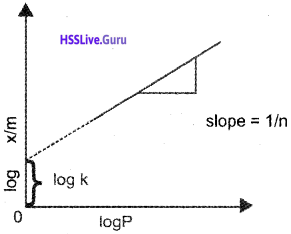
empirical relation between the quantity of gas adsorbed by unit mass of the solid adsorbant and pressure at a particular temperature.
x/m = k.P1/n (n > 1)
x → mass of the gas adsorbed
m → mass of adsorbent
‘k’ and ‘n’ are constants which depend on the nature of the adsorbent and the gas at a particular temperature.
OR log x/m = log k + \(\frac{1}{n}\) log P
Plus Two Chemistry Notes Chapter 5 Surface Chemistry 1

Adsorption from Solution Phase:
Freundlich’s equation approximately describes the behaviour of adsorption from solution.
\(\frac{x}{m}\) = k.C1/n m
C – equilibrium concentration
log x/m = log k + \(\frac{1}{n}\) log C
Plotting log x/m vs log C a straight line is obtained

Applications of Adsorption:
Production of high vacuum, in Gas masks – activated charcoal is filled in gas mask to adsorb poisonous gases, for removal of colouring matter from solution in heterogeneous catalysis, in chromatographies analysis, in froth floatation process.

Catalysis :
The process of altering the rate of chemical reaction by the addition of a foreign substance (catalyst) is called catalysis, e.g. MnO2 acts as a catalyst in the thermal decomposition of KClO3.

Plus Two Chemistry Notes Chapter 5 Surface Chemistry

Promoters:
substances that enhance the activity of a catalyst, e.g. In Haber’s process, iron is used as catalyst and molybdenum acts as a promoter.
Plus Two Chemistry Notes Chapter 5 Surface Chemistry 2

Poisons:
substances which decrease the activity of a catalyst.

Homogeneous and Heterogeneous Catalysis
a) Homogeneous Catalysis:
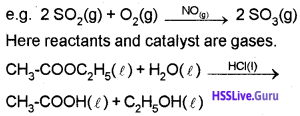
When the reactants and catalyst are in the same phase, the process is said to be homogeneous catalysis.
Plus Two Chemistry Notes Chapter 5 Surface Chemistry 3
Here both the reactants and the catalyst are in the liquid phase.

Heterogeneous Catalysis:
If the reactants and the catalyst are in different phase, the catalysis known as heterogeneous catalysis.
Plus Two Chemistry Notes Chapter 5 Surface Chemistry 4
Here reactants are gaseous state while the catalysts are in the solid state.

Important Features of Solid Catalysts
a) Activity:
ability of catalysts to accelerate a chemical reaction.
Plus Two Chemistry Notes Chapter 5 Surface Chemistry 5
But pure mixture of H2 and O2 does not react at all in the absence of a catalyst.

b) Selectivity:
ability of a catalyst to direct a reaction to yield a particular product.

e.g. CO and H2 combine to form different products by using different catalysts.
Plus Two Chemistry Notes Chapter 5 Surface Chemistry 6

Shape Selective Catalysis by Zeolites:
The catalytic reaction that depends upon the pore structure of the catalyst and size of the reactant and the product molecules.

Zeolites are good shape-selective catalysts because of their honey comb-like structures. Zeolites are widely used in petrochemical industries for cracking and isomerisation of hydrocarbon.
e.g. ZSM – 5 – which convert alcohols into petrol.

Enzyme Catalysis:
Enzymes are biological catalysts. They catalyse biological reaction in animals and plants to maintain life. e.g.

  1. Invertase – Cane sugar into glucose and fructose
  2. Zymase – Glucose into alcohols
  3. Maltase – Maltose into glucose
  4. Diastase – Starch into maltose
  5. Cellulase – Cellulose into glucose
  6. Urease – Urea into NH3 and CO2

Characteristics:
Highly efficient, highly specific in nature, highly active under optimum temperature, highly active under optimum pH

Plus Two Chemistry Notes Chapter 5 Surface Chemistry

Mechanism (Lock and key model)
The molecules of the reactant (substrate), which have complementary shape, fit into the cavities on the surface of enzyme particles just like a key fits into a lock. The enzyme catalysed reactions proceeds in two steps:
Step -1 :
Binding of enzyme to sutbstrate to form an activated complex.
E + S → ES*
Step-2 :
Decomposition of the activated complex to form product.
ES* → E + P

Catalysts in Industry

  1. Finely divided iron with molybdenum as promoter in Haber’s process. (New catalyst: a mixture of iron oxide, potassium oxide and alumina)
  2. Platinised asbestos in Ostwald’s process
  3. Platinised asbestos or V205 in Contact process

Colloids:
Heterogeneous system in which one substance is dispersed (dispersed phase) as very fine particles in another substance called dispersion medium, e.g. Starch, Gelatin. In colloids the particle size (diameter) is between 1nm and 1000 nm.

Classification of Colloids:
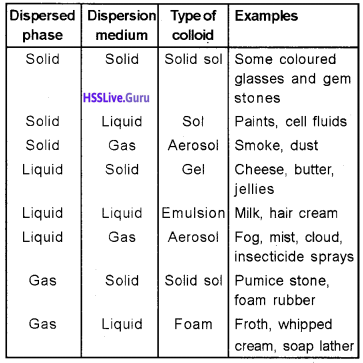
i) Based on physical state of dispersed phase and dispersion medium:
Plus Two Chemistry Notes Chapter 5 Surface Chemistry 7

ii) Based on Nature of Interaction between Dispersed Phase and Dispersion Medium:
1. Lyophilic (solvent attracting) Colloids:
there is strong interaction between the dispersed phase and dispersion medium. They are reversible sols. e.g. Starch, gelatin, albumin etc.

2. Lyophobic (solvent repelling) Colloids:
there is little or no interaction between the dispersed phase and dispersion medium. They are also irreversible colloids and are not stable.

iii) Based on Types of Particle of the Dispersed Phase
a) Multimolecular Colloids :
the individual particles consist of an aggregate of atoms or small molecules with molecular size less than 1 nm, the particles are held together by van der Waals’ forces, e.g. Sulphur sol, Gold sol etc.

b) Macromolecular Colloids :
the particles of dispersed phase are sufficiently big in size, maybe in the colloidal range, e.g. Starch, cellulose, proteins.

c) Associated Colloids (Micelles):
colloids which behave as normal strong electrolytes at low concentration but get associated at higher concentrations and behaves as colloidal solutions. The associated particle formed are called micelles.
e.g. Soap, detergents etc.

The formation of micelles take place only above a particular temperature called Kraft temperature (Tk.) and above a particular concentration called Critical Micelle Concentration(CMC).

Plus Two Chemistry Notes Chapter 5 Surface Chemistry

Mechanism of micelle formation –
In soaps, the RCOO ions are present on the surface with their COO groups in water and R staying away from it and remain at the surface. At CMC, the anions are pulled into the bulk of the solution and aggregate to form ‘ionic micelle’ having spherical shape with R pointing towards the centre of the sphere and COO part remaining outward on the surface of the sphere.

Preparation of Colloids
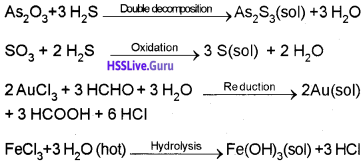
a) Chemical Methods
Some examples:
Plus Two Chemistry Notes Chapter 5 Surface Chemistry 8

b) Electrical Disintegration or Bredig’s Arc Method
Metallic sols can be prepared by striking an arc between two electrodes of the metal, immersed in the dispersion medium. The metal is vapourised by the arc which then condenses to form particles of colloidal size. e.g. Gold sol, Platinum sol, Silver sol etc.

c) Peptization:
process of converting a precipitate into colloidal sol by shaking it with dispersion medium in the presence of small amount of electrolyte (peptizing agent), e.g. Freshly prepared Fe(OH)3 is peptized by adding small quantity of FeCI3 solution (peptizing agent).

Plus Two Chemistry Notes Chapter 5 Surface Chemistry

Mechanism of peptization –
During peptization, the precipitate adsorbs one of the ions of the electrolyte on its surface. This causes the development of positive or negative charge on precipitates, which ultimately break up into smaller particles of the size of a colloid.

Purification of Colloids:
process of reducing the amount of impurities to a requisite minimum from the colloids.
i) Dialysis:
process of removing a dissolved substance from a colloid by means of diffusion through a suitable membrane.

ii) Electro-dialysis:
process of dialysis in presence of an applied electric field. It is faster and is applicable if the dissolved substance in the impure colloid is only an electrolyte. The ions present in the colloid migrate out to the oppositely charged electrodes.

iii) Ultrafilteration:
process of separating the colloidal particles from the solvent and soluble solutes present in the colloid by ultra filters. The ultra filter paper is prepared by soaking the filter paper in a colloidion solution (4% solution of nitro cellulose in a mixture of alcohol and ether). It is then hardened by formaldehyde and finally dried.

Properties of Colloids
1) Colligative Properties:
values of colligative properties as smaller due to smaller number of particles.

2) Tyndall Effect (Optical Property):
phenomenon of the scattering of light by colloidal particles.

Conditions for observing Tyndall effect:
1. The diameter of the dispersed particles is not much smaller than the wavelength of the light used; and

2. The refractive indices of the dispersed phase and the dispersion medium differ greatly in magnitude. The ultramicroscope used to observe the light scattered by colloidal particles is based on Tyndall effect.

The colour of the sky can be explained by Tyndall effect. The dust and other colloids present in the atmosphere scatter the light. Only blue light reaches to our eyes.

Plus Two Chemistry Notes Chapter 5 Surface Chemistry

3) Colour:
It depends on the wavelength of lighty scattered by the dispersed particles which in turn depends on the size and nature of the particles and changes with the manner in which the observer receives the light, e.g. a mixture of milk and water appears blue when viewed by the reflected light and red when viewed by transmitted light.

4) Brownian Movement:
The constant zig-zag movement of the colloidal particles. It is due to the unbalanced bombardment of the particles by the molecules of the dispersion medium. It does not permit the particles to settle and is responsible for the stability of sols. ,

5) Charge on Colloidal Particles:
Colloidal particles carry an electric charge.
Positive charged sols: Al2O3. xH2O, CrO3.xH20, basic dye stuffs, blood (Haemoglobin) etc.

Negatively charged sols:
Metal sols (Cu, Ag, Au), metallic sulphides, acid dyes stuffs, starch, gelatin.

Reason for charge:
It is due to
i) electron capture by sol particles during electrodispersion of metals,
ii) preferential adsorption of ions from solution and/ or
iii) formulation of electrical double layer.

Helmholtz Electrical Double Layer:
combination of two layers of opposite charges around the colloidal particle. The first layer of ions is firmly held and is termed fixed layer while the second layer is mobile which is termed as diffused layer.

Electrokinetic Potential or Zeta Potential:
It is the potential difference between the fixed layer and the diffused layer of opposite changes in the electrical ‘ double layer.

Significance of Charge on Colloidal Particles:
provides stability to the colloid because the repulsive forces between charged particles having same charge prevent them from coalescing or aggregating when they come closer to one another.

6) Electrophoresis:
lled anaphoresis and that of cathode is called cataphoresis.

Plus Two Chemistry Notes Chapter 5 Surface Chemistry

Coagulation/Flocculation/Precipitation:
process of settling of colloidal particles by the addition of electrolyte.

Coagulation of lyophobic sols can be carried out by the following ways:
Electrophoresis, mutual coagulation (mixing two oppositely charged sols), boiling, persistent dialysis, addition of electrolytes, etc.

Addition of electrolytes –
Colloids interact with ion carrying charge opposite to that present on themselves. This causes neutralisation leading to their coagulation.

Hardy – Schulze Rule:
the greater the valence of the flocculating ion added, the greater is its power to cause precipitation.

The ion having opposite charge to sol particles (coagulating ion) cause coagulation.

In the coagulation of negative sol, the flocculating power is in the order: Al3+ > Ba2+ > Na+

In the coagulation of positive sol, the flocculating power in the order:
[Fe(CN)6]4- > PO43- > SO42-> Cl

Protective Colloids:
the lyophilic sol used for protection of lyophobic sol.

Plus Two Chemistry Notes Chapter 5 Surface Chemistry

Emulsions:
liquidin liquid colloidal systems i.e., the dispersion of finely divided droplets in another liquid. There are two types of emulsions.
1) Oil dispersed in water (O/W type):
water acts as dispersion medium, e.g. Milk, Vanishing cream.

2) Water dispersed in oil (W/O type):
oil, acts as dispersion medium.e.g. Butter, Creams, Cod liveroil Emulsification – process of making an emulsion. Emulsion may be obtained by vigourously agitating a mixture of both liquids.

Emulsifying agent or emulsifier –
substance used to stabilise an emulsion. It forms an interfacial film between suspended particles and the medium, e.g.

Emulsifying agents for O/W emulsions :
Proteins, gums, natural and synthetic soaps etc.

Emulsifying agents for W/O emulsions:
Heavy metal salts of fatty acids, long chain alcohols, lampblack etc.

Plus Two Chemistry Notes Chapter 5 Surface Chemistry

Colloids Around Us :
Fog, mist and rain; food materials, blood, soils, formation of delta.

Application of Colloids
I) In Medicine:
Colloidal medicines are more effective because they have large surface area and are, therefore, easily assimilated, e.g. Colloidal silver (Argyrol) – as eye lotion, Colloidal antimony – in curing Kalaazar, Colloidal gold – for intramuscular injection. Milk of magnesia – in stomach disorder.

II) In industries :
Electrical precipitation of smoke – by Cottrell smoke precipitator, purification of water, tanning, cleansing action of soaps and detergents (micelle formation), photographic plates and films, rubber industry and Industrial products.

Plus Two Accountancy Chapter Wise Questions and Answers Chapter 3 Reconstitution of a Partnership Firm – Admission of Partner

Students can Download Chapter 3 Reconstitution of a Partnership Firm – Admission of Partner Questions and Answers, Plus Two Accountancy Chapter Wise Questions and Answers helps you to revise the complete Kerala State Syllabus and score more marks in your examinations.

Kerala Plus Two Accountancy Chapter Wise Questions and Answers Chapter 3 Reconstitution of a Partnership Firm – Admission of Partner

Plus Two Accountancy Reconstitution of a Partnership Firm – Admission of Partner One Mark Questions and Answers

Question 1.
Total value of business-Net tangible assets’ is the value of goodwill under.
(a) Superprofit method
(b) Present value of super profit method
(c) Capitalization of average profit method
(d) Weighted average profit method
Answer:
(c) Capitalization of average profit method.

Question 2.
Which of the following does not lead to reconstitution of a partnership firm?
(a) Admission of a new partner
(b) Retirement of a partner
(c) Death of a partner
(d) Dissolution of a partnership
Answer:
(d) Dissolution of a partnership

Plus Two Accountancy Chapter Wise Questions and Answers Chapter 3 Reconstitution of a Partnership Firm – Admission of Partner

Question 3.
Change in agreement (relationship among the partners) lead to
(a) Reconstitution
(b) Dissolution
(c) Reconstruction
(d) Amalgamation
Answer:
(d) Reconstitution

Question 4.
Change in profit sharing ratio of the existing partners result in
(a) Gain to all partners
(b) Sacrifice to ail partners
(c) Gain to some partners and sacrifice to others
(d) None of these
Answer:
(c) Gain to some partners and sacrifice to others.

Question 5.
Unless otherwise mentioned, sacrificing ratio will be
(a) Equal ratio
(b) New ratio
(c) Old ratio
(d) None of these
Answer:
(c) Old ratio

Question 6.
The profit or loss arising from revaluation of assets and liabilities is transferred to
(a) Old partners’ capital account
(b) All partners’ capital account
(c) New partners’ capital account
(d) Profit and Loss Appropriation account
Answer:
(a) Old partners’ capital account

Plus Two Accountancy Chapter Wise Questions and Answers Chapter 3 Reconstitution of a Partnership Firm – Admission of Partner

Question 7.
The profit or loss on revaluation is transferred to the old partners capital a/c in
(a) Old ratio
(b) Sacrificing ratio
(c) New ratio
(d) In the ratio of capital
Answer:
(a) Old ratio

Question 8.
At the time of admission of a new partner the re-serves and accumulated profits in P & L account is transferred to
(a) Profit and Loss appropriation account
(b) Profit and Loss Adjustment Account
(c) Old Partner’s capital account
(d) Revaluation account
Answer:
(c) Old partner’s capital account

Question 9.
The amount of goodwill brought in by the new partner is shared among the old partners in
(a) Old ratio
(b) Sacrificing ratio
(c) New ratio
(d) None of these
Answer:
(b) Sacrificing ratio

Question 10.
The goodwill brought in kind (assets) by the new partner is transferred to
(a) Revaluation account
(b) Profit and Loss Account
(c) Sacrificing partners’ capital account
(d) All partners’ capital account
Answer:
(c) Sacrificing partners’ capital account

Question 11.
When the new partner is not able to bring his share of goodwill, his account will be
(a) Debited
(b) Credited
(c) Omitted
(d) Closed
Answer:
(a) Debited

Plus Two Accountancy Chapter Wise Questions and Answers Chapter 3 Reconstitution of a Partnership Firm – Admission of Partner

Question 12.
In partnership, a minor
(a) Cannot be a partner
(b) Can be a partner
(c) Can be admitted only to the benefits of a partnership.
(d) Can be a partner and share profit & losses along with other partners.
Answer:
(c) Can be admitted only to the benefits of a partnership.

Question 13.
Complete the following on the basis of the hint given

  1. Premium – Sacrificing ratio.
  2. Revaluation profit – _______.

Answer:
Old profit sharing.ratio

Question 14.
Joy’s capital A/c
Dr. Saju’s capital A/c Dr
To Profit and Loss A/c.
What is the entry stands for?
Answer:
Accumulated losses transferred to old partners capital a/c.

Plus Two Accountancy Reconstitution of a Partnership Firm – Admission of Partner Two Mark Questions and Answers

Question 1.
‘Goodwill is an asset, but is not visible’. Describe.
Answer:
Goodwill is the value of the reputation of a firm. As such it is an asset to the firm. But it is an intangible asset and is not visible.

Question 2.
A firm has an average profit of Rs. 50,000 during the last certain years. The normal rate of return is 10%. The firm has net tangible assets of Rs. 3,00,000. Calculate the value of goodwill using capitalization method.
Answer:
Average profit = Rs. 50,000
Normal rate of return = 10%
Capitalised value of
average profit = \(\frac{50,000 \times 100}{10}\) = Rs. 5,00,000
Goodwill = Capitalised value of average profit – Total of net tangible assets.
= Rs. 5,00,000 – 3,00,000 = Rs. 2,00,000.

Plus Two Accountancy Chapter Wise Questions and Answers Chapter 3 Reconstitution of a Partnership Firm – Admission of Partner

Question 3.
When a new partner is admitted into a firm?
Answer:
Inclusion of a new partner into an existing firm is called admission of a partner. A new partner is admitted, when a firm needs more capital, managerial skill, etc.

Question 4.
What are the rights acquired by a new partner?
Answer:

  1. Right to share the assets of the firm – For this the new partner has to bring a certain amount of capital.
  2. Right to share the profits of the firm – For this he has to bring his share of goodwill.

Question 5.
What do you mean by sacrificing ratio?
Answer:
At the time of admission of a new partner, the old partners have to sacrifice a certain portion of their profits for the incoming partner. The ratio in which they give up or sacrifice their profit is called sacrificing ratio.

Question 6.
What is a revaluation account?
Answer:
Revaluation account is a nominal account prepared at the time of admission of a new partner. This is prepared to find out the profit or loss on revaluing the assets, if they are overstated or understated.

Question 7.
What is meant by premium or goodwill?
Answer:
At the time of admission, the new partner has to bring in a certain amount for getting a share in future profit. This amount is called premium or goodwill.

Question 8.
What treatment is made of accumulated profits and losses on the admission of a new partner?
Answer:
Accumulated profits and losses are distributed amongst the old partner’s in their old profit sharing ratio. The new partner should not share such profits or losses because these arose before his admission.

Plus Two Accountancy Chapter Wise Questions and Answers Chapter 3 Reconstitution of a Partnership Firm – Admission of Partner

Question 9.
What is Memorandum Revaluation Account?
Answer:
A memorandum revaluation account is prepared when the partners decide to record the effect of revaluation of assets and liabilities without affecting the old figures of assets and liabilities in the balance sheet.

Question 10.
A new partner is admitted into a firm; but he is not in a position to bring his share of goodwill. What the firm will do?
Answer:
When the new partner is not able to bring his share of goodwill, his account is debited and the sacrificing partners capital account is credited. The following is the journal entry.
New Partners’ Capital A/c Dr.
To Sacrificing Partners’Capital A/c.

Question 11.
An equipment having a book value of Rs.2,600 was sold at Rs. 3,000 on the date of admission of a partner.

  1. How much amount will be credited to Revaluation A/c?
  2. Give journal entry for the above.

Answer:

Cash a/c Dr. 3000
To Equipment 2600
To Revaluation (Being equipment sold) 400

Question 12.
In connection with the admission of Mr.Santhosh Kumar as equal partner, one of the existing partners
of the firm Mrs. Sreema has taken over the plant and equipments worth Rs. 15000 at Rs. 18000 on the date of admission. Give a journal entry to this effect.
Answer:

Sreema’s capital Dr. 18000
To Plant & Equipment 15000
To Revaluation (Being P & E taken over by Sreema) 3000

Plus Two Accountancy Chapter Wise Questions and Answers Chapter 3 Reconstitution of a Partnership Firm – Admission of Partner

Question 13.
X and Y are partners sharing profits and loses in the ratio of 2:1. They admit Z into the firm for a fourth, share. Calculate new ratio and sacrificing ratio.
Answer:
Old ratio = 2:1
New ratio =2:1:1
Plus Two Accountancy Chapter Wise Questions and Answers Chapter 3 Reconstitution of a Partnership Firm – Admission of Partner - 1
Here old ratio and sacrificing ratio are the same.

Question 14.
P and Q are partners in a firm sharing profits in the ratio of 5 : 3. They admit R for 1/6 share. The total goodwill of the firm is Rs. 50,000. Goodwill existing in the books is Rs. 25,000. Pass the journal entry for the share of goodwill to be brought in by R.
Answer:
Amount of goodwill to be brought in by R
= 1/6 of (50,000 – 25,000)
= 1/6 of 25,000
= 1/6 × 25,000 = Rs. 4,167
The Journal entry is

Cash A/c Dr. 4,167
To Goodwill (Premium) (Share of Good will brought in by R) 4,167

Plus Two Accountancy Reconstitution of a Partnership Firm – Admission of Partner Three Mark Questions and Answers

Question 1.
Calculate the value of goodwill at 2 years, purchase from the following 3 years average profits.

1995 Rs. 27,000
1996 Rs. 28,000
1997 Rs. 29,000

Answer:
Average profit = \(\frac{27,000+28,000+29,000}{3}\)
= 28,000
Goodwill = 2 yeas purchase of the average profit = 2 × 28,000 = 56,000.

Plus Two Accountancy Chapter Wise Questions and Answers Chapter 3 Reconstitution of a Partnership Firm – Admission of Partner

Question 2.
A business has earned average profits of Rs. 1,00,000 during the last few years and the normal rate of return in a similar business is 10%. Ascertain the value of goodwill by capitalisation of superprofits method, given that the value of net assets of the business is Rs.8,20,000.
Answer:
Goodwill = superprofit × 100/ Normal rate of return Super profit = Actual/Average profit – Normal profit Normal profit = Capital employed × Normal rate of return = 820000 × 10/100 = 82000
Super profit = 100000 – 82000 = 18000
Goodwill = 18000 × 100/10 = Rs. 180000.

Question 3.
Ram and Rahim are partners in a firm sharing profits in the ratio of 3:2. Their capitals were Rs.80000 and Rs.50000 respectively. They admitted Syam on January 1st 2014 as a new partner for 1/5 share in the future profits. Syam bought Rs.60,000 as his capital. Calculate the value of goodwill of the firm.
Answer:
Syam’s capital = 60000
Syam’s share of capital = 1/5
Total capital of new firm = 60000 × 5/1 = 300000
Total capital of Ram, Rahim & Syam
= 80000 + 50000 + 60000 = 190000
Goodwill of the firm = 300000 – 190000 = 110000
Syam’s share of goodwill = 110000 × 1/5 = Rs.22,000.

Plus Two Accountancy Chapter Wise Questions and Answers Chapter 3 Reconstitution of a Partnership Firm – Admission of Partner

Question 4.
L and M are partners sharing profits in the ratio of 5: 4. On 1st July 2005 they admit N into the firm for 1/10 share in future profits. N contributed the following assets for his capital and share of goodwill. Stock-in-trade Rs. 50,000, Furniture Rs. 25,000 and Land and Buildings Rs. 75,000 and machinery Rs. 50,000. Goodwill of the firm was valued at Rs. 45,000. Give the journal entries.
Answer:
Journal
Plus Two Accountancy Chapter Wise Questions and Answers Chapter 3 Reconstitution of a Partnership Firm – Admission of Partner - 2
Plus Two Accountancy Chapter Wise Questions and Answers Chapter 3 Reconstitution of a Partnership Firm – Admission of Partner - 3

Question 5.
P and Q are partners sharing profits and losses in the ratio of 3:2. They admit R into the firm with 2/5 share which he gets equally from P & Q. Calculate the new ratio and sacrificing ratio.
Answer:
Old ratio = 3 : 2 = 3/5 : 2/5
R’s share = 2/5 ie. (1/5 from P 1/5 from Q)
Plus Two Accountancy Chapter Wise Questions and Answers Chapter 3 Reconstitution of a Partnership Firm – Admission of Partner - 4
Here the sacrificing ratio is equal (1: 1) as R gets equally from P&Q.

Plus Two Accountancy Chapter Wise Questions and Answers Chapter 3 Reconstitution of a Partnership Firm – Admission of Partner

Question 6.
Which are the matters on which accounting adjustments are required at the time of the admission of a new partner?
Answer:
At the time of the admission of a new partner, accounting adjustments are required on the following

  1. Capital of the new partner
  2. Ascertainment of profit sharing ratios – new and sacrificing
  3. Revaluation of assets and liabilities
  4. Adjustment of accumulated profits (including reserves) or losses.
  5. Calculation of goodwill
  6. Adjustment of capital accounts of partners.

Question 7.
Explain the premium method of treatment of goodwill.
Answer:
Under premium method, the new partner brings his share of goodwill in cash. The amount so brought in by him is shared among the old partners in the sacrificing ratio.
The journal entries here are:

  1. Cash a/c Dr.
    To premium for goodwill a/c (cash brought in by the new partner for goodwill)
  2. Premium for good will a/c
    To old partners capital a/c (Goodwill shared among the old partners)

“If the amount of premium is paid privately to the old partners, no need of entering the same in the books.”

Question 8.
A new partner instead of bringing his share of good¬will in cash brought the same as assets. How will you treat it?
Answer:
When an incoming partner brings his share of goodwill in kind (as assets), the assets account will be debited. Credit is given to premium for good will account with the share of goodwill and new partner’s capital account with the share of capital.
The journal entries here are:

  1. Assets a/c Dr. To New partner’s Capital A/c
    To Premium (goodwill) A/c (Assets brought in by the new Partner)
  2. New partners’ capital a/c Dr. To Sacrificing partners Capital A/c
    (Share of goodwill brought in by the new partner transferred to old partners capital).

Plus Two Accountancy Chapter Wise Questions and Answers Chapter 3 Reconstitution of a Partnership Firm – Admission of Partner

Question 9.
A and B are partners sharing profits and losses equally (1:1). They admit C for 1/6 share in future profits. Calculate the new ratio and sacrificing ratio.
Answer:
Old Ratio = 1:1 C’s
Share = 1/6
Remaining portion = 1 – 1/6 = 5/6
This 5/6 is to share among A & B in their old ratio.
So their new shares will be
A’s share 1/2 of 5/6 = 1/2 × 5/6 = 5/12
B’s share 1/2 of 5/6 = 1/2 × 5/6 = 5/12
The new ratio between
Plus Two Accountancy Chapter Wise Questions and Answers Chapter 3 Reconstitution of a Partnership Firm – Admission of Partner - 5
Old ratio and sacrificing ratio are the same here.

Question 10.
Roshi and Riya are partners sharing profits and losses in the ratio of 5 : 3. Maria is admitted into the firm. Roshi sacrifices 1 /5 of her share and Riya sacrifices 1/6 in favour of Maria. Calculate the new ratio.
Answer:
Old ratio = 5:3
Plus Two Accountancy Chapter Wise Questions and Answers Chapter 3 Reconstitution of a Partnership Firm – Admission of Partner - 6
Plus Two Accountancy Chapter Wise Questions and Answers Chapter 3 Reconstitution of a Partnership Firm – Admission of Partner - 7

Plus Two Accountancy Chapter Wise Questions and Answers Chapter 3 Reconstitution of a Partnership Firm – Admission of Partner

Question 11.
Ansa and Valsa are partners in a firm sharing profits and losses in the ratio of 3:2. They admit Sona into the partnership fora sixth share for which she brings in Rs. 35000 as capital and Rs. 20,000 for good will. Pass journal entries in the books of the firm.
Answer:
Journal
Plus Two Accountancy Chapter Wise Questions and Answers Chapter 3 Reconstitution of a Partnership Firm – Admission of Partner - 8
Note: Old ratio itself is the sacrificing ratio here as the ratio between old partners is not changed.

Question 12.
X and Y are partners sharing profits and losses equally. They admit Z for a third share for which he brings Rs. 15,000 for good will. X and Y withdrew the full amount of goodwill immediately. Pass journal entries in the books of the firm.
Answer:
Journal
Plus Two Accountancy Chapter Wise Questions and Answers Chapter 3 Reconstitution of a Partnership Firm – Admission of Partner - 9

Plus Two Accountancy Chapter Wise Questions and Answers Chapter 3 Reconstitution of a Partnership Firm – Admission of Partner

Question 13.
P and Q are partners sharing profits and losses in the ratio of 2:1. They admit R for a third share. He brings in Rs. 30,000 for goodwill, half of which is withdrawn by the old partners. Pass journal entries.
Answer:
Journal
Plus Two Accountancy Chapter Wise Questions and Answers Chapter 3 Reconstitution of a Partnership Firm – Admission of Partner - 10

Question 14.
X and Y are partners sharing profits in the ratio of 4:3. Z is admitted for 1/6 share in profits. Their capitals were Rs. 50,000 and 40,000 respectively. It is also agreed that Z’s capital should be proportionate to her profit sharing ratio. Find out the amount to be brought in by Z as capital.
Answer:
Share of Profit of Z = \(\frac{1}{6}\)
Share of profit of X and Y = 1 – \(\frac{1}{6}\) = \(\frac{5}{6}\)
Total capital of X & Y= 50,000+ 40,000 = 90,000
Capital of X and Y for 5/6 share = 90,000
∴ Total capital of X,
Y and Z = 90,000×6/5 = 1,08,000
∴ Capital to be brought in by Z = 1,08,000 – 90,000
or 1,08,000 × 1/6 = 18,000.

Question 15.
A trading firm has in its ledger book, an accumulated profit balance of Rs. 30,000 in general reserve. The partners Smitha, Neha, and Anila who share profits in the ratio of 3:2:1. They have decided to become equal partners. Show journal entry to adjust the existing general reserve through capital accounts.
Answer:
Old ratio = 3:2:1 = 3/6 : 2/6: 1/6
New ratio = 1:1:1 = 1/3:1/3:1/3
Plus Two Accountancy Chapter Wise Questions and Answers Chapter 3 Reconstitution of a Partnership Firm – Admission of Partner - 11
Plus Two Accountancy Chapter Wise Questions and Answers Chapter 3 Reconstitution of a Partnership Firm – Admission of Partner - 12
Share of general reserve = 30,000 × \(\frac{1}{6}\) = 5000
Anila’s capital A/c Dr. 5000
To Smitha’s capital 5000
(Being goodwill adjusted between capital a/cs of Smitha and Anila, Neha’s profit sharing ratio remains
unchanged (Neha’s old ratio = \(\frac{2}{6}\) – \(\frac{1}{3}\), New ratio = \(\frac{1}{3}\)).

Plus Two Accountancy Chapter Wise Questions and Answers Chapter 3 Reconstitution of a Partnership Firm – Admission of Partner

Question 16.
The Profits of firm for the last five years were as follows

Year Profits
2002-03 20,000
2003-04 24,000
2004-05 30,000
2005-06 25,000
2006-07 18,000

Calculate the value of goodwill on the basis of 3 year’s Purchase of weighted average profit based on weights 1, 2, 3, 4, & 5 respectively to the profits for 2002, 2003, 2004, 2005 and 2006.
Answer:
Plus Two Accountancy Chapter Wise Questions and Answers Chapter 3 Reconstitution of a Partnership Firm – Admission of Partner - 13
Weighted Average Profit = \(\frac{3,48,000}{15}\) = 23,200
Goodwill = 23,200 × 3 = 69,600

Plus Two Accountancy Reconstitution of a Partnership Firm – Admission of Partner Five Mark Questions and Answers

Question 1.
List the factors affecting goodwill.
Answer:
Following are the important factors affecting the goodwill of a firm

  1. Nature of business -A firm producing goods having constant demand will have more goodwill.
  2. Suitable location – A firm which is situated in a favourable locality will have more goodwill.
  3. Efficiency of management – if the management of a firm is efficient, it wil have high goodwill.
  4. Running period – a firm which is running for a long period of time, will have more goodwill.
  5. Requirement of capital – if a firm requires a lesser amount of capital, it will have high goodwill.
  6. Market situation – if competition in the market is limited, it helps a firm to have more goodwill.

Plus Two Accountancy Chapter Wise Questions and Answers Chapter 3 Reconstitution of a Partnership Firm – Admission of Partner

Question 2.
Describe the methods of valuing goodwill.
Answer:
The following are the common methods used for valuing good will

  1. Average profit method/simple average profit method.
  2. Super profit method
  3. capitalisation method.

1. Average Profit method:
Under this method, the goodwill is valued at agreed number of years purchase of the average profits of the past few years.
Goodwill = Average profits × No. of years purchased.
Average profit = \(\frac{\text { Total profits }}{\text { No. of years }}\)
Weighted Average Profit method:
Goodwill = weighted Average Profit × No. of years purchase. Weighted average is based on specified weights like 1, 2, 3, 4 for respective year’s profit.

2. Superprofit Method:
Under this method, goodwill is calculated by multiplying the super profit with the agreed num-ber of years.
Goodwill = Super Profit × No.of years purchase
Super Profit = Actual or Average Profit – Normal Profit
Normal profit = Capital employed × Normal Rate of Return
Capital employed = Total Assets – Total Liabilities or outside liabilities
Average profit = \(\frac{\text { Total profits }}{\text { No. of years }}\).

3. Capitalisation Method:
Under this method, the goodwill can be calcu-lated in two ways

  • by capitalising the average profits.
  • by capitalising the super profits.

(i) Capitalisation of average profits
Under this method, the value of goodwill is calculated by deducting the capital employed (net assets) in the business from the capitalized value of average profits on the basis of normal rate of return.
Good will = capitalised value – capital employed (net asset)
Capitalised value of average profit
Average Profit × \(\frac{100}{\text { Normal Rate of Return }}\)

(ii) Capitalisation of Super Profits
Under this method the goodwill can be ascer tained by capitalising the super profit directly.
Goodwill = Super Profits × \(\frac{100}{\text { Normal Rate of Return }}\).

Plus Two Accountancy Chapter Wise Questions and Answers Chapter 3 Reconstitution of a Partnership Firm – Admission of Partner

Question 3.
The following are the particulars in respect of two partnership firms.
Plus Two Accountancy Chapter Wise Questions and Answers Chapter 3 Reconstitution of a Partnership Firm – Admission of Partner - 14
Manu wishes to join in any one of the above firm which can make better profit. He seeks your advice as to which firm is more worth while and reputed.
Answer:
Capital Exployed = Assets – Liabilities = (10,000 + 15,000 + 20,000 + 20,000) – 5,000 = 60,000
Normal profit = Capital employed × Normal rate of return
60,000 × 10/100 = 6,000
Actual profit = 5,500
Super profit = Actual profit – Normal Profit
= 5,500 – 6,000 = -500
Firm Y
Capital Employed= (2,000 + 8,000 + 10,000 + 20,000) – 5,000 = 35,000
Normal profit = 35.000 × 10/100 = 3,500
Actual profit = 4,000
Superprofit = 4,000 – 3,500 = 500
Conclusion: Firm ‘Y’ earns Rs. 4,000 which is above normal profit.
Firm Y’s performance is better. So select Firm Y’.

Question 4.
How the capital accounts of the partners are adjusted at the time of admission of a new partner?
Answer:
At the time of admission of a new partner the capital accounts of the partners may be adjusted in the following ways.
1. Asking the new partner to bring in the capital on the basis of the existing partner’s capitals. Here new partners’ capital is calculated as follows.

  • Totalling the capitals of the existing partners left after making all adjustments.
  • Totalling the new profit sharing rights of the old partners.
  • Total capital as per (a) is treated as the capital for the total rights as per (b)
  • On the basis of the above, calculating the amount of capital to be brought in by the new partner.

2. Adjusting the capital of the old partners on the basis of the capital brought in by the new partner. This is done as follows.

  • Comparing the capital of the incoming partner with the capitals of old partners.
  • Asking the partner to bring in the required amount whose capital is less.
  • Allowing the partner to withdraw the surplus amount whose capital is more.

Plus Two Accountancy Chapter Wise Questions and Answers Chapter 3 Reconstitution of a Partnership Firm – Admission of Partner

Question 5.
A and B are partners sharing profits in the ratio of 3:2. On 1st April 2005 they admit C into the firm. C brought in Rs. 1,00,000 for his capital but he was not in a position to bring his share of goodwill. The goodwill of the firm was valued at Rs. 1,50,000. Goodwill existing in the books of the firm is Rs. 2,75,000. The new profit sharing ratio is 2: 1: 1. Pass the journal entries.
Answer:
Working Note:
Sacrificing Ratio = Old Ratio – New ratio
Plus Two Accountancy Chapter Wise Questions and Answers Chapter 3 Reconstitution of a Partnership Firm – Admission of Partner - 15
C’s share of goodwill = 1,50,000 × 1/4 = 37,500 This Rs. 37,500 is to be debited to the new partner’s capital account and credited to old partners’ capital as C (new partner) cannot bring in the same.
Journal
Plus Two Accountancy Chapter Wise Questions and Answers Chapter 3 Reconstitution of a Partnership Firm – Admission of Partner - 16
Plus Two Accountancy Chapter Wise Questions and Answers Chapter 3 Reconstitution of a Partnership Firm – Admission of Partner - 17

Question 6.
R & S are partners sharing profits and losses in the ratio of 3:2. They admitted T into the firm. They have agreed to share the future profits – equally. T brought in Rs. 45,000 as his capital and Rs. 40,000 for his share of goodwill. The goodwill of the firm as in the books is Rs. 12,500. Write the journal entries.
Answer:
Notes
Sacrificing Ratio = Old ratio – New ratio
Old ratio = 3:2
New ratio = 1:1:1
Plus Two Accountancy Chapter Wise Questions and Answers Chapter 3 Reconstitution of a Partnership Firm – Admission of Partner - 18
Journal
Plus Two Accountancy Chapter Wise Questions and Answers Chapter 3 Reconstitution of a Partnership Firm – Admission of Partner - 19

Plus Two Accountancy Chapter Wise Questions and Answers Chapter 3 Reconstitution of a Partnership Firm – Admission of Partner

Question 7.
Terry and C.L. Stephen are in partnership engaged in software development on accounting packages to various companies.
Ledger balances as shown by the books of accounts are:

Capital: Terry 3,00,000
C.L. Stephen 2,50,000
Plant and Machinery 2,00,000
Office Fixtures 1,00,000
Current Assets 1,50,000
General Reserve 80,000
Bank loan 1,60,000
Stock in trade 40,00,000
Land and Building 3,00,000
  • They have decided to admit Francis who is the son of Mr. Terry on the following terms.
  • Fixed Assets valued 10% more than the book value.
  • Interest payable on Bank loan Rs 16,000
  • Office Fixtures was taken over by C.L. Stephen.

The new partner’s capital A/c is to be credited with half of Mr. Terry’s capital A/c before making any adjustments. Prepare capital accounts of the partners.
Answer:
Revaluation A/c
Plus Two Accountancy Chapter Wise Questions and Answers Chapter 3 Reconstitution of a Partnership Firm – Admission of Partner - 20
Capital Accounts
Plus Two Accountancy Chapter Wise Questions and Answers Chapter 3 Reconstitution of a Partnership Firm – Admission of Partner - 21
Note: The new partners capital A/c is to be credited with half of Mr. Terry’s capital a/c before making Adjustment.
Journal entry is:
Plus Two Accountancy Chapter Wise Questions and Answers Chapter 3 Reconstitution of a Partnership Firm – Admission of Partner - 22

Plus Two Accountancy Chapter Wise Questions and Answers Chapter 3 Reconstitution of a Partnership Firm – Admission of Partner

Question 8.
A and B are partners sharing profit & losses in the ratio of 3:2. They admit C as a partner who is unable to bring goodwill in cash, but pays Rs. 16,000 as his capital. A Goodwill Account is raised in the books of the firm. Goodwill of the firm is valued at two year’s purchase of average three year’s profits. The profits for the three years were Rs. 10,000, Rs. 8,000 and Rs. 9,000. The net profit sharing ratio will be 5:2:2. The partners decided to write off goodwill after C’s admission. Make the Journal Entries, write up the Capital A/c. of partners & Goodwill calculation.
Answer:
Journal
Plus Two Accountancy Chapter Wise Questions and Answers Chapter 3 Reconstitution of a Partnership Firm – Admission of Partner - 23
Capital A/c
Plus Two Accountancy Chapter Wise Questions and Answers Chapter 3 Reconstitution of a Partnership Firm – Admission of Partner - 24
Calculation of Goodwill
Average profit = \(\frac{10,000+8,000+9,000}{3}\) = 9,ooo
Goodwill = Average profit × No. of years purchase
= 9,000 × 2 = 18,000
C’s share of Goodwill = 18,000 × 2/9 = 4,000
Sacrificing ratio = Old ratio – New ratio
Old ratio = 3:2
New ratio = 5:2:2
Sacrifice of A = 3/5 – 5/9 = 27 – 25 / 45 = 2/45
Sacrifice of B = 2/5 – 2/9 = 18 – 10 / 45 = 8/45
Sacrificing ratio of A and B = 2 : 8 = 1 : 4

Question 9.
You are given the following information on a reconstitution of a firm.
Partners capital

  • Ammu – Rs. 20,000
  • Beena – Rs. 30,000
  • Ceema – Rs. 20,000
  • Old profit sharing ratio – 2:3:1
  • New Ratio – 1:2:3
  • Revaluation profit – 22,500
  1. State the reason for reconstitution.
  2. Give a journal entry to adjust the revaluation profit through capital accounts of partners.

Answer:
Reconstitution refers to a change in the nature of relationship among partners due to

  1. Change in profit sharing ratio
  2. Admission
  3. Retirement
  4. Death or Amalgamation of two partnership firms.

In the firm of Ammu, Beena and Ceema reconstitution of firm takes place because they decided to change their profit sharing ratio:
Old ratio = 2:3:1 = 2/6 : 3/6: 1/6
New ratio = 1:2:3 = 1/6 : 2/6: 3/6
Ammu’s sacrifice = old ratio – new ratio
= 2/6 – 1/6 = 1/6
Beena’s sacrifice = old ratio-new ratio
= 3/6 – 2/6 = 1/6
Ceema’s gain = new ratio-old ratio = 3/6 – 1/6 = 2/6
Ammu’s revaluation profit = 22,500 × \(\frac{1}{6}\) = 3750
Beena’s revaluation profit = 22,500 × \(\frac{1}{6}\) = 3750
Ceema’s revaluation profit = 22,500 × \(\frac{1}{6}\) = 7500.

Plus Two Accountancy Chapter Wise Questions and Answers Chapter 3 Reconstitution of a Partnership Firm – Admission of Partner

Question 10.
Ann and Gopu were doing sole proprietorship business of same nature. Both are close friends. On 1st April 2005, they have decided to start a partnership business and have brought their existing assets into the new firm. They share profits in the ratio of 3:2. Details of existing assets and liabilities.
Plus Two Accountancy Chapter Wise Questions and Answers Chapter 3 Reconstitution of a Partnership Firm – Admission of Partner - 25
On 31st December, 2006, they have changed their profit sharing ratio and become equal partners. The assets were then revalued as follows:

  • Building is up by 10%
  • Plant is down by 10%
  • Furniture is up by 10%
  • Stock is valued at 1,50,000
  • Goodwill valued at Rs. 10,000
  1. Give journal entries at to bring capital into the records on 01.04.2005.
  2. Prepare :
    • Revaluation A/c
    • Capital A/c
  3. New Balance Sheet

Answer:
Revaluation A/c
Plus Two Accountancy Chapter Wise Questions and Answers Chapter 3 Reconstitution of a Partnership Firm – Admission of Partner - 26
Capital A/c
Plus Two Accountancy Chapter Wise Questions and Answers Chapter 3 Reconstitution of a Partnership Firm – Admission of Partner - 27
New B/S
Plus Two Accountancy Chapter Wise Questions and Answers Chapter 3 Reconstitution of a Partnership Firm – Admission of Partner - 28

Plus Two Accountancy Chapter Wise Questions and Answers Chapter 3 Reconstitution of a Partnership Firm – Admission of Partner

Question 11.
Haridas and Sudheer Raj are partners in a firm sharing profits in the ratio 3:2. On 1.04.2004, they admit Ramdas into the firm for a 5th share in profits. Ramdas contributed the following in respect of his capital and goodwill.

Stock Rs. 10,000
Furniture Rs. 20,000
Plant Rs. 30,000
Building Rs. 40,000

Goodwill has been valued at 2 years purchase of super profit of past 3 years.

1.4.2002 profit Rs. 18,000
1.4.2003 profit Rs. 25,000
1.4.2004 profit Rs. 32,000

Capital employed is Rs. 2,00,000 and normal rate of return is 10%.
Give journal entries in respect of:

  1. Capital contributed by Ramdas.
  2. Goodwill brought in by him.

Answer:
Super profit = (Actual profit) Average profit – Normal profit
Average profit =
Plus Two Accountancy Chapter Wise Questions and Answers Chapter 3 Reconstitution of a Partnership Firm – Admission of Partner - 29
Normal Profit = Capital employed × Normal rate of
return =200000 × \(\frac{10}{100}\) = 20000
Super Profit = 25000 – 20000 = 5000
Value of Goodwill = Super profit × No. of years purchase = 5000 × 2 = 10000
Ramdas’s (New Partner) Share of goodwill = Total goodwill of firm × Ramdas’ share
= 10000 × \(\frac{1}{5}\) = 2000 5
Plus Two Accountancy Chapter Wise Questions and Answers Chapter 3 Reconstitution of a Partnership Firm – Admission of Partner - 30

Plus Two Accountancy Reconstitution of a Partnership Firm – Admission of Partner Eight Mark Questions and Answers

Question 1.
Jo and Sony are partners sharing profits and losses in the raito of 2: 1. Their Balance Sheet as on 31st December 2004 was as follows.
Balance Sheet As on 31st December 2004
Plus Two Accountancy Chapter Wise Questions and Answers Chapter 3 Reconstitution of a Partnership Firm – Admission of Partner - 31
Ebo is admitted into the partnership on the Balance Sheet date on the basis of the following.

  1. Ebo will bring Rs. 50,000 as his capital.
  2. Stock in trade should be decreased by Rs. 5,000
  3. Plant and Machinery should be increased to Rs. 35,000 and Land and Building should be appreciated by 10%.
  4. Bills payable and creditors be decreased by 5% and 10% respectively.

Record necessary journal entries, prepare revaluation account and partner’s capital account and also prepare the Balance sheet after Ebo’s admission.
Answer:
Journal
Plus Two Accountancy Chapter Wise Questions and Answers Chapter 3 Reconstitution of a Partnership Firm – Admission of Partner - 32

Plus Two Accountancy Chapter Wise Questions and Answers Chapter 3 Reconstitution of a Partnership Firm – Admission of Partner
Revaluation A/c
Plus Two Accountancy Chapter Wise Questions and Answers Chapter 3 Reconstitution of a Partnership Firm – Admission of Partner - 33
Partner’s Capital A/c
Plus Two Accountancy Chapter Wise Questions and Answers Chapter 3 Reconstitution of a Partnership Firm – Admission of Partner - 34
Balance Sheet as on 1st January 2005
Plus Two Accountancy Chapter Wise Questions and Answers Chapter 3 Reconstitution of a Partnership Firm – Admission of Partner - 35

Question 2.
Sunu and Jinu are partners in a firm sharing profits and losses equally. The following is their Balance Sheet as on 31.12.2005.
Plus Two Accountancy Chapter Wise Questions and Answers Chapter 3 Reconstitution of a Partnership Firm – Admission of Partner - 36
On the balance sheet date Tinu is admitted into the partnership on the following terms.

  1. Tinu should bring in Rs. 60,000 as his capital
  2. Furniture should be revalued at Rs. 50,000 and machinery at 25% less.
  3. Bank overdraft should be decreased to Rs. 75,000
  4. A provision of 10% is to be made for bad debts.
  5. An unrecorded liability of Rs. 5,000 on rent is to be recorded.

Give journal entries, prepare revaluation account, capital accounts of partners and the Balance Sheet after Tinu’s admission.
Answer:
Journal
Plus Two Accountancy Chapter Wise Questions and Answers Chapter 3 Reconstitution of a Partnership Firm – Admission of Partner - 37
Plus Two Accountancy Chapter Wise Questions and Answers Chapter 3 Reconstitution of a Partnership Firm – Admission of Partner - 38

Plus Two Accountancy Chapter Wise Questions and Answers Chapter 3 Reconstitution of a Partnership Firm – Admission of Partner
Revaluation A/c
Plus Two Accountancy Chapter Wise Questions and Answers Chapter 3 Reconstitution of a Partnership Firm – Admission of Partner - 39
Partner’s capital A/c
Plus Two Accountancy Chapter Wise Questions and Answers Chapter 3 Reconstitution of a Partnership Firm – Admission of Partner - 40
Balance Sheet as on 1st January 2006
Plus Two Accountancy Chapter Wise Questions and Answers Chapter 3 Reconstitution of a Partnership Firm – Admission of Partner - 41
Plus Two Accountancy Chapter Wise Questions and Answers Chapter 3 Reconstitution of a Partnership Firm – Admission of Partner - 42

Question 3.
The following is the Balance sheet of L & M as on 30th June 2005.
Plus Two Accountancy Chapter Wise Questions and Answers Chapter 3 Reconstitution of a Partnership Firm – Admission of Partner - 43
L & M were sharing profits and losses in the ratio of 2:1. N is admitted into the firm for a fourth share. The following are the conditions agreed upon.

  1. Provision for bad and doubtful debts be increased to Rs. 2,500
  2. Land and Buildings was to be depreciated by Rs. 10,000
  3. The firm had an unrecorded machinery of Rs. 10,000 which is to be recorded.
  4. N is asked to bring Rs. 50,000 as his capital and Rs. 15,000 for good will.
  5. L & M had to withdraw half of the goodwill brought in by N.

Record journal entries, prepare Profit Loss adjustment account, capital accounts, and the New Balance Sheet
Answer:
Journal
Plus Two Accountancy Chapter Wise Questions and Answers Chapter 3 Reconstitution of a Partnership Firm – Admission of Partner - 44
Plus Two Accountancy Chapter Wise Questions and Answers Chapter 3 Reconstitution of a Partnership Firm – Admission of Partner - 45

Plus Two Accountancy Chapter Wise Questions and Answers Chapter 3 Reconstitution of a Partnership Firm – Admission of Partner
Profit & Loss Adjustment (Revaluation) a/c
Plus Two Accountancy Chapter Wise Questions and Answers Chapter 3 Reconstitution of a Partnership Firm – Admission of Partner - 46
Partner’s Capital A/c
Plus Two Accountancy Chapter Wise Questions and Answers Chapter 3 Reconstitution of a Partnership Firm – Admission of Partner - 47
Balance Sheet as on 1st July 2005
Plus Two Accountancy Chapter Wise Questions and Answers Chapter 3 Reconstitution of a Partnership Firm – Admission of Partner - 48

Question 4.
Edwin and Abel are partners sharing profits and losses in the ratio of 4:3. Their Balance sheet as on 30th June 2005 is as follows.
Plus Two Accountancy Chapter Wise Questions and Answers Chapter 3 Reconstitution of a Partnership Firm – Admission of Partner - 49
Jerin is admitted into the firm with 2/7th share. The following are the terms and conditions.

  1. Jerin should bring in Rs. 40,000 as his capital and share of goodwill. The value of the goodwill of the firm is fixed at Rs. 35,000.
  2. The amount of furniture and fittings should be written down by Rs. 5,000.
  3. The full amount of goodwill should be withdrawn by old partners.
  4. Creditors should be reduced by Rs. 2,000.
  5. The new profit sharing ratio should be 3: 2:2.

Prepare necessary accounts and the Balance Sheet after the admission of Jerin.
Answer:
Working notes :
1. Jerin’sshare of goodwill = Goodwill of the firm × 2/7
= 35,000 × 2/7 = 10,000

2. Sacrificing ratio = Old share – New share
Edwin’s sacrifice = 4/7 – 3/7 = 1 / 7
Abel’s sacrifice = 3/7 – 2/7 = 1 / 7
Ratio = 1/7 : 1/7 ie. = 1 :1
Revaluation A/c
Plus Two Accountancy Chapter Wise Questions and Answers Chapter 3 Reconstitution of a Partnership Firm – Admission of Partner - 50

Plus Two Accountancy Chapter Wise Questions and Answers Chapter 3 Reconstitution of a Partnership Firm – Admission of Partner
Partner’s capital a/c
Plus Two Accountancy Chapter Wise Questions and Answers Chapter 3 Reconstitution of a Partnership Firm – Admission of Partner - 51
Balance Sheet as on 1s July 2005
Plus Two Accountancy Chapter Wise Questions and Answers Chapter 3 Reconstitution of a Partnership Firm – Admission of Partner - 52

Question 5.
Ram and Gopal are partners in a firm sharing profit and loss in the ratio of 3:1 respectively. The following is their Balance Sheet as on 31 /12/2008.
Balance Sheet
Plus Two Accountancy Chapter Wise Questions and Answers Chapter 3 Reconstitution of a Partnership Firm – Admission of Partner - 53
They admit Menon into partnership on 1-1-2009 on the following terms.

  1. Menon should bring Rs. 10,000 as his capital for 1/5th share and 18,000 as her share of good will.
  2. Liability for workmen compensation estimated at Rs. 1500.
  3. Value of land and building be appreciated by Rs. 5000.
  4. Stock reduced by 5%
  5. A provision of 5% should be made for doubtful debts in debtors.

Prepare revaluation a/c, capital account of partners and the Balance sheet of new firm.
Answer:
Revaluation A/c
Plus Two Accountancy Chapter Wise Questions and Answers Chapter 3 Reconstitution of a Partnership Firm – Admission of Partner - 54
Plus Two Accountancy Chapter Wise Questions and Answers Chapter 3 Reconstitution of a Partnership Firm – Admission of Partner - 55

Plus Two Accountancy Chapter Wise Questions and Answers Chapter 3 Reconstitution of a Partnership Firm – Admission of Partner
Capital A/c
Plus Two Accountancy Chapter Wise Questions and Answers Chapter 3 Reconstitution of a Partnership Firm – Admission of Partner - 56
Balance Sheet
Plus Two Accountancy Chapter Wise Questions and Answers Chapter 3 Reconstitution of a Partnership Firm – Admission of Partner - 57
Working Note:
Menon’s share of goodwill = 18,000 Sacrificing ratio = 3:1
Goodwill credited in Ram = 18,000 × 3/4 = 13,500 Gopal = 18,000 × 1/4 = 4,500.

Question 6.
The following is the Balance Sheet of A and B as on 31st Dec. 2004.
Plus Two Accountancy Chapter Wise Questions and Answers Chapter 3 Reconstitution of a Partnership Firm – Admission of Partner - 58
A & B share profits and losses in the ratio of 5 : 3. They admit C into the partnership for equal share. C brings in Rs. 50,000 as capital and Rs. 5,000 for his share of goodwill. Goodwill of the firm is valued at Rs. 30,000. The following conditions were agreed upon.

  1. Land and buildings are appreciated by 20%.
  2. Stock is decreased by Rs. 5,000/-
  3. Creditors include Rs. 2,500/- not become payable.
  4. Unexpired insurance or insurance paid in advance Rs. 2,500 is to be recorded.

Record journal entries, prepare ledger accounts and the new Balance Sheet.
Answer:
Notes:
Calculation of sacrificing ratio
Sacrificing ratio = old ratio – new ratio
Plus Two Accountancy Chapter Wise Questions and Answers Chapter 3 Reconstitution of a Partnership Firm – Admission of Partner - 59
Journal
Plus Two Accountancy Chapter Wise Questions and Answers Chapter 3 Reconstitution of a Partnership Firm – Admission of Partner - 60

Plus Two Accountancy Chapter Wise Questions and Answers Chapter 3 Reconstitution of a Partnership Firm – Admission of Partner
Plus Two Accountancy Chapter Wise Questions and Answers Chapter 3 Reconstitution of a Partnership Firm – Admission of Partner - 61
Revaluation A/c
Plus Two Accountancy Chapter Wise Questions and Answers Chapter 3 Reconstitution of a Partnership Firm – Admission of Partner - 62
Partner’s Capital A/c
Plus Two Accountancy Chapter Wise Questions and Answers Chapter 3 Reconstitution of a Partnership Firm – Admission of Partner - 63
Balance sheet as on 1st January 2005
Plus Two Accountancy Chapter Wise Questions and Answers Chapter 3 Reconstitution of a Partnership Firm – Admission of Partner - 64

Question 7.
P and Q are partners sharing profits and losses in the ratio of 4:3. Their balance sheet as on 30th June 2004 is as follows.
Plus Two Accountancy Chapter Wise Questions and Answers Chapter 3 Reconstitution of a Partnership Firm – Admission of Partner - 65
R is admitted into the firm on the basis of the follow-ing conditions.

  1. Sundry debtors should be revalued at Rs. 1,00,000.
  2. R should bring in Rs. 15000 as capital and Rs. 10000 as his share of goodwill. He will get 1/6 share in future profits.
  3. The capital accounts of all partners should be adjusted on the basis of their profit sharing ratio by bringing in or paying off the cash as the case may be.

Prepare necessary ledger accounts and the new Balance sheet of the firm.
Answer:
Working notes:
Calculation of new ratio:
Old Ratio between P & Q = 4 : 3
R’s share = 1/6
Remaining portion = 1 – 1/6 = 5/6
P’s new share = 4/7 of 5/6 = 4/7 × 5/6 = 20/42
Q’s new share = 3/7 of 5/6 = 3/7 × 5/6 = 15/42
R’s share = 1/6 = 7/42
Plus Two Accountancy Chapter Wise Questions and Answers Chapter 3 Reconstitution of a Partnership Firm – Admission of Partner - 66

Plus Two Accountancy Chapter Wise Questions and Answers Chapter 3 Reconstitution of a Partnership Firm – Admission of Partner
Calculation of capital required:
R’s capital for
1/6 share in profits = 15,000
Total capital of the firm= 15,000 × 6/1 = 90,000
P’s capital = 90,000 × 20/42 = 42,857
Q’s capital = 90,000 × 15/42 = 32,143
Revaluation A/c
Plus Two Accountancy Chapter Wise Questions and Answers Chapter 3 Reconstitution of a Partnership Firm – Admission of Partner - 67
Partners capital a/c
Plus Two Accountancy Chapter Wise Questions and Answers Chapter 3 Reconstitution of a Partnership Firm – Admission of Partner - 68
Cash A/c
Plus Two Accountancy Chapter Wise Questions and Answers Chapter 3 Reconstitution of a Partnership Firm – Admission of Partner - 69
Balance sheet as on 1st July 2004
Plus Two Accountancy Chapter Wise Questions and Answers Chapter 3 Reconstitution of a Partnership Firm – Admission of Partner - 70

Question 8.
A and B are partners in a firm sharing profits and losses as 3/5 and 2/5.C, comes in for 1/5Th share of profit. He pays Rs. 8,000 as goodwill premium and 50% of the adjusted capitals of A and B. Balance Sheet of A and B on the date of Cs’ admission stand as follows:
Balance Sheet
Plus Two Accountancy Chapter Wise Questions and Answers Chapter 3 Reconstitution of a Partnership Firm – Admission of Partner - 71
Land and Buildings are to be valued at Rs. 40,000. Plant is to be depreciated by 10% and stock by Rs. 500.Sundry Debtors is worth Rs. 31,750. A liability of Rs. 1,750 for outstanding expenses has been omitted to be recorded in the books. A and B have a joint life policy of Rs. 15,000 not shown in the books, the premium for which has been charged to Profit & Loss Account. The surrender value of the policy on the date of admissions is Rs. 2,000, and is agreed to raise a life policy account in the books at this value. Give Journal Entries.
Answer:
Journal
Plus Two Accountancy Chapter Wise Questions and Answers Chapter 3 Reconstitution of a Partnership Firm – Admission of Partner - 72

Plus Two Accountancy Chapter Wise Questions and Answers Chapter 3 Reconstitution of a Partnership Firm – Admission of Partner
Revaluation A/c
Plus Two Accountancy Chapter Wise Questions and Answers Chapter 3 Reconstitution of a Partnership Firm – Admission of Partner - 73
Dr. Partner’s Capital A/c Cr.
Plus Two Accountancy Chapter Wise Questions and Answers Chapter 3 Reconstitution of a Partnership Firm – Admission of Partner - 74
Plus Two Accountancy Chapter Wise Questions and Answers Chapter 3 Reconstitution of a Partnership Firm – Admission of Partner - 75
Capital to be brought in by C = 50% of the adjusted capital of A and B.
i.e., = 50% of 57,500+ 40,000 = 50% of 97,500 = 48,750.

Question 9.
Below given the details related to a firm.
Plus Two Accountancy Chapter Wise Questions and Answers Chapter 3 Reconstitution of a Partnership Firm – Admission of Partner - 76
Plus Two Accountancy Chapter Wise Questions and Answers Chapter 3 Reconstitution of a Partnership Firm – Admission of Partner - 77
Can you analyse the adjustment on admission of a new partner and show the balance sheet after admission.
Answer:
Revaluation A/c
Plus Two Accountancy Chapter Wise Questions and Answers Chapter 3 Reconstitution of a Partnership Firm – Admission of Partner - 78

Plus Two Accountancy Chapter Wise Questions and Answers Chapter 3 Reconstitution of a Partnership Firm – Admission of Partner
Capital Accounts
Plus Two Accountancy Chapter Wise Questions and Answers Chapter 3 Reconstitution of a Partnership Firm – Admission of Partner - 79
Balance Sheet
Plus Two Accountancy Chapter Wise Questions and Answers Chapter 3 Reconstitution of a Partnership Firm – Admission of Partner - 80
Working Note
Goodwill Calculation: Here, Goodwill is calculated on the basis of super profit method.
Goodwill = Superprofit × No. years purchase
Superprofit = Actual or Average profit – Normal profit
Normal profit = Capital Employed × Normal rate of return
Capital employed = Asset – Liabilities
= (10,000 + 20,000 + 31,500 + 30,000+ 20,000) – 11,500
= 1,00,000
Normal profit = 1,00,000 × 10/100 = 10,000
Superprofit =40,000 – 10,000 = 30,000
Goodwill = 30,000 × 2 = 60,000
New partner’s share of Goodwill – 60,000 × 1/3
= 20,000
Sacrifacina ratio
Manu = 3/5 – 1/3 = 9 – 5/15 = 4/15
Raju = 2/5 – 1/3 = 6 – 5/15 = 1/15
Sacrificing ratio = 4:1
Manu = 3/5 – 1/3 = 9 – 5/15 = 4/15
Manu’s Sacrifice = 20,000 × 4/5 = 16,000
Raju’s Sacrifice = 20,000 × 1/5 = 4,000 [Hint: New ratio 1:1:1].

Plus Two Accountancy Chapter Wise Questions and Answers Chapter 3 Reconstitution of a Partnership Firm – Admission of Partner

Question 10.
Observe the following table.
Plus Two Accountancy Chapter Wise Questions and Answers Chapter 3 Reconstitution of a Partnership Firm – Admission of Partner - 81
Furniture was sold at Rs. 2700 on the date of admission. You are required:

  1. Revaluation A/c
  2. Capital Accounts
  3. Balance sheet of the new firm

Answer:
Revaluation A/c
Plus Two Accountancy Chapter Wise Questions and Answers Chapter 3 Reconstitution of a Partnership Firm – Admission of Partner - 82
Capital A/c
Plus Two Accountancy Chapter Wise Questions and Answers Chapter 3 Reconstitution of a Partnership Firm – Admission of Partner - 83
Cash A/c
Plus Two Accountancy Chapter Wise Questions and Answers Chapter 3 Reconstitution of a Partnership Firm – Admission of Partner - 84
Balance Sheet
Plus Two Accountancy Chapter Wise Questions and Answers Chapter 3 Reconstitution of a Partnership Firm – Admission of Partner - 85

Plus Two Accountancy Chapter Wise Questions and Answers Chapter 3 Reconstitution of a Partnership Firm – Admission of Partner

Question 11.
A and B are partners in a firm sharing profits in the ratio of 2:1 ‘C’ is admitted into the firm with 1/4 share in Profits. He will bring in Rs. 30,000 as capital and capital of A and B are to be adjusted in the profit sharing ratio. The balance sheet of A and B as on 31/03/2017 (before c’s admission) was as under.
Balance sheet of A and B as on 31/03/2017
Plus Two Accountancy Chapter Wise Questions and Answers Chapter 3 Reconstitution of a Partnership Firm – Admission of Partner - 86
The terms of agreement are as follows:

  1. ‘C’ will bring in Rs. 12,000ashisshareofgoodwill.
  2. Building was valued at Rs. 45,000 and Machinery at Rs. 23,000
  3. A provision for bad debts is to be created @ 6% on debtors
  4. The capital accounts of A and B are to be adjusted by opening current accounts.

Prepare necessary ledger accounts and new balance of the firm.
Answer:
Revaluation A/c
Plus Two Accountancy Chapter Wise Questions and Answers Chapter 3 Reconstitution of a Partnership Firm – Admission of Partner - 87
Capital A/c
Plus Two Accountancy Chapter Wise Questions and Answers Chapter 3 Reconstitution of a Partnership Firm – Admission of Partner - 88
Balance Sheet
Plus Two Accountancy Chapter Wise Questions and Answers Chapter 3 Reconstitution of a Partnership Firm – Admission of Partner - 89
Working Note:
1. New Profit Sharing ratio C’s share of Profit = 1 /4
Plus Two Accountancy Chapter Wise Questions and Answers Chapter 3 Reconstitution of a Partnership Firm – Admission of Partner - 90

Plus Two Accountancy Chapter Wise Questions and Answers Chapter 3 Reconstitution of a Partnership Firm – Admission of Partner

2. New capital of A and B on the basis of c’s capital
Total capital of the new firm = 30,000 × \(\frac{4}{1}\) = 1,20,000
As new capital = 1,20,000 × \(\frac{2}{4}\) = 60,000
The Existing capital of A = 63,680 Excess (A) = 3,680
B’s new capital = 1,20,000 × \(\frac{1}{4}\) = 30,000
The existing capital of B = 38,840
Excess (B) – 8,840
The current accounts can be opened and the amount to be withdrawn by A and B will be transferred to their respective current accounts.

Plus Two History Notes Chapter 3 Kinship, Caste and Class

Students can Download Chapter 3 Kinship, Caste and Classs Notes, Plus Two History Notes helps you to revise the complete Kerala State Syllabus and score more marks in your examinations.

Kerala Plus Two History Notes Chapter 3 Kinship, Caste and Class

1. Family is the basic unit of society. But all families are not alike. There are differences in the number of members, their mutual relationships and the activities they do.

2. From BCE 6th century, most families in India followed the patriarchal system. This was a male-dominant system. After the death of the father, only the sons were entitled to his property. If the father was a king, the right to the crown belonged to the sons. This patriarchal system played a big role in marriage.

3. Since sons were the heirs to the authority and paternal property, they had much importance in this system. Daughters were not entitled to family property. It was considered best to marry them to homes which were not connected with them in any blood relationship.

Plus Two History Notes Chapter 1 Bricks, Beads and Bones

4. The Dharmasutras and Dharmasastrds acknowledged 8 kinds of marriages.

5. The first 4 kinds were considered good. The remaining four were ridiculed and rejected. It is believed that these ridiculed types were practised by those who did not follow the Brahmin laws.

6. Caste or Jati shows a group in the social hierarchy. It was during the end of the Rigveda period that social divisions based on Caste distinctions came into existence.

7. There were many people in the society that did not approve the caste ideas of the Brahmins. Sanskrit Books of those times call these people, who were outside the influence Brahmin laws, uncivilized, ugly and animal-like.

8. In different parts of the subcontinent, many kinds of social classes came up at this time. There were slaves, landless agricultural workers, hunters, fishermen, shepherds, farmers, village heads, artisans, traders and royal people. Their status was determined or based on their resources.

9. Buddhists were aware of the social inequalities. Brahmins saw inequality as something divinely ordained. This.theory was rejected by the Buddhists. They believed that social inequalities were neither by birth nor ordained by God. It is possible to overcome them. Therefore Buddhists developed institutions that were capable of controlling social conflicts.

10. “Mahabharat” is considered as an “Ithihas” (Classic)of early Sanskrit literature. The literal meaning of ‘Ithihas ‘ is “Thus it was”.

11. The real writing of Mahabharata started in BCE 5th century. It is the Brahmins who took the initiative to do it. The Mahabharata story which was in oral tradition was collected by them and it was written down.

12. The most important feature of Mahabharata is its energy. Even with the Sanskrit edition its growth did not end. Different editions of the “Ithihas” continued to be written in different languages for centuries. So many stories which were popular in certain areas or among certain sections of the people became part of the Ithihas.

Plus Two History Notes Chapter 1 Bricks, Beads and Bones

Time Line – 1
Important Books

  • Around 500 BC: Panini’s Ashtadhyayi, a book on grammar
  • Around 500 BC: Important Dharma Sutras (Sanskrit)
  • Around 500-200 BC: Tripitaka (Pali) and other early Buddhist books. Around.
  • Around 500 BC to-400 AD: Ramayana and Mahabharata (Sanskrit)
  • Around 500 BC to 200 AD: The writings and collection of books by Tamil Sangham’; Manusmriti (Sanskrit)
  • Around 100 AD: Charakasamhita and Susruthasamhita (medical books)
  • Around 300 AD: Bharata’s Natyasastra (Sanskrit), about performing arts.
  • Around 300 to 6Q0 AD: Other Book on Dharmasastra (Sanskrit)
  • Around 400-500AD: Sanskrit Plays including those of Kalidas; Books on Astrology and Mathematics (Sanskrit) by Varahamihira and Aryabhatta; Jain Writings in Prakrit.

Time Line – 2
Milestones in the Study of Mahabharata

  • 1919-1966: Critical Studies on Mahabharata
  • 1973: J.A.B. van Buitenen started the English translation of the Critical Judies of Mahabharata. But he died prematurely and the translation is incomplete.