Kerala Syllabus 8th Standard Hindi Solutions Unit 2 Chapter 4 उजाला

You can Download उजाला Questions and Answers, Summary, Activity, Notes, Kerala Syllabus 8th Standard Hindi Solutions Unit 2 Chapter 4 help you to revise complete Syllabus and score more marks in your examinations.

Kerala State Syllabus 8th Standard Hindi Solutions Unit 2 Chapter 4 उजाला (कहानी)

उजाला Textbook Activities

Kerala Syllabus 8th Standard Hindi Guide प्रश्ना 1.
कहानी का कौन-सा प्रसंग शीर्षक को सार्थक बनाने में अधिक संगत है?
Kerala Syllabus 8th Standard Hindi Solutions Unit 2 Chapter 4 उजाला 1
उत्तर:
कहानी का यह अंतिम प्रसंग शीर्षक को सार्थक बनाने में अधिक संगत है। यहाँ लेखक के पूछने पर अंधा व्यक्ति कहता है कि रात में लोग प्रकाश के बिना निकलते हैं। वे आकर हमसे टक्कर लेते हैं। उनसे बचने तथा उन्हें प्रकाश देने के लिए हम लालटेन लेकर चलते हैं। मतलब स्वयं अंधे होते हुए भी वे लालटेन से दूसरों को राह दिखाते हैं। यह प्रसंग ‘उजाला’ शीर्षक को सार्थक बनाने योग्य है।

उजाला Summary in Malayalam and Translation

Kerala Syllabus 8th Standard Hindi Solutions Unit 2 Chapter 4 उजाला 2
Kerala Syllabus 8th Standard Hindi Solutions Unit 2 Chapter 4 उजाला 3
Kerala Syllabus 8th Standard Hindi Solutions Unit 2 Chapter 4 उजाला 4
Kerala Syllabus 8th Standard Hindi Solutions Unit 2 Chapter 4 उजाला 5
Kerala Syllabus 8th Standard Hindi Solutions Unit 2 Chapter 4 उजाला 6
Kerala Syllabus 8th Standard Hindi Solutions Unit 2 Chapter 4 उजाला 7
Kerala Syllabus 8th Standard Hindi Solutions Unit 2 Chapter 4 उजाला 8

HSSLive.Guru

उजाला शब्दार्थ Word meanings

Kerala Syllabus 8th Standard Hindi Solutions Unit 2 Chapter 4 उजाला 9

Plus Two Physics Chapter Wise Questions and Answers Chapter 15 Communication Systems

Students can Download Chapter 15 Communication Systems Questions and Answers, Plus Two Physics Chapter Wise Questions and Answers helps you to revise the complete Kerala State Syllabus and score more marks in your examinations.

Kerala Plus Two Physics Chapter Wise Questions and Answers Chapter 15 Communication Systems

Plus Two Physics Communication Systems NCERT Text Book Questions and Answers

Question 1.
Frequencies in the UHF range normally propagate by means of:
(a) ground waves
(b) sky waves
(c) surface waves
(d) space waves
Answer:
(d) space waves.

Plus Two Physics Chapter Wise Questions and Answers Chapter 15 Communication Systems

Question 2.
Digital signals
(i) do not provide a continuous set of values
(ii) represent values as discrete steps,
(iii) can utilize only binary system, and
(iv) can utilize decimal as well as binary system. Which of the following options is True:

(a) Only (i) and (ii)
(b) Only (ii) and (iii)
(c) Only (i), (ii) and (iii) but not (iv)
(d) All the above (i) to (iv)
Answer:
(c) because decimal system implies continuous set of values.

Question 3.
Is it necessary for a transmitting antenna to be at the same height as that of the receiving antenna for line of sight communication? A T.V. transmitting antenna is 81 m tall. How much service area it can cover if the receiving antenna is at the ground level.
Answer:
No.

Plus Two Physics Chapter Wise Questions and Answers Chapter 15 Communication Systems

Question 4.
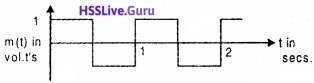
A modulating signal is a square wave as shown below:
Plus Two Physics Communication Systems NCERT Text Book Questions and Answers 1
The carrier wave is given by c (t) = 2 sing (8πt) volts.

  1. Sketch the amplitude modulation wave form.
  2. What is the modulation index?

Answer:
1. amplitude modulation wave form is as shown below:
Plus Two Physics Communication Systems NCERT Text Book Questions and Answers 2

2. µ = 0.5

Plus Two Physics Communication Systems One Mark Questions and Answers

Question 1.
For base station to mobile communication, the required frequency band is
(a) 540 – 1600 kHz
(b) 200 – 325 MHz
(c) 5.9 – 6.42 GHz
(d) 840 – 935 MHz
Answer:
(d) 840 – 935 MHz.

Plus Two Physics Chapter Wise Questions and Answers Chapter 15 Communication Systems

Question 2.
What do you mean by modulation index in AM?
Answer:
It is the ratio of the change in amplitude of the modulated carrier wave to the amplitude of the original carrier wave.

Question 3.
A communication between a fixed base station and several mobile units, located on ships or aircraft utilizing two way radio communication in the VHF and UHF is of frequency band
(a) 3 to 30 MHz
(b) 30 to 300 MHz
(c) 30 to 470 MHz
(d) 30 to 600 MHz
Answer:
(c) 30 to 470 MHz.

Plus Two Physics Chapter Wise Questions and Answers Chapter 15 Communication Systems

Question 4.
Which of the following frequency/frequencies will be suitable for beyond the horizon communication using sky waves?
(a) 10 kHz
(b) 10 MHz
(c) 1 GHz
(d) 1000 GHz
Answer:
(b) 10 MHz.

Question 5.
What are the different types of message signals used in a communication system?
Answer:
The different type of message signals are voice, music, picture and computer data.

Plus Two Physics Chapter Wise Questions and Answers Chapter 15 Communication Systems

Question 6.
What do you mean by modulation index in AM?
Answer:
It is the ratio of the change in amplitude of the modulated carrier wave to the amplitude of the original carrier wave.

Plus Two Physics Communication Systems Two Mark Questions and Answers

Question 1.
Arrange the contents in the table in the most appropriate way.

A B
Low frequency ratio waves Space wave propagation
Television transmission Ground wave propagation
High frequency radio wave Geo stationary satellite
Microwaves Sky wave propagation

Answer:

A B
Low frequency ratio waves Ground wave propagation
Television transmission Space wave propagation
High frequency radio wave Sky wave propagation
Microwaves Geo stationary satellite

Plus Two Physics Chapter Wise Questions and Answers Chapter 15 Communication Systems

Question 2.
What is the modulation index of AM, if the voltage amplitude of the carrier wave is 2kV and side band voltage amplitude is 200V.
Answer:
Plus Two Physics Communication Systems Two mark Questions and Answers 3

Question 3.
100 Hz is an audio frequency. Its wave length is 3000 km. What is the minimum length of the antenna to transmit this wave?
Answer:
C = νλ
3 × 108 = 100 × λ
λ = \(\frac{3 \times 10^{8}}{100}\)m = 3 × 10⁶m
Length of antenna I = \(\frac{\lambda}{4}=\frac{3 \times 10^{6}}{4}\) = 7.5 × 10⁵m.

Plus Two Physics Communication Systems Three Mark Questions and Answers

Question 1.
An expert said that it is necessary to modulate low frequency signals to sent long distances.

  1. What is meant by modulation
  2. What are the different types of modulation

Answer:
1. Modulation is the process of super posing a low frequency (audio signal) information on to a high frequency carrier wave.

2. Three types of modulation using sinusoidal carrier waves

  • Amplitude modulation
  • Frequency modulation
  • Phase modulation

Plus Two Physics Chapter Wise Questions and Answers Chapter 15 Communication Systems

Question 2.
The type of communication system needed fora given signal depends on the band of frequencies in the signal

  1. What are the different types of message signals used in a communication systems. (1)
  2. Match the bandwidth given in Column B with the signal given in Column A.
   Column A Column B
speech signals 6 MHz
Music signals 2.8 kHz
Video signals 20 kHz
TV signal 4.2 MHz

Answer:
1. The different type of message signals are voice, music, picture and computer data.

2.

   Column A Column B
speech signals 2.8 kHz
Music signals 20 kHz
Video signals 4.2 MHz
TV signal 6 MHz

Plus Two Physics Chapter Wise Questions and Answers Chapter 15 Communication Systems

Plus Two Physics Communication Systems Four Mark Questions and Answers

Question 1.
The height of a transmitting antenna is 200m. Radius of earth is 6.4 × 10⁶m
1. Which one of the following is used in TV transmission?

  • Sky wave
  • Space wave
  • Groundwave
  • None of these

2. Find the range upto which the above antenna gives transmission signal.

3. Why is it necessary to use satellite for long distance transmission?
Answer:
1. Space wave

2.
Plus Two Physics Communication Systems Four mark Questions and Answers 4

3. Space waves can not be reflected back by iono sphere. Space wave can be reflected back to earth by making use of artificial satellite.

Plus Two Physics Chapter Wise Questions and Answers Chapter 15 Communication Systems

Question 2.
A radio transmitter, microwave transmitter, and a microwave receivers are placed in a hilly area.

  1. Will the radio receiver in the house get the signal from the radio transmitter? Justify.
  2. In this situation, what are your suggestions for proper communication? Are Microwaves suitable there?

Answer:

  1. Yes. Because wavelength of radio wave is larger than microwave.
  2. To have large coverage, increase the height of antenna or stations. Microwaves are not suitable for this kind of transmission.

Question 3.
The given block diagram shows general form of a communication system.
Plus Two Physics Communication Systems Four mark Questions and Answers 5
1. Identify the parts X and Yin the diagram.
2. What is the difference between

  • transmitter and receiver
  • Attenuation and Amplification

3. Repeaters are used;

  • To decrease the range of a communication system.
  • To increase the range of a communication system
  • Both (i) and (ii)

Answer:
1. X-transmitter, Y-receiver.

2. difference between:

  • A transmitter converts message signal into a form suitable for transmission. A receiver receives the transmitted signal and reconstructs the message signal.
  • The loss of strength of signal while passing through the medium is known as attenuation. The process of increasing the amplitude of a signal is known as amplification.

3. Repeaters are used to increase the range of a communication system.

Plus Two Physics Chapter Wise Questions and Answers Chapter 15 Communication Systems

Question 4.
The given figure shows the various propagation modes of e.m. waves for communication.
Plus Two Physics Communication Systems Four mark Questions and Answers 6

  1. Identify the propagation modes in A, B, C
  2. Why transmission of TV signals via sky wave is not possible?
  3. A radio can tune to any station in 7.5 MHz. to 12 MHz. What is the corresponding wavelength band?

Answer:
1. A – ground wave, B – space wave, and C – sky wave.

2. TV signals are in the range of 100 to 220MHz. Ionosphere cannot reflect these waves.

3. Wave length corresponding to 100 MHz is
Plus Two Physics Communication Systems Four mark Questions and Answers 7
Wavelength corresponding to 220 MHz is
Plus Two Physics Communication Systems Four mark Questions and Answers 8
the wavelength band is 25m to 40m.

Plus Two Physics Chapter Wise Questions and Answers Chapter 15 Communication Systems

Question 5.
To transmit signals in the range 30 – 300 MHz space wave propagation is used

  1. What is meant by space wave propagation?
  2. Why it is called Line of Sight (LOS)?
  3. Derive an expression for area covered by a sig¬nal if height of antenna is h

Answer:

  1. In space wave propagation, wave travels in straight line from transmitting antenna to the receiving antenna.
  2. Because the receiving antenna and transmitting antenna should be in line of sight of wave.
  3. Range of signal from the antenna d = \(\sqrt{2 \mathrm{Rh}}\)

∴ Area A = πd2 = π (\(\sqrt{2 \mathrm{Rh}}\))2
A = π 2Rh.

Plus Two Physics Chapter Wise Questions and Answers Chapter 15 Communication Systems

Question 6.
In the broadcast mode of communication, modulation is necessary.

  1. What do you mean by modulation? (1)
  2. Why modulation is necessary? (2)
  3. What do you mean by modulation index in AM? (1)

Answer:
1. Modulation is the process by which some characteristics, like amplitude, frequency or phase angle of a high frequency carrier wave is varied in accordance with the instantaneous value of the audio signal.

2. Modulation is necessary due to the following reasons.

  • The height of the transmitting antenna should be at least 1/4th of the wave length. So to transmit audio frequency, we need very long antenna.
  • The power radiated by an antenna is inversely proportional to the square of the wavelength. In audio frequency, wavelength is higher.

3. It is the ratio of the change in amplitude of the modulated carrier wave to the amplitude of the original carrier wave.

Plus Two Physics Chapter Wise Questions and Answers Chapter 15 Communication Systems

Question 7.
The given figure shows the frequency spectrum of an amplitude-modulated wave.
Plus Two Physics Communication Systems Four mark Questions and Answers 9

  1. What are the names of (ωc – ωm) and (ωc + ωm). (1)
  2. What is the value of amplitude of (ωc – ωm) if modulation is µ? (1)
  3. What is the modulation index of AM, if the voltage amplitude of the carrier wave is 2kV and side band voltage amplitude is 200V. (2)

Answer:
1. Lower side band frequency and upper side band frequency.

2. Value of the amplitude of the side band frequency is As = \(\frac{\mu A_{c}}{2}\) where Ac is amplitude of carrier.

3.
Plus Two Physics Communication Systems Four mark Questions and Answers 10

Kerala Syllabus 10th Standard Hindi Solutions Unit 5 Chapter 1 बच्चे काम पर जा रहे हैं

Bacche Kaam Par Ja Rahe Question Answer

You can Download बच्चे काम पर जा रहे हैं Questions and Answers, Summary, Activity, Notes, Kerala Syllabus 10th Standard Hindi Solutions Unit 5 Chapter 1 help you to revise complete Syllabus and score more marks in your examinations.

Kerala State Syllabus 10th Standard Hindi Solutions Unit 5 Chapter 1 बच्चे काम पर जा रहे हैं (कविता)

बच्चे काम पर जा रहे हैं Text Book Questions and Answers

बच्चे काम पर जा रहे हैं विश्लेषणात्मक प्रश्न

बच्चे काम पर जा रहे हैं Question Answer प्रश्ना 1.
‘हमारे समय की सबसे भयानक पंक्ति है यह’ ऐसा क्यों कहा गया है?
Kerala Syllabus 10th Standard Hindi Solutions Unit 5 Chapter 1 बच्चे काम पर जा रहे हैं 1
उत्तर:
बच्चों का काम पर जाना भयानक स्थिति है। यह कानूनन अपराध है। फिर भी कई बच्चे रोटी के लिए तरसते हैं। वे अपने परिवार के सदस्यों की भूख मिटाने के लिए काम पर जाते हैं। यह देश की डरावना स्थिति है।

HSSLive.Guru

Bacche Kaam Par Ja Rahe Question Answer प्रश्ना 2.
बातों को सवालों की तरह लिखा जाने से क्या फायदा है?
Kerala Syllabus 10th Standard Hindi Solutions Unit 5 Chapter 1 बच्चे काम पर जा रहे हैं 2
उत्तर:
अकसर हम समस्याओं को विवरण की तरह लिखते हैं, और उस पर चर्चा होती रहती है। कोई हल नहीं निकलता । समस्याओं को सवालों की तरह लिखा जाने से यह फायदा होती है कि उसका जवाब मिल जाता है। समस्या का एक हद तक समाधान होता है।

बच्चे काम पर जा रहे हैं प्रश्न उत्तर प्रश्ना 3.
‘क्या किसी भूकंप में ढह गई हैं सारे मदरसों की इमारतें’ इन पंक्तियों द्वारा कवि क्या कहना चाहते हैं?
Kerala Syllabus 10th Standard Hindi Solutions Unit 5 Chapter 1 बच्चे काम पर जा रहे हैं 3
उत्तर:
प्रस्तुत पंक्तियों से बच्चों की पढ़ाई करने के हक से वंचित होने की बात बताते हैं। यहाँ ‘मदरसों की इमारतें’ पाठशालाएँ है। गरीब बच्चे आज भी पढ़ाई से वंचित रहते है।

बच्चे काम पर जा रहे है प्रश्ना 4.
यह कविता किस सामाजिक समस्या की चर्चा कर रही है?
Kerala Syllabus 10th Standard Hindi Solutions Unit 5 Chapter 1 बच्चे काम पर जा रहे हैं 4
उत्तर:
यह कविता बालश्रम की चर्चा कर रही है। बालश्रम यानी बच्चों से किये जाने वाला कठिन काम आजकल बढ़ता जा रहा है। इसके विरुद्ध समाज को प्रतिक्रिया करनी है। सरकार भी – इस मामले में उचित कारवाई करें तो इस समस्या का एक हद तक हल कर पाएँगे ।

बच्चे काम पर जा रहे हैं Text Book Activities & Answers

अभ्यास के प्रश्न बच्चे काम पर जा रहे हैं

Bacche Kaam Par Ja Rahe Hain प्रश्ना 1.
ये पंक्तियाँ पढ़ें।
(क्या काले पहाड़ के नीचे दब गए हैं सारे खिलौने?)
क्या दीमकों ने खा लिया है
सारी रंग-बिरंगी किताबों को?
इन पंक्तियों से कवि क्या कहना चाहते हैं? चर्चा करें।
Kerala Syllabus 10th Standard Hindi Solutions Unit 5 Chapter 1 बच्चे काम पर जा रहे हैं 5
उत्तर:
कवि यहाँ बच्चों की दुनिया को मनोवैज्ञानिक नज़रिए से पेश करते हैं। बचपन में बच्चों को खिलौने चाहिए। पढ़ने के लिए किताबें चाहिए। खेलने के लिए गेंद चाहिए। पढ़ने के लिए स्कूल चाहिए। खेल के मैदान, बगीचे या आँगन चाहिए। लेकिन यहाँ के बच्चे इन सबसे वंचित हैं। उन्हें मैदान, बगीचे या आँगन में खेलने का मौका नहीं है। खिलौनों से वे वंचित हैं। स्कूल और शिक्षा उनसे बहुत दूर हैं।

10th स्टैंडर्ड प्रश्ना 2.
नमूने के अनुसार लिखे :
Kerala Syllabus 10th Standard Hindi Solutions Unit 5 Chapter 1 बच्चे काम पर जा रहे हैं 6
उत्तर:
Kerala Syllabus 10th Standard Hindi Solutions Unit 5 Chapter 1 बच्चे काम पर जा रहे हैं 7

प्रश्ना 3.
कविता की आस्वादन टिप्पणी तैयार करें।
Kerala Syllabus 10th Standard Hindi Solutions Unit 5 Chapter 1 बच्चे काम पर जा रहे हैं 8
उत्तर:
बाल मजूरी पर तीखा प्रहार करनेवाली कविता – बच्चे काम पर जा रहे हैं
बच्चे काम पर जा रहे हैं श्री राजेश जोशी की कविता है। इसमें कवि ने मनोवैज्ञानिक ढंग से बच्चों की दुनिया पर नज़र डालते हैं। कवि कहते हैं कि बच्चे काम पर जा रहे हैं। वह भी ऐसे समय में जब रास्ता कोहरे से ढका हुआ है। उन्होंने पाठकों से कुछ प्रश्न करते हैं-क्या काले पहाड़ के नीचे दब गए हैं सारे खिलौने?, क्या दीमकों ने खा लिया है | सारी रंग-बिरंगी किताबों को?, क्या अंतरिक्ष में गिर गई है सारी गेदे?, क्या किसी भूकंप में ढह गई है / सारे मदरसों की इमारते? और क्या सारे मैदान, सारे बगीचे और घरों के आँगन खत्म हो गए हैं एकाएक? ये प्रश्न बहुत नुकीले हैं। इन प्रश्नों के माध्यम से कवि कहते हैं कि बचपन खिलौनों से खेलने, किताबों की दुनिया में घूमने, स्कूल में पढ़ाई करने का समय है। ऐसे समय में बच्चों का काम पर जाना बहुत भयानक समस्या है।

कवि प्रश्न करते हैं कि बच्चों के काम पर जाने का कारण क्या है? विश्लेषण करने से हमें मालूम हो जाएगा कि मूल कारण गरीबी है। गरीबी से बचने के लिए बच्चों को भी काम पर जाना पड़ रहा है। अशिक्षित माँ-बाप भी इसका कारण हो सकता है। यह कविता कुछ नुकीले प्रश्न हमारे सामने रखती है। ये प्रश्न हमें बाल मजूरी पर सोचने को विवश करते है।

HSSLive.Guru

प्रश्ना 4.
बच्चे काम पर क्यों जाते होंगे? लिखें।
Kerala Syllabus 10th Standard Hindi Solutions Unit 5 Chapter 1 बच्चे काम पर जा रहे हैं 9
उत्तर:
अकसर ऐसे बच्चों के परिवार गरीब होते हैं। अनपढ़ माँ-बाप ऐसे परिवारों में होते हैं। रोज़ी रोटी के लिए माँ-बाप के साथ बच्चों को भी काम पर जाना पड़ता है।

प्रश्ना 5.
पोस्टर तैयार करें।
अपने बचपन से वंचित कई बच्चे हैं। उनकी मदद करना हमारी भी ज़िम्मेदारी है। बालश्रम के विरुद्ध एक पोस्टर तैयार करे।
Kerala Syllabus 10th Standard Hindi Solutions Unit 5 Chapter 1 बच्चे काम पर जा रहे हैं 10
Kerala Syllabus 10th Standard Hindi Solutions Unit 5 Chapter 1 बच्चे काम पर जा रहे हैं 11
उत्तर:
Kerala Syllabus 10th Standard Hindi Solutions Unit 5 Chapter 1 बच्चे काम पर जा रहे हैं 17

बच्चे काम पर जा रहे हैं Orakkum Questions and Answers

गतिविधि -1

सूचनाः ‘बच्चे काम पर जा रहे हैं’ कविता की पंक्तियाँ पढें और अनुबद्ध प्रश्नों के उत्तर लिखें।
क्या अंतरीक्ष में गिर गई है सारी गेंदें
क्या दीमकों ने खा लिया है
सारी रंग-बिरंगी किताबों को
क्या काले पहाड़ के नीचे दब गए है सारे खिलौने
क्या किसी भूकंप में ढह गई है
सारे मदरसों की इमारतें।

प्रश्ना 1.
क्या दीमकों ने खा लिया है
सारी रंग-बिरंगी किताबों को
– इन पंक्तियों से क्या तात्पर्य है?
उत्तर:
बचपन पढ़ने का समय है। लेकिन काम पर जाने के कारण उन्हें पढ़ने केलिए समय नहीं मिलता हैं।

प्रश्ना 2.
‘क्या अंतरिक्ष में गिर गई हैं सारी गेंदें – इस पंक्ति में गिर गई हैं’ क्रिया रूप किस शब्द के आधार पर हैं? (अंतरिक्ष, क्या, गेंद)
उत्तर:
गेंद

प्रश्ना 3.
क्या काले पहाड़ के नीचे दब गए हैं सारे खिलौने’ – का मतलब क्या है?
खिलौने पहाड के नीचे हैं।
पहाड़ और खिलौने काले हैं।
बच्चे खेलने के अवसर से वंचित हैं।
उत्तर:
बच्चे खेलने के अवसर से वंचित हैं।

HSSLive.Guru

प्रश्ना 4.
इस कविता की आस्वादन टिप्पणी लिखें।
उत्तर:
श्री राजेश जोशी हिंदी के आधुनिक कवियों में प्रमुख हैं। “बच्चे काम पर जा रहे हैं” बालश्रम पर तीखा प्रहार करनेवाली कविता हैं। मनुष्यता को बचाए रखने का एक निरंतर संघर्ष आपकी कविताओं की विशेषता हैं।
कवि कहते हैं – जब सड़क कोहरे से ढका हुआ है तब बच्चे काम पर जा रहे हैं। ये बच्चे खिलौने, किताब, गेंद, स्कूल, खेलने के मैदान इस सब से वंचित है। कवि पाठकों से थोडा प्रश्न पूछते है – क्या सारी गेंद अंतरिक्ष से गिर गई हैं? सारी रंग-बिरंग किताबों को दीमकों ने खा लिया हैं? सारे खिलौने काले पहाड़ के नीचे दब गए हैं? सारे मदरसों की इमारतें भूकंप में ढह गई हैं? इन प्रश्नों द्वारा कवि कहते है कि बचपन उन्हें काम पर जाने का समय नहीं। बच्चों का पढने का समय हैं। बच्चों का काम पर जाना भयानक समस्या है।

कवि पूछते हैं – बच्चे क्यों काम पर जा रहे हैं? इस प्रश्न का उत्तर यह हैं कि माता-पिता। यदि परिवार गरीब हैं और बहुत संकट में हैं, तब माता-पिता को अपने बच्चे को काम पर भेजना पड़ता हैं। जो भी हो आज दुनिया की हज़ारों सडकों से सुबह छोटे-छोटे बच्चे काम पर जा रहे हैं। हम सबको मालूम है कि बच्चे राष्ट्र की अमूल्य निधि है। उसको संपूर्ण सुरक्षा प्रदान करना है। बालश्रमिकों के शोषण की यह परंपरा अनादि काल से चली आ रही हैं और अभी भी समाज में एक मानवीय कलंक के रूप में व्याप्त है। बालश्रम के विरुद्ध हम सब को आवाज़ उठानी है।

प्रश्ना 5.
बालश्रम दुनिया भर में प्याप्त एक दुस्थिति है। बाल मज़दूरी के विरुद्ध एक पोस्टर तैयार करें।
उत्तर:
Kerala Syllabus 10th Standard Hindi Solutions Unit 5 Chapter 1 बच्चे काम पर जा रहे हैं 12

बच्चे काम पर जा रहे हैं Summary in Malayalam and Translation

Kerala Syllabus 10th Standard Hindi Solutions Unit 5 Chapter 1 बच्चे काम पर जा रहे हैं 13
Kerala Syllabus 10th Standard Hindi Solutions Unit 5 Chapter 1 बच्चे काम पर जा रहे हैं 14

HSSLive.Guru

बच्चे काम पर जा रहे हैं शब्दार्थ

Kerala Syllabus 10th Standard Hindi Solutions Unit 5 Chapter 1 बच्चे काम पर जा रहे हैं 15
Kerala Syllabus 10th Standard Hindi Solutions Unit 5 Chapter 1 बच्चे काम पर जा रहे हैं 16

Kerala Syllabus 8th Standard Hindi Solutions Unit 3 Chapter 2 बात उस मंगलवार की

You can Download बात उस मंगलवार की Questions and Answers, Summary, Activity, Notes, Kerala Syllabus 8th Standard Hindi Solutions Unit 3 Chapter 2 help you to revise complete Syllabus and score more marks in your examinations.

Kerala State Syllabus 8th Standard Hindi Solutions Unit 3 Chapter 2 बात उस मंगलवार की (डायरी)

बात उस मंगलवार की पाठ्यपुस्तक के प्रश्न और उत्तर

dr ramani atkuri in hindi प्रश्ना 1.
मेहनत की कमाई का भोजन स्वदिष्ठ क्यों हो जाता है?
Kerala Syllabus 8th Standard Hindi Solutions Unit 3 Chapter 2 बात उस मंगलवार की 1
उत्तर:
श्रम के कारण भूख लगती है। भूख मिटाने के लिए जब खाना खाते हैं, वह अधिक स्वादिष्ठ होता है। बेकार में बैठकर खानेवाले को इसी प्रकार की अनुभूति नहीं होती।

HSSLive.Guru

aapt solutions प्रश्ना 2.
मरीज़ गैर ज़रूरी इंजेक्शन चाहते हैं। क्यों?
Kerala Syllabus 8th Standard Hindi Solutions Unit 3 Chapter 2 बात उस मंगलवार की 2
उत्तर:
बीमारी और इलाज़ के संबंध में बहुत गलतफहमियाँ हैं। आम जनता चाहती है कि इंजेक्शन से बीमारी जल्दी से दूर होती है। यह विचार चिकित्सा के संबंध में उनकी अज्ञता के कारण है।

ibot solutions प्रश्ना 3.
“यहीं जंगल के बीच ये सभी मेरे क्लीनिक हैं।” -इससे आपने क्या समझा?
Kerala Syllabus 8th Standard Hindi Solutions Unit 3 Chapter 2 बात उस मंगलवार की 3
उत्तर:
यहाँ डॉक्टर का मनोभाव प्रकट होता है। यह डॉक्टर चिकित्सा को व्यापार नहीं . मानती है। वे इसे सेवाकार्य मानती है। इसलिए शहर में उनकी अपनी क्लीनिक नहीं है। जंगल के अनपढ़, अशिक्षित, गरीब ही उनके मरीज़ हैं। वे उनके लिए काम – करती हैं।

बात उस मंगलवार की Textbook Activities

Hindi chapter 2 प्रश्ना 1.
डॉ रमणी अटकुरी की चरित्रगत विशेषताएँ लिखें।
Kerala Syllabus 8th Standard Hindi Solutions Unit 3 Chapter 2 बात उस मंगलवार की 4
उत्तर:
रमणी अटकुरी एक ईमानदार डॉक्टर हैं। वे डॉक्टरी को व्यापार मानती नहीं। उनके अनुसार डॉक्टर को समाज की सेवा करनी चाहिए। इस आदर्श को वे अपने जीवन में निभाती है। वह एक आदर्श डॉक्टर हैं।

HSSLive.Guru

kerala pengal प्रश्ना 2.
आपके दृष्टिकोण में एक डॉक्टर के गुण क्या-क्या हैं? टिप्पणी लिखें।
Kerala Syllabus 8th Standard Hindi Solutions Unit 3 Chapter 2 बात उस मंगलवार की 5
उत्तर:
मेरी राय में डॉक्टर को ईमानदार होना चाहिए। अपने पेशे को धन कमाने का उपाय न मानना चाहिए। मरीज़ों के पास जाकर उनकी सेवा-सुश्रूषा करनी चाहिए। मरीज़ों के साथ सहानुभूति पूर्ण व्यवहार अपनाना चाहिए। अपने उत्तरदायित्व को निभाते हुए समाज के लोगों को स्वस्थ रखने के कामों में भाग लेना चाहिए।

प्रश्ना 3.
संवाद लिखें।
Kerala Syllabus 8th Standard Hindi Solutions Unit 3 Chapter 2 बात उस मंगलवार की 13
Kerala Syllabus 8th Standard Hindi Solutions Unit 3 Chapter 2 बात उस मंगलवार की 14
उत्तर:
Kerala Syllabus 8th Standard Hindi Solutions Unit 3 Chapter 2 बात उस मंगलवार की 7

प्रश्ना 4.
संवाद लिखें।
Kerala Syllabus 8th Standard Hindi Solutions Unit 3 Chapter 2 बात उस मंगलवार की 15
उत्तर:
Kerala Syllabus 8th Standard Hindi Solutions Unit 3 Chapter 2 बात उस मंगलवार की 8
Kerala Syllabus 8th Standard Hindi Solutions Unit 3 Chapter 2 बात उस मंगलवार की 9

बात उस मंगलवार की Summary in Malayalam and Translation

Kerala Syllabus 8th Standard Hindi Solutions Unit 3 Chapter 2 बात उस मंगलवार की 10
Kerala Syllabus 8th Standard Hindi Solutions Unit 3 Chapter 2 बात उस मंगलवार की 11

HSSLive.Guru

बात उस मंगलवार की शब्दार्थ Word meanings

Kerala Syllabus 8th Standard Hindi Solutions Unit 3 Chapter 2 बात उस मंगलवार की 12

Adisthana Padavali Malayalam Standard 9 Solutions Unit 3 Chapter 2 Saphalamee Yathra

Students can Download Adisthana Padavali Unit 3 Chapter 2 Saphalamee Yathra Questions and Answers, Summary, Notes Pdf, Activity, Adisthana Padavali Malayalam Standard 9 Solutions helps you to revise the complete Kerala State Syllabus and score more marks in your examinations.

Adisthana Padavali Malayalam Standard 9 Guide Unit 3 Chapter 2 Saphalamee Yathra

Saphalamee Yathra Questions and Answers, Summary, Notes

Adisthana Padavali Malayalam Standard 9 Solutions Unit 3 Chapter 2 Saphalamee Yathra 1

Adisthana Padavali Malayalam Standard 9 Solutions Unit 3 Chapter 2 Saphalamee Yathra 2
Adisthana Padavali Malayalam Standard 9 Solutions Unit 3 Chapter 2 Saphalamee Yathra 3

Adisthana Padavali Malayalam Standard 9 Solutions Unit 3 Chapter 2 Saphalamee Yathra 4
Adisthana Padavali Malayalam Standard 9 Solutions Unit 3 Chapter 2 Saphalamee Yathra 5
Adisthana Padavali Malayalam Standard 9 Solutions Unit 3 Chapter 2 Saphalamee Yathra 6

Adisthana Padavali Malayalam Standard 9 Solutions Unit 3 Chapter 2 Saphalamee Yathra 7
Adisthana Padavali Malayalam Standard 9 Solutions Unit 3 Chapter 2 Saphalamee Yathra 8
Adisthana Padavali Malayalam Standard 9 Solutions Unit 3 Chapter 2 Saphalamee Yathra 9

Adisthana Padavali Malayalam Standard 9 Solutions Unit 3 Chapter 2 Saphalamee Yathra 10
Adisthana Padavali Malayalam Standard 9 Solutions Unit 3 Chapter 2 Saphalamee Yathra 11
Adisthana Padavali Malayalam Standard 9 Solutions Unit 3 Chapter 2 Saphalamee Yathra 12
Adisthana Padavali Malayalam Standard 9 Solutions Unit 3 Chapter 2 Saphalamee Yathra 13
Adisthana Padavali Malayalam Standard 9 Solutions Unit 3 Chapter 2 Saphalamee Yathra 14

Adisthana Padavali Malayalam Standard 9 Solutions Unit 3 Chapter 2 Saphalamee Yathra 15
Adisthana Padavali Malayalam Standard 9 Solutions Unit 3 Chapter 2 Saphalamee Yathra 16
Adisthana Padavali Malayalam Standard 9 Solutions Unit 3 Chapter 2 Saphalamee Yathra 17

Kerala Syllabus 10th Standard Hindi Solutions Unit 3 Chapter 2 ठाकुर का कुआँ

You can Download ठाकुर का कुआँ Questions and Answers, Summary, Activity, Notes, Kerala Syllabus 10th Standard Hindi Solutions Unit 3 Chapter 2 help you to revise complete Syllabus and score more marks in your examinations.

Kerala State Syllabus 10th Standard Hindi Solutions Unit 3 Chapter 2 ठाकुर का कुआँ (कहानी)

ठाकुर का कुआँ Text Book Questions and Answers

ठाकुर का कुआँ विश्लेषणात्मक प्रश्न

Thakur Ka Kuan Questions and Answers in Hindi प्रश्ना 1.
‘ठाकुर के कुएँ पर कौन चढ़ने देगा?’ -गंगी क्यों इस प्रकार सोचती है?
Kerala Syllabus 10th Standard Hindi Solutions Unit 3 Chapter 2 ठाकुर का कुआँ 1
उत्तर:
यहाँ जाति-पाँति की ओर संकेत है। जाति-पाँति एक विकट समस्या है। जाति-पाँति के कारण कुछ लोगों को अछूत समझे जाते हैं। ठाकुर ऊँची जाति के हैं। निम्न जाति के लोगों को उनके कुएँ से पानी भरने की अनुमति नहीं थी। जाति के कारण उत्पन्न गंगी की विवशता यहाँ स्पष्ट होती है।

Thakur Ka Kuan Questions and Answers प्रश्ना 2.
‘मैदानी बहादुरी का तो अब न ज़माना रहा है न मौका। कानूनी बहादुरी की बातें हो रही हैं।’ -इसका मतलब है?
Kerala Syllabus 10th Standard Hindi Solutions Unit 3 Chapter 2 ठाकुर का कुआँ 2
उत्तर:
पहले शारीरिक शक्ति के बल पर समाज के ऊँचे लोग अपना कार्य किया करते थे। लेकिन अब वे सिफारिश के बल पर कानून को अपने अनुकूल बना लेते हैं। कानूनमुकदमे के ज़रिए गरीबों को परास्त करते हैं। यही इस कथन का मतलब है।

ठाकुर का कुआँ Summary in Hindi प्रश्ना 3.
‘गंगी दबे पाँव कुएँ की जगत पर चढ़ी, विजय का ऐसा अनुभव उसे पहले न हुआ था।’ – गंगी को ऐसा अनुभव क्यों हुआ होगा?
Kerala Syllabus 10th Standard Hindi Solutions Unit 3 Chapter 2 ठाकुर का कुआँ 3
उत्तर:
गंगी का मन सामाजिक रीति-रिवाज़ों के विरुद्ध संघर्ष करनेवाला है। चुपके से सही, वह उच्च वर्ग के लोगों को परास्त करना चाहती है। शुद्ध पानी की ज़रूरत अब उसकी विवशता है। अब सारी बाधाओं को तोड़कर वह पानी भरने जा रही है। उसके विचार में यह उच्च वर्ग के लोगों के ऊपर उसका विजय है।

HSSLive.Guru

प्रश्ना 4.
‘शेर का मुँह इससे भयानक न होगा’ -यहाँ ठाकुर के दरवाज़े की तुलना शेर के मुँह से क्यों की गई है?
Kerala Syllabus 10th Standard Hindi Solutions Unit 3 Chapter 2 ठाकुर का कुआँ 4
उत्तर:
शेर एक खूखार जानवर है। इसके मुँह के सामने पड़नेवालों को बचने की उम्मीद नहीं। इसी प्रकार ठाकुर का घर भी गंगी जैसे लोगों के लिए डरावना जगह है। ठाकुर के सामने पड़ने पर बचना मुश्किल है। इसलिए ऐसी तुलना की गई है।

ठाकुर का कुआँ Text Book Activities & Answers

ठाकुर का कुआँ अभ्यास के प्रश्न

प्रश्ना 5.
ये प्रसंग देखें
i. गंगी क्या जवाब देती, किंतु वह बदबूदार पानी पीने को न दिया।
Kerala Syllabus 10th Standard Hindi Solutions Unit 3 Chapter 2 ठाकुर का कुआँ 5
ii. उसने घटा और रस्सी उठा ली और झुककर चलती हुई एक वृक्ष के अंधेरे छाए में जा खड़ी हुई।
Kerala Syllabus 10th Standard Hindi Solutions Unit 3 Chapter 2 ठाकुर का कुआँ 6
iii. ठाकुर ‘कौन है, कौन है?’ पुकारते हुए कुएँ की तरफ़ आ रहे थे और गंगी जगत से कूदकर भागी जा रही थी।’
Kerala Syllabus 10th Standard Hindi Solutions Unit 3 Chapter 2 ठाकुर का कुआँ 7
iv. इन व्यवहारों से गंगी के कौन-कौन से मनोभाव प्रकट होते हैं?
Kerala Syllabus 10th Standard Hindi Solutions Unit 3 Chapter 2 ठाकुर का कुआँ 8
उत्तर:

व्यवहार व्यवहार
1. गंगी क्या जवाब देती, किंतु वह बदबूदारपानी पीने को न दिया। 1. विवशता में भी पति के स्वास्थ्य को सहीरखने का मनोभाव।
2. उसने घटा और रस्सी उठा ली और झुककर चलती हुई एक वृक्ष के अंधेरे छाए में जा खड़ी हुई। 2. सामाजिक पाबंदियों को तोडकर पति की ज़रूरत को निभाने का मनोभाव।
3. ठाकुर ‘कौन है, कौन है?’ पुकारते हुए कुएँ की तरफ़ आ रहे थे और गंगी जगत से कूदकर भागी जा रही थी।’ 3. मन में सामाजिक कुरीतियों के प्रति विद्रोह होने पर भी परिस्थितियों में असहाय होने की भावना।

प्रेमचंद की कहानी ठाकुर का कुआँ का सारांश प्रश्ना 6.
गंगी के ये विचार पढ़ें।
Kerala Syllabus 10th Standard Hindi Solutions Unit 3 Chapter 2 ठाकुर का कुआँ 9
i. ठाकुर के कुएँ पर कौन चढ़ने देगा? दूर से लोग डॉट बताएँगे।
Kerala Syllabus 10th Standard Hindi Solutions Unit 3 Chapter 2 ठाकुर का कुआँ 10
ii. हम क्यों नीच है और ये लोग क्यों ऊँच है? इसलिए कि ये गले में ताग डाल देते हैं। यहाँ तो जितने हैं एक-से-एक छंटे हैं।
Kerala Syllabus 10th Standard Hindi Solutions Unit 3 Chapter 2 ठाकुर का कुआँ 11
iii. इन विचारों में गंगी के कौन-कौन से दृष्टिकोण प्रकट होते हैं?
Kerala Syllabus 10th Standard Hindi Solutions Unit 3 Chapter 2 ठाकुर का कुआँ 12
उत्तर:

विचार दृष्टिकोण
1. ठाकुर के कुएँ पर कौन चढ़ने देगा? दूर से लोग डाँट बताएँगे। 1. सामाजिक पाबंदियों के विरुद्ध विद्रोह एवं अपनी विवशता।
2. कितनी होशियारी से ठाकुर ने थानेदार को एक खास मुकदमे में रिश्वत दी और साफ निकल आए। कितनी अक्लमंदी से एक मार्के की मुकदमे की नकल ले आए।  2. यह दृष्टिकोण कि कानूनी व्यवस्था उच्च कहे जानेवाले लोगों के अनुकूल काम करती हैं।
3. हम क्यों नीच है और ये लोग क्यों ऊँच है? इसलिए कि ये गले में ताग डाल देते |  यहाँ तो जितने हैं एक-से-एक छंटे हैं। 3. उँच-नीच की भावनाओं को तोड़कर एक मन से काम करने से ही सामाजिक उन्नति संभव है।

ठाकुर का कुआँ विधात्मक प्रश्न

Thakur Ka Kuan प्रश्ना 1.
गंगी के चरित्र पर टिप्पणी लिखें।
Kerala Syllabus 10th Standard Hindi Solutions Unit 3 Chapter 2 ठाकुर का कुआँ 13
उत्तर:
गंगी : रिवाज़ी पाबंदियों पर विद्रोह की आवाज़
गंगी प्रेमचंद की की विख्यात कहानी ‘ठाकुर का कुआँ’ की पात्र है। वह एक साधारण गृहिणी है। गरीब परिवार की सदस्या है। जाति से निम्न वर्ग की है। वह कई प्रकार की सामाजिक कुरीतियों की शिकार है। पति बीमार है। वह पानी के लिए तरसता है। लेकिन पीने के लिए केवल बदबूदार पानी है। यह पानी पिलाने को गंगी तैयार नहीं है। वह सारी पाबंदियों को तोड़कर, ठाकुर के कुएँ से पानी भर लाने का साहस करती है। रात के अंधेरे में वह पानी लेने जाती है। उसकी चिंताएँ उसके मन के विद्रोह को व्यक्त करी हैं। अंत में वह कुएँ के जगत तक आ जाती है। उस समय उसका मन एक विजेता जैसा अनुभव करता है। लेकिन
परिस्थितियाँ उलटती हैं, ठाकुर जग जाते हैं और गंगी को विवश भागना पड़ता है। गंगी एक ही समय परिस्थितियों से विवश औरत, विद्रोह मन रखनेवाली नारी एवं षांत के प्रति प्यार रखनेवाली गृहिणी आदि का प्रतिनिधित्व करती है।

HSSLive.Guru

Thakur Ka Kuan Summary in Hindi प्रश्ना 2.
‘जाति प्रथा एक अभिशाप है’ – विषय पर आलेख तैयार करें और संगोष्ठी चलाएँ।
Kerala Syllabus 10th Standard Hindi Solutions Unit 3 Chapter 2 ठाकुर का कुआँ 14
उत्तर:
जाति प्रथा : एक सामाजिक अभिशाप
जाति प्रथा समाज की एक विकट समस्या है। इसके कारण समाज में असमानता,एकाधिकार, विद्वेष आदि दोष उत्पन्न हो जाते हैं। जाति प्रथा की सबसे बड़ा दोष छुआछूत की भावना है। इसके कारण संकीर्णता की भावना का प्रसार होता है और सामाजिक राष्ट्रीय एकता में बाधा आती है।

जाति के नाम पर निम्न वर्ग के लोगों को कई प्रकार की यातनाएँ सहनी पड़ती हैं। उन्हें अपनी जिंदगी स्वतंत्र रूप से जीने में बाधा होती है। आम जगहों को इस्तेमाल करने से उनके लिए पाबंदी है। निम्न वर्ग के लोगों से छुआ पानी पीना, उनका बना भोजन खाना, रास्ते में दूसरों के सामने पड़ना आदि बातों को बुरा समझा जाता है।

कई लोगों ने जाति प्रथा को समाप्त करने की बात की। भारत संविधान में जाति के आधार पर अवसर में भेदभाव करने पर रोक भी लगाई है। पिछली कई सदियों से पिछड़ी रही कई जातियों के उत्थान के लिए आरक्षण की व्यवस्था की गई। निम्न वर्ग के लोगों को इससे कई फायदा हुए। लेकिन जहाँ जाति व्यवस्था कायम है वहाँ नीच जाति वालों को एक तरह से आरक्षण के नाम पर उनकी नीचता की याद दिलाई जा रही है। असल में आरक्षण जहाँ पिछड़ी जातियों को अवसर दे रहा है, वहीं वे उन्हें ये एहसास भी याद करवाता है कि वे उपेक्षित हैं।

कानूनी रोकथाम, शिक्षा में हुई उन्नति आदि के कारण इस कट्टरपन में थोड़ी सी कमी ज़रूर आई। लेकिन जाति प्रथा नए रूपों में वर्तमान है। विश्वविद्यालयों, शासक वर्गों, राजनीतिज्ञों आदि के बीच आज भी यह नए-नए रूप धरकर मौजूद है। अगर हम इसे सफल रूप से रोक न पाएँ तो हमारी सामाजिक उन्नति संभव नहीं होगी।

ठाकुर का कुआँ Orakkum Questions and Answers

गतिविधि -1

सुचनाः कहानी का यह अंश पढ़े और अनुबद्ध प्रश्नों के उत्तर लिखें।
गंगी ने क्षणिक सुख को साँस ली। किसी तरह मैदान तो साफ हुआ। अमृत चुरा लाने के लिए जो राजकुमार किसी ज़माने में गया था, वह भी शायद इतनी सावधानी के साथ और समझ-बूझकर न गया हो। गंगी दबे पाँव कुएँ की जगत पर चढ़ी, विजय का ऐसा अनुभव उसे पहले न हुआ था।

Thakur Ki Kahani प्रश्ना 1.
यहाँ गंगी का मानसिक विजय किसके ऊपर है?
उत्तर:
जाति – प्रथा

प्रश्ना 2.
‘जाति प्रथा एक अभिशाप हैं – विषय पर संगोष्ठी होनेवाला हैं। इस केलिए एक पोस्टर तैयार करें।
उत्तर:
Kerala Syllabus 10th Standard Hindi Solutions Unit 3 Chapter 2 ठाकुर का कुआँ 15

ठाकुर का कुआँ SCERT Questions and Answers

गतिविधि -1

सूचना : ‘ठाकूर का कुआँ’ कहानी का यह अंश पढें और अनुबद्ध प्रश्नों के उत्तर लिखें।
उसने रस्सी का फंदा घडे में डाला। दाएँ-बाएँ चौकन्निदृष्टि से देखा जैसे कोई सिपाही रात को शत्र के किले में सुराख कर रहा हो। अगर इस समय वह पकड़ ली गई, तो फिर
उसके लिए माफी या रियायत की रात्री भर उम्मीद नहीं।

केरल में जाति प्रथा प्रश्ना 1.
गंगी की सावधानी को प्रकट करनेवाले वाक्य चुनकर लिखें।
उत्तर:
दाँए-बाएँ चौकन्नि दृष्टि से देखा जैसे कोई सिपाही रात को शत्रु के किले में सुराख कर रहा हो।

HSSLive.Guru

Thakur Ka Kuwa प्रश्ना 2.
गंगी के चरित्र पर टिप्पणी लिखें।
उत्तर:
गंगी
गंगी प्रेमचंद की कहानी ‘ठाकूर का कुआँ’ का प्रमुख पात्र हैं। वह जाति – प्रथा से त्रस्त समाज की प्रतिनिधि हैं। कहानी के आंरभ में वह पति को पीने का पानी देती हैं। लेकिन पानी पीने का योग्य नहीं था, उस में सख् बदबू थी। दूर के कुएँ से वह रोज़ शाम को पानी भर लाती थी। कल वह पानी लाई थी तो उस में बदबुन थी। पति जोखू बीमार था वह प्यास रोक न सकने पर खराब पानी पीने को तैयार हो गया। लेकिन गंगी न पानी देती। वह जानती थी कि खराब पानी पीने से पति का बीमार पढ़ जाएगा। जाति-प्रथा ज़ोरों में था। निम्न जाति होने के कारण ठाकुर या साहूकार के कुएँ से वह पानी न भर सकती। जाति प्रथा के बारे में सोचते समय हम गंगी में एक विद्रोही का मन देखते हैं। उसकी शंका यह थी कि वह क्यों नीच हैं? और ये लोग क्यों ऊँचे हैं? कहते है जाति से ऊँच पर निम्न बातें करते हैं। ऐसे सोचकर बडी सावधानी से कुएँ की और चली। देवताओं को याद करके उसने घड़ा कुएँ में डाला। घड़े को पकड़कर जगत पर रखने वह झुकी कि एकाएक ठाकुर का दरवाज़ा खुल गया। गंगी का धैर्य टूट गया और उसके हाथ से रस्सी टूट गयी। रस्सी के साथ घडा पानी में गिर गया। कौन है कौन है पुकारते ठाकुर कुएँ की ओर आने लगे। इसी समय गंगी जगत से कूदकर भागी। इस प्रकार पति के स्वास्थ्य के बारे में सोचनेवाली धीर और जाति-प्रथा को घृणा करनेवानी नारी है – गंगी।

गतिविधि – 2

सूचना : ‘ठाकुर का कुआँ’ कहानी का यह अंश पढ़े और अनुबद्ध प्रश्नों के उत्तर लिखें।
बोली – “यह पानी कैसे पिओगे? न जाने कौन जानवर मरा हैं। कुएँ से मैं दूसरा पानी लाए देती हूँ।”
जोखू ने आश्चर्य से उसकी ओर देखा – “पानी कहाँ से लाएगी?”
“ठाकुर और साहू के दो कुएँ तो हैं। क्या एक लोटा पानी न भरने देंगे?”
“हाथ-पाँव तुड़वा आएगी और कुछ न होगा।”

प्रश्ना 1.
‘गंगी’ के बदले ‘जोखू’ का प्रयोग करके वाक्य बदलकर लिखें।
गंगी पानी लाएगी।
उत्तर:
जोखू पानी लाएगा।

प्रश्ना 2.
‘हाथ-पाँव तुड़वा आएगी और कुछ न होगा।’ इस कथन पर आपका विचार क्या हैं?
उत्तर:
जाति प्रथा एक अभिशाप हैं। ऊँच जाति निम्न जाति से कई प्रकार के क्रूर व्यवहार करते हैं। निम्न जाति ऊँच जाति के कुएँ से पानी लेना मना हैं।

प्रश्ना 3.
कहानी के अंश के आधार पर पटकथा का एक दृश्य लिखें।
उत्तर:
Kerala Syllabus 10th Standard Hindi Solutions Unit 3 Chapter 2 ठाकुर का कुआँ 16

गतिविधि – 3

सूचना : ‘ठाकुर का कुआँ’ कहानी का यह अंश पढ़े और अनुबद्ध प्रश्नों के उत्तर लिखें।
गंगी के हाथ से रस्सी छूट गई। रस्सी के साथ घडा धड़ाम से पानी में गिरा और कई क्षण तक पानी में हिलकोरें की आवाजें सुनाई देती रही। ठाकुर ‘कौन है, कौन है?’ पुकारते हुए कुएँ की तरफ आ रहे थे और गंगी जगत से कूदकर भागी जा रही थी। घर पहुँचकर देखा कि जोखू लोटा मुँह से लगाए वही मैला – गंदा पानी पी रहा है।

प्रश्ना 1.
मान लें, भागी आई गंगी ने देखा कि जोखू लोटे का गंदा पानी पी रहा हैं। इस प्रसंग पर दोनों के बीच का संभावित वार्तालप लिखें।
उत्तर:
गंगी : अरे यह आप क्या कर रहे हैं?
जोखू : आ गयी! घडे भर पानी मिला?
गंगी : नहीं
जोखू : मैं ने पहले ही बताया है न? मुझे मालूम था कि नहीं मिलेगा।
गंगी : कुएँ के पास कोई नहीं था। इसलिए सीधे वहाँ पहुँची। पर
जोखू : क्या हुआ?
गंगी : दो लौडियाँ पानी भरने आई। उनके चले जाने तक वृक्ष की छाया में जा खडी हुई।
जोखू : उन्होने तुझे देखा क्या?
गंगी : वे चले जाने के बाद कुएँ के जगह मैं पहूँची। ठाकुर दरवाज़ा बंद करने के बाद पानी भरा और घड़े को पकड़कर जगत पर रखा। तब ठाकुर का दरवाज़ा खुल गया।
जोख : त ने क्या किया?
गंगी : भय से हाथ से रस्सी छूट गयी। रस्सी के साथ घडा धड़ाम से पानी में गिरा। पानी में हिलकोरे की आवाज़ सुनकर ठाकुर कौन है – कौन है पुकारते आये।”
जोखू : फिर!
गंगी : तब मैं जगत से कूदकर भागी।
जोखू : हमें शुद्ध पानी पीने का अवकाश नहीं।

HSSLive.Guru

प्रश्ना 2.
‘गंगी जगत से कूदकर भागी जा रही थी।’ – इस में भागी जा रही थी’ क्रिया का सीधा संबंध वाक्य के किस शब्द से है? (जगत, गंगी, कूदकर)
उत्तर:
गंगी।

प्रश्ना 3.
‘गिरा’ क्रिया के स्थान पर कोष्ठक के किस रूप रखकर सही वाक्य बना सकता हैं?
उत्तर:
घड़ा धड़ाम से पानी में गिरा। उः घड़ा धड़ाम से पानी में गिरेगा।

गतिविधि – 4

प्रश्ना 1.
संबंध पहचानें, सही मिलान करें।

उसने गला मज़बूत किया ।  कि हम ऊँचे हैं, हम ऊँचे।
गली-गली चिल्लाते नहीं तो उसमें बू बिलकुल न थी।
किसीके लिए रोक नहीं | और घड़ा कएँ में डाल दिया।
कल वह पानी लाई। सिर्फ यह बदनसीब नहीं भर सकते।

उत्तर:

उसने गला मज़बूत किया । और घड़ा कुएँ में डाल दिया।
गली-गली चिल्लाते नहीं  कि हम ऊँचे हैं, हम ऊँचे।
किसीके लिए रोक नहीं | सिर्फ यह बदनसीब नहीं भर सकते।
कल वह पानी लाई। तो उसमें बू बिलकुल न थी।।

प्रश्ना 2.
संबंध पहचानें, सही मिलान करें।

स्त्री “यह पानी कैसे पिओगे?”
गंगी। ‘कौन है, कौन है?”
ठाकुर  “पानी कहाँ से लाएगी?”
जोखू । “मत लजाओ दीदी।”

उत्तर:

स्त्री “मत लजाओ दीदी।”
गंगी।  “यह पानी कैसे पिओगे?
ठाकुर “कौन है, कौन है?”
जोखू ।  “पानी कहाँ से लाएगी”?

ठाकुर का कुआँ Additional Questions and Answers

ठाकुर का कुआँ आशयग्रहण के प्रश्न

प्रश्ना 1.
‘कुआँ दूर था। बार-बार जाना मुश्किल था।’ यहाँ गंगी की कौन-सी विवशता प्रकट होती है?
Kerala Syllabus 10th Standard Hindi Solutions Unit 3 Chapter 2 ठाकुर का कुआँ 17
उत्तर:
यहाँ गंगी की गरीबी का चित्र उभर आता है। गरीबी के कारण उन्हें अपना कुआँ नहीं है। गाँव के अन्य दो ही कुओं से पानी लेना पड़ता है। वे कुएँ घर से बहुत दूर भी थे।

प्रश्ना 2.
‘खराब पानी से बीमारी बढ़ जाएगी, इतना जानती थी। परंतु यह न जानती थी कि पानी को उबाल लेने से उसकी खराबी जाती रहती है।’ -इससे कौन-सी सामाजिक वास्तविकता प्रकट होती है?
Kerala Syllabus 10th Standard Hindi Solutions Unit 3 Chapter 2 ठाकुर का कुआँ 18
उत्तर:
यहाँ गंगी की अशिक्षा का संकेत है। निम्न और गरीब लोग शिक्षा से भी वंचित रह जाते हैं। इसलिए उनमें अनजानी, अंधविश्वास आदि भी देखे जाते हैं। यह सामाजिक वास्तविकता यहाँ प्रकट होती है।

प्रश्ना 3.
‘ब्राह्मण देवता आशीर्वाद देंगे, ठाकूर लाठी मारेंगे, साहूजी एक के पाँच लेंगे। गरीबों का दर्द कौन समझता है?’ -जोखू के इस कथन का मतलब क्या है?
Kerala Syllabus 10th Standard Hindi Solutions Unit 3 Chapter 2 ठाकुर का कुआँ 19
उत्तर:
समाज में गरीब लोग सभी प्रकार के शोषण के शिकार है। चाहे ब्राह्मण हो, ठाकुर हो, साहुकार हो सब गरीबों को लुटा रहे हैं। गरीबों के दुख-दर्द को समझनेवाले कोई नहीं है। कोई सहायता देनेवाले भी नहीं हैं। ये सारी बातें जोखू के कथन से स्पष्ट होती हैं।

HSSLive.Guru

प्रश्ना 4.
‘गंगी का विद्रोही दिल रिवाज़ी पाबंदियों और मज़बूरियों पर चोटें करने लगा।’ -यहाँ प्रस्तुत रिवाज़ी पाबंदी और मज़बूरी क्या-क्या हैं?
Kerala Syllabus 10th Standard Hindi Solutions Unit 3 Chapter 2 ठाकुर का कुआँ 20
उत्तर:
जाति के नाम पर समाज में बड़ा अलगाव था। निम्न कहे जानेवाले लोगों से छुआ पानी पीना, भोजन खाना, कुएँ से पानी भरना, रास्ते में उनसे मिलना आदि बातों में पाबंदी थी। निम्न वर्ग के लोग ये सब सहकर जीने को विवश थे। उच्च वर्ग के लोगों के हितानुसार अपनी ज़िंदगी की प्राथमिकताओं को तय करने के लिए भी वे विवश थे।

प्रश्ना 5.
Kerala Syllabus 10th Standard Hindi Solutions Unit 3 Chapter 2 ठाकुर का कुआँ 21
उत्तर:
ये लोग ऊँचे क्यों हैं? चोरी ये करते हैं, जाल-फ़रेब ये करें, जूठे मुकदमे ये करें। साहुजी मिलावाट के सामान बेचते हैं। बारहों मास जुआ ये खेलते हैं। काम पर मजूरी नहीं देते हैं। गरीब नारियों को रस भरी आँखों से देखते हैं।

प्रश्ना 6.
‘हम लोगों को आराम से बैठे देखकर जैसे मरदों को जलन होती है।’ -यहाँ किस सामाजिक स्थिति की ओर संकेत है?
Kerala Syllabus 10th Standard Hindi Solutions Unit 3 Chapter 2 ठाकुर का कुआँ 22
उत्तर:
यह एक अलिखित कानून है कि औरतें घरेलू काम के लिए हैं। खाना बनाना, बर्तन मांजना, पानी भरना, कपड़ा धोना, बच्चों को पालना आदि बातों में उनकी जिंदगी फँसी रहती हैं। अगर कभी इसमें कोई चूक होती है तो पिटने तक नौबत आती है। मर्द चाहे आराम करें, लेकिन औरतों को आराम करने का हक नहीं है। यह विकट स्थिति यहाँ व्यक्त होती है।

ठाकुर का कुआँ Summary in Malayalam and Translation

Kerala Syllabus 10th Standard Hindi Solutions Unit 3 Chapter 2 ठाकुर का कुआँ 23
Kerala Syllabus 10th Standard Hindi Solutions Unit 3 Chapter 2 ठाकुर का कुआँ 24
Kerala Syllabus 10th Standard Hindi Solutions Unit 3 Chapter 2 ठाकुर का कुआँ 25
Kerala Syllabus 10th Standard Hindi Solutions Unit 3 Chapter 2 ठाकुर का कुआँ 26
Kerala Syllabus 10th Standard Hindi Solutions Unit 3 Chapter 2 ठाकुर का कुआँ 27
Kerala Syllabus 10th Standard Hindi Solutions Unit 3 Chapter 2 ठाकुर का कुआँ 28
Kerala Syllabus 10th Standard Hindi Solutions Unit 3 Chapter 2 ठाकुर का कुआँ 29
Kerala Syllabus 10th Standard Hindi Solutions Unit 3 Chapter 2 ठाकुर का कुआँ 30

ठाकुर का कुआँ शब्दार्थ

Kerala Syllabus 10th Standard Hindi Solutions Unit 3 Chapter 2 ठाकुर का कुआँ 31
Kerala Syllabus 10th Standard Hindi Solutions Unit 3 Chapter 2 ठाकुर का कुआँ 32
Kerala Syllabus 10th Standard Hindi Solutions Unit 3 Chapter 2 ठाकुर का कुआँ 33

Plus Two Computer Science Chapter Wise Questions and Answers Chapter 11 Advances in Computing

Students can Download Chapter 11 Advances in Computing Questions and Answers, Plus Two Computer Science Chapter Wise Questions and Answers helps you to revise the complete Kerala State Syllabus and score more marks in your examinations

Kerala Plus Two Computer Science Chapter Wise Questions and Answers Chapter 11 Advances in Computing

Plus Two Computer Science Advances in Computing One Mark Questions and Answers

Question 1.
Which among the following are true regarding distributed computing?
i) Different parts of a program are run simultaneously on two or more computers.
ii) Distributed systems fail even if one node fails to function.
iii) A lot of extra programming is required to set up a distributed system.
iv) All the different processors share memory.
(a) i & ii are correct
(b) iii & iv are correct
(c) i & iii are correct
(d) ii & iv are correct
Answer:
(c) i & iii are correct

Question 2.
______ computing provides users access to computational power just like electricity through wall sockets.
(a) Parallel
(b) Grid
(c) Cluster
(d) Serial
Answer:
(b) Grid

Question 3.
A pattern or a model in the study of any subject of complexity is called ______.
Answer:
paradigm

Question 4.
____ is a method of computing in which large problems can be divided into smaller ones and this smaller one are distributed among several computers.
Answer:
distributed computing.

Plus Two Computer Science Chapter Wise Questions and Answers Chapter 11 Advances in Computing

Question 5.
_____ is the advantage of distributed computing where we can add computers according to the workload.
Answer:
Scalability.

Question 6.
Multiple processors are used in _____ computing
(a) serial
(b) parallel
(c) standalone
(d) none of these
Answer:
(b) parallel

Question 7.
Single processor is used in _____ computing.
(a) serial
(b) parallel
(c) standalone
(d) none of these
Answer:
(a) serial

Question 8.
One instruction is executed on a single processor at any moment in _____ computing.
Answer:
Serial.

Question 9.
More than one instruction is executed on multiple processors at any moment of time in _____ computing.
Answer:
Parallel.

Question 10.
_____ is the fastest supercomputer used by Indian Institute of Tropical meteorology
Answer:
ADITYA

Question 11.
______ computing uses millions of computers and in which computational power(resources, services, data) is readily available like electric power.
Answer:
Grid computing.

Plus Two Computer Science Chapter Wise Questions and Answers Chapter 11 Advances in Computing

Question 12.
Here a group of Internet-connected computers, storage devices, etc are linked together and work like a single computer. Which is this computing
Answer:
Cluster computing

Question 13.
It is an emerging computing technology. Herewith the use of Internet and central remote servers to maintain data and applications. Name this computing
Answer:
Cloud computing.

Question 14.
From the following which is not the cloud service model
(a) SaaS
(b) PaaS
(c) laaS
(d) NaaS
Answer:
(d) NaaS

Question 15.
SaaS stands for _____.
Answer:
Software as a Service

Question 16.
PaaS stands for _____.
Answer:
Platform as a Service.

Question 17.
laaS stands for _____.
Answer:
Infrastructure as a Service.

Question 18.
Expand LAMP
Answer:
Linux, Apache Server, MySQL, and PHP.

Question 19.
Al stands for _____.
Answer:
Artificial Intelligence

Plus Two Computer Science Chapter Wise Questions and Answers Chapter 11 Advances in Computing

Question 20.
The first definition of Artificial Intelligence was established by _______.
Answer:
Alan Turing.

Question 21.
Al was first coined by ______ in 1956.
Answer:
John MacCarthy

Question 22.
With the help of _____ computer can solve the tasks such as playing chess, proving mathematical theorems, natural language processing, medical diagnosis, etc.
Answer:
Artificial Intelligence.

Question 23.
____ is a test of a machine’s ability to exhibit intelligent behaviour equivalent to, or indistinguishable from, that of a human.
Answer:
Turing Test.

Question 24.
NLP stands for _____.
Answer:
Natural Language Processor.

Question 25.
ASR stands for _____.
Answer:
Automatic Speech Recognition

Question 26.
OCR stands for
Answer:
Optical Character Recognition

Question. 27
HCR stands for _____.
Answer:
Handwritten Character Recognition.

Question. 28
GIS stands for ______.
Answer:
Geographical Information System.

Question. 29
CAD stands for ______.
Answer:
Computer-Aided Design

Question. 30
Which of the following is not a distributed computing paradigm?
(a) grid
(b) cloud
(c) cluster
(d) serial
Answer:
(d) serial

Plus Two Computer Science Chapter Wise Questions and Answers Chapter 11 Advances in Computing

Question. 31
The study of control and communication between man and machine is called _____.
Answer:
Cybernetics

Question. 32
In Artificial Intelligence, ANN stands for
(a) Artificial Network of Neural.
(b) Advanced Neural Network
(c) Artificial Neural Network
(d) Architectural Neural Network
Answer:
(c) Artificial Neural Network

Question 33.
Which among the following is the capability that is required by a computer to pass Turing Test?
i. Natural Language Processing (NLP)
ii. Knowledge representation
iii. Machine learning
iv. Computer Vision
(a) i & ii only
(b) i.ii & iii only
(c) iii & iv only
(d) All of the above
Answer:
(d) All of the above

Plus Two Computer Science Advances in Computing Two Mark Questions and Answers

Question 1.
Differentiate the terms intelligence and wisdom.
Answer:
The ability to draw useful inferences from the available knowledge is generally referred as intelligence. Wisdom is the maturity of mind that directs its intelligence to achieve desirable goals.

Plus Two Computer Science Chapter Wise Questions and Answers Chapter 11 Advances in Computing

Question 2.
Find the suitable match.
Plus Two Computer Science Chapter Wise Questions and Answers Chapter 11 Advances in Computing img1
Answer:
1 – c
2 – d
3 – b
4 – a

Question 3.
Find the suitable match.
Plus Two Computer Science Chapter Wise Questions and Answers Chapter 11 Advances in Computing img2
Answer:
1 – b
2 – c
3 – d
4 – a

Question 4.
Classify the following as SaaS, PaaS, and laaS. Adobe Creative Cloud. Google App Engine, Microsoft Office 365, Amazon Web Services.
Answer:

  • SaaS: Adobe Creative Cloud, Microsoft Office 365
  • PaaS: Google App Engine
  • laaS: Amazon Web Services

Plus Two Computer Science Chapter Wise Questions and Answers Chapter 11 Advances in Computing

Question 5.
Question Text:
Pick the odd one out. The services of cloud computing include:
(a) Software as a Service
(b) Hardware as a Service
(c) Platform as a Service
(d) Infrastructure as a Service
Answer:
(b) Hardware as a Service. The others are cloud computing paradigm

Question 6.
Question Text:
State whether the following statements are true or false.

  1. Clusters provide computational power through parallel processing.
  2. Even if anyone of the computers fails, cluster computing as a whole will work.

Answer:

  1. True
  2. True

Question 7.
The following organisations plan to buy cloud computing service for their IT requirements. Suggest the cloud computing model that suits their need.

  1. Hari & Co. requires spreadsheets and presentation software.
  2. Tomy & Co. requires to install their own software for their accounting needs in a LAMP platform.
  3. Raju & Co. requires to use MySQL for their database needs.
  4. Joy & Co. requires 1 TB hard disk space, 2 GB RAM and processing power.

Answer:

  1. SaaS
  2. PaaS
  3. SaaS
  4. laaS

Question 8.
Consider the following statements about distributed computing and state True/False.
1. In distributed computing, parts of a program are run simultaneously from two or more computers which are communicating with each other.
2. WWW is an example for large distributed computing.
Answer:

  1. True
  2. True

Plus Two Computer Science Chapter Wise Questions and Answers Chapter 11 Advances in Computing

Question 9.
Parallel computing is faster than serial computing. Mention the limitations in implementing parallel computing.
Answer:
Disadvantages:

  • Implementing this is more complex than serial application
  • Significant changes must be made to make the programs machine-independent

Question 10.
What do you mean by Distributed computing?
Answer:
Distributed computing is a method of computing in which large problems can be divided into smaller ones and these smaller ones are distributed among several computers. The solution for the smaller ones are computed separately and simultaneously. Finally, the results are assembled to get the desired overall solution.

Plus Two Computer Science Advances in Computing Three Mark Questions and Answers

Question 1.
Differentiate between Bioinformatics and Biometrics.
Answer:
1. Biometrics:
Biometrics refers to the unique characteristics of a human being to recognize an individual such as fingerprints, face recognition, iris, retina, etc. Biometrics are used to record attendance
Eg. In banks, employee login is restricted by using fingerprint reader

2. Bioinformatics:
It is a computer technology to the management of biological information. By the help of a computer analyse the fingerprints, DNA, iris, retina, etc and identifying the concerned person.

Question 2.
Briefly explain the Turing test.
Answer:
The Turing test is a test of a machine’s ability to exhibit intelligent behaviour equivalent to, or indistinguishable from, that of a human. The test involves a human judge engages in natural language conversations with a human and a machine designed to generate performance indistinguishable from that of a human being.

All participants are separated from one another. If the judge cannot reliably tell the machine from the human, the machine is said to have passed the test. The test does not check the ability to give the correct answer to questions; it checks how closely the answer resembles typical human answers. Turing predicted that by 2000 computer would pass the test.

Plus Two Computer Science Chapter Wise Questions and Answers Chapter 11 Advances in Computing

Question 3.
Draw the knowledge pyramid and briefly explain the terms in it.
Answer:
Plus Two Computer Science Chapter Wise Questions and Answers Chapter 11 Advances in Computing img3
Data is termed as a collection of mere symbols. While processing data we get information and knowledge is the organized information. It can be a piece of information that helps in decision making. The ability to draw useful inferences from the available knowledge is generally referred as intelligence. Wisdom is the maturity of mind that directs its intelligence to achieve desirable goals.

Question 4.
Compare grid computing and cloud computing paradigms of distributed computing.
Answer:
1. Grid computing:
It is a system in which millions of computers, smartphones, satellites, telescopes, cameras, sensors, etc. are connected each other as a cyber world in which computational power (resources, services, data) is readily available like electric power. Any information at any time at any place can be made available in our fingertips. This is used in disaster management, weather forecasting, market forecasting, bio information, etc.

2. Cloud computing:
It is an emerging computing technology. Herewith the use of Internet and central remote servers to maintain data and applications. Example for this is Email service, Office Software(word processor, spreadsheets, presentations, database, etc), graphics software, etc. The information is placed in a central remote server just like clouds in the sky hence the name cloud computing

Question 5.
What is cluster computing? Write its advantages and disadvantages.
Answer:
Cluster means groups. Here a group of Internet-connected computers, storage devices, etc are linked together and work like a single computer. It provides computational power through parallel processing. Its cost is less and used for scientific applications.

Advantages

  • Price-performance ratio: The performance is high ‘ and the cost is less.
  • Availability: If one group of system fails the other group will do the work.
  • Scalability: Computers can be easily added according to the workload increases.

Disadvantages

  • Programmability issues: Different computers uses different software and hardware hence the issues.
  • Problem in finding fault: Fault detection is very difficult

Plus Two Computer Science Chapter Wise Questions and Answers Chapter 11 Advances in Computing

Question 6.
The distributed computing method has some advantages and disadvantages. What are they?
Answer:
Advantages

  • Economical: Reduces the computing cost hence it is economical
  • Speed: The workload of the entire system is less hence the speed is high.
  • Reliability: When one computer in the network fails the entire work will not be blocked, i.e. the other computers will do the work properly.
  • Scalability: We can add computers according to the workload.

Disadvantages

  • Complexities: The proper division of the problems and reassembling of the result is a major complex task.
  • Security: Security measurements to be taken to keep track of the sent data packets otherwise it can be used for illegal purposes.
  • Network reliance: Some occasions in case of network failure, the entire system may become unstable.

Question 7.
Most of the companies are opting for cloud computing for their IT requirement. Explain the advantages that they gain from this.
Answer:
Advantages

  • Cost savings: Companies can reduce costs by using cloud computing
  • scalability/ Flexibility: More resources are used when the workload increases.
  • Reliability: It is reliable and helps in disaster recovery
  • Maintenance: The service provider do system maintenance, then reducing maintenance requirements.
  • Mobile accessible: Employees can do their job even when they are in move.

Question 8.
Match the following.
Plus Two Computer Science Chapter Wise Questions and Answers Chapter 11 Advances in Computing img4
Answer:
i – b
ii – c
iii – d
iv – a

Question 9.
Explain the advantages and disadvantages of distributed computing.
Answer:
Advantages

  • Economical: Reduces the computing cost hence it is economical
  • Speed: The workload of the entire system is less hence the speed is high.
  • Reliability: When one computer in the network fails the entire work will not be blocked, i.e. the other computers will do the work properly.
  • Scalability: We can add computers according to the workload.

Disadvantages

  • Complexities: The proper division of the problems and reassembling of the result is a major complex task.
  • Security: Security measurements to be taken to keep track of the sent data packets otherwise it can be used for illegal purposes.
  • Network reliance: Some occasions in case of network failure, the entire system may become unstable.

Plus Two Computer Science Chapter Wise Questions and Answers Chapter 11 Advances in Computing

Question 10.
Write down the merits and demerits of parallel computing.
Answer:
Advantages

  • If one or more node fails, the entire system will not failed instead it works with reduced performance. This method is called fault tolerance.
  • Sharing computing power and storage resources with each other.
  • Distributing tasks to different nodes hence reduce the load of entire system. It is called load sharing
  • Scaling can be easily done.

Disadvantages

  • Implementing this is more complex than serial application
  • Significant changes must be made to make the programs machine-independent

Question 11.
Explain Grid computing with merits and demerits.
Answer:
It is a system in which millions of computers, smartphones, satellites, telescopes, cameras, sensors, etc. are connected each other as a cyber world in which computational power (resources, services, data) is readily available like electric power. Any information at any time at any place can be made available in our fingertips. This is used in disaster management, weather forecasting, market forecasting, bio information, etc.
Advantages

  • It is used to solve more complex problems in a short time.
  • Existing hardware used efficiently
  • Scalable: The number of computers can be added according to the workload increases

Disadvantages

  • Processing speed is less
  • Different computers uses different software and the licensing issues may effect the working of application

Question 12.
Explain cluster computing with its merits.
Answer:
Cluster means groups. Here a group of Internet connected computers, storage devices, etc are linked together and work like a single computer. It provides Computational power through parallel processing. Its cost is less and used for scientific applications.
Advantages

  • Price-performance ratio: The performance is high and the cost is less.
  • Availability: If one group of system fails the other group will do the work.
  • Scalability: Computers can be easily added according to the workload increases.

Question 13.
What is cloud computing?
Answer:
It is an emerging computing technology. Herewith the use of Internet and central remote servers to maintain data and applications. Example for this is Email service, Office Software(word processor, spreadsheets, presentations, database, etc), graphics software, etc. The information is placed in a central remote server just like clouds in the sky hence the name cloud computing.

Question 14.
Explain the Turing test
Answer:
The Turing test is a test of a machine’s ability to exhibit intelligent behaviour equivalent to, or indistinguishable from, that of a human. The test involves a human judge engages in natural language conversations with a human and a machine designed to generate performance indistinguishable from that of a human being.

All participants are separated from one another. If the judge cannot reliably tell the machine from the human, the machine is said to have passed the test. The test does not check the ability to give the correct answer to questions; it checks how closely the answer resembles typical human answers. Turing predicted that by 2000 computer would pass the test.

Plus Two Computer Science Chapter Wise Questions and Answers Chapter 11 Advances in Computing

Question 15.
Compare parallel and serial computing.
Answer:
The difference between these two is given below.

Serial computing Parallel computing
A single processor is used Multiple processors are used with shared memory
A problem is divided into a series of instructions A problem is divided into smaller ones that can be solved simultaneously
Instructions executed sequentially Instructions executed simultaneously
One instruction is executed on a single processor at any moment More than one instruction is executed on multiple processors at any moment of time.

Plus Two Computer Science Advances in Computing Five Mark Questions and Answers

Question 1.
Explain the three cloud service models.
Answer:
Cloud service models (3 major services):
1. Software as a Service (SaaS):
A SaaS provider company provides more services on demand such as they allow to access both resources and applications.
Examples are Google Docs, Adobe creative cloud, Microsoft Office 365, Facebook.com, etc.

2. Platform as a Service(PaaS):
A PaaS provider company provides subscribers access to the components that they, require to develop and operate applications over the Internet.
Example: LAMP platform(Linux, Apache Server, MySQL, and PHP), ASP.NET, PHP and Python, Google’s App Engine, Microsoft Azure, Force.com, etc.

3. Infrastructure as a Service(laaS):
It provides basic storage devices and computing capabilities as standardized services over the network.
Example: Amazon Web Services, Joyent, AT&T, GoGrid, etc.

Question 2.
What are the applications of Computational Intelligence? Explain?
Answer:
Application of Computational Intelligence
A. Biometrics:
Biometrics refers to the unique characteristics of a human being to recognize an individual such as fingerprints, face recognition, iris, retina, etc. Biometrics are used to record attendance
Eg. In banks employee login is restricted by using fingerprint readers.

B. Robotics:
It is a branch of scientific study associated with the design, manufacturing and controls the movements of the robots. Robotics are used in all areas. Some of them are discussed below.

1. Uses in vehicle manufacturing industry: Robots are used to do all tasks such as welding, cutting, lifting, sorting and bending. Since it is a machine, it can operate for long hours untiringly.

2. Exploration of outer space:
Robots are very much useful in this field such as they are used to do all the tasks related to launch a satellite.

3. In intelligent homes:
Robots are used in home segments to safe guard the home, automatically open the gate, doors and windows, etc.

4. Exploration in difficult environments:
Human beings are not ready to work situations like too hot and too cold. Since it is a machine robots are used instead of human beings. Robots are used in oil filed etc.

5. Uses in military:
Unmanned air crafts and vehicles are controlled by robots. Drones and computer controlled cameras are used in Military service.

6. Uses in agriculture:
Nowadays in India, the agriculture field is also in mechanization trend. Hence increase productivity.

C. Computer vision:
The world is changed from 2 dimensional images to 3 dimensional. 3D TVs are available in the market. Multiple cameras are used to capture the images and merge them to form 3D pictures. 3D scanners are used in the Medical filed to diagnose the diseases

D. Natural Language Processing:
It deals with how computers communicate just like a human being communicate naturally. Natural languages are languages spoken by the people. To achieve this ability to communicate like a human being is a laborious task. NLP is further be classified into two, Natural Language Understanding(NLU) and Natural Language Generation(NLG).

  • NLU – The ability to understand languages like English, Malayalam, etc.
  • NLG – It is deal with creation of output, i.e. generate words and giving reply.

E. Automatic Speech Recognition(ASR):
To login some computers, laptops .tabs, smartphones, etc, and to open some gates, doors, etc you have say the password orally. The computer recognizes the speech and opens the device to them.

Such devices are working based upon NLP technology and this system is called Automatic Speech Recognition(ASR) system. To implement this system the requirements, are mica or a telephone and convert the oral instruction into written text. Examples are Apple iOS, Google, etc.

F. Optical Character Recognition(OCR) and Handwritten Character Recognition Systems. (HCR):
It is used to read text from a paper as an image and translate this image into a form that computer can manipulate. For example, if we want to enter the text contents of a book by typing using a keyboard will take more time. Instead of this by using OCR and HCR we can easily do this. OCR is expensive. HCR system reads handwritten texts and converts it into computer-readable form

G. Bioinformatics:
It is a computer technology to the management of biological information. By the help of a computer analyse the fingerprints, DNA, iris, retina, etc and identifying the concerned person.
Three goals of bioinformatics.:

  1. Organise: Huge amount of data organized to access information easily and to add new information when it is produced
  2.  Develop tools: Develop new tools to analyse data efficiently.
  3. Analysis: With thw help of these tools analyse the data and produce results.

H. Geographical Information System:
Geosynchronous satellite moves at the same Revolutions Per Minute(RPM) as that of the earth in the same direction. Thus both the earth and the satellite complete one revolution exactly in the same time and hence the relative position of the ground station with respect to the satellite never changes.

Geographic Information System(GIS) technology is developed from digital cartography and Computer-Aided Design(CAD) database management system. GIS as the name implies capturing, storing for future reference, checking and displaying data related to various positions on earth’s surface.

GIS can be applied in many areas such as soil mapping, agricultural mapping, forest mapping, e-Governance, etc. GIS is used in development planning like strategic rural and urban planning, infrastructure planning, precision agriculture planning, etc.

Plus Two Computer Science Chapter Wise Questions and Answers Chapter 11 Advances in Computing

Question 3.
Explain cloud computing paradigm and its three models of services in detail.
Answer:
It is an emerging computing technology. Herewith the use of Internet and central remote servers to maintain data and applications. Example for this is Email service, Office Software (word processor, spreadsheets, presentations, database, etc), graphics software, etc. The information is placed in a central remote server just like clouds in the sky hence the name cloud computing.
Cloud service models (3 major services):
1. Software as a Service(SaaS)
A SaaS provider company provides more services on demand such as they allow to access both resources and applications.
Examples are Google Docs, Adobe creative cloud, Microsoft Office 365, Facebook.com, etc.

2. Platform as a Service(PaaS)
A PaaS provider company provides subscribers access to the components that they require to develop and operate applications over the Internet.
Example: LAMP platform(Linux, Apache Server, MySQL, and PHP), ASP.NET, PHP and Python, Google’s App Engine, Microsoft Azure, Force.com, etc.

3. Infrastructure as a Service(laaS)
It provides basic storage devices and computing capabilities as standardized services over the network.
Example: Amazon Web Services, Joyent, AT&T, GoGrid, etc.

Question 4.
List and explain any three biologically inspired algorithms/paradigms that simulate natural intelligence, which led to the development of intelligent systems.
Answer:
Computational Intelligence paradigms Computational Intelligence is the ability to make a computer to face and solve real-life problems just like a intelligent man do it. It includes Artificial Neural Networks(ANN), Evolutionary Computation(EC), Swarm Intelligence(SI) and Fuzzy Systems(FS).

A. Artificial Neural Networks (ANN):
The brain is a complex, nonlinear and parallel computer with ability to perform tasks such as recognise pattern, perception and motor control. ANN is the method of simulate biological neural systems to learn, memorise and generalize like human beings. A human brain cortex consists of 10-500 billion neurons with 60 trillion synapses(a synapse is a structure that permits a neuron to pass electrical)

B. Evolutionary Computation (EC):
It is the simulation of the natural evolution, i.e. survival of the fittest. In the surrounding, we can see that the stronger must win and others will lose. EC applied for data mining, fault diagnosis, classification, scheduling, etc.

C. Swarm Intelligence (SI):
Swarm Intelligence is the study of behaviour of colonies or groups of social animals, birds, insects, ants, etc. How they communicate and create and manage their own colonies beautifully.

D. Fuzzy Systems:
Human beings use common sense while facing a problem, just like human beings fuzzy systems can also use common sense and behave like human beings. Fuzzy systems is used to control gear transmission and raking systems, control lifts, home appliances, controlling traffic signals, etc.

Plus Two Computer Science Chapter Wise Questions and Answers Chapter 11 Advances in Computing

Question 5.
One of the recent developments in Computer Science is the use of computational intelligence in different real life applications. Briefly explain any five areas of application of computational intelligence.
Answer:
A. Biometrics:
Biometrics refers to the unique characteristics of a human being to recognize an individual such as fingerprints, face recognition, iris, retina, etc. Biometrics are used to record attendance Eg. In banks employee login is restricted by using fingerprint readers.

B. Robotics:
It is a branch of scientific study associated with the design, manufacturing and control the movements of the robots. Robotics are used in all areas.

C. Computer vision:
The world is changed from 2-dimensional images to 3 dimensional. 3D TVs are available in the market. Multiple cameras are used to capture the images and merge them to form 3D pictures. 3D scanners are used in the Medical field to diagnose the diseases

D. Natural Language Processing:
It deals with how computers communicate just like a human being communicate naturally. Natural languages are languages spoken by the people. To achieve this ability to communicate like a human being is a laborious task. NLP is further be classified into two, Natural Language Understanding (NLU) and Natural Language Generation (NLG).

  • NLU- The ability to understand the languages like English, Malayalam, etc.
  • NLG- It is deal with creation of output, i.e. generate words and giving reply.

E. Automatic Speech Recognition(ASR):
To login some computers, laptops, tabs, smartphones, etc, and to open some gates, doors, etc you have say the password orally. The computer recognizes the speech and opens the device to them. Such devices are working based upon NLP technology and this system is called Automatic Speech Recognition(ASR) system.

To implement this system the requirements are a mica or a telephone and convert the oral instruction into written text. Examples are Apple iOS, Google, etc.

F. Optical Character Recognition(OCR) and Handwritten Character Recognition Systems. (HCR):
It is used to read text from a paper as an image and translate this image into a form that computer can manipulate. For example, if we want to enter the text contents of a book by typing using a keyboard will take more time. Instead of this by using OCR and HCR we can easily do this. OCR is expensive. HCR system reads handwritten texts and converts it into computer-readable form.

G. Bioinformatics:
It is a computer technology to the management of biological information. By the help of a computer analyse the fingerprints, DNA, iris, retina, etc and identifying the concerned person.
Three goals of bioinformatics.

  1. Organise
  2. Develop tools
  3. Analysis

H. Geographical Information System:
Geosynchronous satellite moves at the same Revolutions Per Minute(RPM) as that of the earth in the same direction. Thus both the earth and the satellite complete one revolution exactly in the same time and hence the relative position of the ground station with respect to the satellite never changes.

Geographic Information System(GIS) technology is developed from digital cartography and Computer-Aided Design(CAD) database management system. GIS as the name implies capturing, storing for future reference, checking and displaying data related to various positions on earth’s surface. GIS can be applied in many areas such as soil mapping, agricultural mapping, forest mapping, e-Governance, etc.

GIS is used in development planning like strategic rural and urban planning, infrastructure planning, precision agriculture planning, etc.

Plus Two Maths Chapter Wise Questions and Answers Chapter 3 Matrices

Students can Download Chapter 3 Matrices Questions and Answers, Plus Two Maths Chapter Wise Questions and Answers helps you to revise the complete Kerala State Syllabus and score more marks in your examinations.

Kerala Plus Two Maths Chapter Wise Questions and Answers Chapter 3 Matrices

Plus Two Maths Matrices Three Mark Questions and Answers

Question 1.
Find the value of a, b and c from the following equations;
\(\left[\begin{array}{cc}{a-b} & {2 a+c} \\{2 a-b} & {3 c+d}
\end{array}\right]=\left[\begin{array}{cc}{-1} & {5} \\{0} & {13}\end{array}\right]\).
Answer:
Given;
\(\left[\begin{array}{cc}{a-b} & {2 a+c} \\{2 a-b} & {3 c+d}
\end{array}\right]=\left[\begin{array}{cc}{-1} & {5} \\{0} & {13}\end{array}\right]\)
⇒ a – b = -1, 2a + c = 5, 2a – b = 0, 3c + d = 13
⇒ a – b = -1
2a – b = 0
– a = -1
⇒ a = 1
We have, a – b = -1 ⇒ 1 – b = -1 ⇒ b = 2
⇒ 2a + c = 5 ⇒ 2 + c = 5 ⇒ c = 3
⇒ 3c + d = 13 ⇒ 9 + d = 13 ⇒ d = 4.

Plus Two Maths Chapter Wise Questions and Answers Chapter 3 Matrices

Question 2.
Simplify cosx\(\left[\begin{array}{cc}{\cos x} & {\sin x} \\{-\sin x} & {\cos x}\end{array}\right]\) + sinx\(\left[\begin{array}{cc}{\sin x} & {-\cos x} \\{\cos x} & {\sin x}\end{array}\right]\).
Answer:
Plus Two Maths Matrices 3 Mark Questions and Answers 1

Question 3.
Solve the equation for x, y z and t; if
\(2\left[\begin{array}{ll}{x} & {z} \\{y} & {t}\end{array}\right]+3\left[\begin{array}{cc}{1} & {-1} \\{0} & {2}\end{array}\right]=3\left[\begin{array}{ll}{3} & {5} \\{4} & {6}\end{array}\right]\).
Answer:
Plus Two Maths Matrices 3 Mark Questions and Answers 2
⇒ 2x + 3 = 9 ⇒ x = 3
⇒ 2z – 3 = 15 ⇒ z = 9
⇒ 2y = 12 ⇒ y = 6
⇒ 2t + 6 = 18 ⇒ t = 6.

Plus Two Maths Chapter Wise Questions and Answers Chapter 3 Matrices

Question 4.
Find A2 – 5A + 6I If A = \(\left[\begin{array}{ccc}{2} & {0} & {1} \\{2} & {1} & {3} \\{1} & {-1} & {0}\end{array}\right]\)
Answer:
Plus Two Maths Matrices 3 Mark Questions and Answers 3
A2 – 5A + 6I
Plus Two Maths Matrices 3 Mark Questions and Answers 4

Question 5.
If A = \(\left[\begin{array}{cc}{3} & {-2} \\{4} & {-2}\end{array}\right]\) find k so that A2 = kA – 2I.
Answer:
Plus Two Maths Matrices 3 Mark Questions and Answers 5
Given A2 = kA – 2I
Plus Two Maths Matrices 3 Mark Questions and Answers 6
1 = 3k – 2 ⇒ k = 1.

Plus Two Maths Chapter Wise Questions and Answers Chapter 3 Matrices

Question 6.
Express A = \(\left[\begin{array}{ccc}{-1} & {2} & {3} \\{5} & {7} & {9} \\{-2} & {1} & {1}
\end{array}\right]\) as the sum of a symmetric and skew symmetric matrix.
Answer:
Plus Two Maths Matrices 3 Mark Questions and Answers 7
P = 1/2 (A + AT) is symmetric.
Q = 1/2 (A – AT) is skew symmetric.
Plus Two Maths Matrices 3 Mark Questions and Answers 8

Question 7.
Find the inverse of the following using elementary transformations.
Plus Two Maths Matrices 3 Mark Questions and Answers 9
Answer:
(i) Let A = I A
Plus Two Maths Matrices 3 Mark Questions and Answers 10

Plus Two Maths Chapter Wise Questions and Answers Chapter 3 Matrices

(ii) Let A = IA
Plus Two Maths Matrices 3 Mark Questions and Answers 11

(iii) Let A = IA
Plus Two Maths Matrices 3 Mark Questions and Answers 12

(iv) Let A = IA
Plus Two Maths Matrices 3 Mark Questions and Answers 13

Plus Two Maths Chapter Wise Questions and Answers Chapter 3 Matrices

Question 8.
Find the inverse of the matrix A = \(\left[\begin{array}{cc}{2} & {3} \\{-1} & {5}\end{array}\right]\) using row transformation.
Answer:
A = \(\left[\begin{array}{cc}{2} & {3} \\{-1} & {5}\end{array}\right]\)
Let A = IA
Plus Two Maths Matrices 3 Mark Questions and Answers 14

Question 9.
\(A=\left[\begin{array}{ll}{2} & {3} \\{4} & {5} \\{2} & {1}\end{array}\right] B=\left[\begin{array}{ccc}{1} & {-2} & {3} \\{-4} & {2} & {5}\end{array}\right]\)

  1. Find AB
  2. If C is the matrix obtained from A by the transformation R1 → 2R1, find CB

Answer:
Plus Two Maths Matrices 3 Mark Questions and Answers 15

(ii) Since C is the matrix obtained from A by the transformation R1 → 2R1
⇒ C = \(\left[\begin{array}{ll}{4} & {6} \\{4} & {5} \\{2} & {1}\end{array}\right]\)
Then CB can be obtained by multiplying first row of AB by 2.
CB = \(\left[\begin{array}{ccc}{-20} & {-4} & {42} \\{-16} & {2} & {37} \\{-2} & {-2} & {11}
\end{array}\right]\).

Plus Two Maths Chapter Wise Questions and Answers Chapter 3 Matrices

Question 10.
Construct a 3 × 4 matrix whose elements are given by

  1. ay = \(\frac{|-3 i+j|}{2}\) (2)
  2. aij = 2i – j (2)

Answer:
Plus Two Maths Matrices 3 Mark Questions and Answers 16
a13 = 0, a14 = \(\frac{1}{2}\), a21 = \(\frac{5}{2}\), a22 = 2, a23 = \(\frac{3}{2}\), a24 = 1, a31 = 4, a32 = \(\frac{7}{2}\), a33 = 3, a34 = \(\frac{5}{2}\)
Plus Two Maths Matrices 3 Mark Questions and Answers 17
Plus Two Maths Matrices 3 Mark Questions and Answers 18
a11 = 1, a12 = 0, a13= -1, a14 = -2, a21 = 3, a22 = 2, a23 = 1, a24 = 0, a31 = 5, a32 = 4, a33 = 3, a34 = 2
Plus Two Maths Matrices 3 Mark Questions and Answers 19

Plus Two Maths Chapter Wise Questions and Answers Chapter 3 Matrices

Question 11.
Express the following matrices as the sum of a Symmetric and a Skew Symmetric matrix.
(i) \(\left[\begin{array}{ccc}{6} & {-2} & {2} \\{-2} & {3} & {-1} \\{2} & {-1} & {3}
\end{array}\right]\)
(ii) \(\left[\begin{array}{ccc}{3} & {3} & {-1} \\{-2} & {-2} & {1} \\{-4} & {-5} & {2}
\end{array}\right]\)
Answer:
Plus Two Maths Matrices 3 Mark Questions and Answers 20
Plus Two Maths Matrices 3 Mark Questions and Answers 21
Plus Two Maths Matrices 3 Mark Questions and Answers 22
Plus Two Maths Matrices 3 Mark Questions and Answers 23

Plus Two Maths Chapter Wise Questions and Answers Chapter 3 Matrices

Question 12.
If A = \(\left[\begin{array}{ccc}{2} & {4} & {3} \\{1} & {0} & {6} \\{0} & {-2} & {-3}\end{array}\right]\)

  1. Find 3A. (1)
  2. Find AT (1)
  3. Evaluate A + AT , is it symmetric? Justify your answer. (1)

Answer:
1. 3A = \(\left[\begin{array}{ccc}{6} & {12} & {9} \\{3} & {0} & {18} \\{0} & {-6} & {-9}
\end{array}\right]\)

2. AT = \(\left[\begin{array}{ccc}{2} & {1} & {0} \\{4} & {0} & {-2} \\{3} & {6} & {-3}
\end{array}\right]\)

3. A + AT
Plus Two Maths Matrices 3 Mark Questions and Answers 24
The elements on both sides of the main diagonal are same. Therefore A + AT is a symmetric matrix.

Plus Two Maths Matrices Four Mark Questions and Answers

Question 1.
Consider the following statement: P(n) : An = \(\left[\begin{array}{cc}{1+2 n} & {-4 n} \\{n} & {1-2 n}\end{array}\right]\) for all n ∈ N

  1. Write P (1). (1)
  2. If P(k) is true, then show that P( k + 1) is also true. (3)

Answer:
1. P(1) : A = \(\left[\begin{array}{cc}{1+2} & {-4} \\{1} & {1-2}\end{array}\right]=\left[\begin{array}{cc}{3} & {-4} \\{1} & {-1}\end{array}\right]\)

2. Assume that P(n) is true n = k
Plus Two Maths Matrices 3 Mark Questions and Answers 25
Hence P(k+1) is true n ∈ N.

Plus Two Maths Chapter Wise Questions and Answers Chapter 3 Matrices

Question 2.
Find the matrices A and B if 2A + 3B = \(\left[\begin{array}{ccc}{1} & {2} & {-1} \\{0{1} & {2} & {4}\end{array}\right]\) and A + 2B = \(\left[\begin{array}{lll}{2} & {0} & {1} \\{1} & {1} & {2} \\{3} & {1} & {2}\end{array}\right]\).
Answer:
Plus Two Maths Matrices 3 Mark Questions and Answers 26
Solving (1) and (2) ⇒ 2 × (2)
Plus Two Maths Matrices 3 Mark Questions and Answers 27
Plus Two Maths Matrices 3 Mark Questions and Answers 28
Question 3.

  1. Construct a 3 × 3 matrix A = [aij] where aij – 2(i – j) (3)
  2. Show that the matrix A is skew-symmetric. (1)

Answer:
1.
Plus Two Maths Matrices 3 Mark Questions and Answers 29

2.
Plus Two Maths Matrices 3 Mark Questions and Answers 30
Therefore A is skew-symmetric matrix.

Plus Two Maths Chapter Wise Questions and Answers Chapter 3 Matrices

Question 4.
Consider the following statement P(n ): An = \(\left[\begin{array}{cc}{\cos n \theta} & {\sin n \theta} \\{-\sin n \theta} & {\cos n \theta}\end{array}\right]\) for all n ∈ N

  1. Write P(1). (1)
  2. If P (k) is true then show that P (k+1) is true (3)

Answer:
1.
Plus Two Maths Matrices 3 Mark Questions and Answers 31

2. Assume that P(n) is true for n = k
Plus Two Maths Matrices 3 Mark Questions and Answers 32
P(k+1) = Ak+1
Plus Two Maths Matrices 3 Mark Questions and Answers 33
∴ P(k+1) is true. Hence true for all n ∈ N.

Question 5.
A = \(\left[\begin{array}{lll}{1} & {2} & {2} \\{2} & {1} & {2} \\{2} & {2} & {1}\end{array}\right]\), then

  1. Find 4A and A2 (2)
  2. Show that A2 -4A = 5I3 (2)

Answer:
1.
Plus Two Maths Matrices 3 Mark Questions and Answers 34

2.
Plus Two Maths Matrices 3 Mark Questions and Answers 35

Plus Two Maths Chapter Wise Questions and Answers Chapter 3 Matrices

Question 6.
Let A = \(\left[\begin{array}{lll}{2} & {1} & {3} \\{4} & {1} & {0}\end{array}\right]\) and B= \(\left[\begin{array}{cc}{1} & {-1} \\{0} & {2} \\{5} & {0}\end{array}\right]\)

  1. Find AT and BT (1)
  2. Find AB (1)
  3. Show that (AB)T = BT AT (2)

Answer:
1.
Plus Two Maths Matrices 3 Mark Questions and Answers 36

2.
Plus Two Maths Matrices 3 Mark Questions and Answers 37

3.
Plus Two Maths Matrices 3 Mark Questions and Answers 38
∴ (AB)T = BT AT.

Plus Two Maths Chapter Wise Questions and Answers Chapter 3 Matrices

Question 7.
A = \(\left[\begin{array}{ccc}{1} & {-3} & {1} \\{2} & {0} & {4} \\{1} & {2} & {-2}\end{array}\right]\) Express A as the sum of a symmetric and skew symmetric matrix.
Answer:
Plus Two Maths Matrices 3 Mark Questions and Answers 39
\(\frac{1}{2}\) (A + AT) + \(\frac{1}{2}\) (A – AT)
Plus Two Maths Matrices 3 Mark Questions and Answers 40

Question 8.

  1. Consider a 2 × 2 matrix A = [aij], where aij = \(\frac{(i+j)^{2}}{2}\)
  2. Write the transpose of A. (2)
  3. Show that A is symmetric. (2)

Answer:
1. A = \(\left[\begin{array}{ll}{2} & {\frac{9}{2}} \\{\frac{9}{2}} & {8}\end{array}\right]\)

2. AT = \(\left[\begin{array}{ll}{2} & {\frac{9}{2}} \\{\frac{9}{2}} & {8}\end{array}\right]\)

3. AT = A therefore symmetric matrix.

Plus Two Maths Chapter Wise Questions and Answers Chapter 3 Matrices

Question 9.
A = \(\left[\begin{array}{ll}{6} & {5} \\{7} & {6}\end{array}\right]\) is a matrix

  1. What is the order of A. (1)
  2. Find A2 and 12 A. (2)
  3. If f(x) = xT – 12x +1; find f(A). (1)

Answer:
1. Order of A is 2 × 2.

2.
Plus Two Maths Matrices 3 Mark Questions and Answers 41

3. f(x) = x2 – 12x + 1 ⇒ f(A) = A2 – 12A + I
Plus Two Maths Matrices 3 Mark Questions and Answers 42

Plus Two Maths Matrices Six Mark Questions and Answers

Question 1.
Let A = \(\left[\begin{array}{ll}{2} & {4} \\{3} & {2}\end{array}\right]\), B = \(\left[\begin{array}{cc}{1} & {3} \\{-2} & {5}\end{array}\right]\), C = \(\left[\begin{array}{rr}{-2} & {5} \\{3} & {4}\end{array}\right]\)
Find each of the following
(i) A + B; A – B
(ii) 3A – C
(iii) AB
(iv) BA
Answer:
Plus Two Maths Matrices 3 Mark Questions and Answers 43
Plus Two Maths Matrices 3 Mark Questions and Answers 44
Plus Two Maths Matrices 3 Mark Questions and Answers 45
Plus Two Maths Matrices 3 Mark Questions and Answers 46

Plus Two Maths Chapter Wise Questions and Answers Chapter 3 Matrices

Question 2.
Let A = \(\left[\begin{array}{ll}{1} & {2} \\{3} & {4}\end{array}\right]\); B = \(\left[\begin{array}{ll}{2} & {1} \\{4} & {5}\end{array}\right]\); C = \(\left[\begin{array}{ccc}{1} & {-1} \\{0} & {2}\end{array}\right]\)
(i) Find A + B and A – B (2)
(ii) Show that (A + B) + C = A + (B + C) (2)
(iii) Find AB and BA
Answer:
Plus Two Maths Matrices 3 Mark Questions and Answers 47
Plus Two Maths Matrices 3 Mark Questions and Answers 48
∴ (A + B) + C = A + (B + C)
Plus Two Maths Matrices 3 Mark Questions and Answers 49

Question 3.
A = \(\left[\begin{array}{ccc}{-1} & {0} & {2} \\{4} & {0} & {-3}\end{array}\right]\), B = \(\left[\begin{array}{cc}{0} & {2} \\{-1} & {3} \\{0} & {4}\end{array}\right]\)

  1. What is the order of matrix AB ? (1)
  2. Find AT, BT (2)
  3. Verify (AB)T = BT AT (3)

Answer:
1. Order of AB is 2 × 2. Since order of A is 2 × 3 and B is 3 × 2.

2.
Plus Two Maths Matrices 3 Mark Questions and Answers 50

3.
Plus Two Maths Matrices 3 Mark Questions and Answers 51
(AB)T = BT AT.

Plus Two Maths Chapter Wise Questions and Answers Chapter 3 Matrices

Question 4.
Let A = \(\left[\begin{array}{rrr}{1} & {2} & {-3} \\{2} & {1} & {-1}\end{array}\right]\), B = \(\left[\begin{array}{ll}{2} & {3} \\{5} & {4} \\{1} & {6}\end{array}\right]\)
(i) FindAB. (1)
(ii) Find AT, BT & (AB)T (3)
(iii) Verify that (AB)T = BT AT (2)
Answer:
Plus Two Maths Matrices 3 Mark Questions and Answers 52
Plus Two Maths Matrices 3 Mark Questions and Answers 53
Plus Two Maths Matrices 3 Mark Questions and Answers 54

Question 5.
If A = \(\left[\begin{array}{c}{-2} \\{4} \\{5}\end{array}\right]\), B = \(\left[\begin{array}{lll}{1} & {3} & {6}\end{array}\right]\)
(i) Find AT, BT (1)
(ii) Find (AB)T (2)
(iii) Verify (AB)T = BT AT (3)
Answer:
Plus Two Maths Matrices 3 Mark Questions and Answers 55
Plus Two Maths Matrices 3 Mark Questions and Answers 56
Plus Two Maths Matrices 3 Mark Questions and Answers 57

Plus Two Maths Chapter Wise Questions and Answers Chapter 3 Matrices

Question 6.
Let A = \(\left[\begin{array}{cc}{3} & {1} \\{-1} & {2}\end{array}\right]\)
(i) Find A2 (1)
(ii) Show that A2 – 5A + 7I = 0 (1)
(iii) Using this result find A-1 (2)
(iv) Slove the following equation using matrix: 3x + y = 1, – x + 2y = 2.
Answer:
Plus Two Maths Matrices 3 Mark Questions and Answers 58
Plus Two Maths Matrices 6 Mark Questions and Answers 59

(iii) A2 – 5A + 7I = 0 ⇒ A2 – 5A = -7I,
multiplying by A-1 on both sides,
⇒ A – 5I = -7 A-1
Plus Two Maths Matrices 6 Mark Questions and Answers 60

(iv) The equation can be represented in matrix form as follows, AX = B ⇒ X = A-1B
Plus Two Maths Matrices 6 Mark Questions and Answers 61

Plus Two Maths Chapter Wise Questions and Answers Chapter 3 Matrices

Question 7.
A = \(\left[\begin{array}{ccc}{1} & {2} & {3} \\{3} & {-2} & {1} \\{4} & {2} & {1}
\end{array}\right]\)
(i) Show that A3 – 23A – 40I = 0 (3)
(ii) Hence find A-1 (3)
Answer:
Plus Two Maths Matrices 6 Mark Questions and Answers 62
A3 – 23A – 40I = 0
Plus Two Maths Matrices 6 Mark Questions and Answers 63

(ii) A-1A3 – 23 A-1A – 40A-1I = 0
⇒ A2 – 23I – 40A-1 = 0
Plus Two Maths Matrices 6 Mark Questions and Answers 64

Plus Two Maths Chapter Wise Questions and Answers Chapter 3 Matrices

Question 8.
A is a third order square matrix and \(a_{i j}=\left\{\begin{aligned}-i+2 j & \text { if } i=j \\i \times j & \text { if } i \neq j\end{aligned} \text { and } B=\left[\begin{array}{lll}{2} & {1} & {1} \\{1} & {1} & {5} \\{1} & {5} & {2}\end{array}\right]\right.\)

  1. Construct the matrix A. (1)
  2. Interpret the matrix A. (1)
  3. Find AB – BA. (3)
  4. Interpret the matrix AB – BA. (1)

Answer:
1. a11 = 1, a12 = 2, a13 = 3, a21 = 2, a22 = 2, a23 = 6, a31 = 3, a32 = 6, a33 = 3
A = \(\left[\begin{array}{lll}{1} & {2} & {3} \\{2} & {2} & {6} \\{3} & {6} & {3}\end{array}\right]\)

2. Now,
Plus Two Maths Matrices 6 Mark Questions and Answers 65
Therefore A is symmetric matrix.

3.
Plus Two Maths Matrices 6 Mark Questions and Answers 66
Plus Two Maths Matrices 6 Mark Questions and Answers 67

Plus Two Maths Chapter Wise Questions and Answers Chapter 3 Matrices
Plus Two Maths Matrices 6 Mark Questions and Answers 68

4.
Plus Two Maths Matrices 6 Mark Questions and Answers 69
= -(AB – BA)
∴ skew symmetric matrix.

Question 9.
Find x and y if
Plus Two Maths Matrices 6 Mark Questions and Answers 70
Answer:
Plus Two Maths Matrices 6 Mark Questions and Answers 71
Plus Two Maths Matrices 6 Mark Questions and Answers 72

Plus Two Maths Chapter Wise Questions and Answers Chapter 3 Matrices
Plus Two Maths Matrices 6 Mark Questions and Answers 73
Plus Two Maths Matrices 6 Mark Questions and Answers 74

Question 10.
Given that A + B = \(\left[\begin{array}{ll}{2} & {5} \\{7} & {8}\end{array}\right]\) and A – B = \(\left[\begin{array}{ll}{6} & {8} \\{4} & {3}\end{array}\right]\)

  1. Find 2A. (1)
  2. Find A2 – B2. (3)
  3. Is it equal to (A + B) (A – B)? Give reason (2)

Answer:
1. 2A = A + B + A – B
Plus Two Maths Matrices 6 Mark Questions and Answers 75

Plus Two Maths Chapter Wise Questions and Answers Chapter 3 Matrices

2.
Plus Two Maths Matrices 6 Mark Questions and Answers 76

3. (A + B)(A – B)
Plus Two Maths Matrices 6 Mark Questions and Answers 77
(A + B)(A – B) = A2 + AB – BA – B2
≠ A2 – B2
∵ AB ≠ BA.

Plus Two Maths Chapter Wise Questions and Answers Chapter 3 Matrices

Question 11.
(i) Consider A = \(\left[\begin{array}{lll}{1} & {x} & {1}\end{array}\right]\), B = \(\left[\begin{array}{ccc}{1} & {3} & {2} \\{2} & {5} & {1} \\{15} & {3} & {2}
\end{array}\right]\), C = \(\left[\begin{array}{l}{1} \\{2} \\{x}\end{array}\right]\) (2)

A – Matrix B – Order
A 3 × 1
B 1 × 1
BC 2 × 2
ABC 3 × 3
1 × 3

(ii) Find x if ABC = 0 (4)
Answer:
(i)

A – Matrix B – Order
A 1 × 3
B 3 × 3
BC 3 × 1
ABC 1 × 1

(ii) Given, ABC = 0
Plus Two Maths Matrices 6 Mark Questions and Answers 78
⇒ x2 + 16x + 28 = 0
⇒ (x + 14)(x + 2) = 0
⇒ x = -14, -2.

Plus Two Computer Science Chapter Wise Questions and Answers Chapter 4 Web Technology

Students can Download Chapter 4 Web Technology Questions and Answers, Plus Two Computer Science Chapter Wise Questions and Answers helps you to revise the complete Kerala State Syllabus and score more marks in your examinations

Kerala Plus Two Computer Science Chapter Wise Questions and Answers Chapter 4 Web Technology

Plus Two Computer Science Web Technology One Mark Questions and Answers

Question 1.
Specify an attribute of the HTML tag.
Answer:
DIR: Indicates documents direction. It can take values rtl or ltr.
Eg. <HTML DIR= “rtl”> This specify that document is to read from right to left.

Question 2.
Mention the default value of size attribute of <BASEFONT> tag.
Answer:
3.

Question 3.
Name the tag which has ‘Noshade’ attribute.
Answer:
<HR>Tag

Question 4.
Maximum possible value of the size attribute of the <BASEFONT>tag?
Answer:
7.

Question 5.
Salim developed a personal website. In which he has to create an e-mail link. Can you suggest the protocol used to achieve this task?
Answer:
Mailto.
Eg. <A href= “Mailto:cgj@rediffmail.Com” >Mail to me</A>.

Plus Two Computer Science Chapter Wise Questions and Answers Chapter 4 Web Technology

Question 6.
You want to connect your webpage to the web portal www.yahoo.com. Mention the tag that can be used for this.
Answer:
<A> Anchor Tag
Eg. <Ahref=”www. yahoo.com”>Yahoo</A)

Question 7.
Specify the main attribute of <IMG> tag used to include an image file in web page.
Answer:
SRC. It specify the name of the image file to be included in the page.
Eg. <IMG SRC= “C:/home.Jpg”>

Question 8.
Select the attribute associated with <IMG> tag from the following: (Name, size, Align, value)
Answer:
Align

Question 9.
Write HTML code forgiving hyperlink in webpage.
Answer:
<A HREF= “page2.htm”>Page2</A>

Question 10.
The default colour of Vlink is ________
(a) Blue
(b) Green
(c) Red
(d) Yellow
Answer:
(c) Red

Question 11.
ThedefauKcolour of A link is ________
(a) Blue
(b) Green
(c) Red
(d) Yellow Green
Answer:
(b) Green

Plus Two Computer Science Chapter Wise Questions and Answers Chapter 4 Web Technology

Question 12.
Saritha is assigned the task of writing explanatory notes in an HTML code. Which tag she can utilize.
Answer:
Explanatory notes can be given using <comment> tag. Using two mark up elements. as<!— and →

Question 13.
Pick the odd man out.
(a) BODY
(b) HTML
(c) CENTER
(d) ALIGN
Answer:
(d) ALIGN, all others are tag

Question 14.
Your school has a web site, www.myschool.otg. You want to create a link to this site from your website. Write the code for implementing this.
Answer:
<A href=”www.myschool.org”>My School</A>

Question 15.
HTML was developed by ________
Answer:
Tim Berners-Lee

Question 16.
What are the two major sections of an HTML document?
Answer:
Head section and Body section

Question 17.
An HTML file is saved with _____ extension.
(a) .vbp
(b) .mdb
(c) .htm
(d) .frm
Answer:
(c) .htm or .html

Question 18.
The software used to view web page is _____
(a) Notepad
(b) web browser
(c) Webserver
(d) Web Editor
Answer:
(b) web browser

Question 19.
The default alignment of image in HTML is _____
(a) Left
(b) Right
(c) Center
(d) Inline with content
Answer:
(a) Left

Plus Two Computer Science Chapter Wise Questions and Answers Chapter 4 Web Technology

Question 20.
_______ is an alternative for centralizing a paragraph other than using <P> tag
(a) <AUGN>
(b) <C>
(c) <CENTER>
(d) <CENTRE
Answer:
(c) <CENTER>

Question 21.
______ attribute Of <A> tag specifies the URL of the hyper linked document.
(a) Name
(b) Target
(c) HREF
(d) SRC
Answer:
(c) HREF

Question 22.
What does HTML stands for?
Answer:
Hyper Text Markup Language

Question 23.
Communication on web can be classified into _____ and ______ .
Answer:
Client to Server and Server to Server

Question 24.
The protocol which is responsible for splitting the data into smaller packets is _____
Answer:
TCP.

Question 25.
The protocol which is responsible for the routing of data packets through the correct destination is _____
Answer:
IP (Internet Protocol)

Question 26.
TCP/IP stands for
Answer:
Transmission Control Protocol/lntenet Protocal

Question 27.
Identify the protocol responsible for e-mail communication.
Answer:
(a) DNS
(b) HTTP
(c) TCP/IP
(d) SMTP
Answer:
(d) SMTP

Question 28.
In server to server communication, authentication is done with help of _____
(a) HTTP
(b) Digital certificate
(c) Client
(d) DNS
Answer:
(b) Digital certificate

Plus Two Computer Science Chapter Wise Questions and Answers Chapter 4 Web Technology

Question 29.
Which server acts between merchant server and bank server for transferring data in encrypted format?
Answer:
Payment Gateway

Question 30.
Identify the name of a place where servers and networking systems are placed with high security.
(a) Head office
(b) DNS
(c) Data centre
(d) IIS
Answer:
(c) Data centre

Question 31.
Identify the port number which requests for the service of sending e-mail communication.
(a) 22
(b) 25
(c) 53
(d) 80
Answer:
(b) 25

Question 32.
The IP address corresponding to a domain name is ______ presenting server.
Answer:
DNS

Question 33.
Programs embedded in HTML documents are termed as ______
Answer:
Scripts

Question 34.
Running of ____ scripts can be blocked by the user
(a) Client side
(b) Server side .
(c) Both client side and server side.
(d) None of these
Answer:
(a) Client side

Question 35.
A platform-independent serverside scripting language is ______
Answer:
PHP

Question 36.
Which among the following tools is used for easy formatting and defining style of a document written in HTML?
(a) Ajax
(b) CSS
(c) JSP
(d) JavaScript
Answer:
(b) CSS

Question 37.
Pick the Odd one from the following list and give reason. (IMG, FONT, BR, ALIGN, PRE)
Answer:
ALIGN which is an attribute, all others are tags.

Question 38.
Choose the correct HTML statement to display an image with file name “kerala.jpg” as the background of the web page.
(a) <IMG src=”kerala.jpg”>
(b) <BODYbgcolor=”kerala.jpg”>
(c) <BODY src=”kerala.jpg”>
(d) <BODY background=”kerala.jpg”>
Answer:
(d) <BODYbackground=”kerala.jpg”>

Plus Two Computer Science Chapter Wise Questions and Answers Chapter 4 Web Technology

Question 39.
Two of the following HTML tags have same attribute ‘Align’. Identify them.
(<IMG>, <MARQUEE>, <B>, <P>, <BODY>)
Answer:
<IMG> AND <P>

Question 40.
Identify the correct HTML statement to draw a horizontal line with half the width of the screen.
(a) <HR width=“50%” size= “3″>
(b) <HR size= “50%” width= “3″>
(c) <HR length=“50%” size= “3″>
(d) <HR width= “50%” length= “3″>
Answer:
(a) <HR width=“50%” size= “3″>

Question 41.
A student wants to display a poem in a web page just like as he entered in the text editor. Which tag in HTML will help him?
Answer:
<PRE>tag

Question 42.
A student created a web page about his school. The school name is displayed in the page. He wanted to change the style, colour, and size of the school name. Identify the most appropriate tag in HTML needed for that.
Answer:
<FONT> tag

Plus Two Computer Science Web Technology Two Mark Questions and Answers

Question 1.
A student developed a web page about India. He wanted to display a scrolling text moving from right side to left side with a background colour blue.
The text is “I Love My Country”.

  1. Identify the tag needed for it.
  2. Write the HTML statement to do the task.

Answer:

  1. <MARQUEE>
  2. <MARQUEE direction=”left” bgcolor=”blue” > I Love My country </MARQUEE>

Plus Two Computer Science Chapter Wise Questions and Answers Chapter 4 Web Technology

Question 2.
Write HTML statement for displaying the following text items:

  1. A2B3
  2. A>B

Answer:

  1. A <SUB>2</SUB> B <SUP>3</SUP>
  2. A&gt;B

Question 3.
Two HTML tags are given. They are <BODY> and <FONT>. Identify and write the attribute of each from the following list. (Size, Text, Link, Bgcolor, Color)
Answer:
The attributes of <BODY> tag are Text, Link and Bgcolor The attributes of <FONT> tag are size and color.

Question 4.
Write the use of Border and Alt attribute of <IMG> tag.
Answer:
Border: This attribute is used forgiving border to an image
Alt: This attribute is sued for giving an alternate text. When there is no image in the specified location or the browser doesn’t support the image them this text will be displayed.

Question 5.
When a client send request to a server, the server must know which service is demanded by the client.

  1. How does the server identify the type of service requested?
  2. Write the name of any one of the services in the Webserver.

Answer:

  1. Port number
  2. Any service like FTP, SMTP, HTTP etc

Question 6.
Following are steps for searching the IP address of a domain name by a browser. Rearrange them in proper order.

  1. Look in the local memory of ISP
  2. Look in the DNS servers starting from the root server .
  3. Look in the local memory of brower
  4. Look in the local memory of Operating System

Answer:
Correct order is 3, 4, 1, 2

Plus Two Computer Science Chapter Wise Questions and Answers Chapter 4 Web Technology

Question 7.
Categorise the following tags into Container tags and empty tags.
<B>, <BR>, <A>,<FRAME>, <FRAMESET>, <LI>, <HR>
Answer:
1. Container tags:
<B>, <A>,<FRAMESET>

2. Empty tags:
<BR>, <HR>, <LI>, <FRAME>

Question 8.
Write the HTML statement to get the following output.

  1. Commerce
  2. Humanities

Answer:

  1. <B>Commerce</B>
  2. <l>Humanities</l>

Question 9.
Write the HTML statement to get the following output.

  1. H2SO4
  2. a2 + b2
  3. Computer

Answer:

  1. H<sub>2</sub>SO<sub>4</sub>
  2. a<sup>2</sup> + b<sup>2</sup>
  3. <b>Computer</b>

Question 10.
Write HTML code to display as follows.
The <IMG> tag is used for placing images
Answer:
The &lt IMG &gt tag is used for placing images.

Question 11.
Name some browsers.
Answer:

  1. Internet Explorer
  2. Netscape Navigator
  3. Opera
  4. Eudora

Question 12.
What is a website?
Answer:
A website is a collection of webpages. A webpage is created by using HTML tags.

Question 13.
What is the role of attributes in an HTML tag?
Answer:
Attributes are parameters for providing additional information within a tag. Attribute values specify certain characteristics of the tag.
Eg: <P align=”right”>

Question 14.
What is HTML?
Answer:
HTML stands for HyperText Markup Language. It is used to create web pages. It has two types of tags empty and container. The important thing we have to remember in container tag is first opened tag must be closed last.

Plus Two Computer Science Chapter Wise Questions and Answers Chapter 4 Web Technology

Question 15.
Name the main attributes of the <HR> tag.
Answer:

  • Size: It specifies the line thickness
  • Width: It specifies the length
  • Noshade: It specifies no shade is given for the line.
  • Color: It specifies the color.

Question 16.
Mary wants to display her name in various head-ings. Name the heading tags available in HTML.
Answer:
Heading can be given in six levels from <H1> to <H6>.The tag <H1> produces big heading. The tag <H6> produces small heading. The heading size re¬duce from <H1> to <H6> sequentially.

Question 17.
Differentiate between <FONT> and <BASEFONT>tags
Answer:
<BASEFONT>tag sets the normal font for the entire document text. The font specified will be taken as the default font for the entire document. The main attributes are size, face, and color. The <FONT> tag defines the font characteristics of the text enclosed. <Font> tag change the font property of the text enclosed within <Font> and </Font> whereas <BaseFont> tag specifies the default font characteristics.

Question 18.
Explain the different types of hyperlinks.
Answer:
The two types of Hyper Links are

  1. External HyperLink: This is used two connect the locations of two different web pages
  2. Internal HyperLink: This is used to connect the different locations of the same web page

Question 19.
Write the HTML code to display the following list:

  • Form
  • TextBox
  • Label
  • Command Button

Answer:
<html>
<head>
<title>
list
</title>
</head>
<body bgcolor=”vbcyan”>
<ul type=”circle”>
<li>Form
<li>TextBox
<li>Label
<li>CommandButton</ul>
</body>
</html>

Question 20.
The body section forms the content displayed in the browser window. Briefly explain any four attributes in the BODY tag.
Answer:

  1. Bgcolor – It is used to set background colour
  2. Background – It is used to set a background picture
  3. Text – it is used to set the foreground colour
  4. Left margin – It is used to set the left margin

Plus Two Computer Science Chapter Wise Questions and Answers Chapter 4 Web Technology

Question 21.
HTML has the facility to provide External Jinks as well as Internal links.

  1. Which tag is used to include an External link?
  2. How will you construct an Internal link?

Answer:
1. Anchor Tag i.e. <a href=”filename”>

2. Internal link is used to link two places of the same web page
<html>
<head>
<title>
Internal link
</title>
</head>
<body bgcolor=”vbcyan”>
<a name=top href=#bottom>Goto Bottom</a>
<ul type=”circle”>
<li>Form
<li>TextBox
<li>Label
<li>CommandButton
</ul>
<a name=bottom href=#top>Goto top</a>
</body>
</html>

Question 22.
Categorise the following tags in HTML and write the criterian for the categorisation.
<BR>, <P>, <BODY>, <B>, <HR>, <IMG>
Answer:
1. Empty tag:
<BR>
<HR>
<IMG>
2. Container tag
<P>
<BODY>
<B>

Question 23.
Differentiate empty tags and container tag with example.
Answer:
1. Empty tags: It has opening tag only, no closing tag
Eg; <hr>, <br> etc
2. Container tag: It as both opening and closing tag.
Eg: <html> </html>
<body></body>etc.

Question 24.
Write True or False

  1. Text is an attribute of <BODY> tag to insert a text matter in the web page.
  2. <EM> tag functions similar to <l> tag.

Answer:

  1. False
  2. True

Plus Two Computer Science Web Technology Three Mark Questions and Answers

Question 1.
Write and explain any four text formatting tags in HTML.
Answer:
Text formatting tags are given below.

  1. <B>: This tag is based to make the text Bold Eg: <B> Computer application </B>
  2. <l>: This tag is used to make the text in italics eg: <l> computer aplication</l>
  3. <U>: This tag is used to underline the text eg: <U> computer aplication</U>
  4. <S>: This tag is used for striking out the text eg: <S> computeraplication</S>

Plus Two Computer Science Chapter Wise Questions and Answers Chapter 4 Web Technology

Question 2.
Match the following.
Plus Two Computer Science Chapter Wise Questions and Answers Chapter 4 Web Technology img1
Answer:
Correct match as given below

  • <H2> – Heading-Align
  • <MARQUEE> – Scrolling text – Bgcolor
  • <IMG> – Inserting picture-Src

Question 3.
Briefly explain the use of tags <Q>, <PRE> and <ADDRESS> tags.
Answer:

  1. <Q>: It is used to give text within double quotes
  2. <PRE>: This tag is used to display the content as we entered in the text editor.
  3. <ADDRESS>: This tag is used to provide information of the author or owner

Question 4.
Write a HTML code to develop a web page about Kerala state as shown below:
Plus Two Computer Science Chapter Wise Questions and Answers Chapter 4 Web Technology img2
The specifications for the page are:

  1. The main heading must be of bigger in size, centralised and bold.
  2. Subheadings must be lesser size than main heading and in italics.
  3. There should be a picture at the center of the page with filename“tree.jpg”.
  4. The background colour of the page must me blue.

Answer:
<HTML>
<HEAD>
<TITLE>Kerala State</TITLE>
</HEAD>
<BODY bgcolor = “blue”>
<center> <H1> kerala state </H1 >
<I><H2> <br> God’s own country </H2></l> </center>
<img src = “tree.jpg” align = “middle”>
<br>
Capital: Thimvanthapuram </BODY>
</HTML>

Question 5.
PHP is a popular scripting language.

  1. Write whether it is client side or server side.
  2. Write a brief note on PHP.

Answer:

  1. Server side
  2. PHP (PHP Hypertext Preprocessor)
    • It is an open-source, general-purpose scripting language.
    • It is a server-side scripting language
    • Introduced by Rasmus Lendorf
    • A PHP file with extension .php
    • It support database programming the default * DBMS is MySQL
    • It is platform-independent
    • PHP interpreter in Linux is LAMP(Linux, Apache, MySQL, PHP)

Plus Two Computer Science Chapter Wise Questions and Answers Chapter 4 Web Technology

Question 6.
How client side scripting differs from server side scripting?
Answer:
Following are the differences

Client-Side Scripting Server Side Scripting
Script is copied to client browser To the webserver.
Executed by the client. Executed by the server and result gets back to the browser window
Used for Client level validation Connect to the database in the server
It is possible to block by the user Cannot possible
Client-side scripts depend on the type and version of the browser It does not depend on the type and version of the browser

Question 7.
Briefly explain the two types of communication on the web.
Answer:
The two types of communication on the web are given below.
1. Client to Web server communication:
This communication is carried out. between client to the webserver (shopping site). The technology used to protect data that are transferred from client to web server is https.

2. Web server to web server communication:
This communication is usually carried out between web sever (seller) to another web server (normally bank). For the safe transaction. Digital certificate issued by third-party web sites are used.

Question 8.
Compare static and dynamic webpages.

Static web pages Dynamic web pages
Content and layout is fixed Content and layout is changed frequently
Never use database Database is used
Run by browser It runs on the server and result get back to the client(browser)
Easy to develop Not at all easy

Question 9.
Differentiate Empty tag and Container tag.
Answer:
There are two types of tags, opening tag, and closing tag
1. Empty tag: It has only opening tag and no closing tag
Eg: <br>, <hr>,..

2. Container tag: It has both opening and closing tags. This tag contains some text data
Eg:<html>, <head>, <body>,….

Question 10.
Create a webpage using HTML to display the following message.
Answer:
‘The symbol H2O represents water’.
<HTML>
<HEAD>
<TITLE>Subscript</TITLE>
</HEAD>
<Body>
<B>’The symbol H<SUB>2</SUB>O represents water’<B> .
</Body>
</HTML>

Question 11.
While designing a webpage Neena wants to explain the meaning of each step. Can you help her?
Answer:
Neena can use Comments while writing the code. It is a good programming practice. Comments improve readability. It is not the part of a program. Comments <!—and —>
Eg.
<!—This is used to display an information—> <HTML>
<!—head section—>
<HEAD>
<TITLE>Subscript</TITLE>
</HEAD>
<!—BODY section—>
<Body>
<B> The symbol H <SUB>2</SUB>O represents water’</B>
</Body>
</HTML>

Question 12.
Complete the following table.
Plus Two Computer Science Chapter Wise Questions and Answers Chapter 4 Web Technology img3
Answer:
Plus Two Computer Science Chapter Wise Questions and Answers Chapter 4 Web Technology img4

Question 13.
Give HTML tag to display the sentence “WELCOME TO HTML” as centralized heading, having red colour.
Answer:
<HTML>
<HEAD><TITLE>My page</TITLE></HEAD> <BODY>
<FONTCOLOR=“RED”>
<H1 ALIGN= “CENTER”>WELCOME TO HTML</ H1>
</FONT>
</BODY>
<HTML>

Plus Two Computer Science Chapter Wise Questions and Answers Chapter 4 Web Technology

Question 14.
Explain the Main attributes of font tag.
Answer:
<FONT>tag defines the font properties of text en-closed
The main attributes are:

  1. Face – This specifies the type of font.
  2. Color – This specifies the colour of the text enclosed
  3. Size – This specifies the font size
    Eg. <FONT Face= “Arial” size = “3” color= “magenta”>

Question 15.
John visited a website, it is found that when clicking on a particular text the browser open a new web page. Name the feature and Identify the tag used for this purpose. Write the HTML code to link to a file name “main.html”.
Answer:

  1. Hyper Linking. By clicking on hypertext we can see or go to other webpages or to other section of same document.
  2. <A> tag is used
  3. <A href=”main.htmr>Main</A>

Question 16.
Antony visited his school website, he could not see the picture of his school instead of that there is a text message “Your browser could not support images”. Why it is happened and write the html code for this.
Answer:
Because the browser he used cannot load the image. He can use Alt attribute of IMG Tag.
<IMG SRC =“D:\school.jpg” Alt-Your browser could not support images”>

Question 17.
Suppose you want to display a picture named school.jpg located in the ‘Photos’ subdirectory of the directory ‘My documents’ of C drive in your web page.

  1. Name the tag used for this purpose.
  2. Write HTML code for the web page.

Answer:
1. <IMG>tag. It is used to display images in webpage.

2. code for the web page.
<HEAD><TITLE>
</HEAD>
<Body>
<IMG SRC= ‘C:/My documents/Photos/School.jpg’></Body>
<html>

Plus Two Computer Science Web Technology Five Mark Questions and Answers

Question 1.
Explain the main list tags in HTML?
Answer:
HTML provides three basic types of lists- unordered, ordered and definition list.
1. Unordered list:
Unordered list arranges the list items with bullet symbols in front. <UL> and </UL> tag encloses an Unordered list. List items are specified by <LI> tag. The tag <UL> can take values square, circle or disc. The default type is disc.
Eg: <UL>
<LI>COMPUTER
<LI>BIOLOGY
</UL>

2. Ordered list:
In Ordered list, the list items are numbered in sequence. <OL> and </OL> tag encloses an Ordered list. List items are specified by <LI> tag. The tag <OL> can take values as follows

  1. type = 1 for 1,2,3
  2. type = i for i, ii, iii
  3. type = I fori, II, III,….
  4. type = afora,b,c,…
  5. type = AforA,B,C

Eg:<OL>
<LI>COMPUTER
<LI>BIOLOGY
</OL>

3. Definition List:
It is formed by a group of definitions and their descriptions. No bullet symbol or number is provided for the list items. The <DL> and </DL> tags enclose the definition list. The <DT> tag contains the definition term and <DD> tag specifies the description.
Eg: <DL>
<DT>Echeque
<DD>Electronic cheque
</DL>

Plus Two Computer Science Chapter Wise Questions and Answers Chapter 4 Web Technology

Question 2.
Explain the use of <BODY> tag and list any four of its attributes
Answer:
Web page contents are given int the body section. Attributes of body tag are:
1. BGCOLOR – Specifies background color for the document Body
Eg. <BODY BGCOLOR= “RED”>

2. BACKGROUND – Sets the image as background for the document body
Eg. <BODY BACKGROUNG= “C:\result.jpg”>

3. TEXT – Specifies the color of the text content of the page
Eg. <BODYTEXT= “Red”>

4. LINK – Specifies colour of the hyperlinks that are not visited by the user

5. ALINK – Specifies the colour of hyperlinks

6. VLINK – Specifies the color of hyperlinks which are already visited by the viewer.
Eg. < BODY ALINK= “Cyan” LINK=” Magenta” VLINK= “Orange”>

7. Left margin and Right margin-Sets margin from left and top of the document window.

Plus Two Computer Science Chapter Wise Questions and Answers Chapter 2 Concepts of Object-Oriented Programming

Students can Download Chapter 2 Concepts of Object-Oriented Programming Questions and Answers, Plus Two Computer Science Chapter Wise Questions and Answers helps you to revise the complete Kerala State Syllabus and score more marks in your examinations

Kerala Plus Two Computer Science Chapter Wise Questions and Answers Chapter 2 Concepts of Object-Oriented Programming

Plus Two Computer Science Concepts of Object-Oriented Programming One Mark Questions and Answers

Question 1.
Protecting data from access by unauthorized function is Data
(a) Polymorphism
(b) encapsulation
(c) data abstraction
(d) Inheritance
Answer:
(b) encapsulation

Question 2.
The act of partitioning a program into individual compoents is called,
(a) Polymorphism
(b) encapsulation
(c) data abstraction
(d) modularity
Answer:
(d) modularity

Question 3.
Which of the following is not an OOP concept?
(a) Overloading
(b) procedural programming
(c) data abstraction
(d) Inheritance
Answer:
(b) Procedural programming

Question 4.
The ability for a message or data to be processed in more than one form is called 6303 message or data.
(a) Polymorphism
(b) encapsulation
(c) data abstraction
(d) Inheritance
Answer:
(a) Polymorphism

Plus Two Computer Science Chapter Wise Questions and Answers Chapter 2 Concepts of Object-Oriented Programming

Question 5.
C++ is a ……. language.
(a) Qbject based
(b) non-procedural
(c) Object-oriented
(d) procedural
Answer:
(c) Object-oriented

Question 6.
Which of the following is not a characteristic of OOP?
(a) It emphasises more on procedure rather than data.
(b) It models real world
(c) It wraps up related data items and associated functions in the unit.
(d) None of the above
Answer:
(a) It emphasises more on procedure rather than data.

Question 7.
Which among the following is true about OOPs.
(a) It supports data abstraction
(b) It supports polymorphism
(c) It supports structured programming.
(d) It supports all the above
Answer:
(d) It supports all the above

Question 8.
Identify the correct statements from the following.
(a) Procedural programming approach aims more at procedures.
(b) The object-oriented approach views a problem in terms of objects involved.
(c) Real life cannot be modeled in OOP.
(d) Procedures takes a secondary status in object-oriented approach.
Answer:
(a), (b), (d)

Question 9.
“One form many behaviours” represents
(a) modularity
(b) Abstraction
(c) polymorphism
(d) Inheritance
Answer:
(c) polymorphism

Question 10.
What do you understand by programming paradigm?
Answer:
Paradigm means organizing principle of a program. It is an approach to programming.

Plus Two Computer Science Chapter Wise Questions and Answers Chapter 2 Concepts of Object-Oriented Programming

Question 11.
What are the characteristics of procedural paradigm? Procedural programming.
Answer:
In procedural paradigm, the emphasis is on doing things. Data is the reason for a program’s existence. Yet data is given second class status while programming.

Question 12.
Which of the following is not a programming paradigm?
Answer:
(a) Object oriented
(b) Procedure oriented
(c) Both a and b
(d) Standard
Answer:
(d) Standard. This is not a programming paradigm

Question 13.
In programming, modules are composed of
(a) data types
(b) functions
(c) statements
(d) programs
Answer:
(b) functions

Plus Two Computer Science Chapter Wise Questions and Answers Chapter 2 Concepts of Object-Oriented Programming

Question 14.
The following function prototypes implement an OOP concept. Identify the concept and explain it.
Answer:
Polymorphism

Plus Two Computer Science Concepts of Object-Oriented Programming Two Mark Questions and Answers

Question 1.
State whether the following statements are true or false.

  1. In procedural oriented programming, data is the reason for a program’s existence.
  2. The real word concept gets simplified using concept of abstraction.

Answer:
1. False. In procedural programming, the emphasis is on doing actions or operations. Here data is not secure.

2. True. The real world concept gets simplified using concept of abstraction. In object-oriented programming the problems are viewed in terms of objects involved. Thus modeling real-world becomes easy in object oriented programming. Objects essential features alone are represented. This property is known as data abstraction.

Question 2.
How does inheritance support ‘reusability’?
Answer:
Inheritance allows the addition of additional features to an existing class without modifying it. One can derive a new class (subclass) from an existing one and add new features to it. There is reduction in amount of typing and efforts.

Question 3.
Define the termbase class, subclass and the relationship between a base class and subclass.
Answer:
Inheritance is the capability of a class to inherit properties from another class. That class that inherits from other class is subclass and the other class is base class. For eg: when we say that the class ‘student’ inherits from the class ‘person’, then ‘person’ is a base class of ‘student’ and ‘student’ is a subclass of ‘person’.

Question 4.
How the data is hidden and safe if encapsulation is implemented?
Answer:
Encapsulation is the way of combining both data and the functions that operate on that data. Encapsulation is most often achieved through information hiding, which is the process of hiding all the secrets of an object that do not contribute to its essential characteristics. The structure of an object is hidden.

Plus Two Computer Science Chapter Wise Questions and Answers Chapter 2 Concepts of Object-Oriented Programming

Question 5.
Differentiate object and Class.
Answer:
An object is an identifiable entity with some characteristics and behavior. It represents an entity that can store data and its associated functions. A class is a group of objects that share common properties and relationships. It represents a group of similar objects

Question 6.
Distinguish class and object with the help of examples.
Answer:

  • Class – A class is a collection of objects with similar attributes.
  • Object – An object is an instance of the class. Furniture class is an example for class. Chair, Table, etc. are the instances ie. objects of the class furniture

Question 7.
When we switch on the computer, booting takes place. We do not know what all things are happening inside. Identify the OOP concept that resembles this scenario. Give another situation that resembles this concept.
Answer:
Data abstraction: It refers to the act of representing essential features without including the background details. Switchboard is an example for this.

Question 8.
Which of the following members of a C++ class data type are hidden from accessing?
(a) Private and protected members
(b) Private and public members
(c) Public and protected members
(d) Private, public and protected members
Answer:
(a) Private and protected members

Plus Two Computer Science Chapter Wise Questions and Answers Chapter 2 Concepts of Object-Oriented Programming

Question 9.
Explain how operator overloading implements polymorphism.
Answer:
Polymorphism is the ability for a message or data to be processed in more than one form. This is achieved by function overloading, operator overloading and dynamic binding.

Plus Two Computer Science Concepts of Object-Oriented Programming Three Mark Questions and Answers

Question 1.
You have seen a flask. When you put some ice-cubes in it, it will stay there for hours without melting and when you pour some hot water it will stay hot.

  1. Name the OOP feature that we can correlate with this situation.
  2. Write a short note about that feature

Answer:
1. Polymorphism

2. Polymorphism is an essential feature of object oriented programming. Polymorphism means having many forms. It is the capability of an object to behave differently in response to a message or action. That is, the same operation is performed differently depending upon the type of data it is working with. Polymorphism is implemented in C++ in two ways, compile time polymorphism and runtime polymorphism

Question 2.
Suppose your school is selected as the venue for conducting District youth festival. For the smooth functioning of the programme different committees are formed and each committee is assigned separate duties.

  1. Which OOP feature can be correlated to this situation?
  2. Write a brief note on that feature

Answer:
1. Modularity

2. When programs become larger, the program is broken into functions or modules. A module is separate unit in itself. Each unit can be compiled separately. All modules work hand in hand in order to achieve the program’s goal. The act of partitioning a program into individual unit is called modularity. It reduces program’s complexity.

Plus Two Computer Science Chapter Wise Questions and Answers Chapter 2 Concepts of Object-Oriented Programming

Question 3.
You have seen the enquiry machine in a railway station. The user just types in a few details like train number, station, and date. The details of train, seat availability, fare, etc. will be displayed. The user is not aware of its working. Which OOP feature can you correlate with this situation?
Answer:
Data Abstraction:
Data abstraction is an important feature of OOP. It refers to the act of representing essential features without including the background details or explanations. Abstraction supports data hiding so that only the relevant information is expressed to the user and the rest of the information remains hidden from the user.

Question 4.
The famous luxury ship ‘TITANIC’ has provided all facilities like food, entertainment and medical aid available at that time for its passengers. Can you correlate this with any of the OOP features you have left. Justify.
Answer:
Encapsulation:
Encapsulation is the most fundamental concept of OOP. Placing data and functions together is the central idea of object oriented programming. This is known as Encapsulation

Question 5.
Using a real world example explain the concept of inheritance.
Answer:
Parent child relationship is the best example of inheritance. Child derives properties of parents. C++ supports inheritance.

It is the capability of one class to inherit properties from another class. In other words, inheritance is the process of creating new classes called derived classes, from existing base classes. The derived class inherits all the properties of base class but can add features of its own. The base class is unchanged by this process.
Plus Two Computer Science Chapter Wise Questions and Answers Chapter 2 Concepts of Object-Oriented Programming img1

Plus Two Computer Science Chapter Wise Questions and Answers Chapter 2 Concepts of Object-Oriented Programming

Question 6.
In an ATM machine the user will be given options to access their account details, withdraw money, deposit money, etc. only. The background details are not shown to the user.

  1. Name the object oriented feature that we can correlate with this situation.
  2. Briefly explain about the feature.

Answer:
1. Data abstraction

2. Abstraction refers to the act of representing essential features without including the background details or explanations. Abstraction supports data fiding so that only the relevant information is expressed to the user and the rest of information remains hidden from the user.

Question 7.
Consider the diagram. Can you correlate any OOP feature from this? Write a note on the feature.
Plus Two Computer Science Chapter Wise Questions and Answers Chapter 2 Concepts of Object-Oriented Programming img2
Answer:
Data Encapsulation. Placing data and functions together is the central idea of object oriented programming. This is encapsulation. It is a way to implement abstraction by wrapping up data and associated functions into a single unit.

Question 8.
Consider the following statements.
6 + 9 = 15 but ‘x’ + ‘yz’ = ‘xyz’ Which OOP feature can you infer from the above. Explain.
Answer:
Polymorphism. Polymorphism is the ability for a message or data to be processed in more than one form. The same operation is performed differently depending upon type of data it is working with.

Question 9.
Abstraction and encapsulation are complementary concepts of OOP. Justify.
Answer:
Abstraction and encapsulation are complementary concepts of OOP. Abstraction refers to the act of representing essential features without including the background details. Encapsulation is wrapping up of data and functions into a single unit. Abstraction focuses upon the observable behaviour of an object, whereas encapsulation focuses upon the implementation that gives rise to this behaviour

Plus Two Computer Science Chapter Wise Questions and Answers Chapter 2 Concepts of Object-Oriented Programming

Question 10.
Write four reasons for the increasing complexity of procedural programming.
Answer:
Following are the main reasons of increasing the procedural language complexity.

  1. Data is undervalued
  2. Adding new data requires modifications to all/many functions.
  3. Creating new data types is difficult
  4. Provides poor real world modeling

Question 11.
List the advantages of Object Oriented Programming.
Answer:

  1. OOP allows modularity (divide the large programs into smaller ones.)
  2. it is good for defining abstract data types
  3. It allows data abstraction
  4. It allows code reusability
  5. Real life entities can be easily created
  6. It supports to create new data types.

Question 12.
Identify a suitable attribute from the 2nd column and an associated behaviour from 3rd column for each object in the 1st column.
Plus Two Computer Science Chapter Wise Questions and Answers Chapter 2 Concepts of Object-Oriented Programming img3
Answer:
i) → b → 4
ii) → d → 3
iii) → a → 2

Plus Two Computer Science Chapter Wise Questions and Answers Chapter 2 Concepts of Object-Oriented Programming

Question 13.
“School kalolsavam” is organised with the help of various committees. Each committee is assigned with a specific task. Identify the OOP concept that is analogous to this situation. Give another real life case that resembles with this concept.
Answer:
The OOP concept used in this situation is modularity. Consider the situation to fill up the application forms of students in a class. Suppose one application form takes nearly 5 minutes of time.

So a class teachers will take 5 * 50 = 250 minutes to fill up the application forms of the entire class. Instead of this, the teacher distributes the application forms to the students, that takes only 5 minutes and teachers gives 5 minutes instructures to the students how to fill up the forms:

Next 5 minutes enough for the students to complete the work. After that the next 5 minutes to return back the filled up application forms. So the entire work will take only 5 + 5 + 5 + 5 = 20 minutes

Question 14.
Look at the following figure:
Plus Two Computer Science Chapter Wise Questions and Answers Chapter 2 Concepts of Object-Oriented Programming img4

  1. Identify the OOP concept shown by the figure.
  2. Write short note about this concept.

Answer:
1. Inheritance

2. Inheritance is the capability Of one class of things to inherit properties from another class. The class from which attributes are inherited is called the base class. The inherited class is called derived class.