Plus One Physics Chapter Wise Questions and Answers Chapter 14 Oscillations

Students can Download Chapter 14 Oscillations Questions and Answers, Plus One Physics Chapter Wise Questions and Answers helps you to revise the complete Kerala State Syllabus and score more marks in your examinations.

Kerala Plus One Physics Chapter Wise Questions and Answers Chapter 14 Oscillations

Plus One Physics Oscillations One Mark Questions and Answers

Question 1.
Fill in the blanks :
A girl is swinging on a swing in a sitting position. When she stands up, the period of the swing will______.
Answer:
Decreases

Question 2.
A particle executes a simple harmonic motion with a frequency f. What is the frequency with which its kinetic energy oscillates?
Answer:
Frequency of oscillation of kinetic energy is 2f.
Plus One Physics Chapter Wise Questions and Answers Chapter 14 Oscillations - 1

Plus One Physics Chapter Wise Questions and Answers Chapter 14 Oscillations

Question 3.
Plus One Physics Chapter Wise Questions and Answers Chapter 14 Oscillations - 2
Answer:
a. 7/2R
b. ω = \(\sqrt{k / m}\)

Question 4.
Can a simple pendulum vibrate at centre of earth?
Answer:
No. Because ‘g’ at centre of earth is zero.

Question 5.
A glass window may be broken by a distant explosion. Why?
Answer:
The sound waves can cause forced vibrations in glass due to difference between frequency of sound wave and natural frequency of glass. This can break the glass window.

Plus One Physics Oscillations Two Mark Questions and Answers

Question 1.
A simple pendulum is transferred from earth to moon. Will it go faster or slower?
Answer:
The value of g at moon is low compared to earth. The decrease in g will increase time period of simple pendulum. Hence pendulum will vibrate slower.

Plus One Physics Chapter Wise Questions and Answers Chapter 14 Oscillations

Question 2.
Here five examples of accelerated motion are given in first column. Match each examples given in the second column.
Plus One Physics Chapter Wise Questions and Answers Chapter 14 Oscillations - 3
Answer:
Plus One Physics Chapter Wise Questions and Answers Chapter 14 Oscillations - 4

Plus One Physics Chapter Wise Questions and Answers Chapter 14 Oscillations

Question 3.
A girl is swinging a swing in sitting position. What shall be the effect of frequency of oscillation if

  1. if she stands up
  2. if another girl sits gently by her side

Answer:
1. If the system is considered as simple pendulum, length of pendulum is reduced as girl stands up.
Plus One Physics Chapter Wise Questions and Answers Chapter 14 Oscillations - 5
So frequency of oscillation is increased.

2. The time period and hence frequency of simple pendulum is independent of mass. Hence there is no change in frequency.

Plus One Physics Oscillations Three Mark Questions and Answers

Question 1.
A student is advised to study the variation of period of oscillation with the length of a simple pendulum in the laboratory. According he recorded the period of oscillation for different lengths of the pendulum.

  1. If he plots a graph between the length and period of oscillation, what will be the shape of the graph?
  2. How would you determine the value of acceleration due to gravity using l – T2 graph?

Answer:
1.
Plus One Physics Chapter Wise Questions and Answers Chapter 14 Oscillations - 6
This is the equation parabola. Hence the shape of graph between period(T) and length (l) will be parabola.

2. Find slope of l – T2 graph. The acceleration due to gravity can be found using formula g = 4P2 × slope of (l – T2) graph.

Plus One Physics Chapter Wise Questions and Answers Chapter 14 Oscillations

Question 2.
A simple pendulum has a bob of mass m is suspended from the ceiling of a lift which is lying at the ground floor of a multistoried building.

  1. Find the period of oscillation of pendulum when the lift is stationary.
  2. What is the tension of the string of the pendulum when it is ascending with an acceleration ‘a’?
  3. What is the period of oscillation of the pendulum while the lift is ascending?

Answer:

  1. T = \(2 \pi \sqrt{l /g}\)
  2. Tension, T= m (g + a)
  3. T = 2π\(\sqrt{\frac{\ell}{g+a}}\)

Question 3.
A body tied a spherical pot with a string and suspended it on a clamp. He then filled it with water. Length of the string if 90 cm and diameter of the pot is 20 cm. The pot is slightly displaced to one side and leave it to oscillate. Considering the above example as a simple pendulum (g = 9.8 ms-2)

  1. What is the length of the Pendulum
  2. Calculate the period of oscillation of the pendulum.

Answer:
1. Length of pendulum l = 90 + 10 = 100 cm

2.
Plus One Physics Chapter Wise Questions and Answers Chapter 14 Oscillations - 7

Question 4.

  1. Motion repeated at regular intervals of time is called periodic. Explain the simple harmonic motion with a figure.
  2. A particle executes a simple harmonic motion with a period 2 seconds, starting from its equilibrium at time t = 0. Find the minimum time in which it is displaced by half the amplitude.

Answer:
1. A periodic motion in which acceleration is directly proportional to displacement but opposite in direction is called SHM.
Plus One Physics Chapter Wise Questions and Answers Chapter 14 Oscillations - 8
The graphical variation of simple harmonic motion with time given above.

2. y = a sin wt
Plus One Physics Chapter Wise Questions and Answers Chapter 14 Oscillations - 9
Sin π/6 = sin wt
wt = π/6
\(\frac{2 \pi}{T}\)t = π/6
But T = 2s. Hence we get
Plus One Physics Chapter Wise Questions and Answers Chapter 14 Oscillations - 10

Plus One Physics Chapter Wise Questions and Answers Chapter 14 Oscillations

Question 5.
A spring of spring constant ‘k’ is used to suspend a mass ‘m’ at its free end while the other end of the spring is rigidly fixed.

  1. If the mass is slightly depressed and released, then name the motion of the mass.
  2. Write down the expression for the period of oscillation of the mass.
  3. If this system is taken into outer space then what happens to its period? Why?

Answer:

  1. Simple Harmonic Motion
  2. T = \(2 \pi \sqrt{m / k}\)
  3. Period of oscillation does not change.

Plus One Physics Oscillations Four Mark Questions and Answers

Question 1.
A simple harmonic motion is represented by x(t) = Acosωt.

  1. What do you mean by simple harmonic motion.
  2. An SHM has amplitude A and time period T, What is the time taken to travel from x = A to x = A/2

Answer:
1. Simple harmonic motion is the simplest form of oscillatory motion. The oscillatory motion is said to be simple harmonic motion if the displacement ‘x’ of the partide from the origin varies with time as
Plus One Physics Chapter Wise Questions and Answers Chapter 14 Oscillations - 11

2. x = Acosωt
Plus One Physics Chapter Wise Questions and Answers Chapter 14 Oscillations - 12

Plus One Physics Chapter Wise Questions and Answers Chapter 14 Oscillations

Question 2.

  1. Define simple harmonic motion for a particle moving in a straight line.
  2. Use your definition to explain how simple harmonic motion can be represented by the equation.
  3. Show that the above equation is dimensionally correct.
  4. A mechanical system is known to perform simple harmonic motion. What quantity must be measured in order to determine frequency for the system?

Answer:

  1. A periodic motion in which acceleration is directly proportional to displacement and opposite in direction is called simple harmonic oscillation.
  2. Mathematically, a simple harmonic oscillation can be expressed as
    y = a sin wt (or) y = a cos wt
  3. y = a sin w t
    Sin wt has no dimension. Hence we need to consider dimension of ‘a’ only, ie, y = a, L = L
  4. Its period is determined.

Question 3.
A particle executes simple harmonic motion according to the equation x = 5sin\(\left(\frac{2 \pi}{3} t\right)\)

  1. find the period of the oscillation
  2. What is the minimum time required for the particle to move between two points 2.5cm on either side of the mean position?

Answer:
1. x = 5sin\(\left(\frac{2 \pi}{3} t\right)\), when we compare this equation
with standard S.H.M, x = a sin wt.
We get wt = \(\frac{2 \pi}{3} t\)
Plus One Physics Chapter Wise Questions and Answers Chapter 14 Oscillations - 13

2. y = a sin wt
2.5 = 5 sin w × t
Plus One Physics Chapter Wise Questions and Answers Chapter 14 Oscillations - 14
Time taken to travel 2.5 from the mean position is 0.25 sec. Hence time taken to travel 2.5 cm on either side of the mean position is 0.5 sec.

Plus One Physics Chapter Wise Questions and Answers Chapter 14 Oscillations

Question 4.
A mass m is suspended at one end of a spring and the other end of the spring is firmly fixed on the ceiling. If the mass is slightly depressed and released it will execute oscillation.

  1. Write down the expression for the frequency of oscillation of the mass.
  2. If the spring is cut into two equal halves and one half of the spring is used to suspend the same mass then obtain an expression for the ratio of periods of oscillation in two cases.
  3. If this system is completely immersed in water then what happens to the oscillation?

Answer:
1. f = \(\frac{1}{2 \pi} \sqrt{k / m}\)

2. f1 = [atex]\frac{1}{2 \pi} \sqrt{k / m}[/latex] ____(1)

3. When spring is cut in to half,spring constant becomes 2k. Hence frequency,
Plus One Physics Chapter Wise Questions and Answers Chapter 14 Oscillations - 15

4. If this system is immersed in water, the amplitude of oscillation decrease quickly. Hence system comes to rest quickly.

Question 5.
Starting from the origin, a body oscillates simple harmonically with an amplitude of 2m and a period of 2s.

  1. What do you mean simple harmonic motion.
  2. Draw the variation of displacement with time for the above motion.
  3. After what time, will its kinetic energy be 75% of the total energy?

Answer:
1. The oscillatory motion is said to be simple harmonic motion if the displacement ‘x’ of the particle from the origin varies with time as
Plus One Physics Chapter Wise Questions and Answers Chapter 14 Oscillations - 16
where
x(t) = displacement x as a function of time t
A = amplitude
ω = angular frequency
(ω t + Φ) = phase (time-dependent)
Φ = phase constant or initial phase

2.
Plus One Physics Chapter Wise Questions and Answers Chapter 14 Oscillations - 17

3. y = a sin ω t
ν = aω cos ωt
Kinetic energy,
Plus One Physics Chapter Wise Questions and Answers Chapter 14 Oscillations - 18
Plus One Physics Chapter Wise Questions and Answers Chapter 14 Oscillations - 19

Plus One Physics Chapter Wise Questions and Answers Chapter 14 Oscillations

Question 6.
A body of mass 16 kg is oscillating on a spring of force constant 100 N/m.

  1. What do you mean by spring constant.
  2. Derive a general expression for period of oscillating spring.

Answer:
1. Spring constant is the force required for unit extension.

2.
Plus One Physics Chapter Wise Questions and Answers Chapter 14 Oscillations - 20
Consider a body of mass m attached to a massless spring of spring constant K. The other end of spring is connected to a rigid support as shown in figure. The body is placed on a frictionless horizontal surface.

If the body be displaced towards right through a small distance Y, a restoring force will be developed.
Plus One Physics Chapter Wise Questions and Answers Chapter 14 Oscillations - 21
Comparing this equation with standard differential equation \(\frac{d^{2} x}{d t^{2}}\) + ω2x = 0
We get ω2 = k/m
Plus One Physics Chapter Wise Questions and Answers Chapter 14 Oscillations - 22

Question 7.
A particle execute simple harmonic motion according to the equation, x = 5sin \(\left(\frac{2 \pi}{3}\right) t\)

  1. What is the period of the oscillation?
  2. Write an expression for velocity and acceleration of the above particle.

Answer:
1. When x = 5sin\(\left(\frac{2 \pi}{3}\right) t\) with standard equation.
x = asin ω t we get
Plus One Physics Chapter Wise Questions and Answers Chapter 14 Oscillations - 23

2. Velocity V = \(\frac{d}{d t}\) 5sin\(\left(\frac{2 \pi}{3}\right) t\)
Plus One Physics Chapter Wise Questions and Answers Chapter 14 Oscillations - 24

Plus One Physics Chapter Wise Questions and Answers Chapter 14 Oscillations

Question 8.

  1. Arrive the differential equation of SHM.
  2. What do you mean by seconds pendulum.

Answer:
1. The force acting simple harmonic motion is proportional to the displacement and is always directed towards the centre of motion.
Plus One Physics Chapter Wise Questions and Answers Chapter 14 Oscillations - 25
Comparing this equation with standard differential equation \(\frac{d^{2} x}{d t^{2}}\) + ω2x = 0,
We get ω2 = k/m.

2. A pendulum having period 2 sec is called seconds pendulum.

Question 9.
SHM is a type of motion in which both speed and acceleration change continuously.

  1. Which of the following condition is sufficient for SHM?
    • a = ky,
    • a = ky
    • a = ky2
  2. Draw a graph of SHM between
    • displacement-time
    • speed – time
    • acceleration -time

Answer:
1. a = ky

2. Variation of displacement Y with time t
Plus One Physics Chapter Wise Questions and Answers Chapter 14 Oscillations - 26
Variation of velocity Y with time t
Plus One Physics Chapter Wise Questions and Answers Chapter 14 Oscillations - 27
Variation of acceleration with time
Plus One Physics Chapter Wise Questions and Answers Chapter 14 Oscillations - 28

Plus One Physics Chapter Wise Questions and Answers Chapter 14 Oscillations

Question 10.

  1. Is oscillation of a mass suspended by a spring is simple harmonic?
  2. Write period of oscillation of the spring?
  3. There are two springs, one delicate and another stout. For which spring, the frequency of oscillation will be more?
  4. Two un equal springs of same material are loaded with same load, which one will have large value of time period?

Answer:
1. Yes

2. T = \(2 \pi \sqrt{\frac{m}{k}}\)

3. When a stout spring loaded with mass ‘m’, the extension (l) produced is large.
∴ T is large, because T = \(2 \pi \sqrt{\frac{m}{k}}\),
T is small, i.e, frequency is large. Stout spring oscillate with larger frequency.

4. When a longer spring is locked with weight mg, the extension T is more
∴ T is large, because T = \(2 \pi \sqrt{\frac{l}{g}}\)
So longer spring will have a large value of period.

Question 11.
A simple pendulum consists of a metallic bob suspended from a long straight thread whose one
end is fixed to a rigid support.

  1. What is the time period of second’s pendulum?
  2. Derive an expression for period of simple pendulum.

Answer:
1. 2 sec

2.
Plus One Physics Chapter Wise Questions and Answers Chapter 14 Oscillations - 29
Consider a mass m suspended from one end of a string of length L fixed at the other end as shown in figure. Suppose P is the instantaneous position of the pendulum. At this instant its string makes an angle θ with the vertical.

The forces acting on the bob are (1) weight of bob Fg(mg) acting vertically downward. (2) Tension T in the string.

The gravitational force Fg can be divided into a radial component FgCosθ and tangential component FgSinθ. The tangential component FgSinθ produces a restoring torque.
Restoring torque τ = – Fg sinθ . L
τ = – mg sinθ . L _____(1)
-ve sign shown that the torque and angular displacement θ are oppositely directed. For rotational motion of bob,
τ = Iα ______(2)
Where I is moment of inertia about the point of suspension and α is angular acceleration. From eq (1) and eq (2).
Iα = – mgsinθ . L
If we assume that the displacement θ is small, sinθ ≈ θ
∴ Iα = -mgθ . L
Iα + mgθ L = 0
Plus One Physics Chapter Wise Questions and Answers Chapter 14 Oscillations - 30

Plus One Physics Chapter Wise Questions and Answers Chapter 14 Oscillations
Comparirig eq (3) with standard differential equation
Plus One Physics Chapter Wise Questions and Answers Chapter 14 Oscillations - 31
Plus One Physics Chapter Wise Questions and Answers Chapter 14 Oscillations - 32
∴ period of simple pendulum,
Plus One Physics Chapter Wise Questions and Answers Chapter 14 Oscillations - 33
for simple pendulum I = mL2
Substituting I = mL2 we get
Plus One Physics Chapter Wise Questions and Answers Chapter 14 Oscillations - 34
The above equation gives that T is indepent of mass.

Plus One Physics Oscillations Five Mark Questions and Answers

Question 1.

  1. Which of the following condition is sufficient for the simple harmonic motion?
    • a = ky
    • a = ky2
    • a = -ky
    • a = -ky2
      Where ‘a’ – acceleration, y – displacement
  2. Prove that simple harmonic motion is the projection of uniform circular motion on any diameter of the circle.
  3. Represent graphically the variations of potential energy, kinetic energy and total energy as a function of position ‘x’ for a linear harmonic oscillator. Explain the graph.

Answer:
1. a = -ky

2.
Plus One Physics Chapter Wise Questions and Answers Chapter 14 Oscillations - 35
Consider a particle moving along the circumference of a circle of radius ‘a’ and centre O, with uniform angular velocity w. AB and CD are two mutually perpendicular diameters along X and Y axis. At time t = 0.

let the particle be at P0 so that ∠P0OB = Φ. After time ‘t’ second, let the particle reach P so that ∠POP0 = ω t. N is the foot of the perpendicular drawn from P on the diameter CD.

Similarly M is the foot of the perpendicular drawn from P to the diameter AB. When the particle moves along the circumference of the circle, the foot of the perpendicular executes to and fro motion along the diameter CD or AB with O as the mean position.

From the right angle triangle O MP, we get
Cos (ωt + Φ) = \(\frac{O M}{O P}\)
∴ OM = OPcos(ωt + Φ)
X= a cos (ωt + Φ) _______(1)
Similarly, we get
Sin (ωt + Φ) = \(\frac{y}{a}\) (or)
Y = a sin (ωt + Φ) _______(2)
Equation (1) and (2) are similar to equations of S.H.M. The equation(1) and (2) shows that the projection of uniform circular motion on any diameter is S.H.M.

3. KE = PE
\(\frac{1}{2}\)mω2(a2 – x2) = \(\frac{1}{2}\) = mω2x2
Solving we get, x = \(\frac{a}{\sqrt{2}}\)
where a is the amplitude of oscillation.

Plus One Physics Chapter Wise Questions and Answers Chapter 14 Oscillations

Question 2.
The spring has a scale that reads from zero to 30 kg. The length of the scale is 30cm.

  1. Calculate the force constant K
  2. If the period of oscillation is 1 sec. Calculate mass of the body attached to the spring.
  3. If the spring is cut into two halves, What is the force constant of each half?

Answer:
1. 30 cm = 30kg
1 cm = \(\frac{30}{30}\) = 1kg
∴ Spring constant K = 1 kg/cm = 10N/cm =1000N/m.

2.
Plus One Physics Chapter Wise Questions and Answers Chapter 14 Oscillations - 36

3. If spring of spring constant K is cut in to half, spring constant of each half became, 2K

Plus One Physics Oscillations NCERT Questions and Answers

Question 1.
Which of the following examples represent periodic motion?
(a) A swimmer completing one (return) trip from one bank of a river to the other and back.
(b) A freely suspended bar magnet displaced from its N-S direction and released.
(c) A hydrogen molecule rotating about its centre of mass.
(d) An arrow released from a bow.
Answer:
(b) A freely suspended bar magnet displaced from its N-S direction and released and
(c) A hydrogen molecule rotating about its centre of mass

Question 2.
Which of the following relationships between the acceleration a and the displacement x of a particle involve simple harmonic motion?
(a) a = 0.7x
(b) a = 200x2
(c) a = 10x
(d) a = 100x2
Answer:
Only (c) ie. a = -10x represent SHM. This is because acceleration is proportional and opposite to displacement (x).

Plus One Physics Chapter Wise Questions and Answers Chapter 14 Oscillations

Question 3.
A spring having spring constant 1200Nm-1 is mounted on a horizontal table as shown in figure. A mass of 3 kg is attached to the free end of the spring. The mass is the pulled sideways to a distance of 2.0cm and released.
Plus One Physics Chapter Wise Questions and Answers Chapter 14 Oscillations - 37
Determine

  1. the frequency of oscillations,
  2. maximum acceleration of the mass and
  3. the maximum speed of the mass.

Answer:
k = 1200Nm-1, m = 3kg, a = 2.0cm = 2 × 10⁻²m
1.
Plus One Physics Chapter Wise Questions and Answers Chapter 14 Oscillations - 38

2. Maximum acceleration = ω2 a = \(\frac{k}{m}\)a
Plus One Physics Chapter Wise Questions and Answers Chapter 14 Oscillations - 39

3. Maximum speed = aω = a\(\sqrt{\frac{K}{m}}\)
Plus One Physics Chapter Wise Questions and Answers Chapter 14 Oscillations - 40

Question 4.
The piston in the cylinder head of a locomotive has a stroke (twice the amplitude) of 1.0m. If the position moves with simple harmonic motion with an angular frequency of 200 rev/min, what is its maximum speed?
Answer:
a = \(\frac{1}{2}\)m, ω = 200 rev/min
Umax = aω = \(\frac{1}{2}\) × 200m/min = 100 m/min.

Plus One Physics Chapter Wise Questions and Answers Chapter 14 Oscillations

Question 5.
A circular disc of mass 10kg is suspended by a wire attached to its centre. The wire is twisted by rotating the disc and released. The period of torsional oscillations is found to be 1.5s. The radius of the disc is 15cm. Determine the torsional spring constant of the wire. (Torsional spring constant α is defined by the relation J = -αθ, where J is the restoring couple and θ the angle of twist).
Answer:
Plus One Physics Chapter Wise Questions and Answers Chapter 14 Oscillations - 41

Plus One Computer Science Notes Chapter 7 Control Statements

Students can Download Chapter 7 Control Statements Notes, Plus One Computer Science Notes helps you to revise the complete Kerala State Syllabus and score more marks in your examinations.

Kerala Plus One Computer Science Notes Chapter 7 Control Statements

Summary
These are classified into two decision making and iteration statements

Plus One Computer Science Notes Chapter 7 Control Statements

Decision making statements:
if statement:
Syntax: if (condition)
{
Statement block;
}
First the condition is evaluated if it is true the statement block will be executed otherwise nothing will be happened.

if…else statement:
Syntax: if (condition)
{
Statement block1;
}
else
{
Statement block2;
}

Nested if:
An if statement contains another if statement completely then it is called nested if.
if (condition 1)
{
if (condition 2)
{
Statement block;
}
}
The statement block will be executed only if both the conditions evaluated are true.

The else if ladder:
The syntax will be given below
if (expression1)
{
statement block1;
}
else if (expression 2)
{
statement block 2;
}
else if (expression 3)
{
statement block 3;
}
……..
else
{
statement block n;
}
Here firstly, expression 1 will be evaluated if it is true only the statement blockl will be executed otherwise expression 2 will be evaluated if it is true only the statement block2 will be executed and so on. If all the expression evaluated is false then only statement block n will be executed

Plus One Computer Science Notes Chapter 7 Control Statements

switch statement:
It is a multiple branch statement. Its syntax is given below.
switch(expression)
{
case value: statements;break;
………
default: statements;
}
First expression evaluated and selects the statements with matched case value. If all values are not matched the default statement will be executed.

Conditional operator:
It is a ternary operator hence it needs three operands. The operator is “?:”.
Syntax:
expression ? value if true : value if false. First evaluates the expression if it is true the second part will be executed otherwise the third part will be executed.

Iteration statements:
If we have to execute a block of statements more than once then iteration statements are used.

while statement:
It is an entry controlled loop. An entry controlled loop first checks the condition and execute(or enters in to) the body of loop only if it is true. The syntax is given below
Loop variable initialised
while(expression)
{
Body of the loop;
Update loop variable;
}
Here the loop variable must be initialised before the while loop. Then the expression is evaluated if it is true then only the body of the loop will be executed and the loop variable must be updated inside the body. The body of the loop will be executed until the expression becomes false.

Plus One Computer Science Notes Chapter 7 Control Statements

for statement:
The syntax of for loop is
for(initialization; checking ; update loop variable)
{
Body of loop;
}
First part, initialization is executed once, then checking is carried out if it is true the body of the for loop is executed. Then loop variable is updated and again checking is carried out this process continues until the checking becomes false. It is an entry controlled loop.

do-while statement:
It is an exit controlled loop. Exit control loop first execute the body of the loop once even if the condition is false then check the condition.
do
{
Statements
} while(expression);
Here the body executes at least once even if the condition is false. After executing the body it checks the expression if it false it quits the body otherwise the process will be continue.

Plus One Computer Science Notes Chapter 6 Data Types and Operators

Students can Download Chapter 6 Data Types and Operators Notes, Plus One Computer Science Notes helps you to revise the complete Kerala State Syllabus and score more marks in your examinations.

Kerala Plus One Computer Science Notes Chapter 6 Data Types and Operators

Summary
Concepts of data types:
The nature of data is different, data type specifies the nature of data we have to store.

C++ data types:
Plus One Computer Science Notes Chapter 6 Data Types and Operators 1

Plus One Computer Science Notes Chapter 6 Data Types and Operators

Fundamental data types:
It is also called built in data type. They are int, char, float, double and void
1. int data type:
It is used to store whole numbers without fractional (decimal point) part. It can be either negative or positive. It consumes 4 bytes (32 bits) of memory. i.e. 232 numbers. That is 231 negative numbers and 231 positive numbers (0 is considered as +ve) So a total of 232 numbers. We can store a number in between -231 to + 231-.

2. char data type:
Any symbol from the keyboard, eg: ‘A’, ‘?’, ‘9’ and so on. It consumes one byte( 8 bits) of memory. It is internally treated as integers, i.e. 28 = 256 characters. Each character is having a ASCII code, ‘a’ is having ASCII code 97 and zero is having ASCII code 48.

3. float data type:
It is used to store real numbers i.e. the numbers with decimal point. It uses 4 bytes(32 bits) of memory. eg: 67.89, 89.9 E-15.

4. double data type:
It is used to store very large real numbers. It uses 8 bytes(64 bits) of memory.

5. void data type:
void means nothing. It is used to represent a function returns nothing.

  1. User defined Data types: C++ allows programmers to define their own data type. They are Structure(struct), enumeration (enum), union, class, etc.
  2. Derived data types: The data types derived from fundamental data types are called Derived data types. They are Arrays, pointers, functions, etc

Plus One Computer Science Notes Chapter 6 Data Types and Operators

Variables:
The named memory locations are called variable. A variable has three important things

  1. variable name: A variable should have a name
  2. Memory address: Each and every byte of memory has an address. It is also called location (L) value.
  3. Content: The value stored in a variable is called content. lt is also called Read(R) value.

Operators:
An operator is a symbol that performs an operation. The data on which operations are carried out are called operands. Following are the operators
1. lnput(>>) and output(<<) operators are used to perform input and output operation.
eg: cin>>n;
cout<<n;

2. Arithmetic operators:
It is a binary operator. It is used to perform addition(+), subtraction(-), division (/), multiplication(*) and modulus(%- gives the remainder) operations.
eg: If x = 10 and y = 3 then
Plus One Computer Science Notes Chapter 6 Data Types and Operators 2
x/y = 3, because both operands are integer. To get the floating point result one of the operand must be float.

3. Relational operator:
It is also a binary operator. It is used to perform comparison or relational operation between two values and it gives either true(1) or false(O). The operators are <, <=, >, >=, == (equality)and !=(not equal to)
eg: If x = 10 and y = 3 then
Plus One Computer Science Notes Chapter 6 Data Types and Operators 3

4. Logical operators:
Here AND(&&) , OR(||) are binary operators and NOT (!) is a unary operator. It is used to combine relational operations and it gives either true(1) orfalse(O). If x = 1 and y = 0 then

Both operands must be true to get a true value in the case of AND (&&) operation. If x = 1 and y = 0 then
Plus One Computer Science Notes Chapter 6 Data Types and Operators 5
Either one of the operands must be true to get a true value in the case of OR(||) operation. If x = 1 and y = 0 then

!x !y
0 1

Plus One Computer Science Notes Chapter 6 Data Types and Operators

5. Conditional operator:
It is a ternary operator hence it needs three operands. The operator is”?:”.
Syntax:
expression ? value if true : value if false. First evaluates the expression if it is true the second part will be executed otherwise the third part will be executed.
eg: If x = 10 and y = 3 then x>y ? cout<<x : cout<<y;
Here the output is 10

6. sizeof():
This operator is used to find the size used by each data type. eg: sizeof(int) gives 2.

7. Increment and decrement operator:
These are unary operators.

  • Increment operator (++): It is used to increment the value of a variable by one i.e., x++ is equivalent to x = x + 1.
  • Decrement operator (- -): It is used to decrement the value of a variable by one i.e., x – – is equivalent to x = x – 1.

8. Assignment operator (=):
lt is used to assign the value of a right side to the left side variable.eg. x = 5; Here the value 5 is assigned to the variable x.

Expressions:
It is composed of operators and operands
Plus One Computer Science Notes Chapter 6 Data Types and Operators

Arithmetic expression:
It is composed of arithmetic operators and operands. In this expression the operands are integers then it is called Integer expression. If the operands are real numbers then it is called Floating point expression. If the operands are constants then it is called constant expression.

Relational expression:
It is composed of relational operators and operands

Logical expression:
It is composed of logical operators and operands

Statements:
Statements are smallest executable unit of a programming language. Each and every statement must be end with semicolon(;).

Declaration statement:
Each and every variable must be declared before using it. eg: int age;

Assignment statements:
Assignment operator is used to assign the value of RHS to LHS. eg: x = 100

Input statements:
lnput(>>) operator is used to perform input operation. eg: cin>>n;

Output statements:
output(<<) operator is used to perform output operation. eg: cout<<n;

Cascading of I/O operations:
The multiple use of input or output operators in a single statement is called cascading of i/o operators. eg: To take three numbers by using one statement is as follows
cin>>x>>y>>z;
To print three numbers by using one statement is as follows
cout<<x<<y<<z;

Plus One Computer Science Notes Chapter 5 Introduction to C++ Programming

Students can Download Chapter 5 Introduction to C++ Programming Notes, Plus One Computer Science Notes helps you to revise the complete Kerala State Syllabus and score more marks in your examinations.

Kerala Plus One Computer Science Notes Chapter 5 Introduction to C++ Programming

Summary
It is developed by Bjarne Stroustrup. It is an extension of C Language.

Plus One Computer Science Notes Chapter 5 Introduction to C++ Programming

Character set:
To study a language first we have to familiarize the character set. For example to study English language first we have to study the alphabets. Similarly here the character set includes letters(A to Z & a to z), digits(0 to 9), special characters(+, -, ?, *, /, …..) white spaces(non printable) etc..

Token:
It is the smallest individual units similar to a word in English or Malayalam language. C++ has 5 tokens
1. Keywords:
These are reserved words for the compiler. We can’t use for any other purposes eg: float is used to declare variable to store numbers with decimal point. We can’t use this for any other purpose

2. Identifier:
These are user defined words. Eg: variable name, function name, class name, object name, etc…

3. Literals (Constants):
Its value does not change during execution
(a) Integer literals:
Whole numbers without fractional parts are known as integer literals, its value does not change during execution. There are 3 types decimal, octal and hexadecimal.
eg:

  • For decimal 100, 150, etc
  • For octal 0100, 0240, etc
  • For hexadecimal 0x100, 0x1A, etc

(b)Float literals:
A number with fractional parts and its value does not change during execution is called floating point literals. eg: 3.14157, 79.78, etc.

(c) Character literal-: A valid C++ character enclosed in single quotes, its value does not change during execution. eg: ‘m’, ‘f ’ etc

(d) String literal:
One or more characters enclosed in double quotes is called string constant. A string is automatically appended by a null character(‘\0’)
eg: “Mary’s”, ’’India”, etc.

4. Punctuators:
In English or Malayalam language punctuation mark are used to increase the readability but here it is used to separate the tokens. eg: {,}, (,).

5. Operators:
These are symbols used to perform an operation(Arithmetic, relational, logical, etc…)

Plus One Computer Science Notes Chapter 5 Introduction to C++ Programming

Integrated Development Environment(IDE):
It is used for developing programs

  1. It helps to write as well as editing the program.
  2. It helps to compile the program and linking it to other (header files and other user) programs
  3. It helps to run the program

Turbo C++ IDE:
Following is an C++ IDE
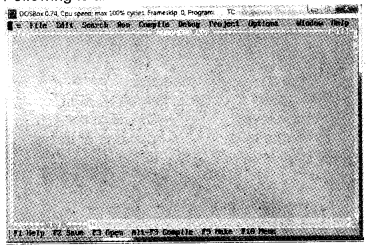
Plus One Computer Science Notes Chapter 5 Introduction to C++ Programming 1
(a) Opening the edit window:
Method I: File → Click the menu item New
Method II: Press Alt and F simultaneously then press N

(b) Saving the program:
Click File → Save or Press Function key F2 or Alt + F and then press S. Then give a file name and press ok.

(c) Running/executing the program:
Press Alt + R then press R OR Click Run → press R, OR Press Ctrl + F9

(d) Viewing the output:
Press Alt + F5

(e) Closing Turbo C++ IDE:
Click File → then press Quit menu Or Press Alt + X

Plus One Computer Science Notes Chapter 5 Introduction to C++ Programming

Geany IDE
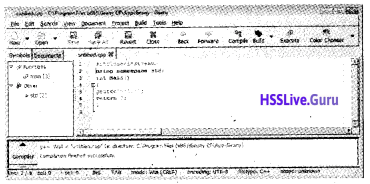
Plus One Computer Science Notes Chapter 5 Introduction to C++ Programming 2
Step 1: Take Geany Editor and type the program (source code)
Step 2: Save the file with extension .cpp
Step 3: Compile the program by Click the Compile Option
Step 4: After successful compilation, Click Build option
Step 5: Then click on Execute option

Plus One Computer Science Notes Chapter 4 Principles of Programming and Problem Solving

Students can Download Chapter 4 Principles of Programming and Problem Solving Notes, Plus One Computer Science Notes helps you to revise the complete Kerala State Syllabus and score more marks in your examinations.

Kerala Plus One Computer Science Notes Chapter 4 Principles of Programming and Problem Solving

Summary
Problem solving using computers:
It has no intelligent quotient. Hence they are slaves and human beings are the masters. It can’t take its own decisions.
They can perform tasks based upon the instructions given by the humans (programmers) .

Plus One Computer Science Notes Chapter 4 Principles of Programming and Problem Solving

Approaches in problem solving:
Top down design:
Larger programs are divided into smaller ones and solve each tasks by performing simpler activities. This concept is known as top down design in problem solving

Bottom up design:
Here also larger programs are divided into smaller ones and the smaller ones are again subdivided until the lowest level of detail has been reached. We start solving from the lowest module onwards. This approach is called Bottom up design.

Phases in Programming:
1. Problem identification:
This is the first phase in programming. The problem must be identified then only it can be solved, for this we may have to answer some questions.

During this phase we have to identify the data, its type, quantity and formula to be used as well as what activities are involved to get the desired out put is also identified for example if you are suffering from stomach ache and consult a Doctor.

To diagnose the disease the Doctor may ask you some question regarding the diet, duration of pain, previous occurrences etc, and examine some parts of your body by using stethoscope X-ray, scanning etc.

2. Deriving the steps to obtain the solution:
There are two methods, Algorithm and flowchart, are used for this.
(a) Algorithm:
The step-by-step procedure to solve a problem is known as algorithm. It comes from the name of a famous Arab mathematician Abu Jafer Mohammed Ibn Musaa Al-Khowarizmi, The last part of his name Al-Khowarizmi was corrected to algorithm.

(b) Flowchart:
The pictorial or graphical representation of an algorithm is called flowchart.
Flow chart symbols are explained below
(i) Terminal (Oval):
Plus One Computer Science Notes Chapter 4 Principles of Programming and Problem Solving 1
It is used to indicate the beginning and ending of a problem.
(ii) Input/Output (parallelogram):
Plus One Computer Science Notes Chapter 4 Principles of Programming and Problem Solving 2
It is used to take input or print output.
(iii) Processing (Rectangle):
Plus One Computer Science Notes Chapter 4 Principles of Programming and Problem Solving 3
It is used to represent processing. That means to represent arithmetic operation such an addition, subtraction,multiplication and, etc.
(iv) Decision (Rhombus):
Plus One Computer Science Notes Chapter 4 Principles of Programming and Problem Solving 4
Plus One Computer Science Notes Chapter 4 Principles of Programming and Problem Solving

It is used to represent decision making. It has one entry flow and two exit flows but one exit path will be executed at a time.
(v) Flow lines (Arrows):
Plus One Computer Science Notes Chapter 4 Principles of Programming and Problem Solving 5
It is used to represent the flow of operation
(vi) Connector:
Plus One Computer Science Notes Chapter 4 Principles of Programming and Problem Solving 6

3. Coding:
The dummy codes (algorithm) or flowchart is converted into program by using a computer language such s Cobol, Pascal, C++, VB, Java, etc.

4. Translation:
The computer only knows machine language. It does not know HLL, but the human beings HLL is very easy to write programs. Therefore a translation’ is needed to convert a program written in HLL into machine code (object code).

During this step, the syntax errors of the program will be displayed. These errors are to be corrected and this process will be continued till we get “No errors” message. Then it is ready for execution.

5. Debugging:
The program errors are called ‘bugs’ and the process of detecting and correcting errors is called debugging. In general there are two types of errors syntax errors and logical errors. When the rules or syntax of the language are not followed then syntax errors occurred and it is displayed after compilation.

When the logic of a program is wrong then logical errors occurred and it is not displayed after compilation but it is displayed in the execution and testing phase.

Plus One Computer Science Notes Chapter 4 Principles of Programming and Problem Solving

6. Execution and Testing:
In this phase the program will be executed and give test data for testing the purpose of this is to determine whether the result produced by the program is correct or not. There is a chance of another type of error, Run time error, this may be due to inappropriate data.

7. Documentation:
It is the last phase in programming. A computerized system must be documented properly and it is an ongoing process that starts in the first phase and continues till its implementation. It is helpful for the modification of the program later.

Plus Two Economics Chapter Wise Questions and Answers Chapter 6 Non-Competitive Markets

Students can Download Chapter 6 Non-Competitive Markets Questions and Answers, Plus Two Economics Chapter Wise Questions and Answers helps you to revise the complete Kerala State Syllabus and score more marks in your examinations

Kerala Plus Two Economics Chapter Wise Questions and Answers Chapter 6 Non-Competitive Markets

Plus Two Economics Non-Competitive Markets One Mark Questions and Answers

Question 1.
Point out the value of the Marginal Revenue when the demand curve is elastic.
Answer:
When the demand curve is elastic, the value of Marginal Revenue (MR) is zero.

Question 2.
Identify from the following demand curve faced by a firm under monopolistic competition.
Answer:
Plus Two Economics Chapter Wise Questions and Answers Chapter 6 Non-Competitive Markets img1
Answer:
(C)

Question 3.
The form of the market having only 2 sellers is called:
(a) monopoly
(b) duopoly
(c) oligopoly
(d) monopolistic competition
Answer:
(b) duopoly

HSSLive.Guru

Question 4.
Differentiated products is a characteristic of
(a) Monopolistic competition only
(b) Oligopoly only
(c) Both Monopolistic competition & Oligopoly
(d) Monopoly
Answer:
(c) Both Monopolistic competition & Oligopoly

Plus Two Economics Non-Competitive Markets Two Mark Questions and Answers

Question 1.
Suppose there are only two firms manufacturing cars in India, namely, Maruti and Hyundai. What market form is this?
Answer:
lip This market form is known as duopoly market. Duopoly is a market structure in which there are only two firms producing a product.

Question 2.
What do you mean by cartel?
Answer:
Cartel is a kind of mutual agreement or coordination of the output and pricing policies of firms having then individual identities so as to act if it is a monopoly. This is a feature of oligopoly market.

Question 3.
Observe the following figures and identify the market situations.
Plus Two Economics Chapter Wise Questions and Answers Chapter 6 Non-Competitive Markets img2
Answer:

  1. Monopoly
  2. Monopolistic competition

Question 4.
Suggest any 2 examples of a monopolistically competitive market.
Answer:

  1. Soap industry
  2. Toothpaste industry.

HSSLive.Guru

Question 5.
The features of firms under different market structure is given below. Classify them into perfect competition and oligopoly.
(a) Collusion
(b) Free entry and exit
(c) Intertdependance
(d) Firms are price takers
Answer:
a & c Oligopoly, b & d Perfect competition

Plus Two Economics Non-Competitive Markets Three Mark Questions and Answers

Question 1.
The monopolist cannot determine the price and quantity simultaneously. Do you agree? Substantiate your answer.
Answer:
Yes, I agree to the statement that the monopolist cannot determine the price and quantity simultaneously. This is because, if the monopolist wants to sell more of the commodity, he needs to reduce the price. Therefore, he can change either of the price or the quantity.

Question 2.
Examine the relationship between Marginal Revenue and Price Elasticity of Demand.
Answer:
Whenever the MR is positive the price elasticity of AR (Demand Curve) isgreaterthan one, that is elastic. When the MR is zero the price elasticity of AR (Demand Curve) is 1, that is unitary elastic. When the MR is negative the price elasticity of demand curve is less than one, that inelastic.

Question 3.
Choose the correct answer
a. In monopoly:

  1. There are many producers
  2. There is no seller
  3. There is no buyer
  4. There is single seller

b. When two commodities are complementary to one another

  1. They may be jointly demanded
  2. They may be complementary goods
  3. They may be substitutes
  4. None of the above

c. Generally government fix control price

  1. Equal to equilibrium price
  2. Less than equilibrium price
  3. More than equilibrium price
  4. None of these

Answer:
a. 4. There is single seller
b. 1. They may be jointly demanded
c. 2. Less than equilibrium price

Question 4.
State whether the followirig satements are true or false.

  1. The seller in a monopoly is a price maker.
  2. Price leadership is an important feature of oligopoly.
  3. Selling cost is the cost of producing the commodity.

Answer:

  1. Time
  2. True
  3. False. Selling cost is the cost of selling a Product.

HSSLive.Guru

Question 5.
State the condition and long run equilibrium in a monopoly competitive industry.
Answer:
The long run equilibrium conditions in a monopolisti-cally competitive industry are:
MR = LMC
P = LAC but P > LMC MR = LMC
P = LAC, P > LMC

Question 6.
The diagram below shows the equilibrium condition of a zero cost monopolist. Find out the quantity produced by such a firm, explain
Plus Two Economics Chapter Wise Questions and Answers Chapter 6 Non-Competitive Markets img3
Answer:
The firm will produce oq1 level of output to maximise the profit. Because at this level of output, the firm satisfies a condition that is MR = MC. Since the firm faces zero cost its MR also will be zero. For this equilibrium, MR and MC should be equal. Since MC is zero in all level of output the firm will produce at a level where its MR is zero.

Question 7.
Examine the behaviour of average revenue and marginal revenue of a firm which can sell more units of a good only by lowering the price of that good. Explain with the help of a diagram.
Answer:
monopolist can sell more units of the good only by lowering the price. Therefore AR & MR will be downward sloping. Draws the appropriate diagram.
Plus Two Economics Chapter Wise Questions and Answers Chapter 6 Non-Competitive Markets img4

HSSLive.Guru

Question 8.
Categorize the following features under two headings Perfect Competition and Monopolistic Competition. 4 Large Number of Producers, Differentiated products, Some Pricing power, Productive Efficiency in the Long run, Low Barriers, Homogeneous products, Long run Price = MC, Many producers, Zero Barriers, Productive Inefficiency in the Long run, Price Takers, Long run Price >MC.
Answer:
1. Perfect competition

  • Large Number of Producers.
  • Productive Efficiency in the Long run
  • Homogeneous products
  • Long run Price = MC
  • Zero Barriers
  • Price Takers

2. Monopolistic competition

  • Differentiated products
  • Some Pricing power
  • Low Barriers,
  • Many producers
  • Productive Inefficiency in the Long run
  • Long run Price >MC.

Question 9.
Consider the commodities given below. Identify the most likely market situation in which they are produced. Substantiate.

  1. Airline industry.
  2. Potatoes.
  3. Toilet soap.

Answer:

  1. Oligopoly – only a few producers
  2. Perfecly Competitive Market – large number of producers
  3. Monopolistic Competition – Many sellers producing differentiated products

HSSLive.Guru

Question 10.
A table related to a particular market is given below:
Plus Two Economics Chapter Wise Questions and Answers Chapter 6 Non-Competitive Markets img5

  1. Find AR & MR
  2. Identify the market related to the table.
  3. Establish the relationship between TR, AR & MR

Answer:
1.
Plus Two Economics Chapter Wise Questions and Answers Chapter 6 Non-Competitive Markets img6
2. Monopoly.

3. relationship between TR, AR & MR

  • TR rises and then falls
  • AR is always falling but lies above MR
  • MR falls and becomes negative

Question 11.
The total revenue equation of a firm is given by the equation,TR = 20Q – 2Q²

  1. Calculate TR, AR & MR.
  2. Identify the market form related to this equation

Answer:
1. TR = 20Q – 2Q2
\(\begin{aligned}
&A R=\frac{T R}{Q}=\frac{20 Q-2 Q^{2}}{Q}=20-2 Q\\
&\mathrm{MR}=\frac{\delta \mathrm{TR}}{8 \mathrm{Q}}=\frac{\left(20 \mathrm{Q}-2 \mathrm{Q}^{2}\right)}{\mathrm{Q}}=20-4 \mathrm{Q}
\end{aligned}\)

2. Monopoly

Plus Two Economics Non-Competitive Markets Five Mark Questions and Answers

Question 1.
State whether the following statements are true or false. Rewrite the statements if they are wrong.

  1. The products in perfect competition are heterogeneous
  2. The seller in monopoly is a price maker
  3. Price leadership is an important feature of oligopoly.
  4. Duopoly is a market situation in which two buyers buy the commodity
  5. Selling cost is the cost for producing the commodity.

Answer:

  1. False. Products in perfect competition are homogenous
  2. True
  3. True
  4. False. Duopoly is a market situation in which two sellers supply the commodity
  5. False. Selling cost is the cost for selling or giving publicity for the commodity

HSSLive.Guru

Question 2.
Find odd one out.

  1. Single seller, price maker, selling cost, control over supply
  2. Fairly large number of firms, product differentiation, selling cost, price maker
  3. A few firms, interdependence between firms, no transport cost, indeterminate demand curve
  4. Tata steel, Reliance industries, Post and Telegraph

Answer:

  1. Selling cost. Others are features of monopoly
  2. Price maker. Others are features of monopolistic competition
  3. No transport cost. Others are features of oligopoly
  4. Post and Telegraph. Others are private sector companies.

Question 3.
Match column B and Q with column A.
Plus Two Economics Chapter Wise Questions and Answers Chapter 6 Non-Competitive Markets img7
Answer:
Plus Two Economics Chapter Wise Questions and Answers Chapter 6 Non-Competitive Markets img8

Question 4.
The market price, quantity and total cost of a firm are given in the following table. Find out.
Plus Two Economics Chapter Wise Questions and Answers Chapter 6 Non-Competitive Markets img9

  1. MRandMC
  2. Equilibrium price and equilibrium quantity
  3. TR, TC and Total profit at equilibrium

Answer:
1.
Plus Two Economics Chapter Wise Questions and Answers Chapter 6 Non-Competitive Markets img10
2. Equilibrium price is Rs. 19 and quantity is 6.

3. At equilibrium
TR= 114
TC = 109
Total profit = 5

HSSLive.Guru

Question 5.
Categorize the following into different market forms.

  1. Indian Railways
  2. Toothpaste
  3. Hero Honda
  4. KSEB

Answer:

  1. Indian Railways – monopoly
  2. Toothpaste – monopolistic competition
  3. Hero Honda – oligopoly
  4. KSEB – monopoly

Question 6.
Prepare a note on price rigidity.
Answer:
Price rigidity is an important feature of oligopoly. Price rigidity means that price will remain rigid without much fluctuation. This is because, price increase by one firm will not be followed by other firms.

However, price reduction by one firm will be followed by other firms, due to this; the firm affecting price change will not get the benefits from the reduction of price. Therefore, no firm will reduce or increase the price. This leads to a situation of price rigidity in the oligopoly markets.

Question 7.
Assume that there are two firms A and B in a duopoly market. Firm B supplies zero output. Firm A realizes that maximum demand in the market is 20 units, and he supplies half of it, i.e., 10 units. Construct a table the different steps showing the quantity supplied by the firms.
Answer:
Plus Two Economics Chapter Wise Questions and Answers Chapter 6 Non-Competitive Markets img11

HSSLive.Guru

Question 8.
Classify the statements under the head features of oligopoly market.
Answer:

  1. Large no. of buyers and sellers
  2. Firm is a price maker
  3. Few number of sellers
  4. Products may be homogneous or differentiated.
  5. There is no interdependence between firms
  6. There are no barries to entry
  7. Firm is price taker
  8. Interdependence between firms
  9. Entry restricted
  10. Price rigidity prevails oil

Answer:
The features of oligopoly market are given below:

  1. Few number of sellers
  2. Product may be homogneous or differentiated
  3. There are no barriers to entry
  4. Interdependence between firms
  5. Price rigidity prevails.

Question 9.
Price rigidity is an important feature of oligopoly. Can you explain what is price rigidity.
Answer:
Price rigidity is an important feature of oligopoly market. In oligopoly market, price does not change m easily in response to change in demand. If one firm decides to increase the price to earn high profit and the other firms do not do so, due to increase the price, the demand of product will fall and it causes fall in revenue and profit. Hence it is not rational for any firm of increase the price. Thus in an oligopoly market, price remain rigid.

Question 10.
Suppose that firm A enters in a duopoly market for production of commodity X at zero cost. He finds that the total demand forX in the market is 300 units. When he starts production, firm B enters in market. Find out the profit maximising quantity by each firm.
Answer:
In order to maximisejprofit each firm will produce 1/3 of the total markerdemand. In one example, total demand in the market is 300 units. Therefore, the profit maximising output is 1/3 x 300 = 100 units.

Question 11.
Identify the market structure.

Description Concept
Market with a few firm
Market with only two firms
Market with only one buyer
Market with only one seller

Answer:

Description Concept
Market with a few firm Oligopoly
Market with only two firms Duopoly
Market with only one buyer Monopsony
Market with only one seller Monopoly

HSSLive.Guru

Question 12.
Make pairs.
Price maker, Price leadership, Monopoly, Monopsonist, single buyer, Oligopoly, monopolistic competition, selling cost.
Answer:

  • Price maker – Monopoly
  • Price leadership – Oligopoly
  • Single buyer – Monopsonist
  • Selling cost – Monopolistic competition.

Question 13.
The demand curves of different market situations are given below.
Plus Two Economics Chapter Wise Questions and Answers Chapter 6 Non-Competitive Markets img14

  1. Identify market situations represented by each demand curve.
  2. Give reasons for the different shapes of demand curves in these two market forms.

Answer:
1. Figure (1) represents perfect competition market Figure (2) represents monopoly market.

2. In perfect competition, there are large number of buyers and sellers. Each firm is a price taker and there is uniform price prevailing in the market. Since each unit is sold at uniform price, P = MR = AR in the market. Therefore, demand curve is horizontal straight line. However, in a monopoly market, firm is a price maker. He can vary the price. If he wants to sell more of the product, he need to reduce the price. Therefore, the demand curve is falling downward.

Question 14.
Prepare a note on monopolistic competition.
Answer:
A market structure where the number of firms is large, there is free entry and exit of firms, but the goods produced by them are not homogeneous such a market structure is called monopolistic competition. Its features are as following:

  1. There are large number of buyers and sellers.
  2. There is free entry and exist in long run.
  3. There is product differentiation.

The monopolist produces less and charges a higher price compared to perfect competiton. It is found in the industry where there is large number of sellers, selling differentiated but close substitute products. Monopolistic competition in a commodity market arises due to the commodity being non-homogeneous.

HSSLive.Guru

Question 15.
Compare the price and output of a firm under perfect competition and monopolistic competition.
Answer:
A firm under perfect competition is a price taker and have a horizontal demand, but a firm under monopolistic competition is a price maker and faces a demand curve that in downward sloping and elastic. Under perfect competition MR = AR. So the firm produces more output and charge less compared to monopolistic competition. Under monopolistic MR < AR.

Question 16.
Identify the market condition with following feature.

  1. Interdependence
  2. Price rigidity
  3. Entry restriction

Explain why prices are rigid in such market situations.
Answer:
Oligopoly. Under such markets, the price is supposed to be rigid. The reason is that here the firms are interdependent. The actions of every firm will be determined by the actions and reactions of every other firm. If one firm increases the price none other follows. The customers of that firm may switch to other firms. The firm which increased the price may feel a fall in revenue and profit.

On the other hand, if one firm reduces the price everyone else will follow. All firm’s revenue and profit fall. So firms under oligopoly will always try to keep their price rigid.

Question 17.
Two tables are given below.
Plus Two Economics Chapter Wise Questions and Answers Chapter 6 Non-Competitive Markets img15

  1. Find TR, AR&MR.
  2. There are five variables in each of the above table. Which two variables in both the tables have the same values? Give reasons.
  3. The two tables are related to two market forms. Identify the form of market for each table. Give reasons.

Answer:
1.
Plus Two Economics Chapter Wise Questions and Answers Chapter 6 Non-Competitive Markets img16
2. Table 1: Price and AR are same Table 2: Price, AR, and MR are same

3. Table 1: Monopoly market because by reducing price firm sells more
Table 2: Perfect competition. Firm is price takes and P=AR=MR

HSSLive.Guru

Question 18.
Does the statement below better describe a firm operating in a Perfectly Competitive market or a firm that is Monopoly?

  1. The demand curve faced by the firm is downward sloping.
  2. The demand curve and the MR curve are the same.
  3. Entry and exit are relatively difficult.
  4. Price Taker
  5. Price Maker

Answer:

  1. Monopoly
  2. Perfectly Competitive Market
  3. Monopoly
  4. Perfectly Competitive Market
  5. Monopoly

Plus Two Economics Non-Competitive Markets Eight Mark Questions and Answers

Question 1.
Prepare a seminar paper on ‘Non-Competitive Markets’.
Answer:
Respected teachers and dear friends,
The topic of my seminar paper is noncompetitive markets. As we know there are different kinds of markets depending upon the number of firms, nature of the product, freedom of entry and exit, etc. On the basis, of the above, we name the non competitive markets as monopoly, monopolistic competition and oligopoly. .

Introduction:
A market structure in which there is a singe seller is called monopoly. A market structure where the . number of firms is large, there is free entry and exit of firms, but the goods produced by them are not homogeneous. Such a market structure is called monopolistic competition. If the market of a particular commodity consists of more than one seller but the number of sellers is few, the market structure is termed oligopoly.

Contents:

  1. Monopoly market
  2. Monopolistic competition
  3. Oligopoly

1. MONOPOLY MARKET:
Monopoly may be defined as a market situation in which there is only a single seller. He controls the entire market. The term monopoly has derived from two Greek words such as ‘mono’ means single and poly means ‘seller’. The meaning of the combined term is single seller. In a boardersense, a monopolist is single seller of a commodity which does not have close substitutes, e.g. KSEB

Features of Monopoly Market:
Some of the salient features of monopoly are as follows:

  1. There is only a single firm producing the product
  2. There is no close substitute for the product
  3. Entry is denied for other producers
  4. Since there is only one seller, the firm and the industry are same
  5. The firm under monopoly is the price maker

HSSLive.Guru

2. MONOPOLISTIC COMPETITION:
Monopolistic competition is a market characterized by the elements of perfect competition and monopoly. It is a market situation characterized by large number of firms producing various kinds of goods and services. The products of a firm will be different from the products of other firms in terms of size, shape, smell, colour, etc.

Features
The salient features of perfect competition are as follows:
1. Large number of buyers and sellers:
Under monopolistic competition, there exists large number of buyers and sellers. But the number of sellers will be less compared to perfect competition.

2. Product differentiation:
One of the most important characteristic of monopolistic competition is the existence of product differentiation. Each firm has its own product with unique brand names. The products of one firm will be different from the products of other firms in terms of size, shape, smell, color, etc.

3. Freedom of entry and exit:
Under monopolistic competition, there is freedom of entry and exit.

4. Selling cost:
The cost incurred for sales promotion such as advertisement, coupons, gifts, etc. are known as selling cost. Under monopolistic competition, the selling costs would be relatively high.

3. OLIGOPOLY:
The term oligopoly has derived from two terms oligo (small) and poly (seller). Thus oligopoly is a market situation characterized by competition among few sellers. In simple terms, it is a competition among few sellers in the market selling either homogenous or differentiated product. The industries manufacturing car, motorcycle, scooter, etc. are some of the examples for oligopolistic competition.

The main features of oligopolistic competition are as follows:
1. Few sellers:
The number of sellers or producers would be few under oligopolistic competition.

2. Homogneous or differentiated products:
The products sold under oligopolistic competition would be either homogneous (e.g. gas, petrol) or differentiated (e.g. car, scooter)

3. Free entry and exit:
Free entry and exit persist under oligopolistic competition.

4. Selling cost:
Firms spend on advertisement and sales promotion.

5. Interdependence of the firms:
Since the number of firms under oligopoly are few, they are highly interdependent. The action of one firm will certainly have impact on other firms in terms of price, quality of the product, etc.

6. Price leadership:
Some of the firms may emerge as price leaders under oligopoly. The price leader could be the first firm in the industry or the firm with largest number of consumers. The price leader takes important decisions regarding vital decisions such as the price of the product or number of units to be produced in the market, etc.

Conclusion:
Thus it can be concluded that there are three kinds of non-competitive markets. This classification is made on the basis of the number of firms, nature of the product, freedom of entry and exit, etc. In contrast to perfect competition, we find that these market forms are more realistic.

Question 2.
Prepare a table to show the distinction between monopoly, monopolistic competition, and oligopoly. Major points of distinction are given below in the table.
Plus Two Economics Chapter Wise Questions and Answers Chapter 6 Non-Competitive Markets img17
Answer:
Plus Two Economics Chapter Wise Questions and Answers Chapter 6 Non-Competitive Markets img18

HSSLive.Guru

Question 3.
If the market of a particular commodity consists of more than one seller but the number of sellers is few, the market structure is termed oligopoly. The special case of oligopoly where there are exactly two sellers is termed duopoly. We shall explain the different ways in which the oligopoly firms may behave.

1. Firstly duopoly firms may collude together and decide not to compete with each other and maximize total profits of the two firms together. In such a case the two firms would behave like a single monopoly firm that has two different factories producing the commodity.

2. Secondly, take the case. of a duopoly where each of the two firms decide how much quantity to produce by maximizing its own profit assuming that the other firm would not change the quantity that it is supplying. We can examine the impact using a simple example where both the firms have zero cost.

3. Thirdly, some economists argue that oligopoly market structure makes the market price of the commodity rigid, i.e., the market price does not move freely in response to changes in demand.

Question 4.
Name important non-competitive markets and give the meaning of them.
Answer:
The important forms of non-competitive markets also:

  1. Monopoly
  2. Monopolistic competition
  3. Oligopoly

1. Monopoly:
A monopoly is a market situation in which there is a single seller of the commodity and no close substitutes of the commodity are available. The single seller can influence the price by varying his sales.

2. Monopolistic Competition:
Monopolistic competition is a market situation in which both the monopolistic element and the competitive elements are present. Its basic features are large number of buyers and sellers in the market and existence of differentiated products.

3. Oligopoly:
Oligopoly is market situation in between monopolistic competition and monopoly. In this market form, there are only a few sellers of the commodity and each seller has a substantial share in the market.

HSSLive.Guru

Question 5.
The diagram below shows the level of output produced and price charged in monopoly and perfect competition.

  1. Identify the levels of output and price charged in monopoly and perfect competition, explain.
  2. Critically evaluate the merits and demerits of perfect competition.

Plus Two Economics Chapter Wise Questions and Answers Chapter 6 Non-Competitive Markets img19
Answer:
1. A firm, if it is under monopoly, will produce when its MR = MC and will charge a price which is equal to AR. It produces oq level of output and charges a price op. But if it is in perfect competition if the market would

2. Confirmed to monopoly perfect competition would charge higher prices and produce less quantity. It is argued that the monopoly firms benefit themselves at the cost of consumers. The monopolist may get a profit even in tire long run and the consumers pay more and get less quantity.

But it is another argument. The profit made by the monopolist would be used for research and development and it may be useful for society in the long run in terms of new technology and new products. Moreover, due to the economies of scale the cost of the monopolist may be much lower than the cost of a firm under perfect competition.

Plus Two Chemistry Chapter Wise Questions and Answers Chapter 9 Coordination Compounds

Students can Download Chapter 9 Coordination Compounds Questions and Answers, Plus Two Chemistry Chapter Wise Questions and Answers helps you to revise the complete Kerala State Syllabus and score more marks in your examinations.

Kerala Plus Two Chemistry Chapter Wise Questions and Answers Chapter 9 Coordination Compounds

Plus Two Chemistry Coordination Compounds One Mark Questions and Answers

Question 1.
The ions or molecules bound to the central atom/ion in the coordination entity are called ___________.
Answer:
Ligands

Question 2.
In [Co(C2O4)3]3-, the coordination number of cobalt is _________.
Answer:
six

Question 3.
Which complex has a square planar structure?
(a) [Ni(CO)4]
(b) [NiCI4]2-
(c) [Ni(H2O)6]2+
(d) [CU(NH3)4]2+
Answer:
(d) [CU(NH3)4]2+

Question 4.
Say TRUE or FALSE.
[Co(NO3)(NH3)5]SO4 and [Co(NO3)(NH3)4(SO4)](NH3) are ionisation isomers.
Answer:
FALSE

Plus Two Chemistry Chapter Wise Questions and Answers Chapter 9 Coordination Compounds

Question 5.
The formula of Wilkinson’s catalyst is _________.
Answer:
[RhCl(PPh3)3]

Question 6.
The charge of Ni in [Ni(CO)4] is
(a) +1
(b) +2
(c) 0
(d) +4
Answer:
(c) 0

Question 7.
The central metal ion present in chlorophyll?
(a) Fe2+
(b) Cu2+
(c) Mg2+
(d) CO2+
Answer:
(c) Mg2+

Question 8.
EDTA is a dentate ligand
(a) uni dentate
(b) bidentate
(c) Tridentate
(d) hexadentate
Answer:
(d) hexadentate

Plus Two Chemistry Chapter Wise Questions and Answers Chapter 9 Coordination Compounds

Question 9.
Which is an example for homoleptic complexes
(a) [Co(NH3Cl2]+
(b) [CoNH3)6]3+
(c) [Cr(NH3)(H2O)3]Cl3
(d) [CoCl2(en)2]
Answer:
(b) [CoNH3)6]3+

Question 10.
Ammonia will not form complex with
(a) Ag2+
(b) Pb2+
(c) Cu2+
(d) Cd2+
(e) Fe2+
Answer:
(b) Pb2+

Plus Two Chemistry Coordination Compounds Two Mark Questions and Answers

Question 1.
In a seminar, Jishnu argued that the “hexaflourocobaltate(III) ion is highly paramagnetic than hexacyanoferrate(III) ion.

  1. Do you agree with this words?
  2. Explain it.
  3. Write the formulae of the given coordination compounds.

Answer:

  1. Yes
  2. CN is a strong field ligand so paring occurs. Number of unpaired electron decreases, paramagnetism decreases. F is a weak field ligand so no paring occurs, paramagnetism increases.
  3. [CoF6]3-and [Co(CN)6]3-

Plus Two Chemistry Chapter Wise Questions and Answers Chapter 9 Coordination Compounds

Question 2.
Raju: Coordination compounds are coloured.
Ramu: No, co-ordination compounds are colourless.

  1. Whose statement is correct?
  2. Explain the reason for your answer.

Answer:

  1. Raju’s statement is correct. Coordination compounds are usually coloured.
  2. The colour of coordination compounds is due to d-d transition.

Question 3.
Why is geometrical isomerism not possible in tetrahedral complexes having two different types of unidentate ligands coordinated with the central metal ion?
Answer:
Tetrahedral complexes do not show geometrical isomerism because the relative positions of the unidentate ligands attached to the central metal atom are the same with respect to each other.

Question 4.
FeSO4 solution mixed with (NH4)2SO4 solution in 1:1 molar ratio gives the test of Fe2+ ion but CuSO4 solution mixed with aqueous ammonia in 1:4 molar ratio does not give the test of Cu2+ ion. Explain why?
Answer:
FeSO4 does not form any complex with (NH4)2SO4. Instead, it forms a double salt FeSO4. (NH4)2SO4.6H2O which dissociates completely into ions. CuSO4 when mixed with NH3 forms a complex [CU(NH3)4]SO4 in which the complex ion [CU(NH3)4]2+ does not dissociate to give Cu2+ ion.

Question 5.
Write the geometrical isomers of [Pt(NH3)(Br)(Cl) (py)] and how many of these will exhibit optical isomerism?
Answer:
The complex [Pt(NH3)(Br)(Cl)(py)] will form three geometrical isomers:
Plus Two Chemistry Chapter Wise Questions and Answers Chapter 9 Coordination Compounds 1
Square planar complexes of this type will not show geometrical isomerism.

Plus Two Chemistry Chapter Wise Questions and Answers Chapter 9 Coordination Compounds

Question 6.
Aqueous copper sulphate solution (blue in colour) gives:

  1. a green precipitate with aqueous potassium fluoride and
  2. a bright green solution with aqueous potassium chloride. Explain these experimental results.

Answer:
Aqueous copper sulphate contains a coordination entity, [Cu(H2O)4]2+ which is blue in colour. Water molecule is a weaker ligand than Cl and F.
1. On addition of aqueous KF solution, a new complex entity is formed wich is green in colour.
Plus Two Chemistry Chapter Wise Questions and Answers Chapter 9 Coordination Compounds 2

2. On addition of aqueous solution of KCl, an another bright green complex entity is formed which is soluble in water.
Plus Two Chemistry Chapter Wise Questions and Answers Chapter 9 Coordination Compounds 3

Question 7.
What is the coordination entity formed when excess of aqueous KCN is added to an aqueous solution of copper sulphate? Why is it that no precipitate of copper sulphide is obtained when H2S(g) is passed through this solution?
Answer:
Aqueous solution of copper sulphate contains Cu2+ ions in the form of complex entity, [Cu(H2O)4]2+ and H2O ligand is a weak ligand. When excess of KCN is added, a new coordination entity, [Cu(CN)4]2- is formed due to the following reaction:
Plus Two Chemistry Chapter Wise Questions and Answers Chapter 9 Coordination Compounds 4

Cyanide ligand, CN is a strong field lignad and stability constant of [Cu(CN)4]2- is quite large and thus practically no Cu2+ ions are left in solution. On passing H2S gas, no CuS is formed due to non- availability of Cu2+ ions in solution.

Question 8.
Optical isomerism is usually exhibited by complexes containing polydentate ligand. What do you mean by ligand?
Answer:
Ligand is a neutral molecule or charged ion which can donate a lone pair of electron to the metal.

Question 9.
Coordination complexes are of different types. Name the compounds.

  1. [Cr(H2O)5Cl2]
  2. K3[Cr(C2O4)3]

Answer:

  1. Pentaaquadichloridochromium(II)
  2. Potassiumtrioxalatochromate(III)

Plus Two Chemistry Chapter Wise Questions and Answers Chapter 9 Coordination Compounds

Question 10.
Write the IUPAC names of the following compounds.

  1. K3M[Fe(CN)6]
  2. [C0(NH3)5(CO3)]Cl

Answer:

  1. Potassiumhexacyanoferrate(III)
  2. Pentaamminecarbanatocobalt(III) chloride

Question 11.
[Fe(CN)6]3- is paramagnetic, while [Fe(CN)6]4- is diamagnetic. Explain with the help of VB theory.
Answer:
In [Fe(CN)6]3- iron is in +3 state and in [Fe(CN)6]4, iron is in +2 state. [Fe(CN)6]3- contains five electrons in d-level (3d5). In this complex iron undergoes d2sp3 hybridisation.

Due to the presence of one unpaired electron, [Fe(CN)6]3-, is paramagnetic. In [Fe(CN)6]4- iron contains six electrons in d-level (3d6). It undergoes d2sp3 hybridisation and has no unpaired electrons. Hence, [Fe(CN)6]4- is diamagnetic.

Plus Two Chemistry Coordination Compounds Three Mark Questions and Answers

Question 1.
Look at the following two diagrams.
Plus Two Chemistry Chapter Wise Questions and Answers Chapter 9 Coordination Compounds 5

  1. Is the diagrams I and II correct? Justify. If the figure is not correct, redraw it.
  2. Which theory is related to this?
  3. Explain briefly, how this theory is applicable to octahedral complexes.

Answer:
1. No, Figure (II) is wrong.
Plus Two Chemistry Chapter Wise Questions and Answers Chapter 9 Coordination Compounds 6

2. Crystal field theory.

3. In the case of octahedral complexes, the ligands are approaching the ‘d’ orbitals through the axis. As a result of this the energy of dx²-y² and d orbitals increases and the energy of the remaining three orbitals decreases. The orbitals which possess high energy are represented as ‘eg’ levels and the orbitals which possess less energy are represented as “t2g” levels.

Plus Two Chemistry Chapter Wise Questions and Answers Chapter 9 Coordination Compounds

Question 2.
A list of coordination compounds are given below:
[Cr(H2O)6] Cl3, [Co(NH3)5Br] SO4, [Co(NH3)5NO2]2+ and [Pt(NH3)2Cl2]. Which type of isomerism do these compounds exhibit?
Answer:
Hydrate Isomerism, Ionisation Isomerism, Linkage Isomerism, Geometrical Isomerism.

Question 3.
The following are examples of coordination compounds. Identify the type of isomerism exhibited by each of them and write their possible isomers,

  1. [Cr(NH3)5Br]SO4
  2. CrCl3.6H2O
  3. [PtCl2(NH3)2]

Answer:

  1. Cr(NH3)5Br]SO4 – Ionisation isomerism – [Cr(NH3)5SO4]Br
  2. CrCl3.6H2O – Hydrate isomerism – [Cr(H2O)5Cl]Cl2.H2)
  3. PtCl2(NH3)2] – Geometrical isomerism

Plus Two Chemistry Chapter Wise Questions and Answers Chapter 9 Coordination Compounds 7

Question 4.
What will be the correct order for the wavelengths of absorption in the visible region for the following:
[Ni(NO2)6]4-, [Ni(NH3)6]2+, [Ni(H2O)6]2+
Answer:
The order of the ligand in the spectrochemical series is H2O < NH3 < NO2. Hence the wavelength of the light observed will be in the order:
[Ni(H2O)6]2+ < [Ni(NH3)6]2+ < [Ni(NO2)6]4-

Thus, the wavelength of light absorbed (E = \(\frac{\mathrm{hc}}{\lambda}\)) will be in the opposite order:
[Ni(H2O)6]2+ > [Ni(NH3)6]2+ > [Ni(NO2)6]4-

Question 5.
In a classroom discussion, Sajan argued that CN, OH, Cl etc. are examples for neutral ligands.

  1. Do you agree with his argument?
  2. If not, give a reason with the help of examples.
  3. What do you mean by chelating ligand and chelation?

Answer:

  1. No.
  2. They are charged ligands.
  3. If a polydentate ligand is coordinated to the metals, a ring structure is obtained. It is called chelate and the phenomenon is called chelation.

Plus Two Chemistry Chapter Wise Questions and Answers Chapter 9 Coordination Compounds

Question 6.
Ligands can be arranged according to the magnitude of Δ0 and the arrangement is given below:
l- < Br < Cl < F < OH < H2O < NH3 < (en)

  1. What is this series known as?
  2. Is the sequence incorrect order?
  3. Identify the weak field and strong field ligands.

Answer:

  1. Spectrochemical series
  2. Yes
  3. The ligands above water are strong ligand and the ligands below water are weak ligands.

Weak filed ligands – l, Br, Cl, F, OH, H20 Strong filed ligands – NH3, en

Question 7.
Consider the following coordination compounds.

  • [Co(NH3)5 Cl] SO4
  • [Co(NH3)5 SO4]Cl

1. Write down the IUPAC name of these compounds.
2. Name the isomerism exhibited by these compounds.

Answer:
1. The IUPAC name of compounds

  • Pentaamminechloridocobalt(III) sulphate
  • Pentaamminesulphatocobalt(III) chloride

2. Ionisation isomerism

Question 8.
Consider the following compounds:
[Co (NH3)5 NO2] Cl2 and [Co (NH3)5 ONO] Cl2

  1. Identify the isomerism exhibited by these compounds.
  2. Explain ionisation isomerism with example.

Answer:

  1. Linkage isomerism
  2. This form of isomerism arises when the counter ion in a complex salt is itself a potential ligand and can displace a ligand which can then become the counter ion.
    e.g. [Co(NH3)5Cl] SO4 & [Co(NH3)5SO4] Cl

These complexes ionises as:

  • [Co(NH3)5Cl] SO4 → [Co(NH3)5Cl]2+ + SO42-
  • [Co(NH3)5SO4] Cl → [Co(NH3)5SO4]+ + Cl

Question 9.
Consider the statement: Crystal Field Theory (CFT) is applicable to octahedral and tetrahedral complexes.

  1. Is this statement true?
  2. Explain the crystal field splitting in octahedral complexes with the help of a neat diagram.

Answer:

  1. Yes
  2. In an octahedral crystal field the ligands are approaching the metal along the axes. Hence, the energy of dx²-y² and d orbitals (eg set) increases by 3/5Δ0and that of dxy, dyz and dxz orbitals (t2g set) decreases by 2/5 Δ0

Plus Two Chemistry Chapter Wise Questions and Answers Chapter 9 Coordination Compounds 8

Plus Two Chemistry Chapter Wise Questions and Answers Chapter 9 Coordination Compounds

Question 10.
When a ligand approaches to an octahedral complex, the degenerate ‘d’ orbitals undergoes splitting.

  1. What will be the observation?
  2. What are the factors influencing crystal field splitting energy?

Answer:
1. The energy of dx²-y² and d orbitals (eg set) increases by 3/5Δ0 and that of dxy, dyz and dxz orbitals (t2g set) decreases by 2/5 Δ0

2. The factors influencing crystal field splitting energy.

  • Nature of the ligand
  • Geometry of the complex
  • Valency of the metal

Question 11.
What will happen when a ligand approaches to a tetrahedral complex?
Answer:
the energy of dxy, dyz and dxz orbitals (t2g set) increases by 2/5Δt and that of dx²-y² and d orbitals (eg set) decreases by 3/5 Δt.

Question 12.
Consider the complex ion [Ti (H2O)6]3+ In the case of an octahedral complex, what is the condition for the pairing of forth electron in the d- level?
Answer:
If the crystal field splitting energy is greater than the pairing energy, the fourth electron will pair at the t2g level and if the pairing energy is greater than the crystal field splitting energy the electron will go to the on eg level.

Question 13.
Is bidentate ligands same as the amidentate ligands? Justify.
Answer:
A bidentate ligand like (en), can form two coordinate bonds with the metal at the same time.
An amidentate ligand like -NO2 can form only one coordinate bond with the metal at a time. But it can ligate through two different atoms.

Plus Two Chemistry Coordination Compounds Four Mark Questions and Answers

Question 1.
Match the following table:
Plus Two Chemistry Chapter Wise Questions and Answers Chapter 9 Coordination Compounds 9

Answer:
Plus Two Chemistry Chapter Wise Questions and Answers Chapter 9 Coordination Compounds 24

Plus Two Chemistry Chapter Wise Questions and Answers Chapter 9 Coordination Compounds

Question 2.
1. Write the IUPAC names of the following coordination compounds.

  • [Pt(NH3)Cl(NO2]2)
  • K3[Cr(C2O4)3]

2. Identify the type of isomerism exhibited by the following complexes and distinguish them. [Co(NH3)5SO4] Br and [Co(NH3)5Br] SO4
Answer:
1. The IUPAC names of the coordination compounds:

  • Amminechloridonitrito-N platinum(II)
  • Potassiumtrisoxalatochromate(III)

2. Ionisation isomerism.
The first compound gives pale yellow ppt. with AgNO3 solution whereas the second compound gives white ppt. with BaCl2 solution.

Question 3.
1. Write the IUPAC name of the following compounds:

  • [Pt(NH3)2Cl2]
  • K4[Fe(CN)6]

2. A list of coordination compounds are given below:

  • [Cr(H2O)6]Cl3,
  • [CO(NH3)5 Br]SO4,
  • [CO(NH3)5 NO2]2+,
  • [CO(NH3)6] [Cr(CN)6]

Which type of isomerism do these compounds exhibit?
Answer:
1. The IUPAC name of the coordination compounds:

  • Diamminedichloridoplatinum(II)
  • Potassium hexacyanoferrate(II)

2. Type of isomerism

  • [Cr(H2O)6]Cl3 – Hydrate isomerism
  • [CO(NH3)5 Br]SO4 – Ionisation isomerism
  • [CO(NH3)5 NO2]2+ – Linkage isomerism
  • [CO(NH3)6] [Cr(CN)6] – Coordination isomerism

Plus Two Chemistry Chapter Wise Questions and Answers Chapter 9 Coordination Compounds

Question 4.
1.. Write down the IUPAC name of

  • K4[Fe(CN)6]
  • [Pt(NH3)2Cl2]

2. On the basis of VBT, explain why [Fe(H2O)6]2+ is strongly paramagnetic while [Fe(CN)6]3- is weakly paramagnetic.
Answer:
1. The IUPAC names are:

  • Potassium hexacyanoferrate(II)
  • Diamminedichloridoplatinum(II)

2.
Plus Two Chemistry Chapter Wise Questions and Answers Chapter 9 Coordination Compounds 11
In [Fe(H20)6]2-, iron undergoes sp3d2 hybridisation (inner orbital complex). It has four unpaired electrons and hence it is highly paramagnetic.
Plus Two Chemistry Chapter Wise Questions and Answers Chapter 9 Coordination Compounds 12

In [Fe(CN)6]3+. iron undergoes d2sp3 hybridisation (outer orbital complex). It has only one unpaired electron. Hence, it is less paramagnetic.

Question 5.
The names of some co-ordination compounds are given below:

  • EDTA
  • Haemoglobin
  • cis-platin
  • Vitamin B12
  • D-penicillamine
  • Chlorophyll
  • Ni(CO)4

a. Classify the above compounds on the basis of application of coordination compounds?
b. There are given some of the coordination compounds Name them.

  1. K3[Fe(C2O4)3]
  2. [Cr(CN)3]3+
  3. [CoSO4(NH3)4]NO3
  4. [CO(NO2)3(NH3)3]

Answer:
a. On the basis of application of coordination compounds:

  • In biological system – Haemoglobin, Vitamin B12, Chlorophyll.
  • Estimation of hardness of water – EDTA.
  • Extraction of metals – Ni(CO)4
  • In medicine – D-penicillamine, cis-platin

b. The coordination compounds are:

  1. K3[Fe(C2O4)3] – Potassiumtrioxalatoferrate(III)
  2. [Cr(CN)3]3+ – Trisethylenediaminechromium(III) ion
  3. [CoSO4(NH3)4]NO3 – Tetraamminesulphato- cobalt(III) nitrate
  4. [CO(NO2)3(NH3)3] – Triamminetrinitrito-N-cobalt(III)

Question 6.
1. Name the following compounds.

  • [Pt(NH3)4 ] [CuCl4]
  • [PtCl2 (NH3)4] Br2

2. What type of isomerism is shown by the following coordination compounds?

  • [Pt(NH3)4 ] [CuCl4]
  • [Cr(en)3]3+

Answer:
1.

  • Tetraammineplatinum(II) tetrachlorocuprate(II)
  • Tetraamminedichloridoplatinum(IV) bromide

2. Type of isomerism:

  • Coordination isomerism
  • Optical isomerism

Plus Two Chemistry Chapter Wise Questions and Answers Chapter 9 Coordination Compounds

Question 7.

  1. Write the d-orbital configuration of [Ti(H2O6]2+
  2. Ti4+ is colourless. Why?
  3. Write the possible isomers of [Co(NH3)5 Br] SO4 and name them.

Answer:
1.
Plus Two Chemistry Chapter Wise Questions and Answers Chapter 9 Coordination Compounds 13
2. In Ti4+ there are no electrons in 3d orbitals. Hence ‘d-d’ transition cannot take place. Hence it is colourless.

3. Possible isomers of [Co(NH3)5 Br] SO4 and names

  • [CO(NH3)5 Br] SO4 – Pentamminebromido- cobalt(III) sulphate
  • [Co(NH3)5SO4]Br-Pentamminesulphatecobalt(III) bromide

Question 8.
‘A’ and ‘B’ are isomers. They have the same composition. But ‘B’ cannot give the test for sulphate.

  1. Write two suitable coordination compounds which give the test for sulphate.
  2. What are the two major classes of isomerism exhibited by coordination compounds?
  3. Draw the structure of an octahedral complex that show optical isomerism.

Answer:
1. Two suitable coordination compounds which give the test for sulphate

  • [CO(NH3)5Cl]SO4
  • [Co(NH3)5Br] SO4

2. Structural isomerism, Stereoisomerism
3. [PtCl2(en)2]2+

Plus Two Chemistry Chapter Wise Questions and Answers Chapter 9 Coordination Compounds 14

Question 9.

  1. Write the formula of the complex ion Chloridonitro tetramminecobalt(III)?
  2. Identify the ligands, coordination number and coordination sphere.
  3. Explain the structure of Tetracarbonylnickel(O) with the help of Valence Bond Theory.

Answer:

  1. [CO(NH3)4Cl(NO2)
  2. Ligands-NH3, Cl , NO2 Coordination number -4
  3. Tetracarbonylnickel(0) – [Ni(CO)]4] – Structure

Plus Two Chemistry Chapter Wise Questions and Answers Chapter 9 Coordination Compounds 15
Ni(CO4) is diamagnetic as it does not contain any unpaired electron.

Question 10.
Consider the complex ion [Ti (H2O)6]3+

  1. What is its outer electronic configuration and its shape?
  2. What do you mean by crystal field splitting theory?

Answer:

  1. Ti3+ – 3d1 4s0 Octahedral
  2. In the case of an isolated gasesous metal atom/ ion all the five d-orbitals have the same energy (degenerate). Due to the presence of ligands are splitted the degeneracy of the d-orbitals is lifted.

Plus Two Chemistry Chapter Wise Questions and Answers Chapter 9 Coordination Compounds

Question 11.
Coordination compounds are those compounds which retain their identity even in solution and it is essential for all living matter.

  1. Name a coordination compound containing Magnesium, which is essential for plants.
  2. When we coordinate EDTAwith any metal, we get a ring structure. What is this process called?
  3. Explain.

Answer:

  1. Chlorophyll.
  2. Chelation.
  3. When a poly dentate ligand is coordinated to the metal, a ring structure is obtained, called chelate complex. Such complexes are more stable than similar complexes containing unidentate ligands.

Question 12.
Some ligands are given below. Arrange them in suitable headings.
[H2O, NH3, CN, CO, Cl, OH (en)]
1. What do you mean by the term ligand?
2. Write down the nomenclature of the coordination compounds given below.

  • K4[Fe(CN)6]
  • [Ag (NH3)2]Cl

Answer:
Neutral ligands – H2O, NH3, CO, en
Charged ligands – CN, OH, Cl
1. Ligand is a neutral molecule or charged ion which can donate atleast one lone pair of electron to the metal.
2. nomenclature of the coordination compounds

  • Potassium hexacyanoferrate(II)
  • Diamminesilver(I) chloride

Question 13.

  1. What do you mean by optically active compounds? Give two examples.
  2. Draw the ‘d’ and T forms of [Co(en)3]3+.

Answer:
1. Optically active compounds are formed by chiral moneluces i.e., molecules which do not have plane of symmetry. These isomers are non- superimposable mirror images of each other. They are optically active and rotate the plane of polarised light equally but in opposite directions.

The isomer which rotates the plane of polarised light towards left is called leavorotatory (-) while that which rotate plane towards right is called dextrorotatory (+).
e.g. [Co(en)3]3+, [PtCl2(en)2]2+
Dextro and laevo forms of these compounds are possible.

2.
Plus Two Chemistry Chapter Wise Questions and Answers Chapter 9 Coordination Compounds 16

Question 14.
What is the importance of the following coordination compounds is different fields?

  1. EDTA
  2. Gold cyanide [AU(CN)2]
  3. cis-platin
  4. [Ag(S2O3)]3-

Answer:

  1. EDTA → Estimation of hardness of water
  2. AU(CN)2 → Metallurgy
  3. cis-platin → Cancer therapy
  4. [Ag(S2O3)]3- → Photography

Question 15.
The d-block elemetns forms coordination compounds.

  1. Name the coordination compound K3 [CoF6].
  2. Write the electronic configuration of the central metal atom of the above complex by using CFT
  3. Draw the figure to show the splitting of degenerate, ‘d’ orbitals in an octahedral field.

Answer:
1. K3[CoF6] – Potassiumhexafluridocobaltate(III)
2. The electronic configuration of Co (Z = 27) is [Ar]3d74s2 In K3 [CoF6], Co is in +3 state. The configuration of Co3+ is 3d6 4s°.
3.
Plus Two Chemistry Chapter Wise Questions and Answers Chapter 9 Coordination Compounds 17

Plus Two Chemistry Chapter Wise Questions and Answers Chapter 9 Coordination Compounds

Question 16.

  1. Name the compound K3[Cr(C2O4)3]
  2. Explain on the basis of VB theory that [Ni(CN)4]2- ion with square planar structure is diamagnetic and [Ni(Cl)4]2- ion with tetrahedral structure is paramagnetic.

Answer:

  1. K3[Cr(C2O4)3] – Potassiumtrioxalatochromate(III)
  2. Ni = 1s²2s²2p63s²3p64s²3d²

Plus Two Chemistry Chapter Wise Questions and Answers Chapter 9 Coordination Compounds 18
It is diamagnetic due to absence of unpaired electrons.
Plus Two Chemistry Chapter Wise Questions and Answers Chapter 9 Coordination Compounds 19
∴ Due to presence of unpaired electrons it is paramagnetic.

Plus Two Chemistry Coordination Compounds NCERT Questions and Answers

Question 1.
FeSO4 solution mixed with (NH4)2SO4 solution in 1:1 molar ratio gives the test of Fe2+ ion but CuSO4 solution mixed with aqueous ammonia in 1:4 molar ratio does not give the test of Cu2+ ion. Explain why?
Answer:
FeSO4 does not form any complex with (NH4)2SO4. Instead, it forms a double salt FeSO4.(NH4)2SO4.6H2O which dissociates completely into ions. CuSO4 when mixed with NH3 forms a complex [CU(NH3)4]SO4 in which the complex ion [CU(NH3)4]2+ does not dissociate to give Cu2+ ion.

Question 2.
Write the geometrical isomers of [Pt(NH3)(Br)(Cl) (py)] and how many of these will exhibit optical isomerism?
Answer:
The complex [Pt(NH3)(Br)(Cl)(py)] will form three geometrical isomers:
Plus Two Chemistry Chapter Wise Questions and Answers Chapter 9 Coordination Compounds 20
Square planar complexes of this type will not show geometrical isomerism.

Plus Two Chemistry Chapter Wise Questions and Answers Chapter 9 Coordination Compounds

Question 3.
Aqueous copper sulphate solution (blue in colour) gives:

  1. a green precipitate with aqueous potassium fluoride and
  2. a bright green solution with aqueous potassium chloride. Explain these experimental results.

Answer:
Aqueous copper sulphate contains coordination entity, [Cu(H2O)4]2+ which is blue in colour. Water molecule is a weaker ligand than Cl and F.
1. On addition of aqueous KF solution, a new complex entity is formed wich is green in colour.
Plus Two Chemistry Chapter Wise Questions and Answers Chapter 9 Coordination Compounds 21

2. On addition of aqueous solution of KCl, another bright green complex entity is formed which is soluble in water.
Plus Two Chemistry Chapter Wise Questions and Answers Chapter 9 Coordination Compounds 22

Question 4.
What is the coordination entity formed when excess of aqueous KCN is added to an aqueous solution of copper sulphate? Why is it that no precipitate of copper sulphide is obtained when H2S(g) is passed through this solution?
Answer:
Aqueous solution of copper sulphate contains Cu2+ ions in the form of complex entity, [Cu(H2O)4]2+ and H2O ligand is a weak ligand. When excess of KCN is added, a new coordination entity, [Cu(CN)4]2- is formed due to the following reaction:
Plus Two Chemistry Chapter Wise Questions and Answers Chapter 9 Coordination Compounds 23

Cyanide ligand, CN is a strong field lignad and stability constant of [Cu(CN)4]2- is quite large and thus practically no Cu2+ ions are left in solution. On passing H2S gas, no CuS is formed due to non-availabiliy of Cu2+ ions in solution.

Plus Two Chemistry Chapter Wise Questions and Answers Chapter 9 Coordination Compounds

Question 5.
What will be the correct order for the wavelengths of absorption in the visible region for the following:
[Ni(NO2)6]4-, [Ni(NH3)6]2+, [Ni(H2O)6]2+
Answer:
The order of the ligand in the spectrochemical series is H2O < NH3 < NO2. Hence the wavelength of the light observed will be in the order:
[Ni(H2O)6]2+ < [Ni(NH3)6]2+ < [Ni(NO2)6]4-

Thus, the wavelength of light absorbed (E = \(\frac{\mathrm{hc}}{\lambda}\)) will be in the opposite order:
[Ni(H2O)6]2+ > [Ni(NH3)6]2+ > [Ni(NO2)6]4-

Plus Two Physics Chapter Wise Questions and Answers Chapter 9 Ray Optics and Optical Instruments

Students can Download Chapter 9 Ray Optics and Optical Instruments Questions and Answers, Plus Two Physics Chapter Wise Questions and Answers helps you to revise the complete Kerala State Syllabus and score more marks in your examinations.

Kerala Plus Two Physics Chapter Wise Questions and Answers Chapter 9 Ray Optics and Optical Instruments

Plus Two Physics Ray Optics and Optical Instruments NCERT Text Book Questions and Answers

Question 1.
A beam of light converges at a point P. Now a lens is placed in the path of the convergent beam 12 cm from P. At what point does the beam converge if the lens is

  1. a convex lens of focal length 20 cm, and
  2. a concave lens of focal length 16 cm?

Answer:
Here the object is virtual and the image is real.
u = 12cm object on right and virtual.
1. f = +20 cm
Plus Two Physics Chapter Wise Questions and Answers Chapter 9 Ray Optics and Optical Instruments - 1
i.e., v = 7.5 cm. (image on right and real). It is located 7.5 cm from the lens.

2. f = -16 cm
Plus Two Physics Chapter Wise Questions and Answers Chapter 9 Ray Optics and Optical Instruments - 2
i.e., v = 48 cm. (image on right and real). Image will be located 48 cm from the lens.

Plus Two Physics Chapter Wise Questions and Answers Chapter 9 Ray Optics and Optical Instruments

Question 2.
Double-convex lenses are to be manufactured from a glass of refractive index 1.55, with both faces of the same radius of curvature. What is the radius of curvature required if the focal length of the lens is to be 20 cm?
Answer:
\(\frac{\mu_{2}}{\mu_{1}}\) = µ = 1.55
R1 = R2 = R
f = 20 cm
Plus Two Physics Chapter Wise Questions and Answers Chapter 9 Ray Optics and Optical Instruments - 3
R = 0.55 × 2 × 20 = 22 cm.

Question 3.
A small telescope has an objective lens of focal length 144 cm and eyepiece of focal length 6.0 cm. What is the magnifying power of the telescope? What is the separation between the objective and the eyepiece?
Answer:
1. For normal adjustment.
M.P. of telescope = \(\frac{f_{0}}{f_{e}}=\frac{144}{6}\) = 24

2. The length of the telescope in normal adjustment
L = fo + fe
= 144 + 6 = 150 cm.

Plus Two Physics Ray Optics and Optical Instruments One Mark Questions and Answers

Question 1.
Fora total internal reflection, which of the following is correct?
(a) Light travel from rarer to denser medium.
(b) Light travel from denser to rarer medium.
(c) Light travels in air only.
(d) Light travels in water only.
Answer:
(b) Light travel from denser to rarer medium.
Explanation: In total internal reflection, light travel from denser to rarer medium.

Plus Two Physics Chapter Wise Questions and Answers Chapter 9 Ray Optics and Optical Instruments

Question 2.
Focal length of a convex lens of refraction index 1.5 is 2 cm. The focal length of lens, when immersed in a liquid of refractive index of 1.25, will be.
(a) 10 cm
(b) 2.5 cm
(c) 5 c
(d) 7.5 cm
Answer:
(c) 5 c
Plus Two Physics Chapter Wise Questions and Answers Chapter 9 Ray Optics and Optical Instruments - 4

Question 3.
If the refractive index of a material of equilateral prism is \(\sqrt{3}\), then angle of minimum deviation of the prism is
(a) 60°
(b) 45°
(c) 30°
(d) 75°
Answer:
(a) 60°
Explanation: A = 60°, n = \(\sqrt{3}\), D = ?
Plus Two Physics Chapter Wise Questions and Answers Chapter 9 Ray Optics and Optical Instruments - 5
D = 60°.

Plus Two Physics Chapter Wise Questions and Answers Chapter 9 Ray Optics and Optical Instruments

Question 4.
Which of the following is correct for the beam which enters the medium?
(a) Travel as a cylindrical beam
(b) Diverge
(c) Converge
(d) Diverge near the axis and converge near the periphery
Answer:
(c) Converge.
Explanation: Since the refractive index is less at the beam boundary, the ray at the edges of the beam move faster compared to the axis of beam. Hence, the beam converges.

Question 5.
A beam of monochromatic light is refracted from vacuum into a medium of refraction index 1.5. the wavelength of refracted light will be.
(a) Depend on intensity of refracted light
(b) Same
(c) smaller
(d) larger
Answer:
(c) smaller
Explanation: velocity of light decreases in a medium. Hence λ decrease in a medium (v ∝ λ).

Plus Two Physics Chapter Wise Questions and Answers Chapter 9 Ray Optics and Optical Instruments

Question 6.
A convex lens and a concave lens, each having same focal length of 25 cm, are put in contact to form a combination of lenses. What is the power in diopters of the combination is
Answer:
Focal length of convex lens f1 = 25 cm
Focal length of concave lens f2 = -25 cm
Power of combination in diopters,
Plus Two Physics Chapter Wise Questions and Answers Chapter 9 Ray Optics and Optical Instruments - 6

Question 7.
Fill in the blanks
Plus Two Physics Chapter Wise Questions and Answers Chapter 9 Ray Optics and Optical Instruments - 7
Answer:
(i) n = \(\frac{c}{v}=\frac{3 \times 10^{8}}{2 \times 10^{8}}\) = 1.5

(ii) Optical fibre

Plus Two Physics Ray Optics and Optical Instruments Two Mark Questions and Answers

Question 1.
Match the following.

A B
Double convex (R1 -ve, R2 +ve)
Double concave (R, = ∞, R2 +ve)
Plane convex (R1 +ve, R2-ve)
Plane concave (R = ∞, R2 -ve)

Answer:

A B
Double convex (R, +ve, R2-ve)
Double concave (R1 -ve, R2 +ve)
Plane convex (R1 = α, R2 -ve)
Plane concave (R1 = α, R2+ve)

Plus Two Physics Chapter Wise Questions and Answers Chapter 9 Ray Optics and Optical Instruments

Plus Two Physics Ray Optics and Optical Instruments Three Mark Questions and Answers

Question 1.
A hemispherical transparent paperweight of radius 5m and refractive index 1.5 is placed on a table. A beam of lazar, at a distance of 2m from the centre is directed as shown in the figure.
1. Name the law which is related to refraction.
2. Locate the position of the image by completing the ray diagram.
Plus Two Physics Chapter Wise Questions and Answers Chapter 9 Ray Optics and Optical Instruments - 8
3. With the source of laser at the centre of the hemisphere, redraw the ray diagram.
Answer:
1. Snell’s law
2.
Plus Two Physics Chapter Wise Questions and Answers Chapter 9 Ray Optics and Optical Instruments - 9
3. The refracted ray is undeviated.
Plus Two Physics Chapter Wise Questions and Answers Chapter 9 Ray Optics and Optical Instruments - 10

Plus Two Physics Chapter Wise Questions and Answers Chapter 9 Ray Optics and Optical Instruments

Question 2.
Figure (a) below snows the image observed at the near point of eye by a boy through a simple microscope. Eye focused on near point.
Plus Two Physics Chapter Wise Questions and Answers Chapter 9 Ray Optics and Optical Instruments - 11

  1. Draw ray diagram which shows the image formation at infinity, so that the boy can observe it with a relaxed eye.
  2. Distinguish between linear magnification and angular magnification.

Answer:
1.
Plus Two Physics Chapter Wise Questions and Answers Chapter 9 Ray Optics and Optical Instruments - 12

2. Linear magnification is ratio of image height to object height. Angular magnifications is the ratio of angle subtended by the image and the object on the eye when both are at the least distance of distinct vision.

Plus Two Physics Chapter Wise Questions and Answers Chapter 9 Ray Optics and Optical Instruments

Question 3.
Figure shows the path of the light rays through a glass slab.
Plus Two Physics Chapter Wise Questions and Answers Chapter 9 Ray Optics and Optical Instruments - 13

  1. Name the phenomena involved here.
  2. Relate the values of n1, n2, i and r on the basis of one figure.
  3. Copy the figure of glass and draw the path of ray when n2 < n1.

Answer:
1. Refraction

2. \(\frac{\sin i}{\sin r}=\frac{n_{2}}{n_{1}}\)

3.
Plus Two Physics Chapter Wise Questions and Answers Chapter 9 Ray Optics and Optical Instruments - 14

Question 4.
A light ray travelling from one medium to another medium is given in the figure.
Plus Two Physics Chapter Wise Questions and Answers Chapter 9 Ray Optics and Optical Instruments - 15
1. Write a mathematical relation for this refraction.

  • n2 < n1
  • n2 > n1
  • n2 = n1

2. What is a relation between angle of incidence, angle of refraction and refractive index of medium.

3. A flint glass rod when immersed in carbon disulfide is nearly invisible why?

Answer:
1. n2 < n1

2. \(\frac{\sin i}{\sin r}=\frac{n_{2}}{n_{1}}\)

3. Refractive index of flint glass rod and carbon disulfide are nearly equal. Hence no refraction (or reflection) take place.

Plus Two Physics Chapter Wise Questions and Answers Chapter 9 Ray Optics and Optical Instruments

Question 5.
A convex lens and concave lens are placed as shown in figure. For convex lens f = 10cm for concave it is 5 cm

  1. Is it converging or diverging why?
  2. If f1 = 5cm and f2 =10cm What change will occur in the optical nature of system?

Plus Two Physics Chapter Wise Questions and Answers Chapter 9 Ray Optics and Optical Instruments - 16
Answer:
1.
Plus Two Physics Chapter Wise Questions and Answers Chapter 9 Ray Optics and Optical Instruments - 73
f = -10 cm
Effective focal length is negative. Hence this lens is diverging.

2. Effective focal length becomes positive- Hence the lens will act as converging.

Plus Two Physics Ray Optics and Optical Instruments Four Mark Questions and Answers

Question 1.
The maximum possible magnification for a simple microscope is 10

  1. How do you increase the magnification further(1)
  2. Draw the ray diagram for compound microscope and find an expression for magnification (3)
  3. What is the advantage of forming image at infinity? (1)

Answer:
1. Use two convex lens instead of single lens.

2.
Plus Two Physics Chapter Wise Questions and Answers Chapter 9 Ray Optics and Optical Instruments - 17
The magnification produced by the compound microscope
Plus Two Physics Chapter Wise Questions and Answers Chapter 9 Ray Optics and Optical Instruments - 18
Multiplying and dividing by I1M1 we get,
Plus Two Physics Chapter Wise Questions and Answers Chapter 9 Ray Optics and Optical Instruments - 19

Plus Two Physics Chapter Wise Questions and Answers Chapter 9 Ray Optics and Optical Instruments
Where m0 & me are the magnifying power of objective lens and eyepiece lens.
∴ m = me × m0 ______(1)
Eyepiece acts as a simple microscope.
Therefore \(\mathrm{m}_{\mathrm{e}}=1+\frac{\mathrm{D}}{\mathrm{f}_{\mathrm{e}}}\) ______(2)
We know magnification of objective lens
m0 = \(\frac{V_{0}}{u_{0}}\) ______(3)
Where v0 and u0 are the distance of the image and object from the objective lens.
Substituting (2) and (3) in (1), we get
Plus Two Physics Chapter Wise Questions and Answers Chapter 9 Ray Optics and Optical Instruments - 20
for compound microscope, u0 » f0 (because the object of is placed very close to the principal focus of the objective) and v0 ≈ L, length of microscope (because the first image is formed very close to the eye piece).
Plus Two Physics Chapter Wise Questions and Answers Chapter 9 Ray Optics and Optical Instruments - 21
where L is the length of microscope, f0 is the focal length of objective lens.

3. Strain for eye, will be minimum when image is at infinity.

Plus Two Physics Chapter Wise Questions and Answers Chapter 9 Ray Optics and Optical Instruments

Question 2.
The refraction of light travelling from glass to water is shown in the figure.
1. The snells law in the above case can be written as………..
Plus Two Physics Chapter Wise Questions and Answers Chapter 9 Ray Optics and Optical Instruments - 22

2. Show that c = \(\sin ^{-1}\left(_{g} n_{w}\right)\). Where C is the critical angle of glass water interface. (2)

3. Three light rays, (Red, blue and yellow) incident at one side and its refractions are shown in the figure. Copy the figure and mark Red, blue and yellow in the figure. (1)
Plus Two Physics Chapter Wise Questions and Answers Chapter 9 Ray Optics and Optical Instruments - 23
Answer:
1.
Plus Two Physics Chapter Wise Questions and Answers Chapter 9 Ray Optics and Optical Instruments - 24

2. In this i = c using snell law, we can write
Plus Two Physics Chapter Wise Questions and Answers Chapter 9 Ray Optics and Optical Instruments - 25

3.
Plus Two Physics Chapter Wise Questions and Answers Chapter 9 Ray Optics and Optical Instruments - 26

Plus Two Physics Chapter Wise Questions and Answers Chapter 9 Ray Optics and Optical Instruments
Question 3.
When a point object is placed in front of a spherical refracting surface an image is formed in the refracting medium.
1.
Plus Two Physics Chapter Wise Questions and Answers Chapter 9 Ray Optics and Optical Instruments - 27
Complete the ray diagram to locate the position of the image.

2. Obtain the expression \(\frac{n_{2}}{v}-\frac{n_{1}}{u}=\frac{n_{2}-n_{1}}{R}\) for the position of image inside refracting medium.

3. If the refracting surface is concave in nature, with the same set up, locate the position of the image by drawing a ray diagram.
Answer:
1.
Plus Two Physics Chapter Wise Questions and Answers Chapter 9 Ray Optics and Optical Instruments - 28

2. Refraction at a spherical surface:
Plus Two Physics Chapter Wise Questions and Answers Chapter 9 Ray Optics and Optical Instruments - 29
Consider a convex surface XY, which separates two media having refractive indices n1 and n2. Let C be the centre of curvature and P be the pole. Let an object is placed at ‘O’, at a distance ‘u’ from the pole.

I is the real image of the object at a distance V from the surface. OA is the incident ray at angle ‘i’ and Al is the refracted ray at an angle ‘r’. OP is the ray incident normally. So it passes without any deviation. From snell’s law,

\(\frac{\sin i}{\sin r}=\frac{n_{2}}{n_{1}}\)
If ‘i’ and ‘r’ are small, then sin i » i and sin r » r.
Plus Two Physics Chapter Wise Questions and Answers Chapter 9 Ray Optics and Optical Instruments - 30
n1i = n2r ……….(1)
From the Δ OAC, exterior angle = sum of the interior opposite angles
i-e., i = α + θ ………(2)
Similarly, from Δ IAC,
a = r + β
r = α – β ……..(3)
Substituting the values of eq(2) and eq(3)in eqn.(1) we get,
n1(α + θ) = n2(α – β)
n1α + n1β = n2α – n2β
n1θ + n2β = n2α – n1α
n1θ + n2β = (n2 – n1)α ………….(4)
From OAP, we can write,
Plus Two Physics Chapter Wise Questions and Answers Chapter 9 Ray Optics and Optical Instruments - 31

Plus Two Physics Chapter Wise Questions and Answers Chapter 9 Ray Optics and Optical Instruments
From IAP, β = \(\frac{\mathrm{AP}}{\mathrm{PI}}\), From CAP, α = \(\frac{\mathrm{AP}}{\mathrm{PC}}\)
Substituting θ, β and α in equation (4) we get,
Plus Two Physics Chapter Wise Questions and Answers Chapter 9 Ray Optics and Optical Instruments - 32
According to New Cartesian sign convection, we can write,
OP=-u, PI = +v and PC = R
Substituting these values, we get
Plus Two Physics Chapter Wise Questions and Answers Chapter 9 Ray Optics and Optical Instruments - 33
Plus Two Physics Chapter Wise Questions and Answers Chapter 9 Ray Optics and Optical Instruments - 34
Case -1:
If the first medium is air, n1 = 1, and n2 = n,
Plus Two Physics Chapter Wise Questions and Answers Chapter 9 Ray Optics and Optical Instruments - 35

3.
Plus Two Physics Chapter Wise Questions and Answers Chapter 9 Ray Optics and Optical Instruments - 36

Plus Two Physics Chapter Wise Questions and Answers Chapter 9 Ray Optics and Optical Instruments

Question 4.
A compound microscope consists of an objective lens of focal length 2cm and an eyepiece of focal length 6.25cm separated by a distance of 15cm. How far from the objective should an object be placed in order to obtain the final image at

  1. Least distance of distinct vision.
  2. infinity

Answer:
1. ve = -25cm
Plus Two Physics Chapter Wise Questions and Answers Chapter 9 Ray Optics and Optical Instruments - 37
∴ uo = 5cm
Length of the tube, L= |vo| + |ue|
∴ vo = 15-5 = 10
Plus Two Physics Chapter Wise Questions and Answers Chapter 9 Ray Optics and Optical Instruments - 38
ue = -2.5cm

2. ∴ vo = 15 – fe = 15 – 6.25 = 8.75
Plus Two Physics Chapter Wise Questions and Answers Chapter 9 Ray Optics and Optical Instruments - 39
uo = -2.59cm

Question 5.
You may be observed that, the fish inside the aquarium appears to be raised.
1. What is the reason for this phenomenon?
2. Obtain an expression for apparent shift offish.
3. What happens to the height of the object, (That vertically stands in the aquarium) when it is observed by the fish.

  • becomes taller
  • becomes smaller
  • Does not change the height. Justify your answer.

Answer:

  1. Refraction
  2. Expression for apparent shift is not included in the syllabus
  3. Becomes taller. When light enters from rare to denser medium, it deviates towards the normal.

Plus Two Physics Chapter Wise Questions and Answers Chapter 9 Ray Optics and Optical Instruments

Question 6.
High precision optical instruments uses prisms instead of mirror to reflect light.

  1. Name the phenomena used for reflecting light using prism.
  2. What is the advantage of using prism instead of mirror for reflecting light?
  3. The critical angle of water is 52°. Calculate the refractive index of water.

Answer:
1. Total internal reflection

2. Prism can be used for total internal reflection. Mirrors can’t be used for total internal reflection.

3.
Plus Two Physics Chapter Wise Questions and Answers Chapter 9 Ray Optics and Optical Instruments - 40
n = 1.26.

Plus Two Physics Chapter Wise Questions and Answers Chapter 9 Ray Optics and Optical Instruments

Question 7.
Two lenses of focal lengths f1 and f2 are placed in contact
Plus Two Physics Chapter Wise Questions and Answers Chapter 9 Ray Optics and Optical Instruments - 41
1. If the object is at principal axis, draw ray diagram of the image formation by this lens.
2. Obtain a general expression for effective focal length in terms of f1 and f2.
3. How will you combine a convex lens of focal length f1 and concave lens f2 such that combination acts as

  • Converging
  • diverging
  • plane glass plate

Answer:
1.
Plus Two Physics Chapter Wise Questions and Answers Chapter 9 Ray Optics and Optical Instruments - 42

2. Obtain an expression for the effective focal length of the combination of two thin convex lenses in contact.

3.

  • Keep in a medium of refractive index lower than that of lens.
  • Keep in a medium of refractive index higher than that of lens.
  • Keep in a medium of refractive index equal to refractive index of lens.

Plus Two Physics Chapter Wise Questions and Answers Chapter 9 Ray Optics and Optical Instruments

Question 8.
The light rays travelling from rarer to denser medium is given in the figure
1. Redraw the diagram and correct it
Plus Two Physics Chapter Wise Questions and Answers Chapter 9 Ray Optics and Optical Instruments - 43
2. State the law relating i and r for retracted ray.
3. Velocity of light in water is 2.25 × 10⁸ m/s, If angle of incidence is 30° calculate angle of refraction.
Answer:
1.
Plus Two Physics Chapter Wise Questions and Answers Chapter 9 Ray Optics and Optical Instruments - 44

2. Snells law:
The ratio of the sine of the angle of incidence to the sine of the angle of refraction is a constant for a given pair of media and for the given colour of light used. This constant is known as the refractive index of second medium w.r. t. the first medium.

Explanation: If ‘i’ is the angle of incidence in the first medium and ‘r’ is the angle of refraction in the second medium, then by Snell’s law,
Plus Two Physics Chapter Wise Questions and Answers Chapter 9 Ray Optics and Optical Instruments - 45
Where 1n2 is the refractive index of the second medium with respect to the first medium. If the first medium is air, then sin i/sin r is known as absolute refractive index of the second medium.
Plus Two Physics Chapter Wise Questions and Answers Chapter 9 Ray Optics and Optical Instruments - 46
where ‘n’ is the refractive index of the second medium.

Plus Two Physics Chapter Wise Questions and Answers Chapter 9 Ray Optics and Optical Instruments

3.
Plus Two Physics Chapter Wise Questions and Answers Chapter 9 Ray Optics and Optical Instruments - 47

Question 9.

  1. An air bubble inside an ice block shine brilliant by……… (Refraction, Reflection, total internal reflection)
  2. Explain the above phenomenon.
  3. The light ray incident at one face of the prism is shown in figure. Copy this figure complete the path of the ray. (Take critical angle of prism C = 42°)

Plus Two Physics Chapter Wise Questions and Answers Chapter 9 Ray Optics and Optical Instruments - 48
Answer:
1. Total internal reflection.

2. Whenarayoflightpassesfromadenserto rarer medium, after refraction the ray bends away from the normal. If we increases the angle of incidence beyond the critical angle, the ray is totally reflected back to the denser medium itself. This phenomenon is called total internal reflection.

3.
Plus Two Physics Chapter Wise Questions and Answers Chapter 9 Ray Optics and Optical Instruments - 49

Plus Two Physics Chapter Wise Questions and Answers Chapter 9 Ray Optics and Optical Instruments

Question 10.
A convex lens produces an inverted image of size 1.4cm The size of object is 0.7cm

  1. What is magnification in the case
  2. What is the nature of image
  3. If the object is at distance 30 cm from the lens calculate focal length of the lens

Answer:
1.
Plus Two Physics Chapter Wise Questions and Answers Chapter 9 Ray Optics and Optical Instruments - 50

2. Real, inverted, magnified

3.
Plus Two Physics Chapter Wise Questions and Answers Chapter 9 Ray Optics and Optical Instruments - 51

Plus Two Physics Chapter Wise Questions and Answers Chapter 9 Ray Optics and Optical Instruments

Question 11.
A ray of light parallel to the principal axis of a spherical mirror falls at a point M as shown in the figure.
Plus Two Physics Chapter Wise Questions and Answers Chapter 9 Ray Optics and Optical Instruments - 52
1. Identify the type of the mirror used in the diagram. (1)
2. If focal length of the mirror is 10cm, what is the distance CF in the figure? (1)
3. Complete the ray diagram and mark the angle of incidence and angle of reflection. (2)
4. If the mirror is immersed in water its focal length will be

  • less than 10cm
  • 10cm
  • greater than 10cm
  • 20cm

Answer:
1. Concave mirror.

2. 10 cm (CF = PC – PF = R = f – 2f – f = f = 10cm).

3.
Plus Two Physics Chapter Wise Questions and Answers Chapter 9 Ray Optics and Optical Instruments - 53

4. 10cm. Focal length of mirror is independent of medium.

Plus Two Physics Chapter Wise Questions and Answers Chapter 9 Ray Optics and Optical Instruments

Question 12.
The given figure shows a compound microscope with two lenses PQ and RS.
Plus Two Physics Chapter Wise Questions and Answers Chapter 9 Ray Optics and Optical Instruments - 54

  1. Identify Objective and eyepiece in the microscope.
  2. A compound microscope has a magnification of 30. The focal length of its eyepiece is 5cm. Assuming the final image to be formed at the least distance of distinctive vision, calculate the magnification produced by the objective.
  3. What is the length of a compound microscope in normal adjustment?

Answer:
1. Objective – PQ, eyepiece – RS.
2. Magnification, M = m0 × me
Plus Two Physics Chapter Wise Questions and Answers Chapter 9 Ray Optics and Optical Instruments - 55
3. The length of a compound microscope in normal adjustment is f0 + fe.

Plus Two Physics Chapter Wise Questions and Answers Chapter 9 Ray Optics and Optical Instruments

Question 13.
A compound microscope consists of an objective lens of focal length 2cm and an eyepiece of focal length 6.25cm separated by a distance of 15cm. How far from the objective should an object be placed in order to obtain the final image at

  1. Least distance of distinct vision.
  2. infinity

Answer:
1. ve = -25cm
Plus Two Physics Chapter Wise Questions and Answers Chapter 9 Ray Optics and Optical Instruments - 56
∴ u0 = 5cm
Length of the tube, L= |v0| + |ue|
∴ v0 = 15 – 5 = 10
Plus Two Physics Chapter Wise Questions and Answers Chapter 9 Ray Optics and Optical Instruments - 57
ue = -2.5 cm.

2. ∴ v0 = 15 – fe = 15 – 6.25 = 8.75
Plus Two Physics Chapter Wise Questions and Answers Chapter 9 Ray Optics and Optical Instruments - 58
u0 = -2.59cm

Plus Two Physics Ray Optics and Optical Instruments Five Mark Questions and Answers

Question 1.
A point object at a distance of 36 cm from the convex lens of focal length 10cm, is moved by 10cm in 2 sec along principle axis towards the lens. Then image will also change its position.

  1. Write the law which relates object and image distance from the lens.
  2. Find the initial and final position of the image and calculate average speed of image.
  3. A man argues that the image will move uniformly at the same speed as that of object. What is your opinion? Justify.

Answer:
1. The lens equation \(\frac{1}{f}=\frac{1}{v}-\frac{1}{u}\)

2. u = -36, f = 10
\(\frac{1}{v}-\frac{1}{u}=\frac{1}{f}\)
Plus Two Physics Chapter Wise Questions and Answers Chapter 9 Ray Optics and Optical Instruments - 59
If object is moved 10cm towards the lens we can find position
u = -26, f=10
v = 7.2 cm
Speed = \(\frac{7.8-7.2}{2}\) = 3cm/sec.

3. Comparing speed of object and image we can arrive at conclusion that the argument of man is false, speed of image is different from speed of object.

Plus Two Physics Chapter Wise Questions and Answers Chapter 9 Ray Optics and Optical Instruments

Question 2.
A ray of light parallel to the principal axis of a spherical mirror falls at a point M as shown in the figure.
Plus Two Physics Chapter Wise Questions and Answers Chapter 9 Ray Optics and Optical Instruments - 60
1. Identify the type of the mirror used in the diagram.
2. If focal length of the mirror is 10cm, what is the distance CF in the figure?
3. Complete the ray diagram and mark the angle of incidence and angle of reflection.
4. If the mirror is immersed in water its focal length will be

  • less than 10cm
  • 10cm
  • greater than 10cm
  • 20cm

Answer:
1. Concave mirror.

2. 10 cm (CF = PC – PF = R = f – 2f – f = f = 10cm).

3.
Plus Two Physics Chapter Wise Questions and Answers Chapter 9 Ray Optics and Optical Instruments - 61

4. 10cm. Focal length of mirror is independent of medium.

Plus Two Physics Chapter Wise Questions and Answers Chapter 9 Ray Optics and Optical Instruments

Question 3.
The image formed by a thin lens is shown in the figure.
Plus Two Physics Chapter Wise Questions and Answers Chapter 9 Ray Optics and Optical Instruments - 62

  1. What is the nature of the image
  2. Find out the power of the image
  3. Draw the ray diagram showing above lens forming a magnified erect, virtual image
  4. If a convex lens of focal length 20cm is kept in contact with above lens. What is the focal length and power of the combination

Answer:
1. Inverted.

2. P= \(\frac{1}{1}\) =ID.

3.
Plus Two Physics Chapter Wise Questions and Answers Chapter 9 Ray Optics and Optical Instruments - 63

4. P = P1 + P2
in this case f1 = 1 m, f2 = 0.2m
Plus Two Physics Chapter Wise Questions and Answers Chapter 9 Ray Optics and Optical Instruments - 64

Plus Two Physics Chapter Wise Questions and Answers Chapter 9 Ray Optics and Optical Instruments

Question 4.
A beam of light passing from one transparent medium to another obliquely, undergoes an abrupt change in direction. This phenomenon is known as refraction of light.

  1. Name the law which satisfies during this refraction.
  2. Draw a figure, which shows refraction through a parallel sided glass slab (Ray passing from air)
  3. Using the figure obtained in (b), show that the incident ray and the emergent ray are parallel to each other. Redraw the same figure, if the light is entering from a medium denser than glass. Justify your answer.

Answer:
1. Snell’s law.

2.
Plus Two Physics Chapter Wise Questions and Answers Chapter 9 Ray Optics and Optical Instruments - 65

3. This derivation is out of syllabus.

4. The light bends away from the normal if light enter from glass to water.
Plus Two Physics Chapter Wise Questions and Answers Chapter 9 Ray Optics and Optical Instruments - 66

Plus Two Physics Chapter Wise Questions and Answers Chapter 9 Ray Optics and Optical Instruments

Question 5.
A group of students are given a project for constructing a telescope and they were supplied with two biconvex lens of power 1 diopter and 0.1 dioptre.

  1. Of the two lenses, which can be used as objective?
  2. Draw the ray diagram for the formation of the image by a telescope.
  3. Arrive at an expression for magnification of a telescope.
  4. Prepare a notice/ label about the precaution to be taken while using the telescope and limitations of the telescope constructed.

Answer:
1. Biconvex lens of power 0.1 dioptre.

2.
Plus Two Physics Chapter Wise Questions and Answers Chapter 9 Ray Optics and Optical Instruments - 67

3. Magnification:
The magnifying power of a telescope is the ratio of the angle subtended by the image at the eye to the angle subtended by the object at the objective.
\(\mathrm{m}=\frac{\text { angle subtented by the image at eye (eye piece) }}{\text { angle subtended by the object at the objective }}\)
i.e. m = \(\frac{β}{α}\) …….(1) [from figure]
But from ∆CIM, tanα = \(\frac{IM}{IC}\), α = \(\frac{IM}{IC}\)
(For small values tan α ≈ α)
from ∆C1IM, tanβ = \(\frac{IM }{\mathrm{IC}^{1}}\) , β = \(\frac{IM }{\mathrm{IC}^{1}}\)
substituting α and β in eq (1) we get
Plus Two Physics Chapter Wise Questions and Answers Chapter 9 Ray Optics and Optical Instruments - 74
But IC = fo (the focal length objective lens) and ICl = fe (the focal length eyepiece lens.)
Plus Two Physics Chapter Wise Questions and Answers Chapter 9 Ray Optics and Optical Instruments - 75
In this case the length of the telescope tube is (f0 + fe).
Case 1 :
When the image formed by the objective is within the focal length of the eyepiece, Then the final image is formed at the least distant of distinct vision. In this case, magnifying power.
Plus Two Physics Chapter Wise Questions and Answers Chapter 9 Ray Optics and Optical Instruments - 76

Plus Two Physics Chapter Wise Questions and Answers Chapter 9 Ray Optics and Optical Instruments

4.

  • As magnifying power is negative, the final image in an astronomical telescope is inverted.
  • To have large magnifying power, fo must be as large as possible and fe must be as small as possible.
  • As intermediate image is between the two lens, cross wire (ora measuring device) can be used.
  • In normal setting of telescope, the final image is at infinity.

Question 6.
The following graph represent id curve of a optical instrument placed in air.
Plus Two Physics Chapter Wise Questions and Answers Chapter 9 Ray Optics and Optical Instruments - 77

  1. Name the device which give the above i-d curve.
  2. Obtain an expression for deviation produced by such a device.
  3. What is the relevance of the value ‘D’? Arrive at an expression for refractive index in terms of this value from (b).
  4. How is the deviation affected if the above arrangement is immersed in a liquid of refractive index less than that of the above device.

Answer:
1. Prism.

2. Refraction through a prism:
Plus Two Physics Chapter Wise Questions and Answers Chapter 9 Ray Optics and Optical Instruments - 78
ABC is a section of a prism. AB and AC are the refracting faces, BC is the base of the prism. ∠A is the angle of prism. Aray PQ incidents on the face AB at an angle i1. QR is the refracted ray inside the prism, which makes two angles r1 and r2 (inside the prism). RS is the emergent ray at angle i2.

Plus Two Physics Chapter Wise Questions and Answers Chapter 9 Ray Optics and Optical Instruments

The angle between the emergent ray and incident ray is the deviation ‘d’.
In the quadrilateral AQMR,
∠A + ∠R = 180°
[since N1M are normal]
ie, ∠A + ∠M = 180°____(1)
In the ∆ QMR,
∴ r1 + r2 + ∠M = 180° ____(2)
Comparing eq (1) and eq (2)
r1 + r2 = ∠A ____(3)
From the ∆ QRT,
(i1 – r1) + (i2 – r2) = d
[since exterior angle equal sum of the opposite interior angles]
(i1 + i2) – (r1 + r2) = d
but, r1 + r2 = A
∴ (i1 + i2) – A = d

3. At minimum deviation D = 2i – A, r1 = r2 = r
Plus Two Physics Chapter Wise Questions and Answers Chapter 9 Ray Optics and Optical Instruments - 79

4. Deviation decreases.

Plus Two Physics Chapter Wise Questions and Answers Chapter 9 Ray Optics and Optical Instruments

Question 7.
\(\frac{1}{f}=\left(\frac{n_{2}}{n_{i}}-t\right)\left(\frac{1}{R_{i}}-\frac{1}{R_{2}}\right)\) is lens maker’s formula.
1. Write down lens maker’s formula for a convex lens.
2. “If a convex lens is immersed in water its converging power decrease. Do you agree with it? Justify your answer.
3. A convex lens of refractive index n2 is placed in different media. Explain optic behavior in each. If n1 is refractive index of surrounding media.

  • in medium with n2>n1
  • in a medium with n2 < n1
  • in a medium n1 = n2

Answer:
1. For convex lens R1 = +ve and R2 = -ve
Plus Two Physics Chapter Wise Questions and Answers Chapter 9 Ray Optics and Optical Instruments - 80

2. Yes.
Plus Two Physics Chapter Wise Questions and Answers Chapter 9 Ray Optics and Optical Instruments - 81
From the above equation it is clear that, \(\mathrm{P} \alpha \frac{\mathrm{n}_{2}}{\mathrm{n}_{1}}\)
Plus Two Physics Chapter Wise Questions and Answers Chapter 9 Ray Optics and Optical Instruments - 82
In water, \(\frac{n_{2}}{n_{1}}\) is less. Hence power decreases.

3. P = +ve, converging
P = -ve, diverging
P = 0, Plane glass

Plus Two Physics Chapter Wise Questions and Answers Chapter 9 Ray Optics and Optical Instruments

Question 8.
Two convex lense are given in the figure A and figure B

  1. Which has more curvature
  2. Which has more power
  3. Which lens produce more magnification
  4. which lens has less focal length
  5. Can these lenses act as diverging lenses in any condition?

Plus Two Physics Chapter Wise Questions and Answers Chapter 9 Ray Optics and Optical Instruments - 83
Answer:

  1. A
  2. A
  3. A
  4. A
  5. Yes, If we place this lens in a medium of higher refractive index than lens.

Plus Two Physics Chapter Wise Questions and Answers Chapter 9 Ray Optics and Optical Instruments

Question 9.
In the figure given below, PQ represents an incident ray falling in the side AB of a prism, when monochromatic light is used
Plus Two Physics Chapter Wise Questions and Answers Chapter 9 Ray Optics and Optical Instruments - 84

  1. Draw the refracted ray, emergant ray and mark the angle of deviation
  2. Derive an equation for refractive index of the material of the prism in terms of angle of minimum deviation
  3. Draw the incident ray and refracted ray, at the angle of minimum deviation

Answer:
1.
Plus Two Physics Chapter Wise Questions and Answers Chapter 9 Ray Optics and Optical Instruments - 85

2. Refraction through a prism:
Plus Two Physics Chapter Wise Questions and Answers Chapter 9 Ray Optics and Optical Instruments - 86
ABC is a section of a prism. AB and AC are the refracting faces, BC is the base of the prism. ∠A is the angle of prism. Aray PQ incidents on the faceAB at an angle i1. QR is the refracted ray inside the prism, which makes two angles r1 and r2 (inside the prism). RS is the emergent ray at angle i2.

Plus Two Physics Chapter Wise Questions and Answers Chapter 9 Ray Optics and Optical Instruments

The angle between the emergent ray and incident ray is the deviation ‘d’.
In the quadrilateral AQMR,
∠A + ∠R = 180°
[since N1M are normal]
ie, ∠A + ∠M = 180°____(1)
In the ∆ QMR,
∴ r1 + r2 + ∠M = 180° ____(2)
Comparing eq (1) and eq (2)
r1 + r2 = ∠A ____(3)
From the ∆ QRT,
(i1 – r1) + (i2 – r2) = d
[since exterior angle equal sum of the opposite interior angles]
(i1 + i2) – (r1 + r2) = d
but, r1 + r2 = A
∴ (i1 + i2) – A = d
(i1 + i2) = d + A ____(4)
It is found that for a particular angle of incidence, the deviation is found to be minimum value ‘D’.
At the minimum deviation position,
i1 = i2 =i, r1 = r2 = r and d = D
Hence eq (3) can be written as,
r + r = A
or r = \(\frac{A}{2}\) ____(5)
Similarly eq (4) can be written as,
i + i = A + D
n = \(\frac{A + D}{2}\) ____(6)
Let n be the refractive index of the prism, then we can write,
n = \(\frac{sin i}{sin r}\) ____(7)
Substituting eq (5) and eq (6) in eq (7),
\(n=\frac{\sin \frac{A+D}{2}}{\sin \frac{A}{2}}\)
i – d curve:
Plus Two Physics Chapter Wise Questions and Answers Chapter 9 Ray Optics and Optical Instruments - 87

It is found that when the angle of incidence increases deviation (d) decreases and reaches a minimum value and then increases. This minimum value of the angle of deviation is called the angle of minimum deviation.

3. Refracted ray is parallel to base
Plus Two Physics Chapter Wise Questions and Answers Chapter 9 Ray Optics and Optical Instruments - 88

Plus Two Physics Chapter Wise Questions and Answers Chapter 9 Ray Optics and Optical Instruments

Question 10.
Refraction of a ray of light at a spherical surface separating two media having refractive indices n1 and n2 is shown in the figure.
Plus Two Physics Chapter Wise Questions and Answers Chapter 9 Ray Optics and Optical Instruments - 89

  1. Which of the two media is more denser?
  2. In the figure, show that\(\frac{\mathrm{n}_{1}}{\mathrm{OA}}+\frac{\mathrm{n}_{2}}{\mathrm{AI}}=\frac{\mathrm{n}_{2}-\mathrm{n}_{1}}{\mathrm{AC}}\).
  3. Using the above relation arrive at the thin lens formula.
  4. An object is placed on the principal axis of a convex lens at a distance 8 cm from it. Find the magnification of the image if the focal length of the lens is 4 cm.

Answer:
1. Refractive index of medium 2 is greater than medium 1.

2. Refraction at a spherical surface
Plus Two Physics Chapter Wise Questions and Answers Chapter 9 Ray Optics and Optical Instruments - 90
Consider a convex surface XY, which separates two media having refractive indices n1 and n2. Let C be the centre of curvature and P be the pole. Let an object is placed at ‘O’, at a distance ‘u’ from the pole.

I is the real image of the object at a distance V from the surface. OA is the incident ray at angle ‘i’ and Al is the refracted ray at an angle ‘r’. OP is the ray incident normally. So it passes without any deviation. From snell’s law,

\(\frac{\sin i}{\sin r}=\frac{n_{2}}{n_{1}}\)
If ‘i’ and ‘r’ are small, then sin i » i and sin r » r.
Plus Two Physics Chapter Wise Questions and Answers Chapter 9 Ray Optics and Optical Instruments - 91
n1i = n2r ……….(1)
From the Δ OAC, exterior angle = sum of the interior opposite angles
i-e., i = α + θ ………(2)
Similarly, from Δ IAC,
α = r + β
r = α – β……..(3)
Substituting the values of eq(2) and eq(3)in eqn. (1) we get,
n1(α + θ) = n2(α – β)
n1α + n1β = n2α – n2β
n1θ + n2β = n2α – n1α
n1θ + n2β = (n2 – n1)α ………….(4)
From OAP, we can write,
Plus Two Physics Chapter Wise Questions and Answers Chapter 9 Ray Optics and Optical Instruments - 92

Plus Two Physics Chapter Wise Questions and Answers Chapter 9 Ray Optics and Optical Instruments
From IAP, β = \(\frac{\mathrm{AP}}{\mathrm{PI}}\), From CAP, a= \(\frac{\mathrm{AP}}{\mathrm{PC}}\)
Substituting θ, β, and α in equation (4) we get,
Plus Two Physics Chapter Wise Questions and Answers Chapter 9 Ray Optics and Optical Instruments - 93
According to New Cartesian sign convection, we can write,
OP=-u, PI = +v and PC = R
Substituting these values, we get
Plus Two Physics Chapter Wise Questions and Answers Chapter 9 Ray Optics and Optical Instruments - 94
Plus Two Physics Chapter Wise Questions and Answers Chapter 9 Ray Optics and Optical Instruments - 95
Case -1:
If the first medium is air, n1 = 1, and n2 = n,
Plus Two Physics Chapter Wise Questions and Answers Chapter 9 Ray Optics and Optical Instruments - 96

Plus Two Physics Chapter Wise Questions and Answers Chapter 9 Ray Optics and Optical Instruments

3. Consider a thin lens of refractive index n2 formed by the spherical surfaces ABC and ADC. Let the lens is kept in a medium of refractive index n1. Let an object ‘O’ is placed in the medium of refractive index n1 Hence the incident ray OM is in the medium of refractive index n1 and the refracted ray MN is in the medium of refractive index n1.
Plus Two Physics Chapter Wise Questions and Answers Chapter 9 Ray Optics and Optical Instruments - 97
The spherical surface ABC (radius of curvature R1) forms the image at I1 Let ‘u’ be the object distance and ‘v1’ be the image distance.
Then we can write,
Plus Two Physics Chapter Wise Questions and Answers Chapter 9 Ray Optics and Optical Instruments - 98
This image I1 will act as the virtual object for the surface ADC and forms the image at v.
Then we can write,
Plus Two Physics Chapter Wise Questions and Answers Chapter 9 Ray Optics and Optical Instruments - 99
Dividing throughout by n1, we get
Plus Two Physics Chapter Wise Questions and Answers Chapter 9 Ray Optics and Optical Instruments - 100
if the lens is kept in air, \(\frac{n_{2}}{n_{1}}\) = n
So the above equation can be written as,
Plus Two Physics Chapter Wise Questions and Answers Chapter 9 Ray Optics and Optical Instruments - 101
From the definition of the lens, we can take, when
U = ∞, f = v
Substituting these values in the eq (3), we get
Plus Two Physics Chapter Wise Questions and Answers Chapter 9 Ray Optics and Optical Instruments - 102

Plus Two Physics Chapter Wise Questions and Answers Chapter 9 Ray Optics and Optical Instruments
This is lens maker’s formula
Plus Two Physics Chapter Wise Questions and Answers Chapter 9 Ray Optics and Optical Instruments - 103
For convex lens,
f = +ve, R1 = +ve, R2 = – ve
Plus Two Physics Chapter Wise Questions and Answers Chapter 9 Ray Optics and Optical Instruments - 104
For concave lens,
f = -ve, R1 = -ve, R2 = +ve
Plus Two Physics Chapter Wise Questions and Answers Chapter 9 Ray Optics and Optical Instruments - 105
Lens formula From eq(4),
Plus Two Physics Chapter Wise Questions and Answers Chapter 9 Ray Optics and Optical Instruments - 106

4. u = -8cm, f = +4cm
m = \(\frac{f}{f+u}=\frac{4}{4+-8}\)
m = -1.

Plus Two Physics Chapter Wise Questions and Answers Chapter 9 Ray Optics and Optical Instruments

Question 11.
Two lenses L1 and L2 are placed in contact as shown in figures. The focal length of each lens is 10cm

  1. What is power of L1
  2. What is power of L2
  3. What is effective focal length of combination
  4. “The power of convex is greater than that of concave and combination can act as a diverging lens”. Is this statement true in any situation? Explain?

Plus Two Physics Chapter Wise Questions and Answers Chapter 9 Ray Optics and Optical Instruments - 107
Answer:
1.
Plus Two Physics Chapter Wise Questions and Answers Chapter 9 Ray Optics and Optical Instruments - 108

2.
Plus Two Physics Chapter Wise Questions and Answers Chapter 9 Ray Optics and Optical Instruments - 109

3.
Plus Two Physics Chapter Wise Questions and Answers Chapter 9 Ray Optics and Optical Instruments - 110
The combination will act as plane glass.

4. This is true statement. If we place the above combination in a medium of refractive index greater than this condition.

Plus Two Physics Chapter Wise Questions and Answers Chapter 9 Ray Optics and Optical Instruments

Question 12.
A lens of particular focal length is made from a given glass by adjusting radius of curvature. The formula applied in this case is lens maker’s formula
1. Write down lens maker’s formula
2. Derive lens maker’s formula considering refraction at a spherical surface
3. Explain the following facts based on lens maker’s formula

  • power of sun glasses is zero even though they are curved
  • if a lens is immersed in water focal length increases

Answer:
1.
Plus Two Physics Chapter Wise Questions and Answers Chapter 9 Ray Optics and Optical Instruments - 126

2. Refraction by a lens:
Lens Maker’s Formula (for a thin lens): Consider a thin lens of refractive index n2 formed by the spherical surfaces ABC and ADC. Let the lens is kept in a medium of refractive index n1. Let an object ‘O’ is placed in the medium of refractive index n1. Hence the incident ray OM is in the medium of refractive index n1 and the refracted ray MN is in the medium of refractive index n2.
Plus Two Physics Chapter Wise Questions and Answers Chapter 9 Ray Optics and Optical Instruments - 112
The spherical surface ABC (radius of curvature R,) forms the image at l1. Let ‘u’ be the object distance and ‘v1’ be the image distance.
Then we can write,
Plus Two Physics Chapter Wise Questions and Answers Chapter 9 Ray Optics and Optical Instruments - 113

Plus Two Physics Chapter Wise Questions and Answers Chapter 9 Ray Optics and Optical Instruments
Adding eq (1) and eq (2) we get
Plus Two Physics Chapter Wise Questions and Answers Chapter 9 Ray Optics and Optical Instruments - 114
Dividing throughout by n1, we get
Plus Two Physics Chapter Wise Questions and Answers Chapter 9 Ray Optics and Optical Instruments - 115
if the lens is kept in air, \(\frac{n_{2}}{n_{1}}\) = n
So the above equation can be written as,
Plus Two Physics Chapter Wise Questions and Answers Chapter 9 Ray Optics and Optical Instruments - 116
From the definition of the lens, we can take, when u = ∞, f = v
Substituting these values in the eq (3), we get
Plus Two Physics Chapter Wise Questions and Answers Chapter 9 Ray Optics and Optical Instruments - 117
This is lens maker’s formula
\(\frac{1}{f}=(n-1)\left(\frac{1}{R_{1}}-\frac{1}{R_{2}}\right)\) ____(5)
For convex lens.
f = +ve, R1 = +ve, R2 = – ve
Plus Two Physics Chapter Wise Questions and Answers Chapter 9 Ray Optics and Optical Instruments - 118
For concave lens,
f = -ve, R1 = -ve, R2 = +ve
Plus Two Physics Chapter Wise Questions and Answers Chapter 9 Ray Optics and Optical Instruments - 119

Plus Two Physics Chapter Wise Questions and Answers Chapter 9 Ray Optics and Optical Instruments
Lens formula
From eq(4),
Plus Two Physics Chapter Wise Questions and Answers Chapter 9 Ray Optics and Optical Instruments - 120
From eq(5)
Plus Two Physics Chapter Wise Questions and Answers Chapter 9 Ray Optics and Optical Instruments - 121
From these two equations, we get
Plus Two Physics Chapter Wise Questions and Answers Chapter 9 Ray Optics and Optical Instruments - 122
Linear magnification :
If ho is the height of the object and hi is the height of the image, then linear magnification.
Plus Two Physics Chapter Wise Questions and Answers Chapter 9 Ray Optics and Optical Instruments - 123

3.
a. R1 = R, R2 = +R
Plus Two Physics Chapter Wise Questions and Answers Chapter 9 Ray Optics and Optical Instruments - 124

Plus Two Physics Chapter Wise Questions and Answers Chapter 9 Ray Optics and Optical Instruments
power of lens, P = 0

b. We know
Plus Two Physics Chapter Wise Questions and Answers Chapter 9 Ray Optics and Optical Instruments - 125
The above equation shows when n1 increases f decreases the refractive index of water is greater than air. Hence when we place a lens in water, focul length decreases.

Plus Two Physics Chapter Wise Questions and Answers Chapter 10 Wave Optic

Students can Download Chapter 10 Wave Optic Questions and Answers, Plus Two Physics Chapter Wise Questions and Answers helps you to revise the complete Kerala State Syllabus and score more marks in your examinations.

Kerala Plus Two Physics Chapter Wise Questions and Answers Chapter 10 Wave Optic

Plus Two Physics Wave Optic NCERT Text Book Questions and Answers

Question 1.
What is the shape of the wavefront in each of the following cases:

  1. Light diverging from a point source.
  2. Light emerging out of a convex lens when a point source is placed at its focus.
  3. The portion of the wavefront of light from a distant star intercepted by the earth.

Answer:

  1. It is spherical wavefront,
  2. It is plane wavefront.
  3. Plane wavefront (a small area on the surface of a large sphere is nearly planar).

Plus Two Physics Chapter Wise Questions and Answers Chapter 10 Wave Optic

Question 2.
What is the Brewster angle for to glass transition? (refractive index glass = 1.5).
Answer:
Given µ = 1.5, θ = ?
Since µ = tan θ
∴ tan θ = 1.5
or θ = tan-1 1.5 = 56.3°.

Question 3.
Light of wavelength 5000 Å falls on a reflecting surface. What are the wavelength and frequency of the reflected light? For what angle of incidence is the reflected ray normal to the incident ray?
Answer:
Given λ = 5000 Å = 5 × 10⁻⁷m
The wavelength and frequency of reflected light remains same.
∴ Wavelength of reflected light,
λ = 5000 Å.
Frequency of reflected light,
Plus Two Physics Chapter Wise Questions and Answers Chapter 10 Wave Optic - 1
= 6 × 10¹⁴HZ
The reflected ray is normal to incident if angle of incidence i = 45°.

Plus Two Physics Chapter Wise Questions and Answers Chapter 10 Wave Optic

Question 4.
Estimate the distance for which ray optics is good approximation for an aperture of 4 mm and wavelength 400 nm.
Answer:
Given a = 4mm = 4 × 10⁻³m.
λ = 400 nm = 4 × 10⁻⁷m
ZF = ?
∴ The minimum distance a beam of light has to travel before its deviation from straight line path becomes significant is called Fresnel distance ZF
∴ ZF = \(\frac{a^{2}}{\lambda}=\frac{16 \times 10^{-6}}{4 \times 10^{-7}}\) = 40 m.

Plus Two Physics Wave Optic One Mark Questions and Answers

Question 1.
The reddish appearance of the sun at sunrise and sunset is due to
(a) The scattering of light
(b) The polarisation of light
(c) The colour of the sun
(d) The colour of the sky
Answer:
(a) The scattering of light
Explanation: The reddish appearance of the sun at sunrise and sunset is due to the scattering of light.

Plus Two Physics Chapter Wise Questions and Answers Chapter 10 Wave Optic

Question 2.
Angle between the plane of vibration and plane of polarization is
(a) 30°
(b) 90°
(c) 60°
(d) 70°
Answer:
(b) 90°
Explanation: Angle between the plane of vibration and plane of polarization is 90°.

Question 3.
If yellow light emitted by sodium lamp in Young’s double-slit experiment is replaced by monochromatic blue of light of the same intensity
(a) fringe width will decrease
(b) fringe width will increase
(c) fringe width will remain unchanged
(d) fringes will becomes less intense
Answer:
(a) fringe width will decrease
Explanation: As β = \(\frac{\lambda D}{d}\) and λb < λγ
∴ Fringe width p will decrease.

Plus Two Physics Chapter Wise Questions and Answers Chapter 10 Wave Optic

Question 4.
A Young’s double-slit experiment uses a monochromatic source. The shape of the interference fringes formed on a screen
(a) straight line
(b) parabola
(c) hyperbola
(d) circle
Answer:
(a) straight line
Explanation: Straight line fringes are formed on screen.

Question 5.
Find the odd one and justify interference, diffraction, polarisation.
Answer:
Polarisation, because polarisation is possible only for transverse wave. So all other phenomenon are due to super position of waves.

Question 6.
State Malus law related to the intensity of light transmitted through the analyzer.
Answer:
The Malus law states that the intensity of the polarized light transmitted varies as the square of the cosine of the angle between the plane of transmission of the analyser and plane of polarizer.

Plus Two Physics Chapter Wise Questions and Answers Chapter 10 Wave Optic

Question 7.
What is the minimum thickness of a soap film needed for constructive interference in reflected light, if the light incident on the film is 750 nm? Assume that the refractive index for the film is µ = 1.33.
(a) 282 nm
(b) 70.5 nm
(c) 141 nm
(d) 387 nm
Answer:
(c) 141 nm
Explanation: Here, 2µt = \(\frac{\lambda}{2}\)
Plus Two Physics Chapter Wise Questions and Answers Chapter 10 Wave Optic - 2

Question 8.
Young’s experiment is performed with light of wavelength 6000 Å wherein 16 fringes occupy a certain region on the screen’. If 24 fringes occupy the same region with another light, of wavelength λ, then λ is
(a) 6000 Å
(b) 4500 Å
(c) 5000 Å
(d) 4000 Å
Answer:
(d) 4000 Å
Explanation: n1λ1 = n2λ2
Plus Two Physics Chapter Wise Questions and Answers Chapter 10 Wave Optic - 3

Plus Two Physics Wave Optic Two Mark Questions and Answers

Question 1.
Name the following wavefronts according to its nature.

  1. Wave front due to point source.
  2. Wave front due to fluorescent lamp
  3. Emergent wavefront from a concave lens.
  4. Emergent wavefront from a prism, when plane is incident on other face.

Answer:

  1. Spherical wave front
  2. Cylindrical wavefront
  3. Diverging wavefront
  4. Plane wavefront

Plus Two Physics Chapter Wise Questions and Answers Chapter 10 Wave Optic

Question 2.
Two coherent sources have intensities in the ratio 25: 16. Find the ratio of intensities of maxima to minima after the superposition of waves from the two source.
Answer:
I1 = a12 = 25, a1 = 5
I2 = a22 = 16
a2 = 4
Maximum intensity Imax = (a1 + a2)2 = (5 + 4)2 = 81
Minimum intensity Imin = (5 – 4)2 = 1

Plus Two Physics Wave Optic Three Mark Questions and Answers

Question 1.
Fill in the blanks in three columns.
Plus Two Physics Chapter Wise Questions and Answers Chapter 10 Wave Optic - 4
Answer:
(i) θ = 42°
(ii) P = 57°
(iii) Straight line
(iv) Planks constant
(v) µr = 1.2
(vi) Paramagnetic.

Plus Two Physics Chapter Wise Questions and Answers Chapter 10 Wave Optic

Question 2.
Match the following suitably.
Plus Two Physics Chapter Wise Questions and Answers Chapter 10 Wave Optic - 5
Answer:
Plus Two Physics Chapter Wise Questions and Answers Chapter 10 Wave Optic - 6

Question 3.
Match the following

A B
1. Colour of sky 1.  Interference
2. Rainbow 2. scattering
3. different colours seen in soap bubbles 3. Dispersion
4. Diffraction
5. Coherence
6. Looming

Answer:

A B
1. Colour of sky
2. Rainbow
3. different colours seen in soap bubbles
2. scattering
3. Dispersion
1. Interference

Plus Two Physics Chapter Wise Questions and Answers Chapter 10 Wave Optic

Question 4.
A plane wave front is entering a lens is given in the figure

  1. What is meant by a wave front
  2. What are different types of wave fronts
  3. Complete the diagram and draw the refracted wave front.

Plus Two Physics Chapter Wise Questions and Answers Chapter 10 Wave Optic - 7
Answer:

  1. Locus of all points having same phase of vibration is called wavefront.
  2. Spherical wavefront, cylindrical wavefront plane wave front
  3. Wave frond through a thin convex lens:

Plus Two Physics Chapter Wise Questions and Answers Chapter 10 Wave Optic - 8
Consider a plane wave passing through a thin convex lens. The central part of the incident plane wave travels through the thickest portion of lens. Hence central part get delayed. As a result the emerging wavefrond has a depression at the centre. Therefore the wave front becomes spherical and converges to a point F.

Plus Two Physics Wave Optic Four Mark Questions and Answers

Question 1.
Thomas young successfully conducted double-slit experiment and explained the interference phenomenon using Huygens principle.

  1. State Huygens wave theory.
  2. State Huygens principle arrive at Snell’s law of refraction.
  3. In the word of Hyugens “Light propagates as longitudinal waves” comment on the above statement.

Answer:
1. According to Huygen’s principle

  • Every point in a wavefront act as a source of secondary wavelets.
  • The secondary wavelets travel with the same velocity as the original value.
  • The envelope of all these secondary wavelets gives a new wavefront.

2. Huygen’s principle: According to Huygen’s principle:

  • Every point in a wavefront acts as a source of secondary wavelets.
  • The secondary wavelets travel with the same velocity as the original value.
  • The envelope of all these secondary wavelets gives a new wavefront.

Refraction of a plane wave. (To prove Snell’s law):
AB is the incident wavefront and c1 is the velocity of the wavefront in the first medium. CD is the refracted wavefront and c2 is the velocity of the wavefront in the second medium. AC is a plane separating the two media.
Plus Two Physics Chapter Wise Questions and Answers Chapter 10 Wave Optic - 9

Plus Two Physics Chapter Wise Questions and Answers Chapter 10 Wave Optic
The time taken for the ray to travel from Pto R is
Plus Two Physics Chapter Wise Questions and Answers Chapter 10 Wave Optic - 10
O is an arbitrary point. Hence AO is a variable. But the time to travel a wavefront from AB to CD is constant. In order to satisfy this condition, the term containing AO in eq.(2) should be zero.
Plus Two Physics Chapter Wise Questions and Answers Chapter 10 Wave Optic - 11
where 1n2 is the refractive index of the second medium w.r.t. the first. This is the law of refraction.

3. Light wave cannot be longitudinal as it exhibit polarisation.

Plus Two Physics Chapter Wise Questions and Answers Chapter 10 Wave Optic

Question 2.
A long narrow slit is illuminated by blue light and the diffraction pattern is obtained on a white screen.

  1. How the width of bands change as the distance from the centre increases?
  2. What happens to the width of pattern, if yellow light is used instead of blue light?
  3. In a double-slit experiment, the slits are separated by 0.03cm and the screen is placed 1.5m away. The distance between the central fringe and the fourth bright fringe is 1 cm. Determine the wavelength of light used in the experiment.

Answer:
1. Width of bands decreases from the centre of the bands

2. The pattern expands or bandwidth increases

3. xn = \(\frac{\mathrm{n} \lambda \mathrm{D}}{\mathrm{d}}\)
d = 0.03cm = 0.03 × 10⁻² m
D = 1.5m, n = 4, xn = 1cm = 1 × 10⁻²m
Plus Two Physics Chapter Wise Questions and Answers Chapter 10 Wave Optic - 12

Plus Two Physics Chapter Wise Questions and Answers Chapter 10 Wave Optic

Question 3.
Light of wavelength 589 nm is used to view an object under a microscope. The aperture of the objective has a diameter of 0.900cm.

  1. What do you mean by limit of resolution of an optical instrument?
  2. What is the limiting of resolution of the above microscope?
  3. What happens to the limit of resolution if the objective is immersed in oil? Explain.

Answer:
1. The minimum distance between two objects at which they can be observed as separated by an optical instrument is called the limit of resolution of the instrument.

2. Limit of resolution ∆θ = \(\frac{1.22 \lambda}{D}=\frac{1.22 \times 589 \times 10^{-9}}{0.9 \times 10^{-2}}\)
= 7.98 × 10⁻⁵ rad.

3. Decreases. Refractive index of oil is more than that of air. Hence wavelength of the light decreases.

Plus Two Physics Chapter Wise Questions and Answers Chapter 10 Wave Optic

Question 4.
The law of refraction \(\frac{\sin i}{\sin r}=\frac{V_{1}}{V_{2}}\)

  1. This law is called
  2. Prove this law based on Huygiens wave theory.

Answer:
1. Snells law

2. Refraction of a plane wave. (To prove Snell’s law):
AB is the incident wavefront and c1 is the velocity of the wavefront in the first medium. CD is the refracted wavefront and c2 is the velocity of the wavefront in the second medium. AC is a plane separating the two media.
Plus Two Physics Chapter Wise Questions and Answers Chapter 10 Wave Optic - 13
The time taken for the ray to travel from Pto R is
Plus Two Physics Chapter Wise Questions and Answers Chapter 10 Wave Optic - 14
O is an arbitrary point. Hence AO is a variable. But the time to travel a wavefront from AB to CD is constant. In order to satisfy this condition, the term containing AO in eq.(2) should be zero.
Plus Two Physics Chapter Wise Questions and Answers Chapter 10 Wave Optic - 15
where 1n2 is the refractive index of the second medium w.r.t. the first. This is the law of refraction.

Plus Two Physics Chapter Wise Questions and Answers Chapter 10 Wave Optic

Question 5.
A long narrow slit is illuminated by blue light and the diffraction pattern is obtained on a white screen.

  1. How the width of bands change as the distance from the centre increases? (1)
  2. What happens to the width of pattern, if yellow light is used instead of blue light? (1)
  3. In a double-slit experiment, the slits are separated by 0.03cm and the screen is placed 1.5m away. The distance between the central fringe and the fourth bright fringe is 1 cm. Determine the wavelength of light used in the experiment. (2)

Answer:
1. Width of bands decreases from the centre of the bands

2. The pattern expands or bandwidth increases

3. xn = \(\frac{\mathrm{n} \lambda \mathrm{D}}{\mathrm{d}}\)
d = 0.03cm = 0.03 × 10⁻² m
D = 1.5m, n = 4, xn = 1cm = 1 × 10⁻²m
Plus Two Physics Chapter Wise Questions and Answers Chapter 10 Wave Optic - 16

Plus Two Physics Chapter Wise Questions and Answers Chapter 10 Wave Optic

Question 6.
Light of wavelength 589 nm is used to view an object under a microscope. The aperture of the objective has a diameter of 0.900cm.

  1. What do you mean by limit of resolution of an optical instrument? (1)
  2. What is the limiting of resolution of the above microscope? (1)
  3. What happens to the limit of resolution if the objective is immersed in oil? Explain. (2)

Answer:
1. The minimum distance between two objects at which they can be observed as separated by an optical instrument is called the limit of resolution of the instrument.

2. Limit of resolution
Plus Two Physics Chapter Wise Questions and Answers Chapter 10 Wave Optic - 17
= 7.98 × 10⁻⁵rad.

3. Decreases. Refractive index of oil is more than that of air. Hence wavelength of the light decreases.

Plus Two Physics Chapter Wise Questions and Answers Chapter 10 Wave Optic

Question 7.
A beam of light, with intensity I0, is passing through a polarizer and an analyzer as shown in figure.
Plus Two Physics Chapter Wise Questions and Answers Chapter 10 Wave Optic - 18
1. State Malus law related to the intensity of light transmitted through the analyzer. (1)

2. If 6 = 45°, what is the relation of the intensities of original light and transmitted light after passing through the analyzer? (2)

3. Which of the following waves can be polarized

  • X-rays
  • sound waves. Why? (1)

Answer:
1. The Malus law states that the intensity of the polarized light transmitted varies as the square of the cosine of the angle between the plane of transmission of the analyser and plane of polarizer.

2.
Plus Two Physics Chapter Wise Questions and Answers Chapter 10 Wave Optic - 19

3. X-rays. Because it is a transverse wave.

Plus Two Physics Wave Optic Five Mark Questions and Answers

Question 1.
Consider a point source emitting waves uniformly in all directions.

  1. Draw two wave fronts very near to the point source. (1)
  2. Using Huygen’s principle, prove that angle of incidence is equal to angle of reflection. (3)
  3. What is the shape of a plane wave front after passing through a thin convex lens? (1)

Answer:
1.
Plus Two Physics Chapter Wise Questions and Answers Chapter 10 Wave Optic - 20

Plus Two Physics Chapter Wise Questions and Answers Chapter 10 Wave Optic

2.
Plus Two Physics Chapter Wise Questions and Answers Chapter 10 Wave Optic - 21

AB is the incident wavefront and CD is the reflected wavefront, ‘i’ is the angle of incidence and r’ is the angle of reflection. Let c1 be the velocity of light in the medium. Let PO be the incident ray and OQ be the reflected ray.
The time taken for the ray to travel from P to Q is
Plus Two Physics Chapter Wise Questions and Answers Chapter 10 Wave Optic - 22

Plus Two Physics Chapter Wise Questions and Answers Chapter 10 Wave Optic
O is an arbitrary point. Hence AO is a variable. But the time to travel for a wave front from AB to CD is a constant. So eq.(2) should be independent of AO. i.e., the term containing AO in eq.(2) should be zero.
∴ \(\frac{A O}{C_{1}}\)(sin i – sin r) = 0
sin i – sin r = 0
sin i – sin r
i = r
This is the law of reflection.

3. Spherical wavefront.

Question 2.
A slit S is illuminated by a monochromatic suorce of light to give two coherent sources P1 and P2. These give a dark band at the point R on the screen as shown in figure.
Plus Two Physics Chapter Wise Questions and Answers Chapter 10 Wave Optic - 23

  1. Write the formula to find out bandwidth. (1)
  2. What relationship must exist between the length P1R and P2R? (1)
  3. Can interference fringes be produced by using two identical bulbs? (1)
  4. If the distance between P1 and P2 is 1 mm and the screen is placed in 1m away, what is the fringe separation for a light of wavelength 5 × 10⁻⁷m?(2)

Answer:
1. β = \(\frac{\lambda D}{d}\)

2. The condition for dark fringe is P2R – P1R = (2n -1)\(\frac{\lambda }{2}\) where n = 1,2, 3, etc.

3. No. They are not coherent sources.

4.
Plus Two Physics Chapter Wise Questions and Answers Chapter 10 Wave Optic - 24

Plus Two Physics Chapter Wise Questions and Answers Chapter 10 Wave Optic

Question 3.
In interference, when light energy superimpose with a phase difference 180°, darkness occurs.

  1. Two sources which can give sustained interference pattern is said to be …….
  2. Does interference phenomenon violate law of conservation of energy? Justify.
  3. Modify the expression for bandwidth in terms of refractive index of medium between slit and screen.

Answer:
1. Coherent sources.

2. No. In interference, only energy is redistributed.

3. We know refractive index n = \(\frac{c}{v}=\frac{\lambda}{\lambda_{1}}\)
λ1 = \(\frac{\lambda}{n}\) substituting this in the expression for bandwidth \(\left(\beta=\frac{\lambda, \mathrm{D}}{\mathrm{d}}\right)\)
we get \(\beta=\frac{\lambda D}{n d}\).

Plus Two Physics Chapter Wise Questions and Answers Chapter 10 Wave Optic

Question 4.
Figure below shows a version of Young’s Experiment performed by directing a beam of electrons on a double slit. The screen reveals a pattern of bright and dark fringes similar to an interference pattern produced when a beam of light is used.
Plus Two Physics Chapter Wise Questions and Answers Chapter 10 Wave Optic - 25

  1. Which property of electron is revealed in this observation.
  2. If the electrons are accelerated by a p.d. of 54v, what is the value of wavelength associated with electrons.
  3. In similar experiment, if the electron beam is re-placed by bullets fired from a gun, no interference pattern is observed. Give reason.

Answer:
1. Dual nature or wave nature.

2.
Plus Two Physics Chapter Wise Questions and Answers Chapter 10 Wave Optic - 26

3. λ = \(\frac{\mathrm{h}}{\mathrm{mv}}\). Since the mass ofthe bullet is very much greater than the mass of electron, the de Broglie wavelength is not appreciable.

Plus Two Physics Chapter Wise Questions and Answers Chapter 10 Wave Optic

Question 5.
A. In young’s double-slit experiment two slits are illuminated by real monochromatic light source.

  1. If one of the slits is closed, what will be the observation on the screen?
  2. Arrive at an expression for bandwidth of interference fringes, when both the slits are open.
  3. What happens to the bandwidths, if the experimental arrangement is immersed in water?

Answer:
1. Single slit diffraction pattern.

2. Expression for band width:
Plus Two Physics Chapter Wise Questions and Answers Chapter 10 Wave Optic - 27

S1 and S2 are two coherent sources having wave length λ. Let ‘d’ be the distance between two coherent sources. A screen is placed at a distance D from sources. ‘O’ is a point on the screen equidistant from S1 and S2.

Hence the path difference, S1O – S2O = 0
So at ‘O’ maximum brightness is obtained.
Let ‘P’ be the position of nth bright band at a distance xn from O. Draw S1A and S2B as shown in figure.
From the right angle ∆S1AP
we get, S1P2 = S1A2 + AP2
S1P2 = D2 + (Xn – d/2)2
= D2 + Xn2 – Xnd + \(\frac{\mathrm{d}^{4}}{4}\)
Similarly from ∆S2BP weget,

Plus Two Physics Chapter Wise Questions and Answers Chapter 10 Wave Optic
S2P2 = S2B2 + BP2
S2P2 = D2 + (Xn + d/2)2
Plus Two Physics Chapter Wise Questions and Answers Chapter 10 Wave Optic - 28
S2P2 – S1P2 =2xnd (S2P + S1P)(S2P – S1P) = 2xnd
But S1P ≈ S2P ≈ D
∴ 2D(S2P – S1P) = 2xnd
i.e., path difference S2P – S1P = \(\frac{x_{n} d}{D}\) ____(1)
But we know constructive interference takes place at P, So we can take
(S2P – S1P) = nλ
Hence eq(1) can be written as
Plus Two Physics Chapter Wise Questions and Answers Chapter 10 Wave Optic - 29
Let xn+1 be the distance of (n+1)th bright band from centre o, then we can write
Plus Two Physics Chapter Wise Questions and Answers Chapter 10 Wave Optic - 30
∴ band width, b
Plus Two Physics Chapter Wise Questions and Answers Chapter 10 Wave Optic - 31
β = \(\frac{\lambda \mathrm{D}}{\mathrm{d}}\)
This is the width of the bright band. It is the same for the dark band also.

3. Since wavelength decreases, the bandwidth decreases.

Plus Two Physics Chapter Wise Questions and Answers Chapter 10 Wave Optic

Question 6.
Green light is incident at the Polarizing angle on a certain glass plate as shown in figure.
Plus Two Physics Chapter Wise Questions and Answers Chapter 10 Wave Optic - 32

  1. What do you mean by polarizing angle?
  2. Indicate the polarization components on the reflected and refracted rays, by arrows and dots.
  3. Find the refractive index of glass.

Answer:
1. The angle of incidence, at which incident light on a transparent medium, become completely plane polarized is known as polarizing angle.

2.
Plus Two Physics Chapter Wise Questions and Answers Chapter 10 Wave Optic - 33

3. Polarizing angle = 90° – 32° = 58°, Refractive Index, n = tan 58° = 1.6.

Plus Two Physics Chapter Wise Questions and Answers Chapter 10 Wave Optic

Question 7.
Allow to lights rays to incident on a screen after passing through two slits.

  1. Why light is passed through two slits.
  2. Find the expression for fringe width
  3. What happens to the pattern on the screen when the whole apparatus is dipped in water

Answer:
1. Because light has wave nature. Two slits gives effect of coherent sources.

2. Expression for band width:
Plus Two Physics Chapter Wise Questions and Answers Chapter 10 Wave Optic - 34
S1 and S2 are two coherent sources having wave length λ. Let ‘d’ be the distance between two coherent sources. A screen is placed at a distance D from sources. ‘O’ is a point on the screen equidistant from S1 and S2.

Hence the path difference, S1O – S2O = 0
So at ‘O’ maximum brightness is obtained.
Let ‘P’ be the position of nth bright band at a distance xn from O. Draw S1A and S2B as shown in figure.
From the right angle ∆S1AP
we get, S1P2 = S1A2 + AP2
S1P2 = D2 + (Xn – d/2)2
= D2 + Xn2 – Xnd + \(\frac{\mathrm{d}^{4}}{4}\)
Similarly from ∆S2BP weget,
S2P2 = S2B2 + BP2
S2P2 = D2 + (Xn + d/2)2
Plus Two Physics Chapter Wise Questions and Answers Chapter 10 Wave Optic - 35

Plus Two Physics Chapter Wise Questions and Answers Chapter 10 Wave Optic
S2P2 – S1P2 =2xnd (S2P + S1P)(S2P – S1P) = 2xnd
But S1P ≈ S2P ≈ D
∴ 2D(S2P – S1P) = 2xnd
i.e., path difference S2P – S1P = \(\frac{x_{n} d}{D}\) ____(1)
But we know constructive interference takes place at P, So we can take
(S2P – S1P) = nλ
Hence eq(1) can be written as
Plus Two Physics Chapter Wise Questions and Answers Chapter 10 Wave Optic - 36
Let xn+1 be the distance of (n+1)th bright band from centre o, then we can write
Plus Two Physics Chapter Wise Questions and Answers Chapter 10 Wave Optic - 37
∴ band width, b
Plus Two Physics Chapter Wise Questions and Answers Chapter 10 Wave Optic - 38
β = \(\frac{\lambda \mathrm{D}}{\mathrm{d}}\)
This is the width of the bright band. It is the same for the dark band also.

3. The pattern shrinks (Band width decreases) if whole apparatus is dipped in water. (Because of high refractive index, velocity of light decreases. The wavelength also decreases and hence fringe width also reduce).

Plus Two Physics Chapter Wise Questions and Answers Chapter 10 Wave Optic

Question 8.
The double slit in Young’s experiment is replaced by a single narrow slit (illuminated by a monochromatic source). Then,

  1. How the pattern of bands on the screen differ from the pattern due to double slit? (1)
  2. Derive an expression for the bandwidth of the central fringe. (3)
  3. Draw a graph which shows the variation of intensity of light with distance. (1)

Answer:
1. A broad pattern with a central bright region is seen. On both sides, there are alternate dark and bright regions of decreasing intensity.

2. Consider a point P, on the screen at which wavelets travelling in a direction making an angle θ with CO are brought to focus by the lens are shown in figure.
Plus Two Physics Chapter Wise Questions and Answers Chapter 10 Wave Optic - 39
These wavelets travel unequal distances in reaching the point P1. Hence these waves are not in phase. The wavelets from the points A and B reaching P1 are having a path difference, BP1 – AP1 = BN = a sinθ.

This path difference equals to λ. Then for each point in the upper half AC of the slit, there is a corresponding point in the lower half CB such that the wavelets from these two points reach at P1 with a path difference of λ/2.

These wavelets interfere destructively to make the intensity at P1 minimum. The point P1corresponds to first minima. Condition for first minima is a sinθ = λ.

Plus Two Physics Chapter Wise Questions and Answers Chapter 10 Wave Optic

Thus in general, the minima will occur when the path difference = asinθ = λ where n = 1,2,3. Thus minima are formed on both sides of O, i.e. the central maxima. In between minima, other maxima called secondary maxima are formed. Secondary maxima will be at those points for which the path difference for the rays is asinθ = (2n + 1)\(\frac{\lambda}{2}\).

The width of the central maximum is defined as the distance between the first minima on either side of the central maximum. For the first minimum, a sinθ = λ when θ is small sinθ = θ. i.e.a θ = λ.
Plus Two Physics Chapter Wise Questions and Answers Chapter 10 Wave Optic - 40

3.
Plus Two Physics Chapter Wise Questions and Answers Chapter 10 Wave Optic - 41

Plus Two Physics Chapter Wise Questions and Answers Chapter 10 Wave Optic

Question 9.
A slit S is illuminated by a monochromatic suorce of light to give two coherent sources P1 and P2. These give a dark band at the point R on the screen as shown in figure.
Plus Two Physics Chapter Wise Questions and Answers Chapter 10 Wave Optic - 42

  1. Write the formula to find out bandwidth, (1)
  2. What relationship must exist between the length P1R and P21R? (1)
  3. Can interference fringes be produced by using two identical bulbs? (1)
  4. If the distance between P1 and P2 is 1 mm and the screen is placed in 1m away, what is the fringe separation for a light of wavelength 5 × 10⁻⁷m?(2)

Answer:
1. β = \(\frac{\lambda D}{d}\)

2. The condition for dark fringe is P2R – P1R = (2n -1)\(\frac{\lambda }{2}\) where n = 1,2, 3, etc.

3. No. They are not coherent sources.

4.
Plus Two Physics Chapter Wise Questions and Answers Chapter 10 Wave Optic - 43

Plus Two Physics Chapter Wise Questions and Answers Chapter 10 Wave Optic

Question 10.
The Photograph given below is obtained by passing a LASER beam on a pain of closely spaced slits.
Plus Two Physics Chapter Wise Questions and Answers Chapter 10 Wave Optic - 44

  1. Identify this pattern.
  2. Obtain an expression for bandwidth of the pattern.
  3. In the double slit experiment using wavelength 5461 A0, the fringe width measured is 0.15mm. By keeping the same arrangement, the fringe width is measured for an unknown wavelength is 0.12mm. Find the unknown wave length.
  4. If you change the LASER light from red to blue, what will happen to the space between the pattern shown in photograph. Justify.

Answer:
1. Interference

2. Expression for band width:
Plus Two Physics Chapter Wise Questions and Answers Chapter 10 Wave Optic - 45
S1 and S2 are two coherent sources having wave length λ. Let ‘d’ be the distance between two coherent sources. A screen is placed at a distance D from sources. ‘O’ is a point on the screen equidistant from S1 and S2.

Hence the path difference, S1O – S2O = 0
So at ‘O’ maximum brightness is obtained.
Let ‘P’ be the position of nth bright band at a distance xn from O. Draw S1A and S2B as shown in figure.
From the right angle ∆S1AP
we get, S1P2 = S1A2 + AP2
S1P2 = D2 + (Xn – d/2)2
= D2 + Xn2 – Xnd + \(\frac{\mathrm{d}^{4}}{4}\)
Similarly from ∆S2BP weget,
S2P2 = S2B2 + BP2
S2P2 = D2 + (Xn + d/2)2
Plus Two Physics Chapter Wise Questions and Answers Chapter 10 Wave Optic - 46

Plus Two Physics Chapter Wise Questions and Answers Chapter 10 Wave Optic
S2P2 – S1P2 =2xnd (S2P + S1P)(S2P – S1P) = 2xnd
But S1P ≈ S2P ≈ D
∴ 2D(S2P – S1P) = 2xnd
i.e., path difference S2P – S1P = \(\frac{x_{n} d}{D}\) ____(1)
But we know constructive interference takes place at P, So we can take
(S2P – S1P) = nλ
Hence eq(1) can be written as
Plus Two Physics Chapter Wise Questions and Answers Chapter 10 Wave Optic - 47
Let xn+1 be the distance of (n+1)th bright band from centre o, then we can write
Plus Two Physics Chapter Wise Questions and Answers Chapter 10 Wave Optic - 48
∴ band width, b
Plus Two Physics Chapter Wise Questions and Answers Chapter 10 Wave Optic - 49
β = \(\frac{\lambda \mathrm{D}}{\mathrm{d}}\)
This is the width of the bright band. It is the same for the dark band also.

3.
Plus Two Physics Chapter Wise Questions and Answers Chapter 10 Wave Optic - 50
λ1 = 5461 A° = 5461 × 10-10 m
β1 = 0.15mm = 0.15 × 10⁻³m
β2 = 0.12mm = 0.12 × 10⁻³m.
Plus Two Physics Chapter Wise Questions and Answers Chapter 10 Wave Optic - 51

4. Wave length of blue is less than that of red. Hence β decreases.

Plus Two Physics Chapter Wise Questions and Answers Chapter 10 Wave Optic

Question 11.
According to a principle, at a particular point in a medium, the resultant displacement produced by a number of waves is the vector sum of the displacements produced by each of the waves.

  1. Name of the principle.
  2. Derive an expression for the bandwidth in Young’s double-slit experiment.

Answer:
1. Superposition principle.

2. Expression for band width:
Plus Two Physics Chapter Wise Questions and Answers Chapter 10 Wave Optic - 52
S1 and S2 are two coherent sources having wave length λ. Let ‘d’ be the distance between two coherent sources. A screen is placed at a distance D from sources. ‘O’ is a point on the screen equidistant from S1 and S2.

Hence the path difference, S1O – S2O = 0
So at ‘O’ maximum brightness is obtained.
Let ‘P’ be the position of nth bright band at a distance xn from O. Draw S1A and S2B as shown in figure.
From the right angle ∆S1AP
we get, S1P2 = S1A2 + AP2
S1P2 = D2 + (Xn – d/2)2
= D2 + Xn2 – Xnd + \(\frac{\mathrm{d}^{4}}{4}\)
Similarly from ∆S2BP weget,
S2P2 = S2B2 + BP2
S2P2 = D2 + (Xn + d/2)2
Plus Two Physics Chapter Wise Questions and Answers Chapter 10 Wave Optic - 53

Plus Two Physics Chapter Wise Questions and Answers Chapter 10 Wave Optic
S2P2 – S1P2 =2xnd (S2P + S1P)(S2P – S1P) = 2xnd
But S1P ≈ S2P ≈ D
∴ 2D(S2P – S1P) = 2xnd
i.e., path difference S2P – S1P = \(\frac{x_{n} d}{D}\) ………1)
But we know constructive interference takes place at P, So we can take
(S2P – S1P) = nλ
Hence eq(1) can be written as
Plus Two Physics Chapter Wise Questions and Answers Chapter 10 Wave Optic - 54
Let xn+1 be the distance of (n+1)th bright band from centre o, then we can write
Plus Two Physics Chapter Wise Questions and Answers Chapter 10 Wave Optic - 55
∴ band width, b
Plus Two Physics Chapter Wise Questions and Answers Chapter 10 Wave Optic - 56

Plus Two Physics Chapter Wise Questions and Answers Chapter 10 Wave Optic
β = \(\frac{\lambda \mathrm{D}}{\mathrm{d}}\)
This is the width of the bright band. It is the same for the dark band also.

Kerala Syllabus 10th Standard Hindi Solutions Unit 5 Chapter 2 गुठली तो पराई है

You can Download गुठली तो पराई है Questions and Answers, Summary, Activity, Notes, Kerala Syllabus 10th Standard Hindi Solutions Unit 5 Chapter 2 help you to revise complete Syllabus and score more marks in your examinations.

Kerala State Syllabus 10th Standard Hindi Solutions Unit 5 Chapter 2 गुठली तो पराई है (कहानी)

गुठली तो पराई है Text Book Questions and Answers

गुठली तो पराई है विश्लेषणात्मक प्रश्न

प्रश्ना 1.
‘यूँ तो बड़ी बुआ गुठली को अच्छी लगती हैं। पर उनसे बात करना उसे कुछ खास पसंद नहीं।’ क्यों?
Kerala Syllabus 10th Standard Hindi Solutions Unit 5 Chapter 2 गुठली तो पराई है 1
उत्तर:
बुआ हमेशा नसीहतें देती रहती हैं। हर बात में मनाही करती रहती है। कहती है कि गुठली पराए घर की अमानत है। इसी कारण से गुठली बुआ से बातें करना नहीं चाहती।

HSSLive.Guru

Mera Bachpan 10th Hindi Lesson NotesGudali tho Parai haiप्रश्ना 2.
‘अरी बेवकूफ़ यह घर तो पराया है’ बुआ गुठली से ऐसा क्यों कहती हैं?
Kerala Syllabus 10th Standard Hindi Solutions Unit 5 Chapter 2 गुठली तो पराई है 2
उत्तर:
इस संस्कृति को माननेवाली है। इसलिए बुआ यह कहती हैं।

प्रश्ना 3.
लगा उसे जैसे उसके पैरों के नीचे से ज़मीन खींच ली गई हो। गुठली को ऐसा क्यों लगता है?
Kerala Syllabus 10th Standard Hindi Solutions Unit 5 Chapter 2 गुठली तो पराई है 3
उत्तर:
बुआ गुठली से कहती है कि गुठली का अपना घर उसका नहीं पराया है। उस समय वह अपनी . माँ की ओर देखती है। लेकिन माँ बुआ की बातों से हामी भरती है। माँ भी उसे पराई मानती है। यह सच्चाई जानकर गुठली को लगा कि अपने पैरों के नीचे से ज़मीन खींच ली गई है।

प्रश्ना 4.
‘पर ताऊजी उसमें भैया के छोटे-से बेटे का भी नाम है जो अभी बोल भी नहीं सकता तो मेरा…।’ – यहाँ कौन-सी सामाजिक अव्यवस्था की झलक मिलती है?
Kerala Syllabus 10th Standard Hindi Solutions Unit 5 Chapter 2 गुठली तो पराई है 4
उत्तर:
यहाँ लड़के-लड़की भेदभाव की ओर संकेत है। हमारे परिवार पुरुष केंद्रित हैं। आज भी परिवारों में लड़कों को बड़ा स्थान मिल रहा है। लड़कियों से ऐसा व्यवहार करते हैं कि वह दूसरे घर में व्याहकर जानेवाली है। इसी कारण से लड़कियाँ कई बातों से वंचित रह जाती हैं। इस सामाजिक अव्यवस्था की ओर यहाँ संकेत है।

गुठली तो पराई है Text Book Activities & Answers

गुठली तो पराई है अभ्यास के प्रश्न

प्रश्ना 1.
पढ़ें, ये वाक्य किसकी ओर इशारा करते हैं? इसकी आपकी राय क्या है?
i. ‘अरी बेवकूफ़ यह घर तो पराया है। बाकी लड़कियों की तरह तू भी किसी और की अमानत है। ससुराल ही तेरा असली घर होगा। जैसे देख, पैदा तो मैं भी इसी घर में हुई थीं, पर अब तेरे फूफाजी का घर ही मेरा घर है। कुछ समझी?”

ii. “भूला नहीं है रे… अपने घर की छोरियों के नाम कार्ड पर नहीं छपते।”
Kerala Syllabus 10th Standard Hindi Solutions Unit 5 Chapter 2 गुठली तो पराई है 5
उत्तर:
ये वाक्य लड़की-लड़के के भेदभाव की ओर संकेत करते हैं। लड़कों की अपेक्षा लड़कियों के प्रति भेदभाव रखना बिलकुल अनुचित है। लड़कियों को भी लड़कों जैसे अधिकारों का हक है।

HSSLive.Guru

प्रश्ना 2.
पढ़ें।
Kerala Syllabus 10th Standard Hindi Solutions Unit 5 Chapter 2 गुठली तो पराई है 6
उत्तर:

जोधपुर
12 दिसंबर 2017, मंगलवार

प्रिय मुन्नी,
नमस्कार । तुम कैसी हो? सोचता हूँ खुश है। मैं एक बात बताने के लिए यह चिट्ठी लिख रही हूँ। अपने घर के लोग मुझे पराए घर की चीज़ मानते हैं। बुआ, माँ सब यही बीचबीच में कहती रहती है। यह क्या सही है। क्या हमें अपने भाइयों की तरह अपने घर में रहने का अधिकार नहीं। ये लोग ऐसा क्यों है?

मुझे लगता है ये लोग पुरुष केंद्रित समाजिक व्यवस्था को छोड़ना नहीं चाहते हैं। हमें इसके विरुद्ध आवाज़ उठानी है। मैं अपने घर में काम करना बंद किया है। अगर घर । भाइयों का है तो घर का काम भी वे करें। सोचती हूँ तुम्हारे मात-पिता भी सकुशल हैं। उनको मेरा नमस्कार कहना।

सेवामें
मुन्नी
10/215, गुलाब एनक्लेव
गाँधीमार्ग, इलाहाबाद।

तुम्हारी सहेली
गुठली।

प्रश्ना 3.
Kerala Syllabus 10th Standard Hindi Solutions Unit 5 Chapter 2 गुठली तो पराई है 7
उत्तर:
1. पत्र-पत्रिकाओं में लिख सकते हैं।
2. कहानियाँ लिख सकते हैं।
3. कविता रच सकते हैं।
4. चित्र प्रदर्शनी चला सकते हैं।
5. लोगों में अवबोध जगाने के लिए पोस्टर वगैरह तैयार कर सकते हैं।

गुठली तो पराई है Orakkum Questions and Answers

गतिविधि -1

सूचनाः ‘गुठली तो पराई है’ कहानी का अंश पढ़ें और अनुबद्ध प्रश्नों के उत्तर लिखें।
“ऐसा मत करो”, “ऐसे पट-पट मत बोलो”, “ऐसे धम-धम मत चलो…” एक दिन गलती से उसने पूछ ही लिया, “क्यों?” तो बस शुरु हो गई, “अरे छोरी, लोग नाम तो तेरी माँ को ही रखेंगे। कहेंगे कुछ सिखाया ही नहीं। ऐसे ही करेगी क्या अपने घर जाकर ? गुठली बोली, “अपना घर? यही तो है मेरा घर, जहाँ मैं पैदा हुई।”

प्रश्ना 1.
‘लोग नाम तो तेरी माँ को ही रखेंगें – यहाँ रखेंगे’ क्रिया का रूपायन किस शब्द के आधार पर हैं? (नाम, लोग, माँ)
उत्तर:
लोग

HSSLive.Guru

प्रश्ना 2.
कहानी में किसका संकेत है?
क. वर्तमान समाज में स्त्री-पुरुष में समता हैं।
ख. वर्तमान समाज में स्त्री-पुरुष समता का अभाव हैं।
ग. वर्तमान समाज स्त्रीयों को पुरुषों के समान ही देखता हैं।
उत्तर:
वर्तमान समाज में स्त्री-पुरुष समता का अभाव है।

प्रश्ना 3.
कहानी के उपर्युक्त अंश के आधार पर पटकथा का एक दृश्य लिखें।
उत्तर:
Kerala Syllabus 10th Standard Hindi Solutions Unit 5 Chapter 2 गुठली तो पराई है 8

गतिविधि -2

सूचनाः ‘गुठली तो पराई’ कहानी का अंश पढ़ें और अनुबद्ध प्रश्नों के उत्तर लिखें। ।
जैसे-तैसे पूजा-पाठ के बाद कार्ड हाथ में आया तो गुठली का मूंह उतर गया। वह ताऊजी के पास जाकर बोली, देखिए भइया मेरा नाम कार्ड में छपवाना भूल गया? ताऊजी बोले, “भूला नहीं है रे… अपने घर की छोरियों के नाम कार्ड पर नहीं छपते।” गुठली, “पर उनमें भइया के छोटे-से बेटे का भी नाम है जो अभी बोल भी नहीं सकता तो मेरा.

Gudli प्रश्ना 1.
यहाँ ‘मुँह उतर गया’ – का मतलब क्या हैं? (उदास हो गई, खुश हो गई, नाराज़ होई)
उत्तर:
उदास हो गई।

प्रश्ना 2.
गुठली दुखी हुई थी। वह अपने मन की बातों को पत्र के ज़रिए सहेली से बताना चाहती हैं। सहेली के नाम गुठली का पत्र कल्पना करके लिखें।
उत्तर:

स्थान
तारीख

प्रिय मित्र,
नमस्कार। तुम कैसी हो? खुशी हैं न? मैं यहाँ कुशाल से हूँ। कई दिनों से मैं तुझे एक पत्र लिखना चाहती हूँ। क्या हमारे समाज में लडका लडकी एक समान नहीं हैं? लडकालडकी का समान अधिकार है न? मेरी बुआ मुझसे कहती हैं। जिस घर में मेरा जन्म हुआ वह मेरा घर नहीं। घर की लडकी तो और किसी की अमानत हैं। ससुराल ही मेरा असली घर होगा आदि। बुआ का उपदेश मैं न सकती, जैसे – ऐसा मत करो गुठली, ऐसे धम-धम मत चलो। पट-पट मत बोलो। यह सब मुझे बुरा लगती हैं। हम लडकियों से घर में इतना भेदभाव क्यों? लडकों को कोई रोकटोक नहीं। ऐसा क्यों? दीदी की शादी के कार्ड पर मेरा नाम नहीं छपवाया। पर भैया के छोटे बच्चे का नाम भी छपवाया है। इससे मैं बहुत दुखी हूँ। हमारे समाज में लडकियों को कोई स्थान नहीं? इसके विरुद्ध जरूर आवाज़ उठाना हैं। क्या तुम भी मेरे साथ होगी?

सेवा में
नाम
पता

तुम्हारा मित्र
हस्ताक्षर
गुठली


गुठली तो पराई है Additional Questions and Answers

गुठली तो पराई है आशयग्रहण के प्रश्न

प्रश्ना 1.
Kerala Syllabus 10th Standard Hindi Solutions Unit 5 Chapter 2 गुठली तो पराई है 9
उत्तर:
जीवन में बचपन बार-बार नहीं आता। गुज़रते समय कभी वापस नहीं आता। इसलिए वर्तमान में जी भर कर जीने के लिए माँ कहती हैं। भविष्य के संबंध में आशंकित होकर जीने की ज़रूरत नहीं।

गुठली तो पराई है Summary in Malayalam and Translation

Kerala Syllabus 10th Standard Hindi Solutions Unit 5 Chapter 2 गुठली तो पराई है 10
Kerala Syllabus 10th Standard Hindi Solutions Unit 5 Chapter 2 गुठली तो पराई है 11
Kerala Syllabus 10th Standard Hindi Solutions Unit 5 Chapter 2 गुठली तो पराई है 12
Kerala Syllabus 10th Standard Hindi Solutions Unit 5 Chapter 2 गुठली तो पराई है 13
Kerala Syllabus 10th Standard Hindi Solutions Unit 5 Chapter 2 गुठली तो पराई है 14
Kerala Syllabus 10th Standard Hindi Solutions Unit 5 Chapter 2 गुठली तो पराई है 15

HSSLive.Guru

गुठली तो पराई है शब्दार्थ

Kerala Syllabus 10th Standard Hindi Solutions Unit 5 Chapter 2 गुठली तो पराई है 16
Kerala Syllabus 10th Standard Hindi Solutions Unit 5 Chapter 2 गुठली तो पराई है 17
Kerala Syllabus 10th Standard Hindi Solutions Unit 5 Chapter 2 गुठली तो पराई है 18