Plus Two Physics Chapter Wise Questions and Answers Chapter 1 Electric Charges and Fields

Students can Download Chapter 1 Electric Charges and Fields Questions and Answers, Plus Two Physics Chapter Wise Questions and Answers helps you to revise the complete Kerala State Syllabus and score more marks in your examinations.

Kerala Plus Two Physics Chapter Wise Questions and Answers Chapter 1 Electric Charges and Fields

Plus Two Physics Electric Charges and Fields NCERT Text Book Questions and Answers

Question 1.
What is the force between two small charged spheres having charges of 2 × 10⁻⁷C and 3 × 10⁻⁷ C placed 30cm apart in air?
Answer:
Given q1 = 2 × 10⁻⁷C, q1 = 3 × 10⁻⁷ C
r = 30cm = 0.3m
Force of repulsion
Plus Two Physics Chapter Wise Questions and Answers Chapter 1 Electric Charges and Fields - 1

Plus Two Physics Chapter Wise Questions and Answers Chapter 1 Electric Charges and Fields

Question 2.
When a glass rod is rubbed with a silk cloth, charges appear on both. A similar phenemenon is observed with many other pairs of bodies. Explain how this observation is consistent with the law of conservation of charge.
Answer:
When a glass rod is rubbed with silk, the charges developed on the glass rod and the piece of silk are equal and opposite. Similar is the case in other pair of bodies. So electric charge is neither be produced nor destroyed but simply transferred from one body to another, hence is consistent with the law of conservation of charge.

Question 3.
An electric dipole with dipole moment 4 × 109 cm is aligned at 30° with the direction of a uniform electric field of magnitude 5 × 10⁴NC-1. Calculate the magnitude of the torque acting on the dipole.
Answer:
Given
p = 4 × 10⁻⁹cm, θ = 30°, E = 5 × 10⁴ NC-1, τ = ?
Since τ = pEsinθ
= 4 × 109 × 5 × 104 × sin 30°
= 20 × 10-5 × 1/2 = 10-4Nm.

Plus Two Physics Chapter Wise Questions and Answers Chapter 1 Electric Charges and Fields

Question 4.
A Polythene piece rubbed with wool is found to have a negative charge of 3 × 10⁷C.

  1. Estimate the number of electrons transferred from which to which?
  2. Is there a transfer of mass from wool to polythene?

Answer:
1. Charge on one electron
∴ Number of electrons in the given charge
Plus Two Physics Chapter Wise Questions and Answers Chapter 1 Electric Charges and Fields - 2

= 1.875 × 1012 = 2 × 10¹²

2. Since woold gets negative charge on rubbing with polythene, wool must gain electrons from polythene.
∴ Ideally speaking there must be a transfer of mass due to transfer of electrons but since the mass of electron is very small, this transfer of mass may be negligible (=2 × 10¹⁸kg).

Question 5.
A uniformly charged conducting spheres of 2.4m diameter has a surface change density of 80.0m cm-2.

  1. Find the charge on the sphere.
  2. What is the total electric flux leaving the surface of the sphere?

Answer:
Given σ = 80.0µcm-2 = 80 × 10-6cm-2
D = 2.4m, r=1.2m
1. Charge on the sphere,
q = σ × 4πr2
= 80 × 10-6 × 4 × 3.142 ×(1.2)2
= 1.45 × 10⁻³C.

2. Electric flux,
Φ = \(\frac{q}{\varepsilon_{0}}=\frac{1.45 \times 10^{-3}}{8.854 \times 10^{-12}}\)
= 16 × 108 NC-1m2

Plus Two Physics Chapter Wise Questions and Answers Chapter 1 Electric Charges and Fields

Question 6.
An infinite line charge produces a field of 9 × 10⁴ NC-1 at a distance of 2cm. Calculate the linear charge density.
Answer:
Given E = 9 × 10⁴ NC-1, r = 2cm = 0.02m
Plus Two Physics Chapter Wise Questions and Answers Chapter 1 Electric Charges and Fields - 3

Plus Two Physics Electric Charges and Fields One Mark Questions and Answers

Question 1.
A point charge Q is place at the center of a cube of side, i the electric flux emerging the cube is.
Plus Two Physics Chapter Wise Questions and Answers Chapter 1 Electric Charges and Fields - 4
Answer:
(d) \(\frac{q}{\varepsilon_{0}}\)

Question 2.
A hollowing insulated conduction sphere is given a positive charge of 10p. what will be the electric field at the center of the sphere if its radius is 2 meters?
(a) 20 μ Cm-2
(b) 5 Cm
(c) zero
(d) 8 Cm
Answer:
(a) 20 μ Cm-2

Plus Two Physics Chapter Wise Questions and Answers Chapter 1 Electric Charges and Fields

Question 3.
A charge Q μ C is placed at the center of a cube, the flux coming out from each face will be.
Plus Two Physics Chapter Wise Questions and Answers Chapter 1 Electric Charges and Fields - 5
Answer:
(a) \(\frac{Q}{6 \varepsilon_{0}} \times 10^{-6}\)
Explanation: For complete cube Φ = \(\frac{Q}{\varepsilon_{0}} \times 10^{-6}\)
For each face Φ = \(\frac{1}{6}\) \(\frac{Q}{\varepsilon_{0}} \times 10^{-6}\)

Question 4.
Pick the odd one out of the following based on electric field intensity.
(i) Point charge
(ii) Uniformly charged sphere
(iii) Uniformly charged cube
(iv) Uniformly charged sheet
Answer:
(iv) Uniformly charged sheet (The electric field does not depend on distance)

Question 5.
“Electrostatic force is medium dependent that is why NaCI dissolves in water” comment on this statement.
Answer:
Dielectric constant of water is 81. Hence the force between Na+ and cl reduces by 81 times.

Question 6.
Classify into true or false

  1. In a charged conductor charges reside inside and out side the conductor
  2. In a charged conductor net field is zero inside the conductor.

Answer:

  1. False
  2. True

Plus Two Physics Chapter Wise Questions and Answers Chapter 1 Electric Charges and Fields

Question 7.
Electrostatic force is a_____force
(i) Conservative
(ii) non conservative
(iii) medium independent
(iv) dissipative Conservative
Answer:
(i) Conservative

Plus Two Physics Electric Charges and Fields Two Mark Questions and Answers

Question 1.
It is safe to be inside a vehicle rather than outside, even when there is lightning and thunder. Comment on this.
Answer:
Inside a spherical shell electrical field is zero. This is called electrostatic shielding. Hence it is safe to be inside a vehicle rather than outside.

Plus Two Physics Chapter Wise Questions and Answers Chapter 1 Electric Charges and Fields

Question 2
There are two types of charges namely positive and negative.

  1. List any two basic properties of electric charge.
  2. Can a body have a charge of 0.8 × 1o-19 C? Which basic property of electric charge is the reason for your answer?

Answer:
1. Quantization of electric charge. Conservation of electric charge.

2. No. According to quantisation of charge, total charge is Q = ne when ‘n’ is an intiger. Here
n = \(\frac{0.8 \times 10^{-19}}{1.6 \times 10^{-19}}\) = 0.5 n is a fractional value.

Plus Two Physics Electric Charges and Fields Three Mark Questions and Answers

Question 1.
A cubical iron block is given a charge of +40m C and placed in vacuum.

  1. Give the direction of electric field at the centre of one face.
  2. Calculate the net flux due to the charged cube through one face.
  3. Will there be any change in the flux if it is placed underwater of dielectric constant 81. Justify.

Answer:
1. Normally outwards from the surface.
Total flux = \(\frac{40 \times 10^{-3}}{8.85 \times 10^{-12}}\) = 4.51 × 10⁹Nm2C-1

2. Through one face = \(\frac{4.51 \times 10^{9}}{6}\) = 0.75 × 10⁹Nm2C-1

3. Electric flux decreases because flux depends on permittivity of medium.

Plus Two Physics Chapter Wise Questions and Answers Chapter 1 Electric Charges and Fields

Question 2.
When a rubber sheet is rubbed with woolen carpet, the carpet is found to acquire a positive charge of 8 × 10⁻⁷C
1. In the above process charging is by

  • conduction
  • friction
  • induction
  • polarization

2. Among Rubber shoe and woolen carpet which one acquire both mass and charge during rubbing? Explain.
Answer:
1. In the above process charging is by:

  • Friction

2. Carpet is found to be positive body which means that electrons are lost from carpet to rubber shoe. Hence rubber shoe acquires charge and mass.

Question 3.
A glass rod rubbed with silk found to have acquired a positive charge 6.4 × 10⁻⁷C.
1. In the above process charging is by

  • Induction
  • Conduction
  • Friction
  • Electromagnetic induction

2. Regarding above process which statement is false

  • glass rod loss some mass
  • silk gain negative charge but no mass
  • Silk gain charge arid mass
  • Total charge of the silk glass system is zero

3. Will the above process obey law of quantization of electric charge? Clarify your answer by finding numbers of electrons transferred to silk.
Answer:
1. In the above process charging is by:

  • Friction

2. Regarding above process which statement is false:

  • Silk gains charge and mass

3. yes
Number of electrons transferred to Silk,
n = \(\frac{q}{e}=\frac{6.4 \times 10^{-7}}{1.6 \times 10^{-19}}\) = 4 × 10¹²

Plus Two Physics Chapter Wise Questions and Answers Chapter 1 Electric Charges and Fields

Question 4.
In a NaCI molecule there is an attractive force between Na+ ion and Cl ion

  1. Which law help us to find this attractive force? State the law.
  2. State the law and write it’s mathematical form
  3. Why NaCI molecule is easily soluble in water? [Hint;- Dielectric constant of water is 81]

Answer:
1. Coulombs law.

2. The force between two changes is directly proportional to product of their charges and inversely proportional to square of the distance between them. Force on q1 due q2.

3. Force between two charges depends on the medium in between them.
i.e. F = \(\frac{1}{4 \pi \varepsilon_{0} k} \frac{q_{1} q_{2}}{r^{2}}\)
For water molecule K=81. Hence the force between two charge in water decreases by 81 times. As result NaCl molecule is easily soluble in water.

Question 5.
There are two types of charges namely positive and negative.
1. List any two basic properties of electric charge. (1)

2. Can a body have a charge of 0.8 × 10⁻¹⁹ C? Which basic property of electric charge is the reason for your answer? (1)

3. Name the basic property of electric charge that you can see in the equation. (1)
Rn86 → P084 + He2

Answer:
1. Quantization of electric charge. Conservation of electric charge.

2. No. According to quantisation of charge, total charge is Q = ne when ‘n’ is an intiger. Here
n = \(\frac{0.8 \times 10^{-19}}{1.6 \times 10^{-19}}\) = 0.5 n is a fractional value.

Plus Two Physics Chapter Wise Questions and Answers Chapter 1 Electric Charges and Fields

Question 6.
The rectangular block shown in the figure attracts the flowing water.
Plus Two Physics Chapter Wise Questions and Answers Chapter 1 Electric Charges and Fields - 6
Identify the rectangular block as a magnet or electrically charged body. Justify your answer.
Answer:

  • Electrically charged body.
  • Charged body attracts water flow.

Question 7.
Figure represent an infinite sheet of charge of surface charge density σ. You have to find electric field intensity at P due to this infinite charge.
Plus Two Physics Chapter Wise Questions and Answers Chapter 1 Electric Charges and Fields - 7

  1. Can you apply Coulomb’s inverse square law to find electric field at P?
  2. Find electric field intensity at P due to this sheet

Answer:
1. No.

2. Field due to A uniformly charged infinite plane sheet:
Plus Two Physics Chapter Wise Questions and Answers Chapter 1 Electric Charges and Fields - 8
Consider an infinite thin plane sheet of change of density σ.
To find electric field at a point P (at a distance ‘r’ from sheet), imagine a Gaussian surface in the form of cylinder having area of cross section ‘ds’.
According to Gauss’s law we can write,
Plus Two Physics Chapter Wise Questions and Answers Chapter 1 Electric Charges and Fields - 9
But electric field passes only through end
surfaces ,so we get ∫ ds = 2ds
Plus Two Physics Chapter Wise Questions and Answers Chapter 1 Electric Charges and Fields - 10
E is directed away from the charged sheet, if σ is positive and directed towards the sheet if σ is negative.

Plus Two Physics Electric Charges and Fields Four Mark Questions and Answers

Question 1.
Two charges +3µC and -3µC are separated by a very small distance of 5mm.
1. What is the name of the above arrangement?

2. If the above arrangement is placed in a uniform electric field of intensity 3 × 10⁻⁵ N/C with its axis perpendicular to the field direction. What is the torque acting on it?

3. If the arrangement is placed in a non uniform electric field, what happens?

Answer:
1. Electric dipole.

2. τ = P × E
= PE (θ = 90°) = q2aE
= 3 × 10-6 × 5 × 10-3 × 3 × 10-5 Nm(∴ 2a = 5 × 10⁻³)

3. The dipole undergoes for both translation and rotational motion.

Plus Two Physics Chapter Wise Questions and Answers Chapter 1 Electric Charges and Fields

Question 2.
NaCI when placed in a uniform electric field 20VM-1, both Na+ and Cl ions experience a force (average distance between Na+ and Cl is 1.3A°).

  1. In what way the NaCI will orient in the electric field.
  2. Arrive an expression for torque experienced by the dipole.
  3. Calculate the maximum torque experience by the NaCl molecule in the electric field.

Answer:
1. ‘Na’ is orienting towards -ve side and cl ions towards +ve side.

2.
Plus Two Physics Chapter Wise Questions and Answers Chapter 1 Electric Charges and Fields - 11
Consider an electric dipole of dipole moment P = 2aq kept in a uniform external electric field, inclined at an angle θ to the field direction.
torque = any one force × perpendicular distance τ = qE × 2 a sin θ
Since P = 2aq
τ = p E sin θ
Vectorialy
Plus Two Physics Chapter Wise Questions and Answers Chapter 1 Electric Charges and Fields - 12

3. τ = q2a.E
τ = 1.6 × 10-19 × 1.3 × 10-10 × 20 Nm
= 41.6 × 10⁻²⁹ Nm.

Plus Two Physics Chapter Wise Questions and Answers Chapter 1 Electric Charges and Fields

Question 3.
A metal sphere of radius R carrying q (+ve) charges is shown in the figure.
Plus Two Physics Chapter Wise Questions and Answers Chapter 1 Electric Charges and Fields - 13
1. Draw the electric lines of force related to this metal sphere.

2. Derive the strength of electric field at a distance ‘r’ from the centre of sphere.

3. “A sphere of radius 1cm can hold a charge of 1 coulomb” Comment on the statement.
[Hint:- The dielectric strength of air is 3 × 10⁶ v/m]
Answer:
1.
Plus Two Physics Chapter Wise Questions and Answers Chapter 1 Electric Charges and Fields - 14

2. Field due to A uniformly charged thin spherical shell:
Consider a uniformly changed hollow spherical conductor of radius R. Let ‘q’ be the total charge on the surface.
Plus Two Physics Chapter Wise Questions and Answers Chapter 1 Electric Charges and Fields - 15
To find the electric field at P (at a distance r from the centre), we imagine a Gaussian spherical surface having radius r.
Then, according to Gauss’s theorem we can write,
Plus Two Physics Chapter Wise Questions and Answers Chapter 1 Electric Charges and Fields - 16
The electric field is constant, at a distance ‘r’. So we can write,
Plus Two Physics Chapter Wise Questions and Answers Chapter 1 Electric Charges and Fields - 17
Case -1: Electric field inside the shell is zero.
Case – II: At the surface of shell r = R
∴ E = \(\frac{1}{4 \pi \varepsilon_{0}} \frac{q}{R^{2}}\)

3. The Electric field intensity due to Ic,
Plus Two Physics Chapter Wise Questions and Answers Chapter 1 Electric Charges and Fields - 18
E = 9 × 10¹³v/m.
This Electric field is higher than the dielectric strength of air (3 × 10⁶v/m). Hence the charge will leak through air.

Plus Two Physics Chapter Wise Questions and Answers Chapter 1 Electric Charges and Fields

Question 4.
Two metal plates A and B are connected to cell of emf 2V is shown in the figure
Plus Two Physics Chapter Wise Questions and Answers Chapter 1 Electric Charges and Fields - 19

  1. Redraw the diagram and draw lines of forces to represent electric field.
  2. Calculate the value of electric field between A and B.
  3. A charged particle starting from rest moves in the opposite direction of electric field, is it an electron or proton?
  4. Calculate acceleration of above particle.

Answer:
1. Diagram and draw lines of forces to represent electric field:
Plus Two Physics Chapter Wise Questions and Answers Chapter 1 Electric Charges and Fields - 20

2. E = \(\frac{v}{d}=\frac{2}{1 \times 10^{-3}}\) = 2 × 10³ v/m.

3. Electron. Electron flows from lower potential to higher potential ie. flows from -ve terminal to +ve terminal.

4. F = eE , ma = eE
Plus Two Physics Chapter Wise Questions and Answers Chapter 1 Electric Charges and Fields - 21
a = 3.5 × 10¹⁴ m/sec2.

Question 5.
Two closed surface S1 and S2 enclose two charges q1 and q2 as shown in the figure.
Plus Two Physics Chapter Wise Questions and Answers Chapter 1 Electric Charges and Fields - 22

  1. State the law in electrostatic that relates the electric flux passing through the surface with the charge enclosed. (1)
  2. If q1 = +6µC and q2 = -4µC find the ratio of the flux passing through surfaces S1 and S2. (2)
  3. Let the surface S2 expands to double its area while S1 remains as such. What will happen to the above ratio? (1)

Answer:
1. The net flux of electric field passing through a closed surface is equal to 1/ε0 times the charge enclosed by the surface.

2. By Gauss’ theorem flux passing through a
Plus Two Physics Chapter Wise Questions and Answers Chapter 1 Electric Charges and Fields - 23

3. Remains the same (because electric flux is independent of the size and shape of the enclosed surface).

Plus Two Physics Chapter Wise Questions and Answers Chapter 1 Electric Charges and Fields

Question 6.
A spherical shell of radius R is uniformly charged to a surface charge density σ.

  1. State the theorem which can be used to find the electric field outside the shell.
  2. Using the theorem arrive at an expression for electric field at a distance r from the centre of the spherical shell.
  3. It is safe to be inside a vehicle rather than outside, even when there is lightning and thunder. Comment on this. (HSES.Q.P)

Answer:
1. Gauss’s theorem states that the total electric flux over a closed surface is 1/ε0 times the total charge enclosed by the surface.

2. Field due to A uniformly charged thin spherical shell:
Consider a uniformly changed hollow spherical conductor of radius R. Let ‘q’ be the total charge on the surface.
Plus Two Physics Chapter Wise Questions and Answers Chapter 1 Electric Charges and Fields - 24
To find the electric field at P (at a distance r from the centre), we imagine a Gaussian spherical surface having radius r.
Then, according to Gauss’s theorem we can write,
Plus Two Physics Chapter Wise Questions and Answers Chapter 1 Electric Charges and Fields - 25
The electric field is constant, at a distance ‘r’. So we can write,
Plus Two Physics Chapter Wise Questions and Answers Chapter 1 Electric Charges and Fields - 26
Case -1: Electric field inside the shell is zero.
Case – II: At the surface of shell r = R
∴ E = \(\frac{1}{4 \pi \varepsilon_{0}} \frac{q}{R^{2}}\).

3. Inside a spherical shell electrical field is zero. This is called electrostatic shielding. Hence it is safe to be inside a vehicle rather than outside.

Plus Two Physics Chapter Wise Questions and Answers Chapter 1 Electric Charges and Fields

Question 7.
q1, q2, and q3 are three point charges located in free space

  1. What is the force between q1 and q2, if q3 is absent?
  2. What is the force between q1 and q2 if q3 is present?
  3. State the principle used to find total force on q1 and calculate total force F1 on q1
  4. Draw the vector diagram representing individual forces and total force on q1.

Answer:
1.
Plus Two Physics Chapter Wise Questions and Answers Chapter 1 Electric Charges and Fields - 27

2.
Plus Two Physics Chapter Wise Questions and Answers Chapter 1 Electric Charges and Fields - 28

3. Total force on q1 can be found using super position principle ie.
Plus Two Physics Chapter Wise Questions and Answers Chapter 1 Electric Charges and Fields - 29
Plus Two Physics Chapter Wise Questions and Answers Chapter 1 Electric Charges and Fields - 30
Where r12 is the distance between q1 and q2 and r13 is the force between q1 and q3
Plus Two Physics Chapter Wise Questions and Answers Chapter 1 Electric Charges and Fields - 31

Plus Two Physics Chapter Wise Questions and Answers Chapter 1 Electric Charges and Fields

Question 8.
Variation of field with distance of a charged conducting shell is given below. R is the radius of the sphere
1. field is maximum at

  • centre of the sphere
  • at r<R
  • at r>R
  • at r = R (surface)

2. From the graph find value of field at centre. Give on practical application of this result

3. Draw the potential -distance graph in the above case
Plus Two Physics Chapter Wise Questions and Answers Chapter 1 Electric Charges and Fields - 32
Answer:
1. at r = R

2. E = 0

  • It is safe to be sit inside car during lightning
  • Sensitive electrical instruments can be pro-tected from external electric field by placing inside a metal box.

3.
Plus Two Physics Chapter Wise Questions and Answers Chapter 1 Electric Charges and Fields - 33

Plus Two Physics Electric Charges and Fields Five Mark Questions and Answers

Question 1.
Two-point charges q1 and q2 are separated by a distance ‘r’ in space
1. What happens to the force between the charges;

  • When the magnitude of the point charges increases
  • When the distance of separation decreases

2. Three-point charges +2µC each are placed at the corners of an equilateral triangle of side 1 m. Find the magnitude of the force between charge q1 and q1 [F12] and q1 and q3 [F13].

3. Draw \(\overrightarrow{\mathrm{F}}_{12}\) and \(\overrightarrow{\mathrm{F}}_{13}\) at A and find the total force acting on q1.
Answer:
1. The force between the charges:

  • Force increases
  • Force decreases
\(F=\frac{1}{4 \pi \varepsilon_{0}} \frac{q_{1} \times q_{2}}{r^{2}}\)

2. Force between q1 and q2
Plus Two Physics Chapter Wise Questions and Answers Chapter 1 Electric Charges and Fields - 34
= 36 × 10-3 N.

3.
Plus Two Physics Chapter Wise Questions and Answers Chapter 1 Electric Charges and Fields - 35
= 62.35 × 10⁻⁶ N.

Plus Two Physics Chapter Wise Questions and Answers Chapter 1 Electric Charges and Fields

Question 2.
Match the following
Plus Two Physics Chapter Wise Questions and Answers Chapter 1 Electric Charges and Fields - 36
Answer:
(a) E = constant
(b) E ∝ 1/r
(c) E ∝ 1/r3
(d) E ∝ 1/r2
(e) E = O

Question 3.
An electric dipole is placed in a uniform electric field . of Intensity E as shown in the figure.
Plus Two Physics Chapter Wise Questions and Answers Chapter 1 Electric Charges and Fields - 37

  1. What are the forces on +q and -q?
  2. What is the net force on the system?
  3. Copy the diagram, mark the forces and derive an expression for torque.
  4. If the dipole is placed in a non uniform electric field what nature of motion does it show?

Answer:
1. Force on +q, F+ = +qE (along the direction of electric field)
Force on -q, F = -qE (Opposite to the direction of electronic field)

2. Net force on the system is zero.

3.

Plus Two Physics Chapter Wise Questions and Answers Chapter 1 Electric Charges and Fields - 38
Consider an electric dipole of dipole moment P = 2aq kept in a uniform external electric field, inclined at an angle θ to the field direction.
torque = any one force × perpendicular distance τ = qE × 2 a sin θ
Since P = 2aq
τ = p E sin θ
Vectorialy
Plus Two Physics Chapter Wise Questions and Answers Chapter 1 Electric Charges and Fields - 39

4. In nonuniform electric field, total force is not zero. Hence the dipole undergoes for both translational and rotational motion.

Plus Two Physics Chapter Wise Questions and Answers Chapter 1 Electric Charges and Fields

Question 4.
In electrostatics, Electric charge is a feature of particles like protons, electrons, etc. that decides the
force of interaction among them.
1. Write the name of the law that is used to measure the above force of interaction.

2. Express the above law in vector form.

3. Two charged spheres when placed in air attract with a force F. Keeping the distance between the charges constant, the spheres are immersed in a liquid of relative permittivity K. Then the spheres will.

  • attract with a force KF
  • repel with a force KF
  • attract with a force F/K
  • repel with a force F/K

4. Two small aluminum spheres are separated by 80cm. How many electrons are to be transferred from one sphere to the other so that they attract with a force of 104N.
Answer:
1. Coulomb’s law in electrostatics

2.

Plus Two Physics Chapter Wise Questions and Answers Chapter 1 Electric Charges and Fields - 40

3. Attract with a force F/K

4. If n electrons are transferred, charge on each sphere Q = ne
Plus Two Physics Chapter Wise Questions and Answers Chapter 1 Electric Charges and Fields - 41
n = 5.27 × 10¹⁵

Question 5.
Intensity of electric field is a vector quantity.
1. Define intensity of electric field at a point.

2. Two small spheres A and B carrying charges 2µC and 6µC respectively are separated by a fixed distance. Intensity of electric field at the location of B due to A is E. Intensity of electric field at the location of A due B is

  • E
  • 3E
  • 6E
  • 12E

3. Two-point charges +4nC and +5nC are placed at x = 0.2m and x = 0.3m respectively along the x-axis. Find the magnitude and direction of intensity of electric field at the origin.
Answer:
1. Intensity of electric field at point is the electrostatic force experienced by unit positive charge placed at that point.

2. 3E

3.
Plus Two Physics Chapter Wise Questions and Answers Chapter 1 Electric Charges and Fields - 42
Intensity of electric field at the origin due to the negative charge
Plus Two Physics Chapter Wise Questions and Answers Chapter 1 Electric Charges and Fields - 43
E(-) = 500NC-1 along -ve x axis
Intensity of electric field at the origin due to the positive charge
Plus Two Physics Chapter Wise Questions and Answers Chapter 1 Electric Charges and Fields - 44
E(+) = 900NC-1 along -ve x axis
Net intensity of electric field at the origin
E = E(+) + E(-) = 500 + 900 = 1400 NC-1 along -ve x axis.

Plus Two Physics Chapter Wise Questions and Answers Chapter 1 Electric Charges and Fields

Question 6.
You find a sealed box on your door step. You suspect that the box contain charged metal spheres packed in insulating material.

  1. Which law explains relation between charge of spheres and electric flux.
  2. State the law.
  3. Give a mathematical proof for this law.
  4. Using this law, can you estimate the total charge inside the box without opening the box?

Answer:
1. Gauss’s theorem

2. Gauss’s theorem states that electric flux over a closed surface is 1/ε0 times the total charge enclosed by the surface.
Gauss’s theorem may be expressed as
Plus Two Physics Chapter Wise Questions and Answers Chapter 1 Electric Charges and Fields - 45

3. Gauss’S Law:
Gauss’s theorem states that the total electric flux over a closed surface is 1/ε0 times the total charge enclosed by the surface.
Gauss’s theorem may be expressed
Plus Two Physics Chapter Wise Questions and Answers Chapter 1 Electric Charges and Fields - 46
Proof:
Plus Two Physics Chapter Wise Questions and Answers Chapter 1 Electric Charges and Fields - 47
Consider a charge +q .which is kept inside a sphere of radius ‘r’.
The flux at ‘P’ can be written as,
Plus Two Physics Chapter Wise Questions and Answers Chapter 1 Electric Charges and Fields - 48
But electric field at P, E =
Plus Two Physics Chapter Wise Questions and Answers Chapter 1 Electric Charges and Fields - 49
Plus Two Physics Chapter Wise Questions and Answers Chapter 1 Electric Charges and Fields - 50
Important points regarding Gauss’s law:

  • Gauss’s law is true for any closed surface.
  • Total charge enclosed by the surface must be added (algebraically). The charge may be located anywhere inside the surface.
  • The surface that we choose for the application of Gauss’s law is called the Gaussian surface.
  • Gauss’s law is used to find electric field due to system of charges having some symmetry.

4.
Plus Two Physics Chapter Wise Questions and Answers Chapter 1 Electric Charges and Fields - 56

Plus Two Physics Chapter Wise Questions and Answers Chapter 1 Electric Charges and Fields

Question 7.

  • Write an expression to find electric flux passing through small element ds
  • Which law helps to find total flux passing through a closed surface? State the law.
  • Using this law, derive an expression for electric field due to thin uniformly charged shell.
  • How can we protect delicate instruments from external electric field?

Plus Two Physics Chapter Wise Questions and Answers Chapter 1 Electric Charges and Fields - 51
Answer:
1.
Plus Two Physics Chapter Wise Questions and Answers Chapter 1 Electric Charges and Fields - 52

2. Gauss’s law:
Guass’s law states that total flux over a closed surface is 1/s0 times net charge enclosed by the surface.

3. Field due to A uniformly charged infinite plane sheet:
Plus Two Physics Chapter Wise Questions and Answers Chapter 1 Electric Charges and Fields - 53
Consider an infinite thin plane sheet of change of density σ.
To find electric field at a point P (at a distance ‘r’ from sheet), imagine a Gaussian surface in the form of cylinder having area of cross section ‘ds’.
According to Gauss’s law we can write,
Plus Two Physics Chapter Wise Questions and Answers Chapter 1 Electric Charges and Fields - 54
But electric field passes only through end
surfaces ,so we get ∫ ds = 2ds
Plus Two Physics Chapter Wise Questions and Answers Chapter 1 Electric Charges and Fields - 55
E is directed away from the charged sheet, if σ is positive and directed towards the sheet if σ is negative.

4. Delicate instruments can be protected from ex-ternal electric field by keeping it in a metal cavity.

Plus One Computer Science Chapter Wise Questions and Answers Chapter 10 Functions

Students can Download Chapter 10 Functions Questions and Answers, Plus One Computer Science Chapter Wise Questions and Answers helps you to revise the complete Kerala State Syllabus and score more marks in your examinations.

Kerala Plus One Computer Science Chapter Wise Questions and Answers Chapter 10 Functions

Plus One Functions One Mark Questions and Answers

Question 1.
The process of dividing big programs into small programs are called __________.
Answer:
Modularization

Plus One Computer Science Chapter Wise Questions and Answers Chapter 10 Functions

Question 2.
The big programs are divided into smaller programs. This smaller programs are called __________.
Answer:
Functions

Question 3.
The execution of the program begins at __________ function.
Answer:
main function

Question 4.
One of the following is not involved in the creation and usage of a user defined function.
(a) Define a function
(b) Declare a function
(c) invoke a function
(d) None of these
Answer:
(d) None of these

Question 5.
The default data type returned by a function is ________.
(a) float
(b) double
(c) int
(d) char
Answer:
(c) int

Question 6.
After the execution of a function, it is returned back to the main function by executing _________ keyword.
Answer:
return

Question 7.
Supplying data to a function from the called func-tion by using _________.
Answer:
parameters (arguments)

Question 8.
_________ keyword is used to give a value back to the called function.
Answer:
return.

Question 9.
_________ key word is used to specify a function returns nothing.
Answer:
void

Plus One Computer Science Chapter Wise Questions and Answers Chapter 10 Functions

Question 10.
One of the following is not necessary in the function declaration. What is it?
(a) name of the function
(b) return type
(c) number and type of arguments
(d) name of the parameters
Answer:
(d) name of the parameters

Question 11.
A function declaration is also called _________.
Answer:
prototype

Question 12.
Consider the following declaration
int sum(int a , int b)
{
return a+b;
}
From the following which is the valid function call.
(a) n = sum(10)
(b) n = sum(10,20)
(c) n = sum(10,20,30)
(d) n = sum()
Answer:
(b) n = sum(10,20)

Question 13.
The ability to access a variable or a function from some where in a program is called ________.
Answer:
scope

Question 14.
A variable or a function declared within a function is have ______ scope.
Answer:
local

Question 15.
A variable or a function declared out side of all the functions is have __________ scope.
Answer:
global

Question 16.
State True/False

  1. A local variable exist till the end of the program
  2. A global variable destroyed when the sub function terminates

Answer:

  1. False
  2. False

Question 17.
consider the following declaration
int x;
void main()
{
……..
}
Here x is a _____ variable.
Answer:
global

Plus One Computer Science Chapter Wise Questions and Answers Chapter 10 Functions

Question 18.
consider the following declaration
void main()
{
int x;
}
Here x is a _______ variable
Answer:
local

Question 19.
__________ parameter is used when the function call does not supply a value for parameters
Answer:
default

Question 20.
The parameter used to call a function is called ____________.
Answer:
Actual parameter

Question 21.
The parameters appear in a function definition are ___________.
Answer:
formal parameters

Question 22.
After the distribution of answer scripts, the teacher gives the Photostat copy of the mark list to the students to check the marks. If the students make any change that do not affect the original mark list. There is a similar situation to pass the arguments to a function. What is this method?
(a) call by value
(b) call by reference
(c) call by address
(d) none of these
Answer:
(a) call by value

Question 23.
Your class teacher gives you the original mark list to check the mark. If you make any change it will affect the original mark list. There is a similar situation to pass the arguments to a function. What is this method?
(a) call by value
(b) call by reference
(c) call by function
(d) none of these
Answer:
(b) call by reference

Question 24.
Consider the following function declaration
int sum(int,a, int b)
{
Body
}
Here the arguments are passed by __________.
Answer:
call by value method

Plus One Computer Science Chapter Wise Questions and Answers Chapter 10 Functions

Question 25.
Consider the following function declaration
int sum(int &a, int &b)
{
Body
}
Here the arguments are passed by __________.
Answer:
call by reference method

Question 26.
A function calls it self is known as ____________.
Answer:
recursive function

Question 27.
Varun wants to copy a string by using strcpy() function. From the following which header file is used for this?
(a) cstdio
(b) cmath
(c) cstring
(d) cctype
Answer:
(c) cstring

Question 28.
__________ is a named group of statements to perform a job/task and returns a value.
Answer:
Function

Question 29.
In his C++ program Ajith wants to accept a lengthy text of more than one line. Which function in C++ can be used in this situation.
Answer:
gets() function can be used to accept a lengthy text.

Question 30.
A function can call itself for many times and return a result. What is the name given to such a function? (MARCH-2016)
Answer:
Recursive function

Question 31.
How many values can a C++ function return? (SCERT SAMPLE-I) (1)
Answer:
One Value

Question 32.
A function may require data to perform the task assigned to it. Which is the component of function prototype that serves this purpose? (SCERT SAMPLE – II) (1)
Answer:
Arguments (Parameters)

Question 33.
“Arguments used in call statement are formal arguments”. State true or false. (SAY-2016) (1)
Answer:
False

Plus One Computer Science Chapter Wise Questions and Answers Chapter 10 Functions

Question 34.
Name the built-in function to check whether a character is alphanumeric or not. (MARCH-2017)
Answer:
pisalnum()

Plus One Functions Two Mark Questions and Answers

Question 1.
How does C++ support modularity in programming C++
Answer:
The process of converting big programs into smaller programs is known as modularisation. This small programs are called modules or sub programs or functions. C++ supports modularity in programming called functions.

Question 2.
Consider the following code snippet
charch;
cout << “Enter an alphabet”;
cin>>ch;
cout<<toupper (ch);
What is the output of the above code? Give a sample output.
If the above code is used in a computer that has no cctype file, how will you modify the code to get the same output?
Answer:
It reads a character and convert it into upper case.
eg:
Enter an alphabet: a
The output is A.
If a computer has no cctype header file the code is as follows,
char ch;
cout<< “Enter an alphabet”;
cin»ch;
if (ch >= 97 && ch<<122)
cout<<ch – 32;

Question 3.
The following assignment statement will generate a compilation error.
char str[20];
str = “Computer”
Write a correct C++ statement to perform the same task
Answer:
char str[20] = “Computer”;

OR

char str[20];
strcpy(str,”Computer”); (The header file <string.h> should be included)

Question 4.
float area(const float pi = 3.1415, const float r)
{
r = 10;
return pi*r;
}
Is there any problem? If yes what is it?
Answer:
There is an error. The error is ‘r’ is a constant V must be initialised and cannot be changed during execution.

Question 5.
Match the following

a. strcmp() 1. cctype
b. tolower() 2. iomanip
c. sqrt() 3. iomanip
d. abort() 4. cstdlib
e. setw() 5. cmath

Answer:
a. 3
b. 1
c. 5
d. 4
e. 2

Plus One Computer Science Chapter Wise Questions and Answers Chapter 10 Functions

Question 6.
What are the jobs of a return statement in a program?
Answer:
In the case of a sub function a return statement helps to terminate the sub function and return back to the main function or called function. But in the case of a main function it terminates the program.

Question 7.
How to invoke a function in C++ program?
Answer:
function can be called or invoked by providing the name of the function followed by the arguments in parenthesis.
eg: sum(m,n);

Question 8.
Briefly explain constant arguments
Answer:
By using the keyword const we can make argument (parameter) of a function as a constant argument. The value of the const argument cannot be modified within the function.

Question 9.
Short notes on header files
Answer:
A header file is a prestored file that helps to use some operators and functions. To write C++ pro-grams the header files are must. Following are the header files
alloc
iostream
iomanip
cstdio
cctype
cmath
cstring
The syntax for including a header file is as follows
#include<name of the header file>
eg: #include<iostream>

Question 10.
Identify the appropriate header files for the following.

  1. setw()
  2. cout
  3. toupper()
  4. exit()
  5. strcpy()

Answer:

  1. setw() – iomanip.h
  2. cout – iostream
  3. toupper() – cstring
  4. exit() – process
  5. strcpy() – cstring

Question 11.
Construct the function prototypes for the following functions.

  1. The function Display() accepts one argument of type double and does not return any value.
  2. Total () accepts two arguments of type int, float respectively and returns a float type value. (MARCH-2015) (2)

Answer:

  1. void Display(double);
  2. float Total(int, float);

Plus One Computer Science Chapter Wise Questions and Answers Chapter 10 Functions

Question 12.
Explain two types of variable according to its scope and life. (SAY-2015) (2)
Answer:
Scope and life of variables and functions
1. Local scope:
A variable declared inside a block can be used only in the block. It cannot be used any other block.
eg:
#include<iostream>
using namespace std;
int sum(int n1 ,int n2)
{
int s;
s = n1 + n2;
return (s);
}
int main()
{
int n1 ,n2;
cout<<“Enter 2 numbers cin>>n1>>n2;
cout<<“The sum is “<<sum(n1 ,n2);
}
Here the variable s is declared inside the function sum and has local scope;

2. Global scope:
A variable declared outside of all blocks can be used any where in the program.
#include<iostream>
using namespace std;
int s;
int sum(int n1,int n2)
{
s = n1 + n2;
return(s);
}
int main()
{
int n1 ,n2;
cout<<“Enter 2 numbers cin>>n1>>n2;
cout<<“The sum is “<<sum(n1,n2);
}
Here the variable s is declared out side of all functions and we can use variable s any where in the program.

Plus One Computer Science Chapter Wise Questions and Answers Chapter 10 Functions

Question 13.
There is a way to pass more than one value to the calling function from the called function. Explain how? (SCERT SAMPLE – I) (2)
Answer:
Methods of calling functions
Two types call by value and call by reference.
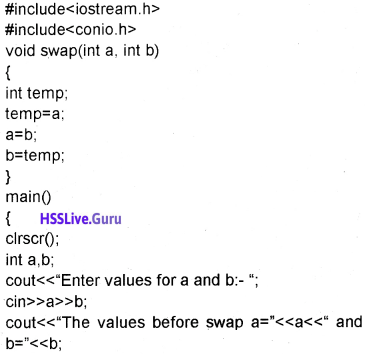
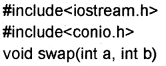
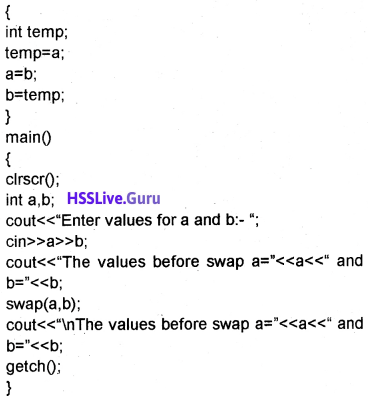
1. Call by value:
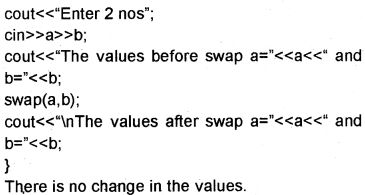
In call by value method the copy of the original value is passed to the function, if the function makes any change will not affect the original value.
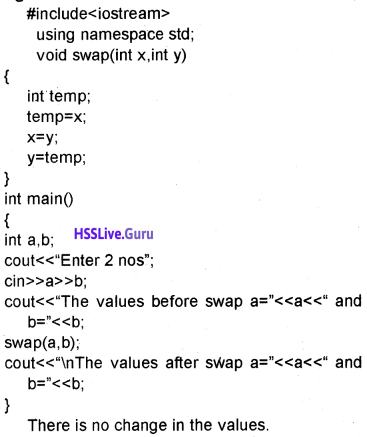
Example
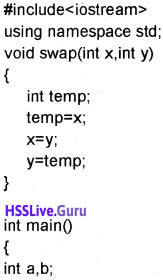
#include<iostream.h>
#include<conio.h> void
swap(int a, int b)
{
int temp;
temp = a;
a = b;
b = temp;
}
main()
{
clrscr();
int a,b;
cout<<“Enter values for a and b:-“;
cin>>a>>b;
cout<<“The values before swap a =”<<a<<“ and
b =”<<b;
swap(a,b);
cout<<“\nThe values before swap a =”<<a«“ and
b =”<<b;
getch();
}

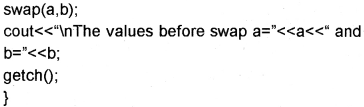
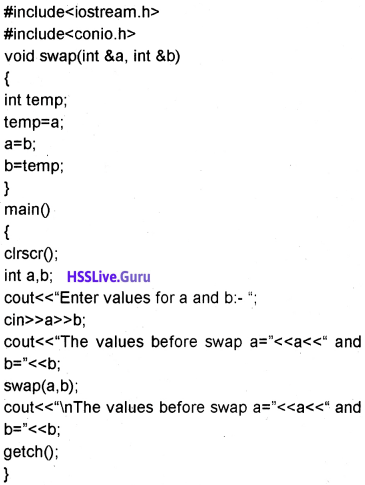
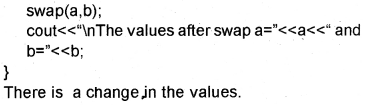
2. Call by reference:
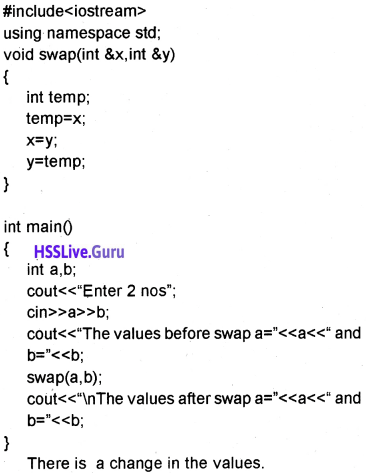
In call by reference method the address of the original value is passed to the function, if the function makes any change will affect the original value.
Example
#include<iostream.h>
#include<conio.h>
void swap(int &a, int &b)
{
int temp;
temp = a;
a = b;
b = temp;
}
main()
{
clrscrO;
int a,b;
cout<<“Enter values for a and b:- “; cin>>a>>b;
cout<<“The values before swap a =”<<a<<“ and
b=”<<b;
swap(a,b);
cout<<“\nThe values before swap a =”<<a<<“ and
b =”<<b;
getch();
}

Question 14.
A
Answer:
int sum (int N, int Start_No) .
{
int i, S = 0;
for (i = Start_No; i < = N + Start_No; i++)
S = S + i;
reurn S;
}

Question 15.
Differentiate between the string functions strcmp() and strcmpi(). (SAY-2016) (2)
Answer:
strcmp(): It is used to compare two strings and returns an integer.
Syntax:
strcmp(string1,string2)

  • if it is 0 both strings are equal.
  • if it is greater than 0(i.e. +ve) stringl is greater than string2
  • if it is less than 0(i.e. -ve) string2 is greater than string1

strcmpi():
It is same as strcmp() but it is not case sensitive. That means uppercase and lowercase are treated as same.
eg: “ANDREA” and “Andrea” and “andrea” these are same.

Question 16.
Read the function definition given below. Predict the output, if the function is called as convert (7). (MARCH-2017) (2)
void convert (int n)
{
if (n>1)
convert (n/2);
cout<<n%2;
}
Answer:
The out put is 111. convert() is a recursive function.

Plus One Functions Three Mark Questions and Answers

Question 1.
Consider the following function declaration with optional (default) arguments and state legal or illegal and give the reasons

  1. int sum(int x = 10, int y, int z)
  2. int sum(int x = 10, int y = 20, int z)
  3. int sum(int x = 10, int y = 20, int z = 30)
  4. int sum(int x, int y = 20, int z)
  5. int sum(int x, int y = 20, int z = 30)
  6. inf sum(int x, int y, int z = 30)
  7. int sum(int x = 10, int y, int z = 30)

Answer:
There is a rule to make an argument as default argument,i.e., to set an argument with a value that must be in the order from right to left. All the arguments in the right side of an argument must be set first to make an argument as a default argument.

  1. illegal, because y and z are not have values
  2. illegal, because z has no value
  3. legal
  4. illegal, because z has no value
  5. legal
  6. legal
  7. illegal, because x has a value but y has no value

Plus One Computer Science Chapter Wise Questions and Answers Chapter 10 Functions

Question 2.
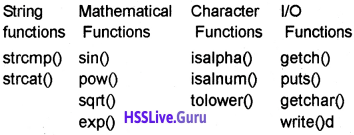
A list of C++ built-in functions are given. Classify them based on the usage and prepare a table with proper group names.
Plus One Computer Science Chapter Wise Questions and Answers Chapter 10 Functions 1
Answer:
Plus One Computer Science Chapter Wise Questions and Answers Chapter 10 Functions 2

Question 3.
Read the following program
#include<iostream>
using namespace std;
int main()
{
cout<<sum(2,3);
}
int sum(int x, int y)
{return (x + y);}
On compilation on the program, an error will be displayed. Identify and explain the reason. How can you rectify the problem
Answer:
The compilation of the program starts from the first line arid next line and so on( i.e. line by line). While compiling the line cout<<sum(2,3); The compiler does not understand the word sum(2,3) because it is not declared yet hence the error prototype required. To rectify this problem there are two methods

First method:
Give the function definition just before the main function as follows.
#include<iostream>
using namespace std;
int sum(intx, int y)
{return (x + y);}
int main()
{
cout<<sum(2,3);
}

Second Method:
Give the function declaration(prototype only) in the main function as follows.
#include<iostream>
using namespace std;
int main()
{
int sum(int.int);
cout<<sum(2,3);
}
int sum(int x, int y)
{return (x + y);}

Question 4.
Considering the following function definition.
{
for (int f = 1; n>0; n-)
f = f*n;
return f;
}
void main()
{
int a = 5, ans;
ans = fact (a);
cout<< a << “! = ” << ans;
}
The expected, desired output is 5! = 120
What will be the actual output of the program? It is not the same as above, why? What modification are required in the program to get the desired output.
Answer:
The output is 0! = 120
Because the address of variable ’a’ is given to the variable ‘n’ of the function fact(call by reference method). So the function changes its value (i.e. n-) to 0. Hence the result.
To get the desired result call the function as call by value method in this method the copy of the value of the variable ‘a’ is given to the function. So the actual value of ‘a’ will not changed. So instead of int fact(int &n) just write int fact(int n), i.e., no need of & symbol.

Plus One Computer Science Chapter Wise Questions and Answers Chapter 10 Functions

Question 5.
A function is defined as follows
int sum (int a, int b = 2)
{return (a + b);}
Check whether each of the following function calls is correct or wrong, Justify your answer

  1. cout << sum (2,3);
  2. cout << sum( 2) ;
  3. cout << sum();

Answer:
Here the function is declared with one optional argument. So the function call with minimum one argument is compulsory.

  1. It is valid. Here a becomes 2 and b becomes 3.
  2. It is also valid . Here a becomes 2 and b takes the default value 2.
  3. It is not a valid call. One argument is compulsory.

Question 6.
The factorial of a number, say N is the product of first N natural numbers. Thus, factorial of 5 can be obtained by taking the product of 5 and factorial of 4. Similarly factorial of 4 be found out by taking the product of 4 and factorial of 3. At last the factorial of 1 is 1 itself.

Which technique is applicable to find the factorial of a number in this fashion? Write a C++ function to implement this technique. Also explain the working of the function by giving the number 5 as input.
Answer:
A function calls itself is known as recursion.
#include<iostream>
using namespace std;
int fac(int);
int main()
{
int n;
cout<<“enter a number”;
cin>>n;
cout<<fac(n);
}
int fac(int n)
{
if (n == 1) return (1);
else
return (n × fac(n – 1));
}
The working of this program is as follows If the value of n is 5 then it calls the function as fa. The function returns value 5 × fac(4), That means this function calls the function again and returns 5 ×4 × fac(3). This process continues until the value n = 1. So the result is 5 × 4 × 3 × 2 × 1 = 120.

Question 7.
How do two functions exchange data between them? Compare the two methods of data transfer from calling function to called function
Answer:
There are two methods they are call by value and call by reference
1. call by value:
In call by value method, a copy of the actual parameters are passed to the formal parameters. If the function makes any change it will not affect the original value.

2. call by reference:
In call by reference method, the reference of the actual parameters are passed to the formal parameters. If the function makes any change it will affect the original value.

Question 8.
Read the following program
#include<iostream>
using namespace std;
int a = 0;
int main()
{
int showval(int);
cout<< a; a++;
cout << showval (a);
cout<< a;
}
int showval(int x)
{
int a = 5;
return (a + x);
}
Write down the value displayed by the output of the above program with suitable explanation. What are the inferences drawn regarding the scope of variables?
Answer:
The output is 061.
Global variable: A variable declared out side of all functions it is known as global variable.
Local variable: A variable declared inside of a function it is known as local variable.
If a variable declared inside a function(main or other) with the same name of a global variable. The function uses the value of local variable and does not use the value of the global variable.

Here int a = 0 is a global variable. In the main function the global variable ‘a’ is used. There is no local variable so the value of ‘a’, 0 is displayed. The statement ‘a++’ makes the value of ‘a’ is 1. It calls the function showval with argument ‘a = T.

The argument ‘x’ will get this value i.e. ‘x = 1 But in the function showval there is a local variable ‘a’ its value is 5 is used. So this function returns 6 and it will be displayed. After this the value 1 of the global variable ‘a’ will be displayed. Hence the result 061.

Plus One Computer Science Chapter Wise Questions and Answers Chapter 10 Functions

Question 9.
The following are function calling statements. Some of them will be executed, while some other generate compilation error. Write down your opinion on each of them with proper justification Function

  1. har ch =
  2. sqrt(25);
  3. strcat (“Computer”, “Program”);
  4. double num = pow(2,3,5)
  5. putchar(getchar());

Answer:

  1. getch get a character from the console(keyboard) but does not echo to the screen. So we can’t read a character from the console.
  2. It returns the square root of 25.
  3. It concatenates Program to computer, i.e. we will get a string “computer program”
  4. The function pow should contains only two arguments. But here it contains 3 arguments so it is an error. We can write this function as follows Double num = pow(pow(2,3),5)
  5. It reads a character from the console and display it on the screen.

Question 10.
Write down the operation performed by the following statements.

  1. int l = strlen(“Computer Program”);
  2. char ch[ ] = tolower(“My School”);
  3. cout <<(strcmp(“High”, “Low”)>0 ? toupper(“High”):tolower(“Low”));

Answer:

  1. The built in function strlen find the length of the string i.e. 16 and assigns it to the variable I.
  2. This is an error because tolower is a character function.
  3. This is also an error because tolower and toupper are character functions.

Question 11.
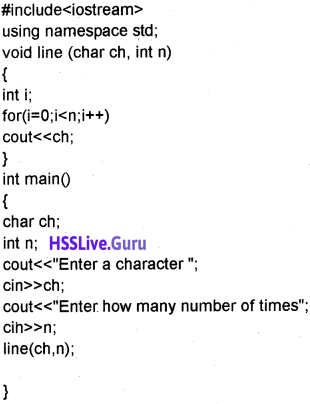
A line of given length with a particular character is to be displayed. For example, ********** js a line with ten asterisks (*). Define a function to achieve this output.
Answer:
Plus One Computer Science Chapter Wise Questions and Answers Chapter 10 Functions 3

Question 12.
Read the following function
int fib(int n)
{
if (n<3)
return 1;
else
return (fib(n – 1) + fib(n – 2));
}

  1. What is the speciality of this function
  2. How does it work?
  3. What will be the output of the following code?

Answer:

  1. This function is a recursive function. That means the function calls itself.
  2. It works as follows
    • if i = 1, The function fib calls with value 1. i.e. fib(1) returns 1
    • if i = 2, The function fib calls with value 2. i.e. fib(2) returns 1
    • if i = 3, The function fib calls with value 3. i.e. fib(3) returns fib(2) + fib(1) i.e. it calls the function again.
      So the result is 1 + 1 = 2
    • if i = 4, The function fib calls with value 4. i.e. fib(4) returns fib(3) + fib(2) i.e. it calls the function again.
      So the result is 2 + 1 = 3
  3. The output will be as follows 1 1 2 3

Question 13.
Explain scope rules of functions and variables in a C++ program
Answer:
Local variable or function:
A variable or function declared inside a function is called local variable or function. This cannot be accessed by the out-side of the function.
eg:
main()
{
int k; // local variable
cout<<sum(a,b); // local function
}

Global variable or function:
A variable or function declared out side of a function is called global variable or function. This can be accessed by any statements.
eg:
int k; // global variable
int sum(int a, int b); // global function
main()
{
}

Plus One Computer Science Chapter Wise Questions and Answers Chapter 10 Functions

Question 14.
Briefly explain default arguments Default arguments.
Answer:
A default value can be set for a parameter (argument) of a function. When the user does not give a value the function will take the default value. An important thing remember,is an argument cannot have a default value unless all arguments on its right side must have default value.
Functions with valid default arguments are given below

  • float area(int x, int y, int z = 30);
  • float area(int x, int y = 20, int z = 30);
  • float area(int x = 10, int y = 20, int z = 30);

Functions with invalid default arguments are given below

  • float area(int x = 10, int y, int z);
  • float area(int x, int y = 20, int z);
  • float area(int x = 10, int y = 20, int z);

Question 15.
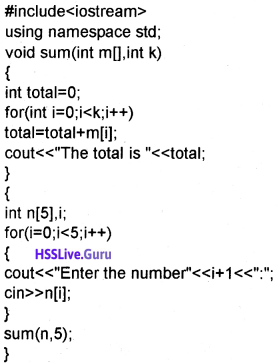
How to pass an array to function.
Answer:
By using call by reference method we can send an array as argument. We have to send only the array name and its data type. The array name holds the starting address and will access the subsequent elements of an array.
The following example shows this
Plus One Computer Science Chapter Wise Questions and Answers Chapter 10 Functions 4

Question 16.
How to pass a structure to a function.
Answer:
A structure can be passed as argument to a function either call by value or call by reference method. An example is given below to read name and age of a structure and pass it to a function.
Plus One Computer Science Chapter Wise Questions and Answers Chapter 10 Functions 5

Question 17.
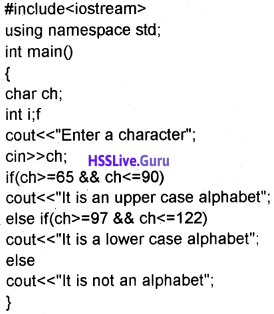
Write a program to read a character and check whether it is alphabet or not. If it is an alphabet check whether it is upper case or lower case?
Answer:
Plus One Computer Science Chapter Wise Questions and Answers Chapter 10 Functions 6

Question 18.
Write a program to read 2 strings and join them 2 string.
Answer:
Plus One Computer Science Chapter Wise Questions and Answers Chapter 10 Functions 7

Question 19.
Write a program to read 2 strings and compare it 2 string.
Answer:
Plus One Computer Science Chapter Wise Questions and Answers Chapter 10 Functions 8
Plus One Computer Science Chapter Wise Questions and Answers Chapter 10 Functions 9

Question 20.
Write a program to read a string and display the number of alphabets and digits and special characters.
Answer:
Plus One Computer Science Chapter Wise Questions and Answers Chapter 10 Functions 10

Question 21.
Write a program to perform the following opera-tions on a string

  1. Length of a string
  2. Search a character
  3. Display the string

Answer:
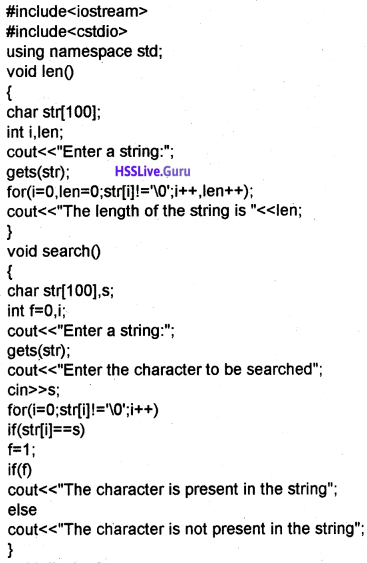
Plus One Computer Science Chapter Wise Questions and Answers Chapter 10 Functions 11
Plus One Computer Science Chapter Wise Questions and Answers Chapter 10 Functions 13

Plus One Computer Science Chapter Wise Questions and Answers Chapter 10 Functions

Question 22.
Write short notes about conversion functions.
Answer:
The header file stdlib.h is used for conversion functions.Following are the important conversion functions
1. itoa():
It is used to convert an integer into a string.
eg:
int n = 100;
charstr[20];
itoa(n,str,10);

2. Itoa():
It is used to convert an long into a string.
eg:
long n = 1002345L
char str[20];
ltoa(n,str,10);

3. atoi():
It is used to convert a string into integer
eg:
int n;
str[] = “123”
n = atoi(str);

4. atoll():
It is used to convert a string into long
eg:
long n;
str[] = “123456”
n = atol(str);

Question 23.
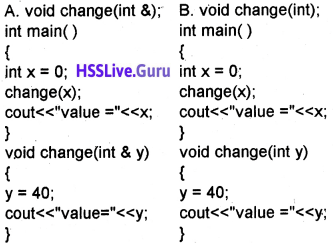
Plus One Computer Science Chapter Wise Questions and Answers Chapter 10 Functions 14

  1. Predict the output of both programs.
  2. Justify your predictions.

Answer:
1. A. Output
value = 40

B. output
value = 0

2. In the first case (A) the argument x is passed by reference method. So the changes made in the function reflects in main()

In the second case (B) the argument x is passed by value method. So the changes made in the function will not reflect in main()

Question 24.
Consider the following C++ function.
int recfact(int x)
{
if(x == 0)
return 1;
else
return x * recfact(x – 1);
}

  1. What type of function is this? Explain. (2 Scores)
  2. What is the output of the above function when x = 5

Answer:

  1. recursive function. The abilty of a function to call itself is called recursion. A function is said to be recursive if a statement in the body of the function calls itself.
  2. Output 120

Plus One Computer Science Chapter Wise Questions and Answers Chapter 10 Functions

Question 25.
void initialise()
{
int k = 10;
}
int main()
{
int a, b;
float marks;
a = 20;
cout<<“First value =”<< a;
initialise();
b = k + a;
cout<<“New value =”<<b;
}

  1. Identify the error in the above code and explain its reasons.
  2. Correct the errors.

Answer:

  1. K is a local variable in the function initialize 0. It is not accessible in main()
  2. Making the variable K as global we can correct the error.

Question 26.
Write a program to read 2 strings and join them using string function.
Answer:
#include<iostream>
#include<cstring>
#include<cstdio>
using namespace std;
int main()
{
char str1 [50],str2[50],str[100];
cout<<“Enter a string:”; gets(strl);
cout<<“Enter another string:”; gets(str2);
strcat(str,str1);
strcat(str,str2);
cout<<“The concatenated string is”<<str;
}

Plus One Computer Science Chapter Wise Questions and Answers Chapter 10 Functions

Question 27.
Consider the following code.
#include<iostream>
#include<cstdlib>
using namespace std;
int main()
{
char str1 [] = “123”,str2[] = “45”;
int a,b;
a = atoi(str1);
b = atoi(str2);
cout<<a + b;
}
What will be the output and give the reason?
Answer:
The output is 123 + 45 = 168. Here the conversion function atoi is used to convert the string “123” into integer 123 and “45” into integer 45 so the result.

Question 28.
Name the different methods used for passing arguments to a function. Write the difference between them with examples. (MARCH-2015)
Answer:
Methods of calling functions:
Two types call by value and call by reference.
1. Call by value:
In call by value method the copy of the original value is passed to the function, if the function makes any change will not affect the original value.
Example
Plus One Computer Science Chapter Wise Questions and Answers Chapter 10 Functions 15
Plus One Computer Science Chapter Wise Questions and Answers Chapter 10 Functions 16

2. Call by reference:
In call by reference method the address of the original value is passed to the function, if the function makes any change will affect the original value.
Example
Plus One Computer Science Chapter Wise Questions and Answers Chapter 10 Functions 17

Question 29.
Write a C++ program to display the simple interest using function. (SAY-2015) (3)
Answer:
include < iostream>
using namespace std;
float Simplelnt (float p, int n, float r)
{
return (p*n*r/100);
}
int main()
{
float p, r, SI;
int n;
cout<<“Enter values for p,n,r:”; cin>>p>>n>>r;
SI = Simplelnt (p,n,r); cout<<“simple interest is”<<SI;
}

Plus One Computer Science Chapter Wise Questions and Answers Chapter 10 Functions

Question 30.
Write a function’s definition of the above type to find the sum of matural numbers from 1 to N. (Hint: If the value of N is 5, the answer will be 1 + 2 + 3 + 4 + 5 = 15). (MARCH – 2016) (3)
Answer:
int sum (int n)
{
if (n == 0)
return 0;
else
return (n + sum (n – 1));
}

Question 31.
A program requires functions for adding 2 numbers, 3 numbers and 4 numbers, How can you provide a solution by writing a single functio0n? (SCERT SAMPLE -1) (3)
Answer:
It can be solved by writing function with default values.
eg: int add (int n1, int n2, int n3 = 0, int n4 = 0)
{
return (n1 + n2 + n3 + n4);
}
This function can be invoked by the following function calling
1. add (5,2);
2. add (5,2,7);
3. add (5,2,7,10);

The 1. Call returns 5 + 2 = 7
2. Call returns 5 + 2 + 7 = 14
3. Call returns 5 + 2 + 7 + 10 = 24

Question 32.
Explain the difference between call-by-value method and call-by-reference method with the help of examples. (SCERT SAMPLE – II) (3)
Answer:
Methods of calling functions:
Two types call by value and call by reference.
1. Call by value:
In call by value method the copy of the original value is passed to the function, if the ’ function makes any change will not affect the original value.
Example
Plus One Computer Science Chapter Wise Questions and Answers Chapter 10 Functions 18
Plus One Computer Science Chapter Wise Questions and Answers Chapter 10 Functions 19

2. Call by reference:
In call by reference method the address of the original value is passed to the function, if the function makes any change will affect the original value.
Example
Plus One Computer Science Chapter Wise Questions and Answers Chapter 10 Functions 20

Plus One Computer Science Chapter Wise Questions and Answers Chapter 10 Functions

Question 33.
Explain recursive functions with the help of a suitable example. (SAY-2016) (3)
Answer:
A function calls itself is called recursive function.
#include<iostream>
using namespace std;
void convert(int n)
{
if(n>1)
convert(n/2);
cout<<n % 2;
}
int main()
{
convert(7);
}
Here the function convert is a recursive function, that means it calls itself and output of the above program is 111.

Question 34.
Name the built-in function to check whether a character is alphanumeric or not. (MARCH-2017) (3)
Answer:
isalnum()

Question 35
Briefly explain the three components in the structure of a C++ program. (MARCH-2017) (3)
Answer:
1. Preprocessor directives:
A C++ program starts with the preprocessor directive i.e., # .include, #define, #undef, etc, are such a preprocessor directives. By using #include we can link the header files that are needed to use the functions. By using #define we can define some constants.
eg: #define x 100. Here the value of x becomes 100 and cannot be changed in the program. No semicolon is needed.

2. Header files:
A header file is a pre stored file that helps to use some operators and functions. To write C++ programs the header files are must. Following are the header files iostream

  • iomanip
  • cstdio
  • cctype
  • cmath
  • cstring

The syntax for including a header file is as follows
#include<name of the header file>
eg: #include<iostream>

3. The main function:
The main function is the first function which is invoked at the time of execution and the program ends within main(). The other functions are invoke from main().

Question 36.
Explain the difference between call by value method and call by reference method with the help of examples. (MARCH-2017) (3)
Answer:
Two types are call by value and call by reference.
1. Call by value:
In call by value method the copy of the original value is passed to the function, if the function makes any change wilt not affect the original value.
Example
Plus One Computer Science Chapter Wise Questions and Answers Chapter 10 Functions 21

2. Call by reference:
In call by reference method the address of the original value is passed to the function, if the function makes any change will affect the original value.
Example
Plus One Computer Science Chapter Wise Questions and Answers Chapter 10 Functions 22
Plus One Computer Science Chapter Wise Questions and Answers Chapter 10 Functions 23

Plus One Functions Five Mark Questions and Answers

Question 1.
Short notes about character functions and string functions
Answer:
A. Character functions:
1. isalnum():
t is used to check whether a character is alphabet or digit. It returns a non zero value if it is an alphabet or digit otherwise it returns zero.

2. isalpha():
It is used to check whether a character is alphabet or not. It returns a non zero value if it is an alphabet otherwise it returns zero.

3. isdigit():
It is used to check whether a character is digit or not. It returns a non zero value if it is digit otherwise it returns zero.

4. islower():
It is used to check whether a character is lower case alphabet or not. It returns a non zero value if it is a lowercase alphabet otherwise it returns zero.

5. isupper():
It is used to check whether a character is upper case alphabet or not. It returns a non zero value if it is an upper case alphabet otherwise it returns zero.

6. tolower():
It is used to convert the alphabet into lower case

7. toupper():
It is used to convert the alphabet into upper case

B. String functions:

1. strcpy():
This function is used to copy one string into another

2. strcat():
This function is used to concatenate(join) second string into first string

3. strlen():
This function is used to find the length of a string.

4. strcmp():
This function is used to compare 2 strings. If the first string is less than second string then it returns a negative value. If the first string is equal to the second string then it returns a value zero and if the first string is greater than the second string then it returns a positive value.

Plus One Computer Science Chapter Wise Questions and Answers Chapter 10 Functions

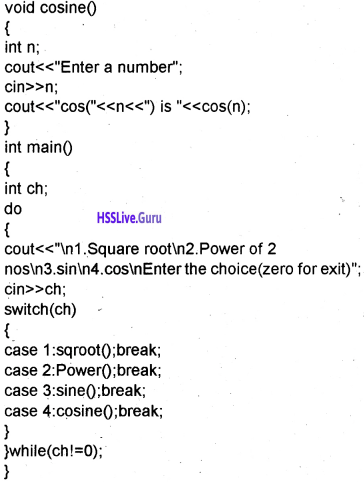
Question 2.
Write functions to perform the following operations

  1. sqrt()
  2. power of 2 numbers
  3. sin
  4. cos

Answer:
Plus One Computer Science Chapter Wise Questions and Answers Chapter 10 Functions 24
Plus One Computer Science Chapter Wise Questions and Answers Chapter 10 Functions 25

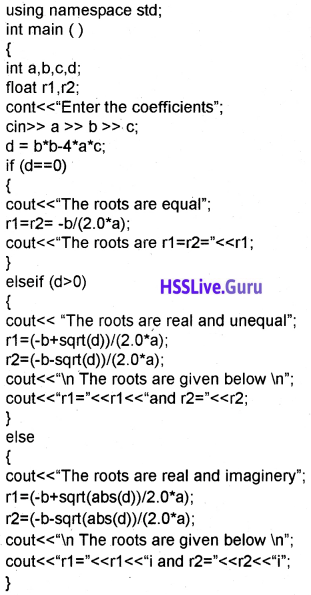
Question 3.
Write a C++ program to display the roots of quadratic equation. (SAY-2015) (5)
Answer:
#include<iostream>
#include<cmath>
Plus One Computer Science Chapter Wise Questions and Answers Chapter 10 Functions 26

Question 4.
Explain ‘Call by Value’ and ‘Call by Reference’ methods of function calling with the help of a suitable example. (SAY-2016)
Answer:
Two types are call by value and call by reference.
1. Call by value:
In call by value method the copy of the original value is passed to the function, if the function makes any change will not affect the original value.
Example
Plus One Computer Science Chapter Wise Questions and Answers Chapter 10 Functions 27
Plus One Computer Science Chapter Wise Questions and Answers Chapter 10 Functions 29

2. Call by reference:
In call by reference method the address of the original value is passed to the function, if the function makes any change will affect the original value.
Example
Plus One Computer Science Chapter Wise Questions and Answers Chapter 10 Functions 30

Plus One Computer Science Chapter Wise Questions and Answers Chapter 10 Functions

Question 5.
Define network topology. Explain any four network topologies in detail. (SAY-2016)
Answer:
Network topologies:
Physical or logical arrangement of computers on a network is called structure or topology. It is the geometrical arrangement of computers in a network. The major topologies developed are star, bus, ring, tree and mesh

1. Star Topology:
A star topology has a server all other computers are connected to it. If computer A wants to transmit a message to computer B. Then computer A first transmit the message to the server then the server retransmits the message to the computer B.

That means all the messages are transmitted through the server. Advantages are add or remove workstations to a star network is easy and the failure of a workstation will not effect the other. The disadvantage is that if the server fails the entire network will fail.

2. Bus Topology:
Here all the computers are attached to a single cable called bus. Here one computer transmits all other computers listen. Therefore it is called broadcast bus. The transmission from any station will travel in both the direction. The connected computers can hear the message and check whether it is for them or not.

Advantages are add or remove computer is very easy. It requires less cable length and the installation cost is less. Disadvantage is fault detection is very difficult because of no central computer.

3. Ring Topology:
Here all the computers are connected in the shape of a ring and it is a closed loop. Here also there is no central computer. Here a computer transmits a message, which is tagged along with its destination computer’s address. The message travels in one direction and each node check

whether the message is for them. If not, it passes to the next node. FIt requires only short cable length. If a single node fails, at least a portion of the network will fail. To add a node is very difficult.

4. Hybrid Topology:
It is a combination of any two or more network topologies. Tree topology and mesh topology can be considered as hybrid topology.
(a) Tree Topology:
The structure of a tree topology is the shape of an inverted tree with a central node and branches as nodes. It is a variation of bus topology. The data transmission takes place in the way as in bus topology. The disadvantage is that if one node fails, the entire portion will fail.

(b) Mesh Topology:
In this topology each node is connected to more than one node. It is just like a mesh (net). There are multiple paths between computers. If one path fails, we can transmit data through another path.

Kerala Syllabus 9th Standard Hindi Solutions Unit 4 Chapter 2 संसार पुस्तक है

You can Download संसार पुस्तक है Questions and Answers, Summary, Activity, Notes, Kerala Syllabus 9th Standard Hindi Solutions Unit 4 Chapter 2 help you to revise complete Syllabus and score more marks in your examinations.

Kerala State Syllabus 9th Standard Hindi Solutions Unit 4 Chapter 2 संसार पुस्तक है (पत्र)

संसार पुस्तक है Textual Questions and Answers

संसार पुस्तक है विश्लेषणात्मक प्रश्न

Sansar Pustak Hai Summary in Malayalam प्रश्ना 1.
‘हिंदुस्तान, जो एत बहुत बड़ा देश है, फिर भी दुनिया का एक छोटा-सा हिस्सा है। अगर तुम्हें इस दुनिया का …..तुम पैदा हुई हो’ -इससे आपने क्या समझा?
Kerala Syllabus 9th Standard Hindi Solutions Unit 4 Chapter 2 संसार पुस्तक है 1
उत्तर:
देश कितना भी बड़ा हो या छोटा, उसके बारे में कुछ जानना चाहते हैं तो ज़रूर दुनिया के सारे देशों के बारे में और वहाँ के जीव-जंतुओं के बारे में जानकारी होना ज़रूरी है। केवल एक छोटा-सा देश भारत को जानने से दुनिया का हाल समझ नहीं सकते। हम अपने देश भारत को जानना मतलब दुनिया को जानना है।

HSSLive.Guru

Sansar Pustak Hai Chapter प्रश्ना 2.
‘पुराने ज़माने की लिखी हुई किताबें न होने पर भी कुछ ऐसी चीजें हैं जिनसे हमें उतनी ही बातें मालूम होती हैं जितनी किसी किताब से होतीं।’ ऐसा क्यों कहा गया है?
Kerala Syllabus 9th Standard Hindi Solutions Unit 4 Chapter 2 संसार पुस्तक है 2
उत्तर:
दुनिया में ऐसी कई चीजें हैं जो हमारे लिए पुस्तकों से ज़्यादा जानकारी देती है। पहाड़, चट्टान, नदियाँ, जंगल, समुद्र, जानवरों की हाड़िडयाँ, शिलालेख आदि ऐसी ही चीजें हैं। ये पुराने ज़माने की स्मृतियाँ जगाने वाली ज़िंदा सबूत है।

Sansar Pustak Hai प्रश्ना 3.
इसी तरह पहले तुम्हें प्रकृति के अक्षर पढ़ने पड़ेंगे’ -इसका मतलब क्या है?
Kerala Syllabus 9th Standard Hindi Solutions Unit 4 Chapter 2 संसार पुस्तक है 3
उत्तर:
प्रकृति का अक्षर पढ़ना’ का मतलब है- प्रकृति को समझने ज्ञान प्राप्त करना। प्रकृति को समझने के लिए उसकी विभिन्न बातों को ठीक तरह से समझना होगा। तभी हम प्रकृति ठीक तरह से समझ सकते हैं।

संसार पुस्तक है Text Book Activities

संसार पुस्तक है विधात्मक प्रश्न

संसार पुस्तक है प्रश्न उत्तर प्रश्ना 1.
वाक्यांशों को उचित खानों में लिखें।
उत्तर:

प्रकृति के साथ प्रकृति के विरुद्ध
पेड़ लगाना पेड़ों को काटना
मिट्टी का संरक्षण करना मिट्टी को प्रदूषित करना
पहाड़ों का संरक्षण करना चट्टानों को तोड़ना
जलस्रोतों का संरक्षण करना नदी-नालों में कूडा कचड़ा डालना

प्रश्ना 2.
संसार पुस्तक है लेख के आधार पर सही वाक्यों पर सही का निशान ✓ लगाएँ।
उत्तर:
Kerala Syllabus 9th Standard Hindi Solutions Unit 4 Chapter 2 संसार पुस्तक है 4

संसार पुस्तक है Summary प्रश्ना 3.
आशयों का सही मिलान करें।
उत्तर:

 प्रकृति के साथ प्रकृति के विरुद्ध
1. लाखों पुरानी धरती में  1. कई दिनों तक कोई आदमी नहीं था।
2.पुराने समय के जानवरों के बारे में जानने के लिए 2. उनकी पुरानी हाड्डियाँ महत्वपूर्ण सहायता देती है।
3. विद्वानों के अध्ययन के अनुसार 3. एक ज़माने में धरती बेहद गरम थी।
4. प्रकृति का निरीक्षण करने से 4. समय के अनुसार भूमि में हुए परिवर्तनों का अनुमान कर सकते हैं।

प्रश्ना 4.
आत्मकथा लिखें :
Kerala Syllabus 9th Standard Hindi Solutions Unit 4 Chapter 2 संसार पुस्तक है 5
‘दुनिया का पुराना हाल जानने के लिए खुद संसार-रूपी पुस्तक को पढ़ें।’
Kerala Syllabus 9th Standard Hindi Solutions Unit 4 Chapter 2 संसार पुस्तक है 6
i. संसार-रूपी पुस्तक में आप क्या-क्या पढ़ सकते हैं?
Kerala Syllabus 9th Standard Hindi Solutions Unit 4 Chapter 2 संसार पुस्तक है 7
ii. आपके इलाके की भी एक कहानी होती है। लिखें उसकी आत्मकथा।
Kerala Syllabus 9th Standard Hindi Solutions Unit 4 Chapter 2 संसार पुस्तक है 8
उत्तर:
संसार-रूपी पुस्तक से हम संसार के विभिन्न संसाधनों के संबंध में पढ़ सकते हैं। संसार
के बातों की विशेषताएँ, उनका विकासक्रम, उनमें असर डालनेवाले तत्व आदि की
जानकारी संसार-रूपी पुस्तक से मिल सकती है।
आत्मकथा लिखते समय ध्यान दें :
लेखन में कहानीपन हो।
मुख्य बातों को जोड़ें।
आत्मकथा शैली हो।

संसार पुस्तक है Additional Questions and Answers

संसार पुस्तक है आशयग्रहण के प्रश्न

प्रश्ना 1.
इंग्लैंड और हिंदुस्तान क्या फरक बताया है?
Kerala Syllabus 9th Standard Hindi Solutions Unit 4 Chapter 2 संसार पुस्तक है 9
उत्तर:
इंग्लैंड केवल एक छोटा-सा टापू है और हिंदुस्तान एक बहुत बड़ा देश है।

Upstox Hindi प्रश्ना 2.
आदमियों के आने के पहले धर्ती की क्या स्थिति थी?
Kerala Syllabus 9th Standard Hindi Solutions Unit 4 Chapter 2 संसार पुस्तक है 10
उत्तर:
आदमियों के पहले सिर्फ जानवर थे, और जानवरों से पहले धरती पर कोई जानदार चीज़ न थी।

HSSLive.Guru

संसार पुस्तक है Class 6 प्रश्ना 3.
विज्ञान पृथ्वी के संबंध में क्या कहता है?
Kerala Syllabus 9th Standard Hindi Solutions Unit 4 Chapter 2 संसार पुस्तक है 11
उत्तर:
एक ऐसा समय था जब यह धरती बेहद गर्म थी और इसपर कोई जानदार चीज़ नहीं रह सकती थी।

Pustak Ki Atmakatha in Hindi for Class 5 प्रश्ना 4.
हमें दुनिया का पुराना हाल कहाँ से मालूम होगा?
Kerala Syllabus 9th Standard Hindi Solutions Unit 4 Chapter 2 संसार पुस्तक है 12
उत्तर:
पहाड़, समुद्र, सितारे, नदियाँ, जंगल, जानवरों की पुरानी हड्डियाँ और भी इसी तरह की अनेक चीज़ों से हम दुनिया का पुराना हाल मालूम कर सकते हैं।

प्रश्ना 5.
चट्टान का एक टुकड़ा चिकने चमकीले रोड़े में कैसे बदल जाता है?
Kerala Syllabus 9th Standard Hindi Solutions Unit 4 Chapter 2 संसार पुस्तक है 13
उत्तर:
चट्टान का टुकड़ा पानी के बहाव में घाटी में आ पहुँचता है। वहाँ से कोई नाला उसे छोटे-से दरिया में पहुँचाता है। फिर वह बड़े दिया में आ जाता है। इस बीच लुढ़कतेलुढ़कते वह चिकना चमकीला हो गया।

संसार पुस्तक है Grammar

संसार पुस्तक है व्याकरण के प्रश्न

प्रश्ना 1.
ये वाक्य पढ़ें :
Kerala Syllabus 9th Standard Hindi Solutions Unit 4 Chapter 2 संसार पुस्तक है 14
i. इंग्लैंड केवल एक छोटा-सा टापू है।
Kerala Syllabus 9th Standard Hindi Solutions Unit 4 Chapter 2 संसार पुस्तक है 15
ii. हिंदुस्तान दुनिया का छोटा-सा हिस्सा है।
Kerala Syllabus 9th Standard Hindi Solutions Unit 4 Chapter 2 संसार पुस्तक है 16
इन बातों को मिलाकर पाठ भाग में कैसे प्रस्तुत किया गया है? देखें :
Kerala Syllabus 9th Standard Hindi Solutions Unit 4 Chapter 2 संसार पुस्तक है 17
….इंग्लैंड केवल एक छोटा-सा टापू है और हिंदुस्तान, जो एक बहुत बड़ा देश है, फिर भी दुनिया का एक छोटा-सा हिस्सा है।’
i. ऐसी प्रस्तुति में कौन-सा नया आशय मिलता है?
Kerala Syllabus 9th Standard Hindi Solutions Unit 4 Chapter 2 संसार पुस्तक है 18
ii. इसमें रेखांकित शब्दों की भूमिका पहचानें।
Kerala Syllabus 9th Standard Hindi Solutions Unit 4 Chapter 2 संसार पुस्तक है 19
उत्तर:
इस प्रस्तुति से इंग्लैंड और हिंदुस्तान की तुलना की गई है। इसमें रेखांकित शब्द योजक की भूमिका निभा रहे हैं। इसका मुख्य और आश्रित उपवाक्य अर्थ-बोध में एक-दूसरे की सहायता करते हैं। इस वाक्य में उपवाक्यों को एक साथ रखने से ही एक विचार या अर्थ-बोध पूर्ण हुआ है। यह मिश्र वाक्य है।

HSSLive.Guru

प्रश्ना 2.
मिश्रित वाक्य चुनें :
Kerala Syllabus 9th Standard Hindi Solutions Unit 4 Chapter 2 संसार पुस्तक है 20
i. पाठ-भाग से ऐसे मिश्रित वाक्यों को चुनकर लिखें।
Kerala Syllabus 9th Standard Hindi Solutions Unit 4 Chapter 2 संसार पुस्तक है 21
ii. उन्हें सरल वाक्यों में विभाजित करें।
Kerala Syllabus 9th Standard Hindi Solutions Unit 4 Chapter 2 संसार पुस्तक है 22
iii. योजक शब्दों को सूचीबद्ध करें।
Kerala Syllabus 9th Standard Hindi Solutions Unit 4 Chapter 2 संसार पुस्तक है 23
उत्तर:
लेकिन विज्ञान जाननेवालों और विद्वानों ने, जिन्होंने इस विषय को खूब सोचा और पढ़ा है, लिखा है कि एक समय ऐसा था जब यह धरती बेहत गर्म थी और इसपर कोई जानदार चीज़ नहीं रह सकती थी।
विज्ञान जाननेवाले विद्वानों ने लिखा है।
विद्वानों ने इस विषय को खूब सोचा और पढ़ा है।
एक समय में यह धरती बेहद गर्म थी।
धरती में कोई जानदार चीज़ नहीं रह सकती थी।
योजक : जो, कि, और।

संसार पुस्तक है Summary in Malayalam and Translation

Kerala Syllabus 9th Standard Hindi Solutions Unit 4 Chapter 2 संसार पुस्तक है 24
Kerala Syllabus 9th Standard Hindi Solutions Unit 4 Chapter 2 संसार पुस्तक है 25
Kerala Syllabus 9th Standard Hindi Solutions Unit 4 Chapter 2 संसार पुस्तक है 26
Kerala Syllabus 9th Standard Hindi Solutions Unit 4 Chapter 2 संसार पुस्तक है 27

HSSLive.Guru
प्रश्ना 1.
बात बड़ी है पुराणी
थी प्रकृति की भी कहानी
आज आपको भी सुनानी। …..
प्रकृति की कहानी क्या है?
Kerala Syllabus 9th Standard Hindi Solutions Unit 4 Chapter 2 संसार पुस्तक है 28
उत्तर:
प्रकृति एक दिन से बनी नहीं है इसका एक
बड़ा इतिहास है। प्राकृतिक संसाधनों के
बीच एक संतुलन है। यह संतुलन बिगड़ने
पर बड़ी आपत्ति होगी
Kerala Syllabus 9th Standard Hindi Solutions Unit 4 Chapter 2 संसार पुस्तक है 29
Kerala Syllabus 9th Standard Hindi Solutions Unit 4 Chapter 2 संसार पुस्तक है 30
Kerala Syllabus 9th Standard Hindi Solutions Unit 4 Chapter 2 संसार पुस्तक है 31
Kerala Syllabus 9th Standard Hindi Solutions Unit 4 Chapter 2 संसार पुस्तक है 32

HSSLive.Guru

संसार पुस्तक है शब्दार्थ

Kerala Syllabus 9th Standard Hindi Solutions Unit 4 Chapter 2 संसार पुस्तक है 33

Plus One Zoology Chapter Wise Questions and Answers Chapter 2 Animal Kingdom

Students can Download Chapter 2 Animal Kingdom Questions and Answers, Plus One zoology Chapter Wise Questions and Answers helps you to revise the complete Kerala State Syllabus and score more marks in your examination

Kerala Plus One Zoology Chapter Wise Questions and Answers Chapter 2 Animal Kingdom

Plus One Animal Kingdom One Mark Questions and Answers

Question 1.
Fill in the blanks.
Plus One Zoology Chapter Wise Questions and Answers Chapter 2 Animal Kingdom - 1
Answer:
i) B – Nereis
ii) B – Ctenoplanna
C – Ctenophora
iii) A – radula

Question 2.
Write any two members of the Phylum Aschelminthes which are found parasitic on Human beings.
Answer:

  1. Ascaris (Roundworm)
  2. Wuchereria (Filaria worm)

Plus One Zoology Chapter Wise Questions and Answers Chapter 2 Animal Kingdom

Question 3.
In some animal groups, the body is found divided into compartments with at least some organs/ organ repeated. This characteristic feature is named
(a) Segmentation
(b) Metamerism
(c) Metagenesis
(d) Metamorphosis
Answer:
(b) Metamerism

Question 4.
Given below are types of cells present in some animals. Each one is specialized to perform a single specific function except
(a) Choanocytes
(b) Interstitial cells
(c) Gastrodermal cells
(d) Nematocytes
Answer:
(b) Interstitial cells

Question 5.
Which one of the following sets of animals share a four chambered heart?
(a) Amphibian, Reptiles, Birds
(b) Crocodiles, Birds, Mammals
(c) Crocodiles, Lizards, Turtles
(d) Lizards, Mammals, Birds
Answer:
(b) Crocodiles, Birds, Mammals

Question 6.
Which of the following pairs of animals has non glandular skin.
(a) Snake and Frog
(b) Chameleon and Turtle
(c) Frog and Pigeon
(d) Crocodile and Tiger.
Answer:
(c) Frog and Pigeon

Plus One Zoology Chapter Wise Questions and Answers Chapter 2 Animal Kingdom

Question 7.
Birds and mammals share one of the following characteristics as a common feature.
(a) Pigmented skin
(b) Alimentary canal with some modification
(c) Viviparity
(d) Warm blooded nature
Answer:
(d) Warm blooded nature

Question 8.
Note the relationship between the first two words and find a suitable word for the fourth place,

  1. Coelenterata: radial symmetry, platyhelminthes, _______
  2. Lizard: Poikilothermous, crow, _________

Answer:

  1. bilaterally symmetrical
  2. Homoiothermous

Question 9.

  1. Annelida: Parapodia :: __________ : Comb plates
  2. _________: Water vascular system :: Coelenterata : cnidoblast

Answer:

  1. Ctenophora
  2. Echinodermata

Question 10.
Malpighian tubule is the excretory organ of which phylum?
(a) Phylum porifera
(b) Phylum arthropoda
(c) Phylum Coelenterata
(d) Phylum mollusca
Answer:
(b) Phylum Arthropoda

Question 11.
A chordate animal having flame cells as the excretory organ.
Answer:
Amphioxus

Question 12.
From the pictures given below, find out the poikilothermic animals.
Plus One Zoology Chapter Wise Questions and Answers Chapter 2 Animal Kingdom - 2
Answer:
B and D are poikilothermic animals.

Question 13.
Segmentation in the body is first observed in which of the following:
(a) Platyhelminthes
(b) Aschelminthes
(c) Annelida
(d) Arthropoda
Answer:
(c) Annelida

Plus One Zoology Chapter Wise Questions and Answers Chapter 2 Animal Kingdom

Question 14.
Shark has to swim continuously, otherwise, it will sink down. Give reason.
Answer:
Due to absence of air bladder.

Plus One Animal Kingdom Two Mark Questions and Answers

Question 1.
Arrange the phylum in order.
Arthropoda → Platyhelminthes → Porifera → Ctenophora → Cnidaria → Mollusca → Annelida → Echinodermata → Aschelminthesip
Answer:

  • Presence of milk producing mammary gland.
  • Presence of hair on skin.
  • External ear or pinnae is present.
  • Different types of teeth are present in the jaw.

Question 2.
Complete the blanks.

Character Phylum
a. Body is flat
b. Body has similar segments
c. Body has jointed appendages
d. Body is round

Answer:

Character Phylum
a. Body is flat Platyhelminthes
b. Body has similar segments Annelida
c. Body has jointed appendages Arthropoda
d. Body is round Aschelminthes

Question 3.
Triploblastic animals are more complex than diploblastic animals. Do you agree with this statement? Justify.
Answer:
Triploblastic animals have more cell layers so they have the possibility of greater degree of cellular specialisation.

Plus One Zoology Chapter Wise Questions and Answers Chapter 2 Animal Kingdom

Question 4.
All vertebrates are chordates but all chordates are not vertebrates. Justify.
Answer:
Notochord is present in all vertebrates but vertebral column is present only in vertebrates and not in all chordates.

Question 5.
Copy and complete the table.

Chondrichthyes Osteichthyes
a _____________ Seen in all water forms
b. Endoskeleton is cartilage _____________
c _______________ Body covered by cycloid scales
d ______________ Mouth is terminal

Answer:

Chondrichthyes Osteichthyes
a. Marine form Seen in all water forms
b. Endoskeleton is cartilage Endoskeleton is bony.
c. Body is covered by placoid scale Body covered by cycloid scales
d. Mouth is ventral Mouth is terminal

Question 6.
Arrange the phylum in order.
Arthropoda → Platyhelminthes → Porifera → Ctenophora → Cnidaria → Mollusca → Annelida → Echinodermata → Aschelminthes
Answer:
Porifera → Cnidaria → Ctenophora→ Platyhelminthes → Aschelminthes → Annelida → Arthropoda → Mollusca → Echinodermata

Question 7.
Categorise and classify the following organisms and arrange them in a table with separate columns and provide appropriate headings.
Exocoetus, Physalia, Ascaris, Apis, Locusta, Corvus, Pita, Hydra, Sepia, Ancylostoma.
Answer:
Plus One Zoology Chapter Wise Questions and Answers Chapter 2 Animal Kingdom - 3

Question 8.

  1. Identify the phylum which exhibit metagenesis or alternation of generation.
  2. What is meant by alternation of generation?

Answer:

  1. Cnidaria
  2. Alternation of sexual and asexual forms of organism: ie., Polyp asexually produce medusa, medusa sexually product polyp.

Plus One Zoology Chapter Wise Questions and Answers Chapter 2 Animal Kingdom

Question 9.
Name the following.

  1. Phylum in which flatworms are included
  2. Excretory organs of Annelids.
  3. Largest phylum.
  4. An oviparous mammal.

Answer:

  1. Platyhelminthes
  2. Nephridia
  3. Arthropoda
  4. Platypus

Question 10.
Apis, Prawn, Locust, Spider
Following animals have different habit and habitat. But they have many common characters.

  1. Mention the common characters.
  2. Identify their phylum.

Answer:

  1. Joint footed animals
    • Metameric segmentation
    • Chitinous exoskeleton
  2. Arthropoda

Question 11.
A list of animals are given below. Arrange them according to increase in complexity of organization. Scorpion, Earthworm, Liver fluke, Pigeon, Seaanemon, Sycon, Elephant, Anabas.
Answer:
Sycon, Seaanemon, Liver fluke, Earthworm, Scor¬pion, Anabas, Pegeon, Elephant.

Plus One Zoology Chapter Wise Questions and Answers Chapter 2 Animal Kingdom

Question 12.
Nithin is Studying in Std. XI. He collected some specimens during the field trip conducted by the Science Club of his School. Help Nithin to Classify the Animal in respective Phylum.
Prawn, Slug worm, Butterfly, Pila, Grass Hopper, Crab
Answer:

Arthropoda Mollusca
Prawn Slugworm
Butterfly Pila
Grass hopper
Crab

Question 13.
During a field trip Raju has collected some organisms with the following characters. Help him to identify the phyla of those organisms.

  1. Metamerically segmented body.
  2. Body covered with calcareous shell.
  3. Dorso-ventrally flattened leaf like body.
  4. Body divided into head, thorax and abdomen.

Answer:

  1. Annelida
  2. Mollusca
  3. Platyhelminthes
  4. Arthropoda

Question 14.
Categorise the following fishes into Osteichthyes and Chondrichthyes?

  1. Exocoetus
  2. Trygon

Answer:

  1. Exocoetus – Oesteichthyes
  2. Trygon – Chondrichthyes

Question 15.
Arrange the following terms in two columns correctly. Malpighian tubules, radula, metamerism, Bioluminescence, choanocytes, nematocytes, Phylum-coelenterate, phylum-Arthropoda, phylum- ctnophora, phylum-Mollusca, Phylum-Porifera.
Answer:

Malpighian Phylum – Arthropoda
Radula Phylum – Mollusca
Metamerism Phylum – Annelida
Bioluminescence Phylum – Ctenophora
Choanocytes Phylum – Porifera
Nematocytes Phylum – Coelenterata

Plus One Zoology Chapter Wise Questions and Answers Chapter 2 Animal Kingdom

Question 16.
Match the following

Bidders canal Earthworm
Typhlosole Catla
Air bladder Shark
Placoid scale frog

Answer:

Bidders canal frog
Typhlosole Earthworm
Air bladder Catla
Placoid scale Shark

Question 17.
Observe the given organisms
Plus One Zoology Chapter Wise Questions and Answers Chapter 2 Animal Kingdom - 4

  1. Place these animals in proper phylum.
  2. Segmentation in the body is first observed in which of the above phylum?

Answer:

  1.  i) Arthropoda,
    ii) Porifera,
    ii) Annelida
  2. Annelida

Question 18.
Observe the table given below and fill the blank columns A, B, C and from the animals given in brackets. (Ascaris, Starfish, Fasciola, Earthworm)
Plus One Zoology Chapter Wise Questions and Answers Chapter 2 Animal Kingdom - 5
Answer:
Plus One Zoology Chapter Wise Questions and Answers Chapter 2 Animal Kingdom - 5

Question 19.
1. Identify the animal given below.
Plus One Zoology Chapter Wise Questions and Answers Chapter 2 Animal Kingdom - 7
2. Write one well marked property of the above animal.
Answer:

  1. Pleurobrachia
  2. Bioluminescence is well marked property of pleurobrachia

Plus One Zoology Chapter Wise Questions and Answers Chapter 2 Animal Kingdom

Question 20.
Representatives of some vertebrate classes are introducing themselves. Write down the name of the class in which they belong.

  1. My gills are covered by operculum. I have bony endoskeleton.
  2. I give birth to young ones. My body is covered by hair.
  3. My skin is glandular? Have trilocular heart.
  4. I live only in marine water. My endoskeleton is made up of cartilage.

Answer:

  1. Osteichthyes
  2. Mammalia
  3. Amphibia
  4. Chondrichthyes

Question 21.
During classroom discussion a student said that sponges are more complex than cnidarians. Do you agree with him. Justify.
Answer:
NO. Sponges are asymmetrical and body is formed of loose aggregate of cells. Cells are not organised to from tissues and organs. Cnidarians are radially symmetrical and tissue grade of organisation. So cnidarians are more complex than sponges.

Question 22.
Due to the absence of air bladder, fishes belonging to the class Chondrichthyes have to swim constantly. How important is the presence of air bladder in these fishes?
Answer:
Due to the absence of air bladder in chondrichthyes, they have to swim constantly to avoid sinking. If air bladder is present which regulates buoyancy.

Question 23.
Match the column A, B &C in the table given below:
Plus One Zoology Chapter Wise Questions and Answers Chapter 2 Animal Kingdom - 8
Answer:
Plus One Zoology Chapter Wise Questions and Answers Kerala - 9

Question 24.
Identify the phylum whose larvae are bilaterally symmetrical, but adults are radially symmetrical.

  1. Annelida
  2. Arthropoda
  3. Mollusca
  4. Echinodermata

Mention two salient features of the phylum.
Answer:
4. Echinodermata
Salient features Presence of Echinodermata:

  • Water vascular system
  • Spiny bodies, Endoskeleton of Calcareous ossicles

Question 25.
Write the name of phylum.

  1. Diploblastic, tissue grade of organisation, radially symmetrical, polymorphic animals.
  2. Soft bodied, Unsegmented, Bilaterally symmetrical animals with open type circulation.
  3. Triploblastic, bilaterally symmetrical, true coelomic animals with metamerism, closed circulation.
  4. Triploblastic, chitinous exoskeleton and open circulation.

Answer:

  1. Cnidaria
  2. Mollusca
  3. Annelida
  4. Arthropoda

Plus One Zoology Chapter Wise Questions and Answers Chapter 2 Animal Kingdom

Question 26.
Observe the table given below and fill the blank columns a, b, c, and d from the animals given in brackets.
Plus One Zoology Chapter Wise Questions and Answers Kerala - 10
(Hydra, Shark, Spongilla, Obelia)
Answer:
(a) Hydra/Obelia
(b) Shark
(c) Spongilla
(d) Hydra/Obelia

Question 27.
Copy and complete the table.
Plus One Zoology Chapter Wise Questions and Answers Kerala - 11
Answer:
Plus One Zoology Chapter Wise Questions and Answers Kerala - 12

Question 28.
You are provided with two fishes Catla (Bony fish) and Shark (Cartilagenous fish). Prepare a table showing difference in:
(a) Position of mouth
(b) Air bladder
(c) Scales
(d) Fertilization
Answer:

Calta (Bony fish) Shark (Cartilaginous fish)
(a) Mouth is terminal Mouth is ventral
(b) Air bladder present Air bladder absent
(c) Cycloid scales Placoid scales
(d) External Fertilization Internal Fertilization

Question 29.
Prepare a list of some animals that are found parasitic on human beings.
Answer:
Tapeworm (Taenia), Ascaris (Roundworm), Wuchereria (Filaria worm), Ancylostoma(Hookworm)

Question 30.
Plus One Zoology Chapter Wise Questions and Answers Kerala - 13

  1. Identify the 2 forms of Cnidarians.
  2. Mention any 2 difference between them.

Answer:

  1. A – polyp
    B – medusa
  2. Polyp: Asexual, sessile, mouth upwards Medusa: Sexual, Free swimming, Mouth downwards

Plus One Animal Kingdom Three Mark Questions and Answers

Question 1.
Classify the given organisms and arrange them in the order of their phylum.
Limulus, Corvus, Spongilla, Ascaris, Physalia, Nereis, Catla, Sepia, Echinus, Taenia, Pleurobrachia, Tiger, Viper, Toad.
Answer:

Non chordata Chordata
Limulus – Arthropoda Corvus
Spongilla – Porifera Catla
Ascaris – Aschelminthes Tiger
Physalia – Cnidaria Viper
Nereis-Annelida Toad
Sepia – Mollusca
Echinus – Echinodermata
Taenia – Platyhelminthes
Pleurobrachia – Ctenophora

Plus One Zoology Chapter Wise Questions and Answers Chapter 2 Animal Kingdom

Question 2.
Match the following.

(a) Operculum i. Ctenophora
(b) Parapodia ii. Mollusca
(c) Scales iii. Porifera
(d) Comb plates iv. Reptilia
(e) Radula v. Annelida
(f) Hairs vi. Cyclostomata
(g) Choanocytes vii. Mammalia
(h) Gill slits viii. Osteichthyes

Answer:

(a) Operculum viii. Osteichthyes
(b) Parapodia v. Annelida
(c) Scales iv. Reptilia
(d) Comb plates i. Ctenophora
(e) Radula ii. Mollusca
(f) Hairs vii. Mammalia
(g) Choanocytes iii. Porifera
(h) Gill slits vi. Cyclostomata

Question 3.
Observe the diagram
Plus One Zoology Chapter Wise Questions and Answers Kerala - 14

  1. Identify the phylum of this hypothetical organism.
  2. List out the features that helps in identifying it.
  3. Write about the fate of notochord in Urochordata, Cephalochordata and Chordata.

Answer:

  1. Chordata
  2. Notochord, Dorsal nerve cord, Pharyngeal gill slits, Post anal tail
  3. In Urochordatarfiotochond is present only in larval tail. In Cephalochondata, notochord extends from head to tail region is persistent throughout their life. In vertebrata, the notochord is replaced by a cartilagenous or bony vertebral column in the adults.

Question 4.
Select the following items into their appropriate phylum.
Radula, Parapodia, Comb plate, Nephridia, Choanocytes, Flame cells.
Answer:

  • Radula – Mollusca
  • Parapodia – Annelida
  • Comb plate – Ctenophora
  • Nephridia – Annelida
  • Choanocytes – Porifera
  • Flame cells – Platyhelminthes

Plus One Zoology Chapter Wise Questions and Answers Chapter 2 Animal Kingdom

Question 5.

(a) Fill and complete the chart given below.
Plus One Zoology Chapter Wise Questions and Answers Kerala - 15

(b) Write any two fundamental characters of the phylum chordata.
(c) Classify Tetrapoda into classes:
Answer:
Male accessory ducts store and transport the sperms from testis to the outside through urethra. Male accessory glands secrete seminal Plasma, Which is rich in fructose, citrate, prostaglandins and certain enzymes. The secretion of cowper’s glands lubricate the penis.

Question 6.
Write down the functions of the following (any two) structures and assign their phyla.

  1. Radula
  2. Flame cells
  3. Parapodia

Answer:

  1. Radula: File like rasping organ for feeding.
    Phylum: Mollusca
  2. Flame cells: Osmoregulation and excretion
    Phylum: Platyhelminthes
  3. Parapodia: help in swimming
    Phylum: Annelida

Question 7.
1. Identify the organism A and B.
Plus One Zoology Chapter Wise Questions and Answers Kerala - 16
2. Which features of these organism enable you to identify them?
Answer:

  1. A-Tapeworm
    B – Earthworm
  2. Features of these organism:
    • Tapeworm: Scolex is present, suckers and hooks are present. No true segmentation.
    • Earthworm: True segmentation, Absence of Scolex, hook and suckers, Clitellum is present.

Question 8.

  1. Which of the following animals exhibit metagenesis? (Ascaris Obelia Earthworm Crab)
  2. To which phylum does it belong?
  3. Write any two features of the phylum.

Answer:

  1. Obelia
  2. Cnidaria
  3. Two features of the phylum:
    • Presence of Cnidoblasts
    • Cnidarians exhibit two basic forms called polyp and medusa.

Plus One Zoology Chapter Wise Questions and Answers Chapter 2 Animal Kingdom

Question 9.
Pick out the appropriate one from the term given within bracket and put against the corresponding phylum.

  1. Porifera
  2. Coelenterata
  3. Platyhelminthes
  4. Annelida
  5. Arthropoda
  6. Mollusca
  7. Echinodermata
  8. Chordata

(Hirudin, Flame cell, Choanocytes, Cnidoblast, Jointed legs, Radula, Notochord and Dermal Ossicles)
Answer:

  1. Porifera – Choanocytes
  2. Coelenterata – Cnidoblast
  3. Platyhelminthes – Flame cells
  4. Annelida – Hirudin
  5. Arthropoda – Jointed legs
  6. Mollusca – Radula
  7. Echinodermata -Dermal ossicles
  8. Chordata – Notochord

Question 10.
Plus One Zoology Chapter Wise Questions and Answers Kerala - 17


  1. Identify the organism (A) and (B) and which class do they belong?
  2. On which basis do you classify these animals?

(Hint: Write any 2 Identifying characters)
Answer:

  1. Organism in (A) and (B)
    • A – Bony fish – Osteichthyes
    • B – Cartilagenous fish – Chondrichthyes

2.

Osteichthyes Chondrichthyes
Mouth is terminal Mouth is ventral
Operculum is present Operculum absent

Question 11.
From a fish market, you got a fish, on a close watching you friend says it is a cartilaginous fish.

  1. Which characters helped him to identify it as a cartilaginous fish, (any four characters.)
  2. Name the class it belongs.

Answer:

  1. Characters:
    • a – Gillslits are separate and without operculum
    • b – Placoidscale
    • c – Mouth is located ventrally
    • d – heterocercal caudal fin
  2. Chondrichthyes

Plus One Zoology Chapter Wise Questions and Answers Chapter 2 Animal Kingdom

Question 12.
Presence or absence of a cavity between the body wall and the gut wall is very important in classification.
Plus One Zoology Chapter Wise Questions and Answers Kerala - 18


  1. Identify the different types of body cavities.
  2. Give examples to each

Answer:

  1. Different types of Body Cavities:
    • a – Coelomate
    • b – Pseudocoelomate
    • c – Acoelomate
  2. Examples:
    • Coelomate – Chordates
    • Pseudocoelomate – Aschelminthes
    • Acoelomate – Platyhelminthes

Question 13.
From the following general characters find out corresponding/Class with an Example

  1. Exclusively marine, triploblastic, spines on the skin, radially symmetrical in the adult and bilaterally symmetrical in the larval stage.
  2. Marine, they migrate towards freshwater for spawning, then their larvae return to ocean after metamorphosis.
  3. Triploblastic, bilaterally symmetrical, coelomate and metamerically segmented animals.

Answer:

  1. Echinodermata
    • eg: Starfish
  2. Class – Cyclostomata
    • eg: Petromyzon
  3. Annelida
    • eg: Earthworm

Question 14.
Arrange the following points in a two-column table and give suitable heading for each column.

  1. Notochord present
  2. Post anal tail absent
  3. Pharynx Perforated by gill slits
  4. Notochord absent
  5. Posts anal tail present
  6. Gill slits are absent

Answer:

Chordata Non Chordata
Notochord present Post anal tail present
Pharynx perforated by gill slits Notochord absent
Post anal tail present Gill slits absent

Question 15.
Observe the figure and answer the questions.
Plus One Zoology Chapter Wise Questions and Answers Kerala - 19

  1. Identify the structure.
  2. Name the phylum which possess this structure.
  3. How this structure help the organism?

Answer:

  1. Cnidoblastornematocyst
  2. Cnidaria
  3. Capture of Prey
    • Defense organ.

Plus One Zoology Chapter Wise Questions and Answers Chapter 2 Animal Kingdom

Question 16.
Note the relationship between first two words and suggest suitable words for the 4th place.

  1. Planaria: Flartfe cells: Earthworm: _________
  2. Jaw present: Gnathostomata:: Jaw absent: ___________

Answer:

  1. Nephridia
  2. Agnatha

Question 17.
Give reasons for the following.

  1. Respiratory and circulatory system are absent in parasitic platyhelminthes and Aschelminthes.
  2. Arthropods are the most successful invertebrate.
  3. Body of endoparasites are covered with cuticle.

Answer:

  1. Parasitic Plalyhelminthes and Aschelminthes lives in anaerobic condition. So respiratory and circulatory systems are absent in these parasitic forms.
  2. Arthropods are most successful, because of the presence of unique chitinous cuticle.
  3. In these parasites, the cuticle helps in escaping from the action of digestive enzymes.

Question 18.
Arthropodes are organisms with chitinous exoskeleton. Suppose exoskeleton is absent in arthropods. List the difficulties arthropodes has to face.
Answer:

  1. Their body will be dried up due to evaporation
  2. They couldn’t escape from predators.
  3. They couldn’t live in all environments.

Question 19.
Suppose during your field visit for collection from a rocky seashore you have got some live specimens such as sea urchin, sea cucumber, sea anemone. Is it possible to keep them on an aquarium in your school. Give reasons for your answer.
Answer:
No. It is not possible.
Marine animals cannot live on freshwater because it leads to endosmosis and death occurs.

Question 20.

  1. Why nematocysts are more concentrated on the oral end and tentacles of cnidarians?
  2. What are the difficulties that coelenterate have to face if nematocysts were absent in body.

Answer:

  1. Nematocysts are concerned with defence and offence. Tentacles are usually used for defence, offence and food collection. Hence nematocysts are more concentrated in the oral end.
  2. The major difficulties cnidarians has to face in the absence of nematocysts are for food collection and escaping from enemies.

Plus One Zoology Chapter Wise Questions and Answers Chapter 2 Animal Kingdom

Question 21.

  1. Which of the following show the body cavity of earthworm?
  2. Identify the names of germlayers ‘a’ and ’b’.


Plus One Zoology Chapter Wise Questions and Answers Kerala - 20
Answer:

  1. Figure C is the body cavity of earthworm. Because it is a true coelom
  2. The names of germlayers
    • a-ectoderm
    • b-endQderm

Question 22.
Identify the characters listed below and put (✓) mark on appropriate places
Plus One Zoology Chapter Wise Questions and Answers Kerala - 21
Answer:
Plus One Zoology Chapter Wise Questions and Answers Kerala - 22

Question 23.
Plus One Zoology Chapter Wise Questions and Answers Kerala - 23

  1. Identify the organisms.
  2. Which feature of these organisms enable you to identify them?

Answer:

  1. The organisms:
    • A-Tape worm
    • B – Ascaris
    • C – Earthworm
  2. Features:
    • Tapeworm – Body is dorso-ventrally flattened and segmented.
    • Ascaris – Body is cylindrical and vermiform
    • Earthworm – Body is divided into similar segments and clitellum is present.

Plus One Zoology Chapter Wise Questions and Answers Chapter 2 Animal Kingdom

Question 24.
During a classroom discussion a student said that sponges are more complex than cnidarians. Do you agree with him. Jusftfy.
Answer:
1. Sponges: Cellular grade of organisation and cell aggregate body plan.

2. Cnidarians: Tissue level of organisation and blind sac body plan. So Cnidarians are more complex than sponges.

Question 25.
While comparing the digestive system of a roundworm and flatworm, a boy noted some differences. List out the differences.
Answer:
1. Flatworms: Digestive system incomplete, has only a single opening, ingestion and egestion occurs through the same opening.

2. Round worm: Complete digestive system, it has both mouth and anus. A muscular pharynx is also present in their digestive system.

Question 26.

  1. Identify the invertebrate whose mouth is on ventral or lower side and anus is on dorsal or upper side.
  2. Mention the phylum.
  3. Comment on its General characters.

Answer:

  1. Starfish
  2. Echinodermata
  3. Its General characters are:
    • Water vascular system
    • Tube feet
    • Coelomate
    • Spiny body

Question 27.
Match the following.
Plus One Zoology Chapter Wise Questions and Answers Kerala - 24
Answer:

  • Arthropoda – Bombyx – Joint footed animals
  • Annelida – Earthworm – Little rings
  • Echinodermata – Antedon – Spiny bodies animals
  • Mollusca – Pila – Soft bodies animals

Plus One Zoology Chapter Wise Questions and Answers Chapter 2 Animal Kingdom

Question 28.
Animals showing metameric segmentation are included under annelida. Body of tapeworm has numerous segments, but the animal is not included under annelida. How will you account for it?
Answer:
Tapeworm show false segmentation. In true segmentation number of segments is fixed and age of the segments are all same.

Question 29.
Complete the given flow chart showing the flow of water through canal system in sponges.
Plus One Zoology Chapter Wise Questions and Answers Kerala - 25
Answer:
Plus One Zoology Chapter Wise Questions and Answers Kerala - 26

Question 30.
Mention a single word for the following.

  1. Sexes are not separate.
  2. Body wall with three layers.
  3. File like rasping organs in Mollusca.
  4. Segmentation of animal body.
  5. The property of a living organism to emit light.
  6. Alternation of generation in Cnidarians.

Answer:

  1. Hermaphrodite
  2. Triploblastic
  3. Radula
  4. Metamerism
  5. Bioluminescence
  6. Metagenesis

Plus One Zoology Chapter Wise Questions and Answers Chapter 2 Animal Kingdom
Question 31.
The birds are well adapted for flying.

  1. Write the general characters of Aves.
  2. Give some of the flight adaptations seen in birds.

Answer:

  1. General characters of Aves:
    • Presence of feathers
    • Presence of beak
    • Forelimbs are modified into wings.
    • Warm blooded
    • Respiration by lungs with air sacs.
    • Oviparous
  2. Flight adaptations:
    • Forelimbs are modified into wings
    • Long bones are hollow with air cavities (Pneumatic)
    • Air sacs connected to lungs supplement respiration
    • Constant body temperature

Plus One Animal Kingdom NCERT Questions and Answers

Question 1.
What is the difference between direct and indirect development?
Answer:
1. Direct Development:
In direct development the young animal resembles an adult. There is no intermediate stage.

2. Indirect Development:
In indirect development there is intermediate stage, like larval stage. For example, frog before being developed into adult passthrough a tadpole stage. This is the case of indirect development.

Question 2.
What are the peculiar features that you find in parasitic platyhelminthes?
Answer:
In parasitic platyhelminthes hooks and suckers are present. Suckers help the parasite, in sucking the blood from the host.

Question 3.
What are the reasons that you can think of for the arthropods to constitute the largest group of the animal kingdom?
Answer:
Arthropods are the first phylum to have well developed systems to carry out different activities. There is distinct system for respiration, locomotion and reproduction. Their survival capacity is great because of elaborate system. This has helped them survive in diverse conditions. They can live in water, on land and in air.

This can be one of the reasons why arthropods are the largest group among the animal kingdom. Another reason is their early development compared to animals of higher phylum.

Question 4.
Water vascular system is the characteristic of which group of the following:
(a) Porifera
(b) Ctenophora
(c) Echinodermata
(d) Chordata
Answer:
(c) Echinodermata

Plus One Zoology Chapter Wise Questions and Answers Chapter 2 Animal Kingdom

Question 5.
“All vertebrates are chordates but all chordates are not vertebrates”. Justify the statement.
Answer:
All chordates have notochord present in some stage of life.
The difference between vertebrates and nonvertebrates is as follows:
In vertebrates the notochord is present in the embryonic stage. This is replaced by a vertebral column during the adult stages.

Question 6.
How important is the presence of air bladder in Pisces?
Answer:
Presence of air-bladder in Pisces helps in buoyancy. This means that members of pisces don’t have to keep on swimming to remain floating.

Question 7.
What are the modifications that are observed in birds that help them fly?
Answer:
Following modification in birds help them fly:

  1. Pneumatic or hollow bones make for a light weight skeleton.
  2. Fore limbs are modified into wings to assist in flight.
  3. Excertion of urine and faeces is through single opening facilitating weight reduction.
  4. Aerodynamic body helps in flying.

Question 8.
Could the number of eggs or young ones produced by an oviparous and viviparous mother be equal? Why?
Answer:
Usually number of eggs produced by oviparous mothers is greater than number of young ones produced by viviparous mothers. The main reason for this is the need of resources required for development of the embryo.
In oviparous the major part of development of the embryo takes place outside the uterus. This makes lesser burden on the mother.

On the other hand in viviparous animals the development takes place inside the uterus so lesser number of young ones can be successfully incubated. Moreover, once eggs are outside they are at risk of getting eaten by some predator because of their immobility, so need of more eggs is there to ensure continuity of progeny.

Plus One Animal Kingdom Multiple Choice Questions and Answers

Question 1.
Calcareous skeleton is found in
(a) echinoderms
(b) some sponges
(c) mollusca
(d) all the above
Answer:
(d) all the above

Plus One Zoology Chapter Wise Questions and Answers Chapter 2 Animal Kingdom

Question 2.
Which cannot be the character of cnidaria
(a) musculoepithelial cells
(b) gastrovascular cavity
(c) nerve cells and process
(d) organ grade organization
Answer:
(d) organ grade organization

Question 3.
A non-matching set in the following is
(a) sepia – cuttle fish
(b) octopus – devilfish
(c) limulus – king crab
(d) ancylostoma – pinworm
Answer:
(d) ancylostoma – pinworm

Question 4.
A character common to Echinoderms and chordates
(a) marine
(b) benthonic
(c) deuterostome
(d) none of the above
Answer:
(c) deuterostome

Question 5.
Largest animal in the world that feed on smallest plankton is the
(a) dolphin
(b) killer whale
(c) blue whale
(d) sea cow
Answer:
(c) blue whale

Plus One Zoology Chapter Wise Questions and Answers Chapter 2 Animal Kingdom

Question 6.
Which is common to amphibian, reptelia and fishes
(a) nucleated RBC
(b) dermal scales
(c) poikelothermic condition
(d) both a and d
Answer:
(d) both a and d

Question 7.
Which of the following has pseudocoelomate tube within a tube body plan
(a) hydra
(b) planaria
(c) ascaris
(d) pheretima
Answer:
(c) ascaris

Question 8.
Ink gland associated with alimentary canal is found in
(a) sepia
(b) earthworm
(c) starfish
(d) cockroach
Answer:
(a) sepia

Question 9.
Which is common to all tetrapods
(a) epidermal scales
(b) red coloured blood
(c) 12 pairs of cranial nerve
(d) ureotelism
Answer:
(b) red coloured blood

Question 10.
Which one of the following is not a characteristic of phylum annelida?
(a) closed circulatory system
(b) segmentation
(c) pseudocoelom
(d) ventral nerve cord
Answer:
(c) pseudocoelom

Plus One Zoology Chapter Wise Questions and Answers Chapter 2 Animal Kingdom

Question 11.
Respiratory pigment of mollusc is
(a) haemocyanin
(b) haemoglobin
(c) haemoerythrin
(d) both a and b
Answer:
(a) haemocyanin

Question 12.
Select the character that can be attributed to chondrithytes
(a) persistened notochord
(b) placoid scales
(c) poikelothermic body
(d) all the above
Answer:
(d) all the above

Question 13.
The central cavity of sponge is called
(a) spongocoel
(b) coelocentron
(c) canal system
(d) spongilla
Answer:
(c) canal system

Question 14.
Flame cell are excretory organ of
(a) hydra
(b) cockroach
(c) planaria
(d) frog
Answer:
(c) planaria

Plus One Zoology Chapter Wise Questions and Answers Chapter 2 Animal Kingdom

Question 15.
Pneumatic skeleton is a feature of
(a) amphibians
(b) reptiles
(c) fishes
(d) birds
Answer:
(d) birds

Question 16.
The number of gills present in osteichthyes is
(a) 2 pairs
(b) 6-15 pairs
(c) 5 pairs
(d) 4 pairs
Answer:
(d) 4 pairs

Plus One Zoology Chapter Wise Questions and Answers Chapter 3 Structural Organisation in Animals

Students can Download Chapter 3 Structural Organisation in Animals Questions and Answers, Plus One zoology Chapter Wise Questions and Answers helps you to revise the complete Kerala State Syllabus and score more marks in your examinations.

Kerala Plus One Zoology Chapter Wise Questions and Answers Chapter 3 Structural Organisation in Animals

Plus One Structural Organisation in Animals One Mark Questions and Answers

Question 1.
Which one of the following types of cell is involved in making of the inner walls of large blood vessels?
(a) Cuboidal epithelium
(b) Columnar epithelium
(c) Squamous epithelium
(d) stratified epithelium
Answer:
(c) Squamous epithelium

Plus One Zoology Chapter Wise Questions and Answers Chapter 3 Structural Organisation in Animals

Question 2.
To which one of the following categories does adipose tissue belong?
(a) Epithelial
(b) Connective
(c) Muscular
(d) Neural
Answer:
(b) Connective

Question 3.
Which one of the following is not a connective tissue?
(a) Bone
(b) Cartilage
(c) Blood
(d) Muscles
Answer:
(d) Muscles

Question 4.
Which one of the following statements is true for cockroach?
(a) The number of ovarioles in each ovary are ten.
(b) The larval stage is called caterpillar
(c) Anal styles are absent in females
(d) They are ureotelic
Answer:
(c) Anal styles are absent in females

Question 5.
Match the following with reference to Cockroach and choose the correct option.

A. Phallomere i. Chain of developing ova
B. Gonopore ii. Bundles of sperm
C. Spermatophore iii. Opening of the ejaculatory dust
D. Ovarioles iv. The external genitalia

(a) A – iii, B – iv, C – ii, D – i
(b) A – iv, B – iii, C – ii, D – i
(c) A – iv, B – ii, C – iii, D – i
(d) A – ii, B – iv, C – iii, D – i
Answer:
(b) A – iv, B – iii, C – ii, D – i

Question 6.
Complete the following sentences:

  1. The most common species of frog found in India is
  2. Blood Vascular system of cockroach is

Answer:

  1. Ranatigrina
  2. Open

Plus One Zoology Chapter Wise Questions and Answers Chapter 3 Structural Organisation in Animals

Question 7.
Name the respiratory organs of insects.
Answer:
Trachea

Question 8.
Note the relationship between the first two words and suggests a suitable word.

  1.  Dendrons: Dendrites
    Axon: _________
  2. Mast cells: Histamine
    Fibroblast: ________

Answer:

  1. Myelin sheath
  2. Fibres

Question 9.

  1. Which among the following is the bone cell _____________.
    (Leucocyte, Chondrocyte, Osteocyte, Thrombocyte)
  2. In earthworm, segments 14-16 are covered by a prominent dark band of glandular tissue called __________. (Setae, Clitellum, Typlosol, None of these)

Answer:

  1. Osteocyte
  2. Clitellum

Question 10.
‘Neuroglia make up more than one half the volume of neural tissue in our body’. Write the function of neuroglial cells.
Answer:
Neuroglia cells protect and support neurons in our neural system.

Question 11.
From the following segments, find out the segments in which, Clitellum is situated in a mature earthworm.
(a) 12-16
(b) 14 -16
(c) 10-14
(d) 16-18
Answer:
(b) 14 -16

Question 12.
Name the cells present in areolar tissue.
Answer:
Fibroblasts, Macrophages, Mast cells

Plus One Zoology Chapter Wise Questions and Answers Chapter 3 Structural Organisation in Animals

Question 13.
_____________ make up more than one half the volume of neural tissue in our body.
Answer:
Neuroglia

Question 14.
Given below are different types of epithelial tissues. Find out the tissue that are present in the tubular parts of nephrons in kidneys.
Answer:
Cuboidal

Question 15.
Heart is made of
1. Epithelial tissue and Muscular tissue.
2. Muscular tissue and neural tissue.
3. Musculartissue and connective tissue.
4. All the four types of tissues.
Answer:
4. All the four types of tissues.

Question 16.
Write the cellular components of blood.
Answer:
Red blood cells (RBC), White blood cells (WBC) and platelets.

Question 17.
In earthworm, setae are absent in the segments.
(a) First and last
(b) Clitellum only
(c) First, last and clitellum
(d) Peristomium and Clitellum
Answer:
(c) First, last and Clitellum.

Question 18.
Intestine of earthworm contain a special organ which help in absorption. Identify the organ.
Answer:
Typhlosole

Question 19.
Name the structures which help in locomotion in Earthworm.
Answer:
Setae

Question 20.
In cockroach the fertilized eggs are encased in capsule called __________
Answer:
Oothecae

Plus One Structural Organisation in Animals Two Mark Questions and Answers

Question 1.
Regarding the blood vascular system of frog, some statements are given below. Check whether these are True or False and make corrections if necessary.

  1. Open type.
  2. Sinus venosus join the right atrium.
  3. RBC is non-nucleated.
  4. Circulation is achieved by the pumping action of the heart.

Answer:

  1. False – Closed type
  2. True
  3. False – RBC is nucleated
  4. True

Plus One Zoology Chapter Wise Questions and Answers Chapter 3 Structural Organisation in Animals

Question 2.
You are given two cockroaches and the teacher asked to display the mouthparts of male cockroach.

  1. How will you identify the male cockroach
  2. Name the mouthparts of cockroach.

Answer:

  1. In males styles are present and the abdomen is narrow and V shaped. In females abdomen is broad and anal styles are absent.
  2. Labrum, mandibles, Hypopharynx, maxilla and Labium.

Question 3.
Give one word for the following.

  1. Tissue attach one bone to another.
  2. The structures protect and support neurons in neural system.

Answer:

  1. Ligaments
  2. Neuroglial cell

Question 4.
Match the following.

A B
Cuboidal epithelium Fallopian tube
Squamous epithelium Ducts of glands
Columnar epithelium alveoli
Ciliated epithelium intestine

Answer:

A B
Cuboidal epithelium Ducts of glands
Squamous epithelium alveoli
Columnar epithelium intestine
Ciliated epithelium Fallopian tube

Plus One Zoology Chapter Wise Questions and Answers Chapter 3 Structural Organisation in Animals

Question 5.
Copy the diagram and label the numbered parts.
Plus One Zoology Chapter Wise Questions and Answers Chapter 3 Structural Organisation in Animals - 1
Answer:

  1. Pharynx
  2. Gizzard
  3. Intestinal caecum
  4. Typhlosole

Question 6.
Observe the diagram
Plus One Zoology Chapter Wise Questions and Answers Chapter 3 Structural Organisation in Animals - 2

  1. Name the above connective tissue. Where they found in our body?
  2. Name any two principle cell found in it.

Answer:

  1. Areolar connective tissue, present beneath the skin.
  2. Fibroblast and macrophage

Question 7.
Observe the pool of connective tissues carefully. Classify them under three headings.
Plus One Zoology Chapter Wise Questions and Answers Chapter 3 Structural Organisation in Animals - 3
Answer:
Plus One Zoology Chapter Wise Questions and Answers Chapter 3 Structural Organisation in Animals - 4

Question 8.
Anatomical structures of 3 animals are given below. Identify the 3 animals and arrange the structures into 3 separate groups.  (Typhlosole, Malpighian tubules, Blood glands, Cloaca, Phallic gland, Kidney, Collateral Gland)
Answer:
Plus One Zoology Chapter Wise Questions and Answers Chapter 3 Structural Organisation in Animals - 5

Question 9.
Copy the diagram and label the numbered parts.
Plus One Zoology Chapter Wise Questions and Answers Chapter 3 Structural Organisation in Animals - 6
Answer:

  1. Testis
  2. Vasa efferentia
  3. Fat bodies
  4. Urino genital duct

Plus One Zoology Chapter Wise Questions and Answers Chapter 3 Structural Organisation in Animals

Question 10.
Match the following.

Column A Column B
Haemocoelom Frog
Typhlosole Frog
Cloaca Earthworm
Pseudocoelom Cockroach

Answer:

Column A Column B
Haemocoelom Cockroach
Earthworm Earthworm
Cloaca Frog
Pseudocoelom Ascaris

Question 11.
Name the labeled parts A, B in the diagram given below
Plus One Zoology Chapter Wise Questions and Answers Chapter 3 Structural Organisation in Animals - 7
Answer:
A. Chondocyte

B. Collagen fibers

Question 12.
Circulating fluid of cockroach is colourless.

  1. Name the circulating fluid.
  2. Name the cell concerned in it.

Answer:

  1. hemolymph
  2. hemocytes

Question 13.
Match the following:

A B
Intestinal mucosa Skeletal muscle
Biceps muscle Smooth muscle
Tendon Brush bordered columnar epithelium
Intestinal muscle Connective tissue

Answer:

A B
Intestinal mucosa Brush bordered columnar epithelium
Biceps muscle Skeletal muscle
Tendon Connective tissue
Intestinal muscle Smooth muscle

Question 14.
Give one word for the following.

  1. Tissue specialised to store fats.
  2. Tissue contains fibroblasts, macrophages and mast cells.
  3. Tissue attach skeletal muscles to bones.

Answer:

  1. Adipose tissue
  2. Areolar tissue
  3. Tendons

Plus One Zoology Chapter Wise Questions and Answers Chapter 3 Structural Organisation in Animals

Question 15.
You are given permanent slides of a bone and cartilage. How will you identify them using a microscope.
Answer:

  1. Bone: Presence of Haversian system.
    Presence of Haversian canal in the centre.
  2. Cartilage: Matrix contain spaces called lacunae.
    Lacunae contain chondrocyte.

Question 16.
Frogs maintain ecological balance. As a biological student do you agree with this statement? Why?
Answer:
Frogs maintain ecological balance because they serve as an important link of food chain and food web in the ecosystem.

Question 17.
Ratheesh mounted the mouthparts of cockroach in the following manner. If there is any error, correct it.
Plus One Zoology Chapter Wise Questions and Answers Chapter 3 Structural Organisation in Animals - 8
Answer:
A) Labium
B) Labrum
C) Mandibles
D) Hypopharynx
E) Maxilla.

Question 18.
Observe the diagram given below and label the parts
A, B, C, D.
Plus One Zoology Chapter Wise Questions and Answers Chapter 3 Structural Organisation in Animals - 9
Answer:
A – Liver
B – Stomach
C – Intestine
D – Rectum

Question 19.
While viewing the fallopian tube through CT scan we can find large number of cilia.

  1. Identify the tissue present in the fallopian tube.
  2. Mention the function of cilia.

Answer:

  1. Ciliated epithelium
  2. Ovum is moved by the help of cilia.

Question 20.
‘An earthworm respires through skin and excretes through nephridia’ Rewrite the above sentence beginning with ‘A cockroach ………………..’ making appropriate
changes.
Answer:
A cockroach respires through trachea and excretes through malpighian tubules.

Question 21.
Match the following

i ii
Hypopharynx Food grinding
Nephridium Food absorption
Gizzard Bone cell
Typhlosole Phallomere
Osteocyte Tongue
Genitalia Earthworm
Frog

Answer:

i ii
Hypopharynx Tongue
Nephridium Earthworm
Gizzard Food grinding
Typhlosole Food absorption
Osteocyte Bone cell
Genitalia Phallomere

Question 22.
Identify the diagram and label the part marked A.
Plus One Zoology Chapter Wise Questions and Answers Chapter 3 Structural Organisation in Animals - 10
Answer:
Frog female reproductive system Part A is Oviduct

Plus One Zoology Chapter Wise Questions and Answers Chapter 3 Structural Organisation in Animals

Question 23.
Observe the given diagram.
Plus One Zoology Chapter Wise Questions and Answers Chapter 3 Structural Organisation in Animals - 11

  1. Identify X and Y.
  2. Write any two characters of X and Y.

Answer:

  1. X – Striated muscle
    Y – Cardiac muscle
  2. Striated muscle – Skeletal muscle, voluntary muscle, striations present Cardiac muscle – Muscles of heart, branched muscle fibres, intercalated disc.

Question 24.
Observe the table given below and fill in the blanks from the list given below:
(Pancreas, Liver, Salivary gland, Tear gland, Adrenal gland, Thyroid gland)
Plus One Zoology Chapter Wise Questions and Answers Chapter 3 Structural Organisation in Animals - 12
Answer:
Plus One Zoology Chapter Wise Questions and Answers Chapter 3 Structural Organisation in Animals - 13

Question 25.
There are some physiological similarities between typhlosole and villi. Substantiate your answer.
Answer:
Both typhlosole and villi are part of intestine of earthworm and human beings respectively. Typhlosole and villi increase the effective area of absorption in the intestine.

Question 26.
Observe the given diagrams.
Plus One Zoology Chapter Wise Questions and Answers Chapter 3 Structural Organisation in Animals - 14
Plus One Zoology Chapter Wise Questions and Answers Chapter 3 Structural Organisation in Animals - 15

  1. Identify A and B.
  2. Write any one function of each.

Answer:

  1. A – Non-striated muscle (smooth muscle)
    B – Ciliated epithelium
  2. A – Found in the wall of internal organs and concerned with the movement of these organs. B – Ciliated epithelium is to move particles or mucus in a specific direction over the epithelium.

Plus One Zoology Chapter Wise Questions and Answers Chapter 3 Structural Organisation in Animals

Question 27.
Write the significance of

  1. Blood
  2. Neuroglia

Answer:

  1. Blood – The main circulating fluid that help in the transport of various substances.
  2. Neuroglia – Protect and support neurons. Neuroglia make up more than one half the volume of neural tissue in our body.

Question 28.
Classify the given terms into three columns and give appropriate headings.
Striated, heart muscle, intercalated disc, biceps, visceral organs, no striation.
Answer:
Plus One Zoology Chapter Wise Questions and Answers Chapter 3 Structural Organisation in Animals - 16

Question 29.
Where do you find the following structures in human body.

  1. Chondrocytes
  2. Axon
  3. Osteocytes
  4. Plasma

Answer:

  1. Cartilage
  2. Neuron
  3. Bone
  4. Blood

Plus One Zoology Chapter Wise Questions and Answers Chapter 3 Structural Organisation in Animals

Question 30.
Write the suitable world for the 4th place.

  1. Muscle to bone – Tendon; Bone to Bone – _____________
  2. Bone – osteocytes; Cartilage – __________
  3. Cardiac Muscle – Involuntary; Striated Muscle – __________
  4. Contractile cell – Muscle; Excitable cell – ______________

Answer:

  1. Ligament
  2. Chondrocytes
  3. Voluntary
  4. Neuron

Question 31.
Give an account on Nephridia of earthworm.
Answer:
Excretory organs in earthworm is nephridia. There are three types:

1. Septal nephridia: Present on both the sides of intersegmental septa of segments 5 to the last that open into intestine.

2. Integumentary nephridia: attached to lining of the body wall of segment 3 to the last that open on the body surface.

3. Pharyngeal nephridia: present as three paired tufts in the 4th, 5th, and 6th segments.

Question 32.
Flow chart showing flow of food through the alimentary canal of an earthworm given. Correct the flow chart if there is any mistake.
Mouth→Pharynx → Stomach → intestine → Gizzard → Oesophagus.
Answer:
Mouth → Pharynx → Oesophagus → Gizzard → Stomach → Intestine

Question 33.
Match the following.

Bidder’s canal Cockroach
Labium Earthworm
Typhlosole Frog

Answer:

Bidder’s canal Frog
Labium Cockroach
Typhlosole Earthworm

Question 34.
You are given an earthworm for dissection, how will you identify its anterior, posterior, dorsal and ventral sides.
Answer:
The dorsal surface of the body is marked by a dark median mid dorsal line along the longitudinal axis of the body. The ventral surface is distinguished by the presence of genital openings. Anterior end consists of the mouth and the prostomium. The posterior end is slightly rounded.

Question 35.
Blood cell of earthworm lack hemoglobin. But blood of earthworm is red in colour. How do you account for it?
Answer:
Blood cell of earth worm lack hemoglobin. But blood of earthworm is red in colour because hemoglobin is dissolved in blood plasma.

Question 36.
Match the related items from B and C with Column A.
Plus One Zoology Chapter Wise Questions and Answers Chapter 3 Structural Organisation in Animals - 18
Answer:
Plus One Zoology Chapter Wise Questions and Answers Chapter 3 Structural Organisation in Animals - 19

Question 37.
Copy and complete the animals on the table and the excretory organs.

Animals Excretory organs
Earthworm _______________
________________ Malpighian tubules
Frog ________________

Answer:

Animals Excretory organs
Earthworm Nephridia
Coackroach Malpighian tubules
Frog Kidney

Question 38.
Identify the animals from the hints given below.

  1. Invertebrate, Burrowing in moist soil, Nephridia, Genital pore.
  2. Chordata, Amphibian, Kidney, Cloaca
  3. Invertebrate, Insecta, Malpighian tubules, gonapophysis.

Answer:

  1. Earthworm
  2. Frog
  3. Cockroach

Plus One Zoology Chapter Wise Questions and Answers Chapter 3 Structural Organisation in Animals

Question 39.
Identify the statements as True or False.

  1. First segment of earthworm is Prostomium.
  2. Peristomium contain mouth.
  3. Clitellum is on segments 14-16.
  4. Earthworm has only a single female genital aperture.

Answer:

  1. False (First segment is peristomium)
  2. True
  3. True
  4. Tare

Question 40.
Earthworm feeds on humus, which contain large amount of humic acid.

  1. How does the earthworm neutralises the humic acid?
  2. Name the region of alimentary canal where humic acid is neutralised.

Answer:

  1. Calciferous gland, present in the stomach, neutralise the humic and present in humus.
  2. In stomach.

Question 41.
Write a note on typhlosole.
Answer:
The special structure present in the intestine of earthworm between 26-35 segment is called typhlosole. It is an internal median fold of dorsal wall of intestine. Typhlosole increases the effective area of absorption in the intestine.

Question 42.
Blood glands are important in earthworm. Give reason.
Answer:
Blood glands are present on the 4th, 5th and 6th segments of earthworm. They produce blood cells and hemoglobin which is dissolved in blood plasma.

Question 43.
Earthworm is a hermaphrodite animal. Where are its sex organs situated?
Answer:
Two pairs of testes present in the 10th and 11th segments. One pair of ovaries is attached at the inter-segmental septum of the 12th and 13th segment.

Question 44.
Earthworms are known as ‘Friends of farmers’. Give reason.
Answer:
Earthworms are known as ‘friends of farmers’ because they make burrows in the soil and make it porous which helps in respiration and penetration of the developing plant roots. The process of increasing fertility of soil by the earthworm is called vermicomposting. They are also used as bait in the game fishing.

Plus One Zoology Chapter Wise Questions and Answers Chapter 3 Structural Organisation in Animals

Question 45.
Write the missing word in 4th place.

  1. Dorsally – Tergites; Ventrally – ……………
  2. Earthworm – Nephridia; Cockroach – …………….

Answer:

  1. Stern items
  2. Malpighian tubules

Question 46.
Cockroach show sexual dimorphism. Write any two morphological differences between male and female cockroaches.
Answer:

  1. In females, the 7th sternum is boat-shaped and there is presence of a brood pouch.
  2. In males, there is presence of anal style and genital pore in the 9th segment.

Question 47
While dissecting a cockroach to display its digestive system, a student observed certain thick white tubules. Teacher explained it as part of respiratory system.

  1. Name the tubules.
  2. Draw a flow chart showing the flow of air through this system.

Answer:

  1. Tracheal tubules
  2. Spiracle → Trachea → Tracheoles → Tissue

Question 48.

  1. Identify the diagram given below.
  2. Label the parts a to e.

Plus One Zoology Chapter Wise Questions and Answers Chapter 3 Structural Organisation in Animals - 20
answer:

  1. Digestive system of cockroach
  2. parts from a to e
    • a – Oesophagus
    • b – Crop
    • c – Hepatic caeca
    • d – Mesentrorr
    • e – Malpighian tubules

Question 49.
Blood of cockroach is colourless. Give reason.
Answer:
Blood of cockroach is composed of colourless plasma and hemocytes. No respiratory pigments present in the blood of cockroach. So blood is colourless.

Plus One Zoology Chapter Wise Questions and Answers Chapter 3 Structural Organisation in Animals

Question 50.
Cockroach is uricotelic animal. Give reason.
Answer:
Cockroach excrete nitrogenous waste in the form of uric acid. So cockroach is known as uricotelic animal.

Question 51.
Name the four structure helps in excretion in cockroaches.
Answer:

  1. Malpighian tubule
  2. fat body
  3. nephrocytes
  4. urecose gland.

Question 52.
If the head of cockroach is cut off, it will still alive for as long as one week. Give reason.
Answer:
The head of cockroach holds a bit of a nervous system while the rest is situated along the ventral part of its body. So, if the head of cockroach is cut off it will still live for long as one week.

Question 53.
Name the sensory organs of cockroaches.
Answer:
Antennae, Compound eyes, anal cerci, maxillary palps, Labial palps.

Question 54.
Compound eyes are more effective than vertebrate eye. Give reason.
Answer:
Each compound eyes in cockroach consists of about 200 ommatidia. With the help of several ommatidia, a cockroach can receive several images of an object. This kind of vision is known as mosaic vision. Compound eye is more effective than vertebrate eye because it can detect the movement of other animals more easily and efficiently.

Question 55.
Frog show sexual dimorphism. Write the morphological difference present only in male frog.
Answer:

  1. Presence of vocal sacs
  2. Presence of copulatory pad on the 1st digit of the forelimb.

Question 56.
Prepare a flow chart showing the flow of food in the alimentary canal of frog. Compare it with alimentary canal of cockroach.
Answer:
1. In frog:
Mouth → oesophagus → stomach → Intestine → Rectus → Cloacal aperture

2. In coackroach:
Mouth → Oesophagus → Crop → Gizzard → Mesentron → ileum → Colon → Rectum → Anus

Question 57.
Cloaca is a common opening of 3 tubes or tracts.

  1. Name the tracts which opens to cloaca.
  2. Name the animal which possess cloaca.

Answer:

  1. Tracts which opens to cloaca
    • Alimentary canal
    • Urinary canal
    • Reproductive tract
  2. Frog

Plus One Zoology Chapter Wise Questions and Answers Chapter 3 Structural Organisation in Animals

Question 58.
Name the portal systems found in frog

  1. Between liver and intestine.
  2. Between kidney and lower parts of the body.

Answer:

  1. Hepatic portal system
  2. Renal portal system

Question 59.

  1. Frog is ureotelic animal. How?
  2. Name the different parts of the excretory system- off rog.

Answer:

  1. Frog excrete nitrogenous waste in the form of urea. So they are called ureotelic animal,
  2. A pair of kidneys, ureters, cloaca and urinary bladder.

Question 60.
Answer in one word.

  1. Covering of eyes in frog.
  2. Number of cranial nerves in frog.
  3. Membranous covering of Heart of frog.
  4. Brain of frog is enclosed in a bony structure named ____________
  5. Larval stage of frog.

Answer:

  1. Nictitating membrane
  2. Ten pairs
  3. Pericardium
  4. Cranium
  5. Tadpole

Question 61.
Frogs are beneficial for mankind. Justify.
Answer:
Frogs are beneficial for mankind because they eat insects and protect the crop. Frogs maintain ecological balance because these serve as an important link of food chain and food web in the ecosystem. In some countries the muscular legs of frog are used as food by man.

Plus One Structural Organisation in Animals Three Mark Questions and Answers

Question 1.
Compare the circulatory system and blood of frog with that of an earthworm.
Answer:
In Frog blood circulatory system is closed type. Frog have a lymphatic system also. Heart is three chambered – two atria and one ventricle. Blood is composed of plasma and cells. The blood cells are RBC, WBC and platelets. RBC’s are nucleated and contain red coloured pigment namely hemoglobin. In earthworm blood circulatory system is closed type.

Blood glands are present on the 4th, 5th and 6th segments. They produce blood cells and hemoglobin. Hemoglobin is dissolved in the plasma. Blood cells are phagocytic in nature.

Question 2.
The mounting of mouthparts of cockroach are given below. If there is any error, correct it.
Plus One Zoology Chapter Wise Questions and Answers Chapter 3 Structural Organisation in Animals - 21
Answer:
a. Labrum
b. Mandible
c. Hypopharynx
d. Maxilla
e. Labium

Plus One Zoology Chapter Wise Questions and Answers Chapter 3 Structural Organisation in Animals

Question 3.
Answer in one word or one line.

  1. Give the common name of Periplaneta Americana.
  2. How many spermathecae are found in earthworm?
  3. What is the position of a ovaries in cockroach?
  4. How many segments are present in the abdomen of cockroach.
  5. Where do you find Malpighian tubules?
  6. Development through nymphal stage.

Answer:

  1. Cockroach
  2. 4 pairs of spermathecae are located 6th – 9th segments.
  3. 2nd – 6th abdominal segments
  4. 10 segments
  5. At the junction of midgut and hindgut.
  6. Paurometabolous

Question 4.
“All glands in our body do not have ducts of their own.” Do you agree with this statement.

  1. Justify your answer using example.
  2. Name three types of cell junctions in the epithelium.

Answer:

  1. No. There are two types of glands in our body. Exocrine gland and Endocrine gland.
    • Exocrine gland – ducted gland
      • eg: Salivary gland
    • Endocrine gland – ductless gland
      • eg: Thyroid gland
  2. Three types of junctions:
    • Tight junction
    • Adhering junction
    • Gap junction

Question 5.
Observe the following diagram carefully.
Plus One Zoology Chapter Wise Questions and Answers Chapter 3 Structural Organisation in Animals - 22

  1. Identify and compare two diagrams.
  2. Mention its location and function.

Answer:

  1. A – squamous epithelium
    B – Columnar epithelium
  2. Its locations and functions are
    • Both squamous and columnar epithelium are simple epithelium. Squamous epithelium is made up of a single thin layer of flattened cells with irregular boundaries. The columnar epithelium is composed of a single layer of tall and slender cells.
    • Squamous epithelium is found in the walls of blood vessels and air sacs of lungs and are involved in the functions like forming a diffusion boundary.
      Columnar epithelium is found in the lining of stomach and intestine and help in secretion and absorption.

Question 6.
Compare the excretory System in Cockroach and Frog.
Answer:
1. Cockroach:
Excretion is performed by malpighian tubules. They absorb nitrogenous waste products and convert them into uric acid which is excreted out through the hind gut. Therefore, cockroach is called Uricotelic. In addition, the fat body nephrocytes and urecose gland also help in excretion.

2. Frog:
Excretory system consists of a pair of kidneys. Ureter, Urinary bladder and cloaca. Excretory wastes are carried by blood into the kidney where it is separated and excreted. The frog excrete urea and thus a ureotelic animal.

Plus One Zoology Chapter Wise Questions and Answers Chapter 3 Structural Organisation in Animals

Question 7.
Mention the mode of respiration in a frog while it is

  1. In water
  2. On land
  3. When under aestivation or hibernation.

Answer:

  1. Gills
  2. Lungs
  3. Skin (cutaneous respiration)

Question 8.
Arrange the columns A, B, and C in the table below and match them properly.
Plus One Zoology Chapter Wise Questions and Answers Chapter 3 Structural Organisation in Animals - 23
Answer:
Plus One Zoology Chapter Wise Questions and Answers Chapter 3 Structural Organisation in Animals - 24

Question 9.
Give reasons.

  1. Simple epithelium functions as lining for the body cavities, ducts, tubes etc. where as compound epithelium is protective in function.
  2. Cockroach does not possess respiratory pigment.
  3. Frog in ureotelic where as tadpole is ammonotelic.

Answer:

  1. Simple epithelium is composed of a single layer of cells. The compound epithelium consists of two or more cell layers and has protective function.
  2. Cockroach respiratory organ is trachea. These tracheal tubules carry oxygen from the air to all the parts of their body. So they does not require any respirations pigment.
  3. Ammonotelism demands an excess of water in the body. Tadpole is aquatic and there is availability of large amount of water. So tadpole is ammonotelic. Whereas Ureotelism requires only a moderate quantity of water. Frog is semiaquatic. So frog is ureotelic.

Plus One Structural Organisation in Animals NCERT Questions and Answers

Question 1.
Answer in one word or one line:

  1. Give the common name of Periplanata americana.
  2. How many spermathecae are found in earthworm?
  3. What is the position of ovaries in cockroach?
  4. How many segments are present in the abdomen of cockroach?
  5. Where do you find Malpighian tubules?

Answer:

  1. Cockroach
  2. 4 pair of spermathecae are found in earthworm
  3. 2 large ovaries are found lying laterally in the 2nd to the abdominal segment.
  4. The abdomen of cockroach consists of 10 segments.
  5. Malpighian tubules are the main excretory organs of the cockroach.

Plus One Zoology Chapter Wise Questions and Answers Chapter 3 Structural Organisation in Animals

Question 2.
Answer the following:

  1. What is the function of nephridia?
  2. How many types of nephridia are found in earthworm based on their location?

Answer:

  1. Nephridia is the excretory organ of the earthworm or pheretima.
  2. There are three types of nephridia in the earthworm:
    • septal nephridia, present on both the sides of intersegmental septa of segment 15 to the last that open into intestine,
    • integumentary nephridia, attached to lining of the body wall of segment 3 to the last that open on the body surface and pharyngeal nephridia, present as three paired tufts in the 4th, 5th and the segments.

Question 3.
Distinguish between the following:

  1. Prostomium and peristomium
  2. Septal nephridium and pharyngeal nephridium

Answer:

  1. Prostomium is the frontmost part of the earth-worm. This is not called a true segment as it doesn’t contain typical organs of an annelida. Peristomium is from where the true segment of the earthworm body starts.
  2. Septal nephridia, present on both the sides of intersegmental septa of segment 15 to the last that open into intestine.

Pharyngeal nephridia, present as three paired tufts in the 4th, 5th and 6th segments Both are same structurally and functionally.

Question 4.
What are the cellular components of blood?
Answer:
Red Blood Cells and White Blood Cells are the cellular components of the blood.

Question 5.
What are the following and where do you find them in animal body?

  1. Chondriocytes
  2. Axons
  3. Ciliated epithelium

Answer:

  1. Chondriocytes are cells of cartilage.
  2. Axons it is the tail like structure of a neuron
  3. Ciliated epithelium is found in the inner lining of bronchioles, Cilia help trap and clear dust and foreign particles.

Question 6.
Distinguish between

  1. Simple epithelium and compound epithelium
  2. Cardiac muscle and striated muscle
  3. Dense regular and dense irregular connective tissues
  4. Adipose and blood tissue
  5. Simple gland and compound gland

Answer:

1. Simple epithelium is composed of one layer of cells, while compound epithelium is composed of more than one layer of cells.

2. Cardiac muscles are present in the cells of heat only. They have contractile property which helps in the pumping action of the heart. Striated muscles are present near articulatory joints. Their role is to facilitate movement of organs like hands and feet.

3. Dense Connective Tissue. Fibres and fibroblasts are compactly packed in the dense connective tissues. Orientation of fibres show a regular or irregular pattern and are called dense regular and dense irregular tissues. In the dense regular connective tissues, collagen fibres are present in rows between may parallel bundles of fibres.

Tendons, which attach skeletal muscles to bones and ligments which attach one bone to another are examples of this tissue. Dense irregular connective tissue has fibroblasts and many fibres (mostly collagen) that are oriented differently. This tissue is present in the skin.

4. Adipose tissue is a type of loose connective tissue located mainly beneath the skin. The cells of this tissue are specialised to store fats. The excess of nutrients which are not used immediately are converted into fats and are stored in this tissue. Blood is a fluid connective tissue. The main function of blood is to transport gases, nutrients and easte products in the body.

5. Simple gland is composed of single cell, while compound gland is composed of multiple cells.

Plus One Zoology Chapter Wise Questions and Answers Chapter 3 Structural Organisation in Animals

Question 7.
Mark the odd one in each series:

  1. Areolar tissue, blood, neuron, tendon
  2. RBC, WBC, platelets, cartilage
  3. Exocrine, endocrine, salivary gland, ligament
  4. Maxilla, mandible, labrum, antennae
  5. Protonema, mesothorax, metathorax, coxa

Answer:

  1. Neuron is not a connective tissue
  2. Cartilage is not part of blood
  3. Ligament is not part of gland
  4. Antennae is not a masticating part of cockroach
  5. Protonema is thread like chain of cells, all others are about morphological structure of cockroach.

Plus One Structural Organisation in Animals Multiple Choice Questions and Answers

Question 1.
Carotene pigment is found in the cells of
(a) dermis
(b) epidermis
(c) adipose cell
(d) Both (b) and (c)
Answer:
(d) Both (b) and (c)

Plus One Zoology Chapter Wise Questions and Answers Chapter 3 Structural Organisation in Animals

Question 2.
The lining of intestine and kidneys in human is
(a) keratinised
(b) brush bordered
(c) ciliated
(d) None of these
Answer:
(b) brush bordered

Question 3.
The type of cell junction, which facilitates cell to cell communication is
(a) tight junction
(b) adhering junction
(c) gap junction
(d) desmosomes
(e) brush borders
Answer:
(c) gap junction

Question 4.
Keratinised dead layer of skin is made up of
(a) stratified squamous
(b) simple cuboidal
(c) simple columnar
(d) stratified columnar
Answer:
(a) stratified squamous

Question 5.
Endothelium of blood vessels is made up of
(a) simple cuboidal epithelium
(b) simple squamous epithelium
(c) simple columnar epithelium
(d) simple non-ciliated columnar
Answer:
(b) simple squamous epithelium

Question 6.
In which one of the following preparations are you likely to come across cell junctions most frequently?
(a) Ciliated epithelium
(b) Thrombocyte
(c) Tendon
(d) Hyaline cartilage
Answer:
(a) Ciliated epithelium

Question 7.
Bowman’s glands are located in the
(a) proximal end of uriniferous tubules
(b) anterior pituitary
(c) female reproductive system of cockroach
(d) olfactory epithelium of our nose
Answer:
(d) olfactory epithelium of our nose

Plus One Zoology Chapter Wise Questions and Answers Chapter 3 Structural Organisation in Animals

Question 8.
Compound squamous epithelium is found in
(a) stomach
(b) intestine
(c) trachea
(d) pharynx
Answer:
(d) pharynx

Question 9.
Find out the wrongly matched pair.
(a) Squamous epithelium – Skin of frog
(b) Columnar epithelium – Peritoneum of body cavity
(c) Ciliated epithelium – Bronchioles
(d) Stratified squamous – Oesophagus epithelium
(e) Glandular epithelium Salivary gland
Answer:
(b) Columnar epithelium – Peritoneum of body cavity

Question 10.
The type of tissue lining the nasal passage, bronchioles and fallopian tubes is
(a) columnar ciliated epithelium
(b) cuboidal epithelium
(c) neurosensory epithelium
(d) germinal epithelium
(e) stratified columnar epithelium
Answer:
(a) columnar ciliated epithelium

Question 11.
The nasal chamber of rabbit has three thin twisted bony plates called conchae. They are lined by
(a) striated cuboidal epithelium
(b) simple cuboidal epithelium
(c) simple squamous epithelium
(d) simple ciliated columnar epithelium
Answer:
(d) simple ciliated columnar epithelium

Plus One Zoology Chapter Wise Questions and Answers Chapter 3 Structural Organisation in Animals

Question 12.
The cavities of alveoli of lungs are lined by
(a) cuboidal epithelium
(b) columnar epithelium
(c) stratified cuboidal epithelium
(d) squamous epithelium
Answer:
(d) squamous epithelium

Question 13.
The type of epithelial cells, which line the inner surface of fallopian tubes, bronchioles and small bronchi, are known as
(a) squamous epithelium
(b) columnar epithelium
(c) ciliated epithelium
(d) cubical epithelium
Answer:
(c) ciliated epithelium

Question 14.
Agranulocytes are
(a) lymphocytes and monocytes
(b) eosinophils and basophils
(c) lymphocytes and eosinophils
(d) basophils and monocytes
Answer:
(a) lymphocytes and monocytes

Question 15.
________ acts as a shock absorber to cushion when tibia and femur came together.
(a) Ligament
(b) Cartilage
(c) Tendon
(d) Disc
Answer:
(b) Cartilage

Question 16.
Erythropoiesis starts in
(a) kidney
(b) liver
(c) spleen
(d) red bone marrow
Answer:
(b) liver

Plus One Zoology Chapter Wise Questions and Answers Chapter 3 Structural Organisation in Animals

Question 17.
Largest single mass of lymphatic tissue in the body is
(a) lung
(b) spleen
(c) liver
(d) kidney
Answer:
(b) spleen

Question 18.
Hypochronic microcytic anaemia and leucopenia are caused by the deficiency of respectively.
(a) pyridoxine and riboflavin
(b) pyridoxine and folacin
(c) biotin and folacin
(d) biotin and cyanocobalamin
Answer:
(b) pyridoxine and folacin

Plus One Maths Chapter Wise Questions and Answers Chapter 1 Sets

Students can Download Chapter 1 Sets Questions and Answers, Plus One Maths Chapter Wise Questions and Answers helps you to revise the complete Kerala State Syllabus and score more marks in your examinations.

Kerala Plus One Maths Chapter Wise Questions and Answers Chapter 1 Sets

Plus One Maths Sets Three Mark Questions and Answers

Question 1.
There are 200 individuals with a skin disorder, 120 had been exposed to the chemical A, 50 to chemical B and 30 to both chemical A and B, Find the number of individuals exposed to

  1. Chemical A but not chemical B. (1)
  2. Chemical B but not.chemical C. (1)
  3. Chemical A or chemical B. (1)

Answer:
1. Given; n(U) = 200; n(A) = 120;
n(B) = 50; n(A∩B) = 30
n (Chemical A but not chemical B)
= n(A ∩ B’) = n(A) – n(A ∩ B) = 120 – 30 = 90

2. n (Chemical B but not chemical A)
= n(A’ ∩ B) = n(B) – n(A ∩ B) = 50 – 30 = 20

3. n (Chemical A or chemical B)
= n(A ∪ B) = n(A) + n(B) – n(A ∩ B)
= 120 + 50 – 30 = 140.

Plus One Maths Chapter Wise Questions and Answers Chapter 1 Sets

Question 2.
In a survey of 400 students in a school, 100 were listed as taking apple juice, 150 as taking orange juice and 75 were listed as taking both apple as well as orange juice. Find how many students were taking neither apple juice nor orange juice.
Answer:
Let A – Apple juice; O – Orange juice be the sets.
Given; n(U) = 400; n(A) = 100;
n(O) = 150; n(A ∩ O) = 75
n (neither apple juice nor orange juice)
= n(A’ ∩ O’) = n((A ∪ O)’)
= n(U) – n(A ∪ O)
= 400 – [n(A) + n(O) – n(A ∩ O)]
= 400 – [100 + 150 – 75] = 400 – 175 = 225.

Question 3.
In a committee, 50 people speak French, 20 speak Spanish and 10 speak both Spanish and French. How many speaks at least one of these two languages?
Answer:
Let F – French; S – Spanish be the sets.
Given; n(F) = 50; n(S) = 20;w(F ∩ S) = 10
n (speaks at least one of these two languages)
= n(F ∪ S) = n(F) + n(S) – n(F ∩ S)
= 50 + 20 – 10 = 60.

Plus One Maths Chapter Wise Questions and Answers Chapter 1 Sets

Question 4.
In a group of 65 people, 40 like cricket, 10 like both cricket and tennis, how many like tennis only and not cricket? How many like tennis?
Answer:
Let C – Cricket; T – Tennis be the sets.
Given;
n(C’ ∪ T) = 65; n(C) = 40; n(C ∩ T) = 10
n(C ∪ T) = n(C) + n(T) – n(C ∩ T)
⇒ 65 = 40 + n(T) – 10 ⇒ n(T) = 35
n (tennis only and not cricket)
= n(T ∪ C’) = n(T) – n(T ∩ C) = 35 – 10 = 25.

Question 5.
Let A and B be two sets such that n( A) = 20, n(A ∪ B) = 42, n(A ∩ B) = 4. Find

  1. n(B) (1)
  2. n(B – A) (1)
  3. n(A – B) (1)

Answer:

  1. n(A ∪ B) = n(A) + n(B) – n(A ∩ B)
    ⇒ 42 = 20 + n(B) – 4 ⇒ n(B) = 26
  2. n(B – A) = n(B) – n(A ∩ B) = 26 – 4 = 22
  3. n(A – B) = n(A) – n(A ∩ B) = 20 – 4 = 16.

Plus One Maths Chapter Wise Questions and Answers Chapter 1 Sets

Question 6.
A = {x: x is a natural number less than 8}

  1. Write in roster form. (1)
  2. Write a subset of A containing all even numbers in A. (1)
  3. Which of the following could not be the number of elements of power set of a set [2, 8, 10, 16]? (1)

Answer:

  1. A = {1, 2, 3, 4, 5, 6, 7}
  2. {2, 4, 6} or {2, 4, 6, 7}
  3. 10. (since other are powers of 2.)

Plus One Maths Sets Four Mark Questions and Answers

Question 1.
Observe the Venn diagram.
Plus One Maths Sets Four Mark Questions and Answers 1

  1. Write in roster form. (1)
  2. Verify that (A – B) ∪ (A ∩ B) = A (2)
  3. Find (A ∩ B)’ (1)

Answer:

  1. A = {1, 3, 4, 8} ; B = {2, 3, 5}
  2. A – B = {1, 4, 8}; A ∩ B = {3}
    ⇒ (A – B) ∪ (A ∩ B) = {1, 3, 4, 8}
    Hence; (A – B) ∪ (A ∩ B) = A
  3. (A ∩ B)’ = {1, 2, 4, 5, 6, 7, 8, 9}

Plus One Maths Sets Practice Problems Questions and Answers

Question 1.
Write the following sets in roster form.

  1. A = {x: x xis an integer and -3 < x < 7}
  2. B = {x: x ∈ N; x ≤ 6}
  3. C = {x : x is a vowel in English alphabet}
  4. D = {x : x is a two-digit natural number such that the sum of its digits is 8}
  5. E = {x: x ∈ Z; \(-\frac{1}{2}<x<\frac{9}{2}\)}

Answer:

  1. A = {-2, -1, 0, 1, 2, 3, 4, 5, 6}
  2. B = {1, 2, 3, 4, 5, 6}
  3. C = {a, e, i, o, u}
  4. D = {17, 71, 26, 62, 35, 53}
  5. E = {1, 2, 3, 4}

Plus One Maths Chapter Wise Questions and Answers Chapter 1 Sets

Question 2.
Write the following sets in Set builder form.

  1. A = {3, 6, 9, 12}
  2. B = {2, 4, 8, 16, 32}
  3. C = \(\left\{\frac{1}{2}, \frac{2}{3}, \frac{3}{4}, \frac{4}{5}, \frac{5}{6}, \frac{6}{7}\right\}\)
  4. D = {5, 25, 125, 625}
  5. E = {2, 4, 6……..} (1 score each)

Answer:

  1. A = {x: x = 3n, n ∈ N, n< 4 }
  2. B = {x: x = 2n; n ∈ N; n < 5 }
  3. C = {x: x = \(\frac{n}{n+1}\); n ∈ N, n ≤ 6}
  4. D = {x: x = 5n; n ∈ N, n ≤ 4 }
  5. E = {x: x is an even number}

Question 3.
Write the following in interval form.

  1. {x: x∈ R, -4 < x ≤ 6}
  2. {x: x∈ R, 0 ≤ x < 7 }
  3. {x: x∈ R, 3 ≤ x ≤ 4 } (1 score each)

Answer:

  1. (-4, 6]
  2. [0, 7)
  3. [3, 4]

Plus One Maths Chapter Wise Questions and Answers Chapter 1 Sets

Question 4.
Write the following in set builder form.

  1. [0, 10]
  2. [-2, 7)
  3. (3, 4)

Answer:

  1. {x: x∈ R, 0 ≤ x ≤ 10 }
  2. { x: x ∈ R, -2 ≤ x < 7 }
  3. {x: x ∈ R, 3 < x < 4 }

Question 5.
Find Set A, B and Universal set U (1 score each)
Plus One Maths Sets Practice Problems Questions and Answers 2
Answer:
A = {e, f, d}; B = {a, b, c, d} and U = {a, b, c, d, e, f, g, h}

Question 6.
Write all subset of the following

  1. {1, 2}
  2. {a, b, c}
  3. Φ (1 score each)

Answer:

  1. Φ, {1}, {2}, {1, 2}
  2. Φ, {a}, {b}, {c} ,{a, b}, {a, c}, {b, c}, {a, b, c}
  3. Φ

Question 7.
Let A = {1, 2, {3, 4}, s, d, θ} , Which of the following statements are true/false and why?

  1. 3 ∈ A
  2. {1, {3, 4}} ∈ A
  3. {1, 2, 3} ⊂ A
  4. Φ ∈ A
  5. 1 ⊂ A (1 score each)

Answer:

  1. False
  2. True
  3. False
  4. False
  5. False

Plus One Maths Chapter Wise Questions and Answers Chapter 1 Sets

Question 8.
If A = {1, 2, 4, 6, 7, 8}; B = {2, 5, 7, 9, 10} and C = {4 , 5, 9, 10}. Find

  1. A ∪ B
  2. B ∪ C
  3. A ∪ C
  4. A ∩ B
  5. B ∩ C
  6. A∪ B ∪ C
  7. A ∩ B ∩ C
  8. (A ∩ B) ∪ (C ∩ A) (1 score each)

Answer:

  1. A ∪ B = {1, 2, 4, 5, 6, 7, 8, 9, 10}
  2. B ∪ C = {2, 4, 5, 7, 9, 10}
  3. A ∪ C = {1, 2, 4, 5, 6, 7, 8, 9, 10}
  4. A ∩ B = {2, 7}
  5. B ∩ C = {5, 9, 10}
  6. A ∪ B ∪ C = {1, 2, 4, 5, 6, 7, 8, 9, 10}
  7. A ∩ B ∩ C = Φ
  8. (A ∩ B) ∪ (C ∩ A) = {2, 7} u {4} = {2, 4, 7}

Question 9.
If A = {2, 4, 6, 7, 8, 12}; B = {2, 7, 9, 10} and C = {5, 9, 10, 12}. Find

  1. A – B
  2. B – C
  3. A – C
  4. B – A
  5. C – A
  6. (A ∪ B) – C
  7. A – {B ∩ C)
  8. (A ∩ B) – (C ∩ A) (1 score each)

Answer:

  1. A – B = {4, 6, 8, 12}
  2. B – C = {2, 7}
  3. A – C = {2, 4, 6, 7, 8}
  4. B – A = {9, 10}
  5. C – A = {5, 9, 10}
  6. (A ∪ B) – C = {2, 4, 6, 7, 8, 9, 10, 12} – {5, 9, 10, 12} = {2, 4, 6, 7, 8}.
  7. A – (B ∩ C) = {2, 4, 6, 7, 8, 12} – {9, 10} = {2, 4, 6, 7, 8, 12}
  8. (A ∩ B) – (C ∩ A) = {2, 7} – {12} = {2, 7}

Question 10.
If U = {1, 2, 3, 4, 5, 6, 7, 8, 9, 10, 11, 12}; A = {2, 7, 9, 10} B = {5, 9, 10, 12} and C = {1, 4, 5, 7, 11}. Find

  1. A’
  2. B’
  3. A’ – C
  4. (B – A)’
  5. B’ ∩ C’
  6. (A ∪ B)’
  7. A’ ∩ B’ (1 score each)

Answer:

  1. A’ = { 1, 3, 4, 5, 6, 8, 11, 12}
  2. B’ = { 1, 2, 3, 4, 6, 7, 8, 11}
  3. A’ – C = {1, 3, 4, 5, 6, 8, 11, 12} – {2, 3, 6, 8, 9, 10, 12} = {1, 4, 5, 11}
  4. (B – A)’ = {5, 12}’ = {1, 2, 3, 4, 6, 7, 8, 9, 10, 11}
  5. B’ ∩ C’ = {1, 2, 3, 4, 6, 7, 8, 11} – {2, 3, 6, 8, 9, 10, 12} = {2, 3, 6, 8}
  6. (A ∪ B)’ = {2, 5, 7, 9, 10, 12}’ = {1, 3, 4, 6, 8, 11}
  7. A’ ∩ B’ = {1, 3, 4, 5, 6, 8, 11, 12} ∩ {1, 2, 3, 4, 6, 7, 8, 11} = {1, 3, 4, 6, 8, 11}

Plus One Maths Chapter Wise Questions and Answers Chapter 1 Sets

Question 11.
If X and Y are two sets such that X ∪ Y has 50 elements, X has 28 elements and Y has 32 elements, how many elements does X ∩ Y have?
Answer:
Given; n(X ∪ Y) = 50; n(X) = 28; n(Y) = 32
n(X ∪ Y) = n(X) + n(Y) – n(X ∩ Y)
⇒ 50 = 28 + 32 – n(X ∩ Y)
⇒ n(X ∩ Y) = 60 – 50 = 10

Plus One Physics Chapter Wise Questions and Answers Chapter 9 Mechanical Properties of Solids

Students can Download Chapter 9 Mechanical Properties of Solids Questions and Answers, Plus One Physics Chapter Wise Questions and Answers helps you to revise the complete Kerala State Syllabus and score more marks in your examinations.

Kerala Plus One Physics Chapter Wise Questions and Answers Chapter 9 Mechanical Properties of Solids

Plus One Physics Mechanical Properties of Solids One Mark Questions and Answers

Question 1.
If longitudinal strain fora wire is 0.03 and its poisson’s ratio is 0.5, then its lateral strain is
(a) 0.003
(b) 0.0075
(c) 0.015
(d) 0.4
Answer:
(c) 0.015
Poisson’s ratio σ = \(\frac { Lateral\quad strain }{ Longitudina\quad strain } \)
Lateral strain = Longitudinal strain × σ
= 0.03 × 0.5 = 0.015.

Question 2.
Between steel and diamond, which is more elastic?
Answer:
Steel.

Plus One Physics Chapter Wise Questions and Answers Chapter 9 Mechanical Properties of Solids

Question 3.
What is the value of Y for a perfectly elastic body?
Answer:
Infinity.

Question 4.
Young’s modulus of the wire depends on
(a) length of the wire
(b) diameter of the wire
(c) material of the wire
(d) mass hanging from the wire
Answer:
(c) material of the wire
Young’s modulus of wire depends only on the nature of the material of the wire.

Question 5.
Two solid spheres of the same material have the same radius but one is hollow while the other is solid. Both spheres are heated to same temperature. Then
(a) the solid sphere expands more
(b) the hollow sphere expands more
(c) expansion is same for both
(d) nothing can be solid about their relative expansion if their masses are not given
Answer:
(c) expansion is same for both.

Plus One Physics Chapter Wise Questions and Answers Chapter 9 Mechanical Properties of Solids

Question 6.
For most materials the Young’s modulus is n times the rigidity modulus, where n is
(a) 2
(b) 3
(c) 4
(d) 5
Answer:
(b) 3
For most materials, the modulus of rigidity, η is one third of the Young’s modulus, Y.
η = \(\frac{1}{3}\)Y or Y = 3η
∴ n = 3.

Question 7.
The stress required to double the length of a wire of Young’s modulus Y is
(a) Y/2
(b) 2Y
(c) Y
(d) 4Y
Answer:
(c) Let L be the length of a wire.
If the length of a wire is doubled, the longitudinal strain will be
Plus One Physics Mechanical Properties of Solids One Mark Questions and Answers 1
Young’s modulus Y = \(\frac{\text { Stress }}{\text { Strain }}\)
∴ Y = Stress (∵ Strain = 1).

Question 8.
What is the bulk modulus of a perfectly rigid body?
Answer:
Infinity

Question 9.
What is shear modulus of liquid?
Answer:
Zero

Question 10.
What is rigidity modulus of liquid?
Answer:
Zero.

Plus One Physics Chapter Wise Questions and Answers Chapter 9 Mechanical Properties of Solids

Question 11.
Identify the type of modulus in twisting of cylinder.
Answer:
Shear modulus

Question 12.
Why work is required to be done to stretch a wire?
Answer:
Work is required to be done against the inter molecular forces of attraction.

Question 13.
Name the material which is famous for a large elastic after effect.
Answer:
Glass

Plus One Physics Mechanical Properties of Solids Two Mark Questions and Answers

Question 1.
Find stress required to double the length of a wire of Young’s modulus Y
Answer:
Let L be the length of a wire.
If the length of a wire is doubled, the longitudinal strain will be
Plus One Physics Mechanical Properties of Solids Two Mark Questions and Answers 2
Young’s modulus Y = \(\frac{\text { Stress }}{\text { Strain }}\)
∴ Y = Stress (∵ Strain = 1).

Plus One Physics Chapter Wise Questions and Answers Chapter 9 Mechanical Properties of Solids

Question 2.
When wire is bent back and forth, it becomes hot. Why?
Answer:
When wire is bent back and forth, the deformations are beyond elastic limit. A part of work done is converted in to heat energy. Hence wire becomes hot.

Plus One Physics Mechanical Properties of Solids Three Mark Questions and Answers

Question 1.
The stress strain graph of two bodies A and B are given in the figure
Plus One Physics Mechanical Properties of Solids Three Mark Questions and Answers 3

  1. Which of the material has greater youngs modulus?
  2. Which of the two material is preferable to be used as a rope in a crane?
  3. Redraw the graph and mark the regions in the graphs where the elastic force is strictly conservative

Answer:
1. Youngs modulus, Y = \(\frac{\text { Stress }}{\text { Strain }}\)
The slope of above graph gives youngs modulus. The body A has larger slope. Hence youngs modulus of ‘A ‘is greater than ‘B’.

2. The fracture point is greater for A. Hence A is stronger. Due to high strength, the material A is used as rope in a crane.

3.
Plus One Physics Mechanical Properties of Solids Three Mark Questions and Answers 4
Up to the point C, the elastic force is strictly conservative.

Plus One Physics Chapter Wise Questions and Answers Chapter 9 Mechanical Properties of Solids

Question 2.
Hook’s law is said to be that fundamental law in elasticity.

  1. State Hook’s law of Elasticity.
  2. Name the different types of modulus of elasticity with their equations.

Answer:
1. For small deformations, the stress and strain are proportional to each other, ie: stress ∝ strain stress = k × strain. Where k is the proportionality constant and is known as modulus of elasticity.

2.
Plus One Physics Mechanical Properties of Solids Three Mark Questions and Answers 5

Plus One Physics Mechanical Properties of Solids Four Mark Questions and Answers

Question 1.
When an external force deforms a solid, internal restoring forces are developed in the body giving rise to stress and strain.

  1. Define stress and strain.
  2. Draw the stress-strain diagram and mark the positions of elastic limit and the regions of elastic and plastic behaviors.

Answer:
1. Stress: It is the restoring force developed per unit area of cross section.
Strain: The ratio of change in dimension to original dimension is called strain.

2.
Plus One Physics Mechanical Properties of Solids Four Mark Questions and Answers 6

Plus One Physics Mechanical Properties of Solids Five Mark Questions and Answers

Question 1.

  1. Distinguish between perfectly plastic and perfectly elastic materials.
  2. What is the quantity obtained from the slope of a stress-strain graph and what is the area under the curve?
  3. Two wires have their lengths in the ratio 1:3 and radii in the ratio 2:1. What will be the ratio of elongations for the same linear stress?

Answer:
1. When deforming forces are applied on a body its volume or shape will change. On removing the deforming forces it regains its original size and shape. It is called elastic body.

On removing the deforming forces. The body which cannot retain the original shape and size is called plastic body.

2. Modulus of elasticity. Area under stress strain graph gives workdone.

3. we know l1: l2, 1 : 3
r2 : r1, 2 : 1
Plus One Physics Mechanical Properties of Solids Five Mark Questions and Answers 7

Plus One Physics Chapter Wise Questions and Answers Chapter 9 Mechanical Properties of Solids

Question 2.
The modulus of elasticity of rubber is higher than that of steel.

  1. Do you agree with this statement? Why?
  2. Give your explanation.
  3. Prove that the elastic potential energy density of a stretched wire is half the product of stress and strain.

Answer:
1. No

2. Y = \(\frac{F l}{A \Delta l}\)
∆l is higher for rubber than steel. Hence youngs modulus is smaller for rubber than steel.

3. Workdone in stretching a wire.
= \(\frac{1}{2}\) × stretching force × extension
= \(\frac{1}{2}\) Fe
Let ‘a’ be the area of cross section and ‘L’ the length of the wire. The volume ‘aL’
Workdone for a volume ‘aL’ = \(\frac{1}{2}\)
Workdone per unit volume
Plus One Physics Mechanical Properties of Solids Five Mark Questions and Answers 8

Plus One Physics Chapter Wise Questions and Answers Chapter 9 Mechanical Properties of Solids

Question 3.
We have common experience that a thin thread breakes if pulled at its ends. Also a thin metallic wire, when pulled at the ends elongates and then contracts, when released.

  1. What do you mean by elasticity?
  2. Draw a the stress-strain graph of a metal and mark elastic limit, plastic region, and fracture point.
  3. A lift is tied with thick iron wires and its mass is 1000kg. What should be the minimum diameter of the wire if the maximum acceleration of the lift is 1.2 m/s2 and maximum safe stress of the wire is 1.4 × 10⁸ N/m2 (g = 9.8m/s2)

Answer:
1. Elasticity of a body is the property of the body by virtue of which the body gains its original shape and size when the deforming force is removed.

2. Stress strain curve
Plus One Physics Mechanical Properties of Solids Five Mark Questions and Answers 9

3. When the lift goes upward with as acceleration a, then tension in the wires,
T = m (g + a)
= 1000(9.8 + 1.2)
= 11000N
Let r be the minimum radius of the wire
Then maximum stress = \(\frac{T}{\pi r^{2}}\)
But the maximum stress the wire can withstand = 1.4 × 10⁸
Plus One Physics Mechanical Properties of Solids Five Mark Questions and Answers 10
r = 0.005m
∴ diameter = 0.01m.

Plus One Physics Chapter Wise Questions and Answers Chapter 9 Mechanical Properties of Solids

Question 4.
The property of material bodies to regain its original size on the remaoval of deforming force is called elasticity.

  1. What are the values of
    • Young’s modulus for a perfectly rigid body
    • Rigidity modulus of a liquid
  2. Why do we prefer steel to copper in the manufacture of spring?
  3. How much should the pressure on a littre of water be changed to compress it by 0.10%?
    (B = 2.2 × 10⁹N/m2)

Answer:
1. The values:

  • infinity
  • Zero

2. Young’s modulus of steel is more than that of copper. Hence steel is more elastic than copper.

3.
Plus One Physics Mechanical Properties of Solids Five Mark Questions and Answers 11

Plus One Physics Mechanical Properties of Solids NCERT Questions and Answers

Question 1.
A steel wire of length 4.7m and cross sectional area 3 × 10⁻⁵m2 stretches by the same amount as a copper wire of length 3.5m and cross sectional area of 4 × 10⁻⁵m2 under a given load. What is the ratio of the Young’s modulus of steel to that of copper?
Answer:
For steel
l1 = 4.7m, a1 = 3 × 10⁻⁵m2
If F newton is the stretching force and ∆l metre the extension in each case, then
Plus One Physics Mechanical Properties of Solids NCERT Questions and Answers 14
Plus One Physics Mechanical Properties of Solids NCERT Questions and Answers 12
For copper
l2 = 3.5m, a2 = 4 × 10⁻⁵m2
Plus One Physics Mechanical Properties of Solids NCERT Questions and Answers 13
Dividing (1) by (2), we get
Plus One Physics Mechanical Properties of Solids NCERT Questions and Answers 15

Plus One Physics Chapter Wise Questions and Answers Chapter 9 Mechanical Properties of Solids

Question 2.
Following figure shows the strain-stress curve for a given material. What are

  1. Young’s modulus and
  2. approximate yield strength for this material?

Plus One Physics Mechanical Properties of Solids NCERT Questions and Answers 16
Answer:
1. It is clear from the graph that for a stress of 150 × 106Nm-2, the strain is 0.002
∴ Young’s modulus of the material
Plus One Physics Mechanical Properties of Solids NCERT Questions and Answers 17
= 7.5 × 10¹⁰Nm-2.

2. It is clear from the graph that A corresponds to the yield point. So, the approximate yield strength of them material is 300 × 106Nm-2 or 3 × 10⁸Nm-2.

Question 3.
The edge of an aluminium cube is 10cm long. One face of the cube is firmly fixed to a vertical wal. A mass of 100kg is then attached to the opposite face of the cube. The shear modulus of aluminium is 25GPa. What is the vertical deflection of this face?
Answer:
Plus One Physics Mechanical Properties of Solids NCERT Questions and Answers 18
3.92 × 10⁻⁷m
≃ 4 × 10⁻⁷m.

Plus One Physics Chapter Wise Questions and Answers Chapter 9 Mechanical Properties of Solids

Question 4.
A steel cable with a radius 1.5cm supports a chair lift. If the maximum stress is not to exceed 108Nm-2, what is the maximum load the cable can support?
Answer:
Maximum load = Maximum Stress × Cross sectional area
= 108Nm-2 × \(\frac{22}{7}\) × (1.5 × 10⁻²)-2N
= 7.07 × 10⁴N.

Question 5.
Compute the fractional change in volume of a glass slab when subjected to a hydraulic pressure of 10atm.
Answer:
Given : Bulk modulus of elasticity of glass
= 37 × 109Nm2 and 1 atm
= 1.013 × 10⁵Pa
p = 10 atm = 10 × 1.013 × 105Pa
Fractional change in volume = Volumetric strain
Plus One Physics Mechanical Properties of Solids NCERT Questions and Answers 19

Plus One Physics Chapter Wise Questions and Answers Chapter 9 Mechanical Properties of Solids

Question 6.
Determine the volume of contraction of a solid copper tube 10cm on an edge, when subjected to a hydraulic pressure of 7 × 10⁶Pa. Bulk modulus of copper =140 × 109Pa.
Answer:
V = L3 = (10cm)3 = (0.1m)3
p = 7 × 10⁶Pa, K = 140 × 109Pa
Plus One Physics Mechanical Properties of Solids NCERT Questions and Answers 20

Plus Two Business Studies Chapter Wise Questions and Answers Chapter 3 Business Environment

Students can Download Chapter 3 Business Environment Questions and Answers, Plus Two Business Studies Chapter Wise Questions and Answers helps you to revise the complete Kerala State Syllabus and score more marks in your examinations.

Kerala Plus Two Business Studies Chapter Wise Questions and Answers Chapter 3 Business Environment

Plus Two Business Studies Business Environment One Mark Questions and Answers

Question 1.
Identify the factor which comes under social environment of a business. (Tax rates, Labour laws, Demographic features, political).
Answer:
Demographic features.

Question 2.
Growing consumerism is
Answer:
Social Environment.

Question 3.
Pick out the factors which do not form part of economic environment of a business firm. (Degree of competition, Customs, and traditions, Business cycle, Capital market)
Answer:
Customs and traditions.

Question 4.
‘Disinvestment’ comes under environment.
Answer:
Economic Environment.

HSSLive.Guru

Question 5.
Name the process which makes a detailed analysis about the business environment.
Answer:
Environmental Scanning.

Question 6.
Which of the following is an example of social environment?
(a) Money supply in the economy
(b) Consumer Protection Act
(c) The Constitution of the country
(d) Composition of family
Answer:
(d) Composition of family

Question 7.
Liberalisation means
(a) Integration among economies
(b) Reduced government controls and restrictions
(c) Policy of planned disinvestments
(d) None of them
Answer:
(b) Reduced government controls and restrictions.

Question 8.
Which among the following is not a component of the economic environment?
(a) Economic system
(b) Stability of government
(c) Interest rates and tax rates
(d) Foreign trade balance
Answer:
(b) Stability of government

HSSLive.Guru

Question 9.
Which among the following is not a component of social environment?
(a) Attitude of people
(b) Literacy rate
(c) Educational system
(d) Employment rate
Answer:
(d) Employment rate

Question 10.
Pick out the factor which does not form part of the economic environment of a business firm.
(a) tax rate
(b) disinvestment
(c) internet banking
(d) economic policy
Answer:
(c) internet banking

Question 11.
Pick out the factors which do not form part of social environment of a business firm.
(a) Degree of competition
(b) Customs & traditions
(c) Business cycle
(d) Demographic distribution
(i) a & b (ii) b & c (iii) b & d (iv) a & c
Answer:
(iv) a & c.

HSSLive.Guru

Question 12.
There are a number of legislations which regulate the day to day operations of business in India.

  1. Identify the type of environment referred in this context.
  2. Name any 2 legislations which regulate the business activities.

Answer:
1. Legal Environment
2. Two legislations which regulate the business activities:

  • Trade Marks Act 1968
  • Essential Commodities Act 1955

Question 13.
Which of the following business environment affects the growth of IT industry in Ernakulam?
(a) Social environment
(b) Technological environment
(c) Political environment
(d) Legal environment
Answer:
(b) Technological environment

Question 14.
Identify the factor which does not come under the economic environment of business.
(a) Inflation rate
(b) Employment rate
(c) Literacy rate
(d) Infrastructure facilities
Answer:
(c) Literacy rate

Question 15.
Identify the type of environmental change in the following case “Digital camera in place of film cameras.”
Answer:
Technological environment

Question 16.
Find the odd one.
(a) Unstable Government
(b) Import-Export policy
(c) Taxation Policy
(d) Licencing Policy
Answer:
(a) Unstable Government

HSSLive.Guru

Question 17.
Find the odd one out.
lifestyles, tradition, culture, disinvestment
Answer:
disinvestment.

Question 18.
Granting autonomy of operations to the private sector and foreign companies is called
Answer:
Liberalisation

Question 19.
The process by which an organization monitors its environment is called
Answer:
Environment Scanning.

Question 20.
environment consists of new approaches to production.
Answer:
Technological environment.

Question 21.
environment describes the characteristics of society.
Answer:
Social Environment

Question 22.
Find the odd one among the following
(a) Industrial & Labour Laws
(b) Consumer Organisation
(c) Commercial Laws
(d) Constitutional provision
Answer:
(b) Consumer Organisation

Question 23.
“In this modern era it has become possible to book railway tickets through Internet from home, office, etc” Identify the environment.
Answer:
Technological environment

Question 24.
The present nuclear family system totally changed our lifestyle. Moreover, women’s liberation movements have added to the freedom of women in society. Identify the business environment referred to in this context.
Answer:
Social Environment.

Question 25.
On November 1, 2008, Reserve Bank of India reduced the cash reserve ratio to 5.5% to improve the availability of credit. Identify the environment to which it relates.
Answer:
Economic Environment.

Plus Two Business Studies Business Environment Two Mark Questions and Answers

Question 1.
What do you mean by Liberalisation?
Answer:
Liberalisation:
Liberalization of economy means to free it from direct control imposed by the government. Liberalisation of the Indian industry has taken place with respect to the following.

  1. Abolishing licensing requirement in most of the industries
  2. Freedom in deciding the scale of business activities
  3. Removal of restrictions on the movement of goods and services
  4. Freedom in fixing the prices of goods and services
  5. Reduction in tax rates
  6. Simplifying procedures for imports and exports
  7. Attract foreign capital and technology to India.

HSSLive.Guru

Question 2.
Explain the two methods of Privatisation.
Answer:
Privatisation:
Privatisation means transfer of the public sector enterprises to the private sector. The role of private sector is encouraged. This can be done in two ways.

  1. Disinvestment of a part of the shares held by the government in public sector units,
  2. Dereservatiion of areas formerly reserved for the public sector.

Plus Two Business Studies Business Environment Three Mark Questions and Answers

Question 1.
Draw a diagram showing the dimensions of the Business environment.
Answer:
Plus Two Business Studies Chapter Wise Questions and Answers Chapter 3 Business Environment img1

Question 2.
Mr. Babu Raj, an engineering graduate who wants to know the factors of legal environment approaches you. Give him an idea about the legal environment affecting business.
Answer:
A business has to work within the framework of the legal systems of the country. Legal environment includes the Acts that have been passed by the Parliament and State Legislature. The important laws that affect business include The Contract Act, Companies Act, Factories Act, Minimum Wages Act, Essential Commodities Act, etc.

Question 3.
Match the following.
Plus Two Business Studies Chapter Wise Questions and Answers Chapter 3 Business Environment img2
Answer:
Plus Two Business Studies Chapter Wise Questions and Answers Chapter 3 Business Environment img3

HSSLive.Guru

Question 4.
Explain the characteristics of Globalisation.
Answer:
Globalization:
Globalisation means the integration of the various economies of the world-leading towards the emergence of a cohesive global economy. Features of Globalisation:

  1. Free flow of goods and services across nations
  2. Free flow of capital across nations
  3. Free flow of information and technology
  4. Free movement of people across borders

Plus Two Business Studies Business Environment Four Mark Questions and Answers

Question 1.
Classify the following factors of business environment under appropriate heads.

  1. Attitude of People
  2. Economic Policies
  3. Acts and Laws
  4. Information Technology

Answer:
Plus Two Business Studies Chapter Wise Questions and Answers Chapter 3 Business Environment img4

Question 2.
“Understanding family lifestyle and customs is important for the food processing industries”.

  1. Observe this statement and identify the type of business environment referred to this context.
  2. State its significance in business.

Answer:
1. Social environment.

2. Social environment:
The social factors include attitude of people, cultural heritage, customs and beliefs of people, literacy rate, educational system, demographic distribution, etc. The socio-cultural environment very much influences the business to follow a code of conduct. A business concern must understand the society in its various dimensions for its success.

Plus Two Business Studies Business Environment Five Mark Questions and Answers

Question 1.
Classify the following environmental factors into Economic, Social and Legal factors.

  1. Tax Rates
  2. Labour Laws
  3. Level of Education
  4. Human Rights
  5. Foreign Trade
  6. Demographic Composition
  7. Liberalisation
  8. Customs and Belief
  9. trademark

Answer:
Plus Two Business Studies Chapter Wise Questions and Answers Chapter 3 Business Environment img5

Question 2.
“It is the forces outside the control of a business”

  1. What is it?
  2. List out the importance of such forces.

Answer:
1. Identification of opportunities:
Environment provides numerous opportunities for business success. Early identification of opportunities helps an enterprise to be the first to exploit them.

2. Identification of threats:
Environmental awareness help managers to identify various threats on time and serves as an early warning signal.

3. Tapping useful resources:
Business environment helps to know the availability of resources and making them available on time.

4. Coping with rapid changes:
Environmental scanning enables the firms to adapt themselves to the changes in the market.

5. Assistance in planning and policy formulation:
Environmental understanding and analysis is the basis for planning and policymaking.

6. Improving performance:
Environment scanning helps an organisation in improving its performance

HSSLive.Guru

Question 3.
“The success of a business depends on correctly forecasting the environmental factors.”

  1. Do you agree?
  2. Explain its importance

Answer:
1. Yes. The business environment refers to the totality of all factors which are external and beyond the control of business enterprise.

2. The importance of Business Environment are:
a. Identification of opportunities:
Environment provides numerous opportunities for business success. Early identification of opportunities helps an enterprise to be the first to exploit them.

b. Identification of threats:
Environmental awareness help managers to identify various threats on time and serves as an early warning signal.

c. Tapping useful resources:
Business environment helps to know the availability of resources and making them available on time.

d. Coping with rapid changes:
Environmental. scanning enables the firms to adapt themselves to the changes in the market.

e. Assistance in planning and policy formulation:
Environmental understanding and analysis is the basis for planning and policymaking.

f. Improving performance:
Environment scanning helps an organisation in improving its performance

Plus Two Business Studies Business Environment Eight Mark Questions and Answers

Question 1.

  1. Identify the various environmental factors influencing the operations of a company in your locality.
  2. Also, classify them and present in a suitable diagram.

Answer:
Plus Two Business Studies Chapter Wise Questions and Answers Chapter 3 Business Environment img6
1. Economic Environment:
Interest rates, inflation rates, changes in disposable income of people, stock market indices and the value of rupee are some of the economic factors that can affect the business enterprise.

2. Social Environment:
The social environment of business includes social forces like customs and traditions, values, social trends, literacy rate, educational levels, lifestyle, etc.

3. Technological Environment:
Technological environment consists of new products, new technologies, new approaches to product, new methods, and equipment, etc.

HSSLive.Guru

4. Political Environment:
Political environment includes constitution, political parties, and their ideology, types of govt., political stability, attitude towards business, etc,

5. Legal Environment:
Legal environment includes various legislations passed by the central, state or local governments.

Question 2.
List out the impact of Government policy changes in business and industry.
Answer:
Impact of Government Policy Changes on Business and Industry:
The government policy of liberalisation, privatisation, and globalisation has made a definite impact on the working of enterprises in business and industry in terms of the following.

  1. Competition for Indian firms has increased.
  2. The customer’s wider choice in purchasing better quality of goods and services.
  3. Rapid technological advancement has changed/ improved the production process.
  4. Enterprises are forced to continuously modify their operations.
  5. Need for Developing Human Resources arise.
  6. There is a shift from production oriented concept to market oriented concept.


Plus One Computer Science Chapter Wise Questions and Answers Chapter 8 Arrays

Students can Download Chapter 8 Arrays Questions and Answers, Plus One Computer Science Chapter Wise Questions and Answers helps you to revise the complete Kerala State Syllabus and score more marks in your examinations.

Kerala Plus One Computer Science Chapter Wise Questions and Answers Chapter 8 Arrays

Plus One Arrays One Mark Questions and Answers

Question 1.
From the following which is not true for an array.
(a) It is easy to represent and manipulate array variable
(b) Array uses a compact memory structure
(c) Readability of program will be increased
(d) Array elements are dissimilar elements
Answer:
(d) Array elements are dissimilar elements

Plus One Computer Science Chapter Wise Questions and Answers Chapter 8 Arrays

Question 2.
Consider the following declaration.
int mark(50) Is it valid? If no give the correct declaration
Answer:
It is not valid. The correct declaration is as follows, int mark[50]. Use square brackets instead of parenthesis

Question 3.
Consider the following declaration.
int mark[200]
The index of the last element is ________.
Answer:
199

Question 4.
Consider the following declaration int mark[200]. The index of the first element is ________.
Answer:
0

Question 5.
Consider the following int age[4] = {15,16,17,18};
From the following which type of initialisation is this.
(a) direct assignment
(b) along with variable declaration
(c) multiple assignment
(d) None of these
Answer:
(b) along with variable declaration

Question 6.
From the following which is used to read and display array elements.
(a) loops
(b) if
(c) switch
(d) if else ladder
Answer:
(a) loops

Question 7.
Write down the corresponding memory consumption in bytes

  1. int age[10] = ——-
  2. charname[10] = ——-
  3. int age[10][10]= ——–

Answer:

  1. 2 × 10 = 20 bytbs (2 bytes for one integer)
  2. 1 × 10 = 10 (one byte for each character)
  3. 2 × 10 ×10 = 200 (2 × (100 elements))

Plus One Computer Science Chapter Wise Questions and Answers Chapter 8 Arrays

Question 8.
A two dimensional array is having ________ number of subscript
(a) one
(b) two
(c) three
(d) none of these
Answer:
(b) two

Question 9.
Consider the following
int age[10][10];
In this array how many elements will contain.
Answer:
10 × 10 = 100 elements

Question 10.
Consider the following int age[4] = {12, 13, 14};
cout<<age[3];
What will be the output?
(а) 14
(b) 12
(c) 13
(d) 0
Answer:
(d) 0

Question 11.
The elements of 2 dimensional array can be read using _________ loop.
Answer:
nested loop

Question 12.
________ is the process of reading/visiting elements of an array.
Answer:
traversal

Plus One Computer Science Chapter Wise Questions and Answers Chapter 8 Arrays

Question 13.
Anjali wants to read the 10 marks that already stored in an array and find the total. This process is known as ________.
(a) insertion
(b) deletion
(c) traversal
(d) linear search
Answer:
(c) traversal

Question 14.
Mani wants to check a number from 100 numbers already stored in an array. This process is called ___________.
(a) insertion
(b) deletion
(c) searching
(d) None of these
Answer:
(c) searching

Question 15.
Divide and conquer method used in ____________ search.
Answer:
binary

Question 16.
“Each element of the array is composed with value to be searched from the beginning of the array”. This method is adopted by _____________ search.
Answer:
linear search

Question 17.
____________ search requires a sorted array as input.
Answer:
binary search

Question 18.
___________ searching is slower for larger array.
Answer:
linear searching

Question 19.
____________ is a simple sorting algorithm.
(a) bubble sort
(b) selection sort
(c) linear search
(d) binary search
Answer:
(a) bubble sort

Question 20.
Adjacent elements are checked and inter changed in _____________ sort.
Answer:
bubble sort

Question 21.
The array is divided into sorted part and unsorted part in ____________ sort.
selection.

Plus One Computer Science Chapter Wise Questions and Answers Chapter 8 Arrays

Question 22.
The elements of an array of size ten are numbered from _____ to _______.
Answer:
0 to 9

Question 23.
Element mark[6] is which element of the array?
(a) The sixth
(b) the seventh
(c) the eighth
(d) impossible to tell
Answer:
(b) the seventh

Question 24.
When a multidimensional array is accessed, each array index is ________.
(a) Separated by column.
(b) Surrounded by brackets and separated by commas.
(c) Separated by commas and surrounded by brackets.
(d) Surrounded by brackets,
Answer:
(d) surrounded by brackets

Question 25.
You have used a 2D array with the Name Mat representing a matrix. Write the C++ expression to access the 3rd element in the 2nd row.
Answer:
mat[1] [2];

Question 26.
Write a C++ statement that defines a string variable called ‘name’ that can hold a string of upto 20 characters.
Answer:
char name[21j;

Question 27.
Given some array declaration. Pick the odd man out.
Float a[+40], int num[0-10], double [50], char name[50], amount[20] of float.
Answer:
char name[50]. It is a valid array decalaration the remaining are not valid.

Question 28.
__________ is a collection of elements with same datatype.
Answer:
Array

Plus One Computer Science Chapter Wise Questions and Answers Chapter 8 Arrays

Question 29.
int num[10];
The above C++ statement declares an array named num that can store maximum ________ integer numbers. (SEP-2015 (IMP) (1)
(а) 9
(b) 10
(c) N
(d) none of these
Answer:
(b) 10

Question 30.
Declare a two dimensional array to store the elements of a matrix with order 3 × 5. (MARCH-2016) (1)
Answer:
int m[3] [5]; or float m[3] [5]

Question 31.
_________ search method is an example for ‘divide and conquer method’. (SEP-2016) (1)
Answer:
Binary

Question 32.
Read the following C++ statement:
int AR[10]
How many bytes will be allocated for this array? (1)
Answer:
To store an integer 4 bytes needed so AR[10] needs 10 × 4 = 40 bytes

Question 33.
Find the value of score [4] based on the following declaration statement. int score [5] = {988,87,92,79,85}; (MARCH-2017) (1)
Answer:
Plus One Computer Science Chapter Wise Questions and Answers Chapter 8 Arrays 1
Hence (158)10 = (9E)16

Plus One Arrays Two Mark Questions and Answers

Question 1.
Whether the statement char text[] = “COMPUTER”; is True/False? Justify.
Answer:
It is a single dimensional array. If the user doesn’t specify the size the operating system allocates the number of characters + one (for null character for text) bytes of memory. So here OS allocates 9 bytes of memory.

Question 2.
Given a word ” Mathematics”. How will you locate this word in a standard dictionary. What are the steps used for this purpose
Answer:
In the standard dictionary the words are arranged in sorted order so binary search method is more suitable to find the word “MATHEMATICS”.

Plus One Computer Science Chapter Wise Questions and Answers Chapter 8 Arrays

Question 3.
How can you find out the word “MATHEMATICS” from a text book. Which is the most convenient method? Justify your answer.
Answer:
In a text book the words are not arranged in sorted order so linear search method is convenient.

Question 4.
Consider the statement char str[] = “PROGRAM” What will be stored in last location of this array. Justify.
Answer:
The last location is the null character(\0) because each string must be appedend by a null character.

Question 5.
Explain different array operations in detail.
Answer:

  1. Traversal: All the elements of an array is visited and processed is called traversal
  2. Search: Check whether the given element is present or not
  3. Sorting: Arranging elements in an order is called sorting

Question 6.
Read the following C++ statement: int MAT[5][4];

  1. How many bytes will be allocated for this array?
  2. Suppose MAT[4][4] is a 2D array that contains the elements of a square matrix. Write C++ statements to find the’ sum of all the elements in the array. (MARCH – 2015) (1)

Answer:
Plus One Computer Science Chapter Wise Questions and Answers Chapter 8 Arrays 2

Plus One Computer Science Chapter Wise Questions and Answers Chapter 8 Arrays

Question 7.
Declare an array of size 5 and intitialize it with the numbers 8, 7, 2, 4 and 6. (MARCH-2016) (2)
Answer:
int n[5] = {8, 7, 2, 4, 6};

Question 8.
Predict the output of the following C++ program.
#include <iostream.h>
int main()
{
int array[] = {1, 2, 4, 6,7,5};
for (int n =1; n<=5; n++)
array [n] = array [n – 1 ];
for (n = 0; n <= 5; n++)
cout<< array [n];
return 0;
}
Answer:
1, 1, 1, 1, 1, 1

Question 9.
Suppose M[5][5] is a 2D array that contains the elements of a square matrix. Write C++ statements to find the sum of the diagonal elements. (SCERT SAMPLE – II) (2)
Answer:
for (i = 0; i < 5, i++)
for (j = 0; j < 5; j++)
if (i == j)
S = S + M[i][j];

Question 10.

  1. Write C++ program for sorting a list of numbers using Bubble Sort Method. (2)
  2. Write the different passes of sorting the following numbers using Bubble Sort.
    32, 21, 9, 17, 5

Answer:
1. Example for Bubble sort is given below
Plus One Computer Science Chapter Wise Questions and Answers Chapter 8 Arrays 3

2. Bubble sort (ascending order):
Consider the first 2 elements of the numbers and compare it. 32 is greater than 21 then interchange both of them. Then the numbers are
21, 32, 9, 17, 5
Next compare 32 and 9. Here 32 is greater so interchange both of them. Then the numbers are
21, 9, 32, 17, 5
Next compare 32 and 7. Then interchange and the numbers are
21, 9, 17, 32, 5
Next compare 32 and 5. Then interchange and the numbers are
21, 9, 17, 5, 32.
After the first phase the largest number is on the right side. Similarly do the remaining. At last we will get the result as follows.
5, 9, 17, 21, 32

Plus One Computer Science Chapter Wise Questions and Answers Chapter 8 Arrays

Question 11.
Suppose M[5] [5] is a 2D array that contains the elements of a square matrix. Write C++ statements to find the sum of the diagonal elements. (MARCH-2017)
Answer:
Plus One Computer Science Chapter Wise Questions and Answers Chapter 8 Arrays 4

Plus One Arrays Three Questions and Answers

Question 1.
Suppose you are given Total mark of 50 students in a class

  1. How will you store these values using ordinary variable?
  2. Is there any other efficient way to store these values? Give reason.

Answer:
We have to declare 50 variables individually to store total marks of 50 students. It is a laborious work. Hence we use array, it is an efficient way to declare 50 variables. With a single variable name we can store multiple elements.
eg: int mark[50]. Here we can store 50 marks. The first mark is in mark[0], second is in mark[1]…. etc the fiftieth mark is in mark[49],

Question 2.
Four friends are in a queue for watching a movie. How can you locate a particular person from that queue? Write all the steps sequentially.
Answer:
Locate a particular person from a queue can be carried out by using two ways.
1. Linear search:
In this method each element of the array is compared with the element to be searched starting from the first element. If it finds the position of the element in the array is returned.

2. Binary search:
It uses a technique called divide and conquer method. It can be performed only on sorted arrays. First we check the element with the middle element. There are 3 possibilities. The first possibility is the searched element is the middle element then search can be finished.

The second possibility is the element is less than the middle value so the upper bound is the middle element. The third possibility is the element is greater than the middle value so the lower bound is the middle element. Repeat this process.

Plus One Computer Science Chapter Wise Questions and Answers Chapter 8 Arrays

Question 3.
Total mark of 50 students in a class are given in an array. A bonus of 10 marks is awarded to all of them. Write the program code for making such a modification.
Answer:
Plus One Computer Science Chapter Wise Questions and Answers Chapter 8 Arrays 5

Question 4.
In School Assembly, try to arrange all the students in your class according to the increasing order of their heights separately for male/female students. Smallest one will be in front and tallest one at the last position. Write sequential steps for doing this, in two different methods.
Answer:
Arranging elements from smallest to largest (ascending) or largest to smallest(descending) is called sorting. There are two sorting methods
1. Bubble sort:
It is a simple sorting method. In this sorting considering two adjacent elements if it is out of order, the elements are interchanged. After the first iteration the largest(in the case of ascending sorting) or smallest(in the case of descending sorting) will be the end of the array. This process continues.

2. Selection sort:
In selection sort the array is divided into two parts, the sorted part and unsorted part. First smallest element in the unsorted part is searched and exchanged with the first element. Now there is 2 parts sorted part and unsorted part. This process continues.

Question 5.
Using the concept obtained from algorithms in question number (9), write complete program for the two types of sorting.
Answer:
Plus One Computer Science Chapter Wise Questions and Answers Chapter 8 Arrays 6
Plus One Computer Science Chapter Wise Questions and Answers Chapter 8 Arrays 7
Plus One Computer Science Chapter Wise Questions and Answers Chapter 8 Arrays 8

Question 6.
Collect the heights of 12 students from your class in which 7 students are male and others are female students. Suppose these male and female students be seated in two separate benches and you are given a place which is used for sitting these 12 students in linear form. How will you combine and make them sit without mixing male/female students. Write a program for the same.
Answer:
Plus One Computer Science Chapter Wise Questions and Answers Chapter 8 Arrays 9
Plus One Computer Science Chapter Wise Questions and Answers Chapter 8 Arrays 10

Plus One Computer Science Chapter Wise Questions and Answers Chapter 8 Arrays

Question 7.
Collect the heights of 12 students from your class in which 7 students are male and others are female students. Suppose you are given the heights according to a sorted order separately for male/female students. How will you combine these group according to the same order in linear form. Write a program for the same.
Answer:
Plus One Computer Science Chapter Wise Questions and Answers Chapter 8 Arrays 11
Plus One Computer Science Chapter Wise Questions and Answers Chapter 8 Arrays 12

Plus One Computer Science Chapter Wise Questions and Answers Chapter 8 Arrays

Question 8.
Write the program code for counting the number of vowels from your school name.
Answer:
Plus One Computer Science Chapter Wise Questions and Answers Chapter 8 Arrays 13
Plus One Computer Science Chapter Wise Questions and Answers Chapter 8 Arrays 14

Question 9.
Write the program code for counting the number of words from the given string.” Directorate of Higher Secondary Examination”
Answer:
Plus One Computer Science Chapter Wise Questions and Answers Chapter 8 Arrays 15
Plus One Computer Science Chapter Wise Questions and Answers Chapter 8 Arrays 16

Plus One Computer Science Chapter Wise Questions and Answers Chapter 8 Arrays

Question 10.
Given a word like “ECNALUBMA” Write the program code for arranging it in into a meaningful word.
Answer:
Plus One Computer Science Chapter Wise Questions and Answers Chapter 8 Arrays 17

Question 11.
Explain the needs for arrays Array
Answer:
Array is collection of same type of elements. With the same name we can store more elements. The elements are distinguished by using its index or subscript. To store 50 marks of 50 students we have to declare 50 variables, it is a laborious work.

Hence the need for arrays arise. By using array this is very easy as follows int mark[50]. Here the index of first element is 0, then 1, 2, 3, etc upto 49.

Question 12.
Explain different types of arrays.
Answer:
There are two tyes of array
1. Single dimensional:
It contains only one index or subscript. The index starts from 0 and ends with size-1.
eg: int n[50];
char name[10];

2. Multi-dimensional:
It contains more than one index or subscript. The two dimensional array contains two indices, one for rows and another for columns. The row index starts from 0 and end at row size-1 and column index starts at 0 and ends at colunn size-1.
eg: int n[10][10] can store 10 × 10 = 100 elements. The index of the first element is n[0][0] and index of the 100th element is n[9][9],

Question 13.
Write a program to read the 5 marks of a students and display the marks and total
Answer:
Plus One Computer Science Chapter Wise Questions and Answers Chapter 8 Arrays 18

Question 14.
Write a program to read 3 marks of 5 students and find the total and display it.
Answer:
Plus One Computer Science Chapter Wise Questions and Answers Chapter 8 Arrays 19

Plus One Computer Science Chapter Wise Questions and Answers Chapter 8 Arrays

Question 15.
Differentiate linear search and binary search
Answer:
1. Linear search:
In this method each element of the array is compared with the element to be searched starting from the first element. If it finds the position of the element in the array is re¬turned.

2. Binary search:
It uses a technique called divide and conquer method. It can be performed only on sorted arrays. First we check the element with the middle element. There are 3 possibilities. The first possibility is the searched element is the middle element then search can be finished.

The second possibility is the element is less than the middle value so the upper bound is the middle element. The third possibility is the element is greater than the middle value so the lower bound is the middle element. Repeat this process.

Question 16.
Differentiate bubble sort and selection sort.
Answer:
1. Bubble sort:
It is a simple sorting method. In this sorting considering two adjascent elements if it is out of order, the elements are interchanged. After the first iteration the largest(in the case of ascending sorting) or smallest (in the case of descending sorting) will be the end of the array. This process continues.

2. Selection sort:
In selection sort the array is divided into two parts, the sorted part and unsorted part. First smallest element in the unsorted part is searched and exchanged with the first element. Now there is 2 parts sorted part and unsorted part. This process continues.

Question 17.
Write a program to read a string and a character and find the character by using linear search.
Answer:
Plus One Computer Science Chapter Wise Questions and Answers Chapter 8 Arrays 20

Question 18.
Write a program to read marks of 10 students and read a mark and check whether it is in the array or not using binary search
Answer:
Plus One Computer Science Chapter Wise Questions and Answers Chapter 8 Arrays 21
Plus One Computer Science Chapter Wise Questions and Answers Chapter 8 Arrays 22
Plus One Computer Science Chapter Wise Questions and Answers Chapter 8 Arrays 23

Plus One Computer Science Chapter Wise Questions and Answers Chapter 8 Arrays

Question 19.
Write a program reverse a string without using a function.
Answer:
Plus One Computer Science Chapter Wise Questions and Answers Chapter 8 Arrays 24

Question 20.
Write a program to read a string and find the no. of vowels .consonents and special characters.
Answer:
Plus One Computer Science Chapter Wise Questions and Answers Chapter 8 Arrays 25

Question 21.
Given a word “COMPUTER”, write a C++ program to reverse the word without using any string functions.
Answer:
#include<iostream>
using namespace std;
int main(()
{
char a[9] = “COMPUTER”;
inti;
for (i=8; i>=0; i- -)
{
cout<<a[i];
}
}

Question 22.
Write a program to accept marks of 10 students and find out the largest and smallest mark from the list.

OR

C++ program to store the scores of 10 batsmen of a school cricket team and find the largest and smallest score.
Answer:
Plus One Computer Science Chapter Wise Questions and Answers Chapter 8 Arrays 26

Plus One Computer Science Chapter Wise Questions and Answers Chapter 8 Arrays

Question 23.
Write the names of two searching methods in arrays. Prepare a chart that shows the comparisons of two searching methods. (MARCH-2015)
Answer:
It is the process of finding the position of the given element.
1. Linear search:
In this method each element of the array is compared with the element to be searched starting from the first element. If it finds the position of the element in the array is returned.

2. Binary search:
It uses a technique called divide and conquer method. It can be performed only on sorted arrays. First we check the element with the middle element. There are 3 possibilities. The first possibility is the searched element is the middle element then search can be finished.

The second possibility is the element is less than the middle value so the upper bound is the middle element. The third possibility is the element is greater than the middle value so the lower bound is the middle element. Repeat this process.

Question 24.
Write a C++ program to illustrate array traversal. (SAY-2015 (IMP) (3)
Answer:
#include<iostream>
using namespace std;
int main()
{
int i, mark[50];
for(i=0;i<50; i++)
{
cout<<“Enter mark “<<i + 1<<“: cirt>>mark[i];
}
cout<<“\nThe mark of 50 students after adding bonus mark 10 is given below \n”; for(i=0;i<50; i++)
cout<<mark[i] + 10<<endl;
}

Question 25.
Define an array. Also write an algorithm for searching an element in the array using any one method that you are familiar with. (MARCH-2016) (3)
Answer:
An array is a collection of elements with same data type. The index of first element is 0 (zero) and the index of last element is size -1. There are 2 methods linear search and binary search.

Searching: It is the process of finding the position of the given element.
1. Linear search:
In this method each element of the array is compared with the element to be searched starting from the first element. If it finds the position of the element in the array is returned.

2. Binary search:
It uses a technique called divide and conquer method. It can be performed only on sorted arrays. First we check the element with the middle element. There are 3 possibilities. The first possibility is the searched element is the middle element then search can be finished.

The second possibility is the element is less than the middle value so the upper bound is the middle element. The third possibility is the element is greater than the middle value so the lower bound is the middle element. Repeat this process.8.3 Two dimensional (2D) arrays.

Some occasions we have to store 6 different marks of 50 students. For this we use 2D arrays. An array with two subscripts is used, eg. int mark[r][c]; Here r is the row and c is the column.

Question 26.

  1. Finding sum of all elements in an array is an example of _________ operation.
  2. If 24, 45, 98, 56, 76, 24, 15 are the elements of an array, illustrate the working of selection sort for arranging the elements in descending order. (SCERT SAMPLE -1) (3)

Answer:
1. Traversal

2. In selection sort the array is divided into two parts the sorted part and unsorted part. First smallest elemant in the unsorted part in searched and exchanged with the first elemant now there is 2 parts sorted part and unsorted part. This process continues.
Plus One Computer Science Chapter Wise Questions and Answers Chapter 8 Arrays 27

Question 27.
Read the following C++ statement:

  1. How many bytes will be allocated for this array?
  2. Write algorithm to sort this array using bubble sort method. (SCERT SAMPLE – II) (3)

Answer:
1. To store an integer 4 bytes needed so AR[10] needs 10 × 4 = 40 bytes.

2. Sorting – Arranging elements of an array in an order(ascending or descending).
(a) Bubble sort:
It is a simple sorting method. In this sorting considering two adjascent elements if it is out of order, the elements are interchanged. After the first iteration the largest(in the case of ascending sorting) or smallest(in the case of descending sorting) will be the end of the array. This process continues.

(b) Selection sort:
In selection sort the array is divided into two parts, the sorted part and unsorted part. First smallest element in the unsorted part is searched and exchanged with the first element. Now there is 2 parts sorted part and unsorted part. This process continues.

Plus One Computer Science Chapter Wise Questions and Answers Chapter 8 Arrays

Question 28.
Explain ‘Call by Value’ and ‘Call by Reference’ methods of function calling with the help of a suitable example. (SEP-2016) (3)
Answer:
Two types are call by value and call by reference.
1. Call by value:
In call by value method the copy of the original value is passed to the function, if the function makes any change will not affect the original value.
Example
Plus One Computer Science Chapter Wise Questions and Answers Chapter 8 Arrays 28

2. Call by reference:
In call by reference method the address of the original value is passed to the function, if the function makes any change will affect the original value.
Example
Plus One Computer Science Chapter Wise Questions and Answers Chapter 8 Arrays 29
Plus One Computer Science Chapter Wise Questions and Answers Chapter 8 Arrays 30

Plus One Computer Science Chapter Wise Questions and Answers Chapter 8 Arrays

Question 29.
What is an array? Write C++ program to declare and use a single dimensional array for storing the computer science marks of all students in your
class. (SEP-2016) (3)
Answer:
An array is a collection of elements with same data type or with the same name we can store many elements, the first or second or third etc can be distinguished by using the index(subscript). The first element’s index is 0, the second elements index is 1, and so on.
Plus One Computer Science Chapter Wise Questions and Answers Chapter 8 Arrays 31

Question 30.
Write an algorithm for arranging elements of an array in ascending order using bubble sort. (MARCH-2017) (3)
Answer:
Plus One Computer Science Chapter Wise Questions and Answers Chapter 8 Arrays 32
Plus One Computer Science Chapter Wise Questions and Answers Chapter 8 Arrays 33

Plus One Arrays Five Mark Questions and Answers

Question 1.
Write a program to perform matrix addition, multiplication, subtraction.
Answer:
Plus One Computer Science Chapter Wise Questions and Answers Chapter 8 Arrays 34
Plus One Computer Science Chapter Wise Questions and Answers Chapter 8 Arrays 35
Plus One Computer Science Chapter Wise Questions and Answers Chapter 8 Arrays 36
Plus One Computer Science Chapter Wise Questions and Answers Chapter 8 Arrays 37
Plus One Computer Science Chapter Wise Questions and Answers Chapter 8 Arrays 38

Plus Two Accountancy Chapter Wise Questions and Answers Chapter 3 Use of Spread Sheet in Business Application

Students can Download Chapter 3 Use of Spread Sheet in Business Application Questions and Answers, Plus Two Accountancy Chapter Wise Questions and Answers helps you to revise the complete Kerala State Syllabus and score more marks in your examinations.

Kerala Plus Two Chemistry Chapter Wise Questions and Answers Chapter 3 Use of Spread Sheet in Business Application

Plus Two Accountancy Use of Spread Sheet in Business One Mark Questions and Answers

Question 1.
Which of the following options in a financial function indicates the interest for a period?
(a) FV
(b) PV
(c) N per
(d) Rate
Answer:
(b) PV

Question 2.
Which of the following arguments in a financial function represents the total number of payments?
(a) FV
(b) PV
(c) N Per
(d) Rate
Answer:
(c) N-Per

Plus Two Accountancy Chapter Wise Questions and Answers Chapter 3 Use of Spread Sheet in Business Application

Question 3.
What Category of functions is used in this formula: = PMT(C 10/12, C8, C9, 1)
(a) Logical
(b) Financial
(c) Payment
(d) Statistical
Answer:
(b) Financial

Question 4.
LibreOffice Calc is a program
(a) Word Processor
(b) Browser
(c) Spread Sheet
(d) Calculator
Answer:
(c) Spread Sheet

Question 5.
……………… is the statement prepared to show detailed salary calculation
(a) Employee Job Card
(b) Payroll
(c) Loan Repayment Schedule
(d) Worksheet Payroll
Answer:
(b) payroll

Plus Two Accountancy Chapter Wise Questions and Answers Chapter 3 Use of Spread Sheet in Business Application

Question 6.
………………… calculates the monthly installment of loan amount
(a) Loan Repayment Schedule
(b) Loan analysis sheet
(c) Loan card
(d) Payroll statement
Answer:
(a) Loan Repayment schedule

Question 7.
Depreciation is provided on
(a) Current Assets
(b) Fixed Assets
(c) Current Liabilities
(d) Long term Liabilities
Answer:
(b) Fixqd Assets

Question 8.
Depreciation =
Answer:
\(\frac{\text { cost of the asset- Scrap Value }}{\text { Life of the asset }}\)

Question 9.
……………………. is the gradual & permanent diminution in the value of assets due to wear and tear, use or abuse or efflux of time.
Answer:
Depreciation

Question 10.
Under …………… method of depreciation, the asset account will be reduced to zero.
(a) Fixed Instalment method
(b) Reducing installment
(c) Depreciation Fund Method
(d) Revaluation method
Answer:
(a) Fixed Instalment Method

Plus Two Accountancy Chapter Wise Questions and Answers Chapter 3 Use of Spread Sheet in Business Application

Question 11.
Decrease in the value of fixed assets is called ……………..
Answer:
Depreciation

Question 12.
If the cost of asset is 10000, Scrap value at the end of 10 years will be 2000, what will be the amount of annual depreciation?
Answer:
Depreciation = \(\frac{10000-2000}{10}\) i.e., 800

Question 13.
Depreciation = (Acquisition cost – ………………. ) ÷ Life time
(a) Salvage value
(b) Carriage expenses
(c) Sales price
(d) Installation charges
Answer:
(a) Salvage value

Question 14.
The ……… of an asset is the value, which is realisable at the end of its useful life
(a) Depreciation
(b) Scrap value
(c) Written down value
(d) Acquisition cost
Answer:
(b) Scrap value

Question 15.
Odd one out
(a) Basic Pay
(b) Grade Pay
(c) House Rent Allowance
(d) Provident Fund
Answer:
(d) Provident Fund (It is a deduction)

Question 16.
_________ is a statutory deduction deducted monthly towards income tax liability of an employee
Answer:
Tax Deducted at Source (TDS)

Question 17.
Gross Salary – Total Deduction = ______
Answer:
Net Salary

Plus Two Accountancy Chapter Wise Questions and Answers Chapter 3 Use of Spread Sheet in Business Application

Question 18.
In PMT function, Type is, whether payment is made at the beginning of the month, the value = ……(a)…… or at the end of the month, the value = …….(b)……
Answer:
(a) 1
(b) 0

Question 19.
Rate of Depreciation under straight line Method = ………
Answer:
\(\frac{\text { Amount of Depreciation (Yearty Depreciation) }}{\text { Total Depreciable Amount (Cost) }} \times 100\)

Question 20.
The function PMT is used to prepare …………….
(a) Pay Roll statement
(b) Depreciation statement
(c) Loan repayment statement
(d) Interest on Investment statement
Answer:
(c) Loan repayment statement

Question 21.
Match the following

A B
(1) SLN (a) Written down value method of depreciation
(2) DB (b) Monthly salary statement
(3) Salvage value (c) Fixed Instalment method of depreciation
(4) Payroll (d) Acquisition Cost – Total Depreciation

Answer:
1 → c; 2 → a; 3 → d; 4 → b

Question 22.
Which among the following is not a component of PayRoll statement
(a) Professional Tax
(b) Present Value
(c) HRA
(d) Dearness Allowance
Answer:
(b) Present Value

Plus Two Accountancy Use of Spread Sheet in Business Two Mark Questions and Answers

Question 1.
What are the different methods for calculating depreciation on fixed Assets?
Answer:
Methods of calculation of depreciation

  1. Straight Line Method (SLM)
  2. Written Down Value Method (WDV)

Question 2.
What commands are used to

  1. Insert a column and
  2. Delete a column in Libre Office Calc

Answer:

  1. Insert a column
  2. Delete a column

Plus Two Accountancy Chapter Wise Questions and Answers Chapter 3 Use of Spread Sheet in Business Application

Question 3.
Develop the command to calculate the Group Insurance Premium and Tax Deducted at source (TDS) by using the ‘IF’ function.

  1. Rate of GI Rs. 200/-. for BP below Rs. 10,000/- and for others Rs. 300/- assuming that BP of employee is given in cell F2
  2. TDS 10% of Gross Pay for employees having Gross Pay below Rs, 25000/- and for others 20%, assuming that the gross pay of the employee is given in cell F2.

Answer:

  1. = IF (B2 < 10000,200,300)
  2. = IF (F2 < 25000, F2*10%, F2*20%)

Question 4.
Name the two basic method of depreciation functions used in LibreOffice Calc
Answer:

  1. SLN
  2. D8

Question 5.
Why is FV taken as Zero (0) in the PMT calculation?
Answer:
At the end of the loan period, the balance amount payable will be zero assuming that the repayments are made on regular basis. Therefore the future value FV is taken as zero.

Question 6.
Write the command to calculate the State Life Insurance (SLI) Premium of an Employee using the ‘IF’ function.
The condition is:- SLI Premium Rs. 250 for basic pay below Rs. 10,000/- for others Rs.500/- (Hint: Basic pay (BP) is given the cell B3)
Answer:
IF (B3 < 10000, 250, 500)

Plus Two Accountancy Use of Spread Sheet in Business Three Mark Questions and Answers

Question 1.
Give some examples for PayRoll components.
Answer:

  1. Basic Pay
  2. Dearness Allowance
  3. House Rent Allowance
  4. Provident Fund
  5. Professional Tax
  6. ESI

Question 2.
Basic Pay, Dearness Allowance, House Rent allowance, Professional Tax, Provident fund contribution are given to prepare the PayRoll statement. Give the equation to calculate Net Salary.

  • Gross salary = Basic Pay + Dearness Allowance + House Rent Allowance
  • Total Deduction = Professional Tax + Provident fund contribution
  • Net Salary = Gross Salary – Total Deduction

Answer:
Net Salary Calculation:
Step 1 – Calculate Gross salary by using the given formula.
Gross salary /Gross Pay = Basic Pay + Grade Pay + Dearness Pay+ Dearness Allowance + House Rent Allowance + Any other Earnings.

Step 2 – Calculate Total Deduction by using the following formula.
Total Deduction = Professional Tax+ Provident Fund + Tax deducted at source + Loan Recovery + Any other deductions

Step 3- Calculate net salary by the given formula.
Net Salary = Gross salary – Total Deduction

Plus Two Accountancy Chapter Wise Questions and Answers Chapter 3 Use of Spread Sheet in Business Application

Question 3.
What is the difference between WDV method and SLN method of depreciation?
Answer:
Written Down Value Method (WDV):
This method is also known as Diminishing balance method or Reducing balance method. Under this method, a fixed percentage is written off every year on the book value of the asset at the beginning of the year.

Here the amount of depreciation goes on decreasing and therefore, the book value of asset will not become zero after its working life.
Amount of depreciation = Written Down Value of asset x Rate of depreciation

Straight Line Method:
Under this method a fixed amount is deducted from the value of an asset year after year on account of depreciation and debited to profit and loss account. This method is also called Fixed Instalment method, or Original Cost method. Under this method value of asset will be reduced to zero.
Depreciation = \(\frac{\text { cost of the asset-Scrap Value }}{\text { Life of the asset }}\)

Question 4.
List down the Parameters of the function PMT
Answer:
LOAN REPAYMENT SCHEDULE:
Loan is a sum of borrowed money for a specified period at a pre-specified rate of interest. The loan is repaid through a number of periodic repayment instalments over the loan repayment period. LibreOffice Calc function PMT is used to calculate the loan repayment schedule. The parameters of the function PMT are as follows.

Parameter – Explanation

  • Rate – Interest rate
  • Nper – Total Number of payments for the loan
  • PV – Present value(Loan amount)
  • FV – Future value, which is taken a zero, is the balance at the end of the loan period
  • Type – Whether payment is made at the beginning (value = 1) or at the end (value = 0) of the period.

Question 5.
Classify the assets under computerised asset accounting.
Answer:
Assets are classified into the following categories:

  1. Goodwill
  2. Land: Freehold and leasehold
  3. Building: Factory, office & residential building
  4. Plant & Machinery
  5. Furniture and fixtures
  6. Vehicles
  7. Work in progress (Capital)
  8. Other assets

Plus Two Accountancy Chapter Wise Questions and Answers Chapter 3 Use of Spread Sheet in Business Application

Question 6.
List out common Payroll components regarding salary computation and its payment.
Answer:
Earnings:

  1. Basic pay
  2. DearnessAllowances
  3. House Rent Allowances
  4. Transport Allowances
  5. Other allowances.

Deductions:

  • Provident Fund
  • Professional Tax
  • Tax deducted at source
  • E.S.I. Premium

Question 7.
What are the common accounting applications done with the help of Libre Office Calc?
Answer:

  1. Payroll Accounting
  2. Asset Management
  3. Loan Repayment Schedule

Question 8.
Write the formula in Libre Office Calc to find the Professional Tax in cell B2 where annual income is given in cell A2. Profession Tax is 5% for income in between Rs. 100000 and Rs.200000 and 8% for income more than Rs. 2,00,000. No tax for income below Rs. 1,00,000.
Answer:
= IF(B2 > 200000, B2*8%, IF(B2>100000, B2*5%,))

Plus Two Accountancy Use of Spread Sheet in Business Four Mark Questions and Answers

Question 1.
Write command to calculate state life Insurance Premium (SLI) of employee using the ‘IF’ function.
Condition
Premium Rs. 350/- below Basic Pay of Rs. 25000 and for others Rs. 450/- (BP is given in cell A3)
Answer:
= IF(A3 < 25000, 350, 450)

Plus Two Accountancy Chapter Wise Questions and Answers Chapter 3 Use of Spread Sheet in Business Application

Question 2.
Briefly explain the procedure of preparation of salary bill and disbursement of cash.
Answer:
Preparation of Salary Bill:
The preparation of salary bill should provide for the following:
1. Maintaining payroll related data such as Employee No., Name, attendance, Basic Pay, DA, and other allowances, deductions to be made etc.

2. Periodic Payroll Computations:
It includes the calculation of various earnings and deductions.

3. Preparation of salary statement and employee’s salary slip.

4. Generation of advice to bank:
It contains the net salary to be transferred to individual bank account of employees and other salary related statutory payments such as provident fund, tax, etc.

Question 3.
The column headings of payroll to be prepared through Libre Office Calc is given below.
Plus Two Accountancy Chapter Wise Questions and Answers Chapter 3 Use of Spread Sheet in Business Application - 1

  1. Write the formula to calculate DA, HRA, Gross pay, TDS and Net pay of Jexin Jose the first employee, in the second row of the worksheet.
  2. Give the command to fill the calculation automatically for the remaining ‘10’ employees in the firm.

Answer:
1. DA → C2 =B2 * 20%
HRA → D2 = B2 * 5%
GP → E2 = B2 + C2+ D2
TDS → F2 = E2 * 10%
NP → G2 = E2 – F2

2. Fill the calculation for the remaining ‘10’ employees in the firm.

Question 4.
Distinguish between straight line method and diminishing balance method of depreciation
Answer:

Straight line Method Diminishing balance Method
1. A Fixed amount is deducted from the value of an asset. 1. The amount of depreciation goes on reducing year after year.
2. Depreciation is computed on the original cost of the asset. 2. Depreciation is calculated on the written down value of the asset.
3. The value of the asset is reduced to zero at the end of effective working life. 3. The value of the asset will not become zero after its effective working life.
4. The method is also known as Fixed Instalment method or original cost method. 4. This method is also known as reducing balance method or written down value method.

Plus Two Accountancy Chapter Wise Questions and Answers Chapter 3 Use of Spread Sheet in Business Application

Question 5.
Mr. Jyothis, a Plus two commerce student, entered the following details in a worksheet of LibreOffice Calc.
Plus Two Accountancy Chapter Wise Questions and Answers Chapter 3 Use of Spread Sheet in Business Application - 2
Write the command to calculate Net Salary
Answer:
Plus Two Accountancy Chapter Wise Questions and Answers Chapter 3 Use of Spread Sheet in Business Application - 3
Fill down the calculation to remaining 4 employees

Question 6.
Develop the commands to calculate the group insurance premium (Gl) and Tax Deducted at source (TDS) by using the ‘IF’ function.

  1. Rate of GI Rs. 200/- for BP below Rs: 8000/- and for others Rs. 300/-, assuming that BP of employee is given in B2.
  2. TDS 10% of Gross pay, for employees having Gross pay below Rs. 15,000/- and for others, 20%, assuming that the gross pay of the employee is given in F2.

Answer:

  1. IF (B2 < 8000, 200, 300)
  2. IF (F2 < 15000, F2*10%, F2*20%)

Plus Two Accountancy Use of Spread Sheet in Business Five Mark Questions and Answers

Question 1.
How the assets are classified in computerised Asset Accounting? What are the different methods of calculating depreciation on such assets?
Answer:
In computerised Asset Accounting, Assets are classified into the following categories.

  1. Goodwill
  2. Land (Normally, depreciation is not provided on freehold land)
  3. Building
  4. Plant and Machinery
  5. Furniture and Fixtures
  6. Vehicles
  7. Work in progress (Capital)
  8. Others

The different methods of calculating depreciation are:

  • Straight Line Method (SLM)
  • Written Down Value Method (WDV)

Plus Two Accountancy Chapter Wise Questions and Answers Chapter 3 Use of Spread Sheet in Business Application

Question 2.
Which built in function of LibreOffice Calc can be used to compute monthly instalments of repayment of loan? Give the parameters of this function.
Answer:
PMT function can be used to prepare Loan Repayment Schedule in LibreOffice Calc.
The parameters of PMT function are:-

Parameter – Explanation

  • Rate – Interest on Loan
  • Nper – Number of payments for the loan
  • PV – Present value; (ie the loan amount)
  • FV – Future value, which is taken a zero
  • Type – If the payment is made at the beginning of the month, the value = 1 or at the end of the month, the value = 0

Question 3.
From the following particulars prepare a payroll of employees of a firm by using LibreOffice Calc

  • DA – 40% of basic pay
  • HRA – 8% of basic pay
  • Contribution to PF – 10% of basic pay.

Answer:

  • DA = Basic pay *40%
  • HRA = Basic pay *8%
  • PF = Basic pay *10%
  • Gross Pay = Basic Pay + DA + HRA
  • Net Pay = Gross pay – PF

Question 4.
From the following particulars, prepare a payroll of employees of a firm by using LibreOffice Calc.

  • DA = 70% of Basic pay
  • HRA = 10% of Basic pay
  • Contributions to PF at 15% of Basic pay.

Answer:
Step 1 – Enter the following

Cell Content
A1 Name of employee
B1 Basic pay
C1 DA
D1 HRA
E1 GROSS SALARY
F1 PF
G1 Net Salary

Step 2

Cell Formula
C2 = B1 * 70%
D2 = B1 * 10%
E2 = B2 + C2 + D2
F2 = B1 * 15%
G2 = E2 – F2

Step 3 – Copy this formula to the remaining cells

Plus Two Accountancy Use of Spread Sheet in Business Practical Lab Work Questions and Answers

Question 1.
Prepare a Pay Roll statement of Viswanath Enterprises from the table given below and additional information.
Plus Two Accountancy Chapter Wise Questions and Answers Chapter 3 Use of Spread Sheet in Business Application - 4

  1. DA is provided at 90% of Basic Pay
  2. HRA: Rs. 500 for manager, 400 for accountant and 200 for others.
  3. PF is deducted @ 20% on Basic + DA

Plus Two Accountancy Chapter Wise Questions and Answers Chapter 3 Use of Spread Sheet in Business Application

Procedure:
Step 1 – Open a blank worksheet in LibreOffice Calc.

Step 2 – Enter the following text/formula in respective cells
Plus Two Accountancy Chapter Wise Questions and Answers Chapter 3 Use of Spread Sheet in Business Application - 5
Step 3 – Enter the given details

Cell Formula
E2 = D2 * 90%
F2 = IF(C2 = “Manager”, 500, IF(C2 = “Accountant”, 400, 200))
G2 = SUM (D2: F2)
H2 = SUM(D2: E2) * 20%
K2 = SUM(H2: J2)
L2 = G2 – K2

Step 4 – Copy the formula down up to the last employee.
Output:
Plus Two Accountancy Chapter Wise Questions and Answers Chapter 3 Use of Spread Sheet in Business Application - 6

Question 2.
Mr. Shibu wants to take a housing loan of Rs. 2,00,000 repayable in 60 equal monthly installments over the next 5 years. Assuming that the installments are paid in the beginning of each month. Find out the amount of monthly installments. Use PMT Function.
Procedure:
Step 1 – Open blank work sheet in LibreOffice Calc.
Applications → Office → Libre Office Calc.

Step 2 – Enter the following data in appropriate cells
Plus Two Accountancy Chapter Wise Questions and Answers Chapter 3 Use of Spread Sheet in Business Application - 7
Output:

Monthly Installments -4,404.84

Plus Two Accountancy Chapter Wise Questions and Answers Chapter 3 Use of Spread Sheet in Business Application

Question 3.
Riya took a industrial loan of Rs. 300000, repayable in 4 years (equal monthly installments). The annual rate of interest is 10%. Assuming that the installments are paid at the end of each month. Find out the amount of monthly installments. Use PMT Function.
Procedure:
Step 1 – Open a blank work sheet in LibreOffice Calc.
Application → Office → Libre Office Calc.

Step 2 – Enter the following data in appropriate cells.
Plus Two Accountancy Chapter Wise Questions and Answers Chapter 3 Use of Spread Sheet in Business Application - 8
Output:

Monthly Installments -7608.78

Question 4.
From the following particulars of employees in Anu Traders, prepare the Pay Roll.

Name Basic pay
Thomson 8760
Nilson 9340
Shibu 10100
Shijo 7690
Shyjan 8350
Rejo 11200

Additional information:

  1. DA – 50% of BP
  2. HRA – 10% of BP
  3. A monthly subscription to PF – 15% of BP
  4. Group insurance premium -120 from each employee.

Procedure:
Step 1 – Open a new worksheet in LibreOffice Calc

Step 2 – Enter the following details in the following cells.
Plus Two Accountancy Chapter Wise Questions and Answers Chapter 3 Use of Spread Sheet in Business Application - 9

Step 3 – Enter the following details in the respective cells

Cell Formula
C3 = B3 * 50%
D3 = B3 * 10%
E3 = SUM(B3: D3)
F3 = B3 * 15%
H3 = F3 + G3
13 = E3 – H3

Step 4 – Copy the formula down up to the last employee.
Output:

Name Net Salary
Thomson 12582
Nilson 13423
Shibu 14525
Shijo 11030.50
Shyjan 11987.50
Rejo 16120

Question 5.
The salary information of a company named Seasons India Ltd. is given below. Prepare Payroll.
Plus Two Accountancy Chapter Wise Questions and Answers Chapter 3 Use of Spread Sheet in Business Application - 10
DA – 50% of Basic pay, CCA – 5% of Basic pay, PF 8% of Basic pay.
Procedure:
Step 1 – Open a blank worksheet in LibreOffice Calc

Step 2 – Enter the following details in the following cells.
Plus Two Accountancy Chapter Wise Questions and Answers Chapter 3 Use of Spread Sheet in Business Application - 11
Step 3 – Enter the following formula in respective cells

Cell Formula
C2 = B3 * 50%
E2 = B3 * 5%
F2 = SUM(B3: E3)
G2 = B3 * 8%
H2 = F3 – G3

Step 4 – Copy the formula down up to the last employee
Output:

Name of Employee Net Salary
Adarsh 12760
Alwin Paul 12613
Amal Mohan 12760
Amarnath 12098.50
Anurag 14230

Plus Two Accountancy Chapter Wise Questions and Answers Chapter 3 Use of Spread Sheet in Business Application

Question 6.
Mr.Anil Kumar a plus two commerce student entered the following details in a worksheet of LibreOffice Calc.
Plus Two Accountancy Chapter Wise Questions and Answers Chapter 3 Use of Spread Sheet in Business Application - 12
But, he faces some difficulty in completing the task. Can you help him by giving necessary commands or formula for filling the bank columns in the given spread sheet.
Answer:
Give the Following Formula:

Cell Formula
C3 = B3 * 15%
D3 = B3 * 5%
E3 = B3 * 2%
F3 = B3 + C3 + D3 + E3
G3 = B3 * 10%
H3 = F3 – G3

Copy these formula to the remaining cell. Edit – Fill – Down or use Drag option.
Output:
Plus Two Accountancy Chapter Wise Questions and Answers Chapter 3 Use of Spread Sheet in Business Application - 13

Question 7.
Prepare the payroll of Amal Bros, for the month of January 2016.
Plus Two Accountancy Chapter Wise Questions and Answers Chapter 3 Use of Spread Sheet in Business Application - 14

  • DA – 36% of Basic Pay
  • HRA – Rs 500
  • CCA – 6% of Basic pay

Deduction:

  1. PF subscription – 8% of BP.
  2. Group insurance premium Rs. 200 below basic pay Rs. 6000 and for others Rs. 350.
  3. Tax deducted at source 10% of Gross Pay for employees below gross pay of Rs. 10000 arid for others 20%. Also, find out the total salary payable to employees for the month.

Procedure:
Step 1 – Open a blank work sheet in LibreOffice Calc

Step 2 – Enter the following details in the following cells.
Plus Two Accountancy Chapter Wise Questions and Answers Chapter 3 Use of Spread Sheet in Business Application - 15

Step 3 – Enter the following formula in the respective cell

Cell Formula
C2 = B2 * 36%
E2 = B2 * 6%
F2 = SUM(B2: E2)
G2 = B2 * 8%
12 = IF(B2 < 6000, 200, 350)
J2 = IF(F2 < 10000, F2 * 10%, F2 * 20%)
K2 = SUM(G2: J2)
L2 = F2 – K2

Step 4 – Copy the formula down up to the last employee.
Output:

Name of Employee Net Salary
Jaizal Grace 7134
Haizal Rose 7218.80
Joshwin Zian 6688
Anlino Zinan 6359.80

Plus Two Accountancy Chapter Wise Questions and Answers Chapter 3 Use of Spread Sheet in Business Application

Question 8.
Prepare a pay roll of Jayakumar Associates for the month of June 2016 from the following details
Plus Two Accountancy Chapter Wise Questions and Answers Chapter 3 Use of Spread Sheet in Business Application - 16
Additional Information’s

  1. DA – 50% of Basic pay earned
  2. HRA – Manager – 30%, Accountant – 20%, clerk 10%, no HRA for saleswoman/Salesman and driver.
  3. Transport allowance – 1500 for saleswoman, 2500 for salesman and 1000 for driver
  4. PF contribution – 6% of BP for all employees except the driver.

Procedure:
Step 1 – Open a blank worksheet in LibreOffice Calc

Step 2 – Enter the following text/formula in the following way
Plus Two Accountancy Chapter Wise Questions and Answers Chapter 3 Use of Spread Sheet in Business Application - 17
Step 3 – Enter the given formula in F2
F2 = 30 – E2
Copy the formula down to the last employee

Step 4 – Enter the given formula in G2
G2 = D2*F2 ÷ 30
Copy the formula down to the last employee.

Step 5 – Enter the text for formula in the following cells.
Plus Two Accountancy Chapter Wise Questions and Answers Chapter 3 Use of Spread Sheet in Business Application - 18
Step 6 – Copy the formula down to the last employee.
Output:
Plus Two Accountancy Chapter Wise Questions and Answers Chapter 3 Use of Spread Sheet in Business Application - 19
Plus Two Accountancy Chapter Wise Questions and Answers Chapter 3 Use of Spread Sheet in Business Application - 20

Plus Two Accountancy Chapter Wise Questions and Answers Chapter 3 Use of Spread Sheet in Business Application

Question 9.
Megha Associates purchased a new Machinery on 1/1/2010 for Rs. 8000 and spent Rs. 2000 for its installation. The expected salvage value is Rs. 2000 at the end of its useful life of 10 years. Calculate the amount of depreciation under straight line method.
Procedure:
Step 1 – Open a new blank worksheet in LibreOffice Calc.

Step 2 – Enter the following details as follows
Plus Two Accountancy Chapter Wise Questions and Answers Chapter 3 Use of Spread Sheet in Business Application - 21
Output:

Depreciation 1800

Question 10.
On 1.1.2010, Vahida Enterprises purchased a new machinery for Rs. 150000 and incurred Rs. 10000 for its installation. Preoperative expense amounted to Rs. 5000. The expected salvage value at the end of its useful life of 8 years is Rs. 2000. Calculate depreciation by straight line method by using spread sheet.
Step 1 – Open a new blank worksheet in LibreOffice Calc.

Step 2 – Enter the following details in respective cells.
Plus Two Accountancy Chapter Wise Questions and Answers Chapter 3 Use of Spread Sheet in Business Application - 22
Output:

Depreciation 20375

Question 11.
On 1st April 2000, a company purchased a Machinery for Rs. 20,00,000, The installation charge is 50,000, pre-operation expenses are 1,50,000 and its salvage value is calculated Rs. 1, 00,000. Life of machinery is estimated to 15 years. Calculate depreciation under straight line method.
Procedure:
Step 1 – Open a new blank worksheet in LibreOffice Calc.

Step 2 – Enter the following data/formula in the following way.
Plus Two Accountancy Chapter Wise Questions and Answers Chapter 3 Use of Spread Sheet in Business Application - 23
Output:

Depreciation 1,40,000

Plus Two Accountancy Chapter Wise Questions and Answers Chapter 3 Use of Spread Sheet in Business Application

Question 12.
From the following details, calculate depreciation under written down value method by using spread sheet.

  1. Purchase fo Machinery – 10-6-2012
  2. Cost of the Machinery – 300000
  3. Machinery installed on – 15-6-2012
  4. Installation Expenses – 2000
  5. Pre operating cost – 13000
  6. Salvage value after 8 years – 18000
  7. 1st year end date – 31/3/2013

Procedure:
Step 1 – Open a new blank worksheet in LibreOffice Calc.

Step 2 – Enter the given data/ formula as follows.
Plus Two Accountancy Chapter Wise Questions and Answers Chapter 3 Use of Spread Sheet in Business Application - 24
Plus Two Accountancy Chapter Wise Questions and Answers Chapter 3 Use of Spread Sheet in Business Application - 25
Output:

Depreciation 79012.50

Question 13.
From the following details, calculate depreciation of machinery under written down value method using spreadsheet.

Name of asset Machinery
Date of purchase 10-5-2009
Date of installation 20-5-2009
Purchase cost 200000
Installation cost 30000
Pre operating cost 20000
Salvage value 10,000
Expected life of asset 8 years
1st year end date 31/3/2010

Step 1 – Open a new blank worksheet in LibreOffice Calc.

Step 2 – Enter the given data in respective cells.
Plus Two Accountancy Chapter Wise Questions and Answers Chapter 3 Use of Spread Sheet in Business Application - 26
Output:

Depreciation 75854.17

Plus Two Accountancy Chapter Wise Questions and Answers Chapter 3 Use of Spread Sheet in Business Application

Question 14.
From the following details, calculate depreciation underwritten down value Method.
Plus Two Accountancy Chapter Wise Questions and Answers Chapter 3 Use of Spread Sheet in Business Application - 27
Procedure:
Step 1 – Open a new blank worksheet in LibreOffice Calc.

Step 2 – Enter the following data in the respective cells.
Plus Two Accountancy Chapter Wise Questions and Answers Chapter 3 Use of Spread Sheet in Business Application - 28
Output:

Depreciation – Filling Machine 2,31,882.75
Depreciation – Packing Machine 31,205.63

Question 15.
On 1-2-2015, Vikram borrowed Rs. 6,00,000 from Canara bank at 9.6% interest. The period of loan is 36 months. Calculate monthly installment assuming the installments are made at the beginning of each month.
procedure:
Step 1 – Open a new blank worksheet in LibreOffice Calc.

Step 2 – Enter data/formula as follows:
Plus Two Accountancy Chapter Wise Questions and Answers Chapter 3 Use of Spread Sheet in Business Application - 29
Output:

Monthly Loan installment 54567.32

Plus Two Accountancy Chapter Wise Questions and Answers Chapter 3 Use of Spread Sheet in Business Application

Question 16.
Mr. Chandramohan has taken a loan of Rs. 300,000 from a bank at an interest rate of 10% p.a. The loan is to be repaid in 36 monthly installments over the next 3 years. Assuming that the monthly installments are paid at the end of each month. Calculate the amount of interest paid by him in the 2nd year only. Use CUMIPMT Function.
Procedure:
Step 1 – Open a new blank worksheet in LibreOffice Calc.

Step 2 – Enter the following details and formula in different cells as given below.
Plus Two Accountancy Chapter Wise Questions and Answers Chapter 3 Use of Spread Sheet in Business Application - 30
Output:

Interest for the 2nd year 16491.63