Plus One Computer Science Notes Chapter 6 Data Types and Operators

Students can Download Chapter 6 Data Types and Operators Notes, Plus One Computer Science Notes helps you to revise the complete Kerala State Syllabus and score more marks in your examinations.

Kerala Plus One Computer Science Notes Chapter 6 Data Types and Operators

Summary
Concepts of data types:
The nature of data is different, data type specifies the nature of data we have to store.

C++ data types:
Plus One Computer Science Notes Chapter 6 Data Types and Operators 1

Plus One Computer Science Notes Chapter 6 Data Types and Operators

Fundamental data types:
It is also called built in data type. They are int, char, float, double and void
1. int data type:
It is used to store whole numbers without fractional (decimal point) part. It can be either negative or positive. It consumes 4 bytes (32 bits) of memory. i.e. 232 numbers. That is 231 negative numbers and 231 positive numbers (0 is considered as +ve) So a total of 232 numbers. We can store a number in between -231 to + 231-.

2. char data type:
Any symbol from the keyboard, eg: ‘A’, ‘?’, ‘9’ and so on. It consumes one byte( 8 bits) of memory. It is internally treated as integers, i.e. 28 = 256 characters. Each character is having a ASCII code, ‘a’ is having ASCII code 97 and zero is having ASCII code 48.

3. float data type:
It is used to store real numbers i.e. the numbers with decimal point. It uses 4 bytes(32 bits) of memory. eg: 67.89, 89.9 E-15.

4. double data type:
It is used to store very large real numbers. It uses 8 bytes(64 bits) of memory.

5. void data type:
void means nothing. It is used to represent a function returns nothing.

  1. User defined Data types: C++ allows programmers to define their own data type. They are Structure(struct), enumeration (enum), union, class, etc.
  2. Derived data types: The data types derived from fundamental data types are called Derived data types. They are Arrays, pointers, functions, etc

Plus One Computer Science Notes Chapter 6 Data Types and Operators

Variables:
The named memory locations are called variable. A variable has three important things

  1. variable name: A variable should have a name
  2. Memory address: Each and every byte of memory has an address. It is also called location (L) value.
  3. Content: The value stored in a variable is called content. lt is also called Read(R) value.

Operators:
An operator is a symbol that performs an operation. The data on which operations are carried out are called operands. Following are the operators
1. lnput(>>) and output(<<) operators are used to perform input and output operation.
eg: cin>>n;
cout<<n;

2. Arithmetic operators:
It is a binary operator. It is used to perform addition(+), subtraction(-), division (/), multiplication(*) and modulus(%- gives the remainder) operations.
eg: If x = 10 and y = 3 then
Plus One Computer Science Notes Chapter 6 Data Types and Operators 2
x/y = 3, because both operands are integer. To get the floating point result one of the operand must be float.

3. Relational operator:
It is also a binary operator. It is used to perform comparison or relational operation between two values and it gives either true(1) or false(O). The operators are <, <=, >, >=, == (equality)and !=(not equal to)
eg: If x = 10 and y = 3 then
Plus One Computer Science Notes Chapter 6 Data Types and Operators 3

4. Logical operators:
Here AND(&&) , OR(||) are binary operators and NOT (!) is a unary operator. It is used to combine relational operations and it gives either true(1) orfalse(O). If x = 1 and y = 0 then

Both operands must be true to get a true value in the case of AND (&&) operation. If x = 1 and y = 0 then
Plus One Computer Science Notes Chapter 6 Data Types and Operators 5
Either one of the operands must be true to get a true value in the case of OR(||) operation. If x = 1 and y = 0 then

!x !y
0 1

Plus One Computer Science Notes Chapter 6 Data Types and Operators

5. Conditional operator:
It is a ternary operator hence it needs three operands. The operator is”?:”.
Syntax:
expression ? value if true : value if false. First evaluates the expression if it is true the second part will be executed otherwise the third part will be executed.
eg: If x = 10 and y = 3 then x>y ? cout<<x : cout<<y;
Here the output is 10

6. sizeof():
This operator is used to find the size used by each data type. eg: sizeof(int) gives 2.

7. Increment and decrement operator:
These are unary operators.

  • Increment operator (++): It is used to increment the value of a variable by one i.e., x++ is equivalent to x = x + 1.
  • Decrement operator (- -): It is used to decrement the value of a variable by one i.e., x – – is equivalent to x = x – 1.

8. Assignment operator (=):
lt is used to assign the value of a right side to the left side variable.eg. x = 5; Here the value 5 is assigned to the variable x.

Expressions:
It is composed of operators and operands
Plus One Computer Science Notes Chapter 6 Data Types and Operators

Arithmetic expression:
It is composed of arithmetic operators and operands. In this expression the operands are integers then it is called Integer expression. If the operands are real numbers then it is called Floating point expression. If the operands are constants then it is called constant expression.

Relational expression:
It is composed of relational operators and operands

Logical expression:
It is composed of logical operators and operands

Statements:
Statements are smallest executable unit of a programming language. Each and every statement must be end with semicolon(;).

Declaration statement:
Each and every variable must be declared before using it. eg: int age;

Assignment statements:
Assignment operator is used to assign the value of RHS to LHS. eg: x = 100

Input statements:
lnput(>>) operator is used to perform input operation. eg: cin>>n;

Output statements:
output(<<) operator is used to perform output operation. eg: cout<<n;

Cascading of I/O operations:
The multiple use of input or output operators in a single statement is called cascading of i/o operators. eg: To take three numbers by using one statement is as follows
cin>>x>>y>>z;
To print three numbers by using one statement is as follows
cout<<x<<y<<z;

Plus One Chemistry Notes Chapter 3 Classification of Elements and Periodicity in Properties

Students can Download Chapter 3 Classification of Elements and Periodicity in Properties Notes, Plus One Chemistry Notes helps you to revise the complete Kerala State Syllabus and score more marks in your examinations.

Kerala Plus One Chemistry Notes Chapter 3 Classification of Elements and Periodicity in Properties

Introduction
The systematic classification of elements made the study of elements easy. In this unit, we will study the historical development of the periodic table and also learn how elements are classified.

Genesis Of Periodic Classification
While Dobereiner initiated the study of periodic relationship, it was Mendeleev who was responsible for publishing the Periodic Law for the first time. It states as follows:

The properties of the elements are a periodic function of their atomic weights.
Mendeleev arranged elements in horizontal rows and vertical columns of a table in order of their increasing ‘ atomic weights. Elements with similar properties occupied the same vertical column or group. He realized that some of the elements did not fit in with his scheme of classification if the order of atomic weight was strictly followed. He ignored the order of atomic weights, thinking that the atomic measurements might be incorrect, and placed the elements with similar properties together.

Plus One Chemistry Notes Chapter 3 Classification of Elements and Periodicity in Properties

At the same time, keeping his primary aim of arranging the elements of similar properties in the same group, he proposed that some of the elements were still undiscovered and, therefore, left several gaps in the table. He left the gap under aluminium and a gap under silicon, and called these elements Eka-Aluminium and Eka-Silicon. Mendeleev predicted the existence of gallium and germanium, and their general physical properties. These elements were discovered later.

Modern Periodic Law And The Present Form Of The Periodic Table
Modem periodic law states that “The physical and chemical properties of the elements are periodic functions of their atomic numbers”. Atomic number is equal to the nuclear charge and the elements are arranged in the increasing order of atomic number.

The period number correspond to the highest principal quantum number (n) of the elements.

Nomenclature Of Elements With Atomic Number Greater Than 100
The names (IUPAC) are derived directly form the atomic number using numerical roots for zero and numbers 1 to 9. The roots are linked together in the order of digits and ‘ium’ is added at the end. The roots for 0,1, 2 9 are nil, un, bi, tri, quad, pent, hex, sept, oct and enn respectively. For example, the element with atomic number 110 will have the name Ununnilium (Un+ un+nil + ium), The element with atomic number 114 has the name Ununquadium (un + un + quad + ium) and the element with atomic number 120 will be Unbinilium (un + bi + nil + ium).

Electronic Configurations And Types Of Elements: s, p, d, f- Blocks

The s-Block Elements
The elements of Group 1 (alkali metals) and Group 2 (alkaline earth metals) which have ns1 and ns2 outermost electronic configuration belong to the s-Block Elements. They are all reactive metals with low ionization enthalpies.

They lose the outermost electron(s) readily to form 1+ ion (in the case of alkali metals) or 2+ ion (in the case of alkaline earth metals). The metallic character and the reactivity increase as we go down the group. Because of high reactivity they are never found pure in nature.

Plus One Chemistry Notes Chapter 3 Classification of Elements and Periodicity in Properties

The compounds of the s-block elements, with the exception of those of lithium and beryllium are predominantly ionic.

The p-Block Elements
The p-Block Elements comprise those belonging to group 13 to 18 and these together with the s-Btock Elements are called the Representative Elements or Main Group Elements. The outermost electronic configuration varies from ns2np1 to ns2np6in each period. At the end of each period is a noble gas element with a closed valence shell ns2np6 configuration. All the orbitals in the valence shell of the noble gases are completely filled by electrons and it is very difficult to alter this stable arrangement by the addition or removal of electrons. The noble gases thus exhibit very low chemical reactivity. Preceding the noble gas family are two chemically important groups of non-metals. They are the halogens (Group 17) and the chalcogens (Group 16). These two groups of elements have high negative electron gain enthalpies and readily add one or two electrons respectively to attain the stable noble gas configuration. The non-metallic character increases as we move from left to right across a period and metallic character increases as we go down the group.

The d-Block Elements (Transition Elements)
These are the elements of group 3 to 12 in the centre of the Periodic Table. These are characterised by the filling of inner d orbitals by electrons and are therefore referred to as d-Block Elements. These elements have the general outer electronic configuration (n-1) d1-10ns^2. They are all metals. They mostly form coloured ions, exhibit variable valence (oxidation states), paramagnetism and oftenly used as catalysts. However, Zn, Cd and Hg which have the electronic configuration, (n-1) d10ns2 do not show most of the properties of transition elements. In a way, transition metals form a bridge between the chemically active metals of s-block elements and the less active elements of groups 13 and 14 and thus take their familiar name “Transition Elements”.

The f-Block Elements (Inner-Transition Elements)
The two rows of elements at the bottom of the Periodic Table, called the Lanthanoids, Ce(Z = 58) -Lu(Z = 71) and actinoids, Th(Z = 90)-Lr(Z= 103) are characterised by the outer electronic configuration (n-2)f1-14 (n-1 )d°-1ns2. The last electron added to each element is filled in f- orbital. These two series of ‘ elements are hence called the Inner Transition Elements (f-Block Elements). They are all metals. Within each series, the properties of the elements are quite similar. The elements after Uranium are called Transuranium Elements.

Plus One Chemistry Notes Chapter 3 Classification of Elements and Periodicity in Properties

Metals, Non-metals and Metalloids. In addition to displaying the classification of elements into s, p, d and f-blocks, they can be divided into Metals and Non-Metals. Metals usually have high melting and boiling points. They are good conductors of heat and electricity. They are malleable (can be flattened into thin sheets by hammering) and ductile (can be drawn into wires). In contrast, non-metals are located at the top right hand side of the Periodic Table.

In fact, in a horizontal row, the property of elements change from metallic on the left to non-metallic on the right. Non-metals are usually solids or gases at room temperature with low melting and boiling points (boron and carbon are exceptions). They are poor conductors of heat and electricity. Most nonmetallic solids are brittle and are neither malleable nor ductile. The elements become more metallic as we go down a group; the nonmetallic character increases as one goes from left to right across the Periodic Table. The elements (e.g., silicon, germanium, arsenic, antimony and tellurium) running diagonally across the Periodic Table show properties that are characteristic of both metals and nonmetals. These elements are called Semi-metals or Metalloids.

Periodic Trends In Properties Of Elements
Most of the properties such as atomic radius, ionic radius, Ionisation enthalpy, electron gain enthalpy and electron negativity are directly related to electronic configuration of their atoms. They show variation with change in atomic number within a period or a group.

Trends In Physical Properties

1. Atomic Radius :
lt is defined as the distance from the centre of the nucleus of an atom to the outermost shell of electrons. Electron cloud surrounding the atom does not have a sharp boundary since, the determination of the atomic size cannot be precise. Hence it is expressed in terms of different types of radii. Some of these are covalent radius and metallic radius. Covalent radius is defined as one half of the distance between the centres of nuclei of two similar atoms bonded by a single covalent bond. Metallic radius may be defined as half of the internuclear distance between two adjacent atoms in the metallic crystal.

Plus One Chemistry Notes Chapter 3 Classification of Elements and Periodicity in Properties

2. Ionic Radius:
The removal of an electron from an atom results in the formation of a cation, whereas gain of an electron leads to an anion. The ionic radii can be estimated by measuring the distances between cations and anions in ionic crystals. When we find some atoms and ions which contain the same number of electrons, we call them isoelectronic species. For example, O2-, F~, Na+ and Mg2+ have the same number of electrons (10). Their radii would be different because of their different nuclear charges.

3. Ionization Enthalpy:
A quantitative measure of the tendency of an element to lose electron is given by its Ionization Enthalpy. It represents the energy required to remove an electron from an isolated gaseous atom (X) in its ground state. To understand the trends in ionization enthalpy, we have to consider two factors: (i) the attraction of electrons towards the nucleus, and (ii) the repulsion of electrons from each other. The effective nuclear charge experienced by a valence electron in an atom will be less than the actual charge on the nucleus because of “shielding” or “screening” of the valence electron from the nucleus by the intervening core electrons.

The first ionization enthalpy of boron (Z = 5) is slightly less than that of beryllium (Z = 4) even though the former has a greater nuclear charge. It is because, s-electron is attracted to the nucleus more than a p-electron. In beryllium, the electron removed during the ionization is an s-electron whereas the electron removed during ionization of boron is a p-electron. The penetration of a 2s-electron to the nucleus is more than that of a 2p-electron; hence the 2p electron of boron is more shielded from the nucleus by the inner core of electrons than the 2s electrons of beryllium. Therefore, it is easier to remove the 2p-electron from boron Compared to the removal of a 2s-electron from beryllium.

Plus One Chemistry Notes Chapter 3 Classification of Elements and Periodicity in Properties

Thus, boron has a smaller first ionization enthalpy than beryllium. Another “anomaly” is the smaller first ionization enthalpy of oxygen compared to nitrogen. This arises because in the nitrogen atom, three 2p-electrons reside in different atomic orbitals (Hund’s rule) whereas, in the oxygen atom, two of the four 2p-electrons must occupy the same 2p-orbital resulting in an increased electron-electron repulsion. Consequently, it is easier to remove the fourth 2p-electron from oxygen than it is, to remove one of the three 2p-electrons from nitrogen.

4. Electron Gain Enthalpy :
When an electron is added to a neutral gaseous atom (X) to convert it into a negative ion, the enthalpy change accom-panying the process is defined as the Electron Gain Enthalpy (∆eg H).

5. Electronegativity:
A qualitative measure of the ability of an atom in a chemical compound to attract shared electrons to itself is called electronegativity. Unlike ionization enthalpy and electron gain enthalpy, it is not a measurable quantity. However, a number of numerical scales of electronegativity of elements viz., Pauling scale, Mulliken-Jaffe scale, Allred-Rochow scale have been developed.

Trends In Chemical Properties
1. Oxidation State :
The atomic property, valency is better explained in terms of oxidation state. It is the charge which an atom of element has or appears to have when present in the combined state. Electronegative elements generally acquire negative oxidation states while electropositive elements acquire positive oxidation states.

2. Anomalous properties of second-period elements:
The first element of each group in s and p block differs in many respects from the remaining members of the respective groups. This is due to their small size, high charge/ radius ratio, high electronegativity and availability of less valence orbitals. The first member has only 4 valence orbitals (2s, 2p) whereas the second member of the same group will have nine valence orbitals (3s, 3p, 3d) for bonding. B can form only (BF4) while Al forms (AlF6)3-

Plus One Chemistry Notes Chapter 3 Classification of Elements and Periodicity in Properties

In group 1 only Li forms covalent compounds and in many respects, Li resembles Mg of group 2. Similarly, Be resembles Al of group 13. This type of similarity in properties is known as diagonal relationship.

Chemical Reactivity
Across a period ionisation enthalpy increases and electron gain enthalpy becomes more negative. Thus elements at the extreme left show lower ionisation enthalpies (more electropositive nature) and those at the right (excluding nobel gases) show larger negative electron gain enthalpies (more electronegative). Therefore high chemical reactivity is found with elements at the two extremes compared to those at the centre. Electropositivity leads to metallic behaviour and electronegativity leads to non-metallic behaviour.

Plus One Chemistry Notes Chapter 2 Structure of Atom

Students can Download Chapter 2 Structure of Atom Notes, Plus One Chemistry Notes helps you to revise the complete Kerala State Syllabus and score more marks in your examinations.

Kerala Plus One Chemistry Notes Chapter 2 Structure of Atom

Introduction
The atomic theory of matter was first proposed by John Dalton. His theory, called Dalton’s atomic theory, regarded the atom as the ultimate particle of matter.

Sub-Atomic Particles
Discovery Of Electron
The experiments of Michael Faraday in discharge tubes showed that when a high potential is applied to a gas taken in the discharge tube at very low pres-sures, certain rays are emitted from the cathode. These rays were called cathode rays.
Plus One Chemistry Notes Chapter 2 Structure of Atom 1

The results of these experiments are summarised below:
1. The cathode rays start from cathode and move towards the anode.

2. In the absence of electrical or magnetic field, these rays travel in straight lines.ln the presence of electrical or magnetic field, they behave as negatively charged particles, i.e.,they consist of negatively charged particles, called electrons.

3. The characteristics of cathode rays (electrons) do not depend upon the material of electrodes and the nature of the gas present in the cathode ray tube.Thus, we can conclude that electrons are the basic constituent of all the atoms.

Charge To Mass Ratio Of Electron
In 1897, the British physicist J.J. Thomson measured the ratio of electrical charge (e) to the mass of electron (m<sub>e</sub>) by using cathode ray tube and applying electrical and magnetic field perpendicular to each other as well as to the path of electrons.

Plus One Chemistry Notes Chapter 2 Structure of Atom

From the amount of deviation of the particles from their path in the presence of electrical or magnetic field, the value of e/m was found to be 1.75882 × 10¹¹ coulomb per kg or approximately 1.75288 × 10<sup>8</sup> cou-lomb per gram. The ratio e/m was found to be same irrespective of the nature of the gas taken in the dis-charge tube and the material used as the cathode.

Charge Of The Electron
Millikan (1868-1953) devised a method known as Oil drop experiment (1906-14), to determine the charge on the electrons. He found the charge on the electron to be – 1.6 × 10⁻¹⁹C.

Mass of the electron (m)

Plus One Chemistry Notes Chapter 2 Structure of Atom 2

Discovery Of Protons And Neutrons
Electrical discharge earned out in the modified cathode ray tube led to the discovery of canal rays. The characteristics of these positively charged particles are listed below:

  • unlike cathode rays, the e/m ratio of the particles depend upon the nature of gas present in the cathode ray tube.
  • Some of the positively charged particles carry a multiple of the fundamental unit of electrical charge.
  • The behaviour of these particles in the magnetic or electrical field is opposite to that observed for cathode rays.

The smallest and lightest positive ion was obtained from hydrogen and was called proton. Later, electrically neutral particles were discovered by Chadwick (1932) by bombarding a thin sheet of beryllium by α – particles when electrically neutral particles having a mass slightly greater than that of the protons was emitted. He named these particles as neutrons.

Atomic Models

Thomson Model Of Atom
J.J. Thomson was the first to propose a model of the atom. According to him, the atom is a sphere in which positive charge is spread uniformly and the electrons are embedded in it so as to make the atom electrically neutral. This model is also known as “plumpudding model’. But this model was soon discarded as it could not explain many of the experimental observations.

Rutherford’s Nuclear Model of Atom
Rutherford and his students (Hans Geiger and Ernest Marsden) bombarded very thin gold foil with α – particles. The experiment is known as α -particle scattering experiment. On the basis of the observations, Rutherford drew the following conclusions regarding the structure of atom :

1. Most of the space in the atom is empty as most of the α -particles passed through the foil undeflected.

2. A few α – particles were deflected. Since the α – particles are positively charged, the deflection must be due to enormous repulsive force showing that the positive charge of the atom is not spread throughout the atom as Thomson had presumed. The positive charge has to be concentrated in a very small volume that repelled and deflected the positively charged α – particles.

3. Calculations by Rutherford showed that the volume occupied by the nucleus is negligibly small as compared to the total volume of the atom.

Plus One Chemistry Notes Chapter 2 Structure of Atom

On the basis of above observations and conclusions, Rutherford proposed the nuclear model of atom (after the discovery of protons). According to this model:
1.The positive charge and most of the mass of the atom was densely concentrated in extremely small region. This very small portion of the atom was called nucleus by Rutherford.

2. The electrons move around the nucleus with a very high speed in circular paths called orbits. Thus, Rutherford’s model of atom resembles the solar system in which the nucleus plays the role of sun and the electrons that of revolving planets.

3. Electrons and the nucleus are held together by electrostatic forces of attraction.

Atomic Numberand Mass Number
’ Knowing the atomic number Z and mass number A of an element, we can calculate the number of protons, electrons and neutrons present in the atom of the element.
Atomic Number (Z) = Number of protons = Number of electrons
Mass Number (A) – Atomic number (Z) = Number of neutrons

Isotopes, Isobars And Isotones
Isotopes are atoms of the same element having the same atomic number but different mass numbers. They contain different number of neutrons. For ex-ample, there are three isotopes of hydrogen having mass numbers 1,2 and 3 respectively. All the three isotopes have atomic number 1. They are represented as \(_{ 1 }^{ 1 }{ H }\), \(_{ 1 }^{ 2 }{ H }\) and \(_{ 1 }^{ 3 }{ H }\) and named as hydrogen or protium, deuterium (D) and tritium (T) respectively. Isobars are atoms of different elements which have the same mass number. For example, \(_{ 6 }^{ 14 }{ C }\) and \(_{ 7 }^{ 14 }{ N }\) are isobars.
Isotones may be defined as atoms of different elements containing same number of neutrons. For example \(_{ 6 }^{ 13 }{ C }\) and \(_{ 7 }^{ 14 }{ N }\) are isotones.

Developments Leading To The Bohr’S Model Of Atom
Neils Bohr improved the model proposed by Rutherford. Two developments played a major role in the formulation of Bohr’s model of atom. These were:

  1. electromagnetic radiation possess both wave like and particle like properties(Dual character)
  2. Experimental results regarding atomic spectra which can be explained only by assuming quantized electronic energy levels in atoms.

Wave Nature Of Electromagnetic Ra-Diation
Light is the form of radiation and it was supposed to be made of particles known as corpuscules.
As we know, waves are characterised by wavelength (λ), frequency (υ) and velocity of propagation (c) and these are related by the equation
c = vλ or v = \(\frac { c }{ \lambda } \)

The wavelengths of various electro magnetic radia-tions increase in the order.
γ rays < X-rays< uv rays < visible < IR < Microwaves < Radio waves

Plus One Chemistry Notes Chapter 2 Structure of Atom

Particle Nature Of Electro Magnetic Radiation: Planck’S Quantum Theory
Planck suggested that atoms and molecules could emit (or absorb) energy only in discrete quantities and not in a continuous manner, a belief popular at that time. Planck gave the name quantum to the smallest quantity of energy that can be emitted or absorbed in the form of electromagnetic radiation. The energy (E) of a quantum of radiation is proportional to its frequency (υ) and is expressed by the equation E = hυ

Photoelectric Effect
When a metal was exposed to a beam of light, electrons were emitted. This phenomenon is called photoelectric effect. Obseravations of the photoelectric effect experiment are the following:

  • There is no time lag belween the striking of light beam and the ejection of electrons from the metal surface.
  • The number of electrons ejected is proportional to the intensity or brightness of light.
  • For each metal, there is a characteristic minimum frequency, u0 (also known as threshold frequency) below which photoelectric effect is not observed. At a frequency u>u0, the ejected electrons come out with certain kinetic energy.

The kinetic energies of these electrons increase with the increase of frequency of the light used.

Using Plank’s quantum theory Einstein explained photoelectric effect. When a light particle, photon with sufficient energy strikes an electron instantaneously to the electron during the collision and the electron is ejected without any time lag. Greater the energy of photon greater will be the kinetic energy of ejected electron and greater will be the frequency of radiation.

If minimum energy to eject an electron is hv0 and the photon has an energy equal to hv. Then kinetic en-ergy of photoelectron is given by, hv=hv0 + 1/2 mev2 where me is the mass of electron and hv0 is called the work function.

Duel Behaviour Of Electromagnetic Ra-Diation
Light has dual behaviour that is it behaves either as a wave or as a particle. Due to this wave nature, it shows the phenomena of interference and diffraction.

Plus One Chemistry Notes Chapter 2 Structure of Atom

Evidence For The Quantized Electronic Energy Levels : Atomic Spectra
It is observed that when a ray of white light is passed through a prism, the wave with shorter wavelength bends more than the one with a longer wavelength. Since ordinary white light consists of waves with ail the wave-lengths in the visible range, a ray of white light is spread out into a series of coloured bands called spectrum. In a continuous spectrum light of different colours merges together. For example violet merges into blue, blue into green and soon.

Emission and absorption spectra
The spectrum of radiation emitted by a substance that has absorbed energy is called an emission spectrum. Atoms, molecules or ions that have absorbed radiation are said to be “excited”.

A continuum of radiation is passed through a sample which absorbs radiation of certain wavelengths. The missing wavelength which corresponds to the radiation absorbed by the matter, leave dark spaces in the bright continuous spectrum. The study of emission or absorption spectra is referred to as spectroscopy Line spectra or atomic spectra is the spectra where emitted radiation is identified by the appearance of bright lines in the spectra.

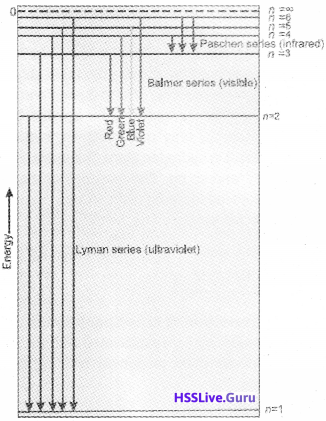
Line spectrum of Hydrogen
The hydrogen spectrum consists of several series of lines named after their discoverers. Balmershowed in 1885 on the basis of experimental observations that if spectral lines are expressed in terms of wavenumber (\(\overline { v } \)), then the visible lines of the hydrogen spectrum obey the following formula :
\(\overline { v } \) = 109,677 \(\left[\frac{1}{2^{2}}-\frac{1}{n^{2}}\right] \mathrm{cm}^{-1}\)
where n = 3, 4, 5, ………….
The series of lines described by this formula are called the Balmer series.

The value 109,677cm-1 is called the Rydberg constant for hydrogen. The first 5 series of lines correspond to n1 = 1, 2, 3, 4, 5 are known as Lyman, Balmer, Paschen, Bracket and Pfund series respectively. Line specrum becomes more complex for heavier atoms.

Bhor’S Model For Hydrogen Atom
Bhors model for hydrogen atom says that
1. the energy of an electron does not change with time.
The diagram shows the Lyman, Balmer and Paschen series of transitions for hydrogen atom.
Plus One Chemistry Notes Chapter 2 Structure of Atom 3
2. The frequency of radiation absorbed or emitted when transition occurs between two stationary states that differ in energy by ∆E, is given by :
\(v=\frac{\Delta E}{h}=\frac{E_{2}-E_{1}}{h}\)
E1 and E2 are the energies of the lower and higher allowed energy states respectively.
The angular momentum of an electron in a given stationary state can be expressed as in equation,

Plus One Chemistry Notes Chapter 2 Structure of Atom 4

Bohr’s theory for hydrogen atom:
1. The stationary states for electron are numbered n = 1,2,3. These integral numbers are known as Principal quantum numbers.
2. The radii of the stationary states are expressed as:
rn = n² a0
where a0 = 52.9 pm

3. The most important property associated with the electron, is the energy of its stationary state. It is
given by the expression, \(E_{n}=-R_{H}\left(\frac{1}{n^{2}}\right)\)
where RH is called Rydberg constant and its value is 2.18 × 10⁻¹⁸ J. The energy of the lowest state, also called as the ground state, is
E1 = -2.18 × 10⁻¹⁸ \(\left(\frac{1}{1^{2}}\right)\) = -2.18 × 10⁻¹⁸ J. The energy of the stationary state for n = ∝, will be :
E2 = -2.18 × 10⁻¹⁸ J\(\left(\frac{1}{2^{2}}\right)\) = -0.545 × 10⁻¹⁸ J.

Plus One Chemistry Notes Chapter 2 Structure of Atom

When the electron is free from the influence of nucleus(n = ∞), the energy is taken as zero. When the electron is attracted by the nucleus and is present in orbit n, the energy is emitted and its energy is lowered. That is the reason for the presence of negative sign and depicts its stability relative to the reference state of zero energy and n = ∞

4. Bohr’s theory can also be applied to the ions containing only one electron, similar to that present in hydrogen atom. For example, He<sup>+</sup> Li<sup>2+</sup>, Be<sup>3+</sup> and so on. The energies of the stationary states associated with these hydrogen-like species are given by the expression,
Plus One Chemistry Notes Chapter 2 Structure of Atom 5

Explanation of Line Spectrum of Hydrogen
The frequency (v) associated with the absorption and emission of the photon can be evaluated by using equation,
Plus One Chemistry Notes Chapter 2 Structure of Atom 6

Limitations of Bohr’s Model
Bohr’s model was too simple to account for the following points:
1. It fails to account for the finer details (doublet, that is two closely spaced lines) of the hydrogen atom spectrum. This model is also unable to explain the spectrum of atoms other than hydrogen Further, Bohr’s theory was also unable to explain the splitting of spectral lines in the presence of magnetic field (Zeeman effect) or an electric field (Stark effect).
2. It could not explain the ability of atoms to form molecules by chemical bonds.

Towards Quantum Mechanical Model Of The Atom
Two important developments which contributed significantly in the formulation of a more suitable and general model for atoms were:

  1. Dual behaviour of matter
  2. Heisenberg uncertainty principle

Dual Behaviour of Matter
The French physicist, de Broglie proposed that matter, like radiation, should also exhibit dual behaviour i. e., both particle and wavelike properties. This means that just as the photon, electrons should. also have momentum as well as wavelength. de Broglie, from this analogy, gave the following relation between wavelength (λ) and momentum (p) of a material particle.
\(\lambda=\frac{h}{m v}=\frac{h}{p}\)

Heisenberg’s Uncertainty Principle
Werner Heisenberg a German physicist in 1927, stated uncertainty principle which is the consequence of dual behaviour of matter and radiation. It states that it is impossible to determine simultaneously, the exact position and exact momentum (or velocity) of an electron. Mathematically, it can be given as in equation,
Plus One Chemistry Notes Chapter 2 Structure of Atom 7

∆x is the uncertainty in position and ∆p<sub>x</sub> (or ∆v<sub>x</sub>) is the uncertainty in momentum (or velocity) of the particle. If the position of the electron is known with high degree of accuracy (∆x is small), then the velocity of the electron will be uncertain ∆v<sub>x</sub> is large]. On the other hand, if the velocity of the electron is known precisely ( ∆v<sub>x</sub> is small), then the position of the electron will be uncertain (∆x will be large). Thus, if we carry out some physical measurements on the electron’s position or velocity, the outcome will always depict a fuzzy or blur picture.

Significance of Uncertainty Principle
Heisenberg Uncertainty Principle rules out existence of definite paths or trajectories of electrons and other similar particles. The trajectory of an object is determined by its location and velocity at various moments. If we know where a body is at a particular instant and if we also know its velocity and the forces acting on it at that instant, we can tell where the body would be sometime later. We, therefore, conclude that the position of an object and its velocity fix its trajectory. The effect of Heisenberg Uncertainty Principle is significant only for motion of microscopic objects and is negligible for that of macroscopic objects.

Reasons for the Failure of the Bohr Model
In Bohr model, an electron is regarded as a charged particle moving in well defined circular orbits about the nucleus. The wave character of the electron is not considered in Bohr model. Further, an orbit is a clearly defined path and this path can completely be defined only if both the position and the velocity of the electron are known exactly at the same time. This is not possible according to the Heisenberg uncertainty principle. Bohr.model of the hydrogen atom, therefore, not only ignores dual behaviour of matter but also contradicts Heisenberg uncertainty principle. There was no point in extending Bohr model to other atoms. In fact, an insight into the structure of the atom was needed which could account for wave-particle duality of matter and be consistent with Heisenberg uncertainty principle. This came with the advent of quantum mechanics.

Quantum Mechanical Model Of Atom
Quantum mechanics is a theoretical science that deals with the study of motions of microscopic objects such as electrons.

In quantum mechanical model of atom, the behaviour of an electron in an atom is described by an equation known as Schrodinger wave equation. Fora system, such as an atom or molecule whose energy does not change with time, the Schrodinger equation written as Hψ = Eψ where H is a mathematical operator, called Hamiltonian operator, E is the total energy and ψ is the amplitude of the electron wave called wave function.

Hydrogen Atom And The Schrodinger Equation
The wave function ψ as such has no physical significance. It only represents the amplitude of the electron wave. However ψ² may be considered as the probability density of the electron cloud. Thus, by determining ψ² at different distances from the nucleus, it is possible to trace out or identify a region of space around the nucleus where there is high probability of locating an electron with a specific energy.

Plus One Chemistry Notes Chapter 2 Structure of Atom

According to the uncertainty principle, it is not possible to determine simultaneously the position and momentum of an electron in an atom precisely. So Bohr’s concept of well defined orbits for electron in an atom cannot hold good. Thus, in quantum mechanical mode, we speak of probability of finding an electron with a particular energy around the nucleus. There are certain regions around the nucleus where probability of finding the electron is high. Such regions are called orbitals. Thus an orbital may be defined as the region in space around the nucleus where there is maximum probability of finding an electron having a specific energy.

Orbitals and Quantum Numbers
Orbitals in an atom can be distinguished by their size, shape and orientation. An orbital of smaller size means there is more chance of finding the electron near the nucleus. Similarly, shape and orientation mean that there is more probability of finding the electron along certain directions than along others. Atomic orbitals are precisely distinguished by what are known as quantum numbers. Each orbital is designated by three quantum numbers labelled as n, l and m<sub>l</sub>

The principal quantum number n’ is a positive integer with value of n= 1, 2, 3 ……………

The principal quantum number determines the size and to large extent the energy of the orbital.

The principal quantum number also identifies the shell. With the increase in the value of ‘n’, the number of allowed orbital increases and are given by ‘n²’ Ait the orbitals of a given value of ‘n’ constitute a single shell of atom and are represented by the following letters
n= 1 2 3 4 ………………
Shell = K LM N ………………

Size of an orbital increases with increase of principal quantum number ‘n’. Since energy of the orbital will increase with increase of n.

Plus One Chemistry Notes Chapter 2 Structure of Atom

Azimuthal quantum number, ‘F is also known as orbital angular momentum or subsidiary quantum number. It defines the three-dimensional shape of the orbital. For a given value of n, l can have n values ranging from 0 to (n – 1), that is, for a given value of n, the possible value of l are: l = 0, 1, 2, ……….. (n – 1)

Each shell consists of one or more subshells or sub-levels. The number of subshells in a principal shell is equal to the value of n. For example h the first shell (n = 1), there is only one sub-shell which corresponds to l = 0. There are two sub-shells (l= 0, 1) in the second shell (n = 2), three l= 0, 1, 2) and so on. Each sub-shell is assigned an azimuths! quantum number (l). Sub-shells corresponding to different values of l are represented by the following symbols.
l : 0 1 2 3 4 5 …………….
Notation for sub-shell : s p d f g h …………….

Magnetic orbital quantum number. ‘m<sub>l</sub>’ gives information about the spatial orientation of the or bital with respect to standard set of co-ordinate axis. For any sub-shell (defined by T value) 21+ 1 values of m,are possible and these values are given by:
m, = -l, -(l-1), (l-2)… 0, 1… (l-2), (l-1), l Thus for l = 0, the only permitted value of m,= 0, [2(0) + 1 = 1, one s orbital].

Electron spin ‘s’:
George Uhlenbeck and Samuel Goudsmit proposed the presence of the fourth quantum number known as the electron spin quantum number (m<sub>s</sub>). Spin angular momentum of the electron — a vector quantity, can have two orientations relative to the chosen axis. These two orientations are distinguished by the spin quantum numbers ms which can take the values of +½ or -½. These are called the two spin states of the electron and are. normally represented by two arrows, ↑ (spin up) and ↓ (spin down). Two electrons that have different m<sub>s</sub> values (one +½ and the other -½) are said to have opposite spins. An orbital cannot hold more than two electrons and these two electrons should have opposite spins.

Shapes of Atomic Orbitals
The orbital wave function or V for an electron in an atom has no physical meaning. It is simply a mathematical function of the coordinates of the electron.

According to the German physicist, Max Bom, the square of the wave function (i.e., ψ²) at a point gives the probability density of the electron at that point.

Plus One Chemistry Notes Chapter 2 Structure of Atom

For 1 s orbital the probability density is maximum at the nucleus and it decreases sharply as we move away from it. The region where this probability I density function reduces to zero is called nodal surfaces or simply nodes. In general, it has been found that ns-orbital has (n – 1) nodes, that is, number of nodes increases with increase of principal quantum number n.

These probability density variation can be visualised . in terms of charge cloud diagrams.

Boundary surface diagrams of constant probability density for different orbitals give a fairly good representation of the shapes of the orbitals. In this representation, a boundary surface or contour surface is drawn in space for an orbital on which the value of probability density |ψ|² is constant. Boundary ‘ surface diagram for a s orbital is actually a sphere centred on the nucleus. In two dimensions, this sphere looks like a circle. It encloses a region in which probability of finding the electron is about 90%. The s-orbitals are spherically symmetric, that is, the probability of finding the electron at a given distance is equal in all the directions.

Plus One Chemistry Notes Chapter 2 Structure of Atom

unlike s-orbitals, the boundary surface diagrams of p orbitals are not spherical. Instead, each p orbital consists of two sections called lobes that are on either side of the plane that passes through the nucleus. The probability density function is zero on the plane where the two lobes touch each other. The size, shape and energy of the three orbitals are identical. They differ, however, in the way the lobes are oriented. Since the lobes may be considered to lie along the x, y or z-axis, they are given the designations 2px, 2py, and 2pz. It should be understood, however, that there is no simple relation between the values of m, (-1, 0 and+1) and the x, y and z directions. For our purpose, it is sufficient to remember that, because there are three possible values of m, there are, therefore, three p orbitals whose axes are mutually perpendicular. Like s orbitals, p orbitals increase in size and energy with increase in the principal quantum number

The number of nodes are given by (n -2), that is number of radial node is 1 for 3p orbital, two for 4p orbital and so on.

For l = 2, the orbital is known as d-orbital and the minimum value of principal quantum number (n) has to be 3 as the value of l cannot be greater than n-1. There are five m; values (-2, -1, 0, +1 and +2) for l = 2 and thus there are five d orbitals. The five d-orbitals are designated as dxy, dyz, dxz, dx²-y² and d. The shapes of the first fourd-orbitals are similarto each other, where as that of the fifth one, d, is different from others, but all five 3d orbitals are equivalent in energy. The d orbitals for which n is greater than 3 (4d, 5d…) also have shapes similar to 3d orbital, but differ in energy and size.

Plus One Chemistry Notes Chapter 2 Structure of Atom

Besides the radial nodes (i.e., probability density function is zero), the probability density functions for the np and nd orbitals are zero at the plane (s), passing through the nucleus (origin). For example, in case of pz orbital, xy-plane is a nodal plane, in case of dxy orbital, there are two nodal planes passing through the origin and bisecting the xy plane containing z-axis. These are called angular nodes and number of angular nodes are given by T, i.e., one angular node for p orbitals, two angular nodes for cf orbitals and so on. The total number of nodes are given by (n-1), i.e., sum of I angular nodes and (n-l-1) radial nodes.

Energies Of Orbitals
The order of energy of orbitals in single electron sys-tem are given below:
1s < 2s = 2p < 3s = 3p = 3d < 4s = 4p = 4d = 4f The orbitals having same energy are called degenerate.

Filling Of Orbitals In Atom
Aufbau principle: According to this principle in the ground state of an atom, an electron will occupy the orbital of lowest energy and orbitals are occupied by electrons in the order of increasing energy.
Plus One Chemistry Notes Chapter 2 Structure of Atom 8
Plus One Chemistry Notes Chapter 2 Structure of Atom 9

Pauli’s exclusiohn principle : Pauli’s exclusion principle states that ‘no two electrons in an atom can have the same values for all the four quantum numbers’

Since the electrons in an orbital must have the same n, I and m quantum numbers, if follows that an orbital can contain a maximum of two electrons provided their spin quantum numbers are different. This is an important consequence of Pauli’s exclusion principle which says that an orbital can have maximum two electrons and these must have opposite spins.

Plus One Chemistry Notes Chapter 2 Structure of Atom

Hund’s rule of maximum multiplicity :
This rule states that electron pairing in orbitals of same energy will not take place until each available orbital of a given subshell is singly occupied (with parallel spin).
The rule can be illustrated by taking the example of carbon atom. The atomic number of carbon is 6 and its electronic configuration is 1s²2s²2p². The two electrons of the 2p subshell can be distributed in the following three ways.

According to Hund’s rule, the configuration in which the two unpaired electron occupying 2px, and 2py orbitals with parallel spin is the correct configuration of carbon.

Exceptional configurations of chromium and copper
The electronic configuration of Cr (atomic number 24) is expected to be [Ar] 4s² 3d4, but the actual configuration is [Ar] 4s¹ 3d5. Similarly, the actual configuration of Cu (At. No. 29) is [Ar] 4s¹ 3d10 instead of the expected configuration [Ar] 4s² 3d9.

This is because of the fact that exactly half filled or completely filled orbitals (i.e., d5, d10, f7, f14) have lower energy and hence have extra stability.

Plus One Computer Science Notes Chapter 5 Introduction to C++ Programming

Students can Download Chapter 5 Introduction to C++ Programming Notes, Plus One Computer Science Notes helps you to revise the complete Kerala State Syllabus and score more marks in your examinations.

Kerala Plus One Computer Science Notes Chapter 5 Introduction to C++ Programming

Summary
It is developed by Bjarne Stroustrup. It is an extension of C Language.

Plus One Computer Science Notes Chapter 5 Introduction to C++ Programming

Character set:
To study a language first we have to familiarize the character set. For example to study English language first we have to study the alphabets. Similarly here the character set includes letters(A to Z & a to z), digits(0 to 9), special characters(+, -, ?, *, /, …..) white spaces(non printable) etc..

Token:
It is the smallest individual units similar to a word in English or Malayalam language. C++ has 5 tokens
1. Keywords:
These are reserved words for the compiler. We can’t use for any other purposes eg: float is used to declare variable to store numbers with decimal point. We can’t use this for any other purpose

2. Identifier:
These are user defined words. Eg: variable name, function name, class name, object name, etc…

3. Literals (Constants):
Its value does not change during execution
(a) Integer literals:
Whole numbers without fractional parts are known as integer literals, its value does not change during execution. There are 3 types decimal, octal and hexadecimal.
eg:

  • For decimal 100, 150, etc
  • For octal 0100, 0240, etc
  • For hexadecimal 0x100, 0x1A, etc

(b)Float literals:
A number with fractional parts and its value does not change during execution is called floating point literals. eg: 3.14157, 79.78, etc.

(c) Character literal-: A valid C++ character enclosed in single quotes, its value does not change during execution. eg: ‘m’, ‘f ’ etc

(d) String literal:
One or more characters enclosed in double quotes is called string constant. A string is automatically appended by a null character(‘\0’)
eg: “Mary’s”, ’’India”, etc.

4. Punctuators:
In English or Malayalam language punctuation mark are used to increase the readability but here it is used to separate the tokens. eg: {,}, (,).

5. Operators:
These are symbols used to perform an operation(Arithmetic, relational, logical, etc…)

Plus One Computer Science Notes Chapter 5 Introduction to C++ Programming

Integrated Development Environment(IDE):
It is used for developing programs

  1. It helps to write as well as editing the program.
  2. It helps to compile the program and linking it to other (header files and other user) programs
  3. It helps to run the program

Turbo C++ IDE:
Following is an C++ IDE
Plus One Computer Science Notes Chapter 5 Introduction to C++ Programming 1
(a) Opening the edit window:
Method I: File → Click the menu item New
Method II: Press Alt and F simultaneously then press N

(b) Saving the program:
Click File → Save or Press Function key F2 or Alt + F and then press S. Then give a file name and press ok.

(c) Running/executing the program:
Press Alt + R then press R OR Click Run → press R, OR Press Ctrl + F9

(d) Viewing the output:
Press Alt + F5

(e) Closing Turbo C++ IDE:
Click File → then press Quit menu Or Press Alt + X

Plus One Computer Science Notes Chapter 5 Introduction to C++ Programming

Geany IDE
Plus One Computer Science Notes Chapter 5 Introduction to C++ Programming 2
Step 1: Take Geany Editor and type the program (source code)
Step 2: Save the file with extension .cpp
Step 3: Compile the program by Click the Compile Option
Step 4: After successful compilation, Click Build option
Step 5: Then click on Execute option

Plus One Computer Science Notes Chapter 4 Principles of Programming and Problem Solving

Students can Download Chapter 4 Principles of Programming and Problem Solving Notes, Plus One Computer Science Notes helps you to revise the complete Kerala State Syllabus and score more marks in your examinations.

Kerala Plus One Computer Science Notes Chapter 4 Principles of Programming and Problem Solving

Summary
Problem solving using computers:
It has no intelligent quotient. Hence they are slaves and human beings are the masters. It can’t take its own decisions.
They can perform tasks based upon the instructions given by the humans (programmers) .

Plus One Computer Science Notes Chapter 4 Principles of Programming and Problem Solving

Approaches in problem solving:
Top down design:
Larger programs are divided into smaller ones and solve each tasks by performing simpler activities. This concept is known as top down design in problem solving

Bottom up design:
Here also larger programs are divided into smaller ones and the smaller ones are again subdivided until the lowest level of detail has been reached. We start solving from the lowest module onwards. This approach is called Bottom up design.

Phases in Programming:
1. Problem identification:
This is the first phase in programming. The problem must be identified then only it can be solved, for this we may have to answer some questions.

During this phase we have to identify the data, its type, quantity and formula to be used as well as what activities are involved to get the desired out put is also identified for example if you are suffering from stomach ache and consult a Doctor.

To diagnose the disease the Doctor may ask you some question regarding the diet, duration of pain, previous occurrences etc, and examine some parts of your body by using stethoscope X-ray, scanning etc.

2. Deriving the steps to obtain the solution:
There are two methods, Algorithm and flowchart, are used for this.
(a) Algorithm:
The step-by-step procedure to solve a problem is known as algorithm. It comes from the name of a famous Arab mathematician Abu Jafer Mohammed Ibn Musaa Al-Khowarizmi, The last part of his name Al-Khowarizmi was corrected to algorithm.

(b) Flowchart:
The pictorial or graphical representation of an algorithm is called flowchart.
Flow chart symbols are explained below
(i) Terminal (Oval):
Plus One Computer Science Notes Chapter 4 Principles of Programming and Problem Solving 1
It is used to indicate the beginning and ending of a problem.
(ii) Input/Output (parallelogram):
Plus One Computer Science Notes Chapter 4 Principles of Programming and Problem Solving 2
It is used to take input or print output.
(iii) Processing (Rectangle):
Plus One Computer Science Notes Chapter 4 Principles of Programming and Problem Solving 3
It is used to represent processing. That means to represent arithmetic operation such an addition, subtraction,multiplication and, etc.
(iv) Decision (Rhombus):
Plus One Computer Science Notes Chapter 4 Principles of Programming and Problem Solving 4
Plus One Computer Science Notes Chapter 4 Principles of Programming and Problem Solving

It is used to represent decision making. It has one entry flow and two exit flows but one exit path will be executed at a time.
(v) Flow lines (Arrows):
Plus One Computer Science Notes Chapter 4 Principles of Programming and Problem Solving 5
It is used to represent the flow of operation
(vi) Connector:
Plus One Computer Science Notes Chapter 4 Principles of Programming and Problem Solving 6

3. Coding:
The dummy codes (algorithm) or flowchart is converted into program by using a computer language such s Cobol, Pascal, C++, VB, Java, etc.

4. Translation:
The computer only knows machine language. It does not know HLL, but the human beings HLL is very easy to write programs. Therefore a translation’ is needed to convert a program written in HLL into machine code (object code).

During this step, the syntax errors of the program will be displayed. These errors are to be corrected and this process will be continued till we get “No errors” message. Then it is ready for execution.

5. Debugging:
The program errors are called ‘bugs’ and the process of detecting and correcting errors is called debugging. In general there are two types of errors syntax errors and logical errors. When the rules or syntax of the language are not followed then syntax errors occurred and it is displayed after compilation.

When the logic of a program is wrong then logical errors occurred and it is not displayed after compilation but it is displayed in the execution and testing phase.

Plus One Computer Science Notes Chapter 4 Principles of Programming and Problem Solving

6. Execution and Testing:
In this phase the program will be executed and give test data for testing the purpose of this is to determine whether the result produced by the program is correct or not. There is a chance of another type of error, Run time error, this may be due to inappropriate data.

7. Documentation:
It is the last phase in programming. A computerized system must be documented properly and it is an ongoing process that starts in the first phase and continues till its implementation. It is helpful for the modification of the program later.

HSSLive Plus One Study Material / Question Bank Kerala

HSSLive.Guru providing HSE Kerala Board Syllabus HSSLive Higher Secondary SCERT Plus One Study Material, Question Bank, Quick Revision Notes, Chapter Wise Notes, Chapter Wise Previous Year Important Questions and Answers, Previous Year Sample Question Papers with Answers based on CBSE NCERT syllabus in both English Medium and Malayalam Medium for Class 11.

HSSLive Plus One Study Material / Question Bank Kerala

HSSLive Plus One Previous Year Question Papers and Answers Kerala

Here HSSLive.Guru have given HSSLive Higher Secondary Kerala Plus One Previous Year Sample Question Papers with Answers.

HSSLive Plus One Notes Chapter Wise Kerala

Here HSSLive.Guru have given HSSLive Higher Secondary Kerala Plus One Chapter Wise Quick Revision Notes.

HSSLive Plus One Chapter Wise Questions and Answers Kerala

Here HSSLive.Guru have given HSSLive Higher Secondary Kerala Plus One Chapter Wise Questions and Answers.

HSSLive Plus One Chapter Wise Previous Year Questions and Answers Kerala

Here HSSLive.Guru have given HSSLive Higher Secondary Kerala Plus One Chapter Wise Previous Year Important Questions and Answers.

Plus One Malayalam Textbook Answers, Notes, Chapters Summary HSSLive Kerala

HSSLive.Guru has great pleasure in presenting HSSLive Plus One Malayalam Textbook Questions and Answers, Plus One Malayalam Chapters Summary, Malayalam Chapter Wise Notes, SCERT Malayalam Guide Pdf, Malayalam Study Materials, Plus One Malayalam Handbook, Malayalam Textbook Kerala Syllabus PDF free download according to the latest syllabus prescribed by SCERT under the activity-oriented grading pattern for class 11.

Kerala Plus One Malayalam Textbook Questions and Answers, Notes, Chapters Summary HSSLive

Unit 1 Kinav

Unit 2 Kalca

Unit 3 Ullariv

Unit 4 Uravu

Plus One Malayalam Textbook Answers, Notes, Chapters Summary

Plus One Malayalam Guide has been designed with a view to improving the skill of answering all types of questions quickly and precisely. Plus One Malayalam material will boost your confidence in the subject and help you face examinations with ease.

Salient Features of Plus One Malayalam Material

  • A simple and brief summary of each lesson is given with its Malayalam translation.
  • All the activities and questions are given after each lesson have been fully answered.
  • The answers are given immediately after the questions.
  • Besides the questions in the text, Exam-oriented questions and their answers in the new pattern are given.
  • Questions on grammar and discourse are also included in this guide.

We hope that HSSLive Plus One Malayalam Study Material will help you improve your quality of learning as per the new grading system and to get an A+ grade in Malayalam. Suggestions for further improvement of this material are always appreciated.

Plus One Malayalam Previous Year Question Papers and Answers

HSSLive Plus One

Plus One Accountancy Chapter Wise Questions and Answers Kerala

HSE Kerala Board Syllabus HSSLive Plus One Accountancy Chapter Wise Questions and Answers Pdf Free Download in both English Medium and Malayalam Medium are part of SCERT Kerala Plus One Chapter Wise Questions and Answers. Here HSSLive.Guru has given Higher Secondary Kerala Plus One Accountancy Chapter Wise Questions and Answers based on CBSE NCERT syllabus.

Board SCERT, Kerala
Text Book NCERT Based
Class Plus One
Subject Accountancy
Chapter All Chapters
Category Kerala Plus One

Kerala Plus One Accountancy Chapter Wise Questions and Answers

We hope the given HSE Kerala Board Syllabus HSSLive Plus One Accountancy Chapter Wise Questions and Answers Pdf Free Download in both English Medium and Malayalam Medium will help you. If you have any query regarding Higher Secondary Kerala Plus One Accountancy Chapter Wise Questions and Answers based on CBSE NCERT syllabus, drop a comment below and we will get back to you at the earliest.

HSSLive Plus One

Plus One Hindi Textbook Answers, Notes, Chapters Summary HSSLive Kerala

HSE Kerala Board Syllabus HSSLive Plus One Hindi Notes, Hindi Textbook Questions and Answers, Hindi Malayalam Translation, Chapters Summary in Malayalam, Chapter Wise Notes, Hindi Guide Kerala, Plus One Hindi Handbook, SCERT Hindi Textbook Kerala Syllabus, Hindi Model Question Papers and Answers, Hindi Study Material, Hindi Textbook Activity Answers, Hindi Course Book Answers are part of SCERT Kerala HSSLive Plus One Notes.

Board SCERT, Kerala
Text Book SCERT
Class Plus One
Subject Hindi
Chapter All Chapters
Category Kerala Plus One

Kerala Plus One Hindi Textbook Answers, Notes, Chapters Summary HSSLive

Unit 1 सपने-सुहाने

Unit 2 चाँद-सितारे

Unit 3 जान-पहचान

Unit 4 दर-किनार

We hope that HSSLive Plus One Hindi Notes, Hindi Textbook Questions and Answers, Hindi Malayalam Translation, Chapters Summary in Malayalam will help you improve your quality of learning as per the new grading system and to get an A+ grade. Suggestions for further improvement of this material are always appreciated.

HSSLive Plus One

Plus One English Textbook Answers, Notes, Chapters Summary HSSLive Kerala

HSSLive.Guru have great pleasure in presenting HSSLive Plus One English Textbook Questions and Answers, Chapters Summary in Malayalam, Chapter Wise Notes, SCERT English Guide Kerala, English Study Materials, English Textbook Activity Answers, English Course Book Answers, English Teachers Hand Book, English Textbook Kerala Syllabus PDF free download according to the latest syllabus prescribed by SCERT in the NCERT pattern under the activity-oriented grading pattern for class 11.

Kerala Plus One English Textbook Questions and Answers, Notes, Chapters Summary HSSLive

Unit 1 Glimpses of Greatness

Unit 2 Words and Deeds

Unit 3 Beyond The Horizon

Unit 4 Braving The Hazards

Unit 5 Harmony of Life

Unit 6 Leaps and Bounds

Plus One English Guide has been designed with a view to improving the skill of answering all types of questions quickly and precisely. Plus One English Study Material will boost your confidence in the subject and help you face examinations with ease.

Carefully prepared study material for Plus One students in English. The style of learning has changed in accordance with the changes in curriculum. Answer the queries of learners and teachers about the changes that have been brought in the question structure and in the form of questions based on the content in the textbook.

Salient Features of Plus One English Material

  • A simple and brief summary of each lesson is given with its Malayalam translation.
  • All the activities and questions given after each lesson have been fully answered.
  • The answers are given immediately after the questions. Malayalam translation of the questions is also given.
  • Besides the questions in the text, Exam-oriented questions and their answers in the new pattern are given.
  • Questions on grammar and discourse are also included in this guide.

We hope that HSSLive Plus One English Study Material will help you improve your quality of learning as per the new grading system and to get an A+ grade in English. Suggestions for further improvement of this material are always appreciated.

Plus One English Previous Year Question Papers and Answers

HSSLive Plus One